Category: Nation World News Wires

  • Iran proposes a deal to reopen the Strait of Hormuz in 7 days if the U.S. meets its conditions

    Iran proposes a deal to reopen the Strait of Hormuz in 7 days if the U.S. meets its conditions

    Iran has offered to reopen the Strait of Hormuz and resume talks on its nuclear program in seven days if the United States lifts its naval blockade of Iranian ports, waives sanctions on Iranian oil sales, and observes a ceasefire that would include Lebanon.

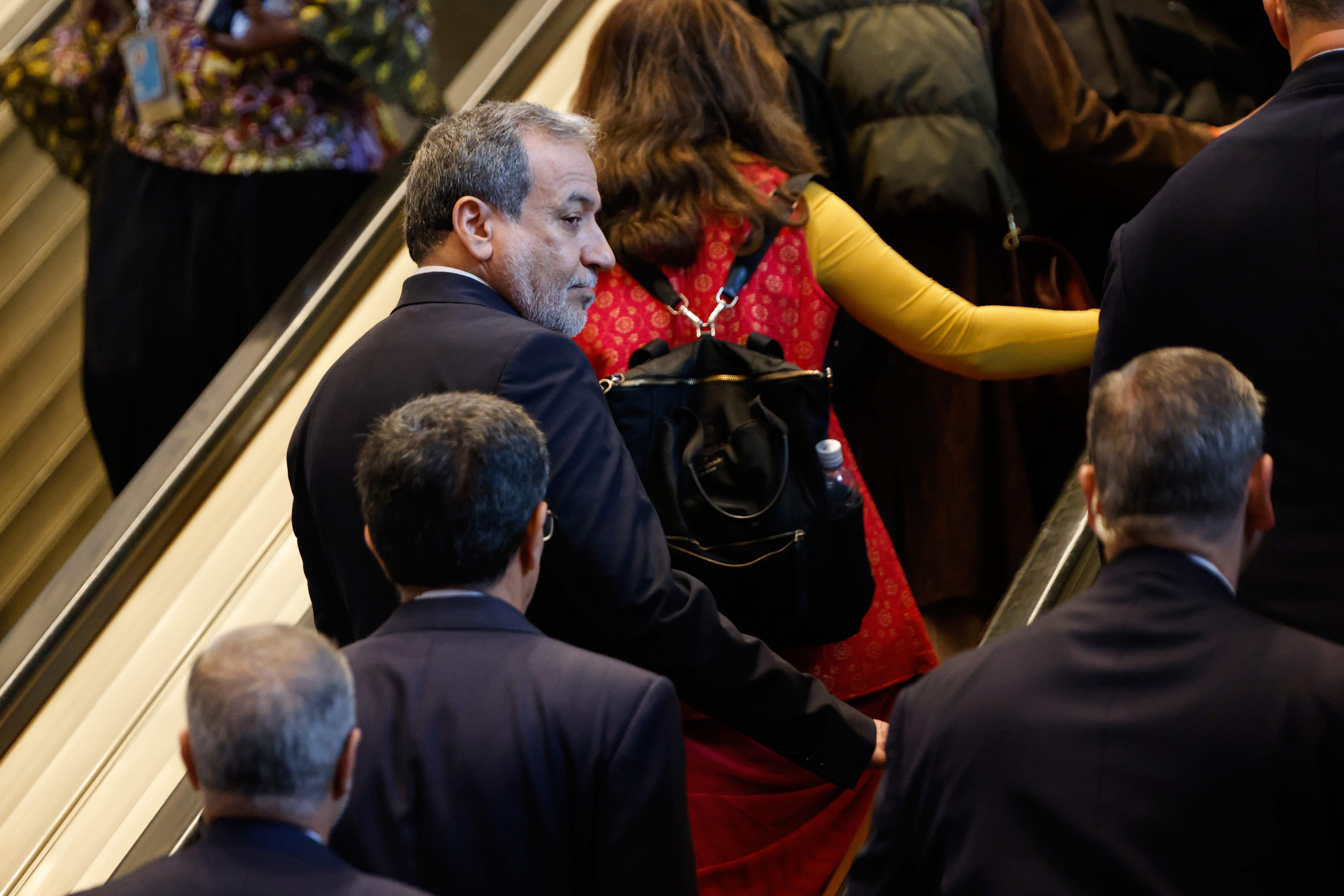
    Iran’s Foreign Minister Abbas Araghchi detailed the proposal in a private gathering on Thursday on the sidelines of the U.N. General Assembly in New York, according to one attendee.

    Trita Parsi, executive vice president of the Quincy Institute think tank, said Araghchi suggested that a speedy agreement would help U.S. President Donald Trump ahead of November’s midterm elections. The arrangement would also relieve enormous economic pressure on Tehran as the U.S. piles on additional sanctions.

    Iran’s disruption of the strait — through which a fifth of the world’s traded oil and gas transited before the war — has emerged as its main point of leverage. The effects have been felt far beyond the Middle East.

    There was no immediate comment from Iran’s U.N. mission or other Iranian officials. A person familiar with the matter, speaking on condition of anonymity to discuss private deliberations, told the Associated Press that Saudi Arabia was skeptical of the latest push for a deal.

    The White House said Friday that U.S. officials are having positive and constructive conversations with mediators on the Iran war. In response to questions from the Associated Press, it said the U.S. is facilitating significant oil exports through the Strait of Hormuz.

    Proposal resembles a June deal that quickly crumbled

    The proposal, conveyed to the U.S. by mediators, strongly resembles the so-called Memorandum of Understanding reached in June, but with an accelerated timetable. The earlier agreement, which called for a 60-day interim period, quickly collapsed as Iran resumed attacks on shipping in the strait.

    Trump has said he is in no rush to reach a deal, even as high oil prices fuel inflation. On the Iranian side, there are questions as to whether the hard-liners who dominate the security forces would accept compromises championed by moderates like President Masoud Pezeshkian.

    “If Trump calculates this arrangement is worthwhile and can bring political benefit before the midterms and reduce gas prices, perhaps we’ll see flexibility not seen in previous weeks,” Parsi said. But he noted “deep suspicion,” especially around the prospect of Iran merely buying time to ship out more of its oil and ease its economic pain.

    Other signs of renewed diplomacy

    In the latest sign of diplomatic movement, Pezeshkian hosted the prime minister of Qatar early Friday. Qatar has been a key mediator, including during hours of indirect Iran-U. S. talks at the U.N. this week.

    It was not clear how long Pezeshkian and Araghchi would stay in the U.S. after Pezeshkian addressed the annual U.N. gathering of world leaders on Wednesday, ending his speech by saying Iran remained open to diplomacy.

    U.S. Secretary of State Marco Rubio, on the same day, said, “If there’s an opportunity to exchange ideas and messages, we will.”

    After multiple failed attempts at a deal, however, suspicion is high on both sides. The U.S. and Israel have attacked Iran twice while it was engaged in nuclear talks, and the U.S. and Iran accuse each other of having swiftly violated the June agreement.

    “The Iranians already know that the chances of this not being accepted by Trump are much higher than the opposite,” Hamidreza Azizi, senior Iran analyst at the International Crisis Group think tank, wrote on X.

    “They want to show that they were ready for diplomacy and that it was the United States that, for the third time, decided to attack in the middle of a diplomatic track — something that people within (Iran’s) strategic community have been anticipating over the past few days.”

    It’s unclear if the proposal would include the Yemen conflict

    The proposal would include Lebanon, where Israel and the Iran-backed Hezbollah have been mostly observing a ceasefire. It’s not clear, however, if it would include the revived conflict between Yemen’s Iran-backed Houthi rebels and Saudi Arabia, which has put even more pressure on global markets.

    Iran appears to think the Houthis’ newly enhanced ability to threaten the Bab el-Mandeb strait on the Red Sea — another trade chokepoint on the other side of the Arabian Peninsula — could push Trump to make a deal.

    Maj. Gen. Yahya Rahim Safavi, a military adviser to Iran’s new supreme leader, told state television that the Americans “face a new problem called the Bab el-Mandeb Strait.”

    He added: “I think the process that is unfolding is in our favor, and the Americans will be forced to accept Iran’s conditions.”

    With the Houthis’ latest surge in attacks, Saudi Arabia was skeptical of Araghchi’s latest push for a deal with the U.S., according to the person familiar with the matter.

    The kingdom, along with other Gulf states, had advocated over the summer for a return to negotiations, saying they could live with an agreement that gave Iran a temporary role in managing the Strait of Hormuz, the person said.

    But the Saudi calculations changed as the Houthis seized Yemen’s strategic Red Sea coast from pro-government forces and a vital Saudi pipeline came under attack.

    Earlier this month, Gulf leaders planned to gather in Oman to discuss an emerging agreement between Oman and Iran on the Strait of Hormuz, which runs between the two countries. But the meeting was canceled after Saudi Arabia called for amendments, only some of which were accepted by Iran, the person said.

    Iran’s leadership has shown signs of divisions

    Iran’s leaders have sought to project unity, but some hard-liners want to continue or escalate the war to secure bigger U.S. concessions and have criticized Pezeshkian and Araghchi’s diplomatic steps this week.

    Firebrand lawmaker Ebrahim Rezaei wrote on X that merely meeting with “the aggressor enemy” showed weakness. Iran’s Assembly of Experts, a panel of Shiite clerics who appoint the supreme leader, said, “There is no path other than resistance.”

    The head of Iran’s powerful Revolutionary Guard, Brig. Gen. Ahmad Vahidi, highlighted the U.N. speech by “the esteemed president” while focusing on Pezeshkian’s comments that Iran doesn’t fear war.

    Iran’s parliament speaker, Mohammad Bagher Qalibaf, who served as chief negotiator in earlier talks with the United States, provided a rare public acknowledgment of the internal divide.

    “There is a view that speaks of war but offers no prospect or mechanism for bringing it to a powerful conclusion,” he wrote on social media. “At the opposite end is a current that makes the error of underestimating national capabilities.”

    He added: “The first error keeps the country in a state of permanent crisis, while the second hands national resources and dignity over to the enemy.”
  • Pope praises free press, warns a ‘paradise of machines’ could undermine humanity as he opens France trip

    Pope praises free press, warns a ‘paradise of machines’ could undermine humanity as he opens France trip

    PARIS — Pope Leo XIV warned Friday that a “paradise of machines” risked undermining humanity as he opened a trip to France by posing fundamental questions about what it means to be human in the age of artificial intelligence, a nuclear arms race, and other threats to life itself.

    Leo raised existential concerns about scientific progress, life, and human rights during his opening speech to President Emmanuel Macron and authorities at the Élysée Palace and then to diplomats and United Nations employees at the headquarters of UNESCO, the U.N. culture and education organization.

    With wars plaguing Europe and the Middle East, he reaffirmed the Vatican’s opposition to nuclear weapons and said the nuclear deterrence doctrine was “mistaken” since it was just fueling a new arms race.

    “Peace is not a balance of power; rather, it is built day by day through dialogue and justice,” he said.

    Leo has an intense four days in France, where the Catholic Church has lost ground in influencing ethical issues given the strict approach to secularism that is enshrined in the French Constitution.

    Yet thousands of people lined his motorcade route, waving French and Holy See flags, with some braving hours of the unseasonable heat to catch a glimpse of him. The turnout underscored the surprising level of interest in Leo’s visit, the first official state visit by a pope to France in 18 years.

    “To see him, praying with us, it comforts us in our faith and on our path,” said Senegalese Sister Antonia Faye, who was glowing after her first-ever event with a pope, an evening prayer service at Notre Dame that featured angelic choirs and the cathedral’s booming organ.

    “Being with the pope is different to being alone or praying alone. We felt the benediction that came down on us,” she said.

    Pope says reporters ‘are all welcome’

    During his flight to France, Leo told journalists they were welcome to report on him, as he responded to the Trump administration’s attempt to bar U.S. media from the White House and affirmed the importance of journalists covering public figures.

    Asked by a CNN reporter about the Trump administration’s attempt to bar CNN and other reporters, Leo said the media was welcome on his plane.

    “I am very happy that here, you are all welcome,” he said. Good media coverage is important, he said, and equally important “that we have it all the way around, for everyone”

    The American pope has long affirmed the need for free and independent press, a point he made in one of his first audiences as pope. Speaking to journalists who covered the 2025 conclave that elected him, Leo called for the release of imprisoned journalists and affirmed the “precious gift of free speech and the press.”

    A capstone visit as Macron’s term ends

    For Macron, who is barred from seeking a third term in May elections, hosting the American pope is something of a capstone. Pope Francis had refused repeatedly to make a proper state visit to France during his 12-year pontificate and pointedly refused to join the inauguration of the rebuilt Notre Dame cathedral in 2024 that Macron had championed.

    “For a president of the republic as Macron, who is at the end of his mandate, it can be important to be aside the pope and to capture a part of his popularity,” said Charles Mercier, director of history and sociology of Catholicism studies at Paris EPHE university.

    With seven months left in his term, Macron’s approval ratings are near record lows, driven by anger over the rising cost of living and criticism of France’s growing debt and deficit and deteriorating public services.

    Smiling broadly as Leo spoke French, Macron thanked the pope for visiting, saying: “You are here with us for an extended visit, giving us your time, and that is moving.”

    Leo calls for the French to mull lofty questions about life

    Unlike Francis, who liked to travel to small Catholic communities far from Rome, Leo has been keen to emphasize and reawaken Europe’s Christian roots. He is seeking to push the church’s message about the value and dignity of human life in a country where the right to abortion was enshrined in the constitution in 2024, and where lawmakers recently gave final approval to a bill allowing adults with incurable illnesses to receive lethal medication.

    The French Catholic hierarchy strongly opposed the measures, in keeping with Catholic teaching that human life must be protected and defended from conception until natural death.

    In his speech to Macron and other government and diplomatic authorities, Leo reminded France of its “deep Christian roots” and called for the French to remember that the right to life is the “indispensable foundation of every other human right.”

    His concern about the dignity of human life and humanity as a whole extended to the threats posed by artificial intelligence.

    “The paradox has become increasingly evident: while ‘intelligence’ is attributed to computational systems, we struggle to recognize the inalienable dignity of human persons, whose lives are judged according to the criterion of efficiency and, when deemed no longer productive, are rejected and discarded,” he said.

    From the very start of his pontificate, Leo has identified AI as one of the greatest challenges facing humanity. He dedicated his first encyclical to the topic, “Magnificent Humanity,” calling for robust regulation and for AI developers to work for the common good rather than profit.

    Leo also appealed to AI developers and political leaders responsible for regulating them to slow down, an appeal that several top AI companies seem to have taken to heart recently.

    “If we are to avoid losing our humanity amid a ‘paradise of machines’ invading and conditioning our daily lives, there is an urgent need for education in ethical discernment and the capacity to acknowledge the moral good,” he said.

    Leo earlier told reporters that he was pleased his message was being heard and said he hoped the dialogue that the Vatican initiated with tech companies would continue.

    “And I think from their perspective, many of them, they’re very much open to looking for ways of making sure that AI does not displace or ultimately destroy humanity, but rather is a tool for human beings,” he said.

    A visit to Notre Dame that Francis declined

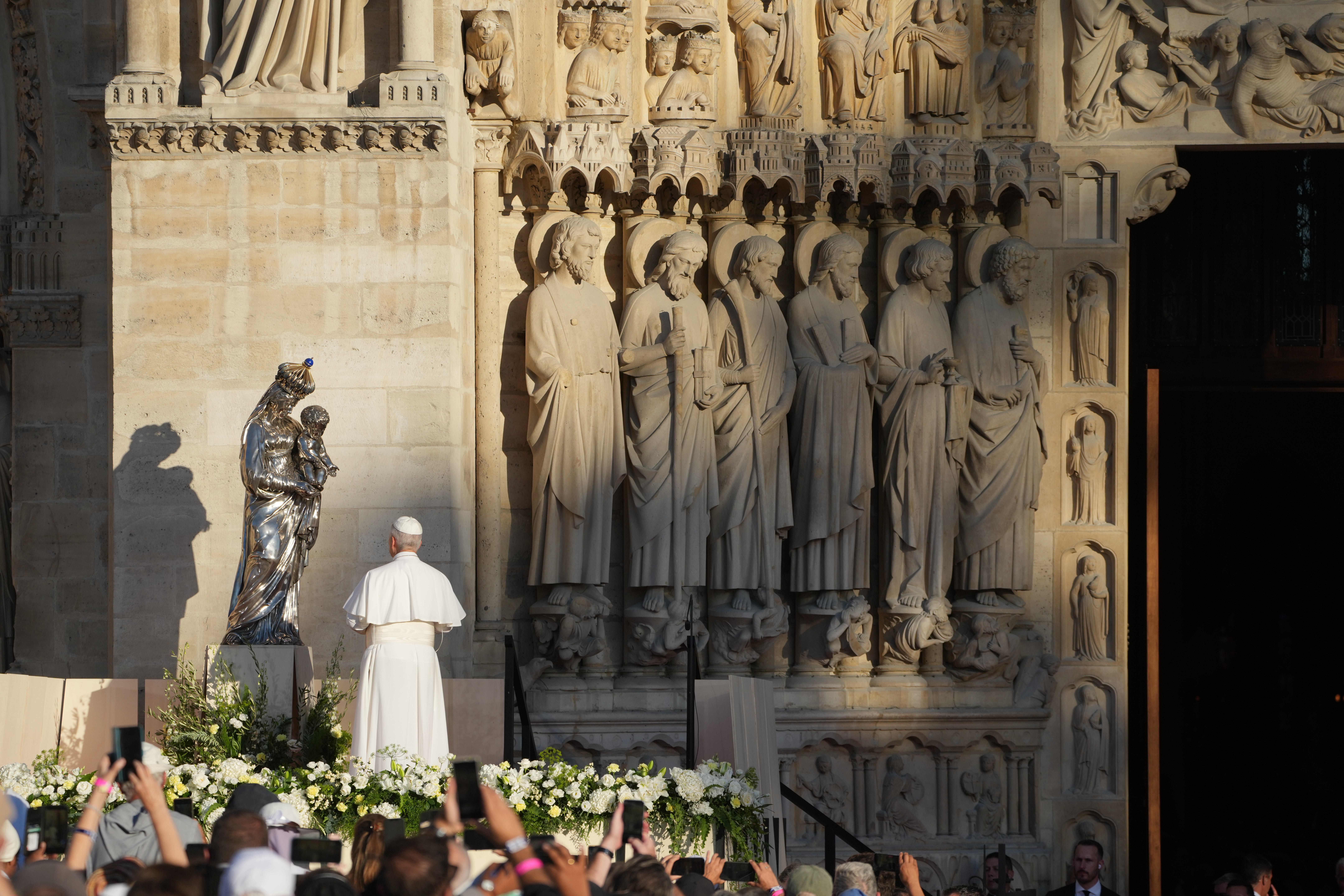
    Later on Friday, Leo presided over evening prayers in Paris’ soaring Notre Dame cathedral, the first pope to celebrate there since the devastating 2019 fire that consumed the cathedral’s roof and toppled its spire.

    After being mobbed by a crowd of eager nuns outside, Leo walked down the central aisle to the combined thundering of the organ above and cheers from the pews below. As bells tolled, he knelt in silent prayer in the same spot where, in 2019, flames brought down scorched roof beams.

    Leo marveled at the brilliance of the stained-glass windows and restored cream columns and praised the artisans who repaired them. He urged the priests and nuns gathered in the pews to be inspired by the combined effort to bring the Gothic masterpiece back to life.

    Francis had refused to visit France on a proper state visit, and explicitly refused Macron’s invitation to come for the 2024 reopening of the cathedral that drew dozens of world leaders.

    He did make three short trips to French cities, however, including Strasbourg in 2014 and Marseille and Corsica in 2024, a one-day visit that became his last foreign trip.

  • Democrats press RFK Jr. on an ethics agreement change involving law firm fees

    Democrats press RFK Jr. on an ethics agreement change involving law firm fees

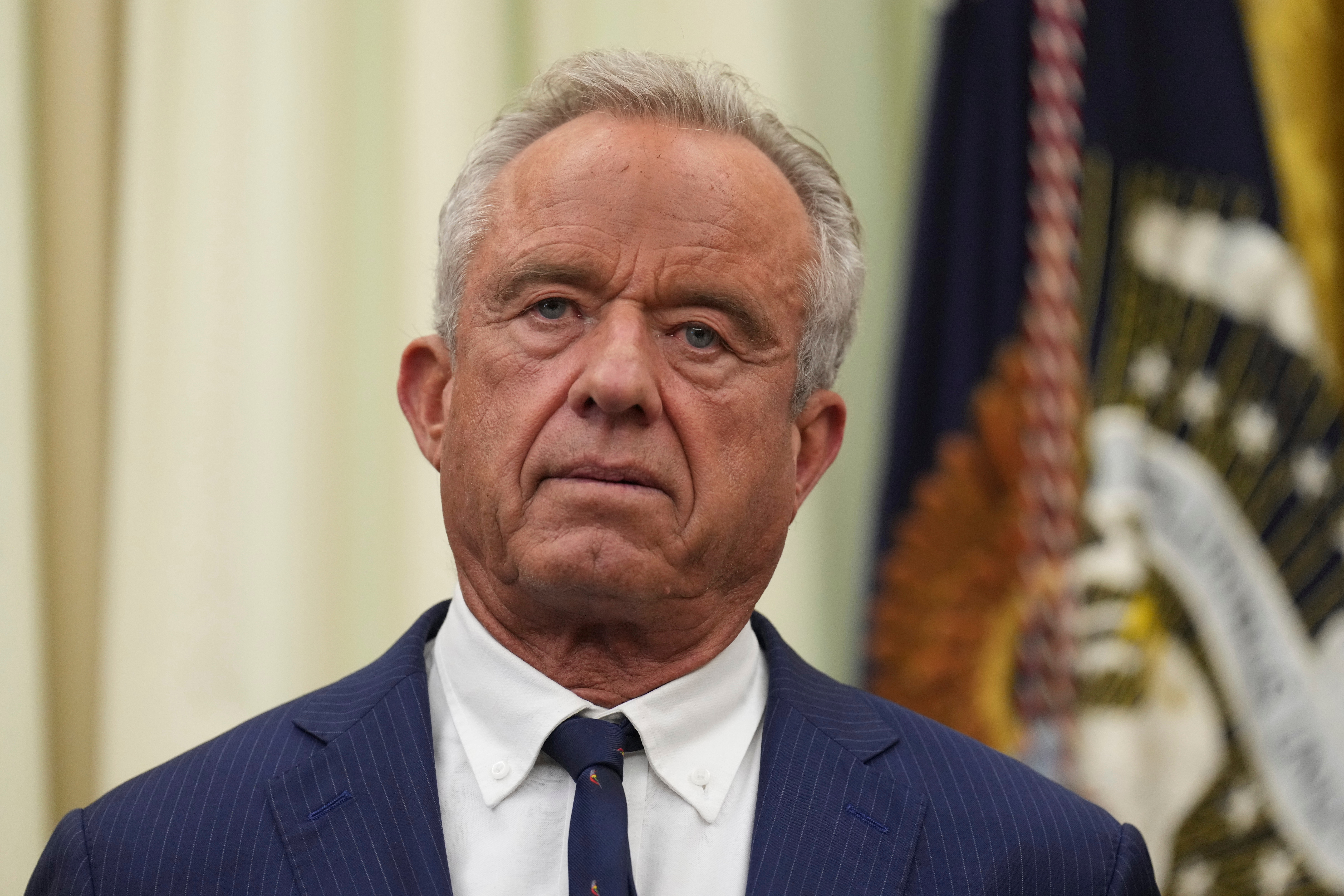
    WASHINGTON — Congressional Democrats are pressing for answers from Health Secretary Robert F. Kennedy Jr. over what they describe as a previously undisclosed change to the ethics agreement he made before being confirmed, which they say calls into question his credibility and the integrity of his decisions.

    Ahead of his confirmation vote last year, Kennedy told lawmakers that he would not collect fees related to litigation he pursued before becoming a government official against the drugmakers of a cervical cancer vaccine, saying he would transfer his financial interests to his adult son.

    The lawmakers say they recently learned, however, that shortly after his confirmation hearings, Kennedy quietly changed his ethics disclosures and transferred his stake to his former employer, the personal injury law firm Wisner Baum, apparently contradicting his sworn commitments to members of Congress.

    In a letter sent to Kennedy on Thursday, Democratic Sens. Elizabeth Warren of Massachusetts, Ron Wyden of Oregon, Richard Blumenthal of Connecticut and Angela Alsobrooks of Maryland said the health secretary has provided no explanation for the change.

    “Your decision to withhold this information from Congress and apparent failure to report this change to agency ethics officials is deeply alarming,” the senators wrote. “These troubling findings call into question the veracity of your public ethics commitments, your transparency with Congress and the public, and potentially, your compliance with federal ethics disclosure laws and regulations.”

    Emily G. Hilliard, an HHS spokesperson, told the Associated Press that HHS had confirmed Kennedy’s compliance with his ethics agreement in May 2025. “Any claim that Secretary Kennedy maintained a financial interest in this litigation after taking office is false,” she said.

    Kennedy’s testimony to lawmakers during his confirmation hearing has come under scrutiny before.

    During the arduous confirmation process in which he needed the support of some skeptical Republican lawmakers to advance, Kennedy pledged to maintain vaccine policies that, once in office, he moved to change. He also said a 2019 trip to Samoa had “nothing to do with vaccines,” an account refuted by documents recently obtained by the AP. The Department of Health and Human Services has denied Kennedy lied over the Samoa trip.

    Kennedy’s initial ethics disclosure, filed in January 2025, allowed him to retain a 10% contingency fee in cases that he had referred to Wisner Baum. After warnings from lawmakers about the conflict of interest, Kennedy agreed to amend his ethics agreement to divest his interest to his son.

    But in an Aug. 25 letter to Warren, HHS revealed Kennedy transferred those fees to Wisner Baum. Kennedy’s son Conor Kennedy is employed at the firm.

    “At the time, Secretary Kennedy intended to assign those interests to a non-dependent adult family member,” said the letter. “After further consideration, Secretary Kennedy irrevocably assigned his outstanding contingency-fee interests in the Gardasil cases directly to Wisner Baum.”

    The senators are now pushing Kennedy for answers on what his agreement with Wisner Baum entails, noting that if it involves any agreement about future payments, it could amount to a conflict of interest.

    “If you made any kind of implicit or explicit agreement for future payment or other future rewards with Wisner Baum in exchange for assigning them this stake, it would mean that you have an ongoing conflict of interest that calls into question your integrity and the motivations for your decisions as HHS Secretary,” the lawmakers’ letter to Kennedy said.

  • CDC vaccine policy recommendations grind to a halt under Health Secretary Kennedy

    CDC vaccine policy recommendations grind to a halt under Health Secretary Kennedy

    NEW YORK — The Food and Drug Administration recently approved a new flu vaccine that tested well in older adults. But the federal agency responsible for telling doctors and the general public how to use it has made no recommendation on it.

    The Centers for Disease Control and Prevention’s inaction on the mFlusiva vaccine marks a break in longstanding practice. It’s also an example of how the agency’s vaccine review-and-recommendation process has been blown up in the past year, grinding decision-making to a halt.

    Efforts by vaccine-wary officials in President Donald Trump’s administration to scale back shot recommendations have been put on hold. Federal guidance on new vaccines has stopped. And public discussion of vaccine policy questions that might cross political divides — including whether there’s solid evidence to justify giving fewer shots to kids — has diminished.

    Health Secretary Robert F. Kennedy Jr.’s crusade to upend vaccine policy and the legal action opposing it have disrupted longstanding systems that deliver crucial health guidance to Americans, affecting whether people are getting the best available protection against vaccine-preventable diseases.

    “We find ourselves at a point where even if credible evidence (for a new vaccine policy) has reached a tipping point, we don’t have an obvious mechanism that can formalize that change,” said Jason Schwartz, a Yale University health policy researcher who studies government health agencies.

    Many in medical field praised a ruling that halted Kennedy’s changes

    For 60 years, the Advisory Committee on Immunization Practices guided the CDC’s vaccine recommendations. The committee met publicly, reviewed vaccine data, and sought input from various health groups. The panel voted on recommendations that went to the CDC director, who almost always adopted them as the government’s guidance, leading public and private insurers to pay for the shots.

    Trump, a Republican, appointed Kennedy to oversee federal health agencies, including the CDC. Kennedy last year dismissed the committee and replaced it with a group that included several anti-vaccine voices. Controversial decisions followed, leading to a lawsuit from the American Academy of Pediatrics and some other medical groups.

    In March, a federal judge said Kennedy likely violated federal procedures, stopped Kennedy’s panel from holding further meetings, and suspended Kennedy’s decision to reduce the number of vaccines recommended for children.

    Many in the medical and public health communities celebrated the decision and took the order as a respite from what they saw as the Trump administration’s assault on vaccines.

    Jason Goldman, president of the American College of Physicians, said he hoped “it will mean a return to a transparent and evidence-driven process that safeguards the health of all communities and the best interests of our patients.”

    In reality, the process stalled and splintered

    With Kennedy’s committee shut down by the court order, doctors’ groups that used to collaborate with the ACIP have gone their own way. Working with a University of Minnesota researcher, they have debated — not publicly — the kind of medical evidence formerly presented at ACIP meetings and issued their own recommendations.

    The trade association for private health insurers decided to heed the medical societies’ choices, and the insurers have continued to pay for shots recommended by those organizations.

    Many of the groups’ recommendations match prior ones made by ACIP and the CDC before Kennedy’s arrival. But they also made their own updates.

    For example, ACIP previously recommended that a new shot be given to women late in pregnancy: a vaccine against respiratory syncytial virus, or RSV, which can be dangerous to newborns. The government panel recommended that the vaccine be given between September and January in most of the U.S., to coincide with the time of year when RSV infections are most common.

    But RSV season sometimes remains active longer. For that reason, the medical groups recently said the shot should be offered to those women through the beginning of March.

    “We all recognized this needs to evolve,” Chris Regal, director of clinical innovation at America’s Health Insurance Plans, the health insurance trade association, said in a recent webinar.

    The official CDC guidance remains unchanged.

    Unanswered vaccine issues are piling up

    The mFlusiva flu shot is another example of the unusual way vaccine policy updates have stalled.

    The shot is the first flu vaccine made with the mRNA technology that was key to ending the COVID-19 pandemic. Kennedy has criticized mRNA vaccines and last year canceled contracts for the development of new ones. The shots also took a tortuous path through the FDA, which finally granted full approval in people ages 50 to 64.

    But the CDC this month quietly posted that it has decided to maintain its flu vaccine endorsements from last year due to “legal uncertainties and inquiries.” That means mFlusiva is not among the listed flu vaccines recommended to the public this fall.

    The medical societies are recommending it as an option, however.

    Another ACIP function was to vote on whether certain vaccines should be covered by Vaccines for Children, a government program that pays for shots for children who have no health insurance.

    The FDA approved updated COVID-19 vaccines, but as the summer dragged on — and fall vaccination campaigns got underway — the government would not say if the VFC program will pay for those shots. It was only this week that officials confirmed orders could be placed through that program.

    HPV vaccine reassessment is derailed

    Another question concerns the HPV vaccine, given to preteens to prevent certain cancers.

    Two HPV shots are recommended, but some recent research has suggested that perhaps one shot could be enough — at least for girls. Indeed, in 2024 the ACIP formed a working group to begin a reassessment of the recommendations.

    That work was derailed when Kennedy fired the entire committee. In January, he decided on his own to order that the number of recommended doses be reduced to one as part of a dramatic contraction of the childhood vaccination schedule. His decision was suspended by the judge’s order.

    Experts are trying to better understand the timing and the duration of protection from just one dose, particularly in boys. The American Academy of Pediatrics is weighing a change to its HPV vaccination recommendations and could reach a conclusion later this year, said the AAP’s James Campbell.

    It’s possible that the medical societies will end up agreeing with Kennedy on just how many HPV shots make sense. But that might not necessarily clear up the current mess, Schwartz said.

    “The credibility of the Trump administration, when it comes to vaccine recommendations, is so compromised in the eyes of the mainstream medical and public health communities,” he said, “that even recommendations that might align with where the public health community was trending are likely to be viewed with skepticism or distrust.”

    Meanwhile, the Trump administration is considering changing the federal government’s categories for vaccine recommendations, although a specific proposal has not been released and a Department of Health and Human Services spokesperson did not respond to questions about what is being contemplated. Public comments were due earlier this week.

    An alliance of 15 Democratic state governors said the proposed changes are likely to increase confusion and administrative complexity.

    “It’s Governors and their residents who bear the brunt of any increased disease outbreaks due to confusion related to hastily made federal changes,” Angela Botticella, managing director of the Governors Public Health Alliance, said in a statement.

  • Supreme Court lets Trump administration use revamped federal voter eligibility database for now

    Supreme Court lets Trump administration use revamped federal voter eligibility database for now

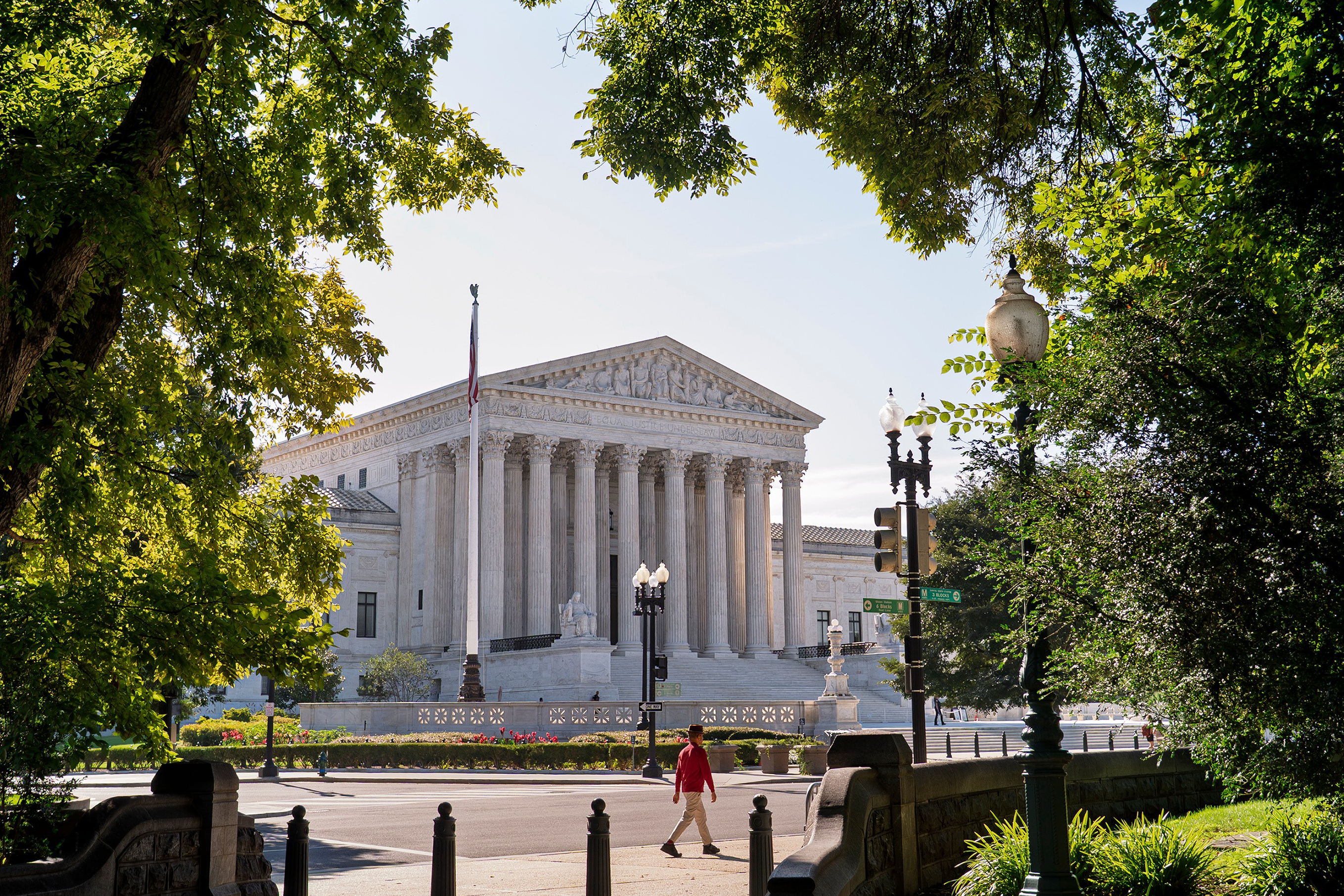
    NEW YORK — The Supreme Court on Friday lifted restrictions on a controversial federal voter database before November’s elections, granting President Donald Trump a temporary win in his aggressive campaign against noncitizen voting.

    The court’s three liberal-leaning justices publicly dissented from the decision.

    The emergency order allows states, for now, to use the Department of Homeland Security program, called Systematic Alien Verification for Entitlements, or SAVE, in their efforts to verify the eligibility of voters on their rolls.

    States’ use of the SAVE program is voluntary. The immediate impact on the upcoming midterms is likely limited because existing law blocks most states from systematically purging voters from their rolls within 90 days of an election, said David Becker, an election law expert who leads the Center for Election Innovation and Research.

    He said since the program is voluntary and DHS itself has admitted the data is not perfect, “states may find this to be a useful tool used along with other tools to keep their lists up-to-date.”

    The court’s order puts on hold a federal judge’s June ruling that had deemed the Republican administration’s recently revamped version of SAVE illegal. U.S. District Court Judge Sparkle L. Sooknanan had blocked the use of the tool, saying it violated Americans’ privacy rights and could result in voters being wrongly removed from the rolls.

    A federal appeals court let her order stand.

    But the Supreme Court majority found that a 1996 law explicitly allows DHS to get information about citizenship and immigration from other federal agencies. The federal government also has “an obligation to respond” to states seeking to verify citizenship.

    “The order below prevents the Federal Government from using the program it believes is best suited to the task,” the majority wrote in the unsigned order.

    Justice Ketanji Brown Jackson dissented, joined by Justices Elena Kagan and Sonia Sotomayor. The database has long been seen to fall under federal privacy laws, she wrote, and there are real risks that legitimate voter registrations could be mistakenly revoked.

    “The harm caused by burdening or disenfranchising even a few lawful voters outweighs the nonexistent harm that the Government experiences when it is prevented from taking an action that it likely lacks the authority to take,” Jackson wrote.

    The plaintiffs and counsel team in the case called the ruling “profoundly disappointing” and said it puts “millions of Americans at risk of being unlawfully targeted by the administration’s unreliable voter purge database” before the midterms.

    “However, this case is not over,” their statement read. “The D.C. district court ruled that the expanded SAVE program violated multiple laws. We will be doing everything in our power to protect Americans’ voting and privacy rights by ensuring that the district court decision stands.”

    The White House did not immediately respond to a message seeking comment.

    The SAVE program was created under an immigration law mandating that DHS help federal, state, and local agencies prevent government benefits from going to noncitizens. The Trump administration last year moved to significantly expand its search abilities. Since then, at least 67 million registrations have been scanned through the program, but critics worry it could end up purging valid voters from the rolls.

    Some registrants have already been wrongly flagged. In Travis County, Texas, for example, officials said they investigated 97 voters flagged by SAVE as apparent noncitizens and found that at least 10% of them — and likely up to 21% — were U.S. citizens. The county urged the Supreme Court to reject the administration’s appeal, while the state of Texas submitted its own brief defending the database.

    Even though the use of the SAVE program has been blocked for months, the administration said in court filings that DHS officials have continued using Social Security Administration data “in certain cases to verify information and help determine whether illegal voting may have occurred.”

    DHS in August launched its own investigation to find noncitizen voters on state rolls, according to a federal whistleblower statement that said the effort is rushed, filled with errors and potentially violates state laws. DHS has defended that investigation as being conducted “diligently and professionally.”

    The effort to create a national voter list is among numerous steps Trump has taken during his second term to try to overhaul the way elections are run. Most of those steps have been blocked by various courts, in part because the Constitution gives states and Congress the authority to set election rules, but provides no such power to the president. In mid-September, the Supreme Court rejected a bid from Trump to restrict mail ballot procedures before the midterms.

    Research shows that noncitizen voting, which is already illegal and punishable as a potential felony that could lead to deportation, is exceptionally rare. But Trump has remained fixated on the idea that massive numbers of noncitizens are voting in U.S. races.

  • Energy Department will spend $2 billion to squeeze more electricity from the aging power grid

    Energy Department will spend $2 billion to squeeze more electricity from the aging power grid

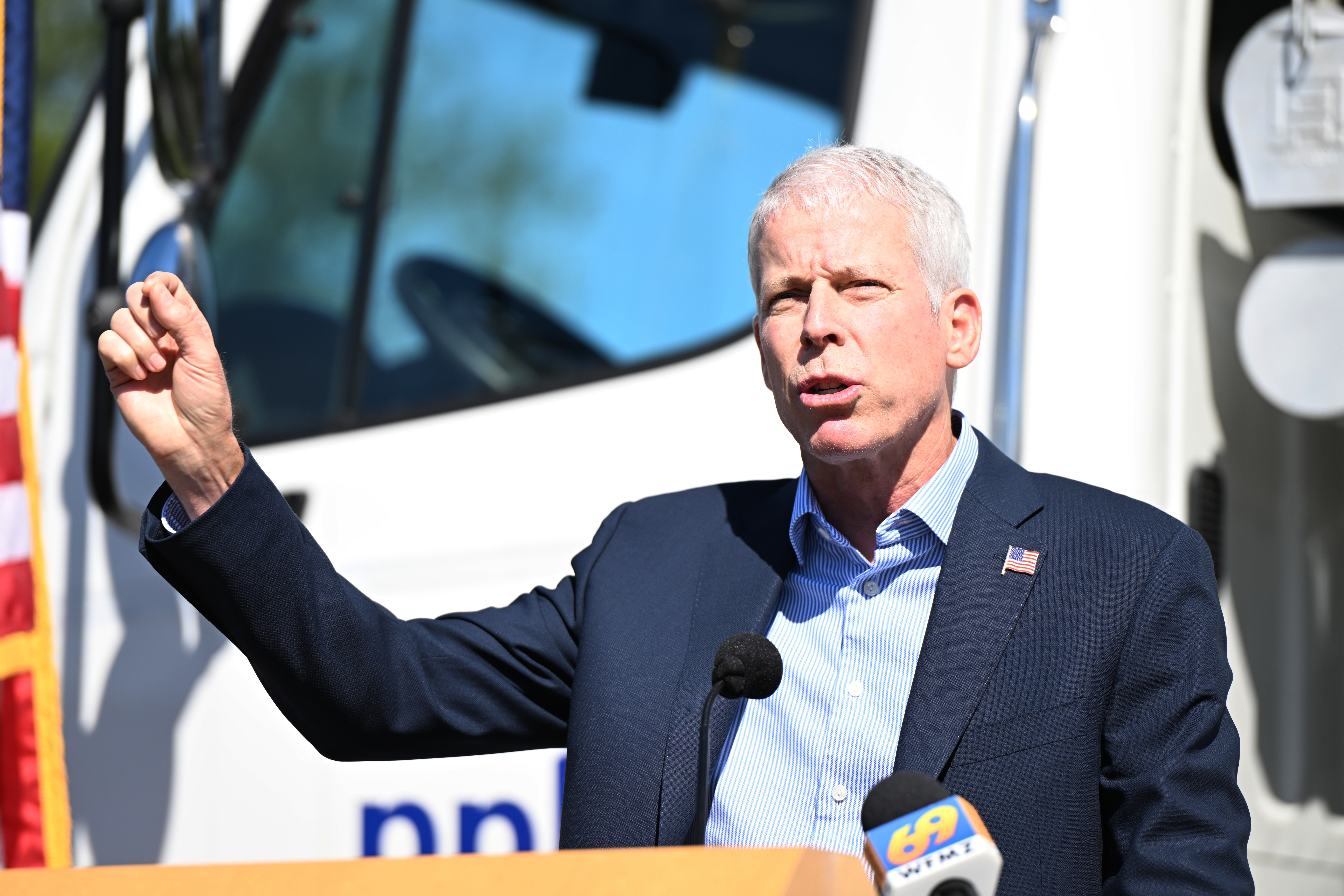
    ALLENTOWN — The Energy Department said Thursday that it will spend almost $2 billion to try to squeeze more electricity out of the nation’s aging and stressed power grid, as President Donald Trump’s administration steps up efforts to avoid blackouts amid skyrocketing energy demand spurred by artificial intelligence.

    The money will go toward 31 projects across 26 states that are expected to produce more than 23 gigawatts of additional electricity capacity — enough to power 16 million homes. The projects will use new technologies such as sensors to measure real-time weather conditions to ensure safe transmission or direct power away from congested paths, the department said.

    The upgrades could improve power reliability and lower electricity costs for about 100 million Americans, officials said.

    “This is a quick way to lower electricity prices and increase reliability: using fibers that are already in the transmission lines to analyze what’s the temperature out, what’s the wind out, how can we use this transmission line to distribute more power, but safely and only in the right conditions,” Energy Secretary Chris Wright said in a news conference promoting the grants Thursday at a PPL Corp. facility in Allentown.

    The eastern Pennsylvania electric utility says two data centers in its territory came online this year and six more are under construction, with enough other data centers in the advanced planning stages that its peak electric demand could quintuple by 2032.

    PPL said it is receiving $71.5 million to modernize an existing high-voltage transmission line across roughly 30 miles in northern Pennsylvania.

    The announcement comes amid warnings that AI’s voracious demand for power is threatening to overwhelm U.S. power supplies, as massive new data centers come online faster than new power plants can be built. It also comes as electricity bills rise faster than inflation in many parts of the U.S., blamed in some areas on demand from data centers.

    The snowballing opposition to data centers in communities across the country has thrown a wrench into the plans of the world’s richest companies and transformed the midterm election landscape.

    Trump continues to stick up for data centers, even as politicians from both major political parties criticize them and many communities try to block them.

    In the meantime, Congress and some states are trying to push utilities to use new technology to make grids more efficient, lessening the need to build new power plants.

    Julia Selker, the executive director of the WATT Coalition, a trade association for grid-enhancing technologies, said both the projects and the scale of the investment are significant. Utilities in the U.S. are lagging places like Europe in adopting the technologies, despite federal investment in the past to develop and test them.

    Wright said that work on the projects should begin right away and that he hoped some efficiencies are in place before this winter to tamp down price spikes when extreme weather sends demand skyrocketing.

    He said he didn’t know whether the projects would have gotten done without federal funding. Many, he said, had been under consideration before the grants were offered, but the grant recipients hadn’t “quite pulled the trigger” on them.

    Projects being announced Thursday will involve component enhancements on more than 1,500 miles of transmission lines and technological enhancements across nearly 21,000 miles, the department said.

    Projects were prioritized based on those that can be put into operation quickly, officials said. Money for the grants comes from the bipartisan infrastructure law enacted by Congress under then-President Joe Biden, a Democrat. The government’s $1.9 billion in funding will be matched by $3.35 billion in cost-share funding from the recipients, the Energy Department said.

    Recipients include utilities, cooperatives and four state agencies. The state agencies — in Colorado, Indiana, Ohio, and Oklahoma — were the biggest recipients, collectively drawing at a total of $810 million, with the Colorado and Oklahoma projects promising improvements to the wider regional grid.

    Trump has vowed to “unleash” the nation’s energy sector in his second term, aiming to drive up record-setting domestic oil and gas production, strip away pollution restrictions on power plants and keep expensive coal-fired power plants operating past their retirement dates.

    The administration also has pledged nearly $4 billion to buy back offshore wind leases as Trump seeks to discourage the expansion of wind energy in favor of fossil fuels.

    His administration has pushed to help tech giants build and connect data centers to power plants and high-voltage power lines and convert Cold War-era uranium enrichment plants into data center and power plant complexes.

  • More than 160,000 pounds of meat bearing false USDA inspection labels recalled

    More than 160,000 pounds of meat bearing false USDA inspection labels recalled

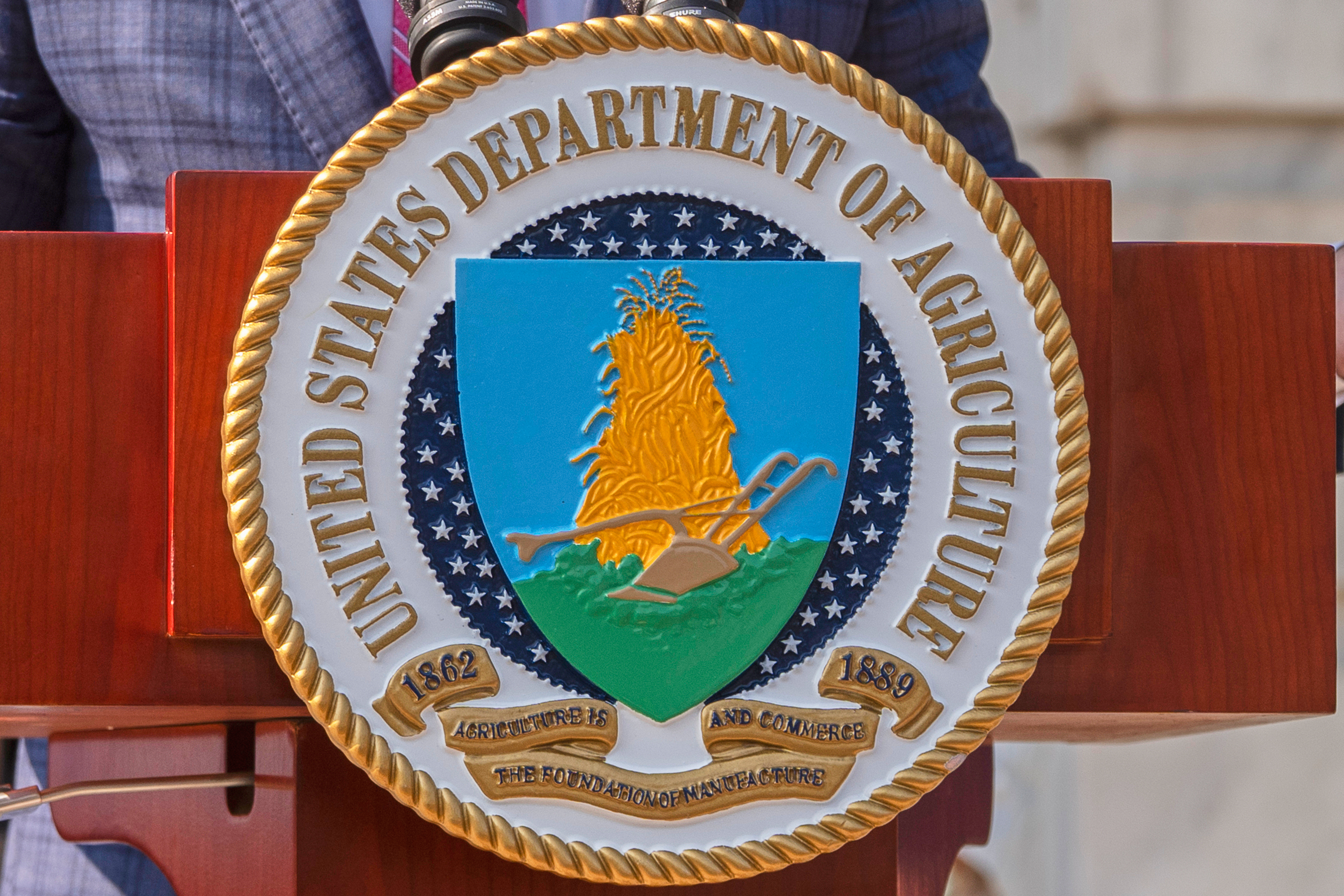
    NEW YORK — More than 83 tons of meat are being recalled across the U.S. because the products were not properly inspected by federal authorities and were shipped out with falsified inspection stickers, the Department of Agriculture said.

    Star Meat Delivery Inc., based in Lucama, N.C., is recalling more than 167,000 pounds of raw pork, beef, and goat nationwide. The USDA said that number could grow as it continues its investigation.

    Food produced without inspection may contain undeclared allergens, harmful bacteria, or other contaminants, the agency said Tuesday in announcing the recall. So far, there have been no confirmed reports of illnesses or injuries from the meats, according to the USDA.

    The meat in question was produced “on various dates” before Sept. 22 and has USDA inspection stickers falsely bearing an establishment number — EST. 1363 — that the agency said “does not have a federal grant of inspection.” However, some packages people purchased may not bear that labeling because retail stores may have applied their own stickers with pricing and safe handling instructions, the agency warned.

    The products were shipped to Georgia distributor A&D Foods to send to retail and restaurant locations nationwide.

    The USDA said the products should be considered misbranded and unsafe to eat and be discarded or returned to the place of purchase.

    The agency said the problem was discovered during the USDA’s Food Safety and Inspection Service’s routine checks. It’s not clear whether anyone has been arrested or criminally charged.

    Star Meat Delivery, in a statement posted on its Facebook page Thursday, pushed back at the notion that the inspection stamps on its products were somehow falsified. It said the establishment number in question was “legitimately reserved” as part of the USDA application process while it seeks approval to process and package meat for the Georgia distributor.

    That approval process is still underway, Star Meat said, although the meat involved was sourced from a USDA-inspected supplier.

    “No other products sold by Star Meat Delivery were mislabeled, and no other products sold by Star Meat Delivery are part of the recall that has been issued,” the company said. “We are cooperating fully with the appropriate authorities to finalize the application and are following the recall procedures that have been put into place.”

    The USDA didn’t immediately respond to Star Meat’s statement.

    Recalls triggered by forged inspection stamps are relatively rare, according to Keith Schneider, a food safety professor at the University of Florida in Gainesville.

    “This is someone taking a shortcut,” he said. “Systems are in place to catch these sorts of things and it appears the system worked as intended. You can’t skip inspections.”

    Last year, some 32,000 pounds of meat, including chorizo, pork chops and ribs, produced by Sabrositos Hondurenos, of New Jersey, were recalled after the USDA determined they had fake inspection stickers.

  • Israel’s Netanyahu, at U.N., calls accusations of genocide in Gaza ‘the biggest lie of the century’

    Israel’s Netanyahu, at U.N., calls accusations of genocide in Gaza ‘the biggest lie of the century’

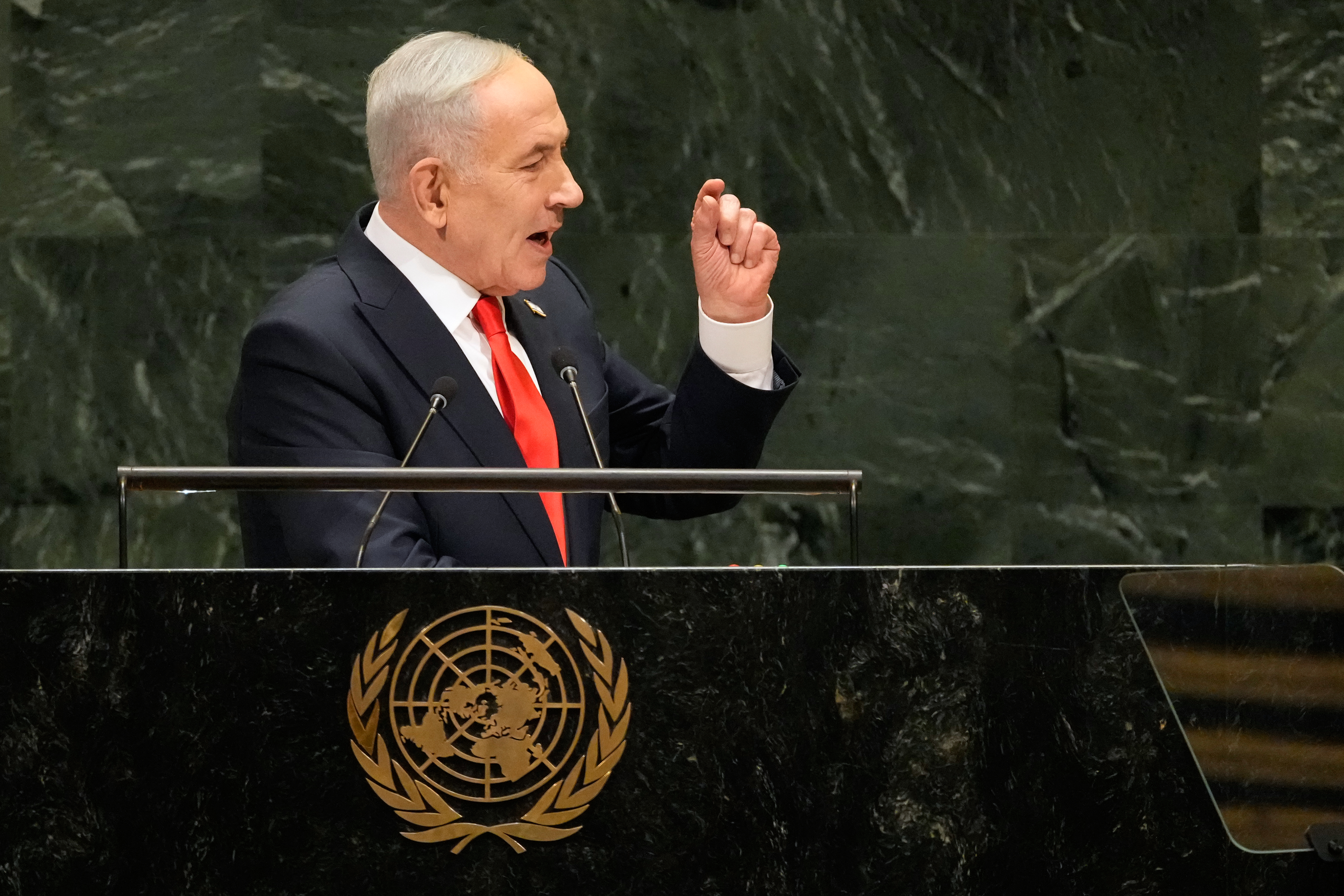
    Allegations of Israeli genocide in Gaza are not only false but “the biggest lie of the century,” Prime Minister Benjamin Netanyahu told world leaders Thursday in a defiant speech that asserted his nation’s right to wage war against Iran — and was not heard by scores of delegates who trooped out before he started speaking.

    Netanyahu, his voice rising in emphasis, said attacking Iran “was one of the easiest decisions I’ve ever had to make” and denounced as “moral cowards” a mass of delegates who walked out of the U.N. General Assembly when he took the podium to speak.

    “In defending itself, Israel is also also defending many of the countries whose delegates just left this hall,” Netanyahu said. “In fact, I want you to know that many of their leaders even thank us privately for taking out Iran’s nukes.”

    When Netanyahu walked to the rostrum, a mix of cheers, boos and mass walkouts erupted. Scores of delegates marched out and a majority of visible seats sat empty afterward. “Order in the hall, please,” General Assembly President Khalilur Rahman said repeatedly.

    “If there are any other moral cowards who have not yet left the hall, please do so now,” Netanyahu said.

    His remarks — which at times sounded like a stump speech as Israel gears up for elections — came after a week filled with speeches by world leaders accusing Israel of genocide and war crimes in Gaza.’’

    Palestinians had called for a mass walkout

    The Palestinian Mission to the U.N. said in a message to many of the 193 U.N. member nations to bring as many staff as possible to the assembly hall and “collectively walk out of the assembly” once the Israeli prime minister is announced.

    “This will send a clear message to Netanyahu and his government that no one is willing to aid, abet, or be complicit in its genocide and war crimes and illegal occupation, which all peace-loving states and peoples demand must come to an end,” the message said.

    Israel rejects allegations that it committed genocide and war crimes and is illegally occupying Palestinian territory. All Israeli settlements are illegal under international law, but the Israeli government insists they are legal.

    Netanyahu, who is prone to using visual aids during his General Assembly speeches, at one point held up a pager while reminding the audience of Sept. 17, 2024, when Israel remotely detonated thousands of pagers that had been distributed to the Iran-backed Hezbollah militant group in Lebanon. The pager attack wounded more than 3,000 people and killed 12, including two children.

    He reminded the assembly of the scale of the Oct. 7, 2023, attack in which Hamas militants killed about 1,200 people. “This is equal to 40,000 innocent Americans slaughtered in less than 24 hours,” he said, or 16 times the death count on the 9/11 attacks that left nearly 3,000 people dead in New York.

    Netanyahu thanked U.S. President Donald Trump for taking decisive action against Iran, and he insisted Israel would prevail: “We will continue to win because we have no other choice.”

    Netanyahu followed the Palestinian president’s remote speech

    Palestinian President Mahmoud Abbas also addressed the U.N. General Assembly earlier Thursday, delivering prerecorded remarks from his office in Ramallah after the United States denied him and other top Palestinian officials visas to attend the gathering for the second year in a row.

    The 90-year-old leader’s popularity at home and relevance abroad have both waned. But in his remarks, Abbas made clear he did not intend to quietly accept being sidelined.

    “We will not leave our homeland. We will not accept displacement. And we will not allow anyone to decide our future on our behalf,” Abbas said.

    Though world leaders have repeatedly invoked the plight of Palestinians in speeches throughout the week, Abbas urged the international community to take more tangible action against Israel.

    “How long will some countries continue to remain silent about Israel, or continue supplying it with weapons that it uses against our people? The world has witnessed the enormous cost in the Gaza Strip and the West Bank,” Abbas said. “What, then, is the international community waiting for before it acts to protect the Palestinian people?”

    Netanyahu is in the city of a mayor who wants him arrested

    In past years, Netanyahu has used his General Assembly speech to both denounce the United Nations as biased and make Israel’s case to world leaders. His address — scheduled for prime time in Israel — is the cornerstone of an abbreviated trip to the United States unfolding under the shadow of New York City Mayor Zohran Mamdani calling him a “war criminal” and pushing for his arrest.

    Mamdani has acknowledged that New York does not have the authority to execute an International Criminal Court warrant but urged federal authorities to do so.

    Israel has grown increasingly isolated throughout the war in Gaza. The war began on Oct. 7, 2023, when Hamas-led militants attacked Israel, killing around 1,200 people and kidnapping 251. At least 73,922 Palestinians have been killed in Israel’s subsequent offensive, according to the Gaza Health Ministry, part of the Hamas-run government whose numbers are generally considered reliable by the international community.

    A ceasefire agreed to by Israel and Hamas last October halted the heaviest of the fighting and led to the release of the remaining hostages yet further steps have since stalled. Israel maintains control of most of Gaza and continues to carry out airstrikes on Palestinians near military-held zones. Hamas not disarmed or relinquished power and there has been no progress toward reconstruction in the mostly destroyed territory.

    Netanyahu has said no Palestinian state will be established while he is Israel’s leader and has argued that the Palestinian Authority is not a partner for peace.

    Netanyahu dismissed incidents of Israeli settler violence against Palestinians in the West Bank as a “handful of young juvenile delinquents” throwing stones, chopping down olive trees and lighting fires.

    “I can’t stand that. I won’t stand for vigilantism,” the prime minister said before accusing foreign leaders and the international press of distorting the scale of violence in the West Bank.

    Netanyahu’s government is dominated by settlers and their allies, including the Cabinet minister who oversees the police. There have been few arrests of settlers involved in attacks on Palestinians.

    Israel captured the West Bank and east Jerusalem in the 1967 war, and the Palestinians want both as part of their future state. The Palestinians and much of the international community view the settlements as illegal and as an obstacle to creating a viable, contiguous Palestinian state.

  • Senate rejects resolution to halt the Iran war as gas prices upend midterms

    Senate rejects resolution to halt the Iran war as gas prices upend midterms

    WASHINGTON — Despite rising political anxiety over the Iran war, senators on Thursday narrowly rejected a war powers resolution seeking to halt President Donald Trump‘s military action, which has been largely blamed for the spike in gas prices and become a flashpoint in the midterm election.

    The Senate tally, 49-50, coming days after Trump’s bombastic address to the United Nations in which he threatened to “annihilate” Iran, was likely the last chance for lawmakers to go on record about the war ahead of November. More Republicans are peeling away from the president as the war drags on and as they campaign for control of Congress. The Senate outcome fell short, with four GOP senators joining most Democrats in favor of the resolution.

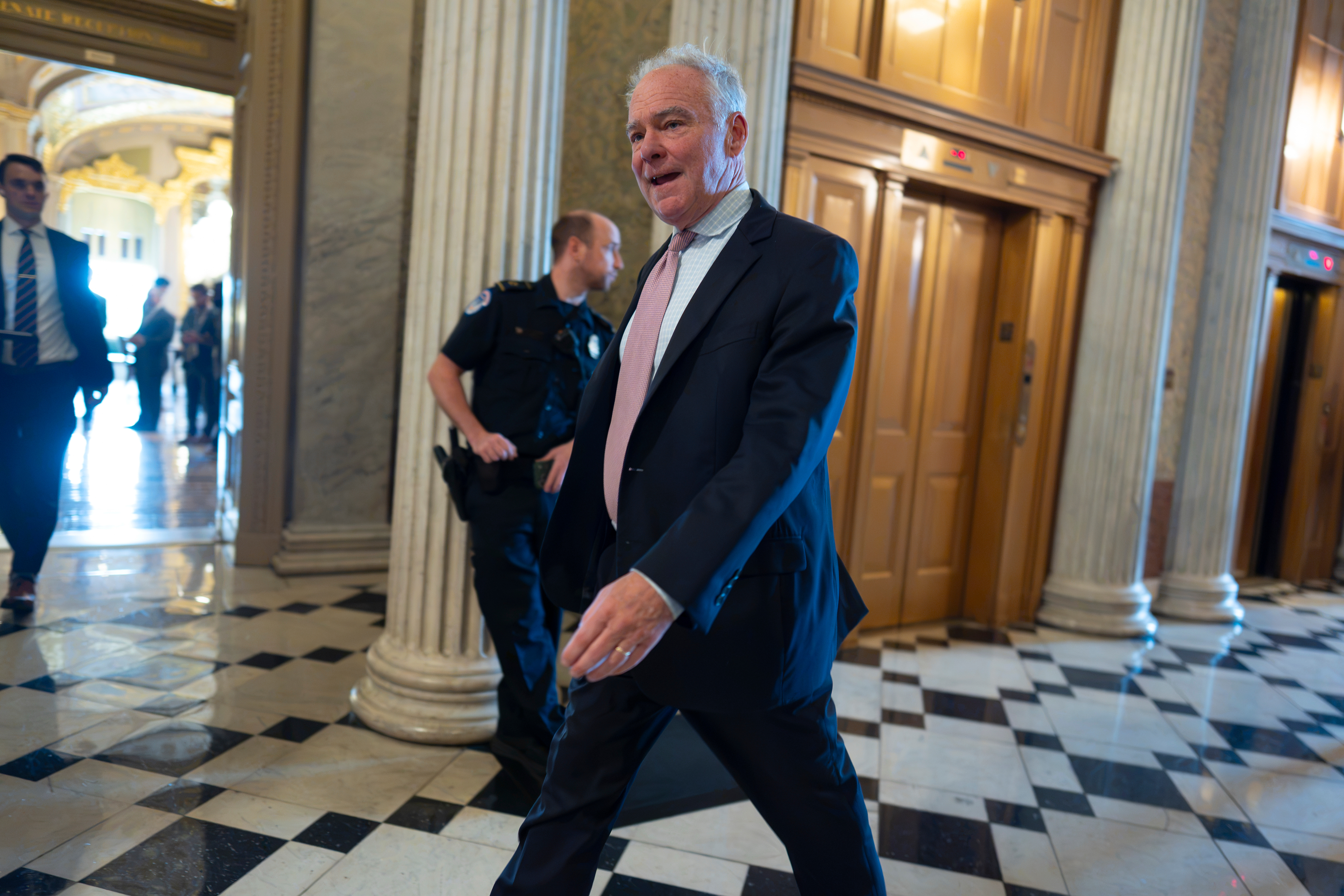
    “They have been carrying water for this ridiculous and illegal war for months and months and months and not listening to their constituents,” said Sen. Tim Kaine (D, Va.), who pushed the war powers resolution forward.

    About half of rural American voters believe the economy is worse off now than when Trump returned to office, according to a new survey from The Associated Press in partnership with KFF. The costs of groceries, gas, and healthcare rank as top pain points for the rural voters.

    “We’ve got to break the cycle,” said Sen. Thom Tillis (R, N.C.), who joined in voting yes.

    Republican Sens. Susan Collins of Maine, Lisa Murkowski of Alaska, and Rand Paul of Kentucky also voted for the resolution to end the war, as they have in many previous tallies. Sen. John Fetterman (D., Pa.) voted against.

    This was the 14th time the Senate has considered a war powers resolution, since Trump launched the conflict on Feb. 28.

    War powers resolutions are largely political statements, without the full force of law, but stand among the sharper tools the House and Senate have to express disapproval of the White House, short of halting funds for Trump’s military actions. As resolutions, they do not go to the president’s desk for his signature.

    As gas prices climb, Republicans start to question the war

    Republicans in control of Congress have shied away from directly confronting Trump over the war, now stretching past the seven-month mark. But their unrest is surfacing as stubbornly high gas prices leave voters in a cash crunch back home.

    Diesel costs, in particular, have almost doubled, topping $6 a gallon, according to AAA.

    Just returning from a swing through Iowa, Kansas, and Nebraska stumping for GOP candidates who are suddenly at risk in their elections, Sen. John Kennedy of Louisiana called on Trump to hold a prime-time address to the nation to explain the Iran war strategy and the end game.

    “People are confused about the war and upset about the cost of living,” he said.

    But he and others were not yet ready to vote against the war.

    “My own view is that the focus right now needs to be on attacking the cost-of-living issues,” said Sen. Josh Hawley (R, Mo.) who opposes the war powers resolution and believes the president is acting within his authority to conduct the military action.

    House Democratic Leader Hakeem Jeffries scoffed at the handful of Republicans now trying to distance themselves from what he called Trump’s failed economy. “Now all of a sudden they’re waking up,” he said.

    Democrats keep pushing war powers votes in Congress

    Earlier this month, the House for a third time approved a war powers resolution, this time with seven Republicans joining the Democrats, including two from battleground Iowa, Rep. Zach Nunn and Rep. Mariannette Miller Meeks, where affordability issues among rural voters are dominating the campaigns.

    Senators, though, have rarely been able to confront Trump by passing a war powers resolution.

    In June, the Senate approved a war powers resolution after four GOP senators joined Democrats, but Republicans abruptly reversed course the next day after Trump berated them during a private lunch over the outcome.

    At the time, Sen. Bill Cassidy of Louisiana, stood up to defend his vote only to end up in a shouting match with Trump. He later switched to oppose the war powers resolution after receiving a personal briefing from the White House.

    Thursday’s vote was on a resolution that had passed the House in July with GOP support. Rep. Pramila Jayapal, D-Wash., who authored the House resolution, said the Senate outcome was “a slap in the face to the millions of American people who want this war to end.”

    Other options to halt the Iran war

    As the war drags on, costing $43.5 billion so far, Congress is also seeking other ways to force Trump to rethink his military strategy in Iran.

    Rep. Thomas Massie, the renegade Republican from Kentucky, pushed forward articles of impeachment against Secretary of Defense Pete Hegseth before the GOP leadership abruptly adjourned the House and sent lawmakers home to campaign for the election, avoiding any potential vote on the matter.

    Lawmakers also have the power of the purse to curtail military spending, something Republicans have been reluctant to do but Democrats are sure to tackle if they win power in the midterm election. The White House’s request for an additional $87.6 billion funding package for the war and other needs has idled in Congress.

    First created in the aftermath of the Vietnam War as a way to hold a president accountable for military actions, the war powers act has long posed a test of the balance of power between the executive and legislative branches of government.

    While the Constitution says only Congress can declare war, the president as commander-in-chief is also able to engage the military. The war powers act seeks to provide clarity by requiring the president, within 60 days of any such action, to seek approval — or risk disapproval — from Congress.

  • Trump hails deep friendship with Xi as China’s leader urges ‘healthy’ competition between 2 powers

    Trump hails deep friendship with Xi as China’s leader urges ‘healthy’ competition between 2 powers

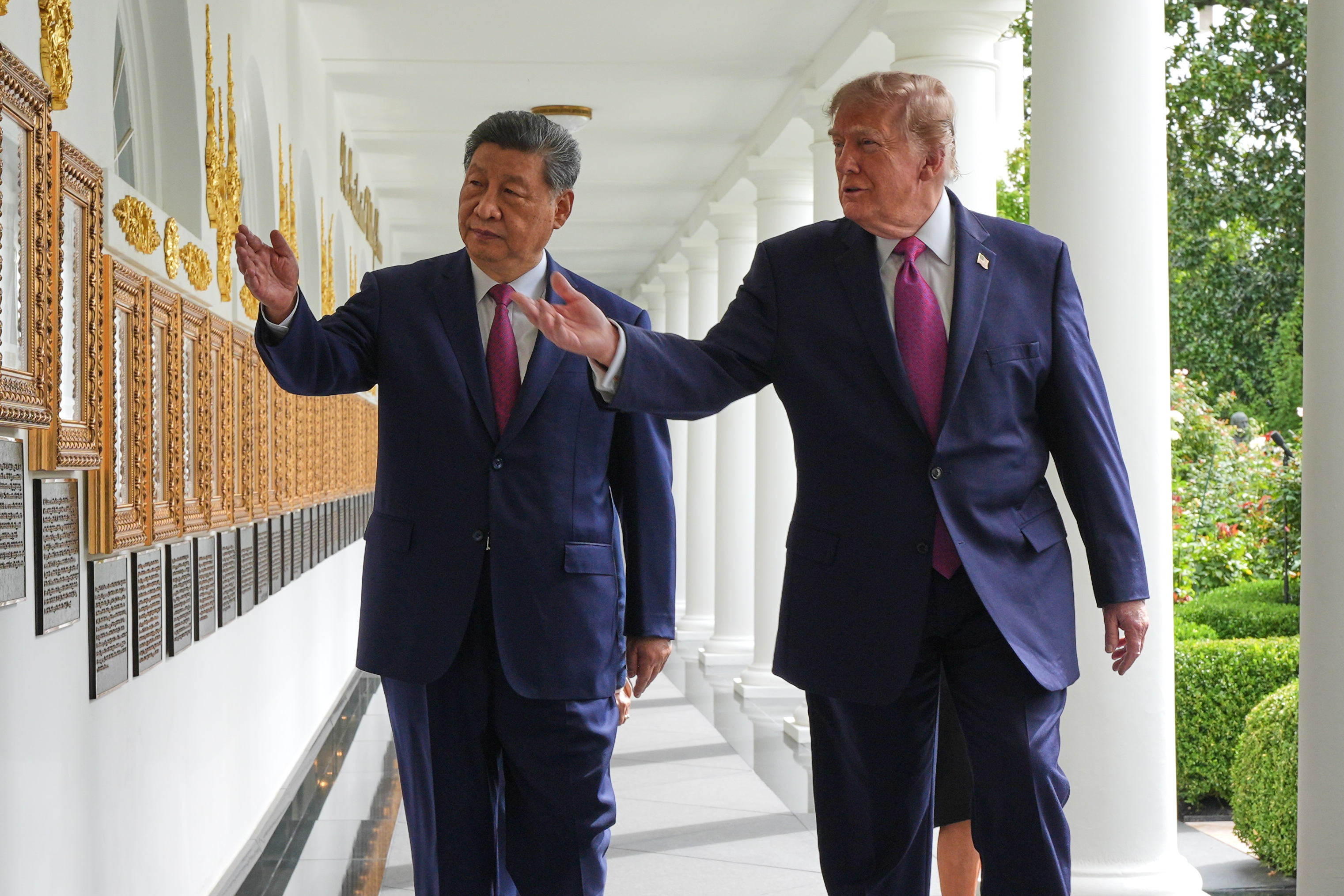
    WASHINGTON — President Donald Trump on Thursday hailed the “truly great friendship” he has forged with Xi Jinping as the Chinese leader began his highly anticipated state visit by pressing for the world’s two biggest economies to work more closely together to avoid friction as they compete.

    While Trump has many thorny issues to discuss with the president of America’s biggest economic rival, he focused on his long relationship with Xi as the two gathered with aides for opening remarks before formal talks.

    “From the time of my first election in 2016, President Xi and I have forged a friendship, a truly great friendship, actually, built on mutual respect and the vital interests of our people,” Trump said.

    China has resisted the Trump administration’s urgings — and economic threats — to use its considerable leverage to prod Iran to agree to U.S. terms to end the nearly seven-month war. Xi wants to see Trump permanently halt arms sales to Taiwan and loosen export restrictions on cutting-edge advanced chips. The two sides on Wednesday agreed to extend by two months a one-year trade truce that was set to expire Nov. 10 as they work to find a more durable agreement.

    Xi presses Trump on Taiwan

    In their private conversation, Xi also urged Trump to “prudently handle the Taiwan issue,” according to the Chinese state media outlet Xinhua.

    China has made clear it views Taiwan as the most sensitive issue in the U.S.-China relationship. Beijing considers Taiwan to be Chinese territory and vows to annex the island by force if necessary. The United States is obligated by law to provide Taiwan with sufficient hardware to deter any armed attack from the mainland. The U.S. has said it opposes any unilateral changes to the status quo by either side.

    China has repeatedly pressed Washington to permanently halt the arms sales, including when Trump and Xi met in Beijing in May.

    After that meeting, Trump said he was holding off on final approval for a record $14 billion arms package that was in the pipeline. He also described arms sales to Taiwan as a “very good negotiating chip” with China.

    Chinese president once more invokes the ‘Thucydides trap”

    Xi was also more pointed than Trump in his public remarks, saying Chinese and American interests are “deeply intertwined” and that the “competition should be a healthy one and should be kept within bounds.”

    He also reiterated his warning that the U.S. and China must avoid the ” Thucydides trap,” referring to the idea that when a rising power threatens to displace an established one, the result is often war. Xi offered a similar warning when Trump visited Beijing in May.

    “It should be a race of catching up with one another, not a wrestle in which one either wins or loses,” Xi added.

    Xi also announced that China will invite 100,000 American youth to come to his country for studies and exchanges in the next five years and that China will send two pandas to the zoo in Atlanta. He called the beloved animals an “envoy of friendship” and that they will meet the American people in a “few days.”

    Xi says China and U.S. should make sure AI is ‘always under human control’

    Trump said in a social media post earlier Thursday that artificial intelligence — “superintelligence” as he is trying to rebrand it — will be high on the agenda amid growing global anxiety that the technology will kill jobs or potentially even wipe out humanity.

    “I want to leave it exactly where it is,” Trump wrote. “That is China’s position also.”

    Xi also touched on AI in his opening comments, saying that the two countries had a responsibility to ensure that humans always operate AI.

    “We have both the capability and responsibility to develop and manage AI for good and ensure that a development of AI is always under human control and serves the well being of the people,” the Chinese leader said.

    The two countries’ finance ministers met earlier this week, with the U.S. proposing a new “notification mechanism” for AI incidents between the two nations.

    Trump rolls out the red carpet for Xi and faces criticism from some White House allies

    Trump has made clear he wants to impress Xi with the visit. The Republican president made sure construction of a new helicopter landing pad on the White House’s South Lawn was completed before the visit and he met Xi and his wife, Peng Liyuan, on Wednesday evening when they flew into Joint Base Andrews outside Washington.

    The White House also arranged for an elaborate military review that the leaders and their spouses observed before the Oval Office talks. Following the military review, first lady Melania Trump accompanied Peng for a visit to the Smithsonian National Museum of Asian Art.

    After about 90 minutes of talks, the leaders stepped out to the South Lawn so Trump could show off the new White House helipad and give Xi a tour of Marine One, the presidential helicopter. Trump and Xi also appeared to peer at the ballroom construction site from afar. Xi left the White House shortly after the quick tour and is to return in the evening for the state dinner.

    “We had a great meeting,” Trump said in a brief exchange with reporters after the tour.

    Later, the leaders will dine on sea bass at a black-tie dinner in the White House East Room, featuring red décor and a toast honoring the late President Richard Nixon, whose 1972 trip to China led to the establishment of diplomatic relations in 1979 and the parallel severing of formal ties with Taiwan.

    Trump’s decision to roll out the red carpet for Xi has spurred criticism from lawmakers in both parties and some White House allies.

    “Quite frankly, had the White House asked me for advice, I would have suggested the president not invite Xi Jinping to Washington for such a lavish welcome here in the United States of America based on all of the troubling issues we have with President Xi and the Chinese Communist Party,” said Sen. Roger Wicker, R-Miss.

    Xi urges U.S. and Iran to return to interim agreement

    The two sides also discussed the ongoing conflict in Iran, according to Chinese state broadcaster China Central Television.

    Trump has argued to little effect that China, which is far more dependent on Gulf oil than the U.S., has plenty of incentive to use its sway with Tehran to help force an end to the conflict.

    But Trump’s war of choice has unnerved Beijing, with the government condemning the U.S. and Israeli military action and Xi previously expressing concerns the conflict signaled a return to what he called the “law of the jungle.” The U.S. administration has warned China, Tehran’s biggest trading partner, not to aid Iran’s military effort.

    Xi, during Thursday’s talks, said China supports the U.S. and Iran returning to a short-lived interim deal from the summer in an effort to wind down the war, according to CCTV. That agreement broke down soon after it was signed in June as the countries traded renewed fire over control of the Strait of Hormuz, a crucial waterway for energy shipments.