Category: Business Wires

  • Average 30-year U.S. mortgage rate rises to highest level in a year at 6.66%

    Average 30-year U.S. mortgage rate rises to highest level in a year at 6.66%

    The average long-term U.S. mortgage rate rose for the fourth consecutive week to its highest level in a year, another setback for prospective homebuyers hoping for a break from elevated home loan borrowing costs.

    The benchmark 30-year fixed rate mortgage rate rose to 6.66% from 6.58% last week, mortgage buyer Freddie Mac said Thursday. One year ago, the average rate was 6.72%.

    Higher mortgage rates can add hundreds of dollars a month in costs for borrowers, limiting homebuyers’ purchasing power. As rates rise, that can lead prospective home shoppers to delay buying a home, one reason U.S. home sales have been sluggish this year.

    Borrowing costs on 15-year fixed-rate mortgages, often sought by borrowers refinancing a home loan, also rose this week. That average rate increased to 6.04% from 5.96% last week. A year ago, it was at 5.85%, Freddie Mac said.

    Mortgage rates are influenced by several factors, from the Federal Reserve’s interest rate policy decisions to bond market investors’ expectations for the economy and inflation. They generally follow the trajectory of the 10-year Treasury yield, which lenders use as a guide to pricing home loans.

    Rates have been mostly rising this year as the Iran war has driven crude oil prices sharply higher, fueling expectations of hotter inflation. That’s pushed up long-term bond yields relative to where they were before the conflict began in late February, causing mortgage rates to trend higher.

    The 10-year Treasury yield was 4.66% at midday Thursday on the bond market. It was just 3.97% in late February, before the war broke out.

    The average rate on a 30-year mortgage is now the highest it’s been since July 31, 2025, when it was at 6.72%. As recently as late February, the average rate dropped slightly below 6% for the first time since late 2022.

    The latest increase in mortgage rates comes a day after the Federal Reserve left its key interest rate unchanged as it wrestles with how to tame stubbornly high inflation, which has been stuck above the central bank’s 2% target for more than five years.

    During the central bank’s two-day monetary policy meeting this week, three regional Fed bank presidents dissented in favor of higher rates to combat high prices.

    That’s a signal that Fed members are no longer in lockstep on inflation and that their next move is not going to be a rate cut, said Anthony Smith, senior economist at Realtor.com.

    “With the Fed signaling that its next move is more likely a hike than a cut, near-term rate relief looks unlikely,” Smith said. “Because oil remains the primary channel through which the Iran conflict feeds inflation, a de-escalation and a reopening of the Strait of Hormuz remains the clearest path back toward lower rates.”

    The central bank doesn’t set mortgage rates, but its decisions to raise or lower its short-term rate are watched closely by bond investors and can ultimately affect the yield on 10-year Treasurys.

    While average long-term mortgage rates remain lower than they were at this time last year, their upward trajectory has weighed on home sales this year. Seasonally adjusted sales of previously occupied U.S. homes were up 0.7% from January to June compared with the same period last year, but they’re still hovering close to a 4-million annual pace far short of the historic norm that is closer to 5.2-million.

    The trend has extended the national housing market slump that began in 2022, when mortgage rates began to climb from pandemic-era lows. Sales of previously occupied U.S. homes were essentially flat last year, stuck at a 30-year low.

    The latest data on mortgage applications show that the upward trend in mortgage rates has given some would-be homebuyers reason to pause.

    Mortgage applications, which include loans to buy a home or refinance an existing mortgage, fell 6.4% last week from the previous week, according to the Mortgage Bankers Association.

    “While incoming economic data will continue to shape the outlook for interest rates, elevated borrowing costs remain a challenge this summer for many prospective homebuyers,” said MBA CEO Bob Broeksmit.

  • Russia accuses Telegram CEO Pavel Durov of aiding terrorism in its latest digital crackdown

    Russia accuses Telegram CEO Pavel Durov of aiding terrorism in its latest digital crackdown

    Russian authorities said Wednesday they had charged Pavel Durov, the founder and CEO of the popular messaging app Telegram, with aiding terrorism, the latest step by the Kremlin to bring the internet and digital communications under its control.

    The charges against the Russian-born Durov, who lives abroad, came as authorities have sought to restrict the use of Telegram as part of a widespread crackdown on online freedom that followed Moscow’s full-scale invasion of Ukraine in 2022.

    The Federal Security Service, or FSB, said in a statement it had accused Telegram’s administration of failing to remove “numerous channels, chats and bots” allegedly used by “Ukrainian intelligence agencies, terrorist and extremist organizations to prepare and coordinate acts of sabotage and terrorism, mass murder, and cyber fraud” in Russia, which resulted in “numerous human casualties.”

    The FSB accused Ukrainian security services of using a popular dating chatbot on Telegram to lure and recruit Russians for “sabotage and terrorist activities,” and said 46 users of the chatbot, from 12 to 22 years old, have been detained in Russia over the past year for assaulting law enforcement officers, arson and other acts.

    It also said it was adding the name of the 41-year-old billionaire to international wanted lists.

    Durov had said earlier this year that Russian authorities opened a criminal investigation against him, and he accused them of fabricating pretexts to restrict access to Telegram as part of an attempt to “suppress the right to privacy and free speech.”

    If convicted, he could face up to life in prison in Russia.

    Telegram, which boasts of more than 1 billion users worldwide, did not respond to a request for comment. Its official website links to an account on X that on Wednesday posted am image of Durov raising a middle finger to the camera.

    Telegram’s website says that the company is based in Dubai and that Durov, who holds dual citizenship in France and the United Arab Emirates, lives there, too.

    Russia has sought to censor the internet

    Under President Vladimir Putin, Russian authorities have engaged in multipronged efforts to rein in the internet, adopting restrictive laws and banning websites and platforms that don’t comply and focused on improving technology to monitor and manipulate online traffic.

    Popular social media platforms, such as Facebook, Instagram and X, have been banned in Russia; YouTube has been throttled; popular messaging apps, such as Signal and Viber, have been blocked, and the most popular ones — WhatsApp and Telegram — have been restricted.

    Russia’s popular Facebook-like social media platform Vkontakte, founded by Durov long before he launched Telegram, had come under the control of Kremlin-friendly companies. Russia tried to block Telegram between 2018-20 but failed.

    While it’s still possible to circumvent some of the restrictions by using virtual private network services, many of them are routinely blocked, too.

    At the same time, Russia actively promotes what it calls a “national” messaging app known as MAX, which critics say could be used for surveillance. The platform is touted as a one-stop shop for messaging, getting online government services, making payments and other activities. It openly says it will share user data with authorities upon request, and experts also say it doesn’t use end-to-end encryption.

    The Telegram restrictions have elicited widespread discontent in Russia, and this year activists in multiple regions tried to organize protests against it, but authorities quashed nearly all their attempts.

    Military bloggers also have denounced the crackdown, arguing the app is an indispensable communications tool for Russian troops in Ukraine and for activists running crowdfunding campaigns to help Moscow’s forces.

    The government initially promised not to restrict Telegram on the battlefield, but a different message later came from the Kremlin. At a meeting with Putin for International Women’s Day, a servicewoman called Telegram “an adversarial communications tool” and agreed with him when he said that “the use of communications systems that are not ours, not under our control, poses a danger to personnel” in battle.

    Despite the restrictions, multiple Russian officials still use Telegram and regularly update their “channels” — its term for blogs — on the platform. The Kremlin’s Telegram page had more than 284,000 followers as of Wednesday.

    Durov was arrested in France in 2024

    In 2024, Durov was arrested in Paris amid allegations that his platform was being used for illicit activity, including drug trafficking and the distribution of images of child sexual abuse. French authorities handed him preliminary charges for allegedly allowing criminal activity on the platform. In March 2025, Durov said he had returned to Dubai after spending “several months” in France.

    The Kremlin at the time criticized the French authorities for their move against Durov as selective. Putin’s spokesman Dmitry Peskov said at the time that “yes, indeed, terrorists use Telegram. But terrorists also use cars. Why aren’t they arresting the CEO of Renault or Citroen?”

    Peskov didn’t respond to a request for comment on what made Russian authorities change their position.

    The Paris prosecutor’s office told The Associated Press that Durov remains under formal investigation, facing an array of potential charges for alleged criminal activities linked to Telegram. French investigators have questioned him repeatedly, most recently this month, the office said in written comments Wednesday.

    Russia is accused of using Telegram as a recruitment tool

    Russia itself has faced accusations of using Telegram coordinate and recruit people to carry out acts of arson and sabotage in Ukraine and across Europe. In the U.K., a British man was recruited, likely by Russian military intelligence, on the platform to organize a plot in 2024 to set fire to a warehouse in London containing satellite equipment for Ukraine. He was also asked to kidnap a pro-Ukrainian exiled Russian billionaire living in London.

    Dutch teenagers were arrested in the Netherlands in September after being contacted by Russian hackers on Telegram who wanted them to map Wi-Fi networks in The Hague. The city is the location of many sensitive organizations, including the International Criminal Court — which has issued an arrest warrant for Putin — as well as the Organization for the Prohibition of Chemical Weapons and Europol which helps European countries fight international crime.

    Moscow has repeatedly denied involvement in acts of sabotage in Europe.

  • Oil prices jump, while the Dow drops more than 1,100 as sinking AI stocks drag Wall Street lower

    Oil prices jump, while the Dow drops more than 1,100 as sinking AI stocks drag Wall Street lower

    NEW YORK — Oil prices got back to jumping on Wednesday, while sinking technology stocks dragged Wall Street lower amid uncertainty about what the Federal Reserve will do to get high inflation under control.

    The S&P 500 fell 1.5% after swinging sharply between gains and losses in the last hour of trading. The Dow Jones Industrial Average dropped 1,153 points, or 2.2%, and the Nasdaq composite slumped 1.7% to fall 9.8% below its record set last month.

    The action was more decisive in the oil market, where the price of Brent crude leaped 7.3% to settle at $88.09 per barrel after fighting resumed in the war with Iran and raised worries about the global flow of oil.

    Brent oil’s price had swung as low as $72 early this month and as high as $102 last week on uncertainty about whether the United States and Iran could reach a deal to allow oil tankers to move freely again from the Middle East to customers worldwide.

    The swings have raised worries that inflation will reaccelerate, and traders came into the day betting on a roughly 34% probability that the Fed would raise its main interest rate in the afternoon, according to data from CME Group.

    Higher rates can keep a lid on inflation, but they can also slow the economy and undercut prices for stocks and other investments.

    Fed officials instead voted to keep the federal funds rate steady, though three members of the policymaking committee did want to raise rates. The Fed’s chairman, Kevin Warsh, implied the bond market may already be doing some of the work to restrain inflation, and he pointed to how yields have climbed since the central bank’s last meeting six weeks ago.

    He reiterated his commitment to get inflation back to 2% following years of faster-than-hoped increases in prices, but he also stuck to his plan of giving financial markets fewer clues about what the Fed may do with interest rates in the near future.

    With less guidance from the Fed, financial markets may be set for more volatile trading amid the uncertainty.

    “Did the Fed take an explicit change in its policy rate today?” Warsh asked rhetorically in a news conference following the Fed’s decision. “No, but I think that’s the beginning of the story.”

    Treasury yields swiveled up and down following the Fed’s decision and Warsh’s insistence on not guiding the market.

    The yield on the two-year Treasury, which closely tracks expectations for Fed action, fell to 4.24% from 4.26% late Tuesday.

    But the 10-year Treasury yield, which moves more with expectations for inflation and economic growth in upcoming years, went in the opposite direction. It jumped to 4.68% from 4.61% late Tuesday.

    That’s up from 3.97% before the war with Iran sent oil prices much higher, and the increase has already sent long-term U.S. mortgage rates to their highest level in nearly a year.

    Higher rates particularly hurt stocks seen as the most expensive, and scrutiny has already been rising on makers of computer chips and other winners of the frenzy around artificial-intelligence technology.

    The recent surges for sellers of computer processors and memory are backed by real revenue and profits, but the exceptional growth won’t be sustainable if AI does not produce as much profit and productivity as hoped.

    The skepticism has hit South Korea’s stock market in particular because it’s dominated by two tech giants, Samsung Electronics and SK Hynix. Seoul’s Kospi index tumbled 6% Wednesday, a day after it plunged 10.8%, and trimmed its gain for the year so far to 34.4%.

    SK Hynix’s stock in Seoul dropped 9.6%. It reported record amounts of revenue and profit for a quarter thanks to strong demand because of AI. But its 257% growth in revenue still wasn’t enough to meet analysts’ expectations.

    On Wall Street, Nvidia was the heaviest weight on the S&P 500 after the chip company fell 3.6%.

    KLA Corp., whose products and services help make semiconductors, lost 10.8% even though it reported stronger-than-forecast profit and revenue for the latest quarter. Expectations were high after its stock surged nearly 150% in this year’s first six months.

    On Tuesday, gains for stocks outside of AI helped offset weakness for tech companies. Analysts have been saying such a rotation in the market from AI to less-loved areas could be healthy, but the majority of U.S. stocks fell with tech on Wednesday.

    Hims & Hers Health tumbled 14.7%, for example, after the Federal Trade Commission, Utah and California alleged it shared consumers’ sensitive health information about medical conditions with third-party advertising platforms despite claiming its services maintain consumers’ privacy. Hims & Hers said their lawsuit is contorting “the law to try to manufacture claims,” which it called baseless.

    All told, the S&P 500 fell 112.63 points to 7,316.15. The Dow Jones Industrial Average dropped 1,153.18 to 51,594.14, and the Nasdaq composite sank 433.97 to 24,442.94.

    In stock markets elsewhere around the world, indexes were mixed. Hong Kong’s Hang Seng rose 2%, and Japan’s Nikkei 225 fell 1.5% for two of the bigger moves.

  • U.S. bans foreign-made humanoid robots, targeting China over national security

    U.S. bans foreign-made humanoid robots, targeting China over national security

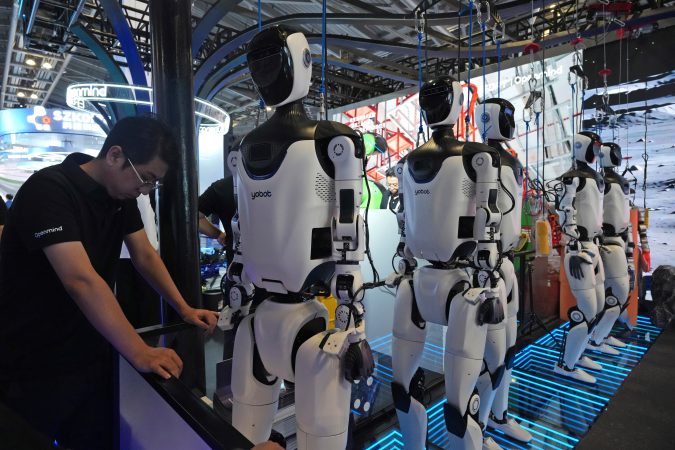
    HONG KONG — The U.S. Federal Communications Commission is banning imports of new foreign-made humanoid robots and power inverters, citing national security risks, in a move that targets China. Beijing quickly accused the U.S. of protectionism.

    The measures are likely to test relations with Beijing ahead of a planned U.S. visit by Chinese leader Xi Jinping to meet with President Donald Trump in September. China dominates the global market for humanoid robots with an estimated market share of roughly 85%.

    The FCC’s ban also includes new imports of quadruped robots, often referred to as four-legged robot dogs. The agency said imports of advanced robots pose cybersecurity and other national security risks. Offshore production of such equipment also leaves U.S. supply chains vulnerable to disruptions.

    The ban on power inverters, which are used to convert direct current (DC) electricity into alternating current (AC) electricity and are used in renewable energy systems, data centers, and household appliances, could have sweeping ramifications.

    This is the latest in U.S. restrictions on Chinese imports

    FCC chairperson Brendan Carr said Tuesday that the move was to “secure America’s critical supply chains.” He said the bans apply to “new versions” of such imports.

    The FCC’s bans follow a slew of U.S. restrictions on imports of Chinese products, including drones, and on exports of U.S. advanced technology to China.

    The U.S. is also weighing controls on use of Chinese open-source artificial intelligence models at a time when Chinese AI is rapidly gaining ground.

    “It’s a steady drumbeat of potential flashpoints heading into [the] Trump-Xi summit planned for September,” said Samm Sacks, a senior fellow at the New America think tank focused on Chinese technology policies.

    China has been rapidly expanding the use of robots, with policies supporting its technology sector. Morgan Stanley analysts forecast its market for humanoids could reach $15 billion by 2030.

    “Chinese manufacturers have been scaling production and reducing costs faster than most overseas competitors,” said analyst Kangyuxiao Li at Morningstar.

    “Restricting their access to the U.S. removes an important future market and protects U.S. developers from potential price competition,” he said. “However, it will not materially slow China’s overall humanoid development, given the size of its domestic manufacturing base and opportunities in other export markets.”

    Of the around 15,000 humanoid robots shipped globally in 2025, Unitree and AGIBOT, two of China’s largest advanced robotics companies, each shipped more than 5,000. Their U.S. counterparts, like Tesla and Figure AI, each shipped a few hundred or less, according to the technology research and advisory group Omdia.

    On the restrictions on power inverters, Cheng Wang, another Morningstar analyst, said the pressure on U.S. markets should be limited. The ban appears to not impact the continued use of existing devices nor the selling by Chinese companies of models that were previously approved by the United States.

    China says protectionism will only hurt the U.S.

    China’s Foreign Ministry hit back at the U.S. move, accusing Washington of overstretching the concept of national security to suppress Chinese companies.

    China will take “all measures necessary” to defend the legitimate rights and interests of Chinese businesses, it said.

    “Protectionism does not make the U.S. more competitive, and it will only hurt the interests of U.S. companies and consumers,” Mao Ning, a ministry spokesperson, told reporters at a regular news conference Wednesday in Beijing.

    The new bans could also potentially interfere with collaborations between U.S. and Chinese technology companies, said Lian Jye Su, a chief analyst at Omdia.

    Nvidia, for example, in June revealed a humanoid robot reference design which uses the humanoid chassis of China’s Unitree.

    The Pentagon recently included Unitree and several other major Chinese technology companies on its list of firms that it said have ties to or aid the Chinese military. Beijing has rejected that claim.

  • U.S. military says it thwarted an Iranian missile attack on American troops

    U.S. military says it thwarted an Iranian missile attack on American troops

    WASHINGTON — Iran has launched multiple ballistic missiles at American forces in the Middle East, shattering a brief pause in fighting as mediators tried to get both sides back to negotiations, the U.S. military said on Tuesday.

    All Iranian missiles were successfully intercepted, U.S. Central Command said on social media, adding that U.S. forces “remain vigilant and at a high state of readiness.”

    Saudi Arabia said Tuesday that it shot down drones fired by Iran-backed militias in Iraq for a second day, while Iran-backed Houthi rebels in Yemen claimed to have forced a Saudi oil tanker to turn around as part of their self-styled blockade of the kingdom.

    The attacks underscored lingering tensions despite a period of calm between the United States and Iran.

    The Saudi Defense Ministry said in a statement that air defenses intercepted and destroyed several drones that had attempted to target petroleum facilities in the nation’s eastern region. It said the attacks were “once again launched from Iraqi territory and carried out by Iran-affiliated terrorist militias.”

    Iraqi Prime Minister Ali al-Zaidi ordered security agencies to investigate after the Saudis alleged a similar attack on Monday. The Iraqi military said in a statement that Iraq is committed to “preventing Iraqi territory from being used as a route or launching point for any attack targeting brotherly or friendly countries.”

    The Iraqi militias have denied any role in the drone attacks. The Islamic Resistance in Iraq, an umbrella group of Iran-backed armed groups, called the Saudi claims “fabrications” and implied that Monday’s attacks were carried out by the Houthis, who had themselves claimed to have attacked Saudi oil facilities.

    Meanwhile, the Houthis claim to have fired missiles at the Saudi oil tanker NCC Ghazal, forcing it to turn back. Last week, they announced a blockade of Saudi shipping, putting another key Middle Eastern waterway — through the Bab el-Mandeb strait leading to the Red Sea — at risk.

    The United Kingdom Maritime Trade Operations Center said a tanker reported hearing explosions while traveling in the southern Red Sea. It did not name the tanker but said the crew and vessel were safe.

    The rebels fired on at least one Saudi tanker in the Red Sea last week.

    Iran and the U.S. paused their fighting over the weekend, though tensions remain high even as officials said mediators achieved progress in getting the two sides back to negotiations.

    Iran said Tuesday that U.S. strikes during an earlier period of escalation destroyed an airport and a marine control tower, and caused damage to 12 bridges and two tunnels, among other infrastructure.

    The U.S. military said at the time that it had struck numerous military targets in response to Iranian attacks on ships in the Strait of Hormuz. Iran retaliated with missile and drone attacks on Arab countries hosting U.S. forces.

  • Wall Street’s flip from AI to less-loved stocks accelerates, while oil prices keep easing

    Wall Street’s flip from AI to less-loved stocks accelerates, while oil prices keep easing

    NEW YORK — Most of Wall Street rose Tuesday, even as stocks of computer chipmakers continued to tumble worldwide. Oil prices, meanwhile, eased further from the two-month high they hit last week.

    The S&P 500 added 0.2%, but the modest move masked big swings underneath the surface. The Dow Jones Industrial Average jumped 537 points, or 1%, while the Nasdaq composite slipped 0.2% after briefly dropping 9.3% below its record set last month.

    The majority of the U.S. market rose after more companies delivered stronger profits for the spring than analysts expected. Coca-Cola climbed 5% after its revenue rose 7% despite what CEO Henrique Braun called “a dynamic consumer landscape.”

    Sherwin-Williams rallied 8.3%, and Illinois Tool Works rose 3.6% after both likewise reported stronger earnings for the latest quarter than analysts expected. Stock prices generally follow the trend of corporate profits over the long term, and expectations are high for this most recent round of reports with the U.S. stock market still near its all-time high.

    Such expectations are weighing particularly heavily on stocks of chipmakers and other companies that have been huge winners from the boom in artificial-intelligence technology.

    Micron Technology’s stock came into the day having more than tripled for the year following gangbuster growth, for example. During the three months through May 28, its revenue more than quadrupled from a year earlier.

    But worries are rising about whether such growth is sustainable. Big spenders on computer memory could pull back on investments if AI does not produce as much profit or productivity as promised. Lower-cost AI models from China could also mean less demand for memory and computing power than earlier expected.

    Micron dropped 8.9% and was the heaviest weight on the S&P 500. Others also helping to keep the market in check were Advanced Micro Devices, down 8.1%, and Applied Materials, down 7.8%.

    All told, the S&P 500 rose 15.60 points to 7,428.78. The Dow Jones Industrial Average jumped 537.24 to 52,747.32, and the Nasdaq composite fell 55.17 to 24,876.91.

    The losses for chip stocks were even worse earlier in the day in other markets worldwide.

    Sharp drops for SK Hynix and Samsung Electronics dragged South Korea’s Kospi index down 10.8%. The market’s losses were so big that trading was temporarily halted at times in Seoul.

    “We believe the market was likely spooked by the progress of China’s chipmaking equipment capabilities, and was worried that this progress would threaten the competitive position of global chipmaking and chip equipment leaders,” said equity analyst Jing Jie Yu of Morningstar.

    “That said, we believe the sell-off today is largely a knee-jerk reaction and overdone,” he said. The dominant position of global chipmaking leaders is unlikely to be threatened meaningfully, he said.

    Several huge spenders on AI chips and data centers are scheduled to report their latest quarterly results this week, which could offer updates on how much they’re planning to invest. Meta Platforms and Microsoft are reporting on Wednesday, while Amazon is due on Thursday.

    Because AI superstar stocks have grown so big, their movements carry more weight on the S&P 500 and other indexes than many other companies. But the broad U.S. market could hold up despite their swings if other, less-loved areas are able to keep rising. It’s a rotation that some strategists have suggested could be healthy for the overall stock market.

    In the oil market, the price for a barrel of Brent crude to be delivered in October fell 4.4% to settle at $82.08.

    It’s been falling since late last week, when the price for a barrel to be delivered in September briefly shot as high as $102.

    Pushing up on prices have been worries that worsening fighting in the Middle East could slow the global flow of oil. On the other side, though, are hopes that the United States and Iran could still negotiate something to allow oil tankers to use the Strait of Hormuz to move crude.

    Lower oil prices helped to ease Treasury yields in the bond market. The yield on the 10-year Treasury fell to 4.60% from 4.65% late Monday.

    A weaker-than-expected reading on confidence among U.S. consumers also weighed on yields. Fewer consumers are saying they feel good about current business conditions, according to the latest survey released by the Conference Board Tuesday.

    The drop in oil prices helped push traders to trim their bets that the Federal Reserve could announce a hike to interest rates following its latest meeting on Wednesday. They’re forecasting a 31.5% probability, down from more than 36% a day before, according to data from CME Group.

    Higher rates could keep a lid on inflation, but they would also slow the economy by making it more expensive for U.S. households and businesses to borrow. Long-term mortgage rates have already hit their highest level in nearly a year, chilling the housing industry.

  • Workplaces look for cheaper AI as ‘tokenmaxxing’ fades as a corporate fad

    Workplaces look for cheaper AI as ‘tokenmaxxing’ fades as a corporate fad

    A corporate fad of “tokenmaxxing” on artificial intelligence technology is hitting its limits as workplaces throwing AI at everything are seeing the costs rise without a similar spike in productivity.

    What started as tech industry-fueled springtime hype over squeezing as much AI-generated work as possible out of products like OpenAI’s ChatGPT and Anthropic’s Claude has shifted to a summertime backlash.

    “It’s very easy to create something you don’t need with AI,” said Vincent Gusdorf, head of AI analytics at Moody’s Ratings and author of a new report that recommends a more disciplined approach.

    “Tokenmaxxing” refers to maximizing usage of tokens — the building blocks of generative AI that correspond to small pieces of text that an AI system reads or writes. Each token is about three quarters of a word. And there’s typically a limit to how many you can use, with pricier versions of AI products offering higher caps.

    “As bills started to pile in, people realized that those new tools are quite expensive and you need to use them wisely,” Gusdorf said.

    Tech executives cast high AI usage as a badge of honor

    Just a few months ago, Silicon Valley executives were promoting high token consumption as a signal of high-performing employees. The stereotypical tokenmaxxer was staying up late — perhaps ignoring their significant other — while orchestrating an army of 24-hour AI agents performing work on their behalf.

    OpenAI CEO Sam Altman said in May he was “excited to see what will happen with tokenmaxxing startups, both for how they work internally and the products they can build.”

    Nvidia CEO Jensen Huang said “if your $500K engineer isn’t burning $250K in tokens, something is wrong.” Facebook parent Meta had an internal competition rewarding token usage.

    The trend boosted revenue for leading AI large language model developers like Anthropic and OpenAI, but it fizzled as it became apparent it wasn’t necessarily the best strategy for everyone else.

    Microsoft CEO Satya Nadella has admitted that tokenmaxxing can be addictive but warned in a recent blog post that customers of those models are paying twice for AI, first in spending on tokens and second by feeding all their proprietary data to them. While promoting Microsoft’s own approach, Nadella’s comments were unusual in the way he raised doubts about the data protection assurances of leading AI providers.

    Alex Karp, CEO of the software firm Palantir Technologies speaks during the Annual Meeting of the World Economic Forum in Davos, Switzerland, on Jan. 20.Markus Schreiber

    Palantir CEO Alex Karp went further, telling CNBC earlier this month that something had gone “completely wrong.” He said he was channeling the voice of American businesses privately “livid” about paying so much for tokens that create no value.

    “The basic view among enterprises in this country is, ‘I’m going to chillax and waste my time with tokens. I’m going to get no value and they’re going to get my IP,” said, a Haverford College graduate with ties to the Philadelphia area.

    Workplaces look more for better ‘routing’ of their AI work

    Bain & Company management consultant Jue Wang said many of the big businesses her firm advises have been taking a closer look at returns on their AI investments.

    “The token cost for them has been doubling, almost every other month,” she said. “Let’s say $200 per developer per month. Multiply that by 20,000 developers, which is often what we’re dealing with at these companies, and that quickly gets you to a number that is not a line item that any general manager has planned for.”

    Sometimes that just means not using the AI equivalent of a sledgehammer to crack a nut.

    “Not everything needs a Claude Opus 4.6,” she said of one of Anthropic’s more capable models suited to software engineering or deep research. “And yet you see so many companies, so many users, default to using Opus for everything, including generating emails.”

    That’s led to a search for tools that do AI “model routing” — in which easier queries get automatically sent to cheaper and more efficient AI systems and more complex tasks go to more powerful models.

    Open-source AI models built in China offer less costly alternatives

    Software developer Hassan El Mghari said companies’ sticker shock over the “ridiculous amount of money” spent on subscriptions to AI products from leading U.S. companies has led many away from rewarding high usage.

    “It’s better to kind of just empower employees on how to use this stuff and let them use AI when and however much they need to,” said El Mghari, who leads developer experience at the startup Together AI, which supplies developers with a variety of “open-source” AI models.

    At the same time, those who favor racking up as many tokens as possible are having a field day with new open-source models from Chinese startups like Moonshot’s Kimi or Zhipu’s GLM, which nearly match the capabilities of top U.S. models at a fraction of the price.

    “There is some validity to the theory that this could push tokenmaxxing a little bit further,” said Raffi Krikorian, the chief technology officer at Mozilla. “But if we look at the industry overall, I think it’s realizing that tokenmaxxing is a dumb thing.”

    It’s similar, Krikorian said, to how software companies once considered how many lines of code a programmer wrote to be a good metric of productivity. That later fell out of favor.

    “I think tokenmaxxing is moving through the exact same pattern,” he said. “I think this is going to be an interesting blip that we’re all going to look back to laugh at in a year.”

  • Stocks drift on Wall Street and crude oil prices drop as Mideast tensions cool

    Stocks drift on Wall Street and crude oil prices drop as Mideast tensions cool

    Stocks on Wall Street drifted to a mixed close Monday as oil prices fell after the U.S. and Iran paused their attacks while work resumed on restarting negotiations to end the war.

    The S&P 500 rose less than 0.1% after spending much of the day bouncing between small gains and losses. The benchmark index was coming off two weekly losses in a row. The Dow Jones Industrial Average rose 0.5%, and the Nasdaq composite fell 0.2%, its fourth straight loss.

    The three major stock indexes are on pace to close out this month in the red. It would be the second straight monthly loss for the S&P 500 and Nasdaq.

    Oil prices reversed course from a week ago, when a sharp escalation in fighting between the U.S. and Iran worsened worries about global oil supplies. The price of Brent crude, the international standard, dropped 6.3% to settle at $85.87 a barrel for October delivery. Prices surged to over $100 a barrel last week before easing.

    U.S. crude oil for September delivery fell 7.5% to settle at $82.61 a barrel.

    The war between the U.S. and Iran has sharply curtailed, and at a times halted, traffic through the vital Strait of Hormuz. That has had a ripple effect throughout the world’s economy. Gasoline prices have surged and shipping costs for most goods are rising, with businesses typically passing those costs along to households.

    Markets closed higher in Europe and Asia.

    Bond yields fell. The yield on the 10-year Treasury fell to 4.65% from 4.69% late Friday.

    Technology companies were behind much of the shifts in the market, with gains and declines for a mix of big companies resulting in uncertain trading.

    Nvidia fell 5% and Micron Technology slumped 2.3%. At the same time, Microsoft rose 1.9% and Apple rose 1.2%. They are all among the most valuable companies in the world, and those huge valuations give them more influence over the direction of the broader market.

    The mix of gains and losses from a variety of those companies had more impact in pushing and pulling the market, even as the majority of companies in the S&P 500 gained ground.

    Communications company stocks were among the gainers Monday. Google parent Alphabet rose 2.1%, while Charter Communications jumped 6.7% and Comcast rose 2.3%.

    Credit card issuers and payment processors also notched gains. American Express climbed 2.8%, Capital One Financial added 2.1%, Visa rose 1.9%, and rival Mastercard gained 2.2%.

    In Asia, Chinese memory chipmaker CXMT soared in its debut in Shanghai. The company jumped to become China’s most valuable listed company with an estimated market capitalization of 3.3 trillion yuan (nearly $490 billion).

    All told, the S&P 500 added 1.20 points to 7,413.18. The Dow gained 262.83 points to 52,210.08, and the Nasdaq dropped 43.74 points to 24,932.08.

    Wall Street has a busy week ahead with several potentially mark-moving updates on the economy and company earnings. Reports are due out on consumer confidence Tuesday and inflation on Thursday.

    “This is a week with more than its fair share of potential surprises, good and bad,” said Chris Larkin, managing director, trading and investing, at E-Trade from Morgan Stanley.

    The big focus will be on the Federal Reserve, which will give an update Wednesday on its interest rate policy. The central bank has been grappling with the impact from rising inflation because of the ongoing U.S. war with Iran. It also has to contend with a fresh round of U.S.-imposed tariffs globally, which could further worsen inflation.

    Wall Street anticipates a nearly 36% chance that the Fed will raise interest rates at its meeting this week. Higher rates can help cool inflation by making borrowing more expensive and slowing economic growth.

    The central bank has been holding rates steady throughout the year as it monitors inflation’s direction and impact, but Wall Street expects at least one rate hike by the end of the year.

    Stubbornly high inflation has been squeezing households and fuel costs have hit budgets and spending particularly hard. Gasoline costs are taking a bigger chunk out of household budgets, and that could mean tighter spending on other things like clothing and travel.

    Investors are monitoring the latest round of corporate earnings for signs of consumer stress along with whether the yearlong jump in stock values throughout Wall Street is justified by profits and forecasts for profit growth.

    Investors also have a heavy round of corporate earnings to review this week. Many of those reports could provide more clues into the health of different areas of the economy. Paint and coatings maker Sherwin-Williams, aircraft maker Boeing, and payments processor Visa will report their latest results on Tuesday.

    Starbucks and Chipotle will report results on Wednesday.

    Technology companies are being watched especially closely because their sharp gains throughout the year have been behind the Wall Street’s record run. Microsoft will report results Wednesday. Amazon, with its growing cloud services business and AI focus, will report results on Thursday, along with Apple.

  • Trump defends his economic policies in Michigan, where new Canadian tariffs may sting

    Trump defends his economic policies in Michigan, where new Canadian tariffs may sting

    MILFORD, Mich. — In a visit to Michigan on Monday, President Donald Trump argued that his economic policies have revived the auto industry and American manufacturing even as many businesses contend that the sweeping tariffs he’s imposed against Canada and the rest of the world have hurt the state.

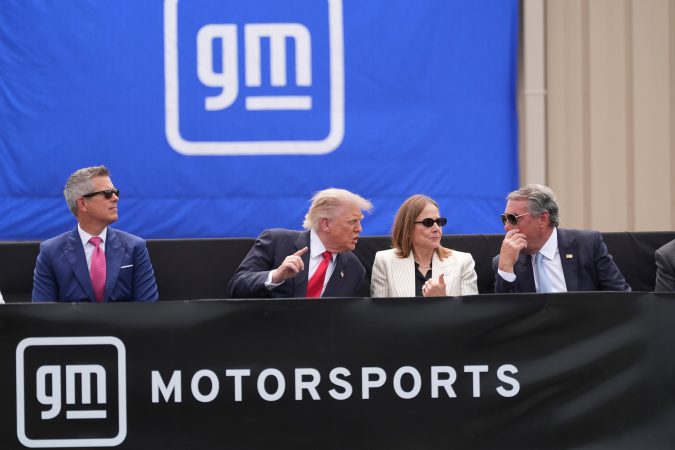
    Trump defended his policies while visiting a General Motors facility in the Detroit suburb of Milford that is a testing ground for its vehicles. He pumped a fist after watching Corvette, Cadillac, and Hummer vehicles compete in a series of drag races.

    In a speech, Trump cheered GM’s plans to expand production domestically in coming years and declared himself a president who was standing up for auto workers “at long last.”

    “I’ve done more for you than your parents, OK?” he said.

    After being led on a tour of vehicles from different eras of GM, some of which he sat in, Trump claimed the tariffs have helped the automaker.

    “They’ve come a long way,” he said to reporters about the Detroit-based automaker. “It’s amazing what tariffs are doing for GM.” Trump said he’s been good to the company but he declined to say more.

    “The rest of the world doesn’t love me, but that’s OK,” he said, alluding to tariffs. “It’s called ‘America first.’”

    Trump’s visit is close to Michigan primary on Aug. 4

    Trump called out several Republican candidates and invited them onstage during his remarks Monday.

    Republican Mike Rogers is unopposed in the Senate primary, but the GOP gubernatorial contest pits Trump-backed Rep. John James against Perry Johnson, a businessperson turned politician who has launched unsuccessful campaigns before, including for president in 2024.

    Johnson is now trying to style himself in the president’s mold — despite missing out on his endorsement.

    The Democratic Senate primary between Rep. Haley Stevens and progressive Abdul El-Sayed has drawn national attention for the right to face Rogers, who was narrowly defeated by Democrat Sen. Elissa Slotkin in 2024.

    Early voting is underway.

    Trump’s new Canada tariffs could hurt Michigan

    Michigan was one of the 2024 battlegrounds Trump flipped after it backed Democrat Joe Biden in 2020. But the state has seen parts of its economy affected by the president’s tariffs, including those on imported cars and auto parts.

    A new round of steep import levies is taking effect on dozens of U.S. trading partners. But Trump has singled out Canada with tariffs as high as 50% on a wide array of its products, including cars.

    The GM facility is in Oakland County, which encompasses much of Detroit’s northern suburbs. Once a Republican stronghold, it has increasingly leaned Democratic, backing Biden against Trump in 2020 and Vice President Kamala Harris against Trump four years later.

    GM says its facility is the oldest dedicated vehicle testing operation in the United States, where 4,200 employees work to refine nearly every vehicle the company makes before they reach consumers.

    Michigan’s economy relies heavily on Canada, however, meaning the new tariffs — coupled with inflation still running high and gas prices rising again as the already unpopular war in Iran continues — have created additional economic concerns statewide.

    Those come at a time when voters across the country were already increasingly dissatisfied with Trump’s handling of the economy.

    Jason Roe, a former executive director of the Michigan Republican Party who tried unsuccessfully to distance it from Trump’s Make America Great Again movement in 2021, said that more than coinciding with his new round of tariffs, Trump’s visit is a function of Michigan’s relatively late primary and is meant to ensure that James secures the nomination.

    But Roe also said it was a risk for the president to tie himself too closely to top Republicans before the general election, calling it “kryptonite to November voters.”

    Trump, who won the White House on a promise to lower the cost of living, also has seen his approval ratings sag, meaning kitchen table issues could be a liability for Republicans trying to hold control of Congress in the Nov. 3 elections.

    “We’re happy to have the president here, campaigning with Republicans. We think it highlights the fact that the only thing they care about is Donald Trump and refuse to stand up to him,” said Curtis Hertel, chairperson of the Michigan Democratic Party. ”It’s good for us every time the president is here because he’s incredibly unpopular.”

    U.S. and Canada have squabbled over a new border bridge

    The Supreme Court struck down many of Trump’s sweeping tariffs, but his administration has tried to find ways around that, including by arguing that he can impose them on Canada because that country is discriminating against American exports of products including automobiles.

    But Trump’s latest round of tariffs came after he voiced frustration with Canada for having retaliated and imposed its own levies on U.S. imports in response to Trump’s initial tariffs last year. Trump launched the first round after alleging Canada should do more to stop fentanyl smuggling.

    It is Trump’s third trip to Michigan in his second term.

    In January, he visited a Ford plant in Dearborn and addressed the Detroit Economic Club, offering a defense of tariffs even as auto industry leaders blamed them for increasing the cost of doing business.

    The president marked his second term’s first 100 days with a rally in Warren, where he mostly mentioned grievances left over from the 2024 campaign,

    His latest visit coincides with tensions between his administration and Canada that have marred the opening of a new bridge linking Detroit and Windsor, Ontario.

    Canada on Friday held its own event hailing the opening of the $4.7 billion Gordie Howe International Bridge instead of a planned celebration with officials in the U.S. after Trump announced the new Canadian tariffs.

    An earlier, joint ceremony had been set for June but was scrapped after Trump suggested the U.S. wanted a “better” deal on the bridge it co-owns with Canada.

    That eventually led to an agreement on splitting tolls that was supposed to allow for the rescheduled joint U.S.-Canada celebration — until the new tariffs derailed that, too.

  • Mediators see progress in efforts to halt Iran war as drone attacks rattle region

    Mediators see progress in efforts to halt Iran war as drone attacks rattle region

    CAIRO — Mediators have achieved progress in getting the United States and Iran back to negotiations, regional officials said Monday, after both sides paused attacks following a period of rapidly escalating tensions. But scattered attacks by armed groups across the region underscored the lingering tensions.

    Saudi Arabia said it had shot down drones fired by Iran-backed militias in Iraq that had targeted its petroleum facilities. Iran-backed Houthi rebels in Yemen meanwhile claimed to have attacked Saudi oil facilities as part of a separate but related conflict. It was unclear if they referred to the same attack.

    Neither the U.S. nor Iran reported carrying out any attacks for three days — a respite after about two weeks of sustained bombardments that had led to increasing fears of a return to all-out war.

    U.S. President Donald Trump said Iran had asked for more discussions, reaching out directly “because we’ve been hitting them very hard.” Iran has said there are no direct talks underway.

    “We’re having good talks, so we’ll see what happens,” Trump told reporters Monday on Air Force One. “I think there’s a good chance that something could happen. And if it does, good. if it doesn’t, we go back to doing what we were doing two days ago.”

    The two regional officials, who spoke on condition of anonymity to discuss the closed-door talks, said mediators led by Qatar and Pakistan were working to bridge the gap between Washington and Tehran to return to an interim ceasefire deal that had collapsed after the exchanges of fire.

    No strikes over the weekend

    In addition to the attack on Saudi Arabia, two drone attacks were reported against a Kurdish Iranian dissident group in Iraq on Monday, and Jordan said it had shot down two drones, without saying where they originated. There were no reports of casualties or damage.

    Iran and Ukraine, meanwhile, have been publicly feuding since Ukraine fired on at least one Iranian vessel in the Caspian Sea over the weekend. Iran, which said a sailor had been killed in the attack, is an important ally of Russia in its war against Ukraine and helped Moscow build up its drone expertise.

    The U.S. paused attacks after targeting Iranian coastal areas and infrastructure in a nearly two-week escalation sparked by Iran’s firing at ships trying to transit the Strait of Hormuz, a crucial waterway for global oil shipments. Iran had responded to the strikes with missile and drone attacks on countries hosting U.S. troops, killing at least three service members at a base in Jordan and one in Iraq.

    Asked if the U.S. munitions stockpile was running low, Trump said both that it was “in very good shape,” and “I’d like to have more, to be honest.” Experts have questioned how long both the U.S. and Iran can afford to keep up attacks.

    Iran halted its attacks following the American pause, Tehran’s army spokesperson told Iranian state TV on Sunday.

    Regional officials cite progress in talks

    One of the regional officials who spoke to AP on Monday described the progress made in mediation efforts as “significant.” He said mediators were working with Iran and Oman on a mechanism for managing vessels’ transit through the Strait of Hormuz, the flashpoint for the latest strikes and counterstrikes.

    Iran’s Foreign Ministry spokesperson, Esmail Baghaei, said during a news conference in Tehran on Monday that “mediators may convey messages to us from the American side” but that there were no direct negotiations.

    He said Iran and Oman, which lies on the other side of the Strait of Hormuz, had already held talks on Friday and Saturday on how to manage ship traffic through the waterway.

    Their aim is to “develop mechanisms to ensure safe navigation through the Strait of Hormuz while respecting the sovereign rights and sovereignty of both coastal states, as well as Iran’s security and national interests” Baghaei said. He stressed that the waterway remains closed.

    Tehran has asserted that the interim deal with the U.S. allows it to manage shipping on the waterway and potentially charge fees, and it has objected to U.S. efforts to support an alternative route that passes close to Oman. The strait was open to all without fees before the war.

    The U.S. military on Monday said its recently reimposed naval blockade against Iran continued, with 17 commercial ships redirected, two disabled, and two boarded.

    The 60-day period established by the interim deal in mid-June is now well into its second half, and major issues that were meant to be negotiated — notably Iran’s nuclear program at the heart of tensions — have been set aside as mediators try to keep both sides talking.

    Shipping traffic on the strait is at a 3-week low

    Concerns have grown about shipping through another crucial waterway in the region, the Bab al-Mandeb strait to the Red Sea. The Houthis last week threatened a blockade of Saudi shipping there, and fired on at least one Saudi tanker, setting it alight.

    Global energy supplies and the economy remain in the balance as gasoline prices have risen again.

    Commercial shipping traffic in the Strait of Hormuz was at a three-week low, a maritime body overseen by the U.S. Navy said Sunday, adding that no new attacks had been confirmed in the past 72 hours. It said traffic remained steady through Bab el-Mandeb.

    Netanyahu says he ‘fully’ backs Trump’s efforts

    Meanwhile, Israeli Prime Minister Benjamin Netanyahu said he plans to meet with Trump in Washington on Tuesday. They last met in Washington in February, weeks before they launched the war on Iran that killed senior leaders, including Supreme Leader Ayatollah Ali Khamenei.

    The Iranian-backed Hezbollah militant group in Lebanon fired at Israel two days after the war began, and Israel responded with airstrikes and a ground invasion. Since then, the U.S. has supported landmark direct talks between Lebanon and Israel to try to calm that front and find a way to disarm Hezbollah.