Category: Associated Press

  • White House press secretary Karoline Leavitt, youngest person to hold role, to leave at month’s end

    White House press secretary Karoline Leavitt, youngest person to hold role, to leave at month’s end

    WASHINGTON — White House press secretary Karoline Leavitt, the youngest person to hold the role, will leave at month’s end, President Donald Trump announced Wednesday.

    Leavitt, 28, just recently returned to the White House after taking a brief leave for the birth of her second child in May.

    Leavitt has been one of the most visible advocates of Trump’s “Make America Great Again” movement. The Republican president described her as one of his “most trusted aides” in a social media post announcing her departure.

    He said Leavitt “will be departing her role at the end of the month so she can spend more time with her beautiful young children and family, a decision I totally understand and respect! Karoline will now be one of my top outside advisors, and an influential voice within the Republican Party, as we work to defy History, and conclusively win the Midterm Elections.”

    Leavitt recently returned to work after taking leave following the birth of her second child, a daughter, in May. She also has a 2-year-old son.

    “The truth is since returning to the White House after the birth of my daughter, I have felt in my heart that I cannot be the best mom my two young children deserve while devoting the constant time, energy, and attention required of the White House Press Secretary — and that is why I have ultimately made the bittersweet decision to depart the White House and embark on a new chapter in my life,” Leavitt said in a social media post.

    Trump did not outline plans for who might replace her in the high-profile role.

    She worked as a spokesperson for MAGA Inc., a super PAC supporting Trump, before joining his 2024 campaign. In 2022, she ran for Congress in New Hampshire, winning a 10-way Republican primary before losing to incumbent Democratic Rep. Chris Pappas.

    During Trump’s first term in office, Leavitt worked as a press aide in the White House press office. She then became communications director for New York Republican Rep. Elise Stefanik.

    Leavitt briefed from the White House press room less frequently than some of her recent predecessors. Trump, who regularly engages with reporters during White House events and during his travels, primarily deployed Leavitt to Fox News and other conservative news outlets to trumpet his agenda and take shots at Democrats and the mainstream media.

    Trump’s first-term press secretaries were Sean Spicer and Sarah Huckabee Sanders, who were known for quarreling with reporters. Another, Stephanie Grisham, never held a briefing. Her successor, Kayleigh McEnany, often lectured the news media during her appearances in the press briefing room.

  • Forget left vs. center. Democratic voters are making clear they just want change

    Forget left vs. center. Democratic voters are making clear they just want change

    WASHINGTON — Democrats remain mixed over what ideological direction the party should take. But across a series of closely watched primaries, they are sending a clearer message about the party’s path forward: They want change.

    In marquee Senate primaries in Michigan and Minnesota, progressive candidates defeated two members of Congress with significant backing from party leaders. Wisconsin voters narrowly rejected a democratic socialist but still chose a 40-year-old county executive who is seeking to become the state’s first Black governor. And in Connecticut, voters ousted one of the longest-serving Democrats in Congress for a challenger who campaigned on generational change.

    The results so far this month deliver no clear ideological mandate. Instead, they add to mounting evidence from this year’s primaries of a Democratic appetite for turnover that is cutting across the party’s traditional divisions.

    “The through line between these races isn’t ideology. It’s impatience with this political system that feels disconnected from the urgency voters feel,” said Lis Smith, a national Democratic strategist. “The demand for change is much broader than the demand for socialism.”

    The immediate challenge for Democrats is whether they can harness the frustration fueling revolts against their own party and turn it against Republicans in November. Beyond that looms the 2028 presidential race, when a new generation of leaders will compete to shape a changing Democratic Party.

    “If leaders in our party don’t recognize that we need to make changes, then the changes are going to come from the ground up,” Luke Bronin, a former mayor who defeated 14-term Connecticut Rep. John Larson in Tuesday’s primary, said in his victory speech. “That’s a message our party needs to hear.”

    Progressives are ascendant, but Wisconsin shows their limits

    Progressive leaders touted Tuesday’s results as further proof that their message is working after victories in Minnesota and Michigan.

    “What we are seeing is that people are sick and tired of establishment politics and establishment policies,” Sen. Bernie Sanders told the Associated Press on Wednesday, pointing to a string of progressive victories around the country.

    In Wisconsin, Democratic socialist Francesca Hong had hoped to also ride the wave of recent progressive victories to the Democratic nomination for governor. Instead, she narrowly lost to Milwaukee County Executive David Crowley, a more moderate Democrat who had the backing of outgoing Gov. Tony Evers.

    Hong’s defeat also came after a number of her past comments resurfaced, including support for defunding the police and a call to cancel Thanksgiving, which she said was a joke. Unlike El-Sayed, Hong didn’t receive the backing of some of the nation’s most prominent progressive leaders, including Sanders and Rep. Alexandria Ocasio-Cortez.

    Sanders said Wednesday that he didn’t endorse Hong because his team lacks the resources to “get involved in every single race. Period. And that’s about it.” He nevertheless praised her “very strong grassroots campaign” for getting “a whole lot of people excited.”

    The result illustrates a tension for the party’s ascendant left flank. Candidates running on populist economic messages have found growing success with Democratic voters. But some positions associated with the progressive movement’s recent past remain vulnerabilities — particularly among voters worried about electability in November.

    “A lot of Democrats are traditionalists on things like culture issues. This is not about culture, it’s about economics. It’s about corruption,” said David Axelrod, who was an adviser to President Barack Obama. “The closer that candidates hew to those issues, the larger the base they’re going to be able to accumulate.”

    That tension was evident Tuesday for Sarah Atkins Hoggatt, 61, who said she agreed with Hong on some issues but worried that Hong’s deeply progressive politics and the democratic socialist label would make it harder for her to defeat Republican Tom Tiffany. She voted for Crowley.

    “I didn’t vote my heart,” Atkins Hoggatt said.

    Progressives scored a much clearer victory in Minnesota, where Lt. Gov. Peggy Flanagan resoundingly defeated centrist Rep. Angie Craig. Craig had the backing of House Democratic Leader Hakeem Jeffries and other prominent Democrats, while Flanagan was supported by Sanders and Sen. Elizabeth Warren.

    Flanagan, similar to El-Sayed in Michigan, highlighted her opponent’s support from wealthy donors while also attacking her vote for a Trump-backed immigration bill that became a liability after immigration agents shot and killed Renee Good and Alex Pretti in Minneapolis.

    As in Michigan, the winning progressive candidate was significantly outspent.

    “Super PACs spent over $80 million trying to defeat El-Sayed and Peggy Flanagan,” Sanders said. ”They lost both elections. I think what people are saying is, we’re sick and tired of billionaires and their super PACs buying elections.”

    Democrats are hungry for change

    Flanagan is 46 years old. Crowley is 40. And El-Sayed is 41. But nowhere was the demand for generational change more explicit Tuesday than in Connecticut.

    Bronin, 47, defeated the 78-year-old Larson — who was first elected to Congress in 1998. A central theme of Bronin’s campaign was the need for a new generation of leadership in Washington.

    Larson became the seventh Democratic House incumbent to lose a primary this year, many of them to younger challengers. The defeated incumbents and the Democrats replacing them span ideological lines, making the wave of losses difficult to explain simply as a shift to the left.

    The push for generational turnover has taken on greater urgency since Democrats’ defeats in 2024, when concerns about President Joe Biden’s age ultimately ended his reelection campaign and forced the party into an uncomfortable reckoning over a generation of leaders who had remained in power for decades.

    Bronin himself has connected his challenge to that experience. Earlier this year, he argued that Democrats needed “new members of Congress, new Democratic leaders who have the energy and courage and clarity of mission that this moment demands.”

    That sentiment was evident among voters in Larson’s district. Dan Schnaidt, a 73-year-old Democrat, said he appreciated Larson’s service but believed it was time to move on.

    “It’s time for new blood, for new ideas,” Schnaidt said.

    The generational divide extends to the electorate

    While Hong fell just short in Wisconsin, the strength of her insurgent campaign highlighted another force reshaping Democratic politics: younger voters.

    Cody Chandler, a 35-year-old software engineer, voted for Hong and called her “probably the most exciting candidate I’ve seen.” Unlike in elections past, Chandler said, he voted for the candidate he most wanted to win rather than the one he considered most electable.

    Jesse Heer, a 32-year-old Madison business owner, also backed Hong, citing her focus on affordability.

    That support showed up geographically. Hong won Madison, home to the University of Wisconsin’s flagship campus, by nearly 7 percentage points, though it wasn’t a big enough of a margin to help her win the nomination.

    A similar pattern helped propel El-Sayed to victory a week earlier in Michigan.

    El-Sayed won Washtenaw County, home to the University of Michigan, by nearly 25 percentage points and Ingham County, home to Michigan State University, by 23 points. He also won Grand Rapids, with its large population of younger, college-educated voters, by nearly 26 points.

    Jordan Snyder, a 20-year-old Michigan voter who supported El-Sayed, said she backed him because of his progressive positions and because she viewed him as someone she could trust, rather than “someone who I feel could be bought and sold.”

    “People are feeling like a lot of the people that they’ve trusted that have been in government haven’t really been living up to expectations,” Snyder said.


  • Congo’s Ebola outbreak is on track to surpass the deadliest one in history, WHO chief says

    Congo’s Ebola outbreak is on track to surpass the deadliest one in history, WHO chief says

    The ongoing Ebola outbreak in Congo is on track to surpass the deadliest one in history, which erupted over a decade ago and killed over 11,000 people, the head of the World Health Organization said Wednesday.

    “At its current pace, it’s on track to eclipse the West African Ebola outbreak of 2014 to 2016,” Tedros Adhanom Ghebreyesus told reporters. That outbreak horrified the world and jolted efforts to develop a vaccine.

    The outbreak in eastern Congo, considered the fastest-growing one yet, has killed over 2,000 people out of more than 4,300 cases. The outbreak was declared on May 15, but health authorities now say sequencing showed it began months earlier, in February.

    It is unlike recent Ebola outbreaks because the rare Bundibugyo virus responsible for it has no approved vaccines or treatments, though efforts to address that are underway.

    WHO says this outbreak ‘had a big head start’

    Experts say this outbreak is moving faster than efforts to track and manage it in a remote part of eastern Congo facing ongoing conflict, near the borders with South Sudan, Uganda and Rwanda.

    Most new cases and deaths are being reported in communities outside the reach of health workers in a region of poor infrastructure and ill-equipped health centers. Some workers have gone on strike over lack of pay. Misinformation about the virus circulates in communities where some are wary of outsiders, keeping some people from clinics.

    “The outbreak had a big head start, still way ahead of us, and we’re playing catch-up,” Tedros said.

    Abdirahman Mahamud, WHO’s director for health emergency alert and response operations, said the agency expects the peak of the outbreak to be reached in six months.

    “But … that’s the moderate scenario,” Mahamud said. “There is a one-case scenario where this outbreak may last nine months to 12 months.”

    This Ebola outbreak has killed more people at a faster rate than any other, including the 2014-2016 outbreak that had at least 28,000 cases. That one took about eight months to reach 1,000 deaths.

    Two vaccines for this type are being tested

    Ebola is rare but highly contagious and can be contracted from bodily fluids such as vomit, blood or semen, and from contaminated surfaces and materials such as bedding and clothing. The disease it causes is severe and often fatal.

    Clinical trials of two possible treatments for this type of Ebola began last month in Ituri, the most affected of the five provinces in Congo where cases have been reported.

    Two vaccines developed specifically for the Bundibugyo virus are now being tested in people for the first time, Tedros said Wednesday.

    WHO also plans to test whether an existing Ebola vaccine could protect people against the virus after studies in animals showed promising results.

    The origins of the outbreak are becoming increasingly clear.

    A study published in Nature Medicine on Monday added evidence that the outbreak began when the virus jumped from an infected animal to a person, rather than stemming from earlier outbreaks. Researchers found the virus is genetically different from versions seen in Bundibugyo Ebola outbreaks in 2007 and 2012.

  • Ex-Chinese Premier Zhu Rongji, who drove economic reforms and led China into the WTO, has died at 97

    Ex-Chinese Premier Zhu Rongji, who drove economic reforms and led China into the WTO, has died at 97

    BEIJING — Former Chinese Premier Zhu Rongji, the impatient, sharp-tongued reformer who helped ignite China’s explosive economic boom by forcing wrenching change on state industry in the 1990s and leading the country into the World Trade Organization, has died of illness, state media reported Wednesday. He was 97.

    Mr. Zhu died in Beijing at around 11 a.m. on Wednesday, the official news agency Xinhua reported.

    Once sent into rural exile to do manual labor for praising reforms in other communist countries, Mr. Zhu pushed through a dizzying array of changes as premier, China’s top economic post, from 1998 to 2003 under former President Jiang Zemin.

    Mr. Zhu clashed with Communist Party conservatives and state industry bosses as he pushed state-owned companies to become efficient and profitable. That cost millions of layoffs, but helped propel China to overtake Japan as the second-largest economy behind the United States in 2010.

    Building on former leader Deng Xiaoping’s 1979 reforms, Mr. Zhu is credited with supplying the resourcefulness and tenacity to push through history-making changes such as China’s WTO membership, which helped to transform China into the world’s biggest exporter.

    Those changes helped to keep economic growth above 8% a year from 2000 to 2010, peaking at 14.2% in 2007.

    A spiky personality who fought corruption and conservatives

    Named premier in 1998 at age 69, Mr. Zhu became a popular figure by criticizing official bungling and graft and accepting blame when the government fell short. His demanding style earned him the nicknames Boss and Zhu Fengzi, or Madman Zhu.

    “I have prepared 100 coffins here — 99 for corrupt officials and one for myself,” Mr. Zhu said in 1998, according to the party newspaper People’s Daily.

    Mr. Zhu ranked No. 3 in the party hierarchy behind Jiang and Li Peng, chairman of the ceremonial legislature, the National People’s Congress. But he was a technician without his own power base. Mr. Zhu complained that allowed officials to ignore his orders.

    Mr. Zhu made his name as a deputy premier in the 1990s by crushing inflation. He enforced price controls and cut off loans to money-losing state companies, rebuffing resistance by local leaders — a pattern Mr. Zhu would repeat as he fought conservatives over the pace of reform.

    Mr. Zhu led efforts to secure WTO membership following marathon negotiations that began in the 1980s. That status would enshrine free trade as a national commitment, giving Mr. Zhu a tool to force local officials to stop protecting favored companies.

    Mr. Zhu’s campaign was nearly derailed when he went to Washington in 1999 with market-opening concessions to win U.S. endorsement of the WTO bid. The Clinton administration rejected the offer as inadequate, while his political enemies at home accused him of offering too much, but Zhu survived and China went on to join the body in December 2001.

    Mr. Zhu launched China’s home ownership boom in 1998 with an initiative to sell apartments owned by state companies. Families rushed to buy, and within a decade the majority of urban housing was privately owned.

    Still, Mr. Zhu was less an advocate of free enterprise than a skilled bureaucrat who carried out party orders to whip state industry into shape.

    Mr. Zhu showed no interest in privatizing the economy. He played a key role in drafting plans in the 1990s to turn banks, airlines, oil companies, and other enterprises into profit-oriented corporations but to retain government ownership.

    Zhu stood out for admitting official failings

    Born Oct. 23, 1928, in Mao Zedong’s home province of Hunan, Mr. Zhu paid an early price for his willingness to take risks and speak out.

    After a start as an economic planner, his career went into a 22-year eclipse when he was labeled a “rightist” in 1957 for praising reforms in Hungary and Yugoslavia. He was banished to the countryside during the 1966-76 Cultural Revolution to do manual labor.

    Rehabilitated in 1979, Mr. Zhu rose swiftly, becoming deputy Shanghai party secretary in 1987 and mayor the next year.

    As mayor in 1989, Mr. Zhu gained a reputation for moderation when he placated protesters and pledged not to call in the military.

    “He managed to defuse, with considerable subtlety, a tense political situation that could have developed into localized violence or worse if the military had felt it necessary to intervene,” wrote Australian diplomat Shelley Warner in the 1991 book The Pro-Democracy Protests in China: Reports from the Provinces.

    Mr. Zhu’s boss, Jiang, would soon be called to Beijing by Deng and made party leader. Mr. Zhu was named deputy premier in 1991 and joined the party’s ruling Standing Committee in 1993.

    Mr. Zhu broke with the leadership’s stance of infallibility by admitting and taking blame for official failings.

    In 1998, after summer floods killed 4,150 people and officials were accused of embezzling money meant for anti-flood dikes, Mr. Zhu complained some barriers were no stronger than bean curd.

    Three years later, he apologized on national television for his cabinet’s failure to protect the public after an explosion in a schoolhouse in southern China killed at least 42 people, most of them children.

    Mr. Zhu enlivened the party’s bland image by cracking jokes in public, sometimes at his own expense. Laughter erupted at a 1999 news conference when he said a recent photo “made me look like a dead man.”

    One of Mr. Zhu’s proudest triumphs as deputy premier was to craft a tax system that required local officials to hand more revenue to Beijing. He said in 1996 that he deserved a Nobel Prize in economics for that.

    Mr. Zhu rarely appeared in public after leaving office as premier.

    Mr. Zhu was married to Lao An, a fellow Hunan native. Their son, Yunlai, also known as Levin Zhu, is a former CEO of China International Capital Corp., a government-owned investment bank.

    Their daughter, Yanlai, led a charity organization supporting schoolchildren that was backed by Zhu Rongji.

  • ICE plans to give officers gloves that can deliver painful electric shocks

    ICE plans to give officers gloves that can deliver painful electric shocks

    Immigration and Customs Enforcement officers may soon be outfitted with gloves that can deliver painful electric shocks intended to gain compliance from combative individuals.

    ICE plans to spend up to $20 million to purchase thousands of “conductive distraction and de-escalation devices” for officers and agents by March, according to a notice published Monday by the Department of Homeland Security.

    The devices are known as the G.L.O.V.E., which stands for Generated Low Output Voltage Emitter, and are manufactured by Compliant Technologies LLC of Lexington, Ky. They have been used in recent years by some jails and police departments.

    DHS said Tuesday that it was working on a response to an Associated Press inquiry and offered no immediate comment. Jeff Niklaus, the founder and CEO of Compliant Technologies, wrote in an email, “Unfortunately, we are unable to speak on this subject.”

    The notice said the solicitation for a no-bid contract could be published as early as Friday.

    Civil rights advocates expressed alarm at the plan, saying ICE officers already face criticism for their use of force with little oversight or accountability while enforcing President Donald Trump’s immigration crackdown.

    Compliant Technologies says the devices function as a normal pair of patrol gloves until officers press a switch to activate their electrical mode. The gloves must be applied directly to someone’s skin to deliver a pain stimulus that typically helps an officer gain compliance within seconds, according to the company.

    “It’s immediate and sharp, and it will distract you. I call it like a bee sting,” said John Peters, president of the Institute for the Prevention of In-Custody Deaths, who is studying how the device has been used. “If the officer is getting any type of resistance from the person, this is certainly an effective tool.”

    Peters said he believed ICE’s planned purchase would likely be the largest from the company to date. He said he could envision ICE officers using the gloves to help remove uncooperative subjects from cars and houses and in and out of detention facilities.

    “For smaller officers or weaker officers or older officers, I think it has a great advantage” because it can produce faster takedowns and shorten confrontations, he said.

    The manufacturer warns the device should not be used as punishment, against people merely exhibiting “verbal defiance or belligerence” or on high-risk populations such as children, pregnant women, or elderly or disabled people.

    Jenn Rolnick Borchetta, deputy project director on policing at the American Civil Liberties Union, said the public should have no confidence that ICE officers will use the devices appropriately. She questioned why the devices would be necessary for civil immigration enforcement and noted those getting shocked might have no advance warning.

    “ICE spent the last year showing this country they are too quick to use force. Now they will be able to deploy electric shocks with the slight push of a button that maybe nobody else can see them do,” she said. “Introducing gloves that can so easily be used to deliver terrible pain in encounters is a recipe for harm to the public.”

    Supporters say the devices are generally used in specific jail and transport situations, rather than broadly to patrol on the streets. They have been used to subdue violent suspects who are refusing to get into squad cars and inmates who are harming themselves and threatening officers, according to Compliant Technologies.

    Peters said he expected the devices to be misused by a small number of employees, as with other policing technologies, but he said they are unlikely to cause injuries. He said it would be important for ICE to have robust policies and training in place.

    To use the device, officers must complete a course and be recertified every two years, the manufacturer says.

  • A blockbuster $12.5B deal as Josh Kushner and Bob Iger agree to buy the Lakers

    A blockbuster $12.5B deal as Josh Kushner and Bob Iger agree to buy the Lakers

    LOS ANGELES — The Los Angeles Lakers are being sold for the second time in a year, going to businessmen Josh Kushner and Bob Iger for a record-breaking price.

    This sale agreement is $12.5 billion, according to a person familiar with the terms who spoke to The Associated Press on condition of anonymity Wednesday because neither side revealed specific details of the latest stunning development with one of North America’s marquee sports teams.

    ESPN first reported that Kushner and Iger are buying the NBA’s most valuable franchise. The Lakers were valued last year at $10 billion — a record for a pro sports team — when Mark Walter purchased a controlling stake from the Buss family, which had owned the team since 1979.

    Kushner, a venture capitalist, and former Walt Disney Company CEO Iger had been working together on landing a possible NBA expansion team for Las Vegas. By buying the Lakers, they don’t have to wait until the possibility of expansion in the 2028-29 season at the earliest.

    The sale still will need approval from the NBA’s board of governors, and that process can take several weeks. The next board meeting is set for September in New York.

    The $12.5 billion price tag is not only a record for U.S. pro sports but a new summit in skyrocketing NBA franchise values. Only three years ago, Michael Jordan sold his majority stake in the Charlotte Hornets for a $3 billion valuation, while the Boston Celtics were sold last year to private equity mogul Bill Chisholm at a valuation of just over $6 billion.

    Walter’s agreement to purchase a controlling stake in the Lakers at the $10 billion valuation last summer obliterated that mark, and now Iger and Kushner have pushed the bar even higher.

    The 66-year-old Walter’s shocking decision to sell the Lakers after just 10 months of official ownership is reverberating throughout the team’s massive fan base, which appeared to be uniformly excited about the purchase last year. Walter has stewarded the Los Angeles Dodgers into the most successful stretch in franchise history, with three World Series championships in the past six seasons as the most aggressive spenders in baseball.

    Multiple media outlets last month reported that Walter’s business empire is under scrutiny from both federal prosecutors and the Securities and Exchange Commission in tax fraud investigations.

    The 41-year-old Kushner’s capital holding company, Thrive Eternal, was set to be the “anchor investor” in FIFA President Gianni Infantino’s plan to sell stakes in future World Cup profits. Infantino abandoned the idea on July 31. Kushner’s brother is Jared Kushner, son-in-law of U.S. President Donald Trump.

    Josh Kushner currently owns a minority stake in the Miami Heat, and he previously owned a stake in the Memphis Grizzlies.

    The 75-year-old Iger became one of Hollywood’s most well-known executives while he ran Disney for two lengthy stints between 2005 and last March, when he stepped aside. Iger and his wife, former sports journalist Willow Bay, are the controlling owners of NWSL team Angel City FC.

    Walter’s purchase of the Lakers was approved by NBA owners last October. He originally bought a 27% minority stake in the team in 2021 before purchasing control of the team last year.

    Walter and his partners also have ownership interests in the WNBA’s Los Angeles Sparks, English Premier League club Chelsea, the Professional Women’s Hockey League and the new Cadillac Formula 1 racing team.

    When Walter bought his controlling interest in the Lakers, the deal specified that Jeanie Buss would stay on as the team’s governor. With new ownership, it’s unclear whether Buss will have a continuing role in the team she inherited along with her siblings from her father, Jerry Buss, who died in 2013.

    The Lakers have won 17 championships going back to the franchise’s origin in Minneapolis, the second-most in NBA history behind Boston’s 18. It is a global brand, always at or near the top of the league’s merchandise-sales rankings.

    This record sale price comes just weeks after LeBron James, the league’s all-time leading scorer, left the Lakers after eight seasons to become a free agent. James ultimately decided to sign with the Philadelphia 76ers.

    The Lakers won their most recent title in 2020, and they have made the playoffs in each of the past four seasons. Their current roster is built around NBA scoring champion Luka Doncic, who is signed through the 2028-29 season.

  • An overnight Ukrainian blitz damages Russia’s Black Sea naval stronghold, Zelensky says

    An overnight Ukrainian blitz damages Russia’s Black Sea naval stronghold, Zelensky says

    KYIV, Ukraine — Ukrainian anti-ship missiles and drones blitzed a major Russian naval base on the Black Sea coast in a “unique” nighttime operation, Ukrainian President Volodymyr Zelensky said Wednesday.

    Cutting-edge drones developed by Kyiv since Moscow’s full-scale invasion over four years ago have repeatedly targeted Russian ships in the Black Sea, including warships and oil tankers.

    Ukraine’s air and sea drones have succeeded in limiting the movements of Russia’s once-dominant Black Sea navy, Kyiv officials say, in one of the country’s biggest accomplishments of the war.

    But Ukrainian officials believe Russian President Vladimir Putin is bent on pressing ahead with the war, despite his bigger army’s slow and costly progress on the battlefield and U.S. diplomatic efforts to find a settlement.

    Putin is planning “an additional rapid mobilization of several hundred thousand Russians by the end of the year,” Zelensky said Tuesday night on social media, citing Ukrainian intelligence reports.

    Those reports have said recently that Russia is expanding production of ballistic missiles and jet-powered drones, both of which are hard for Ukrainian air defenses to counter.

    Ukraine also is trying to scale up its weapons manufacturing through agreements with partner countries.

    Russia shows no sign of a new mobilization

    Neither Putin nor other senior Russian officials have hinted at a possible major call-up of forces to fight in Ukraine. Some officials have accused Kyiv of trying to rattle the Russian public with talk of a mobilization.

    Russian lawmaker Andrei Gurulyov brushed off reports of a possible autumn mobilization. “It is the enemy deliberately spreading rumors about mobilization in order to destabilize the situation inside Russia,” he was quoted as saying by pro-Kremlin online outlet Tsargrad in comments published Monday.

    After the widely unpopular partial mobilization of some 300,000 men four years ago, Russia has relied on volunteers attracted by relatively high pay. However, the decree declaring the partial mobilization that Putin signed in September 2022 is open-ended, allowing authorities to resume it if needed.

    Ukraine says it hit Black Sea port infrastructure

    The Ukrainian military “carried out a unique operation targeting the naval base in Novorossiysk — the last major stronghold of the Russian fleet in the Black Sea,” Zelensky said in a social media post Wednesday. The attack struck air defenses, piers, and other port infrastructure, he added.

    Russia relocated most of its naval ships to Novorossiysk after Ukrainian strikes on the main Black Sea base at Sevastopol on the Crimean Peninsula earlier in the war.

    Hundreds of Ukrainian drones attacked Novorossiysk, Anapa, and Gelendzhik and the Temryuk district of the Krasnodar region overnight, said Gov. Veniamin Kondratyev.

    An 8-year-old child was one of three people killed in the attack on the region, Kondratyev said. He added that 24 others in the region were wounded. Dozens of residential buildings were damaged, Kondratyev said, and debris from downed drones fell on the grounds of four industrial plants.

    The strikes damaged two of Novorossiysk’s three grain terminals, with one of them halting operations, the Russian business daily Vedomosti reported.

    Russia’s Defense Ministry said its air defenses downed more than 500 Ukrainian drones.

    Struck Russian port is also a key oil hub

    Novorossiysk also is home to the Grushovaya oil terminal, one of the largest international hubs in southern Russia for petroleum products. No reports indicated it had been hit.

    In February, the U.S. State Department expressed its displeasure about Ukraine’s attacks on Novorossiysk, saying they affected U.S. oil interests in ⁠Kazakhstan.

    The Caspian Pipeline Consortium operates a pipeline from the Caspian coast in northwestern Kazakhstan to Novorossiysk. The pipeline handles much of the crude exports from three major Kazakh fields in which major U.S. energy companies, Chevron and ExxonMobil, have stakes.

    With the militaries of European countries boarding and detaining sanctioned Russian oil tankers at sea, hurting the country’s trade and heaping economic pressure on Moscow, Putin on Wednesday threatened retaliation for what he termed “piracy.”

    Speaking on a visit to a Russian warship taking part in a naval exercise in the Pacific, Putin said Western countries are breaking international maritime law by seizing ships they say are part of Moscow’s ” shadow fleet ” of sanctions-dodging merchant vessels.

    “It’s nothing but piracy and robbery,” Putin said. “If this is done, we will be forced to respond in kind.”

    On the Crimean Peninsula, which was illegally annexed by Moscow in 2014, air defenses downed 115 Ukrainian drones over Sevastopol overnight, said Mikhail Razvozhayev, the city’s Russian-installed head. He added that 10 apartment buildings and 25 private houses were damaged.

    Russian drones kill 2 and destroy a shopping mall in Ukraine

    Ukraine’s air force said Russia fired 138 long-range drones as well as an unspecified number of missiles during the night, with damage recorded at 16 locations.

    In the Kherson region of southern Ukraine, a large-scale Russian drone attack overnight killed two people and wounded two others, said regional head Oleksandr Prokudin.

    The attacks also destroyed a shopping mall in the southern city of Zaporizhzhia, according to authorities.

    Missiles and long-range drones hit fuel reservoirs and infrastructure used for unloading and storing military cargo in the port of Chornomorsk in Ukraine’s Odesa region, Russia’s Defense Ministry said.

    A bulk cargo vessel carrying military equipment and a tanker loaded with oil for the Ukrainian armed forces also were hit in Odesa, it said.

  • Jackie, the California bald eagle who became an internet sensation, dies after illness

    Jackie, the California bald eagle who became an internet sensation, dies after illness

    BIG BEAR LAKE, Calif. — Jackie, the bald eagle who became an internet sensation and a symbol of the species’ recovery in California, died Monday after being treated for an illness at a veterinary facility, her caretakers announced.

    For more than a decade, nature lovers watched via an online video feed as Jackie and her partner Shadow tended to their nest each year atop trees near Big Bear Lake in the San Bernardino Mountains east of Los Angeles.

    The nonprofit Friends of Big Bear Valley installed the nest camera in 2015 and documented the successes and failures of each breeding season. In 2024, Jackie diligently sat on her eggs for more than 2½ days straight after a winter storm blanketed the nest with snow.

    The Los Angeles County Department of Parks and Recreation’s San Dimas Raptor Rescue team found Jackie on July 17 following reports that the bird had been involved in a fight with two other eagles and was found to be ill.

    Jackie had been receiving medical treatment for three weeks at the Ojai Raptor Center, where she was treated for a variety of ailments including anemia. Despite undergoing a blood transfusion and oxygen therapy, her condition worsened and the center announced the animal’s death Monday.

    “We know this news will be deeply felt by the many thousands of people around the world who have followed her journey, hoped alongside us, prayed for her, and supported the people caring for her,” the center’s statement said. “Our team is heartbroken. It has been an extraordinary privilege to care for her.”

    The California Department of Fish and Wildlife is caring for the remains.

    Among those who enjoyed monitoring Jackie’s nests from afar was biologist Kelly Sorenson, executive director of the Ventana Wildlife Society in central California. While his group was not involved with the Big Bear eagles, he sees their breeding as emblematic of the comeback the species has made in the state over the past decades.

    American bald eagles teetered on the brink of extinction until the pesticide DDT was banned in the 1970s and other protections were established, leading the species to rebound and be removed from the federal endangered list.

    “You want to see a success story like that,” Sorenson said Monday. “Having access to a live cam to see the nesting first hand is very powerful. It brings people in on an emotional level.”

  • Former Syrian President Assad sentenced to death in absentia for war crimes

    Former Syrian President Assad sentenced to death in absentia for war crimes

    DAMASCUS, Syria — A Syrian court on Tuesday sentenced ousted President Bashar Assad and his brother in absentia for murder, torture and crimes against humanity committed before and during the country’s 14-year civil war that left about half a million people dead.

    The verdicts by a court in Damascus are the first against Assad or any members of his inner circle since his family’s five decades in power came to an end 20 months ago. They are mostly symbolic, however, because Assad and his brother Maher fled to Russia, where they received asylum after the Syrian government’s stunning collapse in December 2024.

    Six other former officials were also sentenced to death in absentia. The only former official sentenced to death and in custody is Assad’s maternal cousin Atef Najib, who oversaw a crackdown on dissent that led to an uprising that sparked the civil war. Najib stood inside a cage wearing a prisoner’s uniform as the judge read his sentence aloud, and a crowd gathered outside the heavily guarded courthouse.

    Even though Assad is unlikely to ever face justice, the verdicts will be popular among many Syrians, especially those who have expressed frustration that the new government hasn’t moved with enough speed or strength against Assad-era figures.

    Some human rights groups, though, expressed concerns that the trials were rushed, potentially unfair, and, at the very least, exposed flaws in Syria’s justice system.

    “Bashar Assad used state agencies to commit war crimes and crimes against humanity,” said judge Fakhareddine al-Aryan during a court session that was aired live on state TV — a contrast with Assad-era trials, which were conducted in secret. The verdicts al-Aryan read aloud found Assad and the others guilty of premeditated murder, including against children, as well as other acts of brutality, including torture.

    Al-Aryan said Najib could appeal.

    “Today is the day of justice for all the wounded, martyrs, detainees and Syrians who were forced to leave their country,” said attorney Adnan al-Masalmeh, who represented families of Najib’s victims. “Today marks a victory of right against injustice, a victory of the Syrian people against the ousted regime.”

    Najib is one of the highest-ranking security officials to be put on trial. He is a former army brigadier general who was in charge of political security in Syria’s southern Daraa province.

    During his tenure, more than a dozen teenagers who scrawled anti-government graffiti on a school wall were arrested and tortured. The case became a catalyst for mass protests against the repressive policies of Assad’s security forces.

    The protests were met by a brutal government crackdown in 2011 that spiraled into the civil war that ended with Assad’s ouster in a lightning rebel offensive.

    Some of Najib’s victims were present at the courthouse, including two who were teenagers in 2011 and expressed their opinions to the Associated Press.

    “Today we reached a point where the blood was not wasted,” said Mouawiya Sayasneh, about those who died in the crackdown. Fifteen years later, “there is happiness that Atef Najib was sentenced to death,” he said.

    Another man, Nayef Abazeid, who was detained at the age of 13 in 2011, expressed his satisfaction with the sentence, adding, “Our biggest happiness will be when Bashar Assad is executed.”

    Maher Assad was a former commander of the Syrian military’s 4th Armored Division — which opposition activists have accused of killings, torture, extortion, and drug trafficking, in addition to running its own detention centers.

    “Today’s scenes outside the courthouse reflect 15 years of pain and a justice long denied,” said Hiba Zayadin, Syria researcher at Human Rights Watch. She said the rights group opposes the death penalty in all cases, including this one, because ”it’s cruel and irreversible, especially when a fair trial isn’t guaranteed.”

    She said the appeal process for Najib “needs to meet fair trial standards.” Real accountability for Assad-era crimes depends on Syria building a justice system that lasts, she said.

    The Washington-based Syria Justice and Accountability Center described Tuesday’s conviction of Najib as a “historical step in Syria’s transitional period,” but said it exposed major flaws in the justice system which likely jeopardized his right to a fair trial.

    It said that SJAC’s trial monitoring team attended Najib’s trial and documented multiple issues such as rushed proceedings and witness testimony that did not connect Atef to the crimes he was charged with. SJAC said Najib’s lawyer “lacked the capacity and willingness to meaningfully engage with the case or mount an adequate defense.”

  • Investigators say Myanmar’s military has escalated airstrikes against civilians

    Investigators say Myanmar’s military has escalated airstrikes against civilians

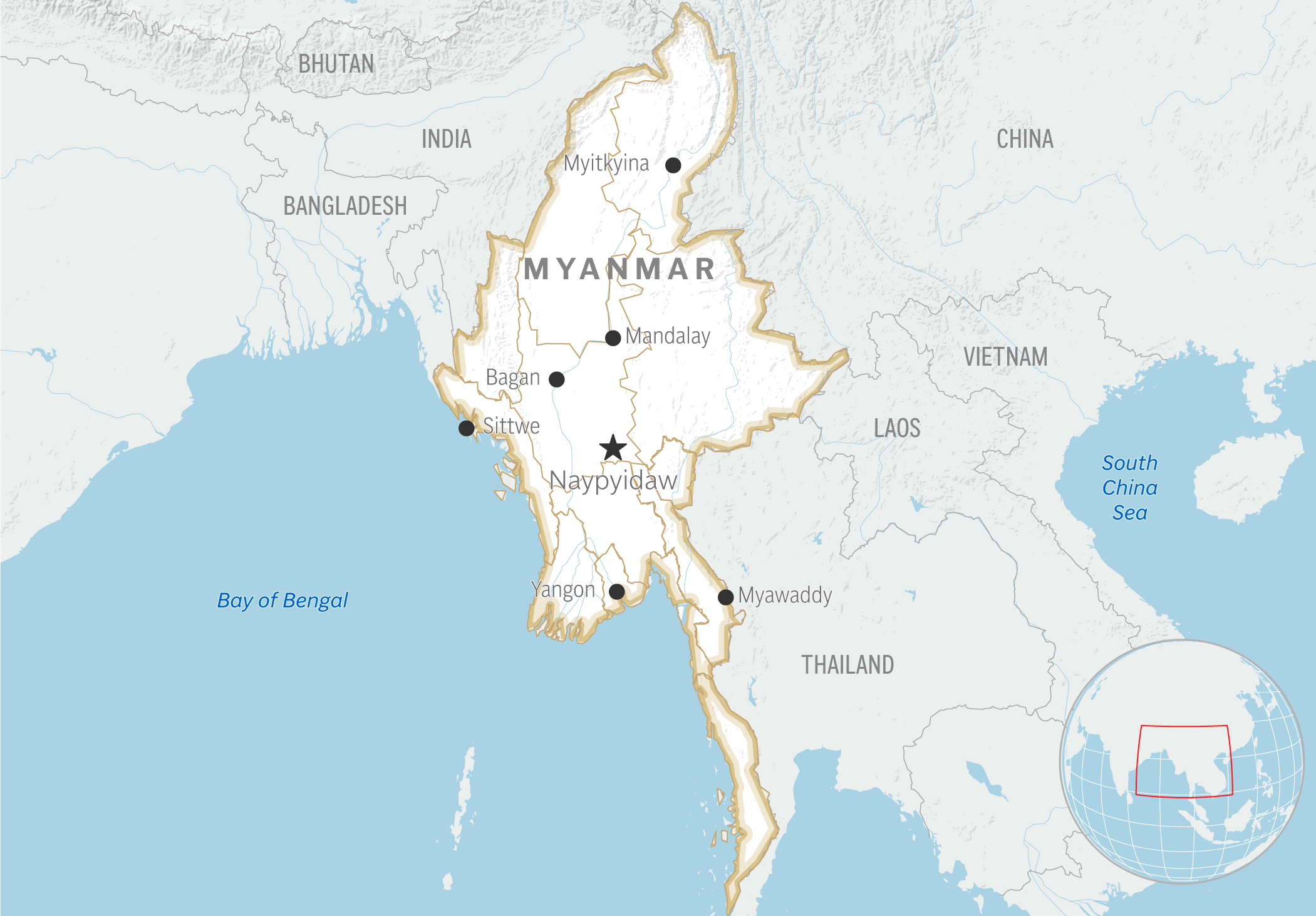
    BANGKOK — Myanmar‘s military has increasingly used low-cost aircraft such as motorized paragliders and gyrocopters in escalating aerial attacks that kill civilians in its conflict with armed, anti-government groups, a U.N. investigation said in a report Tuesday.

    Separately, a major ethnic armed group fighting the government in Rakhine state said 20 civilians had been killed in strikes by the military so far this month.

    Myanmar’s military government did not immediately respond to either the U.N. probe or the allegations by the Arakan Army. In the past, the military has said it only attacks legitimate targets of war, accusing the resistance forces of being terrorists.

    The report by the United Nations-established Independent Investigative Mechanism for Myanmar, or IIMM, details a yearlong investigation into alleged war crimes and crimes against humanity committed by Myanmar’s military and affiliated militias, as well as the opposition armed groups.

    It found that abuses escalated around the country’s army-organized elections in December and January. The IIMM said it observed a notable escalation in aerial attacks in the months preceding the elections and that they have continued unabated afterward, with investigators also documenting a pattern of deliberate arbitrary detention, torture, and sexual violence.

    The IIMM said civilian casualties are worsened by the military’s increasing use of “double-tap” aerial attacks, in which a second strike follows the first, apparently targeting first responders, people helping the wounded, and those trying to flee.

    The IIMM said the Myanmar military was increasingly using motorized paragliders — also known as paramotors — as well as gyrocopters and drones to carry out low-altitude airstrikes with unguided explosives.

    In several recent incidents in the upper Sagaing region, paramotor pilots allegedly cut their engines as they approached targets, allowing them to glide silently and leaving civilians little or no warning to flee or seek shelter, the report said.

    The IIMM’s report came as the Arakan Army, a powerful ethnic armed group fighting the army in Rakhine, said that about 20 civilians were killed and 22 injured in airstrikes across three townships from Aug. 1-11, including one attack involving up to eight aircraft that lasted about an hour.

    The military-backed government has not publicly commented on the alleged attacks.

    According to the Assistance Association for Political Prisoners, an independent organization that keeps detailed tallies of arrests and casualties linked to the civil war, more than 8,000 civilians have been killed and more than 31,000 arrested by Myanmar’s security forces since 2021.

    The IIMM, which was established by the U.N. Human Rights Council in 2018 to monitor violations of international law in Myanmar, said it gathered evidence from more than 1,600 sources and witnesses that can be used in future prosecutions of those responsible.

    “Behind every piece of evidence we collect are people whose lives have been devastated by these crimes,” group leader Nicholas Koumjian said in the report. “Communities across Myanmar are not only living under the constant threat of violence but are also coping with the profound and lasting impact of what they have endured.”

    The IIMM said it is also investigating serious crimes allegedly committed by armed groups opposed to the military, including members of the Arakan Army, who have been accused of rape and other sexual violence against Rohingya Muslim women, summary executions, child recruitment, and the destruction of mosques in Rakhine.

    The report said numerous people were also arrested under an electoral law that carries up to 20 years in prison or the death penalty for acts such as criticizing the elections online or distributing “anti-election” leaflets.

    The election was dismissed by the critics as a sham designed to consolidate the military’s grip on power after its 2021 takeover that ousted the elected government of Aung San Suu Kyi, triggering deadly civil war.