Category: Pennsylvania Politics

  • Chris Rabb warns of ‘great peril’ for Democrats if party ignores Michigan’s Abdul El-Sayed and other progressive wins

    Chris Rabb warns of ‘great peril’ for Democrats if party ignores Michigan’s Abdul El-Sayed and other progressive wins

    WASHINGTON — Chris Rabb is on a winning streak.

    Since his victory in Philadelphia’s highly contested Democratic congressional primary in May, the state lawmaker and presumptive successor to retiring U.S. Rep. Dwight Evans has campaigned across the country — going nine for 10 in races where he’s supported progressives against more establishment-backed, moderate Democrats.

    That wave of momentum — for a left-leaning faction hoping to transform the next generation of the Democratic Party — culminated this week in Michigan, where Dr. Abdul El-Sayed won a consequential U.S. Senate primary in the key swing state.

    Though not a self-described democratic socialist like Rabb, El-Sayed ran on a similar anti-corporation, anti-Israel platform that focused on enacting policies like Medicare for All and dismantling U.S. Immigration and Customs Enforcement.

    Rabb, who was on the ground in Detroit for the final push of the campaign and at El-Sayed’s victory party on Tuesday, said the Michigander prevailed “against extraordinary odds.”

    U.S. Rep. Haley Stevens, with establishment support and about $62 million in outside spending on her behalf, had a roughly 9-to-1 spending advantage over El-Sayed, according to The New York Times. Her loss amid that kind of massive spending “is a testament to the power of economic populism and the growing frustration with incrementalism,” Rabb said.

    “His primary win proves that economic populism and bold progressivism has growing support across the ideological spectrum among Democrats whether they’re voting in Michigan or Pennsylvania,” Rabb said.

    The five-term state representative from East Mount Airy has thrown his energy into other campaigns as his own is pretty much complete. In one of the bluest in the country, he defeated a pair of more moderate Democrats — State Sen. Sharif Street and physician Ala Stanford — and will not face a Republican opponent in the November election. The district covers about half of the city, from South Philadelphia through the Northwest.

    Rabb began looking beyond his district borders almost immediately after the primary.

    In New Jersey’s Trenton-based congressional district, he campaigned for Dr. Adam Hamawy, a former combat surgeon who has also provided medical care to Gazans during the war with Israel. In New York, he threw his weight behind Darializa Avila Chevalier and Claire Valdez, two of the democratic socialists also backed by New York Mayor Zohran Mamdani.

    He turned to other candidates in California, Colorado and Michigan as he door-knocked, called voters and appeared in virtual events.

    “Ever since May 19, which was the night I won, I’ve been paying it forward with so many amazing candidates,” Rabb said during a recent virtual fundraiser for El-Sayed in which Rabb said he was signing and giving away the pink “Philadelphia” baseball hat he was wearing to a lucky donor.

    Rabb hasn’t weighed in on every battle between progressives and moderates. He did not endorse Cori Bush, the former member of Congress and democratic socialist who failed in her attempt at a comeback in Missouri this week. He also has not endorsed every congressional candidate promoted by two key national coalitions that supported him — Justice Democrats, which has been a force behind the election of U.S. Rep. Alexandria Ocasio-Cortez and others, and the Democratic Socialists of America.

    The one candidate he endorsed who did not win was Saikat Chakrabarti, a former campaign manager and chief of staff to Ocasio-Cortez who tried to beat former House Speaker Nancy Pelosi’s hand-picked successor in San Francisco.

    And not all of Rabb’s endorsees are guaranteed to join him in Congress next year. Justin Pearson, a Tennessee state lawmaker who won a U.S. House primary on Thursday, will be the nominee in a state where Republicans redistricted this year in an attempt to root out Democratic incumbents. Pearson’s district is considered “solid Republican” by the Cook Political Report, a nonpartisan group that rates competitive districts.

    While some Democrats have questioned whether progressives can win competitive general election races, Rabb said he was “confident that strategically supporting anti-establishment populist candidates who bring with them new, more active and enthusiastic voters will significantly increase turnout in November.”

    “Ignoring the unique strengths of such candidates and campaigns will be at the Democratic Party’s great peril,” he added.

    That sentiment echoed other comments he’s made in recent months as more centrist leaders in his party questioned the progressive momentum. In June, he responded to an interview in which Gov. Josh Shapiro called the democratic socialists who won in New York an example of “performative politics.” Those candidates would now need to govern effectively, he said, adding that they were not indicative of the types of Democrats winning in Pennsylvania.

    “You’re seeing very different-looking congressional races, and certainly very different Democratic candidates here in Pennsylvania,” Shapiro told CNN, prompting Rabb to respond on social media with, “Ummm…”

    Shapiro, a popular figure as he seeks reelection this fall, has been lending his support to Democrats in four competitive congressional seats in Pennsylvania that are held by Republicans, including a swing district in suburban Bucks County. Flipping those seats in a way that could help Democrats capture the U.S. House majority has been a top priority and has further fueled speculation that Shapiro is eyeing a run for the White House in 2028.

    At the same time, Shapiro has not appeared with or supported Rabb during his campaign, though his team has said the governor looks forward to working with whoever replaces Evans.

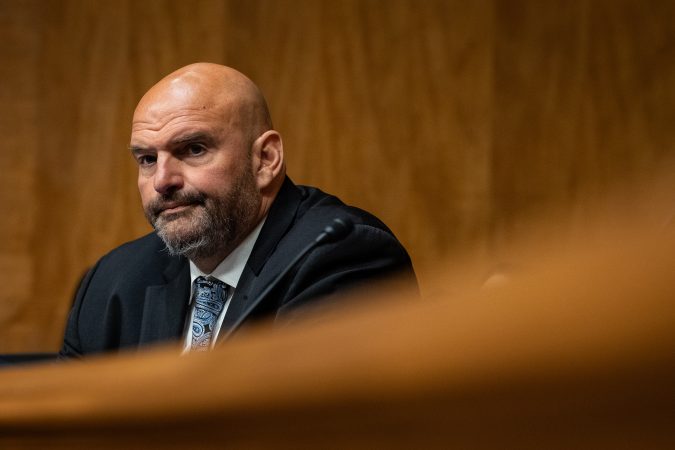
    As Rabb has crisscrossed the country, he’s also drawn more ire from the state’s other most nationally prominent Democrat — U.S. Sen. John Fetterman, who Rabb dismissively refers to as “the F word.”

    Fetterman has included Rabb in his broad denouncements of progressives who are winning Democratic primaries. Progressives like Rabb, meanwhile, have indicated they hope to replace Fetterman with a progressive candidate in 2028.

    “Rabb, he won, and he ran on being a very, very anti-Israel guy,” Fetterman said in early June at an American Jewish Committee conference in Washington. “It’s actually a virtue (in the modern Democratic Party)… It’s heartbreaking for me.”

    After El-Sayed’s win this week against a candidate who received more money from the American Israel Public Affairs Committee than possibly any other candidate on record, Rabb and the coalition behind him have shown no signs of slowing down.

    “Ground Zero was Chris Rabb in Pennsylvania, winning a key congressional primary,” Adam Green, co-founder of the Progressive Change Campaign Committee said on the livestreamed fundraiser with Rabb this week.

    The “ripple effects of winning a battleground Senate contest,” like in Michigan, Green said, will be significant.

    “The message will be undebatable that we won, that we’re on the rise, and that we can win anywhere,” he said.


  • A new $10 million fund is a ‘first step’ toward recovery for Pa. farmers after a disastrous April freeze

    A new $10 million fund is a ‘first step’ toward recovery for Pa. farmers after a disastrous April freeze

    For the second time in five years, a freeze wiped out all of Morgantown farmer Ed Weaver’s peaches this spring.

    What was an unassuming late April frost for most Pennsylvanians this year created devastation for farmers across the state. High temperatures at the beginning of the month accelerated orchards’ blooming process. But an ensuing sudden drop below freezing quickly killed what had grown. The freeze hit 13 states on the East Coast, costing Pennsylvania fruit farmers almost $200 million.

    Along with the peaches, the cold decimated nectarines and cherries at Weaver’s Orchard in Berks County. Now, just 15% of the apples and pears there remain, and about half of the berries are gone. Weaver estimates the freeze caused him to lose between 70% and 80% of his orchard’s revenue this year.

    Weaver is not alone. A surge in extreme weather has taken a toll on fruit farmers’ crops across the state, in an industry growing increasingly sparse from rising costs.

    Weaver — who has overseen his family’s nearly-100-year-old business for four decades — said many farmers are starting to question whether losses from extreme weather are a new standard and are determining the best next steps to maintain stability.

    “How do we move forward? How are we going to mitigate these risks? And is this a new type of normal for us?” he said.

    Attempting to reclaim some of the lost money from the frozen crops, Weaver plans to apply for a Freeze Disaster Assistance Recovery Grant — a $10 million initiative approved last month in the Pennsylvania state budget to assist farmers who have lost 30% or more of their crops.

    Pennsylvania Agriculture Secretary Russell Redding said the department is still determining how the funding will be distributed to eligible farmers, but is hopeful the money can be given by fall, when farmers typically see profits from their spring fruit crops.

    “We wouldn’t forget about the harm that was done through this frost, and the lingering effects of it. So we’re here to deliver on that promise,” Redding said last month.

    The funding comes after Democratic Gov. Josh Shapiro’s administration called for federal assistance to further offset the impact of the freeze. Last month, the United States Department of Agriculture expanded low-interest loan options for some Pennsylvania apple growers with federal crop insurance. Additionally, 17 counties have been designated by the USDA as disaster areas, making farmers there eligible for low-credit loans.

    Berks County, home to Weaver’s Orchard, lost 85% of its crops in the freeze. But the county still hasn’t received the federal disaster designation, Weaver said. State officials have said they’re pushing for more assistance.

    Weaver said the state’s grant program is a great first step, but that it’ll take years for his orchard to recover.

    He said much of the financial strain is born from costs like pruning and fertilizer for the decimated crops.

    Weaver said his orchard is fortunate to have other sources of income, like its market and storefront, rather than relying entirely on its fruit crops. But the freeze impacted Weaver’s “pick-your-own” service, where customers can harvest their own fruit, since there are so few fruit crops available.

    Typically, Weaver said that when farmers’ crops are damaged, they can buy fruit from other growers to sell, but that has been challenging this year, because the freeze was so widespread.

    A flower bud with a brown center, which indicates the apple tree couldn’t produce apples due to the frost, at Highland Orchard in West Chester, on Friday, May 8, 2026.Tyger Williams / Staff Photographer

    For Norm Schultz, farmer at Linvilla Orchards in Media, the freeze took out nearly all of his peaches and apples.

    Schultz said much of his orchard’s rebuilding will rely on the fall season, and how Linvilla’s pumpkin sales fare.

    But the harvest lost in the April freeze will have lingering impacts come fall, he said. Apple crops were affected, meaning that candy apple and cider sales could take a hit.

    The freeze was the latest blow to Pennsylvania’s fruit farmers.

    Both Weaver and Schultz said it’s becoming harder for farmers to pass down their land to their families, partly because of financial unpredictability but also because land is worth more if sold instead.

    The number of farms in Pennsylvania has fallen by 18% over 10 years from 2012 to 2022, according to the most recent agriculture census data.

    Schultz said he hopes the state’s newest grant for affected farmers “can keep the people who only grow fruit in the game, because so many farms and fruit growers go out of business in this area.”

    Similarly, Weaver said there are costs burdens in needing to continually upgrade equipment and make capital investments to maintain facilities, which could reduce profitability and efficiency for future generations.

    “If we’re going to have a good food supply of these kinds of crops in Pennsylvania, it needs to be something that the next generation wants to do,” he said. “And if it burns them financially, they’re going to make a decision of whether they want to [farm] or not.”

    In the meantime, Weaver said it’s important for people to purchase storefront goods from local farms or make use of other services.

    “Especially right now, it’s so important for people to get out and support the local farms and buy local.”

    Natalie Javitt is an intern with the Pennsylvania Legislative Correspondents’ Association. She can be reached at natalie.javitt@gmail.com.

  • Jon Stewart presses John Fetterman on Israel and playing into ‘Republican caricatures’ when he attacks Democrats

    Jon Stewart presses John Fetterman on Israel and playing into ‘Republican caricatures’ when he attacks Democrats

    U.S. Sen. John Fetterman, in perhaps the most in-depth and toughest interview he has faced in recent memory, defended his unwavering support for Israel and his harsh criticisms of fellow Democrats when pressed by Jon Stewart in a podcast episode released Wednesday.

    The liberal comedian and political commentator repeatedly accused Fetterman (D., Pa.) of “caricaturing” the left wing of his party and the debate around Israel’s handling of the war in Gaza.

    “Jewish community and Israel are not the same thing, brother man. They’re not — that is not the same thing,” Stewart, who is Jewish, said at one point as Fetterman described his full-throated support for the war as being because of “the Jewish community.”

    Asked repeatedly about the United States’ moral obligations about backing the Israeli strikes that have led to the deaths of tens of thousands of Palestinian civilians, Fetterman stood firm.

    He said — as he often has since the Oct. 7, 2023, attack by Hamas that sparked the conflict — that it was necessary to go after Hamas leaders. The killing of civilians was “terrible” and “collateral” damage but not a genocide, Fetterman said.

    Stewart continued to press — questioning why Fetterman was standing so firmly behind a foreign ally that was “dehumanizing” and slowly killing another population.

    “I don’t understand how you have no criticisms over their actions, over their increasingly messianic, ultra-right-wing government that seems to think relentless war is, like, that you can bomb people out of resistance,” Stewart said.

    The roughly 75-minute interview, on The Weekly Show with Jon Stewart, came a week after Fetterman once again met with Israeli Prime Minister Benjamin Netanyahu in Washington.

    Many other elected Democrats have distanced themselves from the Israeli government and criticized its tactics. Fetterman has acknowledged his position has hurt him politically. In the interview with Stewart, he echoed previous comments — which have also become evident in public polls — that he has lost the support of his former Democratic base as his and his party’s stances diverged.

    “I’m aware that if I happen to disagree with the party line, there’s a price to pay,” Fetterman said. “There’s a lot of stories of how I’ve become increasingly more unpopular with Democrats in my state. And I’m aware of it. But these were all very specific choices. … I would rather have people know what I happen to believe.”

    Stewart asked Fetterman several times about how he has voiced those disagreements.

    He said the senator has focused far more on arguing with his own party in a way that has further hurt its brand. And he has broken from the party’s ranks as Democrats try to use even an inkling of leverage that could impact Republicans’ agenda as the GOP controls both Congress and the White House, Stewart said. He pointed to issues like immigration enforcement reforms, which Democrats tried to enact by holding out support for a spending bill earlier this year. Fetterman said he supported the reforms but would not go along with letting part of the government shut down as a strategic move.

    Mark Twain Prize recipient Jon Stewart is introduced at the start of the 23rd annual Mark Twain Prize for American Humor at the Kennedy Center for the Performing Arts, in Washington, April 24, 2022. (AP Photo/Kevin Wolf, File)Kevin Wolf

    Stewart also pressed Fetterman on how his approach to President Donald Trump has softened as he has ramped up his criticism of his own party.

    “You called President Donald Trump a jagoff in 2016,” Stewart said, prompting Fetterman to say that he put the phrase on shirts and sold them.

    “You put it on a shirt. And now you’ve been very complimentary to him. And if your concern with Graham Platner is you didn’t think he was very nice to women, you’re ignoring an awful lot of evidence for the current president about his relationship with women,” Stewart said, referencing Fetterman’s attacks on the Maine Democrat who dropped out after facing allegations of sexual assault. “So my point is, there seems like there’s a way to go about this that embraces, as you said, the 90% of things that you agree with, and try and utilize that energy to reform a party that has a worse public image than herpes in terms of getting things done. This feels like it’s playing into the hands of Republican caricatures.”

    Fetterman pushed back, saying he was trying to stop “extreme” elements of his party in a way that would lead to better success in battleground elections — like in Pennsylvania — after Democratic losses in 2024.

    “We keep losing, and now we keep returning back to some of the extreme things,” Fetterman said. “That’s not a caricature. That is a fair assessment of where we are with these kind of things.”

    Stewart, noting that Vice President Kamala Harris was not the most progressive Democratic option in 2024, rejected the idea that the party lost because of far-left views. In an extended conversation about capitalism and socialism, he also encouraged Fetterman to embrace new ideas presented by democratic socialist candidates who Fetterman, like many Republicans, refers to as communists.

    Fetterman, who frequently appears on Fox News but has not appeared on more liberal programs like Stewart’s Daily Show, described himself as a longtime fan of Stewart and said he believed the interview was “very fair.”

    At the end of the podcast, after Fetterman left, Stewart said he “wasn’t sure what to think” and was “weirdly thrown off right now.”

    “I feel like we all just got out of one of those movies. Do you know those movies where it’s like … there was a weirdly traumatizing scene in the movie,” Stewart said. “And now we’re all just, like, ‘Do you guys, um, do you want to go get something? I guess I’m just going to go get a slice and maybe go home.’”

  • Bob Harvie files defamation suit against GOP super PAC over ‘beyond the bounds’ claims of FBI investigation, inappropriate relationship

    Bob Harvie files defamation suit against GOP super PAC over ‘beyond the bounds’ claims of FBI investigation, inappropriate relationship

    Attorneys for Bucks County Democrat Bob Harvie filed a lawsuit Wednesday against a political action committee and a consultant supporting his opponent, Republican U.S. Rep. Brian Fitzpatrick, in a high-stakes congressional contest.

    The lawsuit comes after what Harvie’s campaign says are repeated and false claims about his involvement in an FBI investigation. Harvie’s legal team is also disputing a new attack from the PAC alleging that the county commissioner had an inappropriate relationship with a county employee.

    The lawsuit, filed Wednesday in the U.S. District Court for the Eastern District of Pennsylvania, claims that Defending America PAC Inc. and its president, Chris Pack, have sustained a “campaign to defame Harvie by repeatedly and recklessly publishing false and defamatory statements imputing criminal conduct that go beyond the bounds even of a highly contested political campaign.”

    Harvie’s testimony to a grand jury in an FBI probe in 2022 has sparked a firestorm in the race for the Bucks County-based 1st Congressional District, a seat that could help determine control of the U.S. House this fall. Harvie’s attorneys last month sent a cease-and-desist letter over such statements to Defending America PAC, which subsequently challenged Harvie to file a lawsuit.

    Last month, Fitzpatrick and his campaign also received a cease-and-desist letter from Harvie’s lawyers, but neither the Bucks County Republican nor his campaign is named in Wednesday’s suit.

    Website and social media posts and other materials from Defending America PAC and Pack this election cycle have stated Harvie is an “FBI corruption subject” or “under FBI investigation” related to his time as a Falls Township supervisor, according to the suit, but Harvie’s lawyers assert that the allegations are false and that he has never been under criminal investigation.

    “Contrary to the meaning that out-of-state political operatives have endeavored to convey — to convince Harvie’s community that Harvie is somehow connected to a crime — Harvie is not now and never has been the target of any criminal investigation nor has he ever been charged with a crime,” wrote Harvie’s attorneys, Timothy J. Ford and Marion Barker Taylor of Dilworth Paxson, in the legal filing.

    Harvie and his campaign are seeking an unspecified amount of damages greater than $150,000, as well as legal fees, for defamation and false light invasion of privacy.

    In a statement to The Inquirer on Wednesday, Pack once again referred to Harvie as an “FBI Corruption Subject” and said the Democrat “has predictably chosen to engage in lawfare by filing a meritless lawsuit in an attempt to stifle our political speech” instead of releasing “complete” records “related to his corruption investigation.”

    “Rest assured we will vigorously defend ourselves and seek every remedy available under Pennsylvania law, including Pennsylvania’s anti-SLAPP protections signed into law by Gov. Josh Shapiro,” Pack said, referring to a bill signed in 2024 by the Democratic governor that essentially offers extra layers of protections for defendants in defamation suits.

    The organization appears to have been ready for this next step to happen. In an email blast and website post last week, the group said “we’re willing to pay for Harvie to sue us” so that the PAC could obtain any relevant records during the suit’s discovery phase.

    In response, Harvie said in a statement Wednesday: “Put your money where your mouth is. Just tell us where to send the bills. See you in court.”

    In that same post last week, the PAC made an additional claim — rebuked by Harvie’s lawyers Wednesday — that the Democrat had a “recent divorce” that “may have had something to do with Harvie getting a little too cozy with a county employee.” It links to a screenshot of a random Facebook account that alleges Harvie cheated on his wife with an employee from Bucks County’s children and youth services department and, in turn, helped her become a supervisor.

    Harvie’s lawyers rejected the allegation, calling it “outrageous.”

    “Harvie never cheated on his wife and never had sex with a Bucks County employee. Harvie never used his position to influence a decision to promote a Bucks County employee inappropriately,” they said.

    Harvie and his wife divorced in 2023, public records show.

    ‘Not politics as usual,’ Harvie’s lawyers argue

    The string of events that culminated in Wednesday’s suit dates back to 2022, when Harvie and other officials testified as witnesses before a grand jury in connection with an investigation into political donations and union contracts related to the Pennsbury School District. In 2020, the FBI interviewed several people connected to Falls Township and Pennsbury.

    Harvie’s attorneys said in the filing Wednesday that he has not been asked to provide additional information or testimony and has not had any contact with the FBI since his 2022 testimony.

    Similar allegations were made during Harvie’s 2023 reelection campaign for county commissioner and were also disputed by the Democrat at the time.

    Three years later, they have again bubbled up to the surface as Harvie seeks federal office in one of four Pennsylvania seats being targeted by both parties.

    Harvie’s attorneys said Wednesday that since the Democrat announced his candidacy for the U.S. House in April 2025, Defending America PAC has maintained a website entitled “Fire Bob Harvie,” where the group refers to him as “the subject of an FBI corruption investigation” or an “FBI corruption subject.” The lawyers estimate that the PAC has used similar language in at least 30 social media posts and that Pack has personally done so at least 27 times.

    The commissioner’s lawyers contend that Defending America PAC’s and Pack’s actions have harmed Harvie’s reputation and qualify as “actual malice.” Since Harvie is a public official, lawyers would have to clear a high legal bar to prove that the organization and Pack either knew the information they are pushing is false or otherwise exhibited a “reckless disregard” for its accuracy.

    “Defendants’ conduct is not politics as usual. As shown by doubling down on their escalating rhetoric, Defendants’ conduct is willful, wanton, malicious, and undertaken with actual malice and reckless indifference to Harvie’s rights, thereby entitling Harvie to recover punitive damages,” Harvie’s lawyers wrote.

    What is Defending America PAC?

    Defending America PAC, a super PAC that is designed to work independently from a candidate, launched as Fitzpatrick was seeking reelection in 2024 and has scaled up its operation this year as the candidate faces his most high-profile challenge yet, according to filings with the Federal Election Commission.

    The goal, according to the PAC’s website, is to defend Fitzpatrick “from extremist challengers on the far left and far right.” In 2024, Fitzpatrick defeated a far-right challenger in the Republican primary.

    Without the same donor limits as candidates, it raised $425,000 in 2024 and spent its money to oppose Fitzpatrick’s challenger in the Republican primary. In the current two-year cycle, it has raised more than twice that amount and started spending to oppose Harvie. The PAC currently has about $712,500 in its account.

    About half the money it has pulled in this election cycle came from labor-affiliated groups that are backing Fitzpatrick, including $250,000 from LIUNA Building America, the political action committee for the Laborers’ International Union of North America. An additional $100,000 came from the PAC for the Transport Workers Union of America, and $50,000 came from the Air Line Pilots Association. In recent weeks, Fitzpatrick has continued to receive sweeping support from labor unions.

    Defending America also appears to have received funds from some of the largest Republican donors in the country.

    Billionaire Harlan Crow, a GOP mega-donor and real estate developer known for his association with Supreme Court Justice Clarence Thomas, donated $25,000. Craig Duchossois, the former chair of a Chicago-based investment firm, donated $50,000.

    A $100,000 donation from Keystone Next — a super PAC that launched in 2025 with funds from an organization aligned with U.S. Sen. Dave McCormick (R., Pa.) — arrived in April. The donation was marked just two days after Keystone Next received a $250,000 contribution from Jeffrey Yass, Pennsylvania’s richest man and largest Republican political benefactor.

    It also coincided with two other $100,000 donations that Keystone Next made to super PACs aimed at boosting Pennsylvania Republicans, including the more conservative U.S. Rep. Scott Perry in a competitive Harrisburg-based district.

    Staff writers Michelle Baruchman and Abraham Gutman contributed to this article.

  • After a high-profile snub in Pa., President Donald Trump meets with Stacy Garrity at the White House

    After a high-profile snub in Pa., President Donald Trump meets with Stacy Garrity at the White House

    Clad in a royal blue, two-piece suit, Pennsylvania Treasurer Stacy Garrity stood next to a seated President Donald Trump in the Oval Office on Tuesday, in a video message posted to his social media platform, Truth Social.

    “Pennsylvania is very lucky because you have somebody running for governor who’s going to do a fantastic job,” Trump said to the camera, while shaking Garrity’s hand. “She really is a spectacular person. And I just want to wish you luck. I think you’re going to win.”

    The White House appearance signaled a closer public alliance between Trump and Garrity, and the latest chapter in her campaign challenging Gov. Josh Shapiro as she seeks to draw Trump’s loyal fan base to the polls in November.

    Trump, who endorsed Garrity in January, followed the video message by posting a photo with Garrity, writing: “Stacy is running to be the next Governor of the GREAT Commonwealth of Pennsylvania. She has my Complete and Total Endorsement. She will do a fantastic job!”

    Garrity’s campaign said in a statement that she was visiting the White House alongside the Penn State wrestling team, which was being honored for its 2026 national championship.

    The Oval Office meeting represented a repair of sorts between Garrity and Trump after he has displayed little enthusiasm toward her campaign in recent months.

    Garrity entered the race against Shapiro, the Democratic incumbent, last summer as Republicans — disappointed with their 2022 performance — sought to consolidate support early around one strong candidate. When Trump endorsed Garrity, he called a “true America First Patriot” who “WILL NOT LET YOU DOWN!”

    In March, Garrity hosted a fundraising dinner at Trump’s Mar-a-Lago Club in Florida, where, beneath a wrought-iron doorway at his private golf club, the president said “she should win.”

    But when Trump visited Pennsylvania in June and Garrity introduced him onstage, he seemed to forget her altogether.

    During a speech meant to focus on manufacturing in Macungie, Trump spent over an hour talking about weight-loss drugs, immigration, firearms, the role of transgender athletes in women’s sports, and the UFC fight recently held on the White House lawn. But Garrity never received a mention, and Trump instead celebrated U.S. Rep. Dan Meuser, a Pennsylvania Republican who considered a run for governor before ultimately opting against it. Trump even name-checked Shapiro.

    Three months out from Election Day, Garrity has struggled to gain traction among voters. A Quinnipiac University survey of 895 registered Pennsylvania voters in July found 53% would vote for Shapiro, while 40% said they would vote for Garrity.

    At right is Pennsylvania Governor Josh Shapiro listening to Stacy Garrity, 78th State Treasurer, Forum Auditorium in Harrisburg, Pa., Tuesday, Jan. 21, 2025.Alejandro A. Alvarez / Staff Photographer

    Garrity has stuck with Trump, supporting his political decisions like efforts to nationalize elections and his signature tax cut law, under which 300,000 Pennsylvanians are expected to lose Medicaid, according to state estimates.

    Trump’s latest show of support for Garrity comes as Shapiro — who is rumored to be eyeing a run for the White House in 2028 — has set his sights beyond the governor’s office, lending his time and spending his money to support Democrats up and down the ballot, in an attempt to flip the Pennsylvania state Senate and four swing districts in Congress.

    Last month, in another stop in Pennsylvania, Trump attempted to lend more support to Garrity during Republican U.S. Sen. Dave McCormick’s Defense and Innovation Summit.

    “I hear things about Stacy, and I’m hearing some poll numbers that are very good,” he said.

    Regarding her opponent, however, Trump had stronger words.

    “This guy Shapiro is totally overrated. … He doesn’t have what it takes,” Trump said.

    President Donald Trump visits Mack Trucks in Macungie in the Lehigh Valley Tuesday, June 23, 2026.Tom Gralish / Staff Photographer

    In Pennsylvania, Trump remains deeply underwater in popularity. The Quinnipiac survey found only 39% of Pennsylvania voters would give him a positive job approval. Elsewhere in the country, Trump has remained Republicans’ most effective energizer to the polls — though some are concerned about GOP success without his name on the ballot in November.

    Pennsylvania Democrats on Tuesday seized on Garrity’s appearance with the president.

    “Stacy Garrity always sprints to any chance she gets to pledge her 100% loyalty to Donald Trump and his disastrous agenda,” Ava Pitruzzello, a spokesperson for the Pennsylvania Democratic Party, said in a statement.

    Last week, Shapiro’s campaign launched a new ad calling Garrity “100% MAGA.” Garrity’s campaign, in a statement, called the ad “a dishonest, lying attack.”

  • Democrats accuse Green Party candidate in Lehigh Valley district of Republican meddling

    Democrats accuse Green Party candidate in Lehigh Valley district of Republican meddling

    WASHINGTON — In a Pennsylvania election where a few thousand votes could make all the difference, the last-minute entrance of a Green Party candidate with a background in Republican politics has sparked the second allegation of election meddling in three months and complicated one of the nation’s most competitive U.S. House races this fall.

    The Lehigh Valley-based 7th Congressional District matchup features U.S. Rep. Ryan Mackenzie, a Republican who won the seat by 1 percentage point in 2024, and Bob Brooks, a Democratic union leader and retired firefighter.

    Both parties are prioritizing the race as control of the U.S. House could come down to a few seats nationwide.

    But the emergence of a third-party candidate has alarmed both Democrats — who have long claimed that Green Party candidates pull votes from their nominees — and the Green Party of Pennsylvania, which said it does not know the person now representing its platform in one of the state’s highest-profile races.

    “It sounds a lot like somebody’s just fooling around and trying to use the Green Party name, which is a well-known thing that happens in many states,” said Tim Runkle, cochair of the state party.

    Andrew Tupone, 37, of Northampton County, filed his nomination papers with the state last week ahead of a Monday deadline for third-party candidates. He was the only candidate to file to represent the Green Party in a Pennsylvania race for Congress.

    Unlike the Green Party’s endorsed candidate for governor — Tony Dastra of Lancaster County — Tupone does not have a long association with the party or its left-leaning policies. In 2021, he was the Republican nominee for a Northampton County magisterial court seat. Voter registration records show he changed his party affiliation from Republican to Democrat in February, and then from Democrat to Green in April.

    In an interview, Tupone rejected accusations that he remained affiliated with the Republican Party or that he was asked to run in a way that would draw votes away from the Democratic nominee. He described a leftward shift in his political views after voting for President Donald Trump in 2020, though he said he could not recall whom he voted for in the 2024 presidential race between Trump and Democratic Vice President Kamala Harris.

    “A lot of people are disillusioned with both parties,” Tupone said. “They’re sick of all the stuff that’s going on.”

    Tupone also said he did not pay anyone to help gather signatures for his nominating papers, which he turned in with upward of 9,000 signatures — more than twice as many as required. Runkle said Green Party members encountered paid canvassers for Tupone who declined to say who was funding the effort.

    According to a copy of the nominating papers obtained by The Inquirer, only one of the 22 individuals who gathered signatures is from Pennsylvania. The rest are from all over the country. Multiple have worked for Republican campaigns, according to public records.

    Colin McEvers, who gathered signatures for Tupone in Lehigh County, is a Republican candidate for the Maryland General Assembly who is also listed as the contact for the Maryland White Republican Council. Others — including individuals from Illinois and Michigan — have been paid to canvas for GOP campaigns, according to Federal Election Commission records.

    Tupone said he had no knowledge of anyone paying his canvassers.

    “I went around and I gave a lot of my nominating papers to friends to give to other people, and I sent it to them as well,” Tupone said. “And as I went around, I recruited people and asked them.”

    While the signatures appear to be based in the district — which stretches from the cities of Allentown, Bethlehem, and Easton into the more Republican-leaning Poconos — the other candidates have until Aug. 10 to challenge their legitimacy.

    Such challenges are common, and the Brooks campaign is reviewing its options to decide whether to bring a challenge, according to a source familiar with the campaign’s thinking.

    ‘No one’s paying me to run’

    Jenna Kauffman, Brooks’ campaign manager, in a statement described the situation as a GOP-initiated and “desperate scheme to meddle in this race.”

    She connected it to a last-minute $1.7 million advertising campaign against Brooks in the May primary that appeared to be run by Democrats but was actually funded by a Republican political organization.

    The spending, by a political action committee called Lead Left, was aimed at boosting another Democrat who observers considered to have a worse shot at beating Mackenzie in the November election. But the effort was anonymous, and records that became public only after Brooks won show that it was funded by the Conservative Americans PAC.

    The effort to prevent Brooks from emerging from the Democratic primary came as he coalesced support from across the ideological spectrum with high-profile endorsements ranging from moderate Democratic Gov. Josh Shapiro to U.S. Sen. Bernie Sanders (Ind., Vt.), a democratic socialist.

    “Voters deserve to know who is paying for this effort and whether Ryan Mackenzie and his Republican backers are involved,” Kauffman said, painting Tupone’s candidacy as a continuation of the move in the primary.

    Mackenzie’s campaign did not address that comment when asked about it Monday.

    Tupone said that the inference was “just false,” and that he instead likes the values of the Green Party, which he said included supporting the environment, social justice, and “stopping the corruption and also the genocide in Gaza.”

    “No one’s paying me to run. No one’s asked me to run for this office. I’m running on my own, hopefully with a lot of hope from everyone who wants to volunteer,” Tupone said. “I’m not associated with the Republican Party anymore. I’m not a candidate for them.”

    For years, Democrats have voiced concerns about the Green Party and other third-party candidates “spoiling” elections, from Jill Stein in the 2016 presidential race that first put Trump in power to the 2024 U.S. Senate race in Pennsylvania, when Democratic U.S. Sen. Bob Casey lost to Republican Dave McCormick by about 15,000 votes. In that 2024 election, a Green Party candidate won about 66,000 votes, a Libertarian candidate won almost 90,000, and a Constitution Party candidate won more than 23,000.

    In the 7th District in 2024, Mackenzie defeated incumbent Democrat Susan Wild by 4,062 votes out of more than 403,000 cast. That was the narrowest margin out of any of the state’s 17 districts, making it a key tossup district this year.

    That margin is also significantly different from the one Shapiro potentially faces during his reelection campaign this year as he maintains a sizable lead over Republican Stacy Garrity, and as a Green candidate officially filed to run on Monday. Shapiro defeated Republican Doug Mastriano in 2022 by almost 793,000 votes; the Green Party candidate won just over 24,000 votes.

    Runkle said that nobody solicited the Green Party’s endorsement in a Pennsylvania congressional race this year, and that a conversation he had with Tupone left “a lot of questions.”

    He said the party is concerned about its reputation and about being targeted in ways that do not lift up its platform, which focuses on environmental protections and liberal positions on healthcare. But he also pushed back on concerns that the party should be considered a spoiler.

    “I do solidly believe that the Green Party policies and the values we represent has a solid bloc of voters,” Runkle said. “If people think that’s spoiling the race, then they should try harder to speak to the issues that we speak to.”

  • Pa. lawmakers have proposed dozens of ways to fix the state’s low housing stock. They’re making a database instead.

    Pa. lawmakers have proposed dozens of ways to fix the state’s low housing stock. They’re making a database instead.

    HARRISBURG — More than one million Pennsylvania households spend over 30% of their income on housing. And over the next decade, the state’s housing crunch is slated to intensify, with estimates that Pennsylvania will have nearly 185,000 fewer new homes than it needs to keep up with projected demand.

    State legislators have pushed to address the need, introducing bills that would increase the housing supply through accelerated approval processes and lifting restrictions on new developments — and urged leaders to include those initiatives in this year’s budget negotiations.

    Gov. Josh Shapiro also put housing at the forefront of his budget address in February, asking the General Assembly to ease restrictions for rental applications and to cap costs on manufactured home increases.

    But none of the proposed policies were included in the final budget deal, passed last month. Instead, the budget included the creation of a housing database — a move some lawmakers and advocates say falls short of addressing Pennsylvania’s burgeoning housing crisis.

    “I think the budget generally left a lot of questions unaddressed. And housing, one of the top three issues in terms of the cost-of-living crisis, was one of them,” said Sen. Nikil Saval (D., Philadelphia).

    Saval was one of six senators who voted against the budget. He has since said that was because it left many key policy issues, including housing, unaddressed. Sen. Katie Muth (D., Montgomery), the only other Democratic senator to vote against the budget, has also said she believes the budget left issues like housing, rising energy costs, and affordability unanswered.

    Shapiro’s office did not respond to a request for comment.

    (function() {
    var l2 = function() {
    new pym.Parent(‘pa_housing’,
    ‘https://media.inquirer.com/storage/inquirer/projects/innovation/arcgis_iframe/pa_housing.html’);
    };
    if (typeof(pym) === ‘undefined’) {
    var h = document.getElementsByTagName(‘head’)[0],
    s = document.createElement(‘script’);
    s.type = ‘text/javascript’;
    s.src = ‘https://pym.nprapps.org/pym.v1.min.js’;
    s.onload = l2;
    h.appendChild(s);
    } else {
    l2();
    }
    })();

    The new housing database — incorporated through a bill sponsored by Saval and authored by fellow Philadelphia Democratic Sen. Vincent Hughes — will be overseen by the Pennsylvania Housing Finance Agency. Saval said it will ensure more robust data collection to provide transparency on how much affordable housing is available across the state.

    Under the new legislation, the agency will be required to create an online searchable database of all publicly financed housing that is subjected to public assistance programs. It will include anticipated termination dates on properties’ affordability restrictions and will note if the property has been granted an extension on those restrictions.

    Saval said the publicly available database will ensure lawmakers have a better idea of the state’s affordable housing stock. Much of the affordable housing in the state was created with the help of low-income tax credits that are subject to expiration dates. As termination dates on these housing units loom, with many set to expire within the next five years, Saval said, the database will keep lawmakers aware of when housing is no longer affordable and allow them to see if restrictions can be extended.

    The database will be updated annually by the PHFA, with local housing agencies submitting data every year.

    Chris Anderson, communications officer for the PHFA, wrote in an email that the database is still in the early stages of being built, but that it will not pose any significant costs to the agency and existing resources will be used to create it.

    There are no penalties if the PHFA does not update the database, and the new law does not make it mandatory for local agencies to report information to the agency. The intended audience is primarily housing advocates and organizations, as well as policymakers, Anderson said.

    Saval said the database will help lawmakers know how much affordable housing there actually is in the state.

    But he said the state budget — where legislators often pass policies in addition to the yearly spending plan — was still a missed opportunity to address Pennsylvania’s housing concerns.

    “Anytime there’s a set of budget negotiations where there’s the potential to allocate funding, or create policy that would increase the supply of housing, or address the concerns faced by renters, and anytime that opportunity is missed as it was in this budget, I think it’s a step back,” he said.

    ‘Missed opportunity’

    Carrie Rathmann, vice president of strategic partnerships for Habitat for Humanity Philadelphia, said one initiative notably absent from the final budget deal was the PA Home Preservation Program, a grant administered by the Pennsylvania Department of Community and Economic Development to provide funding for construction cost gaps and keep homeowners in their houses through repairing outdated buildings. The initiative was last funded when it was signed into the budget in 2022, but has not received funding since.

    Previously known as the Whole-Home Repairs Program, the state allocated $125 million toward the program using American Rescue Plan dollars, repairing more than 2,600 affordable homes across the state.

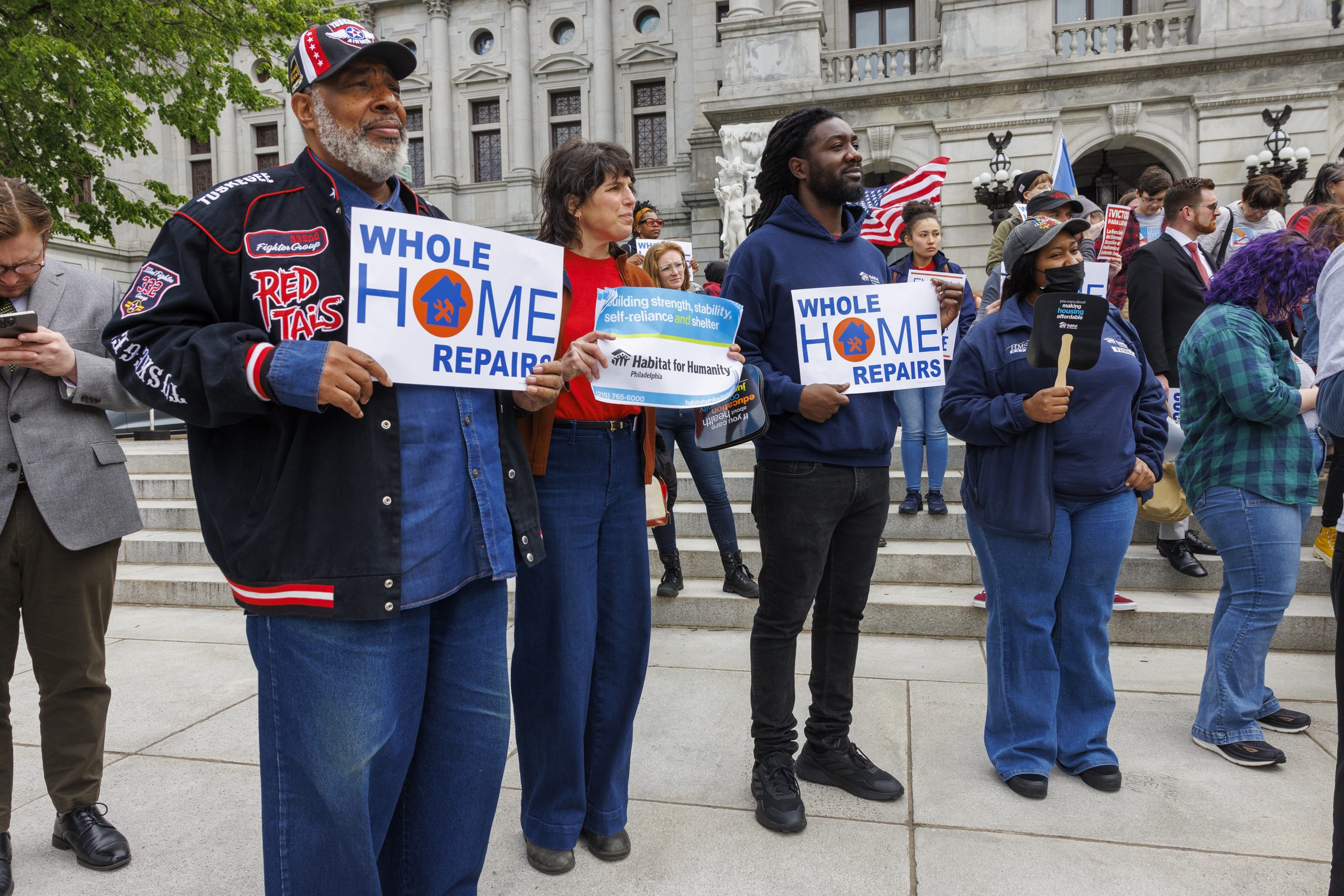
    Douglas Paige (from left), Carrie Rathmann with Habitat for Humanity, Tyron Cheeseboro, and Danielle Paige on the steps of Pennsylvania Capitol during a 2023 rally for the Whole-Home Repairs Program.Alejandro A. Alvarez / Staff Photographer

    Housing advocates have pushed for the state to renew the funding, with the Housing Alliance of Pennsylvania calling it one of the organization’s biggest priorities.

    In an email, spokespeople from the housing alliance noted that the state funding in 2022 was not enough to support the number of people that applied for it, meaning there are still people waiting to have their homes repaired.

    “The program received far more applications from qualified homeowners than available funding could support, highlighting both the scale of unmet need and the importance of preserving existing housing,” the spokespeople wrote.

    The program has not returned in a line item in the state budget since 2022. Companion bills in both chambers supporting the program have received bipartisan support — the House bill passed 122-80 — but are sitting in the Senate Urban Affairs and Housing Committee.

    “That felt like it represented a huge missed opportunity to help thousands of Pennsylvanians stay housed and to keep homeowners safe and healthy in the homes that they already own, because without that dedicated investment, this crisis will only grow,” Rathmann said.

    Habitat for Humanity is a nonprofit that does not rely on state dollars, but Rathmann said state money goes to counties and housing providers like the Philadelphia Housing Development Corp. The money helps an “ecosystem” of housing organizations in the Philadelphia area, and Habitat uses it for a portion of the organization’s work. That included the Built to Last program, an initiative spearheaded by the Philadelphia Energy Authority that inspired the statewide initiative of Whole-Home Repairs in 2022.

    Rathmann said state initiatives that increase efficiency on building houses are key to developing homes faster and cheaper, which in turn increases the housing supply and can keep people in high-quality houses. This includes incentives like building lower density “by right,” meaning property owners can build low-density housing without special approval.

    “We see every day at Habitat that that impact is real, it’s tangible, it crosses different sectors like kids can get to school and do better,” Rathmann said. “Seniors are healthier. People are healthier. People feel less stressed. They have more money in their pocket for medication and food.”

    ‘Risk aversion on all sides’

    Lawmakers on both sides of the aisle in Pennsylvania’s divided state legislature have pushed for their own housing initiatives. Bills have passed through the Democratic-controlled House or Republican Senate, but have yet to move forward in the opposing chamber.

    Democratic-backed House bills sitting in Senate committees include proposals to remove barriers to building accessory dwelling units, lift restrictions on how many unrelated people can live in one home, and seal eviction records to help tenants.

    And the Senate GOP also has a number of bills sitting in the House’s committee, like creating an accelerated approval process for new housing, or establishing a Housing Regulatory Compliance Officer.

    Beth Rementer, spokesperson for House Democrats, wrote in an email that the House has sent 22 bills to the Senate Housing Committee, while the Senate sent two in June.

    The state’s lack of housing action marks a difference from the Republican-controlled federal government. In early July, Congress sent the ROAD to Housing Act to President Donald Trump’s desk — a bill that reduces barriers to home construction and modernizes housing programs alongside other initiatives, including a pilot of Whole-Home Repairs.

    Saval attributed the Pennsylvania legislature’s inaction to a desire to pass the state budget quickly without debate on hot-button policy issues ahead of the November election, when half the Senate and all members of the House are on the ballot.

    “Essentially, there was risk aversion on all sides,” Saval said. “And, understandably, an unwillingness to get into a budget discussion that would prolong the budget negotiation process.”

    Kate Flessner, spokesperson for the Senate Republicans, said in an email that the Senate supports a number of housing initiatives, but that underlying issues lie in how the state will pay for them in light of the roughly $5 billion structural deficit.

    “As we continue working to address the state budget’s serious structural deficit, we will be primarily focused on ways we can improve housing access that do not require vast sums of taxpayer money — and there are many of them,” Flessner said.

    Natalie Javitt is an intern with the Pennsylvania Legislative Correspondents’ Association. She can be reached at natalie.javitt@gmail.com.

  • Why Pennsylvania quietly repealed its 1929 midwifery law — and is now getting sued for it

    Why Pennsylvania quietly repealed its 1929 midwifery law — and is now getting sued for it

    HARRISBURG — Hidden deep in more than 600 pages of state budget documents, Pennsylvania lawmakers last month quietly repealed an unenforced 1929 law that allowed traditional midwives, the main group of midwives delivering home births, to practice.

    Now, traditional midwives — who differ from midwives usually found in hospitals, are not medically trained, and often serve religious minorities like the Amish — are worried they have no legal standing to work in Pennsylvania and are challenging the repeal and a new law in state court.

    The 1929 law had been on the books for nearly a century, asking traditional midwives to submit a paper application and a $10 fee to get a state certificate. But it had not been enforced for decades, and Pennsylvania, which has one of the highest rates of home births in the nation, was counted as one of 13 states that did not regulate the practice at all.

    Meanwhile, other forms of midwifery — such as nurse midwives and certified midwives, who are medically trained and are formally affiliated with a doctor or health system — are highly regulated by the state and its medical board. But these affiliations often prevent nurse midwives and certified midwives from offering home births, as the health systems see them as possible risks for medical malpractice lawsuits.

    The practice of traditional midwifery dates back to the Old Testament and has lived on through centuries of community knowledge and traditions. It can include Amish and Mennonite midwives, who are limited in the amount of education they are allowed to receive, as well as other unlicensed midwives who say they take only low-risk pregnancies.

    Some Pennsylvania traditional midwives say their practice is more necessary than ever, citing the United States’ maternal mortality and morbidity rate and cesarean section rates that outpace most of the rest of the Western world. They see their work as more holistic and personal than the American medical system, offering more personalized care to the new parent and baby for weeks after birth, as well as an answer to maternity care deserts as more hospitals and birth centers close.

    Medically trained midwives and physicians, who receive licenses from the state, argue the practice of traditional midwifery is potentially unsafe for mothers and babies, and requires little to no oversight in comparison to their medical training and licensure.

    A new law, and legal uncertainty

    There is no state law regulating home births — which are chosen by a variety of families for different reasons, from Amish who have religious beliefs about delivering at home to Black and brown women who have felt underserved or discriminated against by the modern healthcare system. But if traditional midwives — the primary group delivering babies in home births — cannot practice, some argue, home births will become inaccessible.

    The legal fight over midwifery began earlier this year, when the General Assembly approved changes to a separate law to include another class of midwife: certified midwives, who have all the same education training as nurse midwives except the nursing degree. To receive a certification from the Pennsylvania Board of Medicine, nurse midwives and certified midwives must provide proof of education and a collaborative agreement with a physician or medical institution.

    The law, the Midwife Modernization Act, was written to protect traditional midwives’ ability to practice, its author, Sen. Rosemary Brown (R., Monroe), said in a statement.

    Kate McHugh, a nurse midwife who has worked for a decade with lawmakers on updates to midwife regulations, said stakeholders approached traditional midwives during earlier iterations of the bill to see how they would like to be regulated. The different groups of traditional midwives could not agree, so the nurse midwives and certified midwives moved forward on their own.

    But the changes to Pennsylvania’s laws created a legal gray area, some midwives argued in a lawsuit filed last month.

    An anonymous group of two traditional midwives, a nurse midwife, and an Amish man whose family utilizes traditional midwifery filed a lawsuit in a state appellate court, challenging Brown’s law as unclear about their ability to practice, and asking the state to enforce the 1929 law already on the books.

    After the lawsuit was filed, legislators repealed the 1929 law as part of an overall state budget deal, creating more uncertainty for traditional midwives, according to their amended filing. Some lawmakers said they did not know they had voted to repeal the law, as the state budget is drafted in closed-door meetings among top leaders and fast-tracked through the legislative process with little time for rank-and-file members to review what they are voting on.

    The law was repealed as part of a request by Democratic Gov. Josh Shapiro’s administration, according to a source briefed on budget conversations. The administration works closely on legal matters with Republican Attorney General Dave Sunday’s office, which is defending the state in the case. Shapiro’s office declined to comment.

    “It’s not fair the way [the budget] is done,” said Rep. Dave Zimmerman (R., Lancaster), who said he unknowingly voted in support of the bill that repealed the 1929 law in an omnibus bill. “It concerns me a little bit that we repeal something in the fiscal code rather than right up front where it’s transparent.”

    “You have people in the Amish and Mennonite community that this is what they do. We have midwives that have been doing this for 30 and 40 years, They’re probably as good as anyone else doing it, certified or not,” Zimmerman added.

    The lawsuit

    The group of traditional midwives filed the lawsuit anonymously out of fear of retribution from the state for continuing to practice, said the group’s attorney, Jonathan Goldman, of the Goldman Law Team, based in Fort Washington. The midwives spoke with The Inquirer on the condition of anonymity for the same reason.

    One of the midwives, who serves south-central Pennsylvania with a largely Amish and Mennonite clientele, said she has delivered 1,600 home births over 38 years. She had practiced traditional midwifery in other states, before similar certifications were required there. At one point, she said, she was arrested and charged with a misdemeanor for continuing to practice home births in New York.

    Unlike medically trained nurse midwives and certified midwives, traditional midwives are prohibited from practicing medicine, which could mean dispensing medication or conducting medical procedures as simple as stitches. They have historically been investigated by state boards of medicine if this is called into question, making the group even more distrustful of state oversight.

    One of the anonymous traditional midwives, who has delivered an estimated 600 births around eastern parts of Pennsylvania, said her clients are often religious and want traditional models of care, such as no lab work and one ultrasound — a very hands-off approach compared to the highly surveilled pregnancies in modern medicine.

    The midwife, who delivered four of her 10 children in the hospital before finding an interest in home births, said her faith as a born-again Christian drew her to the “completely different model of care” that does not rely on pharmaceuticals, with a comfortable home setting and few restrictions like in a hospital.

    “In the hospital, it’s a fractured system. There are several midwives and physicians, you never know who you’re going to get, who is going to be on call,” said the midwife, who works with Amish and Mennonite populations in south-central Pennsylvania. “We are the community midwives. We know the secrets, we know the stories, we know what kind of care works. We know the family intimately. And it improves outcomes because knowing them intimately and emotionally allows us to provide that kind of specialized care.”

    Sunday’s office, defending the state in the suit, said in a July 24 filing that the midwives’ claims are a “misreading and misunderstanding of the current law,” and that traditional midwives “can continue to practice as lay midwives without certificates.” Sunday’s office did not respond to a request for comment.

    The case is scheduled for a preliminary injunction hearing to block the law from going into effect on Wednesday, where Brown and other lawmakers may be called to testify and a judge is expected to rule whether current laws prevent traditional midwives from practicing.

    Outside the medical system’s framework

    Obstetricians in hospitals and birth centers routinely work with certified midwives, who have an advanced degree in midwifery, and nurse midwives, who have a nursing degree in addition to specialized midwifery training.

    “As an OB-GYN physician, I absolutely respect somebody’s right to make a medically informed decision about how they take care of themselves in their pregnancy, and who they request assistance from in birth, and where they give birth to their babies,” said Holly Cummings, an OB-GYN in Philadelphia and chair of the Pennsylvania section of the American College of Obstetrics and Gynecology, a leading physician organization. “But I do also believe a hospital or an accredited birth center is the safest place to give birth. I don’t think in the U.S. in 2026 we can currently safely, uniformly support home birth.”

    ACOG does not support traditional midwives, who can also be known as lay midwives.

    But traditional midwives maintain they should be able to continue their work outside the medical system’s framework, citing it as a religious tradition and safe practice, and hope the judge rules in their favor.

    “Pennsylvania has a rich history of midwifery,” said the midwife listed in the lawsuit who serves parts of eastern Pennsylvania. “We have some of the highest home-birth numbers in the country. … It would be sad to see Pennsylvania not acknowledge the heritage in midwifery that we have here.”

    Staff writer Sarah Gantz contributed to this article.

  • Former state lawmaker, now leading Delco transit agency, charged with DUI and child endangerment

    Former state lawmaker, now leading Delco transit agency, charged with DUI and child endangerment

    Former State Rep. Nick Miccarelli, who left Harrisburg in 2018 during the #MeToo reckoning and then landed a higher-paying job running a publicly funded transit agency, is facing felony charges of child endangerment after a DUI arrest on the Pennsylvania Turnpike.

    Miccarelli, 44, executive director of DELGO Community Transit, which provides subsidized transportation to Delaware County seniors and people with disabilities, was pulled over last Thanksgiving after his ex-wife called 911 as she was headed to meet him for a custody exchange of their two children.

    “As she was driving near the King of Prussia exit, she noticed a vehicle ahead almost strike the center barrier,” according to a police report filed in Lancaster County in January. “She came closer to the vehicle and recognized it as Nicholas’ vehicle and it was ‘all over the place.’”

    State Trooper John Huffstutler stopped Miccarelli — who was driving his two children, ages 4 and 5 — after watching him tailgate another vehicle on the highway and repeatedly swerve left and right out of the driving lane. The arrest has not been previously reported.

    Miccarelli said he had not been drinking or using drugs and explained an odor of mouthwash by saying, “I drink mouthwash from time to time,” according to the complaint.

    A blood sample later put his blood alcohol content at 0.198% — more than twice the legal threshold for intoxication — and also showed the presence of Lorazepam, a prescription benzodiazepine that is not supposed to be mixed with alcohol.

    Huffstutler also noted in his report that Miccarelli’s children were not in a booster seat, as required by law.

    Miccarelli was charged in January with DUI at the highest level (above 0.16%), DUI in combination with a controlled substance, two felony counts of endangering the welfare of children, reckless endangerment, and related offenses.

    The case was transferred to Lancaster County Common Pleas Court after Miccarelli waived his preliminary hearing in February. He is free on bail.

    Miccarelli declined to comment last week. The arrest report did not indicate whether he was driving his personal vehicle or a vehicle that Community Transit provided to him and insured.

    Roger Joseph, chairman of the transit agency’s board of directors, said on Friday that Miccarelli’s arrest was a “personal incident.”

    “The board is fully aware of it,” he said.

    Joseph said the agency’s “insurance carrier is aware of everything that happened” but declined to say whether Miccarelli was driving a Community Transit vehicle.

    Delaware County Council, which allocates state money to Community Transit and appoints some of its board members, “has not been formally notified about this,” county spokesperson Michael Connolly said on Friday.

    “It’s certainly something we’re going to dig into and monitor,” Connolly said.

    #MeToo troubles

    Miccarelli, an Iraq War veteran from Ridley Park, was once seen as a rising star within the Delaware County GOP. He won an election to represent the state’s 162nd House district in 2008.

    Ten years later, then-State Rep. Tarah Toohil and an unnamed political consultant filed a confidential complaint with House lawyers accusing him of a range of abuse when they had dated him.

    The complaint, which included allegations of physical and sexual assault, was first reported in February 2018 by The Inquirer and the Caucus, a news organization that covered state politics. It came as the #MeToo movement was roiling state legislatures across the country.

    Toohil, a Republican from Luzerne County, said Miccarelli assaulted and abused her in 2012, including one instance in which he brandished a gun while driving more than 100 mph and threatened to kill them both.

    The consultant, who had asked that her name not be disclosed, said that Miccarelli was mentally and physically abusive when they dated and that he forced her to have sex with him when she tried to end their relationship in late 2014.

    Miccarelli has steadfastly denied the allegations. Lawyers for the state House found the women credible and said their statements were corroborated by sources who were “contemporaneously aware” of their claims of abuse.

    Toohil was assigned a bodyguard when in the Capitol and obtained a protection-from-abuse order against Miccarelli. She now serves as a Common Pleas Court judge in Luzerne County.

    Tarah Toohil, then a state representative from Luzerne County, obtained a protection-from abuse-order against Miccarelli, a fellow Republican in the state House. Toohil went on to become a Common Pleas Court judge in Luzerne County, while Miccarelli took over a paratransit agency in Delaware County.Fred Adams / For The Inquirer

    Miccarelli rejected calls for his resignation from House Republican leaders and then-Gov. Tom Wolf, a Democrat, but declined to run for a sixth term and left office at the end of the legislative session in November 2018.

    That allowed him to retire with free lifetime health benefits offered to lawmakers who serve for 10 or more years. He also received a state pension.

    In December 2018, Dauphin County prosecutors said they would not pursue sexual assault charges against Miccarelli, at the request of the consultant. She stood by her allegations but said in a statement at the time that “the prospect of a long and drawn-out criminal proceeding promises even more trauma for me in the future. I simply must move on.”

    A new job

    Four months later, Miccarelli was appointed as executive director of Community Transit, a nonprofit organization incorporated in 1983 as the Delaware County Transportation Consortium. It employs more than 100 people and provides about 2,167 trips every weekday for county residents.

    Democrats at the time questioned whether he got the job due to his political connections. Republicans still had a majority on the county council.

    But Community Transit’s director of business development, Wendy Petkus-Mazeika, said in a news release at the time that Miccarelli was the best person for the job: “Nick brings not only a fresh perspective, but a wealth of knowledge of human services issues in the commonwealth.”

    DELGO Community Transit receives millions of dollars a year in public funds. Its medical assistance program, for example, is funded by the Pennsylvania Department of Public Welfare, while its program for people with disabilities gets financial support from the Pennsylvania Department of Transportation.

    In 2024, the agency received $8.9 million in government funding, tax filings show. Some of that was allocated through Delaware County Council.

    Over the last seven years, Miccarelli has kept a relatively low profile. He sits on the board of the Pennsylvania Veterans Museum and posts frequently on Facebook.

    He mostly stayed out of the news until June, when a flurry of new content starting to appear online praising Miccarelli’s work in the paratransit field.

    Miccarelli recently put out a news release calling for more accessible transportation for seniors and veterans, and has created two websites — nickmiccarellitransit.com and nick-miccarelli.com — where he writes about “strengthening community impact and building effective, mission-driven systems.”

    As a result of the PR blitz, Googling his name and agency leads to positive headlines in publications as varied as the Aspen Daily News in Colorado, WBOC news in Maryland, and a magazine called Business Matters in Sutton (England, not Massachusetts).

    “For Nick Miccarelli, the most important ideas have never been about headlines or attention. They have been about creating systems that work, helping communities function better, and finding practical solutions to real problems,” reads a glowing profile, sans byline, that appeared June 28 in Brainz Magazine.

    The headline: “Nick Miccarelli and the Power of Turning Service Into Action.”

    Brainz says in a FAQ that it offers “guaranteed, consistent, search-engine-optimized publicity … at a very low fee.” The magazine did not respond to a question about whether the profile was paid content.

    Meanwhile, Miccarelli’s salary has increased significantly in recent years.

    When hired at Community Transit in 2019 Miccarelli declined to reveal how much he was being paid, telling the Delaware County Daily Times it was “probably not as much as anybody thinks.” He told the Pennsylvania Capital-Star that “people are saying it’s a six figure job and it’s not.”

    Tax filings show that Miccarelli’s compensation at Community Transit in 2019 was $105,360.

    As a state representative, he earned $87,180 in 2018.

    By last year, records show, Miccarelli’s compensation at the transit agency had grown to $159,840.

  • Trump administration may be forcing immigrant parents to choose between green cards and benefits for their U.S.-born children

    Trump administration may be forcing immigrant parents to choose between green cards and benefits for their U.S.-born children

    President Donald Trump’s administration may be creating a difficult choice for low-income immigrants who could be denied green cards by seeking public assistance to feed and access healthcare for their U.S.-born children.

    Under the “public charge” rule — which the administration plans to put in place on Sept. 18 — a person could be denied permanent residency in the United States if immigration officers believe the individual would become a drain on the country by accessing government benefits, which could include SNAP, Medicaid, and housing vouchers.

    In Philadelphia and throughout the region, the rule, though not yet official, is nevertheless having a chilling effect, frightening parents who are legal immigrants into avoiding public benefits for their children, say advocates who work with immigrants and low-income communities.

    “It could prevent families from going to food cupboards, or keep women from accessing domestic violence shelters. The effect will be broad,” said Maripat Pileggi, an attorney with Community Legal Services in Center City.

    Advocates say the administration’s public charge rule could have a major impact on so-called mixed-status families made up of immigrant adults awaiting green cards and their children who are U.S. citizens.

    Immigrant parents have customarily been permitted to apply for the Supplemental Nutrition Assistance Program as well as Medicaid and housing assistance on behalf of their children, as long as they were not seeking help for themselves.

    A spokesperson for the U.S. Department of Homeland Security said people in the United States legally “have nothing to fear” and reiterated that U.S. policy has been that immigrants “should not depend on U.S. taxpayer resources to meet their needs.”

    As the Trump administration pursues its highly public crackdown on undocumented immigrants, the rule highlights ways in which its policies have also targeted all immigrants, including ones on track for lawful permanent residency.

    “They throw another hurdle people have to worry about into their path, making America seem less desirable,” said Jeff DeCristofaro, executive director of the Camden Center for Law and Justice.

    “What happens next is people gathering around their kitchen table and deciding it’s too difficult to be in this country. So they give up and self-deport.”

    DeCristofaro said his organization, which provides free and low-cost legal services to individuals with low incomes, is “already getting calls from people who have to make agonizing choices.”

    What is the public charge rule?

    The public charge rule dates back to the Immigration Act of 1891, when entry to the United States was denied to people who could not take care of themselves, primarily “paupers.”

    In 1999, the Clinton administration clarified the public charge to deny entry to a person who would be primarily dependent on the government for cash subsistence, such as TANF (previously known as welfare), Supplemental Security Income (SSI), or long-term Medicaid. However, the guidance explicitly said that noncash benefits such as SNAP, non-long-term Medicaid, or housing help would not be considered public charge determinations.

    But near the end of Trump’s first term, the public charge definition was expanded to penalize green card applicants for using legal public benefits such as Medicaid of any kind, SNAP, and housing assistance. President Joe Biden later rescinded Trump’s version of the public charge, reestablishing the earlier iteration of the rule.

    Currently, the Trump administration’s second version of the public charge rule does not explicitly state which benefits will be penalized. Advocates, however, expect a return to 2019 standards.

    The Department of Homeland Security has calculated that more than 950,000 individuals will either disenroll from public benefits or forgo enrollment into them because of the policy, according to the Federal Register.

    Ann Sanders, the director of public benefits policy at Just Harvest, an anti-hunger nonprofit in Allegheny County, worries the disenrollments will exacerbate the already growing demands on food pantries in the state.

    “You’re going to have kids going hungry because parents will be trying to keep families together by not going for SNAP benefits,” she said. “It’s insidious. It’s awful.”

    The fear among advocates is that by not delineating the public benefits that can trip up a legal immigrant, U.S. immigration officers will be free to use the public charge rule in any way they see fit, which could severely limit the number of people accepted into the country.

    That is not the best way to assess the policy, according to Hans von Spakovsky, a senior legal fellow at Advancing American Freedom, a conservative think tank created by former Vice President Mike Pence.

    “It allows immigration officers to take a holistic view of the alien being considered for a green card. The old rules about obtaining cash and noncash benefits were rigid,” said von Spakovsky, who was a contributor to Project 2025, a more than 900-page document intended to serve as a conservative blueprint for Trump’s second presidency.

    He called the public charge rule an important tool for determining who should obtain a green card, a major step toward U.S. citizenship. “We want immigrants to be productive members helping the economy without relying on benefits,” von Spakovsky said. “It’s a matter of being more selective.”

    The public charge rule is expected to be challenged in court before the end of the summer.

    Jonathan Grode, an immigration attorney in Center City and adjunct law professor at Temple University, argued the policy stems from one of the goals of Project 2025, which is to reduce all immigration, not just illegal entry into the country.

    “What’s in the rule is secondary to the rule’s primary purpose: changing people’s idea to come to this country in the first place,” Grode said.