U.S. Immigration and Customs Enforcement has awarded more than $17 million in contracts, mostlyto businesses, in the Philadelphia area since the start of President Donald Trump’s second term, with more than half of that money going to a firearms manufacturer in Montgomery County.
The local data, compiled by The Appeal, highlights the Trump administration’s spending related to raids and enforcement operations as the agency carries out the president’s mass deportation agenda, including its purchases of weaponry.
Geissele Automatics, a firearms manufacturer based in North Wales, has the largest and perhaps most consequential contract with ICE in the Philadelphia area.
The company — which specializes in selling high-grade, AR-15-style semiautomatic weapons and parts to consumers, law enforcement agencies, and the military — entered a contract with ICE for nearly $9.1 million in September 2025, according to federal data.
The payment was for the delivery of “precision long guns and accessories” to support ICE agents as well as the agency’s tactical programs, the data show. It’s unclear where the equipment is being used.
Neither the company’s founder, Bill Geissele, nor a representative from the company’s sales team returned a request for comment.
Nationwide,ICE and U.S. Customs and Border Protection has dramatically increased spending on firearms in Trump’s second term, according to a report earlier this year from U.S. Sen. Adam Schiff (D., Calif.), leading to outcry from Democratic officials and voters who say the agency has become a militarized force with little oversight or accountability.
That outrage continued this month when Democrats voiced their opposition to ICE’s plan to provide ICE officers with electric shock gloves. Schiff’s oversight report, released earlier this year, called ICE and CBP’s contracts for weaponry a “misuse of taxpayer dollars to maximally arm federal immigration agents.”
A spokesperson for Department of Homeland Security said in a statement that $17 million in contracts in the Philadelphia region is “simply not accurate” and “conflates nationwide ICE contracts” with spending in the area.
“ICE contracts with vendors across the country to support its law enforcement mission. The existence of a federal contract, a vendor located in a particular region, or a nationwide contract vehicle does not mean that the full value of that contract was spent in Philadelphia,” the spokesperson said
“Reporting should accurately distinguish between nationwide contract values, vendor locations, places of performance, and actual federal expenditures before presenting a misleading figure as fact,” they added.
The details on the contracts come as residents and advocates in the Philadelphia region and nationwide are continuing to remain vigilant of ICE’s presence in their communities. Earlier this year, ICE struck deals to retrofit warehouses in Pennsylvania and New Jersey into mass detention centers before later backtracking after residents and leaders in both states voiced opposition.
Bill Geissele — who hosts the manufacturer’s podcast Shots Fired in Anger —has donated to Republican elected officials in Pennsylvania, including U.S. Sen. Dave McCormick and U.S. Rep. Dan Meuser. Geissele’s contract, while not the company’s first with the federal government, is by far the most significant contract between the gun manufacturer and the federal agency on record.
(function() {
var l2 = function() {
new pym.Parent(‘ice_contracts2’,
‘https://media.inquirer.com/storage/inquirer/projects/innovation/arcgis_iframe/ice_contracts2.html’);
};
if (typeof(pym) === ‘undefined’) {
var h = document.getElementsByTagName(‘head’)[0],
s = document.createElement(‘script’);
s.type = ‘text/javascript’;
s.src = ‘https://pym.nprapps.org/pym.v1.min.js’;
s.onload = l2;
h.appendChild(s);
} else {
l2();
}
})();
In August 2024 for example, under former President Joe Biden’s administration, Geissele Automatics entered a $12,224 contract with ICE for equipment to support a “sniper sustainment” course, according to data compiled by The Appeal.
By 2025, when Trump returned to the White House and significantly ramped up ICE operations nationwide, those contracts ballooned.
On top of the $9.1 million contract that year, Geissele was paid $27,936 to provide training rifles and magazines for the agency’s Office of Firearms and Tactical Programs, as well as $16,544 for rifles and accessories required for testing and evaluation.
ICE also took its spending across the river to Burlington County in New Jersey, where it awarded George J. Petronis Enterprises Inc., a gun shop, slightly more than $505,000 since the start of Trump’s second term for training ammunition and ink cartridges for 9mm training ammo to support ICE’s Office of Firearms and Tactical Programs in Fort Benning, Ga.
George J. Petronis Enterprises Inc. did not return an email requesting comment.
The Appeal’s dashboard also shows a contract for rental of a firing range between ICE and the county’s fire academy, located in Conshohocken, that has existed since at least 2021. But Montgomery County officials said Friday that the contract is with the broader Department of Homeland Security — which ICE is a part of — and not with the federal immigration enforcement agency directly.
County Commissioner Jamila Winder, a Democrat, said that the academy is used by local, state, and federal agencies for law enforcement training but “this facility is not available for training for those engaged in immigration enforcement activities.”
Other contracts highlighted by The Appeal dashboard may also be directly tied to DHS, instead of ICE.
Earlier this year, Montgomery County’s Board of Commissioners passed a resolution restricting federal immigration enforcement from using county property or resources for noncriminal investigations.
Other local contracts with ICE include a roughly $50,000 contract with the Philadelphia Parking Authority for rental spaces for 16 vehicles and more than $78,000 to Ricoh USA Inc., an office technology company headquartered in Chester County that was also used under the Biden administration. Coast2Coast Shredding LLC, which is headquartered in Montgomery County but shreds documents in California, received more than $94,000 from ICE.
HARRISBURG — As part of his new, hard-line stance on regulating data centers in Pennsylvania, Democratic Gov. Josh Shapiro said during a news conference last week that his sweeping executive order has the “strictest guardrails in the nation” on data center development.
Fact check: That is technically true, if you exclude moratoriums, or the full-stop pauses on development that have been implemented in two other states.
States around the country have taken different approaches to data centers in the race for AI supremacy — and, subsequently, how to rein in the increasingly unpopular massive developments that some fear will disrupt their communities, drain resources, and increase energy costs.
Governors, including Shapiro, initially welcomed companies who had come knocking on their states’ doors offering billion-dollar investments to build there. And as the political tide has transformed data centers into widely unwelcome developments among most Americans, leaders have had to adapt — or even change their positions.
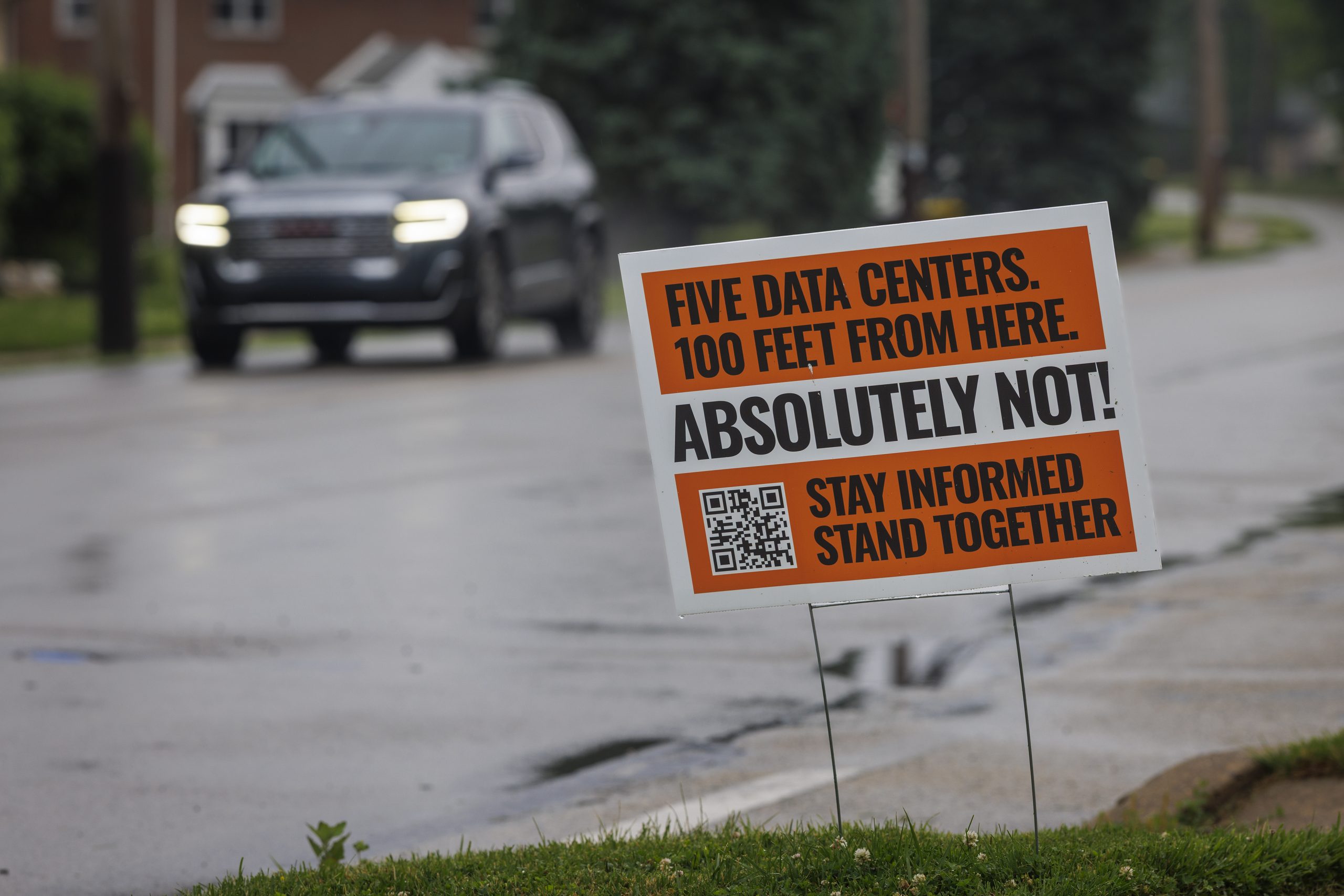
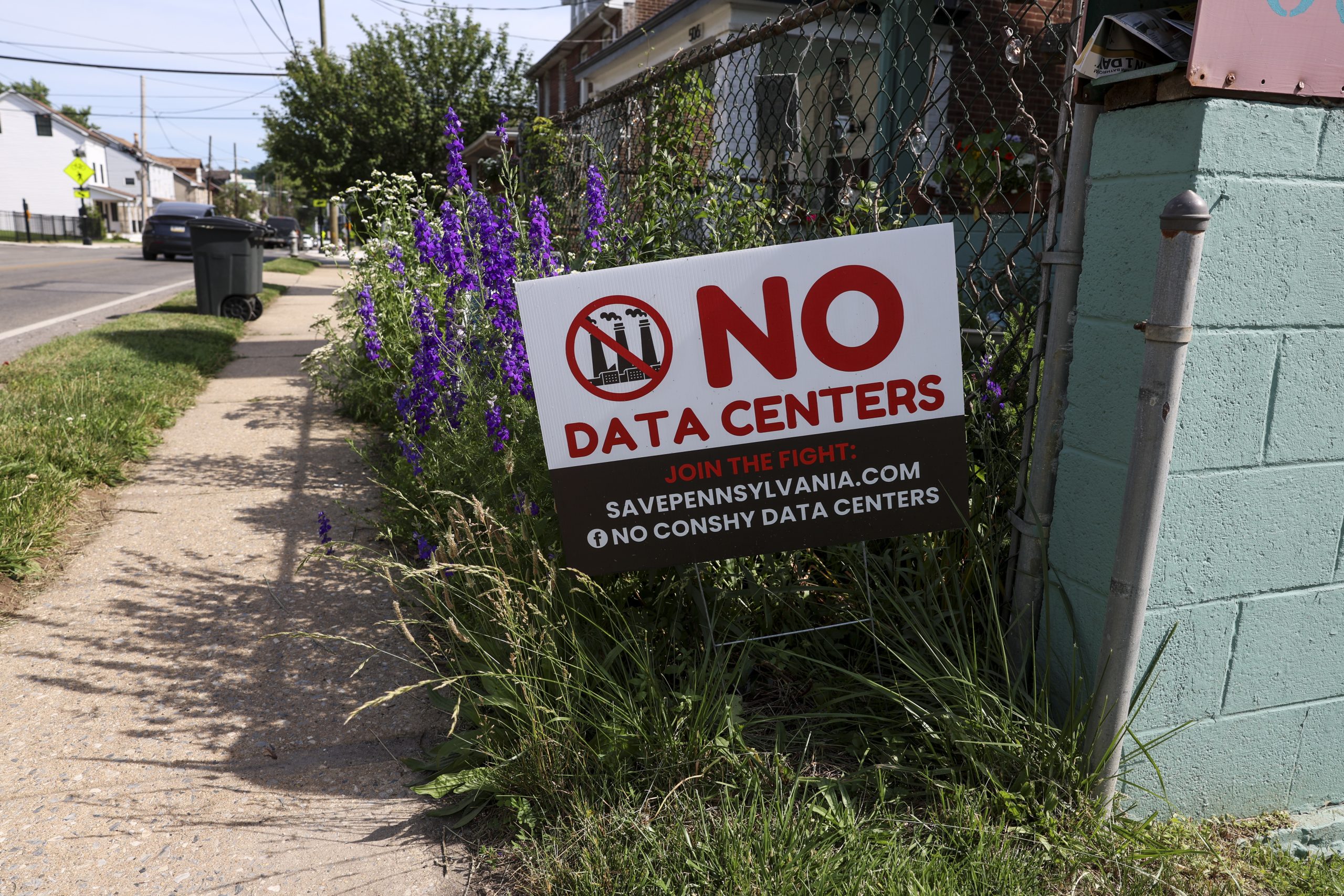
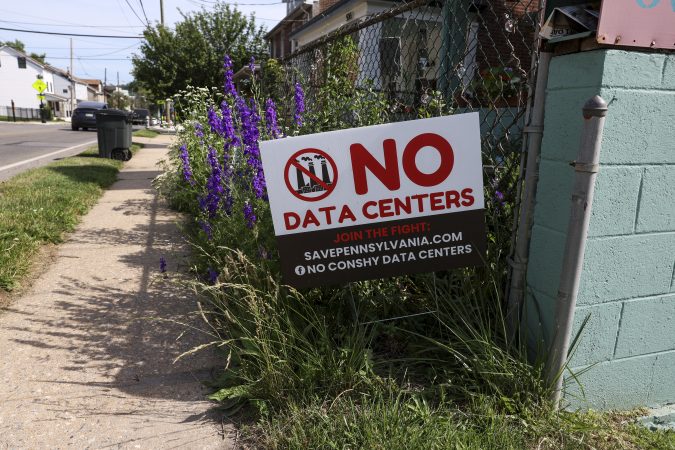
Lawn sign along Crooked Lane in King of Prussia, Wednesday, May 27, 2026. Some residents are standing in opposition to building a data center in their community.Alejandro A. Alvarez / Staff Photographer
To build a data center in Pennsylvania — where Shapiro just 14 months ago trumpeted a $20 billion commitment from Amazon to build at least two data center campuses in Bucks and Luzerne Counties — developers will now be required to sign a consent agreement detailing how it will follow new guidelines in four key areas: transparency, energy affordability, workforce development, and environmental protection.
Many top Pennsylvania Democratic leaders and environmental groups lauded Shapiro’s order, while some Republicans called it a disingenuous flip-flop in an election year. And some of the loudest data center opponents said it did not go far enough — and they still want a moratorium.
Thirty-eight states, including Pennsylvania, offer tax breaks for data centers. Many of these tax incentives were approved years ago, as the emerging artificial-intelligence industry began to come online. Pennsylvania’s legislature firstapproved its benefit in 2021.
Some states, like New York, have halted all data center development for periods of time, while others, like New Jersey, have singled out specific areas, such as consumer protections, in which lawmakers want to curb data centers’ impact.
Shapiro’s administration argues it is unfair to compare its multipronged requirements for developers to build in Pennsylvania to states with moratoriums. In other words, officials say, Pennsylvania has the toughest enforceable barriers for data center development, while moratoriums are a total stop.
Most state legislatures are weighing proposals to restrict data center development through moratoriums or energy generation requirements. Pennsylvania has near-unanimous support among lawmakers to end tax breaks for data center developers, but legislators in the politically split General Assembly failed to do so before leaving Harrisburg for the summer.
In absence of new state laws, a handful of governors, including Shapiro, have taken executive action to restrict data center development in their states. Here is a look at how several states, including Pennsylvania and its neighbors, are approaching data centers.
Pennsylvania
Moratorium: No
Tax credit available: Yes
Restrictions: After previously embracing data center development as a potential economic driver for Pennsylvania, Shapiro changed his position and signed a wide-ranging executive order last week requiring data centers to get local approval, bring their own power, hire and train local workers, and more. The order does not include a moratorium on data center development. However, its requirements for local approval may, in effect, block many from moving forward.
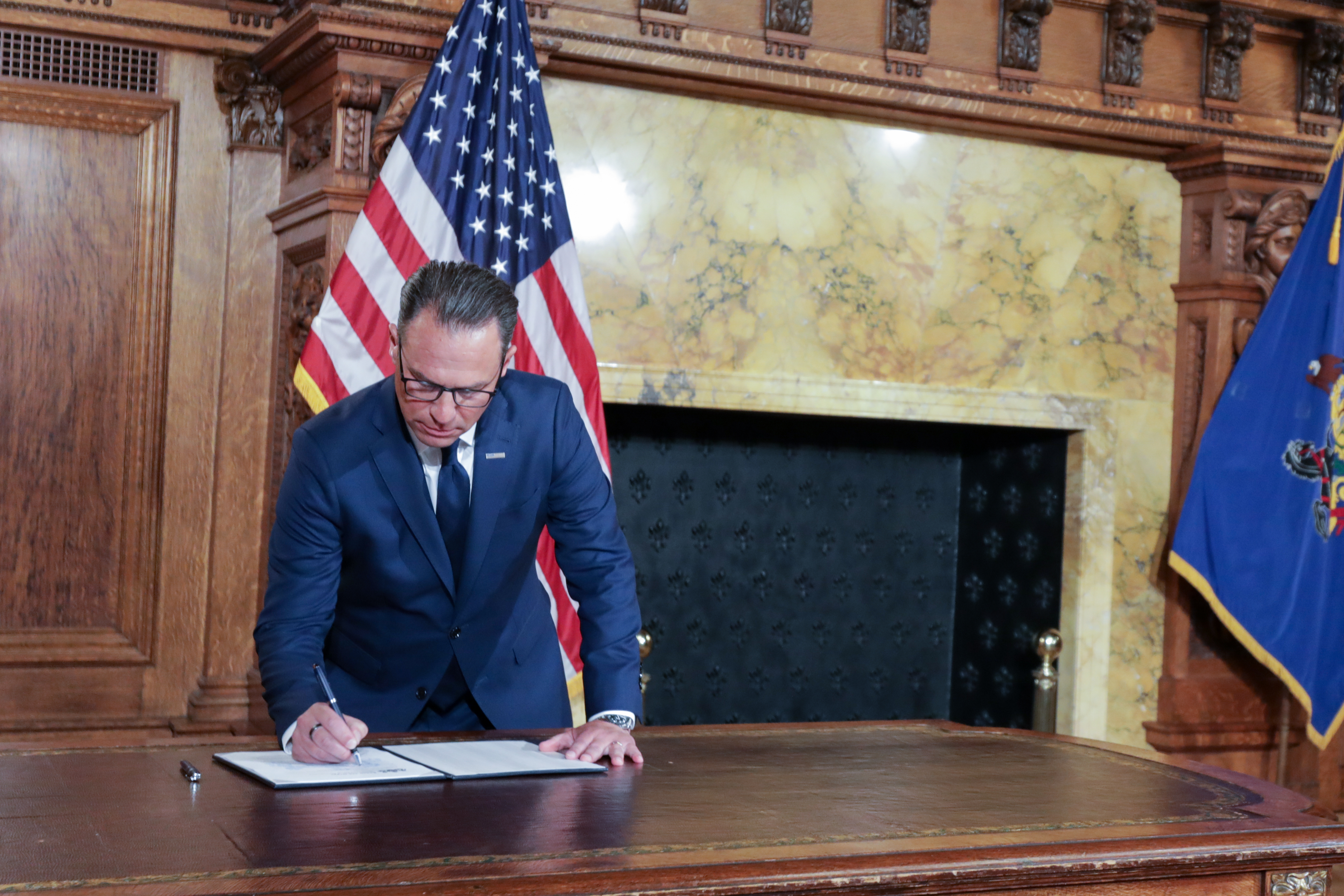
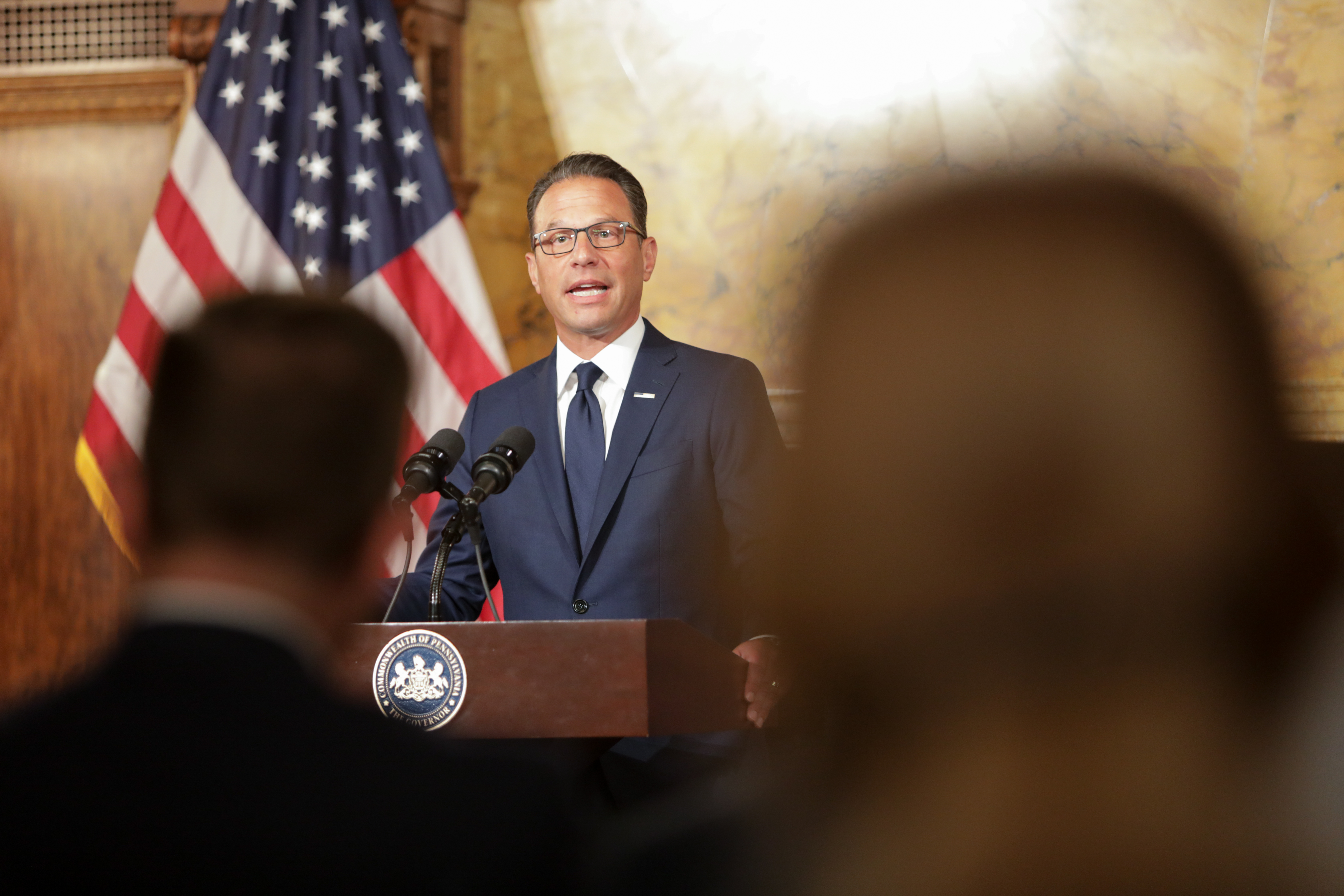
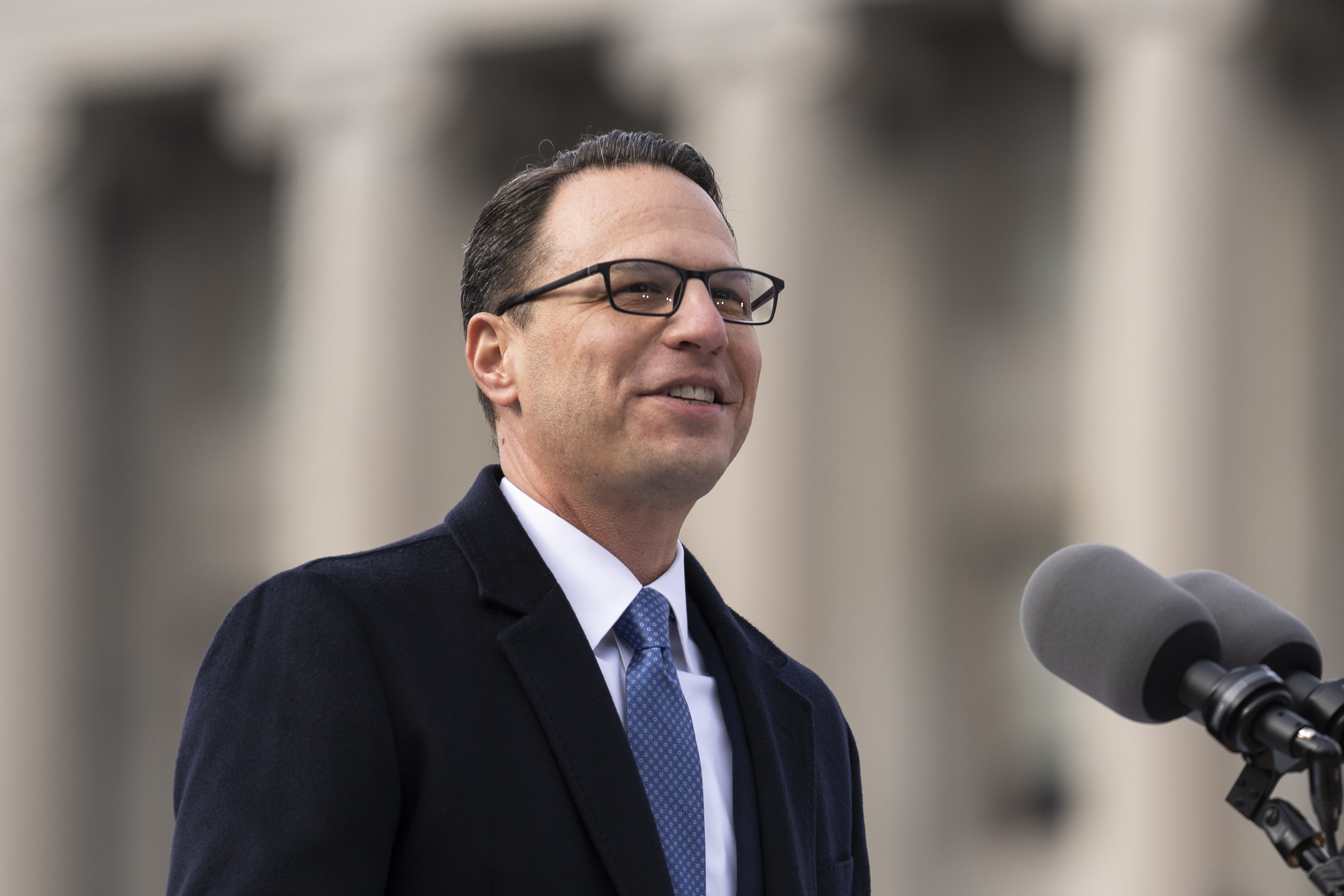
Gov. Josh Shapiro signs an executive order restricting data centers in Pennsylvania during a ceremony in the Capitol in Harrisburg, Pa., Tuesday August 18, 2026.Kalim A. Bhatti / For The Inquirer
Any developer looking to build a data center in Pennsylvania must sign a 33-page, legally binding consent agreement that follows Shapiro’s multifaceted and detailed requirements about the facility’s projected energy generation and water usage and a community benefits agreement in order to receive state-level permit approvals. If the developer does not agree to Shapiro’s rules, its project will be held up by the state indefinitely.
Current projects that have received state permits will be allowed to proceed, but developers will need to sign the agreements for any future approvals.
New Jersey
Moratorium: No
Tax credit available: Yes
Restrictions: In July, Gov. Mikie Sherrill signed several bills into law to protect consumers from increased costs associated with data center development, including the creation of a new tax and rate structure specific to data centers so that the projects pay for their own energy usage and grid updates.
Gov. Mikie Sherrill answers questions from press about the recent rainfall and flooding in Camden at the Fire Administration Building in Camden, N.J., on Tuesday, July 7, 2026.Tyger Williams / Staff Photographer
Sherrill has released a plan with a framework similar to the regulations outlined in Shapiro’s executive order — including requirements for energy generation, community input, workforce development, and environmental protection — but unlike an executive order or legislation, it does not appear to be enforceable.
Restrictions: Gov. Kathy Hochul in July signed the first statewide data center ban in the nation, blocking new construction for any project using 50 megawatts or more of electricity for up to one year. Fewer projects were proposed in New York, one of the nation’s most populous states that relies heavily on surrounding regions to generate its energy consumption, than in its neighbors. Hochul said she will lift the order once her administration develops guardrails for future projects.
Hochul, a Democrat, took specific aim at hyperscale data center proposals, the main projects intended to power emerging AI technologies.
Maryland
Moratorium: No
Tax credit available: Yes
Restrictions: There has been no statewide action on data centers yet, as Maryland is limited on how much energy it can produce due to its size and dense population. Unlike in Pennsylvania, county and local governments in Maryland are allowed to pass their own moratoriums on data center development, which Baltimore and other densely populated counties near Washington have done.
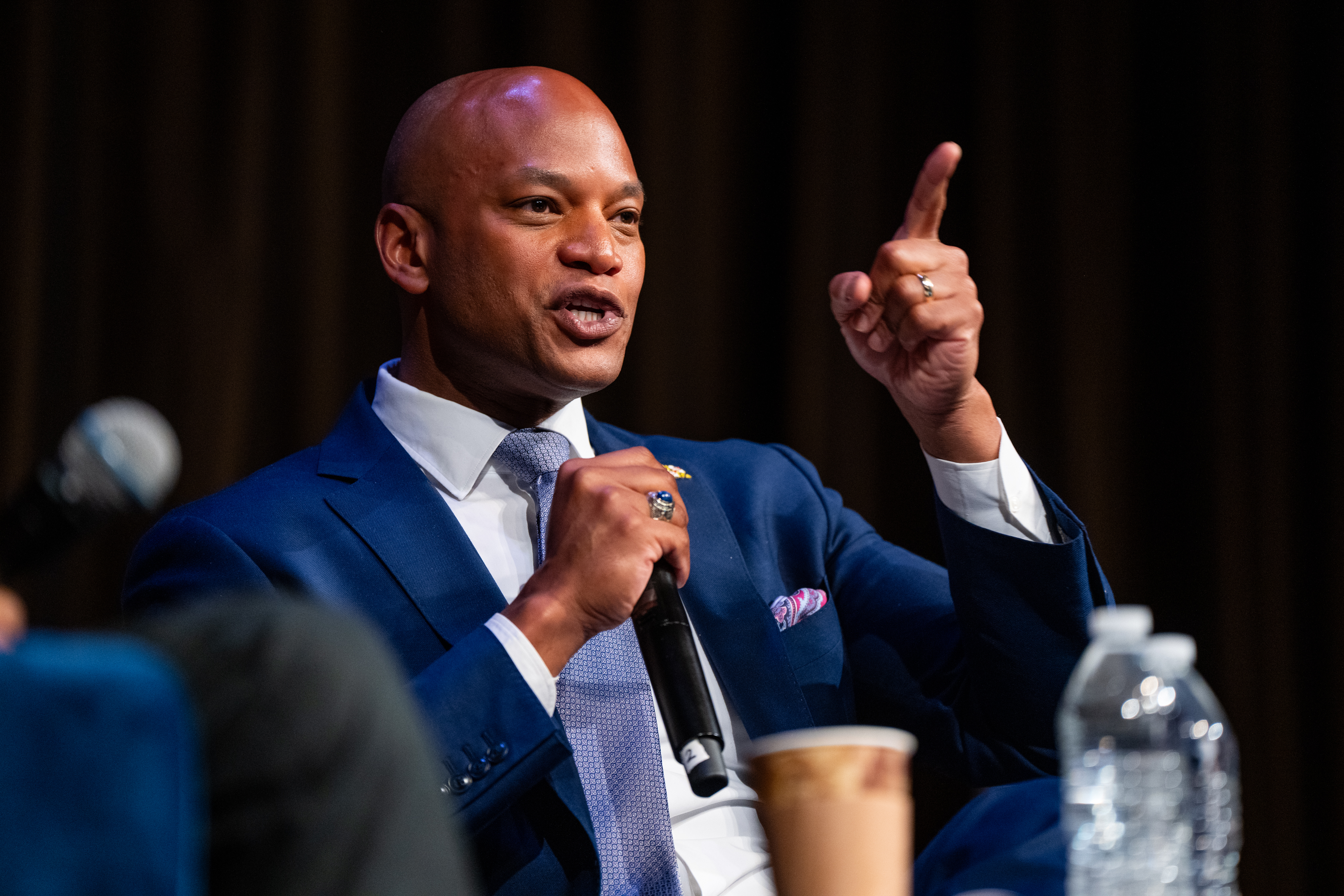
Wes Moore, Governor of Maryland, speaks during the National Action Network (NAN) Convention in New York, Thursday, April 9, 2026. (AP Photo/Angelina Katsanis)Angelina Katsanis
Gov. Wes Moore, a Democrat running for reelection, backs a number of legislative proposals in the Maryland statehouse that would require the centers to bring their own power and hire local union workers. But he has mostly demurred on a statewide moratorium, saying it is up to local governments to decide, online news outlet Maryland Matters reported.
Similar to Shapiro’s Republican opponent, Stacy Garrity, Moore’s GOP challenger, Dan Cox, has called for a statewide moratorium on the projects.
Virginia
Moratorium: No
Tax credit available: Yes
Restrictions: Virginia is among the hottest spots for data center development in the country, with more than 340 data centers in operation and hundreds more proposed. In July, the Virginia General Assembly imposed a new electricity-use tax set to run out in two years.
Virginia is also seeing massive tax revenues from its burgeoning data center industry. One wealthycounty just south of Washington is home to 250 data centers.The local government thereis expected to bring in $1.3 billion in additional tax revenue from data centers, allowing the county to reduce property taxes by 30%, the New York Post reported.
Restrictions: Ohio has the fifth-most data centers in the country, with more than 200 already operating, according to the state’s consumer protection office.
The GOP-controlled state broadly still welcomes data center development. But its utilities commission approved a tariff for large data centers,requiring them to pay for at least 85% of their electricity capacity.
It is also a top issue on the campaign trail in the state’s hotly contested U.S. Senate race that could decide control of the chamber: Top Republicans warned AI developers that they need to fix their public image or lose supportive candidates, Axios reported.
Texas
Moratorium: Yes, for future development
Tax credit available: Yes
Restrictions: In what was once the most welcoming state in the country for data center development, new developments in Texas are now indefinitely on hold.
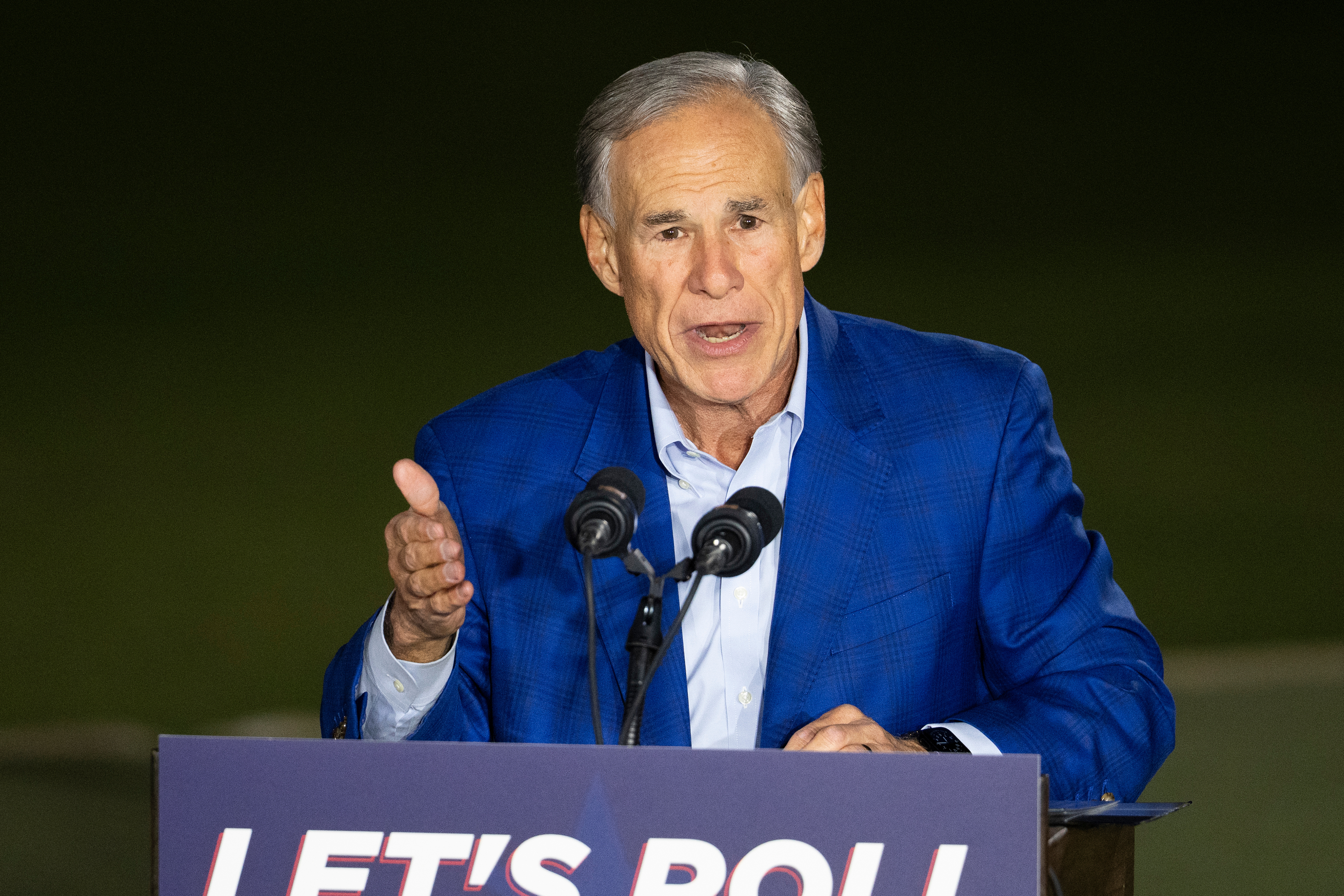
Gov. Greg Abbott announces his re-election campaign for Texas governor in Houston, Sunday, Nov. 9, 2025. (Jason Fochtman/Houston Chronicle via AP)Jason Fochtman
This month, Gov. Greg Abbott, a Republican, announced a moratorium on future data center projects while the state’s utility commission and electricity council audit the current projects’ power and water use, and more.
Kentucky
Moratorium: No
Tax credits available: Yes
Restrictions: Gov. Andy Beshear, like Shapiro an ambitious Democrat and a potential 2028 presidential contender, also signed an executive order earlier this month that requires data center developers to submit an energy plan that outlines that the project will not raise prices for ratepayers. He also directed the state’s utility commission to deny any rate increases to cover increased costs from data centers.
Beshear’s order was met with criticism from some experts who claim his order was not enforceable, particularly for its inclusion of a directive to an independent agency not under the governor’s discretion, the Kentucky Lantern reported.
Pennsylvania Democrats, including Gov. Josh Shapiro, are pointing to a stunning upset in a special election for a deep-red state House district as proof that the party has momentum while campaigning this fall for a trifecta in Harrisburg.
Butler CountyDemocrat Brandon Dukes said his apparent victory over Republican Scott Timko, by fewer than 100 votes as of Wednesday afternoon, was thanks to his focus on local issues, such as a major corridor perennially under construction to the frustration of residents.
“We kept it local, we kept it practical, and we kept it common sense,” Dukes said in an interview.
The 12th Pennsylvania House District, just north of Pittsburgh, went for President Donald Trump by more than 18 percentage points just two years ago and had been held by Republicans since 1999.
Dukes’ apparent win attracted national attention Wednesday as both a sign of the backlash to the president’s party heading into November and as a north star for centrist Democrats as they seek a path forward.
“We won that district last night with a middle-of-the-road community leader, who I backed, who won this improbable race,” Shapiro told CBS Mornings, contrasting Dukes with the party’s more left-leaning candidates this cycle.
“What we’re seeing are commonsense folk from the community who, I think, reflect a lot more my values and my approach to governing who are winning and are upsetting Republicans in these deeply Republican districts,” said Shapiro, a moderate Democrat widely expected to run for president in 2028.
Shapiro recorded a robocall urging voters to cast ballots in the race, his campaign confirmed.
Recipe for November
Democrats are aiming to flip four congressional districts in Pennsylvania this fall and win control of the state Senate for the first time in 30 years with Shapiro, a popular governor, at the top of the ticket.
Dukes, who will compete to win the seat again in November in a rematch with Timko, shattered previous Democratic runs in the Butler County district.
“The fact we just flipped this seat tonight is a political earthquake,” U.S. Rep. Brendan Boyle, a Philadelphia Democrat, said on X.
The district had been represented for more than two decades by one of the Pennsylvania House’s most conservative members, former State Rep. Daryl Metcalfe, who retired in 2023 and was known for his anti-LGBTQ+ rhetoric and actions.
State Rep. Malcolm Kenyatta, a Philadelphia Democrat, said that the seat is one the party “should not have had a chance to come within sneezing distance of,” but that Dukes’ performance provides a blueprint that can be replicated throughout the state.
“Winning here means there is not a single safe seat for the GOP,” Kenyatta, a vice chair of the Democratic National Committee, said on X.
The Associated Press had not called the race as of Wednesday evening, but both parties made statements indicating that they expected Dukes’ lead to hold.
Chantell McCurdy, the director of Butler’s election bureau, said the initial count has been completed and there is a five-day period to challenge the results.
James Markley, a spokesperson the Pennsylvania Republican Party, said in a statement that the race needs to be a “wake up call for Republican voters,” and warned against policies from the Democratic Party’s more leftward flank.
While expressing confidence that the party would win the seat back in November, he also lamented the party’s inability to turn out voters this election.
“The General Election will come down to which party does a better job getting their voters to participate in the election using any legal means of casting a ballot. Democrats did a better job of this,”he said.
Pennsylvania Republican House Leader Jesse Topper of Bedford County downplayed the significance of the special election, calling the results “disappointing but unsurprising” because of demographic change in the district, the timing of the vote during the summer,and the unpredictable electorate for such contests.
“There is much more yet to unfold in the final months of the 2026 election cycle and we will continue carrying out vision for positive growth in Pennsylvania through November,” he said.
But Democrats noted that Dukes’ victory in the district would not have been possible if he did not work to win over Republican voters.
“You cannot win a deep-red district like this without getting at least a big chunk of independents and at least some Republicans” who are “rejecting the chaos and high prices of Donald Trump,” said Pennsylvania Democratic chair Eugene DePasquale.
“I think this is a recipe for a big November for the Democratic Party,” he said.
Dukes, a loan administrator, said he listed affordability, infrastructure, and education as the key issues for his campaign.
DePasquale said Dukes’ campaign worked because he “focused on issues that mattered in the district,” such as high prices and cuts to Medicaid andfood assistance under Trump.
But DePasquale dismissed the idea that Democrats should run only certain kinds of candidates to win.
“We need to be a big-tent party, and we need to have candidates that reflect their districts,” he said. “We are embracing candidates that spread the ideological spectrum of the Democratic coalition, and you’re going to see that lead to success this November.”
Statehouse campaigns often do not receive as much money or attention as congressional and statewide races, but Dukes received a boost from several major figures in the party.
He also boasted an endorsement from former Transportation Secretary Pete Buttigieg, another possible Democratic presidential contender, who said Wednesday that Dukes’ win “reflects voters’ readiness for change.”
Rematch ahead
After he is sworn in, Dukes will serve a roughly 2½-month term, following the resignation of former State Rep. Stephenie Scialabba, a Republican.
As an incumbent, he will then face a rematch with Timko in November for a full two-year term.
Dukes said he plans to “stick with what worked best” for his November campaign, which will include maintaining face-to-face contact with voters.
A graduate of the University of Pittsburgh, Dukes lives with his wife and daughter in Cranberry Township and describes himself as an “avid Star Wars fan” on his campaign website.
House Speaker Joanna McClinton, a Philadelphia Democrat, said Dukes’ win builds momentum for the party to make the case to voters about how electing Democrats achieves their goals on issues like codifying abortion protections and raising the minimum wage.
When state lawmakers return to Harrisburg in September, several issues await, including whether to tax and regulate skill games, finding a long-term funding solution to fund mass transit, and the use of cell phones in K-12 schools.
“When he gets started in Harrisburg in September, he’s going to be a part of the larger House Democratic agenda that’s been focused on affordability and on opportunities for all Pennsylvanians,” she said. “Voters were very motivated to make their values and their frustrations known at the ballot box.”
Dukes will provide votes that he can take back to constituents to further his reelection argument.
“It’s important to tell voters what you’re going to do to make their lives easier because that’s what we did, and we spoke about how we were going to do that,” he said. “It resonated pretty well last night.”
Shapiro, a first-term Democrat running for reelection and a rumored 2028 presidential contender, had been an early champion of data center development in the state, including a $20 billion commitment from Amazon to build at least two data centers in Bucks and Luzerne Counties.
Now he is taking a hard-line stance against the burgeoning data center industry he once courted, as proposed projects draw increasing bipartisan backlash across Pennsylvania.
The far-reaching executive order does not include a moratorium on data center development. However, the order requires local approval for projects to receive state permits, which in effect may block many developments from moving forward.
Shapiro used his executive powers Tuesdayto push through his previously proposedGovernor’s Responsible Infrastructure Development standards, which wereinitially pitched as voluntary incentives for data center developers to receive tax breaks, but failed to receive support from the GOP-controlled state Senate. All projects will be required to follow GRID’s environmental, economic, and transparency requirements in order to move forward.
“I have no other choice than but to take this executive action to protect the good people of Pennsylvania from these predatory developers and from these projects that would negatively impact our communities,” Shapiro said after signing the order.
Shapiro’s order also:
Removes all data center developments, including those by Amazon, from the fast-track permitting program, and no data centers will be considered for the program moving forward.
Requires data center projects to sign legally binding agreements to certain transparency and environmental requirements in GRID, such aswater conservation standards and early and transparent public notification of proposed projects ahead of key local approvals. Companies must follow GRID guidelines to access the state’s existing sales tax break for data centers.
Prohibits any state agency from signing a nondisclosure agreement related to a data center project.
Instructs the Pennsylvania Department of Environmental Protection to publish a publicly accessible map of current permitting information for all proposed data center projects.
Mandates that the projects bring their own electricity generation and pay all costs associated with increased energy usage.
Requires a community-benefit agreement that includes promises to hire and train local employees, as well as developer investments in schools or infrastructure.
UnderscoresPennsylvania’s unique state constitutional rights to clean air, pure water, and environmental preservation — a focus of many residents who oppose data center projects.
‘On notice’
Pennsylvania has become a top target for data center projects, due to its key placement near some of the nation’s largest metropolitan areas, its energy production potential, and its vast rural areas.
But data centers have become increasingly unpopular in the year since Shapiro championed the Amazon deal as one promising that the future of artificial intelligence “is going to run right here through the Commonwealth of Pennsylvania.”
In a June poll conducted by Quinnipiac University, 76% of registered Pennsylvania voters said they would oppose a data center in their communities. Only 24% of voters said they approve how Shapiro is handling data centers in Pennsylvania, including 40% of Democrats — a drop from his 51% overall favorability in the same poll.
A yard sign protests the proposed data center on New Elm Street near the Closed Cleveland-Cliffs steel mill photographed on Thursday, June 4, 2026 in Conshohocken, Pa.Monica Herndon / Staff Photographer
“Archbald and Montco are just two examples of dozens of communities being overrun and overwhelmed by developers who don’t give a damn about us and think they can have their way,” Shapiro said. “Today, I’m formally putting them on notice.”
Shapiro took specific issue with the more than 100 speculative projects across the state, which include some from real estate developers who are seeking building approvals without determining or disclosing the company for which they would be storing the data.
The Data Center Coalition — the leading data center group representing Amazon, Microsoft, and other top developers — said in a statement that distinguishing between real, company-led projects and proposals is important and that rules should not be “changed midstream” for “verified and responsible data center projects.”
“Companies have made plans, communities have prepared for economic opportunities, and workers are ready to build the next generation of digital infrastructure right here in Pennsylvania,” said Dan Diorio, the executive vice president for state policy and government affairs at the Data Center Coalition.
Diorio previously told The Inquirer that Shapiro’s GRID standards were “extensive” compared with the 37 other states that offer sales tax exemptions.
Shapiro’s administration appeared prepared to face legal challenges from the deep pockets of the data center industry or property developers. The order includes a severability clause, something not traditionally used in executive orders, that says if any parts of the order are “held to be invalid,” the rest of the order still stands.
Shapiro has previously said his position on data centers has evolved. But his order Tuesday is perhaps his most dramatic shift: He has gone from consulting Amazon and the data center industry on his GRID principles earlier this year to pulling the tech giant and others from the state’s fast-track permitting program and requiring community-benefits agreements for the projects to move forward.
Gov. Josh Shapiro signs an executive order restricting data centers in Pennsylvania during a ceremony in the Capitol in Harrisburg, Pa., Tuesday August 18, 2026.Kalim A. Bhatti / For The Inquirer
The Amazon projects currently underway in Pennsylvania have already passed through the first phase of permitting, and will be required like all other projects to follow the requirements moving forward, a spokesperson for Shapiro said.
An Amazon spokesperson did not respond to a request for comment Tuesday.
There aresix data center projects under construction in Pennsylvania,and 10 have received at least one state-level permit approval, Shapiro’s office previously told The Inquirer.
Shapiro and the General Assembly have been under pressure by anti-data center activists to enact guardrails on the massive projects, with many arguing that Pennsylvania moved too quickly and sacrificed the state’s safety in favor of Big Tech. Pennsylvania lawmakers nearly unanimously supported ending the sales tax exemption for the projects, but failed to implement a measure during the spring legislative session.
At the news conference Tuesday, Shapiro invited representatives from the Pennsylvania Association of Township Supervisors — the main group representing the local governments at the forefront of pushing for data center restrictions — in addition to advocacy groups including the Pennsylvania Utility Law Project and the National Resources Defense Council. The groups praised Shapiro’s plan.
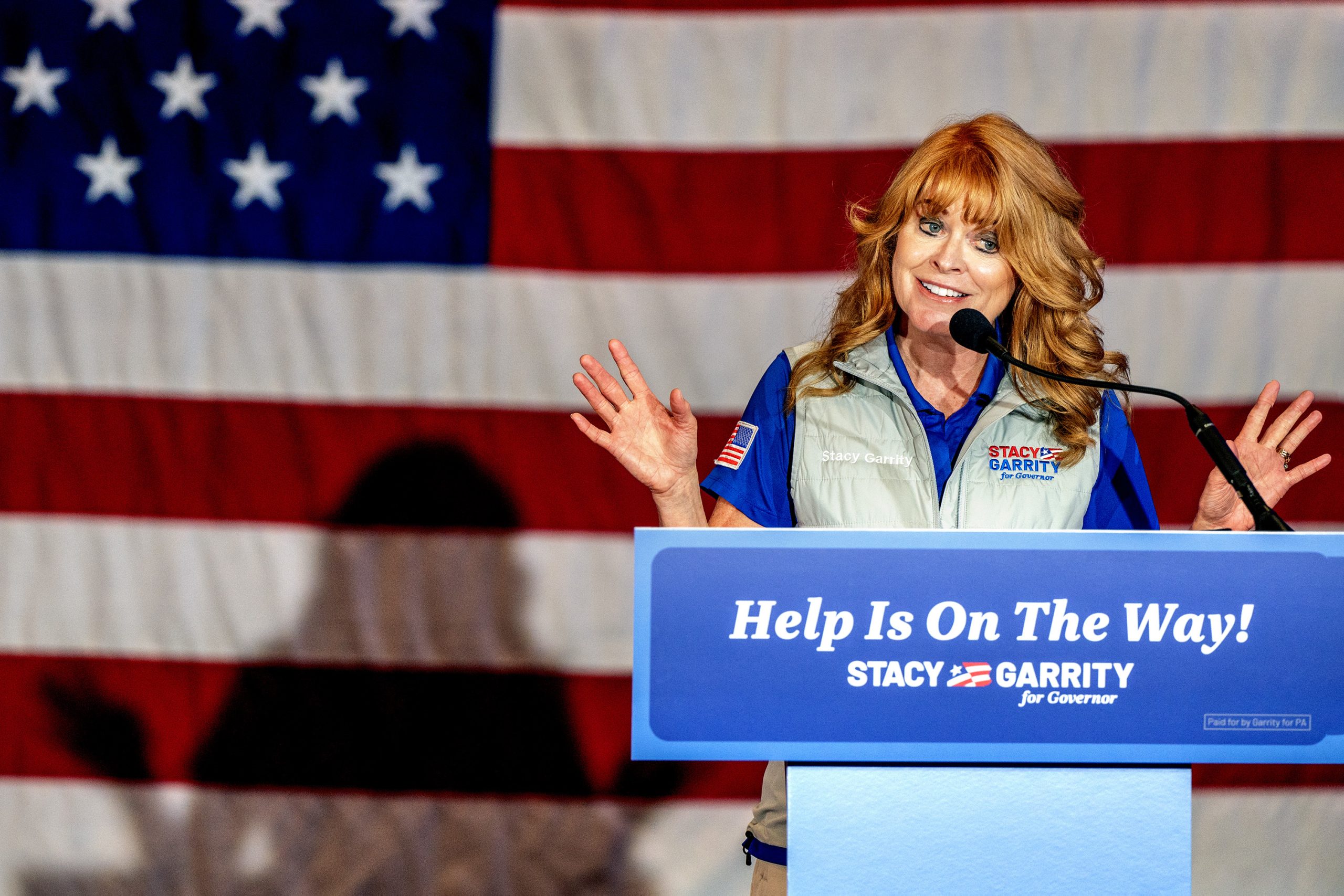
Though Shapiro’s order was widely lauded by Democratic state lawmakers and environmental groups, it was met with criticism from some of his detractors, including his Republican challenger for governor in November, Treasurer Stacy Garrity.
Garrity’s first TV ad featured Shapiro’s support for data centers, and on Tuesday she said in a statement that Shapiro is “trying to gaslight the people of Pennsylvania into not believing what they’ve seen with their own eyes for the past 13 months.” (Garrity’s position on data centers has also changed since the June 2025 announcement, which she lauded at the time; she has since said Pennsylvania needs to put a “pause” on all data center development.)
Megan McDonough, the state director for advocacy organization Food and Water Watch, said in a statement that “Shapiro knows that he’s been acting out of accordance with what Pennsylvanians actually need,” but that the order falls short.
“Shapiro is feeling our heat because Pennsylvanians have made it impossible for him to ignore us,” she said. “The only solution to addressing AI data centers’ many woes is by placing a mandatory moratorium on all new data center development.”
Candidates are trading debate challenges in a contentious congressional race in a key swing district in the Philadelphia suburbs.
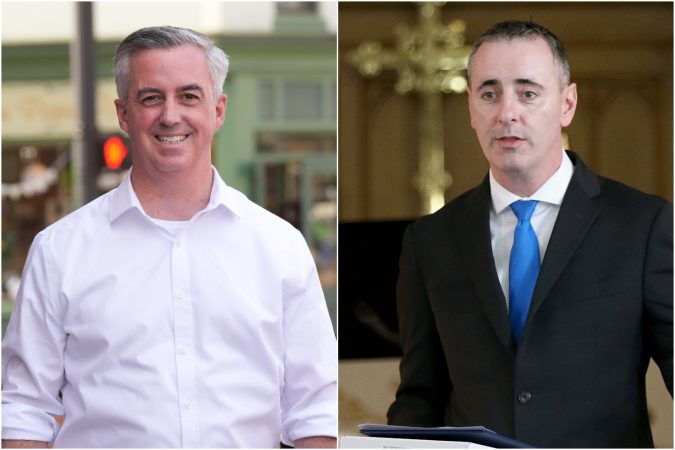
Democrat Bob Harvie is challenging Republican U.S. Rep. Brian Fitzpatrick to four debates, his campaign told The Inquirer.Fitzpatrick, after learning of Harvie’s challenge from The Inquirer, countered with 10 debates — but only if Harvie releases files related to an FBI investigation that Fitzpatrick and allies have routinely alleged focuses on the Democrat.
Harvie does not have files to release, said Dan McCormick, the candidate’s campaign manager. Harvie also has never been under investigation, lawyers for his campaign said. And he has already filed a defamation lawsuit against a pro-Fitzpatrick super PAC for making the same claim.
“Bob would be happy to participate in 10 debates,” McCormick said. “Bob has no files to release and Brian Fitzpatrick knows it. If Fitzpatrick has proof as he says he does, he should put up or shut up.”
The back-and-forth emerged Monday when the Harvie campaign told The Inquirer that the two-term Bucks County commissioner would be challengingthefive-term GOP lawmaker to three debates in Bucks — one each in the lower, central, and upper parts of the county — and a fourth in the Montgomery County portion of the 1st Congressional District.
Harvie said that Fitzpatrick“refuses to answer questions here at home” and “has nothing to show for his nearly 10 years in Washington.”
The increasingly heated race is one of four marquee congressional contests in Pennsylvaniathat could decide which party controls the U.S. House in November.
“It’s time for Fitzpatrick to show up in Bucks and Montgomery County — not Manhattan or the Lavender Fields in France,” Harvie said in a statement, referring to the venues for Fitzpatrick’s wedding and engagement to Fox News senior White House correspondent Jacqui Heinrich. “I’ll be there whether or not he shows, because I will never forget who I am fighting for.”
Heather Roberts, a spokesperson for Fitzpatrick, said as soon as Harvie releases “his full FBI files,” the campaign will move forward with date and venue selections for 10 debates.
“If the Subject of an FBI Corruption investigation is asking to be provided a platform by the only FBI Agent in Congress, he sure as hell will be required to come clean with the public and release these documents in their entirety,” Roberts said in a statement. “If he has nothing to hide, this should be an easy decision for him.”
Roberts also proposed a joint sit-down interview with Harvie and Fitzpatrick, conducted by The Inquirer, to discuss the allegations.
Roberts said that Fitzpatrick, who served 15 years as an FBI agent and a federal prosecutor, “is extremely familiar with this specific grand jury protocol and the documents that are generated.”
The debate drama is the most recent development in what has become an increasingly combative race, filled with personal jabs and legal filings related to controversial ads making allegations that Harvie is the subject of an FBI investigation.
Harvie, a former Falls Township supervisor, and other officials testified as witnesses to a grand jury in an FBI probe in 2022 into political donations and union contracts related to the Pennsbury School District. In 2020, the FBI interviewed several people connected to Falls Township and Pennsbury.
It has been fouryears since voters have been able to see a general election debate in the 1st Congressional District. In 2024, Fitzpatrick did not debate Democratic challenger Ashley Ehasz, after doing so in 2022.
The Harvie campaign said that it would be willing to work with the Fitzpatrick campaign on logistics and other event details, but that the commissioner’s preference is a town hall-style debate so voters can hear from him directly.
Fitzpatrick has held tele-town halls, including one in June, for constituents, and frequently posts on social mediarecapping the meetings and events he attends in the community.
Seated behind his desk in the Oval Office earlier this month, President Donald Trump spoke directly to the camera in front of him. He turned to his right and looked up at the Pennsylvania Republican who, as he had indicated just a few weeks earlier, might very well lose her race for governor this fall.
“I think you can win,” he said this time, extending his hand to Stacy Garrity. It was a change in tune for Trump, who last month at an event in Pennsylvania said Garrity’s opponent, Democratic Gov. Josh Shapiro, was “expected to” and might win.
The president’s confidence in Garrity — and whether his support will extend beyond a handshake and a 17-second video with her at the White House — has become a critical question in the final stretch of the Pennsylvania governor’s race.
Down in the polls and lagging behind Shapiro’s unprecedented fundraising, Garrity has cultivated the president’s support and the potential boost, both financially and in Republican enthusiasm, that could come with it.
It is a risky strategy for a swing-state candidate whose party holds the White House, and particularly as polls show Trump becoming increasingly unpopular. Shapiro and his allies have enthusiastically promoted instances when Garrity, the twice-elected state treasurer, has leaned into Trump’s agenda and brand of politics.
But with less than three months before Election Day, it is not clear to what extent Trump or other key national Republicans will pitch in on her campaign.
State Treasurer and Republican candidate for governor Stacy Garrity holds a rally in Bucks County at the Newtown Sports & Events Center in this 2025 photo. Tom Gralish / Staff Photographer
Trump has not yet stumped in any significant way for Garrity in Pennsylvania, a swing state where he was a near-constant presence during his winning 2024 campaign. And he has not lent his vast political resources — including a Trump-aligned super PAC flush with $400 million — to Garrity or other Republican candidates as his party faces tough campaigns across the country in the midterm elections that will determine control of Congress.
Several gubernatorial races around the country are consideredcompetitive, a reality that also pits Garrity against GOP nominees who polling suggests have better shots of success. The same circumstances have doomed the most recent other Trump-endorsed Pennsylvania Republican nominees for governor — former State Sen. Scott Wagner in 2018 and State Sen. Doug Mastriano in 2022 — who never ended up with national support and lost by double digits.
Campaigns typically heat up after Labor Day, and there is still time for Garrity’s national allies to converge to boost her. But observers say the political reality is also evident.
“The president kind of looks toward two things,” said Samuel Chen, an Allentown-based Republican strategist who is not affiliated with Garrity andwho previously worked for Tom Corbett, Pennsylvania’s most recent GOP governor.
“One is loyalty to him. Garrity has been loyal, but has not necessarily been as vocal as some others have. The other side of it is he likes winners. He wants to endorse people who win,” Chen said. “Everyone in Trump’s orbit knows that Garrity has a very uphill climb.”
Not supporting ‘lost causes’?
The level of involvement from groups like the Republican Governors Association has been a key indicator of whether the party believes its nominee has a chance at winning recent gubernatorial elections in Pennsylvania.
The RGA is made up of GOP governors who collectively support one another’s agendas and campaigns. Democratic governors have a similar alliance.
In 2010 — the last time a Republican won the governor’s mansion in Harrisburg — the group was the largest donor to then-Attorney General Corbett’s gubernatorialcampaign, giving him $6 million starting in August of that year. Four years later and helmed by then-New Jersey Gov. Chris Christie, the RGA was once again Corbett’s biggest donor. It donated more than $5.8 million as Corbett became the first sitting Pennsylvania governor in decades to lose a reelection bid. Christie, preparing to run for president in 2016, stumped with Corbett multiple times.
The picture was starkly different in 2018 and 2022, when Republican voters nominated two candidates closely associated with Trump. Neither Wagner’s campaign against Democratic Gov. Tom Wolf nor Mastriano’s campaign against Shapiro ever became highly competitive — and the RGA and other national groups decided to sit out.
“We’re watching Pennsylvania very closely,” Arizona Gov. Doug Ducey, then the chair of the RGA, said in September 2022. He added that the group would not support “lost causes” or “landslides.”
The RGA would spend nothing in the state that year, even with Mastriano and former Trump lawyer Jenna Ellis pleading for assistance. Shapiro went on to trounce Mastriano by nearly 15 percentage points.
This year, RGA chair and Montana Gov. Greg Gianforte has not publicly weighed in on Garrity’s chances since issuing a brief, generic statement congratulating her after her unchallenged primary in May.
And the competitive landscape Republicans are facing across the country may mean Pennsylvania’s GOP nominee once again gets the short end of the stick. The RGA did not respond to requests for comment.
Even with Pennsylvania’s status as a preeminent swing state that went for Trump two years ago, there are nearly a dozen more competitive gubernatorial races across the country this fall, according to the Cook Political Report, a nonpartisan group that provides election analysis.
Georgia, Iowa, Nevada, Ohio, and Wisconsin — some of which voted overwhelmingly for Trump just two years ago — are all considered toss-ups. Four other states with Democratic governors — Oregon, Arizona, Michigan, and Kansas — are also considered more competitive than Pennsylvania, which is ranked as “solid Democratic,” according to Cook, despite Republicans like Garrity and Trump having won statewide two years ago.
The RGA, according to its most recent filing with the Federal Election Commission, had less than $1.7 million in its RGA Right Direction super PAC after spending about $16 million so far in the current election cycle.
Its recent spending has focused on Iowa, where Democrats are attempting to capture the governor’s office for the first time in two decades, and Kansas, where the RGA launched an ad this month.
“There’s always competition for limited resources,” Charlie Gerow, a longtime Harrisburg-based Republican strategist who also ran for governor in 2022, said of the intraparty competition for donors. “There’s only so much campaign funding to go around as everybody’s trying to get a piece of it.”
In July, Shapiro’s campaign announced he had raised $50 million since January 2025. The next financial filing deadline for statewide candidates is in September, but as of the last reporting cycle, he had outraised Garrity 10-1.
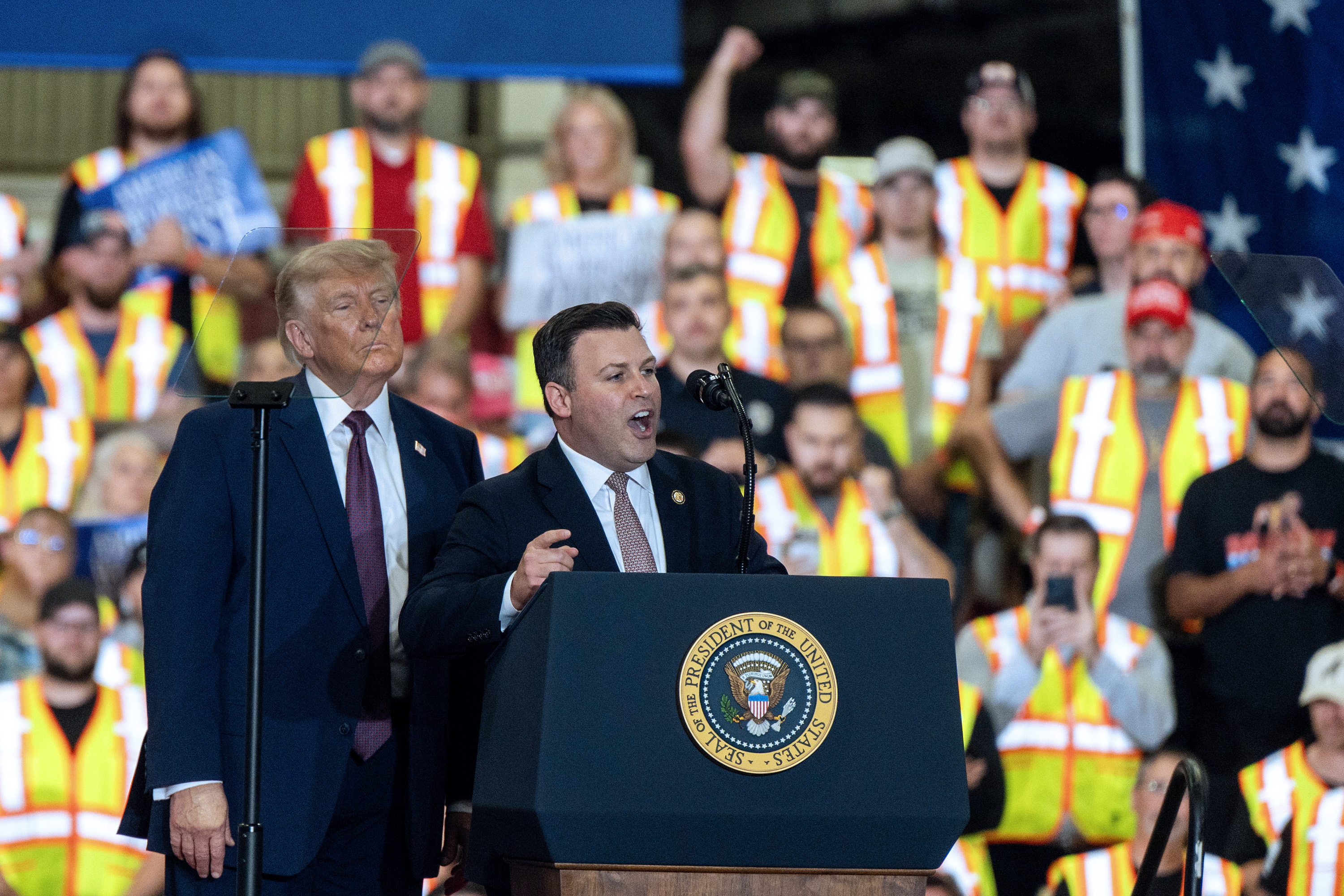
President Donald Trump brings U.S. Rep. Ryan Mackenzie (right) to the stage as he holds an event in Mackenzie’s Lehigh Valley district at Mack Trucks in Macungie Tuesday, June 23, 2026.Tom Gralish / Staff Photographer
But Matthew Beynon, a spokesperson for Garrity’s campaign, said she “does not expect, nor does she need, to go dollar-for-dollar with Josh Shapiro.” Instead, he said, she “just needs the resources to prosecute her case against Josh Shapiro … and she is on pace to be able to do so.”
Garrity looks forward to “continued support” from the RGA, he said.
Other national attention on Pennsylvania
After Mastriano’s disastrous performance in 2022, Republicans coalesced around Garrity — whose 3.5 million votes in 2024 were the most ever for a statewide candidate in Pennsylvania — as their best shot at defeating Shapiro.
But in the year since she received the party’s endorsement, Garrity has barely moved the needle. A Quinnipiac University poll in July found Shapiro leading Garrity 53% to 40% among registered Pennsylvania voters. Trump saw even lower scores: Just 39% of those polled approved of the president’s job performance.
A poll from a Republican-leaning firm promoted by Garrity showed her down, 50% to 43%.
Across Pennsylvania, she has also competed for attention and resources as her party prioritizes other major election battles this fall.
Pennsylvania Gov. Josh Shapiro addresses the audience during a rally for Democratic congressional candidate Bob Brooks at the United Steelworkers Union Hall in Bethlehem, Pa. on Sunday, July 26, 2026.David Maialetti / Staff Photographer
On the other side of the aisle, Pennsylvania’s top elected Republican — U.S. Sen. Dave McCormick — has endorsed Garrity but has not appeared to join in her public campaign efforts so far. A Trump ally and former hedge fund leader, McCormick has raised millions since his election in 2024, and political action committees associated with him have donated to other PACs working to elect Pennsylvania Republicans in Congress.
McCormick has hosted events and campaigned for Garrity, and he “will keep doing everything he can to help her win,” said Mike DeVanney, a spokesperson for the senator.
“He believes she demonstrates the kind of leadership we need and the kind that President Trump and many others have recognized as one that can move our commonwealth forward,” DeVanney said.
Gerow said McCormick undoubtedly could help Garrity down the stretch.
“He’s a prolific fundraiser. He has the connections, and he has the personality to raise large amounts of money. And he can be very, very helpful with the Garrity campaign if he weighs in with full weight,” Gerow said.
Garrity’s campaign said McCormick has been an “incredible supporter,” including with his earlyendorsement and connections to supporters.
Shapiro has also cultivated across-the-aisle relationships with some Pennsylvania Republicans who would be expected to promote Garrity.
In an April interview with Punchbowl News, U.S. Rep. Brian Fitzpatrick, a Bucks County Republican running for reelection in the nationally watched 1st Congressional District, said he thought Shapiro would win his reelection contest and should run for president, adding: “I think Josh is very, very smart.”
And during his 2022 run, Shapiro collected endorsements from other prominent Republicans, including Jim Schultz, a former Trump White House lawyer, and former Republican U.S. Rep. Charlie Dent.
The final stretch
Though the November election is less than three months away, that is still plenty of time in politics. Most ad spending does not start until September, and ground game efforts — door knocking, phone banking, and get-out-the-vote campaigns — get underway in the fall.
Winning Pennsylvania is a priority for Trump in the midterms, and Garrity’s campaign said she is “grateful” for his continued support.
On the state level, James Markley, a spokesperson for the Pennsylvania GOP, said the party is “fully invested” in helping Garrity beat Shapiro. Those efforts include training “thousands” of volunteers and working on education programs around early voting and casting mail-in ballots.
“The more Pennsylvania voters learn about Stacy Garrity, the more they love her,” he said in a statement. “The more Pennsylvania voters learn about Josh Shapiro, they realize he has no record to stand on.”
Gerow said Garrity’s challenge, with limited funds compared with Shapiro, is whether she has enough money to get her message out.
“The major concern for her immediately is to be able to tell her story,” Gerow said. “She doesn’t have the resources to tell that story effectively right now, and she has a great story.”
Buttons for State Treasurer Stacy Garrity and President Trump are left on a table following a VIP reception before a Garrity rally in Bucks County Thursday, Sept. 25, 2025. Tom Gralish / Staff Photographer
Throughout her campaign, Garrity has hammered Shapiro on several issues she said reveal his lack of transparency as a public official. She has held roundtable discussions blasting Shapiro for his early embrace of data centers, a position he has since distanced himself from after calling for new guidelines for their development. Her campaign released a video series online that questions his handling of criminal investigations. And she has repeatedly insisted that Shapiro, who is widely rumored to be running for president in 2028, is “more interested in Pennsylvania Avenue than helping Pennsylvania families.”
Samantha Reposa, a spokesperson for Shapiro’s campaign, disputed Garrity’s framing and emphasized that she has stood in lockstep with Trump on most of his positions.
“Garrity is now running to be nothing more than a rubber stamp for Trump and his agenda that’s hurting Pennsylvania families — and we will continue to hold her accountable,” Reposa said.
Given Garrity’s fundraising deficit, Chen said, he would advise her to focus on meeting individual people in the community, if he were running her campaign.
“Forget the GOP dinners. Start going to fairs. Start going to places that Republicans don’t show up. Start retail politics, and start introducing yourself to the state outside of Donald Trump, outside of modern Republicanism,” he said. “Tell the state what you’ve done for them and what you would do differently [as governor].”
Staff writer Joe Yerardi contributed to this article.
Montgomery County on Tuesday sued some of the nation’s largest social media companies in a Northern California federal court, joining nearly 3,000 actions from parents, school districts, cities, counties, and states that say the platforms are harming the mental health of children and teens.
The social media giants have faced a flood of litigation in state and federal courts, part of a public reckoning over the negative impacts their products are accused of having on young people. The lawsuits allege that the companies have developed platforms that are addictive, especially to young people, and contribute to negative self-image and social isolation.
Montgomery County is suing Meta, ByteDance, Snap, and Google on behalf of the county’s 148 schools and more than 180,000 minor students, the filing said. It accused the companies and their popular products — including Instagram, Facebook, Snapchat, and TikTok — of negligence and creating a public nuisance.
“Too many young people are struggling with anxiety, depression, self-harm, and other serious mental health challenges,” Jamila Winder, chair of the Montgomery County commissioners, said in a news release Wednesday. “We believe social media companies must be held accountable for the role their products play in harming young people.”
Montgomery County’s lawsuit is one of nearly 3,000 cases before a Northern District of California judge through a mechanism called multidistrict litigation. The process allows the federal court system to handle a large volume of similar complaints in one court, usually leading to a number of bellwether trials that help assess the value of a potential global settlement.
The county’s suit is part of a larger partnership between its board of commissioners and its district attorney’s office “to proactively identify, investigate, and pursue cases against companies whose actions harm consumers or create illegal costs for taxpayers,” the news release said.
The 2025 Pennsylvania Youth Survey found that 97% of youth respondents have a phone that can access the internet, 81% have a social media account, and 24% spend four or more hours on a school day on social media.
Teens who spend more than three hours a day on social media platforms have double the risk of depression and anxiety, and half of teens report that social media makes them feel worse about the way they look, according to the advisory.
Spokespeople for TikTok and Snap did not immediately respond to requests for comment Wednesday.
José Castañeda, a spokesperson for Google, said in a statement Wednesday that “the allegations in these complaints are simply not true.”
“Providing young people with a safer, healthier experience has always been core to our work,” Castañeda said. “In collaboration with youth, mental health and parenting experts, we built services and policies to provide young people with age-appropriate experiences, and parents with robust controls.”
A Meta spokesperson also objected to the allegations, saying the company is “confident the evidence will show our longstanding commitment to supporting young people.”
“We’ve listened to parents, worked with experts and law enforcement, and conducted in-depth research to understand the issues that matter most. We’re proud of the progress we’ve made, and we’re always working to do better,” the spokesperson said.
Meta said that damages in the case could reach $1.4 trillion, according to Reuters, which is not far from the $1.5 trillion market cap of the company that owns Facebook, Instagram, and WhatsApp.
(In May, Meta settled for an undisclosed amount in a case brought by a rural Kentucky school district before jury selection took place. The case was slated to be the first bellwether trial in the centralized litigation.)
The social media giants face legal challenges elsewhere, too.
Also on Tuesday, Pennsylvania Attorney General Dave Sunday sued ByteDance, the company behind TikTok, in a Pittsburgh state court. That lawsuit accuses the company of creating an intentionally addictive platform and serving inappropriate content to teens as young as 13.
The companies have argued in courts across the country that they are protected by federal laws that govern the internet, which were enacted before the advent of social media, complex algorithms, and personalized feeds.
The social media platforms themselves cannot be held liable for the content other people post, the companies have argued in court. And, they said, social media addiction is not an established diagnosis and mental health harm cannot be directly linked to use of a platform, app, or website.
But jurors in the first trials over social media’s harmful effectsrejected most of the companies’ arguments. A New Mexico judge this month ordered Meta to pay nearly a billion dollars, combing a $567 million verdict and a $375 million civil penalty, after a jury found the company had committed 75,000 violations of the state’s Unfair Practices Act.
Gov. Josh Shapiro made a declaration in the early days of his administration: Pennsylvania is open for business.
The move would ultimately include promises to slash bureaucratic red tape, cut permit wait times, and offer a new direct line to Shapiro’s office for major corporations hoping to set up shop in Pennsylvania.
Pennsylvania would “move at the speed of business” and “get stuff done,” the new mottos used by his administration, he said. He’s campaigning for reelection in November on the same catchphrases, and boasting major successes like the 12-day repair of I-95 in 2023 that traditionally would have taken months to reopen as an example of how he can think outside the box to solve problems.
What’s more: He sees delivering for residents — showing them government can actually solve problems — as the future of the nationalDemocratic Party, while it searches for an effective message and messenger heading into the 2028 presidential primary, which he is widely expected to enter.
It was with this same spirit last summer that Shapiro announced the largest single private sector investment in Pennsylvania history: Amazon committed $20 billion in Pennsylvania that included two data center campuses in Luzerne and Bucks Counties. Pennsylvania scored the project because of its promise to fast-track permitting and use tax breaks for the massive developments.
“Pennsylvania’s gonna be better off. I think America’s gonna be better off, because we’re going to win the battle of AI supremacy and it’s going to be done right here in the commonwealth of Pennsylvania,” Shapiro said in an interview on CNBC’s Squawk Box on the day he announced the deal.
Gov. Josh Shapiro announces a $20 billion investment by Amazon in Pennsylvania data centers in Salem Township and Falls Township on June 9, 2025.Commonwealth Media Services
But in a year’s time, the politics — and public opinion on both sides of the aisle — have dramatically shifted on data center development. Shapiro’s early welcome of data centers has created an opening for criticism from his gubernatorial opponent and members of his own party.
Yet efforts to cut red tape have proven to be slow and overblown: Only six data centers are actually under construction in Pennsylvania since the announcement, and 10 have received at least one state-level permit approval, according to Shapiro’s office. Still, Shapiro’s popularity is being evaluated by some voters and anti-data center activists on a perception that he moved too quickly and sacrificed the state’s safety in favor of Big Tech.
“I am all about legislators and decision makers getting s— done. This version of it is reckless and it’s irresponsible and it’s not actually serving our people,” said Carrie Santoro, the executive director of progressive advocacy groupPennsylvania Stands Up who has been holding town hall meetings in communities around the state on data centers.
“Governor Shapiro intends to use all the tools available to him to stop the dozens of speculative data center projects that do not meet community needs and Pennsylvania should expect to hear more from him on that in the coming weeks,” said Shapiro’s press secretary, Rosie Lapowsky.
Now Shapiro, who otherwise maintains vast popularity ratings in the state, faces a vulnerability on one of voters’ top priorities as he heads into November, and a particularly sensitive concern among Democrats as he potentially vies for the party’s nomination in two years.
Many states, including Pennsylvania, had already begun welcoming the major projects, and some hyperscale developers plan to spend billions of dollars to build them. Pennsylvania’s General Assembly first approved a sales tax exemption for data center developments in 2021, when Shapiro’s predecessor, Democratic Gov. Tom Wolf, was still in office.
Shapiro, for his part, initially embraced data centers as an economic opportunity for Pennsylvania, bringing union jobs for construction workers to build out the physical infrastructure for the computers running AI software. He also wanted to position Pennsylvania to inherit the most benefit from providing space for AI to operate, leading not only other states but also other countries in the race to advance new technology. He and U.S. Sen. Dave McCormick (R., Pa.) appeared together as early embracers of the technology and the massive buildings needed to power it, speaking together during McCormick’s first AI summit in Pittsburgh last summer.
Sen. Dave McCormick shakes hands with Gov. Josh Shapiro at a panel discussing state investment and infrastructure at the Pennsylvania Energy and Innovation Summit at Carnegie Mellon University in Pittsburgh on July 15, 2025.Kaiden J. Yu / Staff Photographer
But as communities began to push back against the rapid proliferation of data center proposals, in part to protect their water and energy resources, Shapiro adjusted.
Shapiro, like many elected officials, has changed his positions and rhetoric on the unpopular developments. He announced his Governor’s Responsible Infrastructure Standards (GRID) as a way to incentivize developers to follow transparency and environmental requirements in order to receive tax breaks. And when the General Assembly failed to approve his GRID standards or any substantial data center restrictions, Shapiro said he’d act on his own, though it’s still unclear what that will entail.
“You want to build a data center there? You’ve got to bring your own power; you’ve got to pay for your own power. You’ve got to be transparent with the local community — tell them who the hyperscaler is, tell them what’s going to go on there. You’ve got to have a local benefits agreement to help that community. You’ve got to protect the water sources that are used to cool off those facilities,” he said in a June interview with GZERO.
The Democratic governor has been lauded nationally for challenging PJM Interconnection, which is the electric grid operator for Pennsylvania and 12 other states over its efforts to raise prices on ratepayers. He capped the price Pennsylvania consumers could pay through 2029, as residents fear rate hikes due to the data center boom.
But Shapiro’s plan on data centers is too little, too late, Santoro said.
“I saw the GRID proposal as him moving on this issue, and the thing that I am concerned about is he didn’t move enough to keep up with how much voters have moved on this issue,” she said.
Some of those voters would agree. A Quinnipiac University poll of Pennsylvania voters, conducted in early June, found just 24% of those surveyed — and 40% of Democrats — approved of “the way Gov. Josh Shapiro is handling data centers in Pennsylvania.” It’s a stark contrast to Shapiro’s overall approval numbers, in which he’s maintained above 50% approvals — record-high favorability ratings for a first-term Pennsylvania governor.
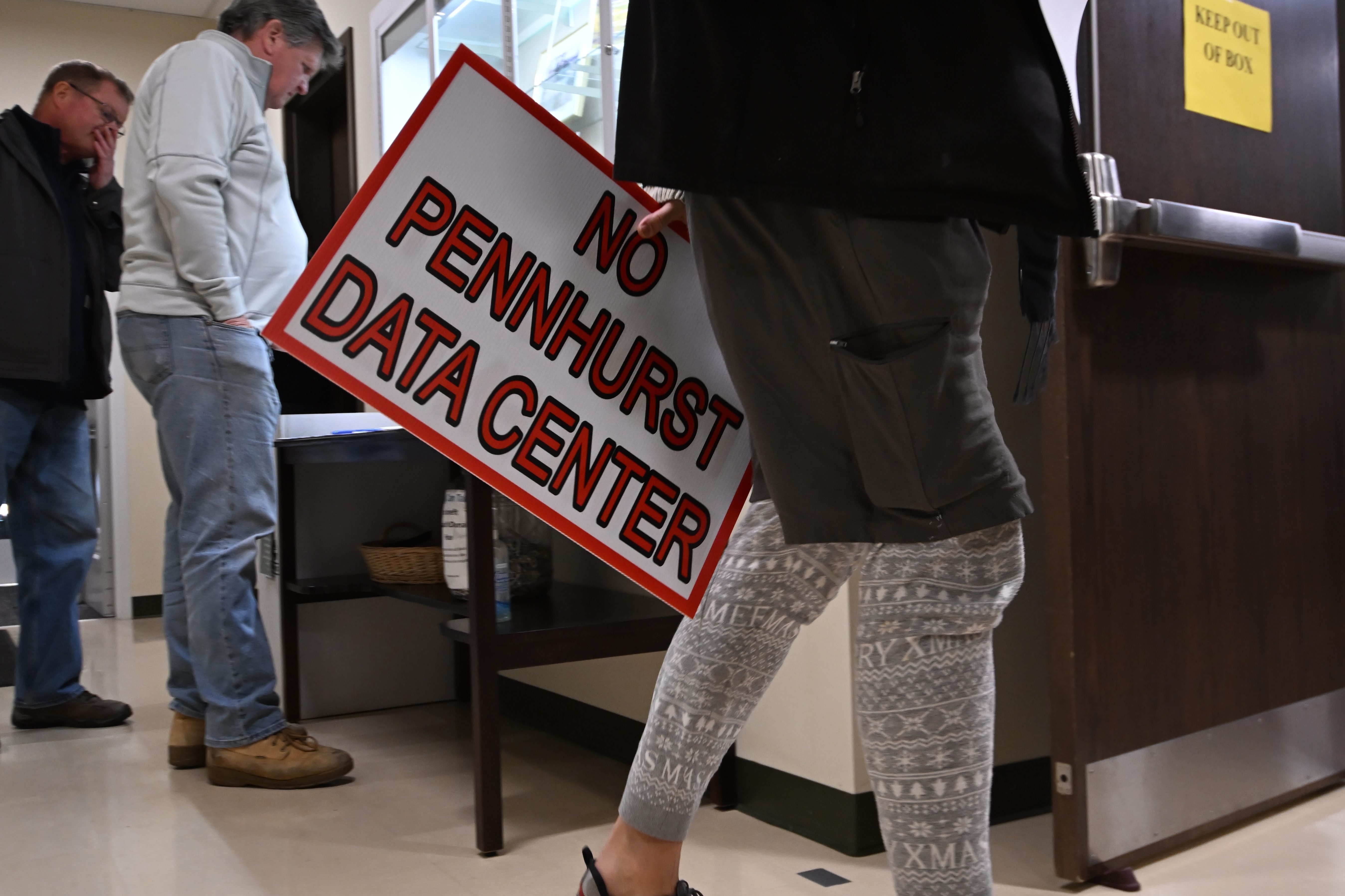
People sign in and head into an East Vincent Township supervisors meeting where an agenda item involved a data center proposal at the former Pennhurst state hospital grounds on Dec. 17, 2025, in Spring City, Pa. Marc Levy
Joanna Tenney, 36, of East Vincent in Chester County, held a sign at a June rally in the state Capitol that read: “Shapiro: Amazon’s bootlicker.” A registered Democrat, she voted for him in 2022, and believes he should be held accountable for supporting data center development in Pennsylvania that led to the fast-tracking of a now-stalled 125-acre data center project near where she lives.
She’s so fed up with Shapiro’s approach to data centers that she said will be writing in the name of her state senator, Sen. Katie Muth (D., Chester), who has been on the front lines of advocating for many state environmental issues, for governor on her November ballot. Tenney said she and a few other anti-data center advocates plan to run a write-in campaign for Muth.
“We’ve elected somebody that we thought was going to make the right choices by us, and we don’t really see that happening,” Tenney said.
Muth, who took office in 2018, said she would not be supporting Shapiro or “any elected official who puts the interests of Big Tech ahead of the health, safety, and future of Pennsylvania communities.”
If Shapiro changes his stance on data centers, she would support him, Muth said. She is the prime sponsor of a bipartisan bill to place a three-year moratorium on hyperscale data center development.
“Get right on the issue, Right your wrongs. If you can’t be on the side of science and people, my support is MIA,” she added.
Emily VanFleet, 26, lives in Archbald in Northeastern Pennsylvania, where six data center projects are underway comprising more than 50 buildings that, when completed, will cover 14% of the town. VanFleet, who is an unaffiliated voter, said she also supported Shapiro in 2022. But because of his public support for speeding up data center development in Pennsylvania, she is “certainly not going to vote for him this upcoming election,” she said. She isn’t sure she’s going to vote at all.
“I want Shapiro to stop being a coward,” VanFleet said in June. “I have emailed him, I have called him, I have reached out to him so many times. I have not heard back, not once. I see his videos all over social media that he has an open-door policy, but I have yet to see it.”
(In May, Shapiro’s administration announced that one of the unpopular Archbald developments, Project Gravity, was removed from a fast-track permitting program for failing to properly engage with the community.)
But negative attitudes toward Shapiro’s position on data centers may be limited statewide and his position is unlikely to dramatically knock down his high popularity or reelection odds: The June Quinnipiac poll found 56% of those surveyed approve of the way he is handling his job as governor overall, and recent polling shows Shapiro ahead 53% to 40% against his Republican challenger, state Treasurer Stacy Garrity.
The data center pitfall
Shapiro’s political opponents — both immediate and prospective — are also seizing on the issue.
Garrity, of Athens in Northeastern Pennsylvania, has also led a statewide listening tour on the topic. In June, she convened one of those sessions in Hatfield with a group of commissioners, zoning planners and emergency responders to talk about how they have been impacted by data centers. She blasted Shapiro for his role in attracting Amazon and said his proposed new requirements amount to a “flip flop.”
“Josh Shapiro has failed on this topic. He was the biggest cheerleader for data center development in Pennsylvania, until he wasn’t,” Garrity said at the June 24 meeting.
Pennsylvania Treasurer Stacy Garrity participates in the podcast “Ruthless” during an event hosted by Americans for Prosperity, Concerned Veterans for America, and the Libre Initiative at the National Constitution Center in Philadelphia on Jan. 29. Elizabeth Robertson / Staff Photographer
Garrity has her own mixed record on data centers.
At the time of the Amazon announcement, Garrity called the investment “great news” that would bring “historic investment” and “create thousands of jobs.” And her current position remains unclear. She has said she opposes a statewide moratorium but wants “a pause” on development instead.
Like Republicans running in districts that supported Trump in 2024 but oppose data centers, she appears to be attempting to find a pro-business and pro-regulation path.
“We want to make sure data centers are an addition to the grid, not a contraction. If there’s infrastructure that needs to be added to the grid, rate payers shouldn’t be paying for it,” she said. “I’m not opposed to data centers, but we have to do them the right way, and we haven’t done it. It’s because of a lack of leadership from the government.”
Garrity’s “long record of supporting completely unregulated data center development makes it clear that she just can’t be trusted,” said Manuel Bonder, a spokesperson for Shapiro’s campaign.
Local government leaders said at Garrity’s campaign roundtable in June that there has been lack of guidance around issues, especially around power demand, water use, infrastructure, environmental impacts, and community compatibility.
Kathie Doyle, a Republican on the Richland Township Board of Supervisors, said confusion around data centers have “set off a firestorm” in her community. Earlier this year, warnings of a supposed proposal for a data center in the Bucks County township circulated on social media, but turned out to be a “business park” with two buildings.
“Our residents don’t understand that we just cannot say no,” she said. Municipalities in Pennsylvania cannot outright ban data center development.
Santoro said Shapiro’s inconsistency is a liability that could sway some voters away from casting their ballot for him.
“Certainly he is giving her an ‘in’ by staying on the wrong side of this,” she said.
And it’s not just Republicans seizing on Shapiro’s position. The early reputation Shapiro earned as a champion of data centers may become a point of attack among other Democratic contenders for the presidency in 2028, too. In a veiled jab at Shapiro in June, Illinois Gov. JB Pritzker, knocked Pennsylvania on a businesspodcast for allowing Constellation Energy to restart Three Mile Island nuclear plant just to power Microsoft’s data centers.
“My guess is that’s going to be a reasonably unpopular thing to have done,” Pritzker said, without noting Shapiro by name on the Prof G Markets podcast.
Vulnerability for down-ballot Democrats
With a $50 million campaign war chest and high approval ratings, Shapiro is widely favored to win reelection this year. But his record on data centers could prove a liability for those he’s hoping to pull along, some advocates, like Santoro, say.
Shapiro has been staking much of his national political clout on his ability to flip four House districts in Pennsylvania for Democratic control of the U.S. House, drawing voters to the polls with his name at the top of the ticket. He’s also aiming to flip Pennsylvania’s Senate into Democratic control for the first time since 1993, giving him a Democratic trifecta in Harrisburg, as the state’s split legislature has blocked many of Democrats’ priorities from becoming law.
Santoro predicted that could be in jeopardy “if he does not change course.”
“Shapiro’s leadership on data centers will be the thing that costs us the first Democratic trifecta in 31 years, and I think that while he will likely win reelection with this wildly unpopular position on data centers, other elected officials and candidates will not,” she said.
Other Democratic candidates aware of data centers’ deep unpopularity are differentiating themselves on the issue, despite remaining otherwise aligned with Shapiro. Scranton Mayor Paige Cognetti, who is running in Pennsylvania’s 8th Congressional District, released a new ad last month putting data center developers on notice.
“Big Tech needs to pay their own way, not hide behind [nondisclosure agreements]. No tax breaks. Don’t raise our electric bills. Don’t poison our water. And hire local union labor,” she said, in the ad spot. “You can’t meet that? Then get out.”
Cognetti’s stance isn’t vastly different from Shapiro’s — both want to end blanket tax breaks — but her rhetoric is much stronger, and she’s putting the issue at the forefront of her campaign.
Democrats insist Republicans, including those running at the state level, don’t have the moral high ground on data centers after failing to pass through several measures that would have enacted stricter controls for their approval.
Sam Silverman, a former congressional aide and founder of Silverman Strategy Group, a strategic communications firm focused on technology and politics, said Shapiro’s approach to data centers — proposing a plan rather than enacting a moratorium — presents a risk that could either pay off and become the model for other states, or fail to fully address all future concerns and is unpopular.
“Shapiro is going out in front by proposing a bargain now. If the standards protect ratepayers, produce visible benefits, and hold bad actors accountable, Pennsylvania could have a model others can follow,” he said. “But because he is putting forward the deal now, he will be judged on whether it delivers.”
Taking a risk involves trust, though. Shapiro can afford to make a big swing at one of the hottest issues in politics because voters put so much faith in him, Silverman said.
“Most politicians do not have the amount of trust and political capital to take a risk, either,” Silverman said.
Whether the governor is triumphant will come down to what standards go into effect and whether bad actors are held accountable, he said, “and whether Pennsylvanians believe those standards are working.”
HARRISBURG — When Pennsylvania announced plans in 2024 for a first-of-its-kind generative artificial intelligence pilot program with the tech giant OpenAI, Steve Catanese believed he was seeing a familiar pattern: the introduction of a new technology that could jeopardize the jobs of his union members.
As president of the labor union SEIU Local 668, which represents 10,000 state workers, Catanese approached Pennsylvania officials about entering into an agreement to provide its members with job protections as the state continued to introduce AI tools.
The state agreed to talk. And, to the pleasant surprise of Catanese, a series of back-and-forth discussions throughout that winter led to a deal. Gov. Josh Shapiro published a public letter outlining commitments to state employees amid the rising popularity of AI use, and the union reached a separate agreement with the state, establishing protections for its members.
Across Pennsylvania’s government, more than 3,000 state employees are now using AI tools, up from the 175 who first piloted the technology. And 6,000 more are currently enrolled in training programs as a prerequisite for accessing the software. In June, Code for America — a civic tech nonprofit — recognized Pennsylvania as one of the top states for AI readiness.
The state, which has established a Generative AI Governing Board and a series of policies regulating its AI use, has stressed that using AI tools has improved government efficiency without eliminating jobs.
Bry Pardoe, the state’s chief information officer, said in a statement that the Shapiro administration is “focused on the safe and responsible adoption of generative AI and other AI technologies.”
Gov. Josh Shapiro speaks at the state Capitol in Harrisburg, Pa., Jan. 17, 2023. Pennsylvania state government would prepare to use artificial intelligence in its operations, Shapiro said Wednesday, Sept. 20, 2023, as states were increasingly trying to gauge the impact of AI and how to regulate it. Matt Rourke
Today, Pennsylvania state employees use AI for a range of functions but focus on relatively basic tasks: deciphering handwritten clemency applications, scanning documents, and triaging customer service requests.
Most employees access generative AI tools through no additional cost according to the Office of Administration. For the 721 employees who have access to ChatGPT Enterprise, the cost is $25 dollars per month for each user, bringing the annual cost — based on current usage — to $216,000 a year.
Mark Fagan, a lecturer at Harvard University’s Kennedy School of Government and author of a book on how governments can use these tools, said that generative AI can serve as an important resource to deliver public services to constituents.
“There are endless opportunities for using AI to improve the way we either provide higher quality, more efficiency, or more equity in our public services,” he said.
But to do this best, he said, governments should first find friction points and inefficiencies in their operations and then determine if the technology can help.
“AI is often a solution to pain, but that’s not enough,” Fagan said. “If you’re going to use AI, it should be the best solution to the problem.”
A first-of-its-kind pilot
In January 2024, the Shapiro administration launched a pilot program in partnership with OpenAI, the company behind the generative AI chatbot ChatGPT, to test the rollout of tools among a select group of executive agency employees.
The program made Pennsylvania the first state in the nation to enter into an agreement with OpenAI, and also marked the first time employees within the state were permitted to use generative AI tools.
“The pilot was designed to explore using AI tools from the perspective of Commonwealth employees; to understand when, where, and how tools could be of useful to them, where using these tools may introduce opportunities for risk, and areas where employees might need additional training or resources to be successful,” Dan Egan, a spokesperson for the Office of Administration, which has overseen the state’s AI rollout said.
Sam Altman, OpenAI’s chief executive officer, said at the time of the rollout that the pilot “showcases Pennsylvania’s commitment to innovation” and would “provide valuable insights into how AI tools can responsibly enhance state services.”
Open AI Chief Executive Officer Sam Altman, center, speaks at the Advancing Sustainable Development through Safe, Secure, and Trustworthy AI Event on Sept. 23, 2024, in New York. (Bryan R. Smith/Pool Photo via AP, File)Bryan R. Smith
(OpenAI has since introduced a new model tailored specifically for government use and entered into partnerships with other states across the country. In February, Massachusetts officials announced they would make ChatGPT available to their entire 40,000 person executive branch.)
In Pennsylvania, the pilot involved 175 employees from 14 state agencies.
Participants, including Office of Administration employees, lawyers, and construction project managers, were equipped with access to ChatGPT Enterprise, OpenAI’s model for businesses which contains additional privacy features. Information submitted to the chatbot isn’t used to train additional models.
Employees most commonly used ChatGPT during the pilot to assist with drafting emails or other writing.
With access to ChatGPT, participants reported saving an average 95 minutes per day and 85% of employees said their experience was “somewhat” or “very positive.”
During a news conference last March, Shapiro said state employees from lawyers to construction managers used the tools and found them beneficial. The pilot, the first-term Democratic governor added, allowed his administration to reduce the time needed to onboard a new employee by 30 days and to help to consolidate the number of state technology policies by 60%.
“There are too many public officials who think they can stick their head in the sand and ignore this,” Shapiro said. “I believe we need to embrace them and we need to use it for the betterment of society and the betterment of the people we serve.”
Protections for employees
Shapiro, in his letter to state employees, wrote that his administration would implement AI tools with a goal of boosting productivity “not with the agenda of substituting Commonwealth employees with AI.”
In its agreement with SEIU, the state made a commitment that AI tools will follow a “human in the loop” process in which “human workers oversee, review, and guide generative AI tool outputs to ensure accuracy, fairness, and compliance with workplace standards.”
The agreement also affirmed the definition of a public employee as a person, something Catanese said was particularly important to his union.
“I think right now, whether you work for the government or big business, or whatever type of entity, you want to work for an employer that actually sees in the long term there is a role for humans,” Catanese added.
But, he is cognizant that the technology is advancing rapidly, and the union will need to remain vigilant in ensuring those human-in-the-loop protections remain in place to protect workers.
Chinmayi Sharma, a professor of law at Fordham Law School whose research focuses on artificial intelligence, said a dissonance can exist between the draw of using AI tools and the diligence required to check their work.
Organizations may turn to AI tools to make jobs more efficient or more accurate. But ensuring there is a human involved to check the work of those tools requires an additional level of vigilance and care, she said.
“Are these humans in the loop being trained about AI to the point where they can identify subtle or nonobvious errors?” Sharma, whose research is generally cautionary about the use of AI, said.
As far as he knows, Pennsylvania is the only state government at this point that has given a union collectively bargained protections around the use of AI, Catanese said.
Within the union’s membership, perspectives on the rapidly changing technology are varied.
“Most of our members do have some serious concerns about what it means for their future in the long term,” Catanese added.
Other members, Catanese said, believe the tools could help lessen their workload. He said current use cases and restrictions on the types of data that can be entered into the tools means that some of those benefits aren’t yet clear.
“Is it fully guaranteed forever? No,” Catanese said of the protections agreed to by the state. “Is it some level of protection that almost every public servant in the country doesn’t have other than our members at the state? Yes.”
‘A solution’
The state’s use of AI is governed by a set of policies that are reviewed annually.
Human involvement is required in work produced by generative AI and any use of AI tools must be disclosed if a customer is directly interfacing with them. Personally identifying, confidential and nonpublic information also can’t be submitted into AI interfaces.
Throughout the AI rollout, the state has consulted researchers through ongoing partnerships with Carnegie Mellon University and the University of Pennsylvania. Subject matter experts from both institutions have answered questions for the state on an as-needed basis as the administration decides to implement new tools and policies.
As the state considers future use cases, Pardoe said she wants “people to have confidence in the services they get from state government.”
That means, she said, “being thoughtful and deliberate about where and how we choose to implement AI as a solution.”
As AI becomes more complex, Sharma predicted that the same logic that makes AI tools attractive nowwill continue to apply as the technology becomes more advanced. If a government is under-resourced, temptations could exist to redirect resources away from paying human employees and toward something else.
And, she noted that officials may be motivated to continue to adopt more tools.
“I don’t know of a politician that’s going to enjoy coming out and saying, ‘We just put a lot of time and effort into this AI pilot, turns out we were wrong, it’s not a great thing for us to do and we are rolling it back,’” she added. “That’s a tough sell.”
Fagan, the Harvard lecturer, believes that states with successful pilot programs, like Pennsylvania, will likely adopt the technology at a faster rate in the future.
The important question, he said, won’t be whether more places are using these tools, or whether existing states expand the number of employees using them.
“The question is whether it creates value or not,” he said of government AI usage. “The real value is in finding problems, finding where there is pain, and solving it.”
Ethan Young is an intern with the Pennsylvania Legislative Correspondents’ Association. He can be reached at ethanmyoung@gmail.com.
WASHINGTON — A new federal proposal to enact protections for communities opposed to the proliferation of data centers has drawn inspiration from both the Philadelphia suburbs and Western Pennsylvania fracking country.
The Data Center Bill of Rights is one of several national efforts to address a growing dissatisfaction with data centers, which have so far faced few restrictions at either the federal or state level in Pennsylvania.
U.S. Rep. Ro Khanna, a California Democrat and Bucks County native considering running for president in 2028, said his home state should be doing more.
He introduced thefederal legislation after a recent tour across Pennsylvania that he said was designed to hear from communities that have lost manufacturing jobs and other economic opportunities.
Data center concerns came up more than any other issue, he said — leading him to incorporate new ideas into the bill healready had in the works, and to call for a pause on data center development in Pennsylvania until further protections and local controls are enacted.
A statewide pause would be more than what Gov. Josh Shapiro — another potential 2028 Democratic contender — has proposed as he seeks to enact data center guidelines. It would also be less than other Democrats, both in Pennsylvania and nationally, who have called for more robust moratoriums. Shapiro’s Republican challenger this year, Treasurer Stacy Garrity, has also called for a pause but not for an extended moratorium.
“I was surprised by the anger about it in Pennsylvania,” Khanna said in an interview after his 15-county tour. “In other states, people are sometimes opposed in local communities, local pockets. But not this widespread anger.”
Khanna, a Council Rock High School graduate who has represented Silicon Valley in Congress since 2017, spoke about the Data Center Bill of Rights during his tour but said afterward that it was “partly inspired” by the concerns he heard in the communities similar to the ones where he grew up.
“As a kid, I used to go to Conshohocken and the King of Prussia Mall. I’m familiar with that area,” Khanna said. “You can’t ride roughshod over what Delaware County wants or when Montgomery County wants.”
The legislation would declare that communities have the right to reject data centers through a “transparent community process” or allow them with specific protections. That includes demanding that data centers don’t lead to higher electricity rates, that they use renewable energy sources and disclose their water consumption, and “pay their fair share of state and local taxes.”
State Rep. Chris Rabb (right) joins U.S. Rep. Ro Khanna (left) Tuesday, July 28, 2026, as he stops on his “Made in PA: New Economic Patriotism Tour” at the City Institute Library on Rittenhouse Square.Tom Gralish / Staff Photographer
One specific provision, Khanna said, was informed by his visit in Washington County with individuals who are paid to host natural gas wells on their properties. It was there that he said he learned of community demands for oil and gas well sites to be at least 2,500 feet from residences. That buffer was a recommendation from a 2020 grand jury report released by Shapiro when he was serving as attorney general and that outlined health and safety issues caused by fracking in the Marcellus Shale region.
The recommendation was not followed, and advocates are continuing to push for extending the buffer from the current distance of 500 feet, according to Inside Climate News.
Khanna’s bill of rights would call for data centers to be built no closer than 2,500 feet from residences, schools, childcare facilities, hospitals or nursing homes. He said the environmental and health hazards for data centers aren’t the same as fracking but they should be kept at a distance from communities that don’t want to live directly next to them.
“At least they were offering royalty checks in the cases of fracking,” Khanna said. “[Data center developers are] not even giving the communities checks. It’s just kind of like, ‘OK, we’re going to build.’ What does the community get out of it? I literally don’t understand it.”
Data center advocates have argued their development is critical in winning an artificial intelligence war with China, and that they will bring construction and some skilled jobs to communities that need them.
Even the staunchest advocates, though, have acknowledged the public blowback.
“I do think that data centers in Pennsylvania have raised legitimate concerns,” U.S. Sen. Dave McCormick (R., Pa.) said during a recent telephone town hall as he continued to promote them in the competition with China and their creation of “thousands of jobs.”
When developers are making their pitch, McCormick said they should come with commitments to protect energy costs and overuse of water, use local labor, invest in the community and pay taxes.
“That should be part of the deal up front,” McCormick said during the telephone town hall in late July. “With all those facts, then the local community can decide whether they want the data center or not. And if they choose not to, that’s their choice.”
Khanna said he’s hoping for bipartisan support as he introduces the bill of rights idea. He’ll also be competing with other proposals — like one from fellow progressives U.S. Rep. Alexandria Ocasio-Cortez (D., N.Y.) and U.S. Sen. Bernie Sanders (I., Vt.) called the AI Data Center Moratorium Act. The bill would enact an immediate federal moratorium on data center construction until other safeguards are passed into law, including some of the ideas Khanna and McCormick have proposed, like around utility costs.
Several Pennsylvania state-level laws have been proposed, though the legislature did not address them during its busy budget season earlier this spring and summer. Lawmakers also left Harrisburg without ending tax breaks aimed at incentivizing data center construction even though the idea had garnered widespread support.
“They shouldn’t be getting these tax breaks to build,” Khanna said. “That’s absurd when you’ve got hyperscalers that are making trillions of dollars.”
The fact that many of those ultra-wealthy corporations are based in his district made the issue a politically dicey situation for him, but also one that the possible presidential hopeful said he was willing to take on.
“We’ve got to pause it in states like Pennsylvania,” Khanna said. “Some of my own constituents aren’t going to like that.”