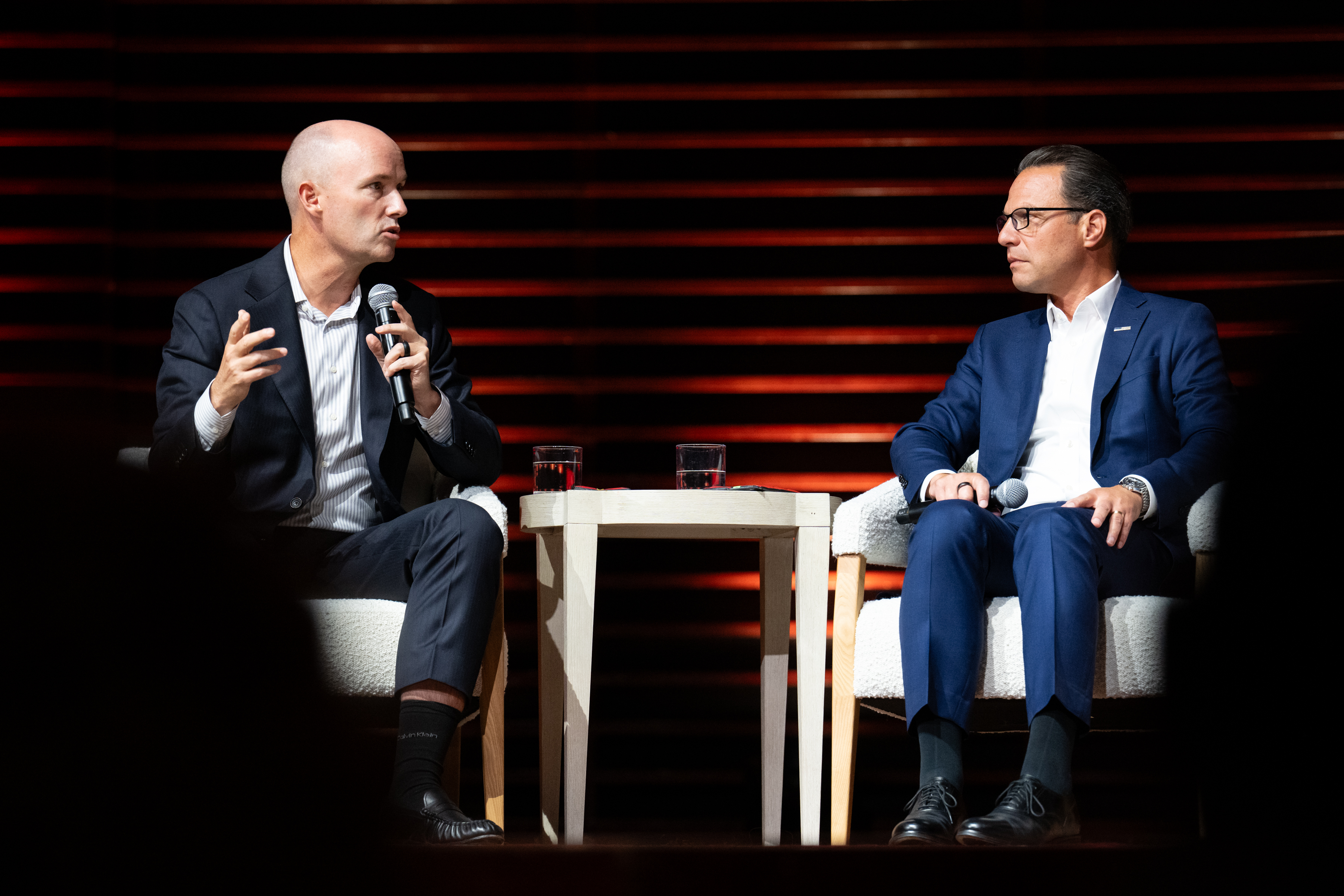
One year ago, Utah Gov. Spencer Cox was on his way to deliver one of the most sobering speeches of his political career.
The conservative activist Charlie Kirk had been assassinated at a university in the state, and the nation was teeming with emotion — grief, vengeance, and celebration all mixed together.
Amid a flurry of messages of support from other leaders, Cox, a Republican, said he spoke to Pennsylvania’s Democratic Gov. Josh Shapiro, who had experienced political violence of his own, and offered advice on how Cox could comfort a jostled community.
“I called him on the way to the press conference, and he told me to ditch my talking points and to speak from the heart,” Coxrecalled on the eve of the anniversary of Kirk’s killing. “I’m grateful for that advice. I took it, and it was really important in that moment.”
The event, moderated by New York Times journalist Lulu Garcia-Navarro, centered on how all members of society can hold respectful and productive conversations, even with people with whom they disagree. It comes less than two months before the midterm elections,as Democrats and Republicans wage heated campaigns for control of Congress and governors’ offices around the country, including in Pennsylvania.
Shapiro, who along with his family narrowly escaped an arson attack on the governor’s mansion last yearwhile they were staying there to celebrate Passover, said Americans should be “deeply concerned” about political violence and should not allow it to be rewarded or take deeper root in our nation.
Since that April 2025 attack, threats have persisted, largely related to his Jewish faith, he said.
“We’ve had six different people arrested in the last six or seven months for making terroristic threats against me and my wife, against our family, and oftentimes it’s rooted in an attack on me because of how I worship,” he said.
“I have a like a split-screen in my brain. I know that the incidents of political violence are rising. I know that the incidents of hate speech and hate crimes are rising, particularly against American Jews,” he said.
Angrier rhetoric, he said, gets rewarded with online engagement and campaign donations.
“Yet the other side of my brain gets to be governor in the greatest place, I think, in this nation, in the toughest swing state in the union, and as I go all across this commonwealth, I am met by good, decent people who offer prayers to my family, in ways that I don’t worship,” he said.
“The talk of celebrating this man’s death, no matter how profound a disagreement over a policy should be, he left behind a wife and two children,” Shapiro said at the time. “No one should be celebrating that. No one. I think that kind of rhetoric is unhelpful on every level.”
“I would say to my friend Governor Cox,” he said, “I hope he recognizes the power that he has from the perch that he occupies and the respect that you’ve earned across the country, and you use that power to help heal our politics and bring us closer together.”
Cox, who has said Trump is “not interested in uniting the country” despite endorsing him in 2024, has ruled out a 2028 presidential run of his own but quipped Shapiro may be interested.
“Somebody someday is going to run for president,” he said. “By the way, I just want to be clear, it may be somebody in this room. It’s not me.”
The audience cheered for Shapiro, who smiled and said “Cox for president” into his microphone.
Cox also praised Shapiro’s ability to “get stuff done” with a divided legislature, using the Pennsylvania governor’s signature slogan.
“That’s going to be on a campaign ad,” Garcia-Navarro said.
DALLAS — In an arena littered with President Donald Trump’s image — from the photos that lined the concourse to the gift shops selling merch depicting the president as a cowboy — one of Pennsylvania’s most vulnerable Republican lawmakers this fall went all-in.
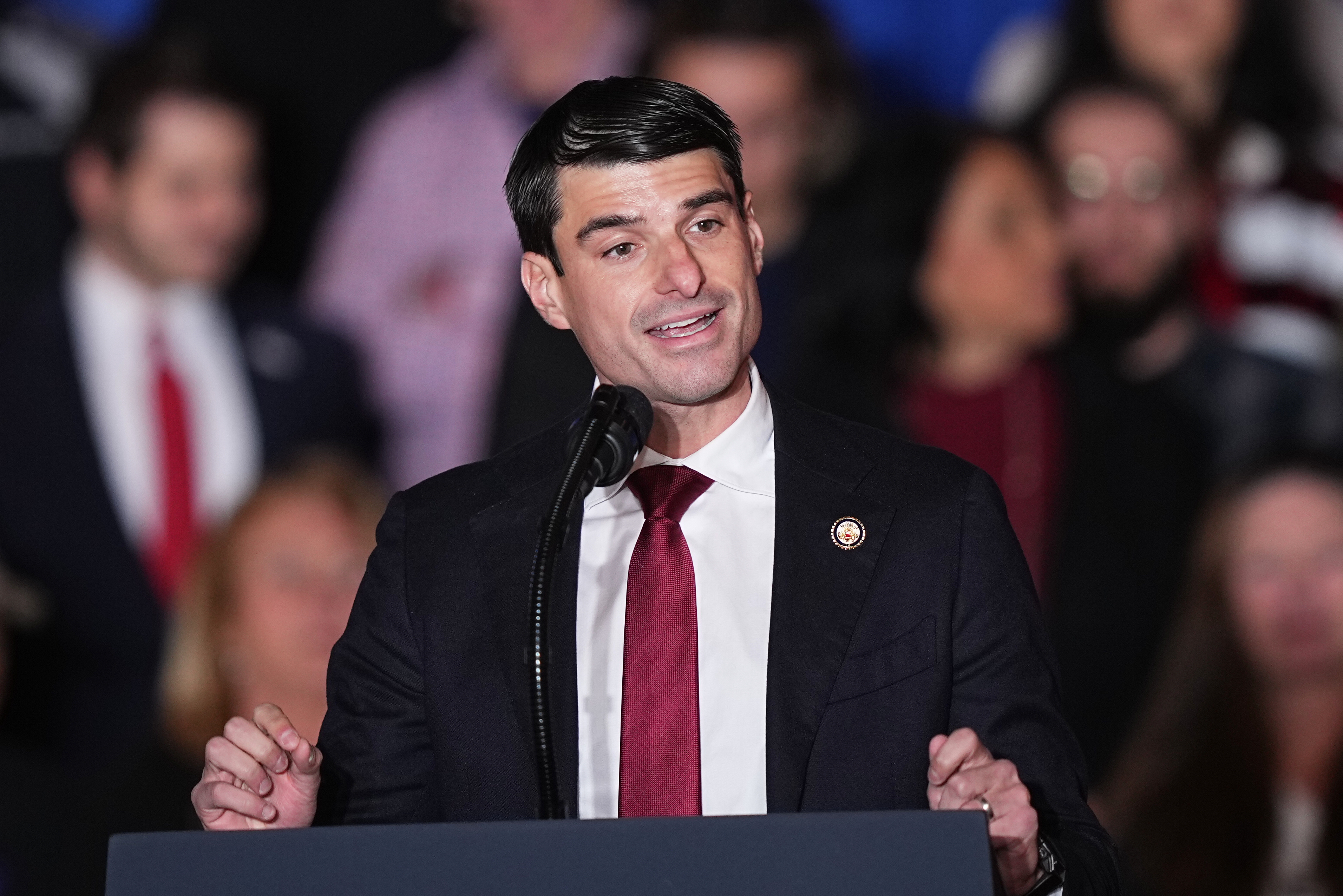
U.S. Rep. Rob Bresnahan, running for reelection in a Scranton-based district that is one of the most competitive in the nation, addressed the Republican Party’s first-ever midterm convention during its opening night on Wednesday.
His decision to attend “Trump-a-palooza” (as the RNC has described it) at all was notable. Some Republicans in tight races decided to stay away out of concerns of associating themselves with a president with low approval ratings. U.S. Rep. Brian Fitzpatrick (R., Bucks), for example, is not attending and has distanced himself from parts of Trump’s agenda.
Bresnahan promoted Trump’s signature tax policy in a brief speech focused on supporting workers and their families.
“Tax relief matters,” Bresnahan told hundreds of party loyalists at the American Airlines Arena in a speech that followed Ken Paxton, the controversial Trump-backed U.S. Senate candidate in Texas. “In Northeastern Pennsylvania, we work until the job is done. And those extra hours should mean more money in your pocket.”
Democrats have used Bresnahan’s vote for the One Big Beautiful Bill Act, which included cuts to Medicaid and food assistance, as a wedge against Bresnahan and other vulnerable Republicans. But Bresnahan contended the income tax cuts and other policies in the legislation, like no tax on tips, are paying dividends for families.
Two other Pennsylvania GOP lawmakers in similar situations, U.S. Reps. Ryan Mackenzie (R., Lehigh) and Scott Perry (R., York), are also attending the two-day convention, with Mackenzie slated to speak Thursday.
Bresnahan spoke to a somewhat sparse crowd compared with Republican National Conventions during presidential election years, which served as a model for the novel midterm convention this year as the party looks to energize its base of voters while seeking to defend narrow majorities in the House and Senate.
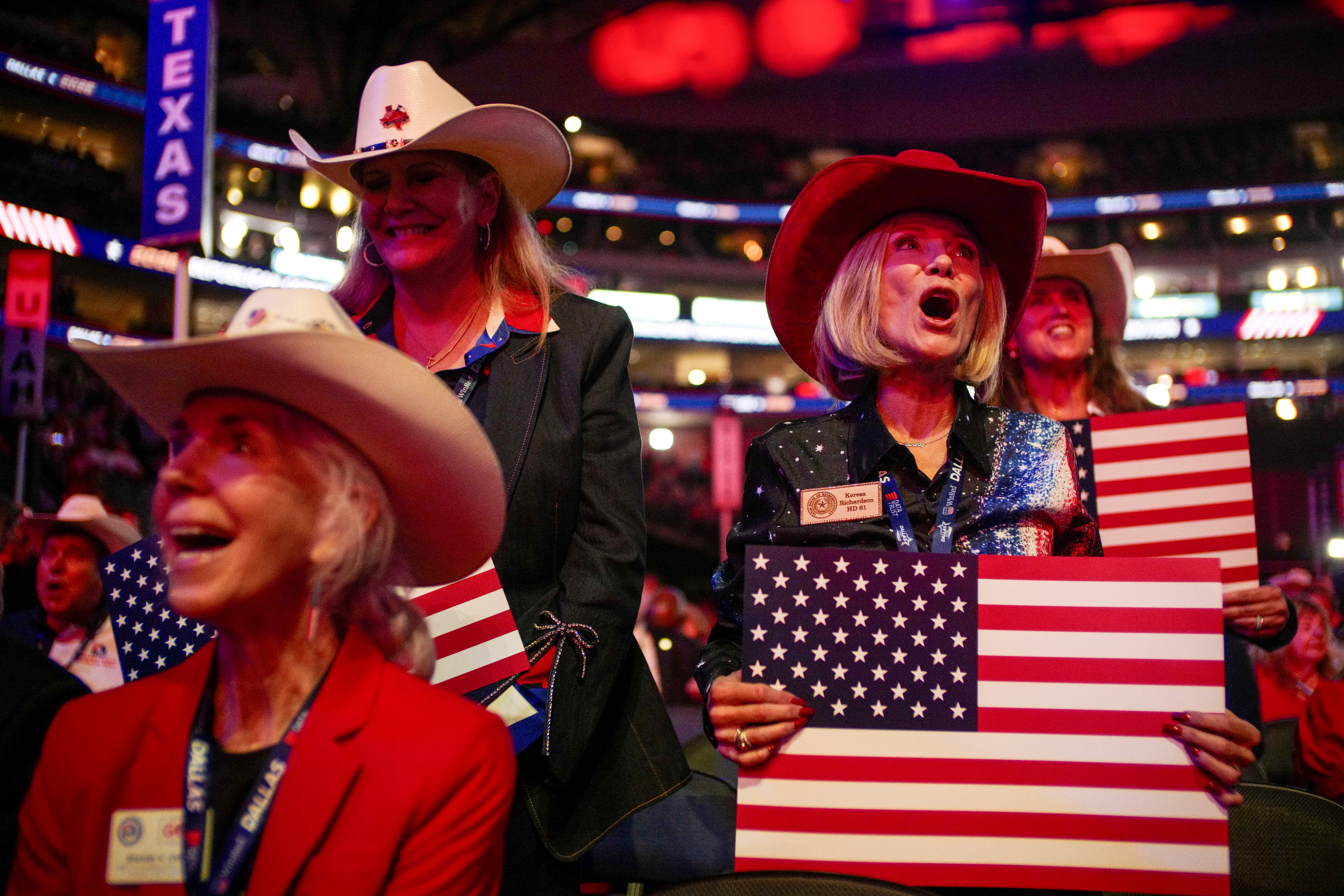
Delegates, clustered by state on the convention floor, cheered and waved signs reading “Keep the majority” and “Republicans are fixing Democrats’ mess.” The stands in the roughly 19,000-person arena remained largely empty, at least for the first few hours before Trump’s speech.
Merchandise shops were packed with Trump’s typical MAGA merchandise, copies of his son Eric Trump’s book, Under Siege, and new mugs and shirts showing Trump on a horse in cowboy gear. Red, white, blue, and — in an unmistakable nod toward the president — gold balloons waited in the rafters for the grand finale on Thursday.
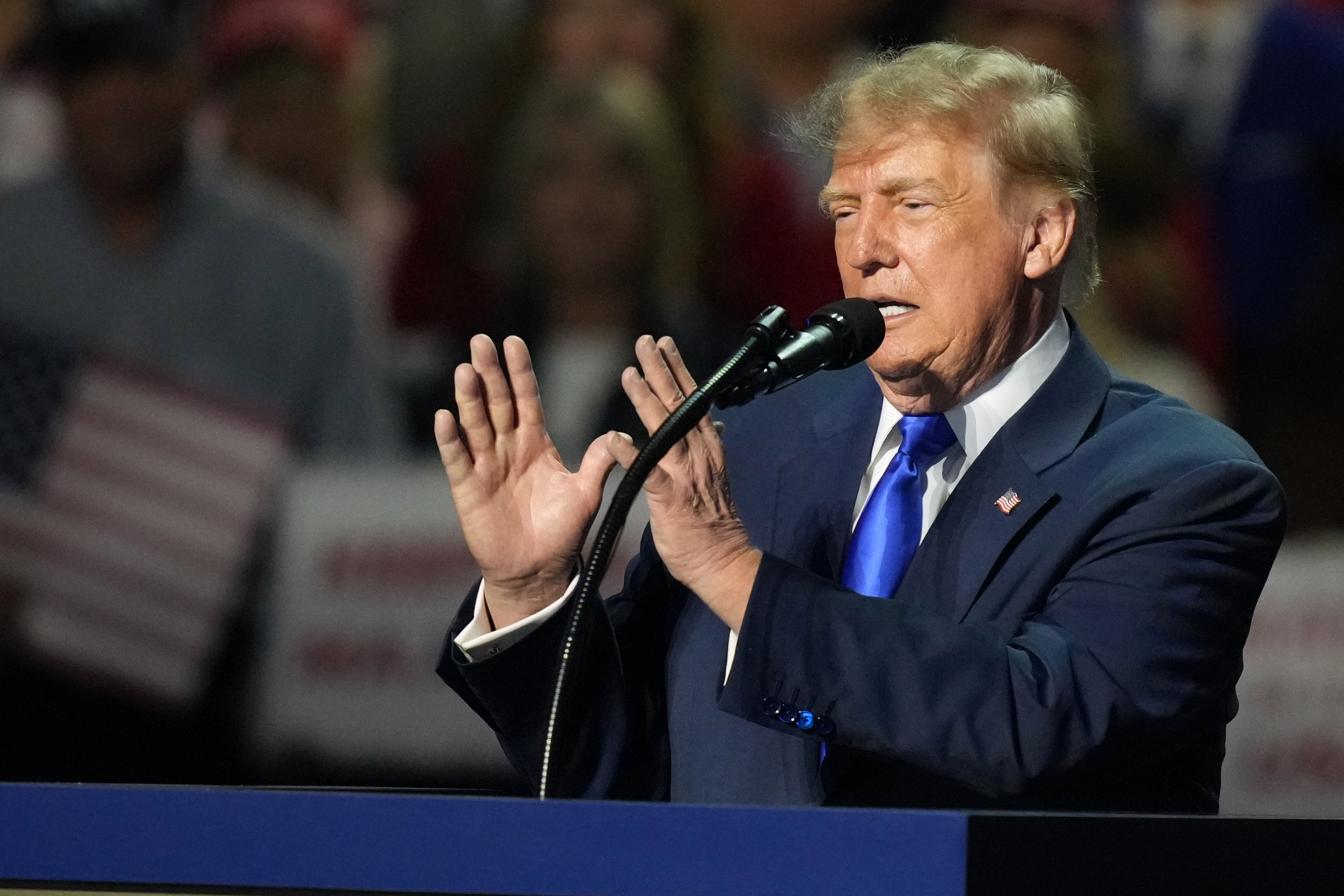
“I’m asking you to pretend that I’m on the ballot. I’m on the ballot, just one more time,” Trump told the cheering crowd in prime time, noting there were about 35 “swing” races the party was prioritizing.
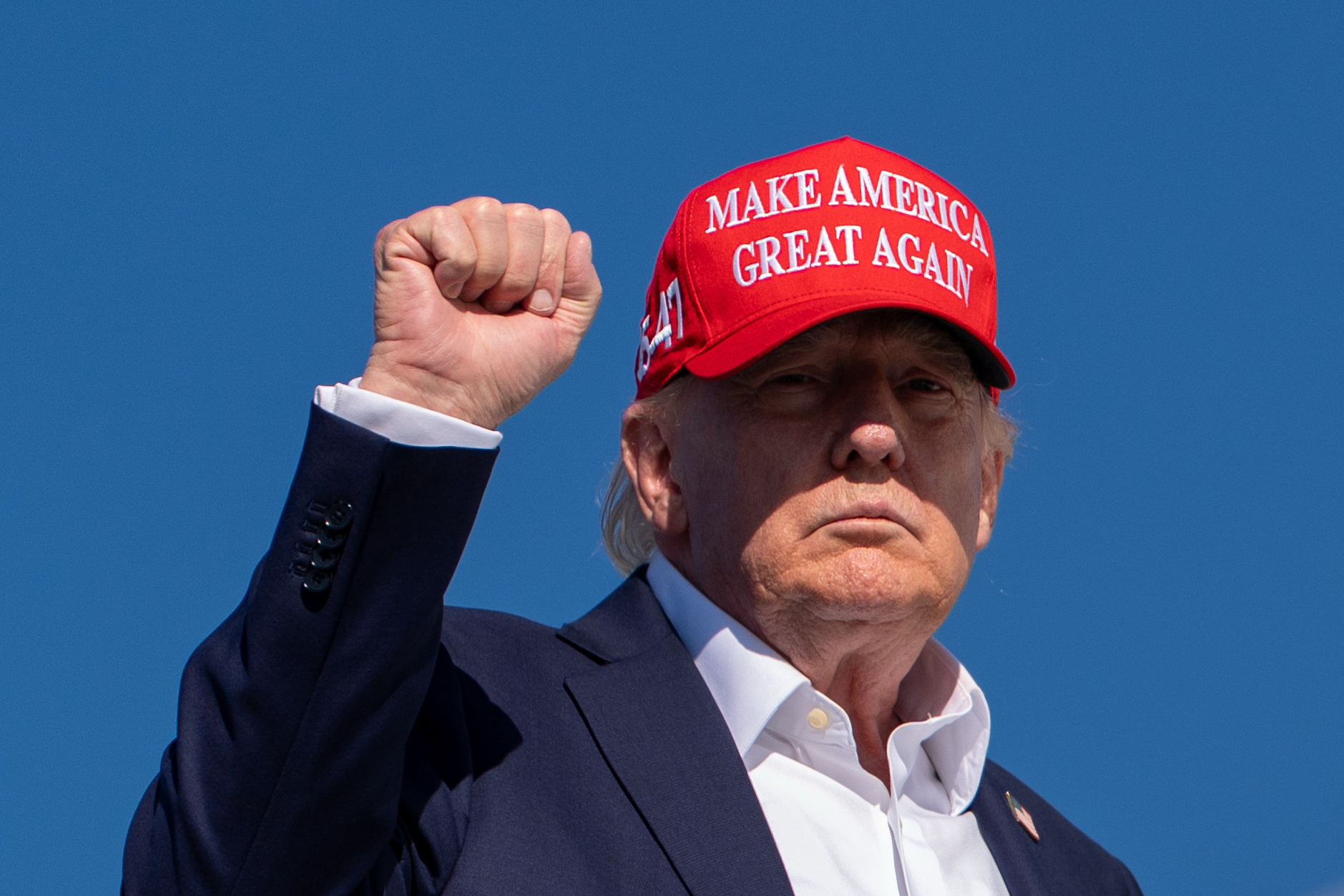
President Donald Trump speaks at the Republican convention Wednesday, Sept. 9, 2026, in Dallas. (AP Photo/Alex Brandon)Alex Brandon
About 1,500 miles away, in another town called Dallas, one of Bresnahan’s constituents hatched a plan to tune in.
On the opening night of the annual Luzerne County Fair — in a booth yards from deep-fried Oreos, flying elephant kiddie rides, and life-size cardboard cutouts of Abraham Lincoln, Donald Trump, and Jesus — Dwayne McDavitt fiddled with his tablet to see if he could stream the convention.
The symmetry of Dallas, Texas, and Dallas, Pa., was “too good to pass up,” said McDavitt, the head of a conservative group called Thunder and Liberty PAC and also the Pennsylvania chapter of Bikers For Trump.
He said he supports Bresnahan, who lives in Luzerne County, over Scranton Mayor Paige Cognetti, the Democratic nominee.
“He shares our values of faith, family, and freedom — meaning free and fair elections,” McDavitt said.
Interviews with other voters in the district on Wednesday underscored the potentially risky nature of Bresnahan’s leaning into the Trump administration.
Malcolm Mabry, 28, of Wilkes-Barre, said he had been victimized by a “Trump bait and switch” as a Republican who voted for the president two years ago. He picked Trump, believing that better policing of the Southern border was paramount.
And while Trump has been using ICE to “grab up people,” as he said, Mabry said much of what else the president promised, like lowering prices and avoiding war, has not occurred.
“Trump just said what he had to, to get into office,” said Mabry, who was unaware of the convention happening at the same time.
A campaign about workers and affordability
Bresnahan won his seat by less than 2 percentage points in 2024 to take down a six-term Democrat in the northeast corner of the state. Trump won the district by more than 8 percentage points.
His Democratic challenger, Cognetti, has garnered high-profile supporters like Gov. Josh Shapiro, who is also up for election, and she has repeatedly targeted Bresnahan for trading stocks while in office despite his previous statements that he would not do so.
Bresnahan, the former head of a family-run electrical contracting business, has made jobs and the workforce a top focus in his campaign and in his brief congressional career.
On a few occasions, he has broken with House Republican leaders to support bills that would strengthen union protections for federal workers. He has said that he hopes his party changes tactics to support those kinds of bills.
“We need the unions that have trained generations of some of the most skilled workers in American history,” Bresnahan said onstage Wednesday. “We have those workers in Northeastern Pennsylvania, and communities across this country are ready for the same opportunity.”
Texas state Rep. Keresa Richardson (R), right, attends the GOP midterm convention. (Joel Angel Juárez/For The Washington Post)Joel Angel Juárez
Bresnahan has racked up a series of union endorsements that are otherwise rare for Republicans. While major unions like the AFL-CIO and the Pennsylvania State Education Association have backed Cognetti, he has won support from organizations like the American Federation of Government Employees and the Teamsters — groups that, in a region with a long history of union issues, could make a difference in a close race.
In his speech, Bresnahan talked generally about supporting workers and manufacturing in the U.S. He spoke about tax policies that put “more money in your pocket” and help “build communities where people can stay, raise a family, and build a life.”
They and other speakers did not address other affordability issues that Democrats have seized on and that polls show voters have top-of-mind heading into early voting.
Trump has mocked the Democratic attacks on the issue as a hoax, including in a speech in Bresnahan’s district last year. But it is a message, and a reality, that has resonated with voters in Pennsylvania, according to polls and interviews.
“I’m on a fixed income,” Bill Dudeck, 83, of Nanticoke in Luzerne County, said Wednesday. “But under Trump, gas, groceries, and utilities are skyrocketing.”
Trump promised a lower cost of living, “but now all our money is out the window,” said Dudeck, a Democrat and former construction worker in Bresnahan’s district.
Bresnahan, whose campaign said earlier this week that he was looking forward to bringing “NEPA to the national stage,” appeared onstage instead with a sheet metal worker and mother of seven from Baltimore.
Cognetti’s campaign noted the pairing in a comment Wednesday that criticized Bresnahan, in part, for trading stocks in office.
“That’s probably why he didn’t have a Pennsylvanian on stage with him tonight,” a Cognetti campaign spokesperson said in a statement. “His speech is just more empty words to try and distract from his broken promises.”
Nora Pruitt, who joined Bresnahan, had previously been recognized by the White House as a beneficiary of Trump’s second term. Listed on the agenda as an “everyday American, factory worker, working mother and manufacturing success story,” Pruitt said “things have really improved for our family since President Trump returned to office.”
“We are so grateful President Trump and Republicans in Congress like Congressman Bresnahan vote for families like ours,” she said.
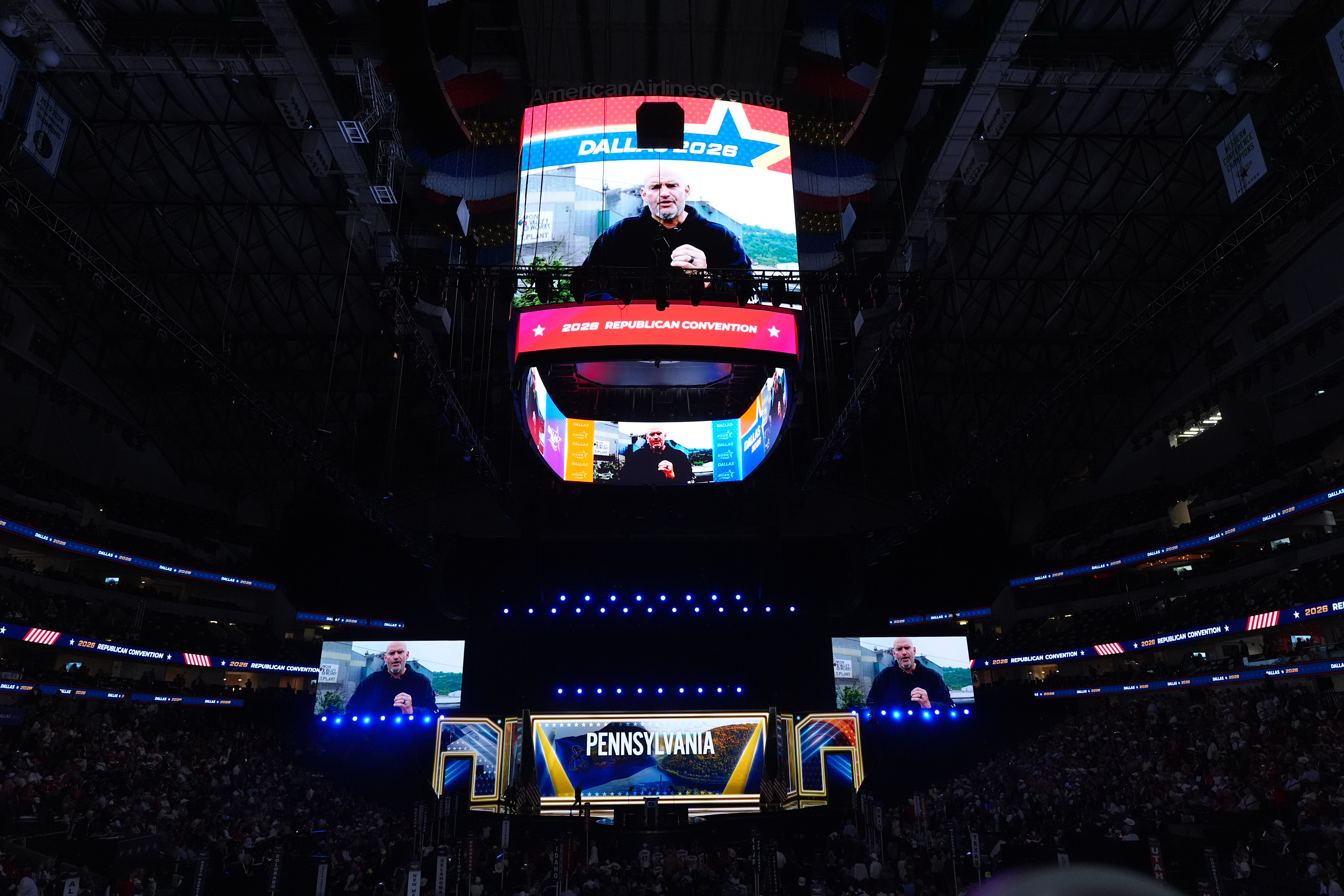
DALLAS — In a remarkable move for a Democratic lawmaker, U.S. Sen. John Fetterman on Wednesday appeared in a video at the Republican midterm convention — an event specifically designed to boost GOP candidates this fall — in a way that praised President Donald Trump for his support of Pennsylvania steelworkers.
The video was a clear escalation of a monthslong shift in which Fetterman has drifted from the Democratic Party. Though he has repeatedly rejected speculation that he would switch parties — and did so again after the video Wednesday — he has consistently criticized Democrats and praised Trump since the president took office.
In the video — which introduced U.S. Sen. Dave McCormick (R., Pa.) as he took the stage — Fetterman said he and McCormick “will work with President Trump to fight and defend the steel way of life right here in the Steel Valley.”
“I’m always going to stand with America. I’m always going to reject the extremes and socialism, and the anti-American way of life,” he said, repeating a common refrain in which he criticizes the leftist wing of the Democratic Party that has secured several high-profile wins this year.
Fetterman, who was not physically in attendance at the American Airlines Arena in Dallas, was cheered and applauded after McCormick took the stage and said, “How great is John Fetterman, right?”
In addition to McCormick, several vulnerable House GOP incumbents from Pennsylvania were at the convention. Fetterman’s video appearance came shortly after a speech from U.S. Rep. Rob Bresnahan (R., Luzerne), who represents one of the districts Pennsylvania Democrats are hoping to flip this year.
U.S. Rep. Madeleine Dean (D., Montgomery), who traveled to Texas to protest the GOP convention, said she was “gravely disappointed” that Fetterman chose to participate in the GOP event rather putting his energy to electing Democrats in key Pennsylvania races — the latest in a growing list of transgressions.
“I will tell you, from the ground, from suburban Philadelphia, my constituents are livid. Those who went out and knocked doors for him, they are absolutely livid,” she said the following day.
Democratic Gov. Josh Shapiro, who has a frosty relationship with Fetterman, said Thursday at an event in Chester that he did not see the video before adding that he was “not going to get distracted” from his duties as governor and his reelection campaign.
Democrats nationally are aiming to flip both the House and the Senate, which could put Fetterman in a powerful position as a swing vote if Democrats narrowly win control of his chamber.
And while leaders in both parties have reportedly made appeals to him, Fetterman said in a statement after his video went out that he would not switch parties if the Senate changes hands.
“I’m a lifelong Democrat who votes overwhelmingly with my party — and should the Senate flip in November, I will still be the 51st vote that I ran on,” he said, referencing his campaign promise in 2022 to be the Democratic vote that clinched the majority.
On Thursday, a web page soliciting donations to Fetterman’s campaign committee included a link to the video and said Fetterman would “keep standing his ground, speaking his mind, and putting Pennsylvania first.”
Fetterman has long been a supporter of the state’s steel industry as the former mayor of Braddock, the Pittsburgh suburb home to the Edgar Thomson Steel Works mill — which served as a backdrop to the video he shot for the convention.
U.S. Steel has pledged to invest up to $2.5 billion into that mill and other Mon Valley Works plants around Pittsburgh since its sale to Japan-based Nippon Steel last year.
The $15 billion sale had been held up for a year, opposed by both Republicans and Democrats concerned about a foreign takeover of the iconic company. Former President Joe Biden blocked the deal, and both Fetterman and McCormick criticized it before Trump took office.
Trump went on to secure a pledge that Nippon would have an American CEO, not lay off workers, and give the U.S. a so-called golden share in the company. Trump returned to Pennsylvania for his first rally in the state to celebrate the deal with steelworkers outside Pittsburgh.
“Under Joe Biden, Democrats blocked critical investment in U.S. Steel, risking thousands of jobs,” McCormick said on stage Wednesday. “I promised Pittsburgh steelworkers I would fight for the steel way of life, and President Trump did, too. And with the president’s leadership, we delivered a deal protecting and creating over 100,000 American jobs.”
Fetterman’s participation in the GOP conference — in the type of promotional video that is common at party conventions — is extremely rare.
The Pennsylvania Democratic senator’s decision to record a video praising Trump ahead of the election may draw comparisons to Georgia Democratic Sen. Zell Miller’s fiery speech praising President George W. Bush — and denigrating Democratic nominee John Kerry — at the 2004 Republican National Convention.
State Rep. Malcolm Kenyatta, a Philadelphia Democrat who ran against Fetterman in the 2022 Senate primary, drew a different historical comparison.
“John is Benedict Arnold, but lazy. Could barely get off the couch in his million-dollar mansion to kiss Trump’s ring, he phoned it in like everything he does,” Kenyatta, a Democratic National Committee vice chair, said on X.
U.S. Rep. Brendan Boyle, a Philadelphia Democrat, similarly blasted the senator’s video appearance at the rival party’s convention.
“A year ago, I labeled John Fetterman ‘Trump’s favorite Democrat.’ Tonight, he yet again proves why,” Boyle said on X.
And U.S. Rep. Chris Deluzio — a Western Pennsylvania Democrat who, like Boyle and Kenyatta, could be a candidate when Fetterman’s seat is up for election in 2028 — declared in a statement that Fetterman is “not going to be a Senator after 2028 — mark my words.”
“If the failing Republican politicians want him, they can have him,” Deluzio said. “Like them, John Fetterman has failed the Pennsylvanians who elected him, who expected him to fight against White House corruption, health care cuts, and reckless war, not cheerlead it.”
Fetterman has not yet said he will run for reelection and his dismal approval ratings among Democrats could make it difficult to win a primary — unless he switches parties. Among Republican voters, he was even more popular than McCormick in a poll last month from The Inquirer, the New York Times, and Siena University.
Fetterman has developed a close association and friendship with McCormick since the Republican’s election in 2024. While Fetterman rarely makes public appearances in the state he represents, he has appeared at a few with McCormick.
In a striking move, the bipartisan pair also set up a joint fundraising campaign committee this summer as Fetterman’s own fundraising lagged. This past week, McCormick came to Fetterman’s defense after the Wall Street Journal reported that the Democrat frequently avoided meeting with, and privately criticized, constituents and interest groups.
“These stories are the latest example of outrageously disloyal staff and forces on the Left using anonymous leaks to cancel my friend John Fetterman,” McCormick wrote on social media. “They hate that he is an independent thinker who refuses to fall into line so they want to silence him.”
In the convention video, Fetterman called McCormick a “great American, a great senator.”
“Yes, he is in a different party, but I’m proud to count him as my great friend,” Fetterman said.
Key figures in Pennsylvania Republican politics — including the state’s top elected federal GOP official and several lawmakers in the middle of heated reelection campaigns — will participate in their party’s first-of-its-kind midterm convention this week in Dallas.
The gathering, spurred and heavily promoted by President Donald Trump, arrives as Republicans look to defend their control of Congress this fall amid difficult circumstances. Trump’s approval ratings, including on key issues such as the economy and the war in Iran, have sunk, including in Pennsylvania.
After Trump successfully won the White House and ushered in a wave of downballot Republican wins just two years ago, the convention — described as “Trump-a-palooza” by Republican National Committee chairman Joe Gruters — is aimed at energizing the base at a critical time.
Pennsylvanians, representing a swing state that has been key to Trump’s success in the past, will play a role.
U.S. Sen. Dave McCormick (R., Pa.) and a pair of House lawmakers in competitive districts — U.S. Reps. Ryan Mackenzie (R., Lehigh) and Rob Bresnahan (R., Luzerne) — are among the more than 100 scheduled speakers over two days, starting Wednesday.
Their speaking slots were among the first to be announced. Underscoring the Keystone State’s role in keeping the House Republican majority, only the host state of Texas had more representatives on the initial list of elected officials scheduled to address the crowd.
The Pennsylvania Republican Party, meanwhile, has orchestrated a “full slate” of 55 delegates and alternate delegates.
“The Republican Party of Pennsylvania is excited and honored to be a part of the first ever RNC Midterm Convention in Dallas,” spokesperson James Markley said in a statement. “It will be a tremendous opportunity to hear from everyday Americans about how this administration has changed their lives for the better.”
The state party had not provided the names of the delegates as of Tuesday, though the list is expected to include party activists and other elected officials. State party leaders had encouraged Pennsylvanians to attend the gathering.
Democrats, who see the president’s lagging approval ratings as a key to their success in the midterms, were quick to blast Pennsylvania Republicans for attending. Their response includes plans to send a small group of House Democrats, including U.S. Rep. Madeleine Dean (D., Montgomery), to Dallas to push back against the GOP messaging.
“While swing seat House Republicans try to hide from their record of raising costs on working families, gutting Medicaid to fund tax breaks for billionaire donors and supporting a reckless war of choice in Iran, House Democrats will be present to hold them accountable,” House Minority Leader Hakeem Jeffries, the New York Democrat in line to become House speaker if his party wins the majority, said in a statement.
Fitzpatrick skips as other Pa. Republicans take center stage
Four of Pennsylvania’s 10 Republican-held U.S. House seats are considered key battlegrounds as the GOP looks to maintain its four-seat advantage nationwide.
Of those, only U.S. Rep. Brian Fitzpatrick (R., Bucks) has distanced himself from parts of Trump’s agenda and is not planning on attending the convention.
Mackenzie and Bresnahan, on the other hand, will be among the featured speakers, and U.S. Rep. Scott Perry (R., York) will attend.
Perry, a close Trump ally, has routinely won reelection in a Harrisburg-based district but is running this year against Democrat Janelle Stelson, a former local television anchor who nearly defeated him two years ago.
Freshmen Mackenzie and Bresnahan were elected to Congress in 2024 afterthey each defeated incumbent Democrats by less than 2 percentage points. Local, state, and national Democrats have rallied behind their challengers — union leader and retired firefighter Bob Brooks in the Lehigh Valley, and Scranton Mayor Paige Cognetti in the district that covers the northeast corner of the state.
Bresnahan campaign spokesperson Samantha Bullock said the lawmaker was “excited to bring NEPA to the national stage because these are the people driving his work in Washington.”
Mackenzie, in a statement that referenced his work to bring federal funds to his district and support areas like local healthcare and tax relief, said he was “looking forward to talking to the people of the Lehigh Valley, the Poconos, and the entire nation about these accomplishments, and how we can build on them in the years ahead.”
Brooks said Mackenzie was “flying to Dallas to kiss the ring of Donald Trump and his party bosses.”
“This is exactly why people are fed up with a broken Washington that isn’t working for working people,” Brooks said in a statement.
Mackenzie’s campaign has similarly criticized Brooks for campaigning with national Democrats — calling an event Brooks had with Jeffries in July a sign that “establishment backers” were trying to “bail him out.”
The convention will feature six hours of programming each night.
Topics that speakers will highlight include the elements of Trump’s signature One Big Beautiful Bill Act, which Republicans have rebranded as the Working Families Tax Cuts Act.
A “candidate showcase” that will highlight “key candidates in target districts” and contrast them with their “extreme” opponents is set for Wednesday night. And an “opposition contrast” to “[deliver] the night’s sharpest partisan case against the extreme liberal Democrats” is slated for Thursday night, according to the agenda.
Besides Trump, the members of his administration scheduled to speak include Vice President JD Vance, U.S. Attorney General Todd Blanche, Centers for Medicare and Medicaid Services Administrator Mehmet Oz, and Health and Human Services Secretary Robert F. Kennedy Jr., who has engaged in a war of words with Pennsylvania Gov. Josh Shapiro over the state’s measles outbreak.
National Republicans have described the convention as a way to energize voters in a tough election year.
The poll found that 51% of likely voters said they were more likely to vote for a Democrat for Congress and 53% said they would want to see the House flip to Democratic control, though the polldid not ask about specific congressional races.
By the time state and local law enforcement in Northumberland County, Pa.,connected a device stealing people’s food assistance benefits from a 7-Eleven to Patricia Bogdan and George Lazar, the pair had already fled to New Jersey.
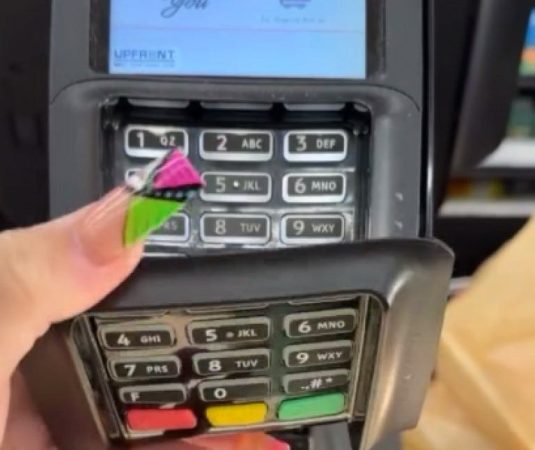
Authorities allege Bogdan and Lazar placed the contraption on a point-of-sale terminal in February, which went undiscovered for days. Bogdan and Lazar then allegedly retrieved the stolen electronic benefit transfer card data in a process known as skimming and spent people’s benefits at BJ’s and Sam’s Club locations in Pennsylvania and New Jersey.
Authorities would later learn Bogdan had multiple aliases and fake passports, while Lazar had a warrant out for an attempted murder charge in Belgium.
“It illustrates how quickly they’re moving, the type of individuals that are involved in this, and just their ability to get in and out, that makes these really complex cases,” said State Inspector General Michelle Henry, whose office investigates EBT thefts in Pennsylvania.
With the help of authorities in New Jersey and North Carolina, Henry’s office was able to find Bogdan and Lazar in March and later bring them back to Pennsylvania, where the cases are ongoing. A small win in what victim advocates argue has risen to a nationwide crisis because the federal government has failed to invest in more secure card technology. The magnetic strips on the cards are too easy to exploit.
Still, a seismic disruption to these scam operations is slated to come to Pennsylvania before Jan. 1, 2028.
The latest state budget appropriated $7 million in funds that would pay for chip-enabled EBT cards, giving the outdated magnetic stripe technology, which the federal government required states to use until 2024, a sorely needed upgrade.
The chip cards are not invulnerable to scammers but exploiting them requires more sophisticated technology, according to the Secret Service. Early adopters of the chip technology, such as California and Alabama, have reported significant drops in thefts already.
To the victims of this sort of fraud, scarred by the memories of an unexpected zero balance while trying to pay for groceries, the change is long overdue. There are countless stories of families learning about how the scam works and having to scrape meals together with the aid of food pantries.Benefits were reimbursed between October 2022 and December 2024, but that ended when Congress did not extend funding.
For now, law enforcement in Pennsylvania continues to confiscate skimming devices and prosecute perpetrators, even when it can feel like a high-stakes game of whack-a-mole, while preparing for the next iteration of scammers.
An ever-evolving scheme that knows no borders
Much of the skimming scam — from recruiting to reselling the goods purchased with EBT data— happens online through the dark web and social media platforms such as Facebook and Instagram.
Transnational criminals, more recently from Eastern European countries, will send already assembled skimmers to partners stateside or provide instructions on how they can piece together the devices themselves. The local partners stick the contraptions onto a point-of-sale machine, steal data, and use the stolen benefits to purchase high-ticket items such as baby formula, which is then offloaded by word of mouth or on social media networks like Facebook and Instagram.
Michael Ross, special agent in charge of the Philadelphia field office for the United States Secret Service, said the advent of Bluetooth technology has made it much harder to catch people in the act since they can digitally collect the stolen data, instead of taking back the physical machine where police might be waiting for them.
Combating these crimes requires a multipronged approach, from the use of digital forensics to old-school public awareness efforts.
“We will send out a small group, not necessarily a formal task force, with state and local law enforcement representatives, and we will go to businesses,” Ross said. “We will go in, we’ll educate, we’ll show what some of these devices look like, things that can be done to make sure that the EBT fraud is mitigated.”
Various states have responded in a similar fashion, educating businesses and placing the onus of protecting food assistance benefits on recipients, who are encouraged to download apps on their phones that allow them to lock their cards until they’re ready to pay for groceries.
Still, Pennsylvania has aimed to be more aggressive in its fight against skimming.
The Office of State Inspector General piloted “Skimmer Response Teams” last year. Since its inception, the six- to eight-person group that works with the broader office on cases, seized more than 55 of these devices before scammers could come back and drain more than $20.5 million in benefits from more than 40,000 accounts.
Despite these strides in prevention, the state reported more than 5,100 skimming incidents that accounted for more than $2.5 million in stolen food assistance benefits in the first five months of the year.
It’s one of the reasons the task force pilot is now permanent and is expected to stay even as the EBT cards switch to chips.
“In my experience as a longtime prosecutor, anything that makes it more difficult to complete the crime is a deterrent,” said Henry. “If it’s super easy, you’re going to have more of it.”
And Pennsylvania wants to make stealing people’s food assistance benefits as difficult as possible.
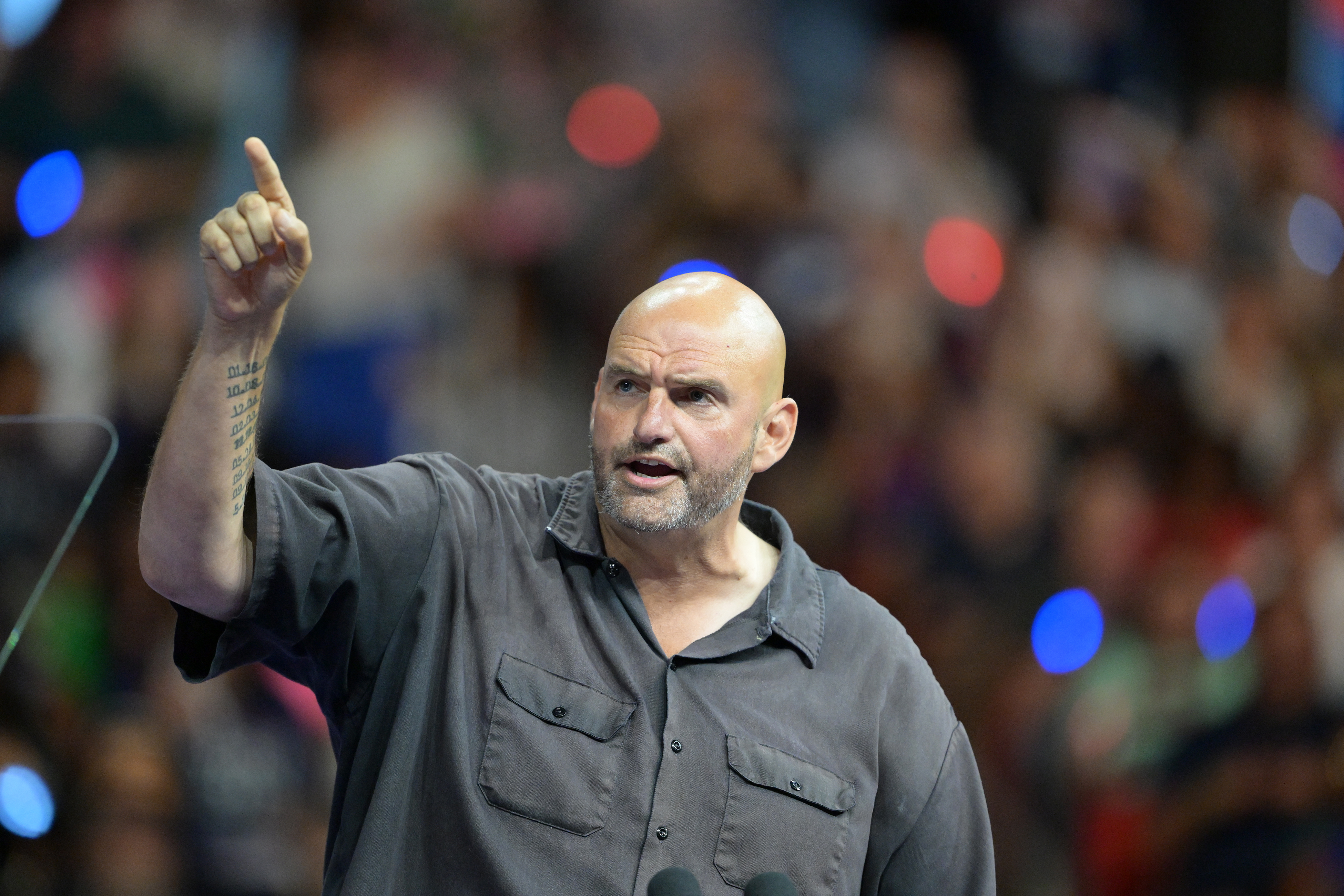
A curt text message privately rejecting concerns from leaders at the Children’s Hospital of Philadelphia about Medicaid cuts was a “dumb joke,” U.S. Sen. John Fetterman (D., Pa.) told CNN this weekend.
“Per usual — lies, half-truths, innuendos, smears, and anonymous,” Fetterman said. He later added: “No matter how many smears or stories, I’m proud to continue to deliver for Pennsylvania.”
The Wall Street Journal report included text messages between Fetterman and his staff and detailed several meetings or events that Fetterman tried to get out of attending, including the meeting with CHOP leaders and a funeral for three York County police officers who were killed while on duty.
Fetterman said the leaked text messages were “stripped of any context and circumstances.”
According to the Wall Street Journal, while discussing the meeting with CHOP officials last September, Fetterman asked in a text, “Why do I have to keep having to meet with chop.”
An aide responded, “Because they’re worried about Medicaid cuts.” Fetterman wrote back, “Well, I’m not.” He then wrote, “I’m convinced they just want free trips to DC.”
Fetterman told CNN that comment was a “dumb joke,” and “for that, I sincerely apologize.”
“My office and I always have, and always will, advocate for CHOP, support their requests and any other needs that we can assist with,” Fetterman told CNN.
The newspaper’s report also included text messages in which Fetterman questioned the length of the funeral for the three York County police officers, writing “3 hours??,” and said attending “may be a nonstarter.” Fetterman, who grew up in York County, did not attend the funeral, according to the report.
Fetterman told CNN that he “privately ordered flowers to be delivered for their families and expressed my condolences publicly” on the day of the fatal shooting. He also said he privately attended a fundraiser for the officers’ families in June, saying, “I met with their chief and the family members directly to express my personal condolences.”
The first-term senator’s tenure has been plagued with criticism. Former staffers have said he often cancels meetings at the last minute, and he has increasingly isolated himself from Democrats in Washington, according to the Wall Street Journal. He regularly appears on conservative media and attacks his own party, and he does not make regular public appearances in the Keystone State.
“If you were troubled by yesterday’s Wall Street Journal story… trust us, that’s just the tip of the iceberg,” the account posted. “It’s even worse than you thought.”
Staff writer Sam Janesch contributed to this article.
Ben Hummer would like to own a house one day in Pittsburgh. He dreams of a two-bedroom, one-bathroom town house where he can live near his job.
But for now, Hummer, 29, rents his 500-square-foot, one-bedroom apartment, and his monthly rate since he moved in has continued to increase by $50 each year, making the goal seem further out of reach.
“Anything that could increase the supply and affordability of housing in the Pittsburgh area would be massive,” said Hummer, who works in human resources.
Like most voters in Pennsylvania, according to a recent poll from The Philadelphia Inquirer, the New York Times, and Siena University, the economy and cost-of-living concerns are the most important issues deciding Hummer’s vote in the 2026 governor’s race between incumbent Democratic Gov. Josh Shapiro and his Republican challenger, state Treasurer Stacy Garrity.
And as Election Day draws nearer, both campaigns are focusing their messaging on these kitchen table issues.
(function() { var l = function() { new pym.Parent( ‘nyt-afford__graphic’, ‘https://media.inquirer.com/storage/inquirer/ai2html/nyt-afford/index.html’); }; if(typeof(pym) === ‘undefined’) { var h = document.getElementsByTagName(‘head’)[0], s = document.createElement(‘script’); s.type = ‘text/javascript’; s.src = ‘https://pym.nprapps.org/pym.v1.min.js’; s.onload = l; h.appendChild(s); } else { l(); } })();
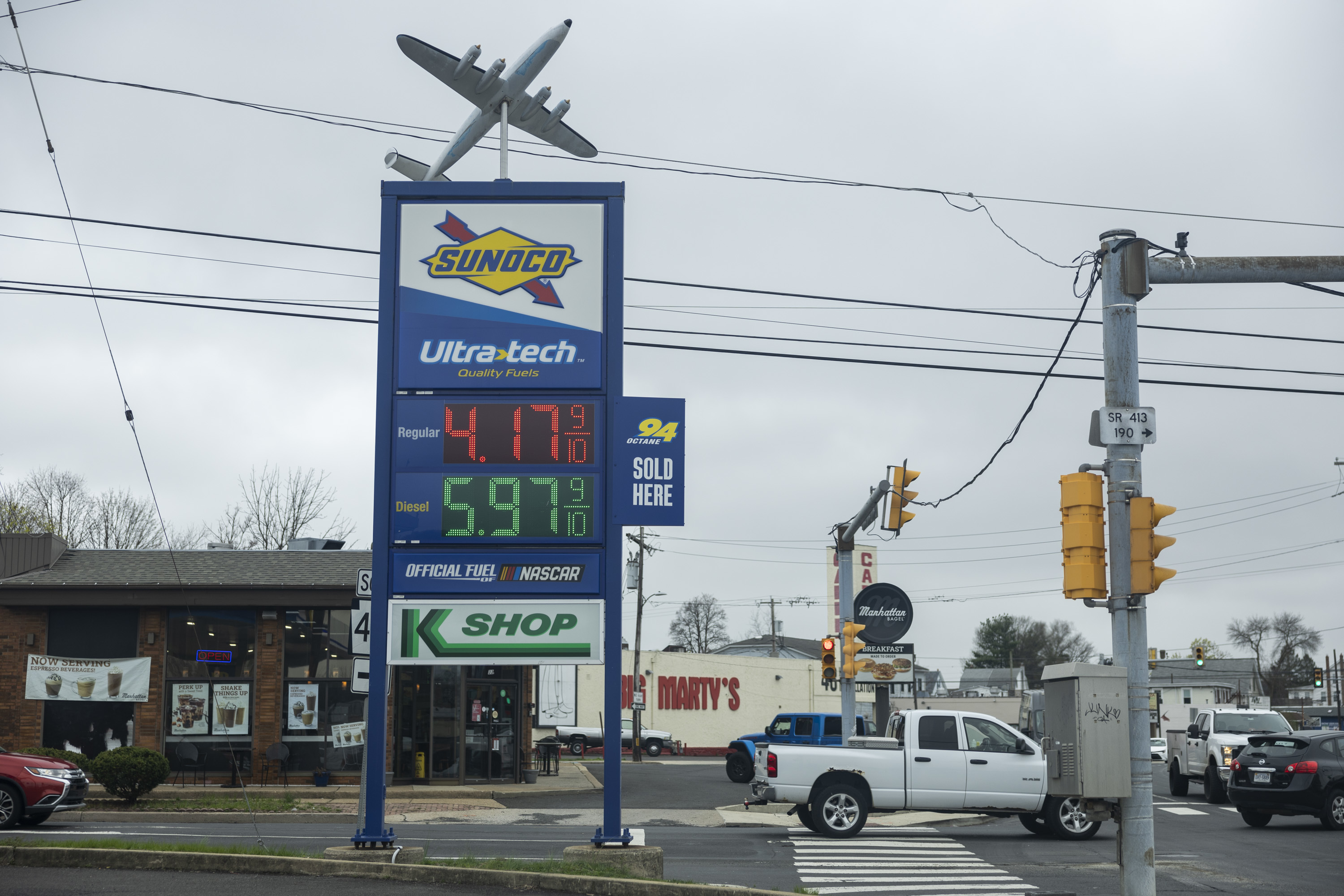
Two years ago, it was the cost of eggs, gas, and groceries that were top priorities among the electorate in Pennsylvania and elsewhere. Voters’ trust in President Donald Trump’s ability to bring down high prices propelled him back to the White House, sending Democrats scrambling to hone an affordability pitch that could land in time for the high-stakes 2026 midterm elections. But in that same time, prices have continued to climb; gas prices have topped $4 per gallon; and tariffs instituted by Trump — who called affordability “a hoax” at a Pennsylvania rally last year — have driven up the cost of every day life. Now both parties are latching on to a focus on affordability.
As he mounts a reelection campaign, Shapiro — who holds a commanding lead in polls — is highlighting his accomplishments during his first term that his campaign says has given Pennsylvanians more money back through tax cuts and wage increases for childcare workers.
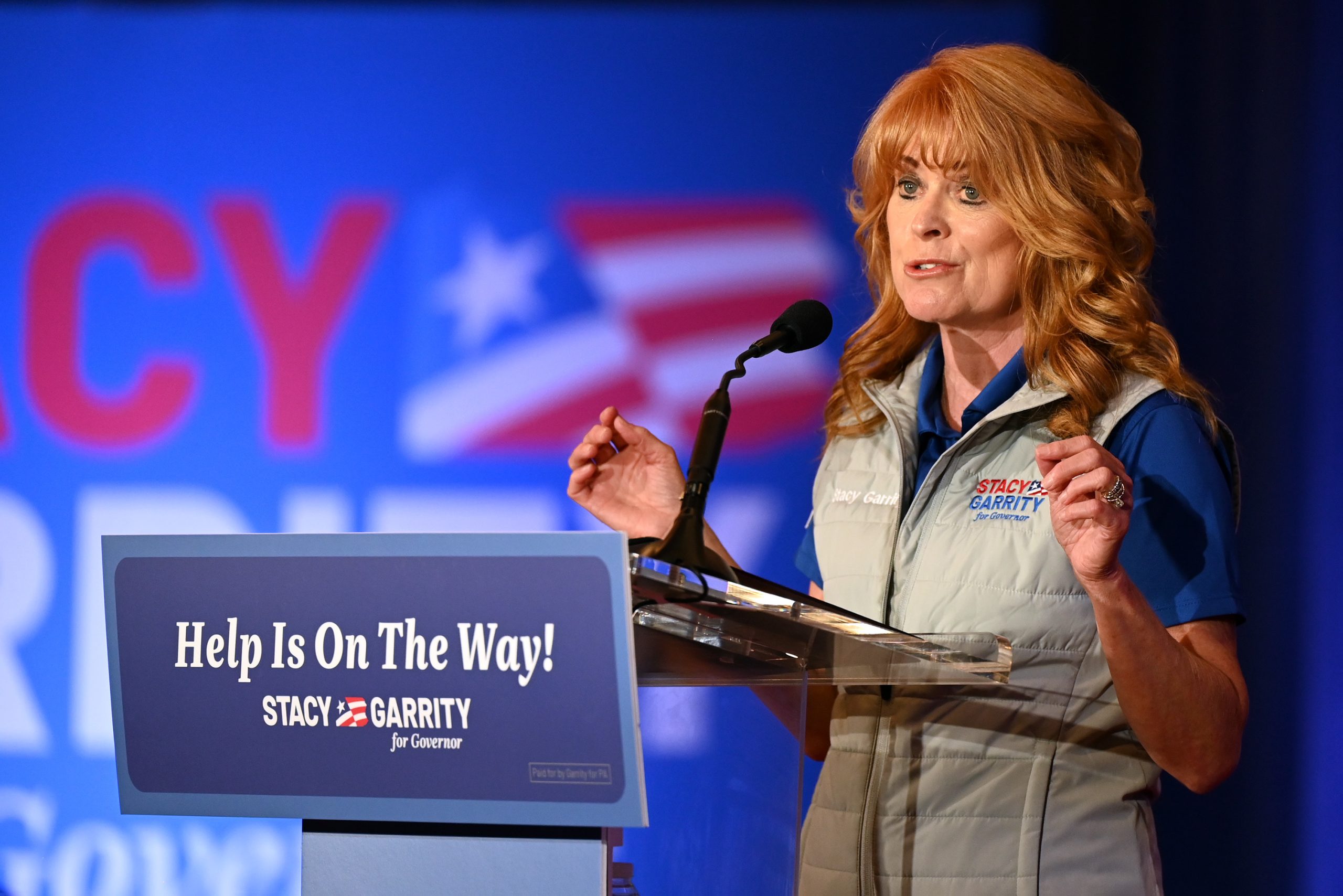
Meanwhile, Garrity has recently shared her own plan, called “Turnaround PA,” to make living more affordable with an outline of how she’d lower prescription drug costs, reduce property taxes, and aim to cut energy bills to get there. But she’s also closely aligned with Trump, who has endorsed her in the race and has dismal markings from voters on two of their top priorities: the economy and cost of living.
(function(){function e(){window.addEventListener(`message`,function(e){if(e.data[`datawrapper-height`]!==void 0){var t=document.querySelectorAll(`iframe`);for(var n in e.data[`datawrapper-height`])for(var r=0,i;i=t[r];r++)if(i.contentWindow===e.source){var a=e.data[`datawrapper-height`][n]+`px`;i.style.height=a}}})}e()})();
That puts her in a difficult spot to challenge Shapiro, said Mark Zandi, the chief economist at Moody’s Analytics.
There’s no easy answer for Republicans to win on economic issues in the midterms, but Zandi said his best advice is to focus on what is in the governor’s control and draft ideas that mitigate the fallout from Trump’s policies.
Hummer, a Democrat who plans to vote for Shapiro this fall, said he trusts the governor to handle the economy and cost of living issues better. More than half of likely Pennsylvania voters in the Inquirer/New York Times/Siena poll agree.
Fifty-five percent said Shapiro would do a better job of handling the state’s economy, and 56% said they think Josh Shapiro would do a better job of handling cost-of-living issues.
“I’m well aware he’s limited in his options to do things, but I would say he’s kept a steady hand on the wheel of the Pennsylvania economy — to the extent that he can,” he said.
Garrity pitches affordability as Republicans seek to overcome Trump’s ratings
Among other proposals, Garrity has pitched a “first-time homebuyer assistance initiative,” which could help house seekers like Hummer and would provide qualified buyers 3% mortgage interest rate support from the state.
She also has proposed cutting taxes by seeking a constitutional amendment that exempts Pennsylvania seniors from paying school property taxes and gives voters the final say over whether to increase property taxes. Her plan would also “reprioritize state spending for property tax relief.”
State Treasurer and Republican candidate for governor Stacy Garrity holds a rally in Bucks County on Sept. 25, 2025, at the Newtown Sports & Events Center.Tom Gralish / Staff Photographer
But there’s no free money, Zandi said. “If you’re giving tax cuts over here,” he said, “you’ve got to figure out how to pay for it … and that means you’re cutting spending.”
Garrity’s plan also would address rural healthcare, and she would “aggressively pursue available federal funding to strengthen rural healthcare.”
But there’s little money left in the pot after Trump cut government spending in last year’s federal budget. His One Big, Beautiful Bill Act directed a reduction in Medicaid spending by $1 trillion over 10 years, starting after the midterm elections, and rural hospitals and nursing homes are more dependent on federal funds. Additional dollars would likely need to come from Harrisburg.
For Pennsylvanians like Caitlyn Needham, 28, the consequences of an unexpected medical bill on top of a limited income meant she went without substantial meals for weeks.
“I have a rabbit, and she had a medical emergency [in November],” she said. “So for two months, the only thing I could afford to eat while paying off those bills was peanut butter and jelly sandwiches for breakfast, lunch, and dinner.”
Needham, a cake decorator in Pittsburgh, said she’s always been frugal and saved a little bit of money from each paycheck, but increasing expenses are pushing her budget to the limit. She said she plans to vote for Shapiro this November.
“Pennsylvanians need a relief valve before things get worse,” she said. “So many people are one bad week away from not being able to keep their housing, or losing their medical coverage, or losing their job because their car broke down and they can’t afford to get service. It’s like everyone is just one accident away from not being able to live.”
(function(){function e(){window.addEventListener(`message`,function(e){if(e.data[`datawrapper-height`]!==void 0){var t=document.querySelectorAll(`iframe`);for(var n in e.data[`datawrapper-height`])for(var r=0,i;i=t[r];r++)if(i.contentWindow===e.source){var a=e.data[`datawrapper-height`][n]+`px`;i.style.height=a}}})}e()})();
“If you’re trying to infer I’m out of line with the president, I don’t think I am,” she said last month during a news conference she held on data centers.
In a statement, she blasted Shapiro’s handling of the economy, saying he has put a tax burden on families and tied businesses up with unnecessary regulations.
“Josh Shapiro’s Pennsylvania is simply unaffordable for the commonwealth’s hardworking families,” Garrity said. “He allowed utility and energy costs to skyrocket due to his unwillingness to expand generation capacity and instituting policies that benefit our neighboring states instead of us.”
Shapiro emphasizes his record is separate from national picture
Shapiro, the incumbent, is leaning on his record on economic policy.
According to his campaign, his administration created more than 25,000 jobs during his first term and brought in $41 billion in private-sector investment.
“Governor Shapiro is fighting for all Pennsylvanians — and he has a track record of creating jobs and economic opportunity, putting money back in Pennsylvanians’ pockets, and standing up to Washington’s reckless, cost-raising policies,” said Samantha Reposa, a spokesperson for the campaign. Garrity, she said, “fully supports the failed economic policies that are raising costs and hurting working families across the commonwealth.”
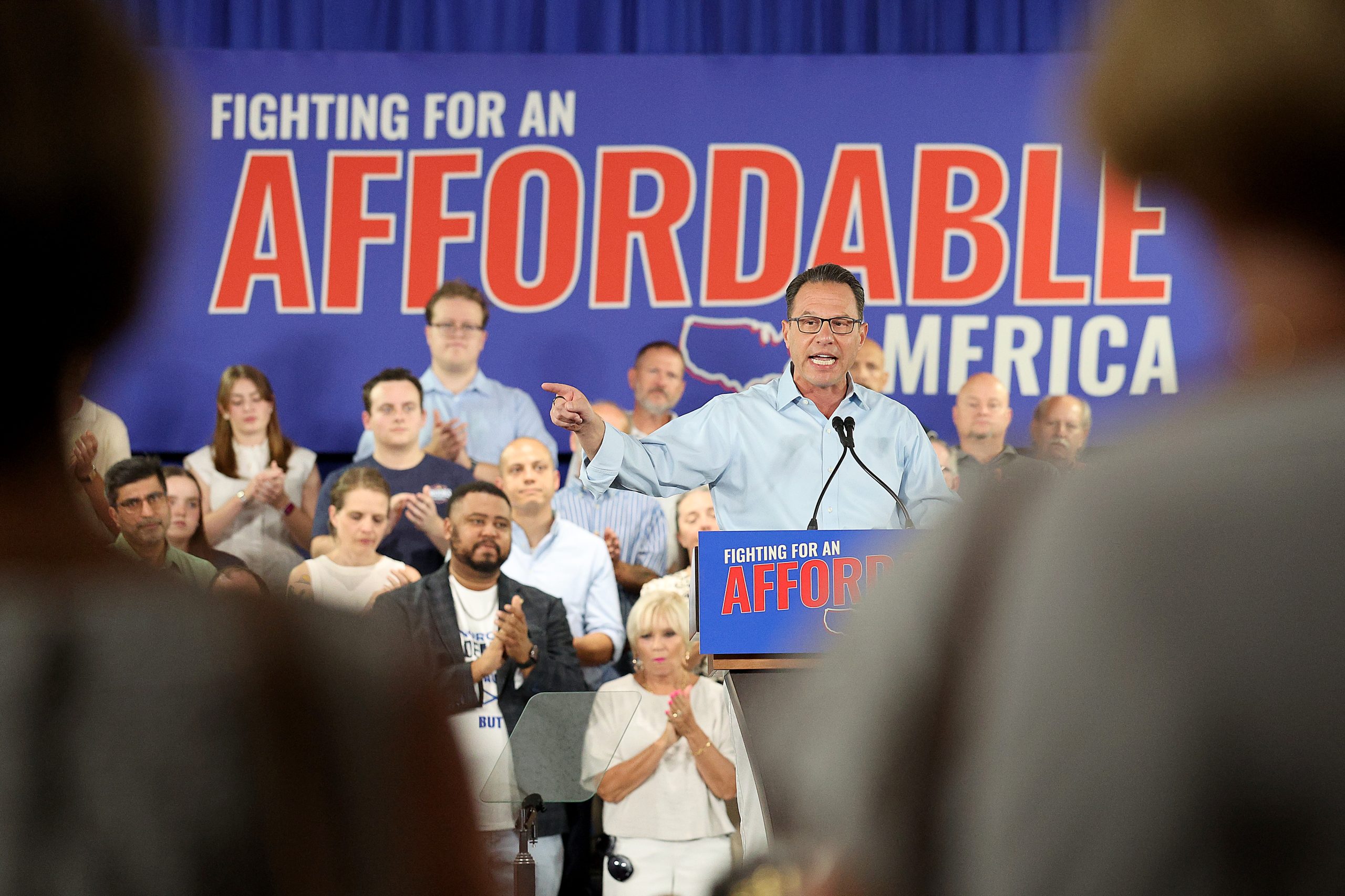
Gov. Josh Shapiro addresses the audience during a July 26 rally for congressional candidate Bob Brooks at the United Steelworkers Union Hall in Bethlehem.David Maialetti / Staff Photographer
His campaign released a Spanish-language digital ad focused on benefits of the Working Pennsylvanians Tax Credit and the Property Tax/Rent Rebate Program, which is targeted toward seniors and people with disabilities.
“If you’re working, you get to keep more of your money. Up to $800 more, more money in your pocket. And right now, every little bit helps,” a woman in the commercial said in Spanish.
Ultimately, Zandi said, “it’s very difficult for lawmakers at any level of government to change the picture on affordability, at least any time quickly,” because those issues are due to broader national and international forces.
There’s also no one-size-fits-all approach for a governor to tackle the costs of education, housing, energy, childcare, elder care, healthcare, and groceries.
“Each issue that makes up the affordability crisis requires its own set of solutions and efforts, so it feels like a laundry list of policy steps, and it is,” he said. “But that actually is probably the only way to make a difference.”
For many Pennsylvanians, paychecks feel like simply treading water: By the time all expenses are covered, there’s little money left to save and build toward the future.
“It just seems that money doesn’t go as far as it used to,” said Thomas Schank, 49, of Scranton. “I’ve gotten raises at work over the last two years, but everything else went up also, so really, no net gain.”
A candidate vying for one of the nation’s most competitive congressional seats who said he represented the Green Party — but who the Green Party and Democrats both accused of election meddling — has been disqualified from the November ballot, a Pennsylvania judge ruled Friday.
Andrew Tupone, 37, of Northampton County, had gathered nearly 11,000 signatures to run as a third-party candidate for Pennsylvania’s 7th Congressional District after previously running for local office as a Republican and switching his party registration earlier this year.
His petition for ballot access implied that he had the Green Party’s official support, though the organization said it did not know him and had questions about his motives. His actions denied the Green Party its right as a political body to select candidates who match their values, the organization argued.
“The Court’s analysis respects the internal governance of political bodies and protects political bodies from external forces hijacking those bodies,” Commonwealth Court Judge Stella M. Tsai wrote in the court document.
In a statement to The Inquirer, Tupone vowed to push his campaign forward, despite the significant legal setback.
“The establishment parties are fighting to keep me off the ballot but I’m not backing down,” he said. “I will continue this fight and appeal this decision because the people of the 7th congressional district deserve a real choice and a true progressive candidate who will stand up for them. This fight isn’t over. I’m going to keep fighting for the voters to have an option and for the representation our community deserves.”
Tupone’s quest for ballot access came as Democrats — who have said Green Party candidates pull votes from their nominees — have targeted the Lehigh Valley-based congressional seat as one of the state’s most flippable in their effort to regain control of Congress. Democratic candidate Bob Brooks, a retired firefighter and union leader, is challenging Republican U.S. Rep. Ryan Mackenzie, who won his seat two years ago by 1 percentage point.
But while the Green Party of Pennsylvania — which considers itself an ecosocialist party — rejects accusations of spoiling, leaders distanced themselves from Tupone’s candidacy, and the party was among the plaintiffs arguing for his removal.
“It sounds a lot like somebody’s just fooling around and trying to use the Green Party name,” Tim Runkle, co-chair of the state party, previously told The Inquirer.
Democrats have also accused Tupone, who was registered as a Republican until 2025 and said he previously voted for President Donald Trump, of attempting to spoil the contest. They furthered their argument after independent journalist Sean Kitchen identified Tupone’s attorney as Wally Zimolong, a Pennsylvania election lawyer who said on his website that he represented Trump, the Republican National Committee, and other Republican candidates. Zimolong also donated to Mackenzie’s reelection campaign in 2025.
Tupone, however, has said he no longer supports Trump. During his testimony before the state court, he said he became progressive after consuming social media posts from The Young Turks, a left-wing news program. He changed registration to the Democratic Party in February to run in the 7th District’s primary and to the Green Party in April after becoming “fed up with both parties” and wanting “to give voters another choice on the ballot.”
The Green Party, which held its state committee meeting in March, formally supported Lancaster resident Tony Dastra for governor and Philadelphia resident Craig Bolton for lieutenant governor — but they will not appear on the ballot after failing to receive enough signatures.
Tupone, who could not remember the name of the lieutenant governor during the court hearing, was the only candidate who filed to represent the Green Party in a Pennsylvania race for Congress.
A former Republican candidate for local office, Tupone has rejected accusations from Democrats and the Green Party that he was asked by Republicans to run for Congress, or that he paid individuals to collect the signatures to get him on the ballot. Of the 22 individuals who gathered signatures for his Green Party candidacy, only one is from Pennsylvania and multiple have previously worked for Republican campaigns, public records showed.
Tupone also said in court that he did not pay for any nomination papers to be circulated and was not aware of anyone being paid to circulate his papers. He said Runkle called him in July asking “weird questions” and “attempted to intimidate him not to run,” but he did not ask about the party’s process for endorsement or receiving support during the call.
Runkle said in the Green Party has declined to run candidates in the past who are unable to articulate the party’s values or have values that contradict the party’s.
Democrats celebrated the news Friday.
“(Republicans) have now tried and failed twice to meddle in the Lehigh Valley because they know weak incumbent Ryan Mackenzie can’t run on his own record. Firefighter Bob Brooks will smoke him in November,” said Eli Cousin, a spokesperson for the Democratic Congressional Campaign Committee.
In the country’s premier battleground state, Pennsylvania Democrats believe they’re in striking distance of a tidal-wave victories that would dramatically shift the balance of power in both Washington and Harrisburg.
For the first time in decades, the party could take full control of the legislature. That would give Democratic Gov. Josh Shapiro — seeking reelection with a wide polling gap on his Republican challenger Stacy Garrity— significantly more power to shape the direction of the state as he potentially pursues a White House bid in 2028.
Democrats also see a chance to flip four congressional seats and take control of the U.S. House. Republicans, meanwhile, are prioritizing defending the Pennsylvania seats with their House majority on the line as President Donald Trump, who won the state justtwo years ago, sinks in popularity.
The path forpower in Washington inthe high-stakes midterms runs through Pennsylvania and its results will be closely watched as both parties prepare for a presidential race in two years when the state promises to play a pivotal role.
Voters across Pennsylvania will head to the polls in November to cast their ballots for races that will decide the balance of power in the state and nation.
Here are the races to watch and how to vote.
Shapiro’s November could dictate his 2028
Shapiro, widely viewed as a likely contender for the 2028 presidency, has big ambitions this fall when he’ll stand for reelection against Garrity, the state’s treasurer.
More than just securing his own reelection, Shapiro hopes to run up the margin and carry downballot Democrats across the finish line.
Another double-digits win and a string of coattail victories would be ashow of strength about his ability to perform in a key swing state that his party lost in the last presidential election.In a presidential primary, Shapiro could use that result to make an argument that he’s a strong general electioncandidate who can boost the Democratic brand.
Will Republicans hold on in competitive congressional seats?
There are four U.S. House districts in the eastern portion of Pennsylvania, targeted by both parties as must wins. In each, the Republican incumbents are seeking to fend off highly financed challengers amid deep frustration among voters with the leader of their party that could translate into a wave of Democratic victories down ballot.
7th Congressional District: Freshman Republican U.S. Rep. Ryan Mackenzie narrowly flipped the Lehigh Valley district two years ago and is widely seen as one of most vulnerable incumbents in Congress. He’s facing a challenge Democrat Bob Brooks, a retired firefighter and union leader whose blue-collar campaign has attracted support across the party’s ideological spectrum with endorsements from Shapiro and U.S. Sen. Bernie Sanders.
10th Congressional District: Republican U.S. Rep. Scott Perry, a close ally of Trump, faces a November rematch against Democrat Janelle Stelson, a former TV anchor, in the Harrisburg area district. Stelson has consistently outraised Perry after narrowly losing in 2024.
In addition to these four races both national parties have targeted, Shapiro has argued that the 9th Congressional District, where Democrat Rachel Wallace is taking on incumbent GOP U.S. Rep. Dan Meuser, is flippable — despite the strong GOP lean in the district, which stretches from Berks County to the New York state border. The district is home to two warehouses that ICE was planning to convert into detention centers before abandoning the plan after a backlash from residents.
This year, Shapiro wants to flip the chamber and win a trifecta to push forward his key priorities, such as codifying abortion access, raising the state’s minimum wage, and increasing funding for transit.
Republicans currently hold 27 of the chamber’s 50 seats. Democrats, who currently hold 23 seats, need to win at least two additional seats and the governor’s office to win control of the chamber with the lieutenant governor as a tiebreaking vote.
The seats, drawn advantageously for Republicans, have been stubbornly resistant to political change for decades.
But this year a blue wave could usher in Democratic pickups in Philadelphia suburbs and the Lehigh Valley.
Races to watch include:
Bucks County’s 6th District, where Republican incumbent State Sen. Frank Farry faces a challenge from Democrat Eileen Hartnett Albillar.
Montgomery County’s 24th District, where incumbent Republican State Sen. Tracy Pennycuick is up for reelection against Democrat Chris Thomas.
Bucks and Lehigh County’s 16th District, which will see a rematch race between incumbent Republican State Sen. Jarrett Coleman and Democrat Mark Pinsley, the Lehigh County controller.
What are the important dates to know?
Election Day is Nov. 3.
The deadline to register to vote is Oct. 19. You must be at least 18 years old, a resident of Pennsylvania and a citizen of the United States to vote. You can register online, by mail, at your county elections office, or at one of several other government buildings.
Pennsylvanians can vote by mail with no excuse required. To apply, fill out an application by mail, online, or in-person and send it into your county election office. Applications must be received by Oct. 27 at 5 p.m. and the completed mail ballot must be received — not just postmarked — by 8 p.m. on Election Day.
An application and mail ballot can be completed in one visit at an election office, essentially functioning as early voting.
Staff writer Fallon Roth contributed to this article.
U.S. Sen. John Fetterman privately rejected the concerns of leaders at the Children’s Hospital of Philadelphia who requested a meeting to talk about vaccine policy and Medicaid cuts, speculating to an aide that they “just want free trips to DC,” according to a new report that sparked another wave of criticism aimed at the first-term senator.
The report from The Wall Street Journal details several meetings or events that while routine for many senators in Washington Fetterman frequently tried to get out of, including the meeting with CHOP and a funeral for three York County police officers who were killed while on duty.
Claims that Fetterman is not fully performing the role of a U.S. senator have plagued much of his nearly four years in office. His former staffers have publicly and privately said he often cancels meetings at the last minute, including with constituent groups and Pennsylvania officials who would normally be considered allies.
As he increasingly attacks his own party, the Pennsylvania Democrat has instead appeared regularly on conservative media. He’s prioritized meetings and events about Israel, whose war in Gaza had been a flashpoint in his break with former Democratic allies and supporters, and he does not make regular public appearances across the state he represents.
Among the new revelations in The Wall Street Journal story is an interaction the senator had with Yechiel Leiter, the Israel ambassador to the U.S. last year.
After Fetterman said he wanted to craft a Senate resolution that would require his colleagues to vote on whether the war in Gaza was a genocide, Leiter suggested Fetterman instead write an op-ed about why he supported Israel, The Wall Street Journal reported. Leiter’s embassy later “sent over drafted points for Fetterman to consider,” but Fetterman’s staff withheld them from him out of concerns that writing the op-ed based on the talking points “risked violating the Foreign Agents Registration Act,” according to the report.
Trump administration official comes to Fetterman’s defense as critics react
Fetterman’s office did not immediately respond to The Inquirer about the claims in the report or about the reactions to it.
“John Fetterman is a disgrace,” U.S. Rep. Brendan Boyle (D., Phila.) wrote on social media in response to the story. “Our state deserves better than a lazy trust fund baby who is too lazy to do the job.”
U.S. Rep. Chris Deluzio (D., Allegheny) called Fetterman’s behavior “pathetic.”
“[B]etween the laziness, disrespect, and willingness to carry water for a foreign government, it shows us something we already know: this man has no sense of duty,” Deluzio wrote on social media. “He is not up for the high office he was elected to — and we in Pennsylvania will do something about it in 2028.”
Former U.S. Rep. Conor Lamb and State Rep. Malcolm Kenyatta, Fetterman’s opponents in the 2022 Democratic primary, also condemned him.
“This report is horrifying, but not new to many of us in PA. John barely showed up as [lieutenant governor] and is constantly MIA as our Senator,” Kenyatta, vice chair of the Democratic National Committee, wrote on social media.
Boyle, Deluzio, Lamb and Kenyatta are among the Pennsylvania Democrats who are considered potential candidates when Fetterman’s seat is on the ballot again in 2028. Fetterman has not said whether he will seek a second term, and he’s rejected speculation that he will switch parties to become a Republican.
A robust Democratic primary is likely either way. Just one out of every five likely Democratic voters have a favorable view of him, an Inquirer/New York Times/Siena University poll found last month. At the same time, his favorability among Republicans had grown to a higher level than Pennsylvania’s Republican senator, Dave McCormick.
Fetterman, meanwhile, has also isolated himself from other Democrats in Washington, according to The Wall Street Journal and other reports this year. The party is looking to capture the Senate majority in the midterm elections this fall — a tall task considering the map of competitive races, but one that could make Fetterman a key swing vote depending on how narrow the majority is for either party. Senate Minority Leader Chuck Schumer, who has called Fetterman “an important member of our caucus,” had dinner with Fetterman last month, according to The Wall Street Journal.
But Fetterman’s detractors in the party — and his former staffers — have indicated they will continue to put pressure on the senator.
On Friday as the latest story was circulating, an X account claiming to be a group of the senator’s former staffers launched with the message that it would share their experiences.
“It’s even worse than you thought,” the first post stated, calling the latest news “the tip of the iceberg.”
One former staffer with insight into the project, and who spoke with The Inquirer on the condition of anonymity, said it was a legitimate group of former staffers who plan to share real accounts of working for the senator.
The account quickly gained tens of thousands of followers on Friday afternoon, even drawing the attention of a Trump administration official.
“I’m disgusted by anonymous leakers, actually,” Harmeet Dhillon, an assistant attorney general for the Civil Rights Division of the U.S. Department of Justice, wrote in a response on X.
Tré Easton, a former legislative director for Fetterman who has frequently criticized him since leaving his staff in early 2025, said it was “sort of extraordinary” to see other former staffers create such an account. He said he is not involved in the effort.
Easton said the claims in the story aligned with his experience working for Fetterman.
“A lot of ink has been spilled about John and his time in office,” Easton said. “What this Journal story captured that these other stories really haven’t is how completely disconnected he is from the work and how he just doesn’t care about it — how he doesn’t care about his constituents and doesn’t care about Pennsylvania in a worthwhile way.”
‘Why do I have to keep having to meet with chop’
The newspaper’s report includes text messages between Fetterman and his staff as they discuss meetings and events that senators would normally attend.
“3 hours??” Fetterman wrote in response to an aide who told him about the length of a funeral last year for three police officers who were killed while serving a warrant in York County, where Fetterman grew up.
Fetterman wrote that the time “may be a nonstarter” and did not attend, the Journal reported.
Discussing the meeting with CHOP officials last September, Fetterman wrote, “Why do I have to keep having to meet with chop,” and an aide responded it was to talk about vaccines and Medicaid cuts, according to the report.
Along with children’s hospitals and health systems nationally, CHOP faces financial pressure from Medicaid cuts starting next year. While the internationally prominent research institution remains financially strong, around half its patients rely on Medicaid for coverage.
During the debate over President Donald Trump’s signature budget legislation, CHOP circulated form letters to federal lawmakers that warned about the potential for the cuts to harm families, asking staff and patient families to sign them in opposition.
Vaccines have also become increasingly political as Trump’s health secretary, Robert F. Kennedy Jr., a longtime anti-vaccine activist, has sought to upend longstanding federal recommendations about the timing and number of immunizations that children receive.
Fetterman has not weighed in publicly about vaccine changes. But he has loudly rejected the Medicaid changes — saying in a statement last year that he was voting “HELL NO” on the Republican bill, which he called “a disaster.”
About two months later, he wrote to an aide while discussing the CHOP meeting that he was not concerned about, the Journal reported.
“I’m convinced they just want free trips to DC,” he wrote.
Asked for comment on Friday, CHOP, in a statement to The Inquirer, did not comment on that text or its relationship with Fetterman in general.
“We value the productive conversations we have with legislators and government officials at a local, state and federal level,” the statement read. “Their decisions have a direct impact on children’s ability to thrive in Pennsylvania and beyond, and we take our role as a voice for children very seriously.”
Staff writer Wendy Ruderman contributed to this article.