Category: Politics

  • Pa. state and religious leaders hold vigil to honor lives lost in ICE custody ahead of nation’s 250th birthday

    Pa. state and religious leaders hold vigil to honor lives lost in ICE custody ahead of nation’s 250th birthday

    As Philadelphia gears up to celebrate the nation’s 250th, a group of political and interfaith leaders held a vigil Thursday at Christ Church to honor those who died in ICE custody.

    The event comes a day before the nation’s birthday celebrations but a week after the Supreme Court’s decision to take Haitians and Syrians off temporary protection status, opening them up to deportation.

    Nathalie Cerin spoke at the vigil about her experience as a Haitian-American on TPS, which allows people whose home countries are unable to accommodate them a way to stay in the U.S. legally. Cerin said she was still celebrating Haiti’s two goals against Morocco in a World Cup game (before ultimately losing) when she heard of the Supreme Court’s decision to end TPS for Haitians.

    Cerin also said her experience on TPS had been a confusing one that left her and others in limbo.

    “The toughest part about being a TPS recipient is the ambiguity, and that’s by design,” Cerin said. “The confusion keeps you from making long-term plans. It traps you in a prison of conjecture, whispers of ICE raids and stories of people in detention centers who didn’t make it out.”

    These vigils and ICE protests happen consistently, said Alisa Lasater Wailoo of First United Methodist of Germantown, who attends the demonstrations every Monday. Demonstrations also happen on Wednesdays and Fridays, Lasater Wailoo said.

    U.S. Rep. Mary Gay Scanlon, a Democrat who represents South Philadelphia and Delaware County, also spoke Thursday, thanking the city’s religious community for stepping up during a time of need.

    “Our faith communities have stepped up and have really been a bright light,” Scanlon said. “They’ve stepped up in defense of the humanity of our neighbors and the strangers among us. They have stepped up as individuals to bring awareness and muster opposition to the administration’s activities, and they’ve stepped up in service to those who are suffering from that cruelty.”

    Scanlon tied her speech to the country’s founding, reflecting on the words of Thomas Paine, the Founding Father who wrote Common Sense, calling for independence from Great Britain.

    “He [Paine] also reminds us we are all called to contribute to the greater good, and it is not in our numbers, but in our unity, that our great strength lies,” Scanlon said. “So I call everyone to hear these words as a calling and an invitation to show up, to shine and to love.”

    The vigil concluded with a Ringing of the Bell ceremony, where the names of 50 people who have died while in ICE custody nationwide since Donald Trump took office in 2025 were spoken and followed by a bell toll.

    Two of the people honored died at the Moshannon Valley Processing Center in Pennsylvania: Fouad Saeed Abdulkadir, who died after a medical event, and Chaofeng Ge, whose death was ruled a suicide.

    State Sen. Art Haywood, a Democrat who represents parts of Philadelphia and Montgomery County, said he hoped attendees would leave remembering that the nation’s future is mutable and that they can make a change.

    “I think the main thing I want people to see is a rededication to what the nation has become,” Haywood said. “I am not so much looking back at 1776. 1776 was a very bad year for Africans; that was a year of enslavement. So I’m not that comfortable celebrating, but I think the future of the nation is very powerful.”

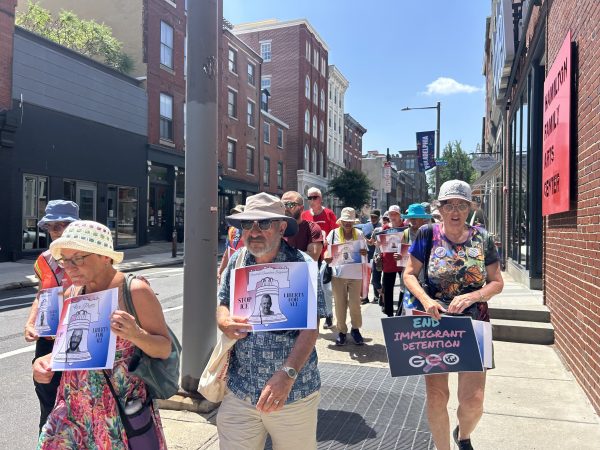
    Following the vigil held at Christ Church, Haywood, multi-faith leaders, and other attendees walked eight blocks through the hot, muggy streets of Philadelphia to take a stand in front of the ICE detention facility on Cherry Street.

    Protesters tied a long red fabric to block the main driveway of the facility. The red cloth was meant to signify the blood of those lost and the red in Betsy Ross’s American flag.

    “Today, we mark this line with the same red that runs through Betsy Ross’s flag,” said the Rev. Kipp Gilmore-Clough of Chestnut Hill United Church. “It is a witness to the bloodshed and the lives lost. But it also symbolizes the possibility of unity.”

  • Trump and Republicans return to communist attacks against Democrats ahead of the midterm elections

    WASHINGTON — President Donald Trump and his fellow Republicans are reviving a line of attack against Democrats heading into the midterm elections: They’re communists.

    In just the past week, Trump has issued dark warnings that members of the Democratic Party’s ascendant left are communists who want to “completely destroy the traditional American way of life” and even engage in assassinations. Vice President JD Vance has similarly called out communism as a political shift that is “something we haven’t seen in the U.S.” House Speaker Mike Johnson has decried “radical candidates” who are “self-described, self-identifying Marxists.”

    The GOP’s ideological focus conflates democratic socialism, which often centers on securing universal healthcare, higher taxes on the wealthy, and stricter corporate regulation, with communism, under which private ownership is largely eliminated. It has been building since Zohran Mamdani, a democratic socialist, won the Democratic nomination for New York City mayor last year.

    But it’s kicked into a higher gear recently after democratic socialists won several New York City congressional primaries last week. The primary victory on Tuesday by another democratic socialist, Melat Kiros, for a Denver congressional seat suggested the trend may extend beyond Manhattan liberalism.

    “The Democrats are making this easy for us,” Rep. Richard Hudson, the North Carolina Republican who leads the House GOP’s strategy and fundraising arm, said in an interview. “They’re nominating extreme liberals, leftists who are out of touch even with mainstream Democrats.”

    Republicans are holding onto slim majorities

    The messaging effort comes as Republicans scramble to hold onto threadbare congressional majorities in the November midterms. It risks overlooking public frustration, particularly among younger voters, with unfettered capitalism at a time of growing income inequality and rising costs.

    But it also gives Republicans a much-needed opportunity to shift the conversation back to territory that is more comfortable for them after their party has spent much of the year on defense over the fallout from Trump’s decision to launch a war against Iran, which contributed to widespread price spikes.

    Ralph Reed, the longtime conservative activist who hosted Trump last week at a Faith and Freedom Coalition conference, acknowledged that Republicans are facing steep headwinds this year. But the recent string of wins by democratic socialists, he said, allows Republicans to present a contrast between “common sense and crazy.”

    Democrats uncertain over the party’s direction

    The renewed push could tug at tensions among Democrats who are largely united in their loathing of Trump but are divided over the party’s direction. This year’s primaries are shaping up as a referendum between centrists who are eager to course correct from what they see as progressive overreach earlier in the decade and a left wing pushing for even more sweeping change.

    “A lot of this anger has been boiling under the surface,” said Joseph Geevarghese, executive director of Our Revolution, which was founded by U.S. Sen. Bernie Sanders, a Vermont independent who caucuses with Democrats. “It’s coming to the fore in this moment in a very powerful way.”

    But Rep. Josh Gottheimer, a centrist New Jersey Democrat, called the victories in Colorado and New York “aberrations.”

    “We’ve got to fight like hell to keep our party from being hijacked by socialists,” he said. “Most of them are bomb throwers, not problem solvers.”

    Nevada Attorney General Aaron Ford easily dispatched a more progressive rival earlier this year in his Democratic bid for governor in a state Trump carried in 2024. As he eyes a general election challenge to Republican Gov. Joe Lombardo, he insisted candidates like those who won in New York don’t represent all Democrats.

    He said the Democratic Socialists of America “is not the face of our party.”

    Rep. Suzan DelBene, a Washington Democrat who chairs the House Democratic campaign committee, said in a statement that Republicans were “resorting to desperate attacks that aren’t actually about the pocketbook issues.”

    Trump risks overreaching with communism argument

    Trump and fellow Republicans risk missing the mark when the public’s embrace of capitalism might not be as strong as it was decades ago.

    About half of U.S. adults, 54%, have a positive view of capitalism, according to an August poll from Gallup, a slight decline from 61% in 2010. Democrats have driven some of the shift, but favorable opinions of capitalism have fallen among independents as well.

    Only 42% of Democrats viewed capitalism favorably, while 66% had a positive view of socialism. The poll found that both younger and older Democrats have warmed slightly on socialism since 2010, but Democrats under age 50 are much less likely to view capitalism favorably. Democrats age 50 or older didn’t shift meaningfully.

    “Young voters, who I would argue are driving a lot of the electoral energy that we’re seeing, came of age politically in a post-Soviet world,” Geevarghese said. “The attacks don’t land in the same way when Donald Trump was politically of age.”

    Hudson, who is running the House GOP campaign committee, acknowledged the communism line might not resonate in the same way with all voters, particularly younger people. That’s why, he said, it’s important for Republicans to tailor their message to the needs of individual districts.

    “I’ve never run cookie-cutter campaigns where we just say one thing over and over everywhere,” he said.

    Still, the argument was high on Trump’s mind again on Wednesday as he visited the newly built Theodore Roosevelt Presidential Library in North Dakota. He called the former president a “ferocious opponent of a thing called communism.”

    “It’s the biggest threat to our country, including World War I, World War II, Pearl Harbor, September 11,” he said. “It’s a bigger threat, potentially a bigger threat than that, because it’s like a cancer that spreads, and you better stop it fast.”

    Beverly Gage, a history professor at Yale University who has written on the rise and fall of Sen. Joe McCarthy, said earlier eras of anti-communism politics took hold because there was a large and active Communist Party in the U.S. and the Soviet Union was the country’s primary foe. But she said Trump’s focus on the issue is notable given his ties to Roy Cohn, a onetime confidant of Trump who earlier worked for McCarthy.

    “It’s not very many steps to get from McCarthy to Roy Cohn to Donald Trump,” she said.

    California Gov. Gavin Newsom, a potential Democratic presidential candidate, shrugged off Trump’s communism focus as “bunk.” In an interview, he said the direction of the party isn’t all that different from the dynamics he’s navigated for decades in California politics.

    “I governed in an environment where the DSA was otherwise known as progressives,” he said. “This dialectic is so deeply familiar to me, and I don’t over read any of it.”

  • Tucker Carlson, who broke with Trump, plans to ‘help build a third party’

    Tucker Carlson, the influential conservative media commentator, said in an interview that he planned to help start a new political party after leaving the Republican Party but that he had no interest in running for office.

    Carlson, a former close ally of President Donald Trump who has broken with the Republican Party over the war with Iran, told the Columbia Journalism Review that he was “going to help build a third party.”

    “There should be a good-faith effort to figure out what benefits the country,” Carlson said in an interview with the Columbia Journalism Review published Wednesday.

    He outlined his plans at a moment of upheaval for both parties: The insurgent left appears ascendant in the Democratic Party as the base has grown angry over the party leadership’s stance on Israel since the war in the Gaza Strip. The Republican Party has been fractured by Trump’s handling of the war with Iran.

    Carlson, a popular podcaster and former Fox News host, said last month that he was leaving the Republican Party. He described himself on a podcast episode as a “consistent defender” of the party for 35 years, but said that he believed the party had lost touch with “America First” principles under Trump.

    In the Columbia Journalism Review interview, he described some of the policies that might animate his new party, saying he supports “ending all immigration.” A longtime nativist and immigration hard-liner prone to conspiratorial views, Carlson said immigration drives unemployment. (Many economists say it does not.)

    He also argued that the two parties did not offer a sufficient contrast on “war and finance.”

    “That’s not a democracy,” Carlson told the Columbia Journalism Review. “That’s a one-party state posing as a democracy, and it needs to be broken, and there’s going to be a third party, and I’m going to do everything I can to bring that about.”

    Carlson was often at Trump’s side during his 2024 presidential campaign and pushed Trump to select JD Vance, then a senator from Ohio, as his running mate.

    But he broke sharply with the president after the United States started the war with Iran in late February, declaring Trump was violating a core campaign promise to avoid foreign conflicts. By April, Carlson said he was “tormented” by his past support for the president.

    He told the Columbia Journalism Review that he had not spoken to Trump since the start of the war, which has been largely paused by a fragile ceasefire.

    “I’m not interested in talking to him,” Carlson told the publication.

    In the past, Carlson’s relationship with Trump has been revived after rocky stretches. In a text surfaced by a defamation lawsuit filed by Dominion Voting Systems, Carlson wrote of Trump, “I hate him passionately.” (Carlson was fired by Fox News after it agreed to pay $787.5 million to resolve the case, which centered on the network’s promotion of 2020 election misinformation.)

    But Carlson’s frequent, forceful public criticism of Trump since the war began has led to some speculation that he might be angling for his own run for office.

    Carlson told the Columbia Journalism Review that he was not entertaining the idea, and he insisted he did not see himself as a competitor to Trump.

    “I’m not a politician, that’s for sure,” Carlson told the publication. “I’m not a rival to Trump for power. I have no power. I’m someone who knows Trump, and I know him well, and I’ve known him for a long time.”

    This article originally appeared in the New York Times.

  • Top Trump official Sean Duffy promotes the President’s House in video with Mayor Parker

    Top Trump official Sean Duffy promotes the President’s House in video with Mayor Parker

    President Donald Trump’s administration has spent almost a year scrutinizing, and then dismantling, and then trying to rewrite history at one of Independence Mall’s most informative exhibits on slavery.

    All for one of Trump’s cabinet secretaries to promote the President’s House in a new video ahead of July Fourth.

    Transportation Secretary Sean Duffy, who has been one of the Trump administration’s biggest cheerleaders for this week’s 250th anniversary celebrations, produced a video asking Mayor Cherelle L. Parker which Philadelphia historical sites visitors should see.

    Parker listed the highlights — the National Constitution Center, Independence Mall, the Liberty Bell, and ended her list of recommendations with the President’s House, which memorializes the nine people enslaved by George Washington in Philadelphia.

    “Reconnect with our history, recommit to the democratic values that we stand on, and have an amazing time,” Parker said.

    Cue Duffy showcasing pictures of the very panels at the President’s House that his boss wants to take down.

    The video, which was posted Wednesday to Duffy’s social media, appears to have been filmed in May, when Duffy visited Philadelphia while the city and the Trump administration were in the midst of a legal battle over the President’s House after the federal government removed the site’s exhibits earlier this year.

    A February court order allowed some of the panels to be reinstalled. Then, a ruling from the Third Circuit Court of Appeals in June said the Trump administration could replace the exhibits with its own materials, which are posted online.

    After the Third Circuit’s ruling, Parker said in a statement that: “I will pursue every legal action possible to reverse this decision. We cannot and WILL not rest until the full story of American history — including the existence of slavery at the President’s House here in Philadelphia — is told, for our Nation and the World to see.”

    On Thursday, a Boston-based federal appeals court removed the final legal obstacle that prevented the Trump administration from installing its own exhibits at the President’s House.

    This was not Duffy’s only visit to Philadelphia that coincided with a key event in the President’s House saga. Duffy joined Interior Secretary Doug Burgum in a visit to Independence National Historical Park in September 2025, just days after reports that the Interior Department planned to make changes to the President’s House.

    The secretaries were preparing for the Semiquincentennial celebrations. The Transportation Department, led by Duffy, has promoted road trips to a number of sites targeted by the Interior for changes, including Harpers Ferry National Historical Park in Virginia, in addition to the sites in Philadelphia.

    Duffy, a former MTV reality television star, has faced backlash for shooting a reality TV-style travel series with his family over the span of several months called The Great American Road Trip, meant to encourage celebrating the United States ahead of the 250th.

    A trailer for the series shows that he stopped in Philadelphia and visited LOVE Park and the Liberty Bell.

    In Wednesday’s video, which does not appear to be related to the series, Duffy says, “There’s no better place to go than where it all began in Philadelphia.”

    “This city is truly amazing, and the history that exists here,” Duffy said, “No one has it.”

  • Pope Leo XIV is speaking to the National Constitution Center live from the Vatican. Here’s what to know.

    Pope Leo XIV will accept the National Constitution Center’s Liberty Medal on Friday, delivering remarks live from the Vatican that will be broadcast inside the Sixth and Arch building.

    The U.S.-born pontiff’s speech is a major addition to Philadelphia’s already extensive lineup of activities and events on the eve of the United States’ 250th birthday on July Fourth.

    His speech will be particularly anticipated in Philadelphia given the Semiquincentennial and Leo’s deep ties to the Philly area.

    The Catholic leader has garnered attention for clashing with President Donald Trump’s administration, which will be further exemplified by his visit with migrants on Independence Day.

    His award acceptance speech also comes just two days after traditionalist Catholics in Switzerland defied him by consecrating bishops without his consent, which Leo called “a sin of extreme gravity,” the Associated Press reported.

    His Friday remarks were initially going to be broadcast on Independence Mall but it was moved inside due to extreme heat.

    Here’s what to know ahead of his Liberty Medal speech.

    What are Pope Leo’s connections to the Philly area?

    Not only is he the first U.S.-born pope, but he has connections to the Philly area — despite being from Chicago.

    Leo graduated from Villanova University in 1977 with a bachelor’s degree in mathematics. He received an honorary doctorate of humanities in 2014 from the Augustinian university.

    Those who knew him at the time described him as a Midwesterner with a sense of humor who was tuned in to global issues like immigration and poverty — and like anyone who goes to Villanova, a big basketball fan. He worked part-time at St. Denis Catholic Church in Havertown as part of the cemetery maintenance crew during his studies.

    In May, he passed along a surprise commencement message to this year’s graduates. In that message, he fittingly referenced America’s 250th anniversary.

    “May the graduates of 2026 always be faithful to the guiding light that has been so important for these 250 years,” Leo said.

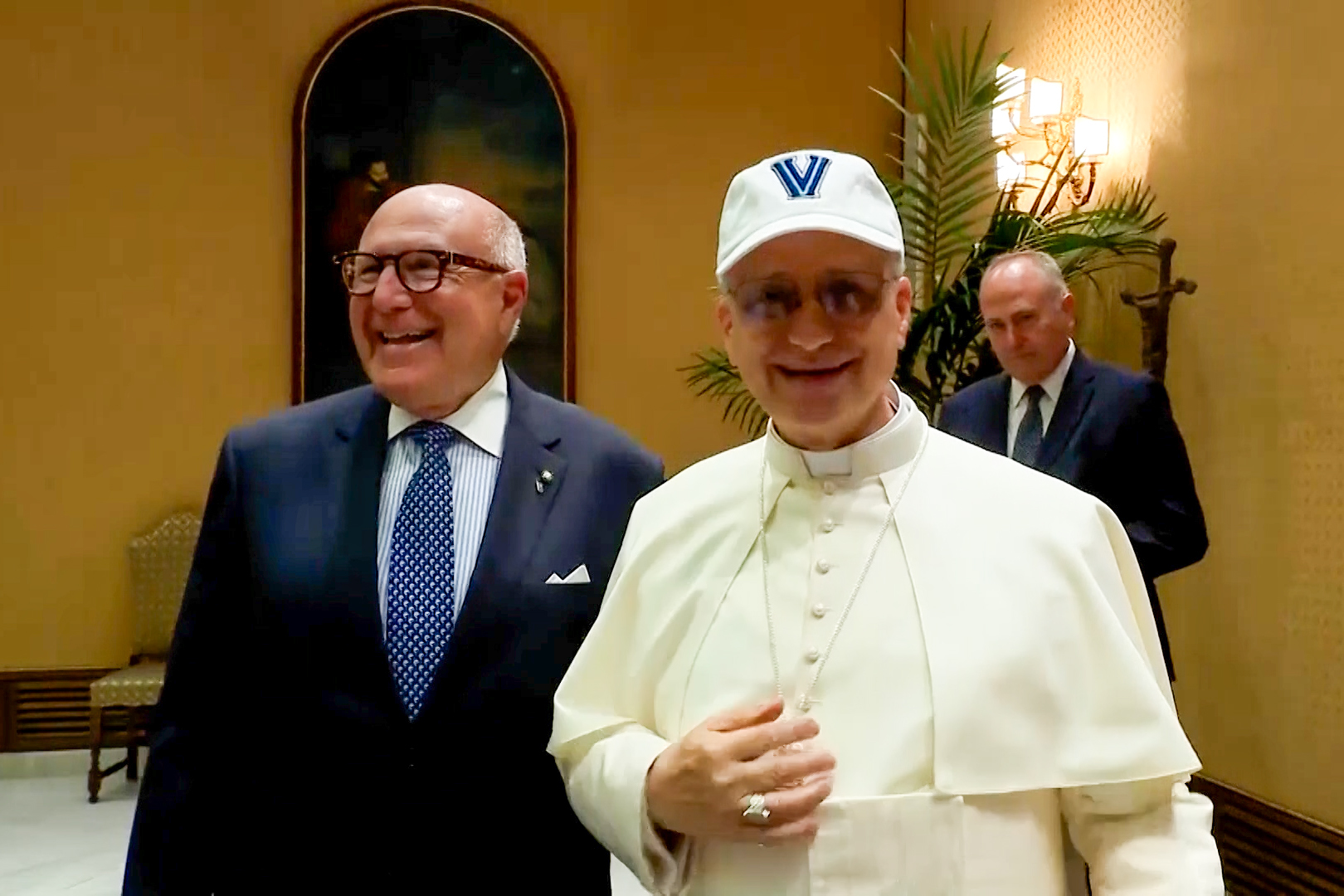
    This video screen grab shows Pope Leo XIV wearing a Villanova hat given to him during a meeting with an Italian heritage group.Associated Press

    Last month, a delegation from Philadelphia’s National Constitution Center met with Leo at the Vatican to present him with the medal. They would have been remiss to forget to celebrate his Philly connections.

    So they brought him a few local goodies: a bundle of Villanova swag, a replica of George Washington’s Acts of Congress, and, best of all, a Wawa tote bag filled with Tastykakes.

    Vince Stango, interim president and CEO of the Constitution Center, said the visit had “a real Philadelphia vibe that was unmistakable.”

    What’s the Liberty Medal?

    The Liberty Medal has been presented by the nonpartisan National Constitution Center since 2006, offering the esteemed prize to individuals and organizations who “strive to secure the blessings of liberty to people around the globe.”

    In Leo’s case, he’s receiving the award because of his work in promoting religious liberty.

    Previous recipients of the award include Ukrainian President Volodymyr Zelensky, the late U.S. Supreme Court Justice Ruth Bader Ginsburg, the late U.S. Sen. John McCain (R., Ariz.), and the late civil rights leader and U.S. Rep. John Lewis (D., Ga.).

    How do I watch?

    The National Constitution Center is streaming the ceremony live on its YouTube channel at 10:45 a.m. NBC10 will also broadcast the awards.

    Tickets to the event were previously made available to the public and other invited guests.

    What’s going on with the pope and Trump?

    Trump invited the pontiff to visit the United States on July Fourth to celebrate the 250th anniversary of the country. He declined.

    Instead, the pope will spend Independence Day visiting Lampedusa, an Italian island in the Mediterranean Sea located between Tunisia, Malta, and Sicily. It‘s a major entry point for migrants seeking refuge in Europe from North Africa. It’s one of the deadliest migration paths in the world, Reuters reported.

    Leo’s predecessor, Pope Francis, visited the island in 2013.

    Francis, who was close with Leo, also clashed with President Donald Trump and Vice President JD Vance on issues like immigration, and that tension has continued under the new pontiff.

    The pope said in November that the United States has been treating migrants “in a way that is extremely disrespectful” under the Trump administration. A month prior, he suggested that the United States’ treatment of immigrants is “inhumane.”

    Vance, who converted to Catholicism in 2019, said this week on Fox News that he finds the Vatican’s immigration views “troubling,” saying that “mass migration has victims.”

    Leo was also outspoken in his opposition to Trump’s war in Iran, and the Vatican declined to participate in Trump’s “Board of Peace” for Gaza.

    Trump has not held back on his criticism of the pope, calling him “WEAK on Crime, and terrible for Foreign Policy” in an April social media rant. He faced condemnation from Catholics — who have found themselves taking a side between the pope and the president — after sharing a now-deleted image of himself presented as Jesus.

    It will be telling whether Leo leans into his disagreements with the Trump administration, whether directly or indirectly, during his speech on Friday.

  • Delaware County is investigating a hack of its network systems

    Delaware County is investigating a hack of its network systems

    Delaware County is investigating a hack of its network after “unauthorized activity” interfered with systems in late June, disrupting county services.

    The county government is “in the process of restoring network access,” according to a statement, and internet and phone service has been restored.

    “The County responded to these attempts by taking the proactive but necessary step of shutting down our network to continue to protect sensitive information and critical systems while following industry best practices in response to the intrusion attempts,” the county said.

    The infringement comes almost six years after Delaware County was hit by a ransomware attack via a phishing email in November 2020. At that time, hackers stole sensitive data and the county eventually had to pay $25,000 to resolve the issue.

    The scale of the latest hack remains unclear, but the county said in its statement that since the 2020 incident, it has “established critical protections and followed industry recommendations about how to best secure its network assets, and those protections have proven valuable in recent days.”

    The public first became aware of disruptions last Friday, when Delaware County Council posted on social media that there was a “network outage” at the Government Center Complex in Media.

    Delco also said it plans to reestablish network access, services, and work with cybersecurity experts.

    “All our offices remain open and ready to continue serving our residents, and we appreciate the efforts of our staff and departments to find alternate ways to perform their duties throughout this period of network interruption,” the county said.

    The delays and detours in services have become frustrating for residents who may have to reschedule appointments with departments like the Register of Wills or at the courthouse.

    6ABC reported earlier this week that residents were not able to complete routine procedures at the courthouse, like filing a motion, and that cases were being taken out of order.

  • The biggest U.S. commemorations happen when we need them the most

    Though much has changed since America’s last notable birthday in 1976, there are many echoes of the Bicentennial’s circumstances and its opportunities in 2026. In yet another time of uncertainty and pessimism, this 250th birthday, like the Bicentennial 50 years ago, offers Americans an opportunity to reconsider their connection to the past and their vision for the future.

    Following one of the most fractious decades in American history, the years approaching the Bicentennial were marked by upheaval. In 1973, the OAPEC oil embargo created a gas crisis that contributed to a global recession and inflation as high as 12%. American lost confidence in their leaders, especially after Richard Nixon resigned from the presidency in August 1974, following two years of fallout over the Watergate scandal. The rights revolution of the previous decade brought issues such as race, gender, and sexuality into mainstream media. Countless laws and social norms changed, sparking backlash among conservatives.

    These circumstances caused many Americans to wonder what was worth celebrating in 1976. Many marginalized groups questioned whether they should celebrate the Bicentennial at all. A broad array of social and civil rights movements seized on the Bicentennial as an opportunity to challenge the triumphal narrative familiar to so many Americans. Their efforts brought into stark relief the paradoxical relationship between the rhetoric surrounding the nation’s founding and its history of oppression. And the conversations that emerged around confronting this more complicated history shaped the Bicentennial’s commemoration and its longer-term impact.

    The circumstances surrounding America’s 250th anniversary are strikingly similar. Political scandals have threatened to engulf the current administration, as the nation has again found itself mired in an unpopular foreign war and a gas crisis, with prices nearly doubling in the last year. Years of inflation have led to a cost-of-living crisis for many Americans. And the last twenty-five years have produced an even greater distrust of institutions such as the government, the media, and the church. A recent Pew Research Center poll shows that nearly 60% of Americans think the nation’s best years are behind us. As during the Bicentennial in 1976, many Americans are again wondering what about the nation’s past and present is worth celebrating.

    Challenging circumstances, however, are not unique to the last two anniversaries. In 1876, Americans commemorated the Centennial in the wake of an economic panic in 1873, increased immigration, the end of Reconstruction and the rise of Jim Crow, and a constitutional crisis brought about that year by one of the most fiercely contested presidential elections in the nation’s history. In such circumstances, the 1876 commemorations looked toward the future. They were marked by a growing sense of the United States being poised as an industrial power to take its place on the world stage, and by the efforts of African Americans and suffragists to realize a future of equal citizenship and rights.

    In contrast, there was much less enthusiasm during America’s 150th in 1926. With the economy booming, many Americans of the roaring 20s did not need the anniversary. In other words, anniversaries of the Revolution have mattered most during the nation’s most trying times. When the American experiment seems closest to failure, we have used our anniversaries to engage in conversations about the meaning of the past and the future we want to create.

    Federal funding also impacts how these anniversaries are celebrated, and in that regard, the Bicentennial and the 250th could not be more different. In the 1970s, the American Revolution Bicentennial Administration gave countless grants to small groups, institutions, and projects across the country. Those grants helped fund local programs, the preservation of local historical sites, and the creation of new sites and museums. In the years leading up to 250, however, there has been a rapid change in the federal funding landscape for historical sites and projects.

    Made By History sponsors. FOR USE ON MADE BY HISTORY STORIES ONLY.Inquirer Staff

    Significant cuts to the National Endowment for the Humanities and other agencies have meant fewer grants and resources to support similar local and historical projects like in the years leading up to 1976. As a result, institutions, historical sites, and museums—large and small—have had to take it upon themselves to both produce and fund meaningful programming for the public. From larger institutions like the Museum of the American Revolution to countless institutions in small towns and counties across the country, Americans have been forced to take responsibility for commemorating 250 for themselves and their fellow citizens. But following the model of 1976, they are working to foster conversations about the complexity of the past alongside visions of the future. And as with the Bicentennial, the greatest opportunities for reconnecting with the nation will come from the work done at the local level.

    Ultimately, the 250th is not just a historical anniversary; it is a civic opportunity. And that opportunity is not limited to July 4, 2026. Revolutionary anniversaries will continue on the national and local levels for more than a decade, eventually culminating with the bicentennials of the Constitution in 2037 and the Bill of Rights in 2039. And like the bicentennials for those events, these 250th commemorations will provide a platform for Americans to reconsider what the revolution and its ideals mean to them in the present moment. The work done by independent and local institutions and organizations across the country will again give Americans the tools and the impetus to engage with the past in meaningful ways. When we seize those opportunities, we become part of the nation’s long tradition of using our anniversaries of the Revolution to imagine a new and better future.

    Michael D. Hattem is the author of The Memory of ’76: The Revolution in American History and is an America250 Media Fellow of the Jack Miller Center.

    The “Road to 250” series is an initiative of Historians for 2026, a group of early American academics, public historians, archivists, and educators devoted to shaping an accurate, inclusive, and just public memory of the American Founding for the 250th anniversary.

    Made by History takes readers beyond the headlines with articles written and edited by professional historians. Opinions expressed do not necessarily reflect the views of The Inquirer.

  • Immigrant arrests surge to 10,000 in 5 days as ICE clamps down

    Immigrant arrests surge to 10,000 in 5 days as ICE clamps down

    WASHINGTON — Federal immigration officials have detained more than 10,000 people in the last five days, a major surge that has stemmed from a push within Immigration and Customs Enforcement to increase arrest rates.

    Agency leaders in recent days ordered top ICE officials to focus more of their officers’ efforts on picking up immigrants they want to deport, according to documents obtained by The New York Times and interviews with federal officials. ICE officers have arrested people at check-ins, with immigration authorities, during traffic stops and on the street. The push has apparently yielded results, with recent arrest numbers roughly doubling from the 1,000 picked up each day earlier this year.

    ICE officials were told that the White House wanted an increase in arrests, according to three officials with knowledge of the conversations. One of the officials said that it was unclear how long the pace could continue, but that ICE officials had been told that 2,000 arrests a day was the new standard for enforcement.

    The surge has occurred without the fanfare of highly visible operations last year, in which officials announced their intentions ahead of time to target cities, including Chicago and Los Angeles, and send officers pouring into the streets. Markwayne Mullin, the homeland security secretary, pledged to mount a quieter enforcement campaign following the chaos of a monthlong operation in Minnesota, where federal officers killed two U.S. citizens.

    The rise in arrests suggests that President Donald Trump is determined to meet his pledge of mass deportations, a goal that is popular among his conservative supporters but that has fueled a political backlash amid the administration’s heavy-handed tactics. The Trump administration has promised more aggressive actions, particularly after the Supreme Court in recent days expanded the president’s power to set federal immigration policy, but undercut his effort to eliminate birthright citizenship for the children of immigrants in the country illegally and visitors.

    “Our message is clear: If you come to our country illegally, we will find you, we will arrest you and we will deport you,” Lauren Bis, a Department of Homeland Security spokesperson, said in a statement.

    Word of an uptick in arrests has started to trickle out, sowing fear in immigrant communities and among advocates already on edge after the Supreme Court ruled that Trump could end deportation protections for people from disaster- and war-torn countries under the Temporary Protected Status program.

    In recent days, ICE officers have launched an intense push to ramp up arrests. Arrests topped out Saturday when authorities detained more than 2,400 people, according to documents obtained by the Times. The detention population inside ICE facilities has jumped nearly 4,000, to more than 63,000 in the agency’s custody as of Tuesday, according to internal documents.

    In emails to ICE personnel, agency leaders applauded the latest numbers.

    “I want to personally thank each of you for your extraordinary efforts this past weekend,” Marcos Charles, the head of ICE’s deportation wing, wrote this week. “Through your dedication, professionalism, and unwavering commitment to our mission, enforcement and removal operations achieved remarkable operational results.”

    Top ICE officials were told to make sure that as many officers as possible were working seven days a week, and to put 80% of their officers on arrest operations, according to two U.S. officials who spoke on the condition of anonymity to discuss internal conversations. Top supervisors were expected to be working closely on the operations as well.

    Last year, Stephen Miller, Trump’s deputy chief of staff, set a goal of 3,000 arrests a day for the agency, a figure it was not able to hit. Since then, the agency has hired thousands of new officers and has had its budget increased by billions of dollars for the enforcement surge.

    Across the country, immigration lawyers and advocates have reported an uptick in enforcement.

    In South Texas, Sister Letty Ugboaja, a Nigerian nun, was arrested on her way to church on Sunday morning, according to Sister Norma Pimentel, her colleague. Ugboaja is a local nurse who also helps at a parish in the region. Pimentel called local leaders after learning of the arrest, and congressional officials soon got involved and pushed for her release.

    On Sunday, she was let go from ICE custody, and Pimentel was there to greet her.

    Pimentel said that Ugboaja was distraught upon her release.

    “It took her awhile to be able to talk — she was crying,” she said.

    In southern Florida, attorneys have been on alert. Cindy Blandon, an immigration attorney in Miami, said that one of her clients, a Nicaraguan father of two children, had an immigration court hearing set for 2027, but was arrested by ICE on Monday during a routine check-in.

    And in Utah, Ysabel Lonazco, an immigration attorney, has noticed an uptick as well. She has spoken to several clients, including a man who was driving when he was picked up by the agency for overstaying his visa this weekend.

    “It sets further fear in the community,” she said. “People don’t want to leave their houses. They are afraid to drive to do their grocery shopping. They are just terrified with these detentions.”

    One of her clients, Arturo, a 48-year-old Mexican man, was arrested in Salt Lake City on his way to a soccer game Sunday, according to his wife, Veronica. She said the arrest had shattered their family.

    “They’re getting people — be very careful,” her husband told her from ICE detention, she recalled through an interpreter. She said her 13-year-old son was traumatized by the arrest of his father, who had worked most days of the week building furniture before his arrest, she added.

    A Department of Homeland Security spokesperson said that Arturo had illegally reentered the United States and would be held in ICE custody as the agency sought to deport him.

    Veronica said the family had not expected to be caught up in Trump’s deportation sweep.

    “We were worried, but it wasn’t like we were extremely worried. We figured — we don’t have any criminal record, we pay taxes every year,” she said.

    This article originally appeared in The New York Times.

  • Judge blocks Postal Service from imposing restrictions on mail-in ballots

    Judge blocks Postal Service from imposing restrictions on mail-in ballots

    WASHINGTON — A federal judge in Washington on Wednesday blocked the United States Postal Service from carrying out changes to its delivery of mail-in ballots, writing that recent policies directed by President Donald Trump ran afoul of legal terms the agency accepted more than four years ago to ensure timely delivery of mail ballots.

    In a brief opinion, Judge Emmet G. Sullivan pointed to a settlement agreement reached between the NAACP and the Postal Service in December 2021, after the group sued the government arguing that postal delays threatened to disenfranchise voters. At that time, the agency agreed to “prioritize monitoring and timely delivery of election mail.”

    Sullivan, an appointee of President Bill Clinton, wrote that the Postal Service’s proposal, which includes not delivering mail-in ballots in states that decline to hand over voter data to the federal government, violated the settlement agreement, which the parties had agreed would run through the 2028 election cycle.

    Sullivan wrote that Trump’s order appeared “designed to exert federal control over who in the United States may be sent a mail-in or absentee ballot in federal elections by the Postal Service.” He wrote that the agency had previously agreed to outline plans before each national election and meet with the NAACP to explain how it would ensure efficient delivery of election-related mail.

    While another judge in Washington had declined for now to halt the enforcement of the executive order because new rules for the Postal Service had not been finalized at the time, Sullivan concluded that the agency’s recent proposal could be blocked preemptively because it would violate the prior agreement.

    Last week, a judge in Massachusetts struck down the main components of Trump’s order, including the creation of lists of eligible voters and changes to mail-in voting. The ruling from Judge Indira Talwani stated that the Constitution granted authority over elections firmly to the states.

    The NAACP, which brought the lawsuit in 2020 amid a spike in voting by mail during the COVID-19 pandemic, had raised concerns about delays in mail delivery. The group argued that the new proposed changes raised fresh worries for coming elections. Among the changes it contested were the addition of new individualized bar codes on mail-in ballots and a plan to reject ballots from states that do not submit a list of eligible mail-in voters to the Postal Service ahead of time.

    “The proposed USPS changes would have created unnecessary and unlawful barriers, in direct violation of the USPS’s mandate to prioritize election mail,” Anthony P. Ashton, the NAACP’s senior associate general counsel, said in a statement. “Those barriers could have disproportionately harmed Black voters, who are more likely to rely on mail voting due to long-standing inequities in access.”

    “Put simply, the use of mail-in voting helps reduce voter intimidation at the polls and Election Day dirty tricks,” he added.

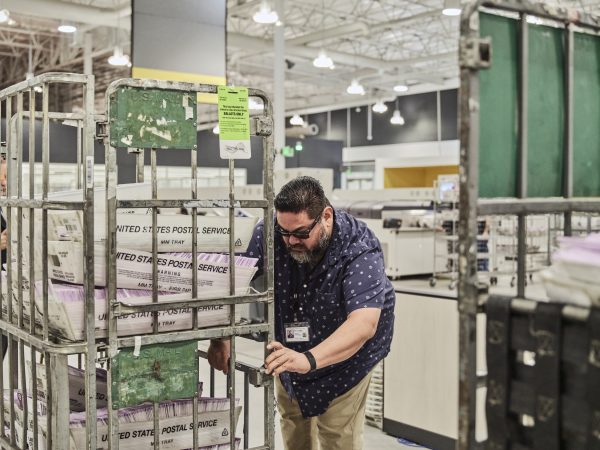
    Postmaster General David Steiner has said on multiple occasions, including to The New York Times this year, that he would follow court orders governing voting by mail.

    The agency had argued in filings before the decision that the court could not block the changes until it had finalized its rules and that the changes fell outside the scope of the legal settlement.

    The Postal Service has not responded to multiple requests for comment after recent court decisions that partially blocked Trump’s mail voting executive order and the Postal Service’s proposal to impose it.

    Under the 2021 settlement, the Postal Service agreed to take extra steps to expedite mail ballots for all even-year federal elections through 2028.

    William Hensley, a former election mail specialist at the Postal Service who helped establish those “extraordinary measures” while at the agency, said in an interview that they can include dispatching delivery trucks on extra trips, authorizing local postmasters to pay out employee overtime, and in some cases postmarking and turning around mail ballots locally rather than at regional processing centers.

    For this year’s midterm elections, the Postal Service said it will begin enforcing those measures Oct. 27, roughly a week before the midterms.

    This article originally appeared in The New York Times.

  • As Congress comes to Philadelphia, Josh Shapiro takes center stage in America 250 celebrations

    As Congress comes to Philadelphia, Josh Shapiro takes center stage in America 250 celebrations

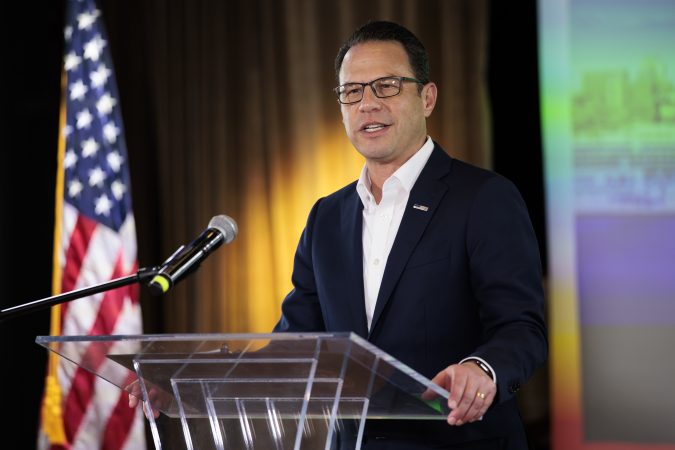
    Pennsylvania Gov. Josh Shapiro has a message for members of Congress when they convene at Independence Hall in Philadelphia on Thursday:

    This is the birthplace of democracy, and with it, comes the responsibilities that America’s founders left behind.

    “The founders made clear that we have a real responsibility to do the work to constantly perfect our union,” Shapiro said in an interview this week, ahead of his speech before the ceremonial meeting of Congress, marking 250 years since the Declaration of Independence was signed in that same building. “And that the Congress of the United States has a unique responsibility in that to be a check on the executive branch.”

    Those words come at a critical inflection point in America’s history, amid a tumultuous presidency, and as Shapiro is rumored to have aspirations of a White House bid in 2028. The first-term Democratic governor will appear before approximately 40 bipartisan members of Congress in Old City at the event convened by U.S. Rep. Brendan Boyle (D., Pa.), speaking to the lawmakers from across the country about their collective duty to the public. Shapiro will attend numerous other 250th celebrations across Philadelphia in the coming days, during which he said he plans to share his optimism for America’s future and deep concerns that President Donald Trump has led the nation astray from its founders’ design.

    “I don’t think patriotism belongs to one party. I don’t think it should ever be partisan,” Shapiro said. “Unfortunately, Donald Trump routinely divides us, routinely injects partisanship into his definition of patriotism, and his actions, in many ways, are the opposite of patriotism.”

    Assembly Room in Independence Hall (Pennsylvania State House) Monday, June 15, 2026. This is the exact space where the Second Continental Congress met and the Declaration of Independence was adopted.Tom Gralish / Staff Photographer

    As Trump plans to spend America’s 250th birthday hosting a political rally on the National Mall — with no plans to visit Philadelphia, the city where the nation was founded — Shapiro sees his own role as a unifier, and in direct contrast to Trump. As attention shifts to Philadelphia this weekend, he’ll appear on the national stage from sunup to sundown at events and on frequent TV hits — all with a home-turf advantage for his 2028 presidential prospects, as the governor of the nation’s quintessential swing state and also most important to the country’s founding.

    “[Celebrating the 250th] allow the spotlight to shine on Shapiro, even though it’s not entirely about him,” said Alison Dagnes, a political-science professor at Shippensburg University. “Do I think that helps his ambitions? Sure.”

    ‘Direct contrast’

    Sitting with Shapiro in his Harrisburg office earlier this week, it’s undeniable that he’s a history nerd — another reason why he was built for the moment.

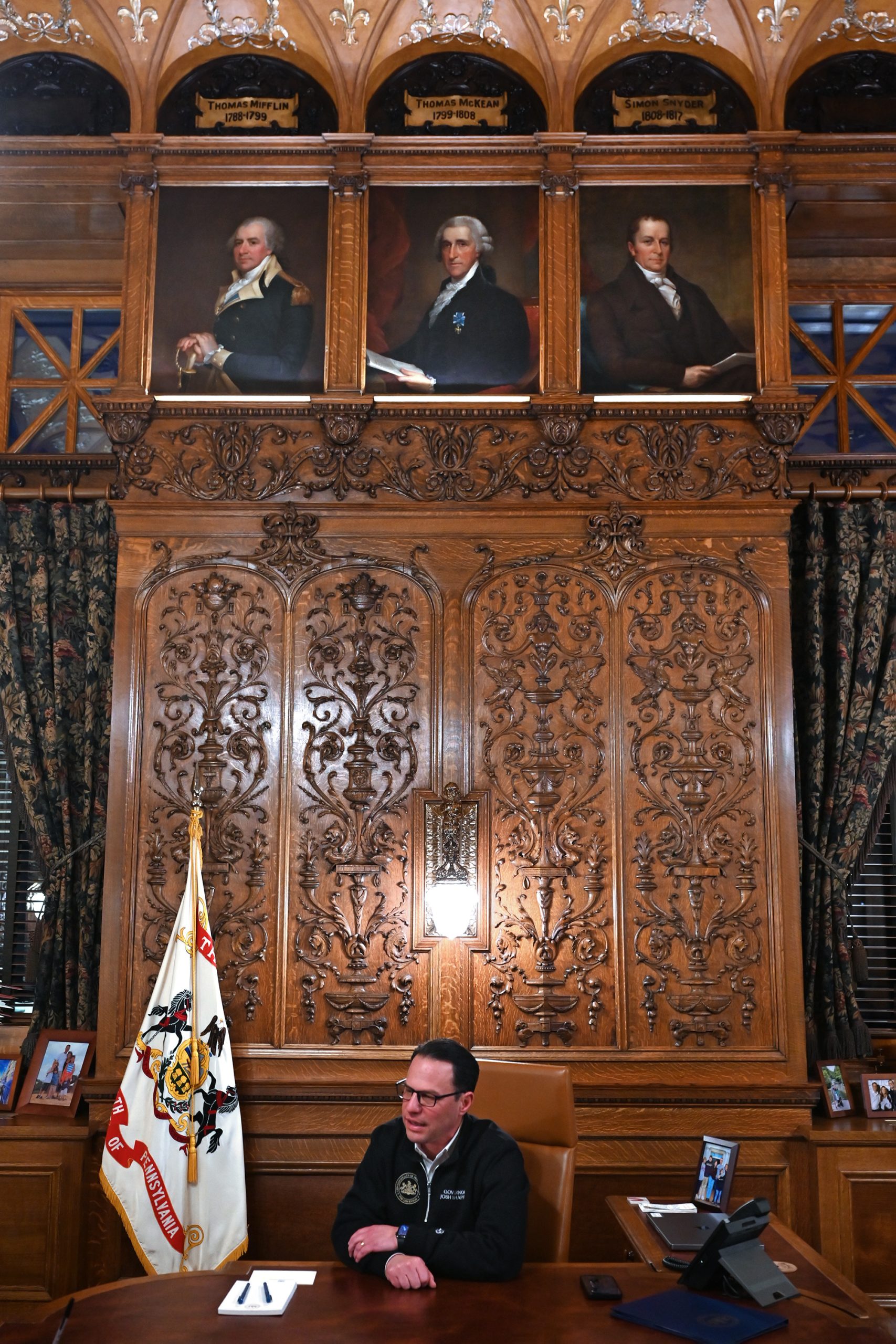
    He casually quotes segments of The Federalist Papers, and references his favorite story about Benjamin Franklin‘s fixation on a half-sun on the back of George Washington’s chair during the 1787 Constitutional Convention, which Franklin remarked during the U.S. Constitution signing that “it is a rising and not setting sun.” Without having to look for its location, he points to his right to a portrait of Franklin, one of his predecessors as governor of Pennsylvania, hanging on his office wall. He notes lesser-known Pennsylvanians who played an important role in the nation’s founding whom he plans to highlight over the coming days.

    “You know, I hate to quote a guy not from Pennsylvania,” Shapiro said, returning to The Federalist Papers to recite James Madison’s concerns about giving an executive too much power.

    Gov. Josh Shapiro in the Capitol in Harrisburg Feb. 21, 2023.Tom Gralish / Staff Photographer

    “If Madison were here today, he’d be really concerned about how one man has accumulated so much power and is wielding it in really dangerous ways, and I hope that at this 250-year mark we find our way back to that balance and back to the constraints on the people who lead our government,” he said.

    Shapiro sees his leadership style as a “direct contrast” to Trump’s, especially at this moment.

    “[Trump] restricts peoples’ freedom and liberties,” the governor added. “He whitewashes our history. That doesn’t further a sense of community, that doesn’t further patriotism. All that does is divide us, and I refuse to participate in that.”

    But for the next few days, Shapiro said his approach to the 250th celebrations is to: “Celebrate America, find ways to bring people together, and to have some fun in the process.”

    Fair games

    Despite his overtures of political unity, Shapiro has faced accusations from Republicans in recent days for playing partisan games over Pennsylvania’s participation in Trump’s 16-day Great American State Fair. Shapiro, in addition to several other Democratic governors last week, announced that Pennsylvania would not take part in the fair due to his administration being unable to secure any state businesses to sponsor the exhibit. Staffing and sponsoring the exhibit on the state’s dime would have cost $700,000 that would be better spent on in-state 250th events, he said this week.

    In the weekend that followed, Pennsylvania’s U.S. senators, Republican Dave McCormick and Democrat John Fetterman, made a push to fill the state’s empty exhibit. By Tuesday, it was filled with antique flags lent by a York County man, bags of potato chips from Snyder County, and a Christmas tree display from Fayette County, among other Pennsylvania-centric items.

    Pennsylvania’s pavilion showcases state history and memorabilia at the Great American State Fair on June 30, 2026, in Washington, D.C.Sam Janesch / Staff

    Some of the businesses originally told Shapiro’s office they didn’t have enough time to participate. But when McCormick and Fetterman approached them with the idea to fill the empty pavilion, they joined in.

    “They obviously had a change of heart at the last minute. That’s fine,” Shapiro said about the revived Pennsylvania pavilion.

    State Treasurer Stacy Garrity — Shapiro’s Republican challenger for governor, who has aligned herself with Trump — in a statement called Shapiro the “only career politician who has politicized America 250.”

    “Josh Shapiro put his political ambitions above his commonwealth and his nation when he pulled Pennsylvania out of the national celebration of our 250th birthday in a pitiful attempt to score cheap political points with the liberal wing of his party,” Garrity said.

    Beyond the 250th

    Shapiro’s strength as a politician has always been his ability to appear “harmonizing” and bringing people together, dating back to his days as a Montgomery County commissioner, Dagnes said.

    A careful politician, Shapiro is known to stick to his message and has faced criticism from some fellow Democrats for his well-rehearsed statements.

    When Shapiro delivers his messages of unity and freedom to a broader audience in the coming days, voters are likely to view them as authentic — one of the most important qualities to any presidential hopeful, she added.

    “If [California Gov.] Gavin Newsom is the guy who’s gonna punch Trump in the face, then Shapiro is going to be the guy who’s like, ‘No, let me offer you an alternative,’” Dagnes said.

    “It’s what he should be doing right now, because this is what America is about,” she added.