Category: Politics

  • Lawmakers slam Trump’s move to cancel $810M in funding approved by Congress

    Lawmakers slam Trump’s move to cancel $810M in funding approved by Congress

    Lawmakers blasted a plan by President Donald Trump to claw back more than $800 million in congressionally approved spending across the government, saying the president had no right to defy Congress in how he directs federal funding.

    The White House late Friday said it was taking a legally contested move to cut funding at federal agencies for a range of programs that direct government services toward immigrants, minority groups, climate change programs, and other issues. It was the latest bid by the Trump administration to assert sweeping control over the government and to trim congressional powers.

    Trump is using his authority under the Impoundment Control Act to do a “pocket rescission” of the funds, the White House said in a statement, a move it also used last year to cut nearly $5 billion in funding for foreign aid, the first time the maneuver had been used in nearly 50 years.

    The Supreme Court allowed the 2025 effort to proceed, though it did so by issuing a stay of a lower court’s ruling that the move was illegal and rested part of its justification on the president’s wide-ranging authority to act on foreign affairs. It held back from declaring that Trump was on solid legal ground. This year’s action is mostly focused on domestic spending.

    The largest slice of funding, $567 million, was clawed back from the Department of Health and Human Services, the White House said, saying that it was cutting money for programs that directed services toward refugees and asylum seekers that it said encouraged a flow of migrants to the United States.

    “These funds previously went to pro-illegal immigration programs and Non-Governmental Organizations that provided services to refugees, asylees, and other non-citizens and put unaccompanied children in harm’s way,” the White House said in its statement.

    Other cuts included an Education Department program for migrant students, a Justice Department program intended to reduce racial tensions in policing, and a Department of Housing and Urban Development program that funded housing counseling for minorities and immigrants.

    Congress typically needs to approve White House rescissions. The White House argues that submitting a rescission request near the Sept. 30 end of the fiscal year allows it to withhold the money until it expires, bypassing Congress.

    The House is out of session until November, while the Senate plans to adjourn in early October to allow lawmakers to campaign for the Nov. 3 midterm elections.

    Sen. Susan Collins (R., Maine), the chairperson of the Senate Appropriations Committee, and top Democratic appropriators have argued that the pocket rescission strategy is illegal. Russell Vought, director of the Office of Management and Budget, has pointed to a Government Accountability Office letter from the 1970s to argue that the strategy has precedent.

    Lawmakers of both parties condemned the move.

    “Without warning or consultation, Congress just received an $810 million package of pocket rescissions from the Administration. This is the most recent attempt by this Office of Management and Budget (OMB) to undermine Congress’s Constitutional power of the purse,” Collins said in a statement.

    Collins is running a tight race for reelection in November for one of the seats that will help determine which party controls the Senate.

    “The independent Government Accountability Office has concluded that pocket rescissions are unlawful and not permitted by the Impoundment Control Act,” she said. “I will work with my colleagues to address these illegal actions.”

    Collins’s Democratic counterpart also blasted the spending decision.

    “This is theft from the American people, plain and simple,” Sen. Patty Murray (D., Wash.), the top Democrat on the Appropriations Committee, said in a statement. “These are funds Congress has delivered on a bipartisan basis and should be helping people — not cut off by a president more focused on building a ballroom than investing in families.”

    Democratic appropriators unsuccessfully fought to bar the Trump administration from using pocket rescissions in their latest funding extension, Murray said. “Republicans refused to take common-sense action and prevent this from happening,” she said.

  • House Democrats plan vast oversight of Trump administration. Impeachment is an option

    House Democrats plan vast oversight of Trump administration. Impeachment is an option

    WASHINGTON — House Democrats are preparing a vast oversight agenda, with investigations of President Donald Trump, his family, and his administration if the party sweeps control of the chamber from Republicans in the November elections.

    The undertaking is as robust as it is daunting, spanning several House committees. With majority power comes bigger budgets and staff, and the ability to investigate, subpoena, and potentially course-correct what the Democrats say are widespread corruption and abuses of power. Impeachment of the Republican president and cabinet officials is not off the table.

    “There is a cost to the American people of the out-of-control corruption,” said Democratic leader Hakeem Jeffries of New York, who is in line to become House speaker if Democrats win control at the Capitol.

    “If folks have been stealing from the American people, shortchanging the American people, or screwing over the American people,” Jeffries said, “we are going to hold the crooks accountable.”

    Congress has enormous ability to conduct oversight of the executive branch as part of its power as a coequal branch of government, and a road map for the Democratic-run investigations has already been set by the almost daily letters lawmakers send to the administration and in amicus court filings.

    Democrats are asking about the money-making by Trump and his family, whose wealth has grown dramatically since he returned to the White House in January 2025. They are investigating the potential civil rights violations of Americans killed protesting U.S. Immigration and Customs Enforcement operations and of detained immigrants being deported to faraway countries. They have fought the closing of the Kennedy Center, launched investigations into private funding of the America at 250 celebrations, and tracked the shuttering of federal operations, including the U.S. Agency for International Development.

    New questions emerge daily, including the Trump family’s recent acknowledgment that a weekend wedding party for the president’s son Donald Trump Jr. was partly funded by a Russian oligarch, with reportedly close ties to the Kremlin.

    Rep. Jamie Raskin (D., Md.), who is in line to become the chairperson of the Judiciary Committee, characterized the issues involved as “gargantuan.”

    “We need to zero in quickly on the forms of systemic corruption that have cost the public huge amounts of money,” Raskin told the Associated Press, “and where there are legislative cures available.”

    Trump impeachments made history then. Could it happen again?

    Jeffries will almost certainly be under pressure from the far left to move more swiftly to articles of impeachment against Trump, who during his first term became the first president to be twice impeached by the House. Both times, he was acquitted by the Senate.

    Impeaching the president a third time may not hold the currency that it once did. Democrats will more likely focus their impeachment efforts on cabinet members. Defense Secretary Pete Hegseth already faces articles of impeachment from a Republican, Rep. Thomas Massie of Kentucky, over his leadership at the Pentagon and his management of the Iran war.

    “We haven’t ruled anything out,” Jeffries said recently about the tools available to Congress, “and we haven’t ruled anything in.”

    The White House is likely to play hardball if confronted with investigations, and Democrats are bracing for an administration that potentially ignores subpoenas or refuses to turn over paperwork that lawmakers are demanding.

    The Democrats are also reaching beyond the administration into various corporate and business entities for potential wrongdoing.

    ‘We’ll act like the Congress,’ says one Democrat in line to lead a committee

    Ranking Democratic lawmakers who are in line to lead committees if power shifts are beginning to chart the investigations they plan to tackle.

    Rep. Robert Garcia of California, the top Democrat now on the Oversight and Government Reform Committee, has outlined five priorities, including Trump family business dealings, the administration’s handling of the Jeffrey Epstein investigation, and ICE operations.

    “We’re already doing work,” Garcia told the AP.

    He also mentioned the Department of Health and Human Services under Secretary Robert F. Kennedy Jr., as well as broader allegations of corporate corruption.

    The top Democrat on the House Foreign Affairs Committee, Rep. Gregory Meeks of New York, whose jurisdiction includes the State Department, said the committee plans to investigate Trump’s international dealings, including around the Iran war.

    He expects the committee will also look into the administration’s Venezuela operations — from the military strikes on alleged drug boats in the Caribbean and Pacific waters to the U.S. partnership with a private company to develop and access the South American country’s oil.

    Rep. Jared Huffman of California, the ranking Democrat at the Natural Resources Committee, which overseas the Interior Department and its National Park Service operations, has begun digging into Trump’s “vanity projects,” including the demolition of the White House’s East Wing for a new ballroom and the president’s proposed arch.

    Huffman and other committee members have also been eyeing the Trump family’s role in various minerals deals.

    At the committee’s last session before lawmakers recessed to campaign for the midterm elections, Huffman said that if Democrats take charge, he plans to call witnesses, put them under oath, and follow the evidence where it leads.

    “When people ask what will we do,” he said he responds, “My answer is simple. We’ll use those tools. We’ll act like the Congress.”

  • Gov. Josh Shapiro’s administration will rescind Pa. disease-tracking proposal that reignited pandemic-era outrage

    Gov. Josh Shapiro’s administration will rescind Pa. disease-tracking proposal that reignited pandemic-era outrage

    Gov. Josh Shapiro’s administration will rescind a series of proposed vaccination and disease-tracking regulations that reignited public outrage toward restrictive pandemic-era policies in Pennsylvania — a decision made after receiving more than 10,000 comments opposing the changes, the Pennsylvania Department of Health said Friday.

    The department will withdraw the regulations, incorporate feedback, and resubmit the public health rules “once Pennsylvanians’ feedback has been adequately incorporated,” Neil Ruhland, a spokesperson for the department, said in a statement.

    Shapiro’s administration earlier this year submitted the proposed regulations aimed at combating infectious diseases to the Independent Regulatory Review Commission, a little-known board that assesses and approves new state regulations, requiring public input before they can be implemented. These regulations had been in progress for years, but were not introduced to the public until June 4.

    The public comment period coincided with a high-profile clash between Shapiro and U.S. Secretary of Health and Human Services Robert F. Kennedy Jr. over two infant deaths that Pennsylvania attributed to measles — the first deaths from the highly contagious and preventable disease in the state in 35 years. And it quickly refueled public disapproval of government mandates enacted during the COVID-19 pandemic.

    The 502-page proposed regulations would have expanded the state health department’s investigatory powers deemed necessary to track, prevent, contain, or mitigate a contagious disease. Republican state lawmakers and thousands of enraged constituents were especially concerned by a provision that would allow the state health department or local health authorities to enter schools or private properties to investigate alleged outbreaks or review vaccination records. They also criticized the health department’s effort to change references to a “pregnant woman” to a “pregnant individual” throughout the policy, claiming it was an effort to remove women from the state’s public health rules.

    The pushback comes at a time when federal health officials, under Kennedy, who has a history of anti-vaccine activism, have worked to reduce the number of childhood vaccination recommendations — and as childhood vaccination rates hit new lows in Pennsylvania. The effort has prompted Shapiro and other Democratic governors to sign executive orders to protect vaccine access. Setting vaccination mandates for schoolchildren falls to the states, not the federal government.

    The proposals rescinded Friday will not affect federal or state executive orders related to vaccination access.

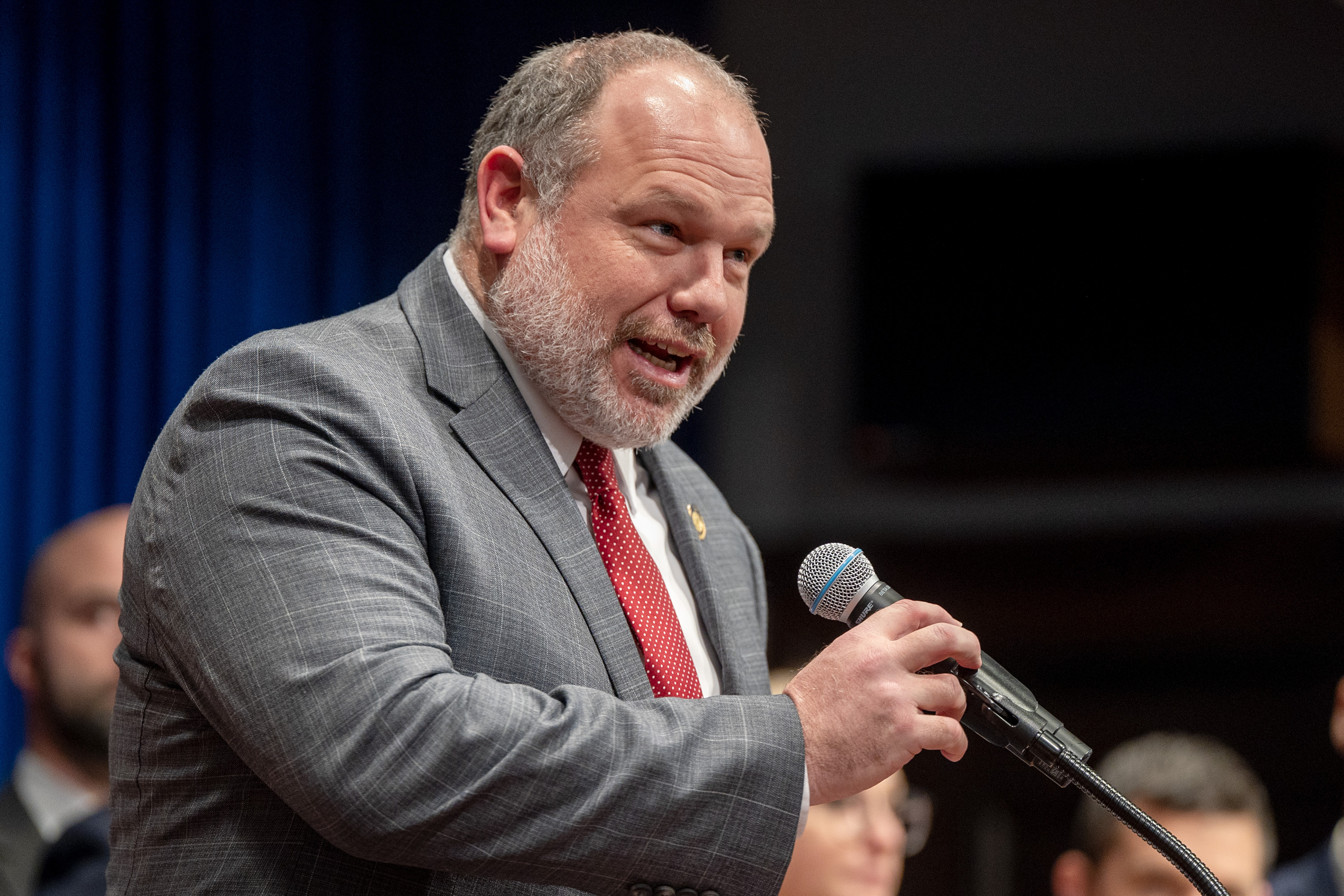
    State House Minority Leader Jesse Topper (R., Bedford) during a news conference at the Capitol in Harrisburg Feb. 3, 2026.Tom Gralish / Staff Photographer

    House Minority Leader Jesse Topper (R., Bedford) was among the first officials last month to raise alarm about the proposed regulations. In a statement Friday, he said it was the “correct and logical conclusion” for the health department, following the outpouring of public opposition.

    Senate Majority Leader Joe Pittman (R., Indiana) called Friday’s announcement “a tremendous victory for the grassroots efforts of Pennsylvanians.”

    ”This is a stark reminder that we must continue to be vigilant when the Executive Branch attempts overreach,” Pittman said in a statement. “We cannot and will not allow actions like we saw taken by the Executive Branch during the height of the COVID-19 pandemic to be put in place again.”

    Nearly all of the members of the Republican caucuses in Pennsylvania’s Senate and House submitted letters in opposition to the proposed regulations, arguing they were more restrictive than the ones enacted during the COVID-19 public health emergency and would infringe on Pennsylvanians’ constitutional rights.

    “The proposed regulations represent executive-branch overreach reminiscent of what we experienced during the COVID-19 pandemic — but this time, the rules would be permanent,” Senate President Pro Tempore Kim Ward (R., Westmoreland) said in a statement last week. “Every Pennsylvanian should understand these regulations and how they could impact their lives.”

    At least one Democrat — State Rep. Dan Frankel (D., Allegheny), who chairs the House Health Committee — submitted his support during the public comment period for updating the state’s existing communicable disease rules. Even so, his remarks recommended several changes to the proposed regulations, including to how the state would evaluate some vaccination exemptions to consider how children will be affected if their parent forgoes the preventive measures.

    Senate Minority Leader Jay Costa (D., Allegheny) said in a statement Friday he was looking forward to continuing the conversation about the regulations, adding that “public trust and buy-in is crucial to effective governance.”

    Beth Rementer, a spokesperson for House Democrats, said Friday that Shapiro’s administration was “acting responsibly” by considering public opinion.

    “After all, that’s how government is supposed to work,” Rementer said.

    Shapiro’s administration has rescinded at least 11 other regulation proposals since taking office in 2023, according to administration officials. But a deluge of feedback is rare, and most proposed regulations receive around five public comment submissions, a Shapiro administration official said.

    Monday was the final day for public comment submissions. As part of their opposition campaign, Republican lawmakers encouraged their constituents to voice their opinion as part of public comment. By the end of the day, the review commission had received more than 10,000 comments opposing the regulations.

    “The Department of Health received a historically high volume of feedback during the public commentary period, and it is clear additional stakeholder input is needed,” Ruhland said in the statement.

    Shapiro, a Democrat, is seeking reelection in November. His GOP challenger, State Treasurer Stacy Garrity, has criticized Shapiro over the proposed regulations, calling them “mandates that would make draconian COVID-era restrictions blush.”

    On Friday, Garrity celebrated the regulation withdrawal, and in a statement called Shapiro “the least transparent governor in America” who “got caught trying to sneak a 502 page invasion of privacy and parental rights through.”

    A spokesperson for Shapiro declined to comment Friday, deferring to the state health department.

  • Josh Shapiro and Gretchen Whitmer, potential 2028 rivals, meet at Philly diner to boost Democrats ahead of midterms

    Josh Shapiro and Gretchen Whitmer, potential 2028 rivals, meet at Philly diner to boost Democrats ahead of midterms

    Pennsylvania Gov. Josh Shapiro and Michigan Gov. Gretchen Whitmer, stopped by a Bella Vista diner on Friday morning to pump up Democratic volunteers to turn out voters, with less than six weeks until the high-stakes midterm elections in both of their swing states.

    On the menu: Electing Democratic candidates to Pennsylvania’s four nationally-watched U.S. House seats that could determine control of Congress, and flipping the state Senate to Democratic control for the first time in more than 30 years.

    Shapiro is also seeking a second term as Pennsylvania’s Democratic governor this November, and maintains a sizable polling and fundraising advantage over his Republican opponent, state Treasurer Stacy Garrity.

    “I know we’re in a moment of tumult right now, where chaos and cruelty and corruption is just enveloping our lives. The good news is in 39 days, you’ve got the power to change that,” Shapiro told the group of a couple dozen volunteers from voter protection groups. Servers at Sam’s Morning Glory Diner, wearing T-shirts with messages condemning President Donald Trump and supporting former Vice President Kamala Harris, whisked by with plates of omelettes and pancake stacks.

    Gov. Josh Shapiro talks to patrons alongside Michigan Gov. Gretchen Whitmer out in the back patio of Sam’s Morning Glory Diner in South Philadelphia on Friday, Sept. 25, 2026. Shapiro is canvassing to get Pennsylvania Democrats elected up and down the ballot as the midterms are upcoming in November. He wants to flip the state Senate for Democrats to take back control. Whitmer is present to support Shapiro’s re-election campaign.Aidan T. Gallo / Staff Photographer

    Shapiro also assured voters that elections in Pennsylvania will be conducted fairly and accurately, following a CNN report that Trump’s Department of Justice is sending a surge of election monitors to oversee polling locations.

    “We’re prepared again in court, and we’re also prepared should they try and bring personnel into certain communities, particularly minority communities, to try and intimidate people, make it harder for people to vote, or make them worried about showing up to vote,” he said.

    State election officials are coordinating with the Pennsylvania National Guard, the Pennsylvania State Police and local law enforcement to protect voting access, he said.

    “We will do everything in our power to stop Donald Trump from interfering with this election and ensure, whether you vote by mail or you vote in person, you will have access to the ballot box, and it will be protected,” he said.

    Gov. Josh Shapiro meets with patrons alongside Michigan Gov. Gretchen Whitmer inside Sam’s Morning Glory Diner in South Philadelphia on Friday, Sept. 25, 2026. Shapiro is canvassing to get Pennsylvania Democrats elected up and down the ballot as the midterms are upcoming in November. He wants to flip the state Senate for Democrats to take back control. Whitmer is present to support Shapiro’s re-election campaign.Aidan T. Gallo / Staff Photographer

    Whitmer is nearing the end of her second term as Michigan’s governor, and like Shapiro, has been floated as a contender in the 2028 Democratic presidential primary.

    The two have been coy about any future pursuits. Shapiro has demurred on his ambitions for higher office, saying he’s focused on his reelection, though he’s also said he will “be a part of that conversation” about who Democrats should nominate for president. Whitmer previously said she had no plans to run in the Democratic presidential primary in 2028 but later walked it back, saying “never say never.”

    But on Friday in South Philadelphia, there were no signs of rivalry. Whitmer said she was in town to help support Shapiro’s reelection effort. Shapiro praised Whitmer, saying she has been a guiding light for the kind of governor he wanted to emulate.

    Whitmer, Shapiro said, is ”someone I have looked up to, someone who knows how to get stuff done in her state, and someone who I think leads with integrity, with purpose, with drive and determination.”

    The two appeared together publicly last year at an Eagles-Lions football game at Lincoln Financial Field, as part of what Whitmer called a friendly rivalry between the NFC championship contenders.

    Pennsylvania Governor Josh Shapiro (right) and Michigan Governor Gretchen Whitmer before the Eagles played the Detroit Lions at Lincoln Financial Field on Sunday, Nov. 16, 2025, in Philadelphia, PA.Yong Kim / Staff Photographer

    During the 2024 presidential election, Shapiro also visited Michigan to stump alongside Whitmer for Harris’ campaign.

    On Friday, Whitmer called Shapiro a “good friend and colleague.”

    “When Washington, D.C. is making life harder — whether it’s through tariffs or a war in Iran that’s jacking up the price of everything — it’s the governors that are protecting our rights, that are making sure we keep more money in our pockets. It’s the governors who are solving problems,” she said. “You got one of the best in the country.”

    After talking with patrons, Shapiro said he planned to sit down with Whitmer to eat something at the restaurant. Featured on Sam’s Morning Glory Diner menu on Friday: “Shapiro 2026″ and “2028 sausage, eggs and gravy.”

    Shapiro did not elaborate on his order.

  • Supreme Court lets Trump administration use revamped federal voter eligibility database for now

    Supreme Court lets Trump administration use revamped federal voter eligibility database for now

    NEW YORK — The Supreme Court on Friday lifted restrictions on a controversial federal voter database before November’s elections, granting President Donald Trump a temporary win in his aggressive campaign against noncitizen voting.

    The court’s three liberal-leaning justices publicly dissented from the decision.

    The emergency order allows states, for now, to use the Department of Homeland Security program, called Systematic Alien Verification for Entitlements, or SAVE, in their efforts to verify the eligibility of voters on their rolls.

    States’ use of the SAVE program is voluntary. The immediate impact on the upcoming midterms is likely limited because existing law blocks most states from systematically purging voters from their rolls within 90 days of an election, said David Becker, an election law expert who leads the Center for Election Innovation and Research.

    He said since the program is voluntary and DHS itself has admitted the data is not perfect, “states may find this to be a useful tool used along with other tools to keep their lists up-to-date.”

    The court’s order puts on hold a federal judge’s June ruling that had deemed the Republican administration’s recently revamped version of SAVE illegal. U.S. District Court Judge Sparkle L. Sooknanan had blocked the use of the tool, saying it violated Americans’ privacy rights and could result in voters being wrongly removed from the rolls.

    A federal appeals court let her order stand.

    But the Supreme Court majority found that a 1996 law explicitly allows DHS to get information about citizenship and immigration from other federal agencies. The federal government also has “an obligation to respond” to states seeking to verify citizenship.

    “The order below prevents the Federal Government from using the program it believes is best suited to the task,” the majority wrote in the unsigned order.

    Justice Ketanji Brown Jackson dissented, joined by Justices Elena Kagan and Sonia Sotomayor. The database has long been seen to fall under federal privacy laws, she wrote, and there are real risks that legitimate voter registrations could be mistakenly revoked.

    “The harm caused by burdening or disenfranchising even a few lawful voters outweighs the nonexistent harm that the Government experiences when it is prevented from taking an action that it likely lacks the authority to take,” Jackson wrote.

    The plaintiffs and counsel team in the case called the ruling “profoundly disappointing” and said it puts “millions of Americans at risk of being unlawfully targeted by the administration’s unreliable voter purge database” before the midterms.

    “However, this case is not over,” their statement read. “The D.C. district court ruled that the expanded SAVE program violated multiple laws. We will be doing everything in our power to protect Americans’ voting and privacy rights by ensuring that the district court decision stands.”

    The White House did not immediately respond to a message seeking comment.

    The SAVE program was created under an immigration law mandating that DHS help federal, state, and local agencies prevent government benefits from going to noncitizens. The Trump administration last year moved to significantly expand its search abilities. Since then, at least 67 million registrations have been scanned through the program, but critics worry it could end up purging valid voters from the rolls.

    Some registrants have already been wrongly flagged. In Travis County, Texas, for example, officials said they investigated 97 voters flagged by SAVE as apparent noncitizens and found that at least 10% of them — and likely up to 21% — were U.S. citizens. The county urged the Supreme Court to reject the administration’s appeal, while the state of Texas submitted its own brief defending the database.

    Even though the use of the SAVE program has been blocked for months, the administration said in court filings that DHS officials have continued using Social Security Administration data “in certain cases to verify information and help determine whether illegal voting may have occurred.”

    DHS in August launched its own investigation to find noncitizen voters on state rolls, according to a federal whistleblower statement that said the effort is rushed, filled with errors and potentially violates state laws. DHS has defended that investigation as being conducted “diligently and professionally.”

    The effort to create a national voter list is among numerous steps Trump has taken during his second term to try to overhaul the way elections are run. Most of those steps have been blocked by various courts, in part because the Constitution gives states and Congress the authority to set election rules, but provides no such power to the president. In mid-September, the Supreme Court rejected a bid from Trump to restrict mail ballot procedures before the midterms.

    Research shows that noncitizen voting, which is already illegal and punishable as a potential felony that could lead to deportation, is exceptionally rare. But Trump has remained fixated on the idea that massive numbers of noncitizens are voting in U.S. races.

  • Welcome to the home stretch | PA 2026 Newsletter

    Welcome to the home stretch | PA 2026 Newsletter

    📅 There are 39 days until Election Day.

    Welcome to the heart of election season.

    Pennsylvania is — once again — at the center of the political universe, and our team is set to bring you the latest as we cover the final stretch of the campaigns from Philadelphia to Washington, D.C. and across Pennsylvania. We’re focusing on the competitive U.S. House races, the battle for the governor’s mansion, and legislative districts across the Keystone State as Democrats fight for control in Harrisburg and in Congress.

    🎤 I’m Sam Janesch, The Inquirer’s national political reporter. I’ll be your host this week as we dig into how Pennsylvania’s always-newsworthy Democratic senator is inserting himself into a campaign season where he’s not even on the ballot. We also have a first look at an unusual new spending effort on behalf of U.S. Rep. Brian Fitzpatrick, who is fighting to keep his seat as the last Republican representing the region in Congress, and new insight into Gov. Josh Shapiro’s polling and money advantages.

    In this edition:

    🗳️ A Democrat in name only: For the first time, a plurality of likely Pennsylvania voters view U.S. Sen. John Fetterman negatively.

    🗳️ Close to home: Fitzpatrick is the least loyal House Republican to President Donald Trump, but he’s still overwhelmingly aligned with the president and his party.

    🗳️ Is this thing on?: Republican Stacy Garrity remains largely unknown in the state, even to a quarter of GOP voters, as Democratic Gov. Josh Shapiro’s lead continues to grow.

    — Sam Janesch, Michelle Baruchman, Fallon Roth, Gillian McGoldrick (pa2026@inquirer.com)

    The latest

    • Pennsylvania voters are giving President Donald Trump worse grades on economic issues as the midterms near. And as gas prices hit $4.55 in Philadelphia, even his 2024 supporters are unhappy.
    • Shapiro has raised $60 million for his reelection, but any leftover money can’t be directly transferred to a 2028 presidential campaign — not that he has declared his candidacy for one, anyway.
    • Only one Pennsylvania Republican received a video shoutout from Trump in his Truth Social endorsement dump last week — and it’s the candidate with perhaps the longest shot of winning. Trump called Garrity “really special,” while slamming Shapiro as a governor who “does not have what it takes.” Meanwhile, U.S. Rep. Ryan Mackenzie is still counting on Trump’s support to help him win in the Lehigh Valley.
    • Outside the midterm elections, another type of political campaign was underway to free convicted former Philadelphia labor leader John Dougherty, widely known as Johnny Doc, from prison. But it was a group of Republicans, including Trump, who ultimately aided the longtime Democratic power broker’s release.

    Data dive

    📊 U.S. Sen. John Fetterman has come a long way from the Bernie Sanders-loving, progressive populist that made him a political sensation starting about a decade ago — at least according to the Pennsylvania voters who elevated him to national prominence.

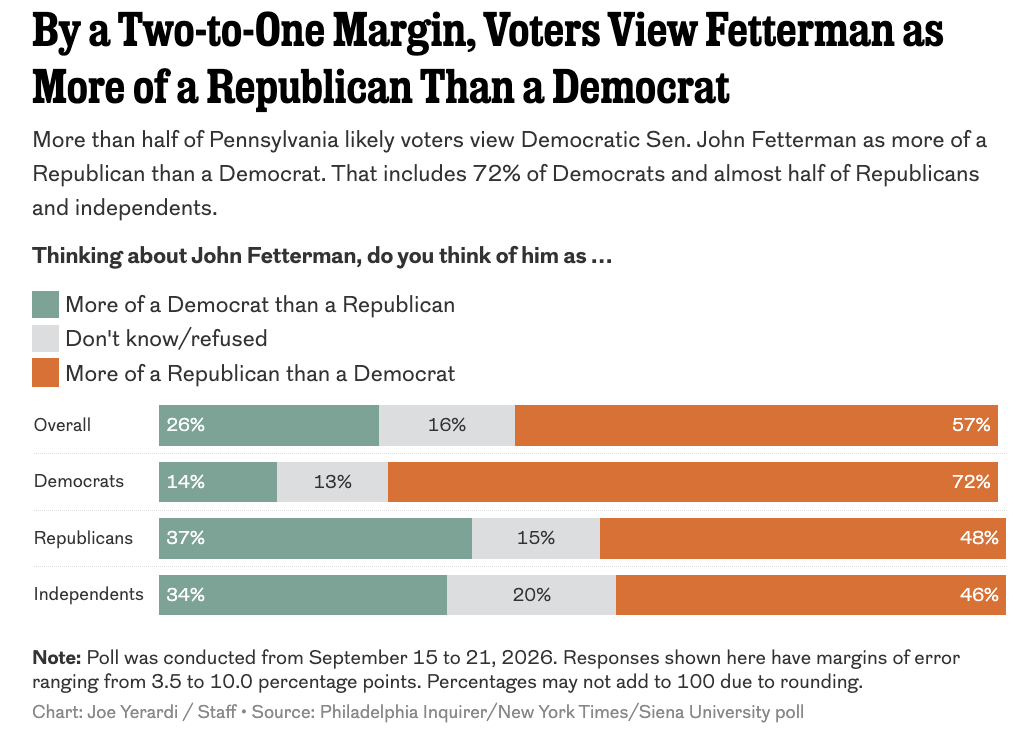
    Four years after his election to the U.S. Senate, a majority of the state’s likely voters think of him as a Republican, according to a new poll conducted by Siena University on behalf of The Inquirer and the New York Times.

    Our polling data shows nearly three-quarters of Democrats think of Fetterman as a Republican. About half of Republicans feel the same way.

    Even though Fetterman has said he will not change parties, that perception could have major implications. Democrats need to net at least four seats to capture the Senate majority starting in January. If they win a slim majority, Fetterman’s wildcard nature could be a roadblock as the party looks to act as a check on Trump in the final two years of his term.

    Democrats in Washington aren’t sweating it. Well, at least not publicly.

    “No,” U.S. Sen. Kirsten Gillibrand, a New York Democrat and chair of the Democratic Senatorial Campaign Committee, said quickly when The Inquirer asked her this week if she or her colleagues are concerned about Fetterman’s role in a narrow majority.

    “I’m very grateful that Sen. Fetterman is serving in the U.S. Senate as a Democrat, and I think he will continue to do so,” Gillibrand said.

    Campaign scrapple

    📺 Exclusive: A top environmental organization is throwing $250,000 toward new digital ads and a mail program supporting Fitzpatrick as he fends off a challenge from Democrat Bob Harvie in the swingy Bucks County-based congressional district that could prove key to flipping party control of the House this fall.

    Fitzpatrick is the only House GOP candidate currently receiving ad support from EDF Action Votes, a super PAC that supports the goals of the Environmental Defense Action Fund.

    US Rep Brian Fitzpatrick speaks during the Garden of Reflection remembrance ceremonies as his opponent, Bob Harvie (3rd from right) listens Friday, September 11, 2026 at Garden of Reflection in Yardley, Pennsylvania.William Thomas Cain / For The Inquirer

    Historically Democratic-aligned groups, like environmental orgs and labor unions, have felt comfortable continuing — or offering new — support for Fitzpatrick despite a national political landscape that has become increasingly unfavorable for Republicans. The Bucks County lawmaker has been known to separate himself from his conference and is the least loyal House Republican to Trump and his party.

    But, according to our recent analysis, he’s still on the president and the GOP’s side most of the time.

    👀 What we’re watching

    🔴 The Pennsylvania Republican Party’s state committee will meet in Pittsburgh this weekend. The committee cleared the field for Garrity as the party’s nominee by endorsing her last September. But since then, she’s struggled across the board — with fundraising, in polls, and more. Politics reporter Michelle Baruchman will be there, hoping to hear from attendees about the party’s outlook heading into November.

    📩 Mail ballots have already begun hitting mailboxes across Pennsylvania, with nearly 14,000 already returned.

    📬 A total of 999,280 mail or absentee ballots have been requested as of Thursday, Sept. 24, according to Pennsylvania Department of State data.

    • The breakdown:

    Quote of the week

    Shapiro, Pennsylvania’s incumbent Democratic governor, is up 21 points over Garrity, according to a new poll conducted by The Inquirer, the New York Times, and Siena University. He also announced a $13.3 million haul this summer and $31 million spent — far outpacing Garrity’s $1.8 million total raised and $1.5 million spent since June.

    As Levy says, Shapiro is highly favored to win in November, with Cook Political Report shifting the race to “Solid Democrat,” just two years after Trump won the state.

    👋 All this election news, and can you believe we still have more than a month to go? You can follow The Inquirer politics team’s coverage here, and we’ll see you in your inbox next Friday.

    By submitting your written, visual, and/or audio contributions, you agree to The Inquirer’s Terms of Use, including the grant of rights in Section 10.

  • New Jersey Lt. Gov. Dale Caldwell resigns after investigation found sexual harassment and other wrongdoing

    New Jersey Lt. Gov. Dale Caldwell resigns after investigation found sexual harassment and other wrongdoing

    New Jersey Lt. Gov. Dale Caldwell has resigned after investigators found “credible evidence” of sexual harassment and other wrongdoing.

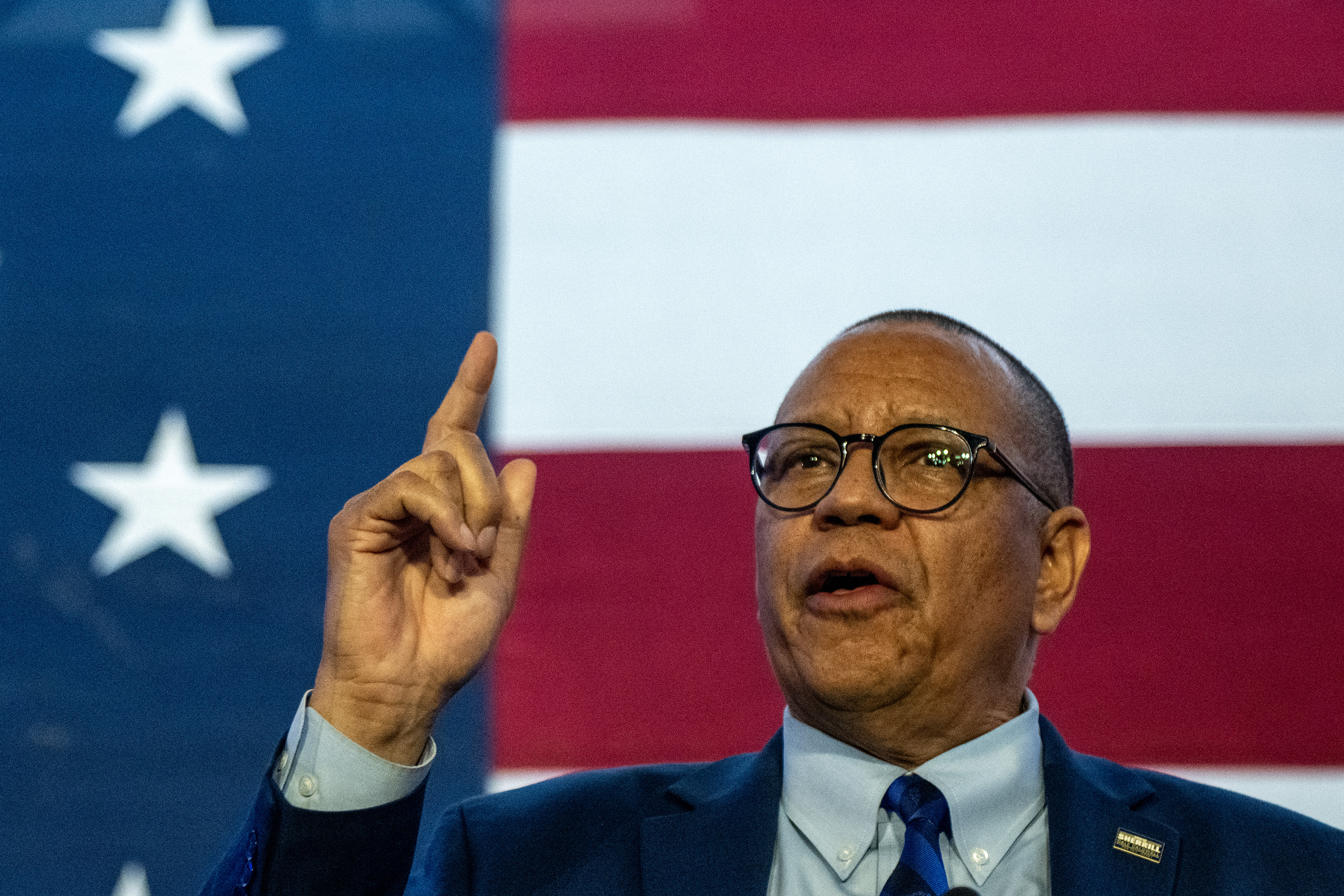
    Gov. Mikie Sherrill announced his resignation at a news conference Friday afternoon after calling for him to step down while releasing the investigative report Thursday evening.

    “His decision will allow us to move forward with important work serving the people of our state,” said Sherrill, who was inaugurated with Caldwell by her side in January.

    “I will move swiftly and thoughtfully in choosing a new lieutenant governor who will represent my administration and the people of New Jersey with honor and integrity.”

    The governor released a 61-page report from a monthlong investigation conducted by an outside law firm late Thursday afternoon. The report said Caldwell made inappropriate comments to women and violated ethics rules. Caldwell, a minister, is the former president of Centenary University.

    Sherrill called for him to resign by Friday, but it was unclear whether he would listen. Caldwell denied the investigation’s findings through his attorney, who argued Caldwell was not given an opportunity to meaningfully address the accusations in the report or provide his own witnesses.

    Sherrill emphasized Friday that she wanted to “make sure everyone was treated fairly and justly” and called the investigation thorough and impartial.

    “After I received the report and the facts were clear, I took action right away,” Sherrill said, in what may have been a nod to earlier criticism that she didn’t confirm the investigation while it was underway. “Let me be clear: all credible allegations of misconduct must be fully investigated and addressed. In my administration, we are committed to doing what is right, not what is politically expedient.”

    The investigation found Caldwell hit on a female staffer’s friend, and when she turned him down, he told the staffer that ambitious women like them needed a man in a position to help them, “but you young women are looking for young sperm.”

    Caldwell denied making the comments, “but we did not find his denial credible,” the report said.

    Replacing Caldwell

    Sherrill did not have the power to fire Caldwell, so his resignation prevents potential impeachment proceedings in Trenton. The governor has 45 days to pick his replacement.

    In the meantime, New Jersey Senate President Nicholas Scutari will lead the state in her absence. Sherrill traveled to campaign for Democrats in congressional races in other states earlier in the summer, leaving Caldwell in charge. But she stopped after the investigation became public knowledge.

    Sherrill said she spoke to Caldwell on Thursday and texted with him on Friday, and that he resigned to let her administration continue with its agenda amid “all of the attacks from the federal government on affordability, voting rights.”

    Caldwell’s attorney, Thomas Calcagni, said in a statement late Friday that his client continues to dispute the allegations in the report and would be exploring “all legal remedies” to contest its findings.

    “We continue to forcefully challenge the report. Dr. Caldwell’s resignation, submitted to put an end to the targeted campaign to discredit his character, does not in any way diminish our outrage concerning the investigative process and its specious findings,” Calcagni said.

    As fragments of the allegations leaked out over the weeks, some of Caldwell’s friends and allies shared messages of support about his character and record of service. And while he did not speak publicly as news of the investigation surfaced, a May letter he wrote to the ethics commission forcefully denying the claims — and alleging racism — was leaked to media.

    On Friday, a group of self-described Black “faith, civic, and community leaders” commended his decision to resign.

    “By choosing to step down and ending this controversy, he has put the interests of the people of New Jersey and the work of our state ahead of himself,” the group said in a statement, which included U.S. Rep. Bonnie Watson Coleman (D., Mercer), New Jersey Democratic Committee Chair LeRoy Jones, among others.

    Democratic state legislators remained largely quiet before Caldwell announced his resignation, but many were relieved to see Caldwell step down.

    Assemblymember Anthony Angelozzi, a Burlington County Democrat, said he was “appalled” with the findings of the report.

    “The idea of using your government position for personal benefit and harassing women, as someone who has staff members who are female and a daughter, I wouldn’t want to put any woman in a compromised position like that,” he said.

    Assemblymember Balivir Singh floated another Burlington County Democrat, State Sen. Troy Singleton, as an ideal replacement for Caldwell.

    “You look for a person with integrity … and I would think my senator is the best,” Singh said.

    As lieutenant governor, Caldwell served a dual role as the state’s top election official. With his resignation less than 40 days before the midterm election, Sherrill appointed Acting Comptroller Shirley Emehelu to serve as secretary of state on an acting basis.

    “For months at this point, the Department of State team has been hard at work preparing for the upcoming elections in partnership with local and county election officials. I will make sure their work proceeds as planned,” Emehelu said.

    The investigation into Caldwell was conducted by former Attorney General Christopher Porrino — who worked under former Republican Gov. Chris Christie — and his law firm. The probe had been going on since at least May.

    Road crews had begun removing Caldwell’s name from state signs on I-95 as of Friday, but the scandal is still likely to dominate New Jersey politics for the foreseeable future.

    Christine Giordano Hanlon, chair of the New Jersey GOP, called Sherrill’s handling of the investigation a “failure.”

    “Caldwell’s resignation is not accountability for everything that happened before it,” she said. “There are many more questions that will need to be answered.”

    ‘Long-term concerning behavior’ outlined in report

    Sherrill said the report “lays out a pattern and practice of long-term concerning behavior.” She said her decision shows the “culture change” she has pushed for in Trenton.

    “What was so important to me was to make sure that if there are substantiated claims of sexual harassment and ethics violations, that I, as the leader of the government, handle that,” she said.

    “There has been a culture in Trenton, probably since the birth of our nation, to sweep this under the rug,” she said. “You can speak to numerous people who’ve worked in the statehouse for decades who felt this day would never come, that allegations would never be taken seriously, action would never be taken, and victims would just have to either quit their job or move on.”

    According to the report, less than a month after being spoken to and given training on workplace conduct and ethics, and four days after he was told about the investigation, Caldwell tried to get a promotion for a state employee he was dating.

    Caldwell’s attorney said the lieutenant governor forwarded the employee’s resume and did not disclose the two had a personal relationship.

    The report also details comments Caldwell allegedly made about wanting a “first lady.” One staffer said he asked her to find him someone and another recalled him suggesting that he would need a wife in order to run for governor and to let him know if she comes across someone suitable. Caldwell admitted to making comments to staffers about wanting a “first lady” but said he wasn’t serious and other people in the office made similar kinds of jokes, the report said.

    He also repeatedly made comments about staffers having “executive appearance,” which came across to some staffers as a judgment on women’s physical attractiveness. Caldwell said the term was about how both men and women carry themselves, not physical appearance, the report said.

    Caldwell repeatedly brought personal guests to ticketed events without clearing it with the ethics officer and without paying for the extra tickets, a practice that continued even after warnings, attending an ethics training, and being told about the investigation, the report said. His attorney said when Caldwell “learned that reimbursement was appropriate in one particular situation, he reimbursed $175 for the event.”

    He was also accused of providing his business card to women he wanted to date, but he said in his May letter that he gives his business card to more men than women.

    “I have never asked anyone out on a date, ‘hit on,’ or pursued anyone romantically while conducting official business as Lieutenant Governor and Secretary of State,” he said at the time.

    Staff writers Susan K. Livio, Sarah Nicell, and Lacey Latch contributed reporting.
  • ‘Data senator’ ad prompts Frank Farry to send a cease-and-desist letter to his Democratic challenger in Bucks County

    ‘Data senator’ ad prompts Frank Farry to send a cease-and-desist letter to his Democratic challenger in Bucks County

    Bucks County Republican State Sen. Frank Farry’s campaign this week demanded his Democratic challenger take down an advertisement attacking Farry for his position on data centers and air an apology instead, calling the commercial “defamatory” and “demonstrably false.”

    Shohin H. Vance, an attorney representing Farry’s campaign, called for Democrat Eileen Hartnett Albillar to remove the ad and issue a 30-second retraction advertisement, according to an eight-page letter sent Wednesday and reviewed by The Inquirer.

    Harnett Albillar’s ad calls Farry a “data senator” and says he is “the data center industry’s number one fan.” The ad also accuses the Republican lawmaker of voting for data center tax breaks in Harrisburg and notes that Farry’s law firm represents NorthPoint, a real estate company which redeveloped the Keystone Trade Center in Falls Township — the soon to be home of an Amazon data center.

    “The Advertisement, which accuses my client of abusing his public office for his own pecuniary interest, is not only misleading — it is demonstrably false,” Vance wrote in the letter.

    The dispute signifies how AI data centers have become a politically toxic issue as candidates from both parties distance themselves from supporting their development.

    Farry’s 6th State Senate District is one of a handful of competitive seats being targeted by Pennsylvania Democrats in hopes of flipping the state Senate and delivering a Democratic trifecta in Harrisburg.

    Hartnett Albillar’s campaign said Friday it has no plans to stop running the ad.

    “His temper tantrum won’t silence this campaign or stop Eileen from fighting to make Bucks County more affordable,” campaign manager Leigh Stafford said in a statement.

    The Farry campaign, in the letter, rejected the notion that Farry or any clients at his law firm — including NorthPoint — benefitted or profited from Farry’s vote in 2021 to support Act 25. The legislation allows computer data center equipment to be exempt from Pennsylvania’s sales and use tax if it’s being used or sold to a certified data center by a valid owner, operator, or tenant.

    “The vote did not, and could not, benefit the client, and none of it put a dollar in Senator Farry’s pocket,” Vance wrote.

    Farry was serving in the state House at the time and did not raise a conflict of interest on the floor. When asked about this, he said in a statement: “I didn’t raise a conflict on the House floor in 2021 BECAUSE I DO NOT REPRESENT DATA CENTERS.”

    The campaign emphasized in its letter that Farry’s law firm, Begley, Carlin & Mandio, has not represented a data center operator in at least 20 years.

    “To be sure, the Keystone Trade Center is now also the site of a data center, and its developer, NorthPoint, is a client of Begley Carlin. But NorthPoint is not a data center, and the fact that it leases a portion of its 1,800-acre site to a data center operator does not make it one,” Vance wrote.Begley Carlin has represented NorthPoint since July 2020.

    Farry has been with Begley Carlin since 2011, but he said in a statement that he has “not done much work at all” for the firm “as my time is filled with being a State Senator, our local volunteer fire chief, a dad to two young kids, and a husband who among other things recently supported my wife through a two year battle with breast cancer.”

    Adam C. Bonin, an attorney representing Hartnett Albillar’s campaign, wrote in a response to Vance Friday that: “We will neither cease nor desist from engaging in this truthful, accurate speech.”

    Bonin highlighted NorthPoint’s close proximity to the Bucks County data center project, including mentions of the company in Falls Township press releases and in news articles. Bonin also argued that the 2021 state House bill, which Farry supported “made this an attractive deal for NorthPoint and Amazon to make. Without them, perhaps Amazon would have stayed out of Bucks County altogether.”

    “While Senator Farry might not like seeing the truth displayed in such an unflattering way, the advertisement’s statements are amply supported by Farry’s legislative record, his law firm’s own website, official Falls Township records and copious news reporting,” Bonin wrote.

    This is not the first legal dustup to happen in a Bucks County race this election cycle. Last month, Democrat Bob Harvie, a county commissioner challenging GOP U.S. Rep. Brian Fitzpatrick in the 1st Congressional District, filed a defamation lawsuit against a super PAC supporting the Republican. The suit argued that the PAC falsely claimed Harvie was under FBI investigation.

    That followed two cease-and-desist letters: one to the PAC and another to the Fitzpatrick campaign.

    Staff writer Gillian McGoldrick contributed to this article.

  • Supreme Court lets Trump administration use revamped federal voter eligibility database for now

    Supreme Court lets Trump administration use revamped federal voter eligibility database for now

    NEW YORK — The Supreme Court on Friday lifted restrictions on a controversial federal voter database before November’s elections, granting President Donald Trump a temporary win in his aggressive campaign against noncitizen voting.

    The emergency order allows states, for now, to use the Department of Homeland Security program, called Systematic Alien Verification for Entitlements, or SAVE, in their efforts to verify the eligibility of voters on their rolls. But because existing law blocks most states from systematically purging voters from their rolls within 90 days of an election, the immediate impact on the upcoming midterms is likely limited.

    States’ use of the SAVE program is voluntary.

    The court’s order puts on hold a federal judge’s June ruling that had deemed the Republican administration’s recently revamped version of SAVE illegal. U.S. District Court Judge Sparkle L. Sooknanan had blocked the use of the tool, saying it violated Americans’ privacy rights and could result in voters being wrongly removed from the rolls.

    A federal appeals court declined to pause Sooknanan’s ruling, prompting the administration’s appeal to the Supreme Court.

    The SAVE program was created under an immigration law mandating that DHS help federal, state and local agencies prevent government benefits from going to noncitizens. The Trump administration last year moved to significantly expand its search abilities. Since then, at least 67 million registrations have been scanned through the program, but critics worry it could end up purging valid voters from the rolls.

    Some registrants have already been wrongly flagged. In Travis County, Texas, for example, officials said they investigated 97 voters flagged by SAVE as apparent noncitizens and found that at least 10% of them — and likely up to 21% — were U.S. citizens. The county urged the Supreme Court to reject the administration’s appeal, while the state of Texas submitted its own brief defending the database.

    Even though the use of the SAVE program has been blocked for months, the administration said in court filings that DHS officials have continued using Social Security Administration data “in certain cases to verify information and help determine whether illegal voting may have occurred.”

    DHS in August launched its own investigation to find noncitizen voters on state rolls, according to a federal whistleblower statement that said the effort is rushed, filled with errors and potentially violates state laws. DHS has defended that investigation as being conducted “diligently and professionally.”

    The effort to create a national voter list is among numerous steps Trump has taken during his second term to try to overhaul the way elections are run. Most of those steps have been blocked by various courts, in part because the Constitution gives states and Congress the authority to set election rules, but provides no such power to the president. In mid-September, the Supreme Court rejected a bid from Trump to restrict mail ballot procedures before the midterms.

    Research shows that noncitizen voting, which is already illegal and punishable as a potential felony that could lead to deportation, is exceptionally rare. But Trump has remained fixated on the idea that massive numbers of noncitizens are voting in U.S. races.

  • Andy Kim and Cory Booker call on N.J. lieutenant governor to resign after report finds evidence of sexual harassment

    Andy Kim and Cory Booker call on N.J. lieutenant governor to resign after report finds evidence of sexual harassment

    New Jersey’s two senators in Washington echoed Gov. Mikie Sherrill’s call for Lt. Gov. Dale Caldwell to resign just hours after she released a report that said he sexually harassed a woman and made advances to others even after he was warned to stop.

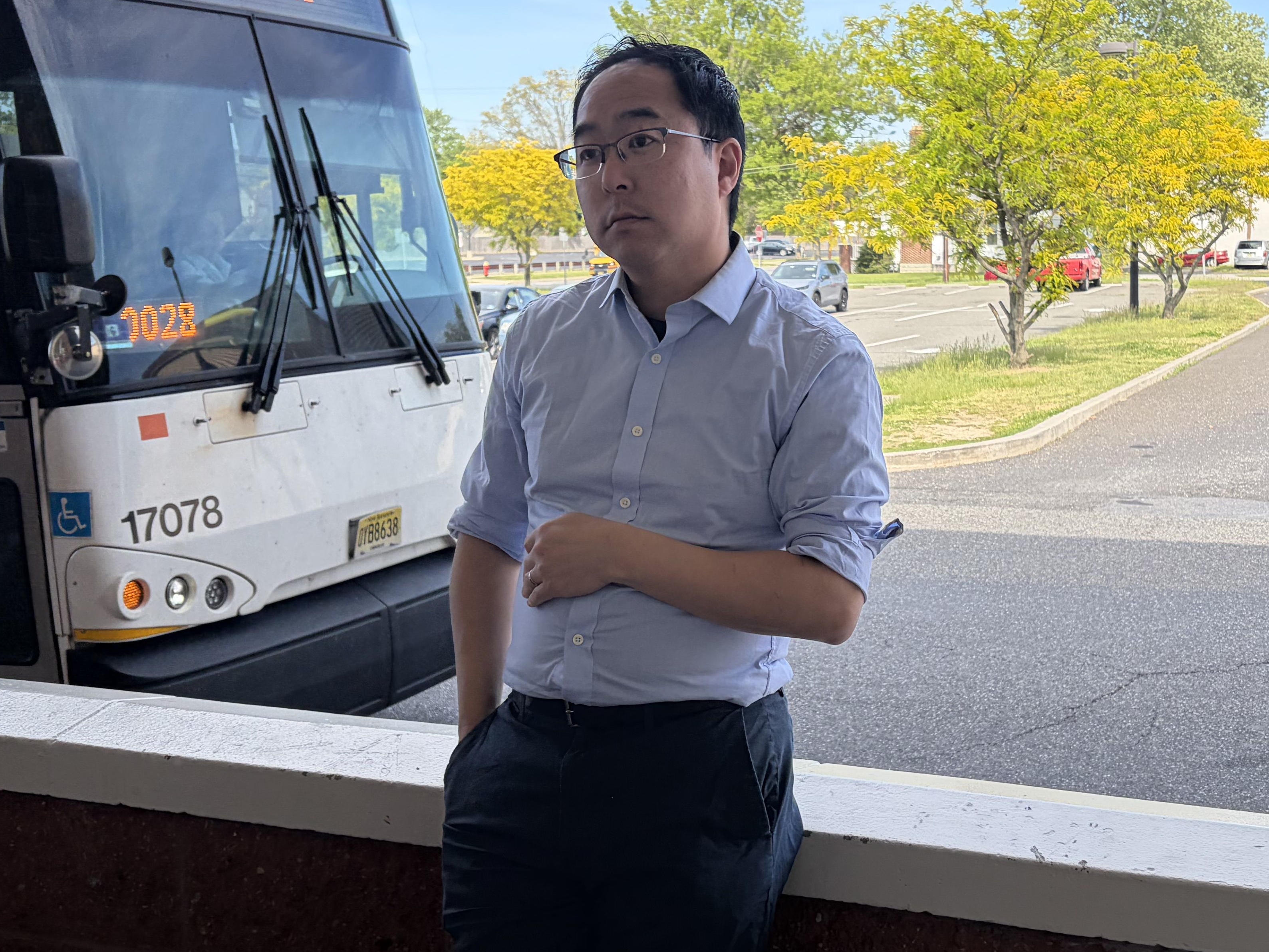
    Sen. Andy Kim, a Burlington County Democrat, said in a statement on social media that the lieutenant’s governor was “unacceptable” based on the findings in the 61-page report based on a months-long investigation by an outside law firm.

    “New Jerseyans deserve to have public servants who work to earn and keep their trust, not undermine it,” Kim said.

    “The Lt. Governor should resign immediately,” he added.

    Sherrill’s office released the documents Thursday evening in her first acknowledgement of the investigation into Caldwell, who has denied the findings of the report.

    Sherrill said Caldwell “engaged in serious, repeated violations of state policy and failed to uphold the responsibilities of his office.”

    The governor called on Caldwell to step down from his post as her No. 2 by Friday, but statements from his attorneys show no indication he plans to adhere to that request. He’ll likely face increasing pressure over the course of the day.

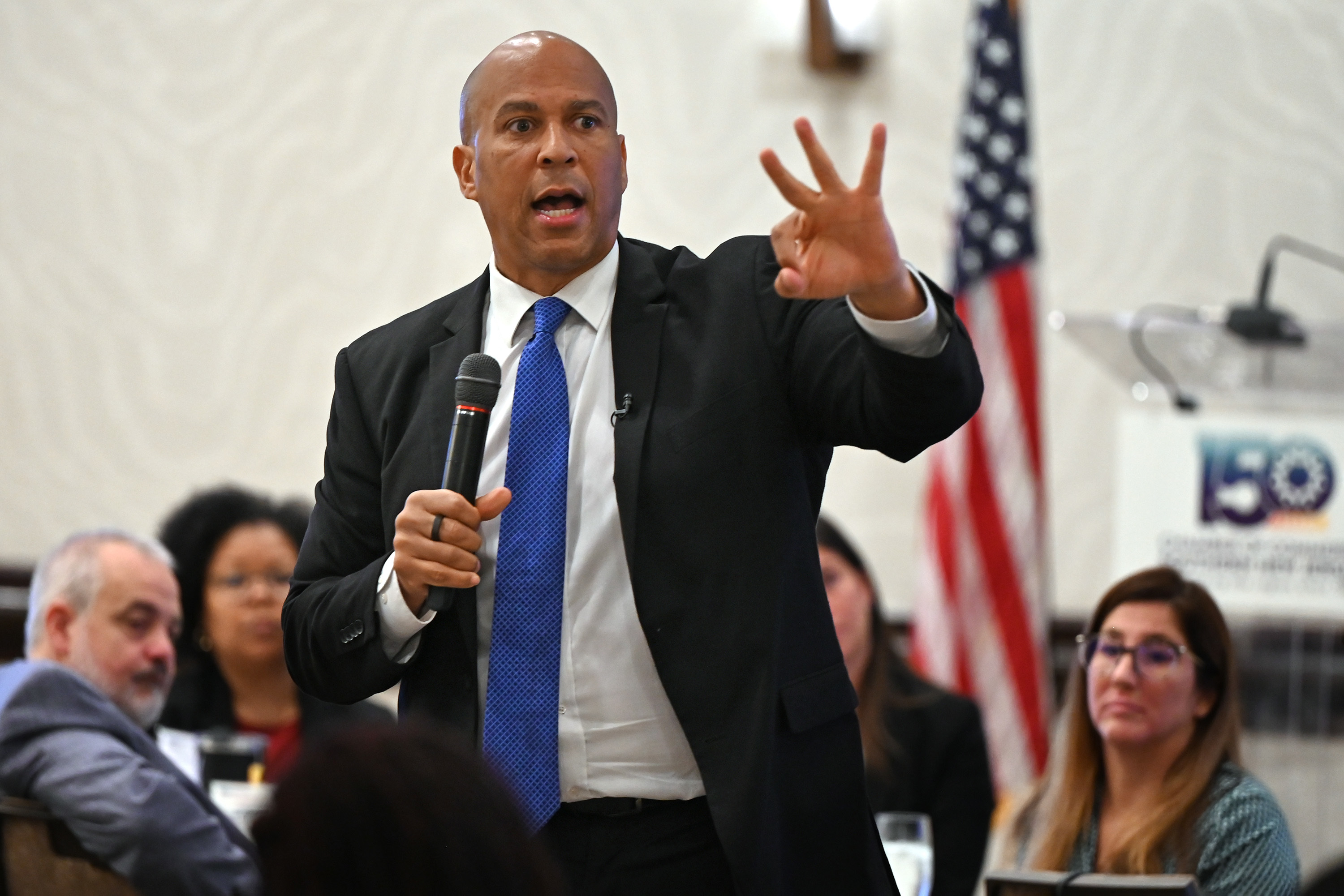
    USE AS DESIRED: U.S. Sen. Cory Booker addresses members of the Chamber of Commerce of Southern New Jersey in Mt.Laurel Aug. 29, 2023.Tom Gralish / Staff Photographer

    Sen. Cory Booker, a Newark Democrat, said Caldwell should resign “for the sake of our state” in a statement on social media.

    “Governor Sherrill is absolutely right the conduct described in the investigative report is totally unacceptable,” he said.