Category: Politics

  • Trump poised to restart tariff campaign, using provision on forced labor

    Trump poised to restart tariff campaign, using provision on forced labor

    The Trump administration is expected as soon as this week to introduce permanent new tariffs to replace the temporary import penalties it imposed after the Supreme Court earlier this year abruptly upended President Donald Trump’s trade strategy.

    The first batch of new tariffs is expected to affect 60 nations that the administration said in June were importing goods produced using forced labor, putting higher-paid American workers at a disadvantage.

    Nations that do not prohibit such goods would face tariffs of 12.5%, while those that have such laws but fail to enforce them would be hit with 10% levies, under a proposal that Jamieson Greer, the president’s chief trade negotiator, made public last month. The president could adjust those numbers before taking final action on what are called “Section 301” tariffs.

    Those tariffs would fill the gap left by the scheduled expiration at 12:01 a.m. Friday of a stopgap measure that Trump introduced in February after the nation’s high court invalidated levies he imposed last year under the 1977 International Emergency Economic Powers Act.

    In response, Trump used a different legal authority to levy a 10% tariff, limited to just 150 days. Now those tariffs are lapsing.

    Forced to start his tariff campaign anew, Trump appears eager to pull every lever of trade power he can identify, using laws considered less vulnerable to challenge than the rushed approach he employed last year. Some are well-established weapons in major laws dating to 1962 and 1974. Others, like his use this week of an untested 1930 law to challenge Canada, reflect his unquenchable desire to test legal limits.

    “The specific authorities this administration is using have changed but the trade strategy has not,” Greer told the Senate Finance Committee on Wednesday.

    Indeed, the president’s goal of greater domestic manufacturing has remained constant since he entered the political arena more than a decade ago. Through tariffs, he aims to encourage manufacturers to invest in new American factories rather than import foreign products.

    In his Senate testimony, Greer said the administration is making progress. The trade deficit through the first five months of the year is down by almost 4%, according to Commerce Department data. The United States is exporting more merchandise and — rather than buying foreign consumer goods — is importing machinery needed to equip new factories that will employ American workers, he said.

    The administration has used tariff pressure to secure 10 so-called reciprocal trade arrangements, which pried open some foreign markets while cementing in place higher U.S. tariffs. Broader trade and investment accords have been reached with the United Kingdom, Japan, and the European Union.

    “They’ve gotten a number of trade agreements that they otherwise would not have,” said Blake Harden, managing director of Washington Council EY, a consultancy. “The way that they used [the International Emergency Economic Powers Act] really resulted in commitments by trading partners that the U.S. has been seeking for quite some time, both on tariffs and nontariff barriers.”

    Yet U.S. factories employ 75,000 fewer workers than when Trump returned to the White House. And despite administration denials, tariffs are aggravating inflation, according to a recent study by the Federal Reserve Bank of Dallas. Without tariffs, the Fed’s preferred inflation measure would have risen at an annual rate of 2.3% in March, instead of its actual 3.2% figure, the Dallas bank said.

    Meanwhile, Trump’s insistence on using the International Economic Emergency Powers Act (IEEPA) to impose his initial round of tariffs in April 2025 — which permitted him to take immediate action — has had far-reaching consequences. After the Supreme Court disallowed his use of the law in February, the administration was required to refund tariffs it had illegally charged importers, an amount the Cato Institute estimated at more than $170 billion. Through the end of June, the government had paid out more than $71 billion, U.S. Customs and Border Protection told a federal judge this month.

    As Trump has sought to rebuild his tariff wall, he has turned instead to Section 301 of the Trade Act of 1974. In addition to pursuing the forced-labor tariffs, the administration is probing 16 nations it says deliberately maintain excess production capacity, leading to a global glut of low-cost products. Some of the largest U.S. trading partners — including China, the European Union, Japan, Mexico, South Korea, and India — subsidize manufacturing at the expense of U.S. producers, the administration says. New levies could result from that probe within weeks.

    The latest flurry of tariff activity began with the imposition earlier this month of 25% tariffs on Brazilian goods, which the administration said was a response to Brazil’s “unfair” trade practices.

    On Tuesday, the president took to social media to announce a 100% tariff on imported generic drugs, effective Aug. 1, 2028, and rising to 200% one year later.

    And on Monday, he cited an untested 1930 trade law to threaten 50% tariffs on Canadian products, which would take effect in 30 days.

    In addition, the Commerce Department has a number of open investigations under Section 232 of the Trade Expansion Act of 1962, which authorizes the president to impose 25% tariffs on national security grounds.

    And Trump could get new tariff powers under a Russian sanctions bill in the Senate that would empower him to levy 100% tariffs on major importers of Russian oil. Business groups such as the National Foreign Trade Council oppose the provision, fearing that Trump would stretch those powers in unforeseeable ways. China, India, and the EU could be at risk of punishing trade taxes if the legislation is approved.

    The administration’s renewed legal maneuvering will arm the president for future trade negotiations, including ongoing talks over revisions to the U.S.-Mexico-Canada Agreement, and equip him to respond when domestic industries seek protection, said John Veroneau, a U.S. trade negotiator under President George W. Bush.

    “The steps they’re taking to get their legal house in order does not necessarily mean that they’re gearing up for massive levels of new tariffs. I think it does suggest they need to get their legal house in order and want to have flexibility to act in targeted ways as they see fit,” Veroneau said.

    Still, this month’s spate of tariff news has left importers and foreign governments scrambling to keep pace.

    “There’s a little bit of whiplash in terms of keeping track of the various duties on Brazil, France, Russia, Canada, you know, the hits just keep on coming,” said Jake Colvin, president of the NFTC, which represents companies such as Coca-Cola, Google and IBM. “It feels like the administration is trying out every tool in its toolbox to come up with new tariffs.”


  • The city plans to pay up to $75,000 to help measure the economic impact of Philly’s major events in 2026

    The city plans to pay up to $75,000 to help measure the economic impact of Philly’s major events in 2026

    When Mayor Cherelle L. Parker faced questions about spending on Philadelphia’s Fourth of July concert, she promised a “fiscal impact report” that would help determine how the economic benefits of the concert and other major events in Philadelphia during 2026 compared with their cost to city taxpayers.

    It turns out the city will have to spend a bit more taxpayer money to get to the bottom of that inquiry.

    The finance department is looking to hire a consulting firm for up to $75,000 to provide “economic analysis services to better understand the economic and fiscal impact of Philadelphia’s 2026 events and related activity on the local economy,” according to a contract opportunity posted on the city’s website last week. Responses are due Aug. 5.

    The contract solicitation calls for an evaluation of “event-related visitation, tourism activity, and associated economic activity” and estimates of “state and local tax revenues generated by event-related economic activity,” among other things. But it does not ask the consultant to produce an accounting of the city’s spending on those events.

    Andrew Richman, a top attorney in the city law department, said the administration will also produce an analysis of the city’s spending related to the major events hosted in Philly during 2026, including the nation’s 250th birthday, FIFA World Cup games, and the MLB All-Star Game.

    Fans celebrate after Mexico scores against South Africa while watching the FIFA World Cup opening match on a giant screen during the opening day of the FIFA Fan Festival at Lemon Hill on Thursday, June 11, 2026, in Philadelphia.Jose F. Moreno / Staff Photographer

    “As a standard operating procedure in the Parker administration, there will be financial accounting that details every dollar and cent spent on 2026-related activities, analysis including all expenses, and economic impact of all activities and investments associated with 2026,” Richman said.

    The mayor’s office did not respond to a request for comment on when that accounting will take place.

    Parker’s administration this year took over management of the July Fourth concert and fireworks show on the Ben Franklin Parkway, which for years had been handled by the nonprofit Welcome America, a public-private partnership created by the city in the 1990s.

    Parker instead hired ESM Productions, a for-profit company led by well-known concert producer Scott Mirkin, and renamed the event the “One Philly: Unity Concert for America,” a version of her slogan, “One Philly: A United City.”

    Pennsylvania Governor Josh Shapiro and Philadlephia Mayor Cherelle L. Parker at the One Philly: Unity Concert for America on the Benjamin Franklin Parkway on Saturday, July 4, 2026, in Philadelphia.Yong Kim / Staff Photographer

    The changes resulted in a much more expensive concert than in years past. The city agreed to pay ESM about $15.5 million to put on the show, The Inquirer reported after obtaining the contract. The previous year’s concert cost Welcome America about $3 million, a source with knowledge of the event told The Inquirer.

    Those sums did not include costs related to city employees, such as sanitation workers and overtime for police officers who worked the event.

    Inclement weather, including extreme heat in the afternoon and a thunderstorm that disrupted the concert for hours in the evening, limited attendance at what Parker had hoped would be a major event.

    The city’s coming analyses, however, will include all of 2026’s major events, not just the concert.

    Parker has said her administration will spend $120 million on this year’s celebrations, and she has pledged to ensure communities across Philadelphia, not just Center City, benefit from the investment, which includes beautification projects in neighborhood commercial corridors and funding for block parties and events across the city. The administration has not yet provided details on how much was dedicated to the concert or any other specific event this year.

    “At the end of our celebration, you will be able to see an accounting of how that $120 million was spent,” Parker said at a July 1 news conference.

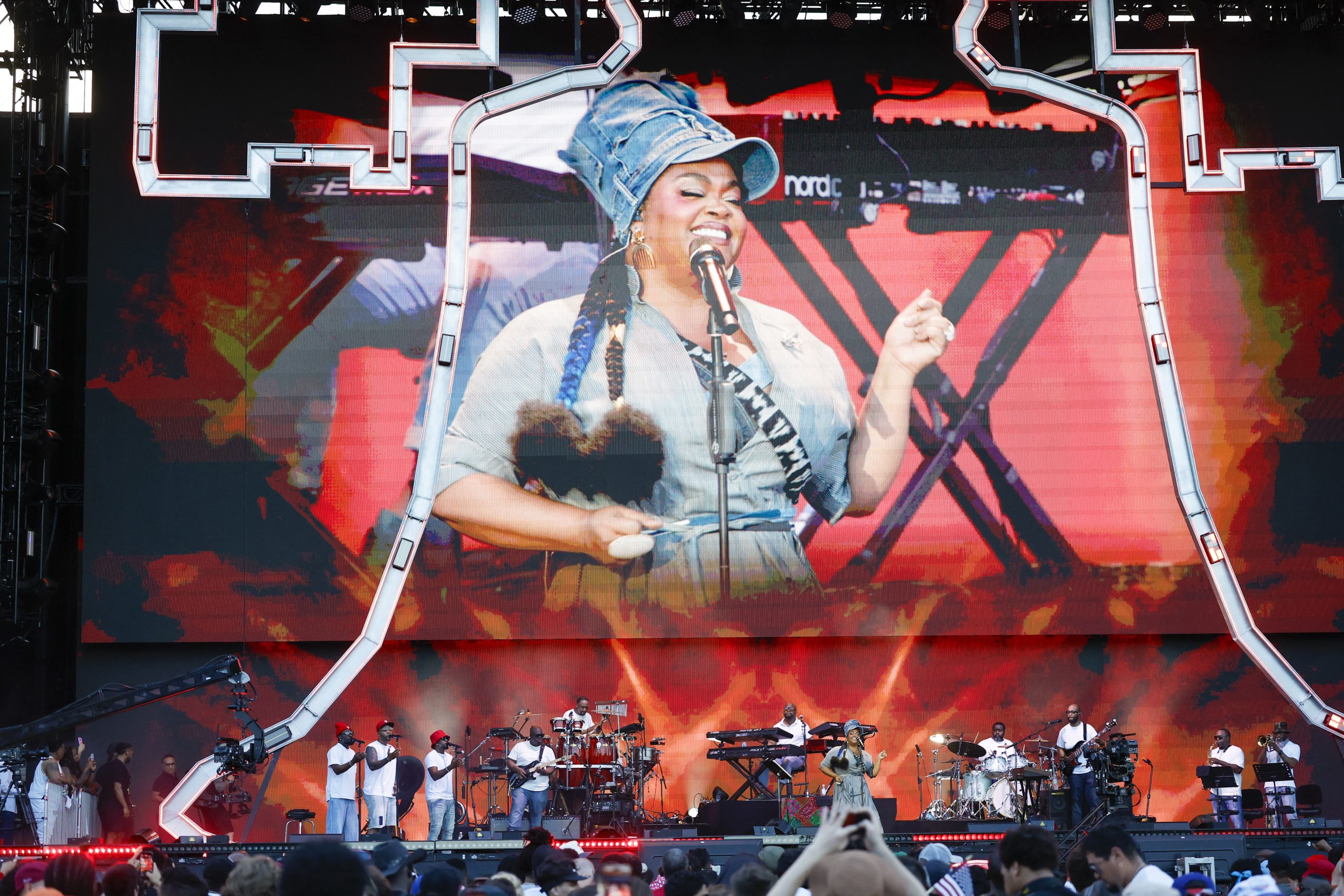
    Jill Scott takes to the stage for One Philly: Unity Concert for America on the Benjamin Franklin Parkway on Saturday, July 4, 2026, in Philadelphia.Yong Kim / Staff Photographer

    Economic impact analyses produced by paid consultants often include rosy estimates that public officials use to justify priorities. Academics who study their work for years have cited issues including inflated assumptions for visitors’ spending and understated or omitted opportunity costs for economic activity displaced by a large project or event.

    “Most economic impact studies are commissioned to legitimize a political position rather than to search for economic truth,” John L. Crompton, a professor at Texas A&M University, wrote in an influential 2006 paper published in the Journal of Travel Research. “Often, this results in the use of mischievous procedures that produce large numbers that study sponsors seek to support a predetermined position.”

    This year’s July Fourth concert was supposed to be headlined by Christina Aguilera, but the pop star ended up not taking the stage after the city paused the event around 9 p.m. due to the storm. The show resumed shortly after midnight, pushing the fireworks to about 2:30 a.m. July 5.

    Parker’s office on Wednesday did not respond to a request for comment on whether the city would receive any refund in light of Aguilera not performing.

    All other scheduled performers went ahead with their sets, including the Roots, Jill Scott, Meek Mill, DJ Jazzy Jeff, and Will Smith, who said Parker reached out to him personally to ensure he came back after the weather delay.

  • A democratic socialist surges in a swing-state primary

    A democratic socialist surges in a swing-state primary

    MADISON, Wis. — As a democratic socialist running for governor in a state Donald Trump won twice, Francesca Hong knew early on that she had doubters.

    She knew it before her critics highlighted her past calls to abolish the police. She knew it before Republicans started spending $2 million to get her through the Democratic primary because they viewed her as a weak opponent. And she knew it before Wisconsin’s outgoing Democratic governor backed a candidate to try to halt her surge in support.

    “It’s a huge flex for us when I get to go and talk to people, especially when there’s so much skepticism right now around my favorite e-word — electability — and, you know, are we for real?” Hong told two dozen supporters, some in “Hotties for Hong” T-shirts, before they knocked on doors for her on a recent Saturday morning.

    Few doubt that her campaign is for real. She’s getting clicks like no one else in the field of five primary candidates. She has locked up support from national figures, inspired the base, and rattled establishment Democrats. And she’s riding high after democratic socialists and progressives won recent primaries in Colorado, New York, and Washington.

    Hong, 37, wears Air Jordans and friendship bracelets, sings karaoke at campaign events, and talks to voters about her love of the Milwaukee Bucks and the need to wallop millionaires with higher taxes. She initially lagged behind her opponents in fundraising, but she has seen a recent burst of donations, including some that came after she appeared on controversial liberal streamer Hasan Piker’s show.

    Hong, a third-term state representative from Madison, is betting she can thrive in a state where Sen. Bernie Sanders (Ind., Vt.), a self-described democratic socialist, won 71 of 72 counties in 2016’s Democratic presidential primary. While progressives have claimed recent victories around the country, Rep. Greg Stanton (D., Ariz.) easily fought off a primary challenge Tuesday from a democratic socialist.

    If Hong wins the Aug. 11 primary, she will next test whether democratic socialists can find support beyond the nation’s urban centers and win a general election in one of the most closely divided states in the country.

    Her backers don’t want her to moderate her call for systemic change if she wins the primary.

    “We can’t keep settling for crumbs,” said Sam Lies, a 61-year-old pharmaceutical representative who is volunteering for Hong’s campaign.

    On the campaign trail, Hong talks about reimagining what government can do, as well as her experience growing up as the child of South Korean immigrants and the challenges she faces as a single mom trying to pay her bills. She recently settled a $30,000 lawsuit over her credit card debt, and she works occasional shifts as a chef and bartender after closing her ramen restaurant two years ago.

    Hong is campaigning on “permanent affordability” and a new way of running the state. She wants to more than double the income tax on millionaires and many businesses, provide free school lunches to all students, subsidize childcare, set the minimum wage at $20 an hour, ban police officers from cooperating with U.S. Immigration and Customs Enforcement in many cases, establish a public bank and public grocery stores, put a one-year freeze on building data centers, protect doctors who provide gender transition care, expand union rights, legalize marijuana, and end the state’s school voucher program.

    “I will not weakly accept the sellout of Wisconsin to trillionaires, billionaires and big tech,” she told attendees at the Democratic Party’s state convention last month.

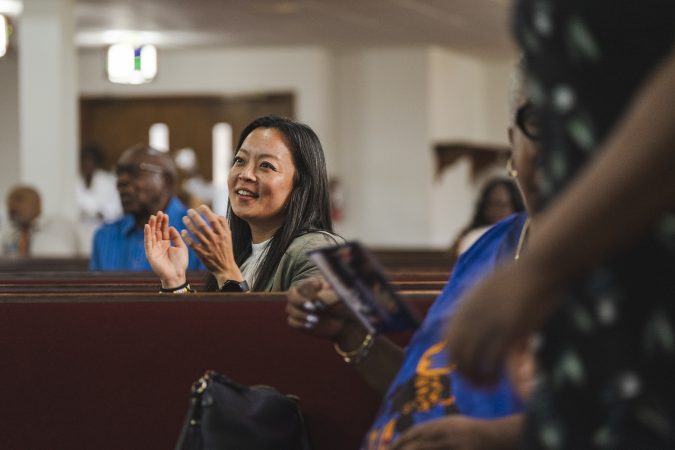
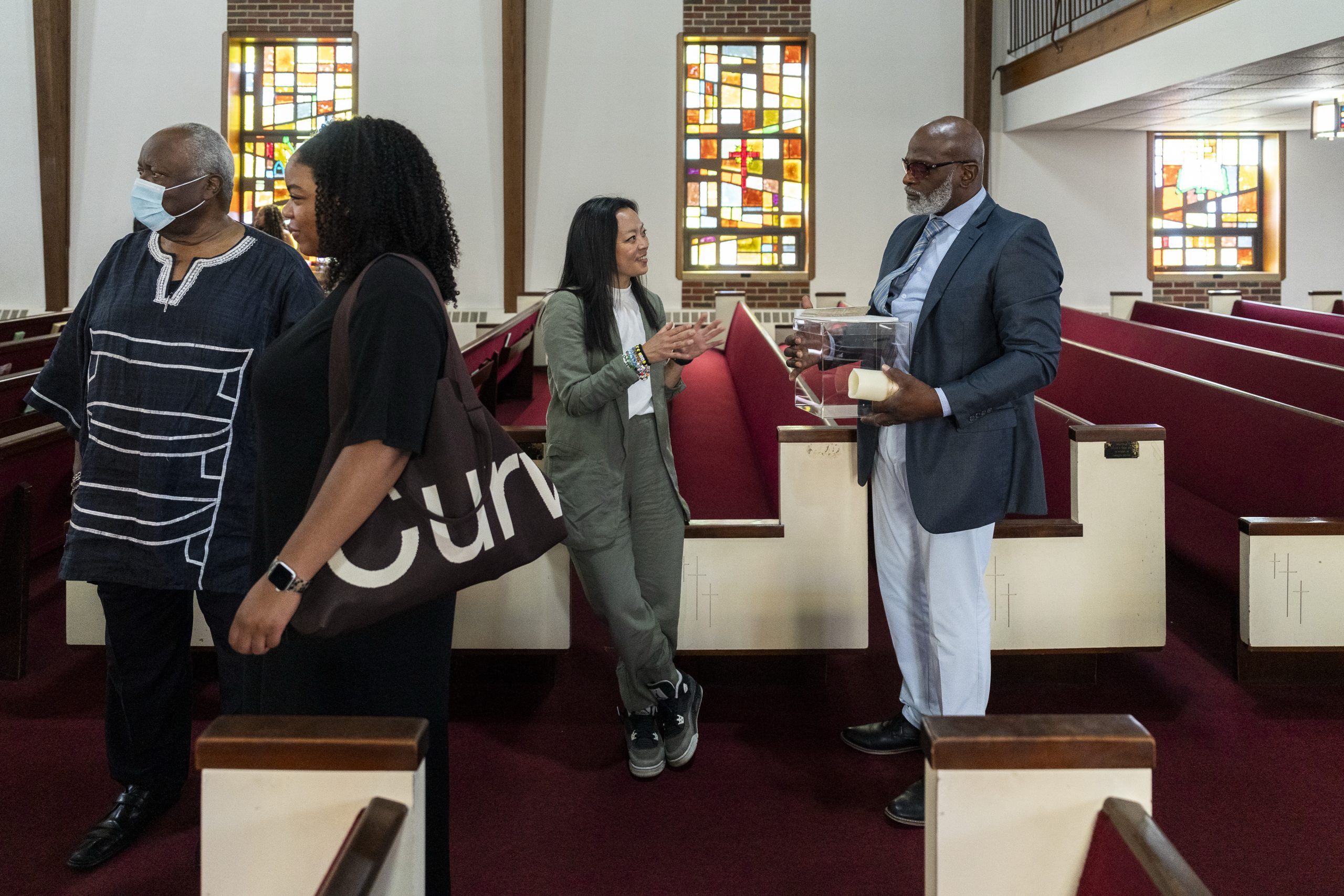
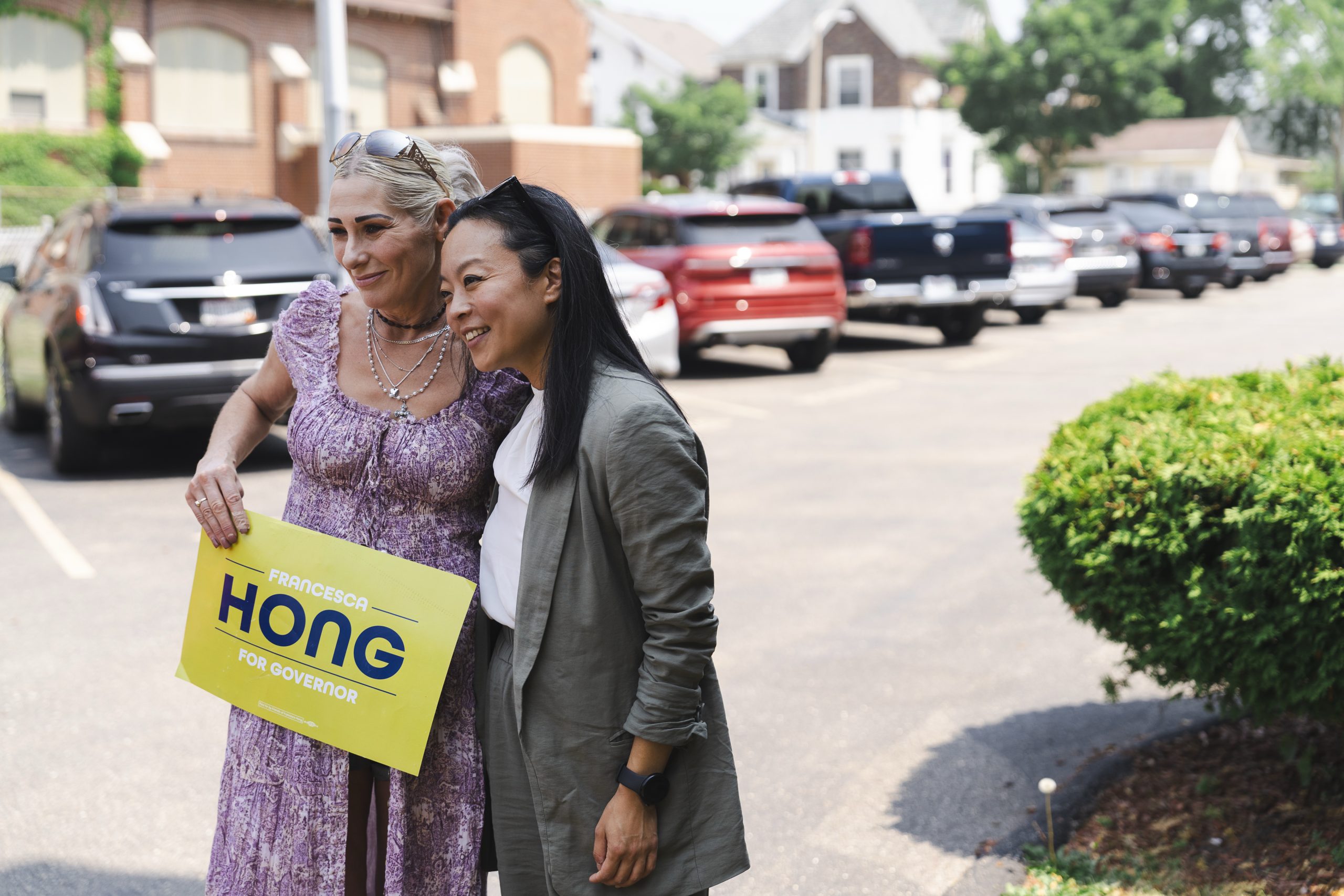
    Hong meets parishioners at the church. Sara Stathas

    Little known at the start of the race, Hong has seen rising support as she runs against four others, including Mandela Barnes, a former lieutenant governor and the Democrats’ 2022 Senate nominee.

    The primary has been tumultuous. A leading candidate, Lt. Gov. Sara Rodriguez, dropped out last week, pointing to faulty campaign finance reports that she blamed on her fired campaign manager. Milwaukee County Executive David Crowley, who had recently quit the race for governor, revived his campaign with support from the current governor, Tony Evers.

    Amid the shake-ups, the Republican Governors Association started spending $2 million on ads calling Hong “too liberal for Wisconsin.” While ostensibly attack ads, the spots could boost Democratic support for her and are the clearest signal yet that Republicans believe they have the best chance of winning in November if Democrats nominate Hong.

    ‘Brooklyn, Wisconsin, not Brooklyn, New York’

    Some who like Hong’s ideas worry about how Republicans will portray her in a general election given that she has embraced socialism, used the C-word online and said her ideal world would be one without prisons.

    “She’s sort of inviting some controversies,” said Vivian Venish, 28, who attended Hong’s campaign launch party but has been studying other candidates.

    The winner of the Democratic primary will face Republican Tom Tiffany, a three-term congressman from northern Wisconsin who has called Hong out of step, saying she “wants to abolish the police and bring socialism to Wisconsin.”

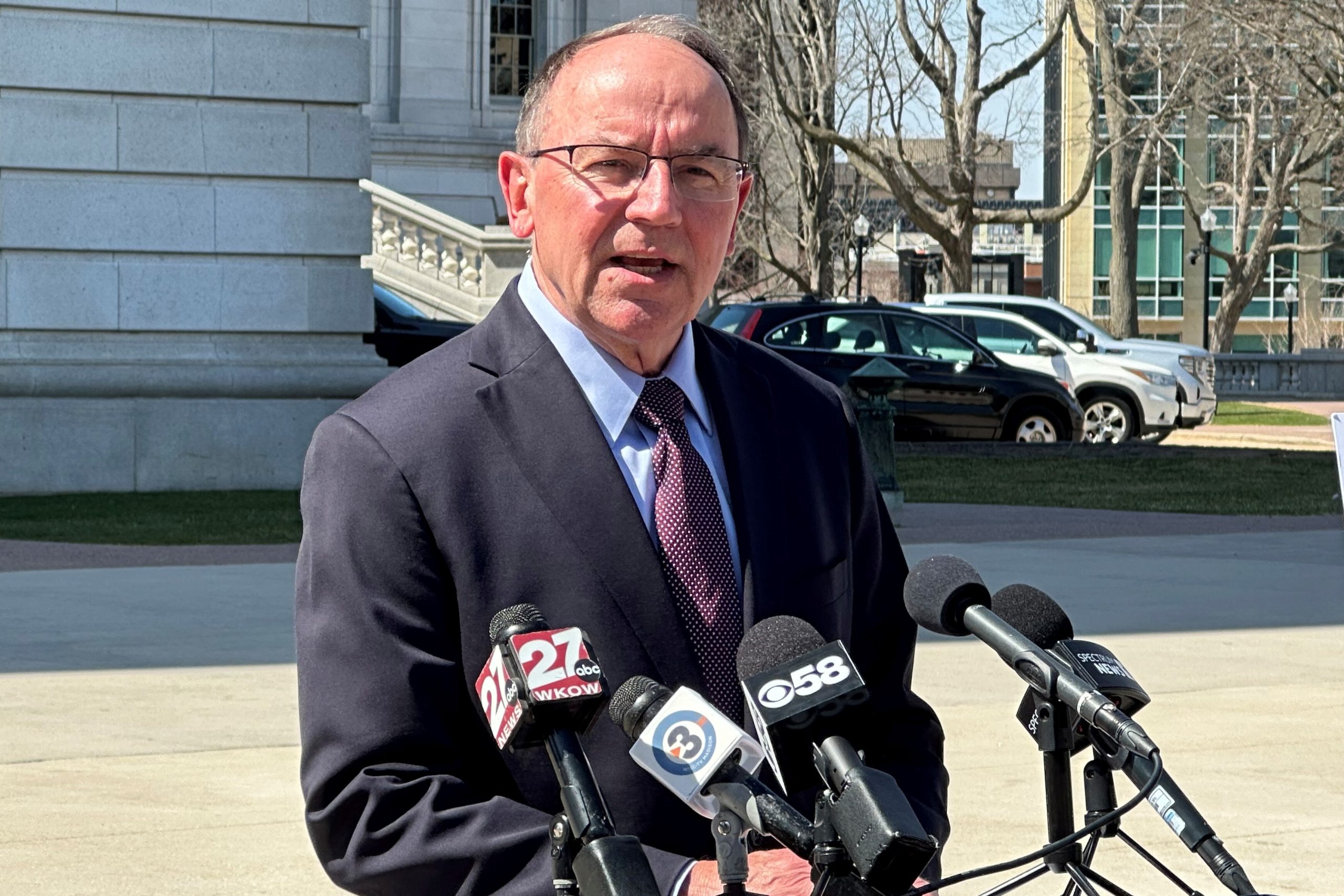
    Rep. Tom Tiffany (R., Wis.), a candidate for Wisconsin governor, speaks during an April 8 news conference in Madison about what the GOP needs to do in November.Scott Bauer

    Brian Schimming, chairman of the state Republican Party, said he expects a tight race in November no matter whom Democrats select. But he questioned Hong’s appeal.

    “We’re in Brooklyn, Wisconsin, not Brooklyn, New York,” he said.

    Wisconsin is as politically divided as it gets, with one Democratic senator, one Republican senator, a Democratic governor, and a Republican-led legislature. The last three presidential races were decided by less than 1 percentage point, with Trump winning in 2016 and 2024 but losing in 2020.

    While narrowly divided today, Wisconsin has a long history of socialism. For much of the first half of the 20th century, Milwaukee was led by socialist mayors who championed “sewer socialism” by focusing on infrastructure and public housing. Wisconsin voters elected a socialist to Congress and sent others to the state legislature.

    In her convention speech, Hong cited progressive iconoclasts like Robert “Fighting Bob” LaFollette, a representative, governor, and senator more than a century ago who “imagined a better world and fought like hell to realize it.”

    “These folks were called unreasonable, impractical and unelectable,” she said. “Yet today, they’re considered visionaries.”

    Hong poses for a photo with a supporter in Racine. Sara Stathas

    She has won the support of Rep. Ro Khanna (D., Calif.), Rep. Ilhan Omar (D., Minn.) and Nina Turner, a co-chair of Sanders’ 2020 campaign for president.

    Hong was a prominent supporter of the push to get Wisconsin Democrats to cast “uninstructed” ballots in the 2020 primary to protest President Joe Biden’s backing of Israel. She found new progressive allies last month by appearing on streams with Piker and Michael Beyer, who is known as Mike from PA. Piker has said he would “vote for Hamas over Israel every single time,” and Beyer has said Jewishness is a “demonic ethnicity, wholly invented.”

    Hong “is willing to sell out the Jews of Wisconsin for a few bucks,” Ann Jacobs, chair of the state Democratic Party’s Jewish caucus, said in a post on social media.

    Hong doesn’t agree with everything the two streamers have said but is willing to talk to anyone to reach more voters, her campaign manager said.

    ‘This is me being myself’

    Voters — especially those born after the end of the Cold War — are ready for something different, not candidates the establishment deems electable, said Dillon Sheehan, a Hong supporter who helps lead the Madison-area chapter of the Democratic Socialists of America. Republicans defanged the term by using it so much, he said.

    “They have called Joe Biden a socialist,” he said.

    Hong argues voters are hungry for dramatic change, and her history of fierce rhetoric shows she has consistently pushed the Democratic Party to the left. In 2020, she called for “defunding the police as a first step towards abolishing the police.”

    Matt Bennett, a co-founder of the center-left Third Way think tank, called the comments “the most toxic thing you could possibly imagine basically anywhere, but especially in a purple place like Wisconsin.”

    In an interview, Hong said she believes the best way to reduce crime is to provide more services and treatment. She said that as governor she would increase state aid to towns and cities and let local officials decide whether to use the money to boost police spending.

    Hong rarely backs down. She has kept in place incendiary posts, including one in 2020 that called tavern lobbyists the c-word. Last year, she used the same word as an acronym in a post encouraging people to vote for liberals in statewide races.

    “This is me being myself,” she said. “I came up through kitchens and a restaurant industry, and now politics, where swearing is pretty normal.”

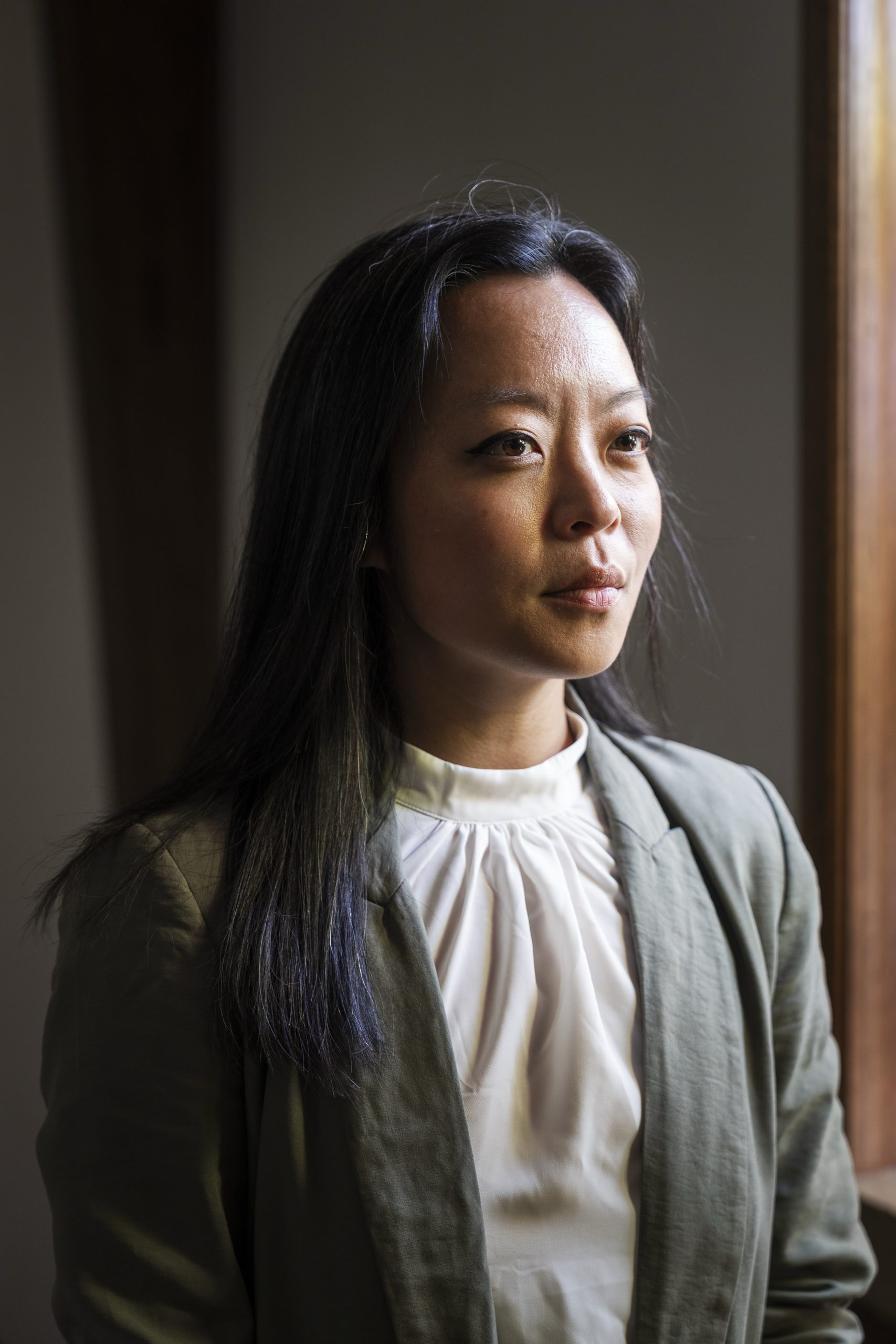
    Hong is campaigning on “permanent affordability” and a new way of running the state.Sara Stathas

    Her campaign style, she said, allows her to connect with voters who feel left out. She has held hip-hop parties and craft fairs and arranged for volunteers to meet at a Dungeons & Dragons gathering.

    On a recent Thursday, members of a Madison club that caters to women and trans bicyclists took their usual ride around the state Capitol. Afterward, more than a dozen of them spread out in a park and decorated postcards encouraging people to vote for Hong.

    The cyclists said they were drawn to Hong’s support for the working class and opposition to data centers. More than anything, they wanted someone ready to shake up the system.

    “If there was ever a year for her to win, it would be this year,” said hotel worker Aiya Askana, 28. “So I’m going to go for it.”

  • House votes for Department of War renaming as part of an annual defense bill

    House votes for Department of War renaming as part of an annual defense bill

    WASHINGTON — The House on Wednesday passed a defense policy bill that incorporates President Donald Trump’s request for a historic $1.15 trillion in spending for national security and that would designate the Department of Defense as the Department of War.

    It also would provide for a pay raise next year ranging from 5% to 7% for service members, depending upon their rank.

    The National Defense Authorization Act is generally one of the more bipartisan bills that Congress takes up on an annual basis. That’s not the case this year. The vote was 216-212.

    Democrats took issue with steep spending increases for the Pentagon as Republicans attempted to cut numerous non-defense programs through other bills. They also opposed some of the conservative social policy riders that were included.

    For example, the bill includes a prohibition on gender-related medical care under the military health program known as TRICARE. It also eases hurdles for service members to carry a privately owned firearm on base, following Defense Secretary Pete Hegseth’s lead on the issue.

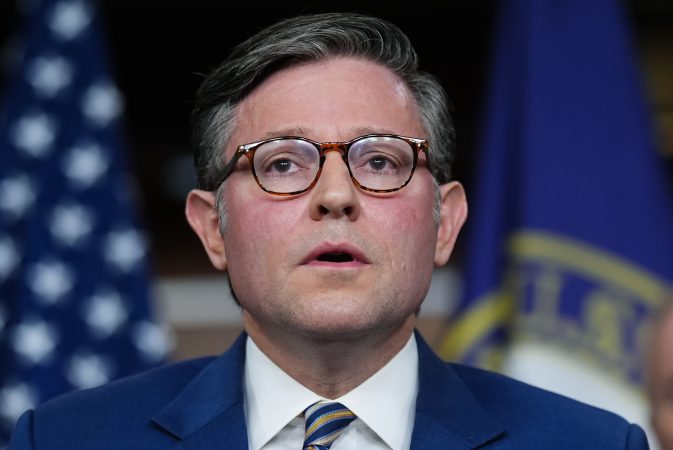
    Republican leaders’ decision to attach Trump’s elections overhaul bill to the defense bill upon its passing also amplified the partisan divide. Speaker Mike Johnson is working to accommodate Republican lawmakers who are angry that the Senate won’t pass the SAVE America Act and are insisting that it be included in must-pass bills until the Senate relents.

    The House bill is testing a normally bipartisan process

    Rep. Mike Rogers, the Republican chairman of the House Armed Services Committee, said he knows there were areas of disagreement, but he emphasized that Wednesday’s vote was a step in a long process. He promised to work in a bipartisan manner on a final product that can pass both chambers and be signed into law.

    Rogers said the United States needs to reverse decades of underinvestment and neglect in the nation’s armed forces and defense industrial base.

    “This bill will do that and much more,” he said. “It will build the ready, capable and lethal fighting force we need to deter China and other adversaries.”

    Rep. Adam Smith, the ranking Democratic lawmaker on the Armed Services Committee, said the defense spending the administration has asked for this year is approaching $1.6 trillion when including separate efforts to pay for the war in Iran and boost weapons stockpiles.

    “The American people are struggling to pay their bills and we’re going to put $1.6 trillion into the defense budget. It’s not a reasonable thing to ask,” Smith said.

    Smith also expressed concern about the war with Iran and that in supporting the defense bill, lawmakers are “de facto supporting this war with no end in sight.”

    “We are in an incredibly, incredibly dangerous time,” Smith said. “I want to maintain the bipartisan nature of this bill. I do. And I know that the chairman does. But if we’re going to do this, we’re going to need some Republicans to stand up to the president of the United States and say, ‘No. No, we’re not going to get you $1.6 trillion. No, we’re not just going to give you a blank check for a war that is totally out of control.”

    The White House backs parts of the legislation

    The spending increases authorized in the bill would not take effect until Congress follows up with a separate defense appropriations bill. The Senate has not yet approved its version of the defense measure. It’s possible a final product won’t be ready until after the midterm elections.

    The White House applauded the spending levels authorized in the House bill and the Department of War designation that it says recognizes the “willingness to fight and win wars on behalf of our nation.”

    The president issued an executive order last year renaming the Defense Department, but it’s up to Congress to make the change official. The Congressional Budget Office has projected that the renaming could cost taxpayers as much as $125 million.

    The White House’s statement also said that the administration has a number of concerns with certain provisions in the bill and would work with Congress before a final bill is presented to the president. Among those concerns was a section of the bill it said would limit or undermine the president’s ability to name military installations and property.

    In 2023, during a national reckoning on issues of race in America, seven Army bases’ names were changed because they honored Confederate leaders. Last year, those bases reverted to their original names, but with different namesakes who share Confederate surnames. The Army found other service members with the same last names to honor.

  • As the president touts Trump Accounts, some families are still waiting for baby’s $1,000

    As the president touts Trump Accounts, some families are still waiting for baby’s $1,000

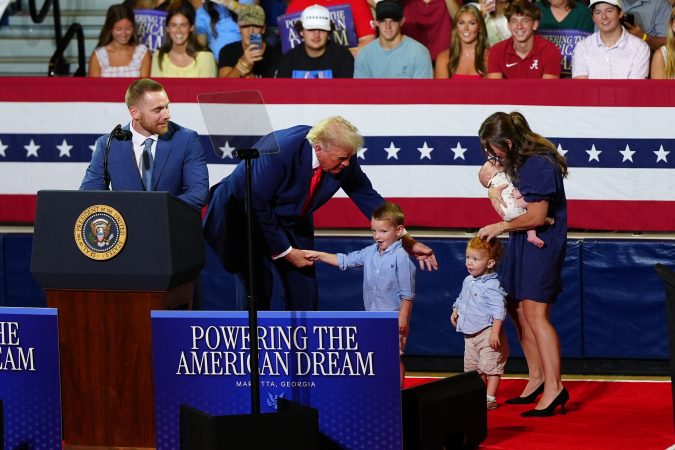
    WASHINGTON — At a rally Wednesday, President Donald Trump touted the $1,000 babies can receive when their parents open Trump Accounts in their names, seed money that Trump says will help give them “a really fair shot at the American dream.”

    “Think of that. The government is finally giving money back to our children,” Trump said to the crowd gathered at a Georgia high school

    Some parents who opened accounts earlier this month for their babies say they’re still waiting for their money. The accounts went live July 4, two days before Trump rang the opening bells for the New York Stock Exchange and the Nasdaq from the Oval Office.

    The tax-advantaged accounts can be opened for any child under the age of 18, and more than 7 million accounts are already active, Trump said Wednesday. Babies born between Jan. 1, 2025, and Dec. 31, 2028, get $1,000 in seed money from the U.S. Treasury. Most of those families receive their $1,000 in one or two days, the Treasury Department said.

    After the Trump Accounts are set up, parents, relatives, friends and employers can contribute to them. Some billionaires have also pledged philanthropic contributions to the accounts. The money is turned over to private firms that invest it in index funds, a type of mutual fund that tracks the performance of the stock market. The money can’t be accessed until the child turns 18, and only then for specific purposes, such as going to school, opening a business or buying a home.

    At the rally Wednesday, Rick Jackson, Georgia’s GOP nominee for governor, said he would push for state lawmakers to match the $1,000 in seed money from the federal government. Jackson, a wealthy businessman and CEO of a healthcare company, said he believes Georgia lawmakers will support that, but “if they don’t, I will personally donate it myself.”

    Boosters of the program say it’s a chance to give more Americans a stake in the stock market. They hope it will stem the rising popularity of democratic socialists, who seek to raise taxes on corporations and wealthy people to ease the cost of things like food and healthcare for low-income and middle-class Americans.

    Some parents were told it could take 4 weeks for the deposit

    For babies born since Trump took office last year, $1,000 from the U.S. Treasury is supposed to kick off the accounts. While some parents report receiving the money, others said in interviews and on social media they’re still waiting for their $1,000.

    Masaki and Kristina McLellan, new parents from Bergen County, N.J., said in an interview they were wary of signing up for the accounts because they worried it was a promotional stunt for the president. But the $1,000 incentive persuaded the couple, whose daughter Maya was born in late March, to start an account anyway.

    Masaki McLellan said he applied for the account July 6. At first, the application was rejected, but the account was activated after he called the Trump Account hotline. He was told he’d see the money in the account in 10 days. Now, he says, he’s been told it will take up to four weeks.

    Kristina McLellan said she was disappointed it was taking so long to fund her daughter’s account. But the infant has multiple other investments already compounding for her. Maya’s parents have already started a 529 college savings plan and a custodial brokerage account for her. The Trump Account is the third investment account in the little girl’s name.

    “We definitely want to give her options for her future and make sure she can choose what she wants to do,” said McLellan, a studio director for a local news station, who returns from maternity leave next week.

    The Treasury Department emphasized the McLellans’ case is unusual and said only a sliver of those who apply need customer support.

    Treasury says most parents wait only 1 or 2 days

    The Treasury Department said that the lag between opening an account and receiving the seed funding constitutes “standard processing time, like receiving a tax refund,” and that the overwhelming majority of parents are waiting only one to two days. But the department likes to give parents a conservative estimate for how long it might take for the money to be transferred, such as the estimate of up to four weeks given to the McLellans.

    “Trump Accounts level the playing field by allowing every parent to invest in their children’s future, not just wealthy families with trust funds,” the department said.

    The government also unveiled an initiative last month that permits child welfare agencies to open accounts on behalf of foster youth.

    “With roughly 1 million sign-ups per month before launch, Trump Accounts have become the most popular and successful government-backed savings product in U.S. history,” the Treasury Department said.

    On Wednesday, Trump called the accounts “the most consequential” part of his signature tax and spending cuts bill, also known as the One Big Beautiful Bill.

    Trump faces pressure over his handling of the economy

    Trump’s stop in Georgia comes as he and fellow Republicans face pressure in the midterm elections for their handling of the economy. Only 33% of U.S. adults approve of Trump’s economic leadership, among the lower ratings of his second term, according to a June survey by the Associated Press-NORC Center for Public Affairs Research. Trump pledged to lower costs, but his tariffs and the war in Iran have instead helped to increase prices.

    Trump Accounts are similar to baby bonds, championed by Democratic-led cities and states meant to shrink the wealth gap between low- and high-income children. But unlike most baby bonds, which generally target kids from disadvantaged backgrounds, Trump Accounts are available to families of all incomes.

    The program has faced criticism from those who say it does nothing to help families in a child’s first years of life, when children are most likely to experience poverty, homelessness, and hunger. And the Republican bill that created the program also slashed funding for programs that are disproportionately used by children, including Medicaid and the Supplemental Nutrition Assistance Program.

  • DOJ says it needs New Jersey’s voter database to verify that more noncitizens aren’t registered to vote

    DOJ says it needs New Jersey’s voter database to verify that more noncitizens aren’t registered to vote

    New Jersey Gov. Mikie Sherrill revealed Tuesday that roughly 6,600 self-identified noncitizens were wrongly added to the voter rolls ahead of the 2024 general election — and President Donald Trump’s administration pounced to capitalize on the disclosure.

    Within hours, a Department of Justice attorney sent a revamped request for New Jersey’s unredacted voter database to Dale Caldwell, the Garden State’s lieutenant governor and secretary of state.

    And the department’s Civil Rights Division launched an investigation and sent Sherrill a letter demanding, within five business days, information about the 6,600 people wrongfully registered as voters, and when and where up to 400 of them voted.

    “Ensuring that U.S. citizens’ votes are not illegally diluted by noncitizens’ votes is of paramount importance,” Harmeet Dhillon, assistant attorney general in the Justice Department’s Civil Rights Division, wrote in the Tuesday letter to Sherrill.

    For the last year, the Justice Department has been seeking the state’s voter rolls, which include each voter’s full name, date of birth, address, and driver’s license or the last four digits of their Social Security number. But the requests have been rebuffed.

    The Trump administration sued Caldwell in February, accusing him of violating federal voting and civil rights laws. Without the data, the suit said, the federal government could not ensure the state was in compliance with federal requirements for voter roll maintenance.

    The Tuesday letter to Caldwell said the new information shared by Sherrill provides an “additional basis” to the request, wrote Jesus Osete, a principal deputy assistant attorney general in the Civil Rights Division.

    “The Division must also verify that no other noncitizens remain on New Jersey’s voter rolls, in violation of federal law,” Osete’s letter said.

    The roughly 6,600 people were improperly added to the voter rolls when applying for driver’s licenses and identification cards. Even though they checked “no” when asked if they were a U.S. citizen, they were registered anyway.

    Fewer than 400 of these individuals voted, Sherrill said.

    The erroneous registrations took place between June 2023 and June 2024, Sherrill said, “through no fault” of the noncitizens, who were registered due to a software glitch in New Jersey’s motor vehicle system, which processes the automatic registration when a citizen obtains an ID or license.

    The Justice Department shared the letter it sent Caldwell with U.S. District Judge Zahid N. Quraishi, who is presiding over the lawsuit.

    “While it is currently unknown in which elections those noncitizens voted or whether the ballots those noncitizens cast affected the outcome of any race,“ the department said in a court filing, ”Governor Sherrill acknowledged in a press conference the seriousness of noncitizens voting in American elections.”

    But the disclosure did not lead Sherrill, a Democrat who took office in January, to change her position about sharing the unredacted voter data with the federal government.

    “The Trump administration has a long history of weaponizing the Justice Department for political purposes and attempting to overturn election results,” Sean Higgins, a spokesperson for Sherrill, said in a statement. “Governor Sherrill has been clear that she will use all the legal tools available to her to protect New Jerseyans’ personal information.”

    The announcement came less than a week after Trump delivered a prime-time address in which he repeated his grievances over his 2020 election loss, and claimed without evidence that more than 250,000 noncitizens had registered to vote in New Jersey, Pennsylvania, California, and Nevada.

    Republican officials used the New Jersey revelation to make the case for the SAVE Act, which would require proof of citizenship to register to vote.

    “This is why we must confirm citizenship before anyone registers. Only US citizens should vote in our elections,” U.S. Sen. Dave McCormick (R., Pa.) said on X in response to the Garden State’s news.

    The Trump administration has also attempted to get the Keystone State’s voter rolls through litigation. A judge tossed out the Justice Department’s lawsuit against Pennsylvania Secretary of State Al Schmidt last month. The suit, which is nearly identical to the one against New Jersey, is one of 16 similar lawsuits that have been dismissed by federal judges throughout the country, according to the Brennan Center for Justice.

    But this month, the Justice Department threatened to bring criminal charges against top election officials in all 50 states if they allowed noncitizens to vote. The letter threatening Pennsylvania officials was addressed to Schmidt, who again declined to share voter information.

    “I take seriously the obligations under both federal and Pennsylvania law to ensure that only eligible voters have access to the ballot box and to see to it that Pennsylvania’s voter rolls are appropriately maintained and updated,” Schmidt wrote.

    Staff writer Aliya Schneider contributed to this article.

  • ICE formally withdraws plans to build two Pennsylvania detention centers, Gov. Josh Shapiro says

    ICE formally withdraws plans to build two Pennsylvania detention centers, Gov. Josh Shapiro says

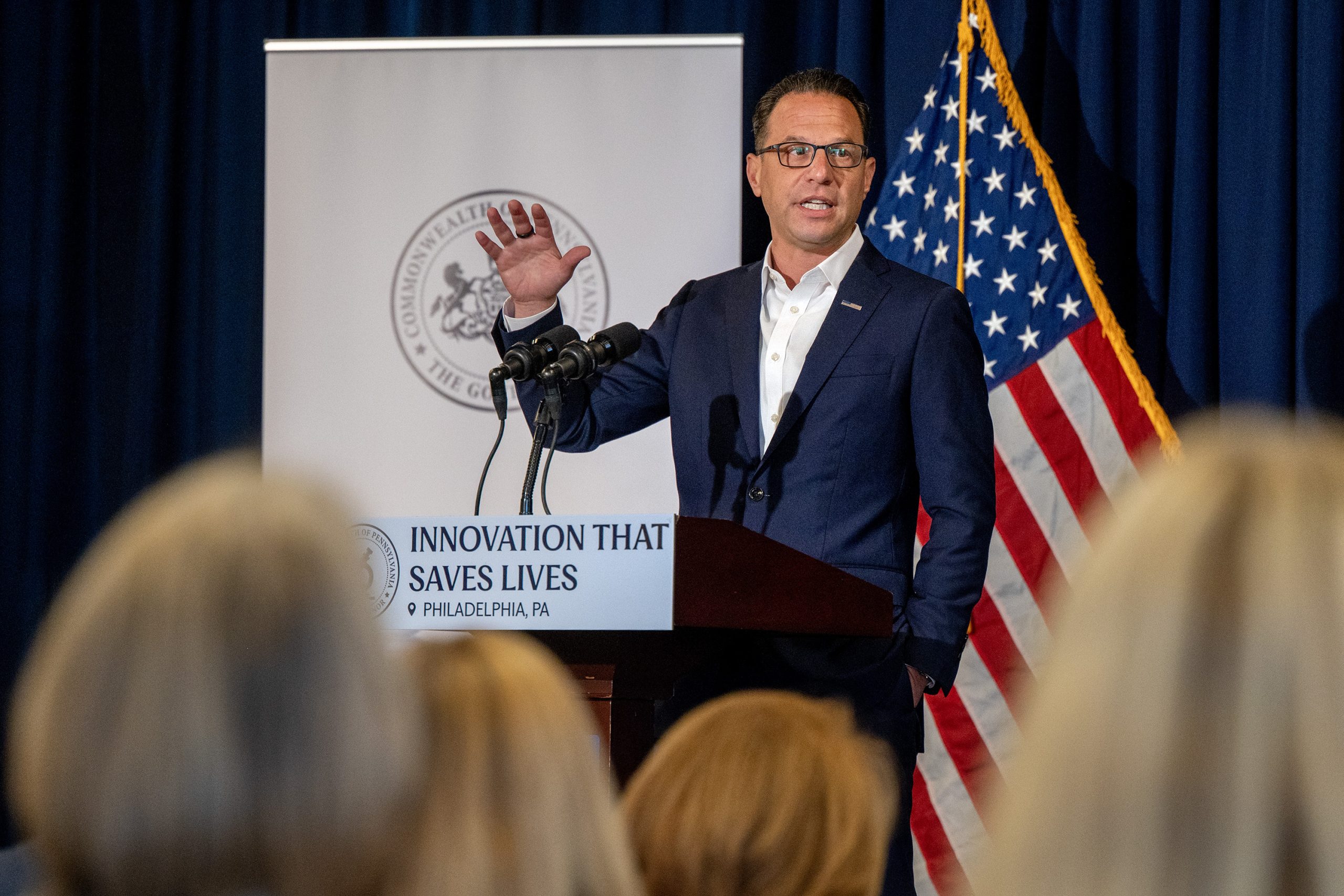
    The U.S. Department of Homeland Security has formally reversed its plans to establish two ICE detention centers in Pennsylvania that were intended to hold up to 9,000 immigrants, Gov. Josh Shapiro said Wednesday.

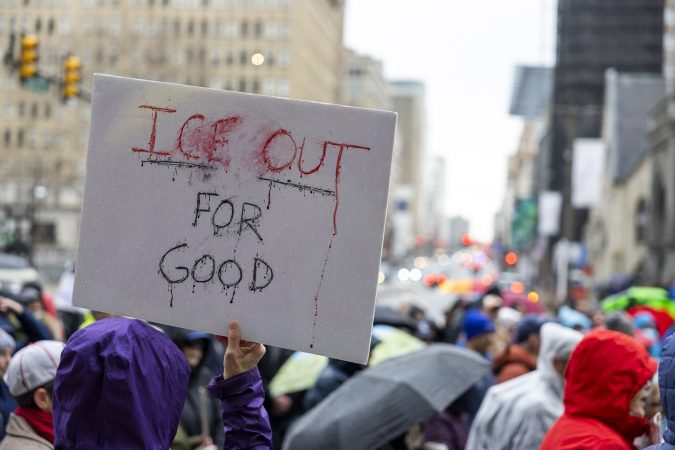
    The decision, which comes amid opposition from the state and from local communities, marks the end of efforts to convert warehouses in Berks and Schuylkill Counties, as the Trump administration works to offload some sites that were intended to support its mass-deportation agenda.

    Shapiro, a first-term Democrat seeking reelection this year, told DHS officials in February he would “aggressively pursue every option to prevent these facilities from opening,” and his administration later denied permits to update local water and sewage systems to handle thousands of additional people.

    On Wednesday, Shapiro praised the federal decision and credited his administration’s work to block the facilities.

    “From the beginning, I’ve been clear that these warehouses should not be used as ICE detention centers because they are not suitable for people and converting them to detention centers would have posed serious risks to the health, safety, and infrastructure of the surrounding communities,” he said.

    Gov. Josh Shapiro on July 21.Tom Gralish / Staff Photographer

    Two sites had been purchased in Pennsylvania ― one in Upper Bern Township, in northern Berks County, and another in Tremont Township, in Schuylkill County, where the plan for a former Big Lots discount store warehouse drew the ire of residents. Both plans faced steep opposition from top officials like Shapiro and from local community activists.

    ICE confirmed its plans to withdraw its permit requests in a filing Wednesday to the Pennsylvania Environmental Hearing Board, as well as in a July 13 letter from DHS Assistant Director James Ingalsbe.

    News emerged earlier this year that U.S. Immigration and Customs Enforcement planned to spend more than $38 billion to buy warehouses and retrofit them as detention centers that would hold tens of thousands of immigrants. Those two dozen properties, including the two in Pennsylvania, would be located across the country, with some holding as many as 10,000 detainees.

    In Pennsylvania, the Berks County project would have held 1,500 detainees, while the Schuylkill County one would have held 7,500.

    An expanded ability to confine immigrants was central to Trump’s plan to deport as many as 1 million people a year. The additional space was necessary to help ICE respond to White House demands for greater numbers of arrests.

    As of July 11, ICE held 65,765 people in detention, up from 60,311 in April, but below the record high of 70,766 set in January, according to Syracuse University professor Austin Kocher, who studies immigration data.

    During Trump’s first year in office, the government fell short of his million-deportation goal, removing 622,000 people through mid-December, fewer than the 778,000 deportations carried out in President Joe Biden’s final fiscal year, according to the American Immigration Council in Washington.

    While some around the country saw the conversion of empty warehouses as a chance for new jobs, others were opposed over humanitarian concerns, the impact on water and sewerage use, and the potential loss of tax revenue.

    Earlier this summer, it appeared likely that the plans in Pennsylvania were being discarded.

    The New York Times reported in June that ICE planned to offload its two properties in Pennsylvania and a third in New Jersey, which were purchased for more than $336 million. Those were among seven warehouses across the nation that would be sold or handed off to other federal agencies, according to the Times.

    The same month, U.S. Sen. John Fetterman (D., Pa.) said that detention-warehouse plans would not go forward in Tremont and Upper Bern Townships and that Homeland Security Secretary Markwayne Mullin had “recognized the negative impacts these facilities would have in Pennsylvania.”

  • House Republicans adopt $95 billion package for the Iran war and Trump’s priorities

    House Republicans adopt $95 billion package for the Iran war and Trump’s priorities

    WASHINGTON — The House adopted a Republican-only $95 billion budget proposal Wednesday, a long-shot effort to fund the Iran war and other White House priorities over objections from Democrats and a few GOP holdouts in a final push before the midterm elections.

    House Republicans were divided over the plan, with conservatives wary because there are no offsetting budget cuts. But Speaker Mike Johnson plunged ahead, viewing the go-it-alone process as the best chance to usher President Donald Trump’s priorities through the split Congress, despite skepticism in the Senate.

    The vote tally was 216-214, with two Republicans and one independent joining Democrats in opposition.

    “Just bullets and bombs to finish the job,” said Rep. Jodey Arrington (R., Texas), the chairman of the Budget Committee.

    Democrats argued the money should be spent at home, particularly on efforts to lower costs for Americans.

    “Republicans plan to spend tens of billions of dollars on Trump’s failed war in Iran,” said Rep. Pete Aguilar of California, chairman of the House Democratic caucus, this week. “Think about what we could spend with these resources instead.”

    Congress is at a standstill over the U.S. war against Iran — unable to stop Trump’s military strikes, but not having authorized the use of American military force — and politically torn over having to provide billions of taxpayer dollars to pay for it. Most Americans disapprove of Trump’s Iran strategy, according to a recent AP-NORC poll.

    The budget battle comes as Trump attended the dignified transfer of four service members killed in the Middle East, bringing the military death toll to 18. Defense Secretary Pete Hegseth told senators at a fiery hearing this week that the Pentagon is running short of cash, despite a massive $150 billion one-time allotment in last year’s big budget bill.

    Even as the House action advanced the resolution, Johnson’s strategy faces uncertainty in the Senate.

    The package has $60 billion for the Pentagon and $13 billion for other national security needs, $12 billion for farmers struggling under Trump’s tariffs, and $10 billion for voting law changes aligned with the SAVE America Act and proof-of-citizenship requirements that are Trump’s top priority.

    A once rare budget tool is now the norm in split Congress

    Republicans are relying on the budget reconciliation process, which enables approval on a majority vote in Congress, bypassing the Senate’s ability to filibuster the measure t o stall or kill it.

    Once rare, the reconciliation process is now Johnson’s preferred strategy for pushing proposals through Congress. It’s the way Republicans approved Trump’s big tax breaks and spending cuts bill last summer and funded Homeland Security this year over Democrats’ refusal to fund Trump’s mass deportation agenda.

    “No matter how you feel about current events, these funds are necessary to ensure our fighting forces remain ready, our troops are paid and our nation is safe,” said Rep. Mike Rogers of Alabama, the Republican chairman of the Armed Services Committee.

    But House Democratic Leader Hakeem Jeffries said, “Republicans have literally ripped food from the mouths of hungry children, seniors and veterans to sustain the Trump war machine.”

    Among those opposed was Rep. Kevin Kiley of California, a former Republican turned independent, who said he felt any war funding bill should be bipartisan. He also wanted to ensure Congress had a “much higher level of involvement” in bringing the war to an end, and he said this proposal did not set that process in motion.

    Republicans Rep. Thomas Massie of Kentucky and Rep. Warren Davidson of Ohio also voted against.

    This is the third time GOP leaders have relied on reconciliation, dubbing this version 3.0, and it’s a lengthy process. If the House approves the budget resolution, it next goes to the Senate for a round-the-clock session to consider politically tough amendments — something senators would rather avoid in an election year.

    The budget resolution sets out instructions for the various committees to draft legislation, which Johnson hopes could be done this summer, with final voting on the package once lawmakers return after the August recess.

    Senators pan House’s budget and have their own ideas

    Senate Majority Leader John Thune has been noncommittal on the House package that also divides his own GOP majority, with some Republican senators preferring more money for the military and others demanding the costs be offset with cuts elsewhere.

    “We’ll see,” Thune said this week.

    Thune’s focus, at the moment, is avoiding another government shutdown. He wants the Senate to approve a stopgap funding measure, called a continuing resolution, to provide routine government funding before lawmakers leave for the summer break.

    If senators are unable to reach agreement on government funding, Thune has said he may hold onto the House’s budget resolution and use it later in the fall as a way to push the resolution through the Senate over objections. He wants to prevent a federal shutdown when current funds expire, Sept. 30.

    “It’s a possibility that, if necessary, we could pull that budget resolution passed by the House and use it to fund government,” Thune said. “I hope that’s not necessary.”

    Thune has also clashed with Trump over the president’s push for the SAVE America Act, which would require proof of citizenship for voting. The measure, while popular among Trump’s most ardent supporters, does not have enough support among Senate Republicans for passage.

    It’s already against the law for noncitizens to vote in federal elections and experts warn the proposed new rules could make it more difficult for eligible Americans to cast ballots.

  • How 6,600 noncitizens were registered to vote in New Jersey and what happens next

    How 6,600 noncitizens were registered to vote in New Jersey and what happens next

    New Jersey Gov. Mikie Sherrill was handed an election security crisis that took place under her predecessor just days after President Donald Trump’s administration pushed out claims of widespread noncitizen voting.

    Sherrill revealed Tuesday that about 6,600 noncitizens had been illegally registered as voters in New Jersey due to a system error in the state’s department of motor vehicle voter registration program under former Gov. Phil Murphy.

    The governor said fewer than 400 of those people had voted. There is no evidence that their ballots changed any election outcomes, but the news has thrust the Garden State into the middle of the national debate over election security.

    “This failure didn’t occur on my watch, but accountability starts now,” she said at a news conference Tuesday.

    Here is what to know about what happened and how, and what the fallout could be — both in Trenton and in Washington.

    How many noncitizens got registered in New Jersey and how many voted?

    About 6,600 people who identified themselves as noncitizens were registered to vote in New Jersey between June 2023 and June 2024 “through no fault of their own” due to the glitch, though fewer than 400 cast a ballot, Sherrill said.

    Sherrill said at a news conference that the error “was caught and stopped in 2024” but that her administration is now working to remove those hundreds of voters from the rolls. She said they could have voted in any elections since then but there is no evidence at this time that they could have swayed any results. She said they were registered as Democrats, Republicans, and mostly unaffiliated, and scattered throughout the state.

    She said her team is “taking a hard look at the process failures that occurred under the previous administration and the guardrails we can put down for the future.” Through a spokesperson, Murphy declined to comment.

    Sherrill, a former member of Congress who began her term in January, campaigned on changing the culture in Trenton and distanced herself from Murphy on the campaign trail but remained cordial with him. Her tone sharply changed this week.

    “This entire situation is unacceptable,” she said. “It’s unacceptable that the vendor released software with such a glaring error. It’s unacceptable that the MVC [Motor Vehicle Commission] took a year to get this fixed, and it’s unacceptable that no one in the previous administration brought this to light, demanded accountability, or took action when it happened years ago.”

    How did this happen?

    Sherrill called the issue a “serious software error in New Jersey’s motor vehicle system.”

    New Jersey began automatic voter registration in 2018, which allows citizens to be automatically registered to vote when they get an ID at the MVC unless they opt out.

    The noncitizens who were improperly registered had answered “no” when asked on a keypad at the MVC whether they were a U.S. citizen, Sherrill said. But she said the system registered them anyway “through no fault of their own.” She said the error could put those individuals’ immigration status at risk. It would be hypocritical for the state to charge the individuals and she wants to protect them, she said, but she “would not put it past” the federal government to charge them.

    U.S. Rep. Josh Gottheimer, a North Jersey Democrat who unsuccessfully ran for governor last year, called for a national audit into IDEMIA, the vendor whose software was used for the registrations.

    But IDEMIA pointed a finger at the New Jersey Department of State, noting that while the vendor’s role is to transmit information between the motor vehicle and state departments, it is ultimately the state department’s responsibility to verify voter eligibility.

    “Information submitted by IDEMIA must still be validated and adjudicated by the Division of Elections,” the company said in a statement.

    When did Gov. Sherrill find out?

    Sherrill said she learned about the error last Wednesday, the day before Trump’s speech. She announced the discovery on Tuesday.

    What is Gov. Sherrill doing about it?

    Sherrill said she immediately ordered an investigation when she learned about the issue and ordered the removal of the noncitizens from the voter rolls. She said that Rosalie Johnson, whom Sherrill appointed as New Jersey Motor Vehicle Commission administrator this year, had already begun replacing the system vendor.

    The governor said her administration hired an independent firm, CSG Law, to conduct the investigation. She said “they will be moving very quickly” and had already found the figures she has been citing. She said she will “present the findings” of the investigation to the public.

    Johnson said she expects to launch the new vendor next year and is working on creating additional safeguards to regularly review information before sending it to the elections division.

    Sherrill said her administration is looking at ways to make the state’s elections more secure and vowed to hold any government workers accountable.

    “Should there be anyone that is identified that is still working in this space that has not done the right thing, I will hold them personally accountable for this,” she said.

    How is the Trump administration responding?

    The Trump administration and other prominent Republicans are using the issue to call for the passage of the SAVE Act, a federal bill that Republicans say would improve election security but Democrats warn would suppress millions of voters.

    Assistant Attorney General Harmeet Dhillon said in a post on X that the Civil Rights Division of the Department of Justice “is investigating this unlawful dilution of American votes.”

    Additionally, the department argued in a letter that the incident justifies the Trump administration’s efforts to obtain the state’s unredacted voter rolls.

    Vice President JD Vance called on New Jersey U.S. Sens. Cory Booker and Andy Kim, both Democrats, to support the legislation in a post on X, given the issue in their home state.

    “If only there was a way to stop this type of ‘software error’ that allowed non citizens to vote in our elections,” Vance said in the tongue-in-cheek post.

    Booker said he trusts the Sherrill administration to solve the problem and criticized “those who will choose to weaponize this issue.” Kim declined to comment on the matter.

    Why is the timing beneficial for the president?

    The news came at an opportune time for Trump, just days after his speech in which he reignited conspiracy theories about his 2020 election loss. The same day, the White House shared claims of widespread noncitizen voting, including in New Jersey.

    DHS Secretary Markwayne Mullin claimed that more than 35,000 noncitizens could be registered in New Jersey. The department has not shared how it arrived at that number, and experts cautioned it could include new citizens who have not been updated in a system meant to check work eligibility.

    Sherrill said her administration received a letter with that 35,000 figure after Trump’s speech — which was also after she said she had learned about the 6,600 noncitizen voters.

    “We have asked them for any evidence of this, where they got that number, who this is,” she said. “We’ve received nothing back yet.”

    Sherrill said that the president “knows that if he provides us any credible information we will of course investigate it” but that he has “zero credibility on the issue of election integrity.”

    “For the past 10 years he’s cried wolf and peddled bizarre conspiracy theories about fraud with no evidence,” she said.

    Trump called for the passage of a national proof of citizenship requirement Wednesday during a speech in Georgia, but he did not directly reference New Jersey.

    How will New Jersey lawmakers respond?

    State Sen. Anthony Bucco of North Jersey, the Senate Republican leader, said the state should “at the very least” suspend the automatic voter registration program until a full investigation is complete and next steps are made clear.

    He also called on the state to enact a voter identification requirement.

    New Jersey requires identification or a Social Security number to register to vote, and first-time voters who registered to vote by mail may need to provide ID at the polls. But overall, most voters do not need to show ID at the polls in New Jersey.

    Republican-led efforts to enact legislation following this incident are unlikely to succeed in Trenton because Democrats hold a supermajority in the Assembly and a majority in the Senate.

    Sherrill said at the Tuesday news conference that the problem is not with the state’s laws, but rather with how the state government has been operating — further pushing blame on her predecessor.

    “I see no reason why our state cannot run our election system well and have a computer program that can operate well, and should any problem occur it should be caught quickly … it’s a problem with accountability,” she said. “It’s a problem with making sure government is effective and running well, and it really is a lack of responsibility.”

    Has this happened before?

    In 2017 Pennsylvania Secretary of State Al Schmidt, a Republican city commissioner in Philadelphia at the time, uncovered and resolved a similar glitch at the Pennsylvania Department of Transportation in which all Pennsylvania drivers were asked if they wanted to be registered to vote regardless of citizenship status.

    Schmidt said at the time that the glitch led to 168 noncitizens registering to vote in Philadelphia but that just 44 ballots were cast in the city as a result.

    Schmidt has since said that noncitizen voting is rare and that the threat has been exaggerated.

    Staff writers Michelle Baruchman and Abraham Gutman contributed to this article.

  • Ida Schmertz, pioneering women’s activist, political innovator, and former American Express senior vice president, has died at 91

    Ida Schmertz, pioneering women’s activist, political innovator, and former American Express senior vice president, has died at 91

    Ida Schmertz, 91, formerly of Jenkintown, pioneering women’s activist, international relations innovator, presidential appointee, first female senior vice president at American Express, volunteer, mentor, and role model, died Thursday, July 2, of organ failure at New York Presbyterian Hospital.

    Born in Amsterdam, Ms. Schmertz and her family made their way to Philadelphia and then Jenkintown at the start of World War II in 1940, and she became a trailblazing American powerhouse in civil and women’s rights, international relations, corporate management, and healthcare.

    She earned a bachelor’s degree in political science and a master’s degree in international relations, and did everything but write a dissertation for a doctorate in international relations and Soviet studies. She was founding codirector in 1971 of the groundbreaking Center for American Women and Politics at Rutgers University, founding cochair in 1994 of the International Business Incubator and Training Center in Russia, and founding chair of the board of trustees for the Romanian-American Foundation in Bucharest in 1994.

    Wherever she was, Ms. Schmertz championed research, education, and public engagement. She helped organize the first national conference of women in political office for the Center for American Women and Politics in 1972, and later provided professional services to small businesses and startups in Russia, especially those owned by women.

    “I have empathy for people,” Ms. Schmertz told a colleague at the Romanian-American Foundation in a 2018 video interview. “I’ve always felt badly for people who are hurt or poor or unfortunate or don’t have access to something.”

    Ms. Schmertz was interested in voluntary foreign service, gun reform, and U.S.-China relations, and she lectured and appeared on TV shows and in dozens of newspapers. She worked with New York Gov. Hugh Carey on statewide initiatives of all kinds in the 1970s and was appointed by President Bill Clinton to head the Romanian-American Enterprise Fund in 1994.

    In the 1950s and ’60s, she worked for the Democratic National Committee, the CIA, and the American Association of University Women. She spoke English, Dutch, Russian, and French, and served as a guide at the State Department’s first U.S. promotional exhibition in Moscow in 1959.

    She lobbied for fair elections in South Africa in the 1990s, and pressed New York lawmakers to support the state’s medical aid in dying act until it recently passed. Colleagues praised her “vision, energy, and grit” and “integrity and long-term commitment” in online tributes.

    From 1979 to 1992, Ms. Schmertz was the first woman to supervise corporate strategy and philanthropy at American Express in New York.Courtesy of the family

    One colleague said: “I feel so fortunate to have known her.”

    Colleagues at the Romanian-American Foundation said in a tribute: “She helped shape not just an organization but a picture of what philanthropy in Romania could be: transparent, accountable, built on partnership, and dedicated to creating opportunity for all Romanians.”

    From 1979 to 1992, Ms. Schmertz was the first woman to supervise corporate strategy and philanthropy at American Express in New York. She was also an honorary director of the Women’s Economic Roundtable and a former director at Prudential Financial Inc.

    “She was extraordinary, formidable, deeply caring, and exceptionally committed to the people and causes that she believed in,” her daughter, Lexy, said. “Her hobby was her job, learning and exploring.”

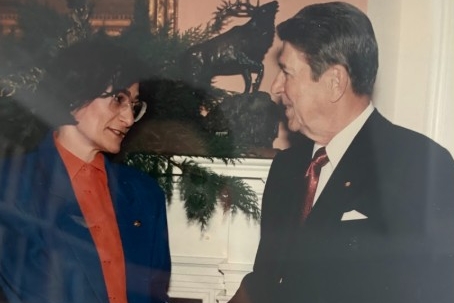
    Ms. Schmertz worked with President Ronald Reagan and many other political notables. Courtesy of the family

    Ida Frederieke Schaap was born Feb. 24, 1935. Her family traveled from the Netherlands to Indonesia in 1939 and then to the United States to escape the war.

    She was the first Jewish student to enroll in the old Stevens School for Girls in Germantown in 1940, was elected president of the student council and captain of the field hockey team, and graduated in 1952. She earned her bachelor’s degree at Wellesley College in Massachusetts in 1956 and her master’s degree at Columbia University in 1960.

    She also studied French political science at Sorbonne University in Paris and Russian at Middlebury College in Vermont. She married Herbert Schmertz in 1962 in Philadelphia, and they had a son, Anthony, and a daughter, Lexy. They divorced in 1976, and he died in 2018.

    Ms. Schmertz was tough and direct, her family said, intelligent and loving. She liked to read and travel, and was an engaging conversationalist.

    Ms. Schmertz was a summer camp counselor for underserved children as a teen, loved cats, and supported the Philadelphia Museum of Art.Courtesy of the family

    She lived in Washington after college, moved to New York in the 1970s, and hosted friends and colleagues from around the world in her Upper West Side apartment. She doted on her four grandsons and took them to museums and hockey games. “She met them where they were,” her daughter said.

    She was a summer camp counselor for underserved children as a teen, loved cats, and supported the Philadelphia Museum of Art. For 30 years, she lived with chronic lymphocytic leukemia.

    “She was compassionate and caring,” her daughter said. Her son said: “She was devoted to her family.”

    In addition to her children and grandsons, Ms. Schmertz is survived by two sisters and other relatives.

    Ms. Schmertz visited Amsterdam in May.Courtesy of the family

    A private memorial service is to be held later.

    Donations in her name may be made to Compassion & Choices, Box 485, Etna, N.H. 03750.