WASHINGTON — The House on Tuesday voted overwhelmingly to make daylight saving time permanent, but the measure to spare Americans the semiannual clock-changing that shortens winter days faces an uncertain path to enactment.
The measure, fittingly named the “Sunshine Protection Act,” passed on a 308-117 vote. Its fate is murky in the Senate, where one GOP leader said it was unclear whether it could move ahead and at least one Republican appears inclined to try to block it.
President Donald Trump has championed the effort to save an extra hour of daylight before nightfall and make the time zone permanent, describing the ritual of moving clocks forward in the spring and back in the fall a “ridiculous, twice yearly production.”
“We are going with the far more popular alternative, Saving Daylight, which gives you a longer, brighter Day,” Trump wrote in a social media post in May. “And who can be against that.”
A sizable bloc of Florida Republicans in Congress is leading the charge on legislation that would do just that, mandating daylight saving time nationwide for the entire year. Rep. Vern Buchanan of the Tampa Bay area is backing the bill, and Rep. Anna Paulina Luna, another Tampa Bay-area Republican, cosponsored it.
House leaders agreed to allow a vote on the measure this week as a sweetener for Luna in their efforts to persuade her to lift a legislative blockade she had maintained as she sought to force Senate action on a voting restriction bill Trump has championed.
Congress first passed the Standard Time Act in 1918 and established federal oversight of time zones. Then came the Uniform Time Act of 1966, which said states can observe daylight saving time from late spring to early fall. The country’s clock-changing practices were last altered in 2005, with the enactment of bipartisan legislation that extended daylight saving time for several weeks.
Most states comply, though there are exceptions: Hawaii and most of Arizona abide by standard time year round, as do Puerto Rico, Guam, American Samoa, the U.S. Virgin Islands and the Northern Mariana Islands. Nineteen states have moved to make daylight saving time permanent, though those laws have not taken effect because federal law does not currently allow people to live in daylight saving time year-round.
Not everyone agrees with the proposed change. Reps. Mary Gay Scanlon, D-Pa., and Pat Harrigan, R-N.C., backed an alternative bill earlier this month that would mandate standard time — which Americans observe between November and March — be used all year.
“Morning light is an environmental cue to set our body’s internal clocks and promote alertness.” Scanlon said. “And dim evening light tells our bodies it’s time to sleep.”
Though many Americans find they are groggy and tired after changing their clocks, sleep experts warn that permanent daylight saving time would hurt, not help, sleep health. The Coalition for Permanent Standard Time, an advocacy group, argues that the winter time zone aligns closely with the body’s circadian rhythm, which is its internal clock.
Should the bill pass, state lawmakers could opt out of permanent daylight saving time in favor of year-round standard time if they enacted such legislation.
Buchanan has said the measure would give Americans all of the health and recreational benefits that an extra hour of sunshine bring, including more time outside and less seasonal depression. Florida’s legislature passed similar legislation in 2018, making it the first state to do so.
“The twice-yearly clock change is a relic of the past that no longer reflects the way Americans live, work and conduct business in the 21st century,” said Rep. Gus Bilirakis, R-Fla.
It isn’t the first time Congress has grappled with turning back the clocks. The United States tried in 1974 to ditch the clock-switching, but went back to flipping the clocks twice a year following widespread discontent. In 2022, the Senate unanimously passed then-Sen. Marco Rubio’s bill to make daylight saving time permanent, but that bill died in the House.
Sen. John Barrasso of Wyoming, the No. 2 Republican, noted Tuesday that the House had “hit the snooze alarm” back then on the Senate measure.
“We’ll see what happens when it gets here,” he told reporters at the Capitol, referring to the current House bill.
He would not say whether he backed the measure. “Depends where you’re living in the country and the impact that it would be in your own home state,” Barrasso said. “So, it’s not as simple as what one state might like.”
Sen. Tom Cotton, R-Ark., said in a floor speech last year that he regretted not objecting to Rubio’s bill.
“By moving the clock back an hour in winter,” he said, “permanent daylight saving time would push winter sunrises to an absurdly late hour, depriving Americans of morning sunshine that’s essential for our safety and well-being.”
In 2025, Pennsylvania updated its license plate design to feature the Liberty Bell, a prescient move for this year’s Semiquincentennial, where the Liberty Bell continues to play a central role—not as a relic of revolutionary history, but as a surface on which Americans have inscribed their ideals, disappointments, demands, and dreams.
The Liberty Bell’s provenance is unique: by 1751, the Pennsylvania State House needed a bell to summon lawmakers to session, gather citizens for announcements and town meetings, and signal special commemorations and events by ringing through the air. Tolling bells could also serve as warnings of fire or other dangers. To be a fully functioning statehouse, a bell was ordered from the famous Whitechapel Bell Foundry in London, which finally closed shop in 2017, after 450 years of business. The bell famously sailed into Philadelphia in one piece, only to crack significantly upon its first ring.
In response, artisans John Pass and John Stow melted down the original bell and recast a new one. This bell remained intact for almost 100 years, until sometime in the early 1840s, when it cracked again. This time, instead of melting the bell down, foundry workers tried to repair the crack by widening it to prevent further spread. Instead, a second crack appeared, and the bell was silenced forever.
One would think a bell without a ring was a literal death knell. Instead, and rather miraculously, the bell took on another life, and another, and another after that in historical memory.
In 1755, Benjamin Franklin mentioned the bell in correspondence with Catharine Ray, writing, “Adieu. The Bell rings, and I must go among the Grave ones and talk Politicks.” Like many others, he did not consider the bell’s association with liberty during the Revolution, perhaps because Philadelphia was under British control for nearly nine months and, for most of the war, he was across the Atlantic, working for freedom in another way.
As far as we know, the bell was not rung when the Declaration of Independence was read. But throughout the long 19th century that followed the Revolution, political activists of all stripes rallied around the words inscribed on the bell: “Proclaim Liberty Throughout All the Land Unto All the Inhabitants Thereof” (Leviticus 25:10).
The Biblical phrase, perhaps commemorating William Penn’s 1701 Charter of Privileges, which granted broad religious freedom and representative government to (some) of the people of Pennsylvania, was adopted, for example, as a symbol of freedom to end slavery. The bell was given the name “Liberty” in the sense of liberation—striving for self-rule in the most basic and humane sense by promoting abolition.
In other words, it was not the Revolution that gave the bell its lasting significance, but the Americans who, thereafter, kept the pursuit of freedom ringing in our ears. Women seeking suffrage. Civil Rights campaigners invoking its biblical call for equality. Cities pursuing community, memory, and history. Its transformation continues today, 250 years beyond the revolution.
Given this history, we understand why the Liberty Bell is visible again during the Semiquincentennial—on our license plates, in commemorative materials and public celebrations, and even as a giant inflatable balloon at the No King’s Rally on the steps of the Pennsylvania State Capitol Building in Harrisburg on March 28. Despite the blustery, cold day filled with flags and a large, grounded eagle puppet, the Liberty Bell remained firmly in place at the top of the steps, where people below gave speeches and rallied for freedom. Of course, nylon ropes secured the inflatable to the ground, but the massive yoke’s symbolic presence, attached to the bell, felt strong and unrelenting.
Ana Thorne, of Center City, 37, is next to the bell they made during the Bells Across PA event in celebration of America’s 250th Birthday in Philadelphia earlier this year.Tyger Williams / Staff Photographer
The Liberty Bell also appears in the Commonwealth’s Semiquincentennial public art initiatives. In Bells Across PA, fiberglass bells decorated by communities across the state appear in each of Pennsylvania’s 67 counties. This kind of collective work, common in community-made public art, remains popular because the project’s scale is manageable and the local scenes painted on the bells carry meaning for those who decorate them. In this case, it is not monumental art by trained artists, but rather youth and adults who hope to create something everyone can recognize and enjoy.
Philadelphia’s most compelling contribution to this conversation may be the public artwork Let Freedom Ring by artist Paul Ramírez Jonas. Originally commissioned by Monument Lab in August 2023 for the National Mall in Washington, D.C., the reinstallation of Let Freedom Ring by the Association for Public Art is on view at the Cherry Street Pier through Sept. 27. The monumental bell tower plays “America (My Country, ‘Tis of Thee)” but intentionally omits the final note. Visitors must ring a Liberty Bell-inspired bell to complete the song. The work poses a deceptively simple question: for whom does freedom ring? The answer is left unfinished and requires public participation.
Made By History sponsors. FOR USE ON MADE BY HISTORY STORIES ONLY.Inquirer Staff
Public art succeeds where monuments sometimes fail by fostering participation rather than passive observation. Rather than presenting history as settled and complete, it invites people to join a conversation across time. The Liberty Bell has always functioned this way. Its inscription is not a statement but a challenge. Its crack is a visual reminder that we must work to close the distance between us.
Today, that challenge and the distance feel especially urgent. The words “Proclaim Liberty Throughout All the Land Unto All the Inhabitants thereof” prompt Americans to consider who is included in that promise and who remains excluded. Each generation has answered differently and struggled to reconcile the nation’s aspirations with its realities.
The stories of the Liberty Bell’s creation, its cracking, its inscription, and its use as a symbol across generations remind us that public art and history can commemorate, criticize, and build community. They can also transform a historical artifact into a forum where each generation redefines liberty. In this Semiquincentennial year, everyone pursuing happiness can make the Liberty Bell their own.
Editor’s note: This story has been updated to clarify that Let Freedom Ring was reinstalled by the Association for Public Art during the semiquincentennial.
The “Road to 250” series is an initiative of Historians for 2026, a group of early American academics, public historians, archivists, and educators devoted to shaping an accurate, inclusive, and just public memory of the American Founding for the 250th anniversary.
Made by History takes readers beyond the headlines with articles written and edited by professional historians. Opinions expressed do not necessarily reflect the views of The Inquirer.
WASHINGTON — Still shaken from the sudden death of Sen. Lindsey Graham of South Carolina, Senate Republicans returned to Washington on Monday and were immediately forced to confront the policy and political complications caused by his absence.
Coupled with the extended leave of Sen. Mitch McConnell, R-Ky., who was hospitalized last month and has not said when he will return to the Senate, Graham’s death Saturday has created further difficulties for an election-year legislative agenda that already faced significant hurdles.
The loss of Graham and the absence of McConnell have temporarily whittled down an already slim Republican majority and are threatening to stall spending bills, a major budget measure the party had hoped to use to push through hundreds of billions of dollars of military spending, and at least one crucial nomination.
It also left uncertain the fate of a new package of sanctions against Russia that Graham had negotiated in the days leading up to his death, which now lacks its most influential Republican champion in the Senate.
In the coming days, Senate Republicans had hoped to quickly confirm President Donald Trump’s pick as attorney general, Todd Blanche, whose confirmation hearings are set for Wednesday and Thursday. They are also eager to pass annual spending bills before a Sept. 30 deadline to fund the government. And with the midterms looming, many Republicans are hoping to find a way to push through sweeping policy initiatives in an arcane budget process known as reconciliation that allows them to skirt a Democratic filibuster.
All of those are up in the air with the loss of Graham. He sat on the Appropriations and Judiciary committees, where Republicans could now find themselves short of a majority to approve legislation or nominations, and was the chair of the Budget Committee, which would drive the reconciliation process.
Sen. John Thune, R-S.D., the majority leader, who was a longtime friend of Graham’s dating to their early years together in the House, had already been skeptical that he and his fellow Republicans could push through a politically charged, one-party budget bill so close to the November election.
“Obviously there are a lot of considerations that we have to work through: how big it is, what the offsets are, what our limitations are,” Thune said. “To get that done and get the requisite number of votes in both the House and Senate will be a heavy lift.”
Thune and other senators were visibly affected by the death, and Graham’s Senate desk was draped in black velvet and held a vase of white roses.
With senior roles on the panels overseeing the Justice Department, spending and budget policy, Graham was seen as an important Republican voice in all three efforts. And as Republicans try to take advantage of their governing trifecta before the elections, Graham was viewed as a crucial link between the Senate and the White House.
Many of Graham’s colleagues acknowledged that he would have been particularly valuable helping Senate Republicans navigate an increasingly tense relationship with Trump, who has grown frustrated by their refusal to bow wholeheartedly to his agenda.
“His voice is going to be really, really missed in terms of the relationship that Senate Republicans have with the president and his team,” Thune said in a CNN interview Monday. “Because he was so good and so effective at talking to the president, and it was so respected by the president.”
That connection would have been central to any attempt to push through a third reconciliation bill.
Trump last week urged congressional Republicans to turn to the procedure — which allows bills that affect government revenues to pass the Senate on a simple-majority vote — to provide $350 billion to the Pentagon and to impose long-sought restrictions on elections.
As chair of the Senate Budget Committee, Graham would have overseen that process, steering any measure through complex rules that govern what provisions can be included. Before his death, he signaled a willingness to try to meet Trump’s demand, even as many Republican senators, including Thune, have been skeptical that they could muster the necessary support to pass such a measure given disputes about how to pay for new spending with compensating cuts elsewhere.
Though Thune has not yet named a successor, Sen. Ron Johnson, R-Wis., is widely viewed as the next in line to lead the budget panel. But Johnson is among the staunchest fiscal conservatives in Congress, and his approach to spending cuts may rankle vulnerable lawmakers who do not want to slash government programs.
Asked about the path forward Monday, Johnson brushed off questions. “Look, I just walked by Lindsey’s desk,” he said. “It’s kind of one step at a time.”
Thune’s most immediate challenge may come with Blanche’s nomination. While some Republicans have voiced concerns about Blanche’s role in establishing a Justice Department fund for people claiming to be victims of unfair prosecution, Graham, a senior member of the Senate Judiciary Committee, was seen as a reliable supporter who would have helped Blanche advance.
But after Graham’s death, Republicans on the committee hold only an 11-10 edge on, meaning objections from any one Republican senator on the committee could stymie Blanche’s nomination. Two of them, Sens. Thom Tillis of North Carolina and John Cornyn of Texas, have raised questions about Blanche. Cornyn reiterated his concerns Monday after a federal judge in Miami assailed a settlement that Blanche brokered between Trump and the IRS that protected the president and his family from tax audits.
“It certainly is another area that I plan to ask about, and I’m certainly not making any commitments until after the hearing,” Cornyn said.
Advancing legislation to fund the government out of the Senate Appropriations Committee was already going to be difficult with McConnell’s absence, and the committee has already been at a partisan impasse.
But Graham’s death could make it nearly impossible to move any spending bills without major bipartisan support. Republicans will now need all their senators on the panel to be present and voting to overcome unanimous Democratic opposition.
Sen. John Kennedy, R-La., said the two primary actions Congress must take are to fund the government and keep it open after Sept. 30, probably through a stopgap bill, and provide money for the conflict in Iran. He predicted that progress would be difficult.
“I’m not terribly optimistic about the next four weeks,” Kennedy said.
With more than three months until Election Day, the Republican campaign against Texas Democratic Senate candidate James Talarico has already made national news for its ugliness.
The baseless accusations against him have included claims that he’s a vegan — a near blasphemy in the beef-loving state. But the centerpiece of the campaign has been repeated assertions that he is gay or trans.
Not long after Talarico won the Democratic primary, White House Deputy Chief of Staff Stephen Miller posted on X, “The Democrats made history in Texas by nominating their first transgender senate candidate,” an attack he later repeated in an appearance on Fox News, in which he added that Talarico was “clearly transitioning into a female.”
And Miller is far from alone. Talarico’s opponent, the scandal-plagued state Attorney General Ken Paxton, dubbed Talarico “six-gender Jimmy” and “Talafreako,” claiming he’s “too low-T for Texas.” Texas Gov. Greg Abbott even posted pictures of Talarico as a woman.
Amid all of this mudslinging, one group has been noticeably silent: LGBTQ Republicans. Their failure to speak out against the assault on Talarico — which seems more an attempt to delegitimize his masculinity than to actually question his sexuality — signals a capitulation to Republican homophobia and anti-LGBTQ bigotry, not to mention a risky betrayal of their own history.
Gay Republican organizing began in California in the 1970s as an attempt to offer an alternative to liberal gay organizations that often worked closely with the Democratic Party. The activists hoped to show that they were loyal Republicans and, in the process, stamp out the antigay “family values” politics that was beginning to take shape within the GOP.
Two particular events in 1978 hastened this development. One was Ed Davis’ run for the Republican nomination for California governor. As Los Angeles police chief, Davis had directed the city’s law enforcement to harass gay and lesbian people. Running for political office, Davis often railed against “fruits” and “fairies.”
That same year, a ballot initiative, Proposition 6, sought to make it illegal for any gay person to work in California’s public school system. Its sponsor, conservative Orange County state legislator John Briggs, regularly equated homosexuality with pedophilia and charged that gay teachers would molest schoolchildren.
Gay Republicans sprang into action, taking great personal and professional risks to publicly organize and mobilize against these threats.
They wanted to send a strong message to the GOP to reject the emerging religious right. In their view, religious conservatives who were trying to use the government to regulate and sometimes criminalize private matters, including sexuality and reproductive decisions, were anathema to the Republican Party’s tradition of individual rights and personal freedom. But they knew if an antigay ballot initiative won in a large state like California, it would make it even harder to stop the GOP’s national slide from social moderation to conservatism.
Both Davis and Proposition 6 lost, signaling that gay Republican activism could work.
The activists recruited other gay and lesbian people to register as Republicans to vote against outspoken homophobes in the party’s primaries and support its moderate candidates. And they insisted to party officials and Republican politicians, including Ronald Reagan, that allowing homophobic language and endorsing antigay legislation would alienate thousands of moderate and independent voters.
Gay Republicans were thrilled when Reagan declared during his 1980 presidential campaign that although he did not support “homosexual rights,” he also believed there was no “place in our society for intolerance and discrimination.” Despite the seeming contradictions in this position, gay Republicans thought it gave them the leverage to nudge the party in a more progressive direction.
With that goal in mind, gay Republican groups formed across the country in the 1980s, culminating in the creation of the Log Cabin Republicans, the nation’s oldest and largest LGBT Republican organization. The national organization and its state and local chapters worked against antigay efforts around the country as they sought to root out homophobia and antigay bigotry within the party.
These groups continued to argue that abandoning bigotry could provide electoral benefits. “Republicanism is a philosophy that is closer to the hearts of gay people than is the extreme liberalism of the Democrat Party,” one pamphlet asserted. But for many gay voters, the GOP was off-limits because “of the extreme hate expressed toward gay people by certain elected GOP persons.”
Made By History sponsors.Inquirer Staff
When socially moderate and gay-friendly Republicans won races, especially in Democratic strongholds, gay Republican activists touted the victories as proof that they were right. After Rudy Giuliani narrowly won the 1993 New York City mayoral race, for example, they pointed out that he did so with nearly a third of the city’s gay vote.
These victories emboldened gay Republicans, who continued to target antigay Republican politicians and encourage the GOP to prioritize economic and national security issues over culture war resentments. For decades, the Log Cabin Republicans saw themselves as existing to hold the Republicans’ feet to the fire until they eliminated — or, at least, effectively marginalized — the party’s homophobic voices.
Leading gay Republicans, like Log Cabin president Rich Tafel, regularly squared off against religious right figures on television, shaming their homophobic views as un-American and a disaster electorally. “The gay-bashing party of Falwell and Pat Robertson will never be the majority party in this country,” Tafel contended.
Gay Republicans scored a major victory when George W. Bush committed that the 2000 Republican National Convention would include no antigay talk in the proceedings — a significant result given that just eight years earlier, commentator Patrick Buchanan had delivered a blistering keynote address while some delegates waved signs that read “Thank God for AIDS” and “Family Rights Forever / Gay Rights Never.”
The Bush administration still went on to work diligently against the legalization of same-sex marriage. Even so, gay Republicans saw changing the tone within the GOP as a crucial first step toward conservative Americans eventually supporting basic rights like same-sex marriage. And as Republican voters, especially critical suburban moderates, became more accepting of homosexuality and gay rights, gay Republicans pressured the party to avoid homophobic messaging and antigay language, if not to abandon antigay politics altogether.
And when the GOP refused to listen, gay Republicans fought back. During the 2004 presidential campaign, Log Cabin Republicans refused to endorse Bush because of his support for a constitutional amendment to ban same-sex marriages and his tolerance of antigay language in the party platform. Gay Republicans felt they had to make their opposition clear. “If you remain silent while people are kicking you in the stomach,” Log Cabin’s executive director explained, “you become completely irrelevant.”
On the one hand, they continue to speak out against some homophobia from elected Republicans, such as Rep. Andy Ogles’ (R., Tenn.) posting on X at the start of Pride Month that “Homosexuality has no place in America.” Yet, their decision to remain silent about the attacks on Talarico may speak even louder.
It’s unclear whether they see the campaign against Talarico as an unserious attempt at humor or worry that scolding the party would be an embrace of the “political correctness” Trump has made anathema in the GOP.
Yet, whatever their reasons, their silence signals a troubling return to the Republicanism of the past that used outright homophobia for political gain — and a forewarning of things to come. Even worse, it’s coming at a moment when Americans are exhibiting declining support for LGBTQ issues, and Republicans’ backing of same-sex marriage has plummeted, down 18% from just four years ago.
Undoubtedly, gay Republicans have always made compromises and chosen their battles carefully in order to exert influence within the GOP. Yet, none of this included turning a blind eye to Republican homophobia; instead, they directly confronted it — even when it came from lukewarm allies like Bush.
Gay Republicans may believe that by overlooking the attacks on Talarico, they can show themselves to be good sports who are not easily offended, true conservatives who know the difference between campaign hijinks and serious political threats, unlike LGBTQ liberals. Yet, they may soon discover that the slurs against Talarico were not an isolated swipe at a political opponent — and, worse, that their silence has facilitated the return of the GOP’s assault on LGBTQ rights.
Made By History takes readers beyond the headlines with articles written and edited by professional historians. Opinions expressed do not necessarily reflect the views of The Inquirer.
On Saturday night, Sen. Lindsey Graham, R-S.C., died of an aortic dissection — a rip in the aorta, the main artery carrying blood from the heart to the rest of the body.
Such a tear is a medical emergency. Fifty percent of patients make it to the hospital, and about half survive, said Dr. Michael Mack, a heart surgeon who is chair of the research institute Baylor Scott & White Health in Dallas.
Mack added that an aortic dissection is the first thing that comes to mind when a patient who is feeling well dies suddenly.
The wall of the aorta has three layers, said Dr. Kendra J. Grubb, a heart surgeon formerly at Emory University and now at Medtronic, the medical device company. A dissection occurs in the inner layer, allowing blood to pour in between the layers of the tubelike vessel.
It’s most likely caused by an underlying aortic aneurysm — a bubble in the vessel, similar to what can occur in old bicycle tubes. Aortic aneurysms can be caused by high blood pressure, atherosclerosis or some rare underlying genetic conditions, like bicuspid aortic valves.
Patients usually describe an excruciating pain, from the chest to the back, “like a knife to the heart,” Grubb said.
Treatment depends on where in the artery the tear is. If it occurs after the section that goes to the brain, doctors can try to repair it, threading a wire from the groin to the aorta that carries material on the vessel to seal the rip.
If the tear occurs in the part of the aorta that carries blood to the brain, treatment involves emergency open-heart surgery. The patient is put on a heart-lung machine, the body is cooled, and a surgeon cuts out the torn section of the aorta. The surgeon then inserts a graft made of fabric.
Hours before his sudden death, Sen. Lindsey Graham returned to Washington from his 10th wartime trip to Ukraine, the latest visit in a four-year campaign he had waged to persuade Americans, often including his close ally President Donald Trump, to treat that country’s fight against Russia as their own.
Since the war began, the South Carolina Republican had been among a small group of senators whose trips to Kyiv had mirrored those often undertaken by senior diplomatic officials within the administration.
He met repeatedly with President Volodymyr Zelenskyy, toured towns and communities that had been reduced to rubble by Russian bombardment, and would return to Washington with fresh zeal and firsthand accounts of the war as he pressed fellow Republicans to sustain military and economic support.
Graham’s death leaves Ukraine without its most influential champion inside Trump’s political orbit. He was one of the few lawmakers who had both an unwavering belief in a muscular American role abroad and a direct line to the president. It was a rare combination in the era of Trump, who has surrounded himself with advisers keen on withdrawing from the global stage in favor of a more inward-looking, “America-first” approach to foreign policy.
Graham was not alone among Republicans in his support for Ukraine, and he almost always deferred when the president resisted supporting the nation’s battle for survival. But his closeness with Trump gave him a unique perch that he used to urge an often reluctant president to confront Russia directly and to ensure Ukraine had the weapons and resources it needed to continue fighting.
He was doing so in the hours before he died, reaching what he said was a breakthrough with fellow senators in both parties and the White House to impose harsh new sanctions on Russia.
“I’ve never been more optimistic today that we have the formula to end this war,” Graham said during a news conference in Kyiv on Friday before traveling back to Washington.
Graham’s commitment to Ukraine was rooted in a worldview he embraced throughout his career. A military lawyer stationed in West Germany during the final years of the Cold War, he often described himself as “a Ronald Reagan Republican,” arguing that the United States should shape world events according to its values rather than retreating from them.
Alongside his close friend Sen. John McCain, who died in 2018, he became one of Congress’ leading defenders of the trans-Atlantic alliance and an interventionist foreign policy hawk, warning repeatedly that American disengagement would embolden authoritarian adversaries.
“When America leads, the world is safer,” he said in a speech on the Senate floor last May. “When we disengage and when we retreat, like we saw for the last four years under the Biden administration, chaos fills the void.”
His focus on Ukraine far predated Russia’s full-scale invasion. After Moscow illegally annexed Crimea in 2014, Graham was as an early advocate for providing Ukraine with defensive weapons, arguing that helping Kyiv resist Russian aggression was both a strategic necessity and a moral obligation.
“If Putin’s actions in Crimea are permitted, it will set a dangerous global precedent that will damage international stability and U.S. national security interests,” he said in a statement at the time, along with former Sen. Kelly Ayotte. “The U.S., working with our international partners, must make clear that Putin will incur increasingly severe diplomatic and economic consequences if he does not end his aggression in Ukraine.”
His support was often paired with public criticism of Democratic administrations that he said had created the conditions for authoritarian leaders such as President Vladimir Putin to act with impunity.
“Putin basically came to the conclusion after Benghazi, Syria, Egypt — everything Obama has been engaged in — he’s a weak indecisive leader,” Graham wrote in a social media post in 2014.
Through a number of administrations, and as control of Congress changed partisan hands, Graham remained one of the Senate’s most consistent voices pressing administrations of both parties to move faster on a number of military aid packages and foreign assistance programs.
When Trump returned to the White House last year for his second term, Graham ascended to an important, if often informal, role as an intermediary between Kyiv and the White House. Before the explosive Oval Office confrontation between Trump and Zelenskyy earlier this year, Graham met privately with the Ukrainian president in an effort to smooth tensions and encourage a productive meeting.
In the months that followed, he continued speaking with both leaders, attempting to bridge deep disagreements over military aid and negotiations even as the administration adopted a more skeptical posture toward Ukraine.
During a meeting with Zelesnkyy in Kyiv last week, his influence was noted after Trump announced a pledge to give Ukraine a license to produce Patriot air-defense systems.
Zelesnkyy told Graham that it was a “positive signal” and “very important.”
Trump, who said Sunday that he had spoken with Graham shortly before his death, described the senator as tired after returning from Ukraine but praised him as one of his closest advisers.
“He was a very strong military person,” Trump said in an interview on CNN after the announcement of Graham’s death.
In mourning Graham, Zelenskyy recalled not only his repeated visits but his steadfast support throughout the war, describing him as a true friend of Ukraine who never stopped advocating for the country’s freedom.
“We will always be especially grateful for the recognition of our people and words of admiration for the courage of Ukraine’s defenders,” Zelenskyy said in a statement. “America and the world have lost a determined leader.”
In the back of a classroom where she had just read to 20 attentive preschool kids, U.S. Rep. Chrissy Houlahan was concerned about what the staff of the West Chester YMCA was telling her.
Nearly a third of the families who rely on the facility’s childcare programs — in the richest county in Pennsylvania, and one of the wealthiest in the country — receive financial assistance to cover the $1,900 monthly cost, the staffers said.
Houlahan, a Democrat who is soft-spoken when she is not grilling President Donald Trump’s cabinet secretaries or House Speaker Mike Johnson (R., La.) on Capitol Hill, asked about the income qualifications for financial aid. At a certain point, the YMCA staff told her, some parents have a disincentive to earn more, lest they become disqualified and then stuck with a higher bill.
“It’s terrible, no matter how you do the math,” Houlahan said a few hours later at a Malvern restaurant, relaying the story to her daughter, Molly Rosa Houlahan, and daughter-in-law, Kristen Rosa Houlahan.
The YMCA’s fee was about the same amount the couple were paying for their 18-month-old, Lucy. With another child due in September, it is also an amount they still are unsure how to afford twice over.
“We’re very fortunate in our jobs, and we’re both trying to get promotions in order to be able to afford a second daycare,” said Molly Rosa Houlahan, 33, a local theater director and producer. “But we are not in that position yet. I don’t totally know what will happen when this second child arrives.”
From childcare to healthcare, groceries to gas prices, affordability concerns have remained top of mind for Americans this year — dominating discussions on Capitol Hill ahead of the high-stakes midterm elections.
Republicans, who control Congress and the White House, say they have made real progress in raising wages and lowering costs. They marked the first anniversary of Trump’s One Big Beautiful Bill Act — since rebranded by Republicans as the Working Families Tax Cut Act — this month by celebrating the law’s more generous tax refunds and other benefits, like new investment savings accounts for children under 18.
Democrats have pointed to the bill’s simultaneous cuts to Medicaid spending and food assistance for low-income families. They say Trump signaled he has no interest in lowering costs when he refused to sign a bipartisan housing bill and said he doesn’t “think about Americans’ financial situation” when handling the war in Iran.
In this 2019 file photo, U.S. Rep. Chrissy Houlahan (D., Pa.) arrives for a House Armed Services Committee budget hearing for the Departments of the Army and Air Force on Capitol Hill in Washington.Andrew Harnik
Houlahan, who has represented most of Chester and Berks Counties since 2019, routinely highlights the broader scope of cost-of-living issues alongside her colleagues. She has taken a leading role among centrist House Democrats to help craft a detailed “affordability agenda.”
Whether her party can advance any of those policies in Washington, even if it wins control of one or both chambers of Congress in November, remains an open question as Trump remains in office and the International Monetary Fund warns of a worsening global economy.
But as the fight drags out, it has also become increasingly personal for Houlahan and her family.
In addition to occasionally helping fill the gaps in their granddaughter’s care, Houlahan and her husband’s own home in Devon, Chester County, has transformed into a version of a so-called sandwich generation household within the last year. The couple’s other adult daughter, her husband, and both of Houlahan’s parents, who are 80 and 84, have all moved in.
The underlying circumstances for the multigenerational home, as they would be for any family, are various and personal. And Houlahan emphasized across multiple interviews that she is fortunate to have the means to welcome her family under her roof. (Houlahan is an Air Force veteran and a former executive at the athletic apparel company AND1. Her husband, Bart, is a partner at an investment research firm.)
But the larger realities — like skyrocketing costs for childcare and senior living — have also now played a role in her own life.Her mother has a Parkinson’s diagnosis, and her parents were unable to find a one-floor living space that was affordable and fit their other needs as they looked to move closer to their family.
“We’re having these conversations, and you know people all over our community are having these conversations,” she said. “It’s an acute issue for families in our area: How do you balance all of this?”
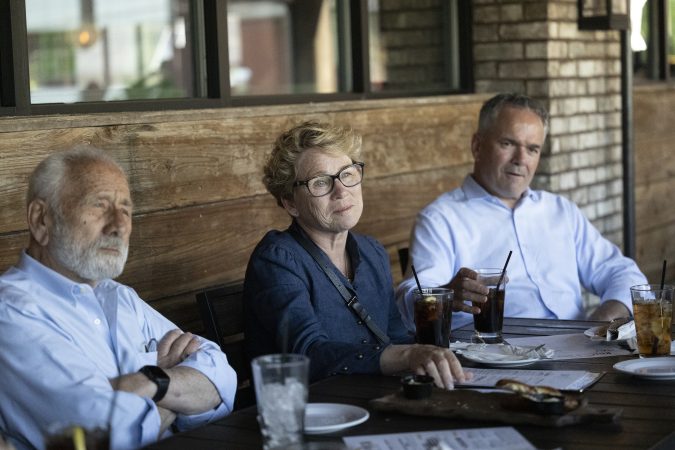
U.S. Rep. Chrissy Houlahan (center) has dinner with her family at Brick & Brew in Malvern, including her father, Andy Jampoler (left), her husband, Bart Houlahan, and her mother, Suzy Jampoler.Jose F. Moreno / Staff Photographer
‘A big balancing act’
Houlahan has shared parts of her family’s story as she has traveled her district this year — prioritizing events and meetings that aim for a deeper understanding of an affordability crisis that has not spared her home county, where the median household income is about $131,000, or 40% more than the statewide average.
On back-to-back days this spring, that meant a focus on the kinds of childcare and senior-care issues she has become familiar with.
“We call it ‘from zero to Edna,’” Laura Schoefield-Pierson, executive director of the YMCA of Greater Brandywine, said of the facility’s programs aimed at all ages, from infants to seniors.
Walking Houlahan through the pre-K classes and a gym with a dozen seniors playing table tennis, Schoefield-Pierson spoke about the organization’s exercise programs aimed at offsetting symptoms of Alzheimer’s or Parkinson’s, and about the complexities of providing assistance for families with young children.
In addition to the “many children” whose care is subsidized through the state’s Child Care Works program — set for families earning 200% or less of the federal poverty level, or $66,000 for a family of four — others receive aid through the YMCA, Schoefield-Pierson said. The facility’s fundraising goal this year is $237,000, she said. On the day of Houlahan’s visit, Schoefield-Pierson said “the kiddos” were writing thank-you notes to donors.
U.S. Rep. Chrissy Houlahan (D., Pa.) interacts with teachers and children at a childcare center at the YMCA in West Chester.Jose F. Moreno / Staff Photographer
Though the U.S. Department of Health and Human Services recommends childcare should not exceed 7% of household income, Houlahan said she was surprised to learn a family would have to earn $327,000 to meet that benchmark at the YMCA for one child.
Nationally, the average annual cost of childcare in 2024 was $13,128, an increase of 29% over the previous five years and far exceeding the national recommendation for the average household’s budget.
“It’s crazy how much healthcare and childcare plays into your family planning,” said Helena Cordoba, a 35-year-old mother of two who said at a roundtable hosted by Houlahan that she had been hoping to grow her family.
A Colombian immigrant who owns Café Com Leite in Phoenixville, Cordoba said she thought she had been living the American dream. But a recent miscarriage and the rising costs of both childcare and healthcare, which she does not currently have, have made her rethink her family’s plans.
“I never thought I was going to say, ‘Maybe the miscarriage is a blessing.’ That thought on its own is very saddening,” Cordoba said. “I don’t know if we were going to be able to afford another baby. Our life would have been completely turned upside down.”
Others voiced similar struggles while Houlahan sympathized and shared her daughter’s own experience with a $2,000 monthly daycare bill.
Karessa, Amelia, and Zack Hathaway, pictured here in 2023, at Sweet Amelia’s in Kennett Square.Monica Herndon / Staff Photographer
Zack Hathaway, who owns the restaurant Sweet Amelia’s in Kennett Square with his wife, Karessa, said their business “makes just enough” to cover the $700 to $800 weekly cost for their babysitter amid a demanding restaurant schedule. Thomas Smith, who works at the Cleveland-Cliffs steel plate production facility in Coatesville, said he makes too much to qualify for subsidies for his grandchildren but still struggles to cover the cost.
“It’s like a big balancing act to be able to put your kids in a place that you want to feel comfortable with them being and with being able to afford it,” said Amarte Grove, another Cleveland-Cliffs employee and a father of five daughters.
In another tour focused on the other end of the agespectrum, Houlahan peppered staffers at Brandywine Valley Active Aging in Downingtown about their work to offer free meals, housing services, and activities to about 120 seniors daily.
According to the organization, Chester County’s homeless population has decreased in recent years — from 916 in 2023 to 747 in 2025. But the percentage of that population that is over 60 has increased from 9% in 2023 to 14% in 2026. About 45 older adults in the county were homeless as of early May, according to the organization, which works alongside other independent and government groups to connect seniors with stable housing.
“It is really difficult to live in Chester County,” said Jen Manthey, BVAA’s director of information and assistance. “It takes a long time for them to get out of homelessness, partly because it takes a long time for us to build the trust with them and get that rapport — that they trust what we’re saying, and there aren’t $400 room rentals out there that we’re just hiding from you.”
U.S. Rep. Chrissy Houlahan (D. Pa.) visits with senior citizens at the YMCA in West Chester. She shares the burden of the “sandwich generation” caring for her elderly parents, opening her home to her adult daughter and son-in-law, and helping to care for her other daughter’s toddler.Jose F. Moreno / Staff Photographer
Nick Popov, BVAA’s chief operating officer, said demand remains high for the 5,000 free lunches the organization provides every month to individuals age 60 and older. The cost for those meals is reimbursed through the Pennsylvania Department of Aging, though the organization raises most of its funding in total, he said.
“The services are out there. We’re doing everything we can to provide them,” Popov said. “But it’s always a struggle to kind of balance the bottom line between our goals and what we can actually affordably accomplish.”
Houlahan’s parents said they had never expected to move in with their daughter. Even as they looked to move closer to their family and could not find a spot that fit their financial and physical needs, it took some convincing, mostly from their son-in-law, Bart Houlahan.
“It was an inspiration that permits us to enter old age — serious old age, not just the kid stuff right now — with greater confidence that our health will be sustained,” said Andy Jampoler,Houlahan’s father, a Holocaust survivor born in German-occupied Poland in 1942.
U.S. Rep. Chrissy Houlahan poses at a family during dinner at Brick & Brew in Malvern, including her father, Andy Jampoler (left), her husband, Bart Houlahan, daughter Molly Rosa Houlahan, daughter-in-law Kristen Rosa Houlahan, and Houlahan’s mother, Suzy Jampoler.Jose F. Moreno / Staff Photographer
Turning experience into policy
In May, Houlahan introduced legislation that would require the federal government to collect data on the sandwich generation, a step she said is critical to creating better policies for an “undervalued role in the nation’s economy.”
It would require at least one federal survey to ask whether individuals provide unpaid care to both children and older adults. U.S. Sen. Andy Kim (D., N.J.), who has two young sons and cares for his father with Alzheimer’s, sponsored a companion bill in the Senate.
Sen. Andy Kim (D., N.J.) poses with his family and Vice President Kamala Harris after taking the ceremonial oath of office in the old Senate chamber on Jan. 3, 2025, in Washington.Steven M. Falk / Staff Photographer
Houlahan is also the chair of an “economic growth and cost of living” working group within the New Democrat Coalition, a group of self-described centrist Democrats that includes about half of the entire caucus. The group rolled out an “affordability agenda” earlier this year that is considered a framework for how Democrats would tackle housing, healthcare, energy, paid family leave, and much more if they win control of the House.
U.S. Rep. Brad Schneider (D., Ill.), chair of the New Democrat Coalition, credited Houlahan for her leadership with the agenda, describing her as having a “quiet wisdom that focuses on the core of a problem” while bringing her own life experience to the work.
“Everyone’s experience is unique, but her experience shares many of the aspects of what people across the country are facing,” Schneider said. “The sandwich generation, taking care of kids and parents, for whatever circumstance, while at the same time seeing the cost of just everyday living … is putting a burden on families.”
The legislation aims to incentivize housing construction, restrict large investors from buying single-family homes, help families with home repairs, and more. The president reiterated Friday that he would not sign it, allowing the bill to become law without his signature.
In her Capitol Hill office about an hour after Trump canceled that bill signing late last month, Houlahan described the president as “so obtuse that he can’t see in front of him that this is something that the people want.” After spending much of the last year calling out Johnson, the House speaker, for not standing up to Trump, she said there should be “counterinsurgents” and an “uprising” in the Republican Party.
At the same time, she expressed some hope. The housing bill may have been a rare moment of bipartisanship, but it was also a sign that Congress can still act on affordability even before the end of the year, she said.
“We don’t have time, for all of this stuff, to wait until somebody else is in charge,” Houlahan said. “We can do this ourselves.”
U.S. Rep. Chrissy Houlahan (D., Pa.) sits between her father, Andy Jampoler, and her husband, Bart Houlahan, at Brick & Brew in Malvern. Houlahan’s parents recently moved in with her. Jose F. Moreno / Staff Photographer
Sen. Lindsey Graham, a longtime Republican lawmaker from South Carolina who went from being one of Donald Trump’s harshest critics to positioning himself in the front ranks of the president’s most deferential supporters, died Saturday. He was 71.
The senator had a remarkable political trajectory that included election to the House in the 1994 Republican takeover, a high-profile role as an impeachment manager against President Bill Clinton, a Senate career featuring foreign policy hawkishness and bipartisan collegiality, and a prominent position as a confidant of President Donald Trump who epitomized Trump’s capture of the Republican Party.
On Sunday, the Associated Press reported that a statement from Sen. Graham’s office said the Medical Examiner of the District of Columbia’s preliminary findings are the senator died of aortic dissection due to arteriosclerotic cardiovascular disease. That is an aorta rupture stemming from hardening of Sen. Graham’s arteries. A final report will be issued later.
Over his more than three decades in the House and the Senate, Sen. Graham became nationally known because of a near-constant presence in the news media, where his folksy manner and talent for a good quote put a soft edge on his sometimes hard-line views. On Sunday, he was scheduled to have made what would have been his 64th appearance on NBC’s Meet the Press, following his return from a trip to Ukraine.
The senator also had a talent for winning elections despite regular attacks from the right and the left. Last month, Sen. Graham won the South Carolina Republican nomination over five challengers in his pursuit of a fifth Senate term, avoiding what many had anticipated would be a runoff and placing him on a glide path to reelection in his deeply Republican home state.
In celebrating his primary win, Sen. Graham paid tribute to Trump, whom he had in 2016 called “a nut job” unfit to be commander in chief. “I want to thank the big guy, God. Trump comes later. Mr. President, you’re not far behind God, but we’re going to start with him,” he said in the June speech.
Although Sen. Graham was criticized throughout his political career as a shape-shifter and attention-seeking opportunist, there were some areas in which he was steadfast. Among them was his advocacy of a hawkish foreign policy, often as an ally of Sen. John McCain (R., Ariz.), a longtime friend.
Sen. Graham championed using the U.S. military and government money to support global allies and confront foreign adversaries, supporting the wars in Iraq and Afghanistan and condemning the withdrawal of troops from both countries.
Sen. Graham had also pushed both the Biden and Trump administration to provide greater support for Ukraine in its fight against Russia’s invasion. A staunch ally of Israel, Sen. Graham had pressed Trump toward war with Iran and warned him against making a premature deal.
Israeli Prime Minister Benjamin Netanyahu, speaking Sunday morning on Fox News, praised Sen. Graham as “a great friend” to Israel. “He was absolutely clear. He didn’t bend to fashion, the winds of fashion. He knew who the good guys were, and he knew who the bad guys were. He never confused the two,” Netanyahu said.
In a social media post written in the predawn hours Sunday, Trump also lauded Sen. Graham — among the few who managed to make it into the president’s good graces after having denounced him — as “one of the greatest people and Senators I have ever known” and “a true American Patriot.”
A childhood growing up behind a bar
Lindsey Olin Graham was born on July 9, 1955, in Central, S.C., a town in Pickens County that gets its name for being the midway point of a rail line between Charlotte and Atlanta.
The future senator grew up in the rooms behind the Sanitary Cafe, a pool hall, restaurant, bar, and liquor store owned by his parents, Millie and Florence James “F.J.” Graham. While his father, also known as “Dude,” tended bar for the millworker clientele, the son racked balls and answered phones.
He would later say jokingly that he learned everything he really needed to know about politics there, often having to tell a wife who called looking for her husband, “He says he’s not here.”
The first member of his family to attend college, Sen. Graham set his sights on a military career, joining the ROTC at the University of South Carolina, although a bad ear and his dismal math scores got in the way of his ambition to become a pilot.
He was still a student when his plans for the future suffered a bigger disruption. His parents died within two years of each other, leaving him to provide for his 13-year-old sister, Darline, who went to live with an aunt and uncle with Sen. Graham as her guardian. After graduating from law school, Sen. Graham legally adopted her, so that she would be eligible for his military benefits.
“You assume everything’s going to be like Ozzie and Harriet — that doesn’t mean it’s going to turn out that way,” he told the Washington Post in 1998. “So here I’ve got a teenager on my hands. She’s turned out great in spite of me. I was probably a nut. I never let her date. I smelled her clothes if she smoked. I listened in on her phone calls. I was probably pressing too hard, just ’cause I felt such responsibility for her.”
For her part, Darline Graham Nordone would later describe Sen. Graham as “a brother, a father, and a mother rolled into one.” She survives Sen. Graham, who never married.
As a newly minted lawyer in 1981, Sen. Graham joined the Air Force’s Judge Advocate General staff, spending four years as a prosecutor and defense attorney in Europe. His defense of an Air Force pilot accused of marijuana use brought him national attention when he was featured in a CBS 60 Minutes report on the Air Force’s faulty drug-testing procedures.
Upon leaving active duty in 1989, Sen. Graham returned to South Carolina and entered politics. After two years in the state legislature, he was elected to the U.S. House in the Republican wave of 1994, when the GOP recaptured the House after decades in the wilderness.
The junior member of the House Judiciary Committee enjoyed a star turn as a House manager in Clinton’s 1999 impeachment trial in the Senate chamber. “Where I come from,” he drawled as he described a phone call the president had made to White House intern Monica Lewinsky, “You call somebody at 2:30 in the morning, you’re up to no good.”
Meanwhile, his military career had continued. He was a member of the South Carolina Air National Guard, called to active duty stateside during the 1991 Persian Gulf War. He joined the U.S. Air Force Reserves in 1995, retiring 20 years later as a colonel. During that time, he did numerous stints in Iraq and Afghanistan, and was the first sitting member of the Senate in decades to do military duty in a combat zone.
Sen. Graham’s growing celebrity helped propel him when a South Carolina Senate seat opened up in 2002 with the retirement of 100-year-old Strom Thurmond. Sen. Graham won it, in what became the most expensive Senate race in state history.
Once in the Senate, Sen. Graham became known for working across the aisle and developed a friendship with then-Sen. Hillary Clinton (D., N.Y.) — an unlikely one, given his recent history as one of her husband’s impeachment managers. The two traveled together frequently and co-sponsored legislation.
Sen. Graham’s independent reputation was boosted by his closeness to McCain, whose presidential candidacy he supported during the bitter 2000 South Carolina GOP primary against the eventual winner, George W. Bush. McCain, the ultimate political maverick and one who shared Sen. Graham’s interventionist foreign policy views, referred to his colleague as “my illegitimate son.”
As a result, Sen. Graham, like McCain, periodically found himself at odds with the Bush administration. When a scandal broke over torture allegations at Abu Ghraib, a prison run by the U.S. military in Iraq, he demanded accountability up the chain of command. “What are we fighting for?” Sen. Graham asked at a hearing. “To be like Saddam Hussein?”
On Sunday, Bush issued a statement lauding Sen. Graham as “a knowledgeable Senator who understood how the world works and how important America’s international engagement is to resist tyranny.”
Hillary Clinton, the Democrats’ 2016 presidential nominee, would later express dismay over Sen. Graham’s transformation during the Trump era. In 2019, she told radio host Howard Stern that he had been someone she “admired and liked enormously” before he became a devotee of Trump, whose bullying, name-calling approach to politics was abhorred by Democrats.
“I saw him as somebody who, you know, had been working to try to figure out what he believed and how he could do things,” Clinton said. “It’s like he had a brain snatch, you know?”
From Trump antagonist to Trump loyalist
In 2015, Sen. Graham announced what would become a quixotic campaign for president.
Outside of his views on foreign policy, he was seen as a moderate Republican. A year before, he had survived an effort by the tea party movement and right-wing commentators to force him out of office. They branded him “Flimsy Lindsey” and “Grahamnesty” over such apostasies as working with Democrats on climate change and immigration, where he supported widening a path to citizenship for undocumented people.
“I want to be president to protect our nation that we all love so much from all threats foreign and domestic,” Sen. Graham said in announcing his candidacy. “So, get ready. I know I’m ready.”
He and Trump, who was running his first and ultimately victorious presidential campaign, clashed often on the debate stage, and Trump at one point gave out Sen. Graham’s personal cellphone number on television, after Sen. Graham called him a “jackass.” As it turned out, the senator was the wrong candidate for the moment in a party that was turning toward Trump’s brand of nativist populism. Sen. Graham left the race in December 2015, before the first votes were cast.
He subsequently endorsed former Florida governor Jeb Bush and, later, Sen. Ted Cruz (R., Texas), only to see their campaigns go down in flames against Trump.
Once Trump was in office, Sen. Graham’s began cozying up to the new president, looking past Trump’s demeaning of the Vietnam heroism of Sen. Graham’s friend and idol McCain, who had been a prisoner of war for 5½ years and was diagnosed with deadly brain cancer in 2017.
Sen. Graham insisted his evolution on Trump was based on acceptance, not opportunism. “I said he was a xenophobic, race-baiting religious bigot,” he told CBS News in 2018. “I ran out of adjectives. Well, the American people spoke, and they rejected my analysis.”
He and Trump bonded over golf outings, and Sen. Graham constantly fed the president’s famous appetite for flattery.
“I think Lindsey likes the president a lot more than he thought he would,” Steve Largent, a former congressman and confidant of Sen. Graham, told New York Magazine in 2018. “I think Lindsey feels a little bit like the adult in the room, speaking with the president. … There’s something about, I’m not going to say innocence, but the president’s affability as well as his naiveté that Lindsey is drawn to.”
Sen. Graham wavered after the Jan. 6, 2021, riot at the U.S. Capitol by Trump supporters seeking to overturn the result of the 2020 presidential election, after Trump did little to stop the violence.
“Trump and I, we’ve had a hell of a journey — I hate it to end this way. Oh my God, I hate it. From my point of view, he’s been a consequential president, but today … all I can say is count me out. Enough is enough,” Sen. Graham said at the time.
Still, Sen. Graham did not join seven other Republican senators the following month in voting to convict Trump of inciting an insurrection after he was impeached by the House.
With the resurrection of Trump’s political career during the 2024 election cycle, Sen. Graham quickly made his way back into the fold. Last month, with his primary approaching, the senator made his pitch to South Carolina voters by noting that he had Trump’s endorsement: “If you want somebody who can go to Washington to help him, I’m your best choice.”
Invitations were sent. American flags lined the back of the red stage set in Statuary Hall. Bright spotlights lit the signing table donned with the presidential seal.
President Donald Trump so abruptly canceled what might have been the last major presidential signing ceremony of this Congress that it caught lawmakers, top aides and housing industry officials all completely by surprise.
Trump said he would not sign the bipartisan 21st Century Road to Housing Act, but it went into law anyway on Friday without his signature.
The axed signing ceremony delivered Trump’s punishment of lawmakers for failing to pass his bill to limit voting rights ahead of the midterms, even though the housing bill represents the most significant housing legislation since the aftermath of the financial crisis.
Trump doubled down on his decision not to sign the bill in a Truth Social post Friday morning.
“I will not sign the Housing Bill, which has been fully approved by Congress and sent to the White House, in PROTEST over the fact that the United States Senate is not capable of passing THE SAVE AMERICA ACT,” Trump wrote. “THE SAVE AMERICA ACT’S non-passage is CRAZY, and a serious threat to any politician who votes against it!”
Trump’s decision to ax the signing ceremony, and his comments referring to the bill as a “yawn,” represent a missed opportunity for lawmakers and the president to demonstrate to Americans that they are addressing their affordability concerns, some congressional watchers say.
“This is the exact kind of bill they want to point to and say Republicans are working on issues that their voters care about, and Democrats would want the same,” said Julian Zelizer, a history and public affairs professor at Princeton University. “That’s not the signal that the administration is sending.”
One housing leader who received an invite to the ceremony from House Speaker Mike Johnson’s office said they were on the way to the event in their Lyft when they received a text with a screenshot of Trump’s post that read: “Today’s Housing News Conference and Signing is hereby cancelled until such time as we pass the desperately needed SAVE AMERICA ACT.”
The housing leader, who spoke on the condition of anonymity, said they then received an email from the speaker’s office shortly after. The housing leader’s first reaction: “incredibly disappointed, but not shocked.”
One business lobbyist who was set to attend the signing ceremony was standing on the Capitol steps, when another attendee told them to check their email, as the event was canceled. Seconds later they received a message with a screenshot of Trump’s Truth Social post.
“When I found out the reason why, it was disappointing, but it wasn’t shocking,” said the lobbyist, who spoke on the condition of anonymity. “With the president in the White House, things can happen on a dime.”
Trump’s last-minute decision to cancel the signing ceremony represents a broader pattern of the president suddenly reversing course on policies previously deemed a priority, including a canceled public signing ceremony in May for an executive order to create a system to vet powerful new AI models before they are released publicly. Trump ultimately signed a revised version of the order weeks later.
Lawmakers were equally blindsided by Trump’s decision on the housing bill. Especially considering that Senate Republicans had already expressed they lacked enough support to pass the Save America Act, which would impose stricter election rules.
House GOP leadership was in the middle of a news conference when Trump canceled the ceremony on social media. House Financial Services Committee Chairman French Hill (R., Ark.) had just discussed his work with Senate Banking Committee Chairman Tim Scott (R., S.C.) to get the bill through both chambers.
When Johnson opened the floor for questions, a reporter notified him of Trump’s social media post. When asked if Trump would sign the bill at a later date, Johnson said, “It’s my estimation he’ll do it within that 10-day window.”
A president has 10 days, excluding Sundays, to either veto or sign a bill after they receive it from Congress. If the president does not act within the window, the bill automatically becomes law if Congress is in session. So Congress is poised to notch a concrete legislative achievement to tout on an issue widely expected to loom large in the midterm elections.
Johnson sent the bill to Trump on Monday, June 29, which meant the 10-day window closed at the end of Friday at midnight.
While many housing advocates have said the bill does not go far enough to address the nation’s housing shortage, they argue it is an important first step.
The bill, which received overwhelming bipartisan support in Congress, would bar institutional investors from buying more than 350 single-family homes, expand federal grant programs to give cities money for building new homes and eliminate an outdated federal construction rule to make manufacturing mobile homes cheaper, among other measures.
Zelizer said Trump’s negative comments about the bill could make it more difficult for some lawmakers, particularly vulnerable Republicans, to sell that idea to voters.
The business lobbyist who was planning to attend the signing ceremony said the cancellation and Trump’s comments hurt the positive momentum around the bipartisan success in passing the bill, but they don’t see that having much sway on Americans’ minds on the matter.
As Democrats grapple with the fallout from Graham Platner’s scandal-plagued and ultimately canceled bid for U.S. Senate in Maine, a political consulting firm that worked on his race and that’s been heavily involved in Pennsylvania politics is at the center of many of the party’s frustrations.
Members of the firm weren’t the only ones advising Platner’s campaign. National operatives such as Daniel Moraff, who has also worked in Pennsylvania, have also fielded criticism for recruiting and not thoroughly vetting Platner, an unknown political outsider.
But both before and after the allegations of sexual assault that led to Platner’s exit from the race this week, other Democratic consultants and political observers blamed FIGHT for continuing to support him through multiple public setbacks.
Platner’s issues have also reignited anger about and drawn parallels to Fetterman, another candidate who ran as a working-class progressive. The Pennsylvania Democrat has lost much of the support from the base that elected him as he’s more frequently sided with Republicans in ways that some have described as a betrayal. He has not been accused of the same types of issues that plagued Platner’s run.
“I supported Graham at the beginning, despite the nagging voice in my head that kept saying ‘this feels familiar,’” Adam Jentleson, Fetterman’s first chief of staff who has become a staunch critic of the Pennsylvania Democrat, wrote on social media.
Jentleson was among those who questioned the FIGHT agency and the rest of the Platner team’s work and its handling of the collapse.
When Morris Katz, the FIGHT strategist on Platner’s campaign, said on social media that his team advised to end the campaign immediately after hearing the allegations Platner had raped a former girlfriend, Jentleson replied that the argument “strains credulity.” Platner and his team had continued to deny the allegations, Jentleson and others noted.
“Shading a narrative toward the positive is standard, lying is not,” Jentleson wrote, comparing the experience to working with Fetterman.
Fetterman, for his part, has heavily criticized Platner in recent months and celebrated his downfall this week.
“You will only be remembered as the accused rapist that got pushed out of your election. … Go back under the rock that you came from,” Fetterman said Wednesday on Fox News.
The Democratic Socialists of America, in a letter that mentioned the FIGHT staff’s work for Fetterman, called on candidates to refuse to work with Katz, The Intercept reported Friday.
FIGHT declined to comment for this story.
As Democrats look to regain their footing in this year’s midterm elections, the Platner saga and FIGHT’s role has also touched on the party’s broader goals of cultivating candidates who can win over the kinds of working-class voters President Donald Trump captured in recent years.
Platner, an oyster farmer and former bartender who suffered PTSD after serving in the U.S. Marines, pitched himself as deeply in-tune with working class voters in Maine. It was the type of profile, many Democrats hoped, would lead to a victory over longtime Republican incumbent U.S. Sen. Susan Collins and help the party win control of the U.S. Senate.
Democrats in Pennsylvania have taken a similar approach.
In a Lehigh Valley-based congressional district considered one of the likeliest seats in the country to flip from Republican to Democrat, the party has rallied behind Bob Brooks, a union leader and retired firefighter who coaches high school baseball and drives a snowplow.
“When you look at Brooks, one of the reasons he was recruited into this race and why Democrats have rallied around him is that there’s a belief that he might capture some of the [working-class Democratic] energy,” said Chris Borick, an adjunct professor of politics at Lehigh University.
The FIGHT agency, which primarily makes candidates’ television ads, has worked on Brooks’ campaign as well as the campaign of Paige Cognetti, the Scranton mayor and Democratic nominee in the Scranton-based 8th Congressional District.
There are no signs that Brooks or Cognetti are being advised by Katz, who has primarily worked on Platner’s campaign. In response to requests for comment Friday, Brooks’ campaign only confirmed that FIGHT makes its ads, and Cognetti’s campaign said, “Paige is glad Platner dropped out of the race.”
The Pennsylvania candidateshave not faced the same type of intense criticism for parts of their personal histories as Platner did throughout his 10-month campaign.
Brooks’ opponents in the 7th Congressional District primary criticized him for old social media posts that, for instance, downplayed the role of guns in a mass shooting. Brooks said the posts were “silly, maybe stupid.” He, like Platner, also faced accusations that he could be “another John Fetterman,” given his background and similar appearance.
Mike Mikus, a Pittsburgh-based Democratic strategist who has long opposed Fetterman, said Brooks was “the real deal” at a time when Democrats are “desperate” to correct their problem with white, working-class voters. Platner, on the other hand, appeared to be an “overcorrection” that involved consultants dismissing “obvious red flags,” Mikus said.
He said FIGHT may lose some future clients because of the misstep, which he largely blamed on Moraff, a consultant who does not work for FIGHT and has also been widely criticized for recruiting Platner.
“Everybody’s looking for authenticity,” Mikus said. “And you can’t workshop somebody into something they’re not.”
Created after Trump and the Republican Party’s sweeping victories in 2024, the FIGHT agency’s pitch since its launch has focused on authenticity. Its candidates have reflected not just voters’ desires for candidates outside the traditional political establishment, but campaigns intent on fighting Trump and advancing economic populism. Zohran Mamdani, the Democratic socialist who won New York’s mayoral race in 2025, has marked their largest success to date.
“Among progressives there’s a sense that the party has not been effective in trying to counter Trump … and we have to fight this battle internally in order to resist Trump,” said Stephen Medvic, an associate professor of government at Franklin and Marshall College. “So you’re getting groups in the last couple of years, like FIGHT Agency, being put together to try to tip the balance in their direction.”
But their approach — finding someone who meets the profile and aligns with their ideology — may not necessarily always produce a winning formula. Limitations may depend on the type of assessment and vetting that goes into recruitment, he said.
“You might get an AOC, but … you might get a Platner,” Medvic said. “A lot of Democrats are now regretting that they were so excited about Fetterman because he turned out to be something so different.”