Category: National Politics

  • Trump administration revives rule that could deny green cards to immigrants who use public benefits

    Trump administration revives rule that could deny green cards to immigrants who use public benefits

    MIAMI — The Trump administration is reviving a rule that could deny green cards to immigrants who use public benefits that could include food stamps, Medicaid, and housing vouchers.

    The policy, known as “public charge,” appeared on Thursday in the Federal Register. It will be formally published on July 20 and take effect Sept. 18. Under the policy, applicants for green cards have to show they wouldn’t be burdens to the country or “public charges.”

    The policy was first implemented in February 2020 as one of President Donald Trump’s moves to limit legal immigration during his first administration, but it was reversed after Democratic President Joe Biden came to power.

    Its return comes when the Republican administration is implementing a hard-line policy to curb both illegal and legal immigration, and when the cost of healthcare and food is rising.

    The federal government “is reaffirming the requirement of self-reliance, protecting public resources and ending policies that encouraged dependency on the backs of hard-working American taxpayers,” U.S. Citizenship and Immigration Services said in a post published on its X account.

    “Under President Trump, USCIS is restoring the basic principle that immigrants must be able to support themselves,” the post said.

    While the administration’s crackdown on immigration has an increased focus on deportations and immigration enforcement in cities across the country and at borders and entry points, it has also taken actions that target legal immigrants and mixed-status families, in which the parents are foreign nationals with U.S.-born children.

    The rule expands disqualification options

    Federal law already requires those seeking permanent residency or legal status to demonstrate that they will not become a public charge. The Trump administration’s rule, however, broadens the grounds for disqualification.

    The new rule does not describe or specify by name the benefits and programs that could be considered a public charge. Instead, it says that officers who would implement the policy will make “individualized, fact-specific public charge inadmissible determinations, based on a totality of the alien’s circumstances.”

    It says that, “using good judgment and discretion, officers will more accurately assess an alien’s likelihood at any time of becoming a public charge.”

    The Trump administration first promoted the rule in 2018 as a way to ensure that only those who were self-sufficient came to the U.S. Immigrant rights advocates criticized it, saying it amounted to a “wealth test.” Public health experts said it would lead to worse health outcomes.

    Manatt Health, a group that provides advice to state and federal governments, estimated the policy would have deterred as many as 26 million people from seeking healthcare, food, housing, or other aid through programs for which they qualified under federal law. About half were U.S. citizens, mostly children or adults living in a mixed-status family, according to the group.

    Experts also noted that most people who receive benefits from the government are already legal residents.

    A 2020 study from the Migration Policy Institute said that while the “chilling effects” may be vast, the number of immigrants who could be deemed ineligible for legal permanent residence based on use of one of the public benefits under the rule was small.

    The institute estimated that no more than 167,000 people — less than 1% of the 22.1 million noncitizens residing in the United States at that time — could be determined ineligible for a green card based on their current use of a listed benefit.

    There were 22.8 million noncitizens living in the U.S. in 2023, according to the Census Bureau.

    Critics say the rule creates fear in the community

    Nongovernmental organizations said the policy generated confusion and fear and caused many immigrants and their U.S.-born relatives to decide not to apply for benefits and services to which they were entitled.

    Immigrant advocates condemned the government’s decision to revive the “public charge” rule and expressed concern.

    “This regulation is a direct assault on immigrant families, and a threat to our country’s health and economic security,” said Adriana Cadena, executive director at the Protecting Immigrant Families Coalition. “The Trump administration is basing immigration decisions on bias and politics, regardless of the resulting harm.”

    Sarah Krieger, senior policy counsel at the National Immigration Law Center, said the rule would make immigrants afraid to go to the doctor, buy food at the grocery store and file taxes.

    “With this new rule, they are sowing fear and chaos to ultimately reshape America into a country where only the few who are white and ultra-wealthy are welcome,” Krieger said. “The rule is not just deeply harmful, it also violates the law.”

  • JD Vance has a lot in common with one of his predecessors

    JD Vance has a lot in common with one of his predecessors

    Speaking to an applauding audience at the Richard M. Nixon Library on June 27, Vice President JD Vance favorably compared himself to the 37th President, “a young Senator, Vice President, writes some best-selling books, is hated by the media, it kind of sounds like JD Vance.”

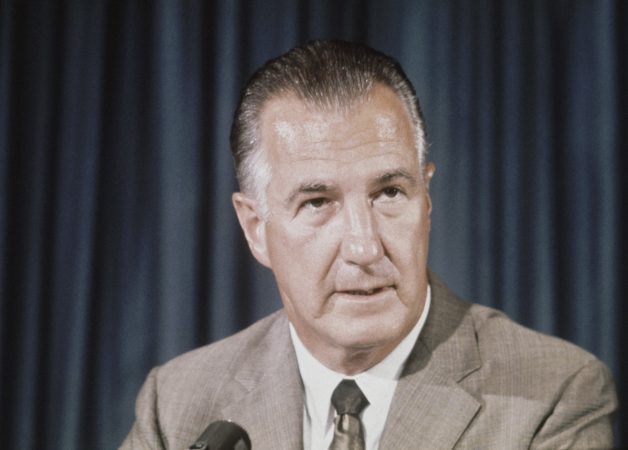
    But in actuality, it’s not Nixon who Vance resembles. It’s Nixon’s vice president, Spiro Agnew. Agnew, a dour-faced hatchet man, was known as “Nixon’s Nixon.” Our current dour political hatchet-wielder is Trump’s Agnew.

    Vance and Agnew share similar resumes. Both were elevated to the national ticket well ahead of their times to appeal to particular electoral constituencies and took on remarkably comparable foes during their vice-presidential terms.

    Like Vance, Agnew came from humble beginnings. The son of a Greek immigrant father and Virginia-born mother, his family owned a diner in Baltimore. Before joining the military and serving in World War II, he Americanized his foreign sounding first name to “Ted” and returned from combat to attend law school on the GI Bill. In 1966, Agnew won the Maryland governor’s race.

    Despite scant political experience, Agnew came to the attention of influential Nixon adviser Pat Buchanan, who recognized that there was national political appeal to the governor’s tough response to rioting in Baltimore following the assassination of Martin Luther King Jr. Agnew had pointedly criticized what he charged was the weak response of local Black leaders to civil disorder. Given that he wasn’t unacceptable to any of the feuding wings of the GOP — unlike many more prominent figures — this was enough for Nixon to make Agnew his running mate.

    Once on the ticket, the Nixon campaign deployed Agnew to counter the alarming momentum of third-party candidate, segregationist and former Alabama Gov. George Wallace. On a campaign swing through North Carolina and Florida, Agnew rallied the crowd with “speeches that sounded not unlike Wallace texts,” the New York Times reported. In 1969 Wallace quipped, “I wish I had copyrighted my speeches. I would be drawing immense royalties from Mr. Nixon and especially Mr. Agnew.”

    Agnew struggled in his first few months in the national spotlight and became known more for campaign trail gaffes than for policy positions.

    Even so, Agnew successfully connected with nervous white suburbanites, primarily in the Midwest and South, who feared civil rights, mistrusted the metropolitan elite and wanted the anti-Vietnam War protesters put in their place. This group of voters — who Nixon later referred to as “the silent majority” — became Agnew’s biggest supporters.

    Agnew’s penchant for gaffes and awkwardness continued after he and Nixon entered office. At a ceremony welcoming President Nixon home from a European trip in March 1969, Agnew slipped on an icy tarmac and smashed his nose. He then stepped up to the mic “bleeding profusely,” according to White House aide H.R. Haldeman.

    Yet, Agnew’s response to his (literal) stumbles helped him to connect even more with anxious white Americans. He refused to stand by and let well educated elites or the news media mock him. Instead, the vice president lambasted them as “an effete corps of impudent snobs” and “the nattering nabobs of negativism,” respectively. Agnew started delivering blistering speeches with the help of Buchanan and his fellow White House speechwriter William Safire, excoriating precisely those forces who anxious white Americans loathed.

    In November 1969 in Des Moines, Agnew made what a poll of leading scholars considered one of the 50 most significant American speeches of the 20th century. The vice president publicly called out the media, what he dubbed “this little group of men who not only enjoy a right of instant rebuttal to every Presidential address, but, more importantly, wield a free hand in selecting, presenting, and interpreting the great issues in our nation.” It would launch a more than half-century-long GOP crusade against mainstream journalists.

    In other speeches, Agnew hammered universities for what he described as the coddling of student radicals, calling them ”circus tents [and] psychiatric centers for overprivileged, under-disciplined, irresponsible children of the well to do blasé permissivists.” Agnew warned, “The criminal left is not a problem to be solved by the Department of Philosophy or the Department of English — it is a problem for the Department of Justice.”

    By the 1972 election, Nixon loathed the pugnacious Agnew and regularly disparaged him privately. He questioned his vice president’s intelligence, judgment and loyalty. Nixon, according to Haldeman, felt “Agnew doesn’t really have it” and had become convinced that “he can’t do the job” of president, should it come to that. The president even contemplated replacing Agnew on the ticket with Texas Gov. John Connally.

    Yet, he demurred, because Nixon recognized how popular the vice president was with his “silent majority” base. Observers initially touted Agnew as a front-runner in the 1976 Republican presidential sweepstakes. Instead, however, the vice president’s political career crashed and burned.

    Made By History sponsors. FOR USE ON MADE BY HISTORY STORIES ONLY.Inquirer Staff

    In 1973, 10 months before Watergate ended Nixon’s presidency, Agnew pled no contest to tax evasion, stemming from unreported bribes he had received while governor of Maryland. Agnew slunk away from public life, disbarred and disgraced, to an odd final chapter of his life that included writing a steamy novel, lobbying for tin pot dictators and engaging in antisemitic conspiracy-mongering.

    A half century after Agnew left office, Vance is having a very similar vice presidency.

    He, too, comes from working class roots. The vice president grew up as James David Hamel in a working-class household in an Ohio Rust Belt town. There, he experienced poverty and domestic instability. Like Agnew, he served in the military, went to law school and spent only two years as an elected official — in Vance’s case, two years in the Senate — before being chosen as the GOP’s vice presidential nominee.

    Just as Pat Buchanan sold Agnew to Nixon as a Silent Majority kindred spirit, pundit Tucker Carlson promoted Vance to Trump as a fellow America Firster. Like the former Maryland governor, Vance joined the Republican ticket in part because he could speak to “blood and soil” Americans.

    Additionally, like his predecessor, Vance has experienced verbal stumbles. In 2021, anticipating a future Kamala Harris run for the presidency, he claimed that America was run “by a bunch of childless cat ladies who are miserable at their own lives and the choices that they’ve made, and so they want to make the rest of the country miserable too.”

    In 2025, the vice president broke the national championship trophy in a ceremony with the Ohio State University football team. That year, the newly converted Catholic also earned gentle but firm pushback from Pope Francis for Vance’s jaw-dropping misinterpretation of the Church’s message on immigrants.

    Trump has also deployed Vance as an attack dog, going after the same universities and media outlets Agnew regularly tangled with. Even before he was elected to the Senate, Vance told the National Conservatism Conference that “if any of us want to do the things we want to do for our country and the people who live in it, we have to honestly and aggressively attack the universities in this country.” As vice president, he has frequently targeted the media, charging that journalists have a “political bias” and cannot be trusted.

    And like Nixon before him, Trump doesn’t seem 100% sold that his vice president is the rightful heir to his political legacy. Most recently, Trump talked about his decision to have Vance serve as the lead negotiator to end the war with Iran by throwing him under the bus, saying, “If it works out, I’m going to take the credit. If it doesn’t work out, I’m blaming JD.”

    Vance’s post vice presidential chapter has not yet been written but it is a good bet that he will run for president in 2028.

    If he decides to seek the top job, he will run, not as a Richard Nixon Republican, but as a Spiro Agnew one. Nixon’s Watergate cover-up and general paranoia overshadowed a more moderate side: the diplomatic achievements, support for environmental protections and the creation of Title IX.

    Agnew, by contrast, was an emblem of the pugilistic, populist politics that Vance has made his calling card. Those, and not substantive policy achievements, constitute Agnew’s historical legacy. Vance’s is likely to be the same.

    Chuck Holden is a professor of history at St. Mary’s College of Maryland. Zach Messitte is the former president of Ripon College where he was also a professor of Political Science. Jerald Podair is professor of history and Robert S. French professor of American studies emeritus at Lawrence University. They are the co-authors of Republican Populist: Spiro Agnew and the Origins of President Donald Trump’s America (University of Virginia Press, 2019)

    Made by History takes readers beyond the headlines with articles written and edited by professional historians. Opinions expressed do not necessarily reflect the views of The Inquirer.

  • House vote exposes Democrats’ widening divide over Israel

    House vote exposes Democrats’ widening divide over Israel

    A striking number of House Democrats — 103 — voted Wednesday to cut off military aid to Israel for the next fiscal year, in a sign of the growing disconnect between the Democratic leadership’s long-standing support for the Jewish state and the party’s left wing.

    The vote was on a largely symbolic amendment introduced by Rep. Thomas Massie (R., Ky.) to an appropriations package for the State Department and other national security agencies.

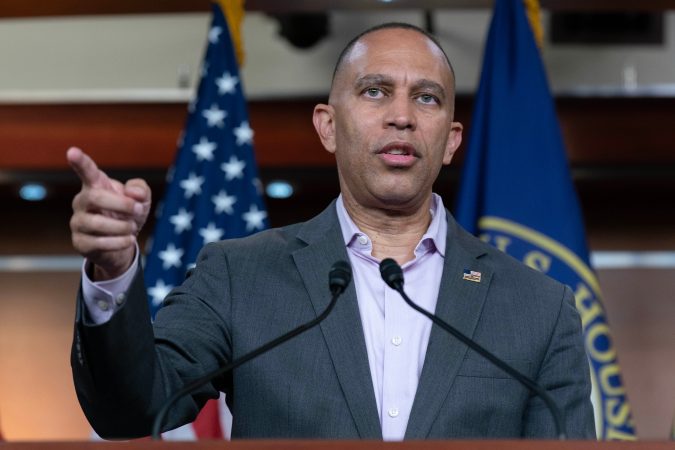
    Despite the considerable Democratic support, the amendment failed in the House. House Minority Leader Hakeem Jeffries (D., N.Y.) voted against it. Massie was the only Republican to vote for the amendment. Ten Democrats voted present.

    Still, the large support for the amendment comes amid a sharp shift among Democratic voters on Israel. A number of Democrats who have voiced support for Israel voted for the amendment, including former House Speaker Nancy Pelosi (D., Calif.) and Katherine Clark (D., Mass.), the minority whip.

    In a statement, Clark — the No. 2 House Democrat — said, “the status quo is not tenable.”

    She added: “We should not provide a blank check for military aid to any country that does not comply with U.S. law, interests, and values. The Netanyahu government has failed to meet that standard.”

    Public support for Israel has plummeted over the country’s military campaigns in Gaza and Lebanon, particularly among Democrats. Nearly three-quarters of Democrats want to reduce or end military support for Israel, according to a Washington Post-Ipsos poll conducted July 8-13. Forty percent of Democrats want to eliminate military support to Israel entirely, including 58% of “very liberal” Democrats.

    Views have shifted dramatically in recent years. Shortly after the Oct. 7, 2023, Hamas attacks on Israel, 28% of Democratic registered voters felt the U.S. was too supportive of Israel, according to polling by Quinnipiac University. That rose to 41% by early 2024 and to 66% last month, including clear majorities of older and younger Democrats.

    Rahm Emanuel, a potential Democratic presidential candidate and former top adviser to Presidents Bill Clinton and Barack Obama, recently traveled to Tel Aviv to warn Israelis that Prime Minister Benjamin Netanyahu had led the country toward dangerous diplomatic isolation.

    Emanuel said U.S. support for Israel was “plummeting around the world” and argued that the United States should end “the American taxpayer’s subsidy of Israel’s defense budget.”

    Jeffries has resisted calls from the base to end all aid to Israel’s government, balancing the priorities of his Democratic members who have stood by the U.S.-Israel relationship. He wrote in a Monday letter to his fellow Democrats that he would be voting against the measure, saying it is too broad.

    But Jeffries said “given the strongly held views throughout the Caucus,” he would let members vote their conscience on the measure.

    A progressive campaign push

    Progressive candidates have cast the divide as evidence that the Democratic establishment is misaligned with its own voters — not only on the war in Gaza, but also on money in politics and the use of U.S. tax dollars abroad.

    “The Democratic Party has been out of step with its own base on Gaza and Palestinian human rights for years. People in this country can’t afford rent, groceries, or a doctor’s visit — and instead of fighting for them, our politicians are sending billions to fund a genocide,” said Darializa Avila Chevalier, a democratic socialist candidate who won a competitive New York primary last month.

    The strategy has had several notable successes.

    In New York, three vocal leftist critics of Israel including Avila Chevalier handily won their primaries, including one in which support for Israel became a central distinction with the moderate incumbent. Candidates making similar arguments also won primaries in Pennsylvania, New Jersey, and Colorado.

    The trend continues in competitive primary races this summer, including in Michigan’s highly watched Senate race where criticism of Israel forms a pillar to progressive candidate Abdul El-Sayed’s message.

    In a statement for this story, Jeffries said the party “must recommit to a two-state solution that prioritizes a safe and secure Israel as a Jewish and Democratic state living side by side in peace and prosperity with a Palestinian state that provides dignity, respect, and self-determination for the Palestinian people.”

    He continued, “It is also imperative that we support the complete reconstruction of Gaza, aggressively surge humanitarian aid to Palestinian civilians and strongly oppose the reprehensible conduct of the far-right Netanyahu government in the West Bank.”

    He added in his letter to fellow Democrats that Israel has reached a point where it should be able to pay for its own defense and that the U.S. should reassess future aid agreements with the country.

    The call for a reset was a significant move for the leader given his past firm support for the U.S.-Israel alliance, said Jeremy Ben-Ami, president and CEO of the liberal pro-Israel group J Street.

    But several progressives have still demanded a stronger stance on the issue than Jeffries’s attempts to balance the positions of the caucus.

    “The Democratic voting base and the American voting base have shifted here,” said Brad Lander, who won a competitive New York primary against Rep. Dan Goldman, a longtime supporter of Israel. “I do believe that the Democratic Party leadership is going to have to catch up.” Lander, like Goldman, is Jewish and supports a two-state solution but differed from Goldman in labeling Israel’s actions in Gaza a genocide.

    The American Israel Public Affairs Committee, the preeminent pro-Israel lobbying group, has become a particular target on the left, held up as an example of what progressives call the corrupting influence of money in politics. Progressive candidates regularly criticize moderate candidates who benefit from spending by AIPAC-affiliated groups, asserting the group’s campaign funding pushes candidates away from the party base’s stance on Israel. AIPAC’s political network supports pro-Israel Democrats and Republicans, including all of the top members of House Democratic leadership.

    El-Sayed has accused his opponent, Rep. Haley Stevens, of failing to adequately condemn the actions of the Israeli government because of what he says is the influence of the pro-Israel lobby. A super PAC affiliated with AIPAC has poured more than $20 million into boosting Stevens.

    “Her entire campaign is bankrolled by outside organizations who know that they’re going to buy a reliable vote to send our tax dollars elsewhere instead of solving actual problems here in Michigan,” El-Sayed said.

    On Wednesday, Stevens voted against the House amendment.

    Stevens is a longtime supporter of Israel, though she has also criticized the government’s handling of the war in Gaza and said Israel’s actions have made Jews around the world less safe. During a debate this month, she said she was the only candidate who truly advocated for the creation of a Palestinian state alongside Israel.

    Stevens’ campaign responded that El-Sayed was “peddling in conspiracy theories” by asserting she was working at the behest of AIPAC.

    “Haley has always believed this race is about the future of Michigan, and that’s why her focus is and has been on promoting policies that will reduce costs, grow the economy and create a strong 21st century manufacturing industry that will carry Michigan forward,” her campaign said in a statement.

    Patrick Dorton, a spokesperson for AIPAC’s super PAC, said the group has the right to partake in the primary process like any other interest group and noted that super PACs have also been spending heavily to back candidates opposed to the U.S.-Israel relationship.

    “The anti-Israel fringe left uses the dark money argument when it suits them and funds super PACs when it’s to their advantage,” Dorton said. “These are red herring arguments to drive pro-Israel Democrats out of the party and out of the primary process.”

    Deryn Sousa, a spokesperson for AIPAC, said that the organization’s membership crosses party lines and the group supports candidates based on their alignment with its support for the U.S.-Israel relationship. Hundreds of AIPAC-backed candidates have won their primaries this year, Sousa noted.

    Democrats for Israel

    Israel still has its ardent defenders among congressional Democrats, several of whom argue that the growing number of vocal Israel critics fails to grasp the reality on the ground.

    “War is terrible, and it’s very hard to be successful in an urban war and successful in the public relations war,” said Rep. Brad Sherman (D., Calif.), a longtime supporter of Israel and co-chair of the Israel Allies Caucus.

    Sherman said he and most other Democrats have been able to criticize the government of Israel without going after the U.S.-Israel relationship, one of the strongest partnerships in the Middle East. He warned that some of the criticism has amounted to demonization and antisemitism.

    And even among the progressive candidates criticizing the party’s stance toward Israel, there is disagreement on the future of the relationship with Jerusalem. While Lander identifies himself as a Zionist, El-Sayed said liberal democracy was incompatible with the idea of a Jewish state.

    The next House Democratic Caucus is likely to include an unusually large number of members openly critical of Israel. Still, foundational disagreements over Israel are nothing new to the caucus.

    Sherman recalled a pushback on similar criticisms against Israel in the 1980s, when the country invaded Lebanon, though he noted the resistance to Israel is greater now among Democrats than then. He was a founding leader at the time of Democrats for Israel, a grassroots group dedicated to rooting out anti-Israel sentiment in the party.

    Avila Chevalier said she would work with anyone “serious about lowering the cost of living working-class people” regardless of their stances on Israel.

    Rep. Bradley Schneider (D., Ill.), a moderate who is largely supportive of the U.S.-Israel relationship, noted Israel critics already serve in the Democratic Caucus and that he is still able to work with them on other issues, including healthcare, housing and education.

    “Democrats are a big tent,” Schneider said. “We welcome diverse opinions.”

  • Donald Trump hits Josh Shapiro, promotes defense investments in Pa. during industry summit hosted by Dave McCormick

    Donald Trump hits Josh Shapiro, promotes defense investments in Pa. during industry summit hosted by Dave McCormick

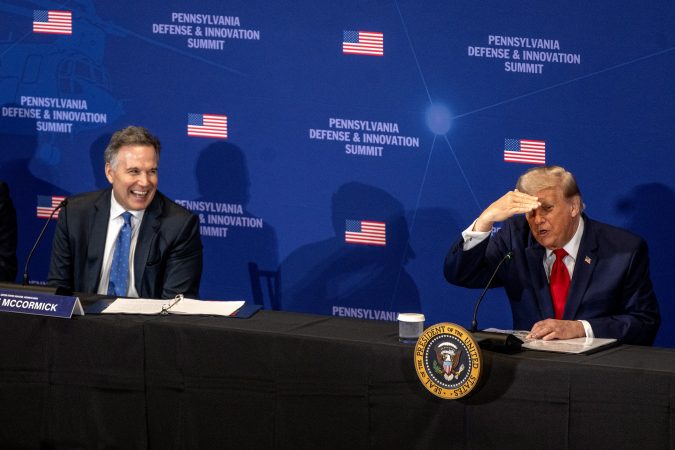
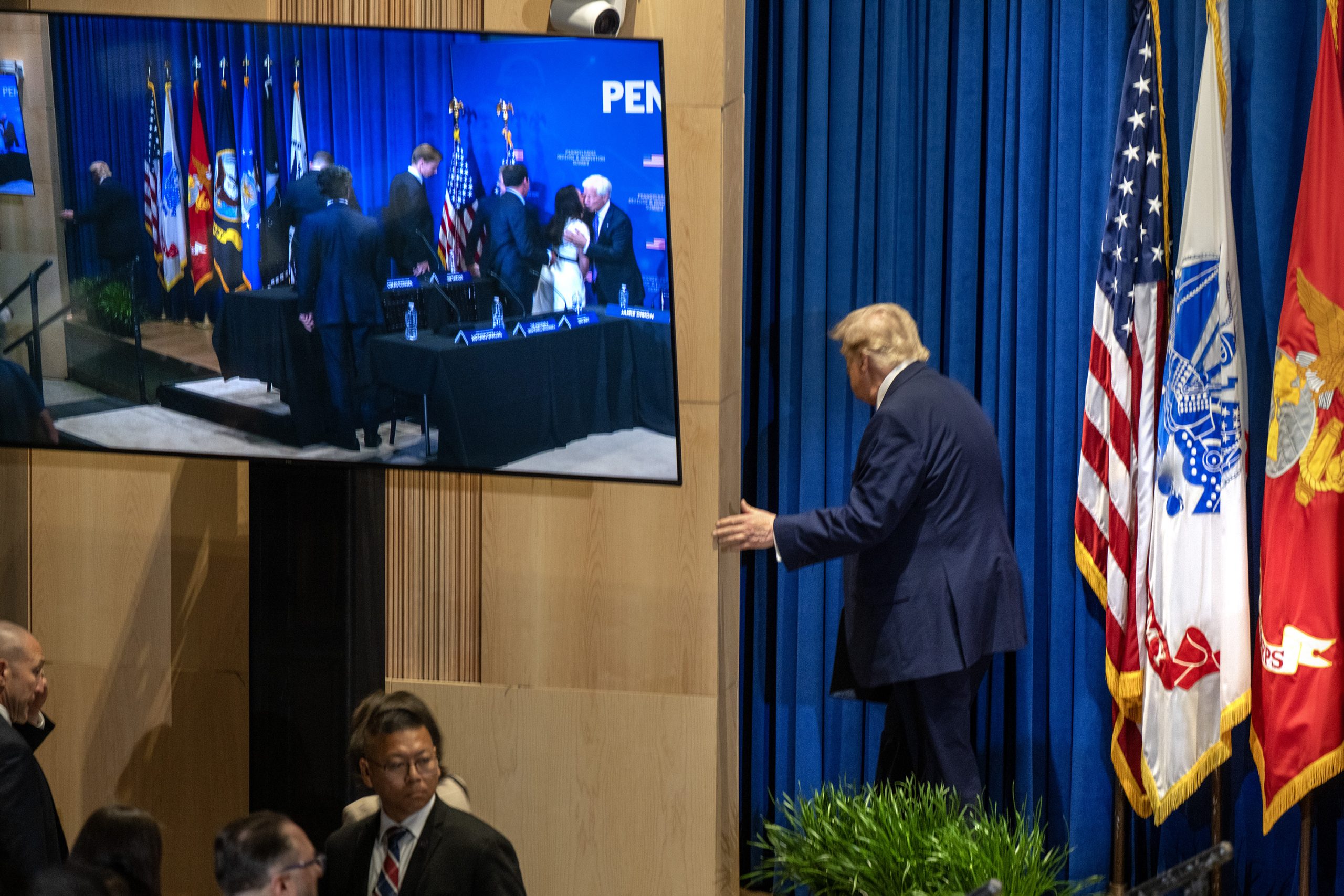
    CARLISLE, Pa. — President Donald Trump — as fighting resumes in Iran and his administration’s request for $1.5 trillion in defense funding stalls in Washington — used a Wednesday appearance at a defense industry summit in central Pennsylvania mostly to boast about his perceived foreign and domestic achievements, from the oil business in Venezuela to the National Guard’s security work during Mardi Gras.

    In a 53-minute speech that was set up as a roundtable conversation, Trump occasionally applauded the latest investments in Pennsylvania’s defense manufacturing and research, which was the focus of the two-day Pennsylvania Defense and Innovation Summit organized by U.S. Sen. Dave McCormick (R., Pa.).

    He also acknowledged the setbacks in Iran and the widely recognized need for the country to more quickly build items like submarines and munitions.

    But in his second stop in three weeks in Pennsylvania — and specifically in a Republican-held U.S. House district that is critical to his party keeping control in the midterm elections — Trump also weaved through a wide range of topics.

    That included the prospect that Democratic Gov. Josh Shapiro would defeat his preferred candidate in this year’s Pennsylvania governor’s race, Republican Treasurer Stacy Garrity.

    “This guy Shapiro is totally overrated. I watched him the other night doing a speech, and he does not have what it takes,” Trump said in Carlisle. “Maybe he’ll win, and he’s expected to win, but I hear things about Stacy, and I’m hearing some poll numbers that are very good. But Shapiro is — he doesn’t have what it takes.”

    Shapiro, who also attended the summit, held back from pointedly criticizing Trump’s foreign aggression during his panel, and he left the summit before the president’s appearance.

    While most panelists and convention-goers praised the federal government’s focus on military investment, there was little discussion about specific developments abroad or controversies around Trump’s use of the armed forces.

    Just this week, fighting in Iran resumed after a tentative ceasefire was reached and then fell apart. The U.S. Senate, which had previously voted — in a mostly symbolic gesture — to restrict Trump’s actions in Iran, has meanwhile stalled the president’s defense budget as Democrats attempt to exert more leverage to wind down the conflict.

    “This war continues to be a costly blunder that has only made us worse off than before,” U.S. Sen. Andy Kim, a New Jersey Democrat who served as a diplomat before entering Congress, said on social media this week as Trump continued the war effort.

    The bombing campaign that began in late February has been both unpopular — a Fox News poll in June found 58% think the U.S. made the wrong decision by starting it — and costly, as gas prices have remained elevated and the nation’s arsenal of Tomahawk cruise missiles has depleted. It will take years to replenish the stockpile, according to an analysis by the Center for Strategic and International Studies.

    McCormick, who has supported Trump’s efforts in Iran, said in opening the summit on Tuesday that the gathering came “in a moment as consequential as any moment in American history, and maybe in human history.”

    “President Trump’s vision of peace through strength demands new players and new ways of doing business,” McCormick said. “Such radical new thinking has never been more needed in America’s history, in the history of our military. China, Iran, Russia, North Korea: They all share one objective — a weakened United States. And they’re actively working together toward that end.”

    But Shapiro said he believed the administration’s antagonistic relationship with longtime allies is a risk to national security, though he did not specifically frame his comments around the wars in Iran or Ukraine.

    “Candidly, I get a little bit concerned when our administration pokes their finger in the eye of our allies,” Shapiro said. “That undermines our ability to innovate, and it undermines our ability to be stronger with our national defense and to have a deterrence that is going to protect the American people and protect our interests abroad.”

    McCormick, a U.S. Army veteran and former hedge fund CEO, organized the 1,300-person gathering to bring defense contractors and other companies together with government officials, military leaders, and research institutions.

    As at a similar energy- and technology-focused event last year, McCormick used the event to highlight what he described as about $10 billion worth of investments in the state.

    The list featured several ongoing Philadelphia efforts — including new ship orders at the Hanwha Philly Shipyard that McCormick valued at $1.5 billion, and a 10-year, $2.5 billion agreement to support submarine construction by Rhoads Industries and General Dynamics.

    Day & Zimmermann, a Philadelphia-based and family-owned conglomerate that is one of the Army’s largest ammunition suppliers, also won a $2.3 billion contract to update, operate, and run the Hawthorne Army Depot in Nevada, according to McCormick.

    JPMorgan Chase & Co. chief executive Jamie Dimon, who visited the Navy Yard on Wednesday ahead of the conference, also appeared in Carlisle to discuss $13 million in financing his company is providing to Rhoads’ ongoing project.

    Not all of the announcements are new or immediate — such as a recent $84 million order of heavy dump trucks from Mack Defense, which is part of a five-year, $221.8 million contract signed last year and that Trump touted in Macungie last month.

    Trump called the announcements “a colossal victory for this commonwealth and for the entire nation.”

    “Pennsylvania workers will build the ships, submarines, trucks, weapons and industries that will ensure America remains the strongest and the most powerful nation in the history of the world,” Trump said.

    In between diversions about the 2024 election, COVID-19, and claiming — as he has before during rallies in Pennsylvania — that affordability concerns are “fake,” Trump also addressed the focus of the gathering by stressing the need for a faster buildup of military equipment.

    “We used to make a ship a day, and now we’re a laggard in that department,” he said while asking the submarine construction workers in Philadelphia to pick up the pace. “We do lots of great things, but we’re a laggard there.”

    Like his rally in Lehigh County in June, Trump’s speech on Wednesday was located in a congressional district with one of the most competitive races — both in Pennsylvania and nationally — this year.

    U.S. Rep. Scott Perry, a York County Republican, is seeking an eighth term in the 10th Congressional District, which covers all of Dauphin County and parts of York and Cumberland Counties. Perry narrowly fended off a challenge from former local television anchor Janelle Stelson in 2024 and is facing her again as Democrats invest more into the race.

    As polls show Democrats have some broad momentum in the midterms, a new Pennsylvania poll released Wednesday found 39% of voters in the state approve and 58% disapprove of the president’s job performance.

    The same poll from Quinnipiac University found 40% approve of McCormick’s job performance, 33% disapprove, and 28% had no opinion.

    The event Wednesday and the energy-focused summit in Pittsburgh last July have spotlighted McCormick in rare, high-profile ways for a freshman senator. The former CEO of Bridgewater Associates, one of the world’s largest hedge funds, has also developed a close alliance with Trump in ways that have elevated his political stature.

    “Hopefully we’ll fix some of these societal problems,” Dimon, one of the country’s most powerful executives, said when McCormick asked him onstage what the next decade would look like. “And Secretary of Treasury Dimon will be happy to report to you, will be happy to report to President McCormick.”

    McCormick has not publicly expressed an interest in running for president — though at least one widely expected 2028 contender was in attendance Wednesday at his invitation.

    “Defense is critical to the future growth of this commonwealth,” Shapiro said, while praising McCormick in a bipartisan showing.

    Shapiro spoke emphatically about bolstering the state’s role in the defense industrial base and said he is doing what he can to have the state benefit from defense-related jobs and a federal focus on national security.

    Shapiro also appeared at the conference at the U.S. Army War College in Carlisle earlier in the day. In a panel conversation there, he did not criticize Trump by name as he fully endorsed the summit’s goal of supercharging the defense industry and placing Pennsylvania at the center of the expansion.

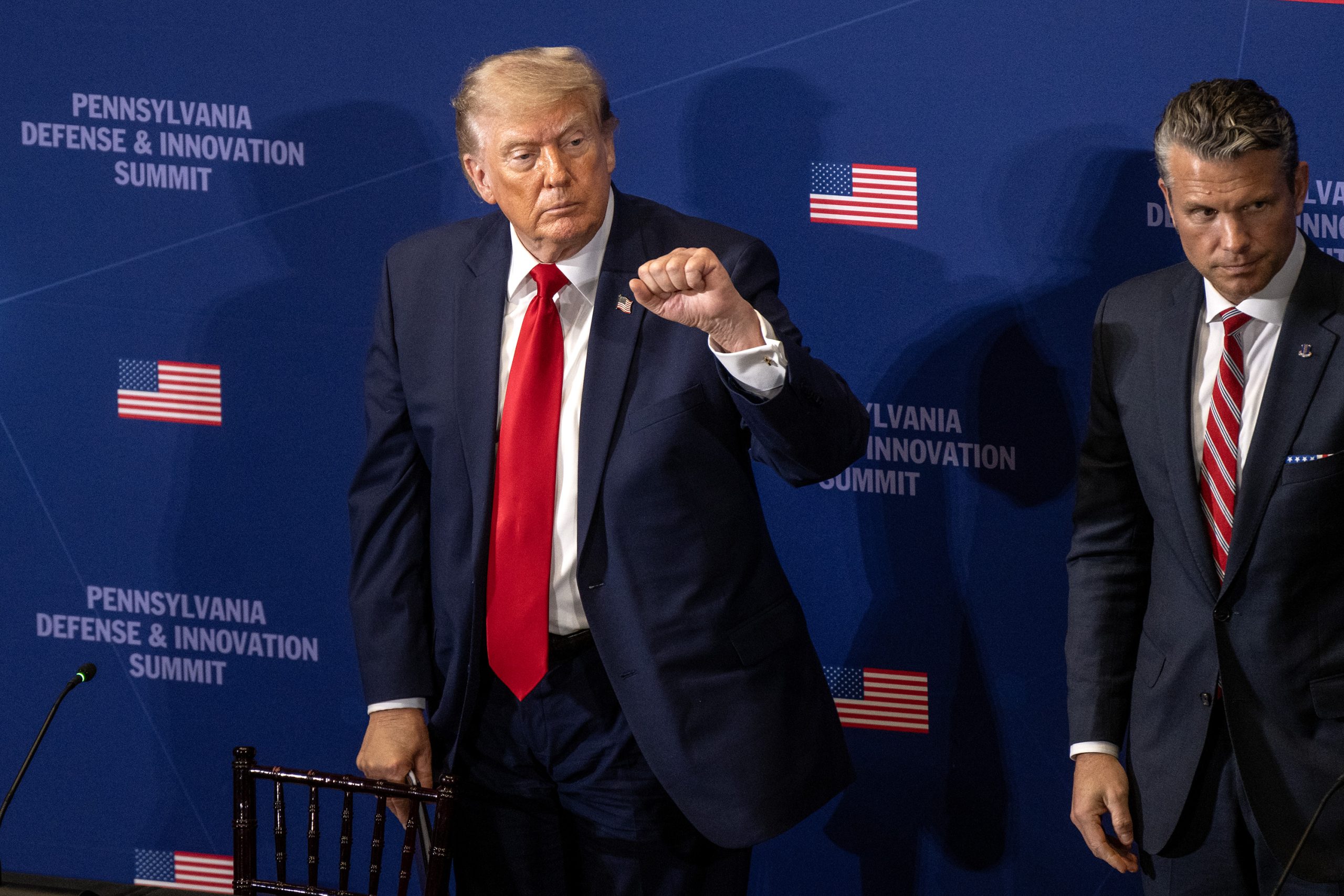
    President Donald Trump and Secretary of Defense Pete Hegseth (right) are on stage at a Defense and Innovation Summit hosted by U.S. Sen. Dave McCormick at the US Army War College in Carlisle Wednesday, July 15, 2026.Tom Gralish / Staff Photographer

    Those jobs include about 2,200 at General Dynamics, a global corporation whose Pennsylvania employees work on everything from sonar and artificial intelligence to submarine defensive systems and electronic warfare, the company’s president, Danny Deep, said while sitting alongside Shapiro.

    Deep referenced the governor’s 2024 visit to the General Dynamics munitions manufacturing plant in Scranton, when Shapiro and Ukrainian President Volodymyr Zelensky signed both empty artillery shells and agreements to work together. Because of the demand during Ukraine’s war with Russia, the company has ramped up its monthly munitions production from 14,000 to 50,000 — a move that Deep said was possible only with help from the state.

    “That’s because of this public-private partnership, and that’s what makes Pennsylvania so special,” he said.

    President Donald Trump leaves the stage at the end of a Defense and Innovation Summit hosted by U.S. Sen. Dave McCormick at the US Army War College in Carlisle Wednesday, July 15, 2026.Tom Gralish / Staff Photographer

    Michael Coulter, president and CEO of Hanwha Defense USA, likewise said on the panel that the cross-party and cross-government support is essential in the company’s continued expansion at the Navy Yard in Philadelphia. The investments announced by McCormick on Wednesday included a federal government order of new ships that was valued at $1.5 billion and supporting more than 2,000 jobs in Philadelphia.

    “We are foot-on-the-throttle to make shipbuilding great again,” Coulter said. “And Pennsylvania’s the heart of that.”

    Staff writer Joseph N. DiStefano contributed to this article.

  • Blanche confronts skeptical questioning of fund, tax deal for Trump at Senate confirmation hearing

    Blanche confronts skeptical questioning of fund, tax deal for Trump at Senate confirmation hearing

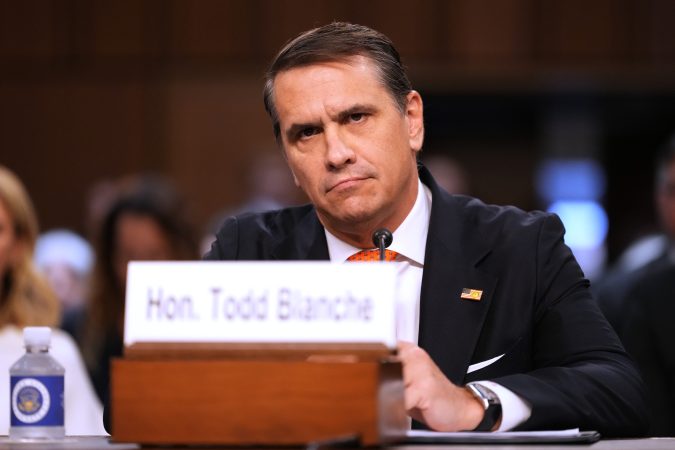
    WASHINGTON — Acting Attorney General Todd Blanche confronted skeptical questioning at a Senate confirmation hearing Wednesday about the creation of a fund to compensate President Donald Trump’s allies and a tax immunity deal for the president as he aimed to lock down the Republican support needed to advance his nomination.

    Blanche insisted that the $1.776 billion “Anti-Weaponization Fund,” which was scrapped after fierce bipartisan backlash, was “not moving forward.” But lawmakers, including Republican Sen. John Cornyn, conveyed concerns that the Trump administration has yet to commit in writing that the fund is dead and could therefore conceivably be resurrected.

    “Just to be clear, the president of the United States, who’s a plaintiff in this lawsuit, has not agreed in writing to delete the ‘Anti-Weaponization Fund’ and there’s no guarantee that he won’t raise it in the future?” Cornyn asked. Blanche replied that Trump has no power over the fund, which was to have been administered by the Justice Department but never launched.

    Cornyn’s questions were closely watched since Blanche requires the backing of all Republicans on the Judiciary Committee and the Texas senator has not committed his support.

    The hearing arrived at a tumultuous time for the Justice Department, with mass firings and resignations hollowing out the workforce and Democrats and other critics raising alarms that Blanche is still functioning as the president’s personal lawyer. He has led the department on an interim basis since April, functioning as the public face of the maligned and later-withdrawn fund and accelerating investigations into perceived Trump adversaries.

    Even as he said the fund had been shelved, he made clear that immunity from tax audits afforded to Trump this year remained in place.

    Those actions, plus the flawed release of files from the Jeffrey Epstein sex-trafficking investigation, received fresh scrutiny Wednesday.

    “You’re in charge of a Department of Justice I don’t recognize, prosecuting the president’s political enemies, firing rank and file prosecutors and FBI agents,” Democratic Sen. Chris Coons of Delaware told Blanche. “These are some actions that in your previous confirmation hearing before us, you said you would not take.”

    Blanche, for his part, insisted he has presided over a course correction following Justice Department investigations into Trump during the Biden administration.

    “In recent years, we watched the Justice Department turned against many of you and a former president, and it damaged the public’s faith in justice,” Blanche argued. “We are fixing that.”

    Blanche will need the support of each Republican on the panel

    Key to Blanche’s confirmation are Cornyn of Texas, who in May lost his primary, and Sen. Thom Tillis, a North Carolina Republican who has opted not to seek reelection. Entering the final stretches of their Senate career, both are seen as more likely than before to split from Trump and both have been outspoken critics of the fund the Trump administration created to compensate people who feel unjustly persecuted by the criminal justice system.

    After questioning Blanche about the fund, Cornyn told CNN he continues “to have some concerns” and is not “going to make any decisions at this point.” Tillis, meanwhile, indicated during questioning that he is likely to support Blanche, even as he said he wanted “to stick a fork in this turkey of a 1776 fund.”

    The death of South Carolina Republican Sen. Lindsey Graham, who was a member of the committee, level 11 Republicans and 10 Democrats on the panel. A no-vote by even a single Republican on the committee could scuttle his nomination.

    Blanche insists the fund is dead. Lawmakers aren’t so sure

    The fund emerged from a settlement of Trump’s $10 billion lawsuit against the Internal Revenue Service over his leaked tax returns. Blanche had initially defended the initiative only to later reveal that it was being scrapped following fierce bipartisan backlash.

    The judge who presided over the case said in a scathing ruling Monday that Trump and his lawyers had manipulated the court system through the lawsuit and subsequent settlement and said she was troubled Blanche had signed the settlement given his prior representation of Trump and was concerned he had given misleading testimony. Blanche said Wednesday that he disagreed “with the judge’s insinuations about me.”

    Blanche also defended a separate element of the settlement that afforded Trump and members of his family protection from tax audits and that, he has said, remains on track despite outrage over it even from Republicans. Blanche said the deal covers any existing audits but does not protect the president from examination of future tax filings.

    “Nobody is above the law,” Blanche said. Such a settlement “doesn’t make any of those individuals above the law.”

    Epstein files are also under scrutiny

    Blanche was also pressed on the department’s staggered release of the Epstein files, a process beset by problems, including redaction errors that left exposed nude photos showing the faces of potential victims.

    During a podcast interview with Joe Rogan released Wednesday, Vice President JD Vance said the administration “absolutely” mishandled the communications surrounding the files, including when then-Attorney General Pam Bondi distributed binders of Epstein documents at the White House to far-right influencers that contained already-public material.

    Blanche acknowledged that “mistakes were made” in the release process but nonetheless defended the work.

    “I want to make sure that the American people know that this administration, when it comes to Jeffrey Epstein, has been more transparent than any administration,” he said. The Justice Department only released additional files after Trump bowed to bipartisan pressure to sign a law forcing the department to do so.

    A former federal prosecutor and key member of Trump’s defense team as the Republican battled four indictments, Blanche arrived at the Justice Department last year as deputy attorney general. At one point, under friendly questioning from Republican Sen. John Kennedy about whether he and Trump are friends, Blanche responded: “I’m his lawyer,” before quickly correcting himself to say he “was his lawyer.”

    He ascended to the top job in April after Trump ousted Bondi, who had frustrated the White House by struggling to bring successful cases against Trump’s political opponents. Blanche has tried to satisfy Trump in that regard, including with an indictment of ex-FBI Director James Comey, another Trump adversary, on charges of threatening the 47th president by posting a social media photograph of seashells in the numerical arrangement of “86 47.”

    Comey has said the numbers were not a call to violence.

    Blanche was also asked about Jan. 6 violence

    Tillis, who has said he would not support for attorney general anyone who equivocates on the events of Jan. 6, 2021, when pro-Trump rioters stormed the U.S. Capitol, denounced the Biden administration Justice Department for what he said were excessive prosecutions and punishments.

    Democrats, meanwhile, pressed Blanche on the violence and Trump’s sweeping clemency action benefiting more than 1,500 people, including those convicted of violently attacking police.

    Democratic Sen. Sheldon Whitehouse criticized Blanche for comments at a political conference this year where he appeared to characterize the Jan. 6 pardons as an administration accomplishment. Blanche replied that he has “never said that any sort of violence against law enforcement is appropriate.”

    “He has the absolute right to pardon anybody for any reason he sees fit,” Blanche said of the president. “I am not celebrating that. It is a fact.”

  • Hegseth announces policy to test troops for low testosterone

    Hegseth announces policy to test troops for low testosterone

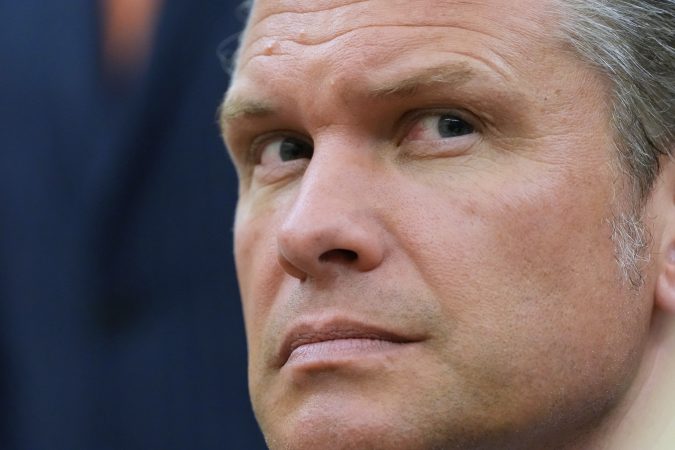
    WASHINGTON — Defense Secretary Pete Hegseth announced Wednesday that he is rolling out a new screening program for “testosterone deficiency” among troops, calling it necessary to allow them to operate at their “absolute best.”

    The screenings will be conducted annually as part of service members’ required medical screenings for those 30 and older, he said. Troops under 30 can volunteer to be tested. In a video on social media, Hegseth said receiving testosterone replacement therapy would be voluntary.

    In the video, Hegseth simply refers to troops, though it appears he is talking about only testing men in uniform for hormone irregularities.

    The move comes as other Trump administration officials have begun to advocate for men to have easier access to testosterone replacement therapies, but the messaging from Hegseth and others blends known science on the hormone with broader, and less substantiated, claims.

    When asked about what conditions Hegseth was looking to address with the new policy, the Pentagon referred to Hegseth’s remarks in the video that mentioned keeping troops “strong, resilient, and capable” and that the rigors of the modern battlefield demand “maximum psychological and mental readiness.”

    Over the past several years, special operations troops — and specifically Navy SEALs — have come under scrutiny for their use of testosterone and similar substances to enhance performance.

    The death of a SEAL recruit during training in 2022 led to a discovery of substances in his possession, including testosterone, and revealed far more rampant drug use among the elite program than was previously acknowledged.

    A year after the recruit’s death, the Navy said it would begin a drug-testing program to screen for “any hormonal substance, chemically or pharmacologically related to testosterone, that promotes muscle growth.”

    Hegseth said his new initiative is “not about artificial enhancement.”

    The Pentagon did not respond to questions about what research or academic studies underpinned the move. It also didn’t say if female troops would be able to be evaluated for estrogen-based therapy as they entered perimenopause.

    Testosterone levels in men decline naturally with age and have long been linked to issues like erectile dysfunction, low libido, mood changes, and weight gain. But experts have debated for years how to diagnose those problems and whether they should be treated by replacing the hormone.

    Hegseth’s announcement comes as Health Secretary Robert F. Kennedy Jr. and other Trump administration officials are moving to make it easier for doctors to prescribe testosterone. Last month, the Food and Drug Administration proposed easing prescribing limits on testosterone gels, pills, patches, and injections.

    The current FDA label specifies that the medications are only for men with hypogonadism, a medical condition that causes drastically low testosterone.

    But many influencers and proponents of Kennedy’s “Make America Healthy Again” movement tout testosterone as a way to look younger, build muscle, and stay mentally sharp — although those uses aren’t accepted by most medical experts.

    Still, recent studies have bolstered the case for testosterone’s benefits, for certain conditions, while allaying worries about its safety — particularly concerns about heart safety.

    Last year, the FDA removed a boxed warning about possible risks of heart attack and stroke from the drugs.

    Separately, a series of studies by the National Institutes of Health in older men found that taking testosterone improved erectile dysfunction, libido, and other sexual measures and had a small effect on mood. But there was little or no improvement in other measures like fatigue, memory or overall well-being.

    Other studies have shown potential improvements in muscle-building, strength and bone density.

    However, current medical guidelines generally recommend against blanket testing of testosterone levels. Typically, doctors are advised to discuss testosterone therapy with men who have troubling symptoms and documented low levels of the hormone on two separate blood tests.

    Testing for testosterone is challenging because levels of the hormone fluctuate throughout the day. Accurate testosterone readings are typically measured in the morning after fasting.

    Rep. Chrissy Houlahan, a Pennsylvania Democrat and Air Force veteran, said the “announcement proves that Secretary Hegseth takes direction from the far corners of the manosphere.”

    The congresswoman on the House Armed Services Committee said she hoped testosterone testing “will be available for both men and women and that servicewomen will be afforded access to the same resources to enable them too to be the most elite warriors” on Earth.

    Hegseth has previously said that he does not believe women should hold combat roles and that those positions should be based on the “highest male standard.” He has blocked some military promotions for women or fired female leaders since becoming Pentagon leader.

    He has made other changes related to the medical treatment of troops.

    In April, he announced the repeal of the military’s long-standing flu vaccine mandate, citing “medical autonomy” and religious freedom. In June, a flu outbreak at the U.S. Air Force’s boot camp sickened at least nearly 300 people.

  • ICE should keep making traffic stops despite recent shootings, Trump says

    ICE should keep making traffic stops despite recent shootings, Trump says

    WASHINGTON — President Donald Trump wants Immigration and Customs Enforcement officers to keep pulling over vehicles, signaling his opposition Wednesday to plans announced just a day earlier to suspend most traffic stops following another string of fatal shootings.

    It’s not clear whether ICE will quickly reverse course and resume most stops, which have been a key tool in Trump’s immigration crackdown.

    Ending those stops, Trump wrote, would be “playing right into the criminal’s hands.”

    “We CANNOT give up one of ICE’s most important and effective Crime Fighting tools, THE TRAFFIC STOP!” Trump wrote Wednesday on his social media site.

    Hours after Trump made his views known, Homeland Security Secretary Markwayne Mullin issued his own statement saying people illegally in the country would be “arrested and deported wherever they are.” But Mullin didn’t directly say whether ICE officers will be allowed to carry out traffic stops.

    ICE’s enforcement tactics are coming under renewed criticism after three people died during encounters with federal officers within a week. In Florida, a 28-year-old man was killed Tuesday after he was hit by a tractor-trailer while running from immigration and other federal officers, authorities said.

    Before that, two motorists were shot and killed by ICE officers — one in Texas last week and another in Maine on Monday.

    After the Maine killing, Trump administration officials told ICE officers to suspend most vehicle stops, people familiar with the decision said Tuesday.

    Since the immigration crackdown began, federal officers confronting drivers have opened fire several times, saying the drivers’ vehicles had posed a danger. Policing experts have long said that shooting into moving cars presents a danger of its own and should almost always be avoided.

    There have been at least 10 deaths involving encounters with immigration agents since Trump launched his deportation campaign. At least four of them involved people in vehicles, a trend so troubling that Republican U.S. Sen. Susan Collins of Maine urged Department of Homeland Security leaders “to cease all non-urgent vehicle stops.”

    Two shootings in a week, she said Wednesday, “raise very serious questions” and warrant a halt in that approach for the time being.

    ICE has been under pressure to beef up arrest and deportation numbers. It says people being sought are increasingly staying in their homes, and it often blames immigration advocates who advise immigrants to stay in homes unless ICE produces a warrant signed by an independent judge.

    ICE officers say that means they’re forced to find other ways to make arrests.

    DHS says the man killed in Maine came to the U.S. illegally

    More protests are planned after hundreds gathered Tuesday to remember Johan Sebastián Durán Guerrero, the 25-year-old Colombian national who was shot in his car Monday.

    Karolina Rojas, his partner and the mother of their young daughter, shared a photo on Instagram of the three hugging and smiling.

    “I love you, my darling, my life. I love you. I have no words for this pain. You were my everything. Please watch over me. Help me find the strength to carry on. Stay with me always. Don’t leave me alone. I’m begging you, my love,” she wrote.

    Durán Guerrero illegally entered the U.S. on Sept. 1, 2023, through the southern border, DHS said Wednesday. Advocacy groups said that when he was killed, he was authorized to work in the U.S.

    Sen. Angus King (Ind., Maine) said the Homeland Security secretary told him on Monday that ICE officers were in Biddeford to serve an arrest warrant but that it wasn’t for the person who was shot.

    When ICE tried to stop a vehicle driven by someone who came from a home under surveillance, the “vehicle attempted to flee the scene and, fearing for public safety, an officer discharged his weapon,” the department said.

    It its statement Wednesday, DHS said Guerrero was released into the U.S. after crossing the border.

    The department didn’t answer questions about the agent who shot him.

    Photos showed bullet holes in Durán Guerrero’s car windshield, but the officers involved didn’t have body cameras, leaving many questions.

    Maine shooting puts a spotlight on ICE

    Outgoing Colombian President Gustavo Petro called the shooting of Durán Guerrero a targeted killing “at the hands of the U.S. government.”

    In Wednesday’s social media post, Trump told ICE to be “judicious, fair and smart, and go back and do your very important job.”

    Border czar Tom Homan told reporters that the investigation needs to play out and that officers will be held accountable if they are found to have acted inappropriately or illegally.

    Maine’s Democratic governor, Janet Mills, said ICE should be scrapped as a federal agency if it can’t be fixed.

    Mills, who has criticized ICE before, said Wednesday that the agency needs changes “before more families are robbed of a loved one.”

  • Slavery exhibits at the President’s House have been swapped for the Trump administration’s version

    Slavery exhibits at the President’s House have been swapped for the Trump administration’s version

    President Donald Trump’s administration has installed its own version of history at the President’s House Site, swapping panels on the brutality of slavery at the site for displays that experts say sanitize George Washington’s role as an enslaver.

    The replacement caps a monthslong legal battle over the site on Independence Mall that was the first direct skirmish between Mayor Cherelle L. Parker and the Trump administration.

    The change happened overnight Tuesday into Wednesday, hours after the city hosted MLB All-Star Game events near the site, allowing the government to switch out the displays and shut down the television screens without public scrutiny.

    Roughly a week prior to the changes, park employees installed security cameras near the site, which one worker explained as being for the All-Star Game festivities. The cameras were still present Wednesday.

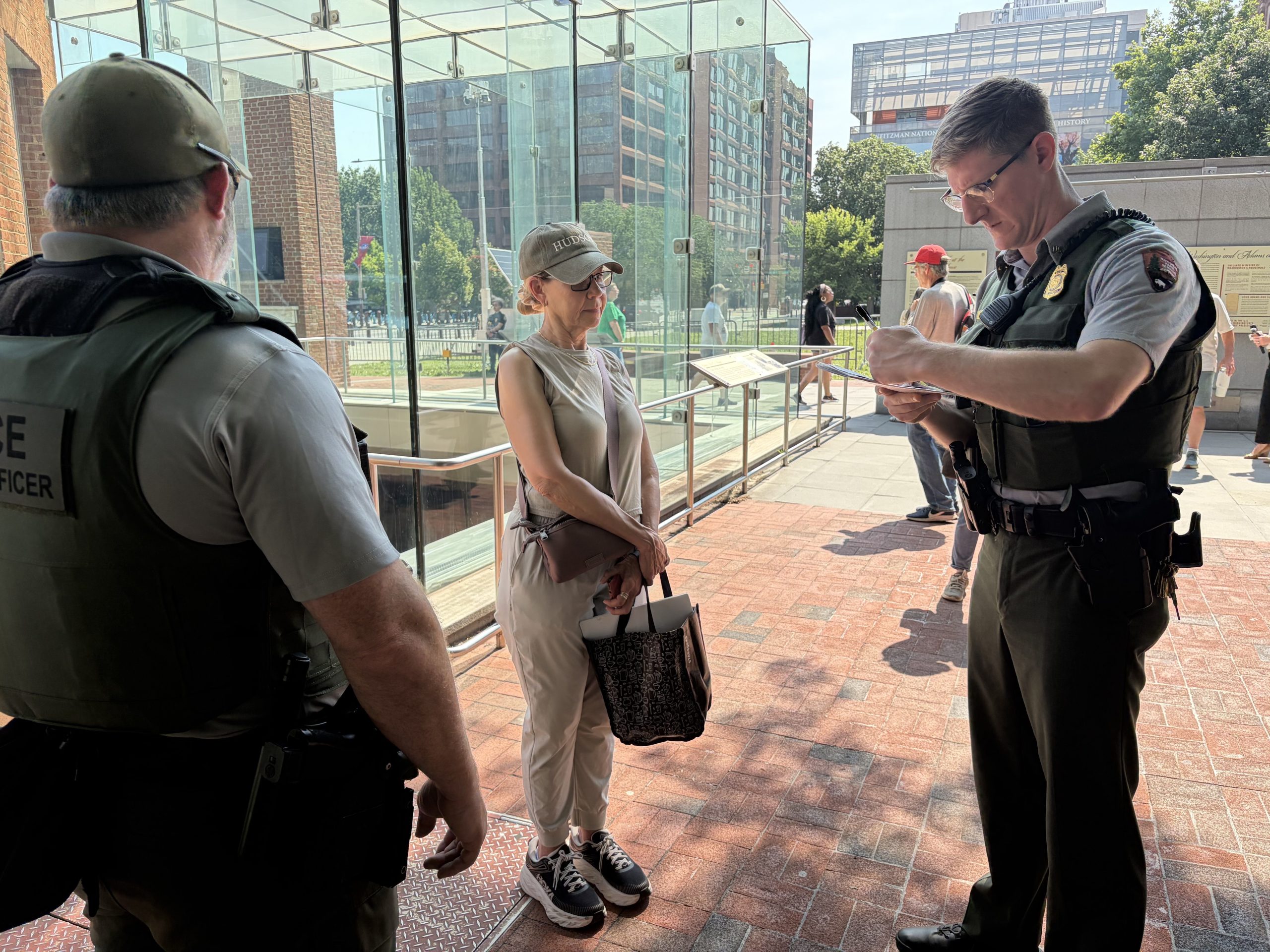
    A U.S. parks police officer and a visitor at the President’s House Site, where new panels have been installed, in Philadelphia, July 15, 2026. Historians and advocates have criticized the panels for minimizing Washington’s role as an enslaver.Jessica Griffin / Staff Photographer

    The overhaul of the President’s House exhibit, which was established to memorialize the nine people Washington enslaved at his Philadelphia residence, comes a little more than a week after the city celebrated the United States’ 250th birthday and tourists from around the world saw an incomplete version as the exhibit hung in limbo.

    On July 3, the U.S. Court of Appeals for the Third Circuit gave the Trump administration the final go-ahead to replace the panels.

    In a statement, Parker said the city intended to seek a rehearing on “serious legal issues” presented in the Third Circuit’s decision and slammed the federal government for installing the panels ”under the cover of darkness.”

    “It was allowed to do this by the decision of the federal court, but that it did so at night shows it understands this action is shameful, that it violates community trust,” Parker said.

    The site now features the 11 panels were proposed by the Trump administration in April, in addition to more than a dozen smaller panels that detail governmental processes, the lives of various historical figures, and a panel dedicated to the escape of Ona Judge and Hercules, two people enslaved by Washington who fled to freedom.

    Though the panels do mention slavery and the people Washington enslaved, the new exhibits mostly offer a broad timeline of U.S. history that significantly strays from the original intent of the President’s House as outlined in the park’s foundation document in 2017: “It would explore the historic context of the site in the context of its ties to slavery and the lives of the enslaved who lived at the site.”

    Visitors to the President’s House Site, where new panels have been installed, in Philadelphia, July 15, 2026. Historians and advocates have criticized the panels for minimizing Washington’s role as an enslaver.Jessica Griffin / Staff Photographer

    The new panels also soften Washington’s role as an enslaver.

    For instance, one display says: “Caught between his private doubts about slavery and his public responsibilities as president, George Washington navigated a nation deeply divided over slavery.”

    “Privately, George Washington often expressed discomfort with the institution and a desire to see it abolished,” the panel continued. “Yet as a Virginia plantation owner, his wealth and livelihood were deeply tied to it.”

    Later in that panel, the Trump administration writes: “Slaves living in the President’s House experienced a greater modicum of autonomy than elsewhere in the South such as to explore the city and sometimes even attend the theater, with Washington buying the tickets.”

    Another panel, titled “Enslaved People at the President’s House,” discusses the lives of each of the nine individuals enslaved by Washington, but reframes Washington’s role.

    “President Washington knew and trusted his enslaved house staff enough to buy them tickets for the circus and theater and to let them venture out into the city’s markets on their own,” the panel says.

    A spokesperson for the Interior Department said in a statement that the “new panels are full of historical context and highlight the momentous events that took place in the President’s House and other sites at Independence National Historical Park.”

    The statement said that the panels “acknowledge the evils of slavery, including its injustice and hypocrisies,” and properly tells the story of the nine individuals enslaved by Washington and the “full story” of U.S. history.

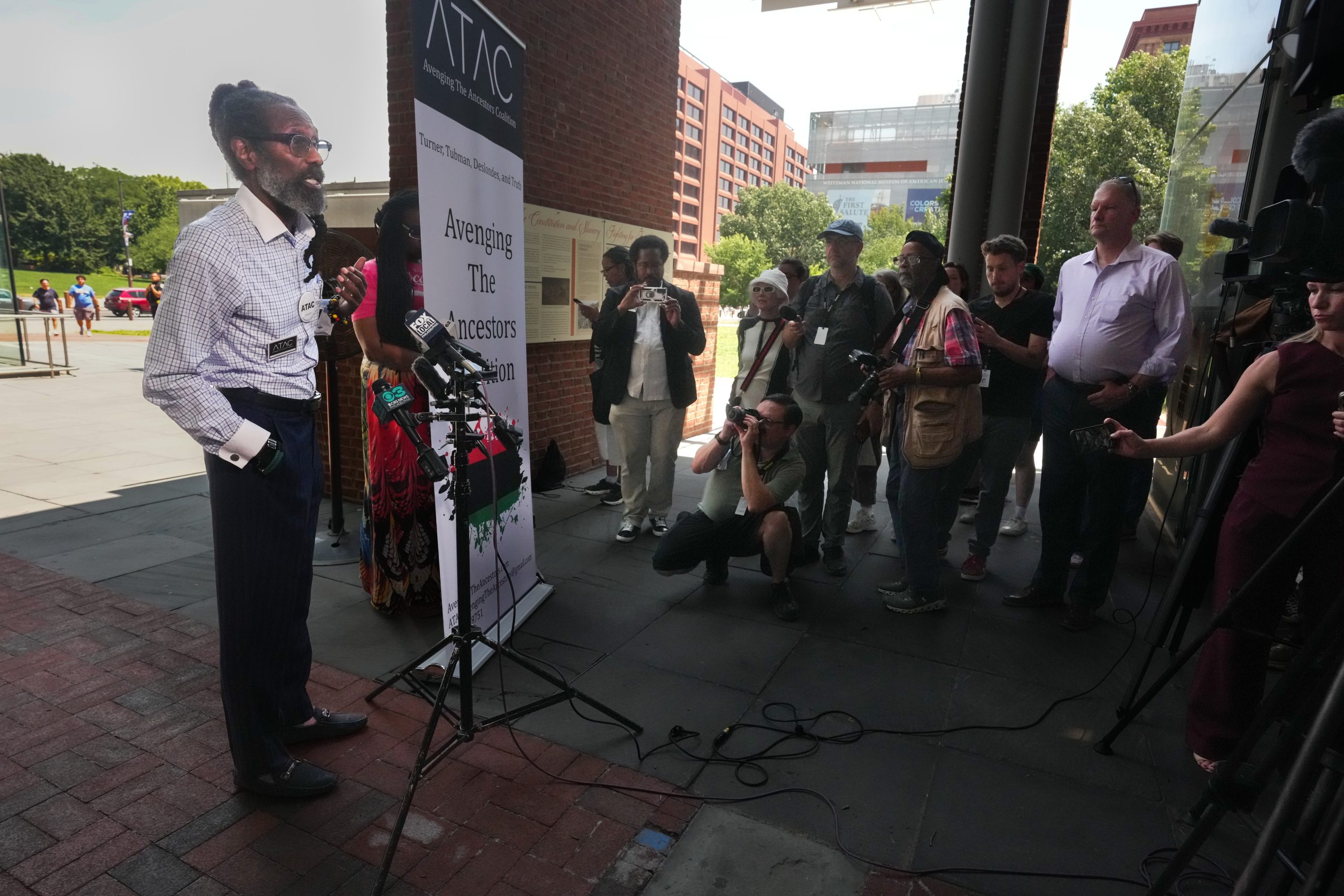
    Michael Coard, leader of Avenging the Ancestors Coalition, a group that has fought to protect the President’s House, said stakeholders were “not surprised — we saw it coming” and were reviewing all possible legal avenues and advocacy options.

    Shortly after noon, Coard and other activists spoke defiantly at the site.

    He called the new panels “a complete whitewashing of American history” and said the few references to existence of slavery are a reminder that “the best lie is one that has a little bit of truth.”

    Lawyer Michael Coard holds a press conference at the President’s House Site, where new panels have been installed, in Philadelphia, July 15, 2026. Historians and advocates have criticized the panels for minimizing Washington’s role as an enslaver.Jessica Griffin / Staff Photographer

    The drastic alterations are a culmination of about a year of turmoil since the Trump administration began scrutinizing the site as part of the president’s executive order to review or remove displays at national parks that “inappropriately disparage Americans past or living.”

    In January, the administration abruptly removed all of the exhibits at the President’s House, provoking a legal battle waged by the City of Philadelphia and nonstop advocacy from stakeholders who helped develop the site in the early 2000s.

    Removals also happened at national parks around the country.

    Sheri Utain, 77, has been coming to the President’s House site since January to read aloud the content of the missing panels. When she arrived Wednesday, she was shocked to learn the exhibit had been replaced overnight.

    “How sneaky is that?” Utain said. “What kind of government is that?”

    Others also continued with their routines, but the response from National Park Service rangers was harsher.

    Sandra Shachar has been posting news articles on the President’s House walls almost every day since January to provide visitors updates on the court battles over the slavery exhibit.

    Sandra Shachar, 72, cited for vandalism at the President’s House Site on July 15, 2026 for attempting to post news articles on the walls.Abraham Gutman

    But Wednesday, the local psychologist was cited for vandalism and ordered to pay a $305 fine.

    “It was something I could do … it feels better than doing nothing,” Shachar said, holding back tears. “Part of free speech and our First Amendment rights is to put up signs. It’s not defacing. It’s not vandalizing.”

    An Interior Department spokesperson said “any vandalism, tampering, destroying, or defacing of cultural or archaeological resources is a federal crime.”

    The installation of the new exhibit marks the end of a phase in the city’s legal battle against Trump’s administration.

    The city sued in January when the slavery exhibit was abruptly dismantled, asking a federal judge to issue an injunction ordering the panels be restored. Judge Cynthia M. Rufe issued a blistering opinion on Presidents’ Day ordering the restoration, comparing the Trump administration’s action to the Ministry of Truth from George Orwell’s 1984 novel.

    The administration installed roughly half of the removed panels before Rufe’s deadline, but left the site’s walls half bare after appealing to the Third Circuit and securing an administrative stay.

    A unanimous Third Circuit three-judge panel — which included Trump, George W. Bush, and Barack Obama appointees — held in June that the city had no rights over the exhibit after having donated the President’s House Site to the National Park Service.

    No changes followed on the ground immediately after the ruling because of litigation in federal court in Boston that challenged the legality of display removals in national parks and historic sites nationwide, leading a district judge to order the Trump administration to restore all removed items.

    Visitors to the President’s House Site, where new panels have been installed, in Philadelphia, July 15, 2026. Historians and advocates have criticized the panels for minimizing Washington’s role as an enslaver.Jessica Griffin / Staff Photographer

    But on July 2, the U.S. Court of Appeals for the Second Circuit stayed that order, clearing any legal obstacles preventing the federal government from installing the new panels.

    In the aftermath of the 250th anniversary celebrations, Parker said, examining the paradoxes of liberty and slavery that existed during the founding of the United States is key.

    “This paradox reveals core questions we still live and struggle with today — how do we share power for the betterment of all people? That is a hard question, and one that President’s House forced us all to consider,” Parker said.

    As activists and the city vow to continue the legal fight, the efforts to educate visitors about the history of the President’s House will also continue.

    Mijuel Johnson, a guide with the Black Journey: African-American Walking Tour of Philadelphia, will lead a tour of the site Thursday.

    “Regardless to what it says on the walls,” Johnson said, “the whole truth is still going to be told.”

  • U.S. Mint to produce $1 coin with Trump’s face on it, treasury secretary says

    U.S. Mint to produce $1 coin with Trump’s face on it, treasury secretary says

    The U.S. Mint will soon begin producing a new $1 gold-hued coin with President Donald Trump’s face on it to commemorate America’s 250th birthday, Treasury Secretary Scott Bessent announced this week.

    The coin’s face features Trump alongside the phrase “In God We Trust.” It is encircled with the phrases “Liberty” and “1776-2026.” The flip side of the coin shows an eagle holding arrows in one talon and olive branches in the other.

    Since the start of his second term, Trump and his allies have pushed to reissue federally created currency and documents to feature the president’s name and likeness. Examples include a commemorative passport with Trump’s image inside its pages and the addition of his signature on newly printed $100 bills. There are also proposals to feature the president’s image on 24-karat gold coins and commemorative $250 bills.

    Bessent said in a post on X that the coin “celebrates the strength of American values, and the promise of a nation dedicated to preserving freedom for all.”

    A Treasury Department spokesperson said the coin “is in production and minted in Philadelphia, and it will be available in the fall.” They also said that there is no gold in the coin but that it has a gold-like finish.

    Earlier drafts proposals of the $1 coin showed Trump standing with a clenched right fist in front of an American flag and the words “Fight Fight Fight” — a reference to the 2024 assassination attempt at his campaign rally in Pennsylvania.

    When plans for the $1 coin were revealed last year, concerns emerged over whether the proposal to include a living president’s image on U.S. currency could violate the law.

    Under a law passed in 2020, the Treasury Department can mint $1 coins during 2026 to mark the 250th anniversary “with designs emblematic of the U.S. semiquincentennial.” However, according to U.S. code, “[o]nly the portrait of a deceased individual may appear on United States currency and securities” — a law that sprang from a Colonial-era tradition against putting current presidents on American coins themselves from the British monarchy.

    In addition, the 2020 law states that “[n]o head and shoulders portrait or bust of any person, living or dead, and no portrait of a living person may be included in the design on the reverse of any coin” produced for the Semiquincentennial, which could be violated by having Trump’s image on both sides of the coin.

    Bessent argued that the $1 coin design was legal, telling Fox News this week that although he is otherwise barred from featuring a living person’s image on U.S. currency, “during the 150th, there was a Calvin Coolidge coin, so we can put living presidents’ images on a coin.”

    The design for the coin also was not what the Commission of Fine Arts, which is composed entirely of Trump appointees, recommended when members met in January. The obverse design recommended by the commission featured Trump’s face in profile, while the final design shows the president with his eyes forward. The treasury secretary has the final say on the design.

    Megan Sullivan, the acting chief of the U.S. Mint’s office of design management, said during the January commission meeting that “the legal research has been done both at the Mint and up into Treasury, and they have determined that [the proposed coin featuring Trump’s image] does not violate any laws.”

    Sullivan described the coins as being “a little bit larger than a quarter” and being composed of “manganese brass” and displaying as “golden in color.”

    The $1 coins are distinct from the 24-karat coins created by the Treasury Department that typically sell for thousands of dollars. Senate Democrats, in June, urged the Trump administration to halt production of that solid gold coin, citing concerns that some of the U.S. Mint’s gold could have links to foreign cartels.

  • Biden will publish ‘Promise Me, America’ memoir after the November midterm elections

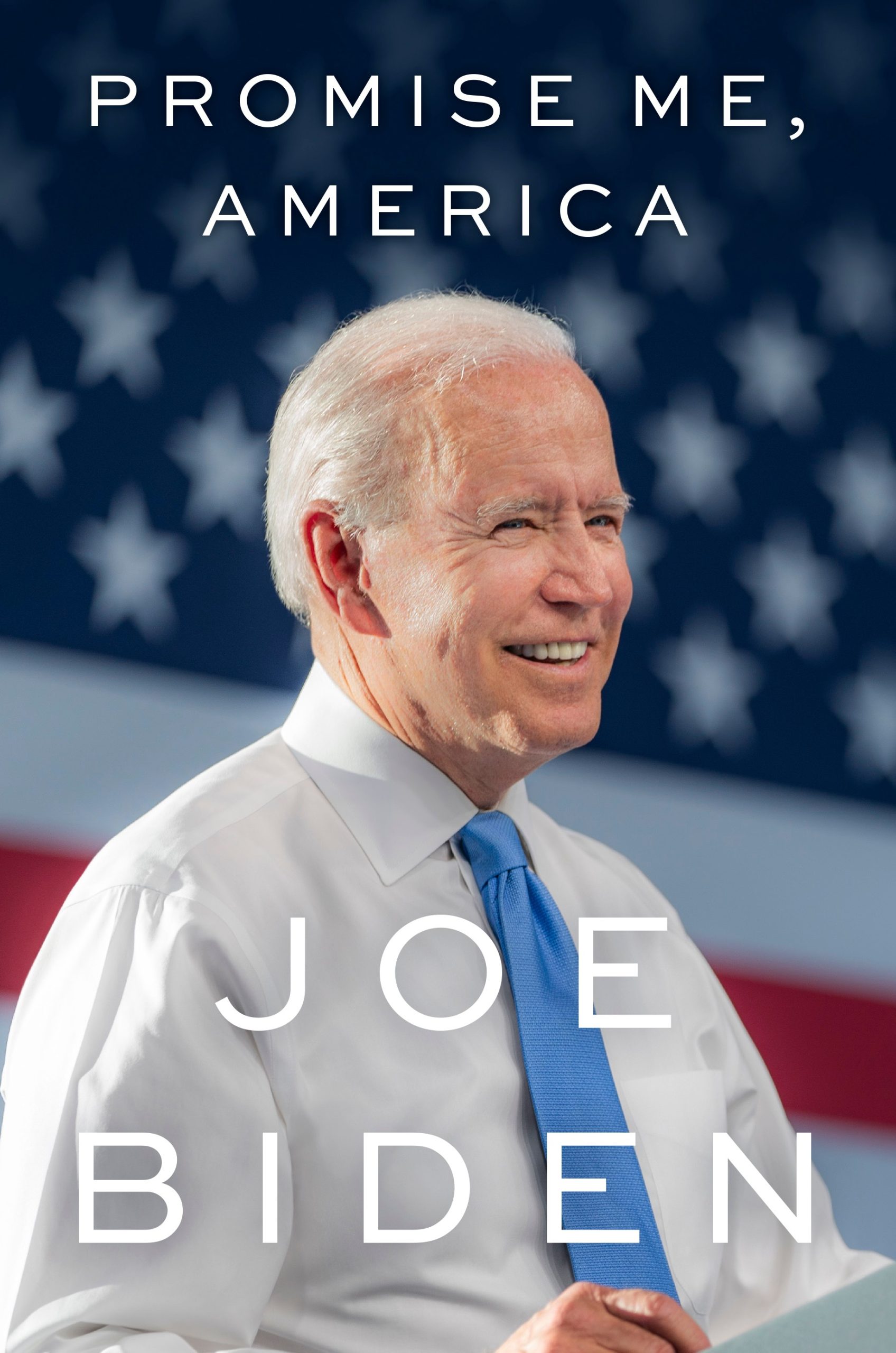
    NEW YORK — Former President Joe Biden will publish a memoir, Promise Me, America, which he says will touch upon everything from the economy to his decision to drop his bid for reelection.

    The memoir is scheduled to come out Nov. 17, publisher Little, Brown and Company told the Associated Press. The timing of the book — two weeks after midterm elections in which Democrats seek to regain control of Congress — could raise concerns within Biden’s party by putting him back into the spotlight.

    Democrats remain divided on Biden’s legacy, with many blaming his ill-fated determination to seek a second term for Republican President Donald Trump’s return to the White House. Leaders hope to keep the fall campaign focused on Trump and his record, and any leaks or promotional efforts before votes are cast could draw frustration.

    “Promise Me, America is about the challenges we faced as a nation. It’s about the decisions I made and why I made them,” Biden said in a video statement accompanying Wednesday’s announcement. “It’s about why I chose to run for reelection and why I chose to step aside.”

    This book cover image released by Little, Brown and Co. shows “Promise Me, America” by Joe Biden.Uncredited

    Reports of Biden’s book have circulated for more than a year, and the former president himself has referred to it during public remarks, appearing to suggest it would be released before November’s election.

    Biden, who will turn 84 three days after the publication of Promise Me, America, has long presented himself as an upholder of standards and traditions; presidential memoirs are one of them. With a handful of exceptions, modern presidents since Harry Truman in the 1950s have published books about their White House years. Like virtually all of his predecessors, Biden did not work on the book alone but was helped by a “small editorial team,” according to the publisher. Little, Brown declined to release financial details for Promise Me, America, although presidents have usually reached deals worth at least seven figures.

    The book’s title echoes a 2017 memoir by Biden, Promise Me, Dad, which centered on the death of his son, Beau Biden.

    Vowing as a candidate to “restore the soul” of his country, Biden was sworn into office in the midst of the COVID-19 pandemic and in the aftermath of the Jan. 6, 2021, attack on the U.S. Capitol by Trump supporters seeking to stop his certification as president. Biden’s term was defined by a wide range of conflicts and achievements, from his handling of wars in Ukraine and the Middle East to the passage of ambitious infrastructure and economic aid bills. But many readers will likely want to know more about his health while president, including the disastrous debate in June 2024 against Trump that led to his giving up his reelection bid. Then-Vice President Kamala Harris, who ran instead, lost decisively to Trump.

    Former first lady Jill Biden wrote in her own book that her husband seemed so weak and disoriented during the debate that she feared he was having a stroke. In View from the East Wing, published in June, she noted that the White House had initially said he was suffering from a cold.

    “The biggest lesson for us, I think, was that if you don’t explain something well enough then the question won’t go away,” she wrote. “There was never a satisfying enough explanation offered for Joe’s debate performance, and a lot of people never got over it.”

    Biden was the oldest man to serve as president and his health was a source of speculation for much of his term; Biden and his White House advisers have faced intense criticism from Democrats and Republicans for allegedly concealing the extent of his problems. A notable book release from 2025, Jake Tapper’s and Alex Thompson’s Original Sin, was subtitled “President Biden’s Decline, Its Cover-Up, and His Disastrous Choice to Run Again.”

    That year, Biden announced he had been diagnosed with prostate cancer.

    Biden’s previous books also include Promises to Keep, a campaign work published to boost his run for president in 2008, when Barack Obama was the eventual nominee and Biden his running mate. Promise Me, America comes out during a year when nonfiction sales have declined and few political books have caught on, although recent bestsellers have included Vice President JD Vance’s Communion and an inside account of Trump’s second term, by New York Times reporters Maggie Haberman and Jonathan Swan, Regime Change.

    A Little, Brown spokesperson said that Biden plans to tour on behalf of the book and give interviews. In his video announcement, Biden said that many people had been asking him how he was doing.

    “I’ve been spending a lot of time with my family. I’m dealing with a cancer diagnosis, been getting treatment, and it’s going really well,” he said. “I want to thank all those who have offered their prayers and support and well-wishes. It’s meant the world to me and to Jill.”