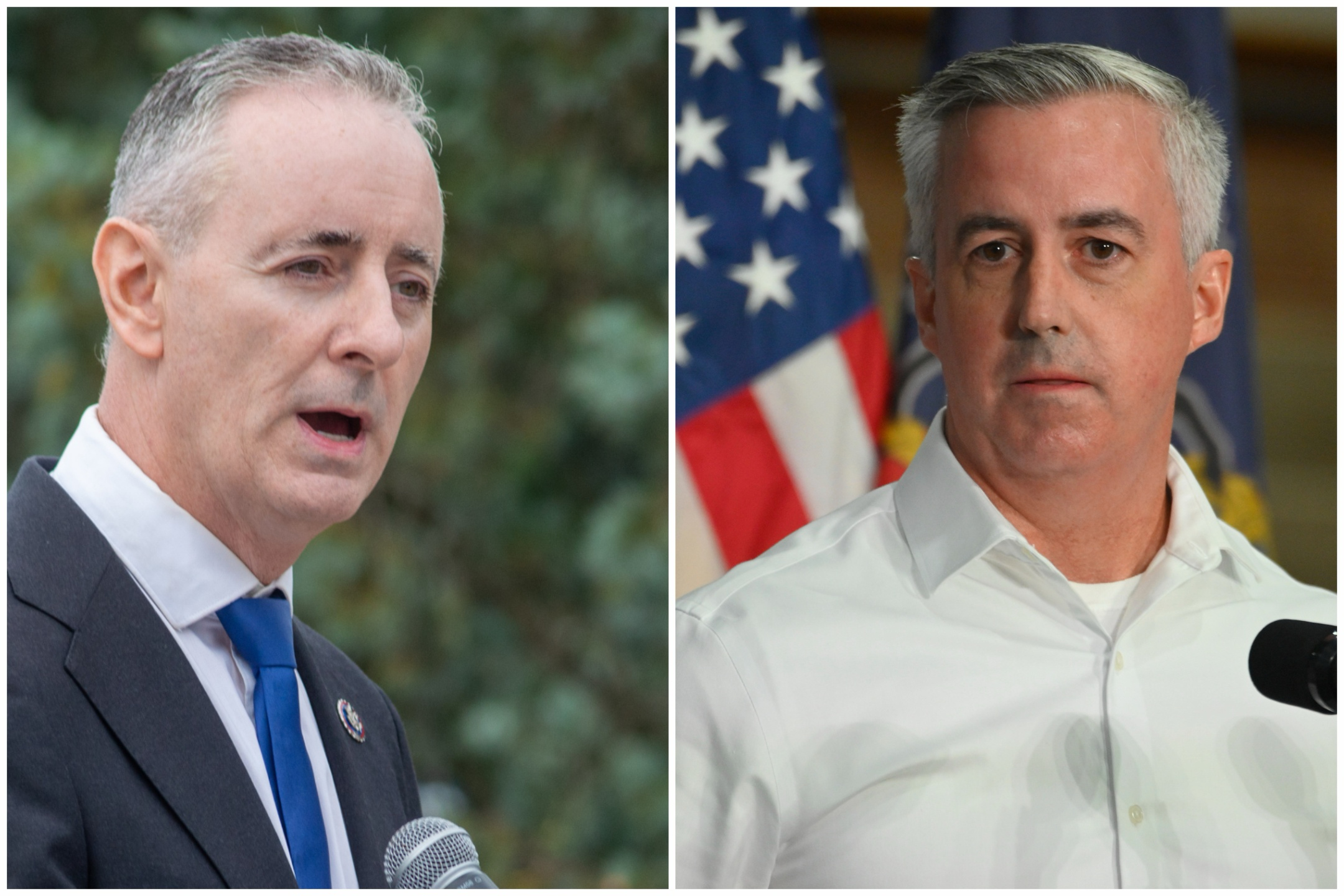
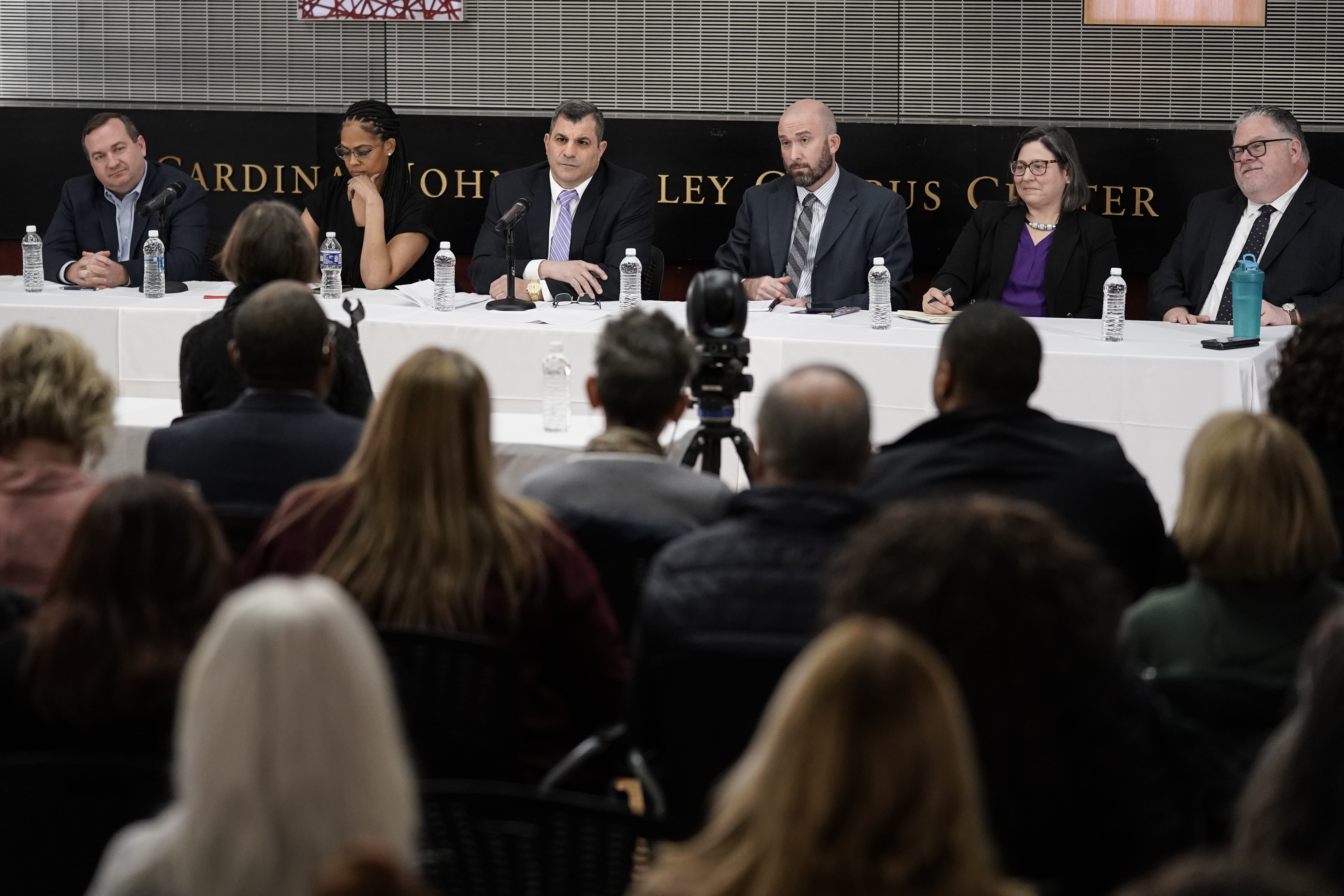
Democrat Bob Harvie holds a narrow lead over Republican U.S. Rep. Brian Fitzpatrick in a Bucks County race that could decide control of the U.S. House.
Harvie’s lead is within the margin of error, but the poll shows the Democrat has a shot at flipping the district a little more than a week before Election Day —an unthinkable prospect just two years ago.
Fitzpatrick, the last remaining House Republican in the Philadelphia suburbs, entered the final month of this race with a massive fundraising advantage and decades of family name recognition. But in the swing district he also faces the drag of his party’s increasingly unpopular president amid gains in Democratic momentum.
A loss for Fitzpatrick would be monumental, but not unprecedented. His late older brother, former U.S. Rep. Mike Fitzpatrick, was defeated in 2006 amid a similar national political environment before winning the seat back four years later.
Out of the state’s four swing congressional districts, President Donald Trump has his worst approval rating in the 1st District — where Gov. Josh Shapiro, who has a double-digit lead against Republican Stacy Garrity in the governor’s race, has his highest.
The younger Fitzpatrick has survived blue wave after blue wave.
The Bucks County Republican leads Harvie on character 46% to 39%, according to the poll of 400 likely voters conducted from Oct. 16 to 22.
Many voters are still forming opinions on the county commissioner. Harvie was seen favorably by 38% of respondents compared with 32% who view him unfavorably, with the rest of the electorate offering no opinion. Fitzpatrick, meanwhile, was viewed favorably by 43% of voters and unfavorably by 44% after five terms.
(function(){function e(){window.addEventListener(`message`,function(e){if(e.data[`datawrapper-height`]!==void 0){var t=document.querySelectorAll(`iframe`);for(var n in e.data[`datawrapper-height`])for(var r=0,i;i=t[r];r++)if(i.contentWindow===e.source){var a=e.data[`datawrapper-height`][n]+`px`;i.style.height=a}}})}e()})();
The 1st District, which also includes part of Montgomery County, is one of the swingiest areas in the state and home to many independent voters who will helpdetermine the election. With both campaigns courting the district’s moderate profile, Harvie and Fitzpatrick are tied at 44% among independents.
Don Levy, director of the Siena Research Institute, said that Fitzpatrick has demonstrated some independence “in a district that demands it,” and that his likability among voters could help him succeed on Election Day despite any disdain for the president.
But, Levy said, the race is a “toss-up.”
“Clearly, Harvie has an opportunity to hold on to this two-point lead on Election Day,” he said.
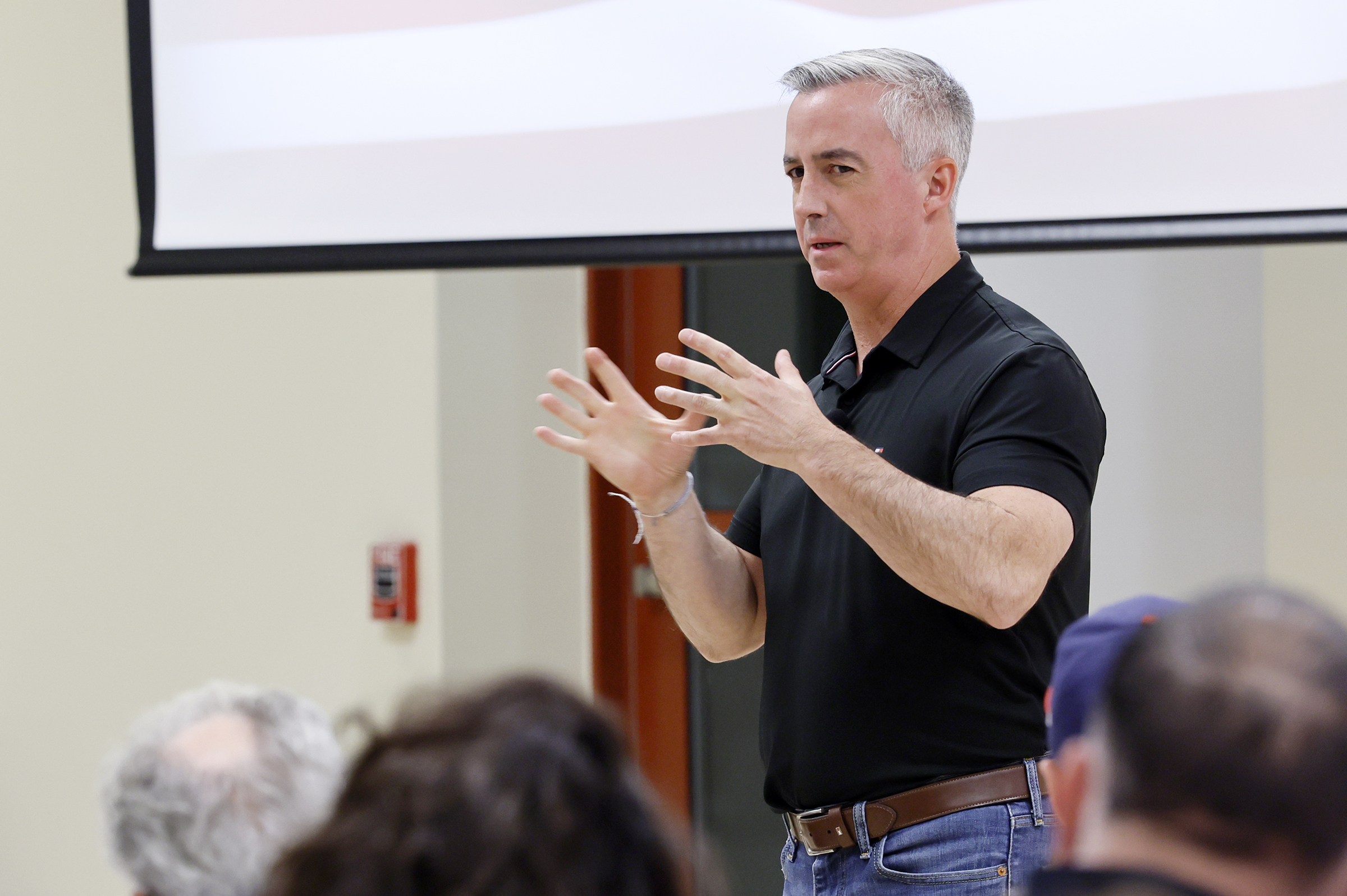
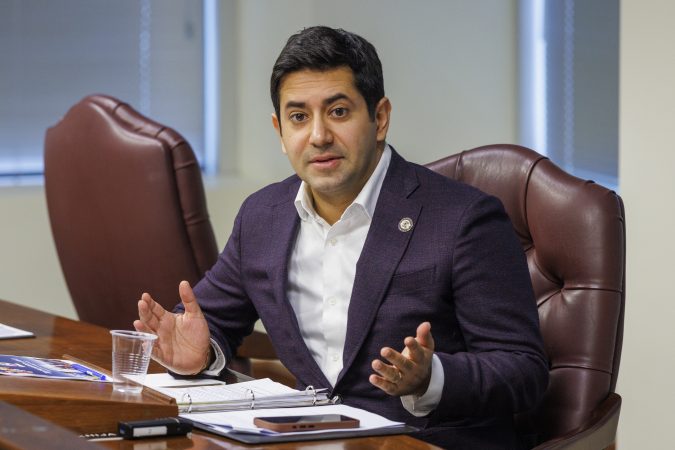
Democrat Bob Harvie talks with people during a town hall meeting at the Horsham Township Building on Thursday, Oct. 8, 2026.Elizabeth Robertson / Staff Photographer
They mean entirely different things for the 1st District.
Shapiro, who is unusually popular as governor, is leading Garrity in the district by 27 points, 61% to 34% — enough to potentially pull Harvie and other Democrats along on his coattails in key downballot races. Shapiro alsohas a 67% approval rating in the district with just 27% disapproval.
Meanwhile, Trump — who won Bucks County in 2024, though former Vice President Kamala Harris won the 1st District overall — has a 35% approval rating and 61% disapproval.
(function(){function e(){window.addEventListener(`message`,function(e){if(e.data[`datawrapper-height`]!==void 0){var t=document.querySelectorAll(`iframe`);for(var n in e.data[`datawrapper-height`])for(var r=0,i;i=t[r];r++)if(i.contentWindow===e.source){var a=e.data[`datawrapper-height`][n]+`px`;i.style.height=a}}})}e()})();
He is also deeply underwater on his handling of the cost of living (68% disapprove) as more than a quarter of 1st District voters view the economy as the most important issue in the congressional race.
This is the political landscape Democrats have been hoping for as they champion Shapiro and Harvie’s bond while trying to tie Fitzpatrick to Trump — a strategy that has not been fruitful in years past but may have more traction now given the president’s unpopularity.
Almost half of 1st District voters, 48%, think Fitzpatrick supports Trump too much, while 31% say he is about right on the president and 8% believe he opposes him too much, according to the poll.
Thirty-nine percent of voters think Harvie is about right on Trump, 30% say he opposes the president too much, and 26% did not know or declined to say how they feel about the Democrat’s perspective on the president.
Democrat Carolyn Perzan voted for Fitzpatrick in 2022 and 2024 but said she is switching her vote to Harvie this timebecause she feels the GOP lawmaker has changed since Trump has come back into office, noting Fitzpatrick’s key vote to advance the One Big Beautiful Bill Act (though he later voted against it on final passage).
“I don’t really know a lot about Bob Harvie, to be honest,” said Perzan, 57, of Hilltown Township. “I did do a little bit of research. I was influenced by the negative ads a little bit, but then I looked into it and I’m just going to vote Democrat because I don’t like what the Republicans are doing. At all.”
Christine Mecutchen, 60, of Furlong, similarly said that she doesn’t know much about Harvie, but that ousting Fitzpatrick is more important.
“Honestly, I’d vote for a watermelon with a hat on over that man,” the Democrat said.
An Inquirer analysis shows that Fitzpatrick is the least loyal House Republican to both Trump and his party, though he has voted with both at least 70% of the time this congressional term. The Bucks County Republican has been explicit in his disagreements with the president (Trump has not endorsed him), including his recent votes in favor of war powers resolutions for the conflict in Iran.
But the war might be a reason Mary Schoenharl’s kids stay home.
The 59-year-old independent, Libertarian-leaning voter from Chalfont plans to cast her ballot for Fitzpatrick because he aligns with her views on small government, public safety,foreign policy, and local issues. But she said she is worried about her 23- and 26-year-olds — conservatives who would otherwise vote forthe incumbent — stayinghome on Election Day as a protest vote against ongoing foreign wars.
“They think they’re all the same, basically, and that no matter who’s in, nothing’s going to change,” Schoenharl said. “It’s how they feel. They’re disheartened.”
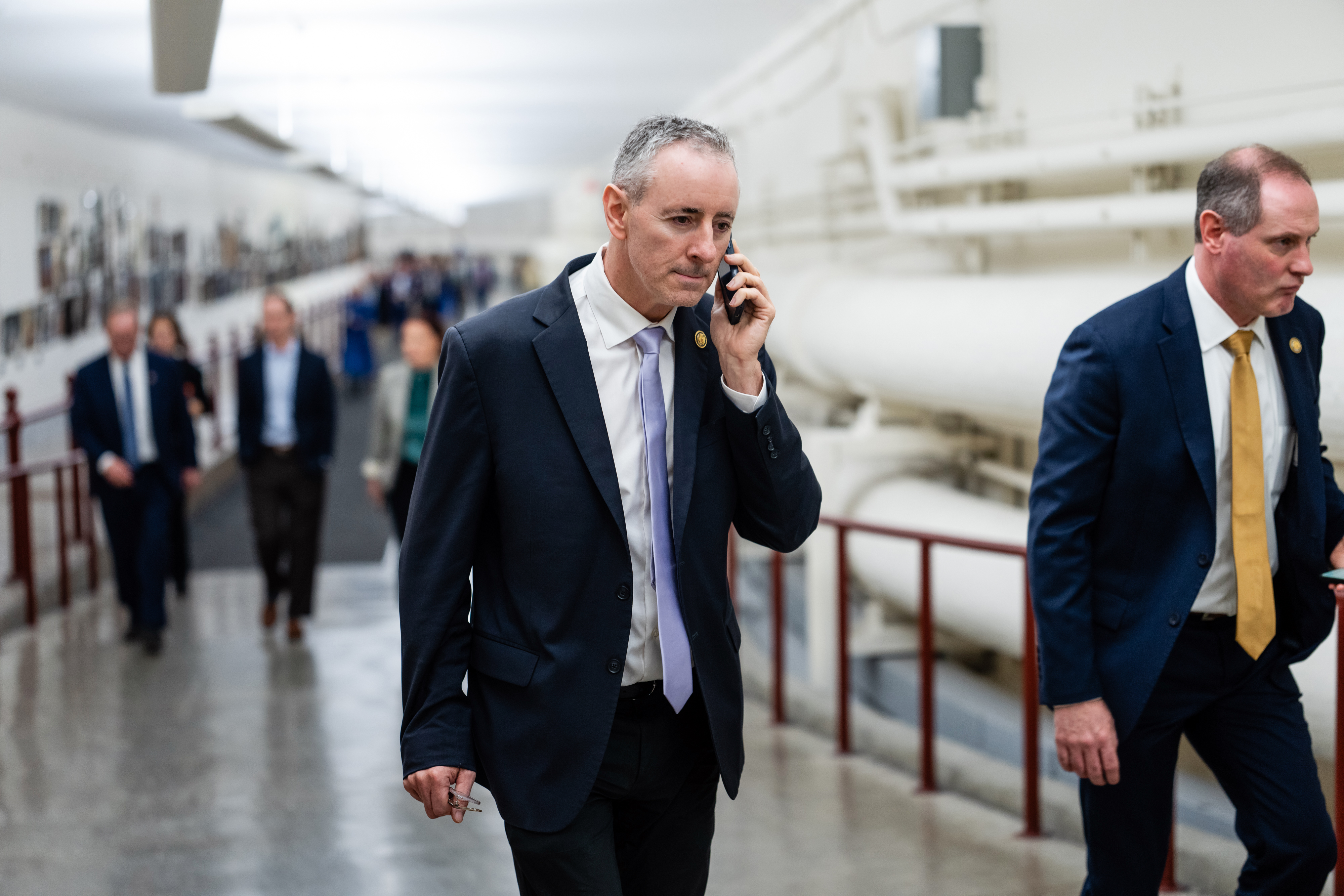
U.S. Rep. Brian Fitzpatrick at the Capitol in Washington on March 5, 2026.Eric Lee
The Shapiro factor
Meanwhile, Democrats in the homestretch are working to keep Harvie aligned with a more popular figure — Shapiro.
The Democratic Congressional Campaign Committee, which recently started making bigger investments in the 1st District, is promoting the governor’s endorsement of Harvie, including in itsclosing ad in the contest that also seeks to connect Trump and Fitzpatrick.
At the same time, Shapiro and Fitzpatrick appear to have an amicable relationship. Fitzpatrick earlier this year said he believes the governor will win reelection and referred to him as a friend. Fitzpatrick invited Shapiro to his wedding this summer, but the governor did not attend and instead sent a “lovely note,” the New York Times reported.
In an interview with The Inquirer this month, Shapiro said, “I like Brian. I think he’s a good man, and I think he works really hard in that district,” but that his fundamental difference with him is “around the idea that he empowers Speaker [Mike] Johnson, who enables Donald Trump.”
“I think that at a time where we need more accountability for Donald Trump, enabling, you know, pathetically weak people like Mike Johnson, who just roll over and do whatever Donald Trump wants, I don’t think that that’s something that we can afford any longer,” Shapiro said. “I think it is important that there be a check on this president in Washington.”
It is likely that some voters in the 1st District will split their ticket between Shapiro and Fitzpatrick, especially in purple Bucks County, where Shapiro won by 20 points during his first bid for governor in 2022 while Fitzpatrick comfortably won reelection.
Hank Conicelli, 67, is one of those voters.
The self-described “middle-of-the-road” Republican will cast his ballot for Shapiro — he said he does not know much about Garrity — and will vote once again for Fitzpatrick, whom he describes as a “nice guy.”
“I don’t see him ever doing anything, you know, on the negative side,” the Yardley resident said, adding that Fitzpatrick “seems like he’s the type of person that helps people in need.”
Conicelli, who voted for Trump in 2024, said he believes the president had done an OK job with the economy up until the spike in oil prices due to the Iran war. But Fitzpatrick should not be bogged down by any potential negative association with Trump or the GOP, he said.
“I think he’s done a good job, and I think people will see that,” Conicelli said. “For me, personally, I look at the person vs. the ‘R’ vs. ‘D.’”
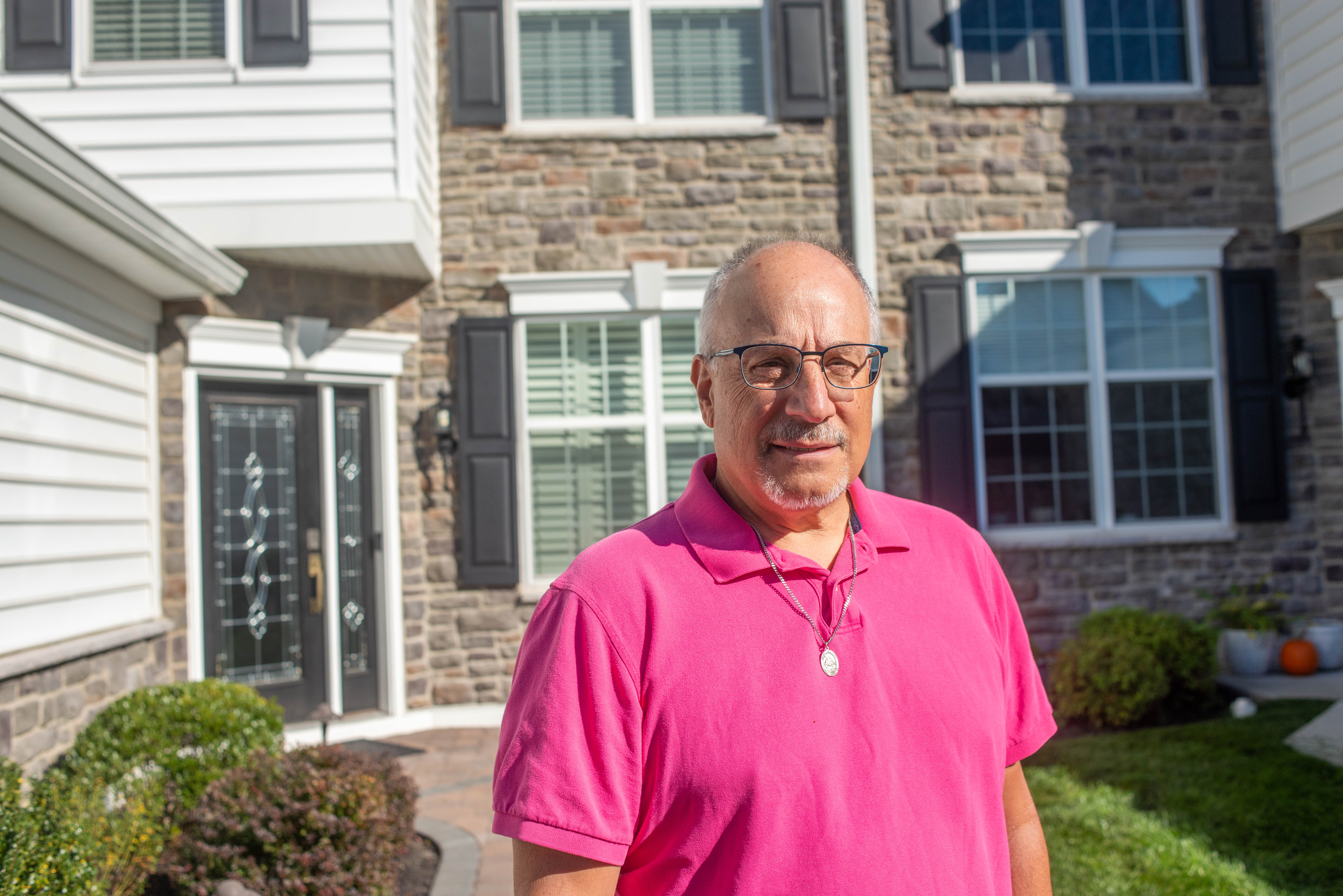
Hank Conicelli, a split-ticket voter, chats about the midterm elections on Friday, Oct. 23, 2026, at his home in Yardley. William Thomas Cain / For The Inquirer
‘A lot more people that are unhappy’
The 1st District race is also tight on the issues.
Harvie holds a slim lead over Fitzpatrick on his handling of all issues covered in The Inquirer/NYTimes/Siena poll, including thecost of living (46% to 43%), immigration (47% to 45%), foreign wars (47% to 42%), AI and data centers (43% to 40%), and corruption (47% to 40%).
Forty-six percent of voters said Harvie would do what is best for ordinary Pennsylvanians, while 44% said the same of Fitzpatrick.
The Bucks County contest has become a race focused both on the economy and corruption. Democrats and Republicans are each working to become the party of affordability and trying to paint their opponents as corrupt — namely by Fitzpatrick continuously claiming Harvie is the “subject” of an FBI corruption investigation and Democrats arguing that the Republican has enriched himself while in office.
And for Fitzpatrick’s part, spokesperson Heather Roberts said an ad by Harvie and the DCCC on the congressman’s finances is “completely absurd and completely fabricated.”
“Brian leads the charge in banning stock trading and has engaged in a total of Zero stock transactions during his entire time in office,” she said in a statement.
(function(){function e(){window.addEventListener(`message`,function(e){if(e.data[`datawrapper-height`]!==void 0){var t=document.querySelectorAll(`iframe`);for(var n in e.data[`datawrapper-height`])for(var r=0,i;i=t[r];r++)if(i.contentWindow===e.source){var a=e.data[`datawrapper-height`][n]+`px`;i.style.height=a}}})}e()})();
For Perzan, the Democrat from Hilltown Township, her vote next month is also about searching for leaders who will hold Trump accountable for what she says is his corruption.
The former Fitzpatrick voter says that everything has “gotten so outrageous,” but that something feels different this year for Democrats, who are battling to represent Bucks County in Congress for the first time in a decade and a half.
“I think there’s a lot more people that are unhappy with what’s going on,” Perzan said.
This story was updated to clarify each candidate’s net favorability rating.
Staff writers Joe Yerardi, John Duchneskie, Michelle Baruchman, and Gillian McGoldrick contributed to this article.
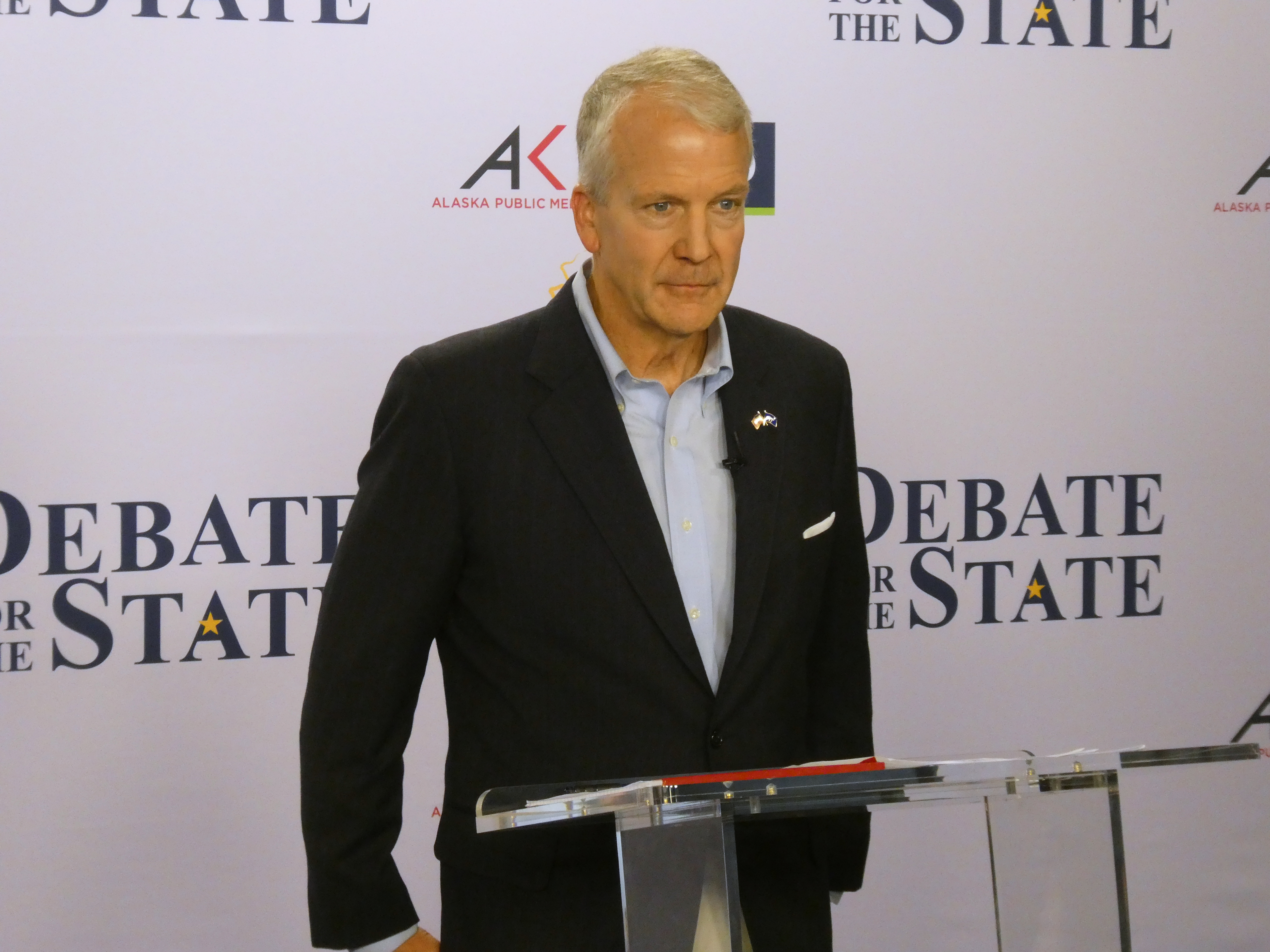
President Donald Trump on Friday said he told his administration to file its lawsuit to block certification of the U.S. Senate race in Alaska if Republican Sen. Dan Sullivan loses, kicking off what many fear could become a lengthy battle between the government and states over certifying an election where the president’s party is struggling.
“I’m the one that said do it,” Trump told reporters as he landed for a campaign rally in Florida.
The lawsuit, filed late Thursday, centers on one of the president’s longstanding complaints in the Senate race — the presence of a second candidate named Dan Sullivan, who Republicans fear could siphon away votes from the incumbent in what’s likely to be a photo-finish contest with Democrat Mary Peltola, the state’s former congresswoman.
The second Sullivan, who is Daniel J. Sullivan from the tiny fishing community of Petersburg, has said he decided to run on his own, but Republicans have contended he is a Democratic plant to siphon votes away from their candidate.
The lawsuit by the Republican president’s Department of Justice in federal court in Alaska demands that the state be blocked from certifying a Peltola win if Daniel J. Sullivan remains on the ballot. “The United States accordingly brings this lawsuit to protect the integrity of the 2026 Senate election in Alaska,” the lawsuit says, contending that federal law requires states to protect the integrity of federal elections.
The legal challenge came 11 days before the Nov. 3 election and months after the final ballot was set.
The Alaska Supreme Court rejected a previous Republican effort to remove Daniel J. Sullivan from the ballot, and the state’s Republican officials made the decisions about how to list him on the ballot. He will appear without a party designation next to his name, while the senator will be listed as the Republican incumbent. Alaska’s ranked choice voting system also will allow voters to select both of the men if confused.
Peltola and Sen. Sullivan were top vote-getters in nonpartisan primary
The senator received more than 68,000 votes in the August primary, while the challenging Sullivan got 4,107, about 2% of the total vote. Peltola, who had previously served one term in the House, was the top vote-getter in the nonpartisan primary. Both parties expect that whoever wins in November will do so by a tight margin in a state of 738,000 people.
The campaign for Sen. Dan Sullivan did not address whether the senator supports the Department of Justice’s intervention. “We’ll let the DOJ complaint run its course,” campaign spokesperson Nate Adams said in a text message. “Alaskans can tell the difference between a Democrat sideshow and Senator Sullivan’s strong record of delivering for Alaska.”
Daniel J. Sullivan, whose presence on the ballot is at issue in the lawsuit, did not immediately respond to a request for comment.
“Donald Trump knows that Dan Sullivan is going to lose the election, so now his Department of Justice is filing a sham lawsuit to overturn the will of Alaska voters and steal an election when he loses,” said Devan Barber, executive director of the Democratic Senatorial Campaign Committee.
In a statement on Friday, the Department of Justice noted that Alaska’s election officials, who are Republicans, determined the other Sullivan’s campaign was an attempt to “mislead” voters and wanted him removed from the ballot. Both a state court and Alaska’s Supreme Court disagreed and kept the second Sullivan on the ballot.
“The Justice Department, consistent with the National Voter Registration Act enacted by Congress, is taking the necessary steps to ensure that this frivolous candidacy does not undermine the integrity of Alaska’s election or the will of its voters,” the department’s statement said.
The Department of Justice has increasingly been used to bolster the Republican president’s political operation, targeting his enemies and suing Democratic-controlled states before the election. Democrats and many voting rights advocates have long feared that the administration will try to block certification of elections that Trump’s party loses, much as he unsuccessfully tried to do when he lost the 2020 White House race to Democrat Joe Biden.
U.S. Attorney General Todd Blanche said that was unlikely outside of extreme circumstances. “It is not DOJ’s intention to, and it’s never our intention to, improperly interfere with elections or the state certification process,” he told reporters Thursday in Virginia before the lawsuit was filed.
The lawsuit was signed by Associate U.S. Attorney General Stanley Woodward, who represented Trump allies and Jan. 6 defendants before becoming one of the top appointees at the department.
Constitution gives states the power to run elections
Derek Muller, a law professor at the University of Notre Dame, said the lawsuit would likely only kick in if Republicans narrowly lose the Alaska Senate race and that it probably would not survive long. “The statute simply doesn’t let the Department of Justice enjoin certification,” Muller said. “The lawsuit could well be mooted by a wide Democratic victory or a narrow Republican one, and if not, the court will likely dismiss it next month.”
The U.S. Constitution grants states the power to run their own elections. Elections for federal office like the Senate must comply with standards set by Congress. That division of power has frustrated Trump, who repeatedly has tried to seize control of election procedures through executive orders that courts have blocked.
The final step for a state election is formally certifying the winner, the act that the administration’s lawsuit seeks to prevent, it requests, “pending an investigation to determine whether votes cast for Daniel J. Sullivan were meant to be cast for Senator Sullivan.”
The process in Alaska is complicated by the state’s ranked choice voting system, which Trump opposes, and many expect it to take weeks before a winner is known. Also on the state’s ballot is an initiative to repeal that system.
Trump has stepped up complaints about a ballot with dueling Sullivans
Trump has complained about Daniel J. Sullivan’s presence on the ballot, making reference to it during a rally in Alaska this month and in repeated social media posts, including one this week where he called it “CHEATING.”
“We are looking at powerful legal options to remove the fraudulent Daniel J. Sullivan Jr. from the Ballot, and holding the Democrats accountable for their Election Interference, in the pursuit of Justice and Fairness,” the president wrote on Wednesday.
Clogging a ballot with third party candidates to siphon off votes from the other major party is a long-standing tactic in the country’s two-party system. Republicans have been linked to an effort to persuade Ohio voters to support a socialist in that state’s Senate race, which could help Republican Sen. Jon Husted fend off a challenge from former Democratic Sen. Sherrod Brown.
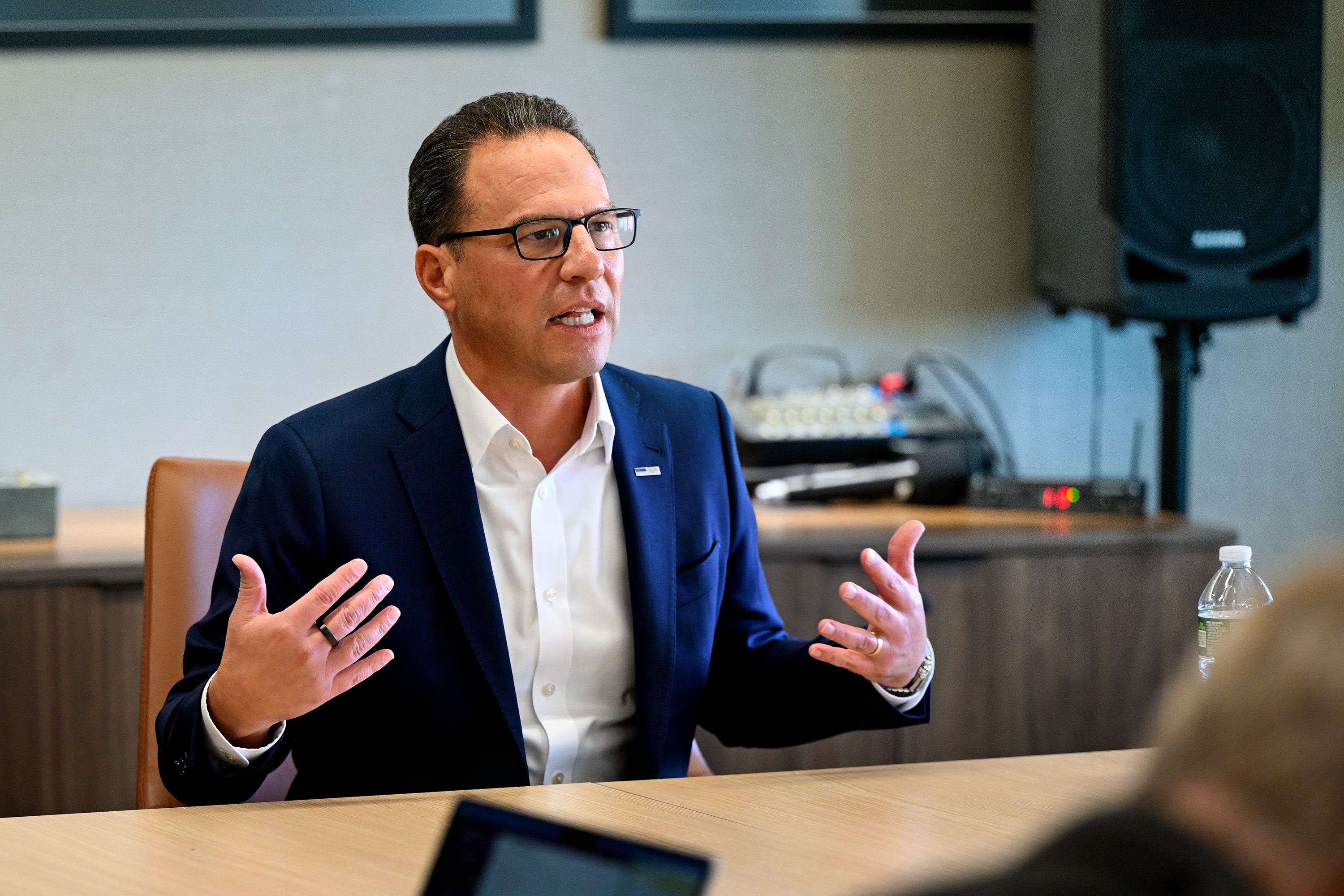
He won’t flinch when you do. No jutted lip, no flicker of emotion. No fiddling with his wedding band or smart ring, one on each hand.
He’s been preparing for this kind of thing for decades.
Shapiro, 53, of Abington Township, has been rumored to have his sights set on the White House dating back to his time as a state representative, as a Montgomery County commissioner, as the state attorney general, and now as Pennsylvania’s governor. And while other 2028 Democratic presidential hopefuls are more outward with their ambitions, hosting fundraisers and making themselves known in early primary states, Shapiro — a disciplined and careful communicator — has led a calculated balancing act as he runs for reelection to the state’s top post, hoping to carry the rest of the Pennsylvania ballot with him.
Are you running for president in 2028?
“I’m going to give you the same answer that I’ve given everyone,” Shapiro told the moderators at a debate earlier this month against his Republican opponent, Stacy Garrity. “The only thing I am focused on is running for reelection as governor, and I’m focused on these midterms in trying to generate the kind of turnout and support the kind of candidates who will push back on the chaos, the cruelty, and the corruption of Donald Trump.”
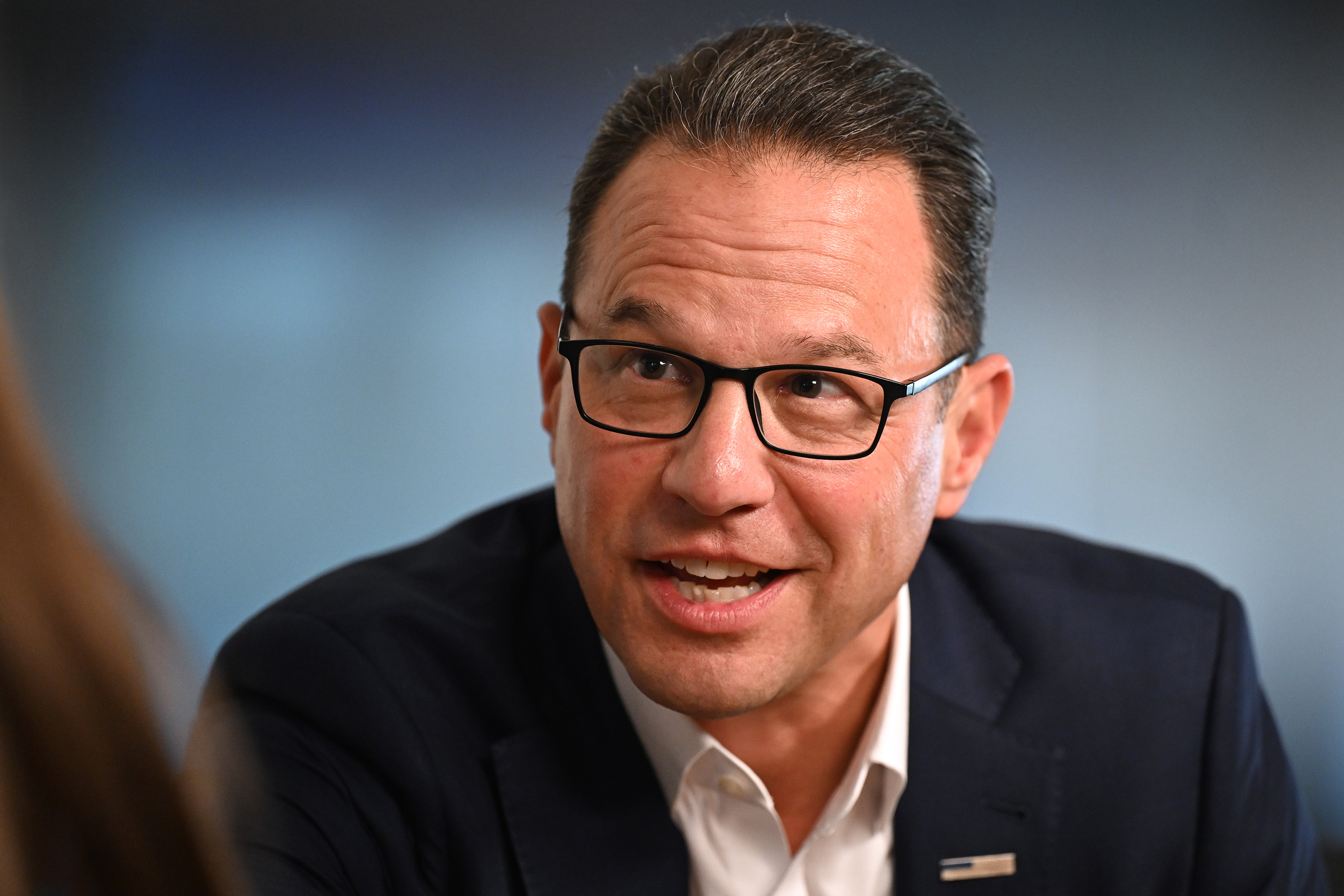
The first-term governor — wearing his daily uniform of a navy blue suit, bright white dress shirt with no tie, white tennis shoes, andblack-framed glasses — does the same again earlier this month in a set of interviews in The Inquirer’s newsroom across from Independence Hall; he smoothly sidesteps the question of whether he’ll promise to fulfill another four-year term if reelected.
Instead, he boasts his administration’s “get stuff done” motto, citing some of his proudest accomplishments as the leader of Pennsylvania, such as reopening I-95 in 12 days, speeding up the state’s process to get licenses or permits to do work, utility rate caps, and new pathways to careers in the trades. In the run-up to the Nov. 3 election, those triumphs have blanketed the state’s TVs, social media and mailboxes, as his campaign tops $42.3 million in ad buys, according to media tracker AdImpact.
Nearby, his campaign staffer sports a pin featuring the number 48. Shapiro is Pennsylvania’s 48th governor. If he runs in 2028, he’d be vying to become the nation’s 48th president.
Nowadays, there’s a noticeable shift in the Democrat who has long prided himself in his willingness to work across the aisle, but who has struggled as a dealmaker in the state’s split legislature as he goes all-in on flipping the Senate in hopes of more easily achieving his goals.
At the same time,he’s become more willing to directly challenge Trump in the state that helped boost the president to a second term just two years ago, as Trump’s approval ratings continue to decline — and national Democrats are looking for a strong leader to carry them into 2028.
“When he’s going to do something to hurt Pennsylvanians, I’m going to stand up to him, and when I stand up to him, I win every single time,” Shapiro said earlier this month.
The shift — and the sharper edge — may be strategic as Shapiro readies himself for a White House run, said Christopher Borick, a political-science professor and pollster at Lehigh University.
“He is more willing to express his animosity toward Republicans, toward Republican policies, and of course, the president,” Borick added. “He’s been more vocal than you may have thought he would be, given his brand.”
‘Straight down the middle’
When Shapiro sat down for an interview at The Inquirer’s offices earlier this month, he studied where he should sit before answering the question himself.
“How’s this, straight down the middle?” the moderate Democrat suggested with a grin, setting himself up at the center of the table.
Gov. Josh Shapiro at The Inquirer’s office on Monday, Oct. 12, 2026.Tom Gralish / Staff Photographer
Shapiro’s brand as a centrist has been tested over the last few years, as he governs one of the only states in the country with a politically split legislature. An early misstep in Shapiro’s first budget negotiations in 2023 over school vouchers tarnished his relationship with the state’s Senate Republicans, a wound that has never fully healed. Republicans accused Shapiro of reneging on their handshake deal to create a new school voucher program. At the time, Shapiro said the move was necessary to avoid a protracted budget impasse.
Still, for the past four years, Shapiro and top state negotiators have struggled to agree on a state budget before the constitutionallyrequired deadline, as Pennsylvania faces worsening fiscal conditions and spends more money than it collects in revenue.
He’s had some major wins, too. State lawmakers have approved $3 billion in funding increases and created a new funding system for public education, after a state appellate court ruled that Pennsylvania’s previous system was unconstitutional. He has celebrated increases to the state’s property tax and rent rebate programs for seniors, a new state tax credit for working families, and a pension bump for retired teachers, police officers, and firefighters. He boasts significant reductions in wait times for business licenses and environmental permits and continued cuts to the state’s corporate net income tax, as part of his cut-red-tape approach.
Shapiro has faced criticism throughout his tenure as governor from top Republican leaders, who say he lacks conviction on the issues he says he cares about and instead changes his stances to reflect what’s popular.
“He was for helping kids out of failing schools, then he was against it,” Senate President Pro Tempore Kim Ward (R., Westmoreland), the top Republican in the state Senate, said last month. “He was for data centers, then he was against them.”
On school choice, he said this month he still supports the creation of a new school voucher program if House Democrats and Senate Republicans can agree on it. And he has defended himself on his recent reversal on increasingly unpopular data center development, which became a political flashpoint that threatened Shapiro’s popularity. He has said his change in position was a direct response to constituent concerns.
Garrity’s campaign has capitalized on the perceived flip-flops, calling Shapiro in a statement a “career politician whose policy failures have left Pennsylvania families struggling.”
His first term as governor also saw the resignation of a longtime top aide, former Rep. Mike Vereb (R. Montgomery), who was accused of sexual harassment by another staffer in the governor’s office that resulted in the state paying the accuser a $295,000 settlement.
Shapiro, previously largely untested on the national stage, also came under scrutiny when he was being considered by Vice President Kamala Harris to be her running mate in 2024. She ultimately passed him over, and he later said he didn’t want the job. But the consideration significantly boosted Shapiro’s rising national profile, and he later retold the story in his memoir, Where We Keep the Light, released earlier this year.
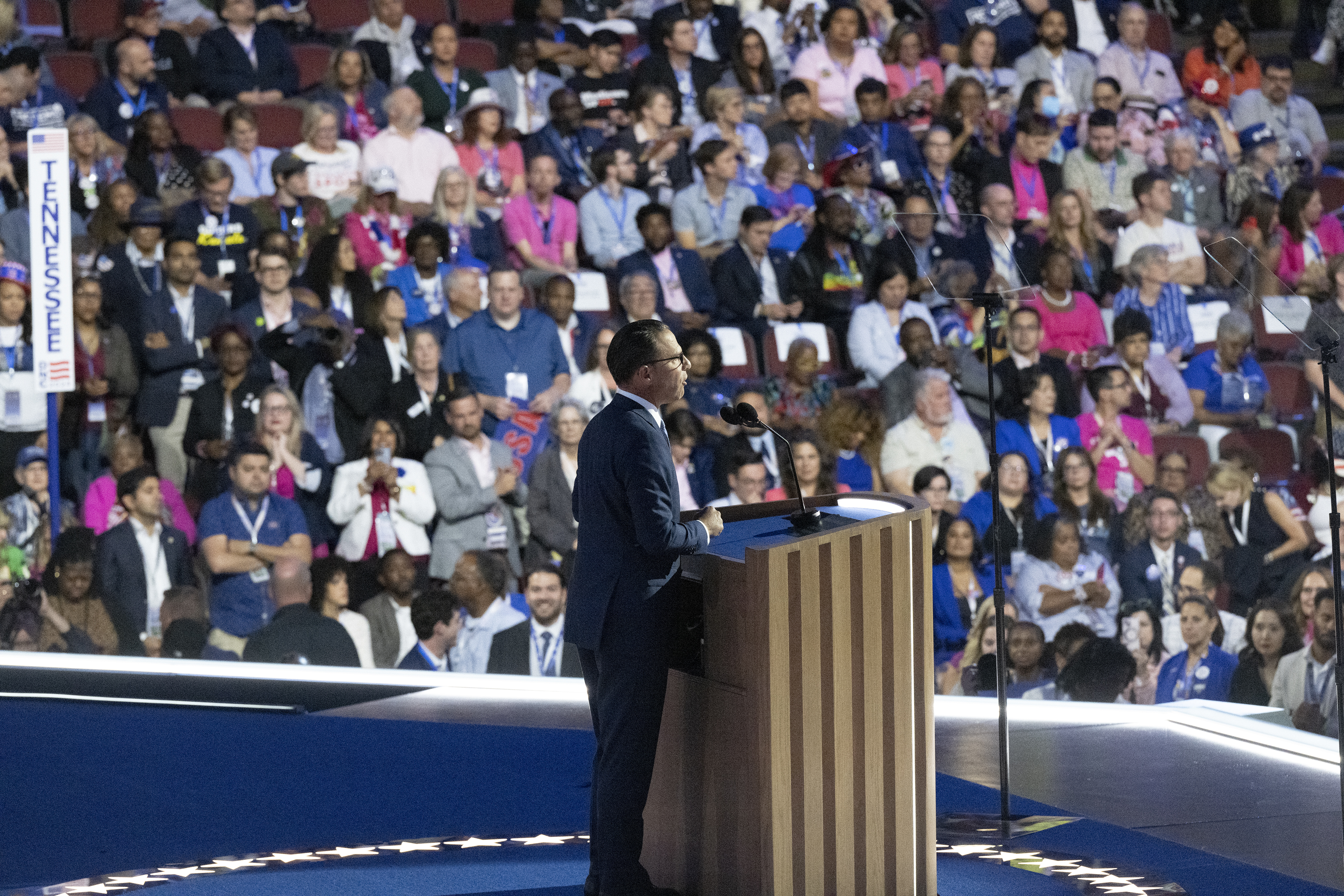
Pennsylvania Gov. Josh Shapiro speaks during the Democratic National Convention on Aug. 21, 2024, in Chicago.Jose F. Moreno / Staff Photographer
And most recently, he’s faced the state’s worst measles outbreak in more than three decades, which the state says has led to the deaths of six Pennsylvania residents. The surge in measles cases, which now tops 1,317 cases in Pennsylvania, led to a public clash with Health and Human Services Secretary Robert F. Kennedy Jr. As of Thursday, the Centers for Disease Control stillrefused to recognize three of the measles-related deaths as caused by the preventable disease.
“There’s a whole bunch we’ve been able to get done by bringing people together, and then there’s some things that I view as quite common-sense that I haven’t been able to convince the Senate to move on — raising the minimum wage to 15 bucks an hour, funding mass transit — even though it helps their communities,” Shapiro told The Inquirer’s Editorial Board this month. “I’m frustrated I haven’t been able to get that done, but again, that’s why I’m still working at this. That’s why I’m still going forward.”
(The Editorial Board, which runs The Inquirer’s opinion pages and decides endorsements, operates independently from the newsroom. Newsroom editors and reporters — including two reporters who attended the Editorial Board meeting as observers — have no role in endorsements, and opinion staffers have no role in news coverage.)
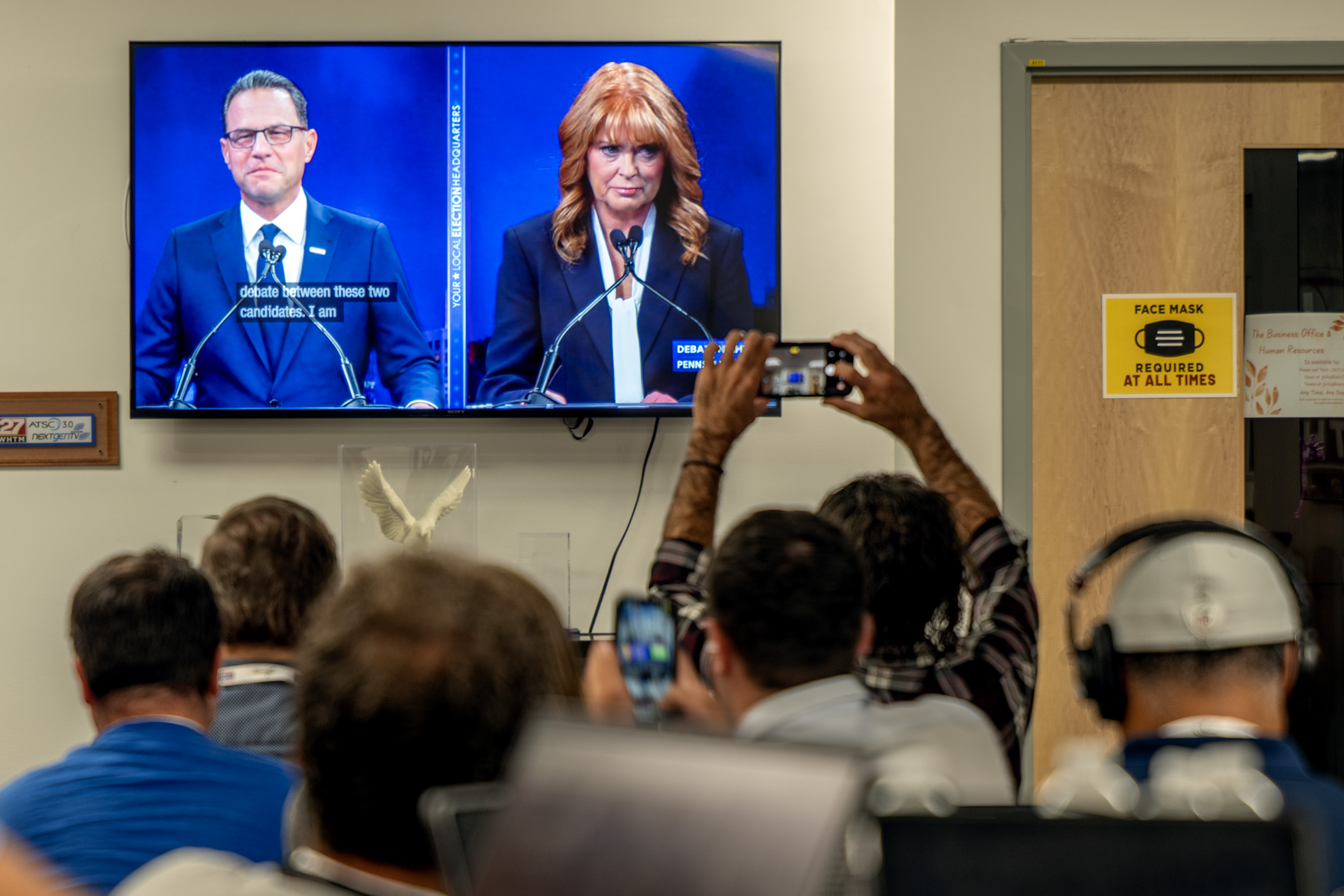
Monitor at the WHTM-TV studios in Harrisburg on Oct. 7, 2026, during the lone debate between Gov. Josh Shapiro and Republican challenger Stacy Garrity.Tom Gralish / Staff Photographer
Shapiro has maintained widespread popularity throughout his first term, including among some Trump supporters, recent polls of likely Pennsylvania voters show. Shapiro’s job approval topped 63% in a Quinnipiac University poll released Oct. 7, and he led Garrity in the poll by 25 points. A poll released Thursday by Franklin and Marshall College had similar findings, including a 22-point lead for Shapiro over Garrity.
“If you can be as popular as he is with divided government and the dysfunction in our Senate… that’s a pretty damn good comment on what he’s been able to accomplish,” said House Majority Leader Matt Bradford (D., Montgomery).
’A responsibility and pride’
These days, Shapiro can’t go to the store or take a walk with his wife, Lori, and their dogs, Bo and Bentley, without a state police detail present and careful coordination.
As Shapiro, one of the nation’s most prominent Jewish politicians, seeks reelection and eyes a presidential run, the impacts of his high-profile, public-facing office have weighed on him, he said. At least six people have been charged in the last nine months with making terroristic threats or ethnic intimidation in regard to the governor, he said.
“If I ever got to the point where I was afraid to go out, or afraid to do my job, or unwilling to do something because I was fearful, that would be the day I would hang it up,” he said. “I don’t feel that way. I feel a lot of purpose in my work, and I feel unafraid when I’m doing it.”
Shapiro said he believes many of the threats he’s received have stemmed from the open practice of his Jewish faith, and he wrote in his memoir that since Hamas’ Oct. 7, 2023, attack on Israel, he and his family “feel both a responsibility and pride demonstrating our faith and living it out loud.”
Pennsylvania Gov. Josh Shapiro stands with his family as he listens to remarks at the Philly Stands With Israel Rally outside a Jewish community center in Wynnewood on Oct. 9, 2023.Steven M. Falk / Staff Photographer
For Shapiro, Israel is“a place that’s meant a lot to me and my family,” he said. It’s where he proposed to his wife, and is a country he said he loves — which has been complicated by Prime Minister Benjamin Netanyahu’s actions during the war in Gaza that he sees as weakening Israel’s position globally. He supports a two-state solution, with Palestinians having a state and living side-by-side with Israel, and said he hopes Israeli voters will select a new leader in its Oct. 27 election.
“Unfortunately, we’re in a time where there are people who are calling into question whether the very country has the right to exist,” he said.
None of these positions, Shapiro points out, have much to do with his role as governor.
But they could be key in the 2028 Democratic primary as debate over the United States’ relationship with Israel continues to fracture the party. According to a September Inquirer/Times/Siena poll of likely Pennsylvania voters, 63% of Democrats said they would support a candidate who opposed aid to Israel.
“Josh is very religious and proud of it, and he has learned about the religion, and it made him a better person,” said former Gov. Ed Rendell, Pennsylvania’s second Jewish governor. But, Rendell raised: “Does it make it harder for him to go further in politics?”
“It’s a tough time for Josh if he’s thinking about launching a national campaign,” Rendell, a Democrat who also served as Philadelphia mayor, said, but “one thing Josh has convinced me of is that anything he wants to do, he’s going to have a good chance of succeeding at.”
Growing impatient
When Trump returned to office in 2025, Shapiro vowed to work alongside the president — as long as it didn’t compromise Pennsylvanians. He joined lawsuits on Pennsylvania’s behalf as Trump threatened to slash federal funding.
His tone has since changed. As Trump’s approval numbers continue to decline, Shapiro has begun to moredirectly instigate Trump, often repeating that Trump has caused “chaos, cruelty, and corruption” in Washington.
He has also put his reputation on the line to flip the U.S. House, endorsing, campaigning and fundraising for four Democratic challengers in competitive congressional districts across Pennsylvania in hopestheywin and take control of the chamber.
In Harrisburg, he has poured more than $10 million in total into the state Democratic Party and the House and Senate Democrats’ campaign arms, his campaign said Thursday.
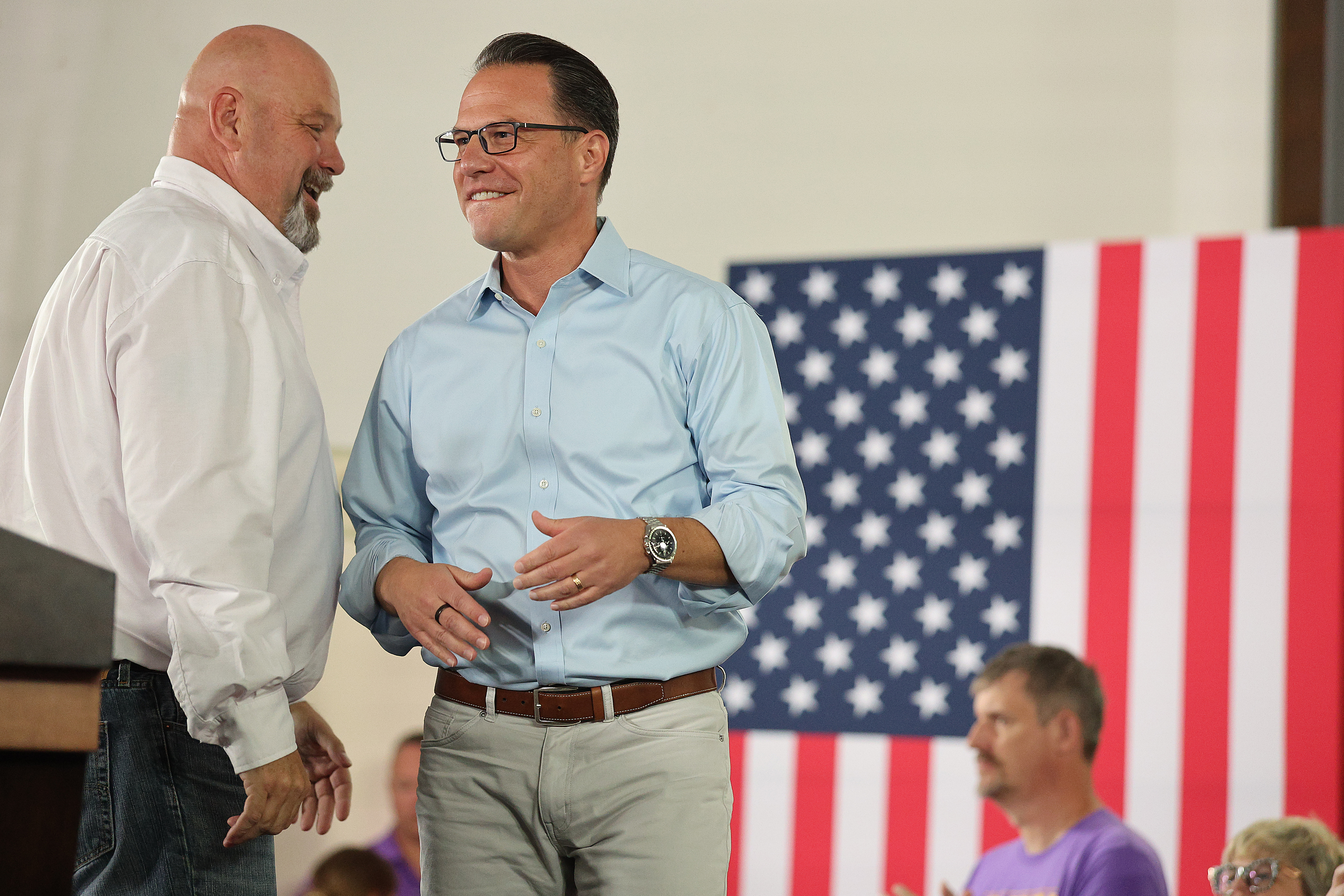
Bob Brooks (left), who is running for Pennsylvania’s 7th Congressional District, and Pa. Gov. Josh Shapiro (right) exchange greetings on the stage during a July 26 rally at the United Steelworkers Union Hall in Bethlehem, Pa.David Maialetti / Staff Photographer
And after he struggled to break through gridlock with Senate Republicans, he went all in on winning full Democratic control in Harrisburg for the first time since 1993.
That move is an example of Shapiro as a pragmatic leader, said Bradford, who has known Shapiro for decades. He wanted to find common ground with Republicans, Bradford said, but when he couldn’t, he found a new solution: winning a trifecta.
“His ideology is competence,” Bradford said. “He’s not an ideologue, and I say that as a proud progressive. … It’s also a recognition that at times he is stymied by a Senate that is incapable of governing.”
Shapiro has been strengthening his grip on the state’s Democratic Party, too, since the fallout of the 2024 election, when Democrats failed to deliver Pennsylvania for Harris. He installed a former top aide as the party’s executive director. The state party has since turned around its declining voter registration numbers.
Still, Shapiro said finding common ground is the most necessary strategy to being a good elected official.
“The people make their choice, and if you’re privileged like I am to be elected, then you’ve got a responsibility when you’re in the room to govern,” he added.
‘Campaign 101′
A lot is on the line this November for Shapiro. If he successfully helps flip control of the U.S. House and gains a trifecta in Harrisburg for the first time in decades, he will have “a great resumé in America’s premier swing state,” Borick said, giving him a leg up among other 2028 contenders.
“That’s a great result that you can bring out on the campaign trail if you so choose to run in 2028,” Borick added.
But if he doesn’t meet expectations, “there may be some questions” about his viability for a presidential run, Borick said.
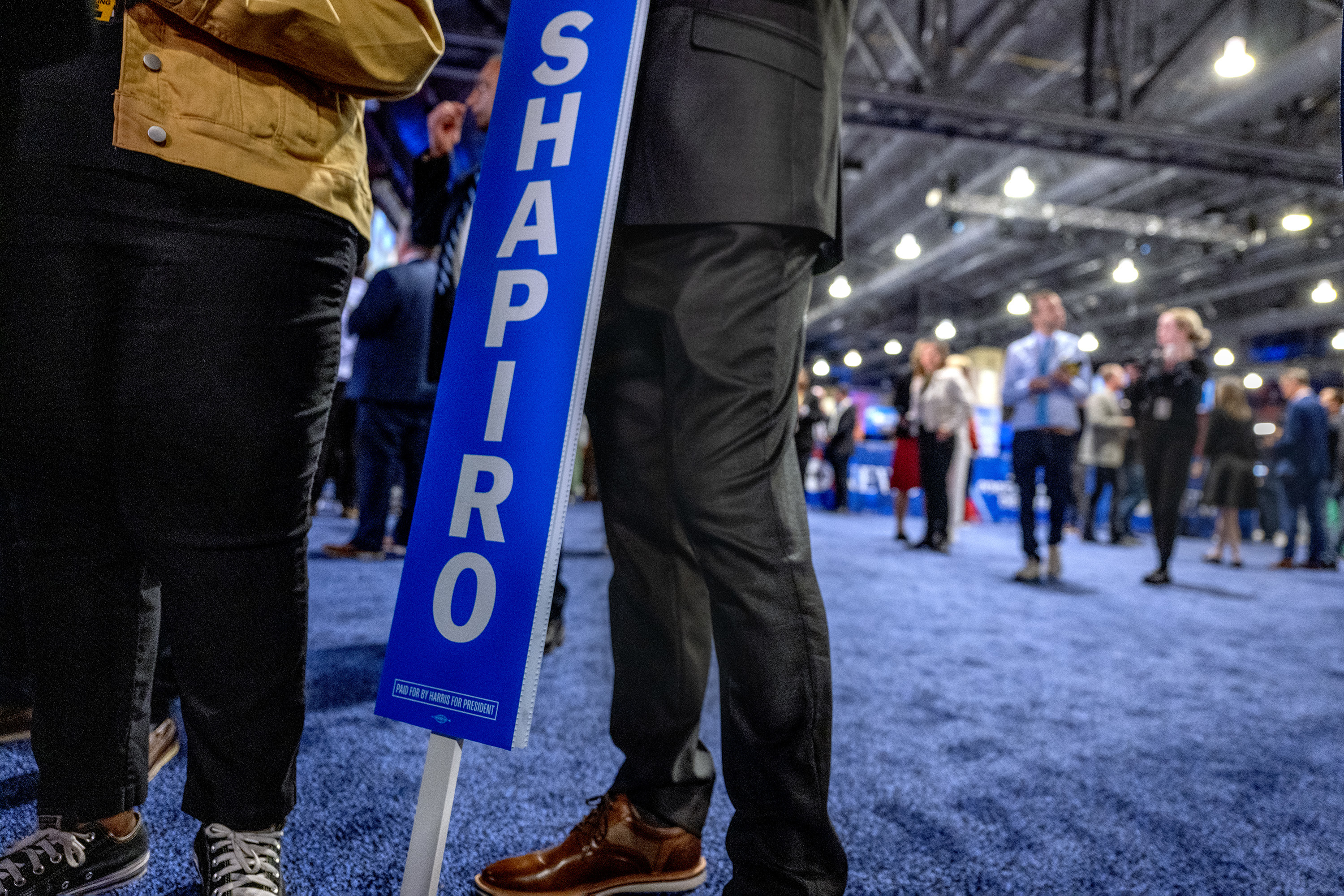
A staffer holds name sign for Gov. Josh Shapiro, a surrogate for Vice President Kamala Harris in the spin room at the Convention Center on Sept. 10, 2024, after her debate with former President Donald Trump at the National Constitution Center.Tom Gralish / Staff Photographer
That may help explain why Shapiro has never publicly said he’s considering a run, as he needs to win reelection first, Borick said.
“You don’t want to get hit at all for looking like you’re thinking ahead and not focused on the race before you,” Borick said. “That’s Campaign 101.”
Still, he’s left a breadcrumb trail for a 2028 run: writing a book, a national media tour, and, earlier this month, creating a federal political action committee, which he could use in the future to finance a White House run.
(His campaign has stressed he is using the PAC to contribute financially to the four Pennsylvania Democrats vying to flip the U.S. House.)
State Sen. Greg Rothman (R., Cumberland), who chairs the state Republican Party, said he believes Shapiro is running for president in 2028. “And I read his book,” he added.
He had some advice for the potential presidential hopeful: Improve your debate performance.
“I’ve been alive for 20-plus presidential debates. He’s gonna need work if he’s gonna compete on a national stage,” he said.
Manuel Bonder, a spokesperson for Shapiro’s campaign, said in response that he appreciates Rothman “taking a break from overseeing this disastrous, flailing Republican campaign for governor to offer unsolicited advice,” adding that Shapiro is only focused on electing Democrats down ballot.
Rothman said he’s still hopeful for a “huge upset” against Shapiro, citing past examples where the expected winner ultimately lost the election, including most recently former U.S. Sen. Bob Casey’s loss to U.S. Sen. Dave McCormick in 2024, without mentioning Garrity. The state party has given no financial support to the state treasurer’s gubernatorial campaign, according to her September campaign finance filings.
“We are a state known for huge upsets,” Rothman added.
Shapiro has also cultivated allies from across the country and ideological spectrum. After conservative influencer Charlie Kirk was murdered while on a Utah campus, Shapiro forged a strong relationship with Republican Utah Gov. Spencer Cox to speak out against political violence. And earlier this month, U.S. Sen. Elizabeth Warren (D., Mass.), who ran for president in 2020 as a progressive,headlined a fundraiser with him in Delaware County, introducing Shapiro as “a man who has the right values.”
“Winning Pennsylvania makes a great argument” for Shapiro’s chances as a prospective 2028 candidate, U.S. Sen. Chris Coons (D., Del.) said. “If you win Pennsylvania, you win the whole presidency.”
But no Pennsylvania governor has ever won the presidency.
(James Buchanan represented the state in the U.S. Senate a decade prior to his election to the presidency in 1856, and Scranton-born Joe Biden’s political career was forged in Delaware.)
Former Govs. Milton Shapp, a Democrat and Pennsylvania’s first Jewish governor, and William Scranton, a Republican, sought their parties’ nominations in 1976 and 1964, respectively. Other popular governors, like Rendell, Bob Casey Sr., and Tom Ridge also considered runs for the nation’s highest office, Borick said, but didn’t pursue them.
Shapiro, he said, is the most poised Pennsylvania governor to be considered seriously for a presidential run in modern history.
Bradford, a top state Democrat who has negotiated the last several state budgets alongside Shapiro, said Shapiro should “absolutely” run for president in 2028. He cited the governor’s popularity and his “record of accomplishment that is rewarded in not just the polls, but by the people.
“And I think that’ll show on Election Day on Nov. 3,” he added.
Correction: A previous version of this story stated the incorrect amount spent on upgrades to Shapiro’s personal home. The state spent $1 million on those upgrades.
Republican U.S. Rep. Brian Fitzpatrick said he would be willing to put Elon Musk,the world’s richest person, under federal oath to investigate potential violations of law related to national security in Ukraine.
“We got to call the witnesses, to to bring them in, put them under oath, and get to the bottom of it because this is a very, very serious matter. It cannot be glossed over,” Fitzpatrick told CNN’s Kaitlan Collins Tuesday night.
Starshield, the military-grade version of Starlink, connects with Ukrainian hardware to power drones that can intercept attacks. But the tech billionaire reportedly capped the speeds connecting the hardware to the satellite-based network, rendering the drones “virtually useless,” according to the Journal.
“If it is in fact Mr. Musk that ordered this, that is likely a violation of the law because he has authority and decision-making authority over Starlink, the civilian commercial product, but not Starshield,which is a military-grade national security tool,” Fitzpatrick said on CNN. “No individual civilian should have any decision-making authority on how that’s deployed. So that’s what we need to get to the bottom of.”
It’s unclear the extent of involvement President Donald Trump had in Musk’s reported decision, the Journal said.
Fitzpatrick said he has spoken to several lawmakers in both parties about ensuring accountability for Musk’s reported actions.
However, Fitzpatrick is the only swing-district Republican in the state who has yet to receive support fromMusk’s political action committee, America PAC. The PAC had spent about $1.4 million, as of last week, supporting Republican incumbents in the three other Pennsylvania districts being targeted by both parties.
Fitzpatrick has consistently supported Ukraine since Russia invaded the country more than four years ago. He and 18 other Republicans voted this summer alongside Democrats to provide billions in military aid to Ukraine and impose new sanctions on Russian industries and had promised even before that to back the effort.
He also wrote a post on X last year defending Ukrainian President Volodymyr Zelensky hours after Trump called Zelensky a “terrible leader” — without directly mentioning Trump.
“President Volodymyr Zelensky need not, and must not, have any deal forced upon him by any outside nation that does not guarantee the security and the sovereignty of the Ukrainian people,” Fitzpatrick had said in a statement on X in February 2025.
More recently, Fitzpatrick rallied a bipartisan group of lawmakers to urge Homeland Security Secretary Markwayne Mullin to allow Ukrainian nationals to temporarily live and work in the United States while conditions remain unsafe. Temporary protected status for Ukrainians was extended Monday, the day protections had been set to expire.
Twelve billion — the number of political ad views in the Philadelphia metropolitan area this year alone. That’s according to AdImpact, a service that monitors political advertisements on both traditional broadcast and streaming services on smart TVs.
To reach that many eyeballs requires spending a lot of money. In the Philadelphia area alone, Democratic candidates have spent $32 million this year to air their ads. Republicans have been a little more frugal, spending just $20 million.
“Money isn’t decisive, but it helps,” explained J.J. Balaban, an admaker for multiple Democratic candidates for Congress. “You have to raise enough to be competitive. If a [candidate] is being outspent 10-1, it’s probably not going to work out.”
The most expensive local race is Pennsylvania’s 7th Congressional District, a closely contested swing seat in the Lehigh Valley, representing over a quarter of total spend on political ads in the Philadelphia area. Incumbent U.S. Rep Ryan Mackenzie is behind in the polls to Democrat Bob Brooks, despite Mackenzie outspending Brooks 2-1.
These are just a few ads representing the Pennsylvania governor’s race as Gov. Josh Shapiro campaigns for reelection and Republican Stacy Garrity campaigns to unseat him. Their campaigns spent the second most for a single race: a combined $8.6 million.
And the breakdown of that spend is staggeringly lopsided. Shapiro’s $8.5 million outlay on airing ads far eclipses Garrity’s $76,000. Garrity has stated “the cavalry will be coming” but with weeks left before Election Day, there is no sign of a rebound.
$1.2 million was spent on airing this Shapiro ad that has seen an estimated 443 million times – the most viewed ad in this race.
On the other hand, Garrity has broadcast only four ads seen by a combined 4.9 million viewers. They are all attack ads on Shapiro’s platform, including this ad about data centers.
A recent Pew Research survey found that a majority of Americans oppose data centers and political campaigns have rushed to reflect that. According to AdImpact, 79 ads shown in the Philadelphia area have data centers as a prominent theme. Most ads that mention data centers are for Democratic campaigns, making up 60 of the 79.
This is most relevant in districts that cover Montgomery and Chester Counties, where according to Data Center Tracker, 13 data centers have been proposed or built. For example, they dominate the debate in the 24th Pa. State Senate district – where 15 of 18 unique ads mention data centers.
more midterm ads after this ad
This ad for Chris Thomas, the Democratic challenger, states that Thomas will “make darn sure these data centers stop raising our utility bills.”
Thomas’ rival and incumbent, State Sen. Tracy Pennycuick aired her own ad about data centers. This 15-second ad – the most seen in the Philadelphia area – focuses on Thomas' relationship with developers who have built data centers while donating to his campaign.
However, data centers are just one of many concerns addressed in ads this year. The most common issues are taxation, data centers, Donald Trump, and healthcare, according to AdImpact’s analysis.
Democrats are running more ads than Republicans that mention artificial intelligence, trade, and education.
While Republicans are running more ads that mention social security, crime, and corruption than Democrats.
more midterm ads after this ad
Even if a campaign ad focuses on an issue voters care about, it might still fall flat. To stick the landing, tone matters just as much, if not more.
“Voters aren’t issue calculators. They don’t sum up ‘I agree with this candidate on 60% of the issues.’ That’s not how human beings make decisions,” argues Balaban. “It’s very driven by emotion and TV is intrinsically an emotional medium. Sometimes my party [Democrats] make the mistake of making ads aimed for the head more than the heart.”
The science agrees. Our emotions impact what we remember, according to Michael Platt, a professor of neuroscience and marketing at the University of Pennsylania, and being a memorable candidate matters on Election Day.
“You have to make [voters] feel something,” said Platt. “Social status, fear, and threat are really good emotions to make [advertisements] memorable and sticky with the viewer.”
An Inquirer analysis of transcripts illustrates these tropes. When ads talk directly to the viewer, for example, they can tap into fear. “You” was mentioned 295 times while “your” was said 185 times.
Belonging and shared values were also a common theme in campaign ads, suggested by use of “our” (438), “us,” (253) and “we” (126).
“There’s an unfortunate feature/bug of our brains to feel a sense of togetherness, and we need to have an out group,” Platt said. “This potentially engages oxytocin signaling in the brain, which is a peptide for group bonding. This would create a stronger connection with that candidate.”
That’s why attack ads are likely here to stay. “Normal human beings will say they don’t like attack ads, but they also remember them,” Balaban said.
Whether these ads are resonating with viewers will ultimately be decided on Nov. 3 in the voting booth. According to Balaban, the real measure of a successful ad campaign is “does the candidate win or not?”
Methodology
The starting dataset of political ads comes from AdImpact’s AdMo+ dashboard. We exported data from the dashboard for ads shown in the Philadelphia media market only. That list was then further refined by:
Filtering for ads aired between Jan. 1, 2026 and Oct. 14, 2026.
Removing ads for 2025 races that were accidentally shown in 2026
Removed ads for races outside of Pa. and N.J. that were inadvertently shown in the Philadelphia area
Removed any ads that AdImpact deemed as political in nature but weren’t attached to a single race or campaign
We used AdImpact’s tagging of the issues in our analysis. We grouped ads by tags, and removed issues with less than 10 unique ads and less than $1 million spend.
Analysis of word count uses AdImpact’s transcriptions. Filler words – such as “to”, “and”, “the”, and “for” – were filtered out.
Staff Contributors
Design, Development, Data, and Reporting: Sam Morris
Editing: Charmaine Runes and Ariella Cohen
Copy Editing: Brian Leighton
Subscribe to The Philadelphia Inquirer
Our reporting is directly supported by reader subscriptions. If you want more journalism like this story, please subscribe today
A small group of U.S. national security officials has been discreetly advising state governments and congressional lawmakers on how to prepare for the possibility that the Trump administration will attempt to interfere in November’s midterm elections, according to people involved in the effort.
The group includes about 10 current and former officials with experience in the Defense Department, some of whom have previously focused on countering authoritarianism abroad.
Their efforts are motivated not by political bias, they say, but a growing sense of alarm that President Donald Trump will harm American democracy by undermining the integrity of the vote to keep the Republican Party in power.
Over the past several months, the group has consulted with officials from 10 states, including governors, election officials, and members of the House and Senate from both political parties who share a fear of federal intervention, two people involved in the effort said.
The effort, which has not been previously reported, focuses on states and jurisdictions where tightly contested races will determine control of Congress for the remainder of Trump’s presidency. Members of the group remain in contact with congressional staffs, and at least one state has continued to meet with them as it works to address potential vulnerabilities.
“All of them have said we’re concerned but we don’t know what to do,” one member of the group said of its meetings with lawmakers.
“The outcome that we hope for is that states would be prepared for any contingencies should they arise,” the person continued.
This report is based on interviews, conducted over several months, with two officials involved in the effort. They spoke on the condition of anonymity and that the lawmakers and state leaders with whom the group has met not be identified either, for fear of retaliation. The Washington Post also reviewed some of the documents the group prepared for its meetings.
Trump has long claimed that a “deep state” of government officials is working to undermine his presidency. Since returning to office, he has undertaken an expansive effort to fire career civil servants and solicit political loyalty from the bureaucracy.
Lauren Bis, a White House spokesperson, dismissed the group’s concerns and blamed Democrats for not supporting stricter election laws.
The Trump administration, she said in a statement, “is taking decisive action to protect our elections including prosecuting election crimes, strengthening election infrastructure security, and protecting vulnerable voters from fraud and coercion.”
The president, Bis added, “is making clear that anyone who illegally votes in our elections will be held accountable.”
In their discussions ahead of the midterms, the national security officials have detailed ways the Trump administration could use its federal powers to sway the upcoming vote, covering categories that include legal and illegal activity. Among their concerns are that the administration could deploy troops or immigration agents to polling stations or seek to nullify results based on claims of voter fraud.
Their meetings with lawmakers have mainly focused on raising awareness, especially among Republicans, of the potential for interference and on counseling them to be prepared to publicly oppose any such efforts. With state governments, they’ve focused more on how to harden election protocols that could be exploited by the federal government, the two members of the group said.
Their warnings are based on personal analysis of the administration’s activities and public statements made by the president and his allies — not access to specific government intelligence or information to which they have access because of their positions within federal agencies, members of the group said. They described the meetings as a way to help state and federal officials secure the election and emphasized that their work has occurred outside of their official capacity as government employees.
Still, their efforts indicate an extraordinary level of concern that Trump may use his authority to influence the election or challenge the results, similar to his extended campaign to overturn the results of the 2020 presidential election that culminated with a raid on the Capitol on Jan. 6, 2021.
Trump’s approval rating is at record lows only weeks ahead of the Nov. 3 midterms, with voters frustrated about the cost of living and the war in Iran. Democrats appear likely to flip the House and possibly the Senate, and have vowed to intensify oversight of the administration if they regain power.
Election officials, including some Republicans, have decried efforts by the Trump administration to assert federal control over a process that the Constitution entrusts to the states. Some GOP-led states, such as Utah, have refused to comply with the administration’s efforts to access their voter rolls.
“The threats that we’re getting now are mostly from our own government,” Utah Lt. Gov. Deidre Henderson told the Post earlier this month.
In January, the FBI raided an election office in Fulton County, Ga., and seized voting materials in an investigation tied to Trump’s debunked claims of voter fraud in the 2020 election. Trump told the New York Times in an interview earlier this year that he regretted not having the National Guard seize voting machines during that race.
As he has campaigned on behalf of Republicans, Trump has repeated his claims about the 2020 election and said that Democrats are attempting mass voter fraud ahead of the midterms. In October, a group of nongovernmental organizations sued the administration, alleging that it unlawfully collected voting data from 47 states.
Throughout the year, he has unsuccessfully urged Congress to pass an election security bill — the SAVE America Act — that would give the federal government more authority over the voting process. The GOP-controlled Senate has not done so, as passing the bill would require ending the chamber’s 60-vote threshold known as the filibuster.
Trump and some of his top Cabinet officials also have declined to rule out the possibility that they will send members of the military or immigration agents to polling stations, alarming Democrats.
During a combative Senate Armed Services Committee hearing in late April, Defense Secretary Pete Hegseth was asked whether he would refuse a presidential order to deploy troops to the polls or to collect voting machines. He dismissed the question, posed by Sen. Elissa Slotkin (D., Mich.), as a “hypothetical.”
When the committee’s Republican chairperson, Sen. Roger Wicker (Miss.), urged Hegseth to provide a response, the secretary said, “I’ve never been ordered to do anything illegal, and I won’t.”
In August, Gen. Dan Caine, the chair of the Joint Chiefs of Staff, wrote to Slotkin and said that there were no plans to deploy troops to the polls or seize voting records.
The Pentagon did not respond to a request for comment.
In September, Homeland Security Secretary Markwayne Mullin declined to rule out the possibility of deploying immigration agents to the polls. Speaking to reporters, Mullin said that they would appear only if there were “specific threats” and that such agents wouldn’t “patrol” voting sites.
A spokesperson for the Department of Homeland Security said that Immigration and Customs Enforcement “is not planning operations targeting polling locations” and would only do so if an “active public safety threat endangered a polling location.”
At other times, Trump and other senior officials have attempted to use the powers of their office to sway voters to support Republicans. The president has promised voters a $5,000 reward if the GOP maintains its majority in Congress, and he has used taxpayer money to air campaign-style ads ahead of the midterms.
The precautions some states are taking against potential federal interference in the midterms signal a radical departure from the threats that state governments normally focus on in an election year. Foreign actors such as China and Russia have long sought to influence or disrupt U.S. elections, and continue to do so ahead of the November midterms, the U.S. intelligence community has assessed.
Tammy Patrick, the chief program officer at the National Association of Election Officials, said that over the past year the possibility of federal interference has become the dominant concern of election officials she has spoken to around the country.
State and local officials, for example, have been rehearsing how to respond if a federal agent appears at a polling place to compel access to ballots or voting machines, she said.
Other officials, Patrick said, have been concerned about moves the Trump administration has already taken.
Since returning to office, Trump has pressured states, such as Indiana and Texas, to redraw their congressional maps to favor Republicans. His administration has also asked the Supreme Court to limit the availability of mail-in voting, a request the court has rejected.
“All of these things,” Patrick said, “are being done in the open.”
National Democrats are targeting Asian American and Pacific Islander voters as they try to flip a Bucks County congressional seat next month in one of the mostly closely watched contests in the country.
Makhija criticizes five-term incumbent Republican U.S. Rep. Brian Fitzpatrick on affordability issues and for being “not the same guy anymore” before urging voters to cast their ballots for Bucks County Commissioner Bob Harvie, the Democratic nominee.
“In Bucks and Montgomery Counties, we deserve someone in Congress who actually represents us,” Makhija says inthe digital ad, which is backed by a six-figure buy in the 1st Congressional District, which includes all of Bucks County and a sliver of Montgomery County.
The district includes a large population of Asian American and Pacific Islander residents in communities such as Bensalem and Hatfield, who could play a key role in determining the outcome of November’s elections.
“Oftentimes, Asian American voters are invisible to the political parties, but when you start paying attention, you realize that in close races like this, we can decide the margin, and in many cases, do decide the margin,” Makhija said in an interview Tuesday.
Bucks County is home to over 30,000 Asian Americans, including more than 18,000 of whom are U.S. citizens of age to vote, Makhija said in a news release. (Census data show Asian Americans make up nearly 7% of the county’s population and nearly 14% of Bensalem’s).
This past weekend, South Asian leaders such as Makhija and Democratic State Reps. Arvind Venkat and Tarik Khan knocked on doors in Bensalem for Harvie and Democrats Eileen Hartnett Albillar in the 6th state Senate District and Bryan Allen in the 18th state House district.
He said that Harvie has “been doing a great job showing up and listening,” but it’s also up to officials within these communities to be reliable messengers.
For his part, in his close to 10 years in Congress, Fitzpatrick has built relationships with Asian American and Pacific Islander voters by regularly celebrating Diwali in the community and cosponsoring legislation, including a bipartisan bill to increase language access in clinical settings.
AAPI voters favored Democrats over Republicans on the economy 41% to 21% as of September, while they were nearly evenly split between the two parties on the issue in March of 2025.
A similar shift took on place on immigration, which AAPI voter favor Democrats on 43% to 24%.
President Donald Trump invoked a centuries-old antisemitic trope to defend the aggressive debt-collecting tactics of Sen. Roger Marshall, the first-term Republican fighting for reelection in Kansas, before the senator began his political career.
At a rally Monday with Marshall in Park City, Kan., the president said Marshall’s opponents had unfairly cast him as “some kind of a Shylock-type guy,” an apparent reference to recent reporting by the New York Times that revealed that Marshall had filed lawsuits against more than 700 patients with outstanding medical bills during his decades-long career as an obstetrician-gynecologist. Marshall, the Times reported, routinely charged an 18% annual interest rate and garnished patients’ paychecks and bank accounts. Trump did not mention the Times by name.
Shylock is the name of the Jewish moneylender from Shakespeare’s The Merchant of Venice. The character, who demands a pound of human flesh as collateral for a loan, has become shorthand for antisemitic representations of avarice and usury.
At the rally, Trump sought to make the case that Marshall had been following the law.
“He’s a fine person,” Trump said of Marshall, who is not Jewish. “And he was given a bum rap because he was mandated by law to request, strongly, money owed from patients. You’re not allowed not to do it. You have to, by law, go after those people. And they made it like, ‘Oh, he was some kind of a Shylock-type guy.’”
Doctors have wide discretion on how to handle unpaid bills and are not required by law to sue patients or involve debt collectors.
“The term ‘Shylock’ is rooted in a longstanding antisemitic stereotype,” the Anti-Defamation League wrote Tuesday on social media, after the Times reached out to the Jewish advocacy group for comment on Trump’s remarks. “Regardless of intent, its use can reinforce harmful tropes about Jews and normalize language that has long been used to target the Jewish community.”
It was not the first time Trump has used the term publicly. During a rally last year in Iowa, he said that farmers should not have to go to, “in some cases, Shylocks and bad people” to borrow money. Afterward, Trump said he didn’t know it was an antisemitic slur.
“You view it differently than me,” Trump told reporters at the time. “I’ve never heard that.”
Jewish leaders and lawmakers last year quickly denounced his use of the term. The Anti-Defamation League called the trope “extremely offensive and dangerous.” Rep. Jerry Nadler (D., N.Y.) said it was “one of the most recognizable antisemitic slurs in the English language.”
The Senate race in Kansas, which Republican leaders did not view as competitive just a few months ago, has evolved into one of the tightest contests of the midterm elections. Marshall faces Adam Hamilton, a megachurch United Methodist pastor who is vying to become the first Democrat from Kansas elected to the Senate since 1932.
During the campaign, Hamilton has turned Marshall’s debt-collecting practices into fodder for political attacks and advertisements, one of which shows a former patient of Marshall’s saying she had been arrested while eight months pregnant for a $50 missed payment. Lawyers for Marshall called the ad “defamatory,” though Hamilton’s campaign continued to use it.
Other politicians have faced criticism for using the term “Shylock” in the past. In 2014, then-Vice President Joe Biden apologized after he said it during a speech.
Trump’s comments come at a time when Republicans up and down the ballot, and across the country, have been trying to win over Jewish voters who feel disillusioned by the Democratic Party’s posture toward Israel. Republican leaders have seized on opportunities to draw a contrast on issues relating to Israel and antisemitism, often casting their Democratic opponents as threatening. Republican leaders have been relentless in their use of Islamophobic attacks against Abdul El-Sayed, the Democratic candidate for Senate in Michigan, who is Muslim. Trump recently claimed that the candidate “hates Jews,” to which El-Sayed responded, “I love and revere Judaism and the Jewish people.”
Republican Senate candidates across the Midwest have struggled to make their case to voters amid rising energy prices and Trump’s unpopular war in Iran. Some, like Rep. Ashley Hinson in Iowa and former Rep. Mike Rogers in Michigan, have sought to distance themselves from the president on these issues. Marshall has not.
For years, Trump and his campaign have been accused of stealthily trying to win over racists and antisemites, a claim they reject. In 2016, Trump, then the presumptive Republican presidential nominee, posted an image on Twitter depicting Hillary Clinton beside a Jewish star and piles of money that had previously appeared on a message board known for antisemitism and white supremacy.
During Trump’s second term, official government social media accounts, including those for the White House, have made dozens of posts that invoke white supremacist and neo-Nazi messaging, drawing condemnation from Jewish leaders and experts in online extremism.
Longtime City Councilmember Mark Squilla is on the short list to become the new leader of the Philadelphia Parking Authority, Bob Brady, chair of the Democratic City Committee, said Monday.
If Squilla, 64, takes the job, it would shake up the race for Council’s 1st District, which he has represented for 14 years. It could also give progressives targeting the popular lawmaker’s seat an easier path to grow their ranks on Council.
Will Gross, 44, a democratic socialist and South Philadelphia ward leader who owns OX Coffee in Queen Village, has already launched a campaign to run in the 1st District Democratic primary next May.
Gross declined to comment on the possibility of Squilla joining the PPA.
Squilla declined to discuss the possibility of him joining the PPA, but did not rule it out.
“I would consider any offer if I had an offer,” Squilla said. “You’d be foolish to say I would never consider any offer.”
But he noted that rumors about the possibility of him not running for reelection have been wrong in the past, including last cycle in 2023.
“I’m running,” Squilla said. “At this point, I’m still having fundraisers, so the goal is to stay in it and see what happens.”
The 1st District includes many of the most progressive neighborhoods in the city, including East Passyunk, Queen Village, Fishtown, and Northern Liberties. And it could see one of the most competitive races in next year’s city elections, when Mayor Cherelle L. Parker and all 17 Council seats are on the ballot.
Squilla has championed some liberal policies, especially on environmental issues, but is generally seen as a centrist Democrat, with close ties to the building trades unions and party leaders.
Brady said he is confident the incumbent would prevail, should he seek a fifth four-year term.
“If Squilla runs, I think he’ll win,” Brady said. ”He’s been a great Council person. If he doesn’t run, it’s his choice.”
In addition to Squilla, the PPA board is said to be considering Keola Harrington, the authority’s current chief financial officer.
Harrington did not respond to a request for comment.
“The process is ongoing,” PPA spokesperson Martin O’Rourke said in a statement.
The state-appointed parking authority board is bipartisan and includes six members, leading to the potential for stalemates.
Rich Lazer, who had been a top aide to former Mayor Jim Kenney, led the PPA for three years before stepping down at the end of May to become the executive director and CEO of the Philadelphia Regional Port Authority, or Philaport.
Lazer’s PPA tenure was widely applauded. He cracked down on sidewalk parking and aggressively towed abandoned cars while working closely with other government agencies.
Gabe Roberts, the authority’s deputy director, has served as interim executive director since June.
If Squilla were to resign in the coming months to take the PPA job, there would likely be a special election to fill out his current term, which ends in January 2028.
Ward leaders choose their party’s nominees in special elections, and Democrats hold an overwhelming advantage in the 1st District. That means the 1st District’s ward leaders, many of whom have ties to the progressive movement, would be in the driver’s seat to name a temporary successor while the race for a full term unfolds.
Progressives eye 1st District
First elected in 2011, Squilla is well-liked and widely viewed by constituents and colleagues as a responsive Council member. But he became a target of progressive activists during the 2024 debate over the 76ers’ proposal to build an arena adjacent to Chinatown at 10th and Market Streets, which is in the 1st District.
All four members of Council with strong progressive ties voted against the unpopular project. And although it never came to fruition, the Center City arena plan could be a potent line of attack in next year’s elections against Squilla and other centrist Council members who backed it.
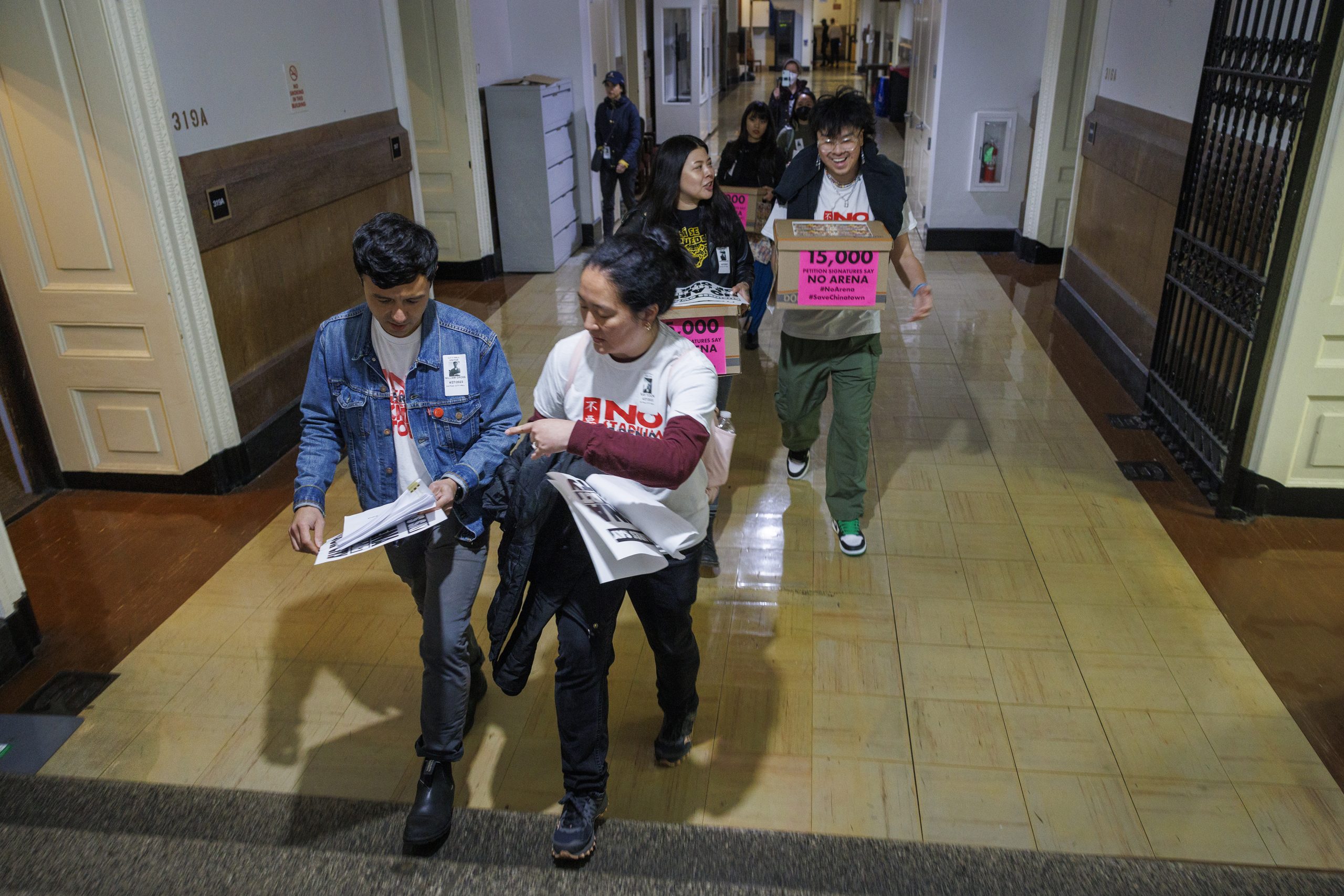
At left is Will Gross, small business owner in Queen Village and Kay Yoon, No Arena in Chinatown Solidarity, delivering petitions to Councilmember Mark Squilla. Community activists against the proposed building of a Sixers arena near the Chinatown neighborhood protest and carry signed petitions to members of Philadelphia City Council after a press conference outside City Hall on Thursday, April 27, 2023.
In addition to Gross, another potential candidate for the seat is Councilmember Rue Landau, who currently holds an at-large seat, meaning she was elected citywide. (Landau, who lives in the 1st District, voted against the arena.)
Multiple stakeholders in the city’s Democratic Party have asked Landau, a first-term lawmaker who in 2024 became Council’s first openly LGBTQ+ member, to consider running for Squilla’s seat if he does not seek reelection, according to a person with knowledge of the conversations who requested anonymity to speak freely about the political dynamic.
More than perhaps any other Council member, Landau has maintained strong relationships in both progressive circles and the party establishment. Party leaders may prefer her to Gross, who is more closely associated with the activist community.
A spokesperson for Landau declined to comment on her plans.
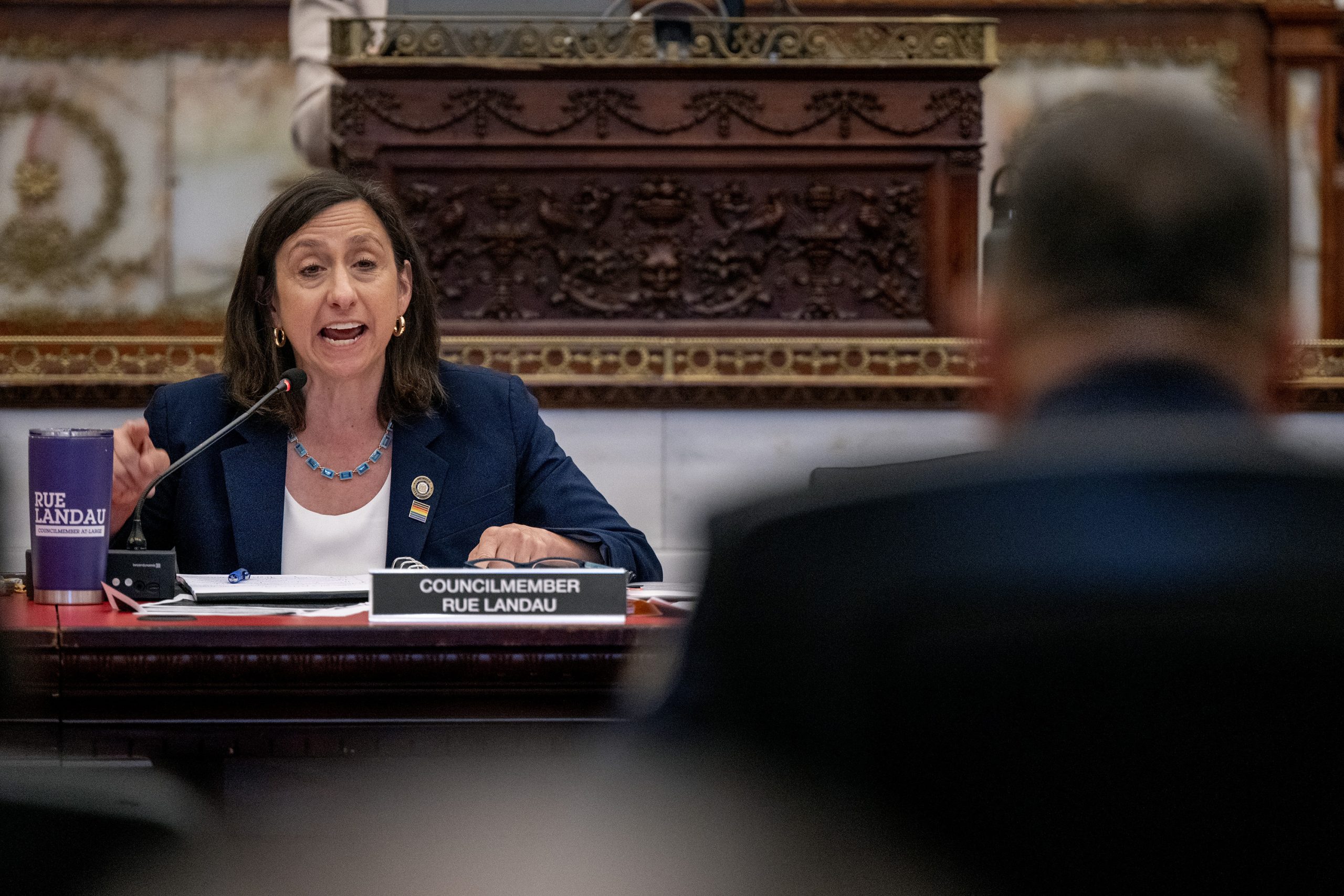
Councilmember Rue Landau questions Police Commissioner Kevin Bethel (foreground) as Council’s Committee on Legislative Oversight holds a hearing on Wednesday, Aug. 5, 2026.Tom Gralish / Staff Photographer
There are several reasons at-large members may want to seek district seats. District members are generally seen as less vulnerable to reelection challenges, and they enjoy substantial powers over land-use decisions in their districts thanks to the practice known as councilmanic prerogative.
A new reality in ward politics
Next year’s race for the 1st District seat could mark a notable moment in the ongoing power struggle between left-leaning insurgents and the city’s more moderate Democratic establishment: For the first time in a major city election, it appears likely that the official party endorsement will be determined by ward leaders aligned with the progressive movement.
The Democratic City Committee makes endorsements based on a vote of the ward leaders in a given district. Ward leaders are elected by Democratic committeepeople, who are in turn elected by neighbors in their voting precincts every four years.
In this past summer’s ward elections, progressive activists recruited scores of committeepeople and rallied around a roster of candidates challenging establishment-backed incumbents or targeting open seats. They fell well short of winning a majority of the 69 ward leader positions, allowing Brady to win a 11th four-year term as party chair.
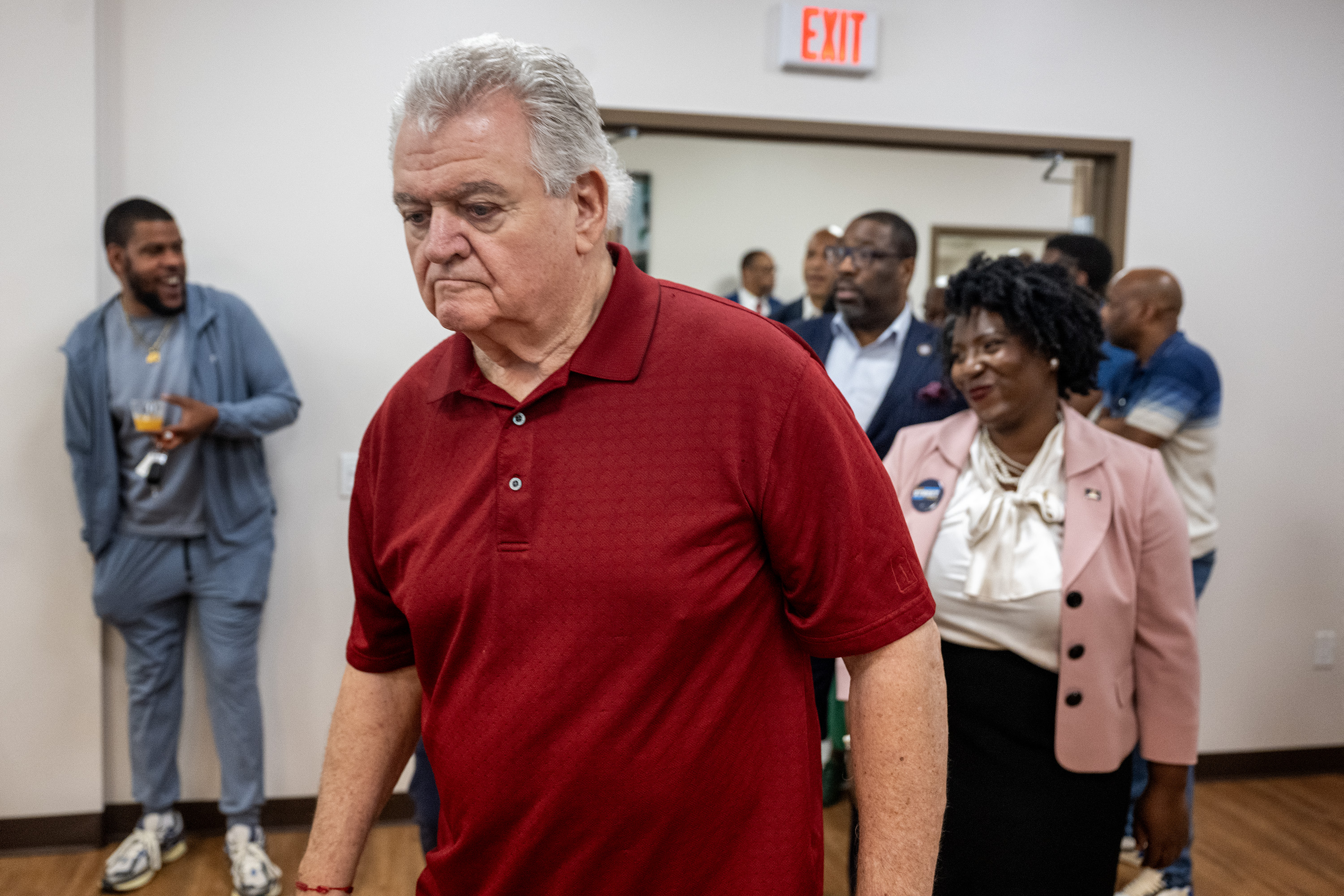
Philadelphia Democratic Party Chairman Bob Brady arrives for a rally for 3rd Congressional District primary candidate State Sen. Sharif Street May 18, 2026. Tom Gralish / Staff Photographer
But in the heavily gentrified 1st District, six of the seven wards are now led by people with ties to the left. If they unite around a candidate, progressives could have a unique opportunity to use the party machinery, so often wielded against them, for their own designs.
Sam Arnold, the Democratic leader of the South Philadelphia-based 1st Ward, said that about a third of his ward’s committeeperson positions turned over this spring, and that many of the new committee members are affiliated with the left-leaning Wards That Work coalition.
He said that while the 1st Ward will not make an endorsement in the Council race until the spring, there is a “very good possibility” that most of the wards in the Council district would back Gross.
Arnold said that Brady, who as party chair has at times clashed with progressives, has “acknowledged how effective a lot of the new energy has been.”
“He understands they are the ones doing a lot of canvassing, trying to get disaffected voters to come out and vote,” Arnold said. “I think he values that work a lot and has tried to welcome us into the party as best he can.”
Progressives began their foray into ward politics in 2018, when activists with Reclaim Philadelphia successfully elected the leaders of South Philly’s 1st and 2nd Wards.
Gross is now the Democratic leader of the 2nd Ward in Queen Village. Ward leaders are not required to resign to run for another office, but progressives and reformers often pledge to do so to avoid a conflict of interest when they are on the ballot.
Gross said Monday that he has informed committeepeople that he is stepping down from the party post to run for Council, and that a transition process is underway.
“Will Gross would be a formidable candidate,” Brady said. “He’s a worker. He’s a friend. He’s been great to the party. We’ve been OK.”
Several incumbent Republicans engaged in tight races in Pennsylvania have featured popular Democratic Gov. Josh Shapiro in their advertisements or messaging as they face their toughest challenges amid an election cycle projected to be unfavorable to the GOP.
When engaged in a high-stakes, competitive campaign, downballot political candidates frequently align themselves with someone at the top of the ticket for an extra boost.
It’s just rare nowadays for contenders to associate themselves with someone who happens to be of the opposite political party.
But a lot is at stake for both parties in Pennsylvania’s midterm elections next month — control of the state Senate, with the possibility of the first Democratic trifecta since 1993, and the battle for the majority in the U.S. House.
Shapiro, who is also running for a second term against Republican Treasurer Stacy Garrity, has been spending most of his time and political capital campaigning for Democrats in competitive state House and Senate races and in four key congressional districts, including in Bucks County — home to some of the most closely watched races next month.
Here’s what to know about the ads featuring Shapiro and what they could mean for the midterms.
Monitor at the WHTM-TV studios in Harrisburg during the Oct. 7 debate between Gov. Josh Shapiro and Republican challenger Stacy Garrity.Tom Gralish / Staff Photographer
Ads could be ‘quite telling’ about the Pa. midterms
Republican State Sen. Frank Farry, who is seeking reelection in Bucks County’s 6th State Senate District, has produced numerous ads featuring Shapiro in his campaign against Democratic challenger Eileen Hartnett Albillar, whom Shapiro has endorsed and campaigned for. The ads include images of Farry standing side by side with Shapiro on a SEPTA platform, another that highlights his support for the governor’s data center regulation plan, and a clip from the Democrat’s speech on a bipartisan budget.
“I’ve spent my whole life serving this community,” Farry said in a recent television ad. “As a senator, I’ve worked with both parties to make life more affordable, including working with Governor Shapiro to cut taxes seven times.”
Farry and the governor have not always been on the same side on policy. For example, though they both supported increasing funding for SEPTA, Shapiro and Farry disagreed on how to do it. (Although Shapiro ultimately used Farry’s ideas to fund it for two years.)
Most of the ads that include the governor are aimed at emphasizing the Republican’s ability to work across the aisle — a trait Shapiro has also emphasized in his own work, and onethat may be key to winning over Bucks County, a suburb known for its split-ticket voting.
“It would be almost impossible in some of these districts for Republicans to survive if they don’t have some ballots that include Josh Shapiro and the Republican on the ballot,” said Chris Borick, a political science professor at Lehigh University and director of its opinion observatory.
For instance, in his 2022 gubernatorial run, Shapiro won the county by roughly 20 percentage points and GOP U.S. Rep. Brian Fitzpatrick also won reelection to represent the Bucks-based 1st Congressional District. Fitzpatrick, who is now in the toughest reelection cycle of his career against Shapiro-endorsed Democratic challenger Bob Harvie, said earlier this year that the governor would win reelection and should run for president in 2028.
Ed Molloy, Farry’s campaign manager, said in a statement that the Republican “works with both parties and is proud to have gotten things done with Governor Shapiro,” especially on affordability measures.
“Senator Farry has been the most independent senator in Harrisburg because he always puts his community first,” Molloy said.
“I want to state very, very, very clear,” Shapiro said. “Despite their cynical efforts to try and hug me, I ain’t hugging him back.”
Manuel Bonder, a spokesperson for the Shapiro campaign, said “apparently even Republican candidates would rather run on Governor Shapiro’s record than Stacy Garrity’s” and pledged to continue campaigning for Democrats.
Though Garrity is absent from these ads and consistently behind in the polls, the GOP is continuing to welcome her on the campaign trail, including at events last week with Republican U.S. Sen. Dave McCormick, Farry, and the Bucks County Republican Committee.
Matt Benyon, a spokesperson for the Garrity campaign, said in a statement that the treasurer is “grateful for the support her campaign has received from fellow Republicans up and down the ballot throughout her campaign.”
“She looks forward to campaigning alongside them in the final two-plus weeks, holding Josh Shapiro accountable,” Benyon said.
Bucks County GOP State Sen. Frank Farry (center) during a ceremonial meeting of the Pennsylvania Senate on May 5 at the National Constitution Center.Tom Gralish / Staff Photographer
Other GOP candidates also focused on collaborating with Shapiro, include State Rep. Joe Hogan (R., Bucks), who mentions working with Democrats, Republicans, and Shapiro “to be a champion for our public schools” on his campaign website. A narrator in an ad for State Rep. Craig Williams (R., Delaware) said the lawmaker “works with whoever it takes,” including Shapiro.
State Rep. K.C. Tomlinson (R., Bucks), running against Democratic challenger Bryan Allen, posted a video to her Facebook page of Shapiro at a school visit, chatting with a student about working across party lines with Tomlinson.
“They say, like, Republicans and Democrats are never supposed to agree on anything,” Shapiro can be seen telling a student in the ad. “Well, we actually agree that making sure kids have breakfast at school is really important, and that our schools have what they need is really important. So we may not agree on everything, but we actually find ways to agree and to talk to each other.”
Borick said the embrace of Shapiro is “quite telling.”
“It’s far rarer to see in a year when there’s a competitive election and their party has someone on the ballot to be highlighting the opposition party,” Borick said.
The Tomlinson, Hogan, and Williams campaigns did not respond to a request for comment.
‘Sad that it’s even a question’
Working across the aisle is also a message GOP State Rep. Valerie Gaydos is trying to showcase to voters on the other side of the Keystone State in the Pittsburgh suburbs.
“I work with everyone, Democrats, Republicans, and Governor Shapiro, to get results,” she said in an ad where she can be seen shaking hands with the Democrat.
But as political divisiveness becomes more and more common, Gaydos said in an interview last week, it’s “sad that it’s even a question” as to why she chose to mention Shapiro in her ad. She noted that she is particularly proud of the bipartisan support she has gotten on legislation aimed at protecting pharmacies and patients and has “taken heat” from both political parties.
“Constituents have been and are sick and tired of being forced to go, ’Are you blue or red?’” Gaydos said. ”And the answer is: I represent my district.”
State Rep. Valerie Gaydos (second from right) with Democratic lawmakers, listening to public comment during a field hearing in Philadelphia on Jan. 27, 2023. Matt Rourke
Christopher Nicholas, a GOP consultant in Pennsylvania, said that after Shapiro himself has routinely highlighted his ability to work with a divided legislature, it will be key to watch how his staunch campaigning for Democrats will affect his relationships with Republican lawmakers, especially if the GOP maintains control of the state Senate.
“Working across the aisle is a two-way street. … If Josh Shapiro’s been able to talk about it literally since day one of his time as governor, I’m not surprised now that some Republican legislators that are on the other side of that grand bargain have now started talking about working across the aisle as well,” Nicholas said.
Staff writer Gillian McGoldrick contributed to this article.