The Democratic National Committee should require each presidential candidate — as a condition of receiving campaign financing support — to issue at least one press release a week on affordability. There is no issue that is going to be more important to voters in the midterms or in 2028 than their ability to afford food, housing, and healthcare. Not abortion, not LGBTQ issues — nothing takes precedence over being able to afford your own food, housing, and healthcare. The president dangles so many alluring targets for commentary — the failed war in Iran, the grift, and of course, the algae and peeling paint in the Reflecting Pool. But don’t be sidetracked, Democrats: What people care about is their money. Get on it. At least one piece a week solely on affordability. You can thank me later.
Linda Falcao,Baltimore
Personal option needed
The Editorial Board is right: Washington is failing patients. But a public option would only make things worse.
The Inquirer’s editorial claims five insurers have “earned” $9 trillion since the Affordable Care Act passed in 2010. But that’s a misleading figure because it represents revenue, not profit.
Those companies made a combined $371 billion in net income over that period — a 4.1% margin (low compared with other industries), or roughly $25 billion a year. Against the nearly $5 trillion Americans spend on healthcare annually, that’s about one-half of one percent. Insurer profit isn’t driving the affordability crisis.
The ACA has already pushed America toward government-managed healthcare, consolidated insurers, and increased premiums. A public option would deepen that path.
Canada’s median wait for specialist care now runs nearly 29 weeks, and the U.K. has more than 7 million patients on its waiting list. This rationing isn’t incidental; it’s how governments control costs when a fixed budget meets unlimited demand.
The real fix is to empower patients. This means enacting price transparency, expanding telemedicine, and allowing nurse practitioners and pharmacists to practice the full extent of their training. But that’s just the beginning of getting government out of the way of affordable care.
Andrew Lewis, president and CEO, Commonwealth Foundation
Join the conversation: Send letters to letters@inquirer.com. Limit length to 150 words and include home address and day and evening phone number. Letters run in The Inquirer six days a week on the editorial pages and online.
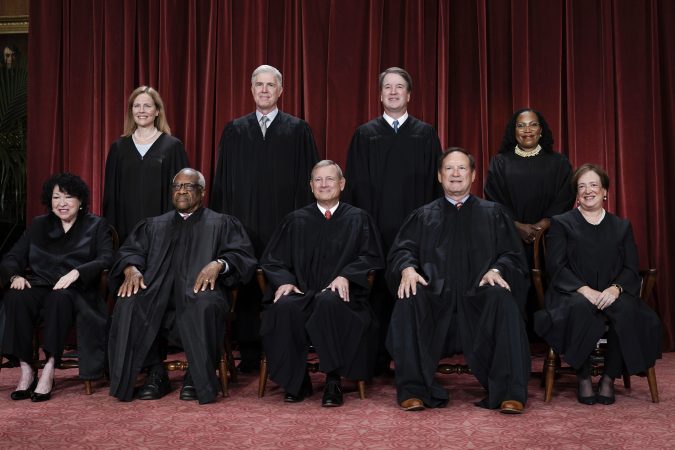
For most Americans, the U.S. Supreme Court occupies a seat on the back burner. We know it is important, but so much of what it does seems unconnected to our daily lives.
Every now and then, it pops up in the news when something major is on the table and briefly grabs our attention — overturning Roe v. Wade and the constitutional right to choose to have an abortion grabbed the headlines, as did throwing out Donald Trump’s tariffs. But, outside of the circles of lawyers, judges, and academics, most of what the court does goes unnoticed. For a brief moment, the nation pays attention. Then the spotlight moves on.
Enduring consequences
Over the next two to three weeks, before the justices depart for their four-month summer recess, the court will issue a series of decisions in cases it has been considering for months. They have listened to the lawyers argue their cases for hours, reviewed thousands of pages of briefs submitted by lawyers, interested organizations, and government officials, and debated among themselves.
Any day now, decisions will be handed down that could alter the legal landscape for decades to come. These cases will affect millions of people, directly and indirectly. These decisions become the law of the land, and their impact will endure for decades. While the court can later reverse its own decisions, it rarely does. So the decisions it makes in the next two to three weeks will endure long after many of us are dead. In 1954, for example, the court’s decision in Brown v. Board of Education finally ended desegregation, 50 years after the same court had infamously approved it in Plessy v. Ferguson.
More recently, in 2022, the court reversed Roe v. Wade, ending a constitutional right to abortion that had been established since 1973.
In short, the decisions it makes in the next couple of weeks are not likely to change for half a century or more. Given what the court is about to decide, all of us have a stake in the outcome.
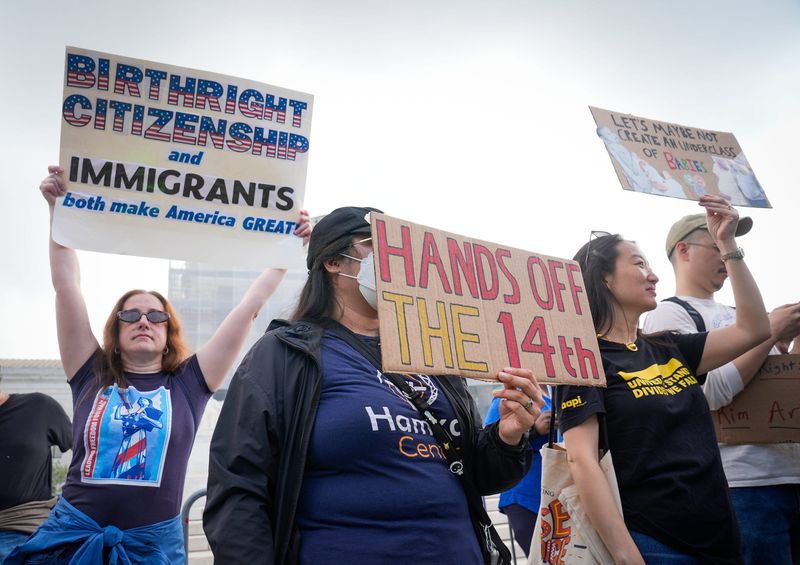
People demonstrate outside the U.S. Supreme Court Building in 2025 before justices hear oral arguments in a birthright citizenship case, one of many critical issues before the court.Jack Gruber / USA TODAY NETWORK
President Trump signed an executive order ending automatic citizenship for those born in the United States unless they meet certain conditions, despite the Constitution (in the 14th Amendment) explicitly conferring it to “all persons” born in the United States.
The stakes in this case extend far beyond immigration policy or the end of birthright citizenship.
The issue is not simply whether birth in the United States confers automatic citizenship. More fundamentally, it asks whether a president may effectively amend the Constitution, eviscerating rights and guarantees formerly entrenched in American society, literally with the stroke of a pen.
The Constitution is meant to endure and survive political winds — and it has for 250 years. In that time, aside from the Bill of Rights, there have been only 17 amendments. The Constitution provides a process for changing its provisions. It is purposefully neither quick nor easy. The framers understood that fundamental rights should not fluctuate like a weather vane depending on who occupies the White House. Constitutional rights are meant to endure and survive political winds — and they have for 250 years.
Executive orders signed by the president, any president, are not among the methods the Constitution provides for rewriting its guarantees.
Critical decisions
The decision is critical. If a president’s signature on an executive order can override constitutional guarantees in one area, where does that authority end? What’s next? The right to remain silent? Free speech? The freedom to practice your religion, safe from government interference? The right to counsel? The guarantee of a fair trial? Presidential term limits? Can Trump end the constitutionally mandated two-term limit with his signature?
Free speech is a central issue. Can students be punished for participating in peaceful demonstrations on college campuses because officials disagree with their views? Does freedom of expression apply equally to all viewpoints, or only to favored ones? If the government can silence one unpopular group today, what prevents it from silencing another tomorrow?
Among the issues that will be decided in the next few weeks are whether states can exclude transgender women from participating in female athletic competitions. Earlier, the court addressed whether states may prohibit licensed therapists from discussing certain issues relating to gender identity with their patients — can they prohibit some of it, or all of it, or none of it. The First Amendment won that battle. Surprisingly. But transgender rights are not a favored policy, and the administration is unashamedly hostile to them, and civil liberties advocates are not hopeful.
The court was asked to revisit long-standing Fourth Amendment protections against unreasonable searches and seizures. Under what circumstances may police officers enter a person’s home without a warrant, probable cause, or judicial authorization? How far may a warrant reach before it undermines the constitutional guarantee that people should be secure in their homes?
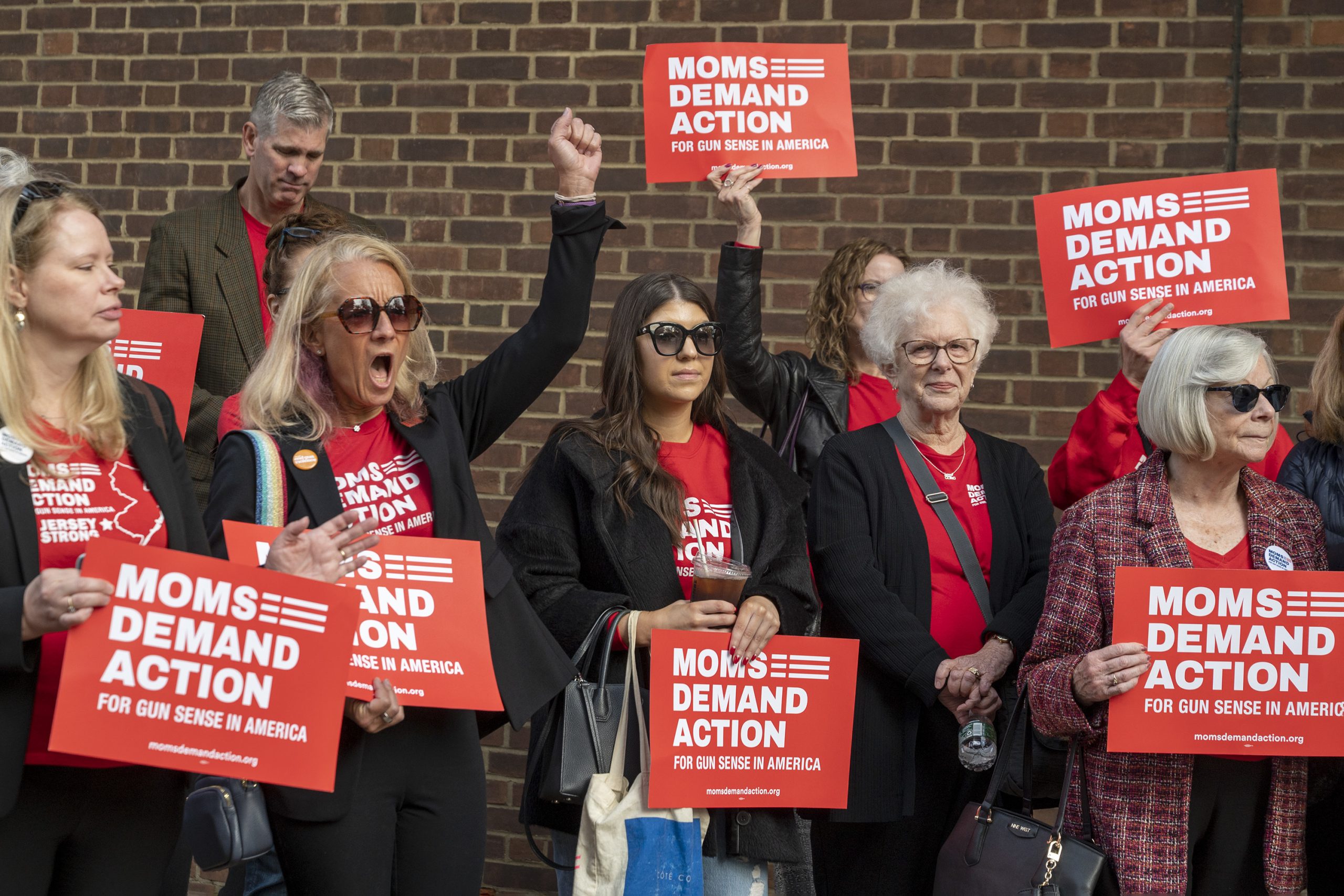
Gun safety advocates rally outside federal court in Philadelphia in 2023 as the Third Circuit Court of Appeals hears oral arguments about a New Jersey law keeping guns out of parks, playgrounds, bars, and other sensitive places. The law was challenged by the National Rifle Association and other gun lobby groups.Tom Gralish / Staff Photographer
The Second Amendment and gun control remain among the most active areas of constitutional law. If school shootings and the murder rate are important to us, we need to be paying attention.
Beyond individual rights, the courts are increasingly confronting questions concerning executive power and the structure of the federal government itself. May a president deploy National Guard troops without the consent of state officials? Can federal employees be dismissed without cause? Does the president have the authority to remove senior agency officials at will, or are there constitutional limits on that power?
Shaping lives
The fundamental right to vote is also at stake, as the plethora of decisions already announced on redistricting and voter rights will undoubtedly shape the political landscape. In the next few weeks, the court’s decisions on mail-in ballot restrictions will add to that mix.
These are not abstract legal debates. They are questions that go to the heart of citizenship, liberty, equality, and the limits of governmental power. They will shape lives, influence public policy, and define constitutional rights long after today’s political battles have faded from memory.
The Supreme Court may not dominate our daily conversations, but the decisions it issues in the coming days will touch every American in one way or another. Whether we agree with the outcomes or not, this is one of those moments when paying attention is not merely advisable — it is essential.
Susan Sullivan is a lawyer and professor of constitutional law and politics at Temple University.
At $5 million, Philadelphia’s primary arts and cultural fund is not one of its many substantial burdens for taxpayers, amounting to well under a thousandth of the multibillion-dollar municipal budget. And yet, the city’s politicians can’t seem to resist the allure of the minuscule expense as a canvas for their financial creativity.
Having narrowly survived fiscal extinction during the pandemic, the Philadelphia Cultural Fund took another disproportionate cut in the city’s recently enacted budget for fiscal 2027, which begins next week. The spending plan recently passed by City Council and signed by Mayor Cherelle L. Parker appropriates $3.5 million for the fund, nearly a third less than this year, according to the fund’s executive director, Gabriela Sanchez. It’s hardly a rounding error in Philadelphia’s $7.1 billion budget, but it’s likely to devastate many of the tiny arts and cultural groups the line item supports citywide.
Nearly 100 of the almost 300 arts organizations that depend on the fund are expected to lose the aid as a result, Sanchez said in a statement. She said the fund would halve its eligibility threshold, limiting grants to groups with budgets of no more than $1.5 million, among other “untenable decisions,” hobbling neighborhood theaters, festivals, music programs, and more. “In practice,” Sanchez added, “this means that community-based arts and culture groups … will lose essential operating funding that sustains their day-to-day work.”
Created three decades ago to supplant more traditionally Philadelphian methods for distributing tax money — according to the whims and still less defensible motives of local politicians — the cultural fund brought a measure of evenhandedness and transparency to bear, offering clear rules and a fair process. Today, it funds groups ranging from A Book a Day, which has donated thousands of books to institutions serving young readers in West Philadelphia, to the Wyck Association, dedicated to preserving and interpreting the historic house of that name in Germantown.
The impact of these groups, economic and otherwise, is far greater than their cost: A 2024 report by the Greater Philadelphia Cultural Alliance found that nonprofit arts groups generate more than $2 billion in yearly economic activity, providing $1 billion in household incomes and $265 million in tax revenues. The alliance also found that the sector suffers from inadequate, unreliable, and uneven public funding.
The cut is cruelly contrary to what city arts groups and some Council members argued for amid the Trump administration’s retreat from federal arts funding, which was to increase the cultural fund’s allocation by 20%. It’s also at odds with a city budget that raises overall spending by about 3% over this fiscal year. At that rate, given the fund’s benefits, the city should at least be able to hold it harmless and maintain this year’s relatively meager contribution.
Philadelphia’s arts groups shouldn’t be perpetually on the budgetary brink just because most of them are small and lack powerful political patrons, making them easy to pick on. The mayor and Council should find a way to restore this funding and stop creating trouble for the city’s invaluable creators.
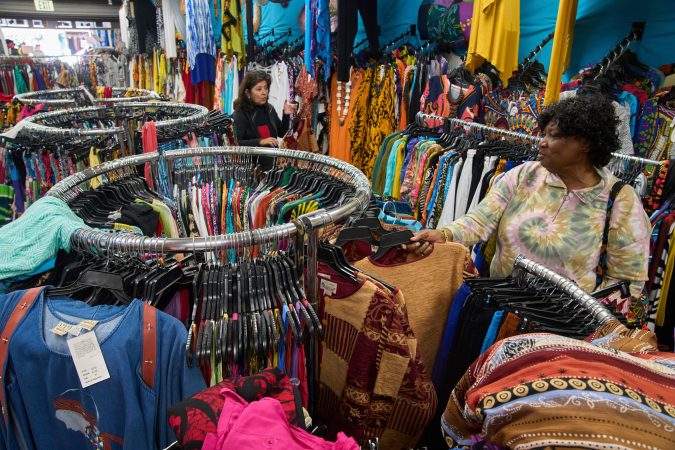
For Maxwell Adew, the owner of Kuueza, a U.S. import-export and sourcing company based in SouthwestPhiladelphia, uncertainty surrounding the African Growth and Opportunity Act is more than just a policy debate in Washington — it has forced him to rethink his business strategy.
Known as AGOA, the trade preference program allows over 7,000 products from eligible African countries to enter the United States, but it is set to expire on Dec. 31. Because of concerns raised by the Trump administration about the fairness of the program, Congress faces a steep climb to save it.
Adew argues that AGOA is well worth saving due to the critical role it plays in helping African goods enter the U.S. market at competitive prices.
“Without AGOA, some businesses using our platform have actually stopped exporting,” he said.
The uncertainty about the program’s future comes at a particularly challenging time for many businesses owned by African immigrants in the United States, including in Philadelphia.
“A lot of immigrant-owned small businesses have been affected,” Adew said. “Some have already shut down. Organizations like the African Cultural Alliance of North America in Southwest Philadelphia are helping businesses navigate these challenges.”
Why it’s important
President Trump has questioned the fairness of the trade preference program, but in February extended it for a year while policymakers weigh its merits. Rosa Whitaker, the president and CEO of the Whitaker Group and one of the program’s architects, said preserving AGOA was an important reminder to the rest of the world about the U.S. commitment to Africa.
“The extension of AGOA sent a powerful signal that Africa was perhaps more important to the United States than many people realized,” she said.
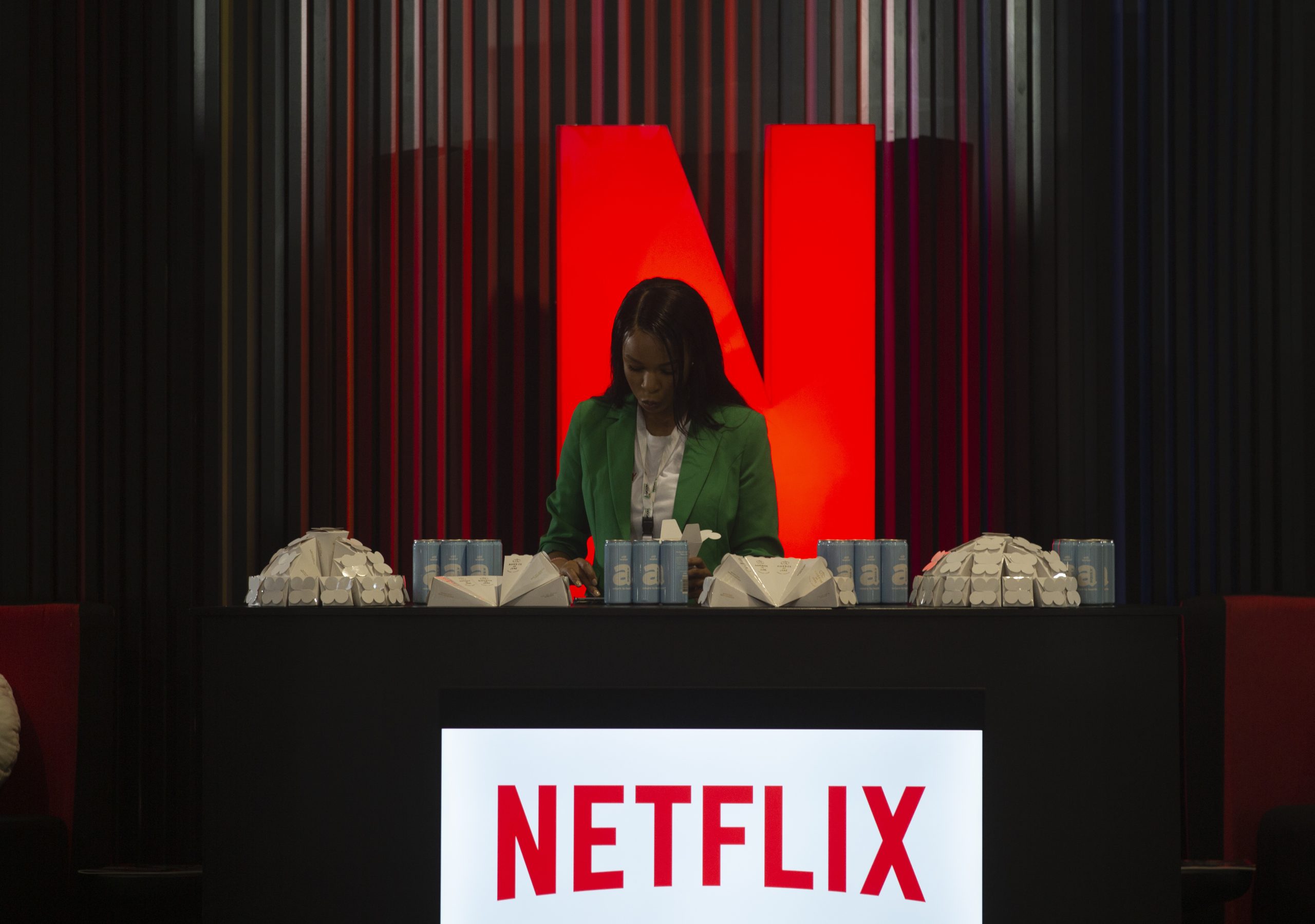
A Netflix representative at an exhibition at the Africa Growth and Opportunity Act (AGOA) Forum in Johannesburg, South Africa. The program, which fosters U.S.-African trade, is in jeopardy, writes Alexanderia Haidara.Denis Farrell
As Congress debates AGOA’s future, several U.S. industries are pressing for both renewal and reform.
“AGOA has not generally been utilized to leverage improved market access for U.S. agricultural products, even though it was intended as a tool for that purpose to facilitate that two-way trade,” said Jim Remcheck, director of export services at the U.S. Meat Export Federation.
But Florizelle Liser, the president and CEO of the Corporate Council on Africa, the leading U.S.-Africa corporate business association, said the program is worthwhile in terms of opening up Africa as an alternative supply chain.
“AGOA has also been beneficial to U.S. companies looking to diversify their sourcing away from China,” she said. “And it supports hundreds of thousands of jobs in the United States, as well as producing significant savings for U.S. consumers.”
Nevertheless, Adew has already changed his investment decisions in Africa because of the uncertainty.
“We’re not sure about the future of AGOA,” he said. “We have to rethink where we invest our resources, and focus on products with stronger demand and higher value.”
U.S.-African relations have been sorely tested under the Trump administration. Some analysts and business leaders say cooperation between the U.S. and African nations has deteriorated amid disputes over trade, aid, migration, and diplomatic engagement.
And while U.S. companies lobby Congress to keep the lines of trade open, South Africa is pushing for a 15-year extension of AGOA, a key part of marketing its vast resource of critical minerals. Government and business leaders there warn that a shorter extension or suspension will undermine investor confidence and disrupt manufacturing plans.
“Africa is recognizing that it must become more self-reliant,” Whitaker said. “Economic integration is no longer optional.”
As Washington debates the future of AGOA, businesses like Adew’s are already adjusting their strategies. The possibility of AGOA’s renewal is no longer theoretical. It is reshaping the future of U.S.-Africa commerce in real time.
Alexanderia Haidara is a former U.S. diplomat and U.S. Agency for International Development specialist helping U.S. companies expand to emerging markets.
Americans deserve a just outcome of the war that Donald Trump began with Iran. Trump recklessly and without provocation ordered the attack on the sovereign country of Iran. Although our national pride is trying to convince us to believe we should be getting a “good deal,” we should be searching for a just deal.
A just deal requires that we pay retribution to Iran for this attack, the Iranian lives lost, sacred and historical sites ruined, and the destruction of infrastructure. A just deal also requires that Trump and his enablers be held accountable for the suffering Americans experienced, including lives lost, life-altering injuries received, financial hardships endured, and billions of hard-earned tax dollars wasted.
A just deal will only be delivered to Americans if we, as a nation, agree that the justice we deserve will not come from something Iran cedes to us. Justice will come only from our country paying for the destruction caused by this war of choice, and from Americans holding Trump and his Republican enablers accountable for the harm they brought to Iran, our country, and others around the world. Justice will come when we, as Americans, insist that they are prevented from executing such a harmful whim again.
Donna Nawalkowsky,Philadelphia
Hatred finds voice
You don’t need to search too far to find examples of distrust and dislike among Americans. At a recent conference I attended, a white woman fingered her cross necklace, telling me she was shaken when a prominent speaker said twice, “Some of my best friends are white,” a statement that led to a nodding, laughing agreement from hundreds of audience members. “This is the statement traditionally used by those who hate Jews … the word Jew is used, rather than white,” she explained. An unnecessary explanation, as I am Jewish. Soon after, I heard about the Cornell University student who turned down a potential job at a tech start-up because the founders are Jewish. He has received more than $19,000 from supporters who blame Jewish people for trying to “ruin” his reputation. I was even more sickened by the vicious remarks made about Michelle Obama by one of the fighters brought to the White House lawn in celebration of Donald Trump’s 80th birthday, as our 47th president sat silently.
Following the conference, I contacted a Black colleague, asking how best to address entrenched hatred. We spoke about the necessity of intense, far-reaching grassroots efforts to bring people together, including truthful examinations of our history. We also agreed on the necessity of deep listening to the experiences of others, in which we all do our best to free ourselves from bias and assumptions.
A neighbor recently asked if I thought today’s ugliness and dangers were new. My response was that the potential toward hate, a virulent, contagious, ever-sleeping monster, has always been there. The difference today is that the monster is being awakened, courted, and embraced by officials who will do all possible to destroy a precious, hard-won, ever-vulnerable democracy. They will stop at nothing to maintain their power and control, including the use of a war they instigated to call off a forthcoming presidential election.
SaraKay Smullens, Philadelphia
Join the conversation: Send letters to letters@inquirer.com. Limit length to 150 words and include home address and day and evening phone number. Letters run in The Inquirer six days a week on the editorial pages and online.
If you ask us, there’s no better way to honor America’s 250th birthday than by arguing vigorously.
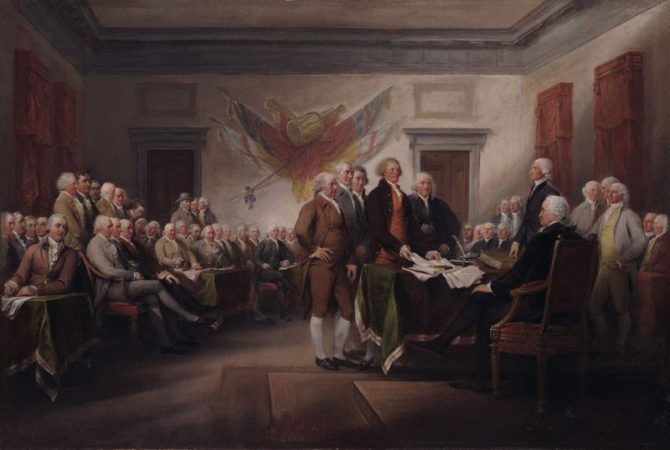
After all, this nation was created amid raucous disagreement, which led to the drafting of the Declaration of Independence, and 11 years later, to the Constitution. And it is precisely because the founders debated so hotly that America has risen to such heights, as principled disagreement has given way to compromise and deeper understanding of what matters most.
But not all arguments are created equal, and with respect to our fellow Americans, many of the loudest arguments happening right now are banal at best. In our nation’s capital and on social media, people are convulsed with disagreement about President Donald Trump’s concert turned rally on the National Mall, the attractiveness of the repainting of the Lincoln Memorial Reflecting Pool, and whether mixed martial arts matches should be held on the lawn of the White House. America is preparing to celebrate its Semiquincentennial, and we’re freaking out over concerts and paint colors?
This should be a time to argue over the meaning and importance of America’s principles, as enshrined in the Declaration of Independence. Are the founding ideals really self-evident? Where did they come from, what do they mean, and how do we fall short 250 years later? Younger Americans, in particular, ought to debate the answers to these critical questions, given they will play a pivotal role in charting America’s next 250 years.
The two of us sought to kick-start that debate through three programs where we teach at Bucknell University this past academic year — programs that constituted the sum total of all activities at our university celebrating the 250th anniversary.
In one jointly taught class, we introduced more than 30 students to the foundational texts of the republic: the Declaration, the Constitution, the Federalist Papers, the Anti-Federalist Papers, and Common Sense. In two other classes, one of us — Paul Siewers — dove into the narrative of American history and took students deep into the ideas of the founding documents and the Gettysburg Address.
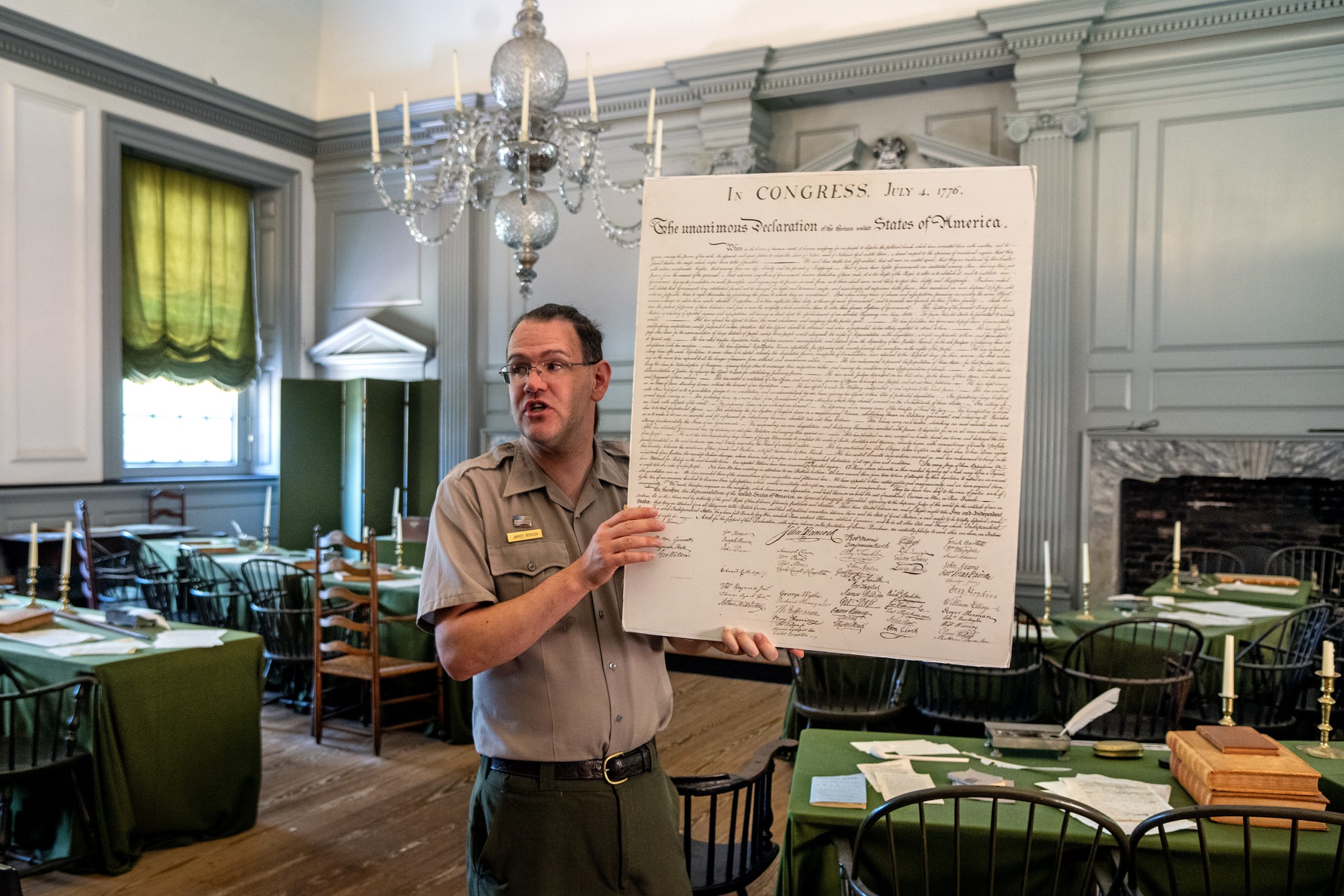
National Park Service ranger James Benson holds an enlarged copy of the Declaration of Independence at Independence Hall in August.Tom Gralish / Staff Photographer
It is a sad indictment of K-12 education that virtually none of our students had meaningfully engaged with these texts before. Yet, we took heart from the students’ desire to learn, which manifested itself in high-spirited debates throughout the semester. Ideologically, the students ran the gamut, with a few die-hard conservatives, a few dyed-in-the-wool progressives, and a critical mass of centrists.
From the start, they disagreed about virtually everything, in the best possible way.
Take the most progressive student in one class, who reacted negatively when we introduced the concept of federalism. What good, she asked, could possibly come from letting states choose different paths? America, she said, needs uniformity, or else injustice will ensue. Yet, after debate, she had become a federalist. The disagreement had convinced her that diversity and inclusion flourish best when states can go their own ways.
The debates over equality and equity were fierce, as well. Most students initially saw them as one and the same, but after much boisterous discussion, the class broadly agreed they were fundamentally different and wholly incompatible. The students gained a deeper understanding of human dignity and the reality that opportunity dies when outcomes are assured or equalized.
At our joint course’s conclusion, we received anonymous reviews from the students. They praised the atmosphere of respectful, meaningful disagreement. One student wrote that hearing from those with different perspectives “strengthens my argument, and it also helps me see how I can better communicate with them.” Another wrote that “the class pushed me outside of my comfort zone” in terms of “speaking up and stating what I believed in.”
The unspoken reality is that such intellectual debate about American ideals is something they don’t expect to encounter in the rest of their education, much less the real world.
But America urgently needs such debate, for a nation can’t endure if it doesn’t understand and apply its own principles. We need to debate the modern-day trade-offs between liberty and security. We need vociferous argument about the pursuit of happiness in the age of artificial intelligence. And with socialism and populism rising on both sides of the aisle, we need to seek understanding, through disagreement, about what’s truly compatible with the Declaration of Independence — and what isn’t.
With the Fourth of July approaching fast, it’s not too late to begin these debates around the dinner table, at bar trivia night, and on the whole panoply of social media platforms. And with the next academic year looming this fall, it’s not too early for parents and policymakers to demand the restoration of real civics education in the classroom — at both the K-12 and collegiate levels. America has always needed vigorous debate about our nation’s principles, purpose, and progress. We certainly need better than the shallow debates that currently dominate this momentous moment.
Charles Mitchell is an adjunct instructor at Bucknell University and cofounder and CEO of the Open Discourse Coalition. The Rev. Paul Siewers is an associate professor of English and chaplain at Bucknell University.
If, in the dead of night, someone had placed their name above John F. Kennedy’s name at the Kennedy Center for the Performing Arts, then drained and repainted the Reflecting Pool at the Lincoln Memorial after tearing down the East Wing of the White House, we would call it the biggest case of vandalism in U.S. history. The perpetrator might even face life in prison without parole. In this case, these acts were done by the president right out in the open with backing from U.S. taxpayers. If we were expecting help from his side of the aisle in Congress — or even a word of protest — we picked the wrong representatives. In addition to the expense of the projects and the sheer chutzpah in these undertakings, the results have been horrific. The Kennedy Center has lost performers and the backing of its subscribers. The algae-filled Reflecting Pool looks to be in a state of disrepair, and the pictures of the new ballroom look to be as garish as one would expect from a Trump project.
In the meantime, as Trump searches for the vandals responsible for the peeling paint in the reflecting pool, he might check in the mirror. His no-bid contracts and incompetent oversight are the culprits.
Elliott Miller, Bala Cynwyd
War enablers
On June 16, both of Pennsylvania’s U.S. senators voted against ending funding for the Iran war, which is far from over. This war was a mistake from the beginning and has steadily devolved into the abject humiliation it is now. It would be funny, except thousands are dead. I am sickened, in particular, at the callousness and lack of accountability shown by these two extraordinarily privileged men. I am sure they are both encouraging their children to enlist.
Andrew Clark, Philadelphia
Iran wins again
The Islamabad Memorandum of Understanding (MOU), an interim ceasefire agreement designed to end the U.S.-Iran war, has been universally condemned as one-sided, heavily favoring Tehran. The criticism, as noted by Trudy Rubin, stems directly from the lack of strategic depth displayed by a team of novice American negotiators.
With Steve Witkoff, a real estate developer, at the helm, a dangerous level of inexperience is driving our diplomatic strategy. America’s once-respected international statecraft has been replaced with naivete and appeasement, rendering our foreign policy apparatus impotent. This handicap will likely lead to a similarly disastrous outcome when the final terms of a peace agreement are negotiated in the coming weeks in Switzerland.
The Iranian delegation, composed of seasoned veteran diplomats, held a strategic advantage over the American neophytes in MOU negotiations. With that leverage firmly in place, a geopolitical victory for Iran, effectively U.S. terms of surrender, seems inevitable.
While not a fan of these parasitic devices, there is a dearth of fairness in supporting an outright ban. Their prevalence and harm are undeniable, but they pale in comparison to the even easier access to phone betting. It would seem the only equitable solution is to tax skill games at the same rate as casino slots.
That outcome won’t sit well given the insidious, outsized influence established gaming has on lawmakers from Gov. Josh Shapiro on down — and that may be a good thing.
J. Savage,Philadelphia
Merci à nos amis
I was outside for a nice Father’s Day lunch at my son’s house in Hammonton when I heard the sound of multiple jets. As I looked up, directly overhead was the Patrouille de France, the official precision aerobatics demonstration team of the French air and space force. They were in two formations of four. This aviation nut was so happy for my own personal little air show.
“Liberté, Égalité, Fraternité”
Ed Truncale,Mays Landing
From the jaws of defeat
Twice this century, the Electoral College has decided the presidency in favor of candidates who lost the popular vote, with George W. Bush in 2004 and Donald Trump in 2016.
Those elections have led to a U.S. Supreme Court whose rulings have determined the Constitution supports limited presidential immunity, and that an element of women’s healthcare — abortion — is unconstitutional. Perhaps it is time to realize that the current framework of the Electoral College is a built-in barrier to democracy and an impediment to the promise that all men and women are equal under the law.
Joel H. Beldner, Glenmoor
Merit or privilege?
Your article on Stacy Garrity’s campaign for governor asserted that “Republicans, in particular, often emphasize that candidates should rise on their skills and talent, not personal identity.” Garrity, herself, is quoted as claiming, “Republicans, for the most part, are based on merit, and that’s how I was raised.”
It’s bad enough when Republicans delude themselves into believing this. But it is really unfortunate that an Inquirer reporter does not notice that current Republicans seem focused on merit only when they criticize and undermine women and people of color who have advanced in the military, been admitted to Ivy League colleges, etc., because they assume such people could not have been chosen based on merit. However, when they support Donald Trump appointees — most of them white males — who lack the fundamental skills and knowledge and experience required to do these critical government jobs, they seem to have abandoned their focus on merit. Or are they just assuming that being male and white are guarantees of merit?
Vicki W. Kramer, Philadelphia
Yes, we can
Thankful is what I am. It is brutal to have to listen day in and day out to a leader who thinks a barrage of lies, threats, and incompetence delivered transparently annuls the distrust, hatred, and divisiveness it foments. How in the world did we get into this predicament in the first place?
So, I was rapt listening to decency, humility, and character delivered so eloquently by former President Barack Obama during a live broadcast of the opening of his presidential library. I believed him when he said it was in our hands to bring this country back from the abyss. We can rebuild an America where everyone counts with fairness, common sense, and mutual respect.
Ross’ first husband, John, joined a militia and was killed in a gunpowder explosion in January 1776. Four months later, according to lore, her husband’s uncle, George Ross, visited her with George Washington and Robert Morris to ask if she would make a new flag. Secrecy was paramount because a new official flag, if discovered, likely would be seen by loyalists and the crown as evidence of the colonies’ final break for independence. (In fact, many colonists continued to have hopes for a negotiated constitutional monarchy in the early years of the war.) During this time, the Grand Union flag was often flown (sporting a canton with the Union Jack’s crosses of SS. George, Andrew, and Patrick), and included 13 stripes added to that canton. Washington’s canny decision to maintain a connection to Great Britain was strategically a smart one.
The lack of definitive information from those secretive times might explain why Ross’ work would be kept under wraps until the new American flag was officially proclaimed on June 14, 1777.
Pat Jordan,Wayne
Join the conversation: Send letters to letters@inquirer.com. Limit length to 150 words and include home address and day and evening phone number. Letters run in The Inquirer six days a week on the editorial pages and online.
Some newsletters have a theme, and this week’s focus is a rare one: good news. Let’s start with the subject of a recent column: Izzy Aly, the 40-year-old Egyptian national from Orlando who’d been in U.S. Immigration and Customs Enforcement custody for nearly six months, amid allegations of neglect around his worsening health. Today, I can happily report that Aly is a free man: released from detention and back home in central Florida. But he still needs assistance for his legal bills and replacing what was taken during his time away; you can help out here.
Soccer, Obama, Knicks give a glimpse of the America we can be at 250
I’m old enough to remember when Lawrence, Kansas was the nightmarish vision of a dystopian U.S. future. The year was 1983, and the corn-fed university town seemed to producers the most fitting all-American location to decimate in a fictional Cold War nuclear apocalypse, ABC’s The Day After.
In 2026, Lawrence is not only still standing, but it’s putting the heart in the American heartland — making love, not nuclear war. And its obscure object of desire is, of all things, a soccer team from 5,000 miles away: the national squad from Arabic-speaking, predominantly Muslim Algeria.
When the Algerians chose Lawrence — about 40 minutes west of Kansas City, where two of its three World Cup matches are taking place — as its training base for the planet’s greatest sporting event, locals came out to greet the foreigners like rockstars.
“I was just so happy that they chose our hometown,” an older man, tearing up slightly, told an Algerian reporter in a video that went viral, as he waited in a rainstorm for the team to arrive. He said he knew three things about Algeria — that it touches the Mediterranean in the north, the Sahara Desert in the south, and that it fought for independence from France. “We don’t know too much, but we want to welcome them here.”
That they did in Lawrence. There are signs on all of the lampposts — “1,2,3, Viva l’Algérie!” — and an official welcome party featured the University of Kansas marching band nailing its cover of the Algerian national anthem while 800 Kansans saluted a rendering of the Algerian flag by local landscape artist Stan Herd. Herd told ABC News that what’s happening in his hometown is “not about football. It’s about cultures coming together. It’s about shared humanity.”
What’s happening in his prairie town is special yet not unique during the second-ever World Cup on U.S. soil. Greensboro, N.C. is festooned with the flags of the Norwegian team that’s training there (although the team chef did have to fly in the players’ halibut) while Chattanooga, Tenn. has gone gaga over sightings of the Spanish soccer superstars training in their city.
There’s a saying in soccer that if one team has all the momentum but then the other team nets a surprise goal on a counterattack, they’ve scored “against the run of play.” It’s hard to imagine anything more against the run of play than these outpourings of international love in states that have voted in the last three elections for the xenophobia of Donald Trump and his mass-deportation regime.
The affection for Algeria is especially remarkable in Kansas, where in 2012 Republican lawmakers enacted a largely symbolic ban against Sharia law in state courtrooms, and in 2017 a man claimed he’d murdered “two Iranians” — the victims were actually of Indian descent — after Kansas candidates ran scare campaigns warning that Muslim terrorism might come to Middle America.
Yet these World Cup welcomes in red America also seem to have captured what feels like a shift in karma that arrived just ahead of the summer solstice. Sure, the news on TV was still giving off bad vibrations — from the reality of a lost war in Iran to the cosmic metaphor of green slime in the Lincoln Memorial Reflecting Pool. But everyday people seem determined not to let our government drown us in their muck.
With the United States less than two weeks from its 250th birthday, regular folks seem eager, even desperate, to celebrate what is good not just about our nation but the bigger world that’s showed up in North America with a soccer ball and a smile.
There was a brief moment of epiphany last Thursday when I started to wonder if — in spite of everything, and there is a lot of everything — America was on the cusp of a Summer of Love, and a much more successful one than the original 1967 iteration.
I’d hopped in the car for the only place I ever go — the dog park — and the dedication ceremonies for Chicago’s Obama Presidential Center were on the radio. I heard the former first lady, Michelle Obama, uttering words that are never formed on the lips of the 47th president: “equality, empathy, honesty, inclusion, fairness.”
She said of her fellow Americans that “deep down in our hearts and souls we all know right from wrong. We know selflessness from greed, righteousness from injustice.” This was just four days, 900 miles, and about 2,000 light years from Trump’s beclowning of the White House grounds for the Caligula-style spectacle of a blood-soaked Ultimate Fighting slate of cage matches that ended with a horrific slur against — wait for it — Michelle Obama.
The Obama Presidential Center was one window into the Bizarro World where America’s leaders are still deeply invested in democracy. Another was unexpectedly taking place in New York City, where the first NBA championship in 53 years for basketball’s Knicks spread joy from Fifth Avenue to Howard Beach, with bond traders high-fiving cabbies as old-fashioned ticker tape rained down on the hoops heroes.
“Neighbors invited neighbors over,” first-year New York Mayor Zohran Mamdani said in his City Hall speech. “Strangers high fived one another in the street. Subway conductors sang their announcements and bus drivers danced behind the wheel. So often, when this city comes together, it is because we are forced to by a moment of tragedy or adversity. What a gift it is to be brought together by pure, unfiltered joy.”
Indeed, it was a remarkable day, with the Chicago and New York celebrations wrapped around a full day of World Cup matches as Americans cheered the best players from Europe, Asia, South America and Africa — some from nations that have been travel-banned and others that have been bombed by a Trump regime that just doesn’t get it.
Yet despite all of those things, it feels like America is having a People’s 250th birthday — one that doesn’t need Trump’s poisoned stamp of approval, or million-dollar donations from crooked corporations, or cage-fighting thugs, or rejects from the I Love the ‘90s Tour singing, or not singing, on the National Mall.
Millions of Americans are looking for a workaround — ways to voice hope over hate, seek joy instead of despair, and wave the U.S. flag while saluting the banners of Algeria or so many places where people may not look or talk quite like us, but share the same dreams. You could squint last week and see the America we are supposed to be at age 250.
Yo, do this!
The one story that truly epitomizes where we are at in the middle of the 2020s is the rise of Elon Musk as the world’s first trillionaire, even as he spews racist bile on his social-media platform X. The veteran writer Charlie Warzel, currently with the Atlantic, looks at the shaky vessel behind Musk’s surge in wealth: SpaceX, the rocket-and-satellite company that recently went public at a valuation that for a time topped $2 trillion — despite currently losing billions of dollars a year. He writes: “SpaceX is a rocket company, a complex financial instrument, a meme, a monument to a broken financial system.” Here’s a gift link for all of Warzel’s must-read essay.
One grossly underreported story that cuts especially hard here in Pennsylvania is the lingering health crisis in rural communities from the fracking boom of the 21st century. A journalist named Justin Nobel has been on the beat of exposing the health hazards of radioactive fracking waste for a decade now, and his latest report for the DeSmog blog from my long-ago western Pennsylvania stomping ground of Washington County is devastating. He finds waste with shockingly high levels of radiation right next to a popular hiking trail, and a possible link to the bone cancer that killed a local teen and devastated his family.
Ask me anything
Question: Is it possible to file against Todd Blanche now for disbarment and if so why is no one taking action or talking about it? — gordeaux (@gchdrake.bsky.social) via Bluesky
Answer: This is a great question, as I’d been thinking about this as the topic for a future column. Blanche, the current acting attorney general who before that was the Justice Department’s No. 2 and before that Donald Trump’s personal attorney, has been accused of a smorgasbord of potential legal misconduct, from his mishandling of the Epstein Files to his role in sending immigration detainees to a Salvadoran hellhole prison. State bar associations are absolutely empowered to investigate misconduct by Justice Department lawyers not only in D.C. but around the nation. But they have been frustratingly slow in doing so. How worried is Team Trump? A recently proposed Justice Department rule would allow the attorney general — right now, this is Blanche — to block state bar-association misconduct probes. Stopping this rule would be one small step in the looming battle for truth and reconciliation in America.
What you’re saying about…
I got a healthy response to last week’s question about whether readers have stayed on X (formerly Twitter) since an openly racist, anti-democratic and extremely wealthy Elon Musk bought it in 2022. Not surprisingly, many of you left after his purchase, or the 2024 election in which he heavily funded Donald Trump. “I absolutely think governments, organizations, media companies and really just about everyone should at a minimum do as I have done and stop posting there completely,” Linda Mitala wrote. But Patrick Roan is conflicted. “I have stayed with it because there are some really good people who have not completely left, including a few who are only on X, but are good and knowledgeable writers with enlightened points of view,” he offered.
📮 This week’s question: The looming Fourth of July is one of those round-number birthdays, America’s 250th. Are you planning to do anything special or different for this Independence Day? Or will you do less because Donald Trump is president? Please email me your answer and put the exact phrase “July 4 plans” in the subject line.
Backstory on the quiet outrage of soldiers occupying D.C.
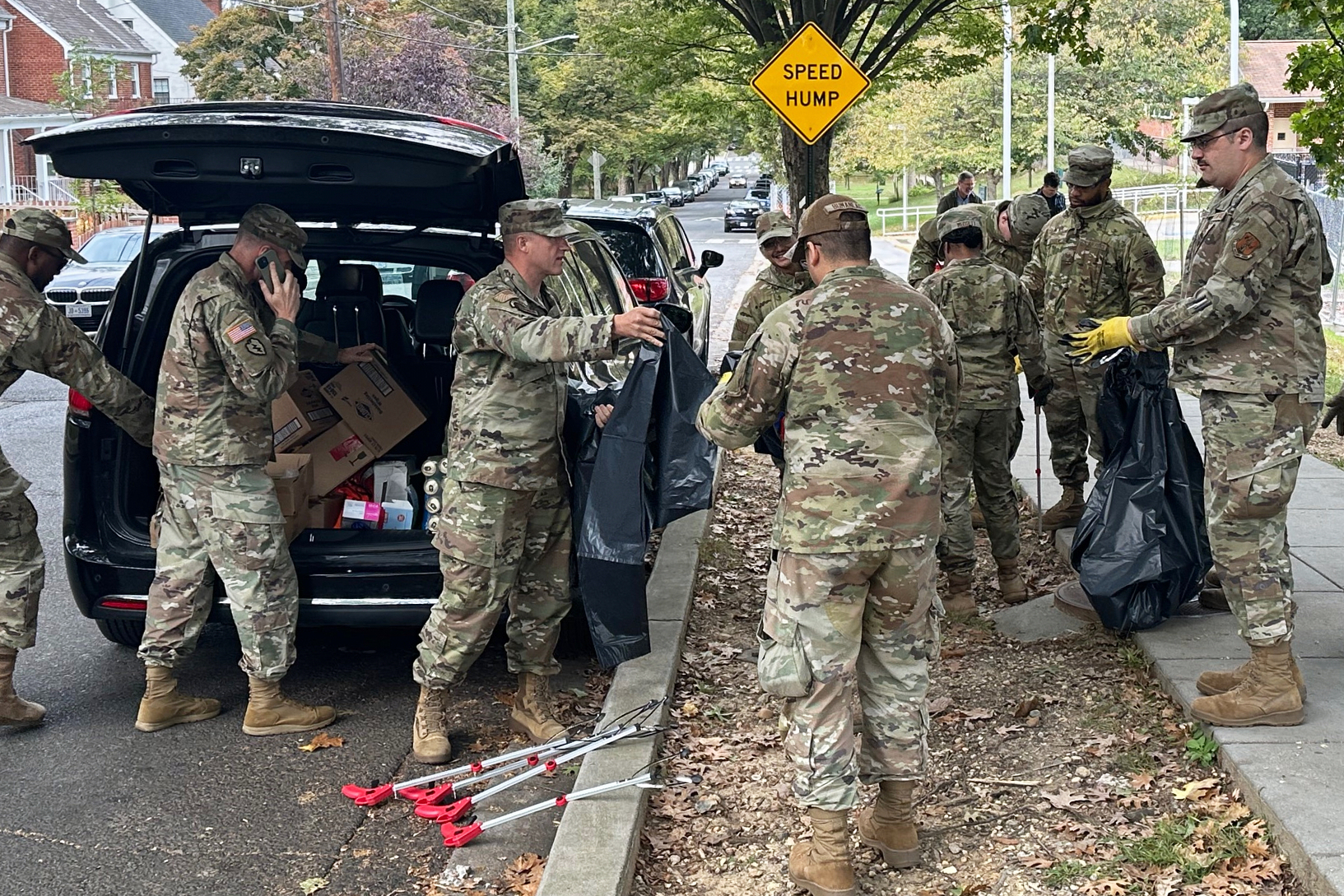
D.C. National Guard members take part in an October clean up of the park around Fort Stevens Recreation Center in the Brightwood section of Washington.Gary Fields
On Father’s Day morning this past Sunday, a longtime Washington, D.C.-based writer named Ian Livingston went out to get a breakfast sandwich. When he returned, he found a small platoon of National Guard soldiers, dressed in camouflage, patrolling an alley near his home. On a video that soon went viral, the troops smile slightly or ignore Livingston and his phone camera, which doesn’t make the scene any less disturbing. “Just a normal morning in our police state,” he wrote.
The normalcy is the problem. It’s been more than 10 months now since Donald Trump first took the extraordinary step of ordering the large National Guard deployment in the nation’s capital, with soldiers from the D.C. armory — authorized by Defense Secretary Pete Hegseth to carry weapons — soon augmented by detachments from red states, rising to an occupation force in the thousands. The move, which the president linked to a surge in “violent gangs, bloodthirsty criminals, and homeless people,” made a lot of headlines, then disappeared from the news. But soldiers haven’t disappeared from the streets. In fact, Trump recently authorized an increase to some 5,000 troops ahead of the July 4 festivities.
But what for? Researchers have found that the presence of the National Guard has had no apparent impact on violent crime rates — which were already at or near 30-year lows — although there has been a drop in “opportunistic crimes” like vehicle break-ins. But the legal parameters of their actual mission bar the troops from making actual arrests, although they can detain someone until district police show up. Typically, their squadrons have been spotted around D.C. picking up trash, although some are now deployed against the algae tourists of the Lincoln Memorial Reflecting Pool.
And at what price? The annual cost to taxpayers of the constant Guard deployment has been estimated at as much as $600 million — money that could otherwise be spent on things like actual solutions to the city’s chronic crisis of homelessness. The unbusy troops are, unfortunately, a magnet for America’s growing number of unhinged people, including the one who killed a West Virginia Guard member and seriously wounded another in a shooting last year. For most, the extended deployments mean unwelcome days away from family, actual work, and their hometowns.
But the real cost is a psychic one: the mental impact of living in an occupied city. Trump’s forever deployment of armed soldiers in our nation’s capital achieves some of the highest goals of his brand of strongman authoritarianism: a) a constant show of force aimed at demoralizing a population that’s increasingly unhappy with life under the 47th president and b) a threat that protesters should stay away from the White House and the Capitol when things really start to go south. We need to keep reminding ourselves what Ian Livingston conveyed tous this weekend: This is not normal. In the immortal 1971 words of singer Freda Payne, bring the boys (and the girls) home.
What I wrote on this date in 2020
This date six years ago was also nearly one month after the Minneapolis police murder of George Floyd, and America — and especially Philadelphia — was still dealing with the consequences. On June 23, 2020, I wrote about an Amnesty International report about police brutality in response to those protests, including the cops’ tear-gas assault on protesters blocking the Vine Street Expressway in Center City. ” We should be shocked that police forces in the United States are acting like the so-called ‘state security forces’ in an authoritarian banana republic,“ I wrote. ”Tear gas is banned in warfare under the United Nations, yet police commanders don’t think twice about lobbing it into crowds of Americans from Seattle to the gates of the White House.” Read the rest: “Amnesty International won a Nobel Prize for fighting torture. Next up: Philly police.”
Recommended Inquirer reading
Only one column last week as I enjoyed a Juneteenth/Father’s Day extended weekend. In that piece, I looked at the real reasons behind the federal conspiracy indictment against a group of an anti-ICE activists that some are already calling “the Minneapolis 15.” The charges — mostly centering on constitutionally protected free speech such as discussing their protests on the Signal app — are outrageous. But they also signal that the Trump regime is desperate to quash political dissent ahead of the November election.
The World Cup is a remarkable moment for sports, but also an incredible time for journalism, because the stories in the stands are often as compelling as what’s taking place on the pitch. At The Inquirer, the five-week tournament has been a great way to reveal how Philadelphia relates to the wider world. Last week’s match between Brazil and Haiti might have been a rout on the field, but sports columnist Mike Sielski took in the scene with Haitian fans who were just delighted their violence-wracked nation was having a moment on the world stage. Alex Coffey spent the weekend with four French fans who played hooky from their jobs back home to spend an unforgettable week in America’s founding city. Longtime soccer writer Kerith Gabriel hailed the city’s joy over the World Cup as “the escape we didn’t know we needed.” It’s easy to join this party in print for the last three unforgettable weeks of the World Cup: subscribe to The Inquirer today.
By submitting your written, visual, and/or audio contributions, you agree to The Inquirer’s Terms of Use, including the grant of rights in Section 10.
By any objective measure, public schools serve one of the most diverse populations in American society. Students arrive with different religious beliefs, political views, family backgrounds, and life experiences. The constitutional challenge has always been to ensure public schools remain places where all students are welcome, regardless of faith or ideology.
On the surface, revisiting Hazelwood may sound like a debate about student free speech. In reality, it is part of a broader legal movement that seeks to redefine the relationship between religion and public education.
In Hazelwood, the Supreme Court held that school officials may exercise editorial control over school-sponsored student publications when their actions are reasonably related to legitimate educational concerns. The decision recognized a practical reality: When a newspaper, yearbook, or other publication bears the school’s imprimatur, the public may reasonably perceive its contents as carrying the school’s endorsement.
Maintaining neutrality
Critics of Hazelwood argue that it gives administrators too much authority. But the ruling has also provided schools with an important tool for maintaining neutrality on contentious political, ideological, and religious issues. It allows educators to prevent school-sponsored platforms from becoming vehicles for messages that could be interpreted as official school positions.
Cases involving school prayer, religious displays, and public funding for religious organizations have increasingly shifted the court away from the traditional emphasis on separation between church and state. Under this approach, actions that once raised establishment clause concerns are now often framed as exercises of religious liberty.
Revisiting Hazelwood would fit neatly within that trajectory.
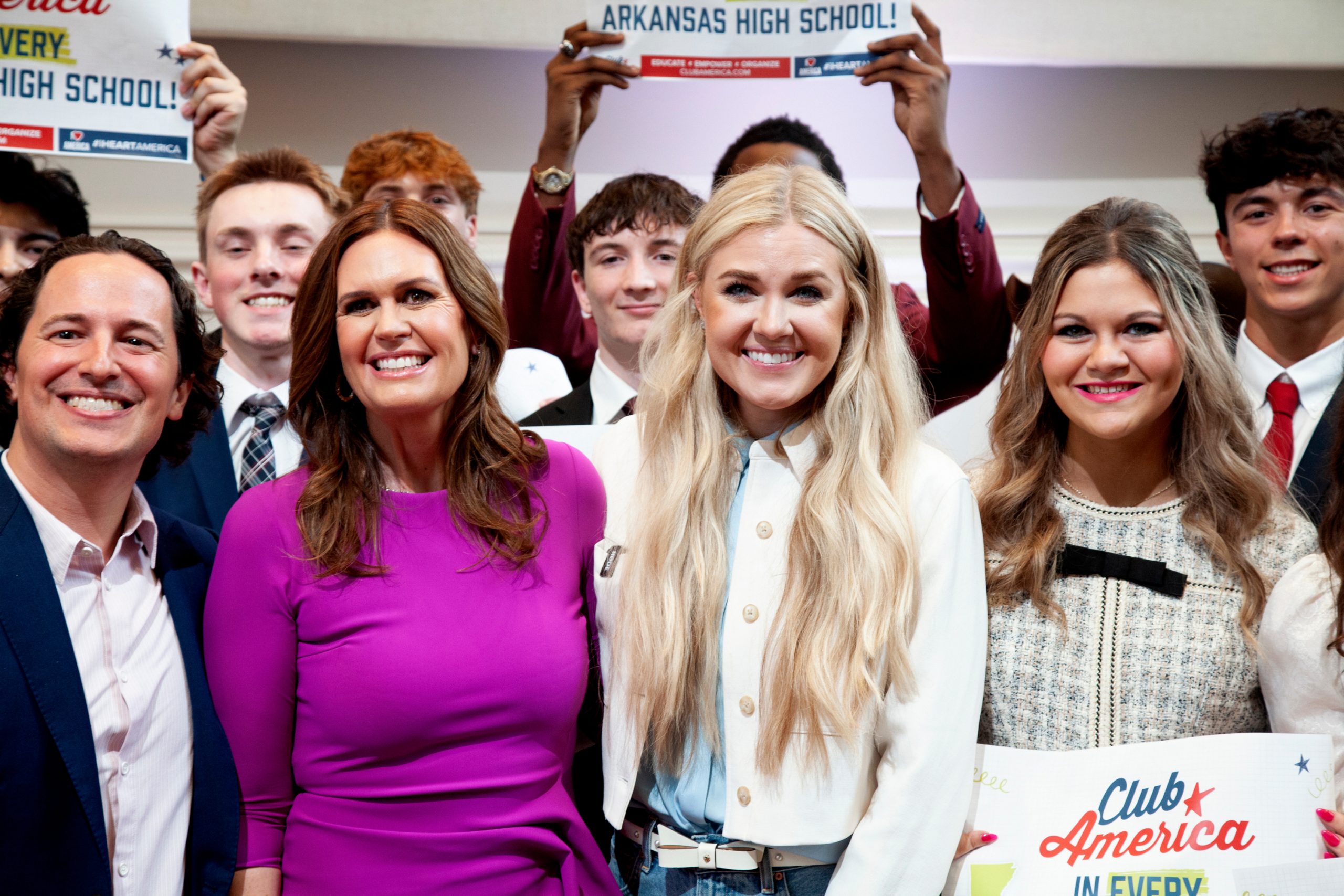
Arkansas Gov. Sarah Huckabee Sanders (center left) and Turning Point CEO Erika Kirk (center right) meet with Club America high school students at the Governor’s Mansion in Little Rock, Ark.Katie Adkins
A current example of this trend can be seen in the efforts of Turning Point USA and its “Club America” initiative. While marketed as a student club, Club America is not simply a grassroots organization created and directed by local students. It is part of a national network organized, funded, and guided by an outside political advocacy organization with a clearly defined ideological mission.
Turning Point exerts tight control over Club America chapters. It requires members under 18 to sign contractual agreements and periodically report back to the organization. It also asks that club members report on teachers and administrators who are viewed as not in compliance with Turning Point’s ideology, evidence that Club America chapters are not truly being run independently by students, but are under strict control by the parent organization.
Supporters argue that students should have the freedom to form clubs reflecting their beliefs. That principle is not in dispute. The concern arises when outside organizations effectively use school-sponsored activities as vehicles to advance political and religious agendas within public schools.
Club America materials emphasize themes that blend political conservatism, patriotism, and religious values. While those viewpoints are entirely legitimate in the public square, public schools must be careful not to allow externally controlled organizations to transform educational settings into platforms for ideological advocacy.
Political objectives
The issue is not whether students may discuss religion or politics. They can and should. The issue is whether a public school should lend its name, resources, facilities, and institutional legitimacy to activities designed and directed by outside organizations pursuing broader political objectives.
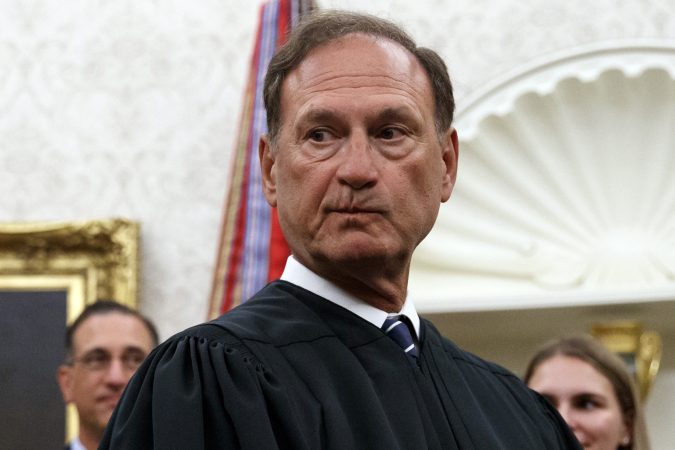
This is where Alito’s suggestion that Hazelwood should be revisited becomes especially significant. If the Supreme Court further limits the ability of schools to oversee school-sponsored speech and activities, administrators could find themselves increasingly unable to distinguish between genuine student expression and organized efforts by outside groups to influence students through the school’s own channels.
The result could be a fundamental shift in the role of public education. Instead of serving as neutral institutions dedicated to academic inquiry and civic engagement, schools could become battlegrounds for competing ideological movements seeking access to captive student audiences. Religious advocacy groups, political organizations, and culture war activists of every stripe would have powerful incentives to establish a greater presence within schools.
The constitutional principle at stake is not hostility toward religion. It is neutrality. Public schools should neither suppress religious expression nor promote it. They should neither favor conservative ideology nor progressive ideology. Their mission is to educate students, not recruit them into political or religious movements. The danger of weakening Hazelwood is that it becomes increasingly difficult to maintain that distinction.
Viewed through this lens, Alito’s criticism of Hazelwood appears less like a defense of student speech and more like another step in a broader campaign to expand the role of religious and ideological advocacy within public education. Whether through school newspapers, school-sponsored events, or externally organized clubs, the result is the same: a gradual erosion of the neutrality that has long been the foundation of public education in a pluralistic society.
Pressure on schools
If school-sponsored publications become less subject to administrative oversight, disputes over religious content are likely to increase. Schools could face pressure to publish explicitly religious viewpoints in newspapers, broadcasts, and other school-sponsored forums.
Administrators who attempt to maintain neutrality could find themselves accused of discrimination against religion.
Supporters would describe this as protecting religious expression. Critics would see something different: the gradual erosion of the principle that public schools should not appear to endorse particular religious beliefs.
The issue is not whether students should be allowed to express their faith. They already can. The Supreme Court has repeatedly recognized that students do not shed their constitutional rights at the schoolhouse gate. Students may pray, discuss religion with classmates, form religious clubs, and express religious viewpoints in many contexts.
Public schools belong to everyone. They serve Christians, Jews, Muslims, Hindus, atheists, agnostics, and families whose beliefs fall outside traditional categories altogether. The government’s role is not to promote one worldview over another, but to create an environment where all students can learn together as equals.
For decades, Hazelwood has helped schools navigate that difficult balance. Weakening it may be presented as a victory for free speech. But viewed in the broader context of recent constitutional trends, it is difficult to avoid the conclusion that the ultimate goal is something more ambitious: expanding the presence and influence of religious ideology within public education.
Americans can disagree about where the proper line should be drawn. What they should not do is pretend that the debate is merely about student journalism. The stakes are much larger. They concern whether public schools remain neutral civic institutions, or become battlegrounds in a continuing effort to blur the constitutional boundary between church and state.
Michael A. Gottesman is the founder of the New Jersey Public Education Coalition, a nonpartisan group that advocates for secular public education.
Long ago, when most Americans left the house for mass entertainment, they flocked to carnivals that crisscrossed the country to delight small towns and big cities. Shows typically included a barker whose steady stream of superfluous oratory enticed folks to spend their hard-earned cash on sometimes dubious performances.
Too often today, our nation’s capital resembles that midway where a slick barker spouts enticements to assure people who want to believe what they want to believe that he will always give them what they want. That may be fine when the tickets sold are for harmless attractions, but what mostly seems for sale in 21st-century Washington is this country’s very soul.
One glaring example of our current predicament is an embarrassingly disappointing healthcare system that fails to meet the needs of millions of Americans who can neither afford adequate medical treatment nor a health insurance plan to help them pay for a doctor or the cost of a hospital stay.
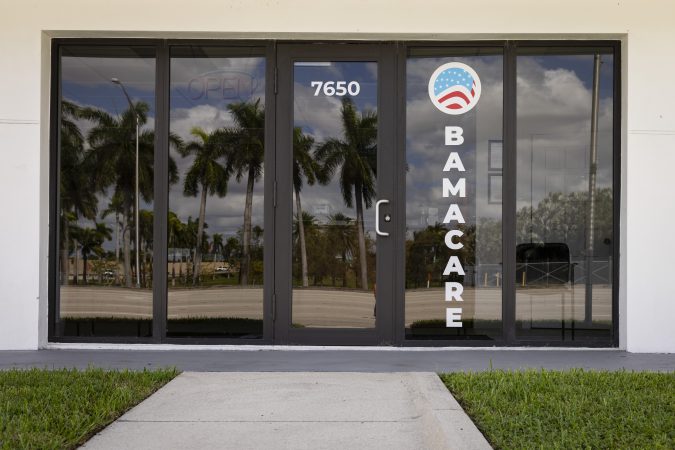
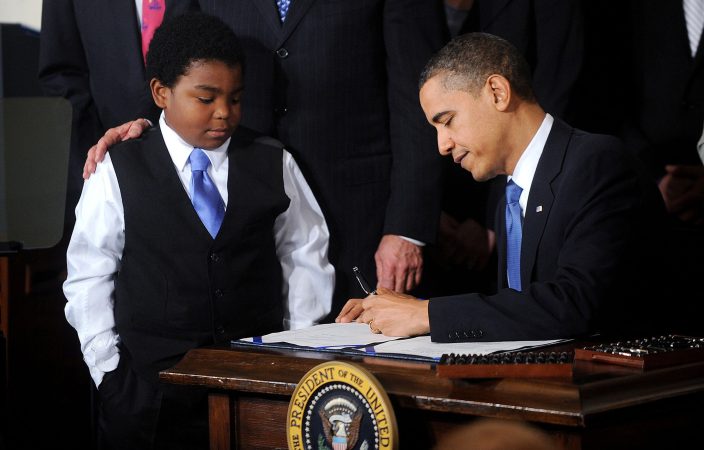
Even as the Affordable Care Act (ACA) was being signed into law by President Barack Obama in 2010, it was clear it would need future adjustments. Unfortunately, that necessity has been ignored by President Donald Trump, who in both his first and current administrations has found it more beneficial politically to criticize rather than improve Obamacare.
The ACA has helped cut the percentage of Americans without health insurance from nearly 16% in 2016 to 8% last year. That means more work needs to be done. But while Trump keeps promising a better alternative to Obamacare, he’s barely delivered on even the “concept of a plan” to improve healthcare access for all.
Trump proposed an ACA alternative in January that he calls “The Great Healthcare Plan,” but it’s too weak to get the health insurance industry to become a better partner in extending coverage to more Americans. Trump’s plan would instead end the ACA subsidies that have helped millions of people pay for health insurance while cutting prescription drug prices and requiring insurance companies to do a better job reporting their costs and profits.
A National Institutes of Health study concluded the Obama administration “bowed to the demands of the medical industrial complex comprised of hospitals, insurance companies, and drug companies” to help it make the ACA law because “it was not politically feasible” to get the bill passed any other way. Unfortunately, the feasibility of improving Obamacare has become even more remote under Trump.
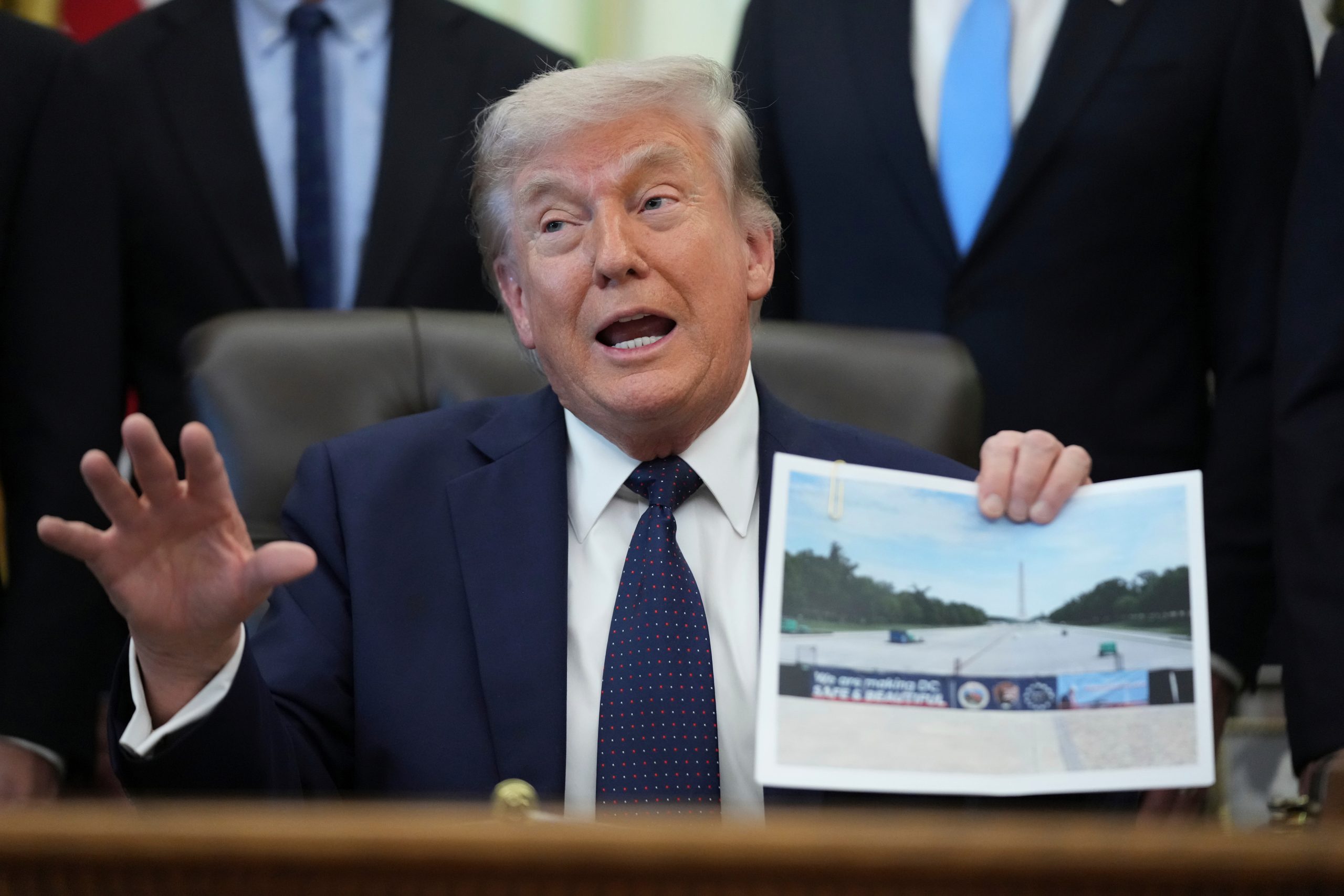
President Donald Trump holds a picture of the Lincoln Memorial Reflecting Pool during an event on health care affordability in the Oval Office in April.Mark Schiefelbein
That’s a sign of the political strength of major health insurance companies, including UnitedHealth Group, Cigna, Kaiser Permanente, Elevance Health (the parent company of Anthem Blue Cross Blue Shield), and CVS Health, which acquired Aetna in 2018. Those firms have earned more than $9 trillion since the ACA was passed in 2010, and show no sign of wanting to ever voluntarily reduce any income derived from federally subsidized premiums paid by Obamacare customers.
It’s time to stop the giveaway to health insurance companies and reconsider an idea that has failed past attempts to survive Washington politics. Americans need a public option similar to Medicare that would allow eligible participants of all ages to pay adjusted health insurance premiums based on their incomes. Switzerland, Germany, and the Netherlands have similar programs, and President Harry S. Truman proposed a public option for the United States more than 70 years ago, but Congress wouldn’t approve it.
“Millions of our citizens do not now have a full measure of opportunity to achieve and enjoy good health,” Truman said in 1945. “Millions do not now have protection or security against the economic effects of sickness. The time has arrived for action to help them attain that opportunity and that protection.” That same speech could be made today, but this Congress and president seem even more in thrall to the powerful insurance companies that today employ more than three-fourths of all U.S. doctors.
The American Medical Association, in a recent report, cited Washington’s kowtowing to corporate healthcare interests trying to maximize profits as a contributing factor to a current statistic that one in five physicians in the United States say they plan to retire within the next two years. “Many physicians find themselves practicing in direct conflict with their own values, the values that led them to a career in healthcare in the first place,” said the AMA report.
With thousands of doctors abandoning their practices and millions of Americans still unable to afford health insurance, it’s time for a bolder, better healthcare system. This country is too prosperous to have so many Americans worrying themselves to death while trying to figure out how to afford decent medical care.
This nation cannot afford our president’s weak ideas to fill huge gaps in America’s healthcare delivery system. Franklin Delano Roosevelt showed how it’s done in steering the passage of the Social Security Act in 1935. Lyndon B. Johnson got both Medicare and Medicaid through Congress 30 years later. And Obama opened the door for a successor to craft the next phase of the Affordable Care Act. It’s time for Trump to stop promising something even better and produce it.