A couple of weeks ago, while staying with my father as he navigates the relentless progression of Alzheimer’s, I found myself thinking about something former Philadelphia Mayor Ed Rendell once said. I’m paraphrasing, but it went something like this: You could be waiting for your car outside the old Le Bec-Fin, standing next to the valet, and if a game was on, someone would inevitably ask, “What’s the score?” Just like that, two strangers from entirely different worlds had something to talk about.
That observation has stayed with me for years because Philadelphia sports have always been one of our city’s great equalizers. We may disagree about politics, science, climate, taxes — just about everything. But ask someone about the Phillies, the Eagles, the Sixers, or the Flyers, and for a few moments we’re on the same team.
But I realized there’s a footnote to Rendell’s point. Philadelphia sports don’t just connect strangers. They reconnect family members with Alzheimer’s.
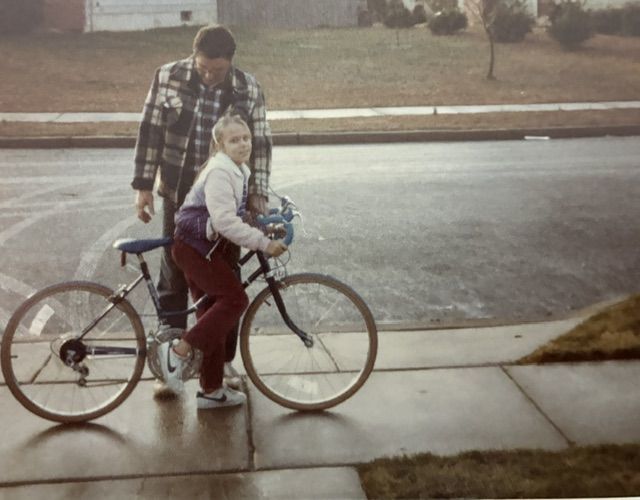
The author, 10, gets ready to hop on her bike as her father looks on in this photo from 1984.Courtesy of Cyndi Reed Rickards
My father’s ability to stay with a conversation now lasts only a few minutes before the disease pulls him somewhere else. Time together has become a matter of fleeting moments rather than long talks.
Then the Phillies came on with a Pittsburgh Pirates series.
Instead of trying to sustain one long conversation, we simply watched the game unfold. Every pitch offered a new beginning. Every at-bat was another opening. A strikeout. A stolen base. A diving play in the gap.
The author dancing with her father at her wedding.Courtesy of Cyndi Reed Rickards
“What do you think?”
“Can they get out of this inning?”
“Who’s up next?”
“How fast was that pitch?”
Unlike so much that depends on sustained attention or memory, baseball is wonderfully episodic. Each pitch stands on its own. Every inning is a reset. Even when memory fades, the present moment is enough.
Phillies designated hitter Kyle Schwarber at bat against the Pittsburgh Pirates at Citizens Bank Park on June 29.Yong Kim / Staff Photographer
The June 29 collapse against the Pirates, blowing a 5-0 lead, was painful for Phillies fans. But as much as that final score stung, it hardly mattered to me, because for nearly two hours, my father was engaged.
We talked. He reacted. He stayed with the game and, more importantly, with me in conversation. We weren’t talking about Alzheimer’s, or doctor’s appointments, or everything that’s been lost. We were just a father and daughter watching the Phillies, the way countless Philadelphia families have done for generations.
I left with a deeper appreciation for what sports can be. More than entertainment, they’re shared rituals. Conversation starters. Bridges across generations and time, they’re one of the few places where a disease that steals memory can’t quite steal the moment.
Sometimes the greatest gift a team gives its fans isn’t a win. It’s a reason to stay connected, one pitch at a time.
Go Phils.
Cyndi Reed Rickards is a former Jersey girl and proud Narberth resident who has remained a devoted Phillies and Eagles fan on both sides of the river. She learned from her dad at an early age that no one does heartbreak like a Philadelphia sports fan — and that Dallas will always suck.
Michelle “MiMi” Gravley changed addresses frequently during her childhood in the 1990s, but rarely with a moving truck.
With her belongings in boxes and plastic bags, she would often find herself lodging at others’ houses in rooms her single mother could afford to rent. So it meant the world to Gravley, herself a single mother, last fall when she bought her first house, a rowhouse in North Philadelphia.
Gravley, 38, is no longer battling housing instability. But she has spent much of her adult life poor, including nearly two decades straight of government assistance, and wants a different fate for her three children. So she’s looking at wealth — specifically her house and her high-yield savings accounts — as something that can help her children avoid poverty as adults.
“I just want them to be OK,” Gravley told me, referring to her daughter, Buttons, 17, and her sons, Chippy, 14, and Boots, 11. “And when they have their kids, their kids is OK. And just, just breaking up generational curses.”
Gravley is one of the parents I spoke with recently in the Philadelphia area who wants to help their children build wealth to break the cycle of poverty in their families. Their goal is to bequeath something — whether it be modest savings or a piece of real estate — to help counter the pull of intergenerational poverty.
They face long odds: Only 16% of children who spend at least half their childhood poor go on to be economically successful, one study found. But there are emerging ideas and policies designed for children that some believe could improve those odds.
I’ve been a business reporter for more than a decade, with a keen interest in how wealth is built and deployed. I’ve had conversations with people from across the economic spectrum, from workers earning minimum wage to C-suite executives and billionaires. I closely follow developments about wealth and personal finance. And lately, I’ve been noticing growing momentum and innovation around wealth-building policies for children — some of which could impact the children or grandchildren of people like Gravley.
In my reporting, two relatively new wealth-building programs stand out. The first is baby bonds, which are government-run trust funds designed to benefit poor children. The other program is Trump Accounts, which are private investment accounts available to all children that allow nonprofits, philanthropic groups, and other entities to target contributions at low-income zip codes. Each has its pros and cons.
Because the creation of baby bonds and Trump Accounts are relatively recent developments (Connecticut approved the first statewide baby bond program in 2021; Trump Accounts were launched this year), there aren’t yet any long-term studies that directly assess their impact on poor populations. But advocates of early wealth accounts, as they are often called, point to supporting evidence from similar initiatives, including Education Savings Accounts. They also argue that structural changes in the economy necessitate a new kind of social contract with America’s young people.
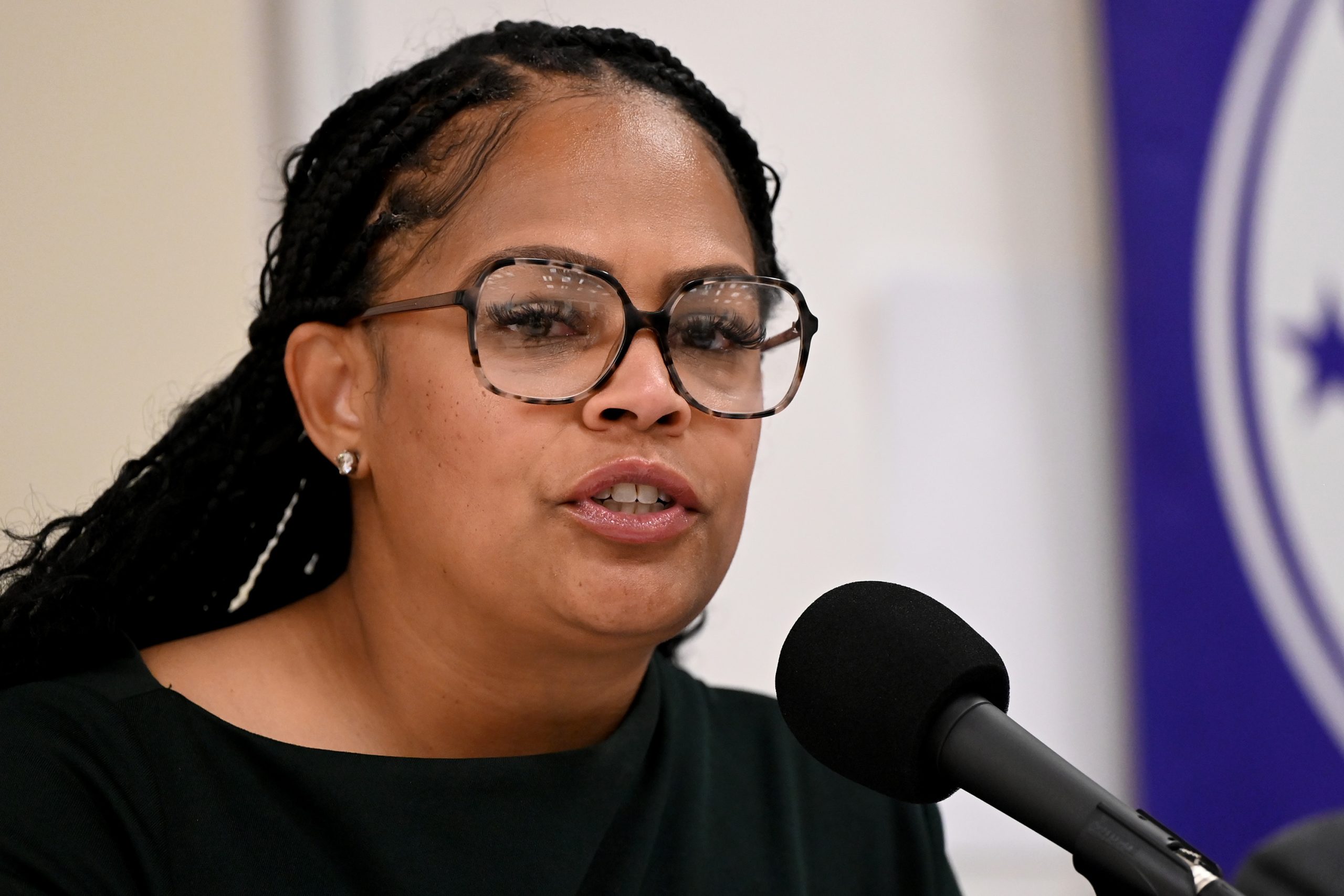
Of her children’s financial future, MiMi Gravley says, “I just want them to be OK.”Aidan T. Gallo / Staff Photographer
“Younger generations face economic headwinds that older generations have not — student loans, unaffordability of housing, starting a family, probably declining Social Security benefits,” said Ray Boshara, a senior policy adviser with the Aspen Institute and Washington University in St. Louis who helped design the framing for Trump Accounts and a similar precursor plan by former Sen. Bob Casey, 401Kids.
He added: “They face a transformed economy. So part of the real purpose of Trump Accounts, I think, is … to give them start-up capital at age 18 to counter these economic headwinds.”
Gaining steam
Across the country, efforts rooted in baby bonds or Trump Accounts are either active, forthcoming, or undergoing serious consideration.
The framework for baby bonds was proposed in a 2010 paper by Darrick Hamilton, founding director of the Institute of Race, Power and the Political Economy at the New School, and William Darity Jr., an economist and social scientist at Howard University and Duke University.
Connecticut launched its CT Baby Bonds program in 2023. It automatically enrolls children whose births are covered by Medicaid. The idea is straightforward enough: When participants turn 18 and complete a financial literacy course, they can claim at least a five-figure sum that can only be used for specified wealth-buildingactivities, such as buying a home or starting a business.
Trump Accounts, also known as 530A accounts, were signed into law last year and took effect this month. Children who are enrolled in the program by their parents could potentially receive $1,000 from the U.S. government. When the enrollee turns 18, the account becomes a traditional IRA and can be used for a variety of purposes, though the tax consequences are lower if used for postsecondary education, a first home, or retirement.
Unlike baby bonds, Trump Accounts were not specifically designed for poor children. And one criticism is that wealthier families will likely contribute more than poor families, which would worsen wealth inequality. But what’s notable about them is that they allow third parties such as employers or philanthropists to contribute cash or stock directly to children in low-income neighborhoods.
For instance, the Dell family pledged funds for every American child in specific zip codes, while the Dalio family and financier Brad Gerstner pledged funds to children in Connecticut and in Indiana, respectively.
Attention in the Keystone State
It’s still early, but for now, the idea of helping poor children build a foundation of capital for the future appears to be drawing bipartisan interest. And in Pennsylvania, policymakers have started paying attention.
“Baby bonds have been a topic of a lot of focus because we all want to make sure that we are creating long-term economic mobility and really breaking the cycles of financial insecurity early,” said State Rep. Morgan Cephas, a Democrat whose district covers West Philadelphia. “So these are some models that we’ve been looking at … and are absolutely looking to do more.”
State Rep. Martina White, a Republican whose district covers Northeast Philadelphia, said Trump Accounts can be a “great tool for working families” and planned to look further into the concept of baby bonds.
Her initial preference, she said, would be to model baby bonds like a college endowment, in which the funding source for the program would come from interest or investment earnings, as opposed to directly from taxpayer dollars.
“I think that the fact that more legislative bodies and governments are looking into ways that we can provide the tools for working families to build their wealth — I think that’s phenomenal, and we should be doing more of that,” White said. “But also helping make sure that government is getting out of the way, too.”
Democratic State Rep. Morgan Cephas said baby bonds have been a focal point for her party “because we all want to make sure that we are creating long-term economic mobility.”Tom Gralish / Staff Photographer
Although baby bonds haven’t been proposed in Pennsylvania’s legislature, the state does have an early wealth initiative through its Keystone Scholars program, which puts $100 into an account that Pennsylvania students can use toward their education costs.
In Philadelphia, there aren’t any initiatives specifically targeting wealth building for children. But there are programs that aim to advance overall wealth access and accumulation. One of the latest is Philly Saves, which, upon implementation, would give workers a way to save for retirement if their current jobs don’t offer retirement plans.
Last month, Sens. John Fetterman and Dave McCormick made a joint appearance in Nicetown, where they urged parents to sign up for Trump Accounts. Fetterman seemed to anticipate that some listeners might be dubious about the program and presume it is politically partisan because of its name.
“Do not fall into that political trap,” Fetterman said. “This isn’t some radical thing. … Do this for your child.”
Even if early wealth initiatives arrive soon in Pennsylvania, it may be too late to have a big impact on older children because the accounts need time to grow.
For Gravley, that means early wealth policies could impact her children but will likely yield larger sums for her future grandchildren. Gravley said she welcomes them as long as there’s some kind of financial literacy involved.
“If you give these children … $10,000 with no instructions, good luck with that,” she said. “It has to be instructions with it, but I think it could be a big stepping stone.”
Darity, the social scientist who helped conceive the idea for baby bonds, said early wealth accounts will have different maximum outcomes based on their design, even if they each grew at 1% above the inflation rate.
For instance, the baby bonds plan he coauthored would turn $60,000 into $72,000 over 18 years at that growth rate (no annual contributions allowed). A federal baby bonds plan proposed by New Jersey Sen. Cory Booker ($1,000 deposit; maximum yearly government contributions of $2,000) would grow to about $41,000 at those terms. For Trump Accounts, a $1,000 deposit and maximum yearly private contributions of $5,000 would grow to $100,000 in 18 years.
While Trump Accounts have the highest growth potential, low-income families who don’t have thousands to contribute annually won’t have “a transformative sum of money at the end of the 18 years,” Darity said.
Because both programs are still so new, we’re decades away from seeing the results of any long-term studies on the efficacy of baby bonds or Trump Accounts once participants reach adulthood. But research into other programs suggests that external interventions in wealth building can have positive outcomes.
For instance, a long-term study of Oklahoma’s SEED OK program found that newborns who randomly received $1,000 in state funds had, by age 14, higher educational expectations, greater social-emotional development, and more family-contributed savings for college compared with those who didn’t.
A 2015 global study of roughly 10,000 households found that asset interventions — like giving impoverished families an income-producing asset, cash assistance, and skills training — had positive economic outcomes well after the program stopped.
Those findings are part of a growing body of evidence from other asset-building experiments that “already points in a consistent direction,” said William Elliott, founding director of the Center on Assets, Education, and Inclusion at the University of Michigan.
That direction, Elliott said, indicates that early wealth accounts should be a pillar of a new social contract with Americans — especially in an age when higher education debt can stall wealth creation.
“The current policy setup strongly favors those who already have wealth,” Elliott said. “And so you don’t have meritocracy happening. To get there, you can’t just give [people] a job anymore, because there’s a gap between wages and productivity. You also have to give them some wealth to make their effort and ability pay off.”
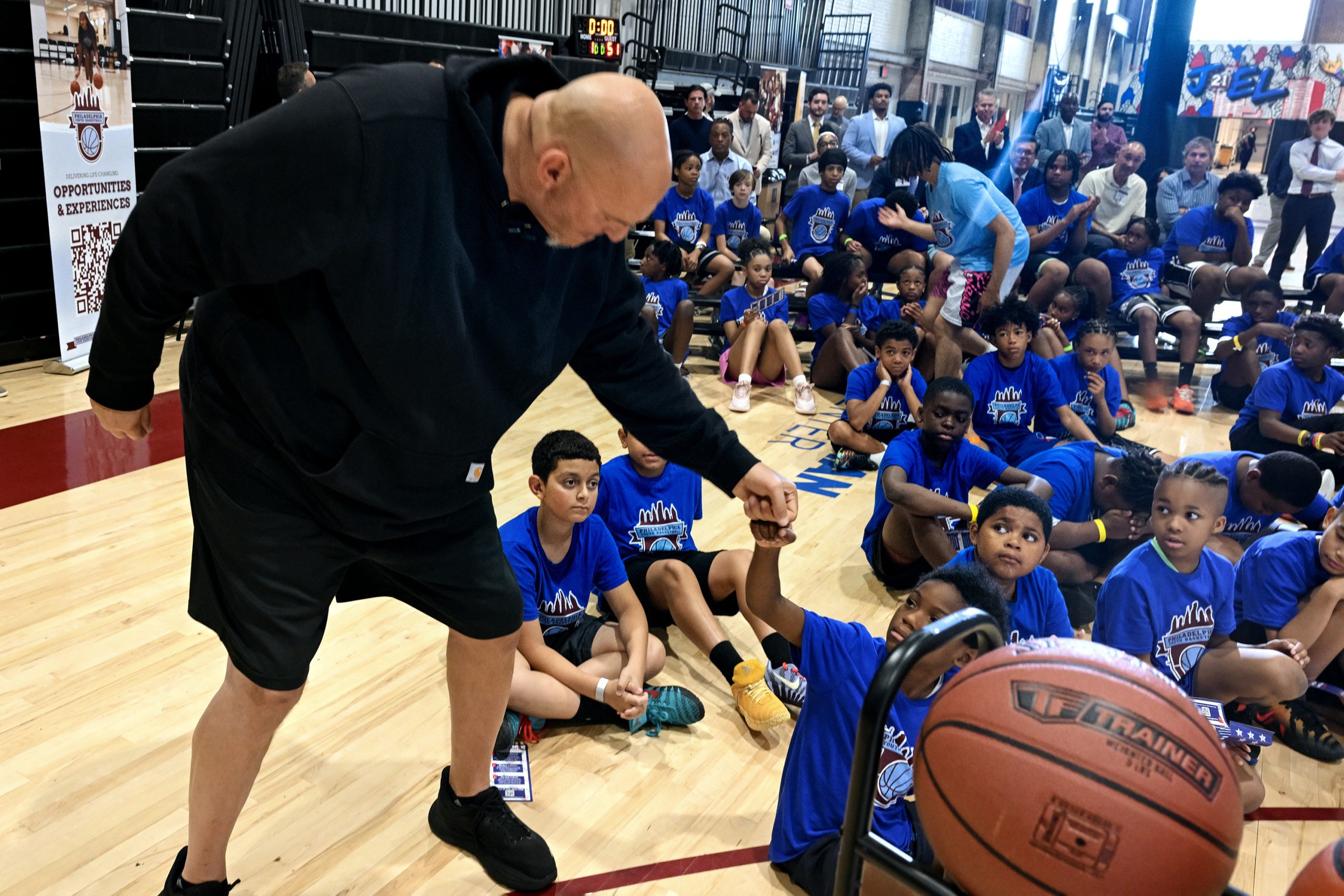
During an appearance in Nicetown with Sen. Dave McCormick, Sen. John Fetterman urged parents to sign up for child wealth-building accounts.Tom Gralish / Staff Photographer
The landscape in Philadelphia
There are more than 300,000 Philadelphians living below the poverty line, according to Pew Charitable Trusts — that translates to about $33,000 annually for a family of four. While the poverty rate here has declined to 19.7% from 26% over the past decade, Philadelphia still has the second-highest poverty rate among large U.S. cities.
Other figures show the prevalence of low-income households in our city.
Gravley, the only worker in her household of four, makes about $40,000 annually.
Raising Pennsylvania’s minimum wage above $7.25 may help workers locally; all of the commonwealth’s neighboring states have higher wage floors. But it could also be untenable for some small businesses.
For Gravley, her home is an asset that could help her family long term, but there’s little it can do to improve her economic prospects today. Despite holding three degrees — an associate in culinary arts, an associate in early childhood education, and a bachelor’s degree in leadership and organizational change — she still regularly grapples with the challenge of making ends meet.
As a program coordinator at Strawberry Mansion High School, Gravley said her expenses are usually about $2,200 per month, which means she typically has about $100 per month for the high-yield savings accounts she manages for herself and her children.
At one point she invested in the stock market but pulled out because she didn’t understand it.
It’s been this way for more than a decade for Gravley. As a recipient of Supplemental Nutrition Assistance Program and Medicaid benefits, she is making enough to cover needs, but financial security and financial growth for her family appear largely out of reach.
“[Welfare] helps, but it’s nothing programmed to get me out of the food stamp thing. Because you tell me to get the degrees and get the better job, and I’m trying to do that, or I did that, and it’s still not enough money. So where is the money?”
Jared Council is a business journalist based in Philadelphia. He was part of a team at the Wall Street Journal recognized as a finalist for the 2022 Pulitzer Prize in explanatory reporting for a series about the 1921 Tulsa Massacre. He is currently a program manager at Every Voice, Every Vote, a civic information and engagement program at the Lenfest Institute for Journalism.
The Inquirer is one of two dozen news organizations powering the Philadelphia Journalism Collaborative. Follow us at @PHLJournoCollab. This article is part of a national initiative exploring how geography, policy, and local conditions influence access to opportunity. Find more stories at economicopportunitylab.com.
You’ve just retired, and in the blush of that found time, your life seems to be taking a decidedly positive turn. You are freer now than you’ve ever been. You can sleep later, take a leisurely shower, and plan trips whenever you want. There are no deadlines to meet, no meetings to endure, and no clients or other stakeholders to manage.
But there are also no appealing challenges for you to ponder or triumphs to celebrate. Eventually, in the honesty of your most objective moments, you know something is “off,” and you are starting to feel adrift. Your calendar has now opened to days of mostly blank space. Metaphorically, it is something between desert and forest. Dry and dark … and getting darker.
It is a particular derangement, a silent assault on your sense of identity, and you have no passport away from it. This life state called “retirement” has occupied you completely, and it is not what you might have expected. It feels more like an ending, a loss, an uncertainty, an inert state in which your energy is no longer directed toward anything challenging or meaningful.
As a psychologist and an executive coach, I have always eschewed the concept of retirement, and the word, too. Retirement — it just didn’t seem apt for anyone who, in the words of a global CEO whom I coached before he retired, “… still had a lot of juice left.”
Some years before I was approaching my own retirement, I started thinking about a more apt and ego-syntonic way to refer to it. Eventually, I hit on the neologism “rewirement,”and whenever I used it in conversation — especially with retirees or pre-retirees — it elicited immediate and positive reactions, strong resonant reactions, and even fervent reactions of gratitude for this term.
Many of the retirees had had demanding and truly successful careers, but they were now feeling flat and at odds with themselves. Uncertain. Unhappy. While they had no financial or physical or familial concerns to worry about, I detected a distinct, almost depressive angst that had been triggered and sustained by their status as a retiree. Their conversation dwelled on “what was before” with no trace of “what could be now.” While they weren’t clear about the concept of rewirement, they brightened at the sound of it.
Of course, not everyone falls into an emotional abyss after retirement. There are people who move through their adult development phases successfully and for whom that growth helps propel them into a state of rewirement upon their retirement — they just didn’t have a word for it. These rewiredpeople serve as role models in that their postretirement journeys are characterized by self-compassion, humor, optimism, curiosity, resilience, and self-expression.
As I’ve come to see it, rewirement is the postretirement life phase during which the retiree identifies pursuits that foster a state of renewal. These pursuits may be new, or they may be “back-burner” dreams or interests that one finally has time to explore.
This state of renewal is sustained by a sense of meaning and contentment. This is comparable to or may even transcend the sense of accomplishment experienced in their previous work-related role.
I am reminded of the former global business executive who became a fine art photographer, the nonprofit leader who joined a community group in which members mended the clothing of low-income and homeless people, the psychotherapist (and former priest) who became a chaplain to hospital patients, and the human resources professional who became a master gardener.
The factors that identify the difference between these successful rewirements and those who get stuck in a conflicted or discontented state of retirement await the scrutiny of research. There is much to discover here.
However, in the meantime, I highlight the concept of rewirementas a possible neutralizer to the quotidian malaise that can seize us in retirement. I see it as a mental compass that can help us progress to renewal. And I’ve also identified three guideposts for those seeking a new sense of meaning as they transition out of their careers.
Identifying the ‘aspirational self’
This is based on one overarching question: What’s my aspirational self now? Exploring the answer to this question involves a concerted reflection about what pursuits one aspires to focus on now in this newfound time they’ve been calling retirement. In short, it’s the identification of the pursuits that will yield challenge and be meaningful in postretirement. This may be clear and even obvious for some, but it can be difficult for others; serious discussion with people who know us well (e.g., colleagues, close friends, partner, executive coach) can help clarify the path forward.
Regardless of how we address this fundamental question, the answer will significantly inform efforts toward achieving rewirement — efforts focused forward on possibilities vs. getting stuck in feelings of loss, despair, emptiness, or even unrequitedness. This is a time to build, not mourn.
Being more discerning about time
Greater discernment about time can prove especially difficult because we are habituated to our daily routines and priorities. Our routines and priorities are deeply ingrained. We trust and value these habits. They have abetted our success.
However, true rewirementnecessitates an abandonment of certain habits — especially those that could interfere with what we really want to pursue during this life phase. For example, pleasing others and an inability to say no, even to requests for spending time and doing things we really don’t want to do anymore, are particular blockers to rewirement.
The necessary behavioral shift here is to deny requests for our time that are not in the service of achieving our aspirational self. While it may sound egocentric, asking yourself the question “Does this really deserve my time given what I’m trying to do now?” is a proactive habit to cultivate on the path to rewirement.
Being more discerning about relationships
Achieving rewirementoften requires a difficult reflection about the quality of our relationships. Who’s supportive? Who’s not? Who’s a time drain? Who fuels our progress, happiness, and sense of meaning in postretirement? If we have a partner, do we need to have a courageous conversation with them about how we can successfully navigate this next life phase together?
Like habituated work habits that can block progress toward rewirement, certain relationships may also need to be changed or even let go in rewirement. As a successfully rewiredbusiness leader once told me: “I realized I had to prune my relationship portfolio as if it were a business. There were so many people from the past with whom I had little in common now.”
Ultimately, to achieve a successful rewirement, retirees may need to change some habits, they may need to manage their time differently, and they may need to adjust some relationships. However, as difficult as these efforts may be at first, they should be rewarded — rewarded because they support the retiree’s tilting toward what can be now vs. slipping into the emotional abyss of what was.
Sigmund Freud maintained that a human life is primarily about two spheres: love and work, and if there’s trouble in one sphere, or surely if there’s trouble in both, that’s a scenario for a depression.
As a sturdy and adventuresome bridge between work and love, a retiree’s personal renewal — fostered by their rewirement pursuits — is a reliable antidote to depression.
Yes, you are freer in retirement, but you can be even freer — and happier — in a state of rewirement. It is an oasis in the desert. Moonlight in the forest. So, are you in your rewirement now? And if not, what will it take to get you there?
Karol M. Wasylyshyn is a consulting psychologist happily in the midst of her evolving rewirement.
Happy 250th birthday, America! As we celebrate our republic, we are reminded that one of our nation’s greatest strengths has been embracing change and innovation while building safeguards that protect the people and communities that fuel our economy.
This goes for banking, too. It’s easy to forget, but this nation didn’t always have a stable monetary system. President Andrew Jackson fought the powerful elite to decentralize savings and lending. Even the almighty dollar was once up for debate; it wasn’t until the 1870s that Congress would issue “greenbacks” everyone could count on.
Financial innovation has succeeded because policymakers took the time to ensure new ideas strengthened, not weakened, the foundation of our economy. But innovation should never come at the expense of the families and farmers that depend on community banks, the backbone of America’s financial system.
These institutions put local deposits to work in the communities they serve, providing loans that help them thrive. More than 99% of businesses in Pennsylvania are small businesses, and small farms — those generating under $250,000 in revenue — make up 85% of the 49,000 farms in our state. Agriculture contributes $27.5 billion to Pennsylvania’s gross state product, and farms, like small businesses across the state, depend most on the kind of relationship-driven lending community banks provide.
Unfortunately, state legislation currently being considered in Harrisburg poses a serious threat to local lending and the communities that depend on it.
House Bill 2647 would allow faceless crypto platforms and payment stablecoins (price-stabilized cryptocurrencies) to operate alongside community banks, but without the same Federal Deposit Insurance Corp. (FDIC) insurance requirements, antidiscrimination rules, capital requirements, and other public protections community banks are obligated to maintain.
Beyond weakening consumer protections, the Independent Community Bankers of America estimates yield-bearing stablecoins could pull $1.3 trillion in deposits from community banks nationwide, cutting local lending capacity in Pennsylvania by approximately $35 billion. Every dollar that leaves a community bank is one less dollar available to help a family buy a home, an entrepreneur start a business, or a farmer plant next season’s crops.
If legislation allowing state licensing of payment stablecoin issuers advances without adequate safeguards, it will weaken local lending and undermine Pennsylvania’s economy.
That is why the current stablecoin debate deserves careful attention.
Community banks support responsible innovation. As the president of the Pennsylvania Association of Community Bankers, I see the cohort of community banks actively exploring new technologies and recognizing that digital assets will play a vital role in the future of finance. But stablecoins should function as a payment mechanism — not as interest-bearing investment products competing directly with federally insured bank deposits.
Small farms — those generating under $250,000 in revenue — make up 85% of the 49,000 farms in Pennsylvania. Those farms rely on the personalized lending community banks provide, writes Kevin Shivers. William Thomas Cain / For The Inquirer
Unfortunately, as currently drafted, significant loopholes remain that encourage unfair competition and ignore important protections consumers deserve and have come to expect.
Community banks have never feared competition. We have welcomed it for more than 160 years. What we are asking for is a level playing field — one that encourages innovation without sacrificing the proven financial model that has financed America’s hometowns for generations.
Lawmakers should slow the march toward stablecoins long enough to ensure innovation strengthens, not weakens, the community banking system that finances Main Street and homeownership in America.
As we celebrate our nation’s 250th birthday, we should remember that America’s greatest achievements haven’t resulted from choosing between innovation and stability, but from insisting on both.
One hundred and twenty years ago Sunday, Alfred Dreyfus, a French army captain, was exonerated of his wrongful conviction on espionage charges— bringing to an end an explosive and tortuous process marked by antisemitism, deceit, and the complicity of France’s military in aiding one of the first great miscarriages of justice to play out in the modern media age.
Dreyfus was arrested in December 1894 after being accused of passing military secrets to the German Embassy in Paris. He was court-martialed, convicted, and sentenced to life imprisonment on France’s notorious Devil’s Island.
Historians now agree that a major factor in Dreyfus’ conviction was antisemitism. Dreyfus was a Jew from the Alsace region of France at a time when Jewish officers were rare in the army. They were subject to the same kinds of prejudice and discrimination faced in other parts of French society. A case was trumped up against him by the French military establishment, looking for a convenient scapegoat.
Following the trial, a French officer, Lt. Col. Georges Picquart, conducted further investigations that indicated that it was not Dreyfus, but another French officer, Maj. Ferdinand Walsin Esterhazy, who was responsible for passing the secrets to the Germans.
Astonishingly, in 1899, Dreyfus was again court-martialed and found guilty. Though he subsequently received a pardon from the president, he was not fully exonerated by France’s highest civilian appeals court until July 12, 1906.
There were many examples of great drama and heroism during what came to be known as the Dreyfus affair.
In 1898, the French author Émile Zola published an open letter to the French president in support of Dreyfus, headlined “J’accuse.” The power of Zola’s piece and its wide dissemination launched a movement in defense of Dreyfus but also reinforced divides: Dreyfusards and anti-Dreyfusards, liberal/secularists vs. conservatives, left vs. right.
A scene from Roman Polanski’s 2019 historical drama about the Dreyfus affair, “J’accuse” (“An Officer and a Spy”).Venice International Film Fest /
That the story spread so widely is even more remarkable considering that the key events in the case took place long before the emergence of electronic media — the widespread use of radios wouldn’t take hold for another 20 years or so after Dreyfus was cleared.
Nevertheless, the Dreyfus affair became a watershed moment in the media’s role in high-profile trialsanda yardstick by which subsequent miscarriages of justice were measured.
In the United States, the 1925 Scopes trial became a cause célèbre with a reach thatapproximated the Dreyfus affair, despite the very different facts surrounding that case.
In 1944, South Carolina executed 14-year-old George Stinney Jr. after a 10-minute trial. Decades later, a judge declared his conviction unjust. Pictured are George Stinney Jr. in an undated booking photo and an article from Atlanta Daily World on June 23, 1944.Illustration: Andrea Brunty, USA
The execution of George Stinney Jr. — a 14-year-old Black boy who was wrongfully convicted of killing two white girls in South Carolina in 1944 — is one of the many controversial death penalty convictions that have also betrayed the principles of justice.
What distinguishes the Dreyfus affair is not just the case itself, but its aftermath. The exoneration of Dreyfus ultimately became an indictment of a political culture in France that was defined by secrecy, prejudice, institutional corruption, and arrogance.
Sadly, none of that is unfamiliar to us — so what have we learned in the past 120 years?
What have we learned? A dozen decades after Alfred Dreyfus was finally cleared — and at a time when antisemitic hate crimes continue to rise — that is a crucial question we must continue to ask ourselves.
Paul McElhinney is a writer and journalist living in Wexford, Ireland. He has contributed to many Irish, British, and American journals.
Most Americans have never heard of it. That needs to change.
The rule has several alarming impacts. For instance, it would allow political appointees to override scientific peer review in grant decisions, upending the meritocratic, rigorous system that has pushed American science forward since World War II.
Perhaps most critically, it would permit the government to terminate any active federal grant at any time, for any reason — including the vague, undefined justification that a study is no longer in the “national interest.” Furthermore, it would effectively ban federal funding for research into health disparities across racial populations, with a stated exception so narrow it is meaningless in practice.
Let me put that in perspective with specific examples. Over seven million Americans currently live with Alzheimer’s disease, and that number will nearly double by 2050. The research that underpins our understanding of this disease — including discovery of biomarkers, assembly of databases, and clinical trial frameworks — took decades of sustained, longitudinal federal investment to build. The Alzheimer’s Disease Neuroimaging Initiative, launched in 2004, required over 20 years of continuous funding and investment prior to producing any comprehensive datasets that now drive clinical trials.
Under the proposed rule, however, a political appointee or administrator with no scientific background could have decided at any point in that 20-year window that the study was no longer in the “national interest” and ended the study. The harm this vague, sweeping rule would do is not hypothetical. Much biomedical and clinical research, including in the field of neurodegenerative diseases, is longitudinal, and progress is not always immediately visible.
“We asked our mentors, ‘Is this something we should do?’ They all said, ‘No. It’s a swamp, and you’ll ruin your careers because so little is known.’ What they saw as a swamp, we saw as a huge challenge and opportunity that has led to an engaging career.”
Trojanowski’s partner in that research was Virginia Lee, whose work on tauopathies I have the privilege of contributing to today.
Their “swamp” turned out to be an oasis of discovery that likely would’ve remained untouched if these two experts in their field had not trusted in themselves and decades of training. If even their mentors — senior scientists in their own right — had dismissed these field-defining ideas, imagine the damage administrators and political appointees can inflict on similar revolutionary discoveries simply because they deem them “not in the national interest.”
For example, research has found that the relationship between the APOE4 gene (a major genetic risk factor for Alzheimer’s disease) and brain pathology inherently differs across racial groups. More specifically, some studies have found different patterns of tau protein markers in Black and Hispanic populations compared with the predominantly white cohorts that comprised much of the foundational, preexisting literature.
As currently written, this provision reaches much further than OMB’s framing of eliminating unlawful DEI policies suggests, and instead directly threatens legitimate biomedical research.
From a student perspective, I also want to acknowledge something that institutional press releases may not: This rule falls hardest on the people least able to absorb the blow.
If a principal investigator or faculty member loses a grant, it is by all means a loss, but they are more likely to have tenure, salary, or institutional support. If a graduate or doctoral student loses a grant mid-project, they potentially lose their publication, graduation timeline, and may face an altered career trajectory. And yet, trainees are never once mentioned in this proposal.
Doctoral students at the Delaware Center for Cognitive Aging study the impact of cardiovascular function on brain tissue integrity and cognitive aging.Kathy F. Atkinson/University of Delaware
So what can those of us who want to ensure we have the tools to effectively treat future pandemics and that our children benefit from world-class health research do?
Congress has little practical recourse here. The Congressional Review Act exists, but in the current political climate, a veto-proof majority to overturn an OMB rule is a fantasy.
If OMB does not meaningfully engage with a substantive objection raised during the comment period, that provides grounds to vacate the rule. Your comment doesn’t just go into a void. It becomes part of the legal ammunition.
Physicians and healthcare workers: Share the stories of your patients who benefited from federally funded studies. Scientists and students: Explain your research and the progress made from it. Attorneys and legal scholars: Challenge the principles and wording in this sweeping, overarching proposal.
To those whose careers do not directly involve science, this is your fight, too.
Comment on your medical condition that’s been treated. Chances are that treatment was only possible due to federally funded basic science. And if you or a loved one suffers from a disease or illness for which we do not yet have a cure, it is all the more important that you speak up with us.
Stable and comprehensive funding allows scientists to develop treatments for both rare illnesses and widespread ones like neurodegenerative diseases.
This is also a fight for our underrepresented racial and ethnic populations, the LGBTQ+ community, and the marginalized in our city. The decision to fund research on medical disparities is a decision to invest in the people who need it most.
This legacy is now in danger. If we want to see another 250 years of great American science, now is the time to act.
Ayaan Shah is a sophomore at the University of Pennsylvania studying neuroscience and an undergraduate research assistant at Penn’s Center for Neurodegenerative Disease Research.
It is past time for Division I colleges and universities to recognize that their student-athletes deserve both the right to bargain collectively and recognition that they are employees because of the compensation their institutions provide to them and the control those institutions have over them.
A deluge of media coverage has been aimed at other issues in big-time college sports, particularly football and basketball, but too little attention has been given to what should be center-stage — how student-athletes should be fairly treated by the institutions that benefit from their athletic prowess.
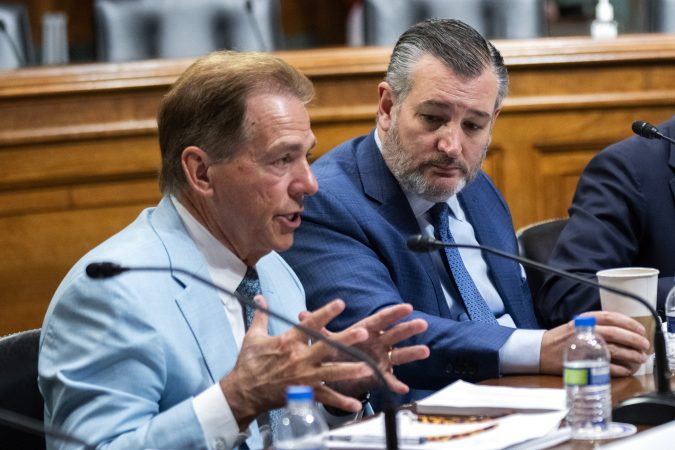
The Senate Commerce Committee recently held a hearing on the Protect College Sports Act of 2026, sponsored by Sens. Ted Cruz (R., Texas) and Maria Cantwell (D., Wash.), to “restore order” to college sports. This 111-page legislative effort is the latest in a series of approximately 40 bills aimed at reversing judicial rulings that oblige universities to share financial gains with their players.
Like their legislative predecessors, the 2026 bill limits or ignores existing player rights and immunizes universities from antitrust liability resulting from player-initiated litigation and substitutes Congress’ judgment for the courts, players, and universities.
Thus, the 2026 bill restricts the ability of players to transfer through a “portal” from one college to another and limits player eligibility to five years beyond the day of high school graduation. The bill would preclude awarding antitrust damages to players who seek to increase their mobility and earnings. It would also preempt state laws guaranteeing players compensation for their names, images, and likenesses used, for instance, on video games and athletic clothing (this has come to be called NIL money).
Until the last decade, the unchallenged position of the National Collegiate Athletic Association was that all college players are amateurs entitled to no more than athletic scholarships and frequently inadequate reimbursement for college expenses. Post-World War II football and basketball were dominated by the Southeastern Conference and the Big Ten, and both were big businesses.
Notwithstanding this reality, the NCAA maintained that the players were amateurs who could not be paid until the U.S. Supreme Court in 2021 ruled that the NCAA and its member campuses were liable for treble damages when they conspired to deny the players “educational” compensation beyond athletic scholarships and reimbursements.
Universities became involved in class-actions brought by their players about player transfers, eligibility, and related issues following that Supreme Court ruling. The ruling recognized that the universities have always treated athletes differently from other students, sometimes providing them with preferred admissions as well as under-the-table monies and other benefits, frequently in conjunction with wealthy alumni and “boosters.”
With California leading the way, many states enacted so-called NIL laws that allow players to be compensated for use of their names, images, and likenesses.
But the NCAA continued to insist the players were amateurs. As a result, outside “booster” groups or “collectives” were created to provide business deals to attract or retain college athletes from a source other than the universities.
Meanwhile, institutions of higher learning went to war to attract coaches with multimillion-dollar salaries, often exceeding those of any other employee, and — among state universities — any other state employee, including governors.
In the wake of these developments, an immediate response was the negotiation of financially lucrative media deals by the universities and a realignment of college conferences.
Stanford University, for example, left the Pac-12 Conference to join the Atlantic Coast Conference, requiring all its varsity athletes to travel regularly across the country, increasing the separation from their classrooms.
Further, NIL procedures have become a kind of Wild West, sometimes composed of shadowy characters and “agents” who operate without any regulation as is provided in the professional leagues.
Earlier this year, President Donald Trump convened a meeting of business and university officials in connection with a new executive order to preempt state regulation. The 2026 Cruz-Cantwell bill is the most recent response. It consigns players to minority representation on an athletic “governing board” or “rulemaking committee.”
Deeply troubling, it avoids even a mention of collective bargaining or employee status for the players. The current National Labor Relations Board is unlikely to address these issues effectively. And this Congress is unlikely to act on the Cruz-Cantwell bill.
Some, we realize, claim we should go back to an earlier era when money was not center stage in every aspect of Division I college sports. But it is too late to return that genie to its bottle.
Rather than wait for voluntary recognition of the organizing power of college players, or for state legislatures to take action, Congress should amend the National Labor Relations Act to allow student-athletes to exercise their collective bargaining rights.
This step by a new Congress in 2027 could provide much-needed protections for college athletes in terms of adequate compensation, health and safety protections, as well as a reasonable measure of player mobility fashioned by both students and universities seeking a balance between freedom and a disruptive revolving door.
After all, the most appropriate forum for resolving the complex matters around modern-day college athletics isn’t through one-off legislation or the occasional court ruling, but rather at the collective bargaining table.
Thomas Ehrlich is the president emeritus of Indiana University, former provost of the University of Pennsylvania, and former dean of Stanford Law School. Currently, he is an adjunct professor at the Stanford University Graduate School of Education. William B. Gould IV is the Charles A. Beardsley Professor of Law, emeritus, at Stanford Law School. He is a member of the National Academy of Arbitrators and former chairman of both the National Labor Relations Board and the California Agricultural Labor Relations Board.
Growing up as a student in Catholic school, I remember occasionally asking adults why God permits human pain and suffering, even among innocent children. Years later, my nephew once approached me about a conversation that took place in his classroom. He asked a nun at his school why his friend was born with a disability that left the child unable to walk. She told my nephew God knew this boy would grow up to be a thief — or worse — and that God crippled him to avoid that fate.
I was aghast and told my nephew she was wrong. God would never do something like that. Yet, the difficulties in reconciling an all-good deity with the terrible ills inflicted upon humanity remain. Does God will these horrors, as the nun at my nephew’s school implied, or just permit them? Why are the innocent as susceptible to great suffering as are the guilty?
It is one of those truly profound theological conundrums that even a youngster can grasp. A childhood friend of mine carried the heavy leg braces and profound limp of a polio patient, and I often wondered why him and not me. He was one of the nicest kids I knew; it wasn’t right. What am I supposed to think of a God who could desire that?
Then I heard Pope Leo XIV as he presented me with a different picture of God. He was speaking to a gathering of young people in Spain last month, and what he said — which was much different from anything I had heard as a student in Catholic school — has stayed with me.
“We must not spiritualize pain, superficially attributing it to ‘God’s will’ or to some mysterious plan of his, because this risks minimizing that suffering, silencing it and hurting people,” he said. “God does not want suffering. He carries it with us and invites us to trust in him with perseverance.”
The pope went on, “With God, life is always reborn.”
On the other hand, he said, moments of darkness and suffering must never be silenced just “because certain cultural norms demand that we always be victorious and perfect.”
I am, shall I say, over 50, and like just about everyone my age, I have witnessed awful pain and suffering, sometimes among the youngest and most innocent. I have been told to “spiritualize” that pain, attribute it to “God’s will,” and just deal with it.
That never sat right with me, from playing with my classmate who had polio to this very day. Leo provided me with a new way to process human suffering.
First, God does not want suffering. When we say, “Oh, it’s God’s will,” we are actually making light of the suffering, shoving it away, minimizing it.
I had never thought of it that way. Saying “It’s God’s will” seemed to make it grander, divine, special.
In fact, the “God’s will” gambit only serves to distance me from what the other person is going through. I get to shake my head with immense pity, sigh deeply, and then go about my business.
What the pope made clear to me is that we are not called to label the suffering of another, wrap it up in brown paper, and send it off to heaven. No, we are called to accompany the sufferer, fully acknowledge their pain, and help in any way we can to ease their hardship.
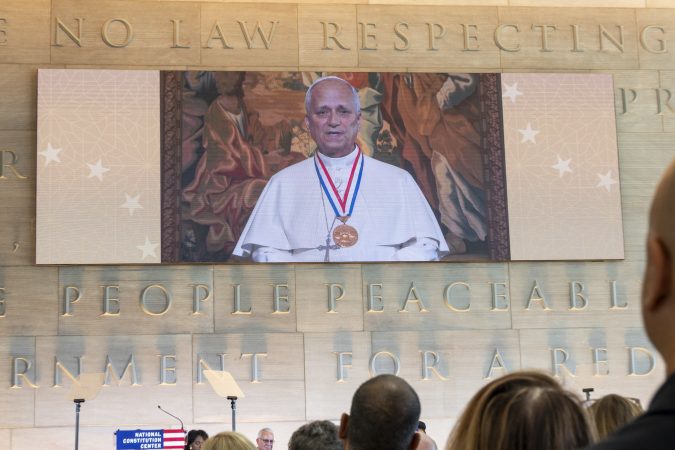
The pope seemed to refer to this duty again — in a broader way — when he accepted the Liberty Medal on Friday. “We are guardians and stewards of those entrusted to our care,” he said. “In this regard, the moral greatness of a nation is manifested, above all, in its capacity to support, protect and cherish the lives of all, especially the most vulnerable and those whose worth is questioned.”
We are born with fragile, mortal, material bodies. They will bruise, break, hurt, and die. That is a given: for my childhood friend, for my nephew’s disabled buddy, and for me.
We are likewise born with the enormous power to empathize, to touch the pain of another with patience and caring. That is not a given; that is a choice.
Jesus confronted hundreds of sufferers. He never said, “That’s God’s will; suck it up.” He reached out and, when possible, healed. His healing power is what is most often mentioned in the Gospels, but it may be the least understood.
I used to think Jesus’ healing gift was what separated him from us, what made him God and us just human beings. Pope Leo hinted that I have been all wrong about that.
We, too, are called to be healers. Our touch may not bring about a cure, only a connection. Suffering is not God’s will, but that connection definitely is. That connection is love.
Lonnie Barone is an author and executive leadership coach who teaches at the Wharton School of the University of Pennsylvania and the Fox School of Business at Temple University.
Rep. Tom Kean Jr. has always felt the mighty weight of his family’s history at the apex of political power in New Jersey, stretching back to the nation’s founding, when his ancestor William Livingston served as a brigadier general with the colonial militia under George Washington and then as the state’s first governor. Since then, the family has churned out two U.S. senators, two governors, and three members of the House — including the embattled scion, who now carries the torch.
“There is certainly a sense of obligation based on the distinguished service of his ancestors,” says Leonard Lance, a longtime friend, who represented the district in Congress for a decade until 2019.
But the dynasty is at grave risk today after Kean disappeared for four months, missing 140 votes, with no explanation until Tuesday, when he said in a short speech on the House floor that he had been hospitalized with severe depression.
The race was tough to begin with for Kean, given the poisonous dislike of President Donald Trump in New Jersey and Kean’s unwavering fidelity to him. Now, Kean’s absence has handed Democrats a potent new weapon.
How, they ask, can he justify his vote for deep cuts in Medicaid and the Affordable Care Act through the Big Beautiful Bill, which deprived more than 300,000 Jersey residents of health coverage they might have relied on to address the same problem? What would he have done without his own cushy congressional coverage or his vast personal wealth, which he’s valued at a minimum of $12.4 million?
So far, Kean has declined to address that question.
What about the stock trades he made while absent from Congress? How is it possible, Democrats ask, that he was able to tend to his own finances but not the public’s business?
“This is the self-serving culture in Washington that New Jerseyans are rejecting, and the kind of behavior they are sick and tired of,” says his opponent, Rebecca Bennett, a former Navy helicopter pilot.
That one has nuance. Kean has said he knew nothing about the individual trades made by his stockbroker, even before his illness.
Still, the trades could prove costly for Kean. In his 2022 campaign, he promised to establish a blind trust, and four years later, he still has not done so. Plus, in that campaign, he scorched his Democratic opponent, Tom Malinowski, for his undisclosed stock trades and accused him of insider trading — even though Malinowski offered precisely the same explanation, saying his broker made trades without his input. Why should we trust Kean’s word, but not Malinowski’s?
Rebecca Bennett hugs supporters in Bridgewater, N.J., on June 2 after winning the Democratic nomination for New Jersey’s 7th Congressional District.Ryan Murphy
And finally, what about Kean’s pledge of “full transparency” about his illness? What hospital did he use, and what kind of treatment did he receive? Were there complications, like substance abuse? And what’s the risk that this might happen again? A 2022 study published by the National Library of Medicine found that 30% to 85% of those who suffered severe depression have a relapse or recurrence.
Kean declined to answer questions on his condition. Full transparency, this is not.
Will any of this cost Kean at the polls in November?
Dave Wasserman of the Cook Political Report still rates the contest as a toss-up. The district was redrawn after the 2020 Census to strengthen the Republican vote, and while Gov. Mikie Sherrill carried the state by 14 points last year, she squeaked by in District 7 by just 2 points. Kean won by 5 points in 2024.
“This is definitely not helpful to Kean,” Wasserman says. “The question is to what extent it’s harmful.”
The damage may be limited, he says, because voters have set opinions about Kean after his four years in Congress and 21 years in the state legislature. And Trump’s standing among college-educated Republicans, like those in Kean’s wealthy suburban district, has not suffered the same drop as it has among working-class Republicans, Wasserman says, perhaps because it was weaker to begin with.
My bet is on Bennett, whose profile closely tracks that of the popular governor, Sherrill. Both broke barriers as helicopter pilots who served in the Mideast. Both are telegenic moms who call themselves centrist Democrats. And both have the gift of gab.
But who knows? Wasserman estimates that Republicans will spend about $2 million, and since Bennett is a newcomer, she may be vulnerable to personal attacks. Plus, Democratic primary voters just selected hard-left nominees in two neighboring districts — Adam Hamawy in the 12th and Analilia Mejia in the 11th — and Republicans may see that as an opportunity.
“She may need to be explicit about where she’s different from nearby Democrats,” Wasserman says.
And that could prove awkward, says Mike DuHaime, who ran Chris Christie’s campaigns for governor. “It puts her in a weird spot because a bunch of her most ardent supporters probably love those folks,” he says.
The Kean dynasty, of course, might survive a loss in November. Kean could run again, or a new generation could pick up the torch. But America seems to have grown weary of political families like the Clintons and Bushes. In November, we’ll find out if New Jersey has had enough of the Keans.
Tom Moran is the author of the Substack Jersey Lowdown and former editorial page editor of the Star-Ledger in Newark, N.J.
For years, I have summed up American politics in one sentence: Republicans have no principles, Democrats have no spine. Now, Democrats seem intent on proving they have no brains to go with that wobbly backbone. Following James Carville’s lead, some frightened Democrats appear determined to snatch defeat from the jaws of victory.
Carville worked magic nearly 35 years ago, helping mastermind Bill Clinton’s 1992 win. He has since become the epitome of the conventional-wisdom consulting class. Only a split within the party could darken the Democrats’ bright electoral prospects this year and beyond. Yet, Carville seems determined to promote precisely that division.
Appointing himself the party’s membership czar, Carville openly advocates for an intraparty “schism,” pushing out the democratic socialists whom voters just elected in Democratic primaries. Sparing no expletives, he said, “I actually do think it’s time for Democrats to talk the S-word: schism.”
Even the word reeks of futility. Schism is most closely associated with the Great Church Schism, which culminated in 1054. The schism irreparably split the Christian Church into Eastern Orthodox and Western Roman Catholic, and weakened Christianity for centuries. It led to Western Crusaders sacking Constantinople in 1204, and left the Eastern Orthodox exposed to the rising Ottoman empire, which took the city in 1453.
The Democratic Party has always thrived on diversity. In the 1930s, Sen. “Cotton Ed” Smith and fellow conservatives held the party’s right flank while Sen. Robert Wagner and the liberals held its left. That coalition built the majorities that enabled Franklin Delano Roosevelt to enact the New Deal and to lead the nation through World War II.
One of FDR’s few political missteps was his attempt to purge conservatives in the 1938 primaries. The failed purge, which party chair James Farley called a “bust,” drove Southern Democrats into a conservative coalition with Republicans and shattered FDR’s aura of invincibility. Though not the primary cause, it contributed to staggering Democratic losses that November: 72 House seats and eight Senate seats.
Carville’s schism has no upside. A handful of democratic socialists will not turn America into Cuba. They sit much closer to the Democratic mainstream than Cotton Ed’s bloc sat to FDR’s. A September Gallup poll found that 66% of Democrats hold a positive view of socialism. And these are not hard-line socialists; they more closely resemble the social democrats of Scandinavia, who would regulate capitalist enterprise, rather than have the state seize it.
The downside, though, is immense. A divided party wins fewer elections. The most likely outcome of a Democratic schism is MAGA rule for the foreseeable future, posing grave danger to American democracy itself.
Carville’s promotional flair has won his idea wide coverage, and some Democrats have signed on. The Nation blared that “Establishment Democrats Are Embracing Loserdom.” The author warned that “Some centrists would rather have Trump triumph than forge an alliance with the left.”
Former Democratic Party chair Jaime Harrison told left-wing Democrats: “If you hate the Democratic Party, then please don’t run for our nomination. Don’t use our resources. Don’t rely on our volunteers. Don’t use our infrastructure.”
Democratic Rep. Josh Gottheimer of New Jersey agreed. “Are we going to let them take over the party? Or are we going to stand up and fight back?” he said. “Many of us believe, as I do, that if you’re a socialist, you’re not a Democrat.”
Democratic Sen. John Fetterman of Pennsylvania, although not explicitly endorsing Carville’s call for schism, blasted left-wing Democrats. He said that the victory of democratic socialists has “just been the dancing days of the dirtbag left. You know, some of these candidates are outrageous.”
Carville and his backers should remember the words made famous by football coach Vince Lombardi: “Winning isn’t everything; it’s the only thing.” Stopping Donald Trump and his cronies from subverting our democracy is not the most important thing; it is the only thing.
A united Democratic Party, not a top-down purged one, holds the only hope of achieving that end.
Instead of panicking over left-wing candidates’ victories, mainstream Democrats should learn why those wins sparked such voter enthusiasm. Democrats should also reject Carville’s siren song and heed Sen. Cory Booker’s response to Fetterman’s slamming of the “dirtbag left.”
“If you want to heal a country, you can’t be picking fights,” he said. “Our party is not homogeneous. One of the things that makes the Democratic Party great is that it’s a big-tent party. We need to stay that way. The focus has got to be the November elections.”
Allan J. Lichtman is a distinguished professor of history at American University. He is also the author of “Great American Presidents: The Twelve Who Transformed the Nation,” out from Bancroft Press in September.