Category: Commentary

  • JD Vance is right about one thing: Caring for children has value. His plan gets the rest wrong.

    JD Vance is right about one thing: Caring for children has value. His plan gets the rest wrong.

    This week, the Trump administration floated an idea that has managed to irritate almost everyone: Allow some parents who stay home with their children to receive federal childcare subsidies.

    The proposal, championed by Vice President JD Vance, would allow some low-income married couples to use money from the federal Child Care and Development Fund to support a parent caring for a child at home. The fund currently helps families pay for childcare so parents can work, study, or get job training.

    Vance is right about the premise. Caring for your own child is work; our economy depends on enormous amounts of it, and public policy does remarkably little to recognize its value.

    But the administration’s proposed solution would draw from a childcare fund already nowhere close to meeting demand. The federal government’s latest estimate found that only about one in six eligible children receive subsidies, and eligible families across the country are already sitting on waiting lists.

    The proposal has become yet another argument about whether or not mothers should work. Conservatives praise it as overdue support for stay-at-home parents; critics see it as another attempt to push women out of the labor force. Both framings make family life sound much tidier than it is.

    I have spent my career working with childcare providers and parents, and the arrangements they cobble together rarely fit clean categories. A mother may stay home with an infant, return to work later, rely on a grandmother some days and use a childcare center on others. A parent who considers herself “stay-at-home” may still want childcare for part of the week. No single work or care arrangement comes close to satisfying everyone, and preferences shift as children grow.

    Using the same federal pot for both obscures an important difference.

    Money paid directly to a parent may make staying home possible when it otherwise would not be. A childcare subsidy, however, does more than help one family purchase care. It also helps sustain the supply of care itself: the teacher’s salary, the home-based provider’s income, the classroom that needs enough children enrolled to remain open.

    If these dollars move elsewhere, the effect does not stop with the family receiving them. A provider may need to close its doors, leaving fewer options for everyone else.
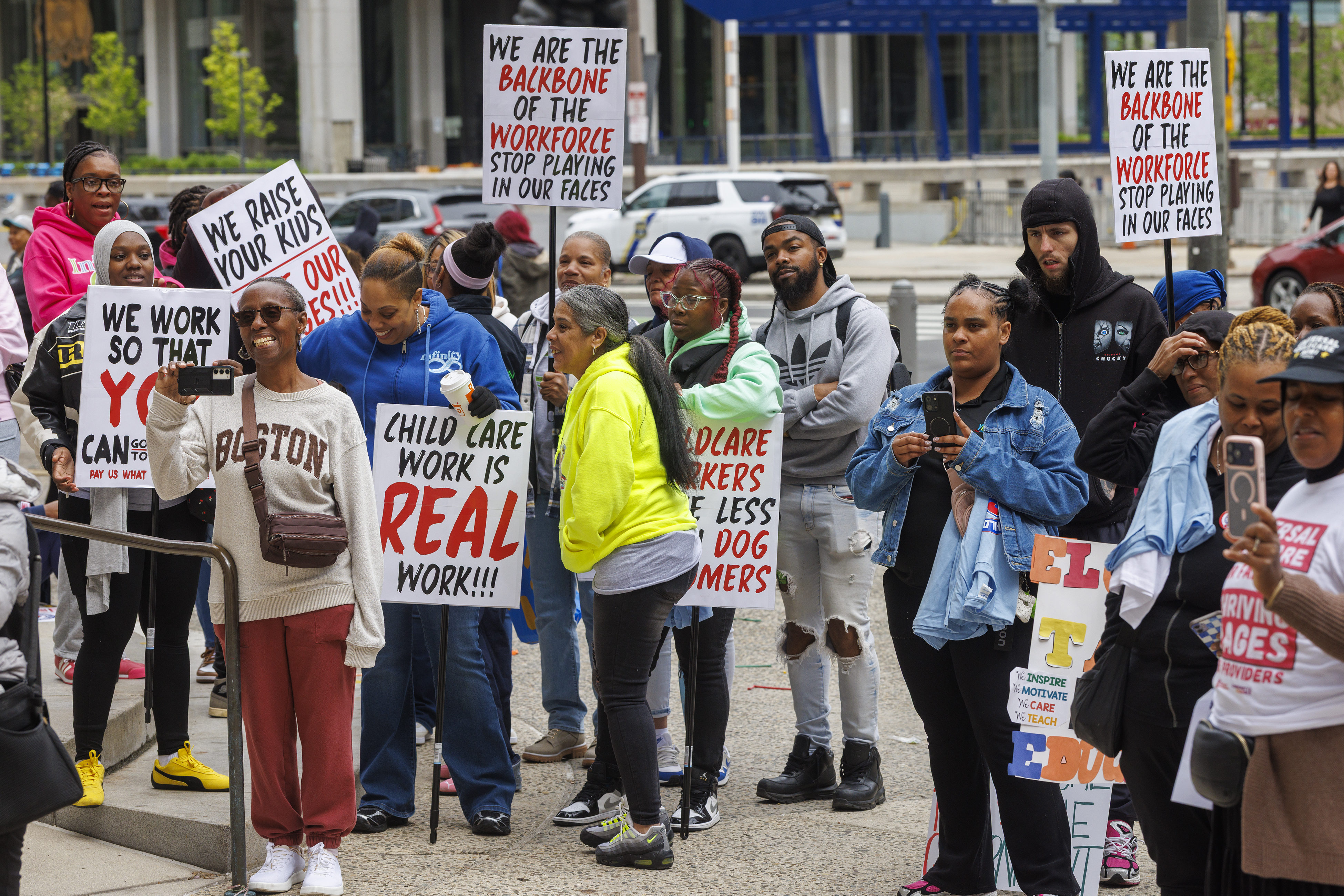
    Childcare educators gather on the north side of Philadelphia City Hall in May. About 98% of center-based early childhood teaching staff are female, writes Sabrina Habib.Alejandro A. Alvarez / Staff Photographer

    The debate usually stops with two mothers: the one who wants to stay at home and the one who needs childcare in order to work. It overlooks a third woman whose livelihood depends on those same dollars: the childcare worker.

    About 98% of center-based early childhood teaching staff are female, earning a median of less than $17 an hour. For self-employed childcare workers — including those running care from their own homes — the latest estimate is even lower, at $9 an hour, or about $18,500 a year, barely above the U.S. federal poverty level. Many of these childcare providers are mothers themselves.

    Seen this way, the proposal exposes a much bigger problem than a fight over who should receive a childcare subsidy. A woman caring for her own child often cannot afford to stay home, while a woman caring for someone else’s child often cannot afford to live on what she earns. Now we are considering asking those women to compete for the same scarce public dollars. Taking money from one underfunded form of care and giving it to another is a peculiar way to show that America values caregiving.

    There are better ways to give parents more room to stay home when that is what they want, such as through paid family leave or a more generous child tax credit. If Washington wants to recognize the economic value of parental care, it should fund that goal directly rather than weakening the childcare system other parents need in order to work.

    While the proposal may have been intended to signal that the administration values caregiving, instead it reveals how little public money America is willing to put behind care in any form.

    Parents at home are undersupported. Childcare workers are underpaid. Families who need care and qualify are stuck on waiting lists. And rather than fixing any of those shortages, the administration is proposing to make them compete against one another.

    America can do better than deciding which woman’s care counts.

    Sabrina Habib is the cofounder of Kidogo, Kenya’s largest childcare network, and leads the Zera Fund, spurring new investments into childcare globally as part of Melinda French Gates’ Global Leaders Initiative. She is also a Public Voices fellow tackling poverty, a partnership between the Op-Ed Project and Acumen.
  • I went to the Flight 93 memorial and witnessed a spirit of unity that’s hard to find elsewhere

    I went to the Flight 93 memorial and witnessed a spirit of unity that’s hard to find elsewhere

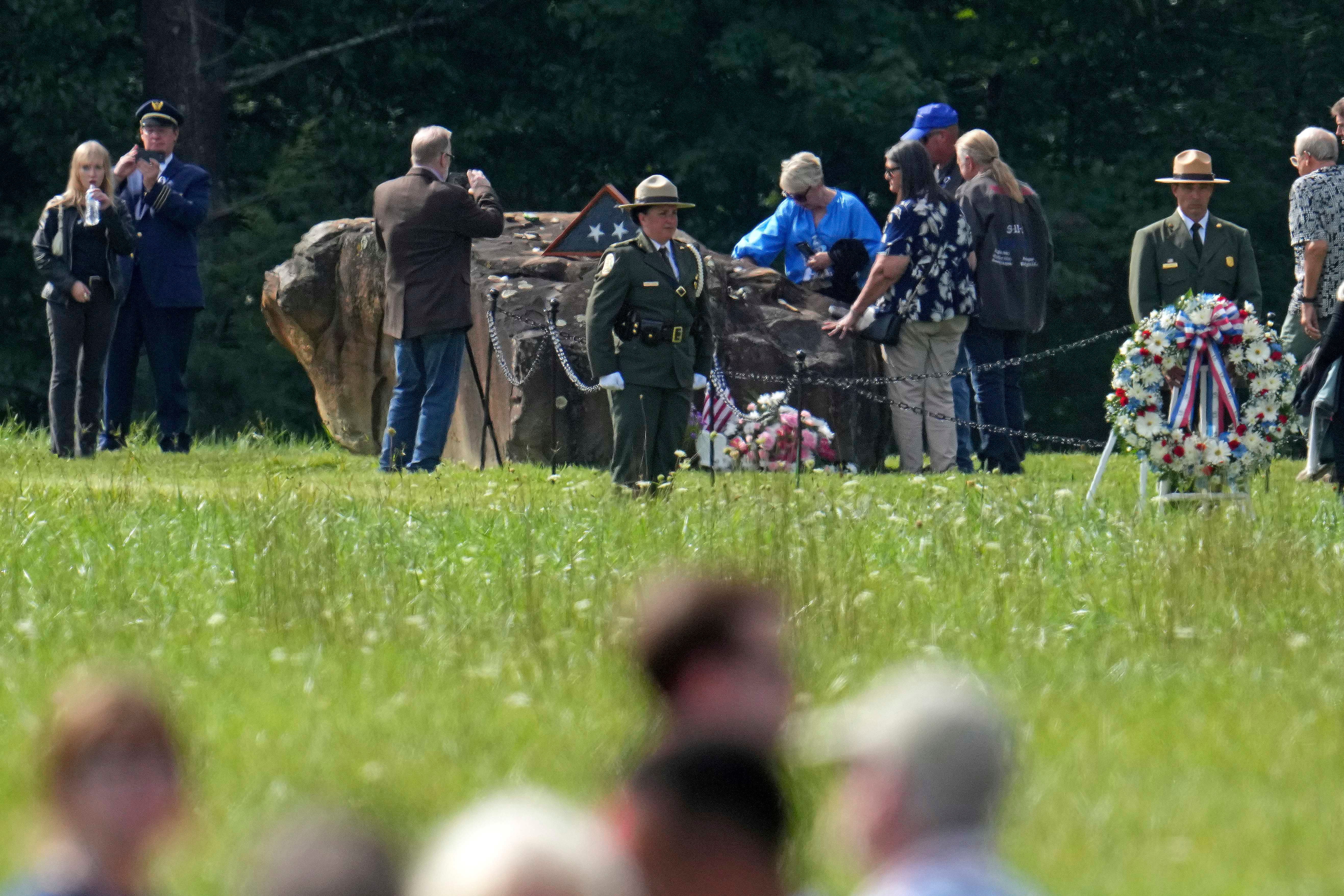
    STOYSTOWN, Pa. — There was almost no shade for the thousands who gathered Friday at the memorial plaza near the field where United Airlines Flight 93 crashed on Sept. 11, 2001. The sun was merciless as Red Cross and Salvation Army volunteers handed out water, and people sought refuge amid a few trees by the side of the road.

    But along with the heat, attendees felt something that has become quite unfamiliar for many Americans 25 years after 9/11: unity.

    While the spotlight was on larger events in New York City and Arlington, Va., they saw some of the conflicts we’ve all grown accustomed to. President Donald Trump refused to join his predecessors at ground zero, reportedly because he wouldn’t be allowed to speak. He opted for the Pentagon remembrance instead, where he and Defense Secretary Pete Hegseth gave speeches trying to tie the Iran war to the attacks of a generation ago.

    In Lower Manhattan, former New York City Mayor Rudy Giuliani — who had called for current Mayor Zohran Mamdani to stay away from the event, claiming Muslims “want to dominate us” — at least had the courtesy to shake Mamdani’s hand at the ceremony.

    None of that animus seemed to be present in rural Pennsylvania.

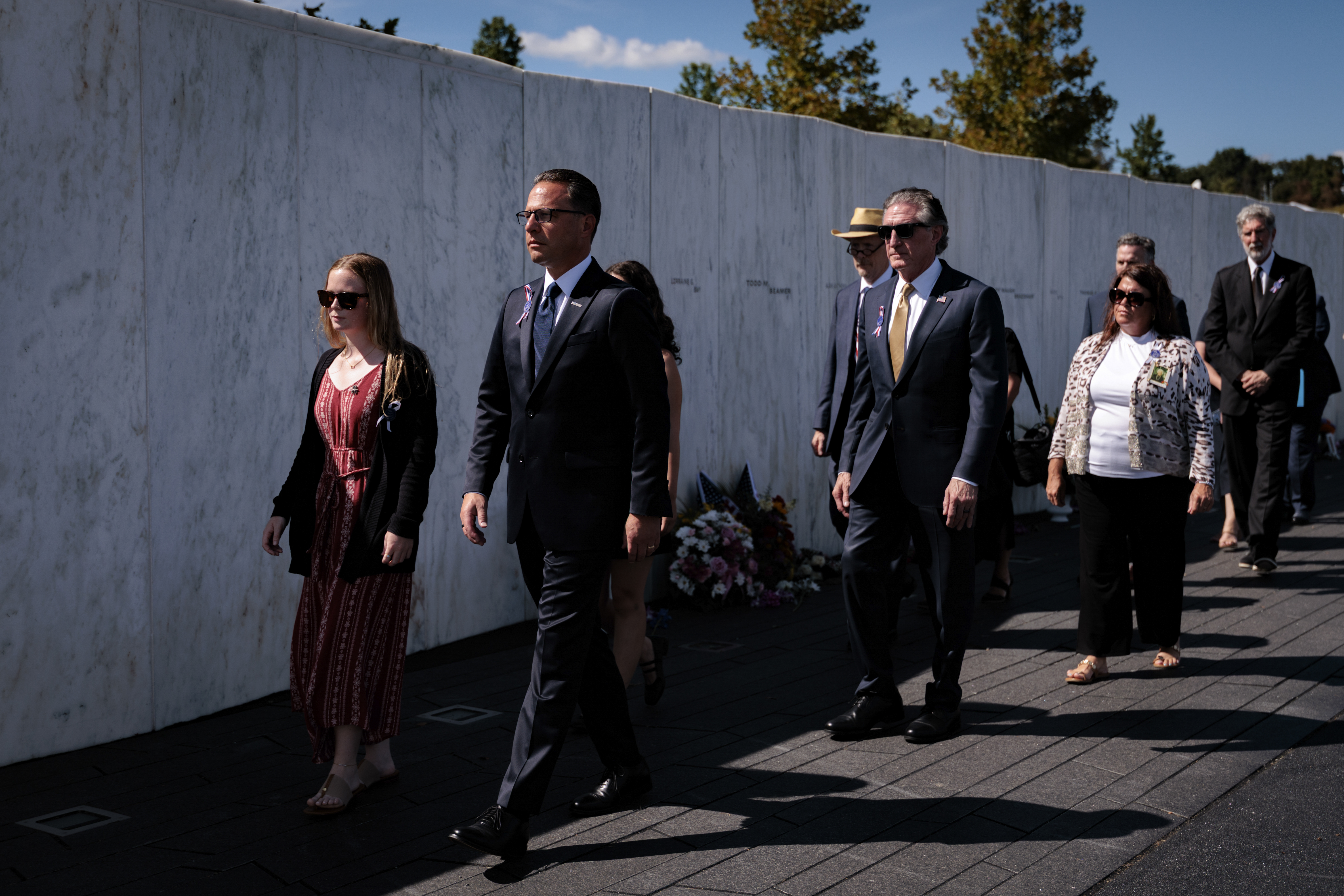
    The speeches by senior National Park Service officials, Gov. Josh Shapiro, and Secretary of the Interior Doug Burgum were civil and shared a common theme: The heroism of the passengers who fought back against their hijackers. Flight 93 never made it to its intended target, believed to be the White House or the U.S. Capitol. Instead, it crashed into a desolate field about 90 minutes outside of Pittsburgh.

    There was no ego on display, no inflammatory rhetoric — Democrat Shapiro and Republican Burgum even stood together at the wreath-laying ceremony in a rare show of political unity. The only comment that could be read as political came from Stephen Clark, superintendent of the National Parks of Western Pennsylvania and thus responsible for the Flight 93 memorial, when he reminded people that “history is shaped not only by the powerful, but by everyday individuals who decide to act with courage.”

    Gov. Josh Shapiro (second from left) and Secretary of the Interior Doug Burgum (center right) walk past the Wall of Names during a wreath ceremony at the Flight 93 National Memorial on the Sept. 11 anniversary in Stoystown, Pa., Friday.Hannah Beier

    In keeping with that sentiment, it wasn’t just those on stage who kept a unifying tone, as people from all walks of life, diverse ages, and across political persuasions came together in Stoystown to mourn and remember.

    I spotted a lone MAGA hat, and spoke with a woman who claimed 9/11 had been an “inside job,” arguing it was only logical because “the CIA killed JFK, too.” However, there were no loud political outbursts, and in talking with people, the same sober sentiment as from the official speakers was evident.

    Tom and Ryan, who preferred not to share their last names, were among the millions of Americans who learned of the attacks in school and watched the second plane hit the south tower in their grade-school classrooms. While they said they consider themselves conservatives, they felt strongly about not making the memorial a political battleground.

    Speaking to other visitors, a few made comments about the president or Democrats, but the major sentiment surrounding the remembrance stayed clear. They were not there to argue about politics. People were there to remember those who perished on 9/11, particularly the heroes of Flight 93.

    Stoystown was not just a contrast to what we regularly see across the U.S.; it also reminded me how difficult it is to come together even in times of tragedy. In my native Germany, recent terror incidents include the 2016 attack at a Berlin Christmas market by an Islamic extremist, a similar attack in Magdeburg in 2024 by a Saudi Arabian refugee (who described himself as an “ex-Muslim” and expressed far-right sympathies when questioned by authorities), and, most recently, an attack on the Berlin Pride parade in July, this one again being linked to Islamic terrorism.

    While decried broadly, none of these events managed to create the unity I felt in Stoystown. On the contrary, every incident in Germany seems to spark new debates about former Chancellor Angela Merkel’s policy of welcoming migrants during the refugee crisis of the mid-2010s. Even years later, populist parties and their supporters make it mostly about Islamophobia and dividing rhetoric instead of uniting to mourn as one people.

    These ugly, divisive sentiments are present in the U.S., of course, but at least for one day in a field in Pennsylvania, the memory of 9/11 still strengthens a bond that has not been erased by terror, populism, or party politics.

    Wim Orth is a journalist with WELT in Berlin and an Arthur F. Burns fellow at The Inquirer.

  • We don’t need new laws to rein in AI — we already have them

    We don’t need new laws to rein in AI — we already have them

    As the risks posed by artificial intelligence have exploded into the national consciousness during the past few days, I’ve seen people everywhere grasp the danger, and then sink into bewilderment and fear, or a resigned fatalism over how now we’re all gonna die. Versions of this mindset: “This threat from AI is so new and so overpowering; how do we wrap our brains around it? What do we do?”

    The answer? We lean into some of the nation’s most basic — and most demonstrably effective — legal principles.

    I’ve been practicing law for more than 30 years, and American jurisprudence has dealt with new situations involving humans and their inventions for centuries. It provides a guide now on how to respond to AI.

    Here are a few things it’s come up with: We require people to not create unreasonably dangerous products. This is the field of product liability, which keeps a company from putting out inherently dangerous products.

    I know someone who lost a finger in the 1970s when he tried to unclog a grass chute inside an electric lawnmower. The risk of that happening has plummeted in the years since because safety guidelines were changed to ensure that when you take your hand off the handle, the motor stops.

    This is how product liability makes products safer. Does it cost more? Yes. Does it result in safer products the company is putting out into the stream of commerce? Yes. We can apply the same requirements to AI: It can’t be so dangerous that there’s a risk of destroying humanity.

    We require people to keep potentially dangerous pets in their care on a leash. Think of walking your dog. Your dog can’t just run free, terrorize other people, and poop on their lawn. AI is the dog of Big Tech companies, and shouldn’t be allowed to do those things, either. It should be on a leash. That’s called government regulation.

    Dario Amodei, co-founder and chief executive of the artificial intelligence company Anthropic, has called on industry leaders to slow AI development for fear of losing control of the technology. KARSTEN MORAN

    U.S. Rep. Ro Khanna (D., Calif.) issued some very good, specific suggestions for regulation that should be implemented immediately, starting with creating a federal agency to oversee safety like we have for airlines and nuclear power, and requiring specific technological safeguards before a product can go to market.

    Finally, we punish people criminally for recklessly endangering other people.

    It is literally the crime of REAP, “reckless endangerment of another person,” and examples would be dropping a heavy object off an overpass or carrying a loaded weapon in a backpack with the safety off. I was an appellate law clerk for several years handling criminal cases, and in my opinion, the risk posed by AI, and the recently demonstrated failures of rules that have been put in place (e.g., instructions to AI “not“ to do something, which it then promptly does, and putting AI agents in “sandboxes” that are supposed to isolate them, which they immediately get out of and find other places to communicate secretly, as in the July hack of the AI company Hugging Face), may meet the requirements of reckless endangerment.

    Importantly, the crime of reckless endangerment of another person does not require that the harms have actually occurred; we are allowed to protect ourselves before it happens. The issue is, did the perpetrator “recklessly engage in conduct which places or may place another person in danger of death or serious bodily injury”?

    I think we’re getting there. Executives at OpenAI, Anthropic, and other AI companies should be warned that they are being evaluated for potential criminal punishment under this statute.

    I get that AI tech bros want that “monster IPO” when they go public, and want to become instant billionaires or trillionaires. The prospect of making a humongous amount of money clouds one’s judgment. They’re underestimating the risk because they want the money.

    It’s our role to give them a more accurate assessment of the risk, and to put limits in place.

    One idea a different candidate floated is to have AI company boards composed of at least 50% nonowners, publicly appointed or elected citizens who don’t have a financial stake in the outcome.

    The AI is a problem. But the bigger underlying problem is the arrogance and recklessness of its human creators that got us to this point in the first place.

    The danger exists; it is real. We don’t have the luxury of remaining frozen in fear. We do have tools to start mobilizing to meet the threat and reduce it. We have to start now.

    Linda Falcão is a civil rights attorney, former appellate law clerk, U.S. Presidential Scholar, and the creator of America Serves, a teen service program.

  • Unhoused men called this Franciscan friar a saint, street messiah, and the ‘Mayor of Front Street’

    Unhoused men called this Franciscan friar a saint, street messiah, and the ‘Mayor of Front Street’

    People told me about a great street messiah, so I set out to find him.

    The homeless men simply called him Zave, short for Xavier de la Huerta.

    In the 1980s, he ran St. Joseph’s Shelter for homeless men where Front Street meets Kensington Avenue, beneath the rumble of the Market-Frankford El. He was a Franciscan friar assigned to nearby St. Francis Inn, the soup kitchen that survives on donations and still serves meals each day to homeless people, those who are unemployed, people battling substance use, struggling seniors, poor children, and anyone else with nowhere to turn.

    The Franciscans have both priests and brothers, such as Zave, with the order saying it is dedicated to serving God where they are most needed. Guests don’t shuffle through a buffet line carrying plastic trays; instead, they sit at tables while volunteers deliver meals, restoring a measure of dignity of which they may have known very little.

    The neighborhood itself foreshadowed what has made Kensington known today beyond its borders, through YouTube videos focused on exploiting images of poverty and the opioid crisis for clicks.

    Once called “The Workshop of the World,” Kensington was one of America’s great manufacturing neighborhoods, home to textile mills, carpet factories, and the John B. Stetson Hat Co., which employed 5,000 people before it closed in 1971.

    As factories evaporated, jobs vanished, families left. Investment in the neighborhood dried up and poverty settled over streets lined with crumbling rowhouses and inoperable, abandoned cars.

    Before meeting Zave in 1989, I imagined him as a stern schoolmaster. The homeless men called him the “Mayor of Front Street,” and spoke of him with such reverence that I pictured a towering authority figure in a black cassock with half-glasses sliding to the edge of his nose.

    I had been talking with the men on the corner when a crowd suddenly gathered around a little man about 5-foot-5 wearing a bright red knit cap with a white pom-pom. The huddle of people trailed him like pigeons chasing breadcrumbs.

    “Who’s that?” I asked.

    “That’s Zave,” they said.

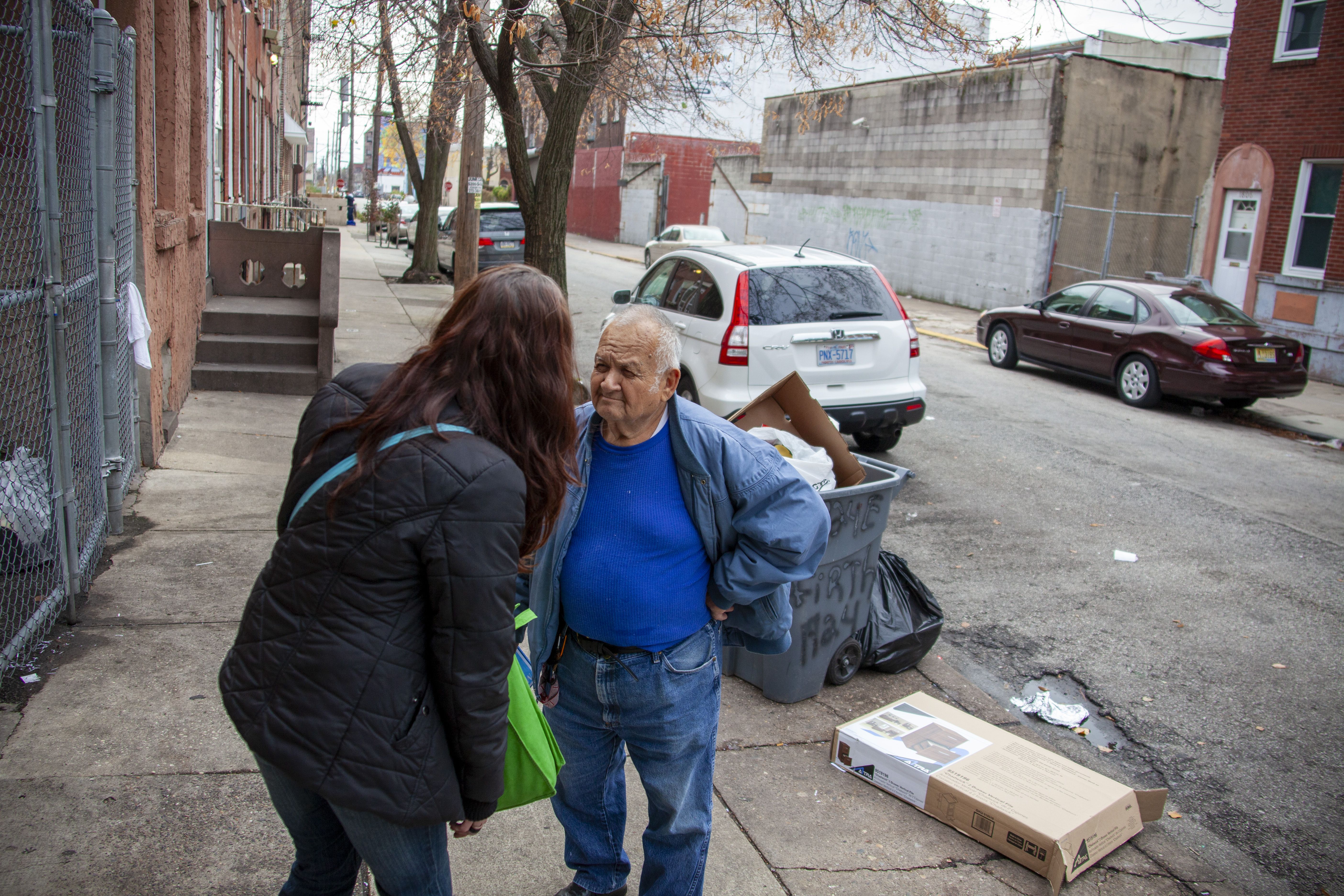
    Brother Xavier de la Huerta opens the entrance gate so that people in need can access St. Francis Inn, in Kensington, in November 2011.Octavio Duran

    I crossed the street, finding someone who seemed half my size, barrel-chested with a gleeful, disarming smile. He unlocked the shelter, empty during the afternoon before residents returned for the evening.

    The building that housed St. Joseph’s Shelter was a narrow rowhouse that had once been Joe’s Bar, its name still preserved on the tile floor. Eight army barracks beds lined one wall. A small sitting room served as the heart of the house, where the men argued, laughed, mourned, and tried to help one another survive substance use and life on the streets.

    I asked Zave what inspired him to dedicate his life to homeless men. Surely this had been his calling. He laughed.

    “This is my assignment,” he said. “It’s where the Franciscans sent me.”

    Brother Xavier de la Huerta listens to a homeless woman explaining how she needs assistance, outside St. Francis Inn in November 2011.Octavio Duran

    I later visited his sister, who lived near my Maryland home. She described her brother as a gentleman with innate kindness. When he stayed overnight at her home the first time, he asked her to replace the bed in the guest room because it was too comfortable. He rarely watched television because he lived upstairs at the shelter among the men, so he enjoyed viewing the old shows on his sister’s box.

    She also told me a childhood story about a faithful dog who waited for young Zave at the school bus stop every afternoon. Neighbors were amazed at the canine’s devotion, but eventually learned the source.

    On the walk home, Zave stopped at the butcher shop to collect discarded bones and carried them home for the waiting pup.

    One homeless man who had spent a decade on Philadelphia’s streets described Zave to me in the most glowing terms.

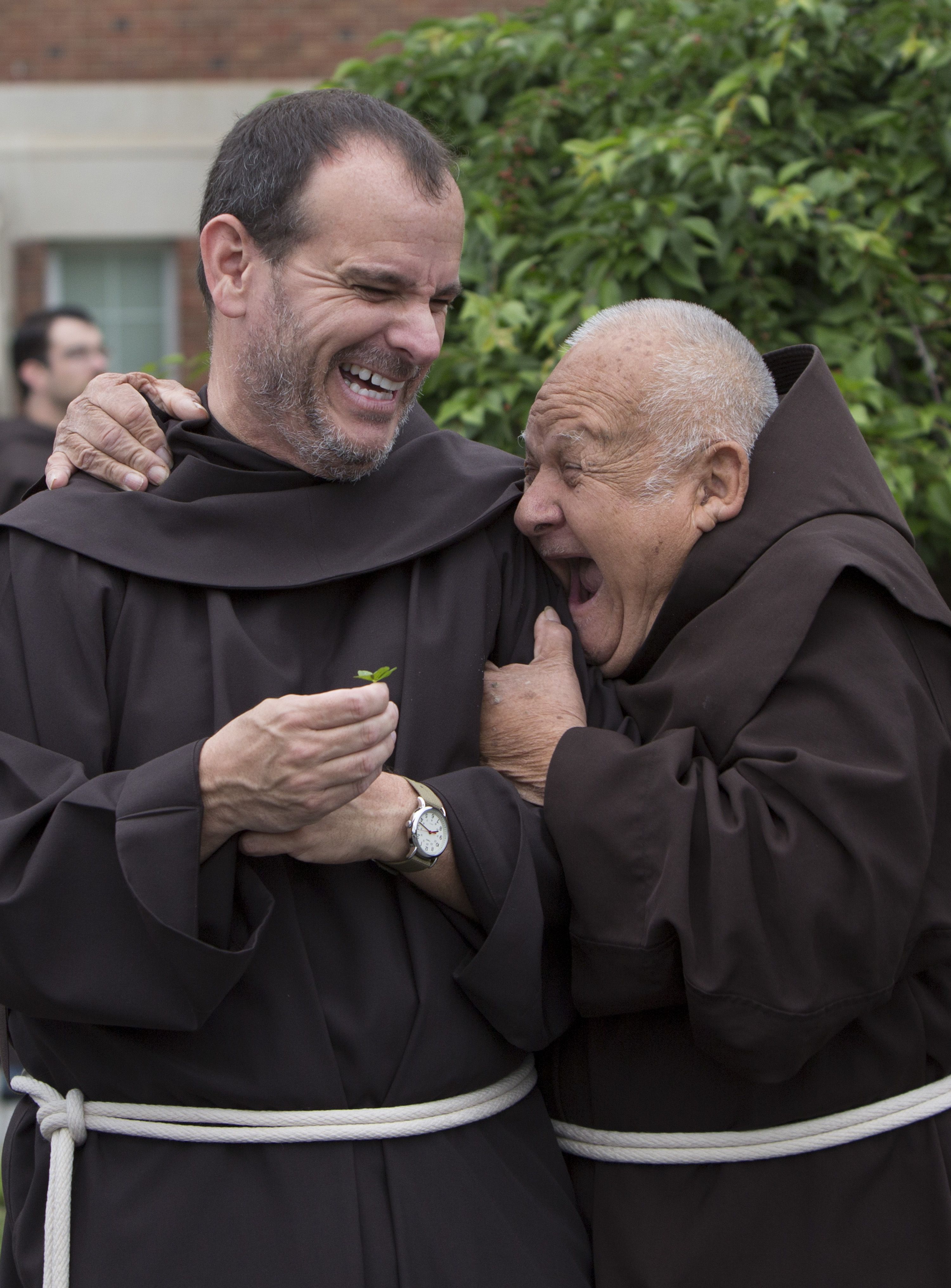
    Brother Xavier de la Huerta (right) shares a laugh with Brother Fred Dilger at Siena College in Loudonville, N.Y., in June 2014.Octavio Duran

    “Brother Xavier, he’s like a saint,” he said. “He’s good people. Very good people. He’d take the coat off his back to give it to somebody. I feel like it’s Christmas whenever I see him; that’s the glow he has. I don’t know how somebody so little can do so much.”

    One of the men I met at the shelter eventually entered drug treatment, moved into a halfway house, found sobriety, and rented an apartment. Another quiet soul Zave saved.

    When I visited Zave again, he looked exhausted.

    “What happened?” I asked.

    “I broke one of my own rules,” he said.

    He had agreed to hold one resident’s money so the man wouldn’t spend it on drugs.

    “At 2 o’clock this morning,” Zave said, “he came pounding on the door demanding it back.”

    There was no complaint in his voice, just another day.

    Last year, Zave, now 90, celebrated 60 years as a Franciscan brother and now lives quietly in his order’s retirement home, the St. Lawrence Friary in Beacon, N.Y. He retired in 2016 after suffering a stroke, completing 37 years of Front Street duty.

    Thirty years of newspaper reporting for major newspapers has introduced me to presidents, governors, celebrities, athletes, and thousands of fascinating people. Few taught me more about the meaning of a life than the little friar in the red knit cap.

    Muhammad Ali once said, “The service you do for others on this earth is the rent you pay for your room in heaven.”

    Zave’s heavenly home is paid off.

    Gerard Shields is a Kensington native and author of “The Front Row: Recording American History from Reagan to Trump.”

  • The ‘safe to breathe’ lie that haunts 9/11 — and Christine Todd Whitman

    The ‘safe to breathe’ lie that haunts 9/11 — and Christine Todd Whitman

    Former New Jersey Gov. Christine Todd Whitman will be 80 years old in a few weeks, with much to celebrate as she marks the moment.

    She was twice elected governor and brought a Republican legislature with her both times. She cut income taxes by 30%. She turbo-charged the drive to save the state’s dwindling green space, earning her a seat in the cabinet of President George W. Bush, running the Environmental Protection Agency. She is a woman of grand accomplishment, a pioneer.

    And she had the guts to compare Donald Trump to Adolf Hitler, way back in 2015, before it was stylish. So count me among those who would clap and hoot when she blows out the candles at her party.

    But … but … but …

    She also assured us, one week after the 9/11 attacks, that it was “safe to breathe” the air at ground zero. And we know now that was a mistake of epic proportions; that the dust covering Lower Manhattan was a toxic stew of asbestos, lead, mercury, arsenic, dioxin, and polychlorinated biphenyls. It scorched the lungs of thousands who breathed it, leaving them disabled, and planted the seeds for cancer in thousands more.

    “The number of people who have died of 9/11-related health conditions has far surpassed the number of people who died on the day of the attacks,” the September 11th Victim Compensation Fund states in its most recent annual report.

    As the illnesses began to pile up, Whitman became an object of scorn to those who felt she had been flat-out lying, bending to pressure from the White House, which was eager to get Wall Street back to work.

    She was called before Congress to answer for this in June 2007, soon after Democrats had taken control of the House, and they were ready to pounce. It was a sweltering day in Washington, nearly 90 degrees, and she had to brave a mob of furious protesters screaming at her as she arrived. This was to be the darkest day of her career.

    “Our government has knowingly exposed thousands of American citizens unnecessarily to deadly hazardous materials,” said Rep. Jerrold Nadler, the New York Democrat whose district included ground zero. “And because it has never admitted the truth, Americans remain at grave risk to this day.”

    But was Whitman really that much of a monster? I had covered her for years as a columnist at the Star-Ledger in Newark, N.J., and I had my doubts. Even today, no one has ever proved she lied about what she knew, or knowingly put people in harm’s way. If she were that evil, it seemed to me, it would be a first.

    Still, this episode will rightly be remembered as the low point for Whitman. She may not have been a monster, but she was surely a wimp. She stood back and let Vice President Dick Cheney spin the EPA’s scientific findings out of shape, as the EPA’s own inspector general established two years later. The EPA’s recommendation that homes and businesses hire professional cleaners to eradicate toxins was removed altogether.

    The changes to the EPA’s draft news releases were made by the Orwellian-named President’s Council on Environmental Quality, which was effectively run by Cheney. The CEQ had final control of press releases, and the IG report spells out each change it made, every time diminishing the danger and adding reassurance about safety at ground zero. Whitman didn’t make a peep of protest.

    Worse, Whitman personally sounded the infamous all-clear before she could have known it was safe, according to the IG report. In the careful bureaucratic parlance of Washington, the report said she “did not have sufficient data and analyses to make such a blanket statement.”

    She didn’t know for certain she was sending people to their doom, as critics like Nadler claimed. But she was going along with the spin, yielding to Cheney. And many people died who might have stayed away.

    At that 2007 hearing, Whitman was having none of it, and was more defiant than I had ever seen her. She was not a liar, she insisted. She based her decision on the best science she had at the time. She had no regrets, and said she was still not sure the toxins at the site were causing illnesses.

    It was an absurd claim, even then. A preliminary study released a year earlier by the Mount Sinai World Trade Center Screening and Monitoring Program showed that 70% of the first 9,000 workers examined had reported some kind of respiratory problem after working on the debris pile. Whitman claimed she hadn’t read it.

    I reached out to Whitman, and she offered a written statement saying, “Everyone at the EPA did the best they could with the information, tools, and knowledge available at the time.” But she declined to answer a more personal question: Does she feel she did anything wrong when she issued the all-clear?

    My guess is that deep down, she does.

    Tom Moran is the author of the Substack Jersey Lowdown and former editorial page editor of the Star-Ledger in Newark, N.J.

  • Head Start offers a model for ending preschool pushout. Don’t weaken it.

    Head Start offers a model for ending preschool pushout. Don’t weaken it.

    On Aug. 6, Philadelphia City Councilmember Isaiah Thomas held an Education Committee hearing on the crisis of preschool suspensions and expulsions, examining their devastating impact on families and possible policy solutions to this discriminatory practice, which research has shown is rife with racism and ableism.

    Ironically, on that same day, Health and Human Services Secretary Robert F. Kennedy Jr. announced plans for sweeping deregulation of Head Start, including rescinding its current regulations that prohibit expulsion and severely limit suspensions in all Head Start programs.

    At the advocacy organization where I serve as policy director, Education Law Center-PA, we help hundreds of families every year who are navigating preschool pushout. That includes families whose children — yes, even toddlers as young as 18 months old — have been suspended or expelled from preschool.

    This shocking practice is common: Preschools suspend children at a rate three times higher than K-12 schools.

    Suspensions and expulsions of our youngest learners, which are harmful to a child’s development and can profoundly impact their future, disproportionately harm Black and brown children, children with disabilities or developmental delays, and children sharing those identities.

    Myriad preschool programs exist in Philadelphia and across the commonwealth, which can make it difficult to untangle how each program is regulated and which agency oversees it. This patchwork can also make it difficult for families to understand which protections apply to their children. The clearest safeguards exist when protections, in conjunction with legal requirements, are explicitly codified in preschool program regulations.

    Head Start programs offer the strongest protections for our youngest learners, but in Philadelphia, those regulations only apply to 170 Head Start locations, a fraction of the city’s total early childcare settings.

    Current Head Start policy, which Kennedy now seeks to rescind, prohibits the expulsion of students in its programs and severely restricts suspensions to extraordinary circumstances, with a host of steps that must be taken before any temporary exclusion.

    During the recent City Council hearing, one of the most important policy suggestions offered by ELC-PA’s attorney, Rose Wehrman, included implementing the existing Head Start policy for all of the city’s preschool programs. It’s a policy that, if implemented with fidelity, could have afforded important protections for many families featured in our April report on preschool pushout.

    Jennifer Garrison’s 4-year-old son, Terrell, is a constant source of joy for everyone around him. Garrison described him to members of City Council as “loving, gentle, and full of energy.” But Terrell, who is Black and has autism, was denied the most basic needs in his preschool and was effectively excluded from his program under conditions that would not have been permissible under Head Start’s regulations.

    To hear Garrison talk about the juxtaposition of who Terrell is compared with how he was treated is gutting — and unfortunately too common.

    Had Terrell been in a program with the protections explicitly outlined by Head Start’s now-in-jeopardy regulation prohibiting such exclusion, perhaps he and his family would not have endured such a traumatic experience. We don’t know that for sure, but we do know that Head Start’s policy is one that should be expanded to more programs.

    The benefits of Head Start are comprehensive: The National Head Start Association outlines academic, social-emotional, and physical health benefits, and notes that the impacts are “particularly strong” among underserved students. This is, in part, due to strong policies around developmentally inappropriate practices like suspension and expulsion.

    But Secretary Kennedy, in the name of “parental empowerment” and even “freedom,” wants to upend the foundations of a decades-long program with lifelong benefits, ranging from increased educational success through K-12 and beyond, as well as physical, emotional, and financial health.

    Changes to Head Start proposed by Health and Human Services Secretary Robert F. Kennedy Jr. include deregulating nearly every facet of of the program, from appropriate staffing ratios to developmental screenings, writes Hillary Linardopoulos.Amanda Cuda

    In addition to the rescission of the suspension and expulsion policy, Kennedy’s proposed rule changes would deregulate nearly every other facet of Head Start. This includes appropriate staffing ratios, developmental screenings, and a host of regulations that are central to the program.

    Fortunately, these proposals are not final, and people can submit public comments (of any length or format) to the Department of Health and Human Services by Oct. 6 to oppose the deregulation of Head Start.

    The existing federal regulations are the ones we should emulate right here in Philadelphia and across the commonwealth. We urge our fellow community members to join us by submitting comments opposing the gutting of Head Start regulations, which would destabilize this foundational program.

    Meanwhile, our organization will continue to work to support families and expand the existing Head Start policies to include all programs educating our youngest learners across Philadelphia and the entire commonwealth.

    Hillary Linardopoulos is the policy director for the Education Law Center-PA, a nonprofit organization dedicated to ensuring equal access to a quality public education for all children in Pennsylvania.

  • America should move beyond the two-party system

    America should move beyond the two-party system

    It may be hard to remember in today’s polarized political climate, but there used to be a time when members of Congress — and even Democratic and Republican presidents — would work across the aisle to approve important pieces of legislation.

    And there was no way around it.

    Until Newt Gingrich came up with his Contract with America in 1994, Republicans had been the minority in the House for 40 consecutive years, making partnering with Democrats unavoidable. Gingrich, then the House minority whip, elevated local races to the national stage, crushing the former conservative Democratic stronghold in the South and flipping it for Republicans. The new GOP platform also moved the focus away from compromise to a more confrontational approach.

    This brutalization of partisan politics has reached a new nadir under President Donald Trump. His hateful rhetoric and frequent attacks on Democrats have made it nearly impossible for members of both parties to constructively work together.

    Meanwhile, with the midterm elections around the corner, the parties themselves seem to be fracturing.

    For the GOP, Trump’s own MAGA candidates are having to deal with increasing competition from traditional Republicans after the president’s laundry list of failures — a war of choice in Iran, soaring gas prices, and a rising cost of living — continues to grow.

    Add to this the Silicon Valley billionaire crowd and the MAHA movement that was brought in by former Democrats Robert F. Kennedy Jr. and Tulsi Gabbard, and you get a party disagreeing on basic ideals. For Democrats, the Democratic Socialists of America are trying to radically change the societal landscape and are pulling the party to the left more than many pragmatic centrists would like.

    Former House Speaker Newt Gingrich stands as he waits for an audience with Pope Francis in 2020. Gingrich swept away four decades of Democratic House rule with the “Contract with America” in 1994.

    With many voters tired of political division that gets nothing accomplished, yet strongly divided themselves over what issues they value most, the U.S. should consider whether the big tent politics of the past are still relevant, or whether it’s time to move beyond a two-party system.

    In Europe, countries like France and Great Britain have already undergone this shift.

    In Germany, where I’m from, there was a strict three-party system after World War II, with the Liberals often serving as power brokers between Conservatives and Social Democrats. In 1983, the Greens made it into the federal parliament, or Bundestag, paving the way for the first real left-wing coalition between Social Democrats and Greens in 1998.

    Through the coalition, the Greens were able to negotiate a gradual end to nuclear power. The party also introduced incentives for investments into renewable energy as well as an ecological tax on fossil fuels — along with taking the first step toward marriage equality for gay couples.

    After German reunification, the successor of East Germany’s state party united with a separatist movement of the Social Democrats, forming another strong contender left of the established spectrum that put heavy societal pressure on the introduction of a minimum wage, rent freezes in metropolitan areas, and a renewed focus on subsidized and public housing.

    Most recently, the Alternative für Deutschland, or AfD, keeps shaking up the system with its MAGA-influenced right-wing approach, being especially successful in the German east and being on track of having its first prime minister at the state level this fall. Even without a majority, the AfD’s growing electoral gains have already led to stricter border security and asylum policies by the other parties.

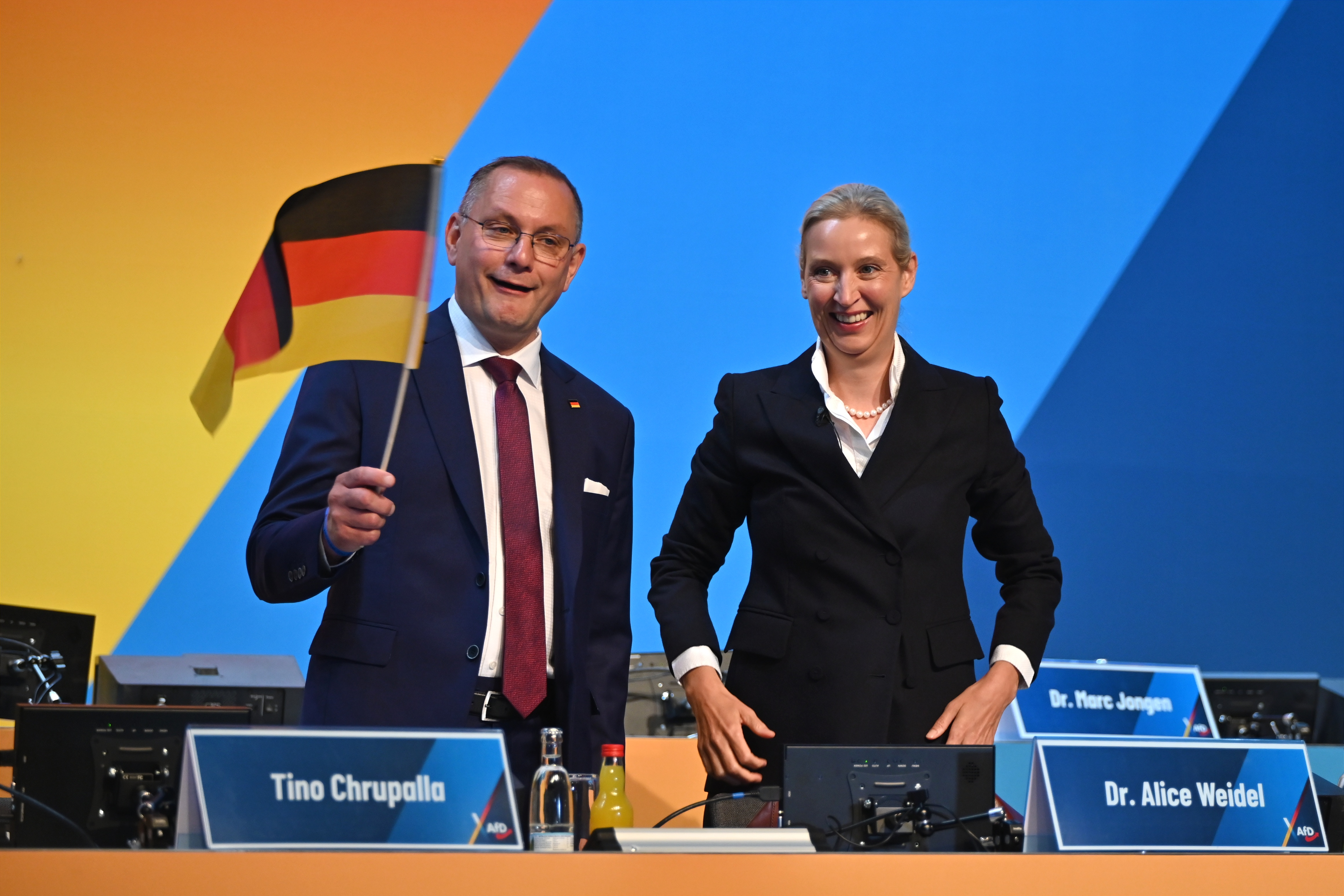
    Alice Weidel (right), group leader of the Alternative für Deutschland, and Tino Chrupalla, chairman of the AfD, attend the AfD party convention at the Erfurt Exhibition Centre in Erfurt, Germany, in July.Katharina Kausche

    There are currently five major parties represented in the Bundestag, while many smaller parties are involved in local governments across the country. Those are a lot of options for a country just short of 85 million people.

    Meanwhile, in the U.S., there are 350 million people coming from all walks of life and facing a host of local issues that often get lost in the push for nationalized politics. Having multiple parties would give voters more choices and solve problems more effectively while weakening polarization.

    For example, here in Pennsylvania, environmentalists and proponents of Big Tech could compromise over data center regulations that protect communities while still making way for artificial intelligence development. Progressive Democrats and union-backed Republicans like Brian Fitzpatrick and moderate Rob Bresnahan could work out solutions for the structural changes of the former coal and steel regions of the state.

    Of course, having more than two parties wouldn’t magically solve all problems, but it could broaden democratic competition and debate, give minorities more of a voice, and even help the GOP and the Democrats come together.

    Yes, there would be fewer people under their respective tents, but the major parties would be able to focus on their own raison d’être again, since it’s impossible to stand for something when you’re trying to stand for everything.

    The United States is a huge country with impressive diversity — it’s time to have a party system that reflects this.

    Wim Orth is a journalist with WELT in Berlin and an Arthur F. Burns fellow at The Inquirer.

  • With more modes of speech, why aren’t we freely communicating?

    With more modes of speech, why aren’t we freely communicating?

    We have never had so many ways to speak. Yet rarely has speaking felt so fraught.

    A defining feature of this moment in history is its extraordinary capacity for speech. Social media offers direct pathways to audiences. Generative tools can now help us refine our own voices. The barriers to speaking have never been lower.

    But the expansion of our ability to speak has not necessarily strengthened the conditions for free expression or led to more meaningful exchange. The same technologies that connect us to vast audiences also keep us within communities of shared views. And even as avenues for expression have multiplied, many Americans feel less certain that they can speak freely.

    New research from the John S. and James L. Knight Foundation and SSRS found that across activities from journalism and art to protest and political expression online, barely half of Americans believe they can exercise their expressive rights freely.

    Just 54% say they feel “very” or “mostly” free to express their political views without government interference or punishment. Asked to think back 10 years, 72% said they had felt that free. Looking ahead 10 years, only 42% expect to. While some among us may feel this more or less acutely than others, the pessimistic outlook holds across a host of different demographic and partisan groups.

    There may be more ways to speak than ever, but Americans are increasingly uncertain about participating in our nation’s public conversation. This should alarm us all.

    The First Amendment protects our right to speak, but free expression also depends on venues where people can actually use that right. In recent decades, we have invested enormously in technologies that increase the quantity of expression while neglecting the places — whether civic institutions, public spaces, or so-called third places — where we cultivate social trust. The spaces where constitutional rights grow into habits of forthrightness, curiosity, listening, and mutual respect; where we learn to recognize one another as participants in a shared civic life.

    The First Amendment gives us the framework. It’s up to us to foster the spaces where it comes to life.

    Critical infrastructure

    Our civic institutions are part of the critical infrastructure of free expression. They create opportunities for discovery and encounters that enrich our understanding. Museums invite us into the complexity of the past, revealing the stories, context, and perspectives that give history texture and meaning. Universities bring competing ideas into conversation and subject them to scrutiny, an aspiration that has always been messier in practice than in principle. Libraries give us the freedom to follow our curiosity, pursue knowledge on our own terms, and venture beyond the familiar. Where they still exist, local newsrooms surface stories that might otherwise go untold.

    None of these institutions gets it right every time. But their value lies partly in creating environments that welcome people in while making room for the friction that meaningful inquiry inevitably produces: disagreement, challenge, surprise, and sometimes a change of mind.

    The same technologies that connect us to vast audiences also keep us within communities of shared views.

    The information economy generated enormous investment in the technologies that have reshaped our civic life. But investment in the institutions that help us make sense of these changes has not kept pace.

    Philanthropy has an important role in this work. It can invest where markets won’t and governments can’t. It can absorb the risk that comes with genuine experimentation in new approaches to civic learning and engagement. It can identify and bring to scale emerging, community-led models that renew the institutions, relationships, and face-to-face experiences that remain essential to democratic life, even as more of our lives move online. And it can help institutions lower barriers and welcome new audiences.

    A new partnership between the National Constitution Center and Knight Foundation is one effort to put these ideas into practice. On Wednesday, the center will host its inaugural First Amendment Day, inviting visitors to explore our expressive freedoms through history, conversation, creativity, and civic engagement. They will have opportunities to exercise their own rights, encounter the perspectives of others, and join conversations about the changing landscape of speech being shaped by new technologies. Later that evening, Govs. Josh Shapiro (D., Pa.) and Spencer Cox (R., Utah) will discuss free expression and civic dialogue at the Kimmel Center. And to ensure this special programming is available to as many people as possible, admission is free to all.

    The goal is not simply to teach what the First Amendment says, but to practice the culture it makes possible.

    Philadelphia has a rich history of civic discourse and debate. It is here that these ideas took root. The Civic Decade ahead, as we celebrate the 250th anniversaries of the Constitution and the Bill of Rights, offers us a chance to invest anew in our institutions of self-government. Building a culture of free expression should be part of that work.

    We have more ways to speak than any generation before us. We must be just as ambitious about nurturing the spaces that remind us not to take our First Amendment rights for granted.

    Julie Silverbrook is the chief content and learning officer of the National Constitution Center. John Sands is vice president of information and society at the John S. and James L. Knight Foundation.

  • While our country mourned the thousands dead in New York, we Arab Americans also had to mourn our place in American society

    While our country mourned the thousands dead in New York, we Arab Americans also had to mourn our place in American society

    Like every American who lived that fateful day, I can vividly remember where I was on Sept. 11, 2001.

    I was in the middle of chairing a hearing as a city civil service commissioner when my administrative assistant burst into the room. She told me a plane had hit the World Trade Center in New York. I postponed the hearing immediately.

    But unlike millions of Americans who were frozen in place watching the heartbreaking visuals of the second plane hitting the second tower, I was already on the phone with the Philadelphia Police Department, the Philadelphia School District, and the Human Relations Commission.

    I knew there would be an immediate backlash against the Arab and Muslim American community.

    Like every other minority community in this country’s history, our community knew too well the playbook that is deployed following a tragedy. The provocations from talking heads on television, the incendiary questions expedited by the broader 24/7 media landscape, even the inflammatory comments made by elected officials — the very people who were supposed to protect us.

    I could see it coming. In America, we always search for an enemy to blame, and sadly, on Sept. 11, 2001, Arab and Muslim Americans were the ones unfairly blamed.

    In those first few days, thanks in part to our partners in law enforcement and our wider community outreach, we managed to head off the worst of it for the Arab and Muslim American community in Philadelphia. We had some threats and attacks on stores, and some people were targeted with violence. But even though that was horrific and traumatizing, in comparison to others, in Philadelphia our community was surprisingly fortunate.

    Across the country, Arab American businesses and mosques were literally burned to the ground. Arab Americans were arrested, and some were held for a long period of time without charge. Other Arab Americans — and those perceived to be Arab — faced targeted violence and, horrifically, a few people were murdered.

    These serious hate crimes and attacks by both lone actors and, sadly, also the government, were widely underreported by the media, then and now. Our community still feels that pain every day.

    We weren’t even given the time to mourn the tragedy ourselves, including the many victims on 9/11 who themselves were Arab and Muslim Americans.

    While our country mourned the thousands dead in New York, we as Arab Americans also had to mourn our place in American society, which has never recovered. It was the way the country changed after 9/11 that has been so difficult for our community. It was a transformation that hit every American, but it felt targeted at us.

    The response to 9/11 fundamentally shifted what the U.S. stood for. We were dragged into two devastating wars, first in Afghanistan, and then in Iraq. Those conflicts took hundreds of thousands of innocent Afghan and Iraqi lives and thousands of our own soldiers.

    Then came the Transportation Security Administration, a government organization that utilized racial profiling in what never once felt like “random” checks.

    The Patriot Act expanded government spying into the private lives of all Americans, but particularly Arab and Muslim Americans, who faced extraordinary government surveillance.

    Other law enforcement agencies followed, with their own prejudiced practices, especially the New York Police Department, which started sending undercover agents into mosques to record worship services. Their “Demographic Unit” went to gatherings, restaurants, and clubs to survey the community. They made lists of our businesses and started infiltrating student groups.

    On top of that, the federal government started the NSEERS program, forcing thousands of men visiting the U.S. from Muslim-majority countries to be fingerprinted and registered like criminals. No terrorists were found among those profiled.

    We also now know the extent to which the government used torture against mainly Arab and Muslim prisoners at black sites, and most notoriously at Guantánamo Bay. We now know that many of those prisoners were innocent and had nothing to do with 9/11, let alone al-Qaeda. That didn’t stop the CIA and its contractors, all of whom escaped justice for their role in the torture program, from using waterboarding and extraordinary rendition on these prisoners, all while denying their basic rights.

    After 9/11, if you were Arab or Muslim, there was no such thing as being innocent until proven guilty anymore.

    Even now, more than a dozen men are still sitting in Guantánamo Bay without ever facing a trial, due in part to the very torture program the government once tried to say was necessary.

    And in the decades since, some things have gotten worse.

    There continue to be travel bans targeting people from predominantly Arab and Muslim nations.

    Groups in places like Texas are trying to ban Sharia law — a grotesque, Islamophobic distortion that pretends Sharia is a legal system challenging the Constitution rather than a set of guidelines for moral and ethical conduct in a religious context.

    And attempts to silence and censure Arab American voices, particularly on issues like Palestine, continue at universities, corporations, and state capitals across the country.

    It hasn’t all been dark, though.

    The pressure our community has faced since 2001 has made us stronger in a lot of ways. It forced us to build real, lasting ties with our religious allies, especially our Jewish and Christian neighbors. That’s how the Interfaith Center of Philadelphia got its start.

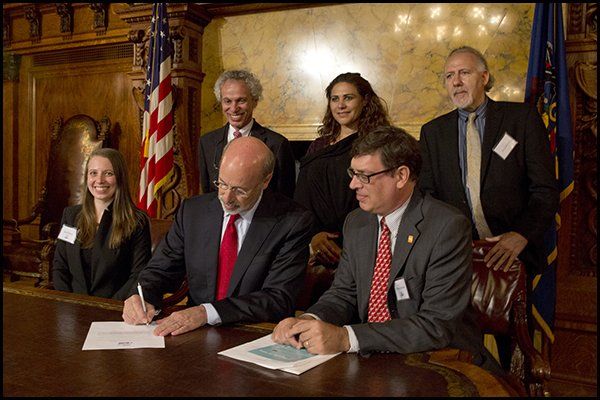
    The author (seated at right) watches Gov. Tom Wolf sign “The Pledge to Combat Bigotry,” a public commitment to speak out against bigotry toward Muslims and Arabs, in Harrisburg on Sept. 30, 2015.Courtesy of Marwan Kreidie

    It solidified our political presence, too.

    Now, we have more leaders than ever standing up for our inclusion in the city and the state. Many elected leaders have rallied to support us, and our community has the greatest number of people elected to local, state, and federal offices we’ve ever seen.

    By working together with allies to make the U.S. freer, and to protect the importance of what it means to be an American citizen, Sept. 11 showed the resilience of our community.

    I could not be prouder of that.

    Twenty-five years ago, even as those terrorists tried to break us, and others inside our own country tried to divide us, America prevailed.

    We nearly lost our democracy on that fateful day, as our democratic system was hijacked in the name of “security.” But we, as Americans, came together.

    And today we must continue to live the words of the great Benjamin Franklin: “Those who would give up essential liberty, to purchase a little temporary safety, deserve neither liberty nor safety.”

    Marwan Kreidie teaches political science at West Chester University and is the executive director of the Philadelphia Arab-American Development Corps.

  • As many close the book on reading, others open a new chapter

    As many close the book on reading, others open a new chapter

    When I moved into my Philadelphia home 10 years ago, I bought a used wingback chair and put it on the top floor of my “trinity”; the heat of summer chased upward from the cooler floors below.

    I sat in that chair and read Walt Whitman: A Life by Justin Kaplan. As I read, I turned my chair toward the east-facing window, toward Camden’s Mickle Street, where Whitman spent his final years. Despite being in ill health after a stroke, he would travel by ferry the short distance to bustling Philadelphia and speak to large audiences of admirers. He was already a literary celebrity by the time he lived there in the 1870s and 1880s.

    Fast-forward to 2016, to me sitting in a too-warm house, new to Philadelphia, feeling a bit of magic in those quiet moments. My proximity to the ghost of Whitman in the warmth of my top floor made me nostalgic for a time before air-conditioning, when writers wrote in pencil on any scrap of paper they could find.

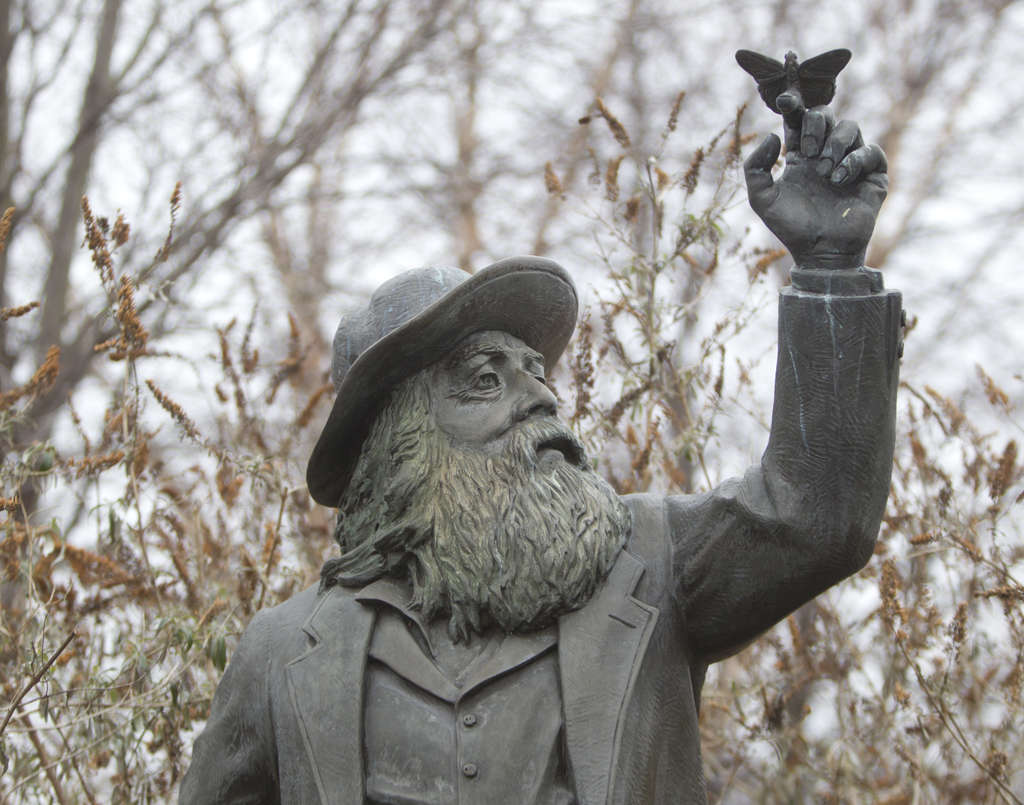
    A statue of Walt Whitman at the Camden Children’s Garden. In his last years, the poet, who lived in Camden, frequently came to Philadelphia to read. ED HILLE / Staff Photographer

    A few weeks ago, the Atlantic published an article by Rose Horowitch titled “The End of Reading Is Here,” which has generated considerable discussion, and there is no doubt there is a trend in this country away from reading that is concerning.

    But I’d like to talk about the 20% of people she points to who are not only readers, but whose reading “accounted for more than 80% of all books read last year.” She quotes Leah Price of Rutgers University, who says that reading has become a niche hobby, like stamp collecting, and those who engage in it spend more time reading each day than they did two decades ago.

    Deep reading

    In the United States, 20% of the population — that’s one in five people — consider themselves readers, and most of these consider themselves deep readers. While it’s useful and important to look at the negative implications of the downward trend in reading, I suggest we also look at this situation in another way.

    If fewer people are reading more deeply, more comprehensively, more robustly, more passionately, then there is optimism masked in this otherwise pessimistic data. And this is reflected in my own life, and the lives of people in the community I inhabit.

    Walt Whitman was the 19th century’s version of an influencer. He enthusiastically promoted Leaves of Grass, his magnum opus he revised numerous times over the course of his life. He was shameless when it came to advertising his own work, and he was convinced of his own skill.

    While he was often criticized for this, in today’s social media world full of personalities happy to call themselves influencers, he would fit right in. TikTok’s BookTok and Instagram’s Bookstagram — lively and prolific subsections of these platforms — feature well-read figures who have gained significant followings to show what they are reading, talk about it with an interested audience, and tie their identities to literature and to the pure joy of reading.

    One doesn’t have to be a social media star to influence others to read. Readers are influencers whether they try to be or not, and their influence can create communities or even microcommunities of readers. This is not mass reading culture — as Horowitch says, those days may be over — but it is something else. It is the emergence of an ecosystem in which reading is central, a chosen activity around which people identify.

    Reading groups

    The Rosenbach Museum and Library offers one example of this shift, where we have begun investing more seriously in reading courses. The Rosenbach holds one of the world’s great collections of the written word, from rare books to original manuscripts. Reading courses are taught by experts, usually university instructors, and extend over one hour or several months.

    The data are compelling: In 2017, we offered between two and four courses a year on books such as Moby-Dick and Ulysses. Around 2018, we expanded the program dramatically, offering 17 courses, the largest number in our history. By 2025, we were offering 40 courses, nearly 70% of which sold out.

    These aren’t large courses. We generally have between 15 and 45 people attending them, both on-site and online. The main idea, though, is that people discuss books with one another, and we give them the forum and a group leader to facilitate the conversation. Since then, we’ve also added ongoing book clubs and livestreamed literary talk shows about everything from Dracula to The Hobbit to works by Jane Austen.

    As the Rosenbach has seen an uptick in interest in our reading courses, we have simultaneously watched humanities programs disappear from universities due to lack of enrollment. While that is disappointing, we also see evidence that there is a hunger for reading as an extracurricular pursuit. We hear from course participants that reading simply makes life more meaningful, and they enjoy reading and discussing books together, in a community. Maybe hunger for something that has become a bit more elusive isn’t such a bad thing.

    Children and adults hold a “read-in” on the steps of the Philadelphia School District’s building in 2025 to call attention to the sorry state of libraries in city schools. Alejandro A. Alvarez / Staff Photographer

    One woman who takes our courses wrote, “The world is in a dark place right now and I find a place of refuge in Rosenbach courses.” This sentiment has been echoed by numerous other course participants, especially over the last five years.

    New ways to read

    People like this participant are the 20%, and they are the very ones we need to nourish. They are responsible for the interest in programs like the Rosenbach offers, the resurgence of bookstores across the country, and the popularity of BookTok and Bookstagram. They are forging communities that may not be wide, but they are very deep.

    When Whitman traveled across the Delaware to Philadelphia to speak, hundreds of people — the stalwarts, the loyal fans — gathered to listen. That audience is our 20% today. They are the people who would have gotten dressed, trundled down the street to sit — or potentially stand — in a room with no air-conditioning, to listen to the aging poet.

    The fact is that the future of reading may not look anything like the past. It may belong to smaller communities, devoted individuals, and institutions that bring people together around books. It may look like a group of friends who trundle down the street to read Whitman at a Rosenbach reading course.

    If all that’s true, our task is not to lament the loss of a mass reading culture. Our task is to nourish the people who are still reading, and to create places where others can discover why they should.

    Kelsey Scouten Bates is the John C. Haas Director of the Rosenbach.