After another high-wire financial rescue from the state, SEPTA leaders are determined to flip their script in the transit funding debate from warning of calamity to showing what the system could be with more investment.
“I wanted to get away from the doom and gloom message,” SEPTA general manager Scott A. Sauer told The Inquirer.
The transit system has been chronically underfunded, but “we never pivoted to ‘Imagine what we could be if we got more than just enough,’” Sauer said.
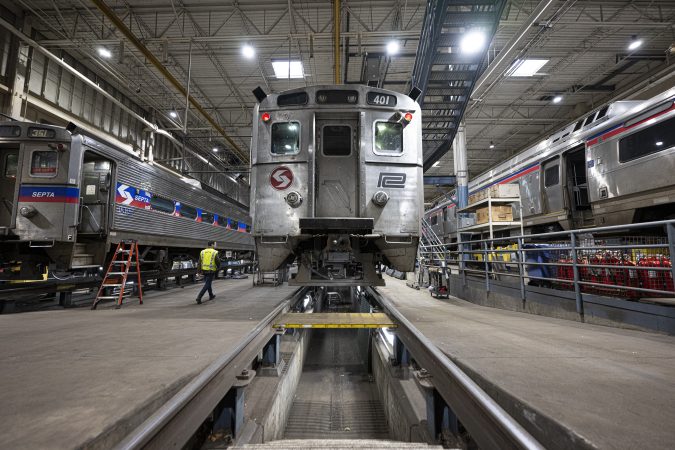
And so on Tuesday, SEPTA is putting out “Accelerate,” its strategic vision for the next decade with investments in a new trolley fleet with stations instead of corner stops, new subway cars for the El, and a reimagined Regional Rail service with more frequent service on critical lines, many in the city.
When those and other, smaller changes are in place, SEPTA says two million people in the region will be within a quarter mile of frequent transit service — up from 900,000 today — and 100% of all trips will go through an accessible station. Today only about 60% of rail and subway stations are accessible.
It’s an ambitious goal, and that’s deliberate, Sauer said.
“You can inspire people to action when you show them what they could get for their investment,” he said.
The idea for a message shift developed as SEPTA representatives and supporters advocated for more state funding last year and lawmakers said that they didn’t have a concrete picture of what SEPTA wants to be and what that would take.
Instead of a demand, the report is framed as a menu of choices for legislators, local officials, business leaders, and the public.
SEPTA projects a structural operating deficit of $192 million in the coming fiscal year. If the state meets that, current levels of service would be preserved along with some improvements.
Beyond that — including a plan to reorganize Regional Rail so trains run every 15 minutes on lines in the city and some suburbs — would require more funding. As would making 50 old stations ADA accessible.
“If you ask me how much do you need, I would say I need enough to do what the people want us to do,” Sauer said.
Last year, Harrisburg lawmakers and the Shapiro administration failed for the third straight year to agree on a steady source of new state funding for SEPTA and other transit agencies.
The transit agency also says it has found about $30 million in annual savings, as well as increased income from advertising, parking, and real estate, and a spike in ridership during a busy summer of big events.
Sauer said SEPTA needs to chip away at changes right away, using what’s at hand, rather than waiting to accomplish a big project in a decade.
“We can’t have everything all at once, so we are trying to move methodically,” he said. “We have to show people continual improvement.”
Philadelphia police responding to a reported shooting found a teen fatally wounded inside a mini-market Monday night in the Summerdale section of the Lower Northeast.
Around 8:45 p.m., 2nd District police found the 18-year-old lying unresponsive in the customer takeout area of the store at the corner of Marcella Street and Summerdale Avenue, said Chief Inspector Scott Small.
The victim, who was described by store employees as a regular customer, was transported by police to Jefferson Einstein Philadelphia Hospital, where he was pronounced dead at 8:59 p.m.
Police found one spent shell casing next to the man’s body inside the store, and at least 25 outside on the sidewalk and on Summerdale Avenue, Small said.
Stray bullets pierced two separate second-floor windows of nearby residences.
“Although the occupants were very shaken up, nobody was struck,” Small said.
Also nearby, police found a Nissan sedan that had hit several parked cars. The two driver-side doors were open and the engine was still running, Small said.
The car, which was considered part of the crime scene, did not have bullet holes, Small said.
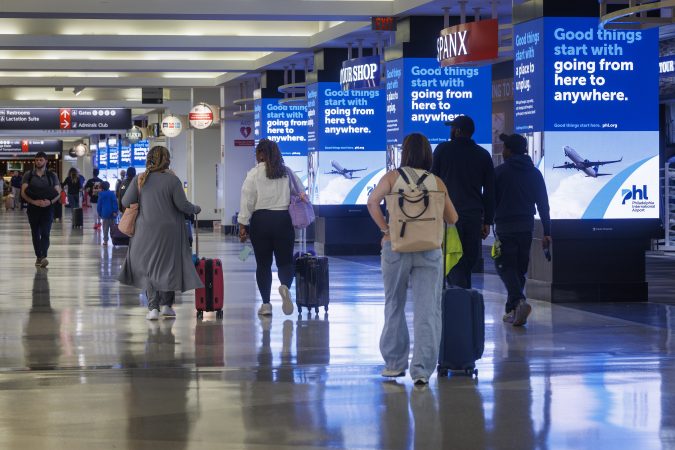
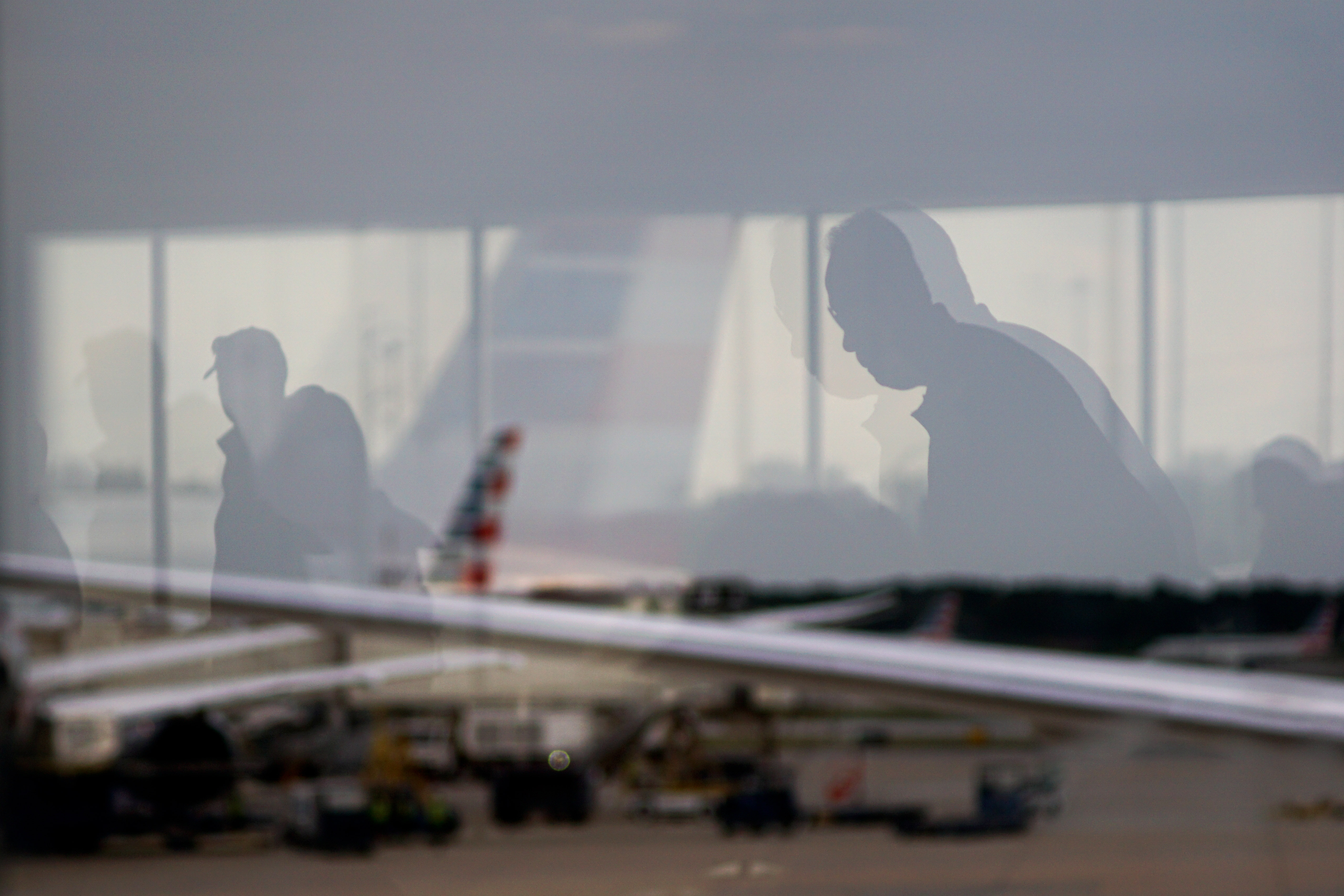
Flights into Philadelphia International Airport were grounded for much of the day Monday due to a stop instituted by the Federal Aviation Administration that impacted hundreds of flights in the Northeast in the wake of equipment outages.
Incoming flights were briefly allowed to resume at one point, but were again halted a short time later, according to the FAA’s airspace system status. The ground stop was again lifted at about 5 p.m. Monday.
As of late Monday afternoon, PHL had experienced about 400 delays and 200 cancellations, according to data from flight tracking website FlightAware. Some airlines were allowing their customers to change flights without fees. The FAA advised travelers to check the status of their flights with their airline before heading to the airport.
On Monday night, arrivals and departures at Philadelphia were still delayed by an average of at least two hours, according to Flighty, the popular flight-tracking app.
During the stops, FAA said planes departing from a U.S. airport and heading to PHL should remain on the ground. At times, flights at John F. Kennedy International Airport, LaGuardia Airport, Newark Liberty International Airport, and Bergen County’s Teterboro Airport were also affected.
The ground stop came after a circuit failed at an air traffic control tower in Philadelphia, and officials found that a line from a backup system was cut at a construction site in New Jersey, FAA Administrator Bryan Bedford said. The technical problems happened at the same FAA facility in Philadelphia that caused numerous disruptions at Newark Liberty International Airport in spring 2025.
“Unfortunately, that circuit failed today,” Bedford said at a Monday news conference. “And when it went to flip into the backup, we discovered that the backup fiber had a break, and that fiber break is probably 13 hours to repair.”
Bedford described the break as “massive,” and said it consisted of about 600 feet of fiber line somewhere between New Brunswick and Newark. It was not immediately clear when the break in the fiber line for the backup occurred, he said.
Verizon said contractors had dug up and cut the cable that runs along the Amtrak rail line in New Jersey. The company said in a statement that its technicians were racing to get the cable fixed.
Transportation Secretary Sean Duffy said the ground stop showed the need for more funding to modernize infrastructure.
“This is not shocking to us,” Duffy said. “It’s an old system that we’re stuck working with.”
The FAA on Monday also began testing a new computer system that uses AI to help predict schedule conflicts and weather issues, but it did not appear to be linked to the outage because it was only being tested in the Washington, D.C., area.
Inquirer staff writer Robert Moran contributed to this article, which also contains information from the Associated Press.
In the wake of the devastating 2010 earthquake in Haiti, Camille Joseph and his family left the island for a better life in Philadelphia.
Joseph found that in the city, said his sister, Ophtanie. But his life was tragically cut short on Sept. 11, when first responders found the 25-year-old in the parking lot of a bustling Nicetown shopping center suffering from a gunshot wound to the chest.
He was pronounced dead shortly after arriving at Temple University Hospital. Police have not identified a suspect or motive as they continue to investigate.
More than a week after the crime, Joseph’s family members and detectives remain puzzled by the killing.
Family members say they cannot fathom why anyone would have wanted to hurt Joseph, a mechanic and a security guard at the Center City bar Time.
“It’s not fair,” said Ophtanie Joseph, who is urging anyone with information about her brother’s death to come forward. “This doesn’t make any sense.”
Sources close to the investigation said the incident began after Joseph pulled into the shopping center parking lot on the 2800 block of Fox Street in his SUV that evening.
Meanwhile, another SUV being driven by a person police have yet to identify also pulled into the lot and crashed into a wall, the source said.
Investigators believe Joseph and the driver of the crashed SUV then got into an altercation before Joseph was shot and killed, though they have yet to figure out why the two parties interacted.
After the shooting, the damagedSUV fled the parking lot along with Joseph’s SUV, which investigators believe was being driven either by a shooting suspect or someone who was traveling with Joseph.
Police were called to the scene around 5:20 p.m. and later discovered Joseph’s vehicle abandoned nearby.
Investigators are now seeking search warrants for security footage from businesses in the shopping center in an effort to piece together the moments before Joseph’s killing and identify a suspect.
Ophtanie Joseph said her brother’s death was a tragedy.
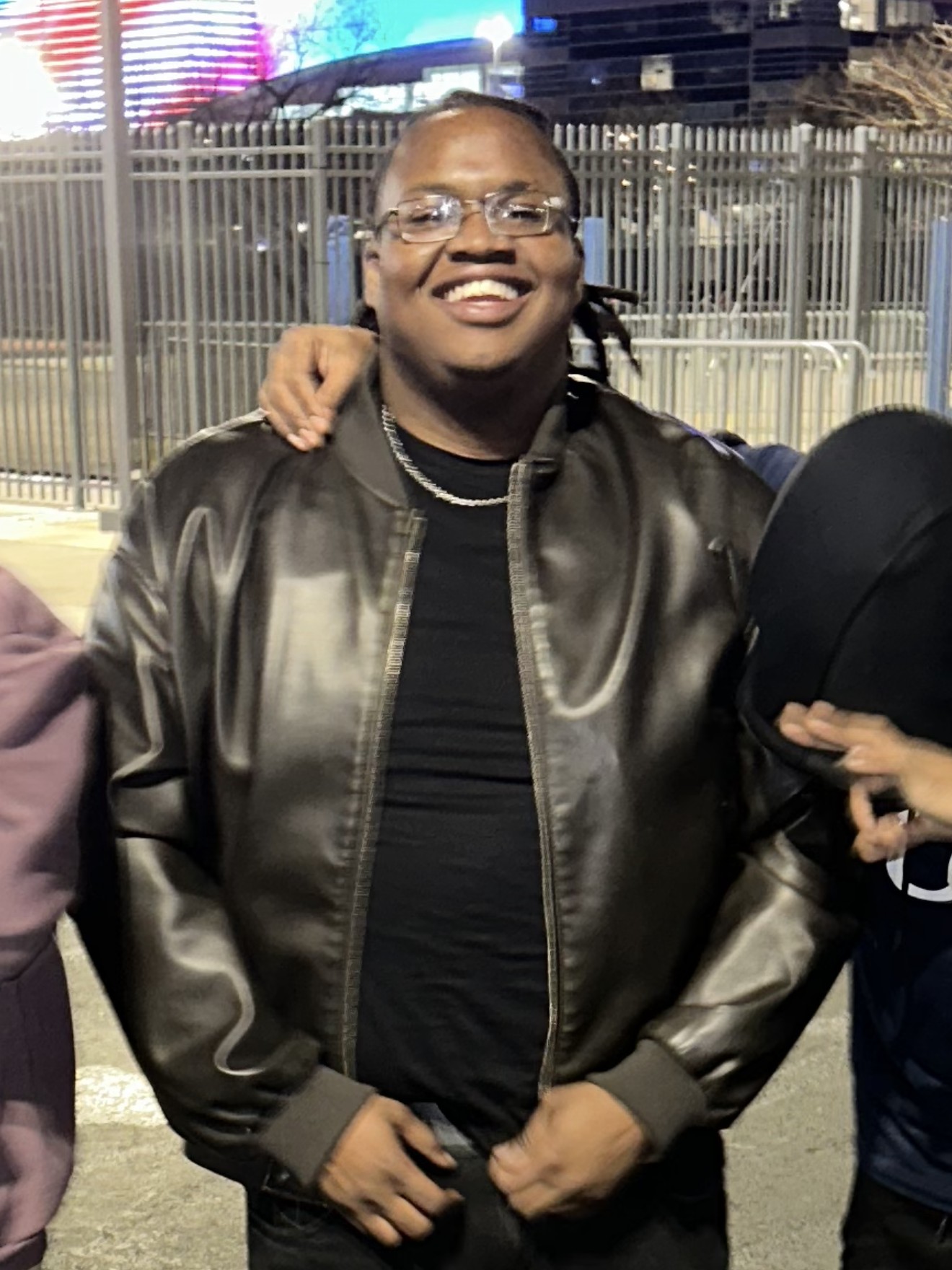
A photo of Camille Joseph.Ophtanie Joseph
He had built a life in Philadelphia after their family left Haiti, she said, attending Benjamin Rush High School, where he played the tuba in the school band and competed in soccer and baseball.
After graduation, he went to trade school to become a mechanic, following the path of his father, his sister said.
He worked at auto shops around the city and was quick to help out friends and family when they had car trouble, she said.
Most recently he worked in security at Time, a whiskey bar and restaurant on Sansom Street. Ophtanie Joseph said her brother loved his job, where he met musicians and local celebrities who passed through the lively establishment and event space.
Camille Joseph was supposed to clock in at 6 p.m. the evening of his killing, his sister said. She later learned that managers began to worry when he never showed up.
“His life wasn’t supposed to stop here,” Ophtanie Joseph said. “He had a lot of dreams: He wanted to have his own mechanic shop, he wanted to travel. He didn’t deserve this.”
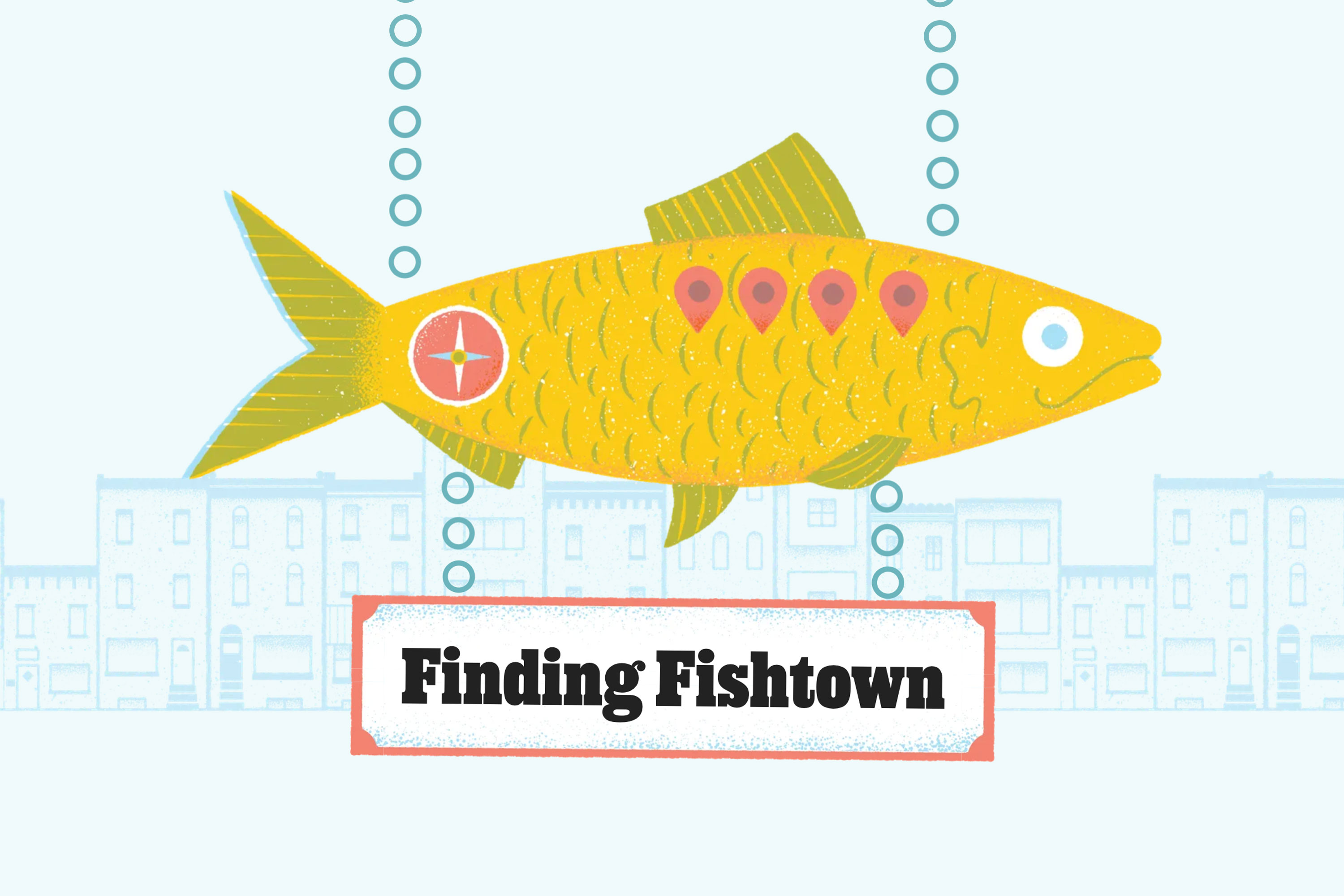
“There never really was a Fishtown, government-wise. It was a localism,” explains Kenneth Milano, a Kensington-born historian and cofounder of the Kensington History Project. Perhaps this is why it’s hard to know exactly where Fishtown’s boundaries are.
“No one [in the old days] would ever call above York Street ‘Fishtown.’ That would have been sacrilege,” Milano said. “With the new folks, they don’t know. The [real estate agent] told them.”
story continues after advertisement
Decades of gentrification in the River Wards have blurred the lines as developers tagged their properties with the coveted Fishtown brand, even as they ventured into what were generally defined as sections of Kensington. (And which Kensington? East Kensington? Olde Kensington? South Kensington? How about Norris Square? And Olde Richmond? And Port Richmond?)
The argument is about more than what to call a few blocks: A neighborhood name can shape a place’s identity, its perceived desirability, and even how it is marketed and valued.
Click anywhere on the map to start drawing your Fishtown boundary
Milano said parish boundaries originally helped reinforce neighborhood identity. Milano, 67, has lived on York Street since age 5 and described the conventional Fishtown as a triangle bounded by Norris, Frankford, and the Delaware River.
The Inquirer’s map of neighborhoods agrees with Milano — although it’s worth mentioning that this map, used internally to help our reporting stay consistent, was created in the 1980s. The Milano-Inquirer definition is definitely conservative when compared to more recent attempts to set boundaries.
By contrast, Zillow’s Fishtown is nearly twice the size. The real estate website includes not only Front Street to the west, but also goes as far north as Lehigh Avenue.
Zillow maintains its own set of neighborhood boundaries “by reviewing sources such as city maps, the Census Bureau, and neighborhood associations,” Zillow spokesperson Briahna Healy said.
There’s some overlap between Zillow’s boundaries and the 19125 zip code. While residents might feel a strong attachment to the last five digits of their address, zip codes exist solely to help route mail. This makes it hard to use 19125’s scraggly borders to define Fishtown — especially when sections that reach that far north are Kensington by any definition.
Somewhere in the middle is the Fishtown Neighbors Association border — sticking with Front Street to the west but extending only as far as York Street to the north. These boundaries “go back about 20 years when FNA was a community organization that needed boundaries to help dictate what projects to work on,” said John Scott, current president of the FNA.
Their boundaries are a single piece in a jigsaw puzzle with surrounding neighboring associations. It explains why some streets are included and others aren’t. For example, the area between Front Street and Frankford Avenue is included because “if we didn’t include them, they would probably be stateless,” Scott said.
This also means that a lot of boundaries are largely codified because the FNA can’t expand without encroaching on neighboring associations — unless, that is, new streets are built, like those in the Northbank development on the Delaware. Now the FNA is about to adjust its boundaries for the first time in a quarter-century to encompass streets south of Schirra Lane.
If we look at all of these definitions at the same time, there is a clear overlap that we can safely call Fishtown.
However, much of the fringe is up for debate. Does Fishtown stop at Front or Frankford, for example? Is York the border, or is it Norris, or even Lehigh?
It’s time for some good, old-fashioned, boots-on-the-ground reporting.
A defining feature of Fishtown are the whimsical fish signs on house facades. Our theory: Surely a painted fish wouldn’t make sense in Kensington. We hit the streets and logged every house that had a fish sign.
Largely, the signs are contained to the FNA-defined borders. But we found a large pocket of signs east of York Street and even a few signs north of Frankford — although they are outnumbered by milk bottle signs to honor Kensington’s old Harbisons Dairy plant.
Fish signs are only one way to delineate Fishtown boundaries. We also looked at restaurants and what neighborhood they describe themselves as belonging to: Fishtown, Kensington, or unsure.
Fishtown has been known for its dining scene since Johnny Brenda’s established the beachhead in 2003. As development marched on, restaurateurs and dining guides followed the cue of developers and real estate agents: We’re in Fishtown.
Today, that’s not entirely the case, as even upscale restaurants are comfortable calling themselves Kensington, though they could claim Fishtown. At Fiore, chefs Ed Crochet and Justine MacNeil use East Kensington for their Italian restaurant north of the York Street roundabout. Directly across is Emilia, chef Greg Vernick’s popular new Italian spot, which doesn’t state its neighborhood in its marketing materials. Resy, its reservation booking platform, calls it Fishtown-East Kensington.
Seemingly everyone says Middle Child Clubhouse is in “Fishtown.” But by dint of its location on the west side of Front Street, it’s arguably in South/Olde Kensington. Yuhiro, a sushi restaurant on Susquehanna Avenue just west of Frankford, markets itself as Fishtown but it could be considered in Kensington.
Then there are the restaurants where it’s even more unclear because they list multiple neighborhoods, or none at all. For example, Picnic, on Martha Street, uses East Kensington in its Instagram bio but has used Fishtown in public relations campaigns. Where is Meetinghouse, a noted bar at Memphis and Cumberland Streets? Chef/co-owner Drew DiTomo thought for a moment: “Its parish is St. Anne’s and I quite like that.”
Finally, we decided to ask people in the gray areas a simple question: “Where are we?”
We found Matt Murphy and Kaitlin Dirkx at Hagert and Tulip Streets — south of Lehigh, north of York, still in 19125. “It’s kind of a curious pocket of the River Wards,” said Murphy, who emphatically called the area “Olde Richmond.” But, as Dirkx added, “they let me into the Fishtown Neighbors Facebook group. My address must have fallen in line.”
Mark Opdyke, who lives on a side street just west of Frankford Avenue near Norris, insisted that his side of Blair Street is in Fishtown. He pointed across the street toward the Blair Garden townhouses, built in 2018 and sold as “Fishtown,” chuckled, and called that side “Kensington.”
At Frankford and Dauphin, Nick Campione’s family has owned AC Auto Repairs for 70 years. Its facade boasts a mural proclaiming, “Welcome to the Neighborhood” with an inscription explicitly describing it as “Fishtown and East Kensington.” Campione won’t take sides: “This is the best of both worlds here.”
Finally, we caught up with Stephanie Goodman and Justin Frye on the west side of Frankford Avenue near Dauphin, in front of the Groove Hound, a doggie day care. Goodman called that stretch Fishtown, adding that it’s two blocks from the house she bought in 2018 across from Philadelphia Brewing Co., which proudly says it belongs to East Kensington. Though Goodman said the real estate agent advertised her block as Fishtown, Frye believes it’s in East Kensington. “Ten different people and 10 different answers,” he said.
So it’s now time for you to decide. Let us know where you think the boundaries of Fishtown are by drawing on the map.
Thanks for drawing your boundaries. Please reach out to interactives@inquirer.com and let us know why you believe these are the boundaries of Fishtown.
This is where the average reader submission currently lays.
Staff Contributors
Design, Development, and Reporting: Sam Morris
Reporting: Michael Klein
Sign Auditors: Sam Morris and Jasen Lo
Illustration: James Olstein
Editing: Charmaine Runes
Copy Editing: Brian Leighton
story continues after advertisement
Subscribe to The Philadelphia Inquirer
Our reporting is directly supported by reader subscriptions. If you want more journalism like this story, please subscribe today
// used for lite color theming and debug buttons only
$colors: (
“purple”: $color-purple,
“pink”: $color-pink,
“red”: $color-red,
“orange”: $color-orange,
“yellow”: $color-yellow,
“green”: $color-green,
“teal”: $color-teal,
“light-gray”: $color-light-gray,
“light-blue”: $color-light-blue,
“blue”: $color-blue,
“black”: $color-black,
“white”: $color-white
);
`;var Wn=tr();var Y=(i=null)=>{let u=Kt.split(`
`),r={};return u.forEach(e=>{let o=e.trim().match(/^$color-([w-]+):s*([^;]+);/);if(o){let s=o[1],n=o[2];r[s]=n}}),i&&r[i]?r[i]:r};var rr=(i,u=null,r=null)=>{r||(r=document.querySelector(“head”));let e=document.createElement(“script”);e.type=”text/javascript”,e.src=i,u&&(e.onload=u),r.appendChild(e)},Ve=()=>(window.PMNdataLayer?.[0]!==void 0&&window.PMNdataLayer[0])?.analytics?.user?.state===”Subscribed”,je=()=>{let u=(window.PMNdataLayer?.[0]!==void 0&&window.PMNdataLayer[0])?.analytics?.user?.state;return window.location.host.includes(“zzz-systest”)||window.location.host.includes(“pmn.arcpublishing.com”)||window.location.host.includes(“stage.fusion.inquirer.com”)||typeof u>”u”},or=()=>{let u=(window.PMNdataLayer?.[0]!==void 0&&window.PMNdataLayer[0])?.analytics?.user?.hasAdsFreeReading;return!!(u&&u==1)},Ae=()=>window.location.host.includes(“localhost”);var To=i=>{(i&&i.querySelector(“.js-loading”))?.setAttribute(“data-state”,”ready”)},Bo=i=>{(i&&i.querySelector(“.js-loading”))?.setAttribute(“data-state”,”loading”)},bo=(i,u)=>{(i&&i.querySelector(“.js-loading”))?.setAttribute(“data-state”,”error”),u&&targetModalErrorEl&&(targetModalErrorEl.textContent=u)},We={stop:i=>To(i),start:i=>Bo(i),error:(i,u)=>bo(i,u)};var ce=document.querySelector(“.js-map-tooltip”),Eo=()=>{ce.classList.remove(“is-hidden”)},Io=()=>{ce.classList.add(“is-hidden”)},ko=(i,u)=>{i&&u&&matchMedia(“(pointer:fine)”).matches?(ce.style.top=i+”px”,ce.style.left=u+”px”):(ce.style.top=””,ce.style.left=””)},Do=(i,u)=>{i==”pre”?ce.textContent=”Click to place the first point”:i==”mid”&&(u{window.addEventListener(“resize”,()=>{ct&&setTimeout(()=>{lr()},300)})},Vo=()=>{rr(“https://interactives.inquirer.com/storage/dependencies/maplibre/5.3.0/maplibre-gl.js”,()=>{let i=new zt;Le=window.maplibregl,Le.addProtocol(“pmtiles”,i.tile);let u=”https://interactives.inquirer.com/melish/1.3″,r=`${u}/north-america.pmtiles`,e=new Oe(r);i.add(e),e.getHeader().then(async()=>{let s=await(await fetch(`${u}/styles/neutral.json`)).json();R=new Le.Map({container:”map”,zoom:13,center:[-75.165222,39.952583],maxBounds:[[-128.362885,24.389629],[-58.886719,52.918839]],attributionControl:!1,interactive:!1,style:{…s,layers:[],sources:{openmaptiles:{type:”vector”,url:`pmtiles://${r}`}}}}),lr(),R.on(“load”,async()=>{for(let f of nr.features)Ko(f.properties.origin,f.geometry);Xo(),st(“people”,sr),st(“signs”,ar),st(“restaurants”,ir),Yo();let y=await(await fetch(“https://interactives.inquirer.com/lyon/2026-fishtown/average.json”)).json();Qo(“readers”,y);let a=R.getCanvas();We.stop(a.closest(“.js-map”)),ct=!0,pt&&ur(pt)}),document.querySelector(“.js-map”).addEventListener(“mousemove”,n=>{jo(n)}),document.querySelector(“.js-map”).addEventListener(“mouseout”,()=>{Wo()}),document.querySelector(“.js-map”).addEventListener(“click”,n=>{Go(n)})})})},lr=()=>{R.fitBounds([-75.14613425987851,39.95952387517457,-75.10908333009395,39.98791745377673],{duration:0})},jo=i=>{if(ve&&ie&&(ue.show(),ue.position(i.clientY,i.clientX),ie==”mid”)){let u=lt(i);xe.features[0].geometry.coordinates[1]=[u.lng,u.lat],R.getSource(“drawing-ghost”).setData(xe),R.setPaintProperty(“drawing-ghost”,”line-opacity”,.5)}},Wo=()=>{ue.hide()},No=()=>{let u=document.querySelector(“.js-map”).getBoundingClientRect().top;u{if(ve){if(ie==”pre”){let u=lt(i);Z.features[0].geometry.coordinates.push([u.lng,u.lat]),xe.features[0].geometry.coordinates[0]=[u.lng,u.lat],document.querySelector(“.js-map-start”).classList.remove(“is-hidden”),pr.setLngLat(u),document.querySelector(“.js-tool-buttons-reset”).disabled=!1,ie=”mid”}else if(ie==”mid”){let u=lt(i);Z.features[0].geometry.coordinates.push([u.lng,u.lat]),xe.features[0].geometry.coordinates[0]=[u.lng,u.lat]}i.target.classList.contains(“js-map-start”)&&Zo(),R.getSource(“drawing-user”).setData(Z),ue.update(ie,Z.features[0].geometry.coordinates.length),ue.show()}},Zo=()=>{ve=!1,ie=”end”;let i=Z.features[0].geometry.coordinates.length,u=Z.features[0].geometry.coordinates[0];Z.features[0].geometry.coordinates[i-1]=u,Z.features[0].geometry.type=”Polygon”,Z.features[0].geometry.coordinates=[Z.features[0].geometry.coordinates],R.getSource(“drawing-user”).setData(Z),R.setPaintProperty(“drawing-user-fill”,”fill-opacity”,.4),R.setPaintProperty(“drawing-ghost”,”line-opacity”,0),document.querySelector(“.js-map-start”).classList.add(“is-hidden”),document.querySelector(“.js-tool-buttons-submit”).disabled=!1},qo=()=>{ve=!0,ie=”pre”,ue.update(ie,0),Z.features[0].geometry.type=”LineString”,Z.features[0].geometry.coordinates=[],R.getSource(“drawing-user”).setData(Z),document.querySelector(“.js-tool-buttons-submit”).disabled=!0,R.setPaintProperty(“drawing-ghost”,”line-opacity”,0),R.setPaintProperty(“drawing-user-fill”,”fill-opacity”,0),document.querySelector(“.js-map-start”).classList.add(“is-hidden”)},lt=i=>{let u=document.querySelector(“.js-map”).getBoundingClientRect(),r=i.clientX-u.left,e=i.clientY-u.top;return R.unproject([r,e])},Jo=()=>{Jt.vote({coordinates:JSON.stringify(Z.features[0].geometry.coordinates[0])})},Ko=(i,u)=>{R.addSource(`boundary-${i}`,{type:”geojson”,data:u}),R.addLayer({id:`boundary-${i}-fill`,source:`boundary-${i}`,type:”fill”,paint:{“fill-color”:Y(“illo-red”),”fill-opacity”:0}}),R.addLayer({id:`boundary-${i}-line`,source:`boundary-${i}`,type:”line”,paint:{“line-color”:Y(“illo-red”),”line-width”:4,”line-opacity”:0}})},Qo=(i,u)=>{R.addSource(`drawing-${i}`,{type:”geojson”,data:u}),R.addLayer({id:`drawing-${i}-fill`,source:`drawing-${i}`,type:”fill”,paint:{“fill-color”:Y(“illo-yellow”),”fill-opacity”:0}}),R.addLayer({id:`drawing-${i}-line`,source:`drawing-${i}`,type:”line”,paint:{“line-color”:Y(“illo-yellow”),”line-width”:4,”line-opacity”:0}})},st=(i,u)=>{let r;window.innerWidth{let i=[{id:”tavern”,coordinates:[-75.13430336980068,39.9690688861316]},{id:”milk”,coordinates:[-75.13290465156766,39.98256059702009]},{id:”pier”,coordinates:[-75.11347715844,39.9714839528569]},{id:”wawa”,coordinates:[-75.11890594948434,39.977239248055895]},{id:”sulimays”,coordinates:[-75.12598489221865,39.971605275979115]},{id:”traffic”,coordinates:[-75.12754751235474,39.98145267435357]}];for(let u of i){let r=document.querySelector(`.js-map-icon[data-id=”${u.id}”]`);new Le.Marker({element:r}).setLngLat(u.coordinates).addTo(R)}},Xo=()=>{R.addSource(“roads”,{type:”geojson”,data:Ne}),R.addLayer({id:”roads”,source:”roads”,type:”symbol”,layout:{“symbol-placement”:”line-center”,”symbol-spacing”:100,”text-field”:”{name}”,”text-font”:[“grot10-regular”],”text-max-angle”:90,”text-pitch-alignment”:”viewport”,”text-rotation-alignment”:”map”,”text-size”:9,”text-transform”:”uppercase”},paint:{“text-color”:”#666″,”text-halo-color”:”#fff”,”text-halo-width”:2}}),cr()},_o=i=>{let u=Object.keys(R.getStyle().sources).filter(r=>r.includes(“boundary-“));for(let r of u){let e=r.includes(i)||i==”all”;R.setPaintProperty(`${r}-line`,”line-opacity”,e?1:0),R.setPaintProperty(`${r}-fill`,”fill-opacity”,e?.2:0)}},en=i=>{let u=Object.keys(R.getStyle().sources).filter(r=>r.includes(“drawing-“)&&!r.includes(“ghost”));for(let r of u){let e=r.includes(i);R.setPaintProperty(`${r}-line`,”line-opacity”,e?1:0),R.setPaintProperty(`${r}-fill`,”fill-opacity”,e?.2:0)}},tn=i=>{let u=Object.keys(R.getStyle().sources).filter(r=>r.includes(“points-“));for(let r of u){let e=r.includes(i);R.setPaintProperty(`${r}`,”circle-opacity”,e?1:0)}},rn=i=>{let u=document.querySelector(“.js-map”);i?u.classList.remove(“is-hiding-icons”):u.classList.add(“is-hiding-icons”)},cr=i=>{let u=JSON.parse(JSON.stringify(Ne.features));u=u.filter(r=>r.properties.defaultVisibility==”visible”),i&&(i=i.split(“,”).map(r=>r.trim()),i=Ne.features.filter(r=>i.includes(r.properties.name)),u=[…u,…i]),R.getSource(“roads”).setData({type:”FeatureCollection”,features:u})},ur=i=>{ct?(i={points:i?.points||null,boundary:i?.boundary||null,drawing:i?.drawing||null,icons:i?.icons||!1,roads:i?.roads||null},_o(i.boundary),en(i.drawing),tn(i.points),rn(i.icons),cr(i.roads)):pt=i},fe={init:()=>{Ho(),Vo()},update:i=>{ur(i)},startDrawing:()=>{ve=!0,ie=”pre”,No()},stopDrawing:()=>{ve=!1},resetDrawing:()=>{qo()},submitDrawing:()=>{Jo()}};var on=()=>{document.querySelector(“.js-tool-buttons-start”).addEventListener(“click”,()=>{pn()}),document.querySelectorAll(“.js-tool-buttons-skip”).forEach(i=>{i.addEventListener(“click”,()=>{fr(),sn(),yr()})}),document.querySelector(“.js-steps-step .js-tool-buttons”).addEventListener(“click”,()=>{nn()}),document.querySelector(“.js-tool-buttons-reset”).addEventListener(“click”,()=>{fe.resetDrawing()}),document.querySelector(“.js-tool-buttons-submit”).addEventListener(“click”,()=>{fe.submitDrawing(),fr(),an(),yr()})},nn=()=>{document.querySelector(“.js-steps-step .js-tool-buttons”).classList.add(“is-hidden”),document.querySelectorAll(“.js-steps-step .js-button”).forEach(i=>{i.disabled=!0})},fr=()=>{document.querySelectorAll(“.js-steps-step.is-hidden”).forEach(i=>{i.classList.remove(“is-hidden”)})},an=()=>{let i=document.querySelector(“.js-tool-buttons-start”).closest(“.js-steps-step”).querySelector(“.inno-p”);i.innerHTML=”This is where you think Fishtown’s borders are.”},sn=()=>{let i=document.querySelector(“.js-steps-step .js-tool-buttons”).closest(“.js-steps-step”),u=parseInt(i.dataset.step),r=document.querySelector(`.js-steps-step[data-step=”${u+1}”]`);r&&r.scrollIntoView({block:”center”})},pn=()=>{document.querySelector(“body”).classList.add(“is-tool-mode”),fe.startDrawing()},yr=()=>{document.querySelector(“body”).classList.remove(“is-tool-mode”),fe.stopDrawing()},mr={init:()=>{on()}};var ln=()=>{or()&&document.querySelectorAll(“.js-adbox”).forEach(u=>{u.classList.add(“is-hidden”)})},dr={init:()=>{ln()}};var me,gr,cn=()=>{me=document.getElementById(“js-inno-toast”)},un=i=>{if(!me)return;me.innerHTML=i,me.classList.add(“is-active”);let u=()=>{me.addEventListener(“transitionend”,fn,{once:!0}),me.classList.remove(“is-active”)};clearTimeout(gr),gr=setTimeout(u,5e3)},fn=()=>{me.innerHTML=””},de={init:()=>{cn()},showToast:un};var Ge,hr=!1,yn=async()=>new Promise(i=>{setTimeout(()=>{console.log(“simulating createShareLink for localhost”),i(“https://inquirer.com/interactives”),mn()},100)}),mn=()=>{let i=document.querySelector(“.js-gift-toast-receiver”);!i||!(i instanceof HTMLElement)||setTimeout(()=>{let u=i?.querySelector(“span”);u&&(u.innerHTML=”Gift link copied to clipboard“)},20)},dn=()=>{let i=window.services?.createShareLink;i&&(Ge=i),Ae()&&(Ge=yn),Ge&&hn()},gn=async i=>{let u=”text/plain”,r=async()=>{try{return await Ge(window.location.pathname)}catch{i.dataset.state=”error”,de.showToast(“Hmm, we couldn’t generate a gift link…”)}},e=new ClipboardItem({[u]:r()});await navigator.clipboard.write([e]).catch(o=>{console.log(o),de.showToast(“Couldn’t copy to clipboard, try again?”),i.dataset.state=”error”}),de.showToast(“Gift link copied to clipboard!”),i.dataset.state=”complete”},hn=()=>{document.querySelectorAll(“.js-gift”).forEach(u=>{(Ve()||Ae()||je())&&u.classList.add(“is-available”)}),document.querySelectorAll(“.js-gift-button”).forEach(u=>{u instanceof HTMLButtonElement&&u.addEventListener(“click”,()=>{u.classList.contains(“disabled”)||(u.dataset.state=”loading”,hr=!0,gn(u),setTimeout(()=>{u.dataset.state=”ready”},2e3))})});let i=document.querySelector(“.js-gift-toast-receiver”);!i||!(i instanceof HTMLElement)||vn(i)},vn=i=>{new MutationObserver(r=>{for(let e of r){let o=[…e.addedNodes].at(0);if(!(o instanceof HTMLElement))return;hr&&de.showToast(o.outerHTML)}}).observe(i,{subtree:!0,childList:!0})},vr={init:()=>{dn()}};var Te,xn=()=>{document.querySelectorAll(“.js-hover”).forEach(i=>{i.addEventListener(“click”,()=>{xr(i)}),i.addEventListener(“mouseenter”,()=>{xr(i)}),i.addEventListener(“mouseout”,()=>{Pr(i)})}),window.addEventListener(“scroll”,()=>{Te!==null&&Pn()})},Pn=()=>{(Te>window.scrollY+100||Te{Pr(i)})},xr=i=>{i.classList.add(“is-visible”),Te=window.scrollY},Pr=i=>{i.classList.remove(“is-visible”),Te=null},wr={init:()=>{xn()}};var Fr=1,ut=class{constructor(u){this.el=u,this.contentPosition=”default”,this.possibleSteps=new Array,this.currentStep=null,this.currentStepEl=null,this.offset=window.innerWidth>960?window.innerHeight*.6:window.innerHeight*.9,this.instanceOfSteps=Fr,Fr++,this.setPossibleSteps(),this.updateContent(),this.bindings()}setPossibleSteps(){this.el.querySelectorAll(“.js-steps-step”).forEach(u=>{u.dataset.step&&this.possibleSteps.push(u.dataset.step)})}bindings(){window.addEventListener(“scroll”,()=>{this.updateContent()}),window.addEventListener(“resize”,()=>{this.updateContent()})}updateContent(){this.updateCurrentStep()}updateCurrentStep(){let u;if(this.el.querySelectorAll(“.js-steps-step”).forEach((e,o)=>{e.getBoundingClientRect().top{let n=”is-“+o,y=”is-“+s;this.possibleSteps.indexOf(o){document.querySelectorAll(“.js-steps”).forEach(i=>{new ut(i)})}};var wn=(i,u,r)=>{document.querySelectorAll(“.js-subscribe”).forEach(e=>{e.classList.toggle(“is-unsubscribed”,!i),e.classList.toggle(“is-preview”,u),e.classList.toggle(“is-dev”,r)})},Cr={init:()=>{wn(Ve(),je(),Ae())}};var Fn=()=>{},Mr={init:()=>{Fn()}};var Ar={init:()=>{Mt.init?.(),mr.init?.(),dr.init?.(),vr.init?.(),wr.init?.(),We.init?.(),fe.init?.(),Sr.init?.(),Cr.init?.(),Mr.init?.(),de.init?.()}};var Sn=()=>{},Lr={init:()=>{Sn()}};var Cn=document.querySelector(“.js-inno”),Tr=()=>{Ar.init(),Lr.init()};Cn?Tr():new MutationObserver((u,r)=>{if(document.querySelector(“.js-inno”)){r.disconnect(),Tr();return}}).observe(document,{attributes:!0,childList:!0,subtree:!0});})();
/*! Bundled license information:
matter-js/build/matter.js:
(*!
* matter-js 0.20.0 by @liabru
* http://brm.io/matter-js/
* License MIT
*
* The MIT License (MIT)
*
* Copyright (c) Liam Brummitt and contributors.
*
* Permission is hereby granted, free of charge, to any person obtaining a copy
* of this software and associated documentation files (the “Software”), to deal
* in the Software without restriction, including without limitation the rights
* to use, copy, modify, merge, publish, distribute, sublicense, and/or sell
* copies of the Software, and to permit persons to whom the Software is
* furnished to do so, subject to the following conditions:
*
* The above copyright notice and this permission notice shall be included in
* all copies or substantial portions of the Software.
*
* THE SOFTWARE IS PROVIDED “AS IS”, WITHOUT WARRANTY OF ANY KIND, EXPRESS OR
* IMPLIED, INCLUDING BUT NOT LIMITED TO THE WARRANTIES OF MERCHANTABILITY,
* FITNESS FOR A PARTICULAR PURPOSE AND NONINFRINGEMENT. IN NO EVENT SHALL THE
* AUTHORS OR COPYRIGHT HOLDERS BE LIABLE FOR ANY CLAIM, DAMAGES OR OTHER
* LIABILITY, WHETHER IN AN ACTION OF CONTRACT, TORT OR OTHERWISE, ARISING FROM,
* OUT OF OR IN CONNECTION WITH THE SOFTWARE OR THE USE OR OTHER DEALINGS IN
* THE SOFTWARE.
*)
*/
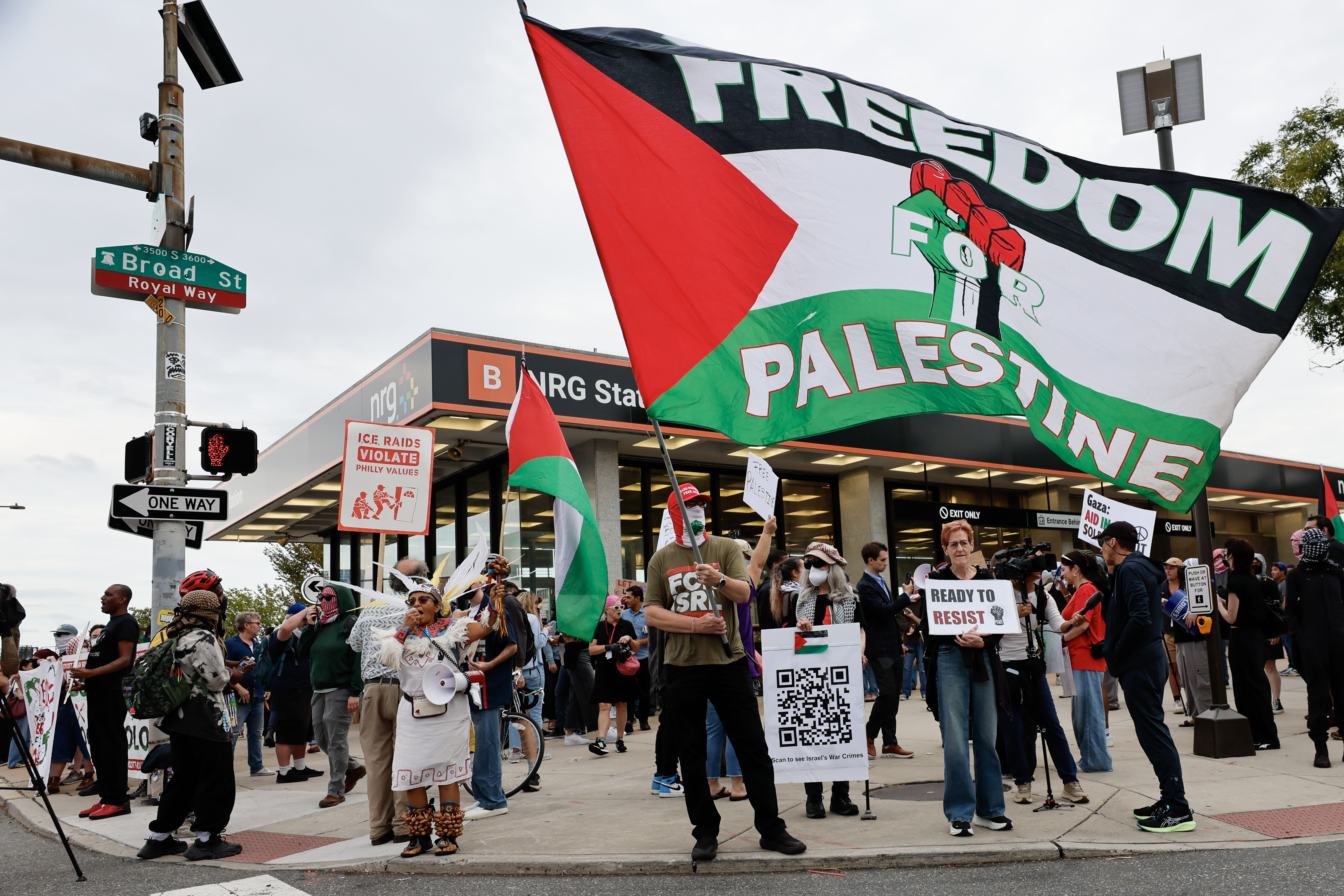
“I’ve had to take and make difficult decisions, and I am making mistakes, and I am so, so sorry,” Sheeran told the crowd Saturday night at Lincoln Financial Field in South Philadelphia. Earlier in the evening, before the 8 p.m. concert, dozens of pro-Palestinian activists protested outside the Linc for what they called censorship.
The British singer-songwriter said he’s never wanted to disappoint fans or be an “activist musician,” but he’s been thrust into the middle of “important and passionate argument about freedom of speech and the most complex political issue on the planet.”
Earlier this month, the supporting act, “Thrift Shop” rapper Macklemore, performed his 2024 protest song, “Hind’s Hall,” which is about pro-Palestinian demonstrators at Columbia University. During the show, Macklemore chanted “Free Palestine” and a screen behind him showed footage from the war in Gaza. In both the song and his statements to the crowd, Macklemore implied he believes the conflict is a genocide.
Afterwards, Macklemore said he had been fired after venues told the tour’s promoter they would prohibit the rapper from performing because of his comments. Sheeran said that venues threatened to “pull” upcoming shows if Macklemore stayed on the billing because of how he “conveyed part of his message.” Both artists attributed those statements to Robert Kraft, owner of Gillette Stadium where Sheeran’s “Loop Tour” is scheduled to stop later this month.
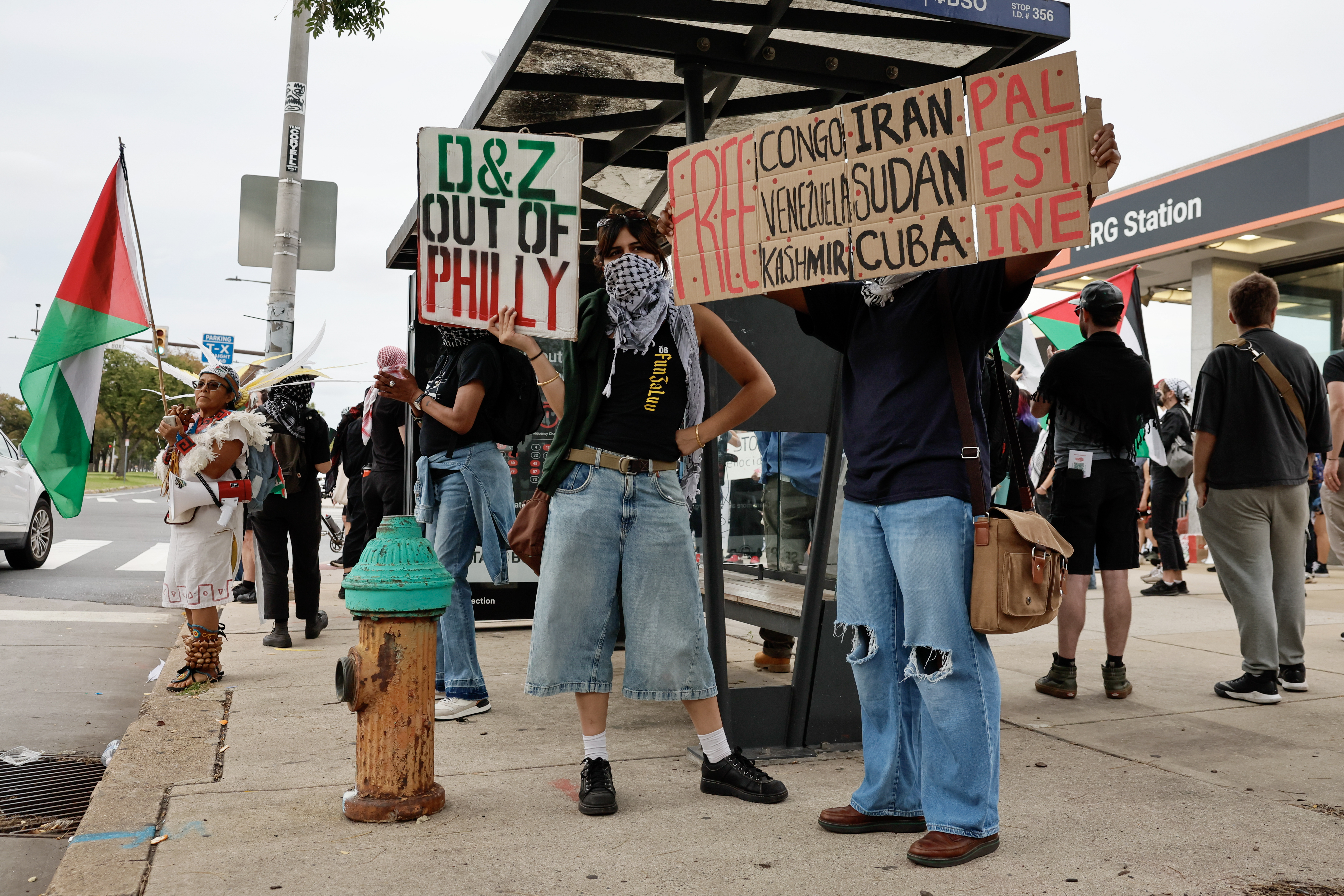
People gather for a protest near NRG Station, outside the Ed Sheeran Concert at Lincoln Financial Field Saturday, Sept. 19, 2026, in Philadelphia.Elizabeth Robertson / Staff Photographer
“I am deeply worried about the idea that venues could pre-approve content and performance,” Sheeran said. “This happens in so many places that I perform around the world, but it should never happen in the free world.”
Sheeran, who has been an apolitical pop figure, acknowledged the Hamas-led attacks on Israel on Oct. 7, 2023, saying it was “horrific and compounded centuries of Jewish pain.” He also said what’s happening in Gaza is “catastrophic and unjustifiable and disproportionate” and that the “systemic injustice we’re seeing unfold in the West Bank cannot be overlooked.”
Throughout the more than two-minute speech, a seemingly emotional Sheeran said that he wants his concerts to be a “safe space for everyone”:
“This concert is still a place where everyone is welcome and everyone here can stand beside people that have opposing views, and everyone here can stand by people that they don’t agree with on everything,” he said, “but they can all agree on singing these songs.”
The airport exposure occurred in Terminals B and F, and in areas connecting to Terminals C, D, and E, on Sunday, Sept. 13, from 7:25 p.m. to Monday, Sept. 14, at 12:05 a.m.
A person with measles was traveling through Philadelphia and stayed in the airport, according to the health department. Officials are encouraging anyone who may have been exposed to check their vaccination status and monitor symptoms.
“Anyone who is not immune, is unsure of their vaccination status, is an infant, is pregnant and not immune, or is immunocompromised should contact a healthcare provider as soon as possible,” the department said in the release on Saturday, adding that some people may still be eligible for treatment that can prevent the disease or reduce its severity.
Officials are urging anyone experiencing symptoms to call ahead before visiting a healthcare facility and notify the provider about the exposure.
“This week’s measles exposures are a reminder of how important it is for all of us to be up to date on our vaccinations,” city Health Commissioner Palak Raval-Nelson said in the statement. “Every Philadelphian who is fully vaccinated has little to fear from the situation at CHOP and the airport. Even more importantly, every one of those people is doing their part to help protect our most vulnerable from measles.”
Raval-Nelson is encouraged residents to visit the city’s website, phila.gov/measles, to learn more about measles and the MMR vaccine.
Pennsylvania’s measles outbreak, the largest in the nation this year, has sickened more than 760 people. The state has confirmed four measles-associated deaths, the most seen in the nation in more than three decades.
The state’s outbreak is centered in Lancaster County, right outside of the Philadelphia region, and measles is actively spreading in suburban Chester County. The widening outbreak has affected more than half of Pennsylvania’s 67 counties.
Two doses of the measles, mumps, and rubella vaccine have proven 97% effective at preventing the disease, the Centers for Disease Control and Prevention says.
Nine in 10 unvaccinated people exposed to measles will acquire the disease.
Typical measles symptoms include a high fever, a cough, runny nose, red, watery eyes, and a rash. Measles can cause severe complications, especially in young children, including pneumonia and brain swelling. While deaths are rare, about three in 1,000 children who contract measles will die.
Measles, long considered eradicated in the United States, is resurging amid declining vaccination rates. Scientists say that about 95% of a community should be vaccinated to prevent spread.
In the Philadelphia region, at least 40% of kindergartens were vulnerable to an outbreak as of last school year, up from 33% the prior year, according to an Inquirer analysis of school immunization data widely used to assess community protection levels.
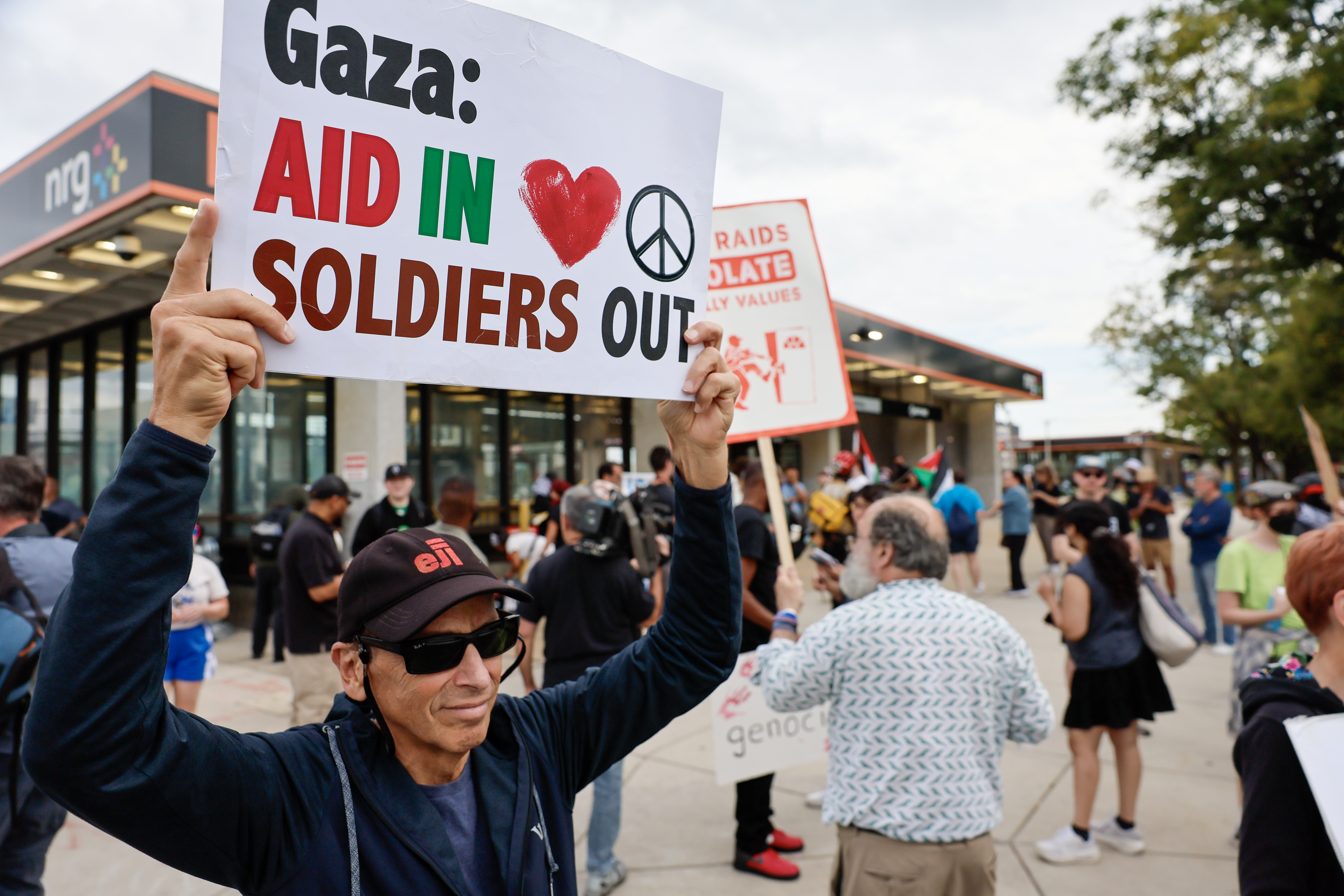
Dozens of activists, some of whom carried Palestinian flags and signs that read “Gaza: Aid In Soldiers Out,” gathered near SEPTA’s NRG Station to decry Macklemore’s firing from the British singer-songwriter’s North American “Loop Tour,” calling the move an act of censorship. Since the “Thrift Shop” rapper was removed from the billing, several other supporting acts have quit in solidarity.
Robert Boucher of Philadelphia (left) gathers with a group for a protest near the sports complex SEPTA station, outside the Ed Sheeran Concert at Lincoln Financial Field Saturday, Sept. 19, 2026, in Philadelphia.Elizabeth Robertson / Staff Photographer
In a statement, Philadelphia’s Jewish Voice for Peace said the opposition to Macklemore’s removal — from the exodus of the other performers to plummeting resale ticket values and demonstrations outside the Linc — shows that “support for Palestinian liberation is growing daily.”
On Ticketmaster, tickets were reselling for as low as $32.25 hours before the 8 p.m. start time. On Friday afternoon, the least expensive ticket on the resale website had been $66.30.
“I’ve had to take and make difficult decisions and I am making mistakes, and I am so, so sorry,” Sheeran said, adding that he’s never wanted to disappoint fans or be an “activist musician.” But, he said, he has been thrust into the middle of “important and passionate argument about freedom of speech and the most complex political issue on the planet.”
Sheeran acknowledged the Hamas-led attacks on Israel on Oct. 7, 2023, saying it was “horrific and compounded centuries of Jewish pain.” He also said what’s happening in Gaza is “catastrophic and unjustifiable and disproportionate” and that the “systemic injustice we’re seeing unfold in the West Bank cannot be overlooked.”
The singer reiterated that he wants his concerts to be a “safe space for everyone”: “This concert is still a place where everyone is welcome and everyone here can stand beside people that have opposing views, and everyone here can stand by people that they don’t agree with on everything, but they can all agree on singing these songs,” he said.
Outside, grassroots organizer Adi Chattopadhyay, a West Philly resident, said the purpose of the protestwas meant to direct the attention back to the war in Gaza.
“Palestinians are very still under occupation,” Chattopadhyay said. “I’m here today to spread that message and tell people why Macklemore was saying ‘Free Palestine.’”
During shows earlier this month at MetLife Stadium in East Rutherford, N.J., while performing his 2024 protest song, “Hind’s Hall,” about pro-Palestinian demonstrators at Columbia University, Macklemore chanted “Free Palestine” and a screen behind him showed footage from the war in Gaza. In “Hind’s Hall” and in his statements to the crowd, Macklemore implied that he believes the conflict is a genocide.
Macklemore and Sheeran posted dueling Instagram statements this week. Macklemore said he had been fired after venues told the tour’s promoter they would prohibit the rapper from performing because of his comments. Sheeran said that venues threatened to “pull” forthcoming shows if Macklemore stayed on the billing because of how he “conveyed part of his message.” Those venues included the Linc, Rolling Stone reported.
Both performers attributed these statements to New England Patriots owner Robert Kraft, whose Kraft Group also owns Gillette Stadium in Foxborough, Mass., where Sheeran’s “Loop Tour” is scheduled to stop later this month. Macklemore said Kraft “rallied some of the other stadium owners and collectively they gave him an ultimatum.”
In a widely reported statement, Kraft, who is Jewish, confirmed he had Macklemore removed as an opening act because of his “recent actions,” material from the New Jersey shows, and “a broader history of antisemitic rhetoric and imagery that we believe has been deeply offensive and hurtful to the Jewish community.”
Gillette Stadium “[does] not provide a platform for hate speech,” the statement said, and Macklemore’s participation in the concert would “cross that line.”
To Saturday’s crowd, Sheeran said he was “deeply worried about the idea that venues could pre-approve content and performance,” adding that “it should never happen in the free world.”
Near the Linc, protester Jodi Rhoden criticized Kraft’s role in Macklemore’s firing.
“Even Ed Sheeran isn’t free of it,” she said. “He had to kick his buddy off his tour because Robert Kraft told him to, because of Israel.”
Nicholas McCarty came early to the concert. He said he is sympathetic to the protest but thinks it’s unfair to blame Sheeran for what happened.
“Robert Kraft pushing Ed Sheeran’s promoter to nuke his contract wasn’t on Ed Sheeran,” McCarty said.
McCarty said he is also a fan of Macklemore, and he’s disappointed he wouldn’t get a chance to see him Saturday.
“It would’ve been a whole different experience if Macklemore is here,” he said.
Others, including Bucks County-bred pop star Pink — who reposted social media posts critical of Macklemore’s performance — have cited a 2014 incident where Macklemore wore a costume with a false nose and beard that many saw as antisemitic. At the time, Macklemore said that was not his intention and apologized.
“More than once, Macklemore’s actions have demonstrated hostility toward the Jewish community,” Jason Holtzman, chief of the Jewish Community Relations Council of the Jewish Federation of Greater Philadelphia, said in a statement.
“‘Free Palestine’ means different things to different people,” his statement continued. “When the slogan comes from a stadium stage, from someone with this history, a Jewish person in the crowd has no way of knowing which meaning is intended. For Jewish concert goers, that ambiguity is deeply unsettling.”
In a social media post, Pink, who is Jewish, took issue with Macklemore showing “violent images” of Israel’s military campaign in Gaza and “[telling] all of the Jews in the stadium that it wasn’t about them.”
“I have never asked for another artist to be silenced and I’m not asking now. I don’t need anyone fired, and I don’t need a refund,” she wrote. “What I need is to be able to say, as a Jewish mom, ‘that scared me, and it scared people I love,’ without being told our fear is just propaganda, and without being told I’m somehow cool with genocide because I noticed?”
Holtzman said Macklemore “remains free to express his views,” while private tour organizers and venues “are free to decide that his conduct is inconsistent with the environment they want to create for their audiences.”
The Linc is publicly owned by the City of Philadelphia.
On Thursday, the Philadelphia chapter of Council on American-Islamic Relations (CAIR) said it had requested records through Pennsylvania’s Right-to-Know Law to determine whether Kraft had communicated with Philadelphia or Linc officials about Macklemore’s performance.
It’s unknown what the request may yield, if anything. But Ahmet Tekelioglu, executive director of CAIR-Philadelphia, said in a statement that Philadelphians should know who made the decision and whether Macklemore’s pro-Palestinian stance was a factor.
“People are free to agree or disagree with Macklemore,” Tekelioglu’s statement said. “But when institutional power is used to remove an artist from a major Philadelphia stage following his political speech, transparency and accountability are reasonable expectations — especially given the public’s relationship to this stadium.”
Macklemore, who has long been outspoken about the Israeli-Palestinian conflict, wrote on Instagram: “Taking a side can cost you. Money, brand deals, sponsorships, festivals, private shows, relationships and access. I’ve lost all of those things.”
Israeli-American artist Rami Even-Esh, who goes by the stage name Kosha Dillz, said pro-Palestinian protestors are using the Sheeran-Macklemore-fueled moment to address an issue they know little about.
“This should be about Palestinian and Israelis working together,” Even-Esh said. “Sheeran’s never been to Israel. I’ve never been to Nigeria. I’ve never been to Zimbabwe. Wouldn’t it be insane if I started commenting on everything on their politics, and leaving out other things?”
Sheeran’s other supporting acts, Finneas, Aaron Rowe, and Lukas Graham, and the Irish backing band Beoga, have also dropped out of the tour. The North American leg of the “Loop Tour” is scheduled to wrap up Nov. 7 in Tampa, Fla.
Terri Ammon, a decade-long Sheeran fan, was the first in line at one of the the concert gates. She’s not a fan of anyone else who was on the billing.
“I’m here for him,” she said, of Sheeran.
Ammon wasn’t paying attention to the protest or the Macklemore fallout, she said.
“We’re here to have a good time.”
This article contains information from the Associated Press.
The 7th annual Seeds Philly Celebration became a solemn and spirited tribute to Indigenous arts and culture: powwow dancing and flag songs, tepee raisings and fry bread, corn husk dolls and Powowpopart.
But this year’s two-day celebration, Saturday and Sunday at Cherry Street Pier, carried added significance. Founded as a small arts gathering in Fairhill, Seeds Philly has grown to include representatives and traditional dancers from 40 tribal nations and more art booths and performers than ever. And, marking the 250th anniversary of the signing of the Declaration of Independence, the two-day event includes a special artist installation confronting hateful language enshrined in the founding document.
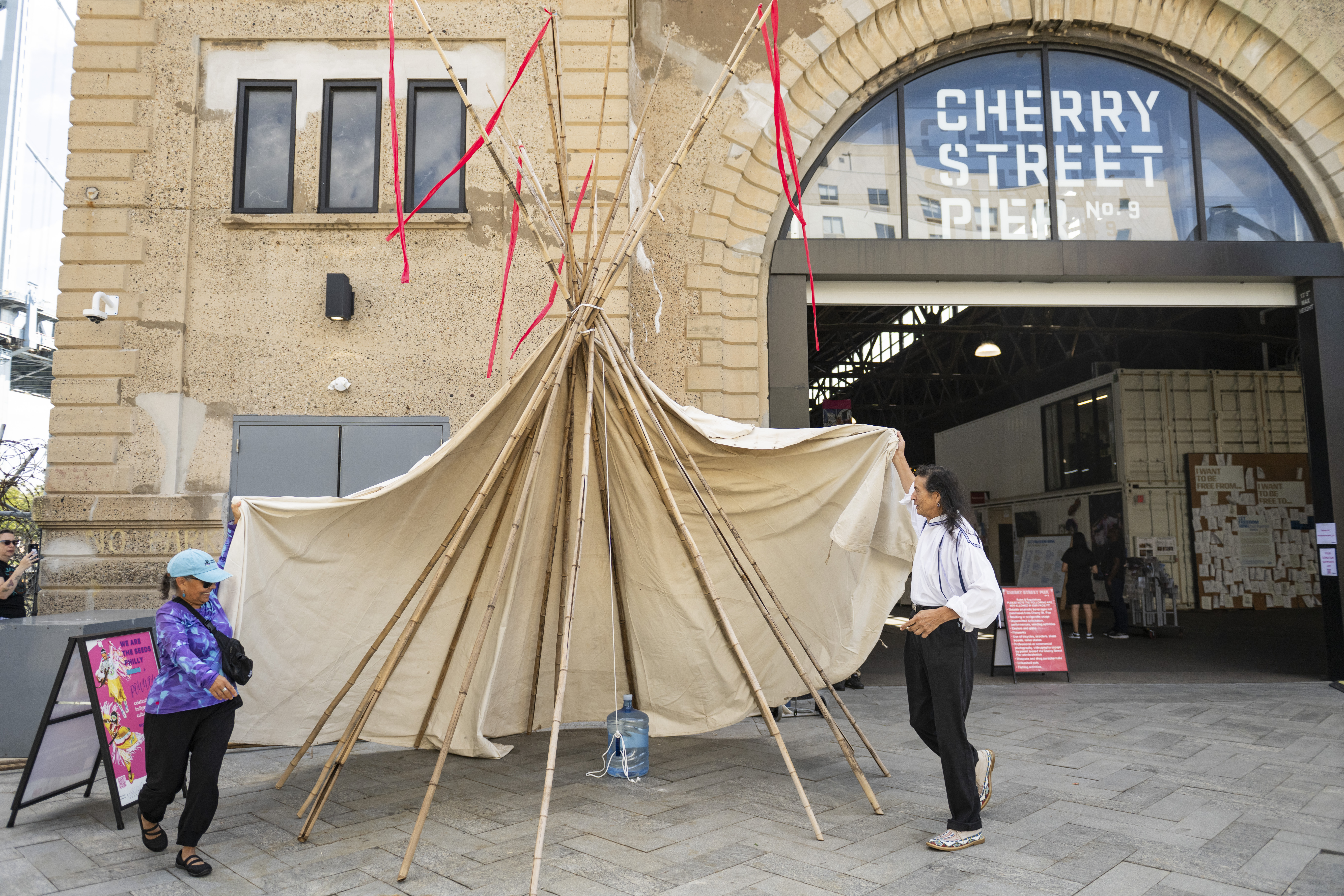
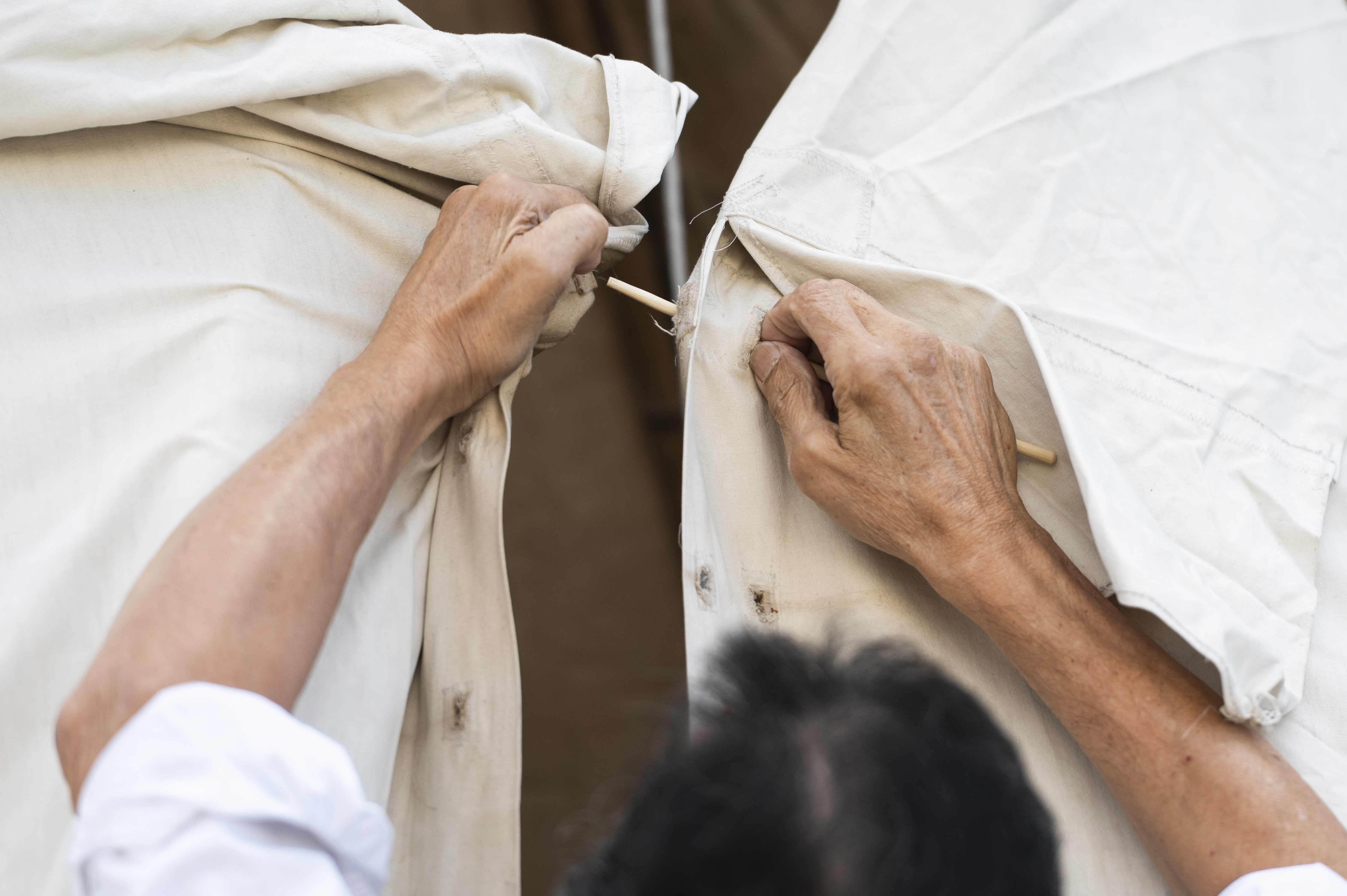
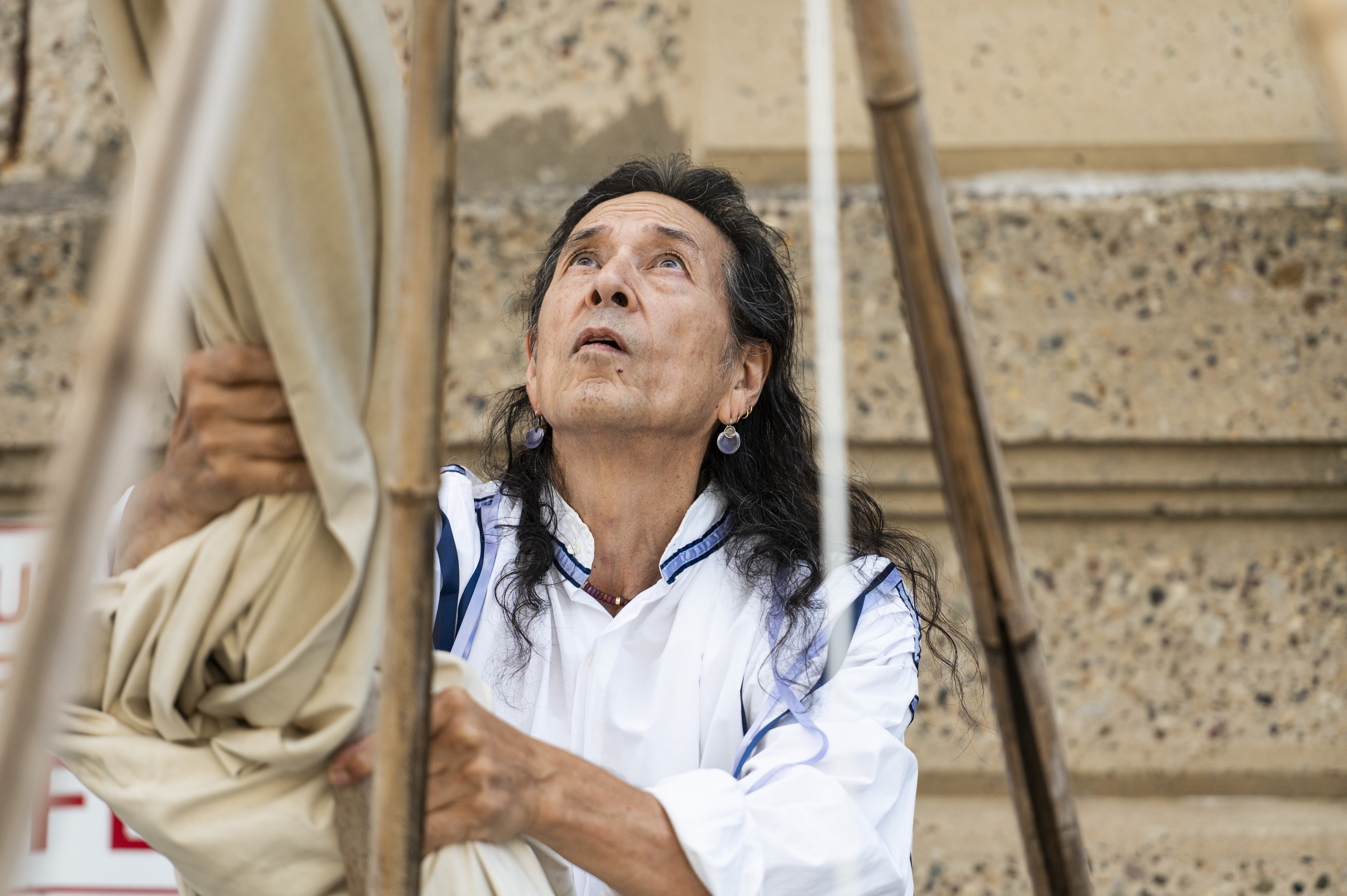
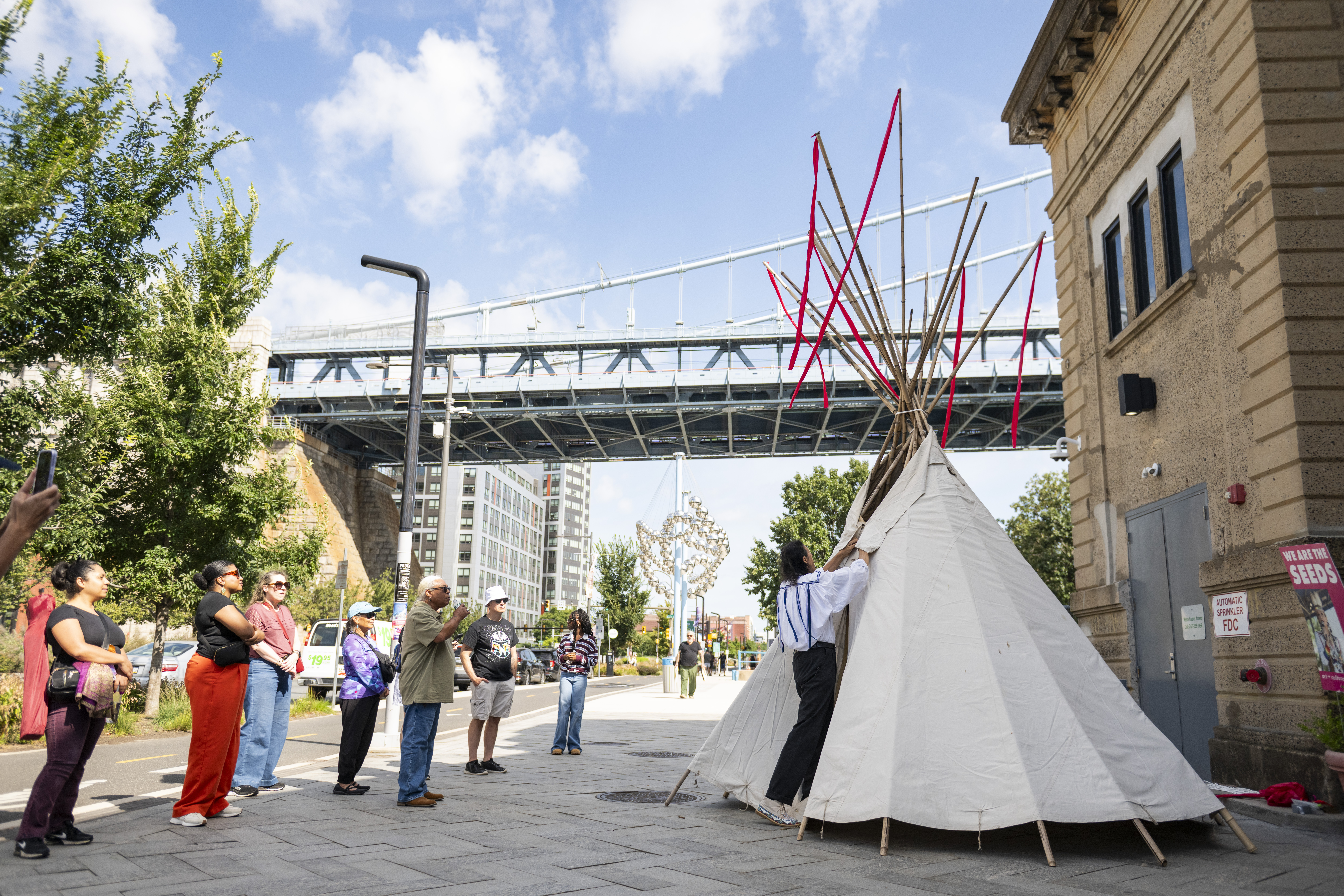
Tchin (left), artist-partner for education and cultural programs at We Are the Seeds, and a volunteer raise a Northern Plains tepee at the Seeds Philly Celebration at Cherry Street Pier on Saturday, Sept. 19, 2026.
This also may be the last Seeds Philly Celebration for the foreseeable future, organizers say. Despite all the gains — and special city funding this year — money has run out.
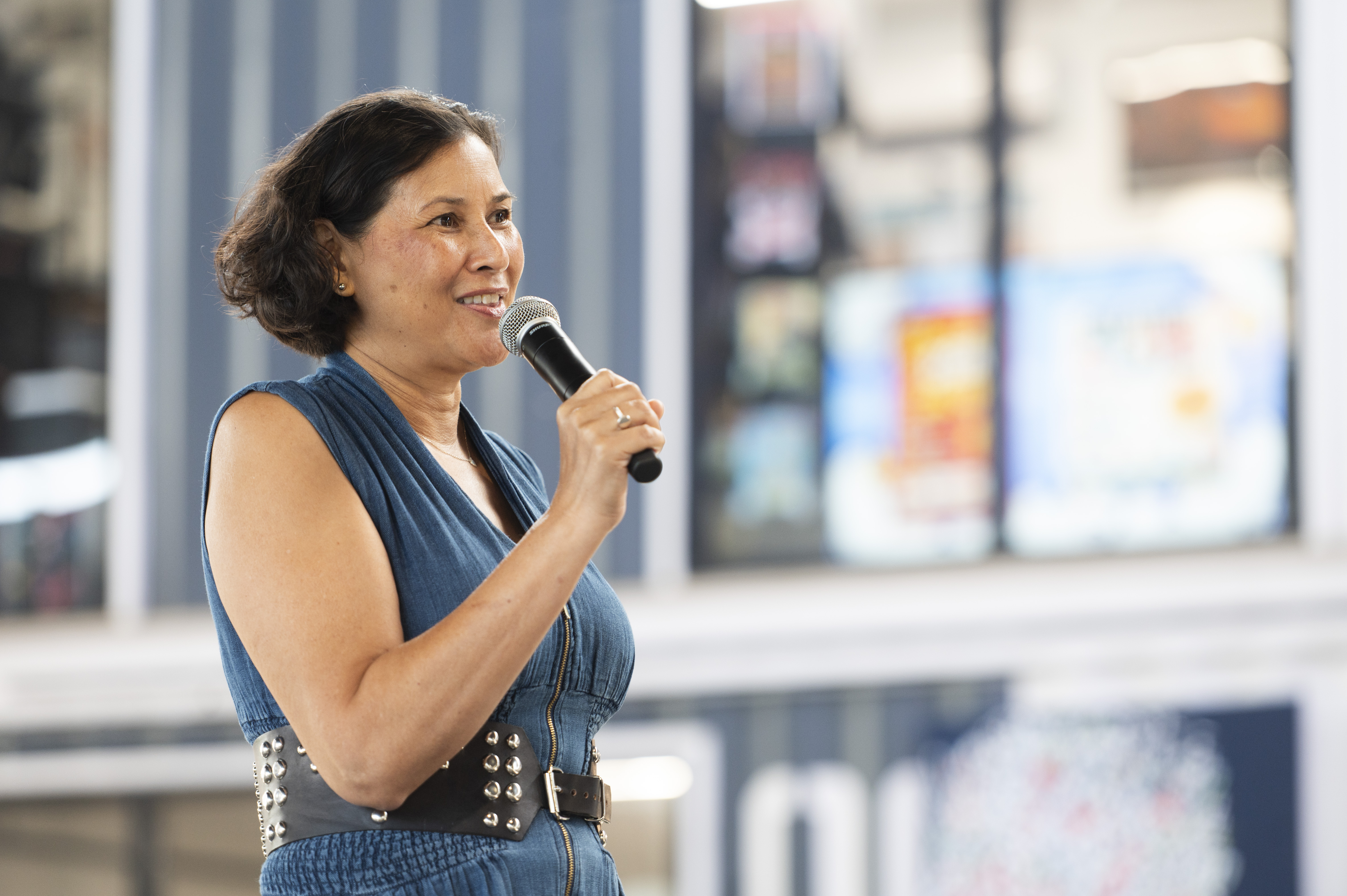
“I would love to see a world where the city and other private foundations would recognize that this event is absolutely critical for this city,” said Tailinh Agoyo, cofounder and executive director of We Are the Seeds, the Philly-based, Native-led organization that runs the festival. “It brings attention to the fact that this is Lenape land we are on, and celebrates not only the histories of our people, but the diversity of the Native people who live in the city now.”
Tailinh Agoyo, co-founder and executive director of We Are the Seeds, speaks to the crowd during the Seeds Philly Celebration at Cherry Street Pier on Saturday, Sept. 19, 2026.
How Seeds Philly was born
Agoyo, who moved to Philadelphia from Sante Fe, N.M., helped form We Are the Seeds in 2016 to celebrate the heritage and culture of Indigenous people in the country’s founding city. At the time, some Philly-area Native American cultural organizations were fading after generations, she remembered.
“I felt like, where do we go?” said Agoyo, a descendant of the Narragansett tribe who is raising four sons. “Where do we have our conversations? Where do we see our community?”
The nonprofit has grown to include Indigenous Listening Gardens in West and North Philly and Kensington; an Indigenous-led theater project examining the myths surrounding Philadelphia’s founding in 1682; and a popular podcast, From Here, With a View, featuring Indigenous artists, culture bearers, and activists.
“We create these types of programs and events for Native people to come together and connect and gather and dance and celebrate,” Agoyo said. “And we invite the greater Philadelphia region to be a part of it.”
But with a key private grant expiring — and the growing festival eating up much of the nonprofit’s expenses — Agoyo said the group needs time and does not know when exactly the event might return. It is bittersweet, Agoyo said, that the festival, which was expecting more than 4,000 attendees — tickets are pay what you can, with a $20 suggested donation — may disappear just as it comes into its own.
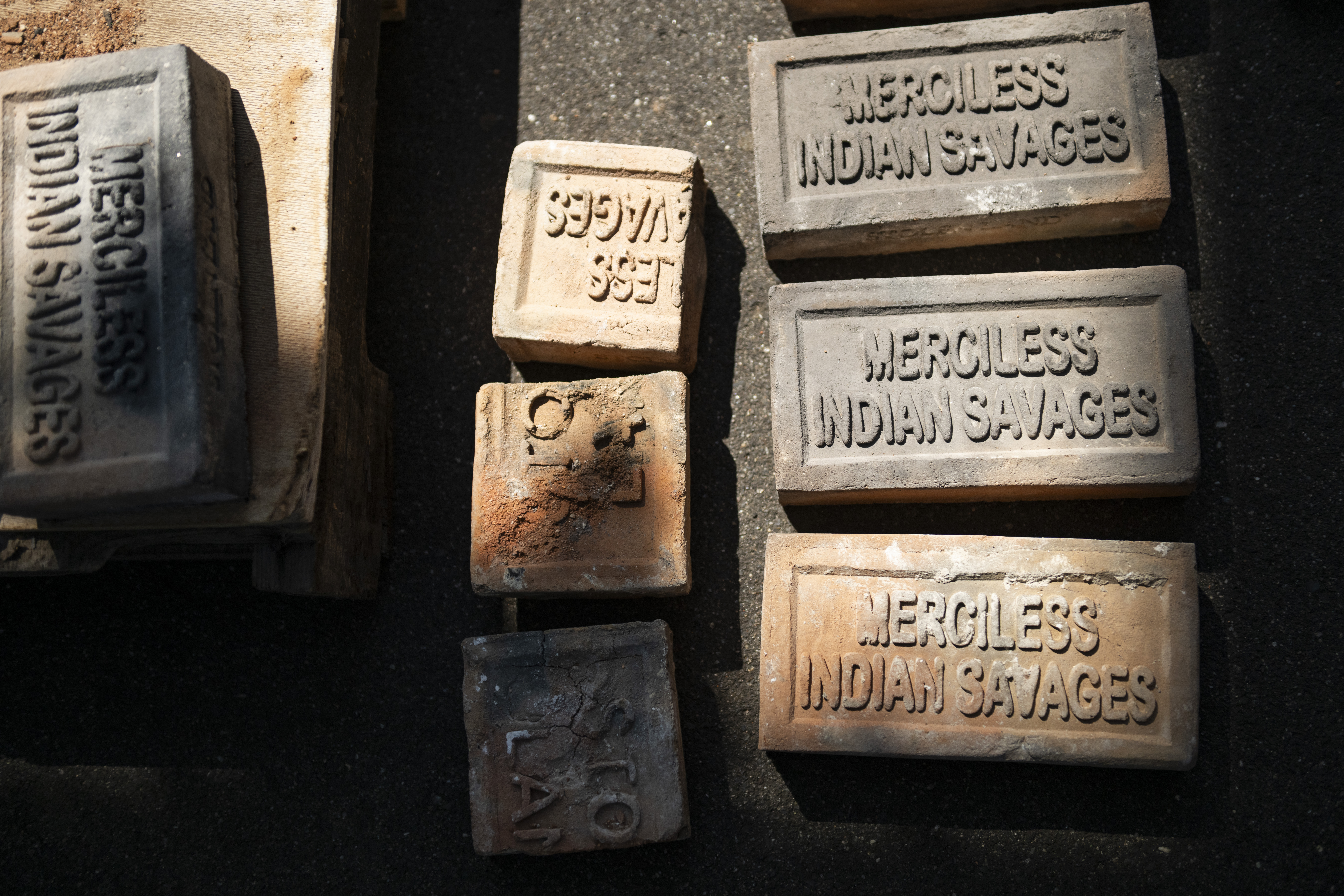
Bricks with the words “Merciless Indian Savages” are laid on the ground to be put together to make a Mohawk Rocket Kiln at the Seeds Philly Celebration hosted by an Indigenous nonprofit, We Are the Seeds, at Cherry Street Pier on Saturday, Sept. 19, 2026.
This year, the city provided funding for the festival through its 250th programming, Agoyo said. And the group plans on applying for more grants and hopes to build partnerships with leading Philadelphia philanthropic organizations.
“The reality is the world is in a really tough place and we need to make sure that we stay healthy as an organization,” shesaid. “So we need to be strong and say, ‘Let’s just rest for our health and our family’s health and our community’s health, and then we figure it out.’”
Perhaps, next year, the festival could return as a smaller event, she said.
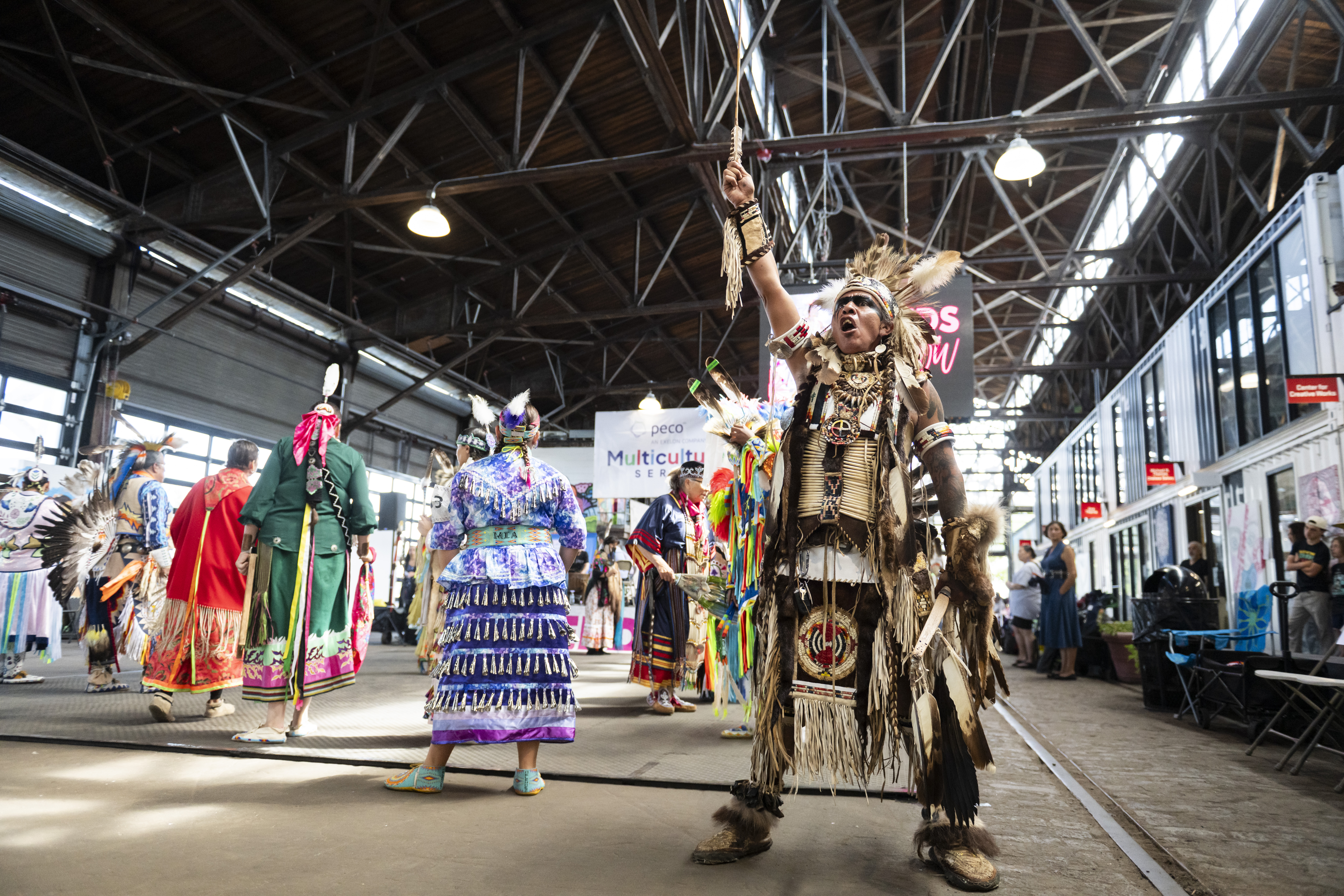
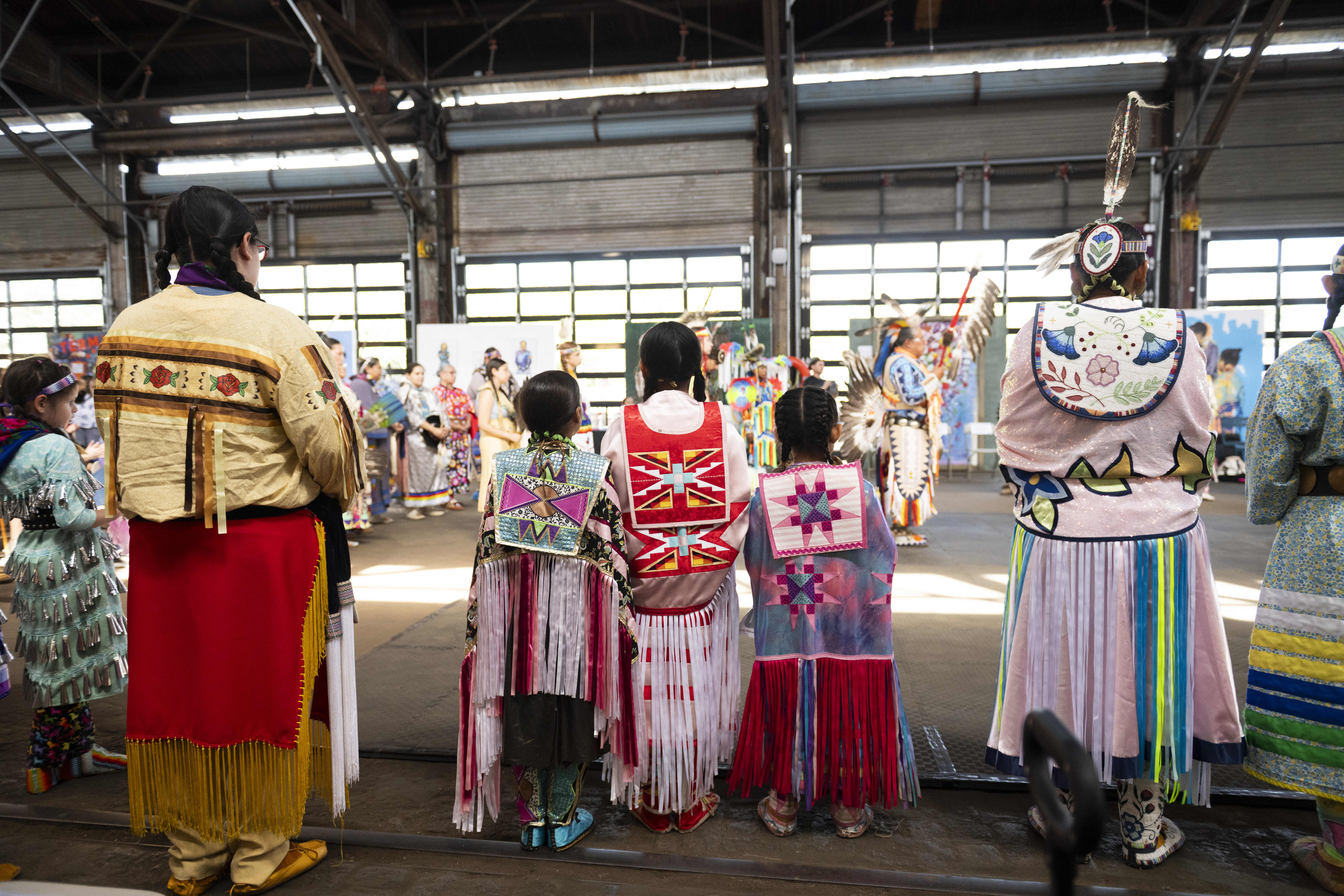
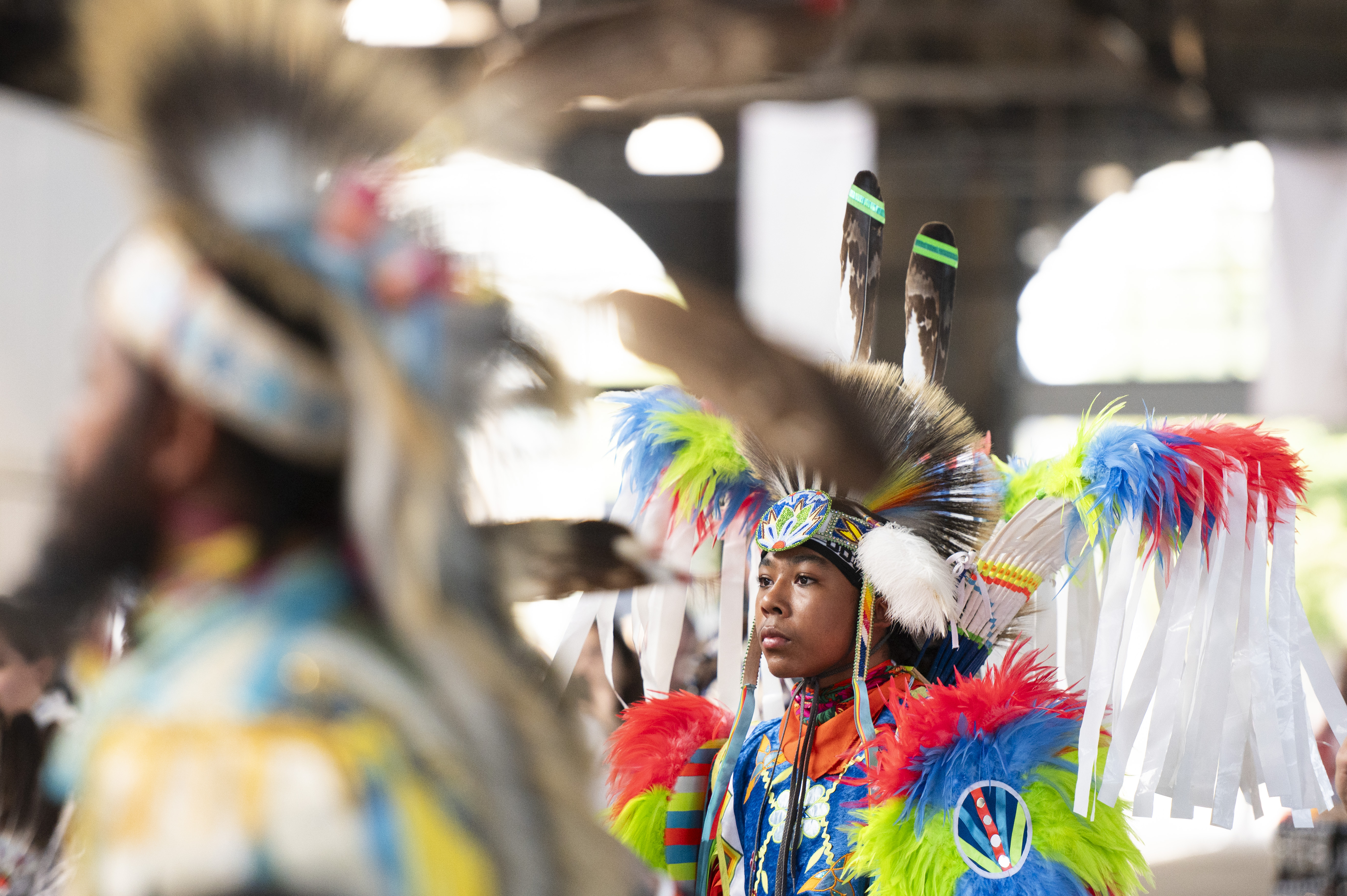
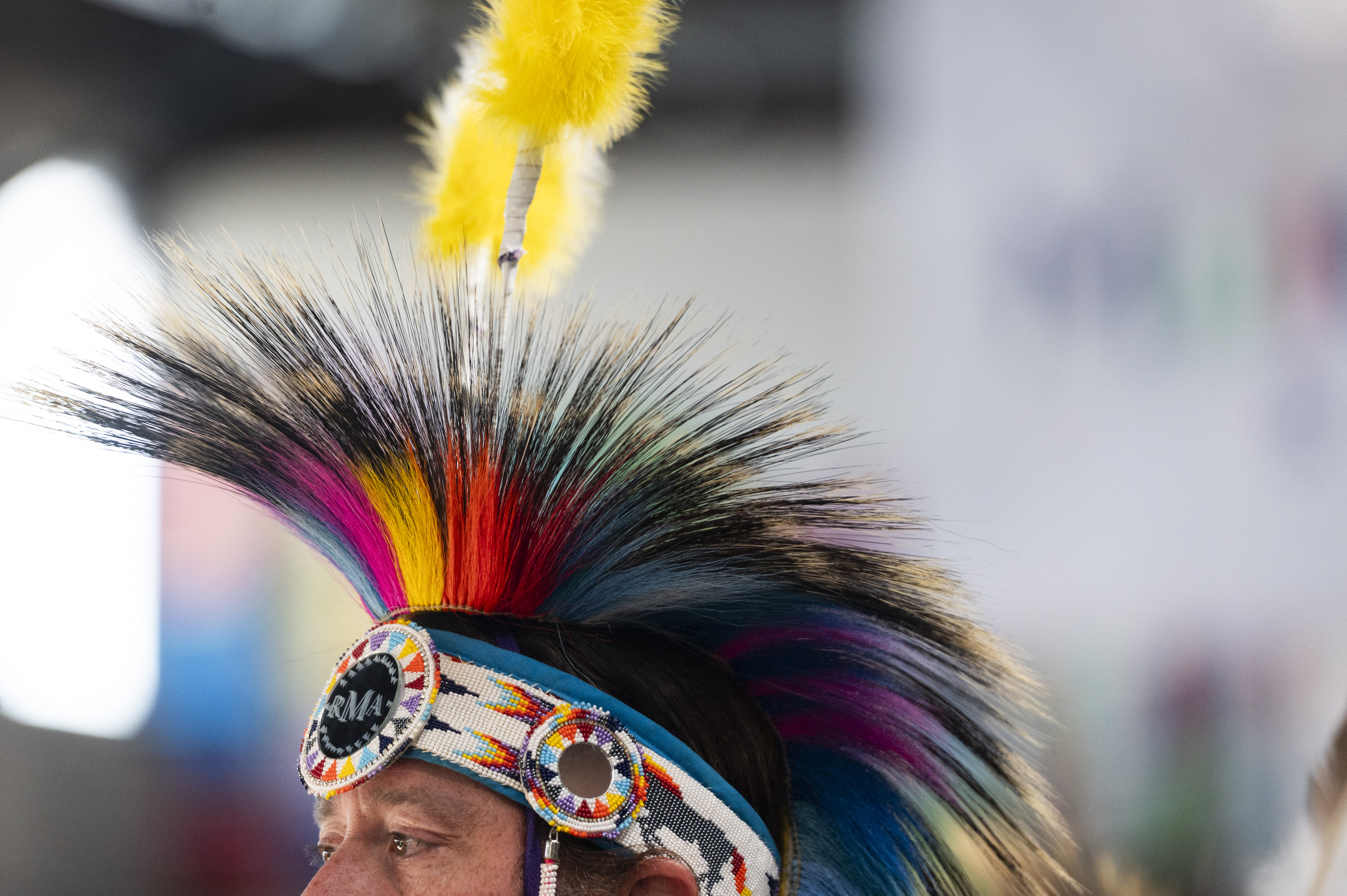
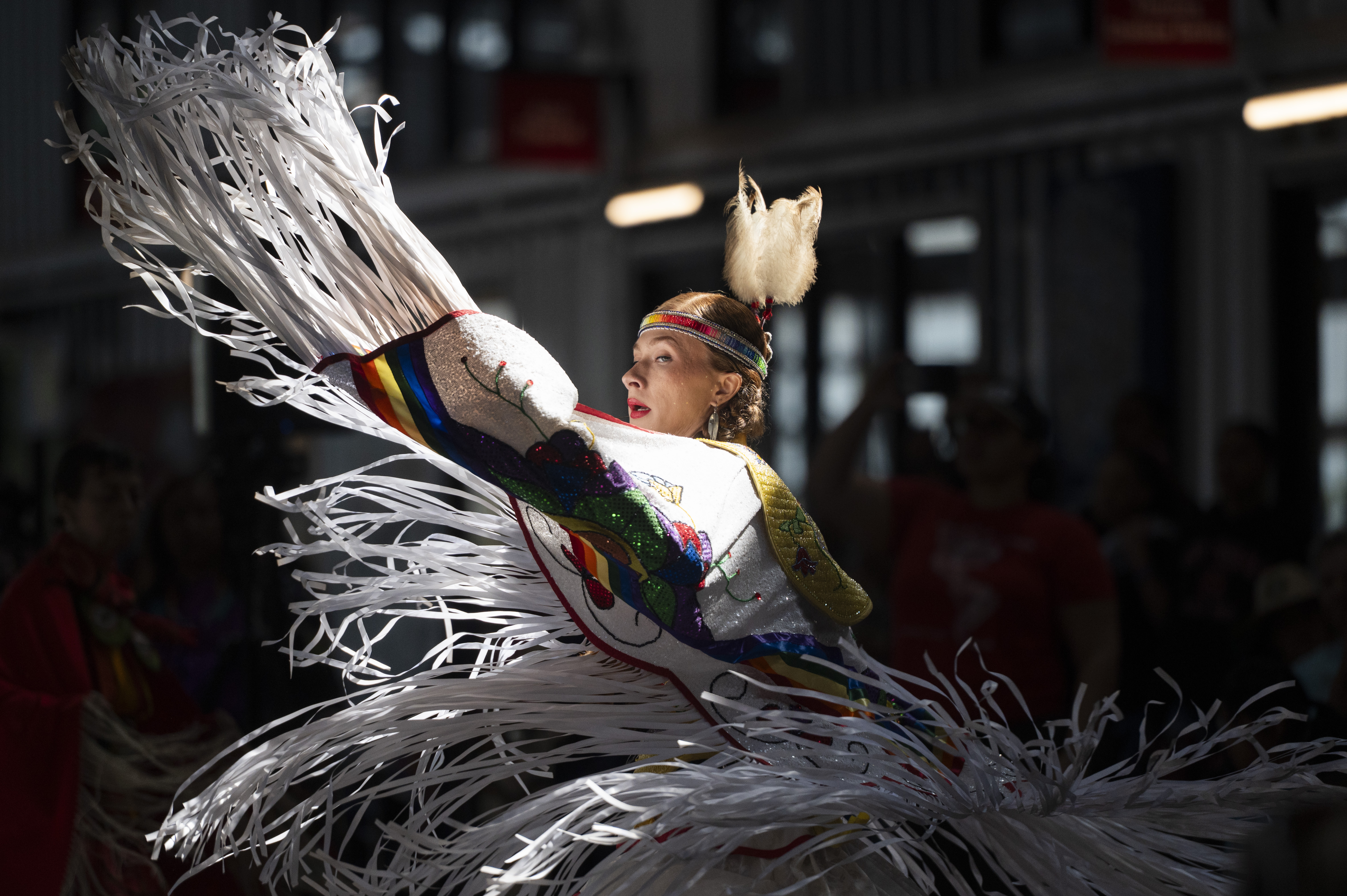
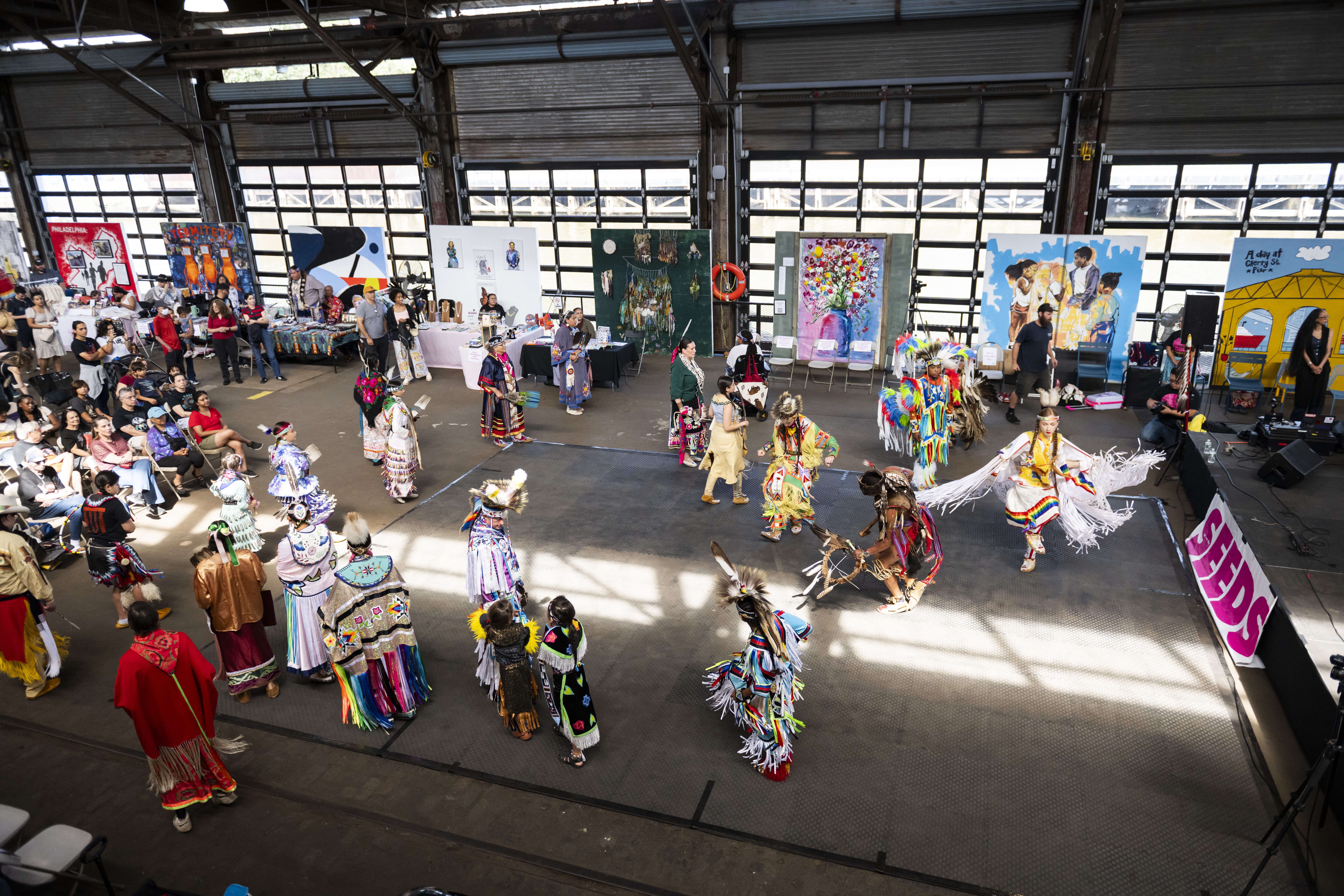
But the hard realities confronting the popular but endangered festival did not dampen Saturday’s celebration. At noon, after an honorary tepee raising, dozens of dancers processed into the powwow. Men and women from tribes up and down the East Coast danced traditional and fancy steps. Jingle dancers donning regalia adorned with dozens of clanking tin snuff lids danced steady rhythmic steps meant to promote healing. Musicians pounded beats on powwow drums made of maple wood and rawhide. Crowds flowed along the pier.
Garbed in a women’s jingle dress, Vaughnda Hilton, executive director of the Philly-based Native Nations Dance Group, said the Seeds Philly Celebration has become a premier Indigenous event.
“It shows we’re still here,” she said. “We’re keeping the culture alive, keeping the dances and songs alive. It’s who we are.”
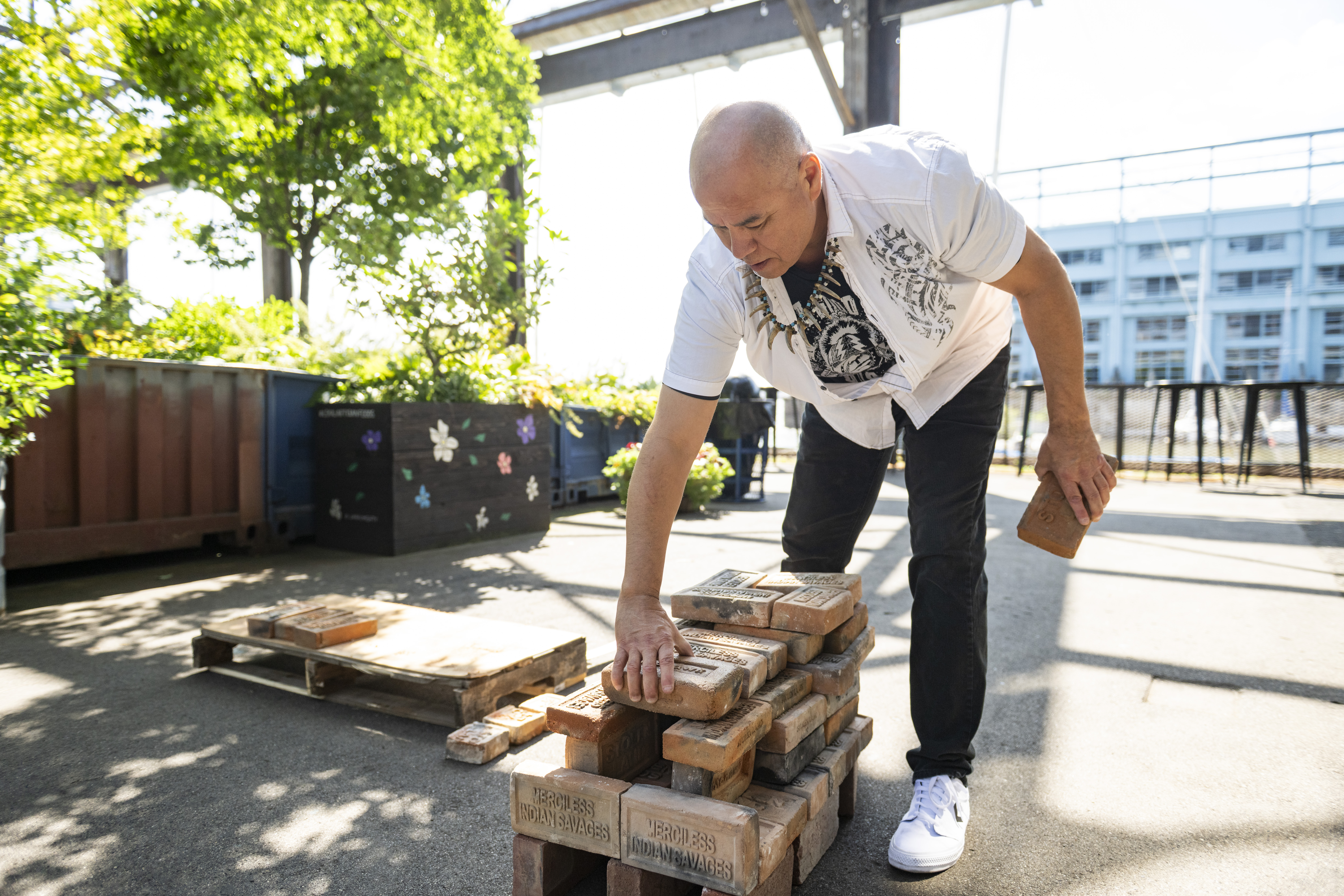
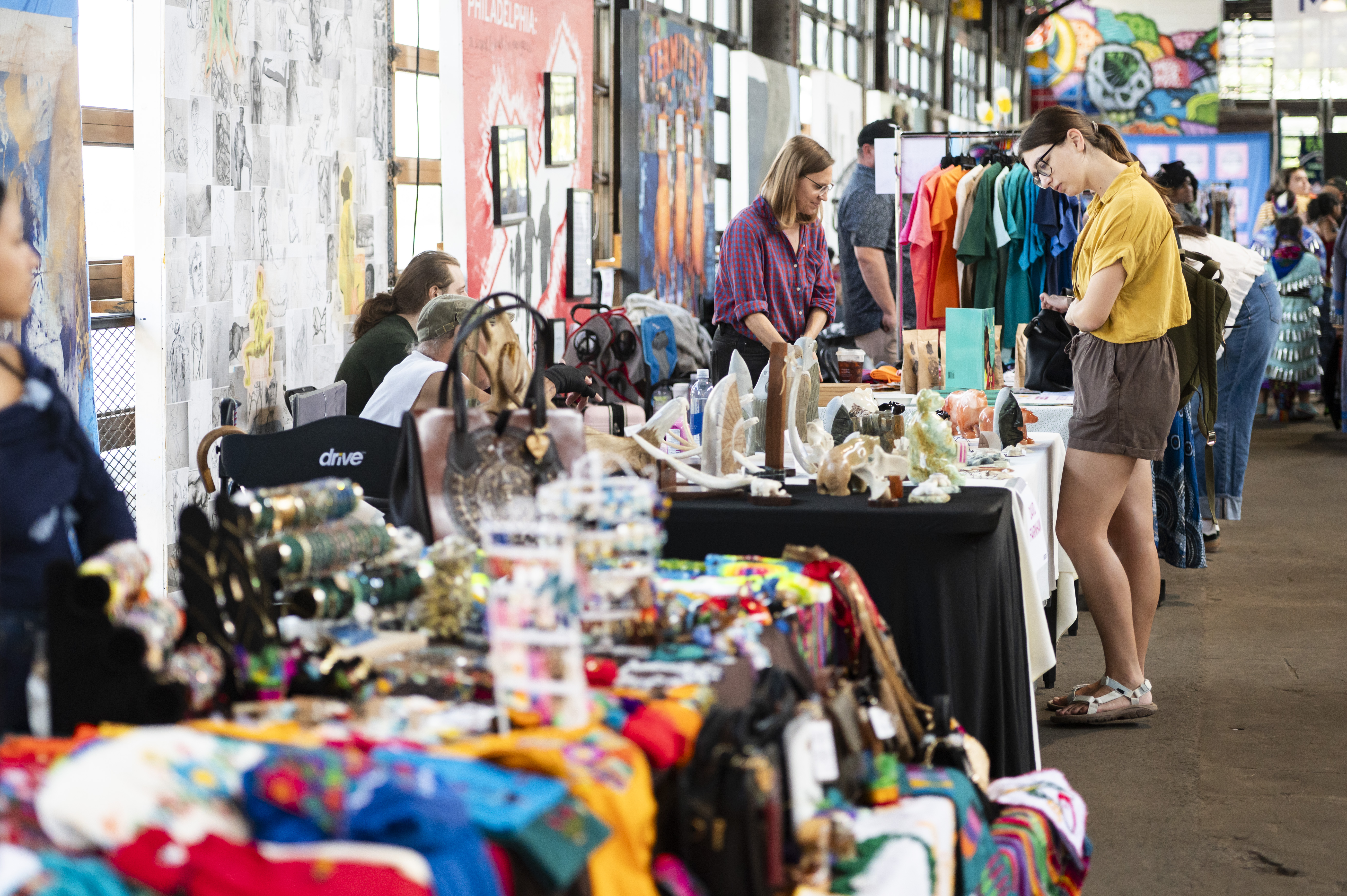
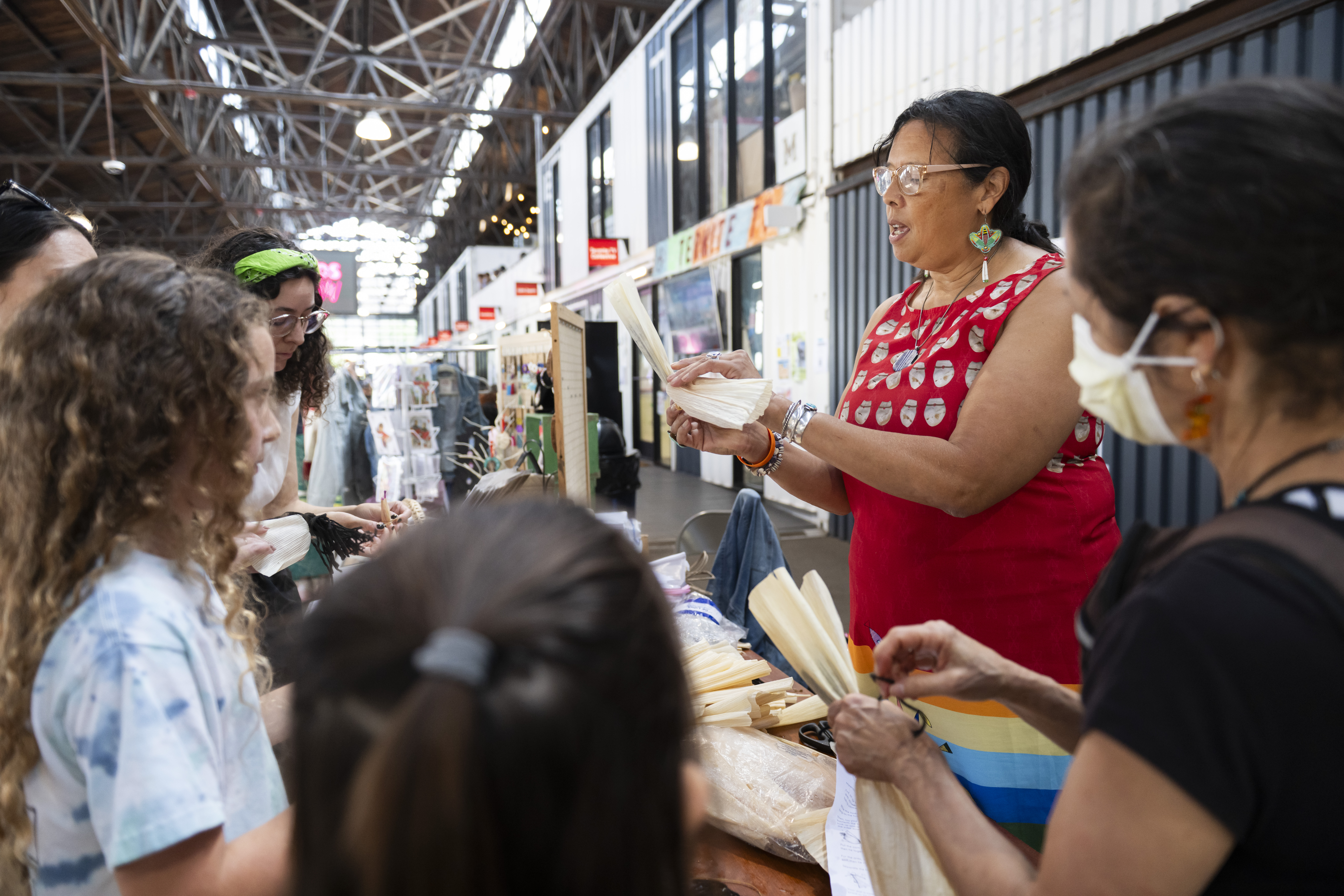
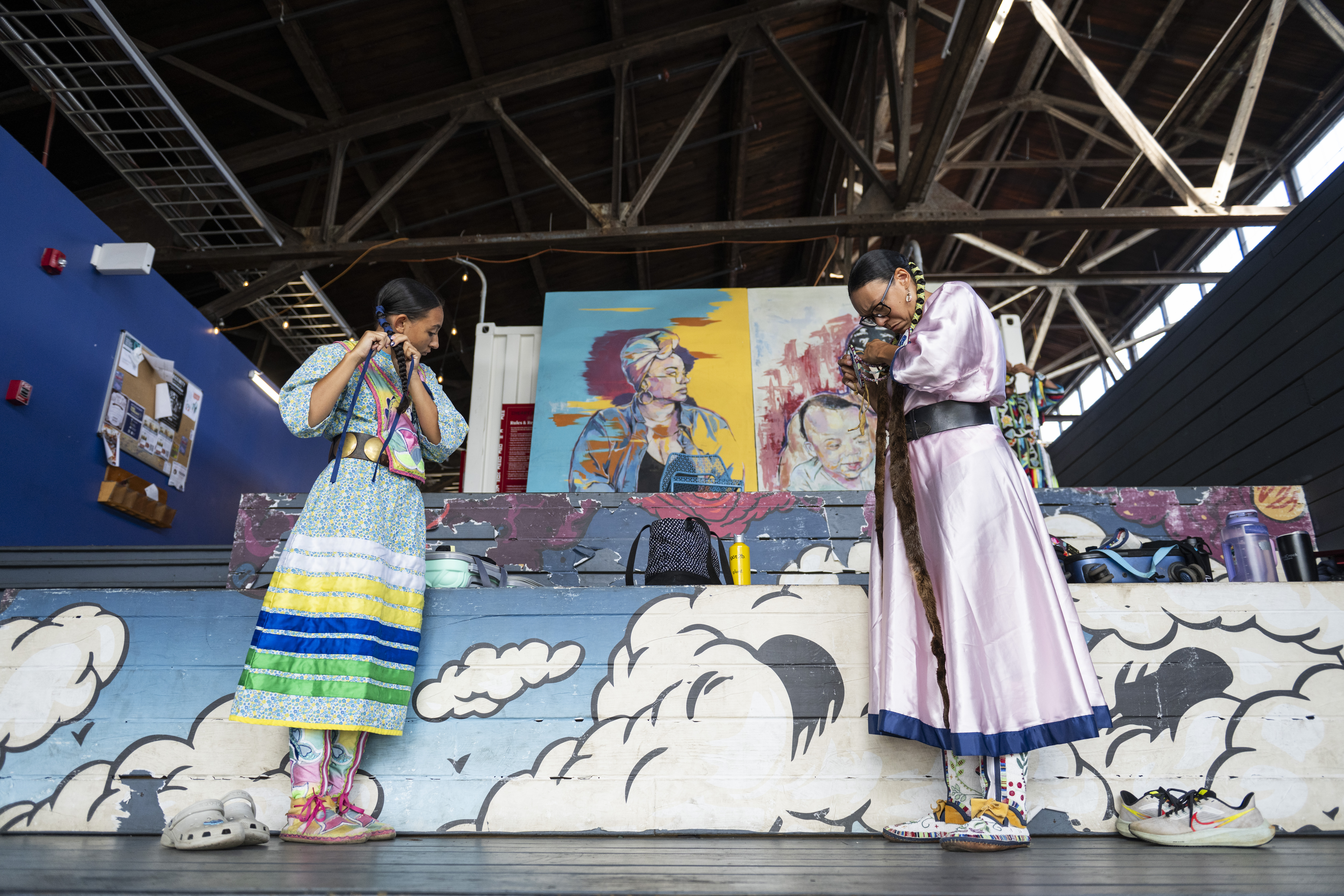
Sosakete of Akwesasne Mohawk Nation builds a Mohawk Rocket Kiln made of bricks with the words “Merciless Indian Savages” at the Philly Seeds Festival hosted by Indigenous nonprofit, We Are the Seeds, at Cherry Street Pier on Saturday, Sept. 19, 2026.Tchin, Artist-Partner for Education and Cultural Programs at We Are the Seeds, puts in a lacing pin to hold together a northern plains tipi at the Philly Seeds Festival at Cherry Street Pier on Saturday, Sept. 19, 2026.Tchin, Artist-Partner for Education and Cultural Programs at We Are the Seeds, raises a northern plains tipi at the Philly Seeds Festival at Cherry Street Pier on Saturday, Sept. 19, 2026.Tchin (right), Artist-Partner for Education and Cultural Programs at We Are the Seeds, puts the finishing touches on a northern plains tipi at the Philly Seeds Festival at Cherry Street Pier on Saturday, Sept. 19, 2026.Dancers line up for the Powwow at the Philly Seeds Festival hosted by Indigenous nonprofit, We Are the Seeds, at Cherry Street Pier on Saturday, Sept. 19, 2026.A dancer performs during the Powwow at the Philly Seeds Festival hosted by Indigenous nonprofit, We Are the Seeds, at Cherry Street Pier on Saturday, Sept. 19, 2026.A dancer wears a decorative headdress at the Philly Seeds Festival hosted by Indigenous nonprofit, We Are the Seeds, at Cherry Street Pier on Saturday, Sept. 19, 2026.Various artists and vendors are set up at the Philly Seeds Festival hosted by Indigenous nonprofit, We Are the Seeds, at Cherry Street Pier on Saturday, Sept. 19, 2026.Sherenté Harris, Head Two Spirit Dancer from the Narragansett Tribe, performs during the Powwow at the Philly Seeds Festival hosted by Indigenous nonprofit, We Are the Seeds, at Cherry Street Pier on Saturday, Sept. 19, 2026.Dancers perform during the Powwow at the Philly Seeds Festival hosted by Indigenous nonprofit, We Are the Seeds, at Cherry Street Pier on Saturday, Sept. 19, 2026.Dawn Spears, artist and Narragansett, teaches a group how to make cornhusk dolls at the Philly Seeds Festival hosted by Indigenous nonprofit, We Are the Seeds, at Cherry Street Pier on Saturday, Sept. 19, 2026.Fancy Shawl Dancers Chitanitehe Ridgeway (left) and Cory Ridgeway (right) put accessories in their hair before the start of the powwow at the The Philly Seeds Festival hosted by Indigenous nonprofit, We Are the Seeds, at Cherry Street Pier on Saturday, Sept. 19, 2026.
Farther down the pier, Roger Sosakete Perkins, a Mohawk multimedia artist and culture keeper from the Bear Clan of Akwesasne near the Canadian banks of the St. Lawrence River, prepared a special fire-working kiln he had built for the festival. Considered a founder of “Powowpopart” — a blending of Native-inspired abstract design and vintage pop culture imagery — Perkins gathered clay from a roadbed near his studio to make Mohawk bricks for the kiln. Each is enshrined with “merciless Indian savages” — a phrase that appears in the Declaration of Independence. On Sunday, Perkins will burn a piece of his own art and a replica of the declaration in the kiln. In Mohawk culture, the burning of something is symbolic of “rebirth” and “replenishing” – like the intentional land fires set to “burn out old growth and bring in new life,” he said.
The installation is meant to represent a conversation, he said, building his kiln, brick by brick, as the pier filled.
“A conversation that has needed to happen for 250 years,” he said. “A real conversation.”
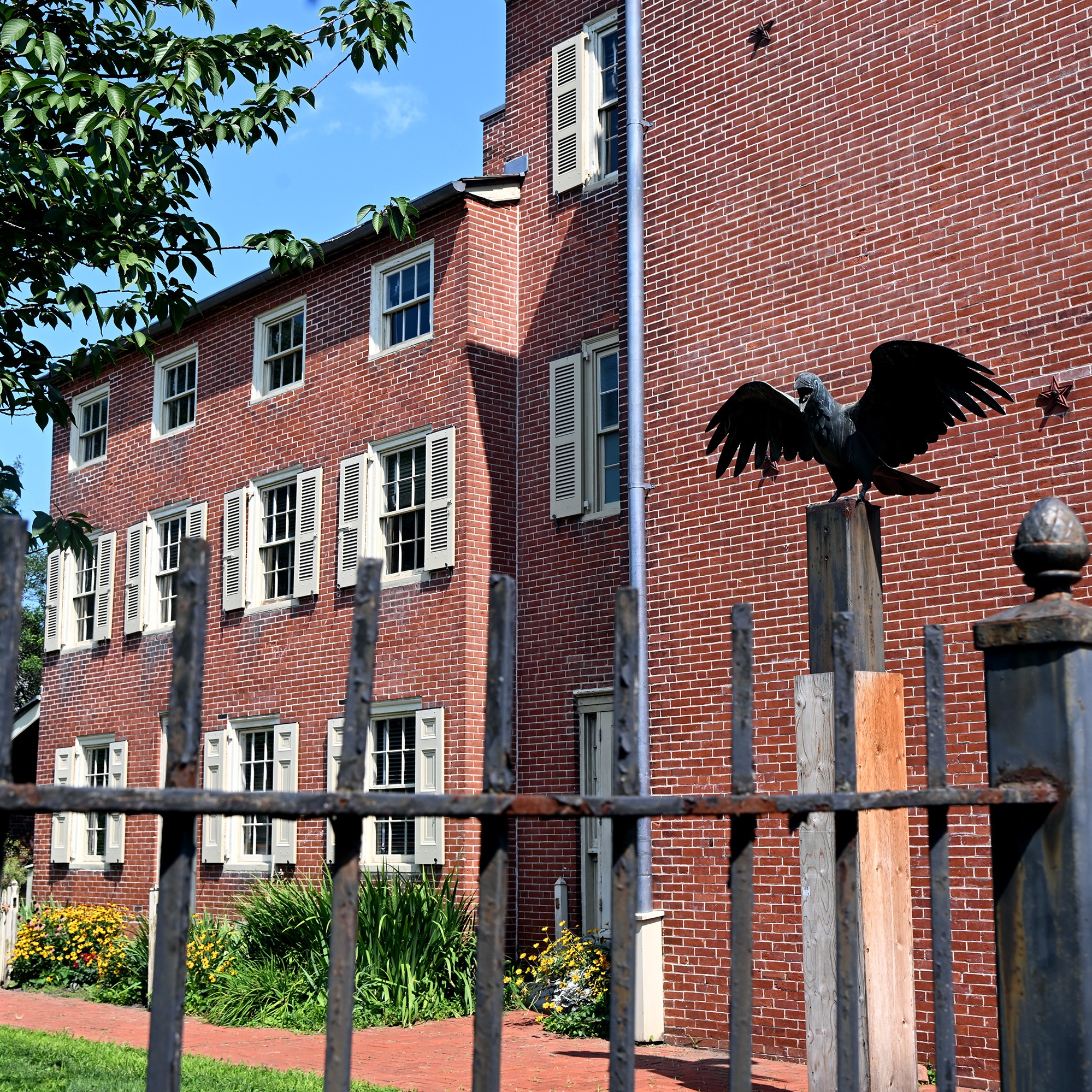
As Philadelphia rounds the corner into spooky season, fans of all things gothic, literary, or historical may be disappointed to learn that the Edgar Allan Poe National Historic Site remains closed.
The three-story brick building at 532 N. Seventh St. shuttered in summer 2024 for fire safety upgrades costing over $931,000. It was initially slated to reopen that fall, but renovations grewinto a broader improvement project, according to the National Park Service.
More recently, Philadelphia’s tourism agency had said the site was expected to open this fall, and an Oct. 31 event celebrating Poe as the father of the modern detective novel is planned at the site.But the National Park Service says there is still no official reopening date for the public.
“I can tell you that we can offer no date for when the house will reopen,” said park service spokesperson John Warren.
Calls to a supervisor at Independence National Historical Park, which manages the Poe house, went unanswered Thursday and Friday.
Warren said park service officials did not provide more details to him on the timeline, adding that there were “multiple, complex infrastructure projects going on at the site all at once.”
“If you have ever owned an old home, you know that repair projects often lead to discovering more issues, so it’s wisest not to speculate on an end date,” Warren said.
What’s holding things up?
At the site Friday, volunteers tended to flowers and plants while National Park Service workers wrapped up another day renovating the building’s first floor.
National Park Service plasterer and painter Joe Palumbo said the house’s issues should have been addressed a decade earlier. He said when he started working there,the property “smelled awful” from likely water damage.
Palumbo said construction crews redid the restrooms, replastered and painted the first floor, and rehabbed the woodworking.
He estimated it would take another week to complete first-floor renovations. From there, outside contractors are set to replace the carpets and blinds.
Palumbo said a plan to renovate the building’s exterior is “on hold,” and he is not sure why.
What’s the significance of the site?
Built in the 1800s, the home is the only remaining residence where Poe lived during his six years in Philadelphia from 1838 to 1844.
Retired National Park Service worker Helen McKenna spent 25 years at the site, educating people about Poe and his ties to Philadelphia. During her time working there, the house had exhibits, poetry recitations, a short biographical film, and a reading room styled after one of Poe’s published articles.
Back then, the house still had the original plaster, which was moldering and falling away from its lath. Of course, she said, the walls would have been gleaming white when Poe lived there in 1843 and 1844.
The neighborhood was not even part of the city at that time, she said, and Poe would have traveled on horse-drawn omnibuses. These kinds of details help people imagine Poe, she said, not just as a literary figure, but as a person.
To her, the house captures thecontrast between Poe’s literary stature — with his influence stretching across detective fiction, science fiction, poetry, and short stories — and the alcoholic, struggling writer who lived there with his mother-in-law and his wife, who had tuberculosis.
“There’s that sense of place. This grand, admired author was living in really humble circumstances on the outskirts of the city,” she said. “He didn’t own the place, he was paying rent, and he wasn’t always able to pay the rent.”
What did Poe do while in Philly?
Many cities have memorials to Poe, McKenna said. That is because he traveled. He was born in Boston, grew up in Richmond and in England, lived twice in New York, had a stint in Delaware, and died in Baltimore.
Poe’s time in Philly, however, marked acreative high-water mark, McKenna said.
He moved to Philly after failing to find success with a novel in New York City and turned his attention to short stories. While in Philly, he published “The Murders in the Rue Morgue,” “The Black Cat,” and “The Tell-Tale Heart,” McKenna said. He also became known as a charismatic speaker and an acerbic critic.
At his best, McKenna said, Poe was “a genius of compression,” creating haunting, memorable stories at a time when interest in American writers was growing.
“I won’t say that Poe is the best writer that America ever produced, but he’s certainly had a ton of impact, globally,” McKenna said.