Meat thieves struck again in Philadelphia, this time stealing $30,000 worth of beef from a refrigerated trailer parked overnight in the Northeast, police said Thursday.
At least some of the meat was later recovered, police said.
Shortly before 4:20 a.m., police were called to the 11600 block of Caroline Road for a reported theft of 3½ pallets of beef.
The driver told police he had parked his tractor-trailer on Caroline Road ahead of a scheduled delivery to a wholesale meat and seafood distributor on Red Lion Road. He said he was later awakened by movement coming from the trailer.
The driver looked out and saw two masked males dressed in black removing boxes of meat, he told police. He also noticed a dark-colored minivan and a dark-colored sedan parked behind his trailer.
He sounded his horn, but the thieves continued removing the merchandise before eventually leaving, he said.
Police found that the trailer’s lock and security seal had been cut, and about $30,000 in beef was stolen.
Some meat was later recovered after an off-duty SEPTA Transit Police officer noticed stacked boxes in the area of the 2800 block of East Pacific Street around 4:45 a.m.
The recovered merchandise was returned to the owner, police said.
Police did not say how much of the stolen beef was recovered.
Anyone with information regarding this incident is encouraged to contact the Northeast Detective Division at 215-686-3153 or submit an anonymous tip through the Philadelphia Police Department’s tip line at 215-686-TIPS (8477).
With the Philly region in for a splendid run of days with wall-to-wall sun and temperatures more characteristic of late April than the week before Thanksgiving, savoring them wouldn’t be the worst idea.
But it may have impacts, especially at the Shore, and meteorologists are becoming ever more certain that the Philly region and much of the nation are in for a tempestuous winter.
The El Niño warming in the tropical Pacific continues to cook and is approaching a record intensity. And, at least in the short term, it may interact with what would be the earliest known southward intrusion of the cold-air-importing polar vortex.
No one is quite sure how this might all work out, given the paucity of precedents, the mixed signals, and the non-signals.
The consensus is that the winter, particularly December, may be kind to heating bills, and Paul Pastelok, a longtime seasonal forecaster with AccuWeather Inc., issued an outlook that looks like a lock. The nation’s various weather apps and websites, he predicts, will experience blizzards of clicks.
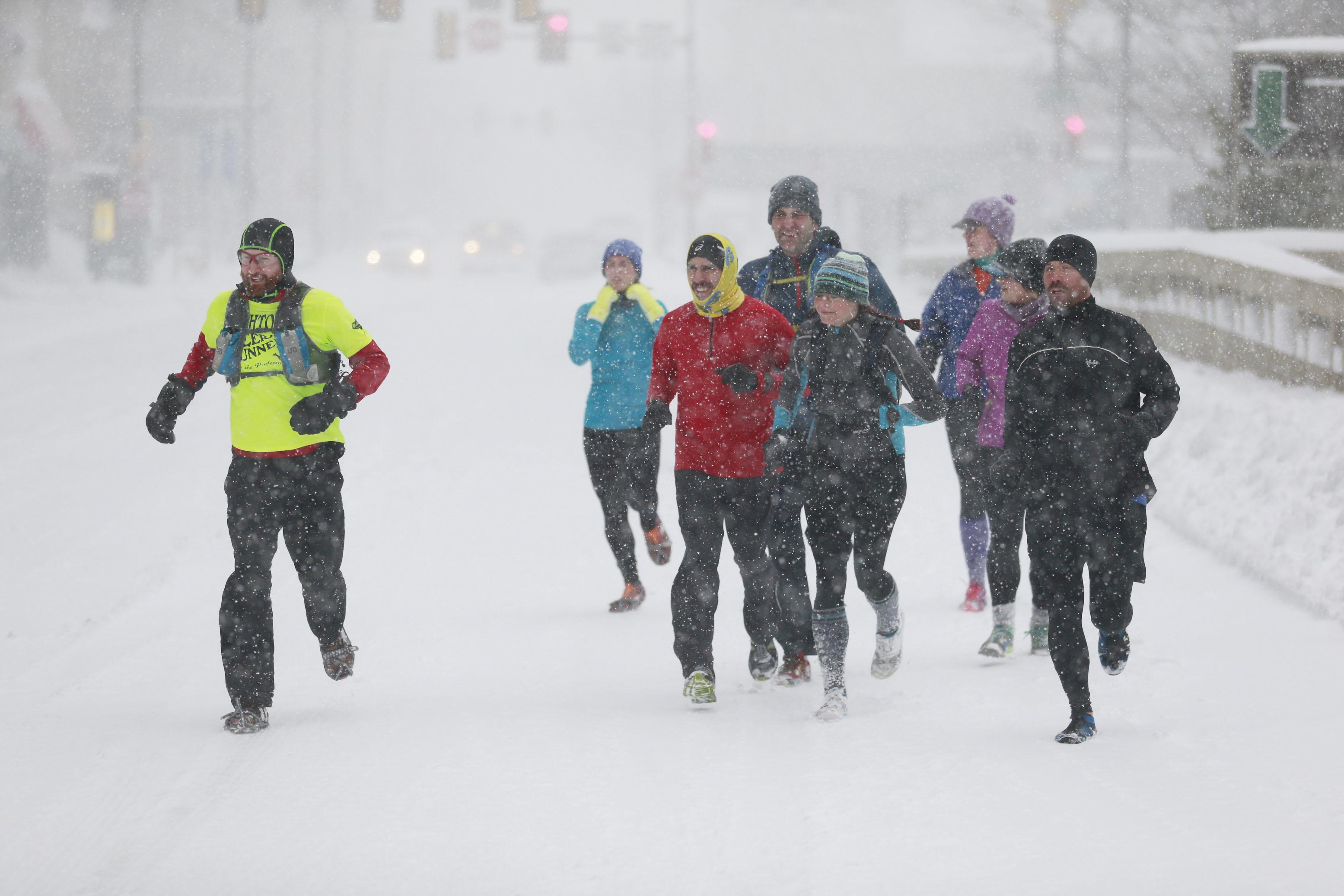
No, these aren’t Philadelphia Marathon racer, but the “Fishtown Beer Runners” make their way up Arch Street toward the Art Museum during an El Niño mega-snowstorm snowstorm in January 2016.
“There’s going to be storm after storm after storm,” he said. “There’s going to be no boring periods.”
What’s going on up there?
El Niño’s influence: It’s going to get stronger
El Niño already is flooding North America with warm air and energizing storm tracks as warming waters over vast areas of the equatorial Pacific threaten to reach record intensities.
The warming is due to persist into the spring, having profound impacts on the weather-bearing west-to-east winds. One likely outcome is a harvest of storms strengthening in the Gulf and tracking up the East Coast.
Whether any produce heavy snow would depend on the availability of cold air, which typically is in shorter supply during El Niño, and that would be the case this weekend.
A possible polar vortex intrusion could have a temporary chilling effect on temperatures in the Northeast sometime in the next few weeks and could interact with the effects of an El Niño that may have had a role in dislodging it, according to atmospheric researchers such as the National Oceanic and Atmospheric Administration’s Amy H. Butler.
El Niño, stratospheric warming, and the polar vortex
About every two years, the potent west-to-east winds about 20 miles up that trap frigid air in the Arctic slacken and then reverse, allowing the cold to ooze southward. It may take weeks before the effects would be evident in the United States.
One such reversal, known as a sudden stratospheric warming because the air warms quickly and radically — by as much as 90 degrees Fahrenheit in the high atmosphere — occurred Nov. 10, the earliest in records dating to 1958.
El Niños may generate atmospheric waves that contribute to the Arctic disruptions, Butler said in a recent blog post on climate.us, a forum for weather and climate experts and the successor to climate.gov, a victim of NOAA cuts.
A polar vortex disruption, said Laura Ciasto, a meteorologist with the National Weather Service’s Extended Prediction Division, can nudge the polar jet stream, the upper-air boundary between warm and cold air, southward, “bringing the Arctic air with it.”
In this case, however, “there is added uncertainty,” she added. Only two other stratospheric warmings have occurred in November, both at the end of the month. Plus, the Arctic air is not as frigid as it would be in January, and the snow cover not as robust. Northern Hemisphere snow cover is the third-lowest in areal extent in the last 30 years, according to the Rutgers University Climate Lab.
And arguing against prolonged cold is El Niño’s December resumé.
December warmth
Michelle L’Heureux, a physical scientist who heads NOAA’s El Niño/Southern Oscillation team, recalled attending a Christmas gathering in the Washington, D.C., area in 2015 at which some of the guests showed up in T-shirts and sandals as warmth washed over the Northeast. In Philadelphia that day, it went up to 68 degrees in what was the warmest December on record.
That coincided with the last winter with an El Niño of comparable strength to this one.
While this month has been warm in much of the country, the evidence for an El Niño role in November warmth is wanting, and actually leans slightly toward below-normal temperatures. she said.
However, at least in Philadelphia,the December warmth signal appears to be robust. According to National Center for Environmental Information data, nationally temperatures were above normal in four of the six El Niños comparable to this one, and all six were warmer than normal in Philly.
Whatever role a polar vortex invasion may have in December or the rest of the winter, Pastelok said, “El Niño is just so overwhelming.”
The outlook for the Philly region
Philly’s first snow threat has not popped on radar yet, and for that matter the city is waiting for its first official freeze, although suburban areas have had their first ice sightings.
Amadi El-Bisiolu, of West Philadelphia, is swinging with her son Jai, 2, at Clark Park on Tuesday.Tyger Williams / Staff Photographer
No precipitation is in the forecast until Sunday, when an El Niñoish coastal storm could generate substantial rain throughout the region, though the timing may spare the annual TIAA Philadelphia Marathon race, which kicks off at 6:55 a.m.
In the meantime, the next three days should feature tranquil conditions with highs in the mid-60s.
One afternoon, Malayshia Allford asked her teacher for a hug. The teacher obliged.
After that, it became their ritual. Every afternoon, before Malayshia climbed aboard the school bus, she got a hug.
On Wednesday, the teacher, Yvette Burns, shared that memory at a celebration of life for the 10-year-old girl, who was killed late last month. Now, with Malayshia gone, Burns said, she takes comfort in knowing that she sent the girl home every day “wrapped in love.”
Malayshia was found dead in the trunk of a car in South Jersey on Nov. 4, ending a more than weeklong search that drew police, federal investigators, and volunteers.
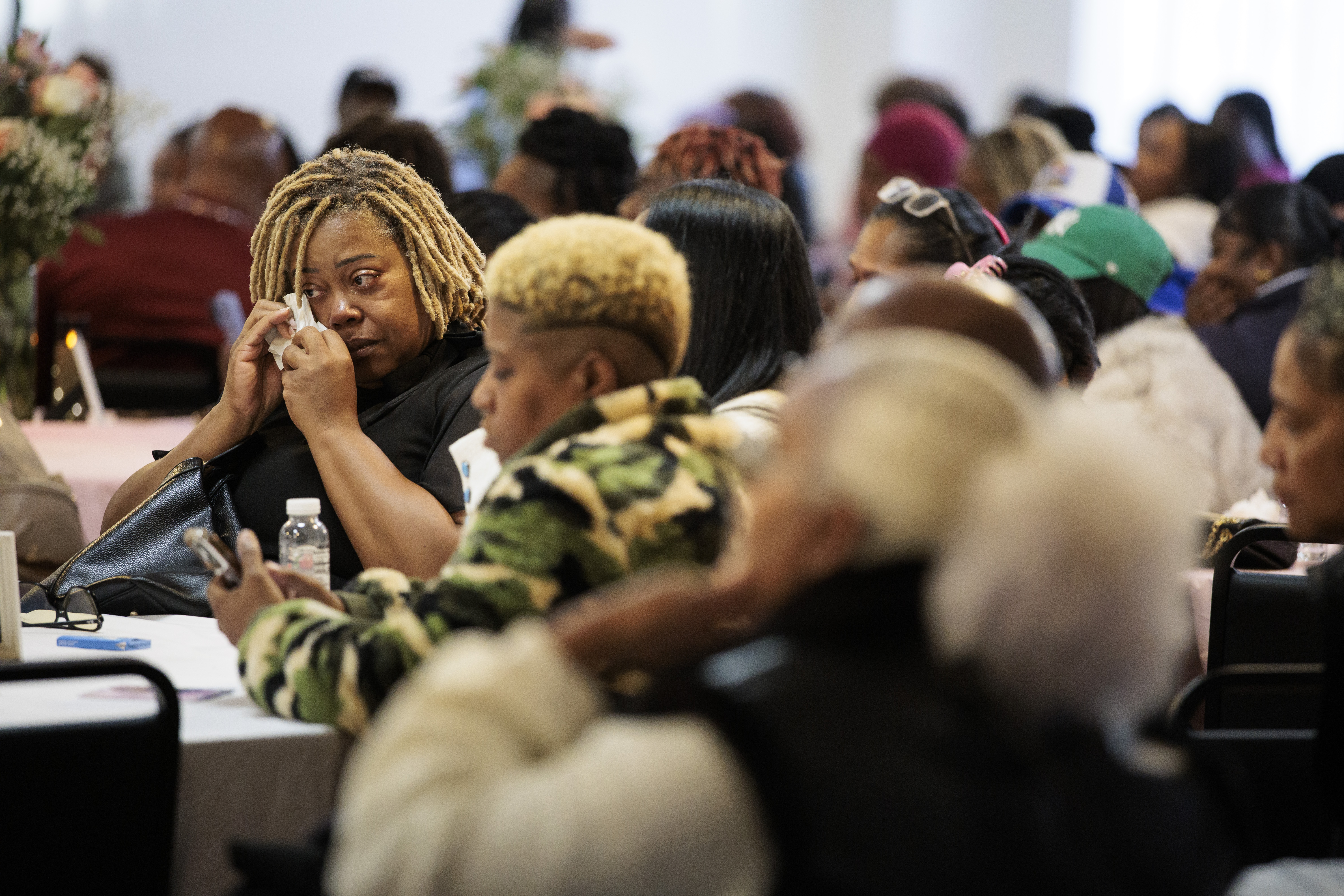
Authorities have charged her foster mother, Philadelphia schoolteacher Carprice Williams, with murder. But to the more than 100 family members, teachers, and friends who gathered Wednesday inside a West Philadelphia venue to remember her, Malayshia was more than the child at the center of a criminal investigation. She was a kind, caring girl who, at least at school, knew she could count on a hug at the end of the day.
“She was a great person,” Burns said, “who just happened to be 10 years old.”
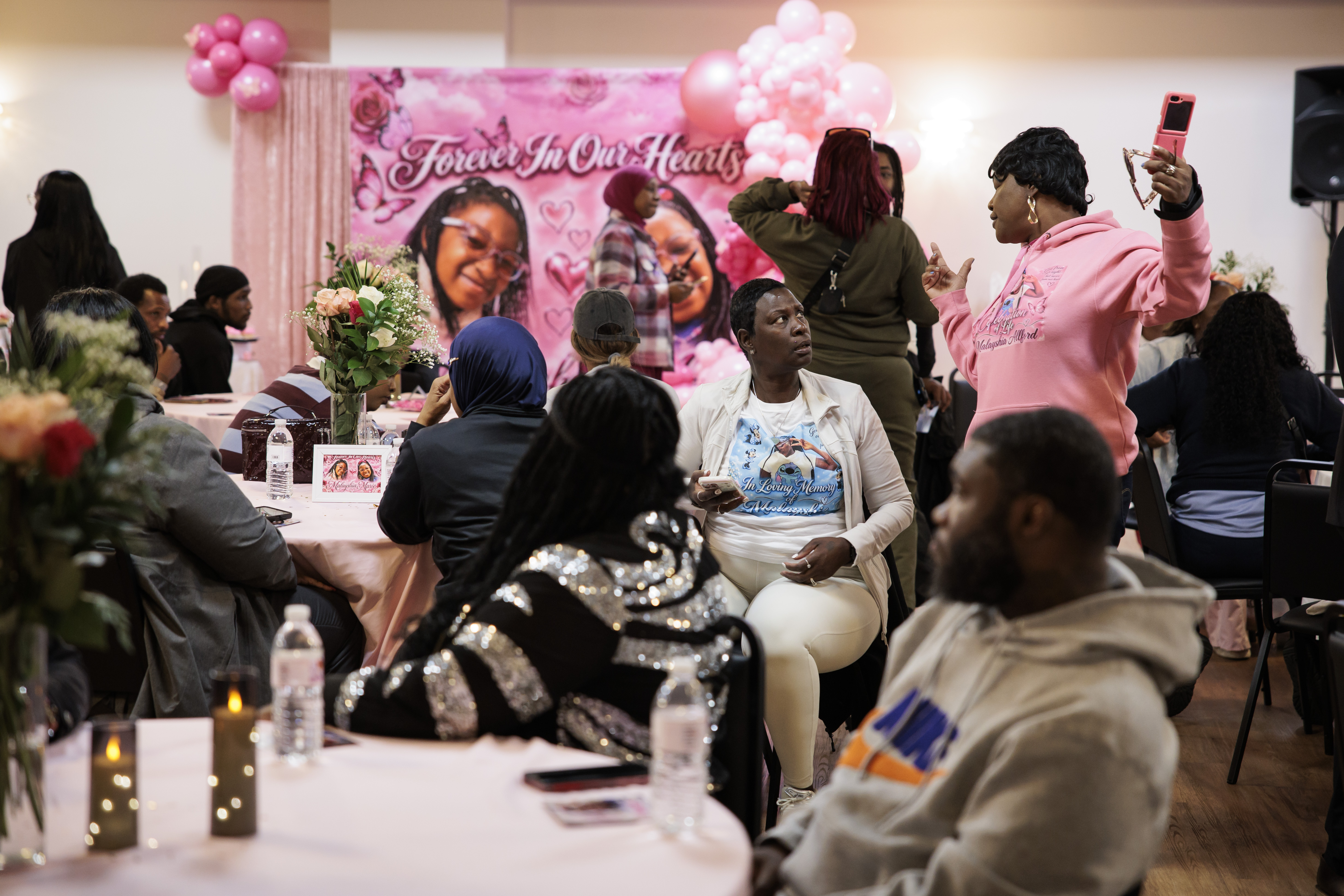
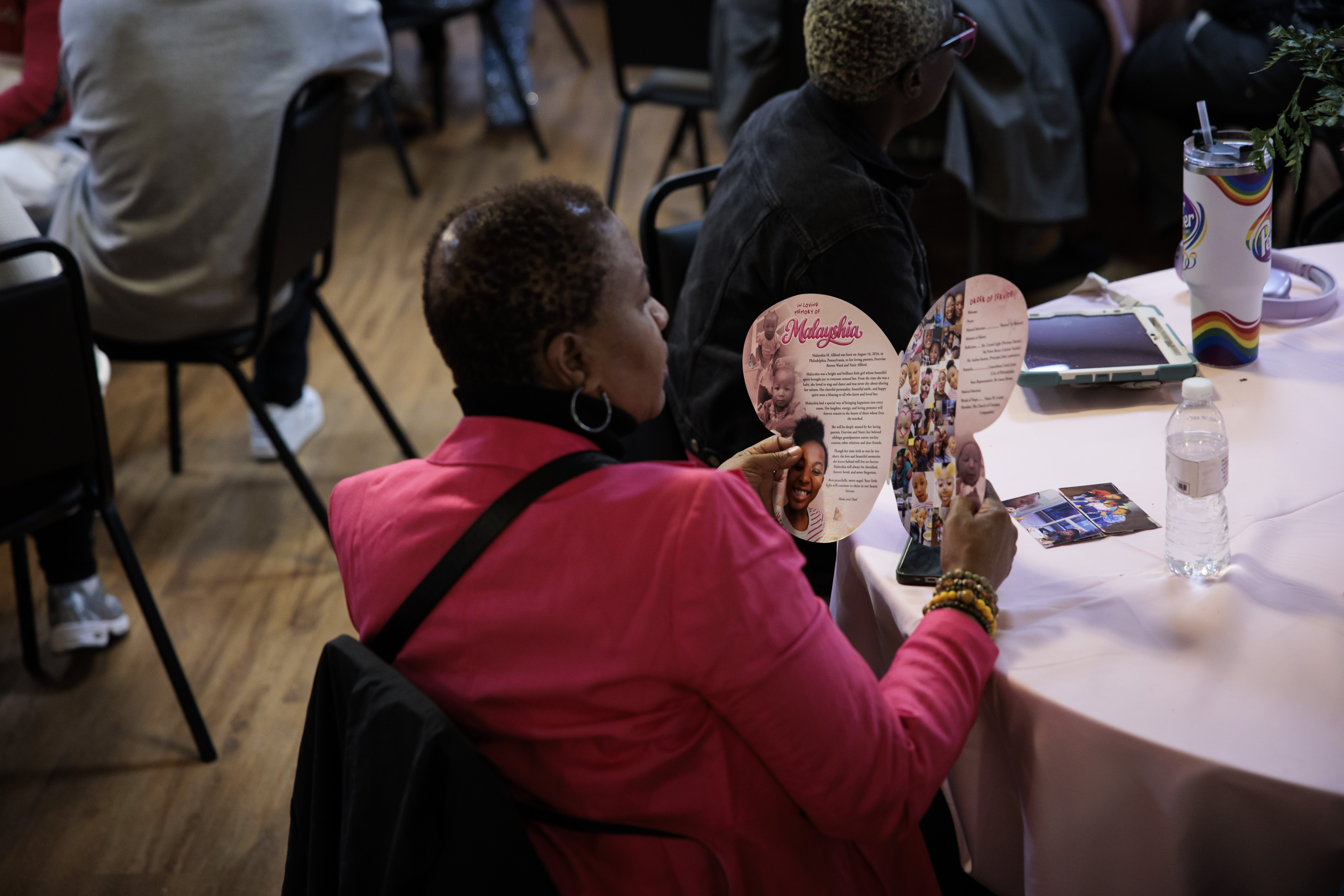
Pink was the color of the celebration, a fitting tribute to a girl whose smiling face cycled across a screen in photograph after photograph, nearly always wearing a touch of it: a bow tucked into her hair, the thick frames of her glasses.
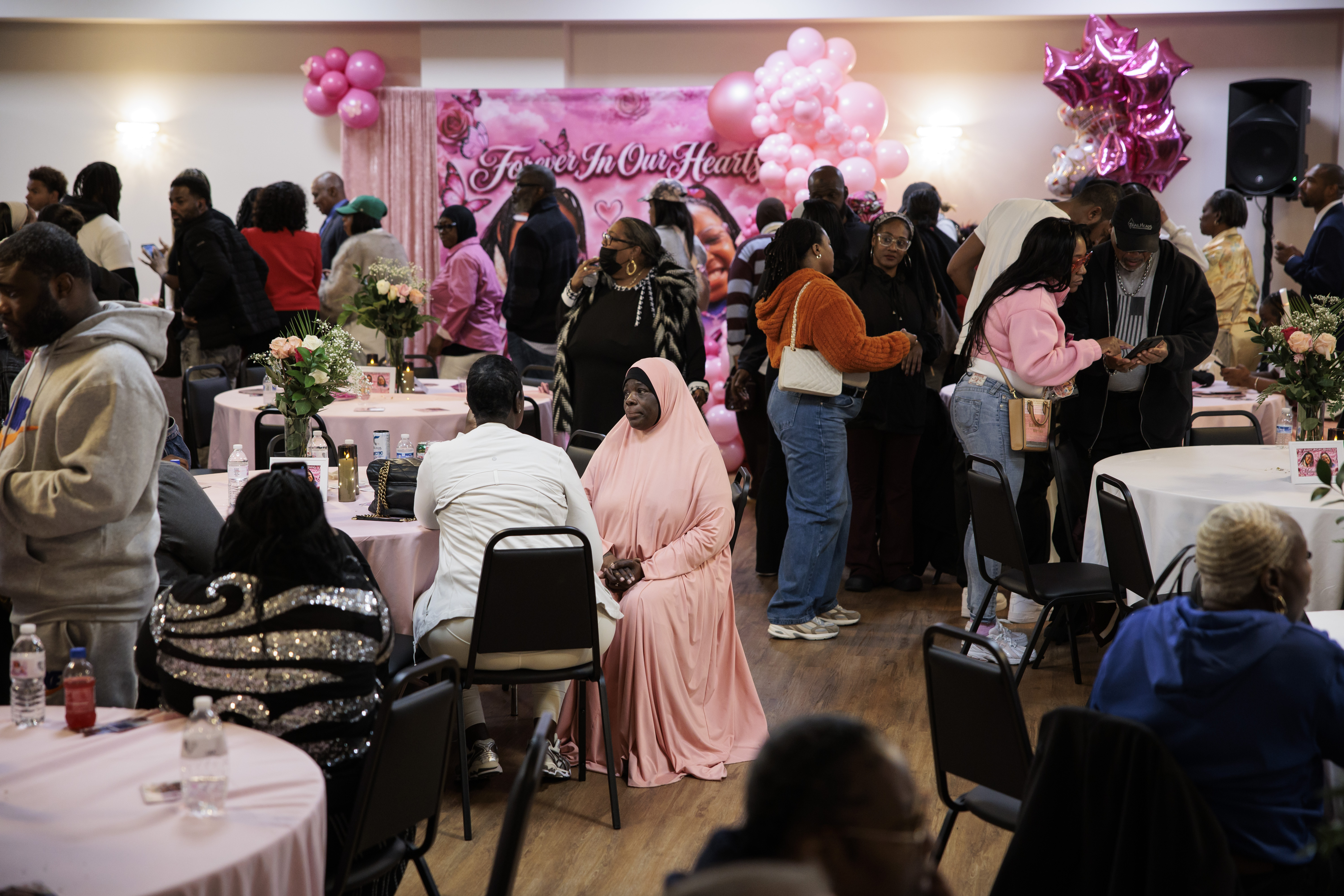
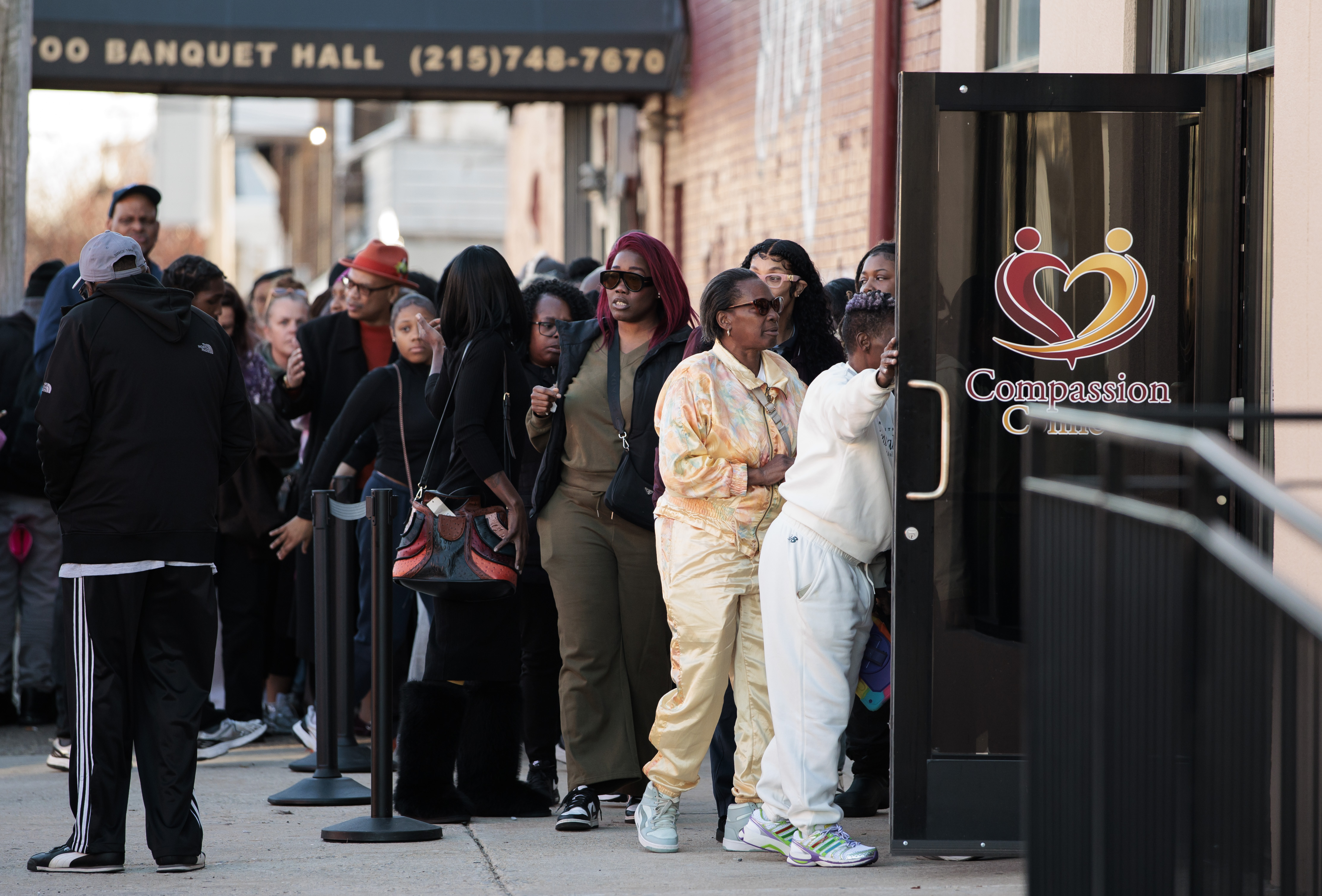
People lined up outside Compassion Connect Venue before the 3 p.m. service, and the queue stretched down the block. On their way inside, they stopped to write messages to Malayshia’s family on hot pink posters, then took seats at tables covered in pink tablecloths. Pink roses and carnations filled flower arrangements throughout the room. Catering tables were draped in fuchsia sequined cloths, and pink balloons framed a large display at the front, where photographs of Malayshia were set against a pink background beneath the words: “Forever in our hearts.”
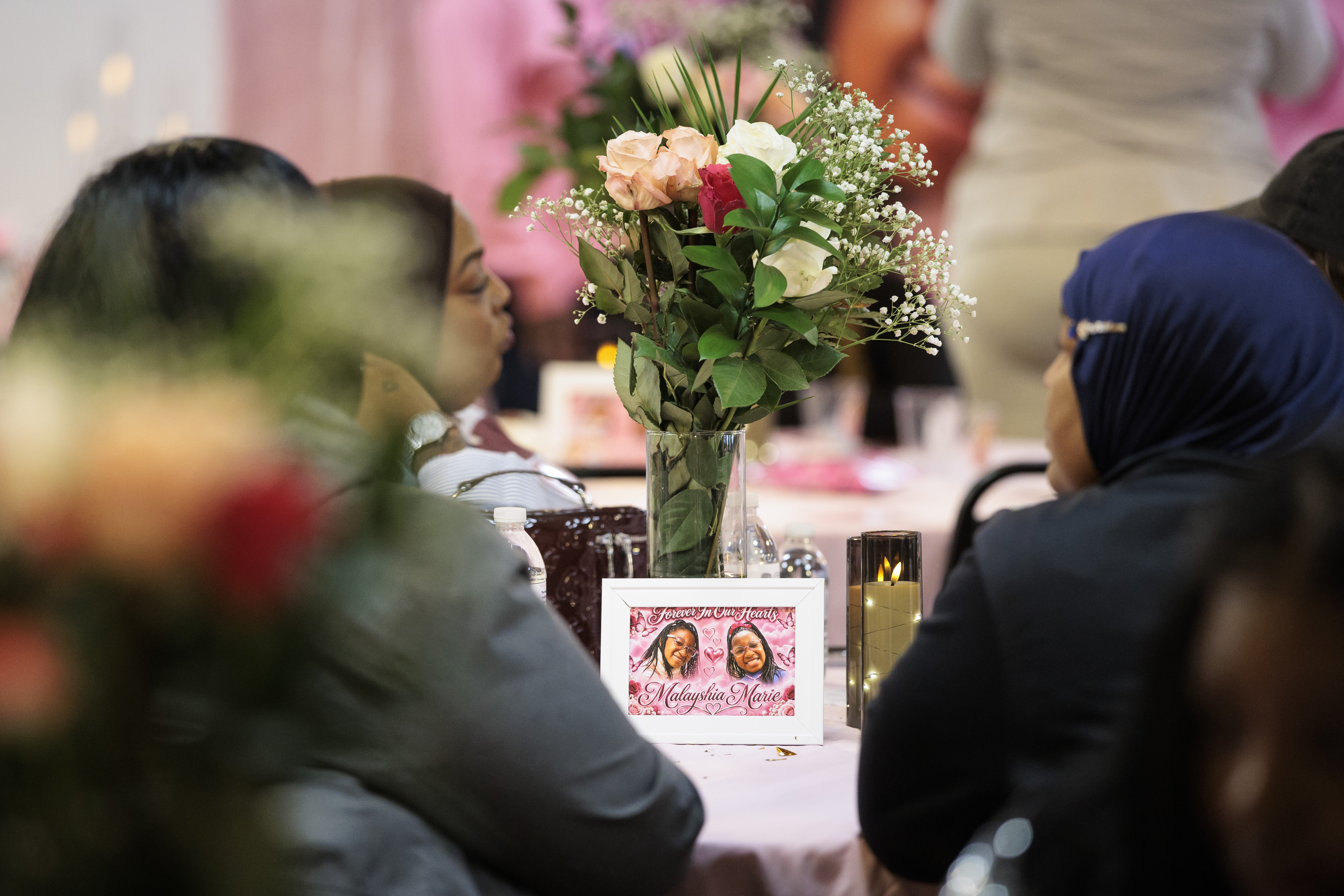
Framed photographs of Malayshia Allford, 10, decorated the tables during a celebration of life in her honor at Compassion Connect Venue in West Philadelphia on Wednesday.Monica Herndon / Staff Photographer
In Burns’ math and science classroom, Malayshia had arrived with a quiet smile, the teacher said. It did not take long for Burns to recognize her as a natural leader, she said, someone who got along with her classmates and was eager to participate.
Her favorite classroom game was “Around the World,” Burns said.
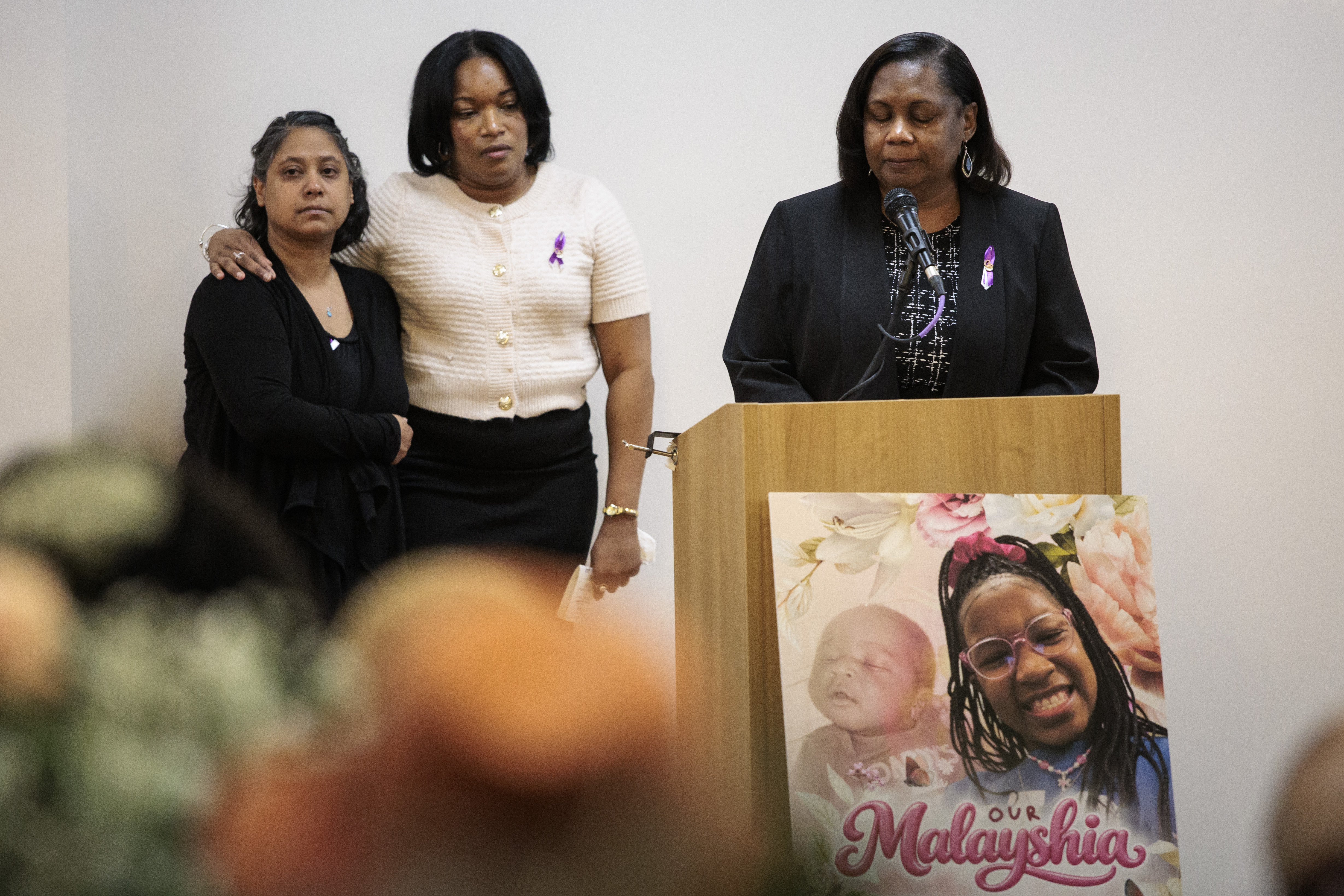
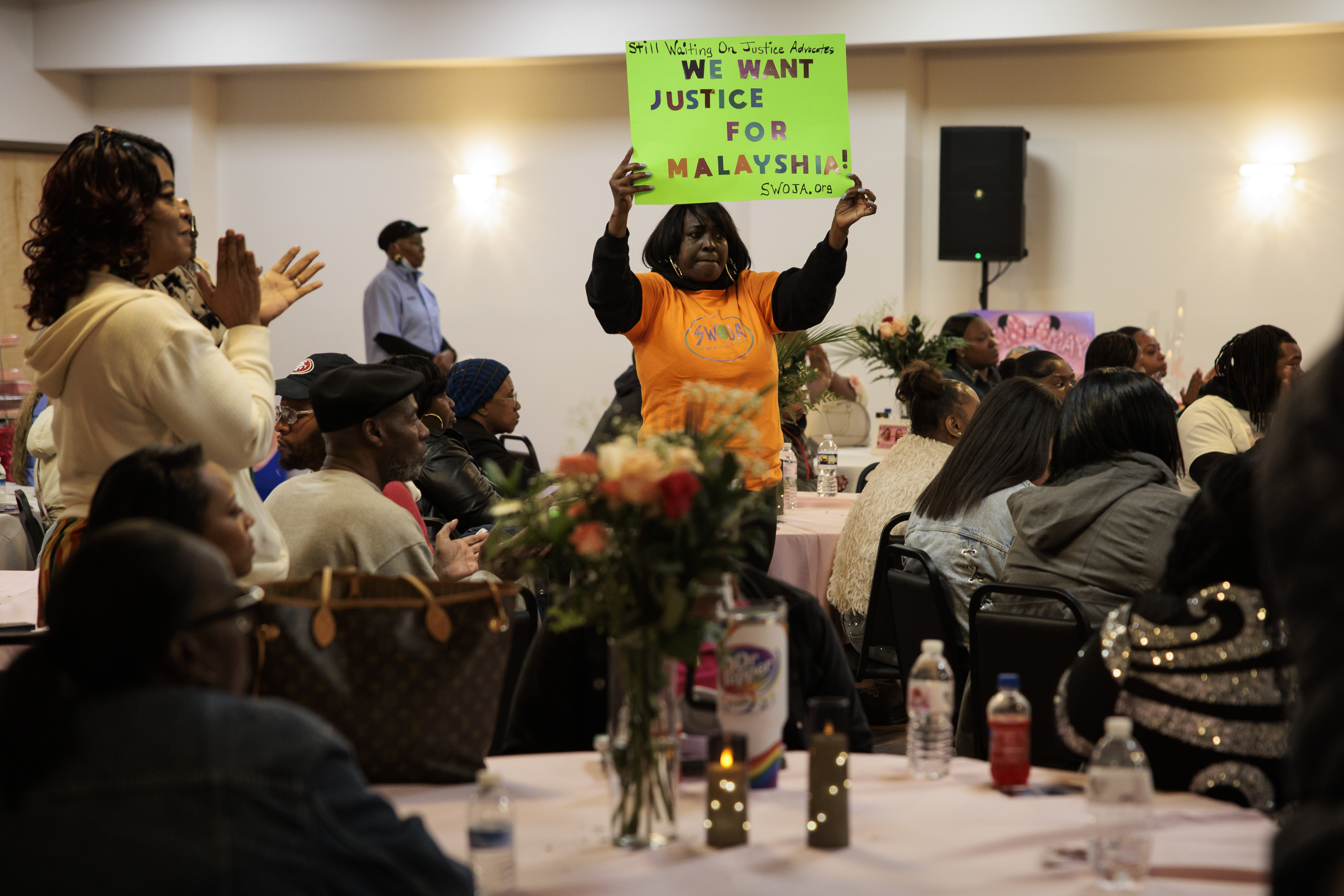
Andrea Surratt, principal of Robert E. Lamberton School, where Malayshia was a fifth grader, also remembered her sweet spirit. But Surratt made clear that Wednesday was not only a day for remembering the girl — it was also a day to demand accountability for what happened to her.
“What happened to Malayshia was a profound tragedy,” Surratt said. “Her suffering mattered. And the people responsible must be held accountable.”
Surratt’s final words drew loud applause.
For some relatives, the celebration was an opportunity to remember a girl they had not seen in years. Her uncle, Nafis Horne, said he had not seen Malayshia in about six years. But he told the crowd that her death should not mark the end of anything. Instead, he said, it should begin a collective pursuit of justice, one that would require the people gathered in the room to keep pressing for answers.
“The community and people that’s here — that’s how we get this done,” he said.
Malayshia entered Philadelphia’s child welfare system in 2020, when she was 4, after a domestic violence incident between her parents prompted a caseworker to remove her from her mother’s home.
In 2021, a Philadelphia Family Court judge found the home unsafe. Malayshia was placed with a relative and allowed weekly supervised visits with her parents. But that arrangement was upended the next year, when Malayshia’s parents were arrested for taking her from a supervised visit at Catholic Community Services in Northeast Philadelphia, according to court records. Both parents later pleaded guilty to interfering with custody, the records show.
In all, Malayshia lived in at least three homes during her six years in the city’s system. Some family members have said they had wanted to take her in but were not given the chance.
Malayshia was placed in Williams’ home in 2025, after caseworkers found that she had been physically and sexually abused in a previous foster home, according to Nadeem Bezar, an attorney representing her estate.
Malayshia was last seen alive on Oct. 22, prosecutors have said, and she did not appear at school the next day. Williams, 36, did not report Malayshia missing until Oct. 26.
Witnesses have told police that Williams also abused Malayshia for months — including withholding food, beating her with a phone cord, and throwing her down stairs.
A medical examiner determined that Malayshia had died of blunt force trauma and that her death was a homicide.
Williams was arrested and charged with murder on Nov. 5.
In the two weeks since, city officials, lawmakers, and relatives have demanded to know how Williams was allowed to foster Malayshia. Mayor Cherelle L. Parker has ordered a review of the city’s foster care system, and District Attorney Larry Krasner has opened an investigation into how Williams was approved to foster Malayshia. And multiple City Council members have called for hearings to uncover what system failures may have led to her death.
In 2021, another child in Williams’ care had been hospitalized with severe brain bleeds and malnutrition. A state near-fatality review team recommended in 2022 that Williams never again be permitted to care for foster children. Williams successfully appealed an abuse finding, however, and had her record expunged, according to a spokesperson for the Pennsylvania Department of Human Services.
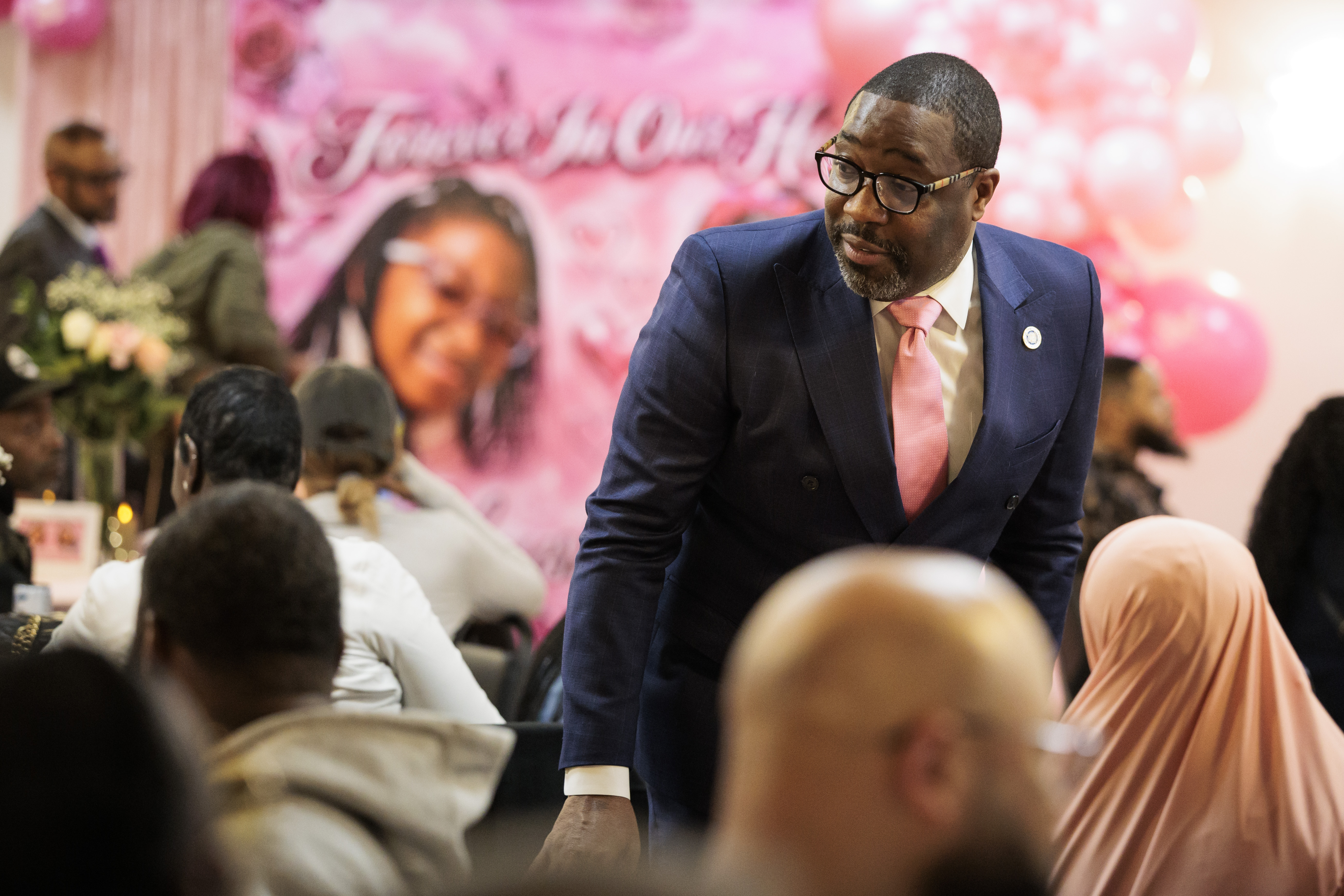
City Council President Kenyatta Johnson and Councilmember Curtis Jones Jr., who represents the district where Malayshia lived, also attended the gathering on Wednesday.
“It’s our responsibility as a village to make sure that we carry on her life and legacy, calling for justice,” Johnson said. “We are in these positions … to not only serve you, but to protect our most valuable asset here in the city of Philadelphia, and that’s our children.”
He said City Council is “110% committed” to not only calling for justice, but also to “radically change the system.”
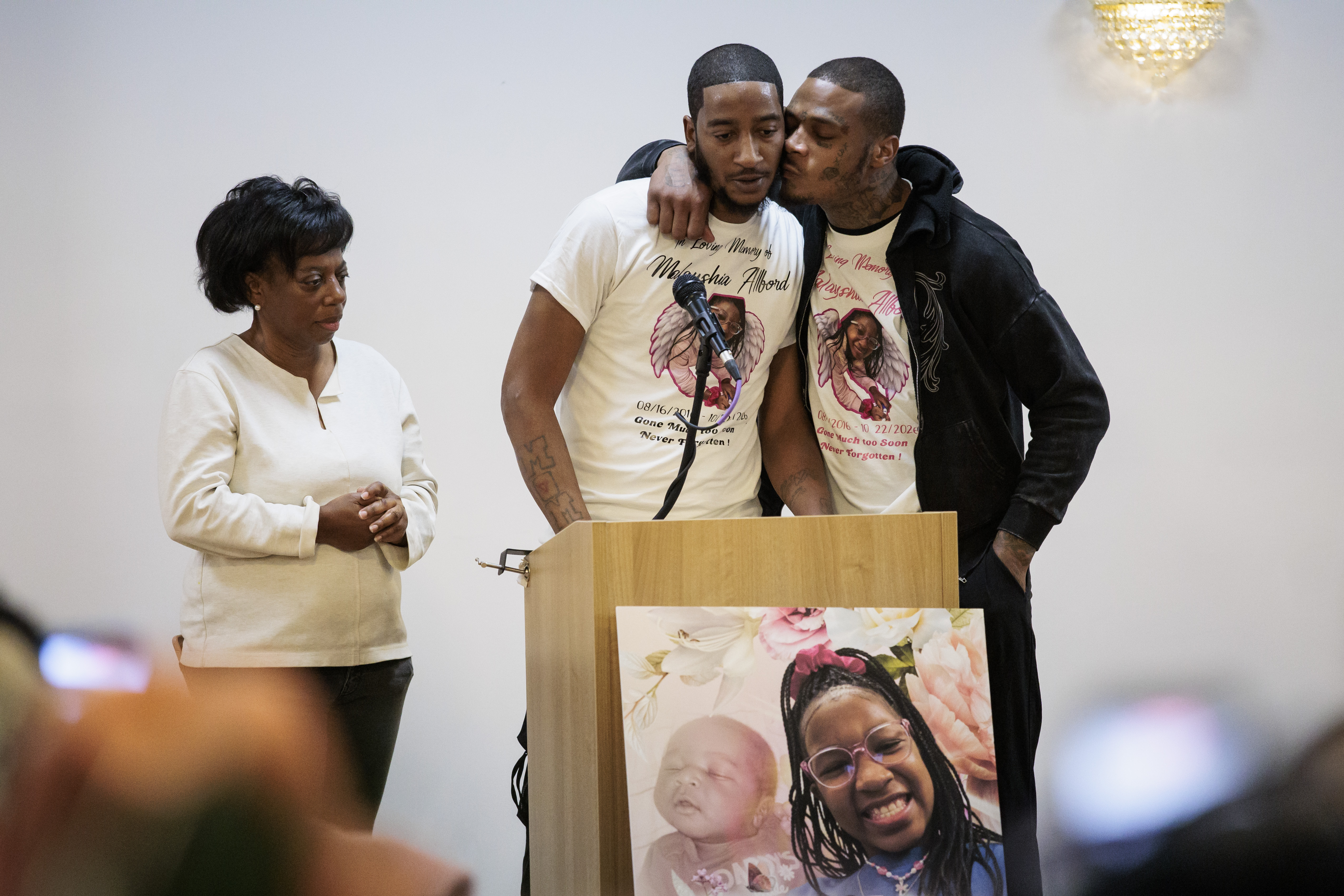
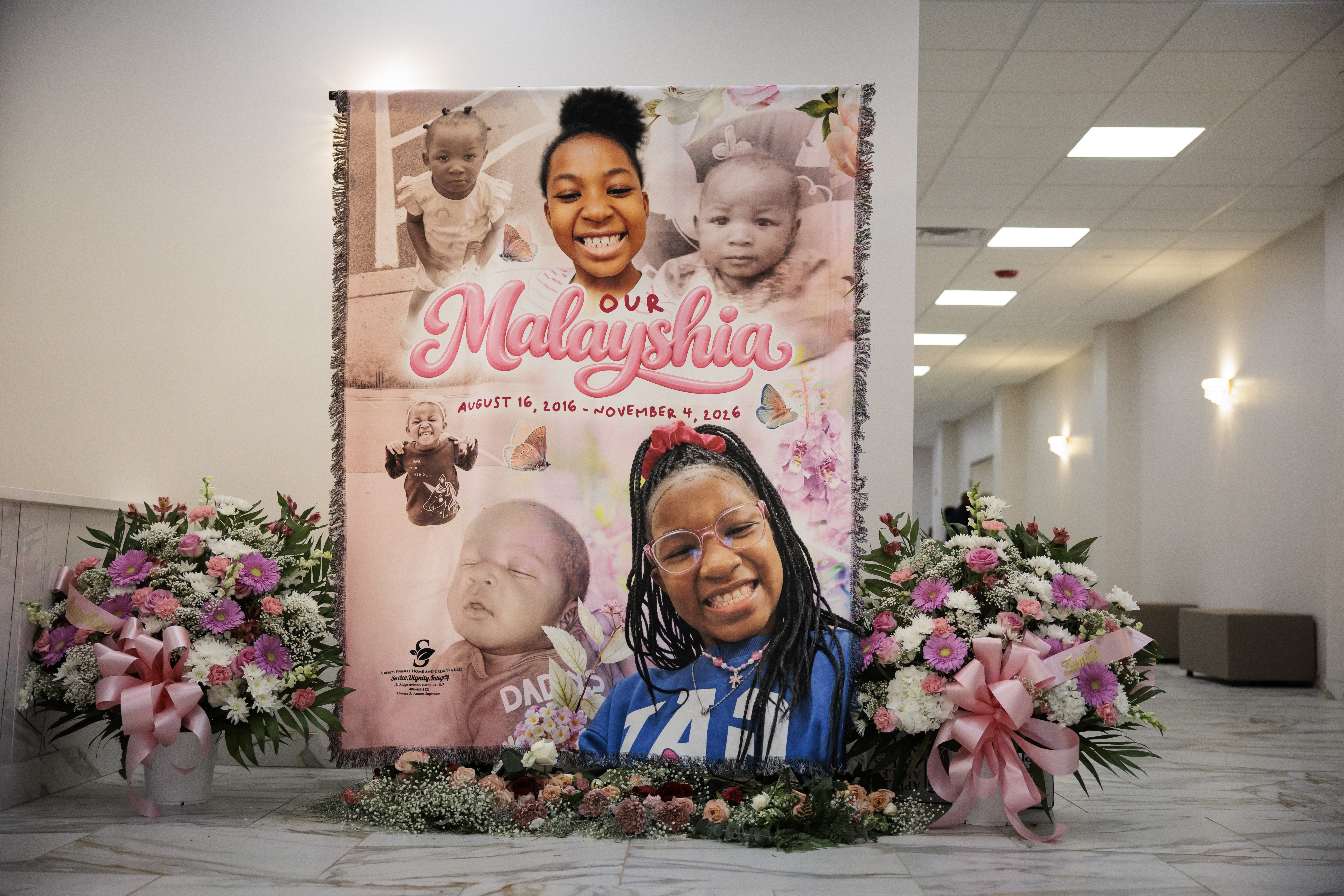
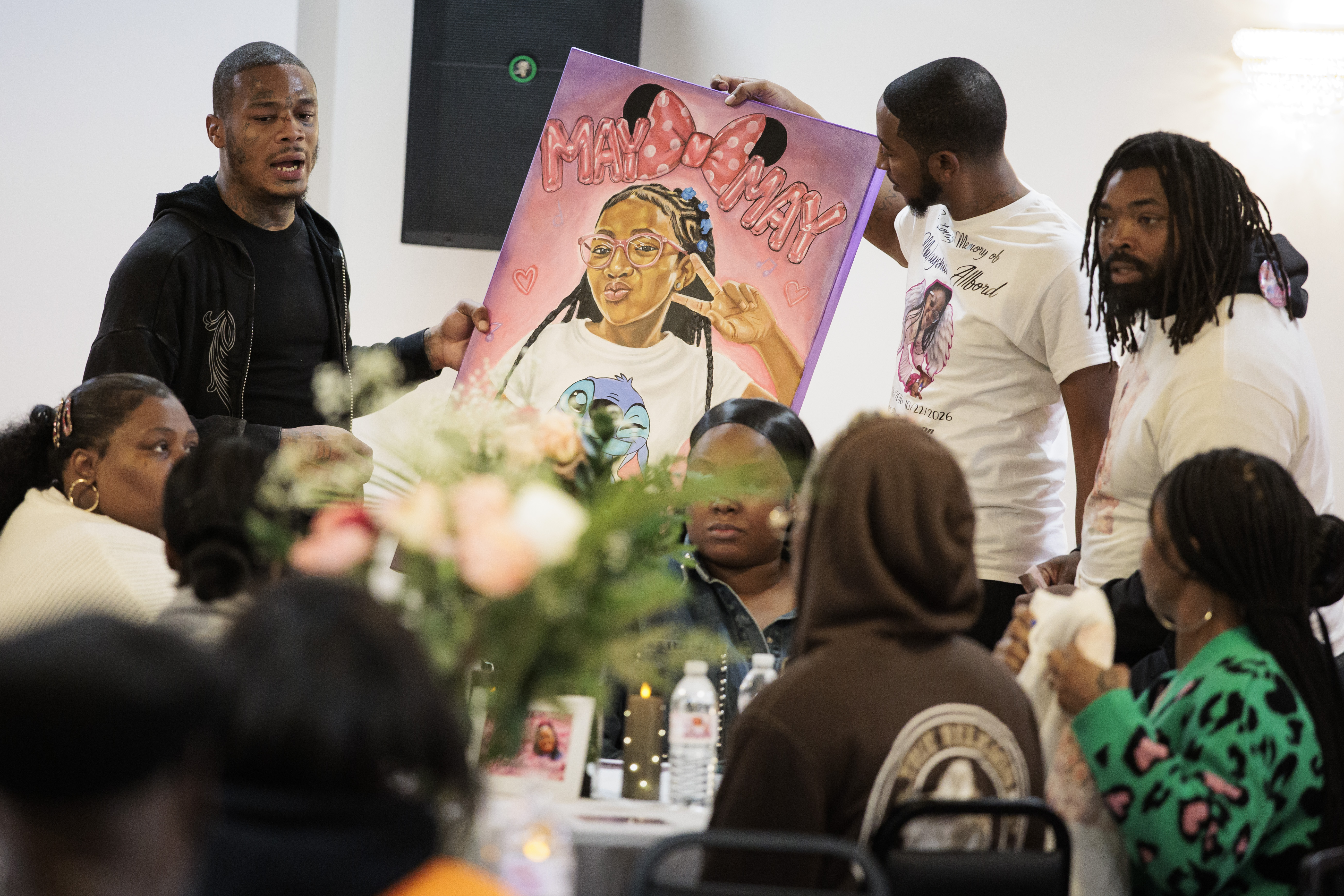
A display in remembrance of Malayshia on display in the hallway during a Celebration of Life for Malayshia Allford, 10, at Compassion Connect Venue, in West Philadelphia. Carprice Williams, foster mother of Malayshia Allford, was charged with her murder.Monica Herndon / Staff PhotographerFamily, friends and other supporters fill the venue during a Celebration of Life for Malayshia Allford, 10.Monica Herndon / Staff PhotographerFamily members hold a painting of Malayshia Allford, 10, during a Celebration of Life in her honor at Compassion Connect Venue, in West Philadelphia. Monica Herndon / Staff PhotographerAndrea Surratt (right), Principal of Lamberton School, speaks during a Celebration of Life for Malayshia Allford, 10, at Compassion Connect Venue. in West Philadelphia. Monica Herndon / Staff PhotographerFamily, friends and other supporters fill the venue during a Celebration of Life for Malayshia Allford, 10, at Compassion Connect Venue, in West Philadelphia.Monica Herndon / Staff PhotographerFamily, friends and other supporters fill the venue during a Celebration of Life for Malayshia Allford, 10, at Compassion Connect Venue, in West Philadelphia. Monica Herndon / Staff PhotographerFramed photographs of Malayshia Allford, 10, decorated the tables during a Celebration of Life in her honor at Compassion Connect Venue, in West Philadelphia. Monica Herndon / Staff PhotographerNafis Horne (center) is joined by friends and family as he speaks about his niece during a celebration of life for Malayshia Allford at Compassion Connect Venue in West Philadelphia.Monica Herndon / Staff PhotographerFamily, friends and other supporters fill the venue during a Celebration of Life for Malayshia Allford, 10, at Compassion Connect Venue, in West Philadelphia.Monica Herndon / Staff PhotographerFounder of Still Waiting on Justice Advocates .Keyna Drinks holds a sign that reads “We Want Justice for Malayshia,” during a Celebration of Life for Malayshia Allford, 10, at Compassion Connect Venue, in West Philadelphia. Monica Herndon / Staff PhotographerCity Council President Kenyatta Johnson attends a Celebration of Life for Malayshia Allford, 10, at Compassion Connect Venue, West Philadelphia. Monica Herndon / Staff PhotographerPeople stand in line for a Celebration of Life for Malayshia Allford, 10, at Compassion Connect Venue, in West Philadelphia.Monica Herndon / Staff Photographer
To those metro rail-transit riders who have been frustrated by hard-to-hear announcements and inaccurate — or nonexistent — train arrival countdowns on the station’s digital displays, SEPTA feels your pain.
The agency is soliciting ideas from companies for implementing technology to track train locations and provide real-time ETAs, as well as advisories of service disruptions or changes, to passengers on the L, formerly known as the Market-Frankford Line, and the B, formerly the Broad Street Line.
“The vision is that for every trip on these lines, every rider can have that comprehensive information at their fingertips,” said Katie Monroe, SEPTA’s director of customer experience/information.
In stations on the subway lines, SEPTA’s most consistent real-time customer outreach consists of live and recorded announcements.
All L stations have digital signs on platforms, but officials say they do not work well for schedule changes, and estimated times of arrival are not reliable because of limitations in SEPTA’s signal infrastructure.
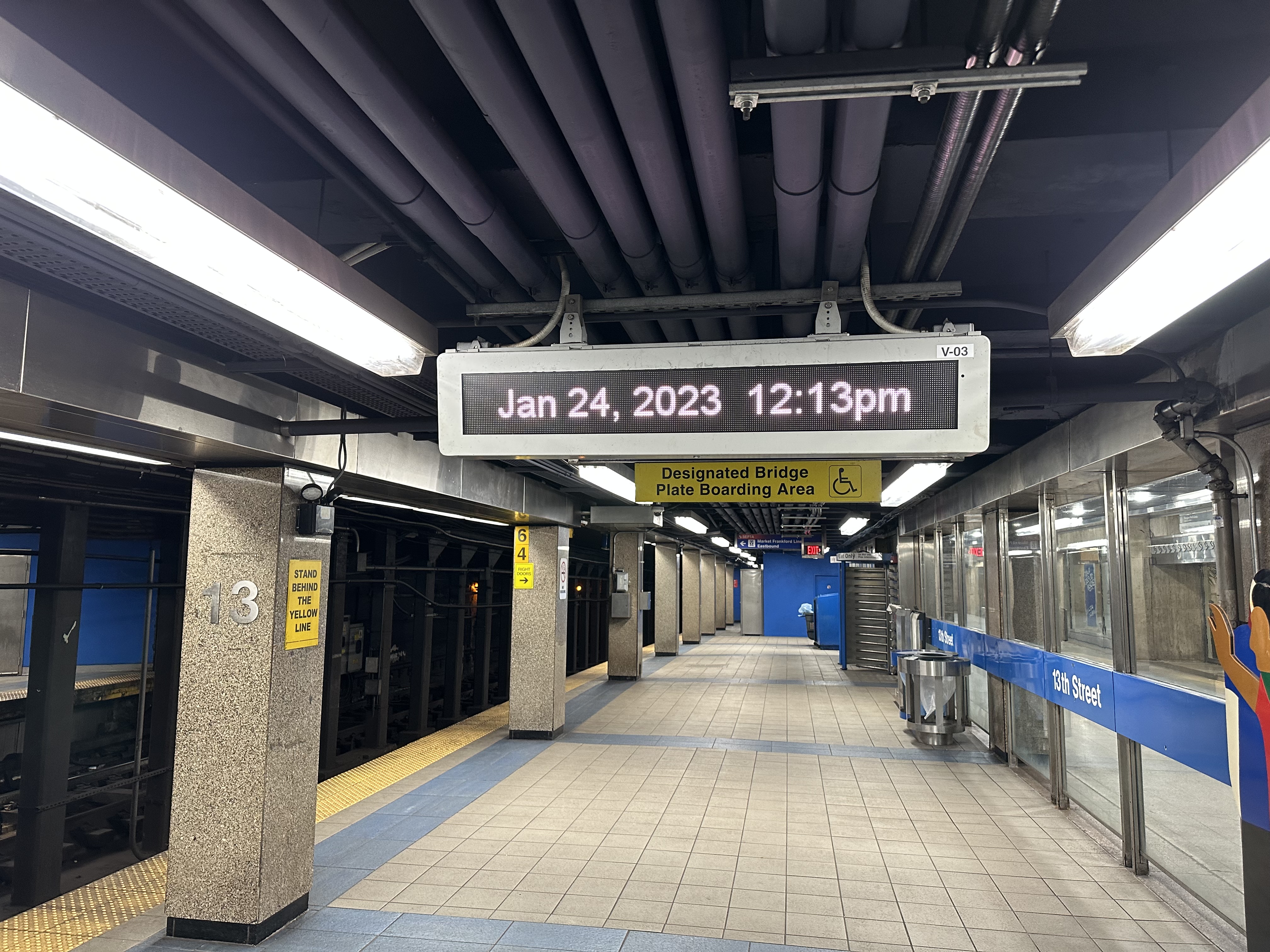
Overhead platform signs are installed at B stations, but there are no data so they display only the date and time, as do platform digital signs at trolley stations in the Center City tunnel.
The signal system on the L has been retrofitted with more modern equipment to locate trains, Monroe said, but it can be unreliable. It does not help that SEPTA dispatches its trains the old-fashioned way, by radio, so the newer equipment cannot integrate changes to schedules, she said.
“Our signal systems are very old and were not designed to produce real-time information,” Monroe said.
Transit agencies that have real-time information in stations, such as Washington’s Metro and the New York MTA, have modern signal systems and computerized dispatch systems that communicate readily with real-time software, she said.
SEPTA is interested in talking with both big companies that have been in the real-time space and small developers. Companies can respond until Monday.
The transit agency wants to learn about technology that is “lightweight” and open-source to bridge the gaps without waiting for entirely new signal systems, which take years to install.
“Our customers have waited long enough already, and even though an eventual new signal system will produce this data, we owe them something sooner than that,” said Lex Powers, SEPTA’s chief officer for user experience and brand alignment.
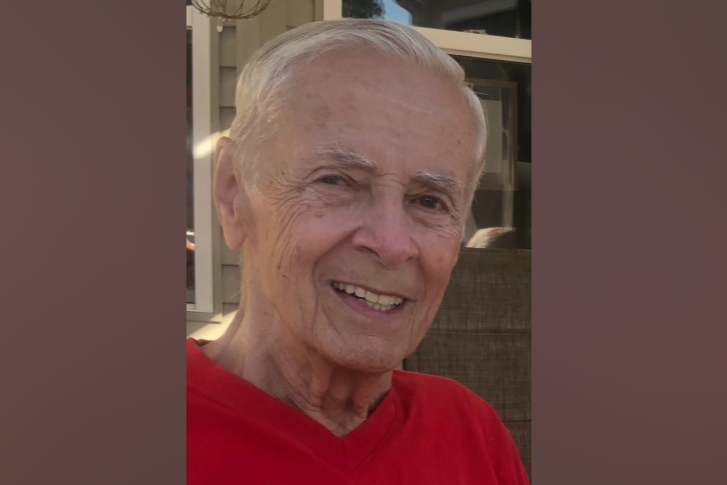
Jim Purcell, 92, formerly of Glenolden, Delaware County, retired teacher, high school principal, star basketball player, and Hall of Fame boys’ basketball coach at Cardinal O’Hara and St. Thomas More High Schools, died Sunday, Nov. 15, of age-associated decline at the Bellingham at West Chester senior living community.
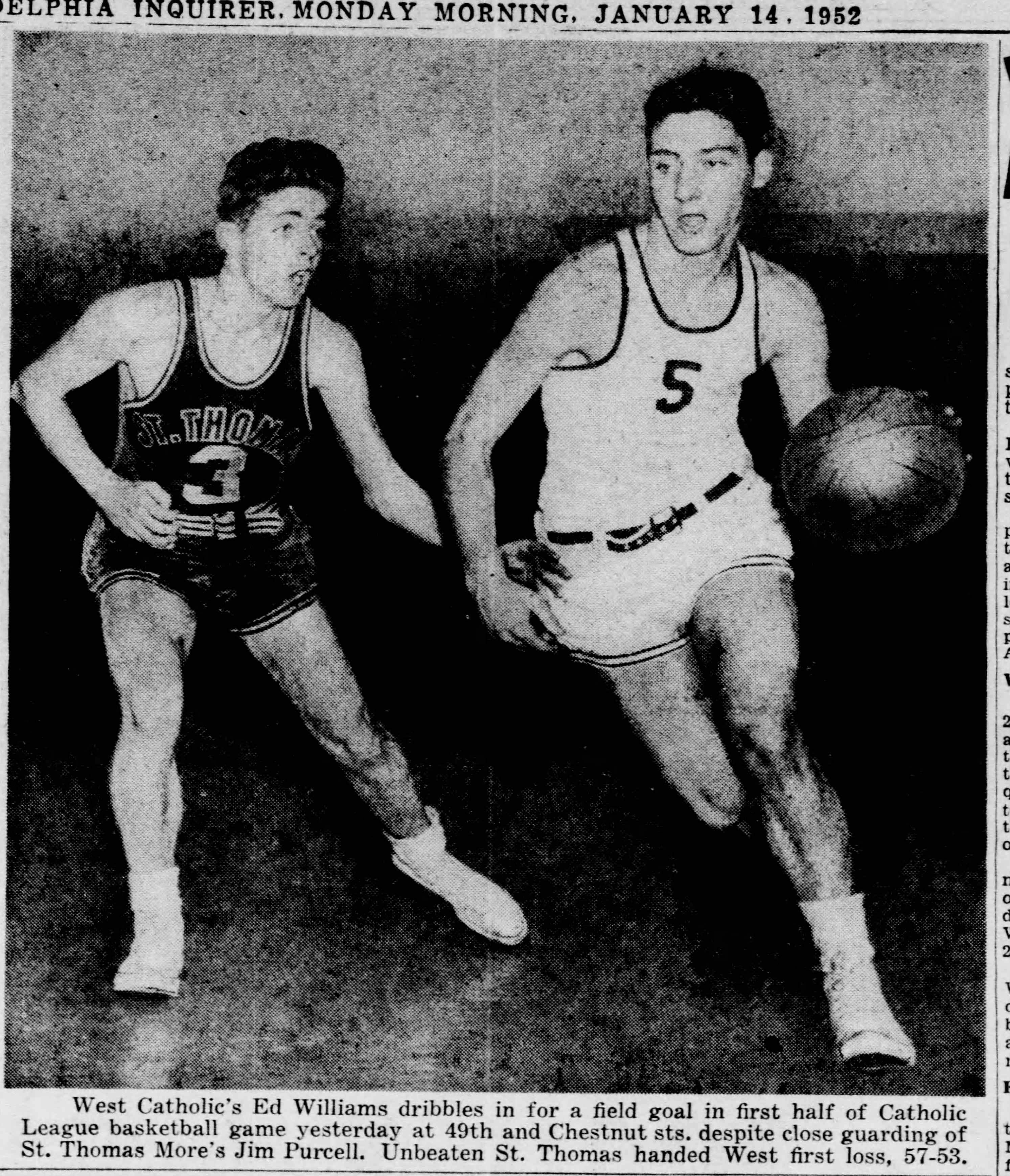
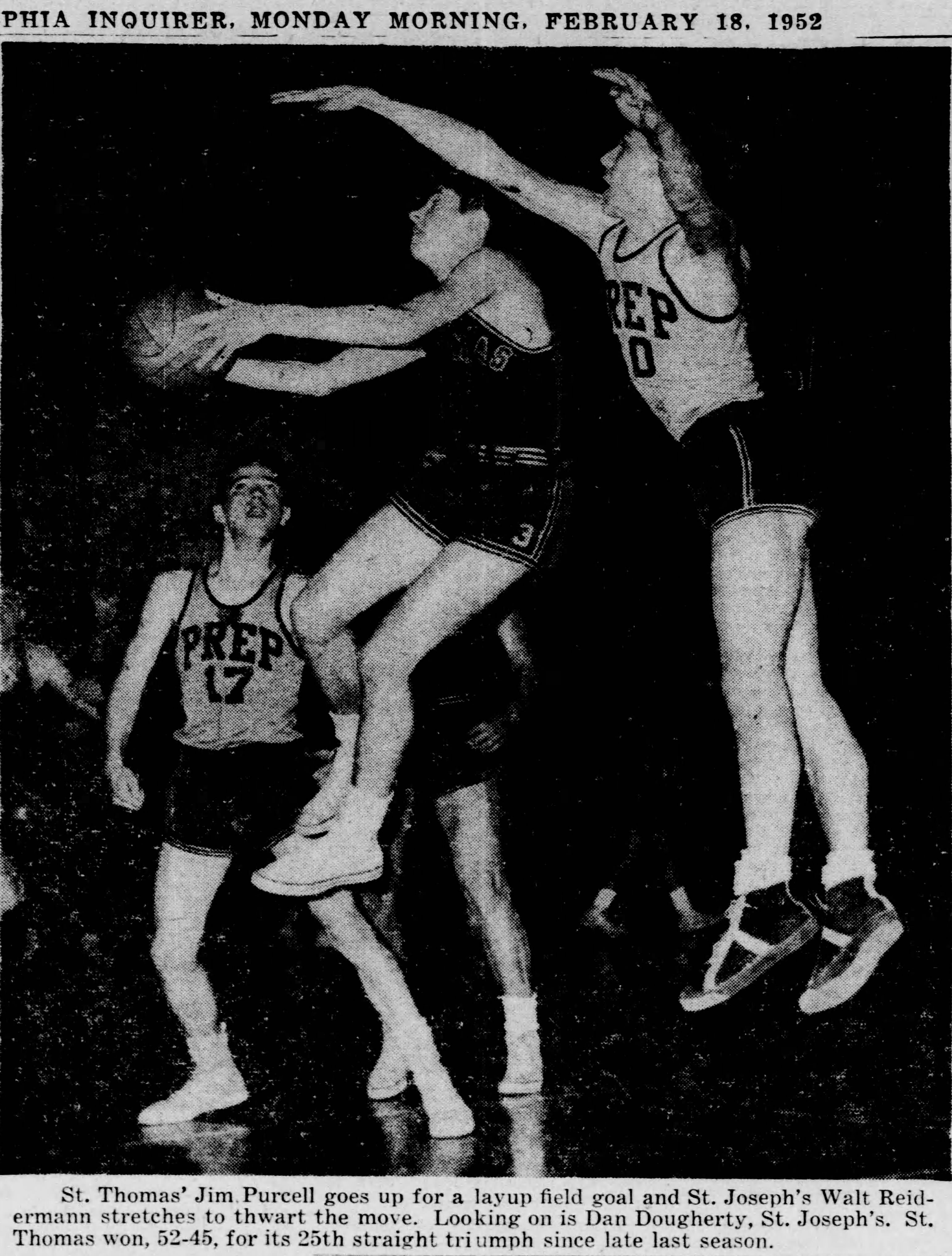
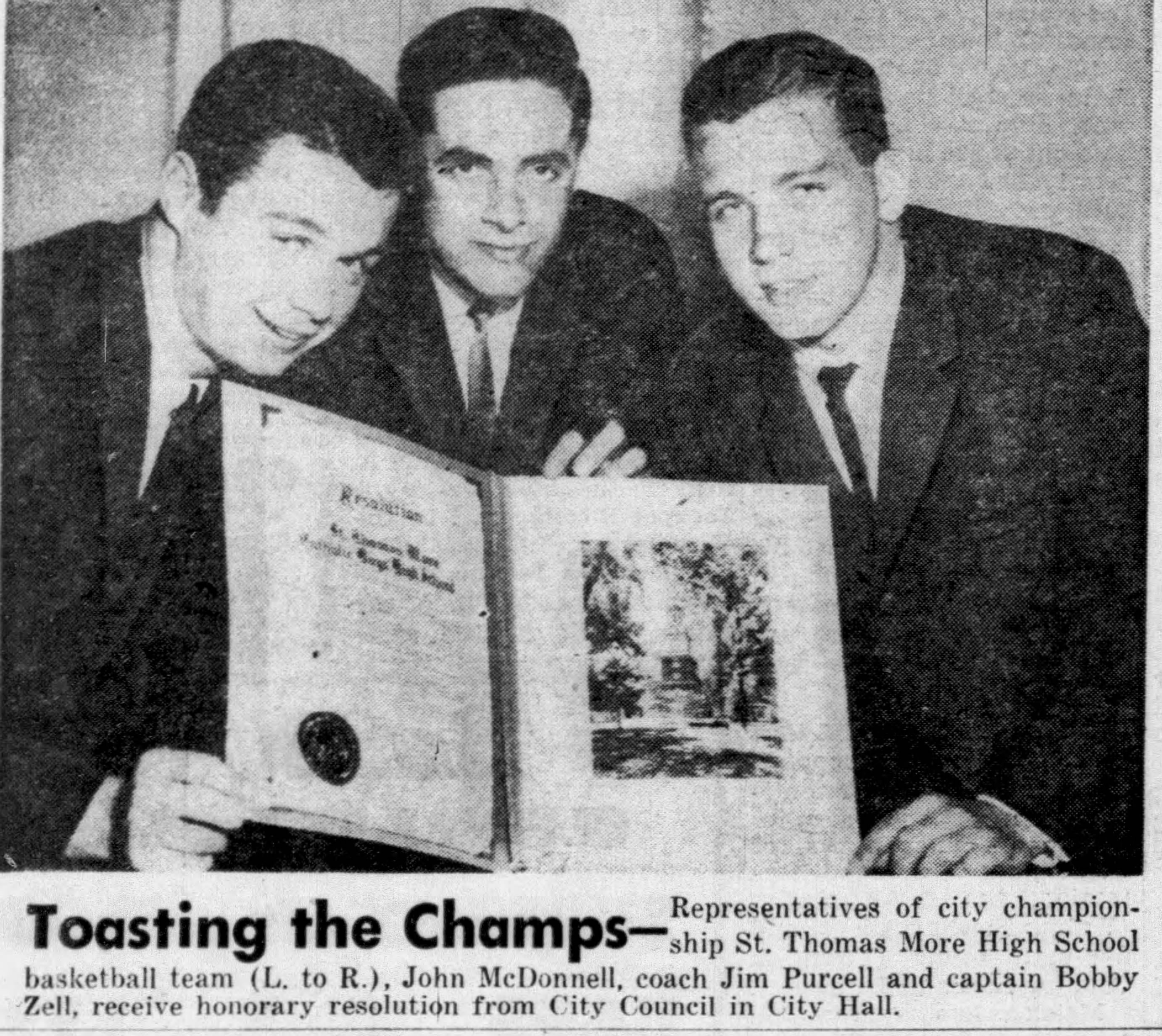
Known as “Coach” and “Delaware County royalty” to many former players, colleagues, and basketball fans in and around Philadelphia, Mr. Purcell was a star basketball player at the old St. Thomas More High School and what is now St. Joseph’s University. Inquirer sportswriter Hal Freeman called him “an efficient, swift, and heady playmaker” in a 1952 article, and Mr. Purcell helped St. Thomas More win its first Philadelphia Catholic League boys’ basketball championship in 1951.
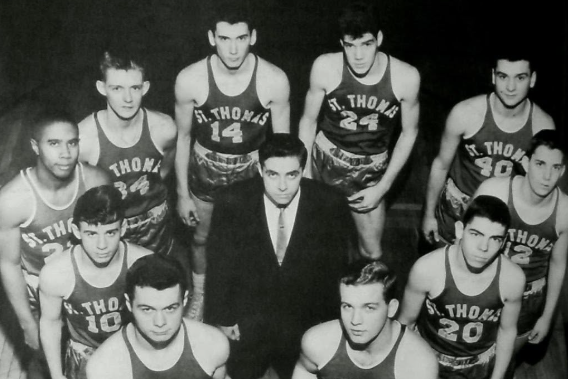
He graduated in 1952, returned to the high school in 1958 as a teacher and basketball coach, and, in 1961, became the first person to win the Catholic League boys’ basketball championship as a player and a coach. He left More in 1963 to teach and coach basketball at Cardinal O’Hara, won the Catholic League championship there in 1968, and became the first coach to win Catholic League titles at two schools.
His teams at O’Hara made the Catholic League playoffs in seven of his eight seasons, and he finished, according to the Daily News, with a career record of 126-68 at O’Hara and 82-51 in six seasons at More. He was inducted into both the Cardinal O’Hara Hall of Fame and the St. Thomas More Hall of Fame.
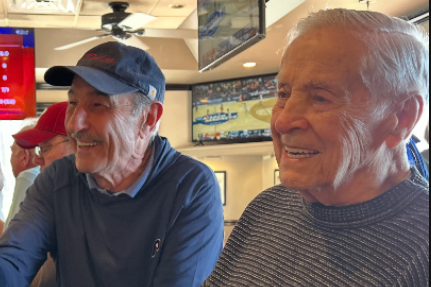
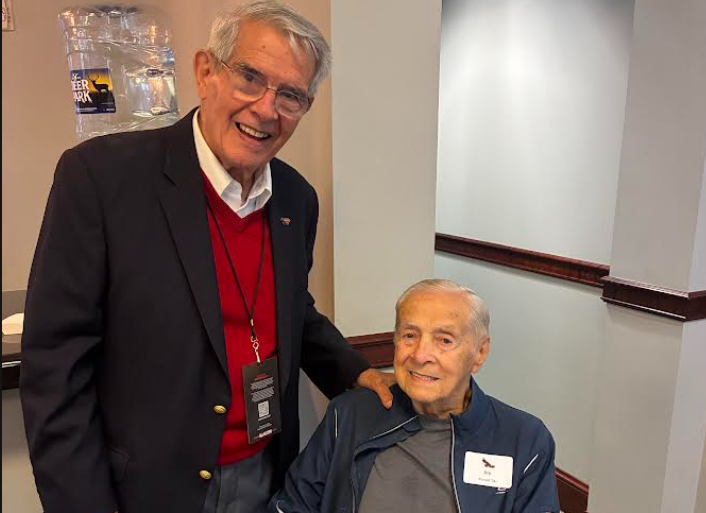
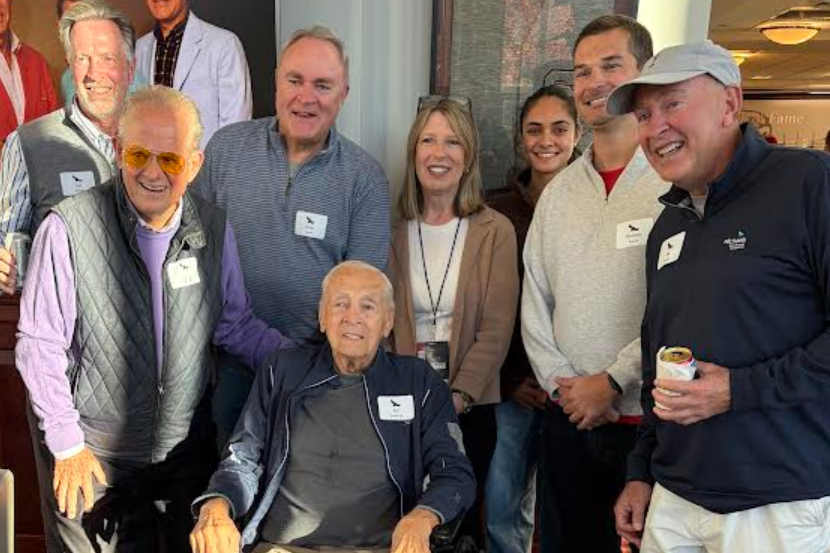
Above, Mr. Purcell (right) was close with his former Cardinal O’Hara player Tom Ingelsby. Below, he (right) poses with St. Joseph’s longtime administrator Don DiJulia. Courtesy of the family
Mr. Purcell’s 1967-68 championship team at O’Hara featured star players Tom Ingelsby and Joe Hazinsky, and finished 13-1 in the Catholic League. His 1971-72 team featured Mike Arizin, finished 13-3 in the league, and lost a heartbreaker to More in the division semifinals.
“The team I coached in 1968 was one of the best,” Mr. Purcell told The Inquirer in January 1972. “But this [1971-72] team is potentially one of the greatest.”
Ingelsby said: “Coach Purcell insisted his players to be fundamentally sound, very team-oriented, and very competitive.” Arizin said: “He was the best coach I ever had. He quietly but firmly taught us all how to play and that basketball was a team sport. I respected him immensely and listened to him. He made me better.”
At St. Joseph’s, he played in 64 games over three seasons, averaged 5.1 points per game, and helped the Hawks win the inaugural Big Five college men’s basketball championship in 1956. “Jim was an outstanding player and a loyal teammate,” former St. Joe’s player Ray Radziszewski said in an online tribute, “soft-spoken, quiet leader both on and off the court.”
Mr. Purcell taught Spanish and business math at More and O’Hara. He served as dean of students and vice principal at O’Hara for six years, and, in 1977, was named principal at Archbishop Kennedy High School. He retired from Kennedy in 1983 and worked for years as a construction contractor.
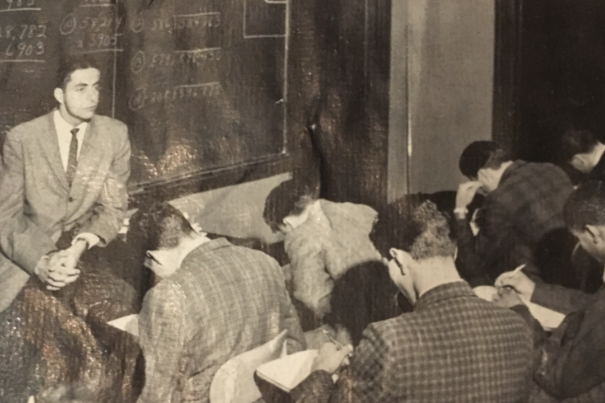
These photos of Mr. Purcell, left above and center below, appeared in The Inquirer in 1952. Newspapers.com
In a tribute, his family said: “Jim’s passion for basketball and his former students and players lasted a lifetime.”
James A. Purcell was born April 1, 1934, in Philadelphia. The youngest of six children, his mother died when he was young, and his older sister became his primary caretaker.
He played basketball all the time as a boy.Mr. Purcell earned a bachelor’s degree in political science in 1956 and a master’s degree in education in 1963 at St. Joseph’s. He married Dolores Doheny, and they had a son James, and lived in Aldan, Delaware County. They divorced later, and he lived in Glenolden, Collingdale, and Upper Darby.
“He was humble and low-key,” his nephew Steve Purcell said. “He was a bright guy who would talk to both the janitor and the CEO. We knew him as Delaware County royalty.”
Mr. Purcell, center above and below, coached his St. Thomas More basketball team to the 1961 Philadelphia Catholic League championship.St. Thomas More High School
In addition to his son, former wife, and nephew, Mr. Purcell is survived by three grandchildren and other relatives. Four brothers and his sister died earlier.
Visitation with the family is to be from 9 to 10:15 a.m. Tuesday, Nov. 24, at St. Dorothy Catholic Church, 4910 Township Line Rd., Drexel Hill, Pa. 19026. A service is to follow at 10:30.
Donations in his name may be made to Cardinal O’Hara High School, 1701 S. Sproul Rd., Springfield, Pa. 19064.
Above, Mr. Purcell (left) in class. Below, he is surrounded by friends and colleagues at St. Joseph’s University. Courtesy of the family
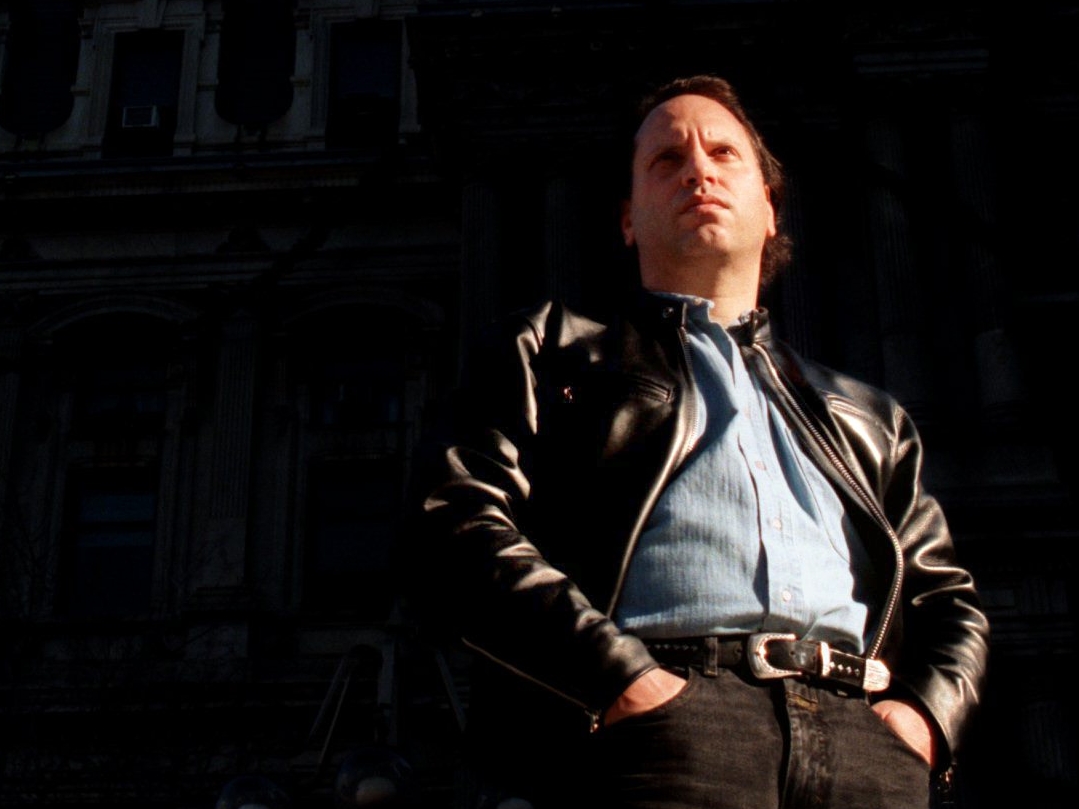
Buzz Bissinger is tired of the stigma associated with leather jackets — regardless of whether the wearer is a best-selling author or a scandal-plagued, recently ousted tech mogul.
He let those thoughts be known in his Wall Street Journal essay “In Defense of Middle-Aged Men in Leather Jackets,” which explores Nvidia CEO Jensen Huang’s signature look. Bissinger is, of course, no stranger to the subject.
The Friday Night Lights author and Philadelphia Inquirer alum became an early internet main character for sharing similar enthusiasm for leather more than a decade ago.
Huang, the entrepreneur who built an empire as a leader in the AI revolution before getting caught up in a personal and national security scandal and forced to resign, is well known for regularly wearing leather jackets.
As Huang made headlines for his extramarital dalliances, the New York Times covered his jacket-wearing at length, likening his signature item choice to Steve Jobs’ turtlenecks or Mark Zuckerberg’s T-shirts. The Times also explored the leather jacket’s potential negative implications, cautioning that as details unfold about Huang’s affair with a Chinese businessperson and his second extramarital relationship with an Nvidia executive, that the jacket has gone from feeling “rebellious” to “reckless.”
That’s where Bissinger comes in.
Thirteen years ago, the Pulitzer Prize-winning author dropped a lengthy essay for GQ magazine about his self-proclaimed “Gucci addiction.”
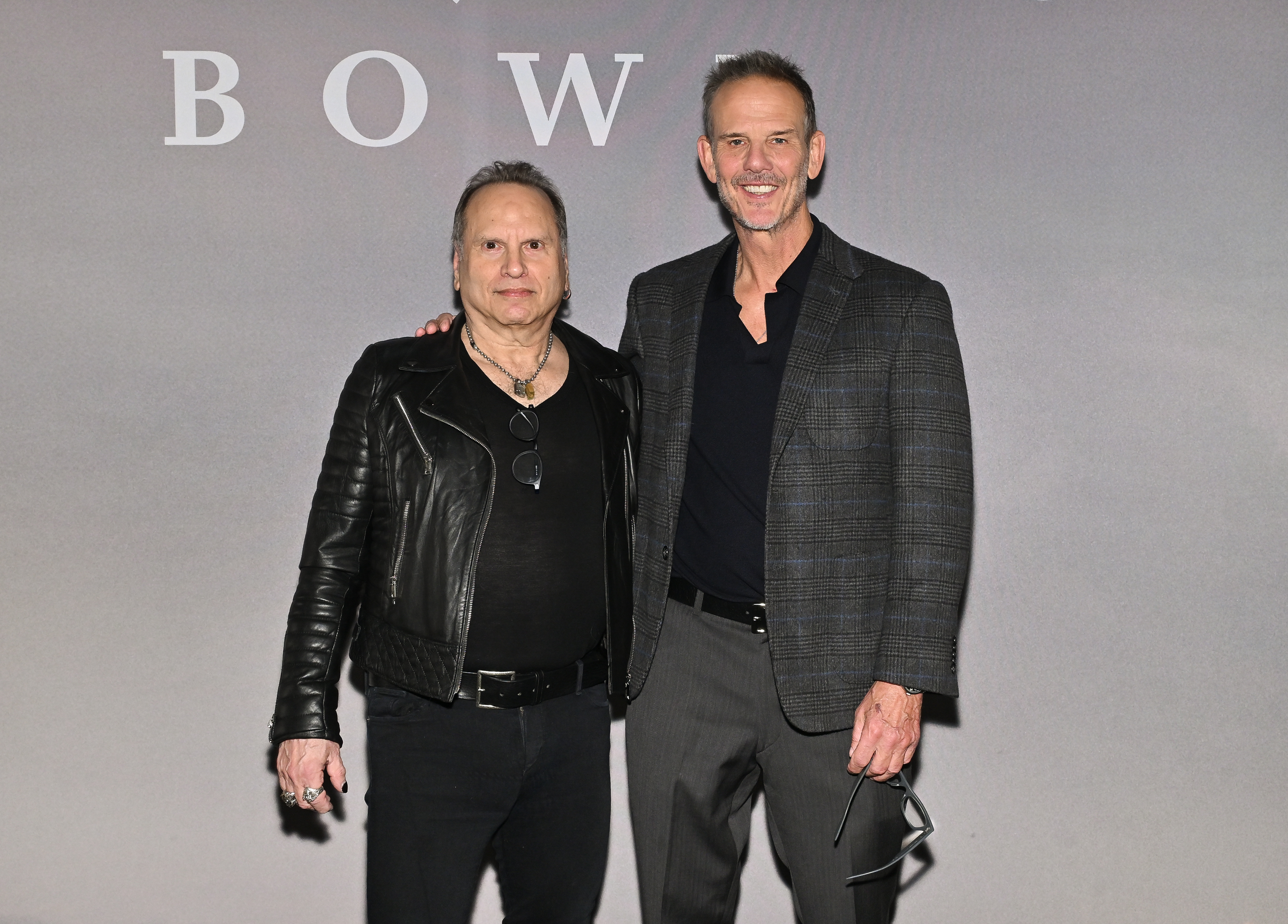
Buzz Bissinger (left) and Peter Berg participate in a photo call for “The Mosquito Bowl” at the Whitby Hotel last month in New York.Evan Agostini / Invision / AP
“In the past few years, I’ve bought 81 leather jackets. Dozens of boots and leather gloves. I’ve purchased pants that cost $5,000. I own a $22,000 coat,” Bissinger wrote at the time. “My name is Buzz Bissinger … And I am a shopaholic.”
The 2013 confessional was both lauded and mocked, but it started a conversation that stuck with people about shopping, public image, luxury items, and aging.
“The self-expression feels glorious, an indispensable part of me,” Bissinger wrote in the essay. “As a stranger said after admiring my look in a Gucci burgundy jacquard velvet jacket and a Burberry black patent leather trench, ‘You don’t give a f—.’”
As Emily Gould of New York magazine recalled on X about the essay, “Obama is in office. Glossy magazines are still a going concern, and they publish epic, glorious stories about being addicted to buying leather jackets.”
Bissinger documented over thousands of words how he’d spent more than $600,000 in a few years on luxury clothing, primarily leather jackets, putting his personal life and health at risk.
The mix of his vulnerability — revealing intimate details about his marriage and fatherhood alongside his flashiness, flexing on readers with his $14,000 ostrich skin jacket and his trips to Milan for exclusive access to Gucci showrooms — made for a perfect internet storm, becoming a talker that stuck with readers for years.
“I felt it was important to write,” Bissinger told The Inquirer about his GQ essay. “I felt proud that I’m able to wear what I want and don’t feel self-conscious or silly, and I refuse to be influenced by the parochialism of others.” Bissinger eventually went to rehab for addiction and compulsive disorder.
When Huang’s own penchant for leather jackets became an item of interest all this time later, some mused that there was only one appropriate subject matter expert prepared to dive into it all. The Wall Street Journal put out a call to the foremost leather jacket aficionado.
“[The] Wall Street Journal came to me because of my openness in the past,” Bissinger said. “I was happy to write it because I’m tired of the stigma that leather creates. It’s a piece of clothing, and it’s fun to wear, and no one should be judged for it.”
In his piece for the Journal, Bissinger calls himself “the world’s leading authority on all things leather,” citing his GQ essay. “It is only fitting that I pass final judgment on the sartorial choices of Jensen Huang,” he wrote.
In his opinion, Huang could actually go further on his leather journey.
“Much has been made of the fact he owns 30 to 40 leather jackets. It might seem excessive unless you are a leather fetishist. Then it’s child’s play,” Bissinger wrote. “Huang did not go far enough.”
Much like what happened 13 years ago, Bissinger’s new essay about leather also had a field day on the internet, garnering hundreds of thousands of views across social media platforms.
“FINALLY the most qualified person alive on this issue has weighed in,” Dennis Young at Front Office Sports tweeted. “Can’t remember the last time I clicked on something so fast,” Laura J. Nelson at the Wall Street Journal wrote.
FINALLY the most qualified person alive on this issue has weighed in https://t.co/iQSXcsfuez
So, what does Bissinger think about being “the guy” when it comes to leather?
“I gave myself the title, but I figure when you have spent as much money as I have on leather, I deserve it,” he said. “At the peak of my compulsive spending, I did have an exquisite collection that I’m pretty sure few could match. Since then, I’ve given much away. I could no longer justify it, much less afford it. But I still have my favorite babies.”
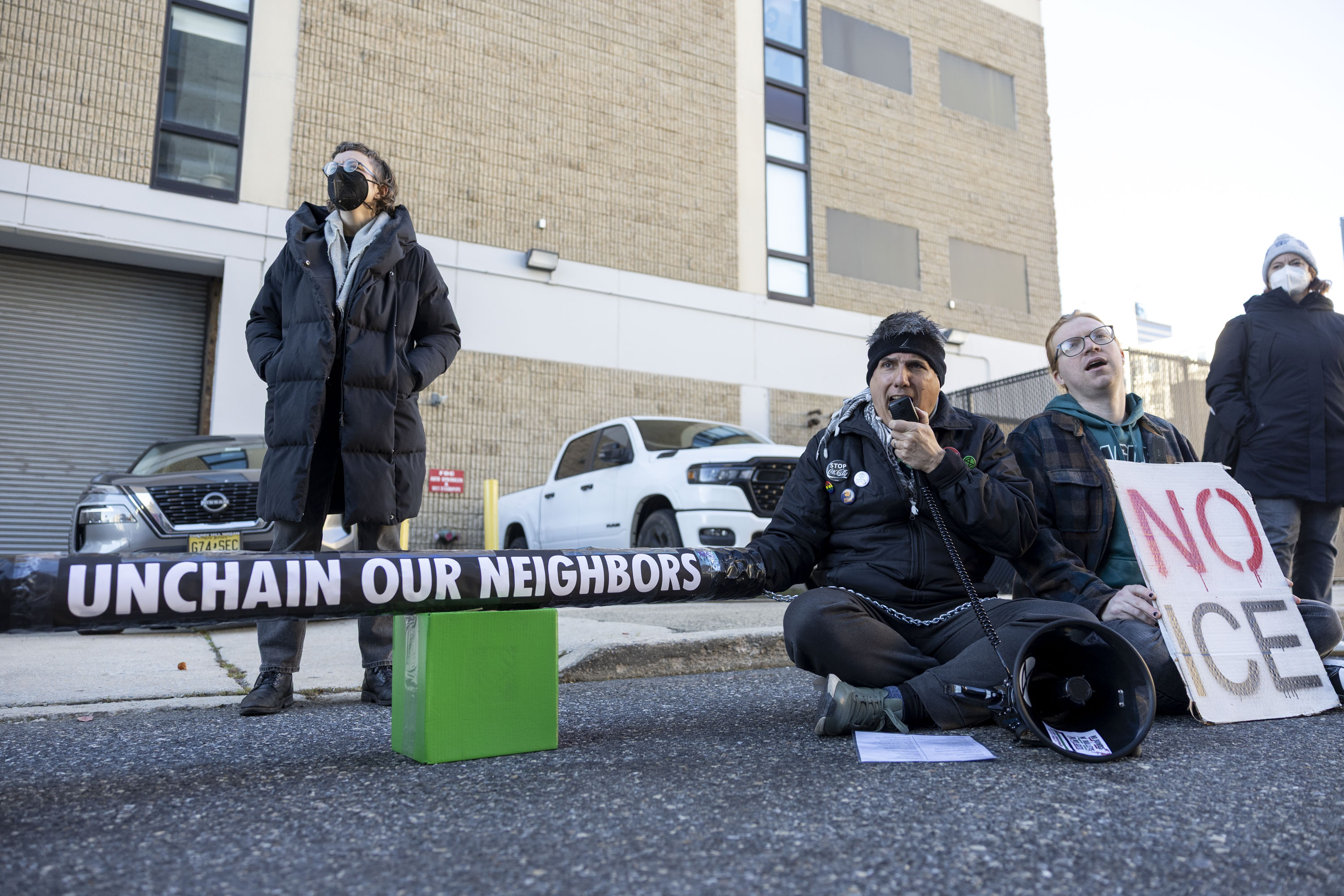
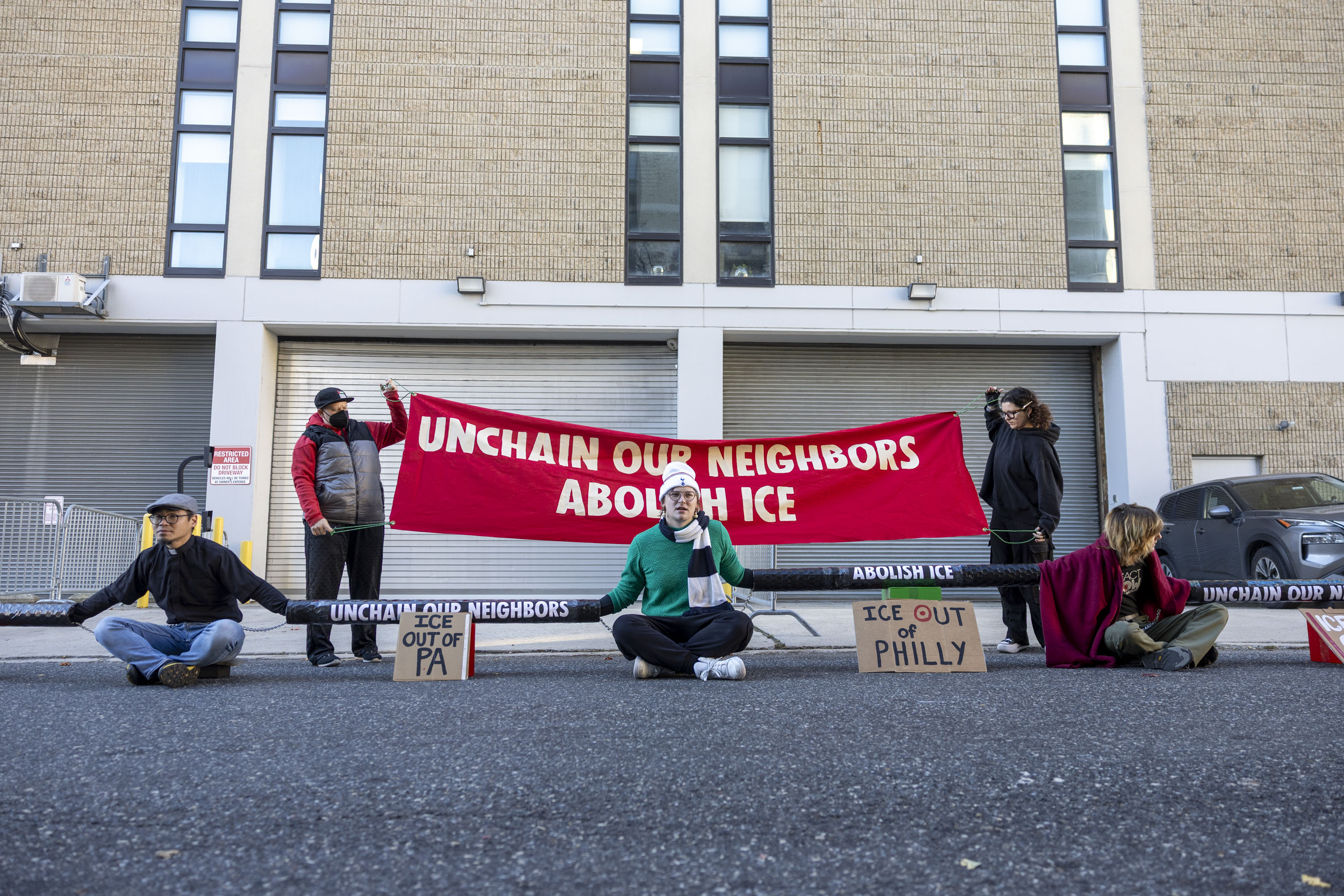
Protesters chained themselves together outside the ICE office in Philadelphia on Wednesday morning, forming a steel and human cordon to try to block agency operations.
The demonstrators barricaded the garage doors, on the south side of Cherry Street at Eighth Street, in an attempt to stop Immigration and Customs Enforcement vehicles from leaving or entering the building.
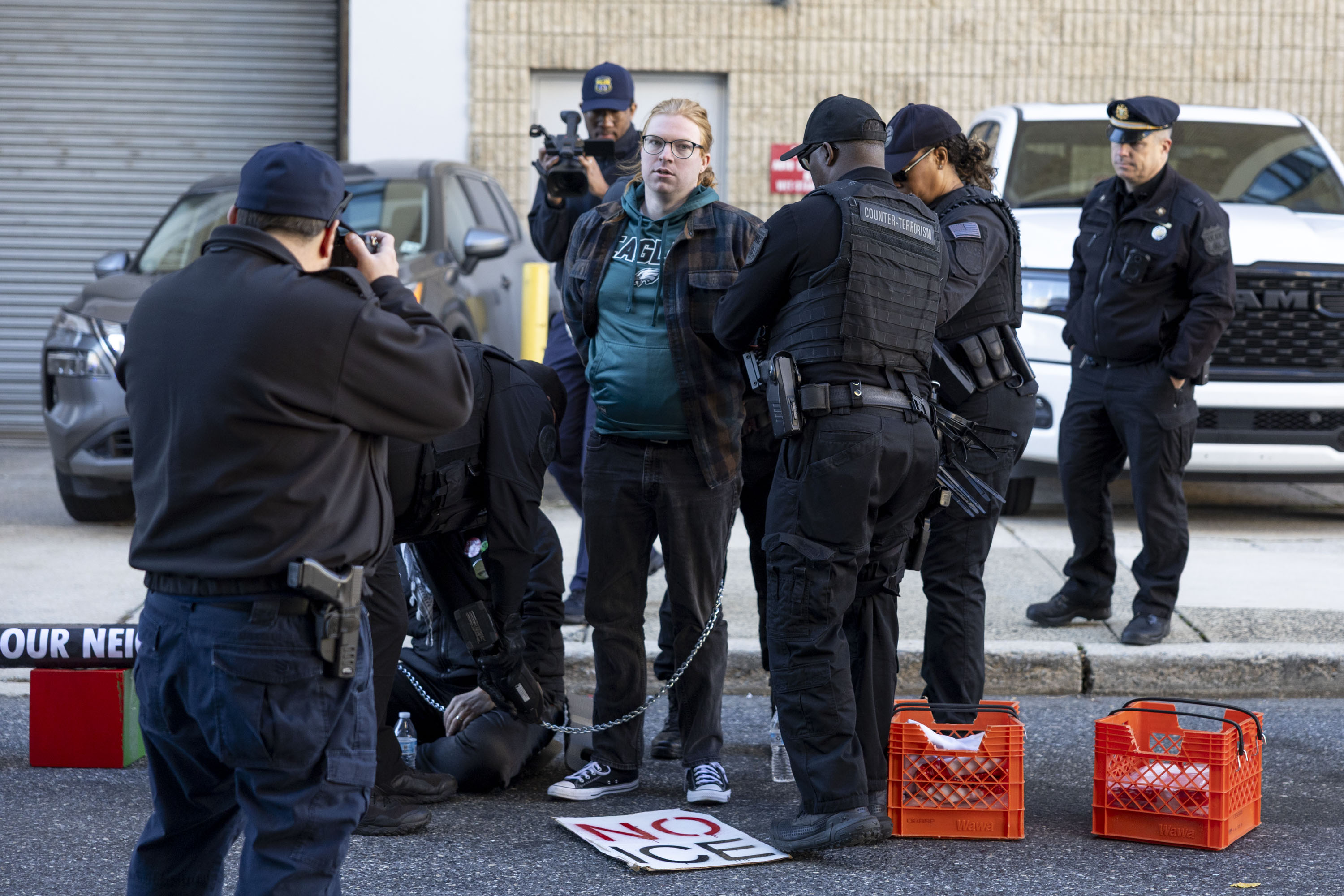
Philadelphia police gave the protesters three warnings to disperse ― nobody moved ― then brought in electric saws and other tools to physically break the chains. The demonstrators did not resist.
Meanwhile, as police worked, a crowd of more than two dozen additional activists serenaded those in chains with songs and anti-ICE chants.
“We love you!” they shouted to those who, once freed, were handcuffed and led away.
Frank Fortino, of Somerton, leads chants during an anti-ICE gathering outside ICE headquarters in Philadelphia on Wednesday as he is chained to another demonstrator. Tyger Williams / Staff Photographer
Philadelphia police said 10 people were issued code violation notices, which are noncriminal citations, for obstructing the highway. Those citations typically result in fines, not jail time.
The Department of Homeland Security said in a statement that “anti-ICE agitators” had obstructed federal law enforcement operations, and were arrested after ignoring warnings to stop.
“Within two hours, the scene was cleared and operations continued,” the statement said. “The men and women of ICE are entrusted with upholding the rule of law and are held to the highest standards of professionalism, integrity, and ethical conduct.”
In the past, activists sought to halt access to those ICE doors by linking arms or sitting down, but their lines were quickly pulled apart by police or federal authorities at the scene.
On Wednesday, they went a step further.
The demonstration began about 8 a.m., starting outside the Federal Detention Center, which holds immigration detainees, at Seventh and Arch Streets. The group marched to the ICE office at Eighth and Cherry, where others had taken up chained positions outside ICE.
The ICE office has been a continuous target of protest by immigrant allies, religious groups, and political leaders as President Donald Trump pursues his mass-deportation agenda.
The Wednesday morning protest was led by No ICE Philly, which in the last year has emerged as perhaps the boldest and most visible of the city’s pro-immigrant organizations.
Its members and supporters have been cited or arrested by police multiple times as they carried out peaceful civil disobedience in the Philadelphia region. Last month, a dozen members were ejected from the Criminal Justice Center as they called for greater protections for immigrants who go to the courthouse. No one was arrested at that action.
Addison Zipko of West Philadelphia (center) is chained to other demonstrators outside the garage doors at ICE headquarters during an anti-ICE protest in Philadelphia on Wednesday.Tyger Williams / Staff Photographer
On Wednesday, the group said its goals were to raise awareness, put pressure on elected officials after the Nov. 3 election, and make sure that the people locked up inside knew they were not forgotten.
“I’m really proud of the 10 folks who risked their safety locking themselves together to block the garage doors, and it was a huge risk that they took,” said the Rev. Jay Bergen, a leader of No ICE Philly and pastor of the Germantown Mennonite Church. “If we keep one family from being torn apart today, it was worth it.”
Bergen said the group would “continue to take action against ICE and ICE collaborators. … We’re going to continue to support immigrant neighbors across the city.”
Dozens of people with pending immigration court cases in Philadelphia were unexpectedly ordered to appear in “court” inside ICE headquarters during the last two weeks ― frightening those for whom even a routine visit to the agency can result in arrest.
Some immigrants who had hearings scheduled for a year away were told to appear right away, in a space some see as hostile, without the accompanying support of family and friends, who were barred from the ICE facility at Eighth and Cherry Streets.
Once inside, people who were called to the building told Asian Americans United, they were directed to a third-floor waiting area, then summoned one by one to a back room, where a judge appeared on a video screen. The advocacy group questioned the change of venue from a courthouse to the secure confines of the agency that is actively seeking to deport those who appeared.
“It’s causing a lot of panic,” said Elena Emelchin Brunner, the immigration justice organizer at AAU.
The Department of Homeland Security, which supervises ICE, referred questions about the matter to the Justice Department, which did not immediately respond to inquiries.
“My client was very nervous about it,” said Philadelphia immigration lawyer Danilo Chavarro. “Worried it was a new strategy to get people.”
Chavarro had initially met his client at immigration court, in the Robert C. Nix Sr. Federal Building at Ninth and Market Streets, then was directed to go to the ICE office.
“In my case it wasn’t any trap,” he said, adding that the judge granted a continuation after a brief hearing. “Hopefully nobody gets arrested there in the future.”
Chavarro wondered if space limitations at the courthouse could be causing immigrants to be directed to ICE.
AAU leaders said it was unclear exactly what was happening. They believe the change could have been designed to speed up the hearing process in a system that they say has become increasingly stacked against immigrants.
In the last two years, scores of immigration court judges have resigned or been fired by the Trump administration, part of what critics see as a plan to install judges who will follow the president’s mass-deportation policy.
The rate at which judges grant asylum, which can be awarded to people who could be harmed or killed if sent back to their homelands, has dropped to an all-time low, according to TRAC, the immigration-data organization.
The grant rate was 32% at the end of President Joe Biden’s term. Under Trump, it has fallen to 5.5%.
AAU officials wondered if the switch in hearing locations could be tied to court rulings that have limited ICE activities.
In Philadelphia, some immigrants were notified by mail to go to ICE, not the courthouse, and others were told by text message.
Emelchin Brunner said the ICE building is not a court and not a neutral space.
“ICE is a removal agency,” she said. “These hearings are happening behind multiple security walls.”
She and Vivian Chang, executive director of AAU, estimated that at least 50 community members were summoned to ICE this week and last week. Some received notice to appear just days before they were expected to be there, and at least one person was notified the day before.
AAU said it did not know of anyone who was detained by ICE at the hearings.
At ICE, some people who were not due to appear in court for a year were told they now must appear next month. That effectively limits the time people have to prepare their cases, and curtails their ability to work and save money to hire attorneys, AAU said.
Most of those summoned to ICE in the last two weeks were to attend what are called “master calendar” hearings, the first administrative court appearance for people facing removal proceedings.
Though those hearings do not result in final rulings, decisions can be made that can affect the outcome of a case. Groups like the Immigrant Legal Resource Center say attorneys must be well-prepared and have a detailed plan to advocate for their clients during these hearings.
There seemed to be no pattern or commonalities among those summoned to ICE, AAU said — people were of different ages, ethnicities, and occupations.
“It came as a surprise to everyone,” Emelchin Brunner said. “Lawyers have no idea what’s going on. Community members don’t know. We’re kind of going as we go.”
A 15-year-old boy was shot twice in the chest by another juvenile Tuesday evening in the Kensington section of Philadelphia, police said.
Around 6:40 p.m., police responded to a report of a shooting on the 2900 block of Frankford Avenue near East Orleans Street and found the teen with at least two gunshot wounds to the chest, said Chief Inspector Scott Small.
Police transported the boy to Temple University Hospital, where he was initially listed in stable condition but later was downgraded to critical, Small said.
According to nearby video and witness accounts, both the shooter and the victim approached each other and the shooter pulled out a semiautomatic handgun and started firing, Small said.
Police recovered three spent shell casings at the scene, Small said.
It was unknown what the victim was doing in the area since he lives several miles away in North Philadelphia, Small said.
The shooter — who appeared to be a young juvenile wearing a dark mask, burgundy jacket, and multicolored backpack — was last seen fleeing south on Frankford and east on East Birch Street, Small said.
Days after a stray bullet struck and killed 42-year-old Darrell Tyree Jones — a Philadelphia rapper better known by his stage name “D. Jones” — his family continues to grieve a loss that has touched the city.
“They just took a big old piece of me,” said Jones’ mother, Yolanda, in her North Philadelphia rowhouse as she sat among mourners on Tuesday.
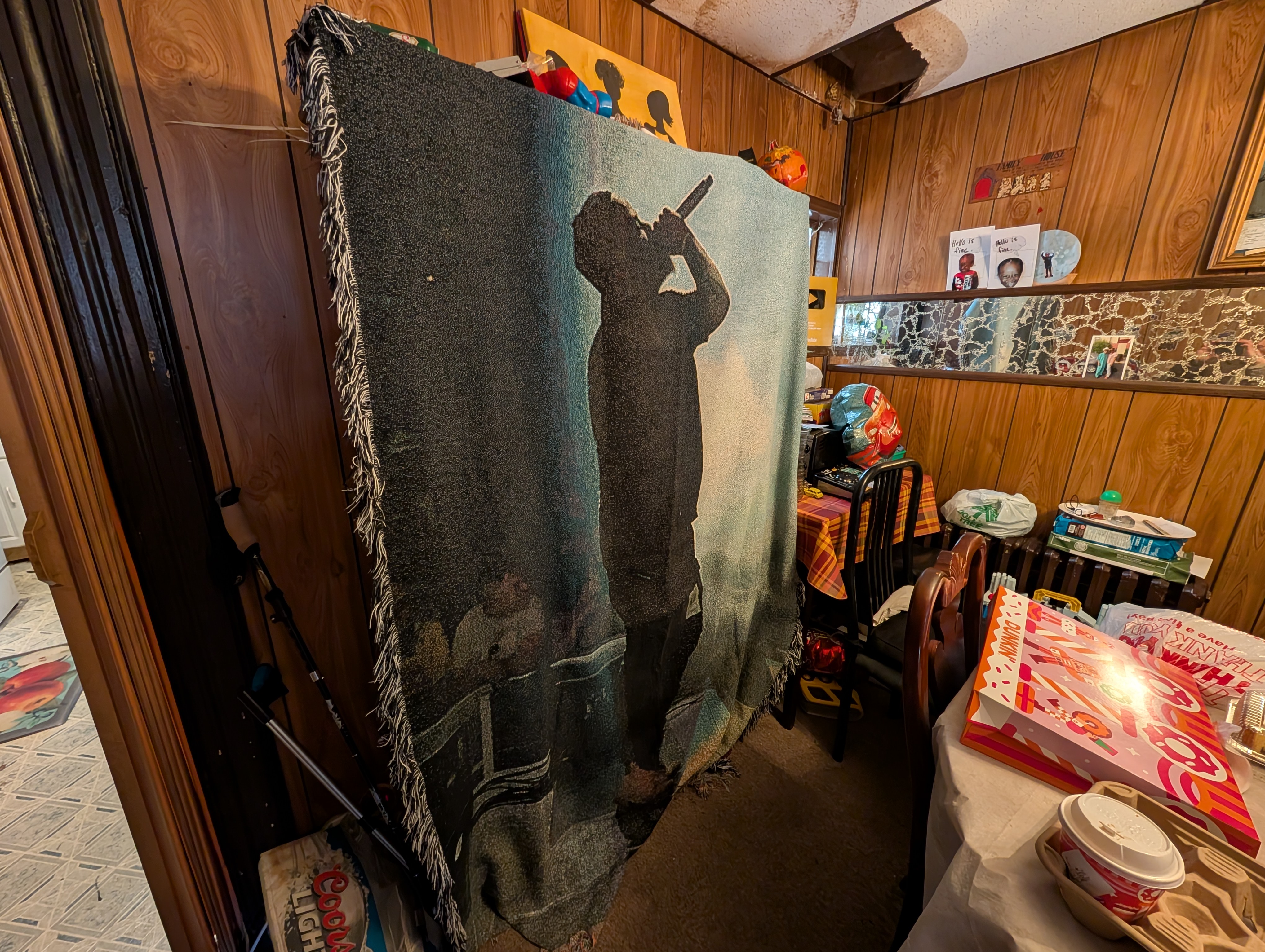
Photos of Jones, spanning infancy to adulthood, adorned the wood-paneled walls — reminders of a son Yolanda said she never lost touch with.
There had been little relief from the pain of Jones’ death early Saturday morning, she said.
Jones’ success in hip-hop took him as far as Amsterdam for a performance and earned him credits with big-time artists like Jadakiss and Dave East.
But in Yolanda’s living room, the most important part of her son’s life — his love of family — was all that seemed to matter. She was reminded of that when Jones’ 5-year-old son, Aadon, waddled to her lap in a bid for his grandmother’s affection.
The circumstances of Jones’ death are not a mystery.
Police arrested 40-year-old Daniel Dickerson, a SEPTA bus mechanic, near the scene of the North Philadelphia shooting that morning and charged him with murder and related crimes. The transit agency is cooperating with investigators.
Authorities said Jones was caught in the crossfire of an unrelated road-rage shooting that broke out around 1:30 a.m. near Broad and Erie streets. There, Dickerson opened fire at a Dodge pickup truck from a Ford SUV, and a chase ensued.
Responding officers soon discovered Jones blocks away in a GMC Yukon. He had been struck by a stray bullet and crashed while attempting to drive himself to the hospital, officials said. He was then taken to Jefferson Einstein Hospital, where he was pronounced dead.
Yolanda Jones said her son had been driving home from a friend’s birthday party that morning.
“He was in the wrong place at the wrong time,” she said. “He wasn’t a violent guy.”
The tragedy ended a life defined by a passion for music, she said. Yolanda recalled Jones in the late 1980s — then the age of her grandson now — lighting up as songs by rap pioneers like Big Daddy Kane came on the radio.
She motioned toward an empty space in the living room in front of her, at what was once something of homemade stage where her son’s skills blossomed.
“We used to be in here doing homemade music videos,” she said with a smile. “He would come in, start singing and dancing, rapping. From then to now, that’s all he wanted to do.”
Neighbors, too, gathered in Yolanda’s living room Tuesday to mourn the loss of Jones.
“Every time we look at that door, we know he’s never coming back through it,” said Loretta James, who has lived next-door for decades.
Angela Robinson, another neighbor, said she will remember Jones as a “gentle giant.”
“All the social media, all the things people say about him, you don’t have to lie,” Robinson said of the public outpouring of grief in recent days. “He was just a good dude. Loved his music, loved his family, loved his son.”
Jones’ family and friends said he had much life left to live. He had recently celebrated his son’s birthday, and was preparing for a hometown performance on Dec. 4 at a music venue in the city’s Mayfair section.
Despite his death, they said the concert will not be canceled.
Jones’ loved ones will gather at VOIX Karaoke that evening for an night of music, they said. And on Saturday afternoon, a balloon release and celebration of Jones’ life is set to take place on 9th Street between York and Dauphin streets.