Category: Philadelphia News

  • One of the gloomier Septembers on record in Philly has come to a merciful end

    One of the gloomier Septembers on record in Philly has come to a merciful end

    Given the remarkable gloominess of the last 30 days, it would be reasonable to believe that the sun had lost its will to shine.

    It is due to make a comeback by Thursday afternoon on the first day of a fresh month, but last month has entered the books as one of the wetter and cloudier Septembers in the period of available records.

    Ordinarily, the September sun is some consolation for what is a month of rapidly shrinking daylight hours and lengthening nights. Not this time.

    Officially, Philly had more than a half-foot of rain during a month when the daytime skies were more than 70% cloud-covered.

    “Not your typical September,” said Ray Martin, lead meteorologist at the National Weather Service office in Mount Holly, who has his own hypothesis that includes an indirect connection with the burgeoning El Niño event in the equatorial Pacific.

    For some folks, the gloominess is more than an aesthetic issue: It can have deleterious effects on mood and overall well-being, mental health experts advise.

    “We’re losing daylight quite rapidly, and a stretch of cloudy weather like we’ve certainly had lately can make that change feel even more pronounced,” said Alan Jacobson, a psychologist practicing in Massachusetts and a specialist in seasonal affective disorder, known as SAD.

    What’s going on up there in the skies over Philly?

    Perhaps both the sun and moon, whose fullness last weekend also was obscured by the clouds, had spent so much time out of the public eye they developed a certain shyness.

    For the month, 18 days came close to or exceeded the criteria for “cloudy,” according to the weather service.

    Unfortunately, sky-cover records are wanting since the agency radically changed the observation protocols — replacing humans with a sky-scanning machine — in the mid-1990s.

    However, this September by far was the gloomiest since September of 2018, when close to 10 inches of rain was measured at Philadelphia International Airport. The 6.61 inches of September 2026 was the highest total since then.

    As to why it has been so cloudy: “We’ve definitely had a lot of systems move through, a lot of moisture,” Martin said.

    And why might that be?

    This has become the longest wait on record for the first hurricane of the season in the Atlantic basin, as the warming of waters in the equatorial Pacific has interacted with the atmosphere to generate powerful storm-shearing winds from the West. It is at least possible that what’s not happening in the Atlantic has been a factor in the clouds over Philly.

    “You could almost argue that the energy that normally would be expended in the tropics by hurricanes … maybe kind of worked its way north,” Martin said, but added: “That’s pure speculation.”

    Whatever the cause, the lack of sun has not been exactly an energizer.

    The effects of the lack of sunlight

    To feel enervated and melancholy at times as the days shorten is a sure sign of normality, Phyllis Zee, a circadian and sleep-medicine specialist with the Northwestern University Medical Center, has observed.

    The sunrise-to-sunset periods are shrinking by more than 2½ minutes daily in the Philadelphia region.

    Plus, the sun is losing radiative power daily, and clouds dilute whatever reaches the surface.

    Less light affects people in a variety of ways.

    “For some people, reduced light can affect sleep, energy, concentration, and mood,” Jacobson said.

    An estimated 5% of people experience serious symptoms of seasonal affective disorder, which is a form of depression, and 10% to 20% are affected by mild versions.

    For those who do not require clinical intervention, Jacobson and other specialists advise that an excellent remedy would be to spend time in the sun (assuming it returns), especially in the morning

    “Get outside and move your body daily,” said Tonya Ladipo, a Philadelphia therapist and founder of the Ladipo Group counseling service. “Even if it’s dark and cloudy, you’ll get some natural vitamin D in addition to the mood and energy boost that comes with being outside in fresh air.”

    The sun is due for a comeback

    And the sun is due to rule the day Friday, and it is at least possible it will show up Saturday and every day of the next workweek.

    But showers are possible Friday night and rain is looking likely Sunday, although conditions certainly should not approach anything like last weekend’s.

    At least that’s the forecast.

  • How do you travel? Your regional planning commission wants to know

    How do you travel? Your regional planning commission wants to know

    The Delaware Valley Regional Planning Commission is collecting granular information about daily travel: Where did people go? Why? Did they drive, take transit, walk, bike, or use an electric mobility device?

    Planners working on the project aren’t nosy or trying to surveil anybody.

    They need real-time data to update DVRPC’s travel demand model for the nine-county Philadelphia area that will guide funding decisions about infrastructure projects and transportation plans for the next decade.

    “Compared to any other 10-year period that I can recall, there has just been so much transformation in how people travel,” said Mike Boyer, the agency’s director of regional planning.

    Information from a new household travel survey will show a clear picture of exactly how it changed and provide clues about where regional transportation might be headed. The last household survey was conducted in 2012 and 2013 and a final version was published in 2015.

    Typically, DVRPC conducts a travel survey every decade, but officials waited 13 years this time to allow transportation patterns to settle into a “new normal” after the massive disruptions of the pandemic.

    How do they find households to take the travel survey?

    Beginning in January, DVRPC has been recruiting participants by mailing postcard invitations to randomly selected households in South Jersey and Southeastern Pennsylvania. It has also used some social media posts.

    People cannot reach out to nominate themselves.

    Random invitations help ensure that respondents reflect the population of the region. Participants need to represent each of DVRPC’s nine counties, as well as a mix of households by income, size, number of workers, and other demographics.

    It is expected to take the rest of the year to get the 9,000 to 10,000 completed household surveys required for a good picture of the region’s habits, said Matt Gates, associate director of travel trends and forecasts for DVRPC.

    Based on typical response rates, it may take as many as 300,000 postcards to recruit enough participants, he said.

    Recruitment paused for the summer and started up again after Labor Day.

    DVRPC serves Burlington, Camden, Gloucester, and Mercer Counties in New Jersey as well as Bucks, Chester, Delaware, Montgomery, and Philadelphia Counties in Pennsylvania.

    Survey data will be held confidential and anonymized, used in the research but not attached to any specific household or phone number, Boyer said.

    “Data won’t be sold or used by any third party,” he said. “We want to be forthright about that.”

    What do participants do?

    Most will report household trips for one 24-hour period, starting around 2 a.m. or 3 a.m., using a smartphone app that runs in the background, tracking each trip via GPS.

    When it detects what might be a trip, it prompts the participant to confirm it and provide details such as the trip’s purpose and what type of transportation is used.

    “If you leave your house in the morning and go to work, and then you leave work and go somewhere for lunch, and then you go back to the office, and then, on the way home, you stop at the dry cleaner — all of those pieces of your daily travel are joined together,” said Gates, the chief travel modeler.

    That would be counted as a “tour,” broken into separate trips, each attached to a specific activity.

    The survey also asks for basic household information — size, ages, jobs, school attendance, income, and vehicles. E-bikes, e-scooters, personal mobility devices for people with disabilities, traditional pedal-powered bicycles, and walking will be counted as separate modes of travel.

    In the 2012-13 survey, walking and biking were separate options, but the travel model combined them in one category called “nonmotorized.” A catchall “other” category covered everything else.

    Participants who do not want to use the app can keep a paper travel diary and then either enter their trip information on a website or reach a call center, where a person will walk them through the questions and record the data.

    How will the information be used?

    After it is fed into the travel model, DVRPC will use it to help draft a Transportation Improvement Program (TIP). That is the federally mandated priority list for allocating federal and state funding of transportation, transit, and highway projects across the region.

    But that’s not all.

    Planners use it to decide on traffic safety projects, to chart where new recreational trails should go, and to test scenarios in response to events.

    Combining the data with information about the transportation network can provide insight into how people make decisions about, say, using a SEPTA train vs. driving between two points, Gates said. “Is it time? Is it cost? The number of vehicles available in a household?”

    A good travel demand model with those insights can help answer “what if” questions such as what effect a new train line or highway would have, or rising gas prices, transit fare increases, and service cuts, Gates said.

    It can help planners think about how the transportation network could accommodate a spurt of growth in Quakertown, Bucks County, for example, or Woolwich Township, Gloucester County.

    Last year DVRPC used existing data to project added motor vehicle traffic amid SEPTA service cuts, which began but were quickly rolled back.

    What trends are the experts looking for?

    • The extent to which hybrid work and e-commerce may be reducing trips per person or household. For example: How many shopping trips have been replaced by deliveries?
    • Transit changes: They want to understand SEPTA’s ridership recovery from COVID-19 and how often people are using transit for a mix of nonwork trips at different times, rather than just traditional commutes.
    • How are people using ride-hailing services like Uber and Lyft, which have mushroomed over the last decade?
    • How are micromobility options like e-scooters and e-bikes affecting traffic flow?
  • 83-year-old woman wounded by stray gunfire in North Philly

    83-year-old woman wounded by stray gunfire in North Philly

    An 83-year-old woman sitting on the steps in front of her house was wounded by stray gunfire from what police believe was a shootout early Wednesday evening in North Philadelphia, police said.

    The woman was struck twice in the torso from two bullets around 5:15 p.m. on the 2300 block of North Gratz Street, Chief Inspector Scott Small said.

    She was taken to Temple University Hospital, where she was listed in stable condition.

    Police found more than 40 spent shell casings at the scene fired from two different-caliber firearms, Small said.

    Nearby on Gratz Street, police found an empty sedan crashed into a light pole with its engine still running and a handgun inside, Small said.

    Video showed a blue Honda Accord heading east on Dauphin Street. It stops and someone gets out and starts shooting, Small said.

    It was not clear whom that person was shooting at, Small said.

  • Ruth Weisberg, longtime radio and TV show host, and voice-over actor, has died at 70

    Ruth Weisberg, longtime radio and TV show host, and voice-over actor, has died at 70

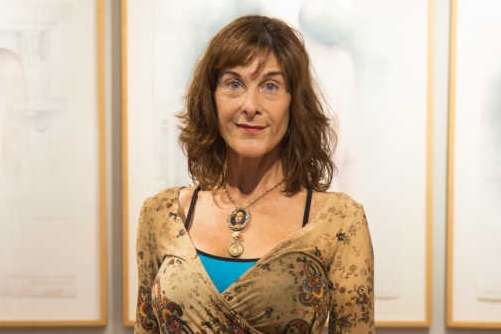
    Ruth Weisberg, 70, formerly of Philadelphia, longtime award-winning radio, TV, and online news anchor, features reporter, and show host; onetime voice of Shadow Traffic, Bell Telephone, and other voice-over clients; voice-over instructor, writer, speaker, pianist, art model, actor, Miss Greater Philadelphia 1980, volunteer, and stand-up comedian, died Wednesday, Sept. 2, of ovarian cancer in an assisted living center in Sarasota, Fla.

    Reared in Oxford Circle and a graduate of Northeast High School and Pennsylvania State University, Ms. Weisberg was a prolific media personality for nearly 50 years in Philadelphia and Florida. She was the radio voice of Shadow Traffic in the late 1970s and early 1980s, a news anchor and features reporter at WXTU, WCAU, WIFI, WPEN, and WSNI radio in the mid-1980s, and a radio, TV, and online talk show host from the late 1980s until recently.

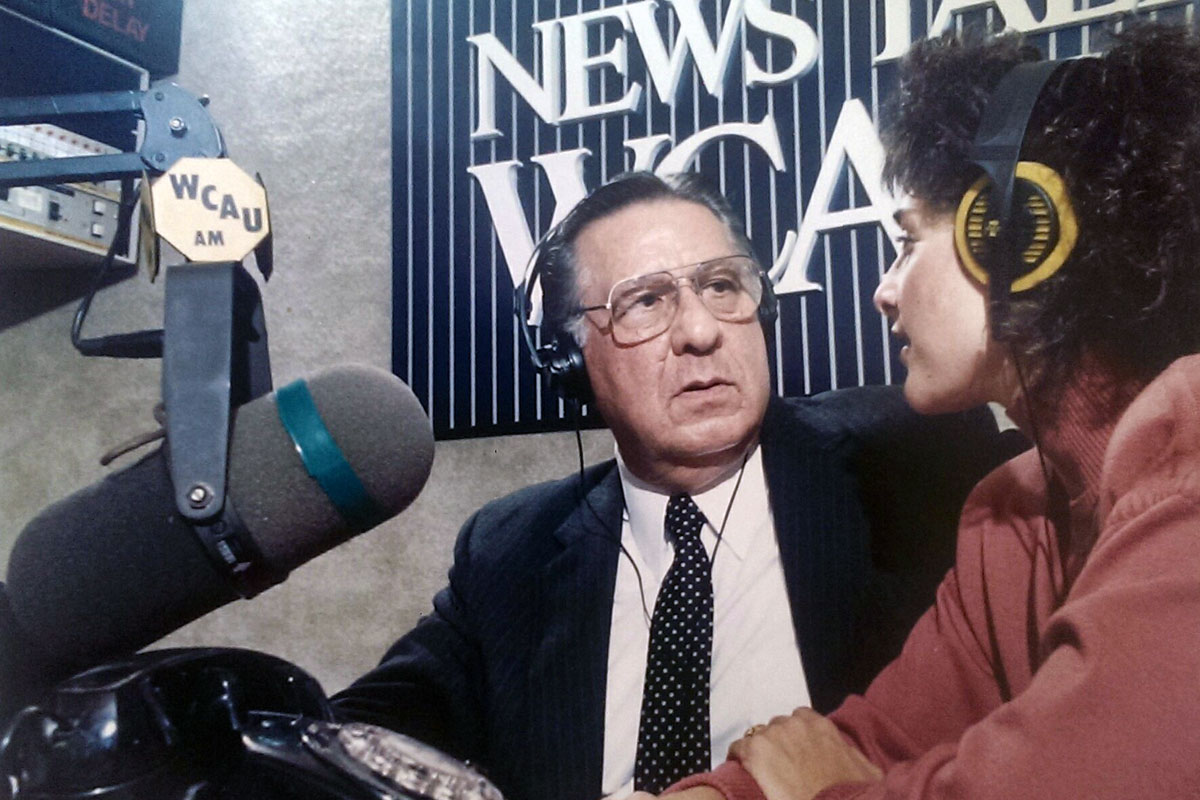
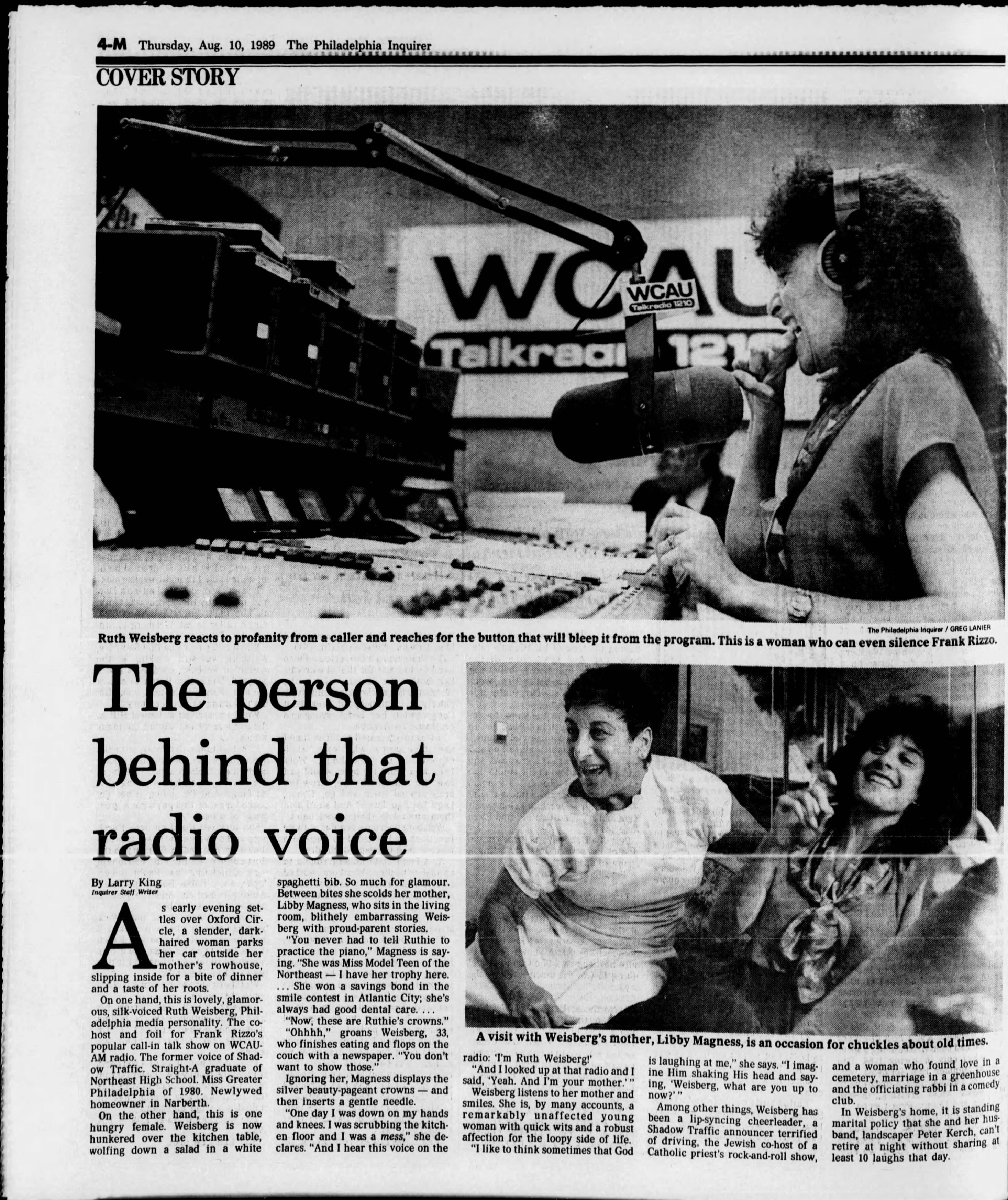
    She hosted Frank Talk With Frank Rizzo on WCAU radio in 1988 and ’89, and told The Inquirer in 1989 that working with the former mayor was like flying a “careening aircraft for three hours.” She also hosted Storytime and Show ’n Tell with Miss Ruth on local cable TV and online in 2015, and Funny You Should Ask, a radio show and podcast about comedy, in Florida in 2023.

    Always drawn to the theater and drama, she started producing TV and radio shows while studying special education at Penn State in the 1970s, and wound up cohosting a local rock and roll radio show as a senior exchange student in England. “All of the sudden,” she told The Inquirer in 1989, “I had this new-found love of radio. I never pursued it. It just came calling.”

    Ms. Weisberg reported on all kinds of lifestyle issues and earned radio awards from the Associated Press, the Philadelphia Press Association, and other groups. In 1994, she was named member of the year by the Philadelphia chapter of the International Television Association.

    She called herself Miss Ruth and Ruth Weisberg Philly on Facebook and reveled in her constant innovation and free spirit. She told The Inquirer: “I like to think sometimes that God is laughing at me. I imagine Him shaking His head and saying: ‘Weisberg, what are you up to?’”

    As a voice-over narrator and actor, she recorded corporate training videos, audiobooks, and radio and TV commercials. Bell Telephone hired her to record “We’re sorry. Your call cannot be completed as dialed” and other phone messages in 1985 because, a top official told her in a letter, her voice was “congenial yet persuasive.” She also taught voice-over classes for organizations and individuals, and mentored others on whatever she was doing wherever she worked.

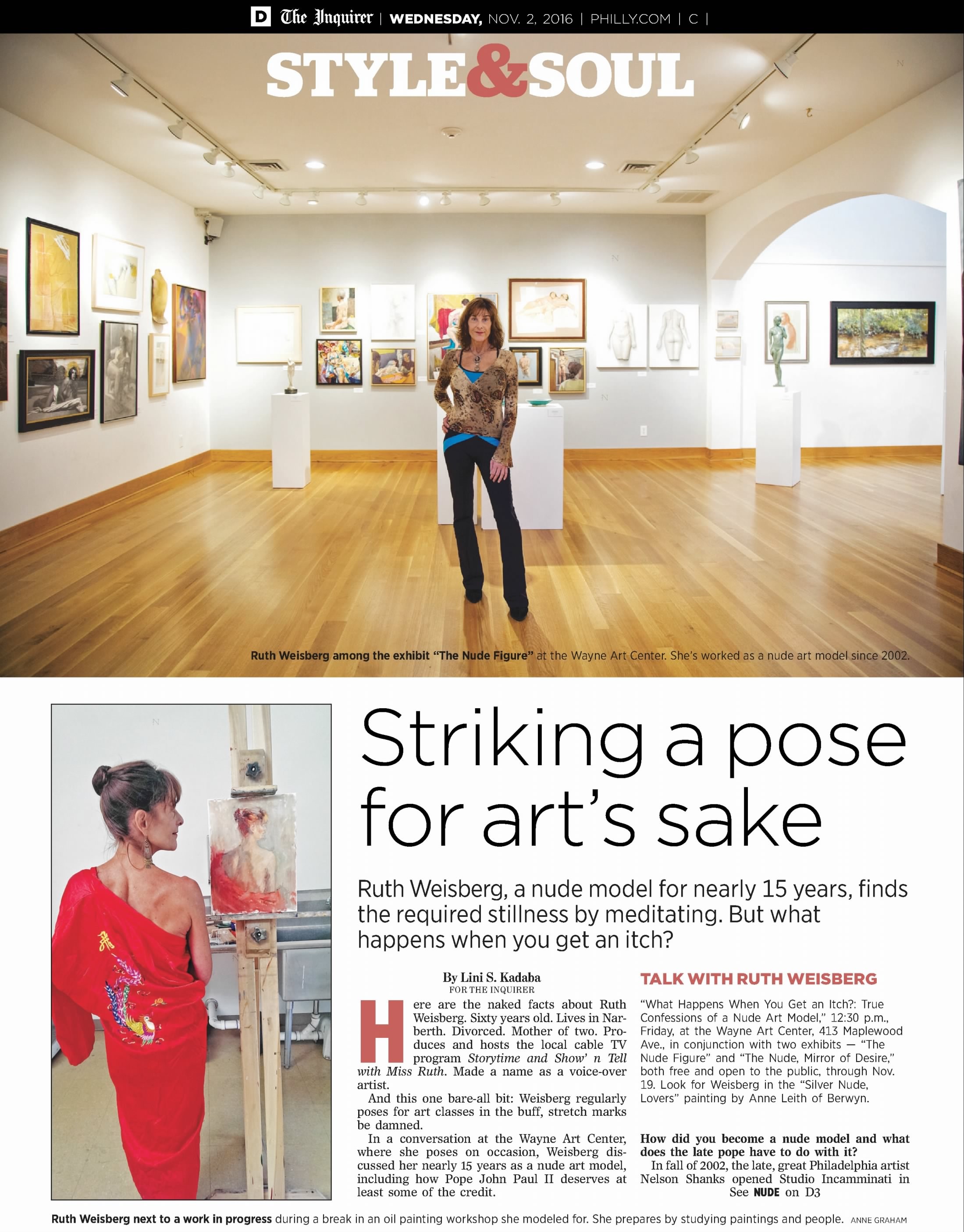
    She modeled for artists — some called her their “muse” — at art centers and colleges, and starred in a short video called The Accidental Art Model. “I love being part of a creative, imaginary, intrinsically artistic world,” she said in the video. “I would like to think of myself as the inspiration and the template for the work that happens.”

    Ms. Weisberg co-hosted a talk with onetime Mayor Frank Rizzo in 1988 and 1989.WCAU Radio

    Ms. Weisberg was drawn to beauty pageants, she said on Facebook, by the glitz and glamour. She was named Miss Central Pennsylvania as a Penn State freshman in 1975 and Miss Greater Philadelphia in 1980.

    “I never once felt objectified, exploited,” she said in a 2018 radio interview about the contests. “If anything, I felt celebrated for my talents and hard work.”

    She held seminars on career networking, spoke to groups often about radio and voice-over work, and read stories to children in bookstores. She wrote op-eds for The Inquirer and articles for the Main Line Welcomat and other publications.

    She posted videos on YouTube. She cohosted the 2001 Miss Greater Philadelphia Pageant. Former Daily News columnist Stu Bykofsky called her “both an eyeful and earful.”

    Ms. Weisberg was featured in The Inquirer in 2016 (above) and 1989 (below).Newspapers.com

    She also acted in local stage productions and performed stand-up comedy routines in brewpubs and restaurants and at gatherings. She was featured several times in The Inquirer and Daily News, and moved to Sarasota in 2016.

    “My work motto is that I will accept any job position that does not require wearing a hair net,” she said in a 2016 online interview. Her family said in a tribute: “Her life and influence were an inspiration and a sparkle of joy to so many people.”

    Ruth Maxine Weisberg was born May 31, 1956, in Philadelphia. She was a cheerleader, was active in theater class, and got straight A’s at Northeast High School.

    She and her mother, Libby, volunteered to entertain people in hospitals and nursing homes when she was young, and she knocked on neighborhood doors for Democratic presidential nominee George McGovern when she was 16.

    Her family spent memorable summers in Atlantic City, and she earned a bachelor’s degree in special education at Penn State.

    She married Peter Kerch in 1988, and they had a daughter, Talia. After a divorce, she married James Herbert, and they had a son, Elliott. They divorced later.

    Ms. Weisberg liked crossword puzzles, collected classic telephones, and attended concerts and beach drum circles. She was a certified scuba diver and wore a hat emblazoned with “The Queen of Everything.”

    Friends and colleagues called her “witty and supportive” and praised her “charm, humor, and kindness” in online tributes. One said she “always brought warmth and sunshine to wherever she was.”

    Her daughter said: “She was effervescent, exuberant, and whimsical.”

    Ms. Weisberg (left above and center below) took her voice-over students on a field trip in 2015. Emily Cohen / Staff Photographer

    In addition to her daughter, son, and former husbands, Ms. Weisberg is survived by two brothers and other relatives.

    A private celebration of her life is to be held later.

  • A woman shot and killed a man breaking into her apartment. She later found out she knew him.

    A woman shot and killed a man breaking into her apartment. She later found out she knew him.

    A woman shot and killed a man who police say she knew after he broke into her Crescentville apartment on Wednesday.

    The woman shot the man in her second-floor apartment on the 4600 block of Castor Avenue around 5 a.m., Philadelphia Police Chief Inspector Scott Small told reporters on the scene. Neither person has been identified.

    First responders found a masked man, 29, in the bedroom, where he was unresponsive with a gunshot wound to the head. The man was pronounced dead at the scene around 5:30 a.m., Small said.

    When first responders removed the man’s mask to render medical aid, the woman, who police believe to be in her 20s, said she recognized the man and knew him.

    The woman is cooperating with investigators, who said they believe the man was shot after breaking into the woman’s apartment.

    “She heard someone breaking windows to the apartment, and then she encountered this male inside of the property,” Small said. “He was wearing a mask covering his face, and she fired one or two shots, striking this male in the head.”

  • Philly DA Larry Krasner said the federal judge who accused him of crimes should be removed from the case

    Philly DA Larry Krasner said the federal judge who accused him of crimes should be removed from the case

    Philadelphia District Attorney Larry Krasner said Wednesday that the federal judge who accused him of potentially breaking the law while overseeing a post-conviction case had reached “baseless,” illogical, and legally unsupported conclusions — and that the judge should be removed from the case because he had acted more like “an advocate against DA Krasner” than an impartial arbiter.

    In a series of documents filed in federal court overnight, Krasner took the unusual step of openly criticizing U.S. District Judge Paul S. Diamond — sometimes using strikingly pointed language.

    In one brief, signed by Krasner and a subordinate, the district attorney said Diamond’s suggestion that Krasner might be guilty of criminal conspiracy relied on allegations “more closely resembling fever-dream conspiracy theories than evidence.”

    Other suggestions of criminality by Diamond — which revolved around actions Krasner took while overseeing the case and his staff — were equally wrong, Krasner wrote.

    “When it comes to all of these nominally-serious-but-actually-wafty accusations of criminal conduct, tempered by ‘coulds’ and ‘mights’ and ‘may haves,’ [Diamond’s] analysis rests on nothing of substance,” he wrote.

    Then, in a separate nine-page letter signed only by Krasner, the city’s top prosecutor said Diamond’s “factual findings and accusatory legal conclusions twist the truth to the point of breaking in ways that defy logic and employ Orwellian language.”

    And if Diamond’s assertions had been made in a setting other than a court case, Krasner said, “these accusations could be litigated as civil claims of defamation, slander, or libel.”

    Finally, in a third document, Krasner and Assistant District Attorney Thomas Gaeta wrote that Diamond’s actions had been so out of line that he should no longer oversee the case. At one point, they said the proceedings had become a “circus,” with Diamond the “ringmaster.”

    And they said Diamond — who was appointed by President George W. Bush, a Republican — had displayed his biases against Krasner, a Democrat, in a number of ways, including by asking improper questions of witnesses, reaching inconsistent conclusions about which witnesses were credible, and improperly blaming and discrediting Krasner for not testifying — even though Diamond had never asked him to.

    Diamond’s conduct, they wrote, “provides a clear and obvious view into the type of unfair and improper proceedings and decisions [Diamond] deigned to make.”

    The filings served as the latest chapter in a saga that has been marked by a series of explosive developments about Krasner’s office in recent months. The episode has also raised legal and political questions about Krasner’s future.

    Most recently, in mid-September, Diamond filed a stunning memorandum in which he said Krasner and one of his top supervisors, Matthew Stiegler, may have committed crimes including conspiracy, obstruction of justice, or perjury while participating in the underlying case. Diamond also said he had referred the matter to the U.S. Attorney’s Office for potential investigation. Federal prosecutors have declined to comment.

    Krasner has consistently disputed the notion that his actions were improper and appealed Diamond’s ruling, which also disqualified him and Stiegler from participating in the case moving forward.

    The underlying matter is centered on Dennis Johnson’s attempts to have his 2009 murder conviction overturned; Krasner’s office had once supported that effort, but reversed course earlier this year after some of his staff discovered that a previous prosecutor had made mistakes in her handling of the appeal.

    Wednesday’s filings served as Krasner’s most extensive response yet to accusations that he had committed misconduct while his staff tried to rectify those errors in court.

    In Krasner’s view, the fact that his office was seeking to correct its own mistakes in open court was just one example of how Diamond’s conclusions — including that Krasner may have conspired to concoct a false cover story about the episode — “cannot logically be reconciled with each other.”

    “I know many of the facts found by [Diamond] and conclusions inferred by [Diamond] are not correct from personal knowledge,” Krasner wrote. “I lived it.”

    Dispute over ‘false narrative”

    The roots of the controversy date to 2022, when then-Assistant District Attorney Jaclyn Mason filed a brief supporting Johnson’s bid to have his conviction overturned.

    Krasner was unaware of the case at that time, he said in his new filings. But he became involved this spring, when some of Mason’s supervisors in the law division concluded that she had made significant errors in her brief, and that they needed to try to withdraw it.

    Krasner approved a document alerting Diamond to the mistakes and apologizing for Mason’s errors.

    Mason, meanwhile, resigned and said Stiegler — her former boss — was most at fault.

    Diamond, in his Sept. 15 memorandum, said that in the aftermath of Mason’s resignation, staff in Krasner’s office discussed how the errors occurred. And in those discussions, he said, Krasner and Stiegler worked to create a “false narrative” to blame Mason, including by considering a Stiegler proposal: to review all of Mason’s old cases and find additional errors they could use to cast Mason as a “rogue” prosecutor.

    Diamond said such an effort could amount to criminal conspiracy.

    But Krasner, in his filings, called that conclusion “baseless,” saying Stiegler’s proposal was to review Mason’s old cases to see if there were additional errors — not to manufacture problems they could improperly attribute to her.

    “Nothing in the record supports the Court’s determination that providing a broader account of their competence would have advanced a ‘false narrative,’” Krasner wrote. “They either had or had not made errors in other cases, and there was absolutely no testimony indicating that DA Krasner (or Stiegler, for that matter) suggested submitting false allegations of error.”

    In addition, he said, Stiegler’s proposal was never actually pursued once other law division supervisors voiced opposition to it — further diluting any notion that Krasner was seeking to force his staff into lying to Diamond.

    “Stiegler proposed a strategy that DA Krasner considered, but DA Krasner also considered and accepted the Law Division supervisors’ advice that it was inadvisable,” Krasner wrote. “This is not misconduct.”

    ‘Reasonable’ consequences?

    Diamond, in his Sept. 15 memorandum, also took issue with Krasner threatening “consequences” for prosecutors who told the judge about another issue roiling the district attorney’s office: whether to refer Johnson’s case to the state attorney general’s office.

    The law division supervisors handling the case after Mason’s resignation — Katherine Ernst, Steven Wildberger, David Napiorski, and Peter Andrews — generally agreed that was the appropriate course of action because of the inner-office drama consuming the matter. And they repeatedly urged Krasner to refer the case to avoid what they viewed as a conflict of interest.

    But Krasner disagreed. And in his filings, he said that as the referral discussions took place over several weeks, he had consulted with several ethics experts who generally agreed there was no conflict necessitating a referral.

    As for the threat of consequences, he said, he was not seeking to prevent his staff from telling Diamond the truth about their deliberations — which the judge later said could amount to obstruction of justice. Instead, Krasner said, he was seeking to prevent them from submitting court documents without his approval.

    “That is particularly so where, as here, those pleadings are premature, legally incorrect, and unnecessary,” Krasner wrote. “It is reasonable to expect consequences for filing a pleading the District Attorney disapproves of while he is still examining the issue and determining the correct course of action.”

    Seeking the judge’s recusal

    In addition to disputing Diamond’s conclusions about his actions — and whether they constituted crimes — Krasner went on to say the judge should no longer oversee the case, which remains pending.

    He said Diamond’s “apparent bias is evident from a number of remarkable circumstances,” all of which should lead to his removal, according to the district attorney.

    One example, Krasner said, was that as Diamond questioned witnesses in his courtroom this summer about what happened in the case — including asking questions of lawyers who still work in Krasner’s office — the judge “departed from [his] role as a neutral arbiter and undertook an active inquisitorial and advocacy role.”

    “The Court’s questions and assertions reflected the Court’s apparently preconceived view that the DAO’s conduct in all cases is inherently suspect,” Krasner wrote.

    Diamond also made “selective credibility determinations” about which witnesses he believed and which ones he discredited, the DA wrote. And he took particular issue with what he cast as Diamond’s reluctance to criticize Mason: Krasner, in his filing, said there were “many additional reasons to question the honesty of Mason’s testimony, all of which were ignored by the Court.”

    Then there was the issue of Krasner’s failing to testify.

    Diamond, in his memorandum, blamed Krasner for not taking the stand. But Krasner, in his filing, said Diamond — who scheduled the hearings and set the witness list — “appears to have taken pains to avoid having DA Krasner testify.”

    In any case, he said, it was improper for Diamond to assume that Krasner’s lack of testimony was somehow “concession by silence.”

    Overall, Krasner said in his motion, the judge “served as a prosecutor for DA Krasner and his office,” thereby requiring his recusal from the matter.

    In his nine-page letter, Krasner went even further, saying he believes Diamond should be recused “from this matter and every other matter involving the Philadelphia District Attorney’s Office for the foreseeable future.”

    It was not immediately clear how Diamond might respond to such a request. On Wednesday, he said any additional paperwork on that issue must be filed within a week.

  • Black Panther-style group members arrested in Chester, as mayor decries their presence

    Black Panther-style group members arrested in Chester, as mayor decries their presence

    The leader of a Philadelphia offshoot of the Black Panther Party for Self-Defense was charged with a firearms crime for carrying a concealed gun without a permit in the city of Chester — and the group’s growing visibility in the Delaware County community is sparking a clash with the city’s mayor.

    Paul Birdsong, who founded Philly’s Panther group, was arrested this summer during what the group says was an armed community patrol of Chester’s streets.

    Birdsong had been carrying two holstered handguns, one of which police said was partially obstructed by his waistband and constituted carrying a concealed weapon, according to the affidavit of probable cause for his arrest.

    Birdsong, 40, is out on bail and appeared earlier this month in Magisterial District Court, where a judge ruled he should stand trial for that crime.

    The judge dismissed two counts of disorderly conduct and one count of resisting arrest stemming from the July 11 incident, court records show.

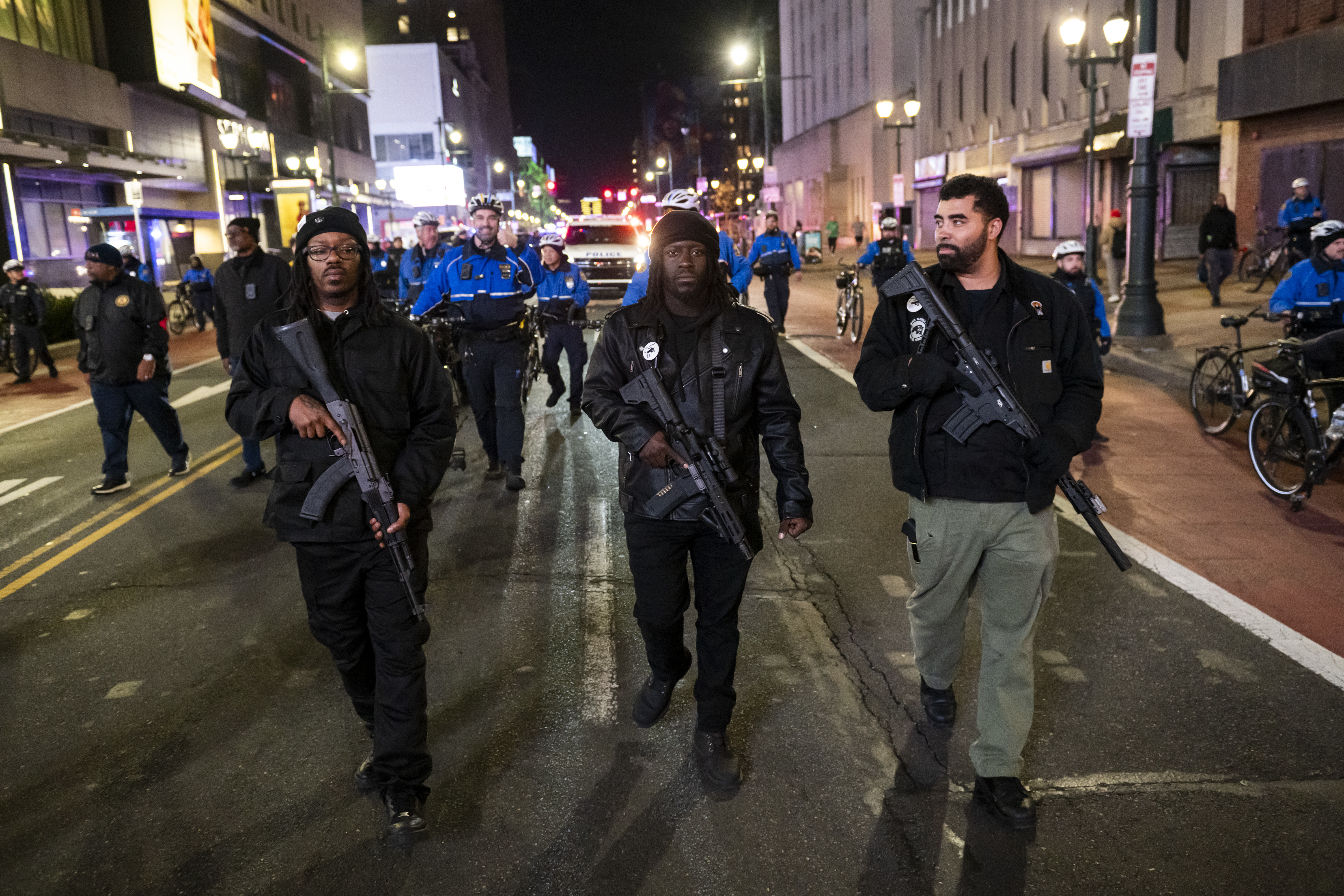
    Birdsong’s arrest, as well as the arrest of another Panthers member in Chester in August, marked the latest run-in between police and the armed citizens group, which is styled after the 1960s political and militant organization. The Panthers first made headlines this winter during anti-ICE protests during which they carried assault-style weapons in Center City.

    Panthers members say they are Second Amendment advocates and regularly conduct patrols in the name of public safety. They say the guns are not meant to intimidate, but to deter crime and encourage responsible firearms ownership. The group also holds weekly giveaways of food and essential supplies for those in need.

    But Chester Mayor Stefan Roots has decried the group’s foray in the city, saying its presence has created “horrible optics” as officials try to reduce gun violence, especially among young people.

    To address the Panthers’ presence, Roots and members of Chester City Council met with Birdsong and other members in a closed-door meeting on Tuesday.

    Councilmembers appeared to have left the meeting with supportive views of the group. But tensions flared when Roots grew frustrated during talks and abruptly left the gathering early, according to Birdsong.

    Roots declined to comment Tuesday, saying only that he had not been aware of the Panther members’ arrests. He did not immediately respond to an additional request for comment Wednesday.

    Birdsong made headlines in May when Philadelphia police revoked his city-issued gun license along with those of four other Panthers.

    The following month, in an unusual show of federal oversight, the Department of Justice’s Civil Rights Division opened an investigation into whether the police department violated the Second Amendment by revoking gun licenses without proper cause. The filing did not name Birdsong or other Panthers in the inquiry.

    A spokesperson for DOJ did not return a request for comment on the status of the investigation. A police spokesperson referred The Inquirer to the city’s law department, which declined to comment.

    After the restrictions in Philadelphia, Panthers became active in Chester, where members have patrolled in the past.

    In July, Birdsong was armed when he was stopped by a police officer near Barclay and West 5th Streets, according to the affidavit of probable cause for his arrest.

    The officer said that he recognized Birdsong from a past encounter in Chester, and that he stopped him after seeing one of his handguns holstered “inside his right pants pocket with the majority of the firearm being concealed from view,” the document said.

    Birdsong questioned why he was stopped and began to record the interaction, the affidavit said. He began to “curse and yell” when additional officers arrived, and he was detained, the document said.

    In an interview this week, Birdsong disputed the officer’s account. He said that the gun was clearly visible and that he believes the enforcement was racially motivated.

    “They’re arresting us as an effort on their part to bully us, to scare us,” he said.

    Carrying a firearm in the open without a license is legal in Pennsylvania — but not in Philadelphia, where a license is required to carry either open or concealed.

    Birdsong’s lawyer, Lyandra Retacco, said the matter would be resolved in court.

    The July incident was not the only time Panthers have clashed with Chester police.

    On Aug. 28, member William Ozah was charged with disorderly conduct and evading arrest after police said he ran from an officer who attempted to stop him for having a knife protruding from his pants pocket, according to the affidavit of probable cause for his arrest.

    The officer used a Taser to subdue Ozah, the document said. During the chase, the officer said, Ozah tried to reach into a satchel, which he believed concealed a firearm.

    After detaining Ozah, officers recovered a knife and a Bryna SD pepper-ball pistol — a less-lethal firearm that uses compressed gas to shoot projectiles filled with a chemical irritant.

    He was held for court on both charges, court records show.

    Meanwhile, Panthers have continued their Chester presence.

    In addition to armed patrols, the group is handing out informational pamphlets to those curious about the group’s mission: to “protect and defend ourselves and our beautiful Black people,” it said.

    The group had arrived, the pamphlet said, because “people reached out to us for help.”

    This article has been updated to reflect comments made by Birdsong’s attorney.

  • A pedestrian was killed in a car crash in Center City

    A pedestrian was killed in a car crash in Center City

    A pedestrian was killed in a car crash in Center City on Wednesday morning, police said.

    At about 6:42 a.m., Philadelphia police responded to a report of a crash involving a vehicle and pedestrian near 19th and Lombard Streets. The victim was a woman in her 20s and she was pronounced dead at the scene, according to police.

    The woman was crossing Lombard Street when the vehicle driver, who was traveling westbound, struck her. The driver remained at the scene, and no arrests have been made.

    Police are investigating the incident.

    Last year, Philadelphia reported its fewest number of traffic-crash deaths since 1928. But the city still remains dangerous for pedestrians and cyclists.

    Overall crashes declined from 2020 to 2025, while crashes involving non-motorists have stayed the same or increased, according to an analysis of Pennsylvania Department of Transportation data by the group Philly Bike Action. Fifty-five percent of people killed in Philly traffic crashes last year were non-motorists, and 52% of serious injuries from crashes occurred when a driver hit someone not in a car, the group found.

  • Saxophonist Immanuel Wilkins, an Upper Darby native, gets a MacArthur ‘genius grant’

    Saxophonist Immanuel Wilkins, an Upper Darby native, gets a MacArthur ‘genius grant’

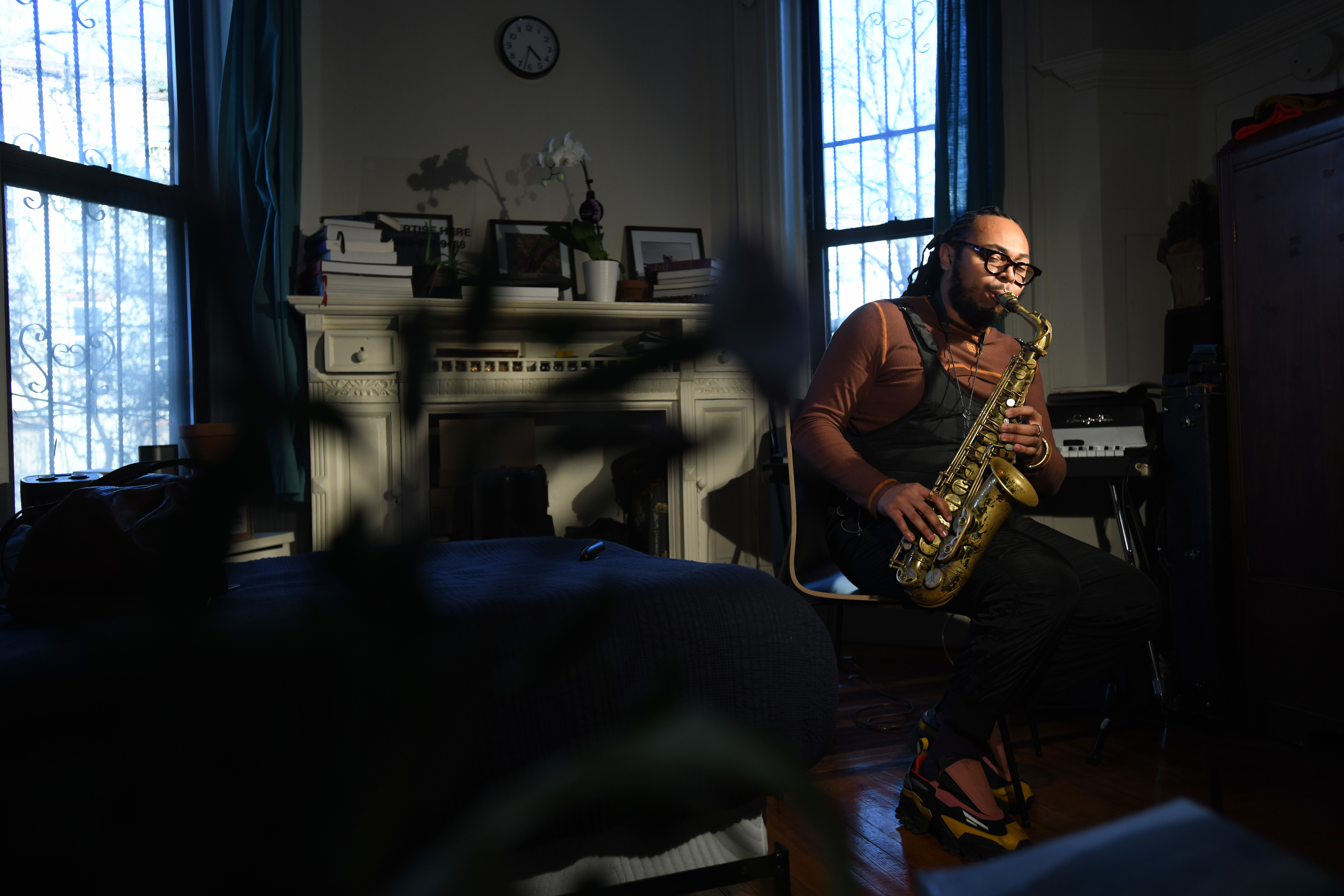
    Upper Darby native and saxophonist Immanuel Wilkins is among the MacArthur Foundation’s 20 “genius grant” recipients for 2026, the foundation announced Tuesday.

    In more official terms, that makes Wilkins, 29, a MacArthur Fellow — the youngest member of his class. All fellows will receive $800,000 in unrestricted funding over the next five years, with the awards giving financial flexibility to recipients for their artistic and scholarly visions.

    Wilkins, in an interview Tuesday with the Associated Press, said he received word that he had been named a MacArthur Fellow while traveling from New York to Philadelphia.

    “I was just outside,” he said. “Which was nice because then I could yell as loud as I wanted to and celebrate.”

    In a video introducing the 2026 fellows, Wilkins described himself as a saxophonist and composer who anchors “original compositions in history and spirituality.” He added that as a performer, he was “looking to escape the gaze that might be on me and direct my creative energy inwards and upwards.”

    Widely considered a leading contemporary jazz musician, Wilkins was joined by jazz great Odean Pope for “RECESS,” an immersive musical experience staged at the Power Market, a former Peco electrical station in North Philadelphia. Pope, 87, and Wilkins met when Wilkins was a young student at the Clef Club of Jazz and Performing Arts, and Pope took him on as a mentee, The Inquirer reported.

    Presented by Ars Nova Workshop, “RECESS” featured the musicians playing on a stage modeled into a combination playground and bandstand, which Wilkins earlier told The Inquirer was a way to inspire “radical play.”

    “I started thinking about the landscape of Philadelphia as functioning as a kind of abstracted play space,” Wilkins said in a May interview.

    Wilkins’ debut album, Omega, was released in 2020, and connects the 1918 lynching of a pregnant Black woman, Mary Turner, to the 2014 fatal police shooting of a Black teenager, Michael Brown. The abstraction of music, Wilkins told the AP, allows him to represent these stories without “recreating the violence of them.”

    “Although it is some of the most painful material, the music itself feels so good,” Wilkins said in the MacArthur Foundation clip.

    Most recently, Wilkins released Immanuel Wilkins Quartet: Live at the Village Vanguard Vol. 1, a three-volume recording of performances at the iconic New York City jazz club.

    In addition to Wilkins, two other MacArthur Fellows this year have ties to the Philadelphia area. Both are Princeton University professors.

    Ellora Derenoncourt, an associate professor in the university’s economics department, told the AP that she would use the award to translate issues of economic justice for the broader public and interested policymakers. And Elizabeth Ellis, an associate history professor, hopes to support research projects focusing Native American history, the university said.

    This article contains information from the Associated Press.

  • Jeff Scott, award-winning TV writer and former Bucks County journalist, has died at 72

    Jeff Scott, award-winning TV writer and former Bucks County journalist, has died at 72

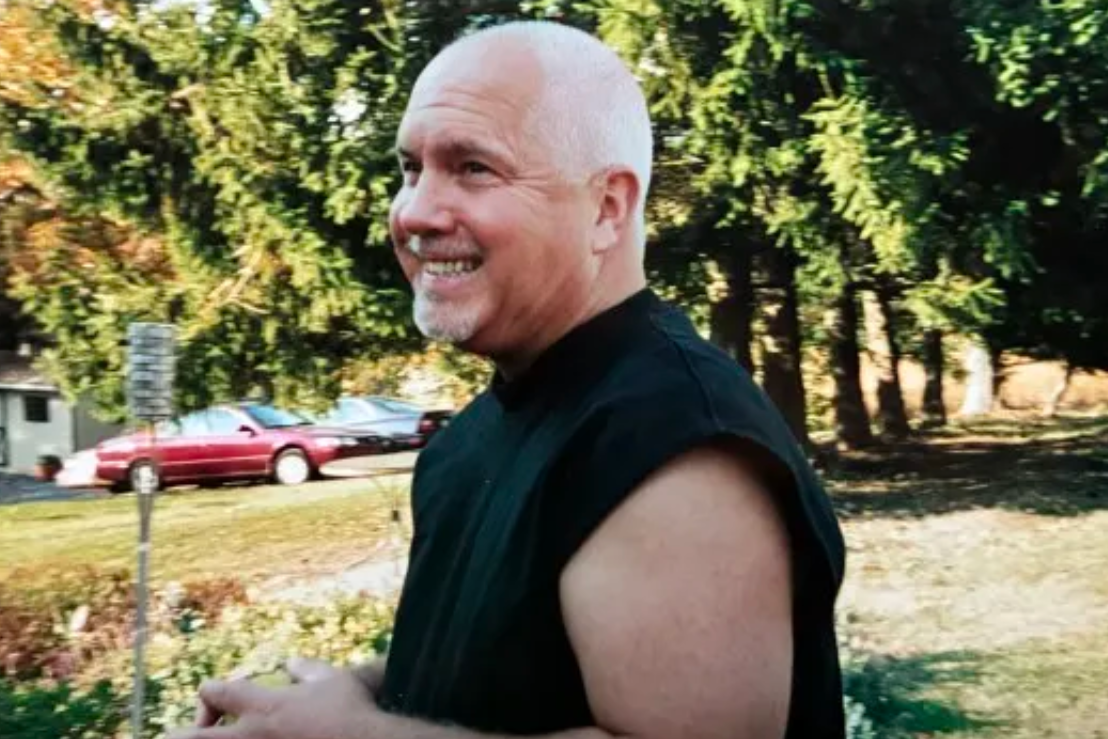
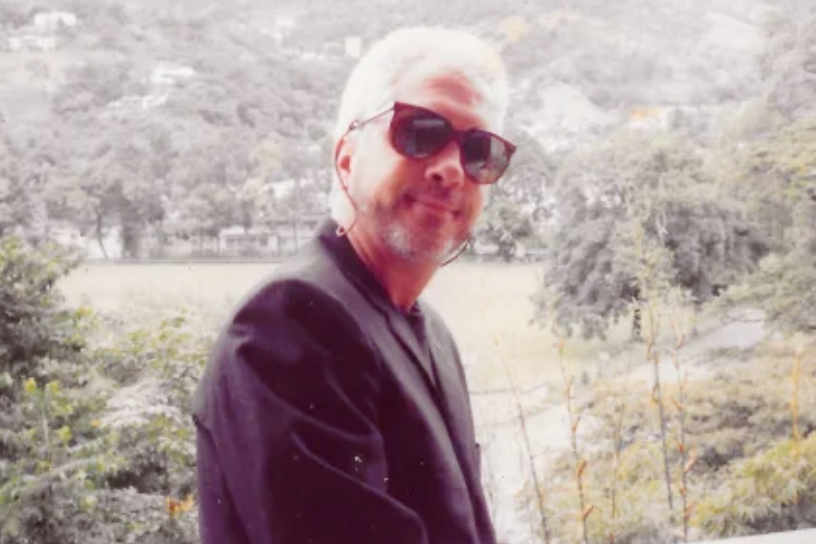
    Jeff Scott, 72, formerly of Hilltown, Bucks County, longtime award-winning TV and video scriptwriter, director, and producer, former columnist and editor at the Quakertown Free Press, and green-thumb gardener, died Saturday, Sept. 19, of pulmonary fibrosis at Hunterdon Medical Center in Flemington, N.J.

    Born in Philadelphia, reared in Hilltown, and a graduate of Pennridge High School, Mr. Scott turned his lifelong interest in sports, affable collegiality, and writing, reporting, and editing skills into an award-winning career as a TV and print journalist that spanned more than four decades.

    For 32 years, from 1983 to 2015, Mr. Scott wrote scripts, directed talent, and produced shows for TV, film, video, radio, and DVDs. He worked for Major League Baseball Productions through Phoenix Communications from 1988 to 2015 and wrote more than 1,000 TV show scripts for ABC, NBC, ESPN, Fox, and other networks, including 176 episodes of ESPN’s Major League Baseball Magazine and 450 consecutive episodes of the popular This Week in Baseball.

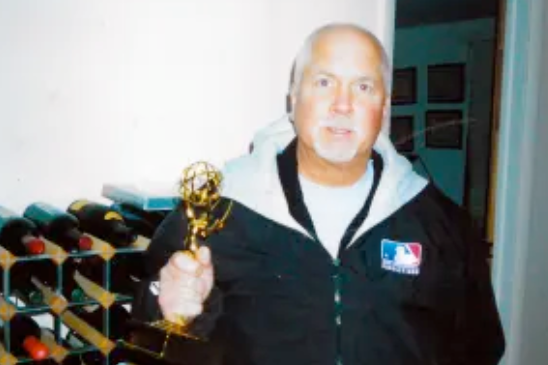
    His dramatic scripts detailed many memorable baseball seasons, went behind the scenes with championship teams, and shared stories about star players on and off the field. They were narrated by iconic announcers such as Mel Allen, Curt Gowdy, Bob Costas, and Harry Kalas, featured thousands of players, coaches, and managers, and earned 16 New York Emmy Awards.

    Mr. Scott earned 16 New York Emmys.Courtesy of the family

    Former colleagues at MLB Communications posted a video tribute to Mr. Scott on X and noted his “indelible impact” on This Week in Baseball. Buzz Brainard, a former narrator for This Week in Baseball, said on Facebook: “Honored to bring his words to life every season for 11 years.”

    Earlier, from 1983 to 1988 at the old Halcyon Days Productions, Mr. Scott wrote scripts for the weekly This is the USFL for ABC and other shows about John Madden, Mike Schmidt, and other sports and entertainment notables. Sports reporter Jayson Stark said on X: “You may not know the name, Jeff Scott. But you should.”

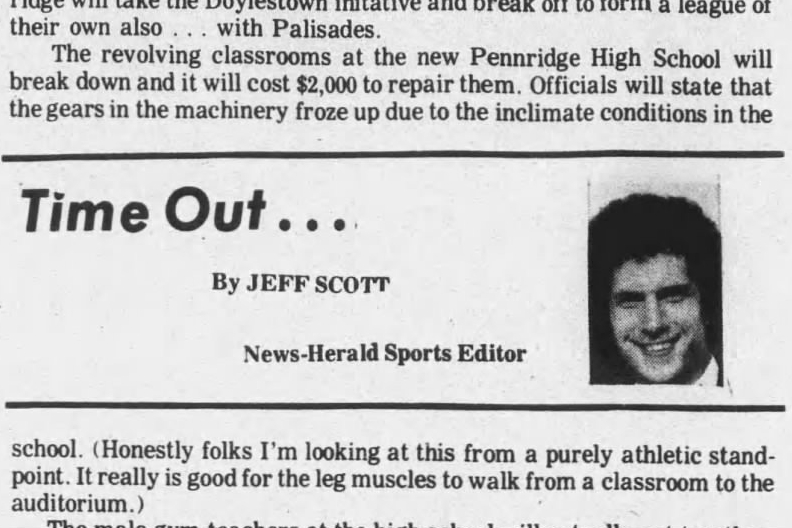
    In print, Mr. Scott was a columnist and weekend magazine editor for the Free Press in the early 1980s. In the 1970s, he was sports editor and a features writer for the Perkasie News-Herald, and a part-time sports reporter for the Doylestown Intelligencer.

    At the Free Press, he won awards and covered all kinds of local stories, including his publisher’s triple-bypass heart surgery. At the News-Herald, he wrote a sports column called “Time Out” and a news feature called “Know Your Community.”

    To know Mr. Scott, a friend said, “was to like him.”Courtesy of the family

    In 1976, he opened a News-Herald sports story with: “Some would call it luck. Some might call it breaks. And some might even consider the fact that somebody upstairs is carrying the fate of the Pennridge football team this year. We prefer to call it pure, unadulterated hustle.”

    A former Pennridge baseball player said in a tribute: “It always was a big deal when he came to our games.” A former colleague at the Free Press said: “He made me feel important, and he made sure I knew that he was my friend.”

    Other former colleagues praised Mr. Scott’s “sense of humor,” “warmth and kindness,” and “quick wit that never waned” in online tributes. “To know Jeff was to like him,” longtime friend and colleague Jim Burger said. “To know him well, which I had the good fortune to do, was to love him.”

    Jeffrey Llewellyn Scott was born Nov. 18, 1953. He played street hockey in Hilltown and baseball at Pennridge, and attended what is now West Chester University.

    Mr. Scott wrote a sports column in Perkasie in the 1970s.Newspapers.com

    After college, he drove a truck, worked as a disc jockey, and traveled across the country. He married and divorced Lorrie Greenly and Amber Hudson.

    He met Lenore Homeward on vacation in Tobago, and they married in 1991 and lived in Manhattan and Pittstown, N.J. He created seven flower beds on their property and tended many flower pots. “It was like a full-time job,” his wife said.

    Mr. Scott enjoyed music and followed the Phillies, Eagles, 76ers, and Flyers. “He was a homebody,” his wife said.

    His niece Shanice said: “My uncle Jeff had a big heart and meant the world to me.” A longtime friend said: “The world will be a less warm and kind place without him in it.”

    Mr. Scott enjoyed time with his family.Courtesy of the family

    His wife said: “He was loyal, funny, humble, and compassionate. He had the ability to see the better in people. He was friends with everybody.”

    In addition to his wife and niece, Mr. Scott is survived by a sister, Kathleen, and other relatives. Three brothers and one sister died earlier.

    Private celebrations of his life are to be held later.