The union representing transit police and SEPTA reached a tentative deal on a new three-year contract Wednesday that includes a 12% raise and avoids a possible strike during the region’s summer of big events.
Officers had been working without a contract since March 31, and the police union said on June 4 it was willing to walk off the job if there was no progress in talks. Leaders said the two sides were at an impasse.
Since then, negotiators traded new proposals and met several times.
Members of Fraternal Order of Transit Police Lodge 109 are scheduled to hold a ratification vote on the agreement Thursday, with SEPTA’s board scheduled to consider it next week.
“SEPTA believes the agreement is fair to our hard-working Transit Police officers and responsible to the fare-paying riders and taxpayers who fund the authority,” spokesperson Andrew Busch said in a statement.
“I can confidently say that a strike has been averted at this time,” FOTP Lodge 109 president Omari Bervine said in an interview.
He credited SEPTA general manager Scott A. Sauer with getting talks moving.
“We were able to actually sit down to direct talks, with the general manager [involved], and that was instrumental in getting a tentative deal worked out,” Bervine said.
Officers would get a 5% pay hike in the first year and 3½% in each of the next two years, according to sources familiar with the agreement. They also would receive a $2,500 signing bonus.
Officers are scheduled to get the first installment of the pay bump on June 28, if the contract is ratified and approved. Normally, pay increases for transit police did not kick in until the next anniversary of the start of the contract year — in this case, April 1, 2027.
Lodge 109 has pressed to change the timing so members would start receiving raises as soon as possible after the signing of an agreement, as happens with other SEPTA unions.
The union represents 203 rank-and-file officers who patrol SEPTA’s stations and transit vehicles across its five-county service area.
Bervine had offered to waive the right to strike if SEPTA voluntarily agreed to submit their dispute to binding arbitration.
Most union-represented police officers in Pennsylvania can use binding arbitration, which involves an independent arbiter deciding the final terms of a contract. In turn, those officers are barred from striking.
But state law does not allow transit police and some other state law enforcement officers to use binding arbitration.
Bervine said there was no agreement to include binding arbitration in the contract. There is proposed legislation in Harrisburg to extend it to officers employed by state agencies like SEPTA. “Hopefully, common sense will prevail,” he said.
Union and SEPTA negotiators met on Tuesday and Thursday last week and exchanged new proposed contract language. They met for a third time Saturday.
The union has exercised its right to strike before.
In December 2023, the transit officers union went on strike for three days seeking wage increases matching those given to Transport Workers Union Local 234 and other SEPTA employee unions.
In 2019, transit officers walked out for six days, in part over whether members could review body-camera footage before filing incident reports. They struck in 2012 over a 15-cent difference between the FOTP’s demand and SEPTA’s offer for an increase in the hourly rate that members received for annual recertification as police officers.
Hunter Hawa would have turned 11 in April, his aunt, Jennifer Back, told a Chester County judge Wednesday.
But the boy known for his smile and laugh died three years ago on the filthy carpet in his parents’ Coatesville apartment. Prosecutors say he had fentanyl and cocaine in his system, powerful narcotics that his parents used and sold that ended his life before it had been given a chance to begin.
Mousa Hawa and Holly Back failed in their ultimate duty as parents to protect Hunter, according to Judge Analisa Sondergaard, who sentenced them both to decades in prison for their son’s murder.
“This was the culmination of many bad days and bad choices,” a visibly angry Sondergaard said. “You chose drugs over Hunter everysingle day. You put your wants and desires before your son every single day.
“You loved drugs more than your son.”
The couple was convicted of third-degree murder, aggravated assault, and endangering the welfare of a child after a trial in February.
Back was sentenced Wednesday to 20 to 40 years in prison, while Hawa was sentenced to 22½ to 45 years. Their sentences included a mandatory minimum of 15 years for third-degree murder of a victim under 13.
District Attorney Chris de Barrena-Sarobe said Wednesday that Sondergaard’s sentences were “justice for a child that deserved so much more.”
“This was a case about parents who continually disregarded every basic parental responsibility and allowed their child to ingest fentanyl and cocaine,” he said. “Because they chose to put themselves above their child, we prosecuted them to the fullest extent of the law.”
Their attorneys said both had been in the throes of drug addiction since their teenage years, and suffered from previously undiagnosed mental health conditions. Hunter’s death, they said, was a horrible accident.
In a tearful statement, Back said the images of her son, lying dead in her living room, are forever burned into her mind.
“I never meant to fail him,” the 42-year-old woman said. “I did not murder my son. The last thing I wanted to do was harm him.”
First Assistant District Attorney Erin O’Brien, who prosecuted the case, rebuked Back’s statement, saying the couple showed extreme indifference to their son and his health.
The two had kept their son in squalor in a home where drugs were “ubiquitous” — Hunter, she said, was surrounded by narcotics and the materials Hawa used to package them. Their attempts to prevent him from touching the toxic substances, she said, were half-hearted at best.
“Hunter didn’t get to make plans for his future; he didn’t even make it to the third grade,” she said. “I could attempt to go through everything he missed out in life, but that list is endless. His life mattered.”
Hawa had called police to his home on July 26, 2023, just before 2:30 a.m., after Back awakened him in a panic, prosecutors said. She had found Hunter “folded like a sandwich,” pinned between the recliner he had fallen asleep on hours earlier and the wall behind it.
When Coatesville Police Officer Jennifer Schreiber arrived at the home, Hawa was performing CPR on his son, who had ashen skin and blue lips. He showed no signs of life, Schreiber said.
Clear signs of drug abuse were found feet from the boy’s body: small glassine bags filled with heroin, cocaine, and methamphetamine, as well as a scale and a syringe.
Doses of Narcan sat unopened on a coffee table, and, O’Brien noted, might have saved the boy if used.
An autopsy later concluded that Hunter died of an overdose of fentanyl, morphine, and cocaine. Exactly how the boy ingested the drugs remains unclear. But samples of his hair showed that he had previously been exposed to those narcotics, according to O’Brien.
Hawa and Back initially lied about their drug use when interviewed by police, but confessed to being regular users weeks later when confronted with their son’s autopsy report, investigators said.
Hawa, 43, told detectives he did not believe his son had overdosed, saying the amount of the drugs found in his blood was too small to be fatal. He said he and Back had repeatedly warned the child not to touch the drugs in their home, telling him that it was their “medicine” and that he could get sick from it.
The fentanyl that killed Hunter was stamped with the same distinctive logo, “Bad Bunny,” as the kind that killed Tyler Stout in Phoenixvillein March 2023.
Prosecutors also deemed Hawa responsible for Stout’s death, charging him with drug delivery resulting in death and related crimes. His trial in that case is pending.
It would have nothing to do with Arthur, which on Wednesday became the first named storm of the Atlantic hurricane season, but the Philly region may be in for tropical-storm force gusts and strong thunderstorms Thursday.
Even if the rains don’t come — and on Wednesday, the storm odds were close to 50-50 — wind gusts to 45 mph are possible during the afternoon, said Alex Staarmann, meteorologist at the National Weather Service in Mount Holly, “quite unusual for June.”
Not so unusual these days would be the forecast high, which would mark the 14th time this year that official readings in Philly had reached 90 degrees or higher. That is about half the average total for an entire year.
But this heat will be more of a ripple than a wave, and the outlook for the holiday weekend is looking spectacular.
When the winds and storms may arrive in Philly on Thursday
As a front approaches, winds from the southwest are expected to gust to 20 mph during the morning and 30 to 40 mph in the afternoon.
While the winds are all but a certainty, it was unclear if any strong storms would pop Thursday. If they did, the best estimate would be between 1 an 8 p.m., the weather service said.
“The environment is favorable for damaging winds if anything does develop,” Staarmann said.
“The biggest question is how widespread the storms are going to be,” he said.
Uncertainty is a near 100% certainty with June storms
Such uncertainty is standard fare with thunderstorm threats this time of year, said Rich Thompson, forecast operations branch chief at the government’s Storm Prediction Center, which would have to make a call on posting severe storm watches.
With so many moving parts and micro-features such as terrain involved, predicting the behavior of small-scale storms is “incredibly complicated,” he said, and on some days clues are frighteningly lacking.
And while observations have improved immeasurably in recent decades, “we still aren’t observing most of what’s there,” he said. Land-based surface observations are far more plentiful than those over the oceans, which cover 70% of the atmosphere, and in the upper atmosphere, where the weather is manufactured.
Even if the atmosphere were perfectly measured, he added, meteorologists would still have to contend with the fact that the physics involved in forecasting are not completely understood.
Arthur and the weekend outlook for Philly
As for Arthur, knighted with a name by the National Hurricane Center at 11 a.m. Philadelphia time Wednesday as it matured off the southeast Texas coast, it is forecast to deluge portions of the Gulf states.
Then it is due to head out to sea before it could have anything to do with Philadelphia or the Jersey Shore, which is likely to be a popular destination this weekend.
For Friday, Juneteenth; Saturday; and Sunday, the beginning of the astronomical summer, highs are expected in the mid-80s with sunny days and no threat of showers until early Monday.
Angel Okeke, a junior at the Academy at Palumbo in Philadelphia, wanted to make sense of the loss of her best friend’s brother to a tragedy spurred by gang violence.
Isadora Pendygraft, an eighth grader at Welsh Valley Middle School in Narberth, felt pulled to explore how restorative justice could reshape the criminal court system.
Avigail Wus, a junior at Pennsbury High in Fairless Hills, hoped to examine how the public, the media, and courts interact with survivors of sexual assault.
They are among a group of students who spent nearly a year thinking, researching, and writing about changes they want to see in Philadelphia. This month, their work culminated in professional performances of their original plays.
“It’s freaking amazing,” Okeke said.
The possibility of performance
The student work is part of What Now: 2026, a new arts festival marking the country’s Semiquincentennial. When the festival was in the planning stages, Madeline Charne, director of education and programs for Philadelphia Young Playwrights, said sheknew youth voices ought to have a place.
That is how PYP’s Civic Theater Project was born.
(L-R) Actor Raymond Ingram rehearses as (seated) Palumbo civics teacher Charlie McGeehan, Philly Young Playrights director of education and programs Madeline Charne, students Abigail Wus, Isadora Pendygraft, Angel Okeke, and Harmonee Summers look on during rehearsal at the Drake Theater in Philadelphia earlier this month.Elizabeth Robertson / Staff Photographer
Charne said she wanted students “thinking about how theater itself can create social change, not just be about social change.” She prompted students to imagine Philadelphia 25 years in the future, to dream about what should be changed, and to see their work as the beginning of that shift.
“Creativity and art and performance — that’s what has the possibility to make people actually listen,” said Charlie McGeehan, a Philadelphia School District civics teacher who worked as a PYP teaching artist.
Kids thought so, too. For every spot PYP had in the process, it received roughly five applicants. Eventually, five young people signed on: Okeke; Wus; Pendygraft; Harmonee’ Summers, who attends Springside Chestnut Hill Academy; and Maroua Benfadhla, a student at Science Leadership Academy.
The young playwrights had to commit one day a week to their work — researching and refining ideas, interviewing change makers around the city, committing to their eventual topic, writing, editing, critiquing one another’s work, andeven casting their plays.
The works the five eventually produced were a revelation, McGeehan said — powerful, smart, and character driven. They were presented in staged readings at the Louis Bluver Theatre in Center City.
The right rooms, the right resources
On a sweltering Wednesday this month just before the students’ work debuted, they gathered at the theater for a final run-through.
The playwrights sat in chairs, eyes fixed on the actors in front of them. The actors performed the plays without sets or costumes, just reading scripts on music stands and allowing the audience to take inthe power of the young people’s words.
The moment Summers first heard professional actors reading words she had written, it stopped her cold.
“It is so cliche to say it’s magical, but it feels different when your words are literally jumping off the page‚” said Summers, whose play is called The Double K Show. It chronicles two young women’s rise to stardom and the effect substance use has on their lives, and was shaped by events Summers observed growing up in North Philadelphia and attending an elite private school.
Part of the students’ process was finding resources that might help with the issues they tackled — from recovery and housing assistance organizations to groups that support survivors of sexual assault.
(L-R) Actor Raymond Ingram rehearses as Palumbo civics teacher Charlie McGeehan, Philly Young Playrights director of education and programs Madeline Charne, students Abigail Wus, Isadora Pendygraft, Angel Okeke and Harmonee’ Summers look on during rehearsal at the Drake Theater in Philadelphia earlier this month.Elizabeth Robertson / Staff Photographer
Pendygraft, whose mother, Letitia Stein, is an editor at The Inquirer, is a PYP veteran and the only middle schooler in the group. The playbill lists Pendygraft’s author name as Rut, a nickname. She said she was inspired by The 57 Bus, a book she had read about the ripple effects of a crime committed by one teenager against another.
“The criminal court has a long history of being complicated and a little corrupt and biased,” Pendygraft said, but restorative justice — the theme of her play — would go a long way toward repairing harm.
Wus said she used the motif of the Salem witch trials as “a critique about the way stories of sexual assault have been commodified into entertainment.” It wasa powerful exercise in using her voice, she said, made stronger by the magic of real performers.
“These actors, they’re the people you see on TV — they are so talented,” Wus said. “Hearing my words out loud has allowed me to make revisions to make my script feel more real. It’s probably one of the best writing experiences I’ve ever had.”
Okeke, who wrote Echoes Beyond Shut Doors about the loss of Naim Castleberry, her best friend’s brother, said she struggled for a time with the idea that her ideas would go nowhere.
“It felt very daunting to tackle such big issues. Often, I feel like I feel small as a young person in Philly. I have this doubt, ‘how much of an impact can I really make?’” Okeke said. But she powered through, with words — and the experience was transformative.
“Us youth really have good things to say if we’re put in the right rooms with the right resources,” she said.
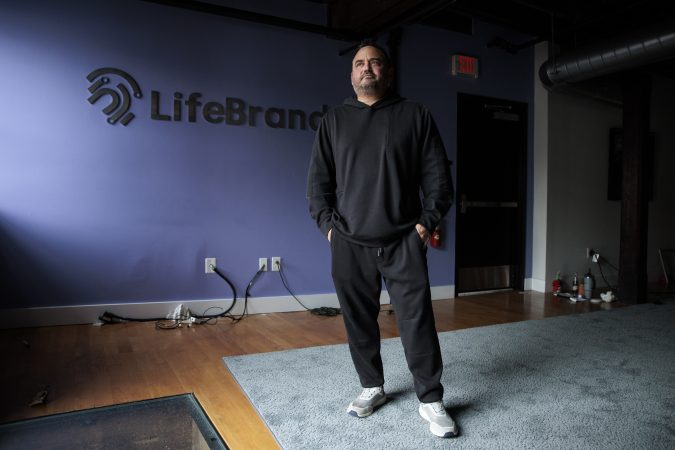
T.J. Colaiezzi was the CEO of West Chester-based startup LifeBrand.Inquirer illustration; AP Images; Getty Images
The founder of West Chester-based startup LifeBrand is facing accusations of fraud, including misspending funds on splashy Philadelphia sports stadium advertising deals and pocketing millions to pay for an extravagant lifestyle (see: a $4.8 million Shore home.)
Investors are taking T.J. Colaiezzi, the company’s CEO and a former gym manager with no tech background, to court, claiming he squandered their investments. LifeBrand — which helped users find and delete potentially embarrassing social media posts, as well as companies vet potential candidates — was once valued at $137 million, but sold in 2024 for pennies on the dollar.
One investor called it a “Ponzi-like” scheme, but Colaiezzi says the venture was a genuine effort, albeit full of mistakes — none of which he said amounted to fraud.
Raised in South Coatesville, Henry Jacks, 104, was a Boy Scout leader, the first Black mail carrier in Coatesville, a city councilmember, and a judge of elections.Steven M. Falk / For The Inquirer
Last week, Chester County celebrated a group of residents with a unique and shared distinction: reaching or exceeding the age of 100.
During their lifetimes, they’ve witnessed numerous changes locally and globally, from increased traffic in the county to the rise of television.
There will be roadwork in several municipalities this week, including ongoing work on Route 30, plus the start of a $1.9 million retaining wall project. See all the possible delays and detours you need to know this week.
A former East Whiteland Township police sergeant and a former member of Octorara Area School District’s school board enrolled in an advanced rehabilitative disposition program last month after being charged with illegally recording a closed executive school board session. Upon completing the program for first-time offenders, Anthony Falgiatore Sr.’s charges will be dismissed and his record expunged. The Inquirer’s Vinny Vella has the details.
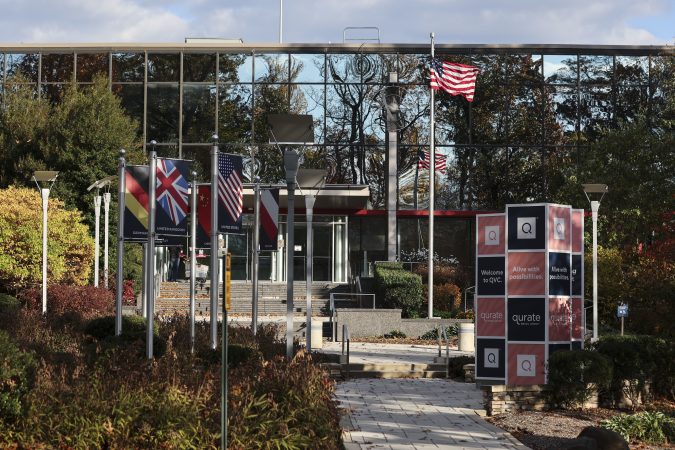
On-air hosts at West Chester-based QVC are moving to unionize as the home shopping giant reorganizes amid a Chapter 11 bankruptcy. The hosts are seeking recognition of their union, with plans to join SAG-AFTRA, which represents 160,000 media professionals nationwide.
West Goshen Township is hosting two conditional use hearings regarding West Chester University’s master plan. The first meeting will take place Tuesday at 6 p.m. at the township building, with another slated for June 30.
The first phase of construction is underway on the Randolph Woods Nature Preserve in Malvern. The project includes an ADA-accessible loop trail and apedestrian bridge, boardwalk, and viewing platform. Work is expected to continue through the fall.
West Vincent Township is celebrating the opening of Fellowship Trail tonight with a community event that includes pretzels, ice creams, and a ribbon cutting. The trail links to Upper Uwchlan Township by way of a 1.3-mile pedestrian- and bike-friendly path.
A women’s-only fitness studio opened its newest location this week in West Chester. Located at 109 N. High St., Train & Nourish offers personal training and classes.
The Spring Citycommunity pool opens daily for the season on Saturday. Its new hours are noon to 7 p.m. Admission is $10 a day for non-members.
🏫 Schools Briefing
Earlier this month the Coatesville Area School Districtreached a four-year agreement with the teachers’ association, which the school board approved at last week’s meeting. The new contract goes into effect July 1 and includes a new schedule for wage increases, with 3.5% bumps for the first three years, and 2.5% for the final year. The board also approved the 2026-27 budget, which includes a 3.5% property tax increase.
Tredyffrin/Easttown School District’s board approved its 2026-27 budget last week with a 4.99% property tax increase, which includes the allowed 3.5% increase plus an additional 1.49% through a referendum exception for special education expenses. That translates to a roughly $388 annual increase for the average assessed home.
Two Chester County girls’ lacrosse teams took home championships over the weekend. Twin Valley High School’s girls’ lacrosse team clinched the PIAA 2A championship on Saturday, defeating Wyomissing Area Junior-Senior High School 11-5. And B. Reed Henderson High School in the West Chester Area School District claimed the PIAA 3A title, beating Conestoga High School 11-6.
Phoenixville Area School District’s school board passed its 2026-27 budget earlier this month, which calls for a 3.5% property tax increase.
🍽️ On our Plate
Last week, The Inquirer dropped our list of the 76 most iconic dishes in the region and there are some local ties among them. Ranking at No. 61 is Santucci’s upside-down pizza, which you can grab at the Paoli outpost. And potato chips from Nottingham-based Herr’s took the No. 46 spot for being so ubiquitous they’re found on virtually every deli shelf in the region. Lastly, Crabfries from Chickie’s & Pete’s rank No. 20. You can get the tasty crinkle cut fries dusted with crab seasoning at the location in Malvern.
Good news for bagel lovers: Delaware-rooted shop The Original Hot Bagels opened its newest outpost at 100 Landenberg Rd. on Saturday, taking over The Landenberg Store’s former space. The Original Hot Bagels is known for its bagels and bagel sandwiches including breakfast versions, a bagel burger, a bagel cheesesteak, and pizza bagels.
🎳 Things to Do
🎙️ Sound of Summer Free Concert Series: Blues and funk mashup band Antar Goodwin and the Faithful Sinners headlines this week’s show. There will also be food trucks. ⏰ Wednesday, June 17, 6:30-8:30 p.m. 💵 Free 📍 Anson B. Nixon Park, Kennett Square
🍄250 in Kennett: The borough will celebrate the nation’s semiquincentennial by bedecking the beloved giant mushroom used for the New Year’s Eve drop in red, white, and blue. ⏰ Thursday, June 18, 5:30-9 p.m. 💵 Free 📍 West State Street, Kennett Square
🎤 East Pikeland Summer Concert Series: Be Kind Rewind, a ‘90s cover band, headlines this year’s first concert. ⏰ Thursday, June 18, 6:30 p.m. 💵 Free 📍 Miller Ampitheater at Kimberton Park, Phoenixville
🎈 Chester County Balloon Festival: See hot air balloons take to the skies or take a ride yourself at this three-day festival. ⏰ Friday, June 19-Sunday, June 21, times vary 💵 $12.51-$28.52, free for kids under 6 📍 Ludwig’s Corner Horse Show, Glenmoore
🏳️🌈 PrideFest: This Pride festival will have live entertainment, over 170 vendors to browse, and kid-friendly activities. ⏰ Saturday, June 20, noon-5 p.m. 💵 Pay as you go 📍 Bridge Street, Phoenixville
🗓️ Coatesville Juneteenth: The Coatesville area NAACP branch is hosting a day of celebration for the holiday, including a family basketball tournament, a parade, and a community fair. ⏰ Sunday, June 21, 10 a.m.-5 p.m. 💵 Pay as you go 📍 Around Paul Palmer Park, Coatesville
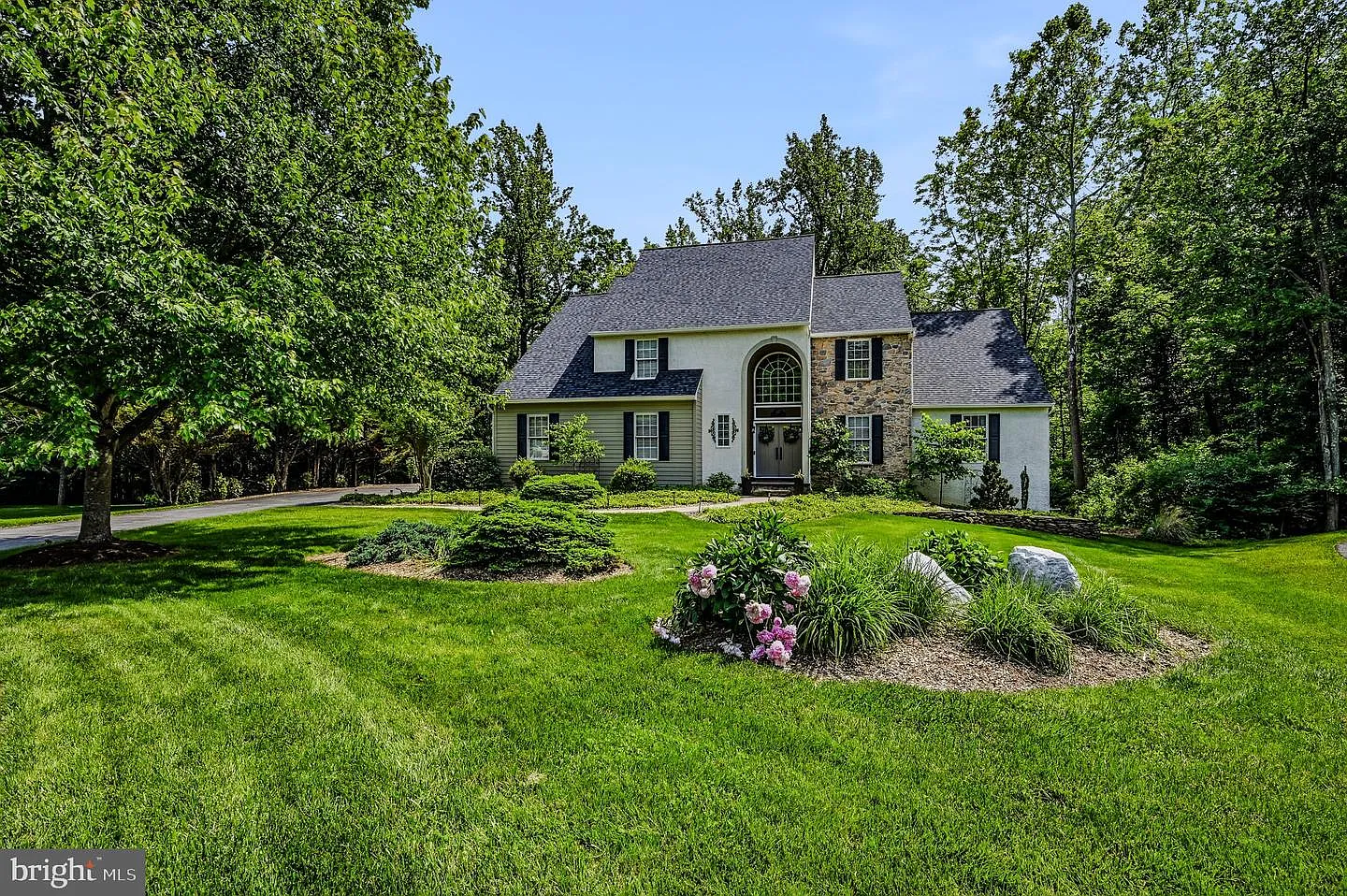
The home sits in a cul-de-sac and backs up to a wooded area.Diamond State Photography | Courtesy of Jerry Strusowski/BHHS Fox & Roach
This four-bedroom home in the Hadley’s Mill community of East Marlborough Township has undergone a number of updates throughout the years. It features a two-story great room with ample windows and a fireplace, an eat-in kitchen with granite countertops and high-end appliances, and an office. It also has a first-floor primary-suite with two closets and a spacious bathroom. An upstairs bedroom opens onto a bonus room, while the finished basement could accommodate another suite thanks to a full bathroom there. Out back, there’s a new deck that looks onto the woods.
By submitting your written, visual, and/or audio contributions, you agree to The Inquirer’s Terms of Use, including the grant of rights in Section 10.
This suburban content is produced with support from the Leslie Miller and Richard Worley Foundation and The Lenfest Institute for Journalism. Editorial content is created independently of the project donors. Gifts to support The Inquirer’s high-impact journalism can be made at inquirer.com/donate. A list of Lenfest Institute donors can be found at lenfestinstitute.org/supporters.
At a grand-reopening celebration at Stateside Live!, Stateside Vodka president Matt Quigley’s wife, Megan, grabbed his arm and beckoned to the crowd around them in disbelief.
“It was just such a prideful moment of like … we’re here to stay,” Quigley said.
Just a couple years earlier, fellow cofounder and CEO Clement “Clem” Pappas looked around Citizens Bank Park to see as many Surfsides as Miller Lites in the hands of Phillies fans: “Holy s —, this is happening,” Pappas recalled thinking at the time.
At their massive new Center City headquarters last week, Pappas and Quigley said Surfside’s astronomical rise still feels surreal.
In 2015, the area natives founded Stateside Vodka in a distillery near Kensington with their brothers, Zach Pappas and Bryan Quigley. The company started selling canned vodka sodas in 2021. But they launched into a different stratosphere when they debuted their spiked teas and lemonades in 2022.
Stateside Vodka’s taproom near Kensington is pictured in 2017, when it was called Federal Distilling. TOM GRALISH / Staff Photographer
Branded as lower-calorie, better-for-you booze, the Surfside cans took off. The cofounders said they sold 200,000 cases in the first year, then 1.3 million in 2023, nearly 5 million in 2024, and a whopping 11.1 million cases last year.
The “slammable” 4.5% ABV cans, as Matt Quigley describes them, are particularly popular in the summertime, a three-month period that accounts for about half the beverage company’s retail sales.
So far this year, Stateside is on track for 70% growth in overall sales, and a 65% growth in Surfside sales, according to the company. That comes after a record year in which the company recorded 111% overall sales growth.
(function(){function e(){window.addEventListener(`message`,function(e){if(e.data[`datawrapper-height`]!==void 0){var t=document.querySelectorAll(`iframe`);for(var n in e.data[`datawrapper-height`])for(var r=0,i;i=t[r];r++)if(i.contentWindow===e.source){var a=e.data[`datawrapper-height`][n]+`px`;i.style.height=a}}})}e()})();
As a private company, Stateside does not have to publicly disclose earnings, and executives declined to share specific sales figures.
While Surfside has accounted for about 90% of sales in the past year, the top executives are bullish on their latest invention, a sports-drink-inspired canned cocktail called Super Lyte. They said the new beverage had sold nearly 400,000 cases in three months, meaning it could outpace Surfside’s early growth.
“The initial response is way beyond our expectation,” Clem Pappas said. “It feels like another hit.”
The company has achieved this success without the backing of an alcohol giant like Anheuser-Busch InBev or Molson Coors, which together manufactures hundreds of brands.
Quigley, 42, and Pappas, 52, said they’ve been approached by nearly every big beverage company, but they have no interest in selling anytime soon.
“As long as you’re still having fun, I see no reason to hang up the metaphorical cleats,” Quigley said.
“I don’t want to sit on the bench. I want to be in the game,” Pappas said. “We still think it’s early days.”
Stateside keeps Philly at its heart amid national growth
A wall at Stateside Vodka’s new Center City headquarters shows a handful of Surfside’s 170 partnerships.Alejandro A. Alvarez / Staff Photographer
In Stateside’s earliest days, Quigley recalled confiding in Pappas about a pipe dream: “If we ever get super successful, I want a sick office in a high-rise in Center City.”
More than a decade later, they have moved from a temporary office in Feasterville-Trevose, Bucks County, to a chic new headquarters at 11th and Ludlow Streets in Market East.
The company plans to stay put for at least 10 years, the cofounders said. For now, about 80 employees work there four days a week with room to grow.
On a recent day, the office was humming during a new-hire orientation. While everyday operations include the same mundane tasks required of any business, the top bosses pride themselves on keeping the vibes light. “We’re not selling, like, car insurance,” Quigley said.
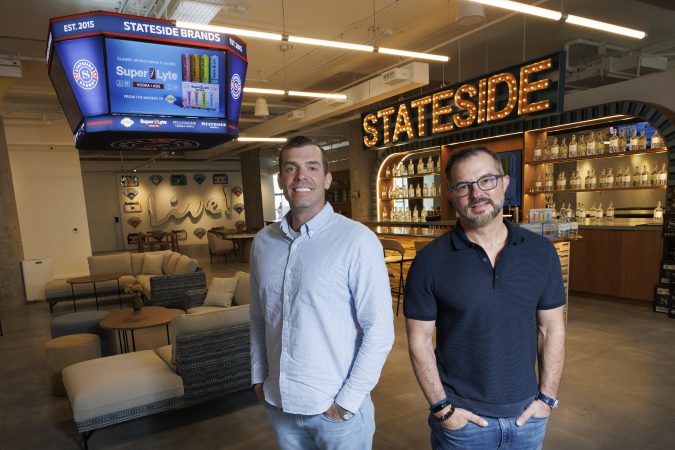
The bright industrial-style space occupies 34,200 square feet across two floors. It is centered around a long bar with a backlit Stateside marquee, a replica of the one at the tasting room. Nearby, there’s an open lounge with couches, underneath a miniature Jumbotron. Ads for Surfside, Super Lyte, and Stateside rotate on the screens.
Office happy hours are a given.
“That’s part of the special sauce,” Pappas said. “We’re in the drinks business.”
Philadelphia has always been at the heart of the company. It’s where they landed their first partnership with the Phillies, which fueled Surfside’s rise. At Citizens Bank Park, the cans have been the top-selling spirit since 2023, according to Stateside executives, citing figures from concessions provider Aramark.
Across the city, the cofounders still run the 7,500-square-foot Kensington-area tasting room and distillery, the latter of which they hope to turn into an event venue.
The distillery has been outgrowing its space for a while. But the need intensified in the past year as the vodka’s retail sales increased 120%.
They attribute the boost in part to greater name recognition thanks to Stateside Live! They said they hope to move vodka production to a larger facility somewhere in the Northeast.
Sales of the original Stateside Vodka, displayed at the company’s office bar, have grown 120% year over year.Alejandro A. Alvarez / Staff Photographer
The cofounders have also stayed local: Quigley, a Fort Washington native, lives in Kensington, and Pappas, originally of Vineland, is in Haddonfield.
Stateside’s reach, meanwhile, has expanded far beyond the region. The company employs about 340 nationwide, up from around 30 in 2022, executives said, and they sell in all 50 states through a network of more than 200 distributors.
Across the country, Surfside has racked up 170 partnerships, including with MLB teams, music festivals, and colleges. Super Lyte has already acquired more than a dozen partnerships, too, including at Penn State, where they said it will be sold at Beaver Stadium this fall.
A hawker carries drinks, including Surfsides, around the concourse at Citizens Bank Park in 2024. The brand now has 170 partnerships at venues nationwide.Elizabeth Robertson / Staff Photographer
In many ways, the cofounders said, they’re trying to replicate the strategy that proved successful with Surfside at Citizens Bank Park: Connect with consumers somewhere where it feels only natural to grab a refreshing, familiar-tasting beverage.
“You’re at a hot baseball game,” Pappas said. “You got a hot dog. You got a soft pretzel. You got an iced tea” — or, rather, a Surfside.
Compared to seeing a new canned cocktail at a beer distributor, he added, “It’s more of an authentic, emotional connection.”
A beverage hawker sells Surfside cans during a Phillies game at Citizens Bank Park in 2024. Surfside has been the stadium’s top-selling spirit since 2023.Elizabeth Robertson / Staff Photographer
Surfside succeeds with familiar tastes
When customers first sip a Surfside or Super Lyte, the taste is likely familiar, perhaps even comforting. It’s similar to iced tea, lemonade, tea cooler, or Gatorade, drinks that for many have been staples since childhood.
That’s intentional, Pappas and Quigley said, and is one of the reasons they think their products have become so popular.
“If you remember your first beer, it was like, ‘Oh God, who wants that?’ It’s bitter. It’s foreign,” Pappas said. “It’s an acquired taste.”
But when it comes to these canned cocktails, “these are not acquired tastes,” he added. “They’re light. They’re easy.”
Quigley said he got the idea for Super Lyte after years of mixing vodka into Gatorade and throwing the bottles into beach bags on summer vacations. He recalled thinking: “I can’t be the only person in America that’s been doing that for a long time.”
The initial uptake of Super Lyte confirmed that, he said.
Super Lyte launched in March with four flavors: fruit punch, orange, lemon-lime, and blue chill.
Surfside now has 16 variations of iced tea, lemonade, iced tea-lemonade, and green tea. A 12-ounce Surfside contains 100 calories, 2 grams of sugar, and no carbonation, while a 12-oz Super Lyte contains 90 calories, no sugar, and no carbonation.
Stateside Vodka’s new product line, Super Lyte, is displayed at the company’s new Center City headquarters.Alejandro A. Alvarez / Staff Photographer
In the alcohol industry, “we’re meeting what was previously an unmet demand,” he said. It’s “all the convenience and the alcohol level of [a light] beer, where you can drink a few of them and you’re not getting sloshed.”
Even younger consumers — who are least likely to drink alcohol, according to recent surveys — are gravitating toward Stateside products, with high sales in some college towns.
Pappas and Quigley said they don’t see drinking rates declining much farther. Instead, they predict an evolution in the market, with an even greater focus on ready-to-drink cocktails.
Matt Quigley (left), Stateside’s president and cofounder, talks about the company’s products with fellow cofounder and CEO Clement Pappas.Alejandro A. Alvarez / Staff Photographer
So Stateside’s leaders plan to keep crafting new products, they said, which is one of the reasons they have turned down acquisition offers.
“Big, publicly traded multinational companies just aren’t great at innovating,” Pappas said.
Stateside has now established “enough of the back-end capabilities to really compete pretty effectively,” he said, without losing “that entrepreneurial spirit” and the drive “to innovate and disrupt.”
At the moment, he said, they are working on several beverage ideas, none of which are ready for publication.
But it seems unlikely they’ll dabble in nonalcoholic drinks. As Quigley noted, “then it would just be iced tea.”
In a forceful and scolding opinion, the Pennsylvania Supreme Court ruled Tuesday that District Attorney Larry Krasner’s office misled the courts, “violated its duty of candor,” and submitted false statements when asking a judge to vacate a 2004 murder conviction.
In the opinion released Tuesday, Justice Kevin Dougherty wrote that prosecutors’ pattern of misleading judges in seeking to overturn murder convictions is so troubling and recurrent that, going forward, before Krasner’s office seeks such relief, judges must notify the state attorney general’s office and allow it to review the case.
The decision amounted to one of the most scathing rebukes yet of Krasner’s efforts to revisit decades-old convictions, and arrives amid intensifying scrutiny of the office’s Conviction Integrity Unit and appeals division, whose handling of post-conviction cases has drawn criticism from judges in both state and federal court.
Just last week, Krasner’s office reversed course in a separate murder case, writing in a federal court filing that one of its prosecutors had made “material misstatements” and submitted “legally erroneous” statements when seeking to overturn a man’s murder conviction. The office sought to withdraw its recommendation to grant the defendant a new trial.
Supreme Court of Pennsylvania Justices Kevin Brobson, Christine Donohue, David Wecht, Debra Todd, Sallie Updyke Mundy and Kevin Dougherty in 2023.Provided by Administrative Offic
By giving the state attorney general authority to intervene when Philadelphia prosecutors decline to defend a conviction, the high court added a new layer of oversight to the state’s largest prosecutor’s office — a rare step that reshapes who controls post-conviction litigation in Pennsylvania.
Krasner, in a video statement shared late Tuesday, said the high court’s ruling “undermines the value of a vote in Philadelphia as compared to every other county.”
In the video, which featured images of the Rev. Dr. Martin Luther King Jr. and Rosa Parks, Krasner compared the pushback to his criminal justice reform efforts to those of other social justice movements.
“First they ignore you — we’re past it. Then they laugh at you — we’re past that. Then they fight you — and we have been fighting for 8½ years,” he said.
While four justices — Dougherty, Sallie Updyke Mundy, P. Kevin Brobson, and Daniel McCaffery — agreed there are systemic concerns about the district attorney’s office, three — Debra Todd, Christine Donohue, and David Wecht — supported neither that narrative nor the court’s remedy.
Wecht cast the lone full dissent, arguing that the case did not warrant the Supreme Court’s intervention and that the lower courts already have the tools necessary to prevent improper concessions by prosecutors.
The case at the center of the court’s ruling was that of Lavar Brown, who was sentenced to life in prison without the possibility of parole after a jury convicted him of second-degree murder in the robbery and shooting death of Michael Richardson, a North Philadelphia Rite Aid worker, in 2003.
Brown was later convicted of shooting and killing a second man, Robert Crawford, in 2005, and was sentenced to death — in part because of the first conviction.
In this 2019 photo, Kristi Richardson looks at photos of her husband, Michael Richardson, who was shot and killed during a robbery at the Rite Aid where he worked in 2003.JULIE SHAW / Staff
In post-conviction court filings, Brown’s attorneys said the prosecution’s case in Richardson’s killing largely relied on the testimony of two witnesses — including one who, in a statement to police, implicated a teenage girl who was incarcerated at the time of the murder. The witness’ earlier statements were never provided to his trial lawyers, the attorneys said, which violated his right to a fair trial.
When a Common Pleas Court judge later granted Brown a new trial, the families of Richardson and Crawford took the unusual step of asking Pennsylvania’s highest court to intervene.
The families said Krasner had a conflict of interest because two of his former law partners had previously been involved in Brown’s case. They also argued the district attorney’s office was trying to “circumvent” the courts by conceding relief in the Rite Aid killing, which had served as an aggravating factor for his death sentence.
A photo of Robert Crawford in the home of his sister Suzette Crawford March 27, 2019. Robert was shot to death in Philadelphia in December 2003. His killer, Lavar Brown, is on death row.TOM GRALISH / Staff Photographer
The Supreme Court agreed to hear arguments in March 2025. And on Tuesday, six justices agreed that Brown’s conviction should not have been overturned and ordered a new hearing in the case.
Dougherty, in writing the majority opinion, was scathing in his assessments of prosecutors’ conduct.
In a case involving a murder conviction and death sentence, he wrote, the district attorney’s office’s “fidelity to its duty of candor should have been at its zenith. Regrettably, it was anything but.”
The opinion said prosecutors did not disclose a memorandum in which a key witness, Ronald Vann, identified Brown as being involved with the murder, even as they asked Common Pleas Court Judge Glenn Bronson to vacate the conviction.
Instead, the court said, they asserted that the document was irrelevant to Brown’s claims.
Krasner’s office also tried to keep the victim’s families from accessing it.
But the memorandum was “unquestionably relevant” to the case and showed a consistency over time of Vann’s statements, the opinion said. That Krasner’s office would say otherwise “rings hollow and smacks of post hoc rationalization,” the court said.
“The memorandum would have poured salt on the ‘fertile ground’ for impeachment envisioned by the DAO,” the ruling said, adding that withholding the document was a “breach of its duty of candor” to the court.
The high court also said prosecutors filed a joint stipulation with Brown’s attorneys that “was false in multiple respects,” including mischaracterizations of the timeline of witness statements to police.
The justices said prosecutors had not interviewed a single witness or investigator who had handled the case, and rejected their claims that it had conducted a “thorough, independent review of the records in this case.” Krasner’s office, the court said, “cut corners and shirked its duties in conducting its post-conviction ‘investigation.’”
The court reversed Bronson’s order granting Brown a new trial.
To “promote just outcomes” moving forward, the opinion said, the courts handling appeals must notify the attorney general’s office of any case in which Krasner’s office plans to seek relief, and give state prosecutors the opportunity to review it and weigh in on whether the decision is appropriate.
A lawyer for Brown could not be reached for comment. The Pennsylvania Innocence Project, which had filed a brief supporting Brown and the district attorney’s office alongside dozens of other prosecutors’ offices, former judges, and defense attorneys, declined to comment.
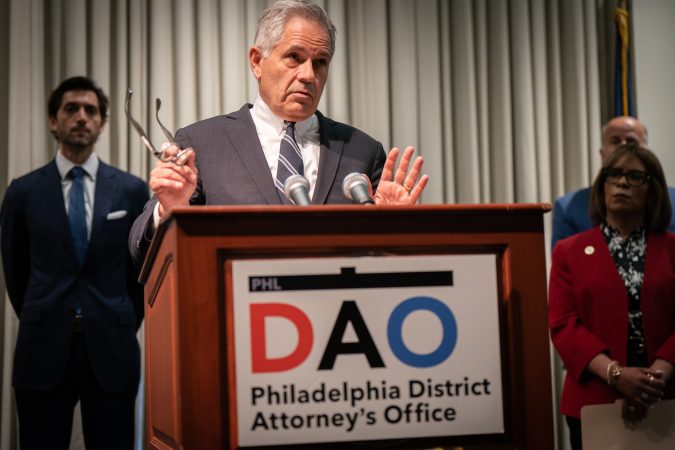
Da Larry Krasner speaks during a May 2026 press conference. Jessica Griffin / Staff Photographer
Chris Lynett, the lawyer who represented the families of Richardson and Crawford, said the high court’s opinion supported their belief that Brown’s case — like others — had not been scrutinized closely enough by prosecutors.
“We can’t just say that if we feel uncomfortable with a conviction that we are going to overturn it,” he said. “You need a full record, you need honesty, and you need an evaluation.”
Lynett, who worked as an assistant district attorney in Philadelphia for five years before leaving the office in 2020, said its leadership needs to “think about what they’re doing and what they’re encouraging their line prosecutors to do in court.”
The attorney general’s office had filed an amicus brief in support of the families, arguing that, since 2018, Krasner’s office agreed to overturn convictions in 115 cases with little to no meaningful opposition to defendants’ claims.
Attorney General David Sunday, a Republican, said in a statement Tuesday that his office is grateful to serve “as a check on this process for the citizens of Philadelphia and ensure that the interests of victims’ families are represented.”
When an investigation shows that a defendant was wrongfully convicted, his office said, prosecutors have a duty to remedy the situation — through the established court processes.
“As the Court noted,” his office said, “this case is about the failure of the process in Philadelphia, both as to this defendant and many others.”
Krasner, for his part, stood by his office’s policies. Philadelphia is on track to record the fewest homicides in recent memory, he said in the video, and correcting past mistakes builds trust in the criminal justice system.
Acting as an adversary in overturning wrongful convictions, he said, “doesn’t help safety, it doesn’t help democracy, it doesn’t help freedom, but that’s OK. Because we know where we are in the fight, and once we get past the fight, we all win.”
A supermajority of the network’s 32 on-air hosts presented a petition to company management last week, announcing their desire to unionize and asking for voluntary recognition of the union, according to a statement from SAG-AFTRA, which the hosts intend to join.
QVC management is reviewing the petition, spokesperson Matthew Goldstein said in a statement: “We respect the legal rights of all team members and are committed to following the appropriate process thoughtfully and responsibly.”
On Tuesday, SAG-AFTRA — which represents 160,000 media professionals nationwide — filed an election petition with the National Labor Relations Board (NLRB) on the QVC hosts’ behalf, according to the federal agency’s website. If the employer does not voluntarily recognize the union, the petition can trigger an NLRB election and lead to a union’s formal certification.
The hosts are taking steps to unionize as company higher-ups try to expedite the bankruptcy process, with the hope of emerging this summer.
QVC pioneered home shopping 40 years ago and developed a loyal following of fans, mostly women, who bought clothes, home goods, kitchen appliances, tech products, and other wares at all hours.
From its West Chester studios, the network and its smaller counterpart, HSN, still broadcast live, and customers can still call in to order merchandise. But the company has also expanded into online, social-media, and livestream shopping — with mixed results. They are up against stiff competition from the likes of Amazon and other ecommerce giants.
The QVC hosts, meanwhile, have other issues on their mind: They are concerned about artificial intelligence, and don’t want QVC using AI to imitate their image, voice, and likeness without consent or compensation, according to SAG-AFTRA, citing the hosts’ petition.
The national union said the hosts are also calling for stronger job security in the face of AI, clearer paths for career advancement, greater say in company decisions, more equitable pay, and transparency around compensation.
“We believe we should have meaningful input into our role in the network’s future, and that this is best accomplished through a formal collective-bargaining process,” the hosts wrote in the petition, according to SAG-AFTRA.
SAG-AFTRA officials said they encouraged QVC management to voluntarily recognize the union and “avoid a costly NLRB process.”
SAG-AFTRAnational executive director and chief negotiator Duncan Crabtree-Ireland said in a statement that he applauded the QVC hosts’ “decision to stand together and seek a collective voice.”
“These workers are at the heart of QVC’s success, connecting with audiences through creativity, authenticity, and innovation every day,” Crabtree-Ireland said.
Goldstein, the company spokesperson, said the network’s hosts are “deeply valued team members and an important part of what makes QVC special.”
The Lower Merion school board voted Monday to repeal its existing technology policies, over outcry from parents who accused the board of stripping their right to opt their children out of district-issued laptops and iPads.
During a contentious meeting — the board summoned security after interruptions from the crowd in the Lower Merion High School auditorium — parents demanded answers on why the district was denying families the ability to reject devices they said were threatening their kids’ education, and even their lives.
“A parent’s right to opt out of one-to-one educational technology to do what is best for their children” is “life and death for their development and learning,” said parent Meredith Brisco-Bacik, a cardiologist who likened the district’s use of educational technology to giving kids a risky medical procedure without their parents’ consent.
By repealing the existing policies, which contain language requiring administrators to accommodate students whose families do not sign electronic device use agreements, “you stand ready to remove the proverbial defibrillators from the room,” Brisco-Bacik said.
District officials have responded to the criticism by advancing a new technology policy that would end the assignment of personal devices to K-2 students and set guidelines for technology use by grade level.
“That is not an option in Lower Merion School District, nor has it ever been an option in Lower Merion School District to opt out,” said Anna Shurak, the chair of the board’s policy committee.
She said the policy repealed Monday — which dates to when the district adopted one-to-one devices in 2011 — has been misinterpreted by parents, and was related to families who did not sign agreements about taking electronic devices home.
But parents said the district had failed to explain why technology was so integral to the curriculum that it was not possible to opt out of personal devices.
“If there were direct payoffs or dirty money exchanging hands, it would make sense, but to think that our kids and teachers have been sold out for simple ideological capture by tech corporations … is incredibly depressing,” parent Eleanor Stanford said.
Numerous parents expressed frustration, saying they felt the district had not listened to them.
Brian Nealis, a parent of children finishing seventh and fourth grades in the district, said that when he tried to talk to his sons’ assistant principal about his concerns, “his response to me was, ‘The kids need to learn self-control.’ And my reaction was like, oh, should we just hand out nicotine packets in middle school? … That is the most asinine thing to hear from an educator.”
The board voted 7-2 to repeal the current technology policies, with members Sarah Thomas and Abigail Lerner Rubin voting no.
Rubin said she was uncomfortable with repealing existing policies before the district had adopted new ones, and asked fellow board members to “pause unless and until we can provide the evidence that people have asked for, that these devices are safe, effective, and legal.”
Shurak said the board needed to repeal the existing policies to allow administrators and teachers to move forward with planning for adoption of the proposed replacement policies for the coming school year.
HARRISBURG — So-called skill games, the slot machine look-alikes that have proliferated by the tens of thousands around Pennsylvania bars and corner stores, are slot machine devices and should be regulated as such, the state’s highest court ruled Monday.
The Pennsylvania Supreme Court ruling clears the way for widespread taxation and regulation by the state, as well as limits on where the machines are available, as a majority of justices ruled that both gambling law and the criminal code apply to the machines.
The majority recognized that the ruling could cause a “potential disturbance” for “business owners and other good-faith participants in the industry,” so the ruling will take effect after a 120-day “safe harbor” period. And if lawmakers in Harrisburg disagree with the opinion, the General Assembly “remains free at any time to take whatever legislative action it may deem appropriate.”
Pennsylvania’s gambling industry is highly regulated and taxed. If state law is unchanged after the 120-day waiting period, the estimated 70,000 skill game machines available across the state would need to be regulated and confined to specific locations like casinos that have the proper licenses.
Chief Justice Debra Todd and Justice Daniel McCaffery, both Democrats, joined the opinion in full, while Republican Justices Sallie Updyke Mundy and Kevin Brobson concurred with most of the majority’s reasoning but wrote a short dissent.
“Because chance predominates both the player’s eligibility for winnings and the magnitude of those winnings, the [skill games] device is a gambling device,” Donohue wrote.
Justice Kevin Dougherty, a Philadelphia Democrat, sat out the long-awaited decision.
Skill game operators have evaded taxation and regulation for more than a decade, operating in a legal gray area after lower courts ruled that the machines require a level of skill not necessary to play games of chance like slot machines.
The most influential player in the skill games industry, Georgia-based operator Pace-O-Matic, has asked the state on multiple occasions to regulate and tax the machines — but at a rate much lower than slot machines, arguing that their technology helps small businesses with small margins stay afloat as prices rise.
In a statement, Pace-O-Matic said it was disappointed by Monday’s ruling, which it said would have “far-reaching consequences” on Pennsylvania’s small businesses and fraternal organizations.
“[Small businesses] are now potentially left facing an impossible choice: cease operating these games and lose an important source of revenue, or endure a legislative solution that could bring excessive regulation and crippling taxation, which will force them to cease operating these games and lose an important source of revenue,” a spokesperson for Pace-O-Matic added.
Gov. Josh Shapiro, a first-term Democrat, has proposed regulating and taxing skill games at 52% — the same rate currently levied on slot machines and most other games of chance. He estimated taxing and regulating the machines could bring in $765.9 million for the state in new revenue in its first year, as part of his $53.2 billion February budget pitch.
Lawmakers have been waiting for the state Supreme Court to rule whether the machines are legally slot machines or not, as the split legislature considers whether to and how much to tax them as a way to create a much-needed new revenue stream.
Top legislators and Shapiro have convened over the last few weeks in closed-door meetings to finalize a state budget deal ahead of a June 30 deadline. Now, with the decision in hand, Senate President Pro Tempore Kim Ward (R., Westmoreland) and Majority Leader Joe Pittman (R., Indiana) said in a statement they believe gaming reform is a “critical piece of resolving this year’s budget.”
In Philadelphia, City Council banned skill games in 2023 over concerns that they attract crime, but a lower court blocked enforcement of the ban while several cases worked their way to the state Supreme Court.
A Philadelphia jury ordered Pace-O-Matic to pay $15.3 million last year to the estate of Ashokkumar Patel, a Hazleton store clerk killed during a 2020 robbery. And a Philadelphia store clerk shot last year during an armed robbery of Philly Market in Frankford, Ahmedine Maham, sued Banilla Gaming, a North Carolina-based skills game manufacturer, for enticing his assailants.
At the end of the 120-day waiting period, the machines will be subject to regulations like slot machines and restricted to specific locations licensed to house slot machines — unless lawmakers decide to change the law.
Pace-O-Matic, in its statement Monday, urged lawmakers to approve bipartisan proposals backed by rural GOP members and Philadelphia Democrats that would charge a $500 fee per skill game machine and would not restrict the machines to licensed slot machine locations, such as casinos.
In a statement, Pennsylvania Attorney General Dave Sunday, a Republican, praised the Supreme Court’s decision as a “significant victory for consumers, taxpayers, and the rule of law.”
“The Supreme Court recognized what our office has argued from the beginning — these machines operate as gambling devices and cannot legally exist without the same oversight, regulation and accountability as other forms of legalized gaming in the commonwealth,“ Sunday added. ”Pennsylvanians deserve protections that ensure games are fair, transparent and operated within the bounds of the law.”