Category: Pennsylvania News

  • High winds tear off roofs, partially collapse buildings across Philadelphia

    High winds tear off roofs, partially collapse buildings across Philadelphia

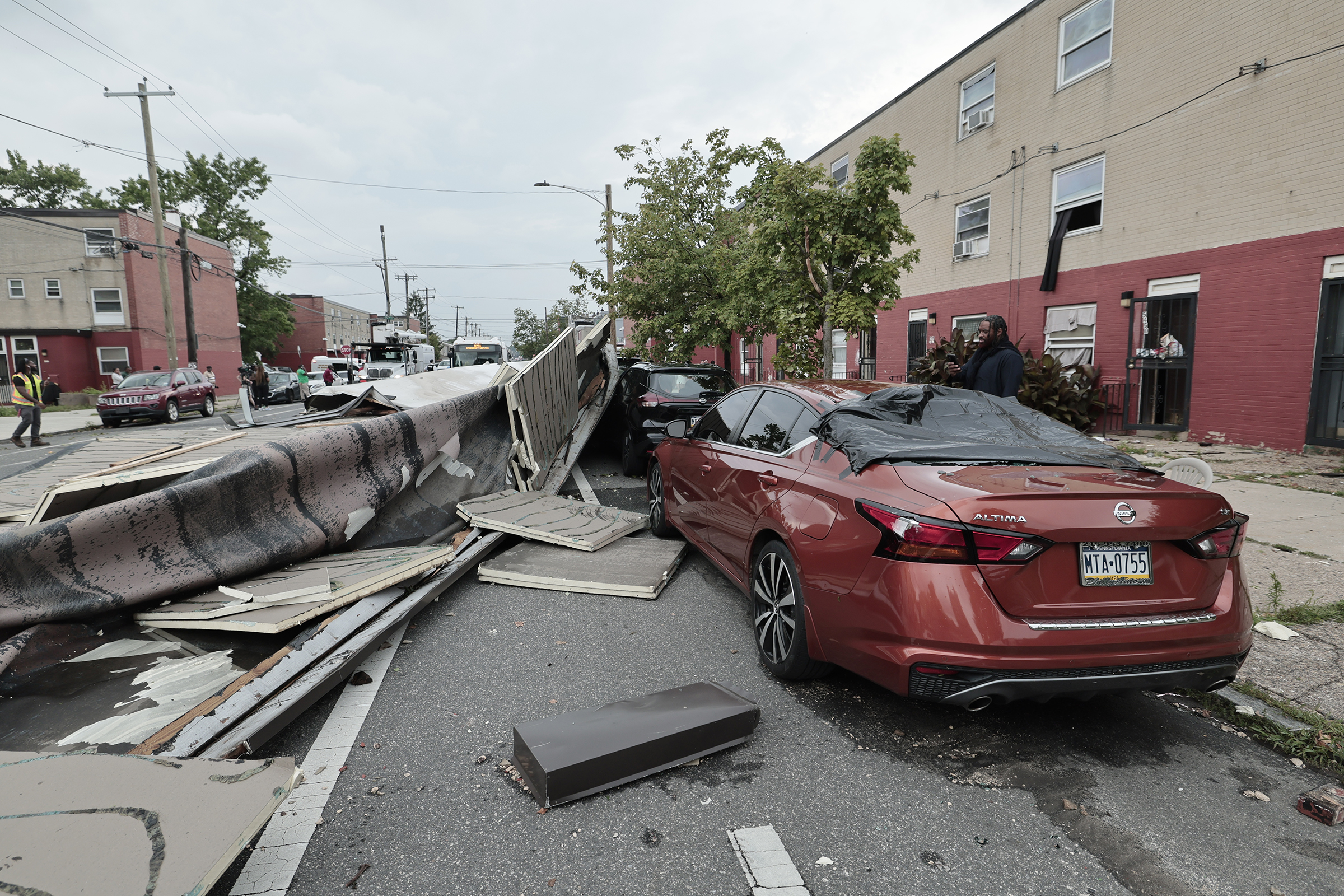
    Saturday’s afternoon storm damaged multiple buildings across Philadelphia, uprooted trees, and caused some streets to flood.

    As city officials gathered at news conference Saturday evening, Police Commissioner Kevin Bethel said that the city’s 911 dispatchers fielded 3,000 calls during a one-hour period during the height of the storm.

    Wind gusts, according to Mayor Cherelle L. Parker, topped out at 60 mph.

    Parker pledged that her office, as well as a number of other city agencies, will be working through the weekend to assess the damage and begin repairs.

    “All of our departments are here today to function as one Philadelphia,” she said. “Because in the midst of crisis, that is what we are supposed to do and that is to have full interdepartmental cooperation today, tonight, and until we make it through this crisis.”

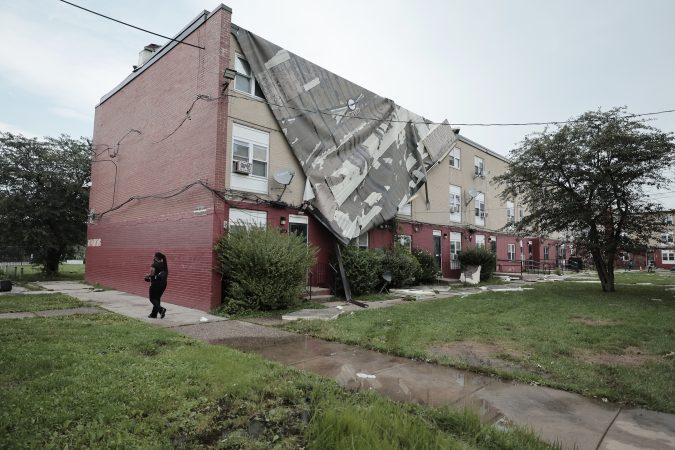
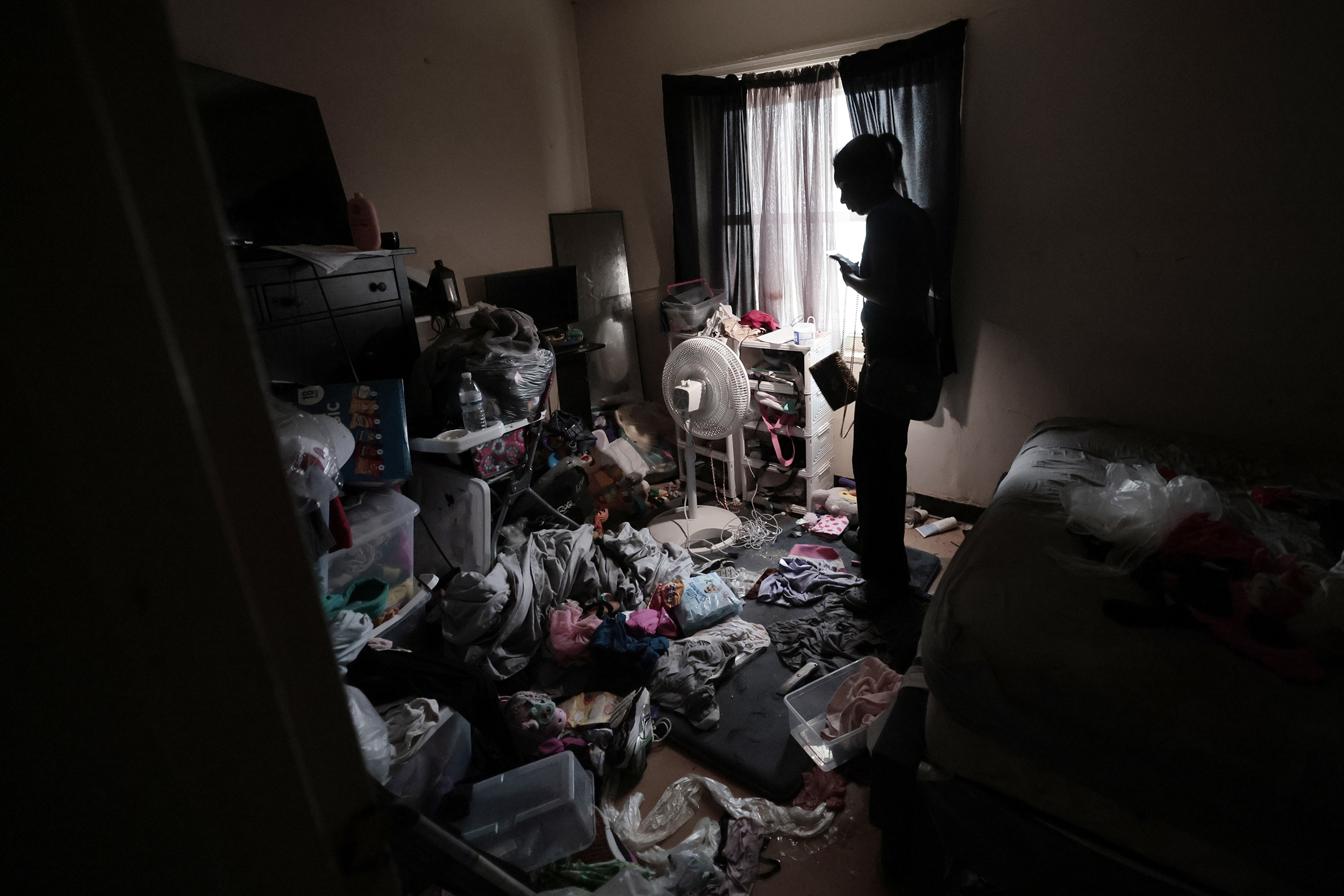
    A woman named Sheila tries to find sneakers for her five children, as everything in her home was soaked. Her PHA building Aspen Way, at 55th and Vine Street, had its roof blown off by strong storms that passed through the area on Saturday afternoon.Elizabeth Robertson / Staff Photographer

    Parker, Bethel, and other city officials spoke near a Philadelphia Housing Authority property on Vine Street near 55th in West Philadelphia that had part of its roof blown off during the storm. Eleven units in the building were affected, officials said, and residents were relocated to nearby hotels.

    Those displaced residents will be moved into new PHA units on Monday, according to PHA president Kelvin A. Jeremiah, while repairs are completed.

    Elsewhere in the city, at least two buildings partially collapsed due to the storm: a vacant property at 24th Street near Washington Avenue, and another building in West Philadelphia on Lansdowne Avenue near 56th Street.

    Carroll Park, in West Philadelphia, had several trees toppled, as did Wharton Square Park in Point Breeze.

    Officials survey the damage to a PHA building, at 55th and Vine Street, that had its roof blown off by strong storms that passed through the area on Saturday afternoon.Elizabeth Robertson / Staff Photographer

    Peco reported that more than 34,000 residents across the region were still without power as of Saturday evening.

    City officials are urging residents to properly document any and all damage their property sustained during the storm — the city is in the process of obtaining state and federal funding to help offset the costs of repairs.

    Officials also warned residents to avoid downed trees and live wires, and could not confirm whether a tornado had caused any of the damage. The officials said they would work with weather experts to determine what sparked the severe storms.

  • Top Pennsylvania leaders have reached a $50.8 billion state budget deal, sources say

    Top Pennsylvania leaders have reached a $50.8 billion state budget deal, sources say

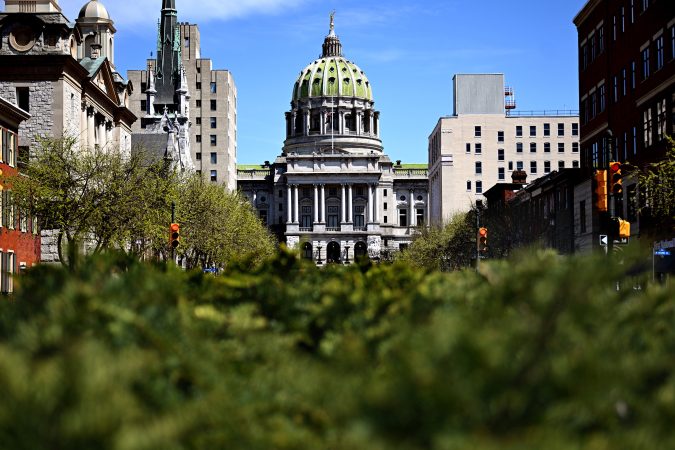
    HARRISBURG — Pennsylvania’s top legislative leaders and Gov. Josh Shapiro have reached a $50.8 billion budget deal, more than a week after a new state budget was due at the start of the fiscal year, according to two sources briefed on the closed-door conversations.

    Details of the contents of the overall budget deal were not immediately available on Saturday, as lawmakers are expected to begin reviewing the bills in the coming days and a final budget is expected to reach Shapiro’s desk by early next week. The state Senate was scheduled to advance parts of the budget on Saturday evening, and the House was scheduled to do the same on Sunday afternoon.

    Though the deal comes more than a week past due, the agreement on the state budget framework among Pennsylvania’s Democratic-controlled House, Republican-led Senate, and Democratic governor marks an improvement from last year’s nearly five-month budget impasse that required school districts, counties, and social service providers to take out expensive loans or close altogether.

    But budget negotiations were less contentious this year, with several major issues taken off the table, including whether the state will tax and regulate skill games, whether the state should create additional school choice programs for students in low-income school districts, and how Pennsylvania will fund mass transit when a two-year fail-safe runs out next year.

    Half of the state Senate and all 203 state representatives are up for reelection this year, and many are eager to approve a state budget and return to their districts to campaign. Many of the more contentious issues before the legislators appear to have been kicked to the General Assembly’s fall legislative session or will resurface in budget talks next year, when lawmakers are not scheduled to face voters. Shapiro, too, is up for reelection this year; his Republican challenger is State Treasurer Stacy Garrity.

    Pennsylvania’s budget deal was crafted largely in secret over weeks of closed-door meetings involving top legislative staff and leaders including Shapiro, House Majority Leader Matt Bradford (D., Montgomery), and Senate Majority Leader Joe Pittman (R., Indiana).

    The overall budget deal presented to the General Assembly will feature a state spending plan, in addition to some policy changes as part of horse-trading of legislative priorities by top leaders.

    One major policy change that appeared to be advancing as part of the overall deal on Saturday evening is a bill to allow local municipalities to pass ordinances placing a moratorium on data center development for no longer than 18 months. That bill, Senate Bill 1345, sponsored by Sen. Jarret Coleman (R., Bucks/Lehigh), was scheduled for a committee vote Saturday evening, when amendments to the bill were possible.

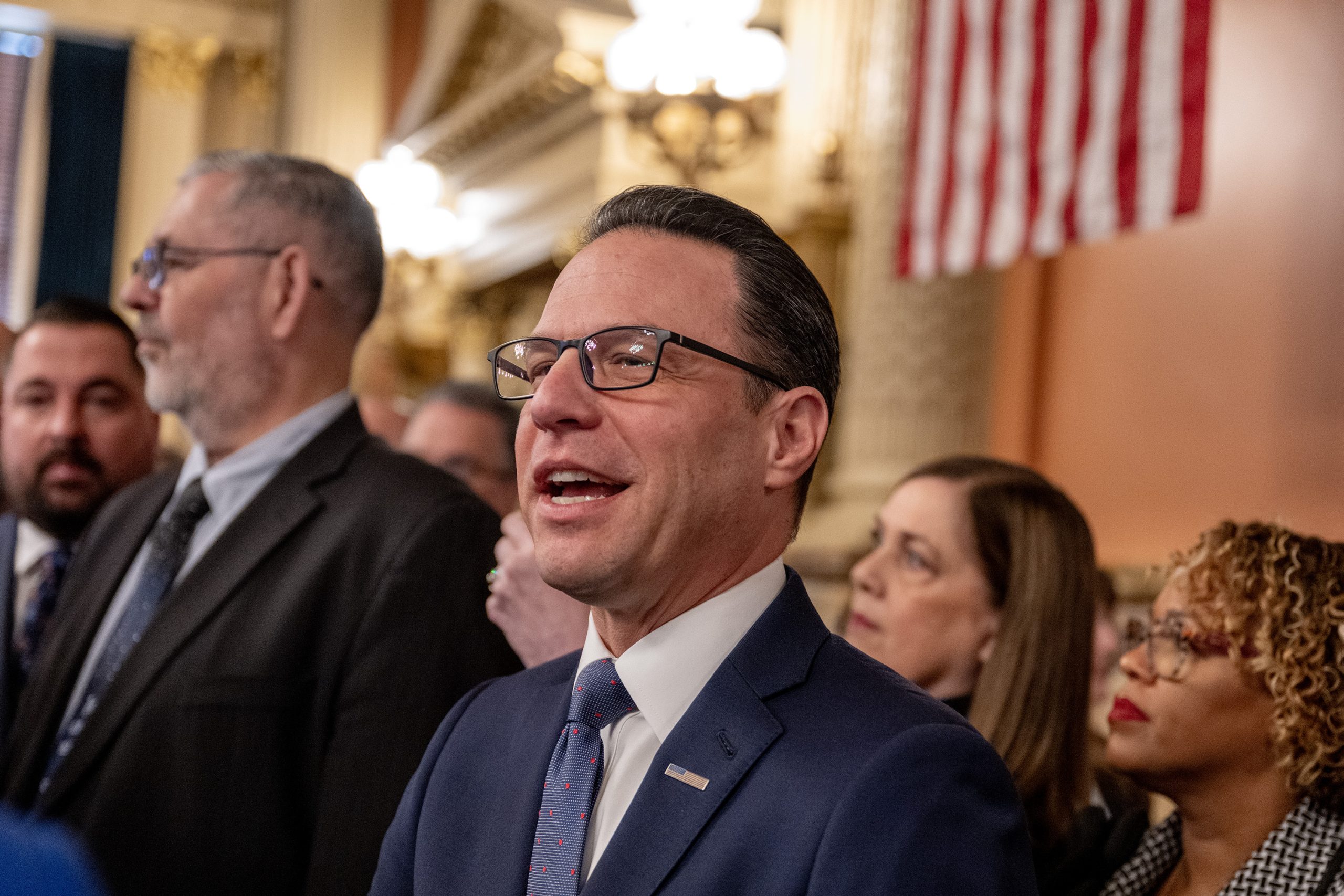
    Gov. Josh Shapiro arrives on the state House chamber to make his annual budget proposal in Harrisburg Tuesday, Feb. 3, 2026.Tom Gralish / Staff Photographer

    Shapiro hinted that a deal was near on Thursday at a news conference in Altoona, saying, “You’re going to see a lot of activity in the Capitol this weekend.”

    “We’ve been working hard, really hard, to bring both sides together, to bring together Democrats and Republicans, and I think you’re going to see a result that benefits the good people of Pennsylvania really soon,” Shapiro added.

    It was not immediately clear how legislative leaders and Shapiro agreed to fill the state’s billion-dollar structural deficit without creating any new revenue streams as part of the 2026-27 fiscal year budget. Even if lawmakers did not increase spending this year — which they are expected to do — the state would need to make up $1.2 billion to balance the budget.

    The deal’s 1.4% increase over last year’s $50.1 billion budget does not allow much room for new spending, unless other existing programs have been cut.

    In new spending, the deal appeared to include an increase to the state’s funding for public education through its adequacy and tax equity formulas, which were designed by lawmakers in 2024 to close a $4 billion “adequacy gap” following a landmark court ruling that found Pennsylvania was illegally underfunding students in low-income districts.

    “If the adequacy number was not agreed to, we wouldn’t be having this conversation,” said State Sen. Vincent Hughes (D., Philadelphia), who is the minority chair of the powerful Senate Appropriations Committee, on Friday evening. “I think the adequacy number will be consistent with what the governor proposed.”

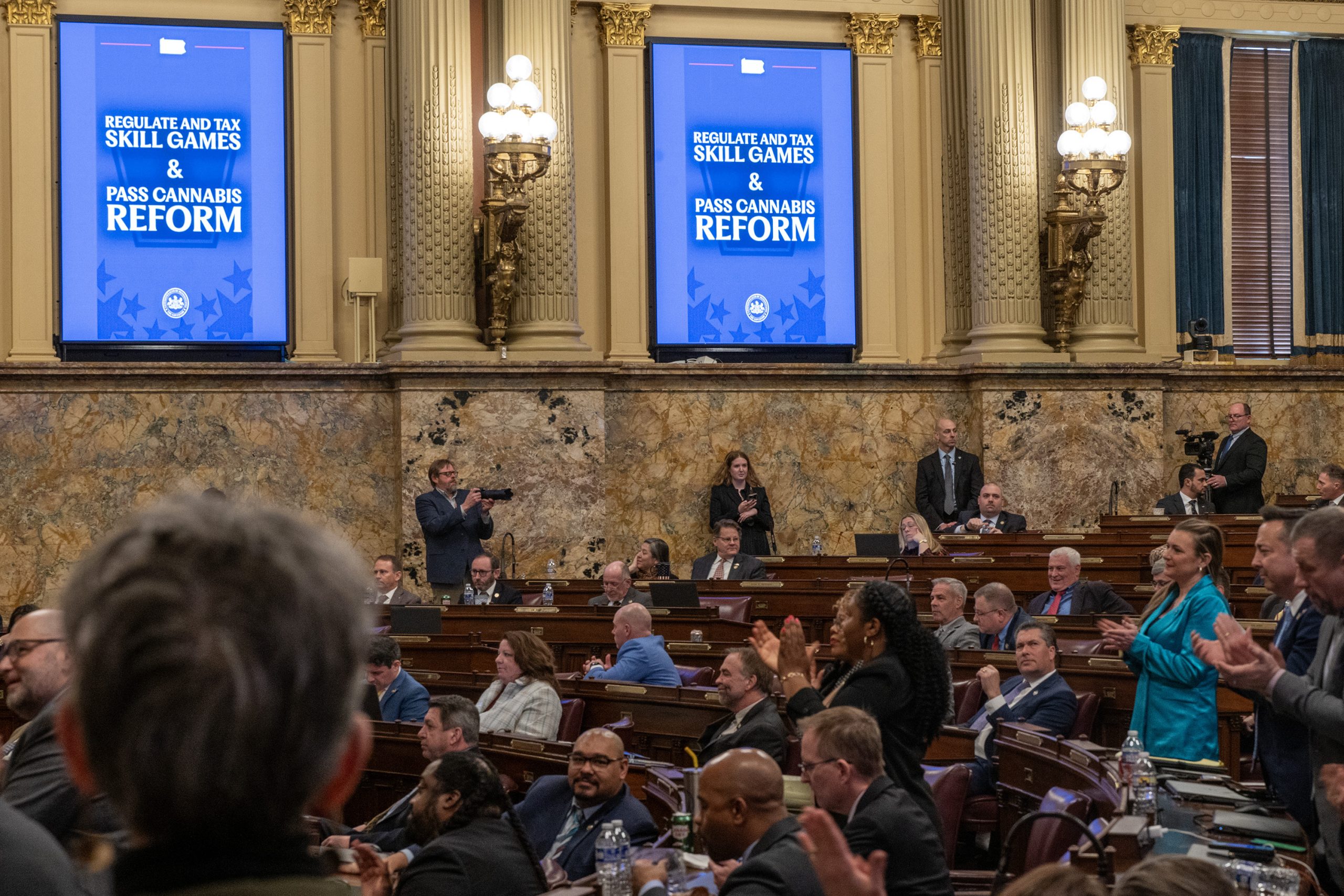
    Shapiro proposed a $53.2 billion budget in February, which included a $565 million increase to adequacy funding for public schools. He also included new potential revenue generators from taxing and regulating skill games, legalizing recreational marijuana, and increasing the state’s minimum wage to $15 per hour. None of these potential revenue generators appeared to make it into the final deal.

    Screens shows skill games and cannabis regulation and reform as Gov. Josh Shapiro makes his annual budget proposal in the state House chamber in Harrisburg Tuesday, Feb. 3, 2026.Tom Gralish / Staff Photographer

    The state is on track to bring in $48.9 billion this year in revenue, according to the Pennsylvania Independent Fiscal Office’s latest projections. Pennsylvania also maintains a $7.7 billion Rainy Day Fund that Senate Republicans have tried to prevent the state from tapping into. It is unclear whether lawmakers will agree to access some of the reserve dollars as many Pennsylvanians face an affordability crisis. Tapping into the Rainy Day Fund requires a two-thirds majority vote by both chambers.

    The state budget topped $50 billion for the first time last year and has increased by 25% — approximately $10 billion — over a five-year period.

    Pennsylvania Legislative Correspondents’ Association intern Ethan Young contributed to this article.

  • Pennsylvania’s booth wins one of 10 ‘Best of Show’ awards at Great American State Fair

    Pennsylvania’s booth wins one of 10 ‘Best of Show’ awards at Great American State Fair

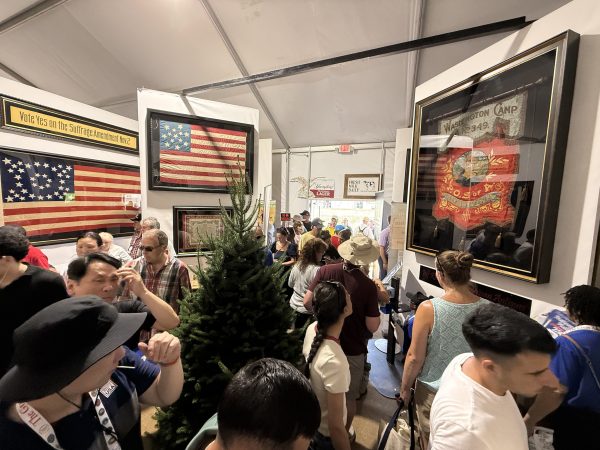
    Pennsylvania’s booth at the Great American State Fair, which ended Friday in Washington, was awarded one of 10 “Best in Show” awards, officials said Saturday.

    In a joint statement, U.S. Sens. John Fetterman (D., Pa.) and Dave McCormick (R., Pa.) said the booth highlighted “the Commonwealth’s central role in America’s story — from the signing of the Declaration of Independence and the sacrifices at Valley Forge to Gettysburg, the Arsenal of Democracy, and the Commonwealth’s continued leadership in agriculture, manufacturing, energy, innovation, and small business.”

    The Great American State Fair, brainchild of President Donald Trump, was held on the National Mall for 16 days, starting on June 25. During the closing ceremony, Freedom250, the organization behind the fair, recognized several outstanding state pavilions from across the country.

    McCormick and Fetterman assumed responsibility for the booth after Gov. Josh Shapiro said Pennsylvania would be skipping the fair because state officials could not find a Pennsylvania business to sponsor the booth. Shapiro was one of several Democratic governors who chose to forgo Trump’s event.

    The two senators said they were able to secure private funding for the display from a coalition of 55 organizations, including the Pennsylvania Chamber of Business and Industry, PennAg Industries Association, Pennsylvania Manufacturers’ Association, and Pennsylvania Farm Bureau. No taxpayer funding was used, according to officials.

    The Pennsylvania pavilion featured an assortment of potato chips donated from various snack-food companies around the state, a replica Liberty Bell, and even a Pennsylvania-grown Christmas tree.

    “What makes Pennsylvania truly awesome are the men, women, and children who call it home. Our farmers, steelworkers, small business owners, and so many more,” Fetterman said in the statement. “Those who visited the pavilion got to see a glimpse of some of the very best of us and our history, and I’m grateful to Senator McCormick, Secretary Rollins [Agriculture Secretary Brooke Rollins], and all who made this a massive success.”

    McCormick said the booth was a tribute to Pennsylvania’s history.

    “From Independence Hall and Valley Forge to our farms, factories, and innovators, the Commonwealth has shaped our nation for 250 years,” he said in the statement. “I’m grateful to Senator Fetterman, Secretary Rollins, and our outstanding Pennsylvania partners for ensuring Pennsylvania had a presence worthy of our history.”

  • Philly Democrats call Trump-promoted Freedom Fuel stations a ‘PR stunt’ that won’t solve high gas prices

    Philly Democrats call Trump-promoted Freedom Fuel stations a ‘PR stunt’ that won’t solve high gas prices

    Philadelphia-area Democrats criticized President Donald Trump’s recent promotion of Freedom Fuel gas stations in Pennsylvania and New Jersey as an effort to fool people about the high price of fuel rather than a long-term solution to the problem.

    “This appears to be a PR stunt of some sort, which is designed to distract people from the fact that gas prices have gone up because the president started a war against Iran,” said Democratic U.S. Rep. Mary Gay Scanlon, who represents Delaware County and parts of South Philadelphia.

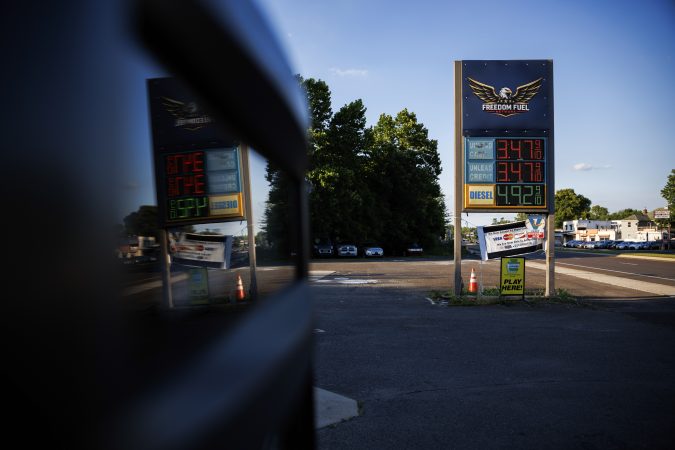
    Questions still abound about who is behind the Freedom Fuel Network, which popped up around the region earlier this month with 25 gas stations sporting the branding.

    No entity is registered in Pennsylvania or New Jersey with the name, but an application for a trademark was filed in Delaware on July 1, two days before the July 3 launch that was heavily promoted by the White House.

    Trump was posting about it on Truth Social ahead of the launch, praising the retailer’s patriotism and promising that gas prices nationally would soon fall after they surged following his decision to attack Iran earlier this year.

    “This Retailer is taking the lead, and others should follow. They are doing this because they love the U.S.A. We are proud to celebrate America’s 250th Birthday in the Great Commonwealth of Pennsylvania, the Birthplace of our very special, one-of-a-kind Declaration of Independence, and where I won BIG in the Presidential Election!” Trump said on Truth Social on July 1.

    The stations started selling gas at $3.47 a gallon on July 3, with the price a nod to the 47th president, according to the White House. Scanlon said that when she stopped by Friday morning, prices were already going up just seven days later.

    “I actually went to one this morning just to get a sense of what was going on,” Scanlon said. ”They may have started with a price of $3.47, but it’s already going up; this one was at $3.57,″ she added, without identifying the location.

    U.S. Rep. Brendan Boyle, a Democrat who represents Philadelphia, said these stations are too little, too late for constituents who have been feeling squeezed by gas prices.

    “Gas was $2.98 a gallon before Trump’s disastrous Iran War. Prices then jumped 50% — the biggest jump in gas prices in American history. These few discounted gas stations are a band-aid on a gunshot wound,” Boyle said in a statement to The Inquirer.

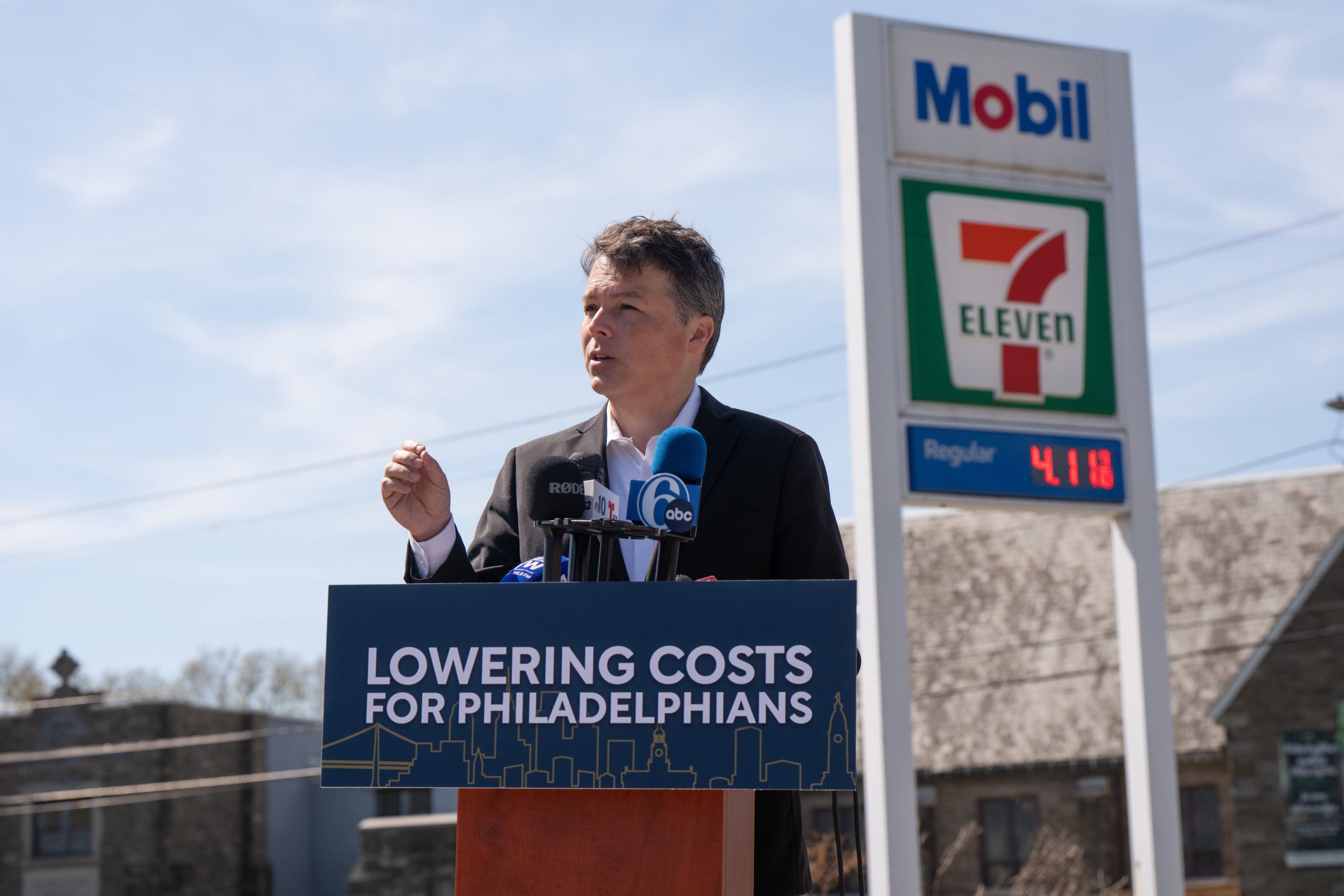
    U.S. Rep. Brendan F. Boyle holds a news conference at a Philadelphia gas station to announce legislation to suspend the federal gas tax whenever the national average price of gasoline exceeds $4.00 per gallon.Jessica Griffin / Staff Photographer

    Boyle has been outspoken about gas prices while in office. In April, he announced a bill to suspend the federal gas tax when gas prices exceed $4 per gallon.

    The average gas price in Philadelphia as of Saturday was $3.99 per gallon, about 11 cents above the national average, according to AAA’s fuel price tracker.

    Gas prices peaked in May but have remained volatile because of the ongoing conflict with Iran. Following U.S. attacks, Iran closed the Strait of Hormuz — an essential trading route — causing gas prices to spike. Recently, the U.S. and Iran resumed attacks, marking the end of a three-week ceasefire.

    “In no uncertain terms, the Cease Fire is OVER!” Trump posted on Truth Social on Friday.

    U.S. Rep. Dwight Evans, a retiring Philadelphia Democrat, said that ending the war in Iran would be the long-term solution for lowering gas prices.

    “As of now, it [the Freedom Fuel Network] doesn’t sound like a long-term solution,” Evans said. “Gas prices are high because Trump has been more focused on vanity projects like a ballroom than on ending his over-four-month illegal war of choice — a war which both houses of Congress have now voted to stop.”

    According to the White House, Freedom Fuel is an independent company that the Trump administration does not fund, and it says the company was not buying gas at a discounted price.

    But the White House has been heavily promoting the effort. It posted a video to social media Tuesday featuring patrons at Freedom Fuel gas stations crediting Trump.

    “I thought gas was more expensive, but it’s not. So thanks Trump for saving me some money!” a man says in the opening of the video, which touts the prices as being 50 cents lower than the Pennsylvania average.

    Scanlon said that identifying the people funding the initiative would make clear the motive for the low prices and whether they would be there to stay.

    “Someone is making it worthwhile for these independent stations to rebrand themselves and sell at under market rates,” she said. “I mean, they’ve got to be making up that money somehow. So the question just is, who is doing it and why? Although it seems there can be no other reason than to prop up the president’s faltering poll numbers.”

  • Chester County has radically reduced chronic homelessness. This Coatesville resident, and her family, have been on the front lines for decades.

    Chester County has radically reduced chronic homelessness. This Coatesville resident, and her family, have been on the front lines for decades.

    Minnie McNeil and her family still think about a challenge issued by her pastor more than 40 years ago: What could their city benefit from, and how could they address it?

    The answer then, and now, was homelessness.

    In the decades since, McNeil, 85, and three generations of her family have devotedly worked to support unhoused men in Coatesville. Their work, alongside countywide cross-sector collaboration, culminated in Chester County in June announcing it had reached “functional zero” for chronic homelessness.

    Though it’s a milestone for the county, it doesn’t mean their work has stopped. They’ve evolved.

    Using federal grant dollars, the W.C. Atkinson Memorial Community Service Center, founded by McNeil and her late husband more than 30 years ago, recently acquired its eighth transitional home in Coatesville, which it will remodel to offer affordable and supportive housing to shelter residents. And the shelter plans to expand its scope — helping catch young adults aging out of foster care before they become unhoused, a story they’ve heard over decades of helping thousands of men.

    And separately, Minnie’s son Andrew McNeil, 58, and grandson, Derrick McNeil, 27, have begun an effort to remodel homes in the city, selling them below market to help revitalize Coatesville and support first-time home buyers at a time when housing prices in the county are soaring.

    “The dollars of the ’70s and ’80s, the jobs that were available, [and] the housing stock available during that time is not, in our view, as easily accessible, and so the needs, in our view, are greater as a result,” McNeil said.

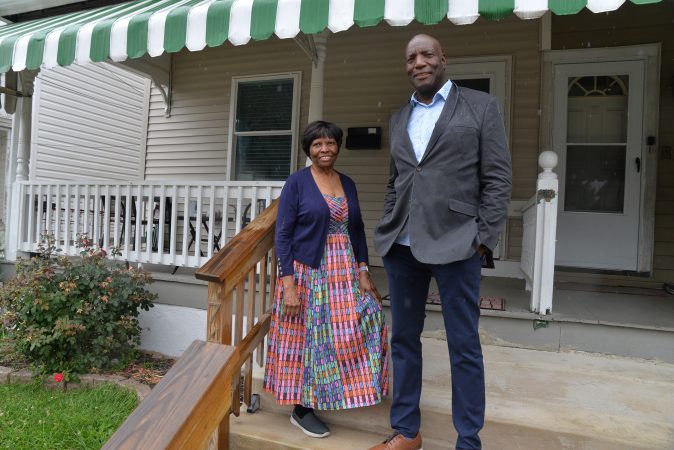
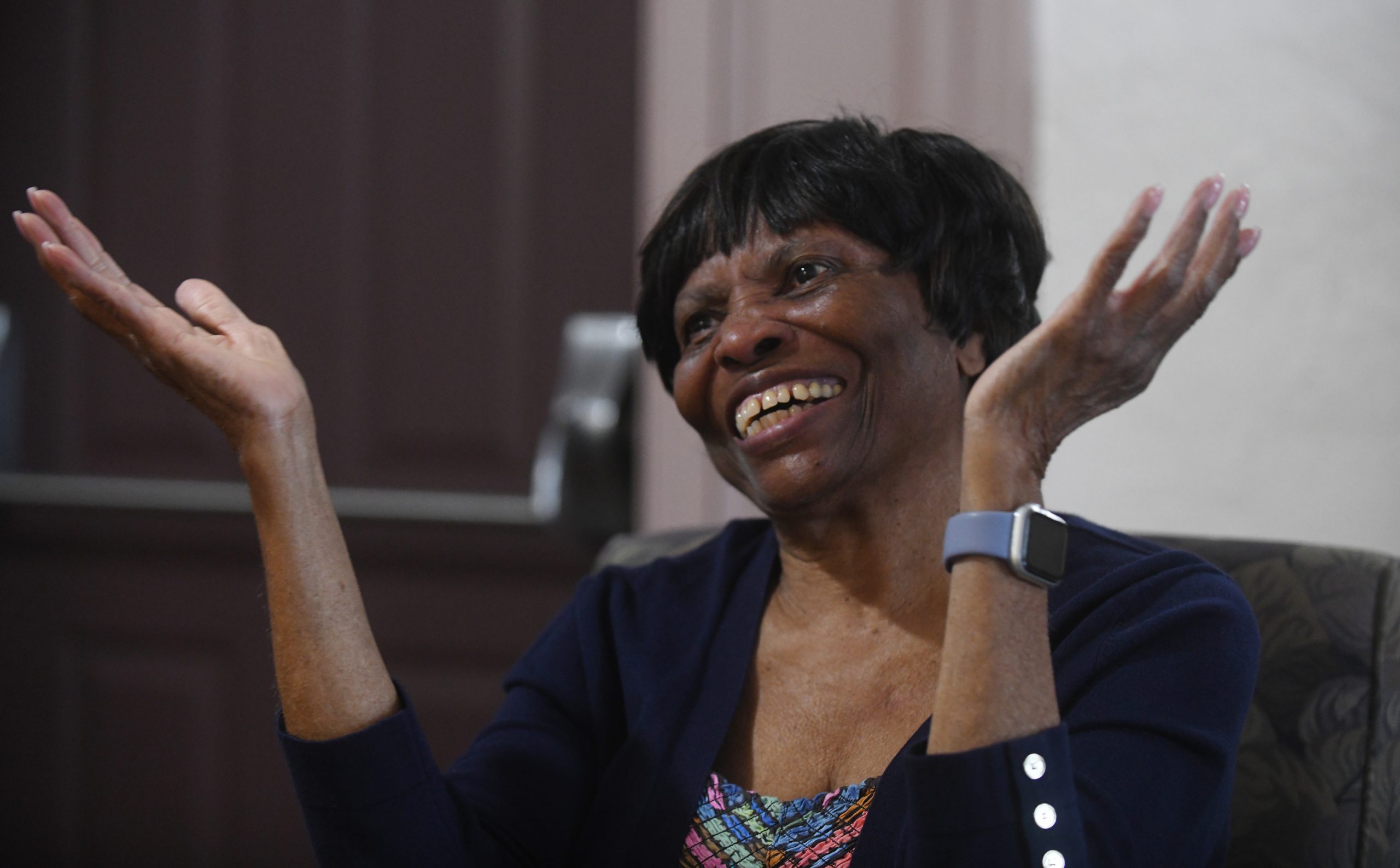
    Minnie McNeil and the McNeil family have helped the homeless in Coatesville since the early 1980s.Bob Williams / For The Inquirer

    It started with the shelter

    In Minnie’s estimate, the need for support services still exists. The county in June announced it had reached “functional zero” for chronic homelessness, meaning that long-lasting or recurring homelessness had been reduced to “a rare, manageable level,” the county said in a news release last month.

    It was an example of cross-sector collaboration, officials said.

    Minnie and her late husband, Andrew McNeil Sr., have been a part of that diverse ecosystem since they founded and opened the W.C. Atkinson Memorial Community Service Center at the former Atkinson hospital in 1992. It has always been intrinsically linked to their eldest son, Andrew; it opened on his birthday that year — Jan. 7.

    There are few people willing to do what McNeil and her family have done, and fewer who do it so exceptionally, County Commissioner Chairman Josh Maxwell said. He has watched her shelter take on just about every possible man — those whom others would have turned away, he said.

    Maxwell knows her magnetism personally: On the biggest day of his political career, his election as chairman, McNeil asked him to stop by a house they were renovating to help. Maxwell was in the attic alongside contractors, ripping out insulation and tearing down walls.

    “I don’t think anyone else can do what she does,” he said. “I think those people wouldn’t be helped. I think we’d have dozens, if not hundreds, of more homeless people in the county if she wasn’t the one taking them in.”

    For Minnie, her children were a guiding light: Could they sleep here? Eat the food? It has kept humanity at the heart, she said.

    “Housing is not just a roof over your head, but we’d like to create homes where people live healthy and happy and their very best lives, they reach their full potential,” she said. “A place that, yes, has some outside influence and support, but builds within that home a nucleus where [there’s] love and compassion.”

    Michael Weber, 55, called the McNeils a “blessing.” He came to the Atkinson after living in a hotel room, unable to find permanent housing. He happily took up odd jobs at the shelter to support it. He thinks that’s why the McNeils asked if he would want to move into one of the support housing sites, where he could pay below-market rent.

    “I didn’t even know it could be this good,” he said.

    Andrew and his two brothers were helping hands as children, working shifts at the shelter overnight and preparing meals. Though he never anticipated he’d return to it, Andrew began to learn the ropes from his father when he came back to the county after 12 years in Maryland. (“I never saw that coming,” his mother noted.)

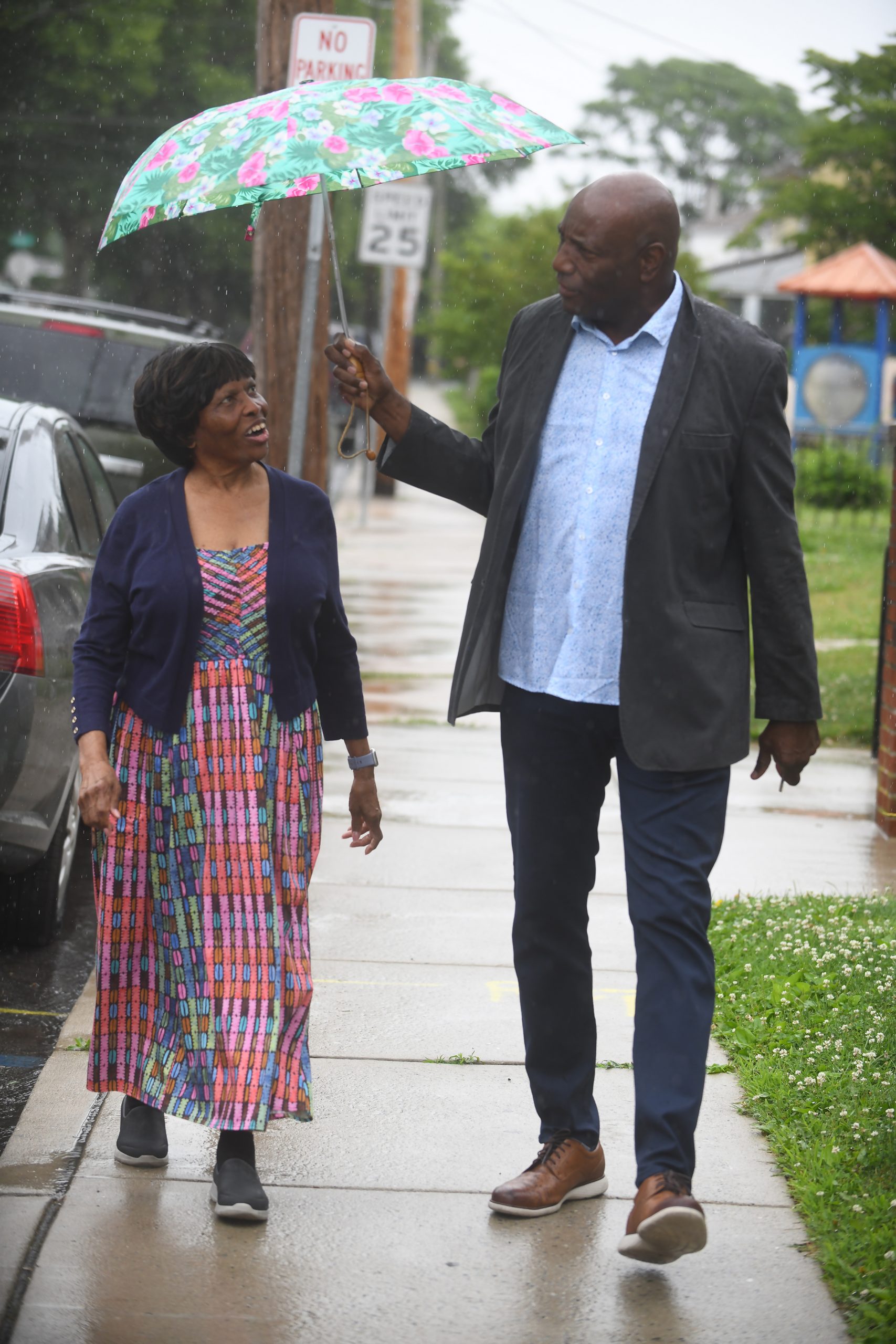
    Minnie McNeil and her son Andrew McNeil walk down East Chestnut Street in Coatesville.Bob Williams / For The Inquirer

    And those lessons didn’t stop at the shelter doors. Derrick, his son, has volunteered at the shelter and found it inspiring. Then Derrick caught the real estate bug, something Andrew knew plenty about.

    Their shared interest is a new chapter that felt like an extension of what Atkinson had been doing, Andrew said.

    “When they move out of the shelter, into the housing, what happens is they have a sense of pride because we’re not putting them into just anything,” he said. “I think that that matters [for] what we’re doing for families as well what we’re also doing with the men.”

    He had watched men move from the shelter into the supportive housing, and saw the sense of pride at the homes they were living in. They wanted to bring that feeling more broadly.

    Affordability in Chester County

    Andrew and Derrick purchased their first project house together in May 2025 for $190,000 as Chester County has seen a diminishing housing stock and rising costs. The county saw some of the highest population growth in Pennsylvania between 2020 and 2024, but the housing market wasn’t keeping pace. Fewer single-family detached homes were built in 2024 than in the last several years, according to the county’s planning commission, and fewer new units were being constructed this decade compared with last.

    In 2024, the median sales price hit $525,000 — the highest in the county’s history. That year, only 331 homes sold for under $250,000, a decrease of 5.9% from 462 units in 2023.

    In Coatesville, like the Atkinson shelter had done with seven transitional houses, Andrew and Derrick took their first project house down to the studs. For 10 months, they remodeled it to a high standard, Andrew said. It went from a three-bedroom, one-bath to a four-bedroom, three-full-bath home. The house sold to a family about a year after they first purchased it, for $290,000 — under an appraiser’s valuation of $330,000, Andrew said.

    “It was a nice experience, just knowing that the end goal was to provide housing and provide opportunities for someone that was maybe purchasing their first property, just trying to provide the best product and the best opportunity for someone at a pretty decent price for what they’re getting,” Derrick said.

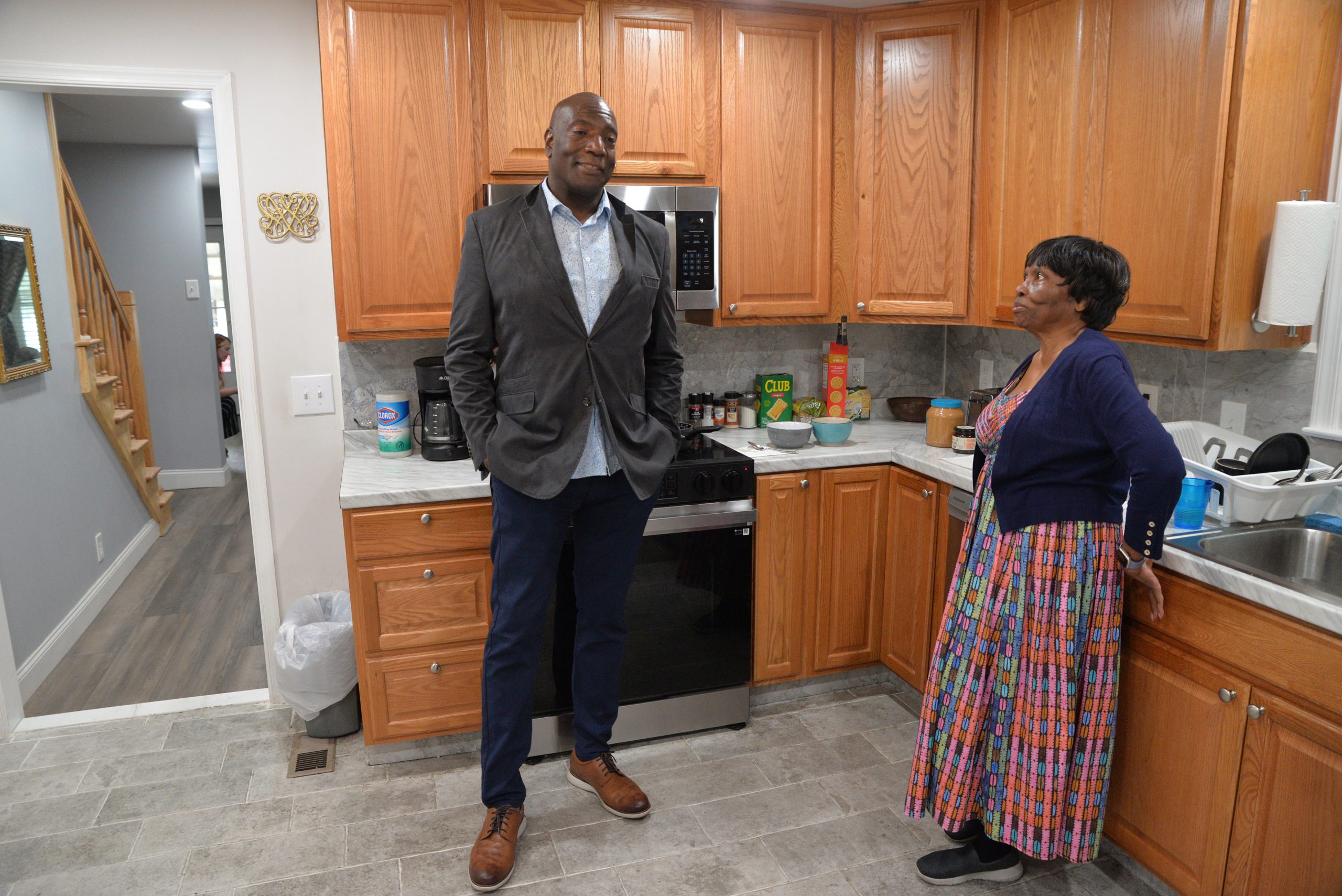
    Andrew McNeil and his mom, Minnie McNeil, in the kitchen area of the house they rehabilitated on Merchant Street in Coatesville. Bob Williams / For The Inquirer

    That care and thoroughness was a lesson both Andrew and Derrick learned from Andrew Sr., as the shelter had taken homes with “no lipstick” and modernized them.

    “One of my father’s sayings was always ‘We get brick and mortar money once,’ so we have to put the quality into the house, because it’s up to us to maintain it after that,” Andrew said. “So we don’t cut any corners when it comes to rehabbing these houses, and so my son and I adopt that same principle when we remodel houses for the community.”

    After the success of their inaugural endeavor, Derrick said they’re looking toward future opportunities like this one, or other options — like lease-to-purchase.

    When Andrew reflects on the legacy of the shelter — opened in a historic property that was owned by Whittier C. Atkinson, the first Black physician to open a practice in Coatesville — he thinks of them continuing Atkinson’s holistic approach to medicine in the 1920s, how he would take gifts from the garden as payment for his work. It’s that essence they’re trying to continue, he said.

    “I’m still taking lessons from my parents,” he said. “It’s always mission first; I observed that at a young age, and their mission, we’re continuing that … by trying to stay ahead of the curve. What’s the latest need in our community, and how can we address it in our focus?”

    This suburban content is produced with support from the Leslie Miller and Richard Worley Foundation and The Lenfest Institute for Journalism. Editorial content is created independently of the project donors. Gifts to support The Inquirer’s high-impact journalism can be made at inquirer.com/donate. A list of Lenfest Institute donors can be found at lenfestinstitute.org/supporters.

  • Abington looks to ban e-bikes at parks and trails, citing safety concerns

    Abington looks to ban e-bikes at parks and trails, citing safety concerns

    Abington moved toward banning e-bikes and e-scooters at public parks and trails during Thursday’s commissioners meeting.

    A majority of Abington’s 15-member commissioner board voted to advance a proposed ban on electric vehicles from Abington park systems because of safety and disruption concerns, according to a summary of the proposal.

    The ban would not apply to electrified vehicles designed for people with disabilities, and would not cover county-owned sites such as Lorimer Park.

    The rise in popularity of small electric vehicles has led to crashes and fatalities across the region. Earlier this week, two people in Pottstown were sent to the hospital after an apparent collision between an e-bike and an e-scooter.

    But some Abington commissioners voted against the motion after local cyclists raised concern that the ban would be too broad.

    Many local cyclists want a narrower ban that still allows slower, lighter e-bikes, said Ross Abel of Bike Montgomery County.

    Pedal-assisted bikes help seniors and parents with young children reach parks, Abel said. A full ban “would really prevent them from getting out in nature on their bikes.”

    The Bicycle Coalition of Greater Philadelphia has argued that the slower e-bikes have been wrongly lumped together with powerful e-moto bikes that look similar but can cause more damage.

    Last year, a cyclist on Schuylkill River Trail near Norristown was hit by an unregistered electric motorcycle, leaving him with a partially dissected artery in his neck.

    State law differentiates e-bikes from vehicles that require a license, like motorcycles. But unlike many e-bike manufacturers, Pennsylvania does not distinguish different e-bikes by power and top speed. And in practice, distinctions can be murky.

    Police responding to the Norristown collision appeared to view the faster vehicle as an e-bike, referring to the e-moto rider as “the other cyclist.”

    That trouble telling the bikes apart is exactly why some argue a narrower ban would be impractical for township staff to enforce, Abington commissioner John Spiegelman said.

    Though Abington’s commissioners have 60 days to finalize the ban once it’s advertised, some are already considering revisions.

    “I’ve been trying to think of some kind of workable compromise that accommodates all parties’ concerns,” Spiegelman said, “while ultimately protecting the folks in our parks and on our trails, including young kids, from injury.”

    This suburban content is produced with support from the Leslie Miller and Richard Worley Foundation and The Lenfest Institute for Journalism. Editorial content is created independently of the project donors. Gifts to support The Inquirer’s high-impact journalism can be made at inquirer.com/donate. A list of Lenfest Institute donors can be found at lenfestinstitute.org/supporters.

  • Pa. lawmakers moonlight as lawyers, landlords, and even as a pilot. Advocates say it’s a conflict of interest.

    Pa. lawmakers moonlight as lawyers, landlords, and even as a pilot. Advocates say it’s a conflict of interest.

    When she’s not serving in the Pennsylvania House, State Rep. Marla Brown is teaching 13 fitness classes a week at the local YMCA.

    From cycling to core strength to high intensity hit lessons, the pressure of the state legislature transformed the Lawrence County Republican’s former fitness hobby into another job, squeezed in the morning, in the evening and on weekends between political commitments.

    “It keeps my mind healthy and active and engaged,” said Brown (R., Lawrence). “I think that’s vitally important in any career, and especially in politics where there’s so much negativity.”

    More than half of the General Assembly reports an outside business interest or alternative forms of income, according to an analysis of all 251 state lawmakers’ statements of financial interest by The Inquirer. They moonlight as attorneys, company executives, property managers, farmers, and other roles when they’re not in session.

    Local government reform advocates say public officials are inevitably influenced by the money they make on the side. Advocates from Rock the Capital and MarchOnHarrisburg have pushed for changes to moonlighting law, calling for bans on what they consider to be conflicts of interest.

    While there are few restrictions to private employment for legislators across the country, the majority of states don’t allow their legislators to work secondary jobs in the public sector, like government or public school positions. New York imposes a cap on earnings from legislators’ outside earned income. Pennsylvania hasn’t pursued any sanctions or caps on outside employment, public or private. Not all state legislators earning outside income are making working wages — more than 40 lawmakers earn passive income as landlords.

    Because the Pennsylvania Ethics Commission requires elected officials to report their businesses regardless of their earnings, it is difficult to say how many legislators are truly making significant profits on the side.

    State Sen. Jarrett Coleman (R., Lehigh) is an airline captain for JetBlue Airways. State Rep. Kathleen Tomlinson (R., Bucks) is a funeral director. State Sen. Jimmy Dillon (D., Philadelphia) runs a children’s basketball academy. State Rep. Dan Williams (D., Chester) is the senior pastor of New Life in Christ Fellowship in Coatesville.

    (function() {
    var l2 = function() {
    new pym.Parent(‘moonlighting_house’,
    ‘https://media.inquirer.com/storage/inquirer/projects/innovation/arcgis_iframe/moonlighting_house.html’);
    };
    if (typeof(pym) === ‘undefined’) {
    var h = document.getElementsByTagName(‘head’)[0],
    s = document.createElement(‘script’);
    s.type = ‘text/javascript’;
    s.src = ‘https://pym.nprapps.org/pym.v1.min.js’;
    s.onload = l2;
    h.appendChild(s);
    } else {
    l2();
    }
    })();

    Pennsylvania is the third highest-paid legislature in the country with a $106,000 annual salary for lawmakers. California and New York legislators make more, but reform advocates say Pennsylvania’s $181 per diem and other benefits likely push the state’s lawmakers to the top in terms of overall compensation.

    With six-figure compensation, Pennsylvania lawmakers are much better off than the average state legislator in the country making $43,494 annually (New Hampshire lawmakers are the lowest-paid at just $100 a year).

    Even so, the Pennsylvania General Assembly gathers fewer than 50 days a year, giving some members time to partake in personal endeavors, which has raised ethical concerns among advocates.

    “You either work for the people or you work for yourself,” said Michael Pollack, executive director of MarchOnHarrisburg, one of the groups pushing for reforms.

    Here’s what state legislators do in their free time, according to their 2023 Statements of Financial Interest.

    Pennsylvania legislator side hustles

    State legislators play a big part in making housing and rent law, but Pennsylvania has no rules limiting or banning legislators from acting as landlords, or in any career appealing to them.

    At least 40 state legislators earn income from rental properties or property management businesses across the Commonwealth. Another nine legislators work as executives for property insurance and realty companies.

    Of those serving in the state House and Senate’s housing committees, at least 11 legislators report income from rental properties or realty companies last year. These committees vote on legislation directly affecting renters, including amendments to Pennsylvania’s Landlord and Tenant Act.

    !function(){“use strict”;window.addEventListener(“message”,(function(a){if(void 0!==a.data[“datawrapper-height”]){var e=document.querySelectorAll(“iframe”);for(var t in a.data[“datawrapper-height”])for(var r=0;r<e.length;r++)if(e[r].contentWindow===a.source){var i=a.data["datawrapper-height"][t]+"px";e[r].style.height=i}}}))}();

    Not all landlord legislators rent out properties to their constituents, though.

    Sen. Frank Farry (R., Bucks), the majority chair of the Senate Urban Affairs & Housing committee, quadruples as a senator, attorney, fire chief, and rental property owner. Rather than traveling to and from the Capitol, he owns a Harrisburg rowhouse that he shares with other legislators during session. He also leases his former home to his in-laws in Langhorne.

    When his daughter moved to Pittsburgh, rather than moving into the newly flipped house he made for her, Rep. Jim Rigby (who DJs for friends and family) decided to rent the property out to local medical students. He says he has yet to break even on the cost.

    Attorneys make up another large chunk of the bucket, with more than 15% of the General Assembly working for law firms. Lawyers have a long-held tradition of dominating American politics, and the story is no different in Pennsylvania.

    Farry, an attorney with Begley, Carlin & Mandio, said he hasn’t set foot in a courtroom in years, but he still gives legal advice over the phone and never from his state Senate office.

    “There needs to be boundaries between my legal job and my Senate job,” Farry said, uncertain that others in the state legislature adhere to the same separations.

    (function() {
    var l2 = function() {
    new pym.Parent(‘moonlighting_senate’,
    ‘https://media.inquirer.com/storage/inquirer/projects/innovation/arcgis_iframe/moonlighting_senate.html’);
    };
    if (typeof(pym) === ‘undefined’) {
    var h = document.getElementsByTagName(‘head’)[0],
    s = document.createElement(‘script’);
    s.type = ‘text/javascript’;
    s.src = ‘https://pym.nprapps.org/pym.v1.min.js’;
    s.onload = l2;
    h.appendChild(s);
    } else {
    l2();
    }
    })();

    The ethics of attorneys-turned-lawmakers working for outside legal clients has been scrutinized for years. Legislators actively practicing could, in theory, meddle in laws affecting their clients, a worry of good government advocates.

    Sen. Gene Yaw (R., Lycoming) moonlights as an attorney for Williamsport-based McCormick Law Firm, which represents gas companies and practices environmental law. Yaw is the majority chair of the state Senate Environmental Resources & Energy committee.

    His firm also has represented Pace-O-Matic, the Georgia-based company dominating the skill games industry. In May, Yaw introduced the Skill Video Gaming Act, which would regulate and tax skill games in the commonwealth. Miele Manufacturing, which produces the systems for Pace-O-Matic in Pennsylvania, occupies Yaw’s district. Yaw did not return requests for comment.

    Pollack, MarchOnHarrisburg’s executive director, said Yaw’s legal side job is “absolutely ridiculous and corrupt as can be” and called for legislators to choose a side of the fence.

    Reform advocates say jobs in law, property management, and big business can create conflicts of interest for legislators.

    But lawmakers’ business interests aren’t confined to those industries. Eight lawmakers work in agriculture. Several others work in health, education, and the Pennsylvania National Guard. Personal businesses range from lake resorts to custom gunsmiths to farm animal pregnancy testing.

    “If you have two skis, and both skis are going in different directions, it’s hard to stay focused,” said Rock the Capital founder Eric Epstein, an advocate for reform.

    Questions remain about Pennsylvania lawmakers’ business interests

    Even if they’re not active in the company, Mary J. Fox, the executive director of the state Ethics Commission, said filers must report their businesses “whether they make money or not.”

    This means that legislators who own businesses that haven’t operated in years still must claim the job, making it unclear at times whether lawmakers are active employees.

    Rep. Michael Schlossberg (D., Lehigh) still must claim his iPhone trivia game company and author website, despite not earning income from either in years. Rep. Perry Warren (D., Bucks), a former ice cream truck driver in Long Beach Island, still claims his business Ice Cream and Dreams despite his last truck being sold in 2017.

    While some lawmakers continue operations as usual, others leave their co-owners, usually spouses, to continue the business while they serve or shut down their work altogether.

    “When I ran for office and got elected, my wife told everybody she fired me because I stopped showing up for work,” said Sen. Timothy Kearney (D., Delaware), the co-owner of architectural firm Cueto-Kearney Architects.

    Lawmakers do not have to report how much they make from their businesses or rental properties, even if they are actively employed. It is unclear how much any legislator is making outside of the General Assembly.

    “Is it a million dollars? Is it a thousand dollars? We’d like to know,” Pollack said.

    Lawmakers who take up other fields say the quality of their legislative work depends on their time spent in public service elsewhere.

    “It’s really a way to stay grounded in reality. One of the problems with being an elected official is you don’t stay connected with what’s going on in the real world,” said Rep. Arvind Venkat (D., Allegheny), an emergency physician working weekend night shifts from 11 p.m. to 7 a.m.

    Farry says firefighting helped him understand his role as the chair of the Fire and Emergency Caucus when he served in the House, even as his staff called him crazy for working 70 hours a week.

    “It was more important to be there and help out, in my mind,” Farry said. “I’ll make up the sleep at some point.”

    Sarah Nicell is an intern with the Pennsylvania Legislative Correspondents Association. They can be reached at snicell@inquirer.com.
  • Downingtown high school students were drinking while supervising a youth football camp, district says

    Downingtown high school students were drinking while supervising a youth football camp, district says

    Two Downingtown high school students admitted to drinking alcohol while supervising a football camp at Downingtown East High School last month, district officials said Friday.

    The students, who were minors, were removed from the Blue & Gold camp after the district learned about the incident June 18, said Downingtown spokesperson Jennifer Shealy.

    The camp, which ran from June 15-19 by the Downingtown East football team’s booster club with the help of high school volunteers, was open to students in first through ninth grades. The club did not immediately respond to a request for comment Friday.

    Shealy said an adult volunteer “partially responsible” for supervising the students was also removed from the camp.

    In a statement, district officials said that “district staff were present and overseeing camp operations at all times, ensuring that campers remained supervised and safe during the camp.”

    The district said in the statement that it had “addressed the matter promptly in accordance with district policies and Student Code of Conduct,” but couldn’t comment on specific allegations “or any disciplinary actions that may have occurred.”

    In a letter the district said was sent to parents of campers, Downingtown High School East principal Paul Hurley and athletic director Corey Sigle said they were “shocked and deeply disappointed” by those involved in the incident.

    “The trust placed in our students by younger campers, families, coaches, and community members makes this behavior especially disappointing,” Hurley and Sigle said in the letter.

    Hurley and Sigle also apologized “for not communicating the initial report immediately.” It wasn’t clear when the letter was sent.

    The students who admitted to drinking did not have drivers’ licenses and did not drive drunk, Shealy said.

  • A Delco library made headlines for a ‘borrowed book returned after 100 years.’ The real story may be more complicated.

    A Delco library made headlines for a ‘borrowed book returned after 100 years.’ The real story may be more complicated.

    A familiar legend at Delaware County’s Darby Free Library goes as follows.

    It was an October day in 1947 when a woman walked into the library and returned a book. The woman had found the library book while going through her late grandfather’s possessions, she said, and she was returning it on his behalf. What was remarkable was that the book had been taken out of the library in the mid-1800s, more than 100 years earlier. It was overdue by a century.

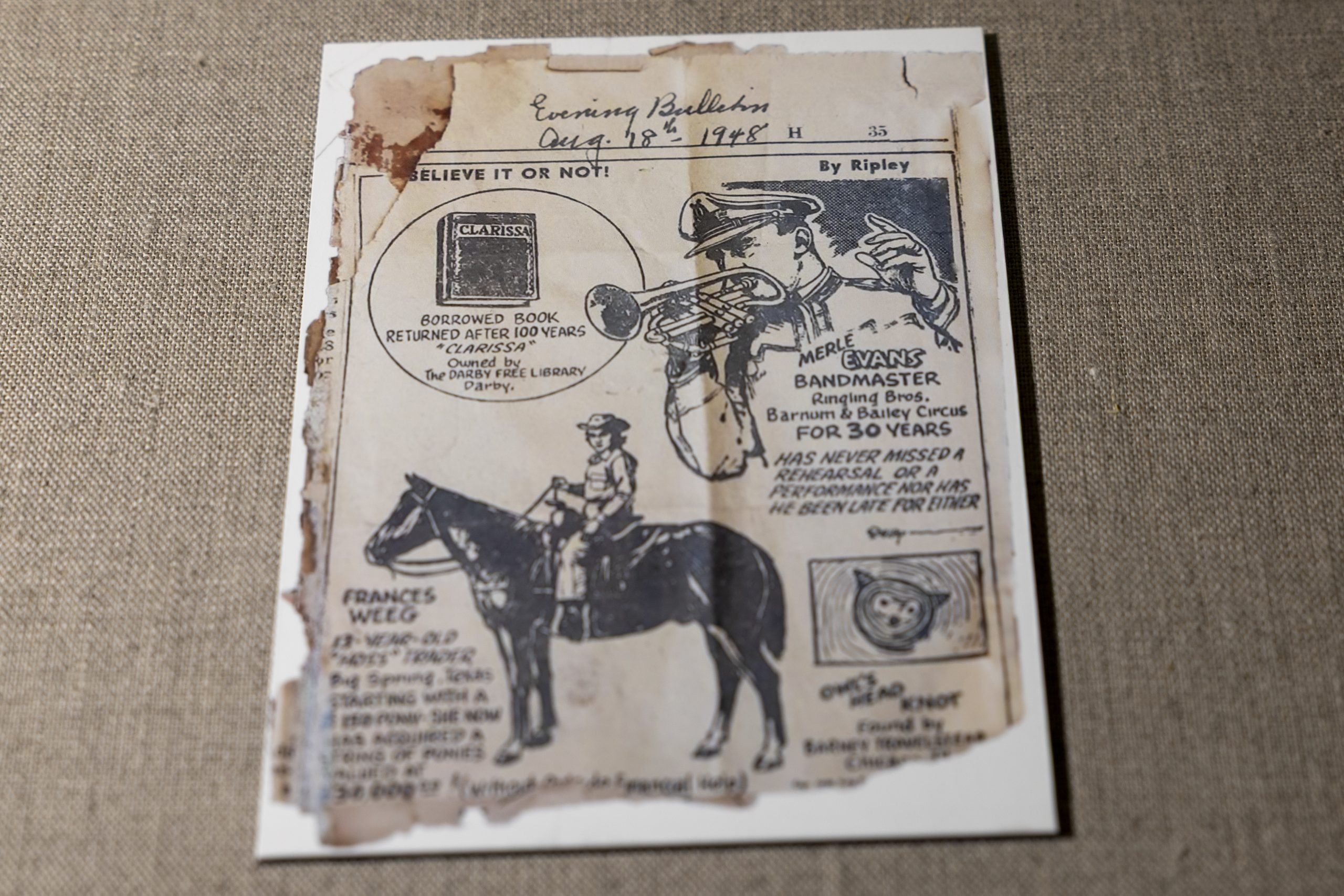
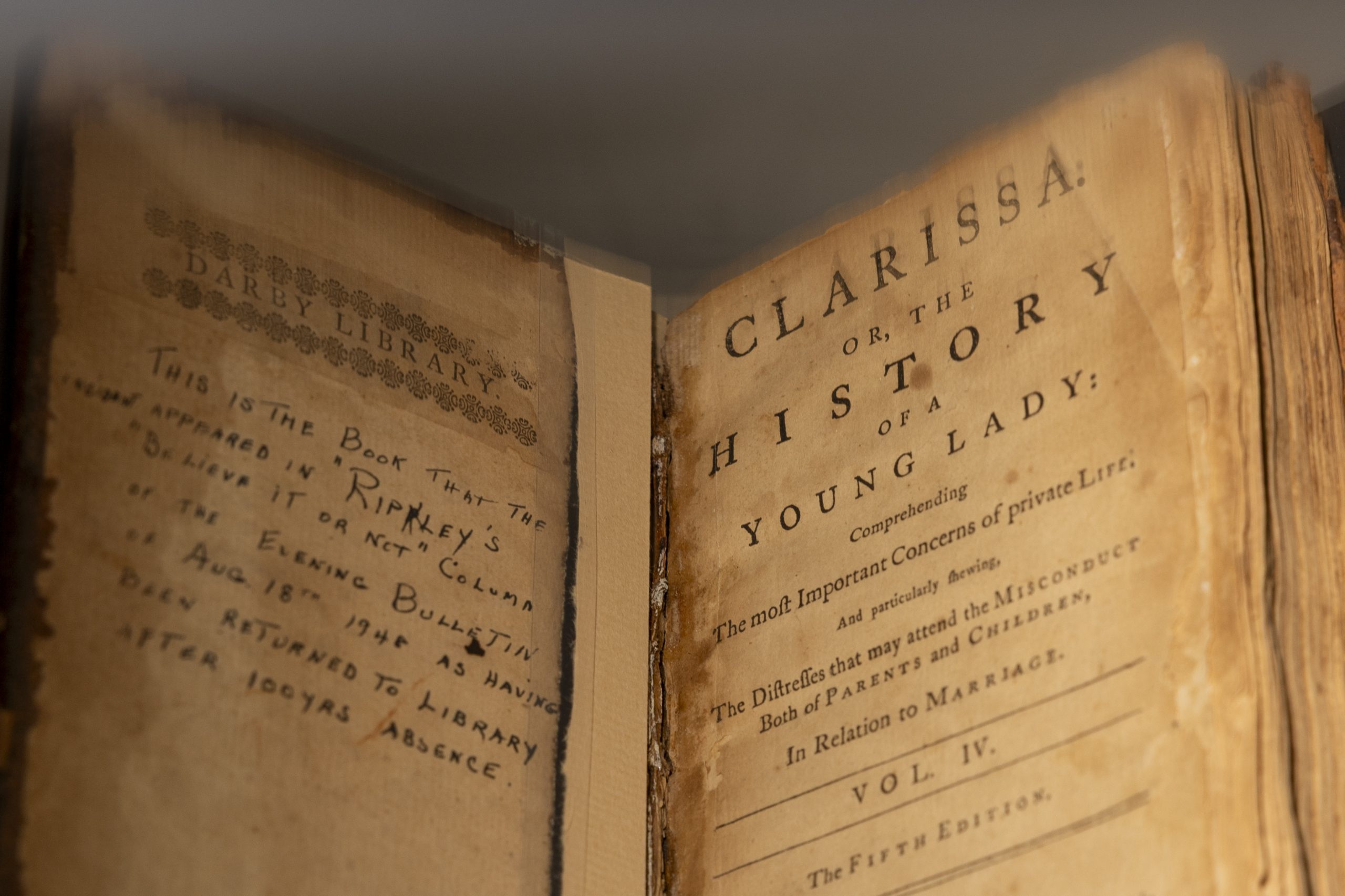
    The local paper purportedly caught wind of the story, and on Aug. 18, 1948, the tale was featured in the Ripley’s Believe It or Not! panel and syndicated in over 750 newspapers around the world.

    “BORROWED BOOK RETURNED AFTER 100 YEARS,” the Ripley‘s panel declared.

    The “Ripley’s Believe It or Not” clipping about the century-overdue volume of “Clarissa” inside the Darby Free Library. Aidan T. Gallo / Staff Photographer

    The famed book was volume four of Clarissa, a 1748 novel by Samuel Richardson that follows the trials and tribulations of Clarissa Harlowe, a young woman who flees home with a charming but untrustworthy man, Robert Lovelace. The book, considered controversial by many at the time, is written largely in the form of letters between Clarissa and Robert Lovelace and is thought to be an early great psychological novel, exploring the characters’ inner lives and the complex themes of gender, power, and freedom. Clarissa spans seven to eight volumes and has a word count of nearly one million.

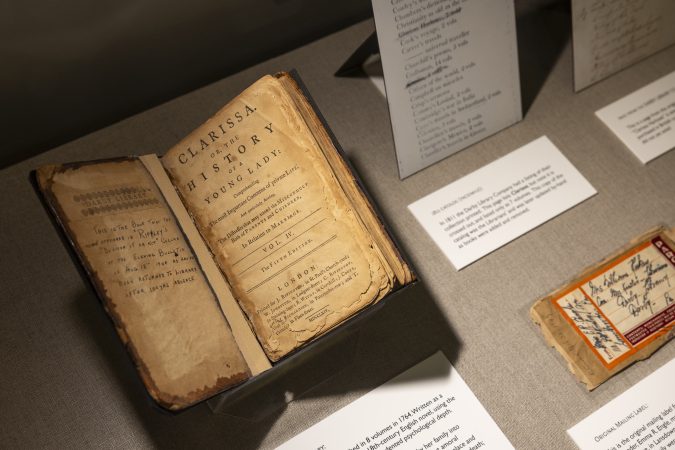
    The Darby Free Library’s Emily Finigan was sorting through the library’s collection a few years ago when she came across the famed overdue copy of Clarissa. Finigan found the book inside of a small box adorned with a mailing label. Attached to the mailing label was the Ripley’s clip, and inside the book was an inscription: “This is the book that the incident appeared in ‘Ripley’s Believe It or Not’ column of the Evening Bulletin of Aug. 18th, 1948 as having been returned to library after 100 yrs absence.”

    Finigan wears a lot of hats at the library, including fundraising, volunteer work, and, with her husband, managing the library building’s restoration.

    Finding Clarissa piqued her interest, and she began to wonder if she could use archival research to uncover the identity of the borrower who first checked out the 100-year overdue book.

    Yet a quest to identify the original borrower of volume four of Clarissa sent Finigan down a rabbit hole that left her with more questions than answers: Was Clarissa really a century-old overdue book? And, if not, what really happened to the library’s copy of the 1700s novel?

    The “Clarissa” copy inside the Darby Free Library.Aidan T. Gallo / Staff Photographer

    The Darby Free Library was founded in March 1743 by a group of Quaker farmers and merchants looking to organize their village’s first cultural institution. The group, made up of 29 townsmen, threw together money to purchase 45 original books, many of which are on display in the library today.

    In 1826, the library offered up borrowing rights to anyone who could pay three pounds. In 1898, it became a public library. Nearly a century later, in 1984, the Darby Free Library was adopted into the Delaware County Libraries system.

    According to records, the Darby Free Library acquired all eight volumes of Clarissa in 1769 for 2 pounds, 6 shillings, and 2 pence.

    By 1811, a catalog of the library’s collection only counted seven of eight volumes, a sign that one may have already gone missing, or had been borrowed by a reader.

    Though the legend of the 100-year overdue volume of Clarissa involved a woman walking into the library to return the book, the copy, Finigan noted, had seemingly been mailed to the library, not returned by a mysterious visitor. So who mailed the package?

    The original shipping label identified the sender as Emma Engle, a local librarian who mailed the book from her sister Josephine’s home in Landsdowne. Emma and Josephine’s parents and grandparents weren’t local to the area, according to archival research, making it unlikely that Emma Engle had returned her own grandfather’s book, as the legend went.

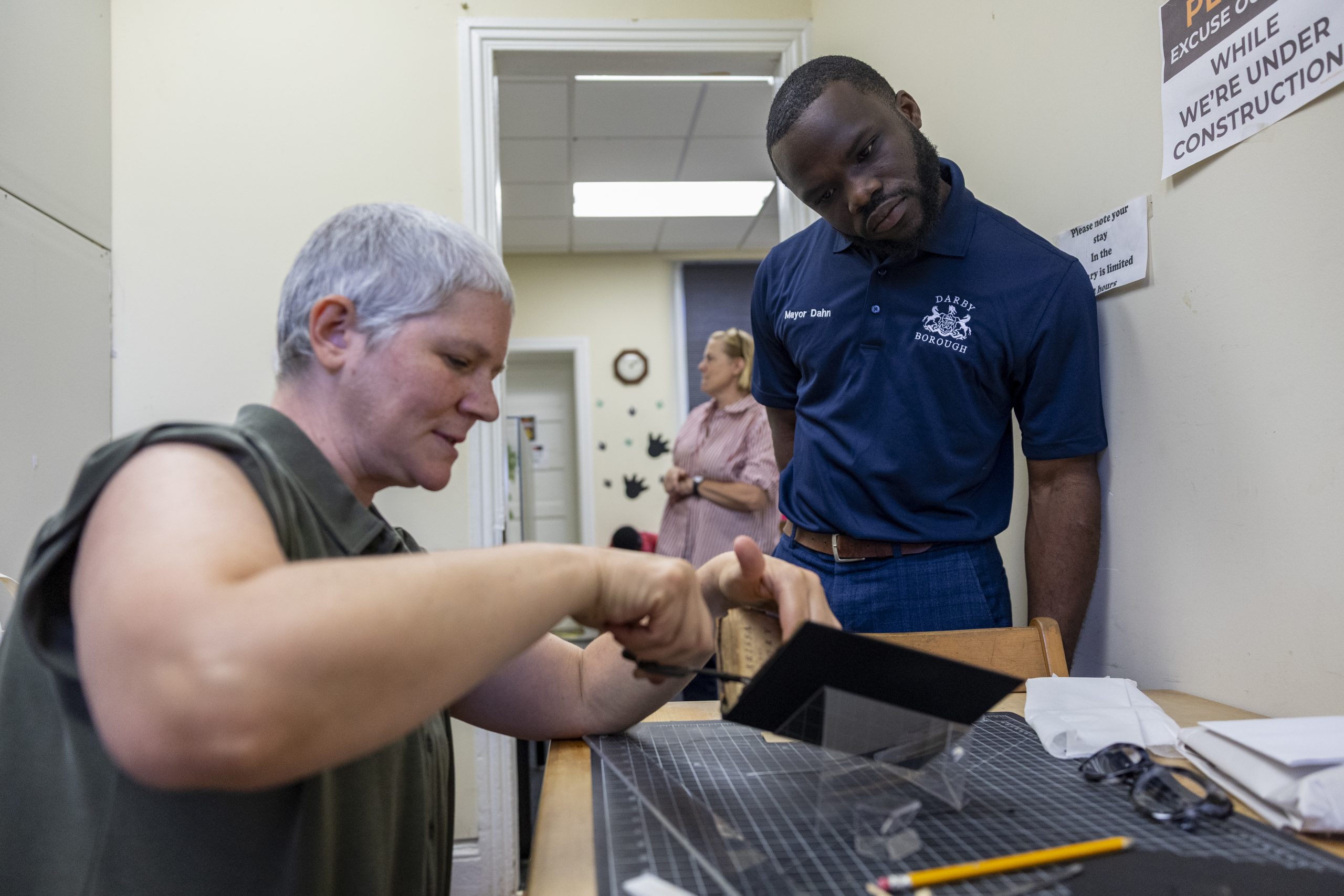
    Darby Mayor Joar Dahn looks on while Liz McDermott, a conservation technician, handles a centuries-old copy of “Clarissa” at the Darby Free Library.Aidan T. Gallo / Staff Photographer

    Josephine Engle, however, was married to a man named Isaac Rhoads, a member of the Darby Quaker Meeting, which was affiliated with the library. Isaac’s mother, Mary Hibberd Rhoads, was listed as a library member, and his grandfather, Samuel Rhoads, would have been alive around the time Clarissa was taken out of the library.

    So was Engle mailing back a long-lost book once taken out, and never returned, by her brother-in-law’s grandfather? That’s one possibility, Finigan said.

    Another possibility? The Darby Free Library may have sold off Clarissa in an attempt to clear its shelves of controversial material, and one volume made its way back to the library through Engle.

    In 1826, the same year the library opened borrowing rights to the community, it appointed a committee to make a list of books that it “may be expedient … to dispose of.” When they met again the following year, a number of titles had made the chopping block, including the seven accounted-for volumes of Clarissa.

    Why would the Darby Free Library want to sell Clarissa, among other books? Finigan has a few ideas. In the eighteenth and nineteen centuries, some saw novels as frivolous, distracting, and tempting readers toward vanity. Some novels with more sinister or self-interested characters may have been viewed as at-odds with the values of honesty and sincerity held by Darby’s Quaker residents, Finigan said.

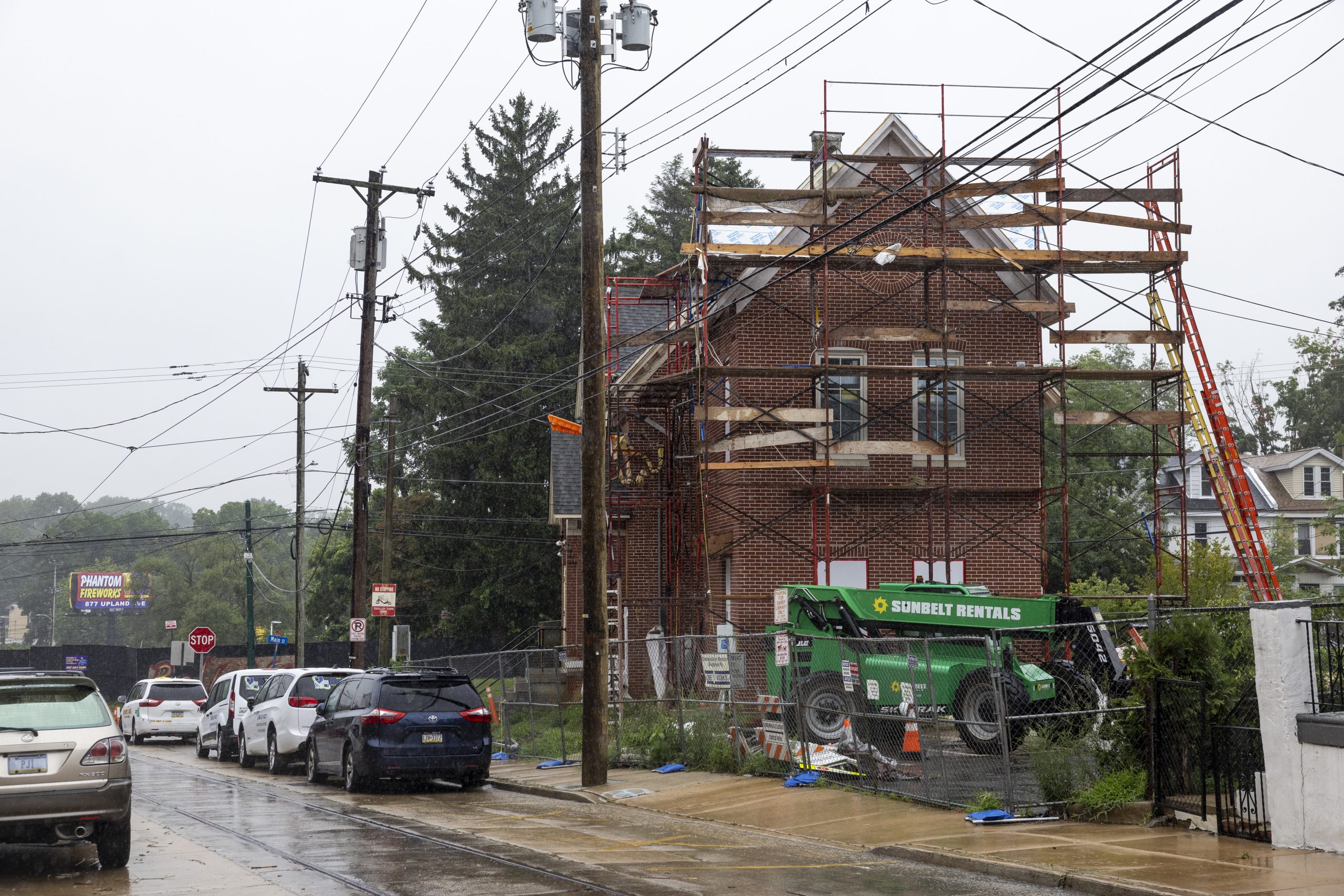
    The Darby Free Library in Delaware County, founded in 1743, is currently undergoing renovations. Aidan T. Gallo / Staff Photographer

    So, was the missing volume of Clarissa actually removed from the library in the early 1800s for objectionable content? That would be one explanation as to why seven, not eight, volumes were listed for sale in 1827.

    Was volume four actually sold with the rest of the collection in 1827 before eventually making it back to the library through Emma Engle? Could the list of seven, and not eight, volumes have been an incorrect count?

    Or could it have truly been an overdue book, taken out by a relative of Emma Engle’s and returned over 100 years later?

    Finigan says the mystery remains, and may never be revealed. But curious minds can view the famed “century overdue” copy of Clarissa at the Darby Free Library from July 10 through Aug. 1 during normal library hours.

    “Treasures from the Darby Library: THE 100-YEAR OVERDUE BOOK”

    📍 Darby Free Library, 📅 through Aug. 1, 🌐 darbylibrary.org/programs

    This suburban content is produced with support from the Leslie Miller and Richard Worley Foundation and The Lenfest Institute for Journalism. Editorial content is created independently of the project donors. Gifts to support The Inquirer’s high-impact journalism can be made at inquirer.com/donate. A list of Lenfest Institute donors can be found at lenfestinstitute.org/supporters.

  • Bingo was legalized in Pennsylvania on this week in Philly history

    Bingo was legalized in Pennsylvania on this week in Philly history

    The stampers were runnin’ wild, and state officials wanted their piece.

    So it was time to crack down on the ping-pong-ball pullers.

    On July 10, 1981, Republican Pennsylvania Gov. Dick Thornburgh signed the Bingo Law.

    The bill, which took effect on Nov. 9 of that year, would ensure the popular game remained a tool of charitable groups and remained small-stakes operations. This new law limited prize money to $250 (about $920 today) per game, $2,000 (about $7,300 today) for a so-called jackpot game, and $4,000 (about $14,700 today) in total for any one day.

    The bill also specified that only nonprofits that had been existence for at least two years could host the games, and that they could do so no more than twice a week.

    Traditionally, bingo games were put on by charitable associations — think church groups and senior centers — that were legitimate nonprofits. Still, it was a prohibited form of gambling, and law enforcement across the state chose to ignore this fact and instead allowed the parlor game to thrive.

    The bill, Thornburgh told The Inquirer in 1981, would “end this hypocrisy.”

    He added, however, that he was not “convinced that this is the absolute, ideal bill,” and that his administration would continue working with the General Assembly “to ensure that some of the loopholes that have been alleged to exist are addressed.”

    The bill-pushers were pumped. Legalizing bingo, they told anyone who would listen, would protect charitable foundations, civic groups, and legitimate nonprofits from what an Inquirer reporter called “unscrupulous bingo entrepreneurs.” It would, theoretically, keep those groups from having to pay taxes on the raised money, and keep it out of organized crime’s reach.

    But the bingo bill had noisy detractors, like future Philly Mayor Ed Rendell, then the district attorney, who astutely pointed out that the bill would allow anyone to organize a nonprofit and run bingo games. The bill did not provide much enforcement infrastructure, either.

    Today, bingo licenses run $100 for a year, or $15 for a three-day stint.

    The state only takes check or money order.