Category: Pennsylvania News

  • Radnor drops plans to turn an old veterinary hospital into a local district court

    Radnor drops plans to turn an old veterinary hospital into a local district court

    Radnor Township has abandoned plans to purchase a shuttered veterinarian’s office and convert it into a local courthouse following pushback from neighbors.

    The township has canceled plans to acquire 405 W. Wayne Ave., the former home of St. George Hunt Memorial Veterinary Hospital, following a “thorough review of the site and vital feedback” from residents regarding infrastructure, traffic, financial issues, and “neighborhood compatibility,” according to a statement released Thursday.

    Radnor’s board of commissioners “remains committed to fiscal responsibility and to ensuring that civic developments properly align with the character and practical needs of our residential communities,” the statement read.

    The township had set out to purchase the Wayne building and convert it into Radnor’s magisterial district court, which, due to a struggle to find a local home, has been located in Newtown Square for the last three years. Officials said the township would purchase the building for $1.45 million and convert it into a courthouse, then lease it back to Delaware County, which would pay Radnor back over the course of 10 years. Bringing the district court back to Radnor would cut down on travel time and costs for residents and law enforcement officers, township officials said.

    Magisterial district courts typically handle minor criminal cases, landlord-tenant disputes, traffic cases, and civil cases involving amounts up to $12,000.

    Commissioners at a July meeting said that the township had looked extensively for a commercial space to house the district court and that the Wayne location presented the most realistic option. The former veterinary hospital was selected for its parking availability, commercial zoning, and price.

    The proposal faced considerable pushback from residents, who said a courthouse would be a poor fit for the largely residential neighborhood. Many warned of traffic concerns, a lack of parking, and the safety of holding court proceedings in an area with children and families. Some called the plan “ridiculous” and “not appropriate.”

    While the former veterinarian’s office is no longer on the table, “the fundamental need to find a suitable home for our local court remains,” the township’s statement read.

    The commissioners plan to host a public information session to provide information about the magisterial district court, the court’s day-to-day operations, and the reasoning for bringing the court back into the township’s bounds. No date or time has been set for the meeting.

    This suburban content is produced with support from the Leslie Miller and Richard Worley Foundation and The Lenfest Institute for Journalism. Editorial content is created independently of the project donors. Gifts to support The Inquirer’s high-impact journalism can be made at inquirer.com/donate. A list of Lenfest Institute donors can be found at lenfestinstitute.org/supporters.

  • PPA voided more than 23,000 tickets due to missing street sign

    PPA voided more than 23,000 tickets due to missing street sign

    Enforcement cameras on Broad Street in Philadelphia caught about 800,000 motorists speeding in the first six months they were operating.

    But the Philadelphia Parking Authority had to throw out 23,195 tickets and refund $1.25 million in fines — all because of a missing street sign at one spot.

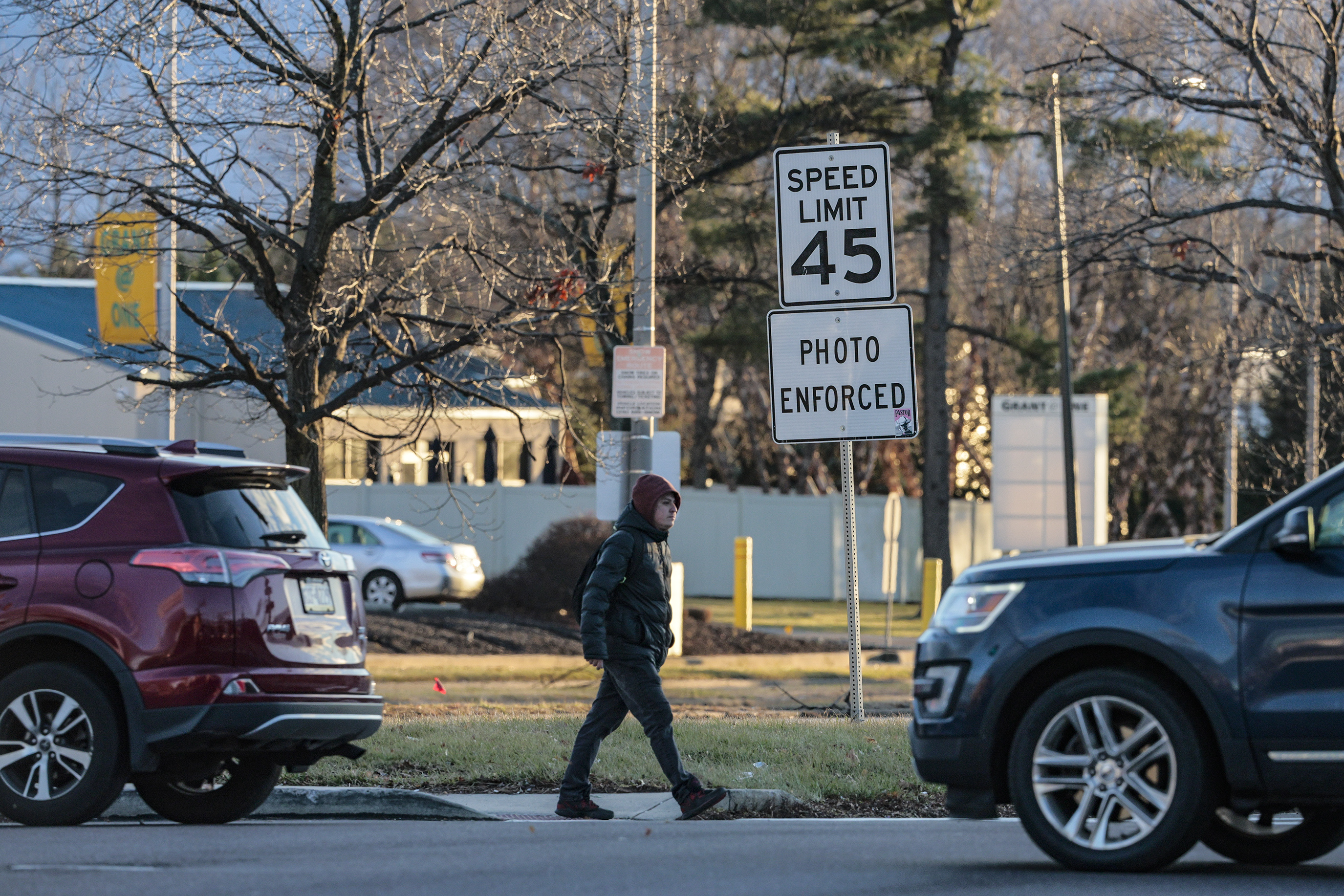
    A speed camera covering the southbound lanes in the 6500 block of North Broad Street operated for several months earlier this year without a required sign telling motorists that it was operating, PPA said last week in its annual speed-camera report.

    A construction crew dug up the sidewalk on the block, knocking down the curbside sign that says the speed limit is 25 mph and is “photo enforced,” said Corinne O’Connor, deputy executive director of the parking authority.

    “We did the right thing,” O’Connor said. The violation notices were canceled because, she said, motorists did not have proper notice of the speed limit and the presence of enforcement cameras at Broad Street and 65th Avenue. State law requires those signs at camera locations.

    Broad Street, also designated State Route 611, has 31 speed cameras at 15 locations spread out between Philadelphia’s northern and southern city limits. They began operating last September.

    Drivers who travel more than 11 mph over the posted speed limit will eventually be ticketed, with fines starting at $100 and rising to $150 for those driving more than 30 mph over the limit.

    A PPA staff member doing a regular check reported the signs near 65th Street missing in mid-January, but it took weeks to correct. Officials did not realize the cameras hadn’t been turned off, and did so on April 22, PPA said. The signs were replaced April 29.

    O’Connor said the delay was due in part to ongoing construction and red tape required to get utility clearance to install a new pole with signs.

    While the signs were missing, the cameras at that location clocked 23,195 speeding vehicles and issued violation notices.

    Before the cameras were turned off, the PPA had processed $1.25 million in payments for 12,214 of the tickets. The money is being refunded, PPA said.

    PPA spokesperson Marty O’Rourke said the drivers cited “were still speeding,” but the violations were annulled because the notification requirement of the law was not met. The tickets could have been canceled if a recipient appealed based on the missing signs.

    O’Rourke said it was a “proactive decision” to cancel them.

    Speed cameras were first installed on Roosevelt Boulevard in 2020 on a trial basis and more were added in the next two years.

    Speeding has dropped 95% on the roadway, based on the declining number of violations issued since the first month cameras were operating there, PPA said.

    A state law enacted in 2023 made the Roosevelt Boulevard speed cameras permanent and authorized Philadelphia to designate five more dangerous corridors on which to use the technology.

    Cameras were deployed last fall on Broad Street and recently on portions of U.S. Route 13 in North and West Philadelphia.

  • Here’s how Pa. and the Secret Service are fighting EBT skimming

    Here’s how Pa. and the Secret Service are fighting EBT skimming

    By the time state and local law enforcement in Northumberland County, Pa., connected a device stealing people’s food assistance benefits from a 7-Eleven to Patricia Bogdan and George Lazar, the pair had already fled to New Jersey.

    Authorities allege Bogdan and Lazar placed the contraption on a point-of-sale terminal in February, which went undiscovered for days. Bogdan and Lazar then allegedly retrieved the stolen electronic benefit transfer card data in a process known as skimming and spent people’s benefits at BJ’s and Sam’s Club locations in Pennsylvania and New Jersey.

    Authorities would later learn Bogdan had multiple aliases and fake passports, while Lazar had a warrant out for an attempted murder charge in Belgium.

    “It illustrates how quickly they’re moving, the type of individuals that are involved in this, and just their ability to get in and out, that makes these really complex cases,” said State Inspector General Michelle Henry, whose office investigates EBT thefts in Pennsylvania.

    With the help of authorities in New Jersey and North Carolina, Henry’s office was able to find Bogdan and Lazar in March and later bring them back to Pennsylvania, where the cases are ongoing. A small win in what victim advocates argue has risen to a nationwide crisis because the federal government has failed to invest in more secure card technology. The magnetic strips on the cards are too easy to exploit.

    Still, a seismic disruption to these scam operations is slated to come to Pennsylvania before Jan. 1, 2028.

    The latest state budget appropriated $7 million in funds that would pay for chip-enabled EBT cards, giving the outdated magnetic stripe technology, which the federal government required states to use until 2024, a sorely needed upgrade.

    The chip cards are not invulnerable to scammers but exploiting them requires more sophisticated technology, according to the Secret Service. Early adopters of the chip technology, such as California and Alabama, have reported significant drops in thefts already.

    To the victims of this sort of fraud, scarred by the memories of an unexpected zero balance while trying to pay for groceries, the change is long overdue. There are countless stories of families learning about how the scam works and having to scrape meals together with the aid of food pantries. Benefits were reimbursed between October 2022 and December 2024, but that ended when Congress did not extend funding.

    For now, law enforcement in Pennsylvania continues to confiscate skimming devices and prosecute perpetrators, even when it can feel like a high-stakes game of whack-a-mole, while preparing for the next iteration of scammers.

    An ever-evolving scheme that knows no borders

    Much of the skimming scam — from recruiting to reselling the goods purchased with EBT data— happens online through the dark web and social media platforms such as Facebook and Instagram.

    Transnational criminals, more recently from Eastern European countries, will send already assembled skimmers to partners stateside or provide instructions on how they can piece together the devices themselves. The local partners stick the contraptions onto a point-of-sale machine, steal data, and use the stolen benefits to purchase high-ticket items such as baby formula, which is then offloaded by word of mouth or on social media networks like Facebook and Instagram.

    Michael Ross, special agent in charge of the Philadelphia field office for the United States Secret Service, said the advent of Bluetooth technology has made it much harder to catch people in the act since they can digitally collect the stolen data, instead of taking back the physical machine where police might be waiting for them.

    Combating these crimes requires a multipronged approach, from the use of digital forensics to old-school public awareness efforts.

    “We will send out a small group, not necessarily a formal task force, with state and local law enforcement representatives, and we will go to businesses,” Ross said. “We will go in, we’ll educate, we’ll show what some of these devices look like, things that can be done to make sure that the EBT fraud is mitigated.”

    Various states have responded in a similar fashion, educating businesses and placing the onus of protecting food assistance benefits on recipients, who are encouraged to download apps on their phones that allow them to lock their cards until they’re ready to pay for groceries.

    Still, Pennsylvania has aimed to be more aggressive in its fight against skimming.

    The Office of State Inspector General piloted “Skimmer Response Teams” last year. Since its inception, the six- to eight-person group that works with the broader office on cases, seized more than 55 of these devices before scammers could come back and drain more than $20.5 million in benefits from more than 40,000 accounts.

    Despite these strides in prevention, the state reported more than 5,100 skimming incidents that accounted for more than $2.5 million in stolen food assistance benefits in the first five months of the year.

    It’s one of the reasons the task force pilot is now permanent and is expected to stay even as the EBT cards switch to chips.

    “In my experience as a longtime prosecutor, anything that makes it more difficult to complete the crime is a deterrent,” said Henry. “If it’s super easy, you’re going to have more of it.”

    And Pennsylvania wants to make stealing people’s food assistance benefits as difficult as possible.

  • A 6-week-old Amish baby died from measles in Pennsylvania, local coroner confirms, as feud between Shapiro and RFK Jr. continues over the deaths

    A 6-week-old Amish baby died from measles in Pennsylvania, local coroner confirms, as feud between Shapiro and RFK Jr. continues over the deaths

    A six-week-old Amish infant from Lancaster County died from measles last month after receiving the care of a community clinic for a deadly genetic disorder, Lancaster County Coroner Stephen Diamantoni said Friday.

    The disclosure comes amid an escalating clash between Pennsylvania Democratic Gov. Josh Shapiro and President Donald Trump’s administration over whether two deaths reported by the state last week should be attributed to the ongoing measles outbreak in Pennsylvania.

    The six-week-old infant died from measles at home and had been in the care of the Clinic for Special Children, a Lancaster County-based treatment and research center focused on diseases found in Old Order Amish and Mennonite communities, LancasterOnline first reported.

    The baby had been getting treated for a deadly genetic disorder, Amish lethal microcephaly, prior to the child’s death from measles, Diamantoni confirmed.

    The baby had been receiving palliative care and was not expected to live much longer than six months due to the genetic condition that occurs in one in every 500 newborns within Pennsylvania’s Amish community, Diamantoni said.

    The announcement follows a nearly two-week-long public feud between Shapiro and U.S. Health and Human Services Secretary Robert F. Kennedy Jr. over whether to classify the Pennsylvania deaths as measles-related. Their standoff has led to the Centers for Disease Control and Prevention taking the unusual step of withholding the deaths from its measles tracker, reportedly under pressure from Kennedy.

    Shapiro, a first-term Democrat seeking reelection in November, initially provided little detail about two measles-related deaths when he announced them last Tuesday in a news conference, saying only the state’s first deaths from the highly contagious disease since 1991 involved residents of the county who were unvaccinated.

    Diamantoni, an elected Republican who is also a physician, subsequently said his office was investigating the death of a newborn who had measles, but did not believe measles contributed to the child’s death. He said the newborn died of a lacerated spleen, and postmortem testing showed a measles infection acquired before birth. He later said “measles” was included on the newborn’s death certificate under a section that lists “significant conditions contributing to death but not resulting in the underlying cause.”

    The deceased baby’s family, who are also Amish, told The Atlantic they believed a severe case of measles during pregnancy contributed to their newborn’s death.

    The discrepancies between Diamantoni’s statements and the state’s created an opening for anti-vaccine activists, including Kennedy, to publicly question whether the deaths could be attributed to the measles. Kennedy accused Shapiro of fearmongering about the disease — suggesting his office may have even fabricating the deaths.

    But the six-week-old infant reported Friday was confirmed to have died from the measles, Diamantoni said, after his office investigated the child’s death that previously was not reported to his office.

    The Clinic for Special Children did not know it was necessary to report the death to the Lancaster County coroner’s office, Diamantoni said.

    Diamantoni said he reported the six-week-old baby’s death to the CDC on Friday, but had not reported it to the state Department of Health.

    He said he did not know whether the six-week-old was the second measles-associated death reported by Pennsylvania last week.

    The Pennsylvania Department of Health said it was aware of the information shared by Diamantoni, noting the state had no new measles-related deaths to report Friday.

    The state has said the Pennsylvania health department’s epidemiology team’s thoroughly investigated and determined the two announced deaths were measles-related.

    The state defines a measles-associated death as deaths of people where evidence of measles is present, even when the disease may not be assessed by the coroner as the immediate cause of death.

    The Shapiro administration has said state privacy laws have limited their ability to release more personal information about the two measles-related.

    Shapiro reshared Friday a local news article about the six-week-old baby’s death and criticized Kennedy in an X post for choosing “to sow doubt, play politics, direct the CDC not to acknowledge these deaths, and even accuse me of fabricating these tragedies.”

    “That led to a firestorm of conspiracy theories that denied these families’ pain, invaded their privacy, and undermined public health,” Shapiro added.

    Kennedy highlighted the Lancaster coroner’s new disclosure in another X post later on Friday, noting “the facts emerging now demonstrate why CDC waited for the evidence rather than allowing political grandstanding to dictate its reporting.”

    A rare death

    As of Friday, there have been 577 measles cases in Pennsylvania, including 115 reported within the last week, according to the health department’s online measles dashboard.

    Measles deaths are rare. About three in 1,000 children who contract measles will die. While many infections are mild, measles can also cause severe complications, especially in young children, including pneumonia and brain swelling.

    Babies with Amish lethal microcephaly frequently die from respiratory infections due to the genetic condition leading the baby to develop with a severely small head and underdeveloped brain, Diamantoni said.

    But infants with the genetic condition usually do not die from the measles because the disease had been largely eradicated in the United States until recent years due to widespread vaccination, he said.

    “Usually there are not a lot of cases of measles, until recently,” Diamantoni added.

    Staff writer Sarah Gantz contributed reporting.

  • Tom Corcoran, retired president of the Delaware River Waterfront Corp., has died at 82

    Tom Corcoran, retired president of the Delaware River Waterfront Corp., has died at 82

    Tom Corcoran, 82, of Philadelphia, retired president of the Delaware River Waterfront Corp., founding president and former chief executive officer of the old Cooper’s Ferry Development Association in Camden, former business administrator for the city of Camden, onetime Peace Corps program director in West Africa, mentor, and poetry enthusiast, died Sunday, Aug. 30, of complications from dementia at his home in Center City.

    Born in Chicago and a graduate of Loyola University Chicago, Mr. Corcoran earned a master’s degree in public administration at the University of Pennsylvania’s Wharton School in 1975 and never strayed far from the Delaware River after that. He spent 25 years, from 1984 to 2009, as president and CEO of the Cooper’s Ferry Development Association on the Camden waterfront, and eight years, from 2009 to 2017, as president of the Delaware River Waterfront Corp. in Philadelphia.

    He championed what he called “the two cities, one waterfront strategy” and was especially adept, former colleagues said, at political maneuvering and marshaling funds and projects. Former colleagues on both sides of the Delaware called him “a tireless public servant,” “a visionary urban planner,” and an “economic development strategist with short-term practicality and long-term vision.”

    In Camden, Mr. Corcoran added more than $550 million of investments to the waterfront area and oversaw the development of what is now the Freedom Mortgage Pavilion, the Adventure Aquarium, Wiggins Waterfront Park, the Riverlink Ferry, several office buildings, and other projects. Another New Jersey developer called him a “cult figure” among state lawmakers.

    Mr. Corcoran talks at City Hall in 2011 about creating a string of parks along the Delaware River.Akira Suwa / Staff Photographer

    He said education as well as development was key to building a strong local economy and told The Inquirer in 2006: “Until Camden has a good-quality education system, we’re not going to be able to attract families with school-age children back to the city.”

    Dana L. Redd, former Camden mayor and current president and CEO of Camden Community Partnership, said on Facebook that Mr. Corcoran often slept on a cot in his Camden office and left daily handwritten messages that his project managers called “love notes.” Redd said: “He challenged a generation of urban leaders to think bigger, believe in Camden, and dream about what the city could become.”

    In Philadelphia, he initiated the Race Street and Washington Avenue pier parks, the Spruce Street Harbor Park, a miles-long bike and walking trail, and the I-95 overpass park to reconnect Center City with its waterfront. “The more we look at the concept of one waterfront, two states, the more opportunities we’re going to find,” he said when he left Camden for Philadelphia in 2009.

    When he retired in 2017, he said: “Instead of swinging for the fences, we decided we would hit singles and doubles and bunts and sacrifices, steal bases, and do whatever we could. Eventually, we thought, we’d always get back to the center.”

    Mr. Corcoran (left) shakes hands with then-Mayor Michael Nutter in 2009 after joining the Delaware River Waterfront Corp. Alejandro A. Alvarez / Staff Photographer

    Longtime colleague and friend Bill Hankowsky said: “It is truly unique that a single individual could have the vast impact across two facing waterfronts in the center of one of the country’s major urban metros.”

    Earlier, Mr. Corcoran served nine years, from 1975 to 1984, in Camden city government, rising from administrative aide to business administrator. In 2001, he earned a Good Neighbor Award from the Camden County chapter of the American Red Cross for his “integral role in the revitalization of the city.”

    In the 1960s, Mr. Corcoran joined the Peace Corps after college and spent seven years in Africa building dams and wells with local farmers. He spoke French and the local African language, and rose to program director.

    “What an exemplary life he led,” a former Peace Corps colleague said in a tribute, “without fanfare or drama and always with service to others.”

    Mr. Corcoran (right) led visitors on a tour of the Washington Avenue pier park in 2014.Viviana Pernot / Staff Photographer

    Off the waterfront, Mr. Corcoran was enthralled by poetry and his Irish heritage. He liked to recite lines from Ulysses and other poems, and sing songs from the old country.

    “He was a true Renaissance man who had a remarkable vision for communities and people,” a former colleague said. Former colleague John Grady said: ”Tom was a giant, unassuming, persistent force for the local community.”

    Thomas Patrick Corcoran was born May 13, 1944. He earned a bachelor’s degree in political science at Loyola in Chicago and rode camels to work in Africa during his time in the Peace Corps.

    He met Robin Lowey at a dinner society event, and they married in 2003, and lived in Camden and Philadelphia. They enjoyed traveling and dining together, and hashing over world affairs.

    Mr. Corcoran and his wife, Robin Lowey, married in 2003. Courtesy of friends

    In 2009, he said he often peered through a telescope at the Philadelphia waterfront from his home in Camden and wondered how he would develop Penn’s Landing. “He’s the one who brought together the business leaders and was able to steer through difficult political waters,” then-Camden County freeholder Jeffrey Nash said in 2009.

    His wife said: “He was a kind and generous gentleman. He was a good, nice person.”

    In addition to his wife, Mr. Corcoran is survived by three sisters, a brother, and other relatives.

    Services were held Thursday.

    Donations in his name may be made to the Caplan Caring Difference Fund at the Penn Memory Center, Office of the Treasurer, Box 71332, Philadelphia, Pa. 19176.

    Mr. Corcoran spent seven years in the Peace Corps after college. Courtesy of friends
  • An airman stationed in Dover raped a Bucks County teen he met on Snapchat, prosecutors say

    An airman stationed in Dover raped a Bucks County teen he met on Snapchat, prosecutors say

    Dylan Drake Williams knew the girl he had befriended on Snapchat was 15. But that didn’t stop him, federal prosecutors said Friday, from asking her how badly she wanted to be kidnapped, and whether she would be his “sex slave.”

    And Williams, an airman stationed at Dover Air Force Base, eventually followed through, according to court filings. He drove to the girl’s Falls Township home Aug. 20, instructed her to leave her phone behind and delete some of the incriminating text messages, and took her to his home, where, the girl told police, he raped her.

    Williams, 27, has been charged in U.S. District Court in Delaware with coercion and enticement, transportation with intent to engage in criminal sexual activity, and travel with intent to engage in illicit sexual conduct. Prosecutors in Bucks County have filed a parallel case, in which he faces similar charges, including unlawful contact with a minor and corruption of minors.

    He also faces a third, separate investigation in Kent County, Delaware, where he is charged with rape.

    Williams will remain in federal custody ahead of a detention hearing later this month, according to court records. Neither his federal attorney, Conor Wilson, nor the attorney representing him in Bucks County, Ellis Klein, returned calls for comment.

    The girl told police she began messaging Williams in April, according to the affidavit of probable cause for his arrest. He knew she was underage, she said, but asked her to send him explicit photos of herself, which he returned in kind.

    Eventually, Williams arranged to meet the girl in Bucks County, and drove to a basketball court not far from her home, the affidavit said. There, Williams coerced the girl to perform a sex act in his car.

    Afterward, the two continued to exchange sexually charged messages. In early August, Williams asked the girl if he could see her again, telling her he wanted “to take ownership” of her and was planning to drive to her home to pick her up in the middle of the night.

    As they planned the meeting, the girl, fearful, asked Williams if he was going to kill her, but he reassured her, telling her he genuinely liked her, and that she “was brave for doing this.”

    Before dawn on Aug. 20, the girl left her home through her bedroom window and walked to Williams’ nearby car. Per his instructions, she had left her cell phone behind.

    Her parents, finding her phone and reading some of the text messages the two had exchanged, called Falls Township Police. Detectives there were able to identify Williams through his Snapchat account, and find that he was enlisted at the Dover base.

    Meanwhile, Williams drove the girl more than 100 miles back to Delaware, where he hid her in the basement apartment he was renting. The girl later told police he forced her to have sex, ignoring her complaints that she was in pain.

    When police arrived at the base, Williams admitted that the girl was at his home, and that he had sex with her.

    He said he knew that getting caught would ruin his life, and said he preferred the death penalty, because he “was too much of a coward to take his life,” the affidavit said.

  • Echoes of the Lindsay Clancy case in a 1989 Northeast Philly infant murder

    Echoes of the Lindsay Clancy case in a 1989 Northeast Philly infant murder

    Samuel C. Stretton, the high-profile Chester County lawyer, said he’s been hearing from women about Lindsay Clancy, the Massachusetts mother facing murder charges for killing her three young children.

    “You know, Sam, she’s innocent,” he recalled one woman telling him at a supermarket.

    Stretton knows the Clancy case has struck a nerve. He knows because he defended a woman in a similar case 37 years ago.

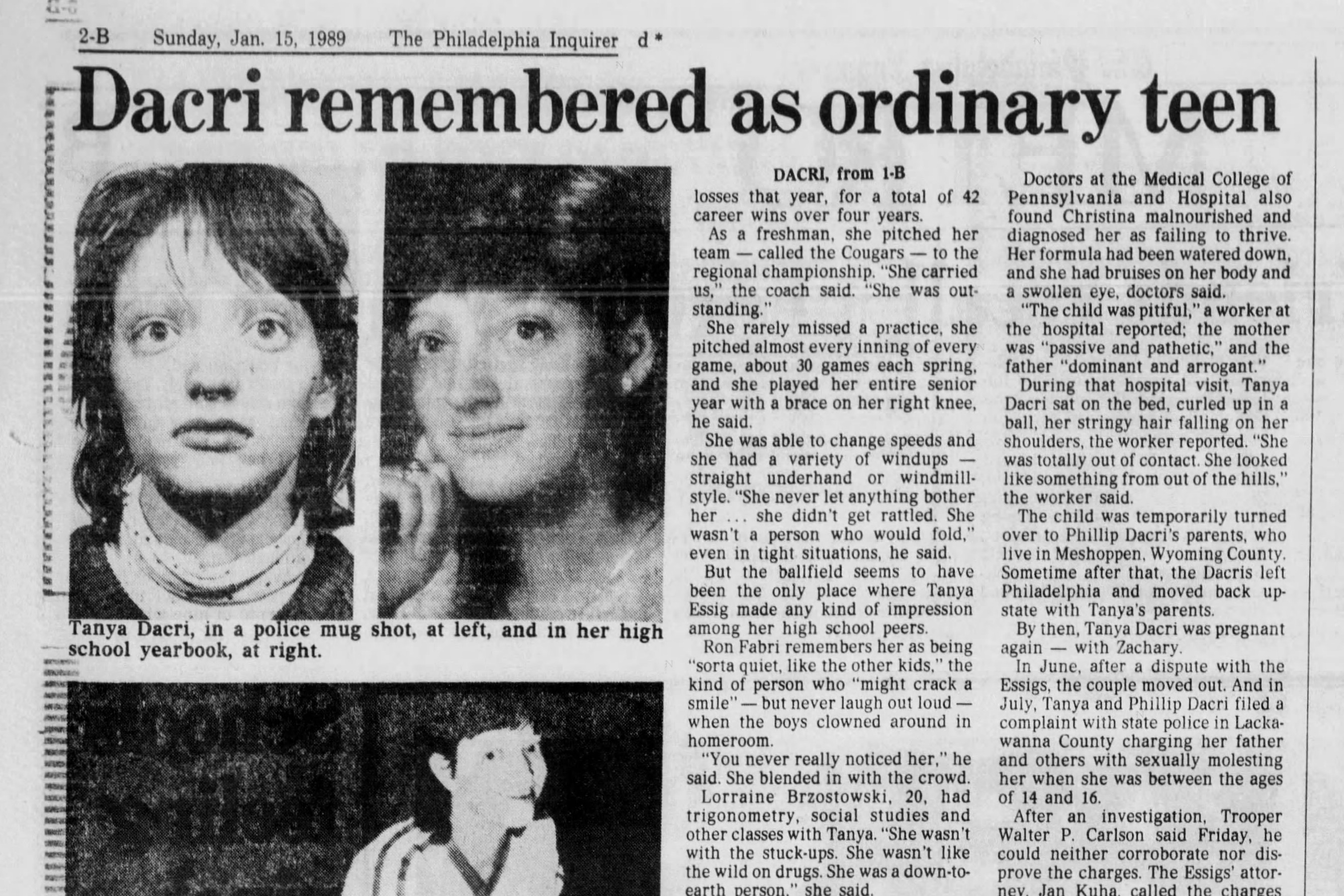
    He represented Tanya Dacri, a Northeast Philadelphia woman who pleaded guilty in 1989 to drowning her infant son Zacharry and dismembering his body.

    She was sentenced to life in prison.

    “I don’t think there’s any question now, in hindsight, that she suffered from [the] postpartum diagnosis. Problem was, it wasn’t understood back then, like it is now,” Stretton said in a phone interview Tuesday night.

    Lindsay Clancy sits at the defense table as Kevin Reddington asks the jury to find her not guilty during her murder trial at Plymouth Superior Court in Plymouth, Mass., on Aug. 27. Greg Derr

    The jury in the Clancy case began deliberating last week. Unable to reach a verdict, Judge William Sullivan declared a mistrial Friday afternoon. A status hearing to decide where the case goes from here was scheduled for Sept. 29.

    Clancy, a former labor and delivery nurse, admits she strangled her children, but her legal defense is that postpartum psychosis led to her actions. Clancy, 36, has pleaded not guilty by reason of lack of criminal responsibility. Prosecutors say she knew what she was doing.

    In Pennsylvania, Dacri, now 58, is serving her sentence at the State Correctional Institution at Muncy, the state prison for women.

    Stretton believes “it’s the right time” for Dacri to seek a pardon or commutation. That would require a unanimous decision from the state Board of Pardons, and then the approval of the governor.

    “She and I have been talking about it for about 10 years, but I told her to wait a little longer. I thought that would enhance her chances, and now I think it’s the right time,” Stretton said.

    The last time Stretton communicated with Dacri was by letter several years ago. Stretton said he would move forward with a clemency application “if she still wants to do it.”

    Dacri has been behind bars since she was arrested in 1989.

    In 1989, Tanya Dacri pleaded guilty to drowning her 2-month-old son Zacharry in a Northeast Philadelphia apartment and dismembering his body.Philadelphia Inquirer

    “She’s done well in prison. She’s adjusted. She’s attended all the programs. She’s sorry. She’s regretful,” Stretton said.

    Dacri “has been adequately punished, and therefore we’re asking them to allow a sentence to be commuted or a pardon be granted, so she can get out and have some of her life left,” Stretton said.

    “Postpartum psychosis” as a legal defense was unusual but not unknown before Dacri’s case, according to a paper published in the spring 1991 Dickinson Law Review.

    Wide-ranging sentences

    While Dacri was sentenced to life in prison, mothers with similar Pennsylvania cases were given wildly different sentences.

    For example, the paper’s author, Amy L. Nelson, cited the case of Sharon Weisensale, who was found guilty but mentally ill in Bucks County of third-degree murder for the 1984 drowning death of her 2-month-old daughter.

    “She was given a five-year suspended prison sentence and was required to undergo psychiatric treatment,” Nelson wrote.

    In another case, Sharon Comitz, of Osceola Mills, Pa., pleaded guilty but mentally ill to third-degree drowning in the 1985 death of her month-old son, Nelson wrote.

    According to testimony, Comitz was treated for severe postpartum depression at the time of the murder, Nelson said. Comitz received a prison sentence of eight to 20 years.

    In another Pennsylvania case, Chanda Smith was convicted of third-degree murder in the drowning death of her three-week-old daughter, Nelson said. Smith was sentence to five to 10 years in prison.

    “Experts testified that Smith, like Weisensale and Comitz, murdered her child while suffering from severe postpartum psychosis,” Nelson wrote.

    A false story falls apart

    On the morning of Jan. 12, 1989, the Dacri story hit the front page of The Inquirer under the headline, “Police: Mother drowned baby.”

    Tanya Dacri, who was 20 years old at the time, initially told police that Zacharry had been taken by purse-snatching Black men — a detail that drew accusations of racism from some media commentators.

    However, investigators were immediately suspicious. Dacri’s fake story quickly fell apart that same day and she told police she killed her son because he was always crying, The Inquirer reported.

    She told police she dismembered his body and put the pieces in weighted plastic bags. She and her husband, Phillip Dacri, then disposed of the bags in the Neshaminy Creek in Bucks County and a creek in Carbon County.

    Phillip Dacri pleaded guilty to helping his wife dispose of the remains and served 10 months in prison.

    In court, During court proceedings, a psychologist for the defense and a psychiatrist for the prosecution agreed Dacri had a mental disorder that might have deteriorated to psychosis on the day she killed her infant son, The Inquirer reported.

    But they disagreed on whether Dacri specifically intended to kill her Zacharry.

    “I am convinced beyond a reasonable doubt that, when you placed your son in that bathtub and when you turned on the water and put the plug in the tub, that it was your intention to kill him,” Common Pleas Court Judge Michael Stiles told Dacri during her sentencing.

  • Penn State cocaine trafficking co-defendants testified against the alleged orchestrator

    Penn State cocaine trafficking co-defendants testified against the alleged orchestrator

    The former Pennsylvania State University student accused of orchestrating a cocaine-trafficking ring has been released on bail, after a preliminary hearing Wednesday where three of his co-defendants testified against him.

    Agostino Abbatiello, 24, eventually came to be known as the main cocaine supplier on campus, according to a criminal complaint. He and other co-defendants allegedly made regular trips to New York City and Philadelphia to acquire large quantities of cocaine, and distributed the drugs out of the Delta Upsilon and Sigma Chi fraternity houses from 2023 to 2024, prosecutors say.

    A judge ordered Abbatiello be held for trial on all charges, which include felony counts of possession with intent to deliver cocaine, conspiracy, and other related offenses. Fourteen people have been charged, and all but one are current or former Penn State students.

    At Wednesday’s hearing, State College Police Department Detective Donald Paul said after Thomas Robinson, 23, was arrested in 2024, he began cooperating with investigators and pegged Abbatiello as the head of the operation, as reported by the Centre Daily Times.

    Robinson testified about the roughly 10 cocaine purchases he made from Abbatiello, which grew in size and price to as much as a kilogram of cocaine for $22,000, the news outlet reported. According to Robinson, the cocaine was typically ground down and repackaged in half-gram bags that were sold for about $80 apiece.

    Two other co-defendants provided more details in their testimonies. One said some fraternity pledges were directed to package the cocaine for sale, while another testified that Abbatiello flaunted the money he was making, and was gambling thousands of it at a time, the Centre Daily Times reported. Senior deputy attorney general Megan McGoron said Abbatiello was making hundreds of thousands of dollars.

    Abbatiello, of Long Island, N.Y., was denied bail when he was arraigned last month, and spent about two weeks in jail. At Wednesday’s hearing, prosecutors requested a $5 million bail, but Abbatiello’s attorneys successfully argued for his bail to be set at $250,000. Abbatiello posted bail and is now home with his family, his lawyer Philip M. Masorti said in a statement.

    Agostino Abbatiello, who is facing charges including possession with intent to deliver and conspiracy, arrives to an appearance at Centre County Courthouse in Bellefonte, Pa., on Wednesday.AP Photo/Matt Rourke

    “We have maintained that holding Agostino without bail was neither necessary nor justified. He is not accused of committing an act of violence. He did not flee. When he learned of the charges, he left his job in Florida, traveled to Pennsylvania, and surrendered himself to authorities,” he said.

    Robinson and three other defendants also charged with felonies waived their preliminary hearings. The case against Robinson’s father, who also faces felony charges for concealing and tampering with evidence, will move forward, a judge ruled.

    Abbatiello’s next court date is set for Sept. 30.

  • SEPTA had ‘better-than-expected financial performance’ this year

    SEPTA had ‘better-than-expected financial performance’ this year

    Moody’s Ratings has upgraded SEPTA’s outlook to stable from negative, one year after the transit authority was cutting service to help close a budget deficit and paying for emergency safety inspections and repairs for 223 decades-old Regional Rail cars.

    The revised outlook “reflects SEPTA’s better-than-expected financial performance” in fiscal 2026 that leaves it with enough liquidity to pay the bills while continuing to try to solve a structural budget gap, Moody’s said in an Aug. 28 statement.

    “Our hope is that this external validation supports the message we want to send to our stakeholders in Harrisburg that SEPTA is a sound investment and that we are good stewards of taxpayer dollars,” assistant treasurer Michael Kendall said in an interview.

    At this time last year, Harrisburg lawmakers and the Shapiro administration had failed for the third straight year to agree on a steady source of new state funding for SEPTA and other transit agencies. Moody’s also downgraded the authority’s fiscal outlook to negative.

    In early September 2025, PennDot redirected $394 million in state capital assistance funds to help cover two years of operating expenses. Later, Gov. Josh Shapiro sent an additional $219.9 million for safety and urgent repairs on both the Regional Rail cars and the trolley tunnel in Center City.

    SEPTA managers pivoted to an increased focus on controlling costs, finding new revenue from advertising, parking, and real estate, and service improvements, Kendall said.

    The transit agency says it has found about $30 million in annual savings, as well as increased income from advertising, parking, and real estate. Ridership remained steady and spiked during the summer’s World Cup games, celebrations of America’s 250th birthday, and the Major League Baseball All-Star Game.

    Overall, SEPTA says its structural budget deficit dropped from $213 million a year to $192 million.

    The credit rating for authority bonds remains good, as they are backed by reliable federal and state income streams, not passenger revenue, which can fluctuate.

    SEPTA has a $501 million bond for asset improvement and a $42 million bond in the Public Transportation Assistance Fund. Moody’s gave both one of its highest ratings, Aa3. Moody’s also affirmed the A3 ratings on the authority’s $138 million in bonds issued against federal capital grants it has been awarded.

    Still, Moody’s warned, “over the long-term, SEPTA’s sizable structural budget gap will be difficult to resolve without further financial support from the commonwealth or significant adjustments to operations.”

  • Pa. is the only state to split fish and wildlife management. Combining could save $34 million a year.

    Pa. is the only state to split fish and wildlife management. Combining could save $34 million a year.

    Pennsylvania is the only state that splits fish and wildlife management across two separate agencies, totaling a combined 1,298 employees — well above the number in similar states.

    Perhaps more dire, the Fish and Boat Commission (PFBC) and Game Commission are expected to see hundreds of millions in reserves drastically reduced within a decade as the number of hunters and anglers continues to decline, according to a new report dated Aug. 31.

    The state could save $34 million annually by combining duplicative operations, the report says.

    The PFBC and Game Commission contracted the Wildlife Management Institute to conduct the independent study in search of efficiencies and collaboration.

    A statement by PFBC said the institute dug into the operations of both commissions, examined finances, looked at physical assets and demographics, and considered employee feedback.

    The institute then compared the data against other state fish and wildlife agencies before making recommendations.

    In a statement, PFBC said this week that the recommendations are only that, and not mandates.

    “The decision on whether to combine the agencies will require detailed analysis of additional factors that are unique to Pennsylvania, as well as potential action by the Pennsylvania General Assembly,” the statement said.

    Pennsylvania Rep. Anita Astorino Kulik, who chairs the House Game and Fisheries Committee, could not be reached for comment.

    The numbers behind the decline

    The report warns that the current way of doing things is unsustainable because the base of both commissions is eroding. Both agencies depend on fees and licenses to hunt, fish, and boat on state game lands and waterways.

    Since 2009, the number of hunters seeking licenses has fallen by 100,000, and it appears little growth is on the horizon. There are significantly fewer license sales to hunters aged 21-37 compared with those aged 49-65.

    The Game Commission projects hunting licenses will decline by 0.8% per year over the next decade.

    Much of the revenue decline stems from the shrinking base of hunters who typically pay full price. Hunters 65 and older pay once for lifetime licenses that require no more payments.

    The loss is similar among anglers. Fishing license sales saw a big spike during the COVID-19 pandemic from 2020 to 2021. But sales have declined steadily since. Many of those buying licenses are also older and transitioning to senior lifetime brackets.

    The report says that nearly one-fifth of active registered anglers held senior lifetime fishing licenses by 2023.

    A senior hunter pays $52 for a lifetime license and an angler pays $85. Seniors also have an option of paying $102 for a lifetime license for both.

    Those licenses return only a small fraction of revenue generated by a standard adult license. Meanwhile, operating costs continue to rise.

    As a result, rising costs at both commissions are projected to outpace revenues within a decade.

    What’s in the report?

    Steve Smith, executive director of the Game Commission, noted in a statement that the report does not call for the two agencies to be completely merged.

    “The Pennsylvania Game Commission takes its fiscal responsibility seriously, and that includes being good stewards of every dollar entrusted to us,” Smith said. “In part, that is why we chose to do this study now, when the commission is in solid financial standing.”

    He also noted that the study does not recommend immediate action.

    The Game Commission has a sizable $504 million cushion, and revenues are expected to grow a bit. However, the report said annual expenditures will soon outstrip that. As a result, the Game Commission is on course to use 95% of those funds by 2034.

    Meanwhile, PFBC is projected to exhaust its $145.8 million in reserves within the same time frame.

    The institute recommends consolidating some operations, which would reduce the number of employees by 17%, saving about $34 million annually.

    How would it save money?

    The study looked at staffing and physical assets at five states comparable in size with similar geographic and ecological profiles: Michigan, Minnesota, New York, Ohio, and Wisconsin.

    The authors say the biggest savings to Pennsylvania would come from unifying the law enforcement branches of each commission. Currently, the combined law enforcement workforce totals 337 sworn officers, surpassing those of comparable states.

    The Fish and Boat Commission’s waterways conservation officers enforce fishing, boating, and environmental laws and regulations by patrolling streams, rivers, and lakes on foot, in vehicles, and on boats.

    The Game Commission’s wardens patrol state game lands. They investigate poaching, illegal shooting, and trapping violations.

    Bringing the number of officers down to 222 would streamline the number of supervisors and enhance field coverage during peak seasons, the report found.

    It also recommends reduction of overlapping administrative positions, including top supervisors, legal counsel, human resources, and engineering.

    The number of buildings could also be reduced. The Game Commission has 74 field offices, compared with an average of 29 in other states. Sharing facilities would cut utility and maintenance costs.

    However, such changes would likely require legislation by the Assembly. There is currently no bill proposed, but combing operations could be tricky given that hunters and anglers have long had their own views of what the state should prioritize.

    Pennsylvania has a sprawling network of state game lands covering 1.55 million acres of public land popular with hunters and anglers. And it has 86,000 miles of flowing waterways popular with anglers and boaters.