Category: News

  • Philadelphia doesn’t have to honor ICE jail detainers, a federal judge rules

    Philadelphia doesn’t have to honor ICE jail detainers, a federal judge rules

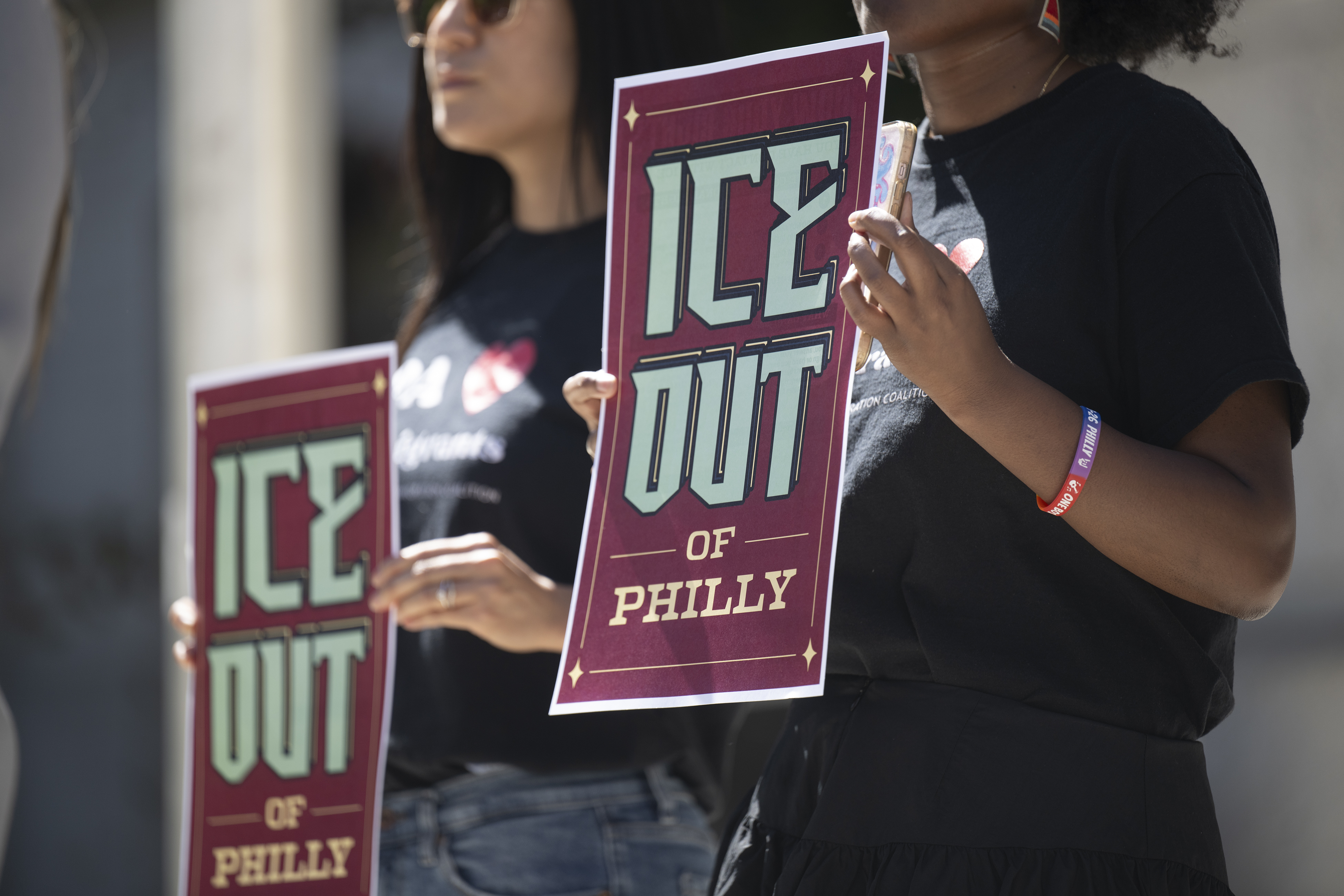
    Philadelphia is not required to respect requests from federal agencies to keep undocumented immigrants in jail long enough to be handed over to U.S. Immigration and Customs Enforcement agents, a federal judge ruled Thursday.

    U.S. District Judge Chad F. Kenney dismissed a challenge brought by the Department of Justice against a provision in Philadelphia’s “ICE Out” legislation that codified the city’s long-standing practice of not honoring immigration detainers.

    “Courts routinely find that compliance with immigration detainer requests is not mandatory for states and localities,” wrote the judge, who was appointed by President Donald Trump.

    Philadelphia’s ordinance is not unlawful because “compliance with an immigration detainer is voluntary,” Kenney wrote. The prohibition on honoring detainers also “does not pose a true obstacle to the federal government’s execution and enforcement” of immigration law, the judge said.

    A spokesperson for the city’s law department said in a statement the city “concurs” with the court’s decision and remains “committed to compliance with local, state, and federal laws.”

    The Justice Department did not respond to a request for comment.

    The lawsuit was originally filed in June against the city, its officials, and District Attorney Larry Krasner and focused on a provision prohibiting law enforcement officers from concealing their identity.

    The Justice Department expanded its complaint to also target the detainer ordinance, which is part of the “ICE Out” legislation package that took effect in July, and makes it illegal for a city agency or employee to keep people otherwise eligible for release in custody because of an immigration detainer, an administrative warrant, or suspicion they violated immigration law.

    The Justice Department argued the local provision imposed a “blanket refusal” by the city to cooperate with the federal government, and amounted to a “standing assurance that the federal handoff Congress built into federal immigration law will never happen within Philadelphia, whatever the circumstances.”

    The detainer provision is the second “ICE Out” bill challenged by the Justice Department. In July, Kenney ruled that Philadelphia doesn’t have the authority to order ICE agents to unmask.

    Unlike the detainer bill, which Mayor Cherelle L. Parker signed in May, Parker allowed the mask bill to become law without her signature, following the advice of then-City Solicitor Renee Garcia that signing the bill “would send an inaccurate signal to the public that the Administration can legally or practically enforce” its provisions.

    The Justice Department expanded its lawsuit in August to also challenge the detainer provision, but this time, Kenney sided with Philadelphia’s position.

  • Proposed housing at Lionville Station Road won’t go forward, after Uwchlan officials deny rezoning

    Proposed housing at Lionville Station Road won’t go forward, after Uwchlan officials deny rezoning

    Plans for an age-restricted community with nearly 500 homes on hundreds of acres of open farmland in Uwchlan Township were denied by elected officials this week, who felt the proposal “did not meet the bar” for rezoning the property to include residential.

    The township’s three supervisors voted unanimously Wednesday to deny both a zoning amendment that would have allowed for residential development at Lionville Station Road, and a tentative development plan that included about 492 homes, a swimming center, miles of nature trails, a Monarch butterfly way station, and more than 100 acres of open space.

    There are elements of the plan that would have served the township well, said board chairperson Laura Obenski, with its focus on recreation, preservation, and residential. But it wasn’t a perfect fit.

    “Unfortunately at the end of the day, I think that the burden that was going to be borne by taxpayers of Uwchlan Township did not meet the bar in my head for a rezoning request and I hope that we can revisit those conversations because there are some extraordinary opportunities on the table,” she said.

    The denial is a blow for some residents, who rallied together years ago as the group Save Lionville Station Road to fend off plans for industrial development of the 237-acre property. They had worked with the developer, Rockwell Development, to create what they considered a satisfactory residential development proposal. The developer said there were about 112 meetings regarding the project.

    Greg Lingo, president of Rockwell, said Friday the board’s decision was “surprising to us, and all the stakeholders that worked so earnestly to develop the low-density active adult residential plan that we all could be proud of.”

    “It was helpful for us to now know formally that the Township does not desire to rezone the property and instead would like to see it developed under its current zoning,” he said. “…We anticipate over the next 60 days to be in front of the Township to process the plan that they prefer.”

    Downingtown Area School District purchased the land in 2003 for roughly $22 million to build a school campus. The district has sought to sell the property for more than a decade after its request to change the zoning was denied.

    After several deals didn’t come to fruition, including what could have become a warehouse complex with an outdoor recreation area that residents opposed, the district in 2024 entered into a sales agreement with Rockwell.

    That year, the township tried to open communication between the district and prospective buyers to avoid repeating history: disagreements about zoning, Obenski said.

    “I think the rest of this process has followed predictably when there’s not healthy communication with all the stakeholders at the table,” she said.

    Still, it’s not a “dead conversation,” she added, saying she “hope[s] we can move forward in a productive way.”

    Before the board took its vote, members of Save Lionville Station Road said while they’d prefer it to remain open farmland, they knew that was unlikely. A residential development seemed much more agreeable than a warehouse.

    “If this community plan doesn’t go through, we’ll end up with ugly warehouses instead of homes and well-maintained properties,” said resident Bonnie Fertell.

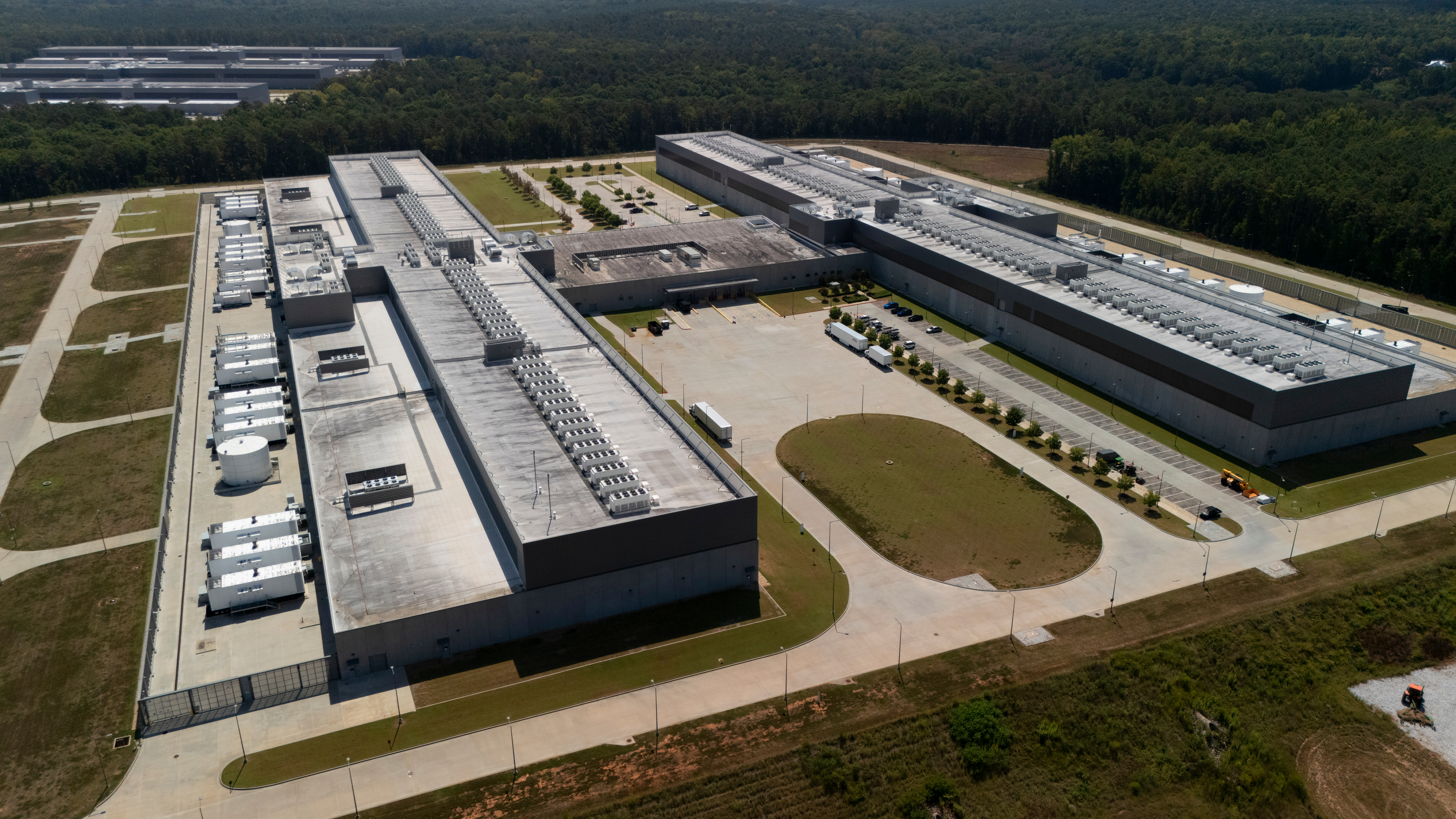
    Or, they worried, data centers.

    “I have a great concern that we may be opening a Pandora’s box by allowing … the entry into data centers if we don’t go forward with the residential plan,” said resident Christopher Engle.

    But it wasn’t enough for the supervisors to greenlight.

    “I don’t think there’s enough positive benefit to the township to justify changing our comprehensive plan,” said vice chairperson Bill Miller, saying that while he wasn’t “necessarily fundamentally opposed” to adding homes there, “the density was too much.”

    Earlier this year, the township’s planning commission had voted to recommend approval of the project — contingent on axing the natatorium and decreasing the houses in the community.

    The traffic the development would create would be “just a nightmare,” Dennis Martin, chairperson of the planning commission, told the board Wednesday. “You don’t have to be a genius to figure all those cars are going to be a problem.”

    Traffic was a large concern for other residents, who asked the township to look further into what it could do to preserve the open space. Some residents Wednesday were also opposed to the addition of a natatorium, which proved to be one of the more divisive parts of the plan. It would be used by the community and the Downingtown Area School District for its swim team’s practices and competitions.

    Resident Kaitlin Knecht, an assistant swimming coach in the district, advocated for its approval, saying, “It is one thing that we’re missing in this community, and I know that from growing up here.”

    Supervisor Larasz Moody was “agnostic” to the natatorium but believed residential development was better than what the alternatives could be.

    “I do hope that future discussions will include a residential development that will better fit into the comprehensive plan of our community and that aligns with what we want as residents currently, and certainly what will benefit future residents as well,” she said.

    Losing the natatorium in the denial “devastated” Obenski the most, she said.

    “I think we have fantastic pieces on the table. They just did not fit together,” she said.

    This suburban content is produced with support from the Leslie Miller and Richard Worley Foundation and The Lenfest Institute for Journalism. Editorial content is created independently of the project donors. Gifts to support The Inquirer’s high-impact journalism can be made at inquirer.com/donate. A list of Lenfest Institute donors can be found at lenfestinstitute.org/supporters.

  • Julian Brodsky, a cofounder of Comcast, has died at 93

    Julian Brodsky, a cofounder of Comcast, has died at 93

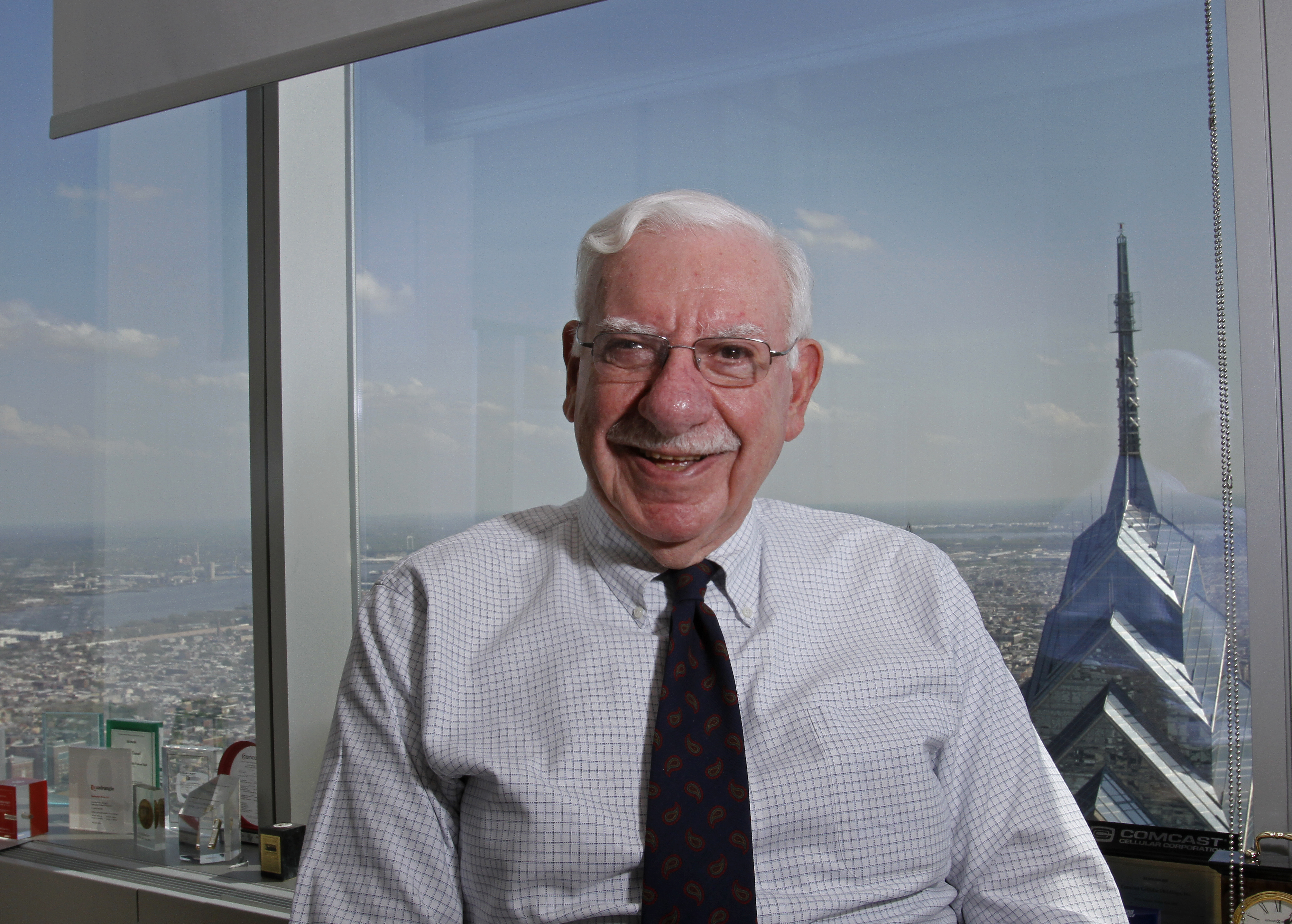
    Julian A. Brodsky, 93, of Philadelphia, a cofounder of Comcast who helped grow a tiny cable venture in the Deep South into one of the biggest companies in the country, died Thursday, Nov. 5, while in hospice care.

    He passed away peacefully, surrounded by his family, Comcast said.

    Mr. Brodsky was described as “an extraordinary leader, a brilliant financial mind, and one of the architects of cable television” by Brian L. Roberts — Comcast’s co-CEO and chairman, whose late father, Ralph, founded the company in the 1960s.

    “He was a trusted partner and close friend to my father, Ralph, and someone I was fortunate to learn from and work alongside for so many years,” Roberts said in a statement Friday.

    Mr. Brodsky “established a culture of financial integrity, uncompromising standards, and respect for colleagues that remains at the heart of our company today,” Roberts said.

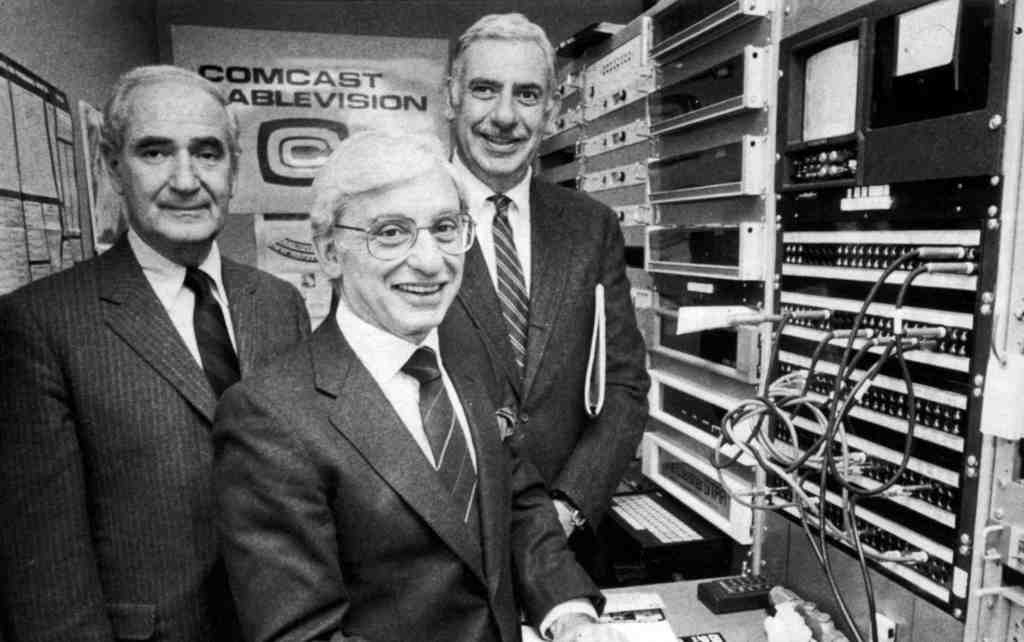
    Comcast’s founders — Ralph Roberts (left), Julian Brodsky (right), and Daniel Aaron — at a Comcast facility in Northeast Philadelphia in the late 1980s or early 1990s. The firm started with a cable TV venture in the Deep South in the early 1960s.

    While the elder Roberts was Comcast’s undisputed leader, Ralph credited Mr. Brodsky, an accountant, with much of the company’s success. “We were never short on money when we wanted to grow,” Ralph Roberts said in 2011, calling Mr. Brodsky one of the smartest men he ever met.

    What began as a single cable system in Tupelo, Miss., with around 1,200 customers is now a telecommunications and media giant headquartered in Philadelphia, with $124 billion in annual revenue.

    “We were lucky, and we were good,” Mr. Brodsky told The Inquirer in 2011. “We never saw a cable company we didn’t like.”

    At 6-foot-4, 250 pounds, Brodsky had a commanding presence — “a very powerful figure, both physically and mentally,” John Malone, a billionaire cable and media pioneer, said in a statement Friday.

    Mr. Brodsky was Comcast’s longtime chief financial officer and served as vice chairman from 2004 until his retirement in 2011. He was an early advocate at Comcast for focusing attention on the internet and started the company’s venture capital fund in 1999.

    Mr. Brodsky was also known as a philanthropist. He served as a trustee at the Philadelphia Museum of Art for almost three decades. Last month, he and his wife, Lois, pledged $20 million to the museum to create a learning and engagement center aimed in part at educating schoolchildren.

    “His impact on the Philadelphia Museum of Art will be felt for generations,” Ellen T. Caplan, chair of the museum’s board of trustees, said in a statement.

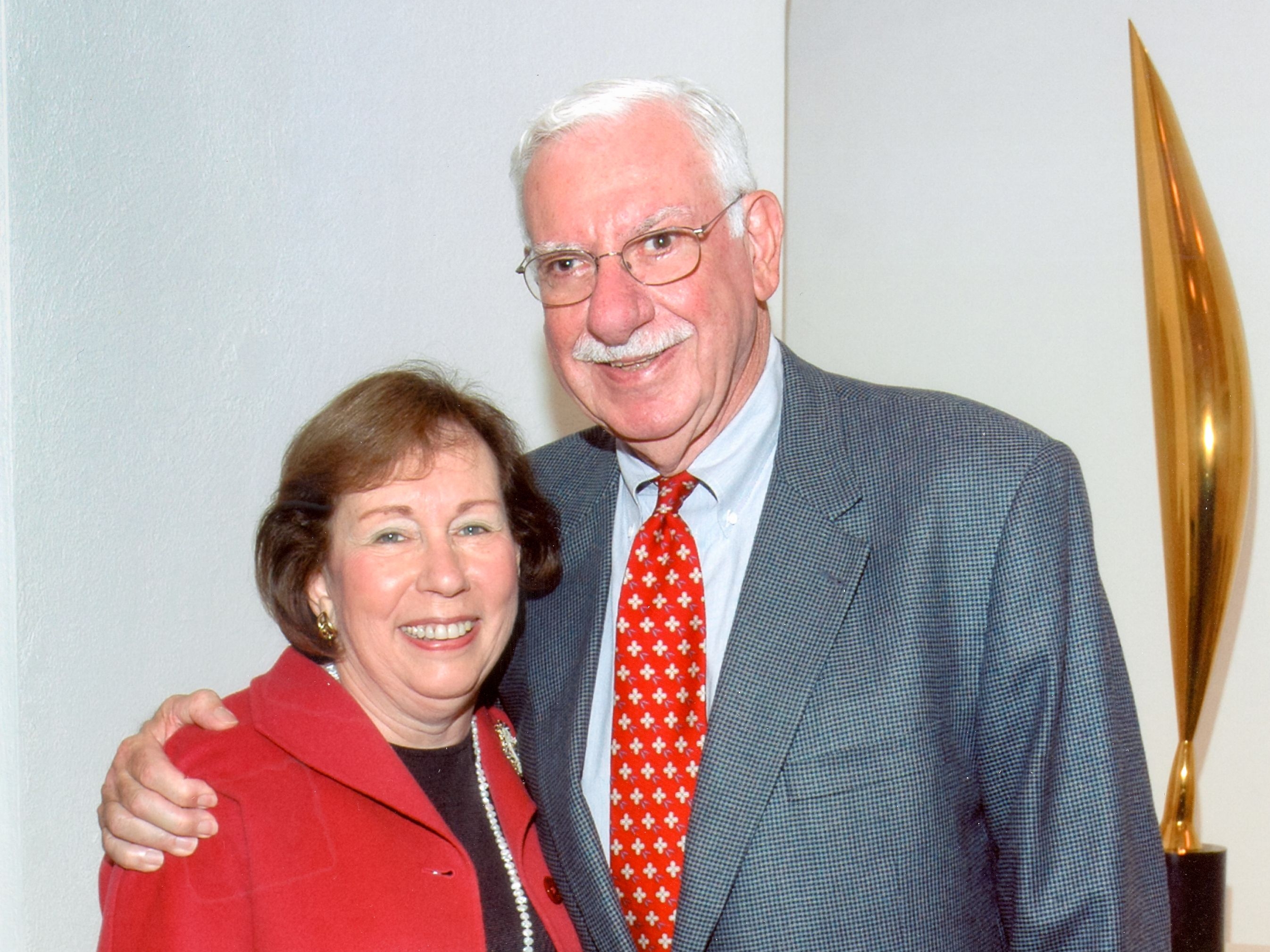
    Lois G. and Julian A. Brodsky in 2005 at the Philadelphia Museum of Art with Constantin Brancusi’s ‘Bird in Space’ behind them.Courtesy the Philadelphia Museum of Art

    Mr. Brodsky lived in Philadelphia’s Logan Square neighborhood for the last two years and before that resided in Cherry Hill for 42 years.

    The son of a homemaker and Dock Street produce wholesaler, Mr. Brodsky was born in Philadelphia in 1933 and went to Overbrook High School.

    When Mr. Brodsky was 17, he told an interviewer, he blocked a shot in a summer-league game by a teenager named Wilt Chamberlain — the future NBA superstar.

    Mr. Brodsky graduated from the Wharton School at the University of Pennsylvania in 1956 and served two years in the Army in Alabama. He joined the Philadelphia accounting firm of Adler, Faunce & Leonard — whose clients included Ralph Roberts, an entrepreneur and Navy veteran who at the time owned a belt-manufacturing business.

    Mr. Brodsky helped Roberts sell the company. Two years later, in 1963, Roberts bought the community antenna television system in Mississippi.

    Mr. Brodsky and Daniel Aaron, a former business writer for the Philadelphia Bulletin, joined Roberts as partners.

    “I said, ‘No way you’re doing this without me,’’ Mr. Brodsky recalled in a 1996 interview. “I loved cable, and I loved Ralph. What could be better?’’

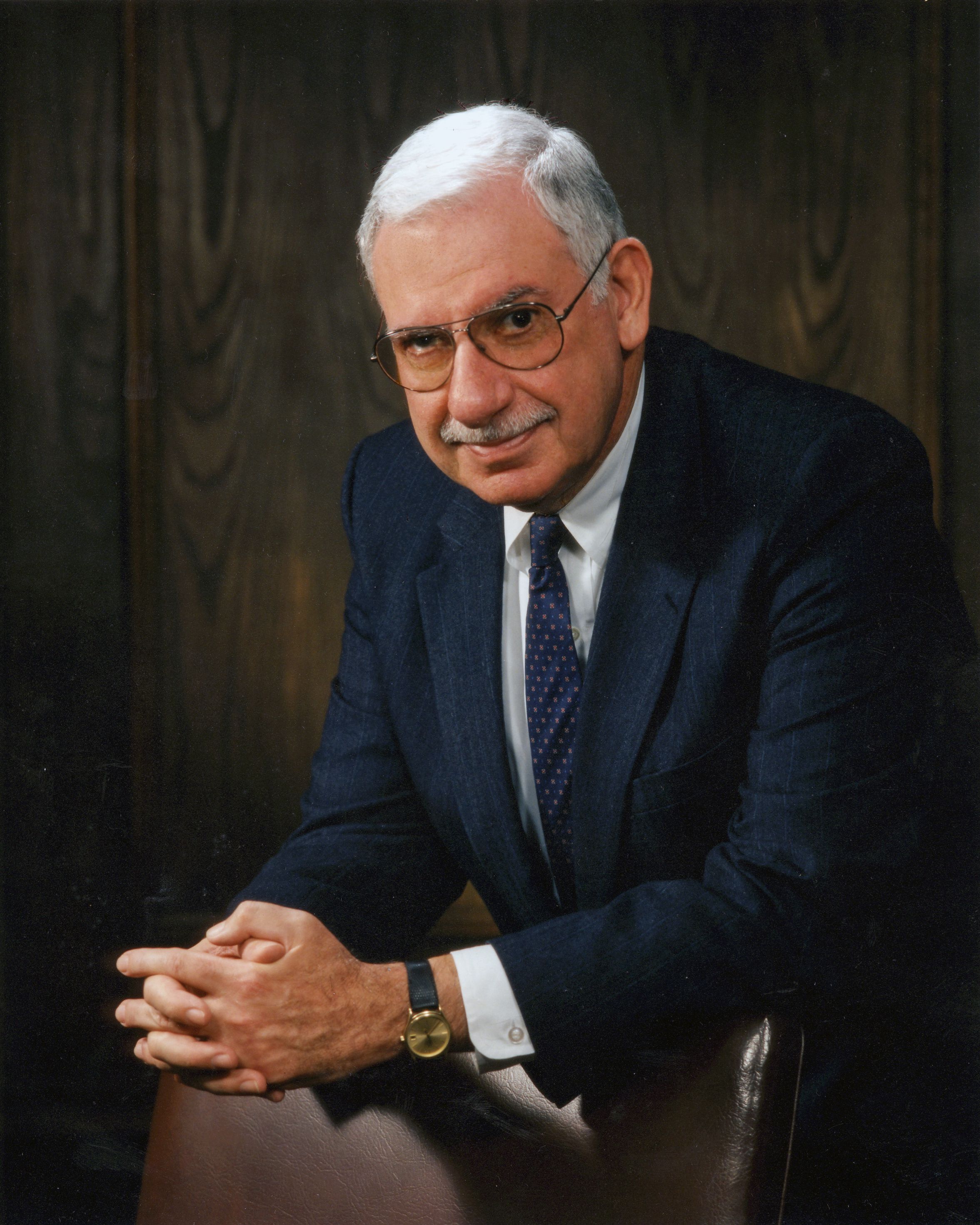
    Comcast co-founding partner Julian Brodsky.Courtesy of Comcast

    In the early days, Roberts operated out of a small office in Bala Cynwyd, where Mr. Brodsky used a card table as a desk.

    Early on, banks sometimes viewed Comcast with skepticism, but Mr. Brodsky sold them on new financing schemes like low-interest, long-term loans.

    With 40,000 cable-TV subscribers, Comcast went public in 1972. Mr. Brodsky played a “central role” in the initial public offering, the company said Friday.

    He was “instrumental in financing the company’s expansion, efforts to raise capital, and helped guide major acquisitions that transformed Comcast from a small regional cable operator into an industry leader,” the company said.

    Mr. Brodsky was the last remaining Comcast cofounder. Aaron died in 2003, and Roberts in 2015.

    Mr. Brodsky is survived by Lois, his wife of 70 years; daughters, Debra, Ellen, and Laura; as well as four grandchildren, one brother, and a niece. A celebration of Mr. Brodsky’s life will be announced at a later date.

    Donations can be made in honor of Mr. Brodsky to the Philadelphia Museum of Art, the Barnes Foundation, and the Free Library of Philadelphia.

  • Planned protest against Jewish-owned Philly restaurants draws ire, security, and feelings of unease

    Planned protest against Jewish-owned Philly restaurants draws ire, security, and feelings of unease

    Philadelphia business leaders and elected officials are condemning a planned bike-ride protest against half a dozen eateries owned by Jewish restaurateurs, days before the cyclists are set to gather in Center City.

    The “Boycott Ride” has drawn ire internationally in recent days, as many have denounced the anticipated action — planned for the eve of Kristallnacht on Sunday — as antisemitic and hateful. In response, city, state, and congressional leaders have called for increased security, and Philadelphia’s Jewish community have rallied behind the businesses.

    “Everyone has the right to peacefully protest and express their political views,” Philadelphia Mayor Cherelle L. Parker said in a statement. “But singling out businesses because their owners are Jewish is unacceptable and has no place in our city.”

    It’s unclear how many people will participate in the bike ride or how the organizers plan to express their dissent. An Instagram post promoting the demonstration had less than 800 likes as of Saturday morning. Meanwhile, a counter, “community food crawl” has galvanized, encouraging people to patronize the targeted businesses this weekend.

    Philadelphia police said Thursday they were monitoring the protest and will “take appropriate measures to maintain public safety,” and a spokesperson for Gov. Josh Shapiro said his administration and state police were working with local authorities ahead of Sunday.

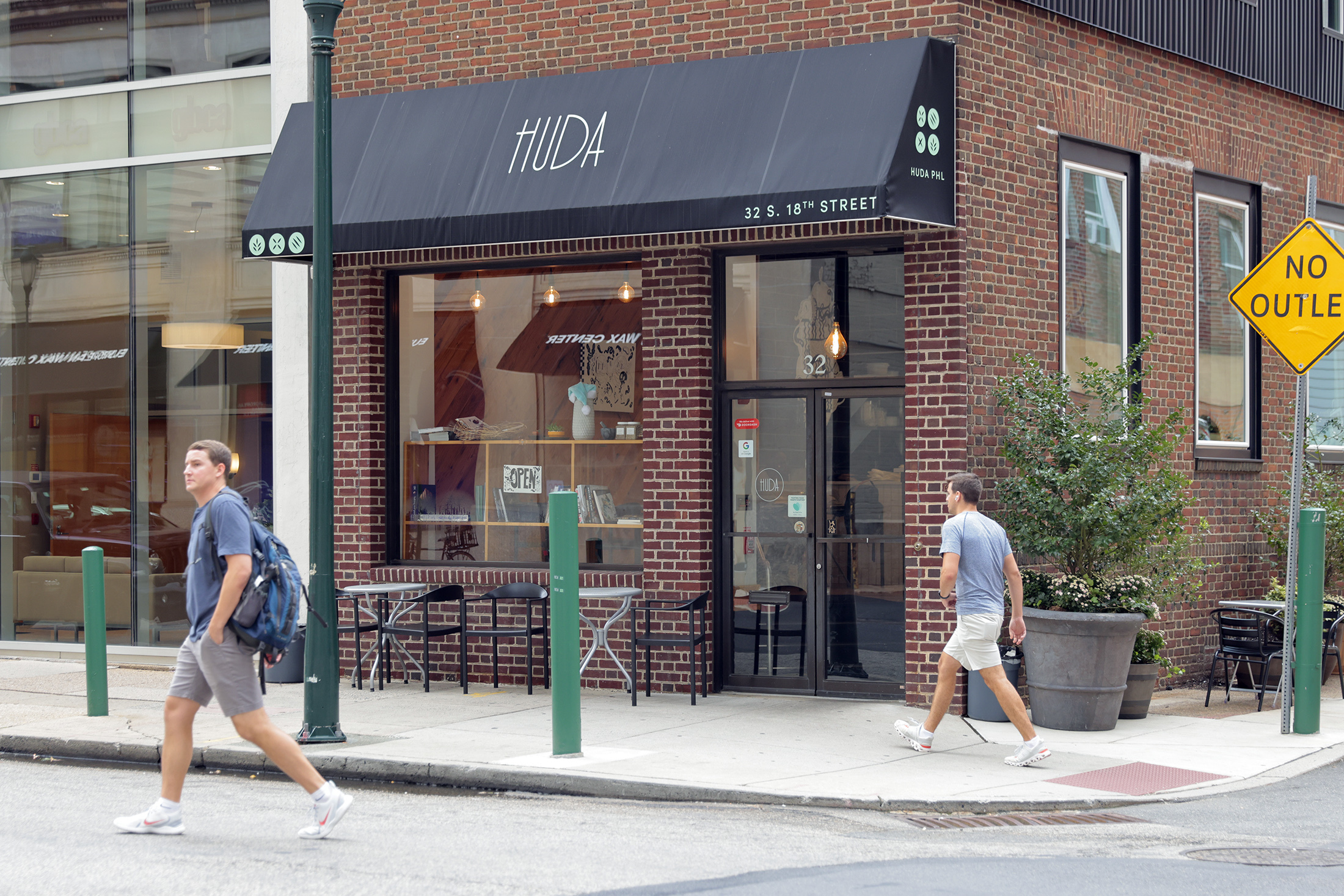
    Organizers of the “Boycott Ride” said on Instagram the cycling demonstration was intended to show pro-Palestinian solidarity and protest six businesses they say are “Zionist establishments”: Mac Mart, K’Far Cafe, Huda, Goldie, Dizengoff, and Schlesinger’s Deli. A widely circulated flier reads, “No business for Zionists! These Zionist Establishments must go! Not in our city!”

    Allan Domb, owner of Schlesinger’s Deli and a former Philadelphia city councilmember, called the boycott “unsettling.”

    “This group wants to see our businesses shut down because we’re Jewish,” he said in a phone interview. “Imagine if this was another group that was being targeted — everybody would be up in arms.”

    In a statement, the Jewish Federation of Greater Philadelphia denounced the bike ride as an attempt to “intimidate Jewish businesses or drive them out of Philadelphia.” The federation, and others, have also taken issue with the boycott’s timing: The protest is planned for the eve of the 88th observance of Kristallnacht, an organized attack on Jewish businesses, homes, and synagogues in Nazi Germany in 1938. During Kristallnacht, Nazis assaulted and killed Jewish people, imprisoned about 26,000 Jewish men in concentration camps, and burned more than 1,400 synagogues, according to the U.S. Holocaust Memorial Museum.

    “Publicly identifying Jewish-owned businesses and declaring that they must go sends a message to Jewish Pennsylvanians that they are unwelcome in the economic and civic life of their own communities,” said Andrea Martin, commissioner of the Pennsylvania Human Relations Commission.

    “Such efforts to intimidate, marginalize, and exclude Jewish business owners should concern every Pennsylvanian who believes in equal rights and the dignity of all people,” Martin said.

    On Saturday, the ride’s organizers — a group called Philly Bike On Your Left — posted a statement to Instagram that said in part, “our ride has been grossly misrepresented.”

    “We firmly stand with indigenous Palestinians in their struggle for freedom and justice,” the statement read. “Let us be clear: the reason we are calling for a boycott of these businesses is because of their support for Israel.”

    The statement also addressed the protest’s timing: “We plan rides around people’s schedules. Palestinians need our support now. Any suggestions about the timing of our ride are simply false.”

    Another group, Boycott CookNSolo — a movement protesting the restaurant group that owns Goldie, K’Far Cafe, and Dizengoff, among others — came to Philly Bike On Your Left’s defense, writing on Instagram that all the restaurants’ owners “have made statements and/or raised funds” in support of Israel in the war. Since the Oct. 7 Hamas attack on Israel, when Hamas militants killed 1,200 people and took 251 hostages, Israel has responded with an offensive that has killed more than 74,000 Palestinians, according to Gaza’s Health Ministry.

    Boycott CookNSolo called the social media fury and attention a “coordinated campaign to discredit and villainize the organizers,” while “disingenuously conflating Zionism with Judaism and invoking Kristallnacht.”

    “Hate has no place in our community or directed at small businesses working hard to feed their families and bring joy to others,” Mac Mart owner, Marti Lieberman, said in a statement. “Since day one, Mac Mart has welcomed everyone, regardless of background, culture, religion, or beliefs.

    “Our mission has always been simple: Make people happy with delicious comfort food. That’s what we’re going to continue doing.”

    A spokesperson for CookNSolo — co-owned by Israeli-born chef Michael Solomonov — did not immediately respond to emails seeking comment. Solomonov and CookNSolo have previously come under scrutiny for fundraising for an Israeli nonprofit.

    Tensions escalated in December 2023 when pro-Palestinian protesters chanted, “Goldie, Goldie, you can’t hide, we charge you with genocide” outside of the falafel shop. Those chants drew rebukes from local leaders up to the White House.

    Huda’s owner, Yehuda Sichel, was not immediately available for comment.

    Both Domb and Lieberman said they’ve received an outpouring of support.

    “Right now, it’s just meant to be a bike ride, but there’s a lot of attention,” Domb said. “We want to keep it peaceful, calm.

    “And I actually think the noise might be greater than the reality.”

  • Flash flood warnings are posted for South Jersey as the region’s 18-day dry spell ends

    Flash flood warnings are posted for South Jersey as the region’s 18-day dry spell ends

    Flash flood warnings were up Friday morning for portions of Burlington, Camden and Gloucester Counties, where up to 3 inches of rain have fallen.

    Heavy rains fell around daybreak in Philadelphia, but totals were considerably more benign west of the Delaware River, where no flooding was anticipated, the National Weather Service said. The warning for South Jersey was in effect until 10:15 a.m..

    Although patches of blue were making cameos, more showers were expected during the day.

    Of note: At 7 a.m. Thursday, officially a mighty 0.01 inches had been measured at Philadelphia International Airport, ending Philly’s longest dry spell in two years.

    And after that long dry run, before the rains come to end on Friday, the region’s motorists may be contending with a hazard more common to Californians.

    The rain was likely to continue through the Friday morning peak commuting period, he said, and raindrops won’t be the only thing falling.

    With the end of the peak foliage season comes the peak leaf-fall seasons, and officials warn that wet leaves could be a nuisance for motorists and Regional Rail commuters.

    In addition, storm drains are prone to clogging with wet leaf-fall, which can lead to road ponding.

    Pennsylvania Department of Transportation staff in Philly and the neighboring counties “have been clearing drains, inlets, and debris on interstates and major routes,” spokesperson Brad Rudolph said.

    For its part, SEPTA was advising Regional Rail commuters to expect delays.

    “The main issue customers may notice is a bit of a slowdown from top speeds — about 10 mph,” spokesperson Andrew Busch said. ”It typically does not result in canceled trips, and as long as there are no other issues impacting service, the slippery rail delays are usually kept to a few minutes or so.”

    He added: “We have had our track-cleaning train out regularly in recent weeks and that will continue tonight, so we think we are in pretty good shape.”

    On the roads, the wet leaves can become “almost like ice out there,” said Isaac Longley, senior meteorologist with AccuWeather Inc.

    After experiencing a California-like dry spell, drivers may get a taste of a common problem in the heavily trafficked areas of the Golden State when rains have broken a dry spell.

    In dry times, “you get a lot of oil building on roadways,” Longley said. “Once you see that first rain in a while, that can cause some slippery spots.”

    The rains were being generated by a slowly approaching cold front, and some part of the region is going to get a serious soaking. Downpours were likely to be confined to a “narrow corridor,” Longley said.

    The weather service said it was possible that up to 3 inches could fall in areas that receive the heaviest rains. Cooper said those areas likely would be to the south and east of the city.

    Thursday’s precipitation ended a stretch of 18 days without measurable rain in Philadelphia, the longest dry run since the rainless October of 2024.

    The weekly interagency U.S. Drought Monitor report Thursday noted “abnormally dry” areas in parts of Bucks, Montgomery, and Burlington Counties, but overall the region remained drought-free.

    After the rains shut off Friday, “the weekend is looking really good,” Longley said. Saturday and Sunday should be sunny with afternoon temperatures in the low 60s, just a shade above the normals for the date.

  • Americans hate data centers. But they might not actually be raising prices.

    Americans hate data centers. But they might not actually be raising prices.

    On Tuesday, Americans voted overwhelmingly against data centers and artificial intelligence growth. In 40 of 41 local ballot races around the country, many in the state of Ohio, voters opted to restrict or prohibit new data center constructions in their areas.

    Much of the growing opposition to data centers has come from rising electricity prices, which are squeezing Americans in a time of already high prices and cost of living.

    But, according to a new study by researchers at Harvard University and the University of Pennsylvania, data centers are probably having only a small effect on residential electricity prices. The researchers calculated that these operations were responsible for just 4% of the utility rate increases over the last five years.

    “Even to me it was somewhat surprising,” said Serguei Netessine, professor at the Wharton School at the University of Pennsylvania and one of the study’s authors.

    In the run-up to the elections, Democrats pointed to data centers — and Republican support for their development — as key drivers of electricity price increases. In one campaign ad, Democrat James Talarico, now senator-elect of Texas, said that Texans were “paying the price with skyrocketing utility bills.” Sherrod Brown, Democratic senator-elect of Ohio, similarly argued that state residents were facing higher electricity bills due to the build-out of energy-hogging data centers.

    There are certainly some areas — like in Pennsylvania, Virginia, Ohio, and other states covered by grid operator PJM — where data centers have skyrocketed demand, pushing some costs onto residential customers.

    But multiple studies by different researchers and organizations have failed to find a strong connection between data centers and the overall trajectory of U.S. electricity prices in recent years. Another analysis earlier this year by researchers at the Massachusetts Institute of Technology found that, between 2010 and 2024, data centers increased average electricity prices for residential customers by just 2.1%.

    Last year, research from the Brattle Group and Lawrence Berkeley National Laboratory found that data centers were actually decreasing costs in certain regions. And another study by the Electric Power Research Institute found that a doubling of data center capacity between 2019 and 2024 resulted in a 4% drop in home electricity prices.

    “Depending on which techniques you use, you can identify a slight increase or decrease in prices historically” due to data centers, said Ryan Hledik, principal at the Brattle Group. “None of these are the kind of earth-shattering rate impacts you hear about.”

    The new Harvard and Penn study found a slightly higher impact on industrial electricity prices — the price paid by manufacturers and large facilities. For those customers, data centers were responsible for 15% of the price increase between 2020 and 2025. But for ordinary Americans, Netessine said, the changes simply were not substantial.

    “So far we have no evidence that data centers increase prices all that much,” Netessine said. Instead, he said, prices are rising due to more quotidian factors: rising gas prices, an aging electricity grid, and wildfires and hurricanes requiring improvements to the grid and recovery after disaster.

    Most of the cost of generating and delivering electricity is based on large, up-front capital costs, such as the costs to build power plants, wires, and transmission lines to carry that power into homes. Some areas of the United States also have excess “capacity” in the grid — meaning that the grid is overbuilt for the actual demand. In those areas, adding a data center means that large fixed grid costs are spread over more consumers. That could lower prices.

    Of course, that’s not the case everywhere. PJM has had booming data center growth that has also required additional build-out of the power grid. This has raised prices at power capacity auctions, and states like Maryland have seen increasing residential prices that are at least in part from this boom.

    If the number of data centers continue to boom, experts say, residential prices could be affected more down the line. Data center electricity demand is expected to increase steeply over the next few years, requiring new power generation — wind, solar or natural gas — to be put onto the grid.

    And residents have issues with data centers that go beyond the price of electricity. The new developments have been singled out for loud noise, polluting power generation, and for disturbing residential neighborhoods and natural landscapes. According to the Pew Research Center, more than half of Americans say that data centers are mostly bad for the environment. Others feel that the AI race — which could ultimately leave many Americans out of work — is being forced upon them.

    “I think generally what we’re seeing is a broader range of reasons the public has opposed data centers,” Hledik said. “Concern about AI leading to loss of jobs — all of that is getting packaged together.”

  • 12 planes in 12 days: Pope begins major Latin America tour, weeks after surgery

    12 planes in 12 days: Pope begins major Latin America tour, weeks after surgery

    ROME — Twelve days, 12 plane flights, two helicopter rides. Nine Masses and 36 speeches. In one six-hour stretch, a flight to a city more than 11,000 feet above sea level to conduct a prayer and blessing service, and another to the Amazon jungle to celebrate Mass.

    It’s a schedule that would tax anyone, let alone Pope Leo XIV, 71, who less than four weeks ago was diagnosed with lung cancer and underwent surgery to remove a lobe of his right lung.

    Yet this is the itinerary that awaits Leo as he embarks Friday for Latin America, where he will meet with dozens of politicians, diplomats and bishops as well as visit a prison, universities and facilities for the elderly and disabled. Strong rains connected to the El Nino phenomenon could pummel some of his destinations.

    Leo will start his journey in Uruguay, a largely secular country where ambivalence about Catholicism may foreshadow that of Latin America, where participation in the church is declining. On Sunday, he will visit Argentina, the homeland of his predecessor, Francis, who never once returned home as pope. Finally, on Wednesday, he will make a kind of homecoming to Peru, where he spent half his priestly life — and became a naturalized Peruvian citizen — before being elected pontiff last year.

    But perhaps the most closely watched aspects of the trip will be the pope’s health and stamina, and how he holds up under the intense schedule.

    Leo left the hospital days after his surgery and appeared robust during prayers above Rome’s St. Peter’s Square a day later. Since then, he has held daily meetings, appeared at general audiences in the square and even briefly dribbled a basketball while meeting the basketball teams from his alma mater, Villanova University, and their rivals from the University of Notre Dame, which were all in Rome last weekend.

    In the days immediately following the pope’s diagnosis, the Vatican Secretary of State, Cardinal Pietro Parolin, suggested the pope might need to “reshape” the journey. But late last month, the pope’s doctor said Leo would not need further treatment and cleared him to travel without any alterations to the planned schedule. In a statement, citing Dr. Luigi Carbone, the pope’s personal physician, the Vatican said “the Pope is following medical recommendations with great care and diligence.”

    Friends of the pope said he did not want to postpone the trip.

    “When he commits to it, he commits to it,” said the Rev. Arthur Purcaro, a theologian at Villanova University who served as an Augustinian missionary in the Andes region of Peru with Leo before he was pope.

    Leo was probably aware of how much hosts invest in planning papal visits, according to the Rev. Peter M. Donohue, president of Villanova, who has been a friend of the pope since they were students at the university. “Knowing the kind of person he is, I think he would be, like, ‘I don’t want to let them down,’” Donohue said.

    Vatican officials said there would be no special accommodations for the pope’s health, though he will be accompanied by his usual international entourage.

    “He’ll have plenty of medical care on board should something happen,” said Maria Montserrat Alvarado, who heads the Vatican’s communications department. “But we don’t see that in his prognosis or even the way that he’s acting.”

    In Peru, Juan José Dioses, a spokesperson for the archdiocese of Lima, said local officials were scheduling Leo’s rides in the so-called “popemobile” — the vehicle from which the pope greets the faithful on the streets — so that he would not have to stand for long. And in at least one location in Lima, Dioses said, the pope can take an elevator rather than climbing stairs.

    Although the pope’s official schedule has not changed since his surgery, his handlers might try squeezing in extra rest time for him during the trip, said Francesco Facciolo, former president of the Italian Society of Thoracic Surgery. “Instead of resting for a quarter of an hour, he can take 25 minutes or half an hour,” said Facciolo, who is not part of the pope’s treatment team.

    Fears about Leo’s health on the trip may stem from stereotypes about the severity of his illness. “I think that there is a false impression that if you’re diagnosed with lung cancer, you’re a goner,” said Dr. Lecia Sequist, a thoracic oncologist at Mass General Brigham Cancer Institute and a professor at Harvard Medical School. But “when cancers are caught early,” as the pope’s was, she said, it is quite common “to get back into activities, to get into work and to be able to be active within a few weeks.”

    Sequist said that although high altitudes could put stress on the heart and lungs, “there’s certainly nothing just across the board where we would say, ‘well, if you’ve had lung cancer surgery, you shouldn’t go to high altitudes.’” Leo’s itinerary includes a stop in Cusco, a Peruvian city more than 11,000 feet above sea level.

    By visiting more far-flung locales, the pope is showing his care for “people who are on the margins of the economic revolution,” said Natalia Imperatori-Lee, an expert in Latin American theology at Fordham University in New York.

    The pope has issued a major teaching document about the need to protect the most vulnerable people from the biggest disruptions caused by artificial intelligence.

    In Peru, said Imperatori-Lee, “nobody who is coming out to see Leo is a tech bro or AI giant.”

    Leo’s highest-profile meetings will be with two allies of President Donald Trump — President Javier Milei in Argentina and President Keiko Fujimori in Peru. Both encounters could be tense: Milei has championed unregulated AI, diverging from the pope. And while serving as a priest in Peru, Leo protested violence associated with Fujimori’s father, Alberto, who led the country for a decade and was later convicted of rights violations, including murder.

    But away from these meetings, the papal voyage will be about showing the faithful that the pope cares about them and is making an effort to reach them, even in far-flung places.

    In scheduling Leo’s stops in Peru, Vatican planners included not only places where the pope could reunite with old friends and associates but also areas that rarely receive papal visits, or where he could show the Church’s efforts to collaborate with local cultures. He will go to Pucallpa in the Amazonian rainforest, for example, to meet with missionaries and representatives from local Indigenous communities.

    By refusing to cancel any part of the trip, the pope may be trying to remind people that even if he is simply human, he can persist, experts said.

    Before his illness, “there was a temptation to think here we have superman, super pope,” said Archbishop Paul Gallagher, the Vatican’s foreign minister, in a meeting with journalists last month. “The fact that he has fallen ill with, in many ways, one of the most common illnesses of our age, means that he is a poor mortal like the rest of us.”

    This article originally appeared in The New York Times.
  • Democratic gains could advance an alternative to the Electoral College

    Democratic gains could advance an alternative to the Electoral College

    Democrats’ midterm victories may raise the chances that enough states sign onto a mechanism that, in theory, could elect the next president effectively by popular vote instead of through the typical rules of the Electoral College.

    The party’s surge in Tuesday’s elections included gaining a hold on the governor’s office and both statehouse chambers in at least four states, Michigan, Nevada, Pennsylvania and Wisconsin. Those states could join an agreement called the National Popular Vote Interstate Compact, which promises that participants would give all their electoral votes to the presidential ticket that wins the national popular vote.

    But the agreement, which has been more popular among Democrats, takes effect only once signed by states representing a majority of the Electoral College, or at least 270 electoral votes, the amount needed to win the presidency. Eighteen states and the District of Columbia have adopted the compact so far, representing 222 electoral votes.

    If all four of the states that just won total Democratic control were to join the agreement, it would tip the group over the 270-vote threshold. Arizona, which is allotted 11 electoral votes, was also projected to have a blue trifecta, though not all of its races had been called by Thursday evening.

    Lawmakers in key states said on Thursday that they had already begun having conversations this week about introducing legislation to join the agreement in the next session, and were hopeful that they would succeed ahead of 2028. But broadening the compact could present a mighty political lift.

    “The time is right,” Carrie Rheingans, a Democrat in the Michigan House of Representatives, said in an interview. “This blue tsunami is really going to help push this forward across the whole nation.”

    Still, Democratic lawmakers “can be apprehensive” with a new majority, said Mattie Daughtry, the Democratic president of Maine’s state Senate. She worked on the compact issue for over a decade before her state joined in 2024.

    “The biggest roadblock is convincing them to use these majorities to do big things,” Daughtry said.

    In 2019, Nevada’s Democratic governor vetoed a bill to join the agreement, saying it could diminish smaller states’ influence in presidential elections.

    Now, it is unclear whether lawmakers will prioritize passing the compact after running campaigns dominated by other concerns, like easing high costs and imposing guardrails on the Trump administration.

    “Time will tell,” said Clinton Anderson, a Democratic state Assembly member in Wisconsin, adding that he planned to reintroduce a compact bill. “I want to make it a priority, but it’s not the thing I heard on the doors I knocked.”

    Kelda Roys, another Democratic lawmaker in Wisconsin, said that her initial attempt to get her state to join the compact in 2009 had been met with hesitancy among people who were unsure exactly what it was. Now, she said, there is a broader public understanding of what problems the Electoral College could present.

    “National popular vote will be something that we’ll prioritize early in the session,” Roys said.

    The idea for a compact among states to bypass the Electoral College gained traction among legal scholars and supporters after 2000, when George W. Bush won the presidency while losing the national popular vote. Momentum grew in 2016 after a second Republican candidate, Donald Trump, won despite losing the popular vote.

    Supporters of the compact said they view the Electoral College as a less democratic mechanism than the popular vote. A YouGov poll conducted in June showed that 56% of American adults supported choosing the president via popular vote.

    The compact is also more practical than amending the Constitution and popular among voters, supporters said.

    Opponents and legal experts said the compact would face a slew of court challenges. One obstacle is that compacts traditionally require the approval of Congress and the president, said Derek Muller, an election law expert at Notre Dame Law School who has written about the agreement.

    “It’s a very real possibility that enough states join this compact,” he said. “There will be a lot of challenges.”

    This article originally appeared in The New York Times.

  • Tangled up in blue | PA 2026 Newsletter

    Tangled up in blue | PA 2026 Newsletter

    📅 It’s 3 days after Election Day.

    A crowd of boisterous Democrats in a Newtown event hall screamed with joy on Tuesday night when the blue wave washed over races in South Carolina, Georgia, and Texas.

    Those states are hundreds of miles away.

    So can you imagine how loud supporters — full of adrenaline and pizza — roared when their homegrown Bucks County Democrat, Bob Harvie, walked in and declared victory over Republican incumbent Rep. Brian Fitzpatrick in one of the toughest races this cycle?

    🎤 I’m Fallon Roth, The Inquirer’s suburban politics reporter, bringing you our final PA 2026 newsletter, and I can personally tell you the answer to that question is: very loud.

    I’ve spent the better part of the past year covering the 1st Congressional District race in Bucks County, and on Tuesday night, Harvie achieved something no one else has — defeating Fitzpatrick, a five-term incumbent.

    And when January comes, Harvie will be the first Democrat to represent Bucks County in Congress since 2011.

    But that’s hardly the only win Democrats notched in Tuesday’s “blue tsunami.” Key seat flips in Bucks County helped expand Democrats’ majority in the state House and won the party’s control of the state Senate, delivering a Democratic trifecta for Gov. Josh Shapiro (who coasted to reelection) for the first time since 1993.

    In this edition:

    🗳️ Complete control: Democrats score a trifecta in Harrisburg for the first time since 1993, giving Shapiro a lot more power.

    🗳️ Staying put: Philly’s Rep. Brendan Boyle won’t seek Sen. John Fetterman’s seat in 2028 as he prepares to take a House chairmanship instead.

    🗳️ Big swing: Bucks County Democrats tried for years to unseat Brian Fitzpatrick. Here’s how Bob Harvie finally did.

    — Fallon Roth, Sam Janesch, Gillian McGoldrick, Michelle Baruchman (pa2026@inquirer.com)

    If someone forwarded you this email, sign up for free here.

    The latest

    Data dive

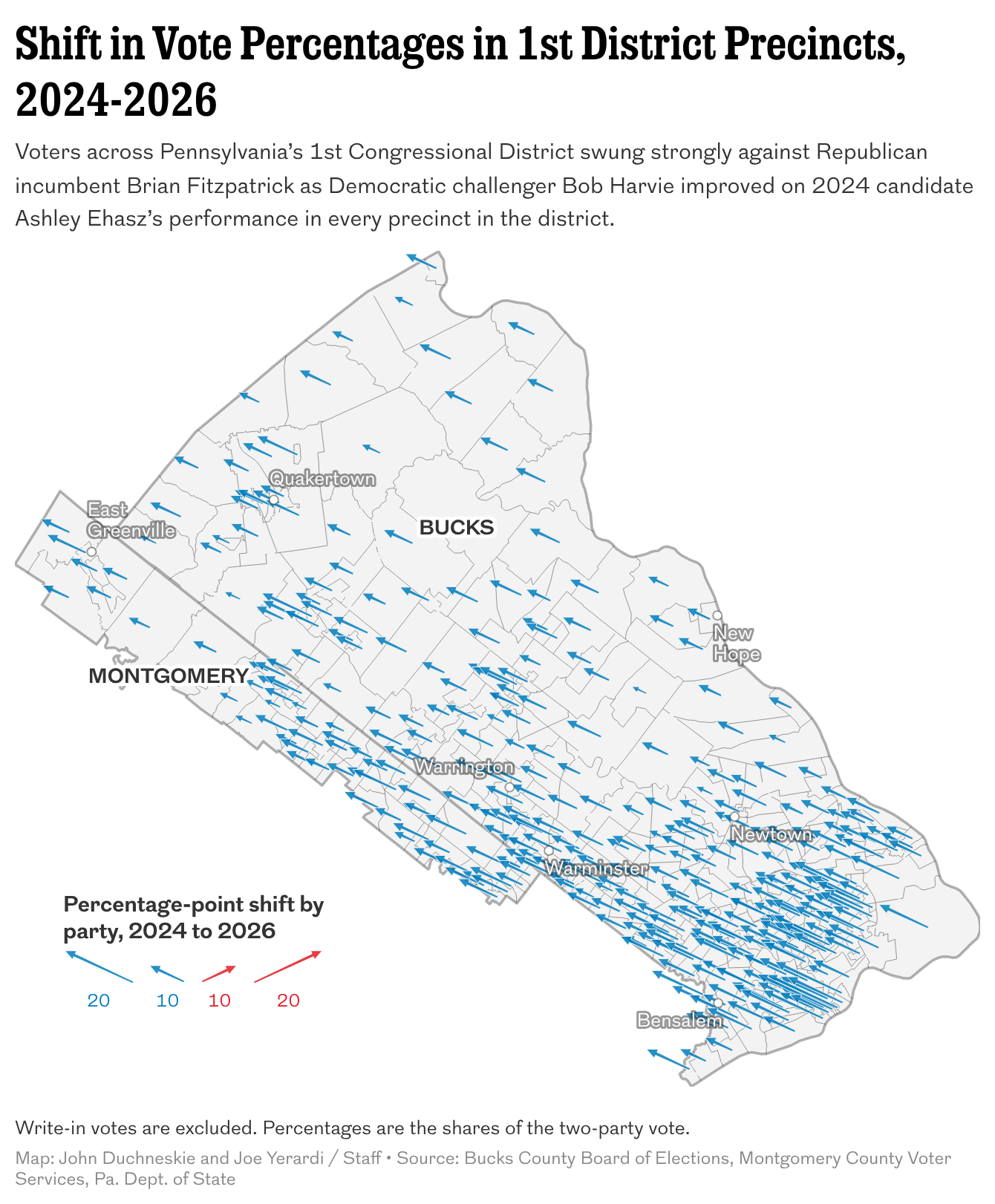
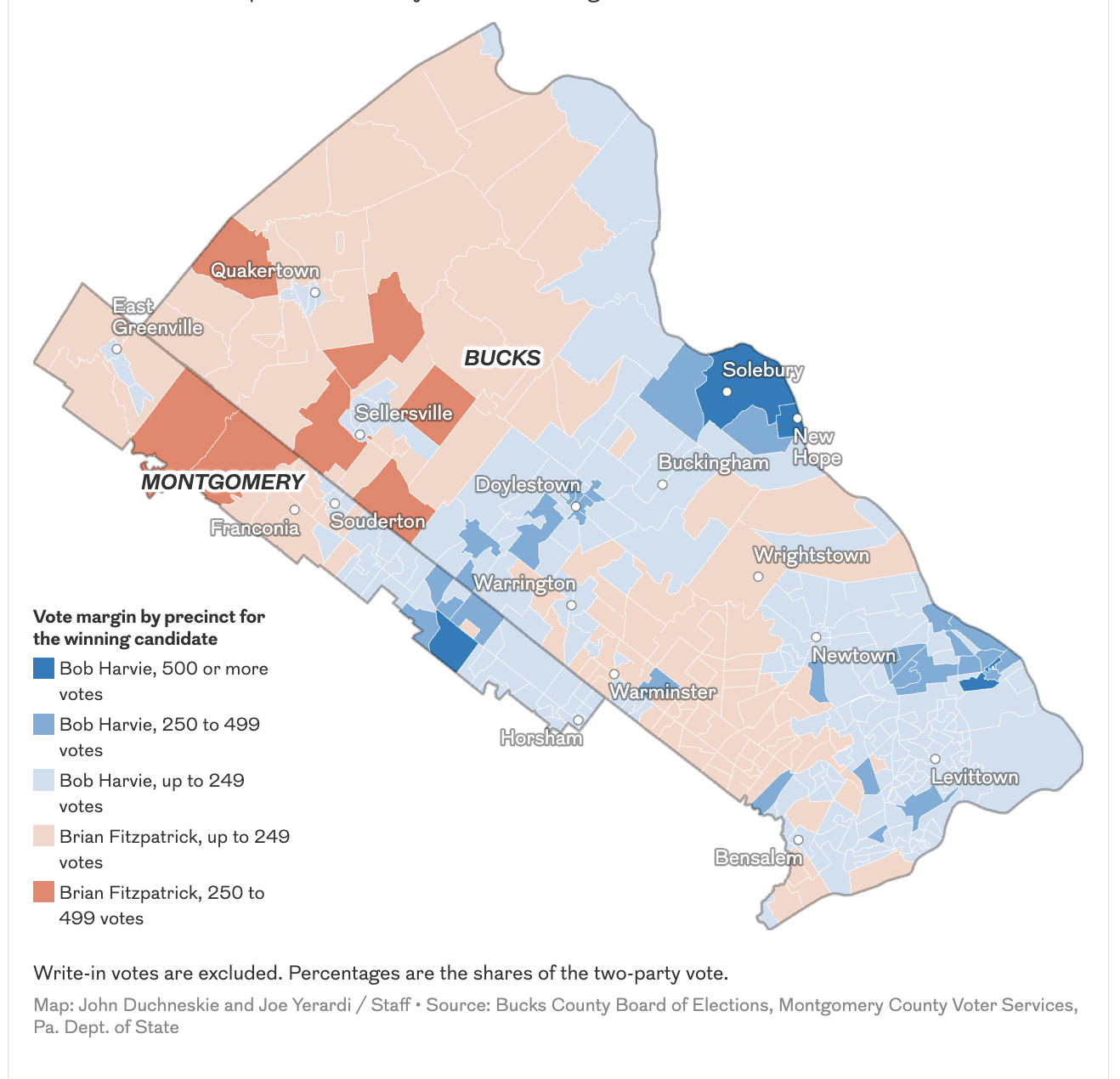
    Every precinct in the 1st Congressional District shifted toward Democrats Tuesday in comparison to 2024.

    Every single one.

    Shift in vote percentages in 1st district precincts 2024-2026.John Duchneskie

    Harvie significantly improved on the performance of Ashley Ehasz, the party’s 2024 nominee, in a year when Fitzpatrick comfortably won reelection by 10 points even as the district went for Democrat Kamala Harris in the presidential race.

    The district covers all of Bucks County and a portion of Montgomery County. Harvie saw his highest vote margins in a precinct in Solebury Township, New Hope Borough, a precinct slightly north of Horsham in Montco, and in a precinct in Falls Township, Harvie’s stomping grounds.

    Bob Harvie received about 52.7% of the two-party vote in his 2026 election victory over Republican incumbent Brian Fitzpatrick in Pennsylvania’s 1st Congressional District.John Duchneskie

    Most of Lower Bucks — a populous part of the county where both candidates are from — went blue, as did most of Central Bucks and the district’s portion of Montgomery County.

    Upper Bucks, a more rural part of the county, leaned red and Fitzpatrick had his largest precinct win margin in a part of Hilltown Township.

    Campaign Scrapple

    • Culture clash: Our colleague Al Lubrano caught an exchange between two voters in Carlisle in the 10th District. Republican Robert House, 57, a beekeeper who said he owns 175 firearms, said he voted for Republican Rep. Scott Perry because he “agrees with the Bible” and opposes abortion. That prompted Adrienne Cedro, a 21-year-old college student, to say she voted to oust Perry and anyone “who’s against the rights of women, LGBTQ, and trans people.”
    • Name that tune: After Republican gubernatorial nominee Stacy Garrity concluded her concession speech Tuesday, she walked off to Fleetwood Mac’s “Don’t Stop” — a song famously associated with Democrat Bill Clinton’s 1992 presidential campaign. Shapiro, for his part, walked off the stage from his reelection victory speech to Tom Petty’s “I Won’t Back Down,” previously associated with George W. Bush’s 2000 presidential campaign until Petty’s team demanded Bush stop using it.

    📸 Behind the scenes snapshot

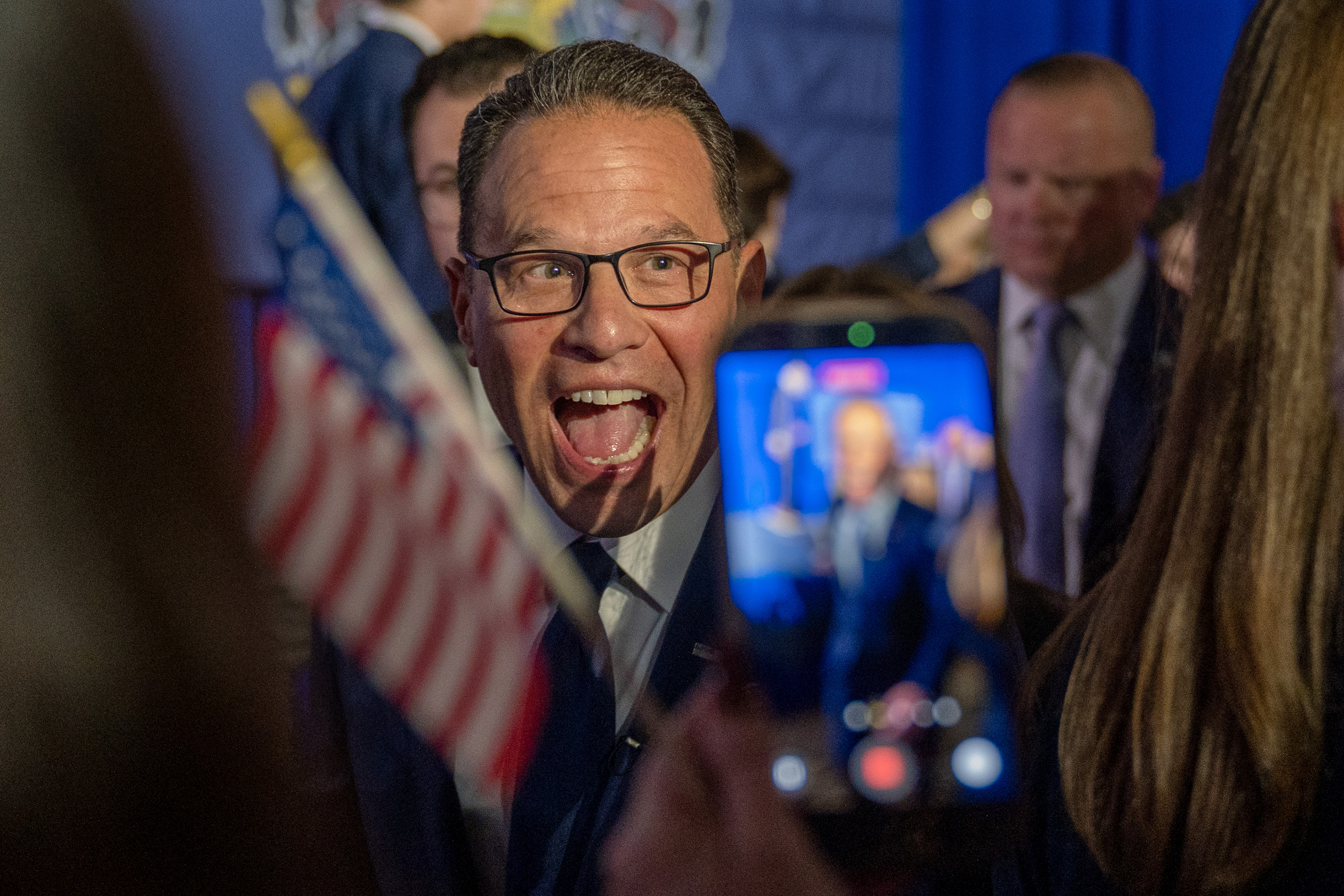
    Gov. Josh Shapiro greets supporters after making his victory speech at his Election Night party in Camp Hill, Tuesday Nov. 3, 2026.Tom Gralish / Staff Photographer

    Rarely do we get to see Shapiro giddy or animated, but our photographer Tom Gralish was able to capture him authentically gleeful on Tuesday evening at his reelection party in Camp Hill. Shapiro went on to bring a similar excitement about Pennsylvania Democrats’ major wins to national network news, as he boasted about his own role in Tuesday’s “bluenami.”

    👀 What we’re watching

    The historic midterm results didn’t just answer massive lingering questions about the limits of Trump’s enduring stranglehold on American politics. It raised countless others — transforming the range of possibilities for the rest of Trump’s time in the White House and far beyond it.

    How will Democrats unite — or butt heads — as they wield their new majorities in Congress amid their own ideological battles? How will Republicans, both in Pennsylvania and Washington, handle the repudiation of a president who’s molded their party in his image over a decade?

    By mid-2027, we’ll also likely — finally — get answers to critical questions about 2028.

    Will Josh Shapiro launch a long-rumored campaign? And, if so, how will his record in the nation’s largest swing state match up against what’s almost certainly going to be a huge field of other Democratic governors, senators and outsiders?

    The other big prize on the 2028 ballot for both parties will be John Fetterman’s seat in the U.S. Senate. Fetterman’s decisions about his own future are a mystery that may not be answered any time soon.

    But Democrats who’ve been promising for months to oust him are already preparing to run (check out our coverage of Rep. Chris Deluzio here) or deciding against it (Rep. Brendan Boyle is taking his talents to the Budget Committee chairmanship).

    Quote of the week

    Christopher Nicholas, a GOP consult, described the reality for Pa. Republicans.William Thomas Cain / For The Inquirer

    Nicholas, a veteran strategist who grew up in Bucks County, captured the reality for Republicans after their wipeout across the state and country.

    It happens.

    Democrats were the bug just two years ago when they lost every statewide race and two congressional seats. But this year, they were the windshield, and Republicans went splat.

    The contrast in mood between the two parties was stark.

    Harvie held his election night party at a massive wedding venue while Fitzpatrick watched in private and Bucks County Republicans kept a small watch party closed to the media. And up in Wyoming County, the AP called Garrity’s loss a minute after polls closed, as people were still filtering into her party.

    👋 Thank you for following along on our journey through the homestretch of this chaotic, exciting, and unpredictable midterm cycle. This may be our last PA 2026 newsletter, but you can always find our in-depth reporting here.

    And see you in 2028? 😎

    By submitting your written, visual, and/or audio contributions, you agree to The Inquirer’s Terms of Use, including the grant of rights in Section 10.

  • European air traffic targeted by new threats in at least 3 incidents

    European air traffic targeted by new threats in at least 3 incidents

    COPENHAGEN, Denmark — Police in Denmark and the Czech Republic investigated threats to air traffic on Friday, while a Romanian plane received a bomb threat following a string of hoaxes that have targeted flights and disrupted travel across Europe this week.

    A flight from Prague to Bucharest operated by Romanian carrier Tarom received a bomb threat. The plane landed at its intended destination, and airport administration officials said the bomb threat proved to be false.

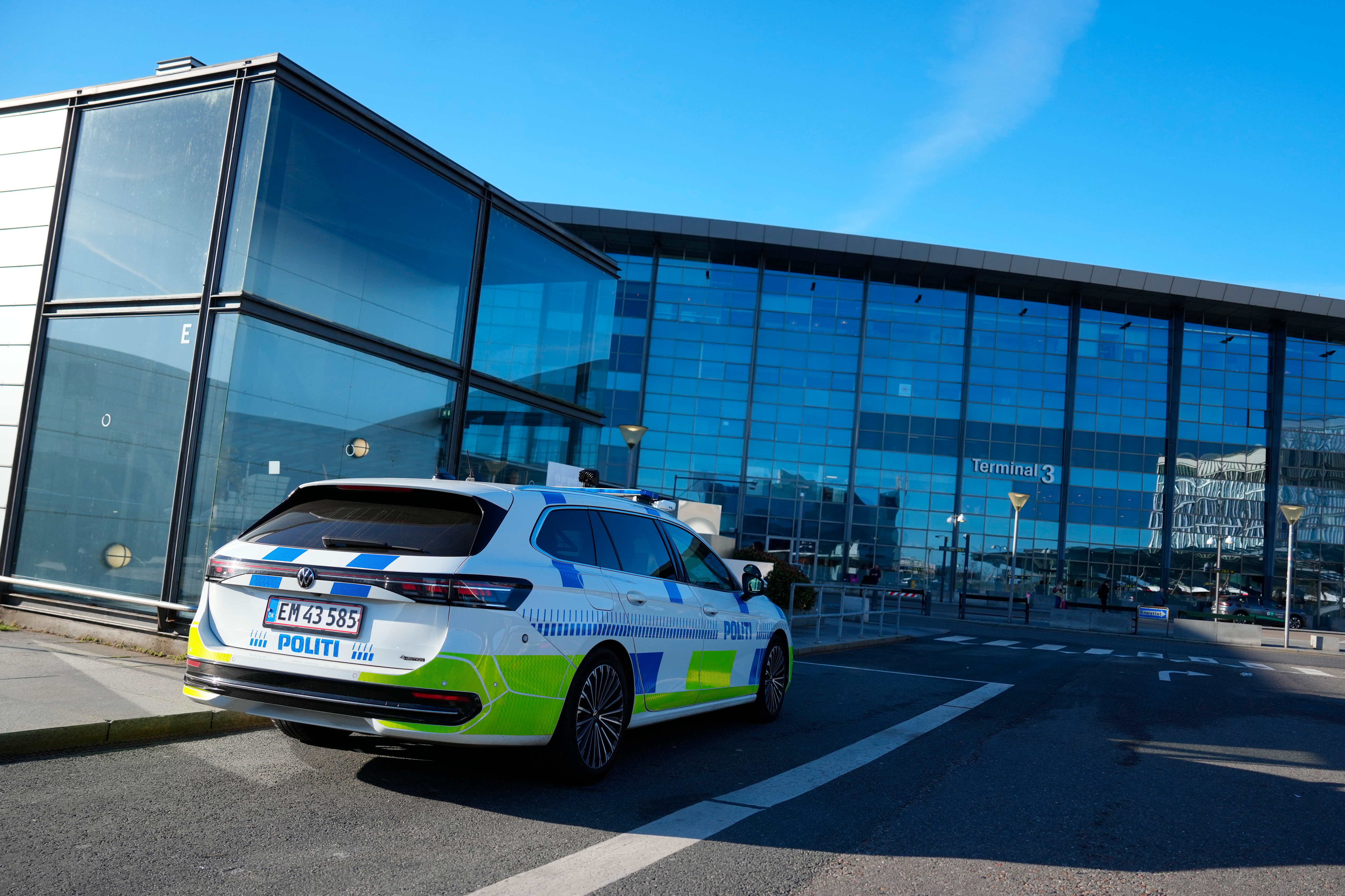
    In the Danish capital, Copenhagen, police said Friday they were present at the airport for a second consecutive day “in connection with threats directed at air traffic.” They said their immediate assessment was that there had been no danger to passengers or to others at the airport. It added that air traffic was proceeding safely and without disruption.

    Czech police also said they were again dealing with threats against planes on Friday. They said necessary security measures have been taken in cooperation with Prague’s Vaclav Havel Airport that have “a minimal impact on the normal operations at the airport.”

    Meanwhile in Ireland, the Dublin headquarters of national broadcaster RTE was evacuated Friday after a bomb threat, and live broadcasts were replaced with pre-recorded programs.

    Ireland’s police force, An Garda Síochána, said it was ”aware of a threat made against media organisations here and in Europe.” It said that it has been liaising with Irish media organizations and the threat will be investigated.

    More than two dozen flights were affected by threats earlier in the week, with some diverted as authorities scrambled to rule out any danger.

    Europe has experienced a slew of other disruptions recently, such as attacks on supermarket refrigeration systems, drone incursions and mysterious triggers to alert apps.

    Fake bomb threats are relatively common but it is unusual to see so many in such a short period. They come at a time of increased geopolitical tensions and warnings from authorities that Russia may be ramping up so-called hybrid threats in Europe.