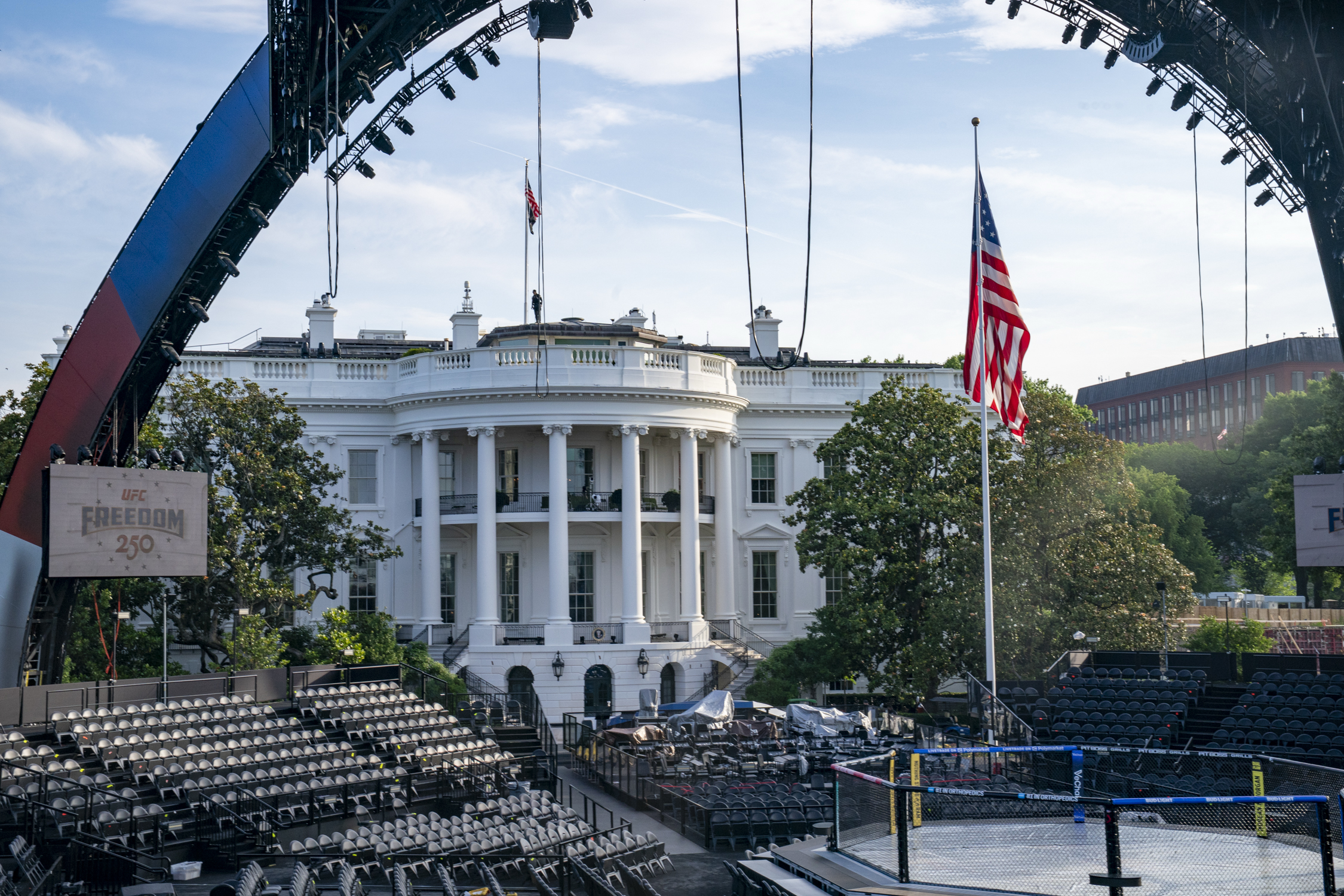
The walls of the eight-sided cage where fighters will pummel each other Sunday on the South Lawn of the White House were plastered with logos for Polymarket, the prediction market where traders had staked millions on the fights.
Across sportsbooks, fans are placing bets on whether President Donald Trump will receive a birthday cake at the event, whether first lady Melania Trump will appear at his side, or whether the now-80-year-old president will fall asleep during a bout.
Less than a decade ago, wagering on a sporting event was a crime in all but a handful of states. On Sunday, the mat of the octagon Trump ordered placed on White House grounds advertised for Stake, a Caribbean-based online casino and sportsbook.
Welcome to UFC Freedom 250 — and to the latest improbable milestone in the transformation of betting from a shadowy, mostly illegal pastime into a mainstream force in American sports, culture, and politics.
The event marks a triumph for an industry that has grown into a multibillion-dollar juggernaut in eight years — and is now expanding beyond sports through prediction markets such as Polymarket, which allow users to wager on everything from Ultimate Fighting Championship fights to election contests and more. But the industry’s embrace by the White House comes as lawmakers and regulators face the consequences of an explosion in legal gambling, including addiction and mounting consumer debt.
“Right now it’s certainly in its heyday,” said Bradley Tusk, a political strategist who helped FanDuel navigate gambling laws more than a decade ago and is now advising prediction markets.
Trump, a former Atlantic City casino owner, has emerged as a natural ally for the sports betting and prediction market industries. He purchased $35,000 to $50,000 of stock in DraftKings earlier this year, according to his financial disclosure filings, and his social media company, Truth Social, also has said it is working with Crypto.com to launch its own prediction market, Truth Predict. Crypto.com’s logo appeared on the steps to the UFC cage, and it was a primary sponsor of the Sunday fights.
In April, Trump said that he was “never much in favor” of prediction markets but later told reporters, “A lot of other countries are doing it, and when the other countries do it, we get left out in the cold if we don’t do it.”
“I know people that are in the prediction market business, and they’re pretty happy with it,” he added. Trump’s son Donald Trump Jr. has invested in Polymarket through his venture capital firm, and he has advised both Polymarket and Kalshi.
Trump “sort of embodies the casino capitalism of the late 20th and early 21st century,” said Jonathan D. Cohen, who leads gambling policy at the American Institute for Boys and Men. “It makes too much sense that his family would have personal investments in the prediction markets and support the rise of gambling on everything, and place a UFC fight on the White House lawn.”
The White House said in a statement that the Trump family’s investments do not pose a conflict of interest, promising that the UFC fights would be “one of the greatest and most historic sports events in history.”
“President Trump only acts in the best interests of the American public — which is why they overwhelmingly reelected him to this office, despite years of lies and false accusations against him and his businesses,” White House spokesperson Davis Ingle said. “President Trump’s assets are in a trust managed by his children.”
UFC and Stake did not respond to requests for comment. Polymarket said in a statement that it was “proud to sponsor” the White House fight.
The White House fights were not expected to generate an unusual volume of betting for UFC matches, said Chris Grove, partner emeritus at Eilers & Krejcik Gaming, a research firm focused on the global gambling industry. He anticipated that the total volume of wagers and trades would be measured in the tens of millions, rather than the hundreds of millions — far smaller than for major sports betting events such as the Super Bowl or FIFA World Cup.
But the event’s role as a billboard for the betting industry has attracted criticism.
“It’s an abomination that we have these sports betting markets sponsoring something that’s happening on the lawn of the chief executive officer of the United States,” said Joel Griffith, a senior fellow at Advancing American Freedom, a conservative think tank founded by former Vice President Mike Pence. “It shows that there’s a lot of money to be made in this business. Unfortunately, [sports betting] is harming Americans.”
Griffith also said he’s “deeply troubled” by the potential conflicts of interest posed by the president’s investments in betting markets and in UFC while hosting an event that advertises both businesses.
Congress advanced bipartisan legislation in 1992 that outlawed sports betting in every state except Nevada, highlighting how politically unpopular it once was to support the practice. Oregon, Delaware, and Montana had limited carve-outs.
But since the Supreme Court struck down that law in 2018, 39 states have legalized sports betting, and bettors have wagered more than $650 billion, according to estimates from Legal Sports Report. The decision enabled the rise of companies such as FanDuel and DraftKings, which allowed people to bet on games directly from their cellphones.
Internet searches for help with gambling addiction, such as “am I addicted to gambling,” have cumulatively increased 23% nationally since the 2018 Supreme Court decision, according to 2025 research from the University of California at San Diego Qualcomm Institute and School of Medicine.
The rise of prediction markets such as Kalshi and Polymarket also has provided a new avenue for people to bet. Combined monthly global trading volume on the platforms has risen from less than $5 billion in September 2025 to about $24 billion in April 2026, according to Pew Research Center’s analysis of data from the Block, a digital assets media and information firm.
The administration proposed new regulations for prediction markets Wednesday that are aimed at allowing most wagering, while restricting bets that are particularly vulnerable to manipulation and those that aren’t in the public interest, such as bets related to terrorism, assassination, or war.
Multiple lawmakers have proposed bills that would regulate prediction markets. One from Sens. Adam Schiff (D., Calif.) and John Curtis (R., Utah) would bar prediction markets from offering sports betting, which they argue circumvents state gaming laws and legalizes sports betting nationwide.
The administration’s proposed rule is “a backdoor for legalized sports gambling,” Schiff said in a statement, adding, “the sight of profiteering and gambling on the White House lawn in celebration of [Trump’s] birthday is problematic enough, we must ensure it is not compounded by insider trading and other conflicts of interest.”
Other proposals would regulate the markets and ban elected officials from trading on them, or ban betting on sensitive events such as war, terrorism, and elections as well as sports.
Lawmakers in Congress also are trying to rein in their own access to prediction markets, raising concerns about conflicts of interest and insider trading. The Senate passed a resolution in April prohibiting senators and staff from using prediction markets, and Rep. Bryan Steil (R., Wisc.) is working on legislation to ban current and former members and candidates from betting on political events.
But such legislation faces an uncertain future as long as Trump is in the White House and holds veto power.
“There’s lots of concern from both sides of the aisle about prediction markets, but there’s also this gnawing sense that the White House will block any attempt to rein them in,” said Cohen, who also wrote Losing Big: America’s Reckless Bet on Sports Gambling. “It’s going to get bigger before it gets smaller.”
SEATTLE — The revolution begins with a poetry reading.
Last month, a journalist turned organizer named Andrew Engelson invited friends and fellow Pacific Northwesterners to a small club in Seattle’s Capitol Hill neighborhood for an evening of verse, in which his guests would ponder what it means to be from “Cascadia,” the bioregion stretching from Northern California, through Oregon and Washington, into British Columbia.
Odes to volcanoes, woods, and rivers would help the audience reach the same conclusion he has: The region might be better off leaving the United States.
Engelson and his group, Cascadia Democratic Action, are trying to drive conversations that could lead to 2028 ballot measures in Washington and Oregon on secession if things don’t improve. The effort is hardly an outlier in these Disunited States, where frustration on the left and right has created small but vocal collections of Americans so fed up with feeling disempowered that they’re talking about redrawing state lines or dissolving them altogether.
“The salmon don’t pay attention to the 49th parallel,” Engelson said, referring to the U.S.-Canada border. “I have way more in common with someone in Vancouver, B.C., than someone in Arkansas.”
Separatism is “in the zeitgeist,” said Ryan Griffiths, a Syracuse University political scientist who wrote the 2025 book The Disunited States: Threats of Secession in Red and Blue America and Why They Won’t Work.
Activists in Texas and California continue to push independence. Lawmakers in inland California have pitched splitting the state in two or three. Organizers in southeastern New Mexico want to join Texas.
Republican lawmakers in Indiana approved legislation last year inviting conservative counties in Illinois to become Hoosiers. A state senator in West Virginia followed suit in late 2025, inviting 30 border counties from Virginia and Maryland to join the Mountaineers.
North of the 49th parallel, conservative Alberta is moving toward a referendum in October asking: Do you want to stay in Canada or have a separate, binding referendum to secede?
The people Griffiths interviews often sound remarkably similar, he said.
“Whether they’re libertarian or conservative or liberal,” he said, they complain that government is “in their face, it’s dysfunctional, and it’s distant.”
One of the most successful of those efforts is, like Engelson’s, based in the Northwest, but on the opposite end of the political spectrum. The Greater Idaho movement, a 6-year-old campaign to move a large swath of rural, conservative Oregon into neighboring Idaho, has won support in 13 county ballot measures and turned a once-fringe idea into a subject of state capital debate.
“Our system is not quite functioning the way it’s supposed to,” said Matt McCaw, a spokesperson for Greater Idaho.
Greater Idaho proponents argue that their movement reflects frustrations that date to Oregon’s earliest days. At the 1857 meeting to draft Oregon’s founding document, 59 of the 60 delegates came from west of the Cascade Mountains.
Today, eastern Oregon makes up roughly two-thirds of the state’s land mass but only 10% to 15% of its population. Lawmakers from Portland and the Interstate 5 corridor dominate policy debates and have pushed through gun laws, environmental regulations, and tax changes that many in rural Oregon oppose.
As western Oregon transitioned from an economy built on timber, farming, and manufacturing to one driven by technology and services, the disconnect has grown.
“They just don’t understand us on the other side of the mountains,” said Dan Joyce, the county judge in Malheur County, Ore., whose voters were among the earliest and strongest supporters of Greater Idaho.
Semir Dzebo, a postdoctoral researcher at Oxford University who worked on a 2025 study on Greater Idaho, said public polling conducted through the study showed that the effort was less a partisan fight than an economic one.
In other parts of the world, efforts to redraw boundaries are often rooted in long-standing ethnic, linguistic, or national identities tied to particular places, such as Scotland in the United Kingdom or Catalonia in Spain. Since the Civil War, America has felt “inoculated” against separatist movements, Dzebo said, “because it rests on a civic understanding of nationalism, that there’s no particular ethnicity that is ‘American.’”
But as electoral politics have become more polarized, and as the gap between the rich and everyone else has grown, the sense of a shared American identity has eroded.
“What propels these movements is when that sense of feeling different really comes with economic consequences,” Dzebo said.
In that regard, the Greater Idaho movement and the Cascadia secession effort are cousins. McCaw doesn’t think elected leaders in the Oregon capital represent him. Engelson feels the same about Washington, D.C.
Cascadians argue that people are often bound more closely by geography, ecology, and regional economies than by national borders, particularly when the borders stretch so far in every direction. Engelson said Washington and Oregon progressives could get more value from their tax dollars if they formed their own smaller political unit and paid for priorities such as universal healthcare and free college tuition.
A number of states are already engaging in a form of “soft secession,” by conducting multistate public health efforts during the COVID-19 pandemic or forming compacts to address climate change.
But none of the secessionist movements are close to achieving their goals.
The Constitution provides a mechanism for changing state boundaries with the approval of legislatures in both affected states and Congress. But that tends to go only one direction. Neither Virginia nor Illinois has responded to the overtures of its neighbors.
Oregon Democrats have declined to meet with proponents of Greater Idaho, and neither President Donald Trump nor Oregon’s lone Republican Congress member, Cliff Bentz, has answered calls for help. And voters in two of the counties that initially embraced the idea have since backtracked.
The Cascadia movement faces an even larger obstacle. In the 1869 case Texas v. White, the Supreme Court ruled that the nation was “indestructible” and that states could not unilaterally secede. The court left open the possibility that a state could leave through “revolution” or with the consent of the other states but rejected the idea that a state could simply vote its way out.
Hugh Spitzer, a retired University of Washington law professor who began studying separatist movements in law school, laid out a possible path through a treaty negotiated by the president and ratified by two-thirds of the Senate. But that would take decades and require momentum driven by more than a single political moment.
Engelson said the second Trump administration had convinced him that conversations about separation could no longer remain theoretical.
“We’re in an abusive relationship with the federal government,” he said. “Divorce is a valid response.”
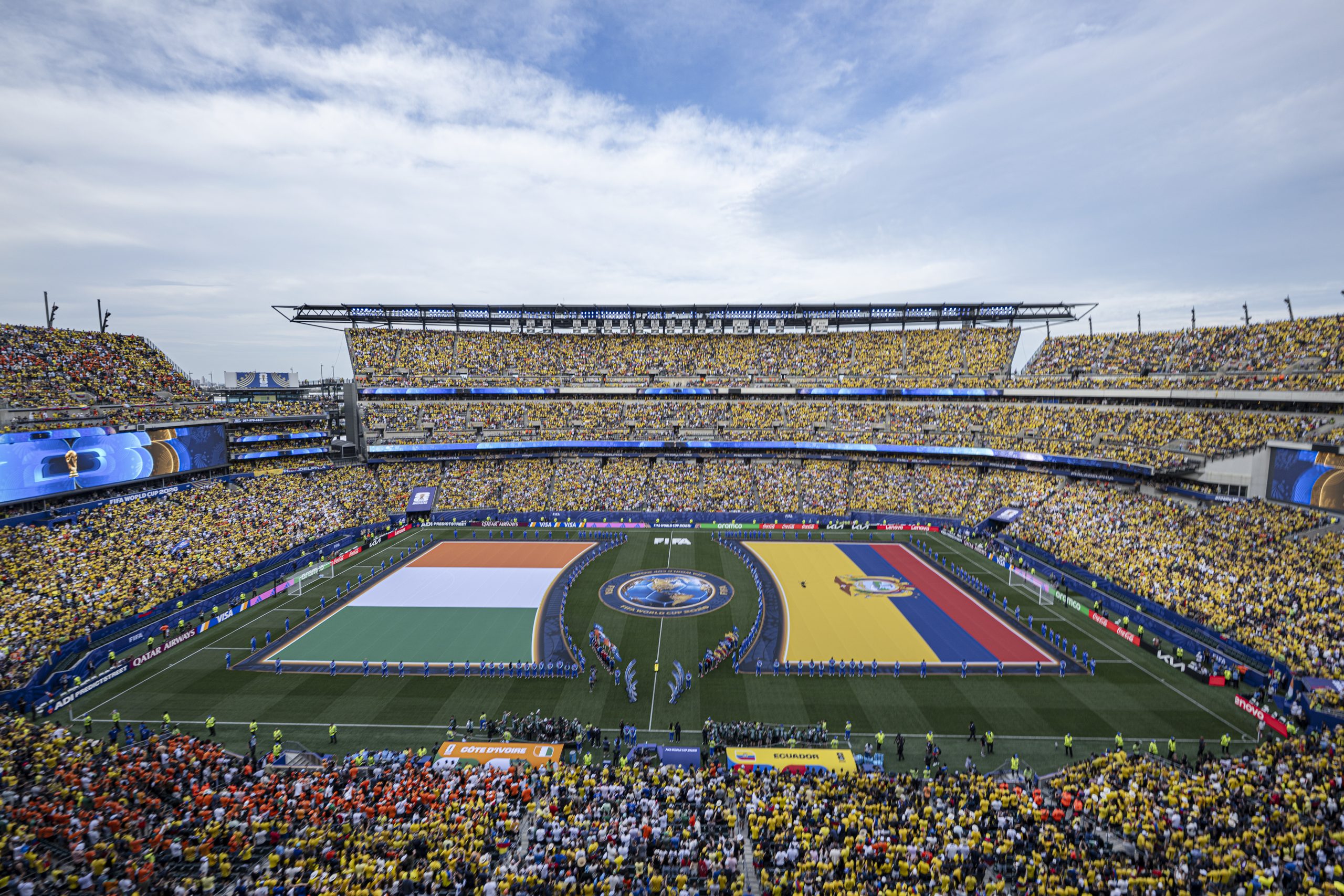
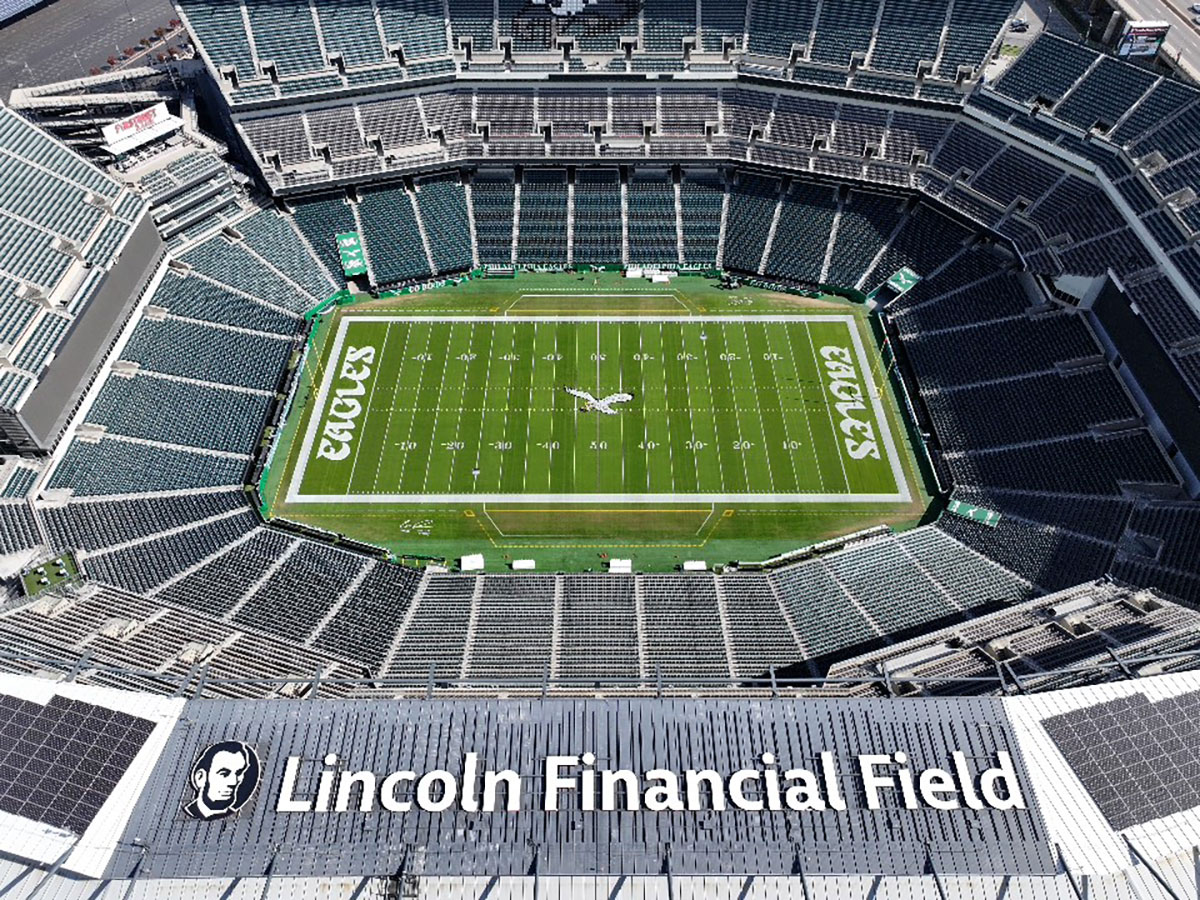
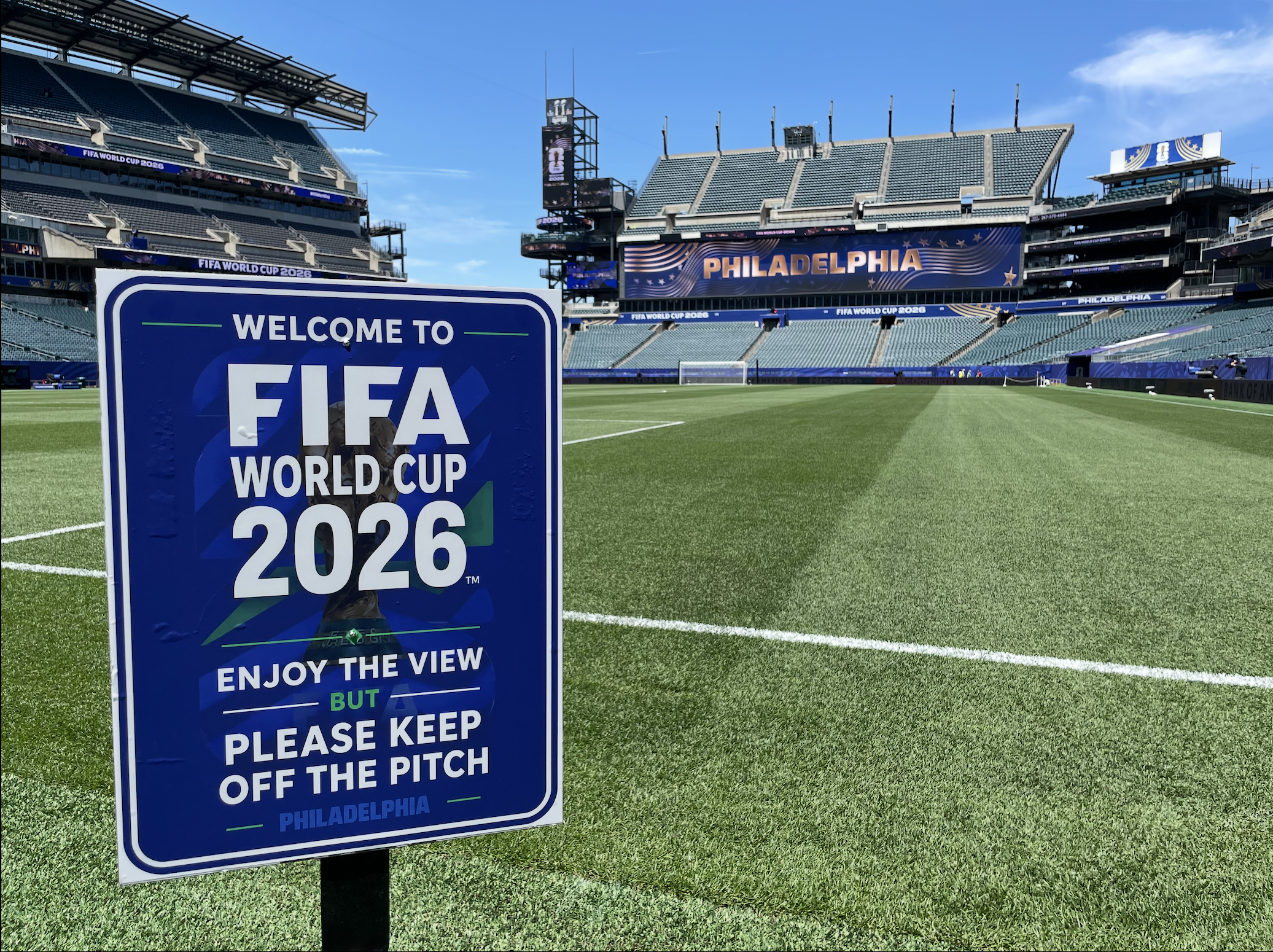
Lincoln Financial Field has been renamed “Philadelphia Stadium” for the duration of the event. In addition to five group stage games, the city will host a Round of 16 game on July 4.
On Friday night, the U.S. national team got its World Cup started with a bang: a 4-1 win over Paraguay on home soil.
// Timestamp 06/14/26 10:15pm
Philadelphia was the star in its World Cup debut
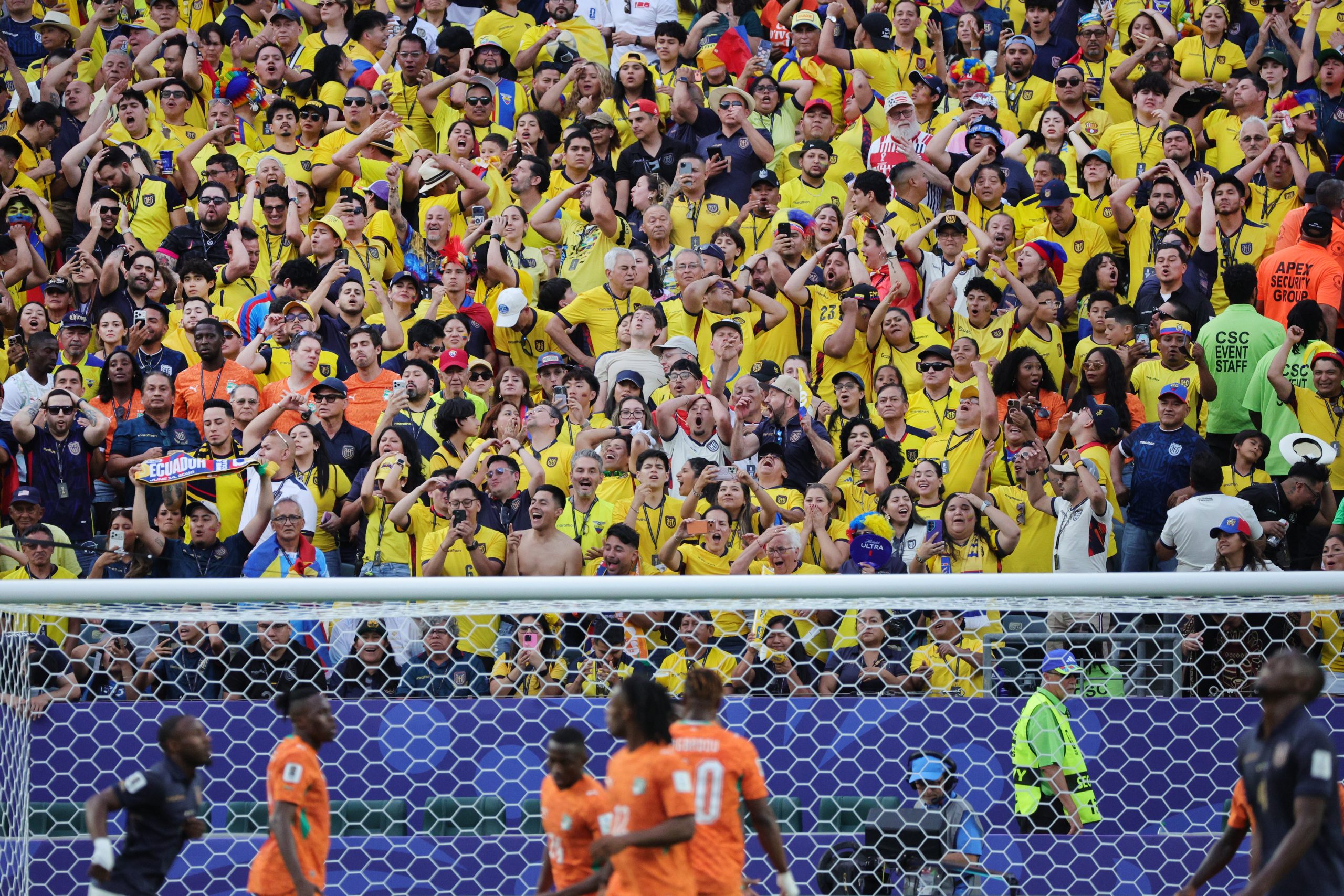
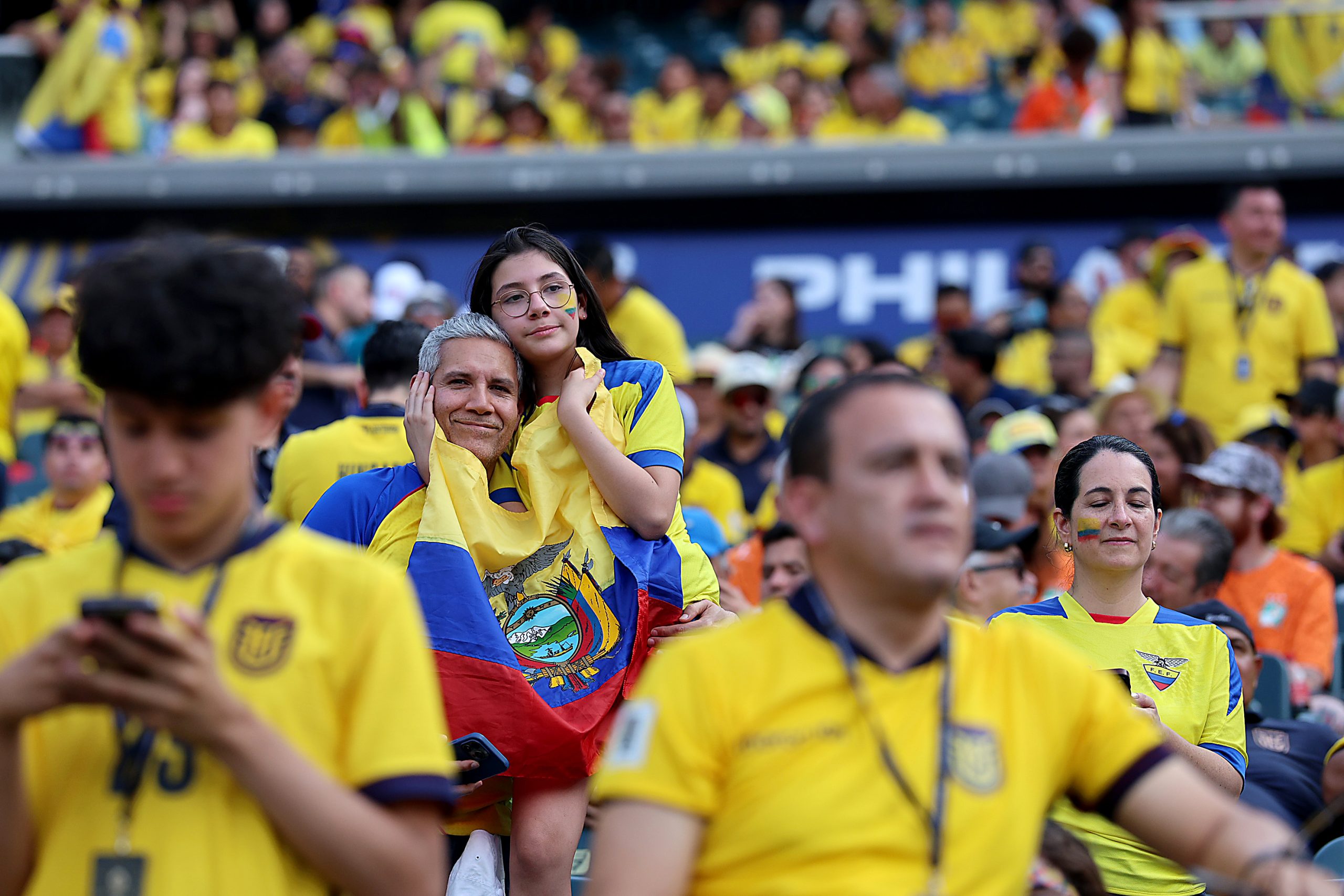
Ecuadorian fans react at a missed scoring chance against Ivory Coast during Sunday’s World Cup match. David Maialetti / Staff Photographer
It took 96 years, but the most sacred version of the beautiful game came to Philadelphia.
Both the city and the match met the moment.
Extra public transportation, hydration stations, and modest traffic framed an evening of graceful and powerful football, the kind every other nation reveres except ours.
Amid the spectacle of team jerseys, flags, and team benches covered by vibrant roofs identifying the sides in national colors, the grass was the star. The stadium’s normal turf is a ragged Bermuda thatched with 5% plastic to withstand the cleated NFL rhinoceroses who usually play there.
For the World Cup, it was transformed into a flawless pitch, golf-course quality ryegrass and bluegrass, the sort of surface you could imagine Jason Kelce lying on his back and making snow angels.
Viewed through an international lens, even a soccer game this insignificant still was the most significant sporting event in the history of the city. A town that has seen two World Series titles and a Stanley Cup won within its borders has never hosted anything that riveted folks on six of the continents.
What comes close? Maybe Rocky Marciano, when he knocked out Jersey Joe Walcott in 1952, and won the heavyweight championship. Maybe not.
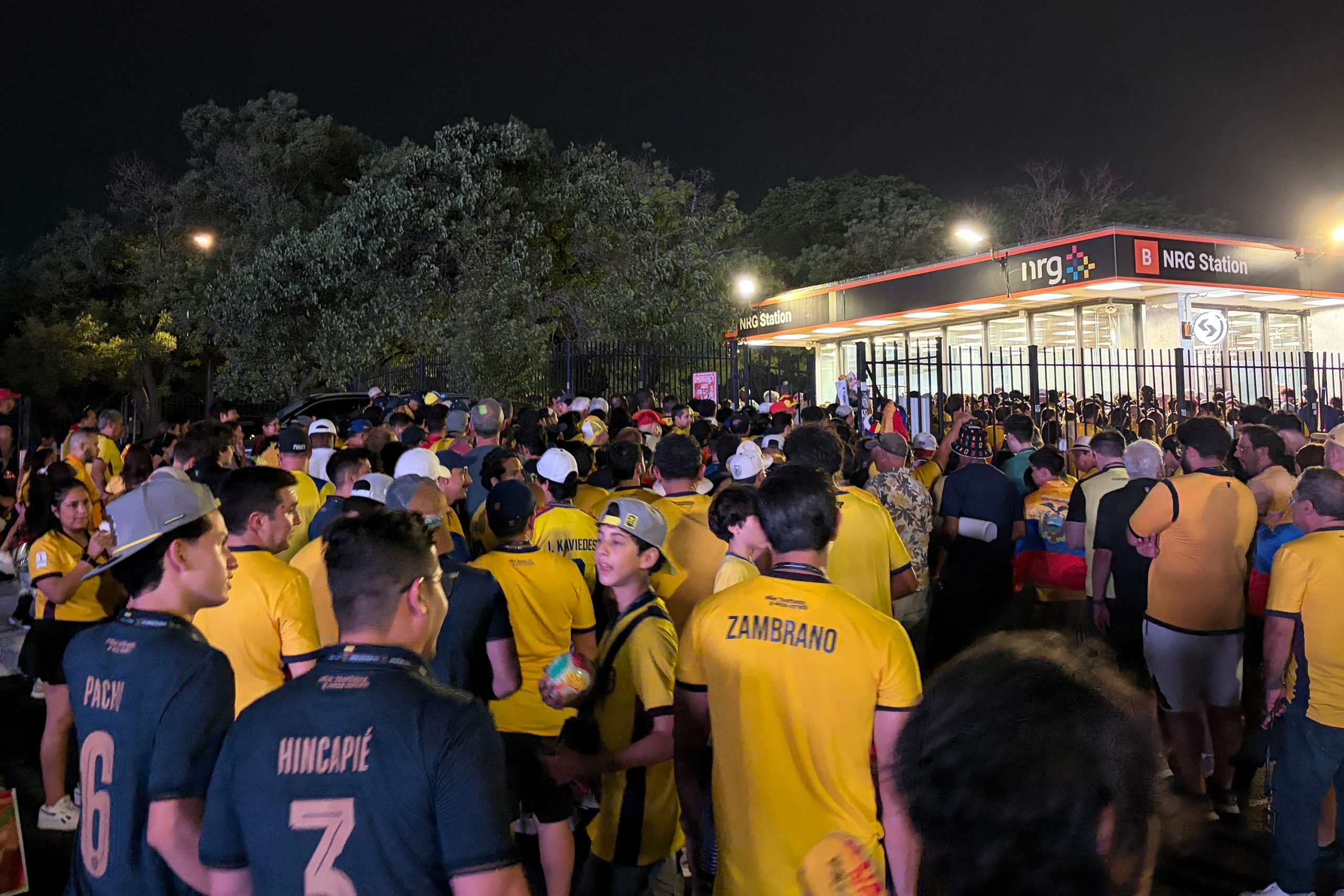
Long wait at NRG Station following Philly World Cup match
Soccer fans wait to enter NRG Station outside Lincoln Financial Field following Sunday night’s World Cup match.Michelle
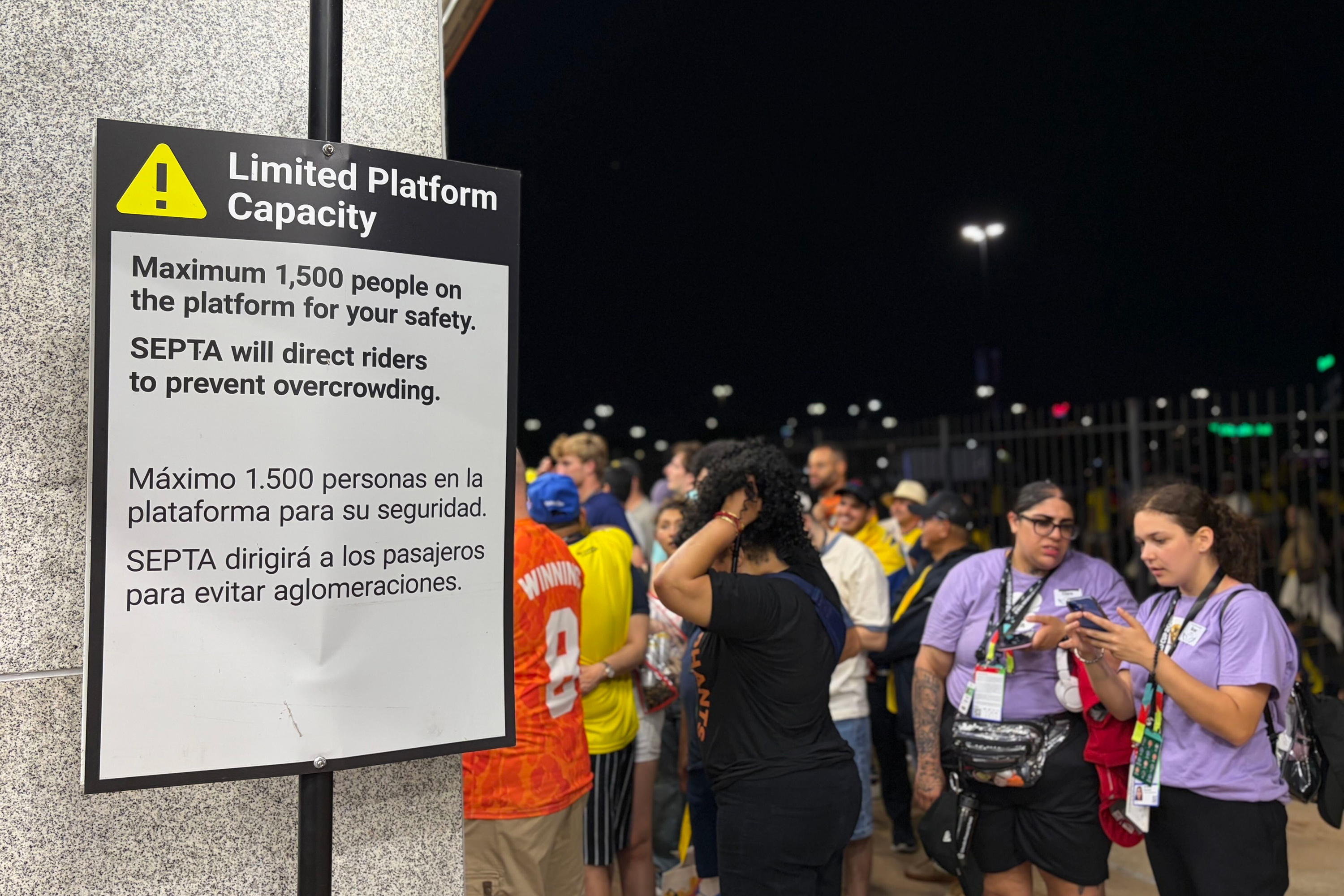
Hundreds of soccer fans waited outside NRG station, a bottleneck at the turnstiles not appearing to break apart anytime soon. Fans chatted in Spanish, sat on plantersm and leaned against yellow gates waiting for entry into the train station.
A SEPTA worker who asked not to be identify said there were already almost 1,500 fans in the platform, so people had to weight until it clears out.
Meanwhile, Ubers to City Hall were ranging between $70 to $78 a ride. On a normal night, they’d run about $15.
Fans hurry to their cars, trains, and buses as storms move into Philly
Fans wait outside SEPTA’s NRG Station near the stadium following Ivory Coast’s victory over Ecuador Sunday night.Michelle Myers
Fans hustle to their cars in South Philly as lighting can be seen in the distance.
For subway riders trying to move closer to the station, the wait might be lengthy, as hundreds of of Ecuadorian fans await by the doors for their turn to get it.
The National Weather Service issued a severe thunderstorm watch for Philadelphia and the surrounding counties Sunday evening that will remain in effect until 1 a.m. Monday morning.
Along with lightning and rain, forecasters say wind guts up to 60 miles per hour are possible, as is quarter-sized hail and potentially a tornado.
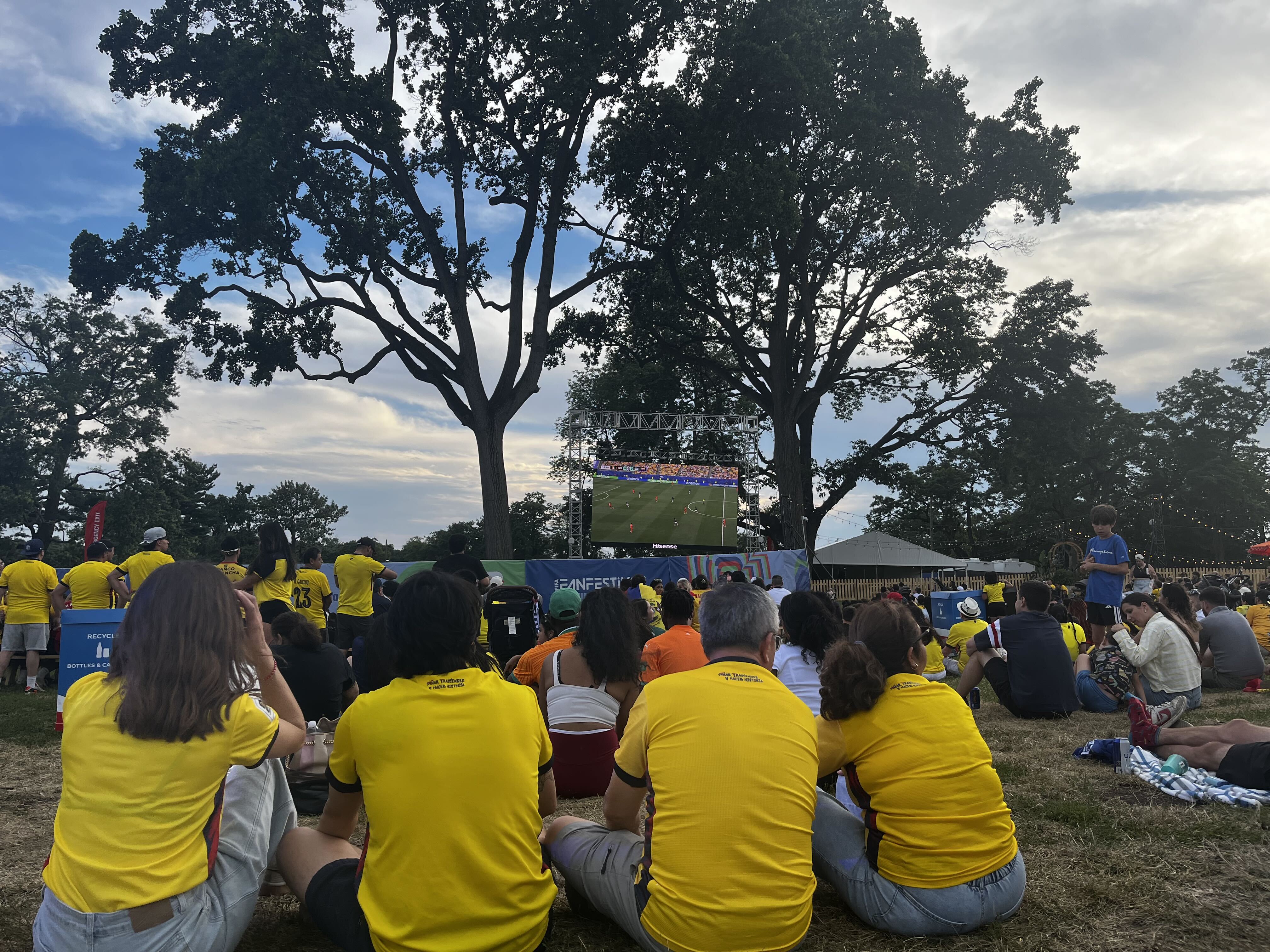
Over at FIFA’s Fan Festival at Lemon Hill in Fairmount Park,, crowds walked along Girard Avenue and Kelly Drive up to Fairmount to access rideshare pickup zones and the Philly PHLASH.
Crowds are funneled to these roads to stay on main thoroughfares, where many impromptu street vendors awaited to sell water and snacks and merchandise. Ice cream trucks also took this as a hint to set up shop.
At Pennsylvania and Fairmount, SEPTA had additional 32 and 48 Busses waiting as additional transportation and were waiting to fill up in order to take the maximum amount of passengers. A total of 4 buses were at the intersection waiting to take passengers at one point.
Police were stationed at various exits and intersections near the festival.
Ivory Coast defeats Ecuador in first-ever Philly World Cup match
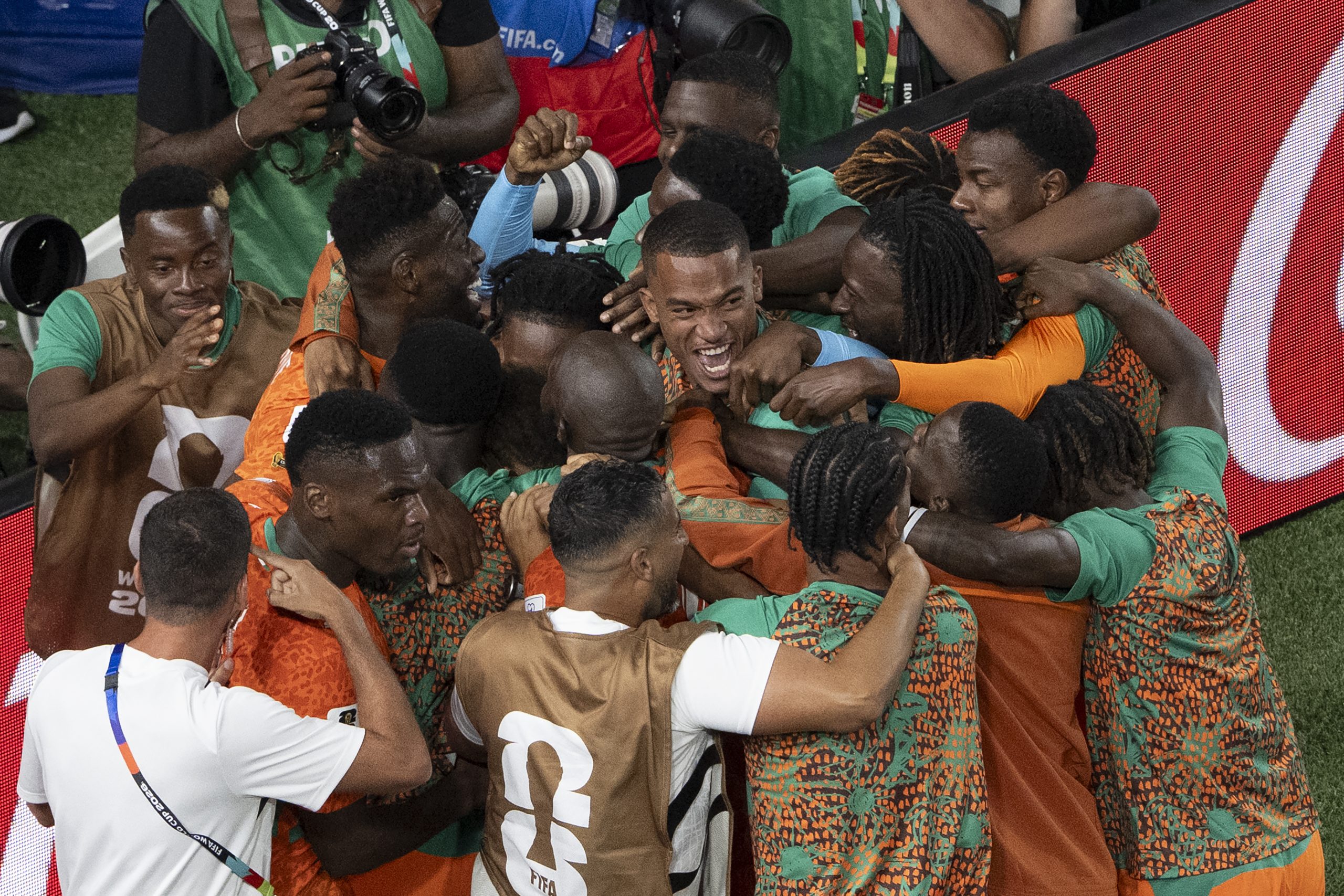
Ivory Coast’s Amad Diallo is congratulated by teammates after scoring the lone goal in a 1-0 victory over Ecuador Sunday in Philly.Jose F. Moreno / Staff Photographer
Amad Diallo will go down in the annals of Philadelphia sports history as the first goalscorer in a World Cup hosted in the City of Brotherly Love. More importantly, his first-time shot in the 90th minute sealed three points in Ivory Coast’s Group E opener against Ecuador on a beautiful night for soccer inside Lincoln Financial Field.
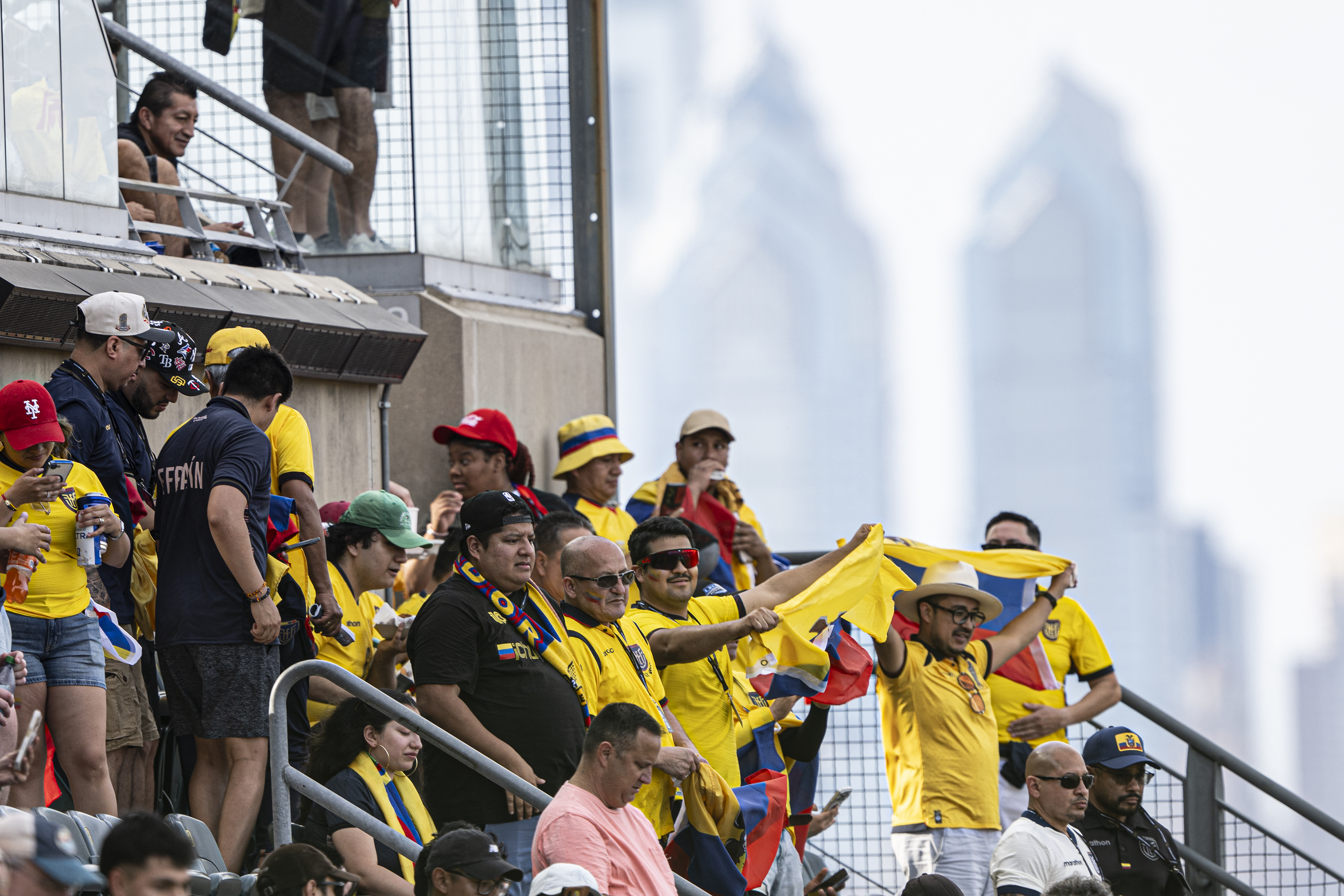
He broke the hearts of a pro-Ecuadorian crowd of 68,274 who sang, cheered and for some even cried to take part in a game that is arguably the biggest sporting event the venue has ever held.
Next up for Ivory Coast, a trip to Toronto to face Germany on Saturday (4 p.m., Fox29), before making their return to Philadelphia to take on World Cup first-timers Curacao on June 25 (4 p.m., FS1).
Ecuador is also back in action this Saturday against Curacao in Kansas City (8 p.m., FS1)
Thousands of cheering fans bathed in stadium lights at Lincoln Financial Field could been seen through a gap between stadium walls from across the street at Stateside Live!
Inside the food court a sea of yellow shirts populated the tables and bars. As Ivory Coast scored, a small but rowdy crew cheered loudly, pumped fists in the air and slapped each other as Ecuador fans sighed.
“Ivory Coast! Ivory Coast! Ivory Coast!” the crew chanted inside, through the doors and out on the patio. They passed two people dressed in green and orange, the two groups screamed excitedly at each other, and the original chanters went on their way through the patio.
Fans also celebrated Ivory Coast’s 1-0 victory outside FIFA’s Fan Festival at Lemon Hill in Fairmount Park.
With the final whistle, thousands of people – some cheering after an Ivory Coast win, others with their heads hung low after the Ecuadorian loss – walked in calm crowds to the exit.
Within half an hour, crowds walked back to their cars, rideshare pickup zones, and SEPTA and PHLASH bus stops with no issue.
As opposing teams fans walked by each other they shook hands, laughed, and went about their night. Just an hour before, Lemon Hill was shaking with horns blasting and fans screaming.
Now the neighborhood is returning to a calm quiet, before the party eventually picks up again during the next World Cup match.
A resounding “No” echoed through the stadium as Ecuadorian fans covered their faces in disbelieve as Ivory Coast took a 1-0 lead in their World Cup matchup in South Philly.
Ivory Coast fans, scattered across the stadium amid a sea of yellow, screamied with emotion after Amad Diallo’s strike.
Ecuador and Ivory Coast remain scoreless, but fans remain confident
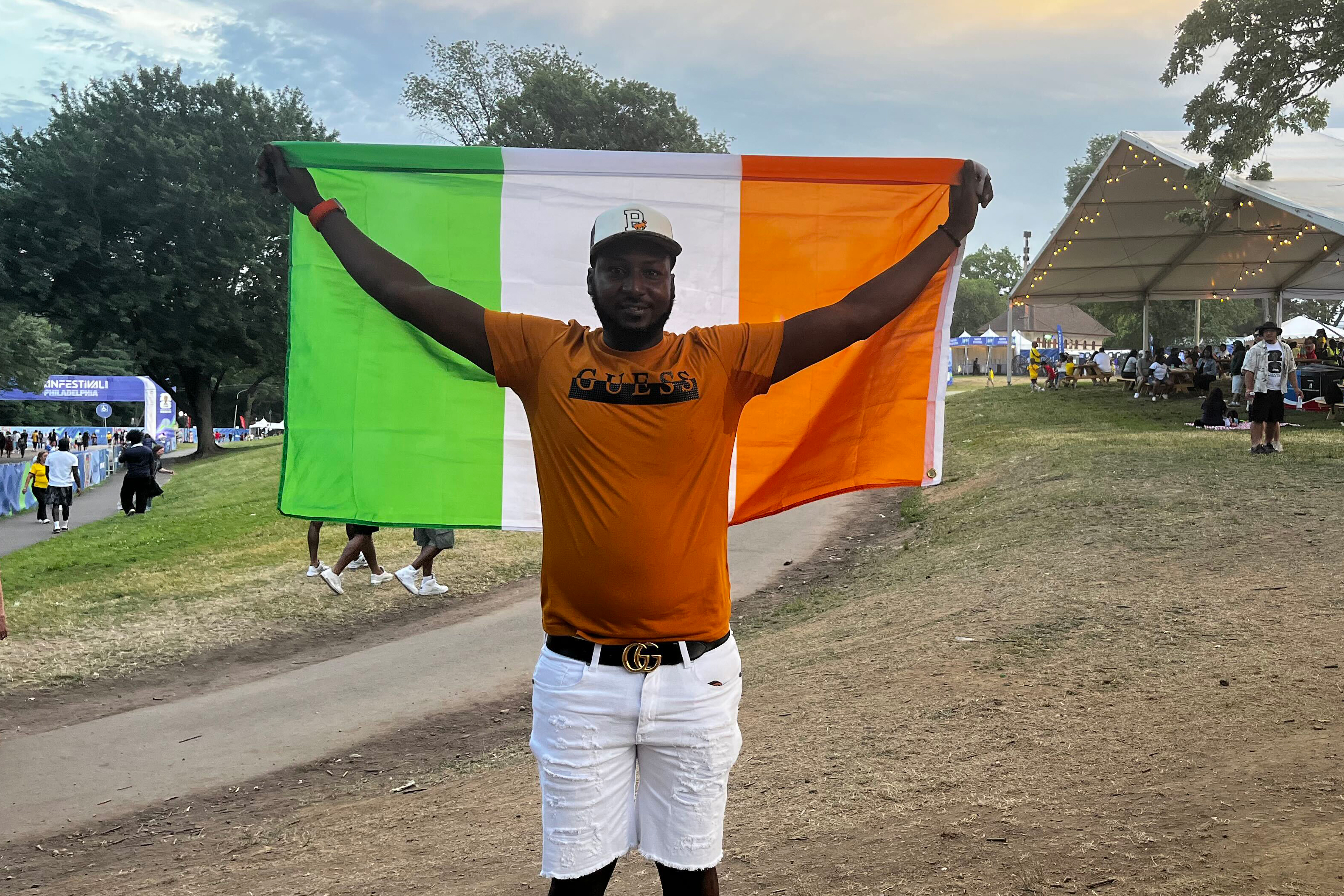
Ahmadou Dia holds the Ivory Coast flag above him at FIFA Fan Festival on Sunday, June 14, 2026.Henry Savage
With the score still 0-0, Ecuador and Ivory Coast fans at FIFA Fan Festival were just as confident as they started the match.
“The first half was 50-50 in terms of possession. It was a great first half,” said Ivory Coast-born Philadelphian Ahmadou Dia. “But the second half, we will for sure beat them.”
At halftime, crowds at Fan Festival flocked to the bathrooms, food vendors, and interactive exhibits to pass the time as DJs on the main stage kept the remaining crowd jumping.
Martin Alfaro, who has Honduran heritage, said he’s cheering for Ecuador, as Honduras doesn’t usually qualify for the World Cup. While Ecuador didn’t seal the deal in the first half, he’s optimistic they’ll score in the second. But, if they do, he’s preparing for the entire Ecuadorian fan section to “lose their minds.”
“I love that it’s 0-0 still, and I think, we’re hoping for a goal, but I’m afraid that if Ecuador does score, everyone’s going to lose their minds celebrating,” Alfaro said.
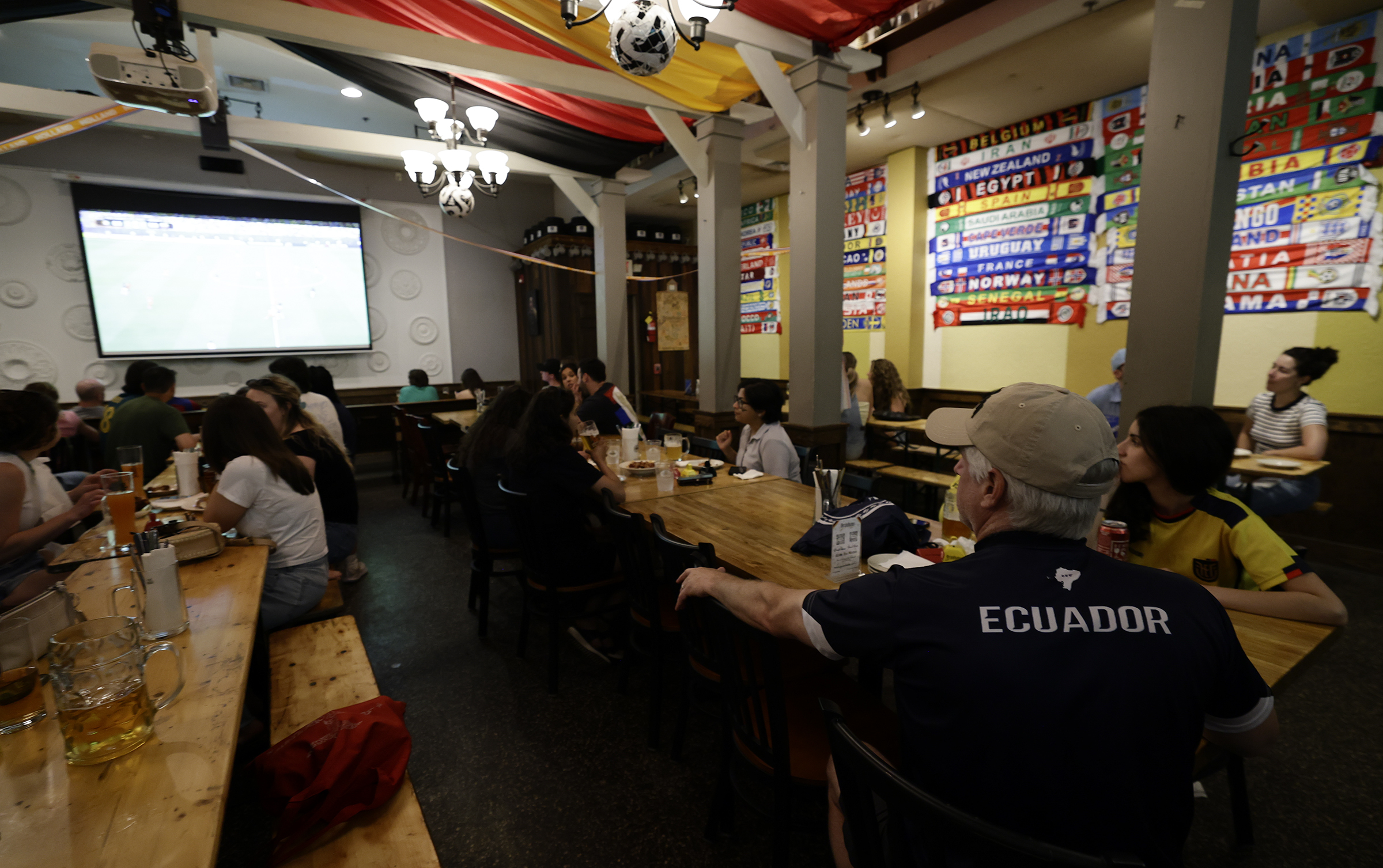
Ecuador fans also flood famed German beer hall in Philly
Soccer fans watch Ecuador take on the Ivory Coast at Brauhaus Schmitz on South Street Sunday.Yong Kim / Staff Photographer
With the score still zero-zero the Caddick family eagerly watched the screen and rang red, black and yellow cowbells at Brauhaus Schmitz on South Street when Ecuador closed in on the net.
Karina Caddick, a 56-year-old Horsham resident, was born in Ecuador, just outside Guayaquil, a port city and the country’s largest metropolis. She moved when she was only one year old, but her family instilled in her the importance of soccer to the national culture.
To watch her native country’s team compete on her home country’s soil is quite special, she said.
“It’s unbelievable that we’re able to watch here,” Caddick said. “To be in Philadelphia and see all the yellow shirts, it’s incredible.”
Seeing all the Ecuador fans on the train into the city on Sunday and exploring the tourist attractions around Center City and Old City was especially inspiring, she said.
“It’s cool. It’s like what are the odds that Ecuador is playing in the city that we live,” said 23-year-old Kayla Caddick, a recent Temple graduate and Old City resident.
Not everyone gets the hype.
“Why does everyone like soccer so much,” one young man asked his friend as he walked down South Street outside Brauhaus.
For those with familial attachments to one of the participating countries outside the U.S., the answer is obvious.
“Soccer is everything to Ecuador. It is the main sport. It’s their spirit. It’s what calls them,” said Karina Caddick.
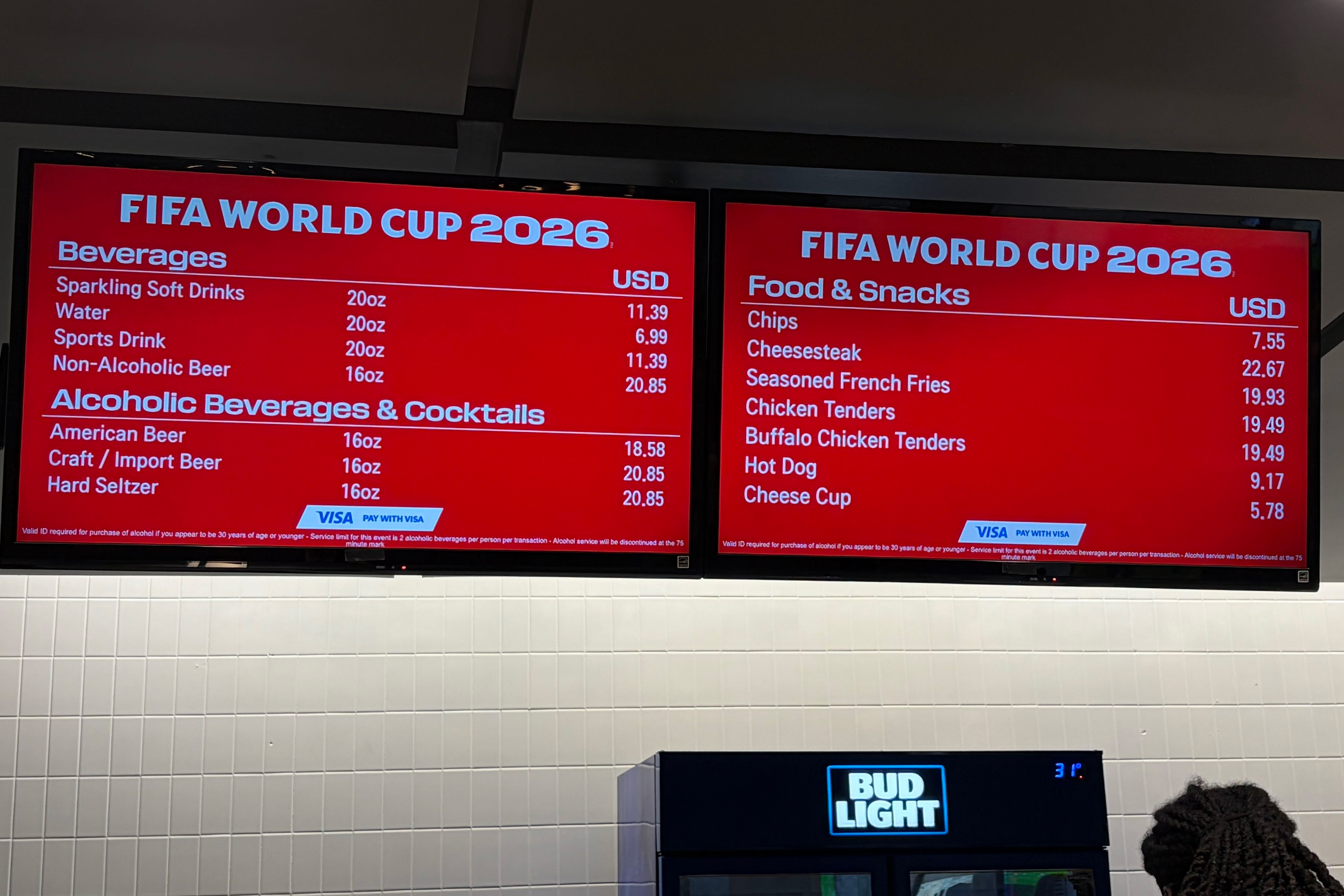
At the World Cup, picking $20 beer over $20 chicken tenders
The price of concessions at Lincoln Financial Field for Sunday’s World Cup match.Michelle My
With fries and beer in the $20 range, fans are having to pick between eating or drinking at the stadium.
For Ecuadorian resident Sebastian Muller, 49, the idea of spending $19.49 on chicken tenders feels ridiculous, and paying almost $7 for a water that will cost him less than a dollar back home, even more.
Beer on the other hand, he couldn’t do without.
He put aside his hunger and bought a $20.85 craft beer.
“Prices are really high, but I still had to buy the beer,” Muller said. “It’s tradition, you can’t watch a match without the beer.”
The sentiment resonated with Jared Chiliquinga, 31, and his brother Rommel, 41.
They came from New Jersey and are used to the MetLife Stadium food prices, they said.
“I usually pay $10 for a can,” Jared said. “But what we can’t watch the game without beer, even if we have to pay more than $50 for two cans,” Rommel added.
The siblings opted for no water or food so they don’t miss out on the beer.
Cynthia Argueta, 29, was not into following their steps, but also didn’t want to give up on the beer.
The New Jersey resident spent nearly $40 to buy herself a hot dog, a bottle of water, and a beer.
“The hot dog tastes very basic,” Argueta said. “but I am starving so I have to eat, and they don’t let you bring water so I have to buy it here.”
Philadelphia finally gets its big World Cup moment, and looks amazing
Soccer fans cheer at Lincoln Financial Field with the Philly skyline in the background. Jose F. Moreno / Staff Photographer
IRVINE, Calif. – As the minutes ticked down toward kickoff, I was sitting in my hotel room while on the road covering the U.S. team. Then a moment came that I’ve been waiting years to see.
Soccer fans cheer during the national anthems before the World Cup match between Ecuador and Ivory Coast.Jose F. Moreno / Staff Photographer
I still remember the day 15 years ago when FIFA punched the U.S. in the gut and gave the 2022 World Cup to Qatar. Though it didn’t take long to learn how much alleged bribery and corruption there was, that specific moment is still vivid in my mind, especially for those of us who’d gathered at Tir na Nóg in Center City to watch the announcement.
It would be another eight years before the combined bid of the U.S., Canada, and Mexico finally prevailed to bring the 2026 tournament here, in 2018. And Philadelphia wasn’t picked as a host city until four years after that, in 2022.
Now, another four years later still, the culmination has finally arrived.
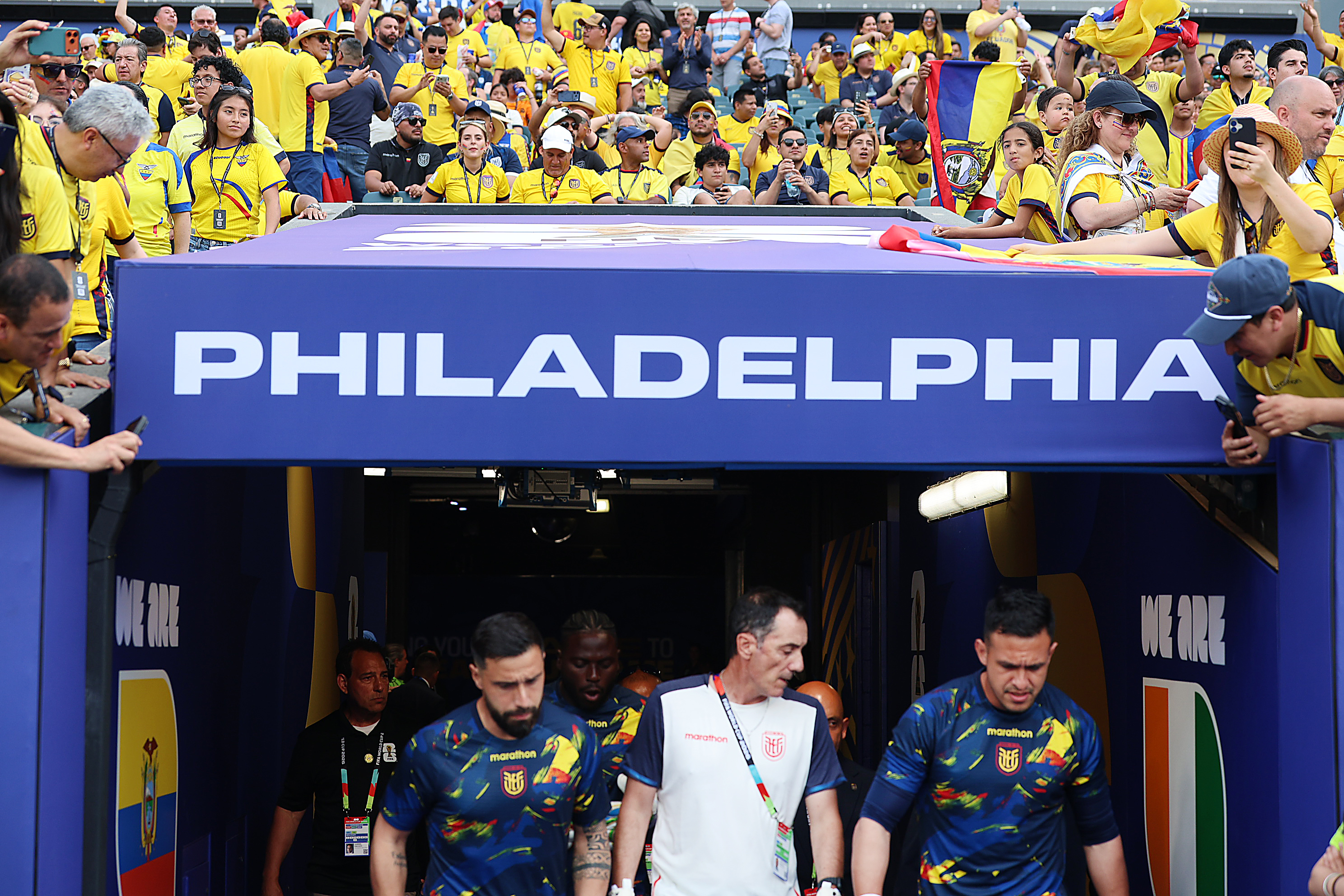
Ecuador takes the field ahead of their World Cup match against Ivory Coast in Philadelphia. David Maialetti / Staff Photographer
I know not everything has gone perfectly, including the last few days for residents around the Fan Fest site. But I could tell in recent months that on the whole, the city was really embracing this moment on the global stage that’s unlike any there’s been before.
I could tell that despite all the challenges posed by brutal visa rules for visitors and exorbitant ticket prices for everyone, Philadelphians were ready to open their arms and welcome the world to town.
Now the world is finally here, and the party is only just beginning.
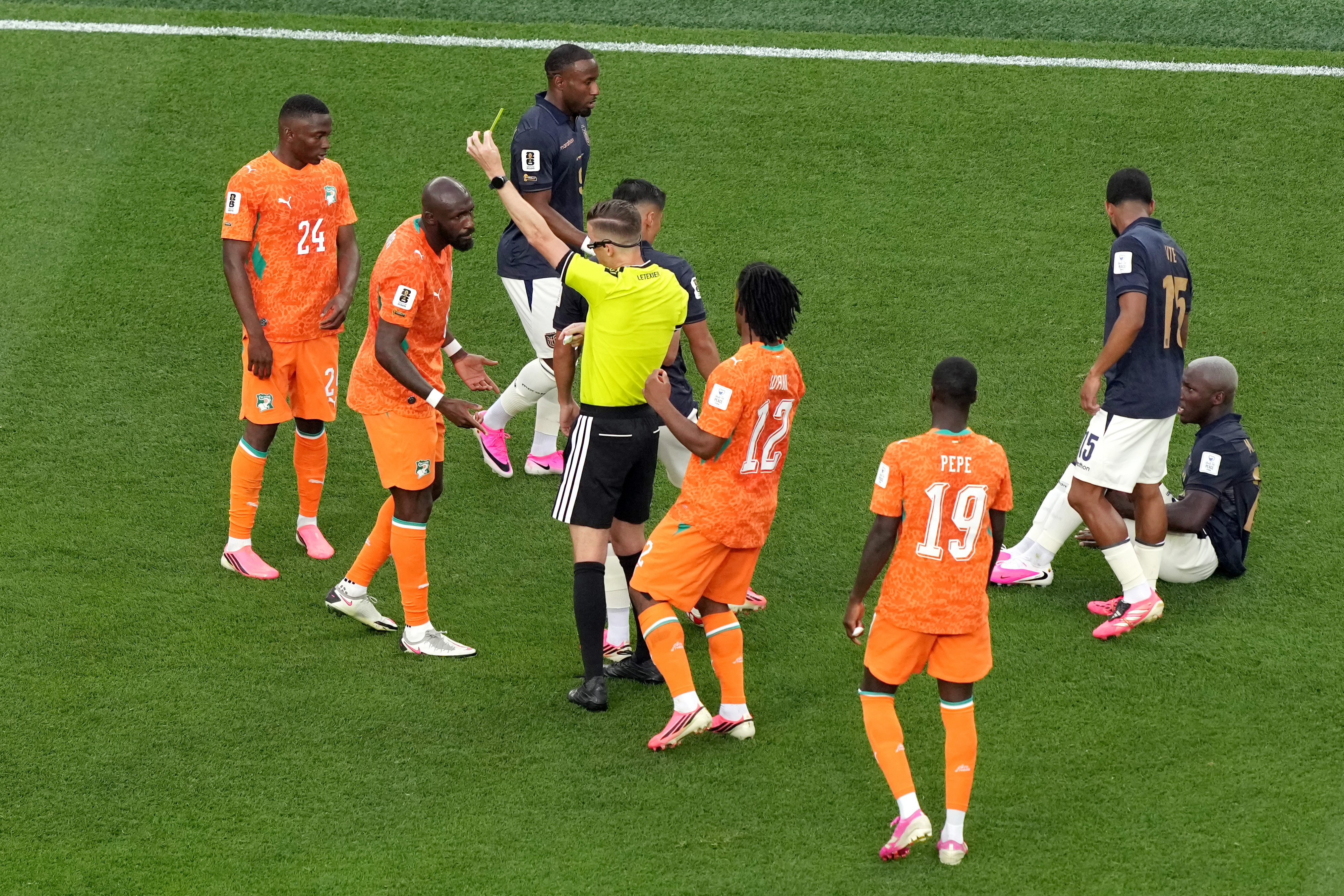
Referee Francois Letexier gives Ivory Coast’s Seko Fofana (6) a yellow card during Sunday’s game against Ecuador. Matt Rourke
The referee for this game, François Letexier of France, is one of the sport’s top officials. He has done lots of big games in his career, including in the French league, the Champions League, the Olympics, last year’s Club World Cup, and the 2024 European Champions League final.
But he wasn’t supposed to be doing this game.
It was originally signed to England’s Michael Oliver, who would also know plenty of Ecuador and Ivory Coast’s players from his years in the Premier League. But FIFA announced on Friday that Oliver is injured.
The announcement said it’s a minor injury, and Oliver won’t be sidelined for long. But it’s still a reminder that the referee has to run just as much in the heat and humidity as the players do.
Letexier has a notable side job away from soccer: he’s a court officer in the French city of Rennes, where he lives. (Maybe he’ll find South Philadelphia a little familiar in a certain way.)
FIFA selected 52 referees, 88 assistant referees, and 30 video officials from around the world for this World Cup. Eight are from the U.S., with Philadelphia’s Kathryn Nesbitt among the assistants.
And as you may have heard, Somalia’s Omar Artan had to withdraw from the tournament after the U.S. government barred him from entering the country. Though FIFA notably did not reassign him to games in Canada or Mexico, it announced Sunday that he’ll get his full tournament pay.
At the FIFA Fan Festival, an Ecuadorian singer and good vibes
Ecuadorian fans watch Sunday night’s World Cup match at the FIFA Fan Festival at Lemon Hill Park.Henry Savage / Staff
Ecuadorian singer Johann Vera commanded center stage at FIFA Fan Festival on Sunday, performing directly before the 7 p.m. kick off between Ecuador and Côte d’Ivoire at Lincoln Financial Field in South Philadelphia.
In Lemon Hill, Vera roared to the crowd, “¿Listos?” and received resounding cheers of joy in return from the crowd. Fans blared horns across the sea of thousands of yellow jerseys, showing an exceptional turnout for Ecuadorian fans. Small pockets of bright orange jerseys signaling Côte d’Ivoire fans made their presence known among the crowd.
“I thought there were more Ivorians in Philadelphia but I guess not,” said Swann Nemin, a Temple University student from Côte d’Ivoire, visiting Fan Festival with her two Ivorian friends Ornella Kouame and Naïke M. and their friend, Phoebe Mattes, who they joke isn’t from Côte d’Ivoire but is “Ivorian by preference.”
The World Cup brought the friend group together to dance and celebrate in a festival of people from all over the world. “I feel like it’s not only people from Ecuador but also people from South America that are cheering for Ecuador, in the same way that people from all over Africa are repping Côte d’Ivoire,” Nemin said.
“We’re just really happy to be out here celebrating,” Kouame said. “Even if we don’t win, honestly, we’re just here to dance.”
Aleyda Alvarado, a Fishtown resident originally from Mexico, said that while Mexico isn’t playing tonight and she admits she isn’t the biggest soccer fan, the World Cup gets her and her friends out to celebrate the heart of soccer.
“Everyone is here from different countries, but during the World Cup, we’re all just fans,” Alvarado said before kick-off. “That’s how soccer bring people together, and what makes me love it.”
After the 5 p.m. SEPTA Orange Line express was taken out of service at Race-Vine because a door wouldn’t close, the 5:15 local train was inundated with Ecuador enthusiasts when it hit the City Hall.
The cars were full to bursting by the time they hit Walnut-Locust, yellow jerseys shoulder to shoulder and chest to chest, men and women alike. As the train pulled out a song arose, full throat and deafening in the hot, cramped subway car:
“¡Vamos, vamos ecuatorianos, esta noche tenemos que ganar!”
Or:
“Let’s go, let’s go Ecuadorians, tonight we have to win!”
As the throng exited up the stairs of NRG Station, their hearts and voices swelled again.
Giant Lincoln Financial Field signs on stadium’s roof also covered
Normally there are two giant Lincoln Financial Field signs facing skyward on the roof of the Linc. As Fox's cameras show, they had to be covered for the World Cup, along with everything else. pic.twitter.com/eNCitublcd
At the Linc, issues with expensive tickets purchased on resale websites
Jayden Quezada, 17, and his parents came to Philadelphia from Bensalem hoping for an Ecuadorian victory. But they were turned away at the door.
“They said there were problems with our tickets because they weren’t on the FIFA app,” Quezada said. “We have been trying to fix it for the last four hours.”
Last night, the trio spend $4,350 to get three tickets through the TickPick app. But, by the time they arrived to the stadium at 1 p.m., the tickets were yet to be transferred to their FIFA app.
As his mom passed on the phone, trying to reach a TickPick representative, Quezada fears his parents won’t be able to see their national team.
“They have been the biggest fans since before I was born and they don’t get to go back often because of work,” Quezada said. “We are probably going to try to get a refund but missing the game would be really sad because we were looking forward to feeling the Ecuadorian pride.”
The Quezada’s weren’t the only ones struggling. In a line of over 50 people, fans waited for help with their failed tickets.
Spanish speakers Monica Rojas, 22, and her friend Jose Avil, were concussed on what to do after the ticket office explained the problem with their ticket in English.
The pair drove two hours from New York, after buying a pair of tickets on Stubhub for $2,000 including parking.
After a FIFA volunteer interpreter intervine, the pair found out their tickets had been refunded, despite having a fifa confirmation email.
“I don’t know what we are doing to do,” Avil said. “It feels defeating, now all we have is the tickets and the desire to watch them.”
‘I’m actually an Eagles fan’: World Cup fans hit the tailgating lots in Philly
Three months from now, the South Philadelphia Sports Complex will be covered in Eagles green as fans hit the tailgating lots to prepare for their home opener in September. But, for now, the lots surrounding the temporarily renamed Philadelphia Stadium were engulfed with fans from Ecuador getting ready for Philly’s first World Cup match.
Although the environment looked a little different from Philly’s typical football Sundays, the tailgating culture was still alive and well on a more international level.
“I’m actually an Eagles fan,” said 18-year-old Ecuador native Natalia Vegas. “I’ve been here a couple times to watch the football games. I’ve tailgated once. It’s also crazy. Everybody is so prideful to be Eagles fans. So it’s kind of the same thing, being prideful as an Ecuador fan.”
With Ecuador facing off against the Ivory Coast for the first of six matches in Philly, both international and local soccer fans came in hordes to witness the historic sporting event making its way to the city.
“It’s been amazing,” said Ivory Coast native Abdoul Ouattra. “Everybody has been really nice to me. I’ve seen a bunch of Ecuadorians. I thought I was going to be intimidated but they were quite welcoming and said whatever happens, we’re friends. So, I love that.”
There is no length Ecuadorian native Pacho Flores wouldn’t go for his national team.
Despite living in New York City, Flores, 62, and his family of eight paid $650 dollars each to watch “La tri” play in Philly.
“It’s the most beautiful thing in the world,” Flores said. “We have to follow the team to every game. It’s a blessing to have them play so close.”
Despite the 90 degree weather, Flores and his son, Alex, danced wearing a thickly knit Diablo Uma masks — an indigenous protective spiritual figure from the highlands of Ecuador— to represent his native town of Cañar.
“It’s not that hot inside the mask, and it’s worth it because we have to win, at least 3 to 0,” Alex said wiping sweat of his for head. “Either way, we will still live the team,” Flores added.
No matter the score, the family won’t have too much time to celebrate. They leave New York City tomorrow morning to pack for the next Ecuadorian game in Kansas City Saturday against Curaçao.
Out front of Stateside Live, a group of Ecuador fans dressed in regional traditional clothing held their own mini flash mob ahead of the first World Cup match in Philly.
Among the dancers was 22-year-old Juliana Padilla, who stepped in last minute to join the flash mob from New York. After days of practicing, Padilla was excited to finally show off Ecuador’s culture ahead of the team’s World Cup match.
“We wanted to represent Latin America,” Padilla said. “We’re wearing the regional, traditional gear. We wanted to bring it to the people here to feel connected with their roots.”
Four hours ahead of tonight’s Ivory Coast vs. Ecuador match at a rebranded Linc, Ecuadorian fans arrive at NRG station chanting: “Let’s go Ecuadorians for we must win tonight.”
Four hours ahead of the Ivory Coast vs. Ecuador match, Ecuadorian fans arrive at NRG station chanting: “Let's go Ecuadorians for we must win tonight.” Via @PhillyInquirerpic.twitter.com/ls3vuiKdKs
Thunderstorms in Philly could interrupt tonight’s World Cup match
Ecuadorian fans flood Lincoln Financial Field Sunday night for the city’s first-ever World Cup match. David Maialetti / Staff Photographer
Severe thunderstorms could make their way through the Philadelphia region later this evening, potentially catching the tail end of tonight’s World Cup match between Ivory Coast and Ecuador.
The National Weather Service issued a severe thunderstorm watch for Philadelphia and the surrounding counties Sunday evening that will remain in effect until 1 a.m. Monday morning.
The most organized swath of thunderstorms are expected to move through the area between 9 p.m. and midnight, potentially bringing severe gusty winds and heavy rain, according to Jessica Storm, a meteorologist at the National Weather Service’s Mt. Holly office.
A tornado is also possible, as it isolated hail up to the size of a quarter.
FIFA will pause play if there is a lightning strike within eight miles of the stadium. The match will remain paused for 30 minutes, with any subsequent lightning strikes resetting the clock.
The FIFA Fan Fest at Lemon Hill Park in Fairmount would also be forced to close if lightning is detected within an eight-mile radius. Fans would need to exit the grounds and move to a safe location, FIFA said in a statement, and could re-enter after 30 minutes if no additional lightning is detected.
IRVINE, Calif. — Since the game ended at 2 in the morning Philadelphia time, you might have been asleep when Australia’s win over Turkey ended.
Then again, if you’re enough of a soccer diehard, you might well have stayed up to be sure you watched all four of Saturday’s games live.
Regardless, the Socceroos’ 2-0 upset in Vancouver blows the United States’ group wide open. Now those two teams have three points each, with the U.S. in first place on goal difference by +3 to +2. (That’s what made Gio Reyna’s late strike in the 4-1 win over Paraguay actually important, not just a cherry on top.)
It also makes Friday’s U.S.-Australia game in Seattle an even bigger deal than it already was. American fans have been waiting ever since the draw to watch their team in one of the nation’s best soccer cities, and now the game has huge stakes.
The winner will be in the driver’s seat to take first place. And if the U.S. prevails, it will only need a draw against Turkey in the June 25 finale back in Los Angeles to win the group.
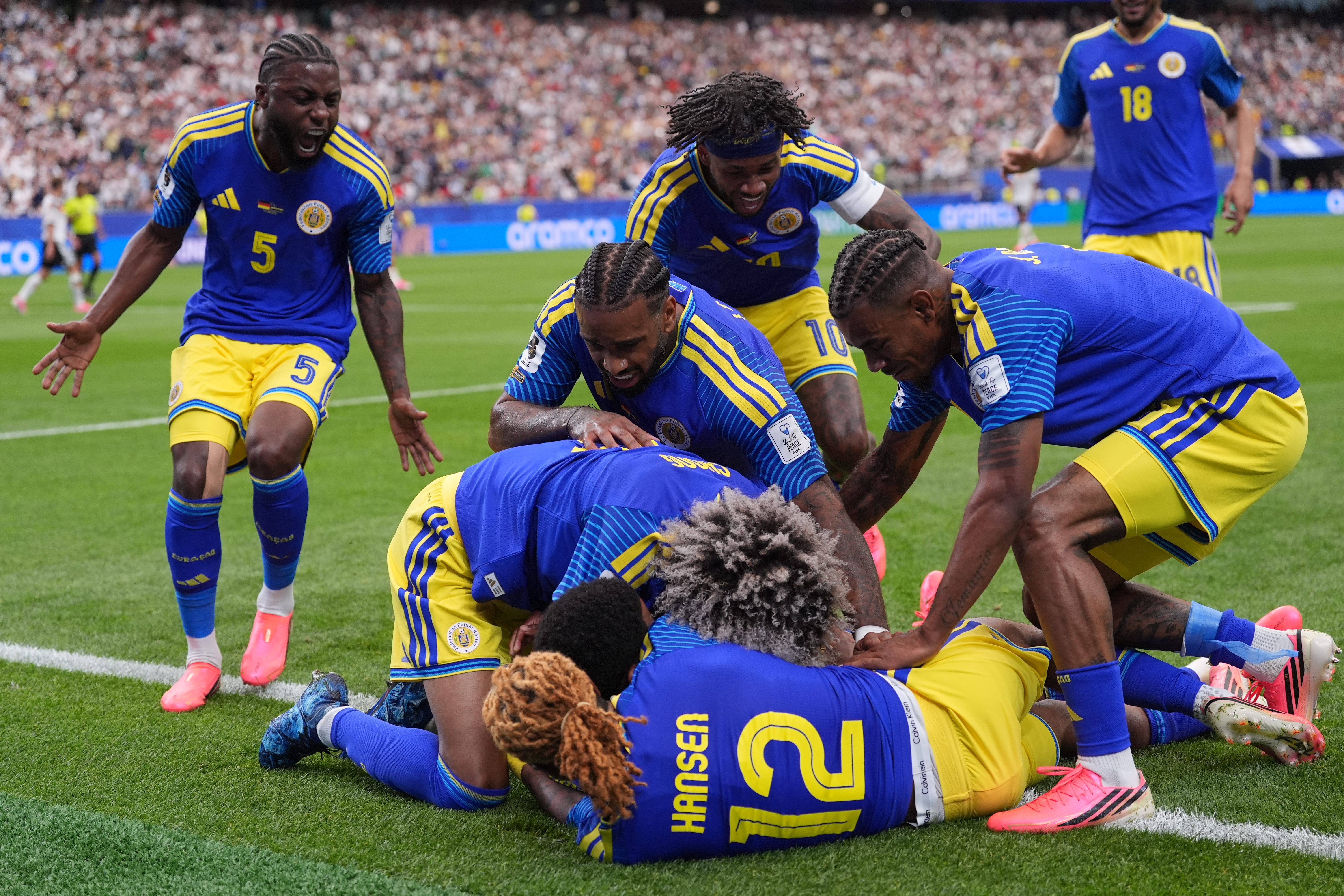
Curacao players celebrate after scoring during the World Cup Group E soccer match between Germany and Curacao in Houston, Sunday, June 14, 2026. (AP Photo/Eric Gay)Eric Gay / AP
If you just saw Curaçao score a tying goal against Germany, you need to understand just how wild it was.
CURAÇAO SCORES ITS FIRST-EVER FIFA WORLD CUP GOAL 🇨🇼
The island nation, a former Netherlands territory, is the smallest country ever to qualify for a World Cup by both population (just over 150,000 people) and land mass (171 square miles).
Germany, by contrast, is a four-time World Cup champion and three-time European champion.
Curaçao’s squad is built mainly of players in global diasporas who have family roots on the island. None of the 26 men play in the world’s five best domestic leagues: the top divisions in England, Spain, Germany, Italy, and France. They pulled off an upset in qualifying too, with a scoreless tie at Jamaica (including Union goalkeeper Andre Blake) on the last day that clinched their World Cup ticket.
Germany, by contrast, has 25 of its 26 players in those circuits — and the other one plays for a bit team in Turkey after many years in the League and Bundesliga.
As I was writing this post, watching the game on TV while on the road covering the U.S. team, Germany just retook the lead. But I promise, those big sections of Blue Sharks fans at the stadium in Houston are having the time of their lives. And everyone around North and Central America who appreciates Curaçao’s underdog story is rooting for them.
What to know if you’re going to the FIFA Fan Festival
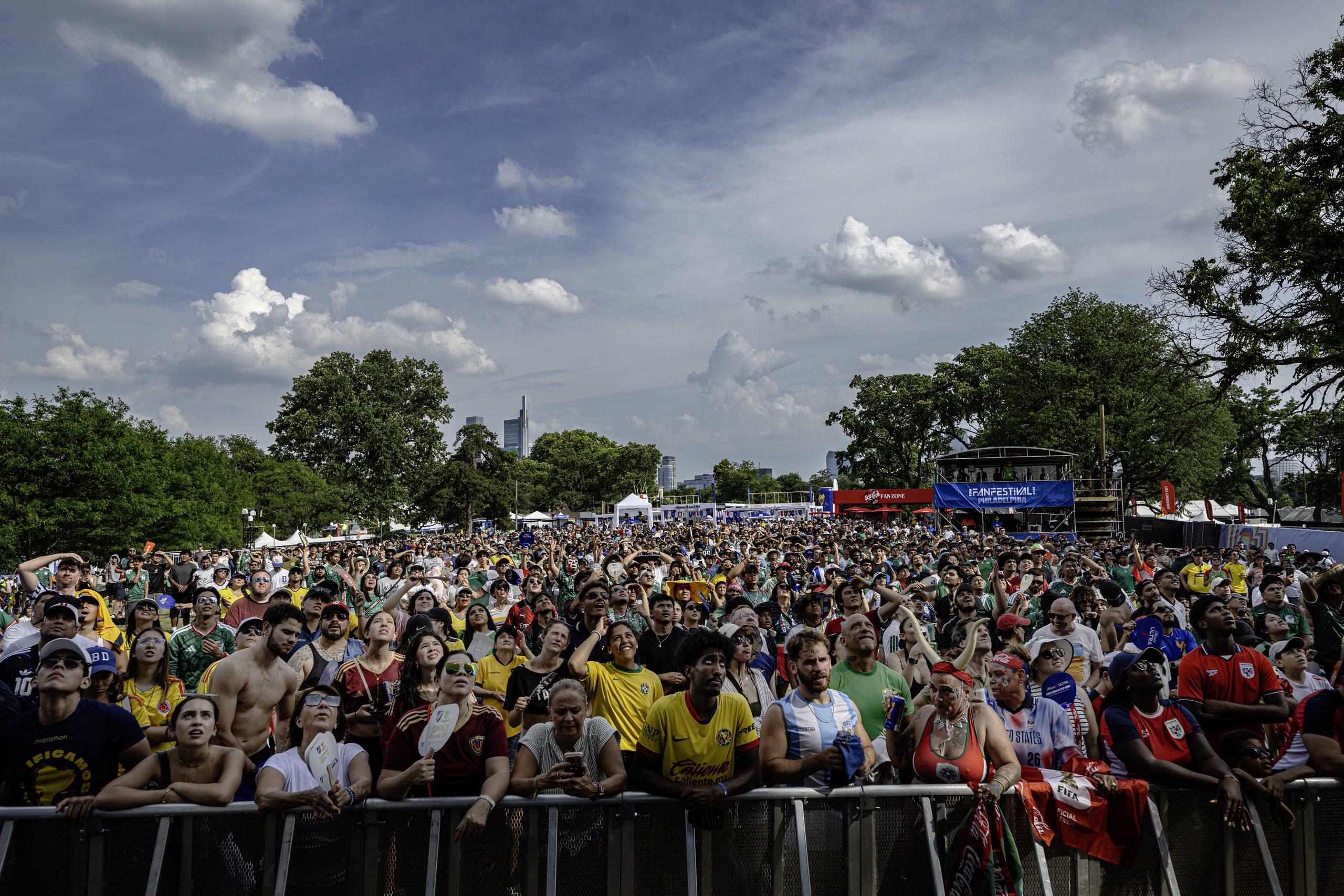
Soccer fans gather to watch Mexico play South Africa on a giant screen during the opening day of the FIFA Fan Festival at Lemon Hill on Thursday, June 11, 2026, in Philadelphia.Jose F. Moreno / Staff Photographer
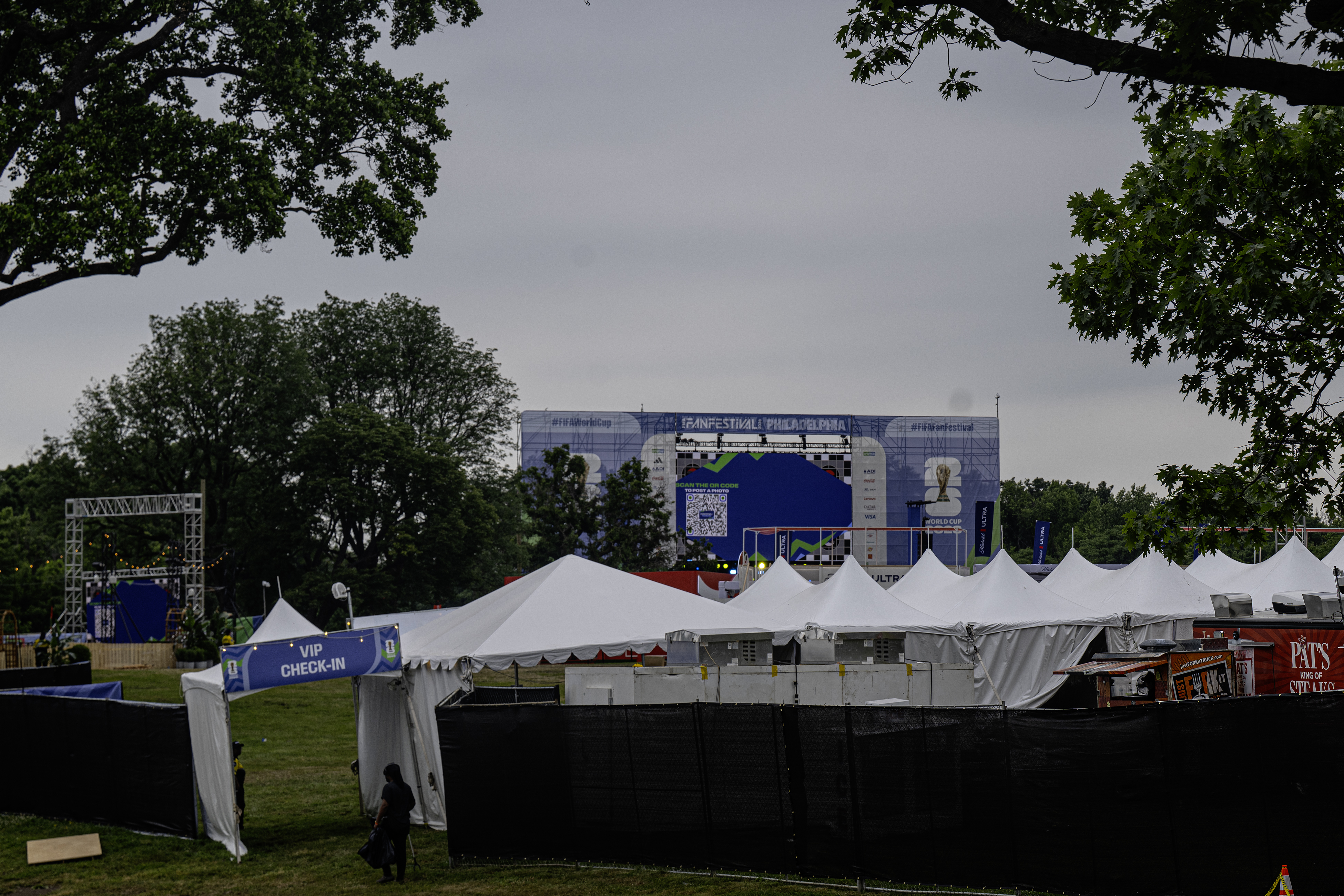
A crowd packed with thousands of cheering fans, the 60-foot-wide screen playing the latest fiery matchup, and dozens upon dozens of food vendors await the FIFA Fan Festival, the cheapest and most immersive way to enjoy the 2026 World Cup in Philadelphia.
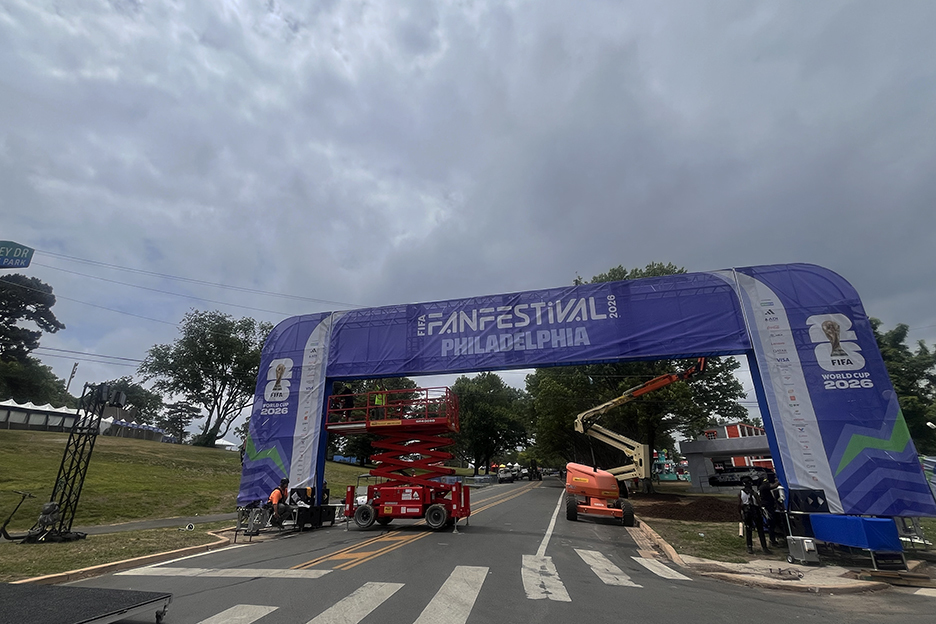
The Fan Festival is open daily to 15,000 fans, for free, to roam the million square feet of festival grounds that have transformed quaint Lemon Hill into an almost unrecognizable extravaganza of global soccer.
The main spectacle is the 60-foot screen that takes over the main stage in Lemon Hill, where the majority of fans will congregate to watch the match. But, throughout the festival are multiple smaller screens playing the game, so fans don’t miss a moment when they roam for food, fun, or the bathroom.
“Even if you’re not a soccer fan, you can still come out and have a great time,” said Michael DelBene, executive producer of FIFA Fan Festival for Philadelphia Soccer 2026. “You can come and listen to music or eat delicious food, or shop.”
The festival is intended for fans of all ages and promises to be kid and family friendly.
An active Union player finally played in a World Cup game
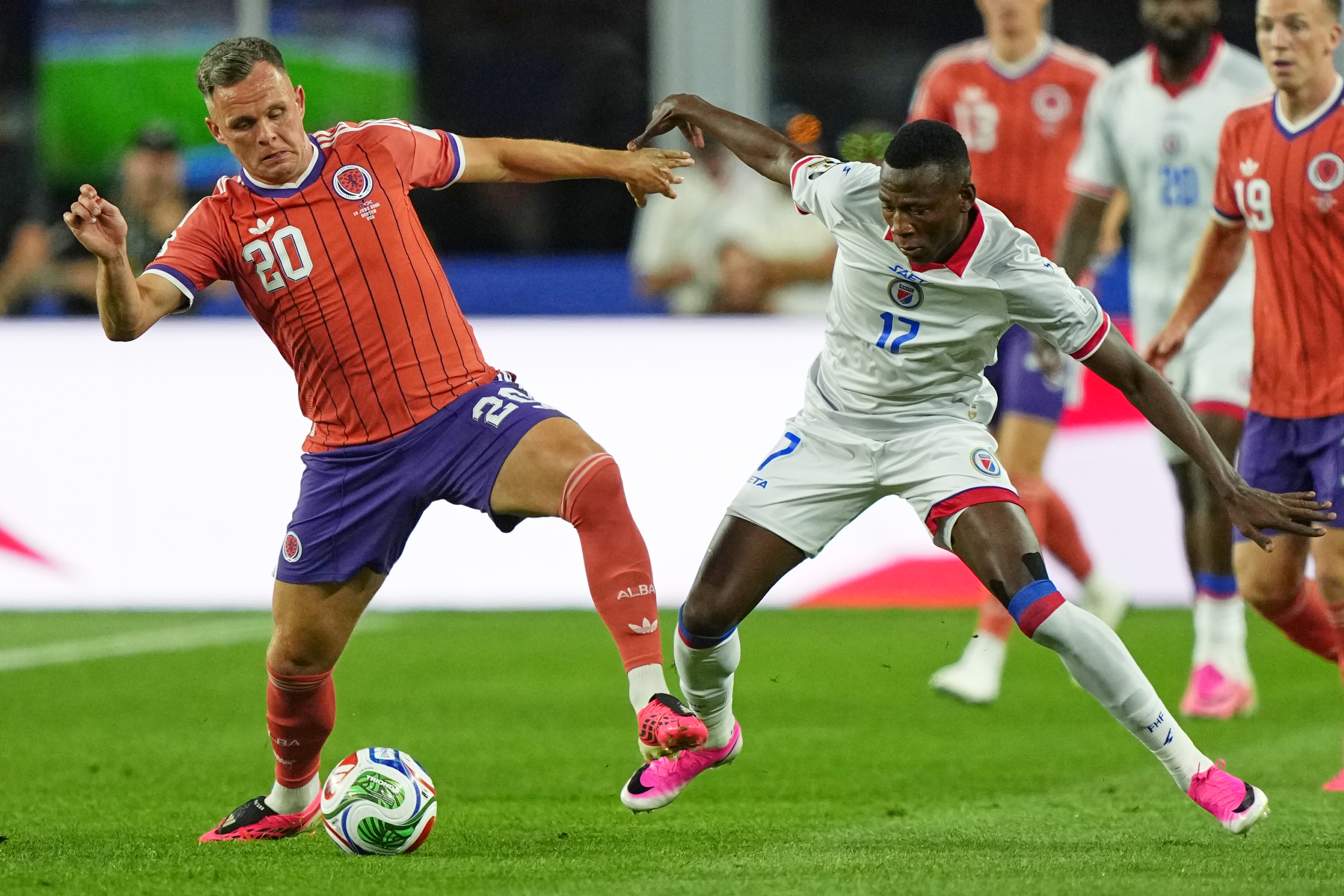
Scotland’s Lawrence Shankland (20), and Haiti’s Danley Jean Jacques (17) battle for the ball during the World Cup Group C soccer match between Haiti and Scotland in Foxborough, Mass., near Boston, Saturday, June 13, 2026. (AP Photo/Martin Meissner)Martin Meissner
Halfway through the Union’s 17th season, midfielder Danley Jean Jacques became the first active player from the club to play in a World Cup.
Jean Jacques started for Haiti on Saturday night against Scotland in Foxborough, Mass., in what was also Haiti’s first men’s World Cup game since 1974 and Scotland’s first since 1998.
Haiti lost the game, 1-0, but played well, outshooting Scotland 15-9 and holding a majority of the possession. Jean Jacques was often at the center of the action, with four tackles, two clearances, one interception, eight duels won in 12 contested, and 44-of-53 passing.
The 26-year-old from the small coastal town of Petit-Goâve is in his third season with the Union. He has been a regular with Les Grenadiers since 2023, earning his 31st cap for the country in this game.
Jean Jacques is the third active Union player to be on a World Cup team. The first was right back Olivier Mbaizo, who made Cameroon’s squad four years ago but did not play.
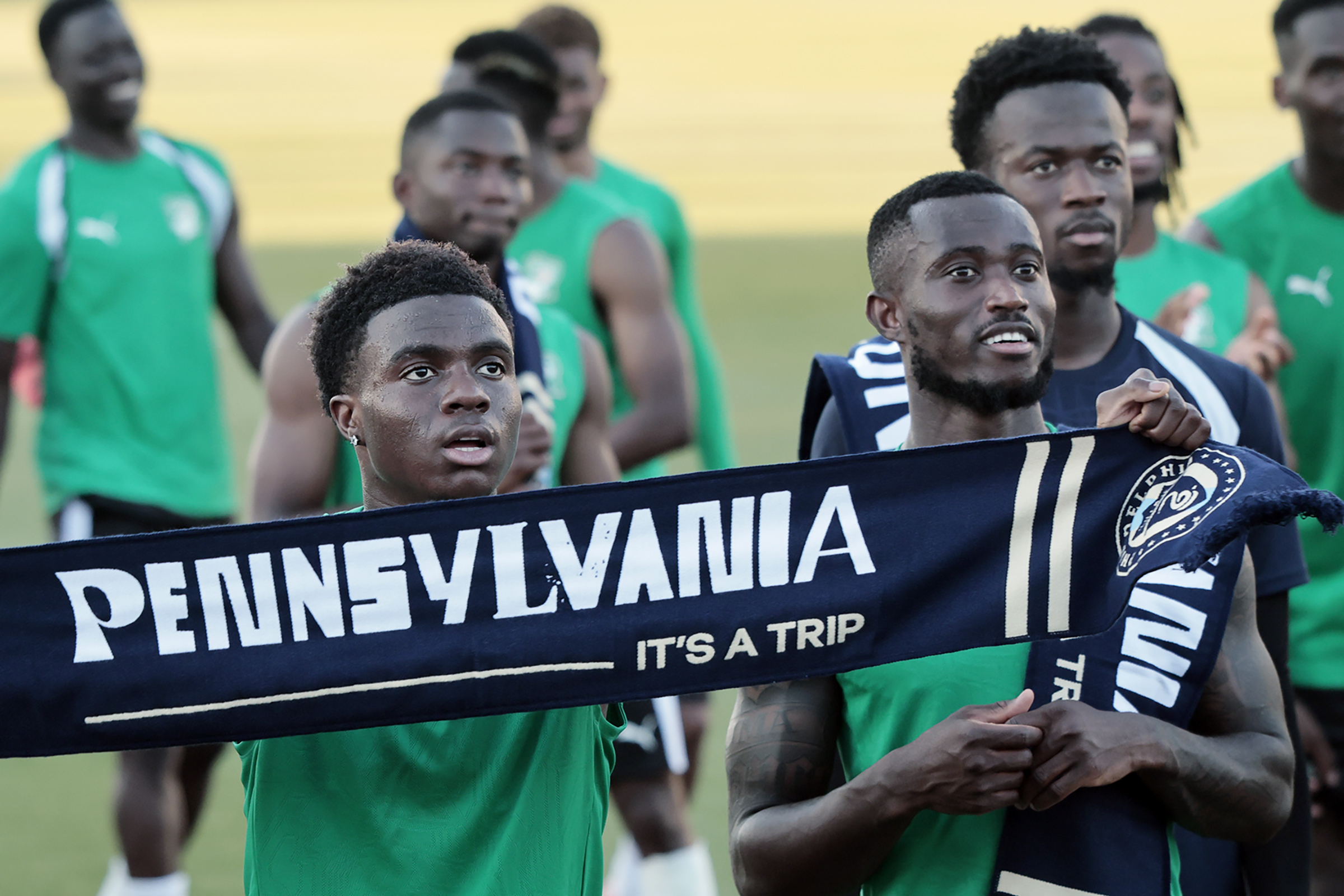
Members of the Ivory Coast national football team react while watching the Sixers Stixers drum line perform following their practice at Subaru Park in Chester, Pa. on Friday, June 12, 2026Elizabeth Robertson / Staff Photographer
The waterfronts of Chester and Wilmington are roughly 5,000 miles across the Atlantic Ocean from Abidjan, the Ivory Coast’s largest city. But, for at least three weeks during the FIFA World Cup, the Ivorian men’s national team will call the banks of the Delaware River home.
Les Éléphants hosted an open training session at Subaru Park on Friday evening, two days before they begins their World Cup campaign with a match against Ecuador at Philadelphia Stadium (aka Lincoln Financial Field) on Sunday (7 p.m., FS1).
Ivory Coast is the only nation scheduled to play at the Linc twice during the World Cup’s group stage, and it is the only team that will stay and train in the Delaware Valley during the tournament.
The team has set up its base camp at Hotel Du Pont in Wilmington and will train at Subaru Park in Chester.
Ivory Coast’s open training session Friday evening was the second free event it has staged for the Philadelphia community. Les Éléphants beat Union II, 2-0, in a tuneup friendly on Monday that was open to the public.
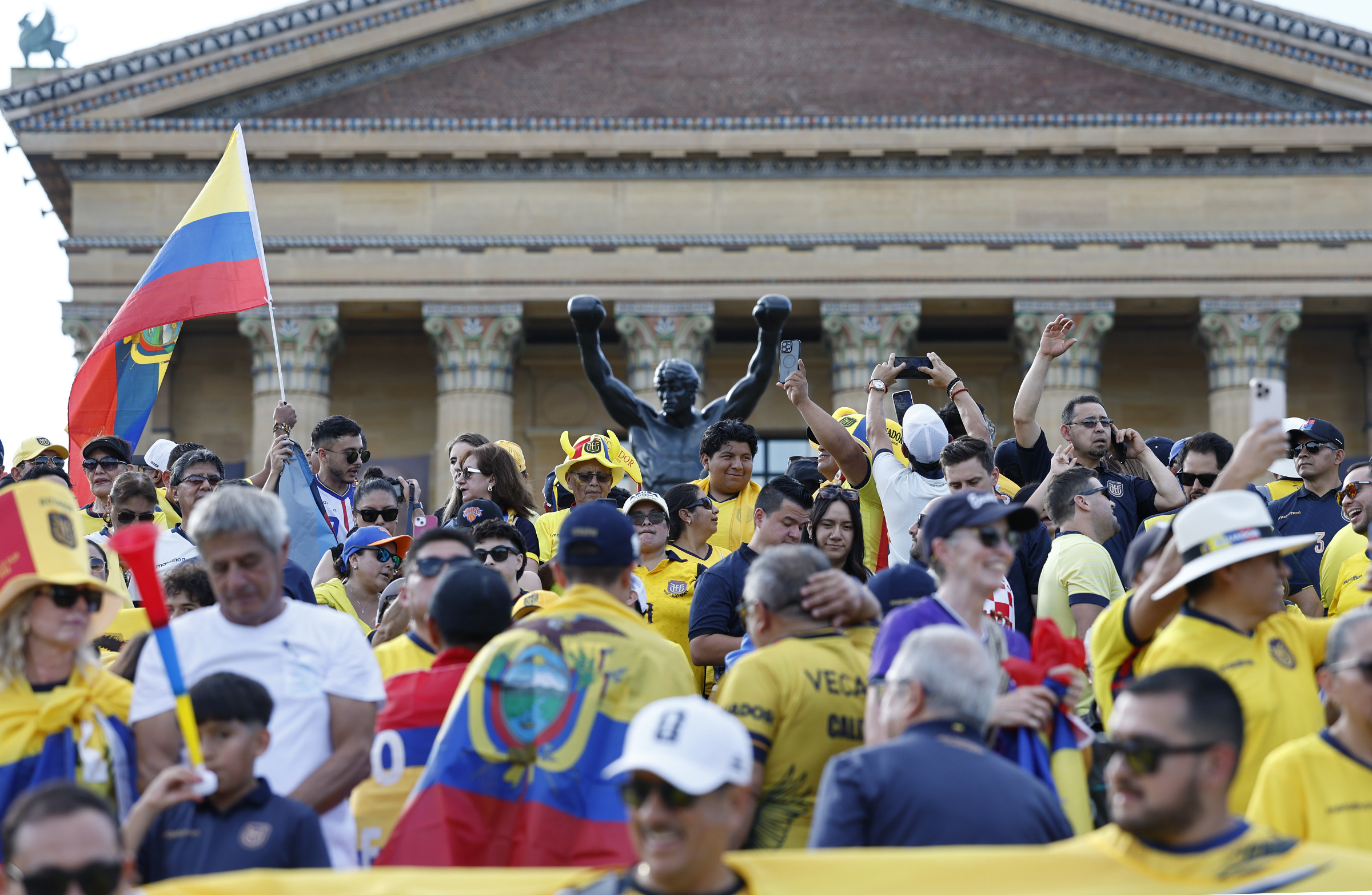
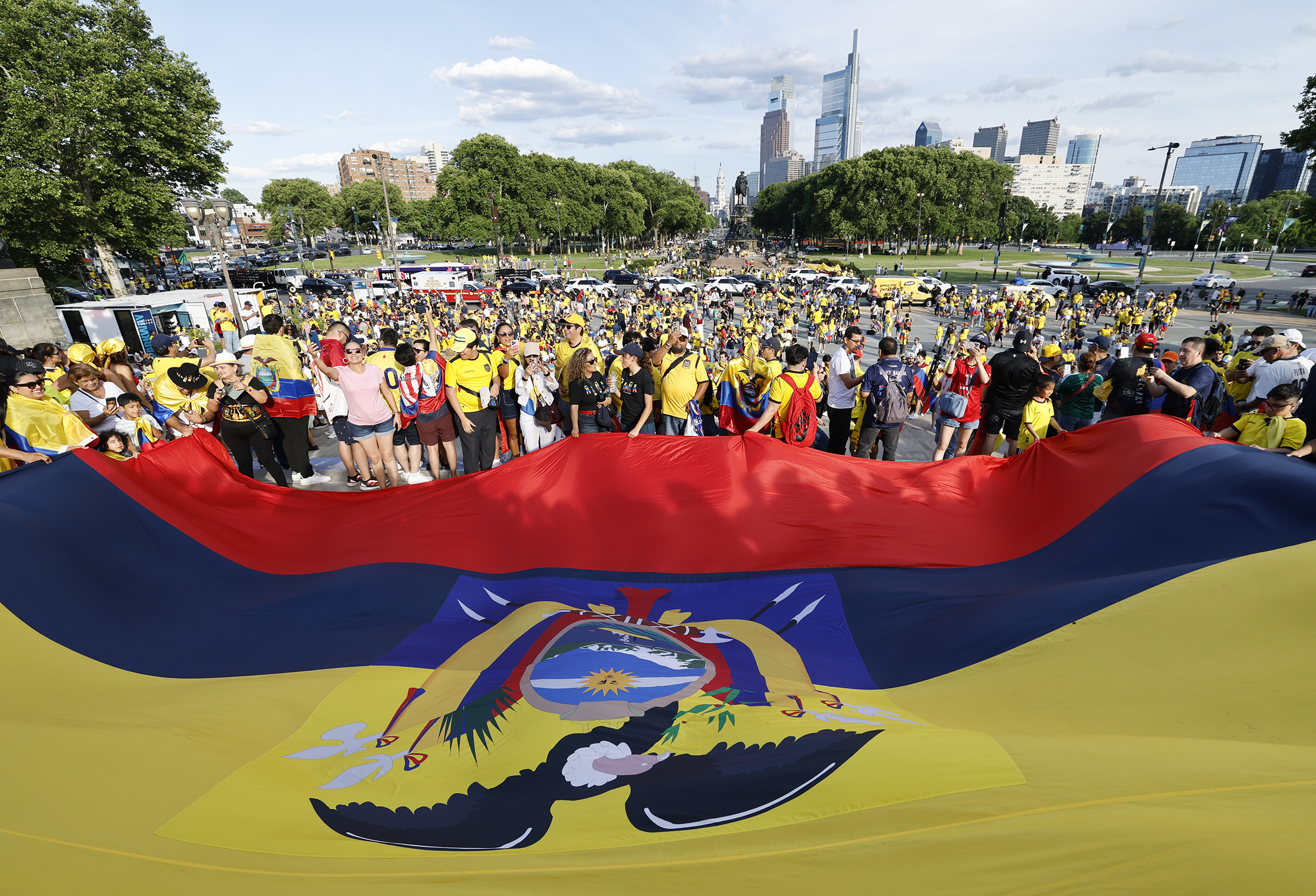
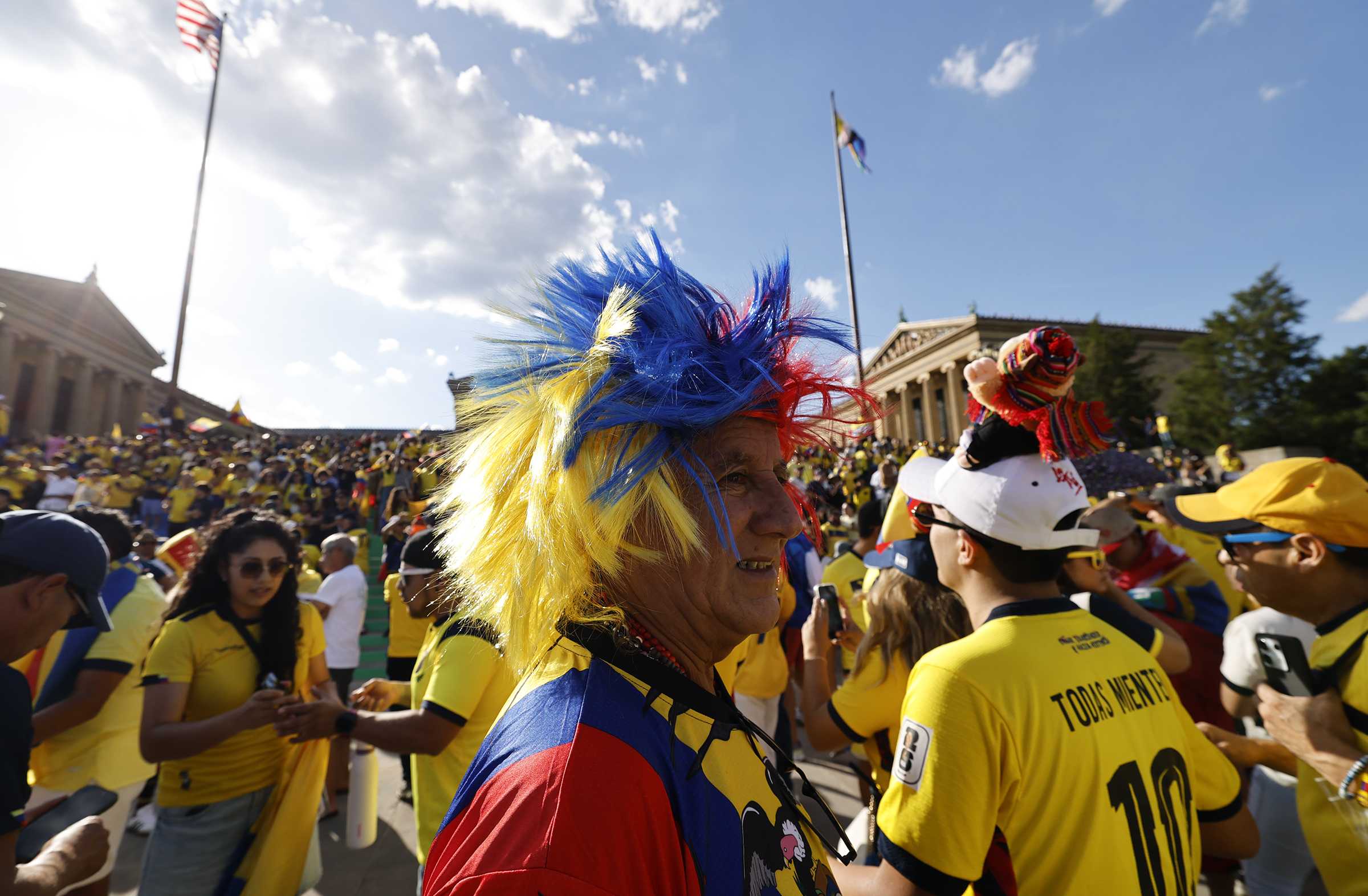
Ecuador fans take over the Art Museum steps before World Cup kickoff
Ecuadorian soccer fans show support for their national team ahead of Sunday’s game against Ivory Coast.Yong Kim / Staff Photographer
After decades living in New Jersey, Ecuadorian native Magaly Moreira, 60, said she had never seen such a display of her country’s people.
“It fills me with happiness, pride, and so much joy,” Moreira said, Ecuadorian flags painted on her face. “It’s our opportunity for us and the players to represent Ecuador.”
She was one of thousands of Ecuadorians attending “El banderazo Ecuatoriano” outside the Art Museum. An event organized by group +593 (the country’s international calling code) that made fans put aside the traditional “Ecuadorian hour” to show up more than on time to support their team.
“Ecuador, Ecuador, Ecuador, vamos Ecuador,” resounded through the Rocky steps as the fans chanted, many sporting the Ecuadorian soccer jersey.
Defeating the heat, a crowd of all ages — from newborns to seniors — cheered and danced to the traditional highland dance “Zapateando Juyayay,” showcasing pride for their country, waving flags, and hugging each other with hope.
With a broken leg and dragging a wheelchair, Darío Galarza and his friend Marco Gallardo flew in from Ecuador two days ago to support their home team. They did not expect to see such an outpouring for their national team.
“The U.S. is accessible for us because we share the same currency and it isn’t far, but we didn’t expect to see so many people,” Gallardo said.
For Galarza, skipping the World Cup wasn’t an option. After undergoing surgery for his leg last month, he made it a point to be as recovered as possible to fly to Philadelphia.
“I guess it’s true, you will always find an Ecuadorian in every corner of the world,” Galarza said. “At least I knew it was going to be me because I wasn’t missing this for the world.”
As a man inside a guinea pig costume began a conga line around the Rocky statue, 77-year-old Ecuadorian Francisco Castellanos couldn’t help but reflect on the wonder of seeing so many Ecuadorians together and the weight of representation.
“There are so many of us here that now we must win,” Castellanos said. “Whatever it takes,” he added, as the crowd erupted chanting the Ecuadorian national anthem.
Everything you need to know about the World Cup in Philly
The first World Cup game in Philadelphia is Sunday night.
Nine nations will compete in five group stage matches over the next two weeks, plus two more in a knockout game on July 4. Here’s what you need to know about those countries — and what those fans need to know about Philly …
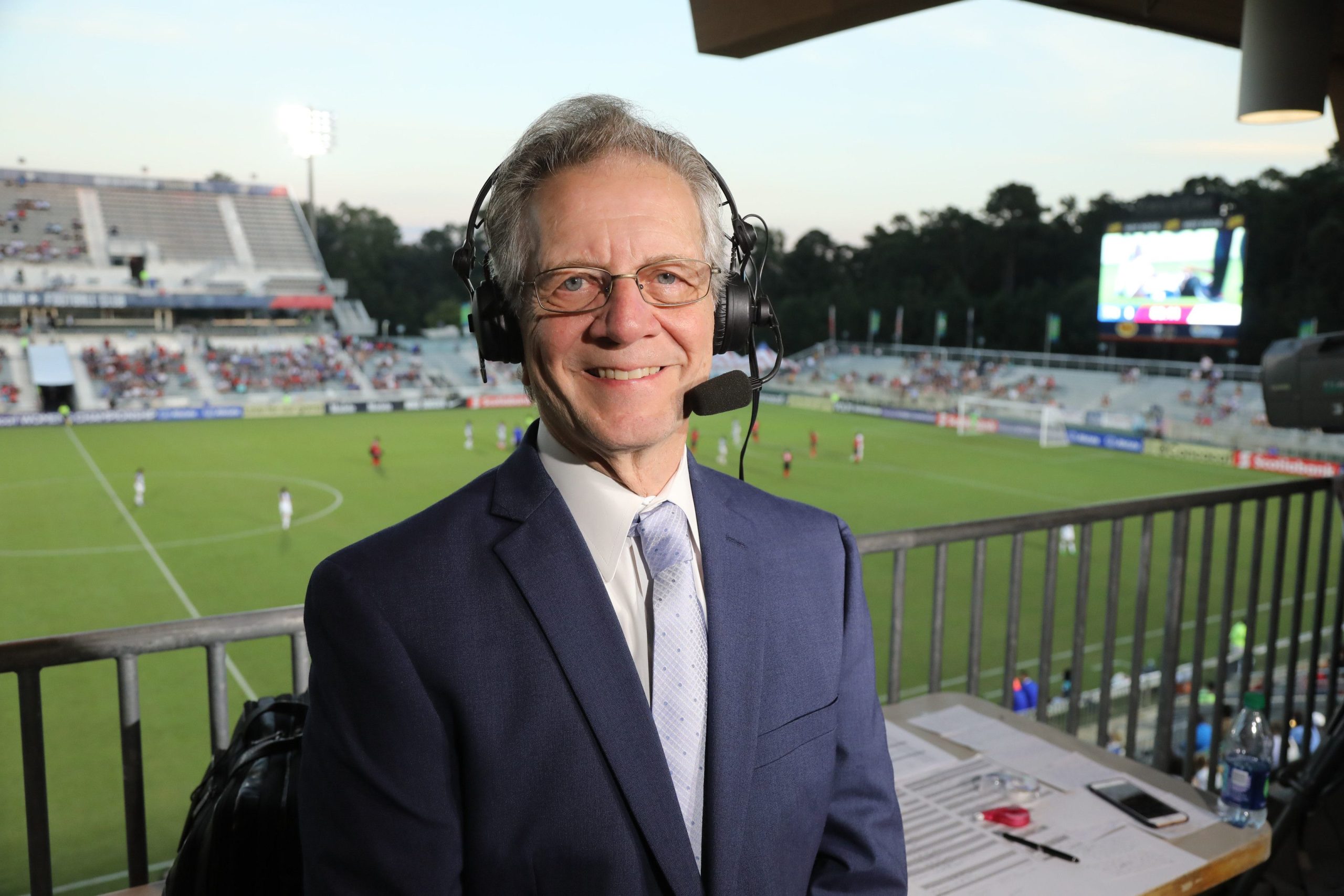
Former Union announcer JP Dellacamera will call Philadelphia’s first World Cup game.Fox Sports
The first of six World Cup matches will take place Sunday night in Philadelphia, with Ivory Coast taking on Ecuador (7 pm., FS1) in Group E action.
Group E also includes Germany, which most experts predict will make it out of the group stage. So tonight’s match could be an early look at who finishes in second place (no offense to Curacao, the smallest country to ever qualify for the World Cup, edging out Iceland).
It seems like Ivory Coast will be the natural team for fans in the Delaware Valley to root for, outside the U.S. It’s the only country scheduled to play two matches in Philadelphia (they’ll take on Curacao on June 25), has made Hotel Du Pont in Wilmington it’s home away from home, and is training at Subaru Park in Chester.
VALLADOLID, Spain — As Pope Leo XIV prepared last month to issue a major statement about the perils of artificial intelligence, he briefly turned his attention to an evening WhatsApp message about a car part.
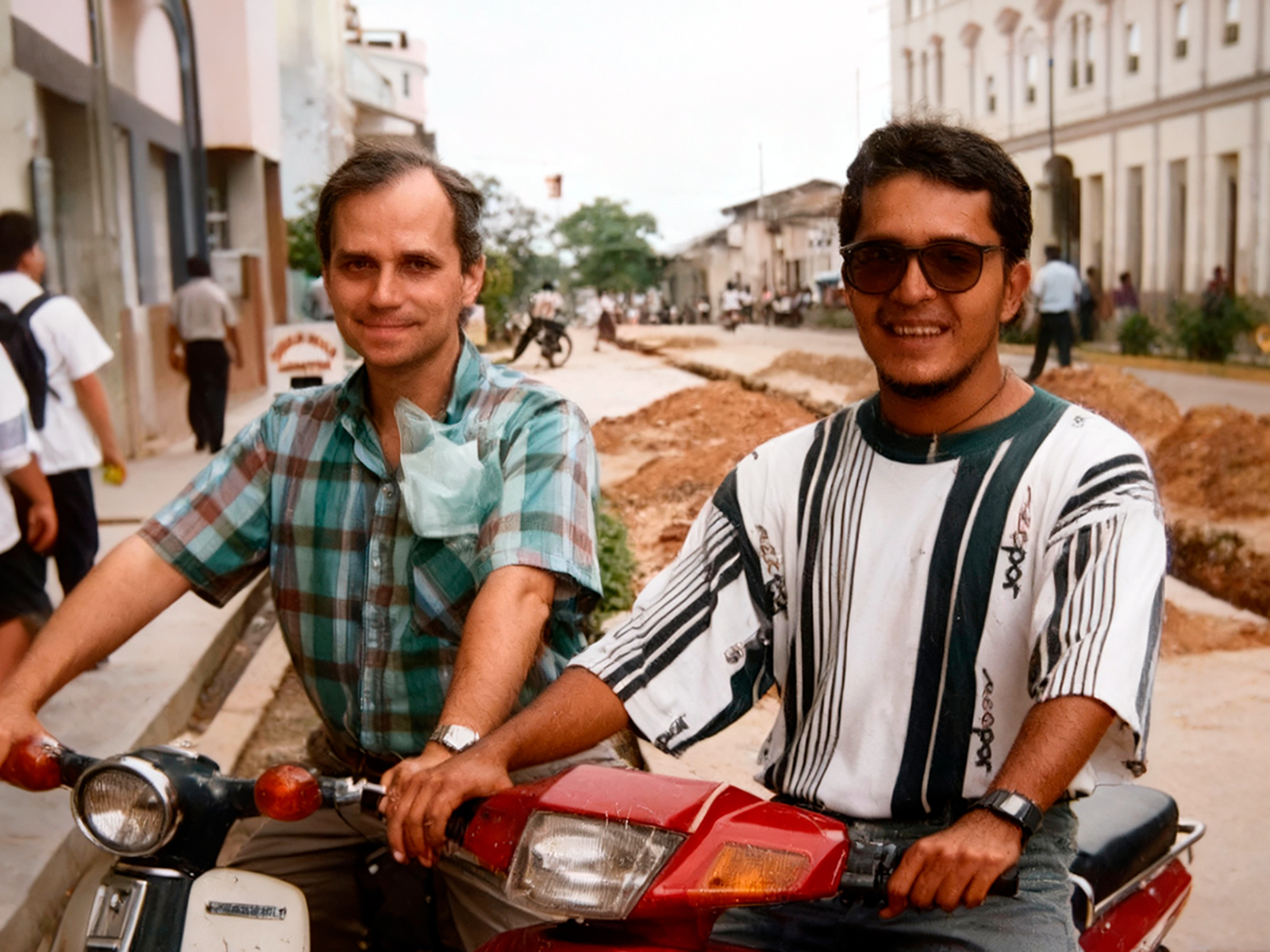
One of the pope’s close friends, Armando Jesús Lovera, had sent Leo an image of a flashing sign on his car’s dashboard warning about the state of the vehicle’s catalytic converter.
“What’s going on with the Citroën?” the pope texted back.
“It’s dying,” Lovera responded.
“Is it running or is it stopped somewhere?” the pope asked.
Lovera informed “Bob” — the name he uses for the pope in his contacts — that he was on the way back to his home city in Spain after an event to promote his new book, From Roberto to Leo, about their friendship.
“How much further do you have?” the pope asked, in an exchange Lovera showed me on his phone. Then the pope implored his friend to “keep a close eye on the engine temperature” and to “drive carefully.” Finally, the Holy Father signed off with a word of fatherly advice to Lovera, an editor at a Catholic publishing group, whom he has known for decades.
“Sometimes at low speed it doesn’t run well,” the pope wrote. “But at a higher speed, the oil flows normally.”
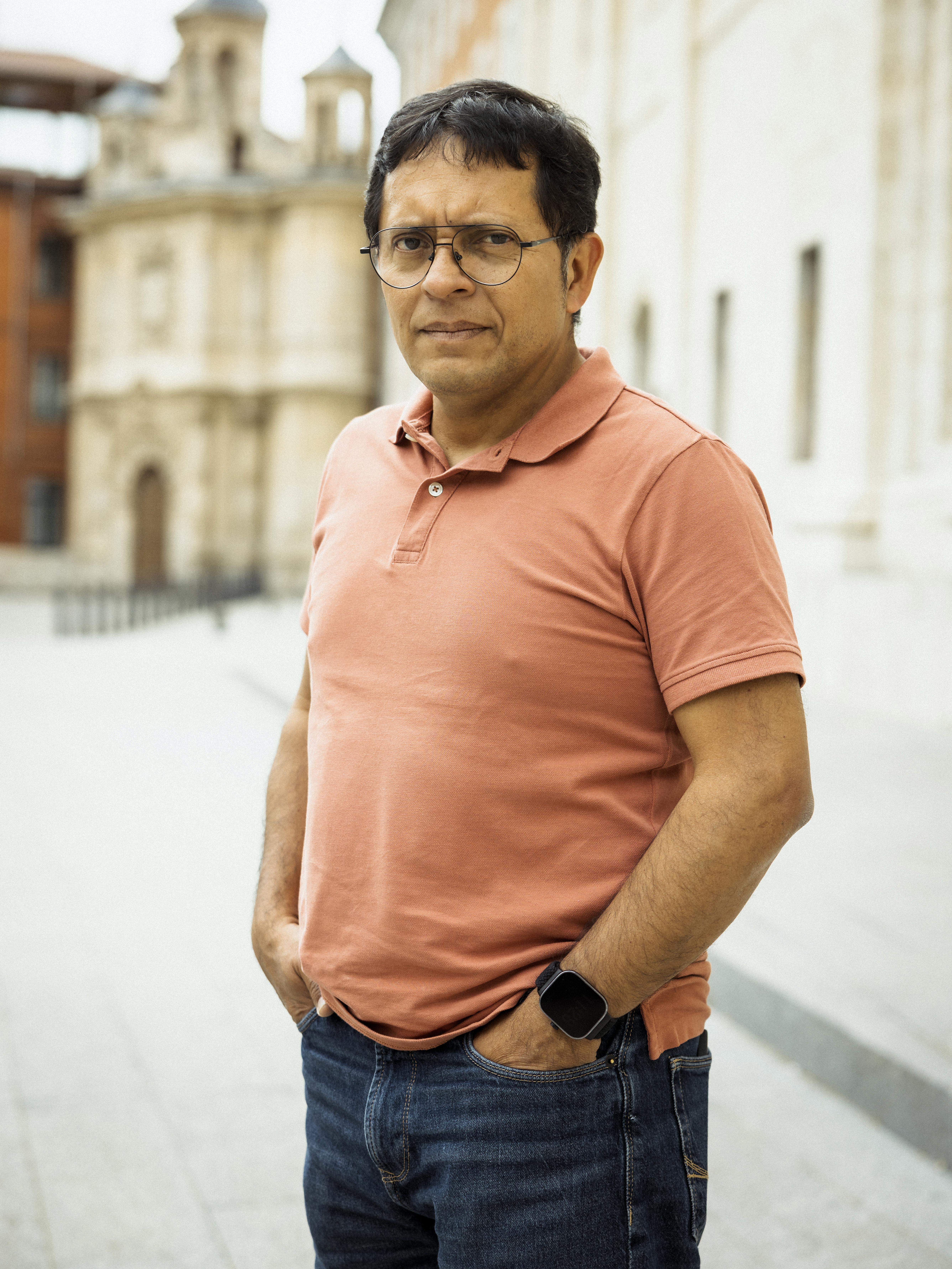
Armando Jesús Lovera in Valladolid, Spain, at the local headquarters of the Augustinian order.Gianfranco Tripodo for The New York Times
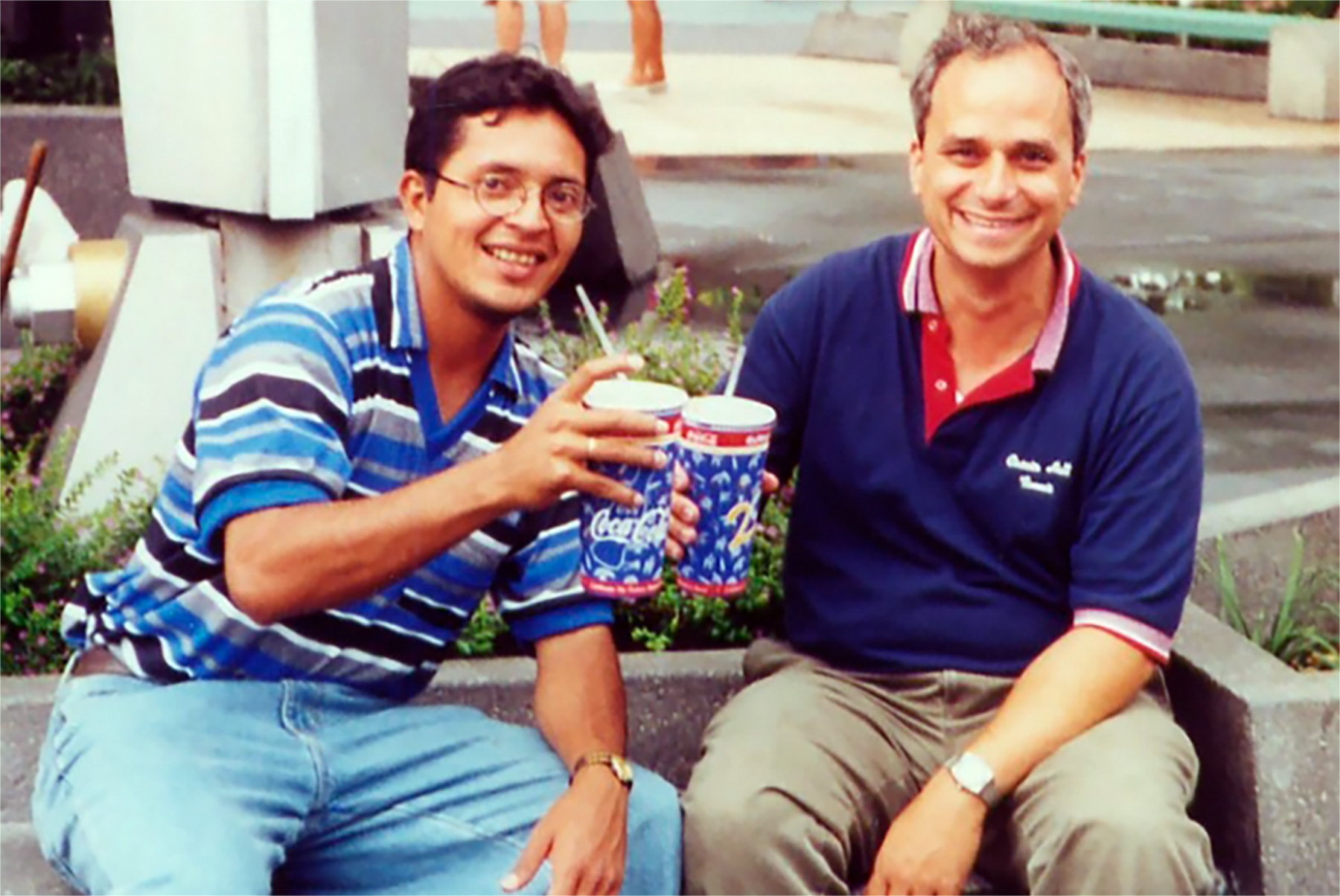
Lovera, 52, and Leo, 70, have been close friends since they lived together for seven years in Peru, in a formation house, a live-in community for Catholics considering a life dedicated to the faith. Leo, then a missionary priest known by his pre-papal name of Robert Prevost, ran the house.
Over the decades — as Lovera moved to Spain and Prevost became a bishop, cardinal and then pope — the two have stayed tight.
Lovera and his family visited the pope for five days in July, and they will join the pope again in Rome this August, Lovera said.
“To play tennis,” he said, “to feed the fish.”
This past weekend, as Leo began his weeklong visit to Spain with a tight schedule of events, he found time to send his old friend a greeting in a text message. “We said hello,” Lovera said.
Lovera, left, and the future Pope Leo in Orlando, Fla., in 2000.Armando Jesús Lovera via The New York Times
Originally from a Roman Catholic family in Iquitos, a town in the Peruvian part of the Amazon, Lovera moved to Colombia with the goal of becoming an Augustinian missionary. There, in 1991, he first met the man who would become Leo; soon after, Lovera moved with other Augustinians into the formation house, in Trujillo, Peru.
Leo taught the small, tight-knit group spiritual exercises and also how to manage money — “because you cannot give what you don’t have,” Lovera said, in an interview at the vast Augustinian headquarters in Valladolid, the city where he lives, a two-hour drive north of Madrid.
“He used to tell me that a community isn’t made of superheroes, but of brothers who decide together what is best,” Lovera added.
The two shared a love of music, mathematics and long road trips.
“We’ve been travel buddies,” said Lovera, who became the group’s driver, even though he didn’t have a driver’s license. The future pope filled their long hauls with car talk, expounding on how to drive cars through flooded streets. When he once spent the night at the Lovera family’s modest home, they had no bed to offer him, only a sofa.
It was so hot and humid that the future pope elected to sleep in a rocking chair. “My mother was dying of embarrassment,” Lovera recalled.
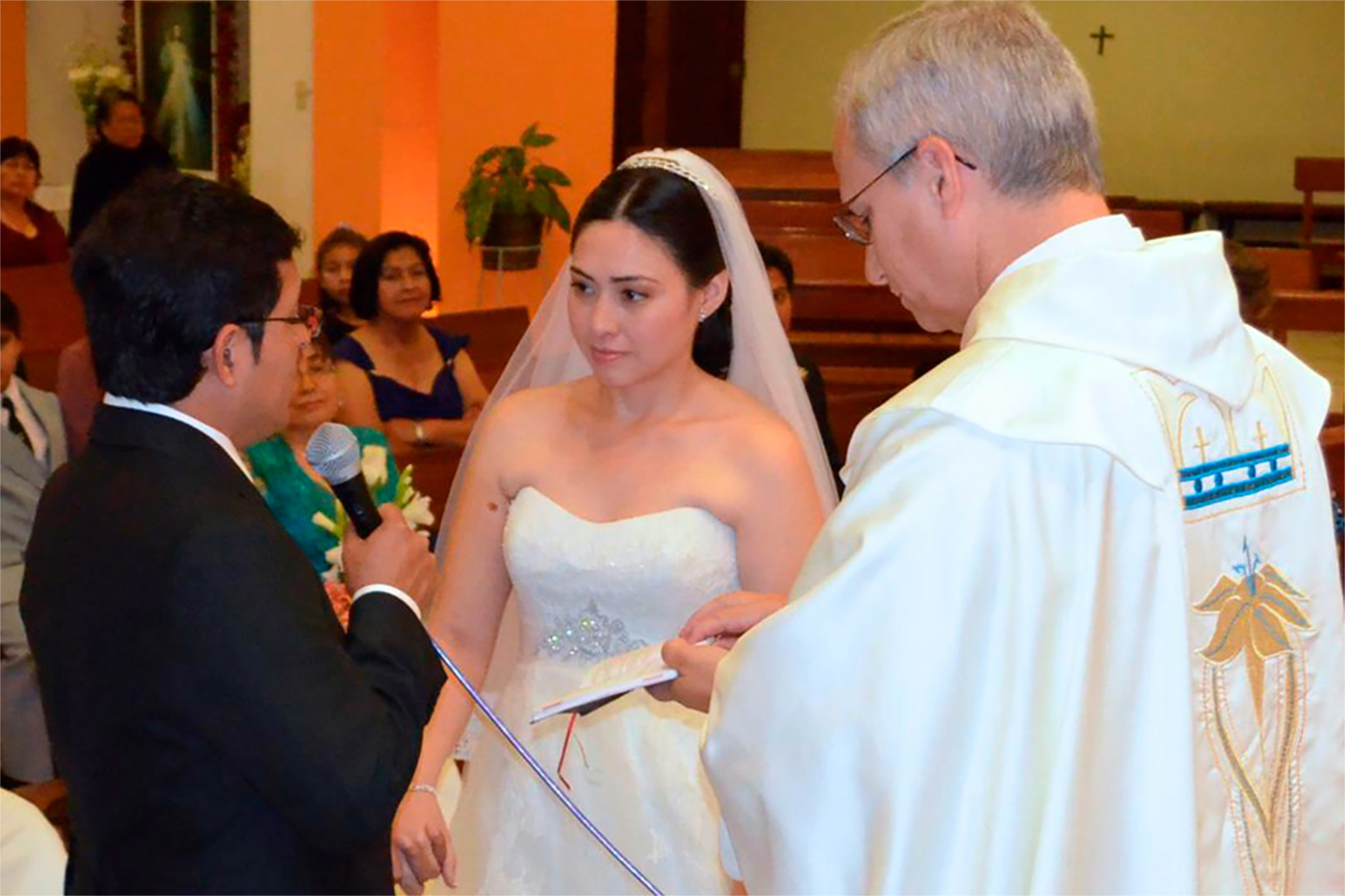
The future pope officiating the church wedding of the Loveras in Trujillo, Peru, in 2013.Armando Jesús Lovera via The New York Times
Leo left Peru in 1999 after being elected to lead the Augustinian Order in the Midwest, and soon after, Lovera decided to leave the missionary track. Community living, he decided, wasn’t for him, and he wanted to do more to protest against the economic policies of the Peruvian government at the time. He also didn’t take well to an order to travel to Rome to study the teachings of St. Augustine: “I wanted to be more independent,” he said.
Lovera said Leo had talked to him about the change and, instead of giving him a teacher’s lecture, had offered a friend’s understanding.
“Don’t feel obligated,” Lovera recalled his friend telling him, emphasizing that a holy life could be lived in different ways. Mostly, Lovera recalled, they joked about the Y2K bug that people at the time feared would wipe out the world’s computers at the turn of the millennium.
Soon after, Lovera moved to Spain for a job with a Catholic publisher. Leo later became the global leader of the Augustinian Order, a job based in Rome that required constant international travel, including to Spain, where he visited Lovera.
Lovera would often visit Chicago and catch up with the future pope’s family, including Leo, who happened to be there in November 2004. At that meeting, Lovera told his friend about a young Peruvian woman in Spain who had caught his eye. But when he had asked her out, Lovera explained, she had told him only that she would think about it — and mentioned a teddy bear that she coveted.
“I told him, ‘I have to find a teddy,’” Lovera recounted. The men hit the road, driving to malls looking for the right stuffed toy, finally finding what Lovera was looking for in a Target near New Lenox, Illinois.
The Loveras with Pope Leo at the Vatican in 2025.Armando Jesús Lovera via The New York Times
Back in Spain, the woman accepted the gift but initially rejected Lovera. He persisted, though, and they eventually married in a civil ceremony with the future pope as their witness.
In 2010, Leo landed in Spain for meetings with Spanish Augustinians, and Lovera picked him up at the airport. It was the day of the final of the soccer World Cup, and the future pope — a professed Real Madrid fan — decided that they should pull over to watch the match. In a pizza bar, they watched Spain defeat the Netherlands with a late goal in overtime, and both men chanted, “I am Spanish,” with the crowd, Lovera said.
For Lovera, the pope was his co-pilot. In 2012, for instance, Leo drove with Lovera to check out a house in Valladolid that Lovera and his wife wanted to buy. “I have never stopped consulting him,” Lovera said.
In December 2013, after the Loveras’ civil wedding, Leo married the couple in a church in Trujillo, and he later traveled to see them after the birth of their two daughters, whom he baptized. The girls, now 9 and 11, don’t quite understand that he is pope, Lovera said, and “see Roberto as part of the family.”
Once they reached school age, Lovera began to call his friend from the car when driving to pick the girls up from school, he said. When Leo became pope, those frequent calls became texts, but they remained in regular contact, Lovera said.
Last May, he asked the pope’s permission to write a book about their friendship, and the pope approved. “I trust you. You are my friend,” the pope said, according to Lovera.
In October, they posed together with the published book, which highlights their efforts to build solidarity among marginalized Peruvians in a time of upheaval.
Last month, Leo mentioned to Lovera that his brother, John Prevost, still called the pontiff from Chicago for information technology support.
“And Roberto says, ‘John, I’m the pope,’” Lovera recalled.
“‘Oh, sorry, pope,’” the pope’s brother responded, according to Lovera. “‘My computer is broken.’”
On his own calls to the pope, Lovera said that he didn’t talk about tech or politics or about the church’s future. Instead, he said, “I talk about cars!”
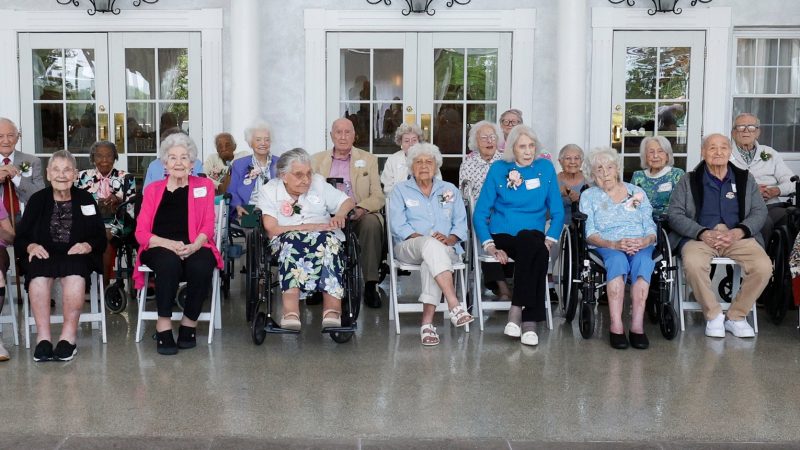
From horses giving way to cars and the invention of television, to the election of more than a dozen presidents, World War II, and even the sale of sliced bread — the 45 Chester County centenarians who gathered for an annual luncheon this week have watched the world remake itself time and time again.
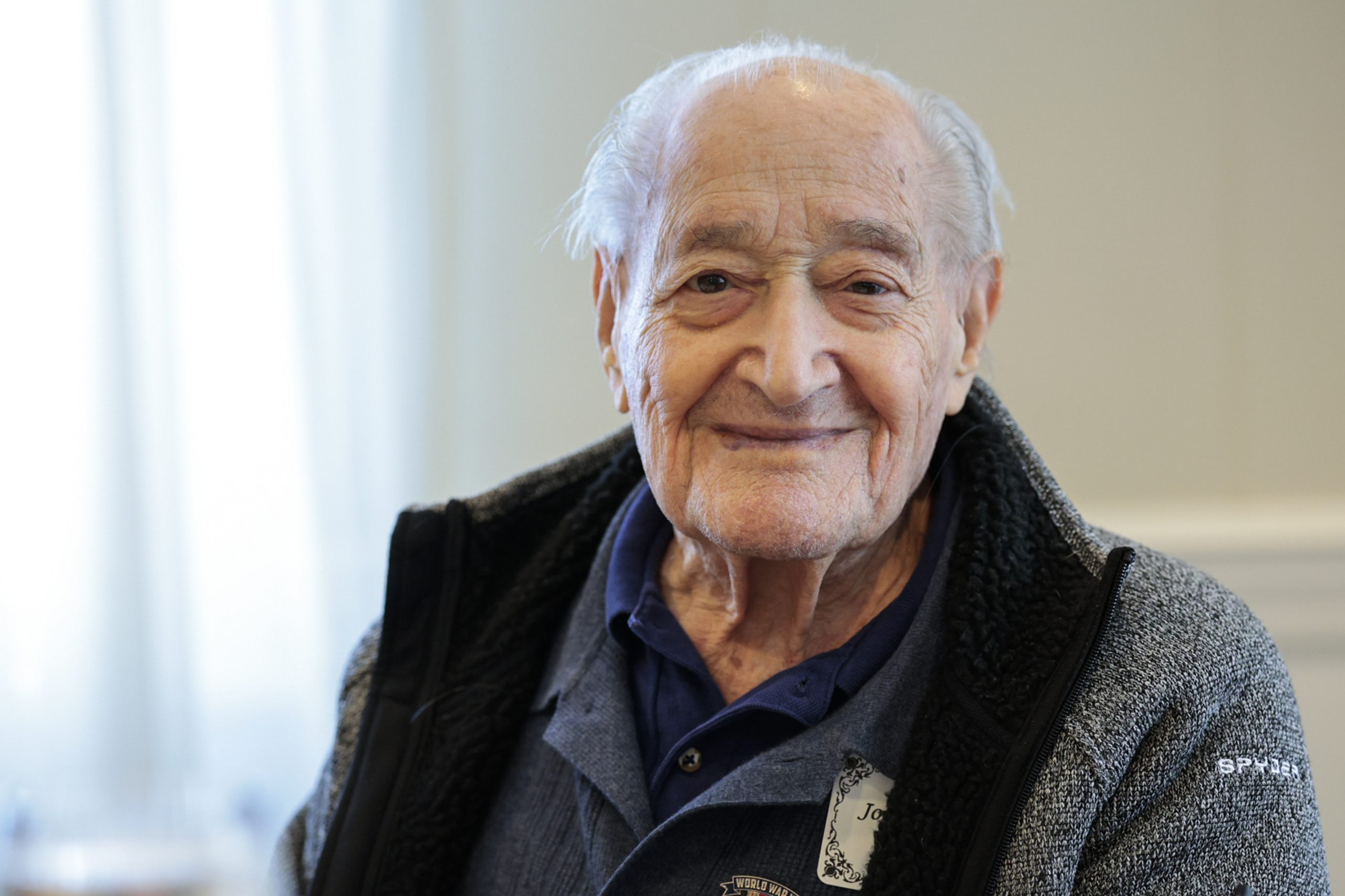
“I saw a lot of things. A lot of wars, and a lot of popes. There’s a lot of good things,” said Anne Caporale, who will turn 100 in July. “I got married, had a family. I had a good life.”
The annual luncheon celebrated Chester County’s group of centenarians — a total of 57 residents reaching or surpassing the milestone. Tuesday’s celebration saw a dozen who would turn 100 this year, plus quite a few returning attendees, including 108-year-old Evelyn Fair, who still writes poetry.
“You are the builders, the teachers, the parents, the neighbors, and the foundation of the Chester County community,” Josh Maxwell, chair of the board of county commissioners, told attendees. “Every single comfort and freedom we enjoy today is a direct result of the hard work, sacrifice, and grace you poured into the world decades and decades ago. We are walking today on paths that you have all cleared.”
Meet some of Chester County’s longest residents.
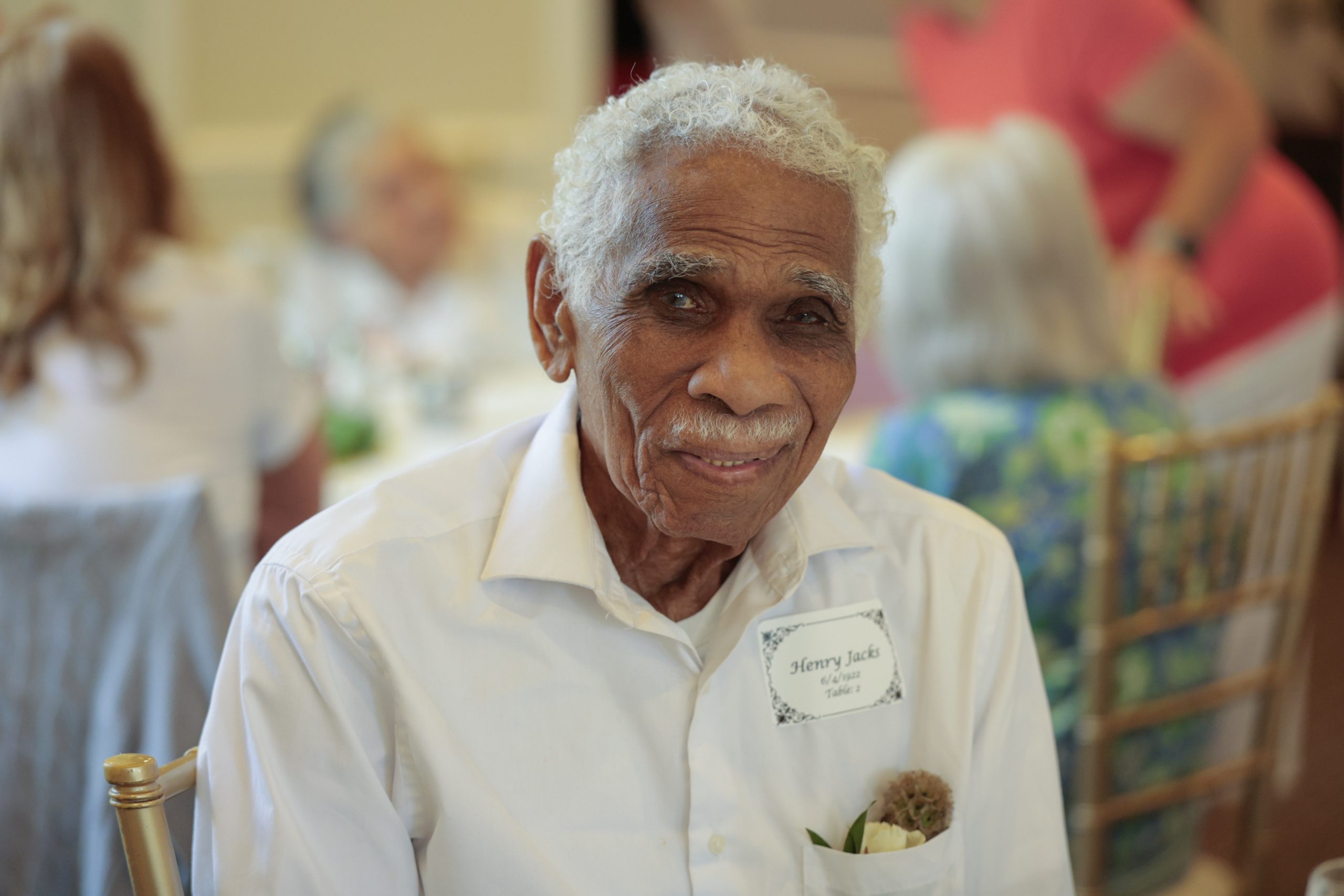
Henry Jacks, 104
Henry Jacks, 104, enjoys the annual centenarian luncheon hosted by the Department of Aging. Steven M. Falk / For The Inquirer
Henry Jacks moved to South Coatesville when he was 4 years old, and has called it home ever since. He’s witnessed “quite a bit of change.”
He remembers watching deliveries come by horse and wagon and recalls the hard days of the 1930s during the Great Depression (“cost of living wasn’t as bad as it is now,” he noted). Jacks joined the Army in 1940 during World War II, serving in the 92nd Engineers Regiment, and was stationed in Africa and Italy. He came back home to have three children, a boy and two girls.
He was a Boy Scout leader, the first Black mail carrier in Coatesville, a city council member, and a judge of elections. He still sings in the church choir. (His advice: “Treat people right. Go to church.”)
“So many changes that I’ve seen in the days,” he said. “I remember when I first saw TV; one of the neighbors had one, and all of the kids used to watch through his window. I’ve seen from the horses, to the cars, to the jet airplanes. And it’s been a wonderful life.”
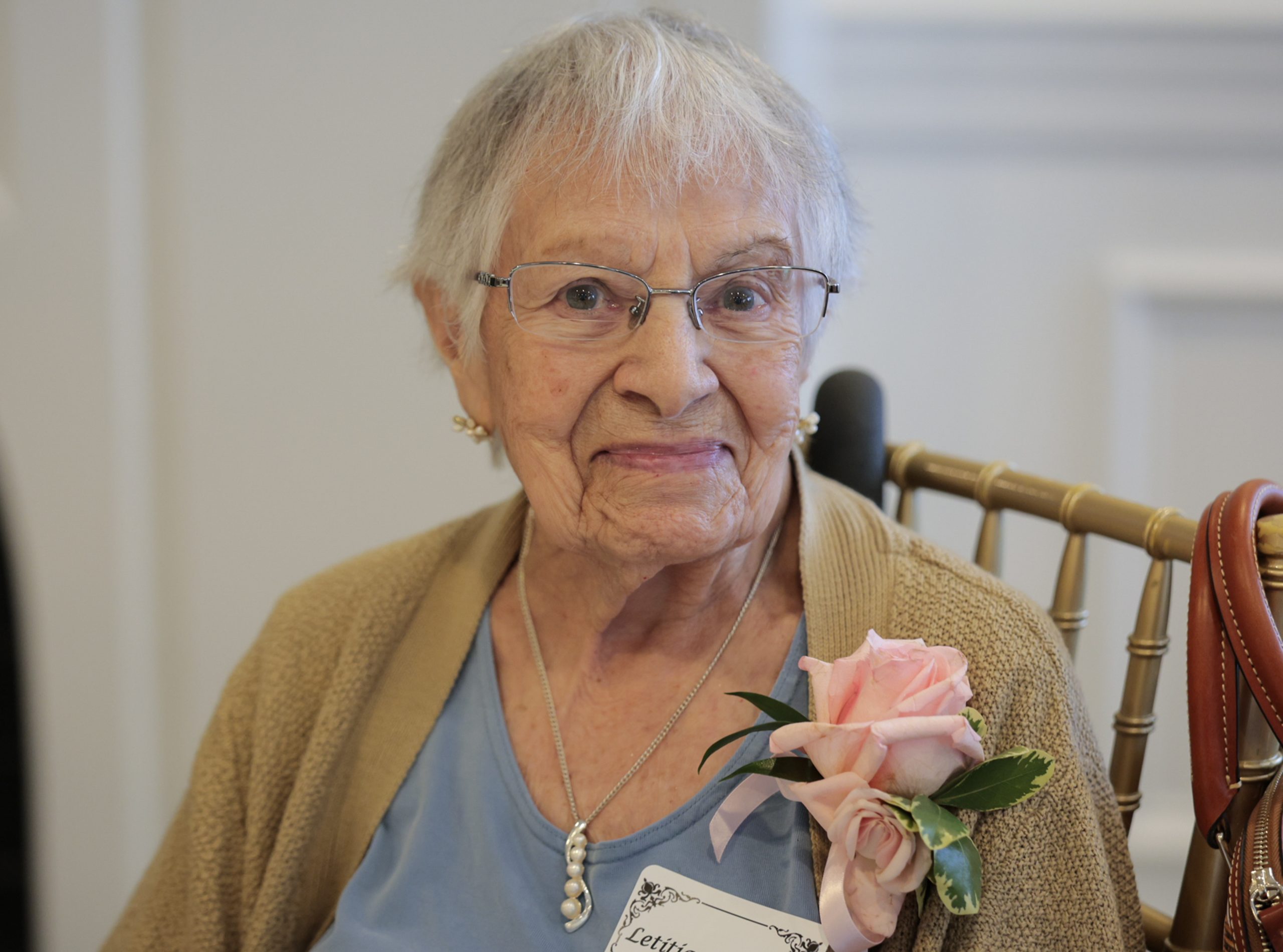
Letitia Hemphill, 103
Letitia Hemphill, 103, at Tuesday’s luncheon. Steven M. Falk / For The Inquirer
Letitia Hemphill started her working life at the candy counter at the former F.W. Woolworth’s five-and-dime in her hometown of West Chester. Though her father remarked she wasn’t good at math, she’d go on to have a long career using her skills while filling the registers and doing the end-of-day count in a department store and later at the treasurer’s office.
She retired in 1986 but had trouble sitting still.
“I got bored of not working,” she said.
She started cleaning houses. It was something she’d always done: help her mother clean in the morning, and then go to the park in the afternoon. She kept up the tradition with her two grandkids and her two great-grandkids, whom she babysat for 14 years.
An active life has been key to Hemphill, who did 10 years of ballroom dancing and more than 20 years at the gym.
“Keep your body moving and keep your mind moving,” she said.
She keeps her mind active by painting landscapes in watercolor, a hobby she took up in 1995.
Hemphill was born in West Chester to a stonemason father and a stay-at-home mother. Once, someone asked Hemphill if she had a lot of friends. With 11 brothers and sisters, she remarked she didn’t need any.
When she journeys through West Chester, she points out all the stores that have changed over time.
Still, Chester County is “beautiful,” and much of her family is still around to keep her moving: two children, two grandchildren, and two great-grandchildren.
Joseph Donia, 100
Joseph Donia, 100. There were 45 centenarians in attendance at Tuesday’s luncheon.Steven M. Falk / For The Inquirer
Up until last year or so, Joseph Donia’s hobby was building boats. He constructed a 20-foot wooden cabin cruiser from scratch. He had it for 40 years.
“The only reason I sold it — my wife couldn’t get on it anymore,” he said.
He had a lifelong love of boats, and spent five years at sea for the U.S. Merchant Marine in World War II. His time in service was the only time he wasn’t living in West Chester, where he bought a house and raised three kids. He also has six grandkids and three great-grandkids.
His most recent project was a 35-foot sailboat. It’s still sitting behind his West Chester home, but he’s given it to his son to finish.
It kept the 100-year-old active — something he advises.
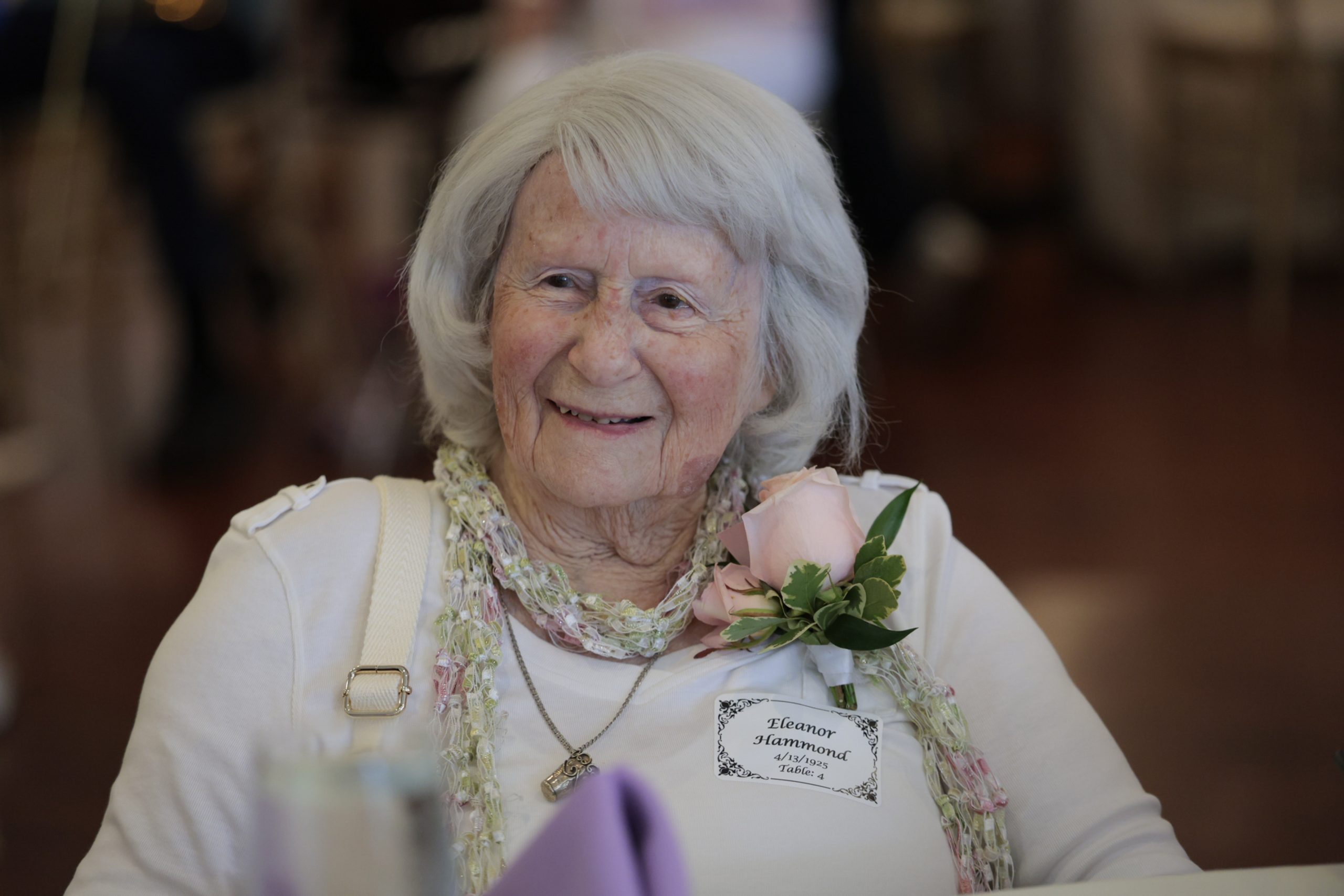
Eleanor Hammond, 101
Eleanor Hammond, 101, enjoys Tuesday’s annual luncheon. Steven M. Falk / For The Inquirer
Eleanor Hammond has always been a fan of creative pursuits: a voracious reader who knitted and sewed. She stitched her daughter’s wedding gown, and, perhaps more memorably, a jacket for her husband.
“He insisted I make him a jacket because I sewed for everyone else. He picked out the material; looked like Liberace. It was horrible,” she said. “I wouldn’t go out with him when he wore it.”
A graduate of Coatesville High School, Hammond would go on to work there until she was 81, in the principal’s office. She was once a disciplinarian, and truancy officer. She’s watched the county change over time, marveling at the amount of development. And, less positively, the traffic.
“The way to get here, I used to zip here,” she said. “But I can’t do that now.”
Still, she likes it, and the changes that have come with time.
“I’ve been here a long time. Everything about it is beautiful. The people are friendly, and it’s a beautiful place,” she said.
And as much as she loves home, she recommends travel. If you don’t know the language, be nice, smile, and “use your arms” to convey your meaning.
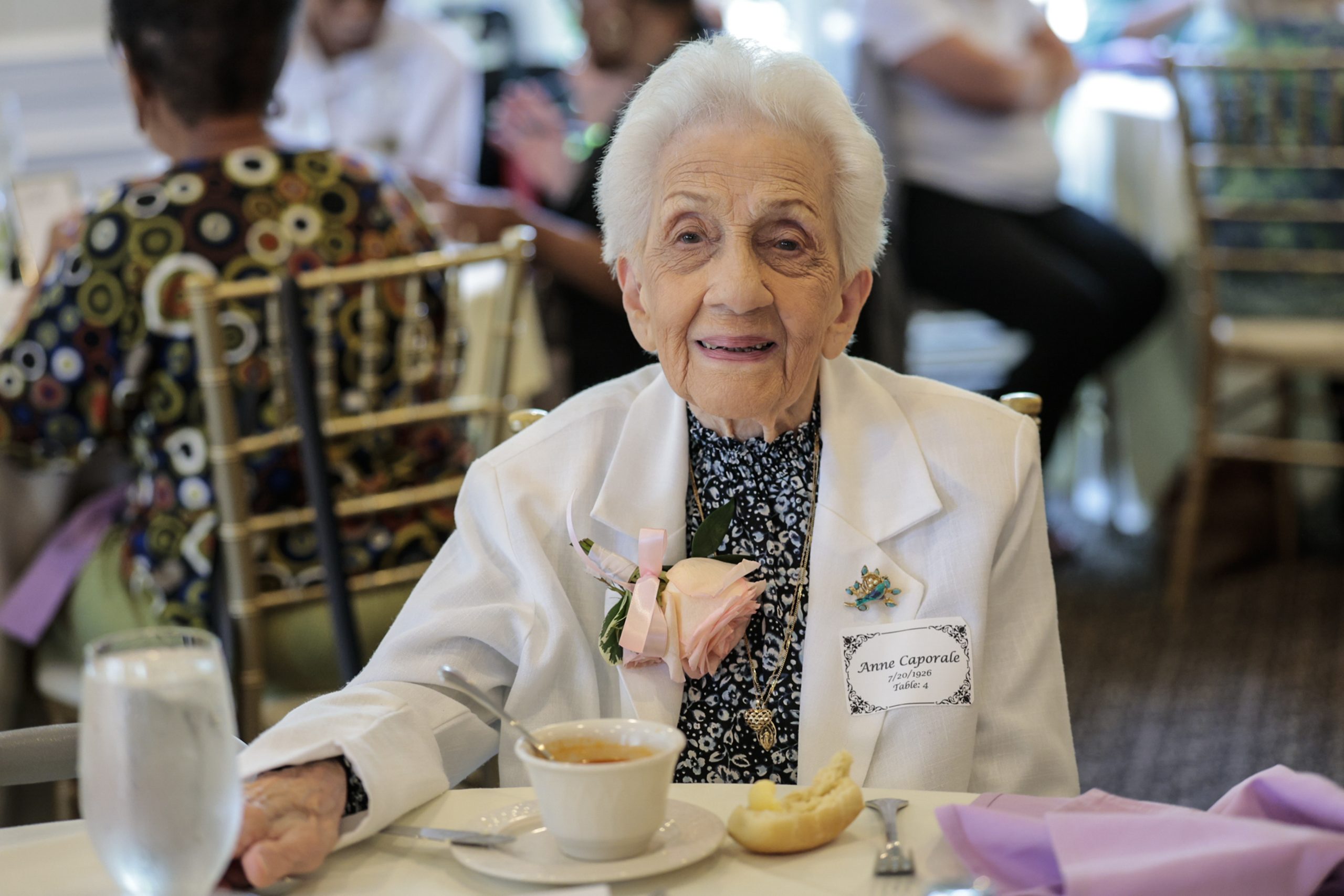
Anne Caporale, 99
Anne Caporale, who turns 100 in July.Steven M. Falk / For The Inquirer
Anne Caporale graduated alongside Hammond at Coatesville High School. She went on to raise six kids, and has 10 grandchildren, 27 great-grandchildren, and three great-great-grandchildren.
“We have quite a group,” she said. “I love them.”
She has found Chester County to be a good place to live and “wouldn’t want to live anywhere else.”
She lives at home, right by one of Downingtown’s high schools, which she loves because “the kids are great.” She still does her laundry and cooks every day. The luncheon Tuesday was a treat for her. “Let somebody else do the cooking,” she said.
Keeping active is the secret, she said.
“I know we’re here for a reason, but I don’t know it. I don’t question it,” she said.
This suburban content is produced with support from the Leslie Miller and Richard Worley Foundation and The Lenfest Institute for Journalism. Editorial content is created independently of the project donors. Gifts to support The Inquirer’s high-impact journalism can be made at inquirer.com/donate. A list of Lenfest Institute donors can be found at lenfestinstitute.org/supporters.
Only a few days into the World Cup, residents of Brewerytown and Fairmount, trapped inside the blast zone of the fan festival in their backyards, are seeing their fears realized.
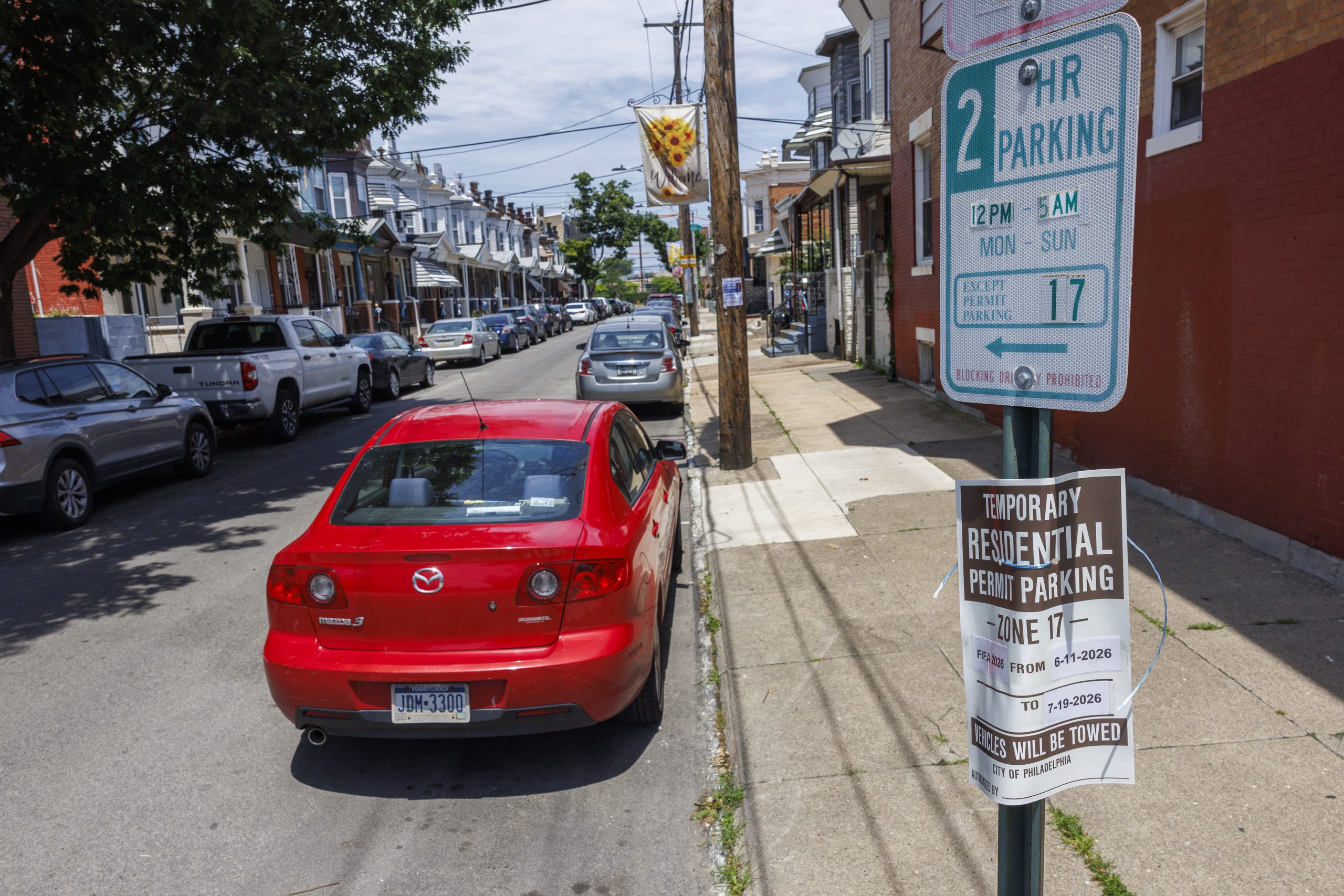
Drivers are clogging up roads, rerouting, and sometimes speeding through neighborhood side streets due to road closures. Uber and Lyft services are offline for residents directly next to the festival during operating hours. Many residents are forced to navigate parking nightmares, turning everyday life into an exhausting headache.
It’s all for the sake of the FIFA Fan Festival, a 39-day, million-square-foot party taking over Lemon Hill and inviting 15,000 daily visitors to its picturesque fields. While city officials and event organizers roll out the red carpet and spend millions on World Cup fans, residents who for years have been pleading for Lemon Hill improvements say the festival will use their neighborhood and park at their expense.
“The sentiment right now is just the complete disrespect for the residents and that this is all being done for tourists,” said Nissa Eisenberg, Fairmount resident and co-organizer of the Lemon Hill Neighbors Association, the organization disseminating festival information and communicating with the city. “Everybody’s feeling pretty resentful, maybe cautiously optimistic, but also just not feeling respected as residents.”
Soccer fans gather to watch Mexico play South Africa on a giant screen during the opening day of the FIFA Fan Festival at Lemon Hill on Thursday, June 11, 2026, in Philadelphia.Jose F. Moreno / Staff Photographer
The FIFA Fan Festival opened its gates to thousands of fans Thursday as not only the cheapest way to experience the revelry of a World Cup game (admission is free, though it requires registration),but also the melting pot of Philly’s best food and shopping. It is also the only fan festival across the 11 U.S. host cities that is open daily for the entire 39-day tournament, culminating on July 19.
If these changes weren’t tough to navigate already, city officials gave residents a little more than three weeks to prepare.
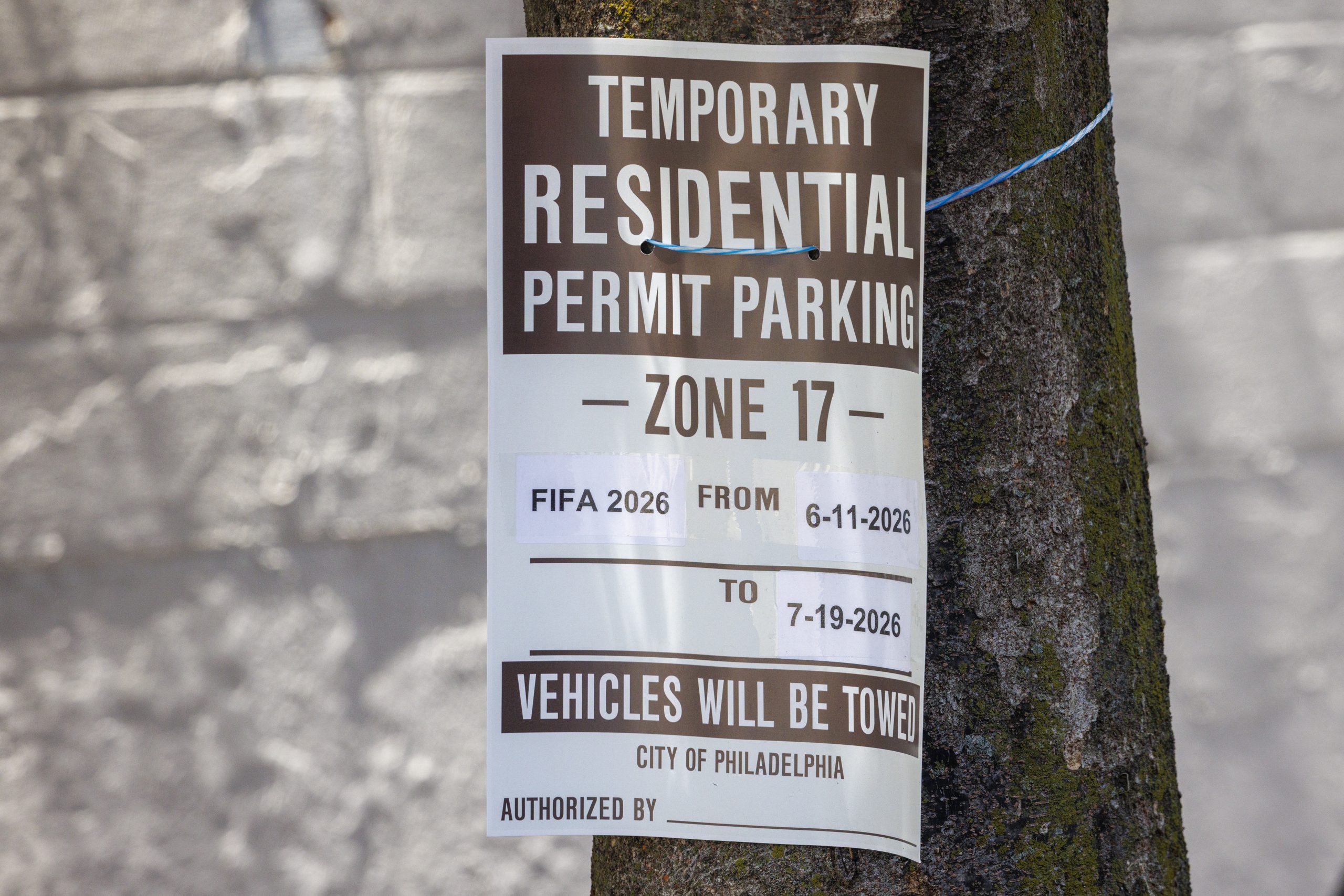
Temporary Residential Permit Parking sign on pole along N. 30th Street and Oxford Street, Thursday, June 11, 2026. Philadelphia Parking Authority is in the area ticketing and enforcing during FIFA Fan Festival at Lemon Hill.Alejandro A. Alvarez / Staff Photographer
“We’ve been talking with them for two years to engage neighbors with a plan, and they waited to communicate their plan until after people made their summer plans, after parents made driving schedules for their kids’ summer camps every week, and after people planned daily commutes,” Eisenberg said.
Charlotte Burns, a Fairmount resident and veterinarian, fears for other residents who work in hospitals and are often on call for medical emergencies. “For months we’ve known this was going to happen, but there has been nothing from the city,” Burns said, referring to the fact that door-knocking, flyers, and posters did not begin in earnest until weeks before the tournament.
(function() { var l = function() { new pym.Parent( ‘fifaroads2__graphic’, ‘https://media.inquirer.com/storage/inquirer/ai2html/fifaroads2/index.html’); }; if(typeof(pym) === ‘undefined’) { var h = document.getElementsByTagName(‘head’)[0], s = document.createElement(‘script’); s.type = ‘text/javascript’; s.src = ‘https://pym.nprapps.org/pym.v1.min.js’; s.onload = l; h.appendChild(s); } else { l(); } })();
On May 18, the city unveiled its plan for how it would manage the festival for residents. Officials informed neighbors that thousands of them would need to swiftly apply for parking permits to allow them to park near their homes for two months, something many residents are still unclear on, said Shaun Cerborino of Lemon Hill Neighbors.
Additionally, no rideshare services like Lyft and Uber will work at Lemon Hill and around six blocks of the surrounding residential areas during festival operating hours, sometimes spanning all day, in a practice called geofencing.Those without cars will have to walk blocks from their home to hail a ride, or use SEPTA, which is still operating in the neighborhood.
City officials told residents last month that rideshare services will not be disabled for riders who require a wheelchair-accessible vehicle (WAV). However, after The Inquirer asked for clarification on how this exemption works in practice, the Philadelphia Office of Transportation and Infrastructure Systems (OTIS) found that a miscommunication between rideshare services occurred.
The city was supposed to designate where WAVs can operate within the geofence, while the city was under the impression that rideshare services handled it.
Philadelphia Parking Authority, Zone 17, a temporary no park zone except for residents with special permit during FIFA Fan Festival at Lemon Hill, Thursday, June 11, 2026.Alejandro A. Alvarez / Staff Photographer
“Now that we have that clarity, we’re going to evaluate some changes to the perimeter that is enclosed in the geofence area. We’ll try to act as quickly as we can to adjust the geofence,” said OTIS Deputy Managing Director Mike Carroll.
City officials said they could not specify what these geofence adjustments will look like until they have finished talks with Uber and Lyft. But what was initially promised, that WAVs will pick up and drop off disabled riders at their homes, might not be possible. Instead, there is a chance WAV-only drop-off zones will be created in that geofenced area.
“That challenge is too difficult for us to work through for any resident who needs it,” Carroll said. “It’s too bad that there’s not a more general way to have these vehicles come in, but we can’t really haggle with [rideshare services] at this point. We’ll just try to make it work as best we can.”
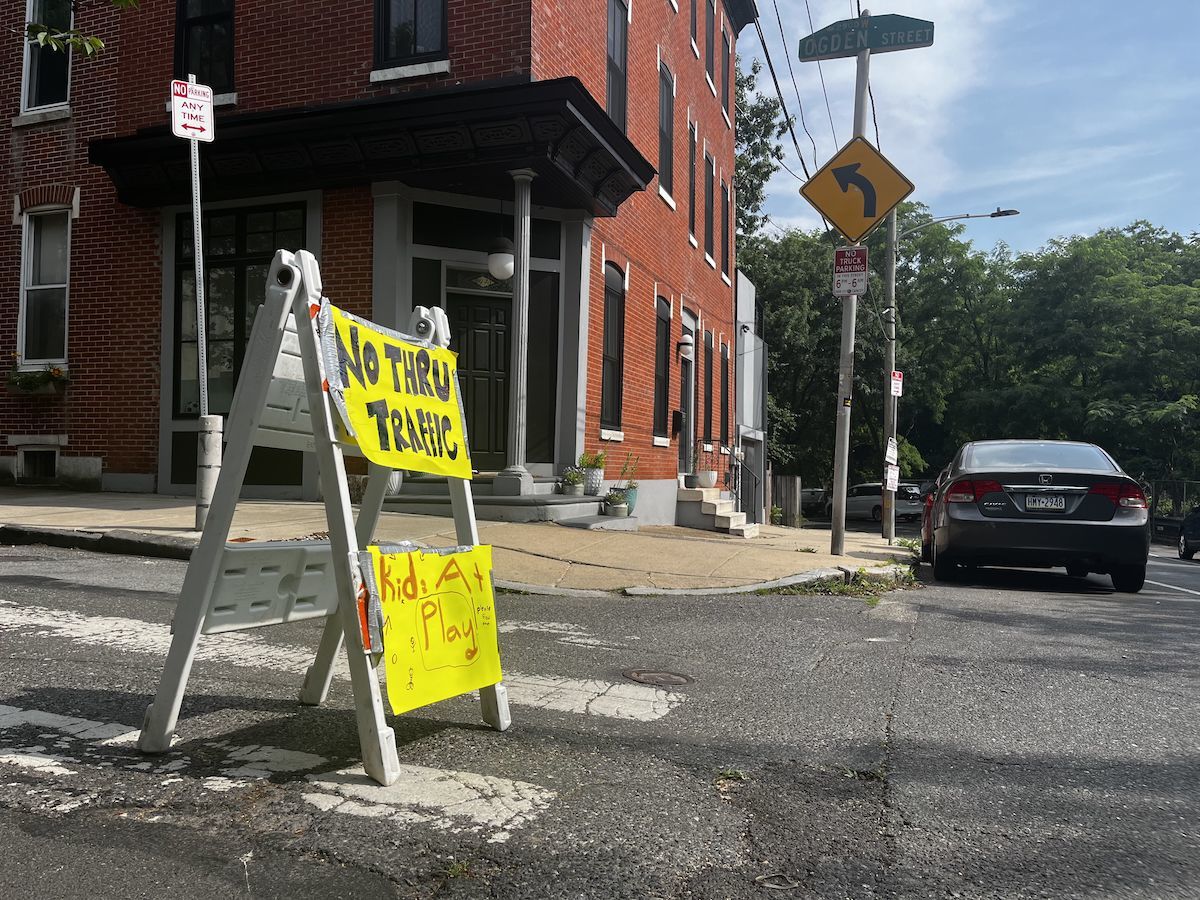
A makeshift sign created by local neighbors, pictured on Wednesday, June 10, 2026, advises drivers not to use side streets for through traffic on Ogden Street, a narrow residential side street one block from the festival, which drivers have been racing down to avoid road closures and traffic.Henry Savage / Staff
The work to calm neighborhood traffic
Dustin Dove, president of the Fairmount Civic Association, points to the 2900 block of Ogden Street, a mere block from the festival, as a microcosm of the neighborhood’s concerns.
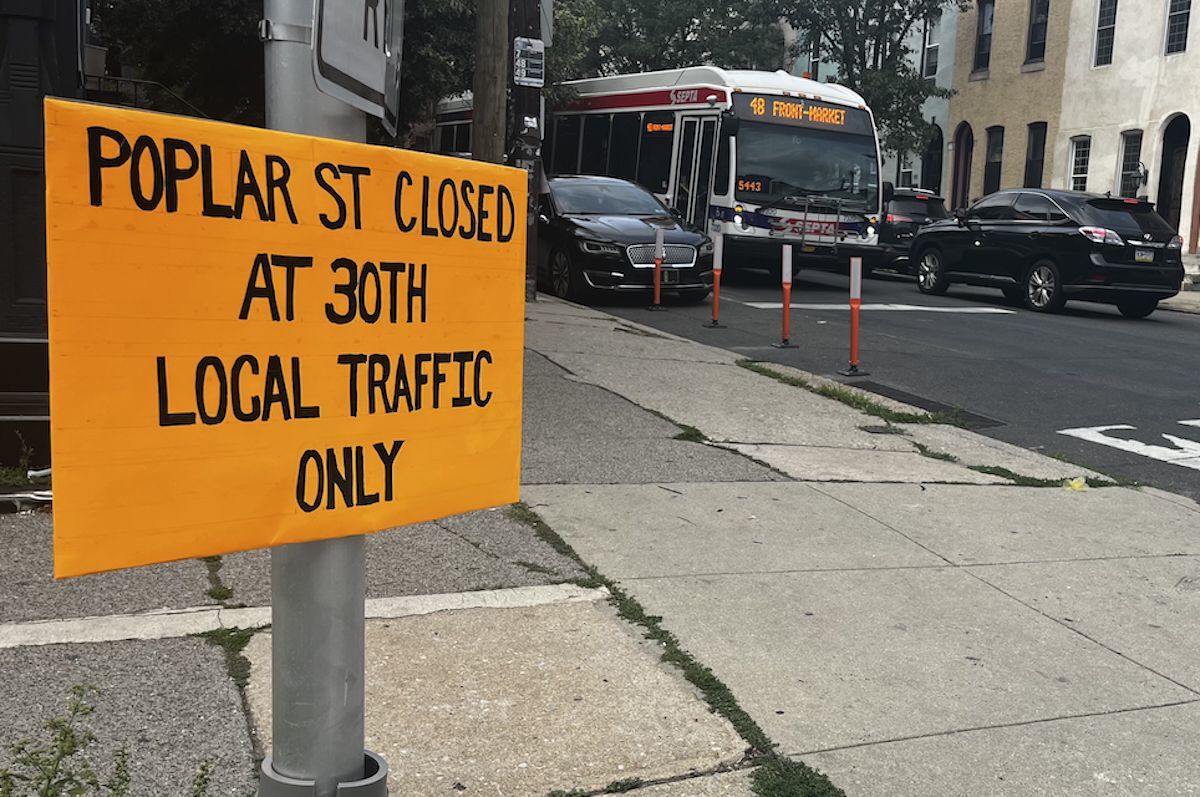
Due to road closures on 30th and Poplar Streets, agitated drivers, stuck in traffic, are choosing to speed down narrow one-way Ogden Street to get around lines of cars, residents said. Neighbors have seen at least two incidents where a car rocketed down the street while young children were playing.
Dove said residents have called every relevant city department and elected official who represents the area, including Councilmember Jeffery Young, requesting additional signage and traffic-control measures at 29th Street to dissuade drivers from using side streets.
“We’re going to be welcoming a lot more people than usual, and we need Council members to come and look at this situation,” Dove said. “There are issues that need some sort of leadership at the top to get them fixed.”
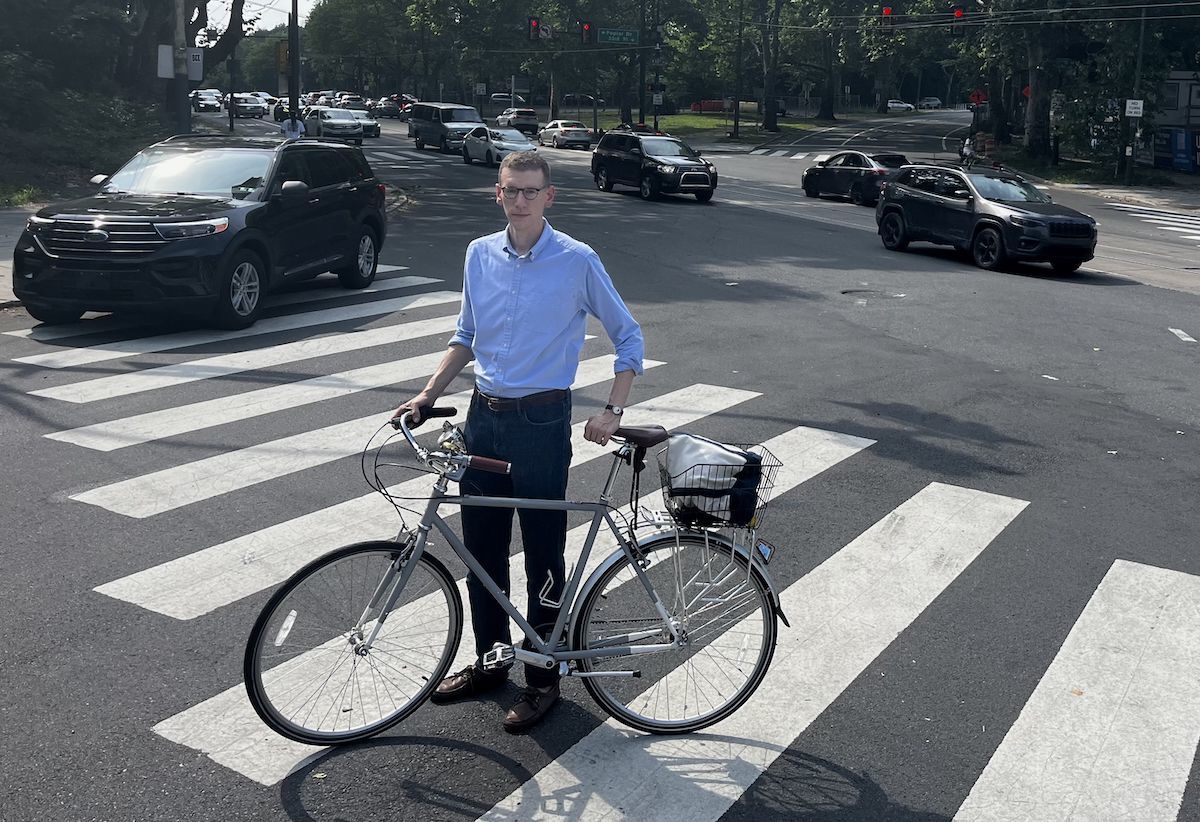
Dustin Dove, a Fairmount resident and president of the Fairmount Civic Association, poses for a photo near one of the busiest intersections near the FIFA Fan Festival in Lemon Hill, at Girard Avenue and Poplar Drive, on Wednesday, June 10, 2026. The FIFA Fan Festival is forcing the local neighborhood to navigate parking restrictions, road closures, and the sacrifice of their summer green space in exchange for the once-in-a-generation World Cup in their backyards.Henry Savage / Staff
Young said he and his office have heard from residents who are “understandably frustrated” by traffic being redirected onto neighborhood streets and confusing or insufficient signage.
“When these concerns were brought to our attention, we immediately notified the appropriate city departments and event organizers and have already seen some additional signage and traffic-control measures put in place. However, more work remains to be done,” Young said.
A city spokesperson said police officers will be stationed at 30th and Poplar Streets throughout the duration of the festival and will make adjustments as needed. The city also committed to installing additional signage where appropriate, the spokesperson said.
Still, as the first day of the World Cup rolled around, neighbors near Ogden Street reported heavy traffic on side streets, Fairmount resident Nicole Ross said, with many residents saying they received parking tickets despite having registered temporary permits. Ross said the Philadelphia Parking Authority later told residents who were ticketed that it was a system error and would be resolved.
Crew members make final preparations, including work on a 60-foot-wide screen, for a FIFA Fan Fest at Lemon Hill in Philadelphia on Tuesday, June 10, 2026.Jose F. Moreno / Staff Photographer
The legacy of Lemon Hill Park
Besides the short-term, everyday nuisances of the FIFA Fan Festival, there are deeper-rooted issues about care and longevity of the park. Park stewards, like Cerborino and Eisenberg, are volunteer workers who care for and maintain much of Lemon Hill.
Across the city’s parks, stewards understand that Philadelphia Parks and Recreation is unable to perform some needed upgrades due to staffing and budgetary constraints. That’s where stewards spend their free time and money to try to keep the city’s nationally ranked parks in an idyllic state. But that often comes with yearslong discussions about proper park funding and upgrades, as recently reported by The Inquirer, where stewards are again pleading with City Council for more funding as they are tired of operating off “love and duct tape.”
When pitching the festival to the city and residents, Philadelphia Soccer 2026 said it would be leaving lasting legacy improvements to the park in exchange for residents giving up their summer green space.
“We will see this through during organizational wind-down following the tournament,” a festival spokesperson said.
Crew members make final preparations, including work on a 60-foot-wide screen, for a FIFA Fan Fest at Lemon Hill in Philadelphia on Tuesday, June 10, 2026.Jose F. Moreno / Staff Photographer
Philadelphia Soccer 2026 is committing $4 million to install a new ADA-accessible sidewalk path, a new playground, and new lighting, as well as to rebuild the picnic pavilion, organizers said. Residents have begged the city for some of these improvements for years, Cerborino and Eisenberg said.
“Residents deserve a clear understanding of what lasting benefits will remain after the crowds leave. I will continue advocating for transparency, accountability, and a concrete plan for legacy investments that benefit the Lemon Hill area and the city as a whole,” Young said.
The city said it will work alongside Philadelphia Soccer 2026 to see these legacy commitments come to fruition, as well as have Philadelphia Parks and Recreation staff monitor the grasslands and trees to address any issues that appear during the festival, a spokesperson said.
While stewards understand that park upkeep is not at the forefront of city budgetary concerns, it does hurt when it seems improvements to Lemon Hill Park will come only after an international or major sponsored event takes place there, Cerborino said.
“Especially when the parks are primarily supported by public dollars, it doesn’t feel right for FIFA or Live Nation, or whatever company, to come in, have their way with our parks, make all the money on it — and the taxpayers foot part of that bill and get very little out of it,” Cerborino said. “The tradeoff is FIFA makes a few billion dollars, and we got a sidewalk.”
LONDON — Pankaj Khanna, the CEO of Heidmar Maritime Holdings, knows what it’s like to be stranded at sea in a war zone. Long before he became a shipping executive, he was a seafarer himself, a crew member on a ship during the Persian Gulf War of 1991 as a Scud missile flew overhead. He recalled the paralyzing fear of some seafarers on board.
Today, the stress on the roughly 11,000 stranded sailors in the Persian Gulf may be even greater. Seafarers now have internet access and are often watching livestreams of attacks happening around them while seeing explosions from their ship decks.
“The fact that they are sitting on board the ships with real-time information — it is psychologically very traumatic,” said Khanna, 55.
Three commercial vessels have been hit by U.S. forces this week. One of the strikes killed three people, bringing the number of seafarers killed since the start of the war to 14. All told, there have been 46 attacks on international ships in and around the Strait of Hormuz since Feb. 28, most by Iran and some by the United States.
The war in Iran is approaching its 15th week. For the shipping industry caught in the middle, pressure is mounting — on the sailors, the shipowners, and operators losing hundreds of thousands of dollars a day, and the customers awaiting the delivery of oil and goods. At stake is not only the safety of those in the line of fire but the functioning of the global economy.
A tense calm prevailed in the Gulf on Friday on hopes that a deal to end the fighting could be near.
“We have heard this, like, 20 times,” Khanna said. “So what are the prospects? I don’t know.”
Even after a reopening of the strait, he added, ships will need a “framework” before they attempt to get out. “We need to know which parts of the strait are clear,” he said.
Heidmar Maritime, based in Athens, Greece, manages a fleet of 60 vessels that operate all over the world, including off the coasts of Europe, South America, and northern Asia and in the Red Sea. Just two weeks ago, one of its ships was attacked by Somali pirates.
The company’s ship in the Persian Gulf, carrying Saudi crude oil, is one of about 500 large vessels operated by established companies that have been stranded there since the early days of the war in late February. Some vessels have taken advantage of windows of calm to slip out of the Gulf. But departures have slowed recently, according to Lloyd’s List Intelligence, as tensions have increased.
And it seems less likely that conditions faced by shipping businesses will quickly return to their prewar state even if a deal is reached.
“Even if a solution for peace is put in place in the coming weeks, there’s no guarantee there won’t be another crisis later on, and we can’t be prisoners to Hormuz,” Rodolphe Saadé, the CEO of CMA CGM, the French shipping giant, said at a French parliamentary hearing Tuesday.
The world’s third-largest container line, CMA CGM has 11 vessels stranded in the Gulf after three others were able to leave. “I won’t be fixated on the idea that the Strait of Hormuz is going to reopen and everything will return to how it was,” Saadé said.
As the strait remains effectively blockaded, shipowners are subject to marine insurance fees as high as $6 million to $7 million to exit the gulf, said Khanna of Heidmar Maritime. Perishable cargoes are expiring, and insurance premiums are adding up. Still, shipping companies have, in some ways, benefited from higher tanker rates and longer journeys needed to reroute around risky areas like the Red Sea.
For the companies with ships stuck in the gulf, Iran has offered a way out: Pay a fee to secure safe passage. But sanctions imposed on Iran by the United States and Europe make it illegal for companies with American or European connections to pay.
The shipping industry has more or less steadfastly maintained that the resumption of free passage through the strait is essential for global trade. Now the rising costs have led to some cracks in that argument.
Last week, Evangelos Marinakis, the owner of one of Greece’s biggest shipping businesses, said at a conference in Athens that paying $100,000 or $200,000 tolls to secure safe passage through the strait would be better than having the strait closed.
“I would prefer to pay a toll for the right to navigate through the Strait of Hormuz immediately and safely, rather than pay huge extra war risk premiums,” he said in a statement.
And the stress for seafarers keeps mounting.
Mohamed Arrachedi, the Middle East coordinator of the International Transport Workers’ Federation, a seafarers union, said he was receiving WhatsApp messages at all times of day from seafarers requesting repatriation or reporting unpaid wages.
“They were hopeful, but now, observing that it is starting again, people are not only anxious, worried, and concerned, but people are desperate,” Arrachedi said.
In recent weeks, more seafarers reported shortages of fresh fruit and vegetables than in the first couple of weeks, he said. On some ships, people are surviving on dry food alone. Drinking water, too, has become an issue since vessels have to be moving in deep water to generate their own supply.
“It’s kind of like being on the front line of a war that you have absolutely no involvement in,” said Michelle Wiese Bockmann, an analyst at the maritime intelligence firm Windward. “You don’t have a dog in the fight, and you’re just there.”
The Pennsylvania State Police gave out nearly 700 tickets and more than 300 warnings just days after a new law banning handheld device use was fully implemented.
Pennsylvania became one of the last states to have such a ban when Gov. Josh Shapiro signed the new law two years ago in June 2024. But the rule wasn’t implemented until June 2025, and it came with a one-year warning period. So police haven’t been able to ticket drivers for the law until just over a week ago.
To mark the occasion, state police conducted Operation Hands Off from Monday to Wednesday, cracking down on the new rule, which carries a $50 fine. The department touted the mission as “highly successful” with 694 traffic citations and 308 warnings related to the new law. They also issued 6,013 other traffic citations, 4,090 other warnings, and 98 DUI arrests during the three-day period.
The state police issued 1,616 warnings during the one-year warning period from June 5, 2025, to June 5, 2026, for the new law.
It’s named Paul Miller’s Law, to honor Paul Miller Jr., who was killed in 2010 after a tractor-trailer driver crashed into him.
“Nearly 15 years ago, two Dunmore state troopers knocked on my door to tell me that my son was killed,” Miller’s mother Eileen Miller said in an April statement. “My son did everything right — he was killed by someone else’s unsafe choices behind the wheel. This law is for every family in Pennsylvania that doesn’t have to experience two state troopers knocking on their door to tell them that their loved one was killed by distracted driving.”
Texting while driving had already been banned in Pennsylvania, but the new law encompasses all sorts of uses like taking photos, playing games, sending emails, scrolling on social media, or talking on the phone while holding it.
The law states that holding a phone or dialing or answering a phone by pressing more than one button is not allowed. Drivers can still use hands-free technology for uses like phone calls, navigation, and music.
There are no exceptions for sitting in traffic or at a red light — but there is an exception for contacting law enforcement in an emergency.
Shapiro’s administration suggests drivers pull over and park in a safe location if it’s urgent, ask a passenger to be a “designated texter,” use the “Do Not Disturb” feature while driving to silence notifications, or place their phone somewhere inaccessible.
After 11 years of marriage, there are very few things Aurora and Jamaal Brown don’t see eye to eye on. Then FIFA announced its first scheduled World Cup match in Philadelphia: Ivory Coast vs. Ecuador.
“Ivory Coast is going to win and I will celebrate with some drinks,” Jamaal playfully teased his wife over the phone Saturday evening. “I am telling her, we are winners.”
The Jacksonville, Fla., resident grew up with friends from the Ivory Coast and recently found out through a DNA test that he has ancestry from the West African country, a genetic inheritance he takes seriously.
Aurora Brown and the family pick out a soccer jersey for dad at FIFA Fan Fest in Philly. Dad Jamaal had stay back home in Jacksonville, where he will be rooting for the Ivory Coast. But Aurora is sticking with Ecuador.Michelle Myers
As an Ecuadorian native, Aurora thinks Jamaal is wrong. But she is letting him “live in delusion” because she and their kids were able to travel to Philly to support the Ecuadorian team. Jamaal had to stay behind to take care of his grandma.
“If they weren’t playing against Ecuador, the whole family would be Ivory Coast fans,” Aurora said while attending FIFA Fan Festival at Fairmount Park’s Lemon Hill on Saturday with her family. “We are going to buy him an Ivory Coast jersey for Father’s Day so he feels the love.”
Walking into the Lemon Hill park area, the mother of two was stunned to see so many Ecuadorian soccer shirts and flags, but no Ivory Coast representation.
Soccer fan Plinio Rada waves the Ecuadorian flag at the Philadelphia Museum of Art steps along the Benjamin Franklin Parkway on Saturday ahead of Ecuador’s first round World Cup match against the Ivory Coast.Yong Kim / Staff Photographer
Waves of yellow, red, and blue paraded down Center City and into the arteries connecting with the Philadelphia Museum of Art. An unusual scene in a city with little Ecuadorian representation.
Both the Ecuadorian and Ivory Coast communities are considered small in the Philly metro area.
According to the Census Bureau, 15,415 Philly-area residents claim Ecuadorian ancestry. And numbers for Ivory Coast residents are hard to estimate because the bureau doesn’t tabulate them.
Maryland resident Michelle Diagne, 35, felt that absence.
The Ivory Coast native came to visit her Philly family from Rockville, Md. But realizing the tickets were too expensive, she and her two teenagers settled for attending fan fest and watching Sunday’s game at home.
While she had hoped to see more Ivory Coast fans in Philly, Diagne said just knowing the “Elephants” are playing in the U.S. fills her with pride.
“It makes me feel like we count,” Diagne said.
Ecuadorian native Magaly Moreira, 60, shares the sentiment. After decades living in New Jersey, she had never seen such a display of her country’s people.
“It fills me with happiness, pride, and so much joy,” Moreira said, Ecuadorian flags painted on her face. “It’s our opportunity for us and the players to represent Ecuador.”
She was one of thousands of Ecuadorians attending “El banderazo Ecuatoriano” outside the Art Museum. An event organized by group +593 (the country’s international calling code) that made fans put aside the traditional “Ecuadorian hour” to show up more than on time to support their team.
“Ecuador, Ecuador, Ecuador, vamos Ecuador,” resounded through the Rocky steps as the fans chanted, many sporting the Ecuadorian soccer jersey.
Defeating the heat, a crowd of all ages — from newborns to seniors — cheered and danced to the traditional highland dance “Zapateando Juyayay,” showcasing pride for their country, waving flags, and hugging each other with hope.
With a broken leg and dragging a wheelchair, Darío Galarza and his friend Marco Gallardo flew in from Ecuador two days ago to support their home team. They did not expect to see such an outpouring for their national team.
“The U.S. is accessible for us because we share the same currency and it isn’t far, but we didn’t expect to see so many people,” Gallardo said.
Ecuadorian soccer fan Demetrio Govrea watches fans during a flag waving event at the Philadelphia Museum of Art.Yong Kim / Staff Photographer
For Galarza, skipping the World Cup wasn’t an option. After undergoing surgery for his leg last month, he made it a point to be as recovered as possible to fly to Philadelphia.
“I guess it’s true, you will always find an Ecuadorian in every corner of the world,” Galarza said. “At least I knew it was going to be me because I wasn’t missing this for the world.”
As a man inside a guinea pig costume began a conga line around the Rocky statue, 77-year-old Ecuadorian Francisco Castellanos couldn’t help but reflect on the wonder of seeing so many Ecuadorians together and the weight of representation.
“There are so many of us here that now we must win,” Castellanos said. “Whatever it takes,” he added, as the crowd erupted chanting the Ecuadorian national anthem.
On a weekend when World Cup soccer was drawing people from all over the world to Philadelphia, Ashley Elder was the exception. She came to play dodgeball.
“Honestly, it’s amazing,” said Elder, 28, from Vernon, Conn. “I love being able to represent my state. This is history. For us, this is a pretty big deal.”
Elder is one of 217 adult recreational league dodgeball players from Boston, Connecticut, New York, D.C., Pittsburgh, Ohio, and Philly who converged on the indoor gym at Ben Franklin High School in Philadelphia Saturday.
Representing 27 teams, they competed in the “Beast Coast” championship — five rounds of fierce round-robin play, followed by a final four tournament in each of two divisions: one for women, transgender, and nonbinary players and the other open to any player, which in practice was mostly men.
Members of the Aggression, a WTNB (women, trans, and nonbinary) dodgeball team gather before they played the Duckin’ Savages during the “Beast Coast” championship Saturday at Ben Franklin High School.Yong Kim / Staff Photographer
The game is six-on-six, with six balls on the court, and teams win the round after hitting all opposing players with a ball. For the first three minutes of a round, players can use a ball to block one that is thrown at them. After that, no blocking. The team that wins the most rounds within 20 minutes wins the match.
Gameplay in the women’s, transgender, and nonbinary division was intense. During the “opening rush” where players scramble to grab one of the six balls at the center of the court, one of Elder’s Connecticut teammates took a ball to the face, point blank, from her opponent on the Philadelphia team. Elder’s teammate shouted, laughed it off, and left the court.
“Yeah, one tactic is to rush the ball, pass to your teammate, and get that opponent out right away to get that quick advantage,” Elder said after the game.
Recreational league dodgeball is nothing new, and is a popular way for people in their 20s and 30s to make friends in new cities. But one league, Philly Dodgeball, has grown over the past four years as it organized what its promoters say is the premier competition on the East Coast.
Samantha Sayward (center) of the Aggression, a WTNB (women, trans, and nonbinary) dodgeball team, throws a dodgeball against the Duckin’ Savages during the “Beast Coast” championship.Yong Kim / Staff Photographer
In the process, it’s brought in elite players from around the country — Elder certainly fits that bill. Elder played basketball and track and field during high school, competed in shot put and discus at Southern New Hampshire University, and was named an NCAA Indoor Track and Field All-American in 2020.
Elder said that after graduating, she powerlifted her way through the worst of COVID-19 isolation. Once she got a chance to join a dodgeball league, she threw her energy into the game.
What started as a way to stay active and have fun led Elder to Graz, Austria, with Team USA for the 2024 world championships. (The Austrians won.) Now, she is one of 10 players at the Beast Coast competition who is headed to Bangkok this winter to compete for the biennial world championship.
It’s a rare sport, Elder said, where casual players can play alongside some of the best out there.
“If you stick to it, you’re going to get better,” she said. “We want people to have fun.”
Members of the Splooters from Connecticut play team Bostonian during the “Beast Coast” championship.Yong Kim / Staff Photographer
Philly Dodgeball
Samantha Sayward got her start when she moved to Philly from Boston in 2018 and was looking to make friends. But Sayward said she wanted to play in a league that followed USA Dodgeball rules, which she said are regarded as the standard rules and keep the games competitive and fair.
When she couldn’t find one, she launched Philly Dodgeball in 2022. As the league grew, she formed an LLC and hired three staffers to help run the league. In 2024, Sayward competed for Team USA in the World Dodgeball Championships.
Sayward, who is 35 and lives in Manayunk, said participation in Philadelphia has blown up in the past two years, from about 40 players to around 500.
Members of the Sirens celebrate after beating team Empire in a WTNB (women, trans, and nonbinary) dodgeball quarterfinals game.Yong Kim / Staff Photographer
She said most players are like her, “transplants” to the city in their 20s and 30s, looking to meet people in an inclusive community. Many identify as part of the LGBTQ+ community, she said, and the league hosts a women, transgender, and nonbinary “Lavender League” every Thursday.
“It is one of the most inclusive sports out there,” said John Michael Szczepaniak, 35, a casual player who came to the league after playing dodgeball in the LGBTQIA+-oriented Stonewall Sports. “There’s men and women, there’s every walk of life, respecting each other, cheering each other on. Even though we’re competitive, we’re the most supportive community.”
But as participation grew, Sayward drew on her experiences as a former Navy hospital corpsman and event planner in the nonprofit world to improve the league: Players have jerseys, regulation gear, referees, and a scoring system. There are custom medals. There’s even a commissioner. And that, she said, has helped bring in similar-minded leagues from across the East Coast for the Beast Coast competition.
By midafternoon, Elder and Sayward’s teams were both knocked out of the competition, with Long Island winning the tournament after beating the D.C., Maryland, and Virginia team in overtime.
Still, eight years after Sayward threw her first dodgeball in Philadelphia, the sport has changed her life. Her boyfriend — they met playing dodgeball — proposed to her in Dublin, Ireland, this year, just before she had to fly to Arizona to attend the Team USA combine. She said yes. And then she made the team.
“It builds friendships, relationships,” she said. “All the girls in my wedding, besides my sisters, I met them in dodgeball.”