Category: News

  • Westtown may ax its historical commission over a dispute to preserve Crebilly Farm’s 19th-century inn

    Westtown may ax its historical commission over a dispute to preserve Crebilly Farm’s 19th-century inn

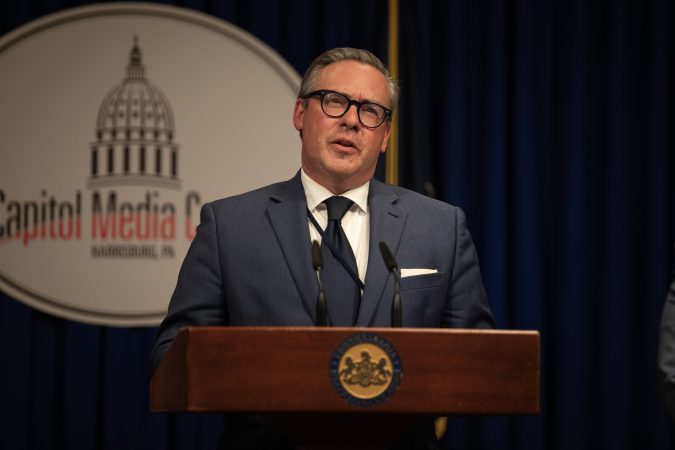
    A schism between Westtown Township’s elected officials and its historical commission reached a boiling point this week, with the municipality’s supervisors planning to remove the commission over what several members say is a disagreement regarding a historic building that residents have fought for years to preserve.

    An email sent to each of the six volunteer commission members Monday alerted them that Westtown’s three supervisors planned to take a vote at their meeting next week to remove them.

    At the center of the conflict is the historic Darlington Inn, a 19th-century building that sits on a two-acre parcel at the corner of State Routes 202 and 926. The inn was acquired in 2024 as part of a larger battle, led by the community, to preserve the 206-acre Crebilly Farm and fend off plans for residential redevelopment of the land.

    But the township has regarded the inn, which is along the farm tract, as a temporary purchase that it would eventually auction or sell off to recoup the $200,000 in taxpayer funds used to buy it. That has put the officials at odds with its own historical commission, whose members have adamantly fought to preserve the inn.

    “It’s really disheartening,” said Pamela Boulos, who has served on the commission for roughly a decade. “It’s really disheartening to know that this is the level that they’re willing to go to.”

    In an email, shared with The Inquirer, that included the subject line “Courtesy notice,” Township Manager Mila Carter said she was providing “advance notice, as a courtesy,” that the board’s agenda for Monday’s meeting “will include an item regarding your appointment to the Historical Commission.”

    “The Board will be considering a motion to remove your appointment from the Commission,” she wrote. “No action has been taken at this time, and the matter will be discussed and considered during the public meeting.”

    She also notified members that the commission’s planned Tuesday meeting had been canceled.

    Members said they were told separately they could reapply.

    The township did not immediately respond to a message seeking comment.

    The board’s decision comes as tensions have been increasing between the commission and the elected officials. Commission members say the relationship has grown more hostile recently, particularly as it pertains to the Darlington Inn.

    Last week, supervisors voted to rezone the property to commercial use, rather than agricultural or residential. The change would allow for “future adaptive reuse” of the inn, board members said previously. They said in April that the inn is currently not at “its highest and best use” by sitting vacant.

    Commission members felt that the community had largely believed that the inn was to be preserved alongside Crebilly Farm when the township purchased it in 2024. When it became clear the intention was to offload the inn as a separate parcel, the commission began to raise awareness among residents about the possible loss of the building. Members said they wanted to see if there was appetite from private donors to purchase and maintain the property.

    And the community, which has been willing to enter the fray to preserve the tract, started showing up to meetings.

    “My belief is that some of the supervisors felt that this was untenable, this was an annoyance, this was interfering with what they wanted to accomplish,” said Stephen Wahrhaftig, who has been on the commission for four years. “A few of the people on the commission were viewed as the troublemakers, and to get rid of only one or two people probably would have been bad optics … so the easy thing to do, as other townships have done, is just dissolve the whole thing, just get rid of it.”

    At its July 6 meeting, Patrick McDonough, chair of the historical commission, asked the township to consider easements on the land, to preserve the facade of the structure. The commission wanted to guard against “Wawa popping up there, or CVS,” he said separately.

    The board of supervisors declined to put any restrictions on the property. Jodi Nawrocki, chair of the board, said at the meeting nothing precluded the township from adding such easements in the future.

    “I think the way to use the building to the best use is through changing the zoning,” she told McDonough.

    McDonough said he felt that, in the process of the commission arguing its point, the board “thought that we were overstepping our bounds as a historic commission.”

    “My own township is willing to just auction this building off with no protection, no easements, and allow it to basically fall into the hands of what everybody else wants to do with it,” McDonough said. “I never thought that my own township would be the one I’d be fighting against the hardest.”

    The commission, formed in 2013, was created to help develop community appreciation of the township’s history and to preserve that history. The commission has created Westtown Day, an annual community day; has published a history book about the township; and hosts a litany of lectures. The volunteer-run body is appointed by the supervisors for three-year terms, and serves as an advisory committee to the board.

    “You would think, being a municipality in one of the oldest counties in America, that historic preservation, especially here in our year of America 250 … would be top of mind and not something swept aside,” Wahrhaftig said. “But I guess right now that’s not the case.”

    This suburban content is produced with support from the Leslie Miller and Richard Worley Foundation and The Lenfest Institute for Journalism. Editorial content is created independently of the project donors. Gifts to support The Inquirer’s high-impact journalism can be made at inquirer.com/donate. A list of Lenfest Institute donors can be found at lenfestinstitute.org/supporters.
  • Supreme Court justices tell Congress their safety is at risk and more must be spent on security

    Supreme Court justices tell Congress their safety is at risk and more must be spent on security

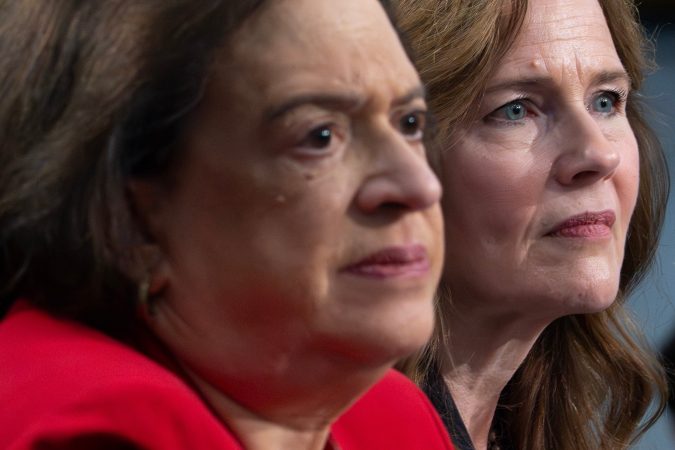
    WASHINGTON — Supreme Court Justice Amy Coney Barrett told lawmakers Tuesday that a sharp increase in threats targeting her and other justices is increasingly encroaching on their personal and family lives.

    During a rare appearance by justices before Congress, Barrett said she had to wear a bulletproof vest home a few years ago, something she struggled to explain to her 12-year-old son.

    “I didn’t expect that performing this service would put me in the position of explaining to my children what a bulletproof vest was, why I had to wear one,” she said.

    She and Justice Elena Kagan testified before a House appropriations panel in support of a request to increase security funding for members of the nation’s highest court.

    Judges around the country have seen a rise in threats of violence and intimidation. Barrett’s home was also targeted by a fake swatting call to police in May.

    The hearing comes two weeks after the conservative-majority court finished handing down a series of major opinions, including a decision that increased President Donald Trump’s power over federal regulatory agencies and another that rejected his wide-ranging tariffs, sparking harsh personal criticism.

    It’s the first time justices have testified before Congress since 2019, and the two justices faced wide-ranging questions about the court’s work.

    Security is central to budget request

    The Supreme Court requested a total of $228 million for next fiscal year, a roughly 10% increase over the year before. About $18 million of that is for maintaining the building and grounds.

    Much of the requested increase, $14.6 million, would go to expanding personal protection for justices, with six more agents for each.

    An additional $2 million would fund an off-site residential security post aimed at making emergency responses faster, as well as increasing the number of Supreme Court police officers.

    The U.S. Marshals Service, responsible for protecting judges, reported 564 threats in the government fiscal year that ended in September, an increase from the year before.

    That total includes threats to the hundreds of federal judges around the country, though the nine-member Supreme Court has not been immune.

    In May, Barrett’s security detail worked with police to quickly deal with the call determined to be swatting, or a fake 911 call designed to provoke a police response. Last year, her sister was the victim of a bomb threat in Charleston, S.C., police said. No bomb was found.

    In 2022, shortly after the leak of a draft opinion overturning the Roe v. Wade abortion decision, a would-be assassin was arrested near the home of Justice Brett Kavanaugh with weapons and zip ties. Threats to the Supreme Court increased after that leak, and have continued to grow, Kagan said.

    Chief Justice John Roberts has condemned the threats to all U.S. judges, saying during a speech in March that criticism of judicial opinions is understandable, but personally directed hostility is “dangerous, and it’s got to stop.”

  • Trump plans primetime speech on 2020 election allegations

    Trump plans primetime speech on 2020 election allegations

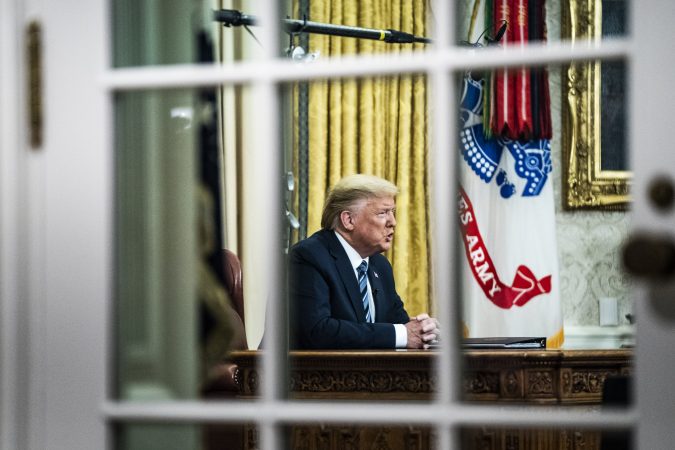
    President Donald Trump is planning a primetime address Thursday that will use findings from reexamined government files to argue that the country’s election infrastructure has vulnerabilities, according to two people briefed on the plan.

    Trump told reporters in the Oval Office on Tuesday that the speech would concern voting machines but declined to elaborate. “It will concern that subject, and we’ll have a couple of other things to say, also,” he said. “But I’d rather save it. But it’s really big news.”

    The president could use the address to press his long-standing allegations of foreign interference in the 2020 election, the results of which he has never accepted. The speech, in part, will highlight claims that China accessed U.S. voter data, said the people, who spoke on the condition of anonymity to discuss a plan that has not been made public. Trump is also expected to discuss findings related to Venezuela, they said.

    It was not clear Tuesday whether the major broadcast networks would provide airtime for the speech. As of late morning Tuesday, the White House had not made a request for air time.

    The plans are fluid and could change. “Anonymous sources are speculating about what President Trump will say during his speech on Thursday evening,” White House press secretary Karoline Leavitt said. “The truth is, nobody knows yet what President Trump will ultimately say, which is why everyone should tune in.”

    The plan came after a confidential White House briefing on Monday to review findings from the Trump administration’s broad reexamination of old FBI records, including from the 2020 election, one of the people said. Trump then announced the speech on social media, without specifying the subject.

    In recent weeks, FBI Director Kash Patel has dispatched hundreds of agents to help the bureau’s Atlanta field office review 700 files by July 17, according to an internal FBI obtained by the Washington Post. Trump has long argued that he unfairly lost the 2020 presidential election in Fulton County, Ga., which includes Atlanta, and, despite a lack of evidence, the FBI field office has been investigating those claims.

    Trump is making the primetime announcement at the urging of advisers including Bill Pulte, the acting director of national intelligence, and John Solomon, a former conservative journalist who temporarily joined the White House to help review government records for release. Solomon has long questioned investigations surrounding Trump and has pushed for the release of FBI investigatory files related to alleged election interference.

    Since Trump returned to office, multiple federal agencies have pursued allegations of tampering with the 2020 vote that had previously been investigated and rejected.

    U.S. intelligence agencies concluded in March 2021 that there was no foreign interference that altered votes or manipulated machines in the presidential election. The agencies said Russian and Iranian spies did try to influence Americans. They also said China considered but did not go through with efforts to try to affect the outcome of the election, a finding that was the subject of internal dispute at the time.

    In Trump’s second term, the Office of the Director of National Intelligence, under Tulsi Gabbard until last month, has taken steps including examining voting machines used in Puerto Rico looking for cybersecurity vulnerabilities.

    In September, the contract firm Mojave Research completed a report for the national intelligence director’s office based on forensic analysis of digital voting software obtained from Puerto Rico. The report concluded that software vulnerabilities made the machines highly vulnerable to hacking, according to two people familiar with the report, who spoke on the condition of anonymity to discuss findings that have not been made public. The Mojave analysts found no evidence that exploitation took place, they said.

    The report’s release had been delayed by the White House, the people said, but it could come this week.

    In January, the FBI and Justice Department seized 2020 ballots that were preserved by a court order in Fulton County. Investigators also obtained records including ballot images from the Republican-led Arizona Senate’s review of the 2020 results in that state’s largest county. And the FBI in recent months interviewed current and former election officials about the 2020 election in Milwaukee.

    Trump lost all three of those swing states in 2020. Recounts and court reviews have upheld those results, even as Trump has spent years falsely claiming the election was rigged.

    The Arizona and Georgia investigations came at the instigation of Kurt Olsen, a lawyer who worked on Trump’s efforts to overturn the 2020 results at the time and advised him in the White House in 2025.

    Trump has taken a series of actions in recent months aimed at influencing how elections are carried out. Most have been blocked in court or otherwise stymied.

    Last week, Trump disbanded a bipartisan commission that helps states and localities administer elections. He also recently signed executive orders designed to limit mail ballots and to require states to verify voters’ citizenship with federal data. Those orders have been halted in court. Judges noted the Constitution gives the power to run elections to the states and Congress, not the president.

    The Justice Department has sued to get copies of state voter rolls but so far has lost those cases. And the administration’s efforts to allow states to check voter eligibility in a massive federal database has been severely hampered in a separate case.

    Trump has demanded that Congress pass a law to require proof of citizenship and ID to vote in this year’s midterms, but Senate Republicans say they lack enough votes. To escalate the pressure, Trump refused to sign a bipartisan bill aimed at making housing more affordable, allowing the legislation to become law without his signature.

    Election officials and voting rights advocates have been bracing for months for the administration to release information that purports to cast doubt on how elections are conducted.

    “Few things can be more predictable than this coming,” said Lawrence Norden, vice president of elections and government at the Brennan Center for Justice at New York University, a voting rights organization that has sued the administration over some of its election policies.

    Any electronic system has vulnerabilities, but states are vigilant about making sure their outcomes are correct using “layered defenses,” Norden said. States conduct audits and recounts to ensure accuracy, and 98% of votes in the midterm elections will be on paper ballots that can be reviewed, he said.

    “Unless you have that context of the security that’s already in place, I think some of the kind of things that they’re throwing against the wall can be very confusing to the public,” he said.

    Some Trump White House officials in 2020 believed China favored Joe Biden in that year’s election and doubted the intelligence assessment that the country would not seek to interfere and had no preference, according to a former official who spoke on the condition of anonymity because of the matter’s sensitivity.

    That view was shared by then-Director of National Intelligence John Ratcliffe, who is currently serving as CIA director.

    Ratcliffe “disagreed with the established analytic line on China, insisting ‘we are missing China’s influence in the US and that Chinese actions ARE intended to affect the election.,’” according to a January 2021 report to Congress from an analytic ombudsman for the intelligence community.

  • As cyclospora illnesses surge to a record, Michigan officials eye lettuce as a possible link

    As cyclospora illnesses surge to a record, Michigan officials eye lettuce as a possible link

    NEW YORK — Infections from the diarrhea-causing parasite cyclospora are surging, with state-level data suggesting that 2026 is already the nation’s worst year for reported cases.

    More than 30 states have reported infections this year, and current data from them shows the number of infections surpassing the record U.S. mark of about 4,700 set in 2019. The illness is not usually life threatening and is typically treated with antibiotics.

    Health officials have not yet definitively identified what is causing the infections. But in Michigan — where more than 3,300 cases have been reported — officials say early information points to lettuce or salad greens as a possible culprit.

    After conducting more than 1,000 interviews with patients, “early information has shown lettuce as a common product that regularly comes up during the investigation,” said Natasha Bagdasarian, the Michigan health department’s chief medical executive.

    Because of that commonality and because produce has been behind some past cyclospora outbreaks, Michigan officials advised consumers to buy whole heads of lettuce, discard the outer layers and thoroughly wash what’s left. They also suggested people avoid bagged lettuce and pre-mixed salad kits.

    On Tuesday, the Taco Bell restaurant chain issued a statement saying it had “voluntarily and temporarily removed limited ingredients at select restaurants as a precautionary measure. We will continue to closely monitor the situation and follow the guidance of public health authorities.”

    Cyclospora is a microscopic, spherical parasite that commonly causes watery diarrhea “with frequent and sometimes explosive bowel movements,” according to the U.S. Centers for Disease Control and Prevention. Outbreaks tend to occur most often in the late spring and summer.

    The heat-loving parasite infects the bowels and spreads through feces. In the past, people have been infected by consuming fruits or vegetables that were exposed to feces-contaminated irrigation water.

    The illness, called cyclosporiasis, is less common than foodborne illnesses caused by other germs, including salmonella and E. coli. Many cases are never linked to a specific food or other source and, for years, few U.S. cyclospora outbreaks were reported. But the number started rising about a decade ago, with a particularly notable spike in 2018 and 2019.

    Experts say it’s likely that cyclospora cases historically were underreported, in part because some common tests used to check for food poisoning have not been geared to detect cyclospora. They attribute the increasing trend in cases to climate change and better detection.

    The worst year in the U.S. for infections was 2019, when about 4,700 illnesses were reported, according to federal data on confirmed and suspected cases.

    The Centers for Disease Control and Prevention keeps those numbers, but they traditionally lag what’s posted by individual city and state health departments dealing with local outbreaks in real time. On Tuesday, CDC officials issued a health alert that said that since May 1, the agency is aware of 1,645 confirmed domestic cases and more than 5,100 that require further analysis to confirm whether the infections were acquired in the U.S. The reports come from 34 states, the CDC said.

    The federal alert did not detail how many reports came from each state. But Michigan officials have reported more than 3,300 cases, officials in northwest Ohio said they have seen more than 1,100, New York City officials counted more than 400, and Illinois reported more than 200.

    Officials do not think all can be tied to a common source. In Illinois, for example, more than half the people with infections said they had travel outside the United States, and at least some may have been infected elsewhere.

    But Michigan officials believe a large share of their total is likely due to a linked domestic outbreak.

  • Camden County wants to spend $400M to make Cooper River swimmable and improve other waterways

    Camden County wants to spend $400M to make Cooper River swimmable and improve other waterways

    Camden County officials announced a $400 million master plan Tuesday to protect the county’s network of rivers, lakes, and streams such as the Cooper River.

    They are hoping voters will approve a referendum in the fall to help pay for it over the next decade.

    That waterway network is threatened by aging infrastructure, stormwater runoff, industry, and changing regulations that have left it degraded. A comprehensive plan is imperative, officials said.

    An ultimate goal, they say, is that residents may one day be able to swim safely in Cooper River Lake without a health risk.

    “Repair. Replenish. Recreate,” County Commissioner Jeffrey Nash said. “Those three words summarize the generational change that Camden County is about to embark on to improve the quality of our water bodies.”

    County, state, and local officials made the announcement at the Camden County Municipal Utilities Authority headquarters in Camden, backed by representatives from various environmental groups and nonprofits.

    To raise the money, officials are assembling federal, state, and government grants and loans, as well as help from private nonprofits.

    Voters could be key

    But they also said a planned voter referendum on increasing the county’s open space tax to $0.03 per $100 of assessed property value is key to secure permanent funding. Voters will weigh in on Election Day, Nov. 3.

    The rate would nudge up from $0.02. That means someone with property assessed at $500,000 would pay $150 a year toward open space, up from the current $100.

    Waterways that would see increased protection include:

    • Cooper River Lake, which spans Camden, Pennsauken, Cherry Hill, Collingswood, and Haddon Township.
    • Kirkwood Lake in Lindenwold.
    • Atco Lake in Waterford Township.
    • Pennsauken Creek, which runs through Pennsauken, Maple Shade, and Cherry Hill.
    • Big Timber Creek, which spans multiple towns.
    • Evans Pond and Wallworth Lake in Cherry Hill and Haddonfield.

    Nash said the county’s population growth over the last 100 years can be attributed to people drawn to the waterways. But increased population also resulted in the need for more sewer lines and attention to aging infrastructure.

    “We stand at a crossroads, and we have a choice to make: Either we’re going to shrug our shoulders and pass this problem on to the next generation, or we’re going to do something that is generational,” Nash said.

    The cost breakdown

    The plan calls for:

    • $200 million to fix aging combined sewer systems that overflow during storms.
    • $75 million for dredging and other methods to reduce sediment.
    • $50 million for rehabilitation of sanitary sewer systems across multiple towns.
    • $50 million to restore recreational lake areas.
    • $25 million for green infrastructure.

    And it includes an unspecified amount for continued planning, monitoring, and management.

    Scott Schreiber, executive director of the Camden County Municipal Utilities Authority, called the plan “a comprehensive strategy that addresses every major factor affecting the health of our rivers, lakes, and streams.”

    He said it represents a new way of thinking about water quality by coordinating across towns, rather than planning by one municipality at a time.

    “Water doesn’t recognize political boundaries or municipal borders,” Schreiber said.

    The biggest chunk of money will go to address combined sewer overflows (CSOs), which are now antiquated. A combined sewer system collects rainwater runoff and household sewage into one pipe. Normally, it can transport all of that to a sewage treatment plant. But storms can bring so much water that they can exceed the system’s capacity. When that happens, untreated stormwater and wastewater flow into bodies of water, such as the Delaware River.

    Schreiber said projects are being designed and built to capture and treat much more stormwater before it reaches the Delaware.

    Separately, money will be used to repair and rehabilitate aging sewer systems, reducing leaks and groundwater infiltration that pollutes waterways.

    He said the infrastructure money will also be used to install rain gardens, permeable pavement, and bioswales, which are typically sloped channels covered with vegetation and designed to capture or slow stormwater.

    The county will start a regular dredging operation to remove decades of accumulated and contaminated sediment in lakes and ponds to improve aquatic habitat, restore ecological function, and create overall healthier waterways.

    And the county plans to restore recreational lakes by improving public access, bolstering shorelines, and boosting overall water quality.

    Officials plan to finance part of the plan through the New Jersey Water Bank, an independent state authority that provides low-interest loans for water quality infrastructure projects.

    However, Schreiber said, the voter referendum will be key. If voters approve it, the referendum would provide $7 million per year that could be used to pay off that debt and pay for other improvements.

    ‘Vibrant waterfront communities’

    Don Baugh, founder of the nonprofit Upstream Alliance, which has helped Camden County build its first water trail, called the master plan a major step.

    “I feel like I should pinch myself,” he said. “This is the dream of restored waterways, swimmable waterways, kids playing in the water, and vibrant waterfront communities.”

    Daniela Solano-Ward, mayor of Collingswood, one of five towns that border Cooper River Lake, said the new coordination by the county is vital.

    “Collingswood can do very little to alter our geographic reality,” she said. “We are bordered by Cooper River to the north and Newton Lake to the south. Ultimately, protecting urban watersheds has fallen to local government. But with 35 municipalities in Camden County, the weight of this lift is too heavy for any one of us to shoulder alone.”

  • ICE halts vehicle stops after 2 deadly shootings

    ICE halts vehicle stops after 2 deadly shootings

    BIDDEFORD, Maine — Trump administration officials told Immigration and Customs Enforcement officers to suspend most vehicle stops after two deadly shootings within a week, people familiar with the decision said Tuesday.

    The order came after an ICE officer shot and killed a Colombian driver Monday in Maine and a week after an officer shot and killed a Mexican motorist in Houston, renewing criticism of the agency’s tactics during enforcement operations.

    The suspension is not absolute and there’s room for exceptions when executing a criminal warrant or working with partner agencies, according to a person who spoke Tuesday on condition of anonymity to discuss sensitive law enforcement operations. Matthew Felling, a spokesperson for Maine Sen. Angus King, said the senator’s office was also told by the Department of Homeland Security that ICE was suspending vehicle stops.

    Hundreds of people in Maine protested Tuesday over the fatal shooting Monday of Johan Sebastián Durán Guerrero, a 26-year-old Colombian national.

    DHS said Monday that the officer, “fearing for public safety,” shot and killed Durán Guerrero while officers were watching the home of someone they believed was in the U.S. illegally and had a final order of removal from the country. It said in a post on X that when ICE tried to stop a car driven by someone who came from the home, the vehicle attempted to flee and the officer fired his weapon.

    That was a shift from how King described the encounter hours earlier, when he said Homeland Security Secretary Markwayne Mullin told him the officer opened fire after the man tried to use his vehicle as a weapon. King said Mullin told him the officers were trying to serve an arrest warrant, but not for the man who was shot.

    DHS, which oversees ICE, didn’t immediately respond to an email seeking clarity on what led to the shooting.

    In a scathing post on X, outgoing Colombian President Gustavo Petro called the shooting a targeted killing “at the hands of the U.S. government.”

    Petro, who has openly quarreled with U.S. President Donald Trump, urged Trump to provide an explanation and accused ICE officers of treating Durán Guerrero as “an inferior being without rights.”

    The shooting sparked outrage among hundreds of protesters who gathered Tuesday outside of ICE detention center in Scarborough, just up the coast between Biddeford and Portland.

    “These people are killers and they must leave our state now,” organizer Todd Chretien told the crowd, including some who held signs reading “Stop the murder” and “End this terror.”

    Maine’s congressional delegation on Tuesday demanded a “comprehensive, transparent, and expedited investigation.”

    Questions surround the shooting

    Durán Guerrero’s shooting marked at least the ninth time ICE has used deadly force since Trump began his immigration crackdown.

    Photos showed bullet holes in the Maine car’s windshield, but the officers involved in the shooting didn’t have body cameras, leaving many questions. Among them are how close the officer was to the vehicle when they fired, whether officers told Durán Guerrero to stop, and why ICE believes he had put the public in danger.

    “We are always evaluating our procedures to keep our officers safe and criminals off our streets. We will not disclose or discuss law enforcement tactics,” an ICE spokesperson said in a statement.

    Maine’s other senator, Republican Susan Collins, said Mullin told her that DHS’ Office of Inspector General is investigating in cooperation with the FBI.

    The state attorney general’s office, which noted that it’s working cooperatively with federal agencies to investigate, said initial statements suggest the driver was trying to flee in the direction of the officer, whose name hasn’t been released and who was placed on leave.

    Video shows the shooting’s aftermath

    According to neighbors and public records, Guerrero lived in an apartment about 150 feet from where his car came to a rest outside an apartment building, across the street from a pawnshop and laundromat.

    Video from a nearby business’ security camera obtained by the AP shows a white car slowly approaching an intersection before making several circles. A law enforcement SUV blocks its path and two officers open the driver’s door and drag out a limp body.

    It isn’t clear from the video when the shots were fired.

    Daniel Boucher, who lives nearby, said he heard a “pop, pop, pop” and ran to the intersection.

    “His face was bloody. His head was bloody,” Boucher said. “I clearly heard the victim say, ‘I tried to stop.’”

    At one point, Boucher said, the officer who shot Durán Guerrero walked close to him.

    “He looked at me and said, ‘He tried to run me over,’ or something to that effect,” Boucher said. “I don’t remember his exact words.”

    Durán Guerrero is survived by his wife and young daughter

    Two advocacy groups — the Maine Immigrants’ Rights Coalition and Presente! — said Durán Guerrero was authorized to work in the U.S.

    Neighbors say Durán Guerrero was a friendly and familiar face even though they rarely chatted because he didn’t appear to speak English.

    Sadie Dilboy and Cory Poulin, who own a laundromat near the intersection where the car came to a stop, said they saw Durán Guerrero all the time.

    “Everyone knows him,” said Dilboy, who remembered that he often came to their store with his daughter and gave her quarters to buy candy.

    Claudia Morton, who lives near Durán Guerrero and his family and often waved to him, was distraught over the shooting. “The whole world should be crying,” she said Tuesday.

    Last week in Houston, an ICE officer fatally shot 52-year-old Lorenzo Salgado Araujo after federal authorities driving unmarked vehicles pursued him while he was driving to a construction job site.

    The Trump administration’s enforcement efforts were widely condemned last winter after the killings by ICE officers of Alex Pretti and Renee Good in Minnesota.

    Another deadly ICE encounter Tuesday

    A man running from an encounter with immigration and other federal agents in St. Augustine, Fla., was struck and killed by a tractor trailer on Tuesday, authorities said.

    The 28-year-old was among four occupants of a vehicle that stopped in the parking lot of a gas station and convenience store in St. Augustine before 7 a.m.

    During an encounter with agents from U.S. Immigration and Customs Enforcement as well as Homeland Security Investigations, the four fled on foot, with one darting across a busy road into the path of the semi, Florida Highway Patrol Sgt. Dylan Bryan said in an emailed statement.

    It was the third death in about a week involving encounters with ICE agents, following shootings in Texas and Maine.

    Neither ICE nor the Department of Homeland Security immediately returned emails from the Associated Press seeking comment.

  • Pa. says it will not hand over voter rolls to federal government in reply to DOJ letter

    Pa. says it will not hand over voter rolls to federal government in reply to DOJ letter

    Pennsylvania Secretary of State Al Schmidt stressed that the state was not in violation of any voting regulations in a response letter to a Department of Justice inquiry that threatened criminal charges over suspicions of noncitizen voting.

    The letter, sent Monday, pushed back against the Trump administration’s insistence that allowing federal assistance in inspecting voter rolls was the best way to avoid criminal prosecution for “aiding and abetting the violation” of federal voting laws.

    The Trump administration’s letter, sent July 7, was addressed to voting officials in all 50 states and requested a reply within the week. Schmidt’s reply made it clear that Pennsylvania would not hand over voter rolls to the federal government and reiterated that voting regulations were followed meticulously.

    “I take seriously the obligations under both federal and Pennsylvania law to ensure that only eligible voters have access to the ballot box and to see to it that Pennsylvania’s voter rolls are appropriately maintained and updated,” wrote Schmidt, an appointee of Democratic Gov. Josh Shapiro.

    “That means working with the election officials of our 67 counties who are statutorily responsible for voter list maintenance,” Schmidt said. “Be assured that these dedicated local officials, as well as our employees who serve at the Department of State, work tirelessly to ensure that Pennsylvania’s voter rolls are accurately maintained.”

    Pennsylvania officials have warned since last year that turning over the voter rolls to the federal government without redactions could put sensitive information at risk.

    The DOJ letter comes after President Donald Trump’s long history of spreading voter fraud conspiracy theories and falsely claiming that he won the 2020 election.

    Schmidt, who used to serve as Philadelphia’s Republican city commissioner, first found himself at odds with the Trump administration when he pushed back on the president’s claims of voter fraud.

    “I have seen the most fantastical things on social media, making completely ridiculous allegations that have no basis in fact at all,” Schmidt told CNN in 2020.

    Following his refusal to give merit to the fraud allegations, Trump blasted Schmidt on X, which led to threats against the election official, Schmidt testified to the House Jan. 6 committee in 2022.

    In his capacity as Philadelphia city commissioner, Schmidt in 2017 identified a glitch in the Pennsylvania Department of Transportation’s system that had allowed 168 noncitizens to register to vote.

    But noncitizen voting does not happen at a rate that would change presidential election results, Schmidt emphasized in a recent interview with VoteBeat.

    “One thing that became very clear through that research and all evidence suggests that noncitizens voting in elections in the United States occurs very rarely,” Schmidt said. “It doesn’t mean that it’s not important. Like I said before, every vote is precious, and we want to make sure that we do everything we can to safeguard and strengthen election integrity. But there’s no evidence to suggest that it happens in any widespread way whatsoever.”

    While Schmidt’s letter did not grant the Trump administration access to voter rolls, it did link to the state’s most recent voter registration report, which outlines the outcomes of officials’ efforts to keep the rolls accurate.

    According to the report, 338,000 voter registrations were canceled in 2025, most of them because the voter died or moved. In around 120 cases, a registration was recalled because an official found the person was ineligible to vote.

    “We [Pennsylvania Department of State] have worked closely with the Department of Justice on matters that have led to criminal charges as recently as this year,” Schmidt wrote in reply to the DOJ. “The Department consistently cooperates with our state and federal partners in their investigations to help ensure that only eligible voters are registered and able to cast ballots in our Commonwealth.”

  • E. Jean Carroll is paid $5.6M in Trump sex abuse and defamation case

    NEW YORK — The writer E. Jean Carroll has collected over $5.6 million that a jury awarded in her sexual abuse and defamation lawsuit against President Donald Trump, court records and her lawyers said.

    The payment — representing the $5 million jury award, plus interest — was made Monday from an account where it had been held in escrow since the 2023 verdict, according to court records. Carroll’s lawyer, Roberta Kaplan, confirmed the payment Tuesday.

    “We are pleased to report that she has received the damages payment,” Kaplan said in a statement.

    Trump’s lawyers have vowed to continue appealing.

    Trump deposited the money in an escrow account shortly after the jury ruled against him. The U.S. Supreme Court recently let the civil verdict stand, clearing the way for Judge Lewis A. Kaplan to release the money.

    Trump’s lawyers then sought but were denied an emergency order to block the payment. The one-sentence denial set no conditions on how Carroll may use the money. Her lawyers have said in court papers that she plans to put it in a retirement account.

    Trump’s attorneys have since filed another appeal seeking to stop or reverse the payment.

    The jury found Trump attacked Carroll in 1996 in a New York luxury department store dressing room and defamed her after she told the story publicly in a memoir in 2019, during his first term as president.

    Trump insisted nothing sexual happened between him and Carroll, now 82, a former advice columnist. Trump claimed she was “totally lying” and “not my type” in a 2019 interview. He said he didn’t know her, dismissing a 1987 photo of them and their then-spouses at a party as inconsequential, and he accused her of harboring political motives and trying to sell books at his expense.

    Trump didn’t attend the trial, where Carroll testified that their flirtatious and friendly chance encounter at the department store turned violent.

    Carroll sued Trump after New York changed its laws to give sexual abuse survivors a fresh chance to sue over attacks that happened in the distant past.

    Trump is also appealing $83 million in defamation compensation granted to Carroll by a separate Manhattan jury after a 2024 trial where Trump briefly testified.

    The Associated Press generally does not identify people who say they have been sexually abused. Carroll has agreed to be named.

  • Trump sharply cuts the size of two national monuments in Utah

    Trump sharply cuts the size of two national monuments in Utah

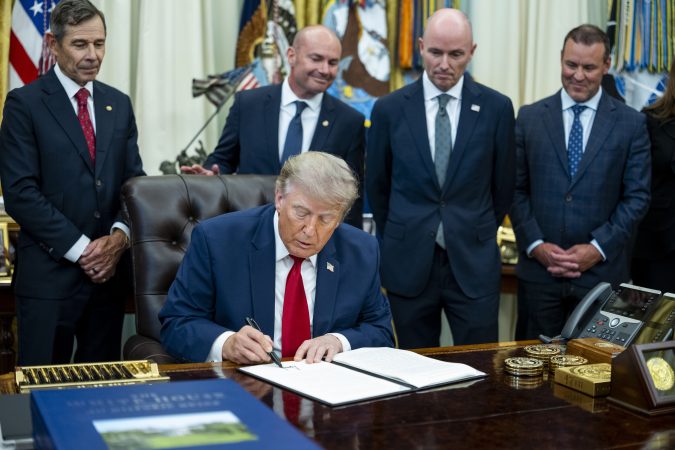
    WASHINGTON — President Donald Trump on Monday reduced the size of two national monuments in Utah by nearly 3 million acres, teeing up a legal battle over whether presidents have the power to shrink such sites in the first place.

    Trump signed two executive orders to sharply cut the Bears Ears and Grand Staircase-Escalante National Monuments to less than 10% of their current size. Both sites are known for their sandstone canyons and vast mesas, which are rich in wildlife habitat as well as archaeological sites of importance to Native American tribes.

    During his first term, Trump similarly shrank both monuments at the urging of top Republicans from Utah, opening about 2 million acres to oil drilling, uranium mining, and other development. But tribes and environmentalists sued over Trump’s move, and President Joe Biden subsequently restored sweeping protections to both sites before a court could issue a final decision.

    Tribes and environmentalists are expected to lead another lawsuit over Trump’s latest effort to shrink the monuments. The legal fight could have far-reaching implications for the future of land conservation, potentially putting dozens of other monuments at risk and opening millions of additional acres to commercial activities.

    The Trump administration has already taken a flurry of other steps to encourage development and recreation on federal lands across the country. In May, for instance, Trump moved to lift restrictions on off-road vehicles in most national parks.

    Before signing the executive orders in the Oval Office on Monday, Trump boasted that he was making bigger reductions to both monuments than he did in his first term, when he shrank Bears Ears by 83% and cut Grand Staircase by 47%.

    “We’re actually giving more than we did the first time back to the people of Utah,” Trump said.

    The six members of Utah’s congressional delegation attended the event in the Oval Office, as did Utah’s governor, Spencer Cox. All are Republicans.

    “It’s very clear that these monument designations are supposed to be the smallest area possible to protect the antiquities, and these multimillion-acre monuments that are bigger than the state of Delaware certainly do not fit that designation,” Cox said.

    National monuments are lands that are legally protected from development. They are similar to national parks, but while national parks are created by Congress, national monuments are created by presidents through the Antiquities Act of 1906.

    Many tribal leaders and environmental lawyers say the Antiquities Act does not authorize Trump to reduce the size of Bears Ears and Grand Staircase. The century-old law, they say, grants presidents the authority to designate monuments but not to abolish or shrink them.

    But many Republicans, ranchers, and oil drillers say previous presidents abused the Antiquities Act by putting vast stretches of land off-limits to development. They note that the law says presidents should limit monuments to the “smallest area compatible with proper care and management of the objects to be protected.”

    President Barack Obama designated Bears Ears during his final weeks in office in 2016. President Bill Clinton classified Grand Staircase in 1996, halting plans for a coal mining project there.

    After Trump shrank both monuments in his first term, his administration sold oil and gas leases on more than 76,000 acres of land adjacent to Bears Ears. But the Biden administration subsequently canceled most of those leases, and the oil industry has little interest in drilling within the monument itself, according to Melissa Simpson, the president of the Western Energy Alliance, an industry trade group.

    “Despite years of rhetoric from environmental advocacy groups, Bears Ears has never been a significant oil and natural gas prospect,” Simpson said in a statement.

    Bears Ears is named for a pair of buttes, or flat-topped hills, that rise thousands of feet above the surrounding canyons. The two symmetrical structures dominate much of the nearby landscape in southeast Utah.

    Grand Staircase is named for a sequence of sedimentary rock layers that stretches from Bryce Canyon National Park to the Grand Canyon. Paleontologists have made extraordinary discoveries there, excavating the fossils of tyrannosaurs and other dinosaurs that roamed the region more than 74 million years ago.

    Today, both monuments provide crucial habitat for hundreds of species, including bighorn sheep, elk, and mule deer. They also contain thousands of archaeological sites that Native American tribes consider culturally significant, including the remains of burial grounds, cliff dwellings, and rock art panels.

    Bears Ears is the ancestral homeland of five tribes in the region: the Navajo Nation, Hopi Tribe, Ute Indian Tribe, Ute Mountain Ute Tribe, and Pueblo of Zuni. The Biden administration reached a unique agreement with a coalition of the tribes, authorizing them to jointly manage the monument with the federal government.

    Anthony Sanchez Jr., the head council member for the Pueblo of Zuni and the co-chair of the Bears Ears Inter-Tribal Coalition, described a feeling of whiplash.

    “You have an administration that backs you up, and then you’re back to square one again,” he said in an interview Monday.

    Sanchez said he worried about the potential for vandals to damage or destroy the rock art at Bears Ears.

    “Even now, with the boundaries not reduced, we still run into that trouble,” he said.

    Scott Braden, the executive director of the Southern Utah Wilderness Alliance, said the nonprofit environmental group would sue over Trump’s effort to shrink the monuments.

    “The Southern Utah Wilderness Alliance is committed to defending the monuments and will challenge this unlawful decision in federal court,” Braden said in a statement. “We are confident that President Trump’s reckless and unlawful acts will be rejected and the monuments restored.”

    But Ben Burr, the executive director of the BlueRibbon Coalition, a group that supports opening public lands to off-road vehicles, vowed to defend Trump’s move in court.

    “Right-sizing these monuments to what the statute actually allows isn’t an attack on public lands; it’s how we keep them open for all Americans to enjoy,” Burr said in an email. “We plan to continue fighting in the courts and in the Congress to ensure that abuse of the Antiquities Act becomes a thing of the past.”

    The litigation over Bears Ears and Grand Staircase could eventually reach the Supreme Court, where Chief Justice John Roberts has suggested that the Antiquities Act is ripe for review.

    “Any land reserved under the act must be limited to the smallest area compatible” with proper management, Roberts wrote in 2021. “Somewhere along the line, however, this restriction has ceased to pose any meaningful restraint.”

    This article originally appeared in the New York Times.

  • Hundreds protest in Maine over the fatal shooting of a Colombian man by ICE

    Hundreds protest in Maine over the fatal shooting of a Colombian man by ICE

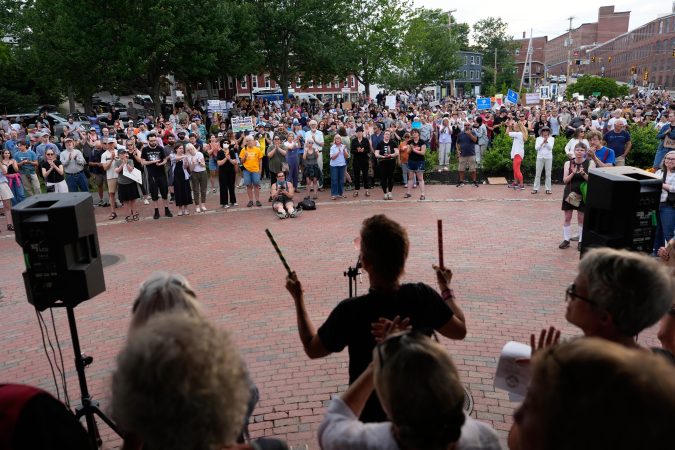
    BIDDEFORD, Maine — Hundreds of people protested in Maine on Tuesday over the killing of a Colombian driver by an Immigration and Customs Enforcement officer, after federal officials appeared to shift their narrative about the deadly encounter.

    The Department of Homeland Security said an ICE officer, “fearing for public safety,” shot and killed the driver Monday in Biddeford while officers were watching the home of someone they believed was in the U.S. illegally and had a final order of removal from the country.

    The department said in a post on X that when ICE tried to stop the vehicle driven by someone coming from the home, the vehicle attempted to flee and the officer fired his weapon. That was a shift from how Maine Sen. Angus King described the encounter hours earlier when he said Homeland Security Secretary Markwayne Mullin told him the officer opened fire after the man tried to use his vehicle as a weapon against the ICE officers.

    King said Mullin told him the officers were trying to serve an arrest warrant, but not for the man who was shot.

    The driver was Johan Sebastián Durán Guerrero, a 26-year-old Colombian national, the Colombian Embassy told the Associated Press in a statement Tuesday.

    Protesters gathered Tuesday outside of an ICE detention center in Scarborough, just up the coast from Biddeford.

    “These people are killers and they must leave our state now,” organizer Todd Chretien told the gathering, including some who held signs reading “Stop the murder” and “End this terror.”

    A small group of counterprotestors briefly disrupted the rally. Protesters drowned out their voices with whistles.

    Questions surround what led to latest ICE shooting

    Durán Guerrero’s shooting marked the second time in a week that ICE used deadly force and at least the ninth death since President Donald Trump began his immigration crackdown.

    The officers involved in the shooting in Biddeford, which is about 15 miles southwest of Portland, didn’t have body cameras, leaving many questions about what transpired. Among them are how close the officer was to the vehicle when they fired, whether officers told Durán Guerrero to stop, and how ICE believes he had put the public in danger.

    “We are always evaluating our procedures to keep our officers safe and criminals off our streets. We will not disclose or discuss law enforcement tactics,” an ICE spokesperson said in a statement.

    DHS, which oversees ICE, didn’t immediately respond to an email seeking clarity on what led to the shooting.

    Maine’s other senator, Republican Susan Collins, said Mullin told her that DHS’ Office of Inspector General is investigating in cooperation with the FBI.

    Photos showed bullet holes in the vehicle’s windshield.

    The Maine attorney general’s office, which is also investigating, said initial statements suggest the driver was trying to flee in the direction of the officer, whose name hasn’t been released and who has been placed on leave.

    Video shows aftermath of the shooting

    Video from a security camera at a nearby business, obtained by the Associated Press, shows a white vehicle approaching an intersection at a modest speed before making several slow circles. A law enforcement SUV blocked its path and two officers opened the driver’s door and dragged out a limp body.

    It isn’t clear from the video when the shots were fired.

    Daniel Boucher said he looked out his third-floor window after hearing a “pop, pop, pop” sound. He saw the car moving down the street until the SUV hit it.

    “His face was bloody. His head was bloody,” Boucher said, getting choked up. “I clearly heard the victim say, ‘I tried to stop.’”

    At one point, Boucher said, the officer who shot the man walked close to him.

    “I was emotional and I just let him have it, and he looked at me and said, ‘He tried to run me over,’ or something to that effect,” Boucher said. “I don’t remember his exact words.”

    Durán Guerrero lived in Maine with his family

    Two advocacy groups — the Maine Immigrants’ Rights Coalition and Presente! — said Durán Guerrero was authorized to work in the U.S.

    Mary Hayes, who lives close to the scene, said the man lived nearby with his wife and daughter.

    “I watched a wife fall to her knees looking at her husband’s dead body on the ground,” Hayes told the AP as she held a sign saying “No ICE Stop ICE.”

    Just last week in Texas, an ICE officer fatally shot 52-year-old Lorenzo Salgado Araujo, of Houston, after federal authorities driving unmarked vehicles pursued him while he was driving to a construction job site.

    The two shootings come amid a Trump administration push to carry out its mass deportations agenda. Over five days at the end of June, ICE arrested more than 10,000 people.

    The figures indicate that while the administration is no longer cracking down on individual cities, arrests are surging. The administration’s enforcement efforts were widely condemned last winter after the killings of Alex Pretti and Renee Good in Minnesota.