Category: News

  • House Republicans adopt $95 billion package for the Iran war and Trump’s priorities

    House Republicans adopt $95 billion package for the Iran war and Trump’s priorities

    WASHINGTON — The House adopted a Republican-only $95 billion budget proposal Wednesday, a long-shot effort to fund the Iran war and other White House priorities over objections from Democrats and a few GOP holdouts in a final push before the midterm elections.

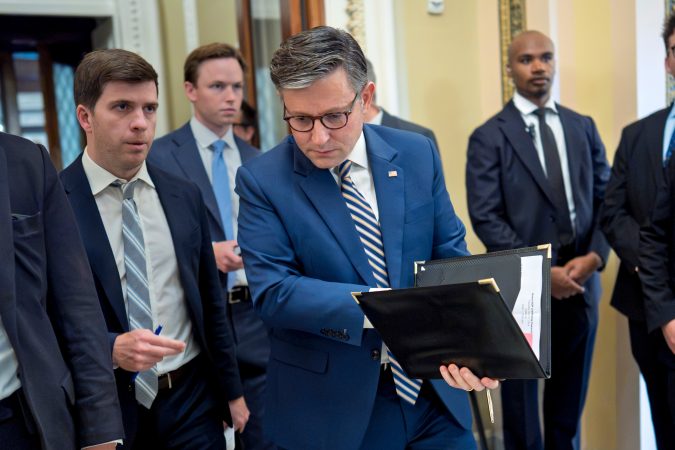
    House Republicans were divided over the plan, with conservatives wary because there are no offsetting budget cuts. But Speaker Mike Johnson plunged ahead, viewing the go-it-alone process as the best chance to usher President Donald Trump’s priorities through the split Congress, despite skepticism in the Senate.

    The vote tally was 216-214, with two Republicans and one independent joining Democrats in opposition.

    “Just bullets and bombs to finish the job,” said Rep. Jodey Arrington (R., Texas), the chairman of the Budget Committee.

    Democrats argued the money should be spent at home, particularly on efforts to lower costs for Americans.

    “Republicans plan to spend tens of billions of dollars on Trump’s failed war in Iran,” said Rep. Pete Aguilar of California, chairman of the House Democratic caucus, this week. “Think about what we could spend with these resources instead.”

    Congress is at a standstill over the U.S. war against Iran — unable to stop Trump’s military strikes, but not having authorized the use of American military force — and politically torn over having to provide billions of taxpayer dollars to pay for it. Most Americans disapprove of Trump’s Iran strategy, according to a recent AP-NORC poll.

    The budget battle comes as Trump attended the dignified transfer of four service members killed in the Middle East, bringing the military death toll to 18. Defense Secretary Pete Hegseth told senators at a fiery hearing this week that the Pentagon is running short of cash, despite a massive $150 billion one-time allotment in last year’s big budget bill.

    Even as the House action advanced the resolution, Johnson’s strategy faces uncertainty in the Senate.

    The package has $60 billion for the Pentagon and $13 billion for other national security needs, $12 billion for farmers struggling under Trump’s tariffs, and $10 billion for voting law changes aligned with the SAVE America Act and proof-of-citizenship requirements that are Trump’s top priority.

    A once rare budget tool is now the norm in split Congress

    Republicans are relying on the budget reconciliation process, which enables approval on a majority vote in Congress, bypassing the Senate’s ability to filibuster the measure t o stall or kill it.

    Once rare, the reconciliation process is now Johnson’s preferred strategy for pushing proposals through Congress. It’s the way Republicans approved Trump’s big tax breaks and spending cuts bill last summer and funded Homeland Security this year over Democrats’ refusal to fund Trump’s mass deportation agenda.

    “No matter how you feel about current events, these funds are necessary to ensure our fighting forces remain ready, our troops are paid and our nation is safe,” said Rep. Mike Rogers of Alabama, the Republican chairman of the Armed Services Committee.

    But House Democratic Leader Hakeem Jeffries said, “Republicans have literally ripped food from the mouths of hungry children, seniors and veterans to sustain the Trump war machine.”

    Among those opposed was Rep. Kevin Kiley of California, a former Republican turned independent, who said he felt any war funding bill should be bipartisan. He also wanted to ensure Congress had a “much higher level of involvement” in bringing the war to an end, and he said this proposal did not set that process in motion.

    Republicans Rep. Thomas Massie of Kentucky and Rep. Warren Davidson of Ohio also voted against.

    This is the third time GOP leaders have relied on reconciliation, dubbing this version 3.0, and it’s a lengthy process. If the House approves the budget resolution, it next goes to the Senate for a round-the-clock session to consider politically tough amendments — something senators would rather avoid in an election year.

    The budget resolution sets out instructions for the various committees to draft legislation, which Johnson hopes could be done this summer, with final voting on the package once lawmakers return after the August recess.

    Senators pan House’s budget and have their own ideas

    Senate Majority Leader John Thune has been noncommittal on the House package that also divides his own GOP majority, with some Republican senators preferring more money for the military and others demanding the costs be offset with cuts elsewhere.

    “We’ll see,” Thune said this week.

    Thune’s focus, at the moment, is avoiding another government shutdown. He wants the Senate to approve a stopgap funding measure, called a continuing resolution, to provide routine government funding before lawmakers leave for the summer break.

    If senators are unable to reach agreement on government funding, Thune has said he may hold onto the House’s budget resolution and use it later in the fall as a way to push the resolution through the Senate over objections. He wants to prevent a federal shutdown when current funds expire, Sept. 30.

    “It’s a possibility that, if necessary, we could pull that budget resolution passed by the House and use it to fund government,” Thune said. “I hope that’s not necessary.”

    Thune has also clashed with Trump over the president’s push for the SAVE America Act, which would require proof of citizenship for voting. The measure, while popular among Trump’s most ardent supporters, does not have enough support among Senate Republicans for passage.

    It’s already against the law for noncitizens to vote in federal elections and experts warn the proposed new rules could make it more difficult for eligible Americans to cast ballots.


  • Tropical Storm Bertha makes landfall on southern Louisiana with threatening winds

    Tropical Storm Bertha makes landfall on southern Louisiana with threatening winds

    Tropical Storm Bertha crawled into southern Louisiana on Wednesday, making landfall and packing strong winds far from its center after closing beaches from the Florida Panhandle to Mississippi.

    The National Hurricane Center said Bertha made landfall in the afternoon in St. Bernard Parish, about 40 miles east of New Orleans. At landfall, the storm’s maximum sustained winds were around 45 mph.

    The wind and storm surge were the main threats for the Deep South states. Parks and piers were closed up and down the coast, as were some low-lying roads. A tropical storm warning stretched from Alabama to Louisiana, including New Orleans where extreme heat was adding to misery.

    Tropical storm force winds were felt as much as 160 miles from the center of the storm, the National Hurricane Center said. A wind gust of 44 mph was recorded at New Orleans Lakefront Airport on Wednesday afternoon.

    But the heaviest rains were staying offshore, reducing the risks of flooding, the center said.

    The storm will weaken now that it’s reached land and is unlikely to leave behind widespread damage, Louisiana State Climatologist Jay Grymes said. The impact should be manageable for coastal communities, he said.

    Gov. Jeff Landry called the forecast “encouraging” but also warned residents to be prepared for some flooding.

    Storm surges up to 3 feet were possible in Louisiana and Alabama, forecasters said. Rain totals were forecast between 1 and 4 inches, with higher amounts possible in isolated areas.

    Bertha is expected to maintain tropical storm intensity until it reaches the Texas coast on Thursday, the hurricane center said.

    Elsewhere in the U.S., a line of storms on Tuesday generated reports of tornadoes stretching from Cincinnati to New Jersey. Torrential rains caused flash floods that swamped homes, washed out bridges and led to water rescues in West Virginia, authorities said.

    Rare combination of tropical storm and heat warnings

    Southern Louisiana was under tropical storm and extreme heat warnings for much of Wednesday — a rare double dose of suffering, the National Weather Service said.

    It was the first time in at least two decades that’s happened in the area, the weather service said, citing records that date back to 2005.

    Bertha is the second tropical storm of the Atlantic season

    Bertha is the second tropical storm of the Atlantic hurricane season. Tropical Storm Arthur in June brought heavy rainfall to the southeastern U.S.

    Bertha could dump heavy rain on coastal areas of Mississippi that are still recovering from flooding brought by Arthur that destroyed and damaged homes.

    Hurricane Fausto in the Pacific is far from land

    In the eastern Pacific Ocean, Hurricane Fausto churned far from land Wednesday. The hurricane was hundreds of miles west-southwest of the southern tip of Baja California with maximum sustained winds of 80 mph.

    It was forecast to gradually strengthen and the hurricane center said that ocean swells generated by Fausto were spreading along the Baja California coast and likely to cause life-threatening surf and rip tides.

  • Ida Schmertz, pioneering women’s activist, political innovator, and former American Express senior vice president, has died at 91

    Ida Schmertz, pioneering women’s activist, political innovator, and former American Express senior vice president, has died at 91

    Ida Schmertz, 91, formerly of Jenkintown, pioneering women’s activist, international relations innovator, presidential appointee, first female senior vice president at American Express, volunteer, mentor, and role model, died Thursday, July 2, of organ failure at New York Presbyterian Hospital.

    Born in Amsterdam, Ms. Schmertz and her family made their way to Philadelphia and then Jenkintown at the start of World War II in 1940, and she became a trailblazing American powerhouse in civil and women’s rights, international relations, corporate management, and healthcare.

    She earned a bachelor’s degree in political science and a master’s degree in international relations, and did everything but write a dissertation for a doctorate in international relations and Soviet studies. She was founding codirector in 1971 of the groundbreaking Center for American Women and Politics at Rutgers University, founding cochair in 1994 of the International Business Incubator and Training Center in Russia, and founding chair of the board of trustees for the Romanian-American Foundation in Bucharest in 1994.

    Wherever she was, Ms. Schmertz championed research, education, and public engagement. She helped organize the first national conference of women in political office for the Center for American Women and Politics in 1972, and later provided professional services to small businesses and startups in Russia, especially those owned by women.

    “I have empathy for people,” Ms. Schmertz told a colleague at the Romanian-American Foundation in a 2018 video interview. “I’ve always felt badly for people who are hurt or poor or unfortunate or don’t have access to something.”

    Ms. Schmertz was interested in voluntary foreign service, gun reform, and U.S.-China relations, and she lectured and appeared on TV shows and in dozens of newspapers. She worked with New York Gov. Hugh Carey on statewide initiatives of all kinds in the 1970s and was appointed by President Bill Clinton to head the Romanian-American Enterprise Fund in 1994.

    In the 1950s and ’60s, she worked for the Democratic National Committee, the CIA, and the American Association of University Women. She spoke English, Dutch, Russian, and French, and served as a guide at the State Department’s first U.S. promotional exhibition in Moscow in 1959.

    She lobbied for fair elections in South Africa in the 1990s, and pressed New York lawmakers to support the state’s medical aid in dying act until it recently passed. Colleagues praised her “vision, energy, and grit” and “integrity and long-term commitment” in online tributes.

    From 1979 to 1992, Ms. Schmertz was the first woman to supervise corporate strategy and philanthropy at American Express in New York.Courtesy of the family

    One colleague said: “I feel so fortunate to have known her.”

    Colleagues at the Romanian-American Foundation said in a tribute: “She helped shape not just an organization but a picture of what philanthropy in Romania could be: transparent, accountable, built on partnership, and dedicated to creating opportunity for all Romanians.”

    From 1979 to 1992, Ms. Schmertz was the first woman to supervise corporate strategy and philanthropy at American Express in New York. She was also an honorary director of the Women’s Economic Roundtable and a former director at Prudential Financial Inc.

    “She was extraordinary, formidable, deeply caring, and exceptionally committed to the people and causes that she believed in,” her daughter, Lexy, said. “Her hobby was her job, learning and exploring.”

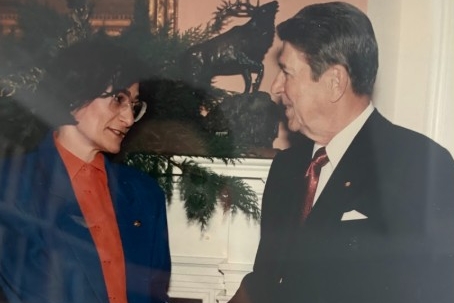
    Ms. Schmertz worked with President Ronald Reagan and many other political notables. Courtesy of the family

    Ida Frederieke Schaap was born Feb. 24, 1935. Her family traveled from the Netherlands to Indonesia in 1939 and then to the United States to escape the war.

    She was the first Jewish student to enroll in the old Stevens School for Girls in Germantown in 1940, was elected president of the student council and captain of the field hockey team, and graduated in 1952. She earned her bachelor’s degree at Wellesley College in Massachusetts in 1956 and her master’s degree at Columbia University in 1960.

    She also studied French political science at Sorbonne University in Paris and Russian at Middlebury College in Vermont. She married Herbert Schmertz in 1962 in Philadelphia, and they had a son, Anthony, and a daughter, Lexy. They divorced in 1976, and he died in 2018.

    Ms. Schmertz was tough and direct, her family said, intelligent and loving. She liked to read and travel, and was an engaging conversationalist.

    Ms. Schmertz was a summer camp counselor for underserved children as a teen, loved cats, and supported the Philadelphia Museum of Art.Courtesy of the family

    She lived in Washington after college, moved to New York in the 1970s, and hosted friends and colleagues from around the world in her Upper West Side apartment. She doted on her four grandsons and took them to museums and hockey games. “She met them where they were,” her daughter said.

    She was a summer camp counselor for underserved children as a teen, loved cats, and supported the Philadelphia Museum of Art. For 30 years, she lived with chronic lymphocytic leukemia.

    “She was compassionate and caring,” her daughter said. Her son said: “She was devoted to her family.”

    In addition to her children and grandsons, Ms. Schmertz is survived by two sisters and other relatives.

    Ms. Schmertz visited Amsterdam in May.Courtesy of the family

    A private memorial service is to be held later.

    Donations in her name may be made to Compassion & Choices, Box 485, Etna, N.H. 03750.

  • Tornado confirmed in Cape May County as storms swept through New Jersey

    Tornado confirmed in Cape May County as storms swept through New Jersey

    The National Weather Service in Mount Holly on Wednesday confirmed a tornado briefly touched land in Cape May County during powerful thunderstorms that swept through the region Tuesday evening.

    The agency said a waterspout was witnessed going ashore at Cape May Point around 6:15 p.m. Tuesday and causing minor tree damage for about a minute. The tornado was classified as EF-0, with estimated peak winds between 60 and 70 mph, the agency said.

    The National Weather Service also confirmed North Jersey tornadoes in the Stanhope and Mount Olive area, and in the Lower Berkshire Valley. An investigation was still ongoing in the Parsippany and Troy Hills area in North Jersey, the agency said.

    The waterspout that became the tornado on the southwestern tip of Cape May County could be viewed as far south as Rehoboth Beach, Del.

    The high winds tore down some trees and a few power lines in Cape May Point, said Bill Gibson, the borough’s emergency management coordinator.

    “We commonly get waterspouts in the bay and harbor, but this was a big one, and when it hit land it was able to continue on for a little bit,” Gibson said Wednesday morning. “But it’s already all cleaned up.”

    National Weather Service surveyors were investigating the remaining North Jersey areas with tornadic damage Wednesday. Findings were expected Wednesday evening. The agency conducted a virtual survey for Cape May Point since the damage was minimal.

  • Cheltenham to pull millions from Citizens Bank over immigrant detention facilities

    Cheltenham to pull millions from Citizens Bank over immigrant detention facilities

    Cheltenham Township is closing its two remaining Citizens Bank accounts over the bank’s financing of companies that run detention facilities, despite the bank’s announcement it would no longer lend to those companies.

    Cheltenham officials said they are working to move around $9 million in two bank accounts from Citizens Bank into Santander Bank after months of lobbying by local residents concerned about Citizens’ financing of private prison companies that operate detention centers, including CoreCivic and GEO Group Inc. GEO Group runs Moshannon Valley Detention Center near State College, Pa., and Delaney Hall in New Jersey.

    Cheltenham’s Citizens divestment still pending

    The township’s tax collector, Melvin Pitts, said he is also closing his office’s four Citizens accounts, but that process will take longer because of the nature of the accounts, which include real estate and income tax money. The total the tax collector holds at Citizens was not immediately available, but May bank statements showed around $3 million between three of the four accounts.

    Cheltenham’s commissioners said at a recent finance meeting that they had hoped to have the township’s two remaining Citizens accounts closed already but hit some administrative hurdles. Cheltenham was also waiting to receive pending state money in one of the accounts before closing it, township spokesperson Lauren Walter said.

    Cheltenham’s primary accounts were already at Santander, she said.

    Pitts and Matthew Areman, president of the township’s board of commissioners, both confirmed that resident lobbying against the detention facilities motivated the switch.

    “The Cheltenham Township Board of Commissioners has committed to divest all Township accounts from Citizens Bank,” Areman wrote in a statement.

    “While the Board remains committed to protecting taxpayer resources and maintaining sound fiscal stewardship, we also believe that where we choose to do business is an expression of our community’s values.”

    Divestment campaign began with dog walkers

    Much of the divestment push came from a community group formed after the 2024 presidential election, said Pam Albright, a member of East Cheltenham CARES.

    Neighbors started chatting while out walking their dogs, Albright said, and EC CARES grew from there.

    With a sizable immigrant community — about 14% of the township is foreign-born, according to U.S. Census Bureau figures — immigration enforcement was among their top concerns.

    After advocacy from EC CARES and other local groups such as Cheltenham Immigration Response, the town adopted a policy last October to affirm that local police would not ask about immigration status or take on federal policing roles when not legally required.

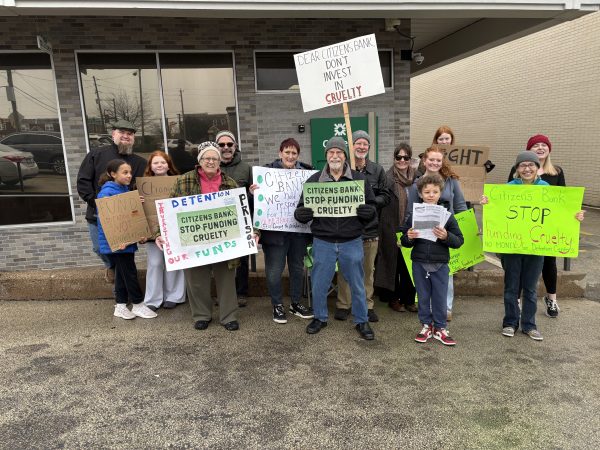
    EC CARES joined Indivisible Jenkintown in protesting monthly outside their local Citizens Bank, volunteers said, and began asking Cheltenham about closing its accounts after seeing other towns take action.

    Everyone played a different role, organizers said: Some talked to township officials, while others pulled research and records or handed out flyers at protests.

    “I like rabble-rousing,” said Susan Shachter of EC CARES. “I like making signs, I like screaming and talking to people.”

    Private prisons have long been a target for organizers over poor conditions and concerns over private companies’ involvement in government-mandated detention. Eight major U.S. banks agreed to stop funding private prison operators back in 2019 under activist pressure.

    But GEO Group and other companies have come under particular scrutiny in recent years for holding immigrants in concentration facilities amid alleged due process violations, detaining young children for months, and reportedly depriving detainees of food, water, sleep, and medical care. Most detainees have no criminal conviction, according to analyses by think tanks, research nonprofits, and news outlets.

    “If we think corporate America is doing what’s ethical in terms of people being detained, we’re joking ourselves,” said KayLee Taylor, another member of EC CARES.

    Some Cheltenham officials were hesitant to push back against federal action, Albright said, but they came around.

    “It is a little scary for them to, as they said, stick their necks out, or have a target on their back,” she said.

    But once commissioners passed the town’s immigration enforcement policy, it got the ball rolling, Taylor said: “Our commissioners have more guts than any others in the county because we were the first ones to put in writing our policy.”

    Albright also got the impression from a commissioner that Santander was fiscally better for the township, she said.

    Walter, the township spokesperson, said Cheltenham likely moved its main account to Santander for better rates a few years ago, but due to township staff turnover she could not confirm details with the officials who were involved at the time.

    Citizens says it stopped lending to GEO, but organizers want more

    Last week, Citizens announced it had stopped lending to private prison companies like CoreCivic and GEO Group now that the federal government has begun buying up facilities and the corporations need less capital than before.

    Walter said Wednesday that she had made commissioners aware of Citizens’ announcement late last week and that the officials did not indicate it had changed their plans. Walter was not sure if Pitts had changed his plans for the tax office accounts or not. Pitts could not be reached for comment on the issue.

    The bank’s announcement also criticized activists for failing to appreciate Citizens’ “virtues,” including the volunteer work its employees do.

    But organizers pointed out that lending is not the only business a bank can do with detention facility providers, and renewed a call for Citizens to end all banking relationships with private prison companies.

    “We want them to completely pull out,” Taylor said. “What you’re doing is wrong.”

    This suburban content is produced with support from the Leslie Miller and Richard Worley Foundation and The Lenfest Institute for Journalism. Editorial content is created independently of the project donors. Gifts to support The Inquirer’s high-impact journalism can be made at inquirer.com/donate. A list of Lenfest Institute donors can be found at lenfestinstitute.org/supporters.

  • Trump pays respects to 4 U.S. service members killed in the Middle East

    Trump pays respects to 4 U.S. service members killed in the Middle East

    DOVER AIR FORCE BASE, Del. — President Donald Trump on Wednesday honored the lives of four U.S. service members who were killed in the Middle East and returned to their families at an air force base in Delaware.

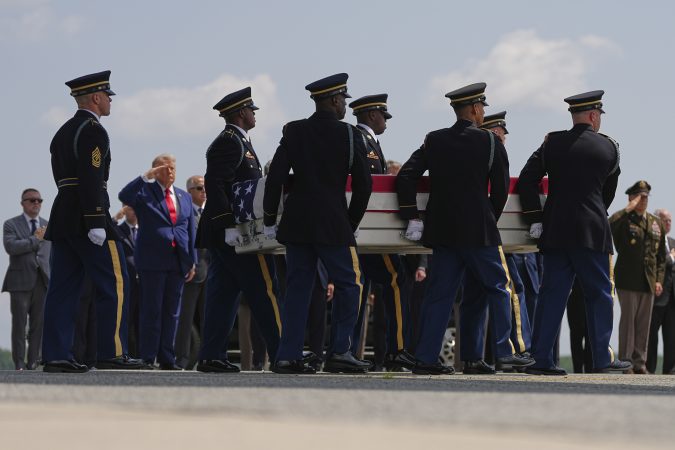
    The president saluted as four transfer cases carrying the service members’ remains were escorted off an airplane during the dignified transfer at Dover Air Force Base. The ritual is one of the most somber duties of a commander in chief. It was the third that Trump has attended since he launched the war in Iran in February.

    Speaking at an event in Georgia hours later, Trump described the ritual as “the toughest thing I do.”

    “I’ve been there many times before,” he said of Dover. “This was, in particular, something very sad.”

    Earlier in the day, Trump said his message to families was simple: “We love you. We love your child,” Trump told reporters.

    Trump was accompanied at the dignified transfer by administration officials including Defense Secretary Pete Hegseth and Gen. Dan Caine, chairman of the Joint Chiefs of Staff. Also present were Sen. Thom Tillis (R., N.C.) and Sen. Chris Coons (D., Del.).

    During the ritual, transfer cases draped with the American flag and holding the remains of the fallen soldiers are carried from the military aircraft that transported them to awaiting vehicles to take them to the mortuary facility at the base. There, the service members are prepared for their final resting place.

    Fallen troops came from Hawaii, Texas, New York, and North Carolina

    Two U.S. Army soldiers killed in Iranian missile and drone attacks in Jordan were returned during the dignified transfer. The remains of a third service member who is believed to be the soldier missing after the Jordan attacks were also returned, as well as the remains of a soldier killed in Iraq during a detonation of an Iranian drone.

    The soldiers killed in Jordan were identified by the Defense Department as Tyler James Feehan, 25, of Ewa Beach, Hawaii; and Isabella Gonzales, 19, of Carrollton, Texas. The soldier who disappeared after the Jordan attacks is Angel S. Rampersad, 28, of Ozone Park, N.Y., the Defense Department said.

    The soldier killed in Iraq was identified as Michael Emmanuel Swinton, 30, who lived in Spring Lake, N.C.

    Trump said Feehan’s family accepted an invitation to join him on Air Force One on Wednesday as he traveled to an event in Georgia, where the family lives. Speaking at the event in Marietta, Trump described Feehan as a “flawless” person who was “going all the way — he was going to be a general.”

    “We will carry Tyler’s memory in our hearts forever, and I just want to thank you,” he told Feehan’s parents during his remarks. “It’s an honor to have you here today.”

    Trump previously said the soldiers died while protecting America and other nations from Iran.

    “We feel very badly, but you know, those great people, those great patriots were out there fighting so that Iran cannot have a nuclear weapon,” Trump told reporters on Sunday. He added that the U.S. was striking Iran “in honor” of the fallen troops.

    Trump vows to retaliate for each U.S. death

    The U.S. has launched multiple retaliatory strikes against Iran as an interim agreement to end the war falls apart. Trump on Monday said that every time Iran kills an American soldier, “they will pay for that killing many times over!”

    Since the war began on Feb. 28, 18 U.S. service members have been killed.

    Trump on Tuesday said that while almost all the incoming fire in Jordan was stopped, some made it through.

    “They did slip something through in Jordan,” he said. “If we had other operators, you know, it would have not happened, unfortunately.” He added that “we let other people do the job — and sometimes it doesn’t work out so well.”

    Trump did not elaborate on his comments, and it was not immediately clear who he was saying was responsible for protecting U.S. forces in Jordan.

    Trump attended two previous dignified transfers since the outset of the war, most recently in March.

    Soldier had planned to marry fiancée and attend law school

    Feehan, a first lieutenant who was killed Saturday, will be posthumously promoted to the rank of captain and awarded the Bronze Star, Purple Heart and Combat Action Badge. He was assigned out of Fort Bragg, North Carolina, to the 32nd Army Air and Missile Defense Command.

    Feehan’s family said in a statement that their hearts were shattered by his loss. They remembered Feehan, who went by “Tivo,” as someone who “packed in more living” in his 25 years than most do in a lifetime.

    “He chased adventure relentlessly,” the statement said. “He believed deeply in the power of military service, especially what it builds in a person: discipline, leadership, character.”

    He planned to marry his fiancée and attend law school after his deployment. The family said they’re starting a scholarship in his name.

    Gonzales, who was killed Friday, was a private with the 10th Army Air and Missile Defense Command in Ansbach, Germany. She graduated last year from Hebron High School in Carrollton, near Dallas, school officials said.

    Rampersad, a sergeant who was believed to have been killed in Friday’s attacks, was assigned to the 57th Air Defense Artillery Regiment, 52nd Air Defense Artillery Brigade, 10th Army Air and Missile Defense Command in Ansbach, Germany.

    In a brief statement, Rampersad’s family called her a “gentle giant” who “stood up for those who couldn’t fight for themselves.”

    “She loved her family fiercely and will live on in the hearts of everyone she touched,” the statement said.

    Deonne Jinkins, 22, a friend, said Rampersad “loved deeply, cared genuinely, and always made people feel seen and important.”

    Swinton, a sergeant who was killed Sunday, will receive a Bronze Star, Purple Heart and Combat Action Badge, and will be promoted to staff sergeant. He enlisted in the Army in 2017 and was assigned to the 55th Air Defense Artillery Regiment, 108th Air Defense Artillery Brigade, out of Fort Bragg, N.C.

  • Judge gives Pennsylvania the green light to fund abortions through Medicaid

    Judge gives Pennsylvania the green light to fund abortions through Medicaid

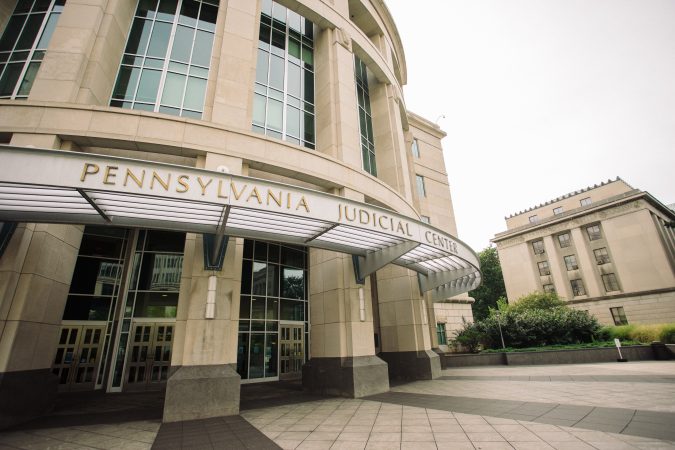
    Gov. Josh Shapiro’s administration can pay for abortions through the state’s Medicaid program while an appeal of the April ruling that recognized “a fundamental right to reproductive autonomy” plays out, a Commonwealth Court judge ruled.

    Judge Matthew S. Wolf last week granted a request from abortion providers to allow Medicaid to fund the procedure during the appeal from the Pennsylvania Attorney General’s Office because the state Supreme Court held previously that the funding restriction was “presumptively unconstitutional.”

    The Philadelphia Democrat wrote the April majority opinion that struck down a decades-old state law limiting public funding for abortions to cases involving rape, incest, or danger to the life of the mother.

    Attorney General Dave Sunday appealed the ruling to the Pennsylvania Supreme Court, where three justices previously signaled their willingness to rule that abortion access is a right.

    The appeal led to an automatic stay on the Commonwealth Court ruling, which meant Medicaid could fund abortion only in the cases allowed by the state’s Abortion Control Act.

    The coalition of abortion providers that brought the lawsuit in 2019 argued the stay would cause irreparable harm because it would force “an unknown number of their patients to carry pregnancies to term” during the appeal, the opinion said.

    If the coverage ban were to remain in place, despite the ruling holding it amounts to sex-based discrimination and recognizing the right to reproductive autonomy, that would violate the constitutional rights of Pennsylvanians, Wolf wrote.

    Sunday’s office argued that lifting the stay would allow more abortions, despite the opposition of many taxpayers.

    “There can be no legitimate interest — for the Commonwealth or the public — in knowingly violating constitutional rights,” Wolf said, rejecting the attorney general’s argument.

    A spokesperson for Sunday declined to comment.

    “At last, a terrible injustice that has harmed Pennsylvanians for decades has ended,” Susan Frietsche, executive director of Women’s Law Project, which represented the providers, said in a statement.

    Sunday, a Republican, stepped in to defend the law when Shapiro’s administration bowed out after the 2024 state Supreme Court ruling, which used language strongly endorsing abortion access as a constitutional right. But the justices were ultimately split on whether they were ready to make that call and sent the case back to the Commonwealth Court.

    The statewide court that oversees government-related matters sided with the abortion providers in a 4-3 ruling.

    It is unclear how quickly medical providers will be able to bill Medicaid for abortions. The Pennsylvania Department of Human Services has not issued guidance for providers yet.

    “Gov. Shapiro has a proven track record of defending a woman’s right to choose and protecting access to safe, legal abortion services,” Rosie Lapowsky, a spokesperson for Shapiro, said. “He will continue to fight for women’s right to make their own medical decisions in consultation with their doctor.”

  • Trump administration weighing military options in Mali, officials say

    Trump administration weighing military options in Mali, officials say

    The Trump administration is weighing military action in the West African country of Mali to target an al-Qaeda-affiliated group known as JNIM, said current and former U.S. officials familiar with the deliberations.

    If approved, it would add an eighth nation to the list of countries where President Donald Trump has ordered strikes since the start of his second term — a chapter of his presidency that he initially said would be dedicated to ending global strife and redirecting U.S. resources to Americans.

    There is disagreement, however, among senior U.S. officials over whether to proceed with attacking the militant group. A vocal advocate for using force is Sebastian Gorka, the National Security Council’s senior director for counterterrorism, said the current and former officials, who like others spoke on the condition of anonymity to discuss military planning.

    The militant group, whose full name is Jama’at Nusrat al-Islam wal-Muslimin, has established a stronghold in Mali and increasingly launched attacks in coastal West African nations, establishing itself as the most well-armed militant group in the region and among the most powerful in the world.

    A spokesman for Mali’s government did not respond to requests for comment.

    Gorka did not respond to requests for comment.

    The Pentagon declined to comment.

    Sebastian Gorka, the National Security Council’s senior director for counterterrorism, has been a vocal advocate for using force.Alex Brandon

    When the White House was asked for comment, an administration official would not disclose whether the president intended to move forward with military strikes but said the United States has been urging governments in North and West Africa “to purchase U.S. equipment and services to support their war efforts against the terrorists.”

    The official said that terrorism in the Sahel, the vast semiarid region south of the Sahara, is a “multinational problem.”

    “We urge regional partners and NATO allies to support the Alliance of Sahel States in their war against JNIM and ISIS,” the official added, referring also to the Islamic State, which rose to prominence in the Middle East before establishing affiliates throughout Africa.

    The Alliance of Sahel States consists of Mali, Burkina Faso and Niger — all West African nations where military leaders have in recent years ousted democratically elected governments in coups, largely cut ties with the West and turned to Russia for security help.

    But the administration official pinned the blame not on those governments but on their Russian partners, saying that Moscow “has proven to be an ineffective security partner for Mali.”

    “We hope that other African nations take note of Russia’s terrible performance in combating terrorism,” the official said.

    The Trump administration’s contemplation of military options in the country has not been previously reported.

    Mali, a landlocked nation of nearly 25 million, has in recent years been plagued by violence by Islamist militant groups — and by Mali’s own junta government and the Russian mercenaries whom it hired to get the situation under control.

    The militant groups, particularly JNIM, have grown increasingly powerful, turning Mali and its neighbors in the Sahel into the world’s center for terrorism.

    Last year, militants with the al-Qaeda affiliate mounted a fuel blockade that paralyzed much of the country. This spring, they launched coordinated, nationwide attacks that included militants roaming the streets of Bamako, the capital; seizing a strategic city in the north from Mali’s military and the Russians; and killing the country’s defense minister in a suicide attack.

    Meanwhile, IS Sahel — an Islamic State affiliate and a JNIM rival — has consolidated power near Mali’s border with Niger, where last year its militants kidnapped American missionary Kevin Rideout, who is believed to be held now in Mali.

    To combat the violence, Mali’s junta government hired Russian mercenaries, first with the Wagner Group and now with Africa Corps, which is more closely linked with Russia’s defense ministry. The Russians have been accused of a string of atrocities, according to rights groups and the Washington Post’s previous reporting.

    The Russian Embassy in Washington did not respond to a request for comment.

    Héni Nsaibia, West Africa senior analyst for the Armed Conflict Location & Event Data project, said that Mali’s military and its Russian backers were responsible for killing hundreds more civilians than JNIM and IS Sahel combined. Last year, the Malian military and its Russian partners were responsible for 925 civilian deaths, according to ACLED, compared with 232 by Islamist militants.

    “It is extremely problematic that a government like the U.S. or any Western partner would provide support to these regimes whose legitimacy remains contested, and which are incredibly fragile and repressive,” he said, referring to Mali, Burkina Faso, and Niger.

    Still, last year, as part of a push by the Trump administration to reengage with Mali, the United States ramped up intelligence sharing with Mali’s government, current and former American officials said at the time. The intelligence was used in strikes by Mali’s military, which had been largely shunned by the Biden administration for its refusal to set a timeline for a return to democratic elections and its work with the Russians.

    But such cooperation has so far remained limited, nowhere near the scale of the U.S.-Nigeria security partnership that ramped up last year and has included U.S. airstrikes and a ground mission that killed one of the Islamic State’s top leaders in Africa.

    Any direct U.S. military involvement in Mali runs the risk of hostilities with Russian forces in the region. It also could require deconfliction efforts between Washington and Moscow akin to ones that existed in Syria during that country’s civil war.

    When asked if Secretary of State Marco Rubio supports military action in Mali, the State Department sidestepped the question, saying the U.S. “unequivocally condemns the terrorist activity in Mali.”

    The department said the Trump administration is “committed to promoting regional ownership and cooperation against terrorist threats, and monitoring indicators and warnings of threats to our homeland.”

    U.S. military action against JNIM would add Mali to the list of countries where Trump has ordered strikes: Yemen, Somalia, Syria, Iran, Iraq, Nigeria, and Venezuela. The administration also has waged a controversial military campaign against alleged drug runners in the Caribbean and eastern Pacific that has resulted in scores of deaths.

    Wassim Nasr, a Sahel specialist and senior research fellow at the Soufan Center, said that the U.S. could be most useful by getting involved instead in “conflict resolution,” forcing Mali’s junta government to talk with JNIM, which has focused not on global aims but on applying Islamic laws in local governance, and other political opponents whom the junta has largely silenced.

    “Opting for the military solution one more time won’t get things resolved,” Nasr said. “The French tried that for 10 years. The Russians have been trying for five years. The situation has only gotten worse and worse.”

    France launched its military intervention in the Sahel in 2013 at the request of Mali’s then-government. French forces quashed the insurgency in Mali and restored a measure of order. That initial mission was followed by a second, Operation Barkhane, that eliminated prominent militant leaders but ultimately failed to stop the spread of various armed groups.

    Anger at France — fueled by its neocolonial missteps and by Russian disinformation — grew over the years, helping propel coups in Mali in 2020 and 2021 and in neighboring Burkina Faso and Niger. President Emmanuel Macron later withdrew French forces.

    Nasr added that if U.S. strikes weaken JNIM, they conversely could help IS Sahel, whose growth has been limited by the rival al-Qaeda-affiliated group.

    Peter Pham, a former Trump administration official, was less pessimistic about the use of military force but said a precondition should be reestablishing trust with the governments of Mali and Niger ahead of security cooperation efforts.

    “While we may have very limited direct economic or other interests in these countries, we do not want jihadists like ISIS and al-Qaeda gaining a foothold there,” Pham said.

    Gorka has long made aggressive counterterrorism policies a cornerstone of his ideology. But his impact on policy since the start of Trump’s second term has been modest, said a U.S. official — a source of relief for his critics, who object to his hard-line approach, and a disappointment to his supporters.

    In the spring, Gorka engaged in conversations about becoming Trump’s next director of the National Counterterrorism Center following the resignation of Joe Kent, who left the administration embittered by the president’s decision to start the war in Iran. But those discussions have not materialized into a nomination for Gorka.

    Current and former U.S. officials said that Gorka had been deeply involved with talks about how to bring home Rideout, the captured missionary. One key aim of the administration last year was to get “overflight” rights in Mali, a former official said, so that U.S. officials could fly airplanes and other surveillance technology over Malian skies to better track his movements.

    That desire for overflight rights was behind the administration’s decision to lift sanctions on key junta members, including Defense Minister Sadio Camara, who was a key proponent of Russian intervention in Mali and was killed in the JNIM attack on April 25.

    Gorka, current and former officials say, also was invested in an effort to kill Abu Ubaydah Yusuf al-Anabi, a leader in an Algeria-based al-Qaeda affiliate that has seen its influence wane in recent years. Although American officials were hopeful last summer that U.S. intelligence had been used in a Malian strike to take out al-Anabi, as the Post previously reported, his death was never confirmed.

    Corinne Dufka, an independent expert on the Sahel, said that there is a risk that any U.S. strikes could lead JNIM to target the U.S. or Americans in the region — which it has not done so far — or to push the group closer to the main al-Qaeda organization, from which it has grown more autonomous in recent years.

    “If the U.S. helps Malian authorities kill JNIM authorities, it could backfire,” she said. “And they could be squandering an opportunity to de-radicalize and demobilize one of the world’s most sophisticated jihadist organizations.”

  • After closure rumors, USPS and Federal Realty are ‘finalizing’ Wynnewood Post Office lease extension

    After closure rumors, USPS and Federal Realty are ‘finalizing’ Wynnewood Post Office lease extension

    For weeks, a rumor swirled in Wynnewood that the local post office may be shuttering due to a leasing dispute between the U.S. Postal Service and Federal Realty Investment Trust, the owner of the shopping center where the post office is located.

    Now, Federal Realty says it is “finalizing an agreement to extend the current lease” of the post office and anticipates “no disruption to services.”

    “The Wynnewood Post Office is a valued tenant, and we appreciate the important role they play in serving the community,” a spokesperson for Federal Realty said in a statement.

    The Wynnewood Post Office primarily serves residents in the 19096 zip code, which encompasses parts of Penn Wynne, Wynnewood, and Penn Valley in Lower Merion. The post office provides a variety of mailing services, including international mailing, money orders, mail holds, and burial flags for deceased veterans. Some functions of the Wynnewood Post Office moved to nearby Havertown in 2009, namely mail processing and sorting for mail carrier pickup.

    The Postal Service did not respond to multiple requests for comment.

    Last month, patrons of the Wynnewood Post Office began hearing from postal workers that the location may close at the end of October after USPS and Federal Realty, which owns the Wynnewood Shopping Center, were unable to reach an agreement over the terms of the post office’s lease.

    Without the Wynnewood Post Office, residents would have to use neighboring post offices for services like mailing packages and accessing P.O. boxes. While other post offices are not far — Narberth’s post office is about a mile up the road from Wynnewood, and Merion Station’s is about 1.5 miles away — locals have said the Wynnewood location is critical for older adults and residents who value its convenience and easy access.

    Vince Tarducci, regional coordinator for the American Postal Workers Union, said in an email, “If there is no disruption in services to the People’s Post Office, we all win,” noting that the Postal Service, which turns 251 on July 26, is older than the United States itself.

    “Maintaining postal services in Wynnewood will allow people, especially our elderly, not to have to travel further from their residences to handle their business whether personal or work related,” Tarducci added.

    Federal Realty declined to say how much the post office’s rent would be raised under the new lease terms.

    “It’s great news that Federal Realty is speaking positively about renewing the lease for the Wynnewood Post Office,” Paul Gottleib, vice president of the Shortridge Civic Association, one of the neighborhood groups associated with the 19096 zip code, said in an email.

    The civic associations that represent the zip code will be “relieved and comforted knowing that the public resources available in the neighborhood will remain here for the foreseeable future,” Gottleib said.

    Gottleib was among a group of residents and civic association representatives rallying to keep the post office open, including spurring a campaign of calls to the office of U.S. Rep. Mary Gay Scanlon, a Democrat who represents the area.

    USPS is facing a financial cliff as costs rise and Americans send less mail. Customer visits to post offices across the country fell by more than half between 2000 and 2025, and walk-in stamp revenue, which once generated over $9 billion annually, decreased by two-thirds, according to the USPS Office of Inspector General. USPS was on track to run out of money next year, but was recently able to stave off a crisis until the early 2030s after pausing payments to worker retirement funds.

    The Postal Service leases around 25,000 facilities throughout the country, nearly triple the 8,500 locations it owns. Leasing post offices leaves USPS vulnerable to disagreements with property owners and, sometimes, post office closures.

    This suburban content is produced with support from the Leslie Miller and Richard Worley Foundation and The Lenfest Institute for Journalism. Editorial content is created independently of the project donors. Gifts to support The Inquirer’s high-impact journalism can be made at inquirer.com/donate. A list of Lenfest Institute donors can be found at lenfestinstitute.org/supporters.

  • Congo’s Ebola outbreak has killed over 1,000 people

    Congo’s Ebola outbreak has killed over 1,000 people

    BUNIA, Congo — More than 1,000 people have died in the Ebola outbreak in Congo, according to Africa’s top health body, a grim toll in the fastest Ebola outbreak in history, as conflict, community resistance and an uneven response fuel its spread.

    Speaking at a health summit in Ghana on Wednesday, Jean Kaseya, director-general of the Africa Centres for Disease Control and Prevention, said 1,031 deaths have been confirmed.

    “These are people dying. They are dying because we don’t have vaccines, we don’t have medicine, we don’t have funding,” he added.

    The latest update from Congo’s Ministry of Health showed that as of Monday, 2,473 cases had been recorded in the latest outbreak. At least 737 patients were in isolation or hospitalized, it said.

    The outbreak, which was declared on May 15, is unlike most previous Ebola outbreaks because the Bundibugyo virus responsible for it has no approved vaccines or treatments. It has also killed more people at a faster rate than any outbreak on record, including the 2013-2016 outbreak that is considered the worst on record with over 11,000 deaths out of at least 28,000 cases. That outbreak took about eight months from the first case to reach 1,000 deaths.

    Conflict and community resistance are complicating the response

    The World Health Organization has said that the true scale of the outbreak could be ⁠two to four times larger than official figures indicate. Some communities at its epicenter also remain difficult to reach, mainly because of fighting involving rebel groups.

    Ebola is rare, but highly contagious and can be contracted through contact with bodily fluids such as vomit, blood, or semen. It can cause severe illness and is often fatal.

    Officials have warned that 80% of new cases have emerged outside known chains of transmission, a sign the outbreak is spreading faster than health officials can track it even as they step up their response in Ituri province, the epicenter of the outbreak, and four other provinces where cases have been recorded.

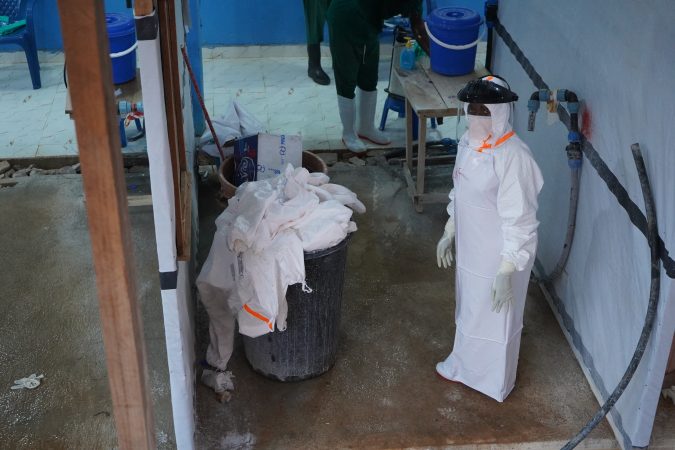
    Community resistance to Ebola teams, particularly those carrying out safe burials, has also hampered the response. Robert Ndjalonga, head of civil protection in Ituri province, said some communities have refused to allow burial teams to operate because they prefer traditional burials, increasing the risk of further transmission.

    “The biggest challenge remains resistance from or outright refusal by some communities to accept response teams,” Ndjalonga said. ”On several occasions, burial teams have had to be escorted by security forces to ensure that safe and dignified burials could be carried out without incident.”

    Shortages of burial supplies have delayed responses to reported deaths, while some affected health zones still lack operational burial teams, Ndjalonga said.

    Attacks on health facilities and response teams have also forced front-line workers and aid groups out of some areas. Some health workers have gone on strike, saying they haven’t been paid since the outbreak started.

    A member of a team carrying out safe Ebola burials was recently injured when assailants threw stones at the team’s vehicle following a burial in Bunia last week, according to provincial civil protection authorities.

    The attack highlighted the challenges facing the response in eastern Congo. In Ituri’s Irumu territory, the local military administrator recently described Ebola as a greater threat than the Islamic State-affiliated Allied Democratic Forces insurgency and urged residents to support, rather than attack, health workers.

    Containment efforts are faltering

    A humanitarian worker involved in the response, speaking on condition of anonymity because he was not authorized to speak publicly, cited poor coordination between response agencies, delays in transferring patients to treatment centers and waits of more than four days for some Ebola test results.

    “At times, it’s unclear who is doing what and where,” the worker said.

    The delays have led some patients to leave health facilities before they can be diagnosed, increasing the risk of further transmission, the worker said.

    Africa CDC head Kaseya called for intensified efforts to slow the outbreak on the first day of the health summit in Ghana on Tuesday.

    “If we do not stop this outbreak today, it could become one of the worst Ebola outbreaks the world has ever documented,” Kaseya said.

    Less than 9% of the contacts of confirmed patients who are expected to be traced are currently being monitored, far below the level needed to contain the outbreak, according to Africa CDC. More than 60% of deaths are occurring in the community before patients can receive care.

    Pierre Akilimali, the Ebola response incident manager at the National Public Health Institute of the Democratic Republic of the Congo, said the high number of community deaths suggests many infections are not being detected or isolated in time, allowing the virus to continue spreading.

    Experts warn of a worsening crisis

    Last month, researchers at the U.S. Centers for Disease Control and Prevention used computer modeling to estimate how the outbreak could evolve. In a worst-case scenario, they said it could approach the scale of the 2014-2016 West Africa epidemic.

    “There’s never been an Ebola outbreak that started with so many cases because it was so late to be identified,” said Trish Newport, emergency program manager for Doctors Without Borders, who has been working in Congo.

    “It’s like the outbreak is outrunning the response,” Newport said.

    University of Pittsburgh epidemiologist Jean Nachega, who is advising African health authorities, said he does not expect the outbreak to reach the CDC’s worst-case scenario but cautioned that the challenges remain “huge.”