
Category: News

  • Canada puts the military on standby as British Columbia wildfires kill 1 and displace thousands

    Canada puts the military on standby as British Columbia wildfires kill 1 and displace thousands

    Canada put its military on standby Monday to help battle deadly wildfires in British Columbia as a local mayor warned that one of the blazes had wreaked huge destruction on his community. A woman has died and some 20,000 people have fled their homes so far.

    For days, scores of wildfires have burned across the province, nearly half of them out of control in hot, windy weather and prolonged drought. Thousands have fled on jammed roads as officials said even more communities could be threatened.

    The mayor of Summerland — home to about 12,000 people, which was ordered evacuated on Saturday night along with about 8,000 people in and around nearby Peachland — warned that the affected areas remained too dangerous to enter and that it was impossible to determine the scope of the destruction.

    The blaze — known as the Bald Range wildfire — remained out of control after racing toward Summerland and other communities along Okanagan Lake over the weekend.

    “It’s going to be quite a bit,” Mayor Doug Holmes said of the expected destruction. “We need to brace ourselves for that bad news when it’s time to go back. Everybody will know somebody who has lost a home.”

    Defense Minister David McGuinty said the Canadian Armed Forces were in constant contact with provincial and federal officials and were ready to respond if British Columbia formally requested assistance. The federal government has already approved provincial requests for help with shelter and accommodations.

    The Royal Canadian Mounted Police said an 80-year-old woman died while trying to escape the fire near Summerland. Canadian Prime Minister Mark Carney said the death was heartbreaking and that the federal government would continue supporting British Columbia.

    The British Columbia Wildfire Service said Monday the fire had grown to about 60 square miles from 53 square miles on Sunday. Officials warned clearer skies and direct sunlight could increase fire activity.

    Ravi Parmer, British Columbia Minister of Forests, said 19 helicopters were assigned to the Bald Range wildfire but that its intensity made it impossible to halt the blaze.

    “We could have put a thousand more helicopters and a thousand more people on the ground, and it wouldn’t have made a difference,” he said.

    British Columbia Wildfire Service information officer Nicole Bonnett said the smoke lingering over the Bald Range fire has reduced visibility, limiting the use of air tankers and water-skimming aircraft.

    Bonnett said the blaze has been fueled primarily by extremely dry conditions rather than wind, and grew explosively Friday, reaching 19 square miles within three hours.

    Evacuated residents face uncertain prospects for return

    Holmes, the Summerland mayor, said there was no timetable for when residents would be able to return as power lines had been downed and hazards at the destroyed or damaged buildings would have to be assessed first. He added that residents would eventually return, likely neighborhood by neighborhood.

    “The hard part is going home and seeing the devastation,” he cautioned.

    Kyla Gaudiuso, a resident of Faulder, a 215-strong community, said her home was likely destroyed as she had gotten a photo showing the ridge where it stood engulfed in flames.

    She described the community’s evacuation as “pandemonium” and said she was now staying with a friend in the town of Penticton.

    “It doesn’t really seem real,” she said. “I have to see it to believe it.”

    Progress made with Washington state fires

    Firefighters in Spokane, Wash., have strengthened containment lines around three destructive blazes in recent days, allowing some evacuated residents to return home.

    Washington Gov. Bob Ferguson announced emergency proclamations to help those impacted by the fires at a news conference in Spokane on Monday. He suspended waiting periods for unemployment benefits and prohibited evictions, while the state Department of Licensing and Department of Health will help people who lost important documents get them immediately without charge.

    The state is also working on a request to the federal government for a major disaster declaration that would secure more support, he said.

    In California, evacuations have been ordered for areas along the famous Big Sur coast as a wildfire burns in the nearby steep, rugged mountains. The Timber Fire in Monterey County started Sunday and had grown to about 2 square miles by midday Monday, according to Cal Fire.

  • Woman’s shooting death in Chester County now believed to be suicide

    Woman’s shooting death in Chester County now believed to be suicide

    Chester County authorities believe that the shooting death of a woman in East Goshen Township on Friday was a suicide and that a 9-year-old girl also was wounded by gunfire.

    “The child who was shot continues to recover from her injuries. As we announced on Friday, this was an isolated incident and there was no threat to the general public,” the Chester County District Attorney’s Office said in a statement Monday.

    Police were dispatched just before 11 a.m. to the Summit House condominium complex on West Chester Pike for a reported shooting. Inside the unit, the officers found the woman, described only as in her 40s, dead from a single gunshot wound.

    The girl was treated at the scene by paramedics and was alert and able to speak, said Chief David Leahy of the Westtown-East Goshen Police Department.

    Police found a gun not far from the woman’s body.

    An earlier version of this article incorrectly reported that the Chester County District Attorney’s Office said the girl was struck by the same bullet that killed the woman.

  • Feds charge speedboat operator after mother and infant are killed in New York Harbor capsizing

    Feds charge speedboat operator after mother and infant are killed in New York Harbor capsizing

    NEW YORK — The driver of a speedboat that capsized in New York Harbor over the weekend, killing a 27-year-old woman and her infant daughter, was charged Monday with causing their deaths through misconduct or neglect.

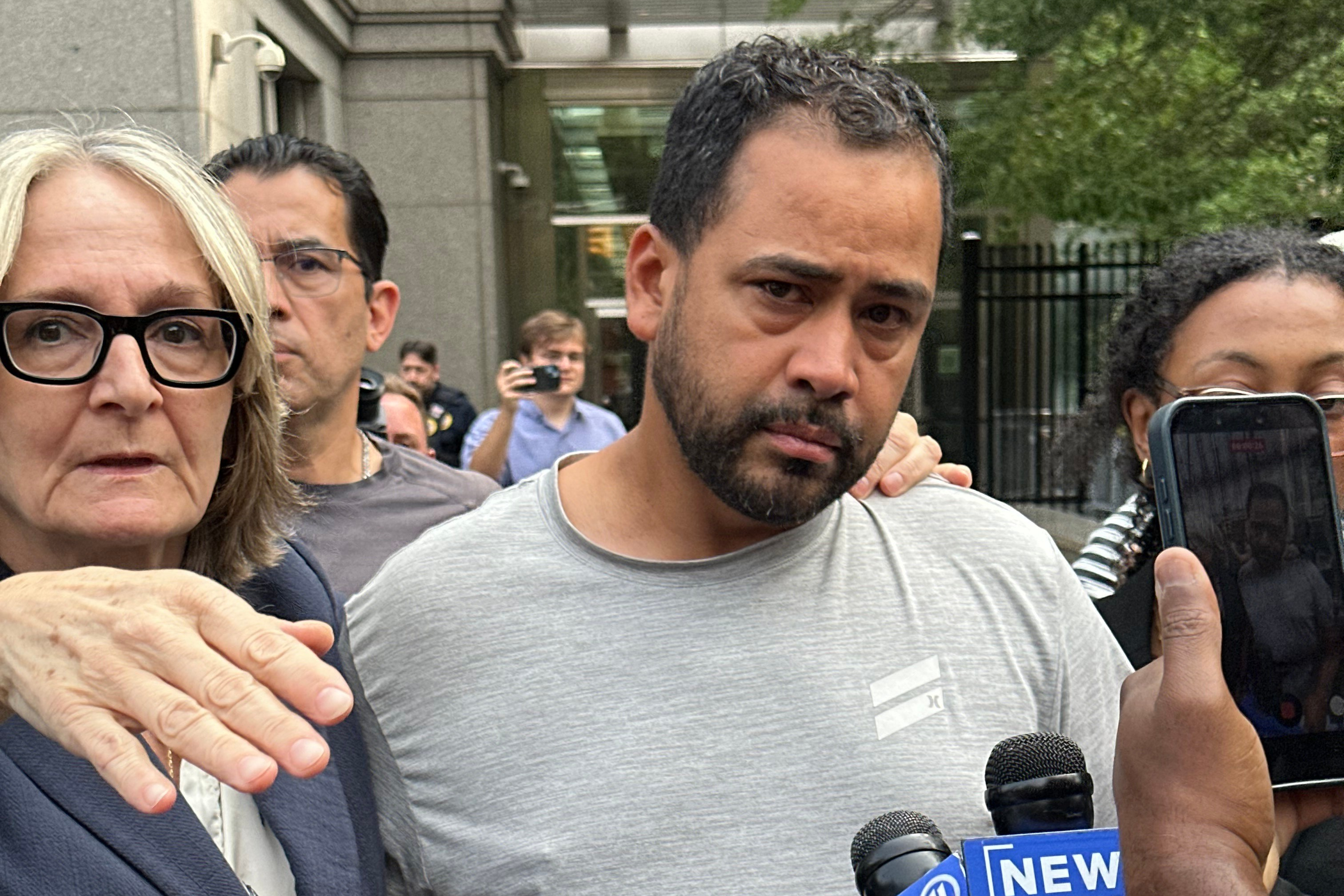
    Manuel Hernandez, 46, of Manville, N.J., wiped his eyes with his hand as he arrived for his initial appearance in Manhattan federal court, his feet shackled. He was not required to enter a plea and was released on $50,000 bail.

    Sara Sanchez and her 5-month-old daughter, Antonella Garcia, died after the 22-foot Yamaha AR210 speedboat overturned late Saturday near the Statue of Liberty in an accident authorities blamed on an overcrowded boat, poor decisions by Hernandez, a lack of appropriate licenses, and the failure to put a life vest on a 5-month-old child. Twelve others were rescued and are in stable condition, authorities said.

    As Hernandez left the hearing, his court-appointed attorney, Amy Gallicchio, guided him to a waiting vehicle. Both declined to comment.

    The vessel was pulled from the water and taken to the New York Police Department’s harbor unit facility on Randall’s Island.

    After state charges were lodged against Hernandez over the weekend, prosecutors said Monday that he will be tried in federal court, not state court. He was transferred to federal custody on Sunday.

    In a criminal complaint, federal prosecutors brought two charges alleging that Hernandez, as the boat’s pilot and operator, engaged in negligent actions and omissions that caused the capsizing and deaths in a boat that exceeded its maximum capacity of 10 people, with 14 on board.

    They said he also knowingly operated the boat with an infant on board without ensuring that the child was wearing a life vest and with the awareness that the boat didn’t have any child- or infant-sized life vests.

    The boat tour, which began at 7 p.m. Saturday, was more than three hours into its journey when Hernandez was piloting the boat toward the Statue of Liberty and made a U-turn that brought it into a swell, possibly caused by a larger passing vessel’s wake, according to the complaint.

    Hernandez tried to accelerate to pass through the swell, but the swell swamped the bow of his boat and immediately capsized it, prosecutors wrote.

    Hernandez told investigators that he had worked for the company on a freelance or contract basis since last year, starting as a limousine driver, they wrote.

    He stated that twice recently he used his personal boat, a slightly larger Yamaha AR250, for charter tours organized by Zeus Luxury Rentals Inc., according to the complaint.

    He said that on Saturday, he used a friend’s boat because his own needed repairs, but he didn’t tell the friend that he was using it for a charter tour, prosecutors wrote.

    Hernandez admitted to investigators that he had never sought the required licensing and claimed he was unaware it was needed, they wrote. He also admitted that he agreed to conduct the tour with the 5-month-old on board despite the vessel not having any child or infant-sized life vests, prosecutors said.

    Police Commissioner Jessica S. Tisch said the “tragedy could have been prevented, and now a family is left to grieve the unimaginable loss of a mother and her 5-month-old daughter because of his negligence.”

    In a news release, U.S. Attorney Jamie McDonald said Hernandez flouted federal regulations and maritime safety protocols when he transported paying customers on a commercial boat without appropriate licenses.

    “We mourn the tragic drowning deaths of the infant and her mother and urge would-be tour operators and the public to observe all safety protocols for commercial vessels,” he said.

    Capt. Doreen McCarthy, the Coast Guard Sector New York commander, credited the rescue of survivors to “heroic, swift actions” by those who responded from various agencies, along with a good Samaritan vessel.

    Meanwhile, a GoFundMe campaign that began Sunday to help Andres Garcia pay for the funeral and other expenses for his partner, Sanchez, and their daughter had topped $25,000 by Tuesday afternoon. Garcia was also on the boat when it capsized.

    Antonio Russo, general manager at Il Punto Ristorante, said Garcia is an “amazing guy” who has been working long hours each week as a waiter, driver, and food-runner to provide for his family here and in Colombia.

    Diego Naranjo, a neighbor of Sanchez in Queens, said he first met her last spring when her son threw a ball into their backyard. After recovering the ball, Naranjo invited her son to play on a trampoline with his children.

    “They were really nice people. You can see when a person is noble,” Naranjo said.

    He said he last saw Sanchez last Tuesday as she brought groceries into her home. He said he was shocked by the deaths.

  • Officials believe it was a missing Chester woman whose body was recovered from a car submerged in the Delaware

    Officials believe it was a missing Chester woman whose body was recovered from a car submerged in the Delaware

    The body believed to be that of a missing 33-year-old Chester woman was recovered Sunday from a vehicle submerged in the Delaware River, divers and family members said.

    Kortney Staples, a home healthcare nurse, was last seen by her family on July 11. She was reported missing on July 18 and since then her family has waged a tenacious public campaign to find her.

    Official confirmation that Staples has been found will be determined by the Delaware County Medical Examiner’s Office.

    “The individual’s preliminary description is consistent with that of Kortney Staples; however, formal identification is pending and will be made through the appropriate investigative and medical procedures,” Chester officials said in a statement.

    Chester police said there were no initial indications of foul play, but the investigation is ongoing.

    Chaos Divers, a volunteer sonar search-and-recovery team, reported that they found her body inside a gray Nissan Altima in the waters off Chester. Officials said the location was near Front and Norris Street, not far frome the Commodore Barry Bridge.

    The dive team said they found the car almost immediately on Sunday afternoon and they posted a photo of the license plate taken from the sunken car. The plate matches the woman’s vehicle.

    “Working in conjunction with Chester Police Department law, fire departments, Station 77 Dive and Rescue, and Rob’s Towing, Kortney and her vehicle were recovered flawlessly,” Chaos Divers posted on Facebook.

    Police said the vehicle was removed from the water around 7:45 p.m.

    “To Kortney’s family, friends, and everyone who knew and loved her, we offer our deepest and most heartfelt condolences. We hope that bringing Kortney home provides some measure of answers as her loved ones begin the incredibly difficult journey ahead,” said Chaos Divers, who are based in Illinois.

    Chester Mayor Stefan Roots called the discovery of the body “a heartbreaking development, and our entire Chester community stands with Kortney’s family and loved ones during this extraordinarily difficult time.

    Family members also said they believe that their search is over.

    “Yall no longer have to share the missing post…..it warms my heart to see my sister up & down my timeline & kno that she was much loved,” Koron Staples, Kortney’s brother, wrote on Facebook.

    Chester police urged anyone with information about what happened to Kortney Staples or her gray Nissan Altima, particularly on the days between July 5 and 18, should contact Capt. El’lan Morgan at 484-745-6662 or Emorgan223@chesterpolice.org, or Det. Astrid Cottrell at835-220-9549 or acottrell321@chesterpolice.org.

    “Even information that may appear insignificant could be helpful to the investigation,” the police department said.

    <iframe src="https://www.facebook.com/plugins/post.php?href=https%3A%2F%2Fwww.facebook.com%2FChaosdivers%2Fposts%2Fpfbid02Yb3vKTCTywg1qTjrdFFG3ufneZzJzxdKC9JXMn4kee41Acx6Jr7tQhELApR2u5h6l&show_text=true&width=500" width="500" height="811" style="border:none;overflow:hidden" scrolling="no" frameborder="0" allowfullscreen="true" allow="autoplay; clipboard-write; encrypted-media; picture-in-picture; web-share"></iframe>
  • Senate, Congress members demand FanDuel eliminate VIP programs for bettors, citing Bryce Harper controversy

    Senate, Congress members demand FanDuel eliminate VIP programs for bettors, citing Bryce Harper controversy

    Three members of Congress on Monday demanded that FanDuel Sportsbook end its VIP reward program and called on Major League Baseball and the Major League Baseball Players Association to prohibit athletes from doing promotional work for gambling entities in response to a “deeply disturbing” controversy involving Philadelphia Phillies star Bryce Harper and a VIP bettor who had a gambling addiction.

    The Inquirer reported in July that a FanDuel VIP manager had sent a personal video greeting from Harper in 2024 to Terry Thompson, a Montgomery County resident who ultimately lost $1.5 million on bets that he placed with the sportsbook operator.

    Harper later said that he had recorded the message through the video service Cameo, but didn’t know that FanDuel would utilize the 21-second video as a reward for a gambler.

    “FanDuel should not be using reckless and unscrupulous loyalty programs to drive bettors into debt and addiction,” U.S. Sen. Richard Blumenthal (D., Conn.) and U.S. Reps. Paul D. Tonko (D., N.Y.) and Valerie P. Foushee (D., N.C.) wrote to the company’s CEO, Christian Genetski. “As such, we strongly demand FanDuel to end its VIP program for bettors, especially those suffering from a gambling addiction, on its platform.”

    Thompson planned to die by suicide earlier this year, rather than confess to his family the scope of his losses, according to a lawsuit that the nonprofit Public Health Advocacy Institute filed in March on Thompson’s behalf against FanDuel and DraftKings, which had also allegedly provided him with VIP perks.

    The three Democrats, who cited The Inquirer’s reporting in their letter, asked Genetski to respond by Aug. 24 to eight questions about the company’s practices, including whether FanDuel VIP managers have sent videos of other athletes or celebrities to gamblers, and if the company monitors those managers to ensure they’re not extending predatory offers to problem gamblers.

    The lawmakers wrote that VIP managers foster “false friendships” with gamblers to entice them to place additional bets.

    Thompson has alleged that his FanDuel VIP host sometimes asked about his family, and provided him with tickets to two Super Bowls and Champagne.

    In an emailed statement, a FanDuel spokesperson did not respond to the congress members’ demand to end its VIP program, but said that the company employs a monitoring system to flag concerning patterns and “trained specialists” to help gamblers who show signs of harmful behavior.

    “Customer protection informs every decision we make as an organization, and we do not compromise when it comes to doing the right thing for our customers,” the spokesperson said.

    Prominent advertising for theScore Bet can now be found in right field at Citizens Bank Park. Elizabeth Robertson / Staff Photographer

    In a separate letter to MLB Commissioner Robert D. Manfred and Bruce Meyer, the players union’s interim executive director, the lawmakers called for “an end to the MLB and MLBPA policies that enabled this type of predatory promotion.”

    MLB’s collective bargaining agreement, which is set to expire in December, allows athletes to appear in advertisements or make personal appearances for casinos, racetracks, or sportsbook companies, so long as the ballplayers do not encourage betting on baseball.

    That players aren’t prohibited from doing promotional work for gambling companies is a “systemic failure,” the lawmakers wrote, “rooted in the deep enmeshment between leagues, teams, and sports books.”

    A representative for Major League Baseball declined Monday to comment.

    As part of negotiations over a new collective bargaining agreement with MLB, the players union is seeking more freedom for players to seek endorsements from sportsbook operators and prediction markets, ESPN has reported.

    MLBPA declined to comment.

    Blumenthal, Tonko, and Foushee also asked MLB and MLBPA to respond to questions about their partnerships with sportsbook operators. The lawmakers said that the league and the players union “must not allow players, regardless of their level of awareness, to legitimize sportsbook VIP programs designed to exploit the most vulnerable fans.”

    Elected officials in Pennsylvania are separately planning legislation that would restrict or eliminate sportsbook VIP programs, and in-game microbets, an effort that Joe Maloney, the president of the Sports Betting Alliance — a national advocacy organization whose members include FanDuel, DraftKings, BetMGM, bet365, and Fanatics — said the organization will oppose.

    The Inquirer will continue to report on issues related to the growth of gambling addiction — among teens and adults — across Pennsylvania. If you or someone you know wants to speak with a reporter, please contact David Gambacorta or William Bender at dgambacorta@inquirer.com and wbender@inquirer.com

  • Contiguous U.S. breaks its record for hottest month ever, NOAA says

    Contiguous U.S. breaks its record for hottest month ever, NOAA says

    KENSINGTON, Maryland — The contiguous United States sizzled to its hottest month ever last month, according to the National Oceanic and Atmospheric Administration.

    July averaged 76.89 degrees Fahrenheit across the Lower 48 states, eclipsing the Dust Bowl’s July 1936 by an eighth of a degree. Records go back to 1895.

    “It’s not good when you’re breaking records from the Dust Bowl, which we are in this case,” said meteorologist Jeff Masters of Yale Climate Connections. “And that was a crazy sort of situation where you put tens of millions of people in motion. You had this great migration because of the drought and the heat that hit the center of the U.S. — just a cataclysmic event in U. S. history. If we’re exceeding records from the Dust Bowl, that says that we’re in deep trouble.”

    Although it was unusually cool in Alaska, hotter-than-normal conditions blanketed the Lower 48, with the most excessive heat in the Mountain West, Southwest, Northern Plains, and Southeast. The heat was so widespread that every one of the Lower 48 states was at least 1 degree F warmer than the 20th century average, said Russ Vose, chief of monitoring at NOAA’s National Center for Environmental Information.

    The heat in the Dust Bowl years was more concentrated in parts of the Midwest and was aggravated by agricultural practices at the time, Vose said.

    What’s happening now is due to the burning of coal, oil, and gas, scientists said.

    “Extremely high temperatures across the continental U.S. this summer, along with intense drought and fire conditions, are absolutely consistent with the climate change signal,’ said Katharine Jacobs, a climate scientist at the University of Arizona.

    The biggest driver of the record heat was nighttime lows that smashed the old mark for hottest minimums by 0.7 degrees, NOAA said. Hotter nights are a classic sign of human-caused climate change, according to scientists and several studies in peer-reviewed literature. NOAA’s calculation is based on averaging 24 hours of temperature, not just highs or lows.

    “If you’re talking heat waves, that nighttime low is incredibly important for determining total heat stress,” Masters said. “So if it doesn’t cool off at night, your body doesn’t have time to readjust to all the heat.”

    As nighttime temperatures increase, more people die and even more lose sleep, studies show.

    The years 2021 and 1936 tie for America’s hottest summer, which is June through August. Through July, 2026 is a shade cooler than 2021, which was powered by record heat in June.

    Because of climate change, Masters said, “This may be one of the coolest years we’re going to experience for the rest of our lives.”

    What’s needed, Masters said, is “to stop burning so many fossil fuels. We also need to be spending money to adapt to the new climate that we’ve put in place.”

  • Ocean City community groups have filed a lawsuit challenging the Wonderland rehabilitation designation

    Ocean City community groups have filed a lawsuit challenging the Wonderland rehabilitation designation

    Four community groups in Ocean City filed a lawsuit Monday seeking to void City Council’s June 25 decision to designate the old Gillian’s Wonderland Pier as “in need of rehabilitation.”

    That vote started a negotiation with developer Eustace Mita, the owner of the property who has been seeking approval to build a seven-story, 242-room hotel on the site.

    Mita said earlier this month he is submitting a revised proposal for a hotel on the 2.42-acre property. His initial proposal called for a luxury hotel that preserved the Ferris wheel, carousel, and some kiddie rides.

    Hotels are not a permitted use under current zoning, requiring either variances or a negotiation under a rehabilitation designation. Mita sought the rehabilitation route.

    He said earlier this month that it was no longer viable to restore or replace the Ferris wheel.

    The lawsuit notes that Wonderland Pier served for generations as “a civic anchor for the northern end of the Boardwalk,” and that the pier “has been a focal point of the City’s identity as a low-rise family-friendly resort community.”

    The groups filing suit in Cape May County Superior Court were two neighborhood groups, Plaza Place Civic Association and Beach Watch Motel Condominium Association, the government watchdog group Fairness in Taxes, and Ocean City 2050, a group that has been advocating for an alternative to Mita’s luxury hotel proposal.

    Jack Gutenkunst (left), Marie Crawford, and her husband, Richard, with Shiloh, a 9-year-old soft-coated wheaten terrier, walk along Plaza Place, in Ocean City on Feb. 3, 2026. They live in the historic neighborhood right behind the site of the old Wonderland Pier and are fighting against the proposed development of a hotel on the boardwalk property.Tim Hawk / For The Inquirer

    Defendants are the City of Ocean City and the City Council.

    “This lawsuit was a difficult but necessary decision to make,” said Jack Gutenkunst of Plaza Place Civic Association, in a statement announcing the lawsuit. “Council’s Wonderland rehabilitation designation is deeply flawed and seeks to improperly strip away important planning protections that residents have long relied upon.”

    The lawsuit alleges that Mayor Jay Gillian’s failure to recuse himself from Council’s Wonderland discussions constituted “substantial financial and ethical conflicts of interest.”

    Gillian, whose family operated Wonderland for 65 years, sold the property to Mita in 2021 but continued to operate the amusement park under a lease arrangement. He made the decision to close Wonderland in 2024. The lawsuit notes financial entanglements that remain between the mayor and Mita.

    Reached by text message, Gillian declined to comment on the lawsuit.

    “The city cannot comment on pending litigation,” Doug Bergen, public information officer for Ocean City, said by email.

    The lawsuit also alleges that the designation failed to satisfy the state’s legal requirements under New Jersey’s Local Redevelopment and Housing law.

    “This lawsuit is not about stopping progress,” said Howie Atkinson of the Beach Watch group, in a statement announcing the lawsuit. “But no project is important enough to justify abandoning transparency, ignoring conflicts of interest, or shutting the public out of the progress.”

    The groups said the lawsuit should not stop the city from continuing to examine recommendations by its Boardwalk subcommittee. City Council tabled action related to the subcommittee at its last meeting due to the pending lawsuit.

  • CEOs pushed White House to delay ultra-processed food definition

    CEOs pushed White House to delay ultra-processed food definition

    Food company executives intervened in recent weeks to persuade the Trump administration not to release a proposed definition of ultra-processed food, according to people familiar with the discussions.

    Chief executives and trade group representatives sent letters and called the White House in a bid to delay the release of a white paper marking the first federal effort to define the controversial food category. The industry argued that laying out the definition would open it up to litigation, increase costs, and hurt business, according to the people, who weren’t authorized to speak publicly.

    Leaders have been airing their concerns for several weeks, arguing the definition could make processed food more expensive and impact federal nutrition programs, an industry official said.

    The administration has been working on a definition of ultra-processed food that is expected to focus on whether it includes certain “cosmetic” ingredients aimed at altering a food’s appearance, according to others familiar with the discussions, who asked to remain anonymous because the conversations aren’t public. The definition is also expected to take into account whether the products include ingredients that aren’t commonly used in home kitchens, they said.

    The effort to define ultra-processed food remains on track, an administration official told Bloomberg. The only special interest guiding the effort is the best interest of the American people, they said.

    The Health and Human Services Department held an event Monday billed as a celebration of two major food policy announcements, but then unveiled only one proposal targeting new food ingredients.

    Acting Food and Drug Administration Commissioner Kyle Diamantas told reporters on a call Monday that the administration has “submitted for final review a proposed definition of ultra-processed foods aimed at creating a stronger foundation for future federal nutrition research.” Additional information will be shared “at a future time,” he said.

    The white paper with the definition has not yet been cleared by the White House budget office, leaving many in the food industry uncertain as to when the administration is planning to release it.

    Top health officials have said Americans are getting sick from ultra-processed food, a broad category of largely packaged products that account for much of what’s sold in U.S. supermarkets. But the federal government has not yet mapped out what it considers ultra-processed food.

    The definition will take the form of a white paper, rather than a formal regulation, according to a regulatory notice published when HHS submitted it for review to the White House budget office.

    It is expected to include an exemption for foods that meet an already-established “healthy” criteria by the Food and Drug Administration. That carve-out may spare foods with nutritional benefits, such as some yogurts and whole-grain breads, from being classified as ultra-processed.

    White House and HHS spokespeople said discussions about any changes should be considered speculation unless they are officially announced.

    “The policy remains under interagency review and has not been finalized,” the HHS spokesperson said.

    Americans currently get more than half of their daily calories from ultra-processed foods, which account for about 62% of childhood diets, according to a nutrition survey from the U.S. Centers for Disease Control and Prevention.

    The food industry has been closely watching the administration’s efforts to craft the definition that could affect a broad swath of packaged foods. More than 92% of U.S. retail sales from Hershey Co. come from ultra-processed foods, according to an analysis from BNP Paribas. It found that at least 77% of retail sales for Kraft Heinz Co., Mondelez, Conagra, General Mills, and Campbell’s Co. come from ultra-processed products.

    Rachel Cohrs Zhang contributed to this article.

  • Ben Jones, ‘Dukes of Hazzard’ actor and 2-term U.S. House member, dies at 84

    Ben Jones, ‘Dukes of Hazzard’ actor and 2-term U.S. House member, dies at 84

    Ben Jones, who played the good ol’ boy mechanic in The Dukes of Hazzard TV series and parlayed his fame into a political career and two terms in the U.S. House, has died. He was 84.

    Mr. Jones had a heart attack in his home Sunday in Washington, Va., as he was waiting to watch his beloved Atlanta Braves play baseball, his wife, Alma Viator, said on social media. Rappahannock County Sheriff Connie Compton confirmed his death.

    Mr. Jones’ fame came from his role as Cooter Davenport, the mechanic who got the Duke boys out of jams as they tried to do the right thing and fight the corrupt Boss Hogg in the fictional Hazzard County, Ga.

    After playing Cooter for all seven seasons of the series from 1979 to 1985, Mr. Jones turned to politics and was elected to the U.S. House from a district near Atlanta in 1988. The Democrat served two terms before he was redistricted out of the seat.

    Mr. Jones was born in North Carolina and in college got involved in acting and civil rights, he wrote in his autobiography Redneck Boy in the Promised Land: The Confessions of ‘Crazy Cooter.’

    Acting took over his life. Mr. Jones performed in numerous stage productions and had a few minor TV and movie roles in Atlanta during the 1970s before his life-defining break came on a TV show Jones defended as a modern-day morality tale and a fine example of Southern values.

    For seven seasons, Mr. Jones was one of a small band of friends and family helping Bo and Luke Duke in The Dukes of Hazzard. The brothers were on probation for running moonshine and were constantly trying to clear their names and stop the crooked and powerful Boss Hogg from stealing or cheating.

    The Duke boys drove a modified 1969 Dodge Charger called the General Lee with a Confederate flag on its roof. Cooter owned Cooter’s Garage in the town square. Nearly every episode involved a car chase with jumps and stunts and a patrol car badly in need of repairs.

    Cooter was often on the CB radio in his pickup truck saying, “Breaker one, Breaker one. I might be crazy but I ain’t dumb. Crazy Cooter coming at you.”

    The Dukes of Hazzard was a hit for CBS and its popularity never waned. It went into syndication and later became a prominent fixture on cable’s Nashville Network.

    Mr. Jones also credited the series with pulling him out of a self-destructive, alcoholic lifestyle that led to the failure of several marriages.

    ″It was like being in a Beatles movie,″ Mr. Jones said. ″Our lives changed.″

    Tom Wopat, who played Luke Duke, said Mr. Jones was an integral part of making the series work.

    “Ben Jones was a fine friend and a fierce advocate of all the best things we can offer in the entertainment business. He will be sorely missed,” Wopat wrote on Instagram.

    After The Dukes of Hazzard, Mr. Jones went into politics. He kept his aw-shucks personality, but took the issues seriously. In his four years in Washington, Mr. Jones was known as a Democrat who could buck his party. He was liberal on social issues and conservative on economics.

    But even in politics, he made a splash. After losing in 1992 in his redrawn district, Mr. Jones ran for Congress again in 1994. He lost to Newt Gingrich in the elections that elevated the Republican to the Speaker’s Office.

    Mr. Jones would file an ethics complaint that Gingrich used tax-deductible donations to fund his partisan college course, leading to a House reprimand and Gingrich’s decision to leave the body.

    Mr. Jones always embraced his role as Cooter. After moving to Virginia, he would open at least three Cooter’s country stores in Nashville and Pigeon Forge, Tenn., and near his home. They sold plenty of T-shirts, key chains, and insulated tumblers and included Dukes of Hazzard memorabilia like one of the 300 or so General Lee cars used and abused in the TV series.

    The show and Cooter lived on because it was funny, had plenty of action and car chases, and had a good, family-friendly heart, Mr. Jones told the Richmond Times-Dispatch at a 2001 car show where he played in a band, signed autographs, and met fans.

    “The show reflects the values of the heartland of America. The good guys always win,” Mr. Jones said.

  • Trump signs executive order calling for spacing out childhood shots

    Trump signs executive order calling for spacing out childhood shots

    WASHINGTON — President Donald Trump on Monday signed an executive order calling for revamped childhood vaccine recommendations that promote his long-held but discredited theory that childhood shots should be spaced out into separate medical visits.

    The order advocates separating the measles, mumps and rubella (MMR) vaccine into three different single-disease shots and administering all childhood immunizations at separate appointments whenever possible. It also directs the nation’s health department to improve research on vaccines, which are already extensively studied, and present a plan to offer separate measles, mumps, and rubella vaccines for children, since that is not currently an option in the United States.

    The renewed focus on vaccines marks a departure from the Trump administration’s recent efforts to emphasize less controversial health policies related to healthy eating, drug price negotiations and medical fraud crackdowns ahead of November’s midterm elections.

    Public health experts have raised concerns that spacing out shots as Trump suggests can lead to an increased risk that children become infected with a vaccine-preventable disease before returning for another visit. Childhood vaccines — and how and when to give them in combination — go through rigorous studies, and safety tracking continues for years as the shots are used.

    Trump called the announcement a “major victory for parents rights, religious and constitutional rights, and for the gold standard science.”

    Speaking about the order at the Oval Office on Monday, Trump repeatedly suggested the number or timing of vaccines could play a role in rising rates of autism spectrum disorder, even as scientific consensus and decades of studies have firmly concluded there is no link. The order also includes several changes to the childhood vaccine schedule that his health department has already attempted, but that have been blocked by a federal judge. A White House official who insisted on anonymity to brief reporters said Trump was within his right to provide his own recommendation through the executive order and said the lawsuit blocking the health department’s schedule was a separate issue.

    Dr. Andrew Racine, president of the American Academy of Pediatrics, said the announcement spreads uncertainty, fear and confusion where “there doesn’t need to be any of that.” He disputed Trump’s recommendations and said previous ones should stand.

    “Science about vaccines and their efficacy has not changed,” he said. “The distribution of viruses and other pathogens in our environment has not changed. Children in this country have not changed in the last 48 hours.”

    Sen. Bill Cassidy, the Republican chair of the Senate health committee, slammed the executive order in a social media post, saying vaccines are safe and do not cause autism.

    “I’m a doctor. This executive order is wrong,” the Louisiana senator wrote. “The President does not have the expertise to make these changes.”

    Who is in charge of vaccine policy?

    Even as the order calls for revised vaccine recommendations, states, not the federal government, have the authority to require vaccinations for schoolchildren. The order advises states with school vaccine mandates to consider updating their laws to reflect the administration’s preferred schedule, according to a White House fact sheet.

    Last December, Trump ordered the Department of Health and Human Services to review how peer nations approach vaccine recommendations and consider revising U.S. guidance accordingly. The department responded by cutting the number of vaccines it recommends for every child, a move that has since been blocked in court.

    Changes to federal childhood vaccine recommendations customarily require approval from the director of the Centers for Disease Control and Prevention. The newly Senate-confirmed CDC director, Dr. Erica Schwartz, oversaw policies promoting vaccination of service members while in a leadership position at the U.S. Coast Guard.

    However, public health law expert Lawrence Gostin at Georgetown University said the Supreme Court’s interpretation of Trump’s power may allow him to supersede Schwartz if she does not agree to new recommendations.

    “This is clearly the first test for Dr. Erica Schwartz,” Gostin said in an email. “The President is placing her in an untenable position.”

    Asked on a call with reporters why the president was advocating splitting MMR into three single-disease vaccines, the White House official did not provide any studies supporting the decision. They said that was Trump’s long-held view and that some countries provide individual measles vaccines in certain circumstances.

    Kush Desai, a Trump spokesperson, told The Associated Press that the president is “one of countless parents who have voiced questions and concerns about the combined MMR vaccine” and said the plan to develop single-disease vaccines would “give parents more options on timing and frequency for their children,” ultimately increasing vaccine uptake.

    Studies of babies and toddlers in the U.S. have shown that the use of combination shots for childhood vaccines, rather than single ones, increased the likelihood of completing all recommended vaccinations by the age of 2.

    Announcement follows other Trump administration vaccine actions

    Health Secretary Robert F. Kennedy Jr., an anti-vaccine activist before he entered politics, set out to overhaul immunization guidance at DHS in the first year of Trump’s term. He fired an entire 17-member vaccine advisory committee, installing replacements who made far more restrictive recommendations that have since been halted by a federal judge. He also personally directed the CDC to abandon its position that vaccines do not cause autism, without supplying any new evidence to support the change.

    Throughout his second term, Trump has been fixated on connecting autism to vaccines. He has recently ramped up pressure on Kennedy to identify the cause of autism, something Kennedy had pledged to do with new research unveiled last year. Trump publicly prodded the health secretary for an update on autism research in a Cabinet meeting last month.

    “How are you doing on the autism research?” Trump asked.

    “We will have an answer for you,” Kennedy said.

    Scientific consensus and decades of studies have firmly concluded there is no link between childhood vaccines and autism. Racine reiterated that point on Monday, noting that the potential link had been studied in “over 40 methodologically well-designed studies in over seven countries involving over 5 million children.”

    “I’m not sure that there is anything that has been as thoroughly looked at as this question,” he said. “And the answer is unequivocally no.”

    In the Oval Office, Kennedy repeated his assertion that he believes an unknown environmental factor is to blame for rising autism diagnoses and said that his department will deliver research findings “as soon as they are ready.”

    Monday’s order comes as students are returning to classrooms around the country and the nation contends with a measles outbreak that experts say could result in the U.S. losing its measles elimination status.

    Doctors have raised concerns that Trump’s falsehoods on vaccines could stoke vaccine hesitancy. Federal data shows U.S. kindergarten vaccination rates have been dropping, with the share of children with exemptions rising to an all-time high in the 2024-25 school year.