Indiana authorities say at least five people have died in flooding across the state this week, as first responders worked to rescue more people Saturday from rising waters in neighborhoods along the White River in Indianapolis.
The state has been hammered over the past week by heavy rains, resulting in rivers and creeks surging.
More than 90 people and their pets were rescued Saturday as floodwaters rose along the White River in Indianapolis and authorities in central Indiana responded to what many described as historic flooding.
The damage so far was concentrated along the river corridor from Hamilton County and into the northern Indianapolis suburbs. Farther east in Delaware County, sheriff deputies on Friday found the body of a 58-year-old woman who they believe died after trying to drive through floodwaters.
Gov. Mike Braun confirmed Saturday that President Donald Trump intends to approve his request for federal resources to help in response to the flooding and the recovery.
Braun said his heart is with the families who have lost loved ones due to the flooding over the past week. He also warned people to take the flooding seriously and stay away from floodwaters.
Indianapolis Mayor Joe Hogsett was joined by emergency managers during a briefing Saturday as he urged residents along the river to evacuate. A day earlier, he had declared a local emergency as heavy rains resulted in creeks and streams swelling throughout central Indiana.
“This is one of those once-in-a-lifetime type floods,” Jacob Spence, director of Marion County Emergency Management, told the Associated Press. “So yeah, this is an unprecedented event and unfortunately we’re setting some new records.”
The National Weather Service reported that more than 11 inches of rain fell over a two-day period in some areas. The White River crested at more than 24 feet in the communities of Anderson and Noblesville, surpassing records set in 1913.
Flash-flood warnings and watches were issued across a swath of central Indiana on Saturday, and forecasters with the National Weather Service warned that more showers and thunderstorms would be moving into the area throughout the day. In Warren County, forecasters reported 2 inches of rain falling in six hours.
Forecasters expected the White River to crest Saturday evening in the Indianapolis area, where National Guard vehicles were among those helping with the rescue efforts. Rita Reith, a spokesperson with the Indianapolis Fire Department, put the number of rescues at 91 people and 45 pets as of early afternoon.
“The water is still rising, so heed the warnings,” said Todd Wilson, director of the city’s public works department.
Residents posted videos on social media that showed vehicles stranded in high water, a power pole being toppled by rushing water, and flooded intersections.
Earlier this week, severe storms wreaked havoc across other parts of the Midwest, causing tornadoes, heavy rains, and flash flooding. Storm damage was reported from the Chicago area all the way to western Pennsylvania.
Cristina Hartley watched her teenage son go from refusing to say more than two lines on stage to taking on the lead role in two performances, thanks to the confidence he built through theater production nonprofit Arts and Athletics Club.
Now, Hartley, who serves on the organization’s board, is worried about what the future holds for the all-ages theater group. The nonprofit, formally founded in 2019 after starting as a high school senior project, was based for roughly four years in the Exton Square Mall, and lost its space when the mall closed its doors in June. The group has struggled to find a new home and will be forced to take a hiatus until a new location is secured.
“The arts are always the first program to be cut out of schools, and there’s always a lack of budget to have that in schools or to expand these programs in schools, and we want everybody to have access to anything art-related, whether that’s drawing or trying to sing or trying to perform,” said Hartley, who has been involved with the nonprofit for six years.
“We know that there’s a space out there. There’s a landlord out there willing to work with a small nonprofit. We just haven’t found it yet,” she said.
The Arts and Athletics Club’s interior at the Exton mall. Finding a space for it to hold its productions and activities has been a challenge, leaders say.Photo courtesy of Arts and Athletics Club
For years, the mall declined from traditional retail, with only a handful of stores left when it shuttered after five decades. It was Chester County’s only enclosed mall.
But even as the mall’s staples dwindled, other organizations — nonprofits, a robotics club, a fencing center, and more — occupied the space, drawing what business leaders said was significant foot traffic.
In June, those still left at the mall received notice that they would have to be out by the end of the month. For nonprofits like the Arts and Athletics Club without robust budgets to quickly relocate, the abrupt end put them in a bind.
The Arts and Athletics Club was in the midst of two productions when its leaders learned they would have to vacate, said Chris Hutelmyer, executive director. They took June to move their things out, depositing belongings in people’s garages, and started the real estate hunt in July.
The two performances, Oh Happy Day and Twisted Tales, went on, albeit under changed circumstances, with one held in a park. After holding a summer bash Saturday, the organization will be on hiatus until it finds a space, Hutelmyer said.
The mall had been perfect for the group. An old Aéropostale served as its mini black box theater for four years. The former clothing store had no windows, which worked well for staging 10 productions each year, and it was accessible with ample parking. There were bathrooms, dressing rooms, and storage space. And it was a central location for its all-ages community, accessible from Malvern to Downingtown to Coatesville.
The cast of “Twisted Tales” poses for a photo. Arts and Athletics Club, primarily a theater production nonprofit, has struggled to find a new facility since the Exton mall’s closure in June. Its last production was held in a park, and it hasn’t been able to run a show since.Photo courtesy of Arts and Athletics Club
Trying to find a comparable space for the Arts and Athletics Club within East and West Whiteland Townships has proved difficult. But its leaders said they want to stay in the area, continuing to provide programming for participants from ages 7 to 70. The mall was the organization’s first permanent location, after performing in parks, libraries, and other community spaces.
The theater group, which offers its programming for free or little cost, has a limited budget for renting or altering a space to fit its needs. Another challenge has been finding an available location that is the right size: about 1,800 to 3,000 square feet of open space.
Group leaders have looked at retail locations, warehouses, and churches, and investigated partnering with community centers.
“We’ve been striking out pretty much everywhere that we’ve been looking,” Hutelmyer said. “It’s just been hard to find a direct match for what we need.”
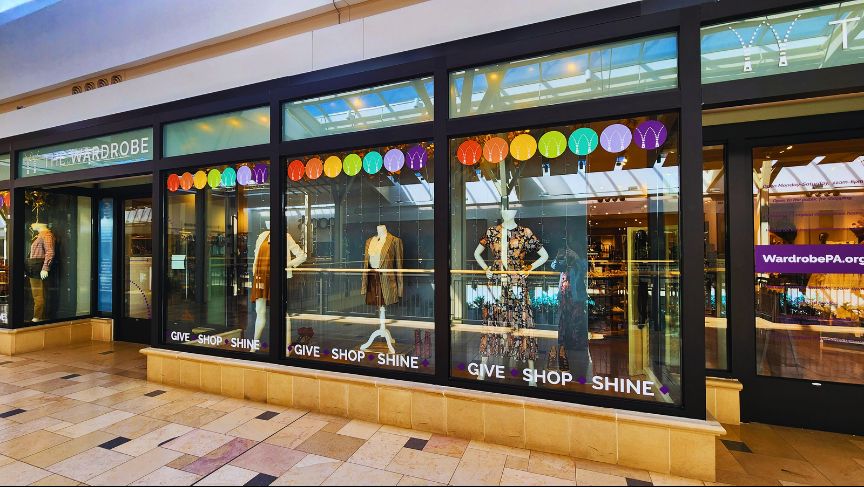
It was a similar scramble for the Wardrobe, a nonprofit thrift store that accepts and sells secondhand clothing and also provides free clothes to those in need, after having to abruptly move out of the Exton mall.
Racing to find a new space to avoid laying off any employees, executive director Sherri Cole enlisted a real estate agent, she said, but struggled to find something affordable that also hit the right marks.
“Everything had to go out of the mall; it’s not like we could be like, ‘OK, we’ll go dark and we’ll move things when we find a new location,’” Cole said.
The old exterior of the Wardrobe, a clothing store that accepts donations and gives clothes to those in need for free, in Exton mall. The business will open its new location in Malvern in the fall.Photo Courtesy of The Wardrobe
By early July, the Wardrobe secured a pop-up location in the Plymouth Meeting Mall.
And this month, the nonprofit found a new, permanent home in the Lincoln Court Shopping Center in Malvern, about a 10-minute drive from the old Exton location. Cole anticipates the store will open by October.
The interior of The Wardrobe’s former Exton mall location. The nonprofit, which has called the mall home for the last few years, struggled to find a new location in Chester County after the mall shuttered in June.Photo Courtesy of The Wardrobe
Still, for both the Wardrobe and the Arts and Activities Club, it was hard to lose the Exton mall.
Out of the Wardrobe’s five locations in the Philadelphia region, the Exton mall location was its second-largest site for foot traffic and retail sales last year, Cole said.
It proved that people would still show up to a “dead” or “dying” mall if there was something they needed, Cole said. And it was meeting a need.
“There need to be spaces in the suburbs where everyone feels welcome, and often, the class divide in the suburbs is really stark,” she said. “It’s great that we’re able to find something that is still within the Exton, Malvern neighborhood where we can be providing these services, because even within the suburbs, poverty is really often overlooked.”
For Hutelmyer, still searching for somewhere for the Arts and Athletics Club to land, it was sad to see a community space like the mall go.
Housing a constellation of community organizations, the mall “wasn’t what people really expected it to be,” Hutelmyer said.
“But as it transformed into the community space, at least while we were there, it was still serving a lot of good, and I think that not being there is a big loss for the community,” he said.
This suburban content is produced with support from the Leslie Miller and Richard Worley Foundation and The Lenfest Institute for Journalism. Editorial content is created independently of the project donors. Gifts to support The Inquirer’s high-impact journalism can be made at inquirer.com/donate. A list of Lenfest Institute donors can be found at lenfestinstitute.org/supporters.
AUSTIN, Texas — Democrats seeking the party’s presidential nomination in 2028 will need to prove themselves early on in states where Black and Latino voters and union members are key supporters, under an election-year calendar approved Saturday.
The primary lineup pushes Iowa from the traditional top spot and makes South Carolina the leadoff state, voting on Jan. 22, 2028, followed by Nevada on Feb. 1. New Hampshire, New Mexico, Michigan, and Virginia round out the early states throughout February, according to the plan endorsed by the Democratic National Committee at its meeting in Texas.
DNC Chairperson Ken Martin said that to win the general election, “You have to be battle-tested in a way that you already have campaigned in front of and for the support of various communities throughout the country.” That is why the calendar designed by the party matters, he said in an interview.
Some potential candidates in what is expected to be a large field have visited early-voting states such as South Carolina. Party leaders have said the order gives candidates the best shot at winning back the White House after Republican President Donald Trump’s second term.
“They have to show that they can go to the South and talk to Black voters and rural voters, as well as out West, talking ranching and mining issues, to a border state, to union members,” said party strategist Karen Finney, who has worked on multiple presidential campaigns. “Whoever survives will be battle-tested.”
Former presidential candidate Howard Dean, a onetime Vermont governor, recalled his tenure as national party chairperson, when Democrats solidified Nevada and South Carolina as early states behind Iowa and New Hampshire. The latest change is even better, he said.
“These states look more like the country” as a whole, he said, “whereas Iowa and New Hampshire don’t.”
Rita Hart, chairperson of the Iowa Democratic Party, said bypassing her state in the early going would sideline important voter voices and give a political edge to Republicans, who are expected to keep Iowa atop their calendar.
Nonwhite voters claim top billing
As the first-in-the-South primary, South Carolina was more decisive than Iowa and New Hampshire for nominees Barack Obama in 2008, Hillary Clinton in 2016, and Joe Biden in 2020. All three dominated among South Carolina’s large Black population, which can yield more than half the state’s Democratic primary electorate.
With Nevada and New Mexico following, candidates will be required to court more Latino voters early in the process.
Shifting from Iowa and New Hampshire does not mean little-known candidates cannot catch fire, as Pete Buttigieg did in Iowa and New Hampshire in 2020, when he was a 37-year-old former mayor. They just will not be able to do it with an almost entirely white audience.
“If you can’t go to every part of this country and make your case, you should not be running for president,” Finney said.
The progressive vs. establishment dynamics may shift
There is disagreement over how Democrats’ split between progressives and mainstream liberals may or may not surface in the nominating calendar.
“I think our primary voters up north are probably a little different than primary voters in South Carolina,” said Boyd Brown, a former DNC member from South Carolina. “It’s not the woke ideologies that we just can’t get away from” in other places.
Nina Smith, a former Buttigieg adviser who now works closely with progressive causes, disagreed. Smith said Black South Carolinians, especially, have gravitated to more moderate candidates — twice rejecting Vermont Sen. Bernie Sanders in favor of Clinton and Biden.
But, she said, “Southern Black voters are more progressive than they’re given credit for” on policy but also “realists” about what is possible.
“Living through Jim Crow and other oppressive structures will force you to be take that approach,” she said.
Smith said that with South Carolina leading off and many Southern states following on Super Tuesday soon after the early lineup concludes, progressives will have to take the time to listen and then tailor their messages.
“A lot of Black voters don’t necessarily see themselves in the ideas and arguments that progressives put forward,” she said.
Unions will get a spotlight in the early-voting states
Nevada has the service industry unions because of Las Vegas; Michigan has the auto industry and associated manufacturing support industries; Virginia is home to more federal workers than any other state.
“Labor is still so important,” Dean said.
Beyond seeking the backing of organized labor, the campaigns and the party will look to unions for help in spreading Democrats’ message to voters and getting people to the polls.
More scheduling efficiency for candidates
Campaigns struggle to balance many demands such as meeting voters in person, raising money, and dealing with the logistics of travel. As a result, places such as Nevada have gotten short shrift in the past because candidates, most from the eastern part of the country, have concluded the investment of time is not worth it.
An expanded calendar offers more clustering opportunities.
A swing to the West could hit two early states — Nevada and New Mexico — and include a fundraising stop in California, full of Democratic donors. A South Carolina trip could mean fundraisers and public appearances in Atlanta, Charlotte, and Raleigh, both in North Carolina. Virginia offers proximity to donors and national TV studios in Washington; the same options are available by adding a New York City stop on the way to New Hampshire.
Bre Maxwell is a DNC member from South Carolina who said the state’s smaller size and lower media costs are a financial equalizer, allowing not only the best-funded candidates to have an impact.
“They can campaign from the top to the bottom in a day,” Maxwell said.
It’s about primaries, with a clear look to November
Of the six early states, all but South Carolina have been competitive in general elections.
That means that even before Super Tuesday, the Democratic candidates will have spent significant time and resources in states worth a combined 43 Electoral College votes. That is not insignificant on the way to the 270 needed to win.
Television ads and news coverage can spill over, as well. Markets targeting parts of South Carolina also reach portions of North Carolina and Georgia.
After all, Brown said, the point is to put a Democrat in the White House.
“This is not a social or a debate club. It is a political party,” he said.
The black and white flags of the Taliban were flying high along the streets of Kabul, Afghanistan’s capital, as the group celebrated five years in power on Saturday.
A shiny Mercedes drifted in front of graffiti praising the Taliban fighters’ “sacrifice,” the word painted in crimson, with depictions of drops of blood. Young Afghans chanted independence songs below posters hailing how “the carpet of democracy” had been removed for Islamic rule.
But the triumphant tone is only half the story. The Taliban may be boisterous in Kabul and have a tight grip on power, yet elsewhere they find themselves targeted and face crises both at home and abroad.
They face a conflict just short of open war with neighboring Pakistan. They’re dealing with new waves of attacks from armed groups that want to topple them. Add to that mass unemployment, international isolation, and growing domestic discontent, and the Taliban face their most serious threats since their return to power in 2021.
It is too early to tell whether all those challenges will escalate and threaten their survival as a governing force. And as the scenes of celebration on Saturday showed, the Taliban are popular among many.
Still, the threats they face have cracked the veneer of security and stability that the Taliban have heralded as their primary achievement — and their main selling point to the world.
As workers were preparing Kabul for celebrations Thursday, a resistance group claimed responsibility for the killing of the Taliban mayor of a provincial capital in northern Afghanistan. Two weeks earlier, another Taliban official had been assassinated in the same province.
A tight grip on power — and yet
The Taliban are holding Afghan society in a chokehold that spares no one. Girls and women face restrictions to a degree unseen anywhere else in the world. Religious minorities are witnessing the forced closure of their places of worship. Anyone who voices criticism is repressed. United Nations staff members face arrests; journalists and rights workers suffer forced disappearances.
The Taliban are collecting taxes and building roads, dams, and canals. European countries have welcomed them in Brussels to facilitate the deportation of Afghan migrants and asylum seekers. They have expanded trade ties with Central Asian states and want the Trump administration to come back to Afghanistan.
Whenever a sign of dissent emerges in a province, the country’s secretive and ultraconservative leader, Sheikh Haibatullah Akhundzada, places a key ally in a leadership position to keep things in check.
And yet the signs of trouble that have appeared in recent months are impossible to ignore.
Troubles in the North
Sporadic sounds of gunfire reverberated across the remote mountains of northeastern Afghanistan on a recent evening. Weary Taliban fighters peppered drivers with questions at checkpoints dotting the main road snaking through the province of Badakhshan.
On the same road, two attackers had killed a senior provincial Talib official a week earlier. A small group of anti-Taliban fighters had briefly seized control of a police headquarters in a nearby district.
Now fighting between the Taliban and another group opposing their rule was continuing in another district of Badakhshan. The province, bordering China, Pakistan and Tajikistan, is emerging as a hot spot.
On a trip to the province this month, we talked to residents ready to support anti-Taliban groups because they said they were fed up with the Taliban’s iron grip, the lack of job opportunities, and the government’s confiscation of natural resources.
We drove through dozens of checkpoints and witnessed the heavy presence of intelligence officers in the isolated village where anti-Taliban fighters had stormed police headquarters.
The clashes and the attacks have so far been scattered. The leader of one of the anti-Taliban groups described them as “opportunity targets” aimed at challenging the Taliban’s sense of control. But the leader, speaking on condition of anonymity to discuss the group’s strategy, said the number of attacks would only increase in coming months.
Tensions in the East
An underequipped Afghan army waits nervously at the border with Pakistan. Once a sponsor of the Taliban, Pakistan has launched dozens of airstrikes on Afghanistan, killing 500 civilians since October, according to the United Nations, and has threatened to use even more force if the Taliban don’t rein in militants who are staging attacks on Pakistani territory.
The mistrust goes both ways: The Taliban have accused Pakistan of supporting the armed groups that have attacked Taliban outposts in Badakhshan.
Whether, or to what extent, Pakistan is actively supporting anti-Taliban groups is not clear, but suspicions are running high.
“The Pakistanis are happy to be portrayed now as a potential patron for the armed opposition to the Taliban, because that increases their leverage over the group,” said Fabrizio Foschini, a researcher at the Afghanistan Analysts Network.
Food, education, and the economy
The picture on the domestic front is also grim. Extreme hunger has been spreading fast from one province to another after aid cuts last year plunged millions into deeper food insecurity. The Taliban’s ban on secondary and university education for women and girls is stifling development, experts say.
The Taliban have deprived 2.4 million Afghan girls of an education, according to UNESCO — the equivalent of all school-age girls in New York, Mexico City, and Moscow combined — and they are forced to stay home indefinitely.
Some scattered signs of discontent have popped up. At a rare protest in June, demonstrators chanted “Work, education, freedom,” similar to what their Iranian neighbors chanted in 2022. And the leader of a large religious minority warned the Taliban in May: Don’t squeeze Afghan society too much, or it will explode.
The potential to spiral?
The Taliban know the world wants a stable Afghanistan — one that isn’t a source of refugees, drugs, or terrorism.
They assert that the country no longer poses a security threat to the region or the West. They say that they have cracked down on the Islamic State militant group, and that they want peaceful relations, based on trade and diplomacy, including with the U.S.
Since the Taliban no longer carry out suicide attacks, bomb schools, or target the security forces they now represent, their main argument may hold.
“The greatest achievement we have had over the past five years is security,” Afghanistan’s foreign minister, Amir Khan Muttaqi, said in an interview with the New York Times in Kabul on Wednesday.
They don’t want their various crises to spiral either.
All the ingredients for things to get out of control in Afghanistan again are here, analysts say: A vast population of unemployed young Afghans are fertile ground for radicalization, especially as economic opportunities are nearly nonexistent. And with animosity growing between Pakistan and Afghanistan, it is unclear who might come to the Taliban’s aid: Afghanistan is, once again, a pariah state, with barely any allies.
The past five years have brought some predictability and an end to almost two decades of fighting, which many Afghans have welcomed, despite the immense hardship and repression. But the country remains shattered, and the fragile peace is already at risk.
The U.S. Navy is considering a major redesign of its new aircraft carriers to better match President Donald Trump’s preferred aesthetic for the warships, according to seven current and former U.S. officials familiar with the matter.
The service is evaluating the feasibility of moving the multistory tower that acts as the carrier’s command center farther forward, toward the middle of the ship, to resemble older vessels, the officials said. The review, which has not been previously reported, is in response to Trump’s concerns about the “look” of the new Ford-class ships, where the tower is near the rear, these people said.
The timing and extent of the Navy’s evaluation is unclear, with current and former officials cautioning that the service was concerned that such a change would require significant time and money. Like others, they spoke on the condition of anonymity to discuss a sensitive situation.
Moving that command center, known as the “island,” would be the second major design change prompted by the president, who on Thursday issued a national security memorandum directing the Navy to develop a plan to revert to older steam-powered catapults on future carriers. The systems help launch jets off the ships’ flight decks.
Trump’s preference, current and former officials said, is for the new aircraft carriers to look more like those that were in service during World War II.
The Navy also examined the issue during his first term as president, said a former senior U.S. official. A study found that moving the island could cost billions of dollars in redesign costs and significantly delay the program, this person said.
“It came back that the cost and time to do so would just be extraordinary,” the former official said.
There are three Ford-class carriers in various stages of development. The USS John F. Kennedy is undergoing sea trials and getting closer to joining the fleet while the USS Enterprise and USS Doris Miller are under construction. The first carrier in the class, USS Gerald R. Ford, is already in service and recently finished a lengthy combat tour in the Middle East.
Plans call for building up to 10 Ford-class carriers over the next four decades, at a projected future cost of $22 billion each, according to the nonpartisan Congressional Budget Office and the Navy’s most recent shipbuilding plan.
Relocating the island would be “a major redesign,” said Bryan Clark, a former Navy officer who studies the service at the Hudson Institute, a right-leaning think tank in Washington. Such an alteration to the carrier’s layout, he said, would affect the ship’s buoyancy and weight and come at a significant cost.
“You could change it,” he added, “but it’s very disruptive.”
The Pentagon and the Navy referred requests for comment to the White House, which pointed to the new national security memorandum when asked about Trump’s desire to relocate the island on future Ford-class aircraft carriers. The memorandum does not address the issue.
Another U.S. official familiar with both the potential changes to the catapult and the island said that the Navy is taking both matters seriously because of the delays and severe cost overruns they could create.
Trump’s interest in the redesign modification marks the White House’s growing influence over the complex mechanics of naval shipbuilding.
Since returning to office, Trump has promised to “resurrect” the lagging industry, and he has already issued multiple executive orders addressing the matter.
Thursday’s national security memorandum would, among other changes, revert the Ford class’ advanced electromagnetic catapult system to steam power. The document emphasizes the administration’s preference for “proven, reliable,, and affordable technologies and ship designs.”
Such a change, multiple officials said, also could run into the billions of dollars and exacerbate chronic delays in the U.S. shipbuilding industry.
The lead Ford-class carrier, the USS Gerald R. Ford, required 17 years to construct. Its design incorporated new technology that led to delays — including the electromagnetic catapult, a feature the Navy has since credited as being highly effective.
The Ford class of carriers will phase out its predecessor, the Nimitz class, which dates back to the late 1960s.
Relocating the island to the back of the newer vessels was done for efficiency and safety, three U.S. current and former officials familiar with the program told the Post. It not only creates more parking space for aircraft close to the carriers’ catapults, allowing crews to reduce the amount of time it takes to launch jets, it also improves landing safety by reducing the chance for turbulence when planes come back to land, the officials said.
The Navy’s surface fleet has been plagued by years of delayed maintenance and low readiness rates, in part because of how often past U.S. administrations have deployed carriers to confront global crises.
Amid the ongoing Iran war, the Pentagon under Trump has further stretched the readiness of its carrier fleet while surging naval assets to the Middle East to conduct strikes and enforce a blockade of Iranian ports.
The USS Ford itself faced an extended deployment that ended earlier this year after a fire rendered many crew members’ sleeping quarters uninhabitable. Officials also acknowledged that the Navy’s newest carrier experienced problems with the “vacuum collection, holding, and transfer” system that supports hundreds of toilets on board.
Democratic lawmakers this week called on Defense Secretary Pete Hegseth to investigate new reports of rapidly worsening conditions aboard the USS Abraham Lincoln, which has been deployed to the Middle East since November. Families of sailors aboard the Lincoln have been outspoken about the situation, and the Navy is investigating a man-overboard incident it says may be connected to mental health issues.
While speaking to reporters on a trip to Panama on Thursday, Hegseth called the reports “completely misrepresented.”
On Friday, as questions continued to swirl around conditions on the ship and its lengthy deployment, Trump told reporters at Joint Base Andrews that the Lincoln’s time at sea had been “not nearly long enough.”
The Lincoln is on an extended combat deployment that has seen its sailors at sea for 200 days without a port call to provide the crew some rest. It is scheduled to be relieved by the USS George Washington in the coming weeks.
Trump has repeatedly shown interest in the design of Navy warships. Last year he unveiled plans for a new class of battleships to lead his vision for a Golden Fleet, prompting criticism from many naval analysts and lawmakers who argued the ships would waste scarce American shipbuilding power on a design the service does not need.
The Congressional Budget Office has since estimated that the Trump Class battleships would cost about $275 billion over 30 years, coming at a cost of $18 billion per ship after finishing the first one.
WASHINGTON — The aircraft carrier USS Abraham Lincoln’s supply problems began soon after the first day of the war, as Iranian missiles and attack drones fell on a Navy base in Bahrain.
The Iranian attack, retaliation for the U.S.-Israeli assault on Tehran, Iran, destroyed much of the base. And as it went up in smoke, so did a major logistics hub the Navy has relied on for decades.
The Navy needed a Plan B to continue feeding the sailors working around the clock to keep warplanes flying strike missions, and later to maintain a blockade of Iran’s ports.
With the threat of Iranian attacks at other ports in the region, the Pentagon looked to a base under British command on the island of Diego Garcia as its supply hub. Diego Garcia is south of the Maldives in the Indian Ocean and roughly 2,200 miles from where two aircraft carrier strike groups have been operating in the Gulf of Oman.
The loss of the hub in Bahrain has contributed to a host of reported problems on carriers supporting operations against Iran, as Democratic senators raise concerns about the Lincoln’s 5,000 sailors and their nearly nine-month deployment.
Sen. Richard Blumenthal (D., Conn.) said in a letter to Defense Secretary Pete Hegseth that the reported problems included shortages of basic supplies and the deteriorating mental health of its crew members.
On Friday at a military air base in Maryland, President Donald Trump dismissed those concerns. “That ship is moving right now, or very shortly, and it’s being replaced with another, very similar, ship,” he said.
The Lincoln’s replacement is the Japan-based carrier USS George Washington, which earlier this week was heading west through the Strait of Malacca in Indonesian waters en route to the Middle East.
Another carrier, the USS George H.W. Bush, has been operating in the Middle East for months since deploying from Norfolk, Va., on March 31.
When asked if the carrier deployments were too long, the president said, “No, no, no, not nearly long enough.”
Hegseth had a similar response on Thursday when a reporter asked how long the United States could maintain its blockade of the Strait of Hormuz.
“We can hold it as long as we need to, indefinitely,” he replied.
At the war’s outset, Keir Starmer, then the British prime minister, denied the Pentagon access to Diego Garcia for use in the operation against Iran. That decision drew Trump’s ire, and Starmer ultimately relented on March 1, granting the U.S. military access to the island for what he described as a “specific and limited defensive purpose.”
A U.S. military official, who spoke on the condition of anonymity to discuss sensitive logistics, said the Navy began using Diego Garcia as the main shipment point shortly after the Navy’s base in Bahrain was heavily damaged.
The use of Diego Garcia as the Navy’s new logistics hub may explain why Iran fired two medium-range ballistic missiles at the island on March 20.
One of the missiles fell into the Indian Ocean short of its target. A Navy warship shot down the other.
The San Diego-based Lincoln has been at sea for nearly nine months without what the Navy calls a “liberty port” — where sailors can get off the ship for a few days.
Bahrain is one of the two ports where U.S. aircraft carriers in the region have typically moored so their crews can get some downtime. The other, the Emirati port of Fujairah on the Gulf of Oman, is also well within the range of Iranian missiles.
The Trump administration relied on yet another carrier, the USS Gerald R. Ford, in the Caribbean for its pressure campaign against Venezuela and later extended its deployment to the Middle East to launch airstrikes against Iran. So far the war has seen the commitment of a significant portion of the Navy’s fleet of aircraft carriers, which will go down to 10 with the expected retirement of USS Nimitz next year.
While six months is the typical length of a Navy deployment at sea in peacetime, some carriers have done far longer stretches following the 9/11 attacks. The Ford’s 326-day deployment, however, broke the record for the longest by a carrier since the Vietnam War.
But in that war, carriers assigned to Yankee Station, a section of the Pacific off the coast of Vietnam, would often head to the Navy base at Subic Bay, Philippines — a short two-day transit away — where sailors could take a break from running nonstop flight operations and the ship could load up on ordnance, food, fuel, and other necessary supplies.
By tradition and Navy regulation, the commanding officer of a warship can request a “beer day” for their crews when they have been at sea for 45 straight days or longer. Given the Lincoln’s time at sea, the crew would have been eligible for five beer days already.
A spokesperson for the U.S. 5th Fleet, which covers naval operations in the region and would authorize beer days, did not immediately respond to a request for comment on Friday about whether any of the ships participating in the Iran war had requested them.
In an interview, Rep. Mike Levin (D., Calif.) said his constituents included sailors aboard the Lincoln, and their family members had reached out to express their concerns about the deployment.
“It gets back to that big picture, which is: What is the mission here?” Levin said. “That’s what the families want to know.”
When 8-year-old angler Seamus Coffey reeled in a 2-pound, red-bellied creature with menacing teeth last weekend, he knew exactly what he had caught.
“That’s a piranha!” Mike Coffey recalled his son screaming on the banks of Ridley Park Lake.
Surely, his father thought, Seamus was mistaken — this must just be a bluegill or sunfish or a bass. A quick reverse image search confirmed Seamus’ hunch.
“No, Dad,” Seamus, who loves watching fishing videos on YouTube, insisted, “that’s a piranha.”
Pictured here, the piranha at the center of Seamus Coffey’s recent virality.Courtesy of Mike Coffey
Now, Seamus is a budding influencer and wannabe YouTuber. Brands are sending him fishing gear, according to de facto manager and agent Mike, who is fielding media requests and running a GoFundMe for filming equipment. Their new Instagram persona, @ReelTalkPiranha, bills them as the “father-and-son duo who took down the infamous Delco Piranha.”
“I understand it’s an extremely, extremely rare circumstance to catch the fish that we did, but we did not expect anything like this,” Mike Coffey said of their virality.
Seamus, meanwhile, has not quite internalized his newfound fame. His bashful TV appearances have been clipped for social media — “I’m everywhere,” Coffey recalled his son saying while scrolling on the couch — but he “doesn’t really understand how big it is.”
Saturday, Aug. 8, started as a normal day of fishing for the Coffeys. Armed with frozen shrimp, they cast their reels hoping to maybe catch a catfish. After a little more than an hour, Seamus pulled in the piranha.
Mike Parker, spokesperson for the Pennsylvania Fish and Boat Commission, said biologists visually confirmed it was a “species of piranha.” No other piranhas have been reported at the lake.
The South American tropical fish was likely a pet whose owner dumped it in the Delco lake — a crime punishable by misdemeanor charges or fines, according to Parker.
“If you have one of these exotic pets and you can no longer take care of it … you have to understand you’re responsible for that animal,” Parker warned. “Releasing it isn’t only illegal, but it’s really cruel.”
While the catch was concerning and unusual, Parker said, his agency does not believe this is a serious or ongoing threat. Frankly, he said, tropical fish cannot survive a Pennsylvania winter. (Mike Coffey said he killed the fish humanely and threw it back into the water.)
“A lot of things happen for a reason,” Coffey said. Seamus “had a lucky catch that day and it took off.”
Violent crime and murder rates across the United States fell sharply between 2024 and 2025, according to FBI data, the largest year-to-year decrease since the federal government began tracking nationwide crime rates in 1936.
The 2025 murder rate of 4.1 killings per 100,000 residents is the lowest the country has seen since the mid-1950s, the agency said.
The FBI released those figures Friday as part of its annual national crime statistics analysis, known as the Uniform Crime Report, which amasses data from more than 17,000 law enforcement agencies across the country to paint a holistic picture of public safety trends in the U.S.
Those trends were reflected in Philadelphia, which recorded 222 homicides in 2025, the city’s lowest annual total since 1966. There were 935 shooting victims in Philadelphia in 2025 — marking the first time the city’s annual total dropped below 1,000 since at least 2007, and a 61% decline in shootings from 2021.
The unveiling of this year’sFBIreport, though, was unconventional. Instead of the announcement originating from the FBI or the Justice Department, it came from President Donald Trump, who broke the news during a visit to the New York police academy on Long Island on Friday.
“Today, I’m thrilled to announce that the FBI has just released the new Uniform Crime Report, showing that in 2025 we achieved the single largest reduction in violent crime in American history,” Trump said to applause. “Together, we’re showing what is possible when you finally have a president in the White House who supports our police, who lets you do your jobs, and who always backs the blue.”
Many criminal justice experts take issue with that analysis, at least in part, since violent crime began falling well before Trump took office.
FBI Director Kash Patel and newly confirmed Attorney General Todd Blanche joined Trump, who was visiting Long Island to campaign for Bruce Blakeman, New York’s Republican gubernatorial candidate and the current Nassau county executive.
The arrival of the FBI’s annual crime report came about a year after the Trump administration began ramping up his tough-on-crime messaging and deploying troops to some of America’s streets — sending the National Guard, dispatching federal task forces, increasing immigration enforcement, and taking temporary control of the D.C. police department.
The president has credited those decisions for the crime declines in 2025, which include an 18.1% drop in murder and nonnegligent manslaughter, an 18.5% drop in robberies, and a 12.4% drop on property crimes, according to the FBI report. The White House has touted it as the “Trump effect.”
But the FBI’s data shows that, after a spike during the coronavirus pandemic, nationwide violent crime began plummeting in 2023 when President Joe Biden was still in office. By January 2025, when Trump returned to the White House for his second term, homicides had already fallen significantly.
That trend continued throughout 2025, according to the FBI figures and other independent analysis by various policing and criminal justice policy organizations. Criminologists and law enforcement experts broadly agree that it is difficult to assign credit — or blame — for the ebbs and flows of national crime rates.
“Lots of places are having historic decreases right now,” said crime data analyst Jeff Asher. “And the feds aren’t everywhere.”
An accurate understanding of the numbers is critical, experts said, so that police and policymakers can operate from a shared set of facts when making choices about public safety.
“There’s a saying: ‘There’s lies, there’s damn lies, and there’s statistics,’” said Matthew Cavedon, director of the Cato Institute’s Project on Criminal Justice. “The numbers don’t tell you the human story. They can tell you correlation all day long, but they aren’t going to tell you causation. It’s a tricky one.”
Those who study crime trends tend to avoid drawing conclusions based on a one- or two-year change in the data, Cavedon said, because the fuller story plays out over decades.
“As with every edition with these kind of reports, the feeding frenzy begins to take credit,” Cavedon said. “Everybody wants to be able to go to the public and the voters and say, ‘This is exactly what did it.’ It’s a bit of a fool’s errand to even try.”
The White House public safety narrative, he said, deserves skepticism, especially the claim that U.S. cities were out of control until Trump deployed the National Guard and began deporting undocumented immigrants.
“That’s too simple of a story,” Cavedon said, pointing to Canada, where crime rates have also been dropping but where U.S. law enforcement policy is irrelevant.
After the Council on Criminal Justice, a nonpartisan think tank, released its semiannual crime report last month, Executive Director Adam Gelb said the consistency of the downward trend nationwide means that “macro-level forces are playing a major role.”
In Philadelphia, experts and city officials have pointed to a number of possible causes for the drop in crime: expanded violence prevention programs, improved law enforcement technology, better coordination between city leaders, and a return to day-to-day life after the disruptions of the pandemic.
“We are seeing changes in criminal justice policy and strategy, advances in technology and surveillance, and broad shifts in society and culture, all happening at the same time,” Gelb said last month. “Crime is falling across too many different kinds of cities to credit any one policy, party, or program.”
That analysis has not deterred Trump in recent weeks from claiming credit — especially for declines in D.C., where he declared a crime emergency last August.
“I’ll tell you, because D.C. is very personal for me … it was so bad when I got there a year and a half ago,” Trump said in Long Island. “Can you imagine our nation’s capital? One of the most dangerous cities in the country. We’ve taken it to one of the safest cities of the country.”
Trump said that crime in the District had dropped by 81%, but in recent appearances with reporters he has also referred to drops of 88% or 92%. When asked to clarify Trump’s remarks about D.C. crime drops, White House officials pointed to arson incidents, which dropped from four in 2025 to one in 2026.
The White House also cited the District’s homicide rate, which has fallen significantly in recent years, but not by the rates cited by Trump.
At Friday’s rally in Long Island, the law enforcement facility had been transformed into a MAGA rally filled with hundreds of his supporters. A pair of police cars were parked inside the building under a “thin blue line” flag. Trump spoke from beneath a “Making America Safe Again” banner, flanked by law enforcement officials in uniform who stood behind him on risers.
He praised the work of Patel and Blanche and pledged to continue pumping federal tax dollars into police departments and law enforcement efforts nationwide.
“Is there anybody that’s in favor of defunding the police in this particular room?” Trump said.
“No!” the crowd yelled in unison.
Staff writer Denali Sagner contributed to this article.
Editor’s note: This story was updated to include information from an interview conducted with Michael van der Veen and William Brennan after the story was published. van der Veen, Brennan, and their attorney, George Bochetto, did not responded to multiple interview requests in the days leading up to publication.
A newly formed local group sued the Gayborhood’s Bar X this month, alleging it is a public nuisance. The group wants to shutter the decade-old business, whose clientele is largely Black.
The lawsuit asks a Philadelphia Common Pleas Court judge to order the Camac Street bar to cease operations. It arrives at a time of increased police presence on the nightlife strip and heightened tension between the city’s Black LGBTQ+ community and police.
Bar X has “repeatedly generated excessive noise, disorderly conduct, disturbances, violence, public intoxication” and requires a constant police presence, the complaint says. It also claimed neighbors have observed “public displays of drunkenness and sexual activity” outside the bar.
The city failed by maintaining the establishment’s business license, the suit says, urging a judge to revoke it.
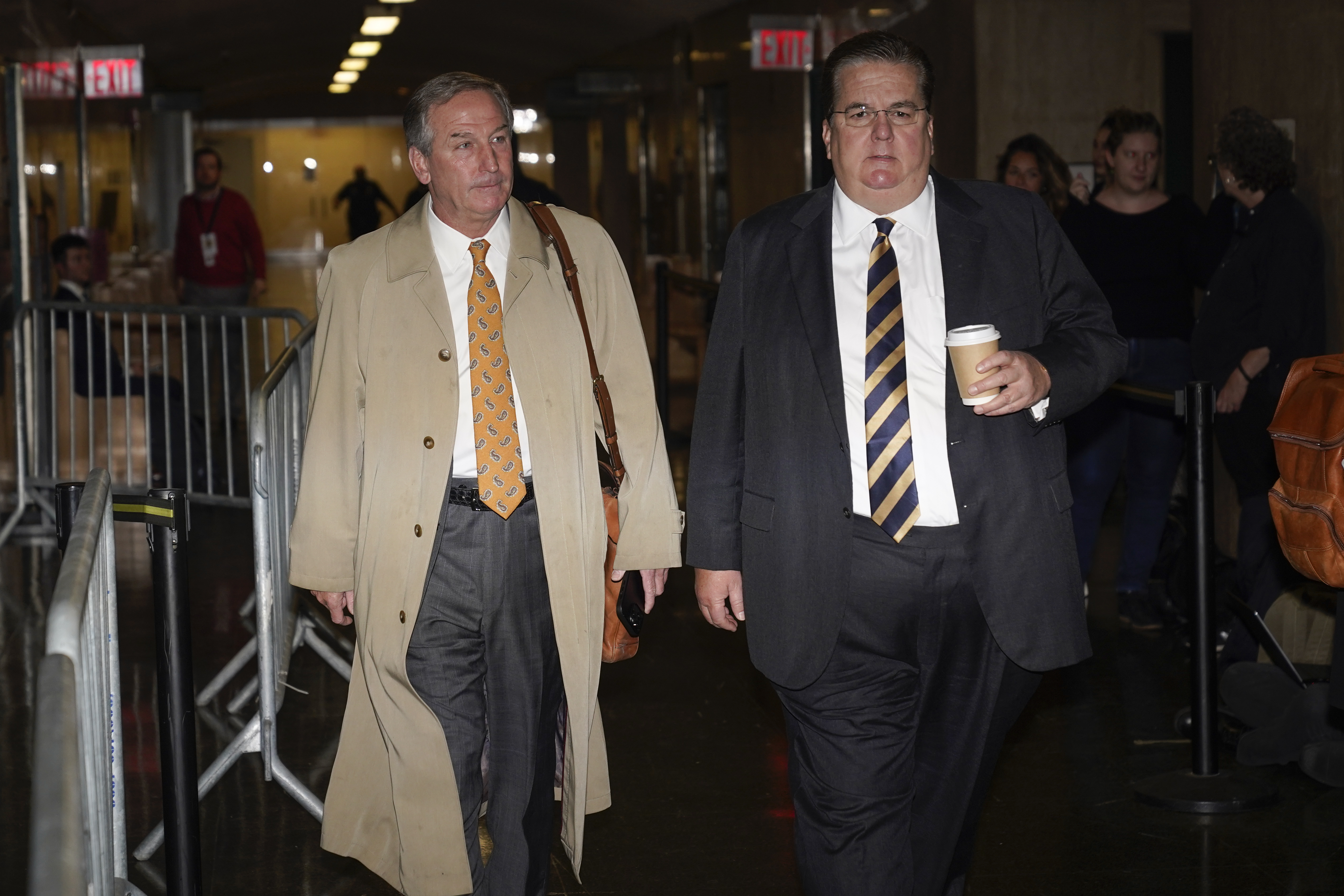
Behind the lawsuit is Michael van der Veen, a 62-year-old high-profile Center City lawyer whose office is in the building across from Bar X on Camac Street.
The bar has been using the office’s parking spot for years, van der Veen said, despite repeated requests to remain off the lawyer’s private property.
But things escalated in July when, according to van der Veen, he was assaulted while leaving his office around 9 p.m. at night.
“When I got jumped from behind and got coldcocked, I was done,” he said.
Days later, veteran criminal defense lawyer William Brennan incorporated Save Our Neighborhood for Tomorrow Inc., the group that filed the lawsuit against “the dive bar of the Gayborhood,” as Bar X pitches itself.
“This changed when passive-aggressive behavior became assaultive-aggressive behavior,” Brennan said. “It can’t be tolerated.”
Save Our Neighborhood for Tomorrow does not appear to have a website or social media presence.
Defense attorneys Michael van der Veen, left, and William Brennan arrive to criminal court in New York in 2022 for Trump’s tax fraud case. Seth Wenig
George Bochetto, the attorney who filed the lawsuit on behalf of the newly formed group, did not respond to repeated requests for an interview. Bochetto is also representing a different group of Pine Street and Spruce Street residents who won an injunction to pause safety upgrades to bike lanes.
The lawsuit against Bar X names owner Tony Tsang, business entities associated with the bar, the city, and the commissioner of the Philadelphia Department of Licenses and Inspections, Bridget Collins-Greenwald. The city did not respond to requests for comment.
Tsang disputed the allegations of public drunkenness and sexual activity and said the bar is a longtime fixture of the block.
“You don’t like it, you like it quieter, how come you don’t move out of the city?” Tsang, 59, said in a recent interview at the bar. “One block, three bars, how come they’re only complaining about us?”
A ‘very homey’ gay bar
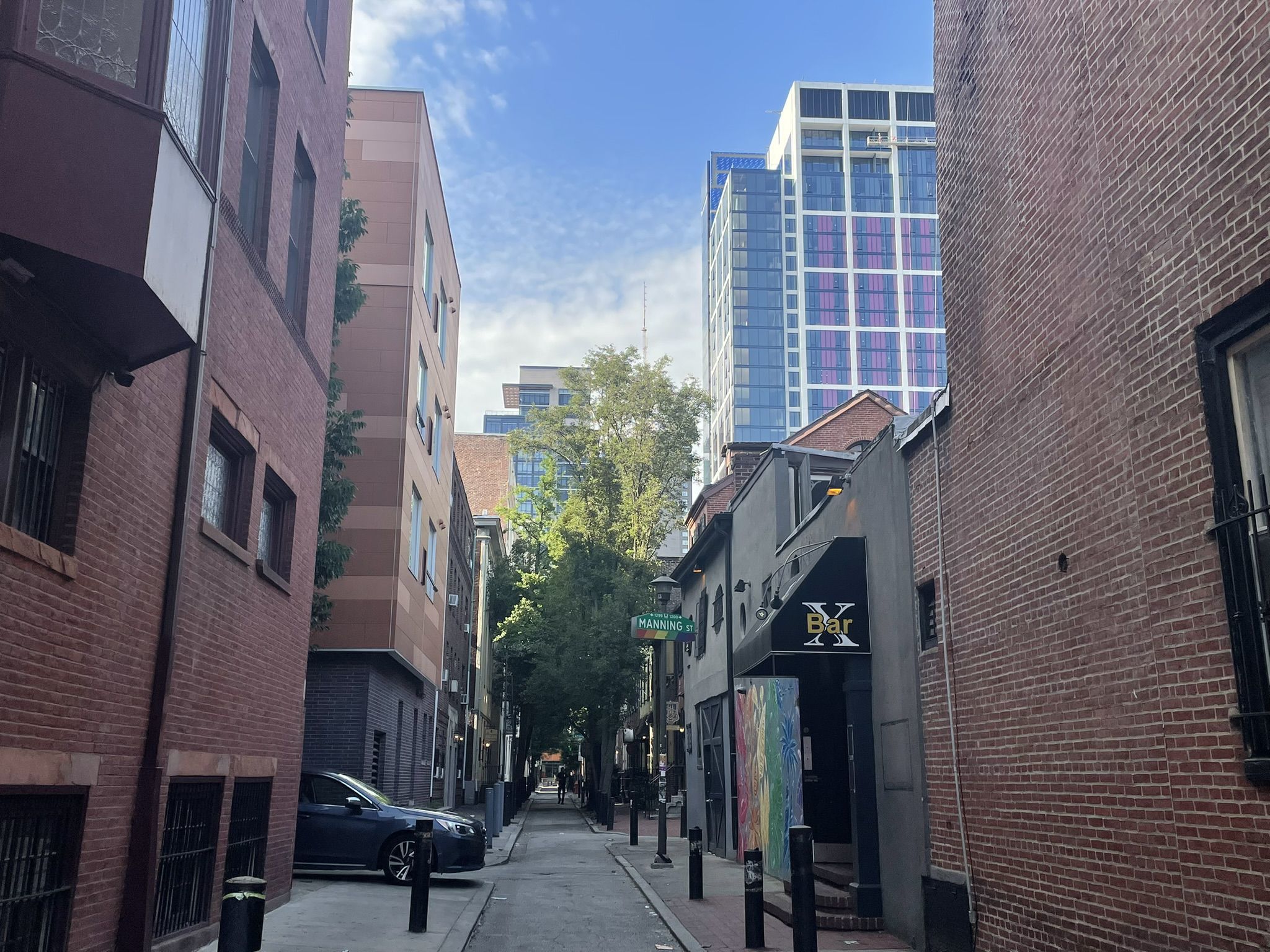
Bar X sits between Locust and Spruce on Camac, a narrow, 200-year-old street that is home to two other gay bars, Tavern on Camac and UBar. It is also around the corner from the bar 254, which replaced Tabu. Those three bars are all owned by the Tavern Group.
Tsang said the majority of his clientele is Black and suggested that the lawsuit had more to do with his identity and that of his patrons than the noise or disturbance allegations.
“To me, it’s the color. I’m Asian. My English isn’t too good. They want to play a game with me,” Tsang said.
Tsang opened his bar in 2016, naming it Bar X so it would be easy for people to remember. The bar’s exterior features a rainbow mural of tropical leaves; inside Tsang hung Ikea posters of Audrey Hepburn and James Dean. He said he stocks the bar himself, buying whatever club soda is on sale at the supermarket.
The bar has a large dance floor and a DJ booth that abuts the alley.
Joseph Ward, a part-time bartender at Bar X who also runs its social media and marketing, said the bar stands out because it’s “very homey,” with Taco Tuesdays and twice-weekly karaoke. (There’s also a male revue every Thursday night.)
Bar X owner Tony Tsang said he stocks the bar himself with whatever club soda is on sale at the supermarket.Elizabeth Robertson / Staff Photographer
“You [can] just chill and not have to worry about the hustle and bustle of a nightclub,” Ward, 36, said. He said the bar is one of the last minority-owned clubs in the Gayborhood and hosts a largely nonwhite crowd.
The lawsuit cites negative Google reviews from people purporting to be Bar X customers, including accounts of stolen phones and allegations that a bartender gave patrons drinks containing sedatives.
The remedy to the situation, the suit says, is for the city to shut down the bar.
Ward said that rumors of drugged drinks at the bar had gained traction online earlier this year, but that staff had not been able to verify any crimes, despite reaching out to those making the accusations. In response, the bar ordered covers for customers’ drinks.
“We take pride in it being a safe place in the Gayborhood,” Ward said, “so we obviously want to keep it that way.”
A new police deployment
Bar X’s block has seen an increase in crime incidents this year, according to Philadelphia Police Department public data.
The lawsuit claims that since last summer there have been nearly 70 crime incidents at the property, including “multiple reports of a person with weapons, assaults, robbery, and disorderly conduct.”
<iframe title="Crime Incidents On Bar X's Block" aria-label="Column Chart" id="datawrapper-chart-LCiYX" src="https://datawrapper.dwcdn.net/LCiYX/1/" scrolling="no" frameborder="0" style="width: 0; min-width: 100% !important; border: none;" height="477" data-external="1"></iframe><script type="text/javascript">(function(){function e(){window.addEventListener(`message`,function(e){if(e.data[`datawrapper-height`]!==void 0){var t=document.querySelectorAll(`iframe`);for(var n in e.data[`datawrapper-height`])for(var r=0,i;i=t[r];r++)if(i.contentWindow===e.source){var a=e.data[`datawrapper-height`][n]+`px`;i.style.height=a}}})}e()})();</script>
In April, the Washington Square West Civic Association hosted a meeting with residents, city officials, and Tsang in an attempt to address neighborhood complaints. Councilmember Mark Squilla, who represents the area and attended the meeting, estimated that more than 40 people attended.
In response, the city experimented with one-off street cleanings of Camac to address litter, Squilla said. Police also began clearing the street of people on weekend nights after 2 a.m., when the bar closes.
“We’ll continue to work on compliance and whatever else is needed there,” Squilla said.
A Philadelphia Police Department spokesperson confirmed there is currently a “bar/nightclub” deployment in the bar’s general area. The department has used similar deployments throughout the city for decades to respond to community concerns and public safety needs, Sgt. Eric Gripp said in a statement.
Jacen Bowman, president of Philly Black Pride, testified earlier this month at a City Council Committee on Legislative Oversight hearing into the Philadelphia Police tactics used during Pride celebrations in June.Tom Gralish / Staff Photographer
“Black and brown LGBTQ+ people are watched differently. We are approached differently. We are policed differently,” Jacen Bowman of Philly Black Pride said at the hearing. “Too often we are made to feel like visitors in a neighborhood that is promoted as the heart of Philadelphia’s LGBTQ+ community.”
MAUMERE, Indonesia — A powerful magnitude 7.7 earthquake struck off the coast of Indonesia early Saturday, killing at least 47 people, collapsing buildings, and causing panic in a region prone to deadly quakes. Authorities said dozens more residents were injured and warned that the death toll would almost certainly rise.
Authorities issued a tsunami warning and urged coastal residents to move to higher ground, but later lifted the warning when Indonesia’s meteorological agency said monitoring showed no significant sea-level changes that posed a threat to coastal communities. Some smaller tsunamis were reported.
The U.S. Geological Survey said the quake hit eastern Indonesia’s Flores region at a depth of 6 miles at 5:58 a.m. local time. Its epicenter was 42 miles north-northwest of the city of Ende in East Nusa Tenggara province.
Wuake triggers landslides, generates small tsunamis
The meteorological agency said the quake was followed by at least 235 aftershocks, with the largest recorded at magnitude 6.2.
The agency’s sea-level monitoring stations acknowledged some small tsunamis reached coastal villages in Manggarai and East Manggarai regencies. Videos obtained by the Associated Press showed the coastal village of Riung in Ngada regency blanketed in mud and debris after what the agency described as a 5.3-foot tsunami. Fishing boats were stranded ashore, infrastructure damaged, and homes surrounded by sediment left by receding waters.
Waves measuring 3.1 feet were observed in Maurole, Ende Regency.
Tsunami waves exceeding 1.6 feet were detected in Bulukumba, South Sulawesi, and Sape in Bima Regency.
A strong, land-based earthquake of 6.9 magnitude hit North Sumatra province in western Indonesia on Saturday afternoon, according to the USGS. It struck 107 miles beneath the earth’s surface, meaning it was too deep to cause significant damage or casualties, Indonesian authorities said.
The quake has caused buildings to collapse
East Nusa Tenggara Police Chief Rudi Darmoko said power outages hampered the spread of information about the impact of the earthquake in cities and villages, complicating search and rescue efforts.
“We are continuing to collect reports of damage and casualties, but there are communication disruptions,” Darmoko said. He said quake-triggered landslides in Ende regency blocked the Trans-Flores highway, a roughly 435-mile paved mountain road spanning Flores Island, from Labuan Bajo to Larantuka.
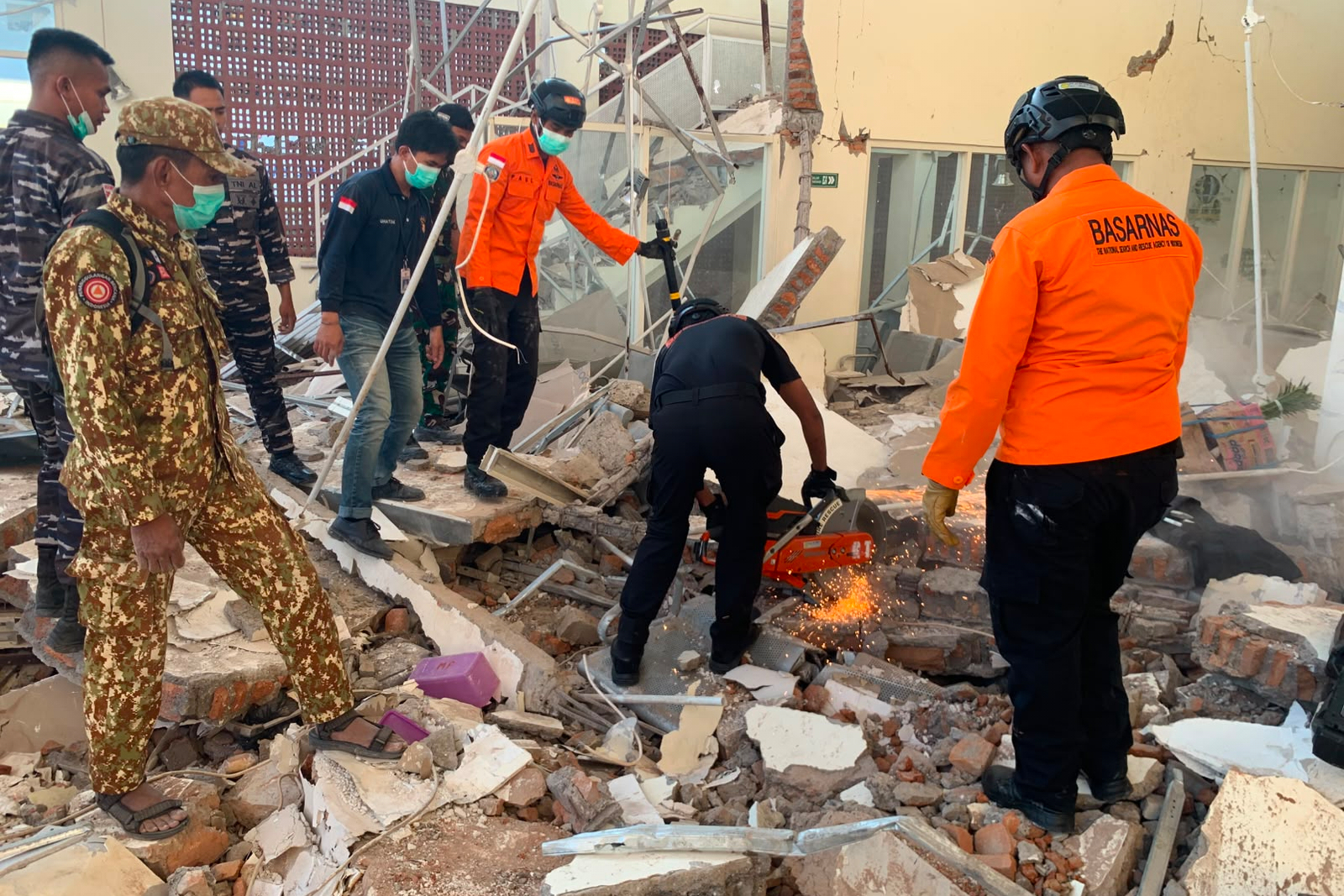
The head of the National Disaster Management Agency, Suharyanto, said rescuers have recovered at least 47 bodies, mostly in Sikka, Manggarai, and East Manggarai, and at least 50 people were taken to hospitals.
Suharyanto, who like many Indonesians uses a single name, said the quake flattened at least 157 houses and damaged nearly 200 more, forcing about 2,000 villagers to abandon their homes and move to temporary shelters. The powerful temblor also destroyed more than 100 public facilities, including schools, medical centers, and churches.
The death toll could rise because landslides triggered by the earthquake buried or cut off many remote villages across six regencies on Flores Island, said Fathur Rahman, who heads the Search and Rescue Office in Maumere, the capital of Sikka.
Some remote villages are completely buried, he said, and damaged infrastructure and a lack of heavy equipment were hindering rescue efforts.
Authorities deployed three helicopters and a rescue vessel to support logistics and emergency response operations, including potential evacuations. East Nusa Tenggara consists of numerous islands and presents significant transportation and access challenges.
Residents ran for their lives when quake struck
The quake was felt across much of Flores island with initial reports indicating heavy damage.
Yohanna Embu, who lives in Sikka, said people ran in a panic to higher ground.
“Many buildings here were damaged … I saw that the waiting room at the port terminal in Maumere had collapsed,” she said.
Students at St. Peter Major Seminary in Sikka who were attending morning Mass fled when the roof of an assembly hall collapsed, said the Rev. Guidelbertus Tanga, rector of the seminary, known locally as Ritapiret Seminary, on the predominantly Catholic island of Flores.
“Our students and nuns ran out in panic beneath a collapsing roof,” Tanga said. “At least one priest suffered a broken leg after jumping from the second floor of a building during the quake.”
The quake also struck Labuan Bajo, a gateway town to eastern Indonesia’s Komodo National Park, one of the country’s best-known attractions. Damage was reported in Bima, a city in neighboring West Nusa Tenggara province, and in parts of southern Sulawesi island.
Indonesian authorities initially issued a tsunami warning for parts of East Nusa Tenggara, West Nusa Tenggara, South Sulawesi, and Southeast Sulawesi provinces, and urged residents to stay away from beaches and riverbanks. The agency located the shallow undersea quake near Flores island.
Indonesia, a vast archipelago of more than 17,000 islands, is prone to earthquakes and volcanic activity because of its location on the Ring of Fire, an arc of volcanoes and fault lines in the Pacific Basin.
Most notably, a powerful earthquake caused a tsunami in 1992 that killed about 2,500 people on Flores, part of a group of islands in the eastern half of Indonesia, while in 2018, a magnitude 7.5 quake spawned a large localized tsunami that wiped out coastal areas, killing more than 4,400 people.
In December 2004, a massive magnitude 9.1 earthquake off Sumatra in western Indonesia triggered a tsunami that killed 230,000 people in a dozen countries.