JERUSALEM — An extremist Israeli lawmaker in Prime Minister Benjamin Netanyahu’s coalition publicly advocated for killing “30 to 40” people in Gaza each night, comments that surfaced Sunday and were quickly shared by Palestinian media.
Minister of National Security Itamar Ben-Gvir made the statement while speaking to a former Gaza-held hostage, Rom Braslavski, on Braslavski’s podcast. The two were discussing Israel’s recovery from the Hamas attack of Oct. 7, 2023, when Ben-Gvir criticized Israel’s recent drawdown of strikes in Gaza.
“It’s no secret, I disagree with the prime minister,” he said. “I think targeted assassinations should be carried out in Gaza, taking down 30 to 40 every night. Not just those who pose an immediate threat — there are people there who are not worthy of life. They shouldn’t live. They’re not even people.”
In the past, similar statements by Ben-Gvir and other Israeli officials were widely condemned. Many have been presented to the UN’s world court as evidence of genocidal intent. Israel denies it has committed genocide in Gaza.
Israel’s domestic media has made scarce mention of the statement, highlighting how once-fringe ideologies like Ben-Gvir’s are surging in the lead-up to Israeli elections Oct. 27.
Figures like Ben-Gvir have become more popular among Israelis since Hamas’ brutal attack in 2023, when the militants killed about 1,200 people and took 251 hostage. Many hostages have recounted long-term starvation, physical and psychological abuse, and, in some cases, sexual abuse.
Ben-Gvir oversees Israel’s police force and prisons
Ben-Gvir does not have power over the country’s military and cannot order strikes on Gaza. But, after operating for decades within Israel’s far-right fringe, he is now one of the most influential people in the country.
He has substantial control over key parts of Israel’s security apparatus, running the country’s prisons — where thousands of Palestinians from Gaza and the West Bank are incarcerated — as well as the national police force.
He has previously boasted of lessening food rations for Palestinian prisoners. Israel’s top court ruled in 2025 that the prison service under Ben-Gvir was depriving Palestinians of a minimum subsistence diet.
Ben-Gvir criticizes drawdown of Israeli strikes in Gaza
Until recently, Israel was striking Gaza nearly every day, attacks that have killed over 1,250 people since an October truce deal came into effect, according to Gaza’s Health Ministry.
Israel’s military, which says the strikes have targeted Hamas militants, appeared to ease off on the attacks in a quiet concession to U.S. President Donald Trump after Netanyahu rejected the president’s latest attempt to move the truce forward.
Israeli media last week reported that the authority for carrying out strikes has now been limited to the army’s chief of staff, raising the ire of right-wing lawmakers such as Ben-Gvir.
Ben Gvir advocates mass emigration, expulsion of Palestinians from Gaza
In the same taped appearance, the lawmaker advocated for mass emigration of Palestinians from Gaza — a proposal that international lawyers say could amount to ethnic cleansing — and resettlement of Gaza by Israel.
Twenty years ago, Israel withdrew from the Gaza Strip, dismantling a block of 21 Jewish settlements known as Gush Katif and pulling out its forces.
“I see all of Gaza as ours,” said Ben-Gvir in the interview. “Settlements not just in Gush Katif but throughout Gaza, encouraging as much emigration as possible, sending them to their countries, and for the terrorists, no emigration, nothing, just to kill them one by one.”
Trump’s latest proposal involves Hamas gradually giving up its weapons while Israeli forces halt their attacks and begin withdrawing from Gaza. Hamas accepted the deal, although the group linked the surrender of its heaviest weapons to the creation of a Palestinian state, something Israel’s current government and most of its political class adamantly reject.
Netanyahu says Israel will not retreat from any of its positions in Gaza until Hamas has been completely disarmed. The stance leaves other elements of the ceasefire, including the deployment of international forces and any reconstruction of the devastated territory, on hold.
BAELEN, Belgium — Firefighters battled a massive wildfire that scorched a nature reserve in eastern Belgium and another on a Greek island where two people were killed on Sunday as hot and dry conditions fueled fires across parts of Europe.
A blaze in eastern Belgium burned about 12 square miles in the High Fens, a large nature reserve, in one of the country’s worst wildfires in recent history.
About 600 residents in the nearby municipalities of Waimes and Bütgenbach, in Liège province near the German border, were told to evacuate on Saturday as winds shifted and smoke spread through the area. Authorities also advised tourists to leave, while a nearby gymnasium was opened to receive evacuees.
Liège provincial governor Hervé Jamar said in a statement Sunday that more than 250 emergency personnel have been deployed, including over 100 Belgian and German firefighters, as well as police and military officers and civil protection staff. Firefighting helicopters operated by Belgium’s federal police and the Netherlands also helped.
Two killed as fires break out on a Greek island
In Greece, two people were killed in a wildfire Sunday on the island of Salamina, west of Athens, Greek firefighters said.
The bodies were recovered in the village of Peristeria, where strong winds fueled the rapidly spreading blaze. A second blaze was reported in the Selini area. Firefighting and coast guard vessels were evacuating beachgoers in the area.
Some 260 firefighters were responding to the blazes, including 15 ground teams, 10 aircraft, and eight helicopters.
The island had been placed at high wildfire risk on Sunday, with near gale-force winds. “These conditions enabled the fire to quickly reach dangerous proportions and spread rapidly within seven minutes toward nearby residential areas,” said Fire Brigadier General Vasileios Vathrakogiannis.
The blaze now torching Belgium has far surpassed a 2011 fire that burned nearly 5.4 square miles in the same area and was previously the country’s largest wildfire on record, according to data from the European Forest Fire Information System.
Nicolas Yernaux, a spokesperson for the Public Service of Wallonia, said conditions were much worse this time. “We’re dealing with something much deeper because we have very dry soil,” he said.
René Dahmen, chief engineer at the Department of Nature and Forest, said the fire was still spreading Sunday in an area that was difficult for crews to reach.
“On the eastern flank, there’s a line at least a kilometer long where the fire is slowly advancing toward a municipal forest,” Dahmen said. “That’s the first priority now.”
Interior Minister Bernard Quintin said on X firefighters managed to keep the fire from spreading towards the west and toward the German town of Monschau.
In Germany, local authorities warned Sunday that the fire was just under a mile from the border.
Some farmers from both Belgium and Germany filled up tanker trucks, pumping water from a nearby lake before heading toward the fire area to help firefighters.
European countries send firefighting aircraft
Belgium activated the European Union’s civil protection mechanism to receive assistance from other countries, EU Commissioner Hadja Lahbib, who is in charge of crisis management, said on X.
“The High Fens are burning. Belgium is not facing it alone,” Lahbib said. Sweden sent two water-bombing aircraft, while three helicopters — two from the Netherlands and one from the Czech Republic — were also being deployed.
The fire follows weeks of unusually hot and dry weather. The High Fens’ mix of heathland and peat bogs has complicated efforts to contain the flames.
Belgium was hit by another spell of intense heat this week, with temperatures reaching about 98.6 F in parts of the country Friday.
Wildfires burn in France and the U.K.
In France, firefighters battling a wildfire in a pine forest in the southwestern Landes region faced no major flare-ups overnight, Landes Prefect Gilles Clavreul said. Authorities estimated the total area burned at 6.6 square miles, while about 650 people had been evacuated from their homes.
It was the third major wildfire in the vast pine forests of southwestern France this summer, following two others in late July. A massive wildfire in the neighboring Gironde department burned about 162 square miles and forced the evacuation of about 220,000 people as it spread toward the Atlantic coast and the Bordeaux area.
In the U.K., emergency crews were fighting 14 wildfires in South Wales with the support of military personnel. Authorities warned that although the heat wave is easing, drought conditions mean the risk of wildfires remains high.
Fires gutted more than a dozen homes in the West Midlands in central England this week as officials recorded the hottest day of the year on Thursday, when temperatures reached 100.6 F.
In Germany, firefighters made significant progress against a wildfire in the Hürtgen Forest, allowing about 2,000 evacuated residents of Gey to return home Saturday. Officials said Sunday there were no open flames and crews had established a cleared cordon around the affected area to prevent the fire from spreading.
Frankie Ramirez’s aguachiles, lamb-neck birria, and seasonal tlayudas have already earned his Kensington restaurant, Amá, a spot in Philadelphians’ hearts. Now, the chef has notched even higher-profile praise.
Ramirez’s contemporary Mexican menu landed Amá on the New York Times’ list of the greatest Mexican restaurants across the U.S.
“While Mexican restaurants [in Philadelphia] have long been shaped by Puebla, the home state of many local families, Mr. Ramirez offers a broad taste of the country’s extraordinary regional variety,” Times’ contributor Regan Stephens wrote of Amá, praising its standout chips and salsa combo — with house-nixtamalized heirloom corn tortilla chips and six artisan salsas — among other dishes.
A variety of salsas representing different regions in Mexico, are lined up in the kitchen at Ama on Wednesday, July 16, 2025 in Philadelphia.Monica Herndon / Staff Photographer
Inquirer critic Craig LaBan also singled that starter out in his 2025 review of Amá, whose ambitious menu signals “a golden moment for the city’s Mexican restaurant scene,” LaBan wrote.
Amá, which opened in May 2025 at Front and Oxford Streets, is Ramirez’s ownership debut. The chef worked in Philadelphia kitchens for several years, starting as a dishwasher at Marcus Samuelsson’s Washington Square before moving on to a string of roles with Starr Restaurants, including executive chef at LMNO. His partners in Amá include his wife, Veronica, and Delaware County restaurateurs Crisalida Mata and Roberto Medina.
Chef Frankie Ramirez is opening Amá at Front and Oxford Streets.Mike Prince
One bill proposes increasing the number of Supreme Court justices from nine to 13. Another would cut their lifetime terms to 18 years. Others would create an enforceable ethics code and place standards on how the court rules from its relatively opaque “shadow docket.”
The latest wave of proposals to overhaul the Supreme Court have reached something of a fever pitch over the past few months, as Democrats grow increasingly frustrated with the court’s rightward turn. While the court blocked several of President Donald Trump’s key initiatives this past term, it also delivered significant conservative victories that pared back the 1965 Voting Rights Act, loosened campaign finance rules, and increased presidential power.
Democrats’ anger is fueled by a conviction that many of these rulings are more about politics than the law.
“There’s constant and building dismay about the increasingly appalling record of the court,” Sen. Sheldon Whitehouse (D., R.I.), who recently introduced a term limits bill, said in an interview. “And I think the continuing interest in reform springs from continued dismay and concern about the court’s misbehavior.”
The pitches coincide with record levels of disapproval of how the Supreme Court is doing its job, as well as perceptions that the justices are ruling based on their ideology — a viewpoint largely embraced by liberals, according to a July Washington Post-Ipsos poll.
Those perceptions have only magnified as the justices have weighed in on issues that could directly affect the upcoming midterm elections. House Minority Leader Hakeem Jeffries (D., N.Y.) said Thursday that there are a “variety of different options that are on the table, and I think we can’t foreclose on any single one of them.”
Conservatives dismiss the proposals as efforts by liberals to intimidate and undermine a court that is not ruling the way they want.
“All of these ‘reforms’ are because the left doesn’t like the decisions coming out of the Court,” Mike Fragoso, a former chief counsel to Sen. Mitch McConnell (R., Ky.), said in an email. “The goal is to intimidate the Court into changing the course of decisions. It’s reprehensible.”
Liberals concede that the measures cannot succeed without Democrats solidly in control of Congress, and even then, only if the filibuster is eliminated — otherwise any proposal would require 60 votes in the Senate, which is highly unlikely.
Last month, Whitehouse and other Senate Democrats proposed a law that would limit justices’ terms to 18 years. Under that system, a president would nominate a justice every other year — a design intended to maintain a measure of ideological balance on the bench.
Some advocates say specified terms also would lower the stakes of Supreme Court confirmation battles, since they would not be for lifetime appointments. These battles in recent years have become all-out, nasty, and often personal.
“Even in a Congress like this one, where these bills have no chance of passage, it’s really important to file them and to stand by them, because they reassure people that there is in fact a mechanism by which the court could be restored to some degree of better order,” Whitehouse said.
Democrats in 2020 also offered a flurry of plans to overhaul the Supreme Court, angered that Trump was able to name three justices thanks to maneuvering by McConnell, who at that time was the Senate majority leader.
But President Joe Biden did not pursue those proposals. And the court’s solidified conservative majority has since overturned a string of precedents — including those guaranteeing the right to an abortion and upholding key parts of the Voting Rights Act — prompting fresh fury among liberals.
Congressional Democrats have introduced about a dozen proposals in recent months for revamping the court.
They call for expanding its size, requiring the justices to place certain assets into blind trusts, and creating standards for the court’s emergency docket, critically referred to as the “shadow docket.” In emergency docket cases, the justices have been criticized for ruling on consequential matters based on a limited record while offering relatively brief explanations for their decisions.
Democrats outside the Beltway are also pitching court reform. Former Vice President Kamala Harris, whom some Democrats expect to run again for president in 2028, said at a recent event at that “we need to revisit” the notion of expanding the court to 13 justices.
James Talarico, a Democrat running for U.S. Senate against Republican Ken Paxton, has called for an “overhaul” of the Supreme Court, including term limits and a binding code of conduct. In an interview with TheGrio, Talarico described the court’s recent rulings on civil rights, including a recent decision that weakened the Voting Rights Act, as a “five-alarm fire.”
“Black Texans, Black Americans, have been ringing the alarm about the Supreme Court,” Talarico said. “And I think it’s time for all of us to realize the crisis that we face on the highest court in this country.”
Tom Jipping, a senior fellow at Advancing American Freedom, an advocacy organization founded by former Vice President Mike Pence, argued that such criticisms only highlight Democrats’ fixation with results rather than the law, exposing their calls for reform as superficial.
“They never say how the Supreme Court got it wrong on the law,” Jipping said. “The only the thing they do is mention the result and tack on a few bombastic pejoratives.”
The court has regularly undergone periods of fierce scrutiny. Under Chief Justice Earl Warren in the 1950s and 1960s, conservatives complained bitterly that it was making up new liberal doctrines. Most notably, President Franklin D. Roosevelt, frustrated by the justices’ rejection of many elements of the New Deal, in 1937 proposed expanding the court, leading to pushback from Republicans as well as many fellow Democrats.
Still, some academics say the current Supreme Court faces real problems unrelated to its ideological composition.
The high court has turned into a political football in which justices on both sides are expected to vote along ideological lines on the most controversial issues, said Daniel Epps, a law professor at Washington University who has advocated for efforts to “depoliticize” the court.
Gone are the days of the “swing” justices like Anthony M. Kennedy, Sandra Day O’Connor, and Lewis F. Powell Jr., all Republican-appointed justices whose votes were less predictable when it came to hot-button issues such as affirmative action, abortion, and LGBTQ+ rights, Epps noted.
“This is the first time where you have a court where the ideology really maps onto partisan affiliation,” Epps said.
Epps and Vanderbilt Law School professor Ganesh Sitaraman argued in a 2019 paper against popular proposals such as term limits and expanding the court’s size. They say both risk further politicizing the court.
Instead, Epps and Sitaraman have suggested a “lottery” model, in which cases would be decided by panels of justices selected randomly from a pool — similar to the way federal appeals courts decide cases.
They have also recommended a “balanced bench” structure, in which the court would be composed of an equal number of justices selected by Democrats and Republicans, with an additional judge selected from a lower court to break ties.
Chief Justice John G. Roberts Jr. and his colleagues have repeatedly said they issue rulings based on the law, not their political biases. But critics argue that the growing perception, among liberals at least, that the court is politically driven risks hurting its credibility in a way that could be damaging for the long term.
“The court only works as an institution if it is capable of deciding the hard cases in ways that seem credible to the country,” Epps said. “And if you have half the country that just sees the court as a partisan institution — and the court behaves in a way that seems largely consistent with that — half the country just can be like, ‘Screw these guys.’”
Texans were caught off-guard several months ago when the Trump administration appeared poised to construct a 30-foot wall through Big Bend National Park, a rugged expanse of moonlike desert that is a point of pride for many in the state.
But after bipartisan opposition grew, the wall was removed from the federal government’s border construction map. Many exhaled, believing that the West Texas park, with its towering mountains and cliffs, would be spared.
Then the bulldozers arrived this month.
The sight of the earthmoving machines along the Rio Grande near the Santa Elena Canyon, one of the park’s major attractions, pointed to the most significant evidence of border barrier construction in the park. Contractors ripped through mesquite trees and brush and leveled the ground for more than 1 mile of what appeared to be a future roadway.
Big Bend is beloved by Texans and many across the country, even those who are not among its more than 500,000 annual visitors. It is a place to feel the immense and inhospitable wilderness of West Texas, where the stars at night actually are big and bright.
The construction sparked a fresh wave of anger and outrage from all sorts of people — environmentalists, former park officials, local sheriffs — who again insisted that such infrastructure was unnecessary in a border region so remote and dangerous that people have rarely tried to cross there, even at the peak of unauthorized migration.
Both John Cornyn, the state’s outgoing Republican senator, and James Talarico, the Democrat running to replace him, expressed concern this month about the start of construction inside the park.
“My constituents believe that the 1,000-foot riverbank cliffs and remote Big Bend terrain offers its own source of deterrence,” Cornyn said in a letter to Homeland Security Secretary Markwayne Mullin.
Other Republican state leaders, including Gov. Greg Abbott and Attorney General Ken Paxton, who defeated Cornyn in the Senate primary, have not weighed in directly on the construction.
On Friday, a local nonprofit and an outdoor recreation business represented by state Sen. Roland Gutierrez, a Democrat, filed a federal suit to try to halt the project. A day earlier, a bipartisan group of Texas legislators sent Abbott a letter urging him to ask federal officials to stop the construction.
“It’s gotten to the point where people are picking up the torches and marching in the street right now,” said Tex Toler, a former tourism director for Marfa, Texas, northwest of the park. “This is one of Texas’ and the country’s last wild places.”
After days of confusion among West Texas residents, senior Trump administration officials explained their plans and rationale Thursday. There would be no wall, but there would be construction.
“CBP is building one new access road, improving existing roads, installing detection technology and placing vehicle barriers in limited, strategic locations,” Rodney Scott, the U.S. Customs and Border Protection commissioner, said in a statement.
The park’s land sits along 118 miles of the U.S.-Mexico border, and a patrol road is slated to run along much of it. A few areas would have miles of 4- to 6-foot-tall vehicle barriers.
The bulldozers and excavators have been engaged this month in “survey and design work,” Scott said.
Fewer than six migrants a day have been encountered crossing from Mexico in recent months in the entire Big Bend patrol sector, which includes the park and hundreds of other miles of border, federal statistics show.
Officials have said that while unauthorized crossings are currently at record lows, they could increase in the future.
The Trump administration has been furiously building new border barriers, and Scott said the Big Bend construction was necessary to fill in gaps. Southwest Valley Constructors, one company currently at work in the region, was awarded a $1.7 billion contract. The company directed questions to federal officials.
“We will not leave Big Bend as an opening for cartels to exploit by shifting their routes and tactics,” Scott said in the statement.
Many of those who oppose a wall are also against building a patrol road. They include local sheriffs who have insisted that major border infrastructure projects are not necessary.
“What security problem are we trying to solve?” Sheriff Thaddeus Cleveland of nearby Terrell County, a Republican and a former Border Patrol agent, wrote on social media. “Can the same security objective be accomplished more effectively another way?”
On Wednesday, people gathered for a demonstration against the construction at the Santa Elena Canyon. Many carried signs protesting the construction — “Stop the Steel,” “No Wall” — or held handmade depictions of javelinas and other wildlife that could be affected by the construction along the river. Some feared the road plan would require building bridges and blasting along Mariscal Mountain, a remote peak.
“There will be no coming back,” said Michael Ryan, a former Big Bend park ranger who attended the protest. “They’re taking taxpayer dollars to ruin this national park.”
An off-duty Philadelphia police officer, Alhassane Barry, 29, died after being shot early Sunday morning outside an after-hours lounge in Southwest Philadelphia, police said.
Shortly before 4 a.m., police responded to a radio call reporting a shooting on the 7200 block of Elmwood Avenue, police said Sunday afternoon. Responding officers found Barry and another gunshot-wound victim at the scene, police said.
Both victims were taken to Penn Presbyterian Medical Center, where Barry was pronounced dead around 8 a.m., police said. The other victim was in critical condition when he arrived at the hospital, said police spokesperson Sgt. Eric Gripp.
No arrest has been made, and the motive for the shooting is unknown, police said.
A funeral service for Barry is scheduled for Monday at a mosque in Southwest Philadelphia, about one block from where he was shot.
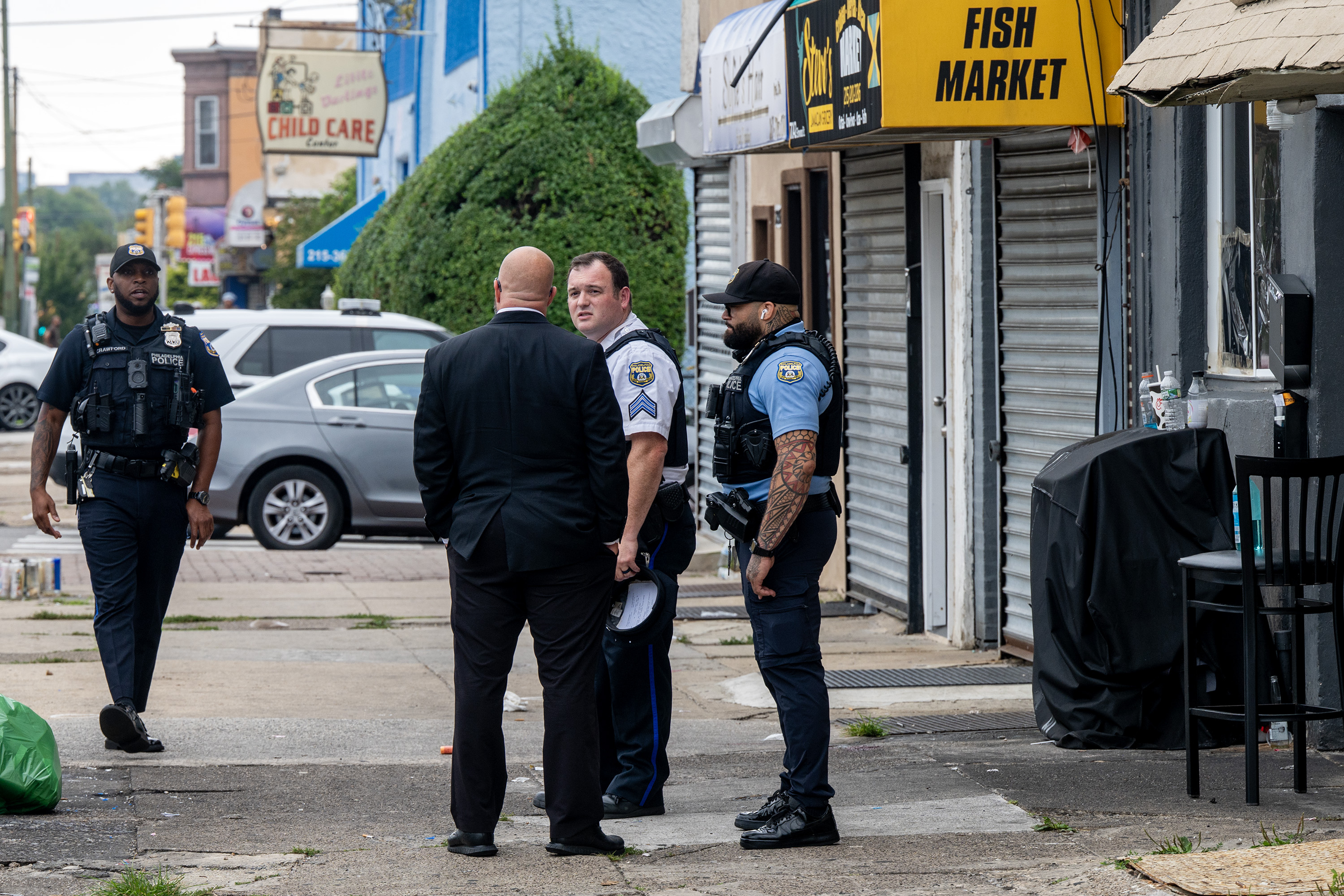
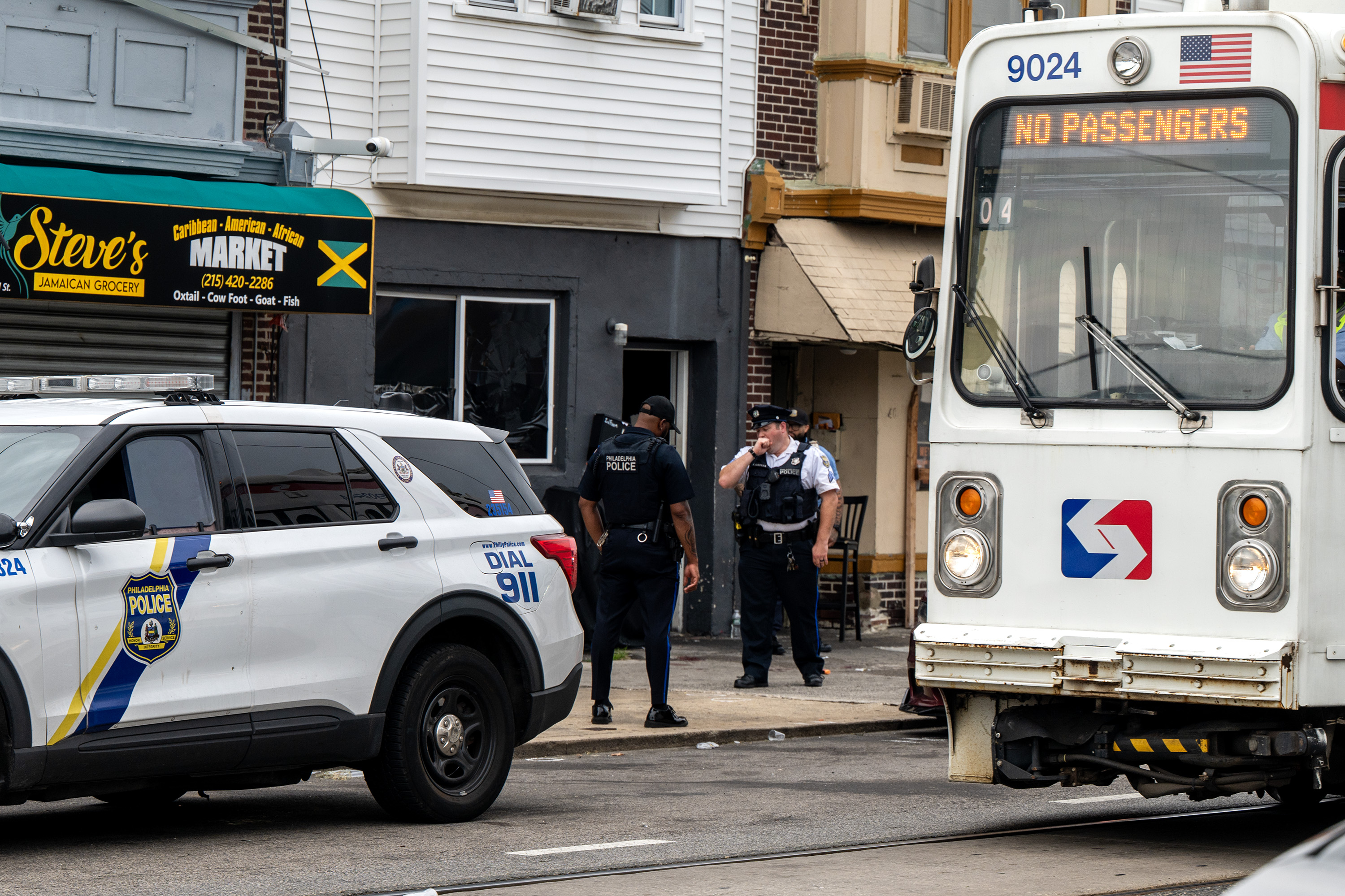
Detectives and police officers remained on the scene Sunday morning at South 73rd Street and Elmwood Avenue.Tom Gralish / Staff Photographer
The 29-year-old officer had been with the Police department for two years, police said Sunday, and was assigned to the 12th District, in Southwest Philadelphia.
(function() {
var l2 = function() {
new pym.Parent(‘copshot_sw_philly’,
‘https://media.inquirer.com/storage/inquirer/projects/innovation/arcgis_iframe/copshot_sw_philly.html’);
};
if (typeof(pym) === ‘undefined’) {
var h = document.getElementsByTagName(‘head’)[0],
s = document.createElement(‘script’);
s.type = ‘text/javascript’;
s.src = ‘https://pym.nprapps.org/pym.v1.min.js’;
s.onload = l2;
h.appendChild(s);
} else {
l2();
}
})();
This is at least the fourth Philadelphia Police Department officer to die in a shooting in the last decade, according to the Officer Down Memorial Page, a national site that tracks police deaths that occur while in the line of duty. Most recently, in September 2024, officer Jamie Roman died in the hospital nearly two months after being shot in the neck during a routine car stop.
In the last three years, at least 18 Philadelphia police officers have been shot in 12 incidents.
Sunday’s shooting occurred near a property neighbors and police have called an after-hours lounge. A social media account linked the address to a nightclub called “Nipsey’s Hookah Lounge.”
A neighbor, Safiatu Keita, said while she was saddened to hear of the officer’s death, she was not totally surprised that a shooting happened there. Keita said loud parties at the property have kept her family awake until 5 a.m. and left garbage cans piled high with empty liquor bottles.
“It’s not safe for us, because when people are drunk there, we can’t do anything,” Keita said.
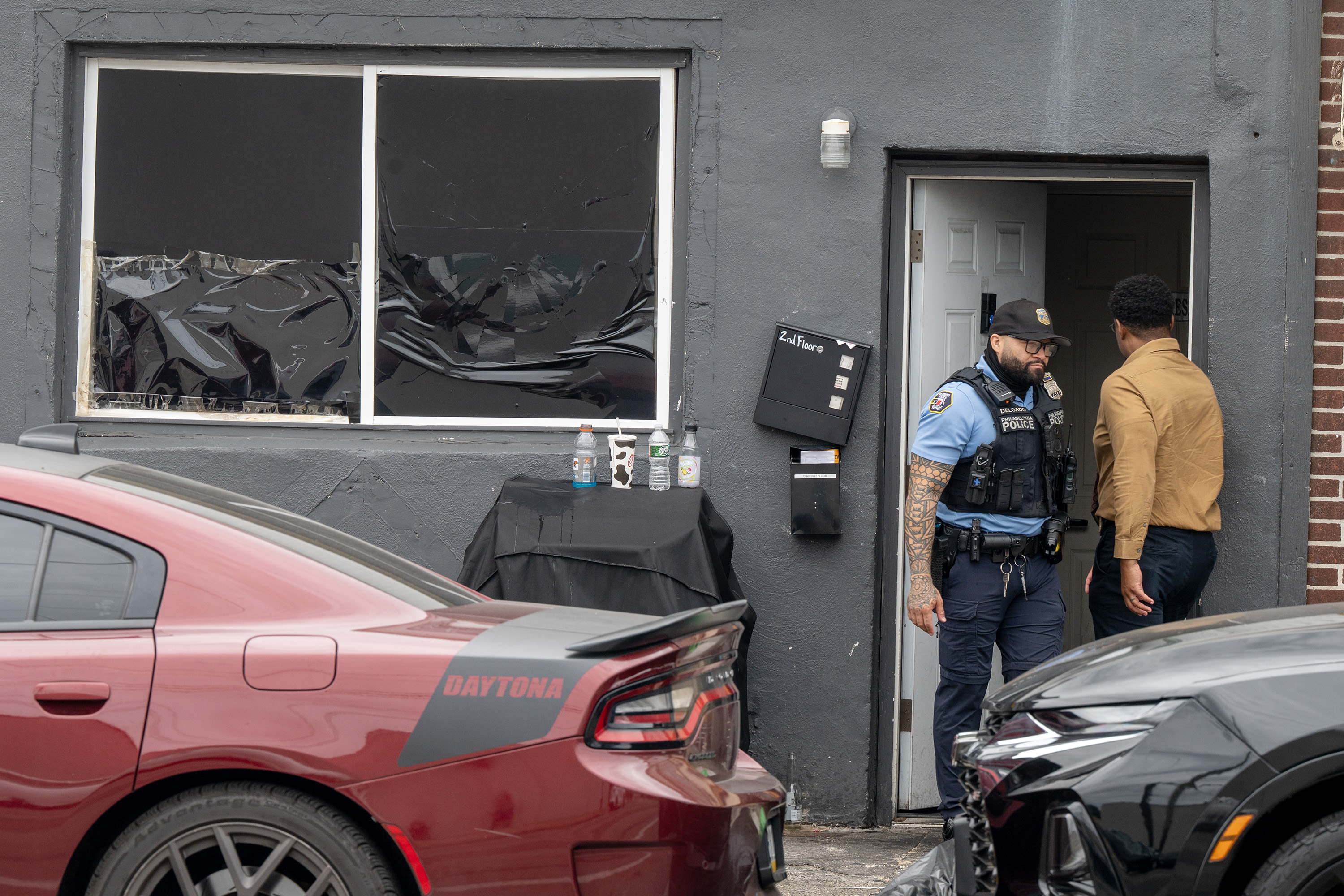
On Sunday morning, the door of the property hung open as police stood near yellow tape closing off the block. An officer pointed out a pool of blood in front of a cooking grill on the sidewalk. White chalk circles on the street and sidewalk marked places where evidence had been identified.
“It’s a bad day,” one officer said, when a passerby asked what happened.
Detectives and police officers remained on the scene of Sunday’s shooting in Southwest Philly.Tom Gralish / Staff Photographer
As detectives in suits came and went, a police lieutenant on the scene said they were working to obtain footage from security cameras on the street, which should provide more insight.
Mayor Cherelle L. Parker said she spent time with the family at Penn Presbyterian hospital to express her profound sorrow for their loss, and offer prayers for the 12th Police District.
“Any loss to gun violence significantly impacts us all. We will never stop working to make Philadelphia a safer city,” Parker said.
Outside Penn Presbyterian’s emergency room entrance late Sunday morning, police vehicles blocked off a segment of the street while officers stood outside. About a dozen people walked in a solemn procession to the front of the emergency department.
As a gurney was wheeled out of the hospital and into an ambulance, the group broke into mourning. Police saluted, and the ambulance drove away from the hospital.
“We continue to ask the community for their prayers, we continue to pray for his family,” Philadelphia Police Commissioner Kevin Bethel said
Bethel said anyone with information should call 215-686-TIPS.
Rebecca Foscolo acknowledges she was “extra spicy” at a Lower Merion school board meeting in June, when the board voted to repeal a policy that let parents like her opt their kids out of school-issued laptops and iPads.
Foscolo, who is part of a group of parents demanding that the affluent Montgomery County district scale back on screens, could not believe the board was moving ahead with the vote, after parents had pleaded for the option to say no to devices they said were imperiling their kids’ ability to learn.
“All these educated people are telling you you are doing something wrong, and you are sitting there and doing nothing,” Foscolo yelled at the board, while seated in a row in the Lower Merion High School auditorium.
Members of the district’s security came up to Foscolo, who left on her own.
Now she is no longer allowed to attend Lower Merion school board meetings in person, for a year.
After a second outburst during a board policy committee meeting on Aug. 3, Foscolo received a letter from the district’s solicitor, informing her she had violated Lower Merion’s civility policy.
A second parent in the Pencils Over Pixels group, David Smyth, said he had received a similar letter after the meeting.
In his Aug. 4 letter to Foscolo, Lower Merion solicitor Kenneth Roos wrote that at both the June 15 and Aug. 3 board meetings, she “displayed disruptive and bullying behavior, including yelling at school board members and administrators while they were conducting board business.” He said her conduct “contributed to the board needing to go into recess prior to the completion of each meeting.”
The district on Friday announced that its meeting on Monday night, when the board is expected to approve a new technology policy, would be virtual only “due to disruptions at two recent meetings,” as well as “threatening comments on social media pages.” It did not say what the social media comments were.
Foscolo, who shouted at the board that “the way you’re responding is ridiculous” after it cut off public comment on Aug. 3 before she had a chance to speak, accused the district of violating her constitutional rights.
“They’re basically just trying to bully me and silence me,” Foscolo said in an interview. She and Smyth were banned from attending school board meetings until June 30, 2027. They can watch meeting live streams and submit written comments, Roos said.
”While we would have preferred that everyone remained calm, and we recognize that the behavior may have been perceived as disruptive, we do not believe banning concerned community members from all future board meetings is an appropriate or productive response,” the group said in a statement.
In another statement, Pencils Over Pixels said it was “disappointed” by the decision to make Monday’s meeting virtual.
Any threatening comments “were not condoned by any member of this group and any threatening language is promptly removed,” the group said.
Is it legal?
First Amendment lawyers said the district’s actions in banning residents could be running afoul of their constitutional rights.
“Unless there’s a threat of violence, there’s really no basis” to ban someone from public meetings, said Sara Rose, deputy legal director of the ACLU of Pennsylvania. A person who is “truly disruptive” can be removed from a meeting, she said, and if the district referred the matter to prosecutors, a court could decide to ban the person.
“But the school district cannot unilaterally tell people they cannot attend future meetings,” Rose said, adding: “I haven’t found a single decision that says that’s permissible.”
The ACLU in November 2024 sued the Souderton Area School District after it banned two parents and a student from school properties, accusing them of threatening a school board member. The parents and student, who were part of a group of demonstrators protesting the board president, said they were wrongly accused, and the district lifted the ban in March 2025.
Melissa Melewsky, media law counsel at the Pennsylvania NewsMedia Association, questioned Lower Merion’s decision to end public comment after 45 minutes during its Aug. 3 policy committee meeting.
While governmentagencies are allowed to have guidelines for how long public comment can last, “there has to be flexibility,” Melewsky said. If there is not enough time to hear every person on a controversial issue, she said, agencies are supposed to schedule another meeting to finish the public comment, and “any proposed action has to be put off as well.”
Asked why the district believed its actions were legal, spokesperson Amy Buckman said that residents “were advised that intentionally disrupting a lawful meeting or the administration of a government function is a criminal offense in Pennsylvania.”
She noted the board’s policy for committee meetings includes a 45-minute time limit for public comment on agenda items, “unless extended by the board for special circumstances.”
Pencils Over Pixels said its members had been “assured by the board that the Aug. 3 meeting would be an opportunity to engage with the policy committee” and receive feedback to their questions about the district’s new technology policy.
Signs reading, “Screens down, pencils up,” are seen a school board meeting at the Lower Merion School District Administration Building on Monday, May 11, 2026, in Ardmore, Pa. (AP Photo/Joe Lamberti)Joe Lamberti
While Pencils Over Pixels said it had urged its members to remain “calm and professional,” some “were rightfully upset that they were unable to engage in dialogue with the committee as promised,” the group said. “Unfortunately, their emotions governed their behavior.”
Frustrations around tech use
Lower Merion parents have been appearing before the board to complain about school technology use since the spring, describing kids focused on gaming or visiting inappropriate websites instead of doing schoolwork. Others have criticized the district’s use of educational technology programs as low quality, and say they do not want their kids doing reading and math on computers. Hundreds of parents signed a petition in favor of opting out of computers.
The district, which has said it is not possible to opt out of technology use, rescinded its policy allowing for that option and has been moving forward with a new version that places more limits on screens.
Under the policy, which the board is expected to vote on Monday, kindergartners and first and second graders will no longer be issued personal devices, while third and fourth graders will have personal logins to computers in the classroom. The policy includes new guidelines for screen time by grade, and district officials say there will also be new tools for teachers and parents to monitor kids’ internet usage.
Parents pushing for stricter limits have called for the district to release its contracts with educational technology companies and data on how long students are on screens during the school day.
They also want more say in how technology is used, including through the creation of a committee to review the district’s educational technology programs.
“They’ve not been really having good-faith personal conversations,” Smyth, who has a seventh and an eighth grader, said of the board.
Smyth, who went up to the microphone after the board said that public comment was over Aug. 3 and called on the board to answer how many speakers remained, said in an interview he was “only disruptive to insist on continuing public comment.”
Foscolo, who has a rising first grader and a 3-year-old, said that while she had previously addressed the board about the technology policy and had met with several board members, she had repeatedly asked to meet with the board’s president, Kerry Sautner, and the policy committee chair, Anna Shurak.
When Sautner responded, she told Foscolo to come to the Aug. 3 meeting, Foscolo said. She was frustrated she was not able to speak then.
To Foscolo, the board appears to be “placating” parents who have concerns about technology, rather than having genuine debate.
“You have a bunch of parents who want to help, and you’re like, ‘Don’t talk,’” she said.
When Capt. John Walker joined the Philadelphia police force decades ago, prospective officers rarely applied to more than one department, let alone four or five.
Today, job candidates may apply to up to half a dozen departments before choosing where to begin their careers. And competition to hire them is fierce.
After years of the department vying for recruits amid staffing shortages and waves of officer departures, its ranks are rebounding. And Walker, who oversees the police academy’s recruiting efforts, credits that in part to a faster and more efficient method of getting potential officers through the door.
The department has scrapped its long-standing tradition of paper applications and is instead using software that speeds up what was once a monthslong hiring process.
Before, getting an applicant from an introduction with hiring managers to the first day of police training could take up to seven or eight months — or sometimes a year, Walker said.
“The process to get hired here was cumbersome,” he said. “It took almost 118 days after you applied for us to even make contact with you. That was a big problem.”
After rolling out the software, called Guardian, the department says it is ushering recruits into the academy in as little as 54 business days — and it hopes to reduce that span even further.
While Guardian is not solely responsible for the increase in applicants, Walker said, it has nudged the department closer to record recruitment numbers.
In 2025, the department enrolled 468 officers in training at the police academy, the second-highest number in the 21st century.
Captain John Walker of the Philadelphia Police Department’s recruitment and background investigations unit.John Walker
Walker is adamant that there has been no drop in the quality of applicants. The California-based company whose software the department is relying on maintains high standards, he said, and is used by more than a thousand law enforcement agencies across the country.
The new system has helped reverse a hiring dearth that began after the widespread protests over police brutality and racial justice in 2020 and continued through the COVID-19 pandemic and beyond.
A year before the protests, the department was at 99% of full staffing, according to Walker. But the numbers soon began to dwindle as diminished interest in policing combined with an uptick in officers leaving the force.
In 2021 alone, 581 of the department’s more than 5,000 officers hung up their uniforms. Officials attributed the drop to retirements, a COVID-era closure of the police academy, and strict local residency rules for prospective officers.
While the department now stands at around 83% of full staffing, Walker said, officials are beginning to see something of a reversal.
Recruitment drives have increased in frequency to more than several times a year, yielding between 1,000 and 2,000 applications each round.
That is a notable step up from 2022, when the department received just 942 applications overall.
Changing technology
Gone are the paper applications of old.
In their place is Guardian’s hiring portal, where prospective recruits can upload copies of their IDs, lists of references, and other documents via computer or on their phones. And the lengthy personal history questionnaires that are standard in the law enforcement industry are now available online, as opposed to requiring a trip to a local police station for paper copies to fill out by hand.
Police recruiters, in turn, use the software to review documents, conduct video interviews, and keep track of a recruit’s medical, physical, psychological, and polygraph exams.
The Guardian software debuted in the city in late 2023, and since then, the time it takes for prospective recruits to go from application to training at the police academy has fallen sharply, to fewer than 60 business days.
Department officials hope to speed things up even more, to about 35 days, Walker said, but it is difficult to schedule the required medical tests and interviews quickly enough to accommodate that time frame. The department plans to hire more doctors to meet demand.
Justin Biedinger, who founded Guardian Alliance Technologies in 2016, said that the company contracts with around 1,300 of the nation’s roughly 18,000 police departments, and that Philadelphia is one of its largest clients.
Biedinger, a former Stockton, Calif., police officer, said the service not only has quickened hiring timelines, but also has increased scrutiny of officers who might not be cut out for a career in law enforcement.
The software allows recruiters to see whether an applicant has been reported for misconduct by another department. And the company uses artificial intelligence to scan social media accounts for red flags such as inappropriate content, guns, or drug use.
“With Guardian,” he said, “these applicants can’t lie.”
To Walker, the biggest benefit of the new system has been the ability to move quickly and hire people who otherwise might have accepted jobs in other departments while they awaited word on applications to work on the Philadelphia force.
“In today’s world, people are not going to wait a year and a half to join this profession, as I did,” he said.
Another benefit of the automated process, he said, is making it easier for out-of-state applicants to apply, drawing candidates as far away as California, Colorado, and Missouri.
And even if the department does not reach its goal of a 35-day timeline, Walker said, the current 55 days “is one of the best in the country. If not, close to it.”
Joseph Richie was born in 1942 and served as a U.S. Marine in the Vietnam War. When he died in 2017 in Delaware County, no one claimed his body, and his cremated remains sat for nearly a decade in the county medical examiner’s office.
But on Friday, Richie’s ashes were taken by motorcade to a national military cemetery about two hours away. Bagpipes played as a volunteer carried his remains. A bell tolled when his name was read. Rifles fired three ceremonial volleys to honor Richie and other veterans. A flag was presented to a volunteer as a sign of gratitude. A bugler played Taps. And although the people there did not know Richie personally, they saluted him.
Richie was one of 15 military veterans from Delaware County belatedly laid to rest during the ceremony at Indiantown Gap National Cemetery, northeast of Harrisburg. Those who attended said it was a fitting honor for people who served their country in Vietnam and elsewhere, but never received a proper funeral.
“They served their country. No one claimed them. It breaks my heart,” said James Augustin, a 74-year old Army veteran who attended the ceremony. Augustin said the ceremony righted that wrong.
Many veterans qualify for military honors at their funeral. Usually, that process begins when a family requests the honors from a veterans service organization.
What made this ceremony different is that no family members were around to do that for these people, said Kathleen Kenney, a staffer in the Delaware County Medical Examiner’s Office. So she and other volunteers took on that role instead.
“My family has a military background, and I believe that everyone who has served should be laid to rest in a dignified manner,” Kenney said.
A motorcade send off for 15 veterans whose remains that came into the county’s possession as part of the Missing In America project, is seen being escorted from the Delaware County medical examiner office in Media, Pa., on Friday, Aug. 14, 2026.Tyger Williams / Staff Photographer
Kenney declined to discuss specific cases but said the county takes possession of a body when it cannot locate any living family members, or when the family declines to do so.
As a result, by the time Kenney took her current role in the medical examiner’s office in 2025, she faced a backlog of names and human remains.
“And I just said, I bet you we have some veterans here,” Kenney said.
She took the list of names and biographical information to the U.S. Department of Veterans Affairs and the National Archives, which confirmed that 15 of the people on the list had been in the military.
Kenney reached out to the Missing In America Project, a nonprofit that coordinates such veterans’ ceremonies. The organization has helped inter more than 41,000 previously unclaimed veterans, Forrest Lingenfelter, the group’s regional coordinator, said at the ceremony.
Volunteers carry a flag and the remains of a U.S. military veteran who was interred at Indiantown Gap National Cemetery Friday, Aug. 14.Brett Sholtis / Staff
Lingenfelter’s team put out the word to veterans organizations, and by Friday morning, more than a dozen vehicles and a pack of motorcycles were gathered at the Delaware County Medical Examiner’s Office in Media. With a police escort, the convoy traveled two hours west to the national cemetery.
During the ceremony, an Army sergeant sang the national anthem, the crowd sang “Amazing Grace,” and American Legion Chaplain Karis Hagen asked God to consecrate the veterans’ final resting place.
Lingenfelter, a retired Army master sergeant, read a poem from a soldier’s perspective that concluded: “I can’t forget a single name. Those men are with me still. If I don’t remember them, then I ask you, who will?”
Then Lingenfelter told the crowd: “Your presence here today answers that question. We will remember those names.”
The ceremony fell silent, other than the sound of flagpole cables clacking in the wind, as members of the military honor guard folded each veteran’s American flag 13 times — one time for each original colony.
Typically, the flag would be presented to a family member as a sign of gratitude. But Friday, volunteer LuAnn Jahnke accepted one of the flags.
Jahnke, a retired Army veteran from Wallingford, Delaware County, said she did not know exactly what these veterans went through, but she could imagine.
“Vietnam veterans lived with secret wounds, hidden wounds from their service,” Jahnke said.
Her husband, retired Army Col. Jeffery Jahnke, carried a flag for one of the dead veterans. He said Vietnam veterans were not always welcomed when they returned to the U.S.
“I tell them, welcome home,” he said.
Jimbo Ernst leads a chapter of Special Forces Brotherhood, a motorcycle club made up of former military special forces members.
He said that ceremonies like this do not just pay tribute to the dead. They also bring together other veterans.
In this case, these people are from all different branches of service and age ranges. Though there is always some rivalry between groups, they are like one big family.
“It definitely helps keep the veteran community together,” Ernst said. “When push comes to shove, we’re always here for each other.”
At left, ceremony organizers Forrest Lingenfelter and Kathleen Kenney watch as a memberof the U.S. Navy honor guard folds an American flag.Brett Sholtis / Staff
The veterans who were interred Friday will be placed in an above-ground structure for cremated remains at the cemetery known as a columbarium, Lingenfelter said. Their names and information will be on display along with a message: “You Are Not Forgotten.” Their names are:
Sgt. First Class Ronald D. Lewis Jr., U.S. Army, 1956-2024.
Spec. 5 Richard J. Catalano, U.S. Army, 1944-2022, Vietnam.
Spec. 5 Ronald C. Ramsue, U.S. Army, 1945-2023, Vietnam.
Cpl. Joseph B. Richie, U.S. Marine Corps, 1942-2017, Vietnam.
Spec. 4 Michael Y. Yellin, U.S. Army, 1941-2024, Vietnam.
Cpl. George L. Zechman, U.S. Marine Corps, 1947-2019, Vietnam.
Pfc. Francis M. Siple, U.S. Marine Corps, 1944-2024, Vietnam.
Pfc. John F. Snow, U.S. Marine Corps, 1951-2025, Vietnam.
Pfc. Samuel L. Williamson, U.S. Army, 1951-2020, Vietnam.
Airman First Class Raymond L. Vining, U.S. Air Force, 1939-2022, Vietnam.
Airman Second Class James L. Lemons, U.S. Air Force, 1942-2018.
Airman Third Class Stanley E. Kornafel, U.S. Air Force, 1940-2024.
Pvt. 2 Samuel L. Webb, U.S. Army, 1950-2023, Vietnam.
Pvt. Hayward J. Strange, U.S. Army, 1948-2025, Vietnam.
Seaman Robert J. Finkbiner, U.S. Navy, 1944-2017, Vietnam.
Two people are dead and three were wounded after a series of shootings in Philadelphia on Saturday.
Police said they were investigating a potential murder-suicide after finding a man and woman dead in Port Richmond on Saturday afternoon.
Around 1:35 p.m., officers responded to a reported shooting on the 2800 block of Mercer Street, police said. There, police said, they found a man and woman with gunshot wounds, and both were pronounced dead at the scene.
“Preliminary information indicates the incident was domestic in nature and is being investigated as a murder-suicide,” police said.
It was the third shooting of the day, according to police reports.
Earlier, police said, two people were critically injured by gunfire in the Hunting Park section of the city.
Around 12:30 a.m., officers responded to the 4300 block of North Fifth Street after receiving a radio call saying a man had been shot near a barbershop and another man had been seen with a gun, police said.
Officers found two people who had been shot inside a gray Honda Pilot SUV, police said. The victims were taken to Temple University Hospital.
Police said a 22-year-old man had been “shot multiple times in the upper torso” and was in critical but stable condition.
A 17-year-old girl had been shot in the head and left leg and was in “serious-critical condition,” police said.
Capt. Shaun Butts told reporters at the scene on Saturday that police found 25 spent shell casings, three projectiles, and “some money left on the scene and all throughout the car.”
Separately, police said they were investigating another shooting on South Fourth Street that happened around 2 a.m. The circumstances around that shooting are unknown, police said. Police noted that a man with a gunshot wound walked into Thomas Jefferson University Hospital around 8:15 a.m.
No arrests have been made, nor motive determined, in either overnight shooting, police said.