Category: News

  • Masked men used an AR-15-style rifle to rob three people in Center City this weekend, police say

    Masked men used an AR-15-style rifle to rob three people in Center City this weekend, police say

    Masked men armed with handguns and what appeared to be an AR-15-style rifle robbed three men early Sunday morning in Center City, forcing at least one of the victims to his knees at gunpoint, according to police.

    The victims — ages 27, 35, and 36 — were talking on the sidewalk around 3 a.m. on the 1500 block of Locust Street when three robbers stepped out of a gray Hyundai sedan and demanded the men’s belongings, said 9th District Capt. Anthony Ganard.

    Two of the men complied, police said, but the third resisted, and one of the robbers hit him in the face with a handgun. He was taken to an area hospital with injuries that were not life-threatening, Ganard said.

    The assailants took cell phones, watches, car keys, wallets, driver’s licenses, and cash, police said.

    No arrests have been made.

    Surveillance video reviewed by investigators shows one of the victims on his knees on the sidewalk as two of the robbers pointed guns — including what appeared to be an assault rifle — at his head. The video shows the victim handing over cash and the watch on his right wrist before the robbers ran back toward the Hyundai, Ganard said.

    “It’s always concerning, any type of robbery involving a firearm, [but] especially when you have a high-powered-style firearm,” Ganard said at a news conference Monday.

    Police believe a fourth man acted as the getaway driver and remained in the Hyundai during the robbery.

    The Hyundai had been circling the area for about three hours before the robbery, Ganard said. It was unclear Monday whether the men were targeted or victims of a random crime, he added.

    The sedan, which police recovered early Monday morning, had been stolen from Cheltenham Township on Wednesday, Ganard said. He declined to say where the car was found.

    Detectives are examining the vehicle for evidence and searching for additional surveillance footage that may have captured the robbery. Investigators have not linked the men to any other similar robberies, Ganard said.

    The investigation remains active, police said.

    Anyone with information is encouraged to contact investigators at the department’s tip line, 215-686-8477 (TIPS).

  • Farmers struggle to get basic services from depleted Agriculture Department

    Farmers struggle to get basic services from depleted Agriculture Department

    WASHINGTON — Mary and Zachariah Ben, farmers in New Mexico, believed they were on the verge of buying the property of their dreams last fall: 47 acres, with enough cropland to grow heirloom corn and a processing facility to expand their organic baby food business.

    But the low-interest loan they secured from the Agriculture Department to make the purchase in Aztec, N.M., was on hold for months, first during the government shutdown that lasted until mid-November and then as federal workers left the agency in droves. Only half a dozen loan specialists who could help process their claims remained in the entire state, the couple learned, leaving them in limbo indefinitely and the seller impatient to know whether the agreement would ever go through.

    Zachariah Ben, who along with his children is a member of the Navajo Nation, ultimately turned to private lenders instead, and the family absorbed more than $200,000 in interest as a result. “At least we got the land because we could have also lost that, and we would have if we had to wait” on the Agriculture Department, Mary Ben said.

    The experience of the Bens, whose aim of providing organic and shelf-stable options for young children appears to align with some of the Trump administration’s stated goals, is not unique. Across the country, farmers and rural residents describe struggling to obtain the basic services the Agriculture Department is meant to offer, including loans and grants, technical assistance, and financing for housing and utilities. Sharp attrition under the Trump administration, largely through voluntary resignations and dismissals by the Department of Government Efficiency, have left many of the Agriculture Department’s local offices with skeletal staffing — and, in some counties, with no one at all.

    The ripple effects of the Agriculture Department’s depleted workforce illustrate how the Trump administration’s mission of shrinking the federal bureaucracy has undercut a competing priority: delivering for farmers, a core political constituency. Strained government resources also risk posing additional challenges for a farm economy that administration officials have described as “dire,” increasing barriers to entry for new farmers who need more assistance, impeding assistance to producers already facing tough economic conditions, and hampering basic services and government aid in the most remote and poorest places.

    “All these practical things that make the wheels go around in a community were facilitated by USDA, and it was with staff who knew how to navigate and had the trust of the local community,” Sen. Pete Welch of Vermont, the top Democrat on the Senate subcommittee on rural development, said in an interview. “It’s something that was working, was working well, and was very cost-efficient. And now it is being demolished.”

    Trump administration officials have defended the staffing cuts as voluntary and necessary to trim a bloated agency.

    “We don’t have the money in our budget to pay for all of the employees that were hired in the prior administration,” Stephen Vaden, the deputy secretary of agriculture, said in a congressional hearing in July. He emphasized that the reductions were “voluntary decisions made by individual employees who chose, with the information that the agency provided to them, to seek a new career elsewhere.”

    Overall, more than 20,000 workers out of more than 110,000 left the Agriculture Department through the first half of 2025, according to an inspector general report. Recently obtained data showed that the Farm Service Agency, a division whose approval the Bens sought in applying for a low-interest loan, has no staff left in dozens of counties across the country, forcing farmers to travel long distances for assistance or to simply give up. Among divisions that directly work with farmers and aid rural residents, the percentage of departures is even higher.

    The Agriculture Department said that it currently had about 93,000 employees after hiring more workers this year, and that it believed staffing levels were adequate as “services and supports have become more targeted and efficient” through planned technological improvements.

    Still, its plans to fundamentally overhaul the agency, as well as funding cuts proposed by President Donald Trump’s latest budget, are likely to deepen difficulties for farmers and rural communities.

    Already, the agency is moving more than half of its staff in the Washington region out of the nation’s capital, a move that is all but certain to further thin the ranks of the agency. Such losses will affect the department’s ability to finance home loans, carry out agricultural research, and service farmers, according to federal workers, farm groups, and rural lenders. (Unions and farm organizations have mounted a legal challenge to that plan.)

    Likewise, Trump’s budget for the next fiscal year proposes a nearly $5 billion cut to the Agriculture Department, essentially eliminating programs for beginning farmers, conservation, and rural aid.

    Some of the steepest cuts have fallen on a part of the Agriculture Department responsible for improving the economy and infrastructure in rural communities, leading to long delays in aid for residents and charities alike.

    The subagency, known as Rural Development, has lost about 1,700 workers, or more than a third of its staff, since the Trump administration took office.

    In New Mexico, questions directed at the agency often languish for weeks, as do approvals of key documents, with emails and queries bouncing among staff members scattered across the state and in Washington, said Lorenzo Alba Jr., the executive director of Casa de Peregrinos, an anti-hunger charity in the area.

    After receiving a grant from the Rural Development section at the end of the Biden administration to build a food pantry in Hatch, N.M., the charity is still waiting for $300,000 in federal funding. For now, Casa de Peregrinos has cobbled together other sources of financing to set up and operate a makeshift pantry with limited hours and food varieties, despite no refrigeration or air-conditioning.

    “Our pantry should have been up and running, fully renovated by now,” Alba said. He added that the delays had led costs to balloon to $600,000 from $475,000, money the charity could have used to buy more food and serve more families.

    “I quit blaming the USDA on this because I didn’t know what they were going through,” he said. “Now I do.”

    It is unclear whether staffing cuts have been a factor, but in the last year the subagency has also financed far fewer loans and grants. As of mid-August, with a little more than a month left in the 2026 fiscal year, the agency has approved nearly 52,000 investments worth $15.8 billion. In comparison, in the past three fiscal years, the agency made between 63,000 and 74,000 investments totaling $24 billion to $40 billion annually.

    Another crucial service the department offers — helping producers carry out sustainable farming practices through its Natural Resources Conservation Service — has lost more than 2,700 workers, or nearly one-fourth of its staff, forcing farmers to miss contract deadlines and turn to expensive private consultants for advice.

    In central Nebraska, Clay Govier, who farms corn and soybeans on 3,500 acres in Broken Bow, described the cascading effect of 50% staffing cuts at his local conservation agency. The technician he had worked with took a buyout at the start of the Trump administration. Now, Govier and his family coordinate with someone who travels between two counties to survey different farms.

    Though the technician is knowledgeable, “he’s stretched very thin because if he needs a signature, he has to drive to our farm and then he drives back or we have to drive to him, and it just burns up an entire morning to get some basic paperwork done,” Govier said.

    As a result, the office is missing more details and overlooking crucial steps to verifying the farmers’ practices these days, leading to delays in the contract cycle and payments.

    “Farming is an art and a science,” he said. “It’s so different for every operation, every state, every region, so you need local NRCS staff that understand their region and how to implement these programs.”

    In southwestern Pennsylvania, Amanda Butterfield worked with the conservation service for nearly a decade, first to restore roughly 180 acres of strip-mined land in Meyersdale into pasture for a herd of beef cattle. After her technician shared anecdotes about burnout and long working hours, Butterfield turned instead to private consultants who work for agribusinesses. But that advice often comes at a steeper cost, like the expectation of buying certain products.

    Butterfield also added that staffing turnover at her local Farm Service Agency had led to errors and inefficiencies: A new worker hired to replace an employee who had left asked her husband to report crop acreage, unaware that the ranch did not grow crops at all.

    “We’ve completely lost a whole group of experts within our communities across the United States that can no longer help and support us,” she said.

    This article originally appeared in the New York Times.

  • Market Street Bridge will be closed to cars for over a year

    Market Street Bridge will be closed to cars for over a year

    Drivers should expect detours around the Market Street Bridge for over a year as the bridge undergoes rehabilitation.

    On Monday, the Market Street Bridge closed to vehicle traffic and is expected to remain shut down for 14 months.

    The work is part of a $149 million Pennsylvania Department of Transportation project that includes reconstruction of the bridge and other construction work in the area.

    Construction work on the bridge began in March 2025 and is expected to be completed by April 2029. The project requires moving around and installing water, electric, gas, and fiber-optic utility lines in the area.

    During the bridge closure, cars and bicycles will be detoured to Chestnut and Walnut Streets, according to PennDot’s plans. The agency has said one sidewalk would remain open to pedestrians to cross the bridge during construction.

    Six SEPTA bus routes will be detoured in the area for roughly a year starting Monday: buses 31, 44, 49, 124, 125, and L1 Owl.

    Parking restrictions are also in effect in the area through 2028 because of the project, PennDot spokesperson Helen Reinbrecht confirmed. Those restrictions affect Chestnut Street between 23rd and 22nd Streets, 23rd Street between Market and Walnut Streets, and Walnut Street between 23rd and 33rd Streets.

    PennDot work in the area has recently led to temporary closures and detours near Amtrak’s 30th Street Station.

    PennDot’s multimillion-dollar project is mostly funded with federal money, with 20% of the cost paid for by the state.

    Pedestrians can cross, but the Market Street Bridge (at left) is closed to vehicle traffic Monday for a Pennsylvania Department of Transportation project that could span 14 months.Tom Gralish / Staff Photographer
  • European leaders mark Ukraine’s 35th Independence Day as Russian invasion pushes on

    European leaders mark Ukraine’s 35th Independence Day as Russian invasion pushes on

    KYIV, Ukraine — European leaders joined President Volodymyr Zelensky in Kyiv on Monday to celebrate the 35th anniversary of Ukraine’s independence and boost its long-range missile program as Russia pressed on with its 4-year-old invasion of the country.

    One of President Vladimir Putin’s key goals in starting a war with Russia’s neighbor in February 2022 was to return Kyiv to Moscow’s orbit. Ukrainian lawmakers voted on Aug. 24, 1991, to proclaim the country’s independence, and a nationwide referendum later that year overwhelmingly approved it.

    With no significant changes on the front line for months and no apparent progress after more than a year of U.S.-led peace efforts, both countries are locked in a spiral of escalating aerial attacks that are killing civilians and smashing infrastructure.

    Europe rallies around Ukraine

    U.K. Prime Minister Andy Burnham, on his first overseas trip since taking office last month, joined almost a dozen other European leaders, as well as other dignitaries, in Kyiv on Monday.

    “For Ukraine, independence is not an abstract idea. We defended it against all odds,” Ukrainian Foreign Minister Andrii Sybiha said on social media. “In times like these, nations learn how important it is to have allies by your side.”

    Burnham co-chaired a meeting of what’s been dubbed the Coalition of the Willing — a group of over two dozen countries helping Ukraine resist Russia’s onslaught.

    Burnham said he is pushing British industry to help a Ukrainian project that is working on a low-cost alternative to the U.S.-made Patriot air defense systems that are desperately needed but are in short supply. He urged other countries to encourage Washington to adopt stiffer sanctions on Russia and press Moscow to accept U.S. attempts to secure an unconditional ceasefire.

    Zelensky said in a speech at Kyiv’s St. Sophia Square that the presence of European leaders reflected continental fears about Russia’s wider ambitions.

    “We all understand that in this Russian war against us — against Ukraine — far more is being decided than the future of Ukraine and Eastern Europe,” he said.

    “No nation in a war like this could rely solely on its own weapons,” Zelensky said. ”No nation could withstand attacks of such intensity without the world’s help.”

    Ukraine eyes local production of Anglo-French missile

    The leaders brought pledges of further military and financial support. Burnham announced his government has agreed to allow defense company MBDA to release classified information relating to British components used in the SCALP long-range missile. That paves the way for France and Ukraine to advance plans for the weapon’s production in Ukraine.

    SCALP is the French version of the U.K.’s Storm Shadow missile, with both systems incorporating shared technology.

    “Ukraine has been Europe’s protector, not a drain on our security, but the front line of keeping Europe safe,” Burnham said, adding that Kyiv and its partners “must keep up the pressure on Moscow.”

    Kremlin spokesperson Dmitry Peskov said the Kremlin views the plan “extremely negatively.” He accused the U.K. of “taking part in this war” on Kyiv’s side.

    Ukraine has leaned heavily on NATO countries for help fighting Russia’s bigger army, although relations with the United States have been cooler under President Donald Trump.

    Russia, meanwhile, is getting help from North Korea and China.

    Ukraine displays its drones in a parade

    Ukraine’s swift development of innovative drone technology has enabled it to blunt Moscow’s battlefield progress as well as hit targets deep inside Russia, as far as 1,200 miles from their border. The speeches in St. Sophia Square were accompanied by a parade of domestically produced weapons.

    Both Russia and Ukraine are trying through long-range strikes to inflict economic pain, disrupt military supplies, and erode public morale.

    Ukraine’s long-range drones have repeatedly hit facilities in Russia’s vital oil industry, causing fuel shortages, and have also engaged in a campaign against Russia’s largest online retailer, Wildberries.

    But foreign suppliers also have to take into account their own needs, weapon production levels, and the depth of stockpiles.

    As the air war has intensified, Ukraine’s stocks of Patriot interceptors to counter Russia’s ballistic missiles have dwindled. Kyiv urgently needs more interceptors before winter, when Russia routinely bombards its power grid, but the demands of the Iran war and slow output of the sophisticated interceptors have left Ukraine short and vulnerable.

    Finnish President Alexander Stubb said he believed that striking Russian targets like Wildberries was a “sensible military strategy” that would hasten peace negotiations.

    Ukrainian strikes kill 3 teenagers

    Three teenagers were killed and six children were wounded in the southern Russian city of Krasnodar, Russia’s children’s rights ombudsperson Maria Lvova-Belova said, as Ukraine attacked several warehouses of Ozon, another online retailer, for the third straight day, according to officials and the company.

    Ozon said a large fire raged at its logistics facility in the suburbs of Krasnodar following the overnight attack.

    A drone also hit the grounds of an Ozon logistics center in the southern Russian region of Adygeya, said regional Gov. Murat Kumpilov, although the company said its warehouse wasn’t damaged.

    In all, four Ozon premises appeared to have been targeted.

    Meanwhile, Ukraine’s General Staff said its forces struck the Russian state-owned Kamenetsky Combine defense company in the Rostov region overnight, starting a fire. The plant produces rocket and missile fuel, it said.

    Russia’s Defense Ministry said its air defenses overnight intercepted and destroyed 351 Ukrainian drones over eight Russian regions, the Crimean Peninsula, and the Azov and Black seas. Moscow illegally annexed Crimea in 2014.

    The ministry also said its forces overnight struck Ukrainian ports and vessels delivering military cargo.

    Russia has also turned its sights on Ukrainian shopping malls, supermarkets, and gas stations in recent months. Russian drones struck a shopping center in central Ukraine in a daytime attack Friday, killing 16 people and wounding 130, Ukrainian officials said.

    Ukraine’s southern Odesa region came under a large-scale Russian missile and drone attack Monday, with food storage facilities and energy infrastructure among the targets, regional authorities reported.

    Eighteen people, including two children, were injured in a Russian drone strike on Chernihiv in northern Ukraine, according to Ukraine’s Emergency Service.

    It was not possible to independently verify each side’s reports.

  • Trump’s economic approach draws concern from some Republicans

    Trump’s economic approach draws concern from some Republicans

    President Donald Trump’s economic policies drew a fresh round of concern from some Republicans over the weekend who criticized his trade policies, as others in the party sidestepped questions about his broader approach amid a midterm election that has put consumer prices front and center.

    Rep. Ashley Hinson (R., Iowa), who is running in one of the most competitive Senate races, reiterated her opposition to Trump’s recent announcement that he would lower tariffs for up to 300,000 metric tons of imported ground beef over the next 90 days, which he claimed would push down costs.

    “We need to focus on affordability, but I think this isn’t the way to do that,” Hinson told Fox News in an interview broadcast on Sunday Morning Futures, arguing it would hurt domestic cattle ranchers. The import taxes, she said, are helping U.S. cattle ranchers restore the U.S. cattle supply, which remains at a 75-year low.

    On Saturday, Sen. Susan Collins of Maine, considered one of the most vulnerable Republican incumbents, implored Trump to reverse course on Canadian import taxes and “reach a fair agreement” after trade talks between the United States and Canada collapsed.

    “If the Administration proceeds with these tariffs, they will increase costs for Maine families, as most businesses will have no choice but to pass on the tariffs to their customers through higher prices,” Collins wrote in a social media post, urging “both sides to return to the negotiating table.”

    Texas Gov. Greg Abbott, a Republican who is running for reelection, refused to grade Trump on the economy when asked about it on ABC News’ This Week on Friday. He said that “people are not talking to me about Trump” on the campaign trail.

    Pressed again, Abbott said, “We all need to have prices lowered,” adding that he thought Trump was “on a track to get us there.”

    The comments from candidates in key races reflected the distance some Republicans have tried to draw from Trump at a moment when polls show that voters have major concerns about the economy and the president’s stewardship of it, including cost increases driven by an unpopular war with Iran. The remarks also revealed some of the geographic sensitivities to the administration’s economic approach that could come into play in November in battleground states such as Iowa and Maine.

    The White House did not respond to a request for comment. Trump has defended his economic actions.

    But some Republicans are unnerved by recent developments.

    Hinson joined other Midwestern Republicans, including Sen. Chuck Grassley of Iowa and both of Nebraska’s senators, who criticized Trump’s beef import tariff cuts. Sen. Tim Sheehy (R., Mont.) said he had “advised President Trump against this course of action for a year.”

    The breakdown of trade negotiations with Canada kicked the Trump administration’s 50% tariffs on a range of Canadian goods into gear and prompted Prime Minister Mark Carney of Canada to promise “dollar for dollar” counter-tariffs on American imports.

    Former Vice President Mike Pence, who served in the first Trump administration before breaking with Trump, expressed concern about the trade standoff between the United States and Canada on CNN’s State of the Union on Sunday.

    “The last thing we need right now, as our economy is getting back on its feet, is a trade war with Canada,” Pence, a critic of Trump’s tariffs, said, adding, “That’s how I would advise the president: Drive a hard bargain, but let’s pursue free trade with free nations, especially our partners to the north.”

    On Sunday, Transportation Secretary Sean Duffy told Fox News Sunday that “Canada gets the benefit of trading with the U.S. way more than the U.S. gets the benefit of trading with Canada” and that it was “foolish” for Canada to think it could win a trade war with the United States.

    Carney said the United States had made unreasonable demands of his country in trade negotiations.

    John Barrasso (R., Wyo.), the Senate majority whip, who is not up for reelection this year, defended Trump’s handling of negotiations — but he also said that the United States needed to maintain its trade relationship with its northern neighbor.

    Canada would “be wise” to return to the bargaining table and move forward, he said on Sunday Morning Futures, “because we need to continue trade with Canada.”

    He added, “The president is very consistent: We’re going to make sure to protect our workers and bring jobs back to America.”

    Democrats have sharply criticized Trump on the economy. On Sunday, Sen. Chris Van Hollen (D., Md.) said Trump had broken his campaign commitments to keep the United States out of foreign wars and to lower prices.

    “He’s done the opposite,” Van Hollen told NBC’s Meet the Press. He added, “Broken promises, betrayal.”

    The campaign of Troy Jackson, the Democrat challenging Collins in Maine, slammed Trump’s tariffs.

    The tariffs are “a tax on Maine families and small businesses,” Dan Gottlieb, a spokesperson for Jackson’s campaign, said.

    Sen. Tim Scott (R., S.C.), a staunch supporter of Trump, sought to redirect an interview when pressed on Trump’s tariffs. Asked on Meet the Press if he agreed with Collins’ comment that they would increase costs for families, Scott, who presides over the Senate Republicans’ campaign arm, pivoted to arguing that Trump had inherited economic problems from his predecessor, President Joe Biden Jr.

    The interviewer, Kristen Welker, interjected to say that Trump had been in office “for two years.”

    Asked if Trump had broken his campaign promise to lower costs, Scott again dodged the question, saying the election would be about differences between Democrats and Republicans.

    “At the end of the day, the American people need to see the contrast,” Scott said. “And the good news is, they’re seeing the contrast.”

    This article originally appeared in the New York Times.

  • Shelley Fabares, ‘Johnny Angel’ singer and actor in ‘The Donna Reed Show’ and ‘Coach,’ dies at 82

    Shelley Fabares, ‘Johnny Angel’ singer and actor in ‘The Donna Reed Show’ and ‘Coach,’ dies at 82

    Shelley Fabares, an actor who was a fixture on television for decades from her days as a young teenager on The Donna Reed Show, through One Day at a Time and Coach, has died. She was 82.

    She died Saturday in Los Angeles, her family said in a statement to the Associated Press. No cause was given.

    “To her family and friends, Shelley was a source of love, strength, laughter, and comfort,” her family wrote. “She had a remarkable ability to make people feel welcomed, valued, and cared for.”

    Ms. Fabares was born in Santa Monica, Calif., in 1944, and started acting as a young child. Her first television credit came at age 10 when she appeared on The Loretta Young Show. Many movies and television shows followed: She acted with Paul Newman, Frank Sinatra, and Eva Marie Saint in a Producers Showcase production of Our Town; was in the Rosalind Russell movie The Girl Rush and the Rock Hudson drama Never Say Goodbye. Other early credits include Annette, Captain Midnight and the “Black Leather Jackets” episode of The Twilight Zone.

    Her biggest break came when she was cast as Mary Stone on The Donna Reed Show, where she was a regular from 1958 through 1963. During that time she also got a recording contract and had two Top 40 hits including “Johnny Angel.” In the early 1960s, she also co-starred in three movies with Elvis Presley: Girl Happy, Spinout and Clambake.

    “I think the years on The Donna Reed Show, the years from 14 to 19, were so incredibly important,” Ms. Fabares told the Los Angeles Times in 1993. “Donna Reed was simply an extraordinary woman, a woman of great strength, kindness, integrity, and compassion. I am not trying to make her sound like a saint, but she had the most profound influence on me. I carry her with me today.”

    In the late 1970s, Ms. Fabares made an impression as Francine Webster on the CBS sitcom One Day at a Time. She also played James Caan’s wife in Brian’s Song. One of her biggest roles came when she was cast as Christine Armstrong in Coach, although the show took a minute to find its audience.

    “I did always feel from the very beginning if they could find the right spot for us, this was a show that would last,” she said in the 1993 Los Angeles Times interview.

    Ms. Fabares married twice, first to producer Lou Adler in 1964. She had been married to M*A*S*H actor Mike Farrell since 1984. She was also a devoted advocate for awareness of Alzheimer’s, which affected her mother.

    In early 1999, a visit to the emergency room for an esophageal bleed revealed that she had progressive liver failure. After spending 22 months on a waiting list, she had liver transplant surgery in October 2000.

    In an interview with Cedars-Sinai Medical Center in Los Angeles three years after the transplant, she said she’d been “changed by the experience” and was eternally grateful to Farrell, who was with her “every step of the way.”

    Her family, in their statement, said, “We will remember Shelley for her kindness, loyalty, wit, courage, and beautiful spirit. We will miss her deeply — not only as a celebrated performer, but as the loving and extraordinary person she was in our everyday lives.”

  • Secret White House bunker undercuts Trump’s ballroom lawsuit, ex-officials say

    Secret White House bunker undercuts Trump’s ballroom lawsuit, ex-officials say

    President Donald Trump has claimed that the White House needs a massive new ballroom because it would provide him and future presidents with a secure, hardened facility. But former officials say the argument fails to acknowledge that the presidential complex already has one.

    More than a decade ago, federal officials built a highly protected bunker, embedded deep underground, that can shelter the president and his top aides in a national security emergency, according to three former officials.

    The facility, which was secretly completed during the Obama administration, can house dozens of people for up to multiple weeks, two former officials said. It’s buried more than 60 feet underneath the White House complex and built to withstand a nuclear blast, two of the officials said, ensuring the president and his team have a secure command center to run the country in times of extreme duress.

    The bunker’s existence, the former officials said, undercuts the Trump administration’s emerging legal argument in the ongoing lawsuit over the $600 million ballroom complex’s construction: that the facility must be completed due to its significance for U.S. national security.

    The people spoke on the condition of anonymity to discuss elements of the secretive facility, some of which have not been previously reported.

    The Washington Post is withholding some details of the bunker and its construction in order to not compromise sensitive White House security protocols.

    Asked about Trump’s assertions about the need for a new military complex, the White House defended the project and criticized past officials for discussing existing security structures.

    “The East Wing Modernization Project is inextricably tied to the security of the President, the White House grounds and the certain security infrastructure assets,” said White House spokesperson Davis Ingle in a statement.

    “Recent events such as the foiled attack on the historic UFC Freedom 250 event at the White House proves exactly why the East Wing Modernization Project is severely needed for large scale events, which include drone proof structures and drone ports among other critical security enhancements,” Ingle added.

    Chief Justice John G. Roberts Jr. issued an order Friday allowing the Trump administration to continue ballroom work in the short term as the Supreme Court weighs an emergency appeal in a lawsuit challenging whether the construction requires the approval of Congress.

    A U.S. district judge and a federal appeals panel have both ordered the administration to stop building the ballroom until lawmakers authorize the project. But the judges carved out an exception: Construction on national security needs, such as a planned military complex underneath the ballroom, can continue.

    In August court filings supporting the White House’s case, Trump’s top national security team urged the Supreme Court to allow the project to proceed. The construction, they said, comes as the president faces rising threats from foreign adversaries and terrorists, alongside advances in commercial drone technology that could more effectively target White House grounds.

    Trump officials argued the ballroom complex would provide essential security upgrades to the president’s residence and help guarantee the U.S. government could continue functioning during a crisis.

    White House Deputy Chief of Staff Stephen Miller wrote in his filing that the facility “serves continuity-of-government interests by ensuring that the President and senior national security staff are able to operate from a protected facility during any attack on the nation’s capital.”

    Army Secretary Dan Driscoll has repeatedly asserted the ballroom’s construction would help resolve an “emergency” in the White House’s “defensive posture” posed by the spread of military-grade drones.

    Driscoll told the Supreme Court in an Aug. 13 filing that completing the ballroom complex was necessary so Trump could run the country in a crisis.

    “Securing this reinforced subterranean node guarantees uninterrupted command and control in place,” Driscoll wrote, calling the project “a nondiscretionary prerequisite to ensure the President can maintain continuity of government, uninterrupted operations, and effectively exercise National Command Authority during an attack or global crisis.”

    The arguments echoed the Trump administration’s increasing effort to rely on national security as a way to justify the ballroom’s completion.

    Trump has taken to calling the project a “military complex” in his public comments and social media posts, and has repeatedly posted AI renderings of drones, troops, and even fuel tanker trucks stationed on the future East Wing roof to press his case.

    “The ballroom is so much a military component with the drones and the bomb shelters,” Trump told reporters on the South Lawn on Wednesday.

    The White House has been racing to complete the project before any court-ordered halt takes effect. Officials told the Supreme Court earlier this month that construction was about “65% complete” and that about 250 workers are working 20 hours per day, seven days a week to quickly finish it.

    The structure goes five stories deep into the ground, and much of the underground work has been completed, the administration said. The project is already 70 feet above ground in some places, officials told the Supreme Court.

    After asserting in court last year that the secure portion of the project could be carried out independently of the ballroom, the administration has reversed its argument.

    Maj. Gen. Garrett R. Hoffman, director of the White House Military Office, told the Supreme Court that the aboveground ballroom and belowground military facility are “inextricably intertwined elements” and that the new construction “provides extraordinary protection to these spaces that has not been available in the past.”

    Officials have also stressed that the concrete, steel, and other materials used for both parts of the project are being chosen for national security reasons. In court filings, they detailed how the ballroom’s construction materials are intended to stop bombs, rockets, missiles, and even nuclear blasts.

    “It is, in a very large way, a ‘safe room’ for the Presidency and the continuity of government,” wrote Joshua Fisher, a senior White House official who is managing the project, in his Supreme Court filing.

    The two former officials noted this same argument had been invoked two decades ago to construct the White House’s existing subterranean bunker that is hardened against nuclear blasts and other threats. They questioned why the administration has suggested that the White House lacks such a secure location, including one that could help ensure a functioning government in national security crises.

    They also contrasted secretive efforts to build the existing bunker to the current project. Details about the secure White House facility are among the most closely guarded secrets in the U.S. government, the former officials said, and its construction was concealed from many lawmakers, administration officials, and the public.

    During the new ballroom’s construction, Trump has repeatedly revealed private aspects of the planned East Wing military complex, such as its medical capabilities and “drone port.” And the renovation has occurred in public view, potentially allowing foreign adversaries to spy once-hidden elements of the White House complex — a threat Trump officials invoked in their court filings to urge that construction continue.

    Trump has separately accused the National Trust for Historic Preservation, the organization that sued to halt the ballroom’s construction, of being “treasonists.” He has claimed that the nonprofit group, which Congress charged with helping preserve historic buildings, was asked not to file a lawsuit for national security reasons.

    “I said the problem with the suit — I told them this — is that we have many military things in this ballroom, and ideally, they shouldn’t be revealed,” Trump said in the Oval Office on Aug. 17. “But now they are revealed, so the world knows about it.”

    The National Trust’s filings have not revealed any new information about the ballroom project that Trump or the administration did not previously disclose.

    National Trust officials also told the Post that they were never briefed on the bunker, that they were not asked by Trump or the White House to not file a lawsuit, and that they sued to halt the ballroom because they believe the president does not have the authority to unilaterally make wholesale changes to the historic White House grounds.

    Trump officials did share classified information directly with U.S. District Judge Richard J. Leon as he weighed the National Trust’s arguments, beginning last year. Leon ultimately ordered a halt to ballroom construction but said the administration could keep working on the underground military complex.

    The White House’s protections for presidents have evolved as threats have increased.

    For decades, the White House bunker was limited to a small facility located in the basement of the East Wing, built during World War II to help protect President Franklin D. Roosevelt in case of an emergency. That site — known as the Presidential Emergency Operations Center, or PEOC — is where the Secret Service hurried Vice President Dick Cheney and first lady Laura Bush during the 9/11 terrorist attacks.

    The attacks of Sept. 11 prompted the White House to begin work on a much more secure facility, said journalist Ronald Kessler, who referenced construction of the bunker in his 2018 book, The Trump White House: Changing the Rules of the Game. The upgraded facility, he wrote, was completed during the Obama administration, had a monthslong food supply, and was equipped with its own self-contained airflow system.

    “It’s a serious issue. What could be more important than maintaining continuity of government?” said Kessler, who supports the Trump administration’s efforts to expand the White House’s secure facilities through the ballroom project.

    Kessler and the former officials who spoke with the Post acknowledged the necessity of providing the president with a secure facility amid ongoing serious threats. Trump has faced multiple assassination attempts, the latest of which — from Iran earlier in the summer — prompted the Secret Service to stage an elaborate ruse that ended with the president flying back from the NATO summit in Ankara on a separate aircraft, apart from Air Force One.

    Still, the two former officials questioned the White House’s public case that the existing architecture is insufficiently hardened. The existing site, the two people said, is buried deep into the Washington bedrock, accessible by a private elevator and built specifically to protect the president from a vast array of threats, including an attack from a weapon of mass destruction.

    Its specifications, the former officials said, include many of the safety protocols the White House is describing in an attempt to justify the new ballroom complex.

    The former officials also warned that the administration’s abrupt decision to demolish the East Wing, and expose what sat underneath it, could have itself created national security risks. The PEOC, two former officials said, sat only about 20 feet under the East Wing and may have been destroyed or damaged in the construction process.

    Fisher, the White House official managing the project, said that he was worried that halting construction now could unwind nearly a year of work.

    “Pausing work now, as the district court has ordered, will jeopardize everything we have done so far,” Fisher told the Supreme Court. “Depending on how long that freeze persists, it might force us to tear down everything we have done as a degraded mass, to allow for whatever comes next — something that would be disruptive and extremely dangerous.”

    Similar arguments have not swayed lower-court judges.

    Leon, the district judge who first ordered the administration in March to halt its ballroom construction, chastised Trump officials for arguing that they needed to complete the project for safety and security reasons.

    “Here is the bottom line,” Leon wrote in a follow-up ruling in April. “Defendants themselves forged ahead and created this ‘coordinated and managed safety hazard’ on White House grounds.”


  • Philly students head back to school

    Philly students head back to school

    Eighth graders tossed a football across the concrete schoolyard. A fourth grader broke into a dead run, intent on catching up with friends she hadn’t seen all summer. A teacher hugged a first grader with a shy smile and a giant pink backpack crammed with school supplies.

    The scene at Overbrook Elementary played out across the city Monday morning as most of the Philadelphia School District’s 113,000 students returned to class for the start of the 2026-27 school year. Kindergartners are due to begin classes Thursday.

    At McClure Elementary in Hunting Park, Superintendent Tony B. Watlington Sr. repeated at a news conference his overarching goal: for Philadelphia to become the fastest-improving big-city school district in the U.S.

    McClure Elementary principal Luis Garcia greets students Monday, Aug. 24, 2026 before they head into class on the first day of school in the Philadelphia School District.Tom Gralish / Staff Photographer

    The district will “double down this year to continue to drive this fast improvement, and we won’t rest until all of our children are at grade level in reading and math,” Watlington said. According to 2024-25 state data, 34% of district students meet state standards in reading, and 23% in math. (More recent PSSAs, typically available to teachers and principals by now, have not been shared by Philadelphia leaders.)

    Reginald Streater, the school board president, said improving educational outcomes is also about creating generational value.

    “A student can walk through the doors, irrespective of their race, creed, class, gender, or shared ancestry, in our schools with a world of possibilities in front of them and leave those same doors with the knowledge, confidence, and opportunity to pursue the future they envision for themselves,” said Streater, father of two children in district schools, “armed with the tools to break the bonds of generational curses and barriers designed to keep them and their ancestors and their progeny in a perpetual state of servitude and second-class citizens.”

    Mayor Cherelle L. Parker was not present at the district’s first-day festivities, a rarity, but Debora Carrera, her chief education officer, touted Parker’s $48 million agreement that restored some of the 340 positions that otherwise would have been axed because of budget cuts.

    That was good news for Johnny Beauchamp, a single father and truck driver, who was dropping off his son for his first day at McClure.

    While Beauchamp said he is confident the city has addressed its budgetary concerns regarding staffing and school openings, he hopes to see some initiatives on school safety.

    “I’m actually more excited than he is. It’s his first day … and his bright future starts today,” Beauchamp said. “But my main concern nowadays is the safety, especially with guns and stuff like that. Also, making sure our schools are clean and sidewalks are clear of glass and other dangerous stuff where our kids are playing.”

    ‘Leave Overbrook alone’

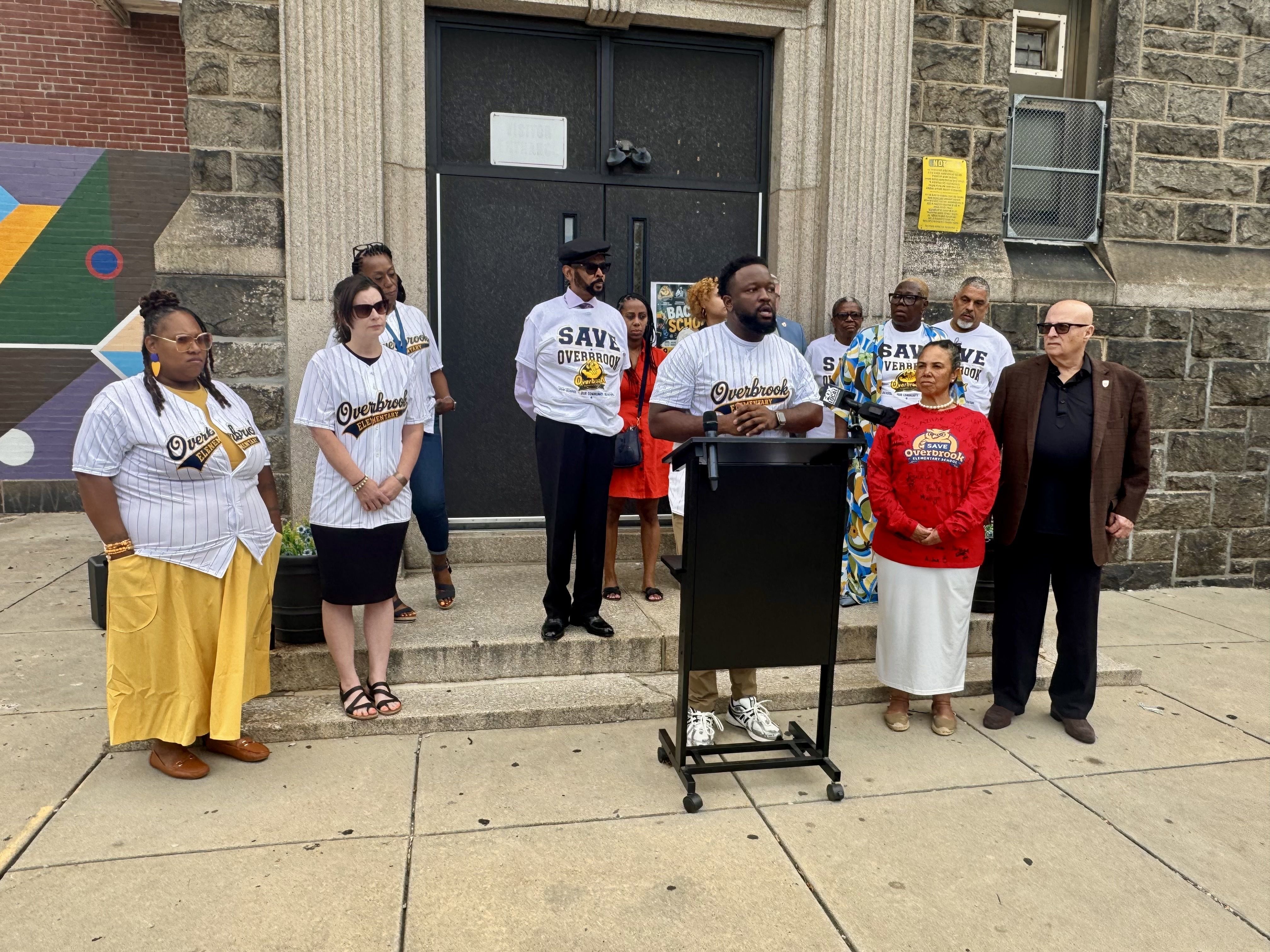
    The first-day tone was upbeat, but a bit different, at Overbrook, one of the 17 buildings the school board voted in April to close as part of its $3 billion, 10-year facilities plan. Overbrook is set to shut its doors permanently in June.

    Overbrook is a small, high-performing school in a very old building: The school is celebrating its 120th anniversary this year. Its tight-knit community wraps its arms around Overbrook and has mounted a fierce fight to keep it open.

    “Leave Overbrook alone,” said Fahmee Shabazz, dad of an Overbrook fourth grader. “Please, somebody help us.”

    Teachers union and elected officials were on hand at Overbrook for a news conference to pledge continuing efforts to try. Multiple politicians have said they will keep the pressure up to remove Overbrook Elementary, Robeson High, and Lankenau High from the district’s closing list.

    Teachers, politicians and Philadelphia Federation of Teachers officials listen to Kenneth Glover, principal of Overbrook Elementary School, speak on the first day of the 2026-27 school year. Glover said the school, which is one of 17 Philadelphia schools slated to close, will focus on academics this year and let adults fight a battle to stave off closure.Kristen A. Graham / Staff

    “We cannot disrupt the good things that are happening here,” said State Sen. Vincent Hughes (D., Philadelphia), chair of the Senate Appropriations Committee.

    Hughes said action needs to happen in Harrisburg to help better fund schools. But he added: “We’re still going to fight for Overbrook Elementary and the schools like it, [which] deserve to stay open.”

    Last year, many Overbrook Elementary teachers used news of the school’s closing as an object lesson — in civics and the world around them — said Kenneth Glover, the school’s principal.

    “I’m so happy that it’s day one,” he said. “Like I tell my students all the time, each day is a fresh start, and this year is a fresh start. Last year, a lot of the focus was on adult issues, right, fighting to keep the school open. This year, I really want students to focus on academics … for us to just have a beautiful school year.”

    Overbrook Elementary School students get ready to enter the building for the first day of the 2026-27 school year. It could be the 120-year-old school’s last first day, as it’s one of 17 schools the Philadelphia School District has slated to close.Kristen A. Graham / Staff

    While Glover said he still hoped the school could be kept open, he has begun to work with the district’s newly created transition office to plan for what comes next.

    Still, said Kathryn McQuade, Overbrook Elementary’s art teacher, the closure and the fight to prevent it are overshadowing the year for many.

    McQuade expressed frustration that the school board just spent $7 million on a four-year Center City lease for Constitution High when Overbrook and other schools have been tagged for closure.

    “Seven million could easily go towards … modernizing this building for the future,” McQuade said. “And that wouldn’t be a lease, that would be a one-time price tag.”

    Arthur Steinberg, president of the Philadelphia Federation of Teachers, said he “was hoping that when I came here today I’d be able to say, ‘Well, we saved Overbrook from the chopping block.’ Unfortunately, that is not the case. However, we have not given up the fight to keep Overbrook and every other school in the city open.”

    Steinberg said the PFT would release a plan this week that would give the district a path to keep all 17 schools open.

    Robin P. Cooper (upper right) watches as school and city official gather for a group photo outside the district bus. Cooper is president of Commonwealth Association of School Administrators (CASA). At far left is Superintendent Tony B. Watlington Sr. The bus, part of Mayor Cherelle L. Parker’s Neighborhood Community Action Centers, was to visit and rally at schools in every city council district.Tom Gralish / Staff Photographer
  • N.J. strikes 5,100 from voter rolls in wake of registration gaffe

    N.J. strikes 5,100 from voter rolls in wake of registration gaffe

    New Jersey officials have deleted 5,100 registered voters from state voter rolls and directed another 1,650 to county election officials for review, one month after Gov. Mikie Sherrill revealed that thousands of noncitizens may have registered to vote after interactions with the Motor Vehicle Commission.

    Sherrill announced the moves Wednesday, saying only about 340 of 6,600 erroneously registered to vote in 2023 and 2024 actually voted. She has blamed the problem on a software error by Idemia, the vendor that has managed driver’s license printing in New Jersey since 2010, and blasted former Gov. Phil Murphy’s administration for transparency and accountability failures. Idemia has denied responsibility for the problem, and Murphy has said he was unaware of it.

    Sherrill on Wednesday said state officials have worked around the clock to fix the issue and review state records “to preserve the integrity of our voter rolls, and ensure that our elections remain free and fair.”

    “I said we would conduct a thorough, complete, and fair investigation, and that is exactly what we are doing. Because that is what accountable government looks like,” she said in a statement. “My commitment to the people of New Jersey is to confront this issue with the urgency it deserves, so we have strong and fair elections.”

    Republicans, including those in the Trump administration, have criticized Sherrill for the voter registration debacle, saying it proves their claims that noncitizens have committed widespread voter fraud. On Wednesday Sherrill said the GOP’s “only interest has been in trying to use this issue for political gain.”

    Assemblyman Paul Kanitra (R-Ocean), one of the Republicans who have sharply criticized the Sherrill administration and Democrats on this issue, believes the number of noncitizens who have cast ballots could be far larger than state officials have admitted. Kanita told the New Jersey Monitor Wednesday that the governor has been less than fully transparent here by not specifying where and in what elections noncitizens have voted.

    “Governor Sherrill has over and over again minimized the harsh reality created by her own party members: Hundreds of noncitizens have voted in several elections in New Jersey,” he said, adding, “We need total and full cooperation of the Sherrill Administration right now. Anything less is a betrayal of the office of governor.”

    State officials took New Jersey’s voter registration system offline briefly so state election officials could copy and preserve it and then update it to remove or modify the status of people impacted, she said.

    That review drove the state to delete 5,100 of the improperly registered voters from voter rolls because officials could find no other proof of their eligibility to vote. State officials also changed the status of about 1,450 others to “rejected” pending further review, because they found separate voter registrations or other transactions in the system suggesting eligibility. County election officials have been tasked with verifying their eligibility and further amending their status after that review.

    Sherrill, who has previously said fewer than 400 of the wrongly registered people had actually cast ballots, put that number at 340 on Wednesday. An additional 220 voted but had previously been registered to vote or otherwise had made attestations in state systems suggesting they are eligible, Sherrill said. County officials also are reviewing that second batch of people, too, to verify eligibility.

    Sherrill said her administration has directed county officials to complete their reviews before voting begins in the upcoming general election. The state’s investigation remains ongoing, she added.

    This story originally appeared on New Jersey Monitor.

  • Phillies installed artificial turf at FDR Park field without environmental permit, record shows

    Phillies installed artificial turf at FDR Park field without environmental permit, record shows

    The Philadelphia Phillies installed artificial turf at Ashburn Field in FDR Park in July but still have not obtained a required state permit, according to Pennsylvania Department of Environmental Protection records.

    Major League Baseball and Phillies Charities Inc. held a ribbon-cutting for the renovated field, named after Hall of Famer Richie Ashburn, on July 10. It was part of festivities leading up to the MLB All-Star Game.

    The renovation of the decades-old field included removing natural grass in favor of a “high-performance synthetic turf system and upgraded drainage” at the five-acre complex, according to an MLB news release.

    However, documents from the Pennsylvania Department of Environmental Protection (DEP) show that the Phillies never obtained the required permit designed to address erosion control and stormwater release at the site.

    Under Pennsylvania law, anyone disturbing more than one acre of ground is required to obtain a permit for stormwater discharges before beginning the work and explain how the work will affect drainage going forward.

    DEP spokesperson Robyn Briggs said in an e-mailed statement that the agency is “currently reviewing the Phillies’ permit application and the compliance situation at the site. Because this matter is still under review, DEP cannot comment on whether any enforcement action or penalty will be taken.”

    The permit review is listed as “paused,” the statement said, because the DEP is still waiting for the Phillies to address outstanding issues.

    “Once the necessary information is received, DEP can continue its review,” the statement said.

    City approval?

    Bonnie Clark, a spokesperson for the Phillies, said in an e-mailed statement that “the recent upgrades to Richie Ashburn Field were undertaken in coordination with the city and relevant governmental agencies.”

    Clark said the city authorized the work to proceed while permit applications were in process so the upgraded field could host All-Star Week events.

    “We expect to obtain all necessary final approvals as early as next week,” Clark said.

    Clark did not specify who at the city, or what department, the Phillies were working with. City officials did not respond to requests for comment.

    When asked if this was proper procedure, Briggs reiterated that the DEP is “reviewing the compliance situation at the site” and noted the state law that requires the stormwater permit for construction-related earth disturbance.

    Typically, state law supersedes city authority.

    What is Ashburn Field?

    Ashburn Field was part of an investment MLB made in Philadelphia’s youth baseball community for the 1996 All-Star Game. The field, owned by Philadelphia as part of its park system, is managed by the Phillies. It is the first large turf field installed at FDR Park.

    MLB said the newly renovated field will serve about 8,000 participants in the Phillies Reviving Baseball in Inner Cities and Youth Academy programs, “while providing a weather-resistant playing surface in an area where rain often forces cancellations.”

    ‘Deficient’

    The Phillies notified the DEP they were applying for a permit on May 13.

    On May 27, the DEP sent a letter to the Phillies notifying the team that it needed additional information and logged 32 items that needed to be addressed, according to documents obtained by The Inquirer. That letter noted that final plan drawings had not been submitted, other drawings failed to include the project’s boundary, and not all water discharge areas were noted.

    A local engineering firm hired by the Phillies responded in June to each point.

    On July 7, the DEP sent another letter to the Phillies again noting technical deficiencies. And it sent another letter on July 24, about two weeks after the ribbon cutting, noting an outstanding deficiency and telling the Phillies to resubmit information in coordination with the Philadelphia Water Department.

    The permit is still listed as pending on the DEP website.

    The fight against artificial turf at FDR Park

    Adding artificial turf to Ashburn Field is the latest in a yearslong debate about changes to FDR Park.

    In 2019, the city’s parks and recreation department released a master plan to overhaul FDR Park, including the installation of 12 artificial turf fields in the footprint of a former golf course. (Those fields are separate from Ashburn Field.)

    The department said average rainfall left sections of the park unusable for days because of frequent flooding. Officials predicted that flooding would only worsen because of climate change and said artificial turf fields would provide better flood control. The plan would require cutting down dozens of trees.

    But that was pre-pandemic.

    As COVID restrictions shut down the world, the golf course returned to a wild state and became a beloved space by dog owners, hikers, and birders. They nicknamed the space “the Meadows.”

    Local opposition to the city’s plan grew, with critics objecting to the use of artificial turf amid natural lands. A grassroots group of South Philadelphians formed the Coalition to Save the Meadows, which has been vocal in its efforts to stop the park overhaul.

    At the same time, the fields drew support from youth athletic clubs.

    In March 2024, 11 South Philly residents filed suit calling for a stop on all work across FDR Park.

    In May, Orphans’ Court Judge Sheila Woods-Skipper denied the critics’ request to temporarily stop work on the park as the trial played out.

    In a recent social media post, the Coalition to Save the Meadows asked why the Phillies were allowed to move forward on Ashburn Field without the permit.

    “PA DEP regulations and permitting requirements exist for a reason: to protect our waterways, watershed, and the people and wildlife that depend on them,” the post read. “So how was this project allowed to move forward without a permit — and will there be consequences?”

    A legacy of artificial turf

    Although Citizens Bank Park, the home of the Phillies, has a natural grass field, the team is no stranger to artificial turf.

    The Inquirer reported in 2023 that six former members of the Phillies who played on the artificial turf field at the former Veterans Stadium died of brain cancer.

    The article noted that the death of former Phillie David West in 2022 came at a time when there was growing scientific concern about the perils of PFAS, known as “forever chemicals” because of their resistance to breaking down.

    PFAS were used to make the AstroTurf that was used at Veterans Stadium. The Vet opened in 1971 and was demolished in 2004.

    For Ashburn Field, the Phillies also installed AstroTurf. However, AstroTurf says on its website that it now uses a PFAS-free formula. A company news release on Ashburn Field said the infill for the new turf uses an organic material made from cork and olive.