Nestled neatly between a bustling shopping center and two schools, the lush old-growth forest that sits along MacArthur Boulevard in Haddon Township can be easy to overlook.
But this environment, home to hundreds of unique plant and animal species, is being threatened by beech leaf disease, a fast-spreading invasive condition that has taken hold among the American beech trees in Saddler’s Woods. The “widespread” disease, first discovered in New Jersey five years ago, has infected trees in every county in the state, according to the New Jersey Department of Environmental Protection.
So far, the Saddler’s Woods Conservation Association has counted more than 200 infected American beech trees on the 25-acre preserve, said Janet Goehner-Jacobs, the organization’s executive director.
There is no effective treatment to combat the disease, she said.
The disease, caused by a microscopic worm believed to have originated in Asia, can affect trees differently depending on their age, health, and site conditions, but it nearly always kills them.
And while this is not the first time Saddler’s Woods has dealt with an invasive species, the worm that causes beech leaf disease presents a particularly daunting challenge, Goehner-Jacobs said.
“There’s mitigations, there’s hope the numbers game works out in your benefit, there’s succession plans that we can build, but it’ll be pretty devastating,” she said.
The disease is putting centuries-old ferns and countless other plant and animal species at risk of losing the various life-sustaining resources that beech trees provide, she said.
Signs of beech leaf disease can be found on more than 200 American beech trees throughout Saddler’s Woods in Haddon Township.Courtesy of Saddler's Woods
Most of the old-growth trees forming the densest part of the tree canopy in Saddler’s Woods are American beech, Goehner-Jacobs said. The shade provided by the canopy allows for young beech trees to mature over time, eventually replacing old or dying trees and filling their gap in the canopy.
“Not only are you subject to the loss of those trees, but everything in the ecosystem will collapse to some level that you have to try and rebuild,” she said. The beech nut is a critical food source for many animals, she said, while the tree’s hollows often serve as a nursery nest for horned owls.
Since it was first confirmed in Bergen and Essex Counties in 2020, beech leaf disease has “spread to all 21 counties — affecting all species of beech — and is considered widespread in the state,” New Jersey Department of Environmental Protection spokesperson Raeanne F. Raccagno said in an email.
Baby owls nest in a hollowed beech tree in Saddler’s Woods. The bird is just one species that could be impacted by the death of the forest’s American beech trees from invasive beech leaf disease.Courtesy of Saddler's Woods
With approximately 14 million American beech trees throughout the state, it is likely that several million have been impacted by this disease, Raccagno said, including the nonnative European and Oriental beech trees.
The state’s forest service reports that across New Jersey, “it is currently more difficult to find a beech tree with no symptoms of Beech Leaf Disease than a tree that is asymptomatic,” Raccagno said.
In infested trees, black banding forms between the veins of leaves, and as thedisease progresses, leaves can become smaller, curled, and discolored.
Trees typically die within four to five years after initial infestation, forest service monitoring has shown, and the consequences of this widespread disease in New Jersey could last for generations.
In addition to drastically shifting the composition of forest ecosystems, the widespread loss of so many beech trees could shorten “natural forest succession timelines by hundreds of years,” Raccagno said.
Beech leaf disease is almost always fatal, often killing trees within four or five years of initial infection, according to the New Jersey Department of Environmental Protection.Courtesy of Saddler's Woods
“As beech declines, other tree species and understory species will fill the available space vacated by dead beech trees,” she said. “With high beech mortality, invasive plant species have the capacity to become more prevalent as light availability and growing space increase in areas previously occupied by dense canopy beech trees.”
With no clear solution to the threat, the conservation team at Saddler’s Woods — composed entirely of volunteers — is “actively working every angle we have” to combat the disease, Goehner-Jacobs said.
This includes documenting what currently exists in the forest and creating a succession plan for how the ecosystem can survive and recover if a large number of beech trees die in the coming years, she said.
The team is also working to identify a few mature beech trees that might benefit the most from an expensive and experimental fungicide treatment that has been shown to help boost the defenses of some trees against the disease, she said.
A native violet sprouts from the forest floor in Saddler’s Woods. The flower is just one of the countless species of plants and animals that rely on the shade cover provided by the canopy of the American beech tree.Courtesy of Saddler's Woods
Because the overarching mission of the Saddler’s Woods Conservation Association is to preserve the forest in perpetuity, the group has to approach potential solutions thoughtfully, Goehner-Jacobs said.
While the organization is working to slow and hopefully stop the disease’s spread, the best solution will likely be the defenses that the tree itself develops naturally through evolution, she said.
But evolution, by definition, takes time. Time that New Jersey’s beech trees might not have, she said.
“Eventually, just like some people never got COVID, some of these trees will have a defense, and you’re waiting for that one,” she said. “Will it be in Saddler’s Woods? I don’t know.”
The CEO of Chobani thought he had identified a site in the Lehigh Valley for the yogurt company’s first dairy plant in Pennsylvania.
But challenges with wastewater and energy were holding up Hamdi Ulukaya’s plans. “And if you don’t have that solution, you kind of don’t want to touch anything,” the billionaire founder said in September.
As Ulukaya announced a $1.2 billion investment at a new facility in Allentown — the biggest private investment in the state’s agriculture industry on record — he credited Gov. Josh Shapiro with making it happen. The state expedited permitting for the project and offered $50 million in grants and loans to support site improvements.
“This really speaks to the leadership of this state,” Ulukaya said. “I’ve never seen anything like this.”
As Shapiro, 53, runs for reelection in November, analysts say, deals with companies like Chobani help reinforce an image the governor has cultivated as a pro-business Democrat who is focused relentlessly on “getting stuff done.”
“I’m competitive as hell. I wanna win every deal,” Shapiro said in September at the Chobani announcement. “For a long time, Pennsylvania wasn’t even on the field. We’re on the field now. We’re competing. We’re winning big deals like this.”
Gov. Josh Shapiro in 2024 at the site of the Bellwether District. The 1,300-acre industrial campus in Southwest Philadelphia was previously a Sunoco oil refinery and is being redeveloped. Alejandro A. Alvarez / Staff Photographer
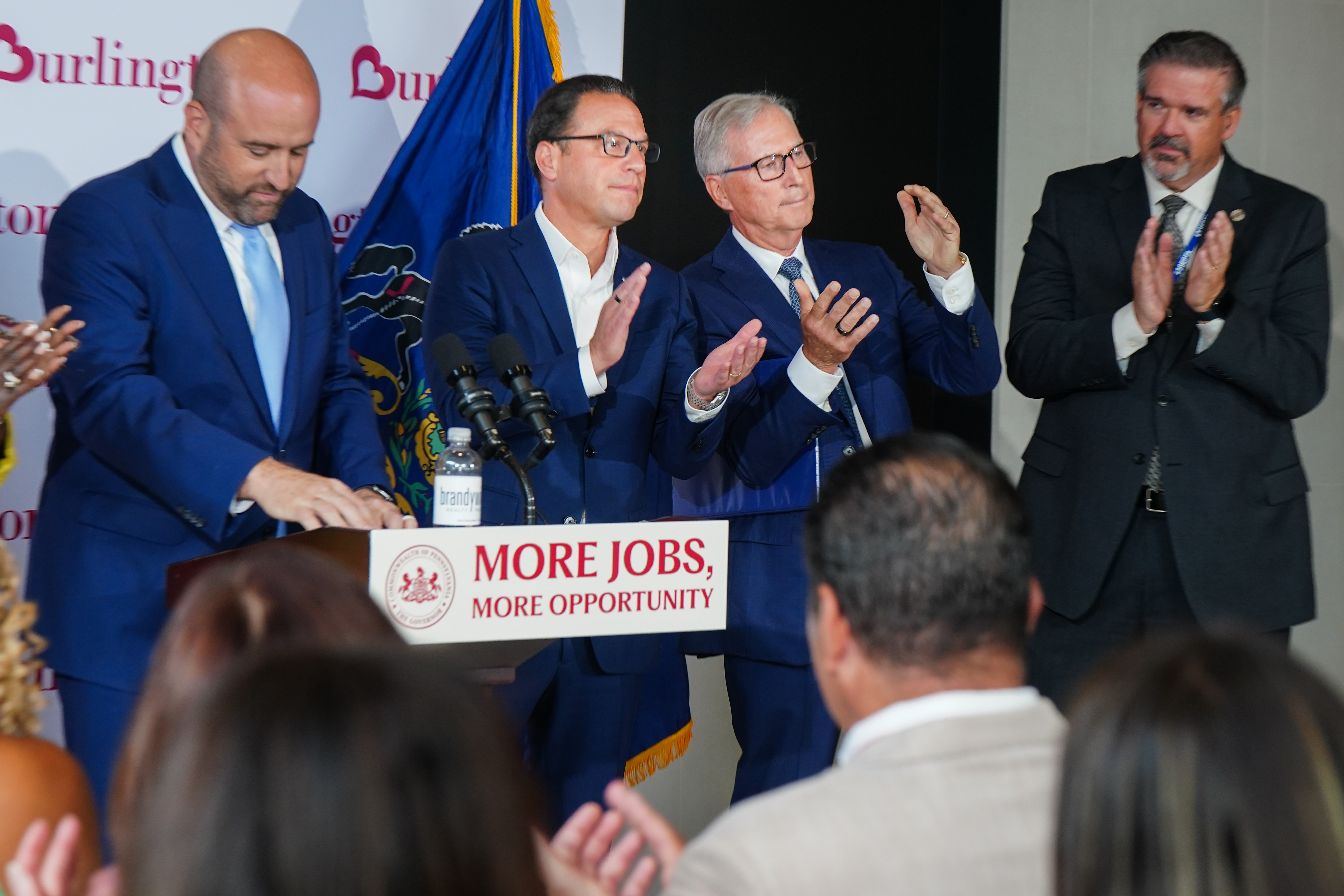
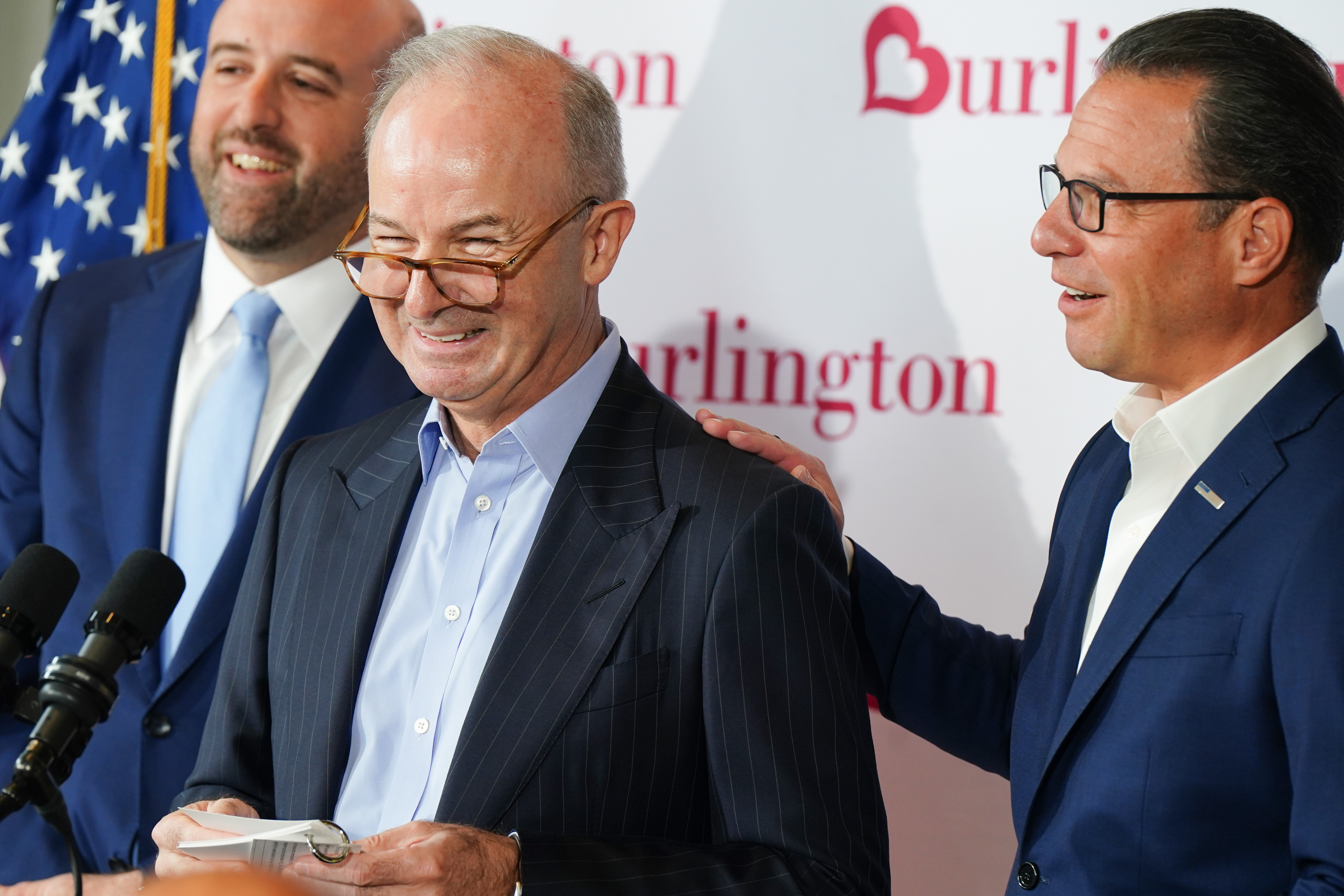
And increasingly, Shapiro has tapped state subsidies to help drive economic development — landing splashy commitments such as pharma giant Eli Lilly & Co.’s plans for a $3.5 billion plant in the Lehigh Valley and discount retailer Burlington Stores’ $370 million move from South Jersey to University City.
Since Shapiro took office in 2023, his business development team, known as BusinessPA, has spent $121.8 million per year on average to attract, retain, and grow businesses through incentives to employers, according to data the state shared with The Inquirer.
That is more than double the $51.6 million the state invested annually on such deals from 2018 through 2022 under Gov. Tom Wolf, according to the current administration.
Shapiro administration officials say incentives are one piece of a broader strategy to make Pennsylvania more attractive to businesses. Other key ingredients include speeding up projects, investing in industrial site improvements, and continuing to reduce the corporate tax rate.
(function(){function e(){window.addEventListener(`message`,function(e){if(e.data[`datawrapper-height`]!==void 0){var t=document.querySelectorAll(`iframe`);for(var n in e.data[`datawrapper-height`])for(var r=0,i;i=t[r];r++)if(i.contentWindow===e.source){var a=e.data[`datawrapper-height`][n]+`px`;i.style.height=a}}})}e()})();
Shapiro’s strategy carries some political risk, however.
In the gubernatorial race, Shapiro is leading Republican State Treasurer Stacy Garrity by a wide margin in polls. But he is also thought to be mulling a run for president in 2028.
Any perceived coziness with big corporations could haunt Shapiro in a Democratic primary, said Chris Borick, a political science professor at Lehigh University. Shapiro has already seen voters turn against an industry he once courted: data centers.
“He left a trail of breadcrumbs that made that connection to the industry that he has had to walk back on this year,” Borick said.
Garrity’s campaign has sought to highlight Shapiro’s early support for Amazon data center projects in Pennsylvania that he said would result in $20 billion in private investment. Shapiro has since sought to restrict data center development. Garrity, too, initially supported data centers publicly, but has since backtracked.
In a statement, Garrity’s campaign said Shapiro’s economic agenda amounted to “corporate welfare.”
A Garrity administration would “cut the red tape that is holding up progress, reduce the tax burden facing families and businesses, and hang a welcome sign — not a handout — to businesses that want to start or move to the commonwealth,” campaign spokesperson Matt Beynon said.
For Pennsylvanians, the bigger question is whether the governor’s economic development deals will pay off in the long term.
But evaluating the efficacy of his incentive spending could prove challenging. A state board created in 2017 to review the performance of tax credit programs and other government spending has not met since 2023, PennLive reported.
“The right scorecard is not the size of the subsidy package or the value of the announcements,” said Bernie Gallagher, executive director of the left-leaning Keystone Research Center in Harrisburg.
“It’s whether public dollars changed business behavior, and then produced additional family-sustaining jobs and left durable assets behind, and then delivered a measurable public value.”
A new strategy for wooing business
State and local governments spend tens of billions of dollars a year on incentives for businesses, research shows.
When Shapiro took office in 2023, his team found Pennsylvania was being outspent “astronomically” by states like New York, North Carolina, Virginia, and Ohio, said Rick Siger, secretary of the Pennsylvania Department of Community and Economic Development.
Ramping up incentives was one part of the Shapiro administration’s economic development strategy rolled out in 2024 — the state’s first new plan in nearly 20 years, according to the governor. It focused on growing five core industries: agriculture, energy, life sciences, manufacturing, and robotics and technology.
“We didn’t have a plan for economic development in the state for a long time,” said Chellie Cameron, CEO of the Chamber of Commerce for Greater Philadelphia, who describes the road map as “significant.”
With bipartisan support in the legislature, Shapiro launched PA SITES, an incentive program aimed at developing shovel-ready sites for businesses. Lawmakers authorized the administration to borrow $400 million to fund it. That is the program Shapiro tapped to incentivize Chobani.
Hamdi Ulukaya, Chobani founder and CEO, announced in September that his company is investing $1.2 billion to set up a new dairy plant in Allentown. Chobani
From 2023 through late September, Shapiro’s BusinessPA team pledged nearly $457 million in grants, loans, and tax credits to roughly 90 companies that promised to create or retain jobs in the state, according to the administration. That figure does not account for tax breaks available to certain firms located in Keystone Opportunity Zones, a program established in 1998 to promote economic development.
The top 10 largest incentive deals — including deals with Johnson & Johnson, Eli Lilly & Co., and Chobani — accounted for 65% of the total subsidies.
“We’ve been able to compete for some of these really large-scale deals that the state did not have the capability to compete for financially in the past,” Siger said.
Since Shapiro took office, his administration has tallied $43 billion in planned investments and 29,000 jobs created in Pennsylvania by private-sector employers that got help from BusinessPA or other state programs.
One hub of economic activity has been the Bellwether District, a 1,300-acre industrial campus in Southwest Philly that was previously a Sunoco oil refinery.
View of the Bellwether District in 2023. The Bellwether District is in a Keystone Opportunity Zone, so businesses that locate there get big tax breaks.Heather Khalifa / Staff Photographer
Canned beverage manufacturer DrinkPAK is investing $195 million in a new manufacturing facility at the district, which is in a Keystone Opportunity Zone and is being redeveloped by Chicago-based HRP Group. DrinkPAK, which also has locations in California and Texas, says it will create 174 jobs at the factory and produce billions of cans a year.
Company executives said they evaluated sites across five states. In addition to Bellwether’s KOZ — a designation that required city and state approval — the Shapiro administration offered DrinkPAK a $2 million grant.
“I’m going to say it really, really plainly,” said Holly Schroeder, DrinkPAK’s vice president of organizational strategy. “DrinkPAK would not be standing here in Pennsylvania without the support of the incentives the commonwealth brought to the table.”
Jeff Hornstein, executive director of the Economy League of Greater Philadelphia, said Bellwether shows how incentives can help stimulate economic activity that would not have occurred otherwise.
“Bellwether was a disgusting, decrepit brownfield, and through visionary leadership and a lot of money, like a lot of tax incentives, it is going to become a job node, much like the Navy Yard became,” he said. About 16,000 people now work at the Navy Yard, for employers including Urban Outfitters, Tastykake, and Jefferson Health.
DCED secretary Rick Siger speaks at a DrinkPAK event in late September, marking a construction milestone for the company’s new Philadelphia manufacturing facility.Tyger Williams / Staff Photographer
But Hornstein questioned whether some of Shapiro’s incentives — like one with Burlington, which is relocating its headquarters from South Jersey to Philadelphia — will benefit the region as a whole.
Burlington says it will relocate 1,500 existing jobs to University City and create 500 new ones. Shapiro’s team counts all of those as newly created jobs because they are new to Pennsylvania.
“Is inducing a firm to move from one part of the region to another — is that really growth activity or is it zero sum?” said Hornstein, whose organization seeks to promote inclusive and equitable growth. “We win 2,000 jobs. Burlington County, N.J., which is in our region, loses 2,000 jobs. Is that net growth for the region, or just ‘yay Philadelphia, yay Pennsylvania’?”
Burlington CEO Michael O’Sullivan and Gov. Josh Shapiro at an event announcing the company’s headquarters move to Philadelphia. Burlington says it will relocate 1,500 existing jobs and create 500 new ones at the new headquarters. Jessica Griffin / Staff Photographer
More broadly, critics say the state’s incentive programs allow politicians to pick winners and losers in the marketplace. They also note that some of the programs are also financed through borrowing, such as Pennsylvania’s Redevelopment Assistance Capital Program — the source of a $20 million grant to Burlington.
“So taxpayers are not only funding those handouts, but they’re also paying interest on those costs, which you know, in our opinion, is kind of the worst of both worlds,” said Elizabeth Stelle, vice president of policy at the Commonwealth Foundation, a right-leaning think tank in Harrisburg.
Who gets the jobs?
Given the amount of money states pump into economic development, there are bound to be some losing bets. And Pennsylvania has had its fair share.
States have been bidding against one another for firms since at least the 1970s, according to academic research, and in that era the big corporate competition featured automaker Volkswagen.
In 1976 the German company chose to build its first U.S. plant in Southwestern Pennsylvania — enticed by $100 million in state subsidies, or about $580 million in 2026 dollars. The plant shut down a decade later.
A 2020 academic paper that reviewed subsidy deals from 2002 to 2012 found that firm-specific incentives were associated with increased average employment in the targeted industry but were not linked to broader economic growth.
“We spend a ton of money on these things, and it’s not obvious they’re always tied to more investment and benefits for the place rather than hollowing out the tax base,” said Owen Zidar, a coauthor of that paper and a professor of economics and public affairs at Princeton University.
Then there’s the question of which workers get the jobs created through subsidy deals.
“We really need to think about talent attraction and talent retention alongside business attraction,” said Jennifer Kebea, president of Campus Philly, which works to keep Philadelphia college students in the area after graduation. “Are the young people graduating from our institutions poised to take these roles?”
Shapiro’s team says it is focused on securing good jobs for local residents.
“We base our incentives — and whether we incentivize a deal at all — on the wages and job quality associated with those roles,” Siger, the department secretary, said.
Jobs created under the Shapiro administration pay more than new jobs announced under the previous administration, the state says.
“That’s the exciting part of what this governor’s been able to do. His team has been able to zero in on really good companies that want to pay good wages,” said H. Patrick Clancy, CEO of Philadelphia Works, the city’s workforce development board.
Down the road, Clancy wonders how many of the jobs created will be retained. In other words: “Long term, did it really all pan out?”
Urban Outfitters cofounder Dick Hayne, and Gov. Josh Shapiro gathered in June at the company headquarters in the Navy Yard, to announce that the business is adding over 1,000 jobs in the region over the next seven years. Alejandro A. Alvarez / Staff Photographer
A 2017 law requires Pennsylvania’s Independent Fiscal Office to review each tax credit program and state agency at least once every five years, and report its findings to the Performance-Based Budget Board. Board members include four lawmakers from both parties, as well as the governor-appointed budget secretary.
But the board has been dormant since 2023 and its members have declined to say why, according to PennLive.
The Shapiro administration is “awaiting consensus” among board members on how to move the review process forward, a spokesperson said, adding that the panel has not provided “clear direction” to agencies.
In the meantime, the administration continues to evaluate government programs, including tax credits, through its Resource Evaluation and Mission Alignment Project (REMAP), the spokesperson said. That project has already informed changes to some tax credits.
Stelle, of the Commonwealth Foundation, said: “Internal reviews are one thing, but the lack of a public review of outcomes is concerning. Pennsylvania taxpayers deserve to see the impact of tax credits and agency programs. Funding should be based on outcomes, not intentions.”
The state says it has measures in place to ensure companies receiving incentives hold up their end of the deal.
“We have a formula that we negotiate with the company to claw back part — or, in draconian cases, all — of an incentive based on nonperformance,” Siger said.
Since the beginning of 2023, the administration says, it has clawed back over $3.8 million from 64 businesses that failed to create or retain the jobs they promised, or otherwise broke their commitment.
“Our goal, of course, is not to do that,” Siger said. “Our goal is to create the jobs.”
Staff writer Joe Yerardi contributed to this article.
The ghosts of not-so-distant-Philadelphia feel strikingly alive in Hidden City Philadelphia’s new landmark visual history: Philadelphia in Color 1950-1990. Hitting shelves next week, and, amazingly, believed to be the first-ever, comprehensive color photographic history of Philadelphia, the collection features hundreds of rarely-seen street photos, portraits, and family snapshots.
From “Philadelphia in Color 1950-1990.”Unknown
The result is spellbinding. A technicolor time capsule of a vanished but powerfully familiar Philadelphia. A bygone city bursting to life in living color.
A 1951 snapshot of a Gimbels Thanksgiving Parade — the Atomic Age spaceship float and its costumed riders nearly luminous in lush Kodachrome light. A pair of South Philadelphia women proudly posing outside a Mifflin Street rowhouse in 1952, sunlight shining off their Sunday pearls. A Ben Franklin impersonator strolling South Broad, his gold waistcoat sparkling. A young boy and girl, siblings it seems, resting wearily under an Italian Market shopfront one day in 1969.
From “Philadelphia in Color 1950-1990.”Unknown
The book became the obsession of Peter Woodall, Hidden City’s project director, who scoured largely forgotten collections of unsung Philly street photographers, hobbyists, and archivists. He scrolled eBay, Etsy, and Flickr.
The photos he collected of neighborhood parades, horse-drawn delivery trucks, street corner scenes all had one thing in common: There’s a dignity there that’s not often granted to that era of Philadelphia.
The aim was to tell a fuller, more beautiful story of that time.
From “Philadelphia in Color 1950-1990.”Unknown
In color, the faces seem more recognizable, the places more immediate.
“The first thing I see is ourselves looking back at us. I see this beautiful range of people who have an incredible amount of style. Who take themselves seriously. Who don’t put up with s—,” said Nathaniel Popkin, author and urban historian, and co-founder of Hidden City Philadlephia.
The folks at Hidden City have achieved their goal: The story they tell is beautiful. It’s one of grit and grime, yes, but also resilience and pride and celebration and a uniquely Philadelphia style.
From “Philadelphia in Color 1950-1990.”Unknown
Philly is a city that’s always lived with its ghosts. It’s part of the charm. We tend to give short shrift to those of our more recent past.
But here they are on the page, in ordinary moments, in their extraordinary Philadelphia, calling out to us, reminding us who we are — and how we got here.
Video of the Week
Video: How First Unitarian Church became a Philly punk institution
Watch Inquirer music critic Dan DeLuca’s discuss why Philly’s music scene is one of the greatest in the country: a 140-year-old church.
Data deep dive
Has LeBron James flown over your house? Inquirer analysts have done their homework on LeBron’s helicopter commuting from Manhattan to South Philly.
(function() {
var l2 = function() {
new pym.Parent(‘lebron_flights’,
‘https://media.inquirer.com/storage/inquirer/projects/innovation/arcgis_iframe/lebron_flights.html’);
};
if (typeof(pym) === ‘undefined’) {
var h = document.getElementsByTagName(‘head’)[0],
s = document.createElement(‘script’);
s.type = ‘text/javascript’;
s.src = ‘https://pym.nprapps.org/pym.v1.min.js’;
s.onload = l2;
h.appendChild(s);
} else {
l2();
}
})();
A look ahead
The very public resignation of two supervising prosecutors this week, after Larry Krasner ignored calls to correct alleged false federal filings, roiled an office long beset by churn and conflict. Chris Palmer, who covers federal courts, has been reporting from the inside. We asked him to tell us what he’s hearing — and where he thinks the story is heading.
Mike: This one may hang around?
Chris: The most extraordinary part is that a federal judge has told the U.S. Attorney’s Office that he believes the city’s District Attorney may have committed crimes, including obstruction of justice, conspiracy, and perjury. All of the legal experts I talked to say they have no historical parallel.
It’srare for judges from their perch to even typically criticize prosecutors let alone suggest their actions could be criminal misconduct.
Mike: U.S. District Judge Paul S. Diamond has referred the case to federal prosecutors? What’s next?
Chris: One of the major questions remains, “What is the U.S. Attorney’s Office going to do?” Every legal expert I talked to seems to believe they will have to at least review the materials that the judge sent. But the extent and depth of that investigation and whether it turns into criminal consequences for Krasner could take months to unfold and will likely play out largely in secret.
Mike: The case is already causing strife inside the D.A.’s office, right?
Chris: Multiple staffers within the office who held prominent positions felt so disillusioned with their interactions with the D.A. that they decided they had to quit is something that has reverberated.
Mike: They didn’t go quietly. Krasner called them “insubordinate.”
Chris: You don’t see that type of staff dissension play out in public very often.
Chris: The next immediate development is whether the judge is going to agree — whether he is going to decide to stay on the case.
Mike: Either way, Krasner could soon find himself squarely in Trump’s crosshairs.
Chris: The circumstances of asking federal prosecutors to investigate a sitting district attorney would be unusual enough in normal times — but in the second Trump administration, when the Department of Justice has pursued political opponents at a rate unseen, it becomes even more potentially perilous for Krasner.
Briefly noted
Valley Forge Military College mulls a move to Oklahoma.
No sign of a White Knight for the Academy of Natural Sciences. That’s because benefactors generally don’t throw money at problems without solutions, writes Peter Dobrin.
Prefer your history with a classic Gothic horror twist? The Museum of the American Revolutions has you covered. This Halloween season, the museum offers a special, daily 10-minute chat digging into the ghastly real-life Revolutionary War history that inspired Washington Irving’s Headless Horseman in the “Legend of Sleepy Hollow.” Included with the price of a ticket, it won’t disappoint. I went last week and it brought me back to spooky childhood Brooklyn nights reading about the Horseman’s midnight rides among the gravestones by attic light.
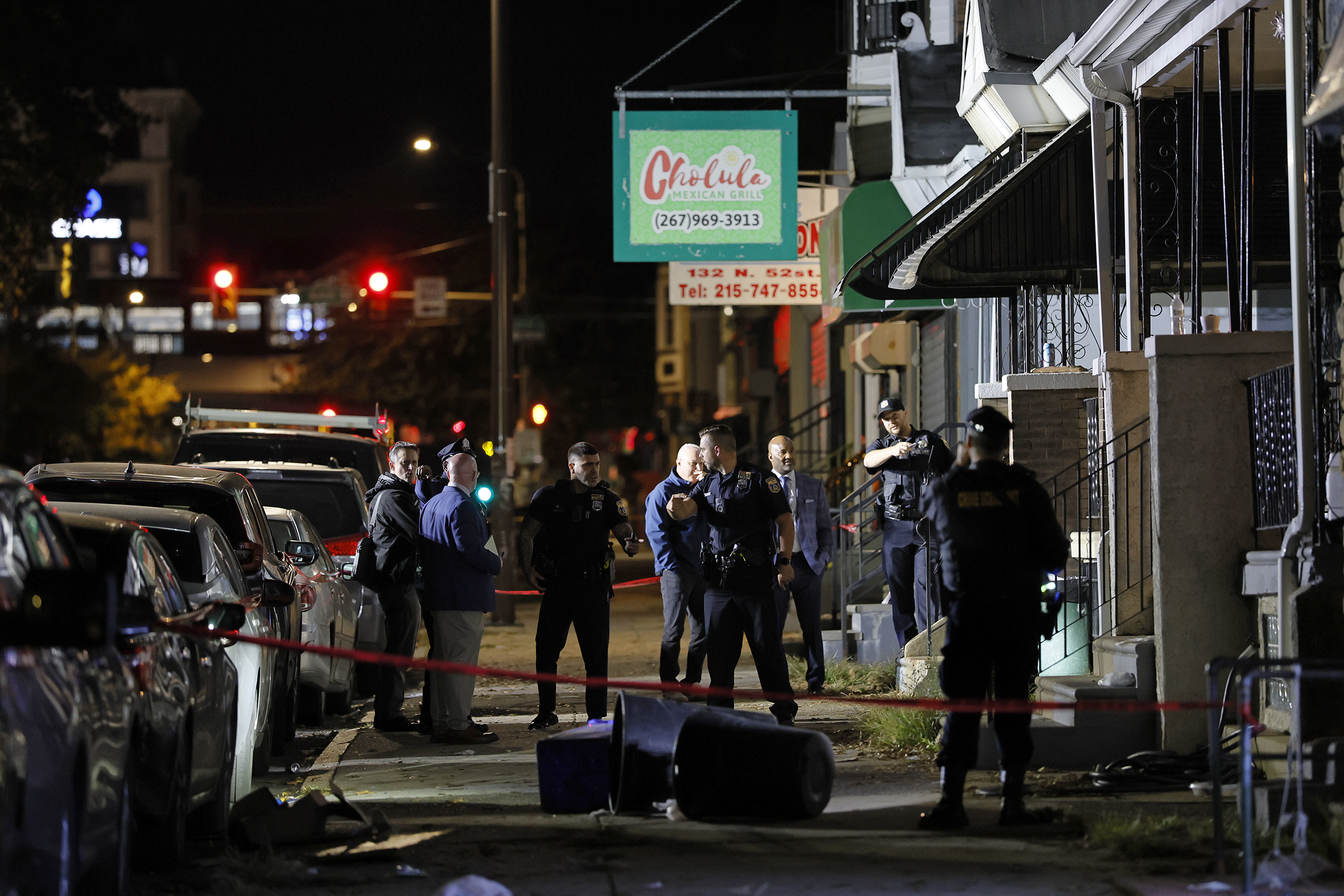
Officer Shane Seiber was knocking on the door of a West Philadelphia home around 12:50 a.m. Saturday when Eric Lewis walked up from behind, demanding to know why police were on his porch, according to a law enforcement source.
Seiber and his partner were responding to a neighbor’s 911 call of a person with a gun in front of a home on the 100 block of North 52nd Street, police said. As Lewis approached the officers, they asked whether he lived there, the source said — but he quickly began yelling and acting aggressively.
A brief struggle followed, and just as the officers moved to check whether Lewis was armed, the source said, he shot them.
Lewis continued to fire as they lay wounded, yelling that he told them to get off his porch, said the source, who spoke on the condition of anonymity to discuss an ongoing investigation.
When two other officers arrived at the home shortly after 1 a.m., the source said, they found Seiber and his partner lying unconscious, bleeding from their wounds.
Seiber, 40, a 10-year police veteran, was shot three times and died hours later at Penn Presbyterian Medical Center. The other officer, a 33-year-old with nine years on the job, was shot 12 times, and remains hospitalized.
Officer Shane Seiber, 40, joined the police department in 2016. Courtesy of the Philadelphia Police Department
Lewis, meanwhile, retreated into a dark alley behind his home — then shot at the reinforcements who would soon arrive, officials said. When he was eventually arrested after a nearly hourlong standoff, he blamed the officers for coming onto his porch, according to an arrest report obtained by The Inquirer.
“I did what I did because they did what they did,” he said, according to the report.
The source’s account, together with the arrest report — which includes interviews with nine officers — provides the most fulsome picture of the moments leading up to Seiber’s death, a shooting that has devastated Philadelphia’s law enforcement community, stunned neighbors, and left a family grieving a husband and father of two young children.
It also offers a fuller account of what unfolded in the hours that followed: a tense standoff in which Lewis, 35, hid in the darkness, shot at responding police, and eventually climbed a tree behind his home as SWAT officers trained their weapons on him.
As he sat perched two stories above the ground early Saturday, Lewis called out to SWAT snipers on a nearby rooftop, asking them not to shoot, according to the report.
He said he wanted to “end this peacefully,” the report said.
Lewis is charged with murder and related crimes in connection with Seiber’s death. He faces 10 counts of attempted murder and related offenses for wounding the second officer, and allegedly shooting at nine others who rushed to the block and came under fire.
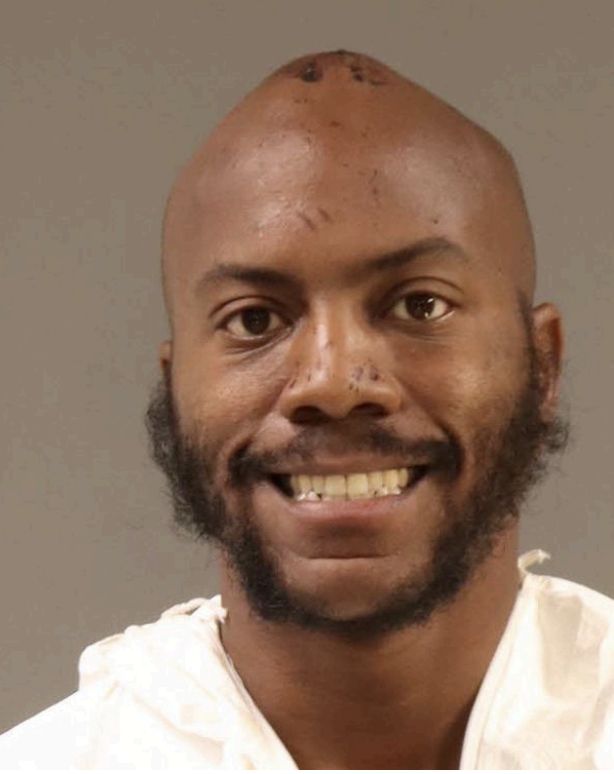
Eric Lewis, charged with murder in the shooting death of police officer Shane Seiber, is shown in a Philadelphia Police Department photo.Philadelphia Police Department
Lewis was arraigned early Sunday morning in Municipal Court, where he was also charged with disarming a law enforcement officer, carrying a firearm without a license, and related crimes.
Police said that after Lewis was arrested in the alleyway, they recovered a shotgun and two handguns, at least one of which belonged to the officers he shot.
He is being held without bail at the Curran-Fromhold Correctional Facility. Lewis is represented by the Defender Association of Philadelphia. Chief Defender Keisha Hudson declined to comment Sunday.
Two of Lewis’ siblings also declined to comment Sunday.
District Attorney Larry Krasner called Lewis’ actions a “brazen and disturbing act of violence” against law enforcement. He said his office would seek full accountability for Lewis’ crimes, but added that the investigation was in its early stages and continuing.
The sequence of events
The neighbor’s call came in around 12:17 a.m., police said — there was a person with a gun at 140 N. 52nd St.
Seiber and his partner arrived at approximately 12:50 a.m., according to the source. Then, at 1:01 a.m., a neighbor again called 911, and said there had been a shooting.
Additional officers arrived two minutes later to find Seiber and his partner bleeding on the porch. They were carried to a nearby patrol car and rushed to the hospital.
More police rushed in, and as they surveyed the back of the home, more gunfire began exploding through the dark alleyway, sending officers diving for cover behind parked cars, according to the arrest report. No one was struck.
Police sealed off the alley until a SWAT team arrived about 1:40 a.m., the report said, and ordered Lewis over a speaker to come out unarmed.
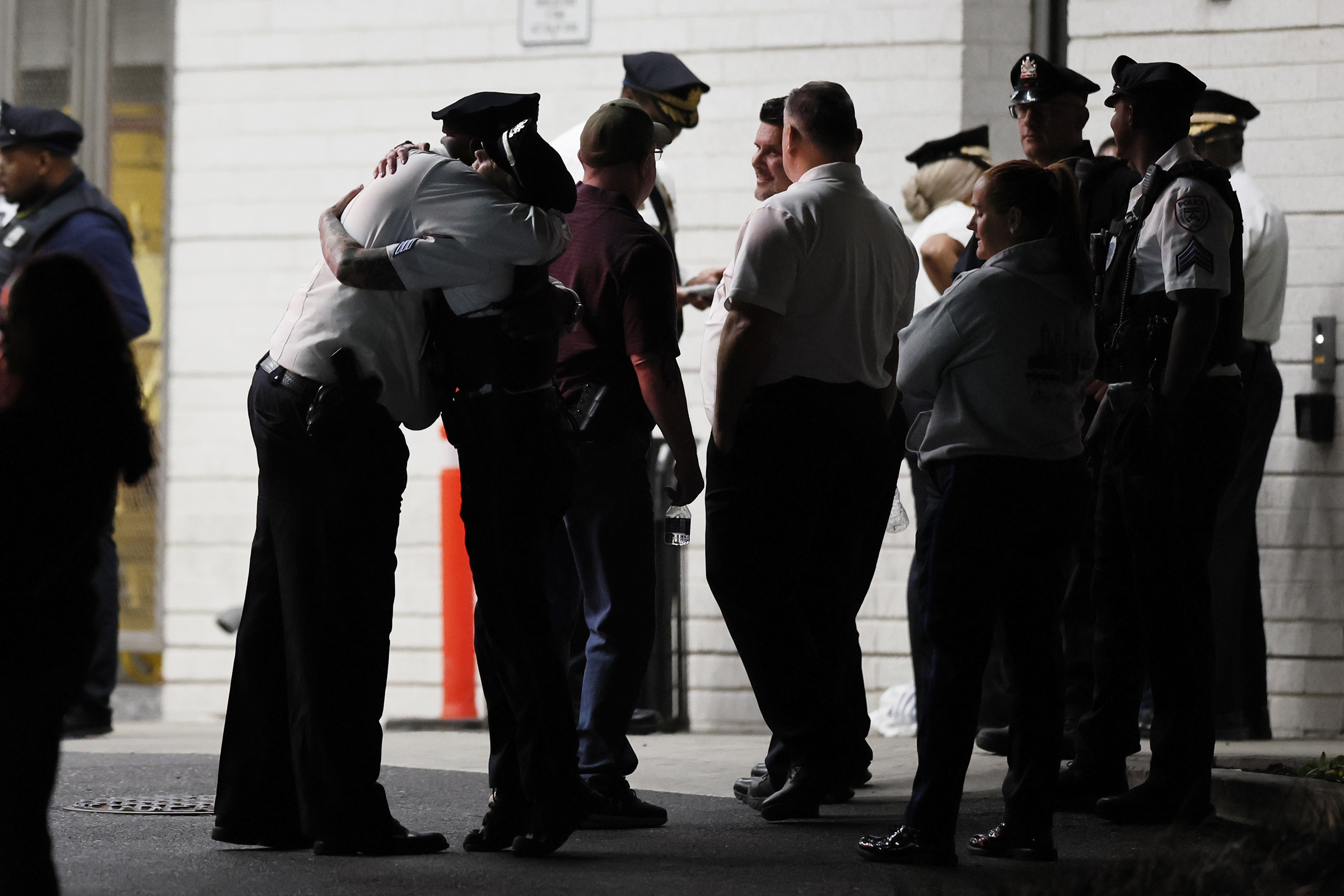
Philadelphia police hug each other outside of Penn Presbyterian Medical Center in Philadelphia on Saturday. Elizabeth Robertson / Staff Photographer
After two SWAT snipers took positions on a rooftop on North Wilton Street, they heard a man’s voice coming from a tree in the alley below, according to the report. The man asked officers not to shoot. One sniper spotted him with the flashlight affixed to his weapon, about two stories off the ground, and ordered him to come down.
Lewis soon fell from the tree, hitting branches on the way down. He told officers he was hurt and could not walk, according to the report.
One SWAT officer, armed with a ballistic shield, then placed him under arrest.
Lewis was taken to Jefferson University Hospital, where officers said he spoke to the police who guarded him for nearly two hours.
According to the report, Lewis said he had been across the street when he saw the officers on his porch, and he walked up to them. He shot them, he said, after the officers put their hands on him.
He also said he shot the officers because they were white, the report said. He told one officer at the hospital, a Black woman, that “if it was you that responded we would have just had a conversation,” the document said.
“They had guns, so I had every right to defend myself,” he said, according to the report.
Police recovered two handguns — including a 9mm Glock service weapon that police said belonged to the injured officer — from the area where Lewis was arrested and a shotgun from a nearby yard.
The 9mm handgun had been loaded with a magazine that came from Seiber’s belt, the police report said.
Lewis has worked as a trades helper for the city Water Department since 2024. He has a criminal record dating to 2012 that includes a 2015 misdemeanor conviction for carrying a firearm in public, court records show. Krasner said Saturday that Lewis had no felony convictions that would have barred him from owning a gun.
Philadelphia police salute as the medic unit carrying the body of the slain police officer pulls up to the medical examiners office in Philadelphia on Saturday. Two police officers were shot overnight, one did not survive.Elizabeth Robertson / Staff Photographer
He joined the force in 2016. After he graduated from the police academy in 2017, Seiber thanked those who had supported him in a Facebook post, promising to “do my best to make y’all proud in this crazy, crazy occupation I’m about to begin.” He also praised his classmates in Class 380 as “some of the greatest people I’ve ever met.”
In the same post, Seiber thanked his wife, who he said had endless patience for his “constant shenanigans, pranks, and general goofing around.”
The couple have a son, 7, and a daughter, 3, police said.
Police Commissioner Kevin Bethel, visibly distraught Saturday, asked for the city’s prayers.
“This will be a period of mourning for us, but we will stand tall as a department,” he said. “We can get through this together.”
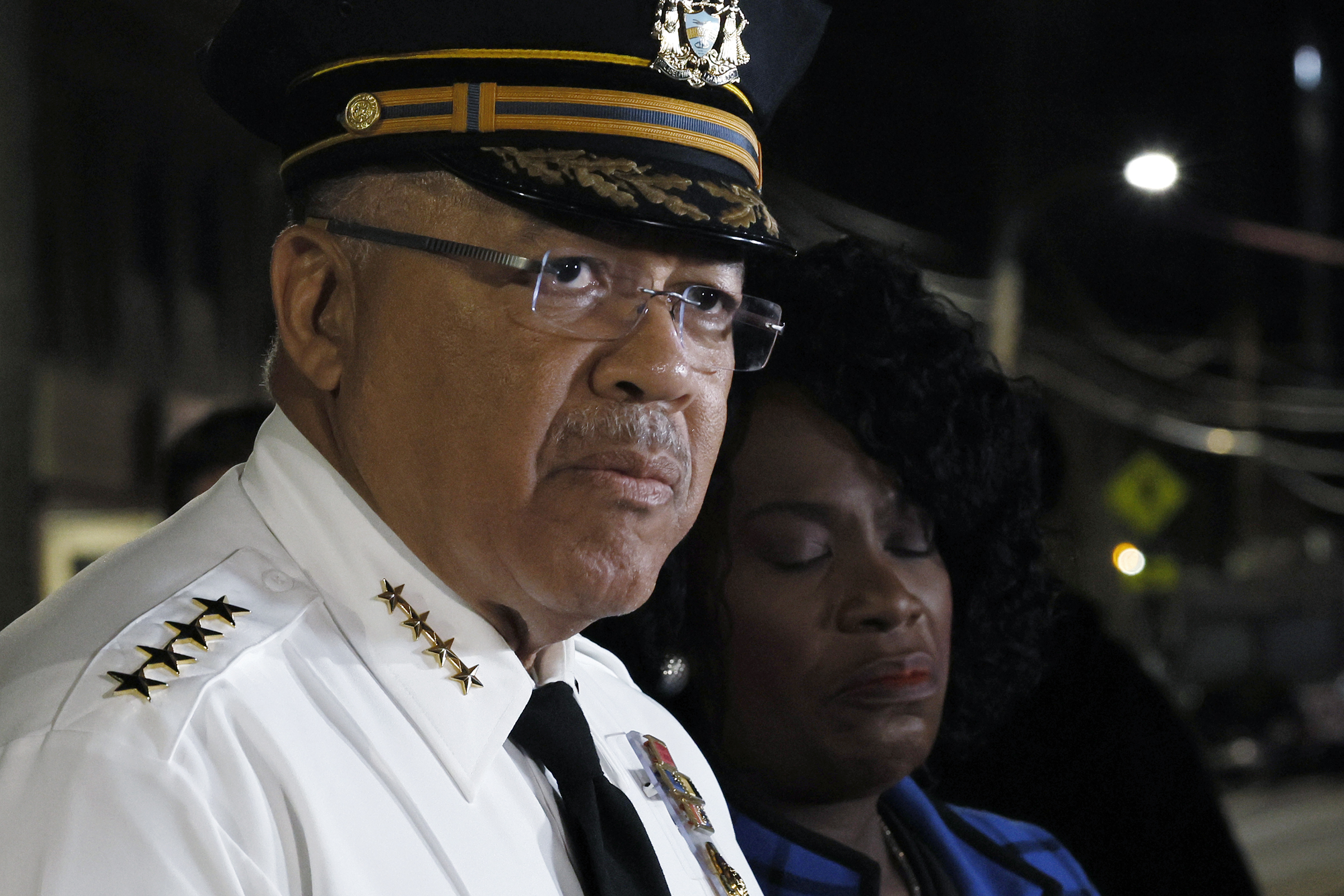
Philadelphia Police Commissioner Kevin Bethel and Mayor Cherelle L. Parker speak about the officers shot in West Philadelphia. Elizabeth Robertson / Staff Photographer
LONDON — U.K. Prime Minister Andy Burnham says it is clear that Russia interfered with Britain’s vote to leave the European Union, adding it was important to put Moscow’s tampering on the record because countries across Europe are facing the same threat.
In excerpts from The Rest is Politics’ podcast released Sunday, Burnham said that when he became prime minister in July he asked his advisers whether Russia had interfered with the 2016 referendum. The full podcast is scheduled to drop on Monday.
“I’ve had the clear answer that yes, there was,’’ Burnham said. “These things are important now to put clearly on the record and I believe help voters in Germany and France understand that some of this politics is instigated via our enemies, namely Russia.”
Russia has long said it does not meddle in other countries’ elections or referendums.
Burnham’s comments come as U.K. intelligence agencies warn about the increasing threat of Russian interference in Britain’s democratic institutions. The intervention is believed to be the first time a British prime minister has publicly acknowledged Russian interference in the Brexit vote.
Burnham said he spoke to German Chancellor Friedrich Merz about possible links between Russia and the far-right Alternative for Germany party when the two leaders met last week in Berlin.
“You know he was saying to me that the AfD are clearly linked to Russia, funded I believe,” Burnham said. “There is certainly misinformation, disinformation that is emanating from Russia into German politics,” he added.
Parliament’s Intelligence and Security Committee found in 2020 that the government failed to fully assess the impact Russian state-run media and “troll” accounts could have had on the EU referendum.
At least 139 people have died, including 15 children, after a boat carrying hundreds of migrants capsized while traveling from the Horn of Africa to Yemen, the International Organization for Migration said Sunday. An additional 84 are still missing, the United Nations body said in a statement, stoking fears that the death toll could climb.
The shipwreck is among the deadliest ever recorded on the route, one of the most dangerous crossings in the world. More than 80 people survived, all of them Ethiopian nationals.
The boat was carrying 305 people when it overturned between Thursday night and Friday morning, near Guhere, north of Obock, a small Djiboutian port town, the migration agency said. The migrants were traveling from Djibouti to Yemen across the Bab el-Mandeb Strait, the agency said. Last year, more than 900 people died or went missing while making the journey, according to an agency tally.
The bodies of nine girls and six boys were among the 139 recovered as of Sunday, the U.N. migration agency said. The cause of the disaster was not immediately clear.
Tens of thousands of men and women from Ethiopia and other East African countries make the desperate sea crossing from the Horn of Africa to Yemen every year, seeking jobs and security in Saudi Arabia and other Persian Gulf states. The boat trip is only the first part of a route fraught with danger. In Yemen, which has been torn apart by civil war since 2014, migrants risk violence, thirst, and hunger as they traverse the country toward the Saudi border, frequently on foot.
The additional risks posed by the heated conflict in Yemen, between the Houthi militia and government forces backed by Saudi Arabia, do not appear to have deterred migrants from embarking on the journey. Last week, the Yemeni government, backed by Saudi warplanes, launched a military offensive to retake territory along the Bab el-Mandeb Strait from the Houthis, who are backed by Iran. Much of the fighting has taken place in and around Ras al-Ara, a key entry point for African migrants arriving in Yemen.
The humanitarian situation has deteriorated sharply in the country in recent weeks, as the pace of the fighting escalates and front lines move quickly. More than 200,000 people have been displaced by the war, the migration agency said Wednesday, a sharp increase compared with the 76,000 displaced people it counted in mid-September.
The death toll as of Sunday makes the shipwreck one of the deadliest in the Red Sea in recent years. In August 2025, more than 60 migrants were killed after their boat capsized in the Gulf of Aden. The previous March, more than 180 went missing after two boats capsized off the coast of Yemen.
“We cannot keep treating these deaths as normal,” said Amy Pope, director-general of the International Organization for Migration. “No one gets into a boat like that unless they believe there is no other safe way,” she said in a statement Sunday. “I am asking governments and donors to act before the next boat goes down.”
Alexandre Coissac, the agency’s chief of mission in Djibouti, described the death toll as devastating. “This tragedy is a stark reminder of the dangers faced by migrants along this migration corridor as they seek economic opportunities,” he said in a statement.
Djiboutian authorities continued search and rescue operations Sunday, even as hopes of finding survivors began to fade. In Obock, the migration agency said it was working with the local authorities to provide healthcare and shelter for the survivors. The Djiboutian Health Ministry did not immediately respond to a request for comment.
Philadelphia Fire Department officials are investigating a house fire early Sunday that left a toddler dead and three others wounded.
The blaze broke out around 3:30 a.m. on the second floor of a home on D Street near Ontario in Kensington, officials said.
One adult and a child living in the home were able to escape, but firefighters had to rescue a toddler and another adult from a back bedroom of the home when they arrived on-scene.
The toddler, a girl, was pronounced dead from her injuries after being taken to St. Christopher’s Hospital for Children. The other child and one of the adults were listed in stable condition Sunday afternoon, officials said. The second adult remained in critical condition.
It was unclear how the fire started, but early reports indicated it was caused by a lithium e-bike battery, according to fire department officials. The fire remains under investigation.
PENSACOLA, Fla. — People in the Florida Panhandle and southern Alabama cleaned up after Isaias swept through as the storm’s remnants brought the risk of flooding to the central Appalachians and the mid-Atlantic region on Sunday. Meanwhile, significant waves from Rachel, a former tropical storm, battered the coast of Southern California.
“Major coastal flooding has already been occurring in some areas, with observed water levels running as much as 1.5 feet above predictions,” the National Hurricane Center said, noting that high waves are coinciding with high tides.
In western North Carolina, rivers overflowed as heavy rainfall raised the risk of flash and urban flooding, according to the National Weather Service. Tornadoes were possible in parts of Virginia and North Carolina, and life-threatening surf and rip current conditions were expected to continue along the Gulf and southeastern Atlantic coasts.
At least four deaths were linked to Isaias, the first hurricane of the Atlantic season, which came ashore as a Category 2 hurricane Friday near Destin, Fla., a Gulf Coast vacation spot filled with high-rises and tourist shops. The storm then roared into Alabama with tropical-force winds before heading farther north.
In Florida’s Escambia County, Sheriff Chip Simmons said a woman was killed when a tree fell on her home and a man died of carbon monoxide fumes from a generator running in his garage.
One person died when a tree fell on a house in Birmingham, Ala., said Cory Moon, the city’s fire chief. A second storm-related death in Alabama was attributed to a motor vehicle crash involving a downed tree in Barbour County, said Josh Johnson of the state’s emergency management agency.
Heavy rains cause problems in North Carolina
In Burke County, N.C., an unhoused man and woman were camping when floodwaters from the Catawba River caught them off guard. They were rescued, along with their dog, according to a spokesperson for the county emergency management agency. Separately, a woman trapped inside her car in floodwaters was freed outside of Morganton.
In McDowell County, N.C., just west of Burke County, first responders said they dealt with five landslides and voluntary evacuations overnight Saturday into Sunday as they responded to flooded roads and streams overflowing their banks.
“Despite a challenging night, we are thankful to report no known injuries or loss of life. We call that a success!” the county emergency management agency posted online.
Nearly a dozen local weather stations in the western North Carolina county reported torrential 24-hour rainfall totals at 9 a.m. Sunday, from about 5 inches to as much as 9.57 inches at the fire rescue station in Enola. The National Weather Service said rainfall was diminishing in the area but that rapid river rises and flooding remained possible.
Dealing with Isaias aftermath in Florida
Hurricane-force winds in the Florida Panhandle blew the roof off a Pensacola hotel, and the city’s mayor said the airport “took some damage.” The storm flattened a boathouse in Destin and ripped away part of the facade of a high-rise in Panama City Beach.
At a church in Pensacola where the United Cajun Navy was distributing supplies Sunday morning, a line of hundreds of cars stretched around the block. Yvette Haro said she arrived at 5 a.m. after being turned away the previous day because supplies had run out.
With a 10-year-old son and a 5-year-old daughter at home, she said, it’s hard to go to stores and wait in long lines. She was looking for water, paper towels, toilet paper, and cleaning supplies.
“Anything that they’re willing to give us is helpful,” she said.
While her home didn’t suffer any damage, the loss of electricity was making things difficult, Haro said. “The biggest thing is our food going bad. It’s really hard to keep grilling everything and then where do we store all this food?”
Roughly 356,000 customers were without power Sunday at 2:30 p.m. ET in southern Alabama and the Florida Panhandle, according to poweroutage.com.
Sarah Gatewood, a spokesperson for Florida Power & Light, said workers from all over Florida and from more than two dozen other states were mobilized to help restore power.
Rachel brings wind, rain to southern California, Southwest
Rachel became a post-tropical cyclone overnight, bringing unusually big waves to Southern California, and it dissipated over Las Vegas as it drenched deserts across the Southwest.
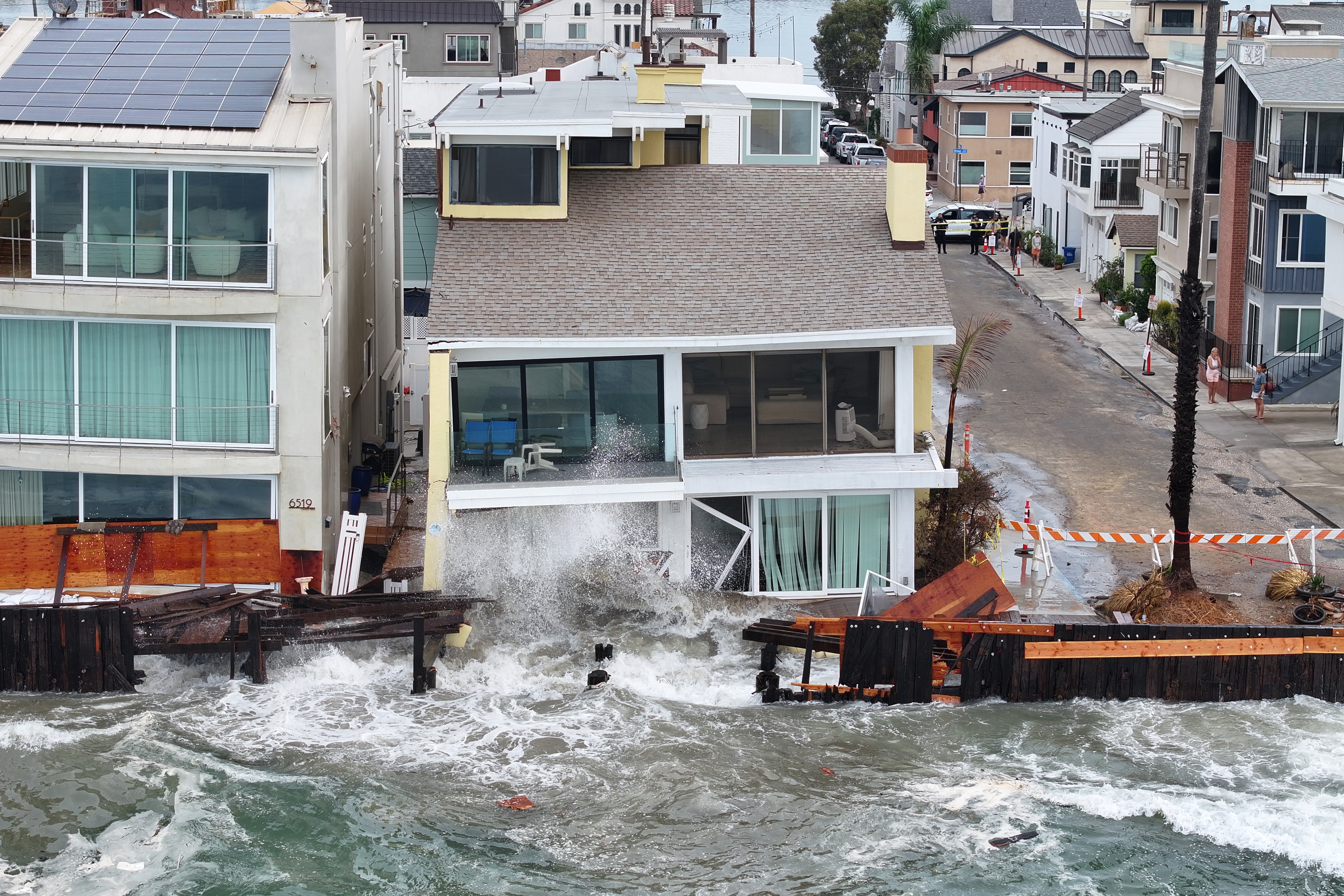
Waves battered a century-old wooden boardwalk on the Long Beach peninsula and forced homeowners to evacuate. The strip of multimillion-dollar oceanfront properties, along with much of the rest of the Southern California coastline, was already reeling from Hurricane Marie in September.
“This area is completely shattered and vulnerable,” Jack Gordon, a Long Beach real estate agent, said. “The fact that Rachel came and gave it the knockout blow — I don’t want to say it can’t get any worse for these houses, but it’s really, really sad.”
Long Beach Mayor Rex Richardson said that the storm would affect the whole city, and urged city residents to avoid the peninsula through the weekend as crews worked to clean up the area. More than half a dozen houses along the coast were declared structurally unsafe.
“It is not normal that we see this type of activity, especially for our residents in the peninsula,” Richardson said Saturday. “These kind of impacts are not normal, they are unprecedented for our community.”
And in the Pacific, Hurricane Simon was a Category 4 storm as it pounded Mexico’s Pacific coast Sunday, its eye remaining just offshore as its most powerful winds and rain slammed people living between the Sierra Madre and the ocean.
ATHENS, Greece — As the U.S. ambassador to Greece, Kimberly Guilfoyle has cultivated a highly visible profile, attending late-night parties and appearing on the cover of Vogue Greece. Lately, however, she has drawn a different kind of attention from Greeks.
Revelations last week that a Republican donor said Guilfoyle asked him to pay her American Express bill in exchange for access to senior Trump administration officials were the latest allegations of hardball tactics or outright misconduct to emerge against her.
Greeks interviewed in Athens in recent days expressed exasperation and cynicism about the steady drip of reports about Guilfoyle’s dealings, and some said they saw them as signs of what smaller countries are forced to endure from larger, wealthier nations.
“Greece is not a major power,” said Petros Malliaros, 35, a freelance lighting technician. “We have to get along with the U.S. and whatever representatives it chooses to send us.”
The accusations against Guilfoyle are “hardly a shock,” said Anna Markaki, a 38-year-old school teacher. Of President Donald Trump, she added, “He probably thinks she’s done a good job.”
Pavlos Iliopoulos, a 47-year-old pizza store owner, shrugged it off. “Greece is a small country and pretty much has to play along with the U.S.,” he said. “One corrupt diplomat staying or going isn’t going to make much of a difference.”
Anta Rapaki, 52, a former healthcare worker, criticized the administration’s decision to send Guilfoyle to Greece in the first place. “They’re underestimating my country as a faithful ally — instead of honoring that friendship, they sent her here as a favor,” she said.
She added, “Because we’re a small country, we have to have friends, and we need the U.S. But we’ll dance the dance up to the point that serves us; we won’t knuckle under.”
Guilfoyle, who was once engaged to Trump’s oldest son, Donald Trump Jr., was one of the first ambassadors to be nominated in the president’s second term. She has said that her experience with Greece before being nominated as Trump’s envoy last November came from college history classes and a honeymoon trip. She has served in Athens with a mixture of MAGA glitz and what her supporters have described as relentlessness in securing business deals involving American interests.
She has come under fire in recent weeks in reports in the Wall Street Journal, which reported last month on potential conflicts of interest in Guilfoyle’s involvement in energy deals in Greece.
This past week, the Journal revealed her communications with a Republican donor, Eric Deters, who said Guilfoyle had asked him to wire $100,000 to pay off her credit card just before her confirmation hearing, which he did not pay. The New York Times confirmed their discussions.
A lawyer for Guilfoyle declined to comment. The U.S. Embassy in Athens directed requests for comment to the State Department in Washington, which did not respond.
In a visit to Athens, Secretary of State Marco Rubio refused to answer questions Thursday about the ambassador’s conduct. Before his trip, he had described her as “an incredibly effective advocate for the president’s agenda in Greece,” adding that she had “successfully advanced U.S. energy interests in Greece and across southeastern Europe.”
Trump said he knew little about the allegations against Guilfoyle. “I don’t know too much,” he told journalists Friday. “But she was always very nice.”
For some Greeks, more troubling was a comment she was reported to have made at a dinner in Athens in March insinuating that the United States could replace the Greek government. “The fact that they would send someone like that here, with no tact or diplomacy skills, shows how low we rank in Trump’s priorities, how insignificant Greece is for them,” said Maria Stefanou, a 68-year-old retiree.
Guilfoyle’s lawyer has disputed the characterization of the dinner, and Foreign Minister George Gerapetritis said Friday that the Greek energy minister who was there denied it as well.
Asked about Guilfoyle’s purported comment, Pavlos Marinakis, a government spokesperson, said, “There was never any question of the Greek government being threatened, nor would anything of the sort ever be tolerated.” He added that the Greece-U.S. partnership was founded on “mutual respect.”
In parliament Friday, Gerapetritis said it was not necessary to summon Guilfoyle to explain herself. “Summoning an ambassador and potentially creating a diplomatic incident would serve no purpose,” he said.
Their responses were part of a Greek government effort seeking to tamp down a national debate over Guilfoyle. Prime Minister Kyriakos Mitsotakis has aligned himself with the Trump administration, seeking cooperation on security and other issues.
“As long as Ms. Guilfoyle enjoys the support of the U.S. president and secretary of state, the Greek government has to respect the position of the U.S. government,” said Constantinos Filis, a prominent analyst and director of the Institute of Global Affairs at the American College of Greece. “It’s as simple as that.”
Leftist parties have called on the government to demand clarifications from Guilfoyle.
“Favors from Trump’s America come with a price tag,” Rena Dourou, a prominent lawmaker of the leftist Syriza party, said Friday. “The question is: How much will the Greek people ultimately have to pay?”
Guilfoyle is the latest of Trump administration ambassadors accused of engaging in decidedly undiplomatic behavior. Many serve in Europe, which long has been a destination for U.S. political appointees of both parties who have little to no experience in official diplomacy.
Bill White, the U.S. ambassador to Belgium, was asked by that country’s foreign minister to stop making derogatory statements about government officials. Charles Kushner, the chief envoy to France (and father of Jared Kushner, Trump’s son-in-law), ignored summonses by the French Foreign Ministry after criticizing Paris for doing too little to combat antisemitism.
Justice Department lawyers have invoked executive privilege to prevent Kennedy Center officials from answering questions about President Donald Trump’s involvement in the institution’s operations, setting up an unusual legal fight over whether presidential secrecy protections extend to his role as chairperson of an arts organization.
The dispute emerged in a lawsuit brought by Rep. Joyce Beatty (D., Ohio), who is challenging decisions made by the Trump-controlled Kennedy Center board, including plans to close the performing arts complex for renovations.
The clash has lengthened the discovery phase of Beatty’s lawsuit by several weeks. On Friday, the case’s judge ordered the center to turn over more financial information. But he has allowed the center more time to respond to the question of executive privilege.
During depositions this week, government lawyers instructed a Kennedy Center official not to answer questions about communications involving Trump and his advisers, including discussions about the center’s finances, renovation plans, potential demolition, and closure, according to court filings.
In one exchange, Kyle Freeny, an attorney for Beatty, asked Kennedy Center executive director Matt Floca what Commerce Secretary Howard Lutnick had said when Lutnick first contacted Floca about helping the institution.
“Executive privilege on that. Don’t answer that,” Justice Department attorney William Jankowski instructed Floca, according to a deposition transcript filed in court.
Jankowski identified the protection as presidential communications privilege. When pressed, he acknowledged that the objection was “protective” rather than one made at Trump’s direction.
Executive privilege generally allows presidents to shield certain confidential communications connected to their official responsibilities, reflecting the principle that presidents and their advisers need space for candid deliberations. But the protection is not absolute.
The Kennedy Center dispute presents an unusual question: Does that protection follow a president into conversations he conducts while serving in another capacity?
Trump became chairperson of the Kennedy Center board in February 2025 after replacing trustees with political allies. Although the center was established by Congress and receives federal funding, it operates outside the executive branch.
Jonathan Shaub, a University of Kentucky law professor who previously worked in the Justice Department’s Office of Legal Counsel, called the privilege claim highly unusual.
“If the president is not acting in his capacity as president, it doesn’t apply,” Shaub said.
Trump’s role as Kennedy Center chairperson, he argued, is distinct from his constitutional responsibilities as president, and his involvement in the institution does not automatically extend presidential confidentiality protections to its operations.
“It’s sort of like gerrymandering a privilege claim,” he said.
Mark Rozell, a George Mason University professor who has studied executive privilege across administrations, was more emphatic.
“This doesn’t even meet the laugh test,” Rozell said of the claim as described to him. He said he knew of no historical precedent for a president successfully invoking the protection in a separate institutional role.
The Kennedy Center and the White House referred questions to the Justice Department, which declined to comment.
Beatty’s lawyers have also accused the administration of trying to have it both ways. In court filings defending the closure, the defendants cited conversations between Trump and Floca. But when Beatty sought information about those communications, Justice Department lawyers objected on executive privilege grounds.
Shaub said courts are generally reluctant to find that the executive branch has forfeited executive privilege, but a judge could be skeptical of allowing the government to rely on conversations as evidence while preventing the opposing side from examining them.
The objections also extended to questions about the Kennedy Center’s finances. During a deposition Wednesday, Freeny asked Floca whether he had raised concerns with Lutnick about conditions attached to certain donations received by the center.
Jankowski objected, saying the question could implicate the presidential communications privilege.
“Object to the extent that that could be construed as advising the president or his advisers on the president’s behalf,” Jankowski said. “On executive privilege grounds, I’ll instruct the witness not to answer.”
He added: “But if you can answer beyond that, feel free.”