Category: News

  • John Anderson, voice of ‘Seminole Wind,’ dies at 71

    John Anderson, voice of ‘Seminole Wind,’ dies at 71

    John Anderson, the country music hitmaker whose gravelly, warbled vocals produced honky-tonk staples such as “Swingin’” and “Seminole Wind,” has died. He was 71.

    Mr. Anderson’s family confirmed his death in a post on social media early Thursday, describing him as “a gifted country music singer whose voice and songs touched countless lives.”

    A native of South Florida, Mr. Anderson was inducted into the Country Music Hall of Fame in 2024, the culmination of a career that spanned nearly five decades.

    Born in 1954, Mr. Anderson first picked up a guitar as a child. Although he was initially drawn to rock ’n’ roll, he pivoted after his mother brought home a country album by Ray Charles. But it was the pioneering voice of Merle Haggard — who would eventually become a friend — that hooked Anderson on the genre.

    “I heard ol’ Merle Haggard and got turned on to his Greatest Hits album,” Mr. Anderson told Pollstar in 2024. “I got ahold of that, and boy, that’s when I fell in love.”

    After moving to Nashville as a teenager in the 1970s, Mr. Anderson found mixed success until 1982, when his album Wild & Blue burst onto the scene.

    A track from that album — “Swingin’” — became a country music anthem and remains one of his most enduring hits. More than 40 years since its release, Mr. Anderson could not touch a stage without playing it. “At this point, I would never think about not doing it,” he told Pollstar.

    In a famously fickle industry, Mr. Anderson managed career reinventions and comebacks over nearly a half century, releasing dozens of records. After going quiet in the late 1980s, he roared back with “Seminole Wind,” an homage to his home state that was critically acclaimed as one of his greatest recorded vocals.

    His last record, Years, was released in 2020. Four years later, he was inducted into the Country Music Hall of Fame.

    “I’m just glad I’m alive to see it,” he told Rolling Stone at the time.

    Mr. Anderson remained active in the country music scene, touring and performing regularly, including stints with his friend and collaborator Blake Shelton and appearances at the Grand Ole Opry in Nashville. As recently as Sunday, Anderson attended the Country Music Hall of Fame induction ceremony for Tim McGraw, among others.

    “We talked, we laughed, we sang his songs that I loved so much together, just goofing off. I am completely heartbroken by his passing,” McGraw wrote on Instagram on Thursday. “There will never be a stylist in music, any music, that was so defining as his.”

    Shelton also saw Anderson on Sunday, he wrote on Instagram.

    “I am sick and I am stunned,” Shelton wrote Thursday. “But I am a very lucky man. I got the opportunity to find out that my hero wasn’t just the guy I hoped he’d be. He was so much more than that. John was my friend.”

    Information about survivors was not immediately available.

  • Port Richmond’s 48-foot-tall pile of industrial waste is finally getting cleaned up

    Port Richmond’s 48-foot-tall pile of industrial waste is finally getting cleaned up

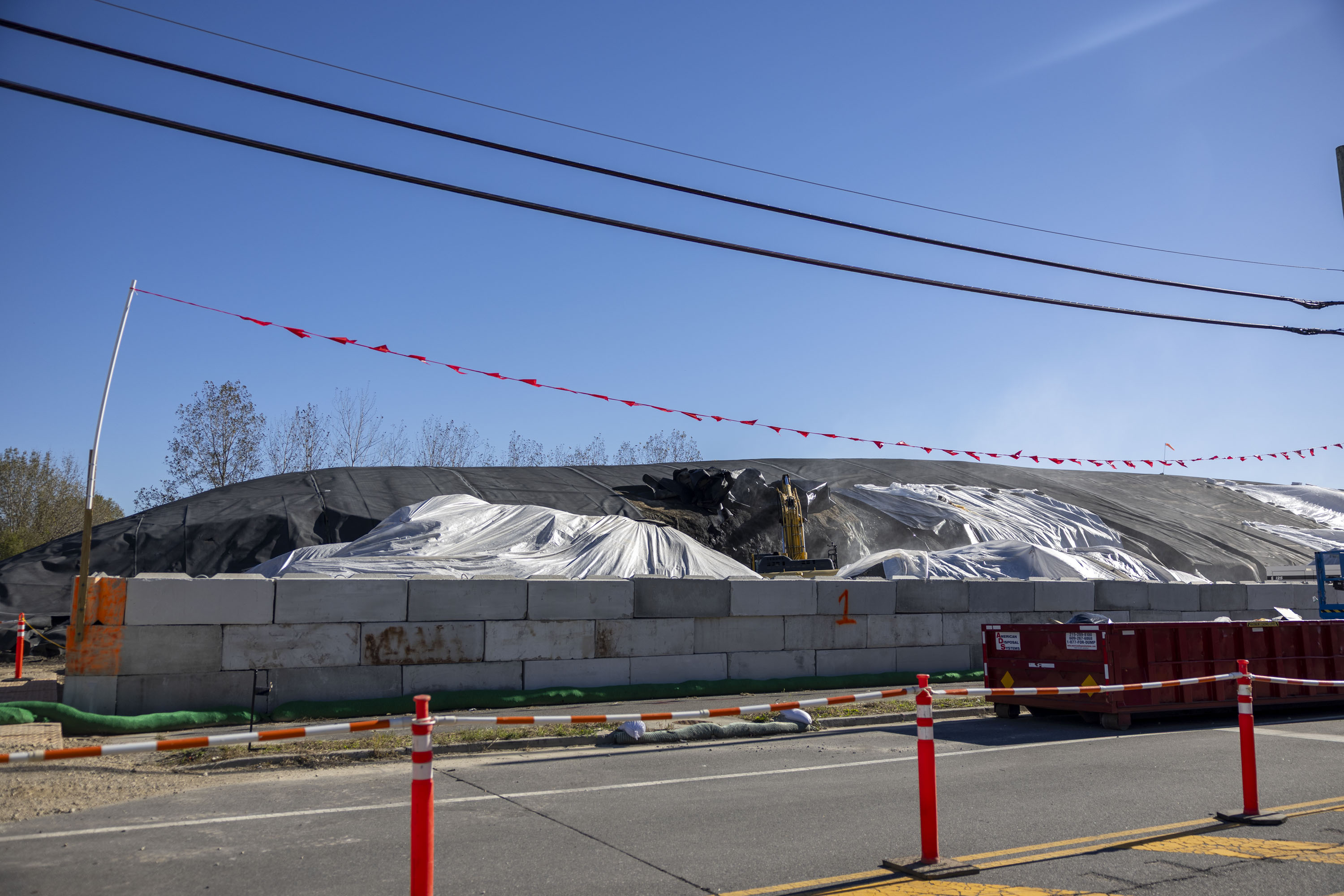
    The 48-foot-high, 350-foot-long Franklin Slag pile has dominated the corner of Castor and Delaware Avenues in Port Richmond.

    Now, crews have begun a painstaking $26 million process of removing the equivalent of 20 Olympic-size swimming pools full of contaminated industrial byproduct from a defunct copper smelting operation just off the Delaware River.

    “This is a 68,000-cubic-yard pile of hazardous waste that’s been in people’s backyards,” Andrew Haneiko, project manager for the U.S. Environmental Protection Agency’s Region 3, said during a tour of the site on Thursday. “It’s part of the EPA mission to get the stuff treated and get it out of here and turn the site back into productive use.”

    The EPA, along with the U.S. Army Corps of Engineers, began remediation and associated construction in August. But crews from New York-based contractor Sevenson Environmental Services have just begun digging up the pile.

    Though the contract is through May 2031, Haneiko believes most of the pile could be gone by next fall. Castor Avenue, parallel to the site, is closed. Cars and bikes are being detoured through Balfour and Venango Streets.

    Cleaned slag will be transported north on I-95 to WM’s Fairless Landfill in Bucks County.

    “No trucks will be going through the community,” Haneiko said. “That’s a really important part of this project.”

    Though the area is mostly industrial, State Rep. Joe Hohenstein, a Democrat who represents the area, noted that over 20,000 people live within a mile of the site and people work nearby.

    He said he is sure the cleanup is safe for residents and workers at the nearby Port of Philadelphia, and at industrial facilities who could be exposed to any drifting pollution.

    “We need to make sure that we’re taking care of our environmental quality for our neighborhoods,” Hohenstein said.

    The cap on the Franklin Slag Pile Superfund site in Port Richmond.Tyger Williams / Staff Photographer

    A history of contamination

    Franklin Smelting & Refining Corp. began smelting copper at the site in the 1930s, producing slag as a byproduct.

    MDC, the operator of the site from the 1950s to 1999, sold the slag as sandblasting grit. But the slag migrated off site. It once covered the nearby rail line and area sidewalks. It caked the inside of storm drains, and could be seen blowing away.

    The EPA, the City of Philadelphia, and the Pennsylvania Department of Environmental Protection (DEP) sampled the site in the 1980s and 1990s and determined the slag contained leachable concentrations of lead. Additional sampling revealed high concentrations of beryllium, copper, and lead in the air near the pile. In high quantities, all can be harmful to humans.

    The four-acre site was added to the EPA’s National Priorities List of contaminated sites and entered into the Superfund program, making it eligible for cleanup funding.

    In 2000, the EPA piled the slag and capped it with a membrane so it could be controlled. Slag that had spilled off-site was removed, along with slag and contaminated soil at a nearby wetland.

    Officials began studying how to approach the site’s full cleanup in 2007. In 2020, the EPA issued a formal plan.

    Sevenson, the contractor, was hired in March.

    Franklin Slag is one of two Superfund sites in Philadelphia. The other is Metal Bank in the Northeast.

    Haneiko, the EPA project manager, said insurance carriers from the site’s previous owners are paying $18 million toward cleanup costs.

    The Franklin Slag site is currently owned by Franco’s Realty Inc. The EPA said there are no immediate plans for the property’s use.

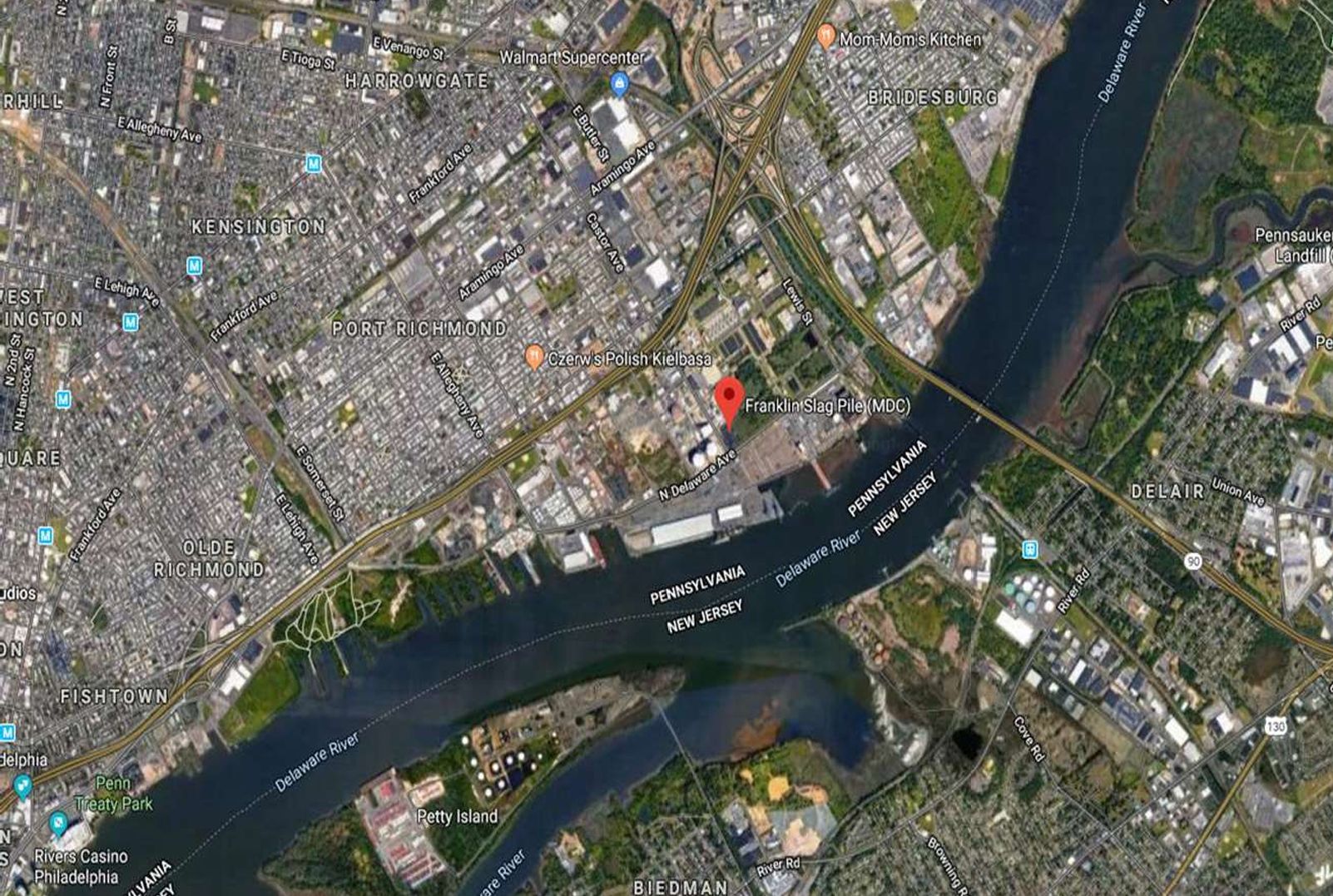
    The land is zoned for heavy industry. It is bordered by a Conrail rail line, closed lagoons owned by Philadelphia Water Department’s Northeast Water Pollution Control Plant, and a Philadelphia Gas Works plant.

    The Delaware River is less than one-quarter mile southeast. The closest residents are about one-half mile away.

    A map by the U.S. Environmental Protection Agency shows the location of the Franklin Slag Superfund site in Phiadelphia’s Port Richmond neighborhood.U.S. EPA

    How the cleanup works

    Army Corps Lt. Col. Ryan Baum said his organization served as an overall project manager for the Franklin Slag site. The Army Corps provided engineering, construction oversight, and contract management, including hiring Sevenson.

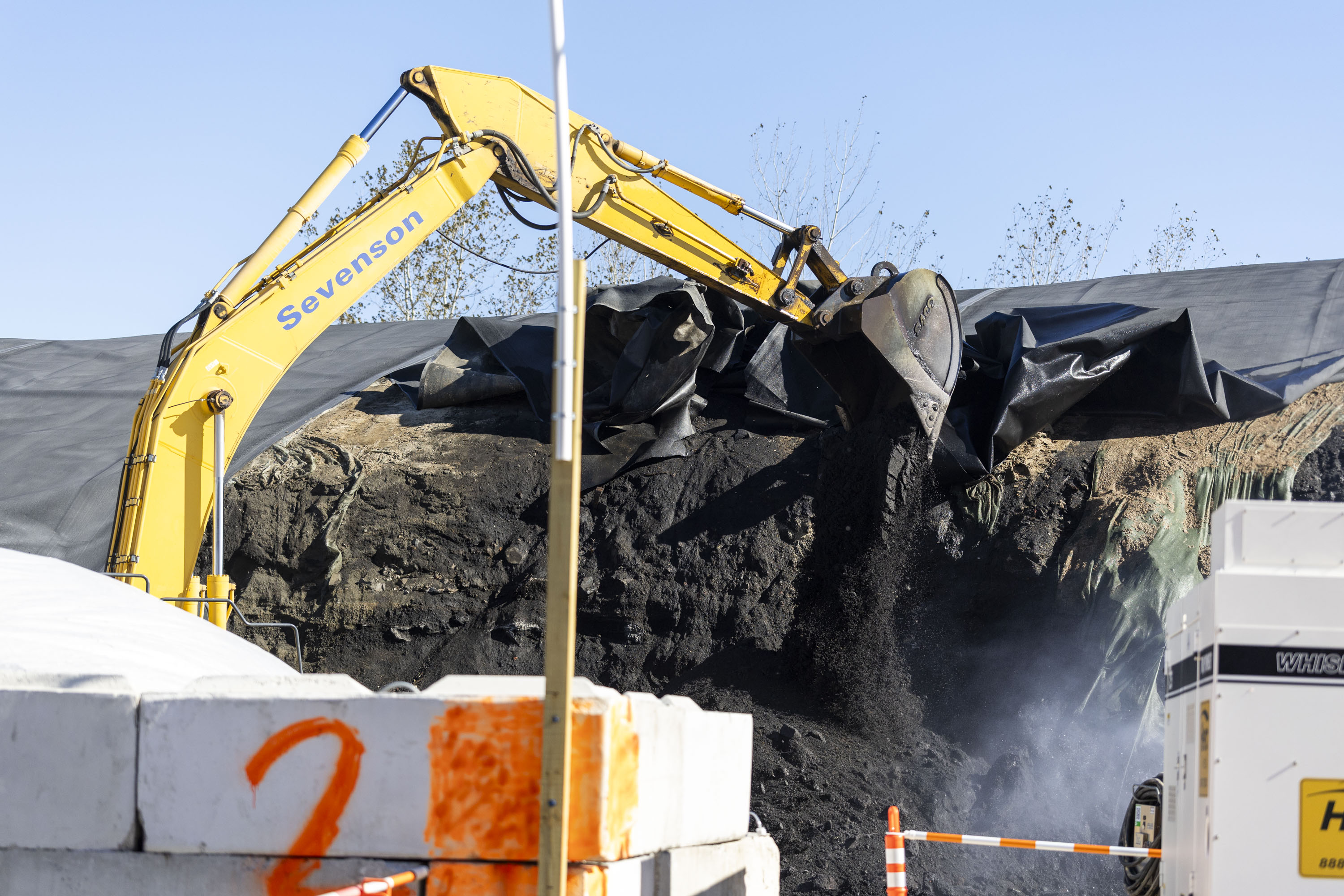
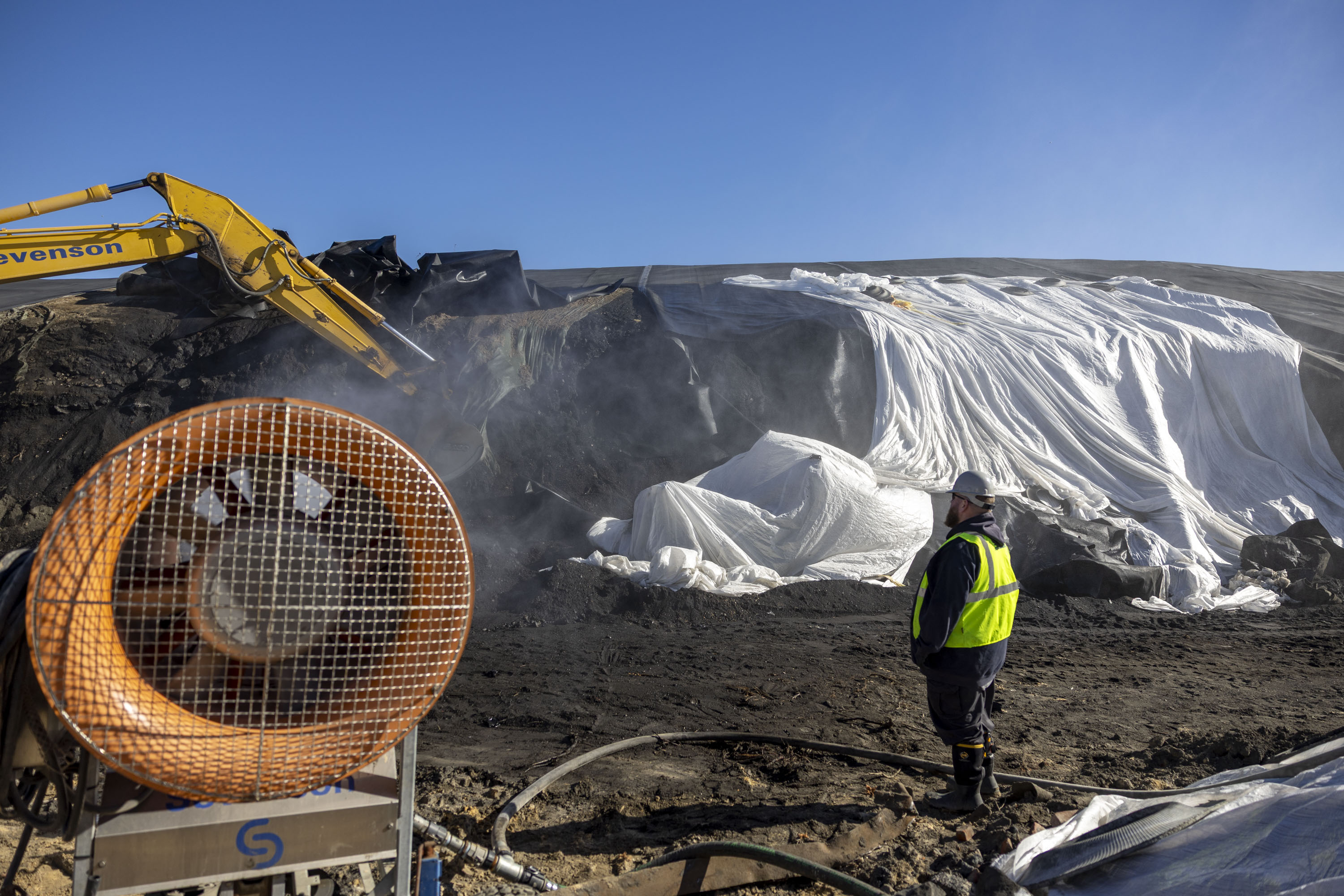
    Each day, crews from Sevenson peel back part of the slag’s cap. They wet the slag to keep it from blowing away. Dust suppression equipment known as a DustBoss emits a fine mist that collides with dust particles to bring them to the ground.

    As the slag is excavated, a proprietary liquid chemical reagent called Make-Tight is applied at a pace of roughly 50 cubic yards every 30 minutes. The solution permanently binds the lead so it cannot leach into groundwater while at the landfill.

    Each batch is tested to ensure it is nonhazardous. The slag is then loaded into haulers equipped with liners, known as “burrito bags,” to prevent dust from escaping into the neighborhood.

    The trucks travel Castor Avenue to I-95, bypassing residential areas.

    Slag being removed from the Franklin Slag Pile Superfund site.Tyger Williams / Staff Photographer

    Solar-power stations encircle the perimeter and monitor the air continuously. If dust reaches 150 parts per million, real-time mobile alerts will prompt workers to halt.

    Additional air monitors are installed at neighboring industrial sites and nearby homes based on community input.

    Angela Unoarumhi, a spokesperson for the EPA, said the agency began meeting with neighborhood groups in March to listen to concerns.

    It met with Port of Philadelphia officials, union stevedores, and port workers concerned about dust.

    As a result, air monitors were installed at the port as well as in a lot adjacent to I-95, near where a 30-year resident of the neighborhood lives. The EPA also learned of a nearby bike path that was not on initial project maps.

    “It allowed us to be better positioned to address community concerns,” Unoarumhi said of the meetings.

  • Powerful Democratic Virginia state Sen. Lucas is accused of leading a marijuana criminal conspiracy

    Powerful Democratic Virginia state Sen. Lucas is accused of leading a marijuana criminal conspiracy

    NORFOLK, Va. — Virginia state Sen. L. Louise Lucas, one of the state’s most powerful Democrats, was charged Thursday with leading what authorities alleged was a wide-ranging criminal enterprise that acquired and distributed large quantities of marijuana and laundered the proceeds.

    Lucas, who has been in elected office for decades, used her political power to insulate the operation from scrutiny, according to an indictment charging her and six other defendants, including several of her relatives. She “put her own financial interests before the people she was elected to serve,” said U.S. Attorney General Todd Blanche, who spoke at a news conference with FBI Director Kash Patel.

    Lucas surrendered, the Justice Department said. She made a brief appearance in federal court on Thursday afternoon, where she was released on her own recognizance, according to court records. She left the court without addressing media gathered outside and went straight into a waiting vehicle.

    The charges, including drug trafficking and money laundering, came after the FBI searched Lucas’ hometown office and a cannabis shop in which she has a stake in May. At the time of the search, Lucas — who has been a vocal critic of Republican President Donald Trump’s administration — characterized it as an attempt to intimidate her.

    “This is the circus we always expected it to be,” said Brian Woolfolk, chief counsel for the L. Louise Lucas Legal Defense Fund.

    Lucas says she won’t be bullied by the federal government

    A statement attributed to Lucas posted on her social media account did not directly address the substance of the charges but said Thursday’s actions amounted to the federal government wielding its “full weight” against a great-grandmother.

    “I will not be intimidated. I will not be bullied. And I will not back down,” Lucas said in the statement.

    The brash 82-year-old lawmaker has spent decades ascending the ranks of Virginia politics and has served since 1992 in the state Senate, where she’s the president pro tempore, overseeing the chamber in the lieutenant governor’s absence. More significantly, she leads the powerful Senate finance committee, through which all legislation with any budget impact must flow. She’s used the position to kill legislation she opposes.

    Justice Department denies politics played a role

    The indictment comes as Trump’s Justice Department has faced intense scrutiny over investigations and prosecutions against foes of the president that critics have called politically motivated.

    Blanche rejected any suggestion politics played a role in Lucas’ case, noting the investigation began well before the second Trump administration started in January 2025.

    “We don’t do political paybacks,” Blanche told reporters.

    A person familiar with the May search told The Associated Press at the time that the probe was opened during Democratic President Joe Biden’s administration. The person spoke on condition of anonymity to discuss a continuing criminal investigation.

    FBI alleges a ‘criminal marijuana enterprise’

    Patel said in a statement that “Lucas and a close-knit group of family members and associates orchestrated a multi-year scheme to enrich their own criminal marijuana enterprise, ‘the Lucas Enterprise’ — using Lucas’ position as Chairwoman of the Senate Finance and Appropriations Committee to insulate the enterprise from criminal scrutiny and influencing legislation to financially benefit themselves.”

    The indictment describes Lucas as the “leader of the enterprise” who “approved and directed criminal activities,” including arranging for the acquisition and distribution of marijuana and supervising the laundering of the proceeds.

    The indictment alleges Lucas worked this year with another of the defendants to use her political position to obtain a recreational marijuana license for him, with the understanding that the proceeds from sales under the license would be shared with her to support the “enterprise.”

    Since 2021, marijuana has been legal to possess in Virginia, and many shops across the state have sold cannabis-derived products. But full recreational sales are not yet underway; legislation enacted earlier this year will allow them beginning in July 2027.

    Law enforcement made multiple controlled purchases of marijuana from Lucas’ shop, which purported to sell hemp products, in 2024 and 2025, the indictment said.

    In addition to drug and money laundering charges, Lucas faces a charge of racketeering conspiracy, conspiracy to commit honest services fraud, and maintaining a drug-involved premises. An arraignment is scheduled for next month.

    Among the other defendants who face a mix of those and other charges are two daughters of Lucas and a grandson. It was unclear if they had obtained legal representation. They were also scheduled to make an initial court appearance Thursday afternoon.

    Virginia officials react

    A forceful advocate of legalizing marijuana, Lucas partnered in opening the shop, The Cannabis Outlet, in 2021. She has publicly spoken about her ownership stake as recently as June, though her most recent financial disclosure forms do not list the business by name.

    At the time of the search — when marijuana was recovered at The Cannabis Outlet, according to the indictment — many Democrats spoke up to defend Lucas.

    On Thursday, Scott Surovell, the Democratic leader of the state Senate, said in a statement that the indictment contained “serious allegations” but emphasized that “Senator Lucas has the right to defend herself, and she has my full support as she does so.” Attorney General Jay Jones, a Democrat who is close with Lucas, said the allegations against her must be tested in a “full and fair” legal process.

    House Speaker Don Scott, Lt. Gov. Ghazala Hashmi, and Gov. Abigail Spanberger, all Democrats, echoed those sentiments, with Spanberger adding that the timing of the indictment so close to the midterm election would “further erode” Americans’ trust in the Justice Department. Lucas herself is not on the ballot this year.

    Ryan McDougle, the Senate Republican leader, said he would not comment while the court proceedings play out.

    The senator draws comparisons to Trump

    Lucas, who represents a district that includes her hometown of coastal Portsmouth, operates with a sometimes-profane, unapologetic style that’s drawn comparisons to Trump.

    She amassed a six-figure following on X and national attention, using the social media platform to advocate forcefully for her priorities and to bash her critics, including former GOP Gov. Glenn Youngkin. She’s also occasionally blasted members of her own party, including Spanberger, with whom she’s had disagreements.

    Earlier this year, Lucas helped lead Democrats’ ultimately unsuccessful plan to gerrymander the blue-leaning state’s congressional districts into a map intended to elect 10 Democrats and only one Republican. Along the way, she posted quips about four GOP members the intended map sought to oust, joking that they soon would be working at McDonald’s. She and other Democrats defended the maps as a reasonable response to Trump-backed efforts to boost the GOP’s midterm advantage in other states.

    Lucas has been in politics for decades

    Lucas has notched several historic firsts in her career. According to a biography from the state library, in 1971 she became the Norfolk Naval Shipyard’s first female shipfitter, a physically demanding job that involves working on metal assemblies for vessels.

    She launched her political career in 1984, when, the biography said, she became the first Black woman elected to the Portsmouth city council.

    In the state Senate, Lucas has been a staunch advocate for abortion rights and increased public school funding and a leading voice on issues of racial justice and civil rights.

    In 2019, after Democrats flipped control of the chamber, her peers elected her to serve as president pro tempore. And in 2024, she was tapped to lead the chamber’s budget committee, gaining enormous sway over any legislation tied to the state budget.

  • SEPTA ridership hits record high since pre-pandemic. But overall ridership still has not fully recovered.

    SEPTA ridership hits record high since pre-pandemic. But overall ridership still has not fully recovered.

    While SEPTA ridership has still not fully bounced back to its pre-pandemic levels, in September, the transit agency recorded the most riders since February 2020.

    SEPTA’s average daily ridership in September passed 822,000 across all modes of transportation, according to new data the agency released Thursday. September also marked the seventh consecutive month of year-over-year ridership — up 8% compared with September 2025.

    “Our focus on the fundamentals has raised our standards, and riders are noticing the difference,” SEPTA general manager Scott A. Sauer said. “They are seeing cleaner stations and vehicles, the system feels safer, and it is becoming easier to use and more accessible.”

    Transit systems across the country are trying to bounce back ridership after years of decline due to rising costs of travel, hybrid work keeping more commuters at home, and the pace of post-pandemic economic recovery. SEPTA worked to address antisocial behavior, like smoking on the Market-Frankford Line, and is working to establish reliability on Regional Rail after fires on Silverliner IV trains took more than 200 railcars out of service.

    More than 800,000 people rode SEPTA on 18 out of 21 weekdays in September. Tuesday, Wednesday, and Thursday are the most popular days to take transit. In late 2019 through early 2020, ridership was about 900,000 on an average weekday, according to SEPTA spokesperson Andrew Busch.

    The agency credits the weekday ridership boom in part to the New Bus Network, according to a new performance report covering the first five weeks of service.

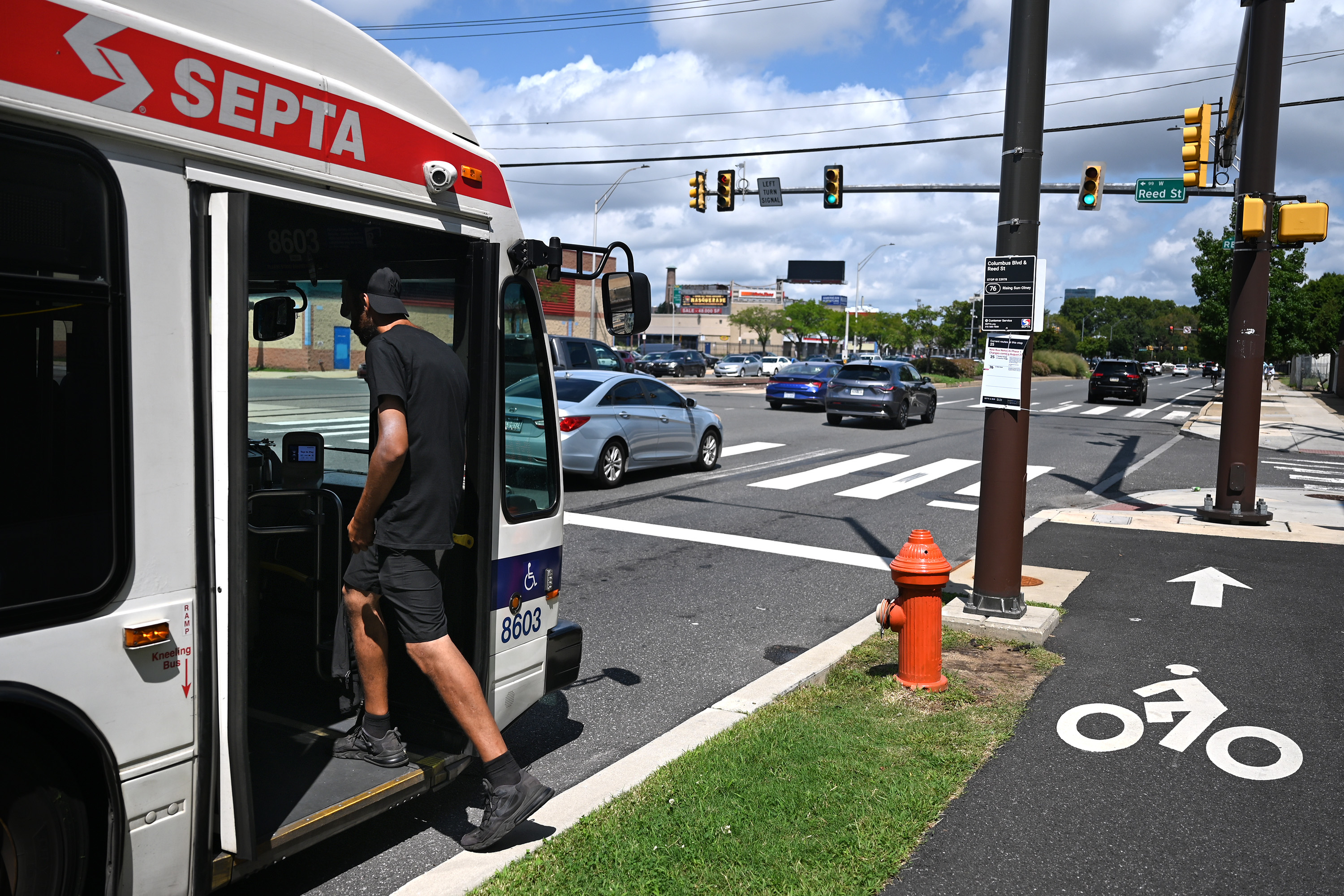
    Passenger board the brand new #76 bus at Reed St. and Columbus Blvd. Sunday, Aug. 23, 2026 on the day the line is introduced as part of SEPTA’s “New Bus Network.” Tom Gralish / Staff Photographer

    The network, SEPTA’s long-delayed streamlining of its bus system, brought changes to 30 routes, including more frequent service on routes with high ridership and buses coming less often on lower-performing routes. Impacted routes experienced a 7% increase in average weekday ridership, with weekend travel growing by 12% on Saturdays and 18% on Sundays.

    “We’ve thought for some time that there’s pent-up demand, and I think we’re seeing that play out,” Busch said of the boom in weekend bus ridership. “The new bus network is aimed at making the trip more reliable by making it more frequent and making better, more convenient connections to other services.”

    Bus riders, who account for more than half of SEPTA’s ridership, were up 14% overall compared with the same time last year.

    SEPTA Regional rail train passes riders waiting for their train at Jefferson Station, Philadelphia, Tuesday, October 7, 2025.Alejandro A. Alvarez / Staff Photographer

    While buses, trolleys, and the Broad Street Line (now dubbed the B) have experienced stronger weekday ridership, Regional Rail is still trailing behind last year’s totals.

    Busch attributed the lag to capacity and frequency issues, which the transit agency hopes to help address with the purchase of 24 used railcars from the Montreal Transit Agency and the leasing of 10 others from Maryland Area Regional Commuter Rail (MARC) in December 2025.

    Railcar procurement can take five years to complete, Busch said. The 34 used railcars will be put into service in early 2027.

    An earlier version of this article incorrectly stated SEPTA ridership returned to pre-pandemic levels, when the ridership hit its highest level since February 2020.

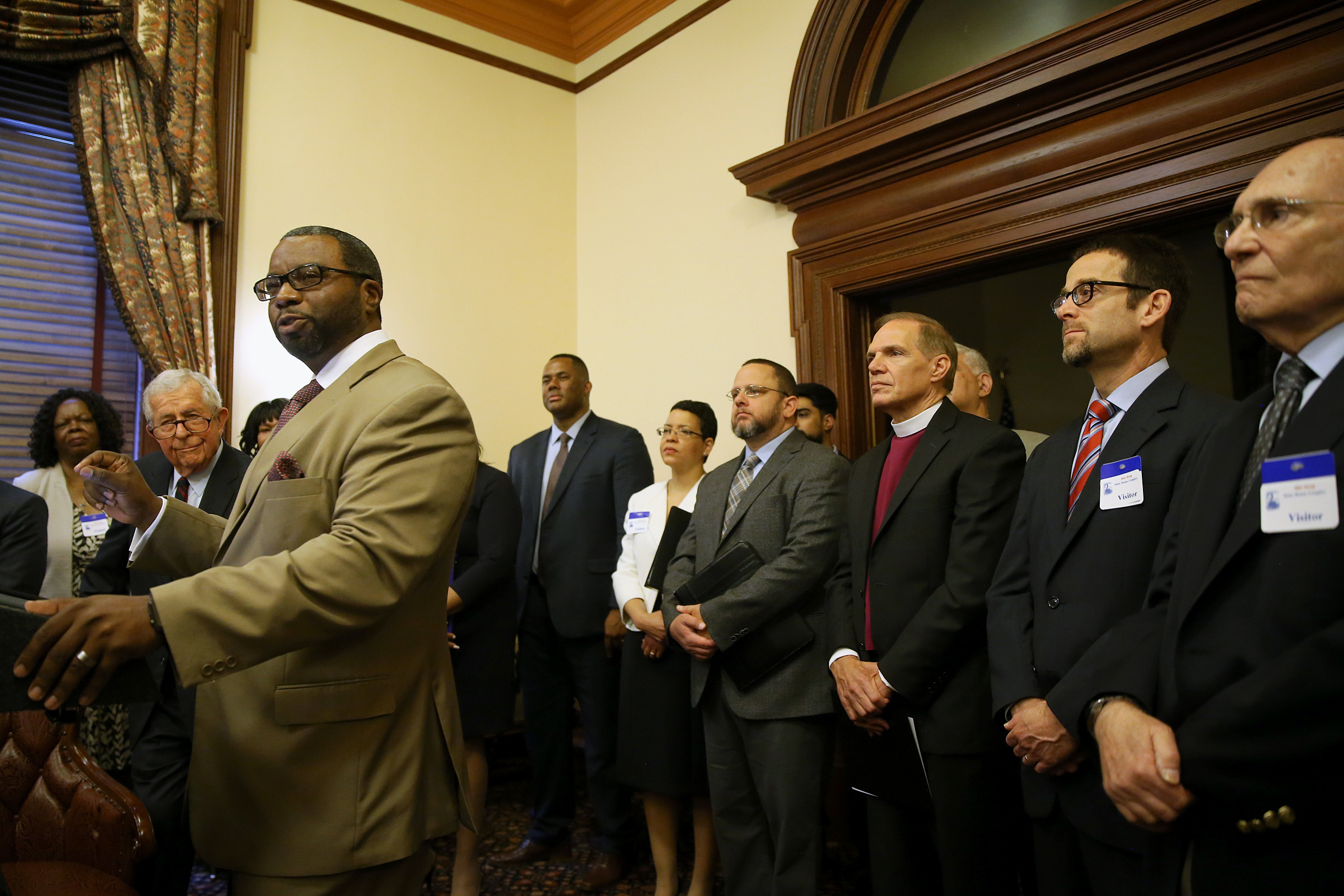
  • A long fight to desegregate New Jersey schools reaches an appeals court

    A long fight to desegregate New Jersey schools reaches an appeals court

    A sweeping New Jersey school segregation lawsuit reached a state appeals court on Thursday, when a coalition of civil rights groups, students, and parents urged judges to hold the state responsible for racial divisions in its public schools and order a plan to address them.

    For more than eight years, the coalition has argued that New Jersey has allowed racial segregation to persist in its districts, leaving hundreds of thousands of Black and Latino students in predominantly nonwhite schools, depriving kids of equal educational opportunities.

    But the state has failed to fix the longstanding disparities, according to the coalition, which includes the Latino Action Network and the NAACP New Jersey State Conference.

    The arguments Thursday at the Appellate Division of the state Superior Court in Trenton marked a milestone in the case. They followed a 2023 ruling in which a trial judge declined to decide whether New Jersey had violated the state constitution, and more than a year of mediation that ended without a settlement.

    After a lengthy hearing, it was not clear which way the judges were leaning. They repeatedly questioned whether the coalition could prove its case with the enrollment data it presented, and pressed both the coalition and the state on whether the case could be decided without a trial.

    The judges did not rule Thursday, but said they hoped to decide soon. When they do, they could side with the plaintiffs, moving the case closer to a court-ordered fix; side with the state, which could end the case; or send it back to a lower court, possibly for a trial.

    How the case got here

    The case began on May 17, 2018 — the 64th anniversary of the U.S. Supreme Court’s landmark Brown v. Board of Education decision, which outlawed racial segregation in public schools — when the coalition filed its lawsuit in the state Superior Court in Mercer County.

    The plaintiffs argued that a state law requiring most children to attend school in the community where they live has helped entrench racial divisions between school districts. The state, represented by the attorney general’s office, countered that the imbalances in enrollment did not by themselves prove unconstitutional segregation.

    The lawsuit was the idea of Gary Stein, a retired state Supreme Court justice whose group, the New Jersey Coalition for Diverse and Inclusive Schools, organized the plaintiffs.

    Five years later, in 2023, a judge declined to rule for either side on the main question in the case. He found “marked and persistent racial imbalance in numerous school districts across the State” that state officials had failed to address. But, he wrote, the plaintiffs had not proved “that the State’s entire educational system is unconstitutionally segregated.”

    On Thursday, the appeal centered largely on that same question: what the state’s enrollment data can prove and how segregation should be measured.

    By the plaintiffs’ count, nearly half of the state’s Black and Latino students attended schools that were more than 90% nonwhite in the five school years ending in 2020. The state’s experts, counting only schools where a single racial or ethnic group made up at least 90% of students, found that about 6% of all students attended such public schools in 2019-20.

    Judge Hany A. Mawla asked whether the panel could fault the trial judge for not siding with the plaintiffs when experts in the case “have different definitions of what segregation is.”

    Lawrence S. Lustberg, a lawyer for the plaintiffs, told the judges that the plaintiffs had never claimed that every district in the state is segregated. “Nor could we,” he said, “because that just isn’t true.”

    But the problem, he said, is widespread: One in four Black students in New Jersey attended a school that was at least 99% nonwhite in recent years.

    Francesco Ferrantelli Jr., a deputy attorney general representing the state, acknowledged that racial imbalances exist in some districts. But he said enrollment numbers alone cannot tell the whole story.

    New Brunswick’s schools, for example, are predominantly Hispanic, he said, but the evidence in the case does not establish whether that reflects unlawful segregation or broader demographic changes in the area.

    A fight over local control

    Under New Jersey’s long tradition of local control, most towns in the state run their own school districts, and children are assigned schools based on where they live.

    The plaintiffs want the state to stop assigning students to schools based only on home address, and to draw up a statewide desegregation plan. But on Thursday, Ferrantelli contended that the state’s residency requirement is fundamental to its public school system.

    The law predates the state’s constitutional ban on school segregation, he said, and reflects a system in which schools are funded in part by local property taxes.

    Dismantling the law, the state has also argued in written filings, would be enormously difficult and require a new way of assigning students to schools, a new school funding formula, a system for busing students across county lines, and new rules for electing school board members.

    Ferrantelli also rejected the idea that the state has done nothing to correct racial imbalances. He pointed to a decades-old program that lets students enroll in other districts, state reviews that block district changes that would worsen divisions, and efforts to expand affordable housing.

    The judges also questioned whether the court could settle any of this without a trial, including in the state’s favor.

  • Justice Dept. opens inquiry into Lewandowski

    Justice Dept. opens inquiry into Lewandowski

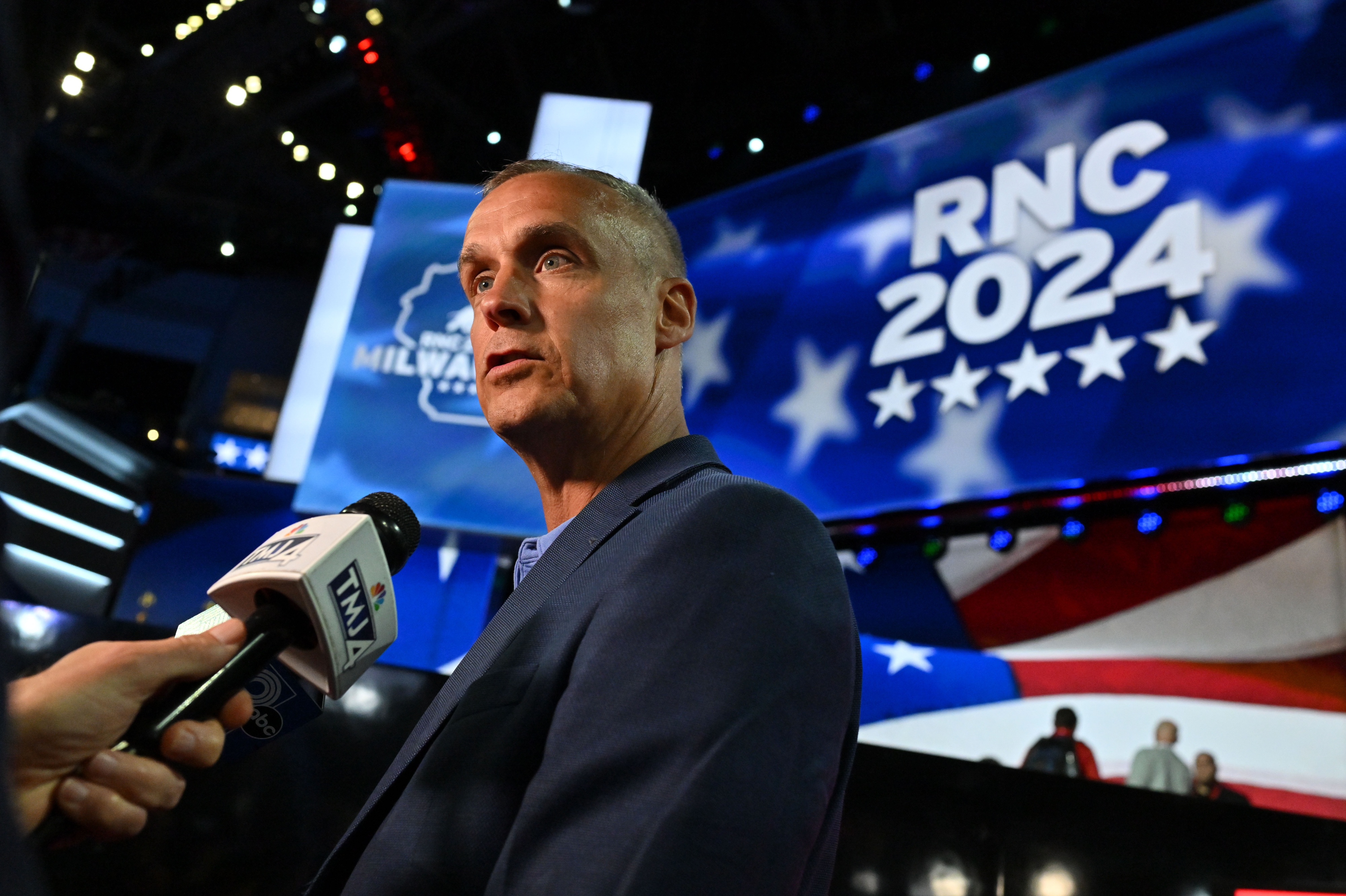
    WASHINGTON — The Justice Department has opened a criminal investigation into Corey Lewandowski over accusations that he personally profited from his role as a top adviser to the Department of Homeland Security, according to two officials with knowledge of the situation.

    The inquiry, one of the rare instances in which an ally or appointee of President Donald Trump’s has been investigated for potential wrongdoing during his second term, is in response to a referral from the Department of Homeland Security’s inspector general, those officials said.

    It was not immediately clear what actions are under investigation.

    A lawyer for Lewandowski forcefully pushed back against any suggestion of criminal activity. “Mr. Lewandowski has not been contacted by the Justice Department regarding any investigation, and he denies any wrongdoing when he was proudly serving his country in a voluntary capacity,” the lawyer, Adam Trigg, said in a statement.

    Lewandowski, who served as Trump’s first campaign manager a decade ago, worked closely with Kristi Noem, the former homeland security secretary, but left after she was forced out in March.

    The catalyst for Noem’s firing appeared to be her answers during two congressional hearings, particularly her under-threat-of-perjury statements that Trump had approved of tens of millions of dollars of government ads in which she was prominently featured.

    Lewandowski wielded power far beyond the scope of his role as an unpaid adviser, serving as Noem’s top aide and confidant. He often hosted meetings in her office without her present, grilling agency officials and issuing orders as he flexed his vast influence over Trump’s efforts to detain and deport millions of immigrants.

    While he joined the department early last year in what was supposed to be a limited, part-time role, Lewandowski, a longtime Republican operative, used his perch to build an expansive portfolio in which he had wide influence over personnel, contracts, and department operations.

    Lewandowski helped elevate Gregory Bovino, a midlevel leader of the U.S. Border Patrol, to a senior position commanding militarized deportation raids across the United States.

    Bovino was forced out earlier this year after agents under his supervision killed two protesters in Minneapolis during an aggressive immigration sweep that he oversaw.

    In the last hours of Noem’s tenure, her agency delivered a windfall to one of her political donors by buying five airplanes from his firm at a substantial markup.

    The Department of Homeland Security agreed to pay the donor’s firm $108 million for a Boeing 737 airliner that had been converted into a huge private jet, complete with a stand-up bar, two bedrooms, marble showers, and a table covered in manta ray skin.

    The firm, Daedalus Aviation Corp., had bought the same plane a few months earlier from a seller who had asked for less than $90 million, according to documents reviewed by The New York Times.

  • DOJ is pressed on its refusal to help state, foreign Epstein investigations

    DOJ is pressed on its refusal to help state, foreign Epstein investigations

    Rep. Jamie Raskin, the ranking Democrat on the House Judiciary Committee, is asking the Justice Department why it has declined to assist state and foreign investigations sparked by the Epstein files, suggesting an area of focus for his party should it win a House majority in November.

    The Justice Department has brought no charges in relation to the millions of documents it has released from federal investigations into convicted sex offender Jeffrey Epstein, but other law enforcement agencies in the United States and abroad have used the material to launch probes into potential crimes and individuals within their own jurisdictions.

    The Washington Post reported last month that the Justice Department had not granted requests by Polish, Norwegian, British, or Latvian law enforcement agencies for evidence, information, and testimony for their investigations.

    Officials in New Mexico, where Epstein maintained a ranch, have sued the Justice Department, alleging that it blocked the state from accessing unredacted records. The Justice Department argued in court filings last week that providing such records would hinder law enforcement operations. On Wednesday, New Mexico Attorney General Raúl Torrez also announced a lawsuit against Epstein’s estate and its executors, alleging that they helped finance and conceal the deceased financier’s sex-trafficking operation.

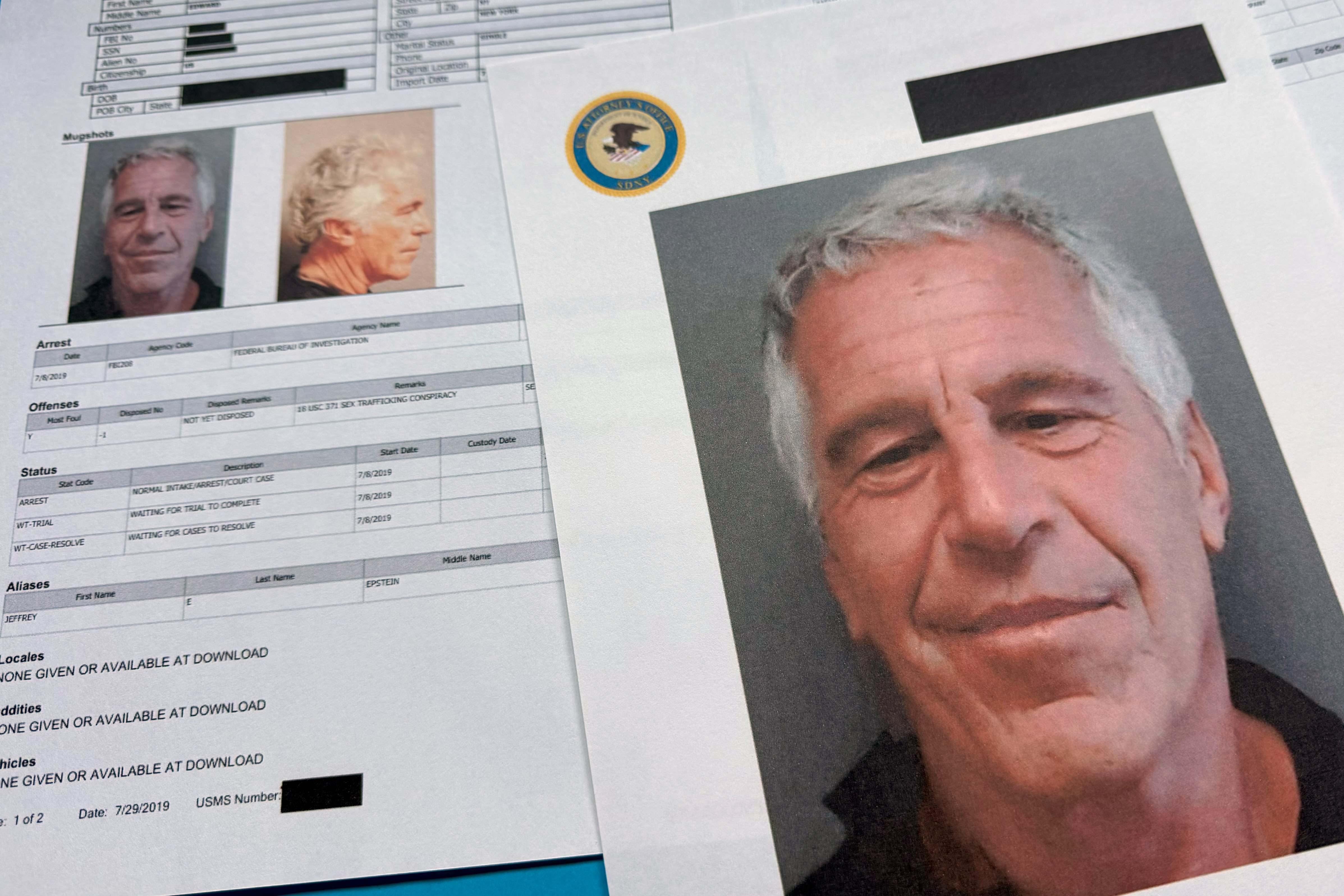
    Epstein, a financier who cultivated relationships with global political, business, and social elites, pleaded guilty in 2008 to soliciting prostitution from a minor and served 13 months in jail. He was indicted in 2019 on federal sex-trafficking charges and rearrested. He died weeks later in a New York prison cell while awaiting trial. His death was ruled a suicide.

    Raskin (D, Md.) asked Attorney General Todd Blanche and Vaughn A. Ary, the director of the Justice Department’s Office of International Affairs, on Wednesday for all records related to requests for mutual legal assistance from foreign countries investigating Epstein’s potential co-conspirators.

    In a letter to Blanche, Raskin also asked for all records related to Justice Department decisions to deny requests for information or cooperation sought by any domestic state or local enforcement entity.

    Raskin says the Justice Department is refusing to investigate Epstein’s potential accomplices and blocking other jurisdictions from doing so.

    “Not only is the DOJ shamefully refusing to investigate Epstein-implicated individuals with your own resources, but it is also now reportedly refusing to share key evidence with other jurisdictions that are taking criminal investigations of Epstein’s potential accomplices and co-conspirators seriously,” Raskin wrote to Blanche and Ary.

    The Justice Department confirmed it received Raskin’s letter and that his request is being reviewed by appropriate personnel.

    Former Justice Department officials have said the process for obtaining evidence and information through mutual legal assistance can be cumbersome and take weeks or months.

    The Justice Department has not explained its refusal to grant foreign investigators mutual legal assistance. It has said New Mexico’s request is overly broad.

    The New Mexico attorney general’s office welcomed Raskin’s effort to press the Justice Department on its handling of requests for evidence related to Epstein and potential co-conspirators.

    “States should not have to take the federal government to court to obtain evidence needed to investigate crimes committed in their jurisdiction,” Lauren Rodriguez, a spokesperson for the New Mexico attorney general, said in a statement.

    Congress voted nearly unanimously last year to require the Trump administration to release all unclassified files and records related to the federal sex-trafficking investigations of Epstein and his associate Ghislaine Maxwell. A bipartisan group of lawmakers has questioned whether the Justice Department has fully complied with the legislation.

    Epstein socialized with Donald Trump from the late 1980s to the early 2000s. The president has said the friendship ended around 2004; Epstein was banned from Mar-a-Lago in 2007. Law enforcement has not accused Trump of any criminal conduct in relation to Epstein, and the president has denied any wrongdoing in connection to him.

    The Justice Department is not obligated to honor Raskin’s request. But House Democrats, if they regain a majority in November elections, plan to hold more hearings related to the files and would have the votes to issue subpoenas, a powerful tool for investigating the Trump administration.

  • Judge orders Trump to sit for a deposition in his defamation lawsuit against the BBC by Dec. 11

    Judge orders Trump to sit for a deposition in his defamation lawsuit against the BBC by Dec. 11

    MIAMI — A federal judge on Thursday ordered President Donald Trump to sit for a deposition in his $10 billion defamation lawsuit against the BBC by Dec. 11.

    The order from U.S. Magistrate Judge Enjoliqué Lett came as lawyers for the British broadcaster complained that Trump had delayed his appearance. Charles Tobin, attorney for the BBC, said that with two months left in the discovery period, “we still haven’t been able to depose the plaintiff.”

    He noted there was an agreed-upon date of Oct. 16, but said Trump had canceled it for a “matter of national importance.” Tobin said the Republican president was in fact campaigning in Georgia that day. “He was participating in party politics and prioritized that over sitting for the deposition,” Tobin said.

    Lett said Trump must sit for a deposition by Dec. 11, or face sanctions up to dismissal of his lawsuit — unless the discovery period is extended past Dec. 18.

    Discovery, where lawyers for both sides exchange documents and other evidence, is scheduled to end Dec. 18, and the BBC’s attorneys want to make sure they have Trump’s deposition before that deadline. Lett said only the presiding judge assigned to the case can alter the trial schedule, and the defense said it would be open to scheduling the deposition at a later time if the trial schedule was also moved back.

    Trump, who has often avoided depositions, filed his lawsuit against the BBC last December. He accused the publicly funded broadcaster of defamation as well as deceptive and unfair trade practices related to a documentary, Trump: A Second Chance.

    The BBC acknowledged that filmmakers spliced together quotes from different sections of the speech Trump delivered to his supporters on Jan. 6, 2021, before the storming of the U.S. Capitol, to make it seem he was directly urging violence. The broadcaster apologized over the editing, and the head of the BBC and its top news executive both resigned. But the BBC has denied Trump’s claims that it defamed him.

    Trump’s attorneys also argued against recording his deposition on video, asking for only a court reporter. The judge ruled that the deposition could be recorded on video but only for attorneys, meaning it wouldn’t be released to the public.

    It remained unclear whether Jack Smith would be allowed to sit for deposition

    To bolster its defense, the broadcaster subpoenaed former special counsel Jack Smith earlier this month. Trump’s lawyers have argued that there was no good reason for Smith, who is not a party to the case, to appear.

    After arguments Thursday, it was not clear whether Smith would be allowed to sit for a deposition. One issue raised was whether Smith had received the legally required permission from the Department of Justice. Assistant U.S. Attorney Matthew Feeley told the judge that Smith had sent a letter to the department saying he would not testify without permission, and the agency had not yet responded. Lett ordered the department to respond to Smith by Nov. 2.

    Earlier in the hearing, Tobin, the BBC lawyer, told the judge that Smith has not objected to being deposed for this case, meaning the only objection is coming from Trump. Tobin said the BBC is not trying to relitigate the events of Jan. 6, but Smith is one of the leading experts in what happened that day, and his deposition could lead the BBC to evidence that could help their case.

    “We can argue later on whether his testimony is admissible,” Tobin said, “but we are entitled to that deposition.”

    Trump’s lawyer, Alejandro Brito, said Smith has no personal knowledge of Trump’s Jan. 6 speech or Trump’s state of mind when he gave it. All of Smith’s knowledge about the case is secondhand, Brito argued, and the special counsel’s report, along with Smith’s testimony before Congress, is all public and available to the BBC’s attorneys, he said.

    Judge says the BBC can see membership records for Mar-a-Lago

    Turning to the damages issue, the judge agreed that the BBC should be allowed to see records for the total number of applications for membership at Trump’s Mar-a-Lago resort in Florida from Jan. 6, 2020, through Jan. 6, 2026, as well as the total cost of membership and initiation fees for new applicants.

    Tobin said one aspect of any defamation case is showing actual damages, and the popularity of Mar-a-Lago is a significant indicator of Trump’s reputation. The BBC’s lawyer described the private club as “a place where he exhibits his reputation in front of people who are important to him.”

    Brito argued that Trump does not actually run Mar-a-Lago, and that his reputation is not associated with the club.

  • Philly DA Larry Krasner said the federal investigation into his office ‘does not concern me at all’

    Philly DA Larry Krasner said the federal investigation into his office ‘does not concern me at all’

    Philadelphia District Attorney Larry Krasner — whose office is now the subject of a federal grand jury investigation over potential obstruction of justice— said Thursday that he is not worried about the prospect of facing criminal charges, saying: “There is not a jury in the world that is going to find me guilty of anything.”

    Speaking just days after sources said his office received subpoenas from federal prosecutors seeking documents and emails connected to a controversial post-conviction case, Krasner said in a defiant radio interview with WHYY’s Studio 2 that his office had acted appropriately in the matter.

    “Not only did we do nothing criminal, we did nothing that was deliberately wrong,” he said. “That does not concern me at all.”

    He also sought to cast the probe as part of President Donald Trump’s penchant for targeting political opponents, saying: “We are living in an era of revenge prosecution. We are living in a time when we have a compromised attorney general, who [was] the personal attorney for the President of the United States, and there is an enemies list … and they are doing what they can do to come after these people.”

    Still, there has been no indication to date that either Trump or Attorney General Todd Blanche has directed an investigation of Krasner. And the probe was primarily spurred by a Philadelphia-based federal judge, who said he believed the U.S. Attorney’s Office should look into whether Krasner or one of his supervisors committed conspiracy, obstruction, or perjury.

    Krasner’s remarks served as some of his most extensive public comments on a matter that has roiled his office for months. The saga has also put him in the unusual position of serving as the city’s chief law enforcement officer while his office is under investigation for potential criminal misconduct.

    Krasner has previously denied wrongdoing in court filings. And he has said the decision by U.S. District Court Judge Paul S. Diamond to refer the matter to federal prosecutors was improper, unfair, and legally unsupported.

    The controversy stemmed from a post-conviction matter before Diamond in which a man named Dennis Johnson sought to overturn his 2009 murder conviction.

    This spring, Krasner’s office discovered one of its prosecutors made critical mistakes in key documents filed in the case. After that discovery, Krasner and some of the prosecutors who work for him met for a series of contentious internal deliberations. And Diamond said testimony from the staffers showed Krasner was seeking to do damage control and took actions that could have amounted to conspiracy or obstruction of justice.

    During Thursday’s interview, Krasner, a Democrat, denied that, and even said he believed Diamond might have defamed him.

    He also went on to say that many of his critics — in this matter and others — have been motivated by either political or personal animosity. As support, he brought up an at-times scattershot list of clashes he’s been a part of over the years, including a lawsuit he filed against Republican megadonor Elon Musk, heated criticism he’s directed toward Trump, and even disputes he had with former Philadelphia power broker John Dougherty, who recently became a registered Republican after Trump commuted his prison sentence for corruption.

    Krasner said his critics have “certain characteristics — they are either Republicans or very close to.” He then added: “Let’s get real about what’s going on here. And this is not just a local pattern, this is a national pattern of a certain president doing the kinds of things he wants to do.”

    Federal prosecutors have declined to comment on their probe against Krasner. Such investigations can often take months or longer.

    Krasner also declined to comment on the specifics of the investigation, except to say: “I know what I did, and I know there’s not a jury in the world that’s going to think I did something wrong here.”

  • Trump backs Ramaswamy on ad featuring Amy Acton’s estranged mother

    Trump backs Ramaswamy on ad featuring Amy Acton’s estranged mother

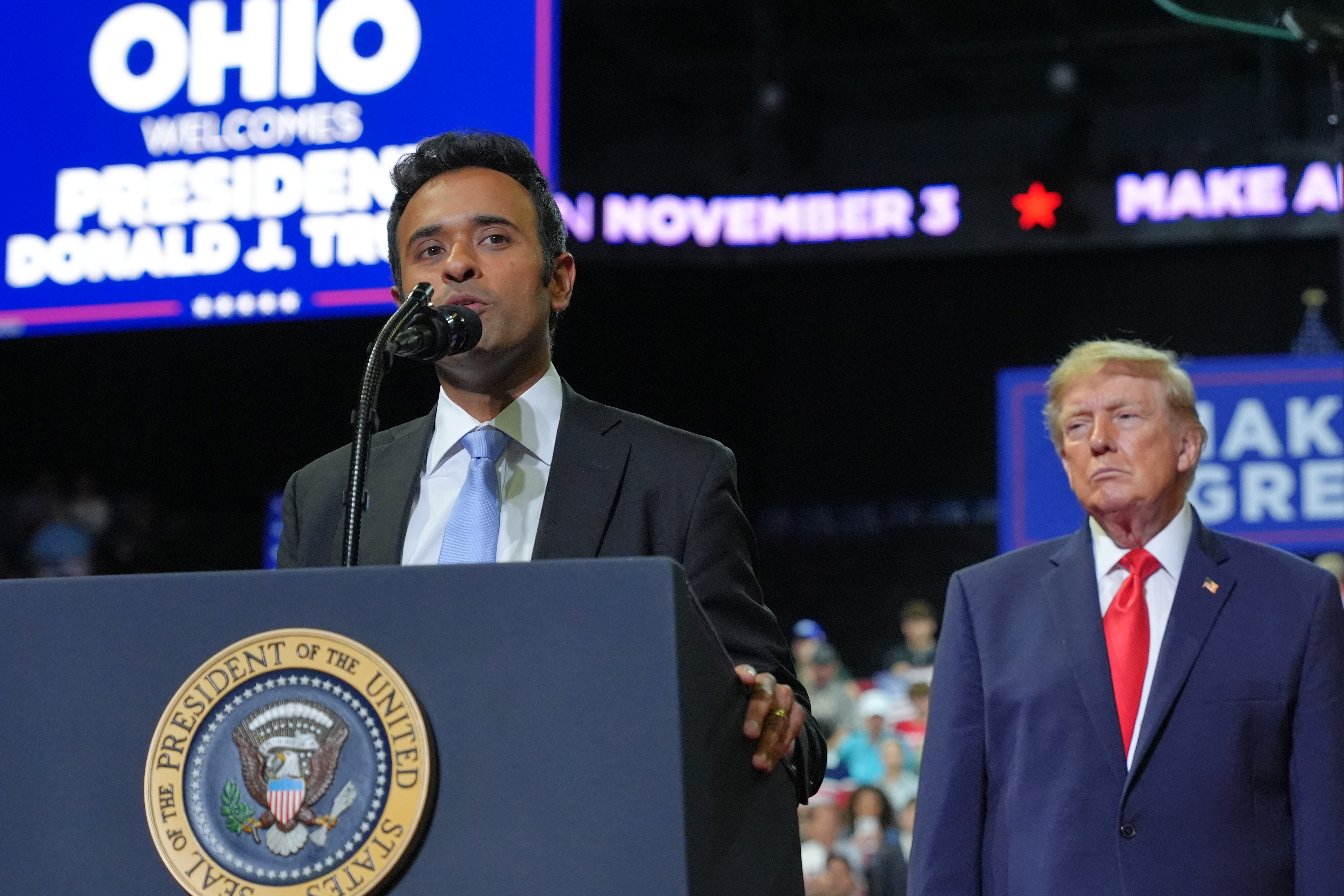
    COLUMBUS, Ohio — President Donald Trump said Thursday that Vivek Ramaswamy, the Republican nominee for Ohio governor, should keep running a controversial ad featuring the estranged mother of Democratic opponent Amy Acton, posting on social media that it was “hitting pay dirt.”

    Trump also denounced Ohio Republican Gov. Mike DeWine, who criticized the ad as “deeply, deeply troubling” earlier in the day. Acton previously served in DeWine’s administration as a health official. Her mother lost custody of Acton and her brother after her husband — the children’s stepfather — was indicted for raping Acton.

    “He strongly suggested that Vivek should, ‘take down the Ad,’” Trump wrote. “He probably wants a Dumocrat to win, and certainly doesn’t want someone who will do a much better job than he is capable of doing. I suggested, on the other hand, that Vivek should keep it up, and let everyone listen to the mother of a defective, dishonest, and incapable Candidate, explain how the daughter is a DISASTER who, uncontrollably, lies, cheats, and steals!”

    At a gathering with reporters at the Ohio Statehouse, DeWine recalled the painful experiences of rape victims he dealt with as a county prosecutor and state attorney general.

    “It’s wrong to run this ad,” he said. “And, even at this late time — my wife, Fran, saw the ad just run this morning on TV — I would just urge the Ramaswamy campaign to take this down.”

    The term-limited DeWine’s remarks place him at odds with Ramaswamy, whom he has endorsed. The biotech entrepreneur and former presidential candidate plans to spend $4 million to broadcast it online and on television.

    DeWine stops short of pulling his endorsement

    But the governor stopped short of pulling his backing of the Republican for now. DeWine recalled a previous line of attack by the Acton campaign had mentioned Ramaswamy’s mother and said that also was wrong — “family members have always historically been off limits” — though he noted it was never used in a multimillion-dollar ad campaign.

    That critique from the summer cited an investigative report into Geetha Ramaswamy’s role at a pharmaceutical company run by her son, who Acton and Democrats described as “hiring his own mother to manipulate clinical trial data.”

    The Ramaswamy campaign called those claims “slanderous” and said he’s being held to a different standard than Acton and other Democrats who have attacked Republicans’ families.

    “Governor DeWine is correct that the first and only candidate to attack the mother of her opponent in this race was Amy Acton,” spokesperson Connie Luck said in a statement, adding, “We refuse to accept the media’s double standards.”

    Ohio Republicans divided over the ad

    By chiming in, DeWine has entered the fray of a growing rift among Ohio Republicans over the advertisement — as both the governor’s race and a race for U.S. Senate appear far tighter than expected in a state Donald Trump won handily three times. The video features Acton’s birth mother, Donna Arthur, calling her “a liar” and insinuating she has mental health issues.

    Acton, Ohio’s COVID-19-era health director, has made no secret of facing homelessness and abuse as a child. Arthur lost custody of her children after their stepfather, Arthur’s husband, was indicted on a charge of rape involving Acton. Acton’s campaign on Tuesday posted a video of her brother, who supported her backstory about living in a tent and being abused.

    Republican Vice President JD Vance, an Ohio native son, expressed disgust during an Ohio campaign swing Wednesday with Republicans “whining” about the ad as low and in poor taste. But Republican U.S. Sen. Jon Husted, DeWine’s former lieutenant governor — running in a tight retention race against Democrat Sherrod Brown — has said he would not have run the ad, as has Republican Secretary of State Frank LaRose, who is running for state auditor.

    Another influential Ohio Republican, former U.S. Rep. Jim Renacci, posted a lengthy essay on X overnight, suggesting that “the floor may have just fallen out from under the Republican campaign for Ohio Governor” and urging every Republican to distance themselves from it.

    Amid the turmoil, Ohio Republican Party Chairman Alex Triantafilou posted what sounded like a warning, or a threat.

    “The final days of a tough campaign are always the best time to find out who is really with you and who just posts and pretends,” he wrote. “Yes—we are keeping score.” The quote was followed by a winking-eye emoji.

    Ad has faced bipartisan rebukes, support in conservative media

    The ad is also dividing Republicans nationally.

    Nikki Haley, who sparred with Ramaswamy during the 2024 Republican presidential primary over the personal nature of his attacks, called him “a bad guy” in a social media post Tuesday. “It’s a shame he continues to get away with it,” she wrote.

    At the same time, Media Matters for America, a left-leaning media watchdog group, has reported that many within the national conservative media are promoting and praising the ad. Ramaswamy’s campaign manager, Jonathan Ewing, characterized it as “a campaign-ending moment for Amy Acton.”

    Wayne Allyn Root, of Gateway Pundit, called it “absolutely hilarious” and Daily Wire host Michael Knowles described it as “brilliant.”

    Police and court records show Cledith Arthur was arrested and charged with the rape of Acton in July 1978, when she was 12, after her biological father lodged a formal complaint against him. The abuse allegedly happened from December 1976 to April 1978. Cledith Arthur failed to show for a court appearance and became a fugitive.

    Donna Arthur remained married to him until his death in 2004.