Category: Nation & World

  • NFL calls on Trump administration to remove post featuring Eagles legend Brian Dawkins

    NFL calls on Trump administration to remove post featuring Eagles legend Brian Dawkins

    The NFL asked the Department of Homeland Security to take down a social media post featuring Eagles legend Brian Dawkins to promote the immigration enforcement efforts of President Donald Trump’s administration.

    ⅔

    The official DHS X account responded to a post on Sunday by Leading Report, a conservative-leaning misinformation outlet, about a purported migrant caravan heading toward the U.S. border with a montage of the Eagles Hall of Famer’s iconic tunnel walkout entrance. Korn’s “Blind” can be heard playing in the background.

    DHS captioned the post, “Our time has come.”

    A DHS spokesperson said it used Dawkins in its post because “DHS is playing lockdown defense at the border.” On Monday, the NFL said it requested that DHS remove the post from its social media accounts.

    “We have requested DHS take down the video,” Brian McCarthy, a spokesperson for the NFL, said.

    Dawkins, who played for the Eagles from 1996 to 2008, was known for leading the team onto the field before games in a menacing “Weapon X” entrance, in which he would run on his hands and feet like X-Men character Wolverine, ready to eviscerate the opposing team’s offense.

    In a video shared on social media Monday afternoon, Dawkins said he did not authorize the Trump administration to use his highlights to promote their immigration agenda.

    “I did not give permission for my name, image, and likeness to be used by anybody, all right? By anybody,” Dawkins said.

    The video of Dawkins’ entrance implied DHS and U.S. Immigration and Customs Enforcement would take aggressive action against the migrant caravan. DHS said it has been tracking the group of about 600 people since it left San Pedro Sula, Honduras, on Sept. 20.

    Former NFL player Brian Dawkins delivers a speech during an induction ceremony at the Pro Football Hall of Fame in 2018.David Richard

    Dawkins is not the first ex-NFL star to be featured in the Trump administration’s increasingly meme-centered presence on social media. The White House’s official X account posted a highlight reel in March of bone-crushing tackles in NFL history, including Eagles cornerback Sheldon Brown’s hit against rookie Reggie Bush, edited to include footage of real drone strikes conducted by the U.S. military in Iran.

    Musical acts like Sabrina Carpenter, Olivia Rodrigo, and Kenny Loggins have seen their music be used in official government posts, including with videos of ICE agents arresting immigrants. The White House has also used popular video game characters like Mario and Halo’s Master Chief to promote Trump policies.

    Trump taxpayer-funded TV ads

    The Dawkins social media post follows the White House’s use of taxpayer funds to air a television ad centering Trump before the midterms. The ad that aired in at least two NFL game broadcasts on Sunday, according to CNN, features Donald Trump walking through a hallway declaring “this is the final battle.” At the end of the commercial, a disclosure reads “Paid for by the U.S. Government,” which drew criticism from both sides of the aisle.

    Sen. Andy Kim (D., N.J.) questioned how much taxpayer money was spent on the ad on Sunday. “Trump has overseen the most corrupt administration in modern history, making billions of dollars for him and his friends, while your costs go up,” he said in a social media post.

    Sen. John Kennedy (R., La.) in an interview on CBS’s Face the Nation said no public official should spend public money on private ads for themselves. “The White House sees differently, but you can’t spend money to promote yourself.”

  • Secretive group’s latest anti-Trump artwork placed in D.C. — and Greenland

    Secretive group’s latest anti-Trump artwork placed in D.C. — and Greenland

    The mysterious art collective responsible for more than a dozen installations mocking President Donald Trump and his administration over the past two years struck again on the National Mall in Washington on Monday morning, this time with an international twist.

    The group, Secret Handshake, created Operation Epic Furious: Nuuk ’Em All, a satirical video game playable on three video game cabinets placed under the dome of D.C.’s World War I Memorial near the under-repair Lincoln Memorial Reflecting Pool.

    The game, according to a news release sent by Secret Handshake, “turns all of Trump’s latest Greenland ambitions into an unhinged Arctic adventure.” Nuuk, a city of about 20,000 people, is the capital of Greenland, an autonomous territory of Denmark.

    In the game, the group says, the president “battles unthinkable evils like Fully Vaccinated Children, Woke Yetis, and the happiest people on Earth, the Danish. All the while, the player’s greatest challenge is trying to keep President Trump from falling back asleep.”

    The White House did not immediately respond to a request for comment on the new installation. It has previously dismissed the group’s work. In response to a mocking Iran War Participation Trophy that Secret Handshake installed on the National Mall in July, the White House said, “These untalented ‘artists’ should stick to their ugly ‘art’ and refrain from weighing in on foreign policy — which they clearly know nothing about, given the fact that the United States Military achieved all of its objectives during Operation Epic Fury.”

    A fourth video game cabinet for Operation Epic Furious: Nuuk ’Em All appears to have been placed in Nuuk over the weekend, according to photos posted on Secret Handshake’s Instagram account. The photos show a console on a hillside overlooking the coastal town.

    Representatives of Greenland’s government in Washington declined to comment on the installation.

    The four video game consoles take aim at positions held by the Trump administration in regard to the United States’ relationship with Greenland. They are decorated with cartoon images of Trump as well as Vice President JD Vance, Defense Secretary Pete Hegseth, FBI Director Kash Patel, and Health and Human Services Secretary Robert F. Kennedy Jr. There are also images of cartoon penguins wearing ammunition belts and American flag patches and a map of Greenland with made-up names and a large section of it labeled “Future Golf Course.”

    Numerous quotes attributed to Trump adorn the consoles, including “That’s Our Territory. All we’re asking for is to get Greenland,” and “We need Greenland very badly. One way or the other, we’re going to get it.”

    On Monday morning, a few visitors happened upon the video games. Shantha Tellambura, 62, and his wife, tourists from Australia who were spending their first day in Washington, said they were surprised to see the installations in a public setting.

    “I think it’s very interesting and it signifies freedom of expression,” Tellambura said. “It’s important that ordinary people are allowed to express their opinions.”

    The message the work delivered, he said, was necessary.

    “We are headed toward a problematic time especially with the possibility of nuclear war,” he said.

    Secret Handshake members have declined in phone interviews with the Washington Post to provide any identifying information. The group has previously placed installations and artwork critical of Trump at locations across Washington.

    They include a statue of Trump and Jeffrey Epstein holding hands, a mock tribute to Trump from the world’s authoritarian leaders, and a reproduction of the desk of former House Speaker Nancy Pelosi (D., Calif.) with a pile of fake excrement on it that ridiculed the Jan. 6, 2021, rioters who sought to overturn the 2020 election.

    In May, the group installed its first video game project. A playable game titled Operation Epic Furious: Strait to Hell targeted the war with Iran.

    Previous installations by the group, all of which had a National Park Service permit for temporary display, were at prominent spots on the Mall, including directly in view of the Capitol’s west side. The group has also installed works in Philadelphia and Portland, Ore.

  • Congo’s Ebola outbreak tops 8,000 confirmed cases as disease remains out of control

    Congo’s Ebola outbreak tops 8,000 confirmed cases as disease remains out of control

    BUNIA, Congo — The number of confirmed cases of Ebola virus in Congo has surged past 8,000, as the country runs out of health workers to contain the deadly disease.

    Congo announced an outbreak on May 15, caused by the rare Bundibugyo virus, which has no known treatment or vaccine, and has struggled to contain it.

    The latest data from Congo’s health ministry released Sunday showed that 8,067 cases have been confirmed, with 3,901 deaths as of Sept. 26 across 63 health zones in seven of the country’s 26 provinces, with a fatality rate of more than 48%.

    “The continuously high crude case fatality ratio, and especially the continuously high rate of deaths occurring in communities, highlights the seriousness of the disease and the persistent challenges in timely case detection and access to early and adequate patient care,” the World Health Organization said in its latest report.

    It means that a large percentage of those infected were dying, without taking into account factors like delays in seeking help or hidden cases.

    The U.N. Office for the Coordination of Humanitarian Affairs said on Monday that the outbreak has begun to have an impact on other essential services in the hot spots as resources are mobilized toward fighting Ebola. According to OCHA’s report, routine primary healthcare services fell by 13% between April and June in Ituri province alone.

    “The indirect impact of the outbreak reflects both reduced health service availability — as a result of staffing and operational pressures — and reduced demand, as fear of infection and isolation discourages care-seeking,” OCHA said.

    Last week, WHO said that Congo was running out of health workers to contain the disease. Health workers have complained about delayed or missing payments, triggering several strikes. According to the Africa Centers for Disease Control and Prevention, 50 health workers have died since the outbreak was announced.

    Some areas have shown signs of improvement, with fewer confirmed cases in the past several weeks, including in Ituri province and Haut-Uele, but officials say the disease is spreading further in other areas, expanding its geographical reach.

    According to data from the Africa CDC, the current outbreak has outpaced the two-year West Africa regional outbreak in terms of spread in the same time. By week 19, the regional outbreak between 2014 and 2016 recorded 3,781 cases, while the current outbreak recorded 7,840. WHO said that it’s on track to surpass the regional outbreak, which killed 11,000 people.

    Containment efforts have been hamstrung by insecurity, displacement, a health workers’ strike, and intense population movements.

  • Trump administration lowers fuel economy standards, critics say at a significant environmental cost

    Trump administration lowers fuel economy standards, critics say at a significant environmental cost

    DETROIT — The Trump administration on Monday released new fuel economy standards that relax regulatory requirements for automakers to control pollution from gasoline-powered cars and light trucks. The new rules were released shortly after President Donald Trump rejected an Iranian proposal to open the Strait of Hormuz, sending oil prices soaring.

    The change furthers Trump’s promise to revoke policies that encouraged or created incentives for the production of electric vehicles and, ultimately, will expose Americans to more planet-warming pollution from vehicles.

    Mileage standards, known as Corporate Average Fuel Economy, or CAFE, requirements, have been implemented since the 1970s energy crisis, and set out how far new vehicles need to travel on a gallon of gasoline. Over time, automakers have gradually improved their vehicles’ average efficiency.

    The Department of Transportation and the National Highway Traffic Safety Administration estimated that the finalized standards would correspond to a combined industry fleetwide average of roughly 34.9 miles per gallon for passenger cars and light trucks in the 2031 model year. That’s up from 30.1 miles per gallon for model year 2024, but down from a projected 50.4 miles per gallon in 2031 under rules put in place by the Biden administration.

    “Thanks to President Trump’s leadership, we have finally ended the illegal mandate that forced automakers to produce more expensive electric vehicles that American families didn’t want,” Secretary of Transportation Sean Duffy said in a statement touting vehicle affordability.

    NHTSA had projected last December that the new standards would hover at roughly 34.5 miles per gallon.

    The news comes amid ongoing tensions as the war in Iran persists, with Trump refusing a deal with Iran to open the strait as recently as Saturday, impacting the world’s oil supply.

    Environmental groups concerned over rollback

    News of the revised standards immediately drew rebukes from environmentalists.

    The DOT said Monday that the rule would cut yearly oil consumption in 2050 by about 1.3 billion barrels as compared to yearly oil consumption in 2024.

    But when the 2024 standards went into effect, NHTSA estimated they would save 14 billion gallons of gasoline from being burned by 2050. The agency also said that while new fuel-efficient vehicles cost more up front, savings on gasoline over the lifetime of the car or truck would more than make up for that.

    Environmental groups estimate now, without stricter standards, cars could produce 22,111 more tons of carbon dioxide per year than under the Biden-era rules in 2035.

    The rule also translates to an extra 90 tons a year of deadly soot particles and 4,870 additional tons a year of smog components such as nitrogen oxides and volatile organic compounds emitted into the air in coming years, experts say.

    Transportation already accounts for much of total U.S. greenhouse gas emissions that warm the planet: 28% as of the last estimate in 2022.

    It “ignores the feasibility of clean technology and the millions of fuel-efficient cars already on the road,” Dan Becker, director of the Center for Biological Diversity’s Safe Climate Transport Campaign, said of the rule.

    Since taking office, Trump has also pulled back auto tailpipe emissions rules, repealed fines for automakers that do not meet federal mileage standards, and terminated consumer credits of up to $7,500 for EV purchases.

    The president has repeatedly pledged to end what he falsely calls an EV “mandate,” referring incorrectly to former President Joe Biden’s target that half of all new vehicle sales be electric by 2030. No federal policy has mandated auto companies to sell EVs.

    According to data from Cox Automotive, EVs accounted for 5.7% of total new-vehicle sales in August, down from 7.4% for all of 2025.

    Katherine García, director of the Sierra Club’s Clean Transportation for All campaign, vowed the environmental group would fight the rule.

    “Less fuel-efficient cars mean more gas burned, spending more at the pump, and dirtier air in our communities,” Garcia wrote in a statement.

    The state of the industry

    Automakers and industry groups have said the new rules will increase Americans’ access to the full range of gasoline vehicles they need and can afford.

    “NHTSA made the right call to better align fuel economy standards with the law and current market conditions,” John Bozzella, president and CEO of the Alliance for Automotive Innovation, which represents the domestic auto industry, said in a statement. He said the previous standards “effectively required a switchover to electric vehicles that was out of step with market realities and customer demand. Today’s final rule is an appropriate course correction.”

    “What the industry needs is long-term regulatory stability that includes balanced, durable, and achievable fuel economy standards that continue to reduce emissions and improve fuel economy,” Bozzella added. “This is the formula for preserving consumer vehicle choice and keeping the U.S. auto industry globally competitive.”

    A spokesperson for Ford Motor Company, maker of the top-selling pickup truck, the F-150, said: “We appreciate Secretary Duffy and the Administration’s work to align regulations with market realities. As we evaluate the final rule’s full impact on our business, we’ll continue working with the Administration to build a strong American auto industry.”

    A General Motors spokesperson said in a statement the company supports the goals of the rule “and its intention to better align fuel economy standards with market realities.”

    Stellantis also welcomed the changes.

    “These standards will allow us to offer our customers the freedom to choose from a range of vehicles and powertrains that meet their needs, from brands they love and trust,” a Stellantis spokesperson said in a statement.

    Trump wrote on his Truth Social media account Saturday that the less stringent mileage requirements would “take the waste out of building cars in America” and save families “thousands on a new, beautiful and safe car,” while boosting auto production in the U.S.

    The DOT reiterated on Monday that the changes will cut the average cost of a new vehicle by $1,300, and save Americans $138 billion over the next five years.

    Americans, however, are spending more on gas as Washington’s war with Iran disrupts the global flow of fuel; gasoline prices averaged $4.47 on Monday, according to the AAA motor club, up from $3.13 a year ago. The rising cost of oil weighed on U.S. stocks to start the week.

    “Trump is tanking sensible mile per gallon standards at the worst possible time for consumers, who are getting hit with sky-high prices at the pump,” the Center for Biological Diversity’s Becker said. “Consumers will pay the price for these reckless rollbacks while Trump’s Big Oil and Big Auto buddies reap the short-term profits.”

    Experts have also said that less stringent rules do not necessarily translate to more consumer purchases of new vehicles that may have more safety features.

    The average new car in America sold for $50,089 in August, crossing over the $50,000 line for the first time since last December, according to Kelley Blue Book data.

  • Trump asked China’s president if he wanted to buy U.S. arms, ambassador says

    Trump asked China’s president if he wanted to buy U.S. arms, ambassador says

    WASHINGTON — President Donald Trump has asked Chinese President Xi Jinping if he wanted to buy weapons from the United States, the U.S. ambassador to China said.

    David Perdue said Trump raised the prospect of the arms sales from the U.S. to its ascendant geopolitical rival, an unlikely offer that if consummated would upend generations of U.S. policy toward China and Taiwan and expose U.S. technology to a potential foe. Perdue, speaking to Shannon Bream on Fox News Channel’s Fox News Sunday days after Trump hosted Xi for a state visit in Washington, didn’t specify when the offer was made.

    But the State Department on Monday looked to distance the Trump administration from Perdue’s comments, saying that “U.S. law prohibits arms sales to China and there is no offer or plan to sell arms to China.”

    Perdue said Sunday that Trump, a Republican, was downplaying longstanding U.S. arms sales to Taiwan — which have drawn protest from Beijing for years — by couching it as just one of many sales Washington makes around the world — and even asking Xi if he’d be in the market for U.S. weaponry.

    Bream had cited concerns from Republican and Democratic lawmakers over delayed aid packages and weapons orders to Taiwan, the self-ruled democracy that seeks to defend itself from China’s threat to invade the island. Bream asked if the U.S. is denying arms to Taiwan to appease the Chinese president, who visited Trump last week.

    Perdue pushed back on the suggestion, stating that Trump “is as strong on Taiwan as I’ve ever seen anybody” and has sold it plenty of weapons. Perdue also said Trump and Xi continue to talk about future U.S. weapons sales to Taiwan.

    “But President Trump continues to say, ‘Hey, we sell arms to other people around the world,’” Perdue said. “He actually asked President Xi, would he like to buy some, at one point.”

    The offer “speaks to (Trump’s) treatment of China in almost exclusively commercial terms, even at the potential expense of the U.S. military position in Asia,” said Evan Sankey, an analyst focused on U.S. policy toward China at the Cato Institute.

    He said the U.S. last sold arms to Beijing in the 1980s and resuming those sales would be “a shocking policy change.”

    The U.S. is bound by its own laws to provide Taiwan with the means to defend itself. While not recognizing Taiwan as a country, the U.S. is the island’s strongest informal backer and arms provider. But multiple U.S. leaders have left ambiguous whether they would commit military force to defend the U.S. ally should China invade.

    China has pressed Washington to halt the arms sales, most prominently during a previous summit in May between Trump and Xi in Beijing. After that meeting, the United States paused the sale of a record-breaking $14 billion package — and Trump described arms sales to Taiwan as a “very good negotiating chip” with China.

    In their private talks at the White House last week, Xi pressed Trump to oppose Taiwan independence, according to Chinese state media.

    In Beijing, China’s foreign ministry spokesperson Guo Jiakun did not confirm Perdue’s remarks when asked about the matter on Monday. But he told reporters that China has always strengthened its national defense capabilities based on its needs and is committed to maintaining world peace and stability.

  • Prosecutor reopens probe into Cornell gang rape allegations after accuser files lawsuit

    Prosecutor reopens probe into Cornell gang rape allegations after accuser files lawsuit

    A New York prosecutor has reopened an investigation into gang rape allegations at a Cornell University fraternity in response to a lawsuit filed by a woman who says she was sexually assaulted in 2024 by seven students after being plied with alcohol and drugs.

    Tompkins County District Attorney Matthew Van Houten said Monday that his office will present evidence to a grand jury as he faces questions from the public about why there were no criminal prosecutions in the case.

    The woman, identified only by a pseudonym in the lawsuit, filed the complaint Sept. 16, saying she was sexually assaulted at the Chi Phi fraternity house on Cornell’s campus in October 2024 after being pressured into snorting ketamine, smoking marijuana, and drinking alcohol. She’s suing seven men, the Chi Phi fraternity, the university, an Ithaca bar, and others, seeking undisclosed damages.

    The woman went to campus police at the time, but Van Houten said the accuser did not make any claims of being gang raped or drugged in her initial sworn statement to authorities. The prosecutor also said he has never been contacted by the woman’s attorney about her statement or about reconsidering the decision not to prosecute.

    “While I generally refrain from commenting publicly on criminal investigations, the community outrage stemming from the incomplete news and social media coverage requires that I provide an answer to why the investigation resulted in a lack of criminal charges,” Van Houten said in a statement.

    Cornell said in a statement that it supports the district attorney’s decision to reopen the investigation. The school said it conducted its own investigation and issued sanctions, including expelling some students and suspending others. It also said the on-campus Chi Phi chapter was closed in 2024 and remains barred from campus.

    School officials on Monday did not immediately respond to a message seeking more information, including how many students were expelled and suspended.

    “Any suggestion that the university did not impose consequential punishments for those involved is false,” the university said. “A continuation of the false narrative that there were minimal consequences in this case is irresponsible, will make survivors feel less safe and supported, and will perpetuate the underreporting of sexual assault.”

    The national chapter of Chi Phi did not immediately return phone and email messages Monday.

    The school said it conducted an internal disciplinary investigation in 2024. It said a panel of trained faculty and staff heard evidence over multiple days, and both the woman and the people accused had the opportunity to testify and present evidence.

    The woman’s attorney did not immediately respond Monday to messages seeking comment on the prosecutor’s decision to reopen the investigation.

    The lawsuit contains allegations about what started as a night of celebrating at a sorority and a local bar. It also accuses the university of not preventing the alleged assaults and includes a photo that it says shows a group chat between frat members discussing sex with the woman.

    Since the lawsuit was filed, Van Houten said, his office has been flooded with phone calls, voicemails, and emails about the case from people seeking answers and others making insults and threats.

  • Andrew Bailey, a deputy director at the FBI, leaves his job

    Andrew Bailey, a deputy director at the FBI, leaves his job

    WASHINGTON — Andrew Bailey, who has served as deputy director of the FBI as part of an unusual leadership arrangement, is leaving the job after a little more than a year, the second such departure amid the turbulence in federal law enforcement agencies under the Trump administration.

    An internal FBI email indicated Bailey was stepping down for family reasons, according to people familiar with the decision who spoke on the condition of anonymity to describe a move that was not yet public. In recent months, people familiar with the inner workings of the agency have described the arrangement between Kash Patel, the director, and his two deputy directors — Bailey and Christopher Raia, a longtime FBI agent and manager — as rocky.

    Patel and Bailey did not get along and often went long stretches without speaking to each other, according to multiple people familiar with their interactions who spoke on the condition of anonymity.

    For decades, the bureau has operated with a single deputy director, a career FBI official overseeing daily operations and reporting to the director, who is appointed by the president. But President Donald Trump upended that tradition by naming right-wing podcaster Dan Bongino, who had been a Secret Service agent but had no experience at the FBI, as the No. 2 to Patel. In essence, that put two firebrand influencers with scant management experience atop the 35,000-person agency.

    Patel and Bongino had a sometimes strained relationship with Trump’s first attorney general, Pam Bondi, whom they blamed for mishandling the release of files related to disgraced financier Jeffrey Epstein. She in turn complained about Patel’s management of the bureau, including his propensity to post premature or inaccurate information about continuing operations.

    In August 2025, the Trump administration announced a novel arrangement, saying that Bailey would come in as a co-deputy director alongside Bongino. At the time, Bailey was serving as the attorney general in Missouri, a post he had used to pursue Republican lawsuits related to culture-war issues.

    Many agents inside the bureau believed that Bondi, a former Republican state attorney general, had brought in someone to serve as director in waiting if Trump ever tired of Patel. But Trump fired Bondi in April, and Patel outlasted Bailey.

    In the interim, Patel had sidelined him, and Bailey left little imprint from his year at the bureau. His appearance when the FBI executed a warrant to see 2020 ballots from Fulton County, Ga., was notable not just because of the legal and political dispute over the inquiry — an effort to press on with Trump’s baseless rigged election claims — but because it was extraordinarily rare for Bailey to play a visible role in any operation.

    This article originally appeared in the New York Times.

  • SpaceX’s supersized Starship launches into orbit for the first time but flight ending early

    SpaceX’s supersized Starship launches into orbit for the first time but flight ending early

    SpaceX launched its enormous Starship into orbit for the first time Monday and successfully delivered the most advanced Starlinks yet, but decided to cut short the flight.

    SpaceX said the spacecraft would reenter over the Pacific and splash down north of Hawaii three hours after blasting off from Texas. The company had been aiming for a 10-hour flight, spanning six full laps around Earth, to prove its readiness for NASA’s Artemis moon program.

    The spacecraft almost didn’t make it to orbit after one of its engines shut down too soon. But with everything else working well and the bad engine no longer needed, flight controllers decided after several tense minutes to proceed as planned.

    “Starship is orbital,” Mission Control announced to cheers.

    NASA Administrator Jared Isaacman congratulated SpaceX on reaching orbit and “managing every step in a safe, responsible, and especially inspirational way.”

    Rocket carries 26 of Musk’s most advanced Starlink satellites

    Founder Elon Musk’s showpiece rocket — the biggest and most powerful ever built — carried 26 of the latest and most advanced Starlink satellites to join the 11,000 older models already providing internet service. They popped out of the spacecraft one by one, drawing more cheers from the SpaceX crowds looking on from the launch site at Starbase, Texas.

    The decision to end the flight early came soon afterward. No reason was provided.

    It was Starship’s 14th full-scale launch from Texas’ southern tip in three years. The earlier test flights ventured no farther than the Indian Ocean halfway around the world, often crashing in flames and briefly skimming space.

    This time, SpaceX was intent on circling the globe from an altitude of 170 miles — not just once but six times over almost 10 hours, ending with a Pacific splashdown near Chile. While Starship achieved the proper orbit zipping along at 17,500 mph, flight controllers opted to play it safe and bring it back several hours sooner, after just a couple of laps.

    The first-stage booster was never meant to return to the Starbase launch site either, instead dropping into the Gulf of Mexico within minutes of the morning liftoff.

    SpaceX wants to ensure that everything works before flying Starship back to Starbase. If the spacecraft breaks apart over land and rains debris onto people, “our popularity would diminish very rapidly,” Musk said at a business summit earlier this month. “That’s why we’re being extremely cautious here.”

    Depending on the findings from Monday’s orbital debut, the next Starship could return to the launch pad with giant mechanical arms grabbing the hovering spacecraft. If the catch works — Musk gives it even or slightly better odds — then SpaceX will refly the spacecraft by year’s end or early next year.

    The 407-foot rocket was designed from the start to be fully reusable — a key to lowering launch costs. SpaceX managed to salvage the last Starship from the Indian Ocean in July. Engineers modified the newly launched Starship’s heat shield based on hands-on inspections from the recovered spacecraft, which is being tugged back to Starbase.

    SpaceX wants Starship to be certified for orbital flight

    SpaceX is pressing hard to certify Starship for orbital flight, a vital step toward moon and Mars travel.

    NASA’s Artemis III mission is coming up as soon as next summer, a triple-launch docking exercise in orbit around Earth between an Orion capsule full of astronauts and competing lunar landers. Jeff Bezos’ Blue Moon will blast off first, then Orion — which will close in for a linkup — then Musk’s Starship for a docking with Orion once Blue Moon is unleashed.

    The next mission — Artemis IV slated for no sooner than 2028 — would have astronauts landing on the moon in either Blue Moon or Starship, whichever is ready first. Subsequent moonshots will alternate between the two billionaires’ landers.

    Musk originally developed Starship for Mars, intending to launch scores of them with the red planet’s first settlers. For now, he plans to focus on the moon and use Starship to haul satellites into orbit by the truckload, phasing out the company’s frailer Falcon 9 rocket within several years. A second Starship launch site is nearing completion at Florida’s Kennedy Space Center and a third is planned for Louisiana.

  • Ospreys are disappearing along the East Coast. Scientists think they know why.

    Ospreys are disappearing along the East Coast. Scientists think they know why.

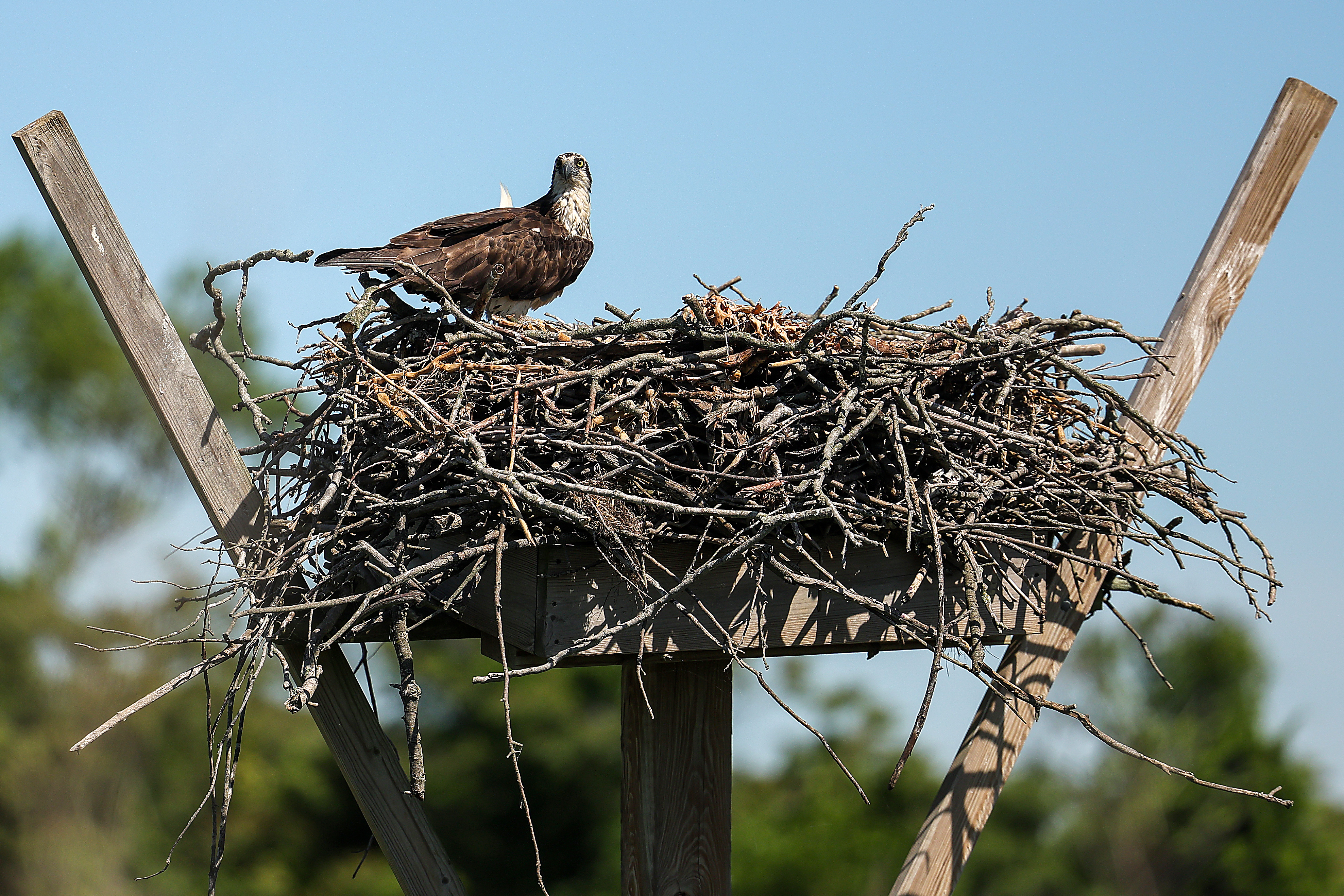
    Bryan Watts has spent more than three decades watching ospreys reclaim the Chesapeake Bay, returning each spring from South America to crowd its tidal rivers and creeks, shorelines, channel markers, and nesting platforms. The William & Mary biologist followed their recovery from the DDT era as the bay became home to the world’s largest breeding population of ospreys.

    Now one of America’s great wildlife recoveries is coming undone. Across the Chesapeake this year, Watts and his colleagues at William & Mary’s Center for Conservation Biology recorded the worst osprey breeding season they have ever documented. Researchers working these waters have found chicks emaciated and starving in their nests.

    A starving osprey chick can seem almost weightless — its breastbone sharp beneath feathers, its body too small for the nest around it. Three summers ago, Watts spent 3½ hours checking 81 nests on Mobjack Bay: empty nest after empty nest, with just three chicks at the end. Seeing a dead chick still gets to him, but what really stops him is absence. Watts drove home, he said, “with a sick feeling that something is clearly not right.”

    The warning sign is no longer confined to the Chesapeake. Last week, Watts and his colleagues released the first picture of the 2026 breeding season up and down the East Coast: 2,886 osprey pairs in 65 study areas across 10 Atlantic states. Only 28% of saltwater study areas produced enough young to maintain their populations, compared with 93% of freshwater areas. The deficits extend from the Chesapeake through Delaware and New Jersey to Long Island and southern New England.

    At the center of that widening crisis is a fish most Americans would hardly recognize. Atlantic menhaden are silver, oily, and generally less than a foot long. Rich in fat and calories, they are the principal prey of Chesapeake ospreys and the nucleus of a food web extending far beyond the bay, including the fish humans do eat. Striped bass, bluefish, whales, and seabirds feed on them; Maine lobstermen put them in traps.

    A fight over menhaden has brought together an unlikely — and increasingly vocal — coalition. Recreational anglers want menhaden in the water for the striped bass and other game fish that eat them. Charter captains need those predators to make a living. Lobstermen need menhaden for bait. Conservation groups want enough left for ospreys and other wildlife.

    What remains uncertain is why menhaden aren’t there when birds and fishermen need them. Scientists are looking at several possible explanations, including commercial harvest and changing water conditions. Timing may matter, too: Osprey food demand has typically peaked from mid-May through mid-July, while in some recent years large numbers of menhaden haven’t arrived until weeks later.

    But a growing number of critics have begun to focus on Omega Protein, which runs the Atlantic Coast’s last remaining menhaden reduction plant, located in Reedville, Va. The state receives about three-quarters of the entire Atlantic Coast menhaden quota, and roughly 90% of its share goes to the reduction fishery supplying Omega.

    At the Reedville plant, menhaden are processed on an industrial scale into fishmeal, fish oil, and other products. Its exclusive supplier, Ocean Harvesters, caught nearly 300 million pounds of Atlantic menhaden for the plant in 2024. That scale alone has made the fleet impossible to ignore in the debate over how many menhaden are being left for everything else that eats them.

    Steve Atkinson, chairperson of the Virginia Saltwater Sportfishing Association, argues there are no longer enough menhaden in the bay to support both industrial reduction fishing at its current level and a healthy ecosystem. Members of his group are seeing fewer schools of menhaden and catching fewer game fish, which is why they support cutting the bay harvest cap in half in the meantime. “We need action now, not five years from now,” he said.

    Omega and Ocean Harvesters reject that conclusion, saying scientists have not established that their harvest causes local shortages or osprey failures. That dispute — over a fish neither side fully controls, eaten by a bird neither side can feed — is at the heart of the fight.

    Ben Landry, vice president of public affairs for Ocean Fleet Services, the parent company of Ocean Harvesters, said in a statement that blaming osprey starvation on the menhaden fishery is “an oversimplified explanation for a complex ecological issue.” Water conditions, other prey, predators, and habitat change all contributed to the birds’ decline, he added.

    Watts himself describes the evidence as a strong association, not proof that commercial harvest caused the nesting failures.

    Regardless of the exact cause, scientists have documented major shifts within the Chesapeake. In saltier waters, where ospreys depend most heavily on menhaden, 81% of nesting pairs failed to raise a single chick in 2026. Across those waters, four nesting pairs produced, on average, just one chick among them — far short of the rate needed to sustain the population. In fresher reaches, where ospreys can turn to catfish and gizzard shad, pairs produced enough young to sustain their numbers.

    The food reaching the nests has changed, too. At some Chesapeake nests, Watts found, ospreys are bringing home menhaden more than 80% less often today than they did in the 1980s.

    Anglers coastwide are seeing their own version of that shift. For 26 years, Chris Newsome made his living guiding fishermen on the Chesapeake from Virginia’s Middle Peninsula. A biologist by training, Newsome knows there will always be pockets of fish somewhere. What has disappeared, he said, is the ability to count on finding them. The good fishing comes in stretches that are “shorter and shorter and shorter.” For a charter captain, he said, what’s needed is “predictability.” This year, after what he called “the worst fishing in my lifetime,” Newsome closed his business and put his boats up for sale.

    Fishermen up and down the Atlantic Coast describe the same increasingly uneven pattern: One community can be surrounded by menhaden, also called pogies or bunker, but more fishermen cite long stretches between sightings where they once reliably found them.

    Off Virginia, spotter pilots search from the air for the dark stain of a menhaden school. Seine boats encircle the fish with massive purse-seine nets, close the bottom like a drawstring and pump the catch aboard larger vessels, including Ocean Harvesters’ new $9 million, 165-foot Tangier Sound. The fleet can also follow migrating menhaden north into federal waters, sometimes as far as New Jersey.

    Reedville is the survivor of a once-sprawling industry. At its peak, more than 20 processing factories operated from Maine to Florida. As stocks contracted and states imposed restrictions, the plants disappeared; by 2006, Reedville was the only one left.

    The corporate arrangement behind that fleet is unusual. Cooke, the Canadian seafood conglomerate that bought Omega for nearly $500 million in 2017, is constrained by a federal law that allows a fishing vessel to be owned by a company only if U.S. citizens own and control at least 75% of the company. Ocean Harvesters is 80% owned by Seth Dunlop, a U.S. citizen, Cooke employee, and nephew of Cooke CEO Glenn Cooke; Omega owns 20%.

    Most of the catch is reduced into fishmeal, fish oil, and concentrated products rather than sold as food for people. Before Cooke took Omega private, federal filings identified Nestlé Purina PetCare as one of Omega’s biggest customers. Some Blue Buffalo and Purina pet foods list menhaden fish meal or oil among their ingredients, though the labels do not identify suppliers. Landry said in an email that most of Omega’s fishmeal and oil is sold domestically, including into pet food markets.

    Most of Omega’s sales are domestic, with about 17% going overseas last year, according to Landry. Omega markets a concentrated menhaden product as an “attractant” for aquaculture feed pellets, and trade records reviewed for this story show its products shipped to Honduras, Indonesia, and Vietnam. That rankles fishermen who see menhaden becoming harder to count on at home.

    A menhaden left swimming is hard to value. But some of that hidden worth can be measured. A June 2026 study commissioned by the Theodore Roosevelt Conservation Partnership, an advocacy group, estimated that East Coast anglers spent $804 million in 2025 on trips using menhaden as bait, chum, or scent. The estimate combines a survey of 1,316 anglers with federal fishing and spending data. For comparison, Omega says its combined Atlantic and Gulf operations generate about $300 million in annual sales, and Omega and Ocean Harvesters say their Virginia operations directly employ about 260 people.

    Balancing those demands falls largely to the Atlantic States Marine Fisheries Commission, a 15-state body that manages menhaden along the coast. It classifies Atlantic menhaden as “not overfished” and says overfishing — fishing above the established threshold — is not occurring. But that is a coastwide finding. ASMFC says its assessment cannot tell whether menhaden are abundant enough in a smaller area such as the Chesapeake Bay.

    Last year, the commission lowered its estimate of the menhaden population after revising a key estimate in its assessment: how many menhaden die of natural causes each year. ASMFC stressed that the change reflected a better understanding of the fish, not a decline in their numbers.

    Jerald Ault and Jiangang Luo, University of Miami scientists whose reanalysis prompted that revision, now say even the revised estimate may be too high. “If natural mortality is set too high,” Ault said in a university statement, “the population can appear able to support more fishing than its biology allows.” ASMFC reviewed an earlier version of their analysis but not the final peer-reviewed paper.

    The lack of definitive science has become an argument against tighter limits. Yet Virginia lawmakers have spent years failing to fund the research that could provide it.

    In 2023, the General Assembly ordered the Virginia Institute of Marine Science to draw up a research plan for menhaden. Scientists, conservationists, anglers, and industry representatives agreed on nine research priorities, including abundance and localized depletion.

    But in each legislative session since, bills to fund that research repeatedly stalled. In 2026 alone, three different proposals failed to advance during the session: one to fund research aimed at understanding menhaden abundance in the bay, another to temporarily halt industrial fishing there, and a third to limit when and how the fleet could fish.

    Omega says it never opposed the research. But a letter its lobbyist sent to Virginia lawmakers last year proposed replacing the full study with a two-year pilot or deferring it until 2026. Landry said that officials at the company believed full funding was no longer available by then and that the study as written was not scientifically sound research.

    “The industry is now using that delay in definitive science as an excuse to stall new limits,” Chris Moore, the Chesapeake Bay Foundation’s Virginia executive director, said in an email. “The alarm bells in the bay keep getting worse. It’s mind-boggling.”

    Landry, however, said the industry has helped fund preliminary research, given Virginia Institute of Marine Science researchers access to its vessels and “supported the research appropriation included in Virginia’s current budget.”

    After the legislation failed again this year, Virginia Gov. Abigail Spanberger kept the research alive through the state budget, and Virginia provided $2 million over two years for the Virginia Institute of Marine Science to begin the work. Meanwhile, the commission is now considering changes to the Chesapeake reduction cap ranging from no cut to a 50% reduction.

    Omega and Ocean Harvesters oppose a 50% cut to the bay harvest, and Landry noted that regulators classify menhaden as “not overfished,” adding that tighter Chesapeake limits aren’t justified “without a demonstrated biological need.”

    The fight extends to Louisiana, where Omega operates alongside Daybrook Fisheries, another menhaden-processing company. After three net failures spilled an estimated 850,000 fish in 2023, lawmakers strengthened tracking, enforcement, and reporting. But a 2026 bill to move the fleet farther offshore and reduce other species caught with menhaden failed.

    Back on the Chesapeake, the numbers keep getting worse. In the saltier reaches where ospreys depend most on menhaden, the birds’ reproduction has fallen for three straight years. If that continues, Watts projects the bay’s osprey population could fall by roughly half within a decade.

    By September, the Chesapeake begins to empty of ospreys. The adults leave first; the young follow later, migrating alone, sometimes thousands of miles south. Those that survive will return next spring to the same rivers, the same navigation markers, sometimes the same nests.

    For generations, that journey has ended with the same promise. They came home to the Chesapeake, circled above the water and hunted.

    There were fish here.

  • 5 British nationals arrested over suspected attack at a U.S.-operated air force base released on bail

    5 British nationals arrested over suspected attack at a U.S.-operated air force base released on bail

    FAIRFORD, England — Five young British men arrested on explosives and terror charges near a U.S.-operated air force base in England were released on bail Monday, and counterterror detectives said they were investigating “multiple lines of inquiry,” including whether there is a link to Iran.

    The men were detained early Sunday after three vans were spotted in the countryside near RAF Fairford, a U.K.-owned base that has been used by American bombers during decades of conflicts in the Middle East, including this year’s war with Iran.

    Investigators haven’t concluded whether the incident was state-backed. They are investigating a possible link to Iran, Russia, or nonstate militant groups. RAF Fairford has also been the focus of protests by anti-war campaigners.

    The five suspects, who haven’t been named, were initially held over suspected explosives offenses, and later also arrested on suspicion of preparing an act of terrorism. Police said the men are all British nationals from London and in their 20s.

    Britain’s national news agency, PA, reported without citing sources that police had not found viable explosives. Announcing that the suspects had been bailed, the head of U.K. Counter Terrorism Policing, Laurence Taylor, said that the suspects face stringent conditions and “absolutely remain under investigation.”

    Taylor said lines of inquiry include that the suspected offenses were committed by “proxies or individuals, either knowingly or unknowingly, working on behalf of a foreign state.”

    Iran denied involvement. The Iranian Embassy in London said that it “categorically rejects and strongly condemns the recent unfounded and malicious speculations” about the incident.

    Residents were evacuated from 85 homes in the village of Whelford near the base on Sunday, and army bomb-disposal experts used a robot to examine three white vans. The villagers were allowed to return home late Monday afternoon, though a cordon remained around the three vehicles, police said.

    Prime Minister Andy Burnham chaired a meeting of the government’s COBRA emergency committee on Monday “to make sure we have the full picture” of the incident, he said.

    Arrests came after reports of suspicious vehicles

    It was unclear whether the arrested men had been on security services’ radar. Local residents described seeing heightened security around RAF Fairford in recent days, with heavy vehicles parked across entrance gates.

    U.S. President Donald Trump said the suspects had been detained following cooperation between the U.S. and Britain, and had been “under view” for some time. Police, however, said the arrests were triggered by a late-night call about “suspicious vehicles” near the base.

    A local farmer said she called police after seeing three oddly parked vans as she drove home late Saturday night, and that nearby she came across “a large group of men,” some with their faces covered. She said they scattered when they saw her vehicle.

    She declined to be identified to protect her identity because she was describing what she saw as potential security lapses.

    British Defense Secretary Wes Streeting said the farmer “did exactly the right thing” by calling police but only had “a partial view” of the operation.

    The arrests came at a time of heightened tensions around the threat from hostile states, with British intelligence services saying Russia and Iran have both used proxies to commit crimes on U.K. soil. In March, officials said the number of national security cases involving activity by hostile states, including Iran, increased by 50% in the six months to December 2025.

    Iran has been linked to a series of attacks in Europe

    Britain didn’t join the U.S. and Israel in the Iran war, which began on Feb. 28, and initially denied Trump’s request to use bases in the U.K. to strike Iran. But then Prime Minister Keir Starmer agreed in March to let the U.S. use bases in Britain for what he called “defensive” operations against Iran’s missiles and their launch sites following Iranian attacks on U.K. interests and Britain’s allies in the Gulf.

    American B-1 and B-52 bombers have taken off from Fairford, 100 miles west of London, for operations during the Iran conflict.

    Iran has said that it considers any base used to attack its territory a legitimate target.

    British security officials say proxies linked to Iran have been behind a string of arsons and other attacks in the U.K. and other countries, many of them targeting the Jewish community and intended to sow fear. They have previously warned that Tehran could expand its targets in the U.K. if conflicts in the Middle East continue.

    Several people also have been charged with plotting to commit arson in the U.K. on behalf of Russia-linked groups.

    U.K. Foreign Secretary Ed Miliband said Monday that the incident is a “reminder of the threats our country faces.”

    Miliband met Iranian Foreign Minister Abbas Araghchi at the United Nations in New York last week and told him that “Britain will not tolerate intimidation, threats, or hostile activity on U.K. soil,” according to a U.K. readout of the conversation.

    U.S. Air Force says personnel remain vigilant

    The U.S. Air Force said that its personnel on the base “remain vigilant,” but “for operational security reasons we will not discuss specific force protection measures.”

    The U.S. Embassy in London has warned Americans in Britain to be cautious and mindful of their personal security.

    Trump said that authorities had the suspects “under view for a long time and we got them.”

    “It was an amazing job. We had them under investigation. They were looking to do big damage to our fort. And working with the British worked out great,” he told reporters in Chicago on Sunday.