Category: Nation & World

  • Denmark approves security deal with U.S. and Greenland, seeking to finally ease tensions with Trump

    Denmark approves security deal with U.S. and Greenland, seeking to finally ease tensions with Trump

    COPENHAGEN, Denmark — Denmark’s parliament on Thursday approved a hard-wrought deal with Greenland and the United States to strengthen security in the Arctic and North Atlantic, a final step aimed to defuse months of tensions over the Trump administration’s pressure about a possible U.S. takeover of the vast, mineral-rich island.

    The trilateral deal — between U.S. President Donald Trump and Danish and Greenlandic leaders — paves the way for more U.S. bases in Greenland, a semiautonomous territory of NATO ally Denmark. It also eases tensions in the Atlantic alliance and with the European Union over Trump’s repeated calls for the vast island to become part of the U.S.

    U.S. Secretary of State Marco Rubio said Thursday the deal “will make us all safer, stronger, and more secure.”

    “This agreement modernizes the United States-Denmark-Greenland defense partnership and bolsters the national security of the United States and our allies in NATO,” Rubio wrote on X. “Looking forward to more cooperation in the future.”

    The 109-0 vote in the Folketing amounts to a final step: The deal enters into force once the parliaments of Denmark and Greenland have signed on, followed by formal notification of the United States in a diplomatic note.

    Greenland’s parliament approved the deal earlier this month, also with no opposition.

    “Today is a big day,” Danish Prime Minister Mette Frederiksen wrote on Facebook. “It hasn’t been an easy process.”

    She said the agreement respects Denmark’s sovereignty and territorial integrity, and the right of Greenlanders to self-determination.

    Greenlandic Prime Minister Jens-Frederik Nielsen wrote on Facebook that Thursday’s vote proved that Greenlanders can stand firm in their rights while also finding solutions through dialogue and cooperation.

    “We have been through a difficult time, during which many people here at home have been concerned about our country and our future,” he said. “I hope that today’s decision will help bring greater calm and a sense of security.”

    The U.S. ambassador to Denmark, Kenneth Howery, welcomed the “strong support” in the Danish parliament for ratification of the deal “paving the way for it to enter into force.”

    “The agreement is a tremendous accomplishment, one that modernizes our partnership for the security challenges of the future and bolsters the security of the United States, the Kingdom of Denmark, including Greenland, and all of NATO,” he wrote on X.

    The aim is to bolster the U.S. military presence on Greenland but keep the self-governing island under Danish control. It would still apply if Greenland eventually chooses independence.

    Trump and the leaders of Greenland and Denmark signed the deal in September in New York, after months of quiet, behind-the-scenes negotiations to address his security concerns and Danish and Greenlandic fears of a possible U.S. takeover.

    Under the deal, which builds on a defense agreement dating to 1951, the United States can expand its military presence on the island and “modernize and expand” its activities at the remote Pituffik Space Base in the northwest.

    The U.S. can also set up “defense areas” at Narsarsuaq in the south and Mestersvig in the east of Greenland, and can establish additional defense areas in the territory and strengthen its military operations or sites.

    The three sides expressed support for a stronger NATO engagement in the Arctic, and for allowing the U.S. military access to Greenland to defend the NATO area — including through the ” Golden Dome ” defense system.

    After repeated U.S. warnings about the threat in the region from geostrategic rivals Russia and China, the agreement says only NATO members can establish manned or unmanned military installations on Greenland.

  • Congress is on the verge of upending landmark environmental laws. Here’s how.

    For weeks, Democrats and environmental groups have been torn apart by a bill making its way through Congress. The measure, known as the Bipartisan American Affordability and Jobs Act (BAAJA), would ease the way for the development of vast wind and solar farms, and ensure data centers pay their fair share for electricity — but it also would spur fossil fuel development and, according to some lawyers, eviscerate existing environmental laws.

    Experts say that however you view the bill, it will fundamentally transform America’s environmental laws. “No one alive has experienced a proposal of this magnitude for the environment,” said Danny Cullenward, an economist and lawyer at the University of Pennsylvania’s Kleinman Center for Energy Policy.

    The measure could pass the Senate as soon as this week and then would head to the House. Here’s what it would actually do for clean energy, data centers and fossil fuels.

    Data centers

    Data centers would have strict requirements on financing their own power if the bill passes. The public roundly dismissed data centers during the midterm elections, with voters opting to restrict or slow such development in 40 of 41 local ballot races around the country. The only exception was North Dakota, where an 845-person town called Harwood voted against increasing data center oversight.

    Currently, data centers have to pay for either their general cost of operating on the existing power grid, or the cost of any additional upgrades and transmission lines needed to serve them. That “either/or” policy means some of those costs could be passed on to consumers — although so far, the impacts seem to be small.

    If the bill passes, data centers will have to pay for both — ensuring that those extra costs aren’t passed on to the consumer.

    “The bill takes a pretty hard line on data centers,” Daniel Palken, director of infrastructure for energy and permitting at Arnold Ventures, a philanthropy that supports the bill, said in a briefing last week. “It’s virtually starting to err on the side of having data centers pay strictly more than their costs.”

    Clean energy

    Two of the Senate’s most dedicated climate hawks — Sheldon Whitehouse (D, R.I.) and Martin Heinrich (D, N.M.) — sponsored the bill, in large part because of how it would improve the large power lines that can carry solar and wind power across long distances.

    “In many parts of the country, clean energy tends to be the cheapest and fastest-to-deploy energy,” said Ben Schifman, a senior technology fellow at the Institute for Progress and a former environmental lawyer. “But it has a real problem, and the problem is that it can’t get from where it’s needed to where the population centers are.”

    The United States currently builds around 500 miles of high-voltage transmission lines every year — a tiny fraction of the roughly 5,000 miles the country needs to add per year to support the build-out of the grid. One infamous power line, the SunZia line from New Mexico to Arizona, took 17 years to gain final permitting approvals. Currently, states can block or indefinitely delay lines that they don’t think would provide local benefits, slowing the pace of building.

    The bill would require utilities to upgrade existing transmission lines and give the Federal Energy Regulatory Commission a stronger role in planning and executing new high-power lines. Experts estimate that it would cut the time for new transmission lines to be approved from more than 10 years right now to around five or six years.

    “In the status quo it’s very easy, comparatively speaking, to build fossil fuel infrastructure, fossil fuel pipelines — but very difficult to permit and build transmission lines,” Schifman said. The bill, he says, helps fix this problem, unlocking more wind and solar development. “If clean energy were on an even playing field, it would be winning,” he added.

    Chad Whiteman, vice president of environment and regulatory affairs at the U.S. Chamber of Commerce, says that the bill would help lower prices by allowing a greater build-out of all types of energy, including renewables. “If we want to address climate, if we want address it in the time frame that scientists say we have to, then you have to be able to build those clean energy resources,” he said.

    Fossil fuels

    For some environmental groups, the problem with the bill is that even if it would unlock clean-energy development, it also could unleash more coal, oil, and gas development. The bill takes aim at the National Environmental Policy Act, a decades-old law that requires agencies to evaluate the environmental impact of a project that is on federal land, has a federal permit, or has federal funding. Currently, this review process takes almost four years, on average, and NEPA violations can result in a project’s approval being paused indefinitely or even revoked by the courts.

    The new legislation says that a court can send the environmental review back to be revised but that during that revision, the project can still go forward. Critics say this amounts to repealing the law altogether.

    “Does NEPA need to be reformed? You bet it does,” said David Bookbinder, a longtime environmental lawyer. “This isn’t that. This is simply repealing it.”

    Abigail Dillen, president of the environmental law firm Earthjustice, says the bill would dramatically undercut environmental groups’ ability to fight polluting projects. “Our system is still built for oil and gas,” she said. Earthjustice opposes the bill.

    Supporters say that the bill helps to fix a broken system, in which projects can be stalled for years or even decades. “Our permitting process is really, really bad,” Xan Fishman, executive vice president of the energy program at the Bipartisan Policy Center, said in a briefing. “It started with really good intentions, but it’s morphed into this process that takes years and years and years to get a yes or a no.”

    Some research suggests the bill would give a slight edge to clean energy, although a small one. According to the research company Rhodium Group, the bill would spur development of both fossil fuels and clean energy, lowering greenhouse gas emissions by around 3% by 2040. But depending on how the next decade and a half goes, Rhodium also noted that it may not reduce emissions at all compared with the status quo.

    Endangered species

    Some other provisions of the bill also have been controversial. The bill would require that the “best available science” be used for the Endangered Species Act, which critics say could allow courts to leave out some emerging research when evaluating a species. It also would allow states to conduct endangered-species reviews, instead of the U.S. Fish and Wildlife Service — states that may not have the ability or desire to carry out those reviews.

    “Any state that does not take the issue of endangered species seriously, the ESA is a dead letter,” Bookbinder said.

    The bill also includes language around “project certainty,” a provision intended to help developers avoid a future president torpedoing projects that they don’t like. (For example, President Donald Trump has targeted wind farms, and both Presidents Barack Obama and Joe Biden halted the Keystone XL pipeline at different points.) The bill prevents the federal government from interfering with projects that already have all their applicable permits.

    Some lawyers and environmentalists worry that it will make it harder for groups to fight projects that were given permits illegally: A president could issue permits during his or her term that would then be impossible to revoke. “You can imagine — maybe there’s a next ballroom to build,” Dillen said, referring to Trump’s White House project.

    But others say that this provision has been fixed by language added during the amendment process, including to say that “certainty” affects only projects that obtained their permits legally.

    “I am beyond satisfied that this is not going to produce the parade of horribles that people think it would,” Schifman said.

  • Trump flaunts camaraderie with Xi and Putin but has little to show for it

    Trump flaunts camaraderie with Xi and Putin but has little to show for it

    SHENZEN, China — President Donald Trump used his first-ever trilateral summit with Presidents Xi Jinping of China and Vladimir Putin of Russia on Thursday to say that their respective nations were “uniquely positioned to discuss how to reduce the number of nuclear weapons on earth.”

    But after an 80-minute conversation at a lakeside villa in the city of Shenzhen, a Chinese technology hub, it was unclear whether the three leaders had agreed to return to the kind of arms control talks that for decades were a centerpiece of diplomacy among superpowers during the Cold War. On new threats, including artificial intelligence, the three leaders were largely silent.

    Trump, who also met with Xi and Putin separately at the Asia-Pacific Economic Cooperation forum this week, appeared delighted to convene the world’s largest nuclear powers for a discussion about disarmament. But he did not come with a detailed plan for how to reduce the number of nuclear weapons, or outline a path to one.

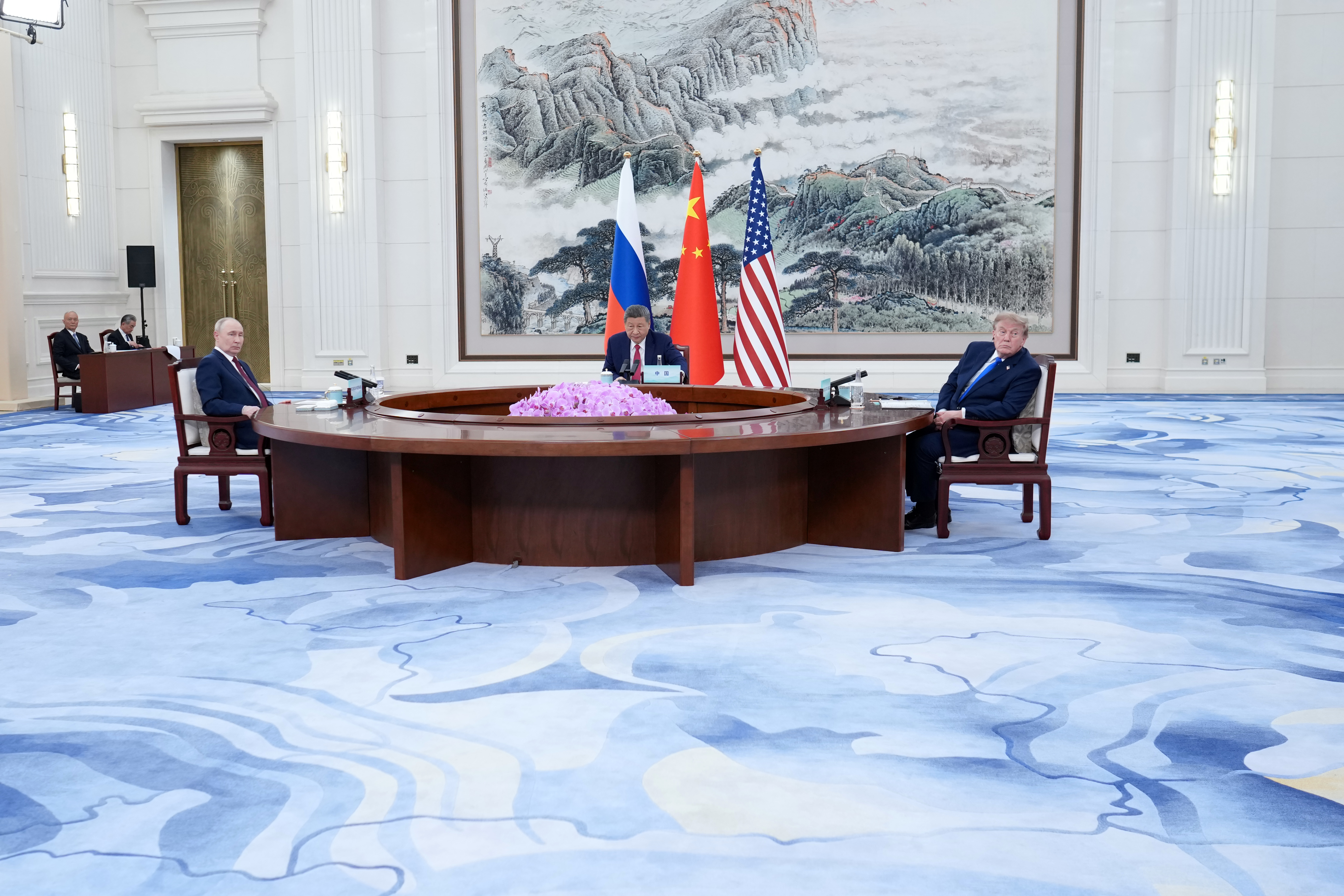
    Instead, Trump relished what amounted to a high-profile photo opportunity of the three leaders seated around a circular wooden table. For Trump, the main achievement seemed to be a mutual commitment to keep talking about peace — without taking meaningful steps toward it.

    “Too often, past leaders avoided talking to nations with whom they had disagreements, and we feel the opposite,” Trump told Xi and Putin. “No peace was ever forged by declining opportunities for engagement and speech.”

    After the summit, the leaders released a joint statement saying they had agreed to reform the United Nations, increase the production and supply of petroleum, oppose perceived abuses by the International Criminal Court against state officials, and continue their dialogue on reducing nuclear risks. “A nuclear war cannot be won and must never be fought,” the statement said.

    While China, which has the fastest-growing nuclear arsenal on earth, agreed to participate in the three-way discussion of nuclear weapons, the leaders announced little concrete beyond agreeing to continue a dialogue on reducing nuclear risks. Xi has long been reluctant to agree to nuclear arms control because China’s arsenal remains a fraction the size of those belonging to Russia and the United States.

    In the end, Trump’s whirlwind journey — two weeks after the Republican Party suffered a wipeout in the midterm elections and amid anxiety at home about widespread digital outages — amounted to a grand show of camaraderie.

    As host of the tightly choreographed event, Xi flattered Trump and gave him an opportunity to ask for China’s assistance on matters ranging from ending global conflicts to spending more on U.S. agricultural goods. The summit also removed Putin from his status as a global pariah over his invasion of Ukraine, elevating him to a leader deserving of equal diplomatic footing.

    But for all of the talk of peace, there was no announcement of breakthroughs in the talks the Trump administration is engaged in to end that conflict. Nor did Trump appear to dwell on finding a way out of the its war with Iran.

    “We don’t need any help,” Trump said, when asked by a Fox News reporter before the summit whether he would seek assistance from the other leaders in ending a conflict of his own making. In fact, the help Trump could ask for would involve demanding that China and Russia stop assisting Iran: U.S. intelligence has concluded that both countries provided either technology or targeting information that likely helped the Iranians strike U.S. military bases in the Middle East.

    On Fox News, Trump described the three-way conversation as a way to disrupt the growing “partnership without limits” that Xi and Putin say they have formed in recent years. Trump said he hoped to break up that alignment and turn it into a three-way conversation, rather than a partnership focused on countering American influence.

    China and Russia’s alignment, Trump said, “should have never been allowed to happen.”

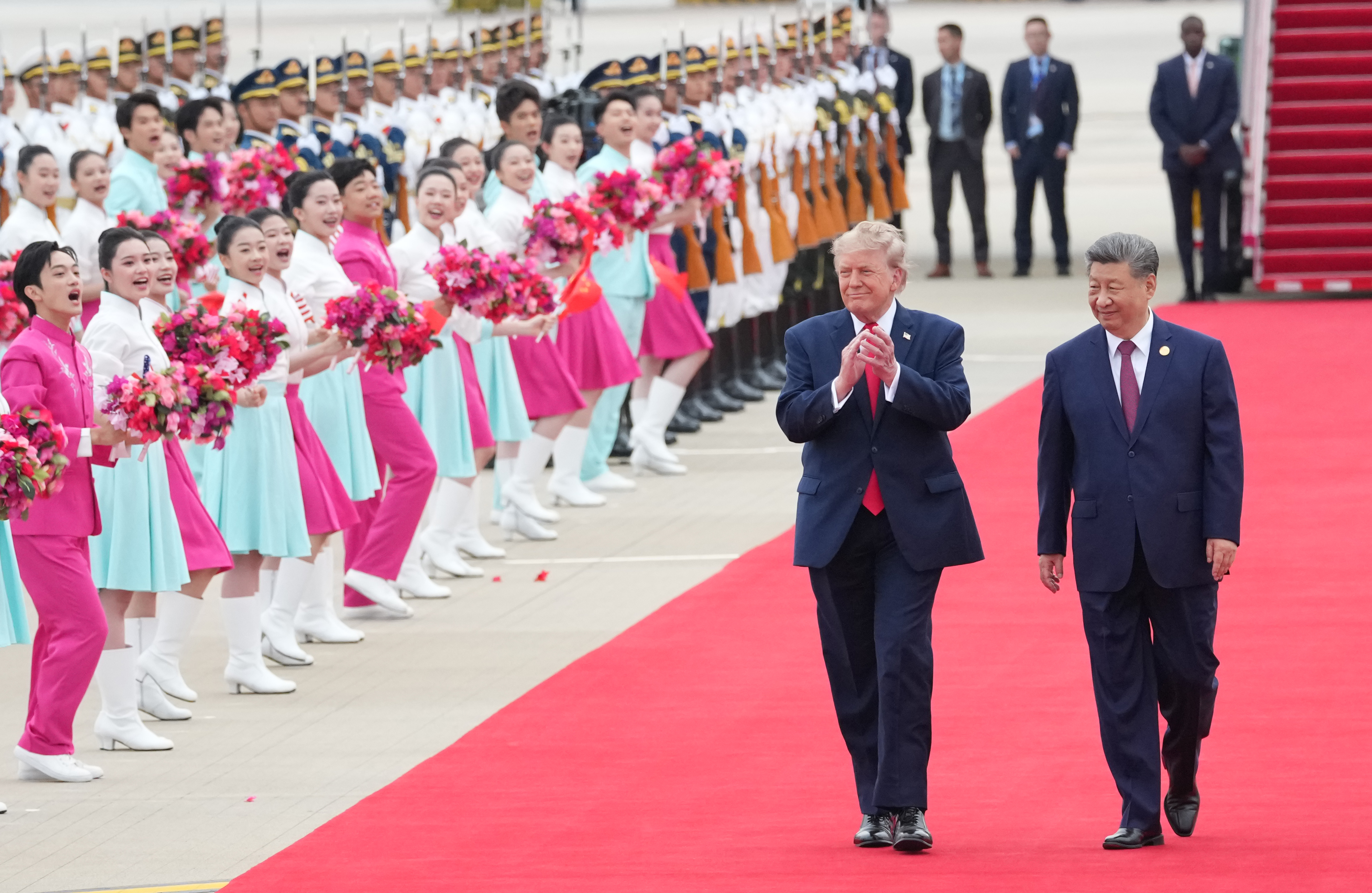
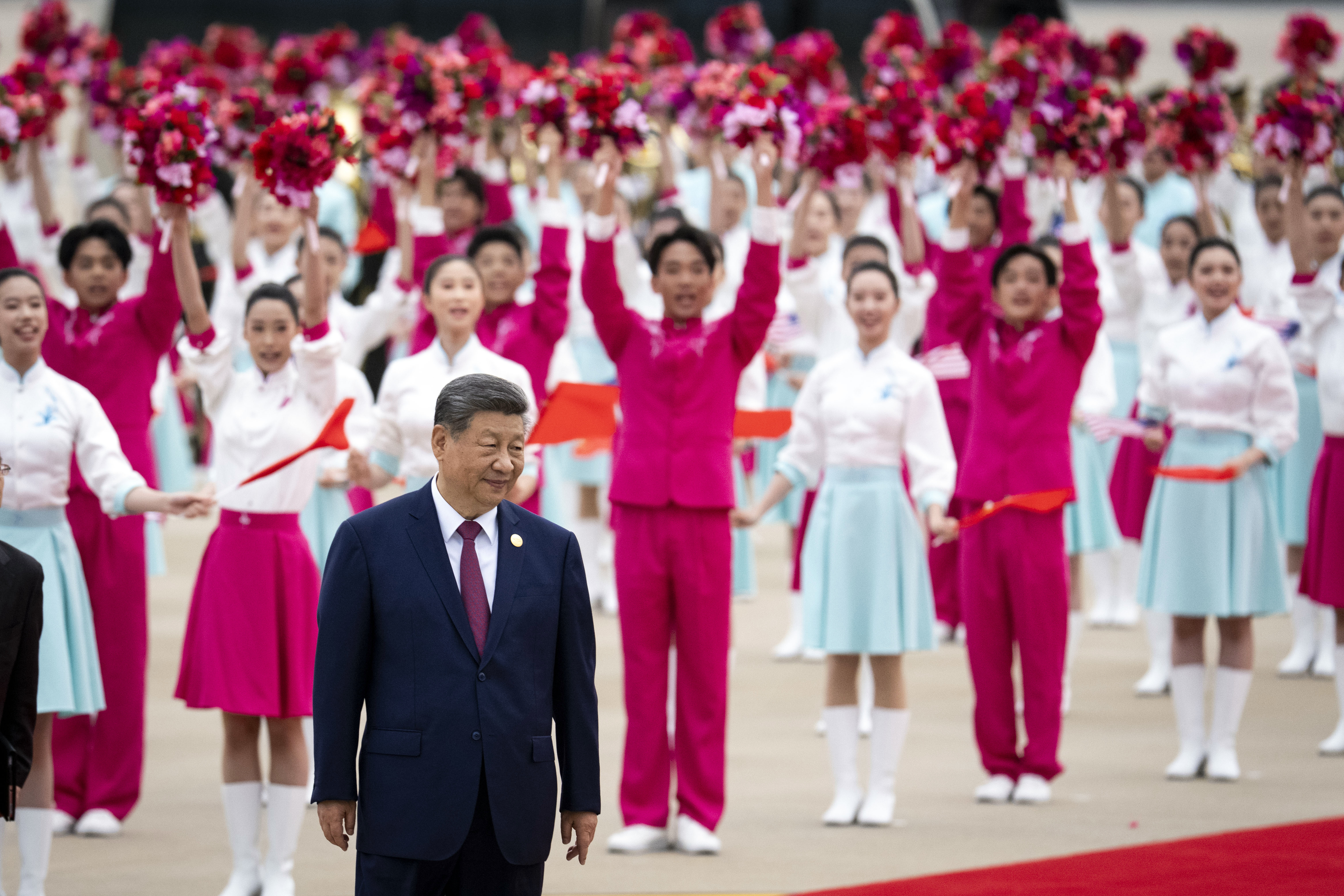
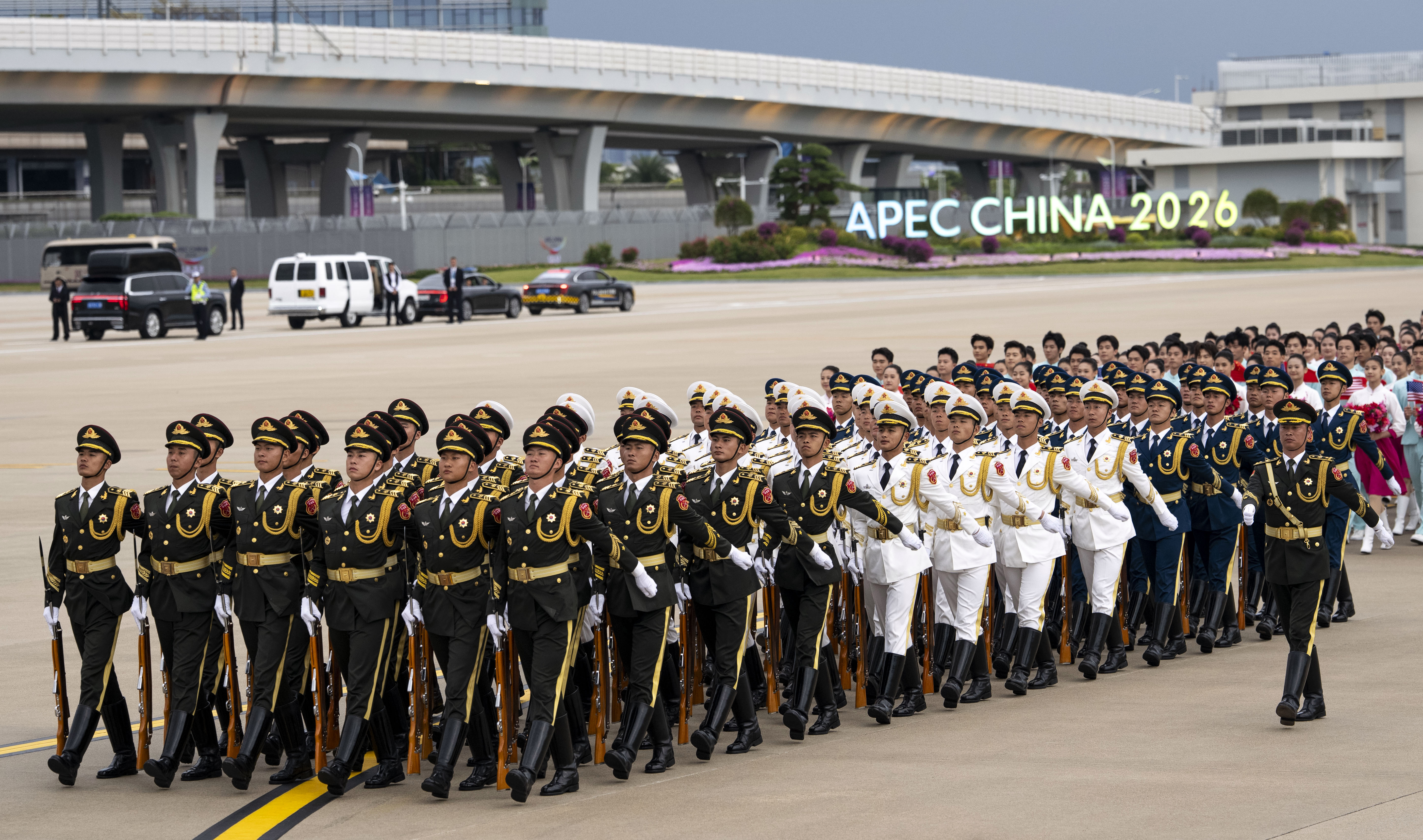
    Seeking his own path into Xi’s good graces, Trump has held three meetings with the Chinese leader this year, with the goal of cooling a tit-for-tat trade war and of building up a personal relationship through mutual flattery. Trump traveled to Joint Base Andrews to welcome Xi to Washington in May, and Xi responded in kind when Trump arrived in Shenzhen on Wednesday, treating the president to a military exercise and a fleet of U.S. and Chinese flag-waving dancers in a flurry of pink, blue and white outfits.

    In Shenzhen, the heart of China’s robotics, telecommunications, semiconductor and software industries, Trump did not visit the chief technological competitors to the United States, or see coffee-serving robots near the city’s center.

    Still, he marveled over the ceremonial welcome and held it up as evidence of a warming bond, telling an interviewer that “one of the great presidents of China” had greeted him. “He’s never gone to the airport to meet somebody,” Trump said.

    The president, who spends much of his time in the United States on bombastic appearances and incendiary social media posts, was on his best behavior alongside Xi. (He was his old self on Fox News before the summit, when he threatened to wipe out Iran should it attack the United States directly.)

    Xi, for his part, said a much improved relationship between China and the United States in recent months was “the right way” for the two powers to “get along.” But he also warned that the key to keeping ties stable “lies in taking concrete actions to implement the consensus reached by the two heads of state.” The remarks came days after Washington moved to close a loophole on Chinese access to advanced AI chips.

    As for Putin, the summit was his first encounter with Trump since the two men met in Alaska last year. That meeting was a diplomatic flop, and the war in Ukraine has intensified since then. The peace mechanism Trump advocated — a direct meeting between Putin and President Volodymyr Zelenskyy of Ukraine, moderated by Trump — has yet to materialize.

    This time, White House officials were modest in their predictions. Expectations were set so low that White House officials who previewed the trip last week initially said Trump would not bring up the war in Ukraine at all, although he ultimately did.

    In Shenzhen, Trump continued welcoming Russia back into the fold of great superpowers. He called Putin “my friend,” and insisted that all three leaders would like to see the war end quickly. The Russian leader reiterated after the meeting, however, that he would not be negotiating with Ukraine.

    During the trilateral meeting, Xi and Putin embraced the idea of peaceful leadership, without making commitments that would be much of a burden to either of their countries. In his own remarks, Putin said their nations were “united not only by the status of being the victorious countries in World War II, but most importantly by the joint responsibility for maintaining international peace and security.”

    And Xi mentioned a utopian goal that has pretty much fallen off the agenda of superpowers. He described nuclear weapons as a “sword of Damocles hanging over humanity” that should be eliminated. But Beijing has typically called on the United States to take the first steps in arms control, a demand that Trump seemed to acknowledge earlier in the day.

    “For me, it’s a hard thing,” he told Fox News. “And it’s probably hard for them to do also.”

    It has been done before, by Trump’s predecessors. Today, the United States and Russia each have slightly more than 5,000 nuclear warheads, and only 1,550 deployed under the New START treaty that expired earlier this year — down from tens of thousands on both sides during the Cold War.

    China, however, was never a party to past nuclear reduction treaties, and it is now intent on building up to at least current Russian and U.S. levels.

    Trump also said in Shenzen that he wanted to crack down on nuclear proliferation by smaller powers — his justification for attacking Iran — and restrain what he said were the excesses of “rogue” organizations like the International Criminal Court.

    Putin is subject to an ICC arrest warrant over alleged war crimes in Ukraine. Nevertheless Trump welcomed the Russian leader in Alaska last year and extended an invitation to the Group of 20 summit next month in Florida. Putin told reporters after the meeting that he was unsure if he would attend.

    One topic that went missing from each leader’s remarks was artificial intelligence, as China and the United States are locked in fierce competition over the new technology.

    Trump did not answer a question, shouted by a Bloomberg News reporter at APEC earlier in the day, if the former CEO of Nvidia — a company that has been central to the AI boom — had been disloyal to the United States. The executive, Jensen Huang, resigned after he was found to have two extramarital relationships, including one with a woman who U.S. intelligence has determined is a Chinese asset.

    The reporter who shouted the question was admonished by Chinese officials and barred from the trilateral meeting. Trump seemed blasé about the matter of espionage earlier in the day, telling Fox News that “we spy on them too.”

    As the president basked in flattery from an authoritarian whose ironfisted leadership he has openly admired, he gently suggested that he had not received as much media coverage as he would have liked.

    “It’s too bad the media couldn’t see some of it,” Trump said of his trip.

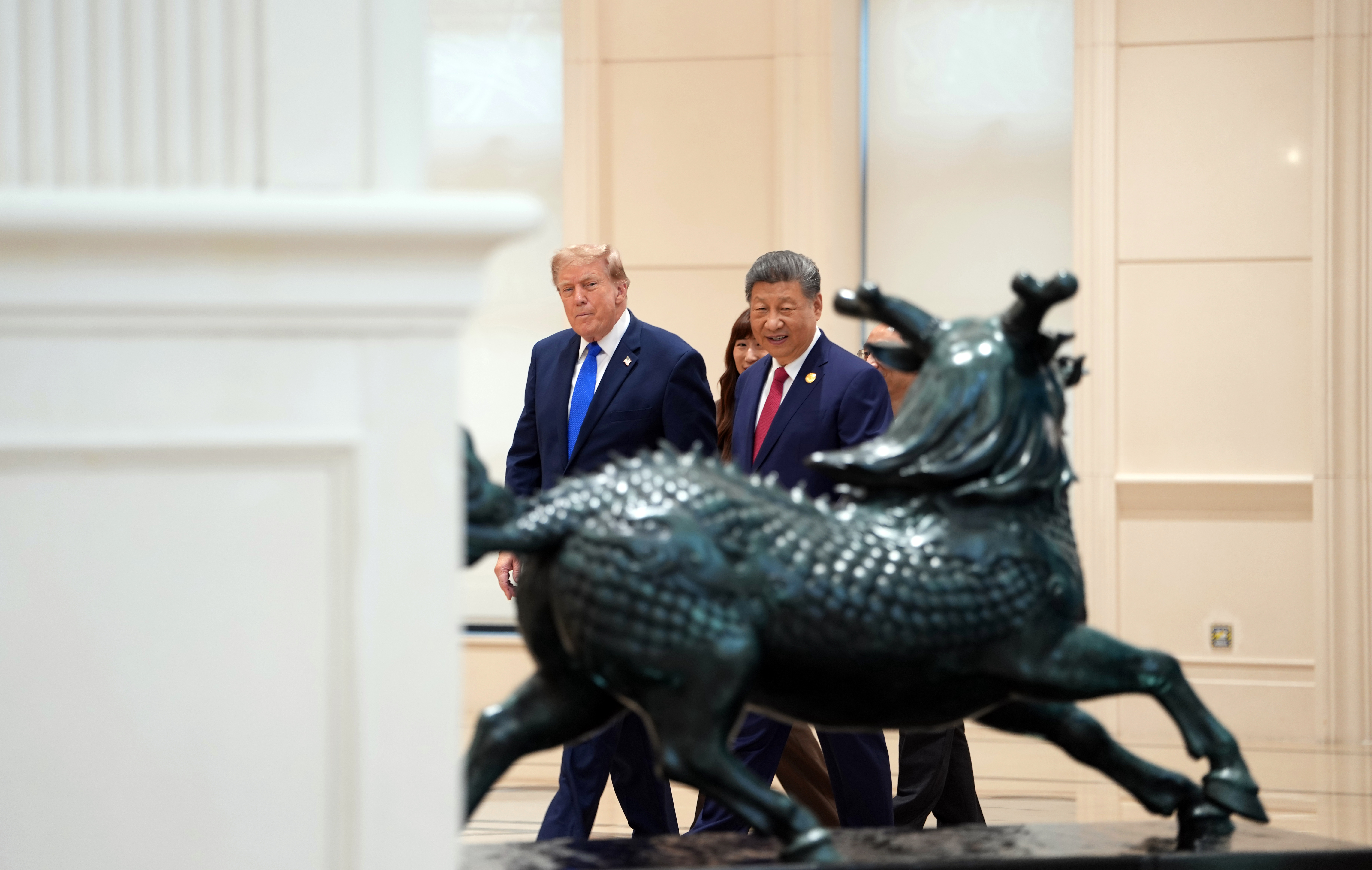
    President Donald Trump, left, with President Xi Jinping of China before their bilateral meeting in Shenzhen, China, on Thursday, Nov. 19, 2026. Trump said that he would bring up the war in Ukraine at the first-ever meeting of leaders of Russia, China and the United States. (Doug Mills/The New York Times)DOUG MILLS
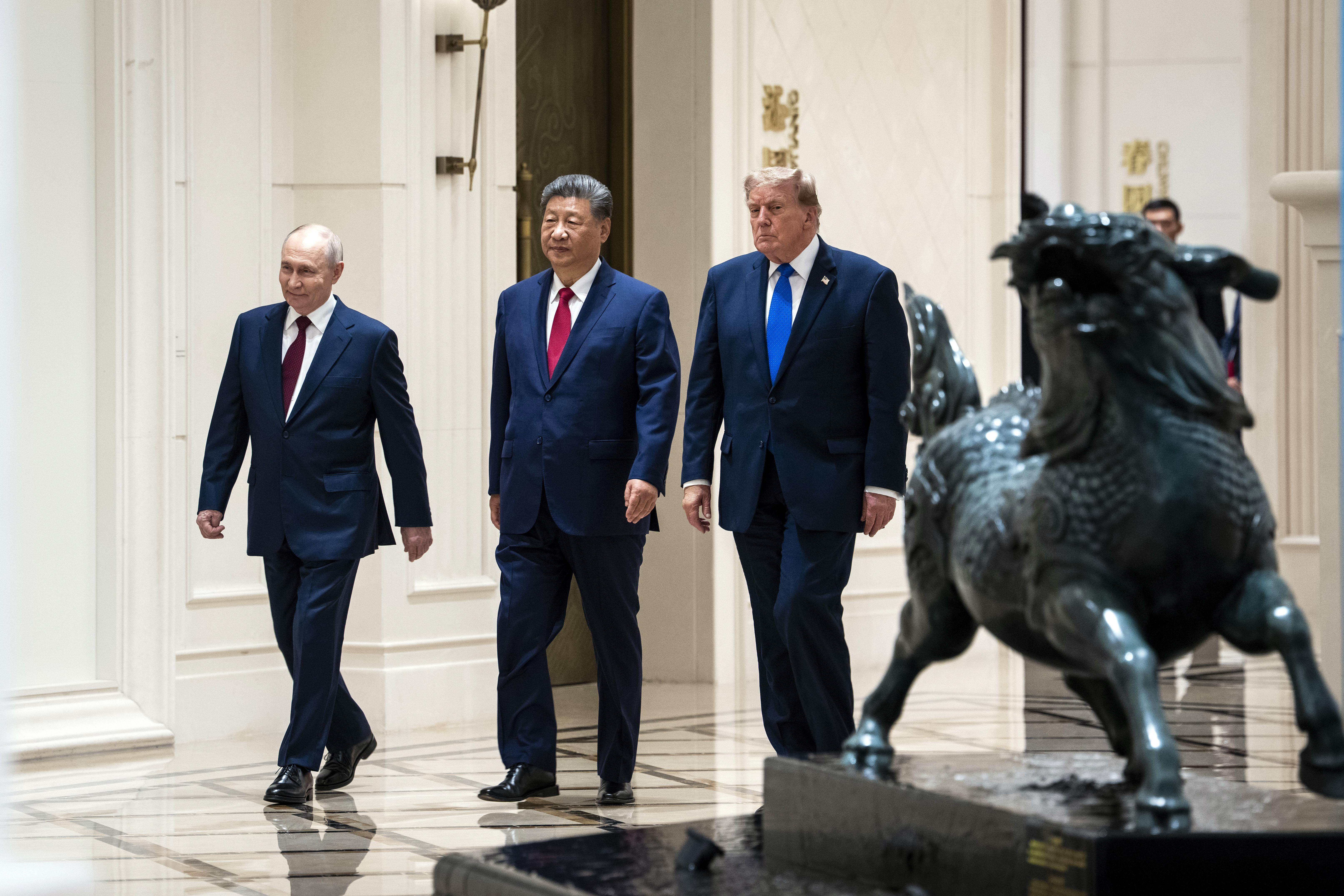
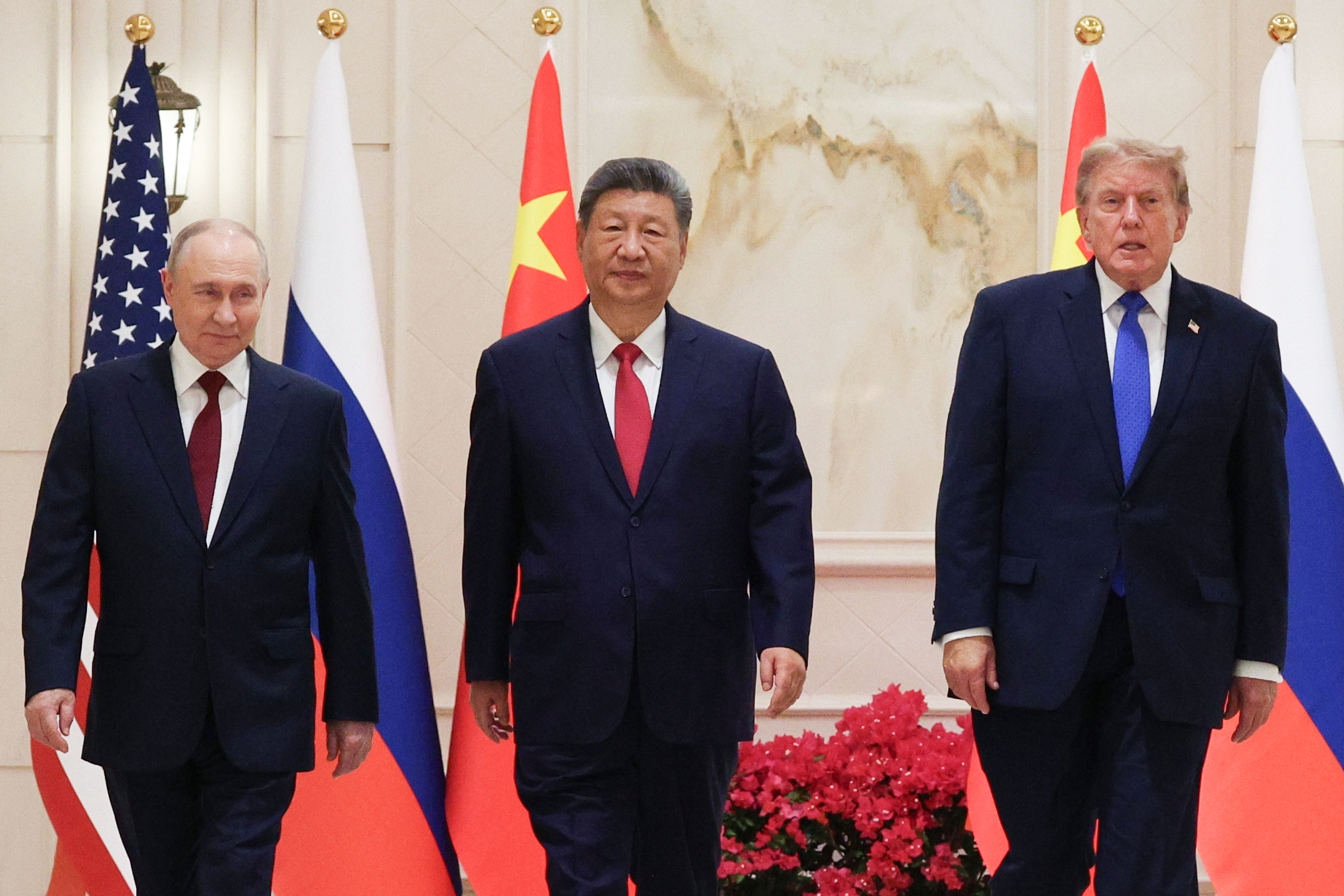
    From left: President Vladimir Putin of Russia, President Xi Jinping of China and President Donald Trump of the U.S. meet in Shenzhen, China, on Thursday, Nov. 19, 2026. Trump said that he would bring up the war in Ukraine at the first-ever meeting of leaders of Russia, China and the United States. (Doug Mills/The New York Times)DOUG MILLS
    President Donald Trump of the U.S. boards Air Force One after meeting withPresident Xi Jinping of China and President Vladimir Putin of Russia in Shenzhen, China, on Thursday, Nov. 19, 2026. Trump said before the meeting that he wanted to discuss nuclear weapons and the wars in Ukraine and Iran. But the three leaders appeared to refer to the topics only in vague terms. (Doug Mills/The New York Times)DOUG MILLS
    From left: President Vladimir Putin of Russia, President Donald Trump of the U.S. and President Xi Jinping of China meet in Shenzhen, China, on Thursday, Nov. 19, 2026. Trump said before the meeting that he wanted to discuss nuclear weapons and the wars in Ukraine and Iran. But the three leaders appeared to refer to the topics only in vague terms. (Doug Mills/The New York Times)DOUG MILLS
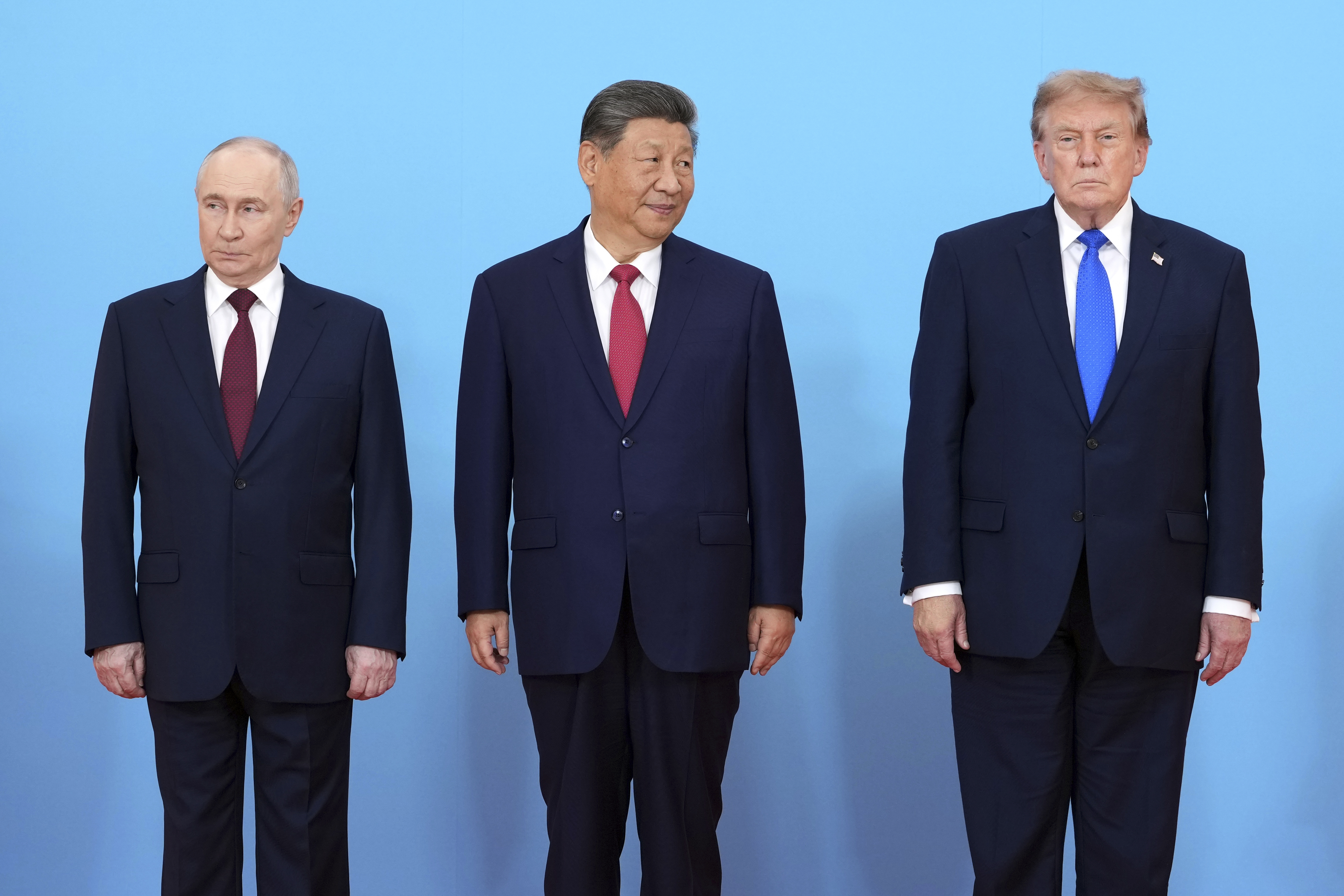
    From left: President Vladimir Putin of Russia, President Xi Jinping of China and President Donald Trump of the U.S. take their places for a group portrait in Shenzhen, China, on Thursday, Nov. 19, 2026. Trump said before the meeting that he wanted to discuss nuclear weapons and the wars in Ukraine and Iran. But the three leaders appeared to refer to the topics only in vague terms. (Doug Mills/The New York Times)DOUG MILLS
    President Donald Trump of the U.S., right, and President Xi Jinping of China during their trilateral meeting with President Vladimir Putin of Russia, not pictured, in Shenzhen, China, on Thursday, Nov. 19, 2026. Trump said before the meeting that he wanted to discuss nuclear weapons and the wars in Ukraine and Iran. But the three leaders appeared to refer to the topics only in vague terms. (Doug Mills/The New York Times)DOUG MILLS
    President Donald Trump, left, with President Xi Jinping of China before their bilateral meeting in Shenzhen, China, on Thursday, Nov. 19, 2026. Trump said that he would bring up the war in Ukraine at the first-ever meeting of leaders of Russia, China and the United States. (Doug Mills/The New York Times)DOUG MILLS
    President Donald Trump, left, with President Xi Jinping of China before their bilateral meeting in Shenzhen, China, on Thursday, Nov. 19, 2026. Trump said that he would bring up the war in Ukraine at the first-ever meeting of leaders of Russia, China and the United States. (Doug Mills/The New York Times)DOUG MILLS
    President Donald Trump of the U.S. speaks as he sits across the table from President Xi Jinping of China during their bilateral meeting in Shenzhen, China, on Thursday, Nov. 19, 2026. Trump said that he would bring up the war in Ukraine at the first-ever meeting of leaders of Russia, China and the United States. (Doug Mills/The New York Times)DOUG MILLS
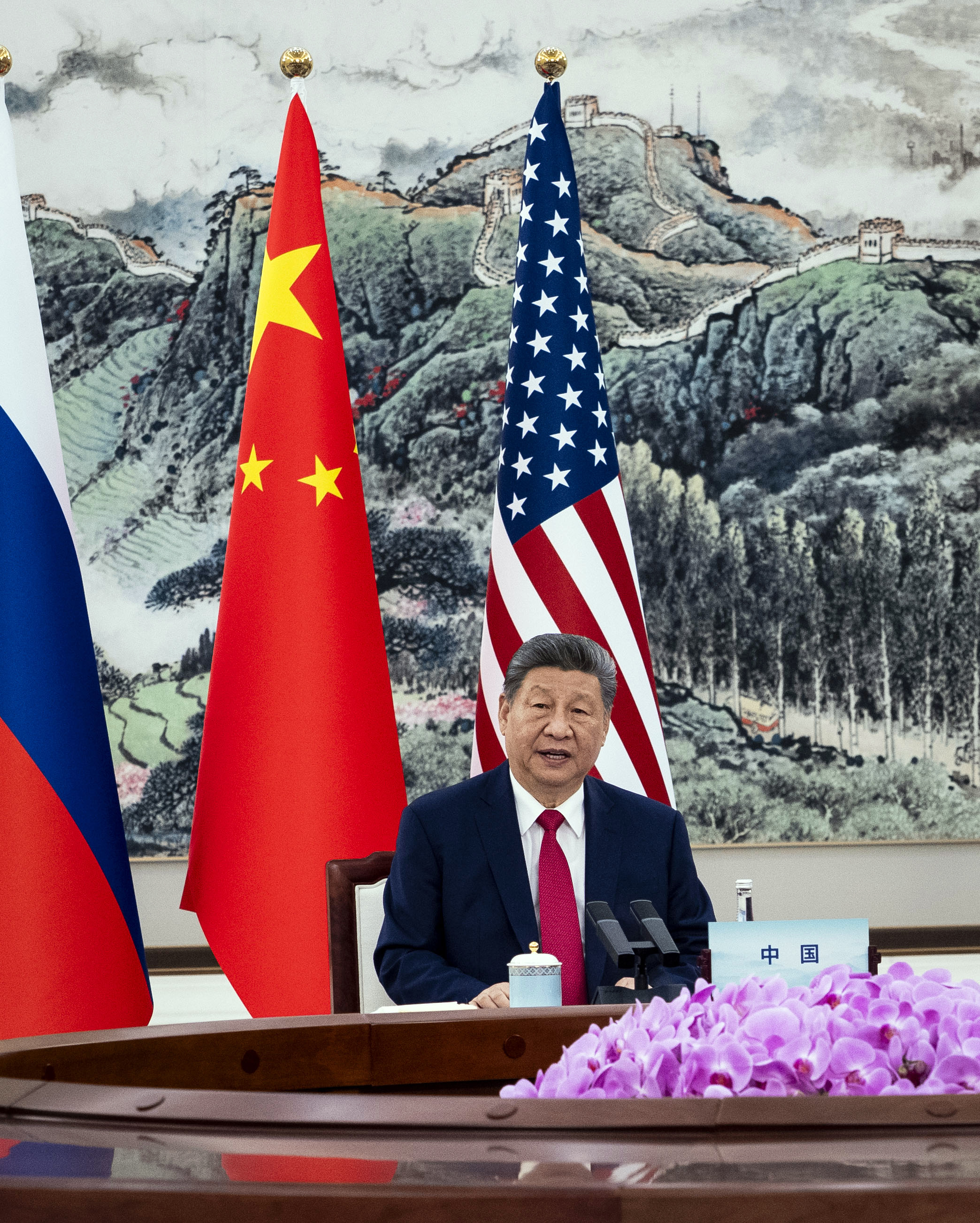
    President Xi Jinping of China speaks during a trilateral meeting with President Donald Trump of the U.S. and President Vladimir Putin of Russia in Shenzhen, China, on Thursday, Nov. 19, 2026. Trump said that he would bring up the war in Ukraine at the first-ever meeting of leaders of Russia, China and the United States. (Doug Mills/The New York Times)DOUG MILLS
    President Vladimir Putin of Russia meets with President Xi Jinping of China and President Donald Trump of the U.S. in Shenzhen, China, on Thursday, Nov. 19, 2026. Trump said that he would bring up the war in Ukraine at the first-ever meeting of leaders of Russia, China and the United States. (Doug Mills/The New York Times)DOUG MILLS
    From left, President Vladimir Putin of Russia, President Xi Jinping of China; and President Donald Trump of the U.S. in Shenzhen, China, on Thursday, Nov. 19, 2026. Trump said that he would bring up the war in Ukraine at the first-ever meeting of leaders of Russia, China and the United States. (Doug Mills/The New York Times)DOUG MILLS
    President Donald Trump, left, with President Xi Jinping of China before their bilateral meeting in Shenzhen, China, on Thursday, Nov. 19, 2026. Trump said that he would bring up the war in Ukraine at the first-ever meeting of leaders of Russia, China and the United States. (Doug Mills/The New York Times)DOUG MILLS
    President Xi Jinping of China , center, speaks during a meeting with President Vladimir Putin of Russia, left, and President Donald Trump of the U.S. in Shenzhen, China, on Thursday, Nov. 19, 2026. Trump said that he would bring up the war in Ukraine at the first-ever meeting of leaders of Russia, China and the United States. (Doug Mills/The New York Times)DOUG MILLS
    President Donald Trump, left, with President Xi Jinping of China at their bilateral meeting in Shenzhen, China, on Thursday, Nov. 19, 2026. Trump said that he would bring up the war in Ukraine at the first-ever meeting of leaders of Russia, China and the United States. (Doug Mills/The New York Times)DOUG MILLS
    President Donald Trump of the U.S. meets with President Xi Jinping of China and President Vladimir Putin of Russia in Shenzhen, China, on Thursday, Nov. 19, 2026. Trump said that he would bring up the war in Ukraine at the first-ever meeting of leaders of Russia, China and the United States. (Doug Mills/The New York Times)DOUG MILLS
    President Donald Trump, right, poses for a group portrait with President Xi Jinping of China, center, and President Vladimir Putin of Russia before their meeting in Shenzhen, China, on Thursday, Nov. 19, 2026. Trump said that he would bring up the war in Ukraine at the first-ever meeting of leaders of Russia, China and the United States. (Doug Mills/The New York Times)DOUG MILLS
    President Donald Trump, right, poses for a group portrait with President Xi Jinping of China, center, and President Vladimir Putin of Russia before their meeting in Shenzhen, China, on Thursday, Nov. 19, 2026. Trump said that he would bring up the war in Ukraine at the first-ever meeting of leaders of Russia, China and the United States. (Doug Mills/The New York Times)DOUG MILLS
    Troops march in formation as President Donald Trump is welcomed upon his arrival at the airport in Shenzhen, China, on Wednesday, Nov. 18, 2026. (Doug Mills/The New York Times)DOUG MILLS
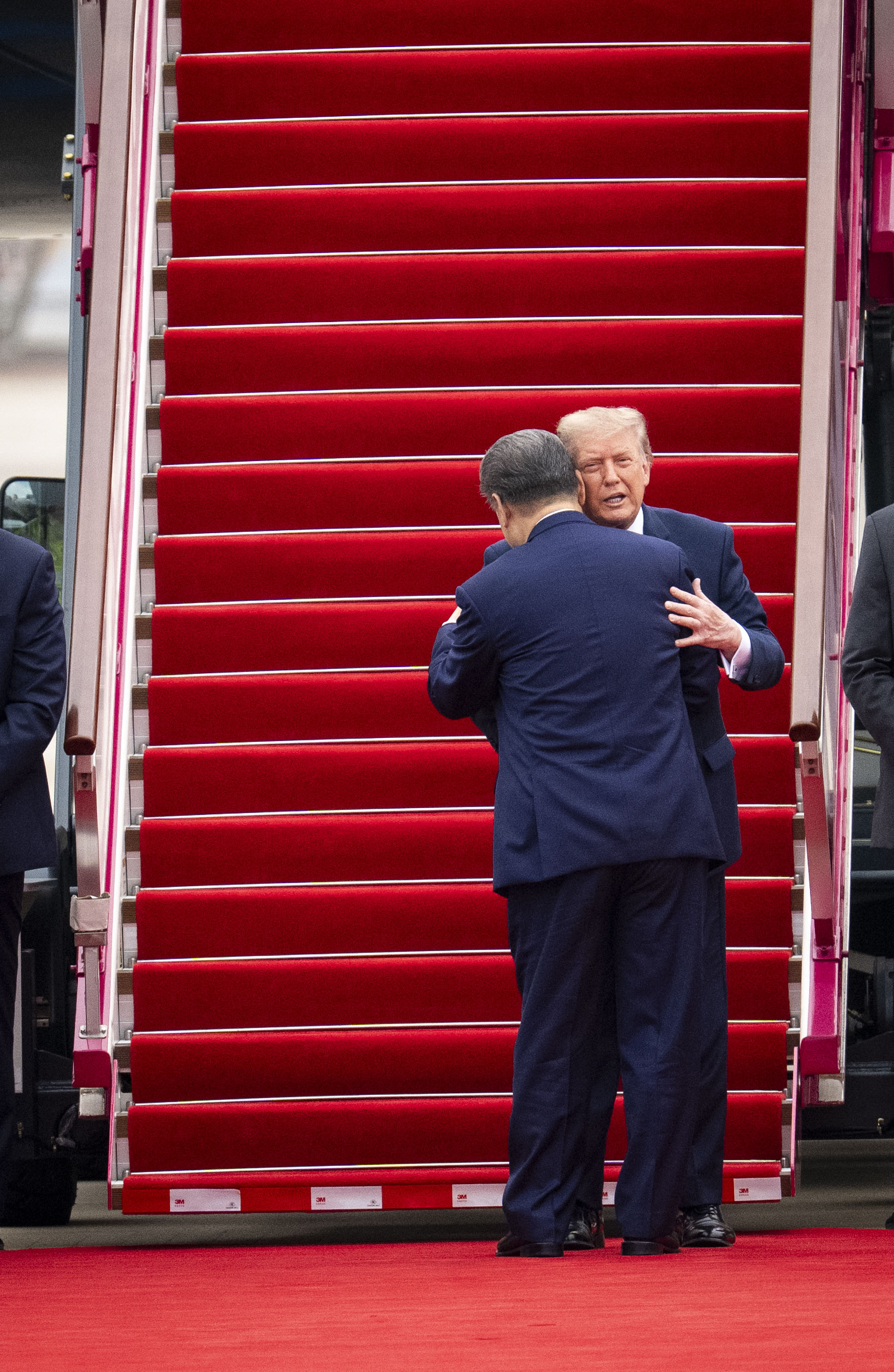
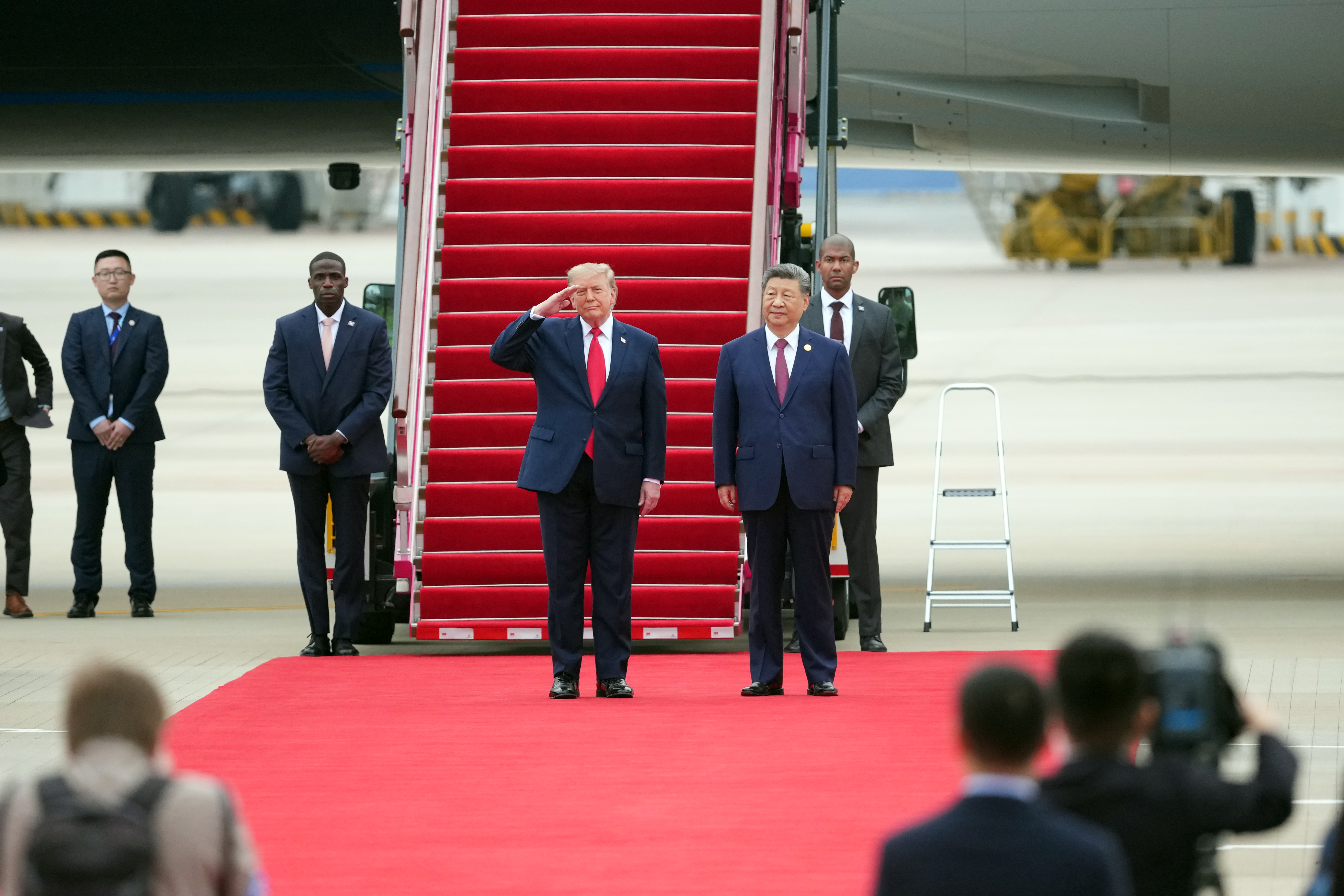
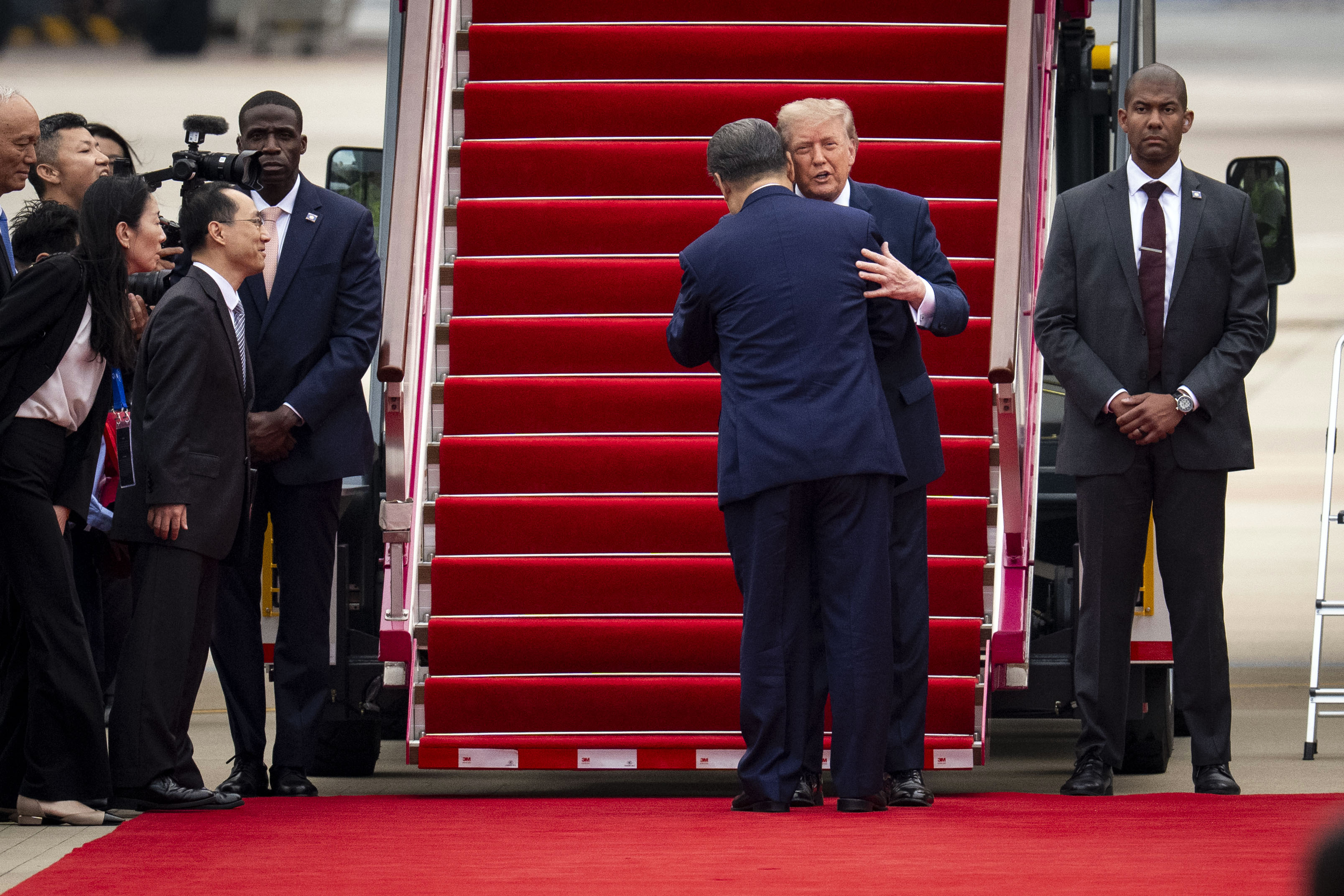
    President Donald Trump is embraced by Xi Jinping, the Chinese leader, upon his arrival at the airport in Shenzhen, China, on Wednesday, Nov. 18, 2026. Xi told Trump that he took the unusual move for a Chinese leader of greeting him at the airport because the American president had done the same for him when he visited the United States in September. “China is a nation of etiquette with a tradition of reciprocity,” Xi said, according to Chinese state media. (Doug Mills/The New York Times)DOUG MILLS
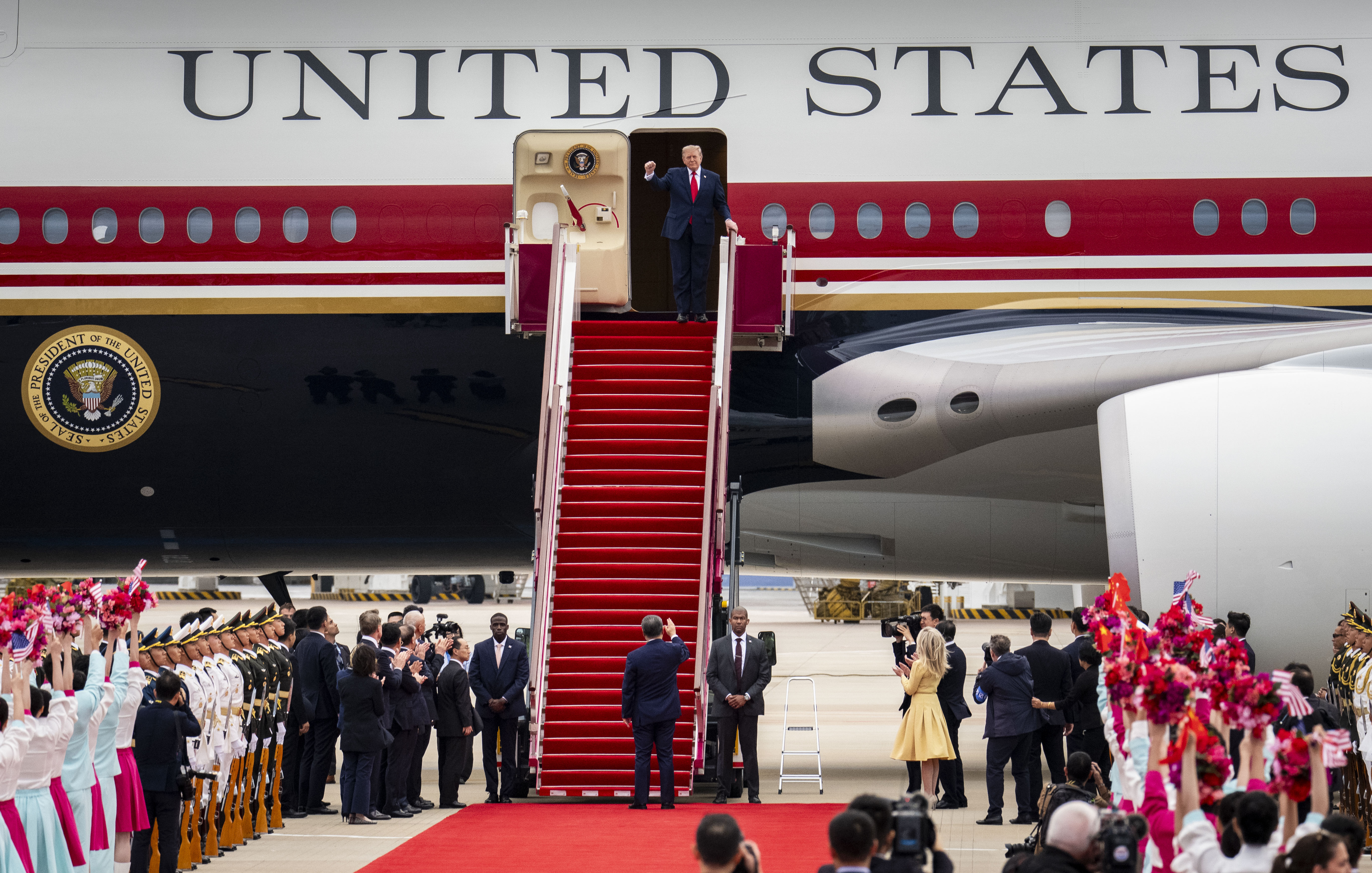
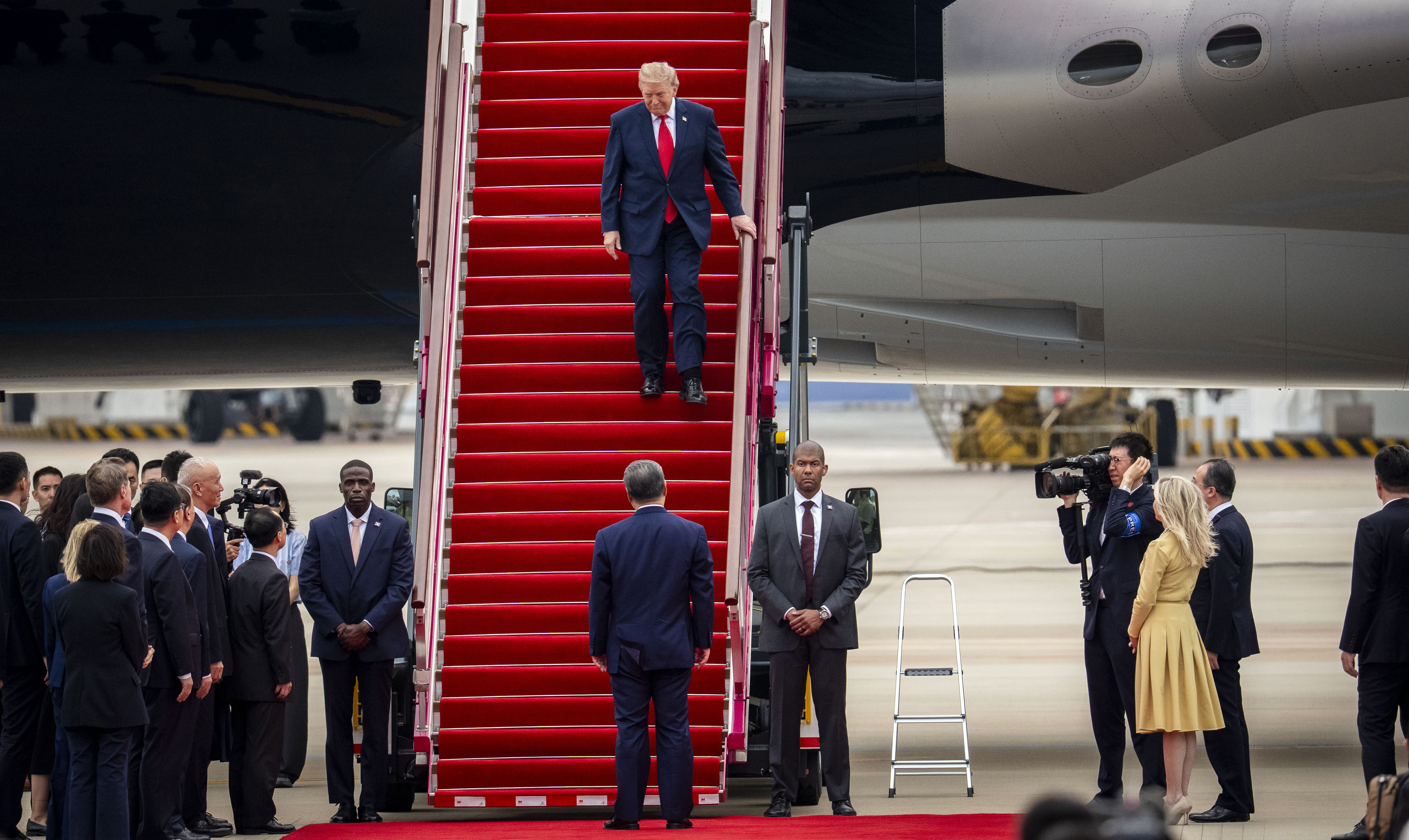
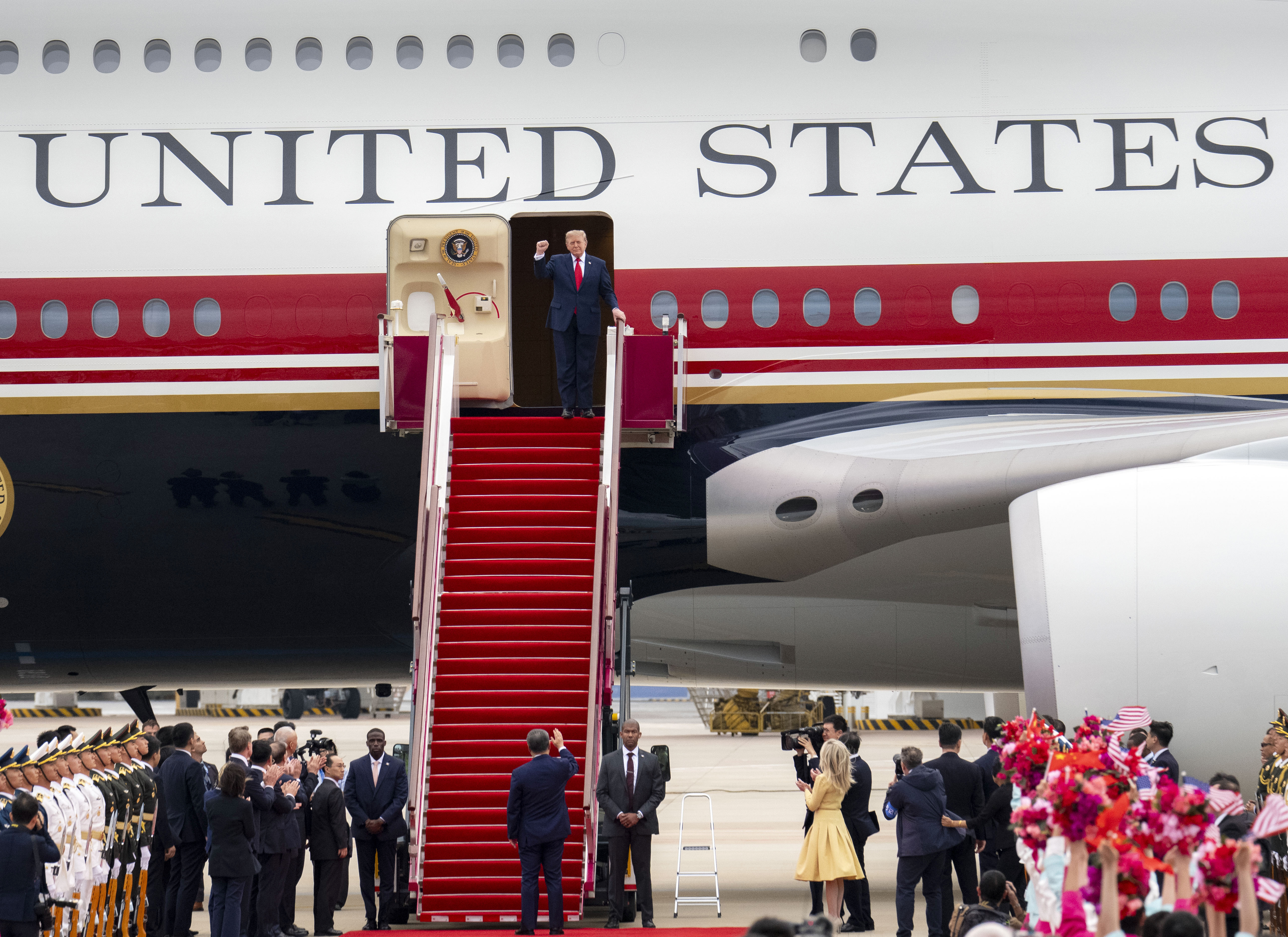
    RETRANSMISSION TO PROVIDE WIDER CROP AND ADDITIONAL CAPTION INFO — .President Donald Trump gestures as he arrives at the airport in Shenzhen, China, on Wednesday, Nov. 18, 2026. President Xi Jinping of China waves to Trump from the bottom of the stairs. Xi told Trump that he took the unusual move for a Chinese leader of greeting him at the airport because the American president had done the same for him when he visited the United States in September. “China is a nation of etiquette with a tradition of reciprocity,” Xi said, according to Chinese state media. (Doug Mills/The New York Times)DOUG MILLS
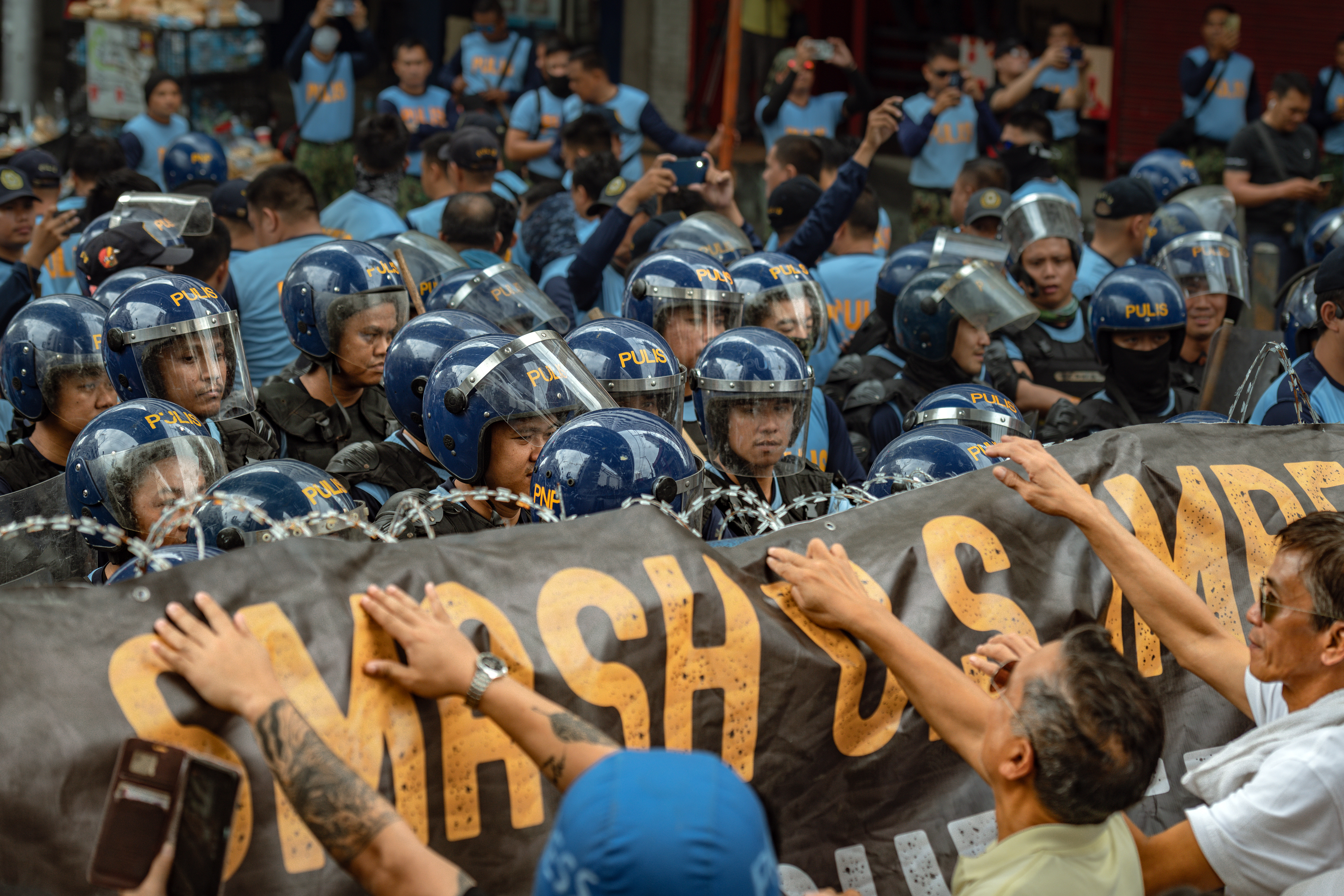
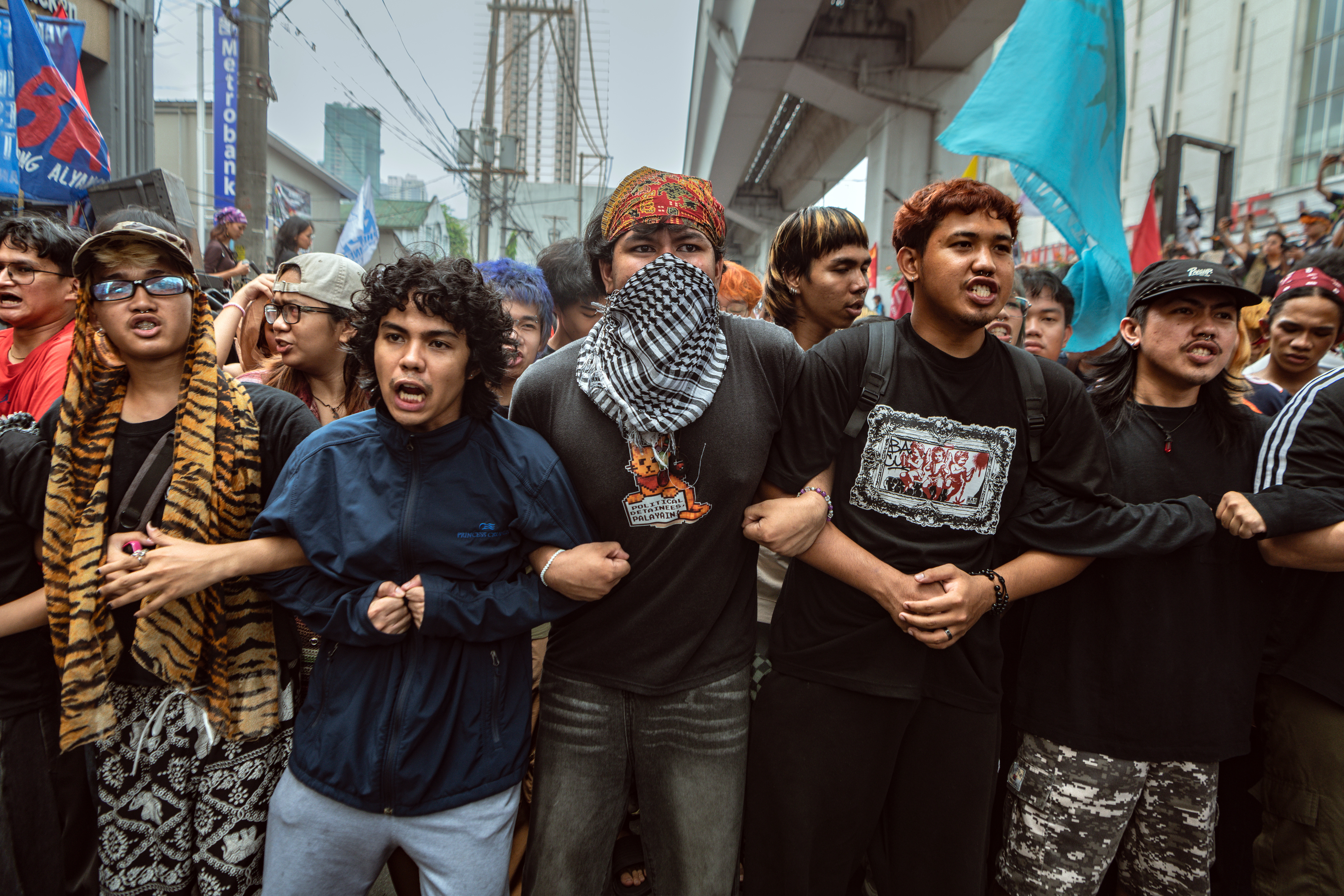
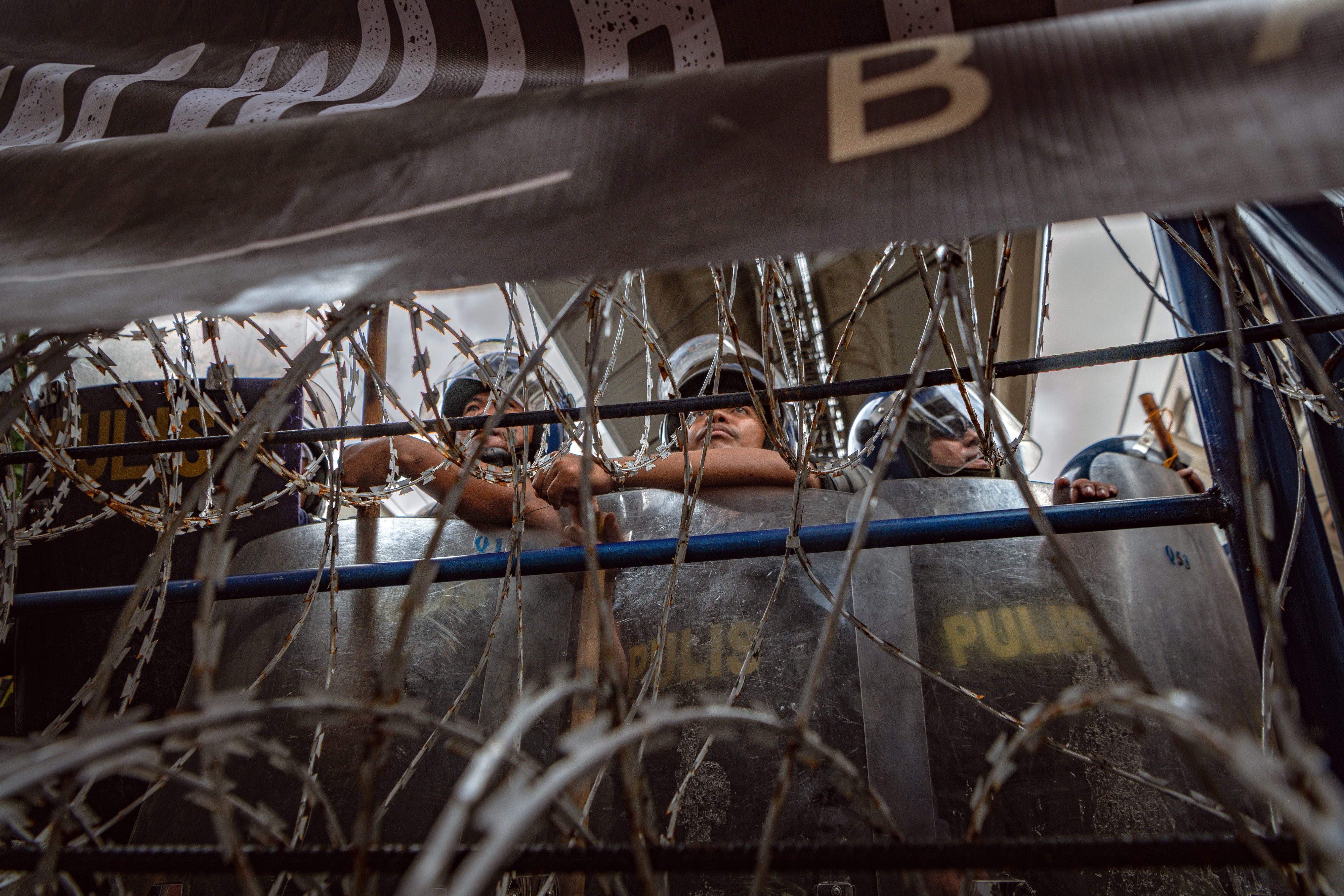
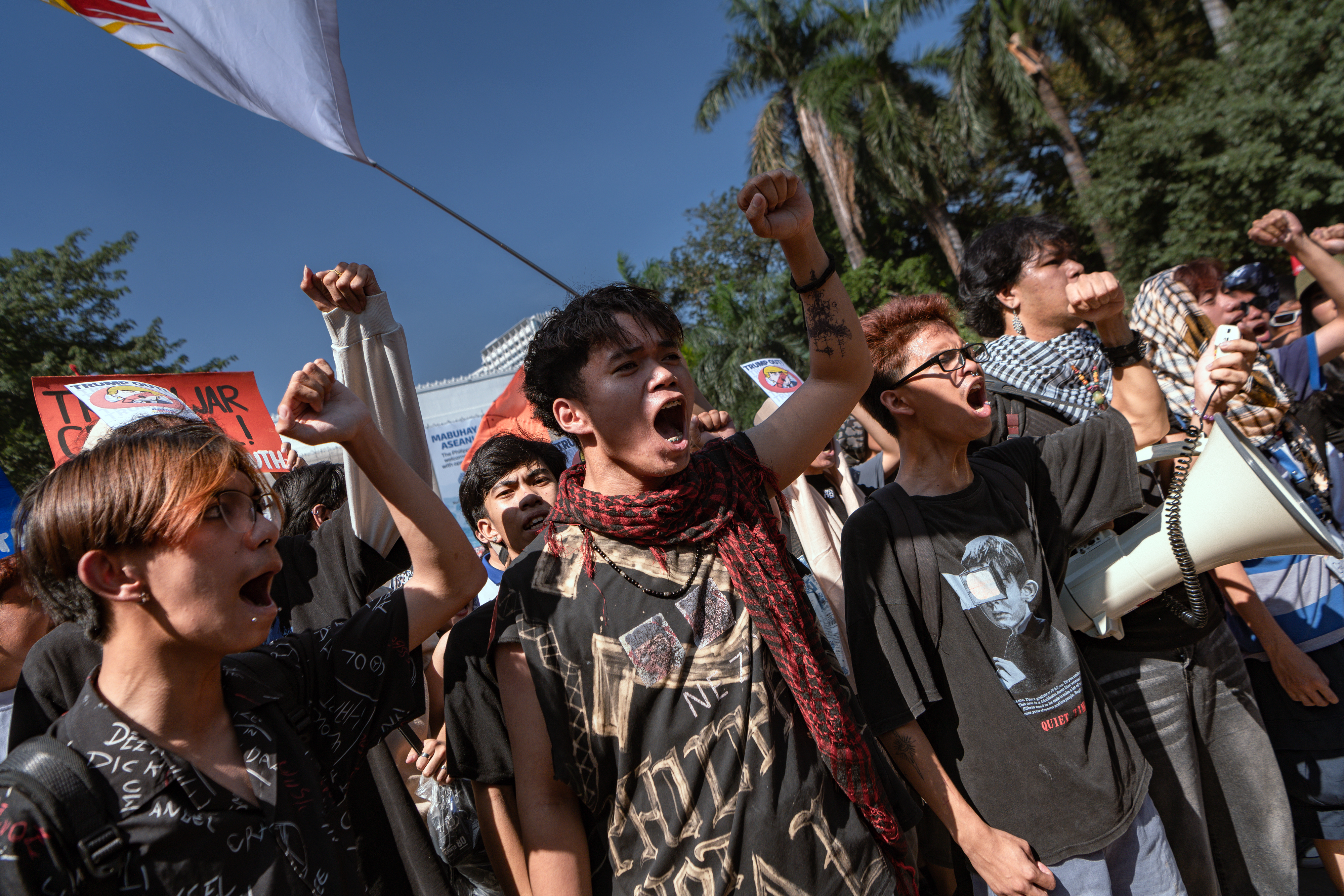
    Protesters in Manila, the Philippines, face off against police in riot gear as they denounce President Donald Trump’s visit and the U.S.-led Pax Silica initiative on Wednesday, Nov. 18, 2026. (Jes Aznar/The New York Times)JES AZNAR
    Xi Jinping, the Chinese leader, back to camera, waits to greet President Donald Trump upon his arrival at the airport in Shenzhen, China, on Wednesday, Nov. 18, 2026. It was a rare personal greeting by Xi before a summit they are expected to hold with President Vladimir Putin of Russia. (Doug Mills/The New York Times)DOUG MILLS
    Protesters in Manila, the Philippines, take to the streets to denounce President Donald Trump’s visit andthe U.S.-led Pax Silica initiative on Wednesday, Nov. 18, 2026. (Jes Aznar/The New York Times)JES AZNAR
    Police officers are deployed as protesters in Manila, the Philippines, take to the streets to denounce President Donald Trump’s visit and the U.S.-led Pax Silica initiative on Wednesday, Nov. 18, 2026. (Jes Aznar/The New York Times)JES AZNAR
    Police officers are deployed as protesters in Manila, the Philippines, take to the streets to denounce President Donald Trump’s visit and the U.S.-led Pax Silica initiative on Tuesday, Nov. 17, 2026. (Jes Aznar/The New York Times)JES AZNAR
    Protesters in Manila, the Philippines, take to the streets to denounce President Donald Trump’s visit andthe U.S.-led Pax Silica initiative on Tuesday, Nov. 17, 2026. (Jes Aznar/The New York Times)JES AZNAR
    Secretary of State Marco Rubio, who is accompanying President Donald Trump on his trip to Asia, departs after speaking to reporters in Manila, the Philippines, on Wednesday, Nov. 18, 2026. (Doug Mills/The New York Times)DOUG MILLS
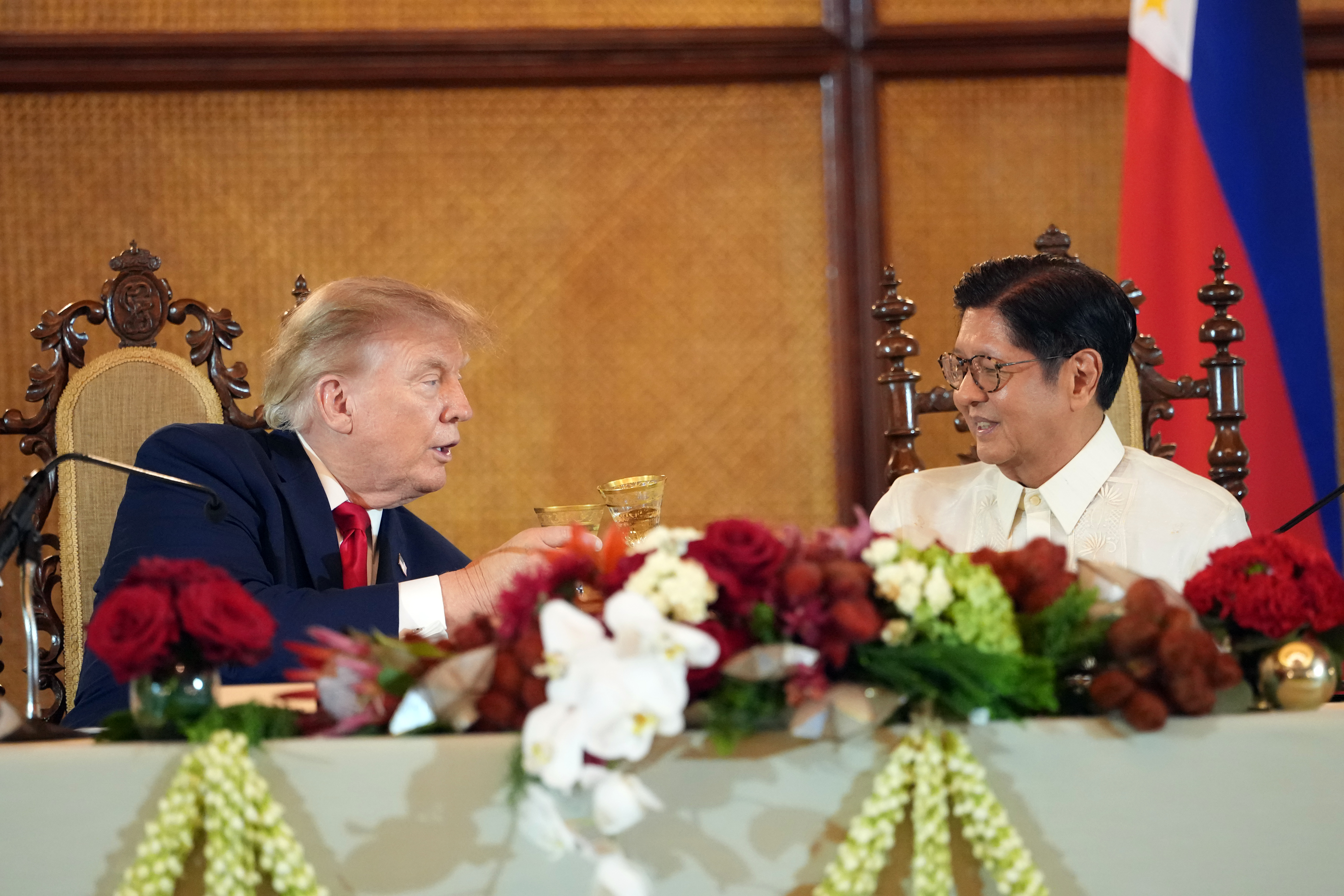
    President Donald Trump, left, President President Ferdinand Marcos Jr. of the Philippines in Manila on Wednesday, Nov. 18, 2026. (Doug Mills/The New York Times)DOUG MILLS
    President Donald Trump, center, arrives for a meeting with President President Ferdinand Marcos Jr. of the Philippines in Manila on Wednesday, Nov. 18, 2026. Looking on are, from right: Deputy White House Chief of Staff Dan Scavino; White House Chief of Staff Stephen Miller; Treasury Secretary Scott Bessent; and Secretary of State Marco Rubio. (Doug Mills/The New York Times)DOUG MILLS
    President President Ferdinand Marcos Jr. of the Philippines, right, welcomes President Donald Trump to the presidential palace in Manila, the Philippines on Wednesday, Nov. 18, 2026. (Doug Mills/The New York Times)DOUG MILLS
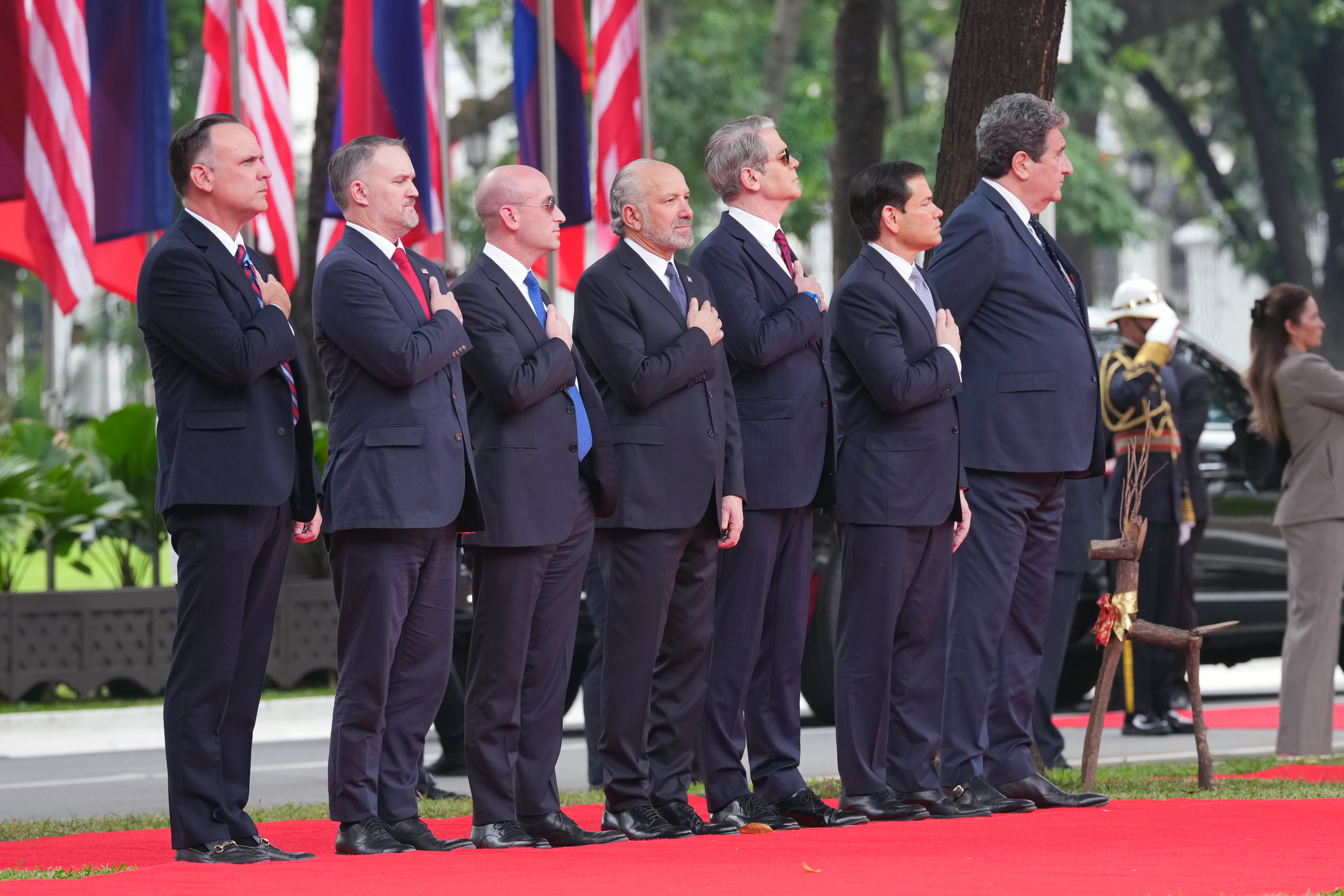
    The U.S. delegation during a welcome ceremony for President Donald Trump at the presidential palace in Manila, the Philippines on Wednesday, Nov. 18, 2026. From left: Deputy White House Chief of Staff Dan Scavino; U.S. Trade Representative Jamieson Greer; White House Chief of Staff Stephen Miller; Commerce Secretary Howard Lutnick; Treasury Secretary Scott Bessent; and Secretary of State Marco Rubio. (Doug Mills/The New York Times)DOUG MILLS
    Xi Jinping, the Chinese leader, looks on during a welcome ceremony for President Donald Trump at the airport in Shenzhen, China, on Wednesday, Nov. 18, 2026. It was a rare personal greeting by Xi before a summit they are expected to hold with President Vladimir Putin of Russia. (Doug Mills/The New York Times)DOUG MILLS
    President Donald Trump salutes as he is welcomed by Xi Jinping, the Chinese leader, upon his arrival at the airport in Shenzhen, China, on Wednesday, Nov. 18, 2026. It was a rare personal greeting by Xi before a summit they are expected to hold with President Vladimir Putin of Russia. (Doug Mills/The New York Times)DOUG MILLS
    President Donald Trump gestures as he arrives at the airport in Shenzhen, China, on Wednesday, Nov. 18, 2026. (Doug Mills/The New York Times)DOUG MILLS
    A colorful flyover by military jets as President DOnald Trump is welcomed upon his arrival at the airport in Shenzhen, China, on Wednesday, Nov. 18, 2026. (Doug Mills/The New York Times)DOUG MILLS
    Troops march in formation as President DOnald Trump is welcomed upon his arrival at the airport in Shenzhen, China, on Wednesday, Nov. 18, 2026. (Doug Mills/The New York Times)DOUG MILLS
    President Donald Trump, left, is welcomed by Xi Jinping, the Chinese leader, upon his arrival at the airport in Shenzhen, China, on Wednesday, Nov. 18, 2026. It was a rare personal greeting by Xi before a summit they are expected to hold with President Vladimir Putin of Russia. (Doug Mills/The New York Times)DOUG MILLS
    President Donald Trump is embraced by Xi Jinping, the Chinese leader, upon his arrival at the airport in Shenzhen, China, on Wednesday, Nov. 18, 2026. It was a rare personal greeting by Xi before a summit they are expected to hold with President Vladimir Putin of Russia. (Doug Mills/The New York Times)DOUG MILLS
  • In bending to Trump, law firm did $11.8 million of free work for administration

    In bending to Trump, law firm did $11.8 million of free work for administration

    The future of Kirkland & Ellis was on the line.

    President Donald Trump, weeks into his second term, had begun an unprecedented campaign to target elite law firms with punitive executive orders that could hurt their profits.

    A top partner at Kirkland, Mark Filip, scrambled to stave off the orders, signaling that he would be willing to negotiate with Trump’s lead personal lawyer and de facto enforcer, Boris Epshteyn.

    Epshteyn, at a moment of maximum leverage, pressed Filip.

    “You have a big trade practice, right?” Epshteyn wrote in a text message to Filip.

    “Please call,” Filip replied.

    The contours of the deal were outlined in a social media post by Trump in April 2025 in which he announced that Kirkland had agreed to do $125 million in pro bono work on causes Trump had championed, like helping veterans.

    But a year and a half later, Kirkland has quietly disclosed to Congress that it has done an array of free work for the Trump administration, about 6,491 hours valued at $11.8 million, according to documents reviewed by The New York Times and interviews with five people familiar with the matter.

    The records, including text messages and a seven-page letter the firm recently sent to Congress, offer the most detailed look yet at the terms of the deal. Kirkland has completed free work for the Commerce Department, the Pentagon, the Postal Service, the U.S. International Development Finance Corp. and an investment entity created as part of a trade deal between the United States and Japan, according to the five people and the letter.

    The letter Kirkland sent to Congress came in response to requests from top Democrats — Sen. Richard Blumenthal of Connecticut, Sen. Adam Schiff of California and Rep. Jamie Raskin of Maryland — who have repeatedly pressed the firm to clarify the details of the deal. The three lawmakers are expected to have key oversight roles in Congress next year, when their party controls the House and Senate.

    The disclosures demonstrate how Trump was not only able to make it more difficult for Kirkland to oppose him and his administration in court. He also successfully reshaped the firm into a tool of the state.

    The revelations raise questions about whether the firm and the White House violated a long-standing federal law that makes it illegal for the federal government to accept free work, circumventing Congress.

    In August 2025, the Times reported that Kirkland and Paul Weiss, the first firm to cut a deal with Trump, were doing work for the Commerce Department on trade deals. But until now, the breadth of the firm’s free legal work, including how many hours it worked for the government and the number of departments or agencies it worked for, had remained unclear.

    Under the Antideficiency Act, the executive branch is limited in accepting free services, to ensure that an administration does not undertake efforts for which Congress has not appropriated money, or over which lawmakers cannot have oversight.

    Zachary Price, a law professor at the University of California, San Francisco, and an expert in congressional appropriations, said that there were some exceptions to the act. But the arrangement between the law firms and the Trump administration, he added, “certainly violates the spirit of the law.”

    “It amounts to expanded resources available for the executive without Congress providing them,” Price said.

    In response to questions, Kirkland said in a statement that it had fully cooperated with the requests from lawmakers, and would “continue to cooperate.”

    The firm said that its work did not violate the Antideficiency Act.

    “First, the act does not apply where there is an agreement that the services will be provided for free, as there was here,” the firm said. “Second, the Antideficiency Act regulates the conduct of executive branch officials, not private parties like Kirkland.”

    The firm said it had represented governments free of charge in the past on significant matters and “would have considered accepting these sorts of representations, consistent with its past practice, without any agreement with a particular administration.”

    In the letter to lawmakers, the firm defended its independence, saying that it had declined to work on certain issues for the administration. Those include the U.S. Census, the pitched fight over the renaming of the John F. Kennedy Center for the Performing Arts, and the Postal Service plan to restrict mail-in ballots.

    The firm also said that it had continued to represent transgender inmates on a pro bono basis, and had rejected a request from a veterans group supporting the construction of Trump’s triumphal arch.

    In response to Kirkland’s disclosures, Blumenthal, Schiff and Raskin have urged other firms with ties to the administration to follow suit. Those include eight firms that made deals with the administration, as well as Sullivan & Cromwell, which represents Trump.

    “The scope of Kirkland’s work for the administration indicates that we need to know from other firms how much, and what type, of work they did,” Blumenthal said in an interview. “The administration’s tactics smacked of implicit or overt threats, and we need to understand what led these other firms to capitulate.”

    Shortly after he took office again last year, Trump issued a series of executive orders against law firms he believed had crossed him.

    To the shock of the legal community, Paul Weiss capitulated to Trump, agreeing to do $40 million in pro bono work on causes Trump championed. In exchange, the president dropped a potentially crippling executive order against the firm that could have made it impossible to represent clients.

    The firms were facing headwinds on a second front.

    Kirkland was among 20 top law firms to receive a letter from the Equal Employment Opportunity Commission demanding information about their “diversity, equity, and inclusion (DEI) related employment practices.”

    Under mounting pressure, Kirkland and a group of firms moved quickly to make deals. The intermediary, however, was not a government official, but a personal lawyer for Trump, Epshteyn.

    In its letter to Congress, Kirkland acknowledged how the executive orders — and fighting them in court — could have jeopardized its relationships with clients.

    “It would be rational for clients with matters before the federal government — be it transactions being reviewed for approval, investigations by agencies, or requests for product, device, or drug approvals — to not engage firms where they perceived the potential for adverse consequences solely on their choice of counsel,” the firm wrote.

    The Paul Weiss deal, it added, functioned as a kind of blueprint.

    It “set forth a precedent for how firms that wished to avoid immediately irreparable harm and protracted, intrusive litigation could resolve potential disputes with the administration,” the letter said.

    To cut the deal, Kirkland said that it hired Ballard Partners, a lobbying firm with close ties to the White House, to arrange a meeting with Trump’s aides, including May Mailman, then a deputy to Stephen Miller, one of the president’s top advisers.

    The firm also hired William Burck, the same lawyer who had struck the Paul Weiss deal with the White House, to negotiate with the employment commission.

    Kirkland, in its letter, said that there was no underlying document that described the terms of the agreement — only Trump’s social media post announcing the deal. It noted that the administration had not asked it for an accounting of whether it had fulfilled its obligations.

  • Trump wants the Supreme Court to let his EPA cancel billions in Biden-era climate grants

    Trump wants the Supreme Court to let his EPA cancel billions in Biden-era climate grants

    WASHINGTON — The Trump administration is appealing to the Supreme Court in its push to cut $16 billion in grants for a climate program, the largest grant cancellation case ever and one that could affect Republican President Donald Trump’s push to defund the priorities of prior administrations.

    The justices have not said whether they will take the case.

    If they do, it could resolve a fight over grants that the Environmental Protection Agency rescinded in 2025. Democratic President Joe Biden’s administration awarded the money under a 2022 law to finance clean energy projects and accelerate the transition from fossil fuels. Trump has targeted other grants, such as those considered to be supporting diversity, equity, and inclusion. A favorable outcome at the high court could help his administration defeat other grant lawsuits, according to the government’s filing this month.

    At issue is the Greenhouse Gas Reduction Fund, commonly referred to as a “green bank.” Climate United Fund and other nonprofits were picked to operate the program authorized by the 2022 Inflation Reduction Act. If the justices decline to take the case, the groups could regain access to their money because a federal appeals court already ruled in their favor.

    The EPA canceled the nonprofits’ grants soon after the start of Trump’s second term in January 2025, with EPA Administrator Lee Zeldin accusing the groups of mismanagement and potential fraud.

    The nonprofits’ lawsuit argues that the EPA broke the law and violated the Constitution. It demands access to their grant money so they can run the program. The administration says it is immune from legal and constitutional claims and contends the groups filed their case in the wrong court.

    If the justices eventually side with the EPA, it could “have far-reaching implications for the government’s ability to reshape grant programs and to terminate grants that do not advance a particular administration’s policy priorities,” said Romany Webb, deputy director of the Sabin Center for Climate Change Law at Columbia University who has supported Climate United’s arguments.

    The EPA says the $16 billion at stake is the largest grant cancellation case ever and is another reason it warrants Supreme Court review.

    The courts have so far tried to thwart the administration’s priorities, the EPA wrote in its petition to the Supreme Court.

    The EPA and Climate United declined to comment.

    Federal appeals court sided with the nonprofits

    In August, a divided federal appeals court in Washington sided with the nonprofits and said the administration improperly terminated the grants. The release of any money was paused to give the Supreme Court a chance to weigh in.

    The justices ruled for the administration recently in decisions over canceled National Institutes of Health grants and teacher training grants.

    The administration has built its arguments around the Tucker Act, which gives the Court of Federal Claims exclusive authority over contract disputes. The claims court can award money, but not direct the government to take certain actions in the way federal courts can.

    The nonprofits argued the way the EPA canceled the grants did not upend a contract with the federal government, but was done illegally and undercut spending on entire programs Congress had required, a constitutional violation. The government argues the matter is a contract dispute.

    The administration’s broad use of contract cancellations to enact policies is a novel approach, according to Bob Wagman, president of the Court of Federal Claims Bar Association and a partner at the firm White & Case.

    “I would hate to think that the only programs that could be supported have a four-year life,” he said, mentioning cancer research as an example of a grant program that would need longer than a single administration to pay off. “It is just not good for the country.”

    Government rushed to cancel grants and criticize the nonprofits

    Zeldin last year told Fox News that he suspected the green bank “was a clear-cut case of waste and abuse.”

    U.S. District Judge Tanya Chutkan said that when the government was asked for evidence of fraud, the EPA did not provide it and shifted its position to more general concerns about the level of oversight over the program. Chutkan said the government cannot terminate the contracts in violation of the law and that the groups should have access to some of their frozen money, which is held in an account at Citibank.

    The administration has been adamant that nothing requires them to make these grants to these groups.

    Passage of the Inflation Reduction Act created the green bank. Trump’s tax and spending bill passed last year rescinded part of the law that established the bank and the money that had not already been obligated to its recipients. The EPA has said that those changes mean it should not have to release any money to the groups.

  • After bridge attack, Putin says he will ‘not be negotiating’ Ukraine ceasefires

    After bridge attack, Putin says he will ‘not be negotiating’ Ukraine ceasefires

    SHENZHEN, China — President Vladimir Putin of Russia said Thursday that “we will not be negotiating” any partial ceasefire with Ukraine after Kyiv’s attacks this week on the only bridge linking Russia to Crimea.

    Putin publicly addressed the strikes, which destroyed a large part of the bridge that carried passenger vehicles, for the first time after a high-profile summit with President Donald Trump and the Chinese leader, Xi Jinping, in Shenzhen, China. He vowed painful Russian retaliation for the attacks.

    The Russian leader built the bridge to connect Russia to Crimea in the years after Moscow illegally annexed the peninsula from Ukraine in 2014. It has served as a monument to Russian control over Crimea and to Putin’s larger imperial ambitions, as well as a crucial transport link for Crimeans.

    Putin said that he had been discussing with his security council the possibility of a ceasefire on shipping in the Black Sea or a halt to strikes on energy infrastructure, but that any such possibility was now off the table.

    “After these strikes on the Crimean Bridge, we will not be negotiating,” Putin said. He warned that Russia’s retaliation would “be far more painful than what the Kyiv regime has done to the bridge.”

    Engineering specialists have said that work to restore the road part of the bridge could take years. Earlier this year, Ukraine tried to cut off Crimea to pressure Moscow to end the war.

    Even before the bridge strikes, there was little sign that Putin was inclined to agree to any ceasefire in the coming weeks. Western intelligence assessments have found that the Russian leader plans to fight in Ukraine at least through the winter.

    It was not immediately clear what the Russian leader’s statement meant for a large swap of prisoners of war and perhaps civilian prisoners that Trump’s special envoys, Jared Kushner, and Steve Witkoff, helped negotiate at talks in Abu Dhabi, United Arab Emirates, last week.

    But the announcement immediately dashed meager hopes that talks between Trump and Putin during the Asia-Pacific Economic Cooperation summit in Shenzhen would lead to a breakthrough in the Trump administration’s on-again, off-again effort to end the war in Ukraine.

    Russia has blamed various Ukrainian attacks for stalled progress on peace talks in the past, including a drone attack that Russia accused Ukraine of launching against Putin’s lakeside retreat but that Kyiv said never took place.

    In his news conference in Shenzhen, Putin addressed the U.S. request to include European officials in the peace talks, which so far have been limited to Russians, Ukrainians and Americans.

    He called insinuations by European officials that Russia was preparing to invade Europe “political diarrhea” and reiterated his position that stationing Western troops in a postwar Ukraine was a red line that he could not tolerate.

    But Putin also said that Moscow had invited European representatives to Moscow “through diplomatic channels” to clarify their position before determining any role for them in the talks. That statement suggested that the broader U.S.-led peace negotiations could continue, though it was unclear how serious the offer was.

    Moscow has in the past rejected various European officials as unacceptable interlocutors, and Putin on Thursday said it would be impossible to normalize relations “without a change in the political elites in certain European countries.”

    Putin raised doubts about whether he would accept Trump’s invitation to attend the Group of 20 summit in Miami next month. The Russian leader said Trump had brought up the question twice during their talks in Shenzhen.

    No decision has been made yet, Putin said. But he added that he had to take into account what was happening in Russia and that it was not always convenient for him to travel abroad. He said a high-level Russian delegation would attend if he did not go.

    The Russian leader suggested that if Kyiv wanted to end the war, it should look at what Russia agreed to last year in Anchorage, Alaska, during a summit with Trump. At the time, Putin agreed to stop fighting if Ukraine handed over the rest of the eastern Donetsk region, a proposal that Kyiv rejected.

    In a black and white satellite image released on Thursday, Nov. 19, by Vantor, the roadway span of the Kerch Bridge connecting mainland Russia to the Crimean peninsula is shown dropped into the water. President Vladimir Putin of Russia said on Thursday that “we will not be negotiating” any partial cease-fire with Ukraine after Kyiv’s attacks this week on the only bridge linking Russia to Crimea. (Satellite image ©2026 Vantor Technologies via The New York Times) – NO SALES, FOR EDITORIAL USE ONLY WITH NYT STORY PUTIN UKRAINE 2 BY PAUL SONNE FOR November 19, 2026. ALL OTHER USE PROHIBITED, VANTOR WATERMARK MUST NOT BE CROPPED OUT –2026 VANTOR
  • Gaza’s children face unmatched threats, report says

    Gaza’s children face unmatched threats, report says

    AMMAN, Jordan — The children of the Gaza Strip face unmatched dangers after three years of war, a prominent non-governmental organization warned Thursday, as they suffer from repeated displacement, loss of family members, lack of healthcare and education, and abysmal living conditions.

    Save the Children said almost one third of the tens of thousands of attacks and violations against children recorded worldwide last year took place in the Palestinian territories. The danger was especially high in Gaza, the tiny enclave with a population of 2 million where at least 20,000 children have been killed, according to local health authorities.

    The psychological and physical impact on Palestinian children in Gaza will “live for many years to come,” Save the Children Regional Director Ahmad Alhendawi told The Associated Press.

    In its annual global report, Save the Children said that one in four children, some 589 million, lived in conflict zones in 2025, the highest number documented since the end of the Cold War in 1990. The vast majority are in the Middle East and Africa.

    The number is expected to increase this year with the ongoing war in Iran and the wider Mideast, and renewed war in Lebanon and Yemen in 2026.

    Save the Children reported nearly 12,500 cases of violations against children in the Palestinian territories, mostly attacks on hospitals and schools and deprivation of aid. It said the situation was especially critical in Gaza, where Israel continues strikes despite an October 2025 ceasefire agreement with Hamas.

    Although the latest report focused on 2025 figures, Alhendawi said conditions have shown little improvement this year.

    “Lots of children who have survived themselves are injured themselves and are without surviving parents,” said Alhendawi. “This report is showing very clearly that what happened and what continues to happen in Gaza are violations at a scale that we haven’t seen and needs to be prioritized by the international community.”

    Israel launched its war in Gaza in response to Hamas’ Oct. 7, 2023, attacks. It says its ongoing strikes, including one on a hospital in the southern town of Khan Younis last week, target militants and are responses to Hamas violations of the ceasefire agreement.

    While Israel has killed most of Hamas’ senior leadership, the conflict has devastated the territory and taken a heavy toll on Gaza’s civilians. The vast majority of people live in crowded tent camps or in the ruins of their former homes, with little access to food, water, or electricity.

    “The children of Gaza are deprived of the bare minimum in life,” said displaced Palestinian Riad Abou Shamel, 65, surrounded by children playing in an open lot in Khan Younis filled with rubble and remains of pancaked buildings hit in airstrikes.

    “They go to the market and can barely bring back half a cucumber or half an apple.”

    Israel’s military did not immediately respond to a request for comment on the report.

    The report shed light on the surge of cases of abductions, sexual violence, and recruitment of children by armed forces in Africa, in conflict areas in the Democratic Republic of Congo, Nigeria, Sudan, and Somalia, and attacks on hospitals in Ukraine.

    The data and figures in Save the Children’s report of violations against children and children living in conflict zones come from the United Nations and the Peace Research Institute Oslo.

  • A wave of outages has Americans preparing for doomsday

    A wave of outages has Americans preparing for doomsday

    Canning fruits was a hobby for Korrie Roth until Microsoft Outlook went down. And then the planes stopped flying. And then Apple Pay froze up. And then the National Security Agency, whose responsibilities include defending the government from cyberattacks, reported its own mysterious outage.

    “Now I’m prepping for survival,” said Roth, a 37-year-old IT specialist and mother of five, who lives in Greenwood, Indiana.

    No explanation from the country’s leaders has soothed her.

    President Donald Trump suggesting everything is “fine” on Tuesday lacked empathy, she thought. She was not feeling fine, and her social media feeds were full of panicked friends asking some version of: What is going on?

    “You’re supposed to trust the government to give you information and protect you,” she said. “But we are worried, and the government is just like, ‘Oh, you’re silly.’”

    Roth bought a crank radio and extra bottled water and checked in with someone she actually trusts right now — her father. He bought a portable generator during the Microsoft crash, he told her.

    A slew of seemingly unrelated outages, coupled with media reports both vague and menacing, have led to a groundswell of worry from Americans who said they’re preparing for a bevy of worst-case scenarios: Widespread power outages? Electrical grid failure? The end of the world?

    The political response has offered little clarity. Some Republicans have amplified suspicions that the outages are connected. “The American people can see everything happening with these service outages, and they feel like they’re not getting the whole story,” Sen. Rick Scott (R-Florida) wrote Tuesday on X, demanding transparency from companies and federal agencies.

    Sen. Josh Hawley (R-Missouri) was more pointed. “If this is all a coincidence, it’s like the greatest coincidence in the history of the world,” he told reporters at the Capitol.

    The administration, by contrast, has sought to tamp down speculation. Secretary of State Marco Rubio said Tuesday he understood why people are nervous but the government had “zero evidence” linking the outages. Director of National Intelligence Jay Clayton told the House Homeland Security Committee in a Wednesday hearing that while Americans are right to ask questions, “these are separate service outages associated with maintenance and technical changes. They are not a coordinated or state-sponsored attack.”

    But on the internet, where “preppers” are sharing tips on Facebook groups and Reddit communities, nothing seems outside the realm of possibility — especially to people who have long maintained that they’re prepared for anything.

    One 60-year-old retired aircraft mechanic restocked his pantry, adding a solar-based power station to charge electronics, 16 small propane tanks, a large propane tank and a portable heater. In the past month, he estimates he’s spent about $3,500 on additional supplies.

    Though Camille Sibert, a 25-year-old stay-at-home mom in Indiana, said she’s been a prepper for three years, the week’s chaos has vindicated her decision to think ahead.

    Amid news of the outages, she and her husband went to Walmart and bought canned goods, gallon jugs of water, vitamins and over-the-counter medication. They also filled up their vehicles with gas. “I try to avoid panic buying, but with everything going on in current events we’d rather be safe than sorry,” she said.

    She used to think of prepping as a hypothetical, but it feels more real now. “It started as a scenario … to think about and consider how I would respond and survive,” she said. “But now, so many odd things have happened recently that the thought of a power grid shutdown doesn’t seem so ‘crazy’ anymore.”

    Whitney Phillips, a University of Oregon professor who studies information politics, said when people receive a barrage of alarming fragments from fractured sources, they often feel compelled to fill in the gaps to make sense of the news.

    “There’s too much to sort through,” she said, “and then we’re making a kind of mental shortcut to try to just get through our days and make sense of things.”

    Increased uncertainty, according to Phillips, can push people already inclined toward apocalyptic thinking further in that direction. “It doesn’t take very much to push them over that edge.”

    But the proclivity to stock up isn’t isolated to those who consider themselves preppers.

    David Bellinger, a senior analyst at the investment bank Mizuho Securities, noted in a Monday research report that shoppers have been swarming Costco in recent days with “emergency prep sales.” As of Sunday night, he noted, 21 of the 26 most expensive generators were sold out on the company’s website. Costco did not respond to a request for comment.

    Two officials at the Federal Emergency Management Agency (FEMA), who spoke on the condition of anonymity because they were not authorized to speak to the media, said they were concerned themselves about the string of outages and were having trouble believing they were a coincidence.

    One official described the barrage of messages they received from former high school classmates asking whether they should be prepping for a massive emergency; another said they took out extra cash.

    “There is nothing on this scale that has happened before in this many sectors this close together,” one of the officials said. “This is scary and there is no leadership.” FEMA did not respond to a request for comment.

    At a time of heightened uncertainty, leaders — of a company or a country — can ease anxiety with clear, detailed information, said John Rogula, a veteran crisis manager who is a principal at the global consultancy Baker Tilly’s risk advisory practice.

    “You’re going to have a lot less panic if you have a plan,” he said. Those in charge set the tone, he added. Shrugging off concerns can amplify them. “You need to be transparent in regards to your readiness,” Rogula said.

    While some Americans are rushing to prepare for a world without power, others have spent years laying the groundwork.

    Shawn Hendrix, 49, a burly survivalist and former operations manager for the popular YouTuber MrBeast, describes himself as a self-sufficient homesteader who lives off the electric grid on a solar-powered farm full of animals.

    From his farm in eastern North Carolina where he was “out moving cows,” he said the recent outages have not fazed him, because he’s been planning for decades.

    “If it happens it won’t be one of these, ’oh no on this date X is going to happen, it will just happen,” he said. “Don’t be scared be prepared. Then just live your life. .”

    Despite her own fears, Roth, the IT specialist who has been canning fruits and buying supplies, flew this week to Washington, D.C., for work.

    The planes were flying again, the ground stop lifted, but delays were still rampant, and she kept checking her phone for updates.

    “In the back of your mind, you’re like, well it’s probably going to be just fine,” Roth said. Then she paused. “But, what if it’s not?

  • For the first time, UN’s highest court finds a country responsible for genocide: Myanmar

    For the first time, UN’s highest court finds a country responsible for genocide: Myanmar

    THE HAGUE, Netherlands — In a landmark judgment, the United Nations’ top court ruled Thursday that Myanmar committed genocide against the Rohingya minority in a brutal 2017 military operation and ordered the Southeast Asian nation to allow people who fled the violence to return home.

    The decision marks the first time the court has ruled that a state committed genocide and comes as the World Court also is handling genocide allegations linked to the Gaza conflict and the war in Ukraine.

    But it remains to be seen how much of the ruling can be implemented. The court’s rulings are final and legally binding, but it has no way to enforce them beyond reporting noncompliance to the U.N. Security Council.

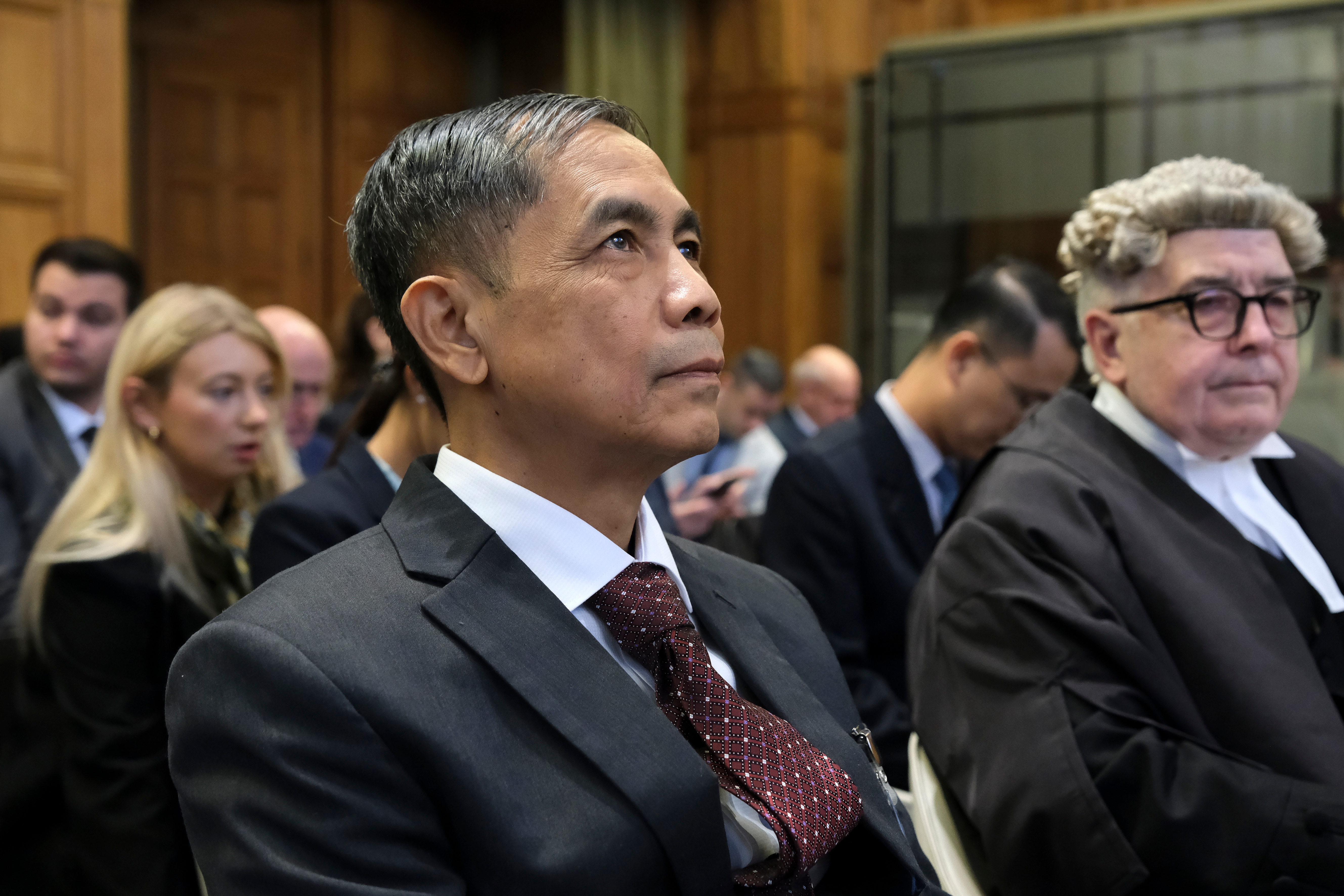
    International Court of Justice President Yuji Iwasawa said the court, in a 9-6 decision, found that Myanmar “has committed genocide against the Rohingya group in northern Rakhine state, in violation of its obligations under the Genocide Convention.”

    The 15-judge panel of the World Court, which included Navi Pillay, the respected international jurist who won the Nobel Peace Prize last month, rejected Myanmar’s defense that the 2017 campaign was a legitimate operation against insurgents.

    Iwasawa said that “the court finds that Myanmar’s security forces killed thousands of Rohingya civilians, perpetrated widespread acts of sexual violence, as well as acts of extreme violence against children, and attacked fleeing Rohingya as they sought to flee in large numbers.”

    Rohingya say the ruling validates the suffering of their community

    The atmosphere following the hearing was electric, with lawyers and members of the Rohingya, some of whom had traveled thousands of miles to attend the reading, hugging and crying.

    “I’m beyond ecstatic today, hearing the judgment, being read out in detail. A lot of those moments and instances that the judges really went into detail, it really validates the kind of experience that Rohingya have,” said Yasmin Ullah, a Rohingya rights activist who sat in the court’s ornate, wood-paneled Great Hall of Justice for the nearly three-hour reading of the ruling.

    In Cox’s Bazar, Bangladesh, refugee Mohammad Rofik welcomed the recognition of the plight of the Rohingya.

    “Today, the world could recognize and give the victory to the Rohingya community, not only the Rohingya community. It is the victory of the whole community of … Myanmar,” he said.

    There was no immediate reaction from the Myanmar delegation in The Hague or from the government in Myanmar.

    The court also ordered Myanmar to commit to reparations including allowing Rohingya “safe, voluntary, and dignified return to their place of residence.” It ordered Myanmar to investigate, prosecute, and punish people found to have committed genocidal acts and to pay compensation to Rohingya. The amount will be decided in later court proceedings.

    An umbrella organization of Myanmar opposition groups said in a statement that “the struggle for justice will continue, and this judgment must now be enforced,” calling on the international community to ensure it is fully implemented.

    U.N. Secretary-General Antonio Guterres called the ruling “a demonstration of international justice and a reaffirmation that impunity for such horrific acts must not stand.”

    Shortly after the ruling was read, U.K. Foreign Secretary Ed Miliband said his government was expelling Myanmar’s defense attache from the U.K. and “calling urgently for a U.N. Security Council session to discuss the judgment.”

    The Trump administration, meanwhile, said it is withholding judgment on the verdict. The president has taken a dim view of international law.

    The U.S. State Department said Thursday that it was “studying the decision to fully assess its implications” before weighing in with an opinion.

    Brutal counterinsurgency campaign triggered the killings and expulsions

    In August 2017, Myanmar’s military launched what it called a clearance campaign in Rakhine state in response to an attack by a Rohingya insurgent group. The campaign led to accusations that security forces committed mass rapes and killings and burned thousands of homes.

    The court said that evidence showed Myanmar forces killed about 10,000 Rohingya.

    Under the 1948 convention, to establish that genocide occurred, the court had to find that there was an intent to destroy the Rohingya “in whole or in part.”

    About 1.2 million Rohingya refugees now live in Bangladesh, primarily in crowded camps across Cox’s Bazar district, where they endure harsh conditions marked by fire hazards, infectious diseases, monsoon landslides, inadequate sanitation, and strict work restrictions.

    The case could impact genocide allegations elsewhere

    In a 2007 judgment, the court said that Serbia “violated the obligation to prevent genocide” in the 1995 Srebrenica massacre, when Bosnian Serb forces murdered some 8,000 mostly Muslim men and boys in the Bosnian town.

    Judges at The Hague-based court have also been asked to rule on other allegations of genocide.

    South Africa has accused Israel of breaching the genocide convention during its offensive in Gaza, a claim Israel vehemently denies. That case is years from completion.

    Ukraine also has a case pending against Russia. Shortly after Moscow’s full-scale invasion in February 2022, Kyiv accused Russia of fabricating genocide claims against Ukraine to justify the attack.

    “The International Court of Justice’s landmark ruling is long-awaited recognition of the suffering the Rohingya have endured from Myanmar’s military. The ruling also provides a significant precedent for victims of genocide, and other grave crimes, across the world in their own quest for justice,” said Maria Elena Vignoli, senior international justice counsel at Human Rights Watch.

    Gambia has a history of persecution of its own

    The Muslim-majority nation of Gambia launched the proceedings in 2019, two years after it peacefully ousted a longtime military dictator, Yahya Jammeh, who committed widespread abuses against civilians. Since then, there has been a big push for accountability for the crimes committed by Jammeh’s regime.

    Outside the courtroom, Gambian Justice Minister Dawda Jallow paid tribute to the Rohingya.

    “The victory belongs to the Rohingya. They survived, they testified, and today they were believed. Many of them are here with our delegation from across the world and from the refugee camps in Cox’s Bazar. Their courage made this judgment possible,” he said.

  • China and Russia say they and US agree on UN reforms, boosting fuel supplies, dialogue on nuclear

    China and Russia say they and US agree on UN reforms, boosting fuel supplies, dialogue on nuclear

    SHENZHEN, China — China, Russia and the U.S. agreed Thursday to seek reforms at the United Nations, increase oil supplies and engage in dialogue to reduce nuclear risks at a three-way meeting, according to Chinese and Russian officials.

    The three countries also took aim at the International Criminal Court, saying state officials should enjoy immunity from its prosecutions and warning that it should not abuse its jurisdiction. Russian President Vladimir Putin is wanted by the court — and the U.S. has heavily sanctioned it and its officials for recent investigations.
    The declaration followed a historic meeting among U.S. President Donald Trump, China’s Xi Jinping and Russia’s Vladimir Putin, a moment that could mark a pivot in world history — or become a quickly forgotten photo op. Experts have kept expectations low for major breakthroughs.

    The declaration did not mention the wars in Ukraine or Iran, two issues that U.S. President Donald Trump said he raised with the leaders earlier in the day. The U.S. has not released the document.

    Xi later called the meeting positive, constructive and “fruitful.”

    The statement said the leaders are committed to advancing U.N. reforms “to more effectively address global challenges,” to increase the production and supply of oil products to ensure a stable flow of energy, and to work to reduce nuclear risks and prevent nuclear proliferation.

    Trump has promoted this first-ever three-way meeting with Xi and Putin — two of America’s leading rivals — as a chance to hash out rules for controlling nuclear arms and to start resolving the wars in Ukraine and Iran.

    “We are really making history,” Trump said. “The United States, Russia and China are uniquely positioned to discuss how to reduce the number of nuclear weapons on Earth and also to lessen the risk of those weapons being used.”

    Xi, meanwhile, earlier said the meeting would focus on “promoting world peace.” Putin, for his part, harkened back to the three countries’ shared history as “victors in World War II,” saying that “we hold joint responsibility for maintaining international peace.”

    The last nuclear arms pact between Russia and the United States, known as New START, expired in February, and Trump has said he wants “a new, improved and modernized” deal that includes China. But China has less motivation to accept limits given that its arsenal of more than 600 warheads is far smaller than the more than 5,000 warheads believed to be in each of the U.S. and Russian stockpiles.

    Daryl Kimball, executive director of the Arms Control Association, said the meeting could at best start a process that would eventually lead to a sustained set of talks for reducing nuclear arsenals.

    “We need more than diplomatic theater and photo opportunities between Xi, Putin and Trump at APEC,” Kimball said. “And one meeting will not likely produce dramatic breakthroughs.”

    The leaders also talked about Iran and trade

    Before the three-way meeting — which lasted more than an hour on the sidelines of the Asia-Pacific Economic Cooperation Summit — the U.S. president had a separate one-on-one with Xi, their third substantial meeting this year.

    The U.S. president praised their friendship and their shared interest in having oil shipped through the Strait of Hormuz, a key waterway for oil shipments from the Middle East that was repeatedly shut because of attacks in the Iran war. Trump suggested he would push Xi to buy more agricultural products from America.

    Xi said that relations between the U.S. and China have been “generally stable and improved” during Trump’s presidency. The official Chinese news agency Xinhua reported that Xi discussed Taiwan with Trump and said the two countries needed to improve communication on economic and trade issues.

    Trump also added a separate sit-down with Putin, marking the first time the leaders have met for talks since their discussions in Alaska last year that failed to broker a deal on Russia’s war in Ukraine.

    “Wonderful things can come out of this — or at least start,” Trump said, calling Putin “my friend.”

    “We’ve had a great relationship for many years,” Trump said after shaking hands with Putin. Their meeting lasted roughly 40 minutes.

    Trump has frequently boasted of his rapport with Putin, as relations between the U.S. and Ukraine appear to have cratered recently. Trump rejected new Russia sanctions, while Kyiv was undermined by disruptions in satellite support for its drones during the war.

    The U.S. president also added that the trio would talk about ways to “protect our nation’s sovereignty from rogue globalist organizations such as the International Criminal Court.”

    Trump’s administration has imposed sanctions on ICC officials and the institution itself as part of a campaign to dismantle the tribunal over investigations into the United States and its allies, including Israel.

    Trump boasts about his relationships. But the ties between Xi and Putin are stronger

    The U.S. president’s ambitions recall an era of great power politics when wealthier countries felt entitled to decide the fate of seemingly lesser nations. Trump is negotiating with China and Russia without the involvement of Ukraine — or allies like Germany, France, the United Kingdom, Japan and South Korea that also have stakes in the outcome of any talks.
    Trump has long believed his ability to create personal connections gives him a diplomatic edge. Xi made a symbolic gesture of friendship Wednesday by taking the unusual step of greeting Air Force One on the tarmac, and the two leaders turned their handshake into a one-armed hug.

    But for all the compliments the U.S. president has showered on the two autocrats, the warmth has not always been mutual — and Trump does not always appear to have the same deep relationship based on common interests that Xi and Putin share.

    On Wednesday at APEC, Xi greeted Putin by calling him “my old friend.” The Russian leader responded by declaring Xi to be his “dear friend.” China has helped economically support Russia after its 2022 invasion of Ukraine, providing Putin with a financial lifeline after the U.S. and its allies imposed new sanctions.
    By contrast, when Xi came to the White House for a state visit in September, he was far more restrained with Trump, saying they had built a “personal rapport and stayed in touch.” Trump and Xi have one more meeting planned this year, at the G20 summit in Florida in December.

    There were also signs of friction Thursday in the U.S.-China relationship despite Trump’s praise of Xi.

    Chinese officials blocked a Bloomberg reporter, Annmarie Hordern, from the trilateral meeting after she asked a question at the earlier Trump-Xi session.

    Chinese television showed a video of Trump appearing drowsy, while the White House posted a clip of Trump helping Xi up an escalator.

    Conflicts on AI also hang over the meetings

    While Trump views his relationship with China as a positive, it has not necessarily resulted in meaningful changes between the world’s two largest economies. China continues to run large trade surpluses with the rest of the world, while the U.S. has almost equally large trade deficits.

    And the race between the U.S. and China to master artificial intelligence has grown tense over the past two weeks. Trump’s ally Jensen Huang resigned last week as the CEO of Nvidia after confessing to an extramarital affair with a woman, Alice Huang, whose former company is under scrutiny over alleged transfers of advanced chips to Chinese companies. Beijing has denied that Alice Huang was a Chinese government agent.

    Trump held off on imposing tougher restrictions on China’s ability to access the chips, suggesting he did not want to aggravate relations.
    U.S. officials have said that China had not fully honored its commitments made last year in a Trump-Xi meeting to buy more U.S. agricultural products and loosen restrictions on the sale of rare earth minerals needed for electronics.
    The trade truce between the U.S. and China reached last year after dueling tariff hikes is set to expire by Jan. 10.
    Meanwhile, both China and Russia have used trade to support Iran, even during the U.S. war on that country, which has pushed up energy prices and reduced global economic growth.