Category: Nation & World

  • How the Pentagon is getting into the Venezuelan oil business under Trump

    How the Pentagon is getting into the Venezuelan oil business under Trump

    WASHINGTON — As the U.S. government faced shortcomings in the country’s weapons manufacturing, the Pentagon set up a new office that would make investments to help boost defense industrial production.

    That effort, which began in 2022 during the Biden administration, is now taking a sharp turn with the Pentagon’s involvement in an oil production deal between the United States and Venezuela that President Donald Trump announced on Friday.

    The Pentagon’s little-known Office of Strategic Capital, which reports to the deputy defense secretary, is the leading U.S. government entity in forming a partnership with a private oil producer whose founder, Alejandro Betancourt López, is a powerful and polarizing figure in international commerce.

    Trump said Pete Hegseth, the defense secretary, and Marco Rubio, the secretary of state and White House national security adviser, reached the agreement with the Venezuelan government on securing billions of barrels of oil reserves “through a partnership with private business.”

    The deal would give the U.S. government the option to take up to a 35% stake in the parent company of Betancourt’s firm, North American Blue Energy Partners. This would come in the form of a financial instrument known as a warrant, plus preferential access to much of the oil that the company produces.

    Warrants would give the government the right to buy shares in the oil company at a predetermined price. The value of warrants, which can be bought and sold, fluctuates based on the value of the company that issued them.

    In this case, the warrants would be what are known as penny warrants, according to two people familiar with the deal, meaning they could be converted into shares for very little money, often just 1 cent.

    Typically, companies issue warrants in exchange for something of value. During the coronavirus pandemic, for example, the federal government bailed out U.S. airlines with more than $50 billion in grants and loans to help the companies pay employees and cover other costs. In return, the Treasury Department received warrants from roughly a dozen airlines, most of which it later sold to private investors.

    In this case, the deal would come “all at zero cost to the United States,” the White House said in a statement Monday night. The federal government’s partnership and seal of approval could make it easier for the company to raise money from private investors and also shield it from legal scrutiny or political upheaval in Venezuela.

    In a statement, Betancourt said the deal would unleash Venezuela’s potential “to the great benefit of both Venezuelans and Americans.”

    During the Biden administration, the Office of Strategic Capital made loans to private companies to bolster strategic industrial production in the United States, and asked for repayment of the loans with interest at below-market federal rates. In the Trump administration, the office has typically asked companies to give it warrants as well as repay the loans.

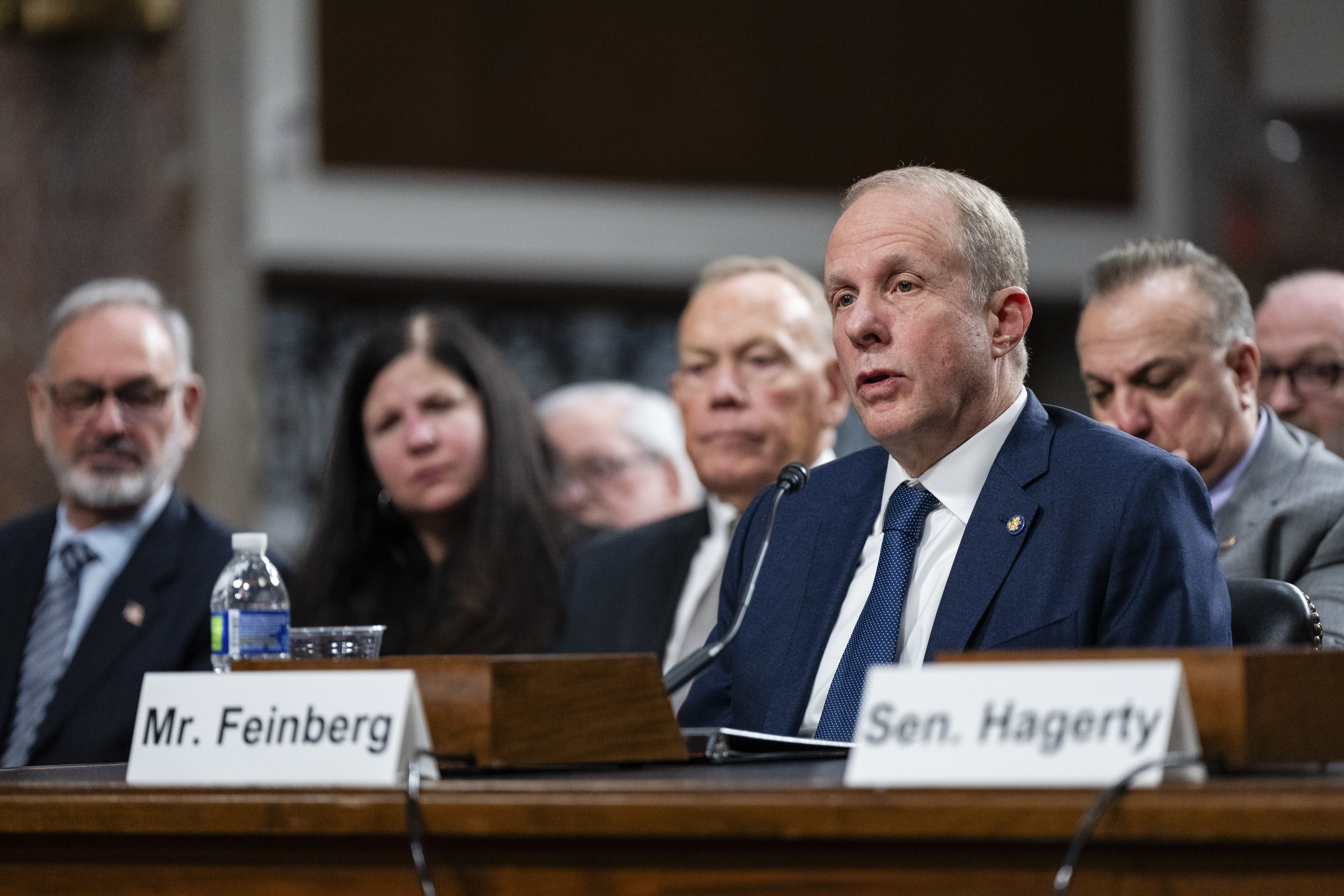
    The office falls under Stephen A. Feinberg, the deputy secretary of defense. Feinberg, a billionaire businessperson and political appointee under Trump, has been tasked with trying to help rejuvenate the U.S. defense industrial base. Feinberg approves the office’s deals.

    The office was founded under the previous defense secretary, Lloyd Austin. At that time, in 2022, U.S. officials were concerned about the fact that critical items for certain weapons systems were made in China. They were also grappling with weaknesses in arms production exposed by Russia’s war against Ukraine and global supply chain problems exposed by the pandemic.

    Those issues have become even more acute, given the drawdown of U.S. weapons stockpiles during the war against Iran that Trump and Israel started six months ago.

    The office’s initial $1 billion loan authority has ballooned to $100 billion, largely because of a boost from Trump’s major domestic policy legislation that Congress passed in July 2025.

    The director of the office is now David Lorch, who worked at Cerberus Capital Management, the private equity firm cofounded by Feinberg. In November, the month Lorch started his job, the office announced a loan of $620 million to Vulcan Elements and one of $80 million to ReElement Technologies to increase domestic magnet production and “significantly bolster U.S. critical minerals supply chains.” The office said it would get warrants from those companies.

    That kind of financing would help the United States decrease its dependency on Chinese manufacturing. But Vulcan Elements has financial ties to the president’s oldest son, Donald Trump Jr., which prompted Democratic senators to criticize the arrangement. Peter Navarro, a White House aide and friend of the younger Trump, requested the financing, ProPublica reported.

    By July, the other company, ReElement Technologies, a rare earths firm, had withdrawn from the loan process because it was struggling to meet federal due diligence standards, Reuters reported.

    On Saturday, the chief Pentagon spokesperson, Sean Parnell, said in a statement that the office “does not take equity stakes in private companies.” The White House’s statement on Monday about the deal contradicts Parnell’s assertion.

    In addition to receiving warrants, the federal government would be guaranteed 20% of the oil that Betancourt’s company produces “at production cost,” according to the White House, meaning at a favorable price. The State Department would also have right of first refusal to buy the remaining 80% of the company’s output.

    That would put the State Department in an unusual role since it is oil companies and other traders who typically buy and sell oil. Any decision to buy oil to refill U.S. government stockpiles would require authorization, including from Congress, and typically be handled by the Energy Department.

    In any case, it would most likely take years for new projects in Venezuela to generate meaningful amounts of oil.

    Betancourt, the U.S. government’s partner, received no-bid oil contracts in Venezuela many years ago. He has been under investigation in Spain and Switzerland on accusations of money laundering and tax fraud. He usually lives in Britain and was barred from foreign travel by the British government while he was in that country because of an extradition agreement with Switzerland, where prosecutors had issued an arrest warrant.

    However, Rubio wanted to get Betancourt to Venezuela to work on oil deals and production, and the State Department in recent months pressed the Swiss and British governments to ease up on him, said a person with knowledge of that effort.

    “Mr. Betancourt has never been charged with a crime in any jurisdiction,” Sara Chouraqui, general counsel for North American Blue Energy Partners, said in a statement Saturday.

    This article originally appeared in The New York Times.

  • Rescuers comb through mud and debris as Nepal-China floods leave more than 1,000 dead

    Rescuers comb through mud and debris as Nepal-China floods leave more than 1,000 dead

    KATHMANDU, Nepal — Rescue teams with search dogs combed through mud, rocks and debris Tuesday in Nepal and China looking for thousands of people still missing after catastrophic flooding tore through communities across the Himalayas, leaving more than 1,000 dead.

    Nepal’s disaster agency said Tuesday that 987 deaths had been counted there, with 3,916 people missing, including 583 foreigners. Chinese authorities, in their latest update on Sunday, reported 16 deaths and 546 people still missing, including 261 foreigners.

    The scale of last week’s disaster was hampering rescue efforts in both regions, with landslides, destroyed roads and widespread damage cutting off remote areas. Crews faced challenging conditions as they searched unstable terrain and piles of debris, raising fears the death toll could rise as rescuers reach isolated communities.

    Rescuers race to reach missing hydropower workers

    In Nepal, rescuers were racing to reach hundreds of workers believed to be trapped inside tunnels at hydropower projects damaged by the floods. About 900 workers are missing from 12 projects, with roughly 500 believed to be trapped in tunnels, according to Nepalese authorities.

    Brig. Gen. Raja Ram Basnet, Nepal’s army spokesperson, said teams assisted by foreign experts were working at several hydropower projects. Visuals released by the army showed rescue teams entering dark, debris-filled tunnels, wading through mud and water and climbing over rocks as they searched for signs of life.

    On the Chinese side, rescue crews scoured areas hit by mudslides, particularly around the Gyirong Port border crossing, which was destroyed.

    Some rescuers, aided by search dogs, searched gaps among rocks and debris for signs of life. Other teams used heavy machinery to clear a major highway leading to Gyirong Port, hoping to clear the way for equipment, personnel and supplies to reach the disaster zone, according to China’s state-run Global Times newspaper.

    Relief operations expand to reach stranded communities

    At least 11,814 people have been rescued so far, according to Nepalese authorities. Emergency crews were using helicopters and other aircraft to reach stranded communities in areas where roads and bridges have been destroyed by the flooding and landslides.

    Authorities on Tuesday also stepped up efforts to provide assistance to survivors in areas where roads and other transportation routes had been damaged or cut off.

    Chinese Foreign Ministry spokesperson Guo Jiakun said China’s second batch of relief supplies for Nepal was expected to ship Tuesday, including drones, DNA testing and water purification equipment. Chinese DNA testing experts will also help Nepal identity bodies, he said.

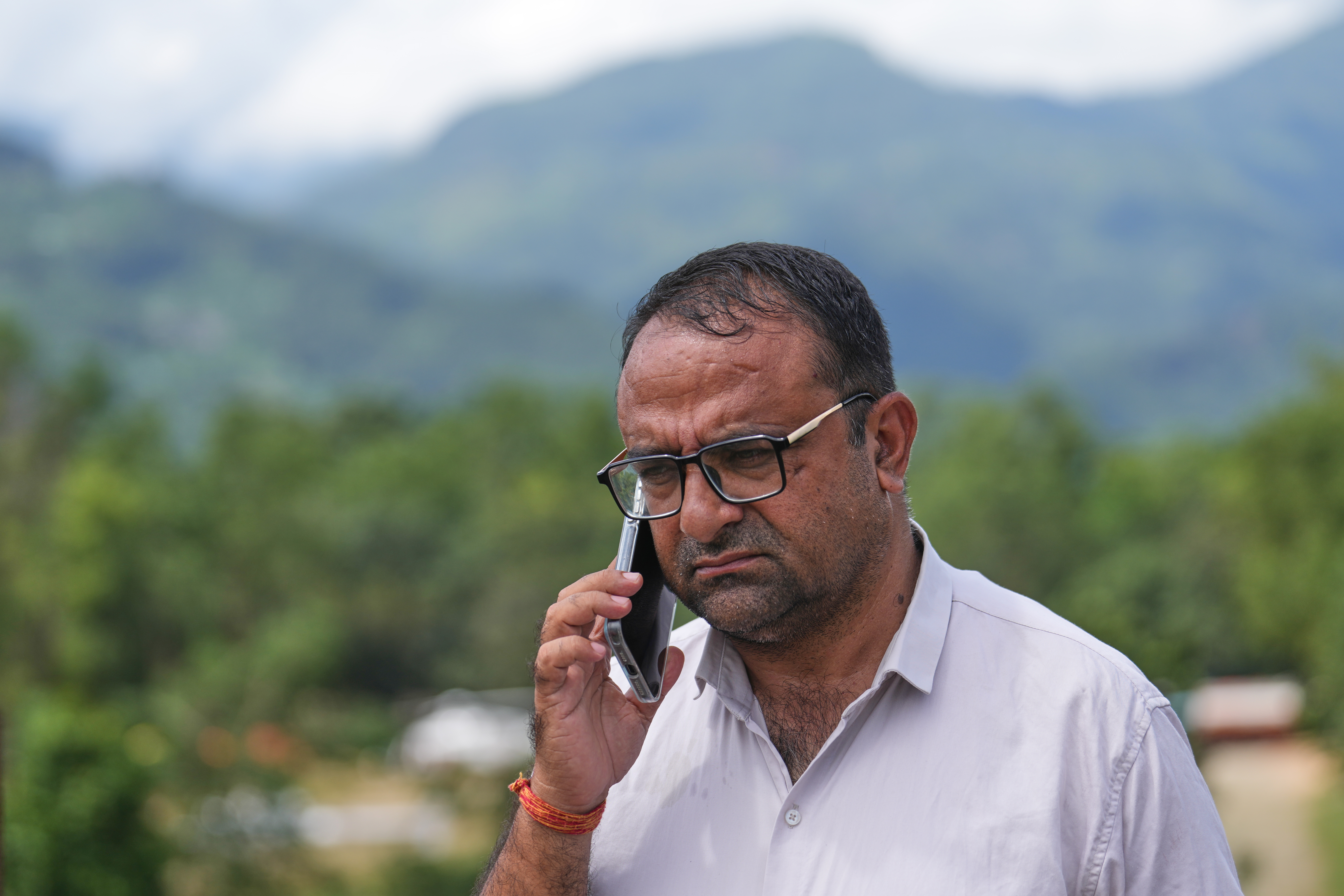
    Bimal Sharma, a helicopter pilot who has been flying rescue and relief missions since the disaster began, said he was shocked to see the devastation in Timure, a border town close to Tibet that he has known for years.

    “It felt like I was flying over an entirely different landscape,” he said.

    Sharma said he has had little opportunity to speak with the people he rescued, but their expressions told him how deeply the disaster had affected them.

    “I can see the pain in their eyes. It’s heartbreaking,” he said.

    The disaster began with a glacial collapse high in the Himalayas

    The Aug. 26 disaster began with a chain of events high in the Himalayas. A glacial collapse sent large amounts of rock, ice and meltwater into valleys below, triggering powerful floods downstream.

    Scientists studying satellite imagery said the collapse appears to have involved the failure of bedrock beneath a glacier in the Himalayan region. The rockfall was powerful enough to register as a magnitude 5.2 seismic event.

    The resulting surge of water and debris entered rivers that flow through valleys in Tibet and Nepal, causing them to rise rapidly. Floodwaters swept away homes, buildings, roads and bridges and carried mud and rocks downstream.

    Nepal’s Prime Minister Balendra Shah said that the disaster highlighted the need for action to combat climate change.

    “This incident has indicated that the risks we face in the Himalayan region are increasing with climate change,” Shah said in a social media post Monday night. “Therefore, this region must be alert, and at the same time, it is time for us to strongly raise the issue of disasters caused by climate change before the international community.”

  • Former N.J. Gov. Chris Christie discusses his legacy as the godfather of legal sports betting, prediction markets, and the Trumps

    Former N.J. Gov. Chris Christie discusses his legacy as the godfather of legal sports betting, prediction markets, and the Trumps

    Chris Christie has been a two-time Republican presidential candidate, the governor of New Jersey, and a U.S. attorney. But history might show that he generated the most enduring national impact in a different role, as the godfather of legalized sports betting.

    In 2012, when he was still New Jersey’s governor, Christie signed a bill that would allow customers to wager on professional and collegiate sports at 12 casinos and four racetracks.

    He correctly predicted that the bill — which directly challenged a longstanding federal law that restricted legal sports betting to just a handful of states — would lead to him being sued by powerful opponents, and that over the long haul, his efforts would succeed.

    But in a recent interview with The Inquirer, Christie said that even he did not imagine that sports gambling would evolve from a location-based attraction to phone apps that are readily accessible and open for business around the clock. Americans spent a record $165 billion on sports wagers in 2025, amid growing concern from health experts and lawmakers that mobile gambling is driving a health epidemic.

    Nor did Christie — who now works as a strategic adviser to the American Gaming Association — envision the rise of prediction markets, some of which have been accused in lawsuits across the U.S. of running illegal sports betting operations. Christie, however, said he is unsurprised that two prediction market companies count Donald Trump Jr. among their advisers.

    Christie’s sports gambling crusade began just two months after New Jersey voters approved a referendum in November 2011 to legalize sports betting in the state.

    Casino industry lobbyists had long championed the type of bill that he signed, predicting that sports betting would be a double win for the state, attracting new customers to struggling casinos and generating revenue to benefit elderly and disabled residents.

    But a federal law, the Professional and Amateur Sports Protection Act, had since 1992 restricted legal sports betting to Delaware, Montana, Nevada, and Oregon. Christie wasn’t deterred.

    “Am I expecting there may be legal action taken against us to try to prevent it? Yes,” he told reporters in 2012. “But I have every confidence we’re going to be successful.”

    Then the National Collegiate Athletic Association — along with Major League Baseball, the NFL, the NBA, and the NHL — sued Christie for violating the federal law, igniting a legal saga that would wind for years through district and circuit courts before reaching the U.S. Supreme Court in 2017.

    Christie argued that PASPA had been a constitutional overreach that violated the Tenth Amendment’s “anti-commandeering” doctrine.

    “We lost the first six times [in lower courts],” Christie said. “I had the sense that maybe I was wrong.”

    In 2018, the Supreme Court voted to overturn PASPA, giving states the freedom to enact their own sports betting laws.

    This interview with Christie, 63, has been edited and condensed for clarity.

    Why was legalizing sports betting in 2012 a priority for you?

    I was trying to differentiate Atlantic City, and give the casinos something new and different to offer, and to help preserve the horse racing business. I saw it at the time as an offensive and defensive measure. That was the motivation.

    The leaders of professional sports leagues were critical of your efforts, and deeply opposed to legalizing sports gambling. What did you think of their position?

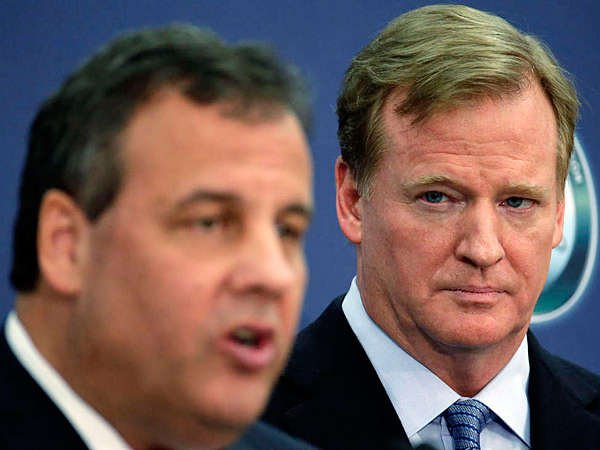
    I thought that their opposition was both wrongheaded and hypocritical, and I told them so. [Then-NBA commissioner] David Stern was probably the most vehement against it, but [NFL Commissioner] Roger Goodell was a driving force, too. I told them, ‘[Sports betting] is happening anyway. You’d rather have people bet with illegal bookies — either mob-related, or offshore — than companies who are in the business and regulated by the state?’ It made no sense.

    Along with his peers in other professional sports, NFL Commissioner Roger Goodell (right) was opposed in 2012 to an expansion of legalized sports betting.
    Were you surprised to see those leagues later enter into lucrative partnerships with sportsbook companies?

    I wasn’t surprised at all. The leagues have shown an extraordinary ability to chase a dollar. I’m still waiting for the statue that they’re going to build of me, or the thank-you note. [Legalizing sports betting] has helped their TV contracts as well. People who weren’t even necessarily interested in sports before are now extraordinarily interested because they have a little bit of a wager on it. It’s kind of amazing.

    In the years since the Supreme Court overturned PASPA, NBA and MLB players have been arrested for conspiring with gamblers. An NFL executive was recently suspended for sharing inside information about the team’s draft plans.

    It’s inevitable that was going to happen. But I think because there is such a great deal of transparency, the leagues can act quickly. That makes it much more different from when gambling was illegal, and you still had some athletes or people associated with sports interacting with [bettors]. The regulation brings about transparency, and transparency makes it easier to police.

    Sports betting has evolved into a 24/7 mobile enterprise. Do you consider it to be a different product than what it was in 2012?

    Completely. I don’t think I could ever have anticipated that it would be in everybody’s pocket. That’s a little bit disturbing to me, to tell you the truth, the proliferation of it. And obviously prediction markets have been very disturbing to me, particularly because they market to teenagers, which is strictly prohibited for the legal gaming companies.

    Prediction markets have also faced backlash for allowing people to wager on U.S. military operations and the deaths of foreign leaders.

    I think the whole thing is absurd, and not good for the public.

    President Trump’s son, Donald Trump Jr., was reportedly given $300,000 worth of Kalshi shares in 2025, after becoming an adviser to the company. MARSHALL SCHEUTTLE
    President Trump’s son, President Donald Trump Jr., is an adviser to Kalshi and has shares of the company, and his venture capital firm has invested in Polymarket. Those companies are regulated by the federal Commodity Futures Trading Commission. Does that seem like a conflict to you?

    I think common sense gives you the answer to that. If it’s a money-making enterprise for the Trump family, then the odds are it’s going to face light regulatory action.

    Some state attorneys general have sued Kalshi. They allege that the company is running an unlicensed, illegal sports betting operation. Kalshi insists it is a commodity exchange. Will this end up being decided by the Supreme Court?

    It’s betting. It’s not an investment. It’s not a commodity. The Supreme Court has ruled that states have the right to regulate sports betting. I think that it’s going to go to the Supreme Court, and I’m confident [the prediction markets] will lose.

    We’ve interviewed addiction experts who say that sports gambling addiction is now a health epidemic, similar to tobacco and opioid abuse.

    I always thought that a big portion of this [revenue] has to go toward addiction treatment, and I think that’s got to continue.

    Elected officials in Pennsylvania, New Jersey and other states are exploring new regulations for sportsbook operators, like curtailing or eliminating in-game microbets or VIP programs. Are those kinds of reforms needed?

    As long as [sports betting] is a venture that creates tax revenue, then the states are always going to be examining this issue. They’re partners. They can’t claim no responsibility. I don’t know how it’ll manifest, or where it’ll land. … I think all regulation should be rooted in evidence-based research. So if there are changes that we see that could help make [gambling] safer, they should be considered.

    The Inquirer will continue to report on issues related to the growth of gambling addiction — among teens and adults — across Pennsylvania. If you or someone you know wants to speak with a reporter, please contact David Gambacorta or William Bender at dgambacorta@inquirer.com and wbender@inquirer.com

  • Army Secretary Dan Driscoll is stepping down after 18 months on the job, White House says

    Army Secretary Dan Driscoll is stepping down after 18 months on the job, White House says

    WASHINGTON — Army Secretary Dan Driscoll is stepping down after 18 months on the job, the White House said Monday, in the latest departure of a top military leader during the Trump administration.

    No reason was given for the departure of Driscoll, who is a friend of Vice President JD Vance, but tensions with Defense Secretary Pete Hegseth have been widely reported. It marks the latest in a series of shake-ups of top military leadership, with the Army especially seeing major upheaval.

    “Secretary Driscoll has been highly effective in advancing President Trump’s agenda to Make America Strong Again at the Department of the Army by providing outstanding leadership during historic military operations, restoring an emphasis on readiness and lethality, assisting with negotiations between Russia and Ukraine, and more,” White House spokesperson Anna Kelly said in a statement.

    “The United States Army is more powerful than ever thanks to his work alongside the Commander-in-Chief and Secretary of War,” she added.

    The Pentagon referred questions to the Army. The Army had not immediately responded to an email seeking comment. A spokesperson for Driscoll had not responded to a text message.

    Hegseth suddenly ousted the service’s top uniformed leader, Gen. Randy George, in April, while the Army’s commander in Europe and Africa, Gen. Christopher Donahue, unexpectedly stepped down in June.

    Gen. Christopher LaNeve, who has made a meteoric rise under Hegseth, took George’s place as the Army’s acting chief of staff. Under LaNeve, the service is pulling the plug on a drone modernization program that Driscoll had heralded. An Army unit based in Europe was building its own drones before LaNeve directed it to end its efforts and return to being a traditional infantry battalion, officials said this week.

    Driscoll was a George ally and lamented his departure, along with both Republican and Democratic lawmakers. He told Congress in April that he and his family drove to George’s house following his resignation “and we all gave him a hug.”

    “That being said, the civilian leadership, the design of our system, is that they get to pick the leaders that they want,” Driscoll added.

    Driscoll is an Iraq war veteran, tech investor, and former adviser to Vance, whom Driscoll met at Yale Law School. When nominating Driscoll in 2024, President Donald Trump called him “a disruptor and change agent.”

    As Army secretary, Driscoll was tapped for the unusual role of key negotiator to try to end the war between Russia and Ukraine. He was also a major force behind trying to cut the red tape for military contractors to quickly develop more drones and counterdrone capabilities as warfare rapidly changes around the world.

    The Senate confirmed him in February 2025, voting 66-28, following an Armed Services Committee hearing that was largely unconfrontational and focused on how the Army could modernize its systems, improve recruiting and beef up the military industrial base.

    Driscoll noted that his father and grandfather served in the Army and he vowed to be a secretary focused on the needs of soldiers. According to the Army, Driscoll served as an armor officer from August 2007 to March 2011, deploying to Iraq from October 2009 to July 2010.

    He also ran unsuccessfully in the Republican primary for a North Carolina congressional seat in 2020, getting about 8% of the vote in a crowded field of candidates.

    His departure comes after Hegseth ousted several other generals and admirals, including the head of the Navy.

    The Pentagon abruptly announced in April that Navy Secretary John Phelan was leaving the job, becoming the first head of a military service to depart during Trump’s second term.

  • DA says a teen who recorded San Diego mosque shooting livestream has been charged with murder

    DA says a teen who recorded San Diego mosque shooting livestream has been charged with murder

    A 17-year-old North Carolina girl who recorded a livestream of a shooting that killed three people at a San Diego mosque and disseminated the attackers’ white-supremacist writings has been charged with murder by aiding and abetting, a district attorney said Monday.

    Forsyth County District Attorney Jim O’Neill said at a news conference in Winston-Salem that the girl, identified in court records as Sarah Lindsey Santiago, was arrested last week. A grand jury indicted her on three counts of murder and one count of conspiracy Monday.

    Santiago’s attorney did not immediately return a message from the Associated Press seeking comment Monday.

    Under North Carolina law, the aiding-and-abetting charges carry the same penalties as if the girl had committed the attack herself, O’Neill said. According to the indictment, Santiago agreed prior to the attack that she would record the livestream, distribute it, and release a document written by the attackers. She carried out those tasks, it said, and she purchased a patch bearing a white-supremacist symbol and sent it to one of the gunmen to wear during the attack.

    “The individual here, locally, was the person who was recording the livestream,” O’Neill said. “She disseminated that information and she published their manifesto.”

    Cain Clark, 17, and Caleb Vazquez, 18, stormed the Islamic Center on May 18 before being driven back outside by a security guard who exchanged gunfire with them as he initiated a lockdown, helping to protect 140 children who were just steps away.

    The pair killed the guard, Amin Abdullah, and two other men before taking their own lives in a vehicle nearby. They left behind rambling writings full of vitriol against a wide range of people, and cited the shooter who killed 51 people at two mosques in Christchurch, New Zealand, in 2019, as one of their models for their violence.

    The two also planned subsequent attacks on two other targets: a Jewish temple and a predominantly Black high school, O’Neill said. He credited the guard and other victims at the mosque with having saved countless lives.

    The attackers’ writings cited a range of far-right ideological inspirations, including the notion that white people are being replaced by other populations, and detailed their motives and goals. They included hateful rhetoric toward Jewish people, Muslims, and Islam, as well as the LGBTQ+ community, Black people, women, and the political left and right.

    They indicated they were trying to accelerate the collapse of society. Vazquez wrote of having “some mental health issues” and being rejected by women.

    In a written statement, the Vazquez family said Caleb Vazquez was on the autism spectrum and had grown to resent parts of his identity. The family said they believed that, combined with exposure to hateful rhetoric online, contributed to his radicalization.

  • Supreme Court clears way for White House ballroom construction to continue

    Supreme Court clears way for White House ballroom construction to continue

    The Supreme Court on Monday allowed construction to continue on the White House ballroom, handing President Donald Trump a victory as he races to complete the largest expansion to the executive mansion in decades.

    The justices found that the historical preservationists who challenged the controversial project had not suffered the direct personal harm required to bring a lawsuit. The ruling means their legal action appears to be dead.

    The National Trust for Historic Preservation had argued that work on the ballroom, which Trump has said is part of a larger complex necessary for national security, must stop until approved by Congress.

    That argument prevailed in lower courts, which twice ordered the White House to pause work on the ballroom. But amid legal machinations, those orders were put on hold, allowing construction to move forward without interruption.

    The high court ruled the National Trust had not shown that it suffered a real-world injury from the ballroom project, meaning it did not have what is known as standing to bring its case.

    The ballroom, which is expected to be able to hold about 1,000 guests, is being built in conjunction with a five-story underground military complex that will include a hospital and shelters to protect the president and senior officials.

    Trump has said that the total cost of the ballroom may be $400 million and will be paid for with private donations, but contractors’ invoices obtained by the Washington Post show that the cost of the project will be $600 million and that taxpayers will foot about half the bill.

    Lower courts have not blocked work on the underground complex, and the justices’ decision pertained only to the aboveground portion.

    The majority in the unsigned ruling said the Trust had not met the required legal standard to bring its case.

    “Today, we do not pass upon the legality of the government’s East Wing project,” the majority wrote. “We conclude only that, based on the submissions before us, the government is likely to prevail in showing that the Trust lacks … standing to challenge the project in federal court.”

    The ruling came over the objections of an unusual coalition of justices, who often are on different sides. Chief Justice John G. Roberts Jr., a conservative, joined with the court’s three liberals in dissent.

    Writing for the group, Roberts said the decision “is no victory for the separation of powers.” He referenced Alison Hoagland, a Trust board member.

    “The White House is not just any building, and — when it comes to historic preservation — Hoagland is not just any person,” Roberts wrote. “In failing to appreciate as much, the Court misconceives the plaintiff’s injury, allowing the Executive’s likely infringement of the Legislature’s power of the purse and authority to regulate federal property in the District of Columbia to continue.”

    The White House and the National Trust did not immediately respond to questions about the ruling.

    Before the Supreme Court order, the U.S. Court of Appeals for the D.C. Circuit upheld a federal judge’s April ruling that work on the 90,000-square-foot addition to the executive mansion probably requires congressional approval to continue.

    Shortly after U.S. District Judge Richard Leon ordered work to stop, the appeals court stepped in and paused that ruling while it decided whether to issue its own injunction.

    The appeals court blocked aboveground construction anew on Aug. 7, finding that Trump had exceeded his power in authorizing the destruction of the East Wing of the White House and the building of the ballroom.

    That decision was stayed for two weeks to give the Trump administration time to appeal to the Supreme Court.

    “We are aware of no instance in American history in which a President unilaterally and using privately collected funds demolished substantial portions of the White House that Congress authorized to be built and American taxpayers paid for. Until now,” the appeals panel wrote.

    In its filings with the high court, the Trump administration argued that it was too late to stop ballroom work because the project was 65% complete, and that the injunction put the lives of Trump and others at risk.

    The filing cited a number of alleged attempts on Trump’s life, including a 2024 incident at a Pennsylvania rally when a would-be assassin’s bullet grazed his ear.

    “The injunction would wrongfully install a single district judge as sole arbiter of what further construction is ‘strictly necessary’ to protect the safety of the President, his family, staff members, and visitors to the White House, including foreign dignitaries, and presidents and prime ministers of other countries,” Solicitor General D. John Sauer wrote.

    Trump initially characterized the ballroom as necessary for presidents to entertain VIP guests, but in recent months he has shifted to arguing it was crucial on security grounds.

    The Trump administration has said the ballroom, which will be built with missile-resistant columns, a drone-proof roof and blastproof windows, will shield the military complex below and the White House more generally.

    To bolster the claim, the administration shared affidavits from Secretary of State Marco Rubio, FBI Director Kash Patel, and others who claimed that completing the ballroom was necessary to protect the president.

    Trump recently posted on Truth Social that the ballroom was a “desperately needed National Security structure” and derided the preservationists as “treasonists.”

    The White House announced the project in July 2025, saying at the time that the privately funded addition would hold 650 guests and cost $200 million. But both the capacity and the price have spiraled upward.

    The National Trust sued to block construction of the ballroom in December, saying that the Trump administration had not gone through the legally mandated review process and that Congress has sole authority to authorize major White House construction.

    The group was skeptical of the claims that pausing the project would create a security risk. In recent court documents, the National Trust argued that the Trump administration was racing to complete the ballroom to thwart oversight.

    “Rather than obtain permission from Congress, Petitioners have instead decided to try to outrun judicial review,” the National Trust wrote in its filing.

    The group also cited a National Park Service environmental assessment that found the ballroom would interfere with sight lines and disrupt the historical continuity of the White House grounds.

    About 30 congressional Democrats filed an amicus brief supporting the National Trust in the case.

    “Questions about how best to protect current and future White House residents, staff, and visitors fall well within the ambit of Congress’s powers over federal property and federal spending,” the Democrats wrote.

    The Post reported in June that an internal contractor’s estimate put the final cost of the project at about $600 million and that roughly half the money would come from taxpayers. The administration has approved a $500 million no-bid contract to construct the ballroom.

  • Congo authorities report more than 6,000 confirmed Ebola cases and nearly 3,000 deaths

    Congo authorities report more than 6,000 confirmed Ebola cases and nearly 3,000 deaths

    BUNIA, Congo — Congo’s authorities said Monday that the fastest-growing Ebola outbreak in history has topped 6,000 cases with 2,911 deaths.

    More than 1,360 people have recovered from the virus, in what authorities said was an “encouraging” development.

    The outbreak in eastern Congo is spreading under extremely difficult conditions, fueled by insecurity, displacement, a health workers’ strike, and intense population movements. The situation is particularly concerning at displacement sites, where residents already live in extremely precarious conditions.

    Last week, the virus spilled into two new health zones in the region.

    The World Health Organization has said that it remains out of control and is on track to surpass the 2014-2016 West Africa Ebola outbreak, the deadliest on record, which killed more than 11,000 people, primarily in Guinea, Liberia, and Sierra Leone.

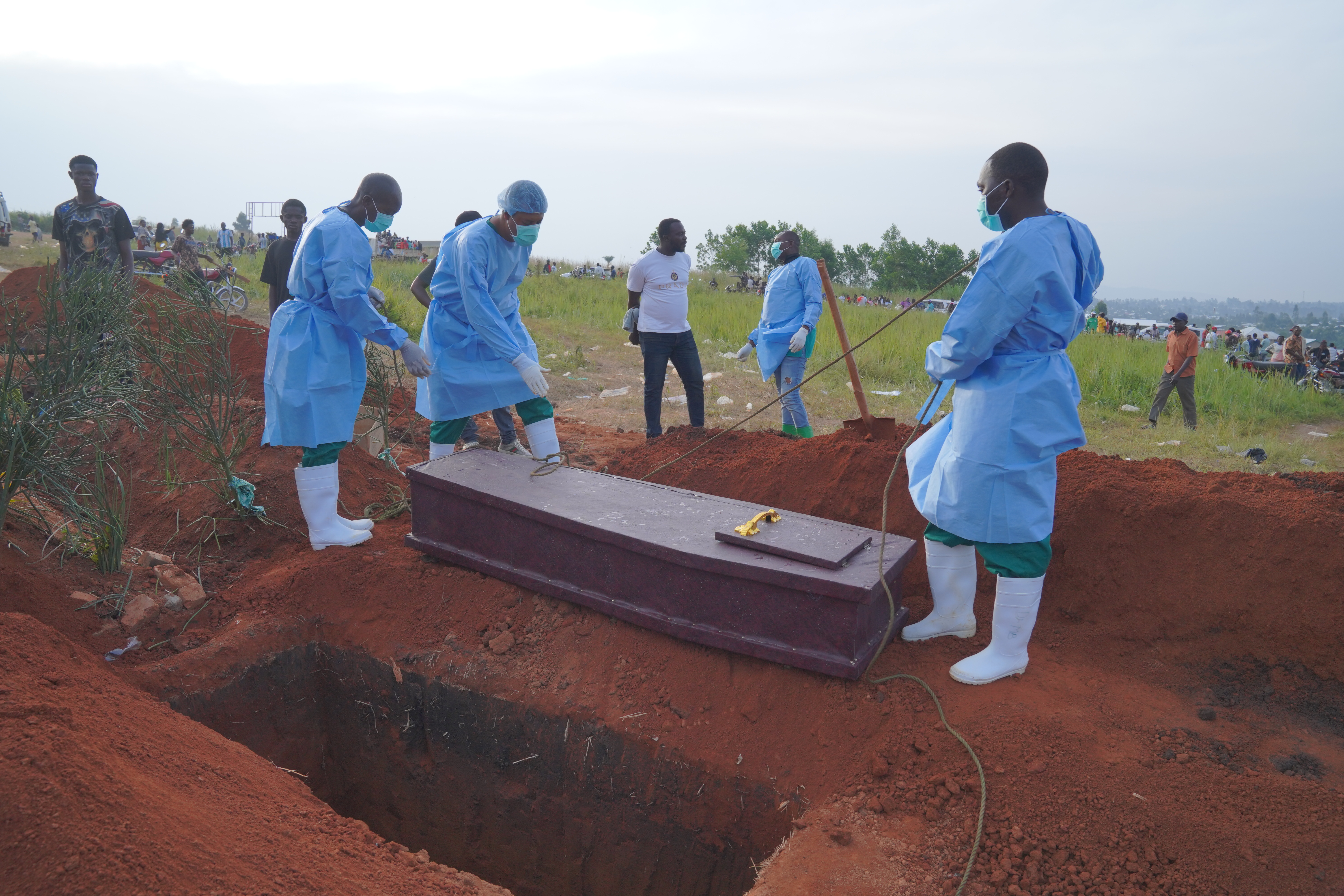
    On Saturday, an Ebola response team was attacked on the outskirts of the town of Mambasa in Ituri province while responding to a call to secure a body. Young people armed with machetes stormed the site of the funeral, forcing the team to flee and injuring one member, a representative told the Associated Press.

    “We demand greater security so we can operate in the field and do our work without endangering our lives,” said Floribert Magene, a member of the response team.

    Bodies of those who died of Ebola can be highly contagious and lead to further spread when people prepare them for burial and gather for funerals.

    In response to the outbreak, Congolese authorities have mandated that the dangerous work of burying suspected victims be managed wherever possible by authorities, which can be met by protests from families and friends.

    The outbreak is caused by the Bundibugyo virus, a rare type of Ebola that has no approved vaccine or treatment.

    Last week, Congo began vaccinating health and other front-line workers with the Ervebo vaccine that was effective in past Ebola outbreaks caused by a different, more common type called Zaire.

    Clinical trials are underway to find a licensed vaccine for the Bundibugyo virus.

    Although the current outbreak was declared in mid-May, officials believe it had been spreading since February. It has spread from three health zones to nearly 60, with most cases and deaths occurring outside the network of monitored contacts and within communities.

    Efforts to bring the outbreak under control — from limited public gatherings to social distancing and airport closures — have disrupted life in the six provinces, particularly Ituri, which also has been ravaged by rebel violence.

    The government has introduced some measures, including installing health and sanitary equipment at some locations, but advocacy groups say more needs to be done to build trust with the community.

    While neighboring Uganda declared itself free of Ebola last month, the risk of further cross-border spread remains, WHO said last week.

  • U.S., Iran exchange attacks after monthlong lull in fighting

    U.S., Iran exchange attacks after monthlong lull in fighting

    DUBAI, United Arab Emirates — The United Arab Emirates said that it intercepted an Iranian drone over its waters Monday, an attack that comes after the United States and Iran exchanged fire over the weekend for the first time in a month.

    Iranian officials said two people were killed and several others wounded in the U.S. attack Sunday night on Larak Island in the Strait of Hormuz. Iran responded by launching missiles at U.S. sites in Jordan, which were intercepted.

    During the lull in fighting, the U.S. has been ratcheting up economic pressure on Iran with the hope of forcing concessions out of Tehran, including reopening the Strait of Hormuz to shipping.

    After the U.S. and Israel attacked Iran on Feb. 28, Iran established a chokehold on the vital strait, through which a fifth of the world’s traded oil passed in peacetime, slowing ship traffic to a trickle. That has roiled the global economy, raising prices worldwide for energy and other goods.

    As the fighting resumed, the price of Brent crude oil, the international standard, climbed above $90, up about 25% from the start of the war, presenting a growing problem for U.S. President Donald Trump before the midterm elections.

    A return to open conflict would be dangerous for the region, where Iran has targeted U.S. military bases and infrastructure in Gulf countries since the war began.

    In the wake of the renewed violence, Anwar Gargash, a diplomatic adviser to the UAE’s president, said on social media that “the state of neither war nor peace cannot be a sustainable solution.”

    He called for a political solution that would return normal navigation to the Strait of Hormuz, but also a “more realistic approach” than the June memo of understanding between Iran and the U.S., which, he said, “failed to outline a practical and acceptable” road map.

    UAE says Iranian attack is a ‘dangerous escalation’

    In a short statement earlier, the UAE Defense Ministry said it “dealt with” an Iranian drone that was detected over its waters approaching from Iran. There were no reports of damage.

    “This dangerous escalation constitutes a blatant violation of the UAE’s sovereignty, security, and stability, and a direct threat to the safety of its citizens and residents,” the Foreign Ministry said.

    The Defense Ministry later issued a second statement denying a claim by the Iranian army that the Al Minhad Air Base in Dubai had been targeted, saying it was false.

    In the wake of the U.S. attack on Sunday, Iran’s military warned that any further U.S. attacks would draw a far heavier response, including strikes on bases or other points from which attacks against Iran are launched, state-run IRNA reported.

    “The U.S. military has no choice but to leave the region,” the statement from Iran’s Armed Forces General Staff and the Khatam al-Anbiya Central Headquarters said.

    Iran says it has right to defend itself and will ‘respond decisively’

    Speaking after the first day of the Shanghai Cooperation Organization’s summit in Kyrgyzstan, Iranian Foreign Minister Abbas Araghchi said the United States must abide by the June memo before the current conflict can end, state television reported.

    Araghchi said Iran would continue defending its rights and that the solution to ending the conflict remained “completely clear.”

    The summit brings together a group billed as a counterweight to U.S. global influence, and includes Chinese President Xi Jinping, Russian President Vladimir Putin, and Indian Prime Minister Narendra Modi. Iranian President Masoud Pezeshkia was scheduled to meet with Putin on the sidelines Tuesday.

    U.S. weekend attack comes after weeks of rising economic pressure

    Meantime, U.S. Treasury Secretary Scott Bessent opened meetings of the Group of 20 finance ministers in North Carolina on Monday, as Washington pressures other countries to help the U.S. economically isolate Iran.

    The shifting strategy centers on threats to punish any country or entity that conducts business with Tehran.

    Two weeks ago, the UAE suspended all trade with Iran after saying it had come under renewed fire from Iran with two missiles splashing down harmlessly in the Persian Gulf. Iran denied the attack.

    Bessent later suggested it was pressure from Washington that led to the UAE decision.

    Trump stressed last week that he is “not in a hurry” to get Iran back to the negotiating table, and he continues making the case that the Islamic Republic’s leadership is on the ropes.

    Appointments to Iran’s senior security leadership in the past month, however, have signaled Tehran’s defiance after weathering decades of sanctions.

    U.S. military says strike on Iranian rocket launchers ‘precise’

    On Sunday, U.S. Central Command said it struck Iranian launchers after observing forces with Iran’s Revolutionary Guard Corps preparing to launch rockets with sea mines into the Strait of Hormuz. The U.S. military said last week that it had completed clearing sea mines from the waterway’s international shipping routes.

    U.S. military officials disputed Iran’s claim that the latest American strikes were an act of aggression, calling them a “limited, precise action” against what they said were minelaying forces.

    Iranian state television later showed what it said were ballistic missiles being fired at American bases in Jordan, and Jordan’s military said it intercepted eight that had entered its airspace.

    The last time the U.S. military confirmed targeting Iran was July 29, when it announced a “heavy wave of strikes” on dozens of Revolutionary Guard targets.

  • This principal in Nepal evacuated 900 students before flooding swept away their school

    This principal in Nepal evacuated 900 students before flooding swept away their school

    BIDUR, Nepal — Rajendra Dawadi was inside his classroom when a colleague rushed in with a warning: Floodwaters were racing through Nepal’s Trishuli Valley, tearing apart homes, bridges, and entire villages.

    Then a teacher received another warning by phone. Moments later, a parent arrived to take her child home. The danger had not yet been confirmed, but Dawadi, the principal, had little time to act. He rang the school bell and ordered his students and staff out of the building and toward higher ground.

    “I immediately decided to stop … school” and get the children out, he told the Associated Press.

    As he followed them to a nearby hill, the floodwaters rose behind him. From the safety of the hillside, he turned to watch the school where he had once been a student — and where he had spent years teaching — disappear beneath a torrent of water, mud, boulders, and debris. Two staff members could not make it and remain missing.

    Dawadi’s decision to evacuate the school saved at least 900 students from last week’s devastating flash floods in Nepal, unleashed after a glacial collapse in the Himalayas. The disaster has killed over 900 people across Nepal and China, while more than 4,700 remain missing.

    As Nepal grapples with the catastrophic natural disaster, Dawadi’s story has emerged as a striking example of foresight and courage.

    The Tribhuvan Trishuli Secondary School had 1,643 students. At least 900 were on campus that morning, while some students were still making their way to school. Dawadi ordered those already there to leave and called bus drivers to tell them not to come.

    One bus, packed with students, had already reached the school when Dawadi told the driver to turn back, he said. The bus crossed a newly constructed bridge and, moments later, the old bridge beside it collapsed.

    For Dawadi, the scale of the destruction has become personal, as the school had been both his workplace and a large part of his life.

    “I have no words. I got education from that school. And I gave education at that school,” he said.

    The destruction of Dawadi’s school was not an isolated loss.

    Across northern Nepal, the floods have left thousands of children without classrooms, disrupted their education, and raised fears that the disaster could cost them months of schooling. Charity group Save the Children said in a statement that at least 69 schools in northern Nepal have been completely destroyed, putting the education of nearly 19,000 students at risk.

    Dawadi’s quick thinking and swift response during the disaster have been hailed as an act of heroism. When he returned to the site of the school days later, parents embraced him as they thanked him for saving their children.

    “Their parents hugged me, they cried with me,” he said. “They were emotional.”

    Student Suvina Tamang, 14, said the building was swept away shortly after the students had been evacuated. “I will thank him when I see him” for saving my life, she said.

    But Dawadi is reluctant to accept the role of hero. For him, rescuing his students was his responsibility. Now he says, students will need psychological counseling. Then, lessons must begin again, even if the school must temporarily relocate.

    His appeal to the Nepalese government is simple: rebuild the schools and get children back to classes.

  • Trump’s deals in Africa could cut U.S. health aid by more than half, analysis shows

    Trump’s deals in Africa could cut U.S. health aid by more than half, analysis shows

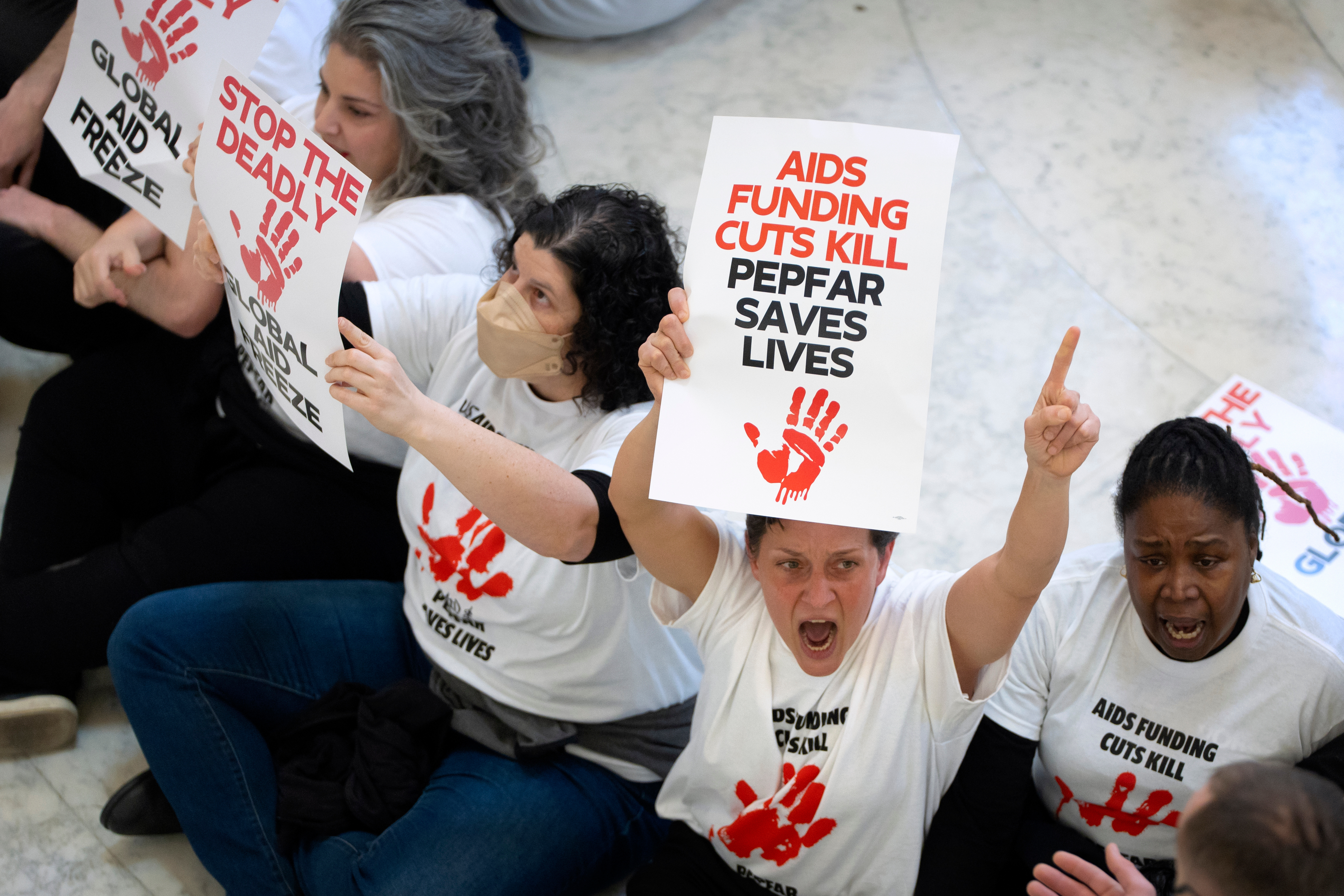
    The Trump administration is working to cut global health funding to developing nations by tens of billions of dollars by 2030, according to a new analysis of the secretive agreements U.S. officials have pursued with more than a dozen governments to date.

    The planned cuts — targeting programs that combat the spread of HIV/AIDS, Ebola, and tuberculosis, among other deadly diseases — appear to reduce U.S. spending on global health initiatives to less than half of Washington’s output in 2024, the analysis found.

    The research was conducted by two nonprofits, Public Citizen and Partners in Health, organizations that have taken a deeply skeptical view of President Donald Trump’s “America First” approach to global health policy.

    Their analysis offers the most detailed reading yet of the bilateral health agreements drawn up by the State Department with 34 countries after the Trump administration, upon taking office last year, paused all U.S. foreign assistance and dismantled the U.S. Agency for International Development.

    Public scrutiny of the agreements has been limited, as the administration, citing a desire to protect what it says are “sensitive” negotiations, has refused to disclose the text outlining their terms. The State Department said earlier this year that it would release them only after all were signed, though it has not disclosed a timeline for that to happen.

    The analysis by Public Citizen and Partners in Health relies on documents that the nonprofits recently obtained from the U.S. government after suing the Trump administration and other previously disclosed material detailing what is contained in many — though not all — of the agreements.

    It questions, among other things, how the Trump administration’s plan to reduce global health spending in developing countries over the next several years accounts for billions of dollars in related funds already appropriated by U.S. lawmakers. Since Trump’s return to office, the Republican-led Congress has voted to keep the amount of U.S. global health funding relatively constant despite the administration’s push for greater self-sufficiency among recipient countries.

    There’s a “big, yawning gap” between how much money lawmakers have apportioned and how much the United States intends to spend via the deals it is reaching with developing countries, said Vincent Lin of Partners in Health, noting that the administration, according to its own accounting, is far behind on spending money related to HIV/AIDS prevention.

    The State Department said in response to questions about the analysis that it does intend to spend the money apportioned by Congress and that more global health money could go to religious aid organizations and what has been dubbed an “innovation fund” to support the use of new U.S. technology in fighting disease. The department did not address the slow pace of HIV/AIDS funding, which Congress approved separately under the President’s Emergency Plan for AIDS Relief (PEPFAR), a long-running global health effort.

    A State Department spokesperson, Tommy Pigott, said in a statement that the Trump administration is defining the “next phase of U.S. global health foreign assistance in a way that prioritizes greater efficiency, transparency, country self-reliance, and American innovation.”

    In most cases, the agreements specify that countries receiving diminished U.S. health funding must at the same time increase their own spending.

    The State Department said that the deals reached so far amounted to $14.5 billion in new U.S. assistance, alongside more than $10.1 billion in “co-investment” from recipient countries.

    The analysis by Public Citizen and Partners in Health shows that across 17 countries whose full agreements were reviewed, and an 18th where just the top-line figures have been revealed, the Trump administration is seeking to reduce global health funding by 59% from 2024 levels by 2030.

    For decades, global health funding has enjoyed bipartisan support in the U.S., with lawmakers arguing that it is both morally correct and in the self-interest of wealthier nations to combat disease globally.

    The Trump administration has sought to reshape this consensus, emphasizing “trade over aid” and criticizing global aid structures, but it has encountered resistance from Congress, which rejected a budget that sought to cut global health spending by $6.2 billion. (Lawmakers later approved a $615 million reduction compared with the previous year.)

    The funding reductions pursued by the Trump administration are most pronounced in poorer African nations that have relied on tens of millions of dollars annually in U.S. foreign assistance to support their fight against HIV, the analysis by Public Citizen and Partners in Health shows.

    Burundi, for example, among the poorest countries in Africa, will see its U.S. health funding fall to 22% of baseline levels, according to the nonprofits’ analysis. Rwanda sees the sharpest drop among the documents examined, with U.S. funding falling to just 3% of what it received before Trump reentered office, the analysis shows.

    While recipient countries are expected to ramp up their own health spending to fill the gap, Public Citizen and Partners in Health have raised doubts about how feasible some of those targets are. They note, too, that the agreements include language detailing penalties for noncompliance, including further cutting U.S. funding.

    “Sierra Leone is supposed to make up a 71% U.S. funding drop in less than five years,” said Peter Maybarduk of Public Citizen, referring to another poorer nation being asked to step up its health funding. “It’s going to be very difficult, and if a country like that falls behind, and then is punished for that, then of course the health problems compound.”

    The State Department said in response to questions that the differing rates were based on a model that evaluated a range of factors, including the wealth of a country and its vulnerability to diseases, and analyses that looked at “the level of instability and conflict in a country.”

    Beyond its planned cuts to bilateral health funding, the Trump administration is behind on spending money appropriated by Congress under PEPFAR, according to tracking by Lin and other analysts. It’s an enormous concern to advocates for disease prevention in developing countries.

    PEPFAR funding must be spent within five years, Lin noted, meaning the administration has not breached the law by underspending it. Still, it could lead to a situation in which programs break down before the funds can be spent, he said.

    “Right now, it looks like a dramatic underspend by billions of dollars … leading to preventable suffering and death,” said Maybarduk. “If that’s not the case, the burden is on the State Department to tell us how.”