Category: Nation & World

  • Yemen’s Houthi militants are learning to arm themselves with AI

    Yemen’s Houthi militants are learning to arm themselves with AI

    The popular image of Yemen’s Houthi rebels is of men on the backs of pickup trucks, firing AK-47s into the desert air.

    Yet the group has launched long-range missile strikes at Israel, more than 1,000 miles away. The Houthis prey on ship traffic in the Red Sea with naval drones. And evidence points to their growing ambition to use artificial intelligence and other means to produce more advanced weaponry themselves, making them less reliant on their sponsors in Iran.

    Although they are backed by Iran, for months the Houthis remained on the sidelines of this year’s fighting in the region. That ended in July, when they declared a maritime blockade on Saudi Arabia. Since then, they have marched south, seizing the historic port city of Mokha last week while capturing islands near the narrow strait known as the Bab el-Mandeb, tightening the group’s grip on the choke point at the southern end of the Red Sea.

    “They use every opportunity to build their capability, to test their capability, such that they are now the most lethal nonstate actor in the entire Middle East,” said Timothy A. Lenderking, the former U.S. special envoy for Yemen, speaking at a Middle East Institute forum Friday.

    A report by Anthropic last week on the misuse of AI said that “a cell of threat actors based in northern Yemen,” where the Houthis have their stronghold, used Claude for “a sustained effort to develop guided weapons.” Despite Anthropic’s safeguards, the company said, the cell proceeded as far as the test firing of a guided rocket.

    The Houthis still rely on their Iranian sponsors for the most sophisticated components in their drones and ballistic missiles, but as the Anthropic report suggested, in recent years they have become much more advanced at building their own weapons systems.

    This has given the Houthis greater flexibility to maintain their fight against their Yemeni and Saudi adversaries, attack shipping traffic in the Red Sea, and threaten Israeli and U.S. targets even with the U.S. Navy enforcing a monthslong blockade of the Strait of Hormuz.

    Laboratory of war

    The Houthis and their Iranian advisers were already experimenting with uncrewed surface vessels a decade ago. The militant group used a remote-controlled boat loaded with explosives to attack a Saudi frigate all the way back in 2017, killing two people in the process.

    After the Houthis captured Yemen’s capital, Sanaa, in 2014, Saudi Arabia led a military coalition propping up the country’s government and fighting back against the militants. A ceasefire was declared in 2022, but experts say the group has used the intervening years to dramatically advance its capabilities.

    The truce gave the Houthis time “to regroup, retrain, refit, restock,” Lenderking said.

    “The volume of goods being brought into Yemen to make weapons increased exponentially and the number of routes being used increased exponentially after the truce was announced in Yemen in 2022,” said Peter Salisbury, an adjunct professor at Columbia University’s School of International and Public Affairs, who has studied Houthi weapons manufacturing closely.

    At first, Yemen was a laboratory for Iran’s pursuit of warfare. Increasingly, it is the factory, too. Salisbury said that larger parts like missile chassis are fabricated in Houthi-controlled territory rather than sent from Iran.

    “Iran and Hezbollah have invested heavily in continuing to up-skill the Houthis in the manufacture and use of weapons,” Salisbury said. “Increasingly they’ve been able to indigenize the production of a lot of things like one-way attack drones.”

    According to Farzin Nadimi, a senior fellow with the Washington Institute for Near East Policy, the Iranian defense industry has dedicated design bureaus and factories for weapons systems specifically for proxy forces like the Houthis that are “simple to assemble, simple to move, simple to prepare for launch, and simple to use.”

    Resilient supply chains

    The Iranians encouraged the Houthis to develop additional supply chains for components from places like China, whose factories supply many of the drone parts used around the world.

    “There’s a lot the Houthis don’t need anymore, and the reason they don’t need it anymore is because they’ve been able to use the global black market supply chain to get most of the things they need,” said Kevin Donegan, a former commander of the U.S. 5th Fleet, whose area of responsibility included the Persian Gulf and the Red Sea, and who built the first intelligence fusion cell to study Iranian support for the Houthis.

    “They do need key components still, especially for the missiles to make them effective,” Donegan said. “They have the ratlines that still can bring those components because they’re not the big pieces.”

    Those might include guidance systems, rocket engines, and wing tips and fins that require a higher degree of precision engineering, Salisbury said.

    While the U.S. Navy’s blockade focuses on large container ships and tankers, smaller components can be smuggled on medium-size vessels like the traditional dhows plowing the region’s waters. Shipments can be sent directly to Houthi-controlled areas of Yemen, transshipped via the Horn of Africa or even transferred ship to ship in the waters off the coast of Somalia. Salisbury calls it a “giant game of three card monte.”

    Increased self-sufficiency is not necessarily the same thing as complete independence from their sponsors in Iran’s Revolutionary Guard. “I think they pretty much still need a lot of help from the IRGC,” Nadimi said. He said that he believed there were “significant numbers” of Revolutionary Guard officers involved in the planning and execution of the current phase of the fighting in Yemen.

    The need for Iranian advisers and the more advanced components may explain how the renewed fighting in Yemen started this summer in the first place.

    A Houthi delegation traveled to Tehran, Iran, in July for the funeral of Iran’s supreme leader, Ayatollah Ali Khamenei. After, they boarded a flight home operated by Iran’s Mahan Air, which is under sanctions imposed by the U.S. government, back to Sanaa.

    The Saudis and the Yemeni government believe that the aircraft carried Iranian military personnel and weaponry. When airstrikes prevented the plane from landing at Sanaa International Airport, the flight diverted and managed to land elsewhere in Houthi-controlled territory.

    The Houthis then launched retaliatory attacks on Abha International Airport, in the southern part of Saudi Arabia. It was the first Houthi attack on Saudi Arabia since 2022, and began a new and unpredictable phase of fighting, with an adversary that spent years planning and advancing its tactics and technology.

    If the Anthropic report is accurate, the group that was using Claude in northern Yemen tried to develop a multistage ballistic missile with a range of more than 1,200 miles and a hypersonic glide vehicle. The would-be weapons designers were careful to avoid the company’s safeguards, hiding the true purpose of the guidance systems they were designing from the very system helping them design it.

    Anthropic said there was no evidence that they were successful in “fielding an operational device.” The users queried Claude Code about why their field test had failed. “Nevertheless, we have evidence that the actors had already built an offline simulation tool kit that does not rely on Claude,” the report said.

    Recent history suggests they will keep working to improve their capabilities.

    “Keep in mind that the Houthis are always on the move,” said Lenderking, the former U.S. envoy. “They’re extremely entrepreneurial.”

    This article originally appeared in the New York Times.

  • U.S. has deployed weapons in space, Air Force secretary says

    U.S. has deployed weapons in space, Air Force secretary says

    The United States has stationed weapons in Earth’s orbit, Air Force Secretary Troy E. Meink said Monday, the first such public acknowledgment by a Pentagon official after years of preparations to counter potential deployments by Russia and China.

    “We are increasing readiness against existing threats, and the United States has on-orbit space control weapons capable of defending the Joint Force against hostile adversary action,” he said at a convention in Maryland, according to a news release published on the Air Force’s website.

    Meink did not provide details about the type of weapons or say when they had been deployed. He made his remarks in a keynote speech at the Air, Space, and Cyber Conference in National Harbor, Md., an annual forum hosted by the Air and Space Forces Association, a nonprofit organization for members of both services.

    The Space Force did not immediately respond to a request for comment late Monday.

    The Pentagon has long feared that China and Russia are making advances in space operations that could threaten U.S. ground forces as well as U.S. satellites.

    Guo Jiakun, a spokesperson for China’s Foreign Ministry, said Tuesday in response to a question about Meink’s comments that China opposed an “outer space arms race.”

    “We urge the U.S. side to stop expanding its military force and preparing for war in outer space,” he said in a regular news briefing.

    In 2024, the New York Times reported that U.S. intelligence agencies had raised concerns that Russia could be planning to put a nuclear weapon in space, a threat that could disrupt satellite networks that are vital to everything from communications to military operations.

    Shortly after President Donald Trump returned to the White House last year, he signed an executive order to expand U.S. air defenses, including the development and deployment of “space-based interceptors.” The project, named the Golden Dome, would be designed to guard against weapons such as hypersonic missiles, which Russia has deployed in Ukraine.

    In May, Trump said that Gen. Michael Guetlein, vice chief of space operations at the Space Force, would oversee the project.

    The United States, Russia, and China began testing weapons capable of destroying satellites decades ago, but the United States has since disavowed such arms because they leave destructive debris fields in orbit.

    In recent years, the Air Force started developing “low-debris-causing weapons” capable of disrupting or disabling enemy satellites, Frank Kendall, who served as Air Force secretary under President Joe Biden, told the Times in a 2024 interview.

    Gen. Chance Saltzman, who served as the Space Force’s chief of space operations during the Biden and second Trump administrations until his retirement last month, told a Senate committee in 2023 that the new space weapons systems would be fully operational by 2026.

    Neither Kendall nor Saltzman specified how the systems would work. Other former Pentagon officials have said they likely would include lasers, high-powered microwave systems, or even U.S. satellites that can grab or move enemy satellites.

    Kendall said in 2024 that it was prudent to recognize that space “is a place that can be used for military advantage.”

    “The threat is there,” he said at the time. “It’s a domain we have to be competitive in.”

    This article originally appeared in the New York Times.

  • The Eagles have exclusive $1 mini art prints from vending machines, a first in the NFL

    The Eagles have exclusive $1 mini art prints from vending machines, a first in the NFL

    Anastasia Inciardi’s art has made the rounds — her mini prints have become desirable collectibles at museums, arenas, and VIP red carpets nationwide. But her latest collab is particularly special because of what it means to her family.

    This week, the Philadelphia Eagles announced that Inciardi’s mini-print vending machines would be stationed at Lincoln Financial Field all season. The machines are stocked with football-themed linocut art with designs ranging from a Go Birds sign to an Eagles pretzel.

    Inciardi’s worked with big names and brands before — ranging from Harry Styles to Snoopy and the Peanuts gang. But her work with the Eagles marks the artist’s first foray into the NFL.

    The Birds are touting the collab as an easy, affordable game-day souvenir. Prints cost $1, and they are about 2.5 inches by 3.5 inches — about the size of a playing card.

    For Inciardi, who lives in Portland, Maine, and grew up in Brooklyn, N.Y., the partnership was a no-brainer, given her family’s Philly ties. Her grandmother, two aunts, two uncles, and cousins all live in Philly.

    “It’s been an absolute dream come true to partner with the Eagles,” she said. “My family are all die-hard Philly sports fans, so it was an honor to create these prints as an homage to this incredibly dedicated fan base.”

    This is the fifth Philly location to host Inciardi machines. Her prints became available in the area in 2024, at book and magazine shop Another Corner, Di Bruno Bros. (the Italian Market bottle shop and Rittenhouse grocery locations), and the Fabric Workshop and Museum.

    “When I first started placing my vending machines, I wanted my grandmother to have one within walking distance,” Inciardi told The Inquirer last year. “She’s 85 and loves to walk to Di Bruno Bros., pick up some Romano, antipasti, and a few of my mini prints.”

    Anastasia Inciardi, a Maine-based linocut artist, poses with one of her popular art vending machines, which have been making appearances nationwide — including in Philadelphia.Courtesy of Anastasia Inciardi

    The novelty of vending-machine art has been on the rise because of the pieces’ small size and affordable pricing. Several other artists have since started putting their own spin on the concept — including Philly’s Fabiola Lara, a Latinx illustrator with machines all over town that hold her Riso-printed art. Those artists, including Lara, credit Inciardi for popularizing the concept.

    The Linc will host three mini-print vending machines with seven designs at the stadium during games, in Pepsi Plaza, Section 107, and Section 113.

    For fans not attending games, the machines will also be accessible at the stadium Pro Shop during the week.

    Each print is $1 and redeemable through tokens — not cash. Tokens can be purchased at Pro Shop locations. Additional designs will be added throughout the season, according to the Eagles.

  • In fits and starts, the Supreme Court stands up to Trump

    In fits and starts, the Supreme Court stands up to Trump

    WASHINGTON — The Supreme Court has not been eager to tangle with President Donald Trump. For much of his second term, the court seemed to have settled on a strategy of deference, ducking, and delay.

    But sometimes the court put its foot down. It did so Monday night in rejecting Trump’s plan to make it harder to vote by mail by having the Postal Service screen mail ballots and determine which ones it would deliver.

    Election administrators of both parties were mystified and alarmed by the plan, which they said would result in the disenfranchisement of millions of voters. Just three weeks ago, the court’s conservative majority deferred a decision on the matter, saying it was not yet ripe.

    That punt, the court’s unsigned ruling said, did not mean it would approve the plan in the end. “On that score,” the majority wrote, “time will tell.”

    That time arrived Monday, and the message was clear. The majority blocked the plan, saying it was most likely unlawful.

    “There aren’t five votes for abject chaos,” said Justin Levitt, a law professor at Loyola Marymount University in Los Angeles.

    Trump, for his part, reacted to the decision with fury, lashing out at his three appointees, none of whom noted a dissent.

    “This Supreme Court is bullied and cajoled by the Radical Left into making decisions that have set America back at least a hundred years,” he wrote Tuesday morning on social media. “These are not the people I interviewed to serve on the United States Supreme Court, they are merely a shell of their original selves.”

    The decision on mail ballots is part of a pattern. The Trump administration met with overwhelming success in some 30 emergency applications to the Supreme Court since the president’s second term began, on what critics call its shadow docket. Those decisions were nominally provisional, but they often delivered lasting victories to the president.

    In rushed proceedings that mostly yielded decisions with scant or no reasoning, the court divided along partisan lines much more often than in cases on the court’s so-called merits docket, which require full briefing, oral arguments, and in-person deliberations.

    The theme of those emergency rulings was deference to presidential power.

    But the tide started to turn in December, when the court refused to allow the deployment of the National Guard in Illinois over the objection of local officials.

    The rebukes continued in the term that ended in June.

    The court rejected the centerpiece of Trump’s beloved tariffs program, leading to refunds of many billions of dollars in illegal levies. It also thwarted Trump’s attempt to fire a Fed governor and disagreed with his interpretation of a law that he said barred counting some ballots received after Election Day.

    After a preliminary ruling last year limiting the power of lower courts to order relief in a case that arose in the context of birthright citizenship — at the time perceived as a major victory for Trump — the court this summer returned to address the citizenship question directly. This time, it dealt Trump a stinging loss, ruling that his executive order seeking to curtail automatic citizenship for babies born in the United States violated the Constitution.

    The majority opinion about mail-in balloting Monday was just three sentences long, but it went further than it might have. Instead of ruling merely that the administration’s plan had been rolled out too close to the November election, a conclusion that might have suggested Trump might still win in the end, the majority signaled that the government was likely to lose on the merits.

    That move was at odds with one of Chief Justice John Roberts’ judicial touchstones. “If it is not necessary to decide more to dispose of a case,” he wrote in 2022, “then it is necessary not to decide more.”

    All the court had to do to block the postal regulation was to say it would cause more harm than good in the current election cycle, Josh Blackman, a law professor at South Texas College of Law Houston, wrote in a blog post Monday night.

    “But the chief justice didn’t want this case to come back, so he reached the merits,” Blackman wrote. “If there is no need to decide more, the court should not decide more. Except when Trump is involved.”

    That approach may be a response to the fire hose of executive orders, programs, initiatives, dodges, and feints from the Trump administration that have threatened to overwhelm and outpace the courts. However significant Trump’s losses in the Supreme Court may have been, he remains hard to constrain by a judicial system used to moving at a stately pace.

    The vote count in Monday’s ruling was not disclosed, but only Justice Samuel Alito, appointed by President George W. Bush, and Justice Clarence Thomas, appointed by President George H.W. Bush, publicly dissented.

    Those two justices are the most reliable votes for Trump’s agenda, while the court’s three Democratic appointees seldom vote for the president. That leaves the three Trump appointees and the chief justice, who was appointed by George W. Bush, at the court’s center.

    If the court is to check Trump in the typical case, then, at least one of his appointees must vote against him. And that has now happened in a series of major clashes.

    “This is not a MAGA court,” Donald B. Verrilli Jr., who served as solicitor general in the Obama administration, said at a briefing for reporters Tuesday at Georgetown University Law Center.

    The practical consequences of the court’s ruling are a mixed bag, election administrators said.

    “The feeling of relief here is palpable,” Marybeth Kuznik, the director of elections in Fayette County, Pa., said on an email forum for election law specialists. Still, she added, “with all the hullabaloo in the media, voters have become alarmed and many are afraid their mail-in votes may not be counted no matter what the ruling may be.”

    There was another election-related ruling last week, about an attempt to redraw Missouri’s voting map to give Republicans an advantage in the midterm elections. It also took two trips to the Supreme Court to resolve. Over the administration’s objections and without public dissent, the court rejected the map.

    Yet another election-related application from the administration is pending at the court. It asks the justices to allow the use of a government database that includes Social Security information to help verify whether potential voters are citizens. It is another example of the administration’s everything-all-at-once approach.

    Still, the combination of the Missouri ruling and the one Monday on the postal regulations sent a message for the coming election, Levitt said.

    “The court is effectively done with actors making sizable last-minute changes,” he said. “The rules are now what they are, and the election is going to be — as it should be — up to the voters.”

    This article originally appeared in the New York Times.

  • U.S. poverty rate drops slightly, but experts fear worse ahead

    U.S. poverty rate drops slightly, but experts fear worse ahead

    The U.S. poverty rate fell slightly last year as Americans’ incomes rose alongside rising prices, according to new census data published Tuesday. But the data from 2025 did not reflect cuts to social assistance this year that experts fear will cause a rise in poverty soon.

    Just over 1 in 10 Americans lived below the poverty line in 2025, the Census Bureau found, a half-percentage point drop since 2024.

    The median American household income rose more than 2% in inflation-adjusted terms, to $87,460. And the numbers reflected a narrowing of the income gap between men and women: Women’s earnings from full-time, year-round work rose about 3%, while men’s earnings remained mostly flat, meaning the average full-time female worker went from earning about 80% as much as an average man to about 83% as much.

    Officials touted the lowest official poverty rates on record for children and for Hispanic Americans, at about 13% of both groups.

    But advocates for people in poverty warned that the gains might be short-lived.

    The report reflects the number of people in poverty in America last year, before significant changes to the social safety net, passed by Congress in 2024 as part of a major tax and spending bill, took fuller effect this year. Experts who reviewed Tuesday’s numbers said they expect next year’s census data to show a substantial increase in poverty, due largely to cuts to the food stamps program.

    “The nature of an annual statistic might mask some of the volatility that families already started to experience,” said Megan Curran, a poverty expert at Columbia University. “We know the reality on the ground is going to be looking quite different from what the numbers were” a year ago.

    “This was the situation that families were in on the eve of the full implementation of these major changes to the safety net,” she said. “But it’s not reflecting what life is like for families who rely on SNAP and programs like that in September of 2026.”

    The Center on Budget and Policy Priorities found that 5 million people lost SNAP benefits between July 2025 and May 2026 as a result of the new legislation, which strengthens work requirements for food stamps and eventually shifts much more of the cost of the program onto states. In the first five months of this year, the organization found, the number of people receiving assistance fell in all but three states, and by as much as 20% in Arizona.

    This year’s Supplemental Poverty Measure — a more sophisticated method that takes into account families’ expenses and government benefits, rather than just marking whether their income falls above or below the poverty line — remained basically unchanged since last year, designating about 13% of Americans as impoverished. Advocates said they expect the SPM to rise next year as well, as government benefits decrease.

    Chastity Lord, president of an anti-poverty program for single mothers and their children, said rising prices have pushed women to take on more work this year to support their families, as reflected in the rising female income numbers. Overall, the average income for full-time, year-round work stayed flat this year while overall household income rose, reflecting more income from other sources including gig work, as well as retirement benefits and other inputs.

    “You’re talking about rising gas prices, rising food prices, rising utility prices. Those are baseline expenses that when they don’t get paid, the engine doesn’t run of life, and folks are having to do what they need to do,” said Lord, whose organization — Jeremiah Program — supports working mothers in nine cities around the country. “Where you’re really seeing supplement around that employment is the gig economy. We call it the ‘survival economy.’”

    She predicts a substantial increase in the SPM next year, when that gig work won’t be enough to replace widespread cuts to food stamps.

    Tuesday’s data also showed that 92% of Americans had health insurance for some or all of the year, a near-historic high that has held fairly steady for the past decade.

    But on health insurance, too, the 2025 numbers don’t reflect changes already underway this year. Substantial subsidies for people who buy their health insurance on the Affordable Care Act marketplace expired on Jan. 1, and the healthcare group KFF predicted that as many as 5 million people could lose marketplace coverage in 2026, either because high premiums deterred them from signing up or because they failed to make payments during the year.

    Meanwhile, premiums for employer-sponsored insurance spiked this year and are set to climb more next year, leading more people to choose to go without insurance.

    Tuesday’s data comes from the annual Current Population Survey, a sample conducted by the Census Bureau early each year. The full decennial census that counts every American will next run in 2030. Last week, the Trump administration proposed both adding a question about citizenship to the 2030 Census and leaving immigrants without permanent residency status out of the count.

  • Kennedy Center board votes to close after judge blocks returning Trump’s name to building

    Kennedy Center board votes to close after judge blocks returning Trump’s name to building

    WASHINGTON — The Trump-aligned Kennedy Center board voted on Tuesday to close most of the iconic performing arts venue just hours after a federal judge blocked the institution from returning President Donald Trump’s name to the building.

    In a social media post, Trump said the closure was needed for safety repairs. But he said the repairs, which Congress has allocated $257 million to cover, would only happen if the board was allowed to move forward with plans to add his name to the building. A federal judge has twice said that can’t happen without the approval of Congress.

    “Simply put, Defendants cannot install memorials for President Trump or anyone or anything else at the Kennedy Center without Congress’s blessing,” U.S. District Judge Christopher Cooper said in the latest ruling on Tuesday.

    Trump, who was named the Kennedy Center’s chairman last year by loyalists on the board, participated in the virtual board meeting and said on social media that the Justice Department would appeal Cooper’s ruling. He said he’d given $17 million to an endowment intended to support the institution.

    The meeting included testy exchanges at points between Trump and Rep. Joyce Beatty, an Ohio Democrat who has led the campaign to block efforts to memorialize the president at the Kennedy Center. At one point, Beatty referred to Trump as someone who caused “extreme harm,” according to a participant in the meeting who spoke on condition of anonymity to discuss private conversations.

    Trump said Beatty was “incompetent” and “holding up everything.”

    “You’re holding up the whole country,” she responded.

    The developments threw into limbo the fate of one of the nation’s most prominent cultural institutions, a place where presidents, lawmakers, and celebrities of all political ideologies have gathered for decades to recognize and celebrate the best in American arts and culture.

    The venue’s leaders have argued that the massive building, which began construction in 1965, was in dire need of renovations. A partial ceiling collapse in the building’s main hallway earlier this month intensified the calls for renovations.

    But Trump’s insistence on a physical recognition of his work on the building, reminiscent of his tendency to add his name to buildings as a real estate developer, has been a persistent sticking point — alienating many of the institution’s longtime supporters and facing repeated legal roadblocks.

    The fight over the Kennedy Center marks a rare setback in Trump’s second term bid to dramatically remake the nation’s capital in his gilded tastes. He’s demolished the East Wing of the White House and is replacing it with a ballroom and plans to build a triumphal arch near Arlington National Cemetery. He’s also eyeing a golf course renovation along the Potomac River.

    The Kennedy Center board voted in August to inscribe his name on the Kennedy Center’s facade so it would read “The John F. Kennedy Center for the Performing Arts Restored and Renovated By President Donald J. Trump.” If the Trump Kennedy Center Fund reached $100 million, another inscription would be added reading: “Endowed by the Trump Kennedy Center Fund.”

    The plaza in front of the Kennedy Center would also be renamed in Trump’s honor.

    Cooper ruled in May that the Kennedy Center illegally added Trump’s name to the building, ordering it removed. The institution’s leaders complied in June but left a tarp and scaffolding in place where Trump’s name once stood.

    Hanging over the hearing was the prospect that the administration may seek to demolish the Kennedy Center. In a filing earlier this week, administration lawyers told the court that absent recognition of the president, the Kennedy Center would struggle to raise money for renovations. Without that money, they suggested, the building may need to be demolished, a prospect that alarmed some given Trump’s swift moves last year to dismantle the East Wing.

    The Kennedy Center, the lawyers argued, “will deteriorate further into an unsafe, decrepit structure that will be required to be taken down, with a determination to follow on what to build on the site, such as a large outdoor amphitheater overlooking the Potomac River that has been proposed, by some, for many years.”

  • Prosecutors will not seek death penalty for Nick Reiner

    Prosecutors will not seek death penalty for Nick Reiner

    LOS ANGELES — The Los Angeles County district attorney said Tuesday that his office would not seek the death penalty in the double murder case against Nick Reiner, who is accused of killing his parents, Hollywood director Rob Reiner and Michele Singer Reiner.

    Nathan J. Hochman, the district attorney, said in a news conference before a hearing in the case that the decision was made after “a rigorous review, where we look at the aggravating factors as well as the mitigating factors.”

    Hochman said the district attorney’s office had spoken with the victims’ family, prosecutors, and law enforcement.

    “We did speak with Nick Reiner’s siblings,” he said, referring to Jake and Romy Reiner. “They made their views very clear. We took their views into consideration in ultimately deciding not to seek the death penalty.”

    If Reiner, 33, is convicted, he would face a maximum sentence of life in prison without the possibility of parole. No trial date has been set.

    Rob Reiner and Michele Singer Reiner were found dead inside their home in the Brentwood neighborhood of Los Angeles in December. A grand jury indicted Nick Reiner on two counts of first-degree murder, to which he has pleaded not guilty.

    Reiner has been charged with murder under special circumstances — including the fact that there were multiple killings — which meant prosecutors could seek the death penalty. Other special circumstances included in the indictment were the allegations that he committed the murders “by means of lying in wait” and with a dangerous and deadly weapon, a knife.

    A public defender representing Reiner did not immediately respond to a request for comment.

    Reiner has been trying to gain access to a $1.6 million family trust fund so he can hire a private lawyer, but he has faced opposition from a financial steward who cited California’s “slayer statute.” The statute blocks people from inheriting money from someone they “feloniously and intentionally” kill.

    Reiner has a history of serious mental illness and drug addiction. He has been diagnosed at different times with schizophrenia and schizoaffective disorder, according to people familiar with the situation, and was placed into a yearlong mental health conservatorship in 2020. One of those people told the New York Times that Reiner had been struggling in the weeks before his arrest with a change in his medication.

    Few details have been shared publicly about what the authorities believe led to the killings and what Reiner’s motive could have been. A judge has issued a protective order, barring prosecutors or defense lawyers from releasing any discovery materials.

    Jake and Romy Reiner were both listed on the witness list for grand jury proceedings in July. In an interview with ABC that was broadcast last month, Jake Reiner recalled the discovery of his parents’ killings on Dec. 14, 2025, when his sister called him in distress.

    “Romy told me our dad was dead,” he said in the interview, “and then she said, ‘I can’t find mom.’”

    He declined to say whether he was surprised when he learned that his brother was considered the prime suspect.

    “I’ll never understand,” he said. “I don’t care how it’s explained to me, I don’t care what facts come out. I will never understand why this happened.”

    This article originally appeared in the New York Times.

  • NATO jets shoot down drone over Lithuania and Russian ship fires flares at Danish helicopter

    NATO jets shoot down drone over Lithuania and Russian ship fires flares at Danish helicopter

    VILNIUS, Lithuania — NATO fighter jets shot down a drone that entered Lithuanian airspace overnight, officials said Tuesday, the day after the head of the alliance said strikes close to its territory would only increase its support for Ukraine in the war against Russia’s full-scale invasion.

    Military officials in Lithuania, a NATO member, said the incident marked the first time that a drone had been shot down in its airspace. Authorities didn’t comment on the drone’s origin or purpose, saying further investigation was needed, but two senior officials said the device was likely carrying explosives.

    Officials in other NATO countries, including Germany, Denmark, the United Kingdom, and Poland, have in recent weeks accused Russia of involvement in acts such as drone incursions, sabotage, arson, and surveillance of defense facilities and in plans to use a drone carrying explosives to attack an airport.

    Separately, Denmark said Tuesday that one of its air force helicopters was fired on with flares as it was carrying out surveillance of a Russian frigate in the Baltic Sea.

    Strikes close to NATO territory showed Russian President Vladimir Putin’s “desperation and also his desire to sow fear and terror,” NATO Secretary-General Mark Rutte said Monday. He spoke after a Russian drone struck a railway line near the Ukraine-Poland border on Sunday shortly after senior visiting officials passed through.

    Rutte pledged to bolster the 32-nation alliance’s own defenses along its long eastern border with Russia and with Belarus, a Russian ally.

    Ursula von der Leyen, head of the European Commission, said the incidents in Lithuania and Denmark were not isolated but “part of a broader pattern of Russian aggression and provocation against Europe, testing our readiness and our resolve.”

    “Russia will find our resolve only growing stronger,” she said.

    Drone found to be carrying explosives

    The drone downed Tuesday in Lithuania fell near the village of Pratkūnai, about 60 miles west of the capital, Vilnius, and near the Kaunas Reservoir, Lithuania’s National Crisis Management Center said Tuesday.

    Vilmantas Vitkauskas, head of the crisis center, told Lithuanian public broadcaster LRT that the drone most likely entered from Belarus. It remained in Lithuanian airspace for about 30 minutes and flew along the outskirts of populated areas before being intercepted, he said.

    Writing on Facebook on Tuesday, Lithuanian Defense Minister Robertas Kaunas said an explosive device was detected on the drone and neutralized by bomb-disposal experts.

    Menacing drones have repeatedly loomed over the skies of Lithuania, which shares borders with Belarus and the Russian exclave of Kaliningrad.

    In May, residents of Vilnius were told to take shelter, and the president and prime minister were taken to safe locations during an alarm over drone activity near the border with Belarus.

    Stray Ukrainian drones have also previously crossed the border into Baltic airspace, including in May, when a NATO fighter jet shot down a Ukrainian drone over southern Estonia.

    Meanwhile, Denmark accused Russia of firing flares at one of its air force helicopters in connection with “routine photographic coverage” of a Russian frigate in waters off the port of Gedser in the Baltic Sea.

    “This is completely unacceptable,” the Danish Foreign Ministry wrote on X, saying that the Russian ambassador was summoned over the incident.

    Russia’s ambassador to Denmark, Vladimir Barbin, said it was “not the first time” that Danish air force helicopters “carried out dangerous maneuvers near Russian warships.”

    He said the Danish helicopter conducted “provocative actions against the Russian frigate.”

    The Kremlin declined to comment Tuesday, with presidential spokesperson Dmitry Peskov saying that he did not have details.

    Kyiv says it’s ‘ready to support de-escalation’

    In Ukraine, Russian drone strikes continued across the country following a social media post from U.S. President Donald Trump on Monday that Russia and Ukraine had agreed “not to hit” each other’s energy infrastructure.

    Trump didn’t offer details on the purported agreement. Previous efforts to broker even a partial ceasefire have repeatedly fallen apart within hours, with both sides accusing the other of violations.

    Ukrainian President Volodymyr Zelensky said late Monday that Kyiv was “ready to support de-escalation” if the United States could ensure “Russia is genuinely ready to stop this war.”

    But Zelensky said Tuesday in a statement that Moscow had continued to attack Ukraine’s energy sector, logistics, and critical infrastructure, and that Kyiv responded by striking an oil refinery in Syzran, a city in western Russia.

    “There is no alternative to ending this war. And all forms of pressure on Russia must create the right diplomatic conditions,” Zelensky said.

    The Kremlin said Tuesday that it considered Trump’s proposal for a ceasefire on energy infrastructure to be “a good idea.”

    However, it stressed that strikes on Russian oil refineries were not the root cause of global supply issues for gas or diesel.

    “The core problem lies in the export of petroleum products to global markets,” Peskov said. He said that countries instead needed to guarantee safe navigation for oil tankers and lift global sanctions on Russian oil.

    The Kremlin’s comments contradict those of Trump, who on Sunday called on Zelensky to halt strikes on Russian oil refineries and claimed that such attacks had caused a global shortage.

    “Mr. Zelensky has to do one thing. He has to stop knocking out diesel fuel in Russia,” Trump told reporters, following news on Friday that diesel prices in the U.S. had soared past an average of $6 a gallon.

    “We spoke to Mr. Zelensky about it. There are plenty of other targets. Don’t hit diesel fuel, because that’s hurting, that’s hurting the world,” he said.

    Ukraine’s State Emergency Service said Tuesday that Russian strikes on Kyiv had killed one person and wounded seven other people since the start of the day, with attacks carried out on the capital’s gas stations.

    Two more people were killed in separate Russian strikes in the Ukrainian cities of Sloviansk and Kramatorsk, the emergency service said.

    Elsewhere, Russian forces shot down 222 Ukrainian drones overnight, Russia’s Defense Ministry said Tuesday.

    A “massive” Ukrainian drone attack sparked several fires in the Russian city of Taganrog, regional Gov. Yuri Slyusar said. He said on Telegram that two apartment buildings and three private homes had been damaged, as well as an educational institution, agricultural warehouses, and a site belonging to Russian e-retailer Ozon.

    Zelenskyy said Tuesday that Kyiv’s forces had targeted a drone-production facility in the city.

    Ukrainian parliament votes to dismiss prosecutor general

    In other developments, Ukraine’s parliament voted to dismiss Ruslan Kravchenko from the post of prosecutor general Tuesday.

    Kravchenko submitted his resignation on Sept. 7 amid an investigation into corruption in his office, though no notice of suspicion was issued against him. Zelensky had suspended Kravchenko from the post the day before. Kravchenko had served as prosecutor general since June 21, 2025.

    Repeated corruption scandals have hurt Zelensky’s approval ratings.

  • ‘Alligator Alcatraz’ used small cages as ‘calming areas,’ report says

    ‘Alligator Alcatraz’ used small cages as ‘calming areas,’ report says

    WASHINGTON — A state-run immigration detention center in the Florida Everglades failed to comply with a host of federal detention standards, creating cramped conditions and confining migrants in “small metal enclosures,” according to a new report by the Department of Homeland Security’s independent watchdog.

    The report said the use of the enclosures was unprecedented among facilities the watchdog, the department’s Office of Inspector General, has previously inspected and presented “significant risks” to detainees’ health and safety. It focused on a high-profile facility known as Alligator Alcatraz, which came under intense scrutiny before it closed this summer.

    The report raised further questions about a facility that became synonymous with the Trump administration’s harsh treatment of immigration detainees. President Donald Trump had joked that the location was in such a remote area that detainees would have to learn “how to run away from an alligator.” It was shuttered after criticism about conditions and cost, and after enduring legal challenges.

    Federal investigators found that the metal enclosures — each providing only about 18 square feet of floor space — were used as “calming areas,” where detainees were held for periods ranging from several minutes to nearly two hours. Although facility staff said detainees asked to spend time in the enclosures, federal investigators found at least one instance in which the enclosures were used to discipline a detainee who “failed to comply with a lawful command.”

    “The use of such restrictive spaces is highly unconventional and does not align with standards for humane treatment,” the report said.

    The Department of Homeland Security did not immediately respond to a request for comment. The office of Gov. Ron DeSantis of Florida also did not immediately respond to a request for comment. Neither did the Florida Division of Emergency Management, which operated the facility before it closed.

    Investigators found that the facility complied with intake and use-of-force standards, but it did not comply with a variety of national detention standards related to medical care, food service, personal hygiene, and recreation.

    The report said the facility’s staff failed to provide detainees with sufficient living space. National standards require detainees to be given at least 75 square feet of floor space per person. But at maximum capacity, the housing units at the facility only provided 28 square feet per detainee, according to the report.

    In July 2025, Florida quickly erected the detention center on a training airport in a rural area between Miami and Naples, championing the facility as part of the state’s efforts to assist Trump’s crackdown on immigration. They even erected an “Alligator Alcatraz” sign on a road to the facility, which critics denounced as cruel.

    The facility had cost state officials more than $1 million per day to operate, including for trucking in water and wastewater disposal. Florida officials closed the facility this summer, citing impending hurricane season — even though detainees spent the 2025 season at Alligator Alcatraz.

    This article originally appeared in the New York Times.

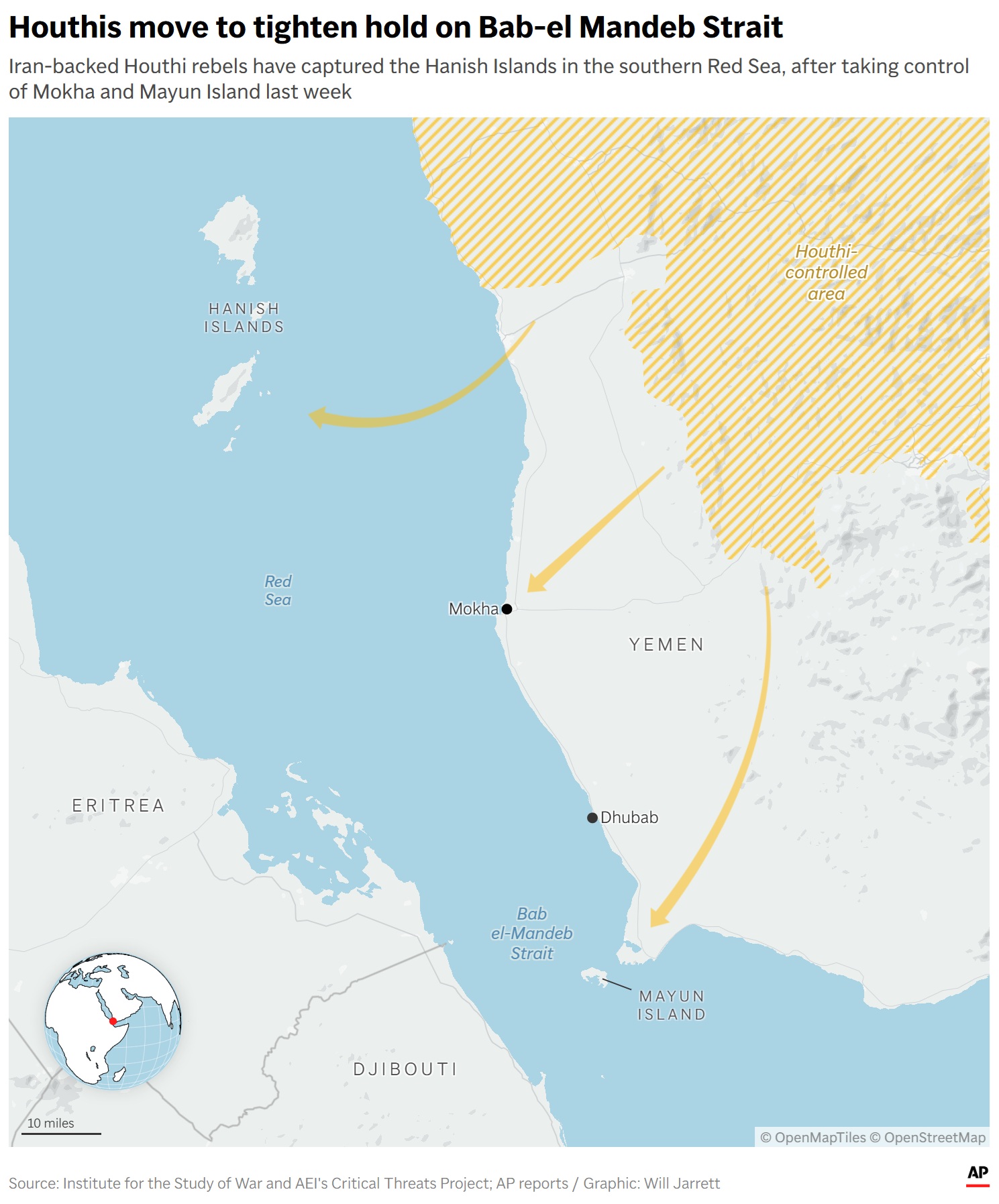
  • Houthis seize 2 strategic Red Sea islands

    Houthis seize 2 strategic Red Sea islands

    Yemen’s Houthi rebels have seized the strategic islands of Greater and Lesser Hanish in the southern Red Sea, bolstering the Iran-backed rebels’ ability to control a key maritime shipping route.

    Meanwhile, repairs to a crucial Saudi Arabian oil pipeline that was struck in an attack last week could last three to five weeks, putting it mostly out of service, two regional officials said.

    Houthis gain ground as oil prices face more pressure

    Houthi officials said Monday that rebels had taken over the two islands just as Saudi-backed government forces tried to claw back territory from the rebels’ swift advances around the Bab el-Mandeb Strait, a crucial shipping alternative to the Strait of Hormuz.

    Iran effectively closed the Strait of Hormuz — through which a fifth of the world’s traded oil and gas transits in peacetime — in the opening days of the war. The Saudis have since used the Bab el-Mandeb Strait, which leads out of the Red Sea, for crude oil exports.

    The Houthis’ latest takeover, following the seizure of the Red Sea port of Mokha and a strategic island last week, puts more pressure on Saudi shipments and, in turn, global oil supplies and prices.

    This could give Iran additional leverage in its war with the United States.

    Oil might only partially move through damaged line

    Saudi Arabia relies on the East-West Pipeline to move crude from Gulf ports to ports on its western, Red Sea coast. From there it can be put on tankers for export.

    Two officials briefed on the matter said repairing damage from an attack on Sept. 10 could take weeks, including at a major pumping facility.

    The officials spoke on condition of anonymity because they weren’t authorized to brief the media. One said the line may work partially while teams carry out the repairs.

    China, a major Middle East oil importer, called Houthi attacks on Saudi energy infrastructure “unacceptable” and said that it was “deeply concerned” about further escalations by the rebels.

    Iran says Saudi Arabia behind postponed meeting on Hormuz

    Iranian Foreign Ministry spokesperson Esmail Baghaei said Monday that Saudi Arabia had “demanded” that a meeting bringing together Iran with other regional countries to discuss the Strait of Hormuz be scrapped “for the time being.”

    Baghaei called the meeting, which was to be hosted by Oman, a “proper opportunity” to restore security in the region.

    The spokesperson said that an agreement between Iran and Oman on the Strait of Hormuz has been finalized and it will be announced later.

    Saudi Arabia had submitted amendments to the agreement, citing concerns that it could have lasting implications for the Strait of Hormuz, negatively impacting other Gulf Cooperation Council countries, according to a Gulf official familiar with the matter who wasn’t authorized to comment publicly and spoke on condition of anonymity.

    Iran condemns Austria’s visa refusal for its nuclear chief

    Iran denounced on Monday the refusal by Austria to issue visas to the Iranian nuclear chief and other delegation members for the International Atomic Energy Agency’s general conference in Vienna, calling the decision “completely unjustified.”

    Baghaei said that Tehran summoned the Austrian chargé d’affaires, saying Austria was obligated as the host country to issue the visas.

    Baghaei accused Western countries of denying Iran an opportunity to defend itself and blamed the U.S. for pressuring Austria to deny the visas.

    The refusal is part of U.N. sanctions on Iran, reinstated last year, that include a travel ban on Iranian officials.

    Iran fails to live up to nuclear obligations, U.S. official says

    U.S. Energy Secretary Chris Wright on Monday criticized Iran’s failure to cooperate with the U.N. nuclear watchdog.

    Wright was particularly critical of Tehran’s refusal to grant U.N. inspectors access to Iran’s nuclear sites affected by the war. He said that Iran had “ample time to address its egregious negligence” toward its obligations ”but that time is up.”

    Speaking at the IAEA general conference in Vienna, Wright said that giving Iran more time “only delays overdue accountability.”

    Yemenis flee homes as rebels press on

    Nearly 94,000 people have fled their homes in Yemen since fighting between Iran-backed Houthi rebels and government forces escalated this month, the International Organization for Migration said Monday.

    The worst-hit areas are Taiz and Lahj, where 48,000 have been displaced, the U.N. agency said, adding that more than 2,000 people have fled across the sea into Djibouti.

    Around 200 schools have been converted to shelters in southwestern Yemen to absorb an influx of families, the International Rescue Committee, an aid group, said.

    Fears mount that Yemen is inching closer to a return to a civil war that killed 150,000 before a 2022 ceasefire. The World Health Organization said more than 500 people were killed in a weeklong period ending Saturday, a sharp increase.

    Israel accused of dismantling ‘Palestinian existence’ in West Bank

    The B’Tselem human rights group said Monday Israel is carrying out a systematic and accelerated project aimed at “dismantling the foundations of Palestinian existence” in the occupied West Bank.

    The group said in a new report that Israeli actions against Palestinians in the West Bank by settlers and the military are designed to undermine Palestinian collective life “while entrenching a permanent system of Jewish supremacy” across the territory.

    Settler violence has surged under the ultranationalist government of Israeli Prime Minister Benjamin Netanyahu. Rights groups say the military frequently turns a blind eye to the violence, and that when it intervenes it often focuses on protecting the settlers.

    The B’Tselem report also says that Israeli actions rely heavily on open cooperation between state authorities and armed settlers who attack Palestinian communities, while the military either fails to prevent the violence or sometimes participates in it.