Category: Nation & World

  • States reach $18 million settlement with 23andMe, with Pa. and N.J. getting more than $400,000 each

    States reach $18 million settlement with 23andMe, with Pa. and N.J. getting more than $400,000 each

    Genetic testing company 23andMe and a group of attorneys general nationwide have reached a multimillion-dollar settlement following the major data breach that led to the company’s demise three years ago.

    More than 40 attorneys general, including Pennsylvania‘s Dave Sunday, announced the national $18 million settlement with the genetic testing company Tuesday.

    “This company was trusted by millions of Americans to safeguard very private data and information, but failed to do so, learning about a data breach far too late, then pointing fingers at their own customers,” Sunday said in a statement. “I find it appalling that a company dealing with customers’ personal information would be so lax about their system protections, then have the audacity to deny and attempt to wash their hands of wrongdoing.”

    As part of the settlement, Pennsylvania will receive $491,902. Nearly 200,000 Pennsylvanians were impacted by the data breach, according to the state attorney general’s office. About 150,000 customers were impacted in New Jersey, which will receive nearly $410,000, said the state’s attorney general, Jennifer Davenport.

    Here’s what else we know.

    What happened with the 23andMe data breach?

    In October 2023, 23andMe launched an investigation after a “threat actor” claimed to have obtained millions of users’ personal data.

    By December, the company confirmed through a filing with the Securities and Exchange Commission that a hacker directly accessed 0.1% of its users’ accounts, or about 14,000 profiles. Still, because of the networks users can build, connecting their information to possible relatives, the hacker was able to view the information of millions of users.

    A spokesperson for the company told news outlets at the time that 6.9 million people had been affected: about 5.5 million customers who had opted into 23andMe’s “DNA Relatives” feature and 1.4 million users whose family tree information was accessed.

    Of those customers, 192,093 were in Pennsylvania.

    What information was accessed?

    Information accessed included:

    • Display name, profile picture, and birth year.
    • How recently they had logged into their account.
    • Their relationship status.
    • Their self-reported location by city and zip code.
    • Predicted relationships with others.
    • DNA percentages users share with their “DNA Relatives.”

    An additional 1.4 million customers who used the “DNA Relatives” feature had their “Family Tree” profiles accessed, which includes a limited subset of profile data, the company said.

    The hacker activity was contained and required existing users to reset their passwords and enable multifactor authentication, 23andMe said at the time. Still, experts warned consumers that they should consider deleting their accounts.

    When did 23andMe declare bankruptcy?

    The company declared bankruptcy in March 2025 and eventually was sold.

    That’s when states, including Pennsylvania, filed claims related to the data breach investigation. As part of the bankruptcy proceedings, 23andMe’s consumer data was sold to TTAM Research Institute, a nonprofit organization formed by 23andMe founder and former CEO Anne Wojcicki. That sale is bound by new guardrails regarding data security that were put in place with the help of the coalition of attorneys general.

    Sunday joined the lawsuit to prevent 23andMe from selling consumer data as part of its bankruptcy proceedings.

    The lawsuit said the California-based genomics biotech company was proposing to sell an “unprecedented compilation of highly sensitive and immutable personal data: a human being’s permanent and everlasting genetic identity.”

    The risk of a data transfer was too great, the complaint said, as DNA data are unique to an individual and can be used to identify relatives — past and future. And genomic data live forever, even after a person dies.

    “If stolen or misused, it cannot be changed or replaced,” the complaint said.

    What happened this week?

    A group of 42 state attorneys general announced the $18 million settlement. This is in addition to a $46.75 million class-action settlement arising from the bankruptcy, for affected U.S. consumers who submitted claims by Feb. 17. Impacted customers should have received an email notifying them about their eligibility for the class-action settlement, according to the Pennsylvania Attorney General’s Office.

    All 50 states and territories except for California, Hawaii, Mississippi, Missouri, Montana, Nebraska, Nevada, Rhode Island, and Wyoming were involved in the settlement.

  • Supreme Court justices tell Congress their safety is at risk and more must be spent on security

    Supreme Court justices tell Congress their safety is at risk and more must be spent on security

    WASHINGTON — Supreme Court Justice Amy Coney Barrett told lawmakers Tuesday that a sharp increase in threats targeting her and other justices is increasingly encroaching on their personal and family lives.

    During a rare appearance by justices before Congress, Barrett said she had to wear a bulletproof vest home a few years ago, something she struggled to explain to her 12-year-old son.

    “I didn’t expect that performing this service would put me in the position of explaining to my children what a bulletproof vest was, why I had to wear one,” she said.

    She and Justice Elena Kagan testified before a House appropriations panel in support of a request to increase security funding for members of the nation’s highest court.

    Judges around the country have seen a rise in threats of violence and intimidation. Barrett’s home was also targeted by a fake swatting call to police in May.

    The hearing comes two weeks after the conservative-majority court finished handing down a series of major opinions, including a decision that increased President Donald Trump’s power over federal regulatory agencies and another that rejected his wide-ranging tariffs, sparking harsh personal criticism.

    It’s the first time justices have testified before Congress since 2019, and the two justices faced wide-ranging questions about the court’s work.

    Security is central to budget request

    The Supreme Court requested a total of $228 million for next fiscal year, a roughly 10% increase over the year before. About $18 million of that is for maintaining the building and grounds.

    Much of the requested increase, $14.6 million, would go to expanding personal protection for justices, with six more agents for each.

    An additional $2 million would fund an off-site residential security post aimed at making emergency responses faster, as well as increasing the number of Supreme Court police officers.

    The U.S. Marshals Service, responsible for protecting judges, reported 564 threats in the government fiscal year that ended in September, an increase from the year before.

    That total includes threats to the hundreds of federal judges around the country, though the nine-member Supreme Court has not been immune.

    In May, Barrett’s security detail worked with police to quickly deal with the call determined to be swatting, or a fake 911 call designed to provoke a police response. Last year, her sister was the victim of a bomb threat in Charleston, S.C., police said. No bomb was found.

    In 2022, shortly after the leak of a draft opinion overturning the Roe v. Wade abortion decision, a would-be assassin was arrested near the home of Justice Brett Kavanaugh with weapons and zip ties. Threats to the Supreme Court increased after that leak, and have continued to grow, Kagan said.

    Chief Justice John Roberts has condemned the threats to all U.S. judges, saying during a speech in March that criticism of judicial opinions is understandable, but personally directed hostility is “dangerous, and it’s got to stop.”

  • As cyclospora illnesses surge to a record, Michigan officials eye lettuce as a possible link

    As cyclospora illnesses surge to a record, Michigan officials eye lettuce as a possible link

    NEW YORK — Infections from the diarrhea-causing parasite cyclospora are surging, with state-level data suggesting that 2026 is already the nation’s worst year for reported cases.

    More than 30 states have reported infections this year, and current data from them shows the number of infections surpassing the record U.S. mark of about 4,700 set in 2019. The illness is not usually life threatening and is typically treated with antibiotics.

    Health officials have not yet definitively identified what is causing the infections. But in Michigan — where more than 3,300 cases have been reported — officials say early information points to lettuce or salad greens as a possible culprit.

    After conducting more than 1,000 interviews with patients, “early information has shown lettuce as a common product that regularly comes up during the investigation,” said Natasha Bagdasarian, the Michigan health department’s chief medical executive.

    Because of that commonality and because produce has been behind some past cyclospora outbreaks, Michigan officials advised consumers to buy whole heads of lettuce, discard the outer layers and thoroughly wash what’s left. They also suggested people avoid bagged lettuce and pre-mixed salad kits.

    On Tuesday, the Taco Bell restaurant chain issued a statement saying it had “voluntarily and temporarily removed limited ingredients at select restaurants as a precautionary measure. We will continue to closely monitor the situation and follow the guidance of public health authorities.”

    Cyclospora is a microscopic, spherical parasite that commonly causes watery diarrhea “with frequent and sometimes explosive bowel movements,” according to the U.S. Centers for Disease Control and Prevention. Outbreaks tend to occur most often in the late spring and summer.

    The heat-loving parasite infects the bowels and spreads through feces. In the past, people have been infected by consuming fruits or vegetables that were exposed to feces-contaminated irrigation water.

    The illness, called cyclosporiasis, is less common than foodborne illnesses caused by other germs, including salmonella and E. coli. Many cases are never linked to a specific food or other source and, for years, few U.S. cyclospora outbreaks were reported. But the number started rising about a decade ago, with a particularly notable spike in 2018 and 2019.

    Experts say it’s likely that cyclospora cases historically were underreported, in part because some common tests used to check for food poisoning have not been geared to detect cyclospora. They attribute the increasing trend in cases to climate change and better detection.

    The worst year in the U.S. for infections was 2019, when about 4,700 illnesses were reported, according to federal data on confirmed and suspected cases.

    The Centers for Disease Control and Prevention keeps those numbers, but they traditionally lag what’s posted by individual city and state health departments dealing with local outbreaks in real time. On Tuesday, CDC officials issued a health alert that said that since May 1, the agency is aware of 1,645 confirmed domestic cases and more than 5,100 that require further analysis to confirm whether the infections were acquired in the U.S. The reports come from 34 states, the CDC said.

    The federal alert did not detail how many reports came from each state. But Michigan officials have reported more than 3,300 cases, officials in northwest Ohio said they have seen more than 1,100, New York City officials counted more than 400, and Illinois reported more than 200.

    Officials do not think all can be tied to a common source. In Illinois, for example, more than half the people with infections said they had travel outside the United States, and at least some may have been infected elsewhere.

    But Michigan officials believe a large share of their total is likely due to a linked domestic outbreak.

  • ICE halts vehicle stops after 2 deadly shootings

    ICE halts vehicle stops after 2 deadly shootings

    BIDDEFORD, Maine — Trump administration officials told Immigration and Customs Enforcement officers to suspend most vehicle stops after two deadly shootings within a week, people familiar with the decision said Tuesday.

    The order came after an ICE officer shot and killed a Colombian driver Monday in Maine and a week after an officer shot and killed a Mexican motorist in Houston, renewing criticism of the agency’s tactics during enforcement operations.

    The suspension is not absolute and there’s room for exceptions when executing a criminal warrant or working with partner agencies, according to a person who spoke Tuesday on condition of anonymity to discuss sensitive law enforcement operations. Matthew Felling, a spokesperson for Maine Sen. Angus King, said the senator’s office was also told by the Department of Homeland Security that ICE was suspending vehicle stops.

    Hundreds of people in Maine protested Tuesday over the fatal shooting Monday of Johan Sebastián Durán Guerrero, a 26-year-old Colombian national.

    DHS said Monday that the officer, “fearing for public safety,” shot and killed Durán Guerrero while officers were watching the home of someone they believed was in the U.S. illegally and had a final order of removal from the country. It said in a post on X that when ICE tried to stop a car driven by someone who came from the home, the vehicle attempted to flee and the officer fired his weapon.

    That was a shift from how King described the encounter hours earlier, when he said Homeland Security Secretary Markwayne Mullin told him the officer opened fire after the man tried to use his vehicle as a weapon. King said Mullin told him the officers were trying to serve an arrest warrant, but not for the man who was shot.

    DHS, which oversees ICE, didn’t immediately respond to an email seeking clarity on what led to the shooting.

    In a scathing post on X, outgoing Colombian President Gustavo Petro called the shooting a targeted killing “at the hands of the U.S. government.”

    Petro, who has openly quarreled with U.S. President Donald Trump, urged Trump to provide an explanation and accused ICE officers of treating Durán Guerrero as “an inferior being without rights.”

    The shooting sparked outrage among hundreds of protesters who gathered Tuesday outside of ICE detention center in Scarborough, just up the coast between Biddeford and Portland.

    “These people are killers and they must leave our state now,” organizer Todd Chretien told the crowd, including some who held signs reading “Stop the murder” and “End this terror.”

    Maine’s congressional delegation on Tuesday demanded a “comprehensive, transparent, and expedited investigation.”

    Questions surround the shooting

    Durán Guerrero’s shooting marked at least the ninth time ICE has used deadly force since Trump began his immigration crackdown.

    Photos showed bullet holes in the Maine car’s windshield, but the officers involved in the shooting didn’t have body cameras, leaving many questions. Among them are how close the officer was to the vehicle when they fired, whether officers told Durán Guerrero to stop, and why ICE believes he had put the public in danger.

    “We are always evaluating our procedures to keep our officers safe and criminals off our streets. We will not disclose or discuss law enforcement tactics,” an ICE spokesperson said in a statement.

    Maine’s other senator, Republican Susan Collins, said Mullin told her that DHS’ Office of Inspector General is investigating in cooperation with the FBI.

    The state attorney general’s office, which noted that it’s working cooperatively with federal agencies to investigate, said initial statements suggest the driver was trying to flee in the direction of the officer, whose name hasn’t been released and who was placed on leave.

    Video shows the shooting’s aftermath

    According to neighbors and public records, Guerrero lived in an apartment about 150 feet from where his car came to a rest outside an apartment building, across the street from a pawnshop and laundromat.

    Video from a nearby business’ security camera obtained by the AP shows a white car slowly approaching an intersection before making several circles. A law enforcement SUV blocks its path and two officers open the driver’s door and drag out a limp body.

    It isn’t clear from the video when the shots were fired.

    Daniel Boucher, who lives nearby, said he heard a “pop, pop, pop” and ran to the intersection.

    “His face was bloody. His head was bloody,” Boucher said. “I clearly heard the victim say, ‘I tried to stop.’”

    At one point, Boucher said, the officer who shot Durán Guerrero walked close to him.

    “He looked at me and said, ‘He tried to run me over,’ or something to that effect,” Boucher said. “I don’t remember his exact words.”

    Durán Guerrero is survived by his wife and young daughter

    Two advocacy groups — the Maine Immigrants’ Rights Coalition and Presente! — said Durán Guerrero was authorized to work in the U.S.

    Neighbors say Durán Guerrero was a friendly and familiar face even though they rarely chatted because he didn’t appear to speak English.

    Sadie Dilboy and Cory Poulin, who own a laundromat near the intersection where the car came to a stop, said they saw Durán Guerrero all the time.

    “Everyone knows him,” said Dilboy, who remembered that he often came to their store with his daughter and gave her quarters to buy candy.

    Claudia Morton, who lives near Durán Guerrero and his family and often waved to him, was distraught over the shooting. “The whole world should be crying,” she said Tuesday.

    Last week in Houston, an ICE officer fatally shot 52-year-old Lorenzo Salgado Araujo after federal authorities driving unmarked vehicles pursued him while he was driving to a construction job site.

    The Trump administration’s enforcement efforts were widely condemned last winter after the killings by ICE officers of Alex Pretti and Renee Good in Minnesota.

    Another deadly ICE encounter Tuesday

    A man running from an encounter with immigration and other federal agents in St. Augustine, Fla., was struck and killed by a tractor trailer on Tuesday, authorities said.

    The 28-year-old was among four occupants of a vehicle that stopped in the parking lot of a gas station and convenience store in St. Augustine before 7 a.m.

    During an encounter with agents from U.S. Immigration and Customs Enforcement as well as Homeland Security Investigations, the four fled on foot, with one darting across a busy road into the path of the semi, Florida Highway Patrol Sgt. Dylan Bryan said in an emailed statement.

    It was the third death in about a week involving encounters with ICE agents, following shootings in Texas and Maine.

    Neither ICE nor the Department of Homeland Security immediately returned emails from the Associated Press seeking comment.

  • E. Jean Carroll is paid $5.6M in Trump sex abuse and defamation case

    NEW YORK — The writer E. Jean Carroll has collected over $5.6 million that a jury awarded in her sexual abuse and defamation lawsuit against President Donald Trump, court records and her lawyers said.

    The payment — representing the $5 million jury award, plus interest — was made Monday from an account where it had been held in escrow since the 2023 verdict, according to court records. Carroll’s lawyer, Roberta Kaplan, confirmed the payment Tuesday.

    “We are pleased to report that she has received the damages payment,” Kaplan said in a statement.

    Trump’s lawyers have vowed to continue appealing.

    Trump deposited the money in an escrow account shortly after the jury ruled against him. The U.S. Supreme Court recently let the civil verdict stand, clearing the way for Judge Lewis A. Kaplan to release the money.

    Trump’s lawyers then sought but were denied an emergency order to block the payment. The one-sentence denial set no conditions on how Carroll may use the money. Her lawyers have said in court papers that she plans to put it in a retirement account.

    Trump’s attorneys have since filed another appeal seeking to stop or reverse the payment.

    The jury found Trump attacked Carroll in 1996 in a New York luxury department store dressing room and defamed her after she told the story publicly in a memoir in 2019, during his first term as president.

    Trump insisted nothing sexual happened between him and Carroll, now 82, a former advice columnist. Trump claimed she was “totally lying” and “not my type” in a 2019 interview. He said he didn’t know her, dismissing a 1987 photo of them and their then-spouses at a party as inconsequential, and he accused her of harboring political motives and trying to sell books at his expense.

    Trump didn’t attend the trial, where Carroll testified that their flirtatious and friendly chance encounter at the department store turned violent.

    Carroll sued Trump after New York changed its laws to give sexual abuse survivors a fresh chance to sue over attacks that happened in the distant past.

    Trump is also appealing $83 million in defamation compensation granted to Carroll by a separate Manhattan jury after a 2024 trial where Trump briefly testified.

    The Associated Press generally does not identify people who say they have been sexually abused. Carroll has agreed to be named.

  • Trump sharply cuts the size of two national monuments in Utah

    Trump sharply cuts the size of two national monuments in Utah

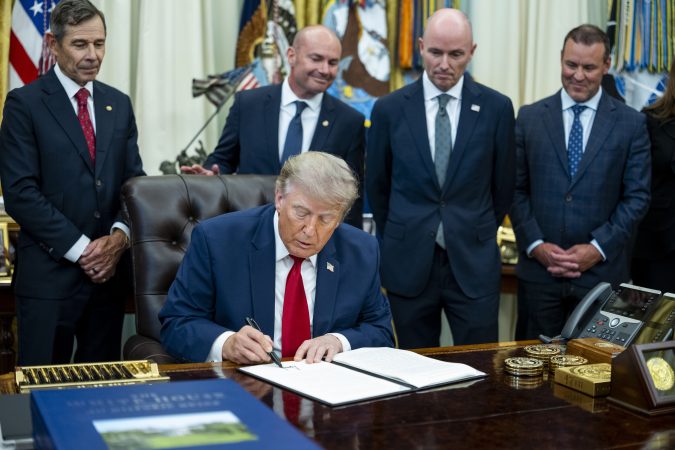
    WASHINGTON — President Donald Trump on Monday reduced the size of two national monuments in Utah by nearly 3 million acres, teeing up a legal battle over whether presidents have the power to shrink such sites in the first place.

    Trump signed two executive orders to sharply cut the Bears Ears and Grand Staircase-Escalante National Monuments to less than 10% of their current size. Both sites are known for their sandstone canyons and vast mesas, which are rich in wildlife habitat as well as archaeological sites of importance to Native American tribes.

    During his first term, Trump similarly shrank both monuments at the urging of top Republicans from Utah, opening about 2 million acres to oil drilling, uranium mining, and other development. But tribes and environmentalists sued over Trump’s move, and President Joe Biden subsequently restored sweeping protections to both sites before a court could issue a final decision.

    Tribes and environmentalists are expected to lead another lawsuit over Trump’s latest effort to shrink the monuments. The legal fight could have far-reaching implications for the future of land conservation, potentially putting dozens of other monuments at risk and opening millions of additional acres to commercial activities.

    The Trump administration has already taken a flurry of other steps to encourage development and recreation on federal lands across the country. In May, for instance, Trump moved to lift restrictions on off-road vehicles in most national parks.

    Before signing the executive orders in the Oval Office on Monday, Trump boasted that he was making bigger reductions to both monuments than he did in his first term, when he shrank Bears Ears by 83% and cut Grand Staircase by 47%.

    “We’re actually giving more than we did the first time back to the people of Utah,” Trump said.

    The six members of Utah’s congressional delegation attended the event in the Oval Office, as did Utah’s governor, Spencer Cox. All are Republicans.

    “It’s very clear that these monument designations are supposed to be the smallest area possible to protect the antiquities, and these multimillion-acre monuments that are bigger than the state of Delaware certainly do not fit that designation,” Cox said.

    National monuments are lands that are legally protected from development. They are similar to national parks, but while national parks are created by Congress, national monuments are created by presidents through the Antiquities Act of 1906.

    Many tribal leaders and environmental lawyers say the Antiquities Act does not authorize Trump to reduce the size of Bears Ears and Grand Staircase. The century-old law, they say, grants presidents the authority to designate monuments but not to abolish or shrink them.

    But many Republicans, ranchers, and oil drillers say previous presidents abused the Antiquities Act by putting vast stretches of land off-limits to development. They note that the law says presidents should limit monuments to the “smallest area compatible with proper care and management of the objects to be protected.”

    President Barack Obama designated Bears Ears during his final weeks in office in 2016. President Bill Clinton classified Grand Staircase in 1996, halting plans for a coal mining project there.

    After Trump shrank both monuments in his first term, his administration sold oil and gas leases on more than 76,000 acres of land adjacent to Bears Ears. But the Biden administration subsequently canceled most of those leases, and the oil industry has little interest in drilling within the monument itself, according to Melissa Simpson, the president of the Western Energy Alliance, an industry trade group.

    “Despite years of rhetoric from environmental advocacy groups, Bears Ears has never been a significant oil and natural gas prospect,” Simpson said in a statement.

    Bears Ears is named for a pair of buttes, or flat-topped hills, that rise thousands of feet above the surrounding canyons. The two symmetrical structures dominate much of the nearby landscape in southeast Utah.

    Grand Staircase is named for a sequence of sedimentary rock layers that stretches from Bryce Canyon National Park to the Grand Canyon. Paleontologists have made extraordinary discoveries there, excavating the fossils of tyrannosaurs and other dinosaurs that roamed the region more than 74 million years ago.

    Today, both monuments provide crucial habitat for hundreds of species, including bighorn sheep, elk, and mule deer. They also contain thousands of archaeological sites that Native American tribes consider culturally significant, including the remains of burial grounds, cliff dwellings, and rock art panels.

    Bears Ears is the ancestral homeland of five tribes in the region: the Navajo Nation, Hopi Tribe, Ute Indian Tribe, Ute Mountain Ute Tribe, and Pueblo of Zuni. The Biden administration reached a unique agreement with a coalition of the tribes, authorizing them to jointly manage the monument with the federal government.

    Anthony Sanchez Jr., the head council member for the Pueblo of Zuni and the co-chair of the Bears Ears Inter-Tribal Coalition, described a feeling of whiplash.

    “You have an administration that backs you up, and then you’re back to square one again,” he said in an interview Monday.

    Sanchez said he worried about the potential for vandals to damage or destroy the rock art at Bears Ears.

    “Even now, with the boundaries not reduced, we still run into that trouble,” he said.

    Scott Braden, the executive director of the Southern Utah Wilderness Alliance, said the nonprofit environmental group would sue over Trump’s effort to shrink the monuments.

    “The Southern Utah Wilderness Alliance is committed to defending the monuments and will challenge this unlawful decision in federal court,” Braden said in a statement. “We are confident that President Trump’s reckless and unlawful acts will be rejected and the monuments restored.”

    But Ben Burr, the executive director of the BlueRibbon Coalition, a group that supports opening public lands to off-road vehicles, vowed to defend Trump’s move in court.

    “Right-sizing these monuments to what the statute actually allows isn’t an attack on public lands; it’s how we keep them open for all Americans to enjoy,” Burr said in an email. “We plan to continue fighting in the courts and in the Congress to ensure that abuse of the Antiquities Act becomes a thing of the past.”

    The litigation over Bears Ears and Grand Staircase could eventually reach the Supreme Court, where Chief Justice John Roberts has suggested that the Antiquities Act is ripe for review.

    “Any land reserved under the act must be limited to the smallest area compatible” with proper management, Roberts wrote in 2021. “Somewhere along the line, however, this restriction has ceased to pose any meaningful restraint.”

    This article originally appeared in the New York Times.

  • Hundreds protest in Maine over the fatal shooting of a Colombian man by ICE

    Hundreds protest in Maine over the fatal shooting of a Colombian man by ICE

    BIDDEFORD, Maine — Hundreds of people protested in Maine on Tuesday over the killing of a Colombian driver by an Immigration and Customs Enforcement officer, after federal officials appeared to shift their narrative about the deadly encounter.

    The Department of Homeland Security said an ICE officer, “fearing for public safety,” shot and killed the driver Monday in Biddeford while officers were watching the home of someone they believed was in the U.S. illegally and had a final order of removal from the country.

    The department said in a post on X that when ICE tried to stop the vehicle driven by someone coming from the home, the vehicle attempted to flee and the officer fired his weapon. That was a shift from how Maine Sen. Angus King described the encounter hours earlier when he said Homeland Security Secretary Markwayne Mullin told him the officer opened fire after the man tried to use his vehicle as a weapon against the ICE officers.

    King said Mullin told him the officers were trying to serve an arrest warrant, but not for the man who was shot.

    The driver was Johan Sebastián Durán Guerrero, a 26-year-old Colombian national, the Colombian Embassy told the Associated Press in a statement Tuesday.

    Protesters gathered Tuesday outside of an ICE detention center in Scarborough, just up the coast from Biddeford.

    “These people are killers and they must leave our state now,” organizer Todd Chretien told the gathering, including some who held signs reading “Stop the murder” and “End this terror.”

    A small group of counterprotestors briefly disrupted the rally. Protesters drowned out their voices with whistles.

    Questions surround what led to latest ICE shooting

    Durán Guerrero’s shooting marked the second time in a week that ICE used deadly force and at least the ninth death since President Donald Trump began his immigration crackdown.

    The officers involved in the shooting in Biddeford, which is about 15 miles southwest of Portland, didn’t have body cameras, leaving many questions about what transpired. Among them are how close the officer was to the vehicle when they fired, whether officers told Durán Guerrero to stop, and how ICE believes he had put the public in danger.

    “We are always evaluating our procedures to keep our officers safe and criminals off our streets. We will not disclose or discuss law enforcement tactics,” an ICE spokesperson said in a statement.

    DHS, which oversees ICE, didn’t immediately respond to an email seeking clarity on what led to the shooting.

    Maine’s other senator, Republican Susan Collins, said Mullin told her that DHS’ Office of Inspector General is investigating in cooperation with the FBI.

    Photos showed bullet holes in the vehicle’s windshield.

    The Maine attorney general’s office, which is also investigating, said initial statements suggest the driver was trying to flee in the direction of the officer, whose name hasn’t been released and who has been placed on leave.

    Video shows aftermath of the shooting

    Video from a security camera at a nearby business, obtained by the Associated Press, shows a white vehicle approaching an intersection at a modest speed before making several slow circles. A law enforcement SUV blocked its path and two officers opened the driver’s door and dragged out a limp body.

    It isn’t clear from the video when the shots were fired.

    Daniel Boucher said he looked out his third-floor window after hearing a “pop, pop, pop” sound. He saw the car moving down the street until the SUV hit it.

    “His face was bloody. His head was bloody,” Boucher said, getting choked up. “I clearly heard the victim say, ‘I tried to stop.’”

    At one point, Boucher said, the officer who shot the man walked close to him.

    “I was emotional and I just let him have it, and he looked at me and said, ‘He tried to run me over,’ or something to that effect,” Boucher said. “I don’t remember his exact words.”

    Durán Guerrero lived in Maine with his family

    Two advocacy groups — the Maine Immigrants’ Rights Coalition and Presente! — said Durán Guerrero was authorized to work in the U.S.

    Mary Hayes, who lives close to the scene, said the man lived nearby with his wife and daughter.

    “I watched a wife fall to her knees looking at her husband’s dead body on the ground,” Hayes told the AP as she held a sign saying “No ICE Stop ICE.”

    Just last week in Texas, an ICE officer fatally shot 52-year-old Lorenzo Salgado Araujo, of Houston, after federal authorities driving unmarked vehicles pursued him while he was driving to a construction job site.

    The two shootings come amid a Trump administration push to carry out its mass deportations agenda. Over five days at the end of June, ICE arrested more than 10,000 people.

    The figures indicate that while the administration is no longer cracking down on individual cities, arrests are surging. The administration’s enforcement efforts were widely condemned last winter after the killings of Alex Pretti and Renee Good in Minnesota.

  • U.S. restores blockade on Iran after its attacks on ships in the Strait of Hormuz

    U.S. restores blockade on Iran after its attacks on ships in the Strait of Hormuz

    DUBAI, United Arab Emirates — The U.S. military said Tuesday that it has reimposed its blockade of Iranian ports in response to Iran’s attacks on commercial ships in the Strait of Hormuz, as the interim ceasefire deal unravels and concerns grow about a return to all-out war.

    The U.S. first imposed the blockade in mid-April and then lifted it in mid-June, a day after the signing of the interim deal aimed at permanently ending the war. The deal set a 60-day timeline to also negotiate an agreement on Iran’s nuclear program, but talks have stalled as fighting over the strait has intensified.

    When U.S. President Donald Trump announced the return of the blockade Monday, he also said he would impose a 20% fee on ships passing through the strait. But he dropped the plan to collect fees hours before resuming the blockade, citing requests from allies in the Gulf.

    The interim peace agreement was supposed to reopen a waterway that is key to world energy supplies and give negotiators time to hammer out a permanent end to the war. Instead, fighting has once again engulfed the region, threatened the global economy, and brought warnings to commercial airlines.

    The U.S. carried out another wave of strikes ahead of reimposing the blockade, a U.S. official told the Associated Press on condition of anonymity to discuss a sensitive military operation. Iran’s deputy foreign minister for legal and international affairs, Kazem Gharibabadi, said in an interview aired Tuesday by IRIB, Iran’s state broadcaster, that the U.S. was seeking to prevent Tehran from exercising what he described as “effective sovereignty” over the strait.

    There are at least 19 U.S. warships in the Arabian Sea, including two aircraft carriers and an amphibious assault ship with more than 1,000 Marines aboard. U.S. Central Command also said in a social media post that there are “hundreds of military aircraft operating across the Middle East.”

    A fifth of all traded crude oil and natural gas passed through the Strait of Hormuz before the war, when it was open to all without tolls. When the U.S. and Israel attacked Iran on Feb. 28, it effectively shut the passage by attacking and threatening ships. That sent the price of oil, fertilizer, and other goods soaring.

    Iran has more recently attacked ships moving through the strait on a route overseen by the U.S. military that is outside Tehran’s control, setting off tit-for-tat strikes. The U.S. has threatened to reopen the strait by force — but experts say that would require a much bigger armada if not tens of thousands of ground troops.

    Trump says he’s replacing the fees with Gulf investments

    Trump said Tuesday that he was called by “kings and emirs” and other leaders who suggested an alternate arrangement to charging ships fees to pass through the strait.

    “They said we’d love to do it a different way. We’d love to invest in the United States with billions and billions of dollars,” Trump told reporters Tuesday in the Oval Office.

    Trump said he preferred that arrangement to charging tolls “because I don’t think anybody should be able to charge a fee for the strait.”

    It was unclear if the investment deals would be new commitments relative to what Trump announced after a visit last year to the Middle East.

    Strikes and counterstrikes resume across the Mideast

    The U.S. military’s Central Command said it struck several areas in Iran, targeting “coastal defense systems, missile and drone sites and maritime capabilities.” Iran acknowledged the strikes but provided no immediate casualty or damage assessments.

    “These strikes will continue imposing a heavy cost on Iranian forces and degrade their ability to attack innocent civilians and commercial shipping in the Strait of Hormuz,” the U.S. military said.

    Iranian state media Tuesday reported the sound of explosions on Qeshm Island in the strait, alongside additional explosions in the southwestern city of Ahvaz and the port city of Bandar Abbas.

    Iran responded with attacks targeting Bahrain, Kuwait, Jordan, and three tankers that traveled through the strait.

    The International Maritime Organization said the attack killed two mariners and wounded 14 others on two of the tankers, Mombasa and Al Bahiyah, which were associated with the United Arab Emirates. The UAE threatened to retaliate.

    Qatar called for diplomacy Tuesday and condemned what it described as repeated Iranian attacks on Jordan, Bahrain, and Kuwait, calling them an “egregious violation” of the three countries’ sovereignty and the international rules-based order.

    Hours after the U.S. said it ended its campaign of strikes, the Iranian city of Bushehr on the Persian Gulf was hit in at least four locations, the state-run IRNA news agency reported. Explosions in the southwestern city of Ahvaz and the southern port city of Bandar Abbas also were reported by Iranian state media on Tuesday evening.

    The attacks again raised the possibility that Gulf Arab states were retaliating against Iran without discussing it in public.

    The interim peace deal is in peril

    Exchanges of fire in recent days had already cast doubt on the interim peace deal — now almost halfway through the 60-day period in which negotiators were supposed to agree to a final accord, which also was meant to address Iran’s disputed nuclear program and other issues.

    “The passage of vessels is not important to the U.S. The U.S. is not dependent on the Strait of Hormuz, and Trump has announced it many times,” Gharibabadi, Iran’s deputy foreign minister, said in an interview aired Tuesday by IRIB. It was not immediately clear when the interview was recorded.

    Trump’s plan to charge fees would have been a change to longstanding U.S. policy and a departure from U.S. promises that the strait would remain open to all without tolls — recently offered by U.S. Secretary of State Marco Rubio on a trip to the region.

    Under the interim deal, Iran agreed that passage through the strait would remain free of charge for 60 days — but the agreement left open what would happen after. Iran asserts it has the right to manage traffic and potentially charge fees. The U.S. has disputed that.

    The price for a barrel of Brent crude oil, the international standard, briefly topped $87 early Tuesday, still well below the nearly $120 reached at the height of the war. The price dipped to $78 in the aftermath of Trump’s announcement that he had changed course.

    Mediators are trying to prevent a return to full-scale war

    Regional mediators are still trying to get the United States and Iran back to the negotiating table, according to two regional officials.

    The officials, speaking on condition of anonymity to discuss the delicate diplomatic process, said Pakistan-led mediation was working around the clock to reactivate the ceasefire.

    Meanwhile, Lebanese and Israeli delegations met Tuesday in Rome and will continue U.S.-mediated negotiations Wednesday. Shortly after the U.S. and Israel launched the war on Feb. 28, the Lebanese militant group Hezbollah joined the conflict in support of its ally, Iran, and began attacking Israel. Israel responded with a ground invasion of Lebanon.

    Last month, Lebanon and Israel announced a “framework agreement” outlining the withdrawal of Israeli forces from southern Lebanon in exchange for the disarmament of Hezbollah. Implementation has stalled.

  • European troops and warplanes join Paris Bastille Day parade in a show of unity for Ukraine

    European troops and warplanes join Paris Bastille Day parade in a show of unity for Ukraine

    PARIS — Ukrainian fighter pilots and troops took pride of place in France’s national Bastille Day celebrations Tuesday as a massive parade showcased support for Ukraine and symbolically flexed European military muscle.

    On President Emmanuel Macron’s last Bastille Day as president, he hosted around 30 other leaders for an event that appeared aimed at showing both Russian President Vladimir Putin and U.S. President Donald Trump that Europe is united and stepping up to defend itself.

    Ukrainian President Volodymyr Zelensky was given an ovation from the assembled European leaders and his country’s troops got the biggest cheers of the day from crowds on the tree-lined Champs-Elysees avenue. Zelensky and Macron shared repeated hugs at the end of the parade.

    France’s biggest national holiday coincided with raging forest fires and a red-alert heat wave that forced the cancellation of traditional fireworks and firefighters’ balls — and with a highly anticipated World Cup semifinal pitting the national soccer team against Spain.

    Here’s what to know about Bastille Day this year.

    It commemorates the start of the French Revolution

    It’s celebrated on July 14 because that’s the day Parisians stormed the Bastille fortress and prison in 1789, helping spark the French Revolution that overthrew the monarchy and sent King Louis XVI and his queen Marie-Antoinette to the guillotine.

    The Bastille Day holiday is central to the French calendar and national identity. Presidents use it to vaunt France’s accomplishments, mayors across the country host village festivals, and families gather for holiday picnics.

    The centerpiece is the Paris parade beneath the Napoleon-era Arc de Triomphe and along the Champs-Elysees, which inspired Trump to stage his own parade last year.

    A huge French tricolor flag hanging below the monumental arch rippled in the wind as a military band on horseback rode down the tree-lined avenue followed by Macron standing in an open military vehicle to kick off the parade.

    Spectators wore hats and brandished small fans to fend off the heat as a formation of air force planes roared overhead trailing red, white, and blue smoke.

    Ukraine is a special guest

    Zelensky joined Macron along with some 30 other heads of state or government in the special viewing area for the parade.

    Ukrainian troops marched along the cobblestoned avenue, and Ukrainian co-pilots trained in France were on board two Mirage 2000B fighter jets alongside French air force pilots.

    “I feel very proud for the fact that they’re here and for the fact that we’re marching alongside of them and I think it as well it will create better ties with them and NATO and to be a part of that history,” 21-year-old U.K. soldier Lance Cpl. Patrick Risso told the Associated Press, speaking of the Ukrainian involvement.

    Troops from around Europe are marching

    On the ground, the parade opened with around 500 troops from the ″coalition of the willing″ grouping of countries that have pledged to help with Ukraine’s postwar security. Many served in NATO operations, and NATO’s chief was also in attendance.

    Macron said Monday night that it’s a ″great honor″ to welcome to the parade ″all the partners in the coalition of the willing and our Ukrainian friends who will march with us and illustrate its strategic reawakening and our unity.″

    The foreign fighters in combat fatigues and dress uniforms marched with their national flags, in a break with tradition.

    In the skies, aircraft from Germany, the United Kingdom, Poland, Denmark, Greece, Sweden, Norway, Spain, and Italy took part.

    The parade set a record in terms of number of troops: The Paris military governor said 7,600 troops were marching this year, compared with 5,810 in 2025. Thousands of soldiers started taking up positions early Tuesday, many taking selfies as helicopters flew overhead.

    World Cup excitement coincides with the holiday

    As the parade wound down, France’s attention turned to Tuesday’s standoff against Spain in the soccer World Cup semifinal in Texas. As Macron greeted crowds on the Champs-Elysees, spectators chatted with him about France’s chances of victory.

    The French tricolor is everywhere — in sidewalk cafes and bars, and the hundreds of fan zones set up in cities and small towns around France. They started filling up hours before the match.

    Bastille Day also coincides with the annual Tour de France cycling race, which adjusted the timing of Tuesday’s stage to ensure that the finish line arrivals wouldn’t compete for viewers with the parade.

    Heat complicates celebrations

    Forest fires are raging in the Fontainebleau forest south of Paris and in areas of southern France, as the country suffers through its third heat wave this year.

    As a result, authorities in some regions — including the French capital — banned fireworks and firefighters’ balls customarily held around Bastille Day.

    The Eiffel Tower’s fireworks and drone show was maintained, however, and held Monday night, including a drone formation shaped like the Statue of Liberty — a gift from France to the United States.

  • ‘We’re fighting Satan’: The war to save bees from a hornet invasion

    ‘We’re fighting Satan’: The war to save bees from a hornet invasion

    Jackie Currie had never seen anything like it. She had raised bees in South Carolina for more than a decade, and her insects had almost always been eager to fly out and collect pollen. But one day last summer, she found her bees huddled at the entrance of their hive, like frightened beachgoers after a shark attack.

    The bees were right to be reluctant. There were murderers in their midst.

    Hovering like hummingbirds just outside the hive were two yellow-legged hornets. Despite being shorter in length than a paper clip, these predatory insects possess a venomous sting and a seemingly sadistic streak when killing honeybees. Once they snatch their prey, the hornets butcher the bee by removing its head, legs, and wings to gain access to the nutritious abdomen.

    Currie’s bees faced a dangerous dilemma: Leave the nest and risk dismemberment or allow the hive’s resources to dwindle, putting the entire colony at risk of collapse.

    “What’s heartbreaking is that my bees don’t know how to defend themselves,” Currie said in June as she watched several yellow-legged hornets hunt outside her apiary. “The bees that know how to deal with yellow-legged hornets are in Asia, not here.”

    Natives of Southeast Asia, yellow-legged hornets first appeared in South Carolina in late 2023 and have spread rapidly throughout the Lowcountry, an idyllic stretch of coastline known for its beaches and golf courses. The region’s balmy weather and bevy of bees make it a hornet heaven, said Brad Cavin, an apiary inspector with Clemson University’s department of plant industry.

    As the state honeybee inspector, Cavin, who has a billowing beard and wears a neon vest whenever live hornets are in the area, is helping to spearhead an effort to track and remove the hornets. In 2024, Cavin’s team discovered 16 yellow-legged hornet nests; this year, the team had already removed 345 nests from the Lowcountry by late June.

    Cavin lives in Greenville, S.S., and makes the nearly 250-mile drive to the Lowcountry multiple times a month. The son of a pastor, he often likens his team’s mission to save this coastal paradise from a plague of invasive insects to a biblical bout between good and evil.

    “This is the Garden of Eden,” he said, “and we’re fighting Satan.”

    A buffet of bees

    With their orange faces, large eyes, and legs that look like they were dipped in Carolina gold barbecue sauce, yellow-legged hornets are visually striking. Yet these eye-catching insects have managed to sneak aboard cargo ships and have moved far outside their native range. They arrived in Europe via France in 2004 and in recent years have popped up everywhere from North Africa to New Zealand.

    Yellow-legged hornets were first observed in the United States by a beekeeper near Savannah, Ga., during the summer of 2023. The insects had likely entered through the Port of Savannah and subsequently spread into South Carolina. (This year, a yellow-legged hornet sighting was reported at a port in Washington state, though the U.S. Department of Agriculture was unable to verify it.)

    Georgia and South Carolina’s Lowcountry provide yellow-legged hornets with a buffet of bees. Georgia is the nation’s third-largest producer of honey, and as of 2022, South Carolina was home to nearly 24,000 bee colonies.

    And the hornets have no shortage of things to eat beyond bees. They feed on everything from deer carcasses to oyster shells and discarded prawn heads. Cavin has seen them pecking at dead alligators.

    To curb this spread, the Clemson team has been focusing on finding and removing the hornets’ nests, which the insects fashion out of wood and plant fibers that they chew into a cementlike paste. The comblike structures are encased in a protective shell covered in swirling patterns that resemble oyster shells.

    When queen yellow-legged hornets emerge at the beginning of spring, they build an embryo nest the size of a Ping-Pong ball. Once the queen and the first generation of her offspring outgrow the embryo nest, they construct what’s called a primary nest, a cantaloupe-size structure that can be fabricated anywhere from a sprinkler valve box to the eaves of a building. Once the primary nest reaches the size of a basketball, the hornets build an even larger structure, known as a secondary nest, usually high up in the trees. With plenty of treetop real estate, these nests can grow larger than beach balls and contain thousands of hornets.

    To find these nests, the team set up a public reporting system last year. The resulting deluge of tips has not always been reliable. Many are cases of mistaken identity, calling out the nests of bald-faced hornets or paper wasps. One reported embryo nest proved to be something even more innocuous: the husk of a hickory nut.

    Trapping and tracking

    The team’s other technique is to find the hornets outside the nest. So far in 2026, the team has deployed more than 4,300 traps throughout South Carolina, fashioned out of plastic buckets and jugs and hung from tree branches.

    To entice the hornets, the team brews up an irresistible bait: a mixture of grape juice and brown sugar syrup that Cavin calls “Georgia juice,” a nod to his mother, who is from Savannah. This sticky concoction has proved effective at catching hornets without attracting beneficial insects like honeybees. Cavin initially bought cases of grape juice from Costco but now buys the juice by the pallet. This year, by the end of June, the team had already used some 4,100 gallons of grape juice and more than 9,000 pounds of brown sugar.

    One recent morning, Cavin’s colleague Miguel Martinez mixed up a batch of Georgia juice in a jug on the bed of a pickup truck. “At the end of the day, I end up smelling like vinegar or wine,” Martinez said. “It’s not the most appealing scent.”

    Martinez and Cavin were preparing to check and refill a string of traps running across Coosaw Island, a mosaic of marshes and pine forests near Beaufort, S.C. Most of the traps were spaced a quarter-mile apart and located right off the road, making the monitoring effort fairly easy. Some of the swampier trapping locales, Martinez noted, were home to alligators and snakes.

    The traps are meant not to eradicate yellow-legged hornets but to help researchers pinpoint where the insects are congregating. Several hornets in a trap are likely to mean a nest is nearby. This morning’s catch was relatively small: five yellow-legged hornets across nearly 10 traps.

    When the team members come across a trap containing dozens of yellow-legged hornets, they place additional traps, using triangulation to help locate the nest. Eventually, they convert some traps to open-lid bait stations and observe the flight paths of the various hornets, which usually fly straight back to their nests after gorging themselves on Georgia juice.

    Despite their targets’ small size, the team members are also experimenting with tracking techniques. The most rudimentary: a brightly colored paint pen, which they use to mark trapped hornets before release. A splotch of blue, red, or yellow paint makes it easier to follow the hornets’ flight path through the Lowcountry’s dense foliage.

    A more sophisticated approach involves electronic trackers. The team in Georgia utilizes high-frequency radio tags that are only slightly larger than a grain of rice and weigh just 0.14 grams, about the same as a quarter of a raisin. After a hornet is extracted from a trap, it is placed on ice as a form of anesthesia. The team then secures a tag to its waist using Kevlar thread, and gives it a meal of fresh honey to provide energy for the return trip to the nest.

    After the hornet takes off, the team tracks it using a simple beeping scanner that increases in volume when pointed in the right direction. This lets the team follow a tagged insect until — hopefully — the nest becomes visible in the treetops.

    Swarms, and a deafening buzz

    Once a nest is confirmed, Cavin calls in removal experts. Among the most reliable are Nathan Krelis and Wes Long from Hilton Head Exterminators, who have removed hundreds of nests since the insect first appeared in the state, including one last summer that was the size of a car engine.

    Removing nests takes skill and steely nerves. The exterminators are often met by swarming hornets and a nearly deafening buzz. To limit the amount of pesticide they spray into the environment, the pair plugs the nest’s entrance with a small piece of sponge, creating a self-contained chamber.

    After the hornets cease swarming, the exterminators scrape the nest off and place it inside a clear plastic bag, like a takeout order. Back at his team’s headquarters, Cavin freezes the nest to kill off any surviving hornets and places the structure in a kiln to dry for preservation.

    One afternoon in June, the team conducted several removals along U.S. Route 278, a road leading out to Hilton Head Island that is lined with gated communities and shopping plazas. The exterminators suited up in beekeeping garb and climbed their ladders to remove nests from maintenance sheds, storefronts. and several houses. (When removing secondary nests from trees, the exterminators use construction lifts.)

    At one house, Karen Opderbeck watched Long remove a nest that was tucked underneath the roofline. Opderbeck, who had reported the nest, recalled a recent visit to an apiary with her garden club, where she witnessed a yellow-legged hornet hunting spree. “They were nabbing bees and going up into the trees with them,” she said.

    Long removed the softball-size nest and held it out in his gloved hand for Opderbeck to inspect. Lodged inside, like a Russian nesting doll, was the original embryo nest.

    “It’s like having a stalker right at your front door,” Opderbeck said.

    This article originally appeared in the New York Times.