Category: Nation & World

  • ICE officer in Maine shooting has history of violent behavior, family and records say

    ICE officer in Maine shooting has history of violent behavior, family and records say

    AUGUSTA, Maine — The Immigration and Customs Enforcement officer who shot a Colombian man in Maine this week is an Army veteran who has struggled with serious mental health issues since early childhood and never should have been given a badge and gun to patrol American streets, several of his close relatives told the Associated Press.

    David Brouillette has a history of terrifying and violent behavior, according to those relatives. They accuse him of attacking women in his life over the years, and one shared a voicemail with the AP from last winter in which he told her that he thought someone should slit her throat.

    Brouillette’s troubling past further challenges how thoroughly the Department of Homeland Security has vetted recruits as it went on a hiring spree to help carry out President Donald Trump’s immigration crackdown.

    At least 10 people have died in encounters with immigration agents since Trump launched the crackdown after retaking office, including 25-year-old Johan Sebastián Durán Guerrero, a Colombian national who was shot and killed by Brouillette on Monday while in his car near his home in the coastal Maine city of Biddeford.

    DHS, which hasn’t released the name of the officer who killed Durán Guerrero, has said the “vehicle attempted to flee the scene and, fearing for public safety, an officer discharged his weapon.”

    Brouillette didn’t respond to text messages or an email seeking comment. Three relatives who said they had spoken to him since the shooting, including an ex-wife and daughter, said he told them he acted in self-defense.

    When reached for comment about Brouillette’s record and his role in Monday’s shooting, ICE spokesperson Lauren Bis said in a statement, “We will never confirm or deny attempts to dox our law enforcement officers,” and that “The ICE officer in question has nearly a decade of federal law enforcement experience with required training including use of force training.”

    The White House referred all questions about the shooting and Brouillette to ICE.

    A new career in ICE

    Brouillette, 37, told his ex-wife Ashley Brouillette late last year that he had been hired by ICE. She said that because of his long history of psychiatric issues, she thought he was having a mental health episode and she didn’t believe him. She didn’t realize he’d been telling the truth until this week, when videos began circulating online of the moments surrounding the shooting.

    Ashley Brouillette told the AP that she spoke to her ex-husband in a Facebook audio call, and he acknowledged that he had killed Durán Guerrero. Their 18-year-old daughter, Madison Brouillette, also told the AP that her father called her Wednesday and said that he shot and killed Durán Guerrero.

    David and Ashley Brouillette were high school sweethearts who got married in 2007. She said she divorced him in 2009 because he had become physically violent with her, which began after she got pregnant with their daughter.

    According to Ashley Brouillette, he once threw boiling water at her while she was holding their child — an incident her mother Avis Collins also recounted.

    The abuse continued after she left him, she said.

    Ashley Brouillette said her marriage to David Brouillette ended after he became physically violent.Mike Householder

    David Brouillette doesn’t appear to have a criminal record in Maine, as a check with the Maine Department of Public Safety returned no records for him.

    But hundreds of family court records obtained from the Augusta District Court clerk’s office detail years of allegations of physical and verbal abuse raised by his second ex-wife on behalf of herself and his daughters.

    The ex-wife — whom the AP is not identifying because she fears retaliation — alleged that he had stalked and harassed her and physically and verbally abused his daughter, according to multiple requests for temporary protection orders. Brouillette tackled his teenage daughter and smashed spaghetti in her hair, and during another outburst, he dragged his daughter around the house as she cried, she said.

    “Dave needs counseling or something for his PTSD & depression,” she wrote in an application for a temporary protective order on behalf of his teenage daughter which a judge granted in 2021.

    In court filings, David Brouillette said that his second ex-wife had slandered him.

    His oldest daughter, Madison Brouillette, said she also witnessed her dad’s volatility.

    “I watched my dad struggle a lot with a lot of things,” she told the AP. She said she came home from school once and he told her he had been sitting on a tree stump with a gun to his head.

    “If you don’t really, truly take care of yourself, there’s no way you can protect other people. And with my dad, he never wanted to get help,” she said.

    An immediate relative of David Brouillette who spoke on the condition that their name not be used said he was diagnosed with severe bipolar disorder and attention deficit disorder as a child — a diagnosis that Ashley Brouillette confirmed. The immediate relative described him as “extremely mentally ill” and said he attempted suicide twice at age 12 and was hospitalized multiple times.

    The relative said they’ve been estranged for years, after they broke off contact because they feared he would harm them. He did not respond to their outreach this week, the relative added.

    A military deployment and law enforcement aspirations

    Growing up in Gardiner, a city of about 6,000 people roughly 60 miles northeast of Biddeford, where Monday’s shooting occurred, David Brouillette was enchanted by law enforcement and the military, his relatives said.

    High school yearbook photos show he was a member of the school’s Naval Junior ROTC, and he wrote that he planned to go to college and become a police officer.

    Brouillette was initially rejected by military recruiters because of his mental health diagnoses, but recruiters encouraged him to go off his medications for a year and reapply, which he did, his immediate relative said.

    He was eventually able to enlist.

    According to U.S. military records, Brouillette enlisted as a chemical equipment repairer in the Maine Army National Guard but then changed jobs to be a medical logistics specialist. He was in the Guard from November 2007 until January 2010, according to records provided by the Pentagon.

    A 2009 article in the Kennebec Journal listed Brouillette as a private in the Maine Army National Guard’s 152nd Maintenance Company in Augusta.

    In January 2010 he joined the regular Army as a human intelligence collector. Brouillette deployed to Afghanistan from May 2012 to February 2013 and eventually left the Army as a sergeant in December 2015.

    His immediate relative believes Brouillette’s time abroad worsened his emotional struggles: “Afghanistan destroyed him — trained him to be a killing monster, a machine. They took someone who was extremely mentally ill and turned him into a killing machine.”

    Life after the Army

    After his discharge, Brouillette held a hodgepodge of jobs — some in or adjacent to law enforcement — and was injured in an accident while training to become a firefighter, public records and court documents show.

    Brouillette worked for the Maine Correctional Center — a medium-security prison — and for the state’s Health and Human Services Department, spending less than a year at each.

    In 2019, court documents show, he was a police officer at a Department of Veterans Affairs medical center near the state capital, Augusta. A Veterans Affairs Department spokesperson on Thursday referred questions about Brouillette’s employment to DHS.

    But by the end of 2021, he wrote in a text message included in court filings, he was broke, going to school full-time, and making money delivering food for DoorDash.

    Brouillette was enrolled in a firefighting program at Southern Maine Community College and was struck in the head by a steel beam while unloading a trailer at a training facility, according to a lawsuit he filed over his injury.

    He sustained a concussion and post-concussive syndrome, with symptoms including impaired memory, cognitive deficits, headaches, vertigo, and light sensitivity, and was unable to complete the program, according to the lawsuit, which was settled out of court.

    In recent years, court filings show, he was collecting disability pay through the VA. He also drove a truck, but quit in January 2025, citing health issues.

    In March 2025, Brouillette passed an exam to become a real estate sales agent. His license was active until December. In a Facebook post, Realty of Maine announced Brouillette would be working in the firm’s Bangor office.

    “David lives in Maine after retiring from the United States Army,” said the post, which has since been deleted. Brouillette is no longer listed as an agent on the firm’s website. Messages seeking comment were left for Realty of Maine.

    In March, the Maine agency that handles child support matters filed a lien against him, public records show. The filing suggests that Brouillette may have been in line for a permanent impairment or disability settlement.

    ‘I don’t think he sees himself as a killer’

    In late 2025, around the time he joined ICE, his ex-wife Ashley said he left a three-minute voicemail mocking her for taking out a restraining order against him. According to the message she shared with AP, he repeatedly called her “disgusting” and suggested that she and the other women and girls in her “bloodline” should die.

    “And all of you should have your f — throats cut,” the voicemail said. “Yeah, you should. Am I threatening that I’m gonna do that? Nope. Nope. But do I think that you should have your f — throats cuts? Or should have had them cut? Yep.”

    She said she cut off contact with him until Wednesday, when his picture began circulating online.

    Ashley Brouillette reached out to his current wife on Facebook and they spoke on the phone for several minutes. Her ex-husband spoke with her, according to cell phone screenshots of the phone exchange she shared with the AP. He acknowledged he had fatally shot Durán Guerrero.

    “He was asking if I could tell them that he was a good person and not to talk about the abuse and stuff that I had endured while with him and he said that the most important thing is his character right now,” she said.

    She said he told her he is now hiding in protective custody.

    “I asked him why he did it,” she said. “He said it was a justified shooting. The guy was trying to run him over with a car.”

    His daughter also said he told her it was justified.

    “I don’t think he sees himself as a killer,” Madison Brouillette said.

    “I think he thinks that he genuinely did the right thing,” she added. “All he said was that he did what he had to do. He said that he had to protect himself.”


  • Texas flash floods leaves at least 2 dead in region devastated a year ago

    Texas flash floods leaves at least 2 dead in region devastated a year ago

    UVALDE, Texas — Catastrophic flash floods in Texas have killed two people and forced hundreds of rescues in areas still reeling from devastating floods a year ago, Gov. Greg Abbott said Thursday.

    Rescuers aboard boats and helicopters have saved more than 200 people, including stranded drivers and people trapped in homes, Abbott said.

    The governor said the hardest-hit areas are expecting more rain into Friday and are not out of danger yet, with some rivers expected to reach historic levels.

    After days of pounding rain, the National Weather Service said a “large and deadly flood wave” barreled down the same river wrecked by flash floods last summer when two dozen children and counselors were killed at Camp Mystic.

    Much like last year, the floods came in the middle of the night. But this time some residents in the Texas Hill Country said they received more warnings.

    Forecasters urgently warned, “Move to higher ground now!” as rivers rose hour by hour, turning them into fast-moving seas of white water. Some spots of the Guadalupe River rose by more than 30 feet.

    The governor said more than 1,300 first responders were deployed.

    As much as 28 inches of rain fell over the past three days in Uvalde County, which was spared from the worst flooding a year ago, the weather service said Thursday. Other areas saw roughly a foot of rain with more expected going into Friday.

    “This is hopefully the last real batch of rain,” said Jason Runyen, a meteorologist with the weather service.

    Victim in Texas floods was swept away

    While authorities have not released the name of the person who died, Jennie Steward said the body of her husband, 65-year-old John Mark Steward, of Kerrville, was found Thursday.

    She was visiting her parents when a neighbor called overnight, saying her husband was missing after water had risen to the door of their mobile home, which stood about 8 feet off the ground.

    The entire home was swept off the platform and floated down Goat Creek on the Guadalupe River, she said.

    “It’s really hard that I wasn’t there with him,” she said. The two were married three years ago and last spoke by phone Wednesday to celebrate their anniversary.

    Hill Country residents say they were better prepared for floods

    The unfolding crisis brought back haunting memories of last summer’s unimaginable Hill Country floods that killed more than 100 people over the July Fourth holiday.

    “It’s crazy happening two times in one year,” said Josiah Rodriguez, who awoke to the sound of heavy rain around 2 a.m. Thursday in Kerrville. He navigated flooded roads to help evacuate relatives.

    “Last year there was no warning of it,” he said. “It just kind of happened overnight and it took everyone by surprise. This year, a lot more alerts have gone into place, a lot more safety measures.”

    Residents said they were caught off guard a year ago and didn’t receive any warning when floods overtopped the Guadalupe. Some local leaders were criticized for not acting quickly.

    The storms and flooding this time threatened multiple counties close to the Mexico border and in the Hill Country near San Antonio. Roughly 6 million residents across Texas were under a flood watch this week, and some were expected to remain in effect through Friday evening.

    Several agencies sent rescue helicopters to the flood zone, including Travis County in the state capital of Austin.

    “My understanding is people were mostly trapped in trees and on rooftops,” said Travis County Judge Andy Brown, who said one caller warned 10 people were trapped on a barn roof.

    Residents rush animals and campers to higher ground

    At a wild animal rescue, Katie Buck evacuated several dozen animals to higher ground in the dark Thursday as the normally dry Lazy Creek overflowed. She had to quickly grab a porcupine despite having no gloves.

    She got all of the animals to safety, but flooding destroyed several enclosures at the Buck Wild Animal Rescue and Wildlife Rehab near Ingram in Kerr County.

    “We were just starting to get back on our feet again,” Buck said. “To have to go through this again is just devastating.”

    Residents at an RV park in Comfort moved their trailers as sirens sounded, said manager Duke Earwood.

    Water rose over the hoods of vehicles parked near the river at the Comfort RV Resort. Markers showed the flooding already matched last July’s big flood.

    “Too familiar for sure, and too soon,” Earwood said.

    Uvalde residents isolated by floodwaters

    Floodwaters also overran the city of Uvalde overnight, cutting off most outside routes. The Leona River, normally dry most of the year, filled streets with water.

    “People really can’t get anywhere,” said Carmen Rodriguez, who nervously watched water engulf her neighborhood as a helicopter roared overhead. “We have a place to go, but all the streets are closed.”

    Rodriguez said authorities seemed to be well prepared, ordering mandatory evacuations and notifying people directly.

    Texas Game Wardens rescued close to 150 people by the afternoon, according to a Texas Parks and Wildlife Department spokesperson. Video released by the agency showed crews hoisting children from a house surrounded with water into a helicopter.

    Flooding hasn’t reached last year’s deadly high

    So far, the heavily swollen Guadalupe has remained below the record levels reached in 2025. Gauges showed it rose by more than 30 feet in some spots over just a few hours.

    Close to Camp Mystic, which hasn’t reopened since last year’s tragedy, the Guadalupe near Hunt reached about 20.5 feet, which is enough to cause flooding, according to U.S. Geological Survey and National Water Prediction Service data.

    In Kerr County, where summer camps dot the river’s shores, the sheriff’s office said all campers were safe. Several camps said the children were staying inside, with one camp reporting normal flooding.

    Towns still rebuilding are hit by new floods

    While the water didn’t rise as high as a year ago in Ingram, Mayor Claud Jordan believes this round of flooding was more widespread in his city. “The rural part of Ingram, all the roads are just trashed,” he said.

    “There are a bunch of businesses that haven’t reopened from last year,” Jordan said. “This doesn’t help.”

    The Hill Country is especially prone to flash floods because the area’s signature limestone is covered by just a thin layer of soil. During heavy rains, water can quickly shoot downhill before filling the narrow river basins.

  • DHS chief faces crisis moment amid mounting arrests, fatal shootings

    DHS chief faces crisis moment amid mounting arrests, fatal shootings

    Homeland Security Secretary Markwayne Mullin was speaking to reporters this month in New York when one asked whether he was under pressure from the White House to increase immigration arrests. Mullin replied that his department was in lockstep with the president’s team and boasted that arrests and deportations were rising.

    “When we go after the worst of the worst, which is exactly what we’re doing, we’re saving lives,” he said.

    Just over two weeks later, Mullin is facing his biggest political and managerial crisis since taking office in March as he scrambles to respond to two deadly shootings involving U.S. Immigration and Customs Enforcement officers. The violence has drawn harsh denunciations from Democrats and immigration advocates, as well as criticism from one prominent Republican senator, and the situation has threatened to reignite the wide public backlash that arose in January when immigration officers killed two U.S. citizens during a surge of operations.

    Mullin’s attempt to quell the uproar over the shootings this week — ordering a moratorium on vehicle-stop arrests by ICE officers — has exposed the precarious position he is in while trying to comply with President Donald Trump’s demands. Less than 48 hours after Mullin issued the directive on traffic stops, a White House official confirmed that it had been reversed.

    Mullin promised to rebuild public trust in the Department of Homeland Security after replacing Kristi L. Noem, and he has undone some of his predecessor’s moves, taking a quieter approach in an effort to stay out of the headlines.

    At the same time, he has doubled down on Trump’s deportation agenda. Data provided to Congress and reviewed by the Washington Post show that under Mullin’s leadership, ICE officers have been making record numbers of arrests. Through July 12, ICE had arrested more than 200,000 people in 2026, a more than 40% increase compared with the same period last year.

    Those arrests were largely happening outside public view until last week, when an ICE officer shot and killed a 52-year-old Mexican man, Lorenzo Salgado Araujo, in Houston. Salgado had been driving to work, and DHS officials said he was not the target of the ICE operation. His family said he had lived in the United States as an undocumented immigrant for more than 35 years and had no criminal record. Surveillance footage has raised questions about DHS’s account of the events surrounding the shooting.

    Less than a week later, a 25-year-old Colombian man, Johan Sebastián Durán Guerrero, was shot and killed by an ICE officer in Biddeford, Maine. He was also shot while driving, was the father of a young child and does not appear to have had a criminal record.

    Mullin’s apparent predicament illustrates the competing incentives within the Trump administration over immigration enforcement ahead of the midterm elections in November that will determine whether Democrats win back control of Congress and establish a meaningful check on Trump’s power for his final two years.

    Trump abruptly undercut Mullin on Wednesday by praising vehicle stops as one of ICE’s most important tools, and Trump’s far-right base revolted over Mullin’s leadership on enforcement, calling him weak and ineffective. After the policy was reversed, Mullin wrote on social media that there was no conflict between himself and the president.

    “President Trump and I are on the same page,” he wrote. “We want our @ICEgov officers to have all options available to keep them safe while executing our mission of deporting as many illegal alien criminals from our country as possible.”

    Some Republican allies and Trump political advisers are wary about the potential for a broader public backlash to the president’s immigration agenda in an election year. But the administration’s immigration hawks, including White House deputy chief of staff Stephen Miller, have continued to push for mass deportations to make good on the president’s campaign promise and appeal to his hard-line base.

    “The president’s supporters reacted absolutely as they should have, and I think the president saw that,” said Mike Howell, president of the Oversight Project and a visiting fellow at the Heritage Foundation, in regards to Mullin’s pause on traffic stops. “Everyone is now seeing another example of the walk-back instinct of DHS leadership.”

    ICE earlier this month had topped 2,000 arrests per day several times, a DHS official said, after setting that figure as a daily arrest target. The official spoke on the condition of anonymity to share internal information not authorized for release.

    In June, ICE arrested and detained more than 39,500 individuals, topping the previous monthly high of 37,800 in December, according to the data reviewed by the Post. DHS is on pace to exceed that number in July.

    The agency has added thousands of new officers, as well as surveillance technology and other resources, thanks to more than $170 billion in new immigration enforcement funding approved by congressional Republicans last year.

    During his news conference in New York this month, Mullin called that funding “the most consequential bill — definitely of President Trump’s tenure and possibly in recent history.” He accused Democrats, including New York Mayor Zohran Mamdani, of being soft on crime and immigration enforcement, and said DHS “might have to flex a little bit more” to respond to the policies in places such as New York.

    Yet Mullin’s pullback on the vehicle stops, which came after he spoke with Sens. Susan Collins (R) and Angus King (Ind.) of Maine, has left him open to criticism from immigration hawks inside and outside the administration.

    One former DHS official suggested that Mullin made the policy change amid pressure from Collins, who is facing a difficult reelection campaign, without consulting the White House.

    “A cabinet secretary just went 180 degrees from the policy of both Trump administrations,” said the former official, who spoke on the condition of anonymity to frankly discuss his former agency.

    In an interview with Fox News on Tuesday, White House border czar Tom Homan said Mullin had made the decision to pause vehicle stops after consulting with ICE leadership.

    “I’m confident that ICE is well trained in vehicle stops,” Homan said. “This is a temporary pause while they look at the incidents.”

    Mullin has said little publicly about the shootings. When asked about the Houston incident in a brief phone interview with Atlanta News First, he expressed regret that ICE officers were not wearing body cameras and blamed a 76-day partial shutdown of DHS in the spring as Congress was deadlocked over a funding bill for slowing efforts to distribute more cameras.

    Wednesday on X, Mullin reposted Trump’s message in support of ICE and added his own statement, saying DHS is focused on keeping officers safe and removing criminals.

    “Illegal aliens will be arrested and deported wherever they are. If you are here illegally, LEAVE NOW,” Mullin wrote, adding that officers are facing a major increase in attacks by people using vehicles to threaten them. (In fact, federal prosecutors in several cases have dropped charges against people accused of assaulting officers in light of contradictory evidence.)

    “We remind illegal aliens attempting to evade arrest is dangerous,” Mullin wrote.

    A former ICE official said Mullin was chosen for the role because he would follow White House directives, and had predicted that Mullin would walk back the pause on vehicle stops or water it down if Trump demanded he do so.

    “He’s not going to do anything counter to what the president wants,” the former official said, speaking on the condition of anonymity to offer a frank assessment of internal deliberations.

    Immigrant rights advocates expressed skepticism that Mullin is committed to softening ICE’s image to restore broader public trust in the agency.

    Nayna Gupta, policy director at the American Immigration Council, said the Trump administration “may have moved away from the more theatrical displays of force that characterized operations in places like Minneapolis and Chicago, but the basic objective has not changed: a fixation on increasing detentions and deportations simply for the sake of numbers.”

    Gupta said that effort has accelerated as ICE has begun to spend the money from the congressional funding bill, and that it’s leading to more violence by federal officers.

    Yet some business leaders who have worked with Mullin, who previously owned a large plumbing company in Oklahoma, say he has taken a measured approach to enforcement and been far more receptive than Noem to hearing their concerns over the impact of mass deportations on their companies, many of which rely on immigrant labor.

    To the immigration hard-liners, any sign that Mullin is appeasing more moderate interests reads as a betrayal of the president and his voters.

    “Secretary Mullin comes from the Senate, and when it comes to that body, there’s an overeagerness to please other people in that body,” said Howell, of the Heritage Foundation. “So when Senator Collins calls and asks him to do something, then he does it, and it looks bad.”

  • NYC sightseeing helicopter likely hit birds before its fatal plunge into Hudson River, report shows

    NYC sightseeing helicopter likely hit birds before its fatal plunge into Hudson River, report shows

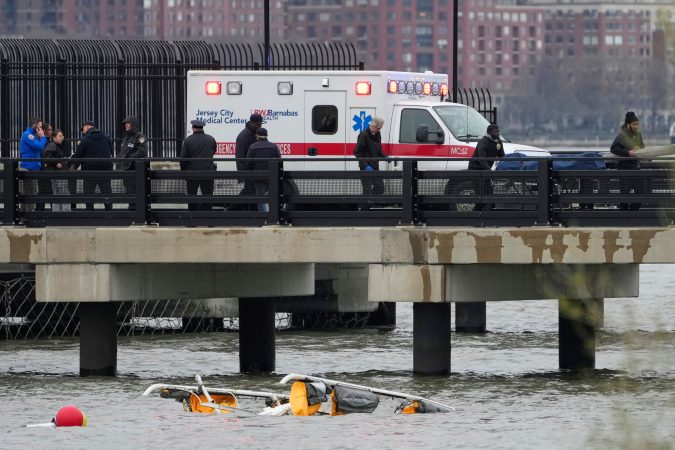
    The remains of several geese were found on a New York City sightseeing helicopter that crashed into the Hudson River last year and killed 6 people, investigators said Thursday, strong suggestions that multiple bird strikes contributed to the tragedy.

    Reports from the National Transportation Safety Board were not final and do not identify a definitive cause of the crash. But they describe evidence that supports bird strikes before the helicopter plummeted into the river on April 10, 2025.

    The Federal Aviation Administration has said that helicopters are especially vulnerable to bird strikes because they fly at low altitudes. Strikes can be devastating.

    “It seems pretty clear to me that the breakup of that helicopter was precipitated by several bird strikes,” said aviation safety expert Jeff Guzzetti, a former federal crash investigator, who read the key findings. “Not just one but several — and birds of a different feather.”

    He noted damage to the aircraft’s horizontal stabilizer, a key part of the helicopter.

    “Without it, the helicopter could become very unstable and difficult to fly,” Guzzetti said.

    The victims of last year’s accident included a Siemens business executive from Spain, his family and the pilot, Seankese Johnson, 36, a U.S. Navy veteran who received his commercial license in 2023.

    Passengers Agustin Escobar, 49; his wife, Mercè Camprubí Montal, 39; and their three children, Victor, 4; Mercedes, 8; and Agustin, 10, all died.

    The crash renewed safety concerns about the popular sightseeing flights and prompted New Jersey’s governor to ask for additional restrictions on nonessential helicopter flights.

    Remains of several geese were found on the helicopter’s rotors and left horizontal stabilizer. One witness told the NTSB that just minutes before the crash a large flock of geese took flight in the area.

    “The geese were big and there were many of them. When the helicopter went bang, I immediately thought it was a bird strike,” the witness told NTSB investigators.

    The Smithsonian Institution’s Feather Identification Lab identified remains from different breeds of geese on the wreckage, including a female Canada goose, which can average nearly 8 pounds.

    Guzzetti said it’s reasonable to conclude “the pilot is not culpable here.”

    “Birds are everywhere, and pilots have limitations with their eyesight,” he said.

    The report, however, noted that a control panel switch to turn on pulsing lights to help deter birds was missing. The tour company’s former chief pilot said the light system was not mandatory during daylight rides, according to investigators.

    The NTSB has investigated 24 helicopter bird-strike crashes in the past 25 years, including three fatal ones. Helicopter pilots are encouraged to try to avoid areas where birds are known to be present and fly slower to minimize the potential damage from an impact.

    The “Miracle on the Hudson” highlighted the danger of bird strikes when a US Airways jet hit a flock of birds and lost power in both engines shortly after takeoff in 2009. Pilot Chesley “Sully” Sullenberger was hailed as a hero after he landed the powerless plane in the Hudson River and all 155 people on board were rescued.

    In last year’s crash, the helicopter took off from a downtown heliport that afternoon and flew north along the Manhattan skyline before heading south toward the Statue of Liberty. Less than 18 minutes into the flight, parts of the aircraft were seen tumbling into the water.

    Rescue boats circled the submerged aircraft within minutes of impact and recovered the bodies from the water. Later recovery crews hoisted the mangled Bell 206L-4 helicopter out of the river for investigators to examine.

    New York Helicopter Tours shut down after the crash, and the FAA issued an emergency order to ground all the company’s flights after learning it had fired its operations director minutes after he had agreed to suspend flights during the investigation.

    The FAA said at the time that it suspected the firing was retaliation for a safety decision.

  • U.S. expands attacks on Iran, which calls Strait of Hormuz a ‘red line’ as it retaliates

    U.S. expands attacks on Iran, which calls Strait of Hormuz a ‘red line’ as it retaliates

    DUBAI, United Arab Emirates — The United States intensified its strikes against Iran on Thursday, hitting targets farther north and firing into a ship the U.S. accused of trying to break its naval blockade on the Islamic Republic. Iran retaliated by launching missiles and drones at U.S. allies in the region, and warned its attacks may escalate.

    The interim ceasefire agreed to last month has collapsed, and the region has endured days of back-and-forth attacks by the U.S. and Iran as they battle for control of the Strait of Hormuz. Iranian officials say U.S. strikes have killed more than 35 people and wounded over 300 others.

    For the first time in this latest round of violence, strikes also reached into areas around Iran’s capital, Tehran, showing a widening set of targets for the Americans. The U.S. launched a second wave of strikes late Thursday, saying it was aiming to “further degrade” Iran’s military capabilities.

    When the U.S. and Israel launched the war on Iran on Feb. 28, Tehran effectively closed the strait to shipping traffic, a move that sent the price of oil soaring and gave Iran major leverage in negotiations.

    Col. Ebrahim Zolfaghari, a spokesperson for the Iranian military’s Khatam al-Anbiya Central Headquarters, threatened that Iran could launch widespread attacks on “all the infrastructure in the region” if the U.S. acts on President Donald Trump‘s repeated warnings that America could hit Iranian bridges and power plants.

    “Under no circumstances and in no way will we allow America, as a foreign and extraregional country, to interfere in the Strait of Hormuz,” he added. “This is Iran’s invincible red line.”

    Both the U.S. and Iran launch attacks as blockade is reimposed

    Iranian state media said the U.S. strikes Thursday hit around Tehran and Semnan province, home to Iran’s ballistic missile production and space program. State media also reported strikes around the provinces of Hamedan, Hormozgan, Khuzestan, Lorestan, Markazi, and Sistan and Baluchestan, as well as on Iran’s Qeshm island, near the Strait of Hormuz.

    Seven people were wounded in a U.S. strike that hit the Allah-Akbar Hill residential neighborhood in the port city of Bandar Abbas, according to Iranian state media. Two more people were wounded in a U.S. attack on the Bandar Abbas railway junction station, state media said.

    And just west of Bandar Abbas, witnesses reported that two bridges were struck in a U.S. attack, killing two people and wounding four others, state media said.

    An attack on Greater Tunb Island targeted Iranian defense and missile sites, U.S. Central Command said.

    Greater Tunb Island is one of three small rocky islands that sit at the confluence of the Persian Gulf and the strait. The islands — seized in 1971 by Iran from what would become the United Arab Emirates — help the Islamic Republic exert significant control over the strait.

    The U.S. military also said it disabled a Curacao-flagged oil tanker as it sailed toward Iran’s main oil export terminal, firing a missile after the ship “ignored multiple warnings.”

    Another American strike Wednesday targeted a barracks for Iran’s 388th Mechanized Infantry Brigade, which operates tanks and armored vehicles, in Sistan and Baluchestan province, Iranian state television reported. The report said seven were killed in the attack, including conscripts and career soldiers.

    Iran retaliated Thursday with missile and drone attacks on Bahrain, Jordan and Kuwait, authorities in those countries home to U.S. forces said. There was no immediate acknowledgment of damage or casualties from the attacks.

    Iraqi Prime Minister Ali al-Zaidi condemned an overnight drone attack in Iraq’s semiautonomous northern Kurdish region. The drone, which authorities said had been intercepted, came during his trip to the U.S. in which he said Iraq would work to disarm non-state armed groups, including those backed by Iran.

    A drone separately targeted a tanker Thursday in the Persian Gulf off the coast of Basra in southern Iraq, the state-run INA news agency reported. No casualties were reported.

    Trump says a peace deal is still possible

    The latest round of fighting is focused on the Strait of Hormuz, as Iran attacks ships using a U.S.-controlled route through the vital waterway.

    Week-to-week cargo shipments through the strait dropped by almost a quarter at the beginning of the month, according to Maritime data firm Lloyd’s List Intelligence. And that was before the recent surge in tit-for-tat attacks.

    Given the risks, some oil shippers are transiting the strait with their location devices turned off, but many are just staying put, Lloyd’s said Thursday. A growing amount of the region’s energy is being shipped through pipelines, but not nearly enough to offset the decline in shipping through the strait.

    The U.S. has threatened to reopen the strait by force, but experts say that would require a much bigger armada if not tens of thousands of ground troops.

    The price for Brent crude oil, the international standard, traded above $85 a barrel on Thursday, more than 15% higher than the price before the war, but still well below the nearly $120 reached at the height of the conflict.

    Rising prices pose a particular challenge to Trump and his Republican Party, which hopes to retain control of Congress in elections in November.

    The U.S. reimposed a naval blockade on Iranian ports Wednesday.

    “They don’t like what we’re doing, and they do want to settle. We’ll find out whether or not we settle with them, or we just finish it off,” Trump said Wednesday at the U.S. Army War College in Carlisle, Pa.

    Pakistan’s Foreign Ministry on Thursday said efforts were still underway to bring the U.S. and Tehran to the negotiating table but acknowledged that was becoming increasingly difficult.

    Trump said on social media that Tehran made a goodwill gesture by releasing an American citizen wrongly detained in Iran since 2024. He did not release further details. Human rights lawyer Jared Genser released a statement identifying the detainee as his client Dena Karari, a U.S.-Iranian citizen who runs a nonprofit and was charged with espionage.

    Iran did not immediately acknowledge the release, and her case was not publicly known, as sometimes happens with detentions in the Islamic Republic.

  • Trump’s teleprompter operator on unpaid leave for alleged prediction market bets on Trump speeches

    Trump’s teleprompter operator on unpaid leave for alleged prediction market bets on Trump speeches

    ATLANTA — President Donald Trump’s teleprompter operator is on unpaid leave after reports that he used his inside knowledge to make bets about the president’s speeches on the online prediction market Kalshi, the White House said Thursday.

    The firm’s enforcement chief said Kalshi contacted federal regulators about bets allegedly made about what the president would say in public addresses.

    White House press secretary Karoline Leavitt said the president is aware of the situation, which she described as “unfortunate” and “a disgrace.”

    “The White House has extremely strict ethical guidelines with respect to issues like this,” Leavitt told reporters, saying the aide is on unpaid leave.

    ABC News reported Thursday that Gabriel Perez, who has been operating Trump’s teleprompter since 2016, used his inside knowledge to win more than $100,000 betting on what the president would say in big speeches, including the State of the Union address earlier this year.

    Robert Denault, Kalshi’s lawyer and head of enforcement, said on X that the “Kalshi surveillance team promptly flagged, investigated and referred these trades” to the U.S. Commodity Futures Trading Commission that has regulatory authority over such matters.

    His statement did not name Perez.

    “We have been assisting regulators on this matter and provided all evidence that we collected, as we do with any referral,” Denault added.

    ABC based its report on multiple sources who have knowledge of the matter but spoke on condition of anonymity to discuss the details.

    The ABC report described suspicious activity on Kalshi’s “Mentions” market, in which users can place bets on what phrases and specific words might be used in public speeches. Kalshi recently began requiring users to disclose their place of employment, and the platform’s policy prohibits betting based on information that users gain because of their job.

    Attention on members of the administration profiting from the presidency has reached all the way to Trump himself.

    On Thursday, his media company announced it would charge for special high-speed access to Truth Social posts, including possibly his own affecting national security and financial markets.

    In his most recent financial disclosures, Trump reported making $1.2 billion from his crypto businesses in 2025, raking in profits while his investors suffered losses in marketplaces that Trump has sought to shield from tighter federal regulation.

    Trump got more than $500 million from his World Liberty Financial business selling new crypto products, including “governance tokens,” according to the required annual disclosure report with the Office of Government Ethics. It also showed another crypto business, CIC Digital LLC, took in more than $600 million from sales of souvenir-type “meme” coins stamped with his face. Both the tokens and the coins have plunged in value since the sales.

    The president has also profited from merchandising deals and high-dollar political and official events at his properties, significantly increasing his net worth since returning to power.

    Trump’s aides have stood by his personal and family business practices.

    “The president is abiding by all conflict-of-interest laws that are applicable to the president,” Leavitt said earlier this year. It’s “absurd for anyone to insinuate that this president is profiting off of the presidency.”

  • Blanche to meet with Epstein accusers after demand from Republican senator crucial to confirmation

    Blanche to meet with Epstein accusers after demand from Republican senator crucial to confirmation

    WASHINGTON — Acting Attorney General Todd Blanche was expected to meet Thursday with accusers of Jeffrey Epstein after a key Republican senator said it was necessary to earn his support for Blanche’s nomination to lead the Justice Department.

    Sen. Thom Tillis had indicated during Blanche’s confirmation hearing on Wednesday that he was leaning toward backing Blanche, who has been leading the department in an acting capacity since April. But after an Epstein accuser testified a day later, Tillis said he expects a meeting to occur before he’s “willing to vote out of this committee.”

    Shortly after Tillis’ remarks, Blanche — who had been meeting with senators on Capitol Hill — told reporters he had tried to meet the Epstein accusers in a Senate office building but “it didn’t work out” and they were working to coordinate schedules. The Justice Department said later that the meeting was rescheduled for Thursday afternoon, adding: “He looks forward to their discussion.”

    “The Department of Justice will always meet with victims or their representatives, and if those victims or their representatives have evidence that anybody committed a crime — whether it has to do with Jeffrey Epstein or anybody else — we will of course move forward and investigate and prosecute,” Blanche told reporters.

    Epstein’s case and the Justice Department’s handling of millions of files related to his sex trafficking investigation have been a persistent political headache for the Trump administration.

    After missteps by then-Attorney General Pam Bondi that enraged Trump’s base, Blanche as deputy attorney general oversaw a massive review and release of millions of files related to the investigation into the disgraced financier with connections to wealthy and powerful people.

    Without Tillis’ support, Blanche’s nomination won’t make it through the Senate Judiciary Committee, which questioned Blanche for hours on Wednesday about the Epstein files as well as the creation of a fund to compensate Trump’s allies, a tax immunity deal for the president and a slew of other issues.

    Another Republican on the committee who says he has not made up his mind whether to support Blanche — Sen. John Cornyn — conveyed concerns that the Trump administration has yet to commit in writing that the fund is dead and could therefore conceivably be resurrected.

    One Epstein accuser, Dani Bensky, told lawmakers earlier Thursday that women harmed by Epstein repeatedly asked to meet with Blanche “through multiple channels and he never responded.”

    “We deserve to be heard directly, not dismissed and ignored,” Bensky said.

    Blanche has pushed back on suggestions that the Justice Department has been dismissive of the late financier’s accusers, saying Wednesday that officials have spoken with more than 30 representatives of the women over the course of its sweeping review of the files.

    Blanche has also defended the department’s staggered release of the Epstein files, a process beset by problems, including redaction errors that left exposed nude photos showing the faces of potential victims.

    Blanche said during his confirmation hearing on Wednesday that he takes responsibility for mistakes that were made, but noted that department lawyers were given a “herculean task” to quickly review millions of files for release. Blanche said department lawyers took pains to protect the women involved, and quickly fixed any errors that were found.

    “I am sorry that in about 1% of the documents mistakes were made,” Blanche said Wednesday. “But what I will say on top of that is we put tons of resources to rectifying those mistakes immediately, including pulling down documents within minutes of being informed that there were mistakes.”

    The political firestorm over the Epstein files dogged the Trump administration for much of last year, with lawmakers eventually passing a measure that compelled the release of a massive trove of documents in the government’s possession related to its investigation.

    The Justice Department began releasing the documents in late December, which included photos, call logs, grand jury testimony, and interview transcripts. The release did little to tamp down skepticism from conspiracy theorists and online sleuths, who have long pushed allegations of a government cover-up, without evidence.

  • Trump administration revives rule that could deny green cards to immigrants who use public benefits

    Trump administration revives rule that could deny green cards to immigrants who use public benefits

    MIAMI — The Trump administration is reviving a rule that could deny green cards to immigrants who use public benefits that could include food stamps, Medicaid, and housing vouchers.

    The policy, known as “public charge,” appeared on Thursday in the Federal Register. It will be formally published on July 20 and take effect Sept. 18. Under the policy, applicants for green cards have to show they wouldn’t be burdens to the country or “public charges.”

    The policy was first implemented in February 2020 as one of President Donald Trump’s moves to limit legal immigration during his first administration, but it was reversed after Democratic President Joe Biden came to power.

    Its return comes when the Republican administration is implementing a hard-line policy to curb both illegal and legal immigration, and when the cost of healthcare and food is rising.

    The federal government “is reaffirming the requirement of self-reliance, protecting public resources and ending policies that encouraged dependency on the backs of hard-working American taxpayers,” U.S. Citizenship and Immigration Services said in a post published on its X account.

    “Under President Trump, USCIS is restoring the basic principle that immigrants must be able to support themselves,” the post said.

    While the administration’s crackdown on immigration has an increased focus on deportations and immigration enforcement in cities across the country and at borders and entry points, it has also taken actions that target legal immigrants and mixed-status families, in which the parents are foreign nationals with U.S.-born children.

    The rule expands disqualification options

    Federal law already requires those seeking permanent residency or legal status to demonstrate that they will not become a public charge. The Trump administration’s rule, however, broadens the grounds for disqualification.

    The new rule does not describe or specify by name the benefits and programs that could be considered a public charge. Instead, it says that officers who would implement the policy will make “individualized, fact-specific public charge inadmissible determinations, based on a totality of the alien’s circumstances.”

    It says that, “using good judgment and discretion, officers will more accurately assess an alien’s likelihood at any time of becoming a public charge.”

    The Trump administration first promoted the rule in 2018 as a way to ensure that only those who were self-sufficient came to the U.S. Immigrant rights advocates criticized it, saying it amounted to a “wealth test.” Public health experts said it would lead to worse health outcomes.

    Manatt Health, a group that provides advice to state and federal governments, estimated the policy would have deterred as many as 26 million people from seeking healthcare, food, housing, or other aid through programs for which they qualified under federal law. About half were U.S. citizens, mostly children or adults living in a mixed-status family, according to the group.

    Experts also noted that most people who receive benefits from the government are already legal residents.

    A 2020 study from the Migration Policy Institute said that while the “chilling effects” may be vast, the number of immigrants who could be deemed ineligible for legal permanent residence based on use of one of the public benefits under the rule was small.

    The institute estimated that no more than 167,000 people — less than 1% of the 22.1 million noncitizens residing in the United States at that time — could be determined ineligible for a green card based on their current use of a listed benefit.

    There were 22.8 million noncitizens living in the U.S. in 2023, according to the Census Bureau.

    Critics say the rule creates fear in the community

    Nongovernmental organizations said the policy generated confusion and fear and caused many immigrants and their U.S.-born relatives to decide not to apply for benefits and services to which they were entitled.

    Immigrant advocates condemned the government’s decision to revive the “public charge” rule and expressed concern.

    “This regulation is a direct assault on immigrant families, and a threat to our country’s health and economic security,” said Adriana Cadena, executive director at the Protecting Immigrant Families Coalition. “The Trump administration is basing immigration decisions on bias and politics, regardless of the resulting harm.”

    Sarah Krieger, senior policy counsel at the National Immigration Law Center, said the rule would make immigrants afraid to go to the doctor, buy food at the grocery store and file taxes.

    “With this new rule, they are sowing fear and chaos to ultimately reshape America into a country where only the few who are white and ultra-wealthy are welcome,” Krieger said. “The rule is not just deeply harmful, it also violates the law.”

  • Need for speed? Driving above the speed limit costs you — and doesn’t actually save much time

    Need for speed? Driving above the speed limit costs you — and doesn’t actually save much time

    Speeding in your car to work, to pick up your children from school, or go from one errand to the next not only wastes money in gas and sends harmful emissions into the air, it barely saves you time, new research says.

    It is something to think about as gas prices stay elevated throughout the summer months and add pain to day-to-day driving and seasonal road tripping.

    Instead, abiding by posted speed limits can save U.S. drivers millions of dollars at the gas pump and eliminate millions of gallons of fuel each day, according to a study published Thursday in the Nature journal Communications Sustainability. That is fuel that, when burned, emits planet-warming gases into the atmosphere. To top it all off, changing driving habits wouldn’t even add a full minute to a driver’s commute.

    University of Minnesota researchers analyzed 120 million vehicle trips across the United States from four Wednesdays in 2021 using driving data on national road networks, speed limits and U.S. Geological Survey elevation data. The analysis included roads with speed limits of 45 mph and higher.

    More than 43% of the studied trips included at least one instance of speeding, and drivers spent nearly 12% of their driving time going faster than the speed limit.

    They found that if drivers of light-duty, conventional internal combustion engine vehicles actually drove at posted speed limits, it could save an average of $22 million, based on fuel costs at the time, 6.7 million gallons of fuel, and 57,000 metric tons of carbon dioxide every day. The researchers said that is comparable to taking about 5.5 million passenger vehicles off the road.

    And while drivers say that speeding saves them precious time, researchers found that is not really the case. With an average daily driving distance of 28.6 miles, driving at or below the posted limit corresponds only to about 54 seconds longer per day.

    “If your goal is to shave one minute off your time, then you’ve got to drive fast. If your objective is to get to your destination safely and to save fuel, then you might drive slower than the speed limit,” said William Northrop, mechanical engineering professor at the University of Minnesota and study co-author.

    The research considered battery-electric vehicle efficiency only in California given the level of EV adoption in the U.S. at that time. Based on the California modeling, “We find that driving slower is beneficial for EVs as well,” he said.

    Interestingly, the study found differences among states. Nevada saw elevated speeding prevalence as well as high speed excess. There was high speeding prevalence in Florida, Georgia, and North Carolina, though those states did not necessarily exhibit high speed excess. Montana, Wyoming, Idaho, and South Dakota showed both low speeding prevalence and speed excess.

    The cost of faster driving today

    Driving faster increases a vehicle’s energy use and the emissions from its engine, as well as reduces efficiency. Vehicle engines have become increasingly more efficient over the past several decades even as vehicles have gotten bigger and more powerful. But speed limits have also climbed since the Emergency Highway Energy Conservation Act was implemented, which mandated 55 mph national speed limits amid the 1970s energy crisis.

    Accounting for the average cost of gas today and more vehicle miles traveled, that increases to roughly $26 million and 7.2 million gallons of fuel that Americans collectively could save each day this year just by not putting the pedal to the metal.

    One limitation of the research is that slower driving could impact traffic patterns, which could play a role in efficiency.

    However, it is especially timely as U.S. drivers remain price-sensitive to volatile gas prices as the war in Iran has sent the cost for a gallon of fuel above $4 this year. Experts have said there are a number of ways to improve one’s gas mileage, including something as simple as slowing down. Less fuel needing to be purchased because of better efficiency could influence oil market demand, which in turn could impact pricing.

    Rob Middleton, associate research scientist of mechanical engineering at the University of Michigan who was not involved in the research, said the study was well-done. But he also noted that the fuel saved from driving more slowly still only represents a fraction of daily gasoline consumption in the U.S., which is about 375 million gallons daily.

    “It’s a big number, but it’s a small fraction,” Middleton said. “This is a ‘freebie’ in that it doesn’t really cost anyone anything to do.”

    “The market penetration of selling EVs is still small, so we still need fuel, we still need ICE [internal combustion engine] vehicles, we’re still going to have them for a very long time,” he added. “Things that we can do to either make the new ones better or to improve our fuel supply, we need to do.”

  • Ukrainians protest Zelensky’s ouster of his popular defense minister

    Ukrainians protest Zelensky’s ouster of his popular defense minister

    KYIV, Ukraine — President Volodymyr Zelensky shook up his wartime government, drawing thousands into the streets Thursday across Ukraine to protest the ouster of his youthful defense minister — seen as an innovator of the country’s successful drone technology but who clashed with the traditional military establishment.

    The personnel overhaul, which included replacing his prime minister, could become a test of Zelensky’s political authority as Ukraine’s fight against Russia’s full-scale invasion approaches 4½ years. Zelensky has remained in office under martial law because wartime elections are prohibited but has periodically reshuffled his government.

    The moves threw Ukraine’s military leadership into an unwelcome crisis at a time when its actions against Russia are starting to bear fruit and as Moscow has unleashed unrelenting aerial attacks. Two people were killed and five others were wounded, including a child, when Russian missiles hit the capital of Kyiv overnight, Ukraine’s Emergency Service said.

    In making the changes, Zelensky cited friction between outgoing Defense Minister Mykhailo Fedorov and Gen. Oleksandr Syrskyi, the commander of Ukraine’s armed forces.

    “I’m just showing that if the sides can’t resolve an issue, I will have to resolve it,” Zelensky said at a news conference.

    The outgoing defense chief was seen as a modernizer

    Fedorov, 35, is considered to be a vigorous modernizer whose technological expertise is credited in part with significantly improving Ukraine’s military performance in recent months against Russia’s bigger army. He is leaving the government after only six months in the post.

    Fedorov appeared at a news conference in a dark T-shirt and jeans, and accused Syrskyi of blocking reforms needed because “the war has changed completely” due to new technology like drones.

    During his time in office, he secured restrictions on Russian forces’ access to the Starlink satellite communications system, allowing Ukraine to better leverage its midrange strike capabilities giving Kyiv significant battlefield advantages.

    Fedorov said he was willing to work with Syrskyi, “but we encountered a situation in which all the initiatives we proposed began to be blocked.”

    “Under this arrangement [with Syrskyi as commander], I personally do not know how the war can be won,” he said.

    On social media, Fedorov highlighted what he called his major achievements: redirecting funds earmarked for salaries into midrange strike capabilities, fiber-optic drones, reconnaissance systems and other technologies. He pointed to expanded drone procurement, Patriot missile defense contracts, successful ballistic missile tests and sweeping changes to military procurement.

    But he acknowledged he was unable to complete the Defense Ministry’s organizational transformation “according to NATO standards and common sense,” and move all procurement to competitive tenders, and build a culture of accountability.

    Syrskyi didn’t appear in public but in a Facebook post thanked Fedorov and said he hoped he would continue to serve Ukraine. “I wish him to continue to remain in the Ukrainian team,” Syrskyi said without elaborating.

    Zelensky said he had asked Maj. Gen. Yevhen Khmara to perform the defense minister’s duties in the meantime, according to a post on the Telegram messaging app. Since January, Khmara has been acting head of the state’s security service, known as the SBU. He had previously led the SBU’s elite Alpha special forces unit.

    Zelensky described a difficult relationship between the Defense Ministry and the military at multiple levels, not simply a matter of personalities, and he said both sides share responsibility for the consequences.

    “Together we win, and together we’re responsible for the things that cause confusion and public reaction,” he said, standing beside British Prime Minister Keir Starmer, who was making his final foreign visit before leaving office next week.

    Mostly young protesters support Fedorov

    Syrskyi, 60, initially organized the defense of Kyiv in February 2022, and seven months later masterminded a successful counteroffensive in the Kharkiv region. Born in 1965, he attended the Moscow Higher Military Command School before serving in the Soviet Artillery Corps before the USSR’s collapse in 1991.

    The Ukrainian military has rallied under Fedorov, slowing Moscow’s front-line advance to a virtual standstill and striking refineries and other energy sites inside Russian territory, causing widespread fuel shortages, Western officials and analysts say. Zelensky’s decision to fire him despite that record has dismayed many people.

    Before becoming defense minister in January, Fedorov headed Ukraine’s digital transformation policies. He won popularity by spearheading the rapid development and deployment of drone technology and introducing several successful e-government platforms.

    As minister, he moved to combat corruption, an issue that carries particular weight with Ukrainians who have repeatedly protested graft. Fighting corruption meant working against the interests of groups that had long profited from programs within the ministry, he said in interviews. He also sought to overhaul weapons procurement to make it more transparent.

    He had promised sweeping military reforms, saying it had faced about 200,000 desertions and draft-dodging by some 2 million people.

    The mostly young protesters who took to the streets of Kyiv and other cities to support Fedorov made crude remarks about the current military commander, chanting, “Syrskyi, go away!” and “A European army for a European country!”

    Kyiv resident Bohdan Huryak said he was “deeply outraged” by Fedorov’s exit.

    “I’m not deeply invested in the internal political debates, but this is a person who shows results on the battlefield, we see results, we feel the fighting spirit and confidence in victory rising,” Huryak told the Associated Press. “And then, six months later, he is removed from office? Come on.”

    Russian military correspondents and pro-Kremlin bloggers relished the controversy. Pro-Kremlin political analyst Sergei Markov described Fedorov’s comments as a “rebellion” against Zelensky.

    The deputy commander of Ukraine’s air force, Col. Pavlo Yelizarov, quit over Fedorov’s dismissal, saying on social media it will weaken Ukraine’s air defenses and lead to more deaths from Russian attacks.

    “I believe that the dismissal of Mykhailo Fedorov is a great evil for the country’s defense capability,” he wrote in his resignation letter on Facebook.

    State energy company chief is new prime minister

    Parliament overwhelmingly approved Serhii Koretskyi, the head of state energy company Naftogaz, as the country’s new prime minister.

    In nominating Koretskyi, Zelensky cited his record in the energy sector and argued he was best prepared to guide Ukraine through another winter, when Russian attacks on the power grid intensify.

    Unlike other senior government officials, the 48-year-old engineer did not rise through political parties, parliament or the civil service. He spent more than two decades managing fuel and food businesses before being picked to run some of Ukraine’s most troubled state-owned energy companies and gained a reputation as an effective crisis manager who could make them profitable.

    Zelensky has faced protests before over his decisions. Large demonstrations broke out in July 2025 when he fast-tracked a law that would have curbed the independence of the country’s anti-corruption watchdogs.

    The outcry threatened his leadership for the first time since Russia’s invasion, and he swiftly reversed course and submitted legislation to restore the agencies’ independence.