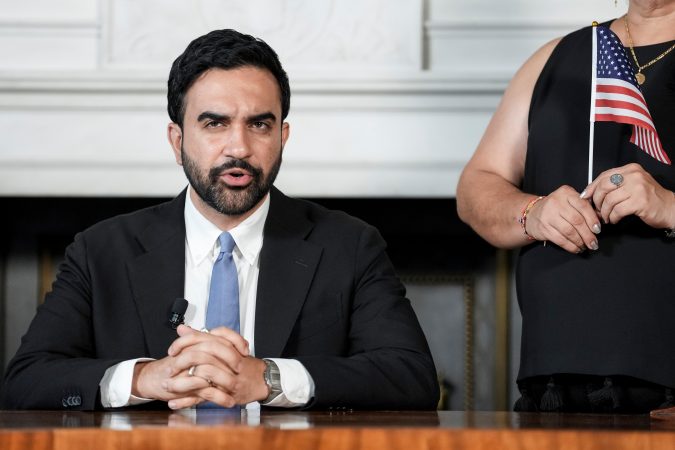
New York Mayor Zohran Mamdani, who pledged repeatedly during his mayoral campaign to arrest Israeli Prime Minister Benjamin Netanyahu, said Tuesday that he does not have the power to do so.
In a video posted on X, Mamdani said his administration had reviewed “every avenue available” under the law to determine whether New York authorities have the power to execute an arrest warrant if Netanyahu travels there. But, they concluded, “it is clear that we do not have the independent legal authority to enforce this.”
He described Netanyahu as the “architect of a horrific genocide against the Palestinian people” for his role in the war in the Gaza Strip and has said he should be tried for war crimes under a 2024 warrant by the International Criminal Court.
Mamdani called on the federal government — which does have the legal authority to enforce the ICC’s warrant — to arrest Netanyahu, who is expected to travel to New York in September for the United Nations General Assembly.
President Donald Trump shut down the idea of Netanyahu’s arrest in a Monday post on Truth Social, saying the Israeli prime minister “will not be arrested, in any way, shape, or form, while in the United States of America.”
The ICC issued an arrest warrant for Netanyahu in 2024, accusing him and his former defense minister Yoav Gallant of war crimes and crimes against humanity stemming from Israel’s military operations in Gaza. The court’s decision obliges 124 countries to arrest the Netanyahu if he enters their territory, but neither Israel nor the United States is a signatory to the court’s key statute that requires this.
Netanyahu has rejected the allegations, calling them absurd, and accused the court of being a biased and discriminatory political body. On Tuesday his office described the ICC as a “kangaroo court that has no jurisdiction over Americans or Israelis” and the arrest warrant as “bogus.”
“Under Prime Minister Netanyahu’s leadership, Israel has taken unprecedented wartime measures to minimize harm to civilians while confronting Hamas,” it said.
Israel’s ambassador to the United Nations, Danny Danon, also hit back at Mamdani’s comments. “Zohran Mamdani, ENOUGH,” he wrote on X. “Enough with the attacks on Jewish organizations. Enough with the outreach to the Iranian regime. You were elected to serve New Yorkers, not Hamas’ propaganda. Do your job!” he wrote.
Trump and his predecessor Joe Biden have criticized the ICC for the warrant. Both administrations have supported Netanyahu during the war in Gaza, which Israel launched after the Oct. 7, 2023, attacks on Israel by Hamas militants, who killed some 1,200 people and took 251 hostage.
Israel’s retaliatory strikes have killed more than 73,000 Palestinians, according to Gaza’s Health Ministry, which does not differentiate between civilians and combatants but says the majority of casualties are women and children.
Mamdani’s continued opposition to Netanyahu comes despite criticism from some Democrats after he said last week that he was in “active conversation” with his legal department to determine whether the Israeli leader could be arrested.
The mayor’s stance also underscores a shift in the Democratic Party that has seen some members show a greater willingness to criticize Israel or turn U.S. support into a campaign issue. A Washington Post-Ipsos poll conducted earlier this month found while most Americans say the U.S. should reduce or end military support for Israel, the figure rises to 74% among Democrats.
R. James Woolsey Jr., a Rhodes scholar and lawyer who led the CIA and the rest of America’s intelligence community for two troubled years during the Clinton administration, as the nation’s spy services struggled to adapt to the post-Cold War era, died Tuesday at his home in Washington. He was 84.
The cause was a stroke, said his wife, Conchita Sarnoff Woolsey. She added that Mr. Woolsey had been in declining health in recent years as a result of “Havana syndrome,” the mysterious ailment that hundreds of American spies and diplomats have reported experiencing around the world.
The malady’s symptoms, which the government refers to as anomalous health incidents, include dizziness, memory problems, and other neurological impairments. Mr. Woolsey began experiencing the condition following an incident in Washington in 2017 and in Istanbul the following year, according to his wife.
“We have traveled the world trying to find a cure and a treatment,” she said, “which sadly we never found.”
As the director of Central Intelligence in 1993 and 1994, Mr. Woolsey spent much of his time fighting to shore up morale and protect the nation’s intelligence agencies from sharp budget and staffing cutbacks, as Congress sought a so-called “peace dividend” following the collapse of the Soviet Union.
His tenure was upended by the FBI’s arrest in 1994 of Aldrich H. Ames, a senior CIA counterintelligence official who had spied for nine years for Moscow in what was then the worst known security breach in agency history.
CIA traitor Aldrich H. Ames in 1994. He was convicted of selling secrets to the Soviets. Michael S. Williamson
Members of the House and Senate intelligence committees were openly critical when Mr. Woolsey declined to dismiss or demote anyone at the CIA, and instead reprimanded 11 current and former agency officials. Rather than focusing on individuals at fault, he highlighted a pattern of widespread inattention, citing a “systemic failure” in the agency’s inability to catch Ames, who was blamed for the deaths of at least 10 intelligence agents.
Mr. Woolsey sought to transform the agency’s culture. He was known among some staff as “the vacuum cleaner,” the Washington Post reported at the time, and told senior aides he always wanted to know more than anyone else in the room. He typically began his day reading classified cables at home at 4:30 a.m., and then arrived at CIA headquarters by 7:30 for meetings and briefings.
But he could be argumentative, even abrasive, and his relations with the White House became so strained that by the time he resigned after 23 months on the job, he complained that he could not get an appointment with the president.
White House aides said that Clinton had lost faith in his ability to overhaul CIA operations and reshape its priorities.
Still, the president praised Mr. Woolsey in a statement at the time, calling him “a staunch advocate of maintaining an intelligence capability that is second to none.”
Robert James Woolsey Jr., an only child, was born in Tulsa on Sept. 21, 1941. His father, a lawyer, was drafted into the Army and fought in the Battle of the Bulge during World War II. His mother was a homemaker.
Mr. Woolsey attended Stanford University, graduating with high honors and membership in Phi Beta Kappa in 1963. He was awarded a Rhodes scholarship to study at the University of Oxford in England, and then attended Yale Law School, where he was managing editor of the law review and was awarded his degree in 1968.
Mr. Woolsey served in the Army and came to Washington in the early 1970s, as a military aide to arms control negotiator Paul Nitze. He later served as general counsel to the Senate Armed Services Committee under Sen. John C. Stennis (D., Miss.).
A so-called “defense Democrat,” Mr. Woolsey was undersecretary of the Navy from 1977 to 1979, during the Carter administration. He later found positions under two Republican presidents, Ronald Reagan and George H.W. Bush, as a part-time, delegate-at-large to strategic arms talks and as chief negotiator of a European arms treaty.
When not in government, he worked for the Washington law firm Shea & Gardner, where he sometimes represented defense contractors and companies whose interests required that he register with the Justice Department as a foreign lobbyist.
A trim man with a bald head and thin glasses, Mr. Woolsey was little known to the public when Clinton, soon after taking office in January 1993, named him to lead an intelligence community still trying to find its footing more than a year after the Cold War had ended.
From the start, he was put on the defensive, forced to justify the need for a strong CIA in a post-Soviet world.
“Yes, we have slain a large dragon,” he said at his Senate confirmation hearings. “But we live now in a jungle filled with a bewildering variety of poisonous snakes.” He said the CIA should focus on terrorist groups and arms proliferation, as well as adversaries such as Iran and North Korea.
Mr. Woolsey was initially seen as a politically savvy expert on national affairs. In his first year, he held more than 150 meetings with members of Congress, mostly to discuss his shrinking budget.
He told the Los Angeles Times in 1994 that despite his efforts, the number of spy satellites had been “substantially reduced,” the civilian staff had been cut by one-fourth, and the military workforce had been cut by one-third.
“There’s a lot of slimming down that’s taking place,” he said.
Mr. Woolsey angered one group of senators when he sternly lectured them, pointer in hand, and demanded they not only reverse the cuts but add to his budget. He clashed repeatedly with Sen. Dennis DeConcini (D., Ariz.), who chaired the Intelligence Committee and, after Ames was arrested, charged that Mr. Woolsey acted more like a civil liberties lawyer than the head of a covert agency that had failed to keep its secrets.
Congress also was unhappy with Mr. Woolsey’s opposition to the creation of a congressionally mandated presidential commission to look at the CIA’s future role, and to Congress’s efforts to resolve a CIA and FBI turf battle over responsibilities for counterintelligence.
After leaving the CIA, Mr. Woolsey served on corporate boards and foundations and remained active in national security circles, including as a partner at Booz Allen Hamilton. He served as a senior adviser on Donald Trump’s transition team before resigning in January 2017, reportedly amid frustrations over the incoming president’s views on national security.
To the surprise of some of his former colleagues, he also published a 2021 book, Operation Dragon: Inside the Kremlin’s Secret War on America, in which he and coauthor Ion Mihai Pacepa, a top Cold War defector from Romania, claimed that the assassination of President John F. Kennedy was rooted in a KGB plot sponsored by no less than Nikita Khrushchev, the Soviet leader.
Mr. Woolsey’s marriage to Suzanne Haley, a former official of the National Academy of Sciences, ended in divorce. Mr. Woolsey was later married to Nancye Miller, a lobbyist, until her death in 2019. The following year, he married Conchita Sarnoff, an advocate for victims of trafficking, who had written a book about Jeffrey Epstein after covering his crimes in a series of articles for the Daily Beast.
In addition to his wife, survivors include three sons from his first marriage, Robert, Daniel and Benjamin Woolsey; two stepchildren, Cristina and Nicholas Sarnoff; and 10 grandchildren.
Mr. Woolsey had a wry sense of humor. Long after he left the CIA, he happily reminded interviewers about the pilot who stole a small airplane and crash landed on the South Lawn of the White House. The pilot was killed, but Mr. Woolsey found a punch line.
“Remember the guy who in 1994 crashed his plane onto the White House lawn?” he told an interviewer in 2002. “That was me trying to get an appointment to see President Clinton.”
Tropical Storm Bertha, the second storm of the season in the Atlantic Ocean, was slowly approaching Louisiana early Wednesday.
As of 5 a.m. Wednesday morning, the storm was about 110 miles southeast of New Orleans, had winds of 50 mph and was moving westward at around 5 mph.
Bertha is forecast to make landfall in southeastern Louisiana on Wednesday, where 1 to 3 or 2 to 4 feet storm surge, dangerous rip currents, tropical-storm-force winds and slow-moving downpours are all possible.
Tropical storm warnings spanned the coastline from the western Florida Panhandle to eastern Louisiana, while tropical storm watches covered portions of far southern Mississippi as well as some of Louisiana.
Winds gusted up to 60 mph in the Florida Panhandle on Tuesday, as beaches were closed along the Gulf Coast and sandbags were distributed in some communities.
Early Wednesday, a disorganized Bertha continued to battle harsh winds that were displacing most of its thunderstorm activity well offshore. However, conditions are expected to worsen — especially near the immediate coastline in Louisiana.
“Bertha is expected to produce total rainfall amounts of 1 to 4 inches with isolated higher totals to 6 inches through Thursday along the central to the western Gulf Coast from western Florida to southern Texas. This rainfall may produce isolated flash flooding, especially in urban areas,” wrote the National Hurricane Center.
By Thursday morning, Bertha will probably still be inching along the Louisiana coastline and moving toward Texas, where scattered downpours are expected into Thursday night — potentially including places such as Houston and Galveston.
Bertha may ingest wildfire smoke
In an unusual twist, wildfire smoke that’s drifting across the country, mostly from numerous fires in the Northwest, may contribute to Bertha’s weakening from Wednesday into Thursday.
This cooler, drier air could also help minimize impacts from Bertha on Thursday across Texas, where deadly floods occurred last week.
Well, that didn’t take long. Days after the World Cup wrapped up, fans are reselling their once highly coveted swag.
The FIFA World Cup resale market is on fire, and that includes Fan Fest attendees profiting off their freebies, including the viral Bank of America charm bracelets.
For those uninitiated: Throughout the duration of the World Cup, fans at U.S. host cities lined up in droves to get their hands on free swag, especially these darned bracelets.
Mimicking a Pandora bracelet, the “Fan Bands” are composed of a red, blue, or black woven band and an assortment of metal charms laced through. Available charms included numbers, flags, a World Cup trophy, and designs that pair with World Cup host cities. Philly, for instance, had boxing gloves, a cheesesteak, and the LOVE statue.
It was the World Cup’s hottest free accessory, but it cost interested parties hours of their time. At one point, wait times in Philadelphia were reported to be four to eight hours. Weeks later, Philly’s Fan Fest refashioned the waiting process, citing high demand. Instead of a free-for-all giant line, organizers nationwide pivoted to a ticketed system with set time windows to receive bracelets.
Bank of America called the demand for the bracelets “unprecedented.”
Now, they’re a relic of a time that has come and gone — and are selling for anywhere from $10 to $150, no line required.
Fashion expert and pro-thrifter Virginia Chamlee says this isn’t surprising.
“The secondary market for the FIFA Fan Fest bracelets is all about scarcity and exclusivity — the second something is ‘free but limited,’ or ‘difficult to obtain,’ it stops being a souvenir, and it becomes a status symbol,” she said. “So people aren’t really buying free beads; they’re buying the two-hour line they didn’t actually wait in.”
On Facebook Marketplace, dozens of bracelets are listed across Philadelphia. Some sellers said they waited about an hour; one said they volunteered at Fan Fest, which gave them easy access to swag; another said they were selling after snagging the bracelets for their kids, who evidently didn’t like their charm selection.
In a few listings, bracelet-holders are hoping to trade with others for different charms.
On eBay, things get more intense. A recent scan, filtering for sold listings, shows bracelets have allegedly sold for as much as $500 in some cases. There was also a listing that sold for $1,000 that included bracelets from nearly every host city. By the knockout rounds of the World Cup, Bank of America unveiled a handful of additional commemorative charms. Bracelets with those charms are in especially high demand.
As of Tuesday, eBay showed over 1,600 active listings for the Fan Bands. Chamlee says it all boils down to desire, and maybe a little bit of FOMO.
“To me, this is no different from paying for a resold Taylor Swift Eras tour tee when you didn’t actually go to the concert, or a Trader Joe’s tote that’s been considerably marked up,” Chamlee said. “In these cases, the price isn’t really set by the object itself (i.e. how much it cost to produce) but by how badly someone wants to say they were there.”
Bank of America says the Fan Bands’ success has exceeded expectations. The company had more than 2 million bracelets and 10 million beads to distribute, it said in a statement at the beginning of the World Cup. Within the first two weeks of the tournament’s nearly six-week run, the company announced it had given away more than 700,000 bracelets across the 11 host cities.
“For Bank of America, this is a marketing win by almost any metric,” Chamlee said. “A giveaway meant to build brand goodwill has evolved into a resale market. That’s free earned media most brands would pay millions for.”
CHICAGO — An active-duty soldier who was hit by a stray bullet during a shooting outside the White House announced on Tuesday that he plans to sue the Secret Service over his life-threatening injuries.
Pfc. Benjamin Del Real Jr., 25, was visiting the capital on May 23 and hoping to snap pictures with his sister and father outside the White House when a gunman opened fire. Secret Service fired back, killing the man, and a bullet struck Del Real in the stomach, causing serious injuries that required emergency surgery. Part of his digestive system had to be removed.
Del Real filed notice of a personal injury claim on Tuesday, saying he plans to sue for $25 million under the Federal Tort Claims Act. He accused the Secret Service of botching its response to the shooting and failing to adequately protect him and other bystanders, he and his lawyer, Joseph Murphy, said Tuesday at a news conference.
“I, my father, and Benjamin all feared for our lives, and the moment that I saw Ben bleeding was undoubtedly the scariest moment of my life,” said his sister, Sara Del Real.
The Secret Service has not said whether its agents fired the bullet that struck Del Real. The Metropolitan Police Department said earlier this summer that the ballistics on that bullet had not yet been returned. Metropolitan Police Department spokesperson Lee Lepe said Tuesday the investigation is ongoing.
Federal law enforcement agencies are generally shielded from legal liability, but there are some exceptions, including some claims of employee negligence.
The Secret Service does not comment on pending litigation, according to Nate Herring, a spokesperson for the Service. He referred questions to the U.S. Attorney’s Office for the District of Columbia, which did not immediately return a message seeking comment.
Del Real, of Salina, Kansas, and his family had spent hours that day touring the National Archives, Arlington Cemetery, and other landmarks before passing by the White House at around 6 p.m. on their way to dinner. Just then, Del Real saw the shooter, about 20 yards closer to a Secret Service outpost, take out a gun and fire several rounds at their booth, prompting agents to return “a hail of gunfire,” Murphy said.
The shooter, 21-year-old Nasire Best, was killed.
Del Real pulled his father to the ground and dragged him behind a concrete barrier, saving his life, but a bullet struck Del Real in the stomach, causing him “life-threatening injuries,” Murphy said. He underwent an emergency surgery, then another two days later to remove the bullet, and is due for a third surgery next month. Doctors had to remove parts of his colon and small intestine.
Del Real, who joined the Army a year and a half ago, said he is “without a doubt, concerned” about his ability to continue a military career.
“He’s a young man, he’s 25 years old, and he’s had part of his digestive system taken out,” Murphy said. “It’s not going to get any better from here.”
KYIV, Ukraine — President Volodymyr Zelensky on Tuesday fired Gen. Oleksandr Syrskyi as commander-in-chief of Ukraine’s armed forces following days of mass protests in Kyiv and other cities nationwide demanding his removal.
Zelensky appointed Mykhailo Drapatyi as the new army chief, according to a statement on social media. “Our shared wish is one — victory over the enemy and conditions at the front and in pressure on Russia that would force Russia toward peace,” Zelensky said.
The Ukrainian leader said he made the decision after a series of meetings with military commanders. They began shortly after protests broke out demanding the reinstatement of former Defense Minister Mykhailo Fedorov, seen by demonstrators as a driver of military modernization, and the removal of Syrskyi, who they said embodied the army’s old, Soviet-style command culture.
Zelensky thanked Syrskyi for his achievements in Ukraine’s fight against Russia and praised him for the defense of Kyiv and for operations in Kharkiv and Kursk. “I am grateful to Oleksandr Syrskyi and to every one of our warriors for Ukraine’s strong front-line positions,” he said. “I am grateful to Mykhailo Drapatyi for holding that same view.”
On Tuesday, Zelensky separately met with Fedorov and offered him what he called a respected position in government that would unify the country’s technology sector. But it wasn’t clear if Fedorov accepted the offer and whether the latest moves would satisfy protesters and bring peace to the streets.
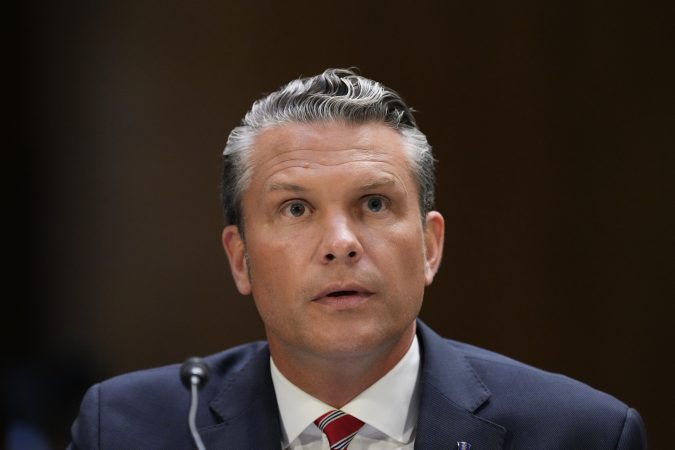
WASHINGTON — Defense Secretary Pete Hegseth faced questions and protests Tuesday over the U.S. war with Iran, which he estimated has cost $37.5 billion so far, as Republicans prepare a $95 billion GOP budget package to fund the military, along with other White House priorities.
Hegseth provided the new estimate, up from earlier assessments, during a fiery hearing at the Senate Appropriations Committee. Several times, protesters interrupted Hegseth’s opening remarks, which came days after the Pentagon announced that three more American service members have died in the conflict, bringing the death toll to 17, and that more than 100 have been injured since early July.
“Without these funds, we face critical shortfalls,” Hegseth testified.
But Sen. Patty Murray, the top Democrat on the panel, warned of “another forever war.”
“This war is now spiraling out of control again,” Murray said in her opening remarks.
Trump “has told us over 40 times now that a deal is near, and the war will be over soon,” she said. ”But now, he’s asking for $70 billion more — and for us to just trust him it’ll all work out fine.”
Gen. Dan Caine, chairman of the Joint Chiefs of Staff, and Agriculture Secretary Brooke Rollins were also testifying before the panel. The proposed budget package includes $60 billion and $12 billion for other national security needs, along with $10 billion for farm aid and $10 billion for voting law changes.
Before the hearing, the White House issued a statement urging support of the budget resolution, “without modification—immediately.”
War funds make up the bulk of the GOP budget plan
War funding makes up the bulk of the GOP’s new budget proposal, one last priority package the Republicans hope to launch before lawmakers recess to campaign for the midterm elections that will determine control of Congress. The package aims to help farmers struggling under Trump’s tariffs and to pay for voter law changes that are likely to include new ID requirements, none of it paid for with offsets.
Most Americans continue to disapprove of how Trump is handling Iran, according to an AP-NORC poll. Gas prices have spiked as Iran works to control oil shipments through the Strait of Hormuz, U.S. munitions are running low from the onslaught of American missile strikes and Trump has shifted away from his own campaign promise not to draw the U.S. into prolonged military conflicts.
Nevertheless, Trump has showed no signs of backing off the war, and the Republicans have largely refused to confront his strategy, question his objectives, or use Congress’ power of the purse or war powers authority to halt the conflict.
“The commander in chief and the whole Department of War are working very hard to bring this to a resolution,” said House Speaker Mike Johnson at his weekly news conference Tuesday.
Trump, in a social media post at the start of the week, asked all House Republicans to vote for the budget resolution.
Hegseth faces questions over war and his own leadership
Hegseth appeared before the panel facing a torrent of questions about not only the war, but his own leadership of the department.
Sen. Susan Collins, the Republican chair of the committee, opened the hearing saying it’s “deeply troubling” that the Pentagon has blocked or denied promotions to various officers, particularly women and minorities.
“This is likely to discourage well-qualified women and individuals of color from joining our armed forces, thus depriving us of their talent, dedication, and patriotism,” Collins said.
Sen. Jeanne Shaheen of New Hampshire questioned why Hegseth is asking for more money when the department has not yet spent about half the $150 billion Republicans provided the Pentagon in last year’s big budget bill.
“If you still have $75 billion available, why are you asking the American people to absorb the cost of a war they don’t support?” asked Shaheen, who is also the top Democrat on the Foreign Relations Committee.
When Hegseth started describing the “historic nature” of Trump’s military strategy, she cut him off.
Hegseth later explained that the rest of last year’s budget package would be spent by September, which is the end of this fiscal year.
Republican Sen. John Kennedy of Louisiana was among several senators demanding answers over the situation in the Strait of Hormuz, asking if Iran will impose tolls on what historically has been an open waterway vital to the flow of oil.
Caine said, “That’s a hypothetical question, and I don’t know the answer to that.”
But Kennedy retorted: “Guys, we need straight answers.”
This week, the Senate will consider another war powers resolution, having voted nearly a dozen times to try to halt the conflict. The House has approved a war powers resolution limiting Trump’s ability to wage war, with a few Republicans joining the Democrats to pass the measure, but no resolution has cleared both chambers to be sent to the president’s desk.
Republicans work to pass budget over Democratic objections
The GOP budget proposal is expected to flow through the reconciliation process, which enables the majority to approve the plan on its own, over the objections of Democrats in the minority.
It’s the same lengthy process Republicans used to approve Trump’s big tax cuts bill last summer, as well as Homeland Security money earlier this year.
The proposal is headed toward a House vote this week, which would start the process by instructing various committees to begin drafting the legislation. Johnson can afford only a few defectors from his slim majority.
So far one Republican, Rep. Warren Davidson of Ohio, has objected to the budget plan, warning it will pile on to deficits because the new funding is not being offset with spending reductions elsewhere. Other conservative Republicans share those concerns.
GOP senators have so far panned the House budget plan, but are waiting to see if Johnson can kickstart the process with this week’s voting.
WASHINGTON — The Supreme Court agreed Monday to review an Alaska bush pilot’s claims that state authorities have tried to illegally seize his $95,000 airplane after a passenger brought a six-pack of beer on a flight bound for a dry village.
The pilot, Kenneth Jouppi, sued to block his plane’s seizure after he was convicted of an alcohol-related misdemeanor charge. The Alaska Supreme Court ruled in the state’s favor that Jouppi’s plane was subject to criminal forfeiture laws.
On Monday, however, the nation’s highest court agreed to hear Jouppi’s case. He argues that taking his 1969 Cessna would violate the Eighth Amendment’s Excessive Fines Clause. Arguments are expected in the fall.
“I’m in my 80s now, and I’ve been fighting this for over a decade because I see it as my duty to ensure that the Bill of Rights actually means something in protecting against government overreach,” Jouppi said in a statement released by his attorneys at the Institute for Justice.
In April 2012, Jouppi was preparing to fly a passenger from Fairbanks to a remote village, Beaver, where alcohol was banned. The passenger had packed beer with other groceries in her luggage. State Police troopers searched Jouppi’s plane before it departed and spotted a six-pack of Budweiser in a shopping bag.
Jouppi, his company, and the passenger were charged with a misdemeanor offense of knowingly transporting an alcoholic beverage into a dry community. The passenger pleaded guilty. A jury convicted Jouppi and the company after a trial. A judge sentenced him to three days in jail.
Jouppi’s attorneys say Alaska’s high court examined his conduct “purely in abstract terms” and didn’t evaluate whether it was part of a broader pattern of criminal activity. And they say it wasn’t.
“Few excessive fines cases will present the issue so sharply; a decision upholding the forfeiture of an airplane for a six-pack is a self-recommending candidate for review,” lawyers from the Institute for Justice wrote in their appeal.
In response, lawyers from the Alaska Attorney General’s office argued that the state Supreme Court’s “fact-bound decision” should be allowed to stand.
“Courts across the country apply a multifactor test to determine whether a fine or forfeiture is grossly disproportional to the gravity of the offense,” they wrote. “Jouppi does not claim that the four-part standard applied by the Alaska Supreme Court is wrong, only that the court misapplied settled law by giving too much weight to some factors and not enough weight to others.”
Jouppi’s attorneys argue that the ruling from the state’s highest court conflicts with case law established in other courts, including U.S. Supreme Court precedent.
“The Excessive Fines Clause was built for cases like this,” they said.
Alaska’s attorneys said Jouppi hasn’t shown how punishing him with forfeiture of his plane is “grossly disproportional to the gravity of his offense.”
“Alcohol abuse is a serious problem in rural Alaska, and airplanes are sometimes the only realistic means to commit the crime of alcohol importation,” they wrote.
WASHINGTON — The director of the Smithsonian’s National Museum of American History pushed back Tuesday against a recent White House report that branded the institution’s leadership as radical activists who cannot be trusted.
The testimony from Anthea M. Hartig came as President Donald Trump has engaged in a broad national effort to reshape the stories of America told by cultural institutions controlled or influenced by the federal government and, in particular, to purge diversity, equity, and inclusion elements from those narratives. Many historians are alarmed by the revisionism.
“As we continue to fact check the report, we unwaveringly attest that it does not fairly or accurately characterize the full body of work at the museum,” Hartig told a House Oversight subcommittee. “There is always room for improvement. But I also know the beauty and the inspiration and the expertise that lies in our collections, our exhibits, and our programming.”
Coinciding with the 250th anniversary of American independence, the White House Domestic Policy Council released a report on July Fourth arguing that the museum, a centerpiece of the sprawling Smithsonian complex on the National Mall, doesn’t tell history “in a way that is inspiring, unifying, and worthy of our great republic.”
Republicans on the panel reiterated some of those concerns on Tuesday.
“In the museum’s current telling, history is just an ongoing power struggle between oppressors and the oppressed,” said Rep. Tim Burchett (R., Tenn.). “The report makes clear that the museum’s woke exhibits and materials reflect a broader vision held by the museum leadership.”
Hartig, the first woman to serve as director of the National Museum of American History, said the institution “does not take sides in America’s political debates.” She described the museum’s presentation of the nation’s story as an evolution intended to add voices, not erase history as detractors sometimes argue.
“When historians talk about reframing a traditional narrative, we don’t mean erasing it,” she said. “We mean adding the evidence, the voices, the objects, that earlier tellings left out, so that more Americans can see themselves reflected in the national story.”
The White House report argued that the museum “has refused to celebrate the Nation and its history.”
“It has not created any exhibit dedicated to presenting a general narrative of American history or telling the story of any of our Founding Fathers, the Second Continental Congress, the Declaration of Independence, the American Revolutionary War, or the achievement of independence and the establishment of the constitutional rule of law,” the report said.
But the museum opened an exhibit in May dubbed “In Pursuit of Life, Liberty, and Happiness” that displays 250 objects throughout the building to celebrate America’s 250th anniversary. The artifacts include the desk used by Thomas Jefferson to draft the Declaration of Independence, a Revolutionary War-era gunboat, and the Star Spangled Banner.
Some Republicans on the panel on Tuesday acknowledged that the museum displays important material related to the anniversary but argued it was challenging to navigate. Rep. Michael Cloud (R., Texas) said he expected references to the Declaration of Independence to be more prominent during a recent visit.
“I’m not saying it’s not there, but it’s hard to find,” he said.
Hartig faced particular scrutiny from Republicans over an exhibit entitled “Girlhood (It’s Complicated),” which included a diary from a 13-year-old exploring issues including gender identity. The museum director said the exhibit, which ran from 2020 through 2023, included a label making clear it was not designed for children.
Hartig’s future as the museum’s director hung over the hearing. Trump last year said he was firing the longtime leader of the National Portrait Gallery, another Smithsonian museum that, like the National Museum of American History, operates independently of the executive branch. The National Portrait Gallery’s director, Kim Sajet, nonetheless stepped down from the museum in the face of the White House pressure.
At one point, Burchett asked Hartig why she should continue in her job. She responded simply that overseeing the museum is “the honor of my career.”
KYIV, Ukraine — One is a tech-savvy drone innovator with no military experience who became Ukraine’s youngest defense minister six months ago and was credited with contributing to successes in defending against Russia’s 4-year-old invasion.
The other is a seasoned, Soviet-trained general more at home with traditional top-down command culture who led Ukraine’s armed forces.
When their personalities and policies clashed, President Volodymyr Zelensky decided one of them had to go as part of a wider government reshuffle. He dismissed the popular young upstart, sparking protests across the country.
A look at the contrasting careers of Defense Minister Mykhailo Fedorov and commander of Ukraine’s armed forces, Gen. Oleksandr Syrskyi.
The youthful face of Ukraine’s drone war
The 35-year-old Fedorov was credited with modernizing Ukraine’s drone program and changed military procurement rules in a crackdown on corruption. He argued that the military establishment was resisting changes demanded by the evolving war with Russia.
“We transformed Ukraine into a global tech leader and a defense powerhouse,” he said on social media after he lost his job last week in Zelensky’s government shake-up.
Fedorov also took credit for restricting Russian military access to Elon Musk’s Starlink satellite internet services.
Before becoming defense minister in January, Fedorov headed Ukraine’s digital transformation policies and introduced successful e-government platforms.
Fedorov got that job after running the digital operations of Zelensky’s presidential election campaign in 2019. Before that, he ran a digital marketing company.
After his dismissal, Fedorov publicly accused Syrskyi of blocking military reforms and insisting on a traditional command culture. That criticism echoed complaints from soldiers and veterans over heavy casualties in costly front-line assaults.
Appearing at a news conference in a dark T-shirt and jeans, Fedorov accused Syrskyi of blocking reforms needed because “the war has changed completely” due to new technology.
The Soviet-trained general dubbed ‘the Butcher’
Protesters framed Fedorov’s removal as an example of Zelensky siding in the feud with an entrenched military old guard over a modernizer.
Syrskyi, 60, was born when Ukraine was still part of the USSR. He attended Moscow Higher Military Command School and served in the Soviet Artillery Corps. He has long been associated with a Soviet-style, top-down command culture.
He played a key role in some of Ukraine’s biggest victories in its war, overseeing the successful defense of Kyiv in the early days of the invasion in February 2022. Seven months later, Syrskyi was credited with orchestrating the counteroffensive in the Kharkiv region, one of the most significant Ukrainian victories in the war.
“I’m not fighting the (defense) ministry. I’m fighting Russia,” Syrskyi said in a column published Monday in the Ukrainian military outlet Militarnyi that defended his conduct.
“The General Staff has never opposed the ministry — we have cooperated and will keep cooperating with whichever minister the state appoints. Because in the army, you don’t get to choose who you serve with. In the army, you follow orders and do your job,” he said.
Within the military, Syrskyi earned the nickname of “Butcher,” a label that gained wider currency during his command of the ill-fated defense of Bakhmut, one of the war’s longest battles that killed tens of thousands of people.
His reputation took another hit after the Ukrainian outlet Babel published an investigation last month detailing allegations of abuse within the Skelia assault regiment, a unit closely associated with Syrskyi. It reportedly has suffered higher-than-average losses. The investigation documented dozens of deaths among recruits.
The ouster brings protests in Ukraine, glee in Russia
The protests of Fedorov’s ouster and the backlash against Syrskyi reached into the military, with the air force’s deputy commander resigning and warning it would weaken Ukraine’s air defenses. Veterans and soldiers on leave joined the protests. Many demonstrators said they wanted a new generation of generals who would prioritize preserving soldiers’ lives.
The stakes are high for Zelensky. The outcry appeared to leave him open to accusations that by ousting Fedorov, he was trying to get rid of a possible political rival. The episode threatened to undermine his authority.
Ukrainian political analyst Volodymyr Fesenko called Syrskyi “a more convenient and more comfortable” choice for Zelensky to keep in his government, adding that it turned out to be a “major miscalculation.”
Zelensky “underestimated the extent to which part of Ukrainian society had come to see Fedorov as perhaps the main driver of the positive changes in Ukraine’s war against Russia,” added Fesenko, head of the Penta Center think tank.
Russian war bloggers responded to Fedorov’s dismissal with glee, noting his role in masterminding long-range drone strikes on oil facilities that have caused a fuel crisis and midrange attacks that disrupted military logistics.
Syrskyi, some noted with grudging respect, has built a string of defenses that have stalled Russian advances.
Many Moscow commentators voiced hope that the controversy would fuel political infighting in Ukraine and weaken its military.