Transit fans who asked what in the El was happening with SEPTA’s old stuff inspired a sale of vintage items from its vault this month, marking the first time in the agency’s six decades of existence that Philly’s biggest fleet has held anything close to a garage sale.
Dubbed “RETROmania,” the sale began online Sept. 14 and is already proving to be a gravy train for SEPTA, with decommissioned transit signs selling out for up to $350 a pop.
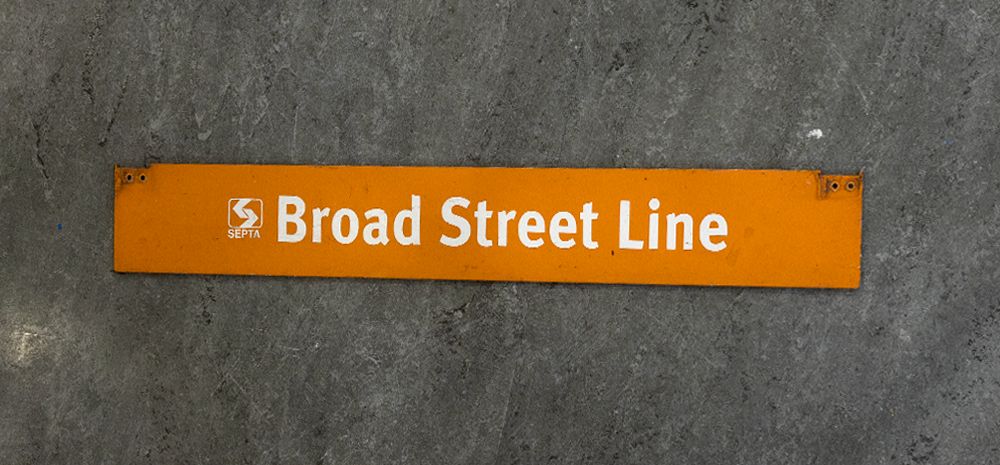
It’s no surprise that signs for the Broad Street Line, which has shuttled Philly sports fans to and from the stadium complex for decades, have been among the hottest-ticket items. Other available products include old street and transit maps and vintage TransPass design sheets.
A TransPass sheet from 1994 is selling for $50 during SEPTA’s RETROmania sale.Courtesy of SEPTA
The early success of the online sale has SEPTA Store manager Al’Lee Floyd and store supervisor Melissa “Meli” Smalls excited for the in-person sales at the store on Oct. 2 and 3.
“It was a big surprise … we did not anticipate some of the signs would sell out in one day,” Floyd said.
Since taking over the SEPTA Store at the agency’s headquarters on Market Street near 12th in Center City in 2021, Floyd has reinvigorated the agency’s merchandise and fan base with wildly popular items like viral pint glasses and must-have ugly Christmas sweaters.
Al’Lee Floyd, manager of the SEPTA Store, outside of the store at the SEPTA headquarters in Center City in 2024. Jessica Griffin / Staff Photographer
But SEPTA’s vintage sale — the first of its kind anyone can recall — was inspired squarely by its customers. Over the last two years, as SEPTA rebranded the names of its lines and signage, like switching the Broad Street Line to the B (a change many Philadelphians have neither accepted nor acknowledged), SEPTA fans have inquired about what’s happening to the signs with the old names on them.
“When people started noticing the stations were switching over, a lot of people were coming into the store and asking what we were doing with the signs coming down,” Smalls said. “We got with our wayfinding team and asked what the plans were and they said they could get them to us if we wanted them.”
Smalls and Floyd took their customers’ curiosity as a sign and went full steam ahead with a vintage sale, digging up other items from SEPTA’s warehouse.
This 1984 street and transit map from SEPTA sold for $25 in its RETROmania sale.Courtesy of SEPTA
Street and transit maps from 1966 to 1999, which were priced at $25 each, have already sold out, but a Delco Public Transit Map and Guide from the 2010s is still available. There are also plenty of vintage TransPass sheets from 1993 and 1994 still for sale at $50 each.
This Walnut-Locust sign was still available, as of publishing time, for $350 in SEPTA’s RETROmania sale.Courtesy of SEPTA
Among the most popular items were what SEPTA calls its “lollipop” signs, circular plastic signs ringed in green with the SEPTA logo in the center, that sold for $350, and, of course, the Broad Street Line signs, which ranged from $125 to $350.
“If a sign identified anything to do with NRG [Station] or any sports complex stuff, it was a little more of a higher ticket item,” Floyd said.
Broad Street Line signs, like the one pictured above, quickly sold out in SEPTA’s RETROmania sale.Courtesy of SEPTA
SEPTA had already sold more than 100 signs as of Sept. 18, when it dropped a new batch of signs into the mix — prototypes with the current names of the lines on them for $50 each.
Unsurprisingly, those haven’t been as popular as the old signs that are drenched in nostalgia (and probably other things) and aged with a fine Philadelphia subway patina.
Anyone who buys a decommissioned SEPTA sign is required to sign an agreement that they will not use it for commercial purposes, Floyd said.
Affectionately referred to by staff as “lollipop” signs, these circular signs already sold out at $350 a pop during SEPTA’s RETROmania sale.Courtesy of SEPTA
The in-person sale at the SEPTA store will include merchandise similar to that in the online sale, along with vintage apparel. A preview sale will be held from 10 a.m. to 4 p.m. Oct. 2 at the store, with the main sale taking place from 10 a.m. to 4 p.m. Oct. 3.
Floyd recommends getting in line early.
“It’s first come, first served, once it’s gone, it’s gone,” she said.
DEAR ABBY: My husband, “Dirk,” cheated on me more than 20 years ago. He has kept in touch with the woman since then. Sixteen months ago, she told him she was “in a bad place.” He offered to let this (married) woman move in with us and didn’t tell me until two weeks before she got here.
Abby, this woman lives like a pig. Her room is filthy, and she has broken several things in my house without paying for anything. Before she moved here, Dirk wanted to get her teeth fixed. I ended up paying for it with my credit card. She promised she was going to pay me back, but she has given me exactly $510 of the $5,000 that she owes me. She has a job, so there’s no reason why she is not giving me the money.
I’m not worried about Dirk cheating with her again, as she has not maintained her looks or figure over the years. Still, how much more of this should I take? I asked her to leave once, but he got her to come back. He will not go to marriage counseling as he doesn’t think we need it. When I ask him why he keeps her around, he tells me he enjoys her company. Do you think I should contact a lawyer and start divorce proceedings or let this go?
— LOSING MY MIND IN TEXAS
DEAR LOSING MY MIND: My dear, you should have left long ago. Call a lawyer immediately. However, since this woman is not a physical threat, resist the urge to move out until you have your attorney’s approval. Abandoning your home may harm your case in the divorce proceedings.
** ** **
DEAR ABBY: I became close with an attractive, younger coworker last year. Realizing I was starting to get a crush, I told her I needed to stay away because of my feelings and, being married, couldn’t risk losing my family. She went through a hard time during our breakup, but we started getting close again. The breakup led her to do something she regrets so much it has affected her work. It has alienated pretty much everyone she knows except for me. I have encouraged her to seek professional help because her emotional state is very draining. I also feel I have reached a point where I no longer want to be around it, but I don’t know how to tell her without feeling guilty for turning my back on her when she’s begging for help. She’s in such a depression; she’s killing herself slowly. What should I do?
— REMOVING MYSELF IN THE EAST
DEAR REMOVING: What you should do is reiterate to her firmly, but as kindly as you can, that she needs to get professional help for her depression. If she balks, explain that, because of her emotional state, she has alienated friends and coworkers and that you are not equipped to give her the support she needs. Then learn from this experience and back away.
When Buddy Osborne’s phone rings, it’s because something has gone wrong. An accident. A death. A traumatic event on a job site. This past April, it was a catastrophic collapse. A parking garage had fallen, and three construction workers were dead.
Osborne, 67, the chaplain for the Philadelphia Building and Construction Trades Council, arrived at the scene to find an ironworker being interviewed by investigators from the Occupational Safety and Health Administration. The man had witnessed the collapse. The workers who died had been part of his crew. Osborne did not know him. They had never met. But as a chaplain, Osborne was there to help the workers who witnessed the traumatic event. His job, as he put it, was to “render support to workers in distress.”
In addition to being a pastor at the Rock Ministry, Buddy Osborne is the chaplain for the Philadelphia Building Trades Council and a former Tyger Williams / Staff Photographer
He waited until the interview ended. Then he walked over, introduced himself, and placed a hand on the worker’s shoulder. “He’s a tough guy,” Osborne said, “but he just broke down.” Osborne hugged the worker as he wept. By the time he pulled away, his shirt was wet with the man’s tears.
The ironworker Osborne comforted was part of a workforce that is deeply woven into Philadelphia’s civic identity. Roughly 121,000 people across the Philadelphia metropolitan area work in construction, following a decade of steady growth. The Philadelphia Building and Construction Trades Council alone represents more than 50 local unions. Politicians court their support. The city celebrates the buildings, roads, and public projects they construct. But behind that civic pride is a workforce in profound distress.
Construction has one of the highest suicide rates of any major industry in the country, according to the Centers for Disease Control and Prevention. More than 5,000 construction workers die by suicide each year, roughly five times the number who die from fatal worksite injuries, and male construction workers are 75% more likely to die by suicide than the general population. Construction workers also die from drug overdoses at a higher rate than workers in any other industry.
Those numbers have set off an urgent effort in Philadelphia to confront the mental health crisis roiling the construction industry. Osborne is but one small part of it. An entire alphabet of organizations, from ATAP, the Allied Trades Assistance Program, and CIASP, the Construction Industry Alliance for Suicide Prevention, to CWC, Carpenters Who Care, and MACSC, the Mid-Atlantic Construction Safety Council, now offer expanded access to mental healthcare and substance use treatment.
There are peer-support networks and suicide prevention training programs. On job sites, there are daily stand-downs and toolbox talks devoted to mental health awareness. There is a Construction Suicide Prevention Week every September, and this past May, for the first time, 50 workers gathered in the Wissahickon for the Greater Philadelphia Construction Hike for Hope, sponsored by the American Foundation for Suicide Prevention.
All of this is to say: Everybody cares. All eyes are on the issue.
As Johnathan Davis, a professor at the University of Iowa’s College of Public Health, put it: “The construction industry has had a phenomenal response to this problem, and the awareness, the destigmatization, and the support programs are important parts of that response.” Indeed, it has never been easier for a construction worker in distress to get help.
Yet the crisis of the distressed construction worker persists, in part because, according to interviews with dozens of workers, the industry itself produces the suffering. And, so far, it has done more to treat it than to prevent it. The focus now, Davis said, needs to be on “upstream solutions.” So, not only helping workers once they hit their breaking points, but also addressing the conditions that bring them there in the first place.
Union workers watch as demolition continues in Grays Ferry on Sunday, April 12, 2026, at the site of the parking garage collapse.Tom Gralish / Staff Photographer
The same day Osborne, who lives in Kensington, was at the parking garage, Marianne Wolfe was meeting with the workers in their union halls.
Wolfe is the managed care supervisor for ATAP, an employee assistance program that provides mental health and substance use services for organized labor. After a tragedy like the parking garage collapse, part of her job is to lead workers through critical incident stress debriefing, a structured, therapist-led conversation meant to help people process the trauma they have just experienced.
In this case, that meant sitting with workers who had witnessed the collapse and were still trying to make sense of it.
“They were just trying to wrap their heads around what took place,” Wolfe said. “Survivor’s guilt. It was a ‘Why wasn’t it me?’ type of thing.”
Trauma, Wolfe said, “is a very tricky thing.” It does not always arrive when expected. It can surface weeks or years later. That is why she expected ATAP to keep receiving calls about the collapse for at least several months. If so, those calls will come into an office that is already busy.
“We’re a high-volume call center,” Wolfe said.
Scaffold workers work on a building on North Broad street in Philadelphia Pa.Jose F. Moreno / Staff Photographer
Workers reach out to ATAP when they need help and don’t know where to turn. They call ATAP’s 24-hour emergency hotline when they are desperate, sometimes actively suicidal, and an ATAP employee quickly connects them to the right level of support, whether that is outpatient counseling, substance use treatment, or immediate inpatient care.
For years, Wolfe said, most of the calls coming into ATAP were about substance use that was exacerbated, in part, by wear and tear from demanding physical labor.
“We were still in the opioid epidemic,” she said. “Now we are in what we’re calling a mental health epidemic.” She attributed the shift to years of education and anti-stigma work that made it easier for workers to ask for help.
Some workers call because they are anxious. Some call to discuss family or work-life balance issues. Sometimes they call because they cannot sleep. Their reasons run the gamut, but they all lead back to a simple truth: “Being a construction worker isn’t an easy job,” Wolfe said.
Layoffs and financial instability are par for the course. The hours are grueling. Some work seven days a week. There is hardly any time to see family. Left unaddressed, those pressures can pile up until a worker feels helpless, or hopeless, or, in Anthony Zecca’s case, both.
A nonprofit called ATAP helped Anthony Zecca get a psychiatrist and helped find treatment and services for his son, Salvatore, who has autism.William Thomas Cain / For The Inquirer
“I’ll be honest with you,” Zecca, who lives in Fairless Hills, said in April. “I didn’t want to live anymore.”
He was describing how low things had gotten the previous December. His marriage was on the brink of collapse. His father-in-law had warned him that if he couldn’t get his temper under control, he was going to lose his family. He had been having anger issues ever since he got out of prison in 2023, after serving four years for possession of a firearm. “I had a very hard time adjusting,” he said.
At Christmas, Zecca got so angry that he kicked over the tree and broke his toe. He had to get surgery and could not work for six weeks. But the real wake-up call was his daughter’s reaction that night.
“I saw how terrified she was of me, and I just broke down in tears,” he said. “I couldn’t do it anymore.”
Zecca, 41, called ATAP the next day and spoke to Wolfe. “I told her I’m having a lot of problems at home,” he recalled. “I said I’m really depressed. I’m not doing good.”
Wolfe got to work on Zecca’s behalf immediately. She got him into anger management and found him a therapist and a psychiatrist, whom he now sees every month. She helped his 8-year-old son who has autism, too, by connecting him with a behavioral psychologist. Zecca ended up calling ATAP so frequently that Wolfe gave him her personal cell phone number.
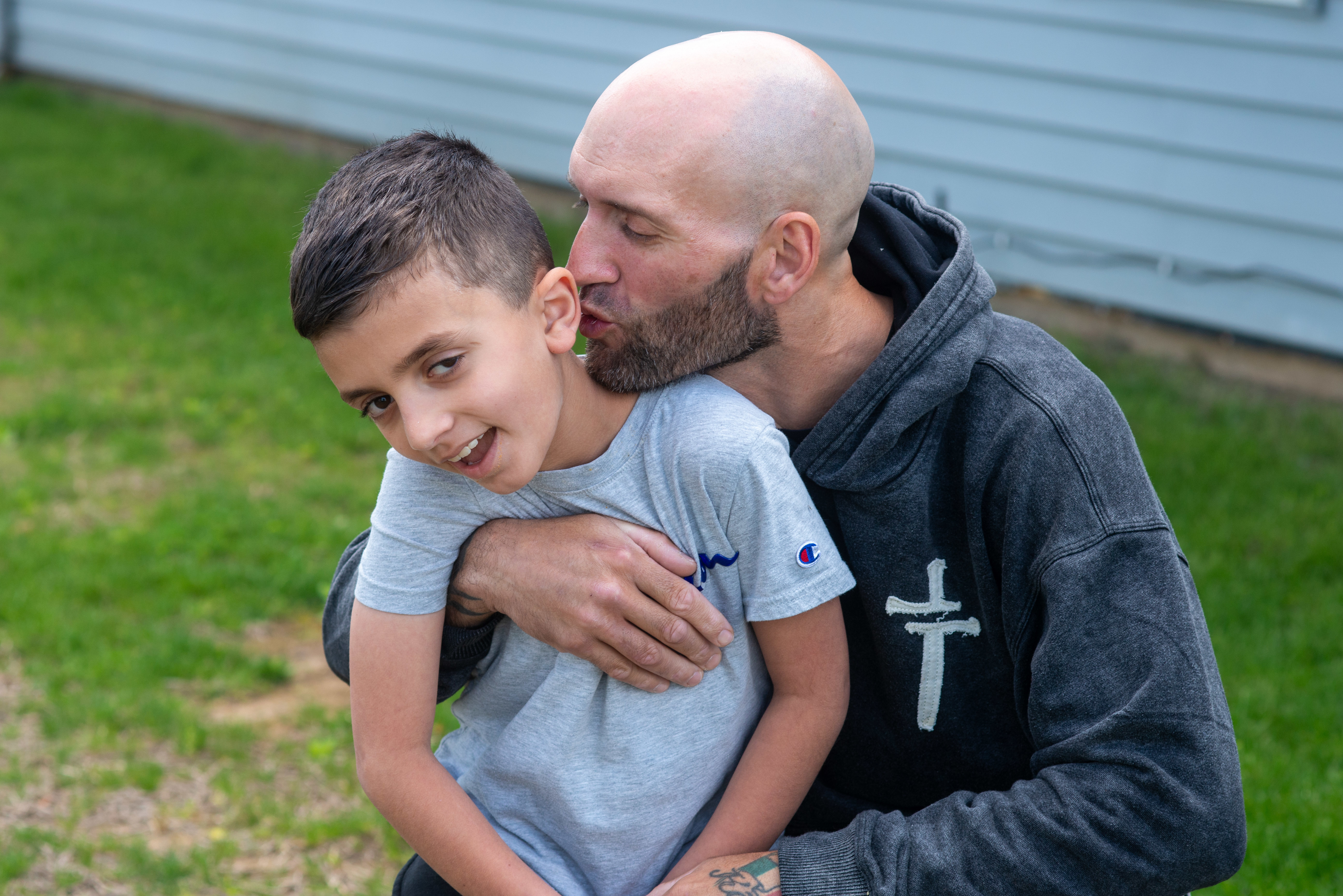
Anthony Zecca (CQ) and his son Salvatore Zecca (CQ), 8, pose for a photograph in their yard Friday, May 08, 2026 at private residence in Fairless Hills, Pennsylvania. A nonprofit called ATAP helped get him a psychiatrist and helped find treatment and services for his son, Salvatore, who has autism.William Thomas Cain / For The Inquirer
Life has been much better for Zecca ever since he reached out to ATAP. He and his wife still fight sometimes, mostly about his hours. He is away from 4 a.m. until 7 p.m. every day. But they have not had any major blowouts since Christmas. His psychiatrist put him on Wellbutrin, which Zecca says helps with both his depression and his ADHD. He uses his therapy sessions to work through the different stressors in his life.
Zecca still has many sleepless nights and considers himself an “anxiety-ridden person.” And the construction industry remains his biggest stressor. He wakes up every day worried he will be laid off and out of work for the next month. “It really wears on me,” he said.
Unable to make peace with the industry’s uncertainty, Zecca is trying to change his circumstances.
“I just want a steady job where I don’t have to worry about being laid off,” he said. He is tired of the stress on the job, the demanding timelines, and the endless hours. He is hardly alone.
John Sobetsky of Royersford at his home on Tuesday, May 12, 2026. John has been dealing with depression over the years and is a major advocate of mental health treatment in the construction industry.Alejandro A. Alvarez / Staff Photographer
John Sobetsky, 35, was among the workers who gathered in the Wissahickon for the Greater Philadelphia Construction Hike for Hope. For him, the cause is personal: Sobetsky survived a suicide attempt in high school and is now active in the industry’s mental health efforts. He also knows firsthand how the pressures of construction can overwhelm the rest of a person’s life.
The former technician and concrete mixer-turned-business development manager said his life is much more manageable ever since he traded the grind and churn of construction work for a 9-to-5.
“It’s almost night and day,” he said. “I don’t have those deadlines weighing on me. I have freedom. I have flexibility.”
Three years ago, Sobetsky, who lives in Royersford, was managing a construction project that was such a “complete cluster from beginning to end. … I wasn’t sleeping. I wasn’t eating,” Sobetsky recalled. “My anxiety was out of control.”
Eventually, it affected his ability to do his job. “I was missing wire runs,” he said. “I was spending way too much time on tasks that should have taken me half the time because I was just mentally out of it.” It got so bad that his boss asked him if he was OK. That, experts say, is often how distress shows up on the job.
“Warning signs often masquerade as performance issues,” said Sonya Bohmann, executive director of the Construction Industry Alliance for Suicide Prevention. “It’s things like not showing up for work on time anymore. It’s things like jumping to conflict when you’re usually the person who’s really the steady Eddie.”
Those sorts of behavioral changes are opportunities for bosses and supervisors to check in and point workers to available services. But, according to Bohmann, culture frequently gets in the way.
“It’s hard to say I’m going to therapy because people will look at you like you’re weak or selfish,” she said, “and you never want someone to think that you’re not fit for duty under the hard hat because then they don’t want you on their crew.”
John Sobetsky of Royersford with books that he enjoys reading for relaxation at his home on Tuesday, May 12, 2026. John has been dealing with depression over the years and is a major advocate of mental health treatment in the construction industry.Alejandro A. Alvarez / Staff Photographer
That fear stopped Zecca from seeing the free mental health counselor at his union hall. “I didn’t want a higher-up to see me go in and out of there and think I was a head case,” he said.
According to Sobetsky, until the culture changes, even the best-intentioned services are nothing more than a “checkbox.” Because when a boss or superintendent treats leaving 45 minutes early on a Tuesday to see a therapist as a problem, the help exists only on paper. “Then you don’t really offer it,” Sobetsky said, “because I can’t use it.”
To Bohmann, that is where the work has to move next: from checking the box to creating what she calls a “culture of care,” built on the understanding that the way the industry functions actually affects workers’ mental health.
That’s not just her hunch. It is what new research from professor Davis and the Center for Construction Research and Training (known by its former acronym, CPWR) suggests. Davis conducted an unpublished study that he says shows the presence of family and paid leave policies correlated with lower rates of suicide for construction workers.
“I believe it,” Zecca said when told about the study’s findings. The implications could not be clearer.
As Davis said: “If you as an employer, you as a contractor, you as a union, are interested in lowering the rate of suicide … these are the type of benefits that you should be working into your programs.”
One upstream, preventive solution the industry so desperately needs? It already exists. It is called PTO.
A construction worker stood in a window at 21st and Washington Streets in Philadelphia, Pa. on Thursday, July 27, 2023. Philly had declared a “heat emergency,” when it felt like 106 degrees in the shade.Monica Herndon / Staff Photographer
Jason Scholl, the owner of LK Miller, based in Ambler, recently transitioned all of his workers from hourly to salaried wages. He gives them Friday afternoons off in the summer and generally tries to create a culture where his team feels safe. “I try to give them every tool in my toolbox to help them handle the rigors of what they’re doing on a day-to-day,” Scholl said.
There are concerned bosses, too. Ones who take decisive action, like Mary Pat Geppert, who runs Geppert Bros., the demolition contractor that cleaned up the site of the deadly January 2025 plane crash in Northeast Philadelphia. The work was horrifying, Geppert said. Debris and human remains were spread across a 12-block area. Geppert’s workers would not even bring their boots home because of what they walked through. She knew they needed help, so she brought in Buddy Osborne and gave everyone the morning off to talk about what they had seen. She bought them new boots, too. And reminded them of one of her favorite sayings: “It’s OK to not be OK.”
But it’s what Geppert does not do that she believes makes the biggest difference to her workers’ mental health. She does not lay people off. Or at least she tries very hard not to. Even when Geppert Bros. does not have a contract, she keeps her guys working in the company’s own yard. “That’s our secret sauce,” she said. “We don’t let our guys go back to the hall.”
A construction worker works at a construction site near Interstate 95 in Philadelphia, Thursday, Jan. 22, 2026.Jose F. Moreno / Staff Photographer
What Geppert Bros. has figured out is what Davis hopes the industry can move toward: steadier, more long-term employment. Such big conceptual changes, like reconfiguring benefits packages and contracts to increase stability, might take more time, but Davis says the industry is well-suited to address these problems.
Zecca is not waiting for those changes to arrive. For more than a year, he has been trying to land a full-time job with Energy Transfer, an oil and gas company headquartered in Texas. The job would involve maintaining the company’s pipelines in Pennsylvania. Instead of starting over with new bosses, crews, and equipment every few months, he would work with the same team on the same project.
It is his dream job. Not because of the work itself or the money. Because it is steady. He wears the company’s navy-and-white hat every day for good luck.
“I just need something with more consistency,” he said one evening in May.
Two days later, he was laid off.
A construction worker helps guide a section of pre-cast concrete in place in the upper level at the site of the new Eagles Stadium on Friday, May 10, 2002.David Maialetti / Staff Photographer
DEAR ABBY: My mom died of extreme old age recently. She was a sweet woman everyone loved. I sent invitations to her memorial, and I’m getting a lot of excuses for why my friends can’t attend. I am upset.
In my circle of friends (all similar ages), I was the last to graduate, get a career job, start a relationship, buy a house, be married and so forth. I’ve attended my friends’ graduations, weddings, baby showers, milestone birthdays, and family funerals, yet there hasn’t been much reciprocation.
Excuses for not attending Mom’s memorial included going to a grandkid’s soccer game and attending a 2-year-old’s birthday party. Really? I know I’m dealing with unusually strong emotions due to Mom’s death, but I want to scream, “This is MY MOM,” not some distant friend or relative. My spouse says I shouldn’t stress and that all we need is each other (said by someone who has a huge, loving family whereas my family is just me and my dad). How do I deal with my feelings of resentment, abandonment and being a low priority?
— LAST ONE IN CALIFORNIA
DEAR LAST ONE: Your spouse is right. In the final analysis, all you need is each other — though a few supportive friends would certainly be welcome. I have always said that funerals are for the living, not the deceased. Be grateful for the support you are receiving from the people who accepted the invitation to your mother’s funeral. They are your core support group; the others are mere acquaintances, so start thinking of them in those terms.
** ** **
DEAR ABBY: I rent a two-bedroom apartment, which I shared with my best friend. When he moved away last month due to a work relocation, I advertised the room, and a couple moved in. They are friendly and pay their rent on time, but their cooking produces extremely strong smells that I cannot tolerate. My medication causes hypersensitivity to odors, and I can no longer stand to be in the kitchen because the smells linger. They also live on a very different schedule from me. As a result, my diet and sleep are both suffering. They remain unaware of how the adjustment has affected me because I don’t feel they are doing anything wrong. I would like to move out into a studio of my own. The lease on this apartment is currently a month-to-month, so the only thing keeping me here is the guilt I feel about burdening my roommates with this. They will have to move out, find a replacement for me or take on the full rent themselves. I want to do right by them, but I know it would be best for me to leave. What is the proper course of action here?
— DOOMED IN AUSTRALIA
DEAR DOOMED: There is no reason why you should feel guilty for leveling with this couple; your health must come first. Explain the problem to them and tell them that while you like them personally, your health is being affected by the cooking odors. Tell them that because you are now on a month-to-month lease, you plan to move to a smaller place of your own and give them the option of staying or moving. Consider this a first step in learning to stand up for yourself.
Nature already is splashing its flecks of yellow on the trees, and soon the Technicolor waves of foliage will ripple toward Philadelphia in what the experts predict will be quite a spectacular season.
Right on schedule, at 8:04 p.m. Philadelphia time Tuesday, the astronomical fall begins with the instant of the autumnal equinox, when the sun beams its direct light on the equator and nature continues to turn down the dimmer switch in the Northern Hemisphere. It is as though the trees brighten to compensate for our daily loss of 2½ minutes of daylight.
It’s the season when the night skies are stunningly crowded with winged traffic, when a remarkable 2-inch-long, Halloween-hued creature has its days in the sun.
And on the nation’s 251st autumnal equinox, we take a look at what nature might offer in the only season with two widely accepted names, “autumn” and “fall.” And we peek at the coming winter — for which a lot of people around here have other names.
Another Red October?
A beautiful view along Kelly Drive during a sunny day in the quite warm October of 2024.Jessica Griffin / Staff Photographer
For the third time in the last four years, an equinoctial cooldown is due this week, with daytime highs in the 60s, as much as 10 degrees below normal.
Monthly readings have been above normal in 15 of the last 16 Octobers. In 2024, it hit 84 degrees on Halloween. In that period, annual average temperatures at Philadelphia International Airport have been about 1.3 degrees above normal, but the Octobers have been a full 2 degrees above.
A very early line on winter
The intensifying El Niño in the equatorial Pacific is a major player in the center’s winter outlook, posted Thursday. It favors above-normal temperatures here and in most of the nation. The center eschews snow forecasts, but it does foresee a potentially active storm track along the East Coast.
A cautionary note: This whole seasonal-forecast exercise remains quite the work in progress, and last winter was yet another victory for atmospheric chaos over science. No one foresaw the 30 inches of snow for Philly or a historic snow-and-ice cover.
The ‘woolly bears’ vs. science?
A “woolly bear” caterpillar. Do those rings say anything about the coming winter?Wiki Commons
The so-called woolly bear caterpillar had long held a legendary place nationally in weather folklore, but in 1948 the forecasting reputation of the incipient Isabella tiger moths took wings.
That year a respected entomologist with the Natural History Museum in New York City ventured to a state park and announced that, based on his analysis of the caterpillars’ black-and-orange-ish rings, the subsequent winter would be mild in the New York region. His forecast was dutifully reported in a New York newspaper, and, indeed, the winter was quite mild.
He continued reporting his annual analyses (however waggishly) that correctly foretold of several mild winters.
As it happened, some of the winters in that period were so snow-deprived in the Northeast they became the impetus for the snow-making industry that has forever changed skiing.
Don’t credit or blame the woolly bears, said Douglas S. Richmond, entomology professor at Purdue University. Their ubiquitous presence this time of year all over North America indicates little more than a 100% probability that it is autumn.
A single crimson tree in Cherry Hill’s Wallworth Park greets Michel and Brigitte Mistler, from Normandy, France, as they take a morning walk while visiting their daughter in the township Oct. 22, 2025. Tom Gralish / Staff Photographer
They are quite fascinating creatures, he notes, that survive winters by producing “body fluids that function as cryoprotectants — essentially biological antifreeze.”
Their bodies actually may contain clues about the behavior of a previous season, according to Richmond.
“It’s probably better to think about woolly bears as being much better equipped with a rearview mirror than a crystal ball,” he said.
A natural place to look for clues
Bill Cullina, executive director of the Morris Arboretum and Gardens of the University of Pennsylvania, holds a collection of acorns in November 2019. Regardless of what the acorns said, that winter was virtually snowless.Jessica Griffin / Staff Photographer
Humans have had a long history of forgoing global forecast models and oscillation indexes in favor of consulting nature for winter clues.
One popular myth cited by The Old Farmer’s Almanac holds that if the acorns keep raining down from the trees like hailstones, get ready for a big chill.
Leaves would be another indicator: If they drop early, winter will be a breeze. If they linger late, those breezes might be cold.
Among Native Americans, beavers were bellwethers. The thicker their autumnal coats and stronger their lodges, the harsher the winter.
The natural world is where to look for clues about the season to come. The waning sun may dim human energy, but it is an ultra-busy time for a lot of other species. It is prime mating season for animals such as birds, bears, deer, moose — and porcupines. We won’t ask how they hug.
And birds — billions of them — are on the move.
An avian air force in the night sky
Audubon’s Keith Russell looking to the skies over Strawberry Mansion while leading a tour.JOSEPH KACZMAREK
The bird feeders and baths are getting ever emptier these days, but something quite amazing is happening after nightfall about 3,000 feet over our heads.
An estimated 1.3 million birds flew across Philadelphia on Friday night and early Saturday. And Chester County was the regional hot spot, with 3.8 million heading south-southwest, according to the Cornell University Ornithology Lab’s radar-powered BirdCast dashboard, With a tail wind from the north, they were zipping along at 25 to 30 mph about 1,600 to 1,800 feet above our heads. On the site, you can track bird traffic live, county by county.
This is the peak migration season, continuing into the first week of October, says Keith Russell, urban-conservation program manager for Audubon Mid-Atlantic, with about 300 species racing through the region, including ruby-crowned kinglets and black-throated green warblers.
To travel thousands of miles, the birds evidently use a remarkable assortment of clues from the sun, the stars, the Earth’s magnetic field, and even landmarks, according to the Cornell lab.
If anyone calls you a “bird brain,” be flattered.
Be grateful for the Earth’s equinoxes
A NASA/Johns Hopkins University Applied Physics Laboratory/Carnegie Institution of Washington image of Mercury in 2013. You probably don’t want to visit. It has lots of equinoxes but it’s mighty hot, mighty cold, and it has no atmosphere. AP
Our planet is arguably in the solar system’s sweet spot for equinoxes, which occur twice a year.
By contrast, Saturn gets one only every 15 Earth years, and Neptune every 82 years, says Harry J. Augensen, director of the Widener University Observatory and a physics and astronomy professor emeritus.
Mercury has four a year, but temperatures range from 800 degrees Fahrenheit to 290 degrees below zero.
DEAR ABBY: You sometimes ask readers to share their pet peeves. I am a public school teacher, and here is mine: Parents wonder why their children misbehave, argue with them and act out with attention-getting behaviors. My advice to them: Put down those cellphones and pay attention to your kids!
I just had a conference with a mother whose children argue, pout and scream when they are told to do something at home. These children have no special needs and don’t demonstrate those behaviors at school. Abby, the woman texted on her phone throughout the meeting. That behavior is not OK.
The next time I encounter a parent who does it, I will ask the person if he or she would like to suspend the conference to take care of the pressing business. Perhaps these parents need to be embarrassed a bit so they will realize how inappropriate texting or talking on the phone is when face-to-face with another person.
— A VENTING EDUCATOR
DEAR EDUCATOR: I agree that what the parent did was extremely rude. It sent the unmistakable message that not only was the meeting not important to her, but neither was anything you had to say. If you are asking me for permission to inform parents that cellphones must be silenced and out of sight during conferences with you, you have it. My advice is to say it as soon as the parent enters your classroom. You can frame it as parents following the same rules as students in your space.
** ** **
DEAR ABBY: I have three grown children. One son, “Charles,” with his wife and three elementary-school-aged children, rents the house next door to me for about $1,200 a month less than I might charge a nonfamily renter. My other two kids live hundreds of miles away. My younger son, “James,” is unmarried and without children. He thinks I’m being unfair to him and his sister because I’m not charging the maximum rent the house might get, thereby reducing his inheritance. I place great value in having Charles and his family living next door to me. James thinks I should be regularly compensating him and his sister for what he claims I’m giving to Charles and his family. What do you think?
— LANDLORD DAD
DEAR LANDLORD DAD: I think it’s presumptuous and ill-mannered of your younger son to count his inheritance while his father is still living and breathing. Charles’ rent is between you and him, and frankly, James shouldn’t be privy to the details of the arrangement. Tell your grasping younger son that every time he brings this up in the future, you’ll deduct $1,200 from his share of the estate and divide it between Charles and his sister.
** ** **
DEAR ABBY: I have two daughters, ages 19 and 21. They both have jobs. My husband and I would like them to help pay for a family vacation because they expect expensive experiences. Are we wrong to ask them to contribute?
— HELPING OUT IN NEW YORK
DEAR HELPING: I don’t think it would be wrong to enlighten your daughters about what the family vacation is costing. If their expectations will uncomfortably strain your budget, explain that you will need them to chip in so they can experience everything they want.
DEAR ABBY: I am a single woman in a friendly neighborhood. Every month, I have the neighbors over for dinner and a movie. I like to be inclusive — bring the kids, bring the dogs! One couple recently had their elderly mom move in, and I installed a ramp so she could join us. Babies cry, dogs bark, women breastfeed, but all are welcome. I put sleeping bags on the floor for the kids to sit on while grownups sit on the couches. Cleanup is a bear, but every squished meatball on the floor reminds me how much I love everyone.
Recently, a new couple moved in, so of course I invited them and their 6-year-old to join us. They warned me that he has severe autism, but I told them everyone is welcome, that he wouldn’t be expected to be quiet and that the house is thoroughly kid-proofed. When the family showed up to join us, their child was horrible, even by my nonexistent standards for kiddo behavior. He screamed, threw food, bit, spit and hit the other kids and the dogs for an hour. Finally, everyone started to leave before the movie was over. The boy’s parents really did try their best, and I was genuinely sympathetic. They apologized the next day and said that if they were welcome in the future, they would alternate one parent staying home with their son while the other joined us. That sounds reasonable, but I don’t like it. I can’t be inclusive just when it suits me. They have since invited me to their home for dinner, and their son was just as bad there, banishing my thoughts that maybe it was just a strange house he was reacting to. I don’t know what to do with all this. I’m looking for a magic wand. Any suggestions?
— NEIGHBORLY IN THE EAST
DEAR NEIGHBORLY: You are a caring, lovely person, but there is no magic wand that will make that child’s severe autism and behavior problems go away. Because you are determined to entertain the entire family, the practical solution would be to invite them and their son over on another evening when other children and pets won’t be at risk of injury. Your movie night will be history if it is disrupted like that again. While I commend you for wanting to befriend the family, I think the parents had the right solution.
** ** **
DEAR ABBY: I’m 70 now, and many of my friends and family spend our time together complaining about their various ailments. I, too, have had some problems but do not make them a part of our visits unless I’m asked about them. How can I rethink how to make these times more positive for everyone involved?
— POSITIVE IN OREGON
DEAR POSITIVE: Sometimes, people of a certain age talk about their health problems because they have become less active and can find little else to talk about. To keep the energy flowing in a more positive direction, help your friends find hobbies and other interests to discuss. Even if they have medical issues, most people can manage quiet activities like board games, card games, a book club or a knitting circle. If all else fails, you can always ask them about their families as a change of subject.
“It’s a great art, is rowing. It’s the finest art there is. It’s a symphony of motion. … When you near perfection, you’re touching the Divine.”
— George Y. Pocock, renowned rowing coach and boatbuilder
“If you want to be a Schuylkill Dragon, don’t be a schmuck.”
— Judy Gernon, 81
Boathouse Row, on the Schuylkill, is the epitome of old-money elegance — a Ralph Lauren catalog come to life.
Home to more than a dozen of the city’s storied rowing clubs, it’s atimeless civicfixture. Opulent brick houses with palatial decks. American flags fluttering from poles. Young rowers with sinewy physiques andwell-earned tans, milling about the docks.
There’s a reason it is considered one of the city’s most iconic settings, the subject of postcards and poetry.
Boathouse Row, a picturesque scene located along the east bank of the Schuylkill.TOM GRALISH / Staff Photographer
About two miles upriver, meanwhile — far from this extravagant scene — sits another boathouse, of far less renown.
To get to it, you have to trek through knee-high grass, past the porta-potties and discarded car tires, and the mosquitoes as big as Buicks. Go past the chain-link fence choked by weeds and the dead trees the city hasn’t yet gotten around to clearing, and soon enough, you’ll reach it.
The humble headquarters of the Schuylkill Dragons.
It is 4 feet by 6 feet. It is packed with faded life jackets, water jugs, a smattering of rusted, secondhand tools. The only thing WASPy about it are the actual wasps — which, at the moment, have infested a corner of the small structure.
It is damp and dirty, thick with dust and cobwebs.
To the ladies of the Schuylkill Dragons — the city’s oldest all-woman dragon-boating team and its unlikeliest sports dynasty — there might be no better place on earth.
The Schuylkill Dragons on June 2, 2026.Allie Ippolito / For The Inquirer
A ‘dump truck’ on the water
My introduction to the Schuylkill Dragons came on a Saturday morning this summer, at a team practice along the Schuylkill.
As I followed the team down a dirt path toward the water, a tiny white-haired woman in her 80s sidled up to me.
“It’s a good thing you didn’t come last Thursday,” she said, “‘cause it was raining like a b—.”
The “boathouse” of the Schuylkill Dragons stands on the west bank of the Schuylkill, near the team’s dock. Members of the team built the structure in 2015.Dugan Arnett
For 25 years, the Dragons have been rumbling their way up and down the Schuylkill.
And for 25 years, they have been the river’s most immovableforce — a sweatin’, swearin’, swaggerin’ group of bandits that no one has quite figured out how to tame.
“Underestimate them at your own peril,”says Bob Mina, a longtime member of the Philadelphia Dragon Boat Association.
Many are in their 60s, 70s, and 80s, and — having endured some of life’s cruelest challenges: cancer, divorce, the loss of spouses — do not find it particularly daunting to propel a two-ton boat upriver until their backs and shoulders scream.
There is Cindy Roberts, a65-year-old retired preservationist known for growling loudly throughout races. And Sue Ferry, 64, who goes by the nickname “Machete” — due to the fact that she once brandished one at practice and used it to hack a path through the weeds to the team’s boat ramp.
Judy Gernon, drummer with the Schuylkill Dragons, yells out calls during a practice ahead of an forthcoming race.Allie Ippolito / For The Inquirer
There is “Crazy Judy” Gernon, a tattooed 81-year-old former Army brat who stands 5-foot-1 (“and a half”) and has never met a sentence she felt couldn’t be enhanced with an expletive (or six). A while back, the team had to convince her to stop flashing people on the river.
Nothing has been able to slay the Dragons. Not injury (they’ve been known to schedule their hip-replacement surgeries around dragon-boating season). Not the city’s rowers (with whom they regularly clash), or the younger, fitter teams they routinely find themselves lined up against (the Dragons have won medals across the globe and are widely considered the gold standard for women’s dragon-boating in the city).
Even their own coaches have occasionally found themselves at the mercy of the Schuylkill’s Bad News Bears.
Years ago, the team was led by a man who worked as an attorney for a prominent pharmaceutical company, a guy with a reputation for navigating the corporate world with iron-fisted efficiency.
“What cracked us up is he had no qualms going into some office and firing everybody there,” says Crazy Judy.
“But to work with a women’s dragon-boating team? He couldn’t say s— if he had a mouthful.”
The Schuylkill Dragons on Tuesday, June 2, 2026.Allie Ippolito / For The Inquirer
‘Renegades’ of the river
Since hosting its first regatta in 1835, the Schuylkill has been a national hub for U.S. rowing. It has produced Olympic rowing medalists and national collegiate champions, been the training ground for clubs with names like Vespa and Crescent.
It was into this hallowed setting, meanwhile, that the Schuylkill Dragons arrived, in 2001, with all the subtlety of a right cross.
Though not the first dragon-boating team on the river — at least one men’s team started in the mid-1980s — the Dragons quickly established themselves as the most colorful.
“We were like renegades,” says Patti Miller, 72, one of the Dragons’ founding members. “We were a novelty: Who are these Schuylkill Dragons?”
If rowing is jazz — smooth, elegant — then dragon-boating is a half-dozen teenagers in a garage, thrashing on electric guitars and banging on drum kits.
Their stroke is urgent and aggressive. Their boats — usually adorned with large dragon heads and tails — are massive, measuring some 40 feet in length. Unlike rowing, which typically includes no more than eight people to a boat, dragon boats hold 22: 20 paddlers, a drummer (who sits up front, banging a drum to set the paddling pace and barking instructions through a microphone) and a steersperson (stationed in the back and responsible for keeping the boat on course).
Amy Virus, a 52-year-old member of the Dragons, explains it this way:
The Schuylkill is like a smooth-running highway, the rowers and kayakers minding their own business.
“And then a dump truck gets on,” she says, “and gets in [everybody’s] way.”
Video: The Schuylkill Dragons are Philly’s oldest all-woman dragon-boating team
The early years weren’t always easy. To find members, the Dragons handed out flyers and published classified ads in the newspaper: Women wanted to paddle on the Schuylkill.
For years, the team was stationed on the Kelly Drive side of the Schuylkill, their boats tied to a tree on the river’s bank. Before each practice, the women — many postretirement age — had to rappel down a rock wall to board the boat.
Introducing dragon-boating to the Schuylkill, meanwhile, was a little like releasing a pack of honey badgers into a wedding reception.
Years ago, a group of male dragon-boaters — who’d apparently done a little too much prerace imbibing — managed to tip their boat during a race, sending themselves spilling into the river. When a police boat arrived to pull them out of the water, they managed to sink that boat, too.
Lora Dunnigan, one of the coaches of the Schuylkill Dragons, on Tuesday, June 2, 2026.Allie Ippolito / For The Inquirer
It was “basically like West Side Story on the water,” says Mina, of the PDBA, of the rower-dragon-boater tension. “Only without the jaunty musical numbers.”
When the Dragons first started on the river, the mostly male rowers would report the team to the Schuylkill Navy — the river’s rule-enforcement body — for rules violations. Or scream at the women to get out of their way.
Today, the two groups seem to have reached an uneasy detente, though plenty of Dragons believe the rowers would be happy if they packed up their hulking boats and disappeared forever. Says Meg Fasy, 62, “They’re looking at us like we’re a bunch of old broads, I’m sure.”
Which is not to say, of course, that the Dragons do not give as good as they get.
Not long ago, when the team encountered a group of younger male rowers on the river during practice, one Dragon couldn’t help herself.
“I’ve got shoes older than you!” she bellowed.
The Schuylkill Dragons on Tuesday, June 2, 2026.Allie Ippolito / For The Inquirer
‘I was better than they were’
Because many came of age before Title IX, the Dragons are, for some, the first team they’ve ever been a part of.
Growing up in Massachusetts, Susan Wilson — the Dragons’ oldest member at 83 — spent childhood evenings playing street baseball with the boys in her neighborhood — long, glorious hours chasing fly balls under a fading New England sun.
But at a certain point, the boys all joined organized teams, and Wilson was relegated to the bleachers — a development particularly unjust, she explains, considering “I was better than they were.”
When she eventually discovered dragon-boating several decades later, in her late 50s, it was a revelation.
“The first night I went out on the water, there were whitecaps [and] hail,” says Wilson. “And I went, ‘Oh, yes, this is for me.’”
One after another, members credit the Dragons with bringing them out of their shells, with instilling in them a newfound confidence.
As a young mother, Karen Anderson, 72, says, she was so competition-averse that during her kids’ youth sporting events, “I’d hope for a tie, so everyone left happy.”
Now?
“I never know what’s going to come flying out of my mouth,” she says. “It’s made me really like a crazy woman when I’m racing.”
Consider Marina Della Putta Johnston. On land, she is a mild-mannered, 62-year-old former Italian Studies lecturer at Penn. On water, she’s “The Marinator” — a nickname earned following a race in Sarasota, Fla., in which the boat she was steering inadvertently clipped that of a rival team, dumping its occupants into the lake.
“They flipped,” Johnston says, “and we kept going.”
Beneath all their bluster, the Dragons care deeply for one another.
Stacy Kent Wyckoff, a member of the Schuylkill Dragons, an all-woman dragon-boating team, sits with teammates before the start of practice on the Schuylkill on Tuesday, June 2, 2026.Allie Ippolito / For The Inquirer
They arrange meal trains when a teammate is sick or injured. They check in on one another. When her husband’s health was declining in 2022, says Stacy Kent Wyckoff, 66, it was the Dragons who helped her through her grief.
“It was just a very healing thing to jump into,” she says.
This is another Dragons specialty — moments of quiet tenderness amid all the grunting and growling and middle-finger salutes.
Two years ago, at a team camp in Florida, a few Dragons were driving from their hotel to dinner. In the passenger seat, 79-year-old Phoebe Wood — who is typically about as sentimental as a court order — suddenly grew nostalgic.
“I just want to say,” she announced, “that I love everyone in this car.”
The Schuylkill Dragons warming up before a practice on June 2, 2026.Allie Ippolito / For The Inquirer
‘Solemn and deadly’
At competitions, some teams arrive at the starting line light and loose — laughing, dancing. The Dragons prefer a different approach: “Looking solemn and deadly,” says Wood.
Talking is almost always prohibited in the boat, even at practice — the better to stay focused.
Today, the team has a standing offer: $20 to anyone who pukes during a race.
The Dragons train four days a week in the summer — Tuesday and Thursday evenings, plus Wednesday and Saturday mornings. In the winter, many team members travel more than an hour each weekend to Pottstown, where they train indoors in a simulation paddling pool. Each spring, a group of Dragons attends a grueling preseason dragon-boating camp in Florida, enduring hours-long days on the water.
The Schuylkill Dragons on June 2, 2026.Allie Ippolito / For The Inquirer
They have competed across the world — Hungary, Canada, Italy. Members have paddled for Team USA at the dragon-boating world championships, considered the sport’s Olympics.
“If you want to race seriously,” says Mina, “that’s the club you want to go to.”
Indeed, it is not for the faint of heart.
The Dragons have paddled with torn rotator cuffs, artificial hips, wonky knees. You could field a marching band with all the Dragons who are currently in physical therapy for one ailment or another. One local paddler with emphysema used to lug her oxygen tank with her onto the boat.
The Schuylkill Dragons launch off the dock at the start of a practice on Tuesday, June 2, 2026.Allie Ippolito / For The Inquirer
Today, Philadelphia is home to more than a dozen competitive dragon-boating teams, many of which share a pair of docks on the Schuylkill’s western bank, off Martin Luther King Jr. Drive.
And while this growth has been viewed very much as a positive, it has occasionally resulted in what the husband of one team member refers to as “Dragon Drama.”
For the Dragons, much of that drama has involved another of the city’s longstanding women’s dragon-boating teams, a rivalry that — like many great conflicts — is rumored to trace its origins to failed romance.
Years ago, according to one version of rivalry lore, the then-coaches of the two teams became romantically involved — which was fine, up until the relationship came to an unceremonious end.
“Then it became, ‘Kill the Dragons!’” says one longtime member of the rival team.
For a long time, the two teams wouldn’t acknowledge each other. Or, conversely, would acknowledge each other too much — lobbing insults from their respective boats before races.
The iciness has since thawed — to a degree.
“We might like them off the boat,” says Anderson. “But on the water … we want to beat their asses.”
The Schuylkill Dragons on June 2, 2026.Allie Ippolito / For The Inquirer
‘You ever heard of dragon-boating?’
The team built its own boathouse, over a single weekend in 2015. They own three dragon boats — long, massive vessels of wood and fiberglass — which they store, patch, and repair themselves. Whereas the clubs of Boathouse Row havestocked bars and gleaming workout facilities — the University of Pennsylvania’s College Boat Club recently underwent a $13.5-million renovation — the Dragons have 70-year-old Julie Regnier, nicknamed “MacGyver” for her proficiency with a two-by-four and a can of epoxy.
Says Linda Breitstein, a 72-year-old Dragon: “These are not women who are used to saying, ‘I’ll call the man to take care of everything.’”
Keeping the team competitive, meanwhile, has required a constant commitment to recruiting, a duty the Dragons have embraced with the intensity of a Southeastern Conference football coach on the hot seat.
They’ve plucked new team members from the gym, from the community garden, from dinner parties. They are not above cornering a fit-looking stranger in the cereal aisle of their local grocery store and extolling the virtues of dragon-boating.
Emma Thomas, center, has served as the Schuylkill Dragons’ tireless team president since 2025. The job includes everything from organizing team events to facilitating the team’s annual training camp in Florida to – on occasion – weed whacking. Thomas joined the team in 2021.Allie Ippolito / For The Inquirer
Once, Anderson found herself at a Bucks County hospital. Her daughter had just gotten out of surgery, and was being wheeled into the post-operation room, but Anderson couldn’t take her eyes off the attending nurse.
“She was tall and she was fit and she had some muscles,” says Anderson, now one of the team’s three coaches. “And I said, ‘I’m going for it.’”
“Excuse me,” she said, as her daughter lay unconscious a few feet away. “Have you ever heard of dragon-boating?”
The nurse joined the team soon after, bringing a neighbor with her.
Though the Dragons are open to women of all ages — their youngest member is 23 — the team has long trended older. As of last year, the average age of the team sat somewhere in the neighborhood of 60.
Lately, there’s been a conscious push to bring in younger paddlers — “our succession plan,” says one former member of the team’s board of directors.The team has instituted an annual rookie camp to scout new members;of the six paddlers who received invitations to join the team this summer, five were under the age of 40.
Short of that, the Dragons have developed a backup plan for ensuring the team’s longevity.
When Crazy Judy told coach Stacey Scanlan recently that they’d have to find a replacement for her eventually, Scanlan shrugged.
“Just don’t die,” she replied.
A steerer on the Schuylkill Dragons, an all-woman dragon-boating team, practices with the team on the Schuylkill.Allie Ippolito / For The Inquirer
The race
On a Saturday afternoon in July, the Dragons gathered in an asphalt parking lot near Baltimore’s Inner Harbor, one of a dozenteams across the Northeast competing in the Charm City’s Dragon Boat Challenge.
It was not going well.
Earlier in the day, the team had finished third in a race they’d hoped to win; afterward, they’d stalked silently to their team tent, pulling out knitting needles or hardcover books and keeping largely to themselves.
Now, as they boarded their boat for the regatta’s final event — the 2,000-meter, the sport’s longest and arguably most grueling race — they vowed to salvage their day.
The Schuylkill Dragons’ final competition of the season takes place Saturday, Sept. 19, at the Mercer County Dragon Boat Festival. The Dragons are among nearly 70 teams competing in the event. Allie Ippolito / For The Inquirer
Ten minutes later, they’d done it, cruising to an easy victory in the eight-team race.
Their smiles returned. They bumped fists. They slapped the side of their boat.
“What a show!” someone yelled from the crowd.
At the awards ceremony a few minutes later, the event’s teams gathered near the water. One by one, they stepped forward to collect their medals. But when it was the Dragons’ turn, the team was nowhere to be found.
“Schuylkill Dragons…” an MC called over a microphone.
“Schuylkill Dragons, are you still here?” he said, finally. “Do you want your medals?”
Far across the parking lot, however, the Dragons were lost in their own little world, giggling and dancing to “Funkytown” and looking to all the world like there was nowhere they’d rather be.
Lynsey Lehr grew up knowing that her beloved Aunt Donna survived a near-deadly hit-and-run as a teenager.
The details of the tragedy were part of the tight-knit family’s history.
Donna Eiser had just finished her freshman year at East Stroudsburg University and aimed to become a physical education teacher. Then one night in August 1974, she was hit by a car a few blocks from her Bensalem home. She spent the next six months in the hospital, relearning how to speak and move. The crash left her permanently disabled, unable to return to school or work, and in need of long-term care.
Lehr’s large family, most of whom lived nearby, rallied. Lehr and her two siblings grew up next door.
“We grew up knowing that there are people who need to be looked out for,” Lehr, 35, said. “She was always one of our pals.”
Her grandmother lived with Eiser and acted as her primary caregiver for the next 43 years, until the grandmother’s death in 2018.
Then the family needed to come up with a plan for Eiser’s future. The Bensalem house was left in a trust to Eiser, and the family wanted to sell it so she could profit from the sale, but Eiser could not live on her own or afford rent elsewhere.
Lehr, a graphic designer at Dietz & Watson in Philadelphia who was still living with her family next door, decided to buy the house and move in with her 71-year-old aunt. She became the 24/7 on-call person; Lehr’s mother shares the rest of the caregiving with her.
These days, Lehr and Eiser can often be found at home together, sewing, playing Yahtzee, and listening to the Beatles.
“My life definitely looks different than some of the people around me,” Lehr said. “While it’s a responsibility, it’s a joy.”
The following, as told to Zoe Greenberg, has been edited for length and clarity.
On deciding to buy the house
Lehr: I couldn’t bear the thought of my aunt losing her mother and then losing her home. The emotional toll just would have been too much. Consistency and routine in her life are important. I was also ready to spread my wings a little bit, even though I was buying right next door.
Eiser: My mother passed away, my father passed away, and I’m disabled. I need someone to help me. So since Lynsey lives right next door, and I’m her godmother and her aunt, she decided to come over and live with me. That helps me out a whole lot.
On becoming a full-time caregiver at 30
Lehr: I didn’t consider not doing it, just because she was my priority. She still is. I don’t know that we’ll stay in the house forever, but I know she’ll be with me forever. She’ll be with one of us forever. At the time it felt like a big responsibility, but it didn’t feel like the alternative was an option I wanted to consider.
Donna Eiser was left permanently disabled by a hit-and-run when she was 19. Here she uses her mobility device in the home she shares with her niece. Monica Herndon / Staff Photographer
On being both niece and caregiver
Lehr: It’s a hard balance sometimes. I don’t want her to feel that I’m treating her like a child, because she’s not. But there are definitely times when I have to ask her to do the dishes or pick up laundry. I still find her playing a mother role to me, and she always did. As my godmother, she took it very seriously to be a spiritual guide and an emotional guide. I think ultimately we’re friends. I don’t know that there’s any kind of hierarchy.
On forgoing a romantic partner
Lehr: I am not in a romantic relationship, and a part of me feels like this may occupy a lot of my time that I would have normally dedicated to finding myself a romantic partnership. My pursuit of that is secondary to this.
Eiser: I always thought maybe I could, but I can’t handle that. It’d be nice to go out every now and then, but when you find someone who wants to be controlling or wants to have their own way, I say no.
On making it work financially
Lehr: I could not do any of this without my family support. I have an income and I pay my bills, and then my aunt fortunately gets help from Social Security, so she contributes a bit of that for her room and board. Because of her disability benefits, she’s not allowed to accumulate any kind of savings. We make it work.
On comparing her life to her peers
Lehr: I have a lot of friends who have young kids, and I think that the caregiving responsibility is similar. There’s a part of me that mourns living alone because I have friends who have their own apartments, or fewer responsibilities. In a way, that life does sound desirable.
It’s kind of a slow life, especially with her mobility issues. We have to consider what is within her comfort level and we do spend a lot of time at home. But we’re content with that.
Donna Eiser points to the calendar that she uses to help her remember appointments and plans. She’s a major Phillies fan. Monica Herndon / Staff Photographer
On their 36-year age difference
Eiser: It’s OK to have a young roommate. Sometimes I think, “How come I can’t do what she’s doing?” The older you get, the harder it is.
Lehr: Honestly, I think Aunt Donna’s younger at heart than I am. She’s so creative, she’ll come up with these outlandish projects. Yesterday, she mentioned out of nowhere that she wanted to be a corn on the cob for Halloween. Now we’re planning logistically how that’s going to work.
This story is part of a series about life partners across the Philadelphia area.
If you want to share your story about who you’re navigating life with, romantically or otherwise, write to lifepartners@inquirer.com. We won’t publish anything without speaking to you first.
At school drop-off, a mother likes to hover around the kids and discipline all of them for every little thing. If there were any actual issues, we’d step in, of course, but if they’re bumping into each other on purpose and laughing, for example, she tells them things like “Stop doing that, it’s almost school time!” or “Francesca doesn’t like that!” (Not the kid’s real name.) Also it’s very clear that Francesca does in fact like it, so we just tell our kids it’s fine. The mom stands right over her daughter and says things like, “We don’t do that, right?” It’s very performative and very annoying.
Now I respect that she can parent her kid however she wants to, but forcefully talking to our kids is driving some of us nuts. I believe kids usually can and should work out issues amongst themselves (again, though, we haven’t actually seen an issue!). She’s not only a helicopter parent, she’s a military-helicopter parent hovering over her kid and attacking the rest. Do we just keep telling our kids it’s fine and maybe, in private, tell them to not listen to her or do we take her aside and tell her what’s what?
Zoe Greenberg, Life & Culture reporter
Francesca is caught between a rock and a hard place.
So, Mike, how would you approach this very annoying and very performative military-helicopter parent?
It seems to me that the obviously “right” thing to do is to take her aside and talk things out kindly and compassionately.
Mike Newall, Life & Culture reporter
Oh yes. I think we can cut the preliminary “see it from both sides” stuff on this one. Time to confront. And, Zoe, you’re right: the only question is how. Public humiliation? Or private intimidation?
Zoe Greenberg
You’re not entertaining the private, gentle-parenting conversation with the parent?
Mike Newall
No, I am. When I first started reading this question, I thought: “Classic kiss-up parent.” You see them often in the wild. The endlessly chatty and performative parent who hovers near the teacher every morning. Those parents can be handled with a quick joke or snarky comment. But this seems like something more. Something deeper. More ingrained. This demands a gently stern talking to.
You don’t parent other people’s kids. Unless the kid is in danger or a danger to someone else.
Zoe Greenberg
I don’t know that I would have the courage of my convictions to take this parent aside myself, although I would know in my heart it’s what should be done. But if I did, I would say something along the lines of, “Hey, I notice that you’re concerned about what’s happening between the kids and often telling them to stop. To me, it looks fine. I wonder if we can let the kids work it out amongst themselves unless there’s a major issue.”
What motivates a performative parent do you think?
Mike Newall
Insecurity is the main motivator.
Zoe Greenberg
Right. Insecurity! And I wonder if taking the parent aside would ramp the insecurity up. They become defensive. They say “Your kid is terribly behaved!” “Your child is coming for my precious Francesca!”
Mike Newall
That’s why I do think the parent needs a little compassion.
Here’s what I would do:
Linger. The insecure parent kissing up to the teacher, telling every kid what to do always lingers. So wait them out. Until every kid has entered and it’s just the helicopter mom, the teacher, and you. Then, with a smile: confront.
Zoe Greenberg
With a SMILE!!!
Newall goes in for the kill.
Mike Newall
Here’s a basic script you can follow: Hey, whoever. Just so you know my wife/husband and I have spent a lot of time carefully teaching our precious Johnny or Katie how to behave. We have somehow made it this far — to be a little snarky, add exactly how far — to the third grade of whatever elementary without your help. We appreciate the consideration but would feel much more comfortable if you would stop talking to our child like that.
Zoe Greenberg
It sounds like there are multiple parents and multiple kids involved here, but I feel a one-on-one is best. Otherwise it becomes a bit of a gang-up, fueling insecurity further.
Mike Newall
One-on-one is best. If the teacher is there as a witness though, that’s not a terrible thing. The parent will likely be stunned into quiet after your initial salvo. Fill that pause politely but firmly. Be an adult. But lay the line down.
If the teacher is cool, they’ll be silently cheering you on.
Zoe Greenberg
And then let the children figure it out! Let them create their utopian society together, where they work through conflict with patience and calm, from each according to her ability to each according to her need etc.
Mike Newall
Exactly, Zoe!
This is their turf. I used to marvel at the social intricacies my son was dealing with in pre-K. Every day, on the ride home, he’d rattle off from the back seat about who was whose best friend on any given day. Who was mean. Who was nice. Who was acting like the king of the seesaw. And he had to figure it all out on his own.