Category: Health

  • Doctors, not pharmacy benefit managers, should be determining the treatment for my cancer

    Doctors, not pharmacy benefit managers, should be determining the treatment for my cancer

    For the better part of two decades, I have been living with cancer. I’m grateful for the advances in treatment that have made that possible, but I also have faced denials and delays to my care that could have meant a different outcome for me.

    In 2010, I went to the doctor with what I thought was the flu. I was having trouble sleeping, frequent heartburn, and a persistent cough. My life quickly took an unexpected turn when I was diagnosed with chronic myelogenous leukemia (CML), a cancer that starts in the bone marrow.

    Again, the unexpected. Suddenly my family and I were navigating an unknown and scary world — multiple tests and treatments I couldn’t spell, countless decisions, and most unexpectedly, despite having insurance coverage, wondering how we’d be able to afford the treatments to save my life.

    For most of my adult life, like most people, I paid insurance premiums for my family, expecting that if my wife or I or one of my daughters gets sick, the money I’ve paid into that pool will be there to help cover what we need. But when I was diagnosed, I quickly realized this wasn’t the case.

    It turns out the insurance company had a treatment plan of its own for me, but not the one my actual oncologist had prescribed.

    I was told that before the insurer would grant coverage for the treatment my oncologist felt was best for me, I had to try and fail on medications the insurance company preferred. That practice is called step therapy, and for cancer patients, it can be deadly.

    I can’t speak for everyone, but for me, failure is not really a word you want to be part of the discussion when it comes to cancer. The companies driving it, pharmacy benefit managers like OptumRx, Express Scripts, and CVS Caremark, profit from controlling what drugs get covered and in what order.

    For patients with other blood cancers like chronic lymphocytic leukemia, the most common adult leukemia, the consequences can be even more severe. Delays and forced substitutions can allow the disease to evolve in ways that close the window on the best available treatment entirely.

    If I had been diagnosed 10 years earlier, the treatment for CML would have included chemotherapy or a bone-marrow transplant. Today, thanks to medical advances, the most effective treatment option for my type of leukemia is daily oral anti-cancer therapy.

    There are no comparable IV medications, and the self-administered pills allow me to continue to work and be an active person. In the last several years I’ve started running again, which has been a great outlet for me and another way to protect my health.

    Thankfully, when my insurance tried to force me to try and fail on their alternative treatment plan, my oncology team was able to get me enrolled in a program with a drug company through which I’m able to get my medication directly from them and at low cost. But without that option, I could be forced to deal with my insurer and likely face delays and denials for my care.

    Thanks to medical advances, the most effective treatment option for his type of leukemia is daily oral anti-cancer therapy, writes Paul O’Hara.Pongsak Tiantad/Dreamstime/TNS

    Congress has an opportunity to stop this from happening to cancer patients, and everyone else who has been put through the dangerous process of step therapy.

    The House Oversight Committee is already leading the charge. In a letter to Mehmet Oz, administrator of the Centers for Medicare and Medicaid Services (CMS), Oversight Committee Chair James Comer called on the centers to do more to protect Medicare Part D patients from insurer- and pharmacy benefit manager-imposed step therapy.

    Part D plans are already bound by national cancer treatment guidelines that make clear not all cancer drugs are interchangeable, yet insurers and their pharmacy benefit managers routinely substitute treatments for financial reasons rather than medical ones. CMS has the tools to crack down and needs to use them.

    Comer also played a critical role in crafting pharmacy benefit manager reforms. He and his colleagues should seize on the momentum of those successes by passing the Safe Step Act, which would ensure patients can receive timely exceptions when step therapy is medically inappropriate.

    The commitment to putting patients first should extend to ending fail-first policies that can delay access to the cancer treatments that physicians determine are most appropriate for their patients.

    All cancer patients want is to live life to its fullest, to see the other side of their diagnosis, and to get back to knowing what to expect out of each day. Patients deserve to know that their health insurance will provide the care their doctors say they need. I ask the Pennsylvania federal delegation to get behind the Safe Step Act. It is vitally important to the lives of American patients.

    Paul O’Hara is a Doylestown resident and the president of Connected Cloud LLC, an information technology consulting firm specializing in cybersecurity.

  • Burnout among psychiatric nurses is high. What can hospitals do to improve?

    Burnout among psychiatric nurses is high. What can hospitals do to improve?

    As a former psychiatric hospital nurse, Justinna Dixon knows what it’s like to feel passionate for a job and overwhelmed by it at the same time.

    Dixon graduated from nursing school at the height of the COVID-19 pandemic, and threw herself into her work, caring for people struggling with mental health and addiction issues. But her new-nurse shine quickly dulled under the burden of long hours, high caseloads, and insufficient support.

    Now a postdoctoral fellow at Penn Nursing’s Center for Health Outcomes and Policy Research, Dixon is studying the burnout she experienced. She hopes her work will help hospital systems better understand what contributes to burnout and what they can do to improve.

    Two out of five inpatient psychiatric mental health registered nurses experience high burnout, according to Dixon’s latest study, published in July in the Journal of Psychiatric and Mental Health Nursing. The study, based on data from 740 registered nurses across 10 states, found that workplace improvements — such as increasing staffing — can help nurses feel more supported and provide better care.

    Dixon spoke to The Inquirer about her research and experience as a nurse in an interview lightly edited for length and clarity.

    What in your experience as a nurse made you want to study burnout?

    I’m a Ph.D.-prepared registered nurse. After I finished my bachelor’s degree in nursing in 2020 from Rutgers University, I worked as an inpatient psychiatric registered nurse for two years. I worked within the same types of units that I talk about in this study. I have personally seen and even felt myself how, when we didn’t have enough leadership support and adequate staffing, it made the job much harder. It made me and my other fellow colleagues give worse care to our patients and made our patients suffer even more than they already were.

    What were the study’s most significant findings?

    One of the main takeaways is that 40% of current inpatient psychiatric nurses right now are burned out. One of the other takeaways: Staffing was a huge driver of these outcomes, the impact of the work environment on the poor job outcomes of the nurses.

    Were you surprised by what you learned?

    To be honest, I’m actually not struck by any of my findings, because I have lived it. Normally, on medical-surgical units in a general acute hospital, nurses are assigned around four to five patients to take care of for their shift.

    I worked on a substance-abuse detox unit in a psychiatric hospital. In this unit, one of the most medically complex units in the psychiatric hospital, I was typically assigned around 10 to 12 patients. One time, we were very short-staffed and had a full house or an almost full house, and we had one patient who was just so sick from actively withdrawing. We were so overwhelmed with all the other patients on the unit, taking admissions on top of caring for our other patients, being short a nurse.

    To be honest, we just couldn’t take care of him the way we wanted to, we couldn’t get him the medication he really needed to quell his uncomfortable symptoms. He was in a lot of distress, and he ended up getting so overwhelmed he threw a chair into our nursing station. It was terrifying for the nurses, but imagine how the other patients felt. It made us delay their care because now we have to deal with this situation, and they’re all sick, too.

    What could hospitals do to reduce nurse burnout?

    Nurse staffing is a very complex issue. But there are some things I think could move the needle. In the current system, hospitals are not financially incentivized to improve their staffing. Hospitals are typically able to bill individually for physicians or other prescribing provider services. But for registered nurses, there’s really no financial structure that allows hospitals to bill insurance companies to pay for a nurse’s contributions to patient care. Nurses are actually lumped in with hospitals’ overhead costs.

    I think that a potential solution to incentivize hospitals to improve hiring is giving them a financial incentive to do so. Another thing that I think could really help is enlisting the public. As nurses, we try to advocate so much for our patients. But maybe we could let our patients advocate for us, too.

  • How to reset your child’s sleep schedule for back-to-school season

    How to reset your child’s sleep schedule for back-to-school season

    NEW YORK — After a summer of vacations and late nights, it’s time to set those back-to-school alarms.

    A good night’s sleep helps students stay focused and attentive in class. Experts say it’s worth easing kids back into a routine with the start of a new school year.

    “We don’t say ‘ get good sleep ‘ just because,” said pediatrician Dr. Gabrina Dixon with Children’s National Hospital. “It really helps kids learn and it helps them function throughout the day.”

    The amount of sleep kids need changes as they age. Preschoolers should get up to 13 hours of sleep. Tweens need between nine and 12 hours. Teenagers do best with eight to 10 hours of shut-eye.

    Set an earlier bedtime

    Early bedtimes can slip through the cracks over the summer as kids stay up for sleepovers, movie marathons and long plane flights. To get back on track, experts recommend setting earlier bedtimes a week or two before the first day of school or gradually going to bed 15 to 30 minutes earlier each night.

    Don’t serve a heavy meal before bed and avoid TV or screen time two hours before sleep. Instead, work on relaxing activities to slow down, like showering and reading a story.

    “You’re trying to take the cognitive load off your mind,” said Dr. Nitun Verma, a spokesperson for the American Academy of Sleep Medicine. “It would be like if you’re driving, you’re slowly letting go of the gas pedal.”

    Parents can adjust their back-to-school plans based on what works best for their child. Nikkya Hargrove moves her twin daughters’ bedtimes up by 30 minutes the week before school starts.

    Sometimes, her kids will negotiate for a few extra minutes to stay up and read. Hargrove said those conversations are important as her children get older and advocate for themselves. If they stay up too late and don’t have the best morning, Hargrove said that can be a learning experience too.

    “If they’re groggy and they don’t like how they feel, then they know, ‘OK, I have to go to bed earlier,’” said Hargrove, an author and independent bookstore owner from Connecticut.

    In the morning, soaking in some daylight by sitting at a window or going outside can help train the brain to power up, Verma said.

    Squash back-to-school sleep anxiety

    Sleep quality matters just as much as duration. First-day jitters can make it hard to fall asleep no matter how early the bedtime.

    Dixon says parents can talk to their kids to find out what is making them anxious. Is it the first day at a new school? Is it a fear of making new friends? Then they might try a test run of stressful activities before school starts to make those tasks feel less scary — for example, by visiting the school or meeting classmates at an open house.

    The weeks leading up to school can be jam-packed and it’s not always possible to prep a routine in advance. But kids will adjust eventually, so sleep experts say parents should do what they can. After all, their kids aren’t the only ones adjusting to a new routine.

    “I always say, ‘Take a deep breath, it’ll be OK,’” Dixon said. “And just start that schedule.”

  • A rare disease weakened his muscles. Plasma donors came to the rescue

    A rare disease weakened his muscles. Plasma donors came to the rescue

    When Richard Sperry’s right shoulder began to ache, the pharmaceutical executive thought he was overdoing it at the gym.

    “I was doing CrossFit at the time,” Sperry said. “I thought it was from doing things that I shouldn’t be doing in my mid-40s.”

    Then, almost overnight, the entire right side of his body was weak. He could not pick up a coffee mug, grasp a pen, or shave his face with his right hand. His wife had to help him button his dress shirts each morning.

    An orthopedic doctor sent him to a Philadelphia neurologist in late 2019. After a battery of tests, the neurologist diagnosed Sperry, then 45, with amyotrophic lateral sclerosis (ALS), or Lou Gehrig’s disease, a fatal nervous system disorder. The neurologist said he would die within three to five years. He went for another opinion, and a second neurologist concurred.

    In early 2020, Sperry traveled to the Mayo Clinic in Minnesota for a third opinion.

    “‘I’m gonna cut to the chase — I don’t think you have ALS,’” Sperry recounted the Mayo doctor saying, as his sister erupted in tears.

    Sperry actually had a rare autoimmune disease called multifocal motor neuropathy, or MMN. The doctor prescribed intravenous immunoglobulin therapy, a treatment made from the blood plasma of healthy donors. Immunoglobulin is an antibody found in plasma, the straw-colored liquid in blood.

    Once back home in Princeton, Sperry got infusions for five straight days, sitting about four hours each time. A few days after treatment ended, Sperry awoke and discovered he could move his right hand for the first time in more than a year, he said.

    “My wife and I were in bed bawling,” Sperry said. “It was like a wonder drug.”

    Sperry is one of millions of people worldwide who depend on plasma donations for their medical treatment. The U.S. — one of only a handful of countries where it is legal to pay donors for plasma — supplies more than 70% of the world’s plasma supply.

    Demand for plasma is growing as the global population ages, more people like Sperry are being diagnosed with chronic diseases, and new medical treatments that require plasma are discovered, research shows.

    The value of a liter of plasma rose from about $181 in March to $192 in June, likely because of increased demand, according to Georgetown University professor Peter Jaworski, who studies the global economics and ethics of the plasma industry.

    Sperry, 52, now works for GBS/CIDP Foundation International, a Conshohocken-based nonprofit that provides support to more than 30,000 people with MMN and two similar neurological disorders that can cause muscle weakness and paralysis: Guillain-Barré syndrome (GBS) and chronic inflammatory demyelinating polyneuropathy (CIDP).

    No cure exists for all three conditions, but symptoms are alleviated with regular infusions of plasma-based therapies.

    “It is life-changing for patients with rare and chronic diseases,” said Anita Brikman, president and chief executive of the Plasma Protein Therapeutics Association, a trade organization that represents donation centers in North America and Europe.

    Doctors are not exactly sure how it works on patients like Sperry, said Sami Khella, a Penn Medicine neurologist and clinical neurology professor at the University of Pennsylvania Perelman School of Medicine.

    But if Sperry does not get his medicine on time, he will “develop weakness almost right away,” said Khella, who sees Sperry as a patient.

    Sperry’s condition causes his immune system to attack his nerves. The immunoglobulin in plasma quells the attack, Khella explained.

    Every four weeks, Sperry receives 35 grams of immunoglobulin through infusions over two days. It takes hundreds of donors to make 35 grams, Khella said.

    Sperry, who is back doing CrossFit, said it feels “scary” to be dependent on plasma donations. When he sees people going in and out of donation centers, he said, he is enormously grateful.

    “It’s not like the drug manufacturer can just build another plant and make more pills,” Sperry said.

  • Selling blood plasma for money is becoming a side hustle as more Philadelphia-area residents try to make ends meet

    Selling blood plasma for money is becoming a side hustle as more Philadelphia-area residents try to make ends meet

    Maleka Evans waited outside Octapharma Plasma in South Jersey at 8:30 on a recent sweltering morning, sweat beading on her face. A dozen other prospective donors had arrived before her, and the line was still growing a half hour before doors opened.

    One woman sat on an overturned shopping cart pilfered from the nearby Walmart. Another brought her own folding chair. A man held a bicycle tire, removed to protect his bike from being stolen once he was inside and hooked up to a machine that extracts antibody-rich blood plasma needed for medical treatments.

    Every Monday and Friday for the last three years, Evans has trekked to the Audubon strip mall for what she considers her second job. She takes a 45-minute bus ride from her Willingboro home to Camden, then walks another 45 minutes to the donation site with a slogan posted in its window: “When it pays to give hope. That’s plasmagic.”

    The 37-year-old single mom has noticed the lines growing in the last year, as others are seeing at donation sites elsewhere in the Philadelphia region and across the nation. The for-profit business is booming as more and more Americans, both poor and middle class, struggle to straddle the gap between stagnant wages and increased living costs.

    Evans relies on the $50 that she typically earns for each plasma donation — loaded onto a prepaid debit card — to help with bills that she cannot cover with her $18-per-hour job packing boxes at a warehouse.

    “Prices for everything — food, rent, transportation, electricity — are just getting higher and higher,” Evans said. “You have to work two jobs to make ends meet, and you’re still living paycheck to paycheck.”

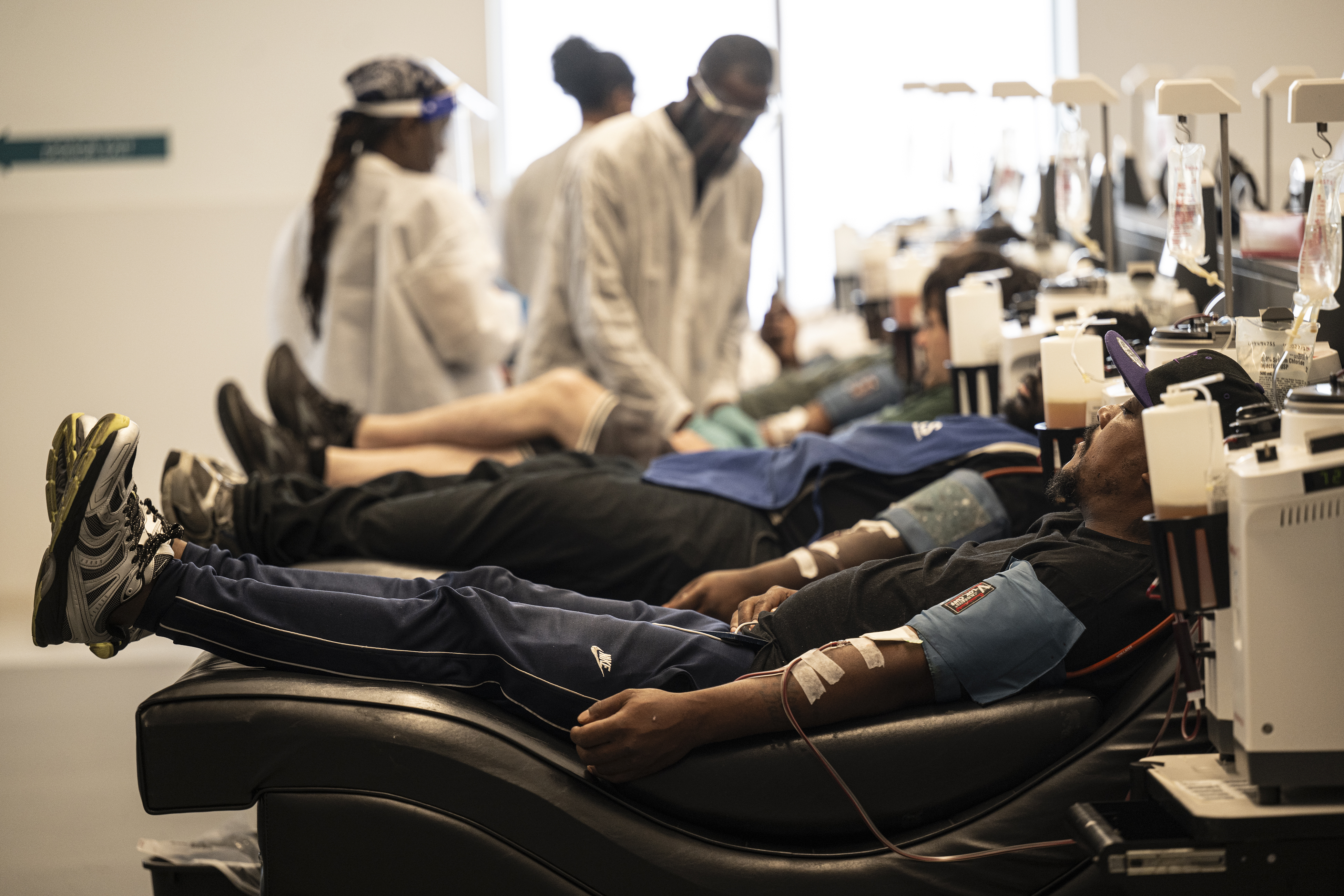
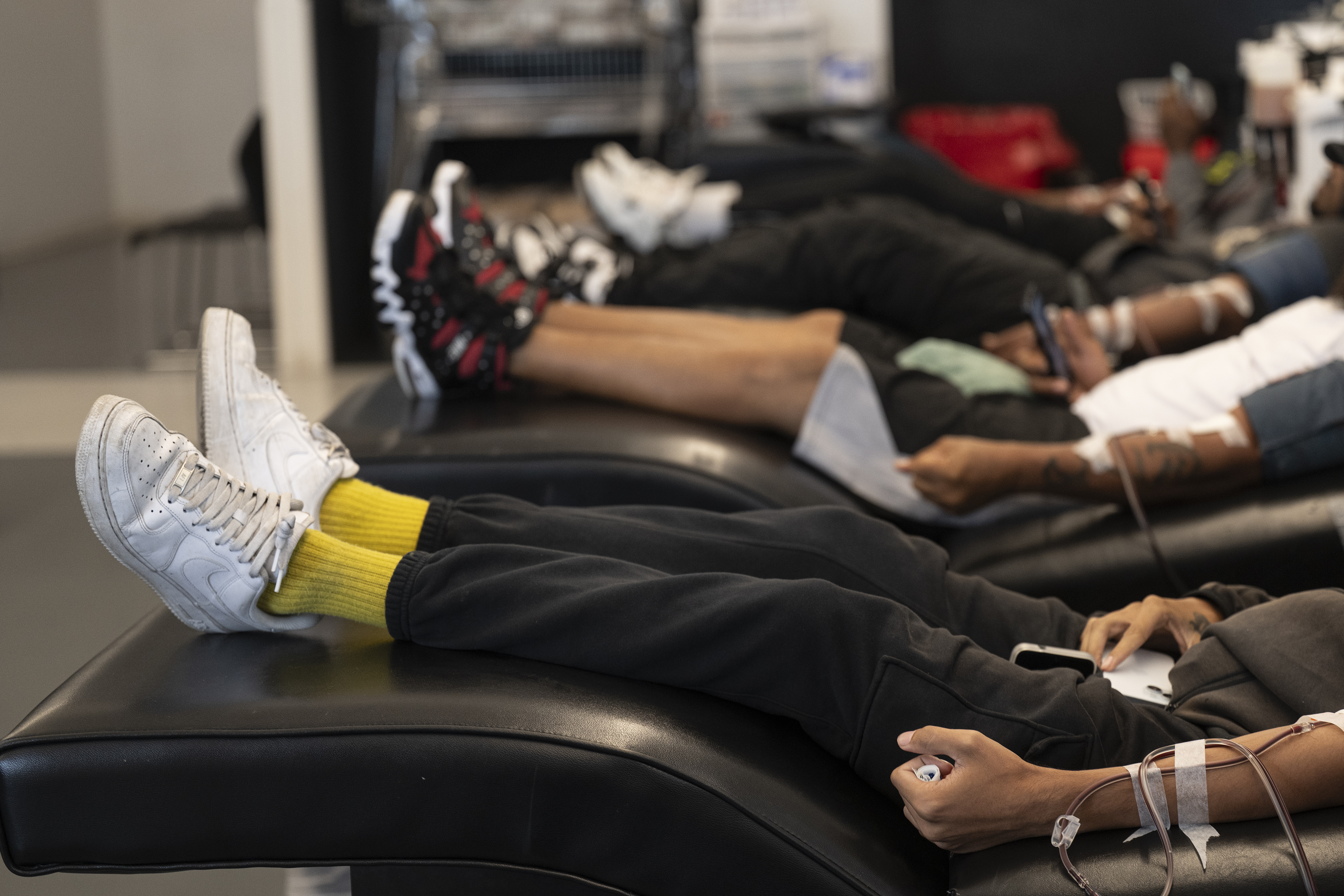
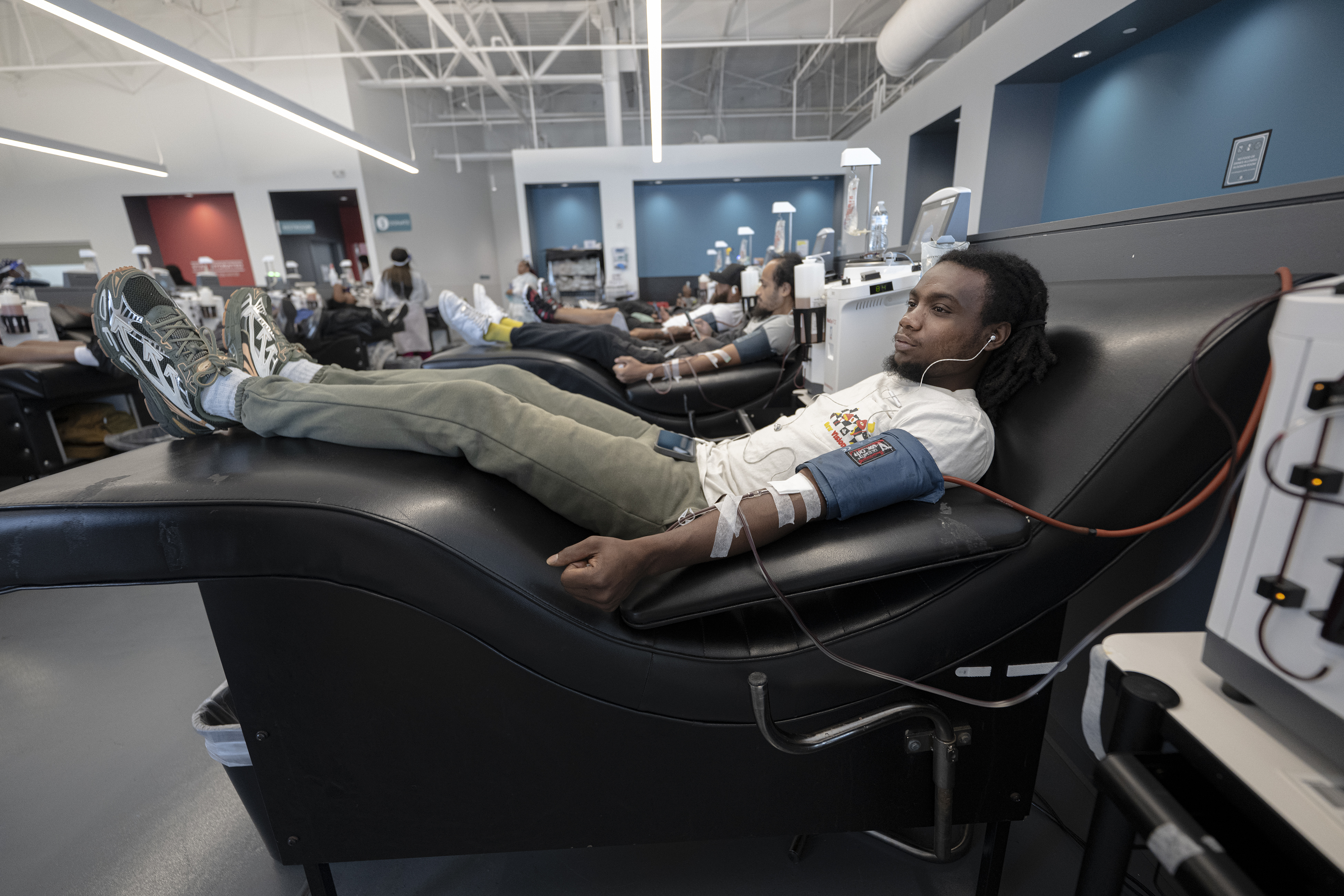
    An increasing number of people in the Philadelphia region are selling their blood plasma for money. Here, local donors sit in recliners with needles in their arms at B Positive Plasma in Montgomery County.Jose F. Moreno / Staff Photographer

    The U.S is one of about a dozen countries where it is legal to pay donors for plasma. It is among only three countries where people are allowed to donate two times over seven days, though not on back-to-back days, per U.S. Food and Drug Administration regulations.

    Nearly 70% of the world’s plasma comes from donors in America, fueling a multibillion-dollar global industry. Plasma, a straw-colored liquid in blood, contains antibodies and other proteins used for treating a wide range of patients with immunodeficiencies, neurological conditions, kidney disease, and bleeding disorders.

    Last year, U.S. donors produced 62.5 million liters of plasma — the highest volume ever collected and an 8% increase from the previous year. That trajectory has continued into this year, according to Georgetown University professor Peter Jaworski.

    Plasma donation has become a side gig, like driving for Uber or DoorDash, said Jaworski, who studies the global economics and ethics of the plasma industry.

    He characterized it as a “shadow safety net.”

    “When the price of most staples goes up, so does the amount of plasma donations,” Jaworski said. “If I fell on hard times, the very first thing I would do is become a regular plasma donor.”

    An extra $520 a month

    Donating plasma is widely considered low-risk, with millions of people doing it each year without reported health problems. However, the long-term health effects of donating twice weekly for years have not been well-studied. Safety concerns raised by the deaths of two people in Canada who had recently donated at for-profit clinics run by the healthcare company Grifols have prompted an investigation there.

    In the U.S., an FDA investigation into 34 deaths of people who had donated plasma between 2016 and 2020 did not find a link between donations and fatalities.

    Some donors experience lightheadedness, fatigue, bruising, bleeding, or dehydration. Drinking water and eating foods high in iron and protein can help alleviate those side effects, according to U.S. health guidance.

    Security guard Danny Morales of North Philadelphia said he feels “tired” after donating. But that has not deterred him from heading to CSL Plasma in the city’s Olney neighborhood twice a week, as soon as he finishes his overnight shift at 6 a.m.

    Morales can earn $520 a month donating plasma, which helps to offset rising expenses that have the 35-year-old father feeling ever more drained: The cost to fill up his Honda Civic’s gas tank jumped from $30 to $80 in the last year; a package of ground beef increased by $8; and even the brand of mac and cheese that his 8-year-old daughter and 2-year-old son enjoy costs about $1 more, he said.

    “It’s just getting worse and worse,” said Morales, whose plasma donations supplement his $18 hourly security job wage. “Stuff is just getting so expensive. Groceries are ridiculous.”

    CSL opens at 6 a.m., but a line starts to form around 4:30 a.m. In late July, it snaked past the building, wrapping around the corner. The sight caught the attention of nearby Olney resident Tony Reed.

    “There’s always a line there, especially toward the end of the month and definitely on Monday mornings,” Reed said. “People are broke.”

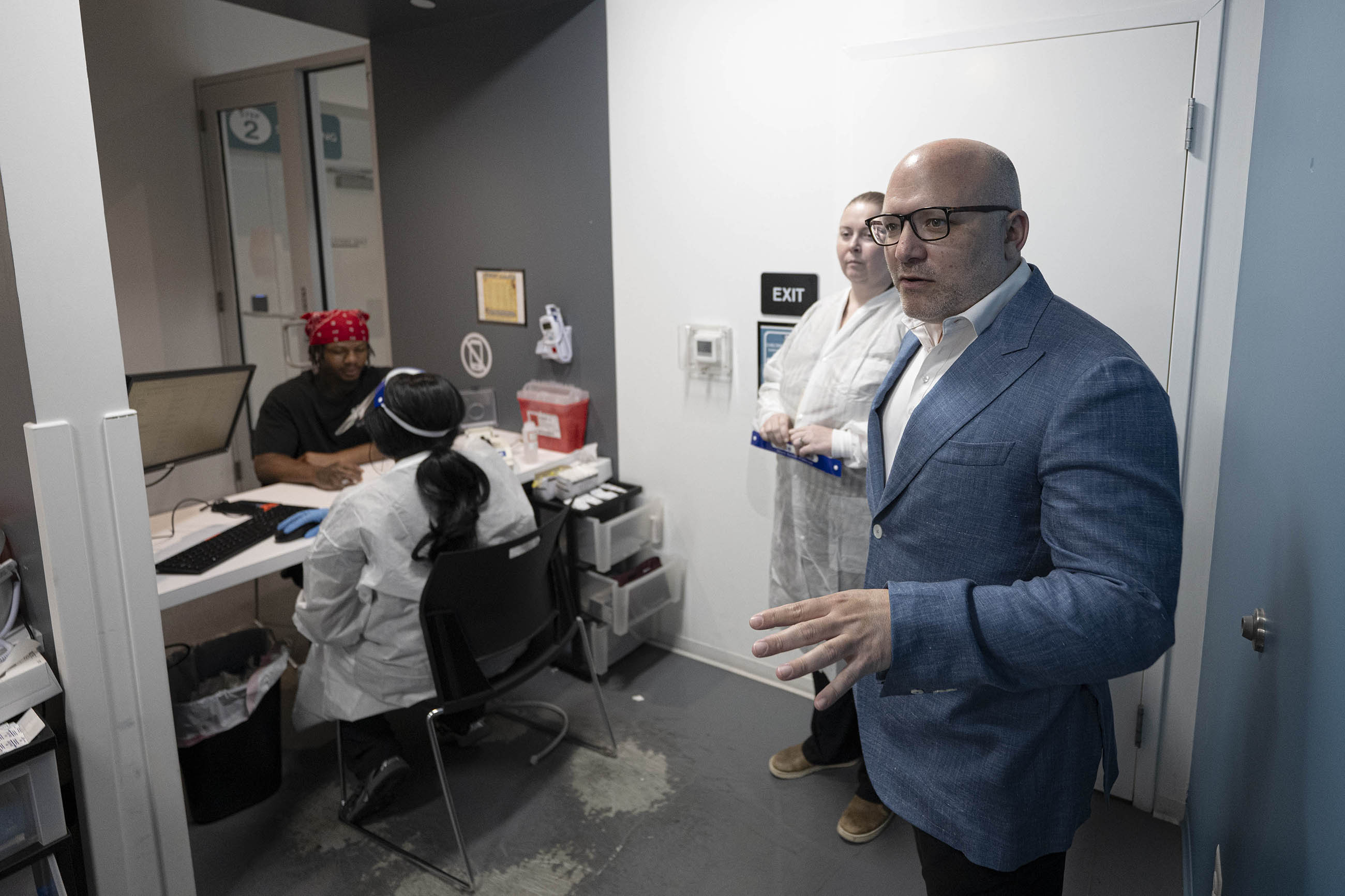
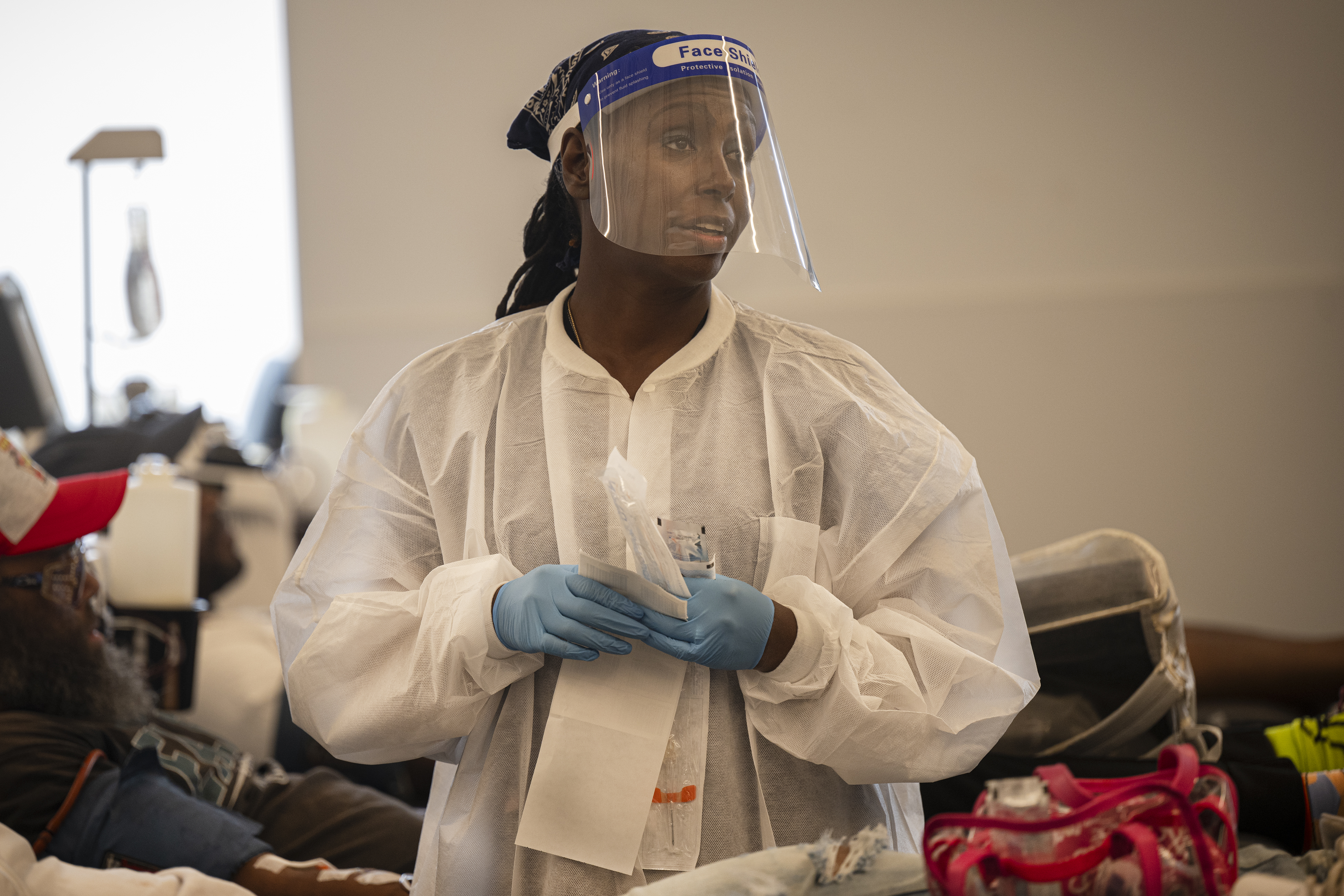
    Ben Ruder, CEO and founder of B Positive Plasma, and Pearl Dixon, an assistant manager and phlebotomist, explain the donor intake process. Each donor fills out an extensive health questionnaire, undergoes a medical exam, and gets a finger prick to test their blood for iron and protein levels. Jose F. Moreno / Staff Photographer

    Inside the booming industry

    On a recent Wednesday afternoon at B Positive Plasma in Montgomery County, a steady stream of donors checked in at kiosks in the lobby.

    After filling out an extensive health history questionnaire, each new donor undergoes an on-site medical exam by a licensed practical nurse. Repeat donors must get annual exams. At each visit, a medical tech checks their vitals, including blood pressure, pulse, and temperature, and performs a finger prick to test their blood for protein and iron levels. Donors must weigh at least 110 pounds.

    “We make sure they’re healthy and well,” said Ben Ruder, founder and CEO of B Positive Plasma, noting that the plasma itself is tested for HIV and hepatitis B and C before being sold.

    Next, plasma donors are hooked up to a machine that draws out blood, spins off the plasma, and then returns the red blood cells back to the donor, a process that typically takes 45 minutes to an hour.

    At 2 p.m., 18 of the 24 cushioned recliners at the Wyncote location on Cheltenham Avenue were occupied by donors, each with a needle in one arm. They included a Philadelphia police officer who had donated more than two dozen times since May 2025; a casino cleaner who earns $120 a week donating to support his young daughter; and a home health aide who donates twice a week to help cover his $750 monthly apartment rent.

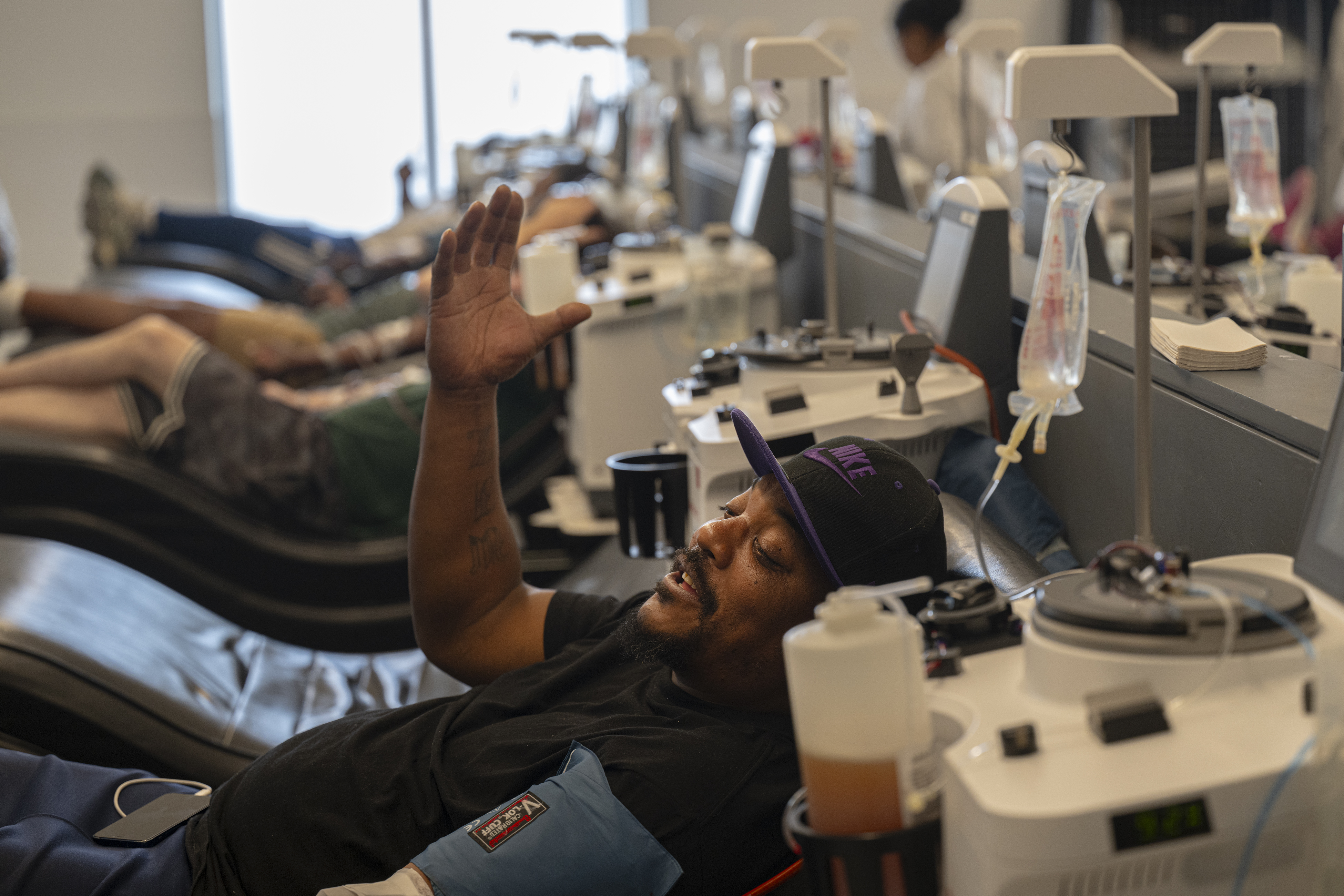
    Jason Johnson, 29, of East Mount Airy, has donated plasma 68 times at B Positive Plasma in the past two years. He makes an extra $120 a week donating twice weekly. The money helps supplement the $17.80 an hour he earns as a cleaner at Live! Casino & Hotel Philadelphia. “In the beginning, I was doing it for the extra money, but once I learned that I’m helping people out in their life, it made me want to come back even more,” Johnson said. Jose F. Moreno / Staff Photographer

    Plasma donation differs from whole blood donation, a faster process that relies on unpaid volunteers who can donate only once every 56 days in the U.S.

    B Positive Plasma is on track to see a record year, with 180,000 donations, peaking this holiday season, when people need extra money for gifts. Last year, the company saw 150,000 donations at about 1 liter per person.

    Ruder, 42, who lives in Center City, opened his first plasma donation center in Cherry Hill in 2012 and rapidly expanded to 12 locations in New Jersey, Pennsylvania, and Delaware. He plans to open two more sites in Maryland next year and another in Allentown later this year.

    B Positive Plasma, like other plasma companies, structures payments to incentivize twice-weekly donors. For instance, donors whose weight and physical health yield the maximum amount of plasma — 1,001 to 1,200 milliliters — will receive $45 for the first visit and another $90 if they return that same week. Plus, the company offered a $50 bonus for anyone who donated eight times in August.

    Donyele Wilkins, 48, a phlebotomist and medical assistant, works in the donation room at the B Positive Plasma in Montgomery County. She suffers from lupus, a chronic autoimmune disease for which she receives plasma-derived infusions to control her symptoms.Jose F. Moreno / Staff Photographer

    Phlebotomist Donyele Wilkins works 12-hour shifts, four days a week, at B Positive Plasma.

    For Wilkins, the paycheck is not the only benefit of working there.

    The 48-year-old Northeast Philadelphia resident suffers from lupus, an autoimmune disease in which the body’s immune system attacks its own tissues and organs. Wilkins said she relies on plasma-derived medication, infused through an IV every four to five months, to help control symptoms like inflammation and joint pain.

    Knowing how plasma is processed makes her feel “safe,” she said. She also likes getting to know “the regulars” who donate.

    “It makes me feel like I know exactly where it’s coming from, and I know the people who are doing it,” Wilkins said. “A lot of them really need the money, so they’re helping me, on top of me helping them.”

    ‘Blood money’

    Paying donors for plasma has sparked ethical debate, with some accusing the industry of exploiting poor people.

    In her 2023 book, Blood Money: The Story of Life, Death, and Profit Inside America’s Blood Industry, Kathleen McLaughlin, a Montana-based journalist, found that donors in many U.S. regions are disproportionately Black and brown people.

    McLaughlin, who has a rare autoimmune disease treated with monthly plasma-derived infusions, said today’s rise in donations is “a symptom of our broken economic system.”

    While the FDA regulates health safety at plasma centers, the pay rate is set by the companies, McLaughlin found. She thinks donors should be paid more and the amount should be standardized.

    “Right now, it’s a capitalist free-market system, where the pricing isn’t transparent,” McLaughlin said. “The profit margins are crazy for these plasma companies, and it’s gamified to make you donate twice a week, every week, in perpetuity.”

    Jaworski, the Georgetown University professor, said donors are compensated fairly. A donor who sits for an hour and a half makes “significantly more than” New Jersey’s $15.92 minimum hourly wage and Pennsylvania’s $7.25. Plus, he stressed, donors save “hundreds of thousands of lives.”

    Wallace Smith, 45, of Upper Darby, prides himself on making an honest living. He earns $15 an hour as a home health aide. He makes an extra $130 a week selling his blood plasma. The money helps cover cigarettes, rent, and his phone bill. Jose F. Moreno / Staff Photographer

    Recently published research suggests that communities can benefit when a new plasma center opens, because fewer young people take out high-interest payday loans and area crime drops, mostly driven by decreases in property and drug-related offenses.

    “It helps you from having to do something wrong,” plasma donor Wallace Smith said.

    When Smith was in his late 20s, he got arrested for selling drugs. Now 45, he is still struggling to find a job that pays a living wage, he said.

    Smith, of Upper Darby, works three days a week, earning $15 an hour, as a home health aide. He earns $130 a week donating plasma, which helps pay for cigarettes, his phone bill, and rent, he said.

    Like many donors, Smith said he likes the win-win of earning extra cash and helping patients who depend on plasma.

    “They say there’s a job’s out here for everybody, but when you become a person who made mistakes in life, then they look at your background, so there’s only certain jobs you can do,” Smith said as his blood flowed into a spaghetti-thin clear tube at B Positive Plasma.

    “With that being said, you don’t go back to your old ways,” he said. “You find better resources like this.”

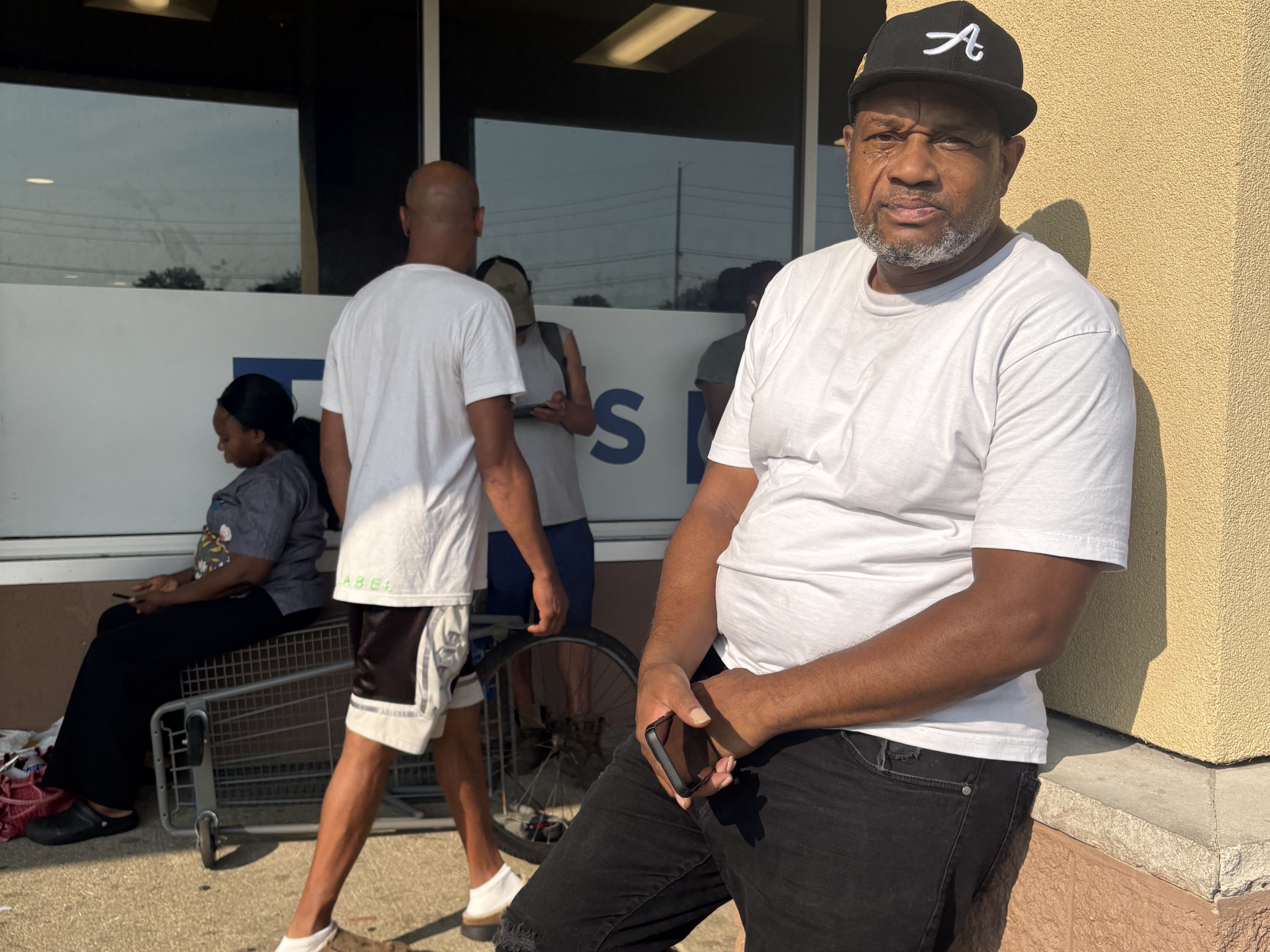
    On a hot August morning, donors line up outside Octapharma Plasma in South Jersey to sell their blood plasma for money. They arrive before the doors open at 9 a.m. to beat the wait. Donor Carl Davis, 56, of Camden, donates every Saturday and Monday, earning $70 each time. The extra money helps supplement his $900 monthly Social Security Income disability check. “I get SSI disability, but it’s not enough at all to pay my bills and buy food,” Davis said.Wendy Ruderman

    Beach boardwalk fun

    At Octapharma Plasma in South Jersey, the wait time can be as long as three hours, donors said. When a sewer pump broke and bathrooms stopped working earlier this year, the company trucked in a row of porta-potties to accommodate donors and staff.

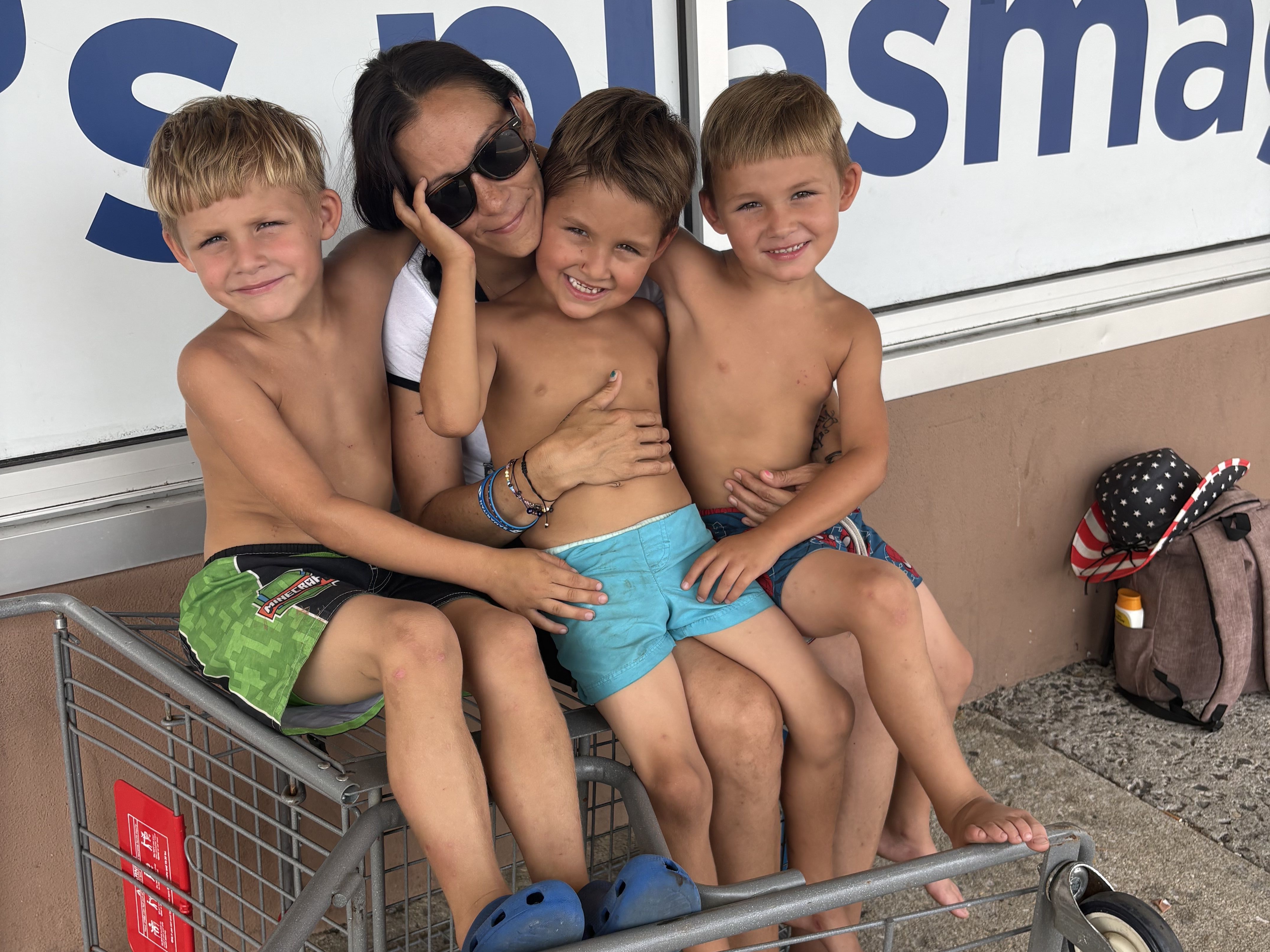
    On a recent August morning, Brittany Barr, 36, and her three sons — 5-year-old twins and a 6-year-old — waited outside Octapharma as her husband donated. The family had walked roughly two miles from their Gloucester City home.

    When Barr learned her friend had kidney failure and needed plasma infusions, she wanted to help. Barr was unable to donate plasma because she is anemic, so her husband agreed to do it.

    In the month since Barr’s husband started donating, the family has earned more than $500. It has helped with groceries and their phone bills to supplement her husband’s income as a shipping manager.

    “With only one income, money is tight these days,” Barr said. “Everything is messed up.”

    The boys, clad in their bathing suits, climbed up on Barr as she sat on a tipped-over shopping cart. They were headed next to Atlantic City for a beach day.

    “This week, the money is going toward fun. They’re going to play arcades and have ice cream or whatever their little hearts desire,” Barr said. “Next week, it’s going to school supplies.”

    Brittany Barr, 36, seated with her boys (from left) Cooper, Cannon, and Colton, waits outside for her husband to finish donating plasma at Octapharma Plasma in Audubon, N.J. The family from Gloucester City was next headed down the Shore, where they planned to spend the extra money earned from donating plasma on arcade games and ice cream.Wendy Ruderman / Staff
  • Universal Health Services wants to create something new with Talkspace acquisition

    Universal Health Services wants to create something new with Talkspace acquisition

    Universal Health Services Inc. has long dominated as the nation’s largest provider of behavioral health services through its network of 182 hospitals and 110 outpatient facilities.

    Last week, the King of Prussia company added a new dimension, completing the acquisition of Talkspace Inc., a virtual behavioral health company, for $835 million. It was UHS’s biggest deal in 15 years.

    “We look at this as a real significant moment for healthcare,” UHS CEO Marc D. Miller said in an interview Tuesday. “It’s not simply a transaction for the company, but creating something in behavioral health that hasn’t existed.”

    UHS’s goal is to create what Miller described as a new mental health continuum of care — including an AI agent introduced in June with human oversight and immediate intervention by licensed clinicians for safety if needed.

    Talkspace’s network of 6,000 therapists conducted 933,000 treatment sessions with patients covered by insurance or employee assistance plans in the first half of this year. It had an additional 5,000 active patients who paid directly for the service during that period, according to Talkspace’s quarterly report.

    The New York-based company reported $123.4 million in revenue and a $7.8 million net loss for the first six months of 2026.

    UHS’s behavioral health arm had $3.9 billion in revenue and $773 million in profit before taxes in the six months that ended June 30. Philadelphia-area facilities include Friends Hospital in Philadelphia, Horsham Clinic in Ambler, and KeyStone Center in Chester.

    UHS also owns the largest behavioral health company in the United Kingdom. Including its 30 acute-care hospitals, UHS’s six-month revenue totaled $9.1 billion.

    The Inquirer spoke with Miller about how Talkspace is expected to complement UHS’s current business. This interview has been lightly edited for length and clarity.

    What made Talkspace attractive to UHS?

    By acquiring Talkspace for UHS, we’re creating the industry’s first nationally scaled end-to-end connected continuum in all of behavioral healthcare. Nobody has what we now have. For example, you can go to Talkspace to get treatment on your phone through the app, access therapists wherever you are, whatever’s comfortable for you. The vast majority are patients that UHS never would have touched.

    Now, they’re going to know about UHS, so it would be natural that if they need excess care after they’ve had some care with Talkspace, they’re going to immediately be referred to all of the different options that UHS offers. On the flip side, we’re now going to have this Talkspace option after somebody’s either in one of our more intensive outpatient programs or an inpatient, so we can quickly say, as part of your aftercare, you might want to go to Talkspace, which is a subsidiary of UHS.

    The concept makes sense. How do you make it work?

    It’ll be totally integrated. Most of the insurers that they’re contracted with we’re contracted with, so there won’t have to be huge changes. There are some different contracts, and there will certainly be some things to work out, and there are some small pockets where they’re with somebody that we’re not. But for the most part, that’s not a big concern.

    As far as the referral networks, we’re just doubling what we have. So there’s the current referral networks that go into UHS. There’s the current referral networks to Talkspace that are vastly different.

    We’re now going to put this together, and we’re going to kind of double up the opportunities to both companies. It’s incredibly positive.

    Talkspace’s AI agent Tee has gotten attention. Why is it different from using ChatGPT or Claude like a therapist?

    Tee was purpose-built for mental health. Rather than just adapting a general purpose chatbot to a clinical context, this was built for this. That’s a huge difference. This was built by mental health experts who had safety and privacy in mind, and it was designed to complement human care.

    People right now are going to ChatGPT and Claude and all these things and asking them questions that are totally disconnected, totally disjointed from any care they could be getting. If they’re not getting care, they’re really relying on something that is not expert to help them in a most serious endeavor.

    Editor’s note: This article has been updated to correct UHS’s revenue and profit for the six months that ended June 30.

  • A mother has spent years caring for her special-needs child. The toll quietly grew.

    A mother has spent years caring for her special-needs child. The toll quietly grew.

    RANCHO CORDOVA, Calif. — Annie Morgan wrapped her arms around her eldest daughter’s waist and guided her toward the minivan, the two of them moving in a slow, sideways shuffle.

    At 13, Ava was nearly as big as Annie, who stands just 5 feet flat, 110 pounds.

    The morning in May had started well. Ava was cooperative and calm, and Annie, 34, smiled as her two other children bolted past them and into the car. Then something shifted. As Annie helped Ava into the vehicle, Ava wailed and slammed her body against the seat. The car rocked.

    “Gentle hands,” Annie said evenly. “We’re OK. We are still going to school.”

    The struggle lasted six minutes: long enough for Annie to tighten one belt, then another. Long enough to block a blow to the head, catch Ava’s hands and dodge them when she couldn’t. Long enough for sweat to gather across Annie’s forehead and beneath her shirt.

    When she finally settled into the driver’s seat, the clock read 7:49 a.m. Still on time for school (basically).

    In one form or another, scenes like this unfold every morning in millions of American homes. Sons and daughters lifting aging parents out of bed. Spouses managing medications. Parents helping adult children get dressed.

    Family caregivers — who provide ongoing support for children or adults with chronic, disabling, or serious health conditions — now number roughly 63 million Americans, up from 43.5 million a decade earlier. That’s based on a nationally representative survey conducted in 2025 by AARP and the National Alliance for Caregiving, and represents about 1 in 4 adults. Just over 60% are women. The Centers for Disease Control and Prevention has documented a similar burden through its own surveillance programs. Together they provide countless hours of unpaid or modestly reimbursed care each year, work that would cost hundreds of billions of dollars if replaced by paid labor.

    Health Secretary Robert F. Kennedy Jr. has called caregivers “the foundation of America’s healthcare system,” warning that without them hospitals and nursing homes would buckle under the demand.

    But decades of shifting norms around caregiving have given rise to millions of new caregivers who are suffering elevated rates of depression, anxiety, burnout, and suicidal ideation, as well as a range of physical conditions.

    Only recently has the toll of caregiving begun to register as a public health problem in its own right. The National Institute on Aging has backed new technologies aimed at easing caregiver burden, including AI tools, and in February a Department of Health and Human Services’s Administration for Community Living document framed the strain as a national infrastructure issue.

    That enormous, largely invisible workforce is in part due to an aging population, rising rates of chronic disease, and one of the most consequential shifts in U.S. social policy of the past half-century.

    The United States has steadily moved away from housing people with disabilities in large institutions and toward a model centered on families and community life. The shift, which accelerated in the 1980s and 1990s, represented a profound change that allowed people who once would have spent much of their lives segregated from society to be part of their communities.

    There was the promise of government support: respite care, behavioral services, trained aides, accessible schools, and robust community programs that would make family-based care sustainable. But today many of those systems remain fragmented, understaffed, or difficult to access. Families became the foundation of the new model, and things haven’t turned out well for many of them.

    Teenagers

    Ava is 14 now. With her long, light-brown hair braided in the latest styles and a wardrobe of T-shirts and lightly ripped jeans, Ava, who is starting ninth grade this fall, blends easily into a crowd of teens. She loves Costco muffins, squeeze yogurt, slime, and any music with a strong beat, from Aretha Franklin to Bollywood soundtracks and beyond. She loves Disney’s Zombies, the Gen Z/Alpha version of High School Musical.

    It’s only when she speaks — or rather, doesn’t — that the difference becomes clear.

    Ava communicates through points and sounds, due to a rare, genetic nervous system disorder that affects roughly 1 in 15,000 people.

    Angelman syndrome is caused by the loss of function of a gene known as UBE3A on Chromosome 15. Most cases occur randomly and are not inherited.

    The condition is often mistaken for autism, and from the outside the two can look similar. They are not. Autism encompasses a broad spectrum: Some people require lifelong support, while others build careers, marry, and live independently. Angelman syndrome follows a more predictable pattern, marked by severe developmental delays, intellectual disability, and lifelong difficulties with balance and movement.

    In the early years, Annie held on to the possibility that science might somehow alter Ava’s course. She followed promising research, sought out specialists across the country, and enrolled her daughter in a clinical trial involving gene therapy. Nothing changed.

    As Ava grew older, the distance between the life Annie once had imagined for her and the life they were living became harder to ignore.

    When puberty hit in Ava’s preteens, her sweetness was increasingly punctuated by moodiness, and she became more physical. Other girls her age were experimenting with makeup, talking about crushes, navigating the awkward rituals of adolescence. Ava had chew toys, cloth books, and diapers.

    Annie found herself looking back at those same years in her own life — a time defined, above all, by movement.

    Dance had been the organizing force of Annie’s childhood. Raised by her grandmother because illness had left her mother unable to care for her, she spent her afternoons moving from ballet to jazz to tap. By high school, she had made the dance team. Then, during her senior year, she showed up at an open audition for the Oakland Raiders cheerleading squad.

    She remembers stopping at a Safeway for false eyelashes and finding a dress at Forever 21, then walking into an audition room filled with women who seemed impossibly polished. Somehow, she made the team.

    Annie cheered for two seasons. Then she became pregnant with Ava, bringing her time with the Raiders to an abrupt end. Not long after, she and Ava’s father separated.

    One day, on the drive home from visiting a friend in the Bay Area, Annie glanced in the rearview mirror. Ava, who was about 18 months old at the time, was slumped in her car seat, frighteningly still. Annie pulled off the freeway and rushed her to an emergency room.

    Ava had had a seizure, the doctors told her. The harder news was why.

    Love

    Not long before Ava was diagnosed, Annie had ventured back into dating. At the urging of her co-workers at the restaurant where she was working as a waitress, she was scrolling through Tinder one day when a message popped up from a guy she thought was cute.

    His name was Daniel, he was working as a personal trainer, and like her he came from a mixed ethnic background. She was a mix of Italian, Puerto Rican, Mexican, and Native American; he, Spanish, Irish, Scottish, German, and Native American. Like Annie, he considered himself nondenominational but took his Christian faith seriously: Their second date was at church. What stood out most, though, was his kindness. He was patient with Ava. Thoughtful toward strangers.

    Four months later, Daniel proposed. Annie wanted to say yes but hesitated.

    She worried about future children. Angelman syndrome is almost always not inherited, but Annie wondered if something in her had led to Ava’s condition. Daniel told her it didn’t matter.

    Annie Trujillo and Daniel Morgan, then 24 and 25, were married on a sunny day in October 2016 at a winery to Celine Dion’s “The Power of Love.” Ava was 4 at the time, and the couple went on to have two more children, a son, Brody, now 7, and a daughter, Naomi, now 4.

    What no one saw

    When Ava was young, Annie and Daniel tried to keep a semblance of an ordinary life. There were playdates and birthday parties, afternoons at the pool, Sundays at church. They packed the walker and whatever else Ava needed and went.

    Daniel shared the work when he was home. But as his career working for the state of California’s housing department took off, he was increasingly on the road, sometimes for a week at a time. And taking Ava out was becoming more complicated. Leaving the house became a logistical operation, necessitating contingency upon contingency in case Ava swept food and plates off a restaurant table, bolted, or began screaming. Annie learned to keep one eye on her daughter and another on the room, gauging the expressions of strangers and deciding when an explanation — or an apology — was necessary.

    Gradually, it became easier to stay home.

    There, Annie’s days acquired their own relentless rhythm.

    She was often up before 5 a.m., preparing food and medications, dealing with paperwork, getting Ava ready for school. After drop-off came the calls: a prescription that needed filling, a therapy that needed scheduling, a specialist to chase down. When Ava got a new version of her communication device, Annie had to learn that, too. A broken wheelchair could mean an afternoon fighting with the insurance company. A problem at school could erase whatever Annie had planned to do that day.

    By 9 p.m., sometimes later, she would fall into bed.

    At night, practical worries would give way to larger ones.

    Annie worried about whether Ava was safe at school and whether she could keep her safe at home. She worried about the future. Ava was becoming a striking young woman without acquiring the ability to recognize all the dangers that came with being one. Annie had read stories about the sexual abuse of disabled women in institutions. Sometimes they kept her awake. What would happen to Ava when she and Daniel were gone?

    She would wake up a few hours later and start again.

    The family receives some caregiving support through Medi-Cal, California’s Medicaid program, and other state programs, including a few hours of weekend care and financial support for caregiving. But it hasn’t been enough, and recently Trump administration officials, including Mehmet Oz, who oversees the Centers for Medicare and Medicaid Services, have questioned Medicaid programs that pay relatives to provide care and have subjected in-home services to increased scrutiny over alleged fraud.

    Annie spent less time wondering what might become of her own life. Every so often, though, she tried.

    She trained to sell tiny homes as the market expanded across California, considered starting a consulting business, launched a podcast called “Blessed for This Mess,” enrolled in nursing classes, and brainstormed furniture designed for children with disabilities. Each new venture offered, briefly, a glimpse of a life that belonged to her as well as to everyone who depended on her. Then something would happen: a medical emergency like a seizure, a crisis at school, a bureaucratic fight that could not wait. Annie would turn her attention back to Ava.

    ‘Who takes care of the caretakers?’

    In the summer and fall of 2023, Annie’s already crowded world of caregiving had expanded again. Her mother was in the hospital with an infection; her uncle had suffered a heart attack. Alongside caring for her three children, Annie began running errands and tending to the small necessities that accumulate when someone else can no longer manage them alone.

    Daniel was accustomed to finding ways to make things work. But this was a time when even he ran out of answers. At Ava’s medical appointments, Daniel began asking what he could do to help Annie. The advice rarely went beyond the familiar: Make sure she rests, takes care of herself. He asked about classes, training, anything more concrete. “Who takes care of the caregivers?” he remembers asking. “There’s no one. How does that make sense?”

    When people ask how they are doing, Daniel, now 35, said, “We always say we are doing awesome, but it’s such a lie.”

    On the hardest nights, after their children were asleep, he and Annie would retreat to the bathroom at the far end of the house. They would slide onto the floor, hold each other and cry.

    Driving alone sometimes, Annie found herself having thoughts that frightened her.

    “I thought, what if I just hit the accelerator and turned the wheel a little …” she recalled.

    The thoughts were less about death than escape. She wanted to live but could no longer imagine how to keep living this way.

    One night in November of that year, she walked into the bathroom, grabbed Daniel’s clippers and shaved off her long brown locks. Looking back, she said she can see the panic on his face at that moment. But at the time he just offered to help, and she politely declined, saying it was something she needed to do on her own because it was “on my bucket list.” The gesture solved nothing. But for a few moments it gave her something she had not felt in a long time: control.

    That Christmas, she downed too much wine, which was very unlike her, and broke down in front of her extended family: “I can’t do this anymore.”

    Not long afterward, a cousin, who is a nurse, called to check on her. “Do you have hope for the future?” she asked, a question medical professionals often use to screen for thoughts of depression or worse.

    Annie didn’t answer.

    Instead, she began to sob.

    Dance parties

    Annie’s cousin helped her find a therapist. She went for about a month. She wasn’t opposed to therapy but left each session frustrated by explaining a world the therapist couldn’t quite see.

    She couldn’t change anything related to Ava’s care, but she could change other things.

    The way back was less a breakthrough than an accumulation of small decisions.

    Annie began dancing again. She signed up for poms, jazz, and funk classes in Sacramento and danced at home with the children, telling Alexa to play Meghan Trainor or Taylor Swift and spinning down the hallway.

    “It felt poetic,” she said. “When I dance even a little bit, I’m showing up for the younger version of me.”

    Other changes were almost comically small: She warmed her pillow with a heating pad before bed, made time for a skin care routine. She learned to let things go, pulling her younger children out of afternoon jujitsu classes and finding that they delighted in their unprogrammed ’90s-style afternoons even better.

    Because Ava’s condition made travel impossible, Daniel helped Annie build a life that asked less of the outside world. Their weekends filled with tending blueberry bushes and olive trees and decorating projects.

    Annie had also begun posting pieces of her life on Instagram and TikTok. Most attracted little notice.

    In April, one of them, about their school-morning routines, took off.

    The video begins with Annie braiding Ava’s hair. Without warning, Ava throws her head backward and strikes her mother in the face. Annie recoils, then keeps going.

    “You’re giving your best,” she tells the camera. “But some days it just gets you. And today was one of those days.”

    The video eventually drew 7.7 million views and more than 228,000 likes.

    Soon, Annie was hearing from parents, caregivers, and people with disabilities she had never met. “Feeling seen,” one person wrote. Another commented, “I’ve never seen another family actually show this side of it.”

    Some others criticized and judged. She tried not to be upset about those, she said, “For the communities that don’t live this life or have access to it … those communities were seeing a reality that they’ve never seen.”

    The platform did not solve Annie’s problems, but it eased her isolation.

    Annie kept posting.

    ‘Going to war’

    On a recent weekday morning, Annie set up her phone in the living room and hoisted a 25-pound bag of Costco’s Kirkland jasmine rice onto her back.

    She began squatting. The bag lurched slightly with each movement.

    “It’s better than weights,” she said, turning toward her phone, which was on a tripod. She explained that unlike a dumbbell, the rice shifted unpredictably, more like a squirmy teen.

    The clip would later end up on TikTok, where Annie now posts several times a week.

    “I look at it as I’m going to war with the syndrome that is trying to burn me out,” she said.

    Annie knows there are decades of caregiving ahead. Increasingly, she finds herself wondering where Ava’s siblings will fit into that future — whether Brody and Naomi will one day help care for their sister. For now, they are only beginning to understand that Ava’s life is different from theirs.

    Brody, a lighter-haired version of his father, is the chill, protective one.

    Naomi takes after Annie. Headstrong and constantly in motion, she is always asking questions. One recent weekend, Brody and Naomi were going to spend a few hours with Daniel’s parents. Ava wouldn’t be joining them. As Annie and Daniel explained the plans, Naomi asked, “Why does Ava have to go to daycare?”

    The evening routine is difficult with Ava even on good days.

    First comes the bath. Then clean clothes. Eventually, Ava is zipped into a specialized safety bed, an essential hand-me-down from another family because Ava tends to wander at night and is unsteady. In October, she sprained both ankles after sliding out of the bed.

    On a recent evening, the trouble started after the bath.

    As Annie tried to help Ava into her back brace — she has scoliosis — and pajamas, Ava became agitated. She screamed, pulled Annie’s hair, tried to bite. Daniel came running over. The two of them wrestled with Ava to keep her from injuring herself while they finished getting her dressed.

    When it was over, Ava began to cry. Annie did, too.

    She pulled her daughter close and closed her eyes. When she opened them again, Ava’s face was still wet with tears, but she was also smiling.


  • 3 things about the brain that actually get better with age

    3 things about the brain that actually get better with age

    When people think about getting older, many picture an inevitable decline in health.

    But that isn’t always the case. You can improve with age, both mentally and physically. This mindset may even be beneficial; having negative ideas about aging is linked to worse health outcomes, almost like a self-fulfilling prophecy.

    While the aging process, like life as a whole, varies from person to person, research shows that there are aspects of brain health that can actually continue improving well past your midlife. Here are three examples of the silver linings to going gray.

    Fewer regrets

    Living without regrets is a common maxim but an uncommon reality. About 90% of people say they have at least one major life regret, research shows.

    “Many of us might worry that we will reach the end of life and have these really big regrets that we can never resolve, and they may take some solace in knowing that that is a very, very common experience,” said Julia Nolte, an assistant professor of economic psychology at Tilburg University in the Netherlands.

    But getting older seems to lessen both the sting and the frequency of regrets.

    In a recent study published in the journal Emotion, Nolte and her colleagues analyzed how age affected feelings of major regret in 90 adults ranging in age from 21 to 89. Older adults reported they had fewer major regrets within the past year than younger adults. In fact, older adults were more likely to say they didn’t have any recent regrets. And when older adults did have a major recent regret, they were less likely to be about relationships or their dealings with other people.

    In older adults, major regrets both recent and lifelong were more likely to be about missed opportunities or the road not taken. Also, older adults had fewer “hot” emotions such as anger or frustration in response to thoughts of what might have been.

    “Older adults tend to be more likely to say, ‘I don’t have recent big regrets,’” and when they do, the negative emotions are less impactful, said Nolte, who conducted the study when she was a psychology graduate student at Cornell University. “I think that that’s something to look forward to and to help decrease these age-related negative stereotypes a lot of us carry.”

    More knowledge

    As you age, you might be more forgetful and slower at mental processing. But on average, older adults actually perform better on tests requiring knowledge or language.

    For example, adults in their 70s and 80s scored higher on vocabulary knowledge than those in the 20s, 30s, and 40s, according to a large 2019 study.

    Your ability to quickly reason through and adapt to new situations — called fluid intelligence — tends to peak in early to middle adulthood, around your 20s by some measures. But your ability to apply all your accumulated experiences, facts, and skills — known as crystallized intelligence — remains stable or continues to improve through the seventh decade of life, research finds.

    A 2022 study, which followed almost 9,000 adults for up to 18 years, found normal age-related decline of fluid abilities was still largely linked with increased crystallized abilities.

    As you get older, your hard-won knowledge and experience may still be growing.

    More wisdom

    Older people may not only continue to grow in knowledge, but also in wisdom.

    Wisdom is a complex personality trait that includes having empathy and compassion, as well as the ability to self-reflect, self-regulate, and accept different perspectives, said Dilip Jeste, a geriatric neuropsychiatrist and president of the World Federation for Psychotherapy, who has researched wisdom since 2008.

    Having higher wisdom is linked to better overall health and emotional well-being throughout the lifespan, research shows.

    There’s evidence that older adults on average measure higher than younger adults on different components of wisdom, including empathy, emotional regulation, and self-reflection, Jeste said.

    Not everyone who gets old is necessarily wise — there are many ready examples to the contrary. But by and large, “people who have these components of wisdom, as they get older, they tend to become wiser,” said Jeste, who wrote a 2025 review on wisdom and aging.

    For example, during the isolation and uncertainty of the COVID-19 pandemic, everyone felt lonelier. But unexpectedly, older people generally fared better with their mental health than younger people.

    When researchers asked why the older people had better resilience despite being at higher risk, “they said, we have been through problems like this before when we were growing up,” said Jeste, who wrote about this finding.

    And they had made it through.

  • AmeriHealth Caritas to invest $15M in a company that serves people with intellectual and developmental disabilities

    AmeriHealth Caritas, a Medicaid insurer based in Delaware County, has agreed to invest $15 million in Deon Health, a Michigan start-up that works with states and insurers to improve care for people with intellectual and developmental disabilities, the two companies announced Friday.

    Deon was founded in 2024 to work with local providers to help people with intellectual and developmental disabilities (I/DD) overcome the silos that make it hard to coordinate primary care, specialty services, behavioral health, and long-term supports needed to allow individuals to live in community settings.

    “We built Deon Health to create a better way to organize care around people with I/DD, their families and the professionals who support them every day,” Sara Ratner, chief executive of Deon Health, said in a news release. “AmeriHealth Caritas brings deep Medicaid experience and shares our commitment to a model built around strong local relationships.”

    Other investors in Deon include Town Hall Ventures, First Trust Capital Partners, and Difference Partners.

    Independence Health Group, the parent company of Independence Blue Cross, is the majority owner of AmeriHealth Caritas. Independence’s partner in the business is Blue Cross Blue Shield of Michigan. Among the nation’s largest Medicaid insurers, AmeriHealth Caritas has contracts in 13 states and Washington D.C.

  • With 89 new cases in a week, Pa. reports the nation’s third-largest measles outbreak

    With 89 new cases in a week, Pa. reports the nation’s third-largest measles outbreak

    Pennsylvania health officials confirmed 89 new measles cases in the state in the last seven days, an escalation of a rapidly growing measles outbreak now impacting more than two dozen counties.

    As of Thursday, Pennsylvania had reported the third-highest number of measles cases in the country for 2026, behind Utah and South Carolina, according to data from the Centers for Disease Control and Prevention.

    Delaware has reported 22 cases this year, the first time in a decade that the highly contagious disease has been diagnosed in state residents. New Jersey has confirmed just one case.

    In Pennsylvania, children made up about one-third of the 379 patients diagnosed with measles in two separate outbreaks so far this year, state officials say. None of the patients diagnosed with measles this year has been fully vaccinated.

    In all of 2025, the state reported just 16 measles cases.

    Lancaster County, with some of the lowest measles vaccination rates in the state, has been at the center of both Pennsylvania outbreaks this year. As of Friday, the county has tallied 181 cases.

    State officials warned earlier this week that the public may have been exposed to the disease on Aug. 4 and 5 at a soccer camp at Millersville University and on Aug. 12 at a Whole Foods in Lancaster.

    Chester County has the second-highest number of cases in the state, at 41; it is the only Philadelphia-area county to report cases in the current outbreak, which began in April.

    And cases are climbing in central Pennsylvania, with Centre County reporting 13 cases and neighboring Mifflin County reporting 25.

    State health officials said that 70 people, including 22 children, have been hospitalized with measles this year. That’s about 18% of the total cases reported.

    In August alone, state officials have confirmed nearly 200 new cases in Pennsylvania.

    The true number of cases is likely much higher, physicians and health officials in Lancaster and Chester Counties say.

    In Chester County, some residents have refused to cooperate with health workers looking to trace their contacts to understand how measles is spreading in the county, officials there have said.

    Local officials also worry about the spreading outbreak as many children return to school next week. Overall, about 93% of kindergarteners in Pennsylvania were vaccinated against measles, mumps, and rubella (MMR) in the 2025-26 school year.

    That’s just below the 95% “herd immunity” threshold, the level at which scientists say a given population must be immunized to prevent the spread of measles, which can infect nine in 10 unvaccinated people exposed to it.

    Analyses earlier this year by The Inquirer and the Pittsburgh Post-Gazette show pockets of vulnerability across the state, with hundreds of kindergarten classes reporting vaccination rates below herd immunity, putting students and communities at risk for an outbreak.

    Still, most Pennsylvania students are fully vaccinated and schools “benefit from robust community immunity that serves as a powerful barrier against the virus,” state health officials said in a statement.

    The state hosted medical briefings for nearly 1,000 school nurses over the summer to provide guidance on preventing measles as they prepare for the upcoming school year, officials said.

    Most measles cases resolve in weeks with mild-to-moderate flulike symptoms, but the disease is particularly risky for young children and can result in severe complications, including death.

    This year, Pennsylvania hospitals have treated adults with brain swelling and pneumonia, and children with dehydration or damaged organs from measles.

    State officials have stepped up vaccination campaigns in response to the outbreak, with health department staff dispensing more than 4,000 vaccinations in the state this year — and more than 1,800 in August alone.

    The department has held 85 pop-up clinics in affected counties since April and has scheduled “dozens” of additional clinics for the coming weeks and months.

    The state has also hosted briefings for healthcare providers on how to recognize and treat measles, and is recommending that doctors offer early vaccinations for children as young as six months old in affected areas.