Albert James Mamary, 59, of Wynnewood, attending physician and professor of thoracic medicine and surgery at Temple University, researcher, writer, mentor, artist, outdoorsman, craftsman, and amateur bicycling champion, died Thursday, July 9, of cholangiocarcinoma at Temple University Hospital.
A 1999 graduate of Temple’s Lewis Katz School of Medicine, Dr. Mamary spent his career at Temple and affiliated hospitals. He was an expert in pulmonary disease, transplants, and sleep disorders at the Temple Lung Center, and became program director of the Pulmonary and Critical Care Fellowship at Temple Hospital in 2006.
He earned a master’s degree in anthropology at the College of William and Mary in Virginia and his premedical school credits at the University of Pennsylvania. In a tribute, his family said: “His education in both medicine and anthropology reflected a lifelong belief that caring for a patient required understanding not only the disease but the whole person.”
Over more than three decades at Temple — as a student, resident, fellow, professor, and physician — Dr. Mamary treated thousands of patients, mentored hundreds of students and doctors, lectured in classrooms and at seminars, and wrote more than 60 scientific papers and textbook chapters. He was named a top doctor by Philadelphia Magazine several times and was featured in The Inquirer and on 6abc TV for his lead role in a successful double-lung transplant in 2015.
“It’s been 120 to 145 patients, individual patients that we’ve been able to help every year,” Dr. Mamary told CBS News in 2024. “That’s really the aim here, is to add years of life to patients who otherwise wouldn’t have that opportunity.”
Colleagues called Dr. Mamary a “physician’s physician” and noted his “amazing intelligence and clinical acumen” in tributes. Gerard J. Criner, chair of Temple’s Department of Thoracic Medicine and Surgery, said: “His patients loved him not only for his clinical skills but also for the warmth, compassion, and humanity he brought to every encounter.”
A former patient said online: “He was a calm in the storm of my end stage disease. … The world has lost a hero.”
A former student said: “His kindness, thorough and balanced approach to medicine, and quiet, thoughtful approach to even the most stressful emergencies reminded me of a Jedi master.”
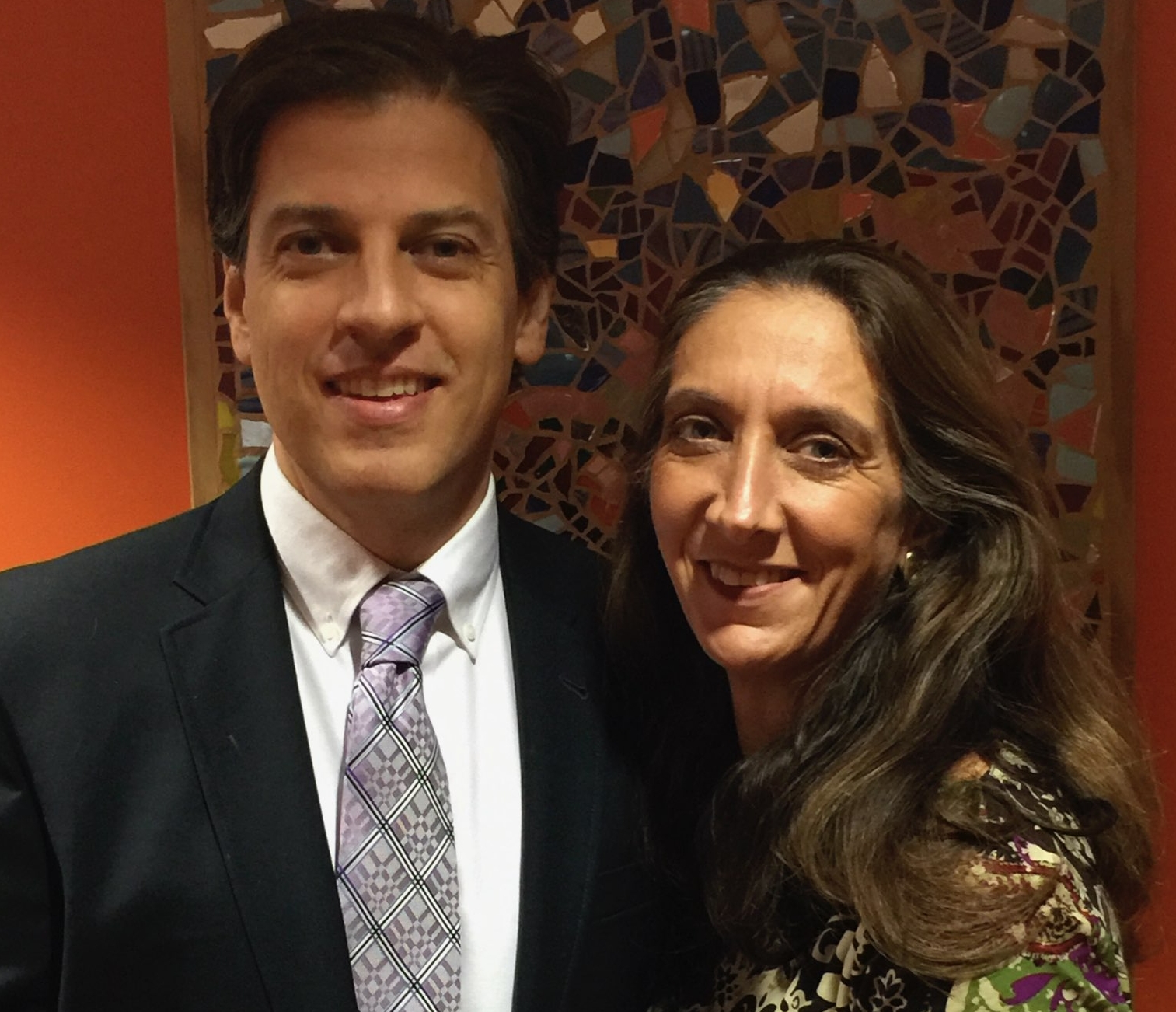
Dr. Mamary and his wife, CeilaSue, married in 1996.Courtesy of the family
Away from the hospital, Dr. Mamary liked to bike, hike, and camp. He built his own 18-foot mahogany canoe, walked the entire 272-mile Long Trail in Vermont, and won masters bicycling championship races.
He also painted and sculpted, and earned a bachelor’s degree in art and psychology at Haverford College. He and his wife, CeliaSue, initiated the Shortridge Memorial Park Arboretum in Wynnewood and earned a 2024 community service award from Narberth and Lower Merion officials.
“James brought wisdom, kindness, curiosity, and genuine joy to every moment,” his wife said.
Albert James Mamary was born June 12, 1967, in Hempstead, N.Y. He grew up in Binghamton, N.Y., became an Eagle Scout, and was a wilderness river guide for the Boy Scouts in Maine during his college years.
Dr. Mamary was an avid bicyclist and won masters championship races. Courtesy of the family
He met CeliaSue Jaffe in class at Haverford, and they married in 1996 and had daughters HannahRose and LilyRuth. They lived in East Falls and Wynnewood, and he rode his bike from home to Penn and then Temple as often as he could.
Dr. Mamary enjoyed traveling, baking, cooking, and gardening. “His specialty is fruits and vegetables, and I grow the flowers,” his wife said.
He followed the Phillies, rescued cats and dogs, and doted on his daughters. Everybody said he was funny and silly.
“He was curious and always learning or doing something new,” his daughter LilyRuth said. “He took joy in simple things.” His daughter HannahRose said: “Even if he wasn’t my dad I would want him as a friend because he was so interesting and so easy to talk to.”
Dr. Mamary was a wilderness river guide for the Boy Scouts in Maine during his college years.Courtesy of the family
Dr. Mamary was diagnosed with cholangiocarcinoma, bile duct cancer, in 2020 and treated by longtime colleagues and friends at Temple, some of whom he had mentored. “It was a profound reflection of the life he lived,” his family said, “that so many of those he had taught ultimately became his caregivers.”
His wife said: “He was a very vibrant and adventurous person but so thoughtful, steady, and reliable. James was incredible.”
The Montgomery County Intermediate Unit’s board of directors plans to tighten its professional development and travel policies after learning in March that its leaders had used their agency credit cards to purchase overseas trips — including a 14-day African safari — without the board’s knowledge.
Mark Klein, an attorney and former schools superintendent who conducted a two-month investigation into the trips, told board members at a virtual meeting Tuesday night that, going forward, the board should require Montco IU leaders to receive board approval for travel.
The current policy, which Klein said includes no such requirement, is “in conflict with many of the school districts that are in the area.” He noted that it is not an unusual policy for an intermediate unit.
The outside investigation began after The Inquirer reported in March that the Montco IU’s executive director, Regina Speaker, and its assistant executive director, Sandra Edling, had used their procurement cards to book about $40,000 worth of international travel since 2023.
Speaker has defended the 2023 trip she and Edling took to Kenya and Tanzania, which culminated a yearlong academy for education leaders run by the School Superintendents Association, known as AASA.
The itinerary included a trip to a tribal school, as well as 11 nights in “handpicked hotels,” six sightseeing tours, and eight wildlife drives in search of zebras, monkeys, lions, baboons, cheetahs, hippos, elephants, wildebeests, and “the exceedingly rare black rhino.”
“Everything was through the lens of leadership,” Speaker previously told The Inquirer. “It was about that process of survival of the fittest, and how are you a leader, and what do you prioritize.”
At Tuesday night’s meeting, however, Speaker apologized for the lack of “adequate transparency” around her travel.
“For anyone who felt disappointed, concerned or uncertain because of my decision, I sincerely apologize,” Speaker said. “I never take your confidence or trust for granted. I remain committed to serving with integrity, humility, and transparency.”
Records obtained by The Inquirer last year through a Right-to-Know request showed that Speaker in May 2023 made about $9,000 in purchases related to the Africa trip without providing receipts. The only mention of Africa in the records appeared months later when she purchased a Tanzanian eVisa for $139.
The Montco IU’s then-board president did not sign off on the expenses until after Speaker had returned from Nairobi.
Klein did not directly address those issues in his presentation Tuesday. He recommended that the intermediate unit conduct an audit of how procurement cards are used.
Speaker, whose base salary was $298,000 last year, also traveled to South Korea and Singapore for 11 days in April 2025 as part of a $13,000 leadership academy.
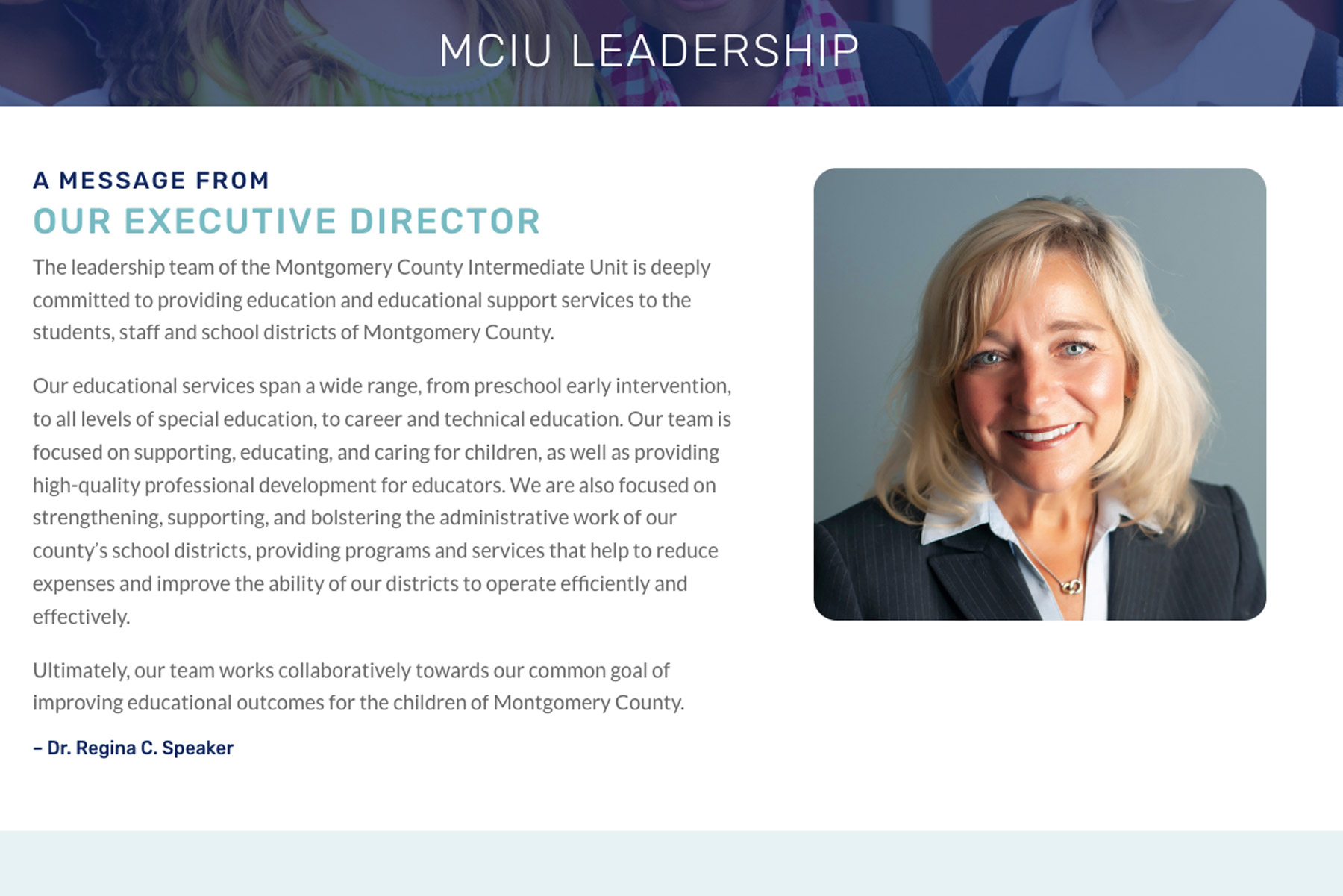
The profile of Dr Regina C. Speaker on Montgomery County Intermediate Unit’s website.Courtesy of MCIU
Gary Ledebur, a Montco IU board member who also sits on the board of the Upper Merion Area School District, said that while Speaker, according to Klein’s findings, did not violate any policies, “I think Dr. Speaker took advantage of this lack of policy.”
“In my opinion, she exhibited an error in judgment,” Ledebur said. “I wish she had chosen not to go on these trips.”
The intermediate unit, which provides support services to more than 200 area schools, is one of 29 state-mandated agencies in Pennsylvania. It has a $198 million budget and receives a mix of local, state, and federal funding.
The full 21-person board, which is composed of members from each school district board in the county, will meet later this month. It is expected to accept Klein’s recommendations.
“We have found some gaps in our policies, and now that we know that, we’re going to do better,” Margaret Wright, president of the intermediate unit’s board, said Tuesday night.
Expense reports show that in March 2025, Edling, whose base salary last year was $215,000, used her procurement card to make about $7,000 in purchases related to what is described on the purchasing log only as a “conference.” The documents did not name a location or offer specifics.
The Inquirer reported that the expenses were for a planned 10-day trip to Germany, Switzerland, and Austria in October 2025 sponsored by AASA, the same superintendents group that organized the African safari.
“Ascend into the Alps for an evening of true Swiss hospitality,” reads the itinerary. “As you feast on beautiful views from your hosts’ mountain chalet, enjoy traditional food, entertainment and fun Swiss games and activities.”
Two school visits were also planned, according to a brochure, in addition to quick-tempo Viennese waltz lessons, an underground train ride into Austria’s ancient Hallein Salt Mine, and a “journey to crazy King Ludwig’s fairy tale castle of Neuschwanstein.”
Edling ended up not going on that trip. Speaker said the IU subsequently froze all travel amid Pennsylvania’s budget impasse that had held up much of the intermediate unit’s funding. (The cancellation also came after The Inquirer had requested the records. Speaker said the IU was able to get a refund for that trip.)
After The Inquirer’s story was published, about 50 people showed up for the Montco IU’s next board meeting, which are usually sparsely attended. At least 225 more joined by Zoom. Intermediate unit employees expressed outrage.
“The trips felt deceptive and intentionally secretive, and I struggle to understand how they related to our mission,” Liz Forcellini, an occupational therapist at the IU, told the board, adding that some staffers were paying for supplies with their own money.
Public finance experts said the trips raised larger questions about whether taxpayers should pay the full cost of professional-development outings that include substantial leisure time. Some school administrators who went on the Africa safari paid for it out of pocket, including the head of a New Jersey education service agency who said she also took vacation days.
“Most of us would consider it a dream trip,” Andrew MacLeod, a personal care assistant at the IU, told the board at the March 25 meeting.
The saga took a bizarre turn the following evening when Kimberly Wheeler, then a member of the Montco IU board, falsely stated at a public meeting of the Souderton Area School District’s board of directors that The Inquirer reporter who wrote the story “right now is under investigation with the Philadelphia police for misleading information, and reporting on inaccurate information.”
Sgt. Eric Gripp, a Philadelphia police spokesperson, said in June that the department does not conduct criminal investigations of journalists for their reporting.
Wheeler later walked back her remarks about a police investigation and said she had been “going by the word of Dr. Speaker.”
Asked for comment at the time, Speaker sent a 2023 news release issued by Philadelphia Sheriff Rochelle Bilal’s office complaining about a story that had exposed financial problems in her office that year. It made no mention of a police investigation.
Staff writer Maddie Hanna contributed to this article.
The Cheltenham school board said it would review safety procedures and assess the culture in all of its athletic programs as it pledged to rebuild community trust after an explosive grand jury report condemned the district’s response to the assaults of a football player last season in a high school locker room.
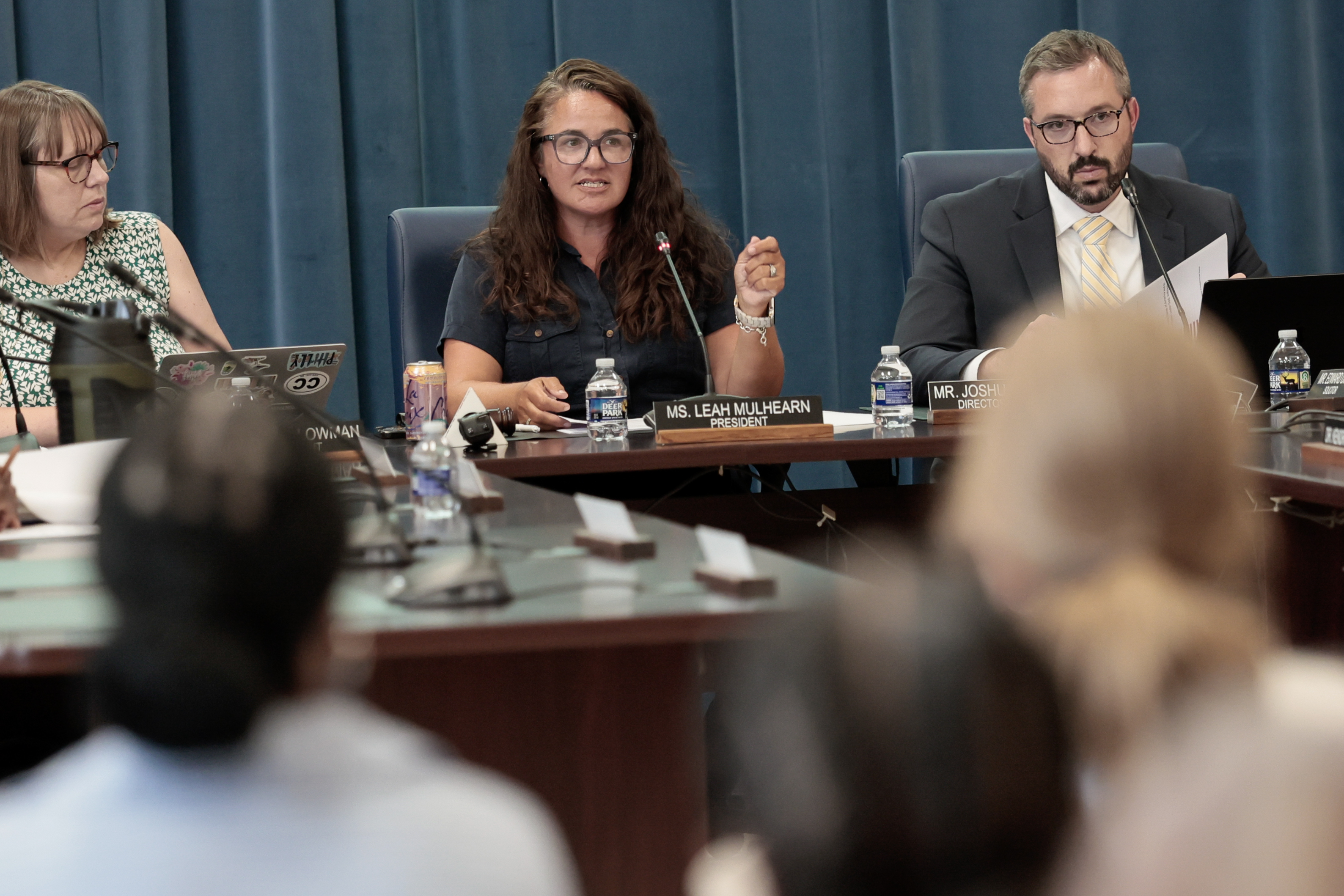
The attacks on the 15-year-old, which took place in August and September 2025, “arose in the context of a culture of intimidation and acceptance of violence,” board president Leah Mulhearn said Tuesday night at the board’s first meeting since criminal charges were announced against four coaches and six players.
Mulhearn, who also announced that veteran educator Chris McGinley would be tapped as interim superintendent, promised the board would move quickly to fix problems.
The district already canceled the 2026 football season in May. “Football will not return until we address this, no matter how long it takes,” Mulhearn said.
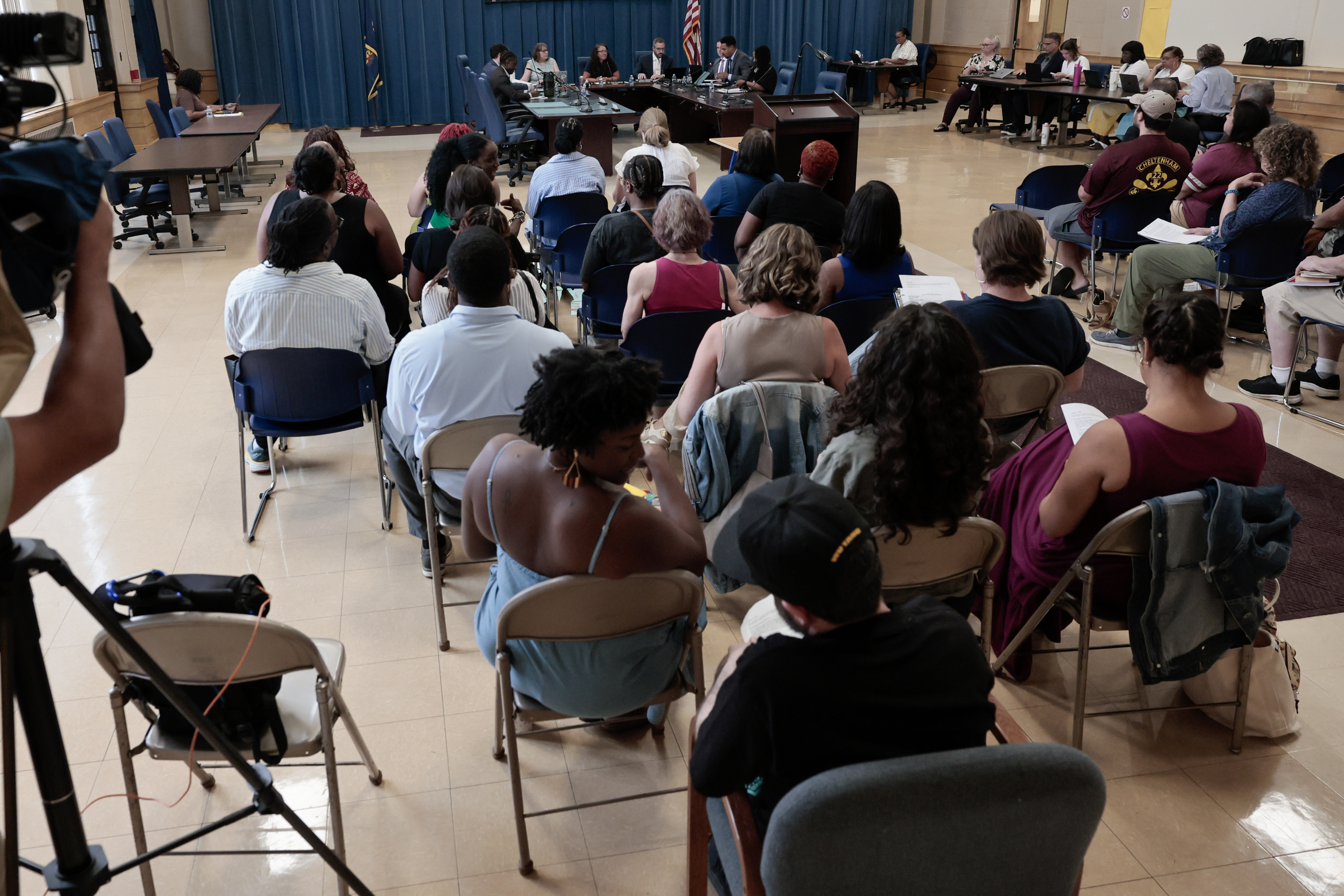
Parents, who lined up behind a microphone in the district’s administration building awaiting their turn to speak, expressed skepticism and demanded more from the board after a grand jury report accused the district of endangering students through a failed response to the assaults, one of which was captured on video.
In emotional comments, some parents said their children had been assaulted in the schools, while others questioned how they could believe the board, when they had warned against hiring a coach who has since been charged with conspiracy and endangering the welfare of a child.
“We entrusted our children to this district,” said Chowan Cowans, who withdrew her son, a rising senior and former Cheltenham football player, because “I don’t feel safe with him being there anymore.”
Cowans accused the district of a lack of transparency, which “has to mean something when the truth is uncomfortable,” she said.
PTO president Stephanie Curry (center) waits in line to speak during the Cheltenham School Board meeting in Elkins Park on Tuesday, August 11, 2026. The school board was meeting for the first time since criminal charges against four football coaches and six players were announced, and since Brian Scriven resigned as superintendent. .Elizabeth Robertson / Staff Photographer
Employees at the high school appeared to minimize the Sept. 3 assault after it was reported to them by the 15-year-old victim’s mother, according to the grand jury report. They also took the head coach, Terence Tolbert, at his word that he had not instructed the player not to tell his parents what happened, and they included the coach in their investigation — which failed to uncover that there were two assaults, the report said.
It also noted that employees were also confused about their mandatory reporting requirements.
On Tuesday, Mulhearn said that while the board “may differ with the grand jury with respect to some of its findings about how the district and board responded, the hard truth is that we must acknowledge that mistakes were made.”
Mulhearn said the board would “move with deliberate speed to address these issues.” She said the board would enlist an outside attorney, Leigh Dalton — who was hired by the Central Bucks School District last year to investigate special-education abuse allegations — to review the district’s policies and procedures and make recommendations within 60 days.
She did not comment on Superintendent Brian Scriven’s resignation last week. Some parents questioned whether and when the board’s position on Scriven had shifted, after the board praised the superintendent’s leadership in May.
A district spokesperson did not respond to a question this week about whether Scriven, who received a new five-year contract in December, would receive any payout following his resignation.
Nor did the board indicate whether it was considering taking action against any employees at the high school. One parent, for instance, asked whether Mark Hoff, the former vice principal at Cheltenham High School, would still become the vice principal at Wyncote Elementary, in light of the grand jury report faulting high school employees.
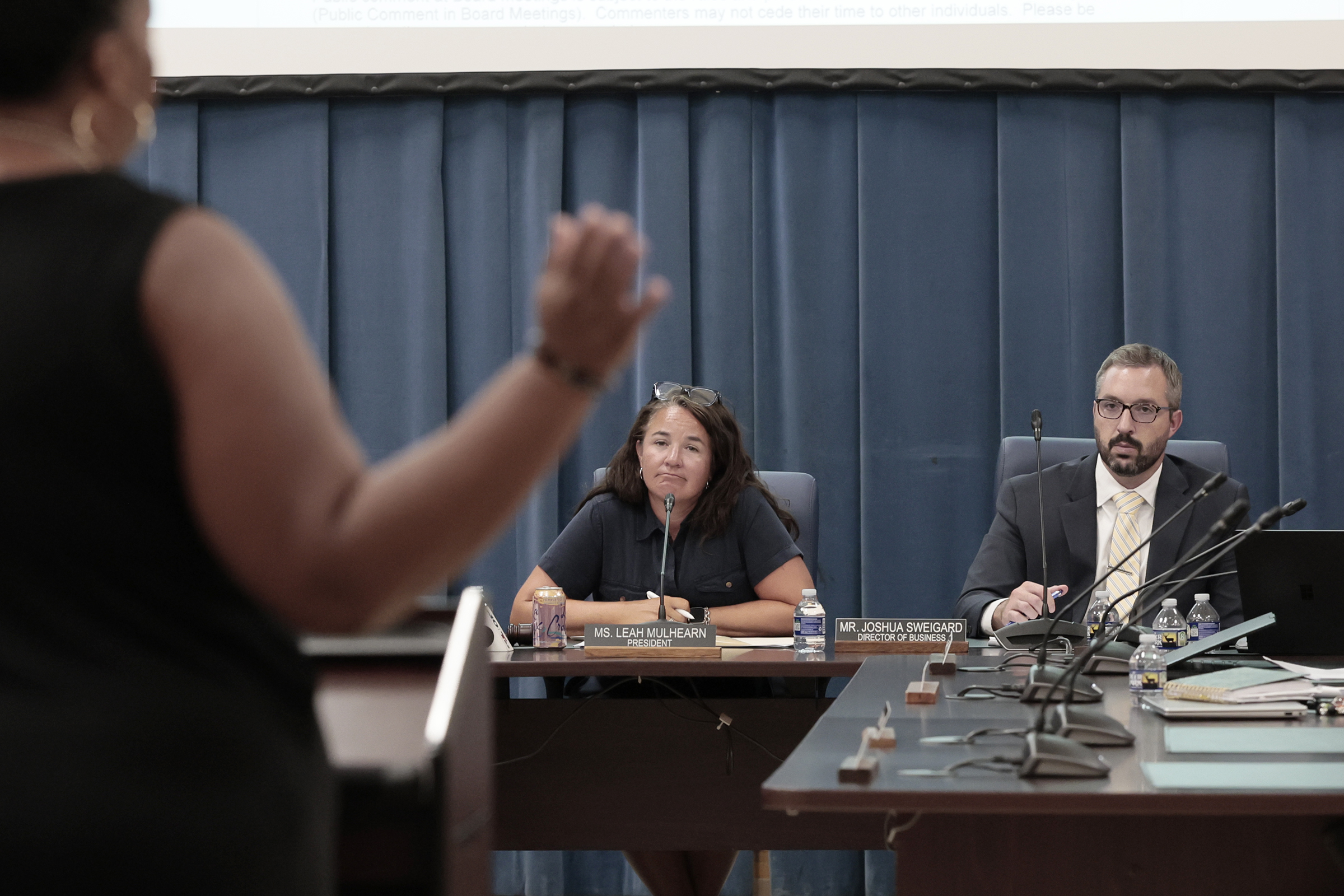
Taryn Knox (left) speaks to School Board President Leah Mulhearn and Director of Business Joshua Sweigard during the Cheltenham School Board meeting in Elkins Park on Tuesday, August 11, 2026. The school board was meeting for the first time since criminal charges against four football coaches and six players were announced, and since Brian Scriven resigned as superintendent. .Elizabeth Robertson / Staff Photographer
The board, which appointed director of business services Joshua Sweigard acting superintendent on Tuesday, will hold a special meeting next week to appoint McGinley as interim superintendent, Mulhearn said. McGinley previously led both the Cheltenham and Lower Merion districts and more recently served on the Philadelphia School Reform Commission and Philadelphia school board. His most recent position was as the faculty program coordinator of the Educational Leadership and Policy program at Temple University.
Parents’ pleas
Parents urged the board to commit to more steps. In a joint statement, the United Parents Group, the Special Education Alliance of Cheltenham, and the Cheltenham African American Alliance called for numerous actions, including a community town hall ahead of the first day of school and an assembly on the first day “to enforce a zero-tolerance policy regarding sexual harassment, bullying and hazing.” They also called for safety data to be a part of every school board meeting.
“We are demanding a fundamental shift in how our school district operates,” Aubria Nance, reading from the groups’ joint statement, told the board.
“Every time I hear a commitment to our students’ safety, I want to see the proof,” said Erin Fadako, a parent at the school.
The Inquirer reported last week that some football parents had urged the district not to hire Tolbert, saying he had allowed bullying while previously serving as head coach in Abington, where he left after one season.
“Everyone from the administration on down that has failed these students, you all have approved them to be hired here,” said Taryn Knox, who was among the football parents who had asked the district not to hire Tolbert.
After a year of negative news coverage, Knox said, “we’re now about to go into the next school year, and the news is still here.”
The Cheltenham school board meeting Tuesday, Aug. 11, 2026, in Elkins Park.Elizabeth Robertson / Staff Photographer
As they voiced their frustration, parents pleaded with the board to make real changes.
“Stop being risk averse and do what you need to do to make it safe for our children,” said Stephanie Curry, president of the high school’s parent teacher organization. “Our kids are the ones that are suffering.”
The Philadelphia School District is changing a policy that effectively barred some qualified students with disabilities from gaining admission into certain magnet schools.
But it did so only after a Philadelphia family — whose child with disabilities was not admitted to a school for which they met academic criteria — notified the district that it intended to sue over the old policy under the Americans with Disabilities Act.
The school system’s policy has traditionally worked this way: Students are eligible to apply for admission to up to five of the 37 district schools for which they meet academic, behavioral, and attendance criteria.
Because of a long-ago agreement resulting from another legal challenge, students with disabilities who meet two of the three criteria for a certain school could request an individualized review, known in the system as the LeGare process, to determine if they could succeed at that school if provided with reasonable accommodations.
If a review panel judged the child eligible, the child entered the lottery for that school, but was required to waive their rights to enter lotteries for any schools where they met all three criteria.
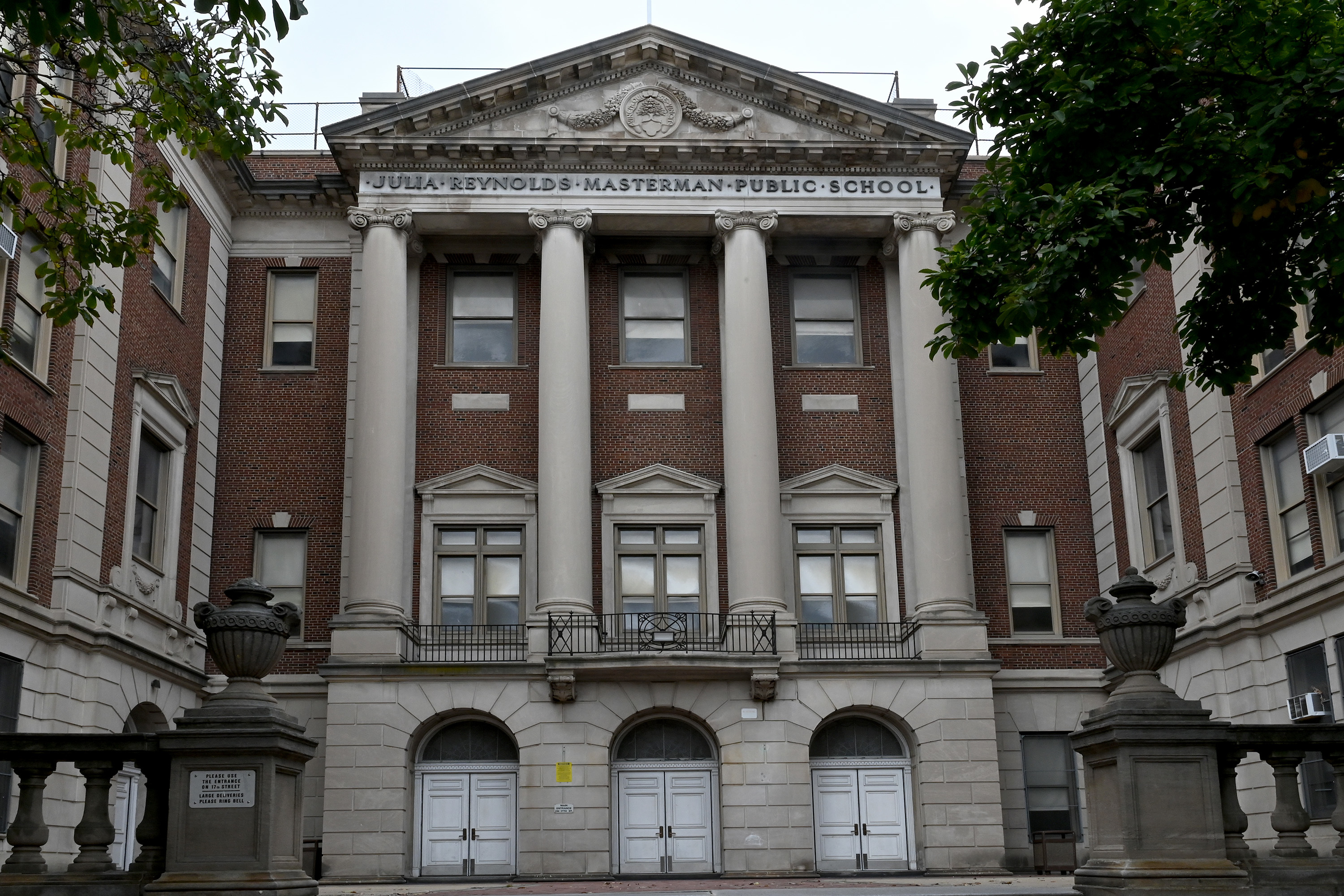
That is: If a student meets entry requirements for the Philadelphia High School for Girls but only two out of three requirements for Masterman, they could opt for an individualized review for their Masterman application — but only if they gave up the right to be considered for Girls’ High.
If their Masterman application failed, Girls’ High was off the table.
Dan Urevick-Ackesberg, an attorney with the Public Interest Law Center, which represented the family that threatened to sue the district this year, in a statement,called it the “double bind,” and said the district for years punished children with disabilities for asking for accommodations they were legally guaranteed.
Exact numbers are not known, but it’s expected the change will affect hundreds of Philadelphia students annually.The application process for the 2027-28 school year is expected to open sometime this fall, though the district has not yet announced a date.
Far-reaching impact
The parent who threatened the lawsuit said when they heard about the policy, they thought they must be an oversight.
“But the district doubled down” when they inquired about it, the parent said in a statement. The Inquirer is not naming the parent, child, or school to keep the child’s identity private. “It felt punitive.”
With no other option, the child moved through the admissions process for the school to which they met two out of three academic criteria, but was denied admission in the review process.
Because they had to forego applications to other criteria-based schools for which they did meet requirements, the student was out of luck.
“The painful either-or of the policy effectively ruined my child’s eighth-grade year and has far-reaching impacts on their academic confidence, self-esteem, and social experience,” the parent said.
When the Law Center notified the district of its intent to sue, the district asked to enter settlement negotiations, and agreed to change the policy.
Going forward, students who are English learners or those with disabilities — either those with individualized education plans or 504 plans — will be able to apply for magnet schools for which they meet criteria and those for which they meet two out of three criteria.
There will be no penalty for asking for an individualized review. Students will not need to waive their applications to schools for which they meet criteria.
“I am beyond relieved that this awful policy has been ended,” said the parent whose lawsuit threat prompted the change. “The district should want to have engaged and talented students with disabilities in our top schools, not push them out.”
Urevick-Acklesberg said the policy change means that “one small barrier is down” to students receiving the free, appropriate public education that’s their right under federal law.
The district can still change its school selection process
The new individualized review policy is an appeal process, not a first-line application, and does not guarantee students’ admission into any school.
The agreement “does not prevent the district from modifying its school selection process, including individualized reviews, or eligibility criteria, nor does it require the district to maintain its current processes for any set period of time,” it reads. “However, to the extent the district’s school selection process continues to allow students to apply to more than one school, the district will provide a mechanism for the subject students to apply to a school where they meet the then applicable criteria, and to additionally seek review of their eligibility where they do not.”
The district also announced other changes to the process earlier last week, including:
Changing the zip codes for preferential admission to Masterman, Central, Carver High School for Engineering and Science, and the Academy at Palumbo: 19132, 19133, 19135, 19138, 19140, or 19141. New to the list are 19138 — Germantown — and 19141 — sections of North Philadelphia including Logan and East Oak Lane. No longer on the preference list are 19121 — parts of North Philadelphia including Brewerytown and Sharswood — and 19136, Holmesburg and Torresdale. The zip codes chosen for preference are the most underserved at the four magnet schools.
Limiting the grades that count toward a student’s GPA for admission to magnets. Now, just English, math, and science grades are counted. Social studies grades also used to count.
Granting preference for kindergarten admission to students who attend prekindergarten at the school to which they’re applying.
Granting preference for career and technical education program admissions to students who participate in a district CTE summer program.
This could be a win-win situation for both the students and the Keystone State.
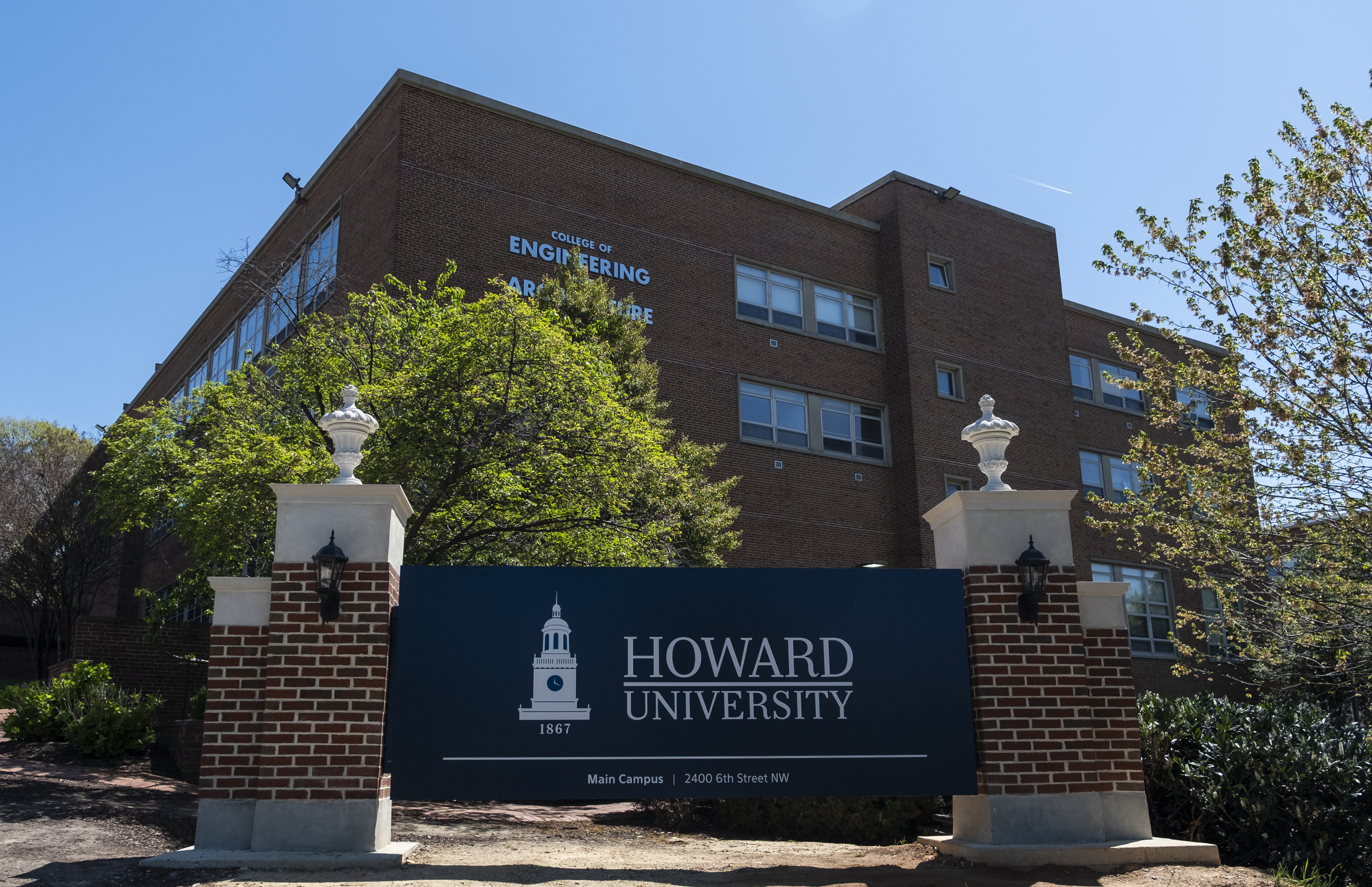
Everyone who knows me recognizes how much I love Howard, which is my alma mater. To call the four years I spent on the campus in Washington, D.C., life-changing would be an understatement. It was the former leader of HU’s journalism department, Lawrence Kaggwa, who set me on my career path, informing me that I was going to work in the newspaper industry.
The first-time college students — some in tears — responded by posting videos on social media about their plight. They were hard to watch. Some went viral and even made the national news.
School officials defended what happened, saying payment notices had been going out since March about deadlines and enrollment requirements. Some students said they didn’t get them, or else received a notification on the same day their bill was due.
Nikiyah Clark told ABC News, “I was so scared because Howard University is my dream school, like, my grandma went there.” She hopped on a bus from Fairport Harbor, Ohio, to D.C. to advocate for herself in person. It paid off, because she has been reinstated into Howard’s first-year class.
But now Clark faces perhaps an even bigger hurdle: paying for tuition. Tuition plus room and board is $66,000, according to Howard’s website.
HU’s interim president, Wayne A.I. Frederick, called for an internal investigation into what went wrong, but it’s going to take a lot more than that to heal the damage to the school’s reputation.
“If another school in the city said that things had to be paid at a certain point, I think people would do that,” he told the Washington Post. “Nobody would make a fuss about the fact that somebody was suggesting a bill be paid on time.”
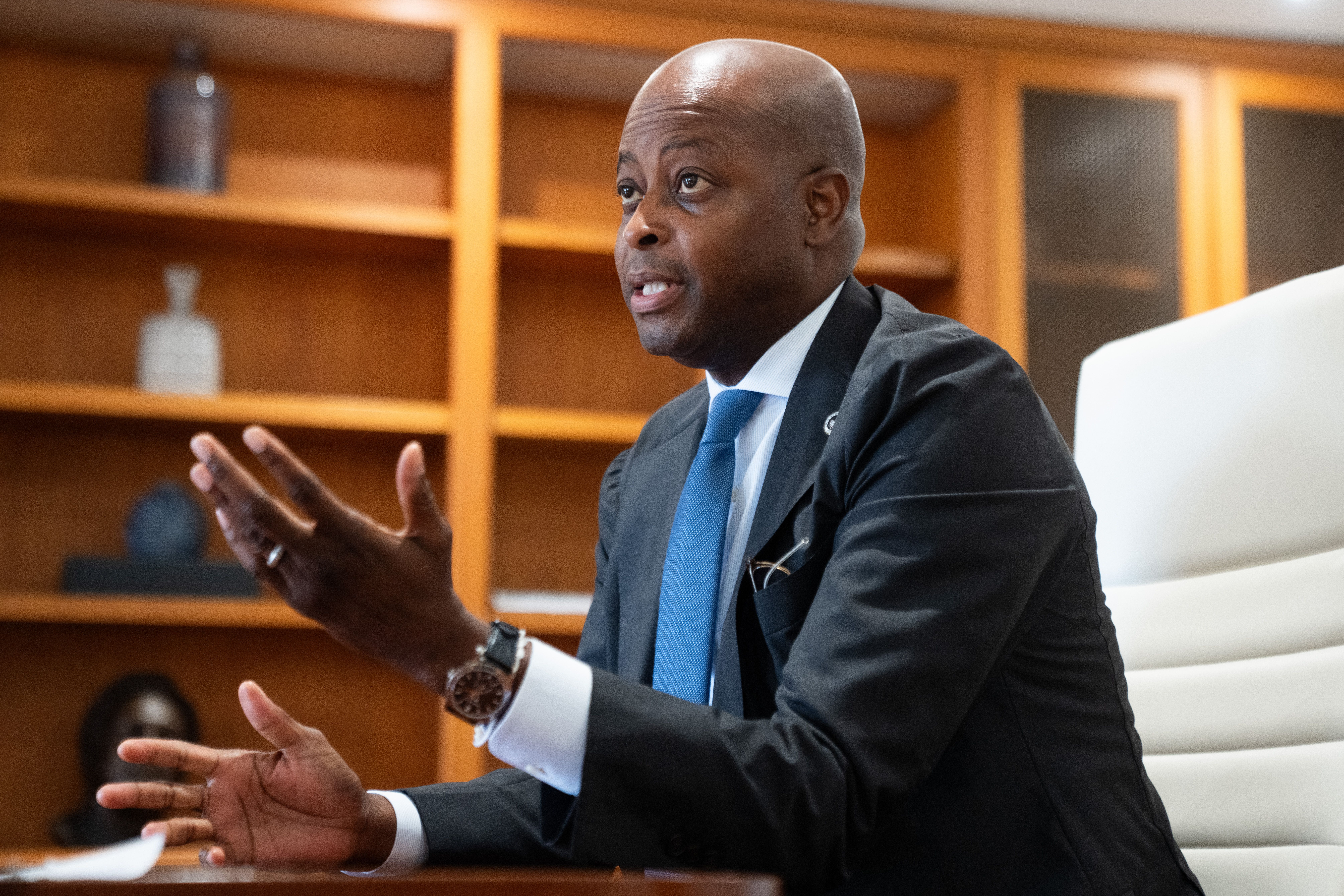
Howard University interim president Wayne A. I. Frederick sits for an interview July 29.Allison Robbert
And the fact is, HU needs the money. Trump administration officials ended a series of annual payments meant to support the construction of the university’s new hospital. That move resulted in a cut to the historically Black college or university’s (HBCU) annual federal appropriation for the current fiscal year of about $64 million, or more than 20%. The Chronicle of Higher Education reported on Thursday that HU has offered buyouts to 600 employees.
Still, that’s no excuse for how the first-time college students were treated. We expect more of institutions like Howard, which was founded in 1867 to educate newly emancipated Black Americans.
“HBCUs are known for being nurturing and family environments,” said Marybeth Gasman, who runs the Rutgers Center for Minority Serving Institutions. “That’s why this comes off as being kind of shocking to parents and students and some alumni, and some people in the HBCU community and beyond.”
As I pointed out earlier, expediting admissions here could be a real win-win both for the students unenrolled from Howard and Pennsylvania’s state colleges and universities. Incoming freshmen could further their educations, and state institutions — which have struggled with diversifying their student bodies and declining enrollments — can take a step toward changing those narratives.
No matter what President Donald Trump would have you believe, diversity matters.
“In higher education, we do a better job as teachers and as researchers when we work in a diverse environment,” David Oppenheimer, a leading scholar on issues of discrimination and equality, told InsideHigherEd.com earlier this year.
Oppenheimer, who is the author of The Diversity Principle, added: “Students learn more. In a science lab, scientists make more significant discoveries when the scientists working in the lab are diverse. It’s a real thing. It’s not just a psychological argument.”
Following all of the public outcry, Howard has readmitted more than 200 of the freshmen who had been dropped, but it’s unclear what all of the other students will do.
Shapiro should recognize that there’s a real opportunity here — and that Pennsylvania should take advantage of it.
The former Cabrini University campus has undergone a more than $100 million, Villanova-fueled rebirth, and students will begin attending classes and living there this month.
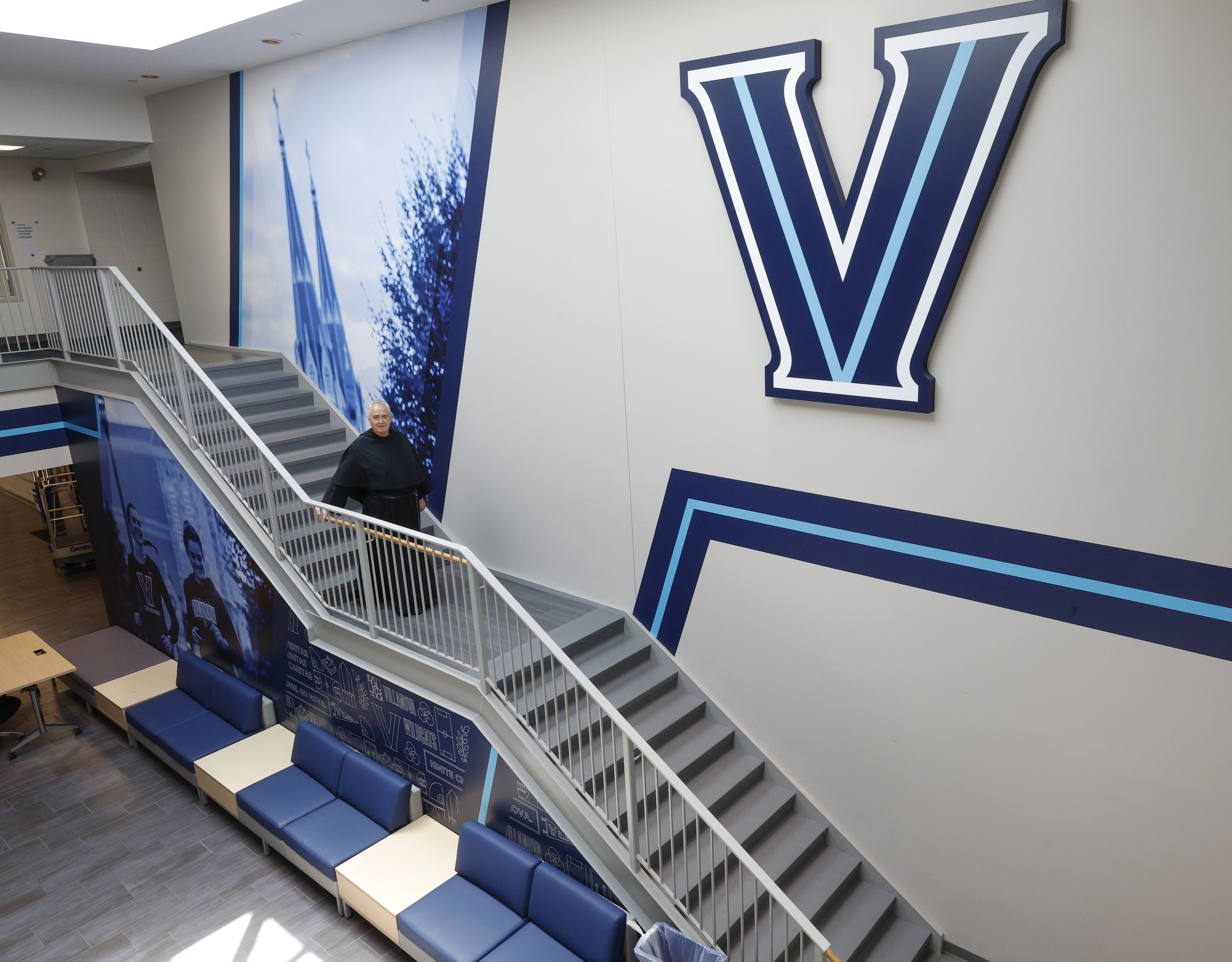
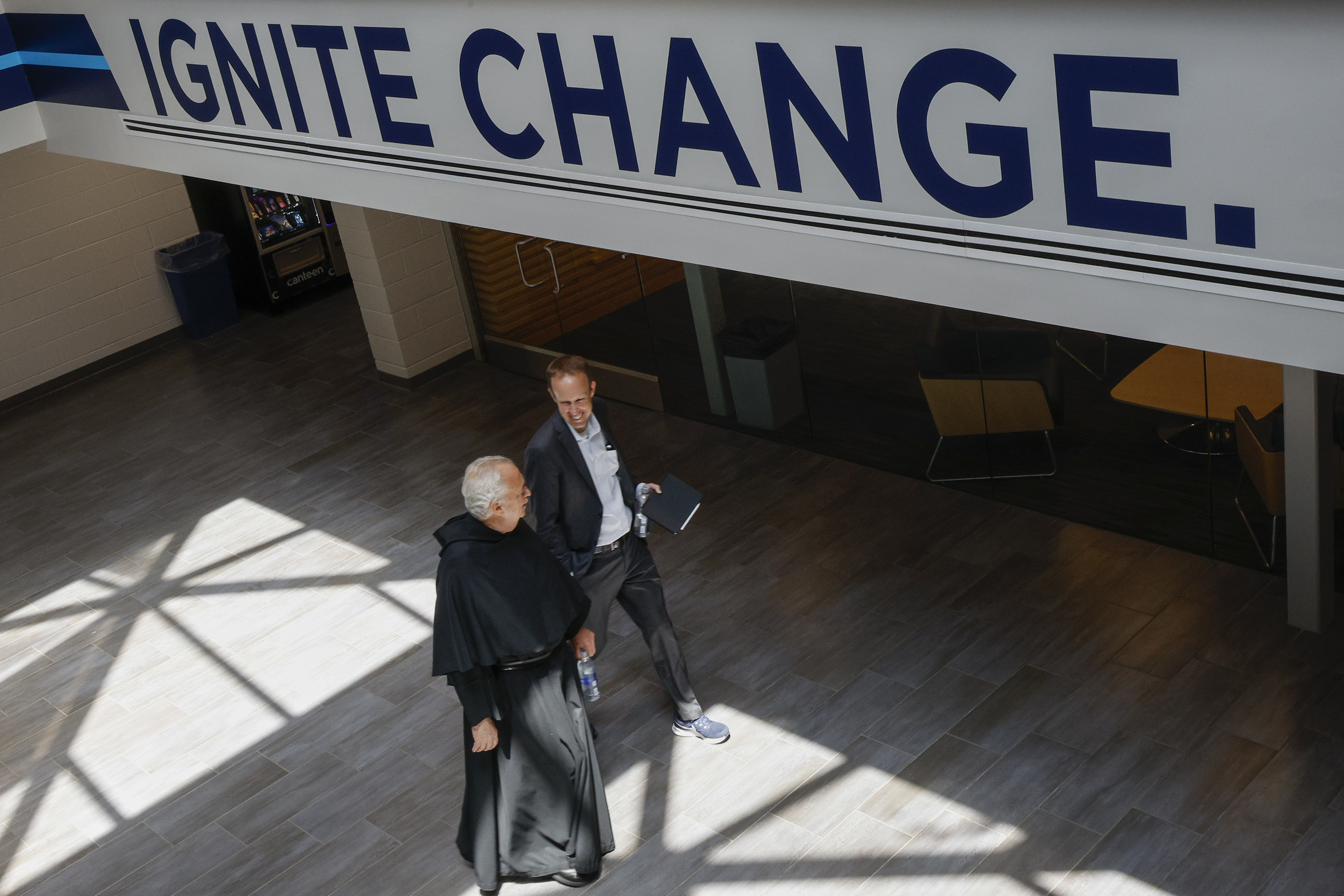
Large signature blue and white V’s for Villanova University are everywhere. “Ignite Change. Go Nova,” says a wall in the student recreation center. Beds in the residence halls now have navy blue sheets, and many of the buildings have been renamed to honor Villanova’s Augustinian heritage.
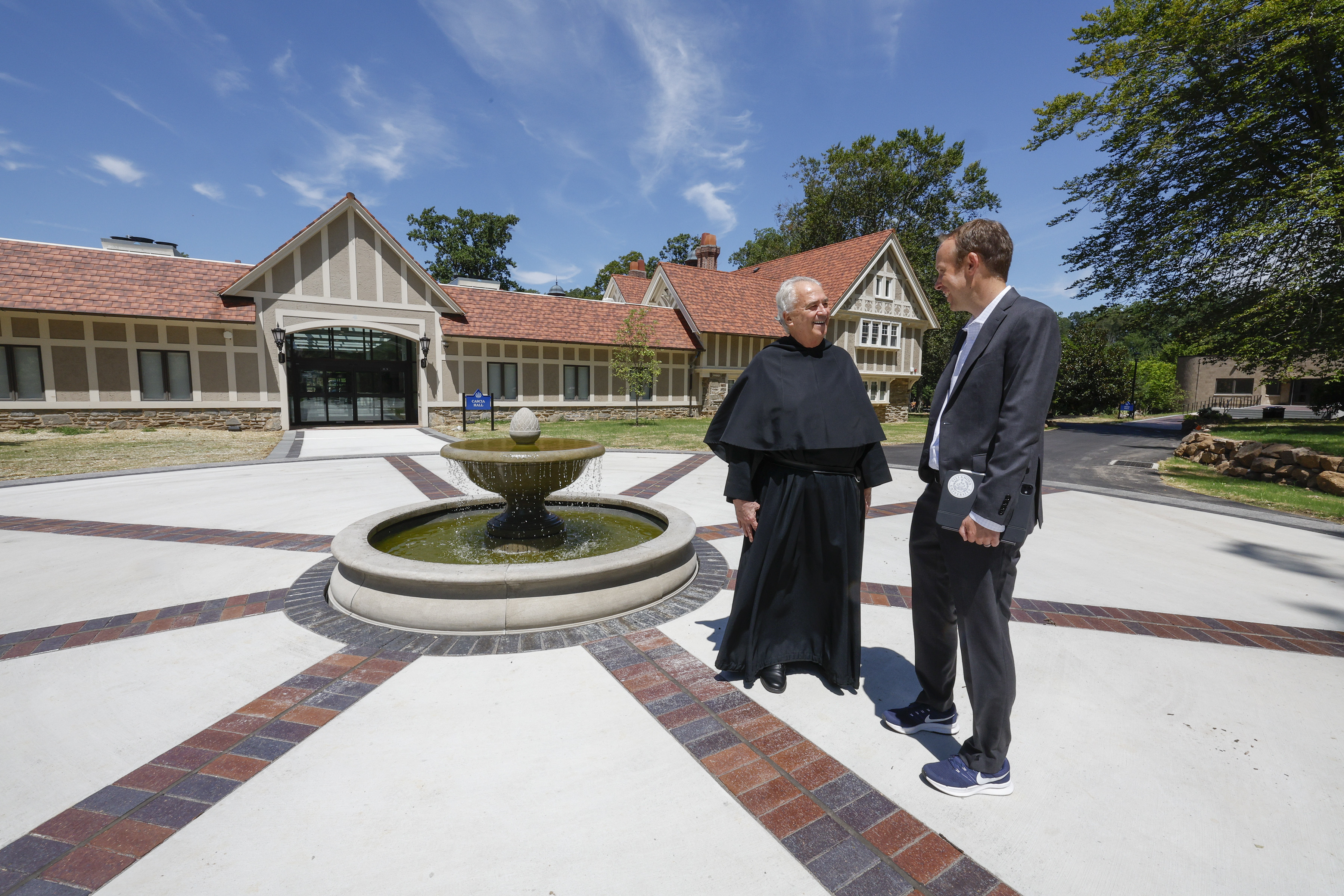
The Radnor campus once in dire need of maintenance sports a fresh look, including new light poles, landscaping, painting, furniture, boilers, roof repairs, a running fountain, pickleball courts, and restored architectural flourishes, in addition to upgraded educational technology for classrooms.
The university removed dead trees, installed firepits on the campus green, and connected the two campuses’ phone and internet systems.
Villanova President Rev. Peter M. Donohue walks down the stairs at the Dixon Center, which has been covered in Villanova signage and colors. Steven M. Falk / For The Inquirer
It is all part of Villanova’s effort to make the 112-acre campus that it acquired from the shuttered Cabrini look and feel decidedly Villanovan. The campus has been closed for the last two years as the planning and upgrades took place.
“It’s always been a beautiful campus, but it looks very Villanova now,” said Kelly Tuzio, assistant director of Villanova’s graduate nursing program, who worked at Cabrini from 2005 to 2011.
“You can feel the change,” she said, helping to ready the Iadarola Center, the building she works in, for the opening. “Everything is just done to perfection.”
Some things remain largely untouched, like the signature statue of Mother Cabrini on the green and the Mansion, Cabrini’s former administrative building, which is on the National Historic Register. It was renamed Montefalco Hall. Masses will continue to be celebrated in the chapel: Cabrini was a Catholic university, as is Villanova.
Villanova University purchased the nearby campus of the now shuttered Cabrini University two years ago and has had the site closed for remodeling. But this fall, students will live and study there. Steven M. Falk / For The Inquirer
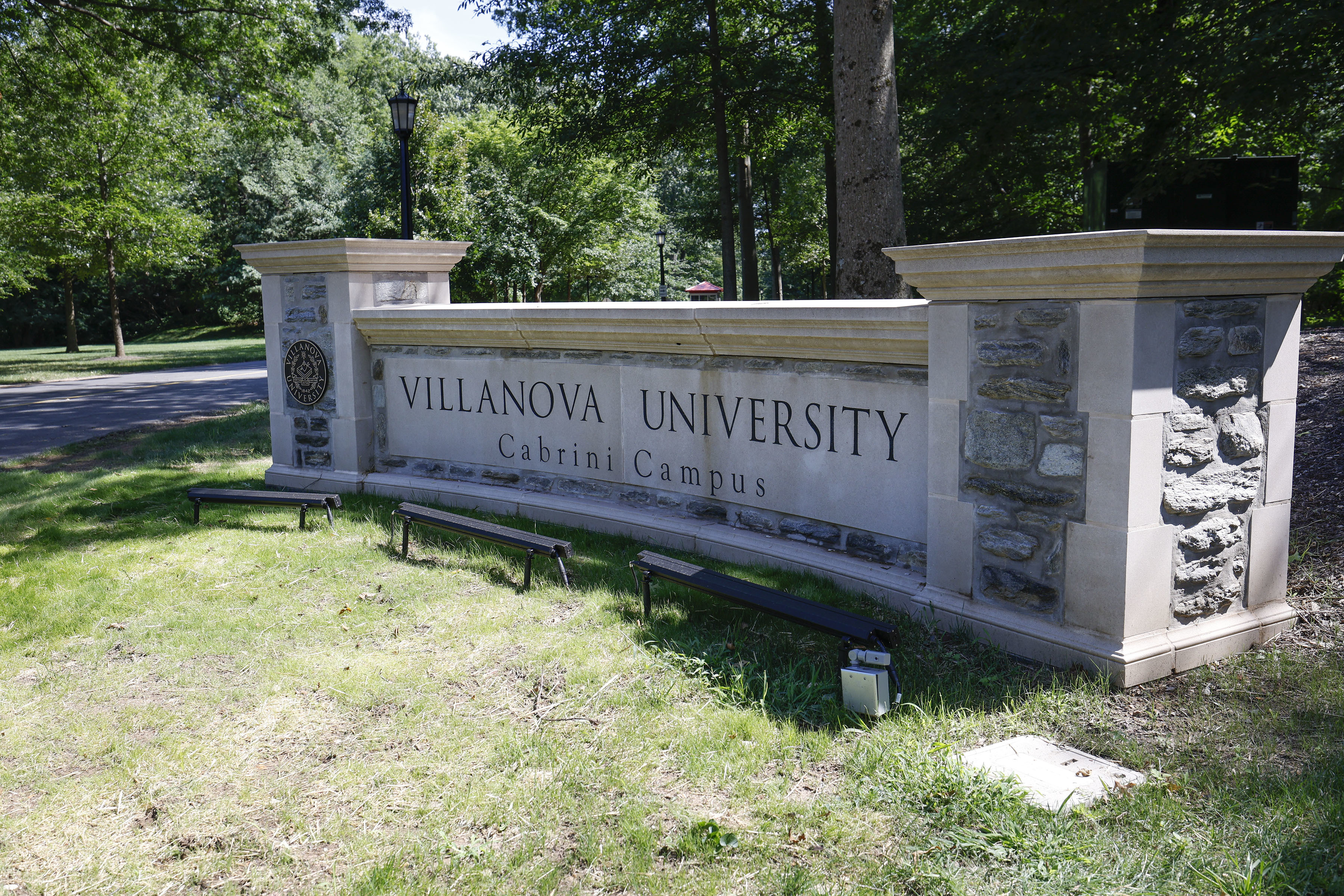
And signs at the entrance to campus say: Villanova University, Cabrini Campus — a nod to Villanova’s larger promise to retain Cabrini’s legacy.
A new era of growth
The acquisition of the campus, which officially opens for fall classes Aug. 24, marks an era of new growth for Villanova.
As many other colleges have lost enrollment in recent years, Villanova plans to grow its undergraduate student body, now at about 7,000, to 8,000 over the next four years, said the Rev. Peter M. Donohue, Villanova’s president. That growth started this year with about 250 additional freshmen. And the school plans to maintain its selectivity; it admitted just 29% of applicants for this fall’s class and saw more than a 10% surge in applications over the last year.
Villanova, which has a 260-acre main campus, will expand 43% in size with the addition of Cabrini.The university’s acquisition of Rosemont College — which will be complete in 2028 — will add 58 acres, increasing Villanova’s total to 430 acres.
The Cabrini campus will house five academic departments: psychological and brain sciences, graduate nursing, education and counseling, ethics, and part of communication. About 75 faculty — 10% of the total — will be based there.
Villanova University President the Rev. Peter M. Donohue left, and Timothy Hoffman, vice provost for finance and administration, stand in front of a newly installed fountain outside Cascia Hall, which received a lot of renovations inside and out. It houses the student center. Steven M. Falk / For The Inquirer
About 900 sophomores — roughly half of those enrolled at Villanova — will live on the campus, expanding the percentage of undergraduates who live on Villanova’s campuses to more than 80%.
In addition, more than 2,000 undergraduate and graduate students — about a fifth of Villanova’s overall student population — will take classes at the Cabrini campus in the fall, said Timothy Hoffman, vice provost for finance and administration.
“I’m just excited to see life again on the campus,” said Michelle Filling-Brown, formerly dean of academic affairs at Cabrini and now associate vice provost for the integrated student experience at Villanova.
She has been designing themed living and learning communities for the new Cabrini campus.
Michelle Filling-Brown, a former top administrator at Cabrini, now works at Villanova.Tyger Williams / Staff Photographer
Started in 1957, Cabrini was the only college founded by Sister Francesca Cabrini’s Missionary Sisters of the Sacred Heart. The university announced in 2023 it would shut the next year and Villanova would take it over, giving students and employees a year to find a new runway. The decision came as enrollment plummeted, finances tightened, and deferred campus maintenance mounted.
Donohue said Villanova has not yet made specific plans for Rosemont.
A classroom with new educational technology at the Iadorala CenterSteven M. Falk / For The Inquirer
Before beginning renovations, Villanova invited Cabrini alumni to collect memorabilia, Donohue said. The school also donated truckloads of old furniture and materials that it did not plan to use to nonprofits.
A $170 million-plus investment
The university has invested more than $170 million into the Cabrini purchase, including the $70 million it paid to close out Cabrini’s debt and acquire its land, buildings, and assets, and more than $100 million on renovations. Donohue said it will take just four years for the school to recover that money through the operation of the campus.
The university was able to keep $15 million of Cabrini’s $42 million endowment, the school said.
Though the campus has not officially opened yet, a few students have begun to move in. Last Tuesday, a group of young staff members huddled in a room, planning grand-opening activities. Others unpacked and organized nursing equipment.
Graduate student Curtis Wesley stops by the Iadarola Center where he will study this fall.Steven M. Falk / For The Inquirer
Curtis Wesley, 26, an incoming graduate student in the nurse anesthesia program, strolled out of the building where his classes will be.
“I just wanted to come and check it out,” said Wesley, who is from Kansas. “I was excited to see all the new technology.”
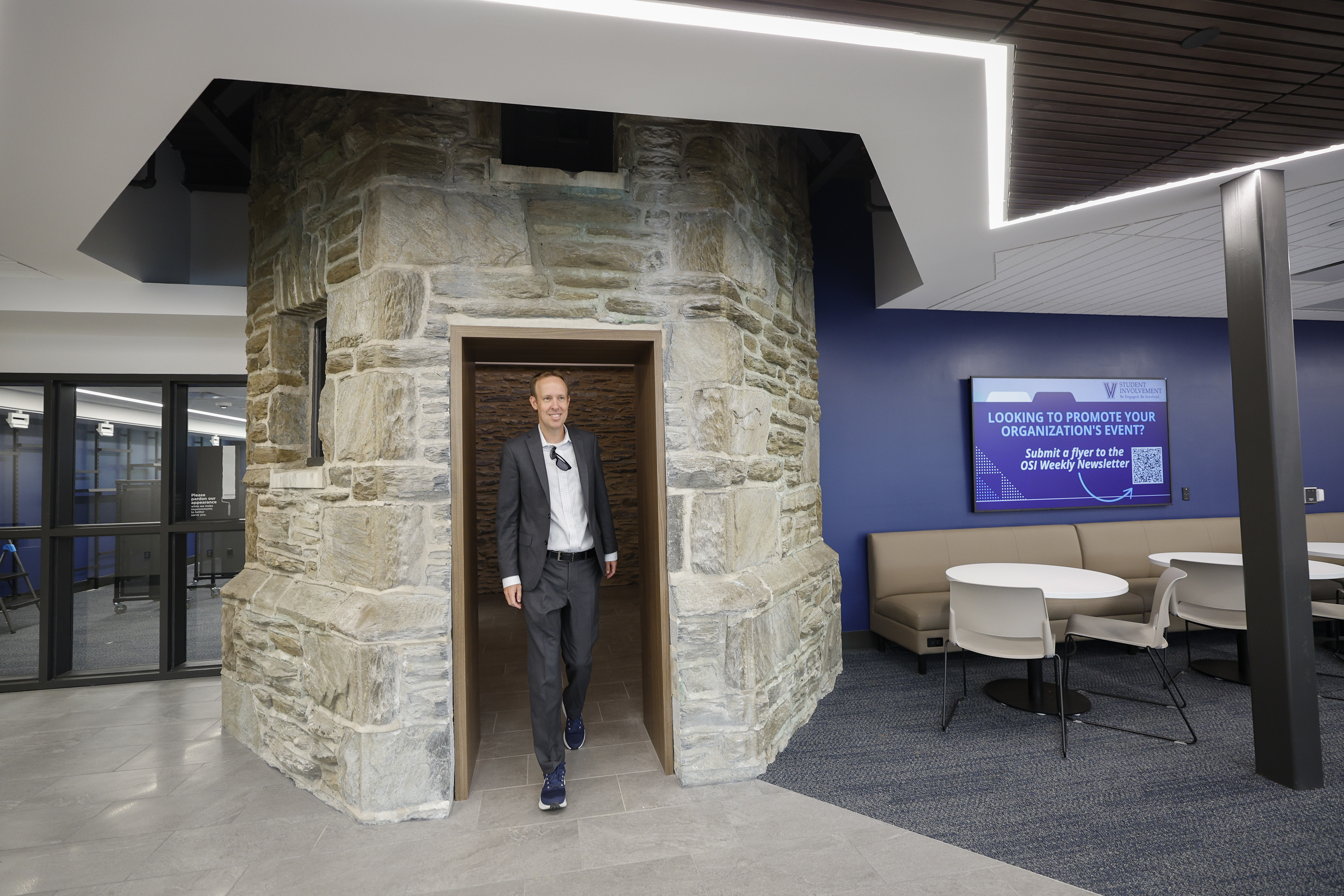
Timothy Hoffman, vice provost for finance and administration, emerges from the stone-walled turret leading to what will be a Villanova apparel shop. The turret was uncovered during remodeling at Cascia Hall. Steven M. Falk / For The Inquirer
One of the buildings that received the most renovation was the former Grace Hall, now Cascia Hall, home to the student center. The building used to be a stable house for the Woodcrest Mansion. Over the years, Cabrini put up drywall and turned much of it into office space.
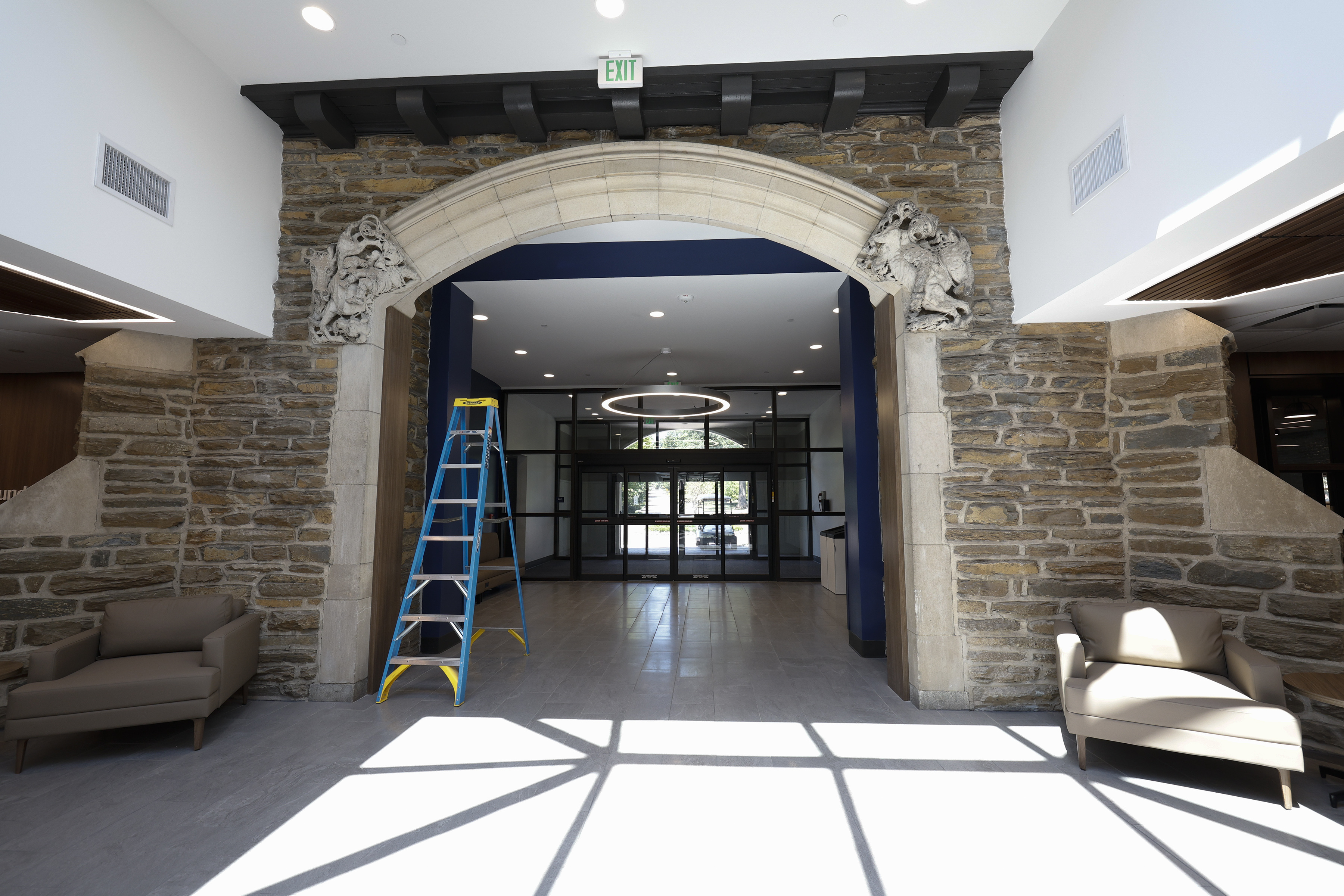
Villanova knocked those walls down and uncovered architectural flourishes including gargoyle-like stone carvings and a cavernous, stone-walled turret with a wooden-framed doorway, leading to what will be a Villanova apparel shop.
Renovations at Cascia Hall uncovered some architectural flourishes, including these stone carved gargoyles. Steven M. Falk / For The Inquirer
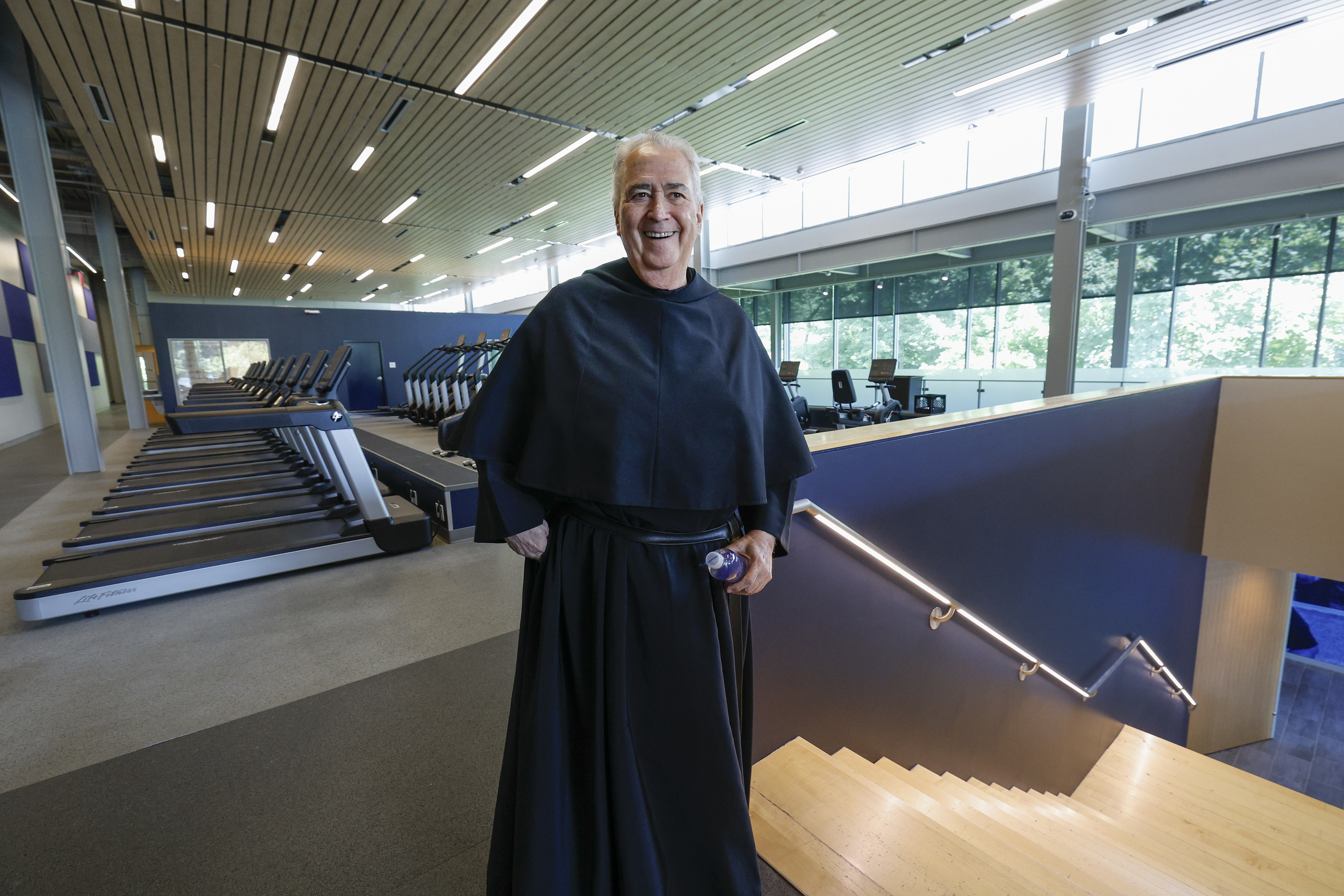
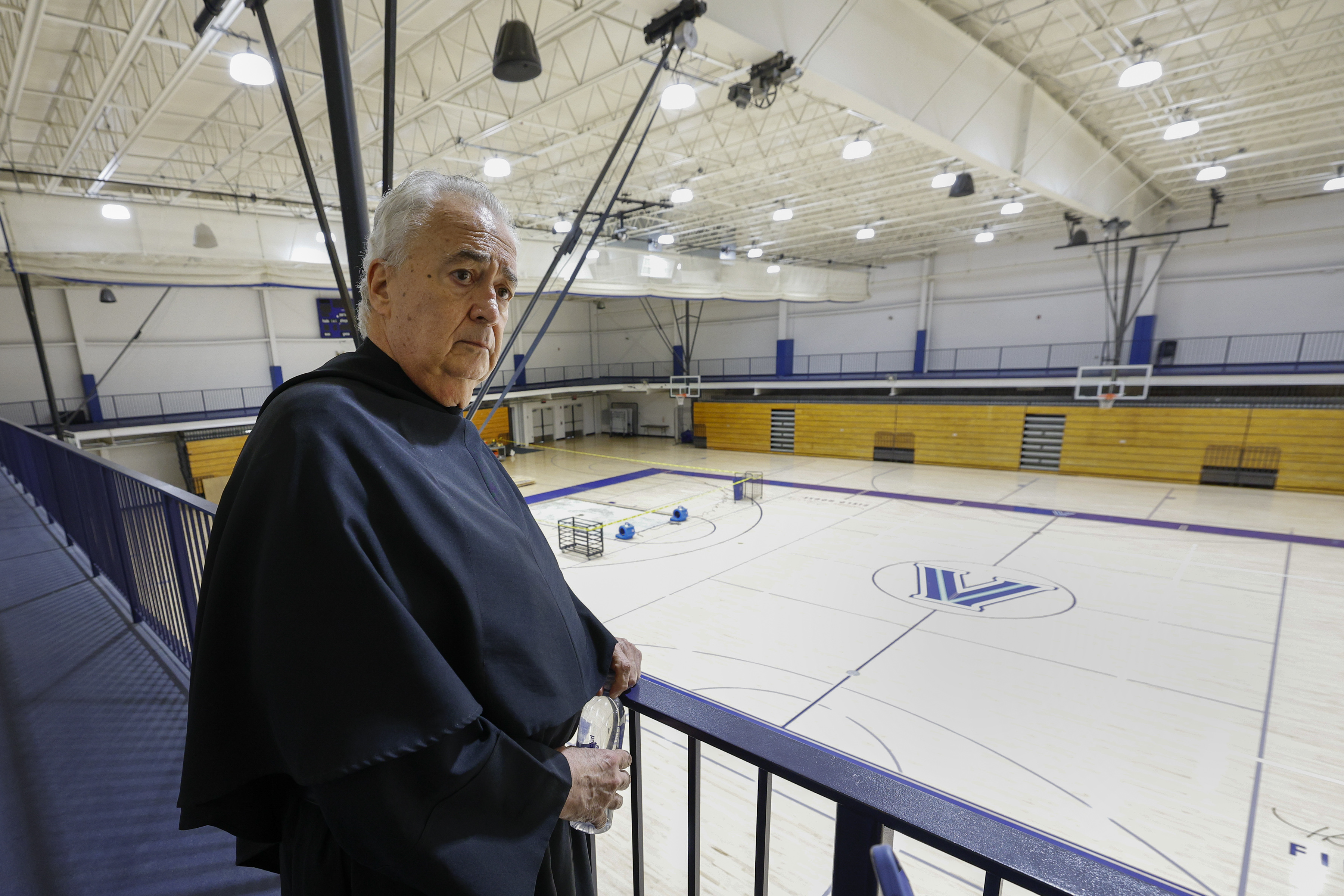
The Dixon Center will remain an athletic facility, but now the basketball court has a large V in the center and the smoothie bar will offer treats such as the Brunson, named after Villanova Wildcats basketball star-turned-New York Knicks standout Jalen Brunson, and the Father Peter Power, honoring the university president.
Donohue couldn’t name the ingredients in his new signature drink.
“I didn’t know it existed,” he said.
The facility, which also got new cardio equipment and reupholstered weight benches, will be used for non-varsity sports recreation.
Villanova President the Rev. Peter M. Donohue overlooks the basketball court at the Dixon Center. Steven M. Falk / For The Inquirer
“Our intramural basketball activity goes into the wee hours because we’re limited in our number of courts, so we are delighted to have this space,” Hoffman said.
The Iadarola Center, Cabrini’s former science building, includes a new nursing simulation facility that Cabrini had recently finished. But Villanova added upgrades, including a vivarium for psychology department research and more space for the brain science program. The former Cabrini library has been converted into student study space.
‘Many more dorm options’
Seven residence halls will house students, including two that had been closed amid Cabrini’s enrollment decline. One of them had a malfunctioning boiler — not anymore.
Sophomores were given the choice of living at Cabrini. Villanova ran tours of the campus for students last academic year. Those who chose Cabrini said they were attracted to the renovated dorms and larger room configurations that allow them to live with several roommates and share a bathroom. Options on main campus for sophomores are largely limited to doubles with a large bathroom shared by an entire floor or wing.
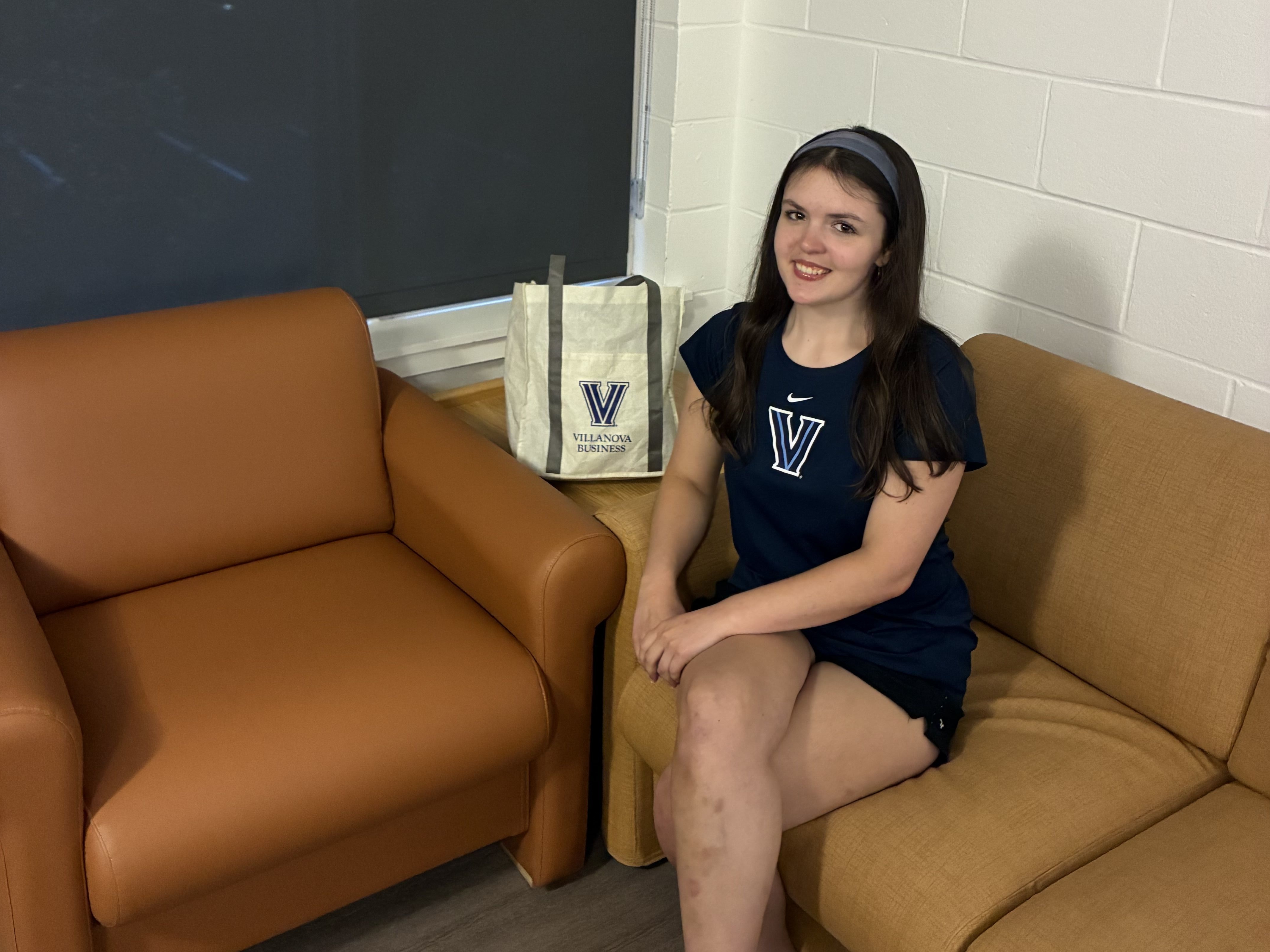
Villanova University sophomore Molly Dunphy-Culp has moved into her new apartment on the Cabrini campus.Courtesy of Molly Dunphy-Culp
“With Cabrini, there are so many more dorm options,” said Molly Dunphy-Culp, 19, a sophomore who was born in Boston and grew up in Abington.
She will be sharing an apartment in Lecceto Hall with three classmates.
She acknowledged that she will have to take the shuttle to main campus for classes, but said the short ride will be worth it. Dunphy-Culp also has a job on Cabrini as a recreation center supervisor — another plus for living there.
About half the students on campus will be allowed to have cars. Sophomores do not have that option on main campus.
“Two of my close friends are both going to have cars on campus,” said Ella Hayman, 19, a sophomore from just outside Boston. “This will give us a little more freedom we didn’t have last year. That was a big motivation.”
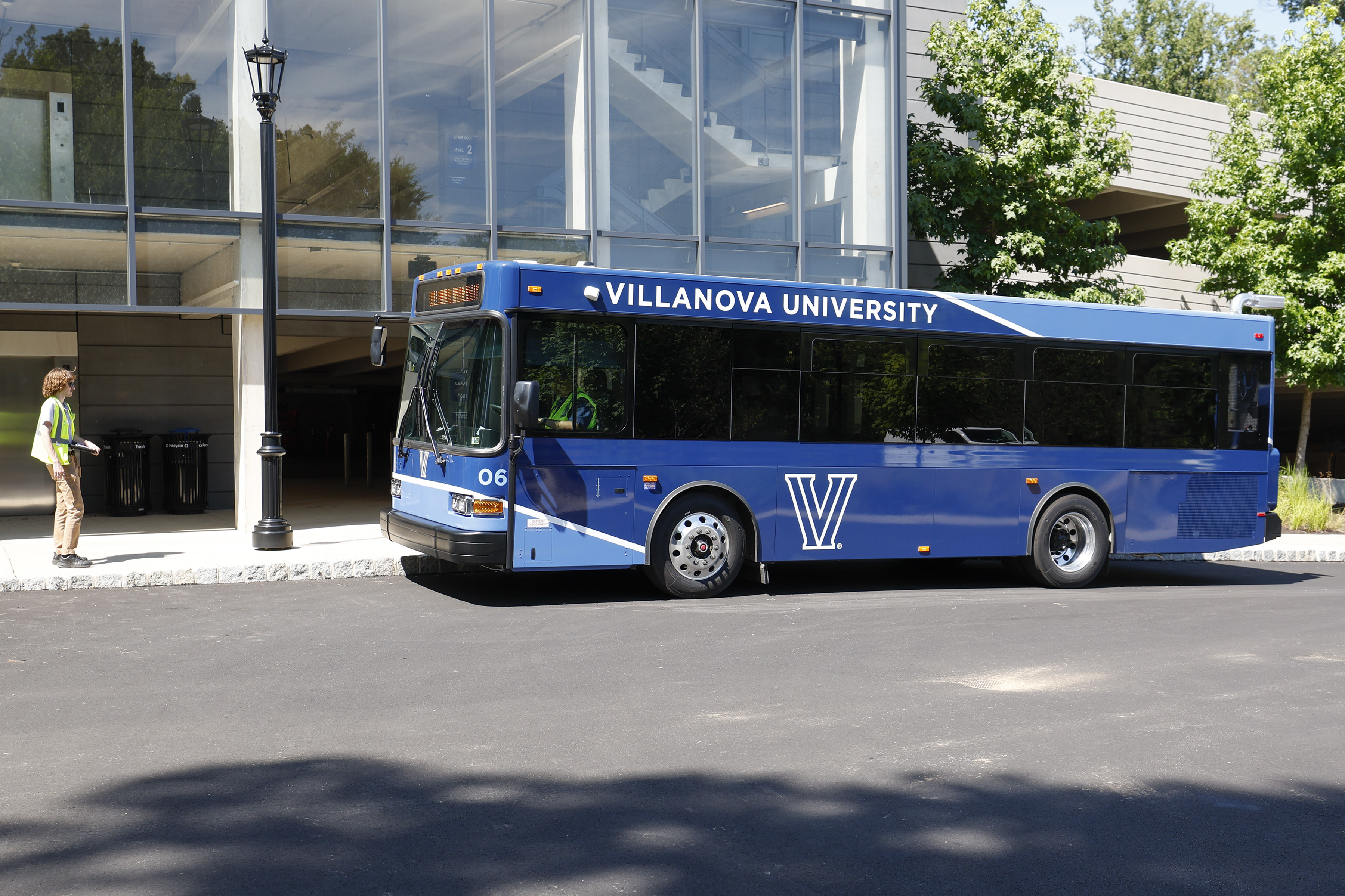
Shuttle buses including this one will transport students between Villanova’s main campus and the Cabrini campus 1.9 miles away. Steven M. Falk / For The Inquirer
Thirteen shuttle buses will transport students between the two campuses, which are 1.9 miles apart — a seven- to 12-minute ride, Hoffman said. A team of Villanova employees over the last couple of years visited five universities with multiple campuses, including Lehigh and George Washington, to learn how best to integrate them. They looked closely at models for a shuttle system that would keep students informed of where and when buses would be arriving and departing, Hoffman said.
Among new dining options on the campus is the restaurant-style Table 1842, named for Villanova’s founding year, where students can order off a menu. It is located in the former Founder’s Hall, now Bellesini Hall, which also was heavily renovated, including the installation of a new entrance that leads directly into dining facilities so people do not have to climb as many steps.
Bellesini has become the third-largest classroom building at Villanova. Some of the nearly 30 classrooms on the Cabrini campus had to be expanded to accommodate slightly larger class sizes, Hoffman said. Cabrini’s classes were 12 to 14, and Villanova starts at 16, Hoffman said.
Villanova University President the Rev. Peter M. Donohue left, and Timothy Hoffman, vice provost for finance and administration, walk through the Dixon Center. Steven M. Falk / For The Inquirer
Some improvements are still to come, including renovations to the former Mansion, which will be costly, and a nature trail, Donohue said.
Villanova named Francesca and Xavier Halls for Mother Cabrini and is continuing Cabrini’s Center for Immigration; Villanova converted it to the Mother Cabrini Institute on Immigration. Villanova also launched an elementary education major in honor of Cabrini’s former program.
Preserving a legacy
“They had a strong desire to make sure some of their legacy lasted, and we wanted to protect that,” Donohue said.
The game room at Cascia HallSteven M. Falk / For The Inquirer
Coincidentally, there is a stained glass window of St. Augustine — namesake of Villanova’s founding order — in Cabrini’s chapel and a stained glass window of Mother Cabrini in Villanova’s Corr Hall chapel.
Filling-Brown, the former Cabrini administrator now at Villanova, said it seems meant to be.
“It’s beyond my wildest dreams for the campus,” Filling-Brown said. “It’s the best outcome to see Catholic higher education continue on that campus.”
Villanova President the Rev. Peter M. Donohue discusses all it took to remodel the Cabrini campus. Steven M. Falk / For The Inquirer
Haverford College has agreed to form an antisemitism committee and enact policies supporting Jewish, Israeli, and Zionist students as part of a settlement of a suit filed during a wave of protests against the Israel-Gaza war.
The suit, filed in May 2024, months after Hamas’ attack on Israel, contended the college failed to protect the plaintiffs and allowed antisemitic harassment and bias to flourish on campus.
“We’re very proud that Haverford College will be a welcoming place for everyone, including Jews and others that support a Jewish state,” said Lori Lowenthal Marcus, legal director for the Deborah Project, the law firm that took on the case.
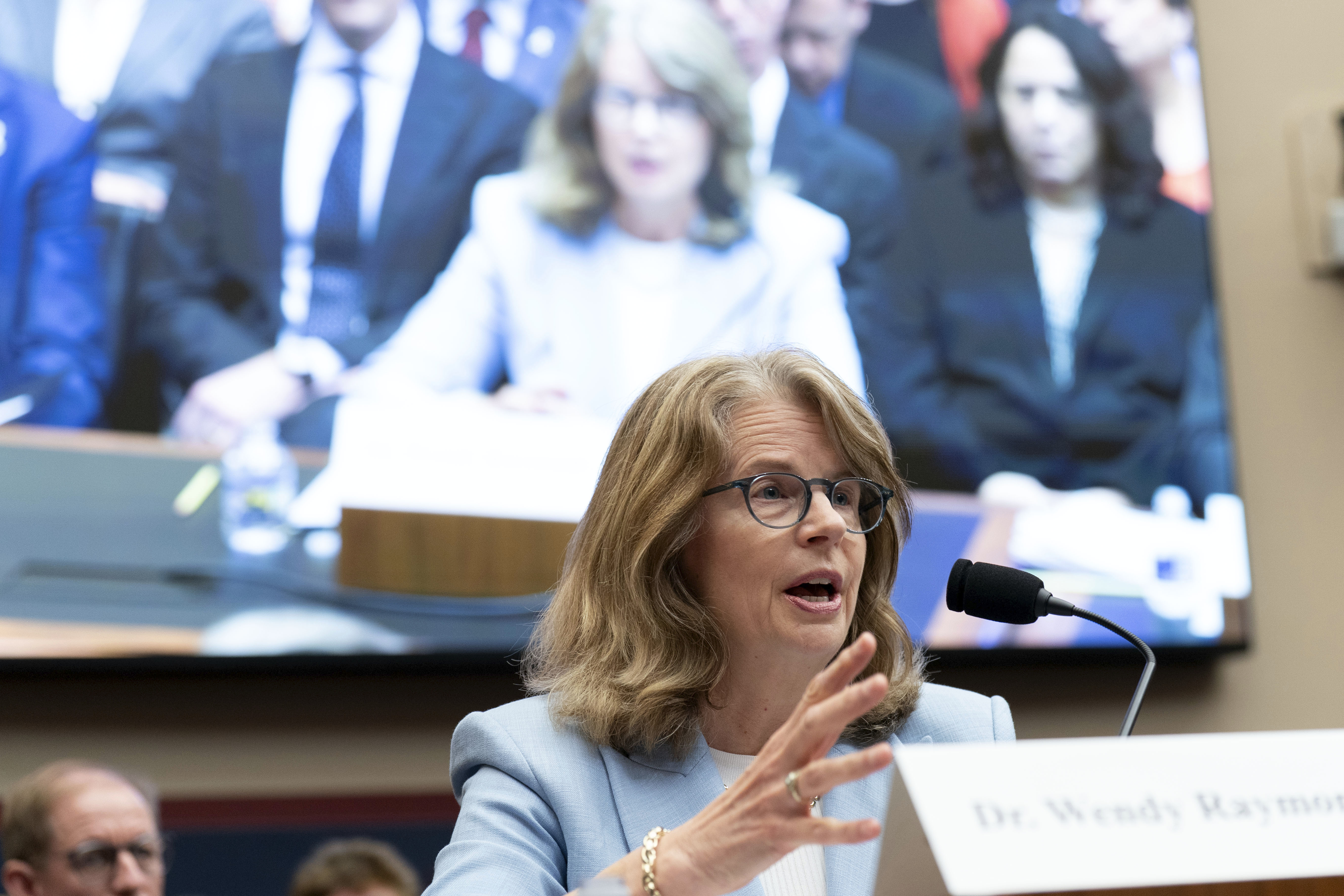
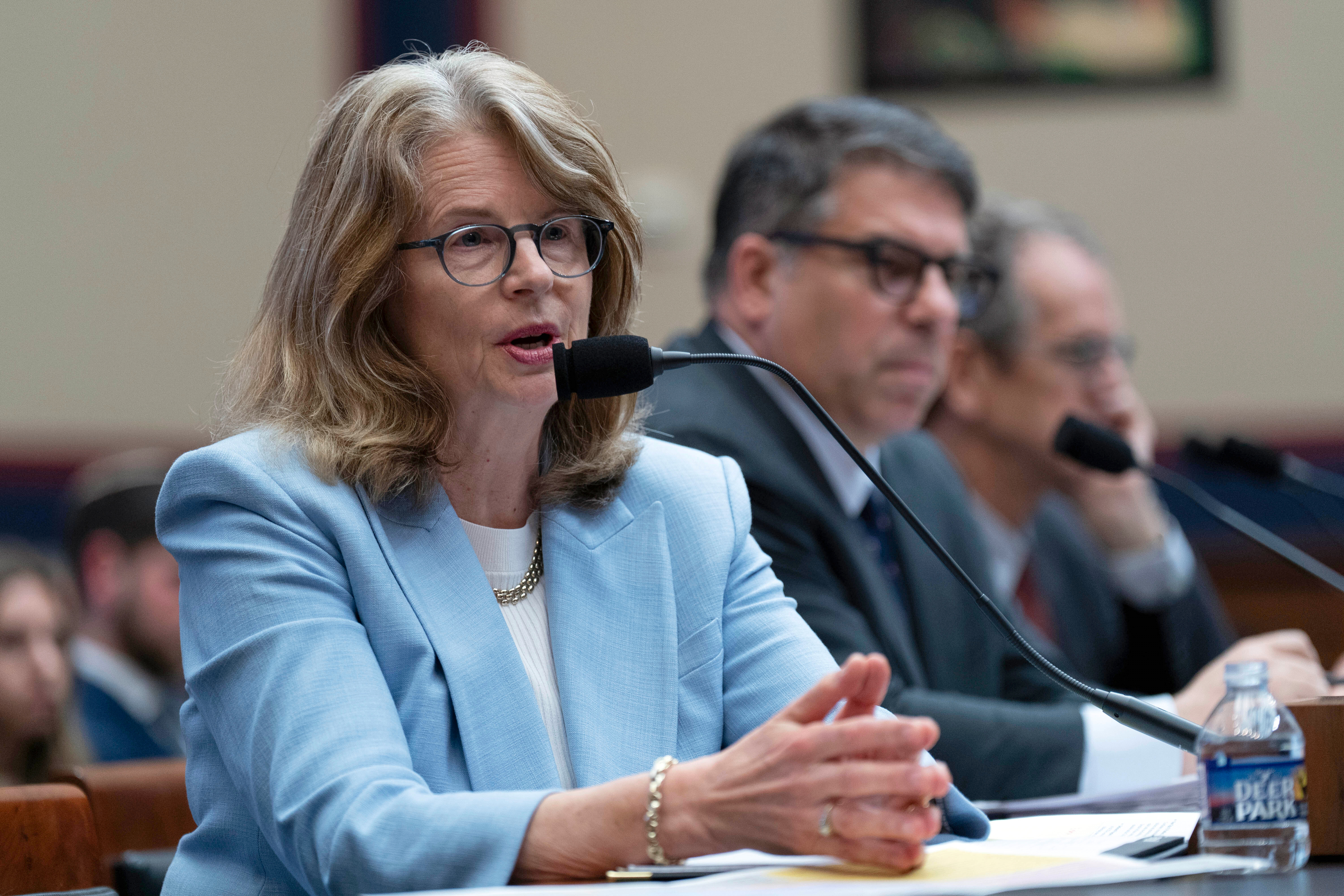
Haverford College president Wendy Raymond released a public letter on Friday as part of the settlement in which she said the college supports students who are Jewish, Israeli, or supporters of Zionism.
“In a community of learning, we may vehemently disagree with one another about the policies and actions of governments, but it is never acceptable to let those disagreements descend into the realm of discrimination, harassment, or bias,” Raymond said.
The settlement aims to resolve injustices that students said theyfaced for supporting Israel while protests engulfed the small liberal arts campus, Marcus said.
One student feared her in-class comments would reveal she was Jewish and put her at risk of discrimination from her professor, Marcus said.
Others holding a meeting on antisemitism were interrupted by bullhorns, pots and pans, and cowbells.
A plaintiff, former Haverford basketball player Ally Landau, was told she couldn’t promote antisemitism awareness at a game because the college couldn’t guarantee enough security to keep the game from being canceled.
To address some of these issues, the college agreed that its new civil rights director would look into antisemitism claims, Marcus said.
The civil rights director will work with an antisemitism committee made up of three Jewish community leaders, three people chosen by the plaintiffs, and three chosen by the school. The committee will advise the school president and provide an annual report to the college’s board of managers.
“The committee and the civil rights director will look into whether anti-Israel sentiment is antisemitism,” Marcus said, and will rely on guidance from the International Holocaust Remembrance Alliance.
Campus events hosted by Jewish Zionist or Israeli students are guaranteed security similar to what other events would get.
People wearing masks or face coverings on campus will be required to show identification if asked by campus authorities.
Professors who refuse to write letters of recommendation due to a student’s Jewish, Zionist, or Israeli identity will be in violation of the school’s anti-discrimination policy.
And the college will mandate annual antisemitism awareness training and has added details on its anti-discrimination policies in its admissions documents. It also will publish a frequently asked questions document about antisemitism.
Marcus declined to say whether the settlement included monetary compensation. She said the formation of the committee and new policies were the important changes.
“It was a great resolution for what was a painful situation,” Marcus said.
In her letter, Haverford president Raymond, who plans to step down in 2027, said the college is committed to doing better going forward.
“It is our shared responsibility to create and maintain a community of belonging for all, where we each contribute to a learning environment and culture in which every person can thrive. Haverford College commits itself to ensuring such a future,” Raymond said.
With the settlement, the court has dismissed all claims made by the plaintiffs “with prejudice,” permanently ending the legal action, a Haverford College spokesperson said.
Most Philadelphia principals believe the city’s district and charter schools are moving in the right direction, though they are also frustrated with punishing workloads and inadequate access to resources.
And while the majority of principals are satisfied with their leadership roles, Philadelphia School District school leaders are less likely to feel positive about their levels of support and autonomy. Only about half of district principals reported feeling backed by central administration, and about the same number said felt they had the authority to make decisions about school policies and practices.
Two-thirds of principals citywide have considered leaving their jobs, with most contemplating K-12 jobs outside Philadelphia or in the education sector but not in a school or district.
The results come via a new survey commissioned by the Philadelphia Citywide Talent Coalition, a group asked by the Philadelphia Mayor’s Office of Education to design and implement strategies to hire and retain more effectiveteachers and teachers of color.
Elevate 215, a Philadelphia-based education nonprofit, commissioned the study on the talent coalition’s behalf, surveying 135 district and charter school principals this spring.
Here are some takeaways from the recently released report:
There are some reasons to be optimistic
Most principals have spent more than a decade in Philadelphia schools, district or charter.
Both charter and district principals said they think Philadelphia schools are going in the right direction — 64% of charter principals and 55% of district principals. (In all, 36% and 45%, respectively, believe the sectors are going in the wrong direction.)
Charter and district principals report a satisfaction gap in some areas
While charter and district principals report similar levels of satisfaction in areas like relationships with students (95% for district principals and 96% for charter principals), there were areas of disparity.
More than three-quarters, 80%, of charter principals felt they had access to adequate funding, supplies, and support staff. Just 23% of district principals were satisfied with their level of resources.
Facilities satisfaction was a key area of difference, too — 83% of charter principals said they were satisfied with their access to adequate facilities, while 34% of district principals did.
Only 32% of district principals said they were satisfied with their workload; 54% of charter principals reported workload satisfaction.
In all, 51% of district principals said they felt supported by their central office administrators, while 88% of charter principals did. The same percentage of district principals said they felt they had autonomy to make decisions regarding school policies and practices; 81% of charter principals did.
Principals’ top challenges are consistent
Principals across sectors reported that staff shortages, workload, inadequately prepared teachers, and expectations around student achievement are top challenges.
Principals sound off
Asked what policymakers should know, the principals — who were not identified in the report by name or school — had much to say.
“One piece of advice I would give policymakers is to listen directly to school leaders who are doing the work every day,” one principal wrote. “Retention will improve when leaders are not expected to carry the weight of academics, culture, staffing, family engagement, safety, and community concerns without adequate support.”
Another principal was succinct, writing: “do not micromanage!”
“People need to be paid more, especially teachers. We also need to be able to enforce truancy policies. It’s frustrating for all involved,” another principal said.
“Attract, support, and help retain high-quality educators,” wrote another principal. “We can’t [hire large numbers of teacherswithout permanent certification] and expect miracles. Hold parents more accountable for school attendance — other states do.”
Another principal focused on a lack of experienced educators: “Offer veteran teachers a higher salary to commit to working at schools such as mine in Kensington where the only applicants are just out of college with no experience. The children continue to fall further behind even with [academic coaches] in our building.”
“Schools in hard to fill locations require veteran teachers with heart who understand their skills are needed desperately,” the principal said.
Haverford College and a Jewish group suing the school over its handling of antisemitism allegations have reached a settlement, according to federal court documents.
The documents in the U.S. District Court for the Eastern District of Pennsylvania did not include details of the settlement, but a lawyer for the plaintiffs says Haverford President Wendy Raymond’s statement to the college community immediately following the settlement announcement Friday was part of it.
“I want to take this opportunity to publicly acknowledge that those members of our community with a commitment to the state of Israel as the Jewish homeland have been deeply hurt by events that have transpired on our campus since Oct. 7, 2023, and that that constitutes a failure on our part,” wrote Raymond, who leads the 1,470-student highly selective liberal arts college on the Main Line. “We commit ourselves to doing better going forward.”
The lawsuit was filed in May 2024 as tensions mounted on many college campuses, including Haverford, in the wake of the Israel-Gaza war, following Hamas’ 2023 attack on Israel. In their complaint, the plaintiffs, three students and the group Jews at Haverford, alleged that the college discriminated against Jews by tolerating antisemitic speech and failing to adequately support Jewish students, some of whom have been shunned on campus and prohibited from participating in group discussions where the war was discussed.
They are represented by an attorney for The Deborah Project, a public interest think tank that defends the rights of Jewish people facing discrimination in the education system.
Raymond, in her statement, repeatedly stated that students who support Zionism, which she defined as “the right of the Jewish people to self-determination and statehood in the land of Israel,” are welcome at Haverford and will have “equal access” to all educational programs and activities.
“Harassing, excluding, or seeking to silence Jewish community members on the basis of their beliefs, their commitment to Jewish observance, or any other element of their Jewish identity, including Zionism, is anathema to the college’s core principles of trust, concern, and respect,” she wrote, noting that the policy applies to offices, classrooms, and student-led organizations and activities.
She said such behavior is a violation of college policy and that those who engage in it would be subject to disciplinary action, and that no Haverford professor can discriminate against or treat differently students based on their commitment to Judaism, Israel, or Zionism.
Support of Zionism has been a flashpoint in the debate over what constitutes antisemitism, with some arguing it’s wrong to conflate antisemitism with anti-Zionism.
Lori Lowenthal Marcus, an attorney for The Deborah Project, which represents plaintiffs, called the settlement “fantastic.” She said Raymond’s statement was part of the settlement, and Marcus said she would be releasing more details on Saturday.
“Plaintiffs are very pleased that they will be protected and respected on Haverford’s campus,” Marcus said Friday.
Stating that students who support Zionism will be protected was important to plaintiffs, she said.
“It’s a new form of antisemitism, saying, ‘Oh, no, I don’t hate Jews, I just hate Zionists,’” she said. “For a Jew to hear that was incredibly painful and led to students really hiding their identities when no one should be forced in any way to hide their identity, including Jewish students who believe in the right of Israel to exist as a Jewish state.”
When the complaint was initially filed in May 2024, one student, Ally Landau, a women’s basketball player who has since graduated, was named in addition to the group Jews at Haverford. Since then, two others were added with their initials.
In their complaint, plaintiffs said, the college failed to condemn Hamas’ attacks on Israel even though it had issued past statements in support of other minority groups, including Black people following the murder of George Floyd by police.
Among other allegations, the group said that a professor called students who supported Israel “racist genocidaires,” which the college did not challenge, and that the school allowed students to host an event where it was asserted that Israel had intentionally infected Palestinians with the coronavirus.
Haverford at the time declined to comment on the lawsuit.
A federal court in February 2025 dismissed the lawsuit, calling the complaint “sprawling and disorganized,” but the plaintiffs refiled.
In May 2025, Raymond was grilled by a congressional committee investigating colleges’ handling of campus antisemitism allegations. She drew fire for reluctance to answer questions about discipline in such incidents, especially in specific cases.
She also issued a statement at that time, saying that the college “came up short” in dealing with the conflict and said both she and Haverford can do better.
“To Jewish members of our community who felt as if the college was not there for you, I am sorry that my actions and my leadership let you down,” she wrote at the time.
The Haverford chapter of the American Association of University Professors, a group of nine Jewish faculty and staff, and more than 50 Jewish students at Haverford had written letters to the committee or issued statements in support of Haverford.
The faculty and staff group, noting they are diverse with some supporting Israel and others not, said at that time they “do not feel that our college is a hotbed of antisemitism.”
“We are all deeply concerned by how you are weaponizing our pain and anguish for your own purposes …,” the students wrote to the congressional committee. “It is a blatant assault on our Black, Brown, transgender, queer, noncitizen, and Palestinian peers.”
Since the congressional committee hearing, tensions have at times continued to flare. Earlier this year, Haverford vowed to make changes in its event policies after a talk by an Israeli journalist speaking on campus was disrupted, including by a protester who shouted through a bullhorn “Death to IOF,” or Israeli Occupying Forces, a name critics use to refer to Israel Defense Forces, and “Shame.”
In her statement to the campus community Friday, Raymond said it is never acceptable to let disagreements over the policies and actions of government “descend into the realm of discrimination, harassment, or bias.
“All members of the Haverford community who wish to express their considered perspectives must do so respectfully while allowing others to do the same.”
The two sides said in court documents they agreed to settle in order “to avoid the further expense, disruption, and uncertainty of litigation, all without admitting liability.”
Raymond, a molecular biologist who has led the college since July 2019, announced last November that she would step down in June 2027.
Betty J. Wilson, 92, of Cherry Hill, celebrated longtime South Jersey teacher, singer, poet, mentor, community advocate, volunteer, and two-time chapter president of Alpha Kappa Alpha Sorority Inc., died Thursday, July 16, of cancer at her home.
Mrs. Wilson taught elementary school students in Bordentown, Bridgeton, and Mount Laurel from the early 1960s to the late 1990s, and served as two-time president of the Mount Laurel Teachers Association. She was named one of the country’s top teachers in 1972 by the old Outstanding Teachers of America Association and told the Courier-Post: “Children are our most valuable asset. If we don’t give them the proper training early, there’s not much chance for the future.”
Her family called her “dynamic and outgoing” in a tribute, and her daughter, Saundra Umstead-Capers, said: “She was a born leader and had a commanding presence.”
Mrs. Wilson championed discipline and parental participation in school and at home, and told the Courier-Post: “Most of our children are allowed to talk first and ask too many questions before complete directions are given. … If the child is used to directives, he won’t resent authority. And in life, we all have to take directions from someone else no matter who we are.”
She represented Mount Laurel teachers during sometimes contentious contract negotiations with Board of Education officials and helped improve teacher benefits and job protection through the New Jersey Education Association.
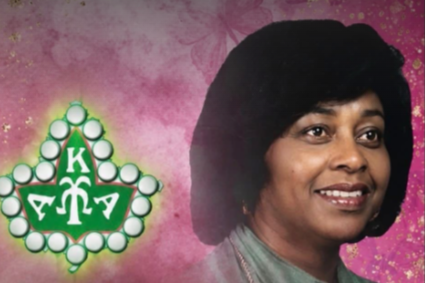
She joined Alpha Kappa Alpha in 1953 at what is now Virginia State University. Later, she cofounded local AKA chapters in Cherry Hill and Voorhees, served as two-time president of the Theta Pi Omega chapter in Cherry Hill, and was recognized by national AKA officials for her contributions.
Friends called Mrs. Wilson “a phenomenal woman” and “a beautiful, smart, professional woman” in online tributes.Courtesy of the family
The theme of her sorority presidency was service, scholarship, and Black American heritage, and she helped establish social service, public speaking, and scholarship programs. “Her presence,” sorority colleagues said in an online tribute, “will be profoundly missed.”
As a singer, Mrs. Wilson had a soaring soprano voice, and she took lessons in high school and college. She performed on a local TV station in Western Pennsylvania when she was young and sang with a traveling choir in college and for the school president.
She also wrote poetry for years and acknowledged the one-year anniversary of the 1999 death of her husband, Wilbur Wilson, by writing in 2000: “Your legacy stays with us and shall always light the way/We thank God for your presence and your sharing every day.”
She lobbied locally for the Civil Rights Act and the Voting Rights Act in the 1960s, and volunteered with the Rancocas Valley chapter of the Links and the South Jersey chapter of the Continental Societies. She served on the education committee at Evergreen Baptist Church in Palmyra and tutored the children of many church members.
In online tributes, friends called her “a phenomenal woman” and “a beautiful, smart, professional woman.” One friend said: “She impacted so many lives, especially the students she taught.”
Betty Jane Atkins was born April 6, 1934, in Library, Pa., about 12 miles south of Pittsburgh. The oldest of nine children, she was an honor student and the lead singer in every musical during her years at the old Snowden Township High School.
She attended Mt. Zion Baptist Church in Library, earned scholarships to attend college, and graduated with a bachelor’s degree in education at Virginia State.
Stylish and sophisticated, Mrs. Wilson was a popular figure on the college campus. She was selected by the football team to represent it on their homecoming float in 1953, and she served as the school’s Miss Valentine in February, Miss Apple Blossom in the spring, and Miss ROTC.
She was an engaging storyteller and, her daughter said, “a lot of fun.”
“Sister Wilson embodied the ideals of an Alpha Kappa Alpha woman,” sorority colleagues said, “elegant, poised, and gracious.”
In addition to her daughter, Mrs. Wilson is survived by a granddaughter, three sisters, a brother, and other relatives. Two sisters and two brothers died earlier.
Visitation with the family is to be from 6 to 8 p.m. Friday, Aug. 7, at Boyd Funeral Home, 1458 Mt. Ephraim Ave., Camden, N.J. 08104. Services are to be at 11 a.m. Saturday, Aug. 8, at Evergreen Baptist Church, 602 W. 3rd St., Palmyra, N.J. 08065.
Donations in her name may be made to Evergreen Baptist Church, 602 W. 3rd St., Palmyra, N.J. 08065.