Category: Business

  • Urban League of Greater Philadelphia is opening a free clinic in West Philadelphia

    Urban League of Greater Philadelphia is opening a free clinic in West Philadelphia

    The Urban League of Greater Philadelphia is opening a free clinic in West Philadelphia for people without health insurance. The $8 million Center for Well-Being will also offer workforce development, housing, and other services, Urban League officials announced Friday.

    The project at 5616 Chestnut St. sits in a neighborhood where three-quarters of the residents have low- or moderate-incomes and chronic conditions like diabetes, obesity, and high blood pressure are widespread.

    The clinic will be open to all Philadelphia residents and expects to serve residents of eastern Delaware County as well, Urban League president Darrin W. Anderson Sr. said at Friday’s kickoff event.

    “Across Philadelphia, too many residents continue to face barriers to good health, economic mobility, stable housing, quality jobs, and the resources needed to thrive. These challenges are deeply interconnected and require more than isolated solutions. They require a comprehensive community center approach,” Anderson said.

    The Urban League acquired the building in March for $1.6 million — attracted by the proximity to the Market-Frankford El and its parking lot, both of which make the building accessible to people outside the immediate neighborhood. With internal demolition about half finished, the center is expected to open in the first quarter of next year.

    U.S. Rep. Dwight Evans secured $1.2 million in seed money for the Urban League of Philadelphia’s Center for Well-Being in West Philadelphia. He spoke Friday at an event announcing the project.Erin Blewett / For The Inquirer

    The center — in a former Mercy Hospital of Philadelphia building — will employ around 30 people when it is fully operational, said Chetan Panda, vice president of community and economic impact for the Urban League.

    The hires for the 4,500-square-foot clinic with eight exam rooms will include a medical director this fall, he said.

    The project’s funding comes from a federal tax credit program designed to encourage private investment in economically distressed neighborhoods.

    Finanta, a nonprofit Community Development Financial Institution and credit union in Philadelphia, arranged the financing.

    Three years ago, U.S. Rep. Dwight Evans, a Philadelphia Democrat retiring at the end of his current term, secured $1.2 million in seed money for the project.

    The role of free clinics

    The Urban League modeled its free clinic on those in Cherry Hill, Phoenixville, and West Chester. The city’s numerous free primary care clinics are only open periodically, as opposed to being open daily.

    Philadelphia has 110,000 people without insurance, according to Panda. Many of them earn too much to qualify for Medicaid, yet don’t have access to insurance through their jobs. Their jobs pay too poorly for them to afford insurance on the state’s Affordable Care Act exchange, Panda said in an interview Thursday.

    The number of uninsured people is expected to grow next year when new requirements for federal insurance program take effect.

    The clinic will refer people who have Medicaid, Medicare, or private insurance to the federal health clinic closest to them. In West Philadelphia, that could be Spectrum or PHMC at the former Mercy Hospital of Philadelphia.

    Urban League of Greater Philadelphia officials, politicians, and other supporters sign a beam that will be used in the the refurbishing of the the Urban League’s planned Center for Well-Being.Erin Blewett / For The Inquirer

    Federal clinics, known as federally qualified heath centers, have a sliding payment scale for people who don’t have insurance. “We see that a lot of uninsured people forgo care at the FQHCs because they don’t want to pay the sliding scale. That’s a cost burden,” Panda said

    When they need care, they often seek it in high-cost emergency departments, he said.

    Free clinics rely on nearby hospitals for some of their staff and for donated services, such as X-rays and other diagnostic tests. Penn Medicine will support the new clinic in West Philadelphia, just as it does existing federal health centers, said Richard Wender, Penn’s chair of family medicine, who was at Friday’s event.

    Penn also supports Community Volunteers in Medicine in Chester County through its Chester County Hospital.

    Correction: This story has been updated to correct Chetan Panda’s title to vice president, and with the correct name of Community Volunteers in Medicine in Chester County.


  • Is AI replacing tech workers or providing an excuse for job cuts?

    Is AI replacing tech workers or providing an excuse for job cuts?

    SAN FRANCISCO — Meta, Coinbase, and Block have each laid off at least 10% of their employees in recent months and partly blamed artificial intelligence. About 13,000 jobs were eliminated among the three companies.

    But the cuts also came after big changes and growing questions about their businesses. Meta backed away from its big bet on the so-called metaverse, which cost the company about $80 billion. Coinbase’s CEO, Brian Armstrong, said its business remained volatile and there was “a down market” for cryptocurrency. And Block’s top executive, Jack Dorsey, acknowledged that the company had grown too much during the pandemic, tripling its workforce from 2019 to 2022.

    Layoffs in the tech industry are accelerating, whatever the motivations of executives. So far this year, more than 150 technology companies have cut a total of at least 115,000 employees, according to Layoffs.fyi, which tracks job cuts in the industry.

    That drip-drip of layoffs has become a steady stream in recent weeks. Companies slashing their staffs have run the gamut from software providers Atlassian and Autodesk, to social networking apps Pinterest and LinkedIn, to financial technology companies Intuit and PayPal.

    But in more than a few cases, the recent layoffs have coincided with other business issues. Wall Street loves an AI story right now. That, analysts and economists say, has offered a smoke screen for companies looking to beef up profits or patch over old mistakes.

    Cutting jobs to make way for AI is “a nice excuse, but some of these aren’t necessarily the best, most well-run companies,” said Mark Mahaney, an analyst at investment bank Evercore. “They may have overhired, or they may be losing market share. There may be other issues.”

    When Snap’s CEO, Evan Spiegel, laid off 1,000 people in April, for example, he said the company needed to turn a profit, which it has done in only three quarters since going public in 2017. But he also said AI was improving efficiency at the company, with “small squads leveraging AI tools to drive meaningful progress across several important initiatives.”

    Meta’s turn toward AI was timed with a big shift away from its giant metaverse project. During the pandemic, the company hired thousands of people to work on the effort, saying it would add 10,000 employees in the European Union. From 2019 to 2022, Meta doubled in size to about 87,000 employees.

    Since then, Meta has steadily trimmed from its augmented and virtual reality unit as it has funneled money into AI. In April, Meta said it would spend $125 billion to $145 billion this year on capital expenditures like data centers, more than double its spending last year. Last month, Meta laid off 8,000 people, or 10% of its workforce, even though its most recent quarterly profit was nearly $27 billion.

    “All these cuts are happening, and there are record profits,” said Ava Sazanami, who worked for Meta from 2022 to 2025. AI “is actually not costing any less money,” she added. “It is an excuse to some extent.”

    Last month, Meta also reassigned 7,000 employees to work on AI tools and apps. The company has been pushing its workers to adopt AI, factoring their use of the technology into performance reviews and tracking employees’ computers to gather training data for its own AI.

    “We’re seeing more and more examples where one or two people are building something in a week that would have previously taken dozens of people months,” Mark Zuckerberg, Meta’s CEO, said during a call with investors in April.

    Meta said its layoffs, reassignments, and other personnel changes varied by team. Coinbase and Snap declined to comment. Block did not respond to requests for comment.

    Many other companies have said they are cutting jobs to help free up money for AI projects. Intuit laid off about 3,000 people last month so it could devote more resources to its “big bets,” including expanding its “AI-native platform,” Sasan Goodarzi, its CEO, said in a memo to employees.

    Cisco’s CEO, Chuck Robbins, said the company would invest “in our employees’ use of AI across the company” as it cut 4,000 employees last month. And Microsoft offered early retirement in April to roughly 7% of its employees in the United States, or thousands of people, as it planned to spend about $190 billion this year on capital expenditures like data centers.

    Perhaps the most blunt explanation for job cuts has come from Cloudflare’s CEO, Matthew Prince. When the company, which provides various internet services, laid off 1,100 people last month, he said in a memo to employees that the cuts were “not a cost-cutting exercise or an assessment of individuals’ performance.”

    Prince said his company was restructuring for “the agentic AI era,” referring to digital assistants that can do tasks by themselves. In an opinion essay in the Wall Street Journal, he said the technology would replace workers he called “measurers” — people with jobs in sectors such as internal audit, compliance, finance, marketing and operations — and middle managers.

    Intuit, Cisco, Microsoft, and Cloudflare declined to comment.

    The rest of the economy has not yet seen sweeping job cuts because of AI, said Daniel Keum, an associate professor of management at Columbia Business School.

    “There are certain segments of the labor market where we’re starting to see real impact,” like “tech-concentrated sectors for juniors and new graduates,” Keum said. “If you’re a junior who graduated in the past two years — or, even worse, if you graduated this year — then hiring is getting cut.”

    But relief for tech workers doesn’t appear to be on the horizon. Andy Jassy, Amazon’s CEO, said last year that the company expected to operate with fewer corporate employees in the coming years “as we get efficiency gains from using AI extensively across the company.” Amazon laid off 14,000 corporate employees in October and 16,000 more in January, saying those cuts were to reduce bureaucracy.

    For college graduates with computer science degrees just entering the workforce, getting a job could be a struggle. In addition to the layoffs, Meta said it would close 6,000 roles it had planned to fill. Snap said it would close 300 open roles. Although AI companies are still hiring, the technology has led some start-ups to hire many fewer people.

    “AI is causing this isolated recession for college graduates now,” Keum said. “Is that going to slow down? My answer is no. It’s going to accelerate.”

    This article originally appeared in the New York Times.

  • IBX and Highmark want to cut costs by moving more outpatient care to surgery centers

    IBX and Highmark want to cut costs by moving more outpatient care to surgery centers

    Independence Blue Cross, the Philadelphia region’s largest health insurer, launched this month a policy designed to move care into lower-cost surgery centers and away from hospitals and clinics that can generate payments twice as high for the same treatment.

    The policy started June 1 echoes Medicare’s efforts to slow federal healthcare spending by paying the same price for outpatient procedures such as colonoscopies and knee surgery in hospitals as in surgery centers.

    Pressure from employers to control costs has similarly motivated IBX and a newer regional competitor, Pittsburgh-based Highmark, which implemented a similar policy on Jan. 1. Both companies’ policies affect people with low risk of complications who are covered by commercial insurance or Medicare Advantage.

    When doctors seek insurance authorization for certain procedures, IBX reviewers will ask whether doctors can treat low-risk patients in a surgery center, according to the company’s chief operating officer Richard Snyder.

    “This is a gentle move,” Snyder said. “We’re not willing to force you to change doctors to have your colonoscopy or your service, but we want docs to get privileges in ambulatory surgery centers.”

    The region doesn’t have enough low-cost surgery center capacity for a large-scale move to that setting, Snyder said. That means the policy might not hit hospital finances right away.

    But the implication is that the policy could take a harder edge in the future. IBX’s goal is to spur the development of more surgery centers — either by the incumbent health systems or by new competitors, Snyder said.

    Even now, the potential for delayed care and denied coverage has several regional health systems worried. Temple University Health System, for example, does not own ambulatory surgery centers, so the time could come when it has to coordinate care with outside providers.

    The money at stake

    Surgery to remove torn cartilage on the knee can cost $7,190 when performed on an outpatient basis in a hospital, nearly three times the $2,477 cost in ambulatory surgery centers, according to Philadelphia-area commercial insurance averages from heath prices data firm Turquoise Health.

    Smaller gaps exist for hernia repairs and colonoscopies with a biopsy, Turquoise reported. Another data firm, Medscout, showed that a majority of those colonoscopies had already shifted to ambulatory surgery centers by 2024. The shift was far less advanced for hernia repairs — a procedure IBX is targeting.

    (function(){function e(){window.addEventListener(`message`,function(e){if(e.data[`datawrapper-height`]!==void 0){var t=document.querySelectorAll(`iframe`);for(var n in e.data[`datawrapper-height`])for(var r=0,i;i=t[r];r++)if(i.contentWindow===e.source){var a=e.data[`datawrapper-height`][n]+`px`;i.style.height=a}}})}e()})();

    Some physicians’ groups already are seeing opportunity in commercial and government insurers’ increased emphasis on surgery centers as a way to reduce spending — as well as regulatory changes that allow more procedures to be done in free-standing surgery centers.

    Southeastern Pennsylvania now has four relatively new cardiovascular surgery centers.

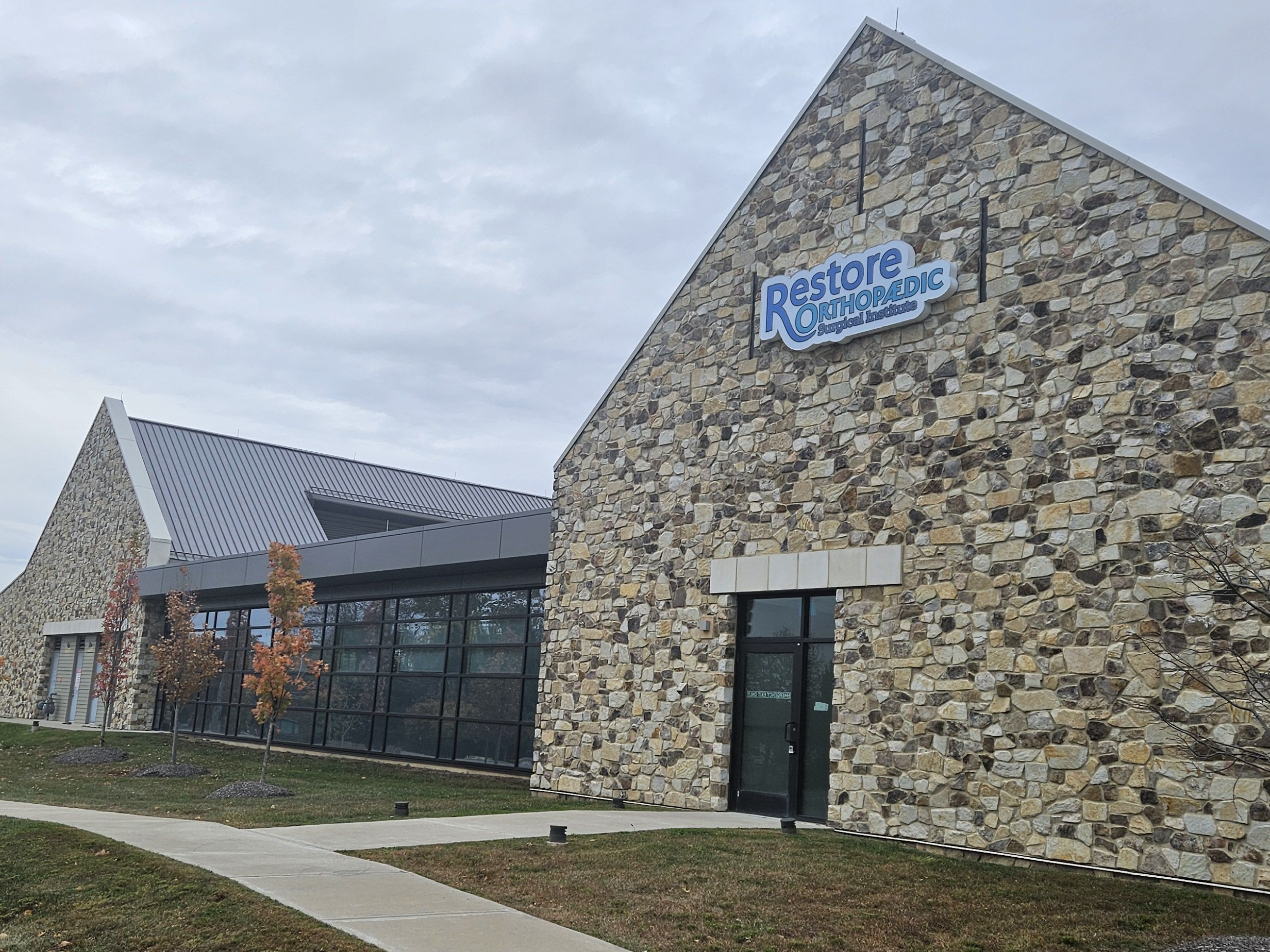
    Restore Orthopaedic Surgical Institute in Chadds Ford, founded by a group of Delaware doctors, has been quickly become a high-volume joint-replacement center.

    In the coming year, Rothman Institute plans to open three surgery centers in the Philadelphia region, the private practice’s CEO Christian Ellison said.

    Restore Orthopaedic Surgical Institute in Chadds Ford has grown quickly to become one of the top joint replacement destinations in Southeastern Pennsylvania after opening in March 2023. The center is positioned to take advantage of an effort by Highmark and IBX to move outpatient procedures from high-cost hospitals to lower-cost surgery centers.Restore Orthopaedic Surgical Institute

    Potential consumer impact

    Several major health systems said the new site-of-care review policies raise questions about the potential impact on patients, without commenting on the implications for their finances.

    Because Temple University Health System does not have any ambulatory surgery centers, “the policy will require certain studies and procedures to be referred outside the health system. This could create additional coordination requirements and may contribute to delays in testing, crucial diagnosis, and/or treatment,” Temple said in an email.

    Main Line Health also said it anticipates the policy “could disrupt established care pathways, including in circumstances where surgeons lack privileges at available free-standing surgery centers,” the nonprofit said in a statement. Main Line has ownership interest in three surgery centers in Philadelphia’s western suburbs.

    The University of Pennsylvania Health System said it will “advocate for our patients’ best interest and appeal any service denials based on the clinical and nonclinical exceptions outlined in the policy.”

    Additional concerns for consumers include complexity, confusion, and possibly more risk of having care denied to what can already be a burdensome prior authorization process, said Christine Monahan, assistant research professor at Georgetown University’s Center on Health Insurance Reforms.

    Monahan said she understands insurers’ impulse to steer people to lower-cost settings, but called policies like IBX’s “maybe not the most efficient way to handle the inefficient pricing in the system.”

    The economic and political backdrop

    The biggest increases in healthcare costs in 15 years are hitting employers this year, according to Mercer’s National Survey of Employer-Sponsored Health Plans.

    The average increase was 6.7%, according to the February survey of 161 chief financial officers, who were not identified.

    The increases are substantially higher than broader inflation. “It becomes more of a tax on employers,” Snyder said. “Next to salaries, many will tell you, that’s the biggest line item” in their expenses.

    IBX has taken other steps to reduce healthcare spending, such as in 2015 introducing a benefit design that includes a preventive colonoscopy with no out-of-pocket costs for the patient at what are called Preventive Plus facilities. Elsewhere, they have a $750 co-pay.

    Highmark and IBX have new policies designed to move more outpatient procedures and treatments out of high-cost hospitals and into lower-cost surgery centers.Pablo Martinez Monsivais

    Medicare has pushed for the last decade to pay the same for services in hospital outpatient departments as in doctors’ offices and surgery centers.

    Medicare prohibited most new off-campus hospital clinics from billing at hospital rates in 2017. So-called site-neutral payments expanded in 2019 to include clinic visits. This year, the government applied the standard to payments for drug administration, such as chemotherapy.

    Highmark Health Plans’ approach

    In the first five months of under new policy, Highmark Health Plans has found some health systems are willing to accept lower surgery center rates for procedures performed within hospitals.

    “What we’ve found is that a number have been willing to do that,” said Kate Musler, chief financial officer for Highmark’s insurance arm. “It may be advantageous for them to have that volume flow through the hospital and keep some volume there, it’s just not necessary in terms of the expense level.”

    Musler cited bariatric surgery as an example of how technology and surgical practices have advanced to the point where a hospital is no longer needed.

    It’s too early to say how much savings the new policy has generated, including in Southeastern Pennsylvania, Musler said. Highmark has seen its policy accepted at different levels across the five states where it took effect.

    Some hospital systems are proactively shifting care to surgery centers to reduce costs, said Musler, who oversees Highmark underwriters helping employers understand their health expenses.

    “We hear directly from employers who are making very difficult decisions,” she said. “It is now more than ever a question of whether they can afford employee health.”

  • Ships stranded by war face costly dilemma: Wait it out or risk attack

    LONDON — Pankaj Khanna, the CEO of Heidmar Maritime Holdings, knows what it’s like to be stranded at sea in a war zone. Long before he became a shipping executive, he was a seafarer himself, a crew member on a ship during the Persian Gulf War of 1991 as a Scud missile flew overhead. He recalled the paralyzing fear of some seafarers on board.

    Today, the stress on the roughly 11,000 stranded sailors in the Persian Gulf may be even greater. Seafarers now have internet access and are often watching livestreams of attacks happening around them while seeing explosions from their ship decks.

    “The fact that they are sitting on board the ships with real-time information — it is psychologically very traumatic,” said Khanna, 55.

    Three commercial vessels have been hit by U.S. forces this week. One of the strikes killed three people, bringing the number of seafarers killed since the start of the war to 14. All told, there have been 46 attacks on international ships in and around the Strait of Hormuz since Feb. 28, most by Iran and some by the United States.

    The war in Iran is approaching its 15th week. For the shipping industry caught in the middle, pressure is mounting — on the sailors, the shipowners, and operators losing hundreds of thousands of dollars a day, and the customers awaiting the delivery of oil and goods. At stake is not only the safety of those in the line of fire but the functioning of the global economy.

    A tense calm prevailed in the Gulf on Friday on hopes that a deal to end the fighting could be near.

    “We have heard this, like, 20 times,” Khanna said. “So what are the prospects? I don’t know.”

    Even after a reopening of the strait, he added, ships will need a “framework” before they attempt to get out. “We need to know which parts of the strait are clear,” he said.

    Heidmar Maritime, based in Athens, Greece, manages a fleet of 60 vessels that operate all over the world, including off the coasts of Europe, South America, and northern Asia and in the Red Sea. Just two weeks ago, one of its ships was attacked by Somali pirates.

    The company’s ship in the Persian Gulf, carrying Saudi crude oil, is one of about 500 large vessels operated by established companies that have been stranded there since the early days of the war in late February. Some vessels have taken advantage of windows of calm to slip out of the Gulf. But departures have slowed recently, according to Lloyd’s List Intelligence, as tensions have increased.

    And it seems less likely that conditions faced by shipping businesses will quickly return to their prewar state even if a deal is reached.

    “Even if a solution for peace is put in place in the coming weeks, there’s no guarantee there won’t be another crisis later on, and we can’t be prisoners to Hormuz,” Rodolphe Saadé, the CEO of CMA CGM, the French shipping giant, said at a French parliamentary hearing Tuesday.

    The world’s third-largest container line, CMA CGM has 11 vessels stranded in the Gulf after three others were able to leave. “I won’t be fixated on the idea that the Strait of Hormuz is going to reopen and everything will return to how it was,” Saadé said.

    As the strait remains effectively blockaded, shipowners are subject to marine insurance fees as high as $6 million to $7 million to exit the gulf, said Khanna of Heidmar Maritime. Perishable cargoes are expiring, and insurance premiums are adding up. Still, shipping companies have, in some ways, benefited from higher tanker rates and longer journeys needed to reroute around risky areas like the Red Sea.

    For the companies with ships stuck in the gulf, Iran has offered a way out: Pay a fee to secure safe passage. But sanctions imposed on Iran by the United States and Europe make it illegal for companies with American or European connections to pay.

    The shipping industry has more or less steadfastly maintained that the resumption of free passage through the strait is essential for global trade. Now the rising costs have led to some cracks in that argument.

    Last week, Evangelos Marinakis, the owner of one of Greece’s biggest shipping businesses, said at a conference in Athens that paying $100,000 or $200,000 tolls to secure safe passage through the strait would be better than having the strait closed.

    “I would prefer to pay a toll for the right to navigate through the Strait of Hormuz immediately and safely, rather than pay huge extra war risk premiums,” he said in a statement.

    And the stress for seafarers keeps mounting.

    Mohamed Arrachedi, the Middle East coordinator of the International Transport Workers’ Federation, a seafarers union, said he was receiving WhatsApp messages at all times of day from seafarers requesting repatriation or reporting unpaid wages.

    “They were hopeful, but now, observing that it is starting again, people are not only anxious, worried, and concerned, but people are desperate,” Arrachedi said.

    In recent weeks, more seafarers reported shortages of fresh fruit and vegetables than in the first couple of weeks, he said. On some ships, people are surviving on dry food alone. Drinking water, too, has become an issue since vessels have to be moving in deep water to generate their own supply.

    “It’s kind of like being on the front line of a war that you have absolutely no involvement in,” said Michelle Wiese Bockmann, an analyst at the maritime intelligence firm Windward. “You don’t have a dog in the fight, and you’re just there.”

    This article originally appeared in the New York Times.

  • Ford and Honda issue recalls for thousands of vehicles

    Ford and Honda issue recalls for thousands of vehicles

    Ford is recalling more than 250,000 vehicles that were incorrectly repaired under a previous recall meant to fix a problem that caused the engine to stall while driving.

    The recall includes 255,404 Ford Focus automobiles, model years 2012-2018. Ford said the canister purge valve may malfunction, causing the engine to stall unexpectedly while driving, increasing the risk of crash and injury.

    To fix the problem, dealers will provide a powertrain software update free of charge.

    Owner notification letters are expected to be mailed July 6. Owners may contact Ford customer service at 866-436-7332.

    Ford’s number for this recall is 26S40. The National Highway Traffic and Safety Administration’s number for this recall is 26V369. The original NHTSA recall number for this issue is 18V735.

    Vehicle identification numbers involved in this recall will become searchable on NHTSA.gov on July 6.

    Earlier this week Honda announced a recall of more than 800,000 vehicles because rear suspension components may fail and cause drivers to lose control, increasing the chances of a crash or injury.

    American Honda Motor Co. said the recall covers certain 2016-2022 Honda Pilot, 2017-2023 Ridgeline, 2019-2023 Passport, and 2014-2020 Acura MDX vehicles. The recall includes 880,514 vehicles that were sold in Connecticut, Delaware, the District of Columbia, Illinois, Indiana, Iowa, Kentucky, Maine, Maryland, Massachusetts, Michigan, Minnesota, Missouri, New Hampshire, New Jersey, New York, Ohio, Pennsylvania, Rhode Island, Vermont, Virginia, West Virginia and Wisconsin.

    The problem centers around the rear subframe, which can corrode at suspension mounting points and cause the rear suspension to fail. Honda estimates that just 1% of the vehicles listed have the defect.

    Honda has had no warranty claims and no reports of an injury or death related to the problem.

    As a remedy, Honda and Acura dealers will inspect the rear subframe and install a reinforcement kit if necessary, or repair or replace the rear subframe components at no cost to vehicle owners.

    Owner notification letters are expected to be mailed July 7.

    The National Highway Traffic Safety Administration’s campaign number for the recall is 26V367000. Honda’s numbers for this recall are AOU and AOT. Vehicle Identification Numbers applicable to this recall will be searchable on NHTSA.gov beginning June 10.

    Owners may contact Honda’s customer service at 888-234-2138.

  • Sleep Number files bankruptcy to sell itself, blames tariffs

    Sleep Number files bankruptcy to sell itself, blames tariffs

    Mattress maker Sleep Number Corp. filed bankruptcy with an agreement to sell the firm to one-time retail partner Sleep Country Canada Inc. after years of weak demand, mounting financial pressure, and unpredictable tariffs.

    Sleep Number blamed its bankruptcy, in part, on “the unpredictable shifting of trade rules imposed by the current U.S. government on top of an already vulnerable global supply chain,” according to a court filing Friday.

    Even after the U.S. Supreme Court struck down some of President Donald Trump’s tariffs, “the broader trade landscape remained complex and the company continued to manage ongoing regulatory uncertainties, particularly regarding potential alternative tariff frameworks that may be imposed” on U.S. imports, chief financial officer Amy O’Keefe said in the filing.

    Sleep Number filed for Chapter 11 protection from creditors in order to hold an auction, at which Sleep Country would be the so-called stalking horse bidder. Its all-cash opening offer for “substantially” all of the firm’s assets is $415 million, O’Keefe said.

    Because the firm tried to sell itself in the months leading up to the Chapter 11 filing, O’Keefe said Sleep Number is seeking a 26-day sale process. Any competing bids would be due July 8 and the sale would close by July 31 under the company’s proposed timeline.

    Sleep Number, which operates 572 stores and is known for its customizable beds, will continue operations while seeking a quicker-than-usual court-supervised sale process, according to the filing.

    The company, whose shares have plunged more than 95% the past four months, has been hurt by declining store traffic amid broader industry pressures.

    In response to mounting financial woes, O’Keefe said Sleep Number restructured its real estate portfolio and launched a number of cost-cutting initiatives in recent years. The firm had reported its operating costs fell by $136 million last year, but its net loss still widened as net sales dropped 16%.

    Sleep Number said in a statement that it will continue to review its footprint with the aim of retaining as many retail locations as possible. It added that as much as $65 million of new borrowing has been arranged to pay for the restructuring process. Sleep Number would also refinance $195 million of older debt should the loan package be approved by the judge overseeing the bankruptcy case.

    The company listed assets of between $500 million and $1 billion and liabilities of between $1 billion and $10 billion, with lenders owned about $672.5 million.

  • Solar power hits new milestones in the U.S. even as Trump boosts coal over clean energy

    Even as President Donald Trump boosts coal over clean energy, solar power is hitting new milestones in the U.S. and remains the leading source of new power.

    Data released Wednesday by global energy think tank Ember, along with a report by the Solar Energy Industries Association and analytics firm Wood Mackenzie, show the continued growth of solar and decline of coal in the United States despite federal policy. In May, for the first time, solar supplied more of the nation’s electricity than coal, or 12.8%, Ember said. Coal supplied 12.2%, its fourth-lowest monthly share ever.

    “For years solar power has risen in the U.S. electricity mix,” said Nicolas Fulghum, senior energy and data analyst at Ember. ”At the same time, coal power has lost its status, first as the largest source in the U.S. mix, and then gradually over the years has fallen even further.”

    Solar also became the third-largest source of electricity in the U.S. in May, behind natural gas and nuclear, Fulghum said. Coal generation hit an all-time monthly low in April and rebounded only modestly in May, allowing increasing solar generation to overtake coal, he added.

    Electricity is produced by converting sources of energy — fossil fuels, renewable resources and nuclear — into electrical power. Burning coal, oil, and natural gas for electricity emits carbon dioxide, trapping heat in the atmosphere and warming the planet. By contrast, solar, wind, geothermal, hydropower, and nuclear are carbon-free.

    After about two decades of essentially flat electricity consumption in the U.S., electricity demand is increasing to power artificial intelligence, grow domestic manufacturing, and electrify transportation and heating. Fulghum said he expects to see more months when solar exceeds coal generation, before overtaking it on an annual basis in a few years.

    These milestones signify that solar “has staying power” at a time when there’s less support for renewable energy at the federal level, he added.

    Wind and solar combined have overtaken coal in the past, and wind power alone has outpaced coal during spring months when wind speeds pick up. Ember gets its hourly and monthly data from the U.S. Energy Information Administration.

    Globally, electricity generation from renewables is growing rapidly. Renewables will become the largest global energy source, used for almost 45% of electricity generation by 2030, according to the International Energy Agency.

    Trump helps the struggling U.S. coal industry while curtailing solar and wind

    Last week, Trump, a Republican, announced a plan to boost the struggling U.S. coal industry by spending nearly $700 million to support coal-fired power plants and coal exports. Trump said at a White House event that “coal’s a great business” and that “in terms of power, there’s really nothing like it.”

    Martin Pochtaruk, CEO and founder of Canadian-based solar panel manufacturer Heliene, said Trump can say that coal is coming back but investors will invest their money in whatever brings the best return. And for power generation that is solar, making it the fastest-growing fuel, he added.

    A White House spokesperson defended the Trump administration’s overall energy policies, saying they were geared toward strengthening the country’s security.

    “The President has reversed the Left’s devastating policies, saved the American coal industry, prevented the retirement of more than 17 gigawatts of power, and saved lives during heightened demand periods,” Taylor Rogers said in a statement.

    While Trump is trying to reverse the coal industry’s decline, solar has been the top source for new power for five years, SEIA said. SEIA and Wood Mackenzie said solar and battery storage were practically the only energy resources being built in the first quarter, making up 91% of all new generating capacity.

    The Trump administration has canceled solar and wind projects, implemented policies that slowed clean energy permitting and development, and terminated $7 billion in funding intended for affordable solar energy projects across the U.S.

    “As power demand skyrockets, political and regulatory attacks are slowing down the exact resources we rely on,” Darren Van’t Hof, interim president and CEO of SEIA, said in a statement. “Impeding the only sector that is actively building new power is a reckless gamble that will only drive electricity bills higher.”

    Several groups sued the Environmental Protection Agency over canceling the Solar for All program. A district court dismissed the case last week citing lack of jurisdiction. The plaintiffs have another filing pending in the Court of Federal Claims.

    In a ruling Saturday, a federal judge struck down guidance from the Internal Revenue Service restricting tax credits for wind and solar projects.

    Trump has blamed renewable energy sources such as wind and solar power for skyrocketing energy costs. But energy analysts say recent price hikes are based on growing demand, aging infrastructure, and increasingly extreme weather events that are exacerbated by climate change. Most recently, the war in Iran that Trump launched has also led to a spike in energy costs.

    Blaming clean energy is “nonsensical,” said U.S. Rep. Jared Huffman. The California Democrat said that “not even lighting $700 million of taxpayer money on fire” can save the dying coal industry.

    “The rest of the world will move ahead toward a clean energy future with countries other than the United States leading the charge, unfortunately,” he said Wednesday. “Trump will fail in this agenda. But, he will do enormous damage to our global leadership on clean energy and to the cost of living for struggling Americans.”

    Top states for solar voted for Trump

    States won by Trump in the 2024 election accounted for 74% of all solar capacity installed in the first quarter of 2026, with Texas, Florida, Ohio, Indiana, Michigan, Arizona, and Mississippi ranking among the top 10 states for new solar additions, SEIA said. The U.S. now exceeds a total of 6 million installations nationwide across all solar sectors, which includes large-scale solar arrays, commercial, community solar, and residential or rooftop solar.

    Johanna Neumann, at the Environment America Research and Policy Center, said it’s “good news for our health and our planet that solar continues to grow,” and also, not surprising.

    “Today we can harness solar more affordably than any other energy source. It’s scalable. And it’s also our most abundant renewable energy source,” said Neumann, senior director of the center’s campaign for 100% renewable energy. “So I think it’s hard to keep the lid on a good idea, especially if the economics are tilting in your favor as well, which they are in the case of solar.”

    Environment America’s renewable energy dashboard shows that 32 U.S. states generated at least 10% of their retail electricity sales from solar, wind and geothermal energy last year, compared to 18 states in 2016. Clean energy in the South is booming, particularly in Florida, Arkansas, and Mississippi, Neumann said.

    “I think there is a misconception in the United States that clean energy is something for the coasts and liberal cities,” she said. “The true story of renewable energy is a 50-state story.”

  • SpaceX IPO extends Elon Musk’s influence across more than just AI

    SpaceX IPO extends Elon Musk’s influence across more than just AI

    Elon Musk controls reusable rockets that are the backbone of the U.S. space program. His constellation of satellites in space represents a pillar of U.S. defense. And he has struck deals with leading artificial intelligence companies to fuel the AI revolution.

    Now the public sale of SpaceX’s shares will not only dramatically increase Musk’s wealth, making him the world’s first trillionaire, but it will expand his reach into pivotal sectors of the global economy.

    All the while, it sets up Musk’s rocket company to dominate the cosmos as entities across the globe vie for control of space.

    “U.S. space power is built on the back of SpaceX. Period. Full stop. What does that mean?” asked Clayton Swope, deputy director of the Aerospace Security Project and senior fellow at the Center for Strategic and International Studies. “It means SpaceX has incredible leverage over the government right now.”

    The IPO is the largest in history, raising $75 billion to fuel the company’s ambitions. But SpaceX also has a recent track record of losing billions of dollars, including $13 billion since the beginning of 2023.

    In IPO documents, SpaceX has laid out an ambitious plan to become an essential hub of the artificial-intelligence age. Despite building its reputation on space launches and its satellite internet service, Starlink, SpaceX sees the vast majority of its market opportunity — all but $2 trillion of an estimated $28.5 trillion — in artificial intelligence.

    That opportunity rests on major, even far-fetched, bets. A constellation of millions of satellites for space-based data centers will power AI from orbit, and the company will vastly expand its Starlink internet service. Starshield, SpaceX’s secure satellite network for government, will be used for defense and national security applications.

    The diversity of SpaceX’s business, which spans AI, social media, and internet connectivity, will likely make it a clearinghouse of lucrative data, allowing it to improve on various capabilities and outpace rivals.

    Its plans are ambitious. Musk has upended global industries — making electric cars mainstream, bringing internet access to remote areas with thousands of satellites, and reviving the Space program. With SpaceX’s IPO, Musk turns his boundary-breaking approach to space, combining capabilities his firm has honed over decades.

    Musk mused recently, in an interview with SpaceX employees posted on X, about a core facet of the company’s mission. “How do you decide what progress a civilization has made?” Musk asked. So far, humanity is harnessing a tiny amount of Earth’s power and a minuscule proportion of the sun’s, he added, marking gaps SpaceX hopes to fill.

    The company’s plans however, are raising concerns among some in the space and tech sectors about the level of power SpaceX has amassed — which may give him tremendous sway over the U.S. space program.

    That power takes several forms.

    “The cost is the big one for me,” Swope said. “Where is the best value proposition? Is it with the company that holds all the cards?”

    By taking SpaceX public, Musk has realized an ambition that began more than two decades ago when he took the earnings from the sale of PayPal and seeded them into two companies: Tesla, which debuted on the stock market in 2010 and went on to become the world’s most valuable automaker, and SpaceX, where the entrepreneur pioneered reusable rockets and made space exploration into a private enterprise.

    The space company debuted on the Nasdaq composite index on Friday, under the ticker symbol SPCX. Its IPO shares were priced Thursday at $135 each. SpaceX opened Friday at $150 a share, then rose to around $168, before finishing the day just below $161.

    SpaceX’s significant losses have not muted its hype. The company has attracted an unusual level of interest from retail buyers, who have jockeyed for a stake in the next potential Musk moonshot.

    To some, SpaceX’s business case is underscored by the high level of importance the U.S. government ascribes to it.

    “This is the United States space program,” said Ross Gerber, a SpaceX investor who has emerged as a Musk critic in recent years. “We’ve outsourced from NASA to SpaceX.”

    In IPO documents, SpaceX describes how its satellites have been deputized for potential defense purposes.

    “What this really is about is about national security and expanding our … footprint in space in a way that no other country could,” Gerber added.

    This interdependent relationship provides upsides for the company, Gerber said, but “there is a risk inherent,” in the country’s level of dependency.

    Analysts expect significant buy-in for SpaceX’s ideas when it takes to the public markets.

    “Musk has always been very good at selling the future to investors, so I am not surprised by the excitement built into the valuation expectations for the IPO,” said David Meier, senior investment analyst at the Motley Fool. Meier noted, however, that SpaceX’s IPO pricing and valuation “looks very aggressive relative to the financial performance it has put up and expects to put up in the near future.”

    Still, SpaceX may not shatter all of the lofty expectations built into its IPO.

    Nick Smith, a senior analyst at research firm and IPO stock index Renaissance Capital, said IPOs of large companies have a mixed track record. For every winner like Meta, Smith said that there are also losers including Rivian.

    The electric vehicle company went public in 2021 with a market value of about $100 billion as its stock shot up on its first trading day. Today Rivian is worth about $20 billion.

    Smith noted that SpaceX’s investment bankers have sketched out a path to booming revenue, including from two deals with AI rivals Anthropic and Google to rent out data-center capacity from SpaceX’s xAI business and plans to deploy a more capable but much delayed rocket. If SpaceX’s annual revenue climbs well above $100 billion in a few years from about $19 billion last year, “I think the valuation is OK if you believe it can do that,” Smith said.

    Smith also said that Musk inspires a magical faith in his capabilities to make the impossible happen. This “Musk effect,” Smith said, makes his companies’ value become “divorced” from typical calculations of what companies should be worth.

    Swope, the senior fellow at the Center for Strategic and International Studies, said he is hopeful SpaceX won’t outgrow the entities it has served in the past.

    “The government’s mission and U.S. space power are so dependent on this company,” Swope said. “No one wants to see the period where it could be weakened.”

    Still, he wondered of the IPO, “How will it change the company?”

    The Associated Press contributed to this article.

  • A Souderton beef processing plant, one of Montco’s biggest employers, is closing

    A Souderton beef processing plant, one of Montco’s biggest employers, is closing

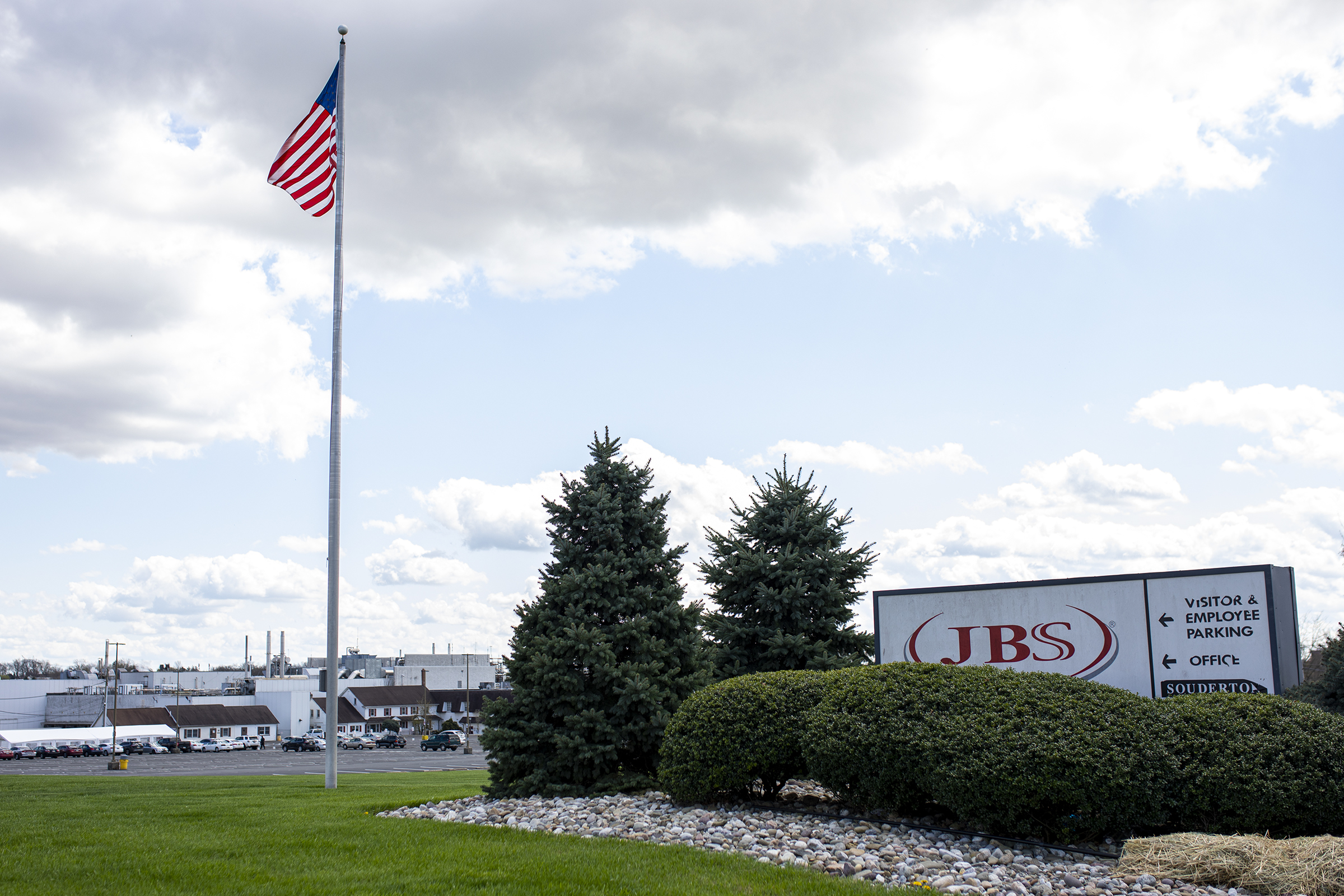
    A global meat producer and one of Montgomery County’s top employers is closing a beef processing facility in Souderton that employs about 1,700.

    JBS said Friday that the plant will close by Aug. 14, citing the company’s larger strategy for “growth, modernization, and long-term competitiveness in the United States.” It also plans to close a site in Memphis.

    The planned closure impacts some 1,500 union workers who are represented by the United Food and Commercial Workers International Union (UFCW) Local 1776.

    “These decisions are never easy because they directly affect our team members and the communities where we operate,” Wesley Batista Filho, CEO of JBS USA, said in a statement Friday. “Our focus right now is on supporting them with transparency, respect, and access to new opportunities wherever possible.”

    Workers at the Souderton facility were among some 26,000 JBS employees who secured a new union contract last year with better wages and benefits including a more inclusive bereavement leave policy and the ability to accrue sick days.

    The contract also established a pension plan for workers. That’s a rarity in the industry in recent decades, according to the union, which called the agreement “a new standard” in the meatpacking industry.

    That contract is set to expire in August, when the company plans to close the facility, according to the union.

    The work being carried out at the Souderton site, which JBS has operated since 2008, will be distributed among the business’ other facilities, according to a company news release. In the past year, JBS has been expanding its operations in Texas, Georgia, and Iowa as it focuses on growing its prepared foods business.

    “JBS USA is investing heavily in the United States and in the future of food production,” Batista Filho said in a statement. “At the same time, we must ensure our operations are efficient, modern, and positioned to compete. By investing where we are growing and making difficult adjustments where needed, we are building a stronger and more resilient company.”

    The union is working to try to keep the Souderton site open.

    “We are not giving up on this plant, and we are not giving up on these workers,” Wendell Young IV, president of UFCW Local 1776, said in a statement Friday. “Our union will be working around the clock engaging with every elected official and government agency we can to explore all options to keep this facility open and these workers employed.”

  • Pa.’s ‘explosive’ data center growth is driving this Philly company’s investments in Appalachian natural gas

    Pa.’s ‘explosive’ data center growth is driving this Philly company’s investments in Appalachian natural gas

    The U.S. runs on natural gas. As power demand surges, gas supplies more than 40% of the nation’s electricity, more than any other source.

    Gas is piped from U.S. wells and storage by big drillers such as Pittsburgh-based EQT and energy giants like ExxonMobil to power plants in Eddystone, Fairless Hills, Grays Ferry, Marcus Hook, West Deptford and more than 1,000 other U.S. communities. More are planned to supply AI data centers and other big industries.

    Mineral rights to the gas they drill are owned by investors. Among the biggest gas field investors is Philadelphia-based WhiteHawk Minerals, which raised $200 million Tuesday in its initial public stock offering (IPO), valuing the company at around $700 million and making it the most valuable stock of its kind.

    CEO Daniel Herz, a former investment banker who has built WhiteHawk with a string of acquisitions, says WhiteHawk will use proceeds to buy more gas mineral rights on properties in Western Pennsylvania, West Virginia, Texas, and other states.

    WhiteHawk is based at 2000 Market St. in Philadelphia. That’s two blocks from a former headquarters of the Pew brothers’ Sunoco Inc., which drilled in Canada, North Africa, and Latin America and refined fuels in Marcus Hook, West Deptford, South Philly, and the Midwest before exiting key businesses and selling the remains to Texas-based Energy Transfer in 2012.

    WhiteHawk, by contrast, is a virtual company, with just a dozen employees scouting and closing deals and working through contractors. Herz worked for Philadelphia-based fracking investment pioneer Edward D. Cohen’s Atlas gas drilling and transport companies and helped set up, run, and sell the Cohen family-backed Falcon Energy oil-and-gas business, before setting up WhiteHawk just three years ago.

    Hours after a ceremonial bell-ringing to mark the first day’s trading in WhiteHawk shares (trading symbol: WHK), Herz took questions from The Inquirer.

    Questions and answers have been edited for length and clarity.

    With gas demand spiking, will companies try to ship more liquefied natural gas (LNG) from the Philadelphia area, despite local opposition that stalled past attempts?

    Our properties in Texas and Louisiana serve LNG ports in that area.

    But it’s not my expectation that will happen here because of a huge development: the tremendous construction of AI and high-speed data centers. EQT last week said they are seeing 20% growth in demand in the Marcellus basin just for data centers.

    Data centers are another phenomenal opportunity for the state of Pennsylvania, if handled properly.

    So I don’t expect our gas will be exported. The AI boom has come to Pennsylvania, Ohio, and Virginia because gas from the Marcellus Shale is the most economic [energy] source in the U.S.

    What did you learn working for pioneer investor Ed Cohen as fracking took off in Pennsylvania?

    Ed Cohen’s been a mentor, boss, and partner for me. Those experiences taught me to appreciate that [investing in] minerals and royalties is the best way to be involved in the gas business.

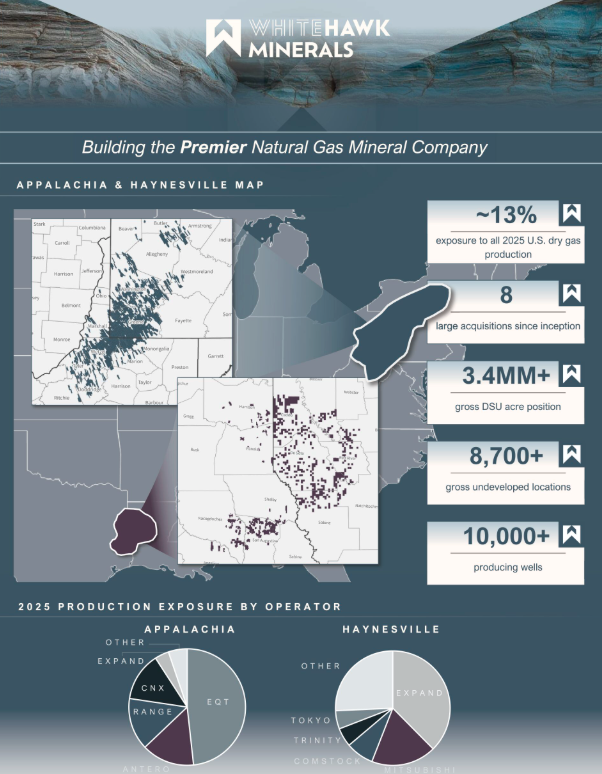
    The operators, companies like EQT and Range Resources, spend all the capital and send us payments [averaging 17 cents for every dollar’s worth of gas]. We have 11,000 producing wells and 9,500 identified sites for future wells. Our operators are drilling every day. We track them. And we hedge [with futures contracts that limit the impact of sudden price moves].

    Then all we have to do is sit back and collect the royalty checks.

    It’s a business where, heads you win, tails you win. We like higher gas prices. But we also root for prices to go down, then we have the opportunity to buy more.

    WhiteHawk Minerals chief Dan Herz and his Philadelphia-based team team have acquired natural gas fields in Pennsylvania, West Virginia, Louisiana, and Texas.Securities and Exchange Commission
    If it’s that simple, why aren’t bigger investors buying these gas assets?

    Four or five years ago, when we started WhiteHawk, a lot of private-equity firms had the good instinct to be buying up mineral rights. But they have found it harder to sell; private equity has been slowing down. The sellers have been offering generous terms. It shows how little competition there is.

    Our first acquisition was in February 2022. The seller gave us an eight-month option to buy an interest in their gas properties. Two weeks after, Russia invaded Ukraine. We immediately exercised the option at a locked-in price [and profited as gas prices rose]. Then another large private equity firm came to us with a six-month option.

    More of these private equity funds are nearing the end of their lives, they have to repay investors, but there aren’t a lot of new funds for them to sell to. This business takes specialized knowledge. It seemed to me we could be a natural buyer and build the premier gas royalty business.

    In all, 13% of U.S. natural gas production now pays us substantial royalties; 49% of EQT’s production pays us royalties. Antero Resources, one-third. Range Resources, 49%.

    We are primarily focused in the Marcellus [Western Pennsylvania, West Virginia] and Haynesville [east Texas, north Louisiana] Shales, which together produce half of U.S. natural gas. And there are many, many more rights owners adjacent to our properties [who can be bought out].

    Why are you based in Philadelphia?

    There is a longstanding tradition [of energy companies] in Philadelphia, and we have a great finance and accounting team and partners here. Myself, I am based in New York.

    Wasn’t it your mentor Cohen who convinced his classmate Pennsylvania Gov. Ed Rendell not to tax natural gas extracted from the Marcellus Shale?

    Yes. Ed Rendell should get the credit for manufacturing coming back to Appalachia because now we have natural gas, ethane, propane, butane, while in some other states [such as New York] you can’t do this.

    How much time do you spend lobbying for more fossil fuel extraction?

    I’ve spent 5% to 7% of my time in the political sphere for 15 years.

    There’s moments when politicians will posture. But we need energy. People should recognize that natural gas has driven the U.S. to lower carbon emissions. We can do all that and put money in Pennsylvanians’ pockets.

    Does your company have debt?

    We’ve been working with EIG [a Washington-based energy lender] for years, and we have a credit facility we haven’t drawn on with a number of banks. But we’re not looking to borrow. We keep leverage low.

    You had to restate 2024 earnings and changed accountants. What happened?

    We hired Baker Tilly, a national firm, to be public company ready. They said we had to restate [the 2024 earnings report certified by a Texas accountant]. I would call it growing pains. We had a great acquisition last year, the effective date was to be Jan. 1, 2025, but we didn’t close the deal until March 31. We counted that income from the effective date, and it should not have been counted until later.

    Why go public?

    This is what we did with Atlas Energy, Atlas Pipeline, Falcon Minerals. We’re back with our institutional and individual investors who want to participate in our growth, our cash flow, and our dividends per share.

    We are growing through acquisitions. Our playbook is to go out and buy another $150 million or $200 million this year building the premier natural gas mineral and royalty business. There is so much more to buy.