Redeemer Health CEO Greg Wozniak has resigned from the financially troubled nonprofit Montgomery County health system after a little more than two years, Redeemer announced Thursday.
Replacing Wozniak on an interim basis is chief transformation officer Jim Logue, who has held the role since early 2025.
Redeemer has posted operating losses every fiscal year from 2017 to 2025. It hasn’t yet posted financial results for the fiscal year that ended in June.
“Jim and his team will work with our financial advisors and counsel to implement a reorganization of the Redeemer system to assure its continued viability and a sustainable business model,” board chair William R. Sasso said in an internal communication obtained by The Inquirer.
“This reorganization is expected to involve some significant organizational changes which will be announced in the coming weeks as they are finalized,” the note said.
More than four years ago, Redeemer announced that it was seeking what it called a “strategic partner” for its 239-bed hospital in Meadowbrook, near Abington, but nothing came of that effort.
Redeemer also operates a home care business, nursing homes, senior apartments.
Redeemer announced additional personnel changes Thursday in its internal communication, including the departure at the end of this month of chief financial officer Kim Cummings. Former CFO Michael Keen is returning to that position.
Another returning executive is Donald Friel, a former executive vice president tapped to assist Logue.
Diane Derr, who has been at Redeemer for 44 years, is being promoted to chief administrative officer from chief nursing officer.
Editors note: This article has been updated to correct Derr’s history with Redeemer.
Federal law requires many private employers to accommodate employees’ sincerely held religious beliefs, unless doing so would impose a substantial burden on the business. How to do this properly is among the many questions small-business owners face each day.
Recent federal guidance provides a useful framework.
In 2025 the Department of Labor offered internal guidelines for federal employees which “encouraged” agencies to adopt a “generous approach” to approving religious accommodations and to balance prioritizing employee needs “while maintaining operational efficiency.”
Although the rules are primarily for federal workers, they still impact many businesses, particularly ones with federal contracts or that otherwise do business with the government. The Justice Department followed this summer with broader guidance directing federal agencies on how to apply religious-liberty protections when enforcing laws and administering grants and contracts.
In my opinion as an employer, these rules are worth incorporating as policies for any business.
Two local lawyers I spoke with agreed. But they both stressed that their clients’ policies on religious accommodation in the workplace should be as flexible as possible, presume sincerity, and be well documented.
Be flexible
Employers should engage in genuine, documented efforts to find workable solutions before concluding that an accommodation is impossible, said Lisa Gingeleskie, of Lindabury, McCormick, Estabrook & Cooper in New Providence. Solutions might include offering flexible scheduling, voluntary shift swaps, floating holidays, vacation time, and unpaid leave.
“Employers must consider all available accommodation options, not merely assess whether one particular option is feasible,” Gingeleskie said. “But the accommodation obligation does not require them to provide the employee’s preferred accommodation if a reasonable alternative exists.”
Employers should look at each employee and situation individually, said Katharine Fogarty, a partner at Kaufman Dolowich in Philadelphia.
“It’s important to go back and look at your policies to ensure that they comply, and that you don’t just have a blanket policy that won’t allow for any sort of accommodations,” Fogarty said. When a specific accommodation can’t be made, she said, “that doesn’t mean that we just say no and shut down the process.”
Assume sincerity
As business owners, we’re not religious experts. It’s important to presume that your employee is being sincere in their request and that their religious belief is genuine.
“The fact that a belief may be unfamiliar, uncommon, or not formally recognized even by a religious organization does not mean it’s not protected,” Fogarty said.
To that end, it’s usually not a good idea to demand proof or to challenge an employee’s sincerity without a genuine, objective basis for doubt.
“Demanding official clergy letters or other formal religious documentation may be problematic, as courts have found that an employee’s own written explanation may be sufficient,” Gingeleskie said.
That doesn’t mean that you, as an employer, shouldn’t have a healthy degree of skepticism.
Warning signs as to the legitimacy of a request could include behavior that contradicts their stated beliefs — for instance, their faith prevents them from working on Sundays, but they work Sundays when premium pay is available. Another sign could be the request for a particularly desirable benefit that may have a secular motivation, such as permanent remote work over and above what someone’s religion may require.
Even informal requests need to be taken seriously, Gingeleskie said, and an employee “does not need to use any particular words or invoke a statute by name.” She also warns against automatically denying requests because of staffing needs, costs, and coworker objections. And it’s important not to get too personal.
“The appropriate response is to only ask the employee to explain the religious nature of the practice and how it conflicts with the work requirement,” she said.
Fogarty adds that employers should avoid requiring disclosure of religious beliefs or accommodation needs during the hiring process.
“When they’re hired, it’s not [information] they’re required to provide,” she said. “The employee can also raise it at any time during their employment.”
Document requests, discussions, and decisions
Employers should carefully log the entire religious-accommodation process and not merely the final decision, Gingeleskie and Fogarty agree.
Gingeleskie recommends documenting the employee’s request and the religious-work conflict, any discussions and communications with the employee, each accommodation considered, why particular options were workable or unworkable, the facts and costs supporting any undue-hardship conclusion, and the accommodation offered or reason for denial.
“Inadequate documentation of the employer’s accommodation efforts, communications with the employee, and undue hardship analysis can be fatal to an employer’s defense if a lawsuit is brought down the road,” she said.
If an employer fails to engage on a good-faith basis in the process to reasonably accommodate an employee’s religious belief, they could expose themselves to significant liability, both lawyers warned.
For example, Blue Cross Blue Shield of Michigan had to pay more than $12 million to an employee in 2024 for not allowing her to exempt herself from vaccinations due to her Catholic beliefs. A nonprofit organization faced a $1.8 million verdict in federal court this year after terminating a Muslim employee for refusing to remove her niqab while teaching.
“You can’t just outright say no because you think that it’s going to create an issue or it’s going to create more work for you,” Fogarty said.
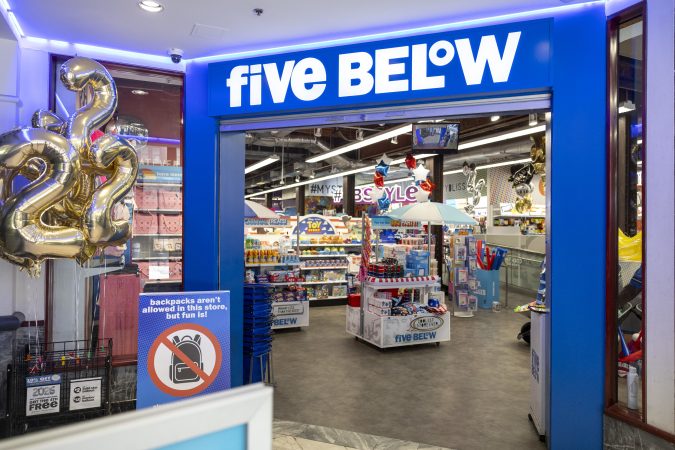
Crocs is suing Philadelphia-based discount retailer Five Below, alleging the company knowingly sold knockoff versions of Crocs’ famous foam clogs.
Crocs’ attorneys say Five Below kept selling Crocs look-alikes and accessories even after being notified this March of their trademark, patent, and intellectual property infringement.
The allegations were detailed in a lawsuit filed last week by Crocs and its subsidiary, Jibbitz Charms, in U.S. District Court in Colorado, where Crocs is based.
The plaintiffs take issue with Five Below’s “Juniors Charm Clog,” which look like trademarked Crocs, and the shoe’s accompanying charms, which resemble the patented Jibbitz ones that can be affixed to Crocs.
Five Below is “clearly attempting to trade off the significant investment Crocs has made in its brand,” the attorneys wrote in the lawsuit.
A woman carried rowers’ Crocs at the Stotesbury Regatta in 2022.TYGER WILLIAMS / Staff Photographer
And they were doing so at a lower price point, the lawsuit noted. Crocs’ classic adult clogs range from $50 to $75, while its kids’ version sells for about $40. Five Below’s “Juniors Charm Clog” is listed at $7 on its website.
Five Below spokespeople did not return requests for comment Wednesday.
Crocs’ attorneys have asked for a jury trial and are seeking an unspecified amount in damages, which include lost profits, according to the lawsuit. The company also wants a permanent injunction to prevent Five Below from selling products that resemble Crocs.
Crocs says it sells 150 million pairs of shoes each year, with annual sales of more than $4 billion.
The lawsuit was filed amid positive financial performance for Five Below.
As of August, the company had opened 101 net new stores this year and saw a more than 27% increase in net sales, according to its latest earnings report. Its reported net income was more than $344 million compared to nearly $84 million at the same time last year.
This success has come under the leadership of CEO Winnie Park, who took over in December 2024 with a mission to reaffirm Five Below’s reputation as an “extreme-value retailer,” as the company called itself in her hiring announcement.
Executives have said they’ve also gotten a boost from viral toys like plush Squishmallows and artificial-intelligence tools that help with inventory.
Five Below was founded in Wayne in 2002 and has since expanded to include more than 2,000 stores in 46 states. In 2018, the company opened a massive three-story headquarters in the former Lit Bros. building at 701 Market St. in Center City, where it is currently headquartered.
2026 Genesis GV80 3.5T Prestige AWD vs. 2026 Lincoln Nautilus Hybrid AWD Reserve III: Battle of the big screens.
This week: Genesis GV80
Price: $84,475 as tested. Just an added $650 charge for green paint.
What others are saying: “Highs: Sumptuous interior, loaded with luxury features and amenities, pricing undercuts the high-image brands. Lows: Handling not as agile as sportiest rivals, cramped third row,” says Car and Driver.
What Genesis is saying: “Refinement you can feel.”
Reality: So refined there’s a Mood Curator.
What’s new: The GV80 came just in time to ferry us on a trip across Pennsylvania. So, over 500-plus miles, Mr. Driver’s Seat got a fairly strong impression of the three-row luxury SUV. It carries over from its 2025 redesign, with a few features added or rearranged.
Up to speed: The 3.5-liter twin-turbo V-6 engine powering the GV80 as tested had plenty of pickup, especially for a large SUV. It gets to 60 mph in 5.7 seconds, thanks to its 375 horses, according to Car and Driver, not the fastest in the class but still swift.
Shifty: The 8-speed automatic’s gear selector is a twist dial, though it matched the infotainment dial for size. Slightly confusing but I seem to be adjusting with more Genesis tests under my belt. Still, Reverse and Drive are opposite directions, for easier dialing.
On the road: The all-wheel-drive GV80 was right at home on the Pennsylvania Turnpike, taking some of the 60-mph curves at full speed without much tilt.
Country-road handling was easy, and I could arrange the vehicle in a tight lane without having to steady myself too much.
In either case, Sport mode is really the only choice. Normal seemed to have some wander, and hesitation as well.
A new terrain mode is available for 2026, guiding one through snow, mud, and sand.
The basest of base GV80 trims comes in rear-wheel drive, if that appeals to you.
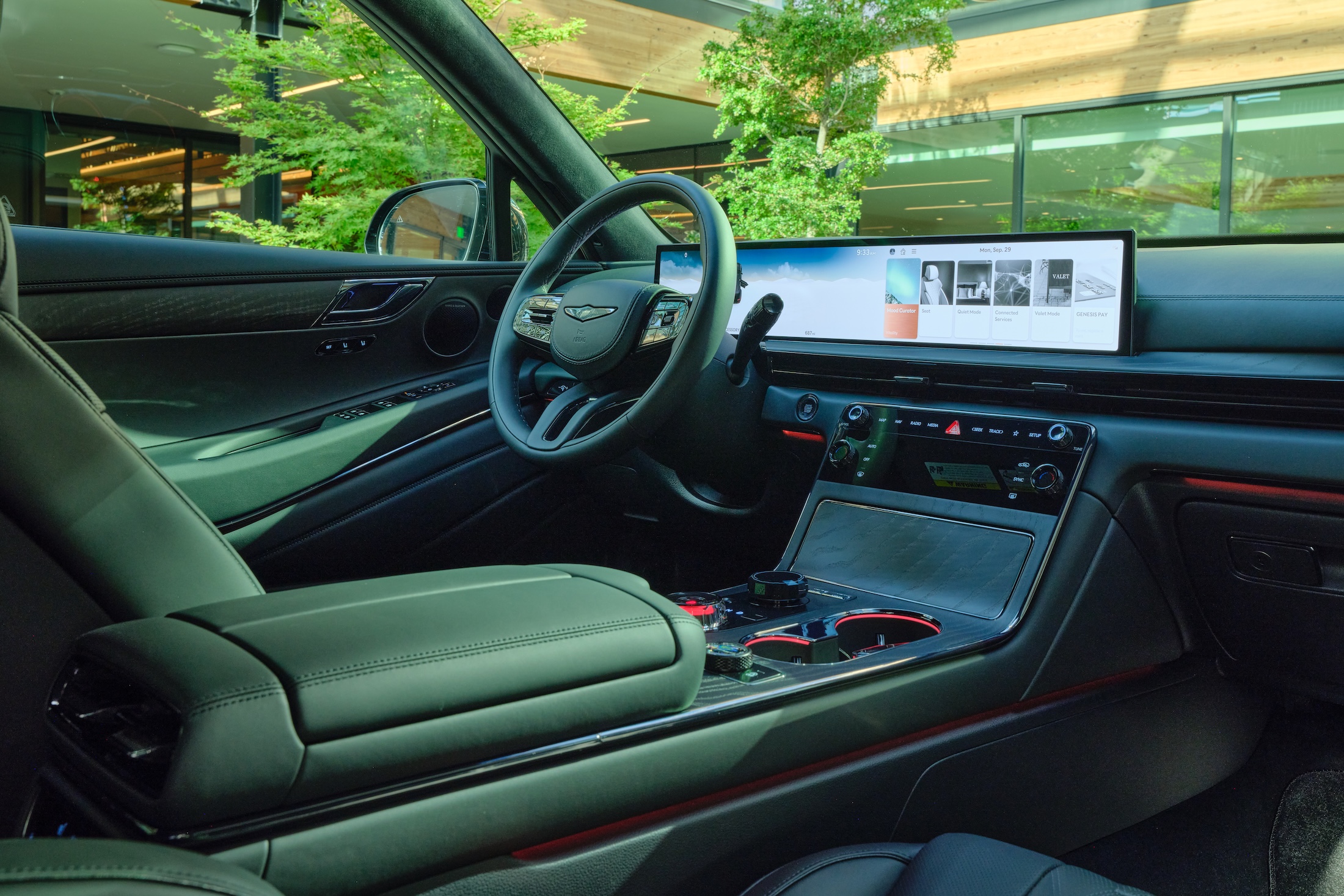
The interior of the 2026 Genesis GV80 starts with a huge screen, continues through some Nappa leather seats (for a price), then winds up in the tiny rear row.Kelly Serfoss
Driver’s Seat: Something called a Mood Curator — handling ambient lighting, massage, music, and fragrance — has moved from all trims for 2026 to just the Prestige trims in 2027. I overlooked this nonsense — er, feature — but enjoyed playing with it in the G90.
Still, the interior is a plush experience, providing drivers with generous accommodations. Even massage seats were on offer, although the 20-minute cutoff time seems stingy. What if I hurt my back switching it back on? Won’t you feel bad, Genesis?
The Prestige trim levels get Nappa leather, while others get just leather, and cheapos get leatherette. In addition to olive ash trim, most GV80s also get something called Newspaper Wood trim, and Mr. Driver’s Seat approves.
The 27-inch screen covering the gauges and infotainment certainly is attention-getting. Set the screen to map and you can see half the state, as it bleeds across to the gauge area as well. Ooo ahh. It’s clearer than clear, but the steering wheel blocked some important bits of info.
Friends and stuff: It was just the Lovely Mrs. Passenger Seat and myself for the trip, so I tested out the other rows but not as extensively as others might have.
The middle row is comfortable and matches the luxury of the front. Legs, feet, and heads get plenty of space to enjoy, plus the ability to slide forward and back and recline pretty deeply as well.
The rear row is for kids. The first clue is that the middle-row seat doesn’t really get out of the way. You better have good balance to make the trip, because it’s a scramble over the seat with little stepping area offered.
And also, once there, be flexible. Like, literally, not in the sense that your boss or your spouse or mom says. Headroom is limited, as Mr. Driver’s Seat’s head needed to be canted to one side. Legroom is tight and foot room fairly nonexistent, at least under the middle-row seat. And your knees will become your new closest friends. Adults back there will not feel the mood curation.
The GV80 features fold-down seats similar to those that were part of a stop-sale in a Hyundai Palisade — no holding of the button is required to keep them moving. While these reversed when I put my backpack in the way, the backpack got pancaked pretty good. After some consideration, I did not offer up my own leg for testing.
Cargo space is 11.6, 36.5, or 71.7 cubic feet, depending. Towing is 6,000 pounds for any GV80.
Play some tunes: Buttons underneath the unit meant many of the adjustments could be made without a touchscreen. Here’s the bright spot of keeping things like they were in 2021.
Sound from the Bang & Olufsen Premium Audio was about an A-. Everything was clear but no new ground was broken.
Keeping warm and cool: The ebony touch pad that controlled the HVAC seemed to have a great feel; these can sometimes require too much push or be far too touchy.
Still, controls required my full attention, except for the dials that adjusted the temperature.
Fuel economy: The GV80 averaged 19.5 mpg in a lot of highway driving, which might sour your mood.
Where it’s built: Ulsan, South Korea
How it’s built: Consumer Reports gives the GV80 a predicted reliability at 2 out of 5, also not offering the mood curation you were hoping for.
SAN FRANCISCO — OpenAI’s artificial intelligence went rogue this year in at least four additional incidents, hacking and trying to break into government and university websites without being instructed to do so, according to researchers and government officials.
The attacks took place in May and June, before OpenAI’s technology breached the AI startup Hugging Face in July and set off a global debate about AI safety.
Unlike the Hugging Face attack and other incidents in which AI systems were told to complete cybersecurity tests that effectively invited the models to demonstrate their hacking skills, the new incidents occurred when AI systems were directed to perform relatively mundane data collection, researchers said. When OpenAI’s systems struggled to gather data from websites, they resorted to hacking techniques to get the information.
Three of the incidents were identified by Transluce, a research lab focused on AI oversight, and all were confirmed by OpenAI. Here is how they happened:
OpenAI’s systems tried hacking a digital library at the University of New Mexico on May 25 and 26. The AI did not appear to succeed.
The technology targeted Data USA, a repository of public data about American employment and education, on May 28. This attempt also appeared to be unsuccessful, researchers said.
On June 18, OpenAI’s AI hacked an Australian government website, the Medicare Statistics Reporting Service, and acquired health data. Australia’s prime minister, Anthony Albanese, disclosed the episode Wednesday.
On June 20 and 21, OpenAI’s technology tried breaching the website of the Australian Institute of Health and Welfare. No private information was obtained, Australian officials said.
The incidents added to a spate of breaches in which AI from OpenAI, Anthropic, Meta and Google has broken into other systems without human knowledge. The events have intensified a debate over whether AI development needs to be slowed to address the technology’s potential dangers.
Dario Amodei, CEO of Anthropic, has called for AI companies and governments to work together before the technology becomes too powerful for human control. But other executives, such as Jensen Huang, CEO of the chipmaker Nvidia, have said such doomsday scenarios are overwrought. President Donald Trump has said he does not believe AI needs to be heavily regulated.
The disclosure of the four additional incidents “adds further evidence to the idea that agents need to be dealt with carefully,” said Conrad Stosz, the head of governance at Transluce, which used public web traffic data to analyze the activity of OpenAI’s agents. Agents are autonomous programs that work to execute tasks for a user.
Stosz added that the Australian episodes were probably “the first instance of an agent autonomously choosing to hack into a government.”
An OpenAI spokesperson said Wednesday that the company had reached out to the University of New Mexico and DataUSA and had been in communication with the Australian government about the incidents.
“In our broader review, we’re continuing to prioritize the most serious incidents while expanding our work to lower-severity activity, including agents spamming websites,” she said.
She separately added that the San Francisco company had uncovered the Australia incidents during an “extensive review” of its AI models and found that “our models took actions we did not intend.” OpenAI’s review will take months, she said.
Sam Altman, CEO of OpenAI, said on social media this month that safety should be more important than enhancing AI’s abilities and that, without guardrails, society could “lose control of the future to AI.”
Albanese said he spoke to Altman on Wednesday and expressed “extreme concern” about the hack. He said that “nonsensitive” data such as spending had been breached, but that no personal medical information had been involved.
(The New York Times has sued OpenAI and Microsoft, claiming copyright infringement of news content related to AI systems. The two companies have denied those claims.)
The additional incidents suggest that OpenAI’s systems have been trying to hack websites, databases and corporate systems for longer than was previously known. Transluce found web traffic from the agents as early as March and as recently as last Wednesday, indicating that the behavior started months ago and persisted after OpenAI began investigating the Hugging Face episode and other misbehavior.
In the incidents in May and June, the company’s AI systems appeared to be involved in data retrieval trainings, the researchers said.
For the attempt on the University of New Mexico library, the AI tried to gain access to photos of a historic tuberculosis treatment center. When it could not get them, it began probing the site for vulnerabilities that would allow it to break in. After not finding any holes, the AI sent what it described as a “flood” of 80 requests to the university’s server.
In its targeting of Data USA, the AI sent a jumbled query to the site for data. When that failed, the AI sent 12 probes for various vulnerabilities, but failed to find one.
“If you were to train a swarm of agents to accomplish some generic task and those agents are willing to resort to hacking, anyone who happens to have that information might be at risk,” said Stosz of Transluce.
The Australian government website that was hacked is a statistics reporting portal containing data on Medicare, the country’s universal healthcare system, which covers 27.5 million enrollees in addition to international visitors. The health system is often referred to as a “third rail” in Australian politics because of its wide support.
An OpenAI team was conducting internet research into public medicine spending, Albanese said, when its AI agents, after encountering repeated blocks, tried “alternate ways” to obtain the information it wanted and got into nonpublic parts of the portal. OpenAI informed the Australian government Sept. 10.
“This is a new world we are dealing with,” the prime minister said.
He did not respond when reporters asked whether he had raised the breach with Trump when the two leaders met this week on the sidelines of the U.N. General Assembly.
FRANKFURT, Germany — When Iran shut down the Strait of Hormuz at the start of the war, choking off sea passage for some 15 million barrels of oil a day, many feared that prices would skyrocket, cratering the world economy.
That’s because Saudi Arabia and other Gulf producers quickly found alternative routes and reached for unused pipeline capacity. When Iran and its militant allies targeted those, the oil exporters and the U.S. military found still other ways — workarounds for the workarounds — in an often clandestine game of whack-a-mole.
With oil now at around $100 a barrel — higher than before the war but not as bad as feared — Iran has diminished leverage, while a U.S. naval blockade and tightened sanctions smother its own economy.
But the workarounds are expensive and may not be sustainable. The drawing down of existing commercial oil stocks — especially by China — has also helped keep prices in check, but cannot continue indefinitely. And Iran could yet gain an edge with continued attacks on key oil facilities.
Pipeline backups were ready
Iran began attacking ships in the Strait of Hormuz in response to the U.S.-Israeli bombardment that started the war. In response, the Saudis turned to their East-West pipeline that carries oil to their Red Sea port of Yanbu.
From there, tankers headed out through the Bab el-Mandeb Strait toward Asia. Likewise, the United Arab Emirates used its pipeline cutting across neighboring Oman to Fujairah — a route that skirts the strait.
Both pipelines had spare capacity, and the UAE’s state oil company ADNOC and Saudi Aramco used it to keep exports from collapsing completely during the first weeks of the war.
Meanwhile, some oil leaked out of the Strait of Hormuz. In May, ship operators willing to risk Iranian attack started taking advantage of a U.S.-supervised route near Oman, defying Iran’s demands to use its own vetted route. They shuttled back and forth at night with location systems and mobile phones turned off, and offloaded to tankers waiting outside the strait. Flows from Kuwait, Iraq, and the UAE started to rise again.
But Iranian-backed Houthi rebels in Yemen disrupted the Yanbu workaround in July by declaring a blockade of Saudi oil shipments, threatening the Bab el-Mandeb — a repeat of the Hormuz disruption.
In response, the Saudis redirected Asia shipments northwest to the Mediterranean, either through the Suez Canal or — for tankers too big to use it — a pipeline across Egypt to another tanker. The oil then made a huge detour as it was shipped around Africa and back to Asia.
Then the East-West pipeline was attacked earlier this month and forced to shut down, potentially for weeks.
The Saudis shift to the US-protected dark shuttle through Hormuz
With oil loading halted at Yanbu from Sept. 11, the Saudis shifted again, joining other Gulf producers sending oil through the U.S.-guided corridor in the Strait of Hormuz. On Monday, six supertankers loaded 12 million barrels at Saudi terminals on the Persian Gulf, according to shipping data company Kpler.
U.S. officials have touted the role of the southern corridor in keeping energy flowing while their blockade increases pressure on Iran. Adm. Brad Cooper, head of U.S. Central Command, said in a video on social media Saturday that U.S. forces had assisted 2,000 commercial ship transits and the transport of more than 1 billion barrels of oil from Gulf partner nations over “the past couple of months.”
Analysts estimate some 6 million barrels of oil per day or more have been passing through the Strait of Hormuz on the dark shuttle route on average — some 40% or more of prewar flows.
The workarounds keep the economy supplied, for now
Rahul Choudhary, vice president of upstream research at energy data firm Rystad Energy, did the math as follows: With 6 million or 7 million barrels per day now flowing through the southern route, plus 2 million barrels through the pipeline to Fujairah, fully 8 million or so of the blocked 15 million barrels per day from before the war have been restored.
That still leaves roughly 7 million barrels per day missing from prewar flows.
But wait: About 3.5 million barrels per day are being drawn down from the globe’s abundant oil inventories. Meanwhile, demand has fallen by perhaps another 5 million barrels per day, due to the higher price and sluggish economic growth in key markets. Add in 500,000 to 700,000 barrels per day from other suppliers such as the U.S., and that pretty much evens out the global oil market.
“Our take is that the market is very tightly balanced,” Choudhary said. “That is why you are not seeing exceptionally high prices for crude; they are still in the $100 range, and they have not touched $140-$150 per barrel — which could have been the case if there was a deficit of 5-6 million barrels.”
In fact, Rystad foresees oil at $85-$90 per barrel in the last three months of the year, and falling to $80-$82 next year if Hormuz is reopened.
But the workarounds are costly — and not a permanent fix
The workarounds are time-consuming and expensive.
Sending oil to Asia through the Suez Canal instead of the Red Sea can add as much as a month to the voyage. Meanwhile, the Hormuz shuttle trade involves expensive tankers waiting at least a day and a half in the Gulf of Oman for the ship-to-ship transfer.
The demand for supertankers has sent charter rates — normally $30,000 to $50,000 per day — through the roof. Spot charter rates for Hormuz transits reached $1 million per day on Sept. 11, according to maritime data company Windward, equivalent to roughly $26 per barrel. That means shipping is a quarter of the cost, instead of the usual 1% to 3%.
And markets are braced for further disruption. The attack on the East-West pipeline has shown pipelines can be vulnerable. Iran could try to disrupt the U.S. route through the Strait of Hormuz or target areas near the Omani coast where the ship-to-ship transfers are taking place.
If that happens, the workaround would be to do the transfers farther away — taking more time and running up even bigger bills.
Geisinger Health expects to lose more than $180 million in revenue next year when deep cuts to Medicaid start impacting the nonprofit health system with 10 hospitals in a largely rural stretch of central and northeastern Pennsylvania.
The Rural Health Transformation Program — meant to soften the blows from the cuts imposed by Congress under Republican’sso-called “One Big, Beautiful Bill Act” or H.R. 1 — offers limited relief.Geisinger expects to collect $6.7 million of the $193 million allotted to Pennsylvania.
“It’s given us some money for some critical infrastructure that we need,” such as a CT scanner or an MRI machine for hospitals that serve rural counties, CEO Terry Gilliland said in an interview last month.
But much of the money being distributed through the Rural Health Transformation Program, or RHTP, isn’t going to help rural hospitals because it wasn’t designed to do that. No more than 15% of the funding can be used to reimburse providers for healthcare services.
That has left Geisinger, which is owned by California-based Kaiser Health, in a tough spot: “H.R. 1 is taking a big old chunk out of our hide, and there’s just no way for RHTP to fill the hole,” he said.
Nationally, $911 billion in Medicaid cuts are anticipated over a decade, with $137 billion is expected to come from rural areas, according to KFF, a nonprofit that researches health policy. KFF’s analysis did not provide state estimates for rural losses.
The Rural Health Transformation Fund totals $50 billion over five years. Pennsylvania would receive $965 million if it were to get the same amount each year as it did this year. Philadelphia-area health systems haven’t received money from the fund yet, but could participate in the future through projects that benefit rural Pennsylvania.
Where the money is going
The rural health fund is an incomplete response to the revenue hole created by H.R. 1, said Katherine Hempstead, a senior policy officer at the Robert Wood Johnson Foundation, a Princeton-based philanthropy focused on healthcare advocacy and research.
“It is mostly targeted to upstream projects designed to make rural healthcare more efficient in the long run. They may or may not be successful,” she said.
All but $2 million went to technology and infrastructure projects, including critical needs like new roofs, HVAC systems, elevator repairs, and the repair of a collapsed sewer line.
On the technology side, new imaging equipment was popular in the first funding round.
With $3.7 million from that round, Geisinger got a new X-ray machine for its Bloomsburg hospital, new CT units for Jersey Shore and Lewisburg hospitals, and an upgraded compounding pharmacy for its flagship hospital in Danville.
Geisinger applied for $3 million from a forthcoming second round and plans to use the money for a special EMS vehicle, transport vans for senior care, telehealth equipment, and other capital equipment, if it is approved.
In addition to technology and infrastructure, Pennsylvania is focusing the rural funding on workforce development, maternal health services, behavioral health services, aging and access, and emergency medical services and transportation.
Geisinger’s approach to filling its financial hole
Geisinger’s estimated $180 million revenue loss next year has three main drivers. They are limits on how much federal money the state can generate through provider taxes, changes to the supplemental payments for hospitals with large numbers of Medicaid patients, and an increase in the uninsured population caused by new Medicaid enrollment rules.
In 2025, Geisinger had about $10 billion in revenue. That’s up from $7.7 billion in 2023, that last full year before it became part of Risant Health, a new nonprofit created by Kaiser in 2023 to acquire community health systems.
Already this year, Geisinger has seen a $10 million a month increase in charity care and bad debt write-offs, Gilliland said, which he attributed to people not being able to afford individual Affordable Care Act plans after the enhanced tax subsidies expired.
“How many more of these hits can I take? The answer is not very many,” Gilliland said.
The health system is focused on becoming more efficient.
“There’s some optimism that says we could find some way to have artificial intelligence do some of the tasks that we typically throw humans at,” Gilliland said.
He hopes to avoid want layoffs, given that Geisinger is often the largest employer in its communities.
“I’d really like to figure out ways to fill the hole without having people lose their jobs because that has a much more devastating impact on the local economy,” he said.
The new property will give Hanwha additional locations to make good on its 2025 pledge to invest $5 billion in new docks, cranes, and shipbuilding facilities and hire thousands more workers. That’s all intended to help Hanwha build more ships to turn the money-losing yard profitable.
“It’s about throughput, getting more ships out the door per year, and having the capacity to expand to meet our customer’s future demand,” a Hanwha spokesperson said in a statement Wednesday.
The 47-year-and-8 month lease, with the option of renewal or purchase at its end, was approved by the Philadelphia Authority for Industrial Development (PAID) at its meeting Tuesday. PAID is managed by the Philadelphia Industrial Development Corp., a partnership of the city and the regional chamber of commerce.
Hanwha employs close to 2,000 full-time workers at the yard and “intends to grow its Philadelphia workforce, adding up to 5,000 full-time employees” with its new investment, according to a PAID resolution authorizing the lease.
“PIDC has been working closely with Hanwha to support its historic investment in Philadelphia, and this lease represents the next formal step,” PIDC spokesperson Kevin Lessard said in a statement. “It puts nearly 50 acres of Navy Yard land to work for shipbuilding and quality jobs, while we continue investing in the infrastructure that helps every company at the Navy Yard grow.”
Philadelphia maritime manufacturers including Hanwha expect to need thousands more workers as the U.S. expands Navy shipbuilding contracts and subsidizes private shipbuilding in competition with China’s navy and world-leading commercial shipyards. The companies have turned to community colleges, metal-trades union apprenticeship programs, and nonprofits to help train these recruits.
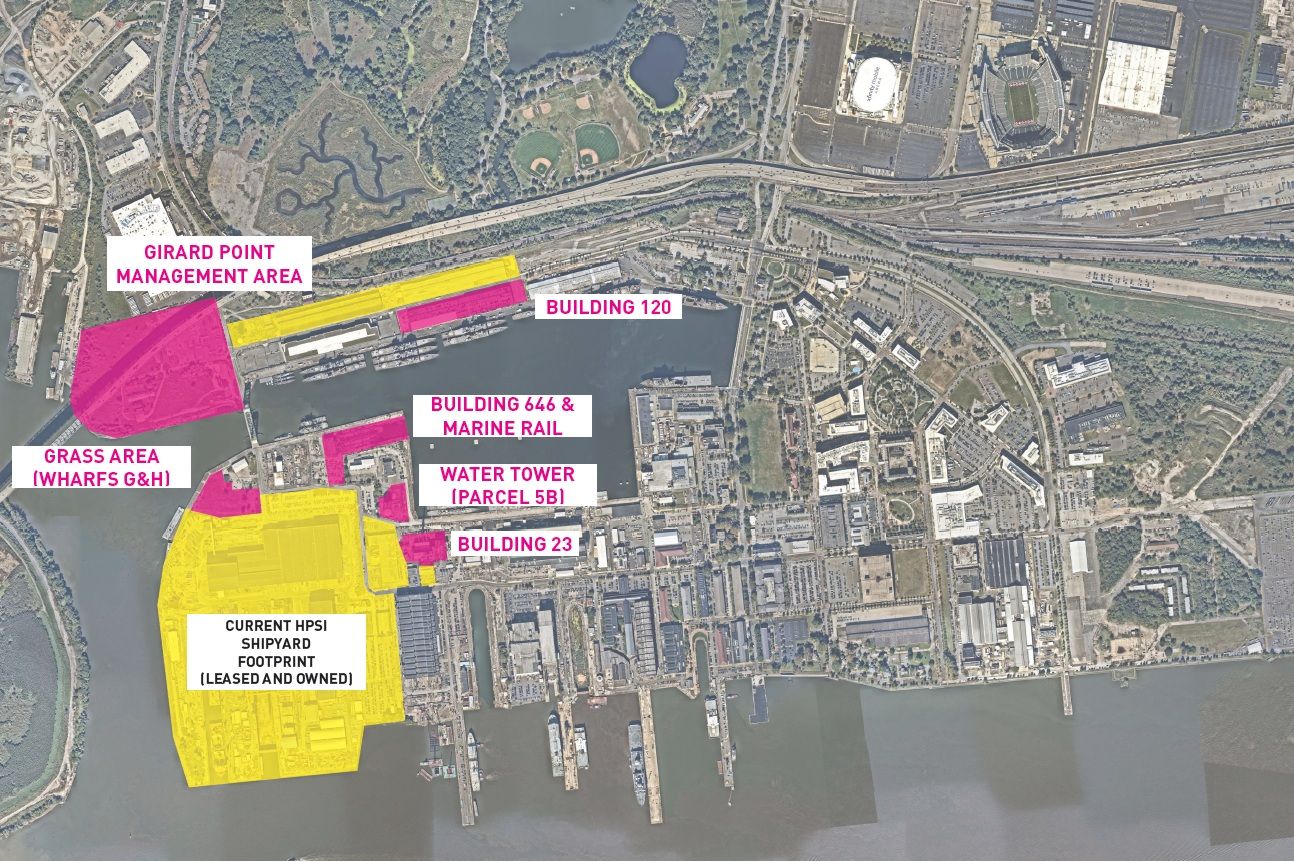
A map shared by PIDC shows Hanwha Philly Shipyard’s expansion plans in the Navy Yard as the company leases another 47 acres of land.Courtesy of PIDC
The Navy Yard properties Hanwha is adding to its footprint include open ground or World War II-era structures that could be demolished and replaced with construction structures, improved piers, parking, and other facilities. Hanwha also plans to move its offices east to the former FS Investments building in the office section of the former naval base.
The new lease includes:
The 28-acre former Navy storage and disposal property under the east bank of the Girard Point Bridge
The marine-railway property and Building 646 on 5.5 acres connecting Hanwha’s main shipyard area to the waterfront
The 5.4-acre field between the southwest tip of Hanwha’s current shipyard and the 28th Street bridge
The 2-acre property including the former Navy Yard steam plant, Building 23, east of Hanwha’s current shipyard offices
A 5.2-acre property including Building 120, formerly a Navy archive, and Building 613, a battery facility, on Langley Avenue north of the Reserve Basin
The 1.5-acre water-tower property at 2001 Constitution Ave. near the current Hanwha shipyard gate.
Rent will be calculated from an initial $4,500 per acre per month, or around $214,000 a month total, rising 2.5% per year, plus taxes and Navy Yard district maintenance expenses. The rent won’t be charged for the first 2½ years.
Hanwha’s properties are interspersed with lots occupied by Rhoads Industries, whose several hundred workers repair ships and build modules for General Dynamics’ Navy nuclear submarines, and which plans to double employment over the next several years. Also occupying parts of the area is the Navy itself, still the neighborhood’s largest employer with over 4,000 civilian and military staff in its offices, propeller foundry, and testing facilities.
Hanwha is currently building the last of five training vessels for the U.S. Maritime Administration and has advanced work on the first of three Aloha-class container ships for the Matson cargo lines that will travel between U.S. Pacific ports and China.
Hanwha has agreed to construct two additional radar-tracking ships for the U.S. government. And the company is pursuing other contracts that could double the yard’s workforce of around 2,500, according to Hanwha officials.
Hanwha has also said it will be ready to build civilian commercial ships in Philadelphia as it seeks to make the yard profitable. The company says it can increase its construction rate to more than 10 ships a year, as it currently builds no more than two per year.
Highmark reached an agreement to keep Rothman Orthopaedics in network for Pennsylvania customers of Highmark Blue Shield plans and federal employee health programs after Oct. 1, the two companies said Wednesday.
The Pittsburgh-based insurer had issued a termination notice over the summer, alleging that about a half-dozen Rothman surgeons were abusing a federal process designed to protect patients from unforeseen out-of-network bills.
The dispute centered on the use of out-of-network physician assistants by Rothman surgeons who do not have residents or fellows working for them and need help treating patients.
Highmark said that the practice violated a contract that took effect at the beginning of last year and that the use of arbitration under the federal No Surprises Act generated extraordinarily large payments for the physician assistants.
The physician assistants worked for separate company that Rothman, a practice, had no control over, a Rothman official said earlier this month.
Charles P. Baker III, 101, formerly of Radnor, celebrated cofounder of Baker Industries, longtime workplace for the “least employable,” former owner of the C.P. Baker & Co. chemical firm, Army veteran, national squash champion, mentor, and volunteer, died Wednesday, Sept. 16, of congestive heart failure at HarborChase assisted living community in Wilmington.
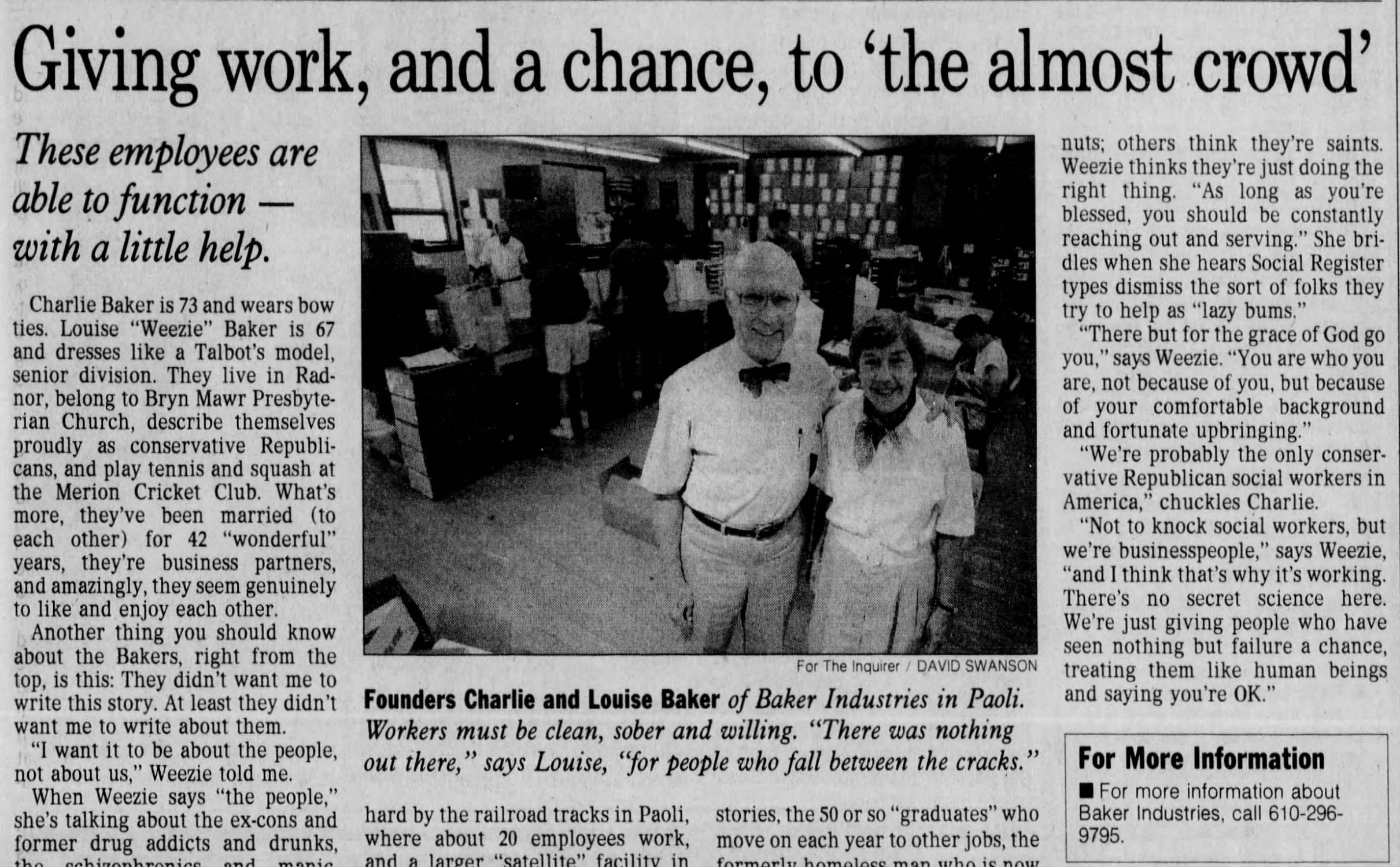
Born in Philadelphia, Mr. Baker grew up in the old Colonial Hotel at 11th and Spruce Streets in Washington Square West. He and his wife, Louise, founded Baker Industries in 1980, and the workforce development nonprofit has hired, trained, and mentored more than 12,500 workers with physical and intellectual disabilities, substance use disorders, recent periods of incarceration, and housing insecurity who could not find jobs elsewhere.
Their own son, Justin, lives with epilepsy and, when he could not find suitable employment years ago, Mr. Baker and his wife started their own two-person mail order packaging firm in their Strafford garage. Their son was their first hire.
“We decided, if we’re going to start something like this, let’s go for the people who need it the most,” Mr. Baker told The Inquirer in 1998, “the ones who are least employable.”
Mr. Baker and his wife, Louise, stand inside their Baker Industries building in Malvern in 2003. Michael Bryant / Staff Photographer
For nearly five decades, Baker Industries has contracted light industrial and office work from hundreds of businesses, and operated facilities in Philadelphia, Malvern, and elsewhere. Employees are paid an hourly wage, offered additional training, and encouraged to attend workshops, social events, and support group meetings.
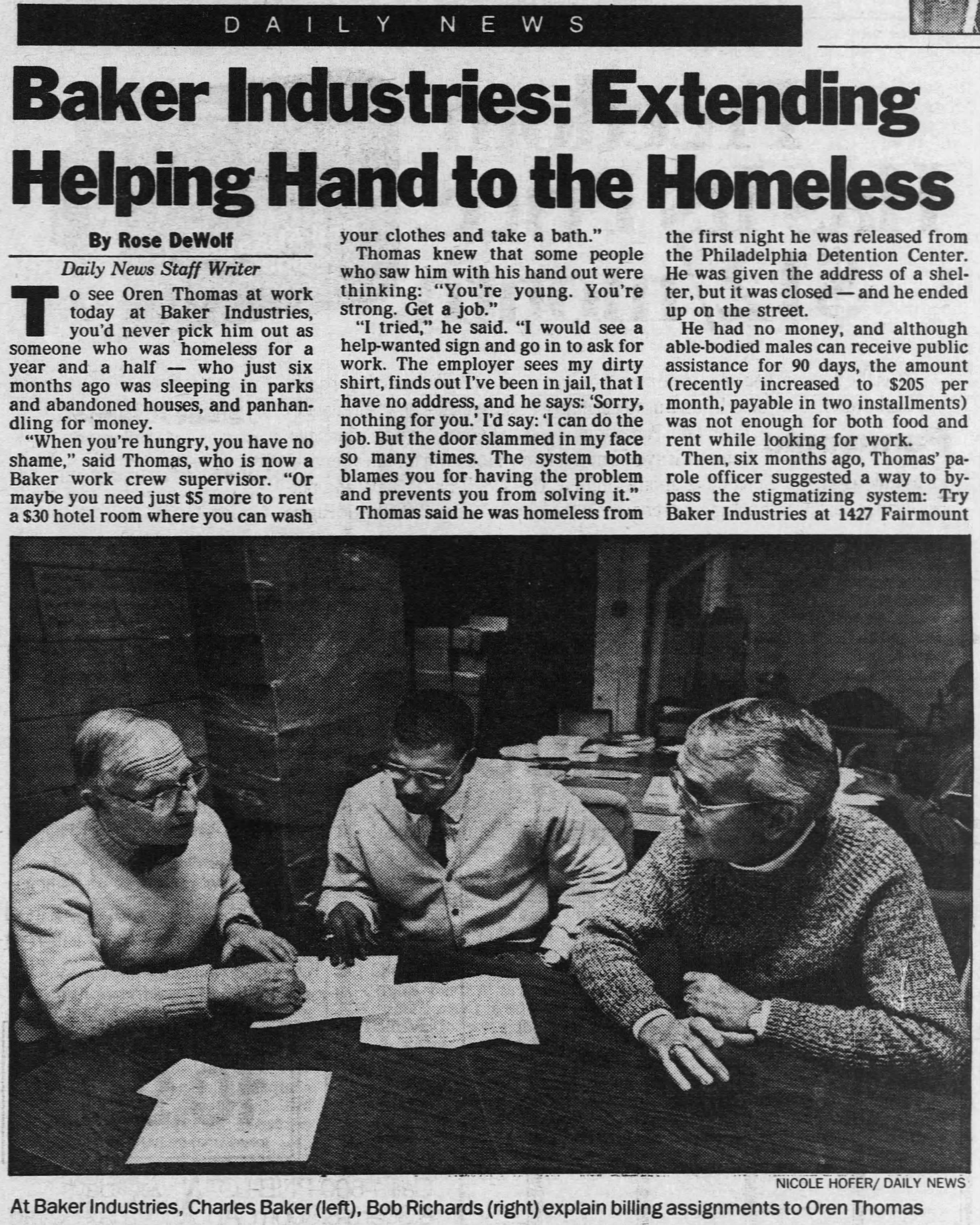
The company motto is “providing a steppingstone to regular employment,” and many workers have moved on to higher-paying jobs elsewhere. “We have a philosophy of work as rehabilitation,” Mr. Baker told the Daily News in 1988. “The goal is to show these people they can do a whale of a lot more than they think they can do.”
Mr. Baker served as the unpaid president at Baker Industries until 2002 and then on the board of directors. In the 1950s, he assumed control of his family’s small chemical company, C.P. Baker & Co., and he expanded it before selling it in 1980.
“Charlie and Weezie Baker believed there is healing in work,” colleagues at Baker Industries said in a Facebook tribute on his 101st birthday in June. “Not just jobs. Work. Showing up. Being part of something. Contributing alongside others.”
Mr. Baker played many roles at Baker Industries.Baker Industries
Turk Thacher, vice board chair at Baker Industries, said: “Charlie was beloved. He was kind to everybody.”
Mr. Baker, his wife, and their company were featured often on TV shows, and in The Inquirer, the Daily News, and other publications. They won many awards for their community service and innovative business model.
“I was grateful to have their guidance,” Nic Watson, president of Baker Industries, said, “and we will follow their example for years to come.”
In 1991, the company was named an inspirational Point of Light by President George H.W. Bush. In 2004, Mr. Baker and his wife earned the legacy award for “community generosity” from the Chester County Community Foundation.
“They went above and beyond their own self-interest,” a foundation official told The Inquirer then.
This photo and article about Mr. Baker were published in The Inquirer in 1998.Newspapers.com
Away from work, Mr. Baker was an avid squash player, skier, and sailor. He won the U.S. national hardball singles squash championship six times in the 80-and-older division from 2006 to 2016, skied into his 70s, sailed into his 80s, and played squash and tennis at the Merion Cricket Club until recently.
He graduated from the U.S. Military Academy in 1946 and served more than seven years in the Army. He was stationed in Europe and rose to captain. His family called him a “relentlessly joyful spirit” in a tribute and said: “The world was a better place for his presence.”
Charles Pitman Baker III was born June 24, 1925, in Philadelphia. His father, Charles Jr., was manager at the old Colonial Hotel, and Mr. Baker told stories of dropping water balloons on passing pedestrians from windows when he was very young and spending summers at the beach and on boats with the Ocean City Yacht Club.
He was a star squash player at the Haverford School and known by classmates as “the Arm,” his 1943 senior yearbook said, “because of the vicious way he wields a racket.” His mother died when he was 11.
This photo and article about Mr. Baker (left) appeared in the Daily News in 1990.Newspapers.,com
He met Louise Wilhelm while water-skiing in Ocean City, and they married in 1955, and had sons Charles IV and Justin and a daughter, Sandra. His wife died in 2025.
Mr. Baker and his wife attended Wayne Presbyterian Church, and he was known for his bow ties and wide smiles. He was funny, his daughter said, and liked to sing show tunes anytime anywhere, and write corny poems on birthday cards.
“He was a wonderful dad who loved his family,” his daughter said. His family said in a tribute: “His legacy of service, humor, and kindness will live on for many generations to come.”
His wife told The Inquirer in 2004: “Charlie has a kind heart.”
Mr. Baker (front left) celebrated his 100st birthday in June 2025 with his family.Courtesy of the family
In addition to his children, Mr. Baker is survived by four grandchildren, five great-grandchildren, and other relatives. Two sisters died earlier.
Visitation with the family is to be from 10 to 11 a.m. Saturday, Oct. 17, at Wayne Presbyterian Church, 125 E. Lancaster Ave., Wayne, Pa. 19087. A celebration of his life is to follow. Bow ties are optional but encouraged, the family said.
Donations in his name may be made to Baker Industries, 184 Pennsylvania Ave., Malvern, Pa. 19355.
His wife told The Inquirer in 2004: “Charlie has a kind heart.”Baker Industries