Category: Business

  • Anthropic begins trading in the biggest IPO on record despite the many fears surrounding AI

    Anthropic begins trading in the biggest IPO on record despite the many fears surrounding AI

    NEW YORK — The artificial intelligence giant Anthropic opened for trading Thursday in the biggest public stock offering ever, despite investor fears of a possible AI bubble and public anxiety that the technology threatens lives and livelihoods.

    Anthropic shares began trading at $111.50, spiking more than 30% above the initial public offering price, before closing at $97.17, more than 17% higher than the IPO.

    A day earlier, the company priced its IPO at $83 per share, enough to value the entire business at $1.5 trillion, surpassing SpaceX as the largest IPO on record. At the start of trading, the valuation leaped to $2.01 trillion.

    The initial price was surprisingly high given investor worries had ratcheted up even more recently following the stunning ouster of AI’s chief promoter, the CEO of Nvidia, amid a possible Chinese spying scandal. Anthropic had earlier set a much lower price range between $70 to $78 per share.

    “It’s a big win for the tech sector after a white-knuckle time with Nvidia,” said Dan Ives, a financial analyst at Yorkville Ives & Co. “The pricing shows strong demand among investors.”

    The San Francisco-based maker of the Claude AI tool, traded on the Nasdaq under the ticker symbol ANT, offered 980 million shares to the public, which at $83 per share translated into proceeds of $81 billion.

    IPO offers a way to raise money without going deeper into debt

    In addition to market jitters over AI, the IPO is facing down a potential regulatory crackdown by a Democratic-led Congress next year and growing anti-AI sentiment among the public. For its part, Anthropic rival OpenAI decided to postpone its initial offering until next year.

    Anthropic is also facing big financial challenges ahead.

    It already has taken on $6.2 billion in debt, which it acknowledges in financial filings is “substantial.” Adding to the strain, the company is unprofitable, at least under standard accounting rules, suggesting that its resources to pay interest and principal are limited.

    While the company showed ample cash in its last financial report, it would have likely run through it quickly given its outsize spending plans. In the same financial report, the company said it had signed leases and other deals requiring it to spend $900 billion on computing power and infrastructure in the coming years, including $70 billion in the next 12 months.

    Such massive spending by AI companies, comparable to the Gilded Age splurge on railroads, has scared lenders, helping to push borrowing rates high recently.

    With the IPO, though, Anthropic will now have enormous resources to accelerate its expansion without taking on more debt. In addition to the cash from public investors, the company also planned to sell $26 billion in shares in a private sale Thursday to bring the total raised to $107 billion — an impressive haul for a business not yet six years old.

    The offering will also allow its employees to sell vested stock, making many of them millionaires overnight — and adding billions of dollars to the fortunes of CEO Dario Amodei and his sister, Anthropic President Daniela Amodei.

    AI industry faces concerns about data centers, a possible bubble, and regulations

    Anthropic is locked in a fight for dominance with OpenAI. But both companies have plenty of other competitors, including Google, start-ups in the U.S. and China, and SpaceX, which has an AI business.

    Anthropic, OpenAI, and SpaceX’s AI division have all lost more money than they’ve made because of the huge costs associated with building AI. That has fueled growing concerns about a bubble forming in the sector.

    Dario Amodei cautioned in September that the AI industry should slow its fast-moving development to give safety measures time to catch up. Without such a slowdown, Amodei warned, AI could be capable of letting loose a swarm of agents that could take over the internet within months.

    In comments at the opening bell Thursday, Amodei sought to dampen fears by stressing a commitment to ensure humans are in control of the technology.

    “If we can show it’s possible to make the right choices on safety and still build an incredibly successful company, others in our industry will be inspired to do the same,” he said. ”The goal is to make the whole industry better, regardless of whether Anthropic is winning or losing at any given time.”

    Amid mounting fears, the regulatory environment could change for Anthropic once the new Congress is in session. Newly elected Democrats are vowing to crack down on the industry amid a backlash against data centers. And two big states offering incentives for data centers, Texas and Georgia, just elected Democratic governors vowing to stop new construction.

    In his comments Thursday, Amodei also touted a range of positive uses for AI, noting that Claude already is helping scientists do quicker research and that the technology could help accelerate that progress in the future.

    “Human intelligence has already made diseases like plague, smallpox, and polio history for most of the world,” he said, “but progress in other diseases has been too slow for so many patients and their families.”

    He also pointed to Claude’s use across companies, nonprofits, and government services. “I’m extremely optimistic about what we can do together in the future,” he said.

    Adding to the pressure to go public was the possibility that demand for AI shares could drop or even collapse. Investors have become anxious about the massive financing needs of the sector, and several tech companies have pulled IPO plans recently.

    Market valuation for AI companies is going to be “up and down for many years to come, but more up than down,” said Rich Lesser, the global chair and former CEO of Boston Consulting Group.

    “Exactly what the flow of that will be, it’s very hard to predict,” Lesser said in an interview with the Associated Press on Tuesday at the Semafor Silicon Valley & the World forum. “There’s no question what Anthropic and OpenAI and Google and a number of the other players in this industry have done is pretty remarkable.”

    Kaitlyn Huamani and Michelle Chapman contributed to this article.

    Editor’s note: This story has been updated with the market close.
  • Hanwha Philly Shipyard says it’s ready to build oil tankers and Navy ships at the same time

    Hanwha Philly Shipyard says it’s ready to build oil tankers and Navy ships at the same time

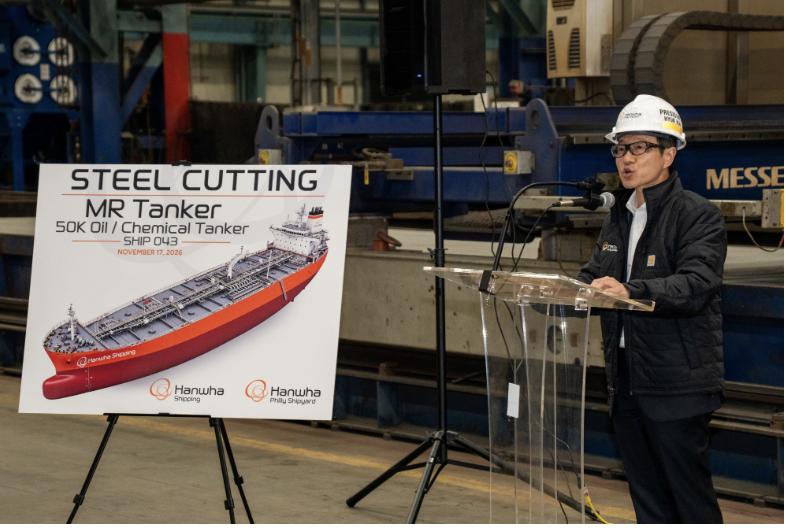
    Hanwha Philly Shipyard says it’s started work on the first of four 600-foot, nearly 50,000-ton oil and chemical tankers to carry U.S. cargoes between U.S. ports.

    The shipyard plans to deliver the ships to its Hanwha Shipping affiliate in 2029 and 2030.

    Renderings and details of the new, medium-range ships, which typically haul cargoes in U.S. or East Asian waters or across the North Atlantic, but not on longer Pacific routes, were unveiled at a steel-cutting ceremony at the South Philly shipyard on Tuesday.

    Hanwha plans to build the ships “simultaneously” with three liquid natural gas container ships it is building for Matson, which ships long-range cargoes between U.S. Pacific ports and to China. The first of the Matson ships, Makua, was christened last month and is to be delivered next year. Hanwha expects to deliver the other two by 2028.

    Meanwhile, Hanwha will start work on the first of up to four Medium Landing Ships (LSMs), for the Navy to land Marines on Pacific islands, in late 2027.

    Hanwha Philly Shipyard is shown at bottom left, alongside Navy contractor Rhoads Industries at right, with the office towers of Center City Philadelphia in the distance.Joseph N. DiStefano

    And it plans to complete two enemy-missile-tracking Missile Range Instrumentation Vessel (MRIV) hulls for the U.S. government by 2030. It expects to begin that after completing TS Golden State, the last of five U.S. Maritime Administration training and multi-mission ships built since 2020, next year.

    The Hanwha group had said last year that it planned to order up to 10 tanker ships for its own Hanwha Shipping affiliate as it seeks to boost production at the Philadelphia yard from about one ship every eight months to one every few weeks.

    The detailed schedule put out this week underlines newly appointed Hanwha Philly president Hyuk Kim’s resolve to continue building commercial cargo ships while expanding U.S. Navy and government ship production. Hanwha meanwhile is adding new facilities on 47 recently acquired acres to the 110-acre complex the group purchased in 2024.

    Shipping analysts have noted U.S.-built ships typically cost more than double the prices charged for similar-sized ships built in China, the world’s leading shipbuilder nation. U.S.-built ships also cost more than ships from Japan and South Korea, partly due to mass-production savings at those countries’ large commercial yards.

    Hanwha says it can get costs down as it increases production. In a statement Wednesday, the company made clear it expects the 1920 Jones Act will remain in force, which will require shipments between U.S. ports to be carried by U.S.-built ships and American crews. That’s despite waivers currently granted some foreign ships to haul certain cargoes during the Iran war.

    Dozens of East Asian-built tankers have hauled Texas and Great Plains crude oil to Philadelphia-area refineries, and shipped natural gas, butane, fuel, and refinery feedstock from Delaware River terminals to plants in New England and Louisiana since March, when President Donald Trump suspended provisions of the Jones Act.

    Lobbyists for Hanwha and other shipbuilders, as well as organizations representing merchant marine officers and Seafarers union seamen, have called for renewed protection for domestic shipping. That would boost demand for U.S.-built ships like the tankers Hanwha is building.

    Against them, lobbyists for refiners such as Delta Air Lines’ Monroe Energy in Trainer, Delaware County, and for PBF, which runs refineries in Delaware City and Paulsboro, N.J., have argued for easing the Jones Act and bringing in more cheap foreign shipping to lower energy companies’ expenses.

    The new ships “will join the Jones Act fleet to transport the fuels that power American homes, businesses, and communities safely and efficiently,” James Sagar, CEO of Hanwha Shipping, said in a statement.

    He noted the overall Jones Act fleet is aging; the new tankers are the first of their size built in the U.S. in nearly 10 years. The Philly yard has been the largest builder of Jones Act ships since 2000, when it opened under previous owners at the former Philadelphia Naval Shipyard.

    With these ships, “Hanwha is reaffirming its commitment to the United States, supporting highly skilled American jobs, and helping strengthen the shipbuilding industrial base that is critical to our nation’s economic and strategic interests,” Sagar concluded.

    Hanwha says the new tanker ships will offer “an energy-efficient design” and meet International Maritime Organization standards for safely carrying chemicals.

    The yard employs around 2,300. Hanwha says it has invested hundreds of millions, and plans to eventually invest a total of $5 billion, in cranes, new buildings and piers, dry docks, automatic welding equipment, and other facilities to increase shipbuilding. The company has said it hopes to boost employment to more than 4,000 welders, pipe fitters, equipment operators, engineers, and other workers over the next several years.

  • 2027 Hyundai Venue: Little old SUV survives on America’s roads

    2027 Hyundai Venue: Little old SUV survives on America’s roads

    2027 Hyundai Venue SEL vs. 2027 Kia Seltos X-Line SX AWD: Bargain battle?

    This week: Hyundai Venue SEL

    Price: $24,440 as tested. We were dinged just $240 for floor mats.

    It starts at $20,500. That must be one bare-bones vehicle.

    What others are saying: “Highs: Ultra-affordable pricing, urban-friendly size, roomier inside than its exterior suggests. Lows: Fuel economy isn’t as good as you might expect, strained and noisy under acceleration, all-wheel drive is not available,” says Car and Driver.

    What Hyundai is saying: “Our small SUV for your big adventures. From America’s best SUV brand.”

    Reality: Small but mighty.

    What’s new: In my mind, the Hyundai Venue and the Kia Seltos have resided in similar worlds. But the Seltos is quite a bit larger than the Hyundai model; and the price variations in the two will reflect that.

    Both small hatchback-SUVs gave Mr. Driver’s Seat big surprises, for vastly different reasons. And how could the Seltos not be the winner, because bigger (and pricier) must be better, right?

    The very small Venue “SUV” has received scant updates since its 2020 debut.

    It’s been five years since I last rode in the Hyundai Venue. This one even wore the same clothes as the 2021, denim blue with a white roof. But much has changed.

    Competition: Never let it be said that I don’t review plenty of inexpensive cars. I don’t remember another category I’ve tested in its entirety like this one, which includes Buick Envista; Chevrolet Trax; Honda Civic and Civic Hybrid; Hyundai Elantra and Elantra Hybrid; Kia K4, Niro, and Niro Plug-In; Mazda 3; Toyota Corolla, Corolla Hatchback, Prius, and Prius Plug-In; and Volkswagen Jetta.

    Up to speed: The first few times I pulled out from a stop with the Venue made me think something was wrong with it, or with me. There was just so much lethargy. But sometime during the first day I found my groove with the 1.6-liter four-cylinder engine.

    Car and Driver reports the Venue’s 121 horses get the vehicle to 60 mph in 8.7 seconds. Somehow this acceleration did not bother me, even at just a tenth of a second faster than the 2021. I never did have more than the Lovely Mrs. Passenger Seat with me, though; a couple more people would have dragged this right down, I’m sure.

    Shiftless: The Venue keeps the continuously variable transmission it had five years ago, with the steps and the handle shifter that can control them for you.

    On the road: The little Venue zipped around curves and turns with great ease, and felt nice doing it. First, though, shut off the lanekeeping; it really seems to interfere with Hyundai vehicles the most.

    Mr. Driver’s Seat found himself driving more sedately in the Venue, and enjoying it. It’s fun enough with that lighter touch even on country roads.

    Sport mode picks up the pace a bit and the ride gets a little more enticing. One evening an SUV was on my tail pushing me through the countryside. I kept testing the limits through curve after curve just to keep the headlights out of my mirror — and enjoyed the heck out of it. Whee!

    There’s no all-wheel drive available in the Venue, but I actually thought there finally was. Instead of the usual front-wheel-drive oversteer going more sharply into turns than I expected, the vehicle seemed to mildly slide as one unit on some hard corners.

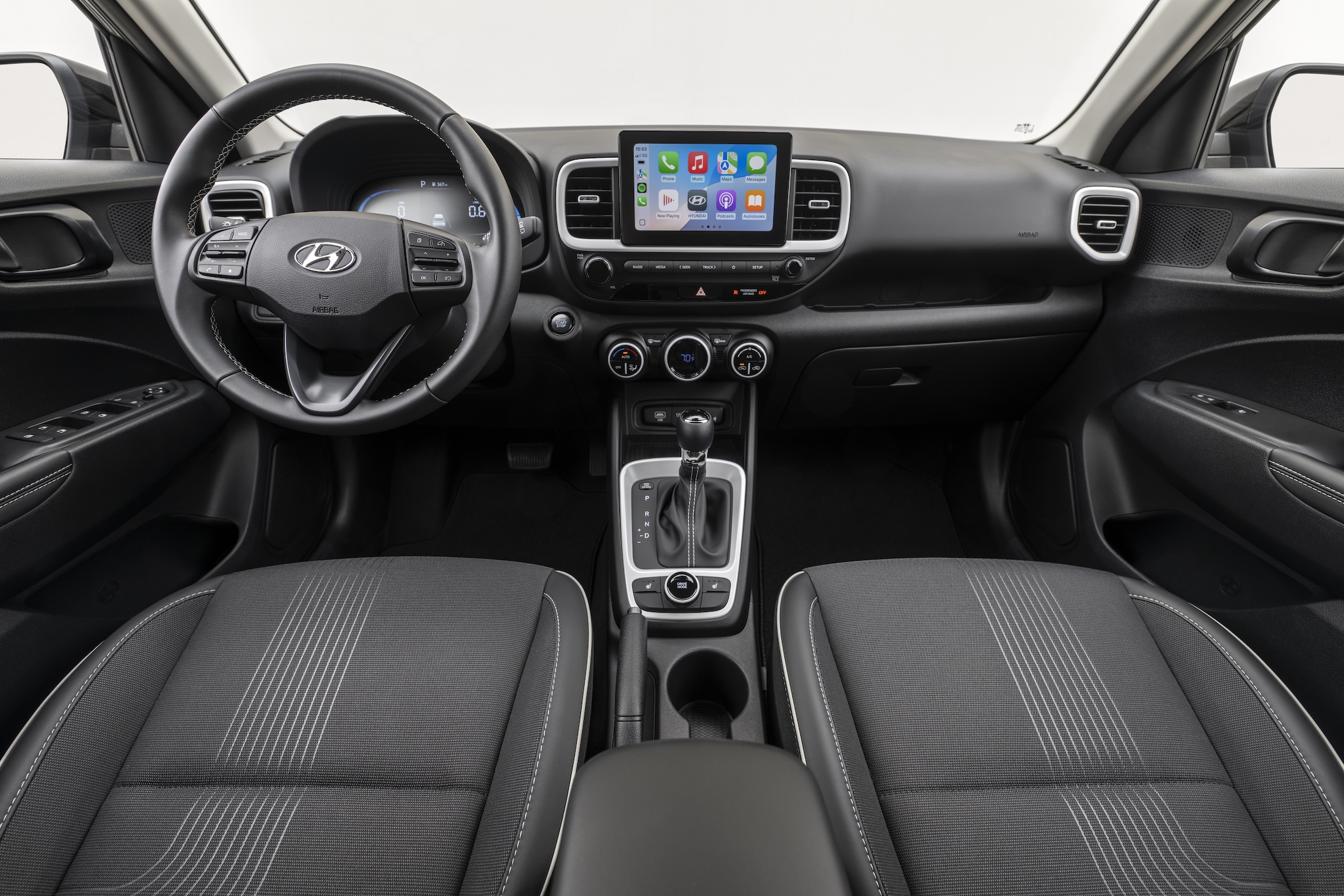
    The interior of the 2027 Hyundai Venue has kept up with the times, with a digital dashboard. The seats are old-style springy, though.DREW PHILLIPS

    Driver’s Seat: Forget my usual “comfortable and supportive” line; this cloth-covered seat is springy, and a little hard. Still, it did all right for keeping me in place in the turns.

    The Venue is not as much the wayback machine as I expected, with a digital speedometer and quite a number of safety features.

    Friends and stuff: The rear seat is right at the edge where snug becomes useless. (For the other side of that line, see the Volkswagen Karmann Ghia.) My legs just fit in there and only an abundance of foot room made the rest of the experience even worth considering. But there’s no room for movement. Tall people might not love this car quite as much.

    Cargo space is 18.7 cubic feet in back and 31.9 with the seat folded.

    In and out: The Venue is a great height, neither too low nor too high.

    Play some tunes: The 8-inch display screen offered with the multimedia system is laughably small by today’s standards. Volume and tuning knobs get an assist from vintage buttons underneath the screen. The screen doesn’t need much attention, so no whining about my eyes having to leave the road.

    Sound from the unnamed six-speaker system was better than I expected, about an A-.

    Keeping warm and cool: A dial controls the temperature and another the fan speed. The readout that looks like a third dial — the same one that puzzled me in 2021 — remains, and continues to lure me into thinking it changes something; it’s just there looking nice and blending in. A little too well.

    Fuel economy: The Venue averaged almost 34 mpg during nearly 500 miles of driving by other drivers. I knocked that down closer to 33, and I feel bad about that. But last time, I pushed it below 30, so I’m getting better with age. Or the Venue is. (Lovely Mrs.: “It’s the Venue.”)

    Where it’s built: Ulsan, South Korea. Its parts are 90% Korean and 1% Canadian or American.

    How it’s built: Consumer Reports predicts the little Venue will get a 3 out of 5 for reliability.

    In the end: There are so many other better cars in this category, but sometimes price wins out. And if that’s the case, there are plenty worse venues than the Hyundai Venue. Almost all the other choices start out about $4,000 more.

    Next week: How does the larger Kia Seltos compare?

  • A wave of outages has Americans preparing for doomsday

    A wave of outages has Americans preparing for doomsday

    Canning fruits was a hobby for Korrie Roth until Microsoft Outlook went down. And then the planes stopped flying. And then Apple Pay froze up. And then the National Security Agency, whose responsibilities include defending the government from cyberattacks, reported its own mysterious outage.

    “Now I’m prepping for survival,” said Roth, a 37-year-old IT specialist and mother of five, who lives in Greenwood, Indiana.

    No explanation from the country’s leaders has soothed her.

    President Donald Trump suggesting everything is “fine” on Tuesday lacked empathy, she thought. She was not feeling fine, and her social media feeds were full of panicked friends asking some version of: What is going on?

    “You’re supposed to trust the government to give you information and protect you,” she said. “But we are worried, and the government is just like, ‘Oh, you’re silly.’”

    Roth bought a crank radio and extra bottled water and checked in with someone she actually trusts right now — her father. He bought a portable generator during the Microsoft crash, he told her.

    A slew of seemingly unrelated outages, coupled with media reports both vague and menacing, have led to a groundswell of worry from Americans who said they’re preparing for a bevy of worst-case scenarios: Widespread power outages? Electrical grid failure? The end of the world?

    The political response has offered little clarity. Some Republicans have amplified suspicions that the outages are connected. “The American people can see everything happening with these service outages, and they feel like they’re not getting the whole story,” Sen. Rick Scott (R-Florida) wrote Tuesday on X, demanding transparency from companies and federal agencies.

    Sen. Josh Hawley (R-Missouri) was more pointed. “If this is all a coincidence, it’s like the greatest coincidence in the history of the world,” he told reporters at the Capitol.

    The administration, by contrast, has sought to tamp down speculation. Secretary of State Marco Rubio said Tuesday he understood why people are nervous but the government had “zero evidence” linking the outages. Director of National Intelligence Jay Clayton told the House Homeland Security Committee in a Wednesday hearing that while Americans are right to ask questions, “these are separate service outages associated with maintenance and technical changes. They are not a coordinated or state-sponsored attack.”

    But on the internet, where “preppers” are sharing tips on Facebook groups and Reddit communities, nothing seems outside the realm of possibility — especially to people who have long maintained that they’re prepared for anything.

    One 60-year-old retired aircraft mechanic restocked his pantry, adding a solar-based power station to charge electronics, 16 small propane tanks, a large propane tank and a portable heater. In the past month, he estimates he’s spent about $3,500 on additional supplies.

    Though Camille Sibert, a 25-year-old stay-at-home mom in Indiana, said she’s been a prepper for three years, the week’s chaos has vindicated her decision to think ahead.

    Amid news of the outages, she and her husband went to Walmart and bought canned goods, gallon jugs of water, vitamins and over-the-counter medication. They also filled up their vehicles with gas. “I try to avoid panic buying, but with everything going on in current events we’d rather be safe than sorry,” she said.

    She used to think of prepping as a hypothetical, but it feels more real now. “It started as a scenario … to think about and consider how I would respond and survive,” she said. “But now, so many odd things have happened recently that the thought of a power grid shutdown doesn’t seem so ‘crazy’ anymore.”

    Whitney Phillips, a University of Oregon professor who studies information politics, said when people receive a barrage of alarming fragments from fractured sources, they often feel compelled to fill in the gaps to make sense of the news.

    “There’s too much to sort through,” she said, “and then we’re making a kind of mental shortcut to try to just get through our days and make sense of things.”

    Increased uncertainty, according to Phillips, can push people already inclined toward apocalyptic thinking further in that direction. “It doesn’t take very much to push them over that edge.”

    But the proclivity to stock up isn’t isolated to those who consider themselves preppers.

    David Bellinger, a senior analyst at the investment bank Mizuho Securities, noted in a Monday research report that shoppers have been swarming Costco in recent days with “emergency prep sales.” As of Sunday night, he noted, 21 of the 26 most expensive generators were sold out on the company’s website. Costco did not respond to a request for comment.

    Two officials at the Federal Emergency Management Agency (FEMA), who spoke on the condition of anonymity because they were not authorized to speak to the media, said they were concerned themselves about the string of outages and were having trouble believing they were a coincidence.

    One official described the barrage of messages they received from former high school classmates asking whether they should be prepping for a massive emergency; another said they took out extra cash.

    “There is nothing on this scale that has happened before in this many sectors this close together,” one of the officials said. “This is scary and there is no leadership.” FEMA did not respond to a request for comment.

    At a time of heightened uncertainty, leaders — of a company or a country — can ease anxiety with clear, detailed information, said John Rogula, a veteran crisis manager who is a principal at the global consultancy Baker Tilly’s risk advisory practice.

    “You’re going to have a lot less panic if you have a plan,” he said. Those in charge set the tone, he added. Shrugging off concerns can amplify them. “You need to be transparent in regards to your readiness,” Rogula said.

    While some Americans are rushing to prepare for a world without power, others have spent years laying the groundwork.

    Shawn Hendrix, 49, a burly survivalist and former operations manager for the popular YouTuber MrBeast, describes himself as a self-sufficient homesteader who lives off the electric grid on a solar-powered farm full of animals.

    From his farm in eastern North Carolina where he was “out moving cows,” he said the recent outages have not fazed him, because he’s been planning for decades.

    “If it happens it won’t be one of these, ’oh no on this date X is going to happen, it will just happen,” he said. “Don’t be scared be prepared. Then just live your life. .”

    Despite her own fears, Roth, the IT specialist who has been canning fruits and buying supplies, flew this week to Washington, D.C., for work.

    The planes were flying again, the ground stop lifted, but delays were still rampant, and she kept checking her phone for updates.

    “In the back of your mind, you’re like, well it’s probably going to be just fine,” Roth said. Then she paused. “But, what if it’s not?

  • Fed officials worry an AI bust could shake the financial system

    Fed officials worry an AI bust could shake the financial system

    Almost every Federal Reserve official raised concerns last month about what could happen to the financial system if the artificial intelligence boom disappoints investors, according to minutes of the Fed’s October meeting released Wednesday.

    Fed officials noted that AI-related debt had grown rapidly, much of it “through complex and opaque financing structures,” according to the minutes of the last committee meeting, which opened with an unusual section about discussions of risks to the financial system. A few said AI-related exposures were becoming increasingly concentrated “among a small number of firms.”

    Fed officials have flagged the risk of an AI-driven market drop in their minutes since late last year, but never with nearly every official weighing in.

    The AI build-out has become one of the economy’s major engines, as tech companies borrow heavily to pay to build data centers and buy the chips to fill them. If the payoff doesn’t come, officials worry, the losses could spread to the investors and lenders paying for it.

    The Fed worries came as doubts about the AI boom were spreading on Wall Street. Ahead of the meeting, two leading AI firms reported revenue growth below investors’ expectations, and one of the giant tech companies building data centers released spending plans that required more financing than investors had anticipated, the Fed’s markets desk told officials, according to the minutes.

    In October, Google’s stock market value dropped by half a trillion dollars in a single day, when it appeared the company would take longer than expected to see a financial payoff from AI. The day before the Fed’s meeting began, Meta said it would sell up to $95 billion in new stock, and Anthropic, maker of the Claude chatbot, started the process for what is expected to be the largest initial public offering in history, an offering expected to be finalized Wednesday.

    In October’s Fed meeting, staff singled out risks from “circular financing arrangements among AI-related firms,” in which chipmakers and other suppliers invest in or lend to the companies that buy their products. They also pointed to long-term lease commitments that don’t show up as debt on companies’ books.

    At his news conference after the meeting, Federal Reserve Chairman Kevin Warsh didn’t mention officials’ concerns about AI debt. He said credit had tightened for some businesses and households since the Fed raised rates in September, “much as we would expect,” and that investors were becoming “somewhat more discerning.”

    But this week, as Warsh opened a Fed conference on how AI could reshape jobs and productivity, he described one scenario Fed staff are studying in which AI disappoints, stock prices fall, and the economy slows.

    In October’s meeting, several officials noted the staff’s view that the banking system remained well capitalized, the minutes said. But several also cautioned that “banking system vulnerabilities could emerge rapidly even after seemingly reassuring initial assessments,” and that bank supervisors may not fully see how exposed banks are to private credit funds and other lenders outside the banking system.

    Almost all officials weighed how the Fed might respond. A few suggested making sure banks hold extra capital, a financial cushion that lets them absorb losses and keep lending if trouble hits elsewhere.

    Several officials stressed that interest rates are “not the appropriate tool” for heading off risks to the financial system directly. Still, rates are likely headed higher.

    Many officials said they viewed the AI buildout as “a material source of inflation risk,” the minutes said, as demand from the buildout strains supplies of tech products and skilled construction workers. This is a view that Warsh has not appeared to embrace.

    Almost all officials said further rate increases would likely be appropriate to bring down inflation, and a couple said a larger than usual hike could be considered at the next meeting in December if inflation data come in hot.

  • Penn’s health system had $88 million in operating profit for three months ended Sept. 30

    Penn’s health system had $88 million in operating profit for three months ended Sept. 30

    The University of Pennsylvania Health System reported significantly lower operating profit in the quarter that ended Sept. 30 compared to a year ago, as increased expenses outpaced revenue growth.

    The seven-hospital system anchored by the Hospital of the University of Pennsylvania had $88 million in operating income in the first quarter of fiscal 2027, down from $109 million a year ago, according to a report to municipal bond investors this week.

    “We had very good growth on the inpatient and outpatient side that is generating higher revenue for us,” the health system’s chief financial officer Julia Puchtler said Wednesday. She cited higher employee benefit costs and medical malpractice expenses as key offsetting factors.

    Here are more details:

    Revenue: Penn’s quarterly revenue climbed 8.7%, to $3.6 billion from $3.3 billion. Patient volumes, adjusted to include both inpatient and outpatient business, rose to 99,400 from 95,800, Puchtler said. The notable growth areas include chemotherapy. Penn expanded its infusion center in Lancaster County over the summer because it was full, despite Penn’s push to do more chemotherapy at home, she said.

    Expenses: Employee benefit expenses jumped 17% to more than $400 million in the quarter as the health system’s more than 50,000 employees used more medical services and pharmaceuticals, Puchtler said. Those increases started in the second half of the last fiscal year, she said. Medical malpractice expense for the latest quarter jumped to $46.5 million from $38.7 million.

    Notable: Medicare changes, including a significant revamp to a federal drug discount program known as 340(b), that take effect Jan. 1 are expected to cost Penn from $50 million to $100 million annually, Puchtler said. Payments reductions for certain imaging services at outpatient departments that are not on the hospital campus but treated as if they are for billing purpose will also impact Penn’s finances. “We’re already underway with work to mitigate” this hit, Puchtler said.

  • Philadelphia airport adds new flight to Florida destination on low-cost airline

    Philadelphia airport adds new flight to Florida destination on low-cost airline

    Allegiant Air, a low-cost airline that started operating out of Philadelphia International Airport earlier this year, is adding another route.

    The Las Vegas-based airline on May 21 will begin offering flights from PHL to Destin-Fort Walton Beach Airport in Florida.

    The route will be offered on Mondays, Fridays, and Saturdays, PHL spokesperson Heather Redfern said.

    Florida is a popular destination among travelers flying out of Philadelphia. American Airlines also offers flights to the Destin airport seasonally in the summer, according to Redfern. And last year, Orlando International Airport, Miami International Airport, Fort Lauderdale-Hollywood International Airport, and Tampa International Airport were among the top 15 destinations for travelers out of Philadelphia based on the number of flights offered, according to the Philadelphia Business Journal.

    “PHL is enthusiastic for Allegiant’s continued investment in our market,” said Ryan Marks, PHL’s director of air service development, in a statement shared via email. “This new nonstop service to Destin, Florida, gives our passengers more opportunities to enjoy Florida’s Emerald Coast, and reflects strong demand across Greater Philadelphia for convenient, affordable service.”

    The new flight to Florida is one of 16 routes Allegiant’s parent company, Allegiant Travel Co., announced this week across the country.

    Some are being serviced by Sun Country Airlines, which Allegiant Travel Co. acquired earlier this year. At the time of the acquisition, the airlines combined had 195 aircraft and served almost 175 cities. This week, Allegiant Travel Co. said the two carriers are expected to continue operating separately through at least 2028.

    “These new nonstop routes, combined with our existing scheduled service, give customers more convenient access to the destinations they want to visit most during the busiest travel periods of the year,” said Drew Wells, Allegiant’s chief commercial officer, in a statement. “Just as importantly, these routes are a first look at how we’ll create more options, access, and value for our customers in the long term.”

    Allegiant was launched in 1999, and earlier this year began operating out of PHL, moving in as Spirit Airlines shuttered.

    The airline operates flights between Philadelphia and the Knoxville, Tenn., area’s McGhee Tyson Airport; Des Moines International Airport in Iowa; Gerald R. Ford International Airport in Grand Rapids, Mich.; and St. Pete-Clearwater International Airport in Florida.

    Tickets to Destin-Fort Walton Beach Airport from Philadelphia with Allegiant are already on sale. A basic ticket for a flight departing Philadelphia on Friday, June 4, and returning on Monday, June 7, costs $230.50, including taxes and fees.

  • Americans will pay more for Thanksgiving dinners this year, Farm Bureau says

    Americans will pay more for Thanksgiving dinners this year, Farm Bureau says

    Record turkey prices and higher fuel costs could make Thanksgiving dinner more expensive this year, according to a survey released Wednesday.

    The American Farm Bureau Federation said the cost of an average Thanksgiving feast for 10 will rise 6% from last year to $58.63. The group tracks grocery prices using hundreds of volunteers in all 50 states and Puerto Rico.

    The Farm Bureau, which has been tracking Thanksgiving costs for 40 years, said it’s the first time since 2022 that Americans will see the price of the meal increase. The price hit a high of $64.05 in 2022.

    High diesel prices have made it more expensive for farmers to process and transport Thanksgiving staples like milk, dinner rolls, potatoes, frozen peas, and cranberries, the Farm Bureau said.

    And turkey prices have risen sharply as more Americans seek out protein even as the industry continues to recover from bird flu cases. The U.S. Department of Agriculture has forecast the wholesale price of a whole frozen turkey hen will average $1.76 per pound this year, up 29% from last year.

  • Trump seeks to show strength in China, but a series of technological snafus raises concerns at home

    Trump seeks to show strength in China, but a series of technological snafus raises concerns at home

    SHENZHEN, China — President Donald Trump landed in China on Wednesday, seeking to reinforce the U.S. status as the world’s leading technology power, but a distressing series of technical outages back home has left the administration scrambling to calm the American public.

    The issues put the administration on the defensive at a moment when the president wants to project strength and certainty ahead of a potentially complicated trilateral meeting on Thursday with the presidents of China and Russia, Xi Jinping and Vladimir Putin.

    As he began his trip to Asia, Trump initially had been nonchalant about the outages that left people in the United States worried about accessing their email, checking their bank accounts or safely flying on an airplane.

    “It’s fine,” Trump pronounced on Tuesday from the Philippine capital of Manila, suggesting it was all just a consequence of being a nation that is “big and powerful.”

    But then the outages involving Microsoft, the Federal Aviation Administration, JPMorgan Chase and the National Security Agency’s communications network began to overshadow Trump’s visit. They raised the specter that artificial intelligence can disrupt daily life, as new cyber vulnerabilities identified require software to be constantly upgraded to fix flaws or other security holes, known as patching, which is supposed to improve how the technology runs.

    So at the start of the second day of Trump’s trip, Secretary of State Marco Rubio stepped in to reassure Americans on Trump’s behalf. He told reporters there was “zero” evidence that the outages are connected or tied to rival nations, cyber hackers or criminals.

    “Sometimes when you are going in to fix your system because you’ve identified a vulnerability, it creates a short-term disruption,” said Rubio, who is also Trump’s national security adviser.

    Trump is trying to project strength in Asia, but the outages challenge that image

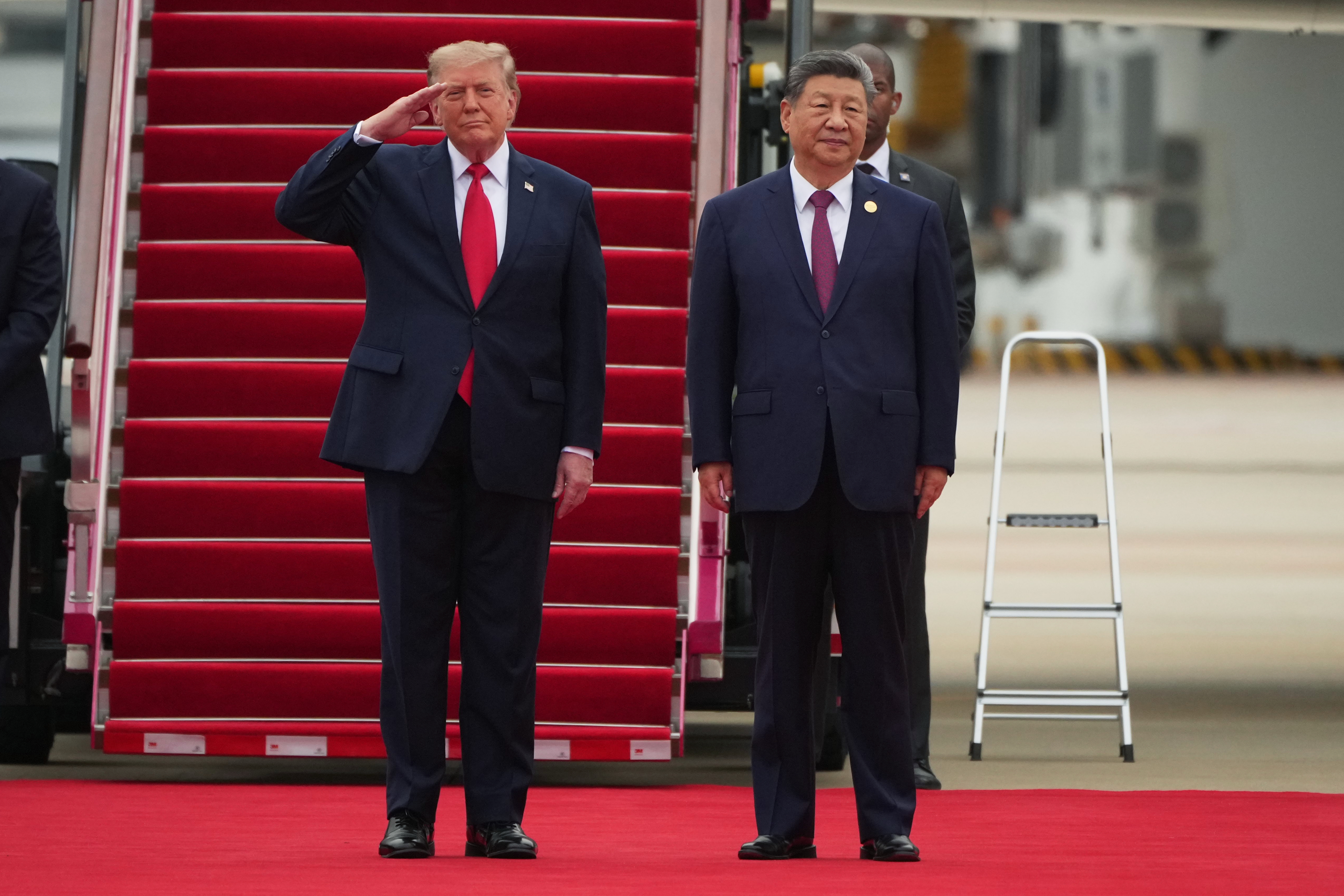
    Xi paid Trump a special honor by greeting him on the tarmac after Air Force One arrived in Shenzhen, China, reciprocating a gesture made by the U.S. president during Xi’s state visit to Washington in September.

    The two leaders greeted each other at the foot of the airplane’s stairs in a handshake that became a hug as group of dancers waved flowers and flags. When Putin arrived earlier on Wednesday, Xi did not greet him at the airport despite their longstanding friendship.

    Trump has signaled that he wants to take an improvised approach during his time in Shenzhen, the skyscraper-filled tech hub that is hosting world leaders for the Asia-Pacific Economic Cooperation summit. It’s a bet that his unscripted brand of diplomacy based on personal relationships can create some kind of legacy to reshape world affairs during his final two years in the White House.

    The White House said that Trump would have two separate meetings on Wednesday with Mexican President Claudia Sheinbaum and Canadian Prime Minister Mark Carney before the official APEC greeting ceremony. Trump has previously voiced his disapproval of the U.S. trade pact with Canada and Mexico that was negotiated during his first term.

    As leaders were introduced on Wednesday night ahead of an APEC group photo, Putin approached Trump. They shook hands and traded greetings.

    On Thursday, at a first-ever trilateral, Trump said he plans to talk with Xi and Putin about limiting nuclear weapons and bringing an end to the war in Ukraine, which began in 2022 with Russia’s invasion. Analysts are not expecting substantive breakthroughs, despite the unprecedented nature of the meeting.

    Before the trip, Trump’s aides had told reporters that the war in Ukraine would not be on the agenda. But Trump said on Tuesday that the deaths of tens of thousands of Russian troops every month had created an opening to resolve the conflict.

    “I think it’s very close to getting it done,” Trump said. “We’re going to have a good meeting on that.”

    Trump also teased the possibility of a private meeting with Putin and a separate sit-down with North Korean leader Kim Jong Un. But neither option had been added to his official schedule.

    Trump has a reunion with old friend Imelda Marcos

    Before he landed in Shenzhen, Trump had lunch in Manila with President Ferdinand Marcos Jr. at the Malacañang Presidential Palace.

    Marcos noted that he had sent fried chicken from the Philippine chain Jollibee to the U.S. delegation for a late-night snack Tuesday and complimented Trump for “working very hard.”

    Trump praised the U.S. bond with the Philippines and the interior decoration of the presidential palace.

    “Our people share common history, common values, common interests, common architectural tastes,” Trump said. “I love what you’ve done here.”

    He said after their meeting that the two nations had reached a trade deal on Wednesday, though he had also said last year that an agreement had been reached.

    Trump also had a short reunion with Imelda Marcos, the former first lady and mother of the Philippines’ current president.

    Famed for her lavish shoe collection, Imelda Marcos knew Trump decades ago through the New York City party scene. During the 1986 “People Power” uprising, her husband, Ferdinand Marcos, was ousted as the Philippines’ strongman leader.

    Trump called her “always the most beautiful” and the 97-year-old matriarch appeared to hand him a gift, according to a video posted by the White House.

    What’s on the agenda for Trump’s meetings with Xi and Putin

    The prospect of Trump meeting with two of America’s largest geopolitical rivals has been a source of unease as the U.S. president has been less welcoming of historic allies such as Canada and NATO partners in Europe.

    His tariffs that were intended to curb China’s trade surplus have done little to stop the progress of the world’s dominant manufacturer, which for the second straight year will have exported $1 trillion more in goods than what it imported.

    Even without the digital outages in the U.S., questions about how to handle AI loom over the summit.

    The technology is viewed as key to unlocking faster economic growth, but its rapid development has meant it poses national security risks and could evolve in ways that put AI beyond human control.

    Trump’s close tech industry ally Jensen Huang was recently removed as the CEO of Nvidia after he admitted to an affair with a woman alleged to be an agent of the Chinese government. Beijing has denied that she was a spy, yet the affair raised concerns about how China has been able to access Nvidia computer chips to develop its own AI models that are competing with the U.S.

    When asked this week why the U.S. had not been more aggressive in cutting off China’s access to advanced computer chips, Trump said there were differences of opinion inside his administration and that “We have a very good relationship with China, and you don’t want to insult them.”

  • Rural poverty and the promise of jobs can make data centers alluring to local officials

    Rural poverty and the promise of jobs can make data centers alluring to local officials

    Data centers have become a hot-button issue in America, and nowhere is that clearer than in rural communities. That’s because, according to Pew, most planned data centers will be built in rural areas.

    From California to the Texas border to Alabama, large corporations have made multimillion dollar offers to rural towns.

    That’s true in Pennsylvania as well, where at least 100 data centers have been proposed. Though Gov. Josh Shapiro initially endorsed construction, he recently signed an Executive Order requiring developers to adhere to strict environmental and economic standards.

    Still, if development moves forward — both in Pennsylvania and elsewhere — data centers will likely permanently alter rural landscapes to meet the infrastructure demands required to support the growth of artificial intelligence.

    Why are rural communities being targeted for these projects? Because they offer tantalizing resources for impoverished regions. That makes it hard for local officials to turn projects away, no matter how unpopular they may be with residents.

    This isn’t a new situation or something unique to data centers. Companies have often targeted rural communities to grow their business, promising that jobs and financial opportunities will outweigh the costs of development to residents. In the 1970s and 1980s, these discussions centered on hazardous waste sites. In revisiting that history, we see how economic hardship shapes local officials’ decisions, leaving their communities saddled with necessary businesses that wealthier communities don’t want.

    In 1977, James Parsons, the son-in-law of Gov. George C. Wallace, who long promoted segregation, purchased 340 acres in Sumter County, a rural majority-Black county in Alabama. Soon, he acquired a state permit to create a hazardous landfill.

    Residents in the rural towns of Emelle, Geiger and Livingston gathered to pose questions about the implications of the facility for their communities. Parsons explained the perceived benefits of the waste site but noted that it was much like a prison: “there is a need, but no one wants it in their community.”

    A year later, Parsons sold the property to a large conglomerate called Chemical Waste (ChemWaste), and that year, the Environmental Protection Agency provided approval for the burial of polychlorinated biphenyls (PCBs) in Emelle. Congress had classified PCBs as toxic chemicals that harmed the environment and humans, and they were no longer in production. The move to bury PCBs in Emelle was not unusual; PCBs were often produced and disposed of in low-income, frequently Black communities.

    ChemWaste insisted that Emelle’s geological makeup provided the perfect disposal site for such hazardous wastes.

    But the plans concerned local residents. A farmer insisted that there were fissures in the soil that could lead to groundwater contamination. Another local worried that there had not actually been a thorough geological survey, while others expressed concerns about the long-term effects of storing hazardous materials in the soil.

    These residents recognized that the waste stored in their communities would be buried beneath the soil indefinitely. Whatever their doubts, however, most locals believed there was nothing they could do to stop the landfill’s operation.

    They were right. State and local officials backed the project because the annual revenues it would generate promised to fund government initiatives. Waste-tax money supported the county’s Board of Education, fine arts program and the parks and recreation department. Local officials also believed that the site would attract more industries to the region and create new jobs.

    And to some extent, they were right: within seven years of the site’s opening, the hazardous waste landfill became Sumter County’s largest employer, offering at least 350 jobs, most of which reportedly went to county residents. Even civil rights activist John Zippert conceded that the county was in a difficult situation because the landfill provided tangible economic benefits.

    The jobs generated by the project, however, didn’t reduce some residents’ opposition. One opponent, Wendell Paris, questioned whether they actually went to local Black residents or if employees commuted from other areas.

    By 1984, a group of Sumter County residents formed Alabamians for a Clean Environment (ACE) with the goal of shutting down the landfill. One of the organizers, Linda Muñoz, explained that many residents did not even know there was a hazardous waste site in their community.

    Even as ChemWaste continued to support county schools and local programming, the dangers of hazardous substances seemed to many residents to outweigh the financial benefits. One ACE member derisively labeled the company’s investment in the region “blood money.”

    Made By History sponsors. FOR USE ON MADE BY HISTORY STORIES ONLY.Inquirer Staff

    Yet, ACE ran into opposition from workers at the Emelle site, who signed a petition arguing that there were safe practices in place and that the landfill’s support for the local economy was irreplaceable. Many residents agreed and felt that shuttering the site would threaten their livelihoods.

    Ultimately, ACE’s efforts failed. Within a decade, at least 88% percent of the waste buried in Emelle came from 42 other states as well as from the Virgin Islands and Puerto Rico. Eventually, the hazardous waste site in Emelle extended across 2,400 acres, where PCBs, insecticides and other banned chemicals were nestled over 700 feet deep within the soil.

    Even as the site grew, some state officials began to believe it was a bad look for Alabama. In his 1986 campaign for state Attorney General, Democrat Don Siegelman insisted that if he won, he would close the landfill. He believed the dangers and negative perceptions of the site outweighed its benefits. As one state legislator argued: Alabama had become the “garbage dump of the South.”

    Siegelman won the election, but he failed to shut the site down despite fighting against the permits that allowed ChemWaste to operate in Sumter County. Proving these efforts were bipartisan, Alabama’s newly-elected Republican Gov. Guy Hunt also sought to implement higher fees for hazardous waste shipments that would deter the growth of the Emelle facility. The two men also backed a plan to institute further regulations to make it more difficult for other companies to construct toxic landfills in the state.

    As Hunt put it: “Alabama is open for business. But we don’t want Alabama open for any more hazardous waste business.”

    Alabamians outside of Sumter County also worried about the trucks hauling hazardous waste through their communities to reach Emelle. A spill could jeopardize the health and safety of residents across the state.

    Yet, none of the activism, resident concerns’, nor state governmental efforts impacted the operation of the Emelle landfill, which is now the largest hazardous waste site in the country.

    The root of its endurance is economic. As one study noted, by the 1990s, Sumter County’s economic dependence on the landfill meant that closing it would create significant fiscal challenges in the region.

    Even as the landfill has continued to serve as an economic engine, however, residents’ worries about drinking water, carcinogens and the damage it was doing to the community’s image have lingered.

    The case is a good example of how the need for revenue and jobs in impoverished rural regions can lead to development that persistently ignores local residents’ concerns and the long-term effects such decisions will have on their communities.

    This history frames current debates about data center construction. Much like the hazardous waste industry did, companies are now promising communities jobs and financial benefits in exchange for shouldering the environmental and human costs required by data centers.

    And like before, rural residents are protesting and expressing their concerns. While some politicians like Shapiro have at least imposed limitations on data center construction or paused them, the history of hazardous waste sites like the one in Emelle suggests that these protests aren’t likely to halt construction permanently.

    That’s true because of two intertwined factors: as with the need to house hazardous waste somewhere, the U.S. needs data centers to meet the energy demands posed by the AI race with China.

    Simultaneously, many rural communities in Pennsylvania and elsewhere will prove unable to resist the revenue promised by data center construction and operation unless and until alternatives emerge to fund necessary operations and provide good paying jobs in their communities.

    And that remains the rub: so long as rural communities remain impoverished, they will remain a good target for necessary industries that wealthier communities don’t want in their backyards.

    Allie R. Lopez is an assistant professor of history at Georgia Gwinnett College where she studies the Black freedom struggle in the rural South.

    Made by History takes readers beyond the headlines with articles written and edited by professional historians. Opinions expressed do not necessarily reflect the views of The Inquirer.