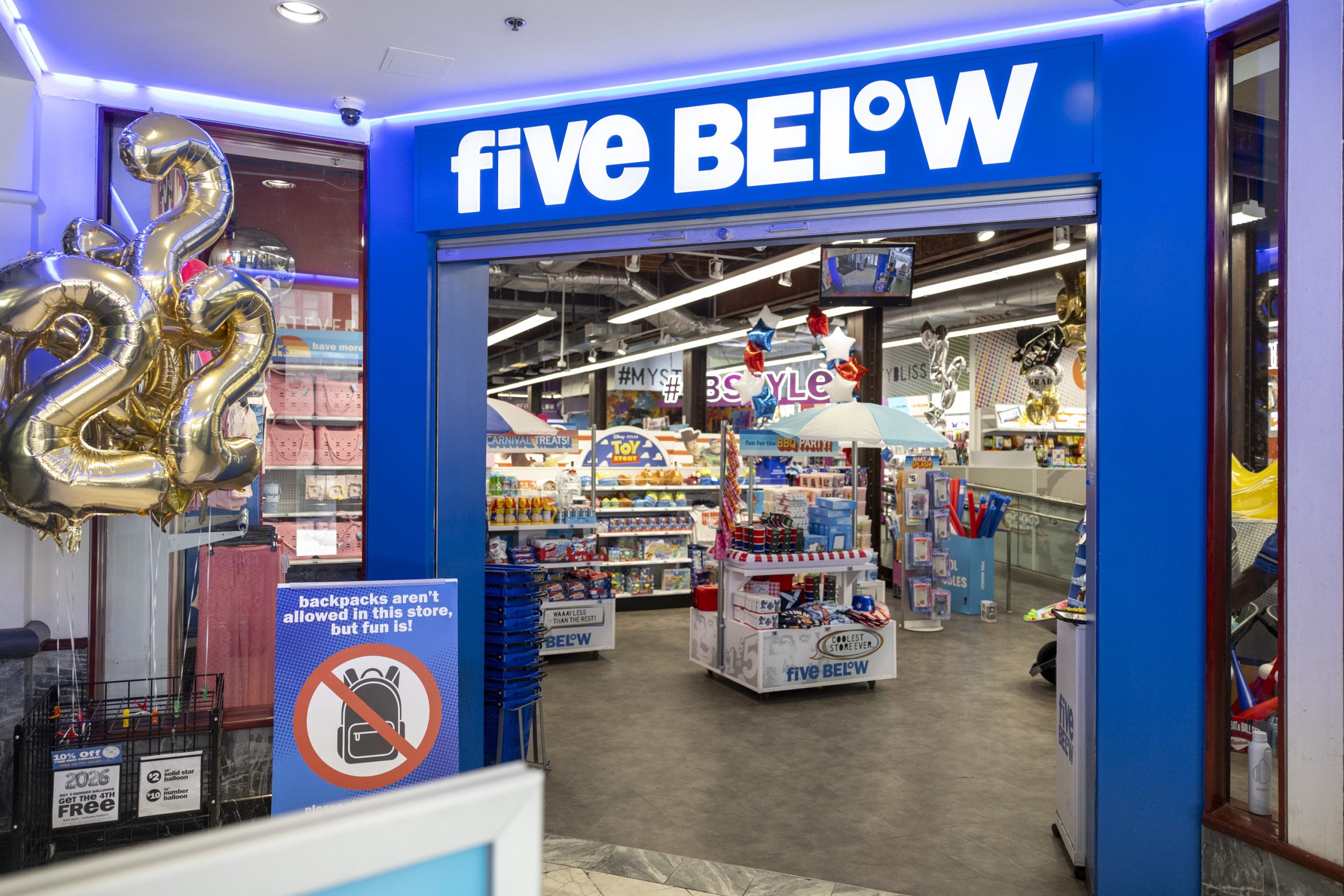
Five Below has been opening hundreds of new stores in recent years, and this month, the Philly-based retailer is set to add its 2,000th location.
The new store is expected to open in LaGrange, Ga., on Friday, July 17, the company announced this week.
“Reaching 2,000 stores is an incredible milestone for our brand whose mission is to be the destination for the kid and the kid in all of us,” CEO Winnie Park said in a statement. “We know our unique retail concept has a lot of runway ahead with thousands of new stores across the U.S.”
The company’s expansion puts its store counton par with Home Depot and Target. As of the beginning of 2026, Home Depot operated 2,359 stores in the U.S., Canada, and Mexico, and Target had 1,995 U.S. stores.
Company leaders said in a recent annual report that they see opportunity to grow Five Below’s store count to 3,500 eventually.
Five Below launched its first store in 2002 in Wayne, and most items the business sells cost between $1 and $5. Its offering of toys, gadgets, games, and other itemsincludes slinky toys, crayons, sandcastle buckets, basketballs, and wireless gaming headsets.
“Many of the products we sell can also be found in mall specialty stores, department stores, mass merchandisers and drug stores,” the company’s most recent annual statement notes, but what sets the business apart is their prices, and their “exciting and easy to shop retail environment.”
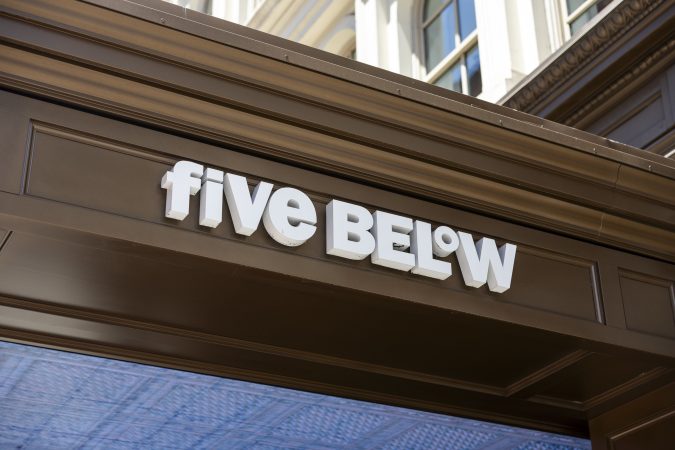
The Five Below storefront at the company’s headquarters in Philadelphia.Tyger Williams / Staff Photographer
Three years ago, Five Below had 1,350 stores in over 40 states. Then-CEO Joel Anderson, said the company had a plan to triple its store count by 2030. In the last three fiscal years, the company has added between 150 and 227 net stores annually, according to its recent annual report.
Five Below recently eliminated the section of its stores dedicated to items over $5. The company still sells the pricier items but now displays them among other items in the store.
As of January, the company reported having 7,800 full-time employees and 16,800 part-time workers, 24,600 total. The majority work at stores across 46 states.
NEW YORK — Kia America has issued a new recall for nearly 463,000 of its Telluride SUVs, urging owners to again park their vehicles outside and away from buildings after several customers reported fires following previous repairs.
The recall, announced this week by the National Highway Traffic Safety Administration, replaces a prior one Kia initiated in 2024. Certain Tellurides from the 2020-2024 model years are affected, with the NHTSA warning that the front power seat motor of these vehicles may overheat due to a stuck slide knob.
That could result in a fire while the car is parked or being driven. And even after Kia rolled out a remedy in 2024, recall documents note several customers filed complaints of alleged fires underneath the passenger seat. The automaker investigated other vehicles that had received the prior repair and identified “sporadic dealer workmanship issues” — later deciding to initiate a new recall.
Between October 2024 and April 2026, Kia North America’s safety office identified 18 incidents involving either localized seat fires or melting of the seat motor, per recall documents. No associated injuries or crashes have been reported.
In a statement, Kia America noted that “an external impact with excessive force” to the vehicles’ front power seat side cover or slide knob could cause their switch to become dislodged or otherwise damaged — resulting in overheating if the motor continues to be used over time. To prevent this, Kia’s new fix will be for dealers to install an electronic fuse assembly, free of charge.
That remedy will be available in early August, according to an advanced dealer notice published by the NHTSA. And owner notification letters are set to be mailed starting Aug. 13.
In the meantime, both the NHTSA and Kia are warning owners to park “outside and away from structures” until the recall repair is complete.”
Drivers can also confirm if their specific vehicle is included in this recall and find more information using the NHTSA site and/or Kia’s recall lookup platform. Irvine, Calif.-based Kia America is a subsidiary of the larger South Korean automaker.
The recall covers 462,869 model year 2020-2024 Tellurides that were manufactured between Jan. 9, 2019, and May 29, 2024. Kia America estimates that 1% have the defect.
Record jet fuel costs — including a 5 cents-a-gallon boost due to a leak and fire at Delta Air Lines’ Monroe Energy plant in Trainer, Delaware County — have been passed along on to airline customers, and Delta has still been able to boost profits, chief executive Ed Bastian told investors at its quarterly investor call Friday.
At Trainer, “we’re back up to about 75%” of full capacity, but production will remain slow through the third quarter, boosting costs another 5 to 7 cents a gallon, Bastian said.
Delta’s fuel costs averaged $3.93 a gallon — the highest ever, the company says — in the three months ending June 30. That’s up from $2.25 a gallon a year earlier.
World fuel costs spiked after the U.S. and Israel attacked Iran in February, and Iran retaliated against U.S.-allied Arab oil suppliers and shippers, reducing exports from producers from several large oil-producing nations through the Strait of Hormuz.
Despite higher revenues and products, Delta shares fell 2% in morning trading to around $87 and closed at $87.39. The stock hit an all-time high of $95 June 30 before Iran and the Trump administration agreed to a truce, which has since been suspended amid new attacks.
Delta, which is based in Atlanta, burned 1.12 billion gallons of fuel in the past quarter, up from 1.11 billion a year earlier. The Monroe Energy facility in Trainer produces more than 8 million gallons of jet fuel and other products a day when operating at peak capacity.
Despite the Trainer slowdown and the Iran conflict’s effect on global tanker traffic, Delta expects its fuel prices have peaked and will fall to around $3.15 a gallon by September, Bastian told investors.
Delta bought the Trainer refinery from ConocoPhillips in 2012 to make the company less vulnerable to sometimes-volatile jet fuel costs.
The complex, which employs 500 United Steelworkers members and managers and hundreds of union tradespeople, is configured to maximize jet fuel for Delta’s East Coast operations and trades other products — gasoline, diesel fuel, heating oil — for jet fuel in other markets.
Delta employs 100,000 worldwide, and Bastian says it continues to hire as it sells new services. Delta sold more “premium” services to passengers than main-cabin service in the second quarter, a reversal from its historical pattern.
“We are still in the early stages” of further segmenting travel into new premium travel classes, Bastian told investors.
Corporate-business travel continues to rise, and customers have been willing to pay higher prices. Delta ticket revenues jumped 13% compared to last year, while passenger-miles were only up 1%.
Transatlantic and domestic U.S. travel has risen, while U.S.-Mexico travel is down over previous years, Delta officials told investors.
International traffic will grow faster than U.S. travel as Delta continues to add new airports, especially in East and Southeast Asia and the Middle East, Bastian predicted. The company will have to cut costs in the U.S. and Europe. Delta’s shift to new Boeing 787s that are built for more premium travelers and more cargo will help.
A big challenge, he added, is finding enough airplanes to meet the demand.
NEW YORK — When two steel columns buckled this week inside the former Pfizer headquarters in midtown Manhattan, the scare prompted evacuations and halted work on one of the nation’s largest office-to-apartment conversions.
It also highlighted the complex engineering behind adaptive reuse projects, which have become increasingly popular as officials try to tackle a nationwide housing shortage by transforming offices that have sat underused since the COVID-19 pandemic.
The plans call for turning two office buildings — one built in 1909, the other in the 1960s — into about 1,600 apartments by adding more than a dozen stories atop the older structure and redesigning and expanding the other. The buckling occurred on the 21st floor of the newer structure, and crews have installed temporary supports as officials investigate.
Engineering experts said the conversion project is complex and poses many challenges, which include making sure older buildings can safely support new loads and carving up office floors to accommodate residential living.
But none said the high-profile setback should make people doubt the ability of engineers to complete such projects.
“I don’t think it really brings into question our understanding of how to do something like this,” said Ben Schafer, a structural engineering professor at Johns Hopkins University.
How do you build a new tower on top of an old one?
On its website highlighting the midtown project, adaptive reuse firm Collaborative Construction Management says the nine-story building from 1909 will be “threaded through” with a new addition of about 30 stories of poured concrete.
Schafer, who is not involved with the undertaking, said the likely approach is to have the century-old building continue to carry its own weight while building a new structural system to support additions.
“My interpretation would be that they’re going to leave that building carrying its own load, and they’re just going to poke holes in it so that they can take the load from the building that they’ve put above it and bring it all the way down to the foundation,” Schafer said.
Schafer said construction on the other tower presents a different challenge: punching holes in the existing floor plate to bring light into apartments, while also ensuring that the steel frame can support the newly added loads.
City officials have not determined what caused the columns to buckle. But both Schafer and Emily Guglielmo, a San Francisco-based structural engineer, believe the failure likely resulted from the added load.
Spokespersons for MetroLoft, the project developer, didn’t respond to requests for comment Thursday. But Nathan Berman, the firm’s founder, acknowledged in an interview with The Wall Street Journal that the added weight from widening the top 15 or so floors of the building likely caused the damage.
Guglielmo thinks that either the original design assumptions were misunderstood, something went wrong during the design or construction process, or construction crews overloaded or weakened the structure.
Adding stories to existing buildings is common in dense urban areas where land is scarce, she said, but it requires reviewing original construction documents and inspecting the building before determining how additional floors will affect the structure.
“In cities and towns that don’t have that available geography, you’re going to see a lot more of this type of a design where there’s an adaptive reuse to an existing building,” Guglielmo said.
Why not just create a new building from scratch?
To many structural engineers, demolition should occur only as a last resort.
“Tearing buildings down is a terrible waste,” Schafer said, pointing out that buildings and the construction sector are responsible for about 40% of the world’s energy-related carbon emissions. “From a sustainability standpoint, that’s a disaster.”
Beyond the environmental costs, demolishing and hauling away the remnants of huge buildings is especially expensive in dense cities such as New York.
If an existing structure can safely be reused, engineers generally prefer that.
James LaFave, a structural engineering professor at the University of Illinois, said a steel-framed building from the 1960s, like the former Pfizer structure, would typically be a “very good” starting point for a conversion.
Does the scare in New York call into question other adaptive reuse projects?
New York, especially, has embraced this push, as officials have made zoning changes and enacted tax incentives to spur housing production. A report from the New York City comptroller’s office last year noted there are 44 adaptive reuse projects in the city that, as of early 2025, had either been completed, were underway or could move forward.
Pfizer moved out of the building in 2023 after opening a new office near Penn Station, leaving the property vacant. Construction on the property began in 2024.
Joshua Harris, director of Fordham University’s Real Estate Institute, said office-to-residential conversions are a key part of solving the housing shortages in New York and other cities, even if they come with risk.
“In a certain sense, it’s not terribly surprising that this happened, and we should have a little bit of grace,” he said. “These are very, very complicated surgical procedures being done to very old buildings.”
“This is part of the reality of fixing the housing crisis,” Harris continued. “Things like this can happen. It doesn’t look as complex as putting a rocket into space, but, in a real estate sense, construction in an environment like Manhattan on 42nd Street and Second Avenue is very complex.”
Guglielmo, the California engineer, said a combination of building codes, inspections and experienced construction crews makes failures like this rare.
“We’re very fortunate here in the United States that we are not seeing these types of failures on a day-to-day basis,” she said. “We’re privileged to have really robust building codes that explain to us as engineers how to do our designs in a way that’s safe.”
Still, Harris said it is likely a gut check for the industry, as office conversions transform once sleepy business districts across the city into 24/7 neighborhoods, like parts of Wall Street in recent years.
“If this building has a problem, all the other projects that have been sort of greenlit, they’re going to want to review to make sure that it’s not something similar,” Harris said.
The stampers were runnin’ wild, and state officials wanted their piece.
So it was time to crack down on the ping-pong-ball pullers.
On July 10, 1981, Republican Pennsylvania Gov. Dick Thornburgh signed the Bingo Law.
The bill, which took effect on Nov. 9 of that year, would ensure the popular game remained a tool of charitable groups and remained small-stakes operations. This new law limited prize money to $250 (about $920 today) per game, $2,000 (about $7,300 today) for a so-called jackpot game, and $4,000 (about $14,700 today) in total for any one day.
The bill also specified that only nonprofits that had been existence for at least two years could host the games, and that they could do so no more than twice a week.
Traditionally, bingo games were put on by charitable associations — think church groups and senior centers — that were legitimate nonprofits. Still, it was a prohibited form of gambling, and law enforcement across the state chose to ignore this fact and instead allowed the parlor game to thrive.
The bill, Thornburgh told The Inquirer in 1981, would “end this hypocrisy.”
He added, however, that he was not “convinced that this is the absolute, ideal bill,” and that his administration would continue working with the General Assembly “to ensure that some of the loopholes that have been alleged to exist are addressed.”
The bill-pushers were pumped. Legalizing bingo, they told anyone who would listen, would protect charitable foundations, civic groups, and legitimate nonprofits from what an Inquirer reporter called “unscrupulous bingo entrepreneurs.” It would, theoretically, keep those groups from having to pay taxes on the raised money, and keep it out of organized crime’s reach.
But the bingo bill had noisy detractors, like future Philly Mayor Ed Rendell, then the district attorney, who astutely pointed out that the bill would allow anyone to organize a nonprofit and run bingo games. The bill did not provide much enforcementinfrastructure, either.
Today, bingo licenses run $100 for a year, or $15 for a three-day stint.
Leonard Abramson, 93, of Jupiter, Fla., a former pharmacist, founder, chair, and chief executive officer of U.S. Healthcare Inc., author, trustee emeritus at Johns Hopkins University, and one of the world’s most generous cancer research and clinical care philanthropists, died Saturday, July 4, of age-associated decline at his home in Blue Bell, Montgomery County.
Born and reared in the Strawberry Mansion section of Philadelphia, Mr. Abramson earned degrees at Pennsylvania State University and the old Philadelphia College of Pharmacy. He worked as a pharmaceutical salesperson, pharmacist, and hospital management executive in the 1960s, founded U.S. Healthcare in 1975, and nurtured the company into one of the country’s first and largest health maintenance organizations.
“Abramson accurately predicted the need for prepaid medical plans to manage spiraling medical spending in the ’60s and ’70s and founded U.S. Healthcare to capitalize on this opportunity,” officials at Harvard Business School said when they named him one of their Great American Business Leaders of the 20th Century.
Under Mr. Abramson, U.S. Healthcare was known for promoting childhood immunizations, mammograms for older women, reduced fees to specialists, and shorter hospital stays. He championed strict standards and accountability for medical professionals, and criticized those who abused a healthcare system then rife with loopholes.
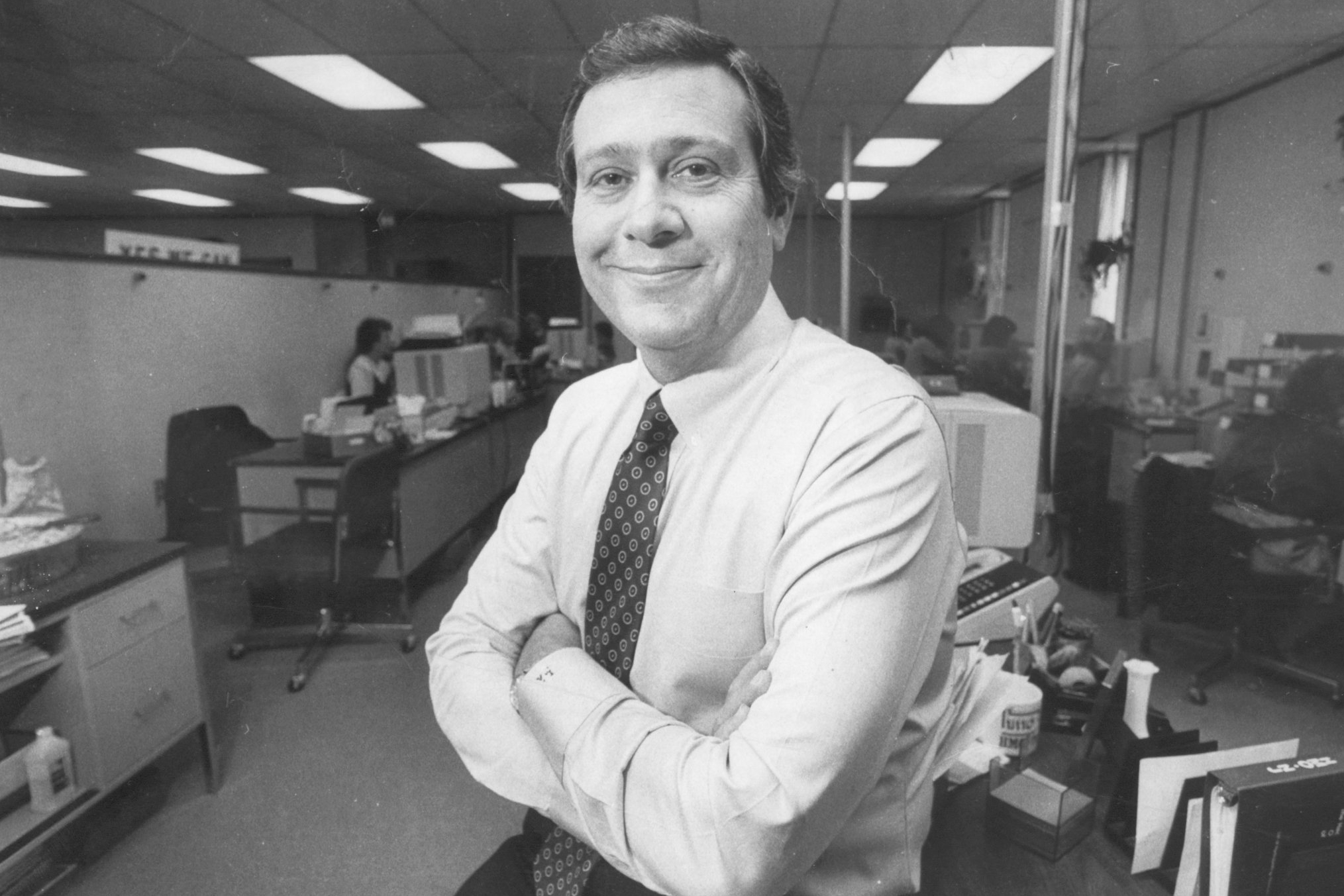
Mr. Abramson “was a brilliant man whose leadership and vision made the company truly exceptional,” a former colleague at U.S. Healthcare said in a tribute.Larry Price / Staff Photographer
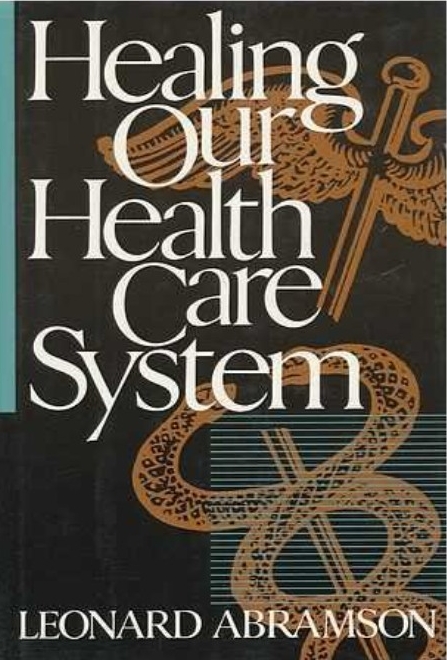
He wrote Healing Our Health Care System in 1990, and told The Inquirer: “If industry leaders know there are solutions, they’re going to call for them. Innovation leads to emulation.” In 1996, he sold U.S. Healthcare to Aetna Life & Casualty Co. for $8.9 billion, established the Abramson Group, and consulted for Aetna and other companies.
“He was a brilliant man whose leadership and vision made the company truly exceptional,” a former colleague at U.S. Healthcare said in a tribute. Another said: “He encouraged a commitment to customer service that stayed with me throughout my career.”
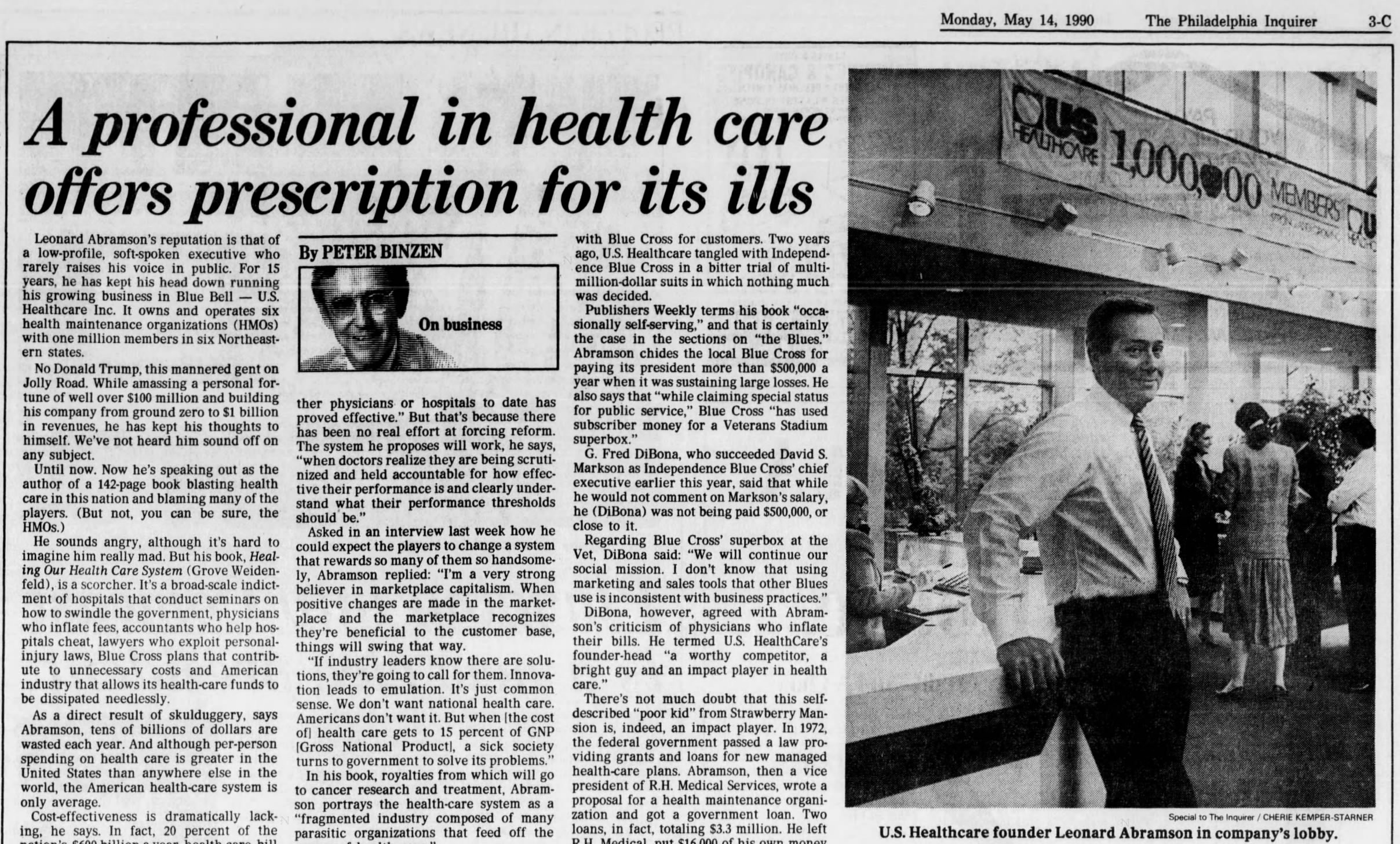
Routinely one of the highest-paid CEOs in the Philadelphia region, Mr. Abramson was a “low-profile, soft-spoken executive who rarely raised his voice in public,” Inquirer business writer Peter Binzen said in 1990. A former colleague at U.S. Healthcare said: “I never worked for a better man.”
As a philanthropist, Mr. Abramson and his wife, Madlyn, established the Leonard and Madlyn Abramson Family Foundation in 1996 and donated more than $140 million to the University of Pennsylvania’s Perelman School of Medicine and the Penn Medicine network. In 2002, Penn Medicine renamed its main cancer facility in University City the Abramson Cancer Center.
This article and photo of Mr. Abramson appeared in The Inquirer in 1990.Newspapers.com
In a tribute, officials at Penn said he “touched countless lives across the world through his generosity, compassion, and leadership.”
At Children’s Hospital of Philadelphia, they supported the Leonard and Madlyn Abramson Pediatric Research Center and a pediatric emergency department at CHOP’s hospital in King of Prussia. In 2013, they donated $10 million to fund scholarships at the Temple University dental school.
Mr. Abramson and his wife, Madlyn, married in 1957.
Mr. Abramson’s wife, a cancer survivor, died in 2020, and he donated $10 million in 2021 to establish an endowed chair of cardiac surgery in her honor at Jupiter Medical Center in Florida. He was an honorary trustee for the Brookings Institution, trustee emeritus for Johns Hopkins, board member for many organizations, and a supporter of Project HOME for affordable housing.
Friends and former colleagues called him a “caring humanitarian,” “a class act,” and “a visionary” in online tributes. One longtime friend said: “Leonard’s kindness and generosity made a difference in the lives of countless individuals.”
Leonard Abramson was born Nov. 12, 1932. He graduated from Northeast High School and drove a cab to help pay his way through pharmacy school.
“Not too many people started off with less than I did,” he told Forbes magazine in 1994.
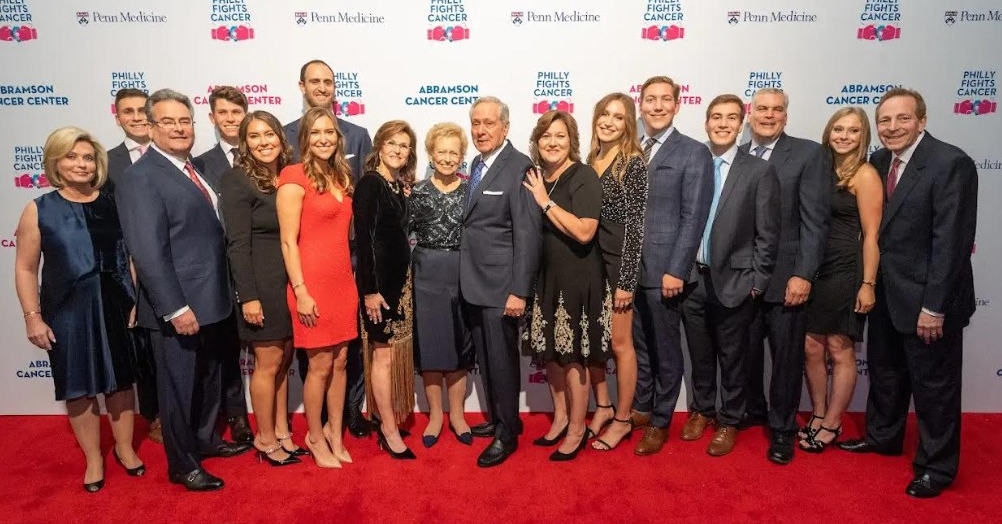
Mr. Abramson (center) enjoyed time with family and friends. Courtesy of the family
He met Madlyn Kornberg in college through a mutual friend, and they married in 1957. They had daughters Marcy, Nancy, and Judy, and lived in Blue Bell, Jupiter, Fla., and Camden, Maine.
Mr. Abramson enjoyed boating, golf, and painting. “He was multifaceted,” his daughter Judy said. His daughter Nancy said: “He was extremely family oriented.”
He told The Inquirer in 1990: “I’ll never retire.” He never really did.
In addition to his daughters, Mr. Abramson is survived by nine grandchildren, two great-grandchildren, and other relatives.
This book by Mr. Abramson was published in 1990.Leonard Abramson
A memorial service is to be held later.
Donations in his name may be made to the Abramson Cancer Center at the Hospital of the University of Pennsylvania, 3535 Market St., Suite 750, Philadelphia, Pa. 19104, and Philly Fights Cancer, Box 9, Wynnewood, Pa. 19096.
America’s grocery stores are cutting prices to attract consumers who have pared back spending to cope with rising costs.
Walmart, the nation’s largest retailer, said Monday that it would lower the price of ground beef rolls, fresh corn, cherries, potato chips, and Coca-Cola as part of a slew of summertime discounts.
It’s the latest grocery chain to do so, increasing competition in a relatively low-margin industry reliant on people buying shopping carts packed with items, including some at more profitable prices.
The grocery industry has struggled over the past 18 months as higher food bills, reductions in food stamp programs, and the rise in the use of weight-loss medications have resulted in shoppers buying less. On top of that, elevated gas prices because of the war with Iran are hitting shoppers’ wallets.
A May CNN poll found that 61% of Americans had changed which groceries they bought in order to stay within their budget.
High grocery prices have been a political issue for several years, so much so that President Donald Trump sought to take credit for Walmart’s announcement, posting on social media that the retailer “will be lowering prices, by a lot, at my administration’s request to celebrate our great country’s 250th birthday.”
Walmart did not mention Trump or his administration in its news release.
But while shoppers may get better deals on some items, it’s unlikely that their overall grocery bill will fall. Prices across all food categories are expected to rise 3.2% in 2026, according to the Department of Agriculture’s Economic Research Service.
While egg prices have dropped from last year’s record levels, the USDA predicts that prices for beef, pork, poultry, sweets, nonalcoholic beverages, fresh vegetables, and fresh fruit will increase this year. That comes on top of the 18% price increase in food consumed at home since the beginning of 2022, according to the U.S. Bureau of Labor Statistics. Beef prices continue to hit record levels this year; Walmart said it would reduce the price of its 1-pound log of ground beef to $5.94 from $6.74.
In the four weeks ending in late June, prices in 61 food categories rose 3.4% from the same period a year ago, while the volume of goods sold slid by 2.1%, according to analysts at Stifel, a financial services firm.
To lure consumers in their doors and, hopefully, persuade them to buy more, several grocery store chains have reduced prices on a few dozen items, or the top 10 food products consumers typically buy. They have also increased the number of less expensive store brand products on their shelves.
“It’s not going to be across the board. It’s not going to be across 40,000 items,” said Phil Lempert, a food industry analyst and the editor of Supermarketguru.com.
Consumers are also changing where they shop and are making fewer trips to traditional grocery stores in favor of discount grocery chains like Aldi, a company that originated in Europe and is quickly expanding in the United States, according to a grocery shopper study by consulting firm AlixPartners.
Retailers, still trying to maintain profits to keep investors happy, are looking for ways to fund the price reductions. On a call with analysts in May, Walmart executives said that at least some of the price cuts could be funded by the $2.4 billion it has filed for in reimbursements after the Supreme Court ruled in February that Trump exceeded his authority in establishing sweeping tariffs on imported goods.
In many cases, the reduced grocery prices likely reflect better deals grocery retailers have gotten from manufacturers, Lempert said. Food and beverage manufacturers, eager for consumers to put more of their foods in shopping carts, oftentimes offer discounts or other promotions to retailers, he explained.
“The average grocery retailer is only making 1.5% to 2% net profits on groceries,” he said. “There’s not a lot they can do to take price cuts on their own.”
Earlier in the year, executives at PepsiCo said the company was lowering some prices to drum up demand, or volume, for its snacks and foods. On Thursday, PepsiCo reported that prices in its North American food business, which includes Frito-Lay chips as well as Quaker Foods breakfast and snack bars, were down 2% in the second quarter compared with the previous year.
Executives said the lower pricing at many stores had helped boost demand in the quarter. They noted, however, that higher gas prices translated into weaker sales at convenience stores.
Executives at Kroger said on an earnings call in June that the retailer would push harder in negotiations with suppliers but would also fund discounts by cutting its own expenses.
In May, Stop & Shop, a unit of Dutch supermarket operator Ahold Delhaize, said it was lowering prices on more than a dozen food items in its New Jersey and New York stores. The price of a rotisserie chicken fell $1 to $6.99 and a can of Bumble Bee tuna was cut to $1.99 from $2.29.
The grocery retailer chose the products based on customers’ everyday purchases across a variety of departments, Daniel Wolk, a spokesperson for Stop & Shop, said in an email.
Since making the price cuts, Wolk said the chain was seeing “encouraging signs that customers are filling their baskets with more volume.” He added that the original cuts were part of a phased approach and that, since then, prices on “thousands of items” in stores throughout Massachusetts, Rhode Island, Connecticut, New York, and New Jersey had been reduced.
Costco said in May that it cut prices on everyday goods including eggs and beef, which had slightly impacted the retailer’s margins. The warehouse club slashed prices on items like chicken wings and chocolate almonds.
“Our goal is to be the first to lower prices where we see opportunities to do so,” Gary Millerchip, the chief financial officer of Costco, told investors on a conference call.
Target said in March that it would reduce prices for “pantry staples,” after lowering prices on thousands of food items late last year.
Retailers are also increasingly leaning into placing more of their own brands onto shelves, hoping to drive customer spending on less-expensive store versions of spaghetti sauce, frozen waffles, and baked goods.
Whole Foods Market, which was famously nicknamed Whole Paycheck for its higher prices, has been trying to alter that perception by expanding its store brand offerings and cutting prices.
“We’ve reduced prices on more than 900 products across private brands, including the 365 by Whole Foods Market private label selection,” a spokesperson for Whole Foods said in an email.
SAN FRANCISCO — The New York Times, the New York Daily News, and 15 other media organizations said in a federal court filing Thursday that OpenAI was withholding evidence that could play a key role in high-profile lawsuits the companies filed against the artificial-intelligence start-up.
With their filing, the publishers called for legal sanctions against OpenAI, accusing the company of violating court rules and acting in bad faith during the litigation’s fact-discovery phase.
The Times sued OpenAI in late 2023, accusing the company of infringing on its copyrights by using its materials to train ChatGPT and other technologies. In the months that followed, other publishers sued the AI start-up, making similar accusations. Many of those cases were consolidated last year.
In the motion Thursday, known as a sanctions filing, the publishers said OpenAI refused to provide information showing how the company’s AI systems are trained and used.
“The evidence is in OpenAI’s training data sets and ChatGPT output logs,” the parties said in their motion. “But instead of just producing that evidence at the start of the case and focusing on the merits of its fair use defense, OpenAI chose obstruction.”
OpenAI did not immediately respond to a request for comment.
OpenAI has previously denied wrongdoing, saying it respects the rights of content creators. The company has also argued in a court filing that ChatGPT is not a substitute for a Times subscription.
A sanctions filing is an unusual step that forces a judge to settle a legal disagreement, said Robin Feldman, a professor at UC Law San Francisco.
It “makes the judge get down in the mud with other parties,” she added.
The Times was the first major American media company to sue OpenAI over copyright issues related to its written works. The Times’ suit made similar accusations against Microsoft, one of OpenAI’s primary partners.
Microsoft has denied the allegations.
A judicial panel last year consolidated many of the dozens of cases brought by publishers against OpenAI, including the lawsuits from the Times and from authors, including comedian Sarah Silverman, John Grisham, Jonathan Franzen, and George R.R. Martin.
Like other AI companies, OpenAI has built its technologies by feeding them enormous amounts of data, some of which is copyrighted. OpenAI, Microsoft, and other companies have long contended that they can legally use copyrighted material to train their AI systems without paying for it because they transformed the material for a different use.
The Times, the Daily News, and other publishers filed their motion after deposing an OpenAI employee. The deposition, which was largely redacted in public court documents, shows that OpenAI could have provided the data the plaintiffs have long sought, the publishers said.
“For two years, OpenAI has been making misrepresentations to the court regarding its ability to search for Daily News content in its training data sets and output logs,” said Steven Lieberman, counsel for the Daily News and several other newspapers that have sued OpenAI.
“OpenAI lied to the Times, the Daily News plaintiffs, the public and the court,” said Ian B. Crosby, a partner at Susman Godfrey and the lead counsel for the Times.
The publishers are asking for monetary penalties and other sanctions, according to the filing. The filing does not ask for sanctions against Microsoft.
Shortly after the Pennsylvania Supreme Court dealt a legal blow to so-called skill games in June, the CEO of Parx Casino celebrated the decision and blamed the unregulated slot machine-like devices for attracting “rampant crime, money laundering, compulsive gambling and underage gambling.”
Days later, hundreds of small-business owners, veterans, and other supporters of skill games had a very different message at a state Capitol rally. They had signs reading “SUPPORT SKILL GAMES, SUPPORT SMALL BUSINESSES” and others declaring that the machines help generate revenue for American Legion and Veterans of Foreign Wars posts.
Some supporters arrived on buses paid for by Pace-O-Matic, the out-of-state game developer that in recent years has become a political heavyweight in Pennsylvania, spending millions on lobbying and electoral campaigns, and growing an unregulated market that swept across corner stores, bars, gas stations, and other locations.
The dueling messages marked the latest clash between Parx and Pace-O-Matic in a yearslong political, legal, and public relations fight over the games, which has featured accusations of conflicts of interest and attempts to influence legislators, law enforcement authorities, and other government officials.
An Inquirer review of hundreds of pages of court records and interviews with key players offer an inside look at the behind-the-scenes battle to shape public policy in Harrisburg between Georgia-based Pace-O-Matic — a leading developer of software for the video game machines — and Bensalem’s Parx Casino, which reported the most gross slot machine revenue, $375 million, of any Pennsylvania casino operator last year.
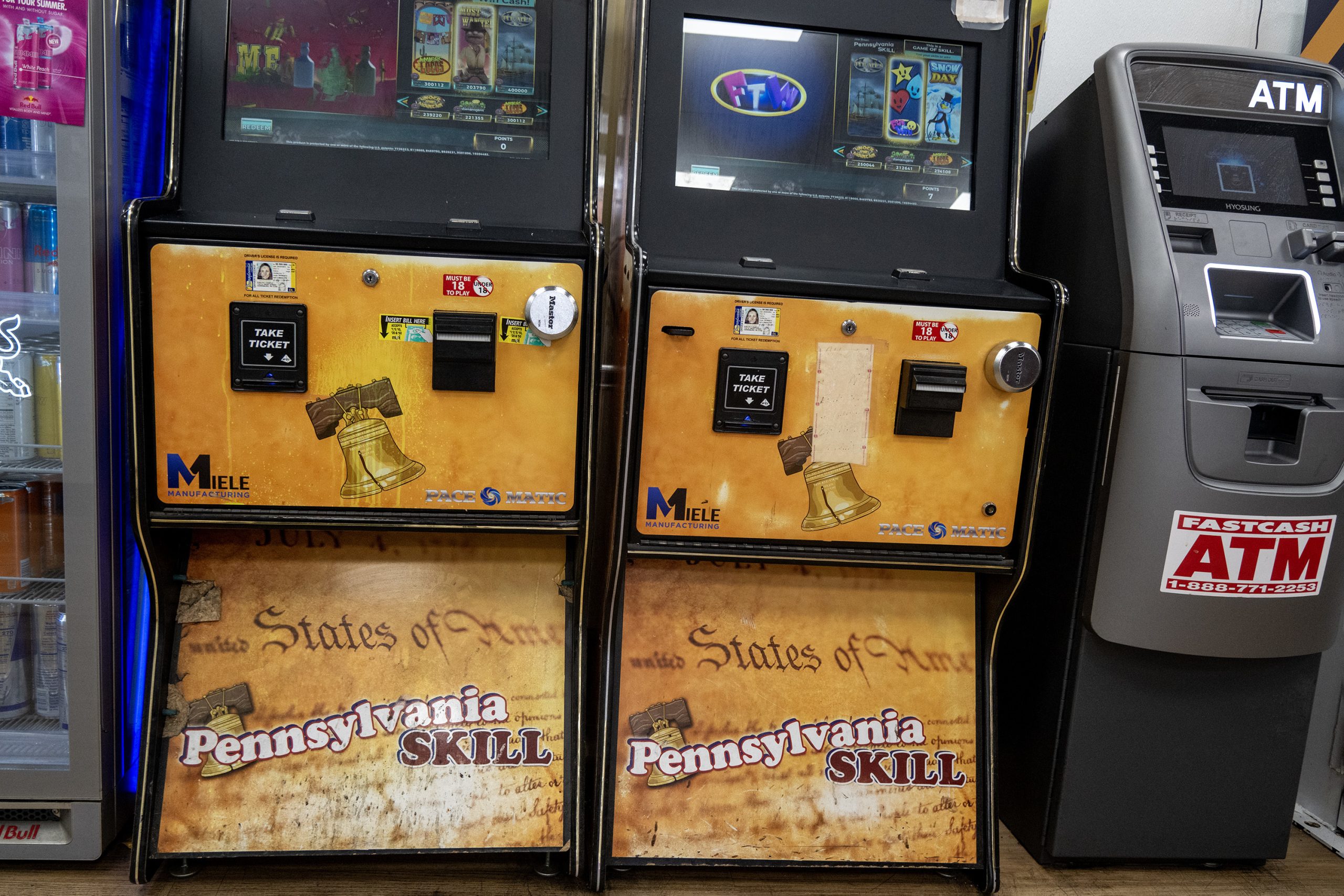
Pace-O-Matic’s “Pennsylvania Skill” game seen in a gas station convenience store in Philadelphia.Tom Gralish / Staff Photographer
In the last decade, skill game developers and manufacturers seized on a huge business opportunity, which casinos and other gambling interests say cost them market share. And some politicians were salivating over a new potential source of tax revenue, while others saw an unacceptable expansion of the vice economy.
That debate has reached a turning point, as the high court found that unregulated skill games are unlawful. But the court paused its order, giving lawmakers a window until October to legalize, tax, and regulate the games — or leave owners and operators vulnerable to prosecution.
Pennsylvania made a bet on gambling two decades ago, legalizing slot machines in casinos in 2004 as lawmakers sought a new stream of tax revenue. The legislature has since authorized more games such as poker and blackjack, sports betting, and video game terminals at truck stops.
Gambling outside casinos and other licensed establishments remains illegal. But corner store skill games managed to take off — in part because of a 2014 court decision that found Pace-O-Matic’s game was not a “gambling device” under the state crimes code.
There are now an estimated 70,000 machines across the state, according to the Pennsylvania Attorney General’s Office, not subject to the taxes or regulations on casino slot machines.
In his February budget address, Democratic Gov. Josh Shapiro proposed a 52% tax on gross skill game revenues — roughly in line with the rate that applies to casino slot machines — which the administration projects could generate almost $800 million in the first year of implementation.
Under his proposal, Shapiro would authorize 40,000 skill game machines and video game terminals — which are already legal — statewide. That means tens of thousands of skill machines currently operating would be considered unlawful.
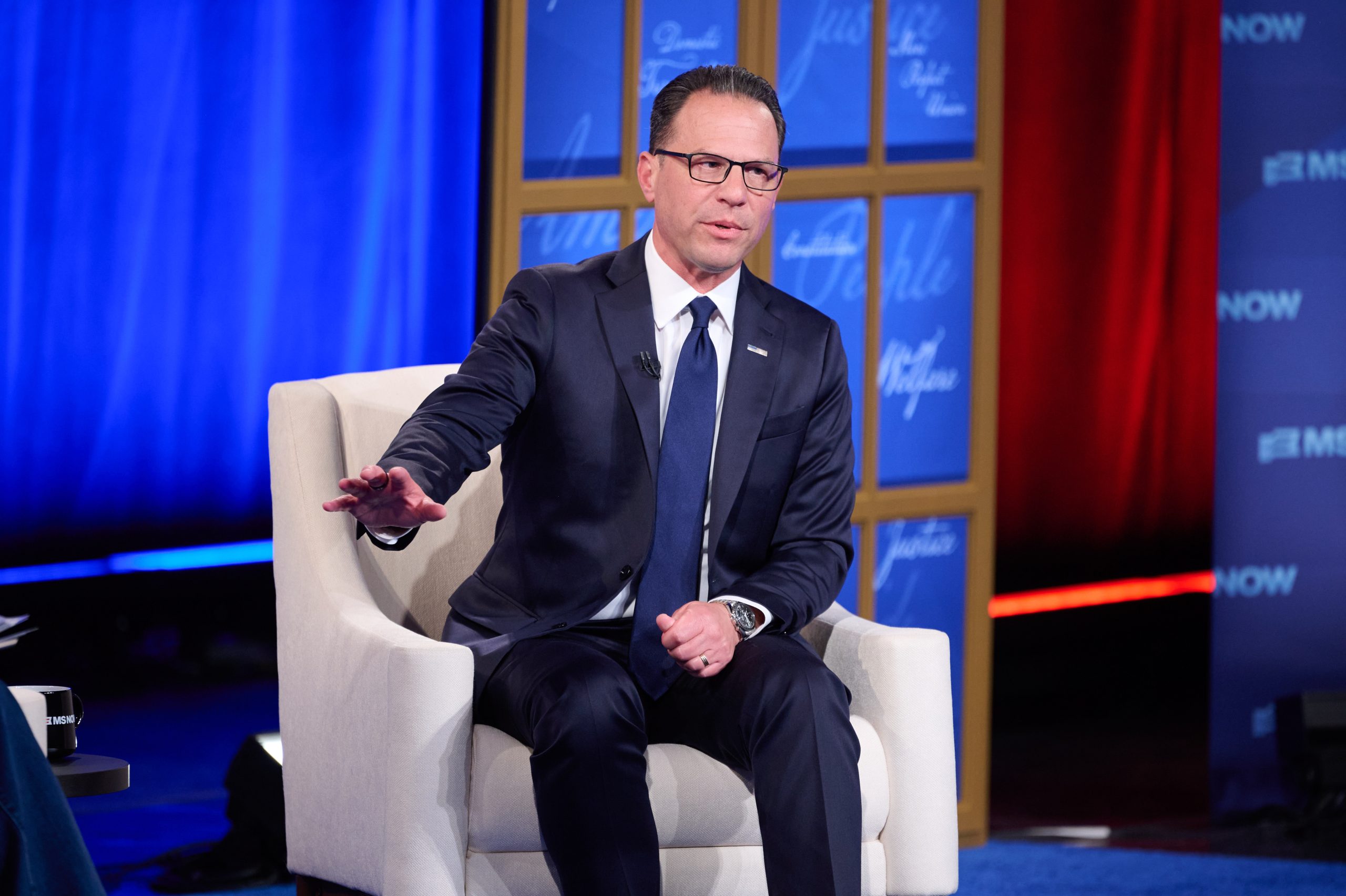
Pennsylvania Gov. Josh Shapiro in June.Courtesy of MS NOW / Scott Gries
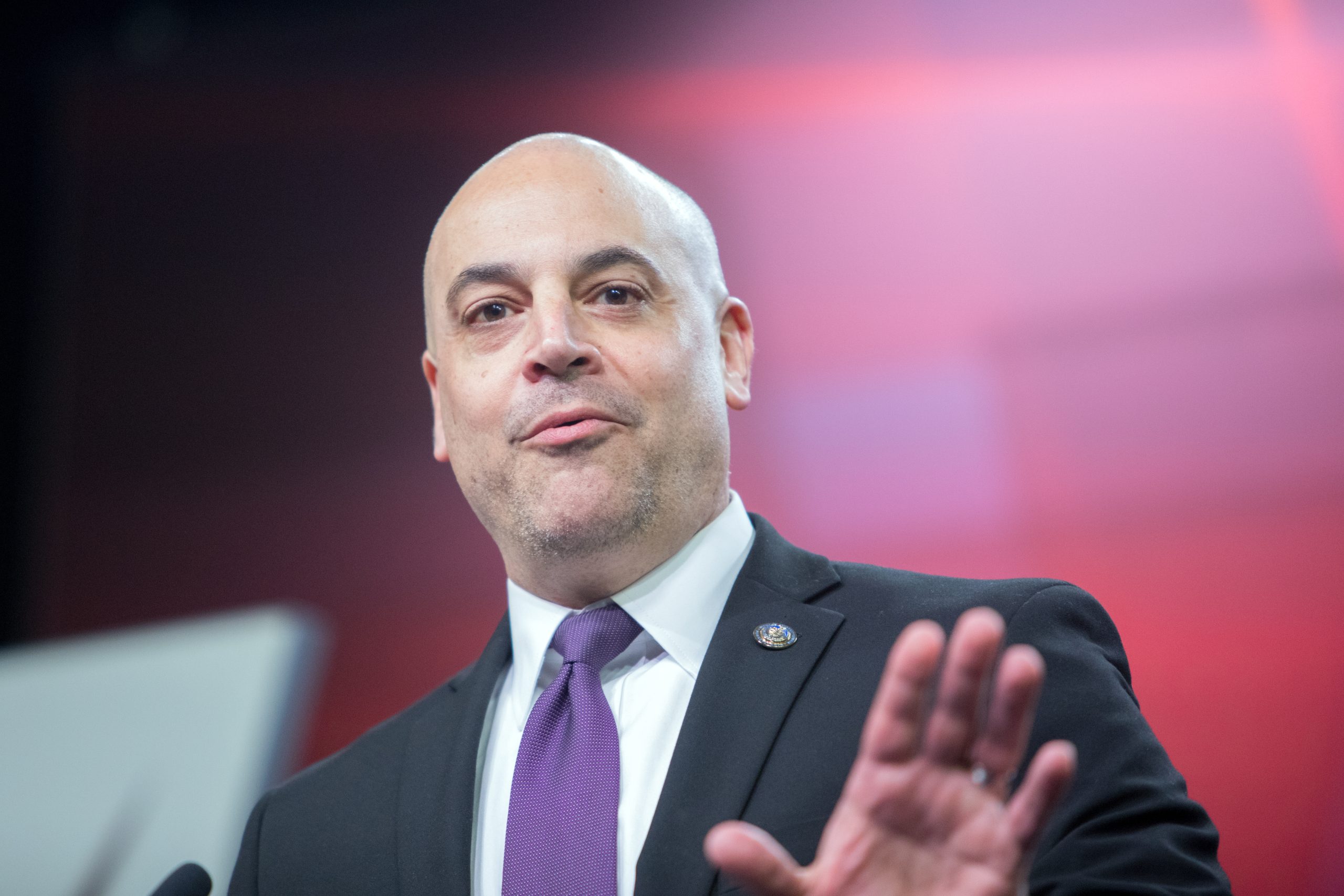
Separately, a bill supported by the skill game industry would impose a $500 monthly fee on each machine, cap the number of total machines at 50,000, and raise an estimated $300 million in tax dollars in the first year. The games are “a small, lifeline raft to help mom-and-pop business owners,” said State Rep. Danilo Burgos (D., Philadelphia), a sponsor of the bill.
Casinos and other gaming interests are trying to protect a $6.8 billion market in Pennsylvania. Pace-O-Matic’s machines across the state generated about $525 million in gross revenue in 2024, with the company receiving 20% of that, minus certain discounts, and the rest going to operators that scout locations and stores that house the machines, according to court documents.
But, come October, if its skill game machines ultimately are not legalized by the state legislature, Pace-O-Matic will pull out of Pennsylvania, said Mike Barley, the company’s chief public affairs officer. “We’ll always abide by the law.”
Millions in lobbying
Pace-O-Matic has spent $8.4 million on lobbying in Harrisburg over the last five years, records show, the most by any single gaming company. In contrast, the operators of more than a dozen Pennsylvania casinos spent $7.6 million combined on lobbying during that time period, according to an Inquirer review of disclosures.
Lobbyists help draft legislation, communicate their clients’ interests to policymakers, and wine and dine government officials.
And Pace-O-Matic has recruited Harrisburg insiders with close ties to state lawmakers for the job: a former member of the Republican National Committee, a former state senator, a onetime top aide to House and Senate Republicans, and a former chief of staff to then-Gov. Tom Wolf, a Democrat.
(function(){function e(){window.addEventListener(`message`,function(e){if(e.data[`datawrapper-height`]!==void 0){var t=document.querySelectorAll(`iframe`);for(var n in e.data[`datawrapper-height`])for(var r=0,i;i=t[r];r++)if(i.contentWindow===e.source){var a=e.data[`datawrapper-height`][n]+`px`;i.style.height=a}}})}e()})();
Since 2021, a political action committee affiliated with the company has reported spending more than $9 million in Pennsylvania, with about two-thirds of that coming this year.
Part of that war chest was aimed at unseating three incumbent Republican state senators in primary elections this spring, as Pace-O-Matic took exception to a proposed skill games tax backed by Senate GOP leaders last year. More than $3 million went toward loan repayments to donors.
Pace-O-Matic has also devoted resources to fighting with its competitor, Parx Casino, in court.
Pace-O-Matic has filed numerous lawsuits, including several that accuse Parx’s lobbyists of going beyond lawful advocacy and wrongfully interfering with its business relationships.
Parx has fought Pace-O-Matic’s growth by privately drafting legislation to ban skill games, filing briefs opposing skill games to the state Supreme Court, and accusing Pace-O-Matic in a lawsuit of leading a criminal enterprise.
Parx spent almost $1.3 million on lobbying during the last five years, the most of any casino. Among its lobbyists is a former state senator who sponsored Parx-backed legislation to ban skill games. Parx’s affiliated PAC, 2999 Group, has reported almost $1 million in expenditures since 2021.
A row of slot machines on the gaming floor of Parx Casino in Bensalem in 2018.James Blocker / Staff Photographer
“It’s a scorched-earth campaign that nobody in town who I know has ever seen anything quite like it,” said Pete Shelly, one of the Harrisburg lobbyists for Parx who was personally sued by Pace-O-Matic. “The amount of money they were able to spend, and the resources they threw at protecting their franchise, was astounding. And their tactics speak for themselves.”
In response, Pace-O-Matic’s Barley responded simply: “Ditto.”
Drafting a bill
Founded in 2000 by Michael Pace — a pioneer of countertop video games — Pace-O-Matic expanded to Pennsylvania in 2014. The company took its game straight to the cops.
Pace-O-Matic says it asked the Pennsylvania State Police whether its coin-operated tabletop machine qualified as a legal game of skill — or as an illegal gambling device. In an effort to test this legal question, the company and the Pennsylvania Bureau of Liquor Control Enforcement in November 2013 arranged for a “friendly” seizure of its game at the American Italian Club in Aliquippa, Beaver County, according to court records.
Whereas in a game of chance like a slot machine, the outcome is decided predominantly “on the basis of probability,” the Pace-O-Matic game featured a level of interactivity that required skill, the judge wrote. That meant the state had failed to prove it was a gambling device.
Skill games in a barber shop in Hazelton.Tom Gralish / Staff Photographer
The opinion gave the skill industry a boost, leading to a boom in machines across the state. Within a few years, Parx went on the offensive.
In 2019, representatives for Parx privately drafted legislation, at the request of then-State Sen. Tommy Tomlinson (R., Bucks), to ban skill games, Spotlight PA reported.
In a March 2019 memo to colleagues about his legislation, Tomlinson cited a lack of consumer protections to prevent minors from playing skill games and pointed to testimony from Pennsylvania Lottery officials that the machines divert funds from programs for seniors.
‘Coordinated litigation strike’
Later that year, in July 2019, Parx outside attorney Mark Stewart e-mailed lawyers representing other casinos, proposing they join together to “launch a coordinated litigation strike on the same day against a large number” of stores that hosted Pace-O-Matic games, according to court papers.
The strike would put “PA Skill” — a reference to Pace-O-Matic’s Pennsylvania Skill games — “on the defensive, having to run around, spend money, and dedicate time and personnel resources to defending the numerous suits,” Stewart wrote.
He added that this would also “draw public and political attention to the illegality of the machines,” according to a lawsuit Pace-O-Matic later filed against Stewart and his firm, Eckert Seamans Cherin & Mellott.
A few months later, Eckert filed dozens of lawsuits on behalf of Parx against retail locations that had skill games, including many that hosted Pace-O-Matic machines, the lawsuit said.
The law firm’s involvement caught Pace-O-Matic’s attention, the company says, because Eckert had represented the company in Virginia even as Stewart advocated against its interests in Pennsylvania.
Pace-O-Matic in 2020 filed a lawsuit accusing Eckert of violating the firm’s fiduciary duties. In court filings, Eckert has denied the allegations, saying that the company knew about the firm’s representation of gaming clients in Pennsylvania. A judge in 2022 signed an order prohibiting Eckert from advocating against the legality of Pace-O-Matic’s skill games. The litigation is ongoing.
Stewart — now an executive vice president at the Cordish Cos., a Baltimore real estate and entertainment company whose properties include two Pennsylvania casinos — did not respond to a request for comment. A spokesperson for Eckert did not return a message.
That litigation unearthed emails showing coordination between Parx representatives and Tomlinson’s office on the proposed legislative ban.
In the two years after he proposed that legislation, Tomlinson’s campaigns received $20,000 in contributions from 2999 Group, the PAC led by Parx founder and chairman Robert W. Green. The PAC formed in 2020 after federal courts struck down a Pennsylvania law banning political contributions from people involved in the gaming industry.
Tomlinson retired in 2022. He registered a lobbying firm, RMT Legislative Consulting, in October 2024. He started lobbying for Parx the following month, records show.
Tomlinson did not respond to requests for comment.
‘STOP THESE MACHINES’
While Tomlinson’s legislation to ban skill games failed to advance, casinos pursued other avenues to protect their interests as the unregulated and untaxed games continued to proliferate throughout the state.
Ahead of a planned meeting with the office of then-Pennsylvania Attorney General Josh Shapiro in July 2021, Parx representatives drafted a PowerPoint presentation depicting a child playing a skill game under the heading “STOP THESE MACHINES,” according to emails reviewed by The Inquirer.
The presentation argued that skill games were illegal, undercut revenue for the Pennsylvania Lottery and the programs it funds for seniors, and failed to comply with anti-money laundering rules that “guard against organized crime and terrorist groups.”
Parx lobbyists wanted to meet with the attorney general’s office, emails show, because they believed prosecutors were preventing the state police from seizing skill games. The attorney general’s office had said in a statement that while the office maintained that skill games were illegal, it would not “actively seize machines” until the state Commonwealth Court provided guidance on whether they were legal.
Reached by The Inquirer, the Pennsylvania Attorney General’s Office — now led by Republican Dave Sunday — said it was unable to confirm if that meeting took place. A spokesperson said the office maintained the posture reflected in its public statement and “successfully advocated for that position leading to the Supreme Court’s decisive ruling.”
Pennsylvania Attorney General Dave Sunday in 2025.Kalim A. Bhatti / For The Inquirer
Pace-O-Matic’s Barley said that around this time, there was a “notable shift in the way the OAG’s office treated our games.” Prosecutors started working with counties to coordinate seizures of games, he said, but Pace-O-Matic successfully challenged those actions and its property was returned.
Casino interests reached out to local law enforcement authorities as well.
When an executive at Mohegan Pennsylvania casino in Wilkes-Barre spotted a new coffee shop in nearby Kingston that advertised Pace-O-Matic games, he contacted his lobbying team, including Stewart and Shelly, the lobbyist who was later sued by Pace-O-Matic, emails show.
“Maybe instead of [Pennsylvania State Police] or local police, we send letter to Luzerne County DA,” Shelly wrote in a March 2021 email to colleagues.
“Seems good idea,” Stewart responded, noting that they had previously sent a letter to the district attorney in Monroe County about skill games.
An alleged conflict of interest
Soon after, the fight over skill games became personal.
Pace-O-Matic in 2022 filed lawsuits against three Parx lobbyists — Shelly, Richard Gmerek, and Sean Schafer — accusing them of attempting to sabotage Pace-O-Matic’s business. In court papers, attorneys for the lobbyists have denied the allegations. The case is ongoing.
In an interview, Parx CEO Eric Hausler said Pace-O-Matic’s lawsuits aimed to “shut our people up, and shut us up, by trying to intimidate our people into being silent about what we believed and continue to believe was a form of illegal gambling.”
He said the firm’s lobbying was appropriate. “We reached out to anybody that would listen to us, whether it was regulators or the attorney general’s office or the legislature, to say, ‘These are slot machines,’” Hausler said.
The Parx CEO noted that the law firm representing Pace-O-Matic in those cases, the McCormick Law Firm, employs State Sen. Gene Yaw (R., Lycoming), a proponent of legislation favored by the skill games industry. Yaw’s wife, Ann S. Pepperman, is a partner at Williamsport-based McCormick. The CEO described Yaw’s association with the firm as a “clear conflict of interest.”
Pa. State Sen. Gene Yaw in August 2023.Frank Kummer / Pa. House of Representatives
Yaw has benefited from Pace-O-Matic’s political giving. Operators for Skill, a PAC led and funded in part by Pace-O-Matic executives, has contributed $47,500 to Yaw’s campaigns since 2021, records show.
His district is home to Miele Manufacturing, a company that makes and distributes Pace-O-Matic’s Pennsylvania Skill machines.
In response to written questions about whether Yaw or his wife has benefited financially from McCormick’s representation of Pace-O-Matic, a spokesperson said the senator had no comment.
Pace-O-Matic representatives have said the company’s leaders and PAC donate to many candidates in both parties.
Targeting incumbent senators
Beyond Yaw, Pace-O-Matic has cultivated plenty of allies in Harrisburg, contributing millions to politicians’ campaigns and inviting lawmakers to an outdoor rodeo festival in Wyoming — and helping pay for some members’ travel. The company has said the purpose of the 2022 trip was to help lawmakers learn from Wyoming legislators about that state’s regulated skill game industry.
But Pace-O-Matic has also alienated some lawmakers, who have described its tactics as overly aggressive.
Last year, the company contributed hundreds of thousands of dollars to a federal super PAC called Citizens Alliance Political Action Committee Inc., which in turn donated to an Ohio-based PAC called Defeating Communism.
Defeating Communism distributed flyers attacking Pennsylvania Republican state senators who had taken positions at odds with the skill game industry. “Tell Senator Farry to stop targeting PA Firefighters + Veterans!” read one flyer targeting State Sen. Frank Farry, a Bucks County Republican and longtime volunteer firefighter who had introduced legislation to tax skill games at the same rate as casinos.
Sen. Frank Farry (R., Bucks), right, has been the Langhorne-Middletown Fire Company fire chief for more than two decades.Jessica Griffin / Staff Photographer
The skill games industry says many volunteer fire departments and Veterans of Foreign Wars posts generate income from their machines.
Pace-O-Matic upped the ante this year, targeting three sitting Republican senators who were facing primary campaigns this spring. A company affiliate contributed $1 million this year to the Citizens Alliance super PAC, which contributed $2.8 million to a state PAC of the same name.
The state PAC spent that money in part on TV ads and mail literature against incumbent Sens. Lisa Baker (R., Luzerne), Camera Bartolotta (R., Washington) — both of whom are members of GOP leadership — and Chris Gebhard (R., Lebanon). Gebhard wrote a bill last year that proposed taxing skill games at a rate the industry argued was too high.
Operators for Skill, the Pace-O-Matic-affiliated PAC, gave $950,000 this year to Citizens Alliance of Pennsylvania PAC, a separate state group that also invested in campaigns against the three senators.
Citizens Alliance is a national organization with chapters in several states, including Pennsylvania. Citizens Alliance CEO Cliff Maloney said his group opposes net increases in taxes and fees, and it works “with partners who agree and want to advance our principles.”
In Bartolotta’s race, voters were getting upward of six mailers each day about her that she described as filled with “every ridiculous lie and smear.”
She remains confused why she was targeted by Pace-O-Matic, arguing that she has always supported fraternal organizations and other small businesses using the machines as an additional revenue source.
“Clearly Pace-O-Matic was making money hand over fist and they didn’t want to be regulated and they didn’t want to be taxed,” Bartolotta said. “They wanted it to be the wild, wild west.”
The outside money prompted Senate Republicans’ campaign arm to spend hundreds of thousands of dollars protecting the incumbents, who ultimately prevailed. The senators also got a boost from sports betting interests, which spent millions backing their campaigns, Spotlight PA reported. That intervention came after a coalition of online sports betting sites helped stave off a last-minute effort to tax sports bets last year.
Asked about Pace-O-Matic’s decision to invest in those races, Barley said, “There’s a part of us that doesn’t feel like our positions were being heard fairly.”
Political skill
Despite the electoral setbacks, Pace-O-Matic has maintained support among a broad cross-section of lawmakers — from State Sen. Anthony H. Williams, a Philadelphia Democrat, to Yaw, the Lycoming County Republican — who point to the revenue skill games generate for small businesses.
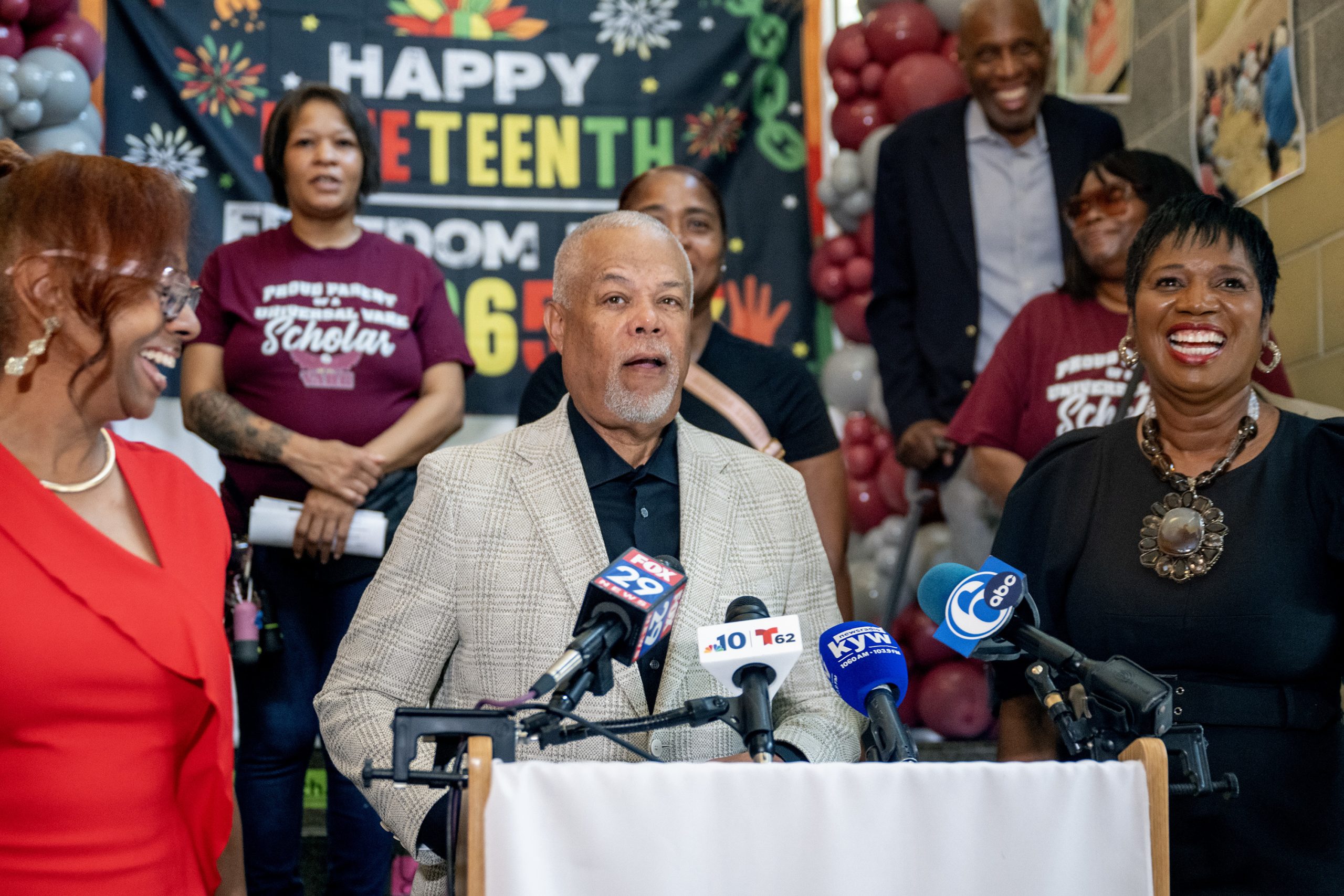
“We signed up to protect the small-business owner, and in this time when everybody talks about affordability, I can’t afford a 52% tax,” Williams said at the recent rally, referring to the governor’s proposal.
He and Yaw have sponsored legislation backed by the industry that would impose the $500 monthly fees on game terminals. In an interview, Williams said the bill would reduce the number of skill games operators in his community “significantly” and ensure proper regulation, adding that he was concerned about locations that offer games in addition to selling liquor by the drink and loose cigarettes.
State. Sen. Anthony H. Williams in 2025.Tom Gralish / Staff Photographer
The political committee aligned with Pace-O-Matic, Operators for Skill, has contributed $70,000 to Williams’ campaign account since last year, records show. Williams, the top Democrat on a Senate panel that oversees gambling, said he developed his policy position before receiving that campaign money. He noted he has also received contributions from casino interests.
“I don’t get a contribution and then decide to support something,” he said. “I’ve never done that.”
Parx CEO Hausler said he is sympathetic to small businesses that host the machines but argued regulation will improve the quality of the games and reduce the number of locations competing with them.
But he argued that skill games should face the same tax rate as casino slot machines, and called the Yaw-Williams bill a “sweetheart deal.”
“I think of it like, ‘I was making $20 an hour in cash off the books. And now I gotta pay taxes,’” he said.
Hausler said Pennsylvania’s casino industry employs 15,000 people and pays more than $2 billion annually in gaming taxes that fund property tax relief, horse racing, and local government grants.
How legislators will balance those interests — and address a perennial budget deficit — is still taking shape. Under Shapiro’s proposed $53 billion budget, the state would spend $4.8 billion more than it is projected to take in over the next fiscal year.
“It’s important that lawmakers act. We don’t want something that’s rushed. We want something that grows the foundation for our future,” Doug Sprankle, a Western Pennsylvania grocery store owner who runs a skill games advocacy group, said during the Capitol rally.
There are signs that at least some lawmakers are not ready to cut ties with Pace-O-Matic or the skill game industry.
Pennsylvania House Republican leaders have invited prospective donors to a July 27 outing at the Aronimink Golf Club in Newtown Square, with a reception and dinner to follow the tournament, according to a fundraising solicitation obtained by The Inquirer.
Listed alongside the event’s sponsors was Operators for Skill, the Pace-O-Matic PAC.
Staff writer Gillian McGoldrick contributed to this article.
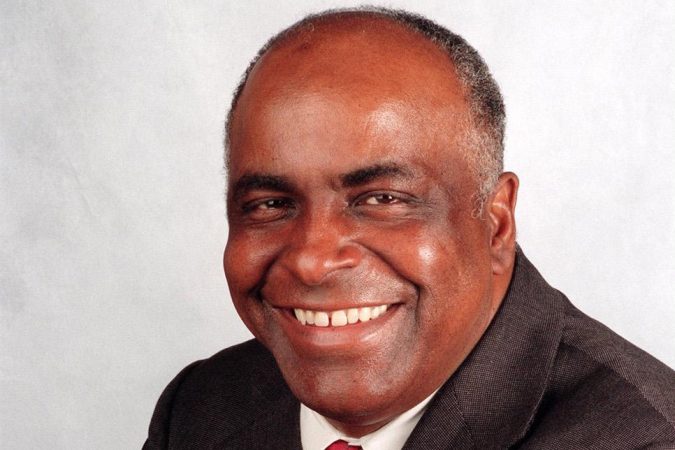
Richard H. Glanton, 79, formerly of Philadelphia, longtime lawyer, onetime executive deputy counsel to former Gov. Dick Thornburgh, business entrepreneur, former Lincoln University trustee, and innovative former president of the Barnes Foundation, died Sunday, June 21, of a heart attack at his home in Princeton.
Born and reared in rural Georgia and one of the first Black graduates of what is now the University of West Georgia, Mr. Glanton went on to become a prominent Philadelphia lawyer, state government policy and administration expert, corporate vice president, and indefatigable president of the Barnes Foundation’s collection of Impressionist, post-Impressionist, and modern art.
He was elected president of the Barnes Foundation in 1990, served until 1998, and championed a series of controversial initiatives to finance extensive gallery renovations and the operation of its art collection and related educational programs. To raise the money, he suggested, among other things, selling 15 of the collection’s hundreds of paintings, charging million-dollar fees for a worldwide lending tour of 83 paintings, extending visiting hours, increasing admission, building a new parking lot, selling a coffee-table catalog, and renting out its art studios.
All of his ideas, several of which did not materialize, drew supporters and critics, and Mr. Glanton, also a Barnes trustee, spoke often of his policy discussions with other Barnes officials, art experts around the world, politicians, and neighbors of the foundation building in Lower Merion Township. In 1990, he told The Inquirer: “I never purported to know anything about art. But I can lead.”
His most successful project turned out to be a two-year world lending tour of 83 foundation paintings that raised about $20 million and drew raves from museum leaders in Washington, Paris, Tokyo, Fort Worth, Toronto, and Philadelphia. The exhibition in Paris drew a then-record 1.5 million visitors, and Mr. Glanton was feted at every stop.
“Richard is somebody who started out by wanting to do something good and important and substantial, and persevered to do it despite a great deal of criticism,” Glenn D. Lowry, then director of the Art Gallery of Ontario, told The Inquirer in 1995.
Some critics said Mr. Glanton and others valued the foundation’s commercial success over its original educational role and what The Inquirer’s Edward J. Sozanski called “the Barnes mystique.” When the lending tour ended at the Philadelphia Museum of Art in 1995, Mr. Glanton told The Inquirer: “I never realized or understood that it could be controversial to make available to the public a collection that is a public trust.
“But I think if you think something’s right, you should do it, whether or not people disagree, and whether it is popular or not. … You have to think not only in terms of your lifetime, but in 100 years, 1,000 years. And when you do, these little slings and arrows don’t really matter that much.”
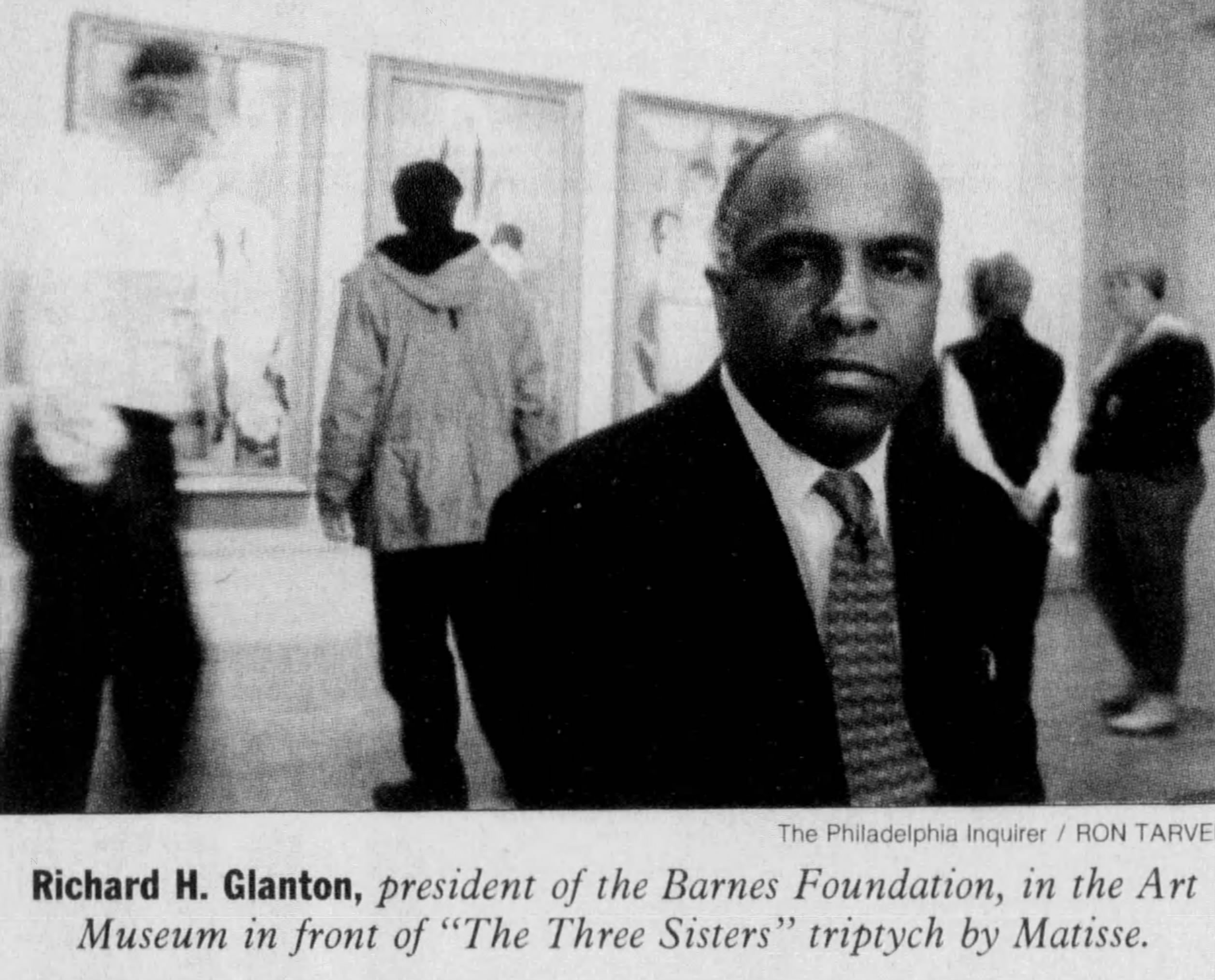
A story and this photo of Mr. Glanton appeared in The Inquirer in 1995.Newspapers.com
Mr. Glanton was executive deputy counsel to Gov. Thornburgh from 1979 to 1983, and he met often with constituents and helped fill judicial vacancies. “Richard is a political animal,” Ted Pillsbury, then director of the Kimbell Art Museum in Fort Worth, told The Inquirer in 1995. “He understands politics. He understands what makes politics work, and he understands people. And he does not take certain things personally.”
Mr. Glanton earned his law degree at the University of Virginia School of Law in 1972 and spent several years with the Equal Employment Opportunity Commission, United Airlines, and other companies. In Philadelphia, he represented politicians and other notable clients, and specialized in energy, insurance, and real estate cases for firms known now as WolfBlock and Reed Smith.
He was also senior vice president of corporate development at Exelon Corp., founder of a local TV station, social media company, and consulting firm, and board member at Aqua America, the Morris Arboretum, Children’s Hospital of Philadelphia, and other groups. He ended a workplace sexual harassment suit with a private settlement in the early 1990s and had public policy spats with local government officials and former Lincoln president Niara Sudarkasa.
He considered running for mayor in 1995. Former Gov. Ed Rendell said: “He was exceptionally bright, courageous, and never afraid to challenge the status quo in pursuit of what he believed was right.”
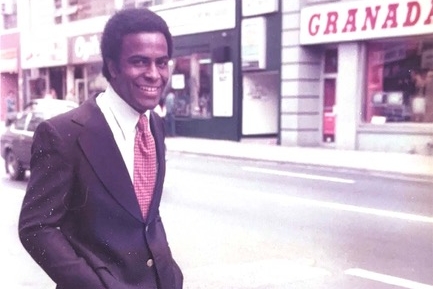
Mr. Glanton was at home in a suit jacket and tie.Courtesy of the family
One of 11 children, Richard Howard Glanton was born Nov. 21, 1946. He was reared in rural Villa Rica, Ga., did not start school until the fourth grade, and worked with his siblings for years on the family farm.
He earned a bachelor’s degree in English and, in 2005, was awarded an honorary doctorate from West Georgia. He married Scheryl Williams, and they had a daughter, Morgan, and a son, David.
After a divorce, he married Eileen Candia, and they had a daughter, Georgia. They lived in Philadelphia and Chicago, and moved to Princeton in 2009.
Mr. Glanton was a doting father, his family said. He taught his children to ride bikes and read Shakespeare. “He taught me that there was no room in which I didn’t belong or couldn’t strive to enter,” his daughter Morgan said. “I love him for that.”
Mr. Glanton was an avid reader and golfer.Courtesy of the family
Nearly everyone he met remembered his laugh and perpetual suit jacket and tie. He played golf, was an avid reader, and would talk politics for hours.
“He was fearless in his conviction to do what he believed was necessary and proper to achieve his goals and provide for his family,” his son said. His wife said: “He was kind and generous. He made everyone he spoke to feel special. He was always bringing you in.”
In addition to his wife, children, and former wife, Mr. Glanton is survived by two sisters, four brothers, and other relatives. One sister and four brothers died earlier.
Memorial services are to be held at noon Saturday, July 18, at Pleasant Hill United Methodist Church, 119 Thomas Dorsey Dr., Villa Rica, Ga. 30180, and at 11 a.m. Friday, Sept. 18, at the Union League, 140 S. Broad St., Philadelphia, Pa. 19102.