Category: Business

  • 4.6-million-square-foot King of Prussia data centers poised for nitty-gritty discussion

    4.6-million-square-foot King of Prussia data centers poised for nitty-gritty discussion

    A Main Line developer’s plan to build more than 4.6 million square feet of data centers in a small section of King of Prussia is set for an in-depth review beginning next week.

    The Upper Merion Planning Commission is scheduled to discuss three of Brian O’Neill’s five proposed data centers at its next meeting on Wednesday, July 22, according to Township Manager Anthony Hamaday and a meeting agenda posted online.

    After receiving an overview of the project at an initial planning commission meeting in May, the township has “done an official review, and we have forwarded our comments to the applicant,” Hamaday said. The plans “have been revised and sent back.”

    Next, Hamaday said, the planning commission will dive into the nitty-gritty, scrutinizing whether the project complies with township code.

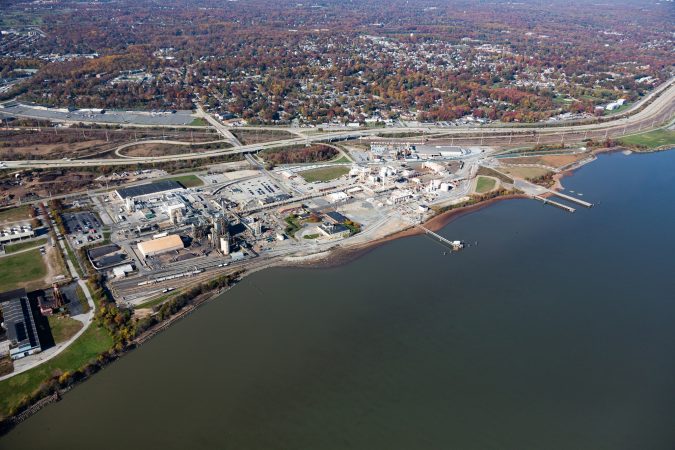
    Next Wednesday, they will review the proposed 2-million-square-foot data center at the Renaissance Boulevard office park; the proposed 370,000-square-foot data center at the current site of a daycare at 3200 Horizon Dr.; and the proposed 188,000-square-foot data center at an office and lab building on a remediated Superfund site at 2100 Renaissance Blvd.

    The other two proposed data centers are set to be reviewed at a meeting on Aug. 12, Hamaday said Tuesday.

    At the May meeting, O’Neill, whose MLP Ventures is behind the proposal, called it “an opportunity to change the world for the better” through AI-powered biotech that would complement his existing life-sciences complex, Discovery Labs. He said most of the centers would be leased to tenants, but has not specified which ones.

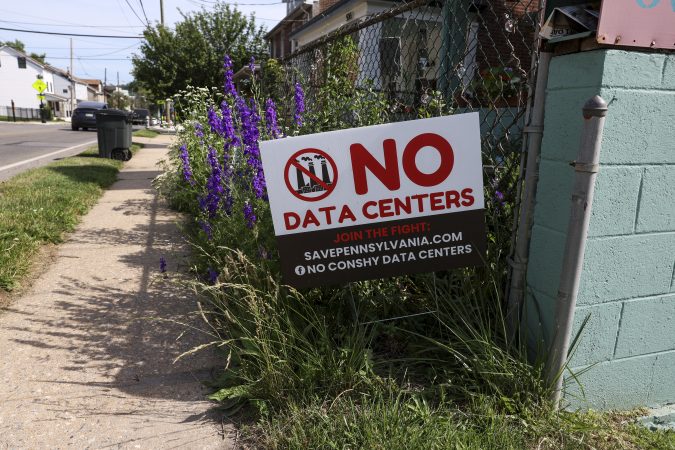
    Anti-data center lawn signs seen in King of Prussia in late May.Alejandro A. Alvarez / Staff Photographer

    Many area residents have rallied against the centers, with some displaying bright orange lawn signs that read: “Five data centers, 100 feet from here. Absolutely not!” Opponents have cited concerns about the potential for noise, light, and other pollution, as well as the general disruption to their daily lives.

    Hundreds of people packed the May meeting. Hamaday said the forthcoming meetings would be moved to the Upper Merion Area Middle School to accommodate expected crowds. They will also be broadcast live, potentially on the local TV channel, he said, and streamed on Zoom.

    Upper Merion Township isn’t the only place where O’Neill has set his sights.

    Across the Schuylkill, on the outskirts of Conshohocken, the developer wants to build another 2 million-square-foot AI data center at the site of the former Cleveland-Cliffs steel mill. He has said the center would be operated by a tenant related to the life sciences.

    The closed Cleveland-Cliffs steel Mill, pictured in June, where Brian O’Neill wants to build a 2-million-square-foot AI data center.Monica Herndon / Staff Photographer

    He recently resubmitted a plan to Plymouth Township, and a procedural zoning hearing board meeting was held last month.

    A similar proposal was abruptly withdrawn in the fall due to legal issues over the sale agreement.

    The next meeting about the Conshohocken-area project is scheduled for Aug. 6 at Colonial Middle School and via livestream on the township’s YouTube channel.

    Both the Conshohocken-area and King of Prussia plans would require multiple recommendations and approvals before construction could begin.

  • War risk for businesses will mean higher prices no matter what happens

    War risk for businesses will mean higher prices no matter what happens

    LONDON — For chief executives and business owners around the world, the Iran war is hammering home an essential reality that they are operating in a world that is riskier and more unpredictable.

    And that also means more expensive. Even if the attacks end, the increased cost of doing business will linger. Higher prices look to be a long-lasting side effect of the war in Iran.

    Every business leader is saying, “I need to get myself options,” said Kevin O’Marah, chief research officer at Zero100, a firm that does research on supply chains. The urgency is felt by executives across sectors from pharmaceuticals to clothing to electronics.

    That means having alternative manufacturers in other locales, stockpiling goods in case of unexpected stoppages and developing new supply chains.

    “Flexibility is additional plant capacity, it’s additional pockets of inventory, it’s alternate routes,” he said. “But that flexibility costs money. And that’s inherently inflationary.”

    Last week, the International Monetary Fund predicted a fresh bout of global inflation, forecasting a rise to 4.7% in 2026 from 4.1% in 2025 because of higher prices for basics like energy, metals, fertilizer, and food.

    A market in Daloa, Ivory Coast, on June 11. The International Monetary Fund expects global inflation to climb in 2026, driven by higher energy and food prices.Finbarr O'Reilly

    And those calculations were made when oil prices had mostly returned to their prewar levels, before there was a sharp escalation in hostilities between Iran and the United States and oil prices shot up.

    President Donald Trump’s vow this week to extract a 20% fee on all cargo moved through the Strait of Hormuz, if it comes to pass, could double the cost of shipping, analysts say.

    With disruptions in the strait, shipping companies such as Maersk have had to employ workarounds. As of June, Maersk had delivered 44,000 containers of goods such as furniture, electronics, and food to Persian Gulf countries by rail and truck.

    It’s a cumbersome and costly process. Cargo is unloaded from ships at the Red Sea port of Jeddah, Saudi Arabia. Then it is trucked to Kuwait, Qatar, and Bahrain by drivers who have journeyed from Jordan, Iraq, and Turkey to meet the increased demand.

    “That is obviously not the most effective way to do it normally, but if the strait is closed, it is the most effective way to do it,” said Vincent Clerc, CEO of Maersk, adding that the alternative route costs the company about $1,000 extra per container.

    If the disruptions continue, either the resulting higher costs will be passed on to consumers or retailers will see eroded profits, Clerc said.

    Higher costs caused by disruptions will cut into company profits or be passed on to customers, said Vincent Clerc, the Maersk chief executive.Charlotte de la Fuente

    The ripple effect has radiated far beyond the Gulf. The cost of sending a container from Shanghai has edged down from levels they hit in late June and early July.

    But rates are high by historical standards, according to Rhenus, a global logistic company. “Despite the recent decline, freight rates still remain 84% higher than a year ago,” the company said in an email.

    Southeast Asia has been particularly affected. Higher supply chain costs and delivery interruptions are interfering with manufacturing planning and schedules.

    “Longer lead times, higher freight costs and elevated energy costs may add pressure to consumer prices,” Rhenus reported.

    Longer routes aren’t the only reason delivery times increased by days or weeks during the crisis. When energy prices shot up, some shipping lines engaged in “slow steaming,” or reducing their speeds to save money on fuel, said Tobias Bartz, CEO of Rhenus.

    Insurance costs will also stay at the highest risk levels until there is at least six months of stability, Bartz said. But every time there is an incident, as in recent days, the clock resets.

    More important, higher costs won’t all disappear when the current crisis in the Gulf recedes.

    The heads of companies like Maersk, based in Copenhagen, Denmark, and French shipper CGM CMA have already said they can no longer depend on a single pathway but must develop alternatives.

    “This is the new operating environment,” Promixa, a global procurement and supply chain consultancy, concluded after surveying more than 500 CEOs of companies that generate income of more than $500 million a year.

    The mindset isn’t just about reacting quickly when a crisis occurs, but rather “creating and running functions that are permanently crisis-ready.” Almost three-quarters of those surveyed said they would accept a cost increase of more than 10% to guarantee the resilience of their supply chains.

    Building that strength into oil and liquefied natural gas delivery routes is much more difficult, time-consuming and expensive. Some efforts, including pipeline expansions by the United Arab Emirates and Saudi Arabia, were already underway before the Iran war.

    But the push has been turbocharged. Kuwait is so desperate to find alternatives to the Strait of Hormuz that it is looking at resurrecting a Saudi pipeline that runs through the Israeli-controlled portion of the Golan Heights and hasn’t been used in more than 35 years, said Jamie Ingram, senior editor at Middle East Economic Survey, a weekly newsletter and energy intelligence publication.

    Oman is expanding ports outside the strait; Iraq is studying pipeline proposals; Saudi Arabia and Turkey are exploring rail connections between Jordan and Syria. As one analyst described it, a “spaghetti junction” will be taking shape in the Gulf as pipelines, roads, rails, and ports sprout up to make sure that energy can get from producers to customers.

    For some new projects, Ingram said, “we’re now entering a new era where the benefits of these investments have gone from being pretty abstract theoretical issues to very concrete tangible quantifiable benefits.”

    Oil exporters like Saudi Arabia and importers like India are also investing in more storage capacity outside the Gulf region.

    All of which means higher costs.

    “We’re now in a world of not economizing for the most efficient option,” said David Goldwyn, a former U.S. diplomat and Energy Department official. “We’re in the world of investing in security and investing in resilience and redundancy.”

    This article originally appeared in The New York Times.

  • Campbell’s jumps on the protein-maxxing trend with 5 new soups

    Campbell’s jumps on the protein-maxxing trend with 5 new soups

    Campbell’s has hopped on the protein trend with a new soup lineup boasting 20 grams of protein per can.

    With enhanced macronutrient profiles on five soups, the Camden-based soup and snack brand has joined the ranks of food companies that recently launched protein-forward products. Chipotle debuted a high-protein menu in December, and Starbucks now offers protein coffee, matcha, and cold foam.

    “As consumers increasingly seek foods that offer both great taste and meaningful nutrition, this innovative product line will bring excitement and drive consumers to the soup category,” Benjamin Crook, senior vice president of soup and broth, said in a news release.

    In 2025, 70% of Americans reported trying to consume more protein, according to a survey by the nonprofit International Food Information Council.

    Campbell’s new soup line includes Italian-style wedding, homestyle chicken and rotini, lemon pepper chicken, Mediterranean lentil, and southwest black bean flavors.

    The updated soups contain more protein than the company’s original iterations. The existing homestyle Italian wedding soup has 7 grams of protein, and the basic chicken noodle has 3 grams.

    The protein soup line is Campbell’s second release of the summer designed to appeal to “better-for-you” consumer preferences. In June, Campbell’s partnered with Banza to introduce its first gluten-free chicken noodle soup. Banza makes chickpea pasta, which has 50% more protein and three times as much fiber as traditional pasta.

    In addition to soups, Campbell’s has a vast food and snack portfolio. Under its umbrella is Pepperidge Farm, the baking company that produces Goldfish and Milano cookies, and Snyder’s-Lance, which owns Cape Cod Potato Chips, Kettle Brand, and Late July. In 2024, Campbell’s acquired the parent company of sauce brand Rao’s.

    The company reported in June that net sales decreased 4% in the third quarter of the 2026 fiscal year. In the meals and beverages segment, sales decreased primarily due to declines in U.S. soup, Prego pasta sauces, and V-8 beverages, but those were partially offset by gains in Rao’s.

    Campbell’s had 13,700 employees in 2025, per the company’s annual report. In 2023, the company launched a $50 million upgrade of its Camden headquarters. The expansion was anticipated to be completed over three years, bringing 330 additional positions to Campbell’s Camden offices.

  • Data centers to add billions in power costs in 13 states, including Pennsylvania and New Jersey

    Data centers to add billions in power costs in 13 states, including Pennsylvania and New Jersey

    PJM, the nation’s largest electrical grid operator, on Tuesday released results of an electricity auction that would add $6.3 billion in costs to the bills of millions of households and businesses within the next three years, an increase driven by the power demands of data centers.

    During the annual auction, power companies supplied prices that they were willing to accept to supply electricity to PJM at times of peak demand. Those prices are then factored into the electricity rates that are eventually charged to the grid’s customers in 13 Eastern states and the District of Columbia.

    In a statement, PJM said data centers were increasing electricity demand throughout the region.

    “These auction results show that demand for electricity continues to grow faster than electricity supply,” David Mills, president and chief executive at PJM, said in an announcement of the auction results. “We are working with government and industry leaders on multiple fronts to restore that balance by bringing on new generation as fast as possible and managing the growth of new load on the grid.”

    Over the last few years, individuals and politicians have grown frustrated with PJM’s operations as electricity prices have steadily increased. At the same time, anger over data centers has spread nationwide. New York on Tuesday announced the nation’s first statewide moratorium on construction of the giant facilities, a one-year pause to assess their impact on the environment and energy use.

    The PJM grid supplies electricity to 67 million people from Virginia Beach, Virginia, to Chicago. The network of power systems includes the world’s largest cluster of data centers, in northern Virginia.

    “Demand growth is not going away,” said Patrick Cicero, a former state-appointed consumer advocate for Pennsylvania who is now counsel for the Pennsylvania Utility Law Project, which assists low-income consumers. “The bottom line is high prices are going to remain in place.”

    In its role as a regional grid manager, PJM effectively sets a significant portion of retail electricity rates, but governors and their appointed regulators have little sway over it. PJM is regulated by the Federal Energy Regulatory Commission, not state lawmakers.

    PJM’s annual auctions help determine the electricity costs for the two years after the auction. Since 2024, the auctions have added in total about $29 billion in costs to all utility customers in the PJM region because of data centers, according to Monitoring Analytics, PJM’s independent market monitor. The market monitor also produced the estimate of $6.3 billion in additional costs from the latest auction, which was held on June 30.

    The high costs have so angered Pennsylvania Gov. Josh Shapiro, a Democrat, that he sued PJM in December 2024. Shapiro and PJM reached a settlement that capped the price set by the auction, saving consumers billions of dollars.

    The PJM grid has often had only a thin buffer of excess power during extreme weather such as the recent heat dome that sent temperatures soaring across the East.

    Shapiro and other governors have complained that PJM has been too slow to connect more power plants, solar and wind farms, batteries and other resources that would have helped lower prices and eased strain on the grid.

    PJM’s grid serves all or part of New Jersey, Pennsylvania, Delaware, Maryland, Virginia, West Virginia, North Carolina, Tennessee, Kentucky, Ohio, Indiana, Illinois and Michigan, as well as the District of Columbia.

    This article originally appeared in The New York Times.

  • Selling your business? Consider these two strategies to defer or reduce your taxes | Expert Opinion

    Selling your business? Consider these two strategies to defer or reduce your taxes | Expert Opinion

    You’ve built up your business over years. Now it’s time to sell. You’ve found a buyer. You’ve negotiated a good price. You close the deal.

    And then comes the hard part: paying taxes on your gain.

    It could be a big number. But there are a number of ways to potentially defer — or even reduce — this cost.

    Here are two strategies that have grown in popularity.

    Structured installment sale

    Using this approach, you don’t take the money up front from the buyer. Instead, a third-party assignment company assumes the buyer’s obligation to make future payments to you.

    In many structured installment sales, that obligation is funded by an annuity.

    An annuity is an investment vehicle that makes a fixed payment to you over a number of years — even your entire lifetime — in exchange for a lump-sum payment up front, which would be made directly by the buyer of your company. These are usually sold by insurance companies or other large financial services firms.

    People like annuities because they protect their principal and offer longer-term financial security. Because many fixed annuities offer a guaranteed payment that covers your expenses, they can also potentially minimize the risk of you outliving your savings.

    A structured installment sale defers the capital gains tax on the sale of your company into the future because you only owe the tax in the year when you receive your annuity payment. Interest earned on the annuity is taxed at your ordinary rate as you receive the payment. If your total income declines in the future, this tax could decrease.

    “A lot of owners have put everything they had into building the business,” said Wade Martin, a financial adviser with RBC Wealth Management in Princeton. “They don’t have a pension, they haven’t focused on their own financial planning, and they don’t want to take stock market risk. For someone like that, a fixed monthly payment can let them sleep at night.”

    There are downsides to annuities.

    You lose control over your investment decisions and forego potentially higher gains if you had invested the money on your own. Each installment payment may include a return of basis (part of the money originally put in), capital gain taxed at capital gains rates, and an interest component taxed as ordinary income. Depending on your circumstances, that interest income — or the tax treatment of any remaining annuity value inherited by your beneficiaries — could result in a higher overall tax bill than taking the proceeds up front. You’ll incur fees and you’d likely be susceptible to surrender charges if you withdraw your money early.

    “You could theoretically invest the money elsewhere and earn a better return than the annuity’s guaranteed rate,” said Bejan Shirvani, head of structured settlements at MetLife. “However, a good annuity can offer guaranteed payments and professional management.”

    Dianne Stewart sold her New Jersey-based auto repair business, Kingston Garage, in 2024. At first she was dubious about a structured installment sale. But then she saw the benefits.

    “I asked myself: Do you really need all the cash up front? What are you going to do with it?” she said. “I soon realized that it would be stupid to sell the business outright and lose about 30% to taxes, so for me it’s like a tax-deferred pension.”

    But this arrangement may not be for everyone, Stewart acknowledges.

    “If you need the money to buy another business or make another investment, it may not fit,” she said. “But if you’re retiring, I think it’s geared toward people who want income instead of one big check, and who want to spread out their tax bill over a longer period of time.”

    Donor-advised funds (DAFs)

    Setting up donor-advised funds with a wealth adviser allows you to make charitable contributions each year, and then take a tax deduction (subject to some limitations) without actually giving the money away immediately. The fund grows tax-free and you can decide in the future where you want the savings to go. It’s a great way to take advantage of the charitable deduction without committing to a specific charity.

    DAFs can also be used to reduce your taxes when you sell your business. The trick here is to make sure your DAF owns a minority shareholder interest in your company before the sale. That way when you sell the company, cash goes to the DAF based on its ownership percentage without generally incurring capital gains taxes because it is a charitable organization.

    “A donor-advised fund gives you an immediate tax deduction, tax-free growth inside the account, and the flexibility to decide later which charities will ultimately receive the money,” said Jesse Wideman, a financial adviser with Zenith Wealth Partners in Philadelphia. “Many of my clients have unusually high-income years, often because they’re selling a business. A donor-advised fund lets them capture the charitable deduction in that high-tax year while distributing the money to charities over many years.”

    If a business owner is charitably inclined a DAF should be seriously considered, Wideman says, but it’s also important to make sure it’s part of your overall financial plan.

    Martin noted that any of these approaches requires thought and long-term planning.

    “It’s a holistic viewpoint,” Martin said. “you have to look at estate planning, income taxes, risk tolerance, and what helps someone sleep at night. It’s important to bring in your accountant, attorney, and financial adviser together before making a decision.”

  • $617 million in tax-free bonds for sale of South Jersey’s Advantage Behavioral Health blur private equity, nonprofit lines

    $617 million in tax-free bonds for sale of South Jersey’s Advantage Behavioral Health blur private equity, nonprofit lines

    A newly created nonprofit wants to borrow $617 million through tax-free bonds to buy Advantage Behavioral Health, a fast-growing South Jersey behavioral health company.

    The current owner, a Connecticut private equity firm called Clearview Capital, isn’t walking away from Advantage, which it bought 15 months ago.

    Clearview Capital and current executives will continue to own the for-profit entity that manages Marlton-based Advantage, according to a preliminary bond offering statement filed late last month.

    Advantage’s proposed sale to a nonprofit called QCF Advantage LLC is noteworthy for mixing for-profit and nonprofit business interests. It would make a private-equity company a key partner in a nonprofit organization with financing from the tax-exempt municipal bond market.

    Advantage’s sale price is about $520 million. That price includes $80 million being held back to see if Advantage hits profit targets after the sale. The company had $141.6 million in revenue in the 12 months that ended May 31. Most of the remaining money from the bond sale will go into reserve funds.

    Like many other mental health service providers, Advantage does not accept Medicare or Medicaid. Taking only private insurance and out-of-pocket payments helps Advantage register strong profit margins amid growing demand for mental health and addiction services.

    The transition to nonprofit ownership creates “a structure that’s designed for long term stability, reinvestment, and patient care,” James D. Golden, CEO of QCF’s parent company, told prospective investors in a recorded presentation.

    “We can provide an efficient exit to private capital,” he said in the recording, published June 30 on a website that tracks documents related to the municipal bond market. “Tax-exempt financing is really the mechanism that makes all that possible.”

    That financing will leave Advantage with an extraordinarily large debt load, said Robert Q. Kreider, a former nonprofit CEO who has no ties to Advantage. He noted that debt of that size requires continued strong growth to make the debt payments and have enough money to continue growing.

    “The bondholders are getting such a juicy rate, they’re willing to accept the risk,” said Kreider, a consultant and former CEO of Devereux Advanced Behavioral Health.

    Officials at Clearview Capital, Advantage, and QCF Advantage did not respond to requests for interviews.

    Advantage’s founding and growth

    Advantage has expanded to Pennsylvania and six additional states beyond New Jersey since its founding in 2017.

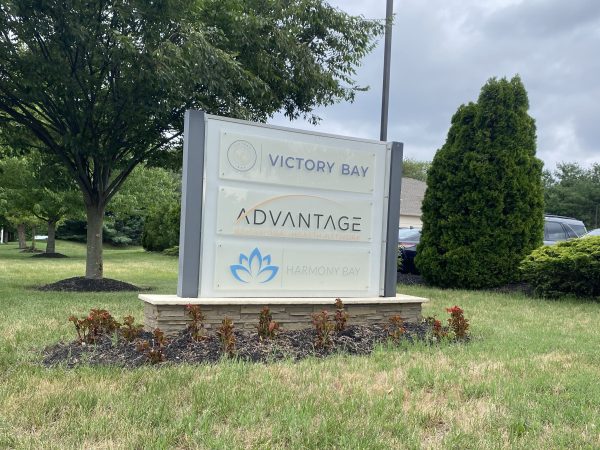
    It initially provided intensive outpatient therapy through a business called Victory Bay in Laurel Springs.

    It launched a telehealth version of its services, called Harmony Bay, in 2020. Outside of New Jersey, Advantage uses Harmony Bay as a way to build a presence in a new state, before introducing in-person services through Victory Bay.

    (function(){function e(){window.addEventListener(`message`,function(e){if(e.data[`datawrapper-height`]!==void 0){var t=document.querySelectorAll(`iframe`);for(var n in e.data[`datawrapper-height`])for(var r=0,i;i=t[r];r++)if(i.contentWindow===e.source){var a=e.data[`datawrapper-height`][n]+`px`;i.style.height=a}}})}e()})();

    Advantage also operates 17 sober-living houses under its Dignity Hall brand in Blackwood, Laurel Springs, Sicklerville, and several other South Jersey towns.

    The average daily census of patients at Victory Bay has soared over the last five years to 805 in the three months that ended June 30, from 81 in the first quarter of 2021, according to data in the bond disclosures. The company employs more than 700.

    Despite the expansion to Massachusetts, Florida, Indiana, Maryland, Ohio, and California, the services provided in a string of buildings along Chews Landing Road in Laurel Springs accounted for 55% of revenue, most of the company’s cash flow last year.

    The parking lots at several of those buildings were packed last Thursday. As part of the bond financing, 20 New Jersey properties valued at $14.4 million are being mortgaged.

    New projects are under development in Absecon and Pine Brook, N.J.; Scranton, Pa.; and Lancaster, Ohio, the bond prospectus said.

    A nonprofit buyer as a vehicle for private equity sales

    QCF Advantage was created in April to acquire Advantage.

    Owner QCF/I Inc., a tax-exempt organization based in Houston, acquires healthcare facilities that can be paid for with tax-exempt financing, according to its 990 tax form. Founded in 1997, QCF stands for Quality Care Foundation.

    “We’re a nonprofit focused on improving the quality of care in the behavioral health industry. We believe mental health is one of the most persistent, complex, and costly challenges in our country today,” Golden told prospective bond investors.

    QCF/I’s niche is buying for-profit businesses, often from private equity firms, while giving the sellers the option to keep managing the business, he said.

    In the Advantage arrangement, QCF/I will collect 2.25% of revenue for administrative services — to be paid before bondholders.

    Clearview Capital, the current private equity owner, will stay involved through an existing management entity that will collect 5% of monthly revenue under an initial 15-year contract.

    Golden and Richard T. Needham together form QCF’s board. They have a background in private equity at a Houston private equity firm called Domain Capital Partners that is not related to Clearview. The phone number on the 990 led to a voicemail box that was full. A voicemail at Domain Capital got no reply.

    QCF’s other businesses include a psychiatric hospital in Las Vegas and an addiction treatment center in North Jersey.

    Surging debt load

    Advantage had about $6 million in long-term debt at the end of 2024, three months before its sale to Clearview for an undisclosed price.

    A year later, the debt totaled $52.5 million, not including a $10 million line of credit.

    If the bond sale happens as expected, the company’s long-term debt would skyrocket to $604 million at the end of this year, according to the bond document.

    That large debt means the success of QCF Advantage depends on continued dramatic growth in revenue and profits, according to a deal summary from Stacy DiStefano, CEO of Consulting for Human Services, a Philadelphia-based advisory firm.

    Advantage’s projected annual interest expense is $42.7 million. For context, that’s about the same as the combined $42.2 million in interest paid last year by three large unrelated health systems in the same South Jersey market, Cooper University Health Care, Inspira Health Network, and Virtua Health.

    Colin Studwell, Advantage’s CEO, said during the investor presentation available on Munios.com that the company is well-positioned for strong growth. He credited the management entity, known as a management services organization, or MSO, that Clearview and executives, including Studwell, already own.

    Studwell will continue to run the MSO, which handles operations support, billing, collections, human resources, information technology, and everything else it takes to run the business.

    “Our MSO capabilities are the engine which allow us to continue to scale our services and treat more patients without any decay in clinical or operational efficiency,” Studwell said.


  • Army laser weapon maker plans 100 hires at a new $30 million Bucks County factory

    Army laser weapon maker plans 100 hires at a new $30 million Bucks County factory

    Attalon, a company that makes laser weapons for the U.S. Army, plans a new $30 million headquarters in Trevose, Bucks County, and will hire for more than 100 engineering, technical, and management jobs in the next few years, company officials said Tuesday. The headquarters will include a factory.

    The company moved its headquarters to Philadelphia from California in January when it was bought by Boston- and U.K.-based private-equity giant Advent from Coherent Corp., which is based in Western Pennsylvania.

    The new plant will be “a major expansion of our U.S. manufacturing footprint” and will focus on protective metal coatings and crystal production, chief executive John Bergeron said in a short, recorded presentation that aired at the Pennsylvania Defense and Innovation Summit on Tuesday in Carlisle, Pa.

    Bergeron was named CEO by the new owner in January. He was previously an operating executive at GE, Raytheon, and other military contractors. Attalon also has facilities in California, Michigan, Colorado, Connecticut, Florida, Ohio, and central New Jersey.

    The company’s laser warfare products and optical assemblies have been deployed along the Mexico border, where the Army shot down a wayward Border Patrol drone last winter. The company has also sought Navy contracts.

    In moving to the Philadelphia area, Attalon will locate in a longtime center of the military aerospace industry. The region is home to Lockheed Martin missile and L3Harris military communications factories, as well as helicopter makers Boeing and Leonardo, electronic sensor giant TE Connectivity, and aerospace systems makers Innovative Aerosystems, Triumph Group, and Analytical Graphics Inc., among others.

    President Donald Trump is expected to address the chief executives of Boeing, Lockheed Martin, and dozens of other military contractors on the summit’s second day on Wednesday, and more investment announcements are expected.

    The event was introduced by military officers and Sen. Dave McCormick (R., Pa.), an Army veteran and former private equity CEO, who last year hosted Trump at a similar event announcing $90 billion in data center and electric power projects for Pennsylvania.

    Along with companies in Pittsburgh and in central Pennsylvania, a pair of Philadelphia-area defense start-ups also announced expansion plans at the event Tuesday.

    Deepwave, which makes artificial intelligence-backed radio-frequency systems for government and telecommunications companies, will hire 20 business development staff to boost sales after negotiating with the Air National Guard to improve systems for aging F-16 jet fighter aircraft, chief executive John Ferguson said in a video presentation.

    “Our manufacturing is all in Pennsylvania,” Ferguson said, noting that state-backed Ben Franklin Technology Partners centers were among Deepwave’s early investors, along with Philadelphia-based NextFab Ventures and Philadelphia-based Robin Hood Ventures.

    Deepwave is based on Walnut Street in Center City.

    Also, Karman Space & Defense, a publicly traded, California-based missile and hypersonic systems maker with a facility in Horsham, said it would invest $2.7 million in expanding that plant and add 20 new “high-tech” jobs.

    This story has been updated to correct the identify of an investor in Deepwave. It is Robin Hood Ventures of Philadelphia.

  • Michelle Widgins-Lewis, singer-songwriter and founder and CEO of Northwest Counseling Service, has died at 69

    Michelle Widgins-Lewis, singer-songwriter and founder and CEO of Northwest Counseling Service, has died at 69

    Michelle Widgins-Lewis, 69, of Philadelphia, singer-songwriter, founder, president, and executive director of Northwest Counseling Service Inc., longtime community housing and education advocate, lecturer, and mentor, died Monday, June 29, of endometrial cancer at Jefferson Abington Hospital.

    Inspired to educate and counsel underserved potential homebuyers about predatory mortgage lending, foreclosure, and other important real estate and housing issues, Ms. Widgins-Lewis founded Northwest Counseling Service on North Broad Street in 1982. For the next 44 years, until recently, she interviewed nearly 5,000 people each year seeking mortgage prequalification and, funded by the Philadelphia Division of Housing and Community Development, advised them about insurance, eviction, credit rating, grants, conflict mediation, and inspections.

    “She helped transform homeownership in Philadelphia,” her family said in a tribute.

    Ms. Widgins-Lewis was appointed to the Pennsylvania Housing Advisory Committee in the 1990s by then-Gov. Ed Rendell and served as a technical adviser on real estate matters for the Philadelphia Division of Housing and Community Development. She worked closely with the Pennsylvania Housing Finance Agency and continually lobbied local, state, and federal government officials for better borrowing and foreclosure laws.

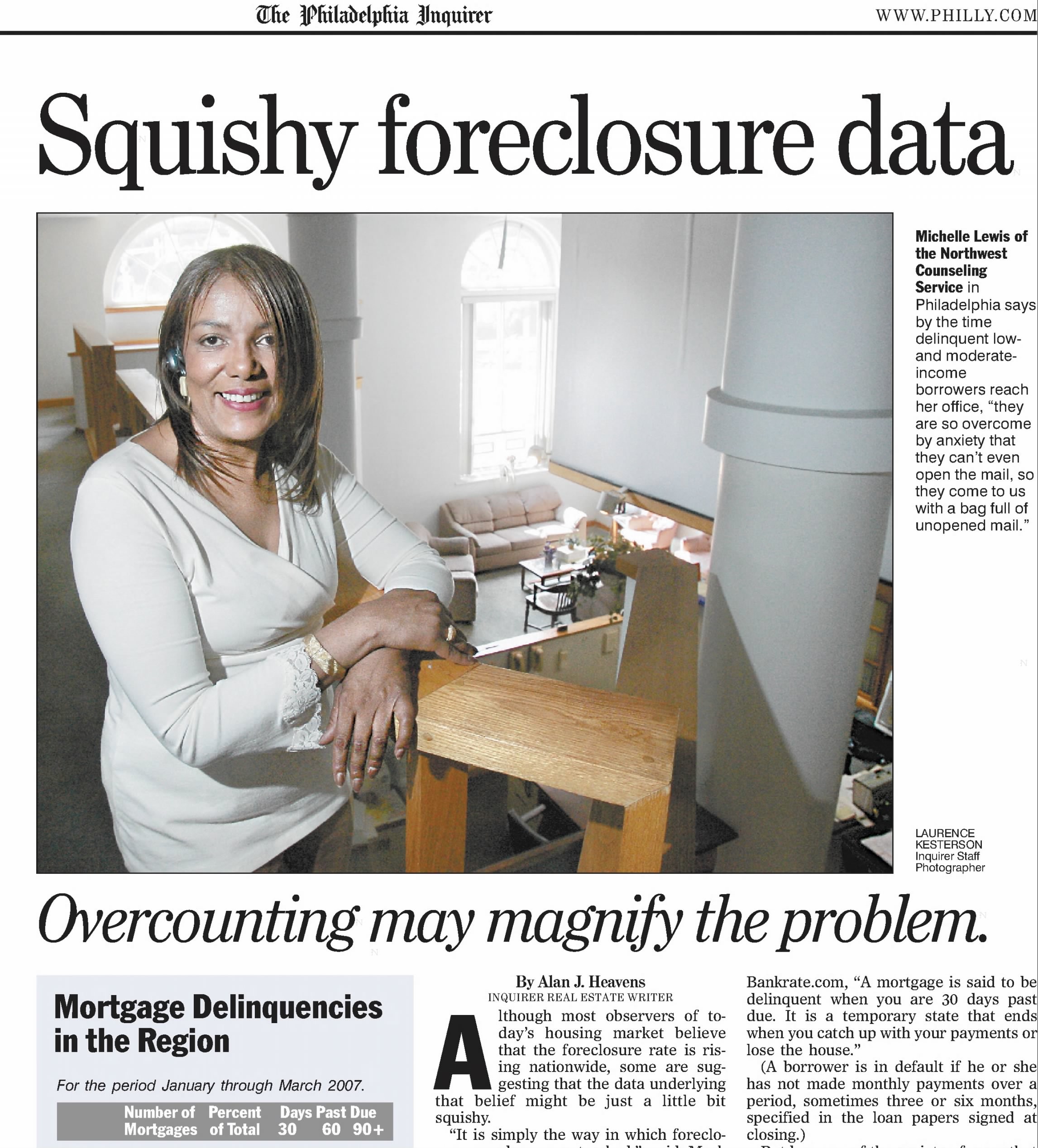
    This photo and article about Ms. Widgins-Lewis appeared in The Inquirer in 2007.Newpapers.com

    She examined property disputes as a forensic real estate specialist, scrutinized scams as a fraud examiner, testified in federal court as a qualified expert, and was licensed as a real estate broker and appraiser. She monitored local landlord-tenant mediation cases closely and told The Inquirer in 1996 that many tenants “end up with an agreement they can’t live up to.”

    People, she said often, are rarely ready to buy their first house. “Instead of considering whether they are prepared to buy a home, people are being propelled into the market by economic pressure that says they should buy because it’s cheaper than renting,” she told The Inquirer in 1995. “That’s not always true.”

    She also founded and chaired the Philadelphia Predatory Lending Task Force, which collected and publicized data about unfair lending practices. “This gives us a picture of the type of problems going on in our neighborhoods,” she told the Daily News in 2001.

    Ms. Widgins-Lewis was an instructor for the National Real Estate Institute and a leader for the American Society of Certified Housing Executives, the Real Estate Educators Association, and other groups. She wrote articles for journals and forged educational partnerships with colleges and universities.

    Ms. Widgins-Lewis performed in several bands and with her sister Dionne.Courtesy of the family

    She spoke on panels and at conferences and workshops about homeownership, and was quoted often in The Inquirer and Daily News. Friends called her “truly inspiring” and “a true champion in the mortgage industry” in online tributes. One friend said: “She was a beast in the housing world.”

    Ms. Widgins-Lewis sang often as a young girl, got rave reviews on karaoke night when she was older, and went on to perform in several bands and with her sister Dionne at local clubs and festivals. She sang rhythm and blues, pop, standards, and jazz, and wrote at least one song that was recorded and released.

    Daily News columnist Stu Bykofsky wrote about her dual career as a singer-songwriter and executive in 1995 and said: “She still has trouble calling herself an artist but feels, at the very least, she’ll always be able to get up and sing at fundraisers for her agency.”

    Her family said: “From childhood, Michelle drew people in with her light and her voice.” Her daughter Tracey Thomas said: “She would light up the room.” Her son Mike said: “Everybody loved her.”

    Her family said Ms. Widgins-Lewis had “an unwavering commitment to education, integrity, and service.”Courtesy of the family

    Michelle Widgins was born May 29, 1957, in Philadelphia. She graduated from Martin Luther King High School and earned a bachelor’s degree at La Salle University and a master’s degree in human services at Lincoln University.

    She married Michael Brown, and they had a daughter, Anji, and a son, Mike. After a divorce, she married Tyrone Lewis, and they had a daughter, Tracey, and a son, Richard. They divorced later.

    Ms. Widgins-Lewis enjoyed reading and writing. She belonged to the Pi Gamma Mu international honor society, was close with Mayor Cherelle L. Parker and former Mayor Wilson Goode, and was guided, her family said, by “an unwavering commitment to education, integrity, and service.”

    Her family is hoping to rename a Northwest Philadelphia street in her honor.

    Ms. Widgins-Lewis lived with cancer for 10 years.Courtesy of the family

    “She was humble but had drive and determination,” her son Mike said. Her daughter Tracey said: “The world was her stage. I can only imagine how her light will shine in heaven.”

    In addition to her children and former husbands, Ms. Widgins-Lewis is survived by eight grandchildren, a sister, two brothers, and other relatives. A sister and a brother died earlier.

    Services are to be at 11 a.m. Thursday, July 16, at Verity Church, 2017 W. Diamond St., Philadelphia, Pa. 19121.

    Donations in her name may be made to Northwest Counseling Service Inc., 6521 N. Broad St., Philadelphia, Pa. 19126.

    Ms. Widgins-Lewis “was humble but had drive and determination,” her son Mike said. Courtesy of the Family
  • States reach $18 million settlement with 23andMe, with Pa. and N.J. getting more than $400,000 each

    States reach $18 million settlement with 23andMe, with Pa. and N.J. getting more than $400,000 each

    Genetic testing company 23andMe and a group of attorneys general nationwide have reached a multimillion-dollar settlement following the major data breach that led to the company’s demise three years ago.

    More than 40 attorneys general, including Pennsylvania‘s Dave Sunday, announced the national $18 million settlement with the genetic testing company Tuesday.

    “This company was trusted by millions of Americans to safeguard very private data and information, but failed to do so, learning about a data breach far too late, then pointing fingers at their own customers,” Sunday said in a statement. “I find it appalling that a company dealing with customers’ personal information would be so lax about their system protections, then have the audacity to deny and attempt to wash their hands of wrongdoing.”

    As part of the settlement, Pennsylvania will receive $491,902. Nearly 200,000 Pennsylvanians were impacted by the data breach, according to the state attorney general’s office. About 150,000 customers were impacted in New Jersey, which will receive nearly $410,000, said the state’s attorney general, Jennifer Davenport.

    Here’s what else we know.

    What happened with the 23andMe data breach?

    In October 2023, 23andMe launched an investigation after a “threat actor” claimed to have obtained millions of users’ personal data.

    By December, the company confirmed through a filing with the Securities and Exchange Commission that a hacker directly accessed 0.1% of its users’ accounts, or about 14,000 profiles. Still, because of the networks users can build, connecting their information to possible relatives, the hacker was able to view the information of millions of users.

    A spokesperson for the company told news outlets at the time that 6.9 million people had been affected: about 5.5 million customers who had opted into 23andMe’s “DNA Relatives” feature and 1.4 million users whose family tree information was accessed.

    Of those customers, 192,093 were in Pennsylvania.

    What information was accessed?

    Information accessed included:

    • Display name, profile picture, and birth year.
    • How recently they had logged into their account.
    • Their relationship status.
    • Their self-reported location by city and zip code.
    • Predicted relationships with others.
    • DNA percentages users share with their “DNA Relatives.”

    An additional 1.4 million customers who used the “DNA Relatives” feature had their “Family Tree” profiles accessed, which includes a limited subset of profile data, the company said.

    The hacker activity was contained and required existing users to reset their passwords and enable multifactor authentication, 23andMe said at the time. Still, experts warned consumers that they should consider deleting their accounts.

    When did 23andMe declare bankruptcy?

    The company declared bankruptcy in March 2025 and eventually was sold.

    That’s when states, including Pennsylvania, filed claims related to the data breach investigation. As part of the bankruptcy proceedings, 23andMe’s consumer data was sold to TTAM Research Institute, a nonprofit organization formed by 23andMe founder and former CEO Anne Wojcicki. That sale is bound by new guardrails regarding data security that were put in place with the help of the coalition of attorneys general.

    Sunday joined the lawsuit to prevent 23andMe from selling consumer data as part of its bankruptcy proceedings.

    The lawsuit said the California-based genomics biotech company was proposing to sell an “unprecedented compilation of highly sensitive and immutable personal data: a human being’s permanent and everlasting genetic identity.”

    The risk of a data transfer was too great, the complaint said, as DNA data are unique to an individual and can be used to identify relatives — past and future. And genomic data live forever, even after a person dies.

    “If stolen or misused, it cannot be changed or replaced,” the complaint said.

    What happened this week?

    A group of 42 state attorneys general announced the $18 million settlement. This is in addition to a $46.75 million class-action settlement arising from the bankruptcy, for affected U.S. consumers who submitted claims by Feb. 17. Impacted customers should have received an email notifying them about their eligibility for the class-action settlement, according to the Pennsylvania Attorney General’s Office.

    All 50 states and territories except for California, Hawaii, Mississippi, Missouri, Montana, Nebraska, Nevada, Rhode Island, and Wyoming were involved in the settlement.

  • Philly port operator sues to block permit for proposed Delaware container terminal

    Philly port operator sues to block permit for proposed Delaware container terminal

    After years of fits and starts, Delaware says it is ready to build a new container port on the Delaware River to attract more cargo — and create jobs.

    Not so fast, says an operator of ports upriver in Philadelphia and New Jersey.

    Affiliates of Gloucester City-based Holt Logistics Corp. filed a lawsuit last week seeking to block project approvals granted by the U.S. Army Corps of Engineers for construction of Delaware’s proposed terminal in Edgemoor.

    If that sounds familiar, it’s because Holt and the Pennsylvania agency that owns Philadelphia’s seaports in 2024 successfully persuaded a federal judge to throw out an Army Corps permit authorizing the same project.

    But since then, Delaware’s taxpayer-owned Diamond State Port Corp. requested new approvals, and the Army Corps granted them in April. The following month, Diamond State and its private-sector partner, Massachusetts-based Enstructure, announced they were moving ahead with the $669 million project at the site of a former DuPont chemical plant.

    They say the new terminal — three miles northeast of the Port of Wilmington — will bring thousands of construction, warehouse, and longshore jobs to the area. Delaware officials estimate the Edgemoor terminal will be able to handle up to 1.2 million container units annually.

    That’s one-third more than Philadelphia’s port handled in 2025, a record year. But Philly’s port — a major gateway for refrigerated cargo, especially fresh fruit from Central and South America — is also expanding.

    The Philadelphia Regional Port Authority (PhilaPort), a state agency, last fall bought a 152-acre yard from Norfolk Southern Corp. for $90 million to create more cargo space.

    A PhilaPort spokesperson declined to comment on the lawsuit. Diamond State didn’t immediately respond to a request for comment.

    “While out-of-state competitors continue their efforts to stop this project, it is time to move forward and make sure Delaware’s port can compete fairly on the Delaware River,” Charuni Patibanda-Sanchez, who as Delaware’s secretary of state serves as Diamond State’s chair, said in May.

    Holt — a family-owned company that operates marine terminals in South Philadelphia, Gloucester City, and Paulsboro — now says the Army Corps repeated several mistakes that doomed its earlier approvals.

    “Most significantly, the court found that the Army Corps had failed to sufficiently consider the project’s likely impacts on navigation and safety in the Delaware River,” says the suit filed by Holt affiliates Greenwich Terminals LLC and Gloucester Terminals LLC.

    “Yet despite the court’s detailed opinion and suggested remedial direction,” it continues, “the Army Corps reissued the project approvals again without conducting a proper evaluation of the applications before it.”

    A spokesperson for the Army Corps declined to comment.