Category: Business

  • N.J.-based Holtec plans IPO to boost sales of its mass-produced small nuclear plants

    N.J.-based Holtec plans IPO to boost sales of its mass-produced small nuclear plants

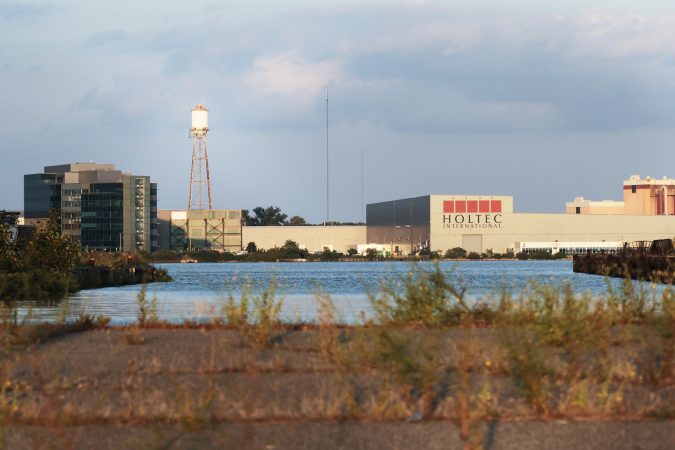
    Holtec Nuclear Corp. plans an initial public stock offering that would transform the 40-year-old Camden company from the industry’s well-paid undertaker that shuts down aging uranium plants into a rapid-growth supplier of next-generation mini-nuclear plants and liquid batteries, the company said in a Securities & Exchange Commission filing earlier this month.

    Holtec hasn’t settled on a date or floated how much money it wants to raise — or what part of IPO proceeds would go into bringing its factory goods to market versus how much would go to company founder Krishna P. Singh.

    Singh and his family would remain the controlling shareholder, even as the IPO potentially boosts Singh’s compensation above last year’s $7.5 million with newly public shares and proceeds.

    The 400-page IPO registration describes a highly profitable nuclear service enterprise preparing to market new power products. Holtec has spent years preparing these products, just as federal government support and industry demand brings nuclear power back into fashion.

    The products include:

    • Uranium-fueled, water-cooled Small Modular Reactors, designed and mass-produced at the company’s factory on the Delaware River waterfront. The reactors could be sold or leased in groups by Holtec, and each unit swapped out so they can be refueled without shutting off all power.
    • The “green boiler,” a liquid solar-energy storage battery Holtec is testing at facilities that Singh owns in India.

    In the statement, Holtec addresses “succession” issues under chief executive Singh, who turns 80 next year. In 2012-13, Singh was a part owner of The Inquirer. Holtec says it has a full management team and succession plans in place. It also requires senior officials to travel separately so an accident won’t put them all out of commission.

    The company president, who was promoted to the post in April after his predecessor departed, is Holtec veteran Rick Springman, 47. He earned a mechanical engineering doctorate at the University of Pennsylvania, as did Singh, donor and namesake of Penn’s nanotechnology labs. Springman joined Holtec in 2009.

    The nuclear industry is attracting renewed interest and investment after decades punctuated by accidents at Three Mile Island (1979), Chernobyl (1986), and Fukushima (2011) when few, if any, new nuclear plants were built.

    Nearly 100 existing plants provide nearly 20% of U.S. electricity, and the U.S. plants compose about a quarter of the global nuclear power industry, according to Holtec data.

    Among fans of expanding nuclear power are President Donald Trump and private-equity investors building electricity-thirsty AI data centers.
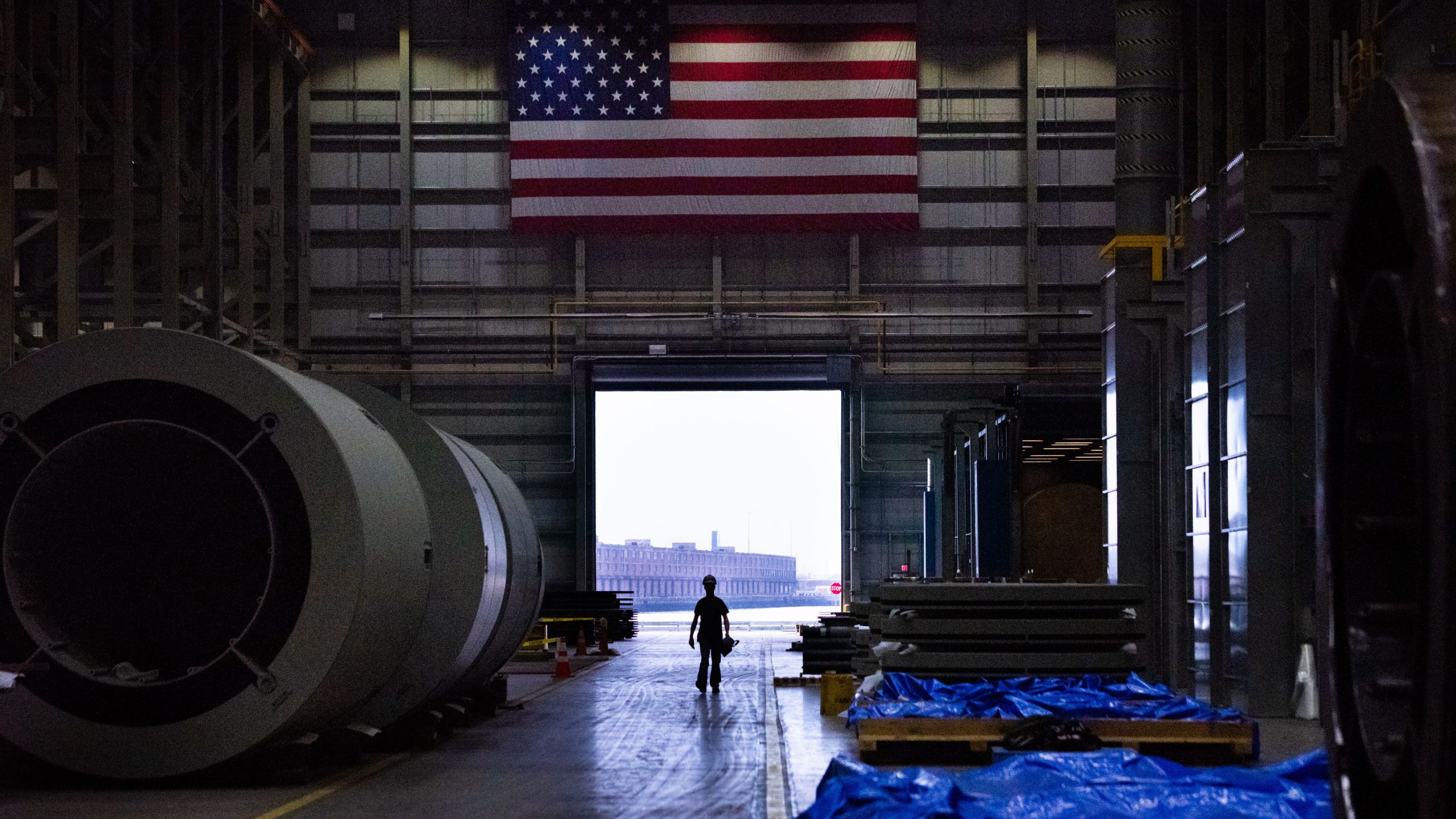
    Steel canisters (at left) used to store nuclear waste for decades dwarf a worker at the Holtec manufacturing plant in Camden.

    On sales of $567 million last year, Holtec reported $395 million in net income — which looks at first glance like a very fat 70% profit margin.

    But the statement notes that half the profits were due to gains on the company’s financial investments. Profits from Holtec products and services were still a comfortable $200 million for a margin of 35%. But that’s down sharply from sales of $766 million and profits of $333 million, the year before.

    Most of Holtec’s sales and earnings flowed from an international business in which it is a leading provider: “decommissioning” and shutting down aging uranium-power reactors and building equipment to manage, store and transport spent uranium. Holtec makes that equipment at plants in Turtle Creek, near Pittsburgh; Orrville, Ohio; and Camden.

    Holtec says its 2025 financial performance suffers by comparison to its unusually profitable 2024 results. The earlier year was boosted by extra revenues from shutting down the Indian Point nuclear reactor in New York and other payment-scheduling vagaries.

    But the company expects U.S. decommissioning work will decline in the near-term, as fewer nuclear stations go out of service — a reversal from the 2010s, when power companies like Exelon shut plants like Three Mile Island because natural gas had become a cheaper fuel.

    Since then, fast-growing power demand for investor-backed data centers has boosted interest in nuclear power. Aided by the U.S. Department of Energy taxpayer-subsidized loans, Exelon spinoff Constellation Corp. is reopening a Three Mile Island nuclear reactor, and Holtec plans to help bring others back online.

    Holtec has been rated below NuScale Power, GE Hitachi, and other developers in the competition among U.S. nuclear companies to win Department of Energy (DOE) approval for its modular nuclear plants. But in 2024, the DOE agreed to guarantee a Federal Financing Bank loan of up to $15 billion so Holtec could install its first commercial small reactors — model SMR-300 — at the former Palisades nuclear plant in Michigan, where Holtec was also the decommissioning contractor.

    Holtec is also hoping the DOE will give it up to $400 million to speed the Palisades work.

    Reopening Palisades is “in the final stages with all major upgrades” completed and smaller jobs done this year for reopening in early 2027, according to the registration statement. Holtec said it can install more small reactors through a partnership with Korea-based Hyundai’s engineering division. Holtec expects the small reactors will prove most attractive in countries that don’t already have nuclear power.

    Small reactors could take longer to win regulatory approval, build, and install than expected, Holtec says. And success isn’t guaranteed for the recently developed Holtec Green Boiler and new solar-based Holtec systems, which “could drive significant long-term growth opportunities.”

    Among the litigation Holtec lists in its registration disclosures is a dispute with the company’s former outside accountants over what Holtec alleges was “inaccurate accounting and tax guidance” and a lawsuit by a former chief financial officer who alleged he was fired in a dispute over investor communications. The company denied wrongdoing.

    Despite the recent surge of support for nuclear power, Holtec said, “negative public and political perceptions of nuclear energy” and news of nuclear accidents could still damage the company.

    The statement adds, “Our business is dependent, in part, upon public and political support for nuclear power in the United States and other countries” and on projects that can last beyond a single U.S. presidency.
  • How thousands of heavy-duty recycling carts made in Hunting Park ended up on construction sites around the U.S.

    How thousands of heavy-duty recycling carts made in Hunting Park ended up on construction sites around the U.S.

    The TommyCart, a durable, bar-coded, welded-steel recycling wagon made in Philadelphia, is popping up at U.S. construction sites from the Wanamaker Building’s apartment conversion in Center City to the Tennessee Titans’ new stadium in Nashville.

    The carts, specialized for recycling, were developed by Richard S. Burns & Co. at its 13-acre Hunting Park complex where demolition debris is sorted for resale to steel mills, building-materials makers, plastics plants, and other reusers.

    “We were struggling with increasing the quality of recycling material going out the door, and from the increased quantity of material coming in the door,” said Allen T. Burns, who runs the company, now known as Burns Services.

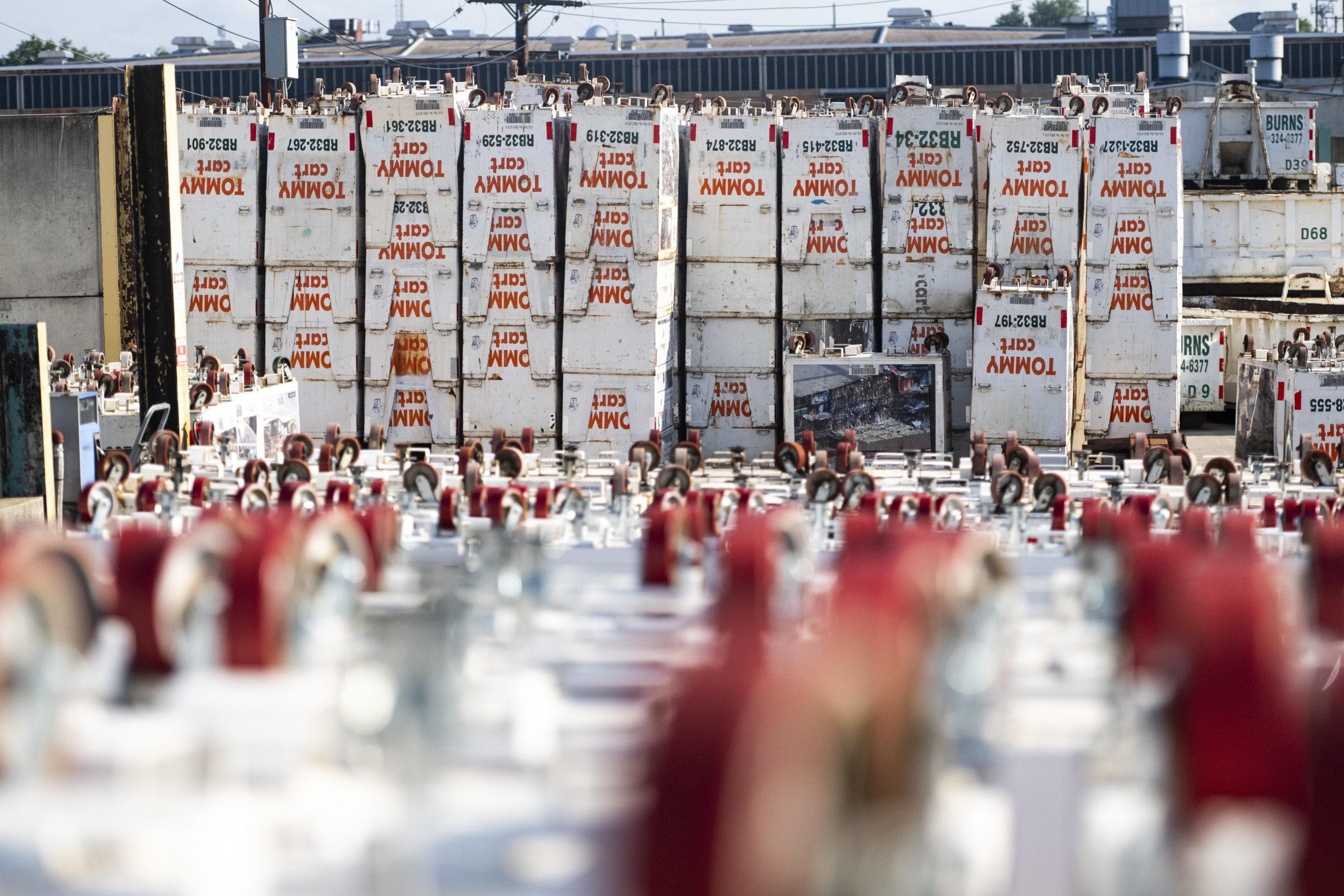
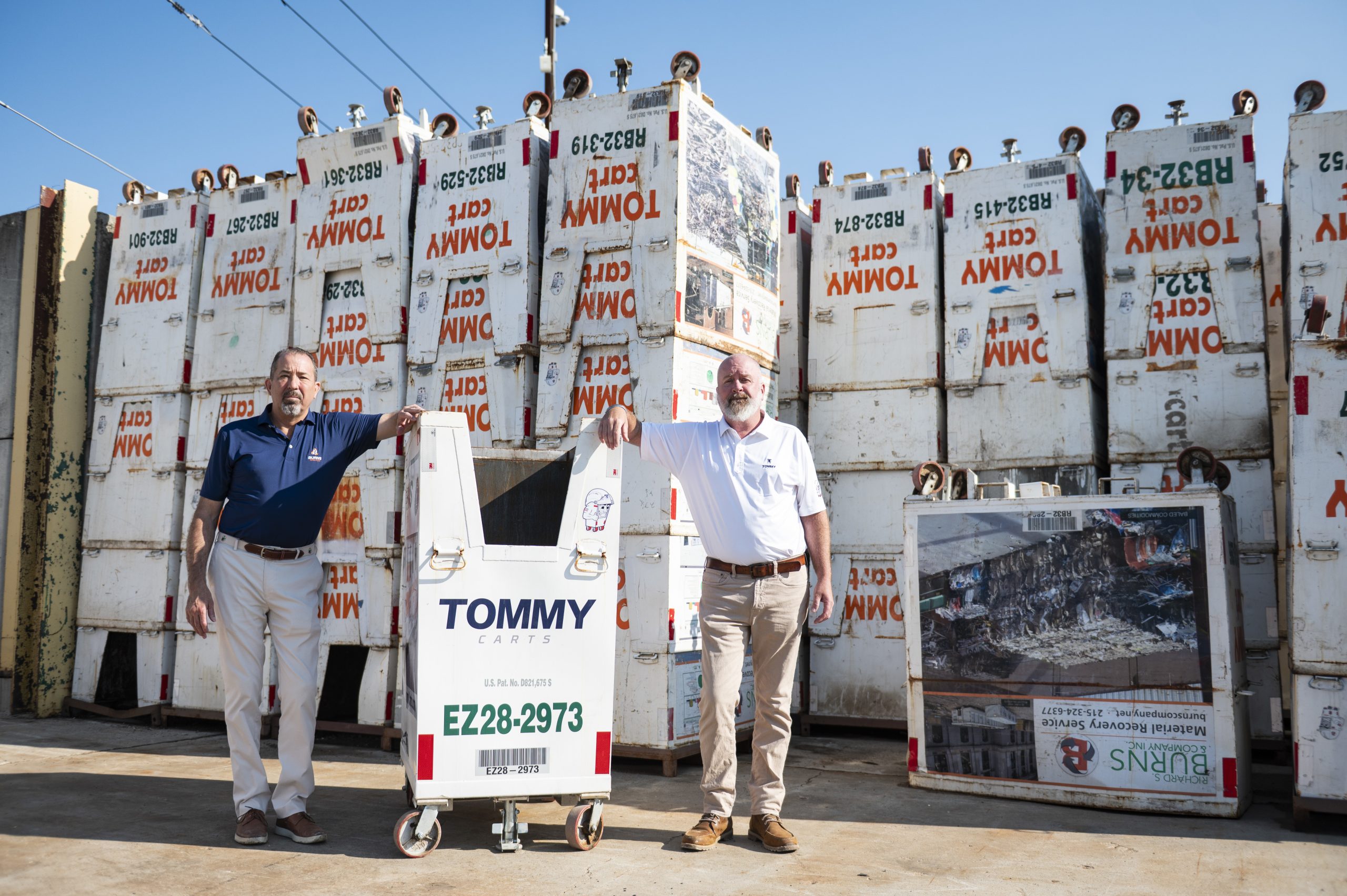
    Allen T. Burns (left), owner of Burns Services, and Ryan Fitzpatrick, director of business development, in front of stacks of TommyCarts, developed and patented by the company. Allie Ippolito / For The Inquirer

    His father, company founder Richard S. Burns, tried automatic sorters but found they chewed up and wasted more than half the material.

    So the family-led team invented and patented a heavy-duty cart, more nimble than the heavy dumpsters used to collect industrial waste. With the carts, they could more easily weigh, measure, and handle materials at crowded building sites. The process was efficient enough to resume hand-sorting and recover far more material to resell.

    Burns ships several thousand TommyCarts back and forth from his Hunting Park complex to regional building sites and has leased thousands more to construction recyclers in Washington, D.C., Pittsburgh, Chicago, and Tennessee.

    Using the TommyCarts, the company can sell about 80% of the recyclables it collects for reuse.

    Burns rolled out its first TommyCarts in 2015. The firm collected a string of patents, began selling the carts to other recyclers in 2023, and won a key industry certification last year. The goal is to produce up to 3,000 TommyCarts in 2027, double this year’s output and triple last year’s.

    How the company grew

    Burns Services has made an average of 500 carts a year since 2015, mostly for its own use at the company’s 13-acre Hunting Park complex. Truckloads and TommyCart-loads of debris — 500 trailers’ worth on a typical day — arrive at the yard, where the materials are sorted and sold.

    “We have six welders, and we can make 15 carts a day. We need to get close to 50 a day to keep up with demand. So we are getting into full robotic welding,” Burns said.

    The carts are named for Burns’ business developer, Tommy Garlick, who is listed as co-inventor on some of Burns’ nine patents.

    “We have rebuilt our maintenance shop, renovated our welding shop, sandblaster, and paint shop to make room for the automation,” Burns said.

    His father, born in an upstate prison, started the company after his Marine Corps service, a semi-pro football career, and a stint at a steel company.

    At the time, recycling was a response to the rising cost of landfills.

    “Dad’s philosophy is that waste is a commodity you haven’t found a market for,” Burns said on a hot June day over the clash of falling debris, sprayed by industrial misters, from the conveyor belt-driven sorting line above two lines of TommyCarts.

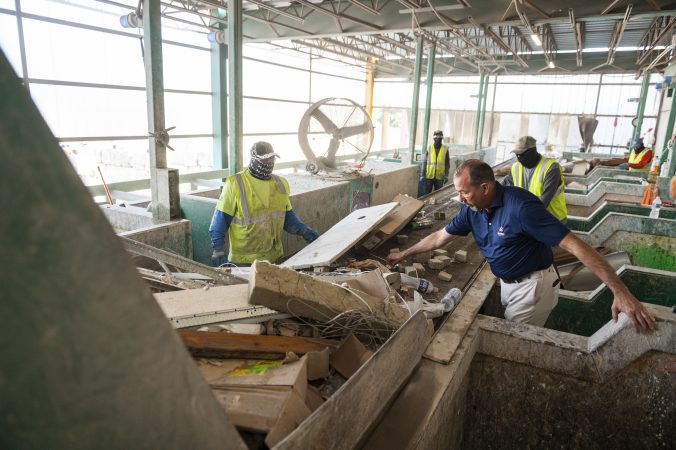
    A Burns worker sorts through debris emptied from a TommyCart at the Hunting Park plant.Allie Ippolito / For The Inquirer

    This is no clean-room factory, as where pharmaceuticals or computer chips are made. Carts are assembled in the Burns welding shop, with rectangular grips for forklifts, wheel mountings, and a brake attached below.

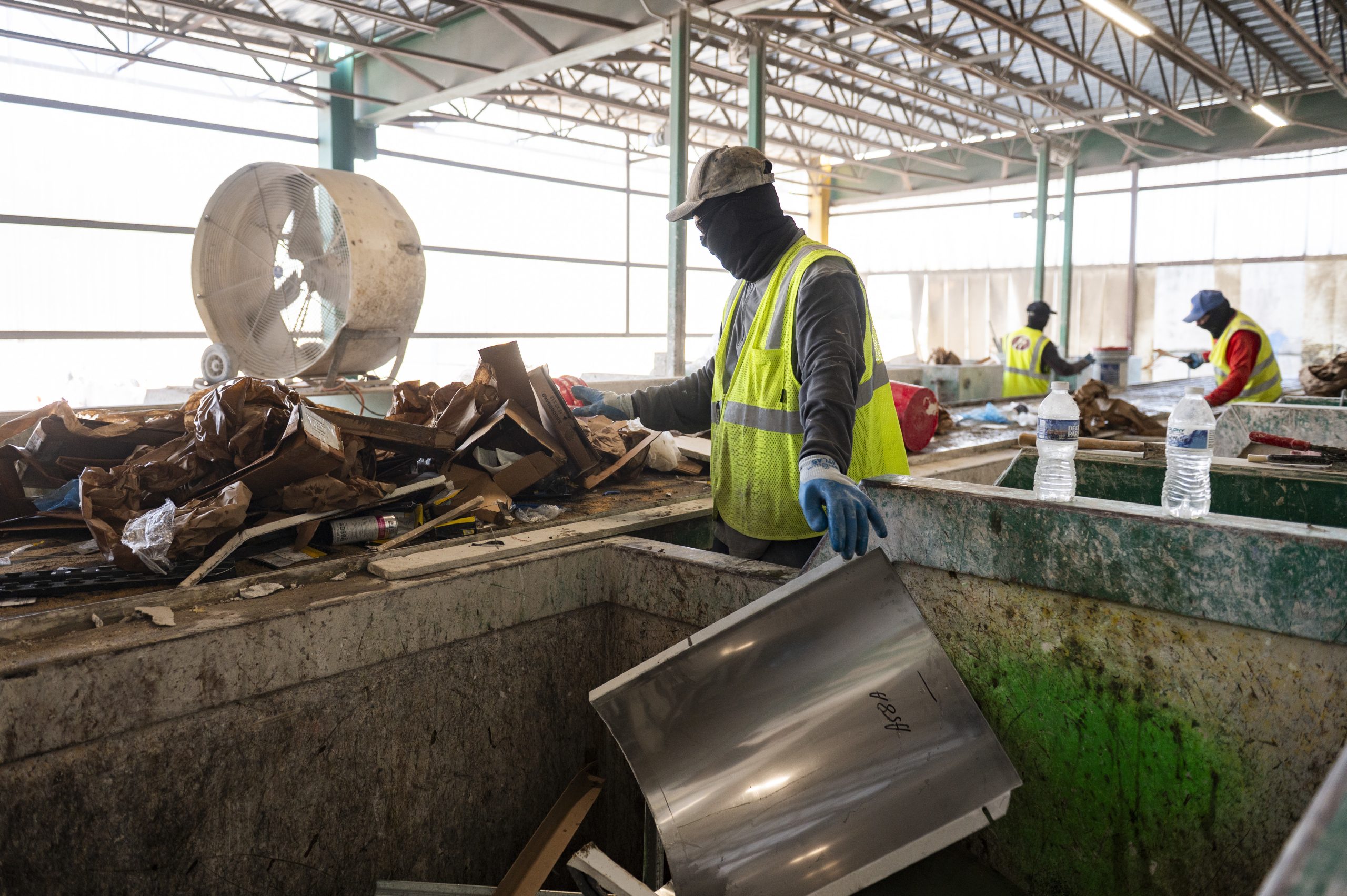
    Outside, sorting-line workers stand wrapped, booted, visibility-vested, and goggled like travelers in a sandstorm — though Burns worked gloveless as he lent a hand, flicking wallboard, steel trim, and plastic liners from truck-fed conveyor belts to the TommyCarts waiting below.

    Pre-TommyCart efforts at automated sorting mangled and smeared the loads, so less than a third of the material could be recycled. Next-generation TommyCarts, numbered and coded, are easy to move in confined areas, simple to weigh before and after sorting, and less damaging.

    Fire can be a menace in a scrapyard — more so recently, with rapidly growing incidence of hot lithium-ion fires from improperly discarded tool and appliance batteries. The EMR scrapyard, Burns’ go-to buyer for iron and steel near Camden’s Beckett Street metal-shipping port terminal, was closed after its latest fire in May, forcing area yards like Burns to find new buyers.

    Burns also had fires traced to batteries this summer, noted John Thomas, Hammonton-based president of the Construction & Demolition Recycling Association, which named Burns “Recycler of the Year” for 2025.

    Honky-tonk cleanup

    In 2023, a Nashville builder gutting a 30,000-square-foot site for country star Morgan Wallen’s new bar had a problem: Trucks couldn’t squeeze onto the site in the city’s crowded Lower Broadway honky-tonk strip and had to be hand-loaded from a distance — at prohibitive cost.

    Lincoln Young, a demolition-debris contractor who runs Rockwood Sustainable Solutions in Tennessee, reached out to Burns in Philadelphia. “He has a patented system, a proven process,” for rolling TommyCarts into the building and back to the trucks, Young said, so the material can be easily weighed, sorted, and sold.

    Rockwood leased carts for the job and became Burns’ first outside TommyCart user.

    “The beautiful thing, these carts would cost me maybe $1,200 to make, but leasing them I have no capital cost. I can scale more or less of them when I need them,” Young said. “General contractors around the country are now calling for TommyCarts in their contract specs. We have hundreds of TommyCarts now at the new Titans stadium.”

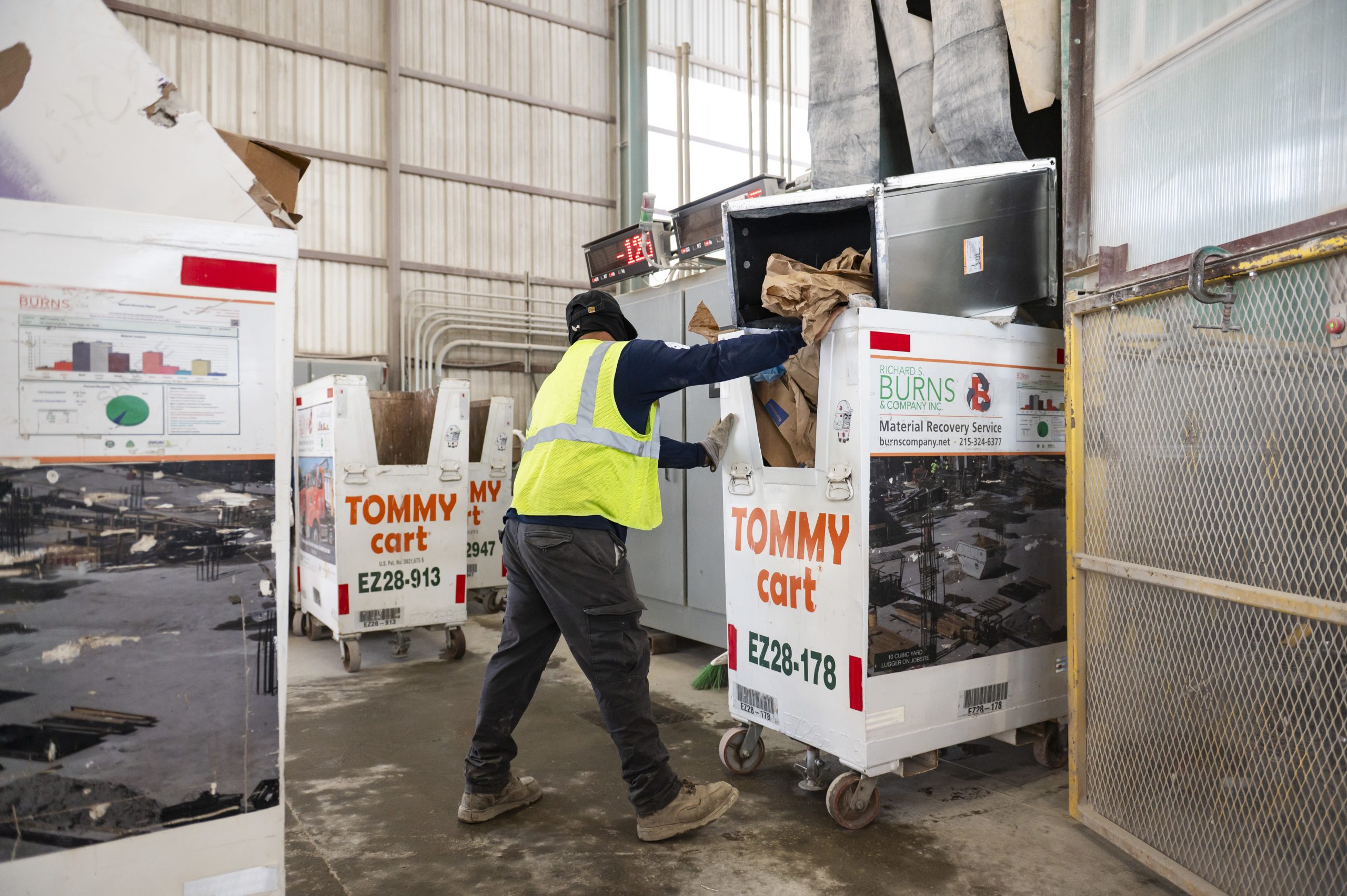
    A worker pushes a TommyCart to be emptied and sorted at Burns Services in Hunting Park. Allie Ippolito / For The Inquirer

    Burns says verifiable measurement is the key to paid recycling. The conveyor system reads the bar codes and records the gross weights to calculate payment.

    “This is not the cheapest way of doing it,” Burns said. “We have competitors who charge less per container. But this way you have accountability. You can get industry certifications.”

    The carts are welded — 20 feet of weld per cart — joining plates of 3/16-inch steel supplied by distributor Joseph Fazzio in Glassboro from U.S. and foreign mills.

    Burns also has tried automated painting systems for the sandblasted metal surfaces, so carts can go a decade without repainting. A $50,000 automated-spraying rig can pay for itself in two years by using less paint, he said.

    “Automation itself is not the issue. Like any tool, it is how it is used,” said Anton Ruesing, director of the Finishing Trades Institute for the IUPAT painters’ labor union. “Tools that reduce repetitive motion injury, improve safety, increase productivity, or even lower costs can enhance both the worker’s and the contractor’s experience” — as long as the worker remains in control and helps plan the job.

    TommyCarts are used at building and demolition sites to collect recyclable materials and shipped back to Burns Services for sorting and selling.Allie Ippolito / For The Inquirer

    The company’s Philadelphia location helps recruit reliable labor, Burns said. He’s hired industry veterans, immigrants, former prisoners, and family members of employees. Some workers have been targeted by Immigration and Customs Enforcement, incurring legal bills even though they are in the U.S. legally, Burns said.

    Work in the yard starts at $16.50 an hour plus benefits, rising to $38 an hour. Overtime starts with the federally mandated time-and-a-half over 40 hours a week, rising to 1.8 times base pay after 60 hours. Sorters can earn more than $50,000 a year, plus benefits.

    Burns’ sons work there, too. “Me and my brothers, we dropped out of high school and worked for my dad,” he said.

    Burns says he learned more in decades of long work, weeks next to his father in the workshops, and from the lawyers, accountants, architects, engineers, and other professionals that help deal with clients and suppliers.

    “I worked elbow-to-elbow with my father,” he said.

    Burns says automation makes work smarter but doesn’t eliminate the need for people, who come up with in-house solutions to tough problems.

    That’s why, as construction companies are experimenting with artificial-intelligence systems, Burns has built a staff of four full-time software programmers.

    “Off-the-shelf systems don’t do what we need,” Burns said.

  • The Eagles and Phillies boost business more than the World Cup did, Philly bar owners say

    The Eagles and Phillies boost business more than the World Cup did, Philly bar owners say

    Philadelphia has been flush with tourists flocking here for the World Cup and the nation’s 250th, patronizing local restaurants, bars, and stadiums.

    And in the aftermath, bar owners are weighing the exact size of any World Cup sales boom, how it compares to an Eagles’ Super Bowl run, and whether Philadelphia truly is a 4 a.m. bar town as the state allowed some establishments to stay open later.

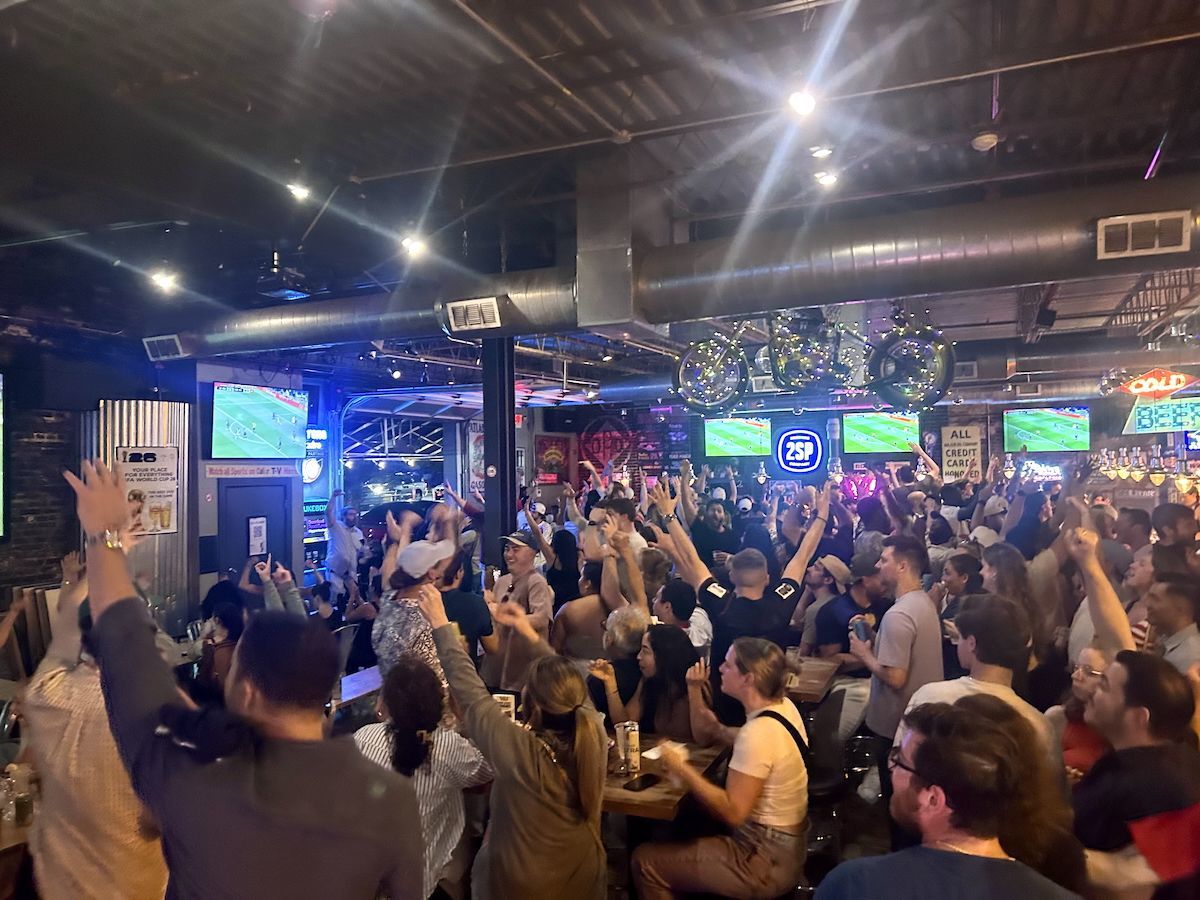
    One thing is clear: If the bar had TVs playing World Cup games, it had a chance at cashing in on fans eager to experience the game with others.

    Sports bars and tourism hot spots made out well

    Jason Evenchik’s Garage bars in Fishtown, Passyunk, and Rittenhouse saw “a nice bump in sales” throughout the World Cup, driving business up 30% to 40%, he said. Evenchik said the TV bars fared better than usual during what’s typically a summertime lull — and much better than when World Cup games were being broadcast from Qatar in 2022.

    Lucy’s Rittenhouse, a sports bar from FCM Hospitality’s Avram Hornik, also did well during the afternoon and evening games, especially when Team USA played, Hornik said. And it attracted patrons during its 2 a.m. to 4 a.m. shift, thanks to a Philadelphia 250 Permit, a temporary license that allows eligible bars to serve alcohol two hours past the city’s usual 2 a.m. closing time.

    “I don’t think it could have gone better,” Hornik said. FCM also operates the Center City nightclub Concourse, the family-friendly taproom Craft Hall, and riverside deck Morgan’s Pier, among other bars.

    “It was a mix of tourists. A lot of South Americans stayed out later because they’re used to places open late. Europeans we found like to camp out at a bar and stay for a while. There was also just a lot of Philadelphians who were happy to have some place to go and experience this moment,” Hornik said.

    Even bars without TVs like the decades-old Fergie’s Pub, nestled smack dab in Center City’s bar scene, saw a tourism boom, said owner Fergie Carey, attracting tourists to its authentic Irish experience. Carey even decided to open for the Fourth of July, when the bar usually closes, because there was so much foot traffic. But having no TVs can have repercussions.

    “The most people I’ve ever seen leave our pub because there are no TVs was on the Fourth of July,” Carey quipped.

    Evenchik and Hornik also saw lower engagement at some of their bars with little to no TVs or sports vibe, such as Evenchik’s Vintage wine bar, which he said suffered a 30% decline in sales during World Cup weeks. Hornik’s neighborhood restaurant and bars like Rosy’s Taco Bar or Harper’s Garden didn’t necessarily take a sales hit, but their private dinner party business “almost disappeared during the time of World Cup,” he said.

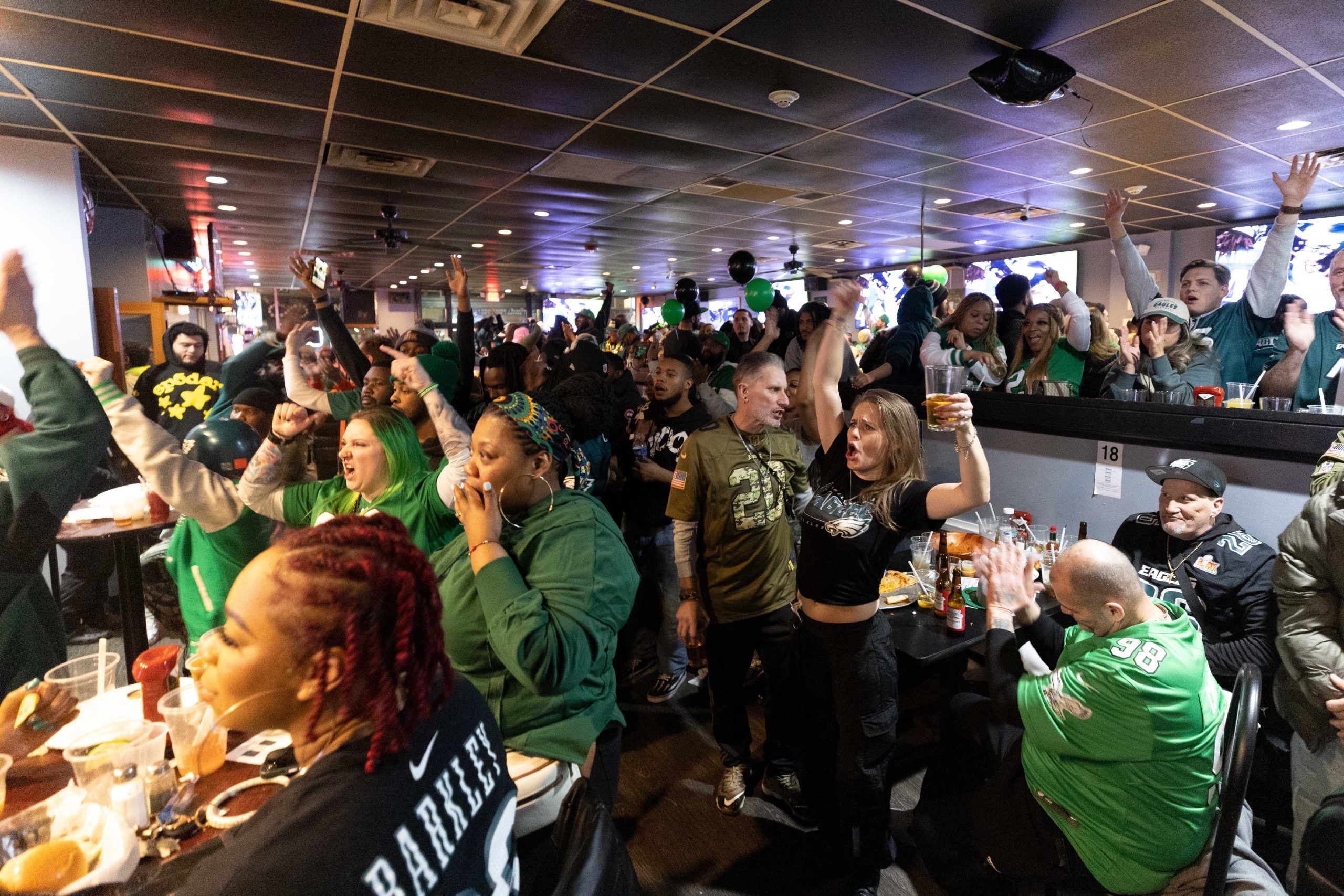
    Fans react to the Eagles play the Chiefs in the NFL Super Bowl LIX, in a bar near Frankford and Cottman Aves., Saturday, Feb. 8, 2025, in Philadelphia.Tyger Willliams / Staff Photographer

    The World Cup pales in comparison to a Super Bowl at Philly bars

    While the sports bars and hotter tourism areas saw a World Cup sales bump, bar owners say it was nothing compared to the revenue brought in from the Eagles going on a playoff-to-Super Bowl run, or the Phillies in the World Series.

    “I don’t think there’s anything that compares to Philly sports fans and their loyalty to our Philadelphia teams when they do well,” Hornik said.

    When a Philly sports team is doing well, Evenchik said, people seem more willing to go out and celebrate on the town.

    “In those times we see a bump in the sports bars, but also everywhere else, including restaurants, because everyone’s so joyous,” Evenchik said. “The World Cup doesn’t really get close to the Super Bowl madness.”

    At Philly’s oldest craft and woman-owned brewery, Dock Street, bartender Jessica Head and assistant general manager Abby Stover said they’ve been relishing the fervor of World Cup fans for every game, regardless of who is playing.

    “The World Cup finals are truly similar to us Philadelphia sports fans in their passion and how much they are willing to ride for their teams, but nothing can beat a good Eagles playoff run,” Stover said.

    “With an Eagles playoff run, we get the bursts during the games once a week, and the energy is undeniable. But the World Cup is really something so special,” Head said. “We’re so lucky we get to see that excitement every single day during the tournament.”

    Fans watch a Team USA match at the Fishtown sports bar, Garage, during the 2026 World Cup.(Courtesy of Jason Evenchik)

    4 a.m. bars in Philly aren’t as popular as believed

    Hornik applied for the Philadelphia 250 Permit at several of his bars.

    But only Lucy’s really enjoyed the benefits of 4 a.m. closing times. FCM’s other nightlife-oriented locations generally didn’t take advantage of their permits, Hornik said.

    While Hornik found success at Lucy’s, others have said the 4 a.m. party culture in Philadelphia just didn’t materialize.

    “I’ve spoken to a couple people who are involved in some of the bars that had a 4 a.m. license, and everyone kind of universally agreed that it cost a bit more than it was worth,” Evenchik said.

    The permit itself cost $500 to apply for, and another $250 for safety training from the city.

    Additionally, only a handful of the 104 World Cup matches were broadcast close to times near Philadelphia’s usual 2 a.m. closing time. “It didn’t really make sense because none of the games were really that late,” Evenchik said.

    World Cup fans share pizza and beer while watching matches at Dock Street South on Washington Avenue in South Philadelphia during the 2026 World Cup.(Courtesy of Renata Vesey)

    What lasts is the cultural exchange

    Neighborhood bars largely didn’t see a boom like Center City and established sports bars, but the World Cup did bring more business and, occasionally, international tourists, said Renata Vesey, creative director at Dock Street, which operates a brewery along Washington Avenue and a taproom in Fishtown.

    “When Côte d’Ivoire played, we got a big crew of Ivorians of all ages,” Vesey said. “It happened to be on a Sunday that we were also hosting a line-dancing event, so it was just such a random, cool mix of people and interests and vibes.”

    Bars were livelier and more crowded than usual, and Dock Street opened for a few games on Mondays, when it is normally closed, she said.

    Hornik’s neighborhood bars and restaurants like Rosy’s continued to draw their usual crowds as well. But what stands out to him is the role that Philadelphia bars and restaurants played in making the city one of the more memorable places to watch the World Cup, he said.

    “It’s not just our job to entertain them for one night, but to make them want to come back here,” Hornik said. “I think that Philadelphia did a great job of showing how great a city Philadelphia is.”

  • The world wants more high-protein products, but there’s not enough whey to go around

    The world wants more high-protein products, but there’s not enough whey to go around

    Global consumers want more protein in every bite, but the dairy industry is struggling to give it to them.

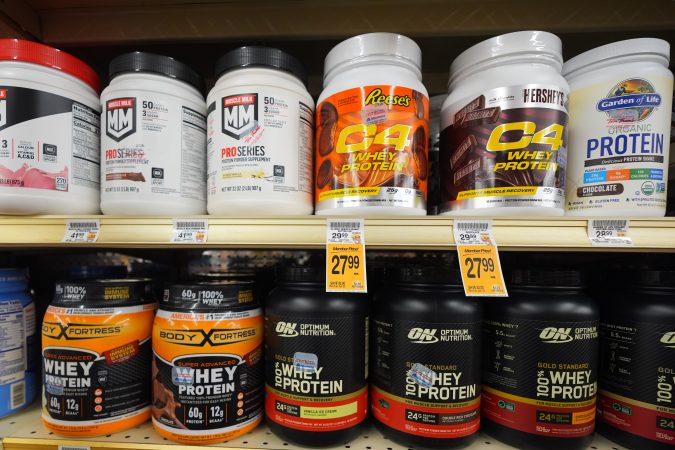
    Athletes and older adults have long used smoothies and shakes blended with whey protein concentrate — a powdered byproduct of cheese-making — to build or maintain muscle. More recently, food companies have sprinkled it into everything from breakfast cereals, Pop-Tarts, and potato chips to bagels, tortillas, and Starbucks drinks to meet growing consumer demand.

    The average U.S. supermarket now has 38,708 products advertising their protein content, according to NielsenIQ, a market research company. But the eagerness to appeal to ingredient-focused shoppers is causing shortages of food-grade whey protein and pushing prices to new records.

    “Demand is very firm and seemingly outpacing supply for right now,” said Kathleen Wolfley, vice president of Ever.Ag Insights, a data provider and consulting company for the agriculture industry.

    Wholesale prices for whey protein began rising in 2024, and the pace accelerated last year and so far this year, Wolfley said.

    Whey protein concentrate with 80% protein — the type often used by food makers and supplement companies as a booster — is trading on the dairy commodities market at more than $13 per pound in the U.S., up 250% from a year ago, according to Ever.Ag. Whey protein isolate, a more refined version that contains at least 90% protein, is 150% more expensive than last year, the company said.

    That’s raising prices for consumers. U.S. prices for whey protein concentrate powder have increased by around 15% over the past year, while more premium whey isolate powder has seen steeper gains, according to Datasembly, a price-tracking company.

    It’s a similar story in Europe. In late May, 80% whey protein concentrate hit a record average of 26,450 euros ($30,518) per metric ton, a price more than double from less than a year earlier, according to DCA Market Intelligence, a Netherlands-based commodity pricing firm.

    Here’s what’s happening with whey protein and when strained supplies might be alleviated.

    Curds and whey

    Milk contains two proteins: casein and whey. During the cheese-making process, the casein — which forms solid curds — is separated from the liquid whey, which is dried to form a powder. Every pound of cheese yields nine pounds of whey, according to the U.S. Department of Agriculture.

    U.S. milk consumption has fallen for decades as Americans shifted to beverages like sodas. But the appetite for cheese remained strong, Wolfley said. A nation of cheese-eaters generated a lot of whey protein, and some of the excess used to be exported to China and other countries.

    The domestic hunger for high-protein snacks and meals is now keeping more whey protein in the U.S. for use as a food additive or a nutritional supplement. U.S. exports of 80% whey protein concentrate and whey protein isolate to China fell 47% from January through April compared to the same four-month period a year ago, according to Vesper, an Amsterdam-based company that tracks commodity prices.

    “There simply isn’t enough product for the U.S. customer, and exports have therefore been paused as much as possible,” said Jasper Endlich, a Vesper dairy analyst.

    China is seeking more whey protein from Europe, which also is seeing shortages thanks to reduced U.S. exports, Endlich said.

    Whey and weight loss

    Use of GLP-1 weight-loss drugs is one of the factors that has supercharged demand for whey protein concentrate, Wolfley said.

    Obesity drugs like Wegovy and Zepbound are designed to suppress the appetites of people taking them. The foods they do eat need to be nutritionally dense, experts say. GLP-1 users often are advised to consume enough protein to help them feel full for longer and to retain muscle mass as they lose weight.

    Around 6% of obese and diabetic patients in the U.S. and 2% of obese and diabetic patients worldwide were using GLP-1 drugs last year, according to an estimate by the investment bank Morgan Stanley. Some estimates have put GLP-1 use as high as 12% of the U.S. adult population, since not everyone on GLP-1 drugs is obese or diabetic.

    Food and nutrition companies are creating added-protein products to attract those consumers as well as people who think drinking protein shakes to replace meals will help them lose weight.

    Pricey protein

    Tight supplies and higher costs have caused some manufacturers to increase the prices consumers pay for protein powder or protein-enriched products.

    Now Foods, an Illinois-based maker of health foods and nutritional supplements, said tubs of whey protein powder are consistently the biggest seller in its sports nutrition category. But after two years of paying more for raw ingredients, the company raised the price of its own whey protein products earlier this year.

    Bryan Morin, the sports brand manager at Now, said the company doesn’t anticipate further price increases on whey protein powder this year. It’s trying to absorb some of its increased costs by cutting back on discounts. It’s also considering expanding its portfolio to include products made with milk protein concentrate, a powder that contains less whey and is cheaper.

    “From our perspective, broader market dynamics continue to indicate a tight and evolving protein landscape,” Morin said.

    More on the whey

    Wolfley, at Ever.Ag, said manufacturers are investing in whey protein production, which should eventually improve supplies. But the relief won’t be immediate.

    Glanbia, an Irish nutrition company, said in November that it planned to increase its whey protein isolate production in New Mexico, but the additional capacity won’t be in place until 2027. In February, Canadian dairy company Agropur said it intended to increase whey protein manufacturing at plants in Quebec, Nova Scotia, South Dakota, and Wisconsin by 2029.

    In the meantime, higher prices could cause some consumers to stop buying whey protein powders, especially at a time when groceries are getting more expensive overall, Wolfley said. Reduced retail demand might reduce shortages at the wholesale level.

    “The supply-demand dynamics could start to improve, but I don’t know if that’s a tomorrow dynamic or within a year. Some of these things are going to take time,” Wolfley said.

  • Peco workers vote to ratify new contract with raises and pensions

    Peco workers vote to ratify new contract with raises and pensions

    Peco workers ratified their new union contract on Saturday, officially adopting an agreement that includes raises and pensions for all workers.

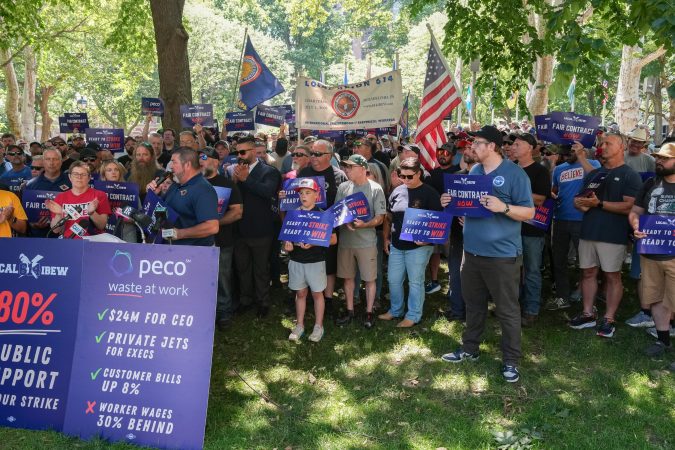
    “Local 614 members stood together and won a great contract, and we’re proud to be back at work serving the public,” Larry Anastasi, president of IBEW Local 614, said in a statement when the results were announced. “They said it couldn’t be done, but we brought back pensions, medical coverage, and raises for all our members.”

    IBEW local 614 represents roughly 1,500 Peco employees, including linemen and call center workers, who have been without a contract for months. Their most recent five-year agreement expired on March 31, and workers walked off the job on the Fourth of July after the union and Peco couldn’t reach an agreement. The work stoppage was the first in the company’s history.

    A tentative deal was reached just before midnight on July 6, bringing an end to the three-day strike. The agreement was described as “historic” by the union that evening.

    The vote took place on Saturday between 7 a.m. and 5 p.m. Of the union members who voted, 97% were in favor of ratifying the agreement.

    The five-year contract is effective immediately and goes through March 31, 2031.

    In a statement Saturday night, Peco said it was pleased IBEW Local 614 had voted to ratify the contract.

    “This agreement reinforces our shared commitment to maintaining a safe workplace and delivering exceptional service to the communities we serve,” the company said.

    The new agreement includes 4% annual raises for field workers in the first four years of the contract and 4.5% in the fifth year. Call center workers will get 3% raises annually throughout the five-year contract.

    During bargaining, Peco had said that on average, its customer service employees earned $45.12 an hour. Average annual pay in 2025 for a lineman was over $243,500, including overtime.

    The agreement also includes cash-balance pensions for all workers. Previously, some 600 workers hired after 2021 didn’t have access to a pension, while those who did have one were on different plans.

    In 2001, Peco gave workers the option to switch over from a traditional pension plan to what is known as a cash-balance plan, union spokesperson Melissa McCleery said.

    A cash-balance plan, like a traditional pension, is employer-funded, typically doesn’t require the employee to make their own contributions, and often the employer manages how the funds are invested. But like a 401(k), the amount available to the employee upon retirement is based on a stated account balance rather than monthly payments for the rest of the retiree’s life – though the amount can be split up over time.

    Roughly 80% switched over to a cash balance plan when the choice was offered, according to McCleery. Since then, the benefits of those cash balance plans have been reduced twice, she said.

    “Like many employers, Peco transitioned from traditional pension plans to cash balance pension plans and, more recently, to enhanced 401(k)-based retirement programs,” the company said in a statement Friday. These programs “have evolved over time in a manner consistent with broader employer and utility industry practices.”

    Roughly 20 to 30 workers still have the traditional pension and are able to keep it under the new union contract, said McCleery.

    Peco did not share how much the new contract will cost the company.

    “While specific contract details remain confidential between the company and the union, the tentative agreement will not result in any immediate changes to customer rates,” a company statement noted.

  • A $3.2 trillion dealmaking frenzy is spurred by the AI economy

    A $3.2 trillion dealmaking frenzy is spurred by the AI economy

    An ebullient stock market, huge bets on artificial intelligence, and an open regulatory environment have fueled one of the biggest six-month booms in dealmaking in years.

    Through the end of June, there were about $3.2 trillion in global deals, a 45% jump from a year earlier, according to Dealogic, a data provider. That was the most spent on dealmaking over a half-year period in at least a decade.

    The frenzy heavily favored large companies, with 44 deals announced that were larger than $10 billion, including takeovers and large-scale fundraising in the private markets. Those blockbusters pushed the overall value of deals higher even though the total number of transactions fell about 1% from last year, as companies with less financial firepower or those more vulnerable to geopolitical uncertainties stayed on the sidelines.

    Executives of many large companies, however, have brushed aside the uncertainties posed by tariffs and the war in the Middle East to pursue takeovers that are more likely to be approved by regulators under the Trump administration than they were during previous administrations.

    Many companies “perceive they have a window in which to attempt to affect something transformational, and now is really the time to try to do it,” Matt McClure, a global co-head of investment banking at Goldman Sachs, said in an interview.

    Bankers insist this time is different from previous booms, such as the record-low-interest era of the COVID-19 pandemic, the leveraged buyouts of 2007, and the dot-com bubble in the 1990s.

    The companies driving this year’s dealmaking surge are among the world’s largest and best-funded, and many of them are aiming to transform their business by doing big mergers, rather than making smaller acquisitions.

    Some of this activity is propelled by a need to simply keep pace in an economy dominated by only a handful of giant corporations. Consider that companies need to be about twice as large to enter the S&P 500 as they did five years ago. Exxon Mobil, once the most valuable company in the United States, is about one-eighth the size of the largest of the so-called Magnificent Seven technology companies.

    “The definition of scale keeps moving, so companies need to be bigger and bigger, and big companies need to do bigger and bigger deals to have an impact,” said Ben Wilson, a co-head of North America mergers and acquisitions at J.P. Morgan.

    NextEra’s $118 billion deal for Dominion Energy, which was announced in May, would create a utility giant aimed at supplying the increasing amounts of electricity needed to power artificial intelligence. SpaceX’s $60 billion acquisition last month of Cursor, a start-up that makes code-writing software, is aimed at helping Elon Musk’s rocket company build its AI models.

    Typically, companies are reluctant to take on big deals in times of turmoil. Disruptions in oil supplies because of the war with Iran and the White House’s open hostility toward America’s biggest trading partners in Europe show no signs of abating. Questions also persist around the AI build-out, such as the costs for computer chips, supply constraints and potential delays on when these AI companies might reap profits.

    “What makes the current boom a little counterintuitive is it appears to be associated with maybe not unprecedented, but top-quartile-level uncertainty and volatility,’’ said Jonathan Knee, a Columbia Business School professor and senior adviser at the investment bank Evercore.

    The deal activity has been a boon for banks, too, with details likely to emerge when they announce earnings next week. Bank of America expects its investment banking revenue in the latest quarter to be up 28% from a year earlier, while JPMorgan Chase expects a 10% increase, according to a research note from Jefferies.

    Not every company has joined the party. In all, 21,727 deals were announced this year, down slightly from 21,997 at this point last year. Some of that decline can be attributed to the challenges facing private equity. Companies owned by private equity firms made up 24% of the overall deal value, according to Dealogic, down from about 34% in 2024 through 2025. Many of these firms are grappling with the uncertain values of the software companies they acquired before AI posed a threat to them, making them difficult to sell.

    “So far this year, it’s just not been quite at the pace the market originally anticipated,” McClure said.

    Initial public offerings during the first half of the year were dominated by larger companies bent on powering the race for AI and those in defense technology.

    Madison Air Solutions, a cooling company that serves data centers, raised $2.23 billion in an IPO, and Cerebras, a Silicon Valley maker of AI chips, raised $5.55 billion. And, of course, SpaceX raised more than $75 billion, in the largest-ever initial public offering.

    These offerings helped boost the value of IPOs in the United States to $155 billion, the most since 2021, when a flurry of so-called blank check vehicles stampeded into public markets.

    Bankers say the door for other offerings related to AI remain open. SK Hynix, a South Korean memory chipmaker, is set to raise $28 billion in a U.S. listing this week.

    But the first weeks of trading for SpaceX shares have been volatile. With its IPO price of $135 a share, it opened at $150 in its first minutes of trading June 12. It closed just above $135 on Wednesday, and was trading at less than $133 on Thursday.

    Questions about whether demand will ultimately justify enormous spending on AI continue to swirl over the markets, along with other uncertainties including the war in the Middle East and inflation. Shares of the Magnificent Seven helped lead the S&P 500 through its best second quarter in six years, even as shares of those companies fell roughly 9% in June.

    Still, Kennedy said, “I do think the AI theme will continue to drive activity through the end of the year.”

    This article originally appeared in the New York Times.

  • Bath & Body Works is on a quest for another billion-dollar scent

    Bath & Body Works is on a quest for another billion-dollar scent

    NEW ALBANY, Ohio — In a brightly lit Manhattan office above a fragrance laboratory, Mary Testa-Gough brought a white strip of paper to her nose and inhaled. Two perfumers’ assistants awaited her verdict, as if the fate of a multibillion-dollar olfactory empire depended on it.

    “Smoky,” Testa-Gough said. “Mossy. Woody. But it feels unfinished.”

    As the chief “nose” for Bath & Body Works, Testa-Gough is in charge of finding the next Japanese Cherry Blossom. That single scent has generated more than $1.5 billion in sales over the last 20 years, filling millions of homes with the aroma of Asian pear, white jasmine, and basmati rice.

    The Japanese Cherry Blossom scent has generated $1.5 billion for Bath & Body Works over the last 20 years.VINCENT TULLO

    The fragrance — which emanates from candles, air fresheners, lotions, and body mists — has been a bestseller since it debuted in 2006. It’s so popular that the retailer celebrated its 20th anniversary with an ad campaign and new packaging this past spring as part of a broader expansion strategy to help bring in new customers.

    Sales at Bath & Body Works slipped to $7.3 billion last year from a pandemic-era peak of $7.8 billion, pushed down by competitors marketing on TikTok and consumers increasingly suspicious of chemicals in fragrances.

    To fight back, CEO Daniel Heaf unveiled a plan in November that included marketing “iconic” fragrances online as stand-alone brands and offering products on Amazon. Bath & Body Works will also begin selling some of its products at hundreds of Ulta Beauty stores this month.

    They’re coming out with new products. Testa-Gough has high hopes for Watermelon Whirl and Tangerine Twirl — which are among the scents being released this week in a new product line promoted by actress and singer Hilary Duff.

    Nobody knows for sure why some scents become classics, while others fall into the discount bin. Despite all the money spent on marketing and focus group testing, some scents still fall flat while others invoke such intense loyalty that customers rant on social media when they can’t find them in a store.

    That’s why the company has invested millions of dollars in being able to quickly manufacture and distribute more candles, lotions, air fresheners, and body mists when customers fall in love with a particular scent. In 2011, for instance, Bath & Body Works stopped buying plastic bottles from China and began sourcing from Axium Packaging, a plastics container manufacturer that built a factory near the Bath & Body Works headquarters in New Albany, Ohio.

    Kdc/one, the contract manufacturer that mixes fragrances into foaming soaps, lotions, and gels, also built a plant there, helping to cut the time to market for some products to weeks from months.

    “It was a massive unlock to be more responsive to what the customers are buying in the store,” said Nicholas Whitley, Kdc/one’s CEO.

    The birth of ‘Beauty Park’

    Since 2008, Bath & Body Works has consolidated its number of strategic suppliers to about 50 from hundreds. It offered long-term contracts to vendors who agreed to build factories in New Albany, creating an industry cluster that is now known as Beauty Park.

    “Fifty-percent of our whole supply chain came from China” in 2008, recalled Toby Thunberg, who handled supply chain logistics for Bath & Body Works at the time and now works for Axium, the bottle maker. Today, 85% of the supply chain for Bath & Body Works hails from North America, according to Susanna Zhu, chief procurement and supply chain executive at Bath & Body Works; of that, 55% is in Beauty Park.

    Beauty Park was the brainchild of retail mogul Les Wexner, founder of L Brands, which owned Bath & Body Works, Victoria’s Secret, and Abercrombie & Fitch. Wexner said in 2007 that the global supply chain for the fragrance business was too cumbersome, according to Thunberg. At the time, the company searched for inexpensive plastic bottles from China. They had to be ordered months in advance, making it impossible to quickly restock best-selling scents, he said.

    Inspired by an apparel hub in India where Victoria’s Secret suppliers turned around underwear orders quickly because they were all clustered in the same area, Wexner envisioned factories surrounding the company’s headquarters in New Albany, where he owned vast tracts of land.

    It was a radical pitch. The proposed site was a pig farm 17 miles from the nearest railway, leaving his own staff and vendors deeply skeptical. Wexner flew his team and key suppliers to India to witness the hyper-efficient ecosystem firsthand, Thunberg recalled.

    Today, the tightly integrated hub allows Bath & Body Works and its core suppliers to work together more closely — shrinking lead times to weeks, from months. During the pandemic, the company was able to quickly pivot to making hand sanitizer and experienced its best year on record.

    Today, Bath & Body Works and its core suppliers have an almost familial relationship, even though the companies also make products for other customers.

    “They are an extension of ourselves,” said Stephen Smith, a supply chain senior executive at Bath & Body Works.

    Those informal bonds make it easier to create new products together, according to Alan Malter, associate professor at the University of Illinois Chicago, who has studied the impact of industry clusters on innovation.

    “If you are just going to have a contract manufacturer in the cheapest place you can find, you will probably be innovating less with them,” he said. “It will be more of a relationship where you are giving them instruction, and say ‘Make this.’ It is less of a partnership.”

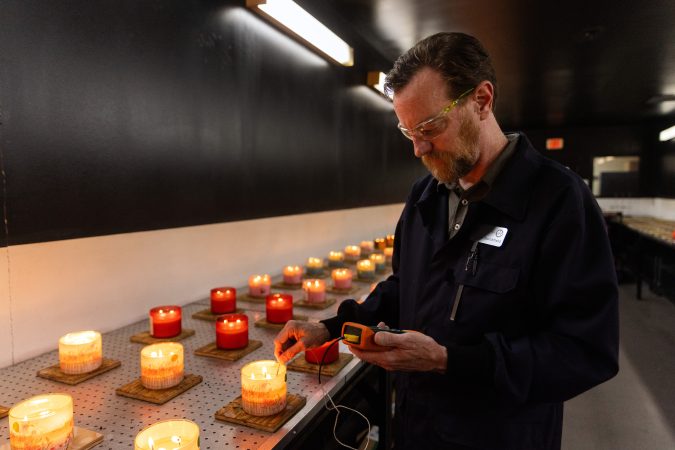
    One afternoon this spring, Zhu popped into Alene Candles, a key supplier in Beauty Park that pioneered the three-wick candle with Bath & Body Works. She chatted briefly with technicians in the burn lab who measure the soot content and height of flame from candles in every batch.

    Then she stopped by the laboratory at Kdc/one and thanked the technicians who helped develop a daily moisturizing hand soap that had been flying off the shelves.

    She wanted to know if they were working on anything new.

    How a fragrance is born

    The search for a new iconic fragrance begins in New York, where master perfumers at major fragrance houses, like DSM-Firmenich, compete to get on the shelves at Bath & Body Works by crafting new aromas based on themes that Zhu brings them.

    They create dozens, if not hundreds, of different scents — inspired by ideas like Mother’s Day or the joy of spring. They fine-tune them, based on feedback from Testa-Gough (the “nose”). Later in the process, focus groups are paid to smell them as well.

    Mary Testa-Gough (right) the chief “nose” for Bath & Body Works, tests a fragrance at DSM-Firmenich, a major fragrance house, in New York on April 20, 2026.VINCENT TULLO

    In the past, fragrances were made by boiling spices for hours or pressing oils out of flower petals. Today, the process is often more high-tech.

    For instance, to create the Milk Bar Birthday Cake collection, molecules were collected from the steam of a freshly baked cake at the popular New York bakery chain, then analyzed and recreated in a lab.

    With the Japanese Cherry Blossom, whose real petals hardly have a scent, the fragrance was more of a perfumer’s fantasy.

    Harry Fremont, a master perfumer at DSM-Firmenich who is best known for creating Calvin Klein’s CK One, designed a cherry blossom-inspired scent in 2006 for Bath & Body Works. Camille McDonald, the creative force behind Bath & Body Works at the time, asked him to make it more complex, so it would appeal not just to mall-loving teenage girls but also their mothers.

    “She said, ‘I want to make something different with it to elevate the brand, to make it more sophisticated,” said Fremont, who is now retired. “She said, ‘I want to make our Shalimar,’” a reference to the famous perfume created by Jacques Guerlain in 1925.

    Fremont added sandalwood, musk, and molecules that smell like basmati rice when it cooks. “Maybe it’s a bit too sophisticated,” McDonald told him after a round of focus group tests. He added back top notes of apple and pear, and it became the company’s top-selling fragrance of all time.

    This article originally appeared in the New York Times.

  • DraftKings sues Philadelphia for investigating whether it’s violating city consumer protection laws

    DraftKings sues Philadelphia for investigating whether it’s violating city consumer protection laws

    DraftKings, one of the nation’s biggest sports betting companies, is suing the city of Philadelphia in an effort to stop an investigation into the company.

    The city is investigating whether DraftKings has violated the Philadelphia Consumer Protection Ordinance, a 2024 law designed to protect Philadelphians from deceptive business practices, according to the lawsuit and accompanying documents.

    In response, DraftKings contends a state law, the Pennsylvania Unfair Trade Practices and Consumer Protection Law, preempts the city‘s ordinance. The Boston-based company argues in the suit filed Thursday in federal court in Philadelphia that the city is trying to usurp the state’s authority through its investigation.

    “DraftKings filed a lawsuit against the City of Philadelphia because we believe the City has acted beyond the scope of its authority on matters governed by state law and regulated by the Pennsylvania Gaming Control Board,” the company said in a statement. “DraftKings remains committed to operating responsibly and in full compliance with Pennsylvania law, and we look forward to addressing this issue through the legal process.”

    The city declined to comment due to litigation being ongoing.

    The legal sparring match comes as sports betting companies have come under fire locally in recent weeks due to tactics they’ve used to entice bettors to keep wagering money on their sites.

    Last week, The Inquirer reported on a personalized video that FanDuel, another sports betting company, sent to a bettor featuring Phillies star Bryce Harper. A lawsuit filed by the nonprofit Public Health Advocacy Institute on behalf of that bettor and another alleges the Harper video is only one of a series of incentives sports betting companies offer to patrons to keep them hooked.

    A subpoena attached to the DraftKings case shows the city requested a host of documentation from the company by May 24. That included requests for details on how much money Philadelphians have wagered in the past three years, how many Philadelphians have placed bets on DraftKings in the past three years, and what kinds of marketing materials have been used with Philadelphians.

    It’s unclear what, if any, of the documentation DraftKings provided the city.

    The city had no right to request such documents due to the state law superseding the city’s version, DraftKings said in its lawsuit. It’s now asking the U.S. District Court for the Eastern District of Pennsylvania to rule that the city overstepped and let DraftKings off the hook for complying with the subpoena.

  • Hanwha Philly Shipyard picked to build two Golden Dome missile defense ships

    Hanwha Philly Shipyard picked to build two Golden Dome missile defense ships

    The federal government plans to build two new missile defense ships at Hanwha Philly Shipyard after it finishes the last of the “multi-mission” training and disaster-assistance ships it’s been building, Trump administration and shipbuilding officials said Friday.

    But new Navy combat ships that yard leaders also hope to build in Philadelphia will have to wait until the yard has additional space ready, shipbuilding officials said.

    The $1.4-billion contract to build two “Golden Defender” ships — officially Missile Range Instrumentation Ships, or tracking ships, topped by bulbous radar, antenna, and other surveillance gear — was announced Friday by U.S. Office of Management and Budget director Russell Vought to hundreds of shipbuilders and government staff. The ships will replace surveillance ships built in the 1960s.

    The group had assembled to watch Fox News host Rachel Campos-Duffy christen TS Lone Star State, the fourth National Security Multi-Mission Vessel completed at the yard since 2023. The last of that line, TS Golden Bear, is due next year.

    Fox News host Rachel Campos-Duffy christened the training and emergency ship TS Lone Star at Hanwha Shipyard. In her remarks, Campos-Duffy invoked the protection of Jesus Christ and Stella Maris, a manifestation of Christ’s mother, Mary, as the “Star of the Sea,” to protect the ship and its crews.Joseph N. DiStefano

    The anti-missile ships will be built on hulls the same size as the multi-mission ships, but without the multistory cabins used for cadets and hospital personnel, to make room for large-scale surveillance gear.

    The new ships fit into a network of surveillance and combat gear developed by L3Harris and other big military contractors for the planned “Golden Dome” anti-missile network. They will keep the “hot production line” busy at the 2,000-worker shipyard for the next few years, U.S. Transportation Secretary Sean Duffy said.

    Golden Dome will be built by Lockheed Martin, L3Harris, and other defense contractors.

    The new ships will be built under a management contract with Tote Services, a Jacksonville, Fla., company that has been overseeing construction of the multi-mission ships.

    Tote and Hanwha have been delivering those ships “ahead of time and under budget,” Duffy said.

    From left: U.S. Rep. Mary Gay Scanlon (D., Pa.); Russell Vought, director of the U.S. Office of Management and Budget; U.S. Transportation Secretary Sean Duffy; and his wife, Rachel Campos-Duffy, a Fox News host, at Hanwha Philly Shipyard. Joseph N. DiStefano

    He contrasted Tote’s and Hanwha’s record, which built on previous yard owner Aker’s upgrades to the yard, with the slow pace of Navy shipbuilding in past decades. He said more ships should be built the Philadelphia way.

    “Who controls the seas controls the world,” Duffy said, noting that the Trump administration supports reviving U.S. shipbuilding.

    That effort will require vast public spending on design and procurement, plus recruiting and training hundreds of thousands of marine welders, crane operators, and other ship construction workers.

    “I’m a free enterprise guy, but we have to recognize that free enterprise doesn’t exist in shipbuilding because every [other nation is] subsidizing commercial vessels,” Duffy said.

    Other new shipbuilding contracts are in the works for yards in Philadelphia and competing cities, he said.

    “Big orders are coming our way. This is just the beginning,” Duffy said. “There is a lot of partisanship in Washington, but America stands together, Democrats and Republicans, as we figure out how we staff and build ships in our country.”

    Jeff Dixon, President of Jacksonville, Fla.-based Tote Services, with government officials after the christening of TS Lone Star State, a federally-funded training vessel built under Tote’s management at Hanwha Philly Shipyard, July 17, 2026.Joseph N. DiStefano

    One of those “big orders” could bring more Navy ship construction to Philadelphia soon — if Hanwha can execute its long-planned expansion of the yard in time. The company has pledged an eventual $5 billion to help revive American shipbuilding but still operates the yard with a single 1,000-foot dry dock and one Goliath crane, a fraction of the size of its main South Korean yard on Geoje Island.

    On July 13, the Navy’s Portfolio Acquisition Executive for Maritime, the ship design, construction, and maintenance agency formerly known as NAVSEA whose local offices are the largest employer in Philadelphia’s Navy Yard business district, awarded Tote Services a $2.2 billion contract to build up to eight Landing Ship Medium (LSM) vessels for the Marines.

    Those ships will be built in three U.S. shipyards: Italian-owned Fincantieri’s Marinette, Wis., works; the family-owned Bollinger shipyard in Mississippi; and a third yard that has not yet been chosen, Jeff Dixon, president of Tote, said in an interview.

    “The Marine Corps needed these landing ships in the Pacific two years ago,” Dixon said, stressing the military’s urgency to get the landing craft built. “Philly will compete in that process. I think they could fit them in,” and still continue work on its commercial ship construction contracts, if the yard can line up new berthing space.

    Neighbor Rhoads Industries has two smaller drydocks and other space in and around the yard that could be converted if Hanwha can arrange the space and the financing, he and other shipyard sources said.

    JPMorgan Chase & Co. chief executive Jamie Dimon on a visit to the Navy Yard district said Tuesday that his bank has worked with Hanwha on other projects and is eager to back the company’s plans to expand construction of U.S. ships. Hanwha has expressed interest in building combat and support ships, submarines, and drones for the U.S. in South Korea, Philadelphia, and other potential locations.

    Hanwha leaders have said U.S. military shipbuilding can be profitable and competitive with the leading shipbuilding nations — China, South Korea, and Japan — only if it scales up construction of commercial ships, making it much more efficient to build each ship.

    The Philadelphia yard has been finishing a ship, on average, every eight months. Hanwha says it wants to build up to 20 ships a year in an expanded shipyard.

  • Touring Camden’s Cathedral Kitchen, Andy Kim calls Trump’s cuts to SNAP ‘devastating and cruel’

    Touring Camden’s Cathedral Kitchen, Andy Kim calls Trump’s cuts to SNAP ‘devastating and cruel’

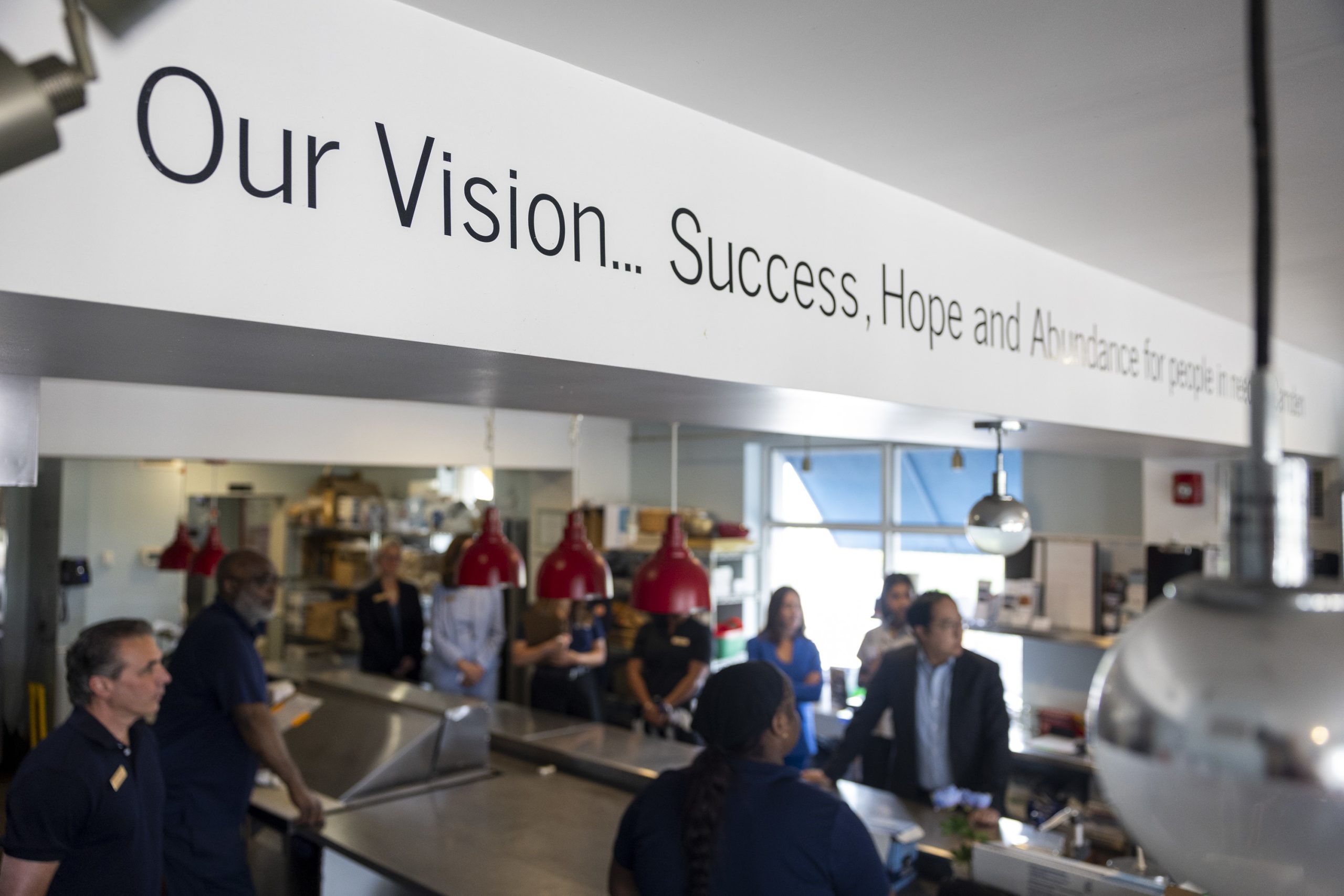
    Touring Cathedral Kitchen, the largest emergency meal supplier in South Jersey, Democratic Sen. Andy Kim praised the 50-year-old Camden institution Friday for the food it has served and the people it has saved.

    “The Kitchen is building community, right here in New Jersey,” said Kim, who noted that the nonprofit distributes 28,000 meals a month while training low-income people to be chefs and restaurant workers. Cathedral Kitchen also works to help people obtain IDs, apply for jobs and benefits, and find housing.

    Its work is needed more than ever, the New Jersey lawmaker said, with hunger on the rise because of high food prices and President Donald Trump’s One Big Beautiful Bill Act, which reduced federal food assistance such as SNAP (the Supplemental Nutrition Assistance Program) beginning July 4 of last year.

    Cutting SNAP benefits and changing eligibility requirements, Kim said, is a “devastating and cruel thing to do” at a time when cost of living has been climbing.

    “Why are we taking away necessary support at this time?” Kim asked. “I mean, we’re talking about food, the basics of being a human. Why is this happening now, at a time when people are struggling with affordability?”

    New Jersey Sen. Andy Kim visits Cathedral Kitchen in Camden, speaking to the workers who provide food for their community and those in need.Tyger Williams / Staff Photographer

    The food assistance cuts are coinciding with the economic fallout from tariffs and the Iran war, Kim noted.

    Nationwide, between January 2025 and January 2026, SNAP rolls decreased by more than 4 million people — from 42 million to 38 million — according to USDA figures.

    In New Jersey, SNAP participation has fallen by more than 50,000 individuals between March 2025 and March of this year, New Jersey Department of Human Services figures show.

    And in Pennsylvania, nearly 90,000 people lost SNAP benefits between July 2025 and April due to new eligibility requirements, according to an analysis by the Pennsylvania Department of Human Services (DHS).

    At the same time, food prices have risen more than 3% in the last year.

    As a result, in Camden, Burlington, Gloucester, and Salem Counties, the number of meals distributed to help those in need grew by 34% over the last four years, according to the Food Bank of South Jersey

    “I know the Camden area,” said Kim, who grew up in nearby Marlton and Cherry Hill. “I’ve seen the struggles that have been here and still persist.”

    The Trump administration has said the cuts it’s made to SNAP, Medicaid, and other programs were necessary to staunch “waste, fraud, and abuse.” It maintains that it’s instituted strict work requirements for SNAP to move more people into the workforce and reduce dependency on government support.

    Kim said many Americans don’t understand that a large number of people who live in poverty also work. “Millions with jobs are still poor, and this country needs a mindset shift to understand that,” Kim said.

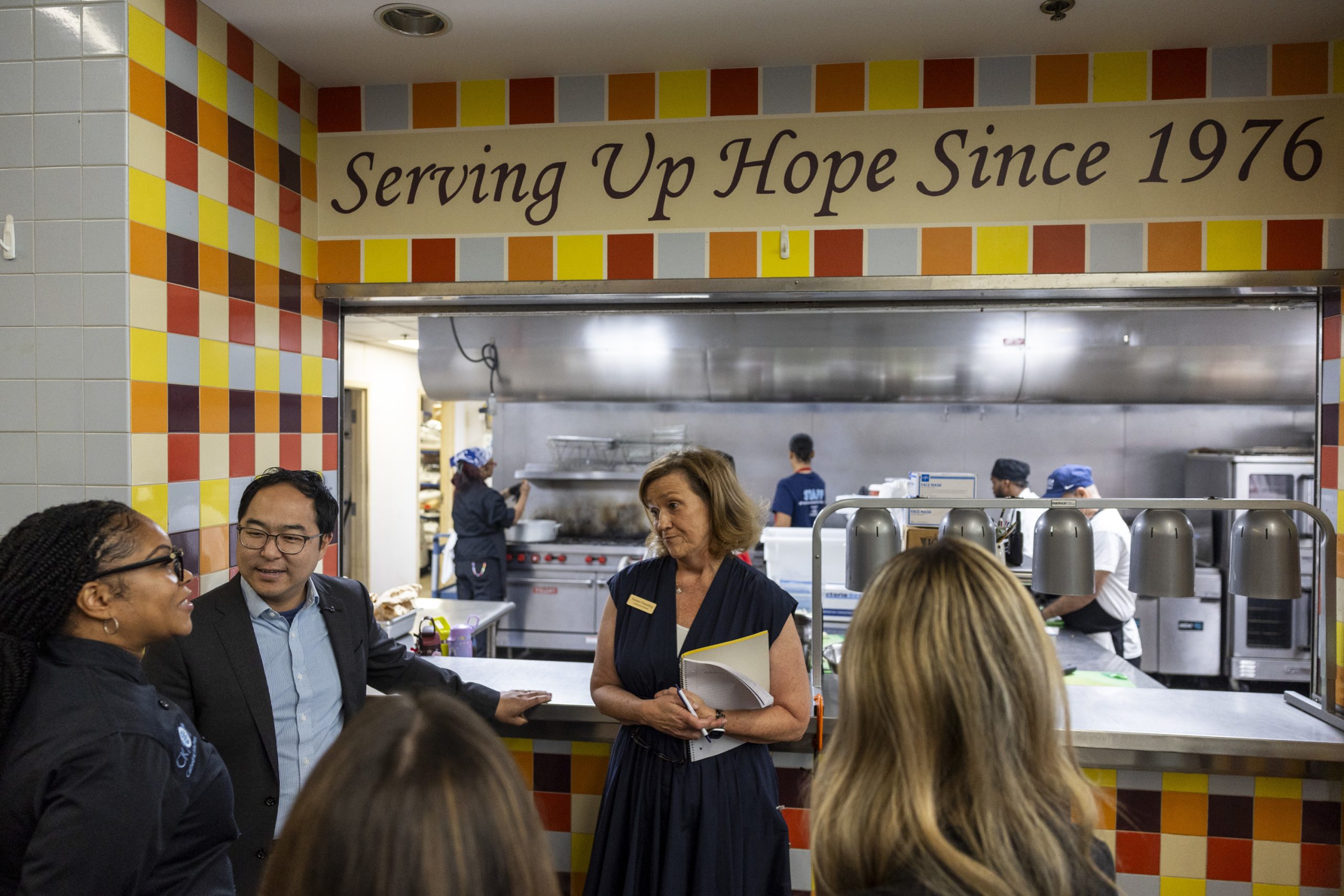
    Sen. Andy Kim (D., N.J.) speaks with Naimah Rutling, executive chef at Cathedral Kitchen in Camden, N.J., on Friday.Tyger Williams / Staff Photographer

    As he continued his Tour of Cathedral Kitchen, Kim invariably found himself in the organization’s actual kitchen, bustling with food workers slicing carrots and onions, preparing for meals ahead.

    Clearly enjoying the moment, Kim said that at home, he makes his own bread, including pizza dough.

    Kim asked executive chef Naimah Rutling what her favorite food is. “Grilled cheese,” she said without hesitating. Kim laughed and said, “I have a 9-year-old and a 10-year-old. About 90% of what we eat is grilled cheese.”

    Before leaving, Kim praised workers in the kitchen for their diligence and dedication in preparing food for those who need it.

    “It gives meaning and purpose to their lives,” he said. “I love the passion I see.”