Category: Business

  • Emil DeJohn, celebrated clothing designer and longtime college fashion professor, has died at 88

    Emil DeJohn, celebrated clothing designer and longtime college fashion professor, has died at 88

    Emil DeJohn, 88, of Ambler, celebrated clothing designer, longtime college department chair and professor of fashion, lecturer, volunteer, and mentor to generations of designers, tailors, dressers, models, and students, died Wednesday, June 24, of a heart attack at his home.

    Born in Philadelphia, Professor DeJohn worked for 37 years with Bill Blass and other notable clothing designers on Seventh Avenue in New York, and for 21 years as chair of the fashion department at Moore College of Art and Design, director of fashion career development at Drexel University, and professor of fashion at the now-closed Art Institute of Philadelphia.

    He designed clothing of all kinds for men, women, and children for Jones New York, OshKosh B’Gosh, and other international labels from 1960 to 1997. He established his own label, Alex DeJohn by Emil, in the 1980s, and his creations appeared on the covers of Vogue, Harper’s Bazaar, and other magazines.

    Several of his gowns were offered to singer Barbra Streisand in the 1960s, and he received design compliments from, among others, film star Elizabeth Taylor and Andre Leon Talley, former editor-at-large at Vogue. In the 1980s, he was chosen by then-first lady Nancy Reagan to design a colorful clothing collection promoting her “Just Say No” antidrug campaign.

    In New York, Professor DeJohn showed designs at Bergdorf Goodman, Saks Fifth Avenue, Neiman Marcus, and Macy’s. In Philadelphia, he showed at Bonwit Teller and other top shops.

    He also showed in London, Paris, Milan, Hong Kong, and elsewhere around the world. He lectured about fashion at other universities, represented the industry at high school career fairs, and mentored many young designers.

    At fashion shows, they always gave him a front-row seat. “It’s an incredible profession,” he told The Inquirer in 2001. “Lots of ups and just as many downs. I wouldn’t trade one day.”

    In 1997, looking to engage less with consumers and more with emerging designers, Professor DeJohn left the workshops and showrooms in New York for classrooms in Philadelphia. He spent six years as chair of the fashion design department at Moore, several years as director of fashion career development at Drexel, and finally retired in 2018 as a professor of fashion at the Art Institute.

    At Moore, Professor DeJohn recruited Bob Mackie, Betsey Johnson, and other renowned designers to meet his students and provide internships and jobs. At Drexel, he oversaw the Crystal Star Award for design program and taught a class called Aspects of Fashion and Merchandising.

    Professor DeJohn (left) attended many galas as director of the Crystal Award for design at Drexel. Emil DeJohn

    He hosted a fashion club at the Art Institute and was named the school’s 2017 Teacher of the Year. “He was always happy to answer our questions and tell us about the industry,” a former student said in a tribute. Another said: “He inspired all of us to dream big.”

    Professor DeJohn won the city’s Phashion Phest Philadelphia Award for design in 2001 and told The Inquirer: “Teaching the students has been a gift to me. I never envisioned anything I could enjoy more than designing. But this has become an amazing part of my life. I actually love coming to work.”

    He earned other awards for design and his volunteer work at the Rowan House, the Ronald McDonald House, and other nonprofits. “He stood as a beacon of hope,” said his granddaughter Alexandra, “always making everyone feel like he believed in them, always bringing out what made them special.”

    His granddaughter Isabella said: “His legacy continues to inspire me every day.”

    Professor DeJohn met Bette Anne DeChiaro at a dance at the Shore when he was 17, and they married in 1963. Courtesy of the family

    Emil Joseph DeJohn was born Dec. 20, 1937, in his mother’s bedroom in South Philadelphia. The youngest of three children, he discovered art in grade school, took art classes at Fleisher Art Memorial, and graduated from John Bartram High School.

    He earned a bachelor’s degree in fine arts at the old Pennsylvania Museum and School of Industrial Art in 1959. He won the school’s design citation as a senior and worked at first as an illus­trator for the Bul­letin’s fashion pages.

    He met Bette Anne DeChiaro at a dance at the Shore when he was 17, and they married in 1963. They had a daughter, Leisa, and a son, Christian, and lived in Center City, Wyncote, and Ambler.

    Professor DeJohn liked antiques, flowers, and anything blue and white. He supported the old Carmelites monastery in Philadelphia and belonged to St. Luke the Evangelist Church in Glenside.

    Professor DeJohn first became interested in art and fashion in grade school. Courtesy of the family

    He made friends on his daily two-hour train rides to New York and said he never considered leaving Wyncote. “I loved leaving all that and coming home to cut the grass,” he told The Inquirer in 2001. “My neighbors didn’t even know what I did for a living.”

    He designed his daughter’s wedding dress, took his granddaughters to mesmerizing fashion events, and made memorable trips to Ocean City, N.J., Longwood Gardens, New Hope, New Mexico, and Florida. He especially enjoyed decorating his home and Christmas tree with ornaments and live flowers.

    “He made us all feel seen and special,” his daughter said. “He did that for everyone he met.”

    In addition to his wife and children, Professor DeJohn is survived by four grandchildren, one great-granddaughter, and other relatives. A sister, a brother, and a son-in-law died earlier.

    Professor DeJohn (right) said he would never leave Wyncote for New York. Courtesy of the family

    Services were held earlier.

    Donations in his name may be made to the Carmel of Jesus Crucified Monastery, Attn: Mother Pia, Box 308, Muenster, Texas 76252.

    Professor DeJohn (second from right) enjoyed time with his family.Courtesy of the family
  • Philadelphia offers forgivable $50,000 loans to help small businesses expand | Expert Opinion

    Philadelphia offers forgivable $50,000 loans to help small businesses expand | Expert Opinion

    Want $50K for your business, along with coaching and advice to help it grow? The City of Philadelphia has a program to provide just that.

    Since 2021, the city has been offering forgivable loans of up to $50,000 for businesses through its annual Boost Your Business program. Applications for this year’s program opened in June and will close Aug. 31. Up to 20 businesses will be selected.

    To be eligible, your business must be independently owned (this includes some franchises), located in Philadelphia, in operation for at least two years, and have at least $350,000 in annual revenue. Businesses also must be paid up or have an approved payment plan for all local, state, and federal taxes. And they must have all necessary licenses and permits, including an active Philadelphia commercial activity license.

    Applicants must provide a budget and growth plan, as well current financial statements and two years of federal business tax returns. Any debt must be disclosed and anyone with more than a 20% interest in your business must provide authorization. Eligible businesses that are seeking city contracts are encouraged to apply.

    The growth plan is a key document. That’s because businesses selected for the program are facing “unique barriers in accessing critical funding and resources that are needed to help their business grow,” according to the city’s Department of Commerce and its partner in the program, the Philadelphia Industrial Development Corp. (PIDC). The awards are made in the form of a loan, which can be forgiven assuming the business meets its stated growth goals.

    “Applications are scored for feasibility of the growth plan and whether and how this $50K will enable the business to achieve that growth,” said Miaya Darby, a senior manager of small business resources at the city’s Department of Commerce.

    The department looks at businesses’ plans to create jobs or compete for projects, Darby added. Favor is given to those who “can show how their business is integral to the success of other Philadelphia businesses and how their business gives back to the community.”

    Darby emphasized that the program is designed not only to help businesses grow, but also to support entrepreneurial development.

    “Through funding, business support services, and one-on-one coaching, participants gain the tools, knowledge, and resources needed to strengthen their leadership, build sustainable business practices, and position their businesses for long-term success,” she said.

    The application process takes time. Rolanda Robinson, a 2024 winner who owns Carefully Caring Home Care Agency in Mount Airy, said applicants should be careful with their due diligence and think ahead about how they’re going use the funds.

    “Just make sure whatever you want to add to your business is feasible and attainable,” she said. “It’s a loan that is forgiven and turned into a grant, so you don’t want to mess that up.”

    The program aims to help businesses obtain new contracts, increase revenue, and create jobs for Philadelphians.

    Winning applicants get one-on-one and monthly coaching sessions, peer networking, and other shared learning resources. They will also have access to experts in tax, human resources, finance, and operations through workshops and presentations. Previous recipients consistently said the coaching and peer network proved as valuable as the funding itself.

    Marc Coleman, who owns The Tactile Group in Center City, said the coaching, peer learning, and access to outside experts are just as valuable as the loan.

    “It’s not only the money; it’s the support,” said Coleman, whose software development company got the loan in 2024. “The professional development, that’s something that cannot be downplayed.”

    Mentorship and coaching was also most valuable for Ian Smith, who runs an architecture, planning, and interior design services firm in Fishtown and won his award in 2024.

    “The $50,000 is nice, but in the grand scheme of things, that money goes quick,” he said. “One of the best things about the program is that you’re there with a bunch of different types of business owners, experts, and advisers, and when you’re in a room of people that are cheerleaders, it’s invaluable.”

    When you own a business, Smith noted, “it’s a lonely space. You’re dealing with problems and you need to vent.”

    Coleman said the PIDC’s guidance helped his company “refine our plan” and move the business forward “in ways that we wouldn’t have come up with by ourselves.”

    Darby says the program’s real impact on past participants is reflected by receiving loan forgiveness each year.

    “Their achievement speaks to the hard work, growth, and dedication,” she said. “Not only have their businesses grown, but they have also grown as business owners throughout the process.”

    Interested business owners can learn more at the next Boost Your Business information session online and in-person Aug. 10.

  • At Trump-promoted Freedom Fuel gas stations, prices are up and questions linger

    At Trump-promoted Freedom Fuel gas stations, prices are up and questions linger

    Even the Freedom Fuel Network promoted by President Donald Trump isn’t immune to rising gas prices.

    Yet, the Philadelphia-area network of gas stations is expanding anyway, according to the company’s website.

    The enterprise, currently made up of 25 stations spread across the region, garnered national attention earlier this month when it began selling regular gas for $3.47 a gallon — a nod to Trump, and 40 to 50 cents cheaper than other stations.

    Gas station owners suddenly undercut, political observers, and government watchdogs wondered how long the promotion would continue.

    It turns out, not long.

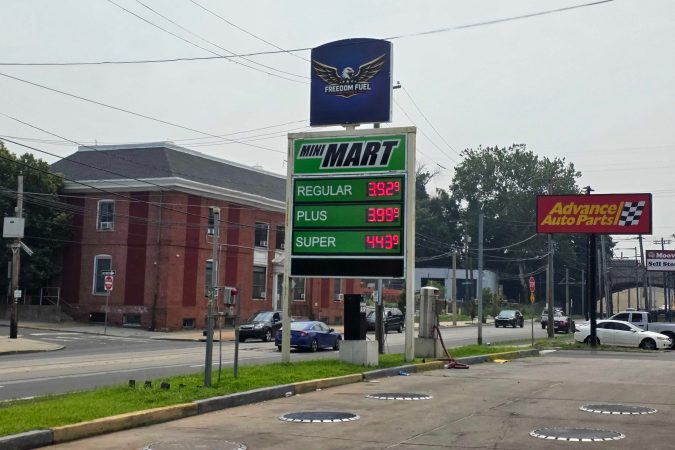
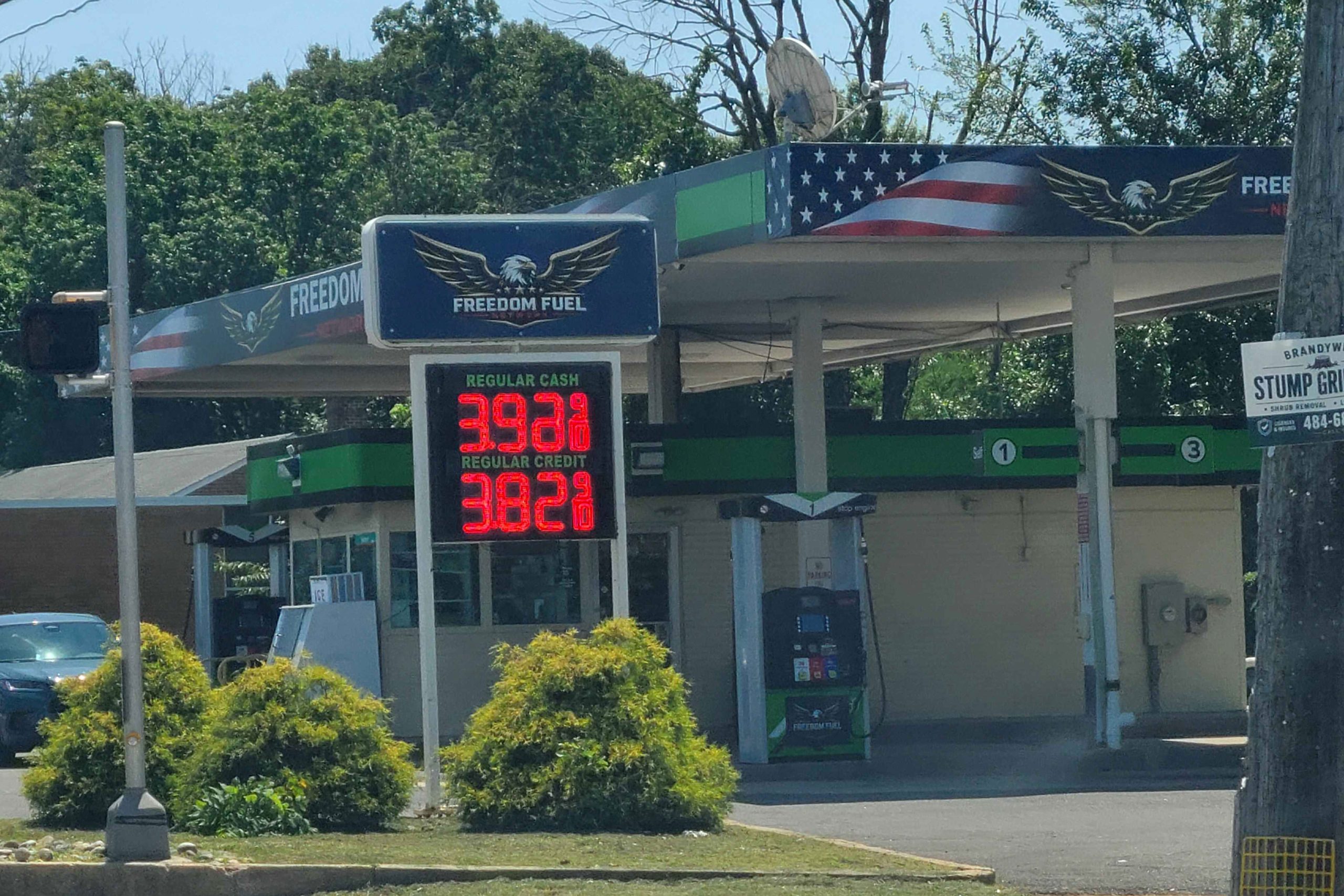
    The Inquirer visited seven Freedom Fuel locations over several days, and while all were still selling gas cheaper than nearby competitors, the deep discounts from earlier were gone.

    Gas prices are up everywhere, including the Freedom Fuel Network station on Edgemont Avenue in Brookhaven, Delaware County.Rob Tornoe /

    Three Philadelphia gas stations and two Delaware County locations were among those within the network selling gas at $3.92 a gallon Monday. Near Philadelphia’s Freedom Fuel stations, competitors were charging $3.89 to $4.09 for a gallon of gas. The same was true in South Jersey, where Freedom Fuel stations in Marlton and West Berlin were selling gas around 10 cents a gallon less than their nearby competitors.

    (function(){function e(){window.addEventListener(`message`,function(e){if(e.data[`datawrapper-height`]!==void 0){var t=document.querySelectorAll(`iframe`);for(var n in e.data[`datawrapper-height`])for(var r=0,i;i=t[r];r++)if(i.contentWindow===e.source){var a=e.data[`datawrapper-height`][n]+`px`;i.style.height=a}}})}e()})();

    Selling gasoline is a low-margin business, with owners making just “a few pennies” of profit per gallon sold, according to Eliezer Fich, a finance professor at Drexel University’s LeBow College of Business.

    “They can sustain those losses for a little while, but it becomes unsustainable if you can’t offset that with a convenience store or a car wash,” said Fich.

    Several Freedom Fuel stations visited by Inquirer reporters were small, appeared somewhat rundown, and offered a limited selection of products beyond gas. One location had an inoperable convenience store.

    Fich doesn’t know the specifics of Freedom Fuel. He said independent stations banding together can offer purchasing power with refineries, which can be one route to securing lower fuel costs. But those savings wouldn’t come close to supporting the deep discounts the stations were offering.

    Despite the White House’s involvement in promoting Freedom Fuel, a spokesperson said the company received no government subsidies and did not obtain fuel at a lower cost. The below-market prices would exist “for as long as the company chooses,” the spokesperson said.

    If that’s the case, the business itself was already absorbing dramatic losses before the United States resumed attacks on Iran, leading to a jump in gas prices over the past week.

    The average cost of a gallon of fuel in Philadelphia was $4.17 a gallon Monday, up from $3.95 a gallon last week, according to AAA. Nationally, the average cost of a gallon of gas also jumped back to $4 a gallon, up from $3.14 a gallon compared to last year.

    While questions remain, Freedom Fuel plans to expand

    Little is known about who is taking on the likely losses expected from the promotion.

    Former Evesham Township mayor, Baltimore Ravens assistant coach, and self-proclaimed “proud Trump supporter” Randy Brown, along with former commodities trader Yoni Gontownik, both signed the certificate of formation, first obtained by The Newsground, an investigative news outlet. Neither could be reached for comment.

    Cherry Hill developer Shamikh Kazmi and his brother Syed Kazmi are linked to at least six locations. The brothers, who have been embroiled in at least two lawsuits related to previous gas station ventures, also could not be reached for comment.

    One of Shamikh Kazmi’s businesses was sued as a result of a lengthy trademark dispute with BP America Inc. and BP Products North America Inc. in 2021. That case ended with four deputies with the U.S. Marshals Service seized remaining brand signs in June 2022, according to court documents.

    Also in 2021, the brothers were accused by Petroleum Marketing Group Inc, a fuel distribution company, of stealing thousands of gallons of gas from the company. Petroleum Marketing Group sued the brothers, who were ordered by a federal judge in February to pay $600,000.

    The company has yet to receive payment.

    Still, the people behind Freedom Fuel are looking at expansion.

    “Since launch, drivers have flooded us with one request: bring Freedom Fuel Network to my area,” read the website Monday. “We heard you. Due to overwhelming demand for additional locations, we’re expanding to serve more communities with lower prices at the pump.”

    The website did not give a timeline for when those additional stations could come online and did not respond to a request for comment.

    The Associated Press contributed to this article.

  • Paramount Skydance’s $110B merger with Warner Bros. Discovery paused by judge

    Paramount Skydance’s $110B merger with Warner Bros. Discovery paused by judge

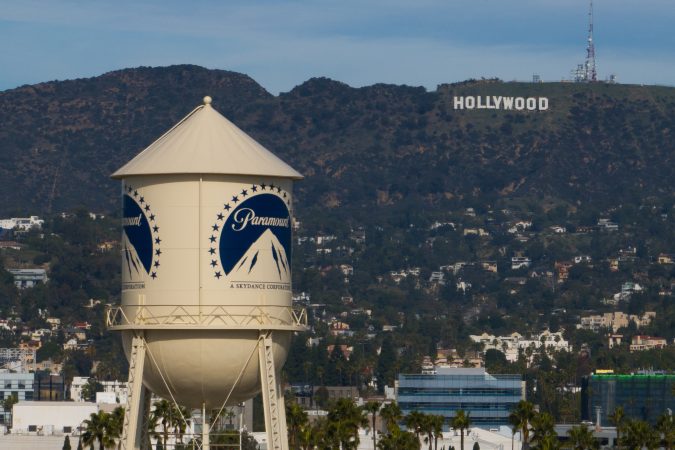
    A federal judge on Monday paused Paramount Skydance’s $110 billion merger with Warner Bros. Discovery — a deal that has promised to reshape Hollywood and the TV news industry — in response to an antitrust lawsuit brought by 12 Democratic state attorneys general last week.

    U.S. District Judge Araceli Martínez-Olguín granted the states’ request for a temporary restraining order, finding that they raised serious questions about the anticompetitive nature of the deal.

    If the merger closes, it would combine the Paramount and Warner Bros. studios, the TV giants CNN and CBS, and streaming services HBO Max and Paramount+.

    In a statement after the ruling, California Attorney General Rob Bonta called the decision a “critical first win in our case to ensure this megamerger never sees the light of day.” California is the lead plaintiff in the case.

    “History tells the tale of what happens when a few people have great power over markets that are central to Americans’ lives: fewer opportunities for more people, worse products and services for all people,” he said.

    Paramount Skydance said in a statement that it is “confident the evidence will demonstrate that the State AGs’ antitrust arguments are without merit as their alleged markets and claims of anticompetitive effects are without any basis in modern market realities.”

    “This merger is lawful, pro-competitive, and will benefit consumers, creators, workers, and the entertainment industry,” the statement added. “We will continue to vigorously defend the transaction and will look forward to the hearings on the substance of the State AGs’ action.”

    The emergency ruling, pausing the merger for 14 days, comes after a Friday hearing in which California’s attorneys presented their case for the first time. The judge asked the parties to reconvene in court on Aug. 3, when she will consider motions for a longer-lasting preliminary injunction.

    The states aren’t the only parties trying to get courts to stop the deal.

    A group of consumers has sued in federal district court in Northern California, as has the Writers Guild of America, the union representing Hollywood screenwriters and many journalists.

    A shareholder lawsuit was separately filed in Delaware’s state chancery court.

    British regulators, too, are considering efforts to intervene, although it’s unclear whether they could fully block the deal.

    The deal would put David Ellison — son of billionaire Oracle founder Larry Ellison, an ally of President Donald Trump — in charge of one of the most powerful companies in American media.

  • Wall Street drifts as AI stocks hold steadier after last week’s losses

    Wall Street drifts as AI stocks hold steadier after last week’s losses

    NEW YORK — Wall Street drifted to a quiet finish Monday after stocks of chipmakers and other winners of the artificial-intelligence boom trimmed some of their recent losses.

    The S&P 500 dipped 0.2%, coming off its first losing week in the last three and just its third since the end of March. The Dow Jones Industrial Average dropped 307 points, or 0.6%, and the Nasdaq composite was basically flat after slipping by less than 0.1%.

    Nvidia added 0.2% and held firmer following its drop on Friday, when it was the heaviest weight on the S&P 500. Sandisk climbed 2.7% after tumbling 29% last week.

    Advanced Micro Devices rose 1.6% after announcing an expanded partnership where Microsoft will use its products for AI, including its new Helios product starting in the second half of the year.

    Such stocks have been under pressure for weeks on worries that their prices shot too high in the euphoria around AI. On one hand, companies are making billions of dollars in revenue as customers pour money into AI chips and data centers. But all that spending may fizzle out if AI doesn’t produce as much profit and productivity as promised.

    Wall Street may get some hints on that soon as some of the biggest spenders on AI report their latest quarterly results. On Wednesday, Alphabet will tell investors how much it made during the spring and give updates on its AI efforts.

    All kinds of companies are under pressure to report strong growth in profit for the spring. They will need to in order to justify the big moves their stock prices have made. Indexes are near their records, even with the recent shakiness for AI stocks.

    AMC Entertainment jumped 26.8% after the movie-theater operator reported stronger revenue for the latest quarter than analysts expected. It also said some of its theaters in Los Angeles and other cities ran “The Odyssey” for more than 85 straight hours from Thursday through Sunday to meet demand.

    Domino’s Pizza climbed 2.1% after delivering stronger revenue for the spring than expected. CEO Russell Weiner said the company saw growth in orders for both its carryout and delivery businesses, even with the broad industry continuing “to face pressure on consumer demand.”

    Another restaurant chain, Jersey Mike’s, is beginning its roadshow to raise interest in its stock, which it’s planning to sell on the New York Stock Exchange for between $21 and $25 per share in an initial public offering.

    It and other businesses are facing pressure in selling to U.S. households feeling crunched by still-high inflation, thanks in large part to high gasoline prices. The average cost for a gallon of gasoline in the United States has gotten back above $4 because of higher crude oil prices.

    After dropping below $72 early this month, roughly back to where it was before the war with Iran began, the price for a barrel of Brent crude has been jumping recently as fighting continues in the Middle East.

    On Monday, the price swung between roughly $86 and $91 before settling at $89.22, up 1.3%.

    The war with Iran is keeping oil tankers from using the Strait of Hormuz to deliver crude from the Persian Gulf to customers, which pushes up oil’s price. S&P Global counted only 127 vessels crossing the strait during the week through Sunday, down nearly 50% from the week before.

    Worries about expensive oil and high inflation have sent Treasury yields higher in the bond market, which threaten to slow the economy and undercut prices for stocks and other investments.

    The yield on the 10-year Treasury climbed to 4.59% from 4.55% late Friday and from just 3.97% before the war with Iran. Higher yields have already sent the average 30-year mortgage rate to its highest level in nearly a year.

    The higher yields weighed on the broad U.S. stock market, and the majority of stocks fell on Wall Street.

    A 3.8% drop for Warner Bros. Discovery also helped erase a gain for the S&P 500 early in the day. A federal judge ordered it and Paramount to halt their $81 billion merger for at least two weeks, allowing states that are challenging the deal more time to see their case through in court.

    All told, the S&P 500 fell 14.41 points to 7,443.28. The Dow Jones Industrial Average dropped 307.16 to 51,839.26, and the Nasdaq composite slipped 12.17 to 25,508.07.

    In stock markets abroad, indexes ended mixed in Europe.

    The moves were sharper in Asia, where South Korea’s Kospi fell 4.5%. It’s been at the center of the huge swings for AI stocks because it’s dominated by two tech companies, Samsung Electronics and SK Hynix.

    Stocks were stronger in China, where indexes rose 2.4% in Hong Kong and 0.9% in Shanghai.

    AP Business Writers Chan Ho-him and Matt Ott contributed to this report.

  • Citizens Bank says it has ended lending to private prison companies used by ICE

    Citizens Bank says it has ended lending to private prison companies used by ICE

    Citizens Bank no longer funds two private-prison companies that house people detained by federal immigration services, the company said in a statement on its investor page Friday.

    The federal government has purchased some facilities it had been using from private prison operator CoreCivic and plans to buy some from the GEO Group, so those companies no longer need as much capital, according to the bank. Citizens now finds it “appropriate to exit” those lending relationships, the bank said.

    Citizens, based in Rhode Island, has the largest bank branch network in the Philadelphia area, according to FDIC data, and ranks among the dozen largest U.S. commercial banks.

    Opponents of the facilities have asked for “assurances in writing” from Citizens Bank that the GEO Group and CoreCivic relationships are over, said Peyton Fleming, a spokesperson for De-ICE Coalition, which organized protests against the bank.

    Earlier this month, CoreCivic announced the sale of two prisons in California to the U.S. for $1.5 billion.

    Protests against Avelo Airlines’ role in transporting deportees for immigration agencies ended last winter after ICE purchased its own airplanes.

    A billboard near the Route 420 exit of I-95 North in Delaware County pressuring Citizens Bank to stop funding private prison operators who housed deportees for federal agencies.Indivisible Highlands

    De-ICE in a statement Friday called Citizens’ decision “an important victory for the people who refused to let a major bank finance human suffering brought on by ICE detention activities of the current federal administration.”

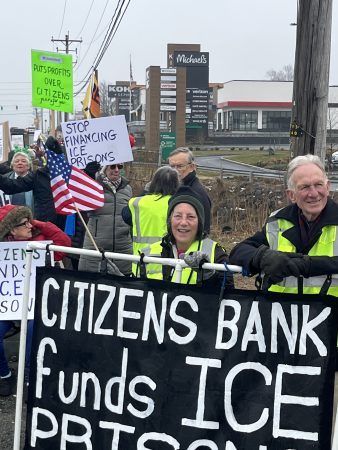
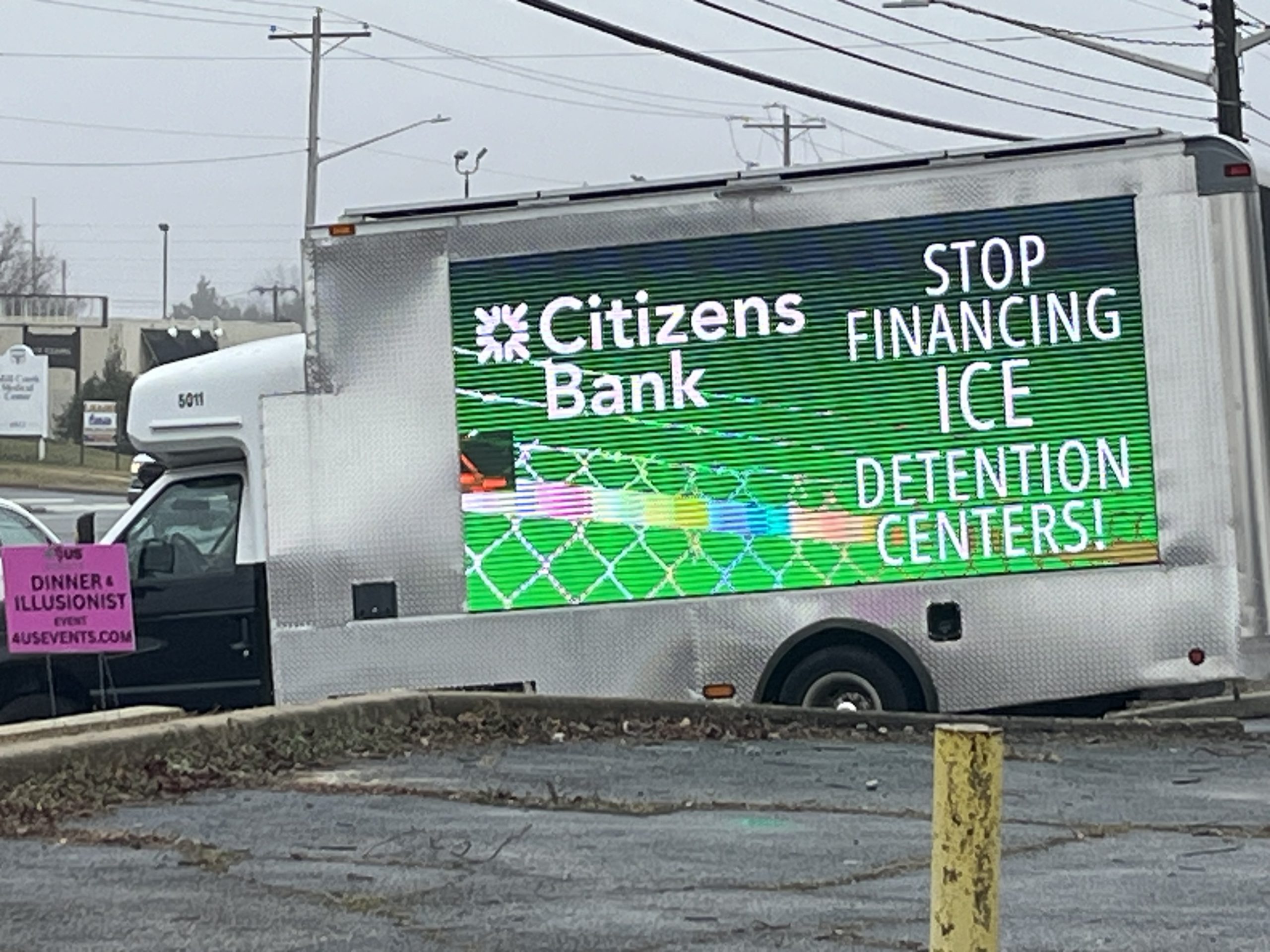
    De-ICE backers sponsored signs, trucks, a billboard on northbound I-95 near the Route 420 exit, a flyover banner before the Major League All-Star Game, and pickets in the region urging Citizens to drop the prisons. The group took credit for the decision, said Debbie Travers, a healthcare consultant and a leader of Indivisible Highlands and Beyond, a Wilmington-based group opposed to aggressive worker and family deportations.

    Citizens, one of the few big banks to finance private prison companies, also was targeted in New Jersey and other states by local ordinance proposals urging towns to withdraw public accounts from Citizens. Jersey City and Montclair voted earlier this summer to withdraw more than $300 million in total from Citizens, according to NJ.com.

    This truck, adorned with illuminated signs urging “Citizens Bank Stop Financing ICE Detention Centers,” was parked near a Citizens branch in Delaware as part of a national protest March 5. Organizers said they visited 68 branches, including several in the Philadelphia area.Joseph DiStefano

    In its statement, Citizens said that due to privacy concerns, it hadn’t previously commented on its relationships with private prison owners and U.S. Immigration and Customers Enforcement detention center operators CoreCivic, which Citizens had served since 2011, and the GEO Group, which Citizens has financed since 2018.

    Activists, including Philadelphia and Delaware chapters of Indivisible, complained that Citizens funding enabled the GEO Group, of Boca Raton, Fla., to operate the Moshannon Valley Processing Center in central Pennsylvania, Delaney Hall in New Jersey, and more than a dozen ICE prisons where conditions have been criticized. CoreCivic, of Brentwood, Tenn., ran the Elizabeth Detention Center in New Jersey, among others.

    Protest organizers, including local branches of Indivisible, said they had marched outside at least 70 of Citizens’ 988 full-service branches, including locations in Center City and Northwest Philadelphia last winter and spring.

    The bank said it has been “disappointed that the activists have dragged it into what is largely a political matter” and complained they mischaracterized the bank as anti-immigrant, pointing to its record of funding agencies that serve immigrants and other nonprofit support.

    Citizens also said bank regulators don’t allow them “to deny banking services to individuals and to lawful businesses based on political or religious considerations, a practice referred to as ‘debanking.’”

    The federal Office of the Comptroller of the Currency, a bank regulatory agency in the Treasury Department, is reviewing banks and has threatened to punish them for politically motivated debanking, citing private prison operators, gun makers, and oil companies among the industries the administration wants to protect.

    Banks “must consider these regulatory and contractual frameworks in making decisions on who to bank or not bank,” Citizens said. “Fair access to bank funding should be something all should agree with. Political concerns should be addressed through political channels.”

    De-ICE spokesperson Fleming said group members believe “public conscience and community resistance” helped change the policy, adding that “doing some good does not cancel out the harm caused by these business relationships.”

    In 2019, eight large U.S. banks including JPMorgan Chase & Co. and Citibank agreed to stop funding private-prison operators.

    In 2024, Citizens’ banking arm agreed to lead a group of lenders raising $1.3 billion for the GEO Group, which operates 82 prisons for state and federal agencies, some of which house immigration detainees.

    Last year, Citizens led a group of lenders, mostly smaller Southern banks, in raising $500 million for CoreCivic, to pay down debt and “for general corporate purposes.”

  • Traffic closures near Amtrak station on I-76 West and Market Street begin this week

    Traffic closures near Amtrak station on I-76 West and Market Street begin this week

    Drivers should expect backups and delays near Amtrak’s 30th Street Station as the Pennsylvania Department of Transportation carries out roadwork nearby in the coming month.

    Starting Monday and through Thursday, PennDot will close I-76 West traffic between the 30th Street and I-676 interchanges from 9 p.m. to 5 a.m.

    Drivers are advised to take the 30th Street exit on I-76 West and use Schuylkill Avenue to access I-676 East or return to I-76 West.

    Between July 20 and Aug. 20, the middle lane on Market Street between 30th Street and Schuylkill Avenue will also be closed. Drivers will be able to use two lanes of traffic in either direction on that stretch during the closure.

    The work being carried out in the next month will prepare for the demolition and reconstruction of the Market Street bridge above the Schuylkill River, which is expected to begin in late August. Detours will be announced closer to that date.

    The construction work is part of PennDot’s $148.9 million project for bridge rehabilitation in the area, which includes improvements to the Walnut Street bridge over the Schuylkill.

    Construction began in March 2025 and is expected to end in April 2029. The majority of the project is federally funded, with the remaining 20% coming from the state.

  • US gas prices hit an average of $4 a gallon again as the US and Iran launch attacks

    US gas prices hit an average of $4 a gallon again as the US and Iran launch attacks

    NEW YORK — U.S. gas prices jumped to an average of $4 a gallon again Monday as the U.S. and Iran launched more attacks.

    According to motor club federation AAA, the national average for a gallon of regular gasoline is now back to $4. The average price a year ago was $3.14 a gallon.

    The price is a national average, meaning drivers in some states have been paying well over $4 a gallon for a while now, while others pay less. Prices vary between states due to factors ranging from nearby supply to differing tax rates.

    People around the world are also dealing with high gas prices as a result of the war.

    Gas prices first went over $4 a gallon on average at the end of March. They dipped below that in mid-June and continued to fall as crude oil prices eased when the U.S. and Iran reached an interim deal. Even then, President Donald Trump expressed frustration that gas prices weren’t falling as quickly as oil prices.

    Affordability is likely to be a key issue for voters in the U.S. midterm elections, and higher gas and oil prices can help push up prices for groceries and other goods.

    Oil prices have climbed again in recent days as the U.S. and Iran move closer to resuming an all-out war.

    Brent crude, the international standard, rose 3.2% to $90.95 per barrel Monday and benchmark U.S. crude climbed 2.8% to $84.04 per barrel.

  • The federal government typically left gambling to the states — until the prediction markets

    The federal government typically left gambling to the states — until the prediction markets

    Prediction markets are rewriting the rules of American gambling.

    These platforms have taken the country by storm, enabling users to stake money on the outcome of real-world events — everything from who will win a baseball game to the location of Taylor Swift’s wedding.

    For users, prediction markets operate almost indistinguishably from online betting platforms. However, they are technically investment sites. As such, they are not constrained by state and tribal gaming law. They are available in all 50 states — even those with no gambling — and the prediction market companies pay no state taxes.

    States have been fighting back. Twenty-six states are engaged in active litigation against prediction market companies, and several have passed increasingly creative laws attempting to restrict or remove them. Yet, most of these attempts have been thwarted by the Commodities Futures Trading Commission (CFTC), the federal regulator that oversees prediction markets. The Commission insists that, as investment platforms, companies like Kalshi and Polymarket need not concern themselves with state regulation.

    The CFTC position reverses over a century of precedent in terms of how the federal government approached gambling policy. Throughout American history, gambling has generally been treated as a state issue. Where the federal government has intervened, it has been to protect states from gambling — even if doing so meant protecting states from themselves.

    But the current CFTC has flipped this equation. A federal agency is doing its utmost to effectively nationalize gambling, leaving states powerless to control what has historically been under their domain.

    The first federal foray into national gambling policy came in response to an interstate lottery scheme.

    In the 1700s, lottery tickets were almost as easy to find in the U.S. as they are today. “Every part of the United States abounds in lotteries” a Boston newspaper observed in 1791.

    Around the turn of the 19th century, however, the public soured on lotteries. A surge of religious fervor brought with it a wave of anti-gambling furor. By the late 1870s, only a single state licensed a lottery: Louisiana.

    The Bayou State did not just run any lottery. The state government licensed its operation to an entity known as the Louisiana State Lottery Company, better known as “the Serpent” or “the Golden Octopus.” It came by these monikers honestly.

    The LSLC was notoriously corrupt, having slithered its way to political invulnerability through bribes to state officials. The lottery, which nominally existed to raise money for a children’s hospital, actually lined the pockets of its proprietors on the back of $28 million in sales in 1890 alone (modern equivalent: $1.02 billion).

    The Golden Octopus nickname was fitting for another reason: the Louisiana lottery’s tentacles reached well beyond the state’s borders. Operating through the U.S. mail, the LSLC sold roughly 90% of its tickets to residents of other states. The Golden Octopus filled the market void for people without other access to legal lottery tickets, becoming a de facto national lottery.

    This created an uproar because other states were powerless to do anything to stem the tide of lottery tickets into their states. The Louisiana legislature was beyond their control, and it was impractical to crack down on every dreamer clutching a ticket or every piece of mail with a Louisiana return address.

    In late 1890, President Benjamin Harrison condemned how the mail system overflowed with “fraudulent and demoralizing appeals and literature emanating from the lottery companies.”

    The only body truly capable of slaying the Golden Octopus was Congress. It did so with bills in 1890 and 1895 that prohibited the mailing and interstate transportation of lottery tickets, advertisements or paraphernalia.

    States could decide the question of lotteries for themselves, but other states could not decide the question for them. Congress overrode Louisiana’s state gambling law to protect gambling laws in the 43 other states.

    The anti-lottery bills set a clear precedent — one that would be replicated almost exactly a century later, when congressional involvement in gambling even more clearly overrode state authority.

    Made By History sponsors. FOR USE ON MADE BY HISTORY STORIES ONLY.Inquirer Staff

    In the 1960s, states once again began operating lotteries. By the late 1980s, as states experimented with new lottery games, a few began considering sports pools. These were games in which players could attempt to predict the outcome of between three and 14 football or basketball games, with the payout dependent on the amount put up both by the bettor and by all other players.

    The only trouble was that, to the professional sports leagues, these games represented a dangerous wedge that could open the door to legalized sports betting. At the time, the leagues were deeply opposed to all things gambling, viewing any association between it and their product as a threat to the integrity of American sports.

    The leagues mobilized in multiple states to attempt to stamp out sports pools. But by going to Congress, they could pull the weeds out by the root. In 1992, Congress obliged, passing the Professional and Amateur Sports Protection Act (PASPA). The bill did not ban gambling. Rather, it banned states from legalizing sports gambling, leaving a few exceptions for states that had already authorized a form of betting, most notably Nevada.

    Anyone who has watched a sporting event in the last eight years knows that PASPA did not last. In 2018, the Supreme Court overturned the bill on the grounds that, according to Justice Samuel A. Alito Jr.’s majority opinion, Congress had usurped state authority as enshrined in the Tenth Amendment: “A more direct affront to state sovereignty is not easy to imagine.”

    Congress could regulate sports gambling. But in creating a patchwork set of rules that banned states from deciding the issue for themselves, it had gone too far in asserting authority over states’ rights. The decision has led to an explosion in online sports betting, with the major sports leagues now embracing gambling and integrating it into their telecasts.

    A few years after legal sports betting took off, prediction markets endeavored to broaden the base of gambling options. Though the Biden administration tried to restrict them, the Trump White House has taken a different approach, authorizing the platforms to expand their offerings from bets on political events like elections to sports, pop culture and seemingly every imaginable topic. It has done so with the direct support of President Donald Trump, whose son, Donald Trump Jr. has financial stakes in both Kalshi and Polymarket.

    For some states, the federal government has once again gone too far on gambling, this time in the opposite direction. Instead of prohibiting states from legalizing gambling, the CFTC has created a national system of de facto gambling in contravention of state and tribal gambling law.

    One direct result is that while most states set the legal gambling age at 21, investment platforms are available to anyone over the age of 18, meaning the CFTC has effectively lowered the national age to legally bet.

    The current CFTC rules are even more vulnerable than PASPA was. Because they’re regulations, not laws, a change in presidential administrations — and by extension, the leadership of the CFTC — could lead to an overhaul of the Commission’s approach to prediction markets. Additionally, passage of any one of the bipartisan bills that have been proposed in Congress to rein in prediction markets could swiftly constrain the experiment in federally-mandated gambling.

    As history shows, gambling law is not forever. States have generally been left to decide for themselves how much gambling they want to offer, with the federal government setting a limit as it sees fit. Odds are that arrangement could return.

    Jonathan D. Cohen leads gambling policy for the American Institute for Boys and Men. He is the author of Losing Big: America’s Reckless Bet on Sports Gambling. Made by History takes readers beyond the headlines with articles written and edited by professional historians. Opinions expressed do not necessarily reflect the views of The Inquirer.

  • Nursing homes got more Medicaid money out of Pennsylvania’s new budget

    Nursing homes got more Medicaid money out of Pennsylvania’s new budget

    Pennsylvania’s new budget has two significant changes for nursing homes.

    In a long-sought victory for the nursing-home industry, lawmakers altered how the Medicaid long-term care budget is set, increasing the state’s share of nursing home funding by $162 million next year.

    Lawmakers also amended the formula used to calculate whether nursing homes are complying with a 2022 law that required them to devote 70% of their expenses to resident care. The changes will make it easier to comply.

    Change to 20-year-old Medicaid funding rule

    For two decades, Pennsylvania Medicaid has paid nursing homes less than their audited costs, according to Michael Jacobs, CEO of the Pennsylvania Health Care Association, a trade group for nursing homes and other long-term care providers.

    In 2005, when lawmakers decided they could only afford to pay nursing homes 95% of their costs, the measure was supposed to be temporary. But 20 years later, what was called the “budget adjustment factor” remains in place. The gap between funding and audited costs grew to 20% from 5%, Jacobs said.

    This year, lawmakers agreed to raise the factor from 80% to 86% of costs and guarantee that it won’t drop below that level for two years.

    “It’s a monumental victory for long-term care to get predictability and stability by putting in a floor,” Jacobs said.

    That translates to a $162 million increase in state funding next year. (The change takes effect Jan. 1, because that’s when the fiscal years for Medicaid insurers begins.)

    The floor on the budget adjustment factor “provides much-needed resources and stability to help nursing homes recruit and retain the experienced caregivers residents depend on,” Matt Yarnell, president of SEIU Healthcare Pennsylvania, said in an email.

    “Now it’s critical that nursing home operators put these additional resources where they belong: into the quality of care for residents and into the frontline workforce,” said Yarnell, whose union represents thousands of nursing home workers.

    Including a federal match of more than $200 million, nursing homes are expected to see a roughly $20 to $25 per day increase for residents with Medicaid, Jacobs said. He did not provide a percentage for the total state and federal increase.

    Current minimum daily Medicaid rates range from $236.56 for Burgh Care Center in Pittsburgh to $573.92 for Fox Subacute in South Philadelphia, which specializes in caring for patients who need ventilators to breathe, according to state data.

    A new formula for calculating 70% rule

    In 2022, Pennsylvania became the fourth state to require nursing homes to devote a specific percentage of expenditures to resident care. Pennsylvania’s law set the threshold at 70%, with fines for nursing homes that didn’t comply.

    When the state Department of Human Services began evaluating nursing homes under the new law, the analysis resulted in what the agency described last year as “distorted” penalties that it considered “inconsistent” with the intent of the law, known as Act 54 of 2022.

    The agency found a lack of consistency in how nursing homes were reporting expenses. Some facilities, “mistakenly reported items that would be considered costs for resident care and services as administrative operating costs,” making it seem like they owed big fines, the agency said.

    The original formula for overall costs also included things over which the nursing home operators had no control. Examples are property taxes, a nursing-home assessment, and depreciation. These items elevated total costs, making it harder for nursing homes to comply with the 70% rule.

    The new law excludes those items from total expenses. Rent, which is often paid to related parties and has been found to be inflated in some cases, remains part of total costs.

    One expense — excess administrative costs — was added to the new formula. That figure frequently topped $1 million per nursing home last year, according the cost report data.

    Jacobs welcomed the formula changes, saying the industry was particularly interested in removing nursing home assessments and property taxes from total costs.

    “We’re happy to be held accountable for the dollars that are being paid to the facilities and making sure they go where they need to be,” he said.