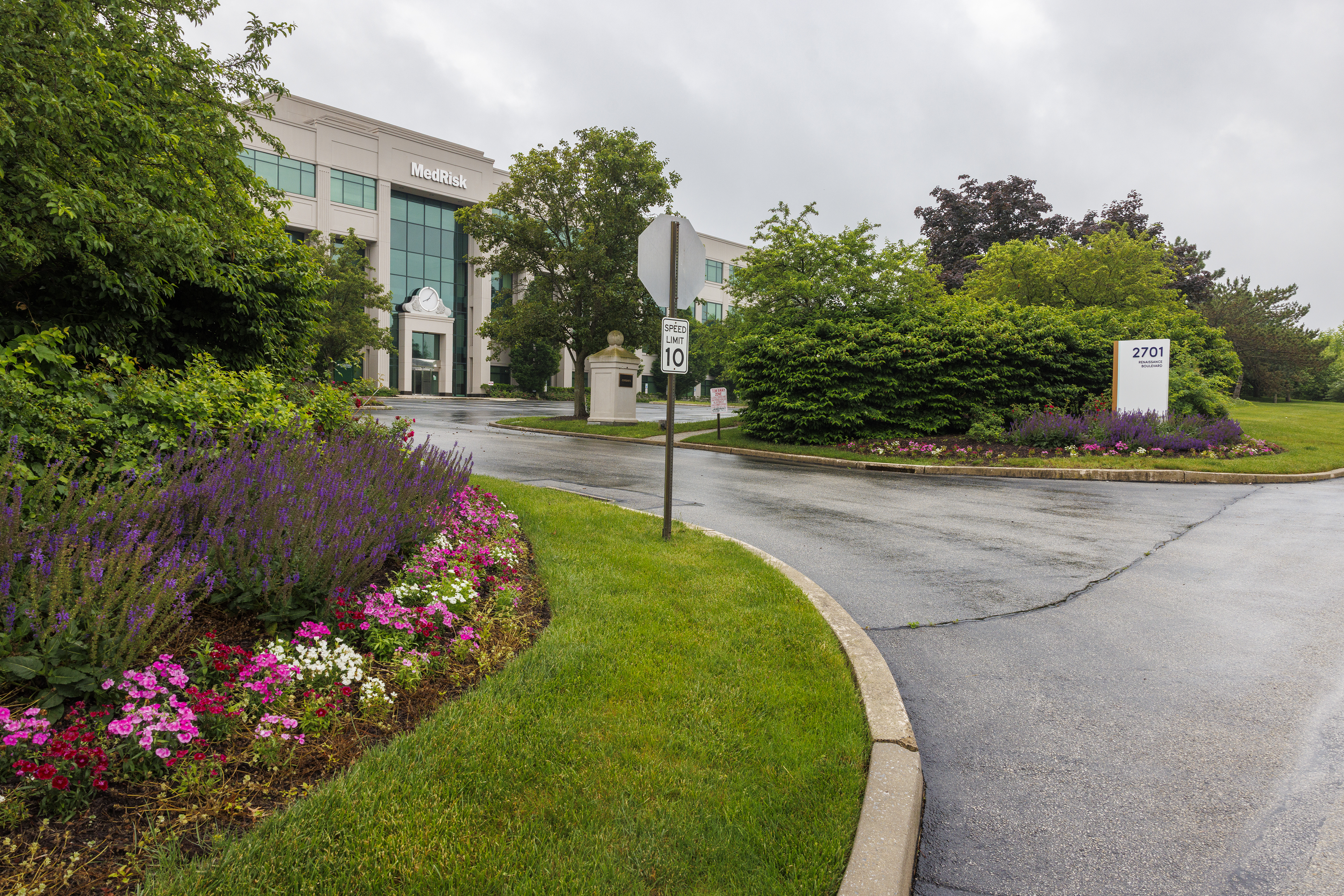
A Main Line developer looking to build multiple data centers in Montgomery County possibly could have more time to make his case for a five-property campus near King of Prussia.
And residents who oppose the projects — who had been preparing for a potential vote on the plans this week — now may wait to learn whether the complex will be built in their neighborhood.
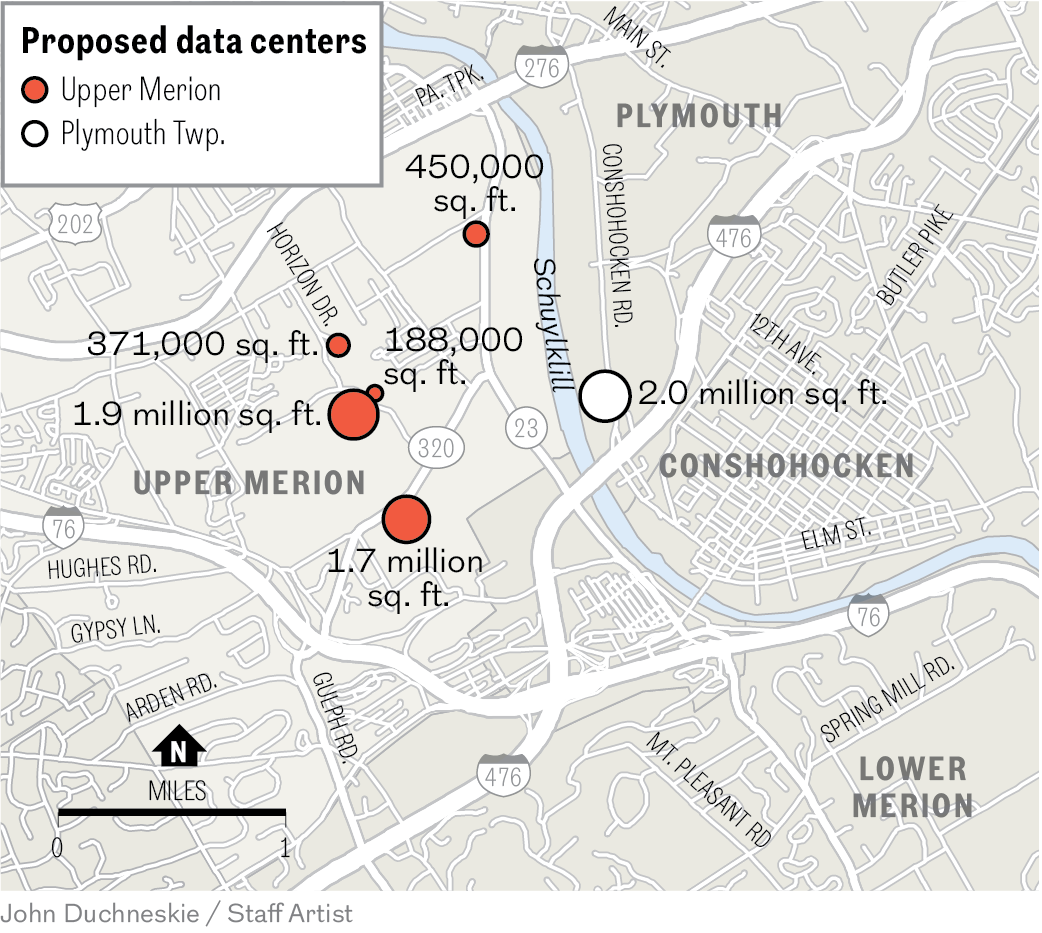
A Montgomery County Court of Common Pleas Judge on Wednesday temporarily prohibited Upper Merion Township from making decisions about any data centers proposed by Brian O’Neill. The township board of supervisors had been set to vote Thursday on the five proposed data centers totaling 4.6 million square feet.
The developer had asked for an extension from Upper Merion until Sept. 30, saying his team needed more time to respond to dozens of township review letters related to the projects. In emails, O’Neill said township officials made clear they would not allow more time.
“It is clear … that the township’s board of supervisors intends to decline the offer of extension and instead proceed to deny the applications,” O’Neill wrote in the lawsuit.
On Wednesday, the developer had sued Upper Merion Township, its board of supervisors, and its planning commission, saying they violated his legal right to an extension and treated him unfairly during the review process.
The judge’s ruling ordered that township officials halt certain proceedings and not make any decisions about the data center plans until after a court hearing scheduled for next week.
Before the lawsuit, the Upper Merion Township Planning Commission had been scheduled to discuss and make recommendations to the Upper Merion Township Board of Supervisors on two of O’Neill’s five data center plans on Wednesday. The planning commission had previously voted not to recommend approval of O’Neill’s three other proposals.
In a separate meeting on Thursday, the township supervisors had been set to vote on whether to approve the five data center plans.
The proposed data centers in Upper Merion are across the river from another data center O’Neill has proposed near Conshohocken.John Duchneskie
But late Thursday afternoon, Judge Garrett D. Page vacated his Aug. 12 order, paving the way for a potential vote Thursday night on O’Neill’s extension request and his data center plans.
O’Neill’s team had declined to discuss the projects with the planning commission on Wednesday, citing the lawsuit.
“We are not making a presentation tonight consistent with the court’s order,” said Edmund J. Campbell, an attorney for the developer. “I will ask to be excused as I don’t believe my presence is needed, pursuant to the court’s order.”
With Campbell’s exit, the township planning commission had opened the floor to dozens of local residents, all but one of whom was opposed to the projects.
They expressed concerns about light, noise, and sound pollution; water use; the impact on the power grid and electricity prices; mental and physical health impacts; and overall quality of life in the suburb. Some said they were angry with O’Neill and his team, with a few citing a recent 6ABC interview in which O’Neill said opponents wanted to “fight for the sake of the fight” and were against development that was “right for the community.”
Some residents disagreed with those statements.
“Judging by the past five months or so [of] our community standing together in solidarity against these horrific proposals, this is clearly not right for our community,” Upper Merion resident Zachary Davis said Wednesday.
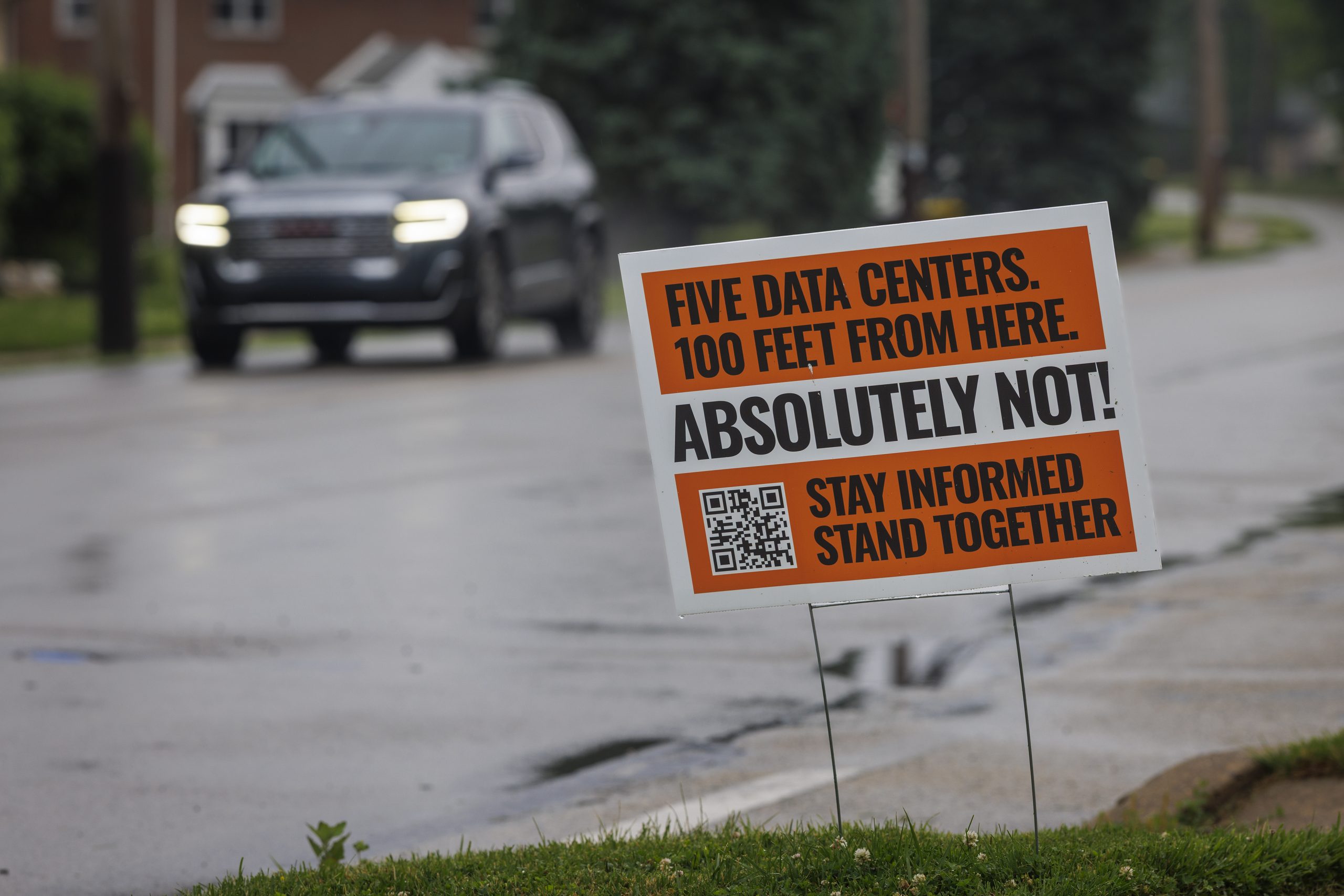
Some King of Prussia residents have put up lawn signs opposing the data centers.Alejandro A. Alvarez / Staff Photographer
The developer has said the data centers would operate on a closed-loop system, requiring no outside water, and provide their own power. They’d emit little light and noise, according to O’Neill, and include billions of dollars worth of emissions controls.
O’Neill’s team last week released an economic impact study that says the Upper Merion centers would result in more than 10,000 jobs during its construction and then generate more than $55 million a year in local tax revenue.
O’Neill’s efforts come as data-center opponents’ ire toward him has intensified.
The animosity was on display last week at a zoning hearing board meeting in nearby Plymouth Township, where O’Neill is trying to build a 2-million-square-foot data center on the outskirts of Conshohocken.
A date has not been set for the next Plymouth Township meeting, though officials indicated it would occur sometime in September.
In Upper Merion, officials said late Wednesday that the monthly board of supervisors business meeting scheduled for 6:30 p.m. Thursday was still on. Other issues, not related to data centers, were on the agenda.
Editor’s Note: This story has been updated after Montgomery County Common Pleas Judge Garrett D. Page late Thursday afternoon vacated his Aug. 12 order.
2026 Volkswagen Jetta GLI Autobahn vs. Hyundai Elantra N vs. Mazda 3 2.5T Premium Plus AWD Hatchback: Let’s have some fun without breaking the bank.
This week: 2026 Hyundai Elantra N
Price: $38,345 as tested; just $500 extra for paint.
What others are saying: “Highs: Sports sedan handling, rip-roaring turbo four, fuel efficient in real-world testing. Lows: The crease-heavy design isn’t for everyone, some dual-clutch clunkiness at low speed, adaptive cruise control isn’t on the menu,” says Car and Driver.
What Hyundai is saying: “Our high-performance sport sedan.”
Reality: Pretty high performance.
What’s new: The front-wheel-drive Elantra continues without much change since its 2024 refreshing.
The Elantra has really grown up in the last few years and is probably bigger if you haven’t checked one out in a few years.
Be aware there’s a high-performance Elantra N like this one and a lesser-tuned N Line.
Competition: In addition to the comparison vehicles, there are the Honda Civic Si, Honda Civic Type R, Toyota GR Corolla, Volkswagen Golf GTI, and Volkswagen Golf R.
Up to speed: Yeehaw! The Elantra N sedan really takes its work seriously, employing its 276-horsepower turbocharged 2.0-liter four-cylinder engine to full effect. There’s a mild turbo lag when pulling out, but the engine will make up for lost time quickly.
The Elantra N gets to 60 mph in a zoomy 4.8 seconds, according to Car and Driver. That dusts the Jetta GLI by almost a second, and the Elantra N didn’t rock and roll under hard acceleration like the Volkswagen did.
Shifty: The Elantra N came in 8-speed automatic form. It features an old-style PRND shifter with upshift and downshift accessed via a snap to the left.
I thought only Mazda and BMW gave us pull-to-upshift anymore, The Way It Should Be, but lo, Hyundai does as well. Sadly, the Elantra N shifter had all the feel of your arm after you sleep on it for about five hours and really wasn’t worth the trouble. Paddles on the steering wheel are also available.
I found shifting overall not worth the bother; the dual-clutch transmission handled the work smoothly, with just enough feel to add some fun when it shifted up or down, especially in Sport mode (which comes with nice sound effects). It holds lower gears a little too long, but I’ve felt worse. Advantage, Elantra N.
On the road: The Elantra N was niiiiiiice on the right roads. I’ve been loath to share my favorite spots in 15 years, but two creekside highways — one in Chester County and one in Berks — featuring plenty of 15 mph curves showed the best parts of the Elantra N. This part of the experience challenges Mazda, Mini, and Volkswagen just fine. It gives the Jetta GLI a run for its money, maybe even besting it.
On highways, though, it hit seams and bumps pretty hard, but overall the Pennsylvania Turnpike was just fine. Here, though, the Jetta shone.
The interior of the 2026 Hyundai Elantra N features a larger screen than the Volkswagen Jetta GLI, but the fabric could be a dealbreaker for pet owners.DREW PHILLIPS
Driver’s Seat: This is a firm one, with tight contours that don’t move for you. In fact, the seat was manually adjusted and lacked ventilation, a nod to the vehicle’s price point. Advantage, Jetta.
The passenger seat gets a cool console grab bar for The Lovely Mrs. to hang on to.
Friends and stuff: The rear seat is perhaps a little firmer than the front, and it features almost as much contour, so woe befalls the loser stuck in the middle.
Legroom and foot room are good, but headroom can be a bit challenging.
The rear seat folds, but only as a single unit. You have to pull both left and right levers from the trunk and then go back to the seat and pull it down. The velour coverings mean pet owners might look for fabric upgrades or a different vehicle altogether.
Cargo space is 14.2 cubic feet, a tenth of a cube bigger than the Jetta GLI.
In and out: We rode off to visit Best Friend 1.0’s 91-year-old mom this week, so the first thing I did was test out entry-exit when the vehicle arrived. She has a 35-year head start on me, but I felt like the seat would be easy enough to access, with a wide door. I’m pleased to report no nonagenarians were harmed in the making of this review, but note that she still drives herself and does her own shopping, so your nonagenarian’s mileage may vary.
Cool looking speakers that resemble giant on-off toggles on your phone are placed in the door, where they make you think they’re door handles at a glance. But no, those are awkwardly down by the armrest. It’s all worth it if the sound system rocks, right?
Play some tunes: Alas, there will be only the standard level of rocking out in the Elantra N. Sound from the system reflects the price point — it’s a B at best. I couldn’t make the songs show off their hidden gems, but everything sounded as it should. The Jetta wins here.
The 10.25-inch touchscreen has more than 2 inches on the Jetta’s, but both are easy enough to navigate. A volume dial is all you get outside of the screen.
Keeping warm and cool: Dials control the temperature and buttons control everything else. Real buttons, too, not touch pad or ebony faux buttons. Advantage Elantra N.
Fuel economy: The vehicle averaged almost 24 mpg over its lifetime, sucking down almost 20% more fuel than the Jetta.
Where it’s built: Ulsan, South Korea. Parts are 85% Korean and 0% U.S. or Canadian.
How it’s built: The Elantra gets a 3 out of 5 reliability rating from Consumer Reports for the 2026 model year.
In the end: The Hyundai Elantra N provides a whole lot of fun for the price, but the Jetta GLI stuffs in so many more creature comforts — leather, ventilated seats, adaptive cruise, and a more everyday-worthy ride — for an even lower price, that’s tough to turn down.
Prescription drug prices recorded the biggest year-over-year drop in more than 60 years in July, a startling reduction experts chalked up to an array of factors, including more generics and discount GLP-1 weight-loss drugs.
While overall costs for medical services continued to rise, prices for medicinal drugs fell 2.7% over the 12 months ending in July, the largest annual drop on record, according to Bureau of Labor Statistics data released Wednesday. Prescription drugs, part of the medicinal drug category, fell by 3.1%, the steepest annual decline since March 1963.
The White House took credit for the good news, saying President Donald Trump’s efforts to slash drug prices were working. Some experts said a Biden-era policy that requires Medicare to negotiate prices for some popular prescription drugs is more likely to be driving down costs.
The drop in prescription drug prices is one of the few bright spots in the U.S. Consumer Price Index, which provides a snapshot of inflation. “Just what the doctor ordered!” Renaissance Macro, an investment research company, posted to X on Wednesday.
Inflation has been running high for more than five years, sparked by the economic disruptions of the coronavirus pandemic and Washington’s response to it. More recently, prices have been rising because of energy pressures fueled by the war with Iran.
Prescription drug prices, on the other hand, have slid sharply over the past six months, Renaissance Macro said, at a seasonally adjusted annual rate of 6.6% — “the sharpest six month drop on record.”
While the results are stark, teasing out the cause is complicated, independent experts said.
President Donald Trump has long pledged to bring down prescription drug prices, and the White House made the case Wednesday that the president’s pricing agreements with drug companies and a new initiative, the direct-to-consumer site TrumpRx, are responsible for the lower prices.
“No president in modern history has been able to drastically reduce prescription drug prices across the board except for President Trump,” White House spokesperson Kush Desai said in an email. “This is a direct result of the President’s willingness to push the envelope with bold policies that actually put Americans and America First.”
White House officials pointed particularly to the costs of GLP-1 weight-loss drugs, which Trump calls the “fat drug.” TrumpRx, which launched earlier this year, offers GLP-1 drugs for as low as $150 for a starting dose. And under a Medicare pilot program that the administration launched in July, drugmakers Novo Nordisk and Eli Lilly agreed to charge the government just $245 a month for their products, Wegovy, Zepbound, and Foundayo.
Monthly prices charged to insurance companies previously had topped $1,000. Trump and the drug companies began negotiating last year and announced the rough outlines of the deals in November.
“In a matter of months, we got up and running these discounts in a way that they were meaningful for American patients,” said a White House official, speaking on the condition of anonymity because administration staff are not authorized to speak publicly.
But bigger trends in the GLP-1 marketplace were already driving down prices independent of Trump’s negotiations, according to experts on drug pricing. Spotty insurance coverage for Wegovy and Zepbound for weight loss has produced enormous demand for lower consumer prices. And cheaper compounded drugs have posed genuine competition for the brand-name companies, adding even greater downward pressure.
Richard Frank, a senior fellow at the Brookings Institution and a professor emeritus of health economics at Harvard University, said he doubts Trump’s initiatives are behind the drop in drug prices.
“If I was a betting guy on what mattered most, it would be probably stuff around the Inflation Reduction Act,” Frank said, adding that Trump’s efforts “wouldn’t be where I’d place my money.”
The Inflation Reduction Act was a signature accomplishment of former President Joe Biden, a sprawling measure enacted in 2022 that aimed to lower prescription drug prices by requiring Medicare, the federal health program for the elderly, to begin negotiating the prices it pays drugmakers for an array of popular and costly prescription drugs.
The first price reductions took effect at the beginning of this year. Using 2023 prices as a benchmark, the Centers for Medicare and Medicaid Services has estimated taxpayer savings of $6 billion from that first round.
The Trump White House argues that the Inflation Reduction Act gets too much credit for lowering prices, in part because it took four years to take effect.
Stacie Dusetzina, a health policy professor at Vanderbilt University, said the Inflation Reduction Act is a more plausible contributor to the decline in prices than Trump’s initiatives.
While only 10 drugs have had their prices negotiated so far, they are commonly used ones “and their prices would likely be reflected in the prescription drug index,” she said via email. TrumpRx, on the other hand, covers “a limited number of branded drugs,” Dusetzina said, and “aside from GLP1s, they may not be high enough volume to be included.”
Dusetzina said another Trump policy — most-favored-nation pricing, which ties U.S. prices to lower ones paid abroad — could not explain the drop in prices either, “as the models that are supposed to use this form of pricing haven’t even launched.”
The Bureau of Labor Statistics category for prescription drugs does not track what drug companies charge. It tracks how much a pharmacy actually receives when it fills a prescription. That means it includes a customer’s payment at the counter plus whatever is paid by their private insurance or by Medicare Part D, the program that pays for drugs picked up from a pharmacy.
A drop in this index does not necessarily mean drugmakers have cut their prices. It can also reflect insurers and Medicare striking better deals or people switching to cheaper drugs.
Which brings up another, less glamorous source of lower prices: generics. When a brand-name drug loses patent protection, BLS waits about six months, swaps the brand in its sample for the cheaper generic and records the difference as a reduction in price.
A wave of blockbuster drugs lost exclusivity over the past year, and Dusetzina said that could be pushing the index down — “especially if the drugs were commonly filled.”
If you give a computer a task, it’s going to need electricity to perform it. The more difficult the problem, the more resources it requires. This is at the heart of the fight against the data centers behind AI – often an incredibly complex and power-hungry process.
You might think that tech giants that build and use data centers would cover 100% of the costs. However, the knock-on repercussions of this heavy power drain could impact the amount you owe on your Peco bill. Let us explain.
1946
The first “data center”
If you needed help with a calculation 80 years ago, you could use the ENIAC, the first general-purpose computer, built at the University of Pennsylvania.
It was 1,440 times faster than a hand calculator but at a cost: high energy demands. The ENIAC had its own dedicated power lines and consumed 150 kWh of electricity.
2000
Powering search engines
By the mid-2000s, we could solve the same problem at a fraction of the ENIAC’s speed thanks to search engines like Google.
Data centers don’t just power search engines; they also sustain streaming services, social media, and much more. However, workflows are increasingly shifting to use artificial intelligence.
story continues after advertisement
2022
AI in everything, everywhere, all at once
Today, unless you actively opt out, your Google search will likely be augmented by AI. “Historically, you would just get hyperlinks, and then you would have to click through and read the webpages yourself,” said Benjamin Lee, professor of computer science at the University of Pennsylvania and visiting scientist at Google. “In some sense, generative AI is doing the reading for you and trying to anticipate the actual answer you were looking for.”
The average Google Gemini prompt uses about 10 times the energy of a pre-AI Google search. This is partly because AI technology involves complex algorithms that require more computing power, but it’s also because between the 1960s and 2010s the basic building blocks of computer chips were increasingly getting smaller and more power-efficient. Within that timeframe, our computational ability multiplied by sixfold with only a 6% increase in power usage, according to Lee.
But those efficiency gains eventually stalled.
“When AI came along in late 2022, we realized we needed hundreds – or thousands – times more [computational power], and the transistors weren’t keeping up,” Lee said. “The hardware side slowed down, even as the computational demands went up by a lot.”
To put it in perspective, in a single hour, a hyperscale 1,000,000-kW data center running at peak capacity can consume more electricity than every household in Philadelphia combined.
Hyperscale data centers can consume a city’s worth of electricity in an hour
ENIAC
150 Philly households' energy usage
Conventional
Hyperscale
The typical Peco customer uses about 0.94 kW per hour in July.
If all 679,428 households in Philadelphia consumed that amount of electricity …
… it would still be less than a hyperscale 1 million kW facility’s electricity use – the equivalent of over 1 million Philly households.
A report by Wood Mackenzie, an energy research firm, found that utility customers might already be shouldering some of the cost of servicing heavy users of electricity, including data centers. These hyperscale facilities and their projected demand for power could impact all three categories on your bill: generation, transmission, and distribution.
Let’s walk through each one.
Generation
Generation refers to how power stations produce electricity from primary energy sources like fossil fuels, solar, or wind. Pennsylvania generates about 60% of the state’s electricity with natural gas, according to the American Gas Association.
“There's only so much gas in the market and, with data centers coming online, there's increased competition for it,” said Elizabeth Marx, executive director of the Pennsylvania Utility Law Project, a statewide legal aid program representing low-income consumers and protecting their access to affordable energy and water.
story continues after advertisement
Pennsylvania Gov. Josh Shapiro recently proposed that hyperscale data centers supply their own power to reduce the burden on residential customers to pay for infrastructure costs. However, not everyone agrees that it will work.
“Unless they are building clean generation that doesn't rely on and constrain our gas supply, [data centers are] having an impact on the price of gas,” Marx said, “and [that cost] flows into your electricity bills.”
PJM has a capacity market, where utilities – like Peco – pay power plants to guarantee enough power to meet future energy needs. This ensures that enough electricity will be available at high usage and to avoid blackouts.
“The biggest impact that we're seeing already from data centers is on capacity market prices,” Marx said. In 2024, AI companies started shopping around for power purchasing agreements directly with power suppliers.
The increased demand for capacity without greater supply increased the cost of electricity. The capacity price during the 2024/2025 auction was about $46 per MW/day, according to Monitoring Analytics, an independent market monitor for PJM. The following year, it surged to $297 per MW/day.
In a recent quarterly report, Monitoring Analytics said that “large data center loads have already had a significant and irreversible impact on PJM customers.” Between 2016 and 2025, Peco customers saw a $20.46 increase in the supply portion of their bill, which includes generation and transmission.
Peco’s Price to Compare has increased steadily since 2022
6
8
10
12
14 cents
Jun 2022
Jun 2026
JuneJune
Source: Peco’s Price to Compare is what customers pay if they do not shop around for an alternative electricity supplier
Pa. law requires that Peco is not allowed to profit off generation and transmission; you are just paying the rate set at PJM wholesale auctions. “Supply costs are set by the competitive market, are not controlled by Peco, and do not generate a profit for the company,” said Candice Womer, communications manager at Peco.
Distribution
Distribution is the final phase, where electricity moves from a transmission station to your home. It makes up 50% of your electric bill and, unlike the supply side of the electricity equation, can generate a profit for utility companies.
Almost two-thirds of Americans believe that a major reason behind their rising home energy costs is utility companies’ bottom line, according to a recent Pew Research Center survey.
In its second quarterly report of 2025, Peco reported $136 million in adjusted earnings, compared with $93 million in the same period in 2024. The company said in its earnings report that it used the profits to improve distribution infrastructure.
When utility companies invest in the electric grid to ensure it is ready for peak demand or storms, those investments are often baked into distribution costs. “Peco must balance its obligation to serve new customers with the risk of overbuilding infrastructure,” Womer said. “When distribution upgrades are needed, those costs are paid up front by the data center customer through a Contribution in Aid of Construction, ensuring there is no impact to other customers.”
One of the fees baked into distribution charges on your monthly bill is the Universal Service Fund. This helps fund programs like Peco’s Customer Assistance Program that help low-income households afford their utilities. In her testimony before the Pennsylvania House Energy and Consumer Protection, Technology, and Utilities Commission earlier this year, Marx said that in Pennsylvania, “universal service costs are only allocated to residential customers.”
Despite their direct impact on rising costs, data centers pay nothing to support these programs, she said.
“It’s very hard to reduce the electricity you use in a significant way,” said Vik Patel, managing attorney of the energy and utilities unit of Community Legal Services. “If it's cold outside, you need to have the heater on. Otherwise it can be unsafe. [It’s the] same thing in the summer; you have to have access to cooling.”
story continues after advertisement
Even if electricity feels unaffordable, it can be difficult for customers to lower their use and, therefore, their bill. But if customers can’t pay their bill, they risk losing power completely.
Last year, about 25,000 households in Philadelphia had their electricity terminated and could not afford to have it restored, according to Patel. “There are a lot of collateral effects when someone's electricity is terminated,” he said. “They can get evicted. [They can] lose custody of their kids.”
What happens next
Data centers and their projected demands on the grid are not the only reason electric bills are increasing, but that has not lessened some residents’ concern about their expansion.
There are already dozens of conventional data centers in Philadelphia, according to Data Center Map, a private company that tracks such facilities nationwide. Two hyperscale campuses are being built in nearby Bucks County and Cumberland County, N.J.
At least four more data centers have been proposed in Chester and Montgomery Counties. These local proposals face a groundswell of opposition from residents who worry about the environmental and financial ramifications of having these hyperscale facilities in their backyard.
Note: Amazon’s 600,000-kW data center is currently under construction in Falls Township, as is the 300,000-kW hyperscale data center in Vineland.
“I don't deny we need to upgrade our grid,” Marx said. “And, quite frankly, more frequent storms are absolutely going to cause more infrastructure costs. But I think there's a lack of transparency in what's necessary and what is nice to have. Who’s it for? Who pays for it and at what expense?”
Staff Contributors
Reporting: Charmaine Runes
Design and development: Charmaine Runes, Sam Morris
Graphics: John Duchneskie
Illustration: Glenn Harvey
Editing: Sam Morris, Cynthia Henry
Copy Editing: Addam Schwartz
Subscribe to The Philadelphia Inquirer
Our reporting is directly supported by reader subscriptions. If you want more journalism like this story, please subscribe today
Albert James Mamary, 59, of Wynnewood, attending physician and professor of thoracic medicine and surgery at Temple University, researcher, writer, mentor, artist, outdoorsman, craftsman, and amateur bicycling champion, died Thursday, July 9, of cholangiocarcinoma at Temple University Hospital.
A 1999 graduate of Temple’s Lewis Katz School of Medicine, Dr. Mamary spent his career at Temple and affiliated hospitals. He was an expert in pulmonary disease, transplants, and sleep disorders at the Temple Lung Center, and became program director of the Pulmonary and Critical Care Fellowship at Temple Hospital in 2006.
He earned a master’s degree in anthropology at the College of William and Mary in Virginia and his premedical school credits at the University of Pennsylvania. In a tribute, his family said: “His education in both medicine and anthropology reflected a lifelong belief that caring for a patient required understanding not only the disease but the whole person.”
Over more than three decades at Temple — as a student, resident, fellow, professor, and physician — Dr. Mamary treated thousands of patients, mentored hundreds of students and doctors, lectured in classrooms and at seminars, and wrote more than 60 scientific papers and textbook chapters. He was named a top doctor by Philadelphia Magazine several times and was featured in The Inquirer and on 6abc TV for his lead role in a successful double-lung transplant in 2015.
“It’s been 120 to 145 patients, individual patients that we’ve been able to help every year,” Dr. Mamary told CBS News in 2024. “That’s really the aim here, is to add years of life to patients who otherwise wouldn’t have that opportunity.”
Colleagues called Dr. Mamary a “physician’s physician” and noted his “amazing intelligence and clinical acumen” in tributes. Gerard J. Criner, chair of Temple’s Department of Thoracic Medicine and Surgery, said: “His patients loved him not only for his clinical skills but also for the warmth, compassion, and humanity he brought to every encounter.”
A former patient said online: “He was a calm in the storm of my end stage disease. … The world has lost a hero.”
A former student said: “His kindness, thorough and balanced approach to medicine, and quiet, thoughtful approach to even the most stressful emergencies reminded me of a Jedi master.”
Dr. Mamary and his wife, CeilaSue, married in 1996.Courtesy of the family
Away from the hospital, Dr. Mamary liked to bike, hike, and camp. He built his own 18-foot mahogany canoe, walked the entire 272-mile Long Trail in Vermont, and won masters bicycling championship races.
He also painted and sculpted, and earned a bachelor’s degree in art and psychology at Haverford College. He and his wife, CeliaSue, initiated the Shortridge Memorial Park Arboretum in Wynnewood and earned a 2024 community service award from Narberth and Lower Merion officials.
“James brought wisdom, kindness, curiosity, and genuine joy to every moment,” his wife said.
Albert James Mamary was born June 12, 1967, in Hempstead, N.Y. He grew up in Binghamton, N.Y., became an Eagle Scout, and was a wilderness river guide for the Boy Scouts in Maine during his college years.
Dr. Mamary was an avid bicyclist and won masters championship races. Courtesy of the family
He met CeliaSue Jaffe in class at Haverford, and they married in 1996 and had daughters HannahRose and LilyRuth. They lived in East Falls and Wynnewood, and he rode his bike from home to Penn and then Temple as often as he could.
Dr. Mamary enjoyed traveling, baking, cooking, and gardening. “His specialty is fruits and vegetables, and I grow the flowers,” his wife said.
He followed the Phillies, rescued cats and dogs, and doted on his daughters. Everybody said he was funny and silly.
“He was curious and always learning or doing something new,” his daughter LilyRuth said. “He took joy in simple things.” His daughter HannahRose said: “Even if he wasn’t my dad I would want him as a friend because he was so interesting and so easy to talk to.”
Dr. Mamary was a wilderness river guide for the Boy Scouts in Maine during his college years.Courtesy of the family
Dr. Mamary was diagnosed with cholangiocarcinoma, bile duct cancer, in 2020 and treated by longtime colleagues and friends at Temple, some of whom he had mentored. “It was a profound reflection of the life he lived,” his family said, “that so many of those he had taught ultimately became his caregivers.”
His wife said: “He was a very vibrant and adventurous person but so thoughtful, steady, and reliable. James was incredible.”
Gen Z has established a foothold in the workplace, and as these workers become a bigger part of Philadelphia’s workforce, they’re increasingly shaping the economy.
So what do Philadelphia’s Gen Zers think is a good job?
The perhaps unsurprising answer: one that allows advancement opportunities, high pay, and employer-funded healthcare benefits, as well as work-life balance and boundaries. That’s the finding of a new report from the Pew Charitable Trusts.
And for some Gen Zers Pew heard from, pursuing a job in their field means looking beyond Philadelphia. Outside of healthcare, and some opportunities in law and engineering, they say, other desirable industries don’t seem to be hiring much here.
“Understanding their attitudes, their perspectives about work, about what a workplace should be, what their feelings are about work-life balance” is important, said Thomas Ginsberg, author of the report on Gen Z workplace attitudes.
Released Wednesday, the report is based on focus group discussions that took place last year with 54 Philadelphians aged 18 to 29.
They’re skeptical about what’s learned in college and want to build up more hard skills. And they see work as a key to living well, not as the reason to live.
“They’re not at all reticent about working hard,” Ginsberg said. “What they’re doing is questioning what’s the ultimate goal of ‘work hard.’ It’s to have an affordable personal life, in their view.”
But participants in the survey expressed that “jobs today often don’t deliver that,” he said.
“You work hard and you still can’t buy a house,” Ginsberg said. “Those two things are coming together pretty starkly for this group.”
Gen Zers looking outside Philly for good, flexible jobs
Gen Z Philadelphians want flexible work hours and perhaps the freedom to go to the dentist without requesting time off from work.
They want boundaries when they’re off the clock, so they can maintain hobbies and relationships. But they also want some in-office time to learn from colleagues.
“I don’t live to work. I work to live. So there needs to be that distinction between the two,” one participant said.
Much of Philadelphia’s Gen Z population works in healthcare, social assistance, and education services, reflecting the city’s eds and meds focused economy.
Survey participants interested in healthcare jobs said there were plenty to go around. Others looking outside that field said there aren’t enough good job opportunities.
In particular, they said, jobs in tech, finance, and the arts seem more scarce. They said New York and Washington, D.C., seem to have more opportunities in those fields.
And while cost of living and housing seems lower in Philadelphia than in other East Coast cities, jobs here generally pay less, they say.
Still, they like much of what the city offers for nonwork hours, from the social life to the sports, arts, and transportation. SEPTA, PATCO, and NJ Transit attracted some Gen Zers to the area in the first place, the report said.
College builds contacts, not skills, Gen Z says
A little over half of Philadelphia residents between the ages of 25 and 29 had a bachelor’s degree between 2020 and 2024 — a higher share than residents older than them. But Pew found this age group has reservations about whether college provides what they need for career advancement.
“This age group is the highest-educated age group that we can measure … and even so, they’re only marginally positive about the value of college education,” Ginsberg said.
Temple University students on graduation day on May 6.Alejandro A. Alvarez / Staff Photographer
College-educated Philadelphians surveyed said their higher education was valuable for building a professional network, Ginsberg said, but not as much for hard skills. They said they want more training in skills like coding, data analytics, AI, and industry-specific software. Some said they know they will need a graduate degree to advance.
Those without a degree felt they could get those hard skills without college, said Ginsberg, pointing to the availability of specialized programs and microcredentials.
Still, those without an undergraduate degree said that they felt like employers favored potential hires who had gone to college and that they could have benefited from learning soft skills such as public speaking, networking, and interviewing in a college setting.
Gen Z doubts the value of retirement benefits
Ginsberg noted that the Gen Z respondents expressed skepticism about financial institutions and retirement, which he wasn’t expecting. Some said they had purposely forgone their employer’s 401(k) plan or couldn’t afford to set money aside to retire. Some said they felt more confident investing money on their own.
“Gen Z has lived through two economic shocks in this country,” Ginsberg said. They’re also facing record levels of college debt, and high inflation.
“They’re translating that, to some degree, into questioning whether the institutions of our economy actually are doing right by them.”
The U.S. Treasury Department permanently repealed a rule Tuesday that required businesses formed in the United States to report who owns them to federal financial-crimes investigators.
Foreign companies and pooled investment vehicles (such as mutual funds or hedge funds) must still report information about foreign owners. But they will no longer have to identify Americans who help them register to do business in the United States, according to a Treasury Department advisory. And Treasury will delete any information it has already collected about U.S. business owners, the advisory said.
In a statement, Treasury Secretary Scott Bessent said the new rule eliminates “a burdensome reporting requirement for millions of law-abiding business owners without compromising our national security.”
Senate Banking Committee Republicans quickly thanked Treasury for “standing up for job creators.” But Democrats and some national security experts criticized the move, which they said would make it easier for drug cartels, human traffickers and money launderers to use anonymous shell companies to avoid detection.
Richard Nephew, who led anti-corruption efforts at the State Department during the Biden administration, called the move “a terrible decision that opens up the U.S. to financial crime, money laundering and corruption.”
The reporting requirements were implemented in January 2024 during the Biden administration as part of an effort to curb illicit finance. It stemmed from the Corporate Transparency Act, which was included in the National Defense Authorization Act and enacted into law in 2021 after Congress overrode President Donald Trump’s veto. It required U.S. and foreign companies doing business in the country to report information about “beneficial owners” — people who have “substantial control” over the company or own at least 25% of it — to Treasury’s Financial Crimes Enforcement Network (FinCEN).
The CTA was supported by law enforcement officials, the American Bankers Association, and human rights advocates, who said it would combat the corrupt use of anonymous companies, known as shell companies. But it immediately drew fire from the National Small Business Association, which pushed Congress to repeal the act and sued the Treasury Department, arguing that the reporting requirements disproportionately affected small-business owners.
In March 2025, the Trump administration announced that it would temporarily suspend reporting requirements for U.S. businesses and American owners of foreign companies. On Tuesday, Treasury made that decision permanent. In a FAQ on the new rule, Treasury said FinCEN and federal law enforcement agencies have multiple alternative sources of information to prevent domestic companies from engaging in money laundering or financing terrorism that it does not have for foreign companies.
Small Business Administration Administrator Kelly Loeffler praised the decision, writing on social media that it will save American businesses $6.7 billion in compliance costs over the next decade.
Sen. Elizabeth Warren (Massachusetts), the top Democrat on the Senate Banking Committee, called the decision “a gift to cartels, criminals, and U.S. adversaries that exploit shell companies to move millions through our financial system.”
Editor’s note: This article has been updated to correct the background of the implementation of the Corporate Transparency Act.
Cleo Winfield has worked at a warehouse located inside the Packer Avenue Marine Terminal in South Philadelphia for 22 years, stacking bananas and other cargo that are unloaded from ships docked on the Delaware River.
Now his job is at risk.
The warehouse, currently operated by an affiliate of Holt Logistics Corp. and staffed by members of a longshoremen’s union, is expected to be razed to make space on the terminal to stack more shipping containers.
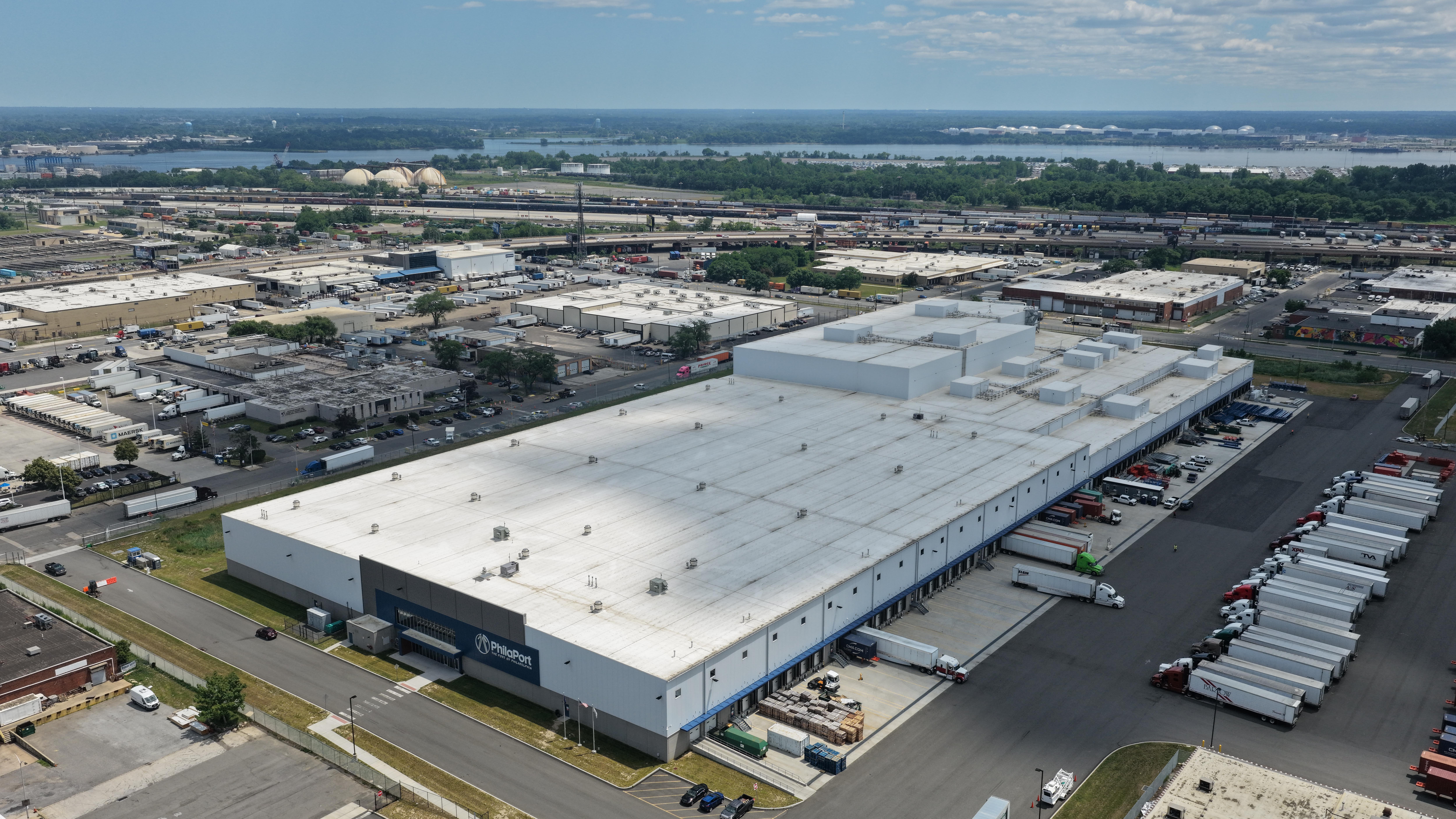
As part of a port development plan, the Philadelphia Regional Port Authority (PhilaPort) — the Pennsylvania state agency that owns the city’s seaport facilities and leases them to private tenants — has built a new taxpayer-funded, Holt-operated warehouse a mile from the Packer Avenue terminal.
Gloucester City-based Holt says it has a deal to staff the new facility with workers represented byTeamsters Local 929. Holt has longshore work available for the members of International Longshoremen’s Association Local 1291, the company says, but it has been unable to reach an agreement with the union. A contract extension expired in June.
The ILA counters that such an arrangement would strip Winfield and 30 other warehouse workers of their seniority — sacrificing wages and benefits they’ve accrued over the years.
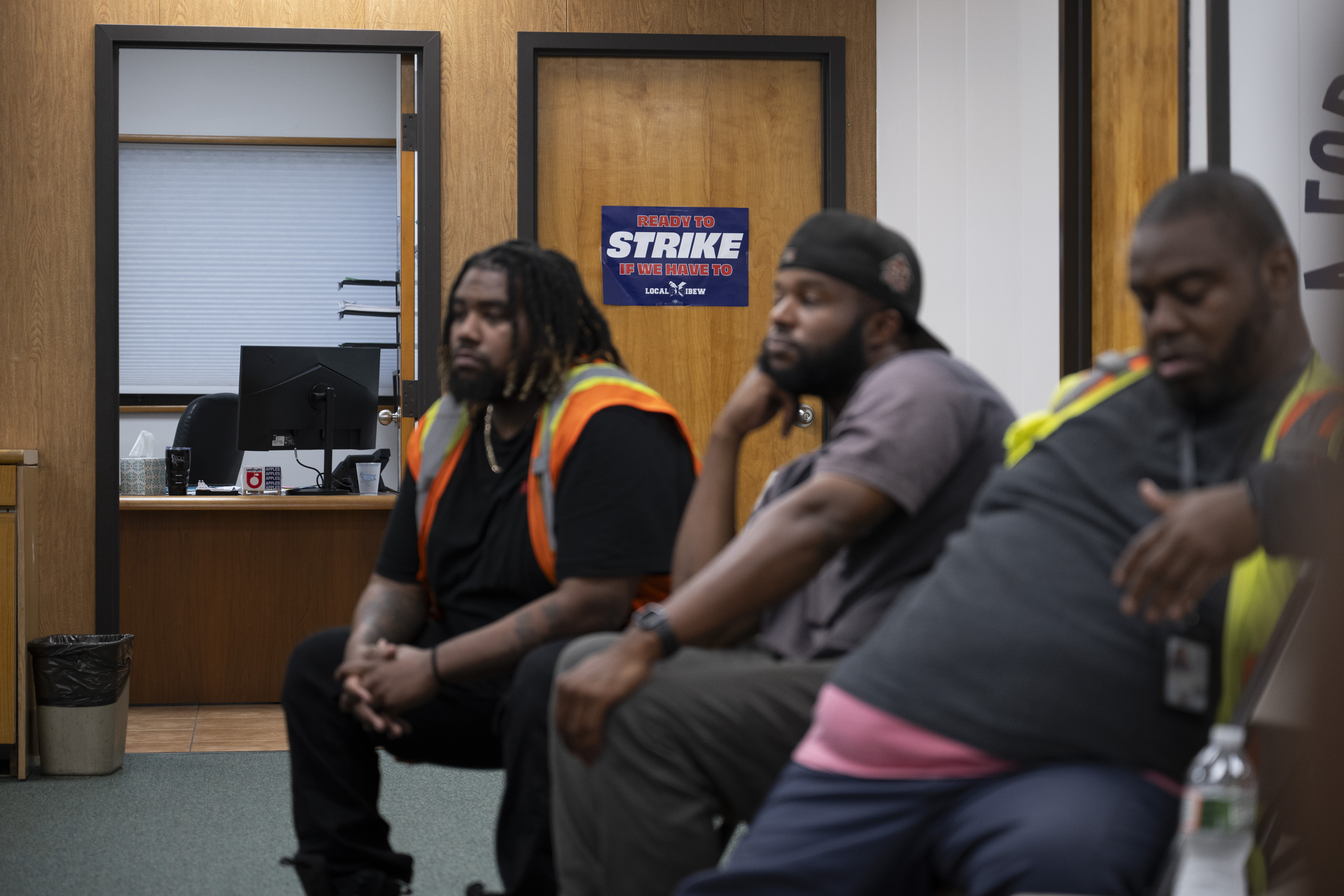
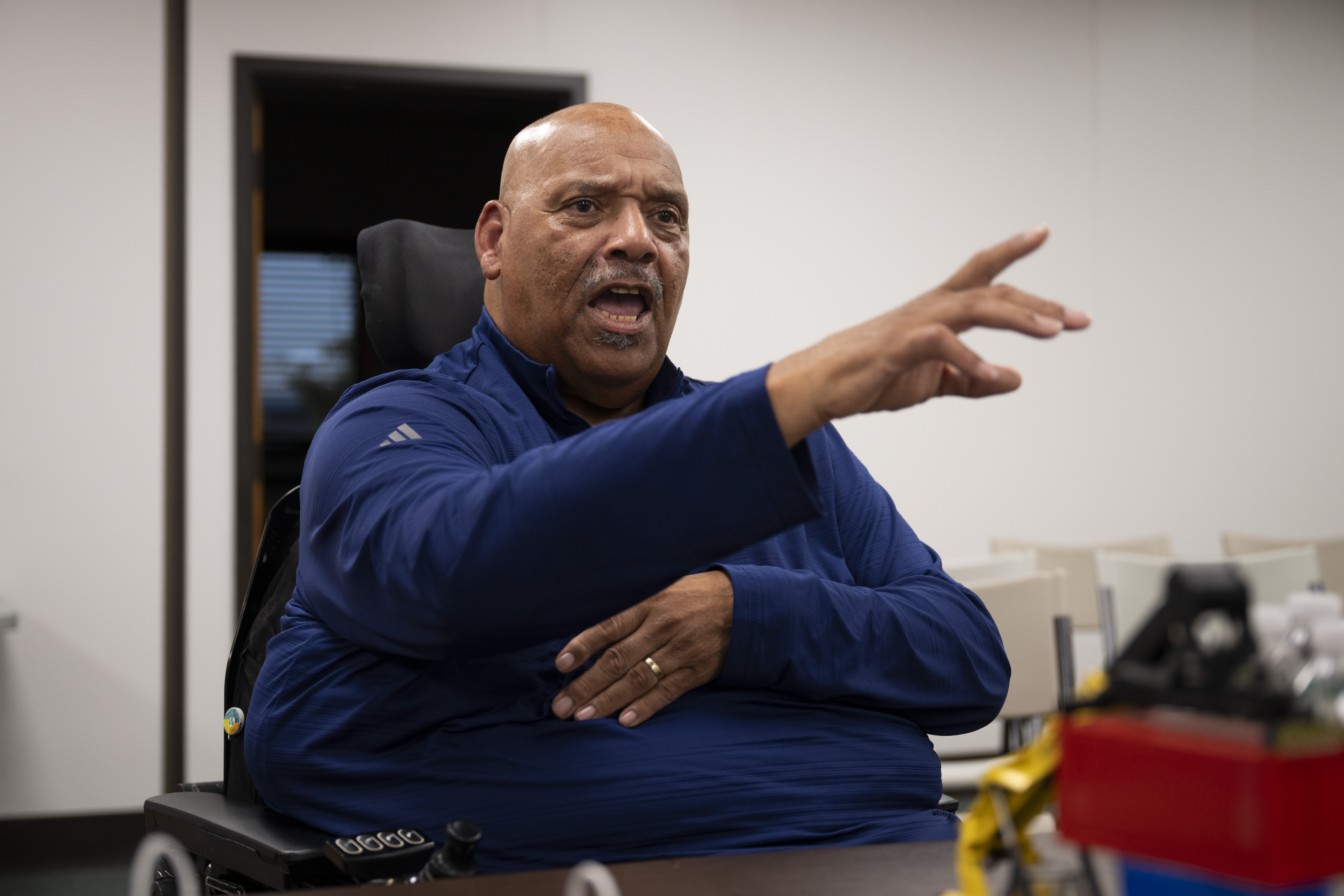
He and the other ILA members who attended Monday’s union meeting in Port Richmond voted unanimously to authorize a potential strike “if and when necessary,” a development that would require approval from their parent organization.
International Longshoremen’s Association Local 1291 members attend a union meeting.Joe Lamberti / For The Inquirer
“Been there so long. That’s really all I know, man,” said Winfield, 57. “Raised my family with that job, put my son through college, man. I’m still paying the student loan on that. … I just want to be able to take care of my family.”
Holt said in a statement that the workers are all “productive and hardworking ILA members.”
“To be clear, there is more than enough terminal and stevedoring work for these men at Packer, and we remain interested in bringing them on if the ILA agrees,” the company said.
Regardless of the outcome, the episode has laid bare growing pains at the Port of Philadelphia, which has seen hundreds of millions of dollars of public and private investment over the past decade — as well as disputes over competition and labor. That includes $85 million in state funds that were allocated to the new 165,500-square-foot warehouse, according to PhilaPort. Holt invested $81 million in the building.
Boise Butler, president of ILA Local 1291, said he wants Holt to be a healthy employer. “But don’t screw them,” he said, motioning to his members. “Don’t screw us. OK? Because it’s not necessary.”
Port development
Philly’s port is relatively small compared to the biggest U.S. container ports, but it’s seen steady growth in recent years and is a major gateway for refrigerated cargo, especially fresh fruit.
Container volumes have more than doubled since 2016, from about 400,000 units that year to almost 900,000 in 2025.
During that time, the U.S. Army Corps of Engineers completed the three-decade-long deepening of the Delaware River from 40 to 45 feet, which allowed the port to accommodate bigger ships.
Leo Holt, president of Holt Logistics Corp., at the the Packer Avenue Marine Terminal in South Philadelphia in April 2025.Tom Gralish / Staff Photographer
And Democratic Gov. Tom Wolf’s administration invested more than $500 million in Philadelphia’s port expansion. That included more than $120 million for a distribution center near Packer Avenue featuring two warehouses totaling 365,000 square feet.
The distribution center “is an important step to improve port facilities and bring more traffic to the port,” Wolf said when construction began on the first warehouse in 2021. Leo Holt, president of family-owned Holt Logistics, said at the time that warehouse space “puts Philadelphia more fully into the last-mile business.”
The PhilaPort Distribution Center in South Philadelphia.Courtesy Holt Logistics Corp.
Teamsters and longshoremen at odds
The warehouses were built at the site of the old Food Distribution Center, a wholesale market that opened in the late 1950s and employed Teamsters for decades.
To Rocky Bryan Jr., that history is important. “We’ve been on that location there since the ’50s,” said Bryan, president of Teamsters Local 929, which represents about 3,000 members in three states.
Rocky Bryan Jr., president of the Teamsters Local 929, pictured in 2022.Tom Gralish / Staff Photographer
The first so-called dry warehouse opened three years ago, and there’s no conflict over that facility. About 15 Teamsters work there, Bryan said. The disagreement revolves around the second, refrigerated warehouse, with both the Teamsters and the longshoremen’s union making claims to the territory.
“To us, it’s all one warehouse. It’s our jurisdiction,” Bryan said, adding that a collective bargaining agreement is already in place. “It’s traditional Teamster work, which is truck driving and warehousing.”
As it happens, the ILA warehouse workers used to belong to the Teamsters but voted to join the longshoremen’s union in 2009, according to the ILA’s Butler.
Butler points to another piece of history. When the Food Distribution Center closed and a new Philadelphia Wholesale Produce Market opened on Essington Avenue near the airport in 2011, the same Teamsters who worked at the old facility continued to work at the new one, he says.
ILA Local 1291 President Boise Butler speaks to his members in Philadelphia.Joe Lamberti / For The Inquirer
The same principle should apply today, Butler says: Some of his members have been working at the Packer Avenue refrigerated warehouse since the late 1990s, and they should be able to “follow their work.”
Butler added, “I knew the Holts was gonna try to turn this into a union against union. I’m not fighting with Rocky.”
Butler — who serves alongside Bryan on PhilaPort’s board — has sought to elevate the dispute to political leaders, writing in an April memo to PhilaPort management and Democratic Gov. Josh Shapiro’s staff that Holt has “refused to commit to hiring” the ILA members.
“In effect, that will mean that taxpayer money was used to subsidize Holt Logistics’ desire to expand its refrigerated warehouse cargo operation, all while ending the careers of 31 warehouse workers in the process,” Butler wrote.
Representatives for PhilaPort and Shapiro’s office declined to comment.
Gov. Josh Shapiro meets with officials of the Teamsters Local 929 as he visits the Packer Avenue Marine Terminal in South Philadelphia in April 2025. Tom Gralish / Staff Photographer
Holt maintains that traditional longshore work is available to the workers. Butler said it’s “not impossible to do that” but added that they would lose their seniority.
That’s because the warehouse workers belong to a separate bargaining unit from the 500 longshoremen in Local 1291 who work the docks at Packer Avenue and other Delaware River ports.
In the final year of the union’s recently expired contract, warehouse workers with at least three years on the job were paid a minimum wage of $30.59 an hour, plus a $4.25 hourly annuity contribution for retirement. It also included provisions for health insurance, overtime pay, and vacation.
“A lot of us put over 20 years here, and a lot of us is at the age where we don’t want to start over,” said Lonnie Boyd, 50, an assistant shop steward who’s worked at the Packer Avenue warehouse since 1998. “We can’t afford to start over.”
WEST PALM BEACH, Florida — As a pink-and-gold sunset faded over the waterside Ben Hotel, Republican state utility officials streamed out of a reception where they had been imbibing with executives from the industries they regulate.
Milling about the coastal glam lobby, one attendee complained about service dogs in the first-class cabin on his flight. A group of men in cowboy hats urged fellow regulators and operatives to join them in continuing the night elsewhere. Another cluster lamented the growing number of local data center bans.
The industry-funded retreat was not meant to be seen. Handouts said reporters and constituents were not welcome. But their name tags identified the attendees moving through the lobby. Among them were utility commissioners — state officials whose decisions impact electricity bills and determine whether utilities can build power plants and transmission lines.
As energy-hungry data centers and rising electricity bills have stoked voters’ anger, some elected but obscure utility commissioners are meeting privately with companies whose fortunes they regulate, according to corporate filings and internal emails reviewed by The Washington Post.
In interviews, commissioners and industry reps said it’s all in the interest of education. But watchdog groups say the industry-funded intermingling is a brazen conflict, as utility and tech companies seek project approvals and elected officials work to keep their seats.
Last month’s all-expenses-paid West Palm Beach retreat was organized by the Regulators Roundtable, an ideologically conservative group whose membership is recruited from the utility industry, tech firms and right-leaning commissioners who tend to support their plans for rapid growth. Major funders have included Google, NRG Energy, the American Gas Association and the Nuclear Energy Institute, according to documents that the Energy and Policy Institute, a utility watchdog, obtained under public records laws and shared with The Post.
“These are companies whose profits are directly affected by decisions made by a remarkably small group of regulators,” said Gabriel Straus, a research fellow at the Energy and Policy Institute. “The last thing you want to hear when you are struggling to make ends meet is your utility commissioner is sipping cocktails at a resort with the utility executives raising your rates.”
The group promises sponsors — several paying $50,000 to be “Inaugural Member Investors” — the chance to “engage directly with these key decision-makers” and provide “insights and expertise that can help steer policy.” Its nonprofit arm flies commissioners to luxury hotels for private meetings with industry representatives, while its political wing contributes directly to campaigns in the 10 states where voters elect these regulators.
The Regulators Roundtable denied any conflicts of interest.
Elizabeth Gianini, the group’s president, said the access promised to corporate sponsors is appropriate, because the organization is private and “no official actions by public service and utility commissioners can nor do occur during programming.” She said the involvement of commissioners in raising money from regulated companies and the lack of public access to the gatherings does not violate any laws.
Gianini declined to provide a full list of companies and trade groups financing the organization. IRS filings show the group is aiming to spend more than $3.7 million over this year and next.
Founded last year by Gianini and a regulator from Georgia, the Regulators Roundtable is intertwined with GOPAC, one of the Republican Party’s oldest political training and recruiting organizations. It shares GOPAC’s offices in suburban Virginia. And a GOPAC “education” fund provides the Roundtable with administrative support and strategic guidance, according to Gianini, who is also a director at GOPAC.
The Roundtable hosts a “campaign school” for commissioners at GOPAC’s headquarters that is aimed at honing their political skills and helping them win reelection.
At the January session, presenters included Americans for Prosperity, the Koch-backed political powerhouse that has helped roll back renewable energy subsidies and climate regulations. Google was there, too, leading a session on using artificial intelligence to improve political communications.
The involvement of Google, long a leader in promoting clean energy, reflects how the politics of electricity are changing as the company seeks more power plants and commissioners willing to approve them.
“Google has been a great supporter from the start of our organization,” Gianini wrote in an email connecting Ed Lodge, an Idaho utilities commissioner and honorary chair of the Roundtable Institute, with Google lobbyist Ron Barnes.
Google is identified in internal emails as a founding sponsor of the Regulators Roundtable, and Barnes serves on the board of the institute, which supports the retreats with industry officials.
Google said in a statement it only funds and participates in the group’s networking and educational activities, adding it “regularly engages with policymakers to share our responsible approach to energy, infrastructure and data center development. Like many in our industry, we collaborate with third parties to facilitate these conversations with officials across the political spectrum.”
The Roundtable’s outreach to prospective donors positions the organization as protecting utility-friendly regulators from “radical climate activists,” consumer advocates and other adversaries eager to tap ratepayer frustration to “shift regulatory control.”
“The need for this group became clear when liberal organizations invested millions to defeat conservative candidates for Corporate Commissioner in Arizona,” Gianini wrote in a March 2025 email to a vice president at Georgia-based electricity giant Southern Company.
Georgia illustrates the political stakes. Voters ousted two long-serving GOP commissioners there last year, after the commission green-lit six rate increases for Southern Company subsidiary Georgia Power in five years. This fall, Republicans risk losing control of the commission for the first time in three decades. Gianini highlighted the risk that “control of Georgia’s Commission could flip entirely” in a recruiting email to a commissioner from another state.
Her email to Southern Company took aim at PowerLines, a nonpartisan utility watchdog that tracks rate increases and helps consumers participate in commission proceedings. It warned that such groups “advocating against conservative commissioners” are investing heavily in commission races and argued that energy companies should help build a political counterweight.
PowerLines officials say it spends no money on races, and the group is focused narrowly on why utility bills are going up.
Big energy companies “don’t want to upset the relationships they are comfortable with,” said Ari Peskoe, an electricity markets scholar at Harvard University who sits on the PowerLines advisory board. “They don’t want fresh voices on these commissions. It is a risk. It is an unknown that jeopardizes their entire business model.”
The Roundtable’s fundraising relies in part on utility commissioners cultivating financial support for the organization from companies they regulate during meetings not typically disclosed to constituents.
Internal emails show Gianini enlisted several commissioners in trying to persuade utilities and industry groups to become “investors.”
“Michele Wheeler from NextEra needs to be impressed!” she wrote to an Oklahoma regulator before a series of meals with prospective Roundtable sponsors on the sidelines of an industry conference in Santa Fe. “I want to be sure she sits next to you and another commissioner that night.”
Gianini continued: “I am getting nervous about the ‘noticing requirements’ every state seems to have their own laws and what it means. Does it make it open to the Public and or Press?”
NextEra, the largest U.S. power utility company, which also touts its commitment to erasing carbon emissions by 2045, did not respond to questions.
Asked about any potential ethical issues raised by elected regulators and industry officials mixing behind closed doors, Lodge, the Idaho utilities commissioner and honorary chair, wrote in an email to The Post that all of the commissioners involved are expected to abide by their state ethics laws.
Tommy Tucker, a North Carolina commissioner who disclosed accepting $2,274 of expenses for the institute’s event in Washington, said critics misunderstand the purpose of the gatherings.
“There is no conflict whatsoever,” he said. “It is educational. You get to meet with other commissioners who are experiencing the same things we are also dealing with data centers.”
He said conversations have also included how to best deploy wind and solar.
But some commissioners have voiced reservations after being courted by the group.
Internal emails show that Alabama Public Service Commissioner Jeremy Oden hesitated over an invitation to a Roundtable gathering in Washington just months before his Republican primary.
Oden had previously signed on to a Roundtable effort to shield regulated utilities — and the state utility commissions — from a White House-ordered review of policies that foster anticompetitive monopolies.
About the Washington event, though, Oden wrote to a political consultant: “I would really like to go to this but don’t know if it is a good idea.”
In the end, he decided against it. “I have never attended one of their events nor phone conversations,” Oden, who lost his reelection bid, said in an email to The Post.
Josh Byrnes, an Iowa utility commissioner, shows up on the internal invite list for another dinner, this one with “potential investor” Southern Company.
Byrnes said he had cut off contact with the Roundtable by then, amid scheduling conflicts and his concerns about its political overtones.
“This is probably something I should not be involved with,” he said in an interview. “People need to do a better job thinking things through when they go to these events. I always ask myself, ‘How would you explain that to a ratepayer?’”
Many utility and tech companies, however, have appeared enthusiastic about supporting and participating in Roundtable events.
NRG, which disclosed its $50,000 donation in corporate filings, said it enlisted with the Regulators Roundtable to “ensure that the perspective of competitive suppliers was represented in discussions.”
The company said in a statement that “NRG regularly engages with regulators, policymakers, and industry stakeholders across the political spectrum to advocate for consumer choice, competitive markets, and reliable, affordable energy.”
It added that it is “not currently active with the organization,” though Roundtable emails suggest its membership won’t lapse until 2027.
Southern Company has not reported donating directly to the Regulators Roundtable, but the company did give $25,000 to GOPAC last year, as that organization’s contributions from utilities soared.
Dominion Energy, Duke Energy and NextEra have also collectively contributed $950,000 to GOPAC since last year. All are seeking regulatory approval for billions of dollars in new power plants, transmission lines and other infrastructure needed to serve surging electricity demand driven by AI data centers — investments expected to generate substantial returns for shareholders.
“We participate in the political process on behalf of our customers and employees,” Dominion said in a statement. “Our contributions are bipartisan and transparent, and we don’t ask the recipients of our campaign contributions for favors.”
Duke did not respond to questions.
GOPAC officials wrote in an email that their support for the Roundtable comes from a separate GOPAC educational fund that does not disclose its donors. They said those donors are not permitted to “earmark” their contributions to be passed through to specific groups or causes. The chief of staff for that GOPAC fund is also identified on tax documents as the Roundtable’s secretary.
Asked about concerns the funding of GOPAC and the Roundtable with regulated industry money creates a conflict, GOPAC responded: “One person’s concern is another’s enthusiasm for a mission of supporting public service and utility commissioners by giving them access to a broad range of perspectives to boost energy reliability, affordability, modernization and innovation.”
“We acknowledge there are those who want to halt production, stop permitting, put on hidden fees, and mandate transitions in their drive to discredit the Regulators Roundtable and Regulators Roundtable Institute,” said the GOPAC statement. “Fortunately, most Americans want their elected and appointed leaders to have a wide-ranging and well-informed understanding of the challenges and opportunities before them.”
The program from a GOPAC energy conference in Nashville last summer offers a glimpse of how it is seeking to influence regulation. Former Trump senior economic adviserSteve Moore pilloried renewable energy incentives and emissions targets, according to a copy of his presentation obtained through a public records request. The documents also show a Texas energy investment firm prepared slides depicting lawmakers who champion aggressive greenhouse gas rules as hapless weaklings getting shoved into a school locker.
On the sidelines, Roundtable donors NRG and the American Gas Association were joined by several state regulators at a Roundtable dinner.
Gas association spokeswoman Emily Ellis said the organization “engages with elected officials and regulators at all levels and across the political spectrum to educate them on energy policy issues.”
The secrecy of the Regulators Roundtable stands in contrast to transparency demands some of its members make of other groups seeking to influence them.
In Louisiana, utility commissioner Eric Skrmetta is leading an effort to require groups involving themselves in regulatory activities to produce sworn affidavits disclosing all the out-of-state donors of any large national organizations that provide financial support. Critics call it an onerous rule aimed at sidelining local nonprofits with layered funding streams.
As drafted, the rule does not appear to apply to activities outside commission proceedings.
So Skrmetta, who did not respond to requests for comment, would not have been required to disclose which donors bankrolled his Regulators Roundtable trip to Washington in January and what was discussed there.
The nearly $600 million in tax-free bond issue meant to finance the sale of South Jersey’s Advantage Behavioral Health failed to attract enough investors last week, leading investment bankers to put the transaction on hold, Bond Buyer reported.
Despite the extremely high investment yield as high as 8.25%, portfolio managers were troubled by the heavy debt load that would have been placed on a company with a short track record and few hard assets backing it up, according to the trade publication.
Representatives of the private equity firm, Connecticut-based Clearview Capital, and QCF Advantage, whose parent company is based in Houston, did not respond to requests for comment Tuesday. Officials at Marlton-based Advantage could not be reached for comment.
Clearview took control of Advantage in April 2025, which means a successful sale would be a quick turnover by private equity standards.
The proposed sale was notable not just because it would have increased Advantage’s debt by 12 times, according to Bloomberg Law, but also because of the structure that would have left Clearview and current executives as owners of a for-profit entity that would manage Advantage.
The proposed sale price was about $520 million, according preliminary bond documents. That price included $80 million being held back to see if Advantage hits profit targets after the sale. The company had $141.6 million in revenue in the 12 months that ended May 31.
Founded in 2017 in Camden County, Advantage also operates in Pennsylvania and six additional states. It offers intensive outpatient therapy through a business called Victory Bay and telehealth services through Harmony Bay. It also operates 17 sober-living houses under its Dignity Hall brand in Blackwood, Laurel Springs, Sicklerville, and several other South Jersey towns.