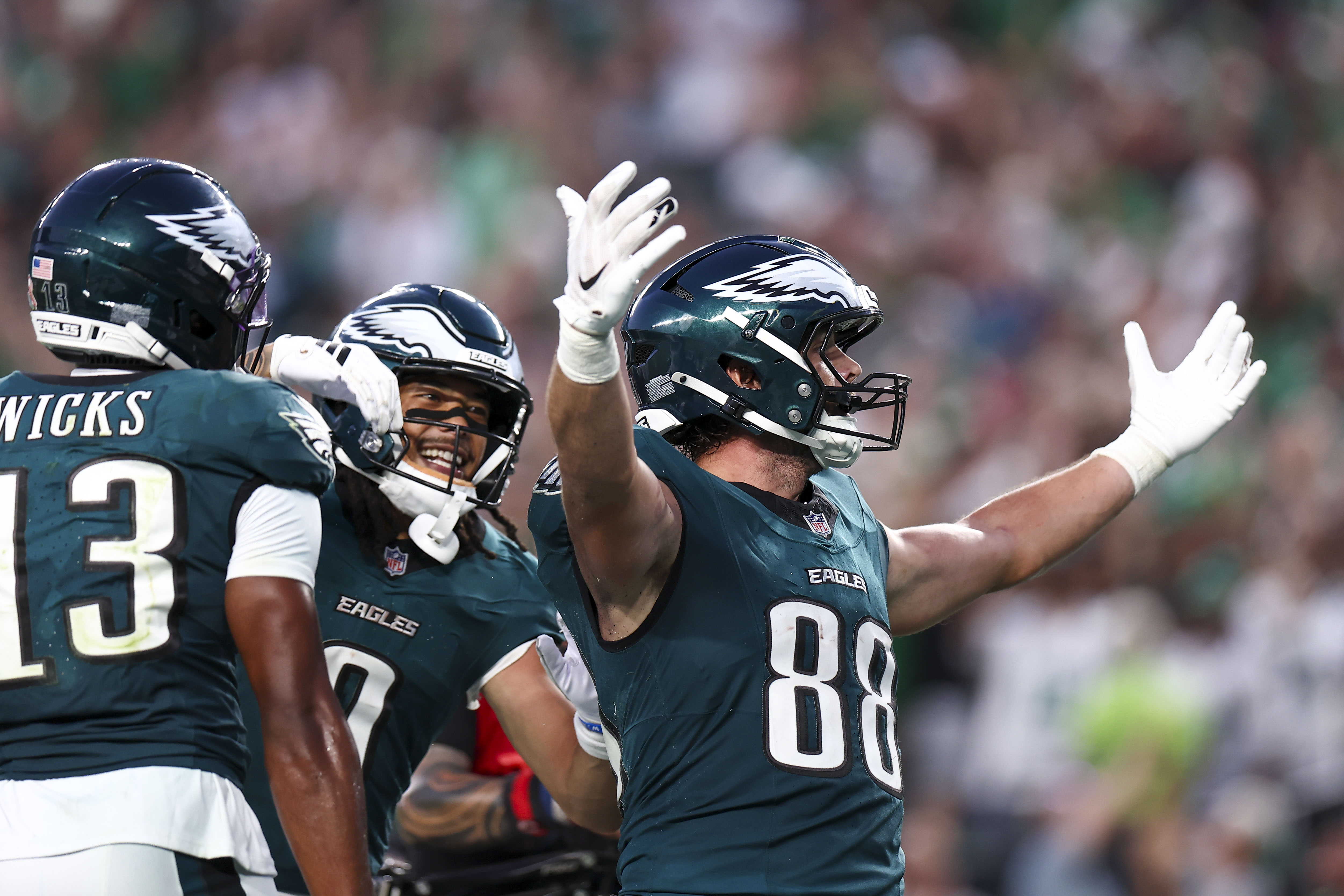
It goes too far to say that the Eagles have been trying to get rid of Dallas Goedert over the last two years, but it is fair to suggest that they’ve been open to other options. They signed him to a one-year contract before last season, then another one-year deal before this one, and those resolutions arrived with the feeling they had settled on him, that they were hesitant to commit to him as they had when he was younger.
This offseason and preseason seemed to bring their own softly tolling bells for Goedert, who will turn 32 in January, and his time here. The Eagles used a second-round pick on a tight end, Eli Stowers — a move strikingly similar to their decision to draft Goedert in the second round of the 2018 draft, when Zach Ertz was in his prime. They signed Johnny Mundt to pick up much of the blocking slack whenever new offensive coordinator Sean Mannion might opt for a two-tight end set. And as Stowers struggled throughout training camp — a slog that culminated with the Eagles’ placing him on injured reserve 24.5 hours before their 24-22 season-opening victory Sunday over the Washington Commanders — Goedert has remained grounded amid the rumors that general manager Howie Roseman might increase the Eagles’ depth at the position by re-signing Ertz.
“Howie’s the GM,” Goedert said just before exiting the Eagles’ locker room Sunday. “Got no control over that.”
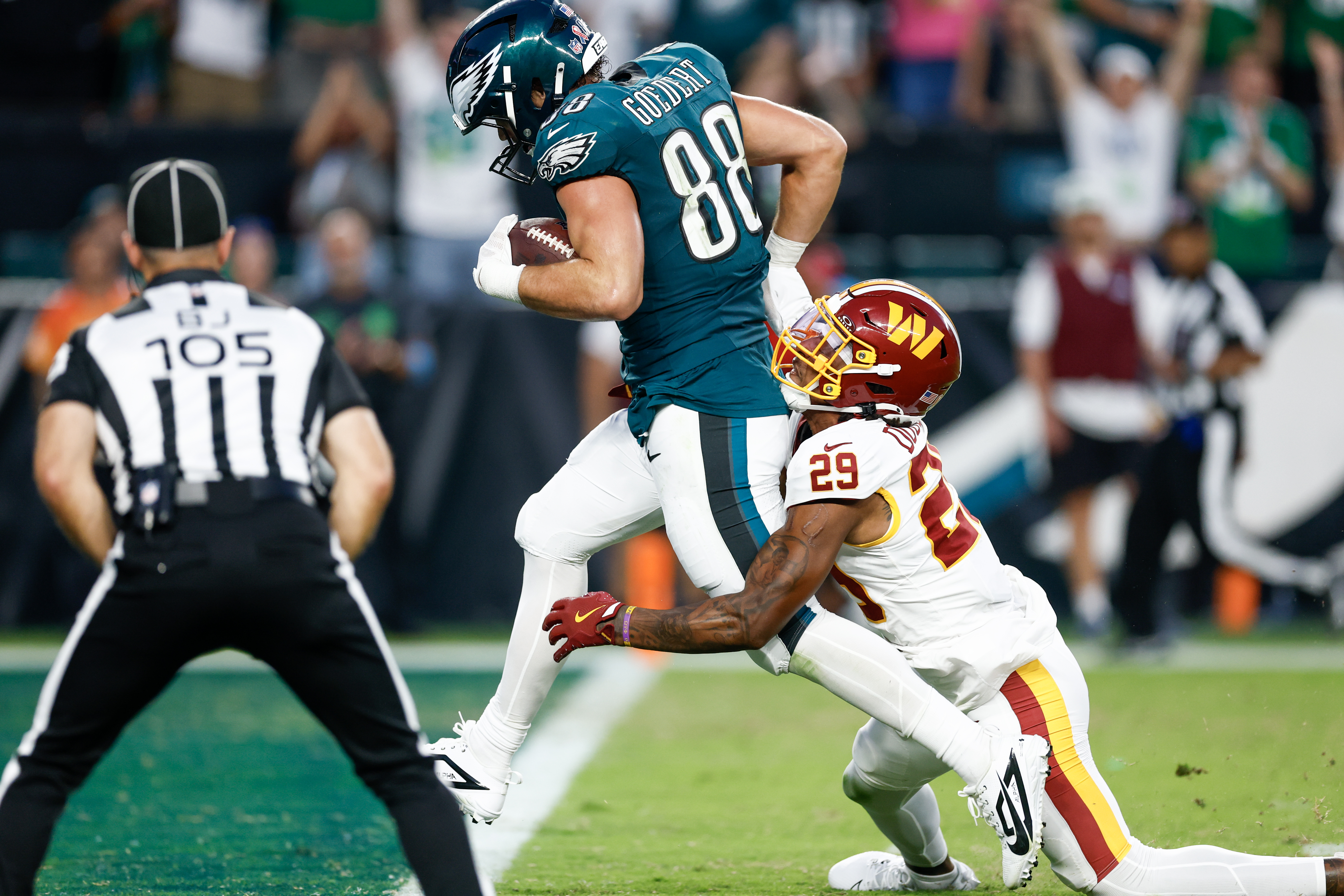
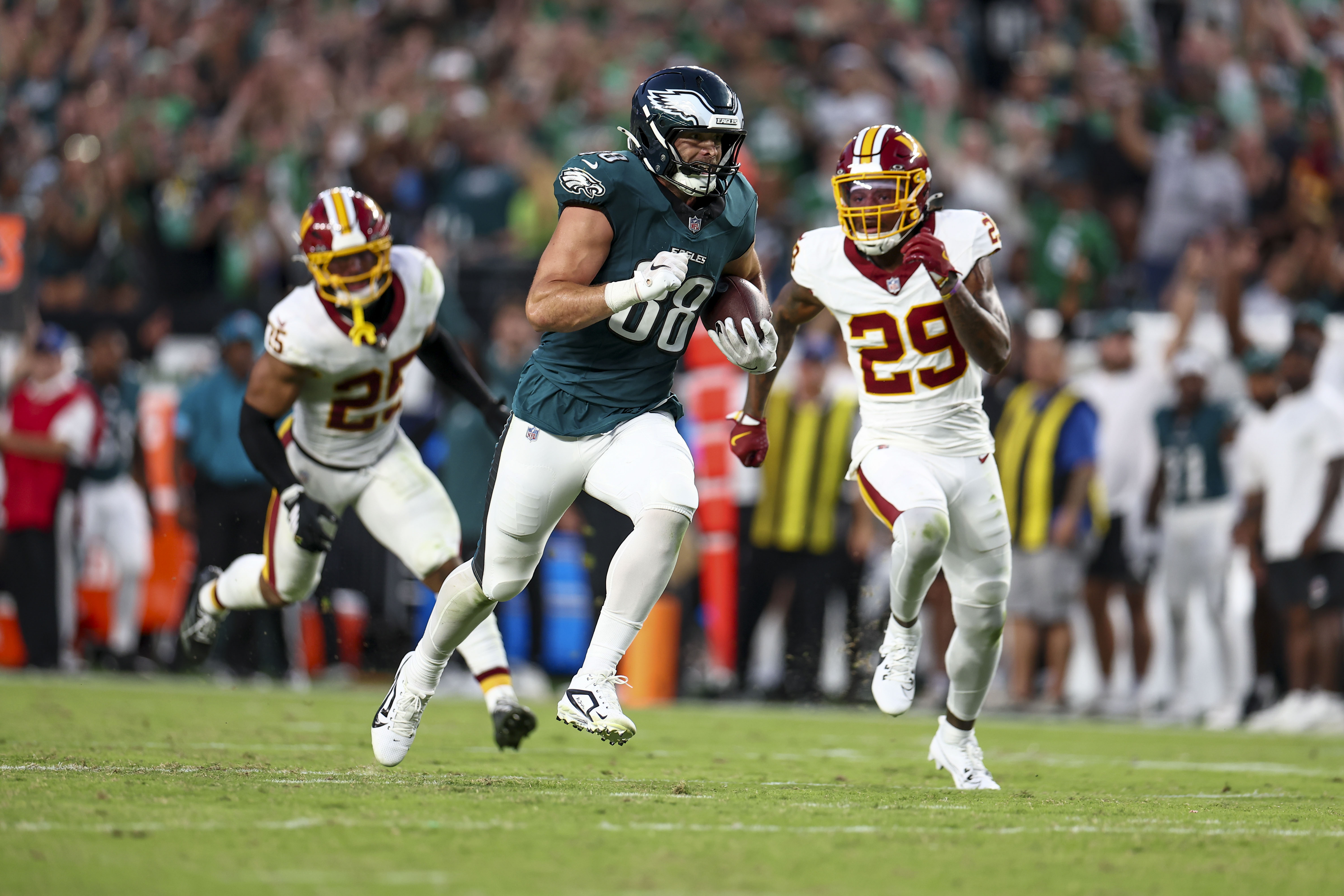
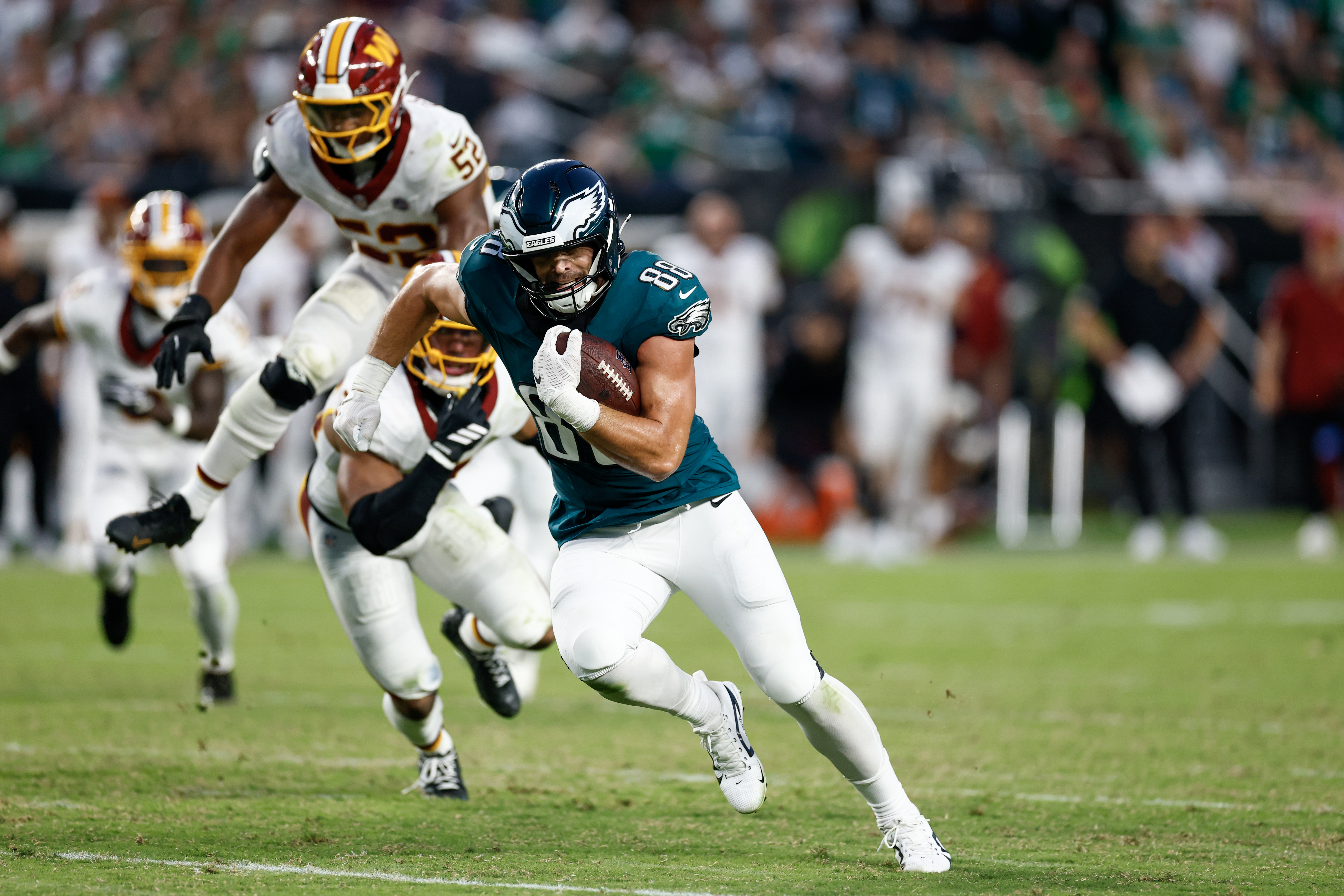
His words were sharp and a bit defensive, and who could blame him? He and Ertz respected each other during their three-plus years as teammates but were not the closest of friends, and no NFL player wants to be told in so many words, and with one possible player acquisition, that he needs help doing his job. Besides, Goedert was just minutes removed from a powerful and productive performance against the Commanders: four receptions, 77 yards, and two touchdown catches that showed he still had the ability to pull off a big play or two.
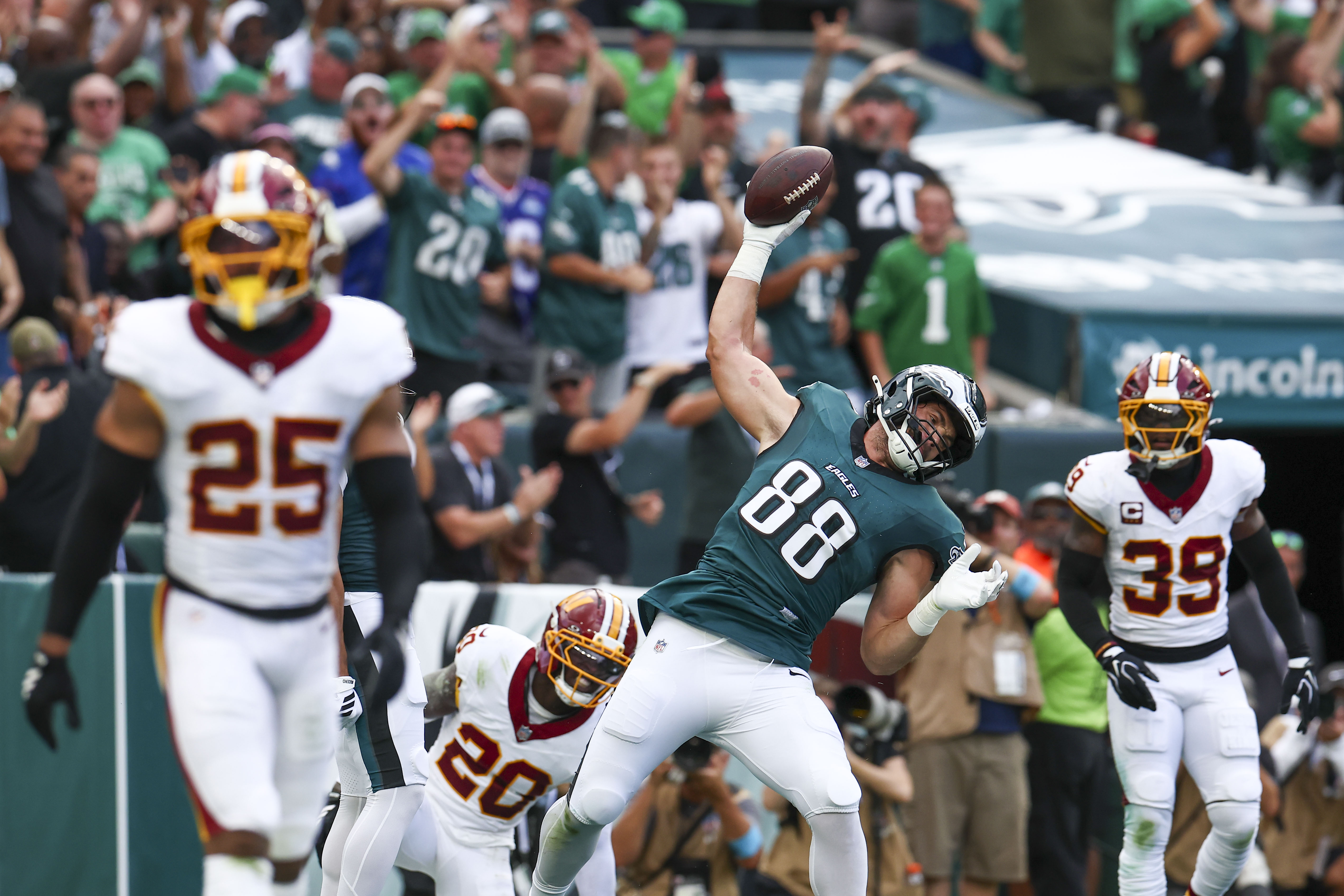
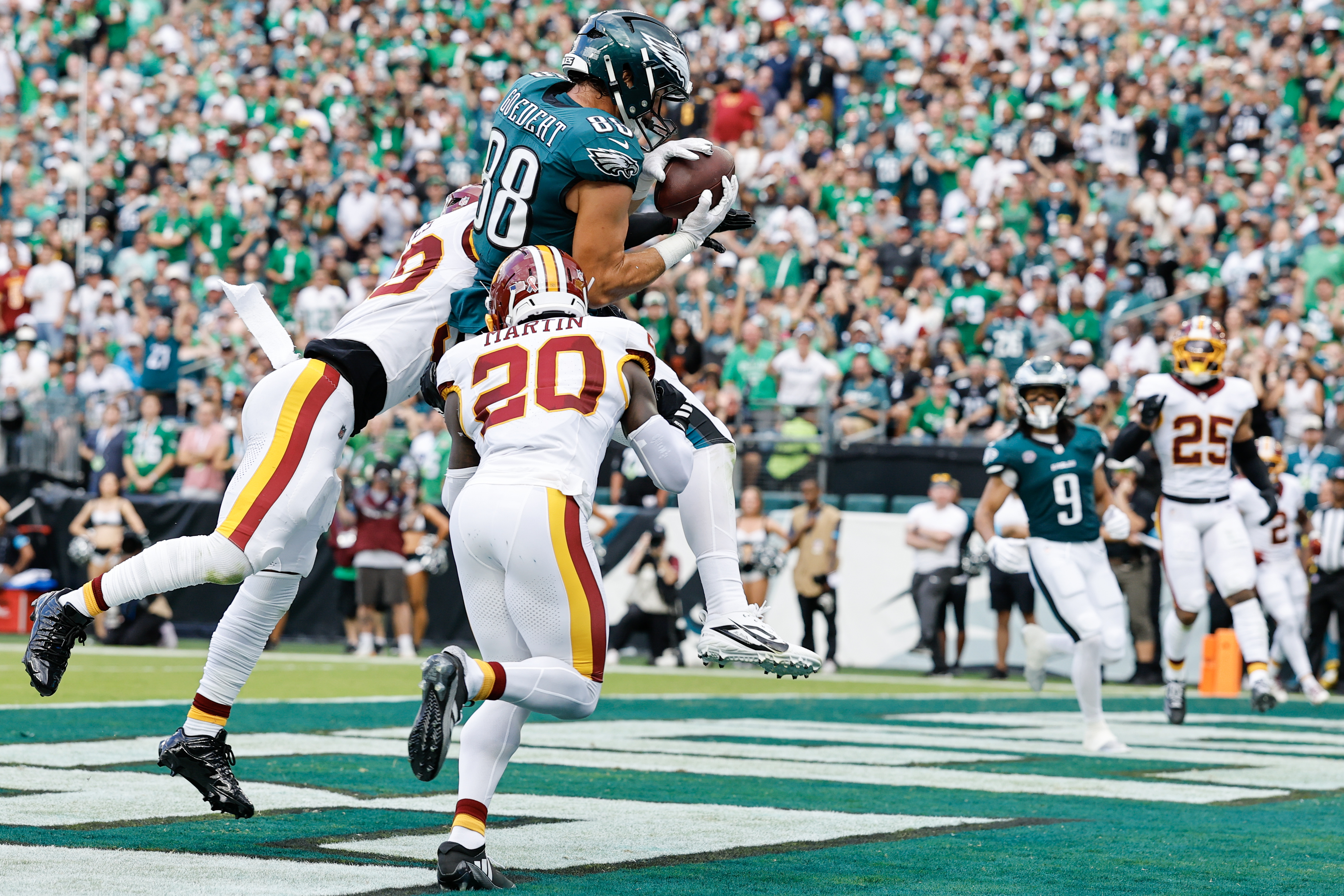
The first was a 17-yard seam route on third-and-goal, just when it appeared the Eagles might settle for a field goal. The second was a 43-yard catch-and-run. What’s that country lyric from a few years back? I ain’t as good as I once was, but I’m as good once as I ever was. Goedert was that good. Twice.
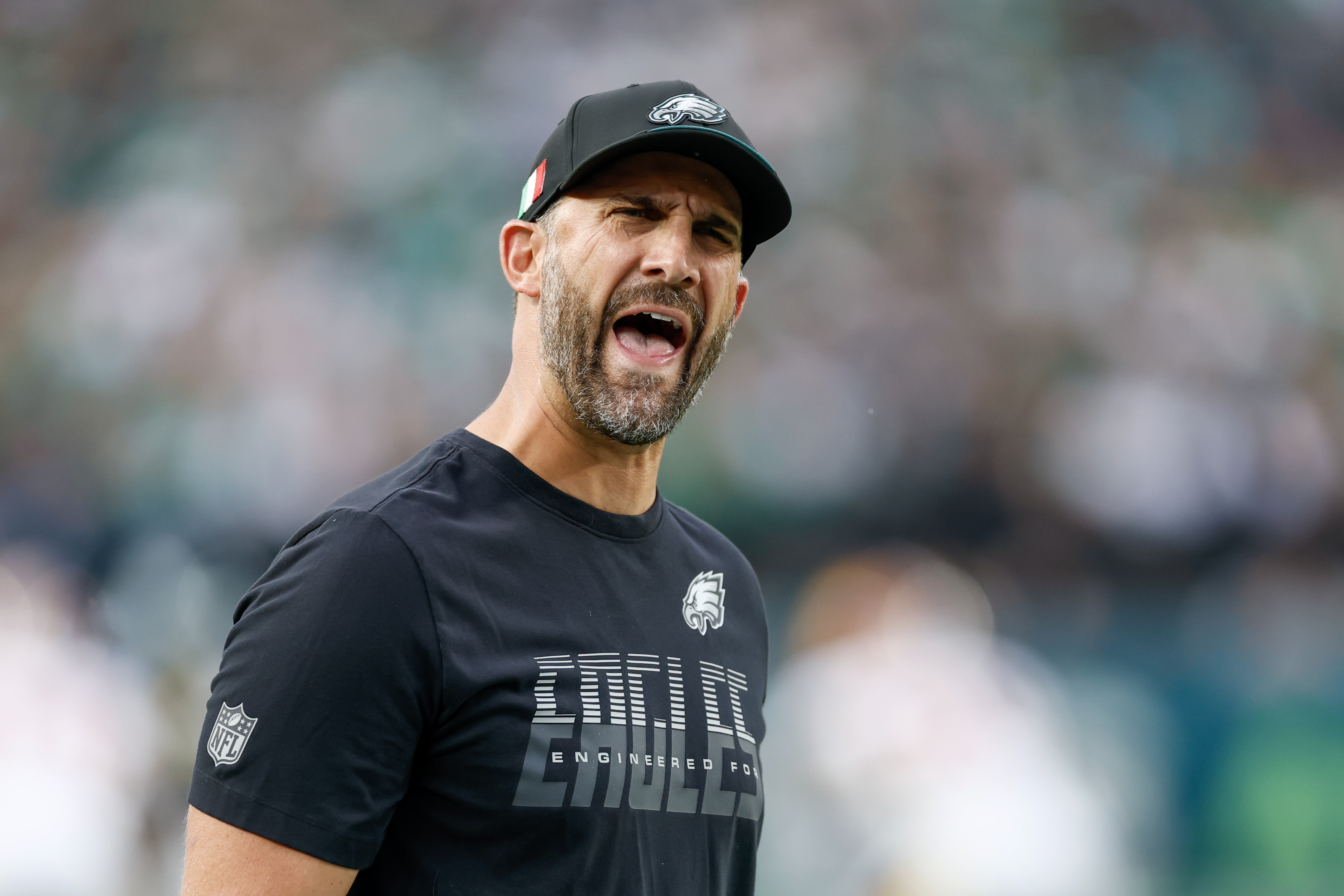
“Dallas is a phenomenal playmaker who, in my six years with him, just has always made plays in really big moments,” Eagles coach Nick Sirianni said. “He brings it every day.”
He will have to. For now, the decision to draft Stowers looks like a mistake, a swing-and-miss on a player who might be too big and slow to be a good wide receiver but not stout enough to be a good tight end. His absence, whether for injury or ineffectiveness, puts more pressure on Goedert, on Jalen Hurts, on every player on the offense as they labor through mastering Mannion’s offense. And if Sunday is any indication, that process will take a long while.
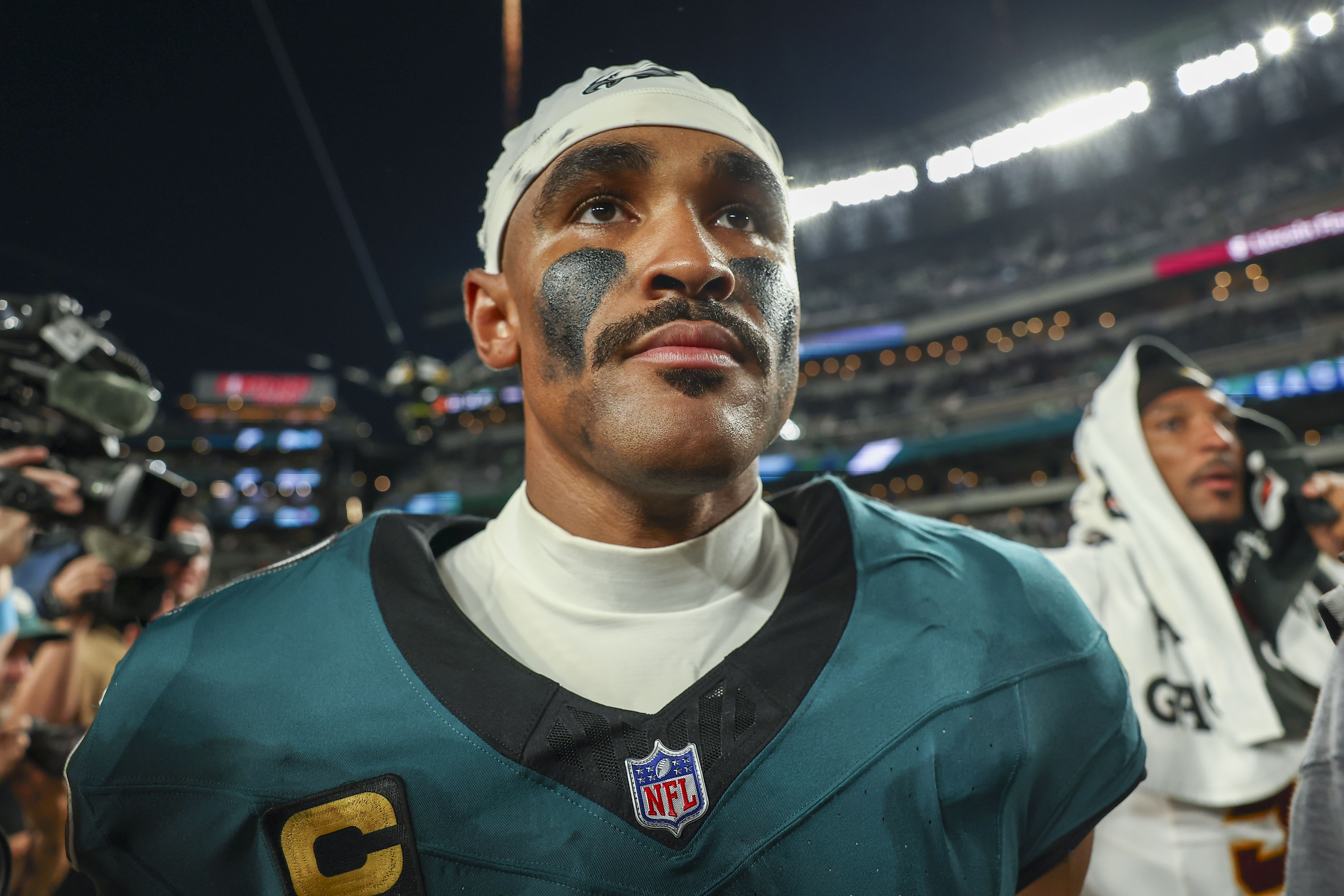
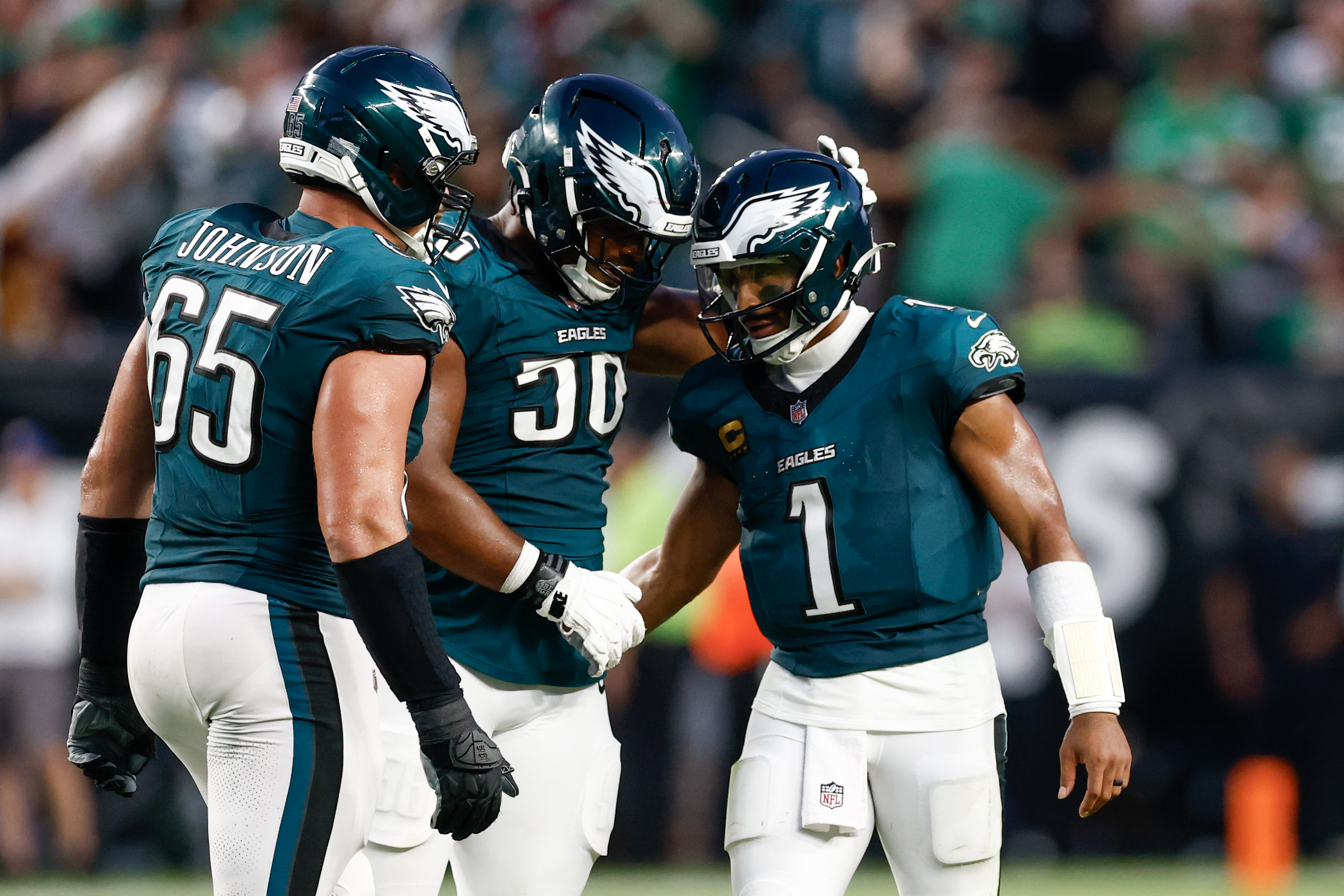
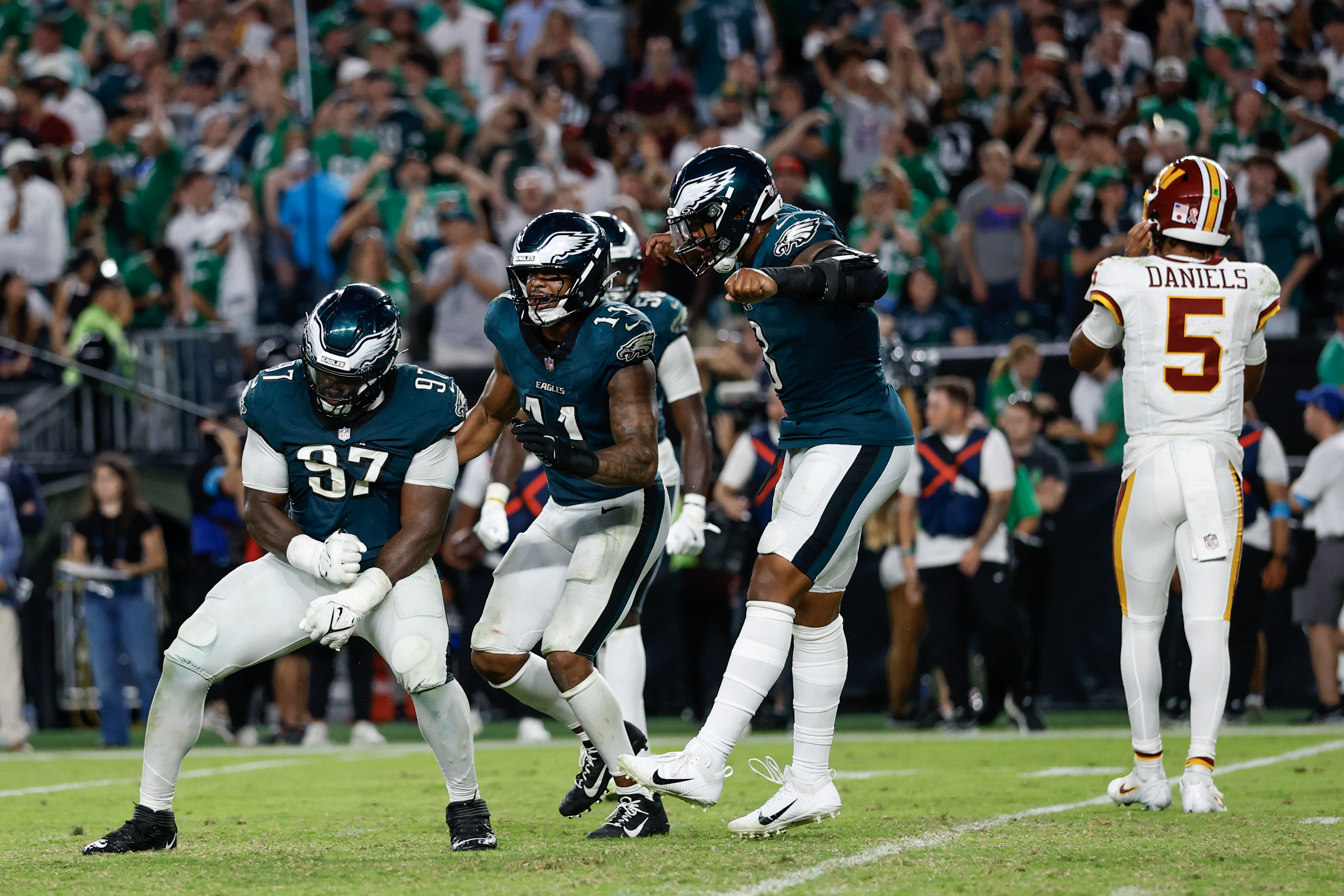
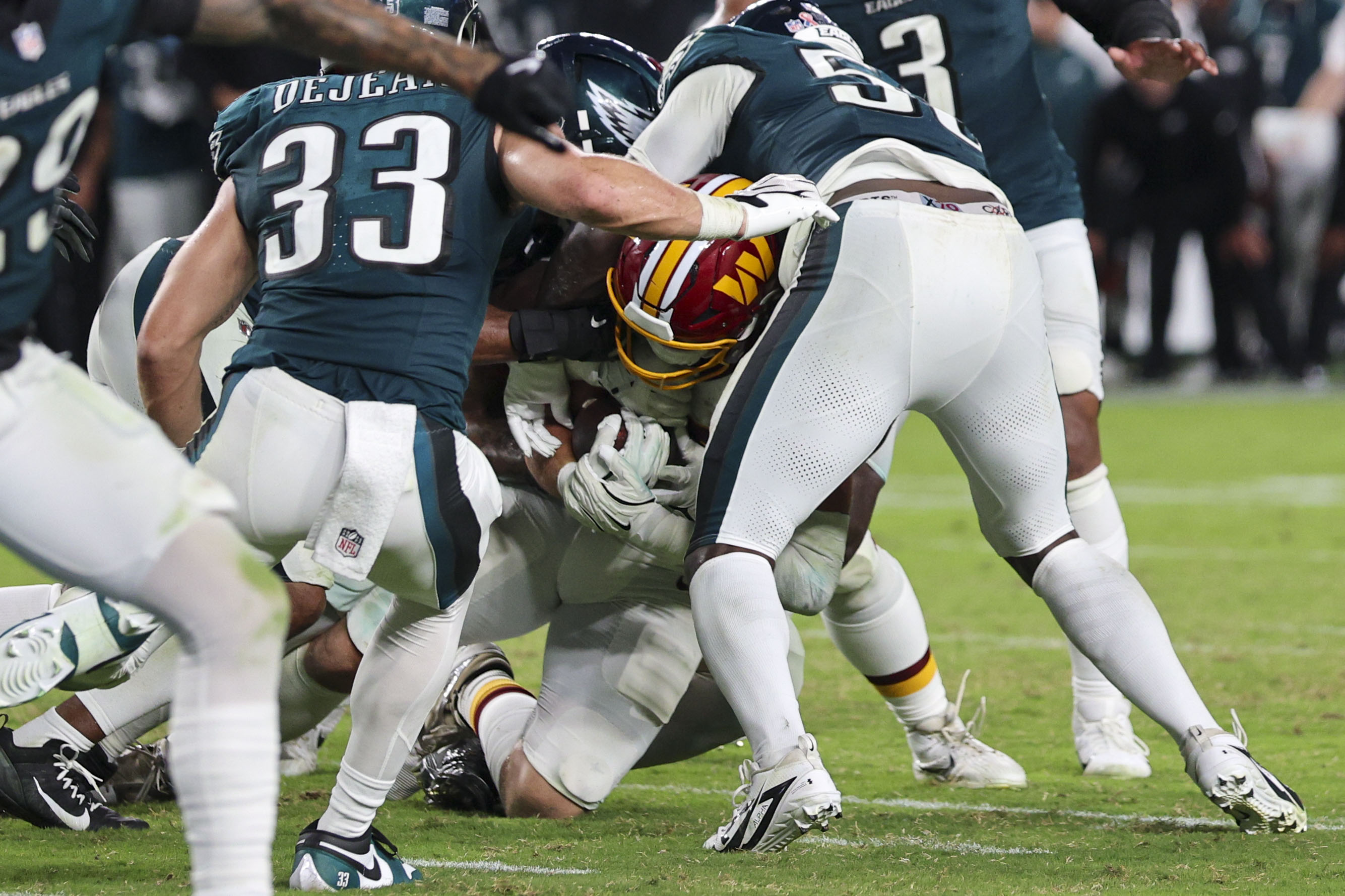
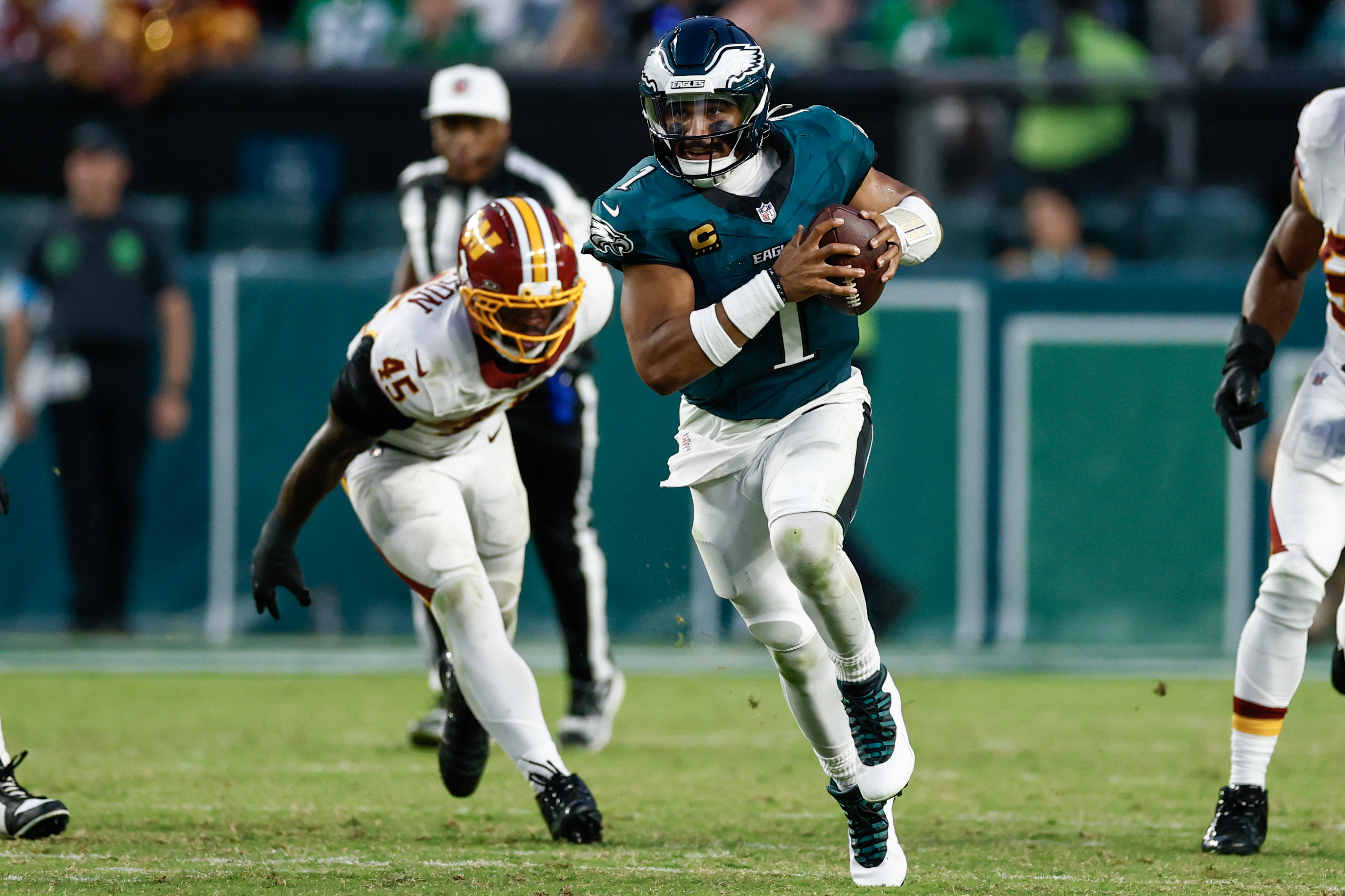
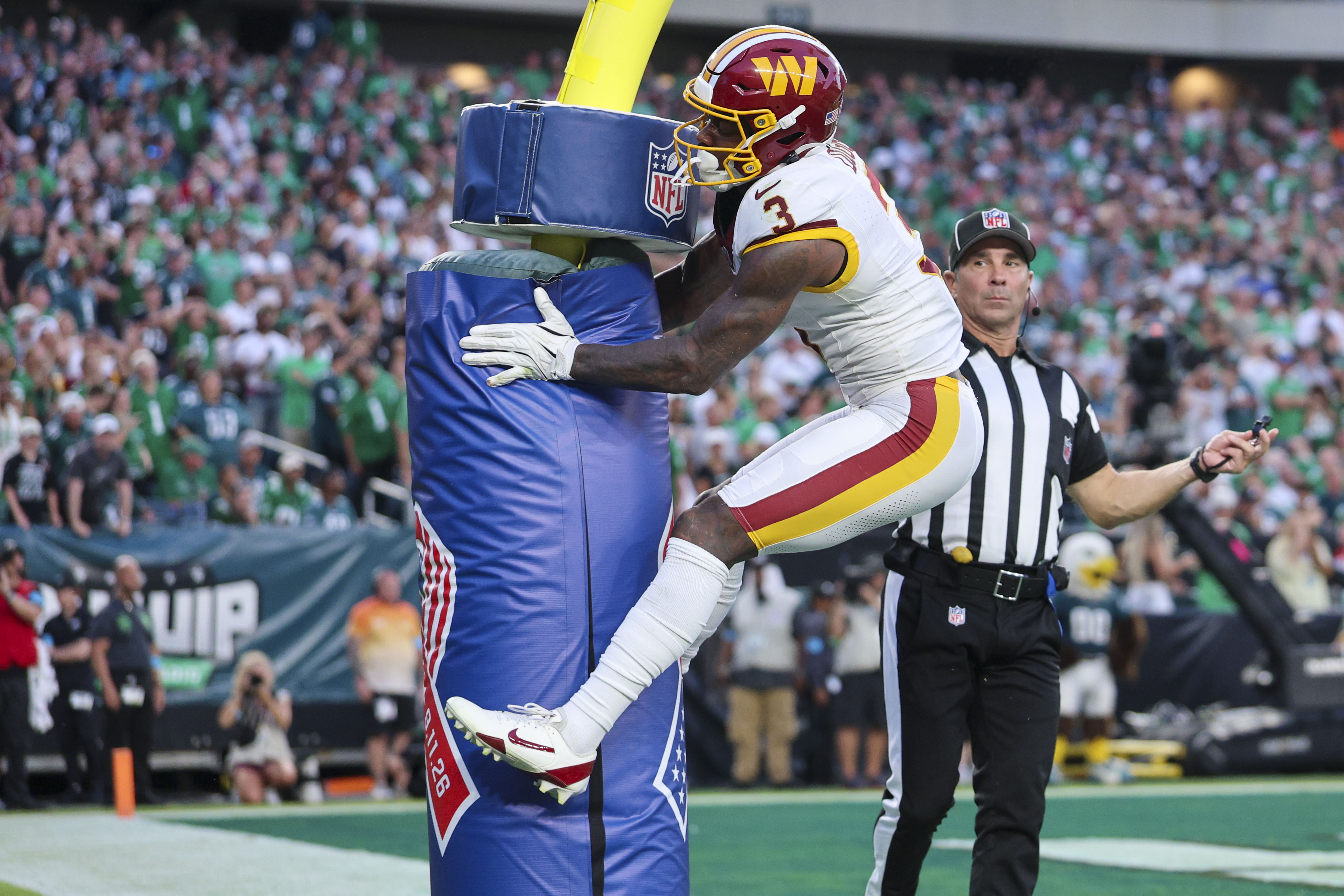
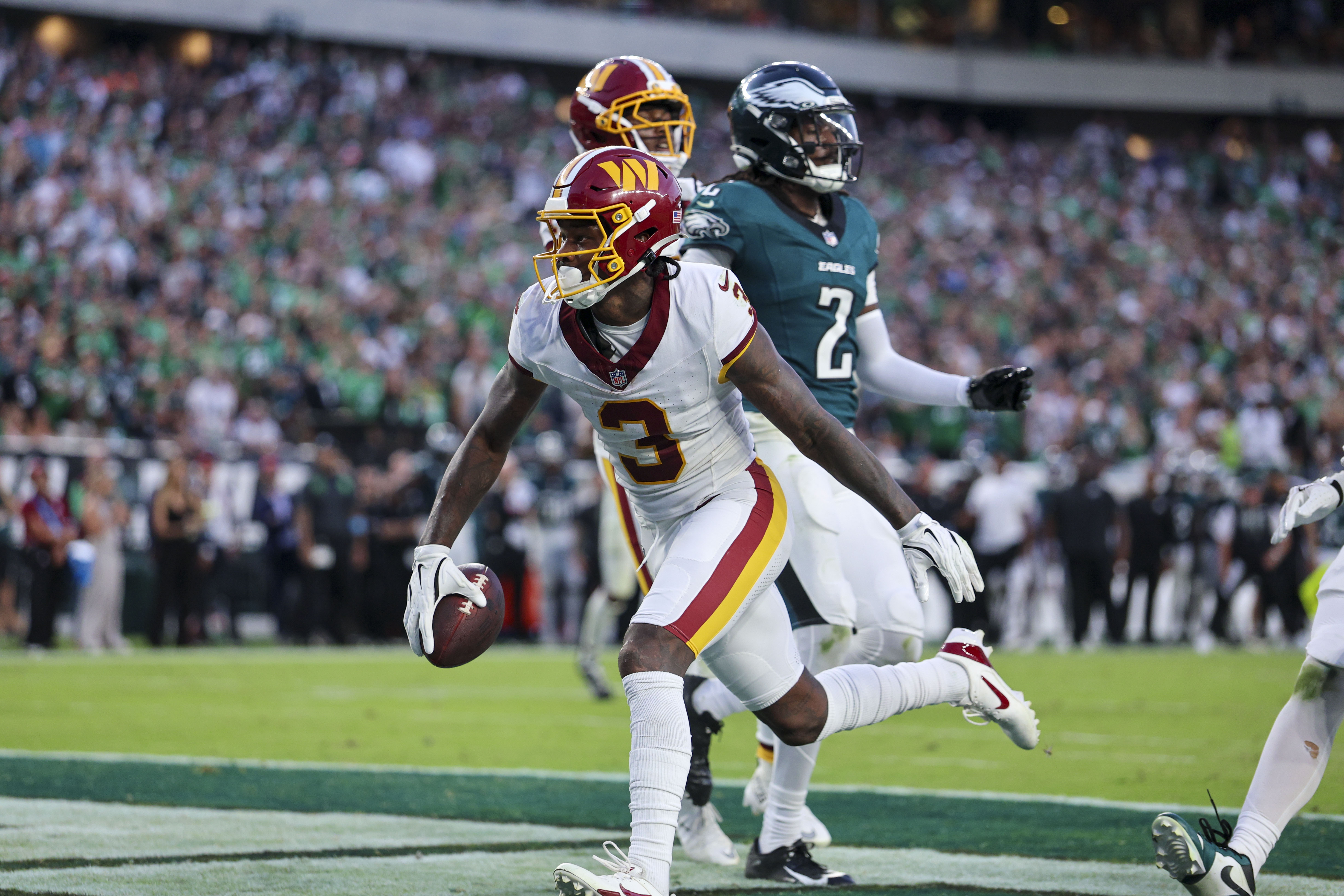
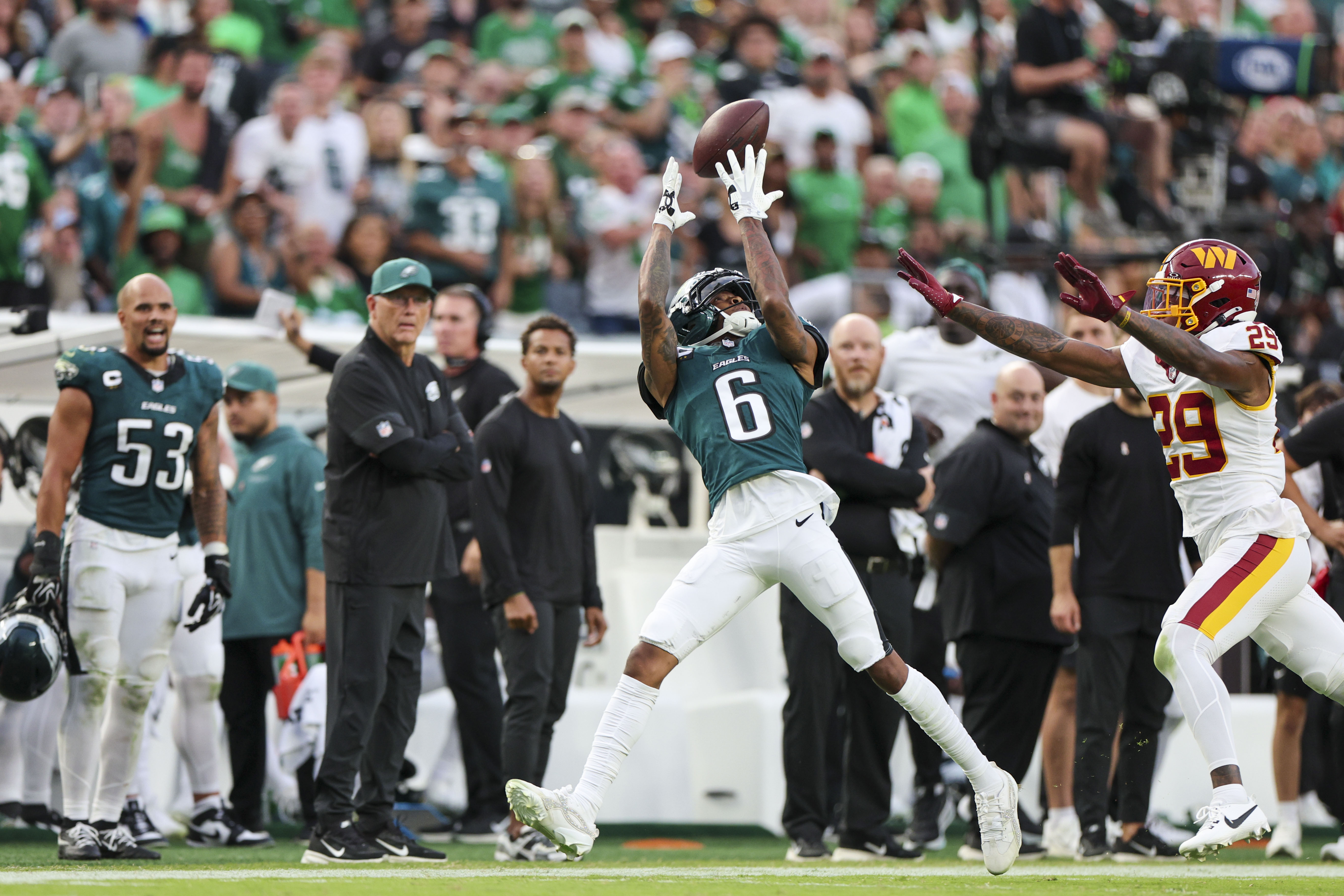
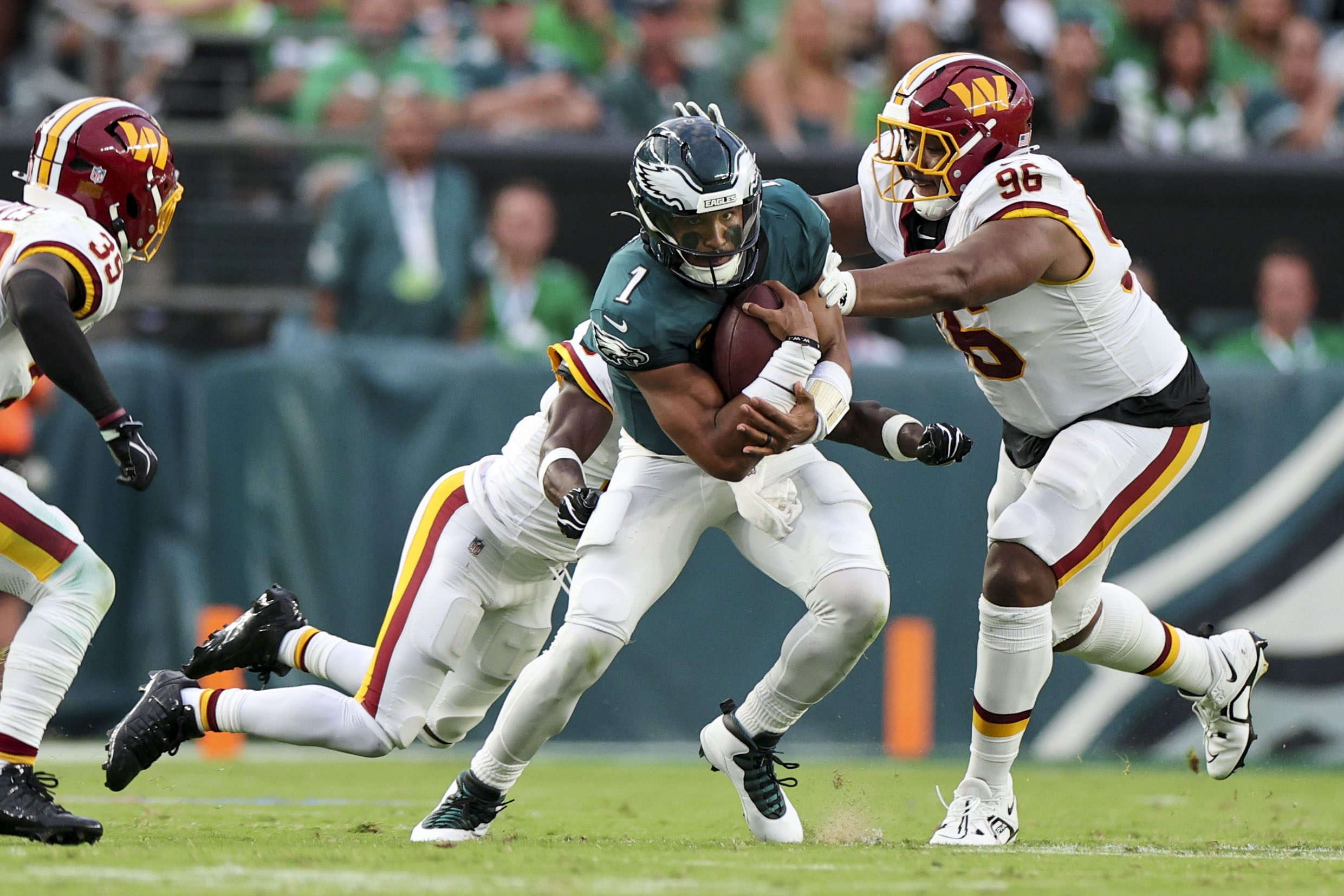
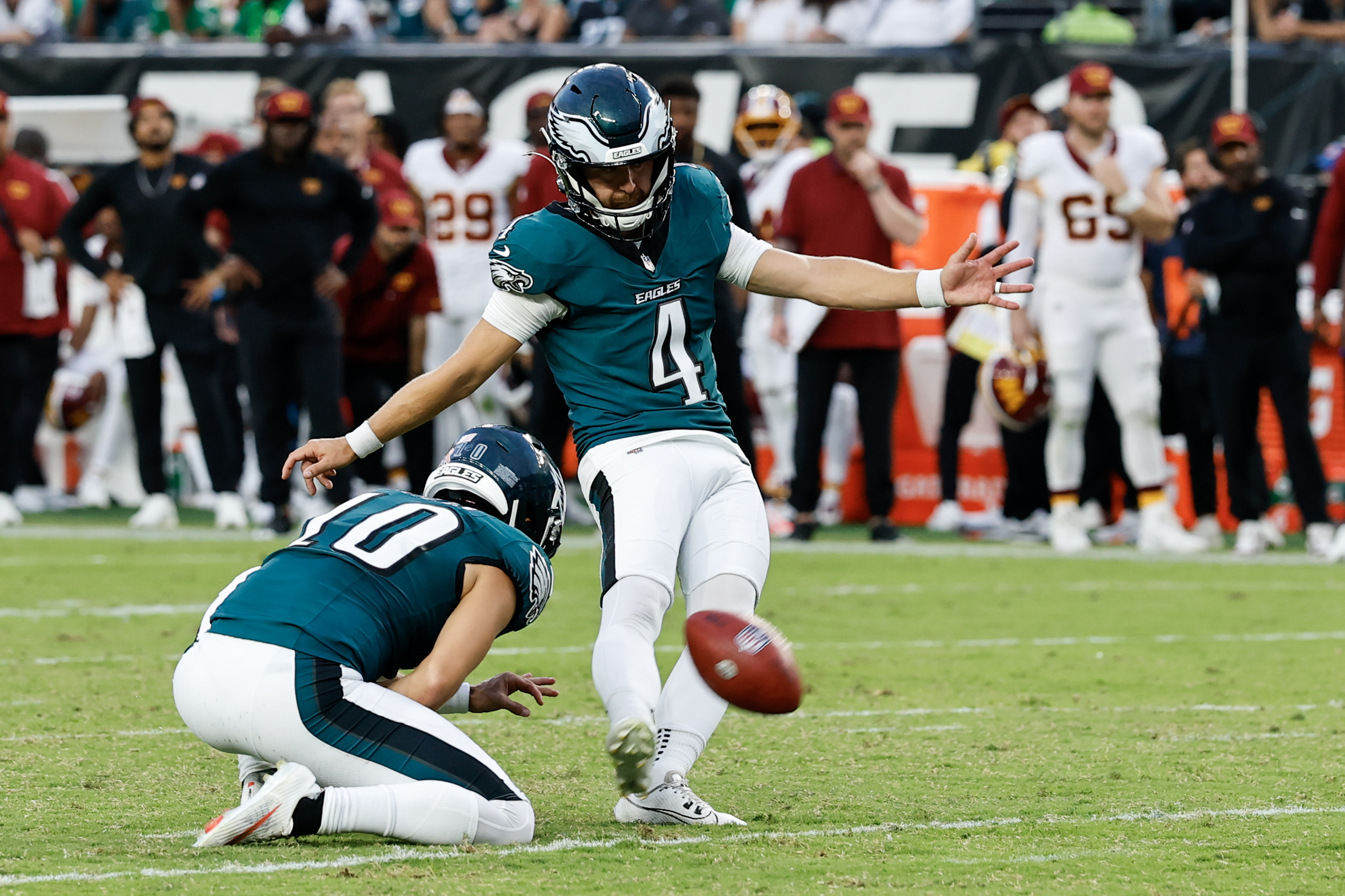
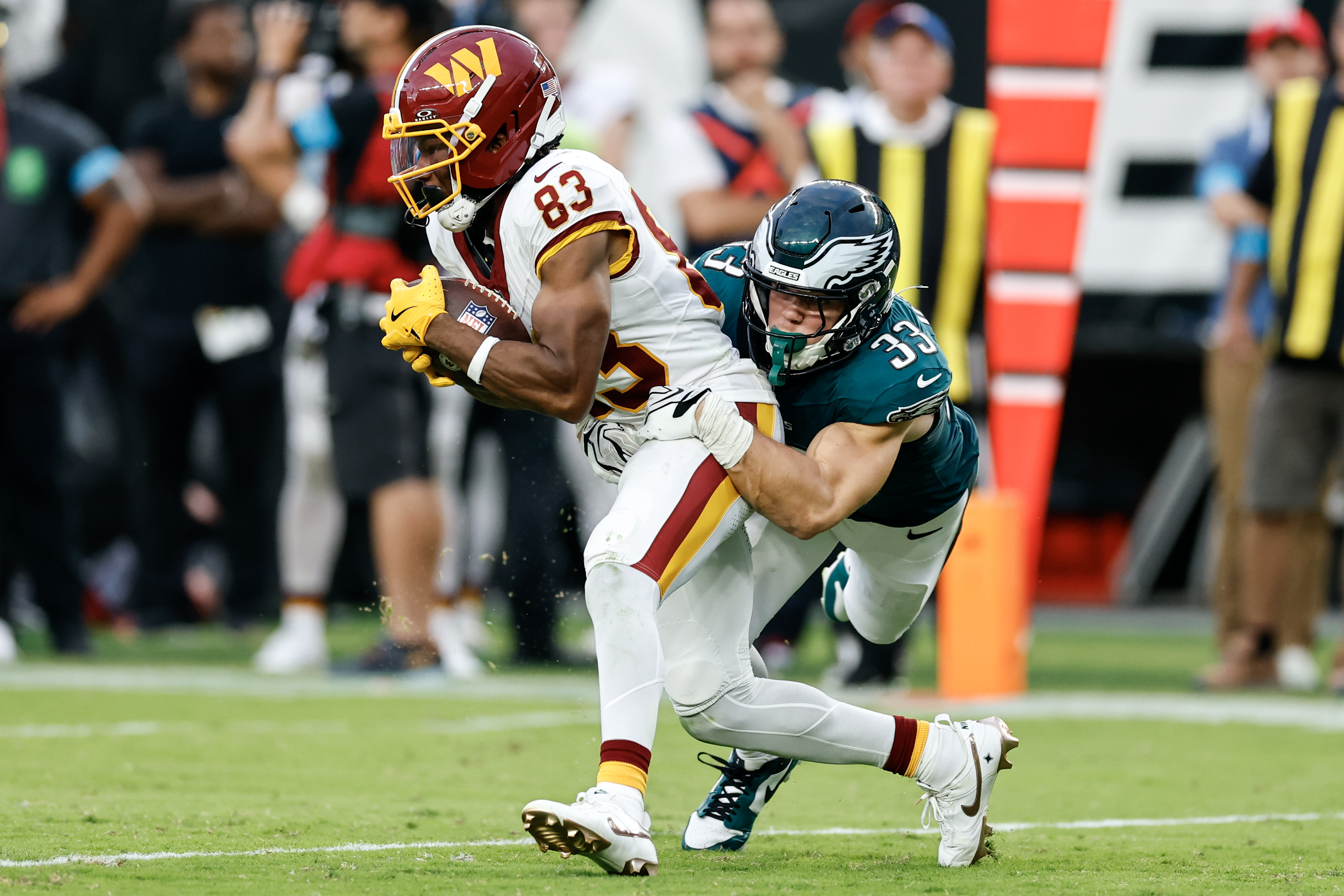
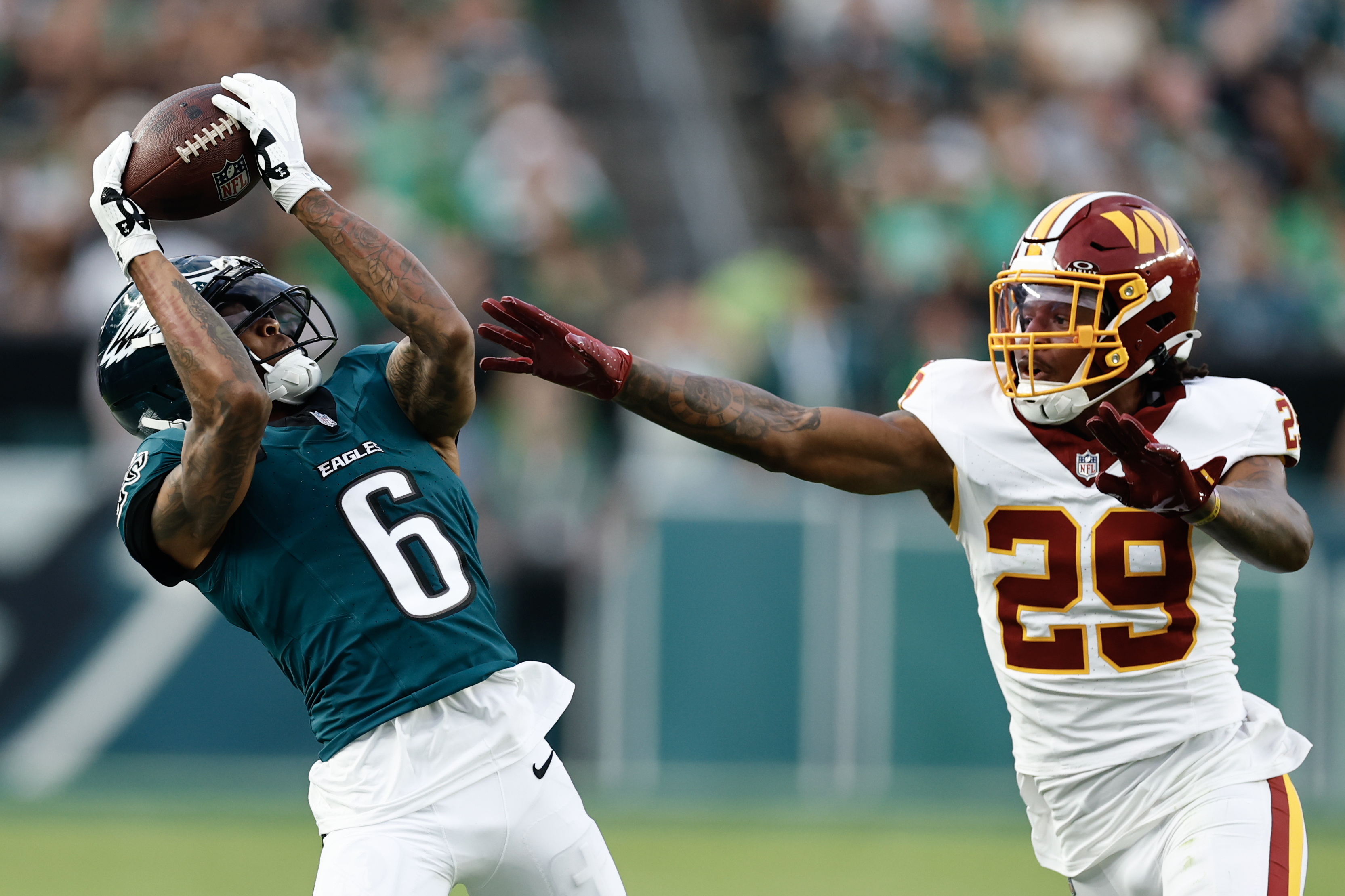
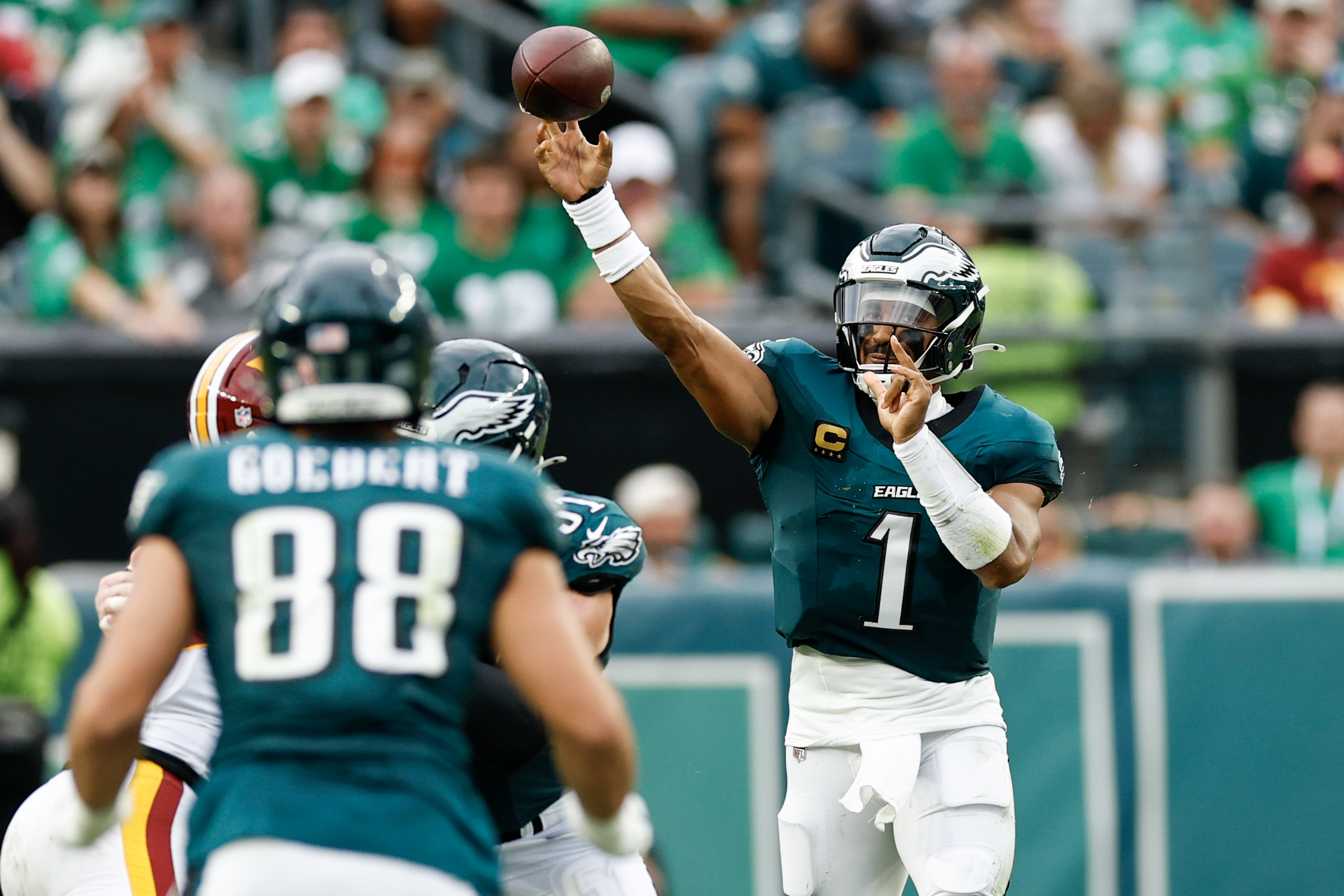
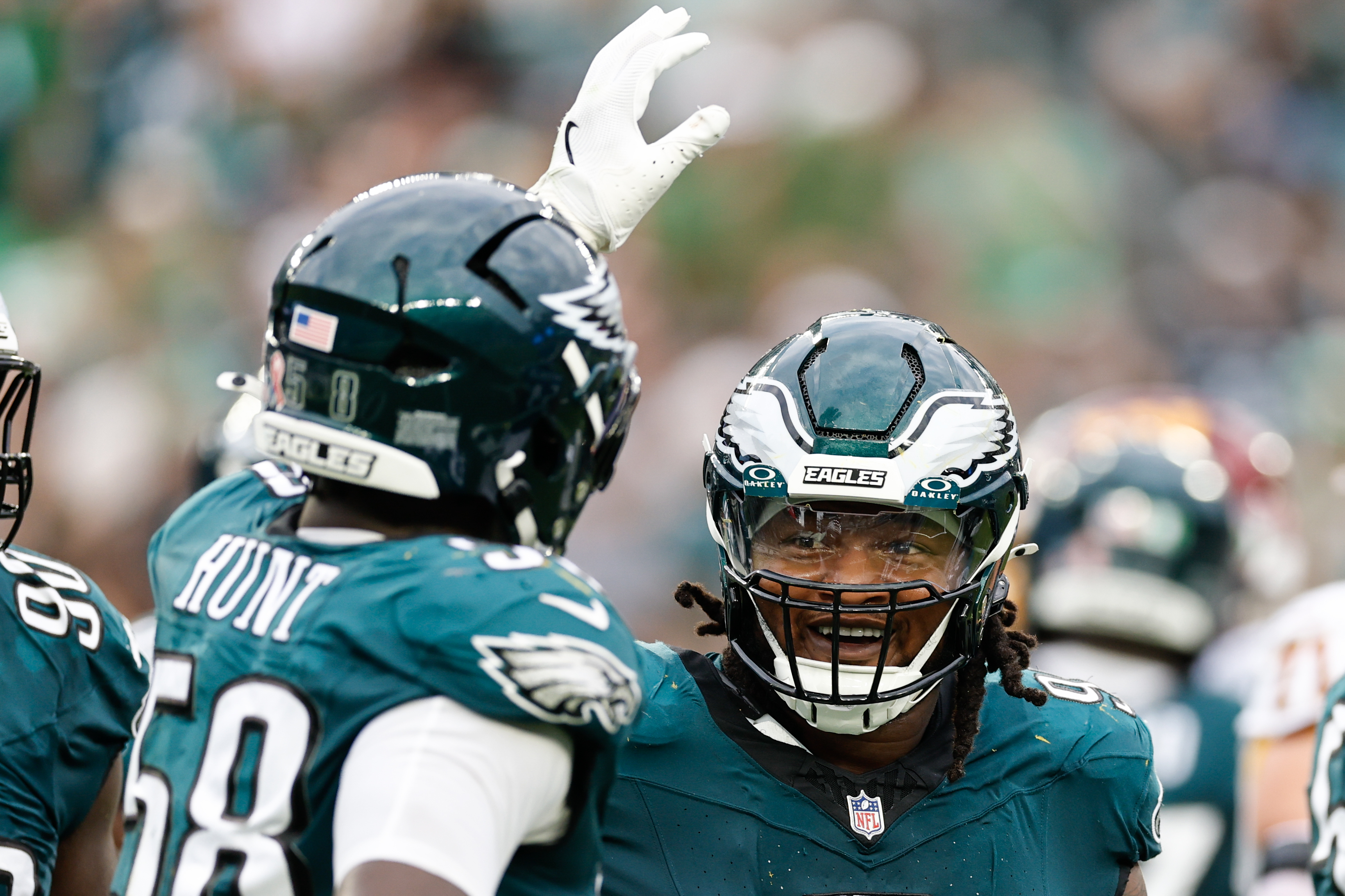
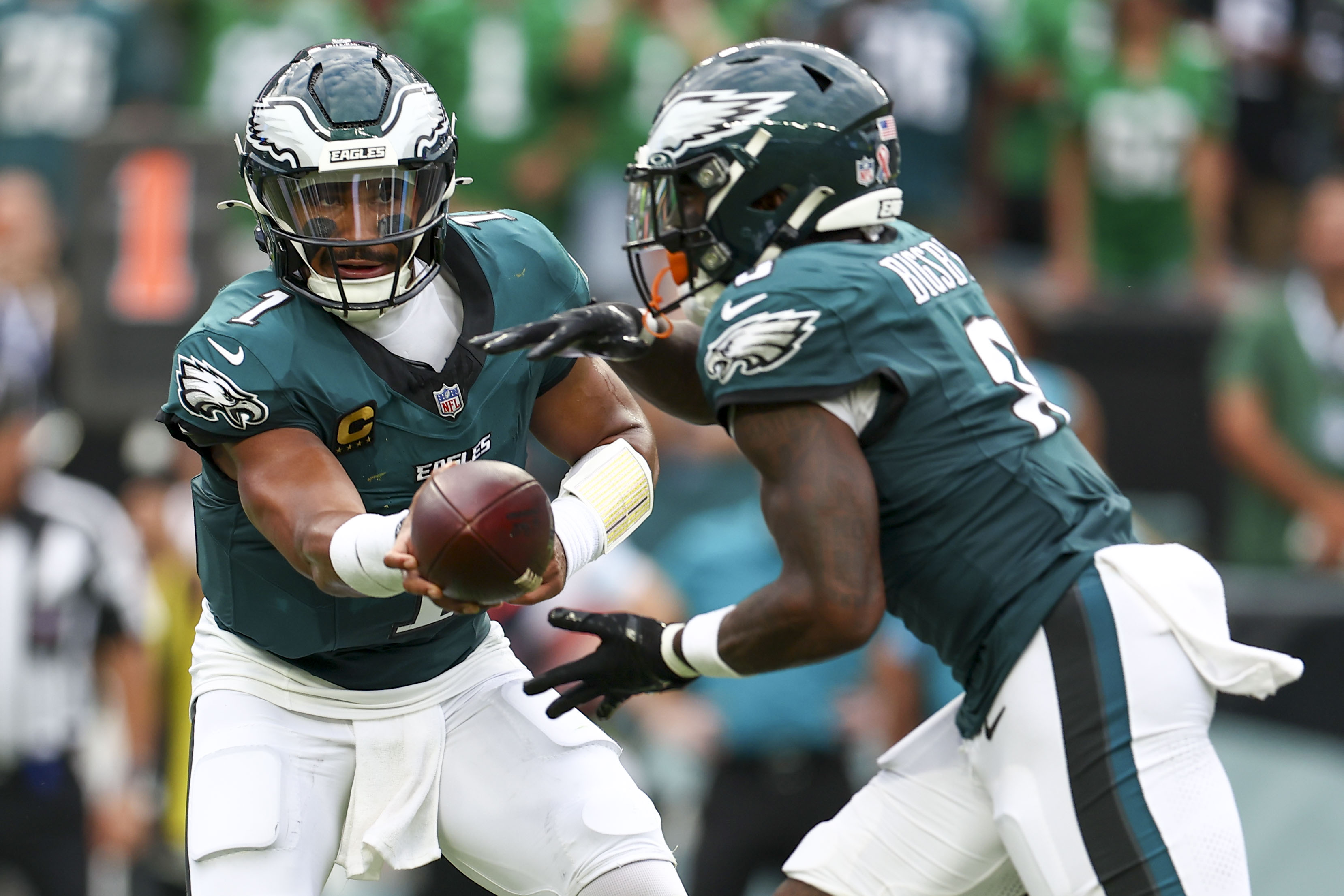
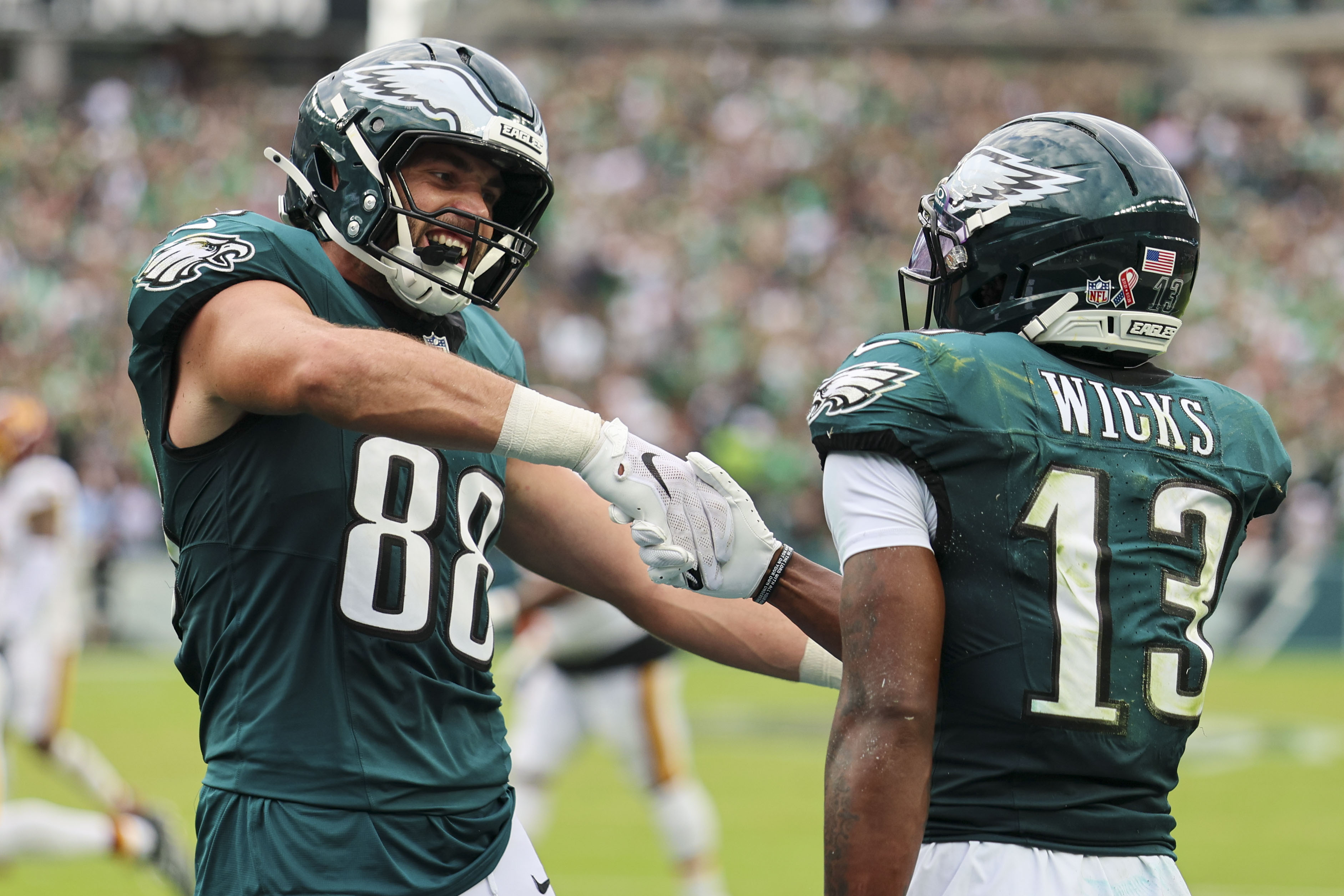
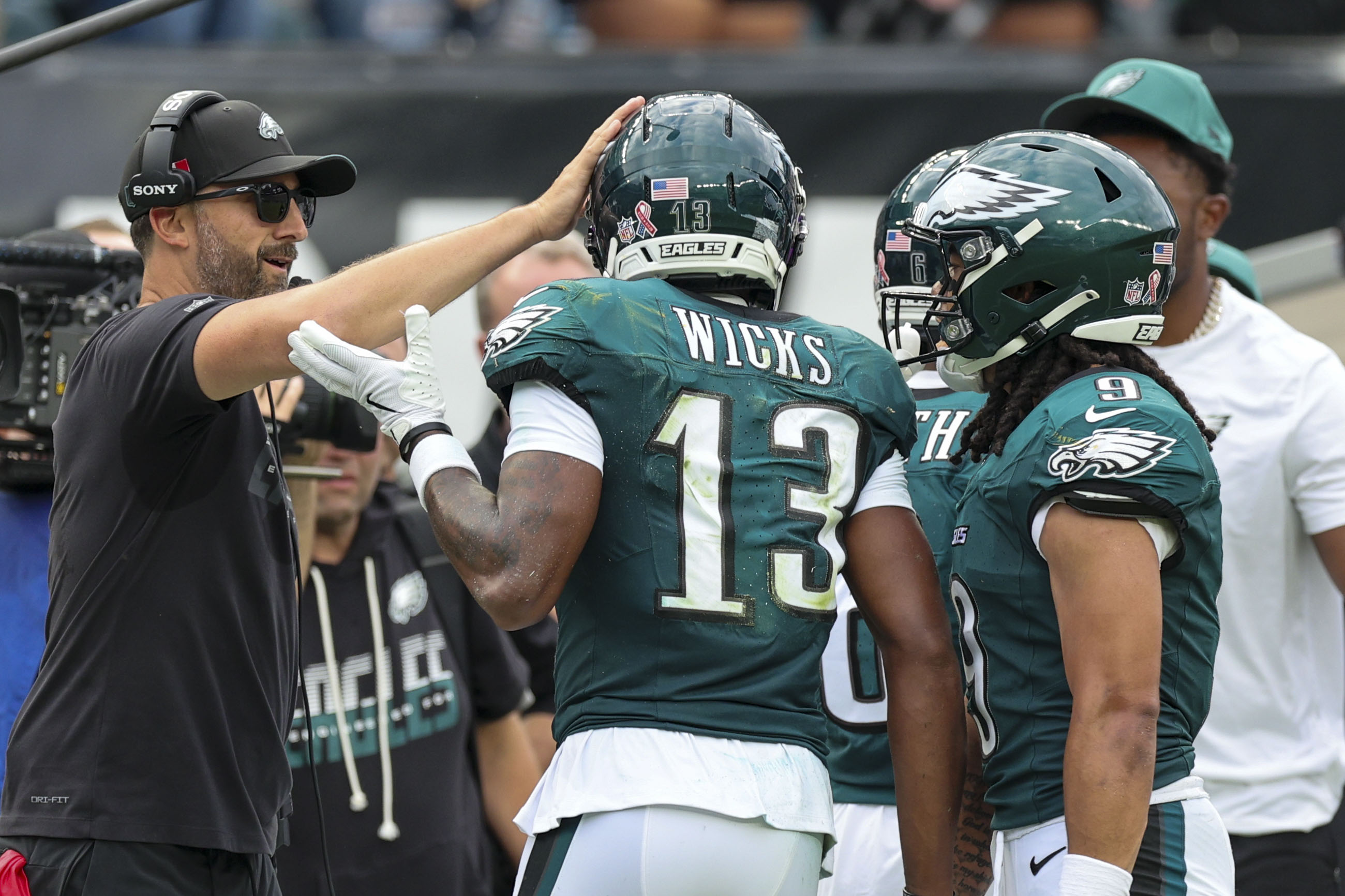
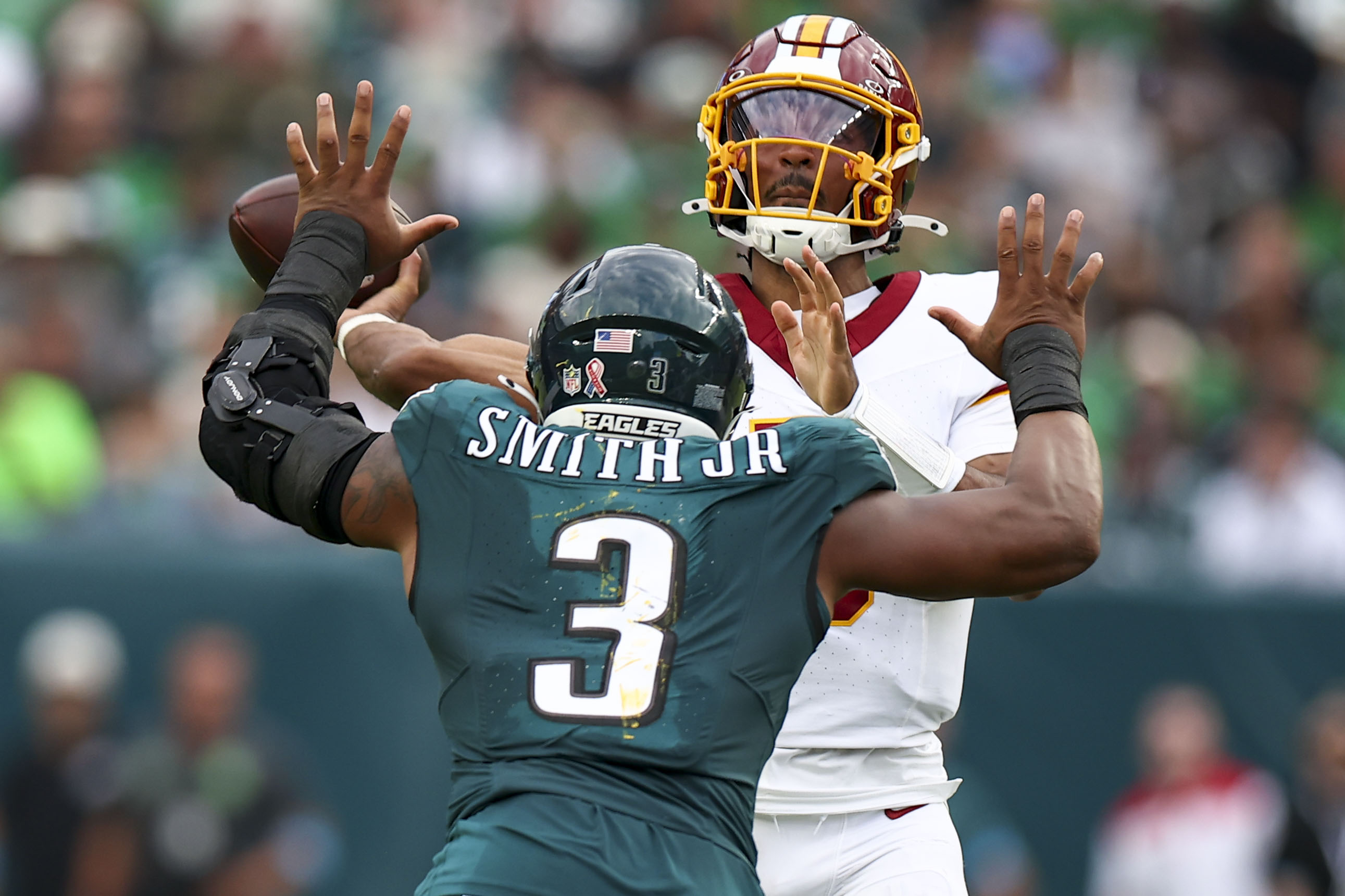
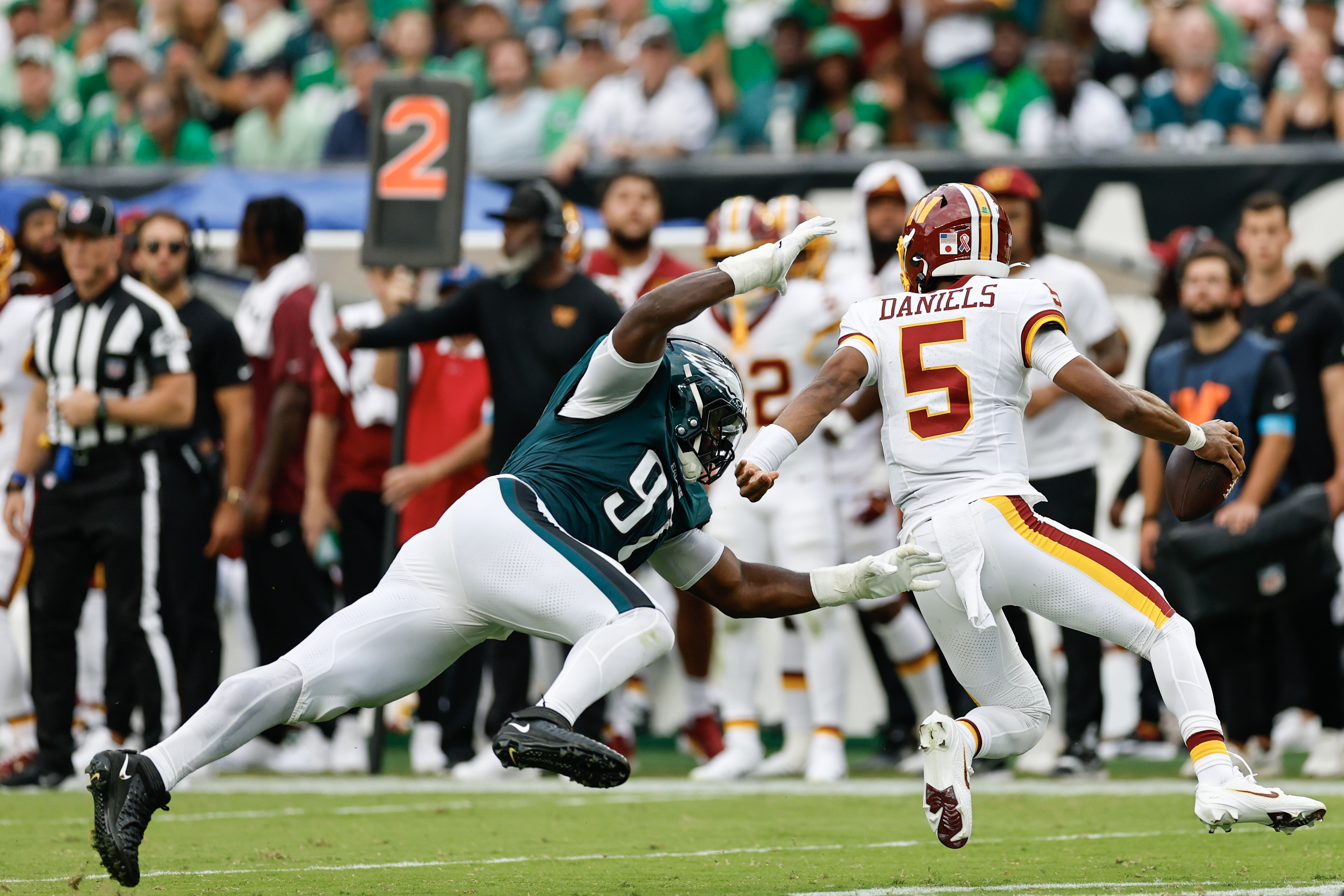
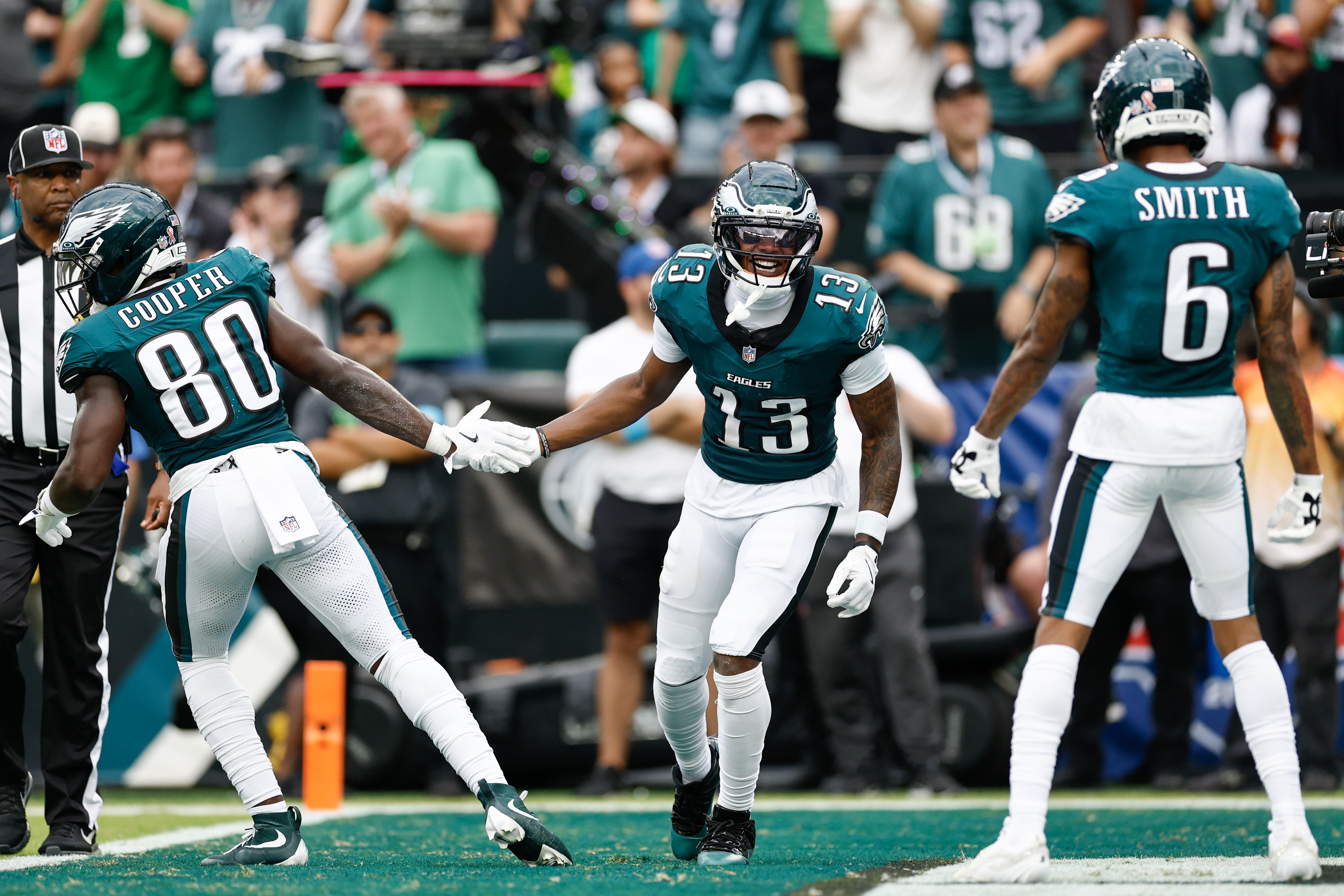
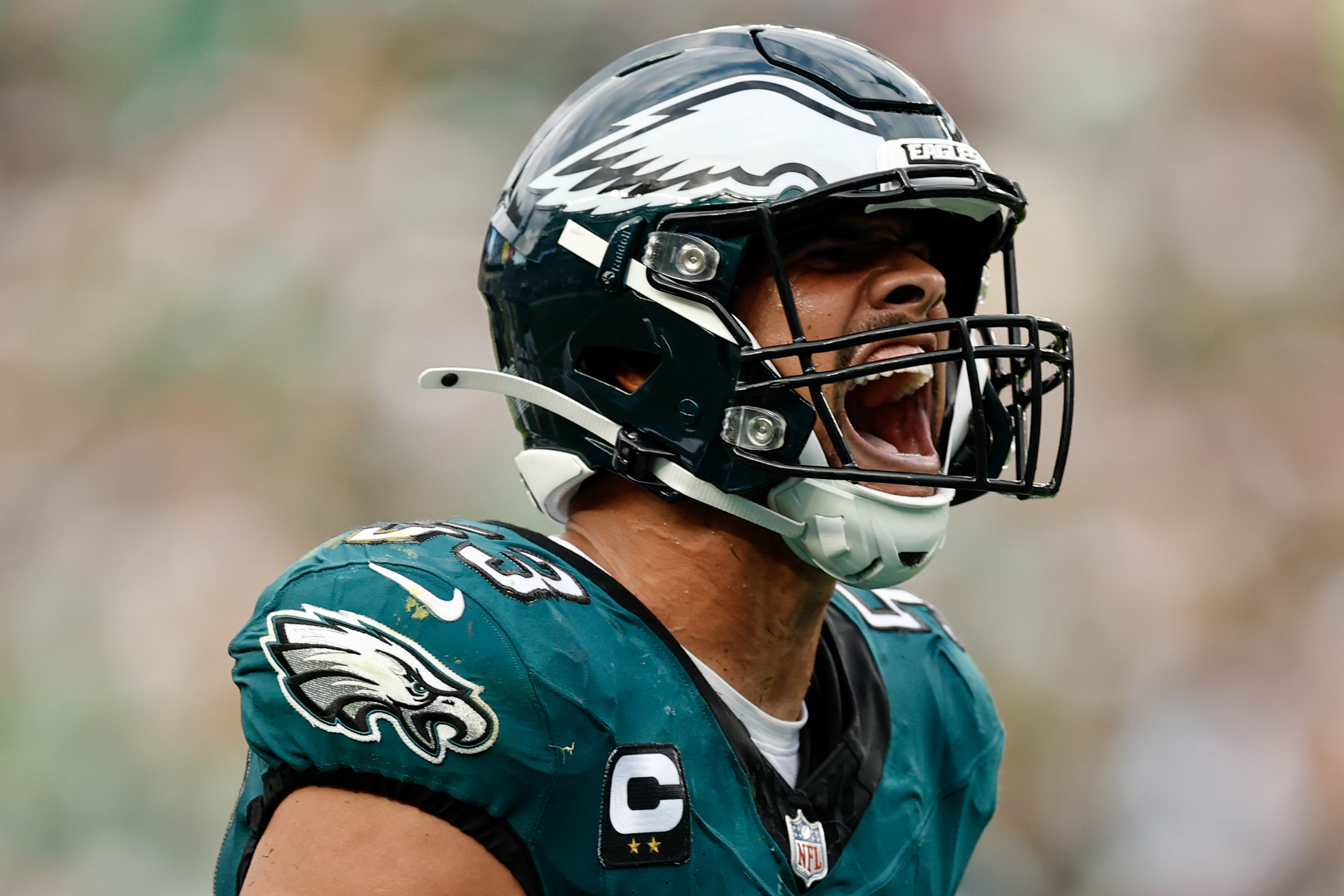
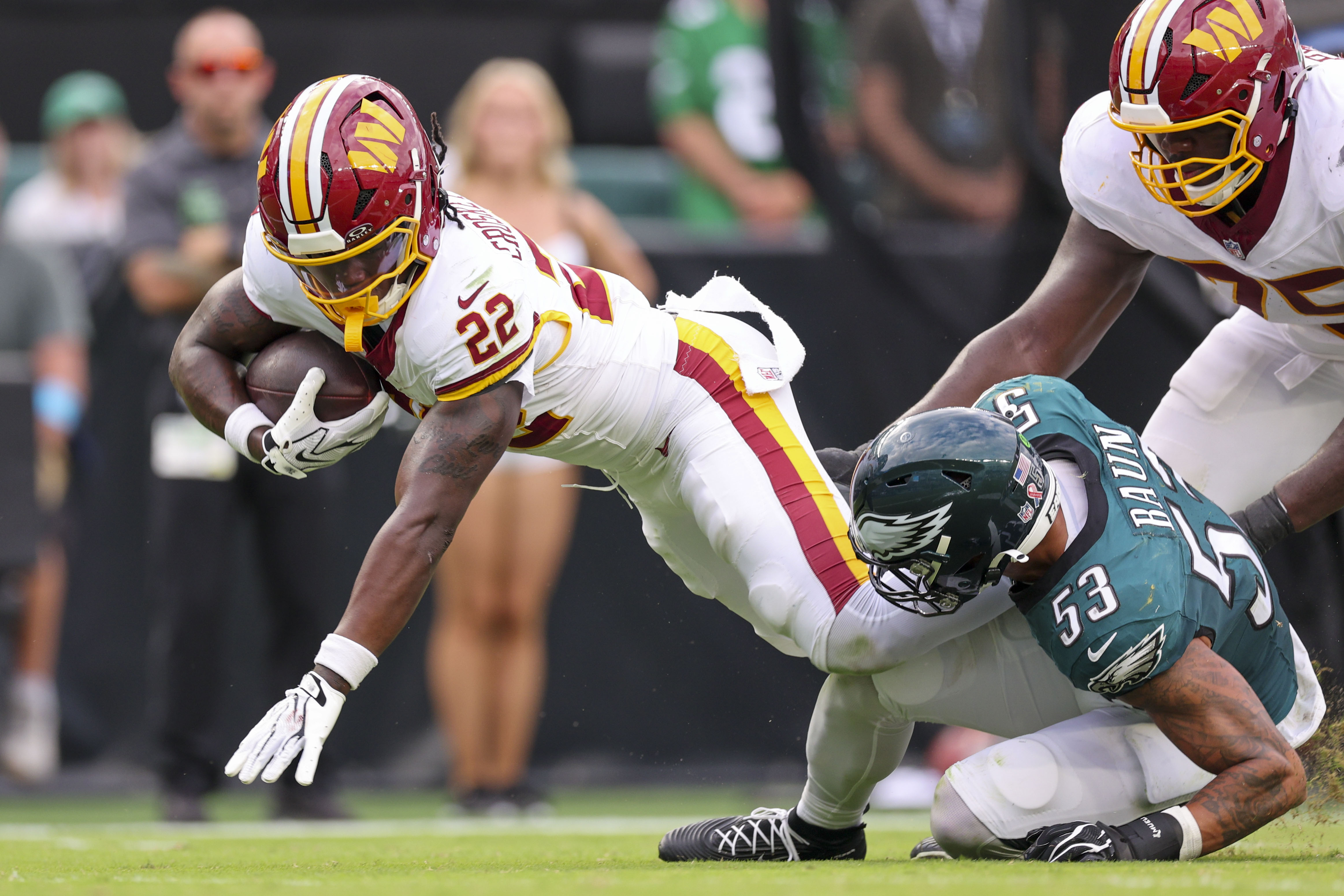
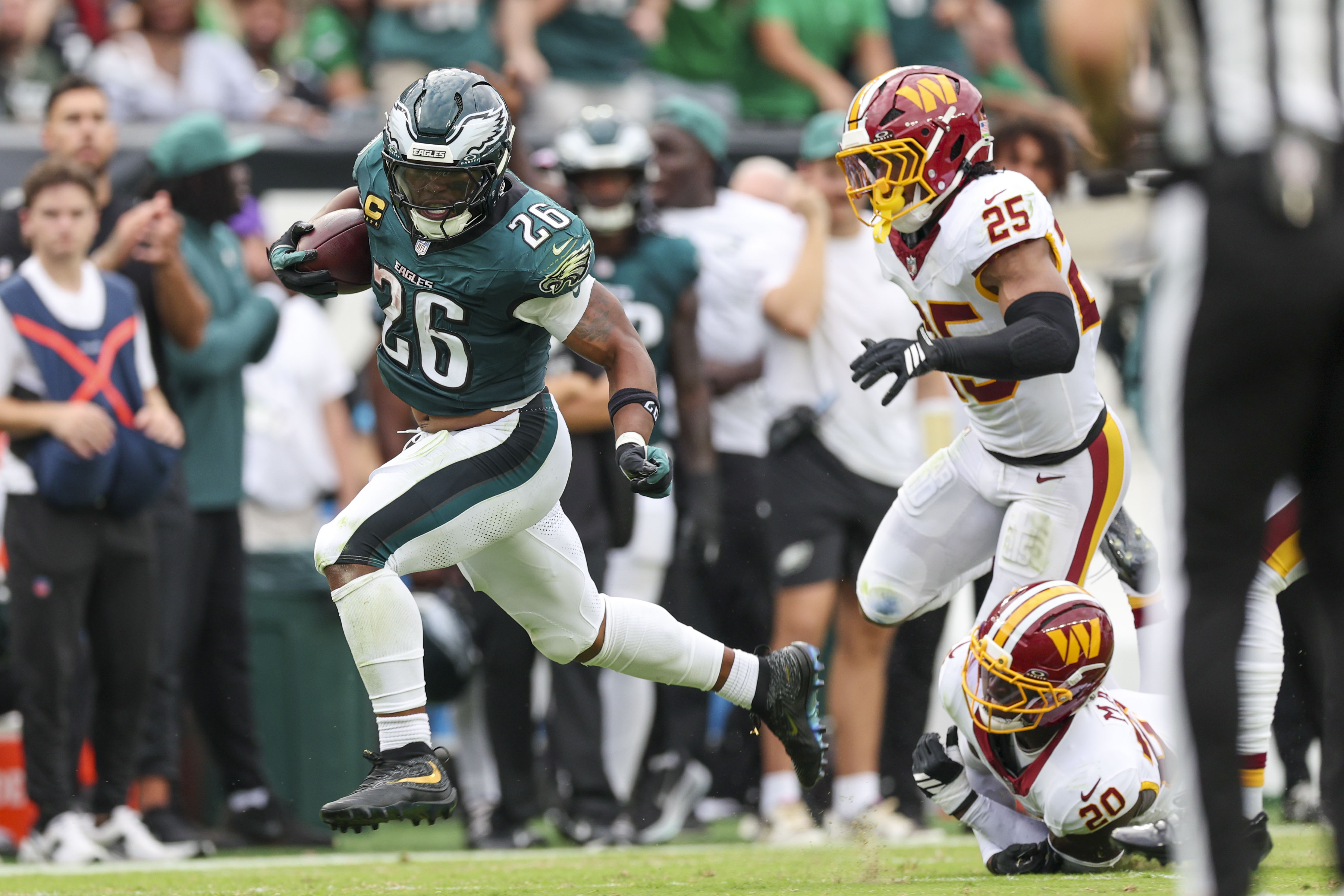
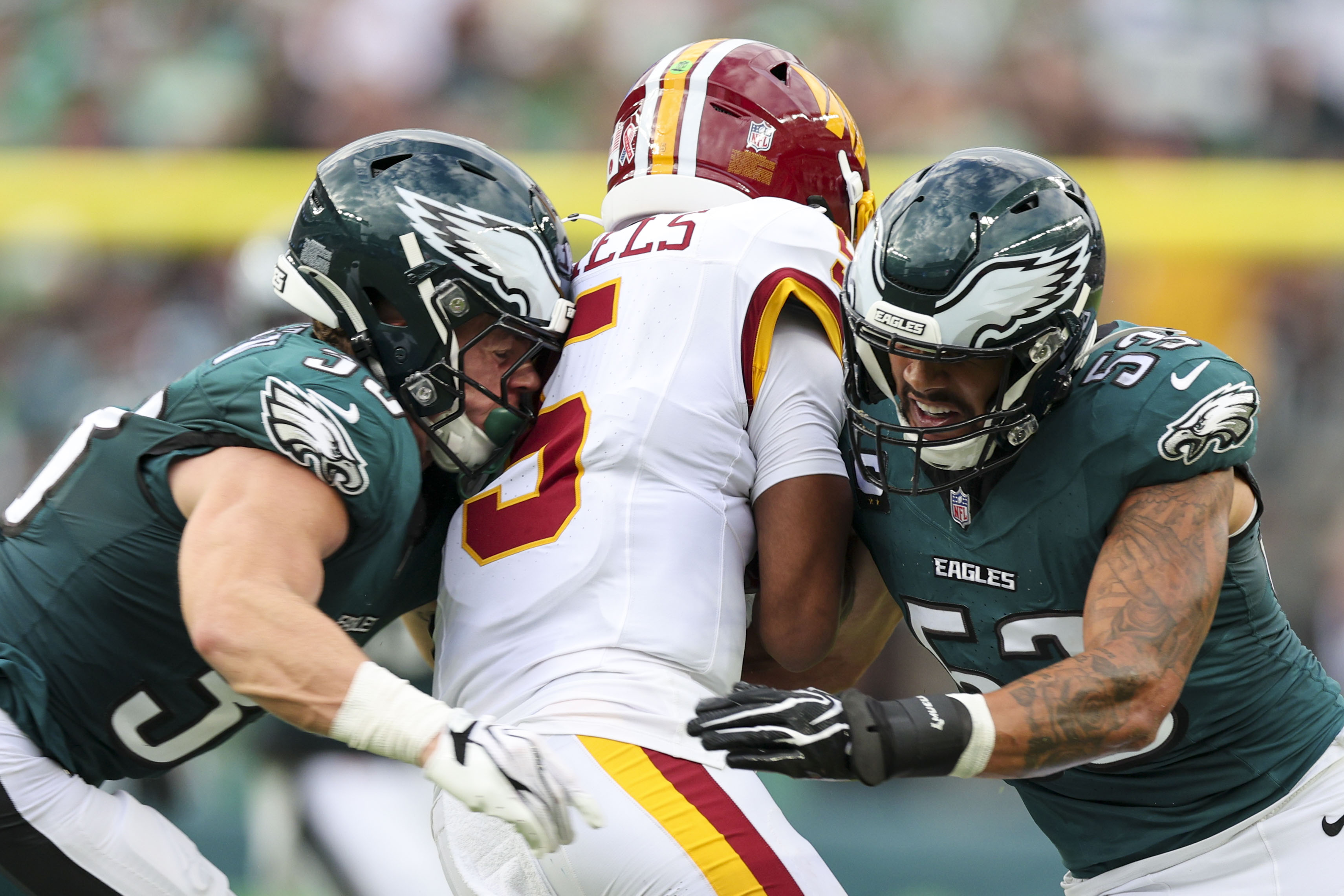
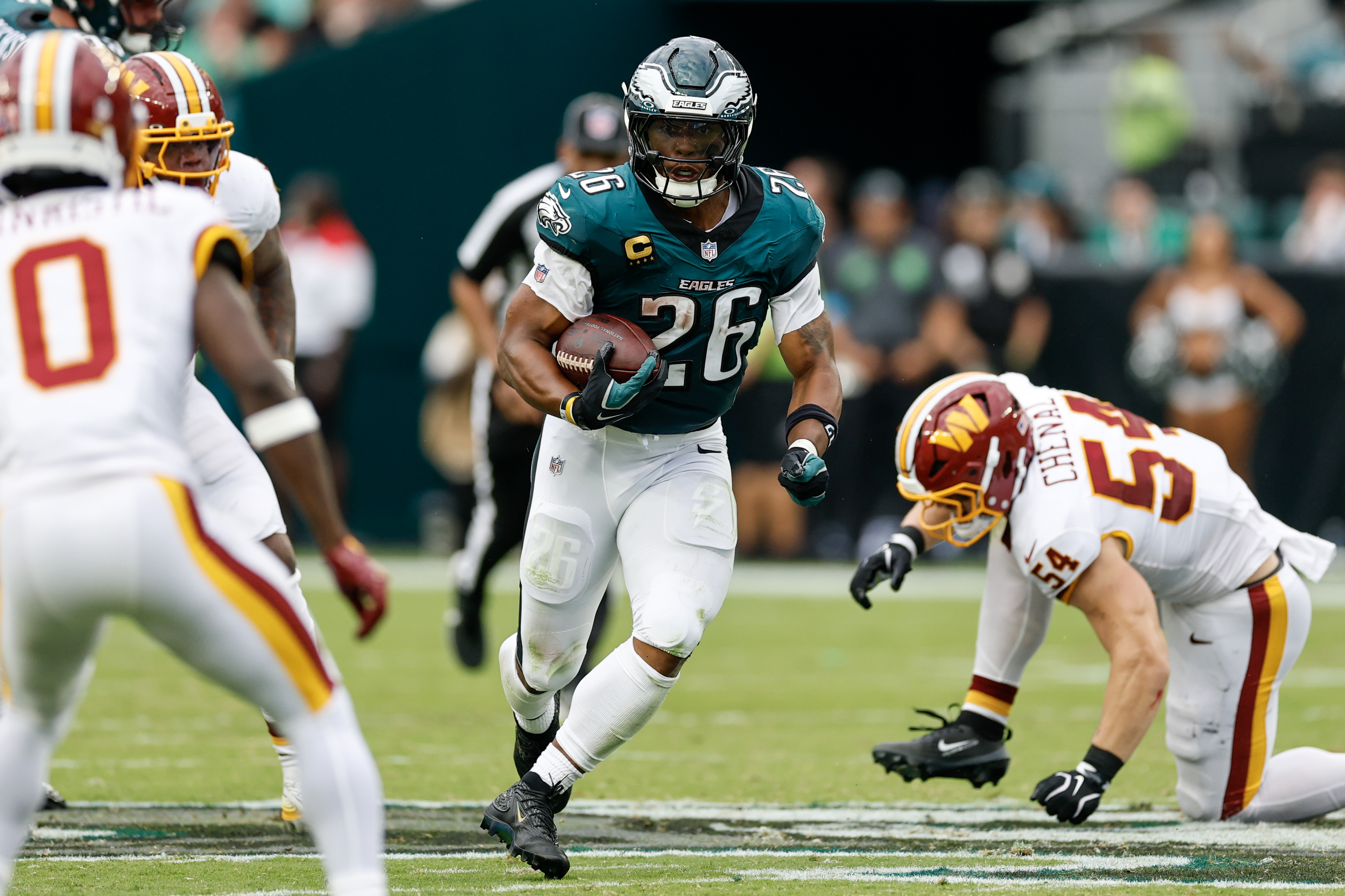
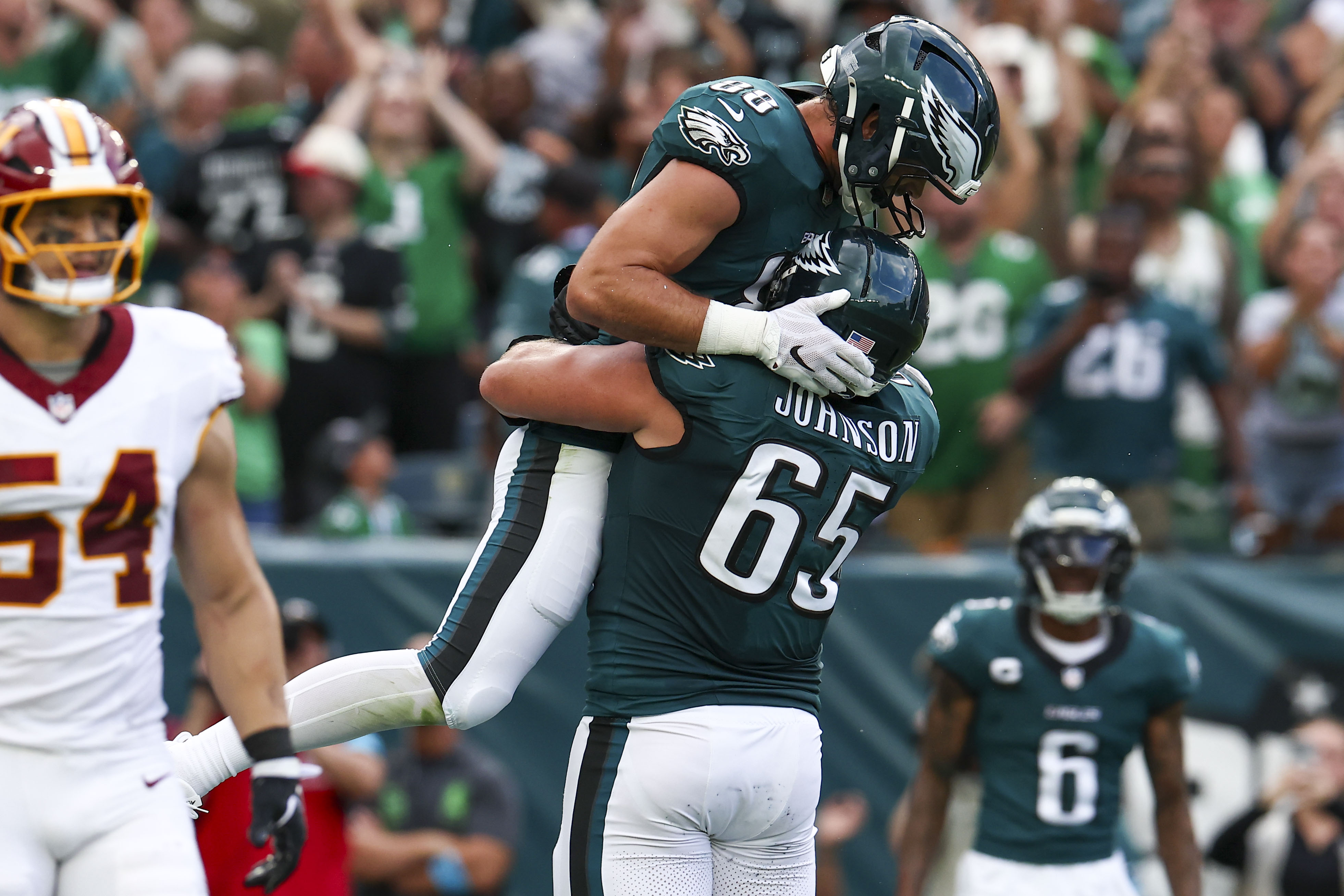
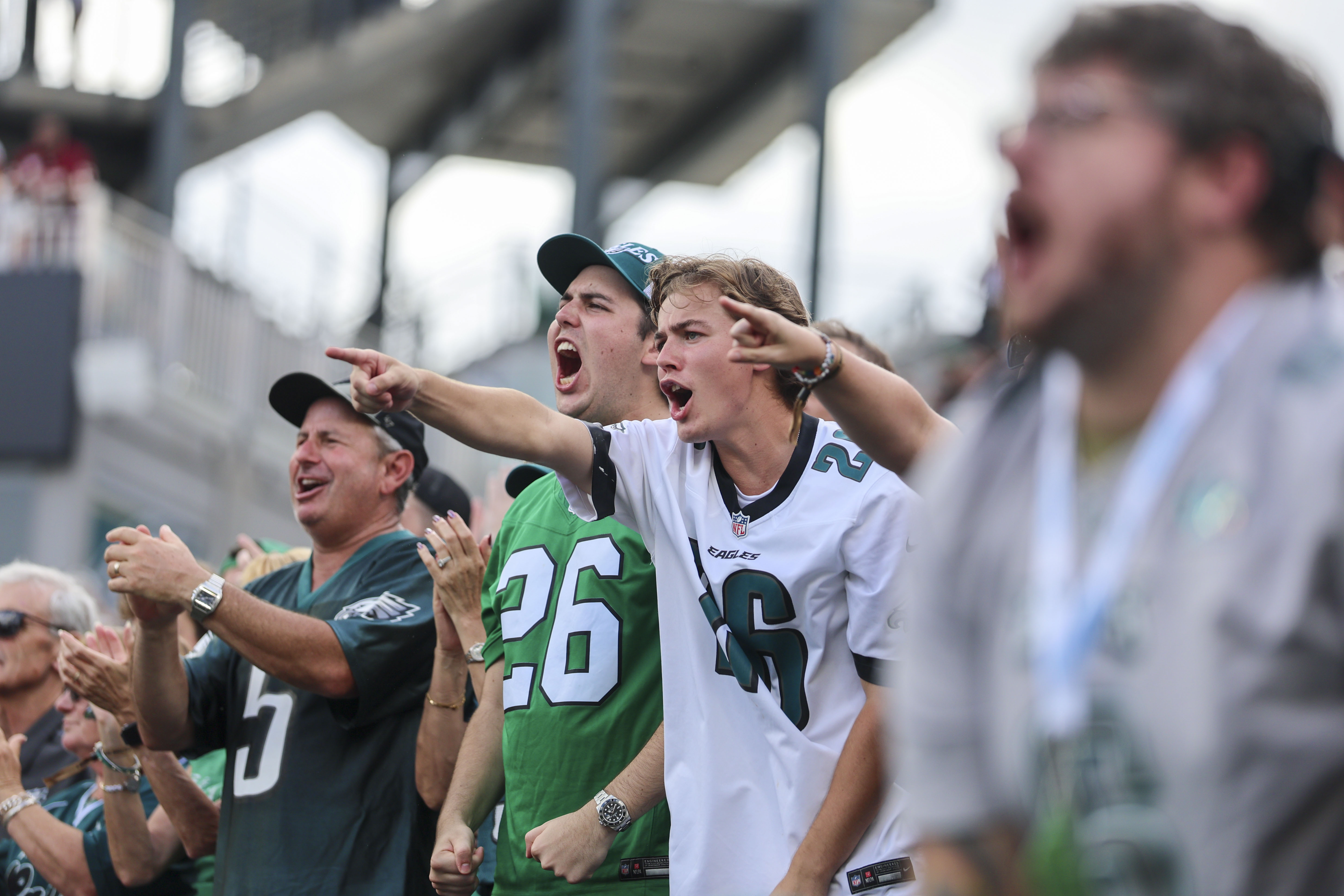
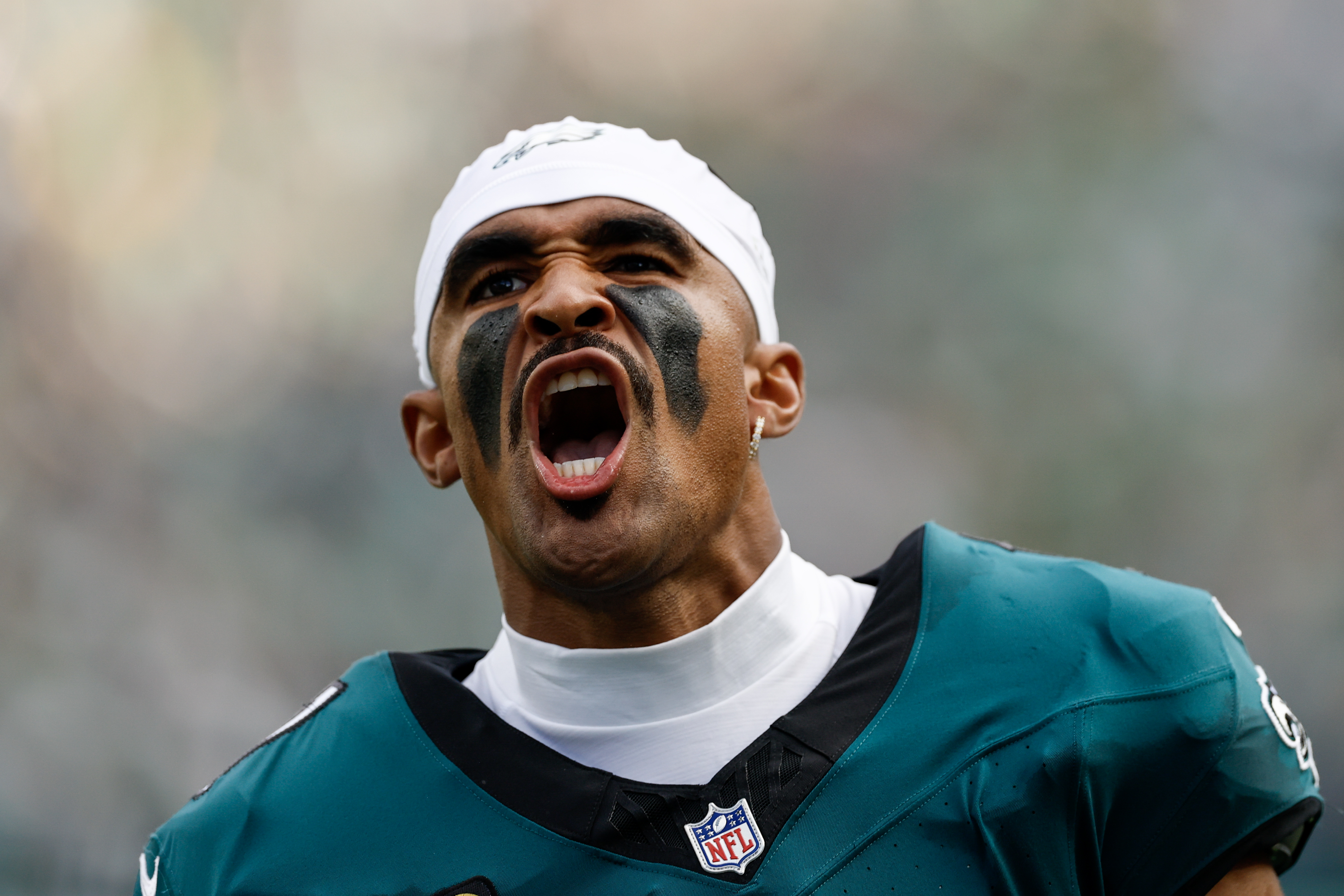
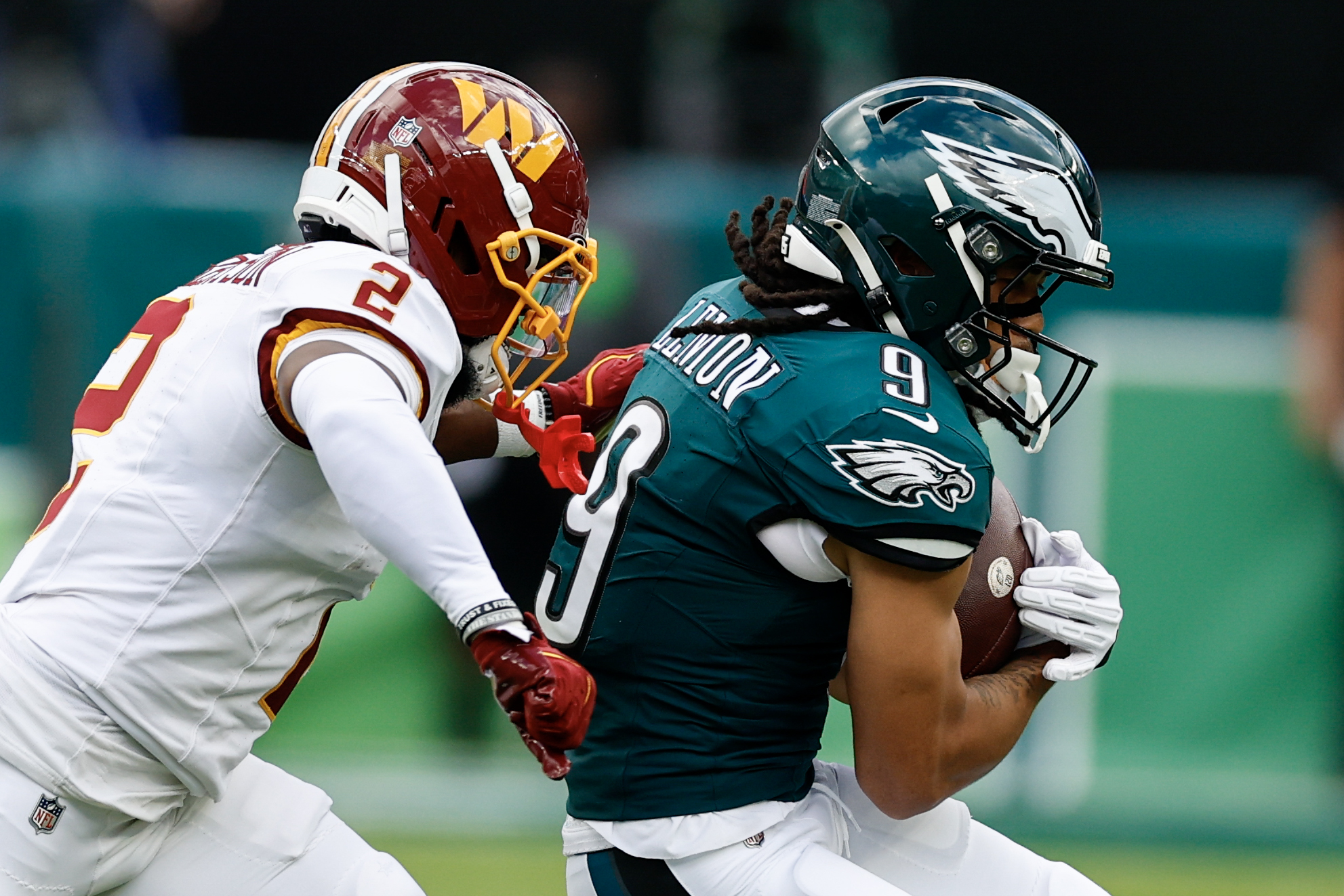
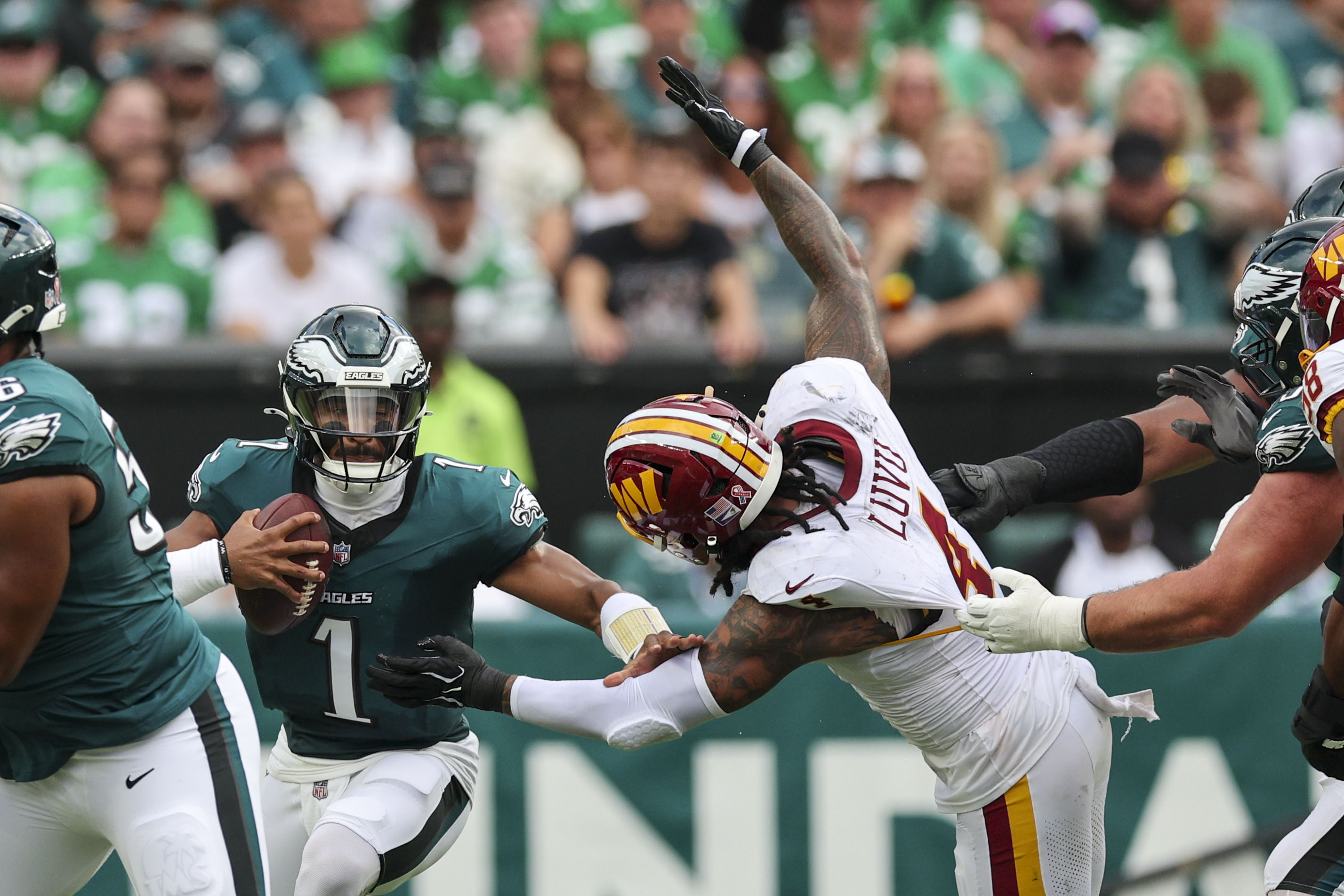
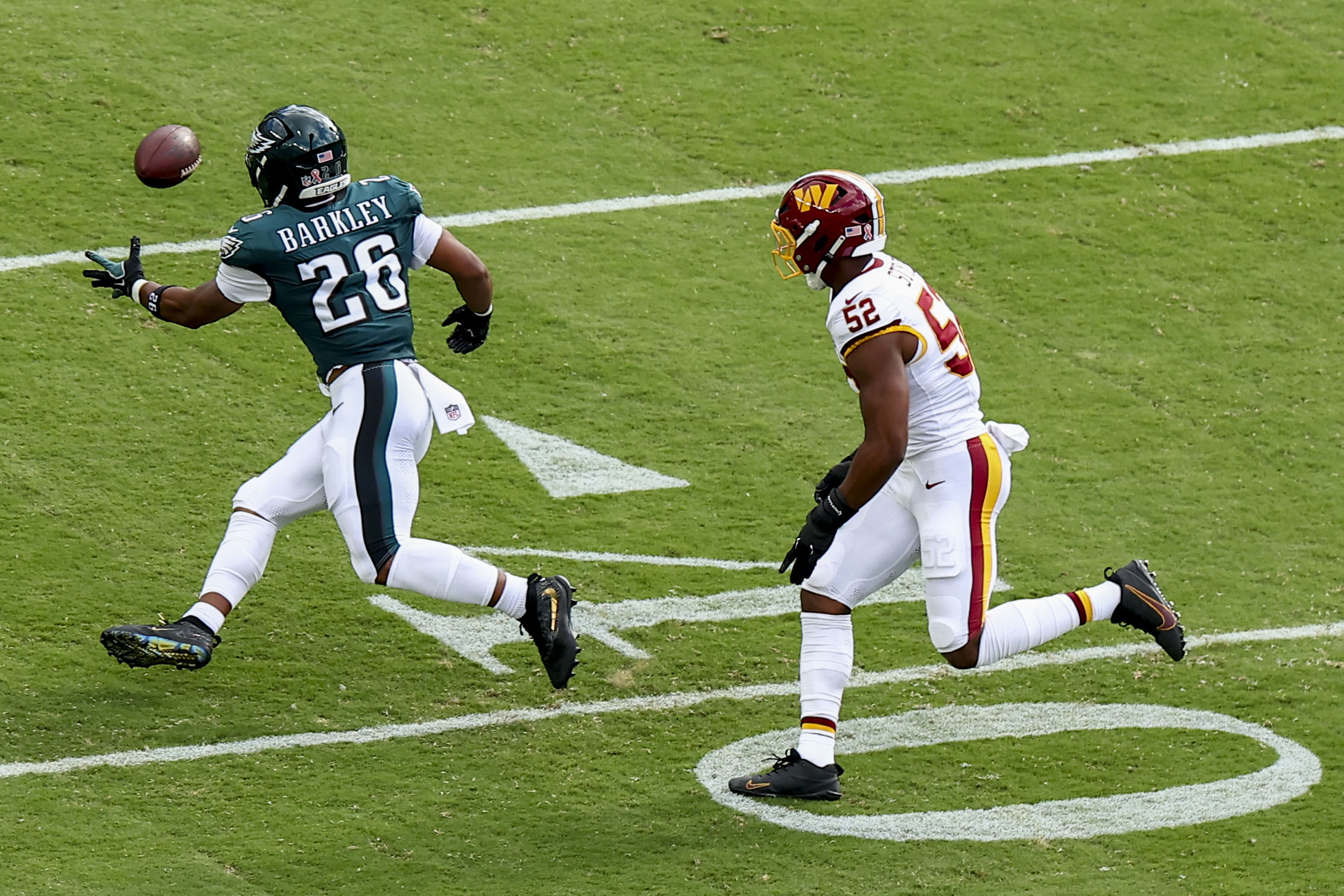
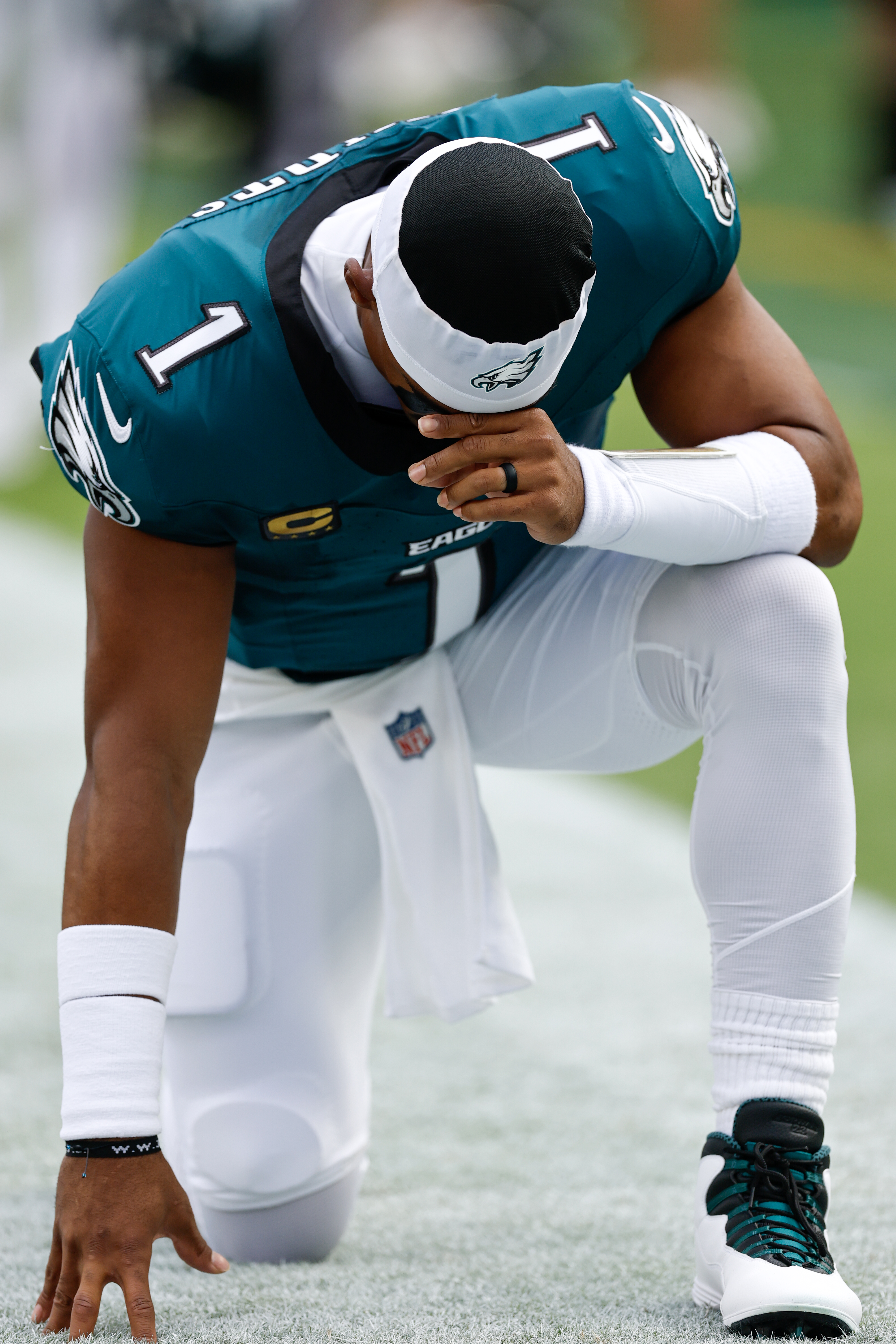
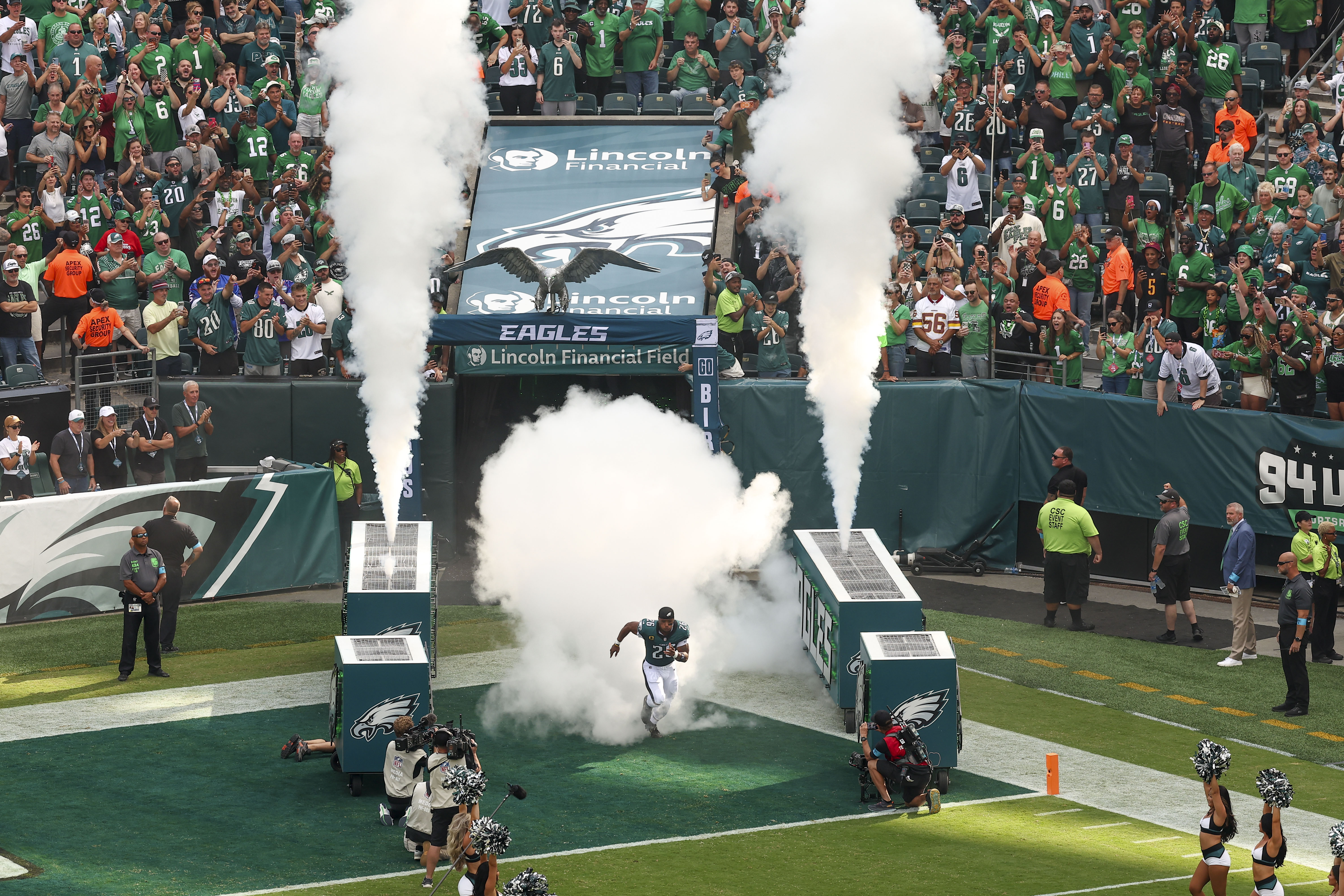
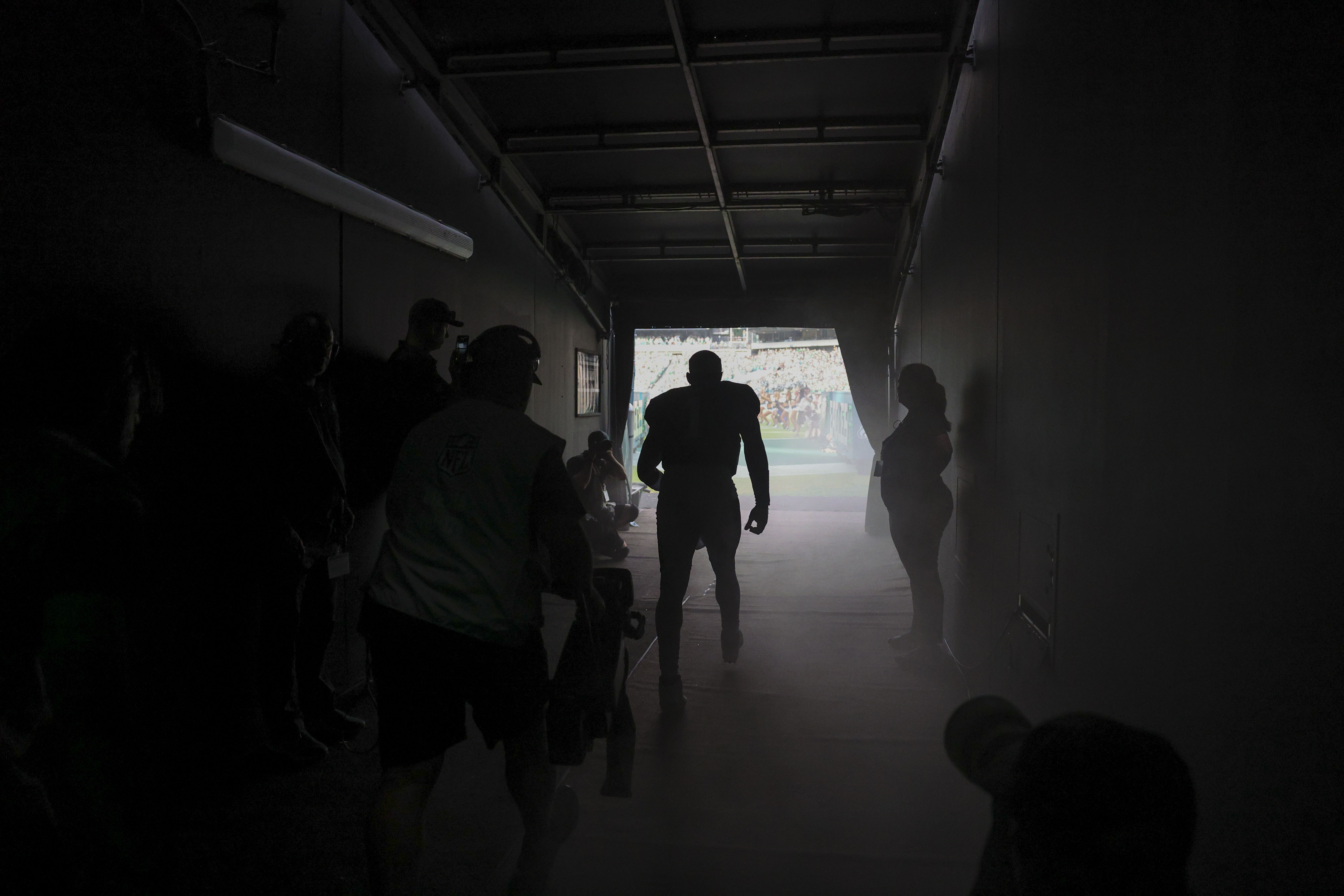
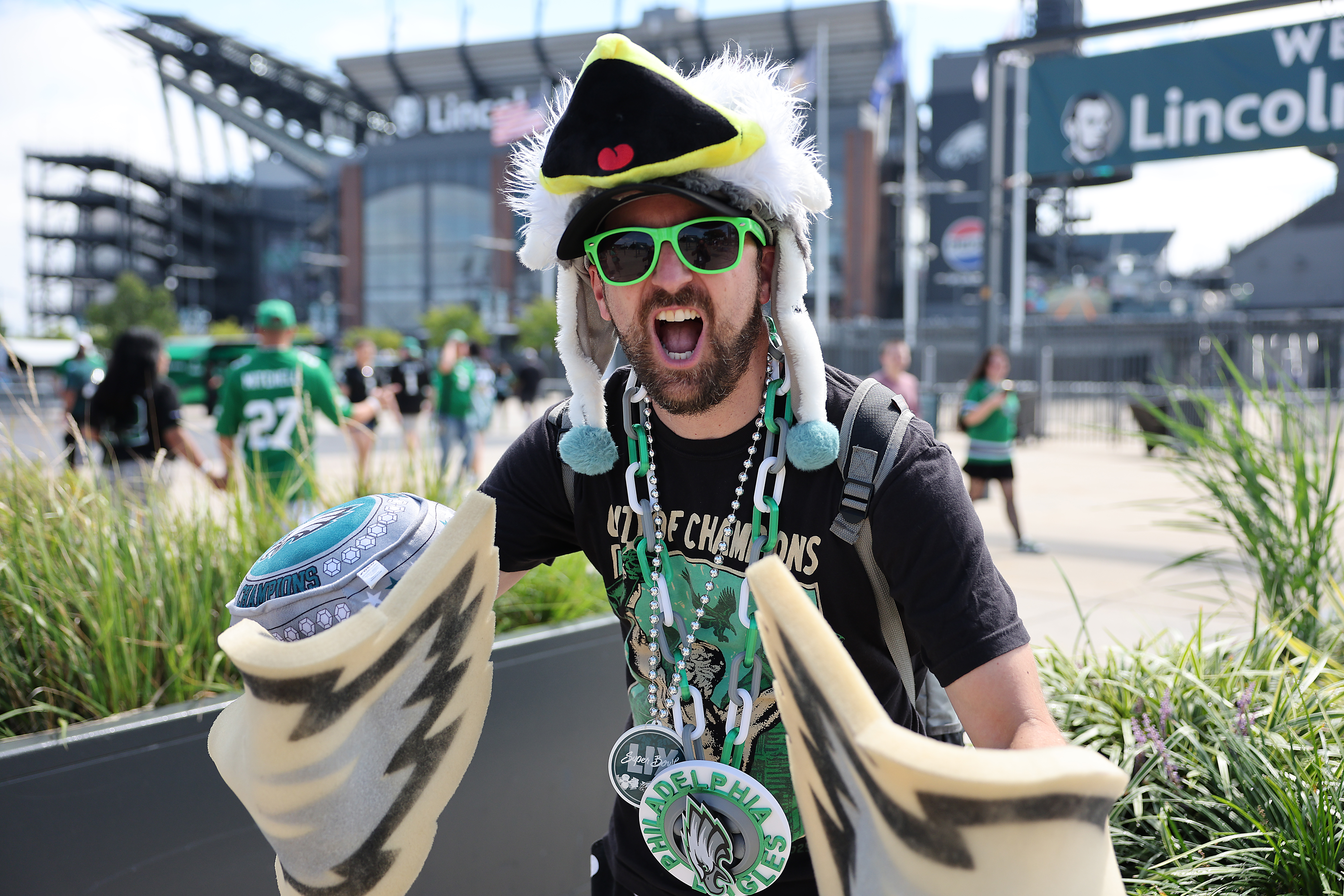
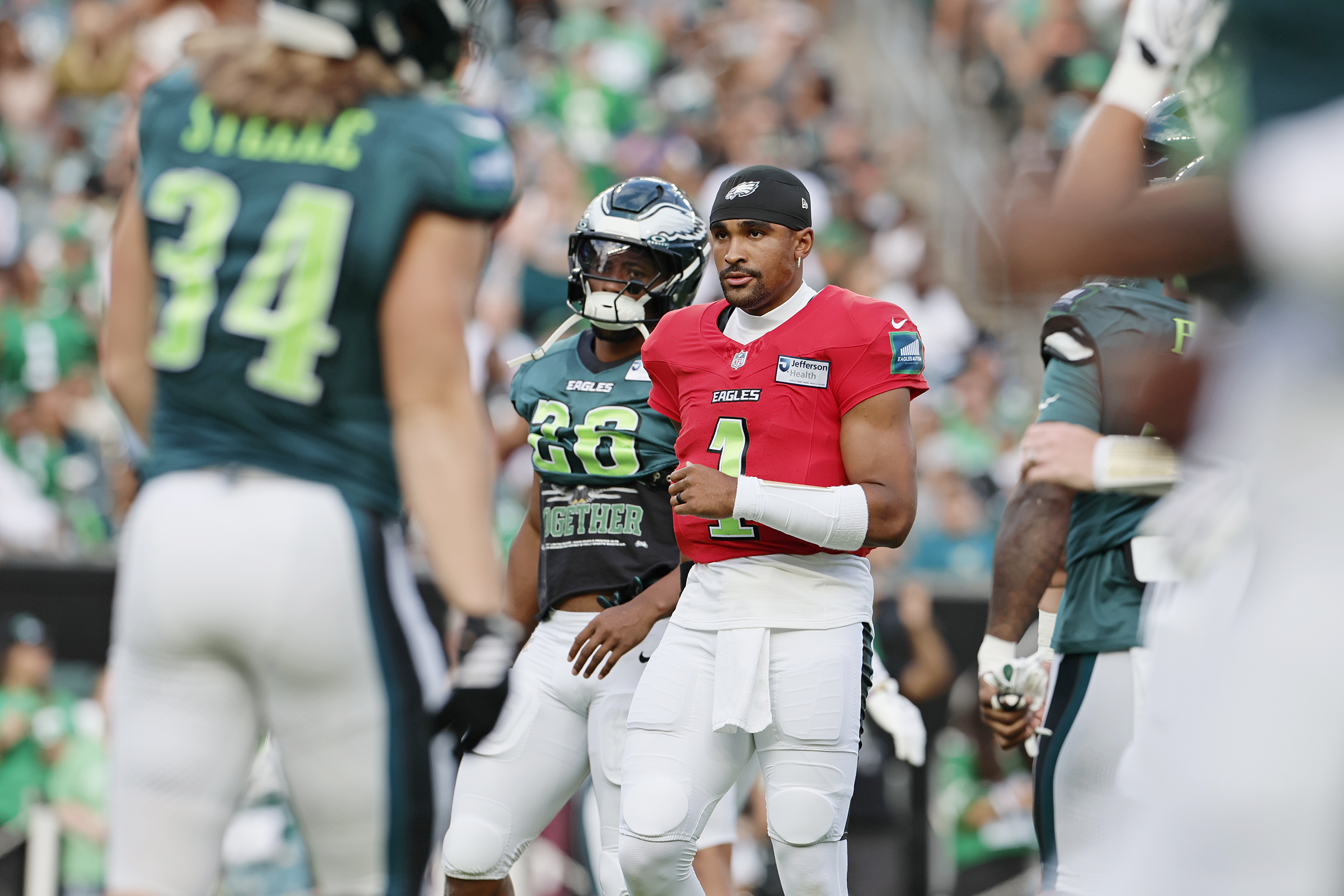
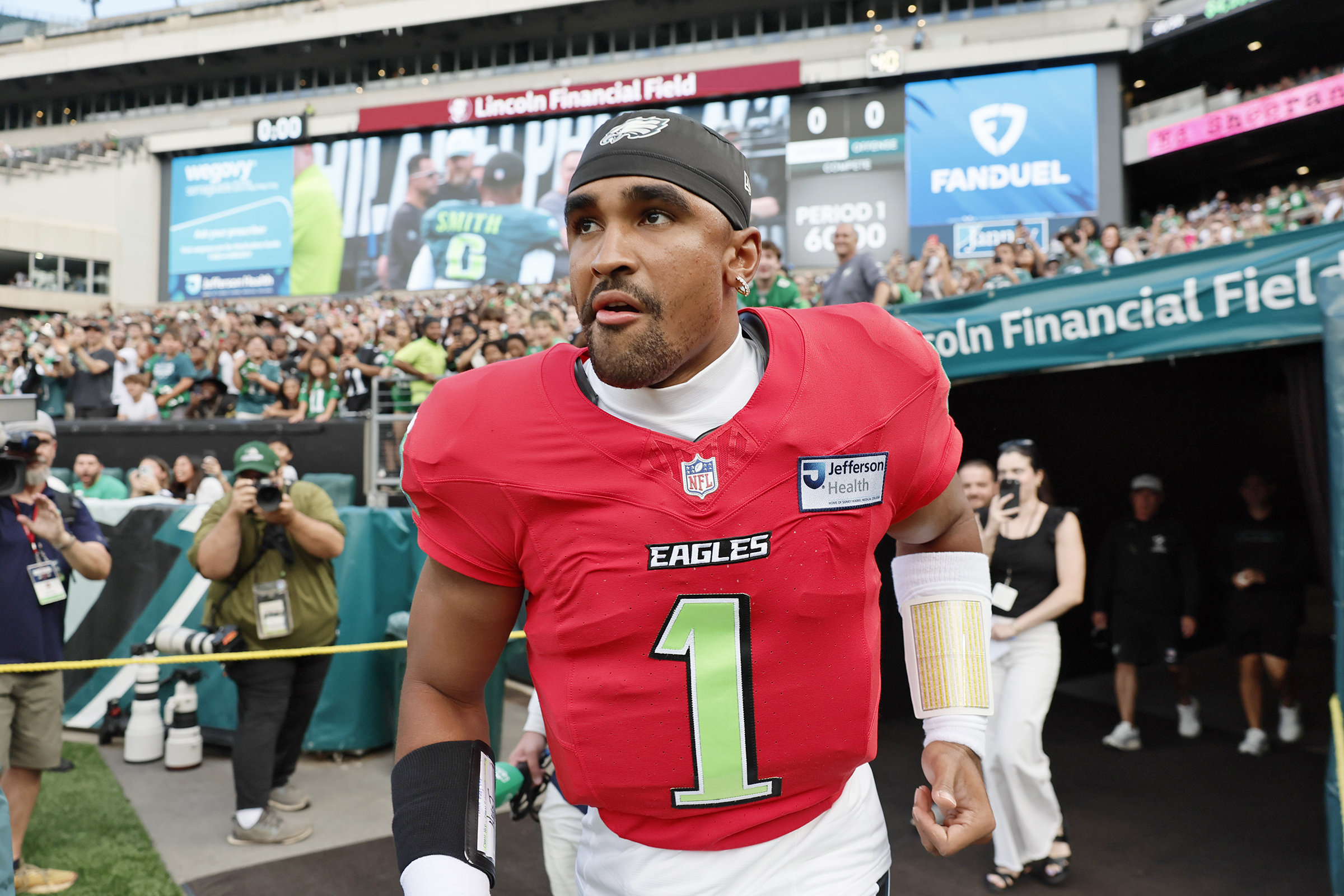
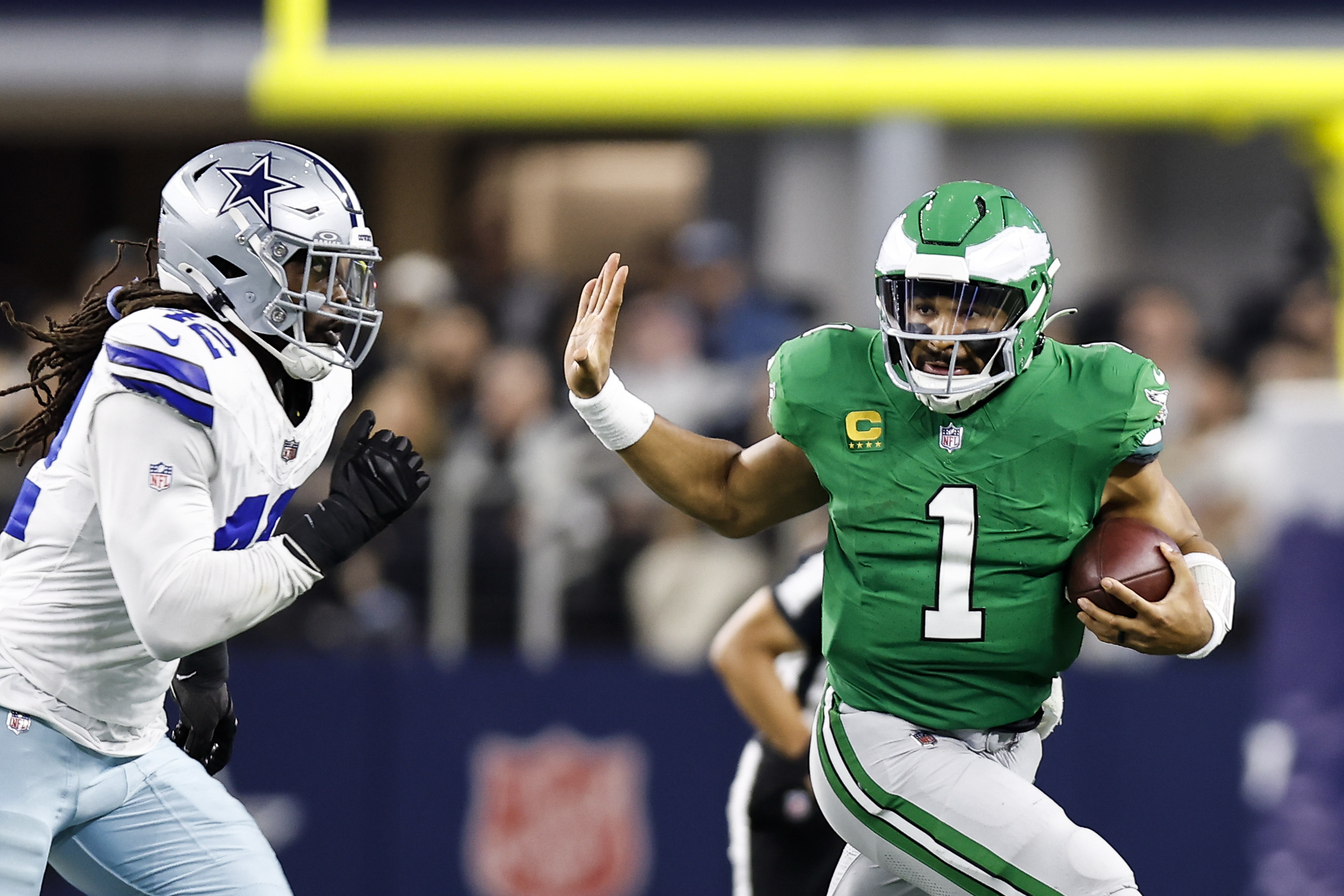
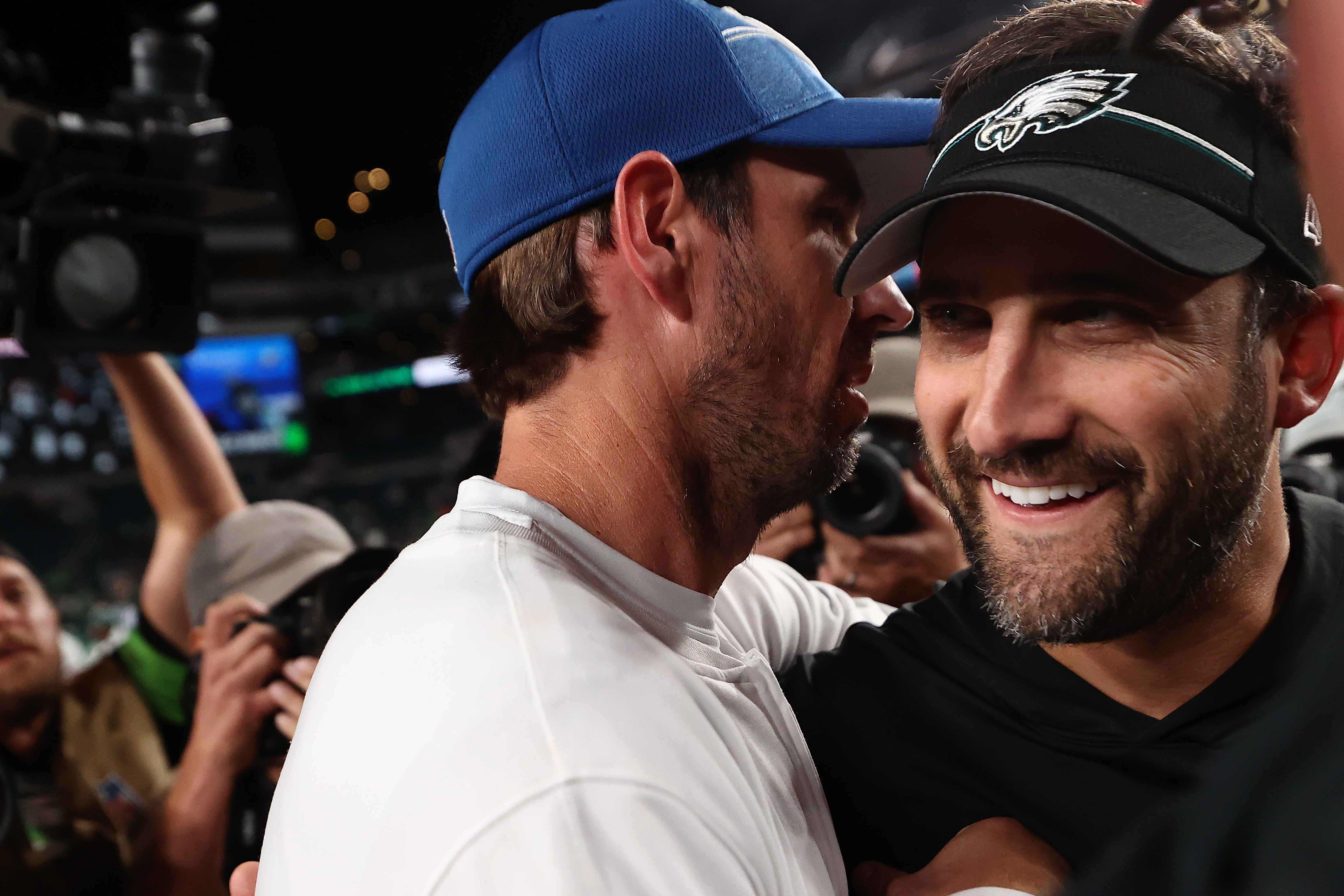
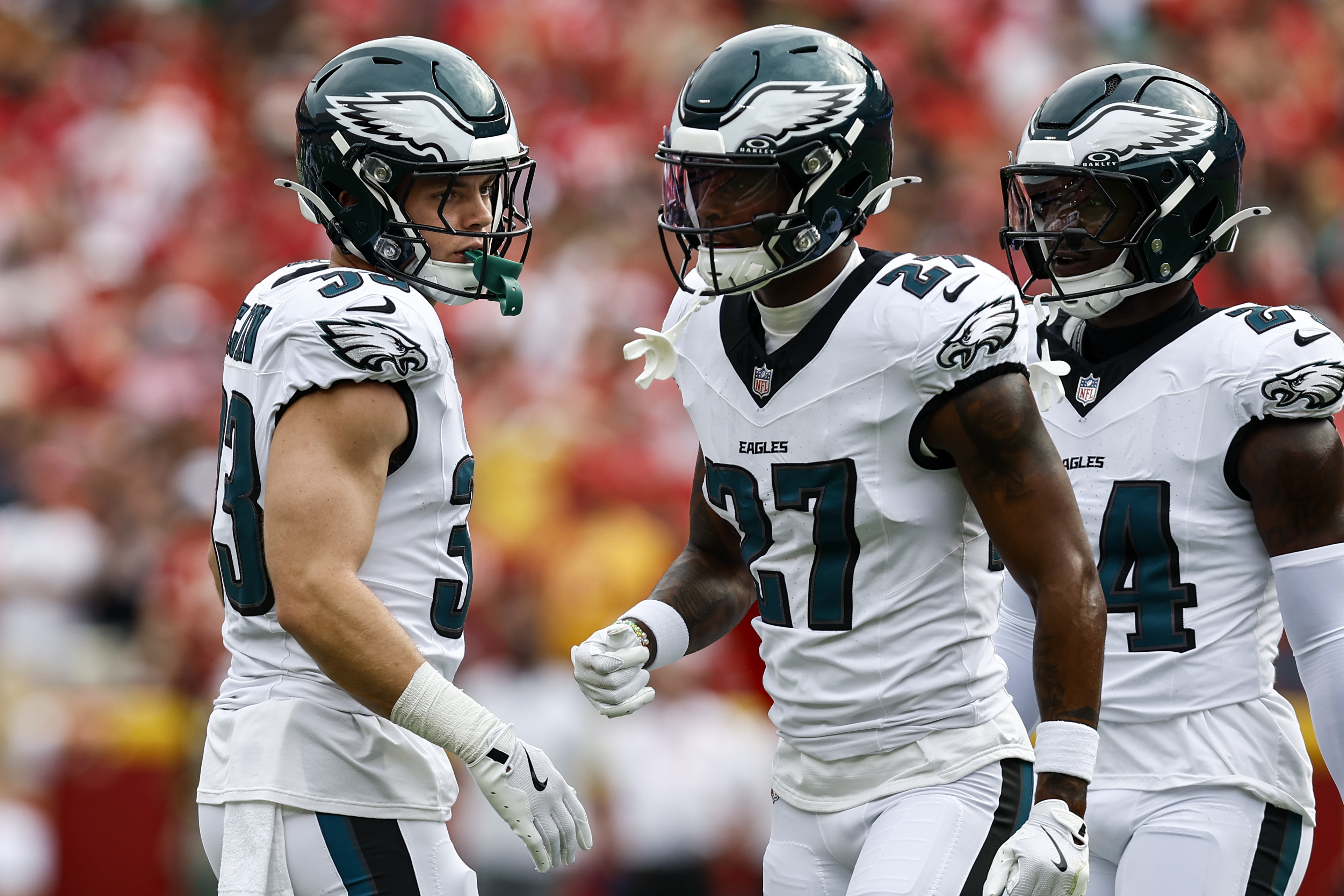
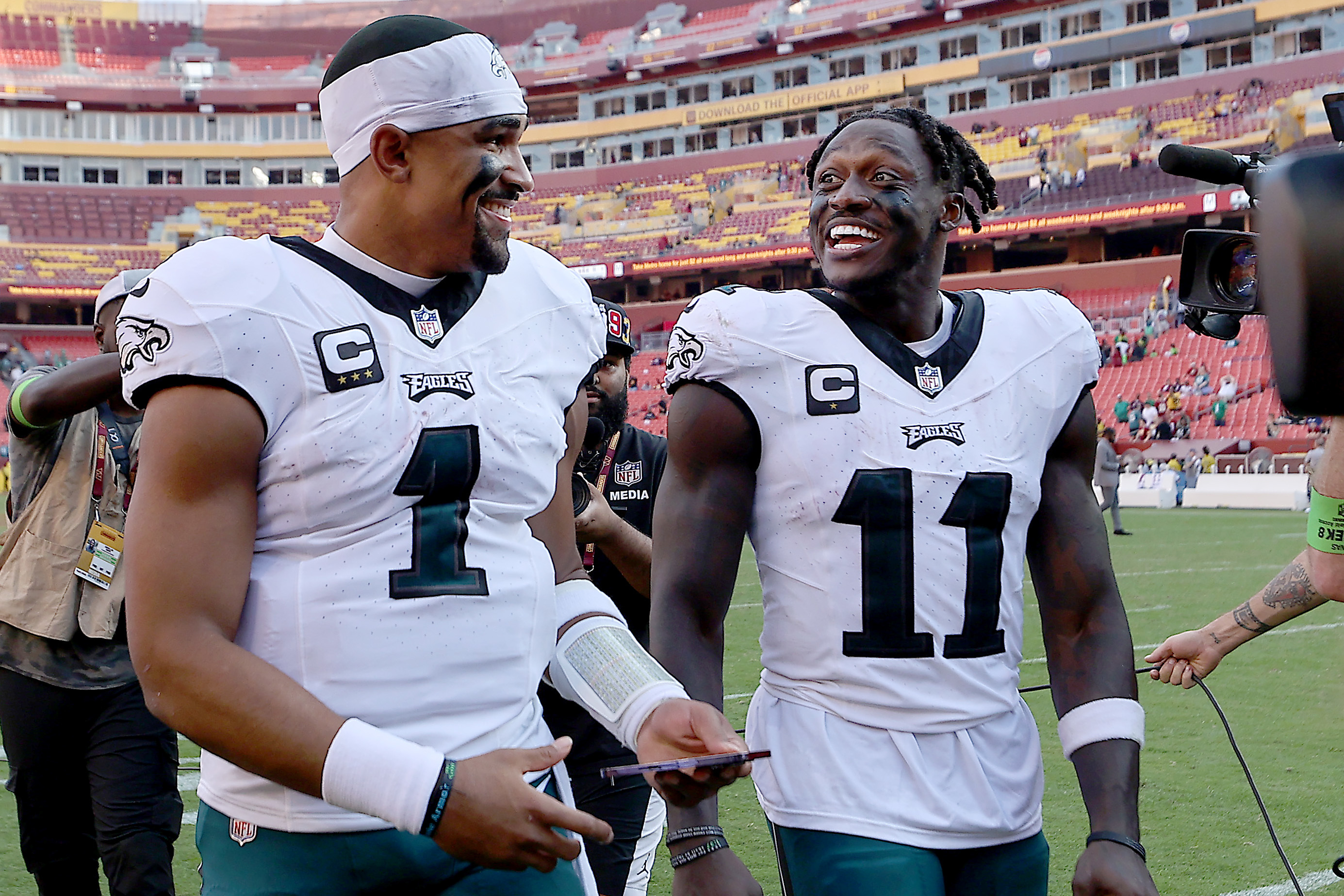
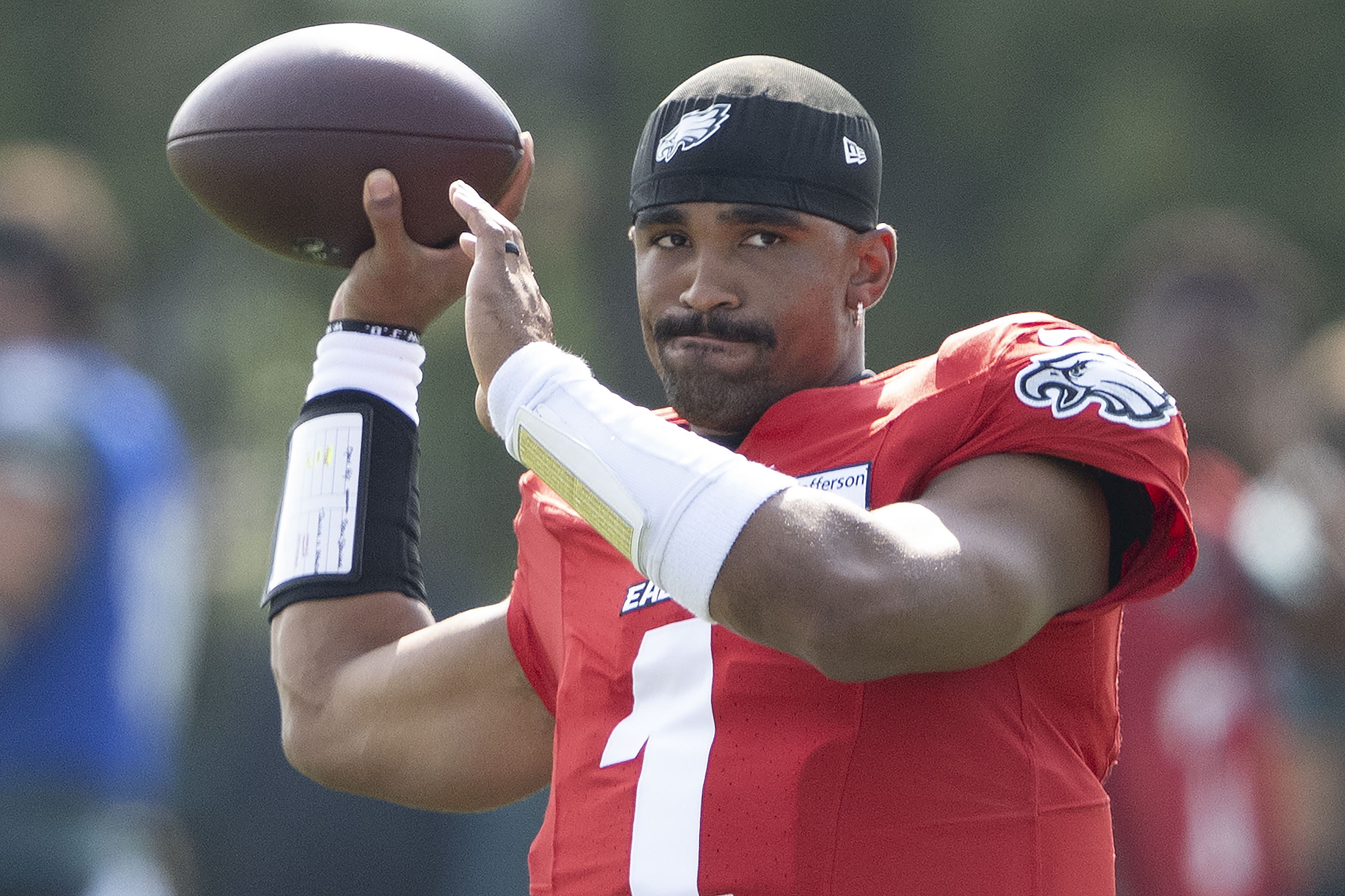
Philadelphia Eagles quarterback Jalen Hurts after winning the season opening game against the Washington Commanders at Lincoln Financial Field on Sunday, Sept. 13, 2026, in Philadelphia.Monica Herndon / Staff PhotographerEagles quarterback Jalen Hurts celebrates a touchdown with Keyshawn James-Newby (center) and offensive tackle Lane Johnson during the fourth quarter of the season opener against the Commanders Sunday, Sept. 13, 2026, in Philadelphia.Yong Kim / Staff PhotographerEagles defensive tackle Moro Ojomo celebrates a two-point conversion stop late during the fourth quarter of the season opener against the Commanders Sunday, Sept. 13, 2026, in Philadelphia.Yong Kim / Staff PhotographerPhiladelphia Eagles stop the two point conversion attempt during the fourth quarter at Lincoln Financial Field on Sunday, Sept. 13, 2026, in Philadelphia.David Maialetti / Staff PhotographerPhiladelphia Eagles tight end Dallas Goedert celebrates his fourth quarter touchdown at Lincoln Financial Field on Sunday, Sept. 13, 2026, in Philadelphia.Monica Herndon / Staff PhotographerEagles tight end Dallas Goedert scores a fourth quarter touchdown past Commanders cornerback Darius Rush during the season opener against the Commanders Sunday, Sept. 13, 2026, in Philadelphia.Yong Kim / Staff PhotographerPhiladelphia Eagles tight end Dallas Goedert runs for a touchdown in the fourth quarter at Lincoln Financial Field on Sunday, Sept. 13, 2026, in Philadelphia.Monica Herndon / Staff PhotographerEagles tight end Dallas Goedert catches the football for a touchdown during the fourth quarter of the season opener against the Commanders Sunday, Sept. 13, 2026, in Philadelphia.Yong Kim / Staff PhotographerEagles quarterback Jalen Hurts first down run during the fourth quarter of the season opener against the Commanders Sunday, Sept. 13, 2026, in Philadelphia.Yong Kim / Staff PhotographerWashington Commanders wide receiver Stefon Diggs hugs the goalpost after scoring a touchdown in the fourth quarter Lincoln Financial Field on Sunday, Sept. 13, 2026, in Philadelphia. Unsportsmanlike penalty was called pushing the Commanders back.David Maialetti / Staff PhotographerWashington Commanders wide receiver Stefon Diggs scores in the fourth quarter at Lincoln Financial Field on Sunday, Sept. 13, 2026, in Philadelphia.David Maialetti / Staff PhotographerPhiladelphia Eagles wide receiver DeVonta Smith catches the ball for a big first down during the third quarter at Lincoln Financial Field on Sunday, Sept. 13, 2026, in Philadelphia.David Maialetti / Staff PhotographerPhiladelphia Eagles quarterback Jalen Hurts gains fourteen yards on a run in the third quarter at Lincoln Financial Field on Sunday, Sept. 13, 2026, in Philadelphia.David Maialetti / Staff PhotographerEagles place kicker Jake Elliott kicks a third quarter field goad during the season opener against the Commanders Sunday, Sept. 13, 2026, in Philadelphia.Yong Kim / Staff PhotographerEagles cornerback Cooper DeJean stops Commanders wide receiver Jaylin Lane during the third quarter of the season opener against the Commanders Sunday, Sept. 13, 2026, in Philadelphia.Yong Kim / Staff PhotographerEagles wide receiver DeVonta Smith catches the ball against Commanders cornerback Darius Rush during the third quarter of the season opener against the Commanders Sunday, Sept. 13, 2026, in Philadelphia.Yong Kim / Staff PhotographerPhiladelphia Eagles quarterback Jalen Hurts sacked in the third quarter by Washington Commanders linebacker Odafe Oweh at Lincoln Financial Field on Sunday, Sept. 13, 2026, in Philadelphia.Monica Herndon / Staff PhotographerPhiladelphia Eagles quarterback Jalen Hurts scrambles on a third down during the third quarter at Lincoln Financial Field on Sunday, Sept. 13, 2026, in Philadelphia.Monica Herndon / Staff PhotographerEagles head coach Nick Sirianni racts during the third quarter of the season opener against the Commanders Sunday, Sept. 13, 2026, in Philadelphia.Yong Kim / Staff PhotographerPhiladelphia Eagles quarterback Jalen Hurts is sacked by Washington Commanders linebacker Sonny Styles in the third quarter at Lincoln Financial Field on Sunday, Sept. 13, 2026, in Philadelphia.Monica Herndon / Staff PhotographerEagles quarterback Jalen Hurts passes to tight end Dallas Goedert late during the second quarter of the season opener against the Commanders Sunday, Sept. 13, 2026, in Philadelphia.Yong Kim / Staff PhotographerEagles defensive tackle Jalen Carter celebrates a blocked extra point late during the second quarter of the season opener against the Commanders Sunday, Sept. 13, 2026, in Philadelphia.Yong Kim / Staff PhotographerPhiladelphia Eagles quarterback Jalen Hurts hands off to Philadelphia Eagles running back Tank Bigsby in the second quarter at Lincoln Financial Field on Sunday, Sept. 13, 2026, in Philadelphia.Monica Herndon / Staff PhotographerPhiladelphia Eagles tight end Dallas Goedert congratulates Philadelphia Eagles wide receiver Dontayvion Wicks after a second quarter touchdown at Lincoln Financial Field on Sunday, Sept. 13, 2026, in Philadelphia.David Maialetti / Staff PhotographerPhiladelphia Eagles head coach Nick Sirianni congratulates Philadelphia Eagles wide receiver Dontayvion Wicks after his second quarter touchdown at Lincoln Financial Field on Sunday, Sept. 13, 2026, in Philadelphia.David Maialetti / Staff PhotographerPhiladelphia Eagles linebacker Nolan Smith tries to block Washington Commanders quarterback Jayden Daniels in the second quarter at Lincoln Financial Field on Sunday, Sept. 13, 2026, in Philadelphia.Monica Herndon / Staff PhotographerEagles defensive tackle Moro Ojomo goes after Commanders quarterback Jayden Daniels during the second quarter of the season opener against the Commanders Sunday, Sept. 13, 2026, in Philadelphia.Yong Kim / Staff PhotographerEagles wide receiver Dontayvion Wicks celebrates a touchdown with Darius Cooper (left) and DeVonta Smith (right) during the second quarter of the season opener against the Commanders Sunday, Sept. 13, 2026, in Philadelphia.Yong Kim / Staff PhotographerEagles linebacker Zack Baun celebrates after breaking up a pass intended for Commanders wide receiver Stefon Diggs during the second quarter of the season opener against the Commanders Sunday, Sept. 13, 2026, in Philadelphia.Yong Kim / Staff PhotographerPhiladelphia Eagles linebacker Zack Baun stops Washington Commanders running back Jacory Croskey-Merritt for a loss, Washington punts on the drive, at Lincoln Financial Field on Sunday, Sept. 13, 2026, in Philadelphia.David Maialetti / Staff PhotographerPhiladelphia Eagles running back Saquon Barkley with a big run in the second quarter at Lincoln Financial Field on Sunday, Sept. 13, 2026, in Philadelphia.David Maialetti / Staff PhotographerPhiladelphia Eagles cornerback Cooper DeJean and Philadelphia Eagles linebacker Zack Baun sandwich Washington Commanders quarterback Jayden Daniels during the second quarter at Lincoln Financial Field on Sunday, Sept. 13, 2026, in Philadelphia.David Maialetti / Staff PhotographerEagles running back Saquon Barkley gains 42 yards during the second quarter of the season opener against the Commanders Sunday, Sept. 13, 2026, in Philadelphia.Yong Kim / Staff PhotographerPhiladelphia Eagles tight end Dallas Goedert celebrates second quarter touchdown with Philadelphia Eagles offensive tackle Lane Johnson at Lincoln Financial Field on Sunday, Sept. 13, 2026, in Philadelphia.Monica Herndon / Staff PhotographerPhiladelphia Eagles tight end Dallas Goedert spikes the ball after a touchdown in the second quarter at Lincoln Financial Field on Sunday, Sept. 13, 2026, in Philadelphia.Monica Herndon / Staff PhotographerEagles tight end Dallas Goedert catches a touchdown against Commanders safety Quan Martin during the second quarter of the season opener against the Commanders Sunday, Sept. 13, 2026, in Philadelphia.nYong Kim / Staff PhotographerPhiladelphia Eagles fans cheer in the first quarter of the season opener against the Washington Commanders at Lincoln Financial Field on Sunday, Sept. 13, 2026, in Philadelphia.David Maialetti / Staff PhotographerEagles quarterback Jalen Hurts reacts during the first quarter of the season opener against the Commanders Sunday, Sept. 13, 2026, in Philadelphia.Yong Kim / Staff PhotographerEagles wide receiver Makai Lemon catches the ball against Commanders cornerback Amik Robertson during the first quarter of the season opener against the Commanders Sunday, Sept. 13, 2026, in Philadelphia.Yong Kim / Staff PhotographerPhiladelphia Eagles quarterback Jalen Hurts is sacked by Washington Commanders linebacker Frankie Luvu in the first quarter at Lincoln Financial Field on Sunday, Sept. 13, 2026, in Philadelphia.David Maialetti / Staff PhotographerPhiladelphia Eagles running back Saquon Barkley misses a pass in the first quarter, defended by Washington Commanders linebacker Sonny Styles, at Lincoln Financial Field on Sunday, Sept. 13, 2026, in Philadelphia.Monica Herndon / Staff PhotographerEagles quarterback Jalen Hurts during a moment of silence before the start of the season opener against the Commanders Sunday, Sept. 13, 2026, in Philadelphia.Yong Kim / Staff PhotographerPhiladelphia Eagles running back Saquon Barkley runs out of the tunnel at the season opener against the Washington Commanders in Lincoln Financial Field on Sunday, Sept. 13, 2026, in Philadelphia.Monica Herndon / Staff PhotographerPhiladelphia Eagles quarterback Jalen Hurts runs out of the tunnel during player introductions before the season opening game against the Washington Commanders in Lincoln Financial Field on Sunday, Sept. 13, 2026, in Philadelphia.David Maialetti / Staff PhotographerGreg Gorski, of Elkins Park, poses for a portrait while tailgating before the Eagles play the Commanders in Philadelphia on Sunday, Sept. 13, 2026.David Maialetti / Staff Photographer
“It’s something we’re all experiencing together,” Hurts said. “We’ve got new coaches at almost every position on the offensive side of the ball, especially when it comes to instilling the values and philosophy of this new scheme. And we’ve got new players who are going to make plays for us in new, important roles. The best way to learn is from experience and to reflect upon that experience.”
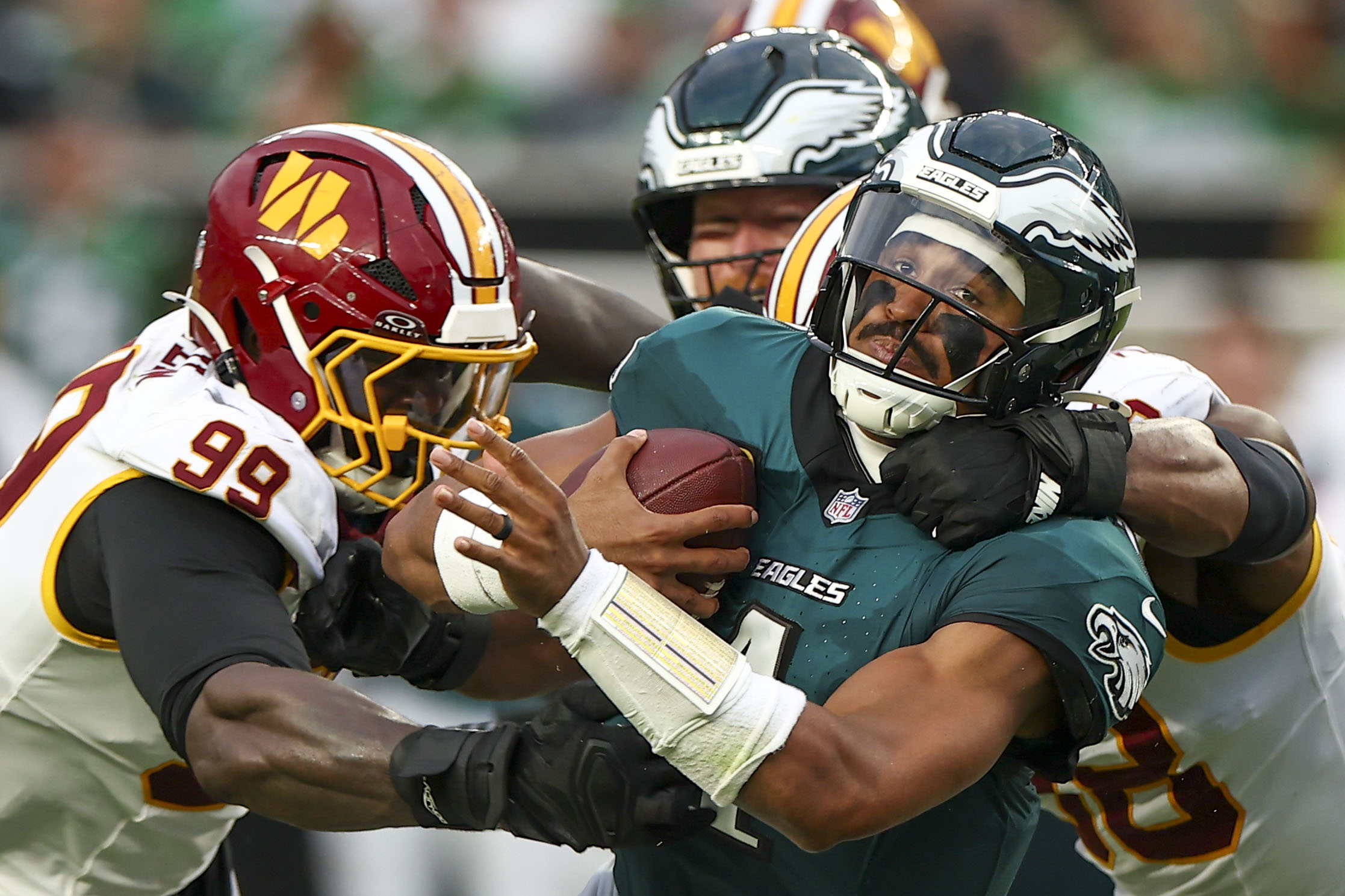
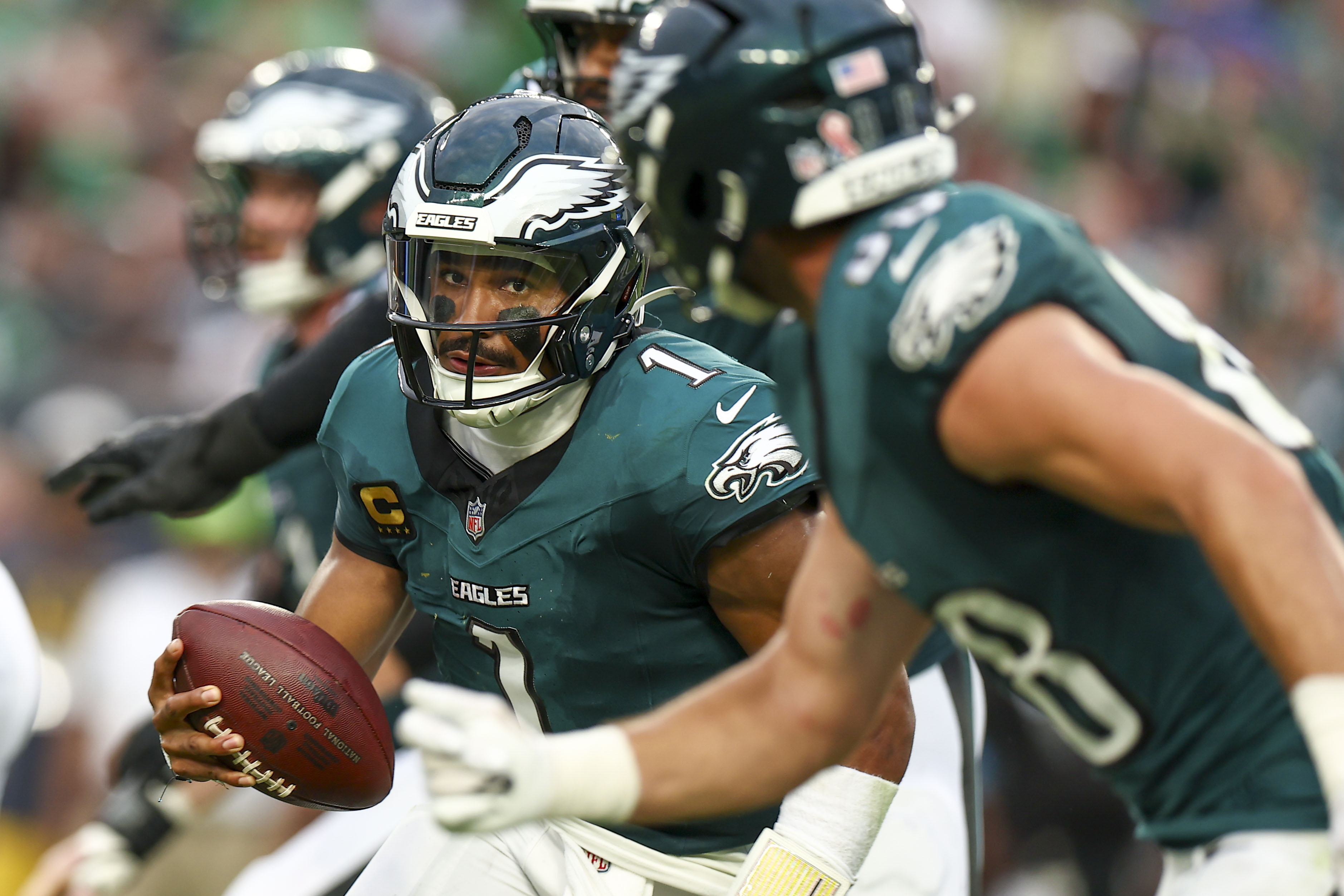
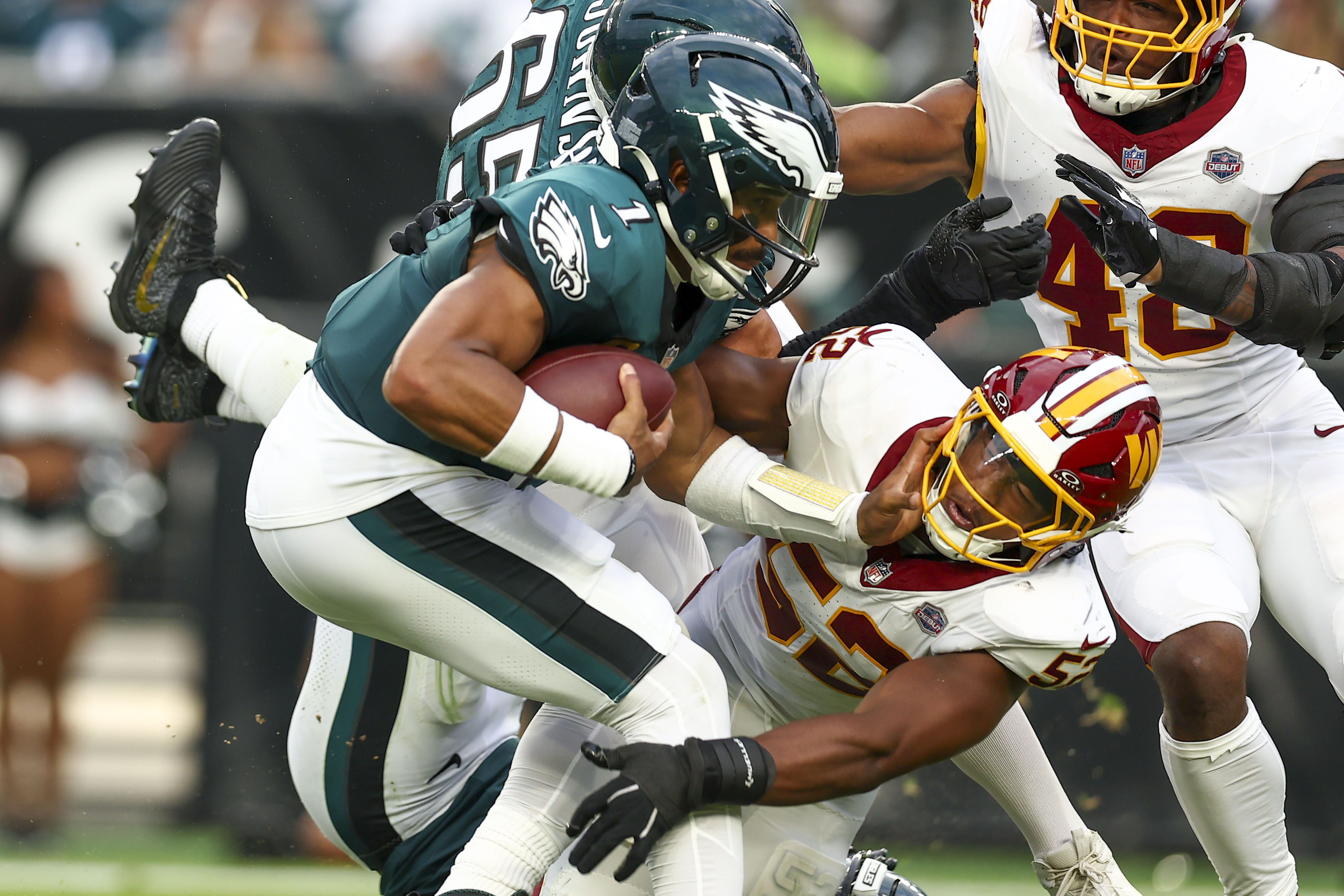
He has as much with Goedert as anyone else, and he’ll need it. The Eagles sure needed it Sunday, through three sacks of Hurts and two holding penalties by center Cam Jurgens and a rough game for guard Landon Dickerson. Up 17-16 midway through the fourth quarter, Hurts and Goedert brought that shared comfort and familiarity to bear in a big way. After tackle Jordan Mailata committed a false start penalty that pushed the Eagles back to their 31-yard line, Hurts ripped off a 22-yard scramble on third-and-18. Three plays later, Hurts zipped a pass over the middle on third-and-6 to Goedert, who spun to his left and chugged away from three Washington defenders to the end zone.
“That’s my brother, man,” said Mailata, the Eagles’ final pick in the 2018 draft, the one in which Goedert was their first. “I was super excited that we brought him back. I was happy. I didn’t want to be the last one here from my draft class. So when Dallas came back, I was very thankful for that. Kudos to him for having a great night tonight. I went up to him after that second touchdown, to him and Jalen, and said, ‘Thanks for bailing me out after that false start.’”
That he is still here to make such plays might seem a victory for him in and of itself. He does not view it that way.
“I never lost confidence in myself,” he said. “I always think very highly of myself, and I think everybody in this locker room thinks the same about themselves. If I get an opportunity, I’m going to try to make the most of it.”
After so much uncertainty about his future, with so much still lingering, Goedert will get more of those opportunities. The Eagles at the moment don’t have another choice, and that’s fine with him.
You don’t need a weatherman to know which way the wind blows. You don’t have to be a longtime travel agent to have looked at the Los Angeles Rams’ Australia itinerary and thought, Hey guys, might be a tough turnaround there. And you don’t have to be a football savant to suspect that the Eagles’ season opener Sunday against the Washington Commanders is going to be a hard watch.
If the first two games of this NFL season weren’t enough to tell you just how rocky these opening weeks will be, Eagles-Commanders ought to drive home the point. Matthew Stafford and Drake Maye were so terrible, so far from the MVP (Stafford) and MVP runner-up (Maye) they were last season, that it would have been fair to check whether either of them had signed an endorsement deal with a prediction market earlier in the week.
The Patriots took a double-digit lead and couldn’t hold it. The Rams might as well have been on walkabout with Mick Dundee. Sam Darnold and A.J. Brown suffered serious injuries. Of the four teams that made up the NFL’s marquee matchups, only the 49ers were ready for prime time. Jeez, it’s almost like, even after a full offseason, having teams play on Wednesday and Thursday nights — or having two California teams start their seasons on a continent roughly 7,300 miles from their home state — leads to lousy football.
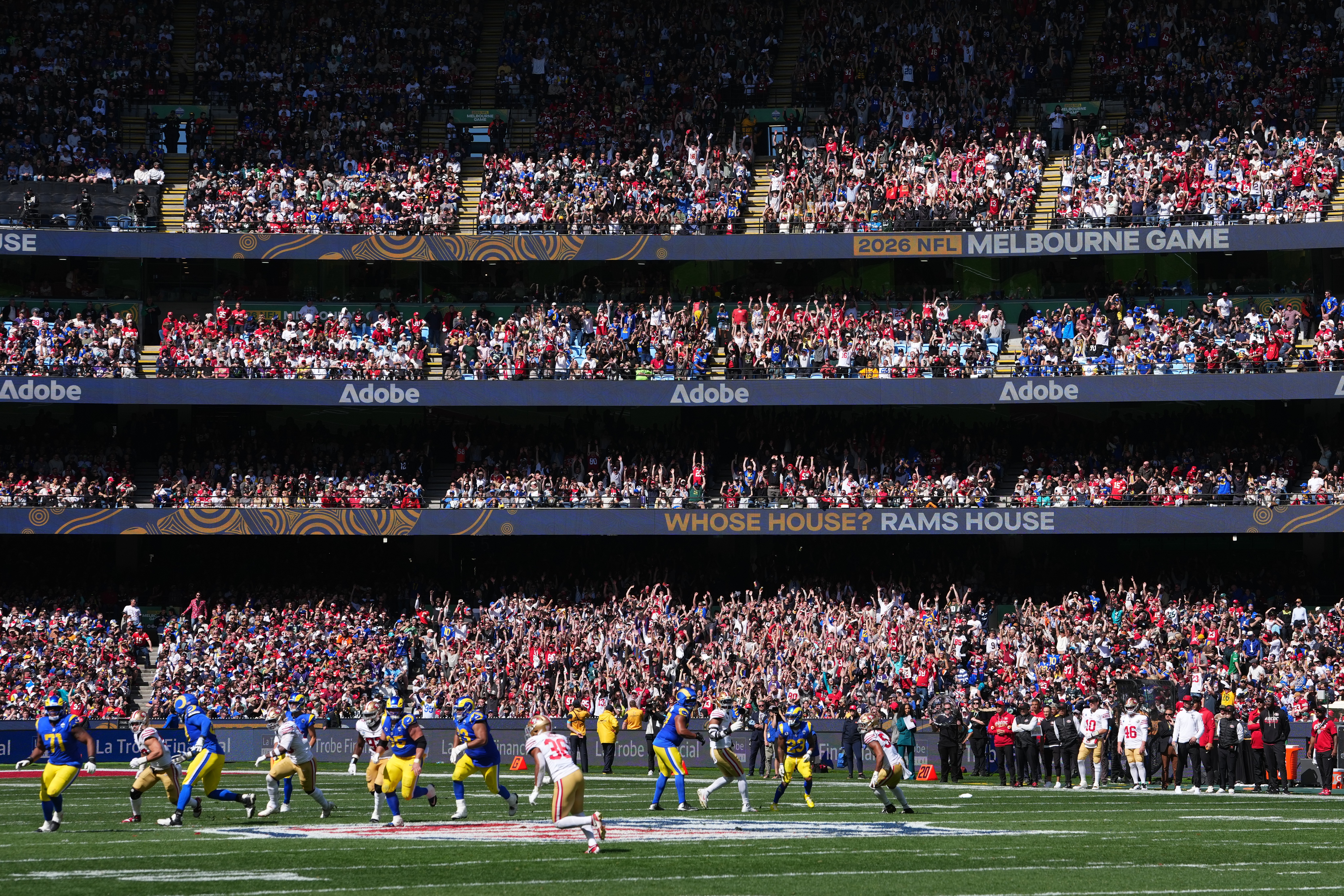
The game between the Los Angeles Rams and the San Francisco 49ers in Melbourne, Australia, wasn’t pretty.Scott Barbour
No one should expect the quality of Sunday’s game at Lincoln Financial Field to be much higher. The Commanders have a new offensive coordinator and a new defensive coordinator, neither of whom has ever coordinated anything in the NFL until now, and aside from Jayden Daniels, their roster resembles a piece of abstract art: You have to stare at it for a long time for it to make any sense (Odafe Oweh for as much as $96 million?), and in the end, it really doesn’t.
The Eagles ought to win, and win handily, because their defense is so strong and, relative to these teams’ other units, so stable. Their offense is a mystery and will remain one until their new coordinator, Sean Mannion, starts calling plays and reveals whether he’s a rookie who’s out of his depth or a nascent genius who’s been sandbagging everybody since training camp began. And whether Jalen Hurts can thrive in this latest new system. And whether any wide receiver other than DeVonta Smith can make a big play.
“Part of our goals for this week are to understand that … there are things that happen in Week 1 that you have to be ready for,” coach Nick Sirianni said Friday, “whether that’s live fundamentals, whether that’s errors in the kicking game, or whatever it may be. The standard doesn’t change [for] what we accept and what we require and what our guys do on the field. We practice like that every day. Anytime there’s something loose with the ball, or we miss a tackle, or whatever it may be, or miss our approach on a tackle, if we’re not tackling to the ground, it’s discussed. It’s watched. It’s critiqued. Our standard — your goal — is to be playing your best football by the end of the year. Our standard does not change.”
No, but the circumstances will. Starters who spent most, if not all, of the preseason sitting out eventually will kick off all the rust. It’s just that eventually likely will take more than one game. That’s the NFL now, with its three-game preseason and its 17-but-soon-to-be-18-game regular season and its insistence that its teams journey across oceans and, quite literally, suit up on every night of the week except Tuesdays.
The players themselves know better than anyone: You take the early victories if you can get them, and the crisp, clean performances probably will have to wait.
“You’re always striving for that,” said wide receiver Hollywood Brown, who is in his first season with the Eagles but his eighth in the league. “But I’ve played a lot of football, so I know that they’ve got a new defensive coordinator, and we’ve got a new offensive coordinator. You can try to study each other as much as you want, but there’s not much out there to go off of. You can go out there with everything we’ve studied and they’ve studied, and it could be something completely different.
“So it’s about knowing our principles, knowing what we’re trying to do, and knowing that’s just the stepping stone. Win or loss, it’s a stepping stone. You learn off it, and as we get into the year, you’re really trying to perfect your craft and identity.”
At what point in the season do players and teams find that identity?
“Usually, around Thanksgiving,” Brown said. “Around Thanksgiving, a lot of players are like, ‘That’s when the real football starts.’ That’s when we know what we are. We know what each team [is]. And it’s about executing the game plan and being at your best once December and January come around.”
Until then, everyone will just have to suffer through some sloppy football. It’s the price of this multi-billion-dollar business now. So if the Eagles win ugly Sunday, even if they somehow lose, don’t panic. Yet.
Now that the NFL preseason has been consigned to memory — that is, if anyone actually remembers it — it’s time for the big moment. It’s time to reveal the outcome of every Eagles game during the 2026 regular season.
Week 1: After an offseason of speculation about his scheme and system, new Eagles offensive coordinator Sean Mannion shocks everyone on the first play from scrimmage against Washington by having Jalen Hurts line up under center, take the snap, and do The Macarena. “I am not trying to seduce you,” Hurts says after the game. “I am trying to win football games.” Saquon Barkley rushes for 221 yards and two touchdowns, compelling President Trump to issue an executive order changing the franchise’s name from the Washington Commanders to the Washington Ontario. Eagles 24, Commanders 7.
Week 2: Before arriving in Nashville to face the Titans, the Eagles’ players and coaches spend Friday in East Tennessee — at Dollywood for a team-bonding retreat. Following a team dinner at Granny Ogle’s Ham ‘n’ Beans, Jordan Davis persuades Vic Fangio to ride the Wild Eagle roller coaster with him. Both of them throw up. Two days later, Jalyx Hunt sacks Titans quarterback Cam Ward three times. “I set out to get him with a fine tooth comb,” Hunt says. Eagles 20, Titans 6.
Week 3: On Fox NFL Sunday, Bears head coach Ben Johnson tells Jay Glazer, “Yeah, we want to win the game, but we want more than that. We want to hang 50 on ’em. We’re the best around, and nothing’s gonna ever keep us down.” Quinyon Mitchell intercepts Caleb Williams’s first pass and returns it 37 yards for the game’s only touchdown. Eagles 7, Bears 3.
Week 4: Less than 24 hours before their matchup against the Eagles, the Rams announce that they have acquired Joey Bosa, Bobby Wagner, Haason Reddick, Brad Pitt, George Clooney, Matt Damon, Don Cheadle, Elliott Gould, and Julia Roberts. DeVonta Smith catches six passes for 66 yards. The Eagles’ other wide receivers combine for six catches for minus-six yards. Rams 27, Eagles 13.
Week 5: In London, Hurts throws two interceptions and loses a fumble against the Jaguars. Asked after the game if he has any plans to go back to an offensive system with which his quarterback is more comfortable, head coach Nick Sirianni says, “Relax. I need some information first. Just the basic facts. Can you show me where it’s Hurts?” Jaguars 21, Eagles 7.
Week 6: The Eagles bounce back against the Panthers, but their manner of victory causes controversy. Barkley carries the ball 45 times for 233 yards and three touchdowns, but Hurts does not attempt a pass. At his locker after the game, Smith is asked how he feels about the offense. “You gotta go shipping up to Boston — or Foxborough — for that answer,” he says. Eagles 30, Panthers 17.
Week 7: On Monday Night Football against the Cowboys, Hurts delivers his finest performance of the season: 349 passing yards, two passing touchdowns, and a career-high seven aphorisms during his postgame press conference. His team off to a 3-4 start, Cowboys owner Jerry Jones says after the game that he has benched quarterback Dak Prescott and asks Troy Aikman if he’d be willing to play again. “Old man,” Aikman responds, “look at my life. Hell. No.” Eagles 34, Cowboys 28.
Jalen Hurts and the Eagles will face the Cowboys in Week 7.Monica Herndon / Staff Photographer
Week 8: It’s the second Eagles-Washington matchup of the season, this time on Sunday Night Football. Josh Harris hosts LeBron James and Jaylen Brown in his Northwest Stadium suite, where the amenities include a catering tray of undercooked hot dogs and guest appearances by former Washington greats Rock Cartwright, Gus Frerotte, and Donovan McNabb. Eagles 31, Whatever Their Name Is 10.
Week 9: Despite the Giants’ 4-6 record entering this game at Lincoln Financial Field, New York Mayor Zohran Mamdani releases 12 social-media videos declaring that Dec. 25 will “be known from this day forth as ‘John Harbaugh Day in the Big Apple.’” The New York Post runs a poll revealing that 57% of the media who cover the Giants believe Harbaugh is a better coach than Bill Parcells, Tom Coughlin, or Vince Lombardi. Jaxson Dart doesn’t complete a pass until late in the fourth quarter. Eagles 23, Giants 0.
Week 10: Through nine games, the Eagles have committed 15 turnovers. So during the bye week, Sirianni announces he will become the full-time play-caller. “The nearer we are to our destination, the more the ball is slip-slidin’ away,” he says. “I wear my passion for protecting the football like a thorny crown.” Asked if he will bench Hurts for any of the other 17 quarterbacks on the Eagles’ roster, Sirianni declines to comment.
Week 11: The Eagles pound the Steelers at the Linc. The next morning, Aaron Rodgers appears on The Pat McAfee Show, claiming that the real reason he and his teammates lost was that Anthony Fauci, The Illuminati, and the game’s replay officials conspired against them. Eagles 28, Steelers 3.
Week 12: On Thanksgiving, the Cowboys rally from a 14-point halftime deficit to beat the Eagles. Asked after the crushing loss why Hurts did not throw a pass over the game’s final three quarters, Sirianni responds, “Jalen was on a vacation far away. So many things I want to say. You know I like my leads a little bit bigger, but I don’t want to lose that ball tonight.” Cowboys 21, Eagles 17.
Week 13: A 10-day layoff leads to sloppiness and frustration on offense against the Cardinals; only a dominant performance from the Eagles’ defense saves them. Standing at his locker, Smith holds out his smartphone to show that he has received a text message from A.J. Brown: “yo bro i told u also don’t 4get book club tues nite.” Eagles 16, Cardinals 3.
Former Eagles OC Shane Steichen (left) and his Colts squad will come to the Linc on Dec. 13.David Maialetti / Staff Photographer
Week 14: The Colts’ Daniel Jones tosses three touchdown passes as former Eagles OC Shane Steichen spends all day scheming receivers open against Fangio’s defense. On WIP, PHLY Sports, and Jeff McLane’s podcast, Brandon Graham announces that he is considering coming out of retirement. Colts 27, Eagles 21.
Week 15: A matchup of the last two Super Bowl champions shows the Eagles where they really stand in the NFC. Hurts throws three interceptions, including two in the red zone, against the Seahawks. “You win. You learn,” Hurts says. “You laugh. You learn. You cry. You learn. You miss Dallas Goedert wide-open in the end zone. You learn.” Still, ESPN’s Dan Orlovsky says that Hurts is in the discussion for the top five quarterbacks in the NFL if you consider that every quarterback in the NFL is really under discussion to be one of the top five quarterbacks in the NFL because every quarterback in the NFL is amazing. Seahawks 24, Eagles 6.
Week 16: On Christmas Eve, the Eagles and Texans combine for seven turnovers and remain scoreless into overtime before C.J. Stroud throws his fourth interception, all to Riq Woolen, and Jake Elliott kicks a 30-yard field goal. Smith shows reporters another text from Brown: ‘haha u missed xmas story marathon on tbs 4 this.’ Eagles 3, Texans 0.
Week 17: When 49ers coach Kyle Shanahan doesn’t appear at one of his midweek press conferences, ESPN’s Adam Schefter reports that the 49ers have allowed him to report that Shanahan has actually been in cryogenic stasis since early October. Eagles 35, 49ers 20.
Week 18: At MetLife Stadium, with Mannion calling plays again, Hurts goes 7-of-21 for 79 yards in an ugly victory over the Giants. New York media members give Harbaugh a standing ovation for going 6-11, talking to them nicely and even using their first names. The Eagles finish 12-5 and clinch their third straight NFC East title. Sirianni announces that, in the following week’s wild-card game, backup quarterback Troy Aikman will start. Eagles 11, Giants 7.
Before the Eagles won two Super Bowls, before they established themselves as a franchise that expects and is expected to compete for a championship every year, before they built the defense they have now — a defense that might be the best in the NFL this season — there was a moment that scarred everyone who cheered for or cared about them.
It has been 35 years since that fateful 1991 Week 1 game at Lambeau Field, since Randall Cunningham threw an incomplete pass on the first play of the second quarter, since a low and late hit from the Packers’ Bryce Paup crumpled Cunningham’s left knee and tore two ligaments in it. The Eagles won that day, 20-3, but everyone knew: Randall was done for the season, and so was his team.
The sadness and frustration in the aftermath of Cunningham’s injury weren’t just for him but for the hopes and dreams of a fan base that hadn’t celebrated a Super Bowl yet and believed it would. That’s how spectacular Cunningham could be. More importantly, that’s how good that Eagles’ defense — with Reggie White, Jerome Brown, Seth Joyner, Clyde Simmons, Wes Hopkins, et. al. — was. Sure enough, the next 15 games were one long exercise in what-might-have-been.
Coached by defensive coordinator Bud Carson, its members hand-picked by Buddy Ryan, that ‘91 unit remains mythological here. It led the NFL in rushing defense and passing defense. It turned every opposing quarterback into Napoleon Dynamite’s Uncle Rico. It ranked first in sacks, first in completion percentage (44.7%!), third in interceptions, and fifth in points allowed.
Now, will the 2026 Eagles’ defense be as great as the 1991 Eagles’?
No.
Will it have to be?
Probably not.
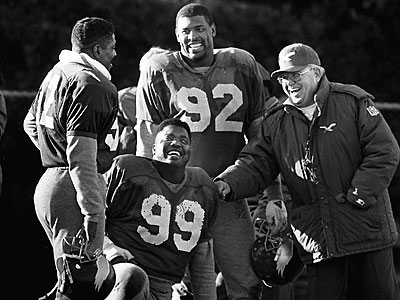
The Eagles’ 1991 defense led by Reggie White (92) and Jerome Brown (99) was forced to carry a team that trotted out a makeshift offense.
First things first: The comparison isn’t as crazy as it might first sound. Yes, that ‘91 defense had White, who was one of the five best defensive players in league history, and was overflowing with talent and ferocity at every level of its alignment: defensive line, linebackers, secondary. Plus, those guys could play with a brutality that, in the modern NFL, would result in most of them being suspended before halftime of the regular-season opener.
In Cunningham’s absence, Jim McMahon, Jeff Kemp, Pat Ryan, and Brad Goebel all were, at one time or another, the team’s No. 1 quarterback. The Eagles didn’t have a running back who rushed for more than 450 yards or a skill-position player with more than 950 receiving yards, and there could be no more compelling evidence for that defense’s dominance than the Eagles’ record that season. Somehow, they went 10-6.
Keep in mind, though: It was just two years ago, in Vic Fangio’s first season as their coordinator, that the Eagles had the league’s best defense for the first time since ‘91: first in total yardage, first in passing yardage, 10th in rushing yardage, second in points. That group saved its best performance of that season for the 40-22 romp over the Chiefs in Super Bowl LIX, when the Eagles intercepted Patrick Mahomes twice, sacked him six times, and didn’t allow Andy Reid’s offense to cross midfield until less than three minutes remained in the third quarter.
Zoom out, too, and consider the prime three years of that Ryan/Carson defense, 1990 through 1992, and these two seasons the Eagles have had under Fangio.
YEAR
POINTS
TOTAL YDS
PASS
RUSH
1990
12th
12th
25th
1st
1991
5th
1st
1st
1st
1992
6th
6th
12th
5th
2024
2nd
1st
1st
10th
2025
5th
13th
8th
22nd
Those comps aren’t far off, and they will be even closer if this season’s defense turns out to be better than 2024’s. It’s not a stretch to think it will be.
The secondary already has two All-Pros in Quinyon Mitchell and Cooper DeJean — both rookies in ‘24 — and now has an outside corner, in Riq Woolen, who has the size and talent to deliver the quality of coverage that Darius Slay provided. At linebacker, Zack Baun is also an All-Pro. Jihaad Campbell was a first-round pick. Based on those who have observed him during training camp, edge rusher Jalyx Hunt, who led the team in both sacks and interceptions last season, looks like the product of an experiment that spliced the genes of Hugh Douglas and Brian Dawkins. (An overstatement, to be sure, but Hunt is an intriguing and improving player.)
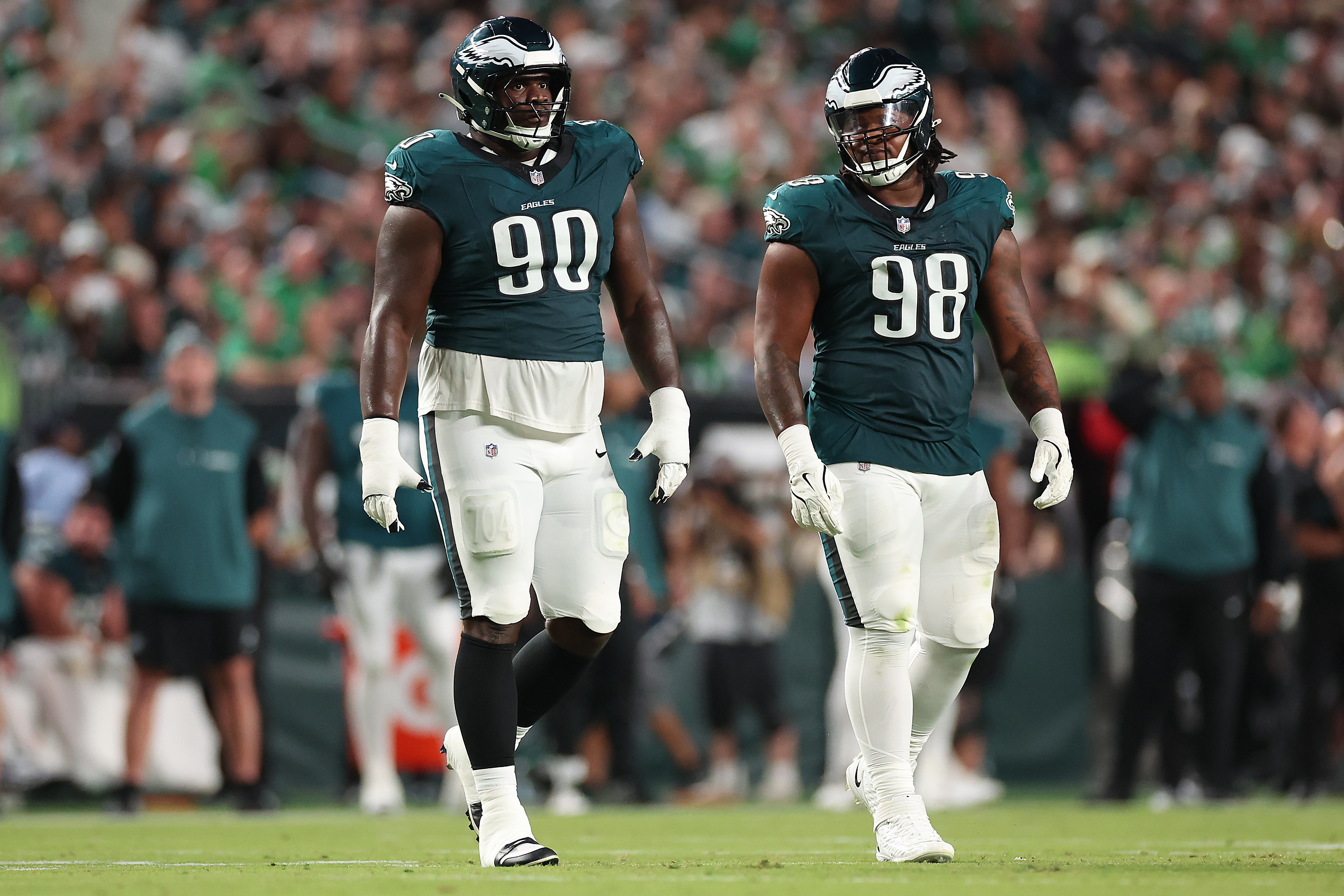
The defensive tackle rotation — Jalen Carter (with two healthy shoulders), Jordan Davis, and Moro Ojomo — is so deep and so good that it will create one-on-one matchups for anyone the Eagles line up on the outside. And if Jonathan Greenard and Nolan Smith Jr. are on the field, the Eagles should win those matchups most of the time.
The greatness of this Eagles defense will begin in the trenches with Jordan Davis (90) and Jalen Carter (98). David Maialetti / Staff Photographer
The most important questions the Eagles have to answer this season don’t have much to do with their defense, if any of them have anything to do with the defense at all. They will have a new offensive coordinator, Sean Mannion, who will be calling plays in the NFL for the first time. Jalen Hurts will have to adjust to playing in a system with which he was completely unfamiliar, and there’s no way to know how he’ll fare in it. The offensive line should be better than it was last season, but it’s hard to see yet how the Eagles won’t be worse at wide receiver and tight end.
Again, questions, lots of them. And while we’re doing the then-vs-now thing, it is fitting that the quality of Hurts’ backups — Tanner McKee and Andy Dalton — have become a popular discussion topic and cause for concern. But none of those potential issues presents the same complications that arose all those years ago once Cunningham went down and stayed down.
Part of the reason that the ‘91 defense was so great was that it had to be just for that team to have a chance each week. Everyone remembers the “House of Pain” game, a 13-6 victory over the Houston Oilers on Monday Night Football in which Reggie & Co. pretty much left bodies strewn about the Astrodome, as if they’d fought off a zombie apocalypse. Not everyone remembers that the Eagles actually gained fewer yards that night (240) than the Oilers did (247). As awesome as that defense was, that offense was just about as bad.
This defense shouldn’t have to meet that same skyscraper-high standard. Barring a worst-case outcome, it will just have to be what it can be. It will just have to be great enough.
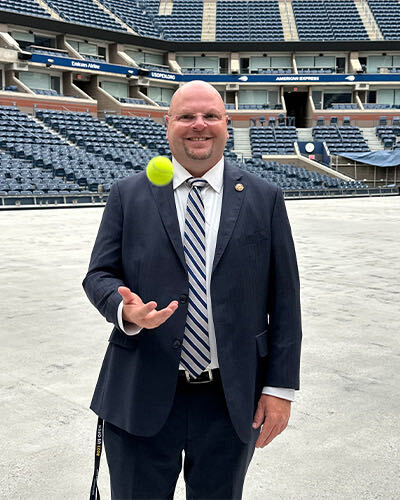
When he was told of the bomb threat, Brian Maguire was where he was supposed to be and doing what he was supposed to do: on the grounds of the USTA Billie Jean King National Tennis Center in Queens, just 100 feet from the complex’s security command center, watching, noting, sizing up.
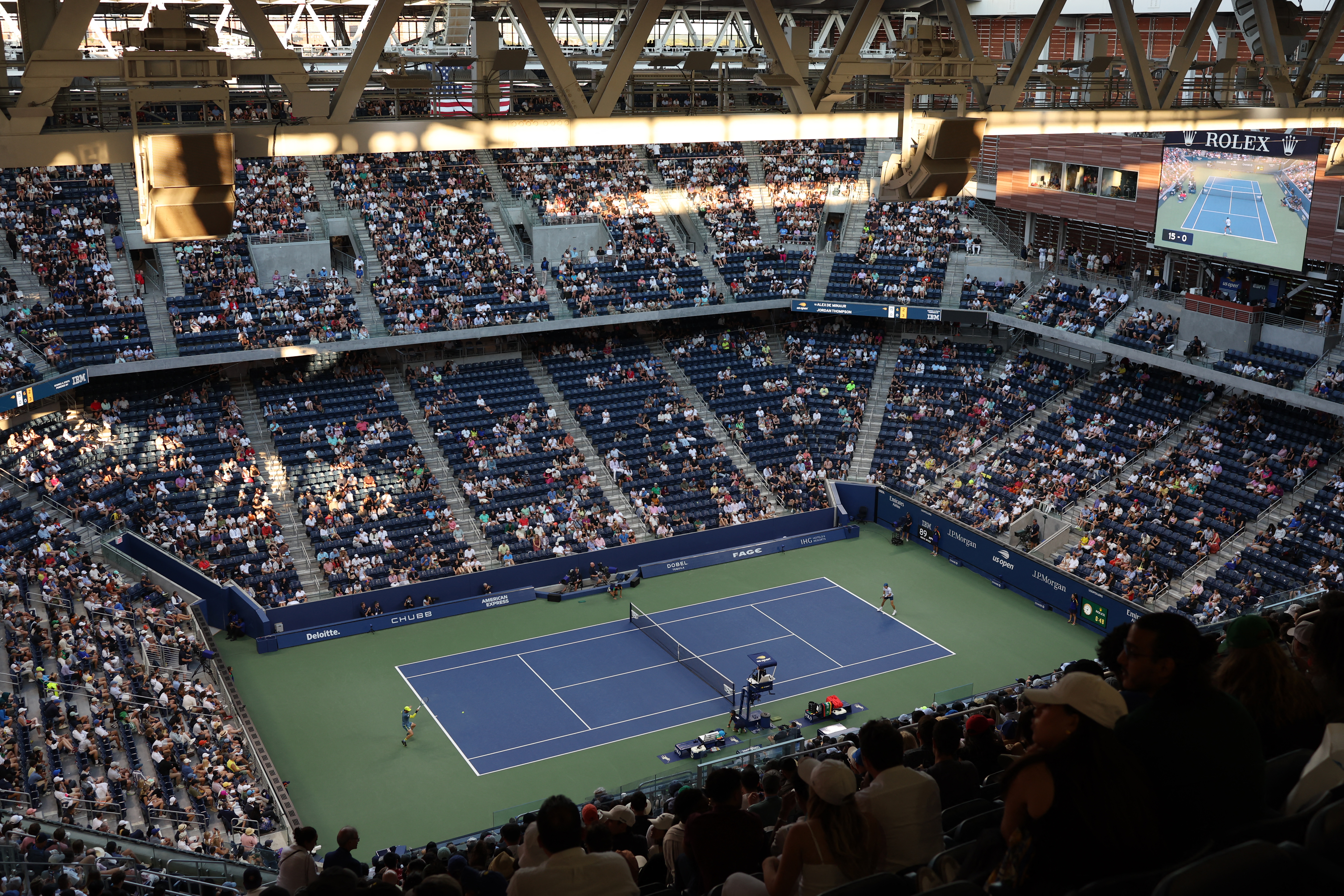
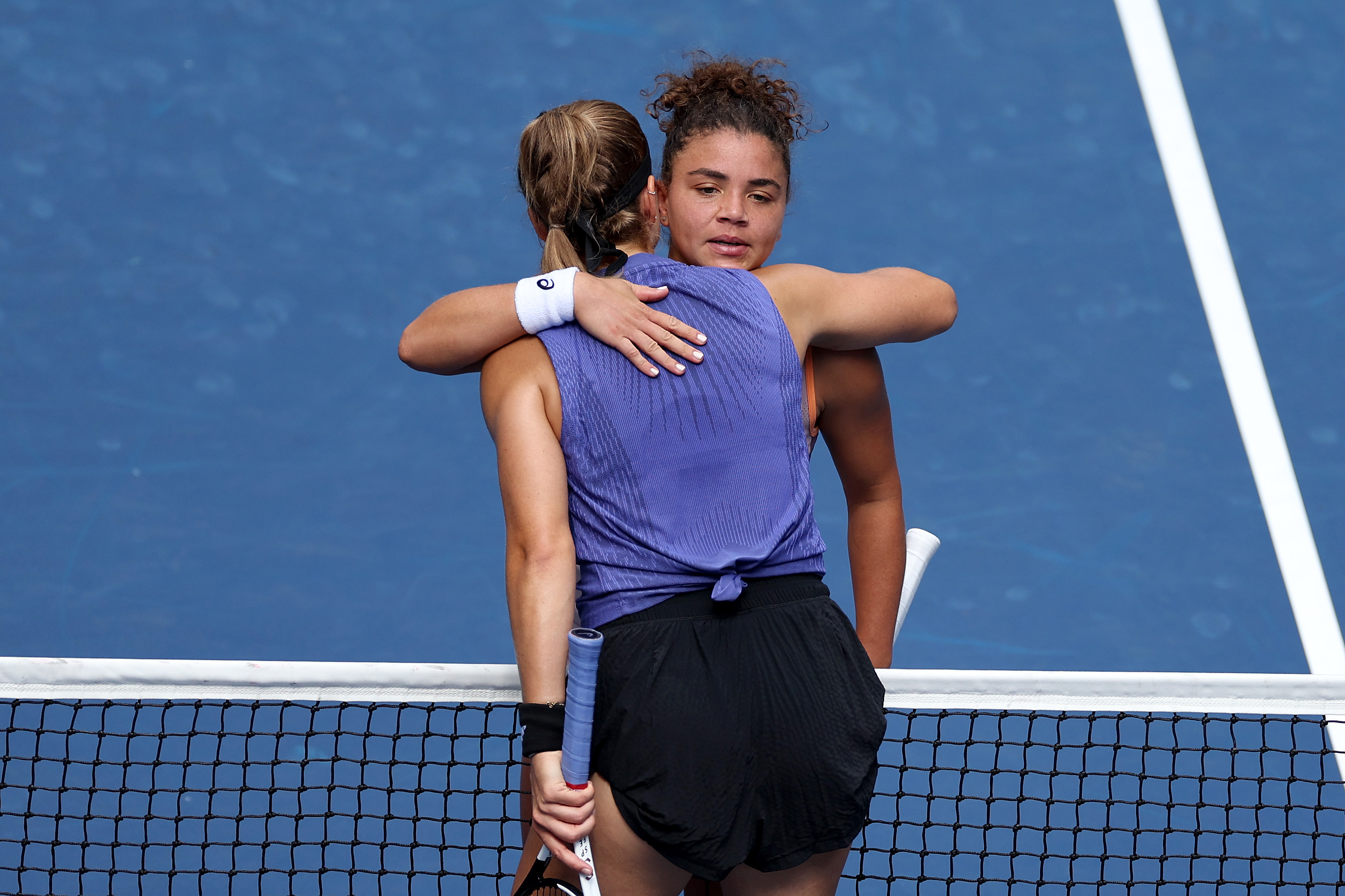
It was Monday, Sept. 2, 2024, the U.S. Open in full swing, clouds dimming the early afternoon sun. Inside Louis Armstrong Stadium, a surprise was brewing. Jasmine Paolini, the No. 5 seed in the women’s singles tournament, was losing her quarterfinal match to an unseeded opponent, Karolina Muchova. Maguire, the USTA’s director of security, wouldn’t learn the full significance of the match’s outcome until later.
Brian Maguire was the U.S. Open’s security director the day of the bomb threat.Courtesy of Brian Maguire
He answered a call from one of his staff members. At 12:12 p.m. — less than seven minutes before Muchova polished off Paolini, 6-3, 6-3 — someone had sent a direct message to the USTA’s Twitter/X account:
“I’m inside Louis Armstrong with a bomb that will go off at 1 pm est”
Louis Armstrong Stadium has a seating capacity of 14,000, and Maguire estimated that, among spectators, staff, and athletes, there were at least an additional 4,000 people on the 46.5-acre campus. All of them had been screened or searched — metal detectors, explosive-detection K-9 teams — so he was confident that the threat was empty. Still, for a man in his position, there was no such thing as being too careful, and if, somehow, there actually was a bomb out there somewhere …
He called his bosses at the USTA to inform them of the threat, then walked back to the command center. Once he arrived, he glanced at a computer screen to see the message for himself, and he conferred with his staff and with on-hand representatives from both the New York Police Department and the Federal Bureau of Investigation.
Built like a solid barrel, Maguire had been an NYPD detective for 27 years, 15 of them on the department’s joint-terrorism task force. Madison Square Garden, Yankee Stadium, Citi Field, the Barclays Center, the United Nations General Assembly, countless Midtown parades, even several previous U.S. Opens: Before the USTA hired him in June 2024, he had worked every major event at every major venue in New York. This kind of situation was not new to him, and he brought an investigator’s calm and logic to bear in evaluating and handling it.
“The Open is a great event,” he said. “Not a lot of bad things happen here, so this was like a one-off when we had this threat. I also knew that bomb threats, since online gambling has become a thing, have just skyrocketed.”
Maguire requested that the FBI open a guardian — that is, begin gathering evidence for a federal case — against the person who had made the threat. The NYPD’s bomb squad and the FBI’s special-agent technicians, accompanied by bomb-sniffing dogs, canvassed the campus. Within 20 minutes, the officers and agents were radioing back from their search to tell Maguire, We’re clear. Louis Armstrong Stadium was never evacuated.
“The likelihood of a device getting on our campus is pretty slim,” Maguire said. “But I’m still taking resources away from other places. We have to take every threat as if it’s real. I know in my mind, ‘Is there going to be a device? Probably not.’ But I still have to go through the motions.
“He’s not thinking that far ahead, this poor sap.”
Arthur Ashe Stadium, the main court at the Billie Jean King National Tennis Center, home to the U.S. Open. Charly Triballeau / AFP via Getty Images
A young man’s future on the line
Aidan Getchius trudged into a courtroom with his lawyer and his mother. Twenty-one years old, with small features and a few dark whiskers drooping around his pursed mouth, wearing a black plaid shirt, he gave the impression of a student who always took a seat near the back of the classroom, to try to go unnoticed. If he was anxious, he did not show it. His nerves already had done their work. Flecks of his dark hair had gone gray.
He was there, inside the Edward N. Cahn Federal Building in Allentown on a rainy morning in May, because he had admitted to doing a stupid and reckless thing. He had used a gambling app to place a $100 wager on the Muchova-Paolini match, betting on Paolini to win. But as Muchova won point after point on her first serve and it became clear that Paolini would lose, Getchius panicked. He wanted to keep his money, and the only way to do it, he thought, was to disrupt or stop the match. From 160 miles away, from the Lancaster County house where he lived with his mother, Trisha Sullivan, he had thumb-typed and sent the bomb threat.
Authorities had an easy time tracing the message back to Getchius and his Twitter/X account. He was charged with conveying false information and hoaxes, a count to which he had pleaded guilty in November 2025. Now he was in court for his sentencing hearing, facing up to five years in prison and a $250,000 fine.
He took a seat at the defendant’s table, its mahogany top gleaming. Sullivan, in a black blazer and a librarian’s glasses, slid into a row just behind him. The lawyers whispered and fiddled with their folders and papers. There was no other sound in the courtroom.
In less than an hour, U.S. District Judge John M. Gallagher would determine Getchius’ punishment and, in turn, his future, but that revelation was just one angle in a story with several worth accenting and examining. The case of Aidan Getchius had come in contact with so many disturbing trends and developments in the relationship between sports and American society that Gallagher’s decision would be the least compelling aspect of it.
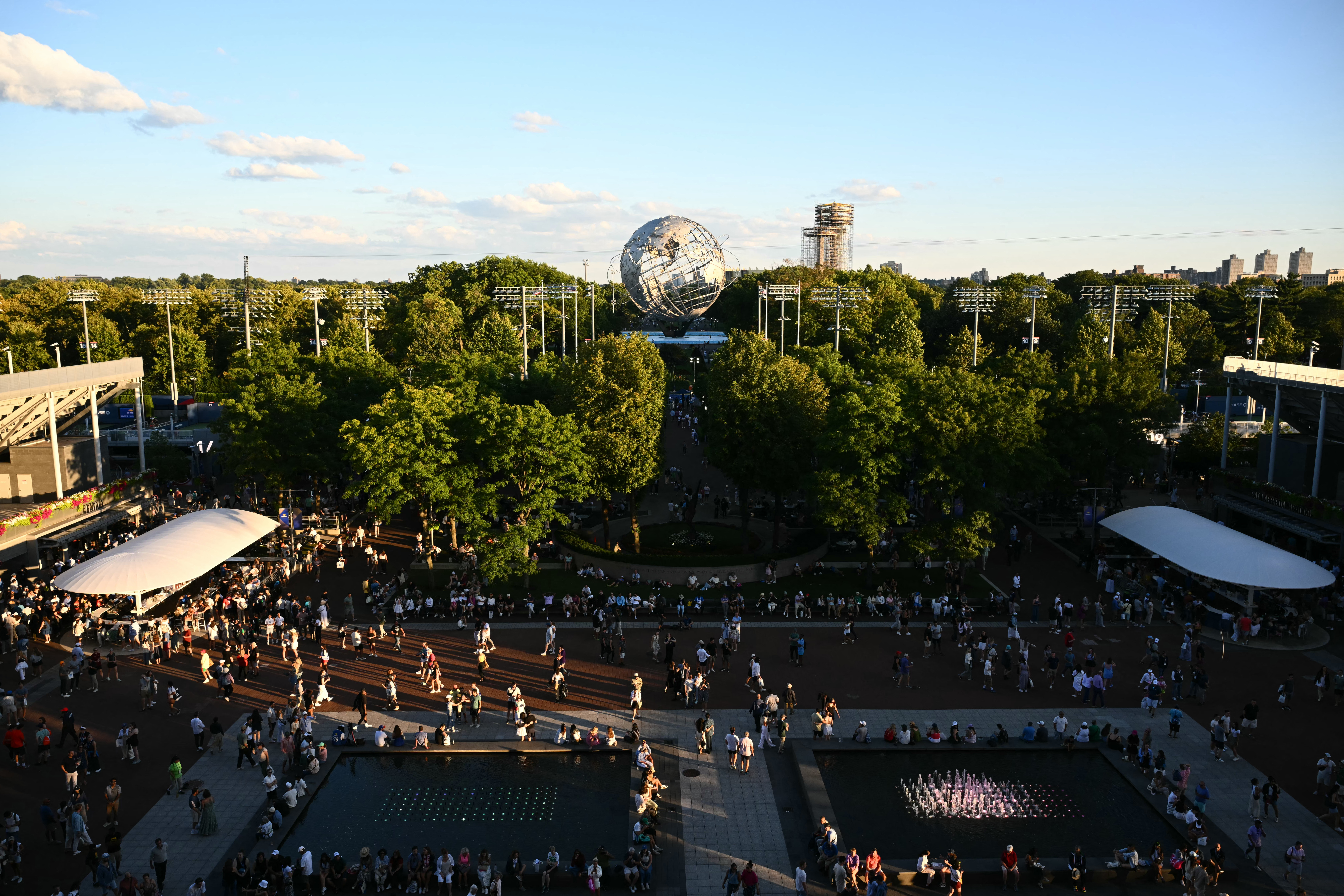
The Billie Jean King National Tennis Center hosts the U.S. Open ever year, with tens of thousands attending every day of the event.Angela Weiss / AFP via Getty Images
‘He doesn’t talk at all’
Getchius had a factor — one rare set of circumstances for someone charged with a federal crime — working in his favor. Neither the attorney defending him nor the attorney prosecuting him believed or argued that he deserved jail time.
He was 19 when he sent the direct message to the USTA, and Jeremy Isard, the federal public defender representing him, framed Getchius as a good kid from a decent home who, while not a dangerous loner or incel, had temporarily lost any sense of social norms and boundaries.
“This is the only time that Mr. Getchius has done such a thing,” Isard said in court. “We live in a world where even the momentary frustration of a teenager can have real-world consequences. That is the reality that all of us are living in for the first time.”
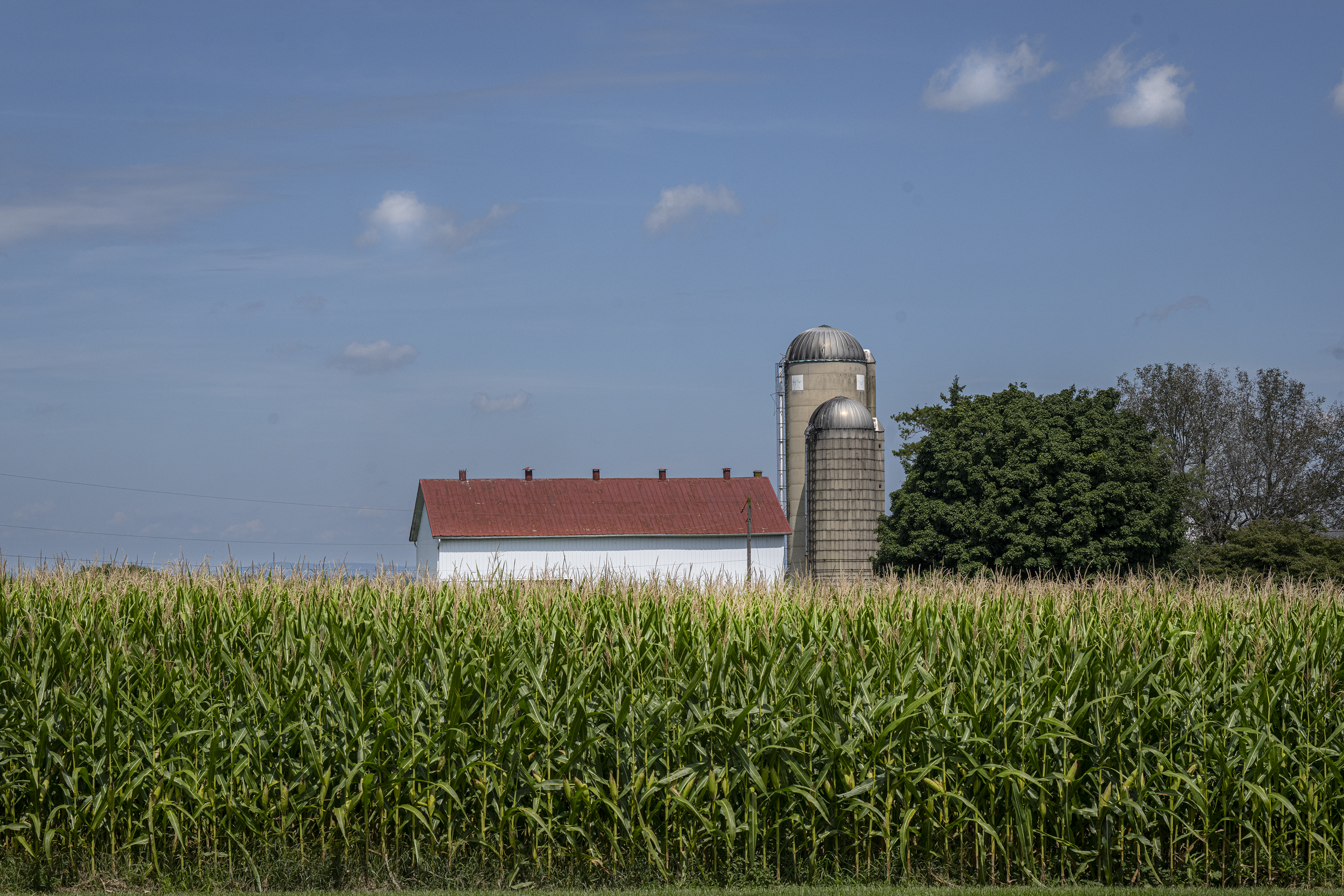
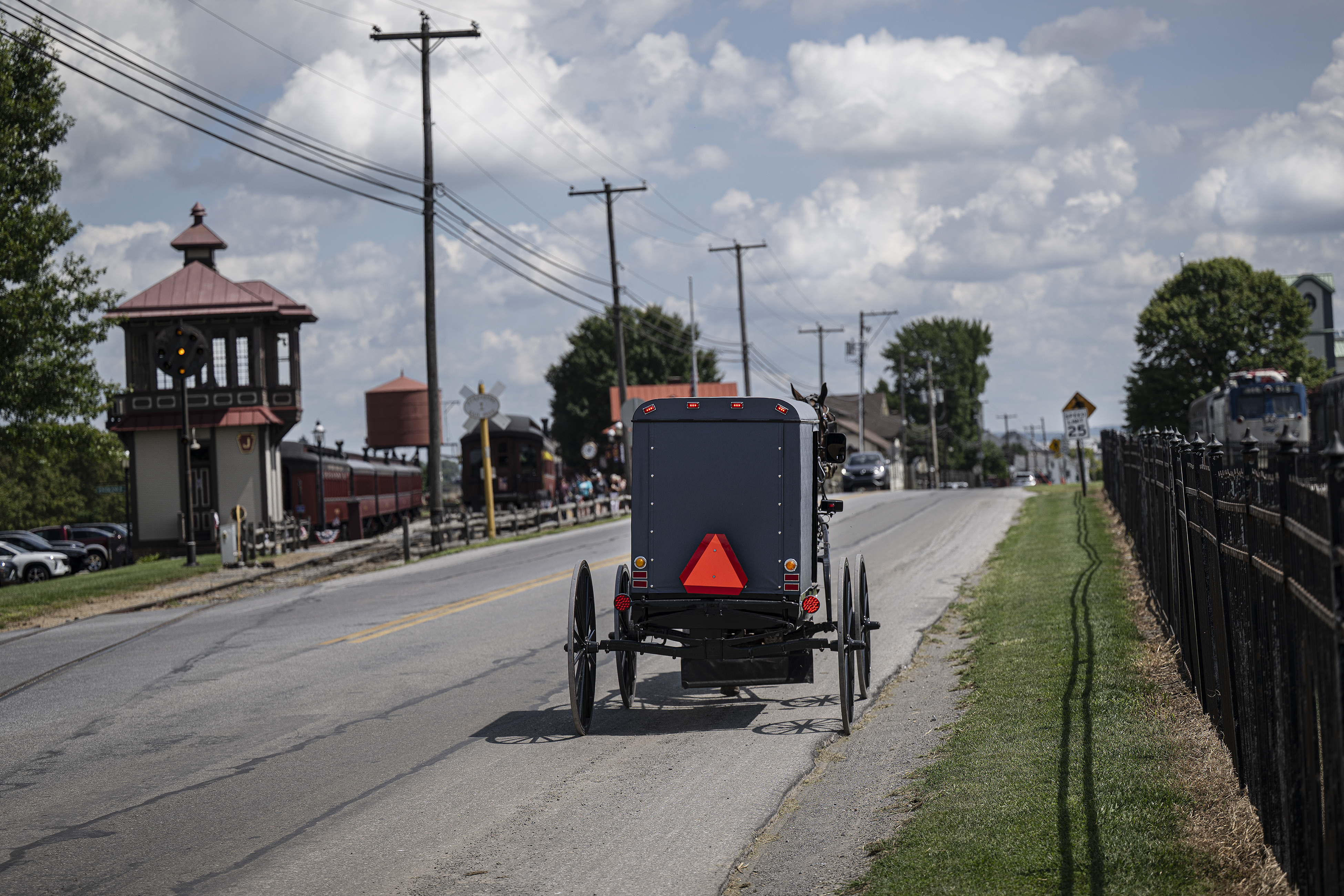
Someone with Getchius’ background and upbringing, though, might feel more removed from those consequences than the average teen who stares at a screen all day. From the east, a car ride out to Strasburg, a town of fewer than 3,200 residents, will likely take someone past the Railroad Museum of Pennsylvania. There isn’t a big-brand supermarket or retailer to be found. And as drivers zoom past eggshell white barns and endless acres of verdant cornfields, they have to mind the shoulder of the road for any Amish and Mennonite farmers and children, dressed plainly, who might be walking, riding modest bicycles, or coaxing horses to keep on clip-clopping as the animals tug them along in wooden buggies.
Throughout middle school, Getchius was bullied “on a near-daily basis,” Isard wrote in a sentencing memorandum. So Sullivan, who raised him by herself and works full time at an insurance company, enrolled him in Pennsylvania Leadership Charter School, an online high school headquartered in West Chester. His four years there “overlapped almost perfectly with the COVID-19 pandemic,” Isard wrote, and allowed him to “focus on academics while saving him what had developed into not insignificant social anxiety.” Multiple messages to the school’s communications office, seeking a comment on or insight into Getchius’ tenure there, went unreturned.
A farmhouse in Strasburg, Pa., and silo stand in front of a cornfield, a few miles from the home of a Lancaster County man who pleaded guilty to a bomb hoax targeting the 2024 U.S. Open tennis tournament.Jose F. Moreno / Staff PhotographerAn Amish buggy travels in Strasburg, Pa., a few miles away from the home of a Lancaster County man who pleaded guilty to a bomb hoax targeting the 2024 U.S. Open tennis tournament.Jose F. Moreno / Staff Photographer
“There are reasons related to Mr. Getchius and his own vulnerabilities,” Isard said in court, “that the sting of losing a bet hits harder for this gentleman than it would for many of the rest of us. … This was someone who [was] living an isolated and digital life.”
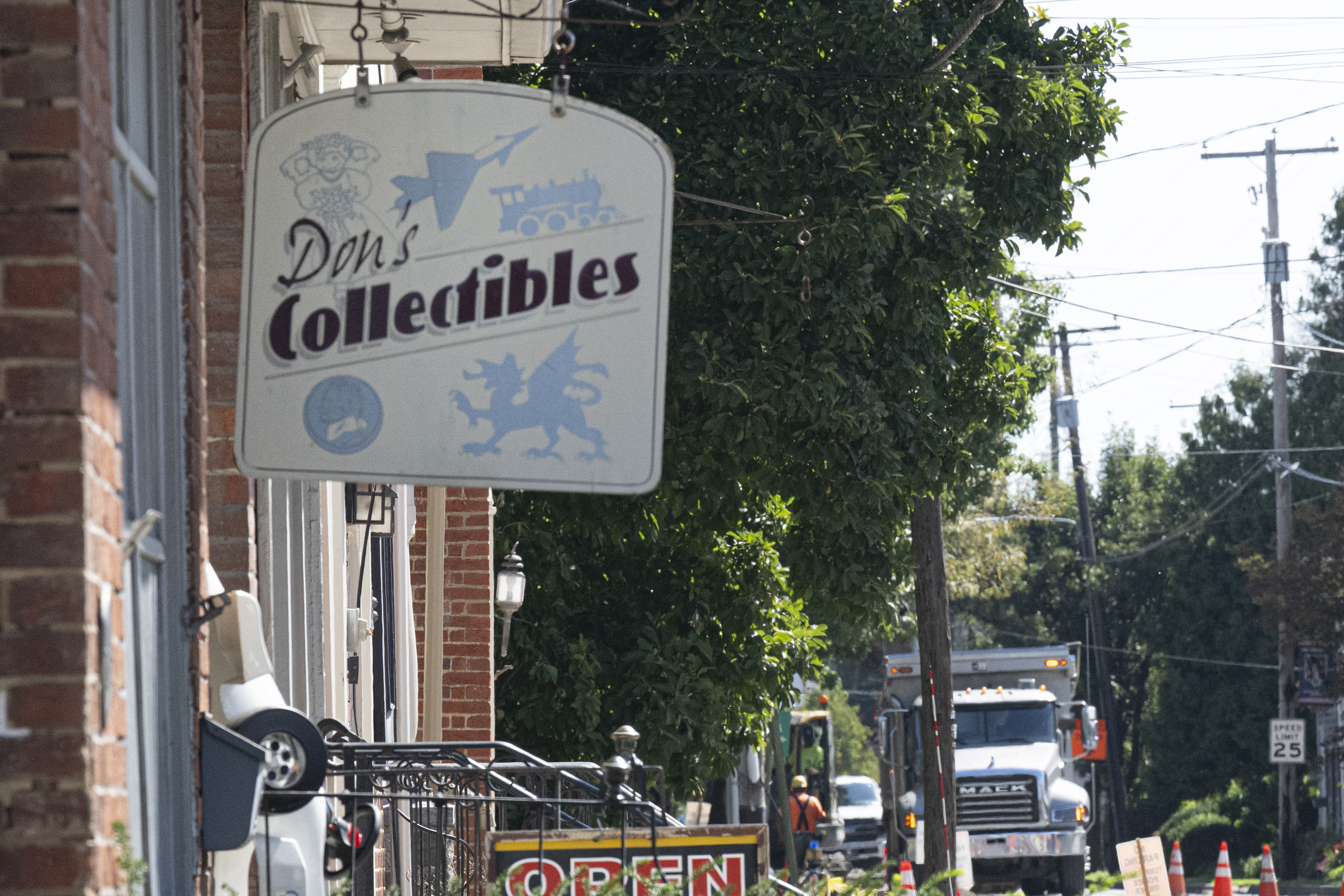
After graduating, Getchius took a job at Don’s Collectibles, a sports and pop-culture memorabilia store owned by his grandfather, Don Dorwart. The store is a fixture in Strasburg, open at its location on Main Street since 1984. For the two years he worked there, Getchius waited on customers and wrote and designed listings for items that Dorwart sold on eBay.
“He’s very quiet,” Dorwart said one morning at the store last month. “He doesn’t talk at all.”
Among the sports cards and trinkets and classic toys that he sells, Dorwart had recently ordered 300 pounds of foreign coins to offer to his customers. Several bags of them were stacked near his cash register, as if the store were a bank vault. Hundreds of coins from Brazil, Canada, and Italy rested in a wide, shallow cardboard box on the front counter. Dorwart was asked about sports gambling, and he was quiet as he considered how and why his grandson had come to place bets and to write and send that threatening message.
“It’s all this,” he said as he ran his left hand through the coins in the box. “He’s not that kind of kid.”
The match at the center of the bomb threat: Karolina Muchova (left) and Jasmine Paolini in a fourth-round singles match in the 2024 U.S. Open at Louis Armstrong Stadium.Sarah Stier / Getty Images
The hold on him
The implication of Dorwart’s gesture — that Getchius and others like him had given in to the addictive allure of legalized sports betting, the rush it delivered, and especially the winnings it promised — would have resonated with Josh Davison, the assistant U.S. Attorney prosecuting the case.
Davison agreed that Getchius didn’t need to be sentenced to federal prison for the bomb threat. Getchius knew he had screwed up, had owned up to his awful mistake, and hadn’t denied it or dodged it or fought the charges; he had pleaded guilty as fast as he could. But there were two aspects of the crime, Davison asserted at the hearing, that Gallagher ought to consider when imposing the sentence. Distilled, they were danger and fear.
Getchius began betting in 2022, when he was 18, after getting back in touch with a few friends from middle school. They formed a group text chain, and Getchius, according to court documents, found comfort in the rekindled friendships and the daily, sometimes minute-by-minute routine of betting. His user name on his Twitter/X account was “GetchiSoto” — a combination of his last name and that of one of his favorite baseball players, star outfielder Juan Soto — and he used that name or a derivative of it on several other accounts, some of which were vessels for his betting: Instagram, Facebook, Reddit, Kik, PlayStation, Xbox, and TikTok.
His mother didn’t know he was gambling. And even after his arrest and plea, even after attending at least 10 sessions of counseling, Getchius continued to bet small sums of money on sports.
Located in Strasburg, Pa., Don’s Collectibles, owned by the grandfather of a Lancaster County man who pleaded guilty to a bomb hoax targeting the 2024 U.S. Open tennis tournament.Jose F. Moreno / Staff Photographer
“It’s certainly legal to place those bets,” Davison said during the hearing. “It’s just disappointing that someone with a pending sentence, who is still facing the threat of incarceration, is placing those bets. That tells the government, ‘Wow, that’s a strong hold.’ That confirms to the government that bringing this case was entirely the right thing.”
The group chat became a forum for banter among the boys and for hyperbolic reactions to lost bets. “As Mr. Getchius understands it,” Isard wrote, “this is how the rough script for his threat to the U.S. Open entered his mind.” He did not pause to consider what might happen if he shared that script.
A train car on the Strasburg Rail Road.Jose F. Moreno / Staff Photographer
The scope of the problem
When it comes to the potential damage of his actions, Getchius was no different from others who have tried to intimidate or menace athletes or have engaged in “swatting” — falsely reporting an emergency with the intent of victimizing an individual or institution. The goal is the same. The chaos and upheaval are the point.
In August 2025, for example, a report of an active shooter at Villanova University caused “panic and terror,” the Rev. Peter M. Donohue, the school’s president, said in a statement. The report was false, and in April federal prosecutors charged a juvenile suspect who was allegedly part of an online group claiming responsibility for similar calls to several colleges and universities.
“This hearing would look a lot different,” Davison said, “if we had Villanova students here.”
Two months before the Villanova hoax, during a Grand Slam Track meet at Penn’s Franklin Field, a bettor who identified himself on Twitter/X as “@mr100kaday” screamed at sprinter Gabby Thomas as she stood at the starting line for one of her races, calling her “Trash Spice.” After Thomas — a three-time Olympic gold medalist — lost her events, the man followed her around the track, insulting her, before posting screenshots of betting slips that showed he had won money by wagering against her.
“I made Gabby lose by heckling her,” he wrote on Twitter/X. “And it made my parlay win.”
This grown man followed me around the track as I took pictures and signed autographs for fans (mostly children) shouting personal insults- anybody who enables him online is gross https://t.co/f9a6vPkX0v
The accumulation of such incidents can create a boy-who-cried-wolf effect that numbs people to a harsh truth: It takes just one of these threats to be genuine, just one bona fide villain who follows through, for an atrocity to occur. And the ubiquity and casual acceptance of betting don’t help.
Matthew Wein, an expert in cybersecurity and a former policy adviser at the Department of Homeland Security, keeps a database of incidents in which athletes have been harassed or threatened. A quarter of those incidents, he said in a phone interview, have been connected to gambling, and his database doesn’t paint a full picture of the problem, given how many threats go unreported.
Wein recommended that sports leagues and franchises start sharing information on problematic or malevolent bettors. The Phillies, for instance, were playing at Citizens Bank Park, less than six miles south of Franklin Field, on the same day that the anonymous gambler hounded Thomas.
“If you’re the Phillies’ owners, wouldn’t you like to know if this man had a ticket to your game?” Wein said. “I’ve described it as a pre-9/11 mindset. In the aftermath of the 9/11 commission hearings, we said that one of the big problems was that people weren’t working well enough together to make the puzzle pieces fit.
“A lot of it comes back to, are teams and leagues and sportsbooks and players unions and social-media platforms and other stakeholders willing to invest in sports-integrity measures? When sports gambling is marketed to young men, some who have mental-health issues, it’s a potent mixture that can really create an on ramp to criminal activity and violence.”
Neither Getchius nor Sullivan responded to requests for an interview, so certain questions about why he did what he did remain unanswered. How much money had he lost? How far in the hole was he? Why did a modest hundred-dollar bet inspire such a dumb and desperate reaction? And why was he betting on tennis?
In today’s gambling culture, there’s no sport or competition too obscure, no over/under or opening tap or coin toss too insignificant, that a wager can’t and won’t be placed on it. Yet even by that standard, the women’s singles bracket of the U.S. Open seemed a strange and random event for a bet from a young man from Amish country. Getchius was not a fan of the sport. He didn’t follow it. Why the Paolini-Muchova match? Why that tournament?
A clue might come from one of his favorite and most familiar places. Near the front window of his grandfather’s collectibles shop, atop a large glass case displaying stacks of baseball cards and a Richie Ashburn figurine, rested the largest item in the store. There was no telling how long it had been there. It was a jumbo lime green Wilson tennis ball. Across the ball, in red lettering, were the words “US OPEN.”
The home, near Strasburg, Pa., of a Lancaster County man who pleaded guilty to a bomb hoax targeting the 2024 U.S. Open tennis tournament.Jose F. Moreno / Staff Photographer
The life and threats to come
As Gallagher prepared to hand down Getchius’ sentence, he told him, “You have the right to be heard, to say anything you want to me or nothing at all.”
Getchius remained seated at the defendant’s table and spoke in a low monotone.
“I apologize for my actions,” he said. “I understand the severity, and I take full responsibility. I’ve learned a lot over the past two years, and I can promise that nothing like this will ever happen again.”
He showed no reaction when Gallagher imposed the sentence: three years’ probation; a $1,000 fine; and the imposition of certain conditions — that Getchius had to attend Gamblers Anonymous or another treatment program and that he was forbidden from engaging in any gambling activity of any kind. Getchius nodded to Isard, consenting to the terms. His mother kept her hands folded on her lap.
“Instead of losing a bet, you lost a lot more,” Gallagher said. “None of this is to excuse what you did, Mr. Getchius, but I do have to consider who you are. … You have a full and lawful and productive life ahead of you. You have people who care about you. You have everything you need. We all want you to put this bad decision behind you and go on living that happy and productive life.”
The 2026 U.S. Open is underway. It has been less than two weeks since the first day of Aidan Getchius’ sophomore year at Millersville University. He carried a 3.24 GPA in his first semester there, makes deliveries for DoorDash to earn some money, and is for now a useful cautionary tale. What he said in court is probably true: He won’t do anything like this again. But if we aren’t careful, someone else will. Someone else will do something worse. And someone will die.
Cathy Engelbert was the Jalen Hurts of the WNBA, the subject of the same kind of questions about whether a prominent figure on a speeding ship was the captain or a passenger — except with her, the answers were more definitive and damning.
For these last few years, for the period in which the league has made its greatest gains in popularity, relevance, and quality of play, she was at best a nonfactor and at worst an impediment. The people behind those gains were the players, one in particular, and with the announcement Friday that Engelbert, a Collingswood native, was “retiring,” the WNBA has a better chance of accelerating its growth and calming the churning waters around it.
No one looks or will look at Engelbert’s tenure atop the WNBA and credit her for the league’s progress, and no one should. The rise of women’s sports in America, particularly of women’s basketball, already was a wind at her back when she became commissioner in 2019.
Title IX had been doing its good work on behalf of girls and young women for nearly two generations by then. Because the WNBA, founded in 1996, rarely has players to enter the league after leaving college early, women’s college basketball has been a fertile garden of talent and star power, feeding the league long before Engelbert oversaw it. UConn, Tennessee, Notre Dame, Baylor: These programs and others like them pumped out stars who had spent four years in school setting records and competing in Final Fours, whose names and games had become familiar before they’d ever signed their first professional contracts.
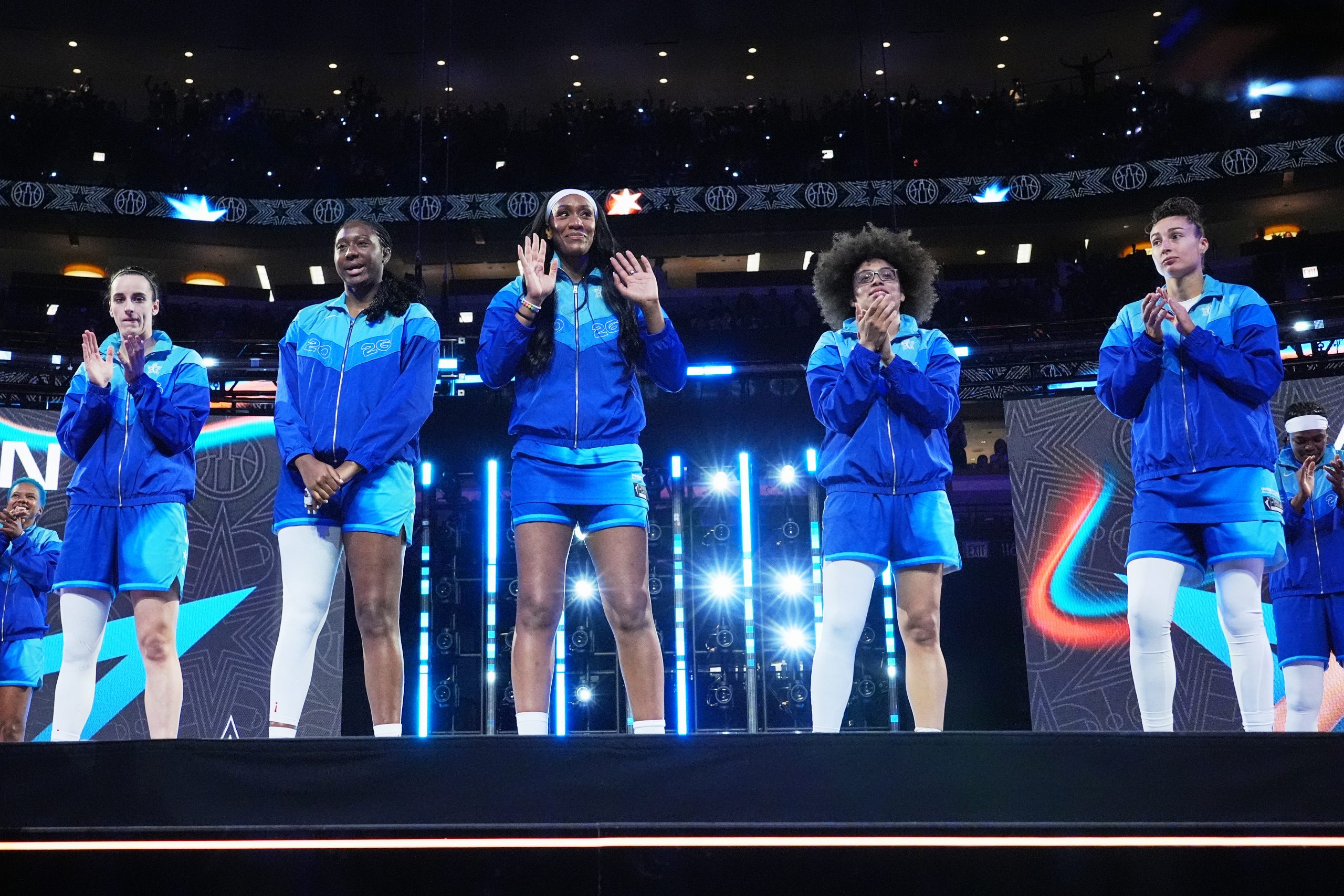
The WNBA’s biggest stars include Caitlin Clark (left), Aliyah Boston, A’Ja Wilson, Olivia Miles, and Jessica Shepard.Nam Y. Huh
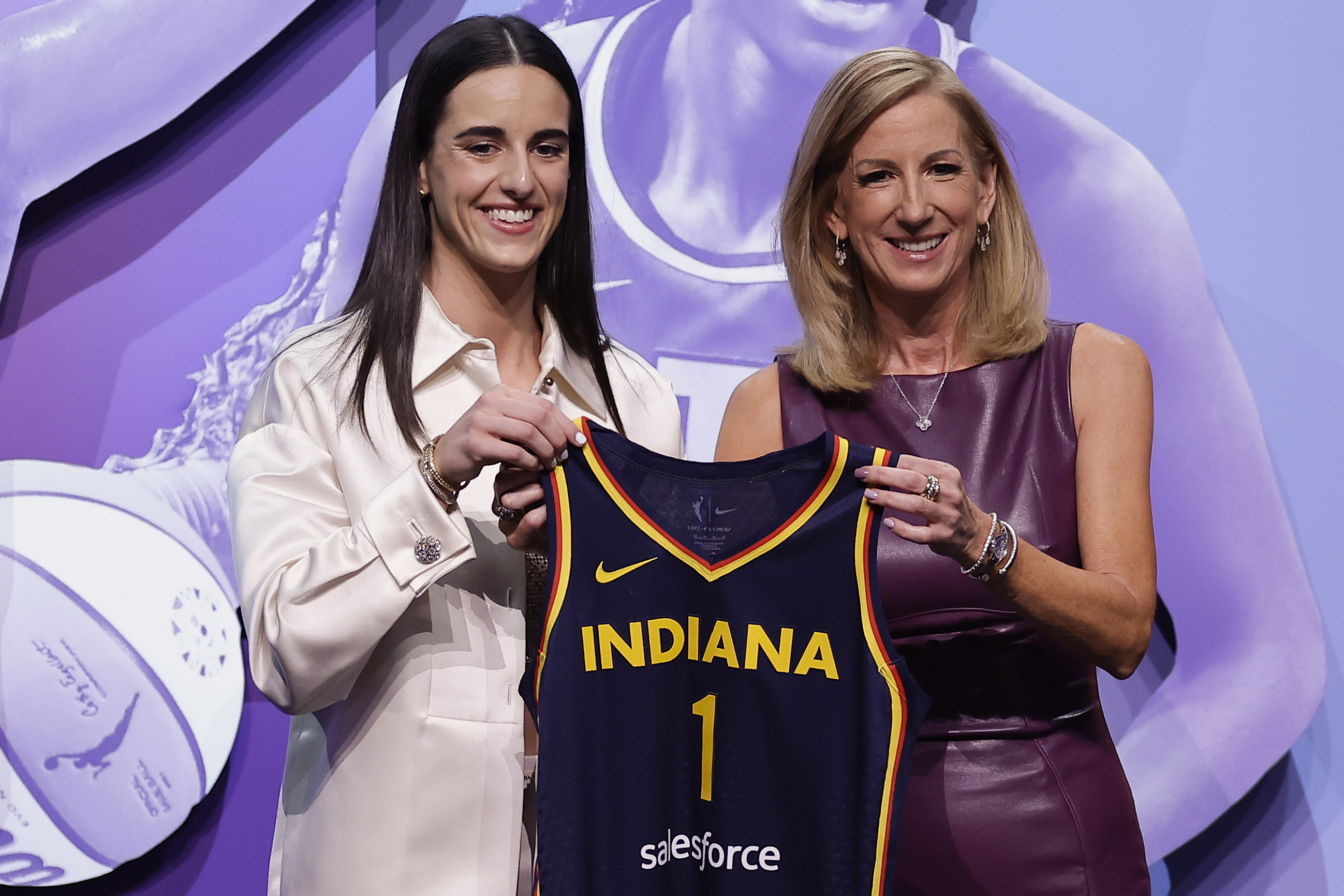
That tide turned into a wave that has crested with Caitlin Clark, with the woman who can lay claim to the title of the most popular and important female athlete in the United States. The NBA lifted off in the early 1980s — once talent poured in after the league merged with the ABA, once Magic Johnson and Larry Bird brought their rivalry to the Lakers and the Celtics — and the WNBA should be on its way to telling a similar story. It has Clark. It has A’ja Wilson and Paige Bueckers and Olivia Miles and Breanna Stewart. It has a depth and breadth of talent unmatched in its history. The games should matter more than they ever have. The games should matter most.
Except … they don’t. Who wants to hear that story now? Out of Engelbert’s lack of leadership, out of her inability and unwillingness to speak simple truths in plain language or take strong stands to benefit it, the WNBA has morphed into a cudgel in the culture war.
On one side are the sexists and misogynists who don’t watch women’s basketball — and wouldn’t dare confess to tuning in even if they did — but whittle away their days complaining about the sport and attacking its athletes on Twitter/X. On the other are the activist players, coaches, fans and compliant media members so defensive and discomfited over the slightest criticism or question — about the inevitable byproducts of a major pro sport going mainstream and gaining a new audience — that they seem to wish that only people like them were permitted to play and watch and cover it.
Engelbert let those sides squish her like a grape. It was bad enough for the league’s image, for its attempts to shake the perception that it was small-time in its operations and approach, that she botched the pronunciation of Golden State Valkyries coach Natalie Nakase’s last name when she presented Nakase (nuh-KAH-say) the WNBA Coach of the Year Award. That it took Clark’s presence and some timely social media posts before Engelbert stopped insisting teams fly commercial and instituted a charter flight program for the league. That her communication skills with the players were so poor that one, Napheesa Collier, felt emboldened enough to say that the league “had the worst leadership in the world.”
No, what has been worse is Engelbert’s cowing in the face of obvious problems with obvious solutions. The league should have started hunting for better, more qualified officials years ago, rather than waiting until May to … form a task force about the topic. Engelbert must have been living in a dream world when, according to Collier, she said that Clark and the WNBA’s other stars “should be on their knees” thanking the league for the prominence it has given them … when it’s actually the other way around.
But it’s the latest and silliest controversy — over the league’s policy, or lack thereof, on transgender athletes — that brought Engelbert’s weakness most clearly to bear.
Royce White and Enes Kanter Freedom are clowns for their publicity campaign to declare themselves to be women so they can join the league. A commissioner with any spine would have swatted them away like gnats simply by pointing out what everyone can already see: Royce, you’re 6-foot-8. Enes, you’re 6-10. You guys played in the NBA! Do you have any idea how pathetic you are for begging to be in our league?
A commissioner with any spine would have pointed out that FIBA, the IOC, and the USOPC already have policies that only biological females can compete in women’s sports, that the WNBA’s players follow those guidelines when they compete internationally — as they are right now, in the FIBA World Cup — and that the league’s policy reflects those policies. Instead, Engelbert has stayed silent, allowing the issue to fester, allowing this sideshow to dominate conversation about the sport.
This is a critical moment for women’s athletics and for the WNBA. The league is expanding, adding three more franchises in the next four years, including one here in Philadelphia. It has an opportunity both to solidify its existing fan base and build upon it. It has an opportunity to climb to a level that, just a decade ago, few would have thought reachable. It will need a new commissioner who can be more than the one Cathy Engelbert was, more than someone sitting on the deck, doing nothing to avoid the swells and crashes, more than someone just along for the ride.
Steve Ontiveros was for once healthy, and had not yet joined the Phillies, when he and Tommy John became teammates, pitchers on the Oakland Athletics in 1985. Ontiveros was 24 years old, a right-hander having a terrific rookie season: a 1.93 earned run average, eight saves. John was already 42, still the same soft-throwing lefty he’d always been, more than a decade removed from undergoing the revolutionary surgical procedure that still bears his name. They did not know then the physiological connection they would come to share.
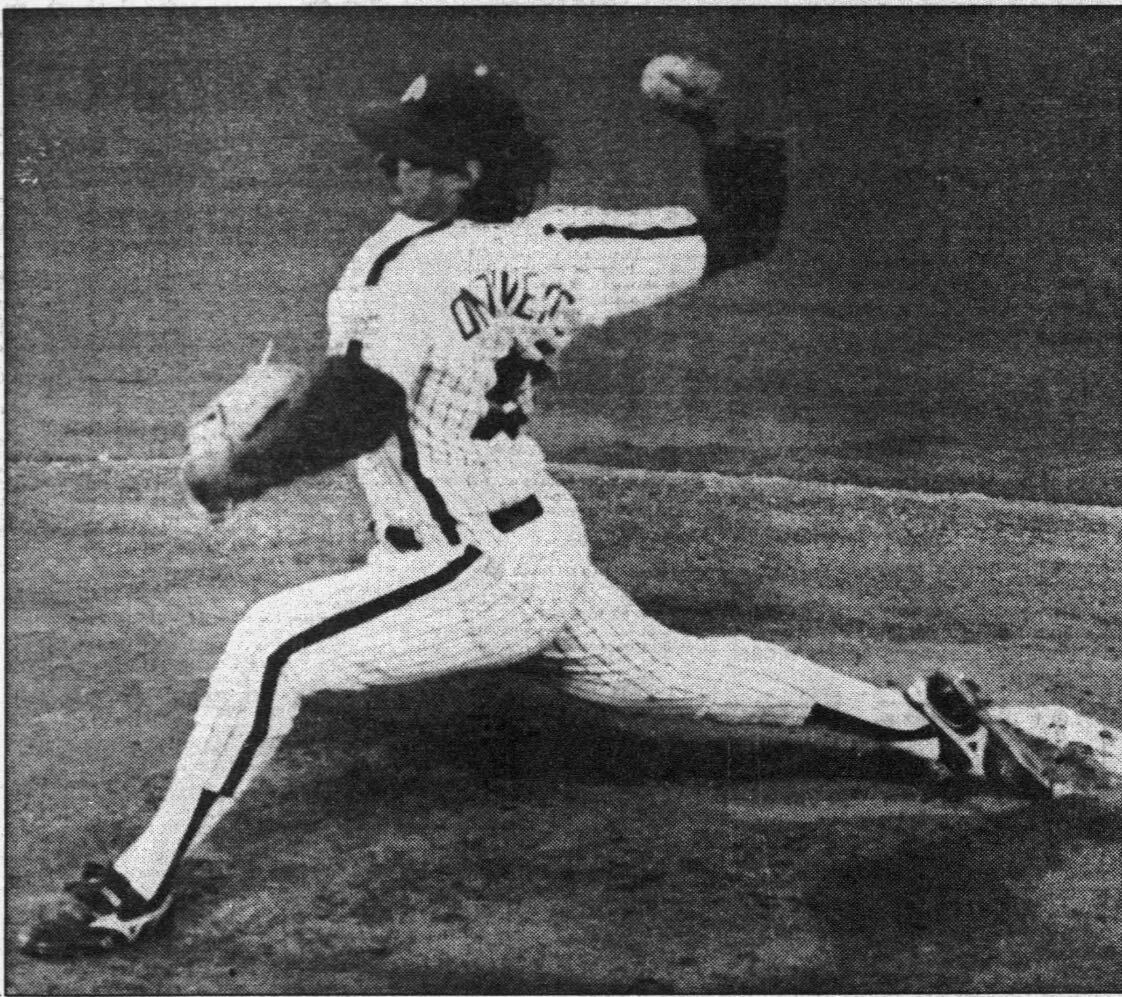
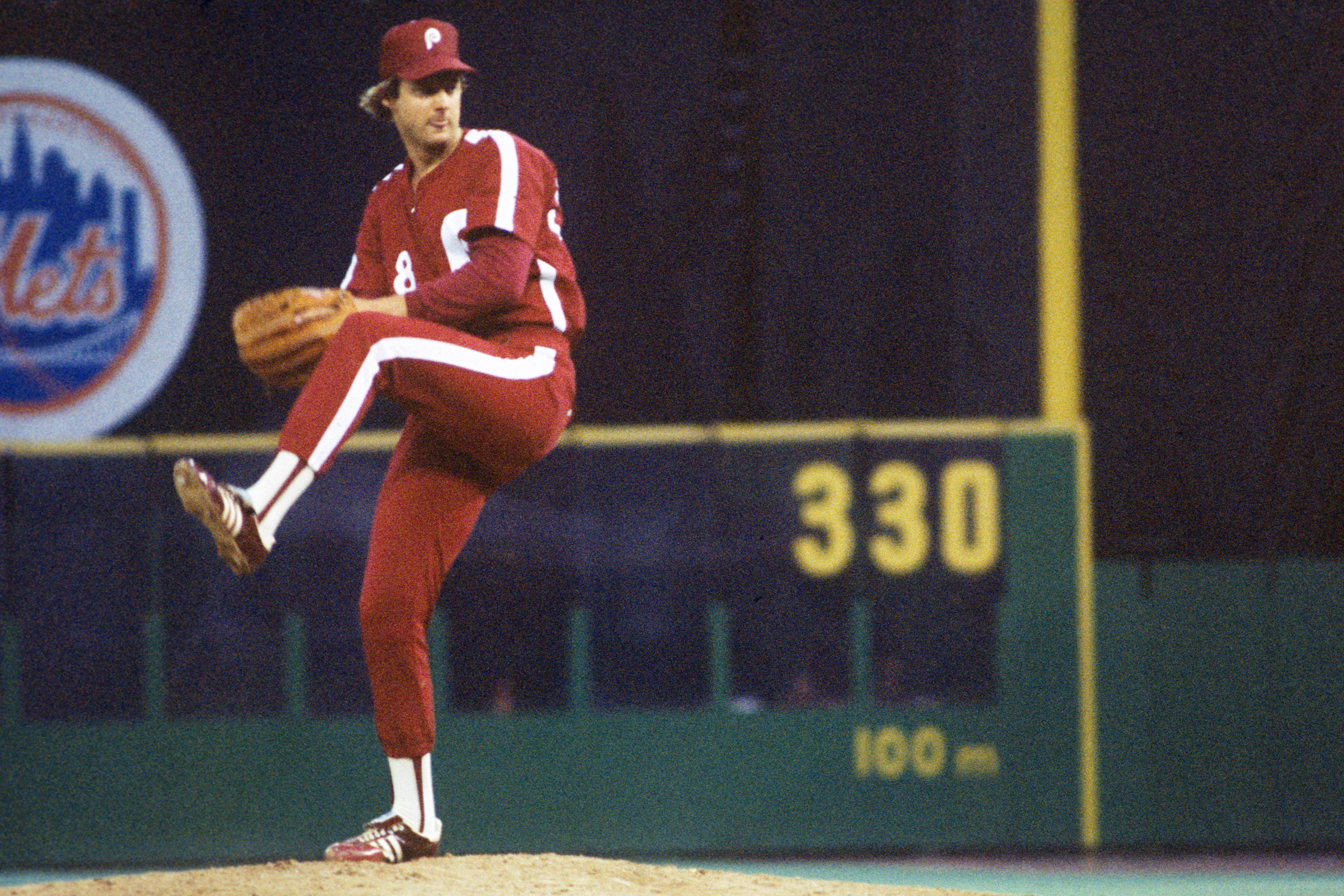
Over the 11 games that he pitched for the Phillies in 1989 and 1990, in an era full of forgettable baseball here, Ontiveros managed to complete a remarkable story — and to introduce Philadelphia to the future of sports medicine. He was the first Phillies pitcher to have Tommy John surgery and return to pitch for the team.
— Philly Sports By Number (@philly_number) March 12, 2026
After starting 2-0 and allowing just two earned runs in his first 20 innings in ‘89, after offering a glimpse of greatness to an awful Phillies team, Ontiveros needed some magical science and the steady hands of surgeon Frank Jobe just to take the mound in the majors again. When he caught the news reports that John had died at 83 late last Saturday night, Ontiveros couldn’t help but recall John’s daring and desperate decision back in 1974 — his willingness to have Jobe try replacing a torn ligament in John’s left elbow with a fresh tendon from somewhere on John’s body.
The procedure saved John’s career. It has saved hundreds of pitchers’ careers since. Steve Ontiveros’ star-crossed stretch in Major League Baseball was one of them.
“He was fantastic,” Ontiveros, 65, said by speakerphone as he and his wife, Cindy, drove near their Scottsdale, Ariz., home Tuesday morning. “Think about it: No one in the history of the game had had that done. It was so off the wall, out of outer space, to even think about that type of surgery. But when that’s your livelihood, you’ll do anything. You’ll take any chance because you want to play. You want to compete.”
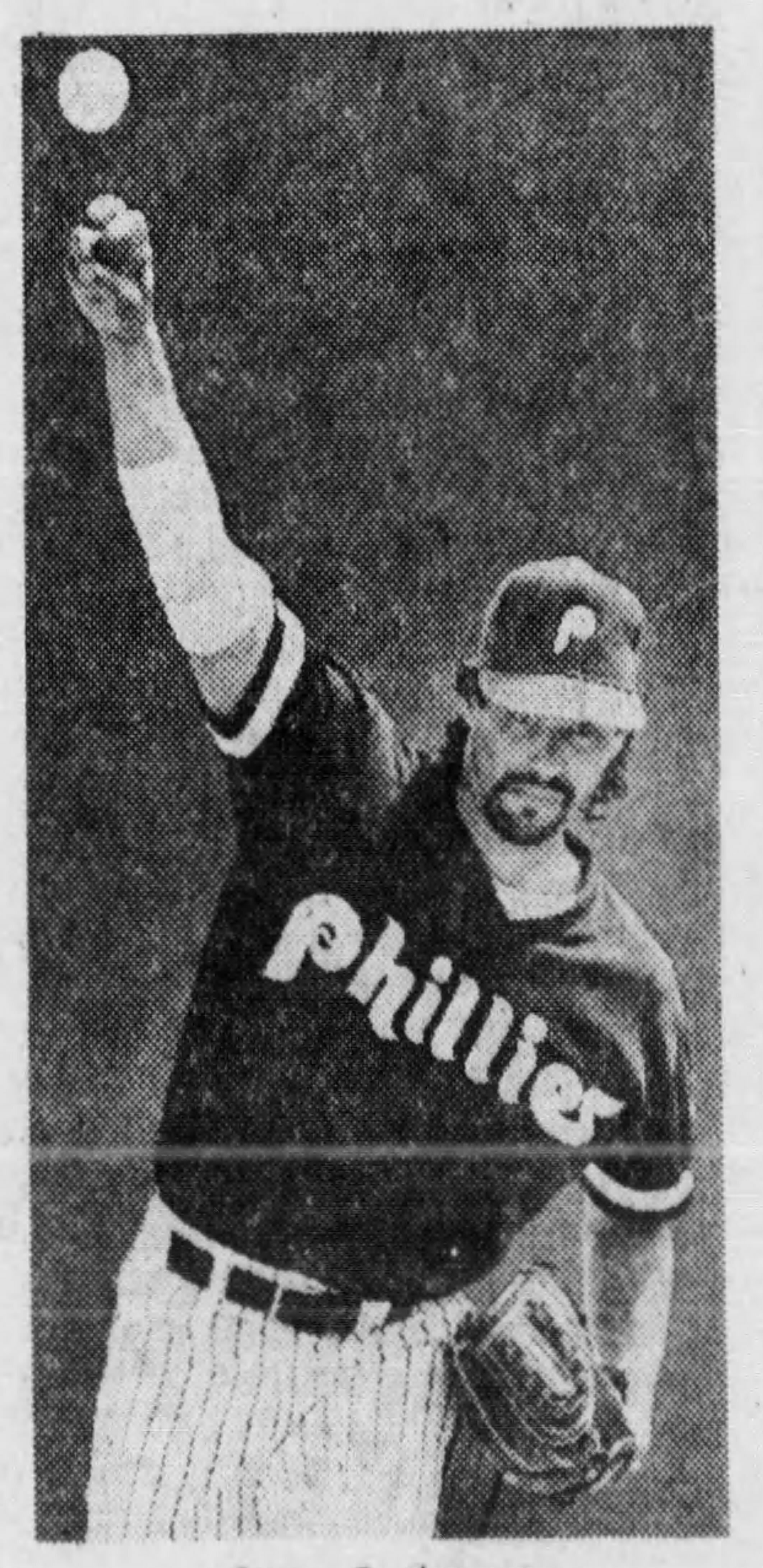
He and John — who appeared in 760 games, won 288, threw 46 shutouts, and should have been inducted into the National Baseball Hall of Fame long ago — were different people, different pitchers, and at different stages of their lives when they met. The A’s picked Ontiveros in the second round of the 1982 draft. A standout at the University of Michigan, a fierce black goatee rimming his mouth, he had five pitches, each of which he could throw with exquisite control. “When I was healthy,” he said, “I got people out.”
John, with his granddad-bod physique and his slow-slower-slowest stuff, seemed a being from another time, another world. Ontiveros, for instance, would be baffled watching him slide himself into a scalding hot whirlpool before every start. The Centers for Disease Control recommends keeping the water in a Jacuzzi under 104 degrees Fahrenheit, but John would crank the temperature to 115 and spend 10 minutes practically poaching himself. When Ontiveros asked him about the strange ritual, John explained that the soak had been part of his pre-start preparation for years. It saps my energy, he told Ontiveros. When I come in, if I’m throwing 85, I get killed. But if I’m throwing 82, they can’t touch me.
John was in the midst of his 25th and next-to-last season in the majors, winning nine games and pitching 176⅔ innings for the Yankees in 1988, when Ontiveros first experienced the arm trouble that would dog him thereafter. The prospective third starter on an Oakland team that starred Jose Canseco, Mark McGwire, Dennis Eckersley, and Dave “Smoke” Stewart and would win the American League pennant, Ontiveros had pain flare up in his elbow during spring training. The A’s pushed him back in the rotation, to the No. 5 spot, to give him more rest, but it didn’t help.
Before Ontiveros’s June 6 start in Kansas City against the Royals, the A’s training staff tried to stabilize his elbow by wrapping it in tape as if it were an injured knee. Twenty pitches into his warmups, the tape fell off, and though Ontiveros allowed just one earned run in seven innings that night, he knew something was wrong.
Tommy John crossed paths with Steve Ontiveros on the A’s in 1985.
“I’m in the seventh inning, and I throw a pitch, get the ball from the catcher, and I’d have to walk around the mound until the pain went away,” he said. “When I’d climb back on the mound, I’d make another pitch. I did that through the entire inning. I said, ‘I can’t do this anymore.’”
He didn’t appear in another game for the A’s that season after early August, and in the offseason he underwent elbow surgery that wasn’t as radical as John’s but was close. A ligament in Ontiveros’ elbow had stretched so far that, he said, “it wasn’t performing as a ligament anymore.” So orthopedist Lewis Yocum shortened it, folding it over onto itself and suturing it.
The A’s released Ontiveros in December ‘88, and the Phillies signed him as a free agent in February ‘89. Pitchers like him were the Phillies’ currency back then: injured or aging long shots who had once been promising prospects or accomplished big-leaguers. Danny Cox, Dave LaPoint, David Palmer, later Fernando Valenzuela and Sid Fernandez: Each of them tried to complete a semi-miraculous comeback.
Despite being a nonroster invitee to spring training, Ontiveros cracked the rotation, then dominated the Cubs — eight innings, one earned run — on April 6 before throwing seven shutout innings to beat the Montreal Expos at Veterans Stadium five days later. The Phillies were 5-2 and in first place in the National League East. “This qualifies as a pleasant surprise in my book,” manager Nick Leyva said after the game.
But after his brilliant start against the Expos, Ontiveros felt the same twinge of pain that he had the season before. He lasted five innings, giving up just one run, in a loss to the New York Mets on April 19 before the Phillies put him on the injured list, with a “strained ligament,” for nearly two months. “I went down, and we lost two other pitchers,” he said. “We instantly sucked after that.” He returned in June and was hammered: three starts, 10⅔ innings, 19 hits, 11 earned runs.
“I wasn’t able to separate the pain from the pitch,” Ontiveros said. “It starts accumulating in your head, the pain that’s going to be coming. It takes away your focus from getting a hitter out. You focus on, ‘What am I feeling right now? Is my arm going to fall off on the next pitch?’ I could not overcome that amount of pain mentally. There may be some people who could. I was not one of them. I was so distracted by the amount of pain I was feeling and the amount of pain that was to come if I kept throwing.”
There was no avoiding the knife now, but the Phillies had little experience with Tommy John surgery. Larry Christenson was their first pitcher to have it, in 1983, in a last-ditch effort to end his lengthy succession of elbow injuries. He never pitched for them or anyone else again. The good news for Ontiveros and the Phillies was that Jobe himself would handle the operation. The bad news was that, even 15 years after John’s pioneering procedure, only so many advancements and improvements to it and a pitcher’s rehabilitation process had been made.
Before Jobe and his team performed the surgery, on July 20, 1989, they asked Ontiveros if he wanted them to take the healthy ligament from his right arm or his left. The left, of course, Ontiveros told them. Why weaken and damage his right arm further? Except the doctors screwed up, instead removing a six-inch tendon from Ontiveros’s right wrist and grafting it onto his elbow.
The mistake prolonged Ontiveros’ rehab, which was hardly the kind of comprehensive, reliable course of action that would reassure an elite athlete whose livelihood was hanging in the balance. Working with the Phillies’ medical and training staff and with Steve Kush, a trainer based in Arizona, Ontiveros tried to improve his right arm’s range of motion before strengthening the muscles around his elbow joint. But no one was completely certain what exercises he ought to be doing or how often he ought to be doing them. When he visited Jobe for a postsurgery consultation, Ontiveros asked the doctor for some direction.
“He literally handed me a copy of what they did with Tommy John,” Ontiveros said. “It was 10 pages of nothing. There was no structure to any of it. I gave it to Steve, and we just kind of winged it.”
Having read that another pitcher, John Tudor, had recovered from Tommy John surgery in just eight months, Ontiveros pushed himself to match that ambitious timeline. “I went out in the offseason, and I threw outside,” he said, “and it was cold, and I felt a little tug. I went, ‘Uh, oh.’ I pushed it too fast, and it set me back months.” Still, the makeshift rehab went well enough that in August 1990, he made a start for the Phillies’ single-A affiliate in Clearwater. He lasted one inning. His arm, he said afterward, felt like he had stuck his finger into an electrical socket, and he was certain his career was finished. It did not have to be. There was some inflammation in his elbow, but rest would heal it. He talked with Cindy. They decided he would not give up.
When he pitched again in the majors, for the Phillies, at Wrigley Field against the Cubs on Sept. 13, 1990, throwing two shutout innings in relief, his senses seemed sharper: the smell of the grass on the infield and the ivy on the outfield walls, the tingle of Lake Michigan’s breeze.
“I went through so much [stuff] with the Phillies, and I loved playing for them,” said Ontiveros, who after retiring ran a baseball academy for 20 years that produced 13 major-league players. “I absolutely loved the fan base. Yeah, they’re brutal, but they’re also amazing. You do well, and they’ll let you know about it. Just being able to know a fan base has passion — I played four years in Oakland before that, and you’d see them come in by the third inning and leave by the seventh inning, and these were World Series-caliber players on a World Series-caliber team. You went to Philly, and it was intense, and I loved that.”
Steve Ontiveros pitched in 11 games for the Phillies over the 1989 and 1990 seasons.Daily News staff
Through a second Tommy John surgery, he somehow kept pitching, returning to the A’s, going 6-4 and leading the American League in ERA (2.65) in 1994, earning a spot on the AL All-Star Team in 1995, appearing in three games for the Boston Red Sox in 2000 when he was 39. When he was as close as he would get to being Tommy John himself, to having something else in common with the man whose name now lives forever.
“It gave me longevity,” he said. “That was good. That wouldn’t have happened otherwise. I’d have been done. It gave me an opportunity to continue my career. It’s just unfortunate that there weren’t that many people ahead of me.”
True, but there have been so many after him who could keep pitching, who could keep playing the game they loved. That legacy is Steve Ontiveros’, too, and as they continued on their morning drive, perhaps because she could hear the wistfulness and what-might-have-been in his voice, Cindy Ontiveros asked her husband a question.
You know how this is going to go. The Eagles will take part in two joint practices, on Wednesday and Thursday, against the New England Patriots — and against A.J. Brown. Those workouts, plus the teams’ preseason game Saturday, will provide all the narrative jet fuel necessary to power us through the rest of the preseason and at least five weeks into the regular season.
By then, Jalen Hurts will have played a few real games in Sean Mannion’s offense, and Brown will have caught who-knows-how-many passes from Drake Maye, and we’ll have a better if incomplete gauge of each team’s chances of qualifying for the playoffs, winning its division, and reaching Super Bowl LXI. Let’s be honest, though: A lot of people who follow the NFL and root for the Eagles will pay attention to how the Patriots fare, sure, but they’ll be more interested in another comparison, another unspoken competition: Jalen vs. A.J.
Jalen vs. A.J. is about more than football. It’s about a friendship that fell apart and that may or may not have been put back together. It’s about a partnership that contributed to a championship, to four seasons’ worth of excellent collective performance, and to a year-plus of questions and passive-aggressive behavior that culminated in the acknowledgment that it was time for one of these men to move on.
Best of all, Jalen vs. A.J. taps into one of the most visceral and familiar sensations within Philadelphia sports fandom (and, to a less intense degree, sports fandom generally). People here love to hate a villain, and Brown — whether he intended to or not, whether it’s fair that he is perceived this way or not — made himself one when he made it clear that he’d be happier playing for another team.
He’s the guy who left, who snubbed the Eagles and everyone who cheers for them. Hurts is the guy who stayed, who wanted to be here. For a lot of fans here, it won’t be enough if Hurts has a terrific season or the Eagles win more games than the Patriots. Brown must drop every pass Maye throws to him, complain incessantly about how miserable he is, and be photographed paging through a copy of The TB12 Method on the New England sideline. These two are going to be held up against each other all season.
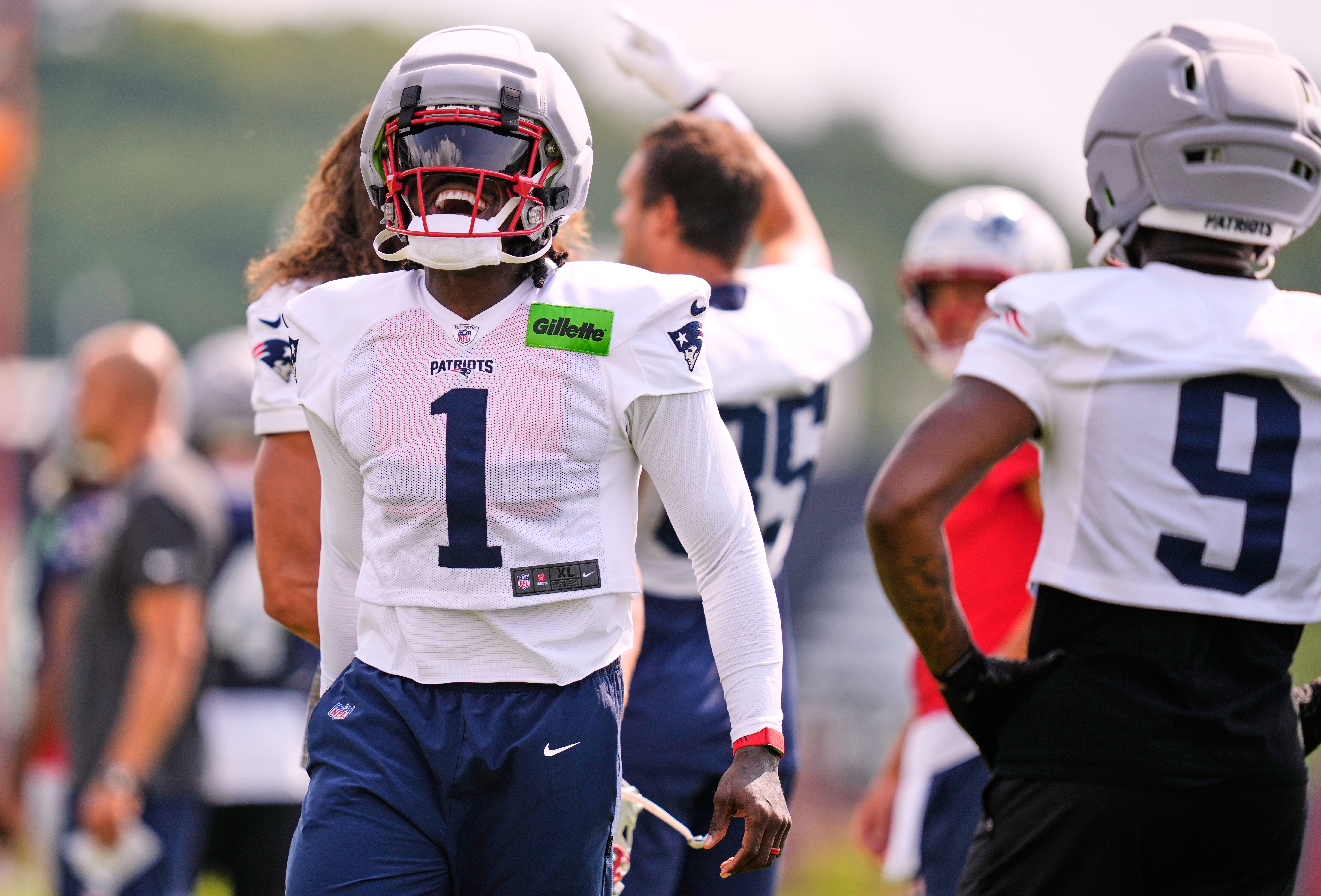
A.J. Brown (1) wanted out, and now resides in New England where many Eagles fans wish him to fail. Charles Krupa
So how will we judge who has won this soap-operatic battle? Obviously, team success and individual achievement will be the primary determining factors. And while there’s really no way to know for certain how the season will play out for either Hurts or Brown, we can look at some conditions and circumstances as they are now to make an educated guess about who will get the better of whom.
Hurts’ head coach is Nick Sirianni, who has won a Super Bowl and sometimes has his children accompany him to his postgame news conferences. Mike Vrabel, who has lost a Super Bowl and isn’t quite as devoted a family man, will hold Brown’s hand throughout their time together with the Patriots. Advantage: Jalen.
Brown’s quarterback will be Maye, who, before his four rocky playoff games, led the NFL last season in completion percentage, yards per attempt, passer rating, and QBR. Hurts’ wide receivers will be DeVonta Smith and three guys named Sal. Advantage: A.J.
In fairness, Hurts can probably count on Sal 1, Sal 2, and Sal 3 to finish running all their routes. Advantage:Jalen.
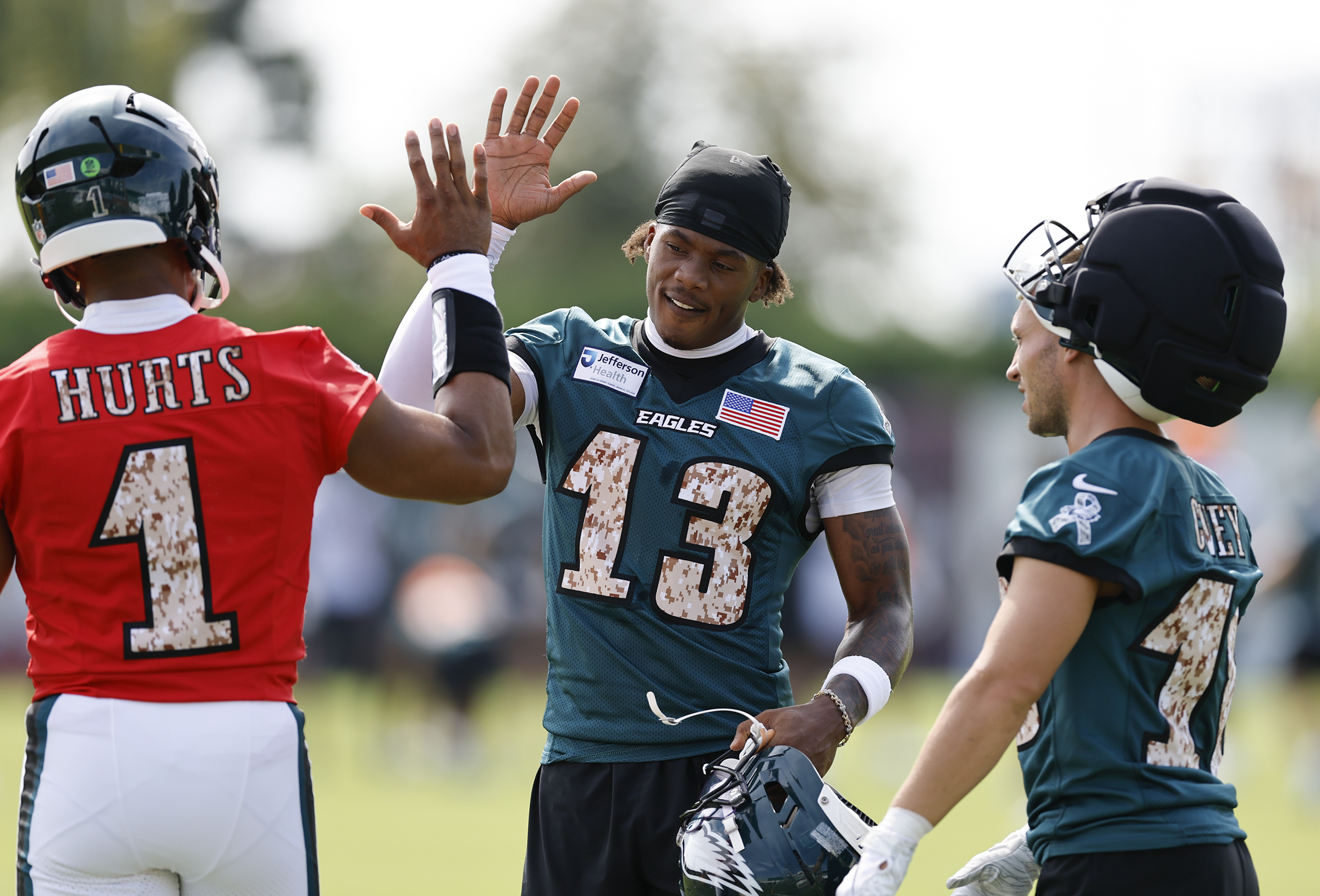
Jalen Hurts with wide receivers Dontayvion Wicks (center) and Britain Covey during training camp earlier this month. Yong Kim / Staff Photographer
The Patriots’ play-caller will be Josh McDaniels, regarded as one of the league’s most astute orchestrators of offense. The Eagles’ will be Mannion, who has never called plays in the NFL but is also not Kevin Patullo. Advantage: A.J.
Hurts still plays in Philadelphia, where he can have dinner at any number of world-class restaurants and partake of a robust cultural scene and night life. Brown now plays in Foxboro, Mass., where he can pay full price for a refill at Dunkin’. Advantage: Jalen.
Over his career, Brown has spent a lot of time, perhaps too much time, on Instagram and X/Twitter and paid a lot of attention, perhaps too much attention, to what has been written and said about him there. But with the Patriots, he doesn’t have to worry about the franchise’s social media team undermining his standing in the locker room by posting a video of him doing something totally humiliating and vitally important like throwing an interception in training camp. Advantage: A.J.
Welp, looks like Jalen vs. A.J. is too close to call at the moment. Which is great. More intrigue! More drama! More content! Two man enter. One man leave. There can be only one Highlander. The winner gets a free copy of Pat McAfee’s new country-rock-rap-grievance album and the satisfaction of knowing the other guy was the true source of the problems with the Eagles’ passing game all along. The loser must live with the shame of knowing he let down a desperate fan base starved for its first Super Bowl victory in a year and a half. Let our long march to the ultimate hot take begin.
As of 2:15 p.m. Friday, a post from the Eagles’ official Twitter/X account showing a slow-motion replay of Quinyon Mitchell intercepting a Jalen Hurts pass during practice Wednesday had accumulated nearly 17 million views on the site. There are no typographical errors in that sentence. An interception at practice garnered 17 million views without Christopher Nolan or Abraham Zapruder having filmed the sequence.
X users reposted the clip more than 3,000 times. Many of them included comments suggesting, or saying outright, that the interception was indicative of the quality of Hurts’ play or that the Eagles were disloyal or disrespectful to Hurts for posting the clip at all.
Former Eagles linebacker Emmanuel Acho, now a professional podcaster and poo-stirrer, wrote that “given my experience with the lengths people go to protect Jalen, somebody getting cussed out for sure and then may get fired.” ESPN’s Mike Golic Jr. quipped: “guys, people can see this.” Ben DiNucci, whose NFL career comprised three games with the Cowboys in 2020, wrote: “Why would they post this lol These social teams have a direct impact on what fans think / believe / see.”
A lot can be said about these people and those who responded similarly to the interception post. None of what can be said is kind. DiNucci at least tiptoed toward a reasonable and accurate point: That many fans, especially those so hungry for information and insights about their favorite teams that they spend hours scrolling through social media in the middle of the day, would blow such a play out of proportion. That’s fine. They’re fans. No one should expect them to be measured and reasonable.
But if you’re going to hold yourself up as an expert and try to earn a living from that purported expertise — and that’s what these media members and influencers and former players are doing — then you ought to have enough knowledge and integrity to treat an interception in practice with the gravity it deserves. Which is to say, next to none. If training camp mattered that much, Paul Turner would be closing in on his 11th consecutive season with at least 1,500 receiving yards, and Sam Bradford would have been a Super Bowl MVP before Hurts or Nick Foles.
Hurts has his strengths as a quarterback, and he has his shortcomings, and, yes, this will be an interesting and important season that could chart the course of his future with the Eagles. But no matter how sensitive Hurts and his camp might be, he has handled situations that were far more pressure-packed than a post intended to praise one of his teammates. And the notion that throwing a pick during training camp should serve as any kind of referendum on any NFL starting quarterback is so stupid that it could gain traction only on X.
It was practice, people. Cue the Allen Iverson rant, and go freak out over another not-so-big deal.
So the NFL has scheduled one game on the night before Thanksgiving, three on Thanksgiving itself, one on Black Friday, one on Christmas Eve (between the Eagles and Texans at 8:15 p.m.), and three on Christmas. Meanwhile, the NBA has nine games on Thanksgiving Eve, 11 on Black Friday, and five on Christmas.
Sorry, count me out, or as out as I can be as someone who covers the Eagles and 76ers. These leagues are attempting to capitalize on the captive audience they believe they’ll have on these holidays, but having those days and the traditions within them consumed by a bunch of games is crass and greedy. The only benefit to this overstuffed sports schedule is that it might keep family members and friends from arguing about politics over the apps and turkey.
Quick hitters
For the Sixers’ sake, it’s good to see so many LeBron James murals popping up around the city. They should serve as a nice counterbalance to the one at 30th St. and Eighth Avenue, around the corner from Madison Square Garden, that depicts Mitchell Robinson — a key member of the New York Knicks’ 2025-26 championship team — dunking over Joel Embiid. …
Based on their offensive output in their 7-1 win over the Twins on Thursday night in Iowa, the Phillies should play all their remaining home games this season at Shady Brook Farm. …
Oh, and for the record, Field of Dreams is among the most overrated sports movies ever. Joe Jackson hit left-handed, not right-handed as the film depicts him. Kevin Costner’s Ray Kinsella was an unsympathetic jerk to his father. And James Earl Jones’s “People will come, Ray” speech is overwrought. Costner’s “Dad, wanna have a catch?” scene is touching, but it does a lot of heavy lifting in making the film watchable. Give me The Natural, Eight Men Out, and Bull Durham every time.
The connection was obvious for anyone who cared to see it.
One parent after another stepped to a lectern at a Cheltenham school board meeting Tuesday night, each of them bemoaning the district’s handling of either the recent hazing scandal within the high school’s football program or a string of student-on-student assaults at Cheltenham Elementary. The alleged hazing led to criminal charges against four coaches and six players and was brutal: teammates holding down a 15-year-old sophomore so they could step on him with football spikes and poke at his buttocks with a broomstick. The alleged assaults at the elementary school, involving children in kindergarten and second grade, involved conduct and comments that were sexual in nature.
Leah Mulhearn, the board’s president, announced that the district would review its safety policies and that “football will not return until we address this,” only to duck behind the protective shield of the passive voice — “Mistakes were made” — when it came time to assign responsibility for the dual disasters. The anger among the meeting’s attendees was palpable and universal, and it was justified. These are not two crises on distinct, parallel tracks. They are linked, and there is no separating them.
It was impossible, after listening to some of those parents describe the abuse accusations at Cheltenham Elementary, not to think, What kind of school leaders ignore these incidents? The kind likely to ignore a parent who reports a violent attack in the football locker room. The Cheltenham school district has a culture problem, and that problem isn’t new. Does that assertion seem outlandish? It isn’t. In youth and high school athletics, certain patterns, even the worst kind, tend to repeat and perpetuate themselves.
“It seems some sort of disconnect,” the author Hank Nuwer, who for decades has been tracking hazing-related incidents and deaths, once told me. “You have to look at it from the outsider position and the insider position. The outsider sees it as sadistic. The people on the inside have the disconnect, particularly if they’ve gone through it themselves. ‘This needs to be done because it has been done to me. So we’re doing it to someone else.’”
Go to 2002, to Central Catholic High School in Pittsburgh, where two football players were charged with sexual assault after allegedly holding down a 15-year-old teammate and slapping him in the face with their genitals.
Go to West Chester’s Arrowhead Day Camp in 1966. The Roman Catholic High School football team was there for training camp. In a hazing prank, three players carried sophomore Lamonte Jenkins to a swimming pool sometime after the pool’s 8:30 p.m. closure, threw him in, then scurried back to their bunks. Jenkins drowned.
Go back to Pittsburgh, in 1962, when Richard Metz, 16, tried out for the Allegheny High School football team and, after the first day of practice, stayed out of the locker room showers to avoid being hazed. The next day, when two players wielded a pair of scissors and threatened to cut his hair, Metz pulled out a .22-caliber pistol that he had ordered in the mail and fired three shots at the players, hitting one of them in the right thigh. Six weeks later, Metz shot himself.
In 1962, Richard Metz shot a gun at two football players who attempted to haze him at Allegheny High School.Newspapers.com
A “psychiatrist’s report showed that Richard had an inability to meet a crisis,” the Pittsburgh Post-Gazette’s Alvin Rosensweet wrote on Oct. 1, 1962, the day after Metz’s death. “He felt he was only defending himself when his teammates goaded him into shooting.”
A young, troubled man who brings a gun to school … and turns it on other students … then dies by suicide. It doesn’t sound like something from the distant past. It sounds like the sort of atrocity too common in our time.
Yes, these episodes are anecdotal. They’re also predictable without proper oversight from the adults who are supposed to be in charge, without awareness and understanding of the conditions that can create them. One would think the omnipresence of smartphones and social media and the possibility that such abhorrent acts would be captured on camera and blasted out to the world would serve as deterrents to hazing. They don’t, and the additional, necessary guardrails didn’t exist at Cheltenham and don’t in too many other locker rooms. Incidents like these seem rare, but there’s no telling how often they actually occur.
“How likely,” Nuwer said, “are students to report this?”
They’re not likely at all. The victims are often too humiliated to reveal the abuse, and you can be sure that the perpetrators won’t be quick to confess. Somehow those lasting lessons weren’t delivered to enough Cheltenham football coaches and players, and based on the abuse parents described Tuesday night, those responsible for the district’s youngest students need to learn them, too.
There will be a review of the district from an outside attorney, and the high school football season has already been canceled, just as last season’s was. These are half-measures, and too late at that. Curtailing such cruelty comes down to stopping it before it starts, to cultivating an environment where everyone understands that there will be consequences for those who don’t meet the baseline for basic human decency.
It takes elected leaders who actually lead. It takes educators and administrators who wield wisdom and compassion and discipline in the proper proportions. It takes parents and students with the willingness to speak up, and it takes parents who have the strength, the humility, and the self-awareness to recognize that their children might be causing the chaos — and who take the steps to stop it. It takes a lot of elements that right now seem in short supply in the Cheltenham school district.
This column has been updated to reflect the outcome of one accusation of hazing.